

Crypto Koala Brasil
2.3k Posts

Crypto Koala Brasil
 Square Verified+
Report
Block User
Content Creator and Institutional Trader | Reach out to me if you need help — Message ID: crip8nv
Open Trade
Frequent Trader
4.9 Years
1.4K+ Following
29.8K+ Followers
8.3K+ Liked
Posts
Portfolio
All
Quotes
Videos
Live
PINNED

Article
Relevant Contents1) Trader Training
1.1) Operator Training:
-
Lesson 1 - Introduction to the Financial Market
-
Lesson 2 - What Really Moves the Price
-
Lesson 3 - Professional Entries, Pullbacks - OB's...
-
Lesson 4 - Advanced Liquidity, Stop Hunts, and Price Formation
-
Lesson 5 - BOS, CHoCH, Continuation vs Reversal, Liquidity...
-
Lesson 6 - How to Identify the Institutional Origin of the Move
-
Lesson 7 — Fair Value Gaps (FVG), Imbalance, and Inefficiency
-
Lesson 8 - How to Identify the Last Failed Block That Reveals Institutional Takeover
Relevant Contents
1) Trader Training
1.1) Operator Training:
-
Lesson 1 - Introduction to the Financial Market
-
Lesson 2 - What Really Moves the Price
-
Lesson 3 - Professional Entries, Pullbacks - OB's...
-
Lesson 4 - Advanced Liquidity, Stop Hunts, and Price Formation
-
Lesson 5 - BOS, CHoCH, Continuation vs Reversal, Liquidity...
-
Lesson 6 - How to Identify the Institutional Origin of the Move
-
Lesson 7 — Fair Value Gaps (FVG), Imbalance, and Inefficiency
-
Lesson 8 - How to Identify the Last Failed Block That Reveals Institutional Takeover
1.1) Operator Training:
-
Lesson 1 - Introduction to the Financial Market
-
Lesson 2 - What Really Moves the Price
-
Lesson 3 - Professional Entries, Pullbacks - OB's...
-
Lesson 4 - Advanced Liquidity, Stop Hunts, and Price Formation
-
Lesson 5 - BOS, CHoCH, Continuation vs Reversal, Liquidity...
-
Lesson 6 - How to Identify the Institutional Origin of the Move
-
Lesson 7 — Fair Value Gaps (FVG), Imbalance, and Inefficiency
-
Lesson 8 - How to Identify the Last Failed Block That Reveals Institutional Takeover
27
27
59
440
·
--
Bullish
Holding $BTC 1.6K USDT
🚨 BITCOIN SURPASSES GOLD IN SEPTEMBER — AND US$100K IS BACK ON THE RADAR
Bitcoin is showing strength precisely in one of the most historically difficult months for the asset.
₿ BTC × GOLD
In recent weeks, Bitcoin and gold have started to diverge:
• BTC remains in the US$83–84k range • Gold fell almost 4% in a session on Monday • BTC has gained more than 40% for the quarter • Bitcoin has been outperforming gold and other major assets over the recent period
📅 SEPTEMBER COULD BREAK A HISTORIC STREAK
Since 2013, whenever Bitcoin ended August in the green, the following September ended in the red.
With only two days left, a positive close in September would break that pattern and put July + August + September as three consecutive months of gains.
🎯 US$100K ON THE RADAR
Jurrien Timmer, global macro director at Fidelity, notes that BTC has formed a possible double bottom.
According to his analysis, confirmation above the US$80k area could project a move toward US$100k.
And the options market also shows interest in this zone:
📊 US$90K call → US$2.45B in open interest
📊 US$95K call → US$2.33B
📊 US$100K call → US$1.79B
⚠️ But pay attention: chart patterns do not guarantee breakouts. CoinDesk itself notes that breakouts can fail and reverse quickly.
🔥 The most important point right now:
Bitcoin is holding up even in the face of high interest rates, rising yields, and pressure on risk assets.
If September ends higher, BTC will not only outperform gold’s recent performance — it will also break one of its most well-known seasonal streaks.
US$100K is back on the map. Now the market needs to confirm the breakout.
$BTC
🚨 BITCOIN SURPASSES GOLD IN SEPTEMBER — AND US$100K IS BACK ON THE RADAR
Bitcoin is showing strength precisely in one of the most historically difficult months for the asset.
₿ BTC × GOLD
In recent weeks, Bitcoin and gold have started to diverge:
• BTC remains in the US$83–84k range • Gold fell almost 4% in a session on Monday • BTC has gained more than 40% for the quarter • Bitcoin has been outperforming gold and other major assets over the recent period
📅 SEPTEMBER COULD BREAK A HISTORIC STREAK
Since 2013, whenever Bitcoin ended August in the green, the following September ended in the red.
With only two days left, a positive close in September would break that pattern and put July + August + September as three consecutive months of gains.
🎯 US$100K ON THE RADAR
Jurrien Timmer, global macro director at Fidelity, notes that BTC has formed a possible double bottom.
According to his analysis, confirmation above the US$80k area could project a move toward US$100k.
And the options market also shows interest in this zone:
📊 US$90K call → US$2.45B in open interest
📊 US$95K call → US$2.33B
📊 US$100K call → US$1.79B
⚠️ But pay attention: chart patterns do not guarantee breakouts. CoinDesk itself notes that breakouts can fail and reverse quickly.
🔥 The most important point right now:
Bitcoin is holding up even in the face of high interest rates, rising yields, and pressure on risk assets.
If September ends higher, BTC will not only outperform gold’s recent performance — it will also break one of its most well-known seasonal streaks.
US$100K is back on the map. Now the market needs to confirm the breakout.
$BTC
Bitcoin is showing strength precisely in one of the most historically difficult months for the asset.
₿ BTC × GOLD
In recent weeks, Bitcoin and gold have started to diverge:
• BTC remains in the US$83–84k range • Gold fell almost 4% in a session on Monday • BTC has gained more than 40% for the quarter • Bitcoin has been outperforming gold and other major assets over the recent period
📅 SEPTEMBER COULD BREAK A HISTORIC STREAK
Since 2013, whenever Bitcoin ended August in the green, the following September ended in the red.
With only two days left, a positive close in September would break that pattern and put July + August + September as three consecutive months of gains.
🎯 US$100K ON THE RADAR
Jurrien Timmer, global macro director at Fidelity, notes that BTC has formed a possible double bottom.
According to his analysis, confirmation above the US$80k area could project a move toward US$100k.
And the options market also shows interest in this zone:
📊 US$90K call → US$2.45B in open interest
📊 US$95K call → US$2.33B
📊 US$100K call → US$1.79B
⚠️ But pay attention: chart patterns do not guarantee breakouts. CoinDesk itself notes that breakouts can fail and reverse quickly.
🔥 The most important point right now:
Bitcoin is holding up even in the face of high interest rates, rising yields, and pressure on risk assets.
If September ends higher, BTC will not only outperform gold’s recent performance — it will also break one of its most well-known seasonal streaks.
US$100K is back on the map. Now the market needs to confirm the breakout.
$BTC

1
582
·
--
Bullish
Verified
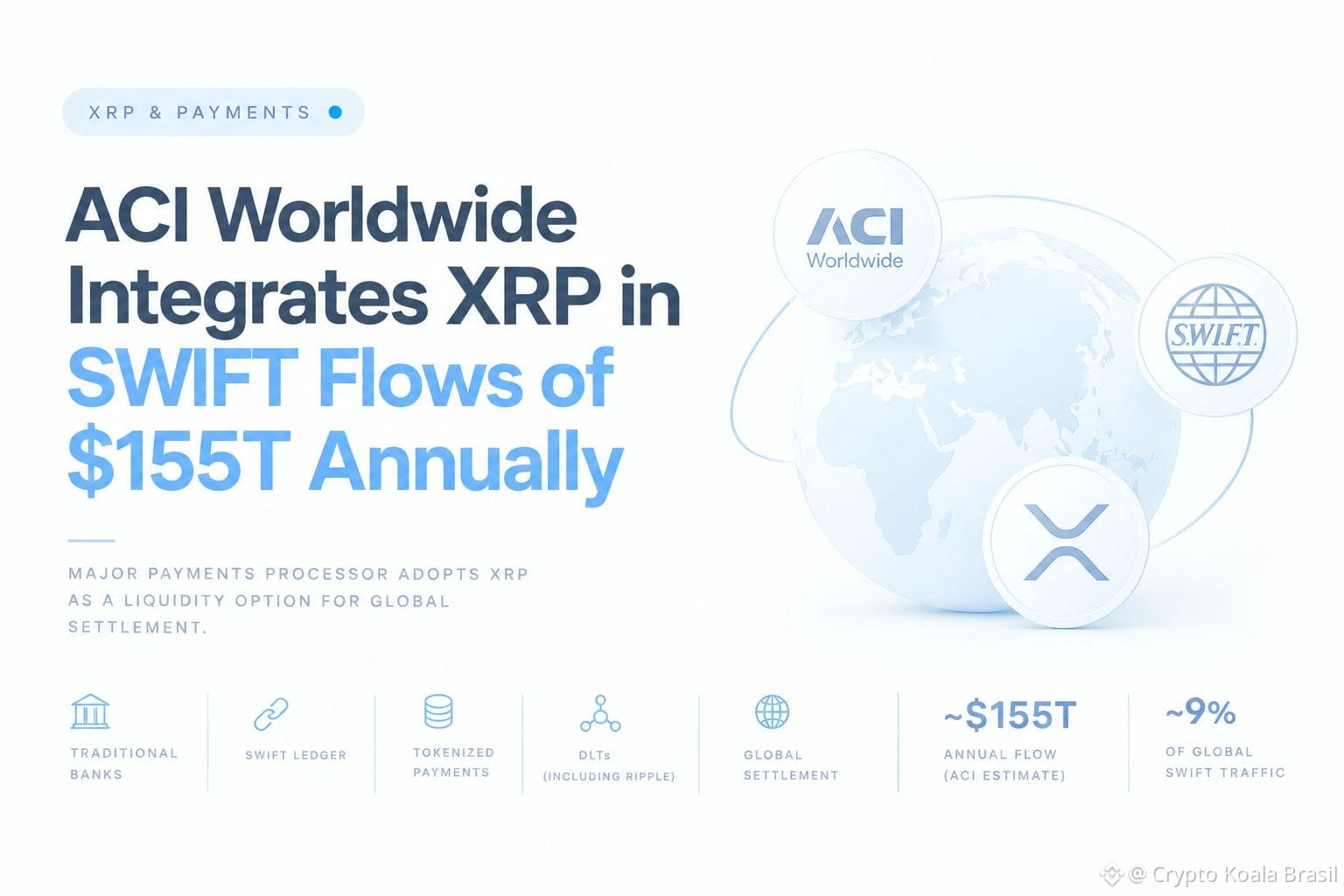
🚨 ACI INTEGRA SWIFT LEDGER — E XRP ENTERS THE GLOBAL SETTLEMENT RADAR
A new ACI Worldwide update brings distributed-ledger-based payments infrastructure even closer to traditional banking flows.
🏦 WHAT DID ACI ANNOUNCE?
ACI Connetic now supports routing of payments orchestrated by the Swift Ledger, allowing banks to process payments with tokenized deposits alongside traditional methods, within the same operational infrastructure.
🌎 THE SCALE IS HUGE
ACI says it supports approximately 9% of global SWIFT traffic.
This places the infrastructure connected to ACI at a scale associated with about US$155 trillion in annual flow.
⚡ SO WHERE DOES XRP FIT IN?
ACI itself says its infrastructure supports different settlement mechanisms and DLTs, including Ripple.
That makes XRP development relevant because it creates a bridge between:
🏦 Traditional banks
🔗 SWIFT Ledger
💳 Tokenized payments
⚡ DLTs like Ripple
🌎 International settlement
⚠️ BUT THERE IS AN IMPORTANT DIFFERENCE:
ACI’s announcement does not say that all SWIFT volume will be settled in XRP, nor that XRP will be used in the US$155 trillion.
The Swift Ledger announced by ACI itself is initially focused on tokenized deposits, while XRP appears as one of the DLT technologies supported by ACI’s infrastructure.
📌 The key point:
Traditional financial infrastructure is moving toward distributed ledgers, tokenized assets, and intelligent settlement routing.
If XRP manages to capture part of these flows through the routes supported by ACI’s infrastructure, the potential scale is significant — but that’s still a possibility, not the US$155 trillion being settled in XRP today.
SWIFT + ACI + tokenization + DLT: the global payments infrastructure is changing.
$XRP
🚨 ACI INTEGRA SWIFT LEDGER — E XRP ENTERS THE GLOBAL SETTLEMENT RADAR
A new ACI Worldwide update brings distributed-ledger-based payments infrastructure even closer to traditional banking flows.
🏦 WHAT DID ACI ANNOUNCE?
ACI Connetic now supports routing of payments orchestrated by the Swift Ledger, allowing banks to process payments with tokenized deposits alongside traditional methods, within the same operational infrastructure.
🌎 THE SCALE IS HUGE
ACI says it supports approximately 9% of global SWIFT traffic.
This places the infrastructure connected to ACI at a scale associated with about US$155 trillion in annual flow.
⚡ SO WHERE DOES XRP FIT IN?
ACI itself says its infrastructure supports different settlement mechanisms and DLTs, including Ripple.
That makes XRP development relevant because it creates a bridge between:
🏦 Traditional banks
🔗 SWIFT Ledger
💳 Tokenized payments
⚡ DLTs like Ripple
🌎 International settlement
⚠️ BUT THERE IS AN IMPORTANT DIFFERENCE:
ACI’s announcement does not say that all SWIFT volume will be settled in XRP, nor that XRP will be used in the US$155 trillion.
The Swift Ledger announced by ACI itself is initially focused on tokenized deposits, while XRP appears as one of the DLT technologies supported by ACI’s infrastructure.
📌 The key point:
Traditional financial infrastructure is moving toward distributed ledgers, tokenized assets, and intelligent settlement routing.
If XRP manages to capture part of these flows through the routes supported by ACI’s infrastructure, the potential scale is significant — but that’s still a possibility, not the US$155 trillion being settled in XRP today.
SWIFT + ACI + tokenization + DLT: the global payments infrastructure is changing.
$XRP
A new ACI Worldwide update brings distributed-ledger-based payments infrastructure even closer to traditional banking flows.
🏦 WHAT DID ACI ANNOUNCE?
ACI Connetic now supports routing of payments orchestrated by the Swift Ledger, allowing banks to process payments with tokenized deposits alongside traditional methods, within the same operational infrastructure.
🌎 THE SCALE IS HUGE
ACI says it supports approximately 9% of global SWIFT traffic.
This places the infrastructure connected to ACI at a scale associated with about US$155 trillion in annual flow.
⚡ SO WHERE DOES XRP FIT IN?
ACI itself says its infrastructure supports different settlement mechanisms and DLTs, including Ripple.
That makes XRP development relevant because it creates a bridge between:
🏦 Traditional banks
🔗 SWIFT Ledger
💳 Tokenized payments
⚡ DLTs like Ripple
🌎 International settlement
⚠️ BUT THERE IS AN IMPORTANT DIFFERENCE:
ACI’s announcement does not say that all SWIFT volume will be settled in XRP, nor that XRP will be used in the US$155 trillion.
The Swift Ledger announced by ACI itself is initially focused on tokenized deposits, while XRP appears as one of the DLT technologies supported by ACI’s infrastructure.
📌 The key point:
Traditional financial infrastructure is moving toward distributed ledgers, tokenized assets, and intelligent settlement routing.
If XRP manages to capture part of these flows through the routes supported by ACI’s infrastructure, the potential scale is significant — but that’s still a possibility, not the US$155 trillion being settled in XRP today.
SWIFT + ACI + tokenization + DLT: the global payments infrastructure is changing.
$XRP
4
2.1k
·
--
Bullish
Holding $BTC 1.6K USDT
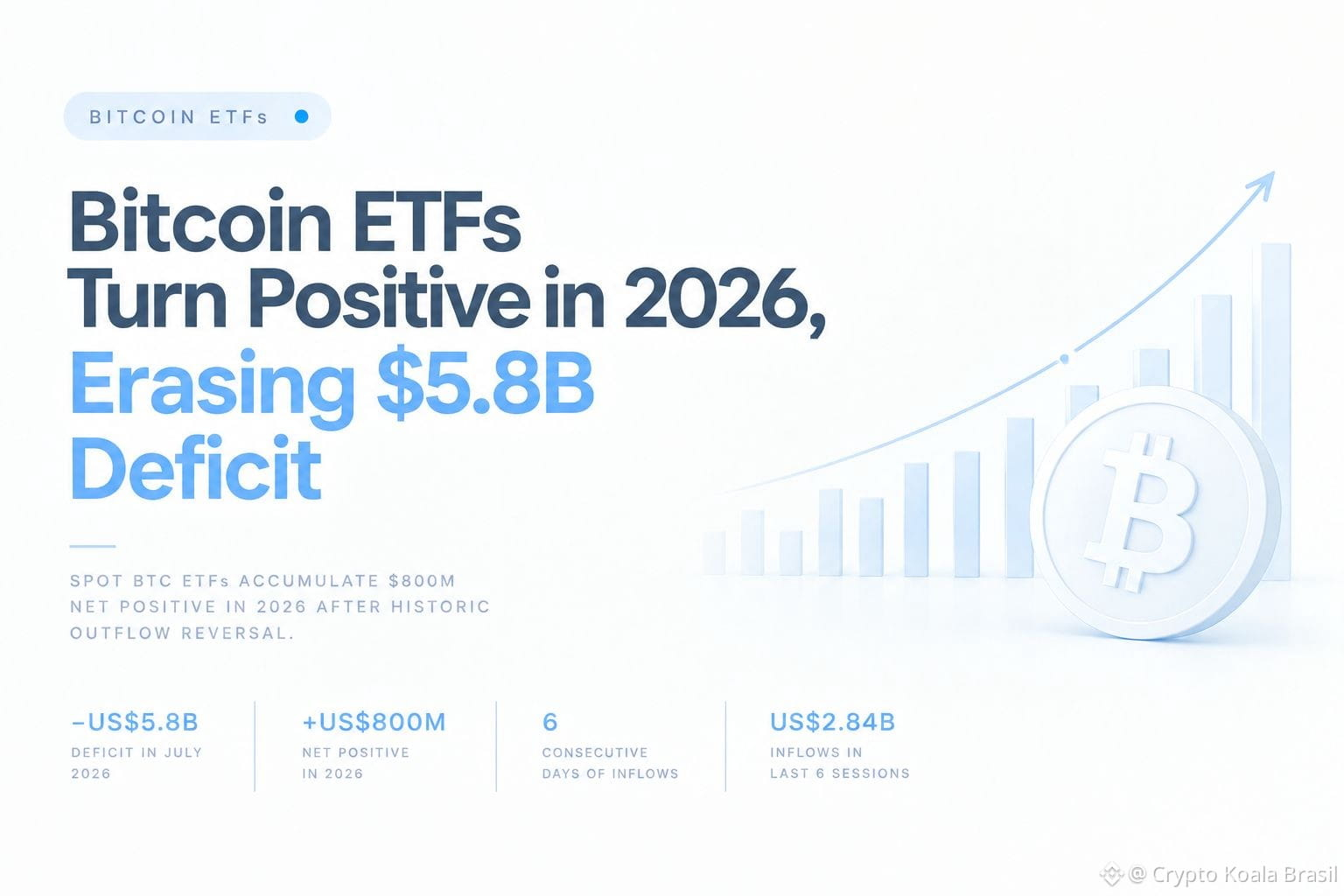
🚨 BITCOIN ETFs ERASE A $5.8 BILLION DEFICIT AND TURN POSITIVE AGAIN IN 2026
Institutional demand for Bitcoin has just recorded a strong reversal.
🇺🇸 The U.S.-listed spot BTC ETFs went from an accumulated deficit of approximately $5.8 billion in July to about $800 million in net inflows for the year.
📊 THE REVERSAL
• July: -$5.8B in accumulated 2026
• Now: ~+$800M
• Flip of approximately $6.6B
• 6 consecutive sessions of inflows
• $2.84B raised in this streak
🔥 The move gained momentum as Bitcoin rebounded from below $58,000 in June to the $85,000 range.
And there’s another important detail:
💰 About $4 billion of the recent inflows occurred since August, according to data analyzed by CoinDesk.
⚠️ But the context matters.
Despite the reversal, 2026 flows are still far below previous years:
2024 → $35.2B
2025 → $21.4B
2026 → ~ $800M
In other words: the deficit has been erased, but cumulative demand is still far from the levels seen in the prior two years.
₿ WHAT DOES THIS SHOW?
Institutional flows moved from a strong phase of withdrawals to a consistent run of inflows.
For the market, the relevant point isn’t only the return to positive— but whether this demand will continue to grow while BTC stays near recent highs.
📌 ETF flows: from -$5.8B to +$800M in just a few weeks.
$BTC
🚨 BITCOIN ETFs ERASE A $5.8 BILLION DEFICIT AND TURN POSITIVE AGAIN IN 2026
Institutional demand for Bitcoin has just recorded a strong reversal.
🇺🇸 The U.S.-listed spot BTC ETFs went from an accumulated deficit of approximately $5.8 billion in July to about $800 million in net inflows for the year.
📊 THE REVERSAL
• July: -$5.8B in accumulated 2026
• Now: ~+$800M
• Flip of approximately $6.6B
• 6 consecutive sessions of inflows
• $2.84B raised in this streak
🔥 The move gained momentum as Bitcoin rebounded from below $58,000 in June to the $85,000 range.
And there’s another important detail:
💰 About $4 billion of the recent inflows occurred since August, according to data analyzed by CoinDesk.
⚠️ But the context matters.
Despite the reversal, 2026 flows are still far below previous years:
2024 → $35.2B
2025 → $21.4B
2026 → ~ $800M
In other words: the deficit has been erased, but cumulative demand is still far from the levels seen in the prior two years.
₿ WHAT DOES THIS SHOW?
Institutional flows moved from a strong phase of withdrawals to a consistent run of inflows.
For the market, the relevant point isn’t only the return to positive— but whether this demand will continue to grow while BTC stays near recent highs.
📌 ETF flows: from -$5.8B to +$800M in just a few weeks.
$BTC
Institutional demand for Bitcoin has just recorded a strong reversal.
🇺🇸 The U.S.-listed spot BTC ETFs went from an accumulated deficit of approximately $5.8 billion in July to about $800 million in net inflows for the year.
📊 THE REVERSAL
• July: -$5.8B in accumulated 2026
• Now: ~+$800M
• Flip of approximately $6.6B
• 6 consecutive sessions of inflows
• $2.84B raised in this streak
🔥 The move gained momentum as Bitcoin rebounded from below $58,000 in June to the $85,000 range.
And there’s another important detail:
💰 About $4 billion of the recent inflows occurred since August, according to data analyzed by CoinDesk.
⚠️ But the context matters.
Despite the reversal, 2026 flows are still far below previous years:
2024 → $35.2B
2025 → $21.4B
2026 → ~ $800M
In other words: the deficit has been erased, but cumulative demand is still far from the levels seen in the prior two years.
₿ WHAT DOES THIS SHOW?
Institutional flows moved from a strong phase of withdrawals to a consistent run of inflows.
For the market, the relevant point isn’t only the return to positive— but whether this demand will continue to grow while BTC stays near recent highs.
📌 ETF flows: from -$5.8B to +$800M in just a few weeks.
$BTC
1
2
777
·
--
Bullish
🌎 TRUMP-XI DOME AND OIL DROP BOOST MARKETS
The market started the week in risk-on mode, with cryptocurrencies and global stocks rising while oil falls.
🇺🇸🇨🇳 TRUMP × XI — SEPTEMBER 24
The meeting between Donald Trump and Xi J. in Washington became one of the main events of the week.
Markets are mainly watching for possible signs about:
• Tariffs and trade
• A commercial truce between the US and China
• Artificial intelligence
• Critical minerals
• Geopolitical relations
A signal of greater stability could reduce some uncertainty about global trade. On the other hand, any deterioration in negotiations could increase volatility.
🛢️ OIL FALLING
Brent posted its fourth/fifth consecutive session of declines, while US oil also retreated.
A drop in oil reduces part of inflationary pressure and, consequently, may ease the impact on interest rates and risk assets.
₿ CRYPTO AND EQUITIES RESPOND
Bitcoin moved to multi-month highs, while Asian and US stocks also rose.
The move combines:
📉 Falling oil
🇺🇸🇨🇳 Expectations for the Trump-Xi meeting
📈 Higher appetite for risk
₿ Bitcoin recovery
📊 Gains in global stocks
⚠️ But the 09/24 event remains a catalyst for volatility.
The market is anticipating possible progress in negotiations — and any surprise at the meeting could quickly change this picture.
The next big variable for global markets is now Washington.
$BTC
🌎 TRUMP-XI DOME AND OIL DROP BOOST MARKETS
The market started the week in risk-on mode, with cryptocurrencies and global stocks rising while oil falls.
🇺🇸🇨🇳 TRUMP × XI — SEPTEMBER 24
The meeting between Donald Trump and Xi J. in Washington became one of the main events of the week.
Markets are mainly watching for possible signs about:
• Tariffs and trade
• A commercial truce between the US and China
• Artificial intelligence
• Critical minerals
• Geopolitical relations
A signal of greater stability could reduce some uncertainty about global trade. On the other hand, any deterioration in negotiations could increase volatility.
🛢️ OIL FALLING
Brent posted its fourth/fifth consecutive session of declines, while US oil also retreated.
A drop in oil reduces part of inflationary pressure and, consequently, may ease the impact on interest rates and risk assets.
₿ CRYPTO AND EQUITIES RESPOND
Bitcoin moved to multi-month highs, while Asian and US stocks also rose.
The move combines:
📉 Falling oil
🇺🇸🇨🇳 Expectations for the Trump-Xi meeting
📈 Higher appetite for risk
₿ Bitcoin recovery
📊 Gains in global stocks
⚠️ But the 09/24 event remains a catalyst for volatility.
The market is anticipating possible progress in negotiations — and any surprise at the meeting could quickly change this picture.
The next big variable for global markets is now Washington.
$BTC
The market started the week in risk-on mode, with cryptocurrencies and global stocks rising while oil falls.
🇺🇸🇨🇳 TRUMP × XI — SEPTEMBER 24
The meeting between Donald Trump and Xi J. in Washington became one of the main events of the week.
Markets are mainly watching for possible signs about:
• Tariffs and trade
• A commercial truce between the US and China
• Artificial intelligence
• Critical minerals
• Geopolitical relations
A signal of greater stability could reduce some uncertainty about global trade. On the other hand, any deterioration in negotiations could increase volatility.
🛢️ OIL FALLING
Brent posted its fourth/fifth consecutive session of declines, while US oil also retreated.
A drop in oil reduces part of inflationary pressure and, consequently, may ease the impact on interest rates and risk assets.
₿ CRYPTO AND EQUITIES RESPOND
Bitcoin moved to multi-month highs, while Asian and US stocks also rose.
The move combines:
📉 Falling oil
🇺🇸🇨🇳 Expectations for the Trump-Xi meeting
📈 Higher appetite for risk
₿ Bitcoin recovery
📊 Gains in global stocks
⚠️ But the 09/24 event remains a catalyst for volatility.
The market is anticipating possible progress in negotiations — and any surprise at the meeting could quickly change this picture.
The next big variable for global markets is now Washington.
$BTC
1
598
·
--
Bullish
Holding $RENDER 869.4 USDT
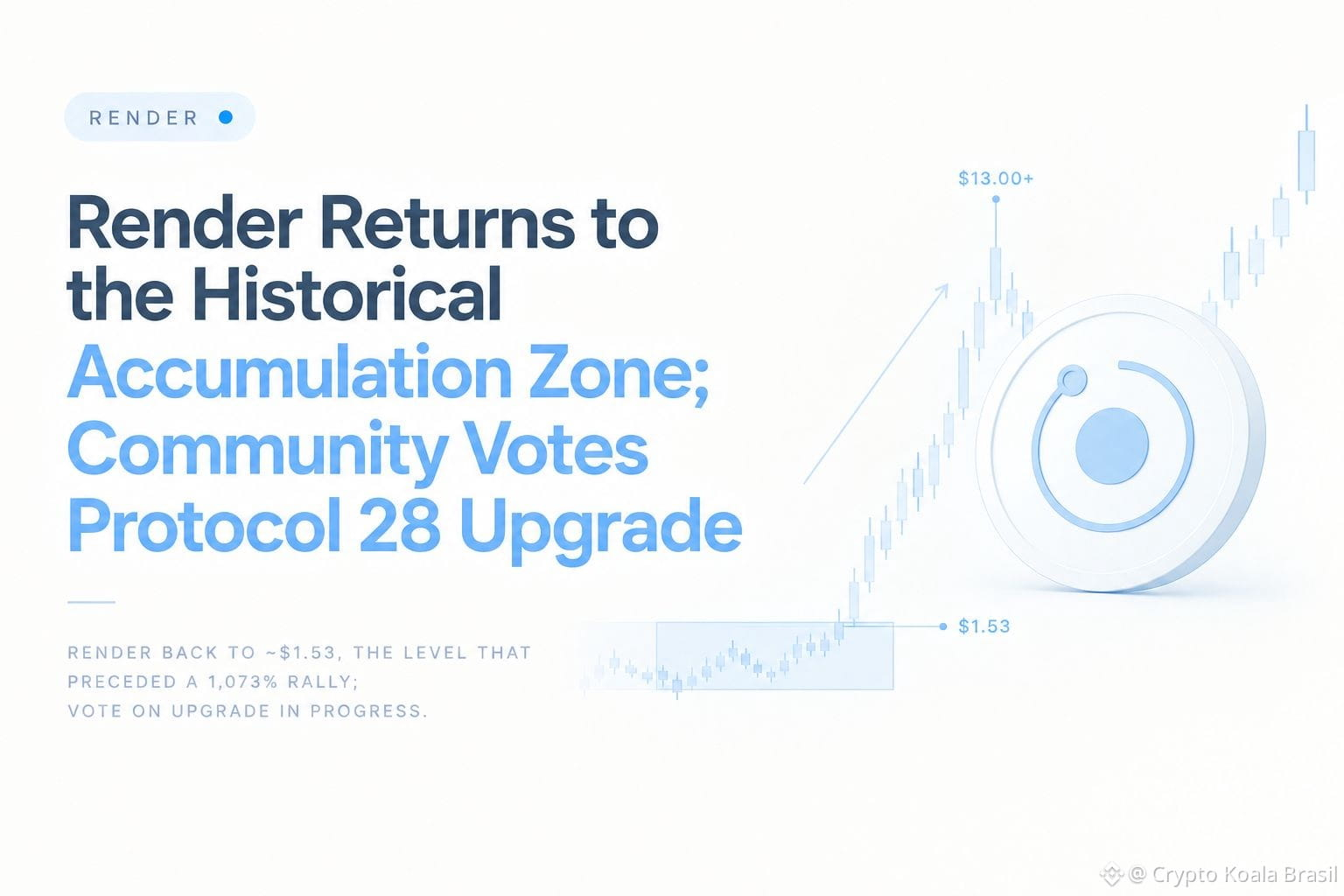
🚨 RENDER RETURNS TO THE ZONE THAT PRECEDED A +1073% RALLY
RENDER has returned to an area near $1.53 — a band that draws attention because it preceded a historic surge of approximately +1073%, when the token went from around $1 to above $13.
📊 Why does this region matter?
• RENDER returned to a former accumulation zone
• The prior move from this region was +1073%
• The current price is again close to $1.50
• A new vote related to the Protocol 28 Upgrade is being followed by the community
• The outlook still depends on volume, demand, and structure confirmation
⚠️ This does not mean the same move will repeat.
History only shows that this region already worked as a starting point for a major price expansion. For the movement to repeat, it would require a new wave of buyers and a break above the relevant resistances.
🔎 RENDER is again in a zone that deserves attention — but confirmation still needs to come from price.
$RENDER
🚨 RENDER RETURNS TO THE ZONE THAT PRECEDED A +1073% RALLY
RENDER has returned to an area near $1.53 — a band that draws attention because it preceded a historic surge of approximately +1073%, when the token went from around $1 to above $13.
📊 Why does this region matter?
• RENDER returned to a former accumulation zone
• The prior move from this region was +1073%
• The current price is again close to $1.50
• A new vote related to the Protocol 28 Upgrade is being followed by the community
• The outlook still depends on volume, demand, and structure confirmation
⚠️ This does not mean the same move will repeat.
History only shows that this region already worked as a starting point for a major price expansion. For the movement to repeat, it would require a new wave of buyers and a break above the relevant resistances.
🔎 RENDER is again in a zone that deserves attention — but confirmation still needs to come from price.
$RENDER
RENDER has returned to an area near $1.53 — a band that draws attention because it preceded a historic surge of approximately +1073%, when the token went from around $1 to above $13.
📊 Why does this region matter?
• RENDER returned to a former accumulation zone
• The prior move from this region was +1073%
• The current price is again close to $1.50
• A new vote related to the Protocol 28 Upgrade is being followed by the community
• The outlook still depends on volume, demand, and structure confirmation
⚠️ This does not mean the same move will repeat.
History only shows that this region already worked as a starting point for a major price expansion. For the movement to repeat, it would require a new wave of buyers and a break above the relevant resistances.
🔎 RENDER is again in a zone that deserves attention — but confirmation still needs to come from price.
$RENDER
3
1.3k
Article
Golden Cross XRP On the Way🚨 BITCOIN RECOVERS US$81K — AND XRP SURGES WITH A SHORT SQUEEZE
After a week marked by a hawkish Fed, a rise from the Bank of Japan, and the blocking of the CLARITY Act, the crypto market showed strength again.
₿ BTC ABOVE US$81K
Bitcoin was up by about 6%, recovering some of the recent losses and helping to pull the altcoin market.
📉 BITCOIN DOMINANCE BELOW 59%
While BTC recovers, its share of the total market value has fallen to below 59%.
This may indicate a relative capital rotation into altcoins, although it's still too early to say that a new altseason has started.
Golden Cross XRP On the Way
🚨 BITCOIN RECOVERS US$81K — AND XRP SURGES WITH A SHORT SQUEEZE
After a week marked by a hawkish Fed, a rise from the Bank of Japan, and the blocking of the CLARITY Act, the crypto market showed strength again.
₿ BTC ABOVE US$81K
Bitcoin was up by about 6%, recovering some of the recent losses and helping to pull the altcoin market.
📉 BITCOIN DOMINANCE BELOW 59%
While BTC recovers, its share of the total market value has fallen to below 59%.
This may indicate a relative capital rotation into altcoins, although it's still too early to say that a new altseason has started.
After a week marked by a hawkish Fed, a rise from the Bank of Japan, and the blocking of the CLARITY Act, the crypto market showed strength again.
₿ BTC ABOVE US$81K
Bitcoin was up by about 6%, recovering some of the recent losses and helping to pull the altcoin market.
📉 BITCOIN DOMINANCE BELOW 59%
While BTC recovers, its share of the total market value has fallen to below 59%.
This may indicate a relative capital rotation into altcoins, although it's still too early to say that a new altseason has started.
1
1.2k
·
--
Bullish
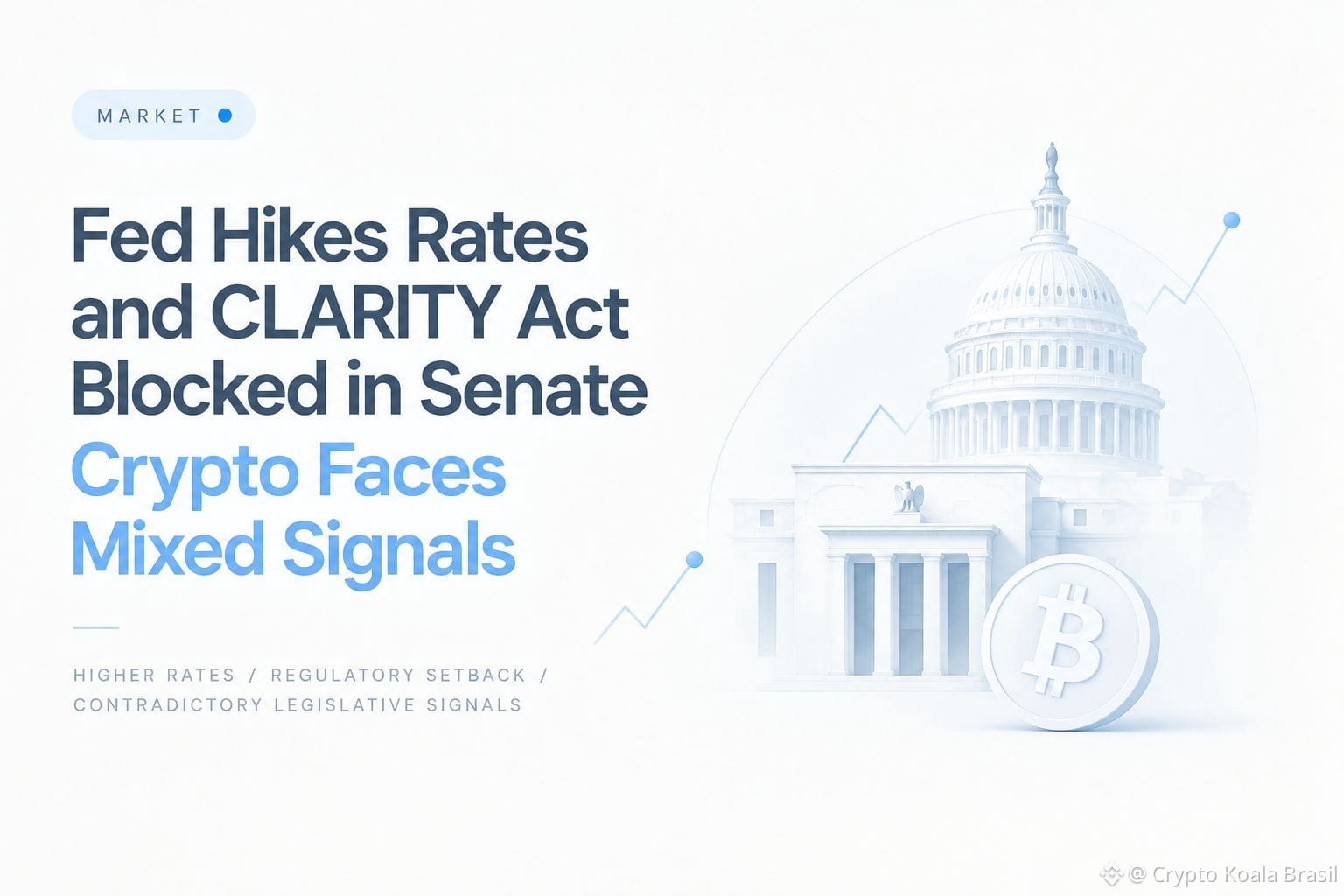
🚨 FED RAISES RATES AND CLARITY ACT IS BLOCKED — CRYPTO ENTERS A PRESSURE SCENARIO
The week delivered exactly the kind of combination that increases volatility in the crypto market:
🏦 FED +25 BPS
The Federal Reserve raised interest rates to 3.75%–4.00%, in a unanimous decision of 12–0.
This was the first increase since 2023.
And the new dot plot points to a median rate of 4.1% by the end of 2026, indicating that FOMC members, on average, still expect room for one more hike.
This tends to keep pressure on risk assets, especially those most sensitive to liquidity.
⚠️ WHAT ABOUT THE CLARITY ACT?
The U.S. Senate rejected, 49–50, the cloture vote needed to move the bill forward.
The outcome prevents the legislation, for now, from advancing through the procedure set out.
For the crypto market, this represents an important regulatory setback, since the CLARITY Act aims to establish a federal framework for regulating digital assets.
📉 MACRO + REGULATION
So we have two relevant forces operating simultaneously:
🏦 More restrictive Fed
📜 CLARITY Act blocked
💧 Liquidity remains a concern
⚡ Elevated volatility
And that helps explain why trading with leverage during weeks of major events can be especially dangerous.
🔎 But there’s one important detail:
The failure of this vote doesn’t necessarily mean the end of the CLARITY Act.
The result was a procedural defeat, and the bill could return to negotiations or be reconsidered later.
Meanwhile, proposals related to creating a strategic Bitcoin reserve continue to move forward in Congress, keeping a contradictory legislative backdrop for the sector.
📌 Summary for the trader:
Fed → macro pressure
CLARITY → regulatory setback
Bitcoin reserve → potentially favorable legislative signal
Outcome → a high-volatility environment with high sensitivity to new headlines.
Source: Federal Reserve / U.S. Senate / Reuters.
$ETH
$RENDER
$PENDLE
🚨 FED RAISES RATES AND CLARITY ACT IS BLOCKED — CRYPTO ENTERS A PRESSURE SCENARIO
The week delivered exactly the kind of combination that increases volatility in the crypto market:
🏦 FED +25 BPS
The Federal Reserve raised interest rates to 3.75%–4.00%, in a unanimous decision of 12–0.
This was the first increase since 2023.
And the new dot plot points to a median rate of 4.1% by the end of 2026, indicating that FOMC members, on average, still expect room for one more hike.
This tends to keep pressure on risk assets, especially those most sensitive to liquidity.
⚠️ WHAT ABOUT THE CLARITY ACT?
The U.S. Senate rejected, 49–50, the cloture vote needed to move the bill forward.
The outcome prevents the legislation, for now, from advancing through the procedure set out.
For the crypto market, this represents an important regulatory setback, since the CLARITY Act aims to establish a federal framework for regulating digital assets.
📉 MACRO + REGULATION
So we have two relevant forces operating simultaneously:
🏦 More restrictive Fed
📜 CLARITY Act blocked
💧 Liquidity remains a concern
⚡ Elevated volatility
And that helps explain why trading with leverage during weeks of major events can be especially dangerous.
🔎 But there’s one important detail:
The failure of this vote doesn’t necessarily mean the end of the CLARITY Act.
The result was a procedural defeat, and the bill could return to negotiations or be reconsidered later.
Meanwhile, proposals related to creating a strategic Bitcoin reserve continue to move forward in Congress, keeping a contradictory legislative backdrop for the sector.
📌 Summary for the trader:
Fed → macro pressure
CLARITY → regulatory setback
Bitcoin reserve → potentially favorable legislative signal
Outcome → a high-volatility environment with high sensitivity to new headlines.
Source: Federal Reserve / U.S. Senate / Reuters.
$ETH
$RENDER
$PENDLE
The week delivered exactly the kind of combination that increases volatility in the crypto market:
🏦 FED +25 BPS
The Federal Reserve raised interest rates to 3.75%–4.00%, in a unanimous decision of 12–0.
This was the first increase since 2023.
And the new dot plot points to a median rate of 4.1% by the end of 2026, indicating that FOMC members, on average, still expect room for one more hike.
This tends to keep pressure on risk assets, especially those most sensitive to liquidity.
⚠️ WHAT ABOUT THE CLARITY ACT?
The U.S. Senate rejected, 49–50, the cloture vote needed to move the bill forward.
The outcome prevents the legislation, for now, from advancing through the procedure set out.
For the crypto market, this represents an important regulatory setback, since the CLARITY Act aims to establish a federal framework for regulating digital assets.
📉 MACRO + REGULATION
So we have two relevant forces operating simultaneously:
🏦 More restrictive Fed
📜 CLARITY Act blocked
💧 Liquidity remains a concern
⚡ Elevated volatility
And that helps explain why trading with leverage during weeks of major events can be especially dangerous.
🔎 But there’s one important detail:
The failure of this vote doesn’t necessarily mean the end of the CLARITY Act.
The result was a procedural defeat, and the bill could return to negotiations or be reconsidered later.
Meanwhile, proposals related to creating a strategic Bitcoin reserve continue to move forward in Congress, keeping a contradictory legislative backdrop for the sector.
📌 Summary for the trader:
Fed → macro pressure
CLARITY → regulatory setback
Bitcoin reserve → potentially favorable legislative signal
Outcome → a high-volatility environment with high sensitivity to new headlines.
Source: Federal Reserve / U.S. Senate / Reuters.
$ETH
$RENDER
$PENDLE
1
664
·
--
Bullish
Holding $XRP 1.9K USDT
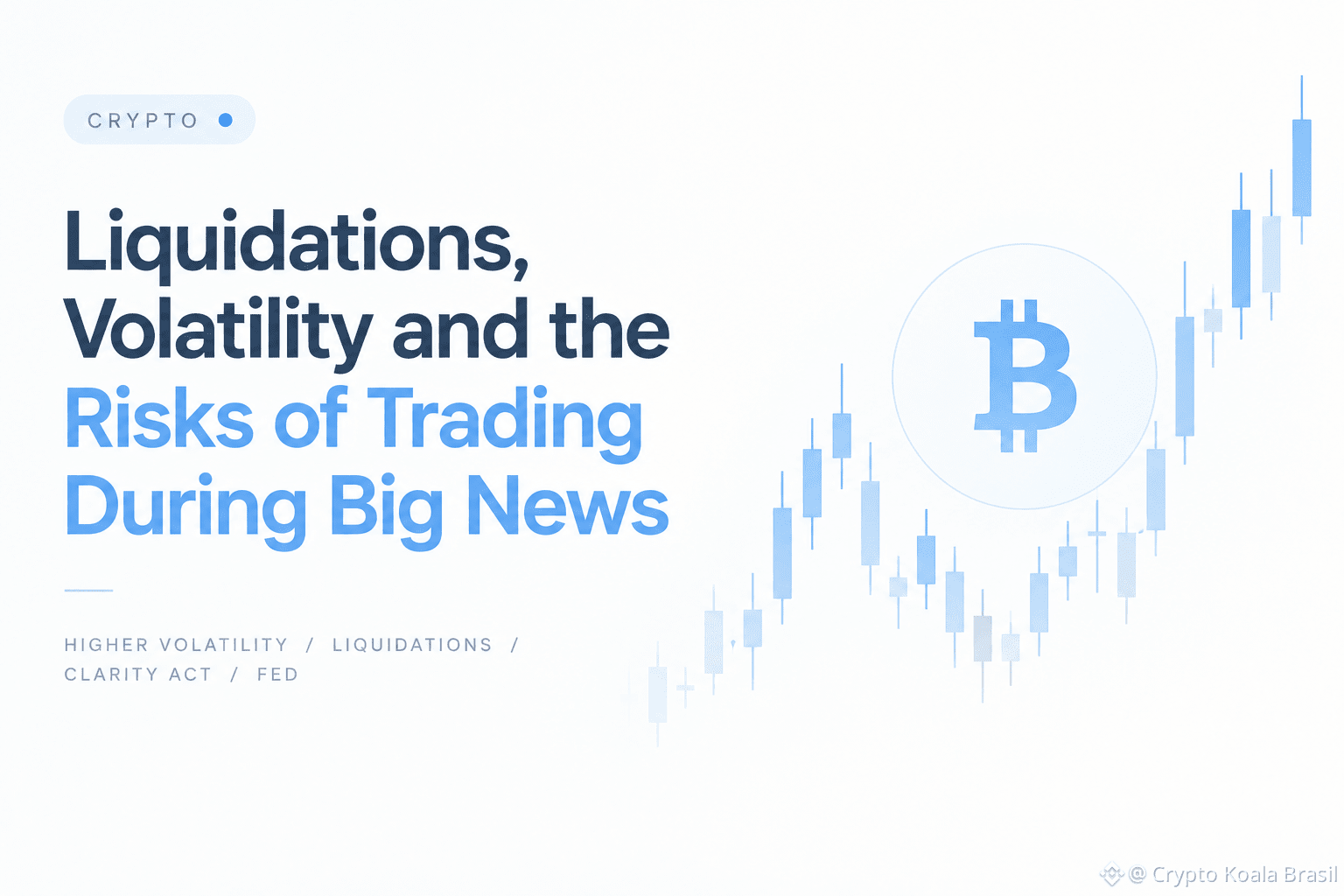
⚠️ BITCOIN SHOWS WHY WEEKS OF BIG NEWS ARE DANGEROUS FOR LEVERAGED TRADERS
Bitcoin’s volatility has increased precisely in one of the most important weeks of the year for the crypto market.
BTC has been wildly oscillating in the US$76–80k range, while macroeconomic data, expectations for the Fed, and the CLARITY Act vote raise uncertainty.
And when price moves quickly, the cascade effect kicks in:
📉 BTC drops → leveraged longs are liquidated → forced selling increases → price falls even more.
📈 BTC rebounds → shorts are liquidated → forced buybacks accelerate the rally → price rises even more.
That’s why a relatively small move in the spot market can trigger a much bigger move in derivatives.
🔥 The real danger isn’t just getting the direction right or wrong.
It’s being overleveraged when the market decides to move against you.
In normal weeks, a position has time to breathe.
In weeks like this, a single piece of news can trigger an extremely fast candle, sweep your stop, seek liquidity, and then flip again minutes later.
📅 And this week has plenty of fuel:
🇺🇸 CLARITY Act — cloture vote in the Senate
🏦 Fed — interest rate decision
🛢️ High oil
📊 Tense Treasury yields
₿ Bitcoin near important technical levels
For the trader, the lesson is simple:
The more events there are that can move the market, the less you should need to use excessive leverage.
You don’t need to predict every piece of news.
You just need to survive the volatility that comes with it.
⚠️ DISCLAIMER: despite uncertainties and the low, implied probabilities priced in some prediction markets, my reading is that the CLARITY Act has a reasonable chance of eventually advancing and passing the Senate—especially considering the recent negotiations and revisions. That said, it does not mean that today’s cloture is guaranteed—those are different things.
$XRP
⚠️ BITCOIN SHOWS WHY WEEKS OF BIG NEWS ARE DANGEROUS FOR LEVERAGED TRADERS
Bitcoin’s volatility has increased precisely in one of the most important weeks of the year for the crypto market.
BTC has been wildly oscillating in the US$76–80k range, while macroeconomic data, expectations for the Fed, and the CLARITY Act vote raise uncertainty.
And when price moves quickly, the cascade effect kicks in:
📉 BTC drops → leveraged longs are liquidated → forced selling increases → price falls even more.
📈 BTC rebounds → shorts are liquidated → forced buybacks accelerate the rally → price rises even more.
That’s why a relatively small move in the spot market can trigger a much bigger move in derivatives.
🔥 The real danger isn’t just getting the direction right or wrong.
It’s being overleveraged when the market decides to move against you.
In normal weeks, a position has time to breathe.
In weeks like this, a single piece of news can trigger an extremely fast candle, sweep your stop, seek liquidity, and then flip again minutes later.
📅 And this week has plenty of fuel:
🇺🇸 CLARITY Act — cloture vote in the Senate
🏦 Fed — interest rate decision
🛢️ High oil
📊 Tense Treasury yields
₿ Bitcoin near important technical levels
For the trader, the lesson is simple:
The more events there are that can move the market, the less you should need to use excessive leverage.
You don’t need to predict every piece of news.
You just need to survive the volatility that comes with it.
⚠️ DISCLAIMER: despite uncertainties and the low, implied probabilities priced in some prediction markets, my reading is that the CLARITY Act has a reasonable chance of eventually advancing and passing the Senate—especially considering the recent negotiations and revisions. That said, it does not mean that today’s cloture is guaranteed—those are different things.
$XRP
Bitcoin’s volatility has increased precisely in one of the most important weeks of the year for the crypto market.
BTC has been wildly oscillating in the US$76–80k range, while macroeconomic data, expectations for the Fed, and the CLARITY Act vote raise uncertainty.
And when price moves quickly, the cascade effect kicks in:
📉 BTC drops → leveraged longs are liquidated → forced selling increases → price falls even more.
📈 BTC rebounds → shorts are liquidated → forced buybacks accelerate the rally → price rises even more.
That’s why a relatively small move in the spot market can trigger a much bigger move in derivatives.
🔥 The real danger isn’t just getting the direction right or wrong.
It’s being overleveraged when the market decides to move against you.
In normal weeks, a position has time to breathe.
In weeks like this, a single piece of news can trigger an extremely fast candle, sweep your stop, seek liquidity, and then flip again minutes later.
📅 And this week has plenty of fuel:
🇺🇸 CLARITY Act — cloture vote in the Senate
🏦 Fed — interest rate decision
🛢️ High oil
📊 Tense Treasury yields
₿ Bitcoin near important technical levels
For the trader, the lesson is simple:
The more events there are that can move the market, the less you should need to use excessive leverage.
You don’t need to predict every piece of news.
You just need to survive the volatility that comes with it.
⚠️ DISCLAIMER: despite uncertainties and the low, implied probabilities priced in some prediction markets, my reading is that the CLARITY Act has a reasonable chance of eventually advancing and passing the Senate—especially considering the recent negotiations and revisions. That said, it does not mean that today’s cloture is guaranteed—those are different things.
$XRP
1
308
Holding $XRP 1.8K USDT
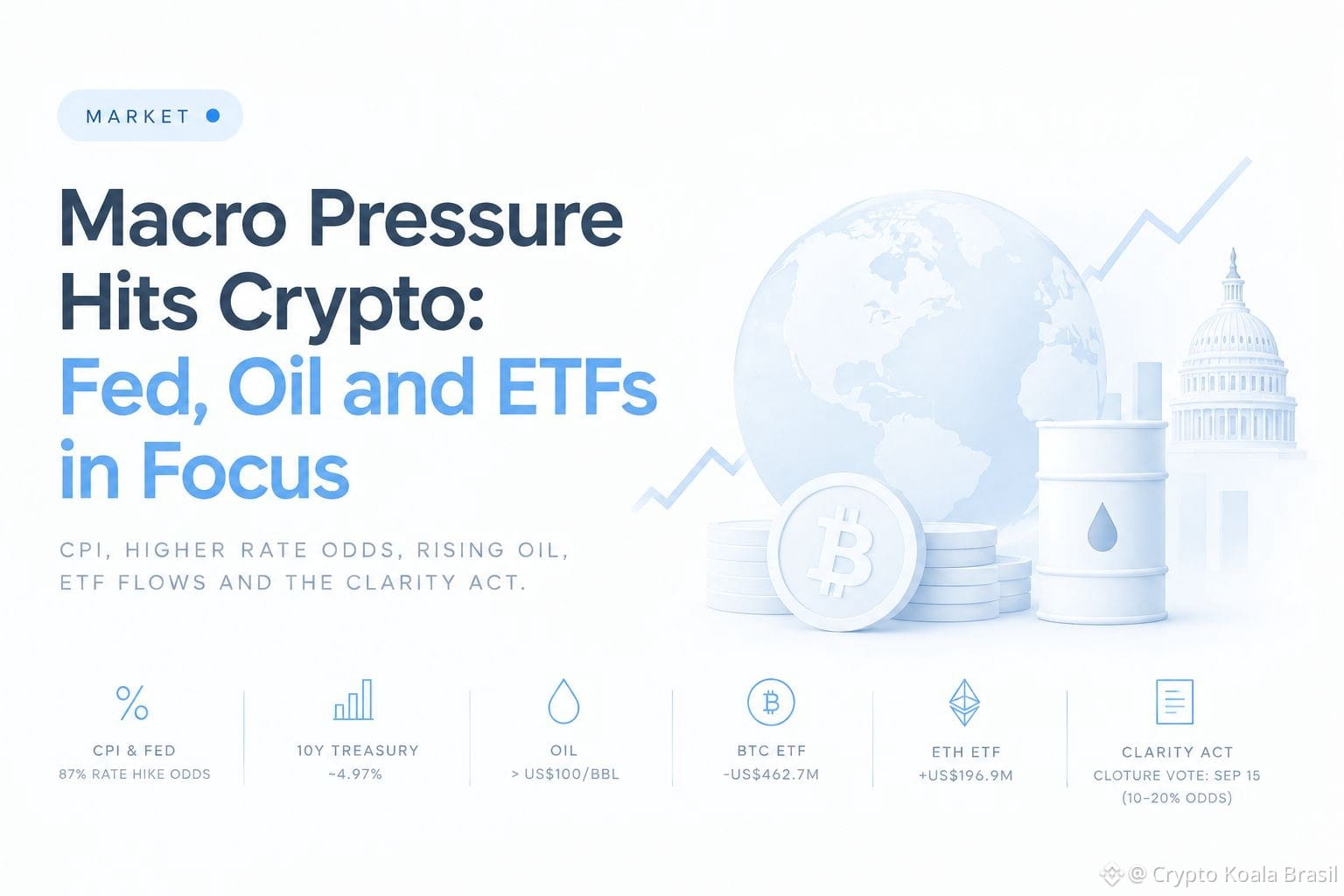
🚨 CRYPTO UNDER MACRO PRESSURE: THE FED, PETROLEUM AND ETFs PUT BTC UNDER THE SPOTLIGHT
The crypto market enters the week with several unfavorable macroeconomic signals — and Bitcoin has returned to the US$77k region.
🔥 What’s putting pressure on the market?
🇺🇸 MORE HAWKISH FED
After August’s CPI, released on September 11, expectations for a 25 bps rate hike at the Fed meeting reached approximately 87%.
📈 10-YEAR TREASURY
Yields touched the 4.97% area, increasing pressure on risk assets.
🛢️ OIL ABOVE US$100
Tensions involving Iran and the Middle East pushed oil prices higher, raising the risk of persistent inflation.
₿ BTC ETF: -US$462.7 MILLION
Between September 8 and 11, spot Bitcoin ETFs saw a strong outflow of capital.
⟠ ETH ETF: +US$196.9 MILLION
Meanwhile, Ethereum ETFs recorded positive net inflows — a contrast that may suggest relatively higher interest in ETH and capital rotation within the crypto market.
⚖️ AND NOW COMES THE CLARITY ACT
📅 SEPTEMBER 15
The U.S. Senate is expected to hold the cloture vote for the CLARITY Act.
Approval odds are low in prediction markets, around 10–20%, depending on the platform.
📌 For traders, the combination is delicate:
A more hawkish Fed + higher oil + the Treasury near 5% + capital outflows from BTC ETFs = an environment with greater pressure on risk assets.
On the other hand, the positive flow into ETH ETFs and the regulatory event of the CLARITY Act could create points of asymmetry and volatility.
⚠️ Next week may be decisive for the crypto market.
$XRP
{spot}(XRPUSDT)
🚨 CRYPTO UNDER MACRO PRESSURE: THE FED, PETROLEUM AND ETFs PUT BTC UNDER THE SPOTLIGHT
The crypto market enters the week with several unfavorable macroeconomic signals — and Bitcoin has returned to the US$77k region.
🔥 What’s putting pressure on the market?
🇺🇸 MORE HAWKISH FED
After August’s CPI, released on September 11, expectations for a 25 bps rate hike at the Fed meeting reached approximately 87%.
📈 10-YEAR TREASURY
Yields touched the 4.97% area, increasing pressure on risk assets.
🛢️ OIL ABOVE US$100
Tensions involving Iran and the Middle East pushed oil prices higher, raising the risk of persistent inflation.
₿ BTC ETF: -US$462.7 MILLION
Between September 8 and 11, spot Bitcoin ETFs saw a strong outflow of capital.
⟠ ETH ETF: +US$196.9 MILLION
Meanwhile, Ethereum ETFs recorded positive net inflows — a contrast that may suggest relatively higher interest in ETH and capital rotation within the crypto market.
⚖️ AND NOW COMES THE CLARITY ACT
📅 SEPTEMBER 15
The U.S. Senate is expected to hold the cloture vote for the CLARITY Act.
Approval odds are low in prediction markets, around 10–20%, depending on the platform.
📌 For traders, the combination is delicate:
A more hawkish Fed + higher oil + the Treasury near 5% + capital outflows from BTC ETFs = an environment with greater pressure on risk assets.
On the other hand, the positive flow into ETH ETFs and the regulatory event of the CLARITY Act could create points of asymmetry and volatility.
⚠️ Next week may be decisive for the crypto market.
$XRP
The crypto market enters the week with several unfavorable macroeconomic signals — and Bitcoin has returned to the US$77k region.
🔥 What’s putting pressure on the market?
🇺🇸 MORE HAWKISH FED
After August’s CPI, released on September 11, expectations for a 25 bps rate hike at the Fed meeting reached approximately 87%.
📈 10-YEAR TREASURY
Yields touched the 4.97% area, increasing pressure on risk assets.
🛢️ OIL ABOVE US$100
Tensions involving Iran and the Middle East pushed oil prices higher, raising the risk of persistent inflation.
₿ BTC ETF: -US$462.7 MILLION
Between September 8 and 11, spot Bitcoin ETFs saw a strong outflow of capital.
⟠ ETH ETF: +US$196.9 MILLION
Meanwhile, Ethereum ETFs recorded positive net inflows — a contrast that may suggest relatively higher interest in ETH and capital rotation within the crypto market.
⚖️ AND NOW COMES THE CLARITY ACT
📅 SEPTEMBER 15
The U.S. Senate is expected to hold the cloture vote for the CLARITY Act.
Approval odds are low in prediction markets, around 10–20%, depending on the platform.
📌 For traders, the combination is delicate:
A more hawkish Fed + higher oil + the Treasury near 5% + capital outflows from BTC ETFs = an environment with greater pressure on risk assets.
On the other hand, the positive flow into ETH ETFs and the regulatory event of the CLARITY Act could create points of asymmetry and volatility.
⚠️ Next week may be decisive for the crypto market.
$XRP
1
667

Article
WHY THE CRYPTO MARKET EXPLODED TODAY?The move this Friday, September 11, may seem contradictory: the CPI came in with a core above expectations, but BTC and altcoins reacted strongly to the upside.
The explanation is mainly positioning, liquidity, and expectations. 👇
📊 1. The CPI wasn’t as bad as the market feared
August’s CPI came in at +0.4% month-over-month and 3.4% year-over-year, exactly in line with expectations.
Core CPI came in at +0.3% month-over-month, above the expected +0.2%.
In other words: it wasn’t a perfect data release, but it also didn’t bring an inflation surprise big enough to justify a new wave of selling.
WHY THE CRYPTO MARKET EXPLODED TODAY?
The move this Friday, September 11, may seem contradictory: the CPI came in with a core above expectations, but BTC and altcoins reacted strongly to the upside.
The explanation is mainly positioning, liquidity, and expectations. 👇
📊 1. The CPI wasn’t as bad as the market feared
August’s CPI came in at +0.4% month-over-month and 3.4% year-over-year, exactly in line with expectations.
Core CPI came in at +0.3% month-over-month, above the expected +0.2%.
In other words: it wasn’t a perfect data release, but it also didn’t bring an inflation surprise big enough to justify a new wave of selling.
The explanation is mainly positioning, liquidity, and expectations. 👇
📊 1. The CPI wasn’t as bad as the market feared
August’s CPI came in at +0.4% month-over-month and 3.4% year-over-year, exactly in line with expectations.
Core CPI came in at +0.3% month-over-month, above the expected +0.2%.
In other words: it wasn’t a perfect data release, but it also didn’t bring an inflation surprise big enough to justify a new wave of selling.
2
1.2k
·
--
Bullish
Verified
Holding $XRP 1.9K USDT
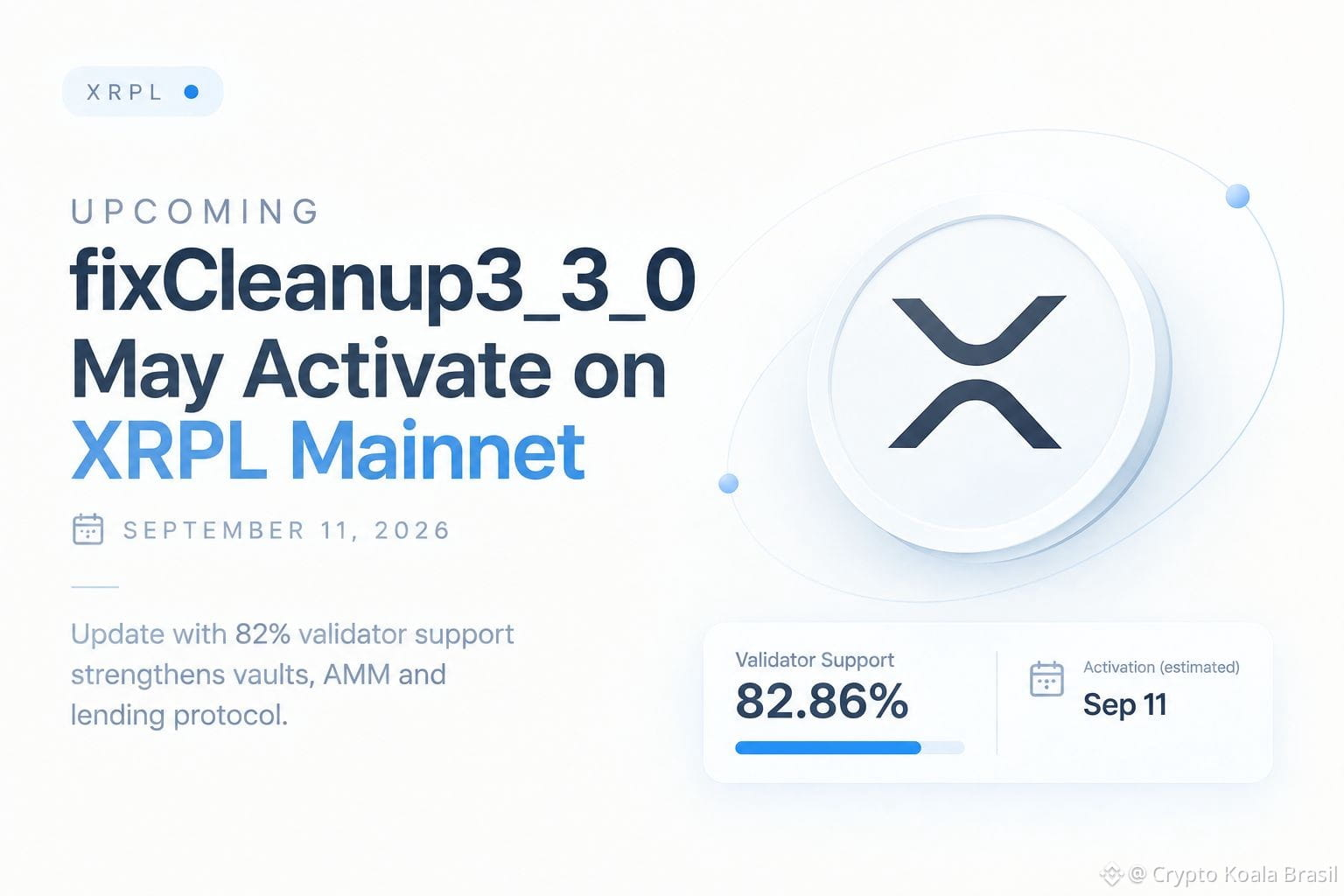
🚨 XRPL CAN ACTIVATE AN IMPORTANT UPDATE ON SEPTEMBER 11
The XRP Ledger is approaching the activation of fixCleanup3_3_0, an update that has already reached 82.86% validator support.
🔧 What changes?
• Improvements to Single Asset Vaults • Corrections to the Lending Protocol • AMM adjustments and protections • Corrections to permissioned DEX • Improvements to the Checks system • More security and consistency involving pseudo-accounts
📅 Scheduled date: September 11, 2026
🗳️ Support: 82.86%
✅ Minimum required: more than 80%
⚠️ Activation still depends on maintaining this support. If support falls to 80% or less during the window, the process may be restarted.
📌 For traders and investors: this is not an update created directly to boost the price of XRP. It is mainly an infrastructure fix that strengthens important parts of the XRPL ecosystem — especially AMMs, Vaults, and Lending.
The market may keep an eye on September 11. 👀
$XRP
🚨 XRPL CAN ACTIVATE AN IMPORTANT UPDATE ON SEPTEMBER 11
The XRP Ledger is approaching the activation of fixCleanup3_3_0, an update that has already reached 82.86% validator support.
🔧 What changes?
• Improvements to Single Asset Vaults • Corrections to the Lending Protocol • AMM adjustments and protections • Corrections to permissioned DEX • Improvements to the Checks system • More security and consistency involving pseudo-accounts
📅 Scheduled date: September 11, 2026
🗳️ Support: 82.86%
✅ Minimum required: more than 80%
⚠️ Activation still depends on maintaining this support. If support falls to 80% or less during the window, the process may be restarted.
📌 For traders and investors: this is not an update created directly to boost the price of XRP. It is mainly an infrastructure fix that strengthens important parts of the XRPL ecosystem — especially AMMs, Vaults, and Lending.
The market may keep an eye on September 11. 👀
$XRP
The XRP Ledger is approaching the activation of fixCleanup3_3_0, an update that has already reached 82.86% validator support.
🔧 What changes?
• Improvements to Single Asset Vaults • Corrections to the Lending Protocol • AMM adjustments and protections • Corrections to permissioned DEX • Improvements to the Checks system • More security and consistency involving pseudo-accounts
📅 Scheduled date: September 11, 2026
🗳️ Support: 82.86%
✅ Minimum required: more than 80%
⚠️ Activation still depends on maintaining this support. If support falls to 80% or less during the window, the process may be restarted.
📌 For traders and investors: this is not an update created directly to boost the price of XRP. It is mainly an infrastructure fix that strengthens important parts of the XRPL ecosystem — especially AMMs, Vaults, and Lending.
The market may keep an eye on September 11. 👀
$XRP
3
1.9k
·
--
Bullish
Partly True
🚨 ARTHUR HAYES BETS ALMOST $1 MILLION ON PENDLE — AND DEFI IS STARTING TO DRAW ATTENTION.
BitMEX co-founder Arthur Hayes accumulated approximately $973K in PENDLE, while the token’s derivatives activity also increased. 💰📈
🔥 Why are traders watching?
The combination of a significant buy by a well-known market figure with rising derivatives activity may indicate that speculative interest in PENDLE is growing.
📊 Key signals: • ~US$ 973K in PENDLE accumulated
• Purchase attributed to Arthur Hayes
• Simultaneous increase in derivatives activity
• Greater attention on the DeFi sector
👀 The buy alone doesn’t guarantee a rally. But when big players start positioning themselves as market activity increases, it’s worth keeping a close eye.
Arthur Hayes is buying PENDLE. Has the next DeFi move already begun? 🔥
$PENDLE
🚨 ARTHUR HAYES BETS ALMOST $1 MILLION ON PENDLE — AND DEFI IS STARTING TO DRAW ATTENTION.
BitMEX co-founder Arthur Hayes accumulated approximately $973K in PENDLE, while the token’s derivatives activity also increased. 💰📈
🔥 Why are traders watching?
The combination of a significant buy by a well-known market figure with rising derivatives activity may indicate that speculative interest in PENDLE is growing.
📊 Key signals: • ~US$ 973K in PENDLE accumulated
• Purchase attributed to Arthur Hayes
• Simultaneous increase in derivatives activity
• Greater attention on the DeFi sector
👀 The buy alone doesn’t guarantee a rally. But when big players start positioning themselves as market activity increases, it’s worth keeping a close eye.
Arthur Hayes is buying PENDLE. Has the next DeFi move already begun? 🔥
$PENDLE
BitMEX co-founder Arthur Hayes accumulated approximately $973K in PENDLE, while the token’s derivatives activity also increased. 💰📈
🔥 Why are traders watching?
The combination of a significant buy by a well-known market figure with rising derivatives activity may indicate that speculative interest in PENDLE is growing.
📊 Key signals: • ~US$ 973K in PENDLE accumulated
• Purchase attributed to Arthur Hayes
• Simultaneous increase in derivatives activity
• Greater attention on the DeFi sector
👀 The buy alone doesn’t guarantee a rally. But when big players start positioning themselves as market activity increases, it’s worth keeping a close eye.
Arthur Hayes is buying PENDLE. Has the next DeFi move already begun? 🔥
$PENDLE
7
4
1.6k
·
--
Bearish
Verified
Holding $BTC 1.2K USDT
🚨 STRONG PAYROLL MEETS APOSTASY FROM THE FED — AND CRYPTO FEELS THE PRESSURE.
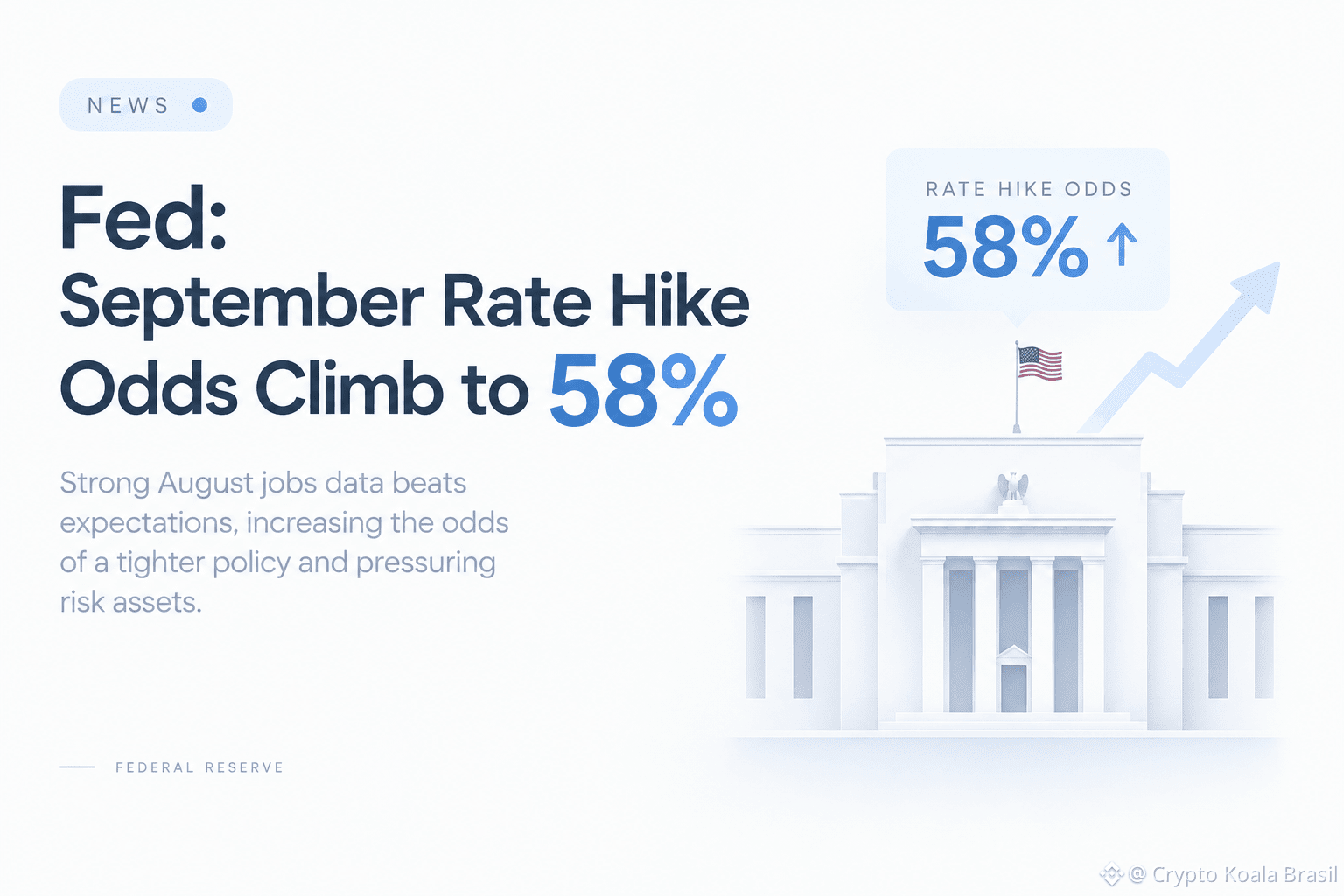
U.S. employment data in August beat expectations, pushing the probability of a rate hike in September up to 58%. 🇺🇸📊
For markets, the logic is straightforward:
📈 Strong employment
⬇️
🏦 Less need for cuts / more room for tightening
⬇️
💵 Potentially higher rates for longer
⬇️
📉 Pressure on risk assets
And that’s exactly where the crypto market comes onto the radar.
Bitcoin and altcoins tend to struggle when rate expectations become more restrictive, since tighter monetary policy can reduce the liquidity available for higher-risk assets.
⚠️ Key point for traders: a 58% probability doesn’t mean a hike is guaranteed.
It means the market is repricing the Fed outlook after the employment data.
👀 Now, inflation, upcoming employment data, and Fed members’ statements become even more important.
A strong payroll may seem positive for the economy — but for crypto, it could mean exactly the opposite in the short term.
$BTC
🚨 STRONG PAYROLL MEETS APOSTASY FROM THE FED — AND CRYPTO FEELS THE PRESSURE.
U.S. employment data in August beat expectations, pushing the probability of a rate hike in September up to 58%. 🇺🇸📊
For markets, the logic is straightforward:
📈 Strong employment
⬇️
🏦 Less need for cuts / more room for tightening
⬇️
💵 Potentially higher rates for longer
⬇️
📉 Pressure on risk assets
And that’s exactly where the crypto market comes onto the radar.
Bitcoin and altcoins tend to struggle when rate expectations become more restrictive, since tighter monetary policy can reduce the liquidity available for higher-risk assets.
⚠️ Key point for traders: a 58% probability doesn’t mean a hike is guaranteed.
It means the market is repricing the Fed outlook after the employment data.
👀 Now, inflation, upcoming employment data, and Fed members’ statements become even more important.
A strong payroll may seem positive for the economy — but for crypto, it could mean exactly the opposite in the short term.
$BTC
U.S. employment data in August beat expectations, pushing the probability of a rate hike in September up to 58%. 🇺🇸📊
For markets, the logic is straightforward:
📈 Strong employment
⬇️
🏦 Less need for cuts / more room for tightening
⬇️
💵 Potentially higher rates for longer
⬇️
📉 Pressure on risk assets
And that’s exactly where the crypto market comes onto the radar.
Bitcoin and altcoins tend to struggle when rate expectations become more restrictive, since tighter monetary policy can reduce the liquidity available for higher-risk assets.
⚠️ Key point for traders: a 58% probability doesn’t mean a hike is guaranteed.
It means the market is repricing the Fed outlook after the employment data.
👀 Now, inflation, upcoming employment data, and Fed members’ statements become even more important.
A strong payroll may seem positive for the economy — but for crypto, it could mean exactly the opposite in the short term.
$BTC
1
296
·
--
Bullish
Verified
Holding $XRP 1.1K USDT
🚨 XRPL HAS AN IMPORTANT UPDATE ON THE WAY — AND IT ALREADY HAS 82.86% SUPPORT.
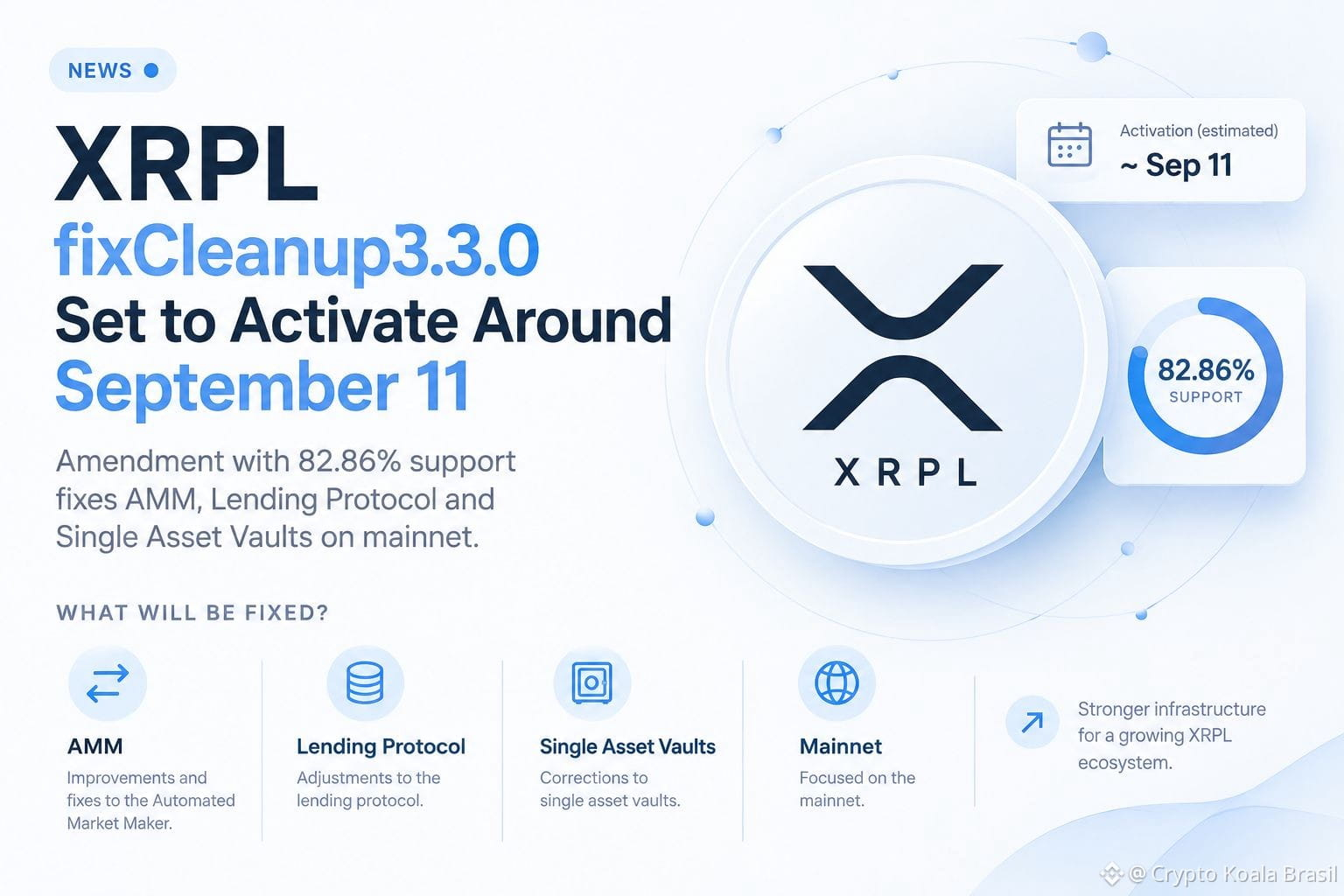
The fixCleanup3.3.0 amendment is expected to activate around September 11, bringing important fixes for XRPL ecosystem components. ⚙️
🔧 What will be fixed?
• AMM — improvements and fixes in the Automated Market Maker
• Lending Protocol — adjustments to the lending protocol
• Single Asset Vaults — fixes to single-asset vaults
• Update targeted at mainnet
📊 With 82.86% support, the amendment shows strong community/validator backing.
👀 Why should traders pay attention?
Infrastructure updates can directly affect the stability, efficiency, and evolution of the XRPL ecosystem — especially as new DeFi applications gain traction on the network.
📅 Expected date: ~September 11
🗳️ Current support: 82.86%
⚙️ Focus: fixes and improvements in XRPL
The market may be looking at the price of XRP, but the infrastructure behind the asset is also evolving.
$XRP
🚨 XRPL HAS AN IMPORTANT UPDATE ON THE WAY — AND IT ALREADY HAS 82.86% SUPPORT.
The fixCleanup3.3.0 amendment is expected to activate around September 11, bringing important fixes for XRPL ecosystem components. ⚙️
🔧 What will be fixed?
• AMM — improvements and fixes in the Automated Market Maker
• Lending Protocol — adjustments to the lending protocol
• Single Asset Vaults — fixes to single-asset vaults
• Update targeted at mainnet
📊 With 82.86% support, the amendment shows strong community/validator backing.
👀 Why should traders pay attention?
Infrastructure updates can directly affect the stability, efficiency, and evolution of the XRPL ecosystem — especially as new DeFi applications gain traction on the network.
📅 Expected date: ~September 11
🗳️ Current support: 82.86%
⚙️ Focus: fixes and improvements in XRPL
The market may be looking at the price of XRP, but the infrastructure behind the asset is also evolving.
$XRP
The fixCleanup3.3.0 amendment is expected to activate around September 11, bringing important fixes for XRPL ecosystem components. ⚙️
🔧 What will be fixed?
• AMM — improvements and fixes in the Automated Market Maker
• Lending Protocol — adjustments to the lending protocol
• Single Asset Vaults — fixes to single-asset vaults
• Update targeted at mainnet
📊 With 82.86% support, the amendment shows strong community/validator backing.
👀 Why should traders pay attention?
Infrastructure updates can directly affect the stability, efficiency, and evolution of the XRPL ecosystem — especially as new DeFi applications gain traction on the network.
📅 Expected date: ~September 11
🗳️ Current support: 82.86%
⚙️ Focus: fixes and improvements in XRPL
The market may be looking at the price of XRP, but the infrastructure behind the asset is also evolving.
$XRP
4
2.1k
Verified
🚨 SEPTEMBER 15 COULD BE ONE OF THE MOST IMPORTANT DAYS OF THE YEAR FOR XRP.
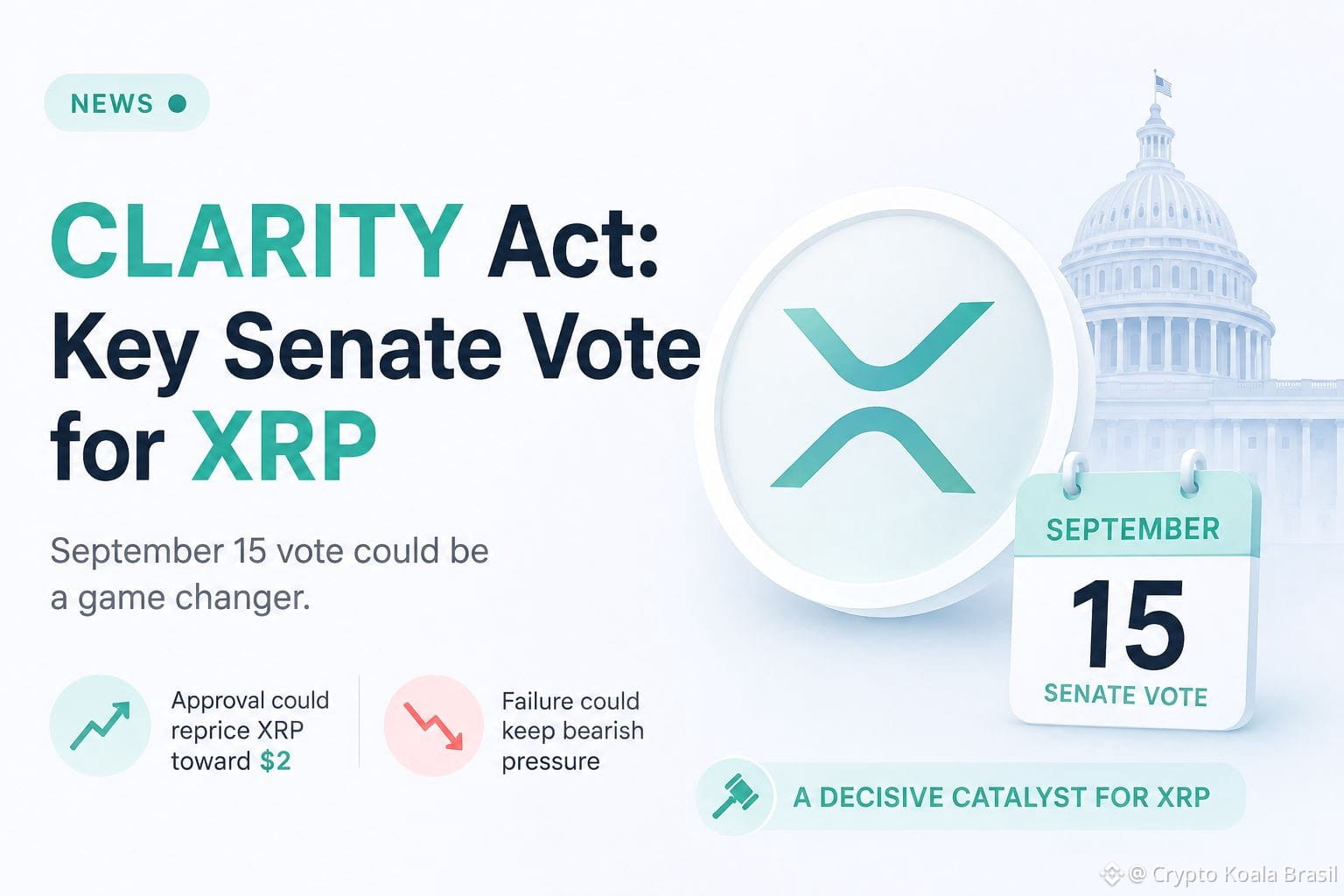
The U.S. Senate has an important vote on the CLARITY Act, and the outcome could be a decisive catalyst for XRP. 🇺🇸⚖️
🔥 If the bill advances: Greater regulatory clarity for the crypto market could reduce uncertainty around assets like XRP, making room for a revaluation.
🎯 One of the market’s projected scenarios is XRP once again targeting the US$ 2 region.
⚠️ But there is another side.
If the vote fails or the process faces new obstacles, regulatory uncertainty remains — which could increase selling pressure on XRP.
📊 For traders, the situation is simple:
🟢 CLARITY advances → possible bullish catalyst
🔴 CLARITY fails → risk of bearish pressure
👀 15/Sep → a date to keep on your radar
The market may begin pricing in the outcome even before the vote, increasing volatility as the date approaches.
🚨 SEPTEMBER 15 COULD BE ONE OF THE MOST IMPORTANT DAYS OF THE YEAR FOR XRP.
The U.S. Senate has an important vote on the CLARITY Act, and the outcome could be a decisive catalyst for XRP. 🇺🇸⚖️
🔥 If the bill advances: Greater regulatory clarity for the crypto market could reduce uncertainty around assets like XRP, making room for a revaluation.
🎯 One of the market’s projected scenarios is XRP once again targeting the US$ 2 region.
⚠️ But there is another side.
If the vote fails or the process faces new obstacles, regulatory uncertainty remains — which could increase selling pressure on XRP.
📊 For traders, the situation is simple:
🟢 CLARITY advances → possible bullish catalyst
🔴 CLARITY fails → risk of bearish pressure
👀 15/Sep → a date to keep on your radar
The market may begin pricing in the outcome even before the vote, increasing volatility as the date approaches.
The U.S. Senate has an important vote on the CLARITY Act, and the outcome could be a decisive catalyst for XRP. 🇺🇸⚖️
🔥 If the bill advances: Greater regulatory clarity for the crypto market could reduce uncertainty around assets like XRP, making room for a revaluation.
🎯 One of the market’s projected scenarios is XRP once again targeting the US$ 2 region.
⚠️ But there is another side.
If the vote fails or the process faces new obstacles, regulatory uncertainty remains — which could increase selling pressure on XRP.
📊 For traders, the situation is simple:
🟢 CLARITY advances → possible bullish catalyst
🔴 CLARITY fails → risk of bearish pressure
👀 15/Sep → a date to keep on your radar
The market may begin pricing in the outcome even before the vote, increasing volatility as the date approaches.
3
2.4k
·
--
Bullish
🚨 XRP SOARS 9.4% IN 24H AND BREAKS THE DOWNTREND.
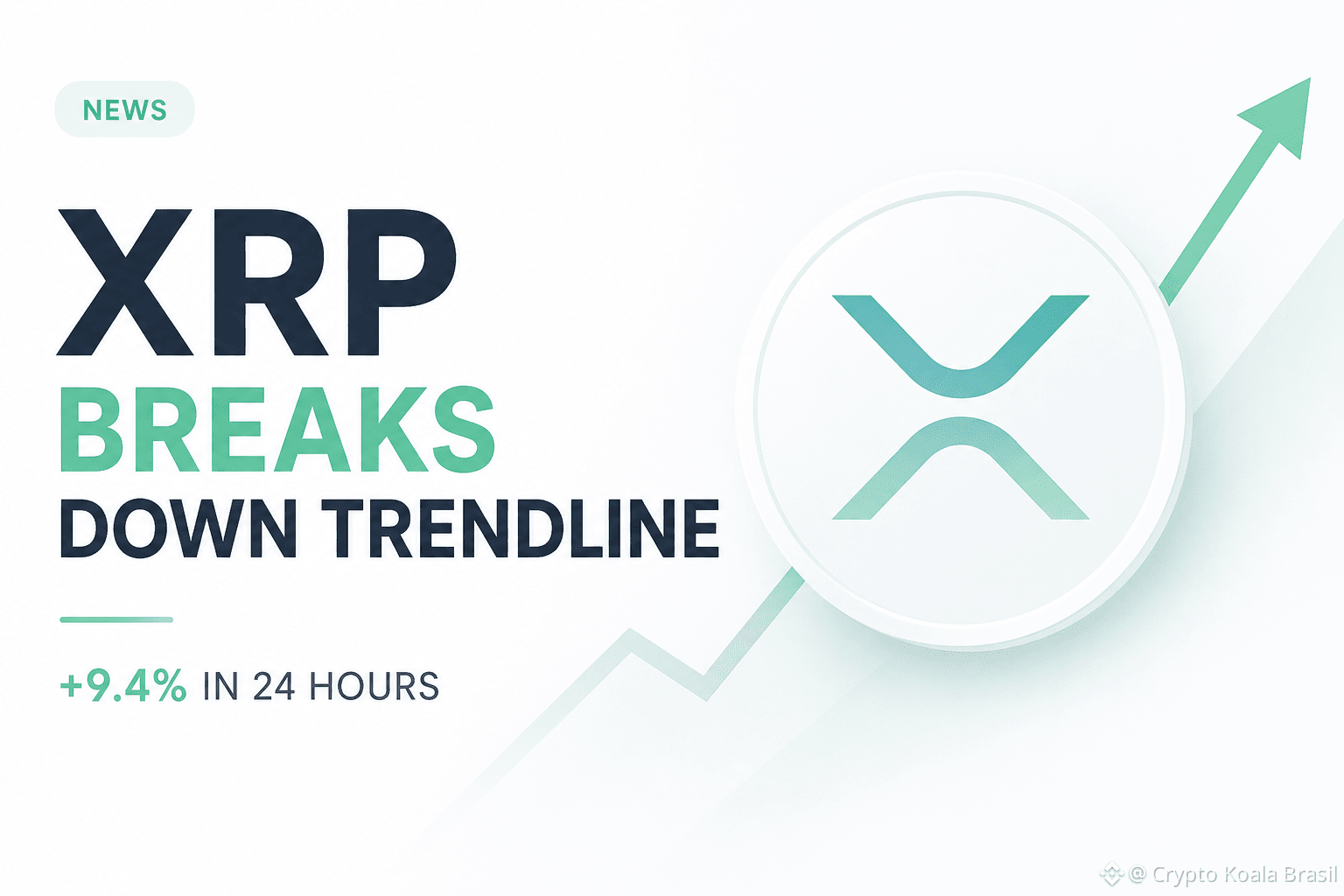
XRP moved from US$ 1.33 to US$ 1.46, while buyers returned to defend a support level considered critical. 📈
🔥 What changed for traders?
The asset managed to break its downtrend line, signaling that selling pressure may be losing strength in the short term.
Now, the main point of attention is whether this breakout can hold.
📊 XRP in focus: • +9.4% in 24 hours • US$ 1.33 → US$ 1.46 • Downtrend line broken • Buyers returning to the market • Critical support defended
⚠️ The breakout is a positive sign, but the next moves will be important to determine whether we’re looking at a trend reversal or just a short-term bounce.
👀 XRP managed to break the downtrend. Now it needs to prove it can stay above it.
🚨 XRP SOARS 9.4% IN 24H AND BREAKS THE DOWNTREND.
XRP moved from US$ 1.33 to US$ 1.46, while buyers returned to defend a support level considered critical. 📈
🔥 What changed for traders?
The asset managed to break its downtrend line, signaling that selling pressure may be losing strength in the short term.
Now, the main point of attention is whether this breakout can hold.
📊 XRP in focus: • +9.4% in 24 hours • US$ 1.33 → US$ 1.46 • Downtrend line broken • Buyers returning to the market • Critical support defended
⚠️ The breakout is a positive sign, but the next moves will be important to determine whether we’re looking at a trend reversal or just a short-term bounce.
👀 XRP managed to break the downtrend. Now it needs to prove it can stay above it.
XRP moved from US$ 1.33 to US$ 1.46, while buyers returned to defend a support level considered critical. 📈
🔥 What changed for traders?
The asset managed to break its downtrend line, signaling that selling pressure may be losing strength in the short term.
Now, the main point of attention is whether this breakout can hold.
📊 XRP in focus: • +9.4% in 24 hours • US$ 1.33 → US$ 1.46 • Downtrend line broken • Buyers returning to the market • Critical support defended
⚠️ The breakout is a positive sign, but the next moves will be important to determine whether we’re looking at a trend reversal or just a short-term bounce.
👀 XRP managed to break the downtrend. Now it needs to prove it can stay above it.
1
884
·
--
Bearish
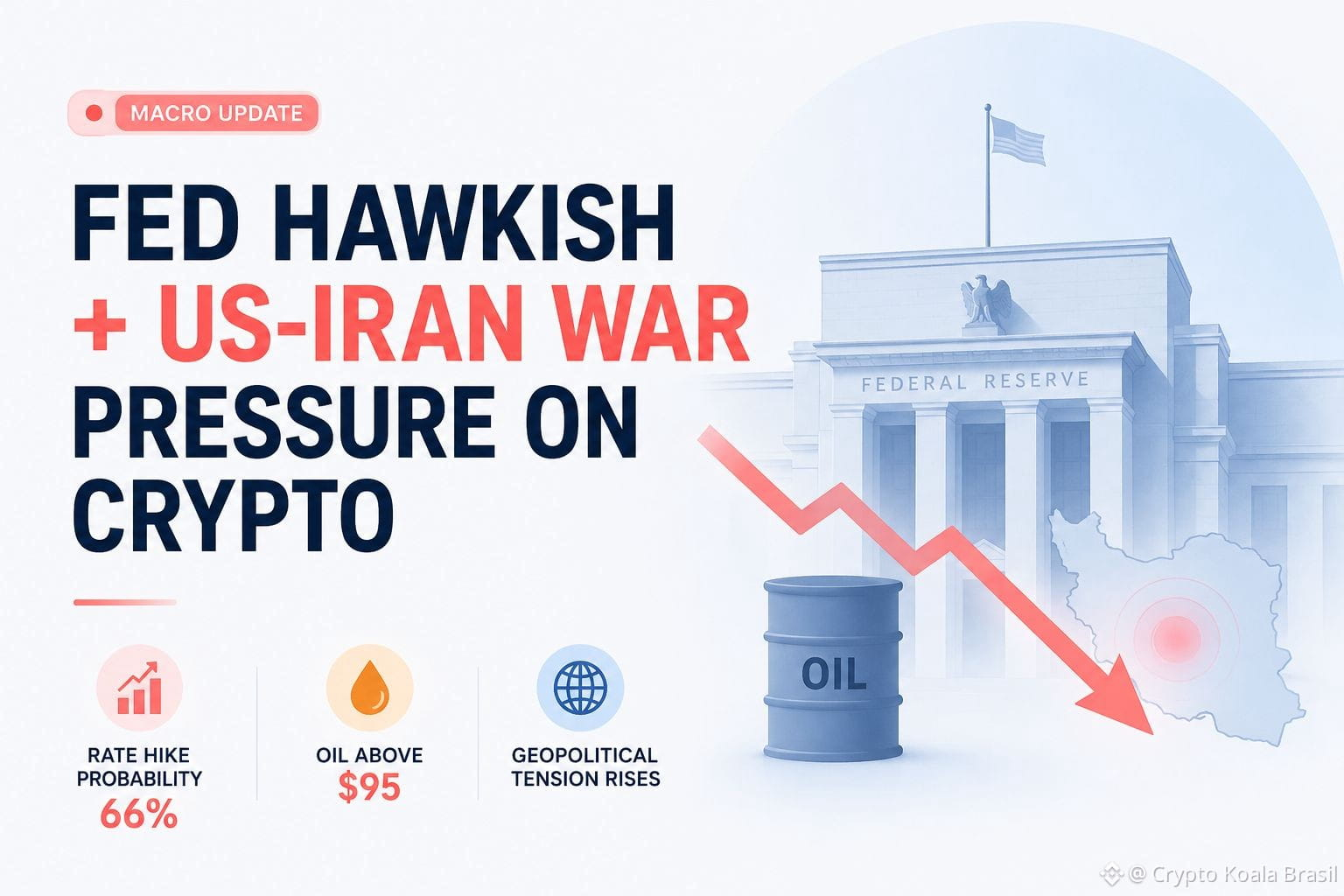
🚨 THE MACRO SCENARIO JUST GOT MUCH WORSE FOR THE CRYPTO MARKET.
The combination of a more hawkish Fed + military escalation between the US and Iran + oil surging is increasing pressure on risk assets. 📉
🇺🇸 Market pricing for a Fed rate hike in September reached around 66% after the shift in monetary policy tone.
🛢️ At the same time, Brent crude has been approaching <$ 95>, fueling inflation concerns. Escalation in the Middle East raises the risk of new energy shocks.
And here’s the problem for crypto:
Oil ↑ → inflation ↑ → more hawkish Fed → rates ↑ → liquidity ↓ → pressure on risk assets.
Bitcoin and the rest of the crypto market could feel this effect especially if investors start reducing exposure to higher-risk assets.
⚠️ But pay attention: a rate hike is still not guaranteed. Expectations change as US employment and inflation data come in, and members of the Fed itself continue to diverge on the need to tighten monetary policy.
📌 For traders, the focus now is on the macro.
The Fed, oil, inflation, and war may determine whether the market correction will be just profit-taking—or the start of a deeper move.
September began with a macro storm. 🌪️
🚨 THE MACRO SCENARIO JUST GOT MUCH WORSE FOR THE CRYPTO MARKET.
The combination of a more hawkish Fed + military escalation between the US and Iran + oil surging is increasing pressure on risk assets. 📉
🇺🇸 Market pricing for a Fed rate hike in September reached around 66% after the shift in monetary policy tone.
🛢️ At the same time, Brent crude has been approaching <$ 95>, fueling inflation concerns. Escalation in the Middle East raises the risk of new energy shocks.
And here’s the problem for crypto:
Oil ↑ → inflation ↑ → more hawkish Fed → rates ↑ → liquidity ↓ → pressure on risk assets.
Bitcoin and the rest of the crypto market could feel this effect especially if investors start reducing exposure to higher-risk assets.
⚠️ But pay attention: a rate hike is still not guaranteed. Expectations change as US employment and inflation data come in, and members of the Fed itself continue to diverge on the need to tighten monetary policy.
📌 For traders, the focus now is on the macro.
The Fed, oil, inflation, and war may determine whether the market correction will be just profit-taking—or the start of a deeper move.
September began with a macro storm. 🌪️
The combination of a more hawkish Fed + military escalation between the US and Iran + oil surging is increasing pressure on risk assets. 📉
🇺🇸 Market pricing for a Fed rate hike in September reached around 66% after the shift in monetary policy tone.
🛢️ At the same time, Brent crude has been approaching <$ 95>, fueling inflation concerns. Escalation in the Middle East raises the risk of new energy shocks.
And here’s the problem for crypto:
Oil ↑ → inflation ↑ → more hawkish Fed → rates ↑ → liquidity ↓ → pressure on risk assets.
Bitcoin and the rest of the crypto market could feel this effect especially if investors start reducing exposure to higher-risk assets.
⚠️ But pay attention: a rate hike is still not guaranteed. Expectations change as US employment and inflation data come in, and members of the Fed itself continue to diverge on the need to tighten monetary policy.
📌 For traders, the focus now is on the macro.
The Fed, oil, inflation, and war may determine whether the market correction will be just profit-taking—or the start of a deeper move.
September began with a macro storm. 🌪️
1
333
·
--
Bearish
Verified
🚨 1 BILLION XRP JUST GOT UNLOCKED — AND TRADERS NEED TO KEEP AN EYE ON THIS.
Ripple released 1 billion XRP from escrow this Tuesday, September 1st, in three transactions of 500 million, 400 million, and 100 million tokens.
💰 In market value terms, the unlock represents more than $1 billion worth of XRP.
But there’s an important detail:
⚠️ Unlocked doesn’t mean sold.
Ripple’s escrow mechanism includes monthly releases of up to 1 billion XRP. The company has historically returned a significant portion of unused tokens back to escrow, meaning the actual impact on circulating supply is smaller than the announced figure.
📉 For traders, what matters now is the flow.
If a significant portion of these XRP is sent to exchanges, sell pressure could emerge in the short term.
If most of it is locked up again, the impact on supply will be much smaller.
🔎 So the figure of 1 billion XRP is the warning — but the next on-chain moves are what really matter.
XRP just received a new supply test. Will demand be able to absorb it? 👀
$XRP
🚨 1 BILLION XRP JUST GOT UNLOCKED — AND TRADERS NEED TO KEEP AN EYE ON THIS.
Ripple released 1 billion XRP from escrow this Tuesday, September 1st, in three transactions of 500 million, 400 million, and 100 million tokens.
💰 In market value terms, the unlock represents more than $1 billion worth of XRP.
But there’s an important detail:
⚠️ Unlocked doesn’t mean sold.
Ripple’s escrow mechanism includes monthly releases of up to 1 billion XRP. The company has historically returned a significant portion of unused tokens back to escrow, meaning the actual impact on circulating supply is smaller than the announced figure.
📉 For traders, what matters now is the flow.
If a significant portion of these XRP is sent to exchanges, sell pressure could emerge in the short term.
If most of it is locked up again, the impact on supply will be much smaller.
🔎 So the figure of 1 billion XRP is the warning — but the next on-chain moves are what really matter.
XRP just received a new supply test. Will demand be able to absorb it? 👀
$XRP
Ripple released 1 billion XRP from escrow this Tuesday, September 1st, in three transactions of 500 million, 400 million, and 100 million tokens.
💰 In market value terms, the unlock represents more than $1 billion worth of XRP.
But there’s an important detail:
⚠️ Unlocked doesn’t mean sold.
Ripple’s escrow mechanism includes monthly releases of up to 1 billion XRP. The company has historically returned a significant portion of unused tokens back to escrow, meaning the actual impact on circulating supply is smaller than the announced figure.
📉 For traders, what matters now is the flow.
If a significant portion of these XRP is sent to exchanges, sell pressure could emerge in the short term.
If most of it is locked up again, the impact on supply will be much smaller.
🔎 So the figure of 1 billion XRP is the warning — but the next on-chain moves are what really matter.
XRP just received a new supply test. Will demand be able to absorb it? 👀
$XRP
1
2
2.6k
·
--
Bullish
🔥 TRADERS ON HYPERLIQUID CAN NOW TRADE THEIR FEE DISCOUNTS.
Pendle, in partnership with Valantis, launched the first open market to trade discounts on Hyperliquid perpetual trading fees.
In practice, this turns something that was previously just an operational benefit into an asset with economic value and the possibility to trade. 👀
💰 Why does this matter for traders?
• Fee discounts can gain liquidity
• Traders can have new ways to capture value
• Trading incentives become part of an open market
• A new opportunity emerges within the perpetuals ecosystem
The news also points to a broader trend in DeFi: turning benefits, rebates, and incentives into tradable financial markets.
And this might be only the beginning.
If a fee discount can become a market, what else will DeFi turn into an asset? 👀
$PENDLE
🔥 TRADERS ON HYPERLIQUID CAN NOW TRADE THEIR FEE DISCOUNTS.
Pendle, in partnership with Valantis, launched the first open market to trade discounts on Hyperliquid perpetual trading fees.
In practice, this turns something that was previously just an operational benefit into an asset with economic value and the possibility to trade. 👀
💰 Why does this matter for traders?
• Fee discounts can gain liquidity
• Traders can have new ways to capture value
• Trading incentives become part of an open market
• A new opportunity emerges within the perpetuals ecosystem
The news also points to a broader trend in DeFi: turning benefits, rebates, and incentives into tradable financial markets.
And this might be only the beginning.
If a fee discount can become a market, what else will DeFi turn into an asset? 👀
$PENDLE
Pendle, in partnership with Valantis, launched the first open market to trade discounts on Hyperliquid perpetual trading fees.
In practice, this turns something that was previously just an operational benefit into an asset with economic value and the possibility to trade. 👀
💰 Why does this matter for traders?
• Fee discounts can gain liquidity
• Traders can have new ways to capture value
• Trading incentives become part of an open market
• A new opportunity emerges within the perpetuals ecosystem
The news also points to a broader trend in DeFi: turning benefits, rebates, and incentives into tradable financial markets.
And this might be only the beginning.
If a fee discount can become a market, what else will DeFi turn into an asset? 👀
$PENDLE
2
503
Log in to explore more content
Join global crypto users on Binance Square
⚡️ Get latest and useful information about crypto.
💬 Trusted by the world’s largest crypto exchange.
👍 Discover real insights from verified creators.
Email / Phone number
Trending Topics
EtherGains70.9%InQ3
162,172 views
1,152 Discussing
One of the best third quarters in history 💰
September closed out last night, and with it, the quarter. For the quarter, BTC is up 42%—the second-best Q3 on record. ETH had a record-breaking Q3 overall, up 70%.
Looking at the chart, things are still looking good: we’re holding support, but we’re testing it more and more often. Plus, ETF momentum is weakening — inflows are gradually declining, and yesterday saw outflows for the first time in a long while.
Yes, historically, October has been a good month for crypto — it’s not called “Uptober” for nothing. But it’s also one of the most volatile months. Last year, for example, we managed to hit a new all-time high (ATH) and experience a flash crash.
🚀 High Accuracy Trades.
$BTC
$ETH
$SOL
#EtherGains70.9%InQ3 #DollarIndexHitsHighestSinceMay2025 #CFTCSubmitsTwoEventContractRulesToWhiteHouse #MicronBeatsEarningsLiftsGuidance
Knowledge is Power
·0 Likes
·242 views
TreasuryLetsStatesFileStablecoinCertificationsEarly
9,903 views
83 Discussing
US10YearYieldNears5.3%
154,173 views
1,144 Discussing