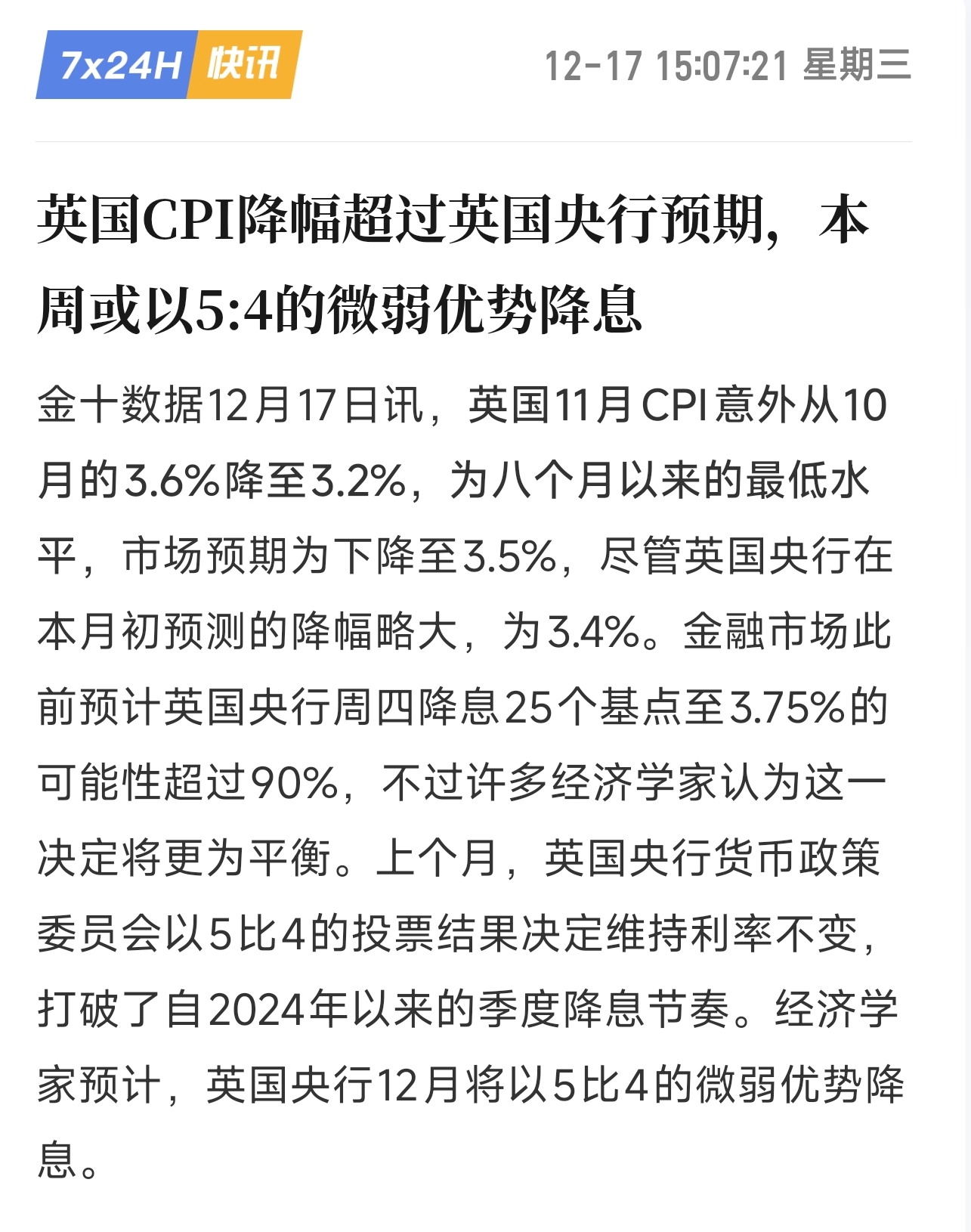
The unexpected fall in the UK's November CPI data has brought the Bank of England's interest rate cut decision to the forefront. The inflation data plummeted from 3.6% to 3.2%, marking an eight-month low, and shifted market expectations for a rate cut in December from 'high probability' to 'inevitable under slight advantage.' The 5:4 voting result also reflects the difficult balance the UK's monetary policy faces between falling inflation and economic recovery.
1. CPI falls more than expected: The core driver of interest rate cuts
The UK's November CPI recorded at 3.2%, which is lower than the market expectation of 3.5% and also below the Bank of England's early-month forecast of 3.4%. The speed of inflation decline far exceeds expectations, becoming the core driving force behind the interest rate cuts. From the perspective of inflation structure, the drop in energy prices and the continued easing of food inflation are the main factors pulling it down, while the moderate decline in service sector inflation has also alleviated the Bank of England's concerns about 'core inflation stickiness.'
The rapid decline in inflation has directly weakened the reasons for the 'hawkish' stance to maintain interest rates. Previously, the Bank of England's Monetary Policy Committee paused interest rate cuts with a 5:4 voting result, breaking the quarterly interest rate cut rhythm for 2024, with core concerns being that inflation declines were not as expected and service industry inflation remained high. The impressive performance of the CPI data has provided crucial policy support for the 'dovish' camp and tilted the 5:4 voting advantage towards the direction of interest rate cuts.
II. Behind the 5:4 Interest Rate Cut: The Dilemma of Monetary Policy
Although the market's expected probability of an interest rate cut exceeds 90%, the slight voting advantage of 5:4 highlights that internal divisions within the Bank of England have not yet been resolved.
On the one hand, the 'dovish' camp believes that inflation has entered a rapid decline channel, and the current benchmark interest rate remains at a relatively high level. Continued tightening policies will further suppress the UK's weak economic growth—UK GDP showed zero growth quarter-on-quarter in the third quarter, and there is insufficient momentum in consumption and investment. An interest rate cut can release liquidity and inject vitality into the economic recovery.
On the other hand, the concerns of the 'hawkish' camp still exist: current inflation is still above the target level of 2%, service industry inflation, although declining, remains sticky, and an early interest rate cut may lead to an inflation rebound, undermining previous tightening achievements. In addition, the tight conditions in the UK labor market have not yet fully eased, and the pressure of wage growth may still support inflation, which is an important basis for the hawks to maintain a 'wait-and-see' stance.
This divergence essentially reflects the Bank of England's trade-off between 'anti-inflation' and 'stabilizing growth'. The 5:4 interest rate cut outcome both acknowledges the decline in inflation and reflects policymakers' vigilance against 'recurrent inflation', representing a compromise that considers short-term economic needs and long-term inflation targets.
III. Market Impact Predictions After the Interest Rate Cut
If the Bank of England announces an interest rate cut of 25 basis points to 3.75% with a 5:4 advantage, it will have multiple impacts on financial markets and the real economy:
1. Foreign Exchange Market: The pound may face downward pressure in the short term. An interest rate cut will reduce the yield attractiveness of pound assets, combined with the market's cautious attitude towards the UK's economic recovery, the pound may experience temporary depreciation against the US dollar, euro, and other major currencies, though the decline may be relatively limited as the expectations for rate cuts have already been priced in.
2. Capital Market: The stock market may see a temporary boost. The liquidity easing brought about by interest rate cuts will benefit interest rate-sensitive sectors, such as real estate, consumption, and technology stocks—the real estate sector will benefit from lower mortgage rates, while the consumption sector will gain support due to lower borrowing costs for households and a rebound in consumption willingness.
3. Real Economy: Lower financing costs for businesses will help boost the investment willingness of small and medium-sized enterprises and alleviate the pressure on consumer credit. However, in the short term, the stimulating effect of the interest rate cut on the economy may be relatively mild, as the core issues facing the UK economy lie in the slow recovery of supply chains and structural conflicts in the labor market, making it difficult for a single monetary policy to solve all problems.
IV. Outlook for Subsequent Policies: The Interest Rate Cut Cycle May Slowly Begin
This slight interest rate cut of 5:4 is likely the 'starting point' rather than the 'end point' of the Bank of England's interest rate cut cycle. If inflation continues to decline, the Bank of England may continue to gradually cut interest rates, adjusting the benchmark rate to a level more suitable for economic growth. However, constrained by inflation stickiness and internal divisions, the pace of interest rate cuts will not be overly aggressive, likely reflecting a 'small steps' approach.
For the market, it is crucial to pay close attention to subsequent inflation data and changes in the economic fundamentals: if the trend of declining inflation continues, the interest rate cut cycle will steadily advance; if inflation shows signs of rebounding, the Bank of England may pause interest rate cuts again, and the pace of monetary policy easing will be adjusted accordingly.
Overall, the unexpectedly rapid decline in the UK's CPI has opened a window for interest rate cuts, while the 5:4 voting result directly reflects the policy trade-offs. Under the dual goals of inflation and growth, the Bank of England's monetary policy will become more cautious, and the market will also need to adapt to this 'weak easing' policy environment, seizing investment opportunities in the data and policy game.