
If you don't have a trading system, you can take a look here, and if you do, you can also take a look. I hope this is helpful for everyone.
Recently, I have been explaining an investment course and have organized a complete trading system, roughly divided into the following 7 parts to share with my fans and friends:
1. Market analysis and trend judgment. Fundamental analysis of macroeconomic indicators: Focus on GDP, CPI, interest rates, monetary policy, etc., and their impact on commodity supply and demand. Industry supply and demand data: Study inventory, production, consumption, seasonal factors (such as agricultural harvest cycles).
Policies and unexpected events: For example, price fluctuations that may be triggered by tariff adjustments, geopolitical conflicts, extreme weather, etc. Cross-market linkage: The linkage effects of exchange rates, stock markets, and related commodities (such as crude oil and chemical products).
Technical analysis trend judgment tools: Moving average systems (such as EMA, MA), trend lines, channel lines, etc., identify market direction. Price patterns: Classic patterns such as head and shoulders top, triangle breakout, and flag consolidation. Technical indicators: MACD (trend following), RSI (overbought/oversold), Bollinger Bands (volatility), etc. Volume and price relationship: Changes in trading volume and open interest verify trend strength (e.g., increased open interest during upward movement is considered a valid breakout).
II. Trading Strategy Design Entry Rules Trigger Conditions: Combine fundamental and technical signals (e.g., going long when breaking through key resistance levels + inventory decline). Timeframe: Define the trading cycle (intraday, swing, or long-term). For example, refer to 5-minute candlestick charts for intraday trading and weekly charts for long-term trading.
Exit rules and profit-taking strategies: Fixed profit/loss ratio (e.g., 1:3), dynamic trailing profit-taking (moving average or parabolic SAR). Stop-loss settings: Fixed amount stop-loss (e.g., single loss not exceeding 2%), technical stop-loss (breaking the previous low or support level).
Trend-following strategies: Employing the Turtle Trading Rules, entry occurs when the price breaks through the N-day high. Mean reversion strategies: Utilizing the RSI overbought/oversold range for contrarian trading. Arbitrage strategies: Inter-month arbitrage (price difference between different contracts of the same commodity), cross-commodity arbitrage (e.g., rebar and iron ore).
III. Risk Management System: Capital Management and Position Control: The risk of a single transaction shall not exceed 2% of the total capital (Kelly formula optimization). Leverage Use: Adjust the leverage ratio according to volatility (reduce leverage for high-volatility instruments). Diversification: Use a combination of multiple instruments and strategies to reduce correlation risk.
Risk Limit: Set a daily stop-loss line (e.g., 5% of total capital triggers a trading halt). Maximum Drawdown Control: A risk review mechanism is activated when the account's net value drops by 15%.
IV. Automated Execution and Monitoring Tools: Programmatic Trading: Automatically triggers conditional orders and stop-loss orders via API (e.g., automatically opening positions when the EMA20 is broken). Monitoring System: Provides real-time alerts for abnormal fluctuations, liquidity risks, or insufficient margin.
Manual intervention mechanism for extreme market conditions: Manually close positions when prices hit the daily limit up/down or liquidity is exhausted. Strategy failure handling: Pause the strategy and review the trades when consecutive losses exceed a threshold.
V. Trading Psychology and Discipline: Emotional Management. Avoid "revenge trading" and "overconfidence," and strictly adhere to your trading plan. Relieve stress through meditation, journaling, and other methods.
Discipline should be established through written trading rules, prohibiting arbitrary changes to stop-loss orders or over-leveraging. A trading schedule should be set up to avoid fatigue-driven decision-making.
VI. Review and Optimize the System: The trading log records the entry reason, holding time, profit and loss results, and psychological state for each trade.
Performance evaluation uses metrics such as win rate, profit/loss ratio, and Sharpe ratio to analyze strategy effectiveness. It distinguishes between "random profitability" and "systematic profitability" to avoid over-optimization.
The parameters are updated dynamically based on changes in market structure (such as adjustments to the rollover rules of the main contract). A machine learning model is introduced to optimize entry signals (the risk of overfitting should be noted).
VII. Hardware and Software Support for Low-Latency Environment: Professional trading terminals (such as WenHua Finance and Kuaiqi), server hosting to reduce slippage. Data Source: Subscription to real-time exchange quotes and historical tick data for backtesting. Backup Mechanism: Disaster recovery solutions including dual-device login and automatic order reporting during network outages.
Investing is not a race on flat ground, but a vertical climb. Being faster than others does not guarantee success, because one misstep and fall can wipe out all achievements.
For a peak with virtually no end in sight, being in the lead is of little significance. The most important thing is to ensure every action complies with safety regulations, avoiding dangerous routes and adverse environments. Forgetting the precipice beneath your feet in pursuit of a temporary ranking is the most foolish thing to do.
Successful investors typically possess a strong strategic vision; they are more inclined to consider issues that will determine the long-term future. Ordinary people, on the other hand, are easily excited by a single day's surge, ignoring the overall failure.
When a person considers issues in 10-year cycles, they will have a future. If they only habitually think about tomorrow's problems, they are destined to only reap the continuation of yesterday.
The rise and fall of assets leads to changes in future expected returns. The more depressed an asset is currently, the higher its future expected returns may be, while the lower the risk. Conversely, not only is the risk greater, but the potential return is also smaller.
However, most people are too accustomed to finding fragile peace of mind in currently performing assets, lacking the courage and patience to persist in doing the right thing. That's why so many major bull markets throughout history haven't changed the fate of many people.
To become a big winner in the speculative market, you must: earn more than you lose and always ensure your survival.
From a speculative perspective, I have never denied that trading is similar to gambling. Regardless of the method, the moment a bet is placed, speculation and art are inherent. Rational gamblers will view trading objectively and systematically, and the market will eventually determine who the smarter gambler is.
Even if trading principles have some flaws in the face of the market, rational gamblers will constantly examine whether their behavior goes against their intentions. Gambling philosophy also emphasizes scientific gambling and principled betting, which is easier said than done.
This article focuses more on the principles of investing and investor attitudes, guiding investors to avoid some common mistakes. It clarifies the difference between "investing" and "speculating" and points out how smart investors determine expected returns.
In the capital market, speculation and investment are the same concept and do not need to be distinguished. Speculation is investment, and investment is speculation. There is no difference between the two.
Every industry has professionals and amateurs, and the speculative industry is no exception. Compared to other industries, where entry barriers are relatively tangible, it's rare to see amateurs and professionals competing on the same stage. Interestingly, however, the most complex capital market has consistently been rife with direct competition between professionals and amateurs—this is perhaps the origin of the saying "one win, two draws, seven losses."
In the speculative market, you'll find elderly women selling vegetables as well as highly educated individuals in suits—a rather peculiar demographic rarely seen in other industries. Perhaps speculation is too easy; isn't it just buying and selling? Anyone can do that. But the truth of the world is often that the simplest things are the most complex.
Buying and selling is easy, but how to buy and sell, and how to make money through buying and selling, is not so easy. Everyone knows that you should earn more than you lose, but very few people actually achieve this result.
In the world of financial transactions, money flows from the hands of the restless to the hands of the tranquil. This is the taxation in the time-space process.
Traders need to listen to the market. To listen to the market effectively, traders need to pay attention to their own trading methods, and just as much as they pay attention to charts and the market. The challenge for traders is to understand who they truly are, and then consciously and resolutely cultivate the qualities that will contribute to their trading success.
Arrogance and pride born of making money can lead to bankruptcy. Making money can cause emotional elation, distorting one's view of reality. The more one earns, the better one feels about oneself, and the more susceptible one becomes to arrogance.
The thrill of making money is what gamblers crave. Gamblers are willing to lose money repeatedly, just for the thrill of winning once.
Those skilled in warfare of old first made themselves invincible, then awaited the enemy's vulnerability. Invincibility lay in oneself, vulnerability in the enemy. Victory can be known but not forced. The way of trading is to secure an invincible position and attack an enemy that is vulnerable. Know the strong, but guard the weak. Only with utmost yin and softness can one conquer the world. Respect randomness. When you are right, regard it as a gift from heaven, cherish it, and make the most of it, letting profits run until they are exhausted and begin to decline; otherwise, you will have failed to live up to the gift bestowed upon you.
Participating in transactions should be like waging war; it requires not only calculating gains and losses but also considering the overall situation, deploying troops according to the principle of attacking when necessary and retreating when appropriate. Money is the army, and you are the general; your decisions determine the life and death of your troops. "The wise govern the world with strategy," and the use of troops must be precise, aiming for stability, accuracy, and ruthlessness.
Most traders get lost in the issue of stop-loss and holding, while stop-loss is relatively easier to implement. Stop-loss can control risk, but the most important thing for success is to "hold" when you are right.
Without the ability to hold positions, one cannot achieve the philosophy of leveraging small investments for large gains and minimizing losses. Most people have a trading habit of closing positions as soon as they make a small profit and waiting for losses to materialize, which is the direct cause of their failure. A mindset of only having a small profit margin will never yield a large return.
The stock market is a zero-sum game, and if you consider costs, it's probably a negative-sum game, with most people losing money. If more than 7 out of 10 people believe that stock prices will move in one direction, that direction usually doesn't generate profits.
"Contrarian thinking" is especially important in investing. When everyone around you is bullish, think about how much profit you could make by shorting. "The mantis stalks the cicada, unaware of the oriole behind." Looking back often might save your life by taking small profits.
Ignorance, impetuosity, and arrogance are perhaps the three most dangerous weaknesses in investing. But more troublesome than these three individual weaknesses are the dangers of combinations. For example, ignorance plus arrogance escalates into stupidity, ignorance plus impetuosity turns into gamblerhood, and having all three makes one a typical "stupid gambler."
Therefore, continuous learning, avoiding arrogance and impatience, having self-awareness, and being honest with oneself are necessary prerequisites for avoiding becoming a foolish gambler.
What drives people to do addition (efficiency optimization) or even multiplication (efficiency optimization through leverage) is actually a greedy and restless heart.
Of course, geniuses exist in the world, but it's unwise to bet on the low probability of being one. However, people prefer to chase after vague and impressive dreams rather than bother to consider the most fundamental principles and simplest methods of investing.
Being able to "lose gracefully" may seem like a humble attitude, but it's actually very difficult to achieve. Those who can truly afford to lose are either young enough or have a sufficiently strong reserve of resources.
In investing, this is often a paradox: the more you can afford to lose, the better your mindset and the less likely you are to go astray; conversely, the less you can afford to lose, the more you want to gamble big and make a quick comeback. If you can't overcome this psychological trap, it's difficult to truly develop an investment mindset.
The reason why it's difficult for stock market investors to make money is that there are simply too many opportunities to make money, not the other way around. The more you focus on how much money others are making, the harder it is for you to earn money. The more you feel that your stocks are difficult to profit from, the less profitable your trading will actually become.
Just like there's a pet called "someone else's pet," there's also a stock called "someone else's stock." Once you see it, you've already lost in your heart.
Oversold market conditions and short-term, high-profit trades must be exited early.
Never forget stop-loss orders; trading without stop-loss orders will hasten your demise. You must overcome the hurdle of not setting stop-loss orders, being afraid to set them, and becoming numb to the importance of stop-loss orders.
Never place an order without a pre-set stop-loss order. During trading, constantly remind yourself of your trading plan's execution, prioritizing adherence to principles rather than judging wins and losses by a single loss. Even profitable trades without stop-loss orders require reflection.
Market consolidation and trends alternate (large and small ranges alternate; before trading, you should first determine which range the market is currently in. You may not be good at prediction, but you can't be without a strategy just because you can't see the market clearly; staying out of the market is one such strategy). We look for markets that have historically been highly volatile with large daily price swings, but have recently shown smaller fluctuations, because we know that days of large price swings are not far off.
Almost every large range can be seen a few days before it appears, with signs of range narrowing. Small ranges give rise to large ranges, and large ranges give rise to small ranges.
I don't think I'm the kind of person who trades for the sake of trading. Instead, I pursue effective trading within my risk tolerance, seeking the best possible trading results to ultimately improve the lives of myself, my family, and friends, and eventually elevate my pursuit of a true spiritual life.
For me, the stock market is just a vehicle; life is the essence, and it shouldn't be just about trading. In trading, I constantly remind myself to prioritize survival before seeking development. I take Soros's "Never bet everything" as my investment motto. As long as you're alive, as long as you're still on the road, you still have hope.
Market opportunities always come in rotation, so remember to wait in line and don't let them slip away when it's your turn. Don't be upset about missing an opportunity; the financial market is never short of opportunities. Just be brave and seize them like a cheetah when the right opportunity comes your way.
The key to successful trading lies in having a pre-planned strategy, calmly and rationally dealing with all situations that arise, and trying to keep all possible outcomes within your control. Avoid being led by the nose by the market and acting without understanding the situation.
To truly achieve this: Remain calm and composed amidst any storm. Always make well-planned trades, never place orders randomly, never do anything outside of your plan; it's better to miss an opportunity than to make a mistake. Truly, never place an order without a prior plan.
To adapt to constant change, one must find timeless methods and stay in sync with the market. For example, the fundamental reason for the rise and fall of the Chinese stock market is its cyclical rotation.
I firmly believe that there are truly exceptional individuals on Wall Street who have surpassed themselves and achieved even greater success than Buffett, Soros, Rogers, Peter Lynch, and Livermore. They have quietly focused on their trading and lived lives that truly belong to them.
The nameless heroes, unsung heroes, have always been my guiding light and the highest ideal I strive for.
I must always remind myself that I am a direct participant in the market—a trader. We don't need to do any excessive analysis or predictions about the outside world, nor do I need to tell anyone how to trade. What I need to do more is to overcome myself, be responsible for myself, and be responsible for our trading funds.
I've always believed that the essence of trading lies in action, not in words. How well you act determines your trading results. Because I understand perfectly well that seemingly correct analysis and predictions from a distance are meaningless to trading itself, as they remain detached from the realities of the market. Trading itself is meaningless because it remains detached from the world.
In the game of investment and trading, which is a loser's game, I always face the market with the mindset of a failed investor, constantly reminding myself to always maintain a sense of awe for the market, to always walk in the market as if on thin ice, and to always be cautious, cautious, and cautious again.
Perhaps many people think I'm conservative, but that's just how I am. I understand that I'm a true professional investor; I rely on it for survival, and I rely on the market to realize my life's ideals and pursuits. What I need most is to be pragmatic and even more pragmatic.
Regardless of whether you make a lot of money or lose a lot of money in the investment market, I believe we are, after all, members of a society. Humans must return to life. Therefore, in the end, we should face life head-on and start by improving our lives. Blindly indulging in lofty ideals and daydreaming about a distant future is a ruthless blow to the pragmatism of investing. We should love life and return to it. Life may not have inherent meaning, but life cannot be without pursuit.
Never gamble everything. Establish a safety net for yourself and your family. Even if you can't become extremely wealthy, you shouldn't be extremely poor either. I believe people live more than just themselves; they should shoulder family responsibilities, especially men. In trading, we don't need to risk our lives every day. Always do what you can control.
I believe the concept of cyclical changes in the investment market is timeless, especially in the Chinese market. This is a good way for me to find certainty. As the saying goes, "What is now prosperous will inevitably decline, and what is now declining will inevitably rise again." This is something I should remind myself to do throughout my life: to find great opportunities in the investment market.
Rising and falling, large and small ranges will always play out in the market. It's impossible for the market to remain unchanged forever without fluctuations. The market will always come when it's meant to; it just depends on whether you have the patience. You must not lose all your funds when your opportunity arises and fall before dawn.
Fast is slow, and slow is fast. Many things seem fast, but the final result is a mess, revealing that time and money were wasted along the way. Some things seem slow and unassuming, but given time, a good result emerges. This is a very important point, because the investment market is ultimately about results. As long as you're in the market, investing is a never-ending race.
Although the investment market is dynamic and uncertain, we should do more to pursue opportunities with high certainty while calculating the limited risks we can bear.
Everything should be based on the market situation. No matter how strong your reasons are or how perfect your analysis is, if the market results are different from your predictions and everyone else's predictions, we should take the market situation as the actual guiding principle when making trades. I always believe that existence is reasonable. We should abandon blind subjectivity and be guided by the results.
A victorious army first secures victory and then seeks battle; a defeated army first engages in battle and then seeks victory. First, make yourself invincible, then wait for the enemy to become vulnerable; establish yourself in an invincible position, then wait for the enemy to be defeated.
The mindset of successful stock traders
Successful traders are not successful because of their superior analytical skills, but because they are better able to control their emotions. To succeed, one must learn in three areas: beliefs, mindset, and psychological strategy.
After analyzing the experiences of many successful traders, psychologists found that these individuals all believed that money itself was not important; they didn't care about losing small amounts of money; they treated trading as a game; they accepted failure with equanimity and considered it a crucial key to victory; and, more importantly, they firmly believed they would win before even entering the market.
Outstanding traders will still experience the bitter consequences of multiple stop-loss exits, but they know that as long as they follow the right methods, they will be winners in the long run. The cost of a few small stop-losses will eventually allow them to capture a major trend.
In terms of mindset, on the one hand, one must reflect on oneself and avoid complaining about the market, analysts, insider trading, technical indicators, or analytical methods. Constantly blaming others may lead to repeated mistakes. On the other hand, one must be patient, control one's anger, and avoid both fear and excessive optimism.
Psychological strategy is essentially a series of steps in personal thinking. For example, we establish operational principles (technical charts or indicators) and use them as the basis for buying and selling.
When these technical charts or indicators appear, the correct psychological strategy is: A signal has appeared -> I am familiar with what the signal means -> I feel good and am willing to act according to the signal's instructions. Conversely, if your reaction to seeing a signal is "If I accept it, something might go wrong -> I feel frustrated," then you are mistaken!
Trading should be natural and effortless. Don't force anything, and don't fight the market or yourself. Perfect trading is like breathing. You inhale and exhale, just like entering and exiting the market. Stay calm and relaxed. Look for visible opportunities. Always be focused and alert.
Detach yourself from the turmoil of the market. Become an observer and wait for opportunities to arise. Don't trade in markets you don't understand, and don't assume you have to trade every wave. There will always be many opportunities that suit your personality and your ability to interpret the market. Seize them, and ignore others that don't suit you. Don't delude yourself into thinking you can be an all-around trader who can trade in any market.
Don't be adversarial. Trading isn't a war. The market isn't hunting you down; it's not even aware of your existence. In fact, it has absolutely no interest in it. Gold doesn't know you bought it. It does what it's supposed to do, and you just have to adapt. The market is your boss.
Follow it and get paid, or resist and get kicked out. It's like you're not fighting the ocean, you're just swimming in it. If you find yourself in the wrong current, don't try to change its direction; find the right one.
Don't speculate. Don't impose your personal emotions on the market, and don't expect the market to care about you. The market is neither hostile nor friendly. It simply exists, nothing more. You have the freedom to choose to participate or withdraw. Trading is the ultimate freedom. The investment market is full of endless opportunities for profit and loss.
All of this depends on your choices. The market offers you opportunities, and you should open your mind to understand the unique language of the investment market. The market only has one language: the language of price, volume, and market rhythm. Any tools you use to interpret market trends are derivatives of this language.
Aside from the market's direct communication with you, other miscellaneous things will only distract you and prevent you from clearly seeing the actual prices, trading volumes, and market trends.
Forget for a moment that your money is in the midst of market turmoil. The money in your trading account is merely a tool to make money. To maintain your money-making tool, you need it to generate even more profit; stop-loss orders can prevent this tool from suffering severe damage.
There is no certainty in the investment market; everything is presented as probability. Therefore, stop-loss orders are unavoidable and an integral part of trading. If the market indicates that your position is incorrect, you must decisively exit with a stop-loss order. Only in this way can this tool continue to serve you.
Admit your mistakes immediately. Occasionally the market will shake you out of the market and then immediately rebound, but don't ignore stop-loss orders because of this. You can always re-establish a position, but once a loss occurs, it's usually very difficult to recover. Every loss represents a lesson, and you must decide how much you're willing to pay for that lesson.
Never pay an excessive price. View trading as a continuous, ongoing process; don't overemphasize the importance of any single trade. Each trade is merely a part of the whole. Allow yourself to accept losses and move on.
Don't trade out of revenge or an urgent need for money. The investment market doesn't know your situation; it's just a vast space where the actions of all other traders intersect. It won't give you a return just because you need one. You are in control.
Whether you make money or lose to other market participants depends on your ability. When traders participate in market activities, it's like putting their money in a big pot. From the moment they start trading, that money is ownerless.
Anyone can profit from this with enough skill. Traders are prepared to lose their money when they put it in. If you're willing to take that risk, put your capital on the table like everyone else. Then don't feel guilty about winning money from this pot.
It is essential to understand that risk is an integral part of trading. When you exchange one commodity with a relatively stable price (banknotes) for another commodity with a more volatile price (gold or other trading instruments), you are choosing to take on risk.
You do this because this price fluctuation is exactly the tool you need to profit from. Opportunity comes with risk, and you can't afford to take on only one of them.
A trading journey, accompanied by a lone wolf roaming the vast wilderness.
Of course, effective thinking is based on rich trading practice. Without it, any shortcuts or overreaching will become unrealistic castles in the air. At this point, what's needed is to abandon impulsiveness. It's difficult to remain unmoved by the rise and fall of account funds, which is why many traders choose to seek answers from ancient sages like Lao Tzu, Zhuangzi, Confucius, and Mencius.
Regarding trading mentality, cultural differences have led to different interpretations in Eastern and Western trading theories. However, there is no essential difference in the rationality of trading behavior. The so-called "sage has feelings but is not burdened" does not mean that he has no feelings, but that he is able to control his emotions.
A world brimming with temptations and unchanging human nature throughout history make it difficult for traders to maintain a calm and composed mindset. It's easy to do so for a short time, but difficult to do so consistently. This lack of consistency leads to many unpredictable outcomes. Speculation is mysterious because it can so easily touch upon some of the most sensitive nerves in human nature.
Greed, fear, wishful thinking, etc., are all things that can only be learned from books. Trading theory can be learned superficially, but trading ability is a process of continuous searching, correction, and understanding. The choice between emotion and reason is always in conflict, constantly forging a trader's stronger character. Trading is a process that has no end once it begins. All wins and losses only represent a certain stage. Winning is the beginning of losing, and losing is the beginning of winning.
As a seasoned short-term trader, stock selection is as easy as drinking water for me! Once a stock meets the "N-shaped limit-up stock selection method," it will hit the limit-up price without exception. Using this method alone, I started with 300,000 yuan and grew it to 7.3 million yuan in three years! After accumulating a certain amount of capital, I have now shifted to portfolio management—primarily medium- to long-term investments, supplemented by short-term trading!
Let me first explain the short-term stock selection strategy.
The order should be: hot topics, themes, market sentiment, stock price increase, trading volume ratio, and finally, performance. The core of short-term trading is finding opportunities in popular, strong stocks. Only by associating with strong stocks can you have a chance for quick short-term profits. Completely abandon unpopular stocks with declining trends and first look at currently popular concept sectors.
Then select stocks with an increase of more than 7% and add them to your watchlist. These are stocks that the major players have already selected for you. Stand on the shoulders of giants to see the world, don't be afraid of the clouds obscuring your vision, follow the hot funds, and prioritize trending sectors.
I. Below, we will explain in detail the "N-shaped starting point for catching limit-up stocks" strategy.
The "N-Shaped Start to Capture Limit-Up Stocks" strategy is a stock selection method based on the initial stage of a price increase, where the stock pattern resembles an "N" shape. Just like the "N" shape itself, it aims for the strength of a subsequent surge after a period of sharp rises and falls, a period of consolidation. The adjustment period within the "N" shape should not exceed 3-4 days! If it's after an aggressive long bullish candle, the total adjustment period should not exceed 5 days.
To summarize simply: a surge + a rapid correction + another surge! There was already a limit-up in the previous period, and after a few days of adjustment, there was another limit-up.
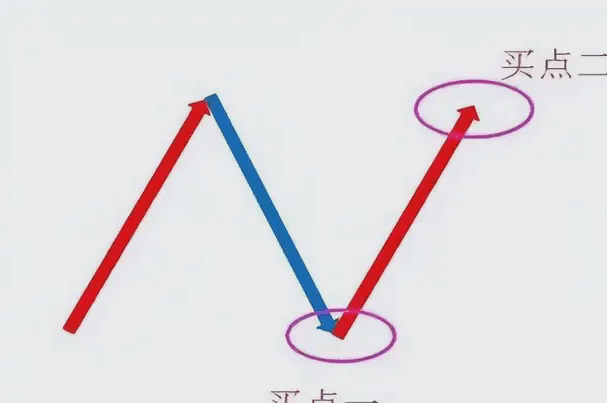 II. Key Points of the N-Shaped Trading Strategy:
1. The shorter the adjustment period, the better, indicating that the stock is already quite strong and there is a significant rush of funds to buy it.
Ideally, the adjustment should only last one day. The most extreme scenario is a limit-up, limit-down, and then limit-up again. This is the most ideal scenario, with virtually no risk, and it's a no-brainer to chase it.
Adjusting for 2 days is the next best option. Ideally, the adjustment period should be no more than 5 days. The longer the adjustment period, the less noticeable the effect.
2. The smaller the adjustment range, the better. It would be even better if the lowest point during the adjustment period did not fall below the lowest point of the previous limit-up.
3. Ideally, the price of the next limit-up should be higher than the previous limit-up, and even better if it exceeds the height of the adjustment period.
4. When selecting stocks, try to choose those whose 20-day and 60-day moving averages have started to rise, preferably those that are in a bullish alignment.
III. Stock Selection Criteria
1. The stock price must rise with double the trading volume!
2. During the stock price correction, the trading volume must be reduced by more than half!
3. When the stock price is rising, it hits the daily limit again, forming an "N" pattern!
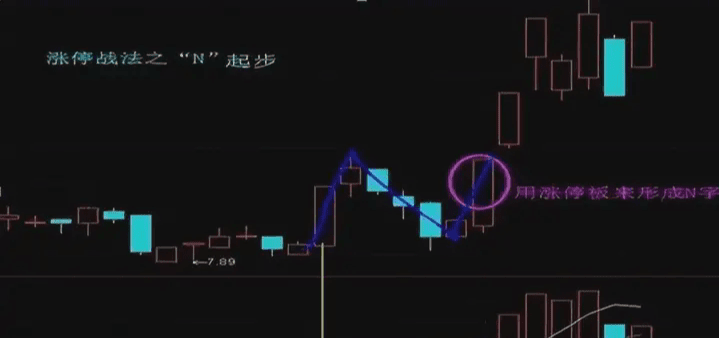 IV. The Formation Principle of N-Shaped Limit-Up Trends
The main force initially used the momentum to push up the first limit-up price, and then took advantage of profit-taking or a market correction to quickly cause a 1-3 day sell-off, returning to the starting position of the previous limit-up price, and then once again increased volume to push up the limit-up price.
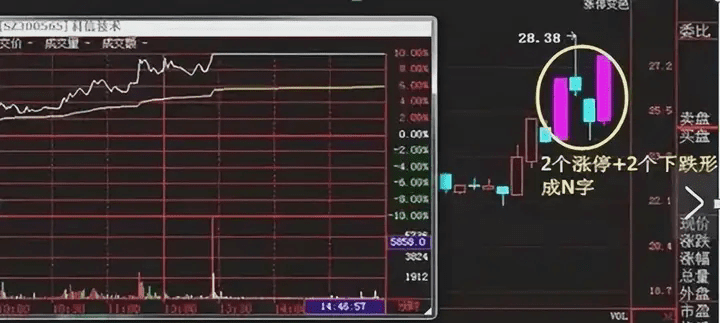 V. Key Points for Buying N-Shaped Limit-Up Stocks
The stronger the candlestick pattern, the greater its explosive potential; the subsequent pullback must be accompanied by decreasing volume. Small positive candlesticks or doji stars may appear during this pullback, but the trading volume must gradually shrink. Furthermore, the price should not fall below the opening price of the first positive candlestick; generally, a 2-3 day pullback is a good buying opportunity.
The final limit-up candle, symbolizing the end of the shakeout and the start of a new upward trend, requires a further increase in trading volume. In other words, the trading volume should also follow a three-step pattern of increased volume, decreased volume, and then increased volume again.
VI. Real-world Case Studies
Hanrui Cobalt Industry's N-shaped limit-up pattern
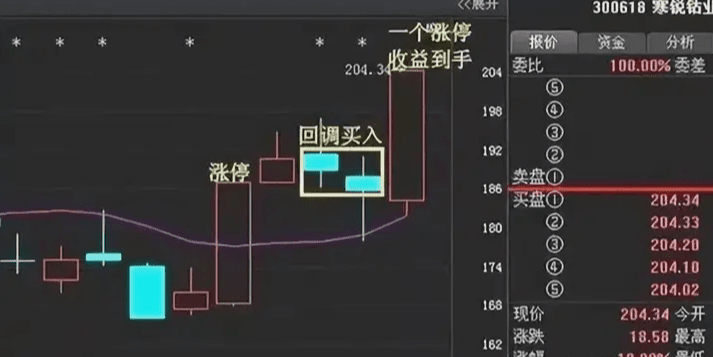 Looking at the chart above, Hanrui Cobalt Industry hit its daily limit on October 20th, then pulled back for two consecutive days, reaching the time limit mentioned in the trading strategy. After confirming the best entry point, it hit its daily limit again, easily capturing an N-shaped limit-up stock.
Hongte Precision's N-shaped limit-up pattern
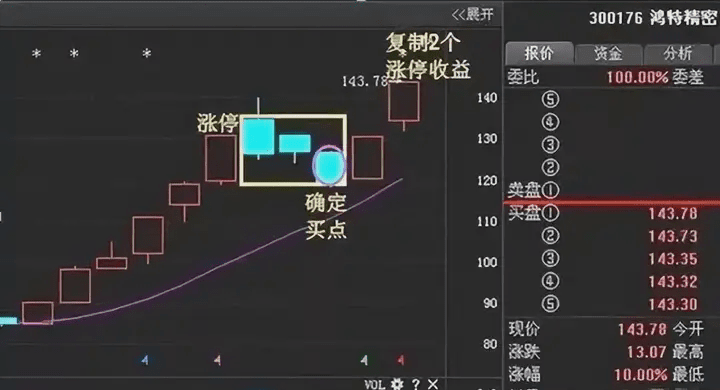 Looking at the chart above, Hongte Precision also shows an N-shaped limit-up pattern. After three consecutive days of pullback, the stock reached the pullback time limit mentioned in our strategy, which aligns with our stock selection method.
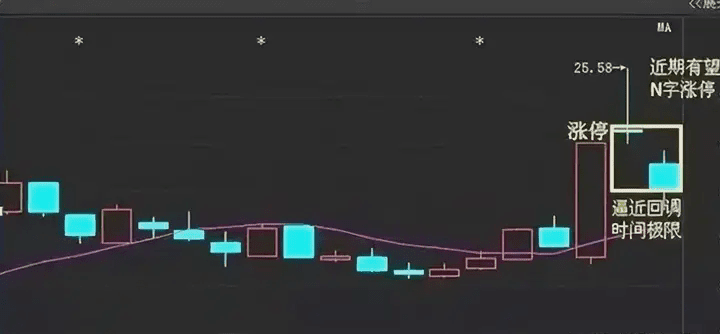 Many stock investors want to chase rising stocks and make large profits, but they can't seem to find the right method. They either buy at the peak and get trapped, or they buy at the right time but miss the selling point and get trapped again.
We all know that chasing rising stocks is characterized by high risk and high reward. If done well, it can bring the pleasure of immediate gains after purchase; conversely, it can lead to immediate losses. Therefore, we should all learn some techniques for chasing rising stocks to avoid losses.
Ten highly successful short-term trading techniques, each one essential. Short-term traders must read this; understanding it can save you five years of wasted time. It's all practical information, so we recommend saving it!
1. Stock Selection Principles. The approach to short-term stock selection should follow this order: hot topics, themes, market sentiment, stock price increase, trading volume ratio, and finally, performance.
The core of short-term trading is to find opportunities in popular and strong stocks. Only by associating with strong stocks can you have the opportunity to make quick profits in the short term. Completely abandon unpopular stocks with trends. First, look at the current popular concept sectors, and then select stocks with an increase of more than 7%. These are stocks that the main players have already selected for you. Stand on the shoulders of giants to see the world. Don't be afraid of the clouds obscuring your vision. Follow the hot funds and the trend track is king.
2. Trading cycle. Short-term holdings should be limited to 3 to 5 days, with a profit target of 8% to 15% and a stop-loss of 5%. If the market consolidates for 3 trading days, sell decisively. The essence of short-term trading lies in its brevity. Time is the greatest opportunity cost of capital. You must be as fast, accurate, and ruthless as if you were waging guerrilla warfare, and you must not linger in the market.
3. Trend is King. Don't refrain from buying because the price is high, nor buy because the price is low. Uptrends are more common, and there's no bottom to be found in a downtrend. Never let the price level determine your buying or selling direction; this is a psychological barrier that you must overcome. Those who fear high prices are destined for misfortune!
4. Position Management. Maintain a base position of 20% to 30%. If the market moves in the same direction, gradually increase your position, with each increase representing a smaller percentage. The position size should resemble a pyramid, with a larger portion at the bottom and a smaller portion at the top. This will ensure that your average holding price is lower than the market price. Your trading strategy determines your mindset.
5. Moving Average Indicators. The 5-day moving average, also known as the attack line, is the most sensitive indicator to stock prices and is the core trading indicator for short-term trading. The best time to buy is when the stock price falls back but does not break below the 5-day moving average. The 10-day moving average is the main force's operating line, or it can be said to be the main force's cost line. Stocks that the main force is pushing up are generally not allowed to fall below this line. If it falls below, it indicates a large divergence between buyers and sellers, and it can be used as a stop-loss line for selling.
6. Volume Ratio. The volume ratio is an indicator that measures relative trading volume. It refers to the ratio of the average trading volume per minute after the stock market opens to the average trading volume per minute over the past 5 trading days. A ratio less than 0.5 indicates significant volume contraction. If a new high can be reached with low volume, it indicates that the main players have a high degree of control over the market, and it can rule out the possibility of the main players distributing their shares. If this is happening in an upward trend, the probability of further price increases is extremely high.
When a stock hits its daily limit and the volume ratio is less than 1, it indicates that there is still considerable room for further gains. If the volume ratio is greater than 1.5, and the stock pulls back with reduced volume after breaking through a certain important resistance level, it is a good time to buy. This is the essence of the limit-up trading strategy.
7. Control drawdowns. For most traders, missing out on a rally is a hundred times worse than being trapped in a losing position. Trying to seize every opportunity is futile; the market is always there, and opportunities are available every day. When you make a big profit, it's easy to become overconfident, but pride comes before a fall. Unless you have a particularly promising opportunity, it's advisable to rest for a day or two, secure your profits, and take profits. Even major players are human; policies aim for balanced development, so current market trends involve constant sector rotation. Stability is paramount!
8. Practice what you preach. As a mature trader, do not try to innovate or seek exceptions. Do not try to surpass the trading system or overturn the trading rules. Instead, routinely follow the buy and sell signals issued by the trading system and skillfully handle each trade. This is the experience and lesson I have accumulated from many failures, each corresponding to one or more painful experiences. There is no trading system with a perfect win rate, only perfect execution!
9. Insist on reviewing past trades. Many retail investors don't know how to review their trades, and they don't even understand how they made or lost money. Such a trading approach will not lead to long-term success. I'll share my method with you, which I've consistently adhered to for ten years.
First, keep a detailed market record. Take out all your trading orders and write down every detail of each losing trade, including the trade date, trade code, opening price, closing price, reason for the trade, precautions, etc. Study and analyze each failed decision, and identify the same mistakes that were repeated many times. Then, summarize the mistakes, such as entering the market too early, being too nervous, holding for too long, or having too large a position size.
10: Enlightenment and Mind Cultivation. Almost all the big players in the speculative investment world have experienced the abyss, halved losses, and even hiding in debt before they achieved enlightenment. You must fall into a trough you have never experienced before in order to conquer a peak you have never reached. Water at its end is a beautiful sight, and people at their lowest point can find a way out. Let us all strive for this!
The above content is for learning and communication purposes only and does not constitute investment advice or the basis for investment decisions. Investing in the stock market involves risks; please invest cautiously!
Thank you for reading. I'm Xiaofei, and it's nice to meet you all. Xiaofei focuses on Ethereum futures spot trading. There are still spots available in my team, so get on board quickly and I'll help you become a market maker and a winner. #加密市场观察 #美SEC推动加密创新监管 $ETH$BTC


