

The probability derived from real money is becoming a new window to insight into the truth of the world.
In the world of cryptocurrency, a prediction market platform called Polymarket is causing a stir. This decentralized prediction market built on blockchain set a historical record in October 2025 with a weekly nominal transaction volume exceeding $3 billion, becoming an important source for institutional investors, media, and even government departments to obtain event probabilities.
Starting in 2020 from a temporary bathroom office, Polymarket's rise to become the most promising 'real-world application' in the cryptocurrency space not only reflects the explosive growth of prediction markets but also reveals the possibility of humans seeking truth in an entirely new way.
 1. Prediction Markets: A New Opportunity in the Cryptocurrency Field
● Prediction markets, in short, are platforms that allow users to bet on future events using cryptocurrencies. Participants can trade tokens related to the outcomes of real-world events, with token prices directly reflecting the probability of those events occurring.
● This concept is not a new phenomenon. The modern model of prediction markets originated from the Iowa Electronic Markets in 1988, which first proposed the idea that "price equals probability." During the 1988 U.S. presidential election, IEM achieved accurate predictions under small-scale operations, with subsequent research showing its election prediction accuracy was above 74% compared to polls from 1988 to 2004.
● The involvement of cryptocurrencies has revitalized this field. Achieving trustless settlement through blockchain smart contracts, prediction markets have significantly enhanced censorship resistance and lowered compliance operational thresholds.
 2. Market Explosion: Growth Trajectory Revealed by Data
In 2025, prediction markets experienced a structural explosion. The market shifted from single-event driven to continuous financial trading activities, with both funding depth and user base reaching historic highs.
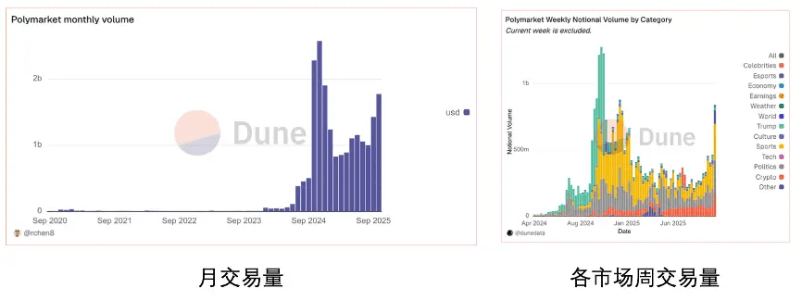
● In terms of trading volume, the market experienced two significant peaks. The first was driven by the U.S. elections in October-November 2024, with weekly trading volumes approaching $2 billion. The second explosion began in July 2025 and reached an all-time high in October 2025, with weekly trading volumes exceeding $2.5 billion, surpassing the peaks during the elections.
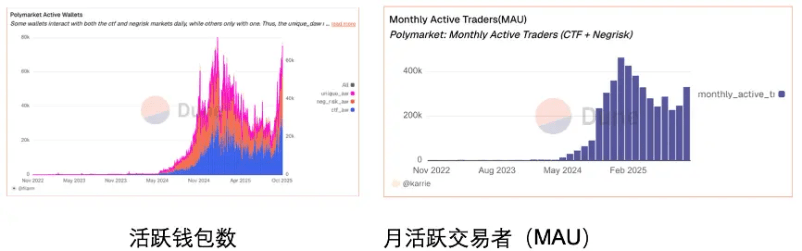
● User growth is equally astounding. In October 2025, the total number of weekly active users in the market surpassed 225,000, indicating that new users are continuously and genuinely pouring in. Polymarket's monthly active traders peaked at 450,000 in January 2025 and maintained over 260,000 active users even after the election heat subsided.
● Funding depth indicates that the market has moved away from mere short-term speculation. During the 2024 elections, the total open contracts in the market reached a peak of nearly $800 million, and entering the second half of 2025, the total open contracts in the market have steadily rebounded and stabilized in the range of $500 million to $600 million.
3. The Pattern Evolution of Polymarket and Kalshi
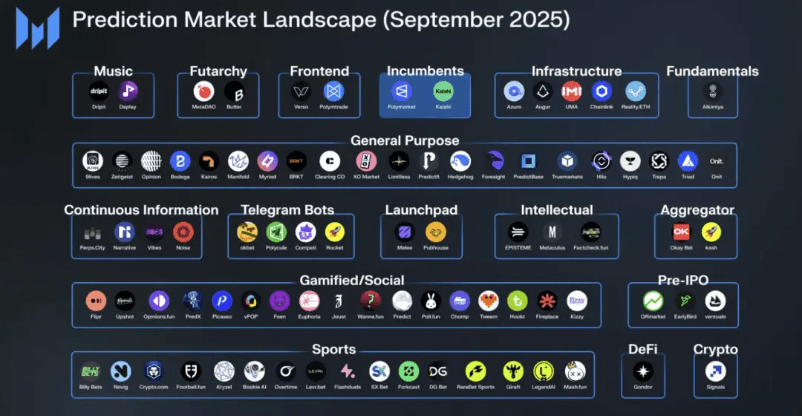
Prediction markets are displaying a duopoly competitive landscape between Polymarket and Kalshi.
● Polymarket, as the leader in decentralized prediction markets, displays strong "event explosiveness." Its historical cumulative trading volume has exceeded $18.1 billion, with monthly peaks occurring during the November 2024 elections, reaching $2.63 billion, growing about 1000 times compared to early data in December 2020.
1. During the peak of the 2024 election, "political/economic" transactions accounted for over 60%, with weekly transaction volumes once exceeding $1 billion.
2. By 2025, the trading focus gradually shifted towards "sports" and "crypto assets," with Super Bowl-related contract trading volume around $1.1 billion, and Bitcoin prediction markets exceeding $15.5 million.
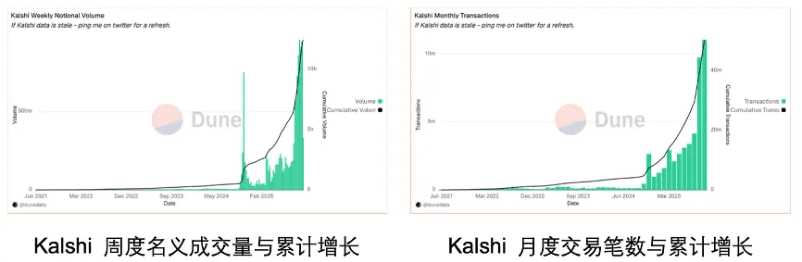
● Kalshi demonstrated the strongest growth momentum in 2025. As of October 2025, its weekly transaction volume accounted for 55%-60% of the entire market, officially replacing Polymarket as the most liquid prediction market platform.
Kalshi, leveraging compliance advantages, has opened up Web2 channels, with cumulative transaction volumes exceeding $10 billion and cumulative transaction counts surpassing 40 million.
 4. The Underlying Logic of Prediction Markets
Prediction markets have a natural symbiotic relationship with cryptocurrencies. The vast majority of prediction platforms, including Polymarket, use USD stablecoins as the settlement method, providing users with a seamless deposit and withdrawal experience.
● Cryptocurrency culture has deeply integrated into the operation mechanism of prediction markets. In 2025, with the introduction of token incentive models, prediction markets experienced a surge of "liquidity mining." Users can not only find price discrepancies and arbitrage but also conveniently earn token incentives, a model reminiscent of the early days of Hyperliquid.
● Machine learning teams have become important participants in prediction markets. Teams like Sportstensor, Synth, Sire, and Billy are heavily investing in prediction markets to refine their signals and models.
Synth takes the route of a prediction market version of a "high-frequency hedge fund," predicting the prices of crypto assets for 1 hour and 24 hours and placing bets in the prediction market, growing from $3,000 to $15,000 in one month, achieving a return of 500%.
● Prediction markets essentially repackage options into a more popular, participatory, and profitable product. Compared to understanding a bunch of Greek letters and complex terminology, users only need to buy Yes or No shares, greatly lowering the participation threshold.
5. From the Crypto Circle to the Mainstream World
Prediction markets are realizing a leap from the crypto circle to the mainstream world, unfolding through multiple dimensions:
● Political predictions demonstrate the accuracy of prediction markets. During the 2024 U.S. election, Polymarket set Trump's winning probability at 99% at 1:30 AM Eastern Time, while Fox News did not announce the result until 1:47 AM, and other media delayed even longer.
● Macroeconomic predictions have become a focal point for institutions. In 2025, the market on Polymarket regarding the Federal Reserve's interest rate decision saw a trading volume exceeding $50 million, with users hedging risks by betting on the probability of "raising rates by 25 basis points."
● Entertainment and sports have garnered nationwide attention. In 2025, the prediction market on Kalshi regarding Taylor Swift and Travis Kelce's engagement saw a trader buy a contract for $0.37, eventually profiting $50,000, triggering extensive media coverage and driving user influx from the entertainment industry.
6. The Dual Game of Regulation and Technology
The development of prediction markets still faces multiple challenges, with regulation being the primary obstacle. Prediction markets exist in the gray area between gambling and financial derivatives. In September 2025, the U.S. CFTC approved Polymarket's return to the U.S. market, but Commissioner Kristin Johnson warned of insufficient regulatory safeguards and a lack of visibility into the market.
● Liquidity shortfalls are also a limiting factor. Most prediction market liquidity pools are concentrated on a few popular events, with the long-tail markets lacking liquidity, leading to prices lacking reference significance. A 2025 report indicated that low liquidity resulted in unmet large hedging demands, impacting accuracy.
● Nevertheless, the future of prediction markets is still full of potential. With upgrades in technological experience, the participation threshold for prediction markets is continuously lowering through forms like AMM + NFTization and lightweight entrances. Polymarket's mobile optimization in 2025 drove a 20% increase in user growth.
● Even more exciting is that prediction markets may deeply integrate with DeFi and AI, ushering in a "dynamic DeFi era." New DeFi protocols can automatically leverage or deleverage based on the predicted prices of underlying assets, automatically rebalancing LP positions, all driven by AI and machine learning.
The parent company of the New York Stock Exchange, ICE, plans to invest approximately $2 billion in the decentralized platform Polymarket, a move seen as a recognition of the Web3 model by top financial infrastructure. When people bet real money on their beliefs, the market will become the place closest to the truth.
Join our community to discuss and become stronger together!
Official Telegram community: https://t.me/aicoincn
AiCoin Chinese Twitter: https://x.com/AiCoinzh
OKX福利群:https://aicoin.com/link/chat?cid=l61eM4owQ
Binance福利群:https://aicoin.com/link/chat?cid=ynr7d1P6Z
