
#fbi
fbi
419,962 views
621 Discussing
Hot
Latest
🛡️ FBI NCIC Breach: What We Know and What We Don't #Cybersecurity
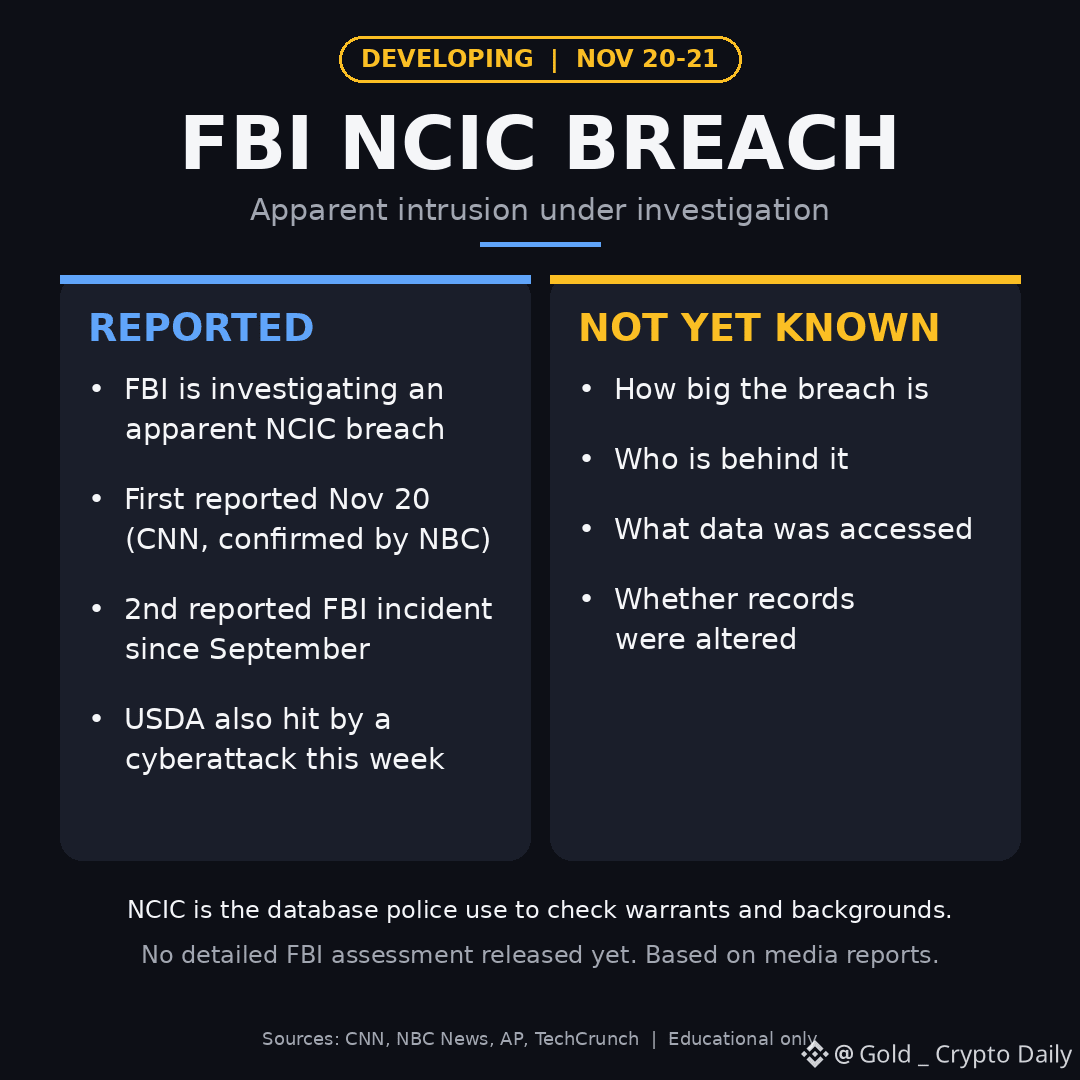
📰 What's reported: CNN first reported on Nov 20 that the FBI is investigating an apparent breach of its National Crime Information Center (NCIC), citing two people briefed on the matter. NBC News said it confirmed the investigation through its own sources. (NBC News)
🗂️ Why NCIC matters: it's the database federal and local law enforcement use to share information about warrants, background checks and more. A former FBI official told CNN the concern is not only whether hackers saw sensitive data, but whether they could compromise the accuracy of the information officers rely on. (TechCrunch) (TechCrunch)
🔁 Context: it's reportedly the second FBI cybersecurity breach since September, when the group ShinyHunters targeted employee data from an FBI jobs website. The USDA also faced its own cyberattack this week. (abc) (NBC News)
❓ Not yet known:
• How large the breach is
• Who is behind it
• What data was accessed
• Whether any records were altered
🗣️ Reaction: President Trump said the reported hack is "not good." (TechCrunch)
📌 No detailed FBI assessment has been released yet, so treat details as unconfirmed. I found no evidence linking this to this week's market moves.
🗳️ What worries you most about breaches like this?
A) Stolen personal data
B) Altered or corrupted records
C) Repeat attacks on agencies
Drop a letter 👇
#FBI #CyberSecurity #databreach #BinanceSquare
1
18

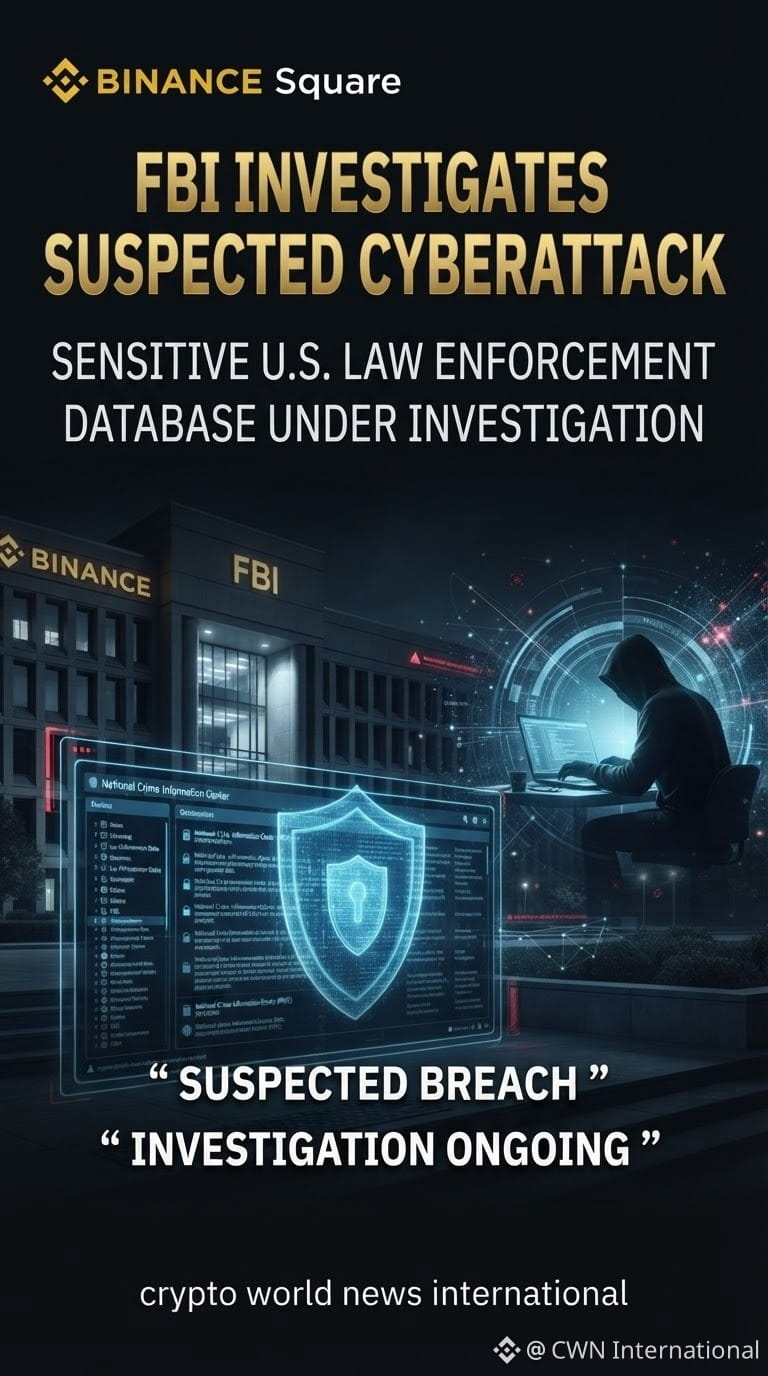
Headline: FBI Investigates Suspected Cyberattack on Sensitive National Crime Database
Summary:
The FBI is investigating a suspected cyber intrusion involving its National Crime Information Center (NCIC), a critical database used by law enforcement agencies across the United States. The incident raises serious questions about the security of sensitive government information.
Key Points:
- The suspected breach reportedly targeted the FBI's National Crime Information Center (NCIC).
- NCIC connects federal, state and local law enforcement agencies.
- The database contains information related to arrest warrants, criminal histories and background checks.
- The FBI reportedly discovered the suspected intrusion in recent days.
- Investigators have not publicly identified the attackers.
- It remains unclear whether sensitive information was stolen, copied or modified.
- This follows a separate September 2026 cyberattack involving the FBI's recruitment website, which exposed employee-related information.
Market Insight:
The suspected incident highlights the growing cybersecurity risks facing critical government infrastructure.
A breach involving a national law enforcement database could have serious implications for data protection, public safety and institutional trust.
However, the FBI has not publicly confirmed the full extent of the incident. The investigation remains ongoing.
#FBI #CyberSecurity #cyberattack #DataBreach #GovernmentSecurity $BTC $ZEC $BNB
{future}(BNBUSDT)
{future}(ZECUSDT)
{future}(BTCUSDT)
Headline: FBI Investigates Suspected Cyberattack on Sensitive National Crime Database
Summary:
The FBI is investigating a suspected cyber intrusion involving its National Crime Information Center (NCIC), a critical database used by law enforcement agencies across the United States. The incident raises serious questions about the security of sensitive government information.
Key Points:
- The suspected breach reportedly targeted the FBI's National Crime Information Center (NCIC).
- NCIC connects federal, state and local law enforcement agencies.
- The database contains information related to arrest warrants, criminal histories and background checks.
- The FBI reportedly discovered the suspected intrusion in recent days.
- Investigators have not publicly identified the attackers.
- It remains unclear whether sensitive information was stolen, copied or modified.
- This follows a separate September 2026 cyberattack involving the FBI's recruitment website, which exposed employee-related information.
Market Insight:
The suspected incident highlights the growing cybersecurity risks facing critical government infrastructure.
A breach involving a national law enforcement database could have serious implications for data protection, public safety and institutional trust.
However, the FBI has not publicly confirmed the full extent of the incident. The investigation remains ongoing.
#FBI #CyberSecurity #cyberattack #DataBreach #GovernmentSecurity $BTC $ZEC $BNB
262

·
--
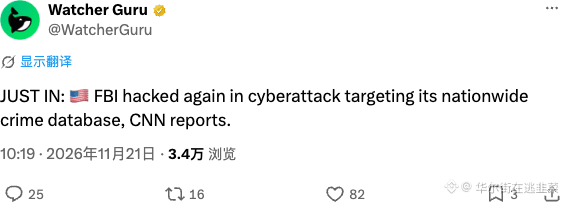
The FBI has been hit again in the U.S.—this time, its national crime database was compromised.
What’s the difference between the feds’ cybersecurity and leaving your Bitcoin private keys lying around? Hilarious. If even law enforcement can’t protect itself these days, what hope is there for protecting users’ assets?
#FBI #Cybersecurity #Crypto
What’s the difference between the feds’ cybersecurity and leaving your Bitcoin private keys lying around? Hilarious. If even law enforcement can’t protect itself these days, what hope is there for protecting users’ assets?
#FBI #Cybersecurity #Crypto
70
·
--
Bearish
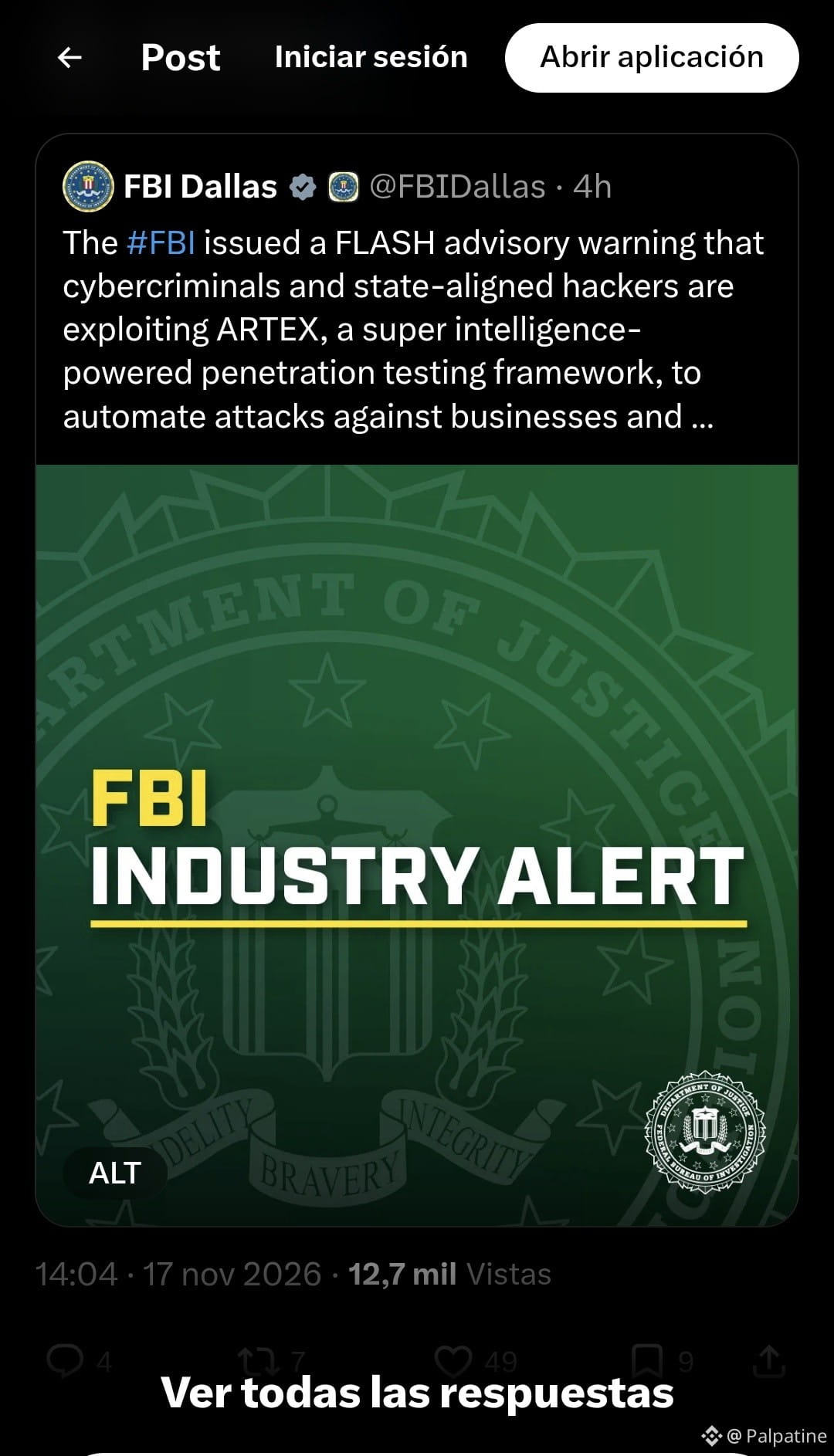
🚨🇺🇸 THE UNITED STATES UNDER DIGITAL ATTACK!
✈️ Air traffic disruptions.
🏦 Banking problems.
🌐 178 websites affected by malicious code.
💥 AND NOW THE FBI IS SOUNDING THE ALARM.
The agency confirmed that hackers and state-linked groups are using artificial intelligence to automate cyberattacks.
⚠️ Coincidences, or are we seeing just the tip of the iceberg?
No connection has been confirmed between all the incidents.
{future}(BTCUSDT)
{spot}(MSFTBUSDT)
{spot}(NVDABUSDT)
#FBI #crypto
🚨🇺🇸 THE UNITED STATES UNDER DIGITAL ATTACK!
✈️ Air traffic disruptions.
🏦 Banking problems.
🌐 178 websites affected by malicious code.
💥 AND NOW THE FBI IS SOUNDING THE ALARM.
The agency confirmed that hackers and state-linked groups are using artificial intelligence to automate cyberattacks.
⚠️ Coincidences, or are we seeing just the tip of the iceberg?
No connection has been confirmed between all the incidents.
#FBI #crypto
Vinhtocdo:
Càng khiến thị trường thêm nóng?
1
108

Verified
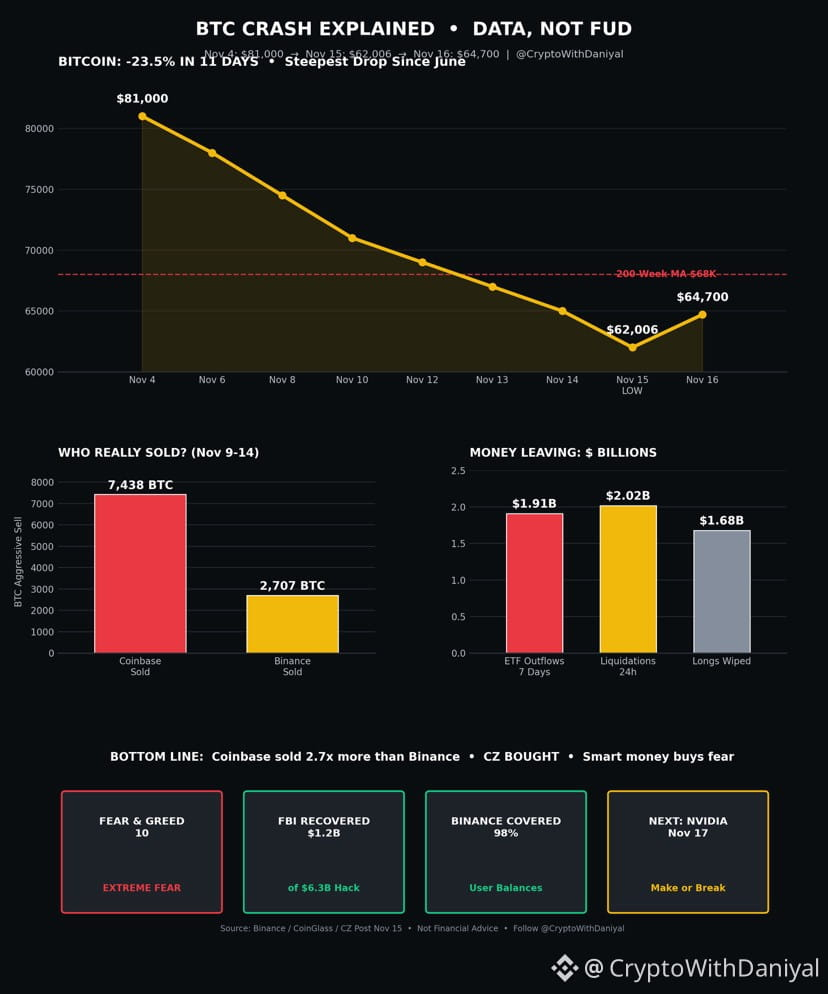
BREAKING: FBI SEIZED $1.2B STOLEN FROM BINANCE 🚨
US Govt just seized $1.2B crypto stolen in Binance $6.3B hack.
Nearly HALF of stolen funds now FROZEN.
Binance already replenished 98% of user balances from own funds.
Withdrawals reopened for 87 networks. All networks back by end of next week.
So let me ask:
If Binance covered 98% + FBI recovered $1.2B...
Why is $BTC still down -13% this week?
Because $ETFT.ETF sold $1.91B. NOT Binance.
Don't fall for FUD. Follow DATA.
Is Binance SAFE now? YES or NO? 👇
Follow @rdanny993
#Binance #BTC #FBI
BREAKING: FBI SEIZED $1.2B STOLEN FROM BINANCE 🚨
US Govt just seized $1.2B crypto stolen in Binance $6.3B hack.
Nearly HALF of stolen funds now FROZEN.
Binance already replenished 98% of user balances from own funds.
Withdrawals reopened for 87 networks. All networks back by end of next week.
So let me ask:
If Binance covered 98% + FBI recovered $1.2B...
Why is $BTC still down -13% this week?
Because $ETFT.ETF sold $1.91B. NOT Binance.
Don't fall for FUD. Follow DATA.
Is Binance SAFE now? YES or NO? 👇
Follow @CryptoWithDaniyal
#Binance #BTC #FBI
8
11
693

·
--
🔐 A Major Development in the $6.3 Billion Binance Crypto Theft!
The FBI announced that US authorities have seized or obtained court authorisation to restrain more than $1.2 billion in cryptocurrency linked to the massive theft.
Authorities and private-sector partners have now frozen more than $2.7 billion in total.
But there's an important distinction: frozen assets are not automatically returned to victims. Legal proceedings are still necessary.
This incident highlights why exchange security, blockchain monitoring and international cooperation matter so much.
Crypto offers exciting opportunities, but security must remain a priority.
Do you think the crypto industry is prepared to handle attacks of this scale?
#Binance #CryptoSecurity #blockchain #CryptoNews #FBI
53

·
--
FBI Warns About “FaceStealer”: North Korean Hackers Use Fake Video Meetings and Victim Recordings to Steal Over $400 Million in Crypto Assets in 18 MonthsIf someone you know invites you to a Zoom call on Telegram or LinkedIn, and the person on screen really is them, but the audio suddenly “stops working” partway through the meeting and they ask you to click a link to fix it, stop immediately. On 11/12, the FBI issued a FLASH alert (number AC-111226-MS) exposing a social engineering scheme called “FaceStealer,” used by North Korean state-sponsored hackers. Over the past 18 months, it has stolen more than $400 million in crypto assets.
1. How does FaceStealer work? (According to the FBI and the U.S. Department of Justice)
Account takeover: Hackers first steal a previous victim’s genuine accounts on platforms such as Telegram, LinkedIn, Slack, and Discord, then use those accounts to invite the victim’s contacts to meetings.
FBI Warns About “FaceStealer”: North Korean Hackers Use Fake Video Meetings and Victim Recordings to Steal Over $400 Million in Crypto Assets in 18 Months
If someone you know invites you to a Zoom call on Telegram or LinkedIn, and the person on screen really is them, but the audio suddenly “stops working” partway through the meeting and they ask you to click a link to fix it, stop immediately. On 11/12, the FBI issued a FLASH alert (number AC-111226-MS) exposing a social engineering scheme called “FaceStealer,” used by North Korean state-sponsored hackers. Over the past 18 months, it has stolen more than $400 million in crypto assets.
1. How does FaceStealer work? (According to the FBI and the U.S. Department of Justice)
Account takeover: Hackers first steal a previous victim’s genuine accounts on platforms such as Telegram, LinkedIn, Slack, and Discord, then use those accounts to invite the victim’s contacts to meetings.
1. How does FaceStealer work? (According to the FBI and the U.S. Department of Justice)
Account takeover: Hackers first steal a previous victim’s genuine accounts on platforms such as Telegram, LinkedIn, Slack, and Discord, then use those accounts to invite the victim’s contacts to meetings.
1
351

·
--
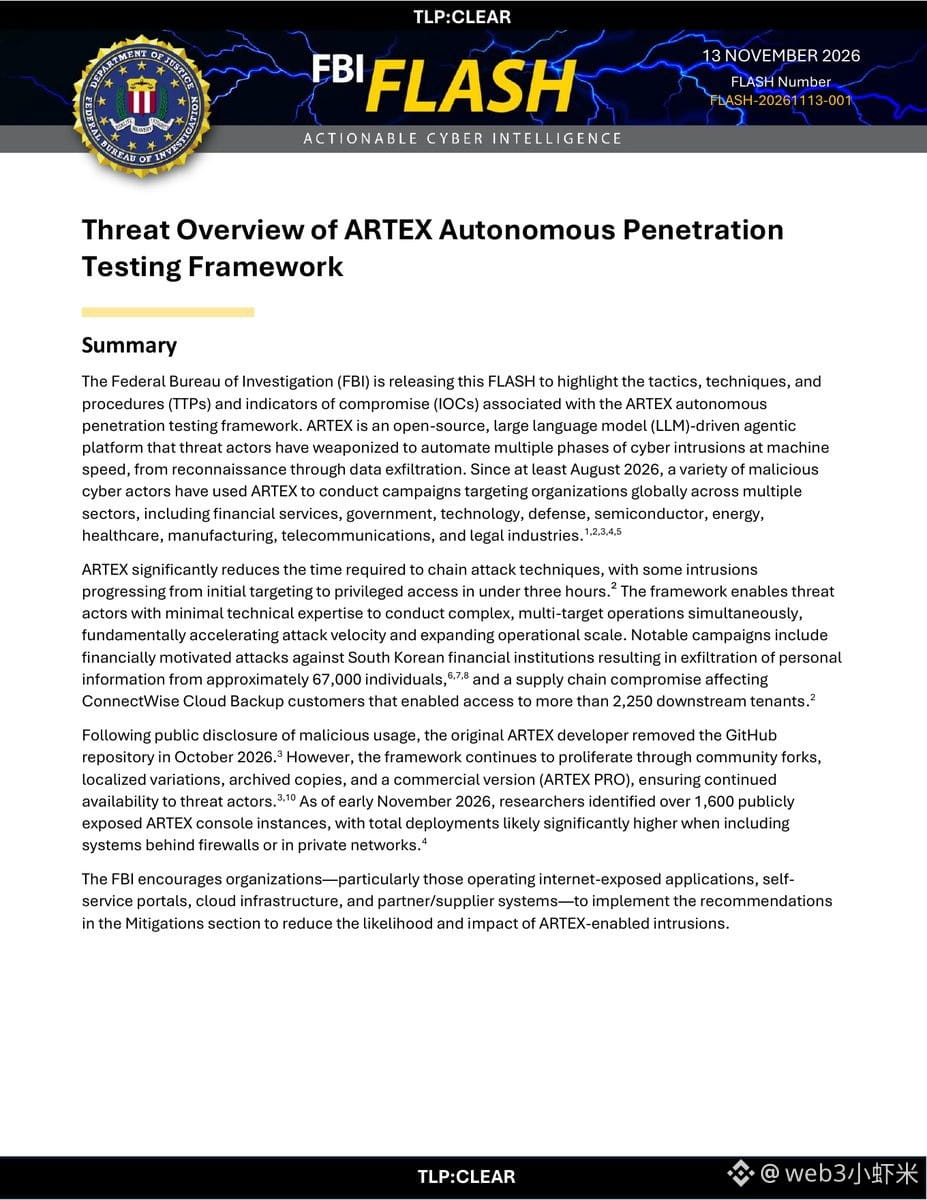
The FBI has just issued a FLASH alert dated November 13, numbered FLASH-20261113-001, specifically warning about an open-source automated penetration-testing framework called ARTEX.
According to the alert, the tool uses large language models to link together every stage of an attack, from reconnaissance to data theft. In some cases, attackers gained elevated privileges in less than three hours. Financial institutions in South Korea have already been hit, with personal information belonging to approximately 67,000 people stolen; a supply-chain incident involving ConnectWise Cloud Backup also affected more than 2,250 downstream tenants.
The original developer took down the GitHub repository in October this year, but the alert says community forks, archived copies, and the commercial ARTEX PRO edition are still circulating. As of early November, more than 1,600 publicly exposed control panels had been identified. The FBI recommends that organizations focus on the exposure of externally facing portals, self-service platforms, cloud systems, and supply-chain-related systems.
#FBI #网络安全 $AI
193

·
--
FBI Smashes North Korea's $400M FaceStealer Crypto Scam
The FBI and DOJ have disrupted FaceStealer, a North Korean scheme that stole over $400M in crypto through fake video-call job interviews. Attackers used AI deepfakes and compromised Telegram, LinkedIn and Discord accounts to lure victims, then drained wallets with malware. Agents seized the operation's cloud servers and recovered 900+ webcam recordings. Separately, courts approved seizing $1.2B tied to the $6.3B Binance hack — over $2.7B now frozen. Never join a video call from a stranger offering a crypto job.
Not financial advice.
#FBI #NorthKorea #CryptoScam #Binance #CryptoSecurity
28

BREAKING: FBI TARGETS $1.2 BILLION IN CRYPTO LINKED TO BINANCE THEFT!
US authorities are taking action against cryptocurrency allegedly stolen in the massive $6.3 billion Binance-related hack attributed to North Korean hackers.
💰 Key details:
🔹 $1.2 billion in crypto targeted.
🔹 Funds linked to the Binance theft.
🔹 US authorities pursuing recovery and forfeiture efforts.
⚠️ This is a major development for crypto security and the fight against cybercrime.
🔗 FULL STORY — LINK IN BIO!
#FBI #Binance #Bitcoin #CryptoNews
50

·
--

Article
That familiar face on your video call might be there to steal your cryptoThat familiar face on your video call might be there to steal your crypto
On November 12, the U.S. Department of Justice and the FBI released two announcements on the same day. A court has approved the seizure or restriction of more than $1.2 billion in cryptocurrency, part of the money hackers stole from Binance on October 29. The hackers stole about $6.3 billion in total that day, and the government and industry have since worked together to freeze more than $2.7 billion. Binance announced that same day that it had fully covered users’ losses using company funds and its protection fund.
The second story is more relevant to retail investors. The FBI took down a scam called FaceStealer, which stole more than $400 million over the past 18 months. The scammers first stole someone’s social media account and video call history, then used that identity to send meeting invitations to people the victim knew. The meetings took place on fake Zoom, Teams, or Meet pages, and the face on screen was either an old, stolen video or an AI-generated deepfake. Halfway through the call, a technical glitch would pop up. Click a link to fix it, and the computer would be infected with a Trojan. Sometimes the stolen crypto wouldn’t move for months, and in the longest cases, for over a year. The FBI seized more than 900 webcam recordings of victims in this operation.
That familiar face on your video call might be there to steal your crypto
That familiar face on your video call might be there to steal your crypto
On November 12, the U.S. Department of Justice and the FBI released two announcements on the same day. A court has approved the seizure or restriction of more than $1.2 billion in cryptocurrency, part of the money hackers stole from Binance on October 29. The hackers stole about $6.3 billion in total that day, and the government and industry have since worked together to freeze more than $2.7 billion. Binance announced that same day that it had fully covered users’ losses using company funds and its protection fund.
The second story is more relevant to retail investors. The FBI took down a scam called FaceStealer, which stole more than $400 million over the past 18 months. The scammers first stole someone’s social media account and video call history, then used that identity to send meeting invitations to people the victim knew. The meetings took place on fake Zoom, Teams, or Meet pages, and the face on screen was either an old, stolen video or an AI-generated deepfake. Halfway through the call, a technical glitch would pop up. Click a link to fix it, and the computer would be infected with a Trojan. Sometimes the stolen crypto wouldn’t move for months, and in the longest cases, for over a year. The FBI seized more than 900 webcam recordings of victims in this operation.
64

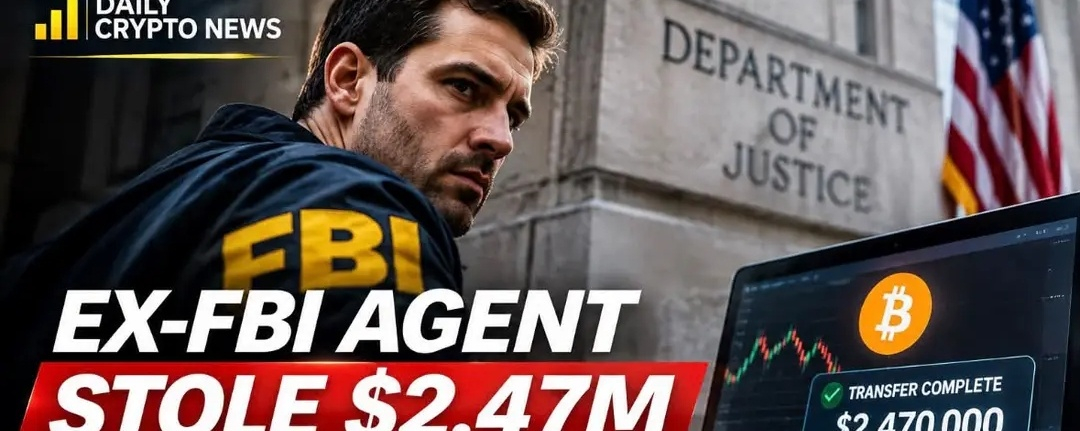
🚨 JUST IN: FBI'S CRYPTO HUNTER STOLE $2.47M IN CRYPTO. 👀
Patrick Yaroch hunted crypto criminals for the FBI — then became one.
He raided wallets from 35 investigations, laundered it via Monero and $SOL .
He blew it on debts and a Portugal vineyard ChatGPT picked.
Sentencing March 4. Up to 20 years per count.
$BTC — who watches the watchers? #FBI #CryptoCrime #ChatGPT
41

·
--
A former FBI counterintelligence agent has been accused of stealing nearly $2.5 million in cryptocurrency.
The case involves the former agent allegedly using the misappropriated funds to pay off debts and intending to finance a new life in Portugal. There, the person is said to have planned to buy a vineyard.
#FBI #Cryptocurrency
Source: Cointelegraph
The case involves the former agent allegedly using the misappropriated funds to pay off debts and intending to finance a new life in Portugal. There, the person is said to have planned to buy a vineyard.
#FBI #Cryptocurrency
Source: Cointelegraph
122


Article
FBI AGENT STOLE $2.47 MILLION IN CRYPTO. THEN PLANNED A NEW LIFE IN PORTUGAL!This sounds like the plot of a Hollywood crime movie.
Except it actually happened.
🇺🇸 Former FBI counterintelligence agent Patrick Steven Yaroch, 37, has pleaded guilty to wire fraud and money laundering after stealing approximately $2.47 MILLION in cryptocurrency.
And the details are extraordinary. 👇
🔐 HE USED ACCESS FROM FBI INVESTIGATIONS
According to the U.S. Department of Justice, Yaroch accessed cryptocurrency wallet credentials collected during federal investigations.
He then made approximately 100 unauthorized transfers involving credentials connected to 35 FBI investigations.
Some of the wallets belonged to criminal-investigation subjects, while others were connected to foreign adversaries and FBI operations.
💰 WHERE DID THE MONEY GO?
Prosecutors say he converted stolen cryptocurrency into other digital assets and moved funds through additional transactions to conceal their origin.
Some of the proceeds went toward paying debts, including credit cards and vehicle payments.
🍷 THEN CAME THE PORTUGAL PLAN
Here’s the part you couldn’t make up.
According to the Justice Department, Yaroch asked ChatGPT about investment returns and where to settle in Europe.
After receiving a suggestion involving a vineyard in Portugal, he took steps toward establishing himself there.
But that retirement dream never materialized.
⚖️ WHAT HAPPENS NEXT?
Yaroch has pleaded guilty and is scheduled for sentencing on March 4, 2027.
He faces up to 20 years in prison.
The case also raises serious questions about how sensitive cryptocurrency credentials are protected inside law-enforcement systems.
💬 THE BIG QUESTION:
If federal investigators obtain access to someone’s crypto wallet during an investigation, who should be responsible for safeguarding those assets?
Should access require approval from multiple independent officials, with every transaction publicly auditable?
👇 Share your thoughts in the comments.
Follow for independently researched cryptocurrency news, security stories, and financial developments.
$BTC
#CryptoNews #FBI #CryptoSecurityIncidents #cryptocurrency #blockchain
FBI AGENT STOLE $2.47 MILLION IN CRYPTO. THEN PLANNED A NEW LIFE IN PORTUGAL!
This sounds like the plot of a Hollywood crime movie.
Except it actually happened.
🇺🇸 Former FBI counterintelligence agent Patrick Steven Yaroch, 37, has pleaded guilty to wire fraud and money laundering after stealing approximately $2.47 MILLION in cryptocurrency.
And the details are extraordinary. 👇
🔐 HE USED ACCESS FROM FBI INVESTIGATIONS
According to the U.S. Department of Justice, Yaroch accessed cryptocurrency wallet credentials collected during federal investigations.
He then made approximately 100 unauthorized transfers involving credentials connected to 35 FBI investigations.
Some of the wallets belonged to criminal-investigation subjects, while others were connected to foreign adversaries and FBI operations.
💰 WHERE DID THE MONEY GO?
Prosecutors say he converted stolen cryptocurrency into other digital assets and moved funds through additional transactions to conceal their origin.
Some of the proceeds went toward paying debts, including credit cards and vehicle payments.
🍷 THEN CAME THE PORTUGAL PLAN
Here’s the part you couldn’t make up.
According to the Justice Department, Yaroch asked ChatGPT about investment returns and where to settle in Europe.
After receiving a suggestion involving a vineyard in Portugal, he took steps toward establishing himself there.
But that retirement dream never materialized.
⚖️ WHAT HAPPENS NEXT?
Yaroch has pleaded guilty and is scheduled for sentencing on March 4, 2027.
He faces up to 20 years in prison.
The case also raises serious questions about how sensitive cryptocurrency credentials are protected inside law-enforcement systems.
💬 THE BIG QUESTION:
If federal investigators obtain access to someone’s crypto wallet during an investigation, who should be responsible for safeguarding those assets?
Should access require approval from multiple independent officials, with every transaction publicly auditable?
👇 Share your thoughts in the comments.
Follow for independently researched cryptocurrency news, security stories, and financial developments.
$BTC
#CryptoNews #FBI #CryptoSecurityIncidents #cryptocurrency #blockchain
2
605

·
--
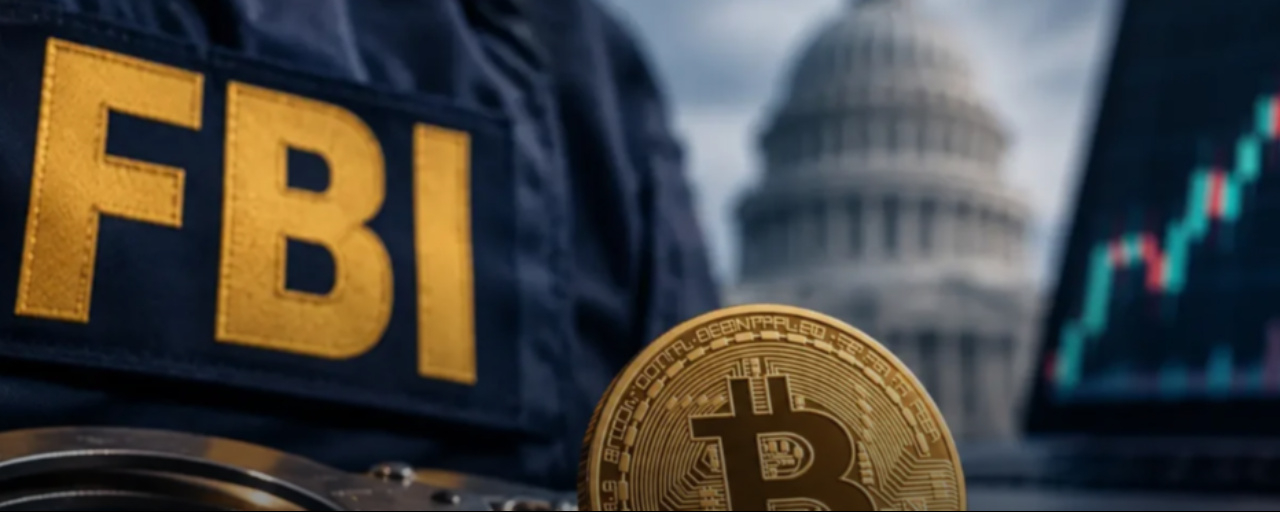
Article
Former FBI Agent Admits to $2.47 Million Crypto Theft📊 What exactly happened?
Defendant: Patrick Stephen Yarok (37), a former Federal Bureau of Investigation (FBI) agent.
Plea: He pleaded guilty to wire fraud and money laundering charges.
Amount stolen: $2,474,380.66 (approximately $2.47 million).
How the theft happened: He abused his position in the counterintelligence division to access the credentials for crypto wallets the FBI had collected during its investigations. He made around 100 fraudulent transfers linked to 35 different investigations.
Former FBI Agent Admits to $2.47 Million Crypto Theft
📊 What exactly happened?
Defendant: Patrick Stephen Yarok (37), a former Federal Bureau of Investigation (FBI) agent.
Plea: He pleaded guilty to wire fraud and money laundering charges.
Amount stolen: $2,474,380.66 (approximately $2.47 million).
How the theft happened: He abused his position in the counterintelligence division to access the credentials for crypto wallets the FBI had collected during its investigations. He made around 100 fraudulent transfers linked to 35 different investigations.
5
5k

·
--
$2.47 million
Around Nov. 5, former FBI agent Patrick Steven Yaroch pleaded guilty to wire fraud and money laundering in the U.S. District Court for the Eastern District of Virginia. Using wallet credentials in the Bureau’s systems linked to 35 cases, he completed about 100 transfers. Court documents put the total at $2,474,380.66.
The wallets from which funds were transferred included those belonging to other investigation subjects, addresses held by an adversarial nation-state actor, and at least one wallet the FBI had opened for an operation.
Earlier, around August, the public estimate was about $1 million and roughly 10 transfers. The figures in this guilty plea are higher.
He faces up to 20 years in prison. Sentencing is scheduled for 2027-03-04.
A guilty plea ≠ a sentence already imposed; the amount documented ≠ all related assets already recovered.
#FBI #监管合规 $BTC

46

·
--
Former FBI agent pleads guilty: Stole crypto using private keys obtained during investigations—about $2.47 million?
Can you believe this story? Someone tasked with monitoring “hostile nations” turned around and used private keys from case files to transfer funds to himself.
On November 5, the U.S. Attorney’s Office for the Eastern District of Virginia announced that a former FBI agent had pleaded guilty to wire fraud and money laundering.
A few details from the official announcement:
1. He had access to cryptocurrency credentials collected during investigations in FBI systems.
2. He used credentials from 35 separate investigations to make about 100 transfers, illegally gaining approximately $2.474 million.
3. The victims included investigation targets, hostile nation-state actors, and at least one wallet the FBI had specifically created for an operation.
4. He converted the stolen crypto into other currencies, then moved it repeatedly to conceal its origins. Some of it went toward credit card and car loan payments.
5. The announcement also said he had asked ChatGPT where in the EU would be a good place to live. He later hired a Portuguese lawyer to obtain a tax identification number and planned to move to Portugal in September.
Note: This is a guilty plea, not a sentence. Sentencing is scheduled for March 4, 2027, and he could face up to 20 years in prison.
Here’s the painful truth: private keys don’t care who you are; they only care who holds them. The same goes for seized crypto: whoever can see the seed phrase can transfer it. The same principle applies to ordinary people: keep your seed phrase and private keys to yourself, and be extra cautious of anyone who offers to “keep them safe” or “help you recover” them.
#FBI #加密犯罪 #PrivateKeySecurity

6

·
--
【Even FBI Agents Steal Crypto! Agent Rifled Through 35 Case Files and Stole About $2.47 Million】
Former FBI agent Patrick Yaroch pleaded guilty on November 5: using wallet credentials found in the agency’s investigative case files, he made about 100 transfers totaling roughly $2.47 million in cryptocurrency across 35 cases. He used the stolen funds to pay off debts and even asked ChatGPT how to buy a vineyard in Portugal. He faces up to 20 years in prison and is scheduled to be sentenced on March 4, 2027.
#FBI #加密盗窃 #Money laundering
71
·
--
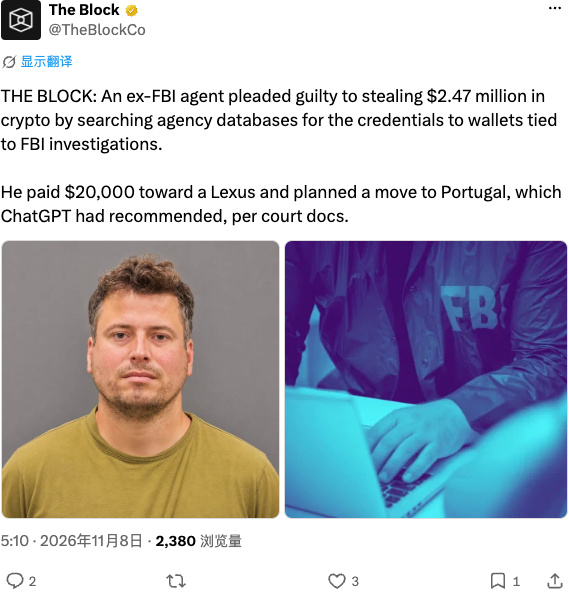
An FBI agent raided a database and stole $2.47 million, then actually trusted ChatGPT’s recommendation to go to Portugal. This plot is even more surreal than a movie.
Wanted to become an elite returning from abroad, ended up a fugitive instead. Looks like AI’s getting blamed for the opposite this time. No matter how advanced the tech is, if you don’t use your head, you’re just setting yourself up to fail.
#Crypto #FBI #Scam #ChatGPT
Wanted to become an elite returning from abroad, ended up a fugitive instead. Looks like AI’s getting blamed for the opposite this time. No matter how advanced the tech is, if you don’t use your head, you’re just setting yourself up to fail.
#Crypto #FBI #Scam #ChatGPT
19

Former FBI agent swipes nearly $2.5 million in crypto? Sounds like a Hollywood crime thriller, but it’s true!
Patrick Steven Yaroch, a former Federal Bureau of Investigation agent, has pleaded guilty to fraud and money laundering. He siphoned off more than $2.47 million in cryptocurrency from FBI investigations, using wallet information he had obtained.
Yaroch carried out around 100 unauthorized transactions linked to 35 sensitive cases, involving everyone from criminal organizations to foreign adversaries. He converted the crypto into other assets and moved it through multiple transactions to conceal its origins, using the money to pay off personal debts.
The case is about more than money: it also exposed classified information, investigative methods, and even sensitive FBI sources, with potentially far-reaching consequences for national security and public trust. Yaroch faces up to 20 years in prison, with sentencing expected in March 2027.
If even an agent can “steal” from the FBI, who can you completely trust in the crypto space?
#CryptoNews
#FBI
1
5
Log in to explore more content
Join global crypto users on Binance Square
⚡️ Get latest and useful information about crypto.
💬 Trusted by the world’s largest crypto exchange.
👍 Discover real insights from verified creators.
Email / Phone number
Trending Topics
1
#AnthropicBreaksBelowIPOPriceAmidAISlump
0 views
30 Discussing
2
#NVDASoarsOnJensenReturn
54,489 views
804 Discussing
3
#Bitcoin'sReboundFadesBelow$60K
39,687 views
256 Discussing
4
#WillMarketsStageAThanksgivingReliefRally?
440,320 views
3,052 Discussing
5
#EthereumFoundationPlansShiftToHashBasedSignaturesBy2028
739 views
54 Discussing
6
#ADPWeeklyPrivatePayrollsSlowTo21000
0 views
0 Discussing
7
#WillOctCorePCEShiftFedHikeExpectations?
173,865 views
1,613 Discussing
8
#USReportedlyPreparesNewTariffsOn16TradingPartners
15 views
32 Discussing
9
#SouthKoreaDigitalAssetBillProposes20%ShareholderCap
149 views
5 Discussing
10
#SouthKoreaProposesBanksHoldOver50%OfStablecoinIssuers
88 views
2 Discussing