
#depin
depin
3.9M views
14,242 Discussing
Hot
Latest

·
--
Ever wondered if your phone or laptop could make money while you sleep? 💤💰
Bless (BLESS) is turning that dream into reality by building a decentralized "supercomputer" powered by everyday devices. Instead of letting your CPU gather dust, Bless lets you contribute spare processing power to a global network — think of it like Airbnb for computing resources. You share idle capacity, and the network uses it for AI training, rendering, or data analysis.
The token just surged over 27% in 24 hours, pushing its market cap to $21M with heavy volume. This signals growing interest in DePIN (Decentralized Physical Infrastructure Networks), a sector merging crypto incentives with real-world hardware. For beginners, it’s an easy entry point: no expensive mining rigs needed, just an app or browser extension.
As big tech centralizes AI compute, projects like Bless offer a community-owned alternative. The real test? Whether everyday users stay active once the hype fades.
#DePIN #PassiveIncome
Would you install an app to rent out your device’s spare power, or do privacy and battery life concerns hold you back? 👇
194

·
--

Article
DePIN: Can Crypto Build Real-World Infrastructure🏗️ DePIN: CAN CRYPTO BUILD REAL-WORLD INFRASTRUCTURE?
Imagine thousands of individuals contributing their own hardware to build a shared global network.
Instead of one corporation owning everything, independent participants provide resources such as:
📡 Wireless connectivity.
💾 Data storage.
⚡ Computing power.
🌐 Sensors and network infrastructure.
This is the idea behind DePIN — Decentralized Physical Infrastructure Networks.
Why does it matter?
Because blockchain incentives can coordinate participants and reward verifiable contributions.
Some projects worth researching:
$FIL — Decentralized storage.
$RENDER — Distributed GPU rendering and computing infrastructure.
$HNT — Decentralized wireless infrastructure.
But there is a critical question:
Can these networks compete with centralized providers on cost, reliability, performance, and customer demand?
A token reward alone cannot create a successful business.
Real usage must come first.
Question: Which DePIN sector has the strongest long-term potential: storage, computing, wireless, or energy?
#DePIN #Blockchain #NexusAtlas#bnb#Binance $FIL $RENDER
DePIN: Can Crypto Build Real-World Infrastructure
🏗️ DePIN: CAN CRYPTO BUILD REAL-WORLD INFRASTRUCTURE?
Imagine thousands of individuals contributing their own hardware to build a shared global network.
Instead of one corporation owning everything, independent participants provide resources such as:
📡 Wireless connectivity.
💾 Data storage.
⚡ Computing power.
🌐 Sensors and network infrastructure.
This is the idea behind DePIN — Decentralized Physical Infrastructure Networks.
Why does it matter?
Because blockchain incentives can coordinate participants and reward verifiable contributions.
Some projects worth researching:
$FIL — Decentralized storage.
$RENDER — Distributed GPU rendering and computing infrastructure.
$HNT — Decentralized wireless infrastructure.
But there is a critical question:
Can these networks compete with centralized providers on cost, reliability, performance, and customer demand?
A token reward alone cannot create a successful business.
Real usage must come first.
Question: Which DePIN sector has the strongest long-term potential: storage, computing, wireless, or energy?
#DePIN #Blockchain #NexusAtlas#bnb#Binance $FIL $RENDER
1
696


·
--
Bullish
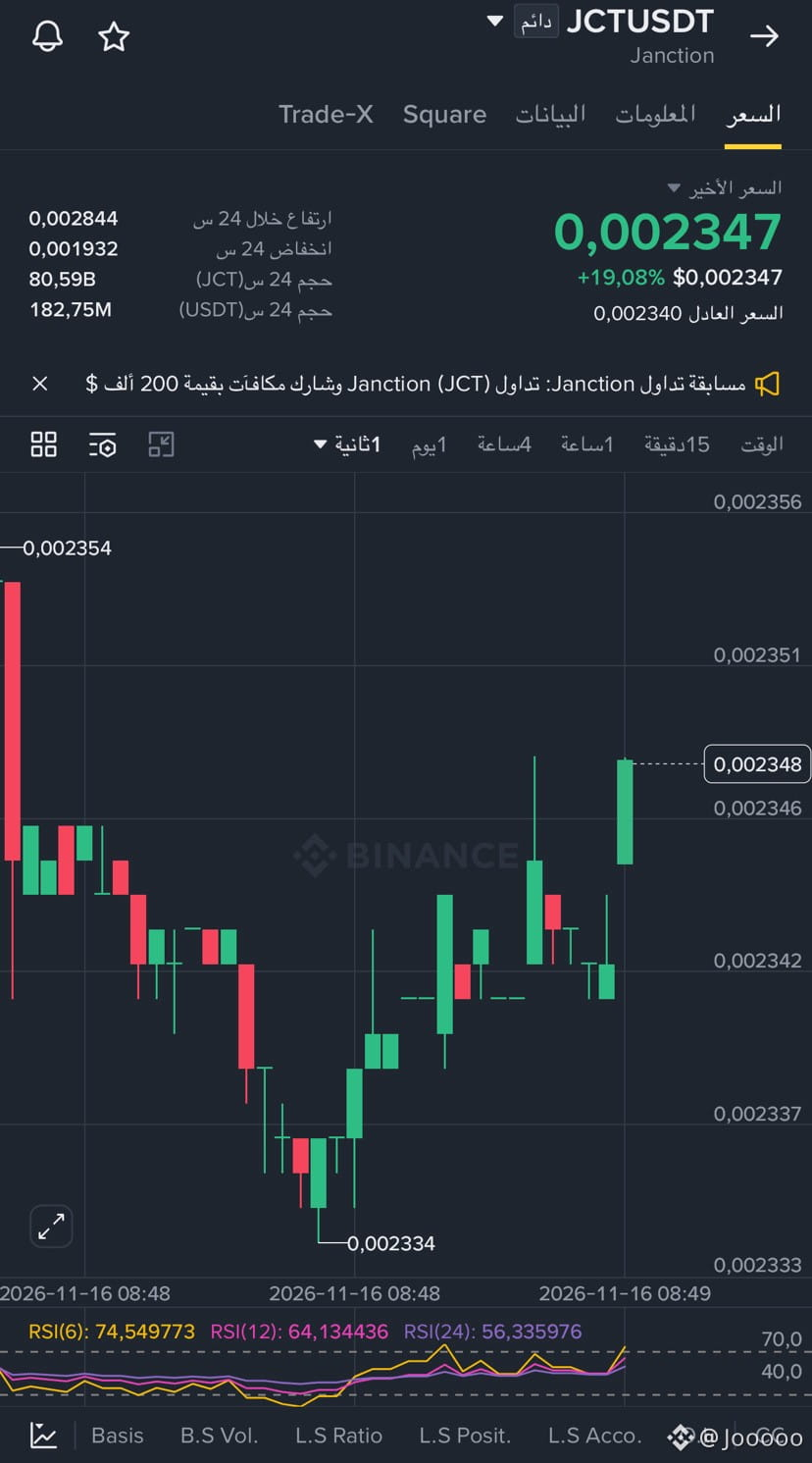
🚨 Binance Square Alpha Update: $JCT (Janction) 🧩🔥
{future}(JCTUSDT)
Are you following the price action of $JCT after recent market fluctuations and correction phases? Here is a quick look at its current status:
🌐 Project Overview:
Janction is a decentralized platform bridging artificial intelligence, cloud computing, and infrastructure (DePIN + AI), putting it on the radar of many investors focused on the AI sector.
📊 Current Indicators:
🔹 Price Action: The token is working to build a new support base and form accumulation areas following profit-taking and correction phases.
🔹 Community Interest: Trading volume and liquidity on the BNB Smart Chain keep the token under the microscope for traders seeking short-term opportunities.
⚠️ Disclaimer:
Trading cryptocurrencies—especially futures or high-volatility projects—involves significant risk. Risk management is key, and you should always do your own research (DYOR).
#JCT #JanctionJCT #BinanceSquareTalks #DePIN #CryptoAnalysis 🚀
🚨 Binance Square Alpha Update: $JCT (Janction) 🧩🔥
Are you following the price action of $JCT after recent market fluctuations and correction phases? Here is a quick look at its current status:
🌐 Project Overview:
Janction is a decentralized platform bridging artificial intelligence, cloud computing, and infrastructure (DePIN + AI), putting it on the radar of many investors focused on the AI sector.
📊 Current Indicators:
🔹 Price Action: The token is working to build a new support base and form accumulation areas following profit-taking and correction phases.
🔹 Community Interest: Trading volume and liquidity on the BNB Smart Chain keep the token under the microscope for traders seeking short-term opportunities.
⚠️ Disclaimer:
Trading cryptocurrencies—especially futures or high-volatility projects—involves significant risk. Risk management is key, and you should always do your own research (DYOR).
#JCT #JanctionJCT #BinanceSquareTalks #DePIN #CryptoAnalysis 🚀
566

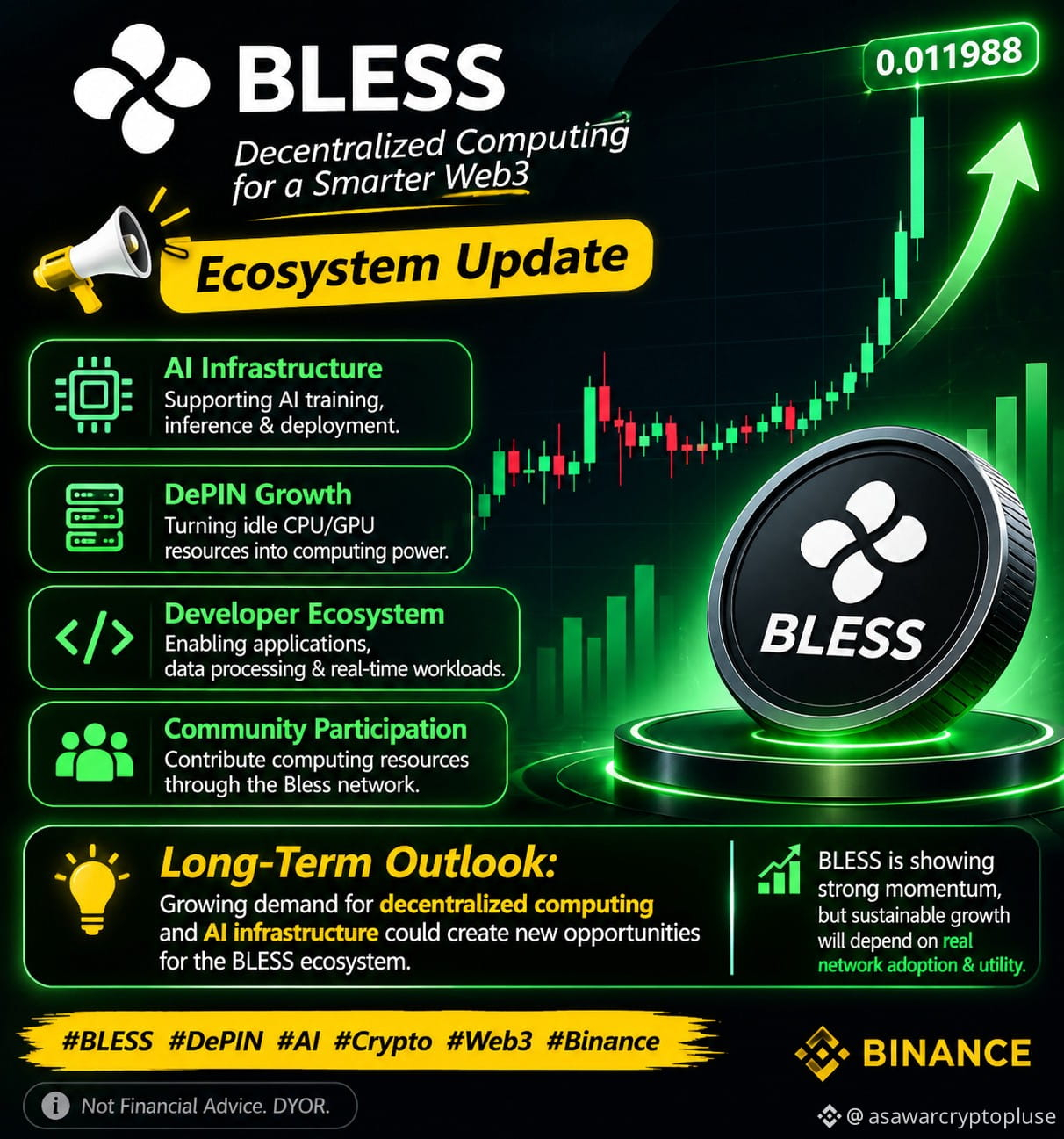
🌐 BLESS Ecosystem Update
$BLESS Bless Network is building a decentralized shared-computing ecosystem powered by everyday devices. Its infrastructure focuses on:
🔹 AI Infrastructure: Supporting AI training, inference and deployment.
🔹 DePIN Growth: Turning idle CPU/GPU resources into distributed computing power.
🔹 Developer Ecosystem: Enabling applications, data processing and real-time workloads.
🔹 Community Participation: Allowing users to contribute computing resources through the Bless network.
🚀 Long-Term Outlook: Growing demand for decentralized computing and AI infrastructure could create new opportunities for the BLESS ecosystem.
📊 BLESS is showing strong short-term momentum, but sustainable growth will depend on real network adoption and utility.$BLESS DYOR
{future}(BLESSUSDT)
#Bless #DePIN #AI #Crypto #Web3 $BLESS
🌐 BLESS Ecosystem Update
$BLESS Bless Network is building a decentralized shared-computing ecosystem powered by everyday devices. Its infrastructure focuses on:
🔹 AI Infrastructure: Supporting AI training, inference and deployment.
🔹 DePIN Growth: Turning idle CPU/GPU resources into distributed computing power.
🔹 Developer Ecosystem: Enabling applications, data processing and real-time workloads.
🔹 Community Participation: Allowing users to contribute computing resources through the Bless network.
🚀 Long-Term Outlook: Growing demand for decentralized computing and AI infrastructure could create new opportunities for the BLESS ecosystem.
📊 BLESS is showing strong short-term momentum, but sustainable growth will depend on real network adoption and utility.$BLESS DYOR
#Bless #DePIN #AI #Crypto #Web3 $BLESS
1
78

·
--
AI Compute Shouldn't Depend on One Provider
Developers need more than powerful GPUs. They need flexibility in how they access computing resources, where their workloads run, and how easily they can adapt when their requirements change.
Depending entirely on one infrastructure provider can limit those choices.
This is one reason decentralized compute is becoming an interesting part of the AI conversation.
@fluence is building a decentralized cloud infrastructure that gives developers another way to access computing resources.
Rather than treating compute as something that must come from one centralized source, decentralized infrastructure creates opportunities to access resources across a distributed network.
I think this is an important direction for AI.
As applications become more demanding, infrastructure flexibility could become just as important as processing power itself.
The future of AI will not only be shaped by who builds the best models, but also by who provides the infrastructure that allows those models to run.
#Fluence #DePIN #AI
AI Compute Shouldn't Depend on One Provider
Developers need more than powerful GPUs. They need flexibility in how they access computing resources, where their workloads run, and how easily they can adapt when their requirements change.
Depending entirely on one infrastructure provider can limit those choices.
This is one reason decentralized compute is becoming an interesting part of the AI conversation.
@Fluence is building a decentralized cloud infrastructure that gives developers another way to access computing resources.
Rather than treating compute as something that must come from one centralized source, decentralized infrastructure creates opportunities to access resources across a distributed network.
I think this is an important direction for AI.
As applications become more demanding, infrastructure flexibility could become just as important as processing power itself.
The future of AI will not only be shaped by who builds the best models, but also by who provides the infrastructure that allows those models to run.
#Fluence #DePIN #AI

51

·
--
Bullish
🌐 TOP 3 DePIN CRYPTO PROJECTS TO WATCH IN 2026
What if blockchain could power real-world physical infrastructure?
Meet 3 projects in the DePIN ecosystem:
1️⃣ Render ($RENDER )
Decentralized GPU rendering and computing network.
2️⃣ Filecoin ($FIL )
Decentralized storage network designed to provide distributed data storage.
3️⃣ Helium ($HNT )
Decentralized wireless infrastructure supported by community-operated hotspots.
🔥 Why watch this narrative?
DePIN connects blockchain incentives with real-world infrastructure and services.
The important question: Can these networks generate sustainable real-world demand?
Which DePIN project are you researching?
#DePIN #RENDER #FIL #HNT

2
1.2k

·
--
📡 DePIN: EARNING FROM REAL-WORLD RESOURCES
You share your PC or car’s resources, and the network pays you in tokens. No expensive mining rigs or complicated setup required.
How it works today:
- Internet: share your unused bandwidth to help train AI (Grass).
- Maps: capture road footage with a dashcam and earn crypto (Hivemapper).
- Storage: rent out unused disk space (Filecoin).
💡 The main advantage: tokens are backed by real demand from businesses, and getting started is often free.
👇 Are you already farming any DePIN projects?
#Binance #DePIN #Web3 #крипта #заробіток
$BTC $RENDER
5

·
--
The whole market is still gripped by extreme fear, yet this token doubled in a day: $BLESS
DePIN project Bless surged from $0.0089 to $0.0175 in 24 hours. It’s now around $0.017, up about 87%.
This isn’t price discovery—it’s a sentiment-driven short squeeze.
Futures trading volume hit $239 million in 24 hours, up 369%; open interest doubled in a day to $50.8 million; and the funding rate is 0.18% every 8 hours, equivalent to about 198% annualized.
Longs are paying real money in funding fees to pile in, while shorts get charged every 8 hours.
But let’s be clear: it’s still about 92% below its all-time high of $0.2221, with a market cap of only around $45.6 million and an FDV of about $170 million.
A 2x move from here is driven by sentiment, not fundamentals.
There’s also an unlock of 42.17 million tokens on November 23, worth around $720,000. It’s not a huge amount, but a shift in sentiment could make it a trigger.
Key levels / signals to watch next:
A move above $0.0175 could extend the squeeze, with $0.02 as the next target;
A drop below $0.014 could send short-term buyers chasing the rally running for the exits, with a pullback to $0.0114;
A drop below $0.0089 would invalidate today’s rally outright.
If the funding rate quickly falls from 198% annualized, that would signal longs are exiting—don’t focus only on price.
My take: this surge is an overheated move driven by funding rates, not a reversal. Don’t assume it’s cheap just because it doubled.
Will it break above $0.0175 and continue squeezing shorts, or fall back to $0.0114? Which do you think?
Analysis only; I have no position.
#BLESS #DePIN #FundingRate
This is for informational purposes only and does not constitute investment advice.
5

IoTeX (IOTX) spot check — the DePIN chain holding near its lows while BTC fights under $70K.
$IOTX ~$0.00268 — roughly flat today (+0.9% on the Binance session), holding above today's low of $0.00262. Day range: $0.00262–$0.00277.
The bigger picture is rough: -5.4% over 5 sessions, -25.9% in a month, -65.6% YTD. Market cap ~$25.5M, rank ~#490. ATH $0.261 (Nov 2021) — still ~99% below it.
Levels: support $0.00262, then $0.00265; resistance $0.00277, then $0.00280.
BTC context: $BTC ~$68,204, -4.4% today, day low $67,568 — lowest since August. Fear & Greed at 20 (Extreme Fear). Spot ETF outflows now 6 straight sessions. $70K is the line to reclaim.
IOTX is a DePIN Layer-1 — real-world devices on-chain. The narrative is alive; the price is waiting for the market to turn.
Not financial advice. DYOR.
#IoTeX #DePIN #Crypto
10

·
--
Verified
RENDER: Burns are increasing, but will the number of customers grow?
{future}(RENDERUSDT)
When looking at RENDER, it’s worth asking one more question: Are these tokens being burned because customers paid for them, or are they burns tied to gifted credits? Both are called “token burns,” but their business implications can be very different.
Render initially targeted some practical problems in rendering work: for example, artists may need a lot of GPUs to render images, but buying their own equipment is expensive, and temporary projects may not justify maintaining a data center long-term. The network connects people who need computing power with nodes that can provide GPUs, delivers results for each task, and uses the token for payments and node incentives.
The value of this business lies in turning computing power into a service that can be purchased. But task compatibility, smooth data transfer, and timely delivery of results all affect the user experience. Being able to take on rendering jobs doesn’t mean it can seamlessly replace every AI training cluster.
RENDER is currently around $1.53, up 0.80% over 24 hours, with roughly $35.99 million in trading volume. The official dashboard shows about 82.56 million frames rendered cumulatively and 5,600 nodes historically. This indicates that the network has indeed delivered work, but the cumulative frame count isn’t this month’s revenue, and the historical node count doesn’t mean all those nodes are online now.
Its token mechanism burns tokens corresponding to task payments, while issuing rewards to network participants according to set rules. Therefore, the existence of burns doesn’t mean the supply must shrink net of issuance, nor does it mean that an equivalent amount came from new market purchases.
One thing that’s easy to overlook is that the official dashboard’s notes also distinguish grant burns: when a task uses gifted credits, tokens are burned directly from the rewards escrow, without a corresponding USDC purchase. Gifted credits can help users try the service; that doesn’t mean anything is being faked. But treating all of them as demand paid for by customers would overstate how mature the business is.
Over the next three to six months, the most important things to watch are whether self-funded tasks continue to grow, whether trial users convert into paying customers, and how paid burns compare with newly issued rewards.
If genuine paid usage increases and nodes deliver on time, the link between demand and RENDER will be more convincing. If task volume is mainly supported by gifted credits, demand is still being validated. Let’s wait and see.。。。
#RENDER #DePIN
RENDER: Burns are increasing, but will the number of customers grow?
When looking at RENDER, it’s worth asking one more question: Are these tokens being burned because customers paid for them, or are they burns tied to gifted credits? Both are called “token burns,” but their business implications can be very different.
Render initially targeted some practical problems in rendering work: for example, artists may need a lot of GPUs to render images, but buying their own equipment is expensive, and temporary projects may not justify maintaining a data center long-term. The network connects people who need computing power with nodes that can provide GPUs, delivers results for each task, and uses the token for payments and node incentives.
The value of this business lies in turning computing power into a service that can be purchased. But task compatibility, smooth data transfer, and timely delivery of results all affect the user experience. Being able to take on rendering jobs doesn’t mean it can seamlessly replace every AI training cluster.
RENDER is currently around $1.53, up 0.80% over 24 hours, with roughly $35.99 million in trading volume. The official dashboard shows about 82.56 million frames rendered cumulatively and 5,600 nodes historically. This indicates that the network has indeed delivered work, but the cumulative frame count isn’t this month’s revenue, and the historical node count doesn’t mean all those nodes are online now.
Its token mechanism burns tokens corresponding to task payments, while issuing rewards to network participants according to set rules. Therefore, the existence of burns doesn’t mean the supply must shrink net of issuance, nor does it mean that an equivalent amount came from new market purchases.
One thing that’s easy to overlook is that the official dashboard’s notes also distinguish grant burns: when a task uses gifted credits, tokens are burned directly from the rewards escrow, without a corresponding USDC purchase. Gifted credits can help users try the service; that doesn’t mean anything is being faked. But treating all of them as demand paid for by customers would overstate how mature the business is.
Over the next three to six months, the most important things to watch are whether self-funded tasks continue to grow, whether trial users convert into paying customers, and how paid burns compare with newly issued rewards.
If genuine paid usage increases and nodes deliver on time, the link between demand and RENDER will be more convincing. If task volume is mainly supported by gifted credits, demand is still being validated. Let’s wait and see.。。。
#RENDER #DePIN
1.1k

While closed-source giants are still competing over clusters worth tens of billions of dollars, this week the open-source community delivered two major releases that emphatically shattered the “compute is everything” mindset:
1. MiniMax open-sourced MiniMax-H3-Image, a native 4K image-generation model that produces 16-megapixel images (4096×4096) in a single pass without upscaling, with consistent results across up to 16 reference images.
2. Edge0 released Edge0-145B, an open-source MoE coding model with 145 billion parameters, with its framework redesigned specifically for local inference on a single machine.
When top-tier visual assets and 145B coding capabilities can both run on a single GPU at the edge, the barriers to the rise of decentralized physical infrastructure networks (DePIN) and AI agents for super-individuals are being swept away overnight. #AI #开源模型 #DePIN
23
Verified
The Decentralized Physical Infrastructure Network (DePIN) and AI narrative continues to capture market attention, with Janction ($JCT ) standing out as a high-beta asset experiencing intense price discovery. Following a sharp correction phase, traders are closely monitoring key technical levels to see if a consolidation base is forming.
Below is a professional market breakdown tailored for Binance Square, covering token fundamentals, technical structure, and risk management guidelines.
🌐 Project Fundamentals: What is Janction?
Janction is positioned at the intersection of blockchain and artificial intelligence, functioning as a decentralized GPU marketplace and computing infrastructure.
Core Val
{alpha}(560xea37a8de1de2d9d10772eeb569e28bfa5cb17707)
ue Proposition: Aggregates idle global GPU capacity to provide scalable, cost-effective AI computing and model training resources.
Token Utility ($JCT ): Acts as the primary medium of exchange for computing power transactions, network governance participation, and node/provider incentives.
Tokenomics: Max supply capped at 50 billion tokens, with a circulating supply currently hovering around 10.34 billion (~20.7%).
📉 Technical & Market Structure Analysis
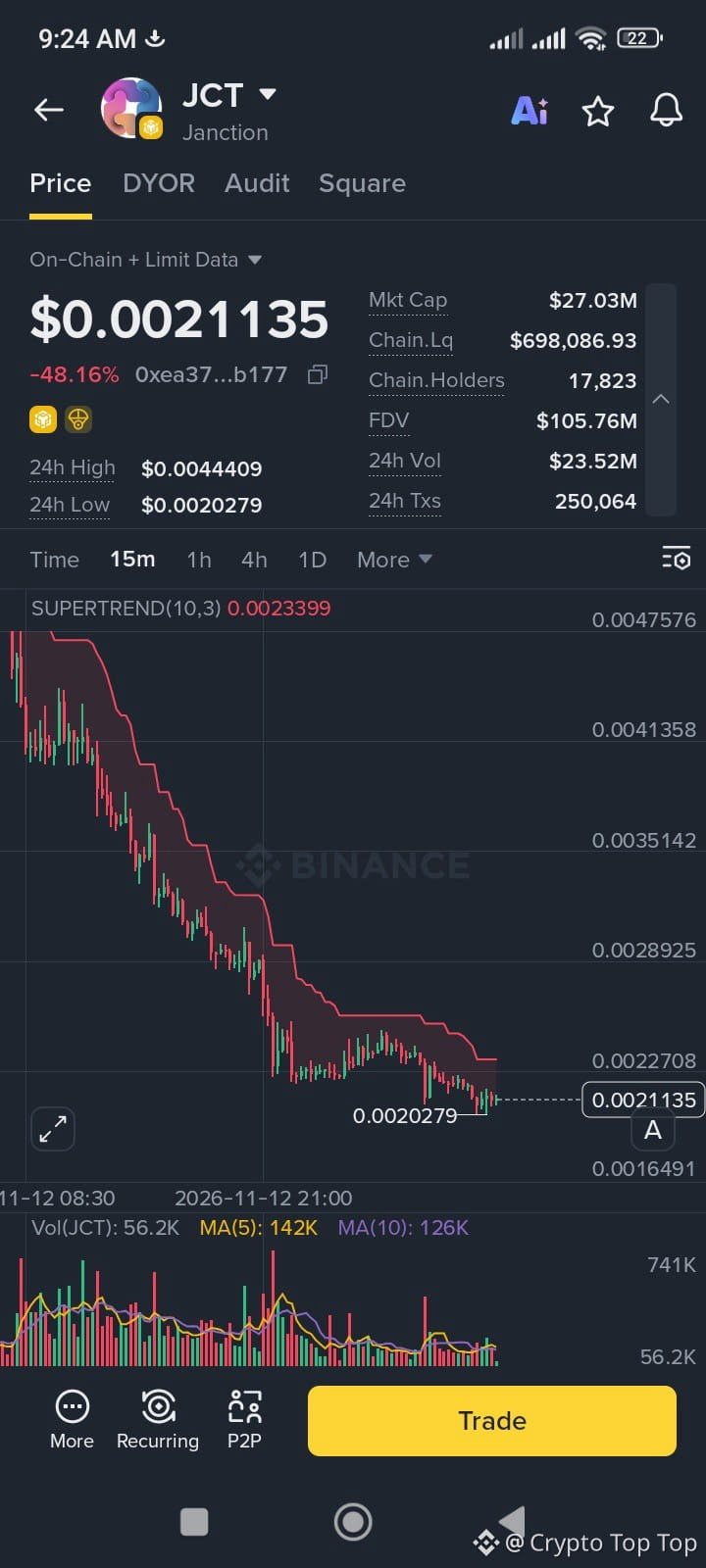
Based on the latest 15-minute and intraday charts from the Binance ecosystem:
Current Price Action: $JCT is trading near $0.00211, reflecting a significant intraday retracement of roughly -48% to -54% from recent local highs.
Market Capitalization & Valuation: Market Cap stands at approximately $27M, with a Fully Diluted Valuation (FDV) near $105M – $118M.
Liquidity & Volume: Healthy 24-hour trading volume (~$23M+) confirms that liquidity remains active despite the downward price momentum.
Trend Indicators: The Supertrend indicator (10,3) on the lower timeframes remains red, flashing resistance overhead around the $0.00233 – $0.00475 zones. Price action has tested local support floors near $0.00202, which traders are watching for potential stabilization or relief bounces.
#BinanceSquare #BinanceSquare #cryptotrading #DePIN
The Decentralized Physical Infrastructure Network (DePIN) and AI narrative continues to capture market attention, with Janction ($JCT ) standing out as a high-beta asset experiencing intense price discovery. Following a sharp correction phase, traders are closely monitoring key technical levels to see if a consolidation base is forming.
Below is a professional market breakdown tailored for Binance Square, covering token fundamentals, technical structure, and risk management guidelines.
🌐 Project Fundamentals: What is Janction?
Janction is positioned at the intersection of blockchain and artificial intelligence, functioning as a decentralized GPU marketplace and computing infrastructure.
Core Val
ue Proposition: Aggregates idle global GPU capacity to provide scalable, cost-effective AI computing and model training resources.
Token Utility ($JCT ): Acts as the primary medium of exchange for computing power transactions, network governance participation, and node/provider incentives.
Tokenomics: Max supply capped at 50 billion tokens, with a circulating supply currently hovering around 10.34 billion (~20.7%).
📉 Technical & Market Structure Analysis
Based on the latest 15-minute and intraday charts from the Binance ecosystem:
Current Price Action: $JCT is trading near $0.00211, reflecting a significant intraday retracement of roughly -48% to -54% from recent local highs.
Market Capitalization & Valuation: Market Cap stands at approximately $27M, with a Fully Diluted Valuation (FDV) near $105M – $118M.
Liquidity & Volume: Healthy 24-hour trading volume (~$23M+) confirms that liquidity remains active despite the downward price momentum.
Trend Indicators: The Supertrend indicator (10,3) on the lower timeframes remains red, flashing resistance overhead around the $0.00233 – $0.00475 zones. Price action has tested local support floors near $0.00202, which traders are watching for potential stabilization or relief bounces.
#BinanceSquare #BinanceSquare #cryptotrading #DePIN
1
734

🚀🔥 RENDER (RENDER) — THE AI COMPUTING GIANT THAT DESERVES YOUR ATTENTION!
What if one of the biggest opportunities in crypto isn't another meme coin, but the infrastructure powering the AI revolution?
Meet $RENDER.
💎 Why am I watching this project?
✅ Decentralized GPU computing.
✅ Real-world 3D rendering applications.
✅ Machine learning infrastructure.
✅ Exposure to the rapidly expanding AI economy.
✅ A working network with an established ecosystem.
📊 THE 100X PRICE TARGET
Current price: ~$1.52
100X target: $152
Imagine:
$100 → $10,000
$500 → $50,000
$1,000 → $100,000
At $152, its implied market capitalization would be approximately $85 billion.
🔥 AI + GPU COMPUTING + DECENTRALIZED INFRASTRUCTURE.
These are three powerful narratives converging in one project.
$RENDER deserves a serious place on your crypto watchlist.
Are you watching RENDER before the next major AI-driven crypto rally?
#RENDER #AI #Crypto #Altcoins #GPU #DePIN
3
267

·
--
Article
AI hires people to go out and photograph stairs—for real, at $600 a taskRobots can’t climb stairs, but they’ll pay you $600 to photograph them.
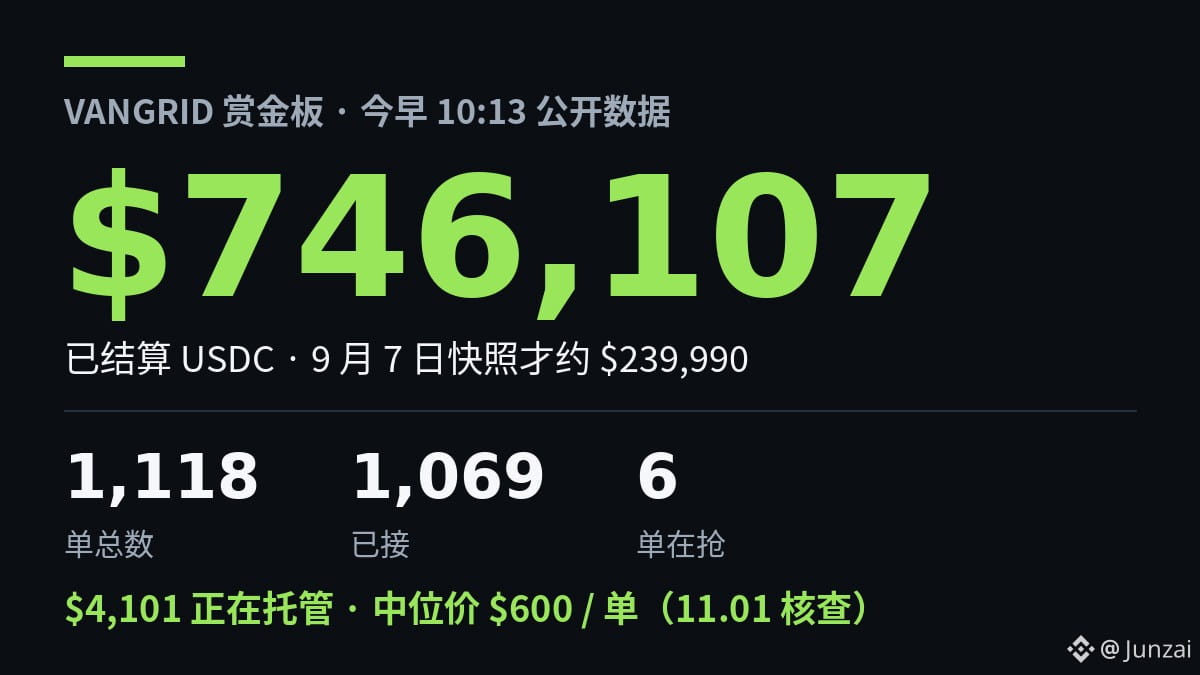
At 10:13 this morning, I pulled the public data from Vangrid’s bounty board: **$746,107** paid out, with 1,069 of 1,118 tasks already claimed. **There are still 6 tasks up for grabs, with $4,101 held in escrow**. A snapshot from September 7 showed just about $239,990—three times less than two months later.
What is this platform for? Robots and self-driving cars need 3D data from real locations. Satellites can see rooftops, and street-view cars can see roads, but nobody has data from places like stairwells, warehouses, and loading docks. A buyer posts a task—and the buyer can even be an AI agent. One HTTP call and an x402 payment in $USDC, and the task is live. You walk around the object with your phone and film it; upload the footage and it becomes a 3D model. The buyer accepts just one submission, and you get paid only if yours is selected. Payment is held in escrow on Base $USDC .
AI hires people to go out and photograph stairs—for real, at $600 a task
Robots can’t climb stairs, but they’ll pay you $600 to photograph them.
At 10:13 this morning, I pulled the public data from Vangrid’s bounty board: **$746,107** paid out, with 1,069 of 1,118 tasks already claimed. **There are still 6 tasks up for grabs, with $4,101 held in escrow**. A snapshot from September 7 showed just about $239,990—three times less than two months later.
What is this platform for? Robots and self-driving cars need 3D data from real locations. Satellites can see rooftops, and street-view cars can see roads, but nobody has data from places like stairwells, warehouses, and loading docks. A buyer posts a task—and the buyer can even be an AI agent. One HTTP call and an x402 payment in $USDC , and the task is live. You walk around the object with your phone and film it; upload the footage and it becomes a 3D model. The buyer accepts just one submission, and you get paid only if yours is selected. Payment is held in escrow on Base $USDC .
300

·
--
🦈 GIANT CAPEX COMMITMENTS IGNITE THE DECENTRALIZED COMPUTE SQUEEZE ACROSS $ANTHROPIC ECOSYSTEMS! ⚡
Institutional liquidity is aggressively locking down gigawatt-scale data center capacity, bypassing retail noise entirely. 📊 When tech giants shovel billions into multi-decade compute contracts, the infrastructure bottleneck tightens like a coiled spring. ⚡
This massive capital rotation directly fuels decentralized compute protocols and energy plays absorbing the overflow. 🌊 Smart money isn't guessing; they are securing the foundation of tomorrow's digital economy right now. 💡
Where are you positioning your capital as this compute squeeze accelerates across the board? 👇
⚠️ Not financial advice. Always manage your risk. 🛡️
🏷️ #ANTHROPIC #DePIN #Infrastructure #Crypto
🔥 💎
13

GPU hyperscalers cost nearly twice as much as GPU clouds; H100 rental prices rise 13–30%
- Fluence published the report "The AI Compute Race," which assesses GPU cloud pricing for companies that are neither frontier labs nor hyperscalers. The report was produced with NEAR AI, io.net, Boundless, Phala, Gensyn, Fortytwo, Theta, Compute Labs, and GAIB.
- Where you buy GPU-hours determines the price: for H100, H200, and B200, hyperscalers charge 1.98 times the GPU-cloud median (ranging from 1.4 times for B200 to 2.8 times for H100).
- The same H200 costs between $4.08 and $10.60 per hour, depending on the provider.
- The length of the commitment matters almost as much as choosing a provider: a 1-year reservation is 21% cheaper than on-demand, a 3-year commitment is 48% cheaper, and spot costs 53% of the on-demand price.
- Prices aren't falling: 17 of the 22 GPU models tracked by GetDeploying cost more than a year ago; median H100 rental prices rose 13–30%, depending on the time period.
- Reasons: demand is shifting to open models (Chinese models' token share on OpenRouter rose from 6–13% to 57–67% in less than 8 months, according to CNBC); the 4 largest hyperscalers are expected to spend $720–740 billion in capex in 2026; and the 4 largest deals between AI labs and Meta and neoclouds total about $233 billion.
- GPU-hours are becoming a financial asset: CME, ICE, and Nodal Exchange announced GPU futures contracts; Lambda borrowed at 6.78% interest, and Sharon AI borrowed at 9.95%.
- The report outlines 4 ways to pay less: compare the same chip across different provider types, commit when workloads are stable, choose a GPU generation suited to the model, and look beyond hyperscalers.
- The RSS source provides no further details beyond the information above.
#BinanceSquare #CryptoNews #DePIN #AI #NEAR THETA IO
$near $theta $io
vlikevn Titanbot
Source: NewsBTC
1
407
Helium $HNT is 25 cents today. Twenty-five. Cents.
The people's network is still out there — hotspots blinking, coverage growing — while the token is down 25% this week and 46% this month. From a $48.80 ATH to a quarter. That's not a dip, that's a whole different currency.
📊 $HNT ~$0.25 (-1% 24h)
📉 24h range: $0.249 – $0.257
📉 7d: -25% | 30d: -46%
💰 Market cap ~$50M
Support $0.249, resistance $0.257. If it holds the quarter, the hotspots keep blinking. If not... well, at least the network still works.
Meanwhile $BTC is at ~$73,400 with spot ETF outflows now 5 straight days (~$1.44B since Nov 5). The whole market is in discount mode.
Would you buy a DePIN token at 99.5% off its ATH, or is this one still falling? 👇
Not financial advice. DYOR.
#Helium #Crypto #DePIN
34

·
--
Article
Render ($RENDER) at $1.50: A top bet on the AI and GPU market at nearly a 90% discount?While the entire tech world scrambles for scarce graphics cards, Render Network, a leader in decentralized computing, is trading around $1.50–$1.60—nearly 89% below its all-time high of $13.53. For those seeking a fundamentally strong asset with a clear business model, the current consolidation zone looks like a great opportunity to take a closer look at the project.
Render ($RENDER) at $1.50: A top bet on the AI and GPU market at nearly a 90% discount?
While the entire tech world scrambles for scarce graphics cards, Render Network, a leader in decentralized computing, is trading around $1.50–$1.60—nearly 89% below its all-time high of $13.53. For those seeking a fundamentally strong asset with a clear business model, the current consolidation zone looks like a great opportunity to take a closer look at the project.
2
507

·
--
Good morning, albeit a late one, as we wrap up our day full of updates! Let’s end today’s discussions by talking about the DePIN (decentralized physical infrastructure) and AI sectors, where Render (RENDER) shines as a revolutionary solution for providing GPU computing power to creators and AI developers around the world. Do you hold RENDER in your long-term investment portfolios? Let’s hear your thoughts in the comments!
#Binance #RENDER #AI #DePIN #Web3
#Binance #RENDER #AI #DePIN #Web3
Darla Matchett U85a:
2
16
3
106
Log in to explore more content
Join global crypto users on Binance Square
⚡️ Get latest and useful information about crypto.
💬 Trusted by the world’s largest crypto exchange.
👍 Discover real insights from verified creators.
Email / Phone number
Trending Topics
1
#A Packed Week of Earnings and Data Tests Markets
81,486 views
487 Discussing
2
#AnthropicIPOTestsInvestorAppetiteForAI
160,908 views
1,713 Discussing
3
#NvidiaBoardNotConsideringHuang’sReturnasCEO
15,437 views
211 Discussing
4
#WhatInvestmentSignalsDo13FFilingsReveal?
9,794 views
149 Discussing
5
#InvescoStablecoinReservesFundLaunchesOnEthereum
3,355 views
77 Discussing
6
#CypherpunkReports$306MQ3NetProfit
738 views
14 Discussing
7
#OPTIMJACKAttackInfectsAtLeast186Websites
6,971 views
109 Discussing
8
#StrategySells2.09MMSTRSharesFor$244.7M
2,189 views
19 Discussing
9
#StablecoinMarketShrinksAtFastestPaceSinceTerraLuna
8,213 views
75 Discussing
10
#BitcoinExtendsLosingStreakToSixWeeks
124,322 views
877 Discussing