

#brazilvirtualassetlicensedeadlinedrawsabout40firms
brazilvirtualassetlicensedeadlinedrawsabout40firms
Hot
Latest

💎 THE FUTURE OF DIGITAL ASSETS NEEDS RESPONSIBLE FINANCE!
Brazil's licensing deadline highlights an important shift toward stronger oversight of crypto businesses.
More accountability and clearer operating standards can help users make better-informed choices.
Let's promote an investment culture built on ethical cash management, transparent transactions, genuine asset ownership, and risk awareness.
No leverage. No interest-based strategies. Just responsible spot investing!
$BTC $BNB $ETH
#brazilvirtualassetlicensedeadlinedrawsabout40firms
1
773
·
--
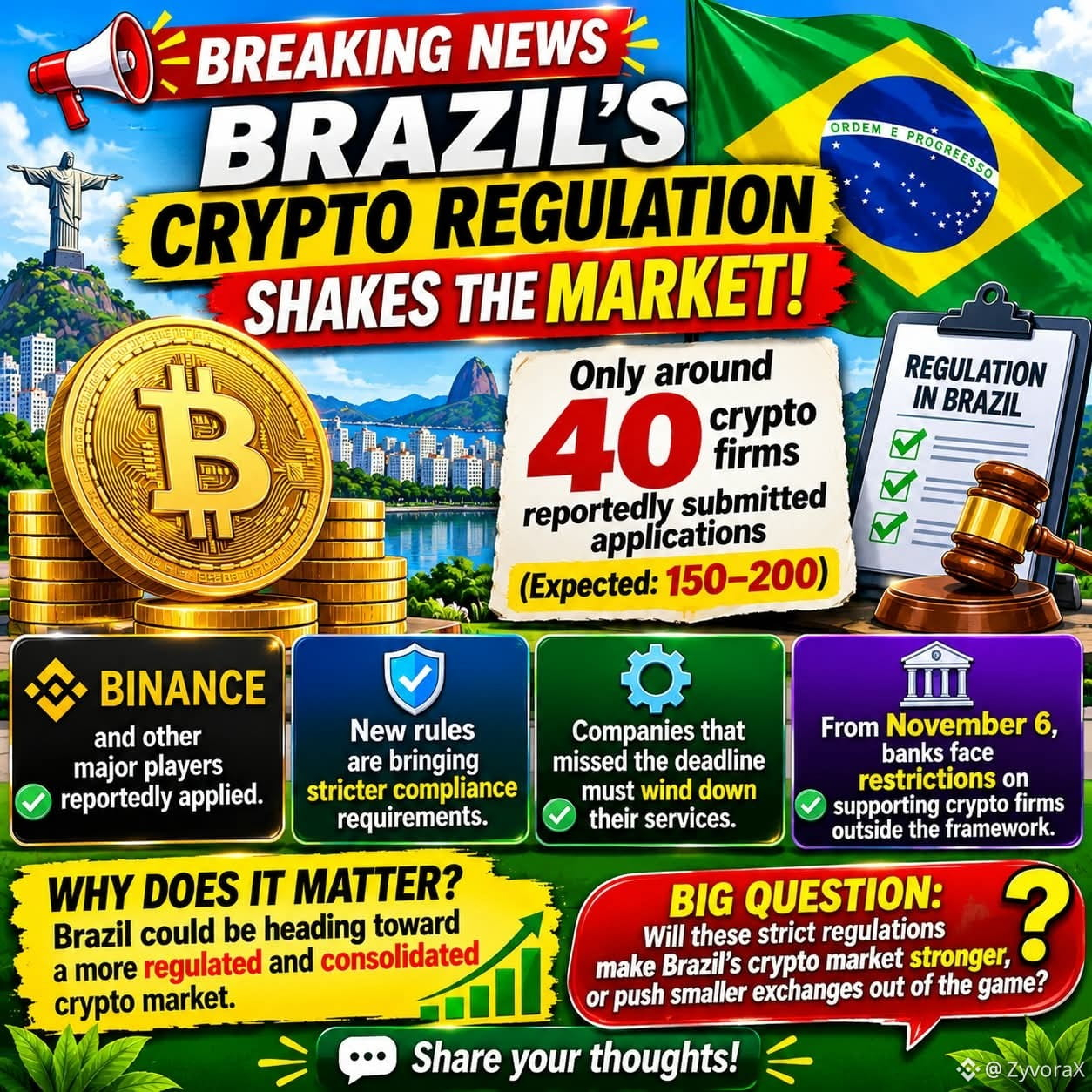
#BrazilVirtualAssetLicenseDeadlineDrawsAbout40Firms 🚨 BRAZIL'S CRYPTO LICENSE DEADLINE SHOCKS THE MARKET! 🇧🇷
Brazil's new crypto regulations are creating a major shake-up! 🌐
Only around 40 crypto firms reportedly submitted applications before the October 30, 2026 deadline, far below the expected 150–200 companies.
WATCH THE TRADE👇
$BTC
🔥 WHAT'S HAPPENING?
✅ Binance and other major players reportedly applied.
✅ New rules are bringing stricter compliance requirements.
✅ Companies that missed the deadline must wind down their services within the transition period.
✅ From November 6, banks face restrictions on supporting crypto firms outside the regulatory framework.
📊 WHY DOES IT MATTER?
Brazil could be heading toward a more regulated and consolidated crypto market, with fewer providers and stronger compliance requirements.
💬 BIG QUESTION:
Will these strict regulations make Brazil's crypto market stronger, or push smaller exchanges out of the game?
👇 Share your thoughts!
#Brazil #CryptoNews #Bitcoin
CLICK TO BELOW TRADE 👇
$BTC $BNB
{future}(BNBUSDT)
{future}(BTCUSDT)
#BrazilVirtualAssetLicenseDeadlineDrawsAbout40Firms 🚨 BRAZIL'S CRYPTO LICENSE DEADLINE SHOCKS THE MARKET! 🇧🇷
Brazil's new crypto regulations are creating a major shake-up! 🌐
Only around 40 crypto firms reportedly submitted applications before the October 30, 2026 deadline, far below the expected 150–200 companies.
WATCH THE TRADE👇
$BTC
🔥 WHAT'S HAPPENING?
✅ Binance and other major players reportedly applied.
✅ New rules are bringing stricter compliance requirements.
✅ Companies that missed the deadline must wind down their services within the transition period.
✅ From November 6, banks face restrictions on supporting crypto firms outside the regulatory framework.
📊 WHY DOES IT MATTER?
Brazil could be heading toward a more regulated and consolidated crypto market, with fewer providers and stronger compliance requirements.
💬 BIG QUESTION:
Will these strict regulations make Brazil's crypto market stronger, or push smaller exchanges out of the game?
👇 Share your thoughts!
#Brazil #CryptoNews #Bitcoin
CLICK TO BELOW TRADE 👇
$BTC $BNB
148
📊 40 FIRMS, ONE BIG MESSAGE: COMPLIANCE MATTERS!
Brazil's crypto licensing process shows how digital finance is evolving.
Clearer licensing requirements can encourage accountability, improve market confidence, and support long-term industry development.
For investors, this is a reminder to check platforms carefully and understand the assets they purchase.
Smart research beats blind speculation!
$BNB $ETH $LINK
#brazilvirtualassetlicensedeadlinedrawsabout40firms
2
192

·
--
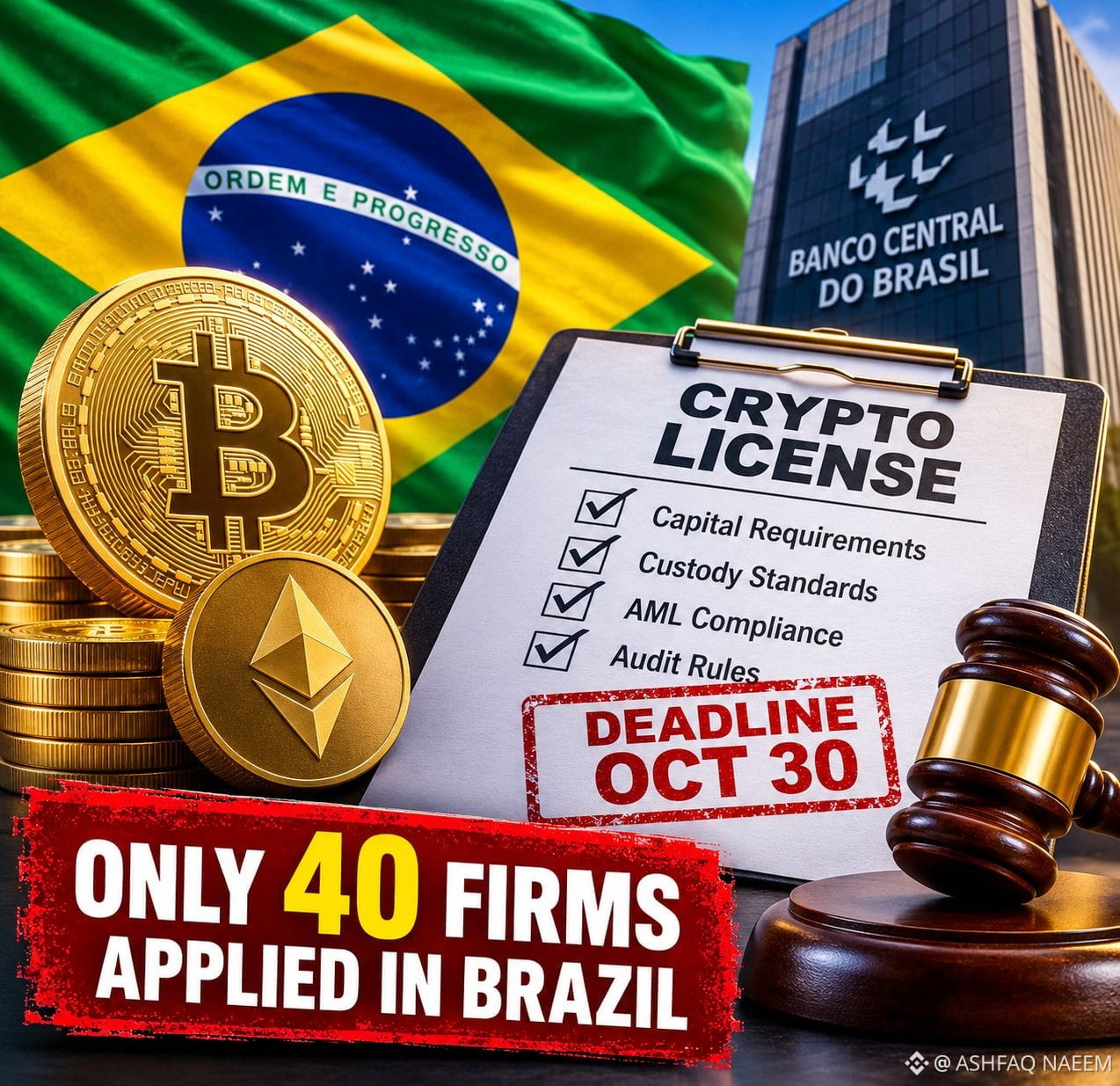
🚨 BRAZIL’S CRYPTO LICENSING DEADLINE JUST CHANGED THE GAME!
Brazil’s new crypto regulatory framework is triggering a major shake-up, with only around 40 firms reportedly entering the licensing process by the October 30 deadline, far below earlier expectations of 150 to 200 applicants
The Central Bank of Brazil is raising the bar with stricter capital, custody, auditing and anti money laundering requirements
🔥 What happens next
• Firms that applied can continue operating while their applications are reviewed
• Companies that missed the deadline must wind down their services
• From November 6, banking restrictions will make it harder for unauthorized crypto providers to access Brazil’s financial system
• Major players with stronger compliance infrastructure could gain a competitive advantage
This could mark a turning point for Brazil’s crypto industry, potentially shifting market power toward larger exchanges and regulated financial institutions
The bigger question is whether tighter regulation will build investor confidence or push smaller crypto businesses out of the market
is Brazil creating a stronger crypto ecosystem or making it harder for innovation to survive?
#brazilvirtualassetlicensedeadlinedrawsabout40firms $BTC $BNB
{spot}(BNBUSDT)
{spot}(BTCUSDT)
🚨 BRAZIL’S CRYPTO LICENSING DEADLINE JUST CHANGED THE GAME!
Brazil’s new crypto regulatory framework is triggering a major shake-up, with only around 40 firms reportedly entering the licensing process by the October 30 deadline, far below earlier expectations of 150 to 200 applicants
The Central Bank of Brazil is raising the bar with stricter capital, custody, auditing and anti money laundering requirements
🔥 What happens next
• Firms that applied can continue operating while their applications are reviewed
• Companies that missed the deadline must wind down their services
• From November 6, banking restrictions will make it harder for unauthorized crypto providers to access Brazil’s financial system
• Major players with stronger compliance infrastructure could gain a competitive advantage
This could mark a turning point for Brazil’s crypto industry, potentially shifting market power toward larger exchanges and regulated financial institutions
The bigger question is whether tighter regulation will build investor confidence or push smaller crypto businesses out of the market
is Brazil creating a stronger crypto ecosystem or making it harder for innovation to survive?
#brazilvirtualassetlicensedeadlinedrawsabout40firms $BTC $BNB
17


·
--
#BrazilVirtualAssetLicenseDeadlineDrawsAbout40Firms
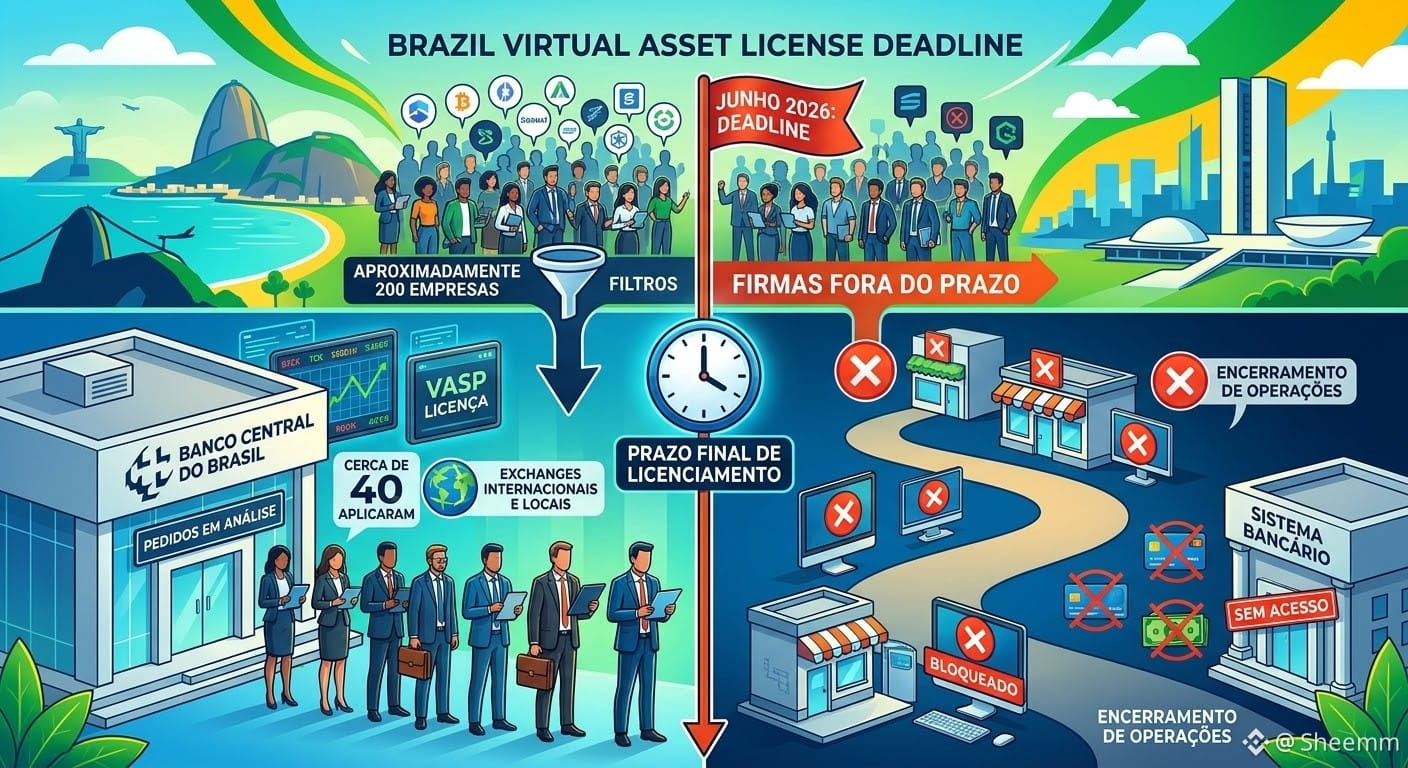
Brazil's central bank licensing deadline for virtual asset service providers (VASPs) has passed, a significant milestone for the country's crypto market. Out of an earlier estimate of nearly 200 firms, roughly 40, including major international exchanges, have applied. This initial cohort now enters a review period while those that missed the window face winding down operations and will lose access to the local banking system. The shift marks a strong move towards a regulated, institutionalized digital asset ecosystem in Latin America's largest economy.
$TAGG.ETF
{etf_us}(TAGG.ETF)
$TA
{alpha}(560x539ae81a166e5e80aed211731563e549c411b140)
$TAKE
{alpha}(560xe747e54783ba3f77a8e5251a3cba19ebe9c0e197)
#BinanceSquareFamily
#BrazilVirtualAssetLicenseDeadlineDrawsAbout40Firms
Brazil's central bank licensing deadline for virtual asset service providers (VASPs) has passed, a significant milestone for the country's crypto market. Out of an earlier estimate of nearly 200 firms, roughly 40, including major international exchanges, have applied. This initial cohort now enters a review period while those that missed the window face winding down operations and will lose access to the local banking system. The shift marks a strong move towards a regulated, institutionalized digital asset ecosystem in Latin America's largest economy.
$TAGG.ETF
$TA
$TAKE
#BinanceSquareFamily
3
366
🇧🇷 BRAZIL'S CRYPTO LICENSING RACE IS HEATING UP!
Around 40 crypto firms reportedly applied before Brazil's virtual asset licensing deadline.
This development highlights the growing importance of regulatory compliance, transparency, and accountability in digital finance.
Clearer rules can help investors evaluate platforms and make more informed decisions.
Build confidence through research, genuine spot ownership, and responsible investing!
$BTC $ETH $BNB
#brazilvirtualassetlicensedeadlinedrawsabout40firms
12
🛡️ CRYPTO TRUST STARTS WITH TRANSPARENCY!
Brazil's virtual asset licensing deadline has brought around 40 firms into the spotlight.
A stronger compliance framework can encourage better operational standards and improve investor awareness.
This may support healthier crypto participation and more responsible investment decisions.
Choose researched assets, transparent transactions, and interest-free spot investing.
$BTC $XRP $ADA
#brazilvirtualassetlicensedeadlinedrawsabout40firms
20

·
--
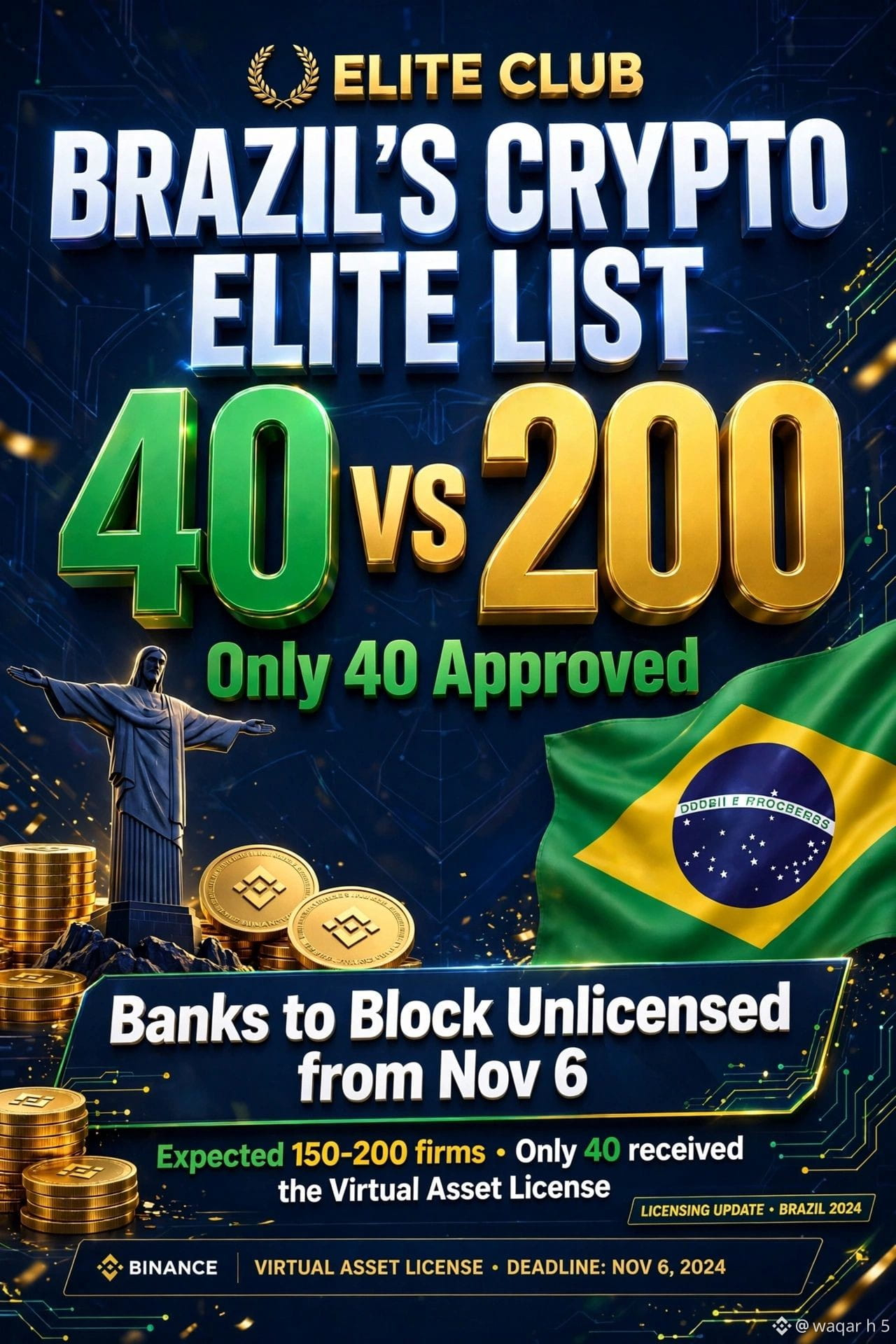
🚨 BRAZIL JUST CREATED A CRYPTO ELITE CLUB 🇧🇷
Only 40 firms survived. 160+ firms KICKED OUT.
Brazil's Virtual Asset License deadline closed on Oct 30 — Expected 150-200 firms, only ∼40 applied 5f2d
What happens now?
✅ Binance, Itaú & B3 are IN — they will keep operating while Central Bank reviews
❌ Others have 30 days to wind down and EXIT Brazil
💥 From Nov 6, banks will BLOCK all transactions for unlicensed firms — fiat access GONE 5f2d
Why only 40? Daily custody reports to Central Bank, monthly proof-of-reserves, 3 years audited balance sheets, AML audits. Most small exchanges couldn't afford it 5f2d
Brazil did R$505B in crypto volume in 2025 — Now that volume will be concentrated in just 40 licensed players.
This is not a ban, this is consolidation. Bullish for compliant giants.
Who do you think is in the Top 40? 👇
#brazilcrypto #VASP #Binance #CryptoRegulation #BrazilVirtualAssetLicenseDeadlineDrawsAbout40Firms
131

🇧🇷 Brazil’s Crypto License Window Closes with Focused Field.
Brazil’s Central Bank deadline for virtual asset service provider licenses drew applications from roughly 40 firms, well below earlier estimates. Those that applied may continue operating while reviews proceed, creating a clearer path for compliant players.
This selective process supports a more robust and transparent market as unlicensed operators prepare to exit. Stronger regulatory standards help build lasting confidence among users and institutions in the region’s growing digital asset sector.
$BNB #CoinVahini #CryptoRegulation #BrazilCrypto #BrazilVirtualAssetLicenseDeadlineDrawsAbout40Firms
48

·
--
#BrazilVirtualAssetLicenseDeadlineDrawsAbout40Firms
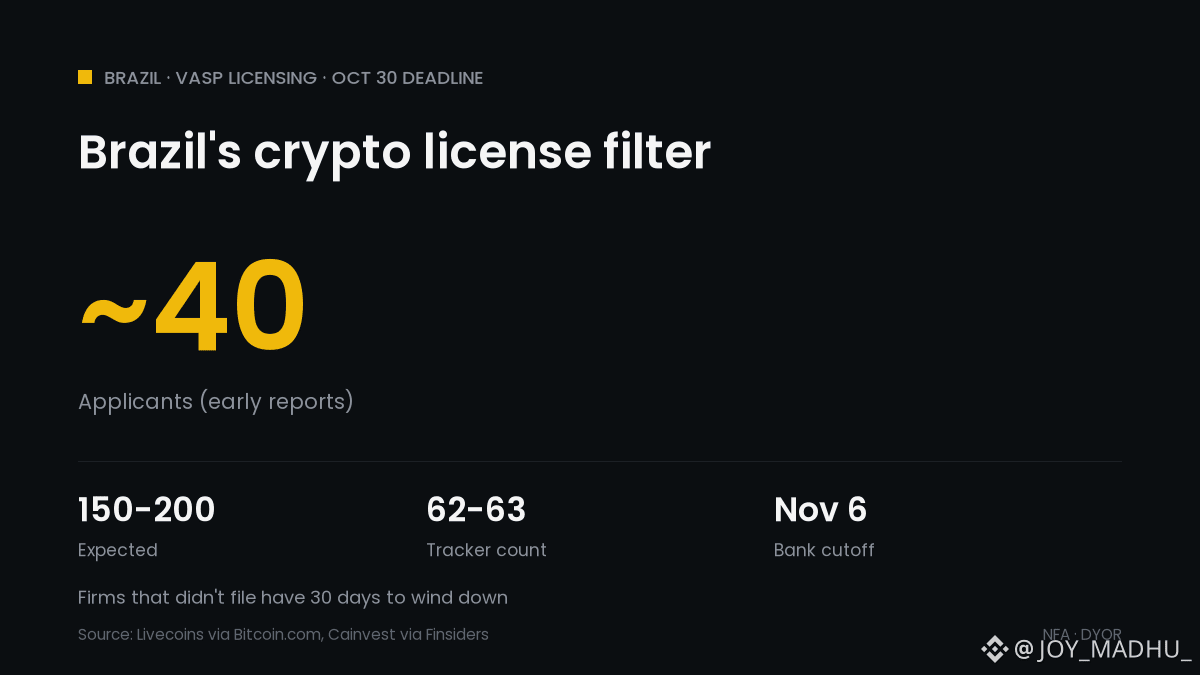
🇧🇷 Brazil's Crypto License Deadline Draws Far Fewer Firms
📅 Central Bank filing window closed October 30
📊 Early reports: about 40 applicants vs 150 to 200 expected
🔍 Private tracker Cainvest later counted 62 to 63, incl. Binance, OKX, Bybit, Coinbase
⚠️ Non-filers have 30 days to wind down
🏦 From November 6, banks can't serve unauthorized providers
📜 Daily custody reports, monthly proof of reserves, 3 years of audits
What it means for crypto: fewer, larger and more supervised platforms. More trust, but less competition, and new entrants may wait up to two years.
Is consolidation good for Brazil's crypto users? 👇
$BTC $BNB
#CryptoNews #Brazil #Regulation #BrazilVirtualAssetLicenseDeadlineDrawsAbout40Firms
131

Brazil's deadline for virtual asset service providers to obtain a license is fast approaching, with approximately 40 firms expected to comply. This regulatory move signifies a significant step towards formalizing the crypto landscape in Latin America's largest economy. The licensing framework aims to enhance transparency, combat illicit activities, and provide greater investor protection within the burgeoning digital asset market. This development could lead to increased institutional confidence and potentially attract further investment into the region's crypto sector, fostering a more mature and regulated environment for innovation and growth.
Disclaimer: This content is for informational purposes only and does not constitute investment advice.
#BrazilVirtualAssetLicenseDeadlineDrawsAbout40Firms $BTC $ETH
Disclaimer: This content is for informational purposes only and does not constitute investment advice.
#BrazilVirtualAssetLicenseDeadlineDrawsAbout40Firms $BTC $ETH
126
Article
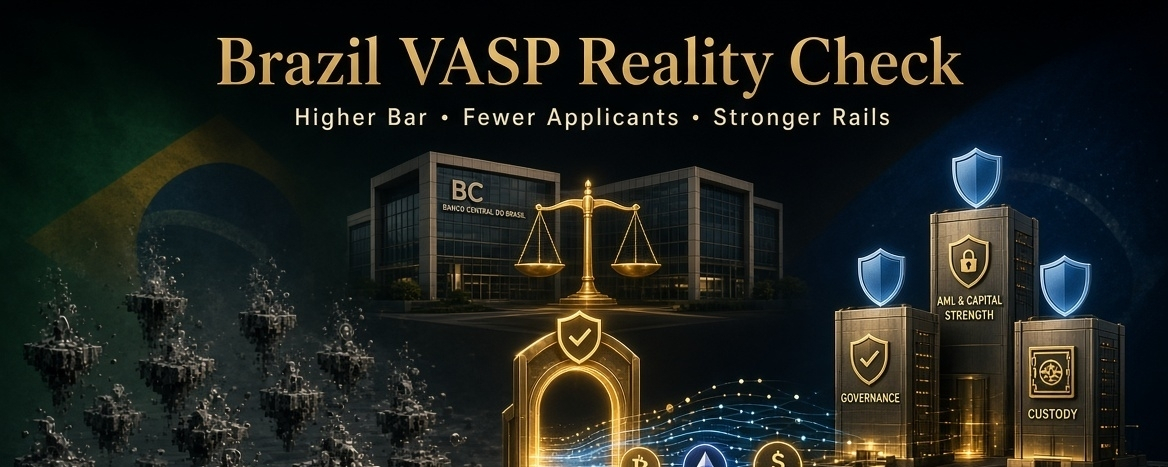
Brazil’s VASP Licensing Reality Check#BrazilVirtualAssetLicenseDeadlineDrawsAbout40Firms 🇧🇷 Brazil’s VASP Licensing Reality Check: Lower Applicant Count, Higher Compliance Bar
🇧🇷 Brazil’s crypto market is entering a decisive regulatory transition. Reports indicate that roughly 40 virtual-asset service providers (VASPs) submitted license applications to the Central Bank of Brazil (BCB), well below early market expectations of 150–200 firms. The applicant count should be treated as a reported industry estimate rather than a final BCB-published registry, but the direction is clear: the new framework is likely to favor firms with established compliance, governance, capital, custody, and operational infrastructure.
Brazil’s framework is built around BCB Resolutions 519, 520, and 521, published on November 10, 2025 and effective from February 2, 2026. The package creates an authorization regime for VASPs, establishes operating rules, and brings certain crypto and stablecoin activities into Brazil’s foreign-exchange and international-capital framework.
🟨 What the rules mean for VASPs
The BCB recognizes three operating modalities:
👉 Intermediary: facilitates or intermediates crypto transactions for clients.
👉 Custodian: safeguards virtual assets or cryptographic credentials on behalf of clients.
👉 Broker: combines intermediation and custody functions.
This classification matters because a provider offering multiple services can face requirements linked to each activity—not merely the label it chooses. BCB materials describe brokerage as the combination of intermediation and custody.
The regulatory burden extends beyond licensing. Firms must build out anti-money-laundering and counter-terrorist-financing controls, governance, cybersecurity, internal controls, auditability, customer-protection processes, and supervisory reporting. Public descriptions of the framework place minimum capital requirements in a range of approximately R$10.8 million to R$37.2 million, depending on the activities and associated risk profile.
Stablecoins now carry an FX and cross-border compliance dimension
BCB Resolution 521 is especially important for stablecoins. It integrates specified virtual-asset activities into the foreign-exchange market and addresses cases subject to Brazil’s international-capital rules. The BCB states that covered activities include:
👉 international payments or transfers using virtual assets;
👉 transfers of virtual assets to settle obligations arising from international card or electronic-payment use;
👉 transfers involving self-custody wallets;
👉 purchases, sales, or exchanges of fiat-referenced virtual assets—i.e., stablecoins.
The regulatory focus is the transaction’s economic function, not only whether it travels through a bank transfer or an on-chain wallet. A stablecoin movement that effectively transfers value across borders may therefore trigger more robust identification, recordkeeping, monitoring, reporting, and AML/CFT expectations.
For the market, this makes stablecoins less of a purely domestic crypto-trading instrument and more of a regulated cross-border value-transfer channel when used in international contexts.
🟨 Why the reported 40 applications matter ⁉️
If the reported applicant count is directionally accurate, it points to a possible market-consolidation phase:
👉 Higher barriers to entry: capital, authorization, security, AML/CFT, audit, and local-governance requirements can be difficult for small or lightly structured providers to meet.
👉 Potential liquidity fragmentation: if providers discontinue Brazilian services or scale back product scope, users may temporarily see fewer local access points, fewer fiat rails, or more concentrated liquidity.
👉 Greater importance of regulated rails: bank and payment-institution access becomes more valuable for providers that are authorized or actively in the authorization process.
👉 Institutional credibility effect: clearer supervision can improve confidence among banks, payment partners, corporate users, and institutional participants—but compliance costs may also pressure margins.
👉 Stablecoin workflow redesign: providers handling cross-border stablecoin use may need stronger customer and counterparty identification, transaction-purpose controls, monitoring systems, and reporting architecture.
📊 Statistical perspective
Using the reported midpoint expectation of 175 firms—the midpoint of the stated 150–200 range—an applicant base of 40 firms would represent about 22.86% of that expectation. Relative to the low-end estimate of 150, it would be about 26.67%; relative to 200, about 20.00%.
That does not prove that the remaining providers have exited. Some may be outside scope, restructuring, awaiting clarification, operating through licensed partners, or absent from public reporting. Still, it highlights the scale of the compliance filter now facing Brazil’s crypto sector.
🧠 Market impact and sentiment
Near-term sentiment: cautiously constructive, with operational uncertainty.
👷 Constructive factors: formal authorization, stronger custody and governance expectations, and clearer stablecoin/FX treatment may support confidence in compliant providers over time.
💀 Risk factors: high fixed compliance costs, unclear self-custody-wallet handling, transfer-process questions, and uncertainty around firms unable to secure authorization could create short-term friction.
👉 For local crypto access: the likely outcome is not necessarily lower crypto demand, but a shift toward providers able to maintain compliant banking, Pix, custody, and reporting infrastructure.
👉 For stablecoins: demand may remain resilient because of their role in trading and cross-border value movement, but compliance-sensitive flows could become more formalized and operationally constrained.
Bottom line: Brazil is moving from a relatively open operating environment toward a supervised VASP market where authorization status, capital strength, custody controls, and cross-border compliance become major competitive differentiators. The framework may improve market quality over time, but the transition can also reduce the number of active providers and create temporary uncertainty around local fiat and stablecoin access. This is regulatory analysis, not a prediction of price performance or investment advice.
$BTC $ETH $QNT
{spot}(BTCUSDT)
{spot}(ETHUSDT)
{spot}(QNTUSDT)
#BinanceProcesses$4.65BWithdrawals #WithdrawalsBack: 15 networks live #BTCPayServerUrgesOperatorsToShutDownInstances #BankOfKoreaSurveysFinancialFirmsOnVirtualAssetRisks
Brazil’s VASP Licensing Reality Check
#BrazilVirtualAssetLicenseDeadlineDrawsAbout40Firms 🇧🇷 Brazil’s VASP Licensing Reality Check: Lower Applicant Count, Higher Compliance Bar
🇧🇷 Brazil’s crypto market is entering a decisive regulatory transition. Reports indicate that roughly 40 virtual-asset service providers (VASPs) submitted license applications to the Central Bank of Brazil (BCB), well below early market expectations of 150–200 firms. The applicant count should be treated as a reported industry estimate rather than a final BCB-published registry, but the direction is clear: the new framework is likely to favor firms with established compliance, governance, capital, custody, and operational infrastructure.
Brazil’s framework is built around BCB Resolutions 519, 520, and 521, published on November 10, 2025 and effective from February 2, 2026. The package creates an authorization regime for VASPs, establishes operating rules, and brings certain crypto and stablecoin activities into Brazil’s foreign-exchange and international-capital framework.
🟨 What the rules mean for VASPs
The BCB recognizes three operating modalities:
👉 Intermediary: facilitates or intermediates crypto transactions for clients.
👉 Custodian: safeguards virtual assets or cryptographic credentials on behalf of clients.
👉 Broker: combines intermediation and custody functions.
This classification matters because a provider offering multiple services can face requirements linked to each activity—not merely the label it chooses. BCB materials describe brokerage as the combination of intermediation and custody.
The regulatory burden extends beyond licensing. Firms must build out anti-money-laundering and counter-terrorist-financing controls, governance, cybersecurity, internal controls, auditability, customer-protection processes, and supervisory reporting. Public descriptions of the framework place minimum capital requirements in a range of approximately R$10.8 million to R$37.2 million, depending on the activities and associated risk profile.
Stablecoins now carry an FX and cross-border compliance dimension
BCB Resolution 521 is especially important for stablecoins. It integrates specified virtual-asset activities into the foreign-exchange market and addresses cases subject to Brazil’s international-capital rules. The BCB states that covered activities include:
👉 international payments or transfers using virtual assets;
👉 transfers of virtual assets to settle obligations arising from international card or electronic-payment use;
👉 transfers involving self-custody wallets;
👉 purchases, sales, or exchanges of fiat-referenced virtual assets—i.e., stablecoins.
The regulatory focus is the transaction’s economic function, not only whether it travels through a bank transfer or an on-chain wallet. A stablecoin movement that effectively transfers value across borders may therefore trigger more robust identification, recordkeeping, monitoring, reporting, and AML/CFT expectations.
For the market, this makes stablecoins less of a purely domestic crypto-trading instrument and more of a regulated cross-border value-transfer channel when used in international contexts.
🟨 Why the reported 40 applications matter ⁉️
If the reported applicant count is directionally accurate, it points to a possible market-consolidation phase:
👉 Higher barriers to entry: capital, authorization, security, AML/CFT, audit, and local-governance requirements can be difficult for small or lightly structured providers to meet.
👉 Potential liquidity fragmentation: if providers discontinue Brazilian services or scale back product scope, users may temporarily see fewer local access points, fewer fiat rails, or more concentrated liquidity.
👉 Greater importance of regulated rails: bank and payment-institution access becomes more valuable for providers that are authorized or actively in the authorization process.
👉 Institutional credibility effect: clearer supervision can improve confidence among banks, payment partners, corporate users, and institutional participants—but compliance costs may also pressure margins.
👉 Stablecoin workflow redesign: providers handling cross-border stablecoin use may need stronger customer and counterparty identification, transaction-purpose controls, monitoring systems, and reporting architecture.
📊 Statistical perspective
Using the reported midpoint expectation of 175 firms—the midpoint of the stated 150–200 range—an applicant base of 40 firms would represent about 22.86% of that expectation. Relative to the low-end estimate of 150, it would be about 26.67%; relative to 200, about 20.00%.
That does not prove that the remaining providers have exited. Some may be outside scope, restructuring, awaiting clarification, operating through licensed partners, or absent from public reporting. Still, it highlights the scale of the compliance filter now facing Brazil’s crypto sector.
🧠 Market impact and sentiment
Near-term sentiment: cautiously constructive, with operational uncertainty.
👷 Constructive factors: formal authorization, stronger custody and governance expectations, and clearer stablecoin/FX treatment may support confidence in compliant providers over time.
💀 Risk factors: high fixed compliance costs, unclear self-custody-wallet handling, transfer-process questions, and uncertainty around firms unable to secure authorization could create short-term friction.
👉 For local crypto access: the likely outcome is not necessarily lower crypto demand, but a shift toward providers able to maintain compliant banking, Pix, custody, and reporting infrastructure.
👉 For stablecoins: demand may remain resilient because of their role in trading and cross-border value movement, but compliance-sensitive flows could become more formalized and operationally constrained.
Bottom line: Brazil is moving from a relatively open operating environment toward a supervised VASP market where authorization status, capital strength, custody controls, and cross-border compliance become major competitive differentiators. The framework may improve market quality over time, but the transition can also reduce the number of active providers and create temporary uncertainty around local fiat and stablecoin access. This is regulatory analysis, not a prediction of price performance or investment advice.
$BTC $ETH $QNT
#BinanceProcesses$4.65BWithdrawals #WithdrawalsBack: 15 networks live #BTCPayServerUrgesOperatorsToShutDownInstances #BankOfKoreaSurveysFinancialFirmsOnVirtualAssetRisks
2
350
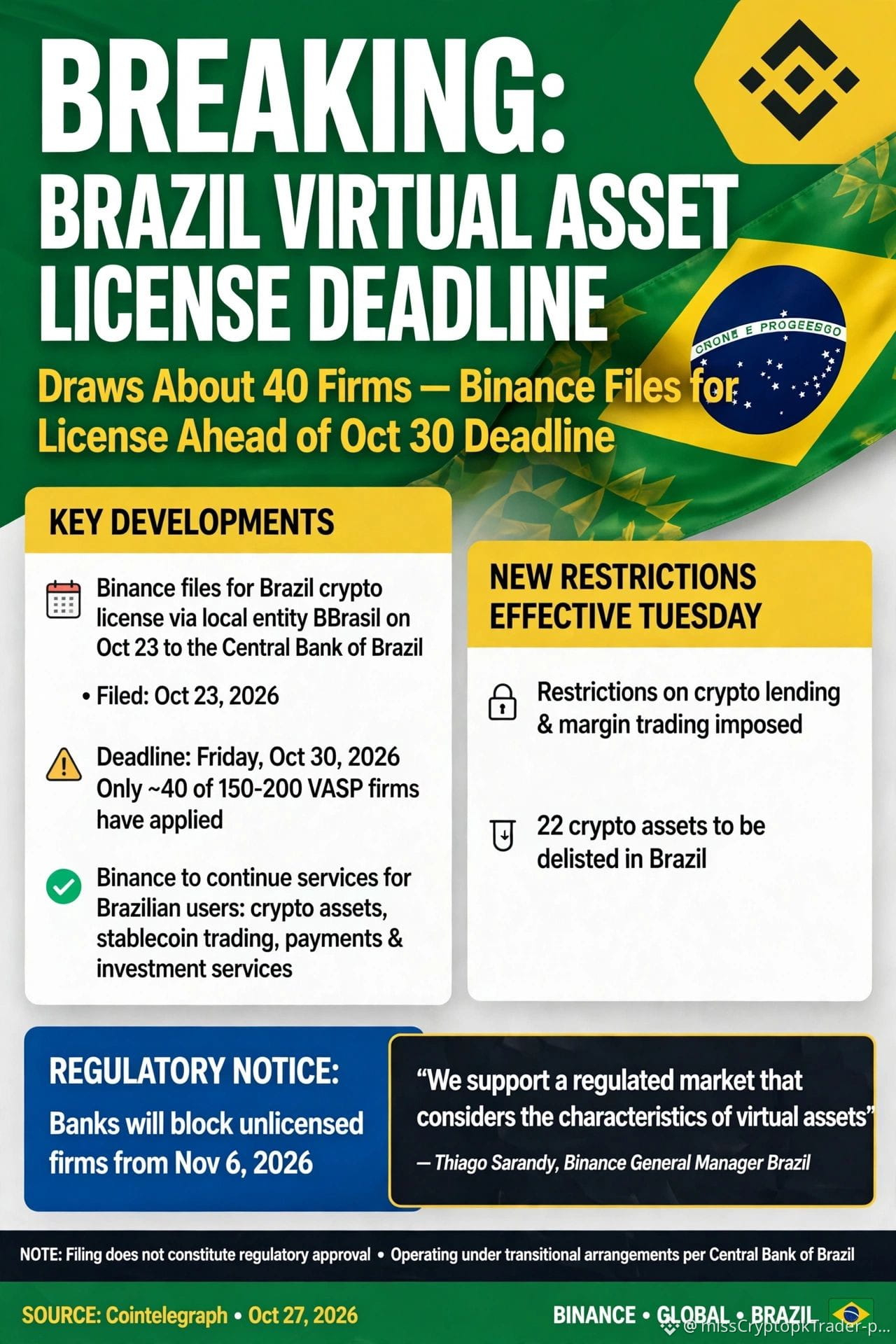
#BrazilVirtualAssetLicenseDeadlineDrawsAbout40Firms
🇧🇷 Binance files for Brazil crypto license ahead of Oct 30 deadline!
📅 Filed: Oct 23, 2026 via local entity BBrasil to Central Bank of Brazil
📉 Market Shakeout: Only ∼40 of 150-200 VASP firms applied — most exiting
✅ Binance to continue: crypto assets, stablecoin trading, payments & investment services for Brazilian users
New Restrictions (Effective Tuesday):
- Crypto lending & margin trading restricted
- 22 crypto assets to be delisted in Brazil
Quote: "We support a regulated market that considers the characteristics of virtual assets, so that access to technology and innovation continues to advance" — Thiago Sarandy, Binance GM Brazil
⚠️ Note: Filing does NOT = approval. Firms operating under transitional arrangements. From Nov 6, banks will block unlicensed firms.
$BNB #Brazil #Binance #VASP #CryptoNewss
2
170

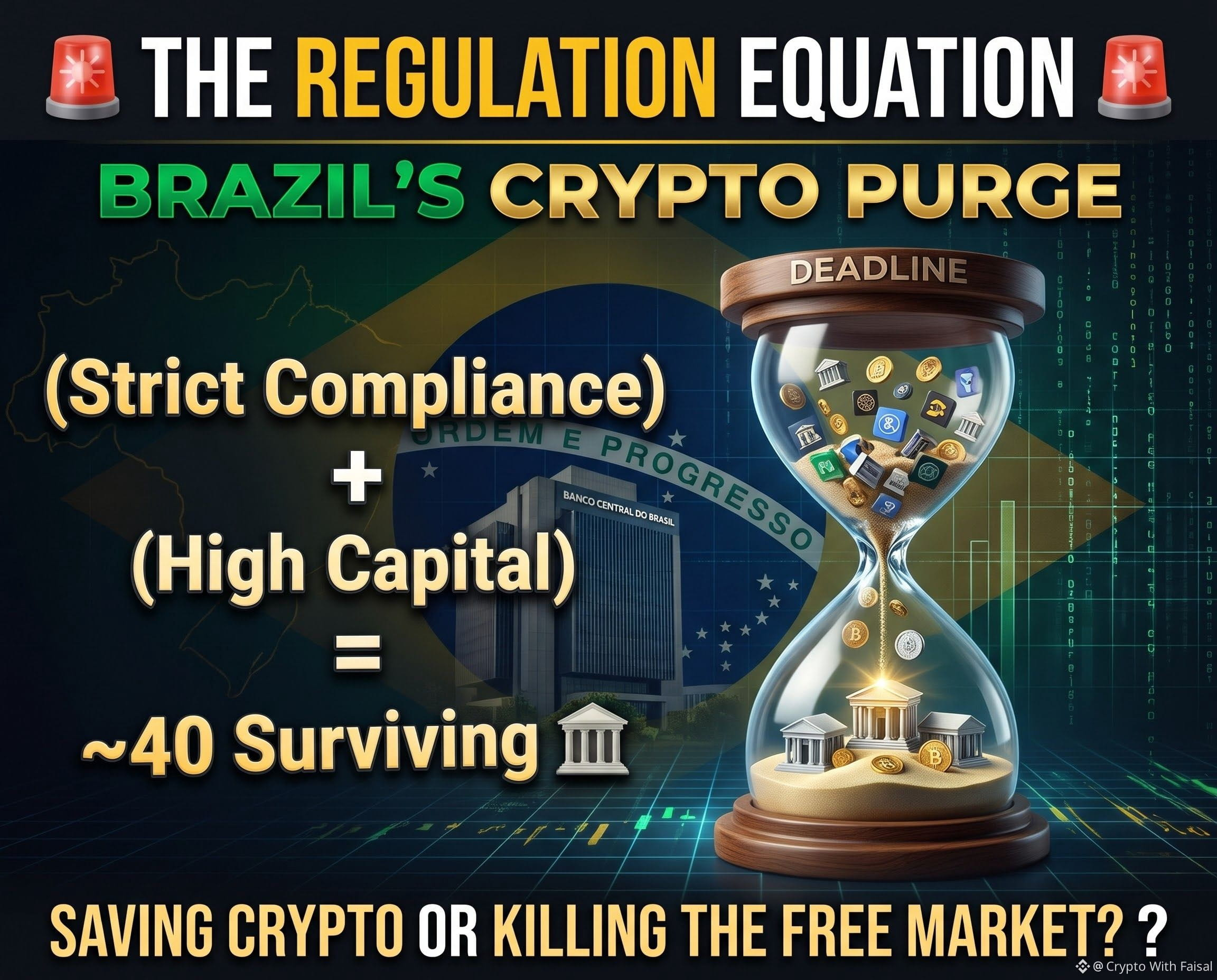
🚨 THE REGULATION EQUATION: Brazil's Purge 🚨
#brazilvirtualassetlicensedeadlinedrawsabout40firms
Let's break down this deadline using math 🧮👇
(Strict Compliance) + (High Capital) = ~40 Firms Surviving 🏛️
The Asset Input:
(The Catalyst) = Banco Central do Brasil (BCB) closed its Phase 1 VASP licensing window on Oct 30. Roughly 40 firms applied, facing severe hurdles like R10.8M–R37M in minimum capital.
The Key Deliverable:
(The Fallout) ➔ These applicants can keep operating during the BCB review, which may take up to 2 years. For non-filers, it's over. By Nov 6, local banks must sever all ties with unauthorized platforms.
The Breakdown:
With mandatory asset segregation and strict AML laws enforced, Brazil is actively filtering out weak hands to build an institutional-grade market.
Are these regulations saving crypto, or killing the free market? ❓👇💬
$BTC
{future}(BTCUSDT)
$BNB
{future}(BNBUSDT)
$ESPORTS
{future}(ESPORTSUSDT)
🚨 THE REGULATION EQUATION: Brazil's Purge 🚨
#brazilvirtualassetlicensedeadlinedrawsabout40firms
Let's break down this deadline using math 🧮👇
(Strict Compliance) + (High Capital) = ~40 Firms Surviving 🏛️
The Asset Input:
(The Catalyst) = Banco Central do Brasil (BCB) closed its Phase 1 VASP licensing window on Oct 30. Roughly 40 firms applied, facing severe hurdles like R10.8M–R37M in minimum capital.
The Key Deliverable:
(The Fallout) ➔ These applicants can keep operating during the BCB review, which may take up to 2 years. For non-filers, it's over. By Nov 6, local banks must sever all ties with unauthorized platforms.
The Breakdown:
With mandatory asset segregation and strict AML laws enforced, Brazil is actively filtering out weak hands to build an institutional-grade market.
Are these regulations saving crypto, or killing the free market? ❓👇💬
$BTC
$BNB
$ESPORTS
2
5k
·
--
#BrazilVirtualAssetLicenseDeadlineDrawsAbout40Firms
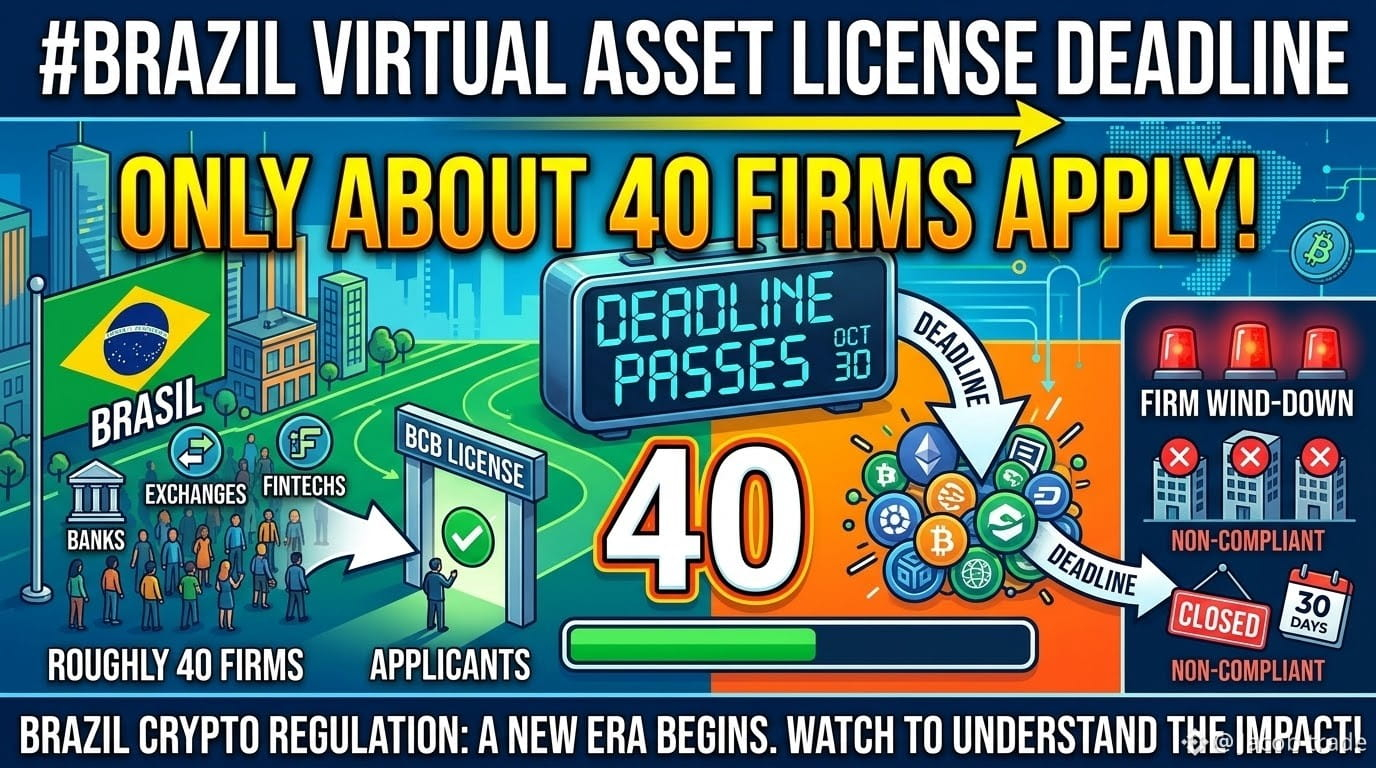
The deadline set by Brazil’s central bank for licensing virtual asset service providers (VASPs) has passed, marking an important milestone for the country’s cryptocurrency market. Of the roughly 200 companies initially estimated, about 40, including major international exchanges, submitted applications. This first group is now entering a review period, while those that missed the deadline will have to gradually cease operations and lose access to the local banking system. This development marks a major step toward a regulated and institutionalized digital asset ecosystem in Latin America’s largest economy
$IDOL
{future}(IDOLUSDT)
$LYN
{future}(LYNUSDT)
$SOPH
{future}(SOPHUSDT)
#BrazilVirtualAssetLicenseDeadlineDrawsAbout40Firms
The deadline set by Brazil’s central bank for licensing virtual asset service providers (VASPs) has passed, marking an important milestone for the country’s cryptocurrency market. Of the roughly 200 companies initially estimated, about 40, including major international exchanges, submitted applications. This first group is now entering a review period, while those that missed the deadline will have to gradually cease operations and lose access to the local banking system. This development marks a major step toward a regulated and institutionalized digital asset ecosystem in Latin America’s largest economy
$IDOL
$LYN
$SOPH
112

#BrazilVirtualAssetLicenseDeadlineDrawsAbout40Firms
The natural selection of Brazil’s crypto market has begun. The Central Bank’s deadline for virtual asset service provider licenses has passed, and the numbers are telling.
Of the roughly 200 companies expected, only 40 submitted applications. The major international platforms secured their place in the regulatory queue. Those left behind now face the worst-case scenario: they will have to wind down their operations gradually and lose access to the local banking system.
In practice, without access to banks, operating becomes unfeasible. The rules of the game have changed, and the market is rapidly moving toward institutionalization. Brazil is building a safe environment for those who play by the rules.
$IDOL
$LYN
$SOPH
{future}(IDOLUSDT)
{future}(LYNUSDT)
{spot}(SOPHUSDT)
#BrazilVirtualAssetLicenseDeadlineDrawsAbout40Firms
The natural selection of Brazil’s crypto market has begun. The Central Bank’s deadline for virtual asset service provider licenses has passed, and the numbers are telling.
Of the roughly 200 companies expected, only 40 submitted applications. The major international platforms secured their place in the regulatory queue. Those left behind now face the worst-case scenario: they will have to wind down their operations gradually and lose access to the local banking system.
In practice, without access to banks, operating becomes unfeasible. The rules of the game have changed, and the market is rapidly moving toward institutionalization. Brazil is building a safe environment for those who play by the rules.
$IDOL
$LYN
$SOPH

88

·
--
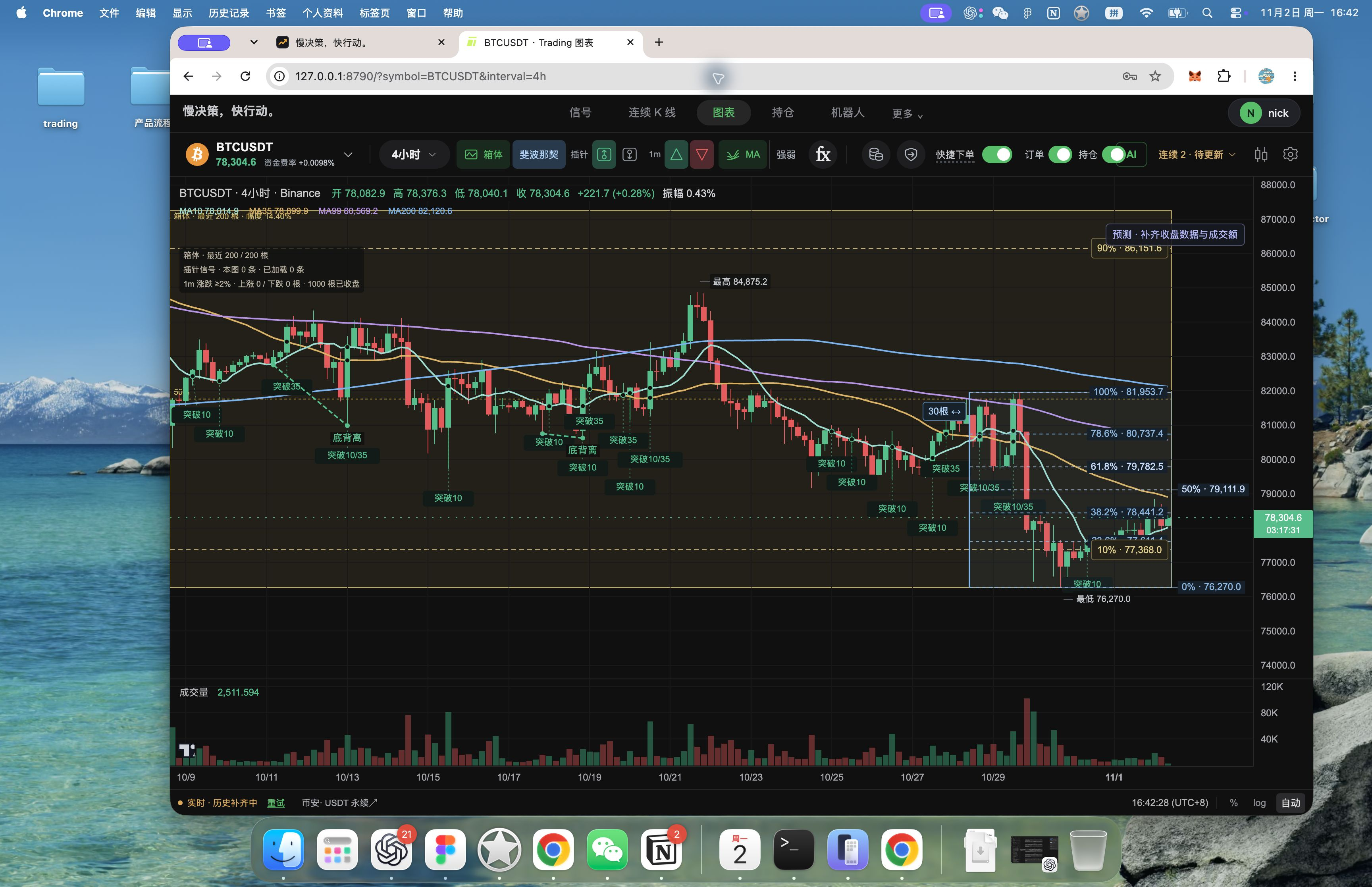
📰 Brazil: From November 6, banks will restrict transactions with unauthorized crypto providers
On October 30, the application period for existing crypto services to apply came to an end in the country. Under a resolution issued by Brazil’s Central Bank, starting November 6, banks and payment institutions will be prohibited from conducting transactions with providers operating outside the regulatory framework authorized by the regulator.
According to Livecoins’ estimate as of October 29, around 40 organizations were in the process of applying—this does not mean 40 licenses had been issued. For customers, the status of a specific platform matters more than the number of applications.
#BrazilVirtualAssetLicenseDeadlineDrawsAbout40Firms
7

·
--
Article
Brazil license deadline: About 68 institutions are applying; banking channels tighten first on November 6# Brazil license deadline: About 68 institutions are applying; banking channels tighten first on November 6
Brazil’s crypto license application window has closed. Much of the discussion centers on the figure of “about 40 institutions applying,” but what really matters is not how long the list is—it’s who will still be able to connect to banking and payment systems after November 6. Applying for authorization only means entering the review process; it does not mean a license has been granted.
The visible topic on Binance Square this round, `#BrazilVirtualAssetLicenseDeadlineDrawsAbout40Firms`, has about 7,383 views and 160 people discussing it. Public reports use a broader tracking scope, listing around 68 institutions, including trading platforms, banks, B3, and stablecoin and payment infrastructure companies. The figures differ mainly because of whether “confirmed applications,” leads from regulatory filings, and “related proceedings” are all counted. They should not be treated directly as the final number of license recipients.
Brazil license deadline: About 68 institutions are applying; banking channels tighten first on November 6
# Brazil license deadline: About 68 institutions are applying; banking channels tighten first on November 6
Brazil’s crypto license application window has closed. Much of the discussion centers on the figure of “about 40 institutions applying,” but what really matters is not how long the list is—it’s who will still be able to connect to banking and payment systems after November 6. Applying for authorization only means entering the review process; it does not mean a license has been granted.
The visible topic on Binance Square this round, `#BrazilVirtualAssetLicenseDeadlineDrawsAbout40Firms`, has about 7,383 views and 160 people discussing it. Public reports use a broader tracking scope, listing around 68 institutions, including trading platforms, banks, B3, and stablecoin and payment infrastructure companies. The figures differ mainly because of whether “confirmed applications,” leads from regulatory filings, and “related proceedings” are all counted. They should not be treated directly as the final number of license recipients.
89

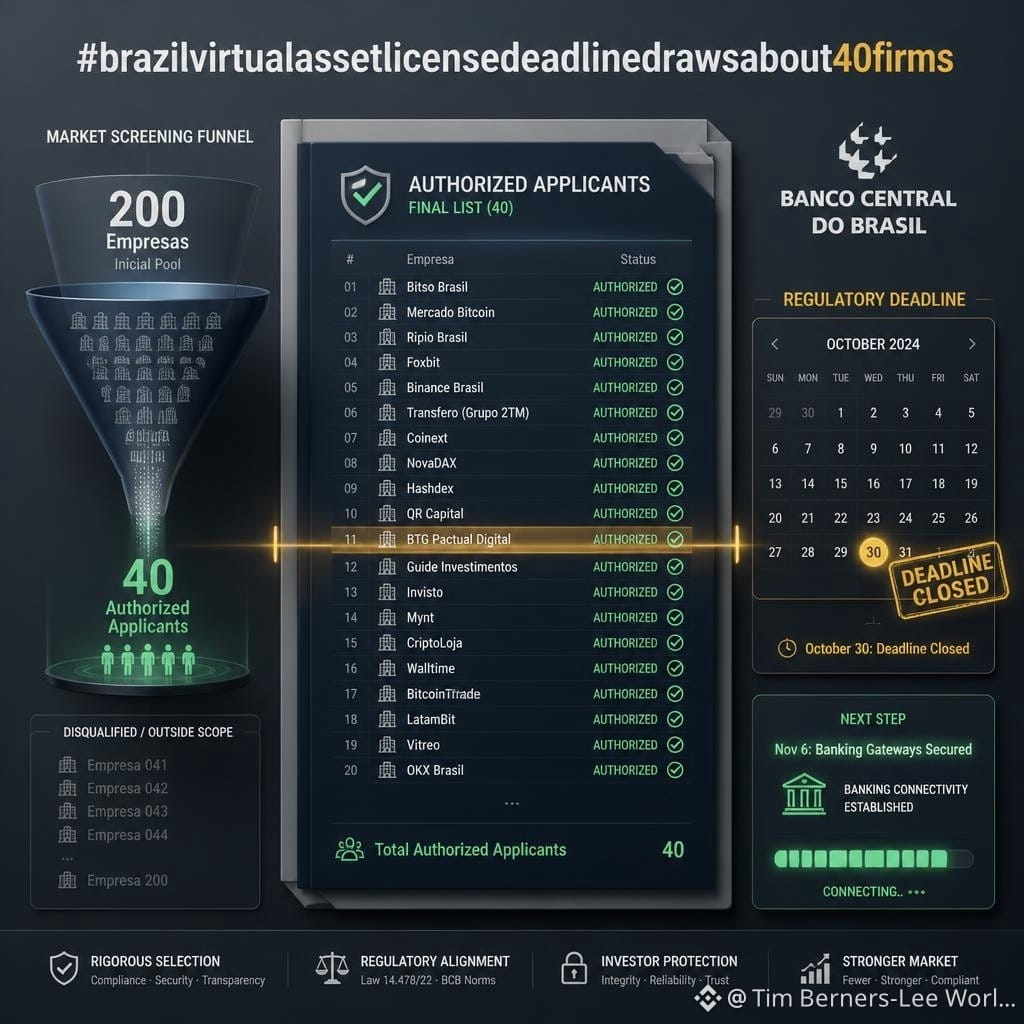
#brazilvirtualassetlicensedeadlinedrawsabout40firms The close of the application period for licenses with the Central Bank of Brazil marks a turning point for the virtual asset industry in the Southern Cone, transforming a massive, fragmented market into a highly concentrated, institutional-grade environment. The fact that only 20% of estimated operators chose to submit to BCB scrutiny does not reflect a lack of interest in the region’s largest economy, but rather the extremely high barriers to entry imposed by the new regulatory framework under Law 14,478/2022. With minimum capital requirements ranging from 10.8 to 37.2 million reais (up to 6.9 million dollars), depending on the business model, mid-sized platforms and those with a regional retail focus have been forced either to abandon direct competition or to structure white-label partnerships with dominant operators. $BNB $BTC
{future}(BTCUSDT)
{future}(BNBUSDT)
#brazilvirtualassetlicensedeadlinedrawsabout40firms The close of the application period for licenses with the Central Bank of Brazil marks a turning point for the virtual asset industry in the Southern Cone, transforming a massive, fragmented market into a highly concentrated, institutional-grade environment. The fact that only 20% of estimated operators chose to submit to BCB scrutiny does not reflect a lack of interest in the region’s largest economy, but rather the extremely high barriers to entry imposed by the new regulatory framework under Law 14,478/2022. With minimum capital requirements ranging from 10.8 to 37.2 million reais (up to 6.9 million dollars), depending on the business model, mid-sized platforms and those with a regional retail focus have been forced either to abandon direct competition or to structure white-label partnerships with dominant operators. $BNB $BTC
AmzadPulse:
yes
3
1
3
3.8k

·
--
Bearish
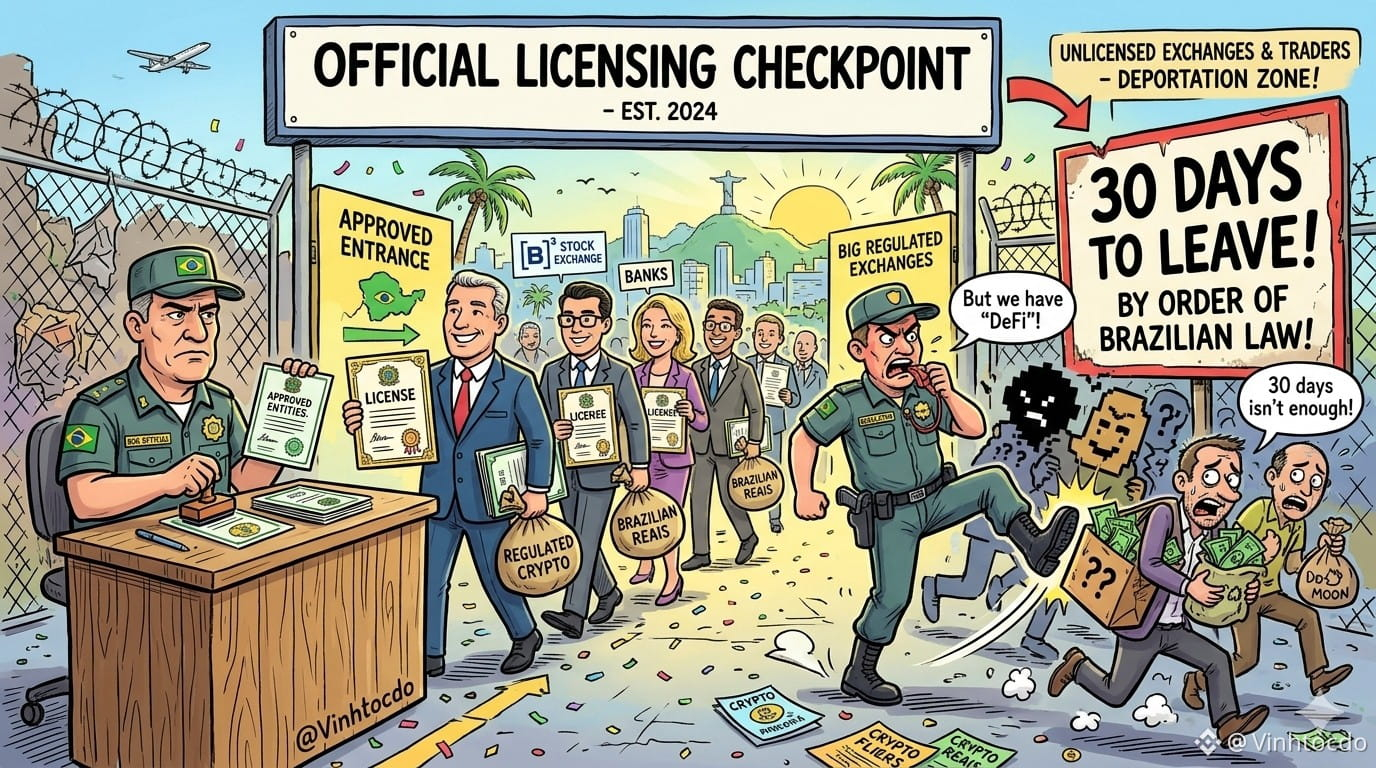
The deadline to apply for crypto licenses in Brazil has just passed, and only around 40 major players submitted applications, instead of the expected 150–200.
The list of 40 includes major exchanges, traditional banks, payment technology companies, and notably B3 (Brazil’s official stock exchange). The purge is beginning: anyone who didn’t apply will have 30 days to pack up and leave Brazil. Starting November 6, any bank caught even so much as partnering with an “unlicensed” exchange will be fined immediately.
The key issue: Brazil’s market is tightening its regulations. Major players such as the B3 stock exchange and banks entering the market show that crypto trading there is shifting from the “black market” to the mainstream—safer and regulated, but with fiercer competition.
What should traders do?
➊ Check whether the wallets/exchanges you use are licensed in Brazil to avoid having your funds frozen.
➋ Take advantage of the opportunity to accumulate assets as the market becomes legalized.
➌ This is not financial advice!
Sign up for Binance now to trade safely:
Referral code: VINHTOCDO
Link: [https://www.binance.com/register?ref=VINHTOCDO](https://www.binance.com/register?ref=VINHTOCDO)
Click the trade links below to support me:
$BTC
{future}(BTCUSDT)
$SOL
{future}(SOLUSDT)
$BNB
{future}(BNBUSDT)
#BrazilVirtualAssetLicenseDeadlineDrawsAbout40Firms #brazilcrypto #CryptoRegulation #B3Exchange #CryptoCompliance #Web3Brazil #VINHTOCDO
The deadline to apply for crypto licenses in Brazil has just passed, and only around 40 major players submitted applications, instead of the expected 150–200.
The list of 40 includes major exchanges, traditional banks, payment technology companies, and notably B3 (Brazil’s official stock exchange). The purge is beginning: anyone who didn’t apply will have 30 days to pack up and leave Brazil. Starting November 6, any bank caught even so much as partnering with an “unlicensed” exchange will be fined immediately.
The key issue: Brazil’s market is tightening its regulations. Major players such as the B3 stock exchange and banks entering the market show that crypto trading there is shifting from the “black market” to the mainstream—safer and regulated, but with fiercer competition.
What should traders do?
➊ Check whether the wallets/exchanges you use are licensed in Brazil to avoid having your funds frozen.
➋ Take advantage of the opportunity to accumulate assets as the market becomes legalized.
➌ This is not financial advice!
Sign up for Binance now to trade safely:
Referral code: VINHTOCDO
Link: https://www.binance.com/register?ref=VINHTOCDO
Click the trade links below to support me:
$BTC
$SOL
$BNB
#BrazilVirtualAssetLicenseDeadlineDrawsAbout40Firms #brazilcrypto #CryptoRegulation #B3Exchange #CryptoCompliance #Web3Brazil #VINHTOCDO
5
443
Log in to explore more content
Join global crypto users on Binance Square
⚡️ Get latest and useful information about crypto.
💬 Trusted by the world’s largest crypto exchange.
👍 Discover real insights from verified creators.
Email / Phone number
Trending Topics
1
#BinanceRestores28FiatWithdrawals
4,039 views
141 Discussing
2
#BinanceProcesses$4.65BWithdrawals
62,233 views
270 Discussing
3
#ETHFalls16.1%InOctober
2 views
7 Discussing
4
#BitcoinClosesAbove50WeekMAFor7thStraightWeek
1,234 views
36 Discussing
5
#BitcoinDropsBelow$78K
4,504 views
34 Discussing
6
#EthereumSurpasses$2300
4,332 views
64 Discussing
7
#BitcoinSpotETFsPost$203MWeeklyOutflow
5,105 views
43 Discussing
8
#SouthKoreanLawmakerProposesReviewOfAllListedDigitalAssets
1,842 views
45 Discussing
9
#SolanaMobileRemovesMaliciousSKRClaimApp
2,260 views
66 Discussing
10
#BrazilVirtualAssetLicenseDeadlineDrawsAbout40Firms
32,157 views
522 Discussing