
#bittensor
bittensor
2.6M views
5,889 Discussing
Hot
Latest

·
--
🚀 $TAO IS PREPARING FOR A BIG BREAKOUT! 📈🔥
TAO is approaching a key descending channel breakout, and a strong bullish move could be on the horizon! With $150 as the invalidation level, all eyes are on the next move. 👀
#TAO #Bittensor #crypto #BinanceSquare
{future}(TAOUSDT)
🚀 $TAO IS PREPARING FOR A BIG BREAKOUT! 📈🔥
TAO is approaching a key descending channel breakout, and a strong bullish move could be on the horizon! With $150 as the invalidation level, all eyes are on the next move. 👀
#TAO #Bittensor #crypto #BinanceSquare
TAO is approaching a key descending channel breakout, and a strong bullish move could be on the horizon! With $150 as the invalidation level, all eyes are on the next move. 👀
#TAO #Bittensor #crypto #BinanceSquare
Magaret Takes pMCr:
Believe me guys $TAO Will hit $250 soon incha Allah,
Don't miss this opportunity, Buy now $TAO
1
646


·
--

Article
Bittensor Pays AI Networks Every Day. But Who Is Paying for Their Work?Bittensor has an unusual idea about building artificial intelligence.
Instead of concentrating everything inside one company, it allows independent networks to compete in areas such as computing, model inference, data processing, and other AI services.
The network rewards participants with crypto.
And that's where things get interesting for TAO investors.
Bittensor is issuing approximately 3,600 TAO per day following its first halving in December 2025.
Those rewards support miners, validators, subnet operators, and stakers across the ecosystem.
But there's a question I keep coming back to.
How much of the AI being produced is something customers actually want to pay for?
That's different from asking how many tokens the network distributes.
Under Bittensor's Dynamic TAO system, individual subnets have their own alpha tokens.
When someone stakes TAO into a subnet, their TAO is exchanged through an on-chain liquidity pool for that subnet's alpha token.
The price changes as people enter and exit.
That creates an economic market around each subnet.
And it means staking into an AI subnet isn't the same as placing TAO into a conventional fixed-yield savings product.
Your return depends partly on the subnet token's price, the rewards earned, validator commissions, and liquidity when you exit.
A subnet can distribute attractive rewards while its alpha token falls in value relative to TAO.
That's a risk worth understanding.
There's another important change.
Bittensor switched back to a price-based emission model in June 2026.
Subnet rewards are now influenced by the exponential moving average of their alpha token prices, with adjustments under the network's emission rules.
Higher-priced subnet tokens can attract a larger share of newly issued TAO.
The logic is that market participants allocate capital toward networks they believe are valuable.
But market demand and genuine customer demand aren't always the same thing.
A subnet token can become popular because people expect its price to rise.
That doesn't necessarily mean businesses are paying for its AI services.
We've seen this distinction in plenty of crypto sectors.
In September, an executive at Bittensor infrastructure company Yuma described growing commercial interest, including customer contracts and subnet token purchases.
That's encouraging.
But I'd still want more standardized reporting of actual sales, recurring customers, and costs across individual subnets.
Especially because Bittensor isn't one single AI business.
It's a collection of networks with different products, operators, and economic incentives.
The overall tokenomics are easier to measure.
TAO has a maximum supply of 21 million, similar to Bitcoin.
Its first halving reduced issuance from about 7,200 to 3,600 TAO per day.
And according to on-chain tracking on November 24, approximately 11.76 million TAO had been issued, representing around 56% of the maximum supply.
About 5.56 million TAO was staked on the root network, while another 1.93 million sat in subnet liquidity pools.
That means a substantial share of existing TAO is committed within the ecosystem.
But committed capital shouldn't automatically be described as permanently locked supply.
Users can unstake, and exiting subnet positions involves swapping alpha back into TAO at the prevailing pool price.
There's no guarantee that all participants can exit at once without affecting prices.
I also wouldn't equate the value of TAO inside subnet pools with revenue from AI customers.
It's investor and participant capital allocated through the network's staking mechanism.
That's very different from dollars earned by selling inference or computing services.
And it's why I think Bittensor needs two separate scorecards.
The first measures network incentives: staking participation, emission allocation, subnet prices, and the amount of TAO entering or leaving subnet pools.
The second measures the actual AI business: paying customers, recurring revenue, service quality, and profit after computing costs.
The first scorecard tells us where capital is moving.
The second tells us whether Bittensor is creating products people will keep using even without token incentives.
For me, that distinction matters more than another headline about the number of active subnets.
Bittensor has created an interesting marketplace for funding decentralized AI development.
Now I want to see which of those AI networks can build businesses that survive without depending mainly on emissions.
#TAO #Bittensor $TAO
{future}(TAOUSDT)
Bittensor Pays AI Networks Every Day. But Who Is Paying for Their Work?
Bittensor has an unusual idea about building artificial intelligence.
Instead of concentrating everything inside one company, it allows independent networks to compete in areas such as computing, model inference, data processing, and other AI services.
The network rewards participants with crypto.
And that's where things get interesting for TAO investors.
Bittensor is issuing approximately 3,600 TAO per day following its first halving in December 2025.
Those rewards support miners, validators, subnet operators, and stakers across the ecosystem.
But there's a question I keep coming back to.
How much of the AI being produced is something customers actually want to pay for?
That's different from asking how many tokens the network distributes.
Under Bittensor's Dynamic TAO system, individual subnets have their own alpha tokens.
When someone stakes TAO into a subnet, their TAO is exchanged through an on-chain liquidity pool for that subnet's alpha token.
The price changes as people enter and exit.
That creates an economic market around each subnet.
And it means staking into an AI subnet isn't the same as placing TAO into a conventional fixed-yield savings product.
Your return depends partly on the subnet token's price, the rewards earned, validator commissions, and liquidity when you exit.
A subnet can distribute attractive rewards while its alpha token falls in value relative to TAO.
That's a risk worth understanding.
There's another important change.
Bittensor switched back to a price-based emission model in June 2026.
Subnet rewards are now influenced by the exponential moving average of their alpha token prices, with adjustments under the network's emission rules.
Higher-priced subnet tokens can attract a larger share of newly issued TAO.
The logic is that market participants allocate capital toward networks they believe are valuable.
But market demand and genuine customer demand aren't always the same thing.
A subnet token can become popular because people expect its price to rise.
That doesn't necessarily mean businesses are paying for its AI services.
We've seen this distinction in plenty of crypto sectors.
In September, an executive at Bittensor infrastructure company Yuma described growing commercial interest, including customer contracts and subnet token purchases.
That's encouraging.
But I'd still want more standardized reporting of actual sales, recurring customers, and costs across individual subnets.
Especially because Bittensor isn't one single AI business.
It's a collection of networks with different products, operators, and economic incentives.
The overall tokenomics are easier to measure.
TAO has a maximum supply of 21 million, similar to Bitcoin.
Its first halving reduced issuance from about 7,200 to 3,600 TAO per day.
And according to on-chain tracking on November 24, approximately 11.76 million TAO had been issued, representing around 56% of the maximum supply.
About 5.56 million TAO was staked on the root network, while another 1.93 million sat in subnet liquidity pools.
That means a substantial share of existing TAO is committed within the ecosystem.
But committed capital shouldn't automatically be described as permanently locked supply.
Users can unstake, and exiting subnet positions involves swapping alpha back into TAO at the prevailing pool price.
There's no guarantee that all participants can exit at once without affecting prices.
I also wouldn't equate the value of TAO inside subnet pools with revenue from AI customers.
It's investor and participant capital allocated through the network's staking mechanism.
That's very different from dollars earned by selling inference or computing services.
And it's why I think Bittensor needs two separate scorecards.
The first measures network incentives: staking participation, emission allocation, subnet prices, and the amount of TAO entering or leaving subnet pools.
The second measures the actual AI business: paying customers, recurring revenue, service quality, and profit after computing costs.
The first scorecard tells us where capital is moving.
The second tells us whether Bittensor is creating products people will keep using even without token incentives.
For me, that distinction matters more than another headline about the number of active subnets.
Bittensor has created an interesting marketplace for funding decentralized AI development.
Now I want to see which of those AI networks can build businesses that survive without depending mainly on emissions.
#TAO #Bittensor $TAO
4
514

·
--
Bullish
$TAO
{spot}(TAOUSDT)
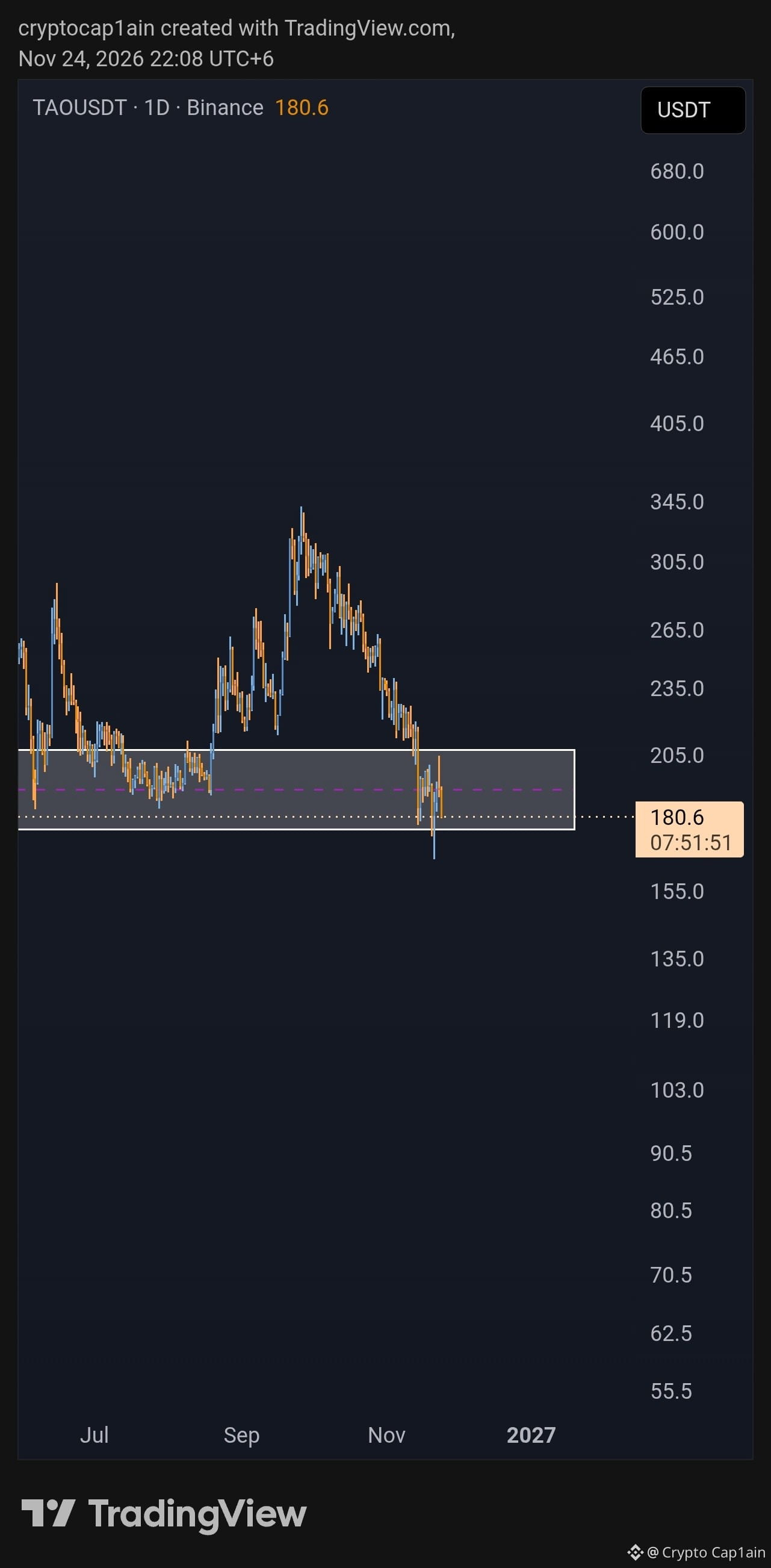
After giving us a good profit, TAO has again come to our buy zone.
If you have planned to buy TAO, buy some here in spot and keep some USDT to dca it lower.
AI will make a comeback soon.
#bittensor #TAO
$TAO
After giving us a good profit, TAO has again come to our buy zone.
If you have planned to buy TAO, buy some here in spot and keep some USDT to dca it lower.
AI will make a comeback soon.
#bittensor #TAO
After giving us a good profit, TAO has again come to our buy zone.
If you have planned to buy TAO, buy some here in spot and keep some USDT to dca it lower.
AI will make a comeback soon.
#bittensor #TAO
احسان EHSAN:
Bad trade is like a cancer
Cut it off before you die
5
4
5.3k

·
--
Bearish
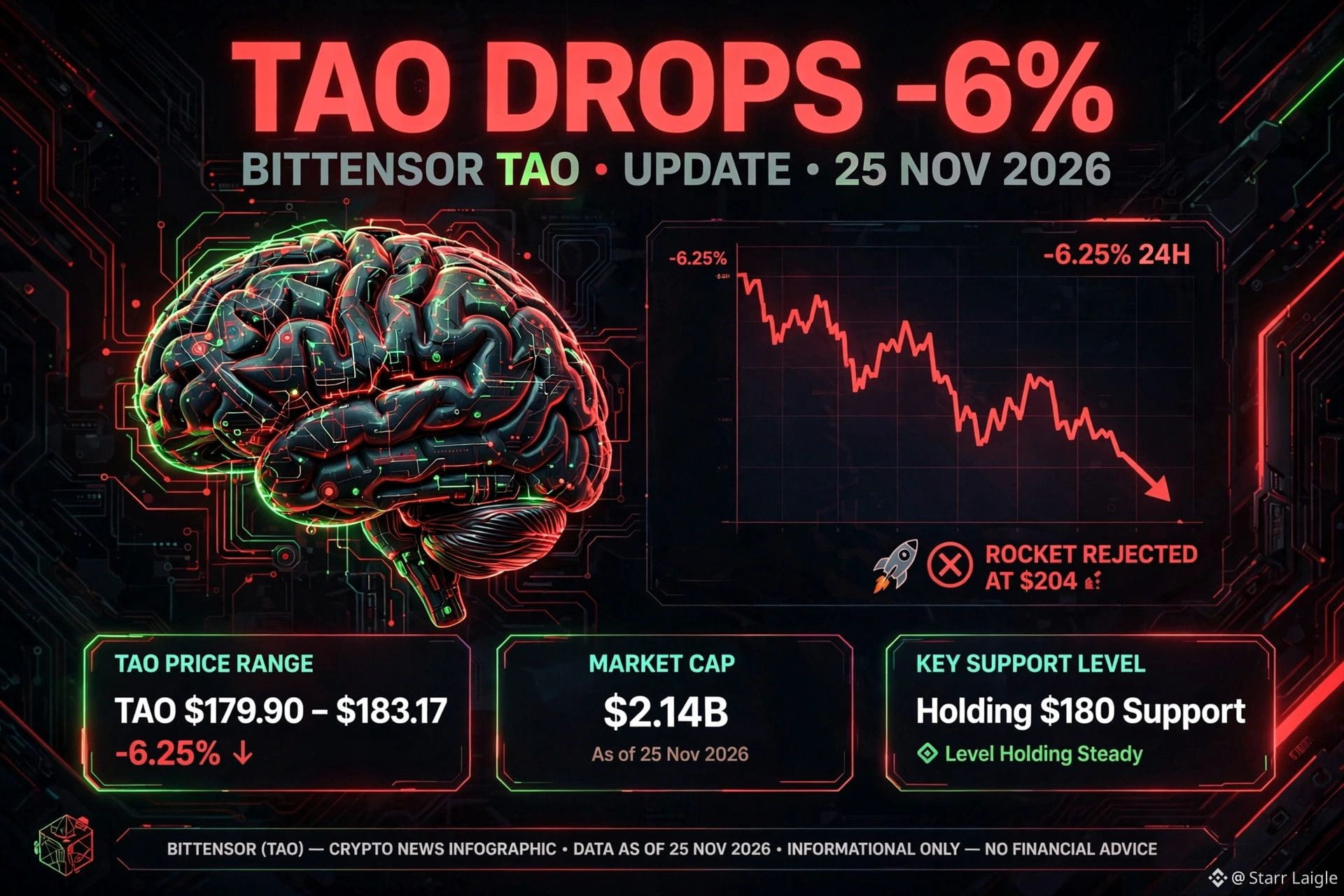
*🔥 $TAO UPDATE • 25 NOV 2026 - BITTENSOR DROPS -6%! REJECTED AT $204! HOLDING $180! 🔥*
$TAO is the #1 AI coin in crypto - and today it's bleeding with the market! After pumping to $204 yesterday, TAO got rejected hard and fell back to $180!
*$TAO PRICE TODAY:*
Price: *$179.90 - $183.17*
24h Change: *-$12 = -6.04% to -6.25% RED!*
Day Open: *$191.90*
Day High: *$192.40 - $194.91*
Day Low: *$179.36 - $179.56*
Previous Close: *$190.80*
1 TAO = *Rs 51,500 PKR* 🇵🇰
Market Cap: *$2.14B - $2.22B*
Rank: *#37 in Crypto!*
24h Volume: *$99.49M - $131.92M*
Circulating Supply: *11.73M TAO*
Max Supply: *21M TAO - Same as Bitcoin! - 56% Circulating!*
All-Time High: *$759.01*
*THE LAST 4 DAYS:*
*21 Nov:* TAO crashed to *$165.40* low, closed $186!
*22 Nov:* Recovered to *$191.10*!
*23 Nov:* Pumped to *$204.40* high! +10%! AI hype + NVDA pump!
*24 Nov:* *Rejected at $204!* Dumped to *$179.40*! -6% in 1 day!
TAO is down -7.4% in 7 days, -27.1% in 30 days, -33.99% in 6 months, -40.46% in 1 year!
*WHY DID TAO FALL?*
1. *BTC Fell Below $60K!* Bitcoin -5% dragged ALL AI coins down! TAO fell -8.62% - MORE than BTC!
2. *Rejection at $203-$204!* Traders sold the $200 resistance! Classic sell-the-news!
3. *Market Wide Selloff!* Total crypto cap fell -4.26% in 24h!
4. *ETF Outflows!* BTC ETFs -$569M, institutions selling!
But TAO is still holding $180 - that's the key level!
*WHY TAO IS STILL BULLISH LONG-TERM:*
1. *AI is #1 Narrative!* NVDA +31% proved AI is back!
2. *Scarcity!* Only 21M TAO ever - same as BTC! Halving every cycle!
3. *Staking!* Lots of TAO is staked / locked - reduces selling supply!
4. *Subnets Growing!* More AI subnets = More demand for TAO!
Are you buying TAO at $180 or waiting for $167?
Comment *"BUYING $180"* if you are buying!
Comment *"WAITING $167"* if you are waiting!
#TAO #Bittensor #AI #crypto
{spot}(TAOUSDT)
*🔥 $TAO UPDATE • 25 NOV 2026 - BITTENSOR DROPS -6%! REJECTED AT $204! HOLDING $180! 🔥*
$TAO is the #1 AI coin in crypto - and today it's bleeding with the market! After pumping to $204 yesterday, TAO got rejected hard and fell back to $180!
*$TAO PRICE TODAY:*
Price: *$179.90 - $183.17*
24h Change: *-$12 = -6.04% to -6.25% RED!*
Day Open: *$191.90*
Day High: *$192.40 - $194.91*
Day Low: *$179.36 - $179.56*
Previous Close: *$190.80*
1 TAO = *Rs 51,500 PKR* 🇵🇰
Market Cap: *$2.14B - $2.22B*
Rank: *#37 in Crypto!*
24h Volume: *$99.49M - $131.92M*
Circulating Supply: *11.73M TAO*
Max Supply: *21M TAO - Same as Bitcoin! - 56% Circulating!*
All-Time High: *$759.01*
*THE LAST 4 DAYS:*
*21 Nov:* TAO crashed to *$165.40* low, closed $186!
*22 Nov:* Recovered to *$191.10*!
*23 Nov:* Pumped to *$204.40* high! +10%! AI hype + NVDA pump!
*24 Nov:* *Rejected at $204!* Dumped to *$179.40*! -6% in 1 day!
TAO is down -7.4% in 7 days, -27.1% in 30 days, -33.99% in 6 months, -40.46% in 1 year!
*WHY DID TAO FALL?*
1. *BTC Fell Below $60K!* Bitcoin -5% dragged ALL AI coins down! TAO fell -8.62% - MORE than BTC!
2. *Rejection at $203-$204!* Traders sold the $200 resistance! Classic sell-the-news!
3. *Market Wide Selloff!* Total crypto cap fell -4.26% in 24h!
4. *ETF Outflows!* BTC ETFs -$569M, institutions selling!
But TAO is still holding $180 - that's the key level!
*WHY TAO IS STILL BULLISH LONG-TERM:*
1. *AI is #1 Narrative!* NVDA +31% proved AI is back!
2. *Scarcity!* Only 21M TAO ever - same as BTC! Halving every cycle!
3. *Staking!* Lots of TAO is staked / locked - reduces selling supply!
4. *Subnets Growing!* More AI subnets = More demand for TAO!
Are you buying TAO at $180 or waiting for $167?
Comment *"BUYING $180"* if you are buying!
Comment *"WAITING $167"* if you are waiting!
#TAO #Bittensor #AI #crypto
60

·
--
Bullish
Worked for 26s 👇
{future}(TAOUSDT)
I'll frame this as a Binance Square post: a concise, market-driven $TAO (Bittensor) outlook combining macro conditions, geopolitical risk, liquidity, and crypto market sentiment. I'll make the prediction directional but not pretend it's guaranteed.
###Binance Square post (under 500 characters)
Ready to post
🚨 $TAO Outlook: Opportunity or Trap?
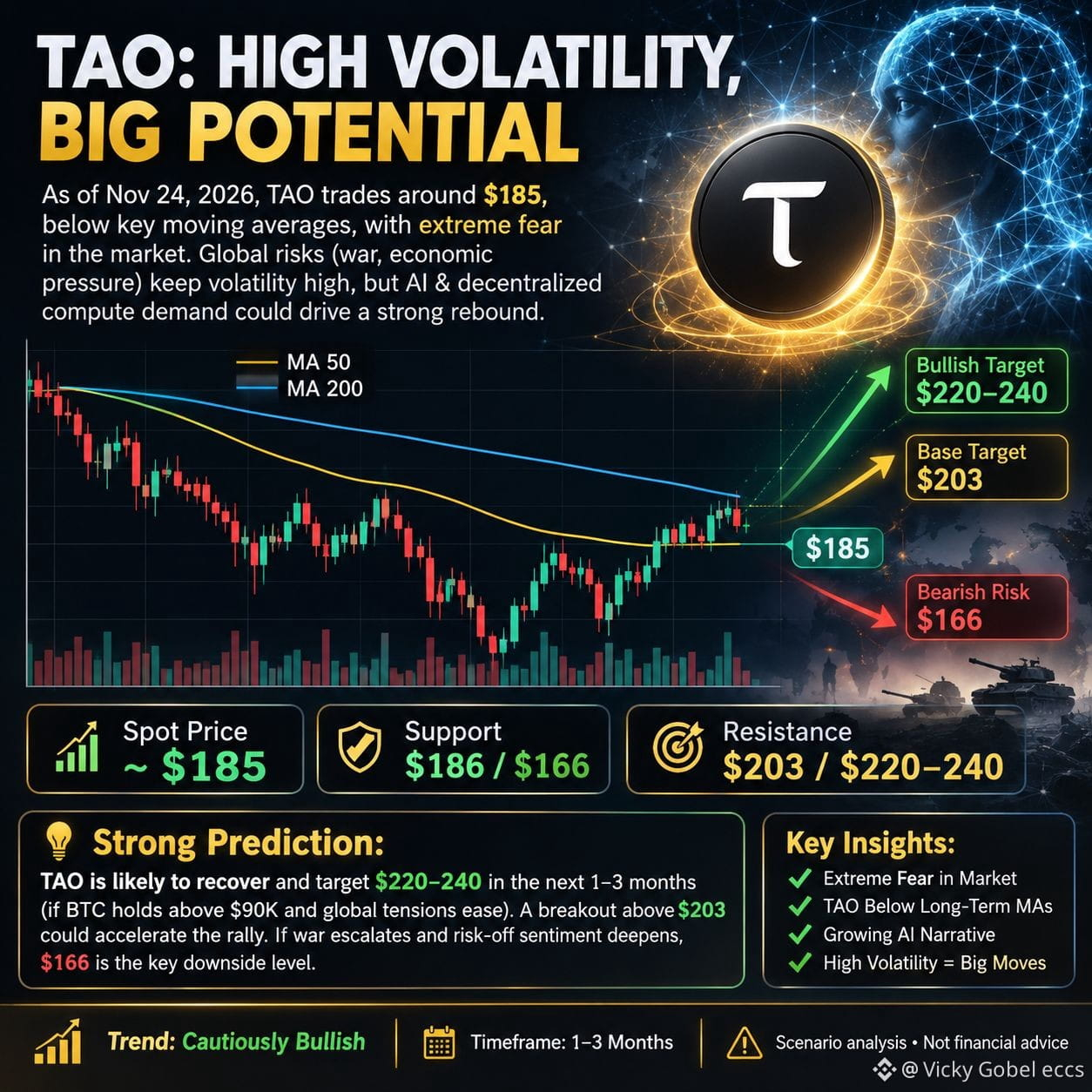
TAO trades near $185 amid extreme market fear, geopolitical uncertainty and macro pressure. Support: $186/$166. Resistance: $203.
My prediction: If $BTC stabilizes and AI narrative strengthens, TAO could target $220–$240 in the next 1–3 months. A breakdown below $166 would invalidate the bullish setup.
{future}(BTCUSDT)
Smart money watches levels, not emotions. 🔥
#TAO #Bittensor #Crypto
Market snapshot and technical context: TAO around $185, with extreme fear and downside risk if support fails. coinmarketcap +2
The image above is designed for your #Binance Square post.
My directional bias: Cautiously bullish, but a break below $166 would significantly weaken the setup.
Worked for 26s 👇
I'll frame this as a Binance Square post: a concise, market-driven $TAO (Bittensor) outlook combining macro conditions, geopolitical risk, liquidity, and crypto market sentiment. I'll make the prediction directional but not pretend it's guaranteed.
###Binance Square post (under 500 characters)
Ready to post
🚨 $TAO Outlook: Opportunity or Trap?
TAO trades near $185 amid extreme market fear, geopolitical uncertainty and macro pressure. Support: $186/$166. Resistance: $203.
My prediction: If $BTC stabilizes and AI narrative strengthens, TAO could target $220–$240 in the next 1–3 months. A breakdown below $166 would invalidate the bullish setup.
Smart money watches levels, not emotions. 🔥
#TAO #Bittensor #Crypto
Market snapshot and technical context: TAO around $185, with extreme fear and downside risk if support fails. coinmarketcap +2
The image above is designed for your #Binance Square post.
My directional bias: Cautiously bullish, but a break below $166 would significantly weaken the setup.
13

·
--
Bullish
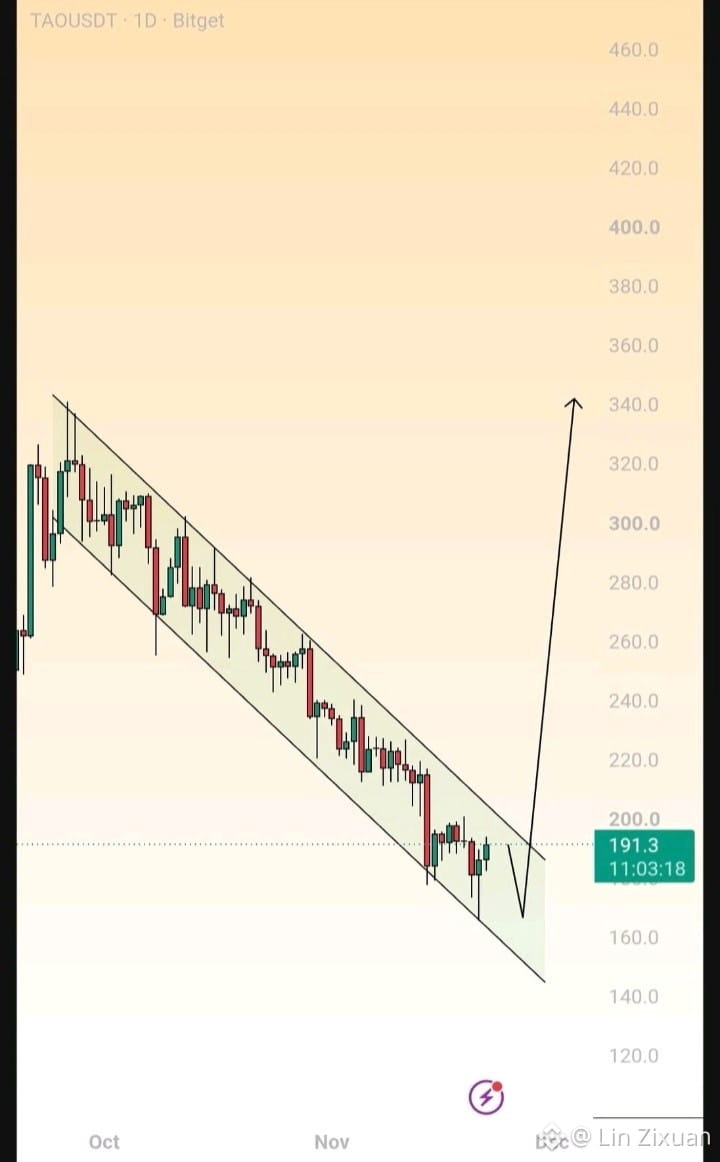
$TAO is approaching an interesting zone. 👀
The daily descending buyers may be preparing for a recovery.
My 3 observations:
1️⃣ Price is testing the lower channel area.
2️⃣ A breakout above the channel could signal a trend reversal.
3️⃣ Volume confirmation is important before entering LONG.
🎯 Targets to watch:
• TP1: $260
• TP2: $340
My view: Bullish reversal possibility, but confirmation is needed.
Would you take a LONG on $TAO ?
#TAO #Bittensor #CryptoTrading
BAMEEN ALE:
Thinking abt this
1
102

Article
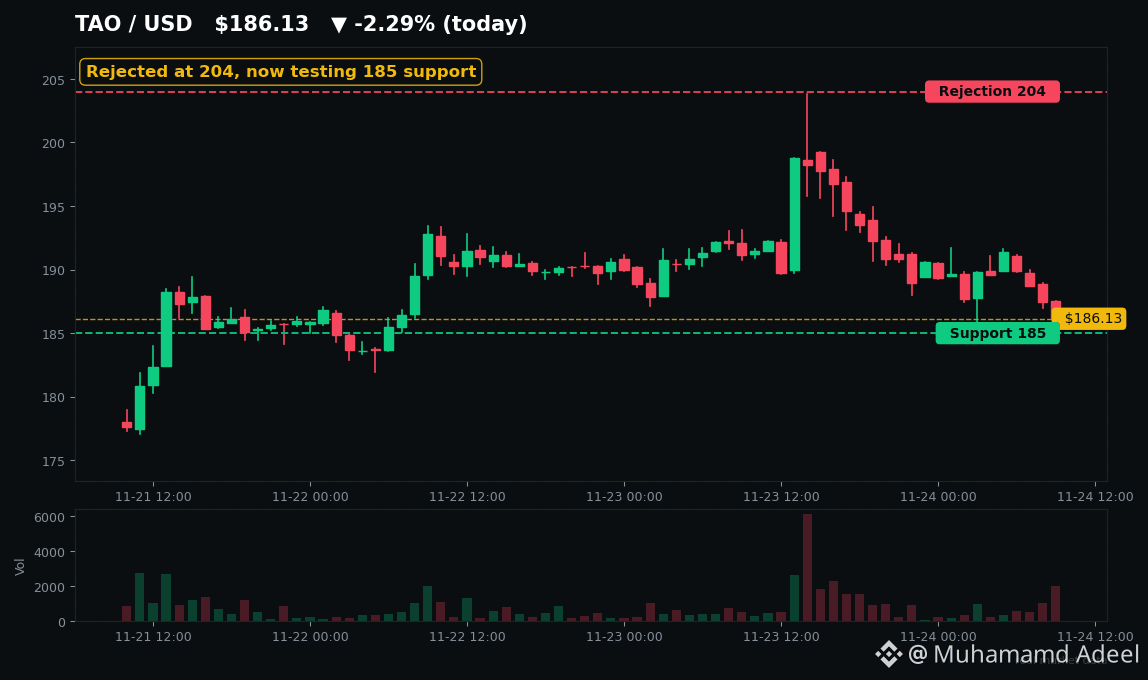
TAO Is 75% Below Its ATH — Yet Social Just Exploded 5,231%. Watch $185TAO is 75% below its all-time high — and yet the crowd just flooded in.
Social engagements around Bittensor exploded 5,231% in a week, pushing TAO to AltRank #2 across all of crypto. But here's the twist: sentiment is sitting at just 28%, near a one-year low. Everyone is watching. Almost nobody believes. That's exactly the kind of split that makes a chart worth watching.
What just happened
TAO spiked to $204 on Monday, got rejected hard, and closed near $190.60. Today it's sliding again — around $186, down about 3.5% in 24 hours and 24% over the past month. It's now sitting right on its $185 support, the same line traders have been marking all week.
Volume is telling its own story: roughly $115M in spot volume in 24 hours, and on-chain transfer volume jumped 115.7% day-on-day. The daily RSI is near 36 — approaching oversold, but not washed out yet.
Why it actually matters
This isn't just a price chart. Bittensor's subnets are starting to show real usage — subnet revenue is estimated at around $70M annualised, up roughly 40% month-on-month, and a new "gamma" metric shows subnets actually spending credits on services. About 64% of TAO supply is staked.
But let's be honest about the other side: that ~$70M of revenue still covers only 9–23% of the network's $300M+ a year in token emissions. The model is improving. It isn't proven yet.
The levels that decide it
Check the $TAO chart — this is a decision point, not a trend.
Support: $185, then $182, then the $165 zone — the same area TAO bounced from twice before, in August 2024 and April 2025, rallying more than 170% within weeks both times. Both times, though, the bounce faded well below the old highs.
Resistance: $195, then $200, then $204 — Monday's rejection high. A daily close back above $204 would be the first real sign the sellers are losing control. Lose $185, and $165–$160 comes into play fast.
The sector check
AI tokens actually led the market on Monday, up 1.75% as a sector while $BTC hovered just under $60K. $NEAR is the other AI name traders are watching in this rotation — but none of this matters if Bitcoin loses $60K. The whole AI trade is still Bitcoin's passenger.
The honest risk
TAO is in a confirmed downtrend, sitting ~20% below its 200-day average. The Grayscale TAO ETF filing is still pending with no launch date, Fear & Greed is at 11 — Extreme Fear — and the market is pricing a ~95% chance of a December Fed hike. History says TAO bounces hard off the $165 zone. History also says those bounces have faded every time since December 2024.
What I'm watching next: whether $185 holds into the close, a reclaim of $200, and Wednesday's PCE inflation print — the next macro trigger for everything.
Not financial advice. DYOR.
#Bittensor #AI
TAO Is 75% Below Its ATH — Yet Social Just Exploded 5,231%. Watch $185
TAO is 75% below its all-time high — and yet the crowd just flooded in.
Social engagements around Bittensor exploded 5,231% in a week, pushing TAO to AltRank #2 across all of crypto. But here's the twist: sentiment is sitting at just 28%, near a one-year low. Everyone is watching. Almost nobody believes. That's exactly the kind of split that makes a chart worth watching.
What just happened
TAO spiked to $204 on Monday, got rejected hard, and closed near $190.60. Today it's sliding again — around $186, down about 3.5% in 24 hours and 24% over the past month. It's now sitting right on its $185 support, the same line traders have been marking all week.
Volume is telling its own story: roughly $115M in spot volume in 24 hours, and on-chain transfer volume jumped 115.7% day-on-day. The daily RSI is near 36 — approaching oversold, but not washed out yet.
Why it actually matters
This isn't just a price chart. Bittensor's subnets are starting to show real usage — subnet revenue is estimated at around $70M annualised, up roughly 40% month-on-month, and a new "gamma" metric shows subnets actually spending credits on services. About 64% of TAO supply is staked.
But let's be honest about the other side: that ~$70M of revenue still covers only 9–23% of the network's $300M+ a year in token emissions. The model is improving. It isn't proven yet.
The levels that decide it
Check the $TAO chart — this is a decision point, not a trend.
Support: $185, then $182, then the $165 zone — the same area TAO bounced from twice before, in August 2024 and April 2025, rallying more than 170% within weeks both times. Both times, though, the bounce faded well below the old highs.
Resistance: $195, then $200, then $204 — Monday's rejection high. A daily close back above $204 would be the first real sign the sellers are losing control. Lose $185, and $165–$160 comes into play fast.
The sector check
AI tokens actually led the market on Monday, up 1.75% as a sector while $BTC hovered just under $60K. $NEAR is the other AI name traders are watching in this rotation — but none of this matters if Bitcoin loses $60K. The whole AI trade is still Bitcoin's passenger.
The honest risk
TAO is in a confirmed downtrend, sitting ~20% below its 200-day average. The Grayscale TAO ETF filing is still pending with no launch date, Fear & Greed is at 11 — Extreme Fear — and the market is pricing a ~95% chance of a December Fed hike. History says TAO bounces hard off the $165 zone. History also says those bounces have faded every time since December 2024.
What I'm watching next: whether $185 holds into the close, a reclaim of $200, and Wednesday's PCE inflation print — the next macro trigger for everything.
Not financial advice. DYOR.
#Bittensor #AI
6

·
--
Bittensor's $TAO is back on CoinGecko's trending list — and the catalyst isn't a pump, it's paperwork.
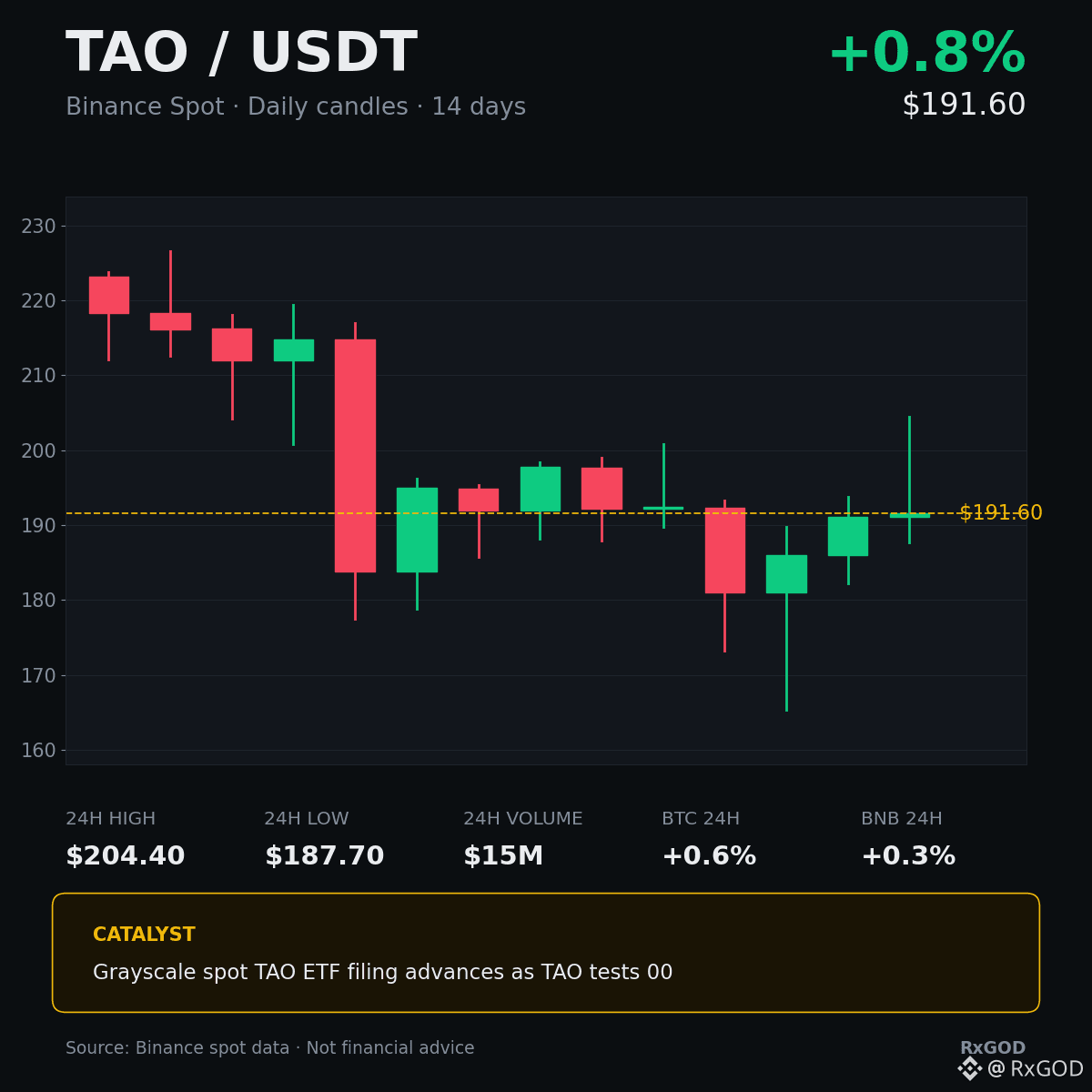
Grayscale filed Amendment No. 2 to its S-1 on October 23 to convert its Bittensor Trust into a spot TAO ETF on NYSE Arca under ticker GTAO, with BitGo and Coinbase Custody holding the tokens. October actually saw three separate US ETF filings for TAO. The catch: SEC approval is still pending, with no launch date or fee disclosed yet — so this is a path, not a done deal.
Price-wise, $TAO trades at $191.60 (+0.8% in 24h on Binance), after being rejected at $204.40 earlier today. It's +6% over the past week, but still -12% over 14 days and roughly 75% below its $757.60 all-time high. The 14-day range is $165.40–$226.50, so we're sitting mid-range — a bounce inside a downtrend, not a breakout. TAO also remains below its 200-day average near $237, and volume, while up ~36% on November 23, is still modest at $15.3M on Binance spot.
The honest read: the ETF story gives TAO a real institutional angle most AI tokens don't have, but the chart hasn't confirmed anything yet.
$200 first, or back to $180? Does a spot ETF actually change TAO's story — or is this just another AI-narrative bounce? What level are you watching?
Not financial advice — DYOR.
#TAO #Bittensor #CryptoNews #AI
100

TAO went on sale Saturday and apparently forgot to stay down.
$165 on Saturday. $191 now. That is a 15% bounce in two days while most of the market is still sitting on the floor wondering what happened.
Honestly, the AI coin is only down about 17% this year. In this market that is practically a flex — most alts are down 40, 50, 60%.
$193 is the wall right above us, $188 the floor underneath. Hold $190 and the $200 round number starts looking real again. Lose it and $182 is waiting.
Bitcoin is doing its part too, parked above $61K. $TAO $BTC
Not financial advice. DYOR.
#TAO #Bittensor #Crypto
10

·
--
🤖 THIS AI COIN IS UP 10% — BECAUSE THE WHOLE INTERNET STARTED TALKING ABOUT IT!
$TAO
Bittensor (TAO) is up about 10% today to around $190 — and it is not on one news story. It is on noise: social engagements jumped 5,231% in a week, with 60 million engagements today alone. TAO is now ranked #2 on LunarCrush's AltRank.
Trading volume is up 133% against its 6-month average. But be honest with yourself: there is no single confirmed catalyst behind this move — it is social momentum plus the market bounce.
TAO is still about 75% below its all-time high of $757.
Are you chasing the AI hype, or letting this one cool off?
#AI #TAO #bittensor #Binance
(Info only, not financial advice)
{spot}(TAOUSDT)
🤖 THIS AI COIN IS UP 10% — BECAUSE THE WHOLE INTERNET STARTED TALKING ABOUT IT!
$TAO
Bittensor (TAO) is up about 10% today to around $190 — and it is not on one news story. It is on noise: social engagements jumped 5,231% in a week, with 60 million engagements today alone. TAO is now ranked #2 on LunarCrush's AltRank.
Trading volume is up 133% against its 6-month average. But be honest with yourself: there is no single confirmed catalyst behind this move — it is social momentum plus the market bounce.
TAO is still about 75% below its all-time high of $757.
Are you chasing the AI hype, or letting this one cool off?
#AI #TAO #bittensor #Binance
(Info only, not financial advice)

1
977
TAO dropped to $165 yesterday. Today it's $191.
A 16% bounce in about a day. The AI coin fell asleep at the wheel, woke up, and remembered it's supposed to be the future.
$181 is the line to hold, $195 is the door to knock on. Clear that and $200 is right there staring at us. BTC sitting at $60,742 helps — AI coins move fast when the market stops panicking.
Not financial advice. DYOR.
$TAO $BTC
#TAO #Bittensor #Crypto
6

·
--
Bullish
🚀 $TAO Current Market Update – Bulls Still Fighting!
$TAO is trading around $191.3 (+7.41%), showing strong bullish momentum after a powerful rally from the $182.2 low.
📊 Current Technical Overview:
- Current Price: $191.3
- 24H High: $193.8
- 24H Low: $177.4
- MA(7): $191.1
- MA(25): $191.3
- MA(99): $186.8
🎯 Key Levels to Watch:
- Resistance: $193.8
- Next Target: $196–$200
- Support: $189–$190
- Stronger Support: $186–$187
My Outlook:
TAO is consolidating after a strong upward move. Buyers need to defend the $189–$190 zone and reclaim $193.8 to potentially push toward $196–$200.
A breakout above resistance could strengthen bullish momentum, while losing support may trigger a deeper pullback.
👀 Watching the next move closely!
#TAO #bittensor #crypto #GlobalStocksFaceLongestLosingStreakSince2023 #SolanaSets2027RoadmapToDoubleComputeCapacity
{future}(TAOUSDT)
🚀 $TAO Current Market Update – Bulls Still Fighting!
$TAO is trading around $191.3 (+7.41%), showing strong bullish momentum after a powerful rally from the $182.2 low.
📊 Current Technical Overview:
- Current Price: $191.3
- 24H High: $193.8
- 24H Low: $177.4
- MA(7): $191.1
- MA(25): $191.3
- MA(99): $186.8
🎯 Key Levels to Watch:
- Resistance: $193.8
- Next Target: $196–$200
- Support: $189–$190
- Stronger Support: $186–$187
My Outlook:
TAO is consolidating after a strong upward move. Buyers need to defend the $189–$190 zone and reclaim $193.8 to potentially push toward $196–$200.
A breakout above resistance could strengthen bullish momentum, while losing support may trigger a deeper pullback.
👀 Watching the next move closely!
#TAO #bittensor #crypto #GlobalStocksFaceLongestLosingStreakSince2023 #SolanaSets2027RoadmapToDoubleComputeCapacity

1
431

·
--
Bullish
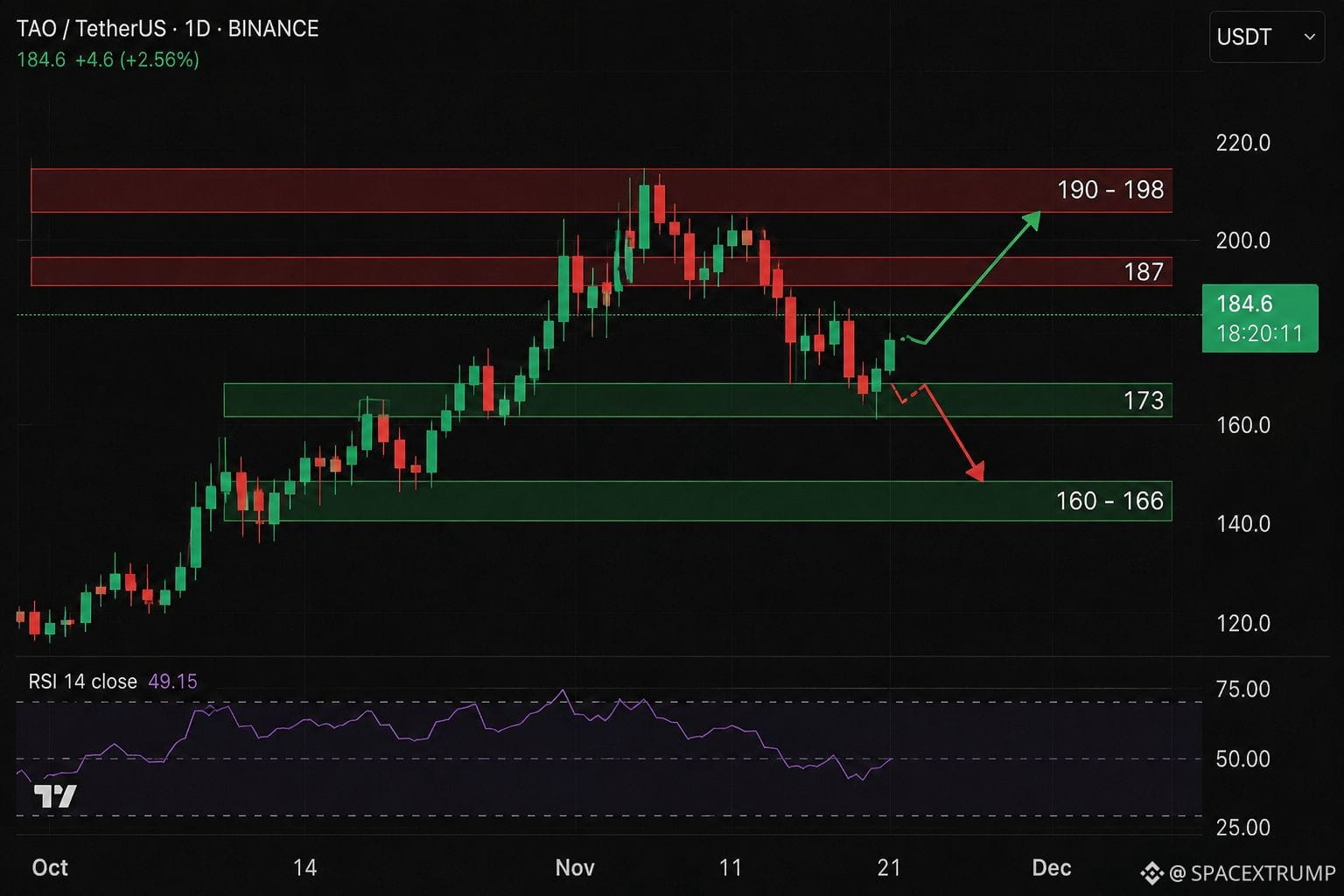
🧠 $TAO — THE NEXT MOVE COULD BE BIG
$TAO is attempting a recovery, but is this the beginning of a reversal or just a temporary relief bounce?
📊 Key levels to watch:
• $180 — Pivot & short-term decision zone
• $187–$191 — Breakout resistance
• $173 — First downside target
• $166 — Major support
🟢 Bullish: Hold $180 and reclaim $191 with volume → potential $195–$200 move.
🔴 Bearish: Lose $180 → $173, followed by $166 if selling pressure continues.
My outlook: Cautiously bullish on the short-term bounce, but not confirmed bullish on the overall trend yet.
TAO remains one of the interesting AI crypto projects to watch, but the chart needs confirmation.
Will $TAO break upwards, or are we getting another fake recovery? 👀
#TAO🔥🔥🔥🔥 #Bittensor #AI
{spot}(TAOUSDT)
🧠 $TAO — THE NEXT MOVE COULD BE BIG
$TAO is attempting a recovery, but is this the beginning of a reversal or just a temporary relief bounce?
📊 Key levels to watch:
• $180 — Pivot & short-term decision zone
• $187–$191 — Breakout resistance
• $173 — First downside target
• $166 — Major support
🟢 Bullish: Hold $180 and reclaim $191 with volume → potential $195–$200 move.
🔴 Bearish: Lose $180 → $173, followed by $166 if selling pressure continues.
My outlook: Cautiously bullish on the short-term bounce, but not confirmed bullish on the overall trend yet.
TAO remains one of the interesting AI crypto projects to watch, but the chart needs confirmation.
Will $TAO break upwards, or are we getting another fake recovery? 👀
#TAO🔥🔥🔥🔥 #Bittensor #AI
1
204

·
--
Bullish
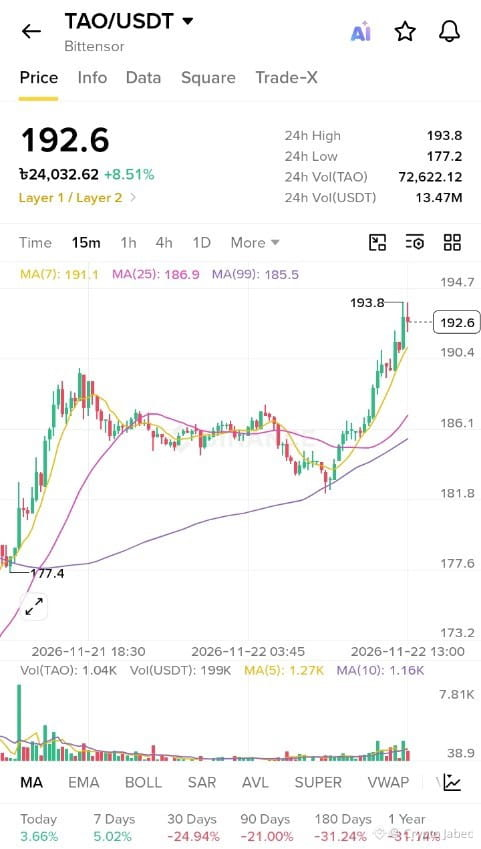
BREAKOUT LOADING? — $TAO 🟢 LONG
TAO is breaking past local resistance with heavy volume. Bulls are clearly in control right now, building pressure for the next leg up.
Entry Zone: $190.50 – $192.60
TP1: $205.00
**TP2:** $225.00
Stop Loss: $184.00
Support (S): $185.50
**Resistance (R):** $193.80
Are you riding this wave?
You can trade from here.👇$TAO
{spot}(TAOUSDT)
#TAO #Bittensor #BinanceSquare
BREAKOUT LOADING? — $TAO 🟢 LONG
TAO is breaking past local resistance with heavy volume. Bulls are clearly in control right now, building pressure for the next leg up.
Entry Zone: $190.50 – $192.60
TP1: $205.00
**TP2:** $225.00
Stop Loss: $184.00
Support (S): $185.50
**Resistance (R):** $193.80
Are you riding this wave?
You can trade from here.👇$TAO
#TAO #Bittensor #BinanceSquare
2
263

·
--
$189.70. $TAO is pushing higher, but volume says be careful. ⚠️
Up 7.60% in 24h and 4.7% over the latest 4h window, yet $14.63M volume is just 0.2x the 20d average. That’s a thin rally. RSI sits at 53, while price remains below the 20d and 50d MAs.
Shorts are paying at -0.001%. Interesting, but not confirmation. Unlike $XRP, this move still needs real participation. At $190, I’d wait for a clean hold, not chase the candle. 📊
Does $TAO hold $190 or fade back below it?
#Bittensor #AI
$189.70. $TAO is pushing higher, but volume says be careful. ⚠️
Up 7.60% in 24h and 4.7% over the latest 4h window, yet $14.63M volume is just 0.2x the 20d average. That’s a thin rally. RSI sits at 53, while price remains below the 20d and 50d MAs.
Shorts are paying at -0.001%. Interesting, but not confirmation. Unlike $XRP , this move still needs real participation. At $190, I’d wait for a clean hold, not chase the candle. 📊
Does $TAO hold $190 or fade back below it?
#Bittensor #AI
21

·
--
Bullish
BITTENSOR IS BRINGING DECENTRALIZED AI BACK INTO FOCUS!
$TAO is one of the most interesting cryptocurrencies in the decentralized artificial intelligence sector.
Bittensor aims to create an incentive-based network where participants contribute digital resources and machine-learning services across specialized subnets.
A notable November development is the launch of Gamma Tokens, adding another layer to the Bittensor ecosystem and its decentralized AI economy.
However, AI-related excitement can create significant volatility. Traders should examine actual subnet activity, token supply dynamics and liquidity instead of relying entirely on the AI narrative.
I'm watching whether ecosystem growth can translate into sustainable market demand.
NFA. DYOR.
#Bittensor #TAO #DecentralizedAI #ArtificialIntelligence #BinanceSquare
1

·
--
Bearish
$TAO falls 3.20% and faces a technical test on November 24, 2026
#TAO trades at USD $184.09, down 3.20% from the previous close, and remains below several moving averages. Volume over the past 24 hours is 11% above the 30-day average. Technical indicators show weakness, although the MACD histogram is positive; there is no confirmed catalyst for this session's move.
#bittensor opened at USD $189.86 and, at the available cutoff, was below both that opening price and the intraday VWAP of USD $190.65. The day's range was USD $182.34 to USD $191.56. Trading below the VWAP—the volume-weighted average price—may indicate that sellers had the advantage during that window, but it does not establish the cause of the move.
The available information does not quantify revenue, fees, users, subnet activity, total value locked, or actual consumption of services linked to Bittensor. Therefore, it does not make it possible to determine whether the price reflects growing adoption or a speculative premium. Assessing a long-term position would require reviewing verifiable metrics on usage, supply, and monetization.
Those who already hold TAO can assess whether the size of their position is consistent with the recorded volatility. For new entries, waiting for a recovery above USD $191.56 and observing whether it continues toward the SMA-15 and SMA-20 would offer more confirmation than buying solely because the price has fallen. A drop below USD $182.34 would worsen the short-term outlook; USD $166.50 is a historical reference for the 90-day period, not a guarantee of a rebound.
Short term: a sustained recovery above USD $191.56 and further continuation would be technical signals some traders might watch. The USD $196.98–USD $201.06 zone corresponds to the SMA-15 and SMA-20.
The available information points to caution: TAO is below most of its moving averages, trades below the VWAP, and has recorded losses across several time frames.
{future}(TAOUSDT)
$TAO falls 3.20% and faces a technical test on November 24, 2026
#TAO trades at USD $184.09, down 3.20% from the previous close, and remains below several moving averages. Volume over the past 24 hours is 11% above the 30-day average. Technical indicators show weakness, although the MACD histogram is positive; there is no confirmed catalyst for this session's move.
#bittensor opened at USD $189.86 and, at the available cutoff, was below both that opening price and the intraday VWAP of USD $190.65. The day's range was USD $182.34 to USD $191.56. Trading below the VWAP—the volume-weighted average price—may indicate that sellers had the advantage during that window, but it does not establish the cause of the move.
The available information does not quantify revenue, fees, users, subnet activity, total value locked, or actual consumption of services linked to Bittensor. Therefore, it does not make it possible to determine whether the price reflects growing adoption or a speculative premium. Assessing a long-term position would require reviewing verifiable metrics on usage, supply, and monetization.
Those who already hold TAO can assess whether the size of their position is consistent with the recorded volatility. For new entries, waiting for a recovery above USD $191.56 and observing whether it continues toward the SMA-15 and SMA-20 would offer more confirmation than buying solely because the price has fallen. A drop below USD $182.34 would worsen the short-term outlook; USD $166.50 is a historical reference for the 90-day period, not a guarantee of a rebound.
Short term: a sustained recovery above USD $191.56 and further continuation would be technical signals some traders might watch. The USD $196.98–USD $201.06 zone corresponds to the SMA-15 and SMA-20.
The available information points to caution: TAO is below most of its moving averages, trades below the VWAP, and has recorded losses across several time frames.
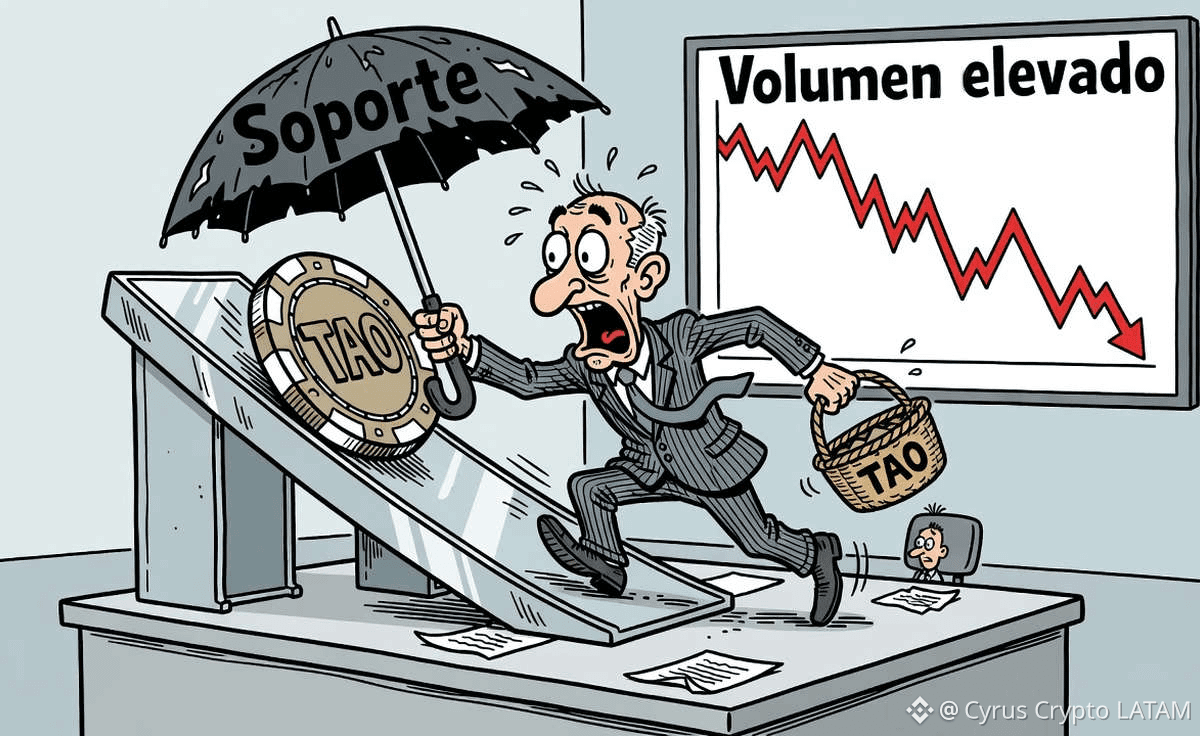
1.5k
TAO's having one of those days where the chart looks like a heartbeat monitor.
Bittensor ($TAO) touched $165.40 earlier today and it's sitting near $186 now — that's about a 13% bounce off the low in a single session, up roughly 3% on the day. Not bad for a coin still down 36% this month and 75% off its $757 all-time high.
The AI angle is doing some heavy lifting here. Bittensor rolled out quantum-resistant wallets earlier this month, and with Anthropic's record IPO still fresh in everyone's mind, AI coins are getting a second look.
$190 is the line to beat — that's today's high. Lose $180 and the $165 low comes back into play fast. $BTC holding above $60K is doing most of the market a favour right now.
Not financial advice. DYOR.
#Bittensor #Crypto #AI
TAO's having one of those days where the chart looks like a heartbeat monitor.
Bittensor ($TAO ) touched $165.40 earlier today and it's sitting near $186 now — that's about a 13% bounce off the low in a single session, up roughly 3% on the day. Not bad for a coin still down 36% this month and 75% off its $757 all-time high.
The AI angle is doing some heavy lifting here. Bittensor rolled out quantum-resistant wallets earlier this month, and with Anthropic's record IPO still fresh in everyone's mind, AI coins are getting a second look.
$190 is the line to beat — that's today's high. Lose $180 and the $165 low comes back into play fast. $BTC holding above $60K is doing most of the market a favour right now.
Not financial advice. DYOR.
#Bittensor #Crypto #AI
6

·
--
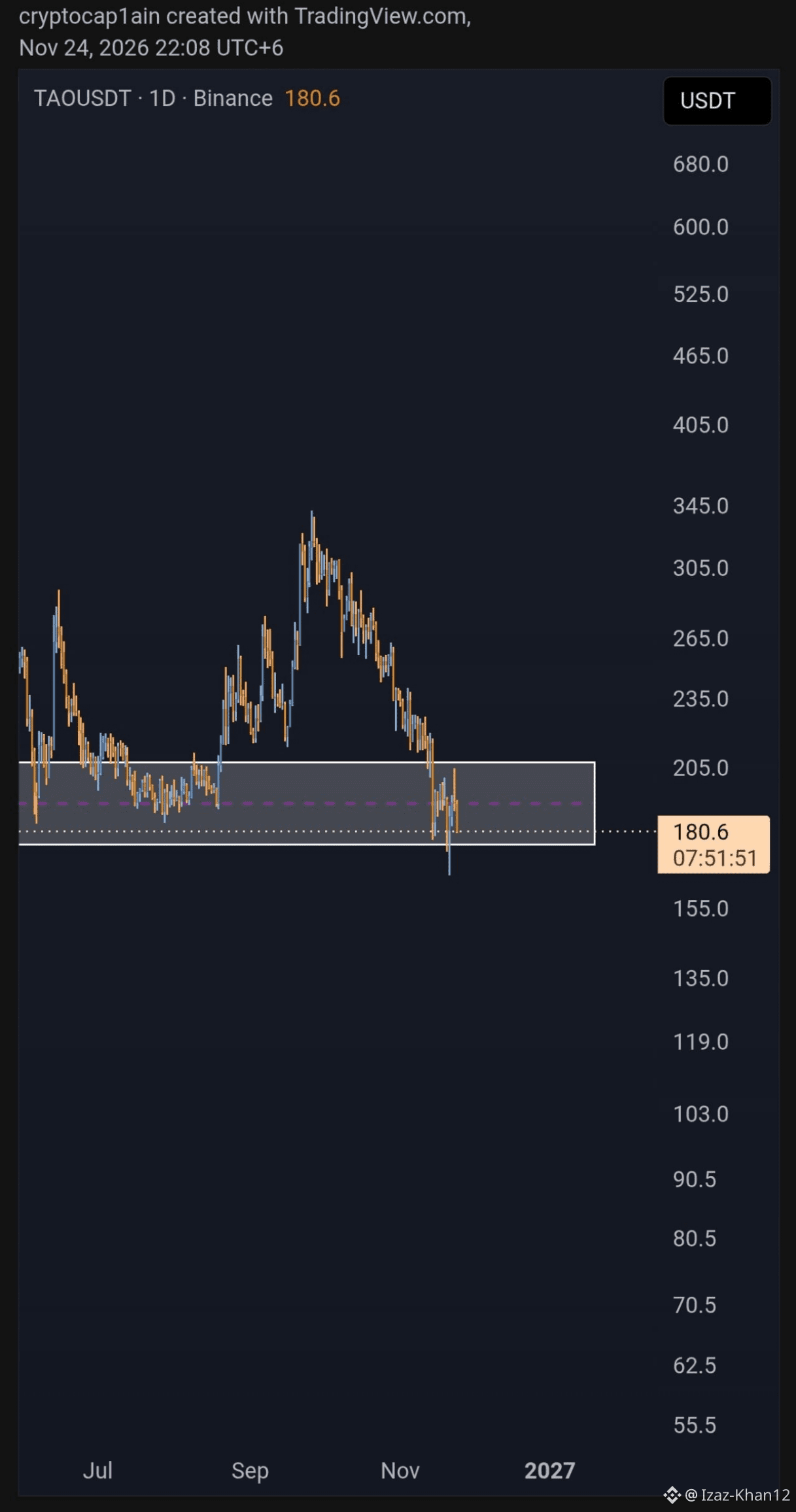
$TAO has returned to the buying zone after generating good profits for us during the previous move. 📉🟢
$TAO | Bittensor 💰 Price: $177.6 📉 Pullback: -7.01%
After taking good profits from TAO, the price has once again returned to the buying zone we’re watching.
If you’re planning to enter, this zone may be suitable for buying part of your position on the spot market, while keeping some USDT aside to continue buying gradually (DCA) if the price drops to lower levels.
🤖 I think the AI sector may see a strong comeback soon, and TAO could benefit from that momentum.
#Bittensor #TAO
3

·
--
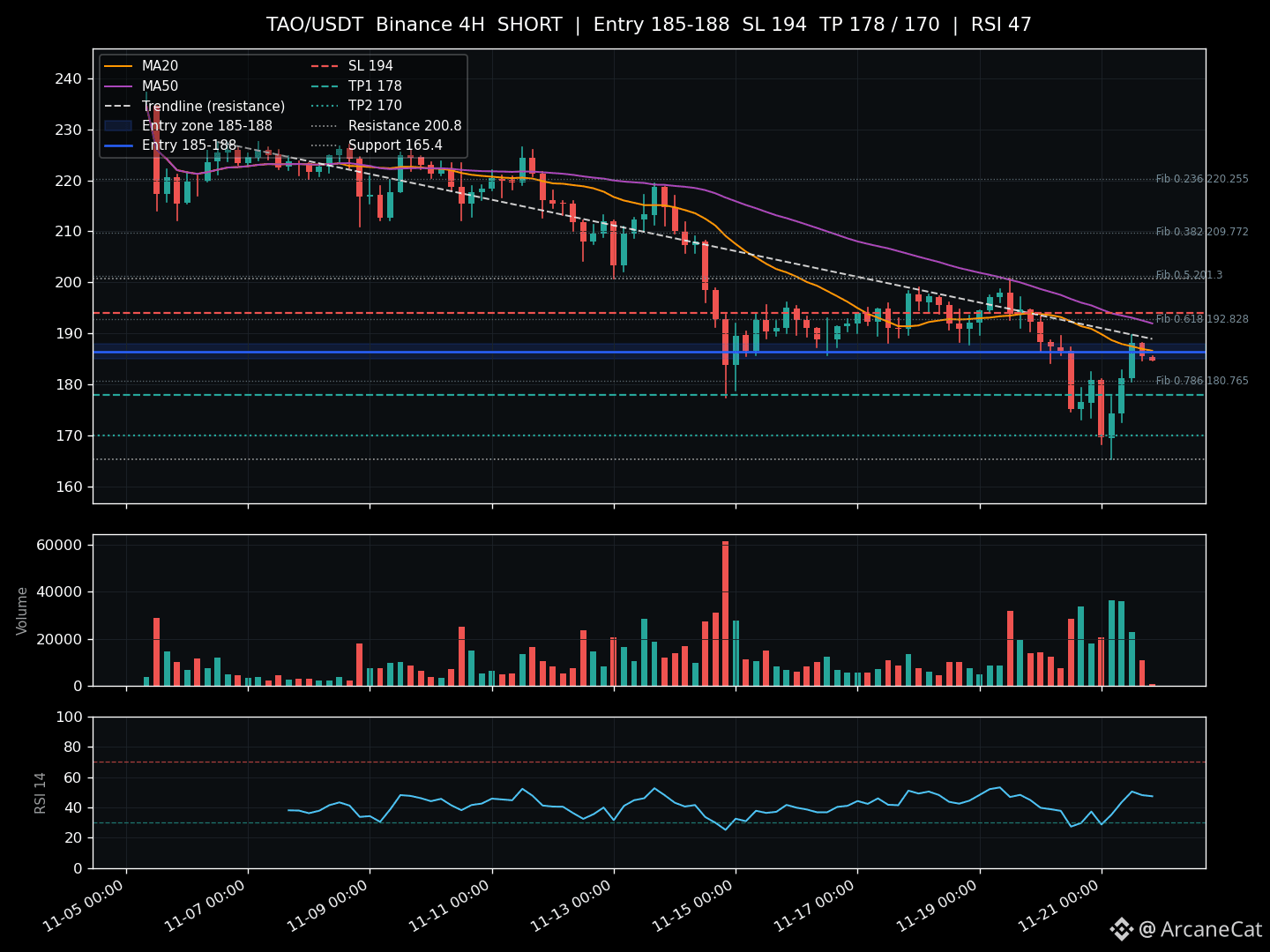
🔥 $TAO pumped 9% — then slammed into $190 and got rejected
SHORT $TAO 📉
Entry: $185–188
SL: $194
TP1: $178 | TP2: $170 🎯
Invalidation: 4H close above $194
Rejected twice at $190 resistance after the bounce — BTC still in a downtrend, sellers in control.
Not financial advice.
$TAO #Bittensor #TAO
🔥 $TAO pumped 9% — then slammed into $190 and got rejected
SHORT $TAO 📉
Entry: $185–188
SL: $194
TP1: $178 | TP2: $170 🎯
Invalidation: 4H close above $194
Rejected twice at $190 resistance after the bounce — BTC still in a downtrend, sellers in control.
Not financial advice.
$TAO #Bittensor #TAO
SHORT $TAO 📉
Entry: $185–188
SL: $194
TP1: $178 | TP2: $170 🎯
Invalidation: 4H close above $194
Rejected twice at $190 resistance after the bounce — BTC still in a downtrend, sellers in control.
Not financial advice.
$TAO #Bittensor #TAO
7
Log in to explore more content
Join global crypto users on Binance Square
⚡️ Get latest and useful information about crypto.
💬 Trusted by the world’s largest crypto exchange.
👍 Discover real insights from verified creators.
Email / Phone number
Trending Topics
1
#BitcoinAndStocksSlipAgainAmidTrump’sTariffPlans
5,991 views
151 Discussing
2
#JensenHuangSaysNvidiaDoesn’tNeedASuccessionPlan
6,628 views
116 Discussing
3
#AnthropicBreaksBelowIPOPriceAmidAISlump
95,343 views
876 Discussing
4
#FidelityCryptoAddsAAVELINKAndUNITrading
0 views
0 Discussing
5
#UKToBanExchangesMakingMarketsOnOwnPlatforms
0 views
1 Discussing
6
#CFTCApprovesTradeReportingRuleForPredictionMarkets
6,429 views
103 Discussing
7
#Bitcoin'sReboundFadesBelow$60K
151,097 views
433 Discussing
8
#WillMarketsStageAThanksgivingReliefRally?
679,314 views
3,720 Discussing
9
#EthereumFoundationPlansShiftToHashBasedSignaturesBy2028
7,210 views
145 Discussing
10
#ADPWeeklyPrivatePayrollsSlowTo21000
20,816 views
333 Discussing