
#tvl
tvl
425,794 views
1,230 Discussing
Hot
Latest

·
--
The Capital Efficiency Rebirth: Decrypting the On-Chain Flow of NEARThe Capital Efficiency Rebirth: Decrypting the On-Chain Flow of NEAR
Looking at my monitors at 1:36 PM, the 3.469 print on the $NEAR ticker doesn't even begin to capture the structural shift happening under the surface. While retail focus is often stuck on immediate price candles, the institutional and whale flow is quietly migrating toward yield-bearing primitives that are fundamentally altering the circulating float. We are seeing a distinct rotation in how liquidity is being managed, moving away from idle assets toward active participation in the staking economy.
The latest numbers show DeFi TVL across the ecosystem holding steady near the 300 million range, but the composition of that value has changed. Liquid staking is no longer a niche play; it has become the standard for on-chain capital management. Roughly 12 percent of the 1.2 billion circulating supply is now tied up in liquid staking protocols, effectively compressing the tradable float and creating a tighter supply dynamic than what the raw emission schedule might suggest.
When we look at DEX volume compared to centralized counterparts, the AMM fee generation on major protocols like Ref Finance is showing resilience despite broader market choppiness. The shift toward restaking primitives is also adding a layer of yield complexity that wasn't here six months ago. By allowing staked assets to be utilized for security across fragmented applications, NEAR is effectively increasing the velocity of its own TVL. This isn't just about total dollars sitting in contracts; it is about how many times that single dollar is being put to work across the ecosystem.
The absorption of new unlocks has been surprisingly orderly. The market is currently pricing in the reality that this liquidity is being locked back into DeFi protocols rather than dumped into the spot order books. The macro consensus is currently split on risk-on appetite, but the on-chain behavior suggests the institutional side is looking for yield-bearing infrastructure rather than just pure speculative volatility.
Are you holding your stake for the long term, or are you actively rotating into these new liquid staking vaults to compound your stack?
_
#DeFi #TVL
The Capital Efficiency Rebirth: Decrypting the On-Chain Flow of NEAR
The Capital Efficiency Rebirth: Decrypting the On-Chain Flow of NEAR
Looking at my monitors at 1:36 PM, the 3.469 print on the $NEAR ticker doesn't even begin to capture the structural shift happening under the surface. While retail focus is often stuck on immediate price candles, the institutional and whale flow is quietly migrating toward yield-bearing primitives that are fundamentally altering the circulating float. We are seeing a distinct rotation in how liquidity is being managed, moving away from idle assets toward active participation in the staking economy.
The latest numbers show DeFi TVL across the ecosystem holding steady near the 300 million range, but the composition of that value has changed. Liquid staking is no longer a niche play; it has become the standard for on-chain capital management. Roughly 12 percent of the 1.2 billion circulating supply is now tied up in liquid staking protocols, effectively compressing the tradable float and creating a tighter supply dynamic than what the raw emission schedule might suggest.
When we look at DEX volume compared to centralized counterparts, the AMM fee generation on major protocols like Ref Finance is showing resilience despite broader market choppiness. The shift toward restaking primitives is also adding a layer of yield complexity that wasn't here six months ago. By allowing staked assets to be utilized for security across fragmented applications, NEAR is effectively increasing the velocity of its own TVL. This isn't just about total dollars sitting in contracts; it is about how many times that single dollar is being put to work across the ecosystem.
The absorption of new unlocks has been surprisingly orderly. The market is currently pricing in the reality that this liquidity is being locked back into DeFi protocols rather than dumped into the spot order books. The macro consensus is currently split on risk-on appetite, but the on-chain behavior suggests the institutional side is looking for yield-bearing infrastructure rather than just pure speculative volatility.
Are you holding your stake for the long term, or are you actively rotating into these new liquid staking vaults to compound your stack?
_
#DeFi #TVL
1
6

·
--
Bullish
🚨🚨🚨 Why high TVL doesn't always mean a good investment 🔍
A DeFi protocol can have billions in TVL and still have a weak token investment case. TVL measures the value of assets deposited into a protocol, not the revenue earned by token holders. That's a very important difference. A protocol might attract deposits through incentives that disappear when rewards end. I would also examine trading fees, protocol revenue, active users and capital retention. Another useful comparison is Market Cap to TVL, although it should never be used alone. Strong TVL growth combined with sustainable fees is more interesting than inflated deposits. Always ask whether the token actually captures economic value from the protocol.
Would you rather invest in high TVL or high protocol revenue?
#CryptoCommunitys #TVL $GNS $HOT #TradFiForBeginners #MarketSentimentToday
$RSR
{future}(HOTUSDT)
{future}(RSRUSDT)
{spot}(GNSUSDT)
🚨🚨🚨 Why high TVL doesn't always mean a good investment 🔍
A DeFi protocol can have billions in TVL and still have a weak token investment case. TVL measures the value of assets deposited into a protocol, not the revenue earned by token holders. That's a very important difference. A protocol might attract deposits through incentives that disappear when rewards end. I would also examine trading fees, protocol revenue, active users and capital retention. Another useful comparison is Market Cap to TVL, although it should never be used alone. Strong TVL growth combined with sustainable fees is more interesting than inflated deposits. Always ask whether the token actually captures economic value from the protocol.
Would you rather invest in high TVL or high protocol revenue?
#CryptoCommunitys #TVL $GNS $HOT #TradFiForBeginners #MarketSentimentToday
$RSR

105

·
--
🎯 On-chain locked value has evaporated 46% in a year—the money really is gone
📰 Total TVL across the market is down to $81 billion, from $127 billion a year ago. Another 9% flowed out in the past 30 days. Solana is holding at $5.2B, with BSC close behind at $5.1B
💬 It’s easy to go numb watching charts rise and fall every day, but declining on-chain balances are the clearest sign of selling pressure. This kind of drain looks worse than a couple of days of price drops—I just stared at it for two seconds
🏷️ #DeFi #TVL #链上数据 #Solana
777
·
--
🎯 Binance lost 6.6% of its on-chain funds in a week
📰 DefiLlama: Binance’s on-chain reserves are down to just $126.1 billion, shrinking 6.6% in 7 days; meanwhile, Aave bucked the trend, rising 2.9% to $15.7 billion, while Obol surged even more—up 16.8%
💬 Losing TVL after $6 billion was stolen—that’s what a real vote looks like. The money hasn’t left; it’s just moving somewhere safer. Don’t just watch the price charts—the on-chain numbers don’t lie.
🏷️ #DeFi #链上数据 #TVL #Aave
62
·
--
🎯 Fear index at 28, yet $2.7 billion flowed on-chain
📰 DeFi total value locked is back to $163.3 billion, up a net $2.7 billion in seven days. On the same day, the Fear & Greed Index was just 28, stuck in the fear zone for two days straight
💬 Retail investors are scared, but money is quietly moving into contracts. This kind of divergence is the real signal—their words say they’re afraid to buy, but their hands are already making moves. Pretty slick
🏷️ #DeFi #TVL #恐惧贪婪指数 #On-chain data
2
·
--
🎯 $300 million pulled out of SOL in one day
📰 DeFiLlama: Solana's on-chain TVL fell from $5.53 billion to $5.22 billion, down 3% in a week—the steepest drop among major blockchains this week
💬 Looking at these numbers, SOL is only at $89 and still up 0.2%, but TVL has already thrown in the towel. The price is holding up while real money is pulling out—this kind of divergence is the most deceptive. I stared at it for two seconds
🏷️ #Solana #TVL #公链 #CapitalOutflow
198
·
--
Lending Protocol Utilization & Stablecoin Yield Matrix Across Major Layer-1 & Layer-2 Networks: My Honest Data Breakdown for $SOL & BTC
While most of the timeline is reacting to every minor tick on SOL near 94.83, I wanted to share the actual defi tvl, restaking, liquid staking & dex volume metrics I've been tracking on the desk today alongside BTC.
Here is the core context driving this sector right now:
Total Value Locked (TVL) Growth, DEX vs CEX Spot Volume Ratio, Liquid Staking/Restaking (LRT), Lending Utilization & Protocol Revenue. By comparing live orderflow and ecosystem retention against historical baselines, we get a much cleaner view of where institutional and smart-money capital is rotating.
Four key metrics I have on my screen today for SOL:
• Chain & Protocol TVL Growth (7D / 30D %)
• DEX-to-CEX Volume Dominance & AMM Fee Generation
• Real Yield Protocol Revenue Distributed to Token Holders
• Liquid Staking & Restaking Capital Efficiency
undefined
What's your honest take on these numbers — are you watching this closely this week or staying patient on the sidelines? Drop your thoughts below 👇
#BinanceSquare #TVL

1
3
·
--
🎯 $7.8 billion quietly pulled out of DeFi in three days
📰 Total TVL across the market fell from $82.7B to $80.8B, with on-chain locked value down nearly 2%. Meanwhile, USDT stayed steady at $177.5B, with no sign of an exodus.
💬 The fact that USDT hasn’t fallen is key: this is position-cutting, not a desperate flight. The money is simply sitting in stablecoins for now. Over the past 7 days, LINK is down just 0.7%, while HYPE is down 16%—high-beta protocols get hit first.
🏷️ #DeFi #TVL #HYPE #Stablecoins
141
·
--
🎯 Nearly half gone, but the money is still on-chain
📰 Binance Chain TVL is $127.6 billion. BTC is down 40% this month, while TVL fell just 11.6% in a week. Even the leaders like Uniswap and Aave are only down single digits.
💬 Honestly, real panic looks like stablecoins flooding the feeds as people rush for the exits, and pools being drained. Right now, it’s just asset values shrinking; positions haven’t moved. Those are two very different things—and that’s exactly what having a foundation comes down to. After looking at the data, I feel a lot less panicked.
🏷️ #DeFi #TVL #链上数据 #CapitalFlows
5
·
--
Arbitrum is proving that there is a massive divide between token price action and actual network utility. While most of the market is fixated on short-term volatility, the real story is happening under the hood in the DeFi ecosystem. We are seeing a steady 5% to 8% monthly growth in Total Value Locked, even as the broader market feels shaky. This isn't just retail speculation; it's a structural shift toward deep, on-chain liquidity that actually generates protocol revenue.
The network is currently acting as a primary anchor for high-volume DEX activity. Platforms like GMX and Camelot are consistently outperforming many of their peers by generating real fees from actual users rather than just relying on inflationary rewards. The integration of liquid staking and restaking protocols like Ether.fi and Renzo has further supercharged this by turning idle capital into yield-bearing collateral. This increases the overall capital efficiency across the chain, driving up lending utilization rates and keeping the ecosystem healthy.
From a data perspective, the elephant in the room remains the circulating supply. The market is still working its way through the heavy float left by earlier unlock cycles. We are currently seeing a spot reference near 0.51, where whale wallets appear to be in a phase of absorption. They are rotating out of stagnant assets and moving into protocols that show superior fee-per-user metrics.
The real test for $ARB moving forward will be its ability to sustain this TVL momentum while competing with base-layer incentives on other chains. If the DEX-to-CEX volume ratio continues to shift toward organic AMM fee generation, we might finally see the narrative move from tokenomics fears back to fundamental growth. It is a classic battle between a heavy supply and a high-functioning engine.
Are you holding through this absorption phase for the long-term governance play, or are you waiting for more clarity on the next unlock wave before adding to your position?
#DeFi #TVL

1
16
·
--
🎯 Money is quietly leaking out of Ethereum
📰 Few people are talking about this data: $44.5 billion is locked on-chain on ETH, down from $53.5 billion 7 days ago—a $9 billion outflow in one week. Uniswap also fell from $3.78 billion to $3.57 billion.
💬 The price is up 2.4%, but money is heading for the exits. When price and on-chain activity move in opposite directions, this kind of divergence usually doesn’t last more than two weeks. Don’t mistake a rebound for a bottom.
🏷️ #DeFi #TVL #以太坊 #Uniswap
321
·
--
The Yield Migration: Why Solana On-Chain Metrics are Diverging From Price Panic
I am staring at the Jito and Solayer deposit contracts at 03:45 AM while the rest of the market is busy reacting to the latest red candles. The reality of $SOL right now is found in the network plumbing, not just the spot price. Despite the noise around the 92.08 level, the Solana DeFi TVL is holding remarkably firm near the 5.8 billion mark. We are seeing a very specific type of resilience where capital is not fleeing to stablecoins, but is instead migrating into liquid staking and the emerging restaking sector.
The growth in Jito and Marinade suggests that investors are focused on maximizing capital efficiency during this drawdown. By moving into these yield-bearing assets, they are effectively locking in their position for the next cycle. The restaking narrative, led by protocols like Solayer, is finally allowing Solana to bridge the gap toward the kind of high-security capital models that attract institutional interest. Looking at DEX data, Raydium is still processing the bulk of the volume, but the gap with Orca is narrowing as liquidity becomes more concentrated. The DEX-to-CEX ratio confirms that while retail remains on-chain, the professional market makers are keeping their heavy size on centralized order books until the liquidity gaps close.
On the lending side, Kamino and Drift are showing stabilized borrow rates. This confirms we are watching a healthy deleveraging event in real-time. The reckless leverage is being flushed, but the infrastructure utilization remains high. With a circulating float of approximately 467 million tokens and scheduled unlocks still pressuring the market, real revenue distribution back to participants is the only metric that will lead to a true macro decoupling.
Are you rotating your holdings into these newer yield-bearing farms to offset the volatility, or are you just waiting for the lending rates to drop further?
_
#DeFi #TVL

1
4
·
--
🎯 Exchanges saw 27% of their TVL drained in 7 days
📰 DefiLlama data: Binance Chain TVL is $125 billion, down 4.3% in a day and 27% in seven days. Bitfinex took an even bigger hit, plunging 30%.
💬 I stared at these numbers for two seconds. A third of the funds gone in a week—not just reshuffling, but people actually moving their money off exchanges. AAVE, by contrast, is down only 8%, so the money has probably moved on-chain.
🏷️ #DeFi #TVL #资金外流 #OnChainData
200
·
--
On-Chain Capital Efficiency Is Secretly Rewiring DeFi TVL Behind BTC Consolidation
It is 04:16 AM, my desk monitor is still glowing, and while most traders are obsessing over the 78933.1 spot reference on $BTC, the real structural story is quietly unfolding across the on-chain yield stack. Capital is no longer sitting idle waiting for directional volatility. We are witnessing a fundamental shift in how liquidity gets deployed, driven by the rapid expansion of Liquid Restaking Protocols and rising capital efficiency across decentralized exchanges.
Total Value Locked across major smart contract platforms has shown steady 30-day expansion, but the crucial metric lies in protocol revenue distribution. Protocols that route real trading fees and protocol revenue directly to token stakers via buy-backs are seeing record liquidity retention. Instead of purely chasing speculative upside, capital is rotating toward protocols operating with sustainable cash flow models.
At the same time, the DEX-to-CEX spot volume ratio continues to tighten. Even while BTC ranges near its current levels, automated market maker fee generation on major DEXs is reaching multi-month highs. Higher liquidity depth and reduced slippage mean institutional-sized participants are increasingly comfortable executing large orders directly on-chain rather than relying on centralized order books.
Liquid Staking and Restaking architectures have effectively lowered the opportunity cost of holding base collateral. By stacking yield layers on top of underlying assets without locking up liquidity, traders are extracting maximum capital efficiency from their spot positions. The market is slowly transitioning from a pure casino mindset into a sophisticated yield-optimization paradigm, and those tracking raw spot price action alone are missing the deep accumulation patterns happening in the underlying plumbing.
Are you currently taking advantage of liquid restaking yields, or are you keeping your capital liquid on the sidelines until market volatility expands?
#DeFi #TVL
On-Chain Capital Efficiency Is Secretly Rewiring DeFi TVL Behind BTC Consolidation
It is 04:16 AM, my desk monitor is still glowing, and while most traders are obsessing over the 78933.1 spot reference on $BTC , the real structural story is quietly unfolding across the on-chain yield stack. Capital is no longer sitting idle waiting for directional volatility. We are witnessing a fundamental shift in how liquidity gets deployed, driven by the rapid expansion of Liquid Restaking Protocols and rising capital efficiency across decentralized exchanges.
Total Value Locked across major smart contract platforms has shown steady 30-day expansion, but the crucial metric lies in protocol revenue distribution. Protocols that route real trading fees and protocol revenue directly to token stakers via buy-backs are seeing record liquidity retention. Instead of purely chasing speculative upside, capital is rotating toward protocols operating with sustainable cash flow models.
At the same time, the DEX-to-CEX spot volume ratio continues to tighten. Even while BTC ranges near its current levels, automated market maker fee generation on major DEXs is reaching multi-month highs. Higher liquidity depth and reduced slippage mean institutional-sized participants are increasingly comfortable executing large orders directly on-chain rather than relying on centralized order books.
Liquid Staking and Restaking architectures have effectively lowered the opportunity cost of holding base collateral. By stacking yield layers on top of underlying assets without locking up liquidity, traders are extracting maximum capital efficiency from their spot positions. The market is slowly transitioning from a pure casino mindset into a sophisticated yield-optimization paradigm, and those tracking raw spot price action alone are missing the deep accumulation patterns happening in the underlying plumbing.
Are you currently taking advantage of liquid restaking yields, or are you keeping your capital liquid on the sidelines until market volatility expands?
#DeFi #TVL
1
1
·
--
Dogecoin Beyond the Meme: How On-Chain Yield Strategy Is Silently Locking Up Supply
For years, Dogecoin lived and died by centralized exchange velocity and social sentiment spikes. But right now, a structural shift in capital efficiency is fundamentally altering how smart money handles $DOGE. We are witnessing the quiet transition of a speculative store-of-value asset into a yield-generating collateral building block across decentralized finance.
On-chain metrics highlight a notable migration of whale capital moving out of exchange hot wallets and directly into liquidity provisioning and lending protocols. With bridged variants and wrapped implementations expanding across high-throughput chains, total value locked associated with Dogecoin ecosystem derivatives is steadily climbing. Instead of letting spot tokens sit idle on order books, institutional-sized holders are prioritizing automated market maker fee generation and yield protocols.
This emergence of liquid staking abstractions and collateralized lending creates a powerful dynamic for underlying tokenomics. Even without native proof-of-stake rewards on the primary chain, wrapped utility layers effectively lock up circulating float into smart contracts. When float is locked to earn protocol revenue or back decentralized loans, the effective spot supply available for aggressive sell-side pressure contracts sharply. This structural supply tightening provides genuine on-chain backing near the 0.07973 reference region.
As DEX volume ratios tick upward relative to spot CEX volume, DOGE is proving it can act as productive decentralized liquidity rather than just speculative trading inventory. The underlying market structure is evolving into something far more durable.
Are you still holding raw spot on exchanges waiting for the next sentiment surge, or are you starting to view your position as a yield-bearing asset?
#DeFi #TVL
Dogecoin Beyond the Meme: How On-Chain Yield Strategy Is Silently Locking Up Supply
For years, Dogecoin lived and died by centralized exchange velocity and social sentiment spikes. But right now, a structural shift in capital efficiency is fundamentally altering how smart money handles $DOGE . We are witnessing the quiet transition of a speculative store-of-value asset into a yield-generating collateral building block across decentralized finance.
On-chain metrics highlight a notable migration of whale capital moving out of exchange hot wallets and directly into liquidity provisioning and lending protocols. With bridged variants and wrapped implementations expanding across high-throughput chains, total value locked associated with Dogecoin ecosystem derivatives is steadily climbing. Instead of letting spot tokens sit idle on order books, institutional-sized holders are prioritizing automated market maker fee generation and yield protocols.
This emergence of liquid staking abstractions and collateralized lending creates a powerful dynamic for underlying tokenomics. Even without native proof-of-stake rewards on the primary chain, wrapped utility layers effectively lock up circulating float into smart contracts. When float is locked to earn protocol revenue or back decentralized loans, the effective spot supply available for aggressive sell-side pressure contracts sharply. This structural supply tightening provides genuine on-chain backing near the 0.07973 reference region.
As DEX volume ratios tick upward relative to spot CEX volume, DOGE is proving it can act as productive decentralized liquidity rather than just speculative trading inventory. The underlying market structure is evolving into something far more durable.
Are you still holding raw spot on exchanges waiting for the next sentiment surge, or are you starting to view your position as a yield-bearing asset?
#DeFi #TVL

1
13

·
--
【Market Flash】Morpho attracts $100 million in 24 hours, leaving Uniswap behind.
According to a post by the RWA Foundation, Morpho’s stablecoin TVL increased by a net $100 million in 24 hours—more than five times Uniswap’s growth over the same period.
Capital is flowing into stablecoin products faster, seeking liquidity and stability.
Is this the start of a trend or just a short-term spike? Share your thoughts in the comments.
$MORPHO $UNI $ETH
#Morpho #DeFi #TVL
(Source: Coinfomania)
⚠️Risk warning: The above is for market information only and does not constitute investment advice. Investing involves risks; proceed with caution.

458
·
--
🎯 Public-chain TVL rankings reshuffled: Robinhood breaks into the top 10
📰 In DefiLlama’s latest rankings, $1.13 billion is locked on its chain, putting it ahead of Arbitrum and Polygon. Base has also climbed to #2.
💬 A brokerage has moved its stock users directly onchain—and it’s moving faster than a bunch of airdrop-focused public chains. Traditional finance has slipped in through the back door this time.
🏷️ #Robinhood #Base #DeFi #TVL
18
·
--
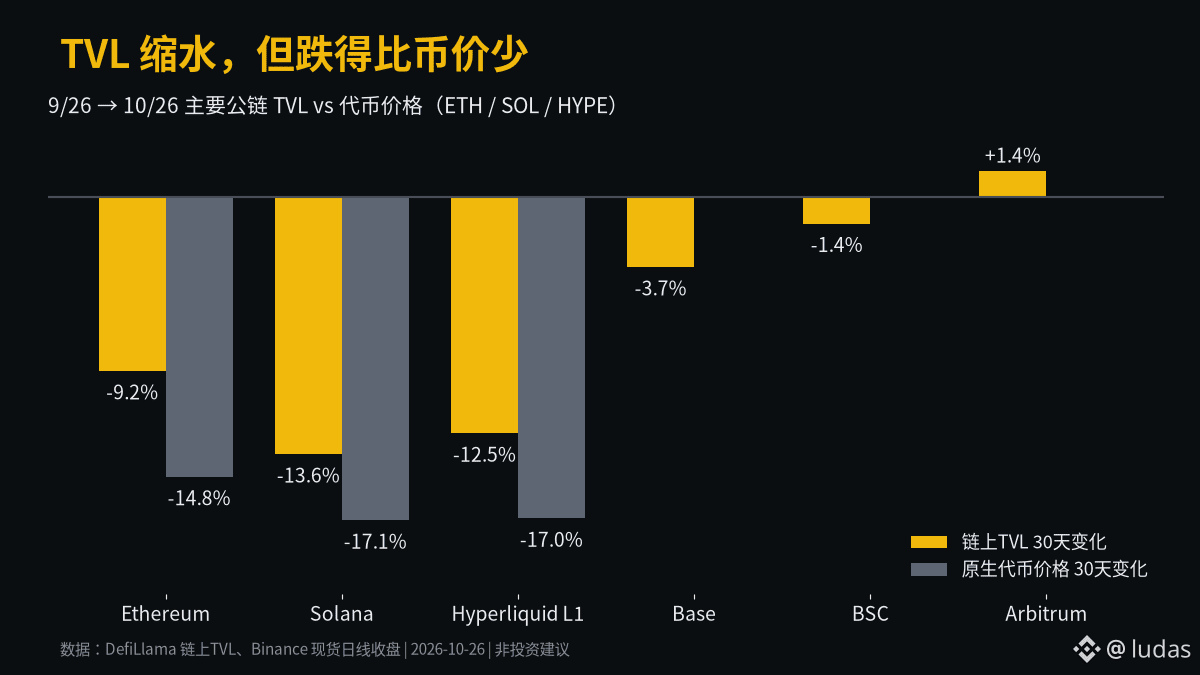
TVL is down nearly $5 billion in a month, but did the money really leave? 📊 I compared the numbers, and the answer may be “not as much as you think.”
🧵 DefiLlama data (9/26→10/26):
• Ethereum TVL: $53.43B→$48.49B, -9.2%; ETH price over the same period: -14.8% (Binance daily close)
• Solana TVL: -13.6%, SOL: -17.1%
• Hyperliquid L1 TVL: -12.5%, HYPE: -17.0%
• Base: -3.7%, BSC: -1.4%, while Arbitrum actually gained 1.4%
⚠️ TVL is denominated in dollars, so falling token prices directly “compress” it. All three chains saw smaller TVL declines than declines in their native token prices, suggesting this is more of a price effect than a large-scale outflow of funds.
💡 My take: When looking at TVL in a bear market, you need to account for token prices. What’s really worth watching is how much stablecoin and dollar-denominated assets remain on-chain. Chains like BSC and Arbitrum, where stablecoins make up a large share, have barely shrunk—that signal matters more than the absolute figures.
Do you pay more attention to TVL or on-chain activity? Let’s discuss in the comments 👇 Drop a like if you found this useful~ (Not investment advice)
#DeFi #链上数据 #TVL $ETH $SOL $HYPE
247
·
--
Lending Protocol Utilization & Stablecoin Yield Matrix Across Major Layer-1 & Layer-2 Networks: My Honest Data Breakdown for $BTC & ETH
While most of the timeline is reacting to every minor tick on BTC near 79700.98, I wanted to share the actual defi tvl, restaking, liquid staking & dex volume metrics I've been tracking on the desk today alongside ETH.
Here is the core context driving this sector right now:
Total Value Locked (TVL) Growth, DEX vs CEX Spot Volume Ratio, Liquid Staking/Restaking (LRT), Lending Utilization & Protocol Revenue. By comparing live orderflow and ecosystem retention against historical baselines, we get a much cleaner view of where institutional and smart-money capital is rotating.
Four key metrics I have on my screen today for BTC:
• Chain & Protocol TVL Growth (7D / 30D %)
• DEX-to-CEX Volume Dominance & AMM Fee Generation
• Real Yield Protocol Revenue Distributed to Token Holders
• Liquid Staking & Restaking Capital Efficiency
For me, watching how these underlying metrics evolve over the next few sessions will tell us far more about BTC and ETH than any single hourly candle.
How much weight do you give to defi & tvl data when building your thesis on BTC? Share your thoughts below 👇
#BinanceSquare #TVL
42
·
--
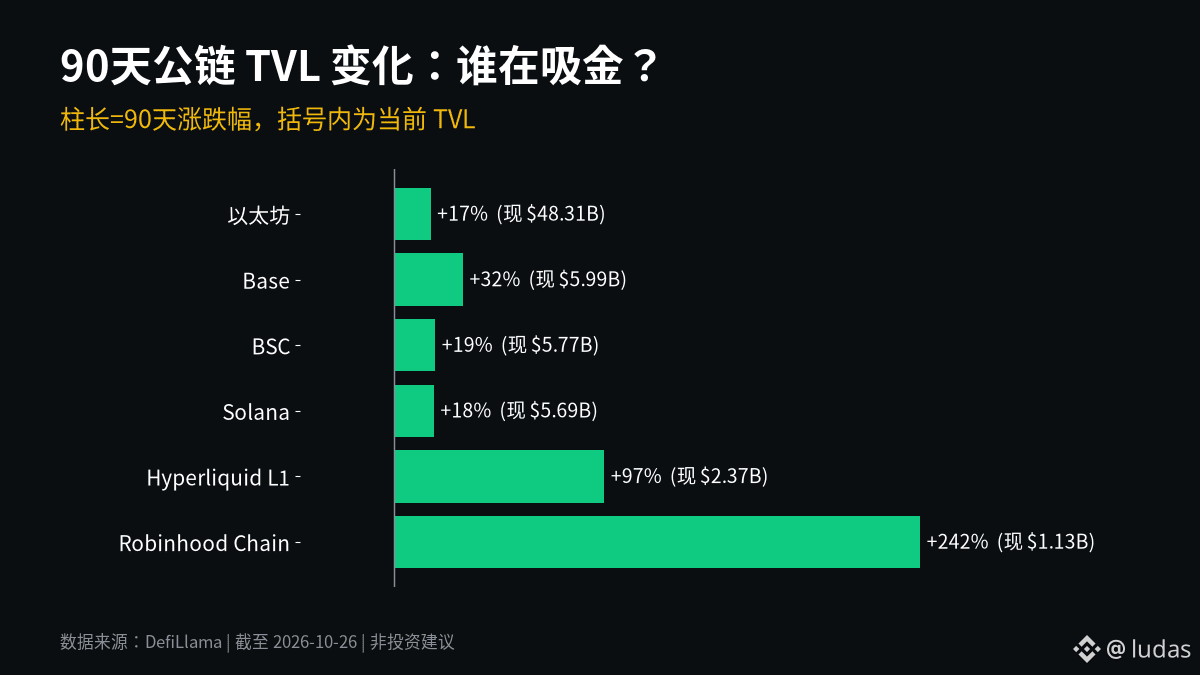
In 90 days, Robinhood Chain’s TVL rose 242%, Hyperliquid nearly doubled, while Ethereum gained just 17%. Where is the money flowing? 📊
According to DefiLlama (as of October 26):
🔥 Robinhood Chain: about $330M → $1.13B, +242%. It’s also the only chain in the table still up over the past 30 days (+11%).
⚡ Hyperliquid L1: $2.37B, +97% over 90 days, but -13% over 30 days.
🟦 Base: $5.99B (+32%); BSC: $5.77B (+19%); Solana: $5.69B (+18%).
🏛️ Ethereum: $48.3B, +17% over 90 days, -9.6% over 30 days.
🧵 My take: Major chains have broadly given back gains over the past month, suggesting risk appetite is cooling overall. The growth of newer chains against the trend is driven more by new assets and incentives; their sustainability will depend on how much activity remains after incentives taper off. Data is for reference only, not investment advice.
Which chain do you think will be the next TVL dark horse? Share your thoughts below 👇
#链上数据 #TVL #DeFi
1
126
Log in to explore more content
Join global crypto users on Binance Square
⚡️ Get latest and useful information about crypto.
💬 Trusted by the world’s largest crypto exchange.
👍 Discover real insights from verified creators.
Email / Phone number
Trending Topics
1
#NvidiaInvestigatesAfterHuang’sAffairApology
104,177 views
1,129 Discussing
2
#BitcoinFiveWeeklyLosses
127,865 views
1,586 Discussing
3
#AIChipSlumpNasdaq
64,138 views
980 Discussing
4
#CPITestsDecemberRateOutlook
557,187 views
2,407 Discussing
5
#AnthropicRejectsIPODelayValuationinQuestion
11,529 views
224 Discussing
6
#CryptoLiquidationsReach$1.16BIn24Hours
978 views
15 Discussing
7
#BrentCrudeDrops3.8%To$94.56
634 views
9 Discussing
8
#EUInstitutionsInviteIndustryToSetTokenizedSecuritiesStandards
485 views
5 Discussing
9
#ChinaCACListsFiveIssuesAffectingBlockchainFilings
3,113 views
68 Discussing
10
#UKBanksCanNowApplyToConductCryptoAssetBusiness
2,323 views
48 Discussing