

Trend Finder
630 Posts

Trend Finder
Report
Block User
Self Dependent Trader - Growth and Alpha Tracker - Navigating Crypto Chaos - Sharing strategies and daily insights
Occasional Trader
5.8 Months
15 Following
61 Followers
652 Liked
Posts
·
--
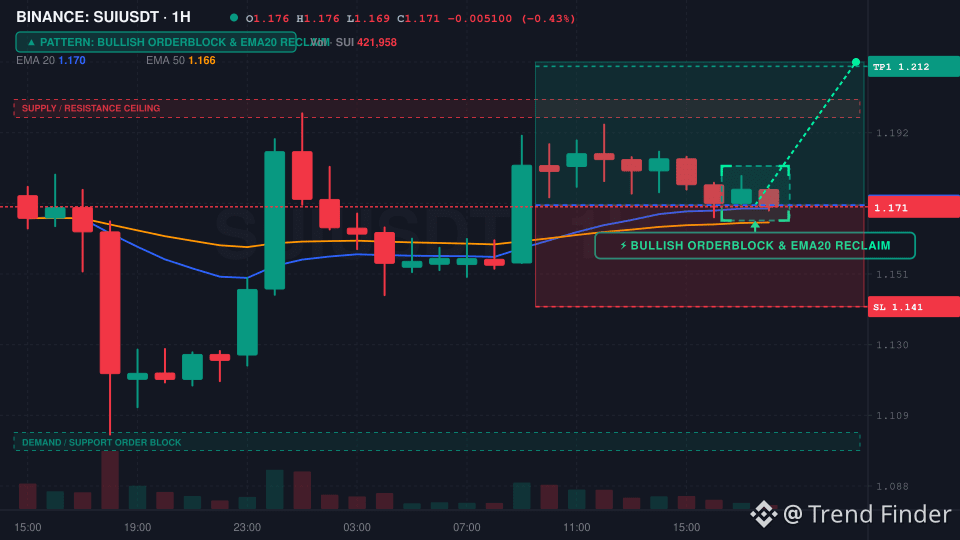
While $BTC chops around, smart money is heavily absorbing $SUI supply right around the EMA20 after a clean liquidity sweep. This 1H Bullish Orderblock screams continuation. RSI sitting at 56 with strong momentum.
Entry: 1.171
SL: 1.141
TP1: 1.212
TP2: 1.239
#BinanceSquare #CryptoTrading #SUI
While $BTC chops around, smart money is heavily absorbing $SUI supply right around the EMA20 after a clean liquidity sweep. This 1H Bullish Orderblock screams continuation. RSI sitting at 56 with strong momentum.
Entry: 1.171
SL: 1.141
TP1: 1.212
TP2: 1.239
#BinanceSquare #CryptoTrading #SUI
Entry: 1.171
SL: 1.141
TP1: 1.212
TP2: 1.239
#BinanceSquare #CryptoTrading #SUI
1
19
·
--
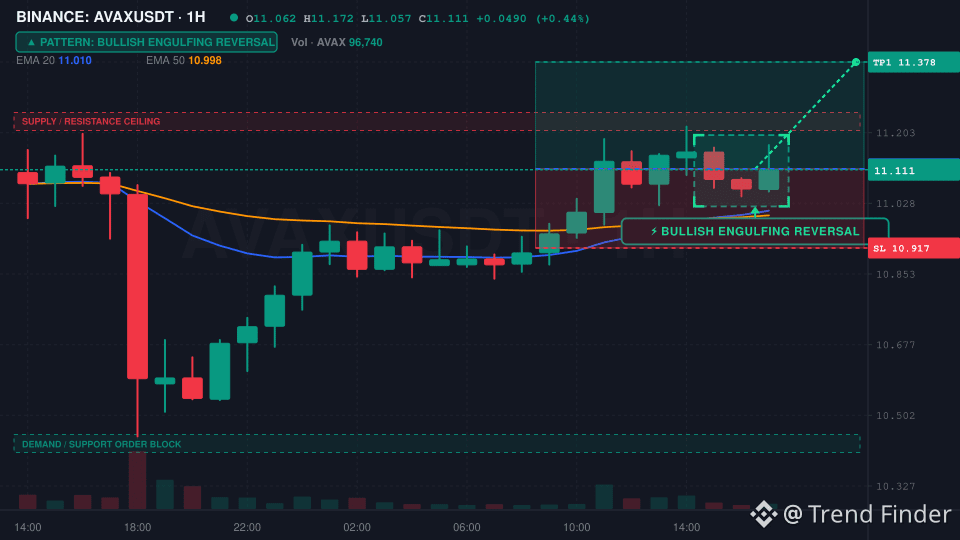
$AVAX is starting to show serious relative strength as spot desks swallow the 11.068 liquidity pocket. While $BTC sideways chop bores the retail crowd, this 1H Bullish Engulfing marks a verified 55-point breakout with institutional backing. RSI 56 is the sweet spot for continuation after the initial 2.4% move.
Entry: 11.113
SL: 10.917
TP1: 11.378
TP2:
#BinanceSquare #CryptoTrading #AVAX
$AVAX is starting to show serious relative strength as spot desks swallow the 11.068 liquidity pocket. While $BTC sideways chop bores the retail crowd, this 1H Bullish Engulfing marks a verified 55-point breakout with institutional backing. RSI 56 is the sweet spot for continuation after the initial 2.4% move.
Entry: 11.113
SL: 10.917
TP1: 11.378
TP2:
#BinanceSquare #CryptoTrading #AVAX
Entry: 11.113
SL: 10.917
TP1: 11.378
TP2:
#BinanceSquare #CryptoTrading #AVAX
1
12
·
--
The DogeOS Pivot: Why Smart Money is Absorbing the 171 Billion FloatThe DogeOS Pivot: Why Smart Money is Absorbing the 171 Billion Float
Dogecoin is currently undergoing a fundamental shift that most of the retail crowd is completely missing while they chase the latest shiny object. We are looking at a digital veteran with a circulating supply of over 171.88 billion tokens, but the narrative that its inflation makes it worthless is being challenged by massive liquidity absorption. Unlike the typical new coin launch where we worry about massive venture capital unlocks or team vesting cliffs, $DOGE has a zero-cliff supply structure because it is already 100 percent distributed.
The current macro data shows that institutional custodians and high-net-worth whales are not just sitting on their hands. On-chain metrics confirm that wallets in the 10 million to 100 million bracket vacuumed up 1.14 billion tokens during the recent dip toward 0.098. This level of smart money concentration suggests that the floor is being reinforced by actors who view the 3.2 percent annual inflation as a manageable security cost rather than a dilution threat. This predictable issuance is actually one of the few transparent supply schedules left in a market full of opaque unlocks.
The real catalyst for this cycle is the DogeOS public testnet launch. By introducing an EVM-compatible layer, the ecosystem is moving toward actual utility. We are talking about gas fees, governance potential, and decentralized application layers on a chain that was previously just for peer-to-peer transfers. When you look at the current spot price around 0.09312 and compare it to the growing application layer, the risk-reward profile starts to look very different from a standard meme.
With zero venture capital supply walls hitting the market in the next twelve months, the price action is purely driven by spot demand and utility expansion. The question is no longer about whether DOGE is a joke, but whether the infrastructure can keep up with this level of institutional accumulation.
Are you holding for the meme, or are you watching the DogeOS utility build-out?
The DogeOS Pivot: Why Smart Money is Absorbing the 171 Billion Float
The DogeOS Pivot: Why Smart Money is Absorbing the 171 Billion Float
Dogecoin is currently undergoing a fundamental shift that most of the retail crowd is completely missing while they chase the latest shiny object. We are looking at a digital veteran with a circulating supply of over 171.88 billion tokens, but the narrative that its inflation makes it worthless is being challenged by massive liquidity absorption. Unlike the typical new coin launch where we worry about massive venture capital unlocks or team vesting cliffs, $DOGE has a zero-cliff supply structure because it is already 100 percent distributed.
The current macro data shows that institutional custodians and high-net-worth whales are not just sitting on their hands. On-chain metrics confirm that wallets in the 10 million to 100 million bracket vacuumed up 1.14 billion tokens during the recent dip toward 0.098. This level of smart money concentration suggests that the floor is being reinforced by actors who view the 3.2 percent annual inflation as a manageable security cost rather than a dilution threat. This predictable issuance is actually one of the few transparent supply schedules left in a market full of opaque unlocks.
The real catalyst for this cycle is the DogeOS public testnet launch. By introducing an EVM-compatible layer, the ecosystem is moving toward actual utility. We are talking about gas fees, governance potential, and decentralized application layers on a chain that was previously just for peer-to-peer transfers. When you look at the current spot price around 0.09312 and compare it to the growing application layer, the risk-reward profile starts to look very different from a standard meme.
With zero venture capital supply walls hitting the market in the next twelve months, the price action is purely driven by spot demand and utility expansion. The question is no longer about whether DOGE is a joke, but whether the infrastructure can keep up with this level of institutional accumulation.
Are you holding for the meme, or are you watching the DogeOS utility build-out?
Dogecoin is currently undergoing a fundamental shift that most of the retail crowd is completely missing while they chase the latest shiny object. We are looking at a digital veteran with a circulating supply of over 171.88 billion tokens, but the narrative that its inflation makes it worthless is being challenged by massive liquidity absorption. Unlike the typical new coin launch where we worry about massive venture capital unlocks or team vesting cliffs, $DOGE has a zero-cliff supply structure because it is already 100 percent distributed.
The current macro data shows that institutional custodians and high-net-worth whales are not just sitting on their hands. On-chain metrics confirm that wallets in the 10 million to 100 million bracket vacuumed up 1.14 billion tokens during the recent dip toward 0.098. This level of smart money concentration suggests that the floor is being reinforced by actors who view the 3.2 percent annual inflation as a manageable security cost rather than a dilution threat. This predictable issuance is actually one of the few transparent supply schedules left in a market full of opaque unlocks.
The real catalyst for this cycle is the DogeOS public testnet launch. By introducing an EVM-compatible layer, the ecosystem is moving toward actual utility. We are talking about gas fees, governance potential, and decentralized application layers on a chain that was previously just for peer-to-peer transfers. When you look at the current spot price around 0.09312 and compare it to the growing application layer, the risk-reward profile starts to look very different from a standard meme.
With zero venture capital supply walls hitting the market in the next twelve months, the price action is purely driven by spot demand and utility expansion. The question is no longer about whether DOGE is a joke, but whether the infrastructure can keep up with this level of institutional accumulation.
Are you holding for the meme, or are you watching the DogeOS utility build-out?

1
10
·
--
Solana Institutional Gravity: Why the Machine Economy is Outpacing SpeculationSolana Institutional Gravity: Why the Machine Economy is Outpacing Speculation
Forget the retail noise for a second. While the broader market watches the S&P 500 correlation, Solana is quietly becoming the backbone for autonomous finance. We are seeing a massive transition where $SOL is no longer just a high-speed L1; it is the settlement layer for the machine economy.
The numbers on the x402 protocol are wild. Over 23.2 million AI agent transactions hit the chain in a single month, representing 76 percent of that protocol activity. When Alibaba Cloud starts integrating payment channels for inference services, you know the enterprise interest is real. On the hardware side, DePIN is finding its home here because the costs are 45 to 75 percent lower than traditional cloud giants like AWS. With Render hitting over 3,800 active GPU nodes and Helium crossing a million devices in the U.S., the physical footprint is massive and growing.
Institutional capital is moving just as fast. We are looking at 3.7 billion in non-stablecoin real world assets on Solana right now. BlackRock is already positioning its BUIDL fund for expansion, and tokenized US Treasuries are on track to double to 14 billion this year. The flow data reflects this accumulation. 362 whales recently stacked over 130.7 million SOL while only 176 whales distributed. Even with October token unlocks on the horizon, the supply is being absorbed by treasury companies like Forward Industries, which added nearly 950,000 SOL to their holdings last quarter.
The narrative is clearly shifting from pure speculation to tangible utility and institutional adoption across these three sectors. With the spot price hovering around 119.59 and liquidity depth increasing, the infrastructure for a machine-led economy is already live.
What do you think is the biggest catalyst for Solana in Q4?
_
#CryptoAI #RWA
Solana Institutional Gravity: Why the Machine Economy is Outpacing Speculation
Solana Institutional Gravity: Why the Machine Economy is Outpacing Speculation
Forget the retail noise for a second. While the broader market watches the S&P 500 correlation, Solana is quietly becoming the backbone for autonomous finance. We are seeing a massive transition where $SOL is no longer just a high-speed L1; it is the settlement layer for the machine economy.
The numbers on the x402 protocol are wild. Over 23.2 million AI agent transactions hit the chain in a single month, representing 76 percent of that protocol activity. When Alibaba Cloud starts integrating payment channels for inference services, you know the enterprise interest is real. On the hardware side, DePIN is finding its home here because the costs are 45 to 75 percent lower than traditional cloud giants like AWS. With Render hitting over 3,800 active GPU nodes and Helium crossing a million devices in the U.S., the physical footprint is massive and growing.
Institutional capital is moving just as fast. We are looking at 3.7 billion in non-stablecoin real world assets on Solana right now. BlackRock is already positioning its BUIDL fund for expansion, and tokenized US Treasuries are on track to double to 14 billion this year. The flow data reflects this accumulation. 362 whales recently stacked over 130.7 million SOL while only 176 whales distributed. Even with October token unlocks on the horizon, the supply is being absorbed by treasury companies like Forward Industries, which added nearly 950,000 SOL to their holdings last quarter.
The narrative is clearly shifting from pure speculation to tangible utility and institutional adoption across these three sectors. With the spot price hovering around 119.59 and liquidity depth increasing, the infrastructure for a machine-led economy is already live.
What do you think is the biggest catalyst for Solana in Q4?
_
#CryptoAI #RWA
Forget the retail noise for a second. While the broader market watches the S&P 500 correlation, Solana is quietly becoming the backbone for autonomous finance. We are seeing a massive transition where $SOL is no longer just a high-speed L1; it is the settlement layer for the machine economy.
The numbers on the x402 protocol are wild. Over 23.2 million AI agent transactions hit the chain in a single month, representing 76 percent of that protocol activity. When Alibaba Cloud starts integrating payment channels for inference services, you know the enterprise interest is real. On the hardware side, DePIN is finding its home here because the costs are 45 to 75 percent lower than traditional cloud giants like AWS. With Render hitting over 3,800 active GPU nodes and Helium crossing a million devices in the U.S., the physical footprint is massive and growing.
Institutional capital is moving just as fast. We are looking at 3.7 billion in non-stablecoin real world assets on Solana right now. BlackRock is already positioning its BUIDL fund for expansion, and tokenized US Treasuries are on track to double to 14 billion this year. The flow data reflects this accumulation. 362 whales recently stacked over 130.7 million SOL while only 176 whales distributed. Even with October token unlocks on the horizon, the supply is being absorbed by treasury companies like Forward Industries, which added nearly 950,000 SOL to their holdings last quarter.
The narrative is clearly shifting from pure speculation to tangible utility and institutional adoption across these three sectors. With the spot price hovering around 119.59 and liquidity depth increasing, the infrastructure for a machine-led economy is already live.
What do you think is the biggest catalyst for Solana in Q4?
_
#CryptoAI #RWA
1
3
·
--
The Invisible Supply Wall: Deconstructing BNB Road to 100 MillionThe Invisible Supply Wall: Deconstructing BNB Road to 100 Million
The real story for $BNB right now isn't found in the local price action but in the relentless contraction of its liquid supply. We just moved past the 36th quarterly auto burn which wiped out over 1.6 million tokens, valued at nearly 932 million. When you combine these massive quarterly events with the real-time BEP-95 gas burns, the path toward the 100 million hard cap becomes a mathematical certainty rather than just a roadmap goal.
What distinguishes this ecosystem from the sea of newer high-FDV projects is the complete absence of vesting overhang. Most traders forget that the final team and seed unlocks wrapped up back in 2021. We aren't looking at massive cliffs or VC dumps anymore; the supply you see is essentially all there is. Currently, about 18.6% of the eligible supply is locked up by stakers. That is roughly 24.8 million tokens removed from the immediate sell-side float, creating a supply-side constraint that builds quietly in the background.
On the demand side, the macro environment is shifting. Binance has seen over 30.5 billion in stablecoin inflows over the last thirty days. This level of dry powder usually precedes significant volatility, but with the circulating supply now sitting around 133.16 million, every dollar of new capital has to chase a shrinking pool of tokens. Even as BNB trades near the 777.56 mark, the structural scarcity is reaching a tipping point ahead of the 37th burn expected in mid-October.
We are seeing a unique scenario where protocol-level deflation meets massive institutional liquidity. How are you positioning for the next leg of this supply crunch as we head toward that 100 million BNB milestone?
#TokenUnlocks #Tokenomics
The Invisible Supply Wall: Deconstructing BNB Road to 100 Million
The Invisible Supply Wall: Deconstructing BNB Road to 100 Million
The real story for $BNB right now isn't found in the local price action but in the relentless contraction of its liquid supply. We just moved past the 36th quarterly auto burn which wiped out over 1.6 million tokens, valued at nearly 932 million. When you combine these massive quarterly events with the real-time BEP-95 gas burns, the path toward the 100 million hard cap becomes a mathematical certainty rather than just a roadmap goal.
What distinguishes this ecosystem from the sea of newer high-FDV projects is the complete absence of vesting overhang. Most traders forget that the final team and seed unlocks wrapped up back in 2021. We aren't looking at massive cliffs or VC dumps anymore; the supply you see is essentially all there is. Currently, about 18.6% of the eligible supply is locked up by stakers. That is roughly 24.8 million tokens removed from the immediate sell-side float, creating a supply-side constraint that builds quietly in the background.
On the demand side, the macro environment is shifting. Binance has seen over 30.5 billion in stablecoin inflows over the last thirty days. This level of dry powder usually precedes significant volatility, but with the circulating supply now sitting around 133.16 million, every dollar of new capital has to chase a shrinking pool of tokens. Even as BNB trades near the 777.56 mark, the structural scarcity is reaching a tipping point ahead of the 37th burn expected in mid-October.
We are seeing a unique scenario where protocol-level deflation meets massive institutional liquidity. How are you positioning for the next leg of this supply crunch as we head toward that 100 million BNB milestone?
#TokenUnlocks #Tokenomics
The real story for $BNB right now isn't found in the local price action but in the relentless contraction of its liquid supply. We just moved past the 36th quarterly auto burn which wiped out over 1.6 million tokens, valued at nearly 932 million. When you combine these massive quarterly events with the real-time BEP-95 gas burns, the path toward the 100 million hard cap becomes a mathematical certainty rather than just a roadmap goal.
What distinguishes this ecosystem from the sea of newer high-FDV projects is the complete absence of vesting overhang. Most traders forget that the final team and seed unlocks wrapped up back in 2021. We aren't looking at massive cliffs or VC dumps anymore; the supply you see is essentially all there is. Currently, about 18.6% of the eligible supply is locked up by stakers. That is roughly 24.8 million tokens removed from the immediate sell-side float, creating a supply-side constraint that builds quietly in the background.
On the demand side, the macro environment is shifting. Binance has seen over 30.5 billion in stablecoin inflows over the last thirty days. This level of dry powder usually precedes significant volatility, but with the circulating supply now sitting around 133.16 million, every dollar of new capital has to chase a shrinking pool of tokens. Even as BNB trades near the 777.56 mark, the structural scarcity is reaching a tipping point ahead of the 37th burn expected in mid-October.
We are seeing a unique scenario where protocol-level deflation meets massive institutional liquidity. How are you positioning for the next leg of this supply crunch as we head toward that 100 million BNB milestone?
#TokenUnlocks #Tokenomics
1
8
·
--
The amount of stablecoin dry powder hitting the market is wild. Massive USDT and USDC treasury minting shows global liquidity is stacking up. SSR metrics confirm exchange reserves are fueling future buying power. Even though $BNB hasn't formed a clean technical setup at 775.26, the macro fuel is ready. Watching $BTC closely. _
#Stablecoins #CryptoLiquidity #BNB
The amount of stablecoin dry powder hitting the market is wild. Massive USDT and USDC treasury minting shows global liquidity is stacking up. SSR metrics confirm exchange reserves are fueling future buying power. Even though $BNB hasn't formed a clean technical setup at 775.26, the macro fuel is ready. Watching $BTC closely. _
#Stablecoins #CryptoLiquidity #BNB
#Stablecoins #CryptoLiquidity #BNB
1
12
·
--
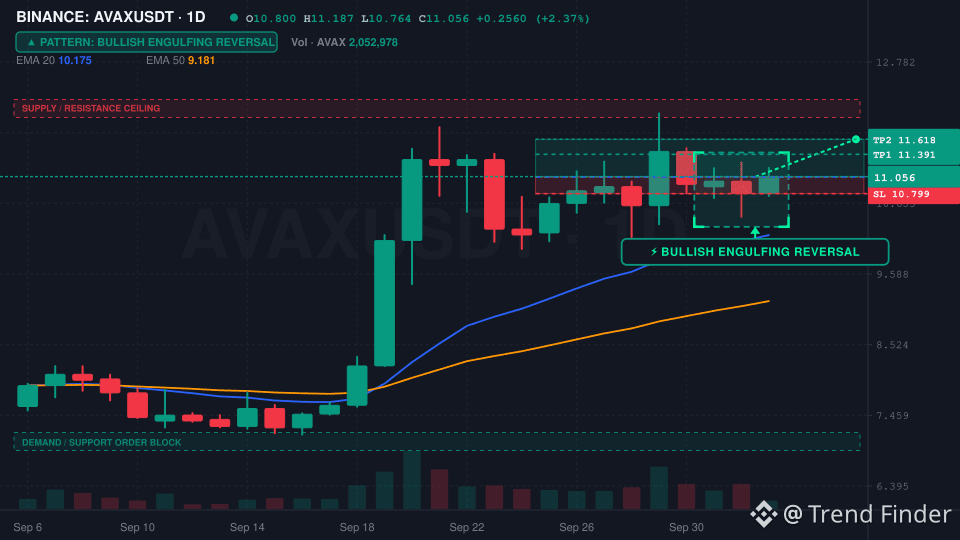
Institutional algorithms just finished a massive $AVAX liquidity sweep. This 1D Bullish Engulfing confirms deep spot absorption while $BTC sideways churn creates a perfect window. Structural demand is clearly absorbing supply above the EMA20 for this 55-point breakout.
Entry: 11.051
SL: 10.799
TP1: 11.391
TP2: 11.618
#BinanceSquare #CryptoTrading #AVAX
Institutional algorithms just finished a massive $AVAX liquidity sweep. This 1D Bullish Engulfing confirms deep spot absorption while $BTC sideways churn creates a perfect window. Structural demand is clearly absorbing supply above the EMA20 for this 55-point breakout.
Entry: 11.051
SL: 10.799
TP1: 11.391
TP2: 11.618
#BinanceSquare #CryptoTrading #AVAX
Entry: 11.051
SL: 10.799
TP1: 11.391
TP2: 11.618
#BinanceSquare #CryptoTrading #AVAX
1
10
·
--
Solana is Entering a Supply Vacuum Phase as Whale Dormancy EndsSolana is Entering a Supply Vacuum Phase as Whale Dormancy Ends
The real story for Solana right now is happening away from the noisy price charts. While the broader market focuses on daily volatility, the structural setup for $SOL is shifting toward a massive supply squeeze. Looking at the latest on-chain movements, there is a clear trend of large-scale accumulation that suggests smart money is positioning for a long-term play rather than a quick flip.
In just the last week, we saw wallets holding over 10,000 units of SOL grow by 1.58 percent. This is not retail hype; it is institutional-grade positioning. One of the most telling signals was a major dormant whale, who sat on the sidelines since their massive profit take in 2023, finally re-entering the market with a 3.6 million unit purchase. When players of that size end a two-year silence, you have to pay attention to the value they are seeing.
At the same time, the available float on centralized exchanges is drying up. Exchange reserves dropped nearly 5 percent recently, signaling a major move toward self-custody and staking. With staking participation sitting between 65 and 73 percent of the circulating supply, the actual liquid supply available to meet new demand is incredibly thin. This exodus from exchanges creates a structural floor that is hard to ignore, especially with the spot price hovering around 119.3.
The MVRV Z-Score is currently at 0.028, which historically points to SOL being undervalued compared to its realized value. We are also seeing a significant shift in long-term tokenomics with developments like SGP-0002, which effectively doubles the annual disinflation rate. This is projected to keep nearly 19 million units out of circulation over the next six years. When you combine reduced future issuance with a drying exchange supply, the fundamental math looks incredibly tight.
Are you guys seeing this same accumulation pattern in other majors, or does Solana feel like it is carving out its own path right now?
_
#OnChainData #WhaleAlert
Solana is Entering a Supply Vacuum Phase as Whale Dormancy Ends
Solana is Entering a Supply Vacuum Phase as Whale Dormancy Ends
The real story for Solana right now is happening away from the noisy price charts. While the broader market focuses on daily volatility, the structural setup for $SOL is shifting toward a massive supply squeeze. Looking at the latest on-chain movements, there is a clear trend of large-scale accumulation that suggests smart money is positioning for a long-term play rather than a quick flip.
In just the last week, we saw wallets holding over 10,000 units of SOL grow by 1.58 percent. This is not retail hype; it is institutional-grade positioning. One of the most telling signals was a major dormant whale, who sat on the sidelines since their massive profit take in 2023, finally re-entering the market with a 3.6 million unit purchase. When players of that size end a two-year silence, you have to pay attention to the value they are seeing.
At the same time, the available float on centralized exchanges is drying up. Exchange reserves dropped nearly 5 percent recently, signaling a major move toward self-custody and staking. With staking participation sitting between 65 and 73 percent of the circulating supply, the actual liquid supply available to meet new demand is incredibly thin. This exodus from exchanges creates a structural floor that is hard to ignore, especially with the spot price hovering around 119.3.
The MVRV Z-Score is currently at 0.028, which historically points to SOL being undervalued compared to its realized value. We are also seeing a significant shift in long-term tokenomics with developments like SGP-0002, which effectively doubles the annual disinflation rate. This is projected to keep nearly 19 million units out of circulation over the next six years. When you combine reduced future issuance with a drying exchange supply, the fundamental math looks incredibly tight.
Are you guys seeing this same accumulation pattern in other majors, or does Solana feel like it is carving out its own path right now?
_
#OnChainData #WhaleAlert
The real story for Solana right now is happening away from the noisy price charts. While the broader market focuses on daily volatility, the structural setup for $SOL is shifting toward a massive supply squeeze. Looking at the latest on-chain movements, there is a clear trend of large-scale accumulation that suggests smart money is positioning for a long-term play rather than a quick flip.
In just the last week, we saw wallets holding over 10,000 units of SOL grow by 1.58 percent. This is not retail hype; it is institutional-grade positioning. One of the most telling signals was a major dormant whale, who sat on the sidelines since their massive profit take in 2023, finally re-entering the market with a 3.6 million unit purchase. When players of that size end a two-year silence, you have to pay attention to the value they are seeing.
At the same time, the available float on centralized exchanges is drying up. Exchange reserves dropped nearly 5 percent recently, signaling a major move toward self-custody and staking. With staking participation sitting between 65 and 73 percent of the circulating supply, the actual liquid supply available to meet new demand is incredibly thin. This exodus from exchanges creates a structural floor that is hard to ignore, especially with the spot price hovering around 119.3.
The MVRV Z-Score is currently at 0.028, which historically points to SOL being undervalued compared to its realized value. We are also seeing a significant shift in long-term tokenomics with developments like SGP-0002, which effectively doubles the annual disinflation rate. This is projected to keep nearly 19 million units out of circulation over the next six years. When you combine reduced future issuance with a drying exchange supply, the fundamental math looks incredibly tight.
Are you guys seeing this same accumulation pattern in other majors, or does Solana feel like it is carving out its own path right now?
_
#OnChainData #WhaleAlert
1
6
·
--
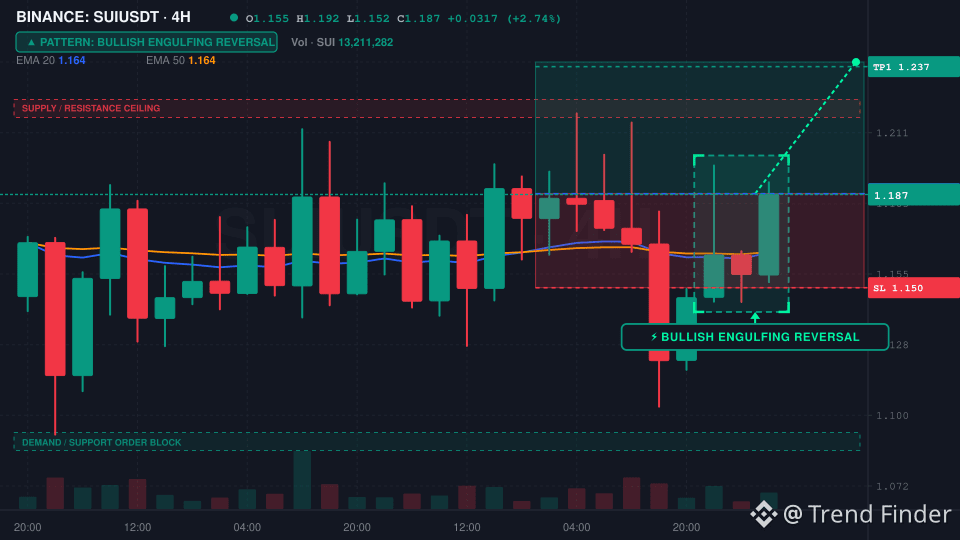
Aggressive limit orders just swallowed the $SUI liquidity sweep. While $BTC stalls, capital is rotating into strength. This 4H bullish engulfing confirms that sellers are trapped and demand is absorbing supply above the 1.182 EMA20.
Entry: 1.187 | SL: 1.15 | TP1: 1.237 | TP2: 1.27
_
#BinanceSquare #CryptoTrading #SUI
Aggressive limit orders just swallowed the $SUI liquidity sweep. While $BTC stalls, capital is rotating into strength. This 4H bullish engulfing confirms that sellers are trapped and demand is absorbing supply above the 1.182 EMA20.
Entry: 1.187 | SL: 1.15 | TP1: 1.237 | TP2: 1.27
_
#BinanceSquare #CryptoTrading #SUI
Entry: 1.187 | SL: 1.15 | TP1: 1.237 | TP2: 1.27
_
#BinanceSquare #CryptoTrading #SUI
1
9
·
--
On-chain liquidity is maturing beyond speculation. I'm noticing a massive surge in DeFi TVL, specifically through liquid restaking protocols which maximize capital efficiency. DEX volumes are also outpacing CEXs in key pairs, driving real protocol revenue. No clear setup on $DOGE yet, but the $BTC DeFi ecosystem is heating up.
#DeFi #TVL #DOGE
On-chain liquidity is maturing beyond speculation. I'm noticing a massive surge in DeFi TVL, specifically through liquid restaking protocols which maximize capital efficiency. DEX volumes are also outpacing CEXs in key pairs, driving real protocol revenue. No clear setup on $DOGE yet, but the $BTC DeFi ecosystem is heating up.
#DeFi #TVL #DOGE
#DeFi #TVL #DOGE
1
25
·
--
Verified
Solana’s Institutional Maturity: Why SOL is Now a Digital Commodity StapleSolana’s Institutional Maturity: Why $SOL is Now a Digital Commodity Staple
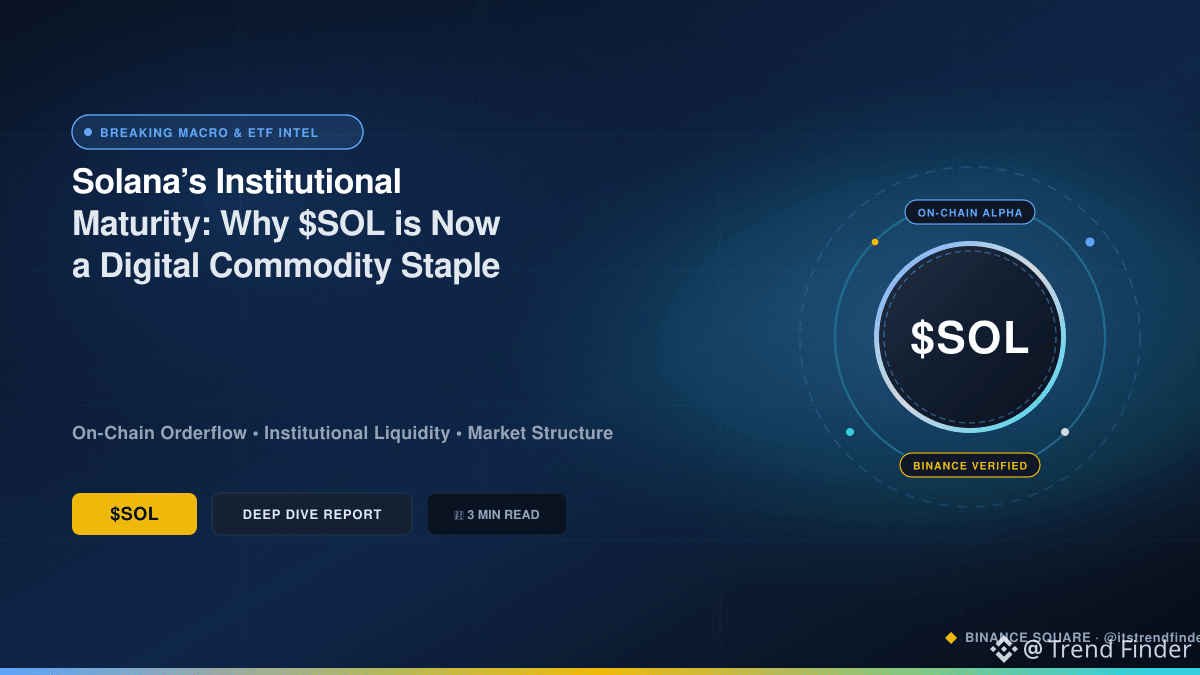
The narrative around SOL has shifted from a high-speed speculative play to a structural cornerstone for global finance. We aren't just looking at network uptime anymore; we are looking at billions in institutional commitment that survived the initial volatility of 2026. With the SEC and CFTC effectively de-risking the asset by classifying it as a digital commodity, the floodgates for Western capital have swung wide open.
The numbers tell a compelling story of accumulation. Spot Solana ETFs reached a cumulative net inflow of 1.606 billion recently, despite a minor 5.9 million outflow on October 1st. Fidelity’s FSOL fund and BlackRock’s BUIDL expansion are significant because they treat Solana as a settlement layer rather than just a tradable asset. BlackRock managing over 2.6 billion in its tokenized fund—much of which leverages this network—validates the tech at a level retail sentiment alone cannot reach.
On the ground, the supply dynamics are tightening. We have roughly 588.15 million tokens circulating, with an annual inflation rate currently at 3.622% and trending lower. Whale movements, like that massive 446 million transfer off Binance earlier this year, suggest that large-scale players are moving into long-term custody rather than preparing for a quick exit. In Q3 alone, we saw a 48% price surge and a record 14 billion transactions. This reflects pure network utility rather than just empty trading volume.
With MiCA providing a clear operational framework in Europe and the spot reference for SOL holding steady around 119.39, the foundation for Q4 looks remarkably solid. The network is handling 45% of adjusted stablecoin volume this year, proving it can handle the load. The question now is whether the current 12-week inflow streak can maintain momentum as we head into the next macro cycle. What's your take on the current whale accumulation—long-term conviction or just institutional rebalancing?
_
#BitcoinETF #CryptoNews
Solana’s Institutional Maturity: Why SOL is Now a Digital Commodity Staple
Solana’s Institutional Maturity: Why $SOL is Now a Digital Commodity Staple
The narrative around SOL has shifted from a high-speed speculative play to a structural cornerstone for global finance. We aren't just looking at network uptime anymore; we are looking at billions in institutional commitment that survived the initial volatility of 2026. With the SEC and CFTC effectively de-risking the asset by classifying it as a digital commodity, the floodgates for Western capital have swung wide open.
The numbers tell a compelling story of accumulation. Spot Solana ETFs reached a cumulative net inflow of 1.606 billion recently, despite a minor 5.9 million outflow on October 1st. Fidelity’s FSOL fund and BlackRock’s BUIDL expansion are significant because they treat Solana as a settlement layer rather than just a tradable asset. BlackRock managing over 2.6 billion in its tokenized fund—much of which leverages this network—validates the tech at a level retail sentiment alone cannot reach.
On the ground, the supply dynamics are tightening. We have roughly 588.15 million tokens circulating, with an annual inflation rate currently at 3.622% and trending lower. Whale movements, like that massive 446 million transfer off Binance earlier this year, suggest that large-scale players are moving into long-term custody rather than preparing for a quick exit. In Q3 alone, we saw a 48% price surge and a record 14 billion transactions. This reflects pure network utility rather than just empty trading volume.
With MiCA providing a clear operational framework in Europe and the spot reference for SOL holding steady around 119.39, the foundation for Q4 looks remarkably solid. The network is handling 45% of adjusted stablecoin volume this year, proving it can handle the load. The question now is whether the current 12-week inflow streak can maintain momentum as we head into the next macro cycle. What's your take on the current whale accumulation—long-term conviction or just institutional rebalancing?
_
#BitcoinETF #CryptoNews
The narrative around SOL has shifted from a high-speed speculative play to a structural cornerstone for global finance. We aren't just looking at network uptime anymore; we are looking at billions in institutional commitment that survived the initial volatility of 2026. With the SEC and CFTC effectively de-risking the asset by classifying it as a digital commodity, the floodgates for Western capital have swung wide open.
The numbers tell a compelling story of accumulation. Spot Solana ETFs reached a cumulative net inflow of 1.606 billion recently, despite a minor 5.9 million outflow on October 1st. Fidelity’s FSOL fund and BlackRock’s BUIDL expansion are significant because they treat Solana as a settlement layer rather than just a tradable asset. BlackRock managing over 2.6 billion in its tokenized fund—much of which leverages this network—validates the tech at a level retail sentiment alone cannot reach.
On the ground, the supply dynamics are tightening. We have roughly 588.15 million tokens circulating, with an annual inflation rate currently at 3.622% and trending lower. Whale movements, like that massive 446 million transfer off Binance earlier this year, suggest that large-scale players are moving into long-term custody rather than preparing for a quick exit. In Q3 alone, we saw a 48% price surge and a record 14 billion transactions. This reflects pure network utility rather than just empty trading volume.
With MiCA providing a clear operational framework in Europe and the spot reference for SOL holding steady around 119.39, the foundation for Q4 looks remarkably solid. The network is handling 45% of adjusted stablecoin volume this year, proving it can handle the load. The question now is whether the current 12-week inflow streak can maintain momentum as we head into the next macro cycle. What's your take on the current whale accumulation—long-term conviction or just institutional rebalancing?
_
#BitcoinETF #CryptoNews
1
7
·
--
Labor Market Whiplash: Why the NFP Print is Shifting Institutional SentimentLabor Market Whiplash: Why the NFP Print is Shifting Institutional Sentiment
The air always gets a bit thin right before the US Bureau of Labor Statistics drops the payroll data. We are sitting at 2:46 PM IST, and the market is essentially holding its breath. With $BTC hovering around the 84618.58 spot reference, the next few hours are less about the technicals and entirely about how the macro tape reads the labor market health.
The consensus is pegged between 145K and 150K jobs, coming off a previous reading of 142K. If we see a number that significantly overshoots this, the DXY will likely catch a bid, putting immediate pressure on risk assets. On the flip side, a cooling labor market—perhaps a print closer to 130K—could be the catalyst for the Fed to accelerate rate-cut velocity. We are tracking a potential ±3.5% to ±6.0% implied volatility range in institutional orderbooks. When volatility spikes like this, liquidity usually thins out, and we see those aggressive whale movements trying to front-run the Fed’s next move.
Institutional ETF inflows have been the backbone of this current range, but they are incredibly sensitive to the macro backdrop. Recent CPI data showed that inflation isn't going down without a fight, which forces the FOMC to stay hawkish. This data-dependency means the market is hyper-reactive. We are seeing a real tug-of-war in the orderflow between recession fears and inflation sticky-ness. If the unemployment rate stays steady at 4.2% while wage growth slows to the 0.3% forecast, it might give the bulls enough breathing room to maintain this 84k level.
The big players aren't gambling on the direction; they are positioning for the volatility. Are you de-risking your portfolio before the 12:30 UTC release, or do you think the cooling narrative is already baked into BTC?
_
#NFP #MacroData
Labor Market Whiplash: Why the NFP Print is Shifting Institutional Sentiment
Labor Market Whiplash: Why the NFP Print is Shifting Institutional Sentiment
The air always gets a bit thin right before the US Bureau of Labor Statistics drops the payroll data. We are sitting at 2:46 PM IST, and the market is essentially holding its breath. With $BTC hovering around the 84618.58 spot reference, the next few hours are less about the technicals and entirely about how the macro tape reads the labor market health.
The consensus is pegged between 145K and 150K jobs, coming off a previous reading of 142K. If we see a number that significantly overshoots this, the DXY will likely catch a bid, putting immediate pressure on risk assets. On the flip side, a cooling labor market—perhaps a print closer to 130K—could be the catalyst for the Fed to accelerate rate-cut velocity. We are tracking a potential ±3.5% to ±6.0% implied volatility range in institutional orderbooks. When volatility spikes like this, liquidity usually thins out, and we see those aggressive whale movements trying to front-run the Fed’s next move.
Institutional ETF inflows have been the backbone of this current range, but they are incredibly sensitive to the macro backdrop. Recent CPI data showed that inflation isn't going down without a fight, which forces the FOMC to stay hawkish. This data-dependency means the market is hyper-reactive. We are seeing a real tug-of-war in the orderflow between recession fears and inflation sticky-ness. If the unemployment rate stays steady at 4.2% while wage growth slows to the 0.3% forecast, it might give the bulls enough breathing room to maintain this 84k level.
The big players aren't gambling on the direction; they are positioning for the volatility. Are you de-risking your portfolio before the 12:30 UTC release, or do you think the cooling narrative is already baked into BTC?
_
#NFP #MacroData
The air always gets a bit thin right before the US Bureau of Labor Statistics drops the payroll data. We are sitting at 2:46 PM IST, and the market is essentially holding its breath. With $BTC hovering around the 84618.58 spot reference, the next few hours are less about the technicals and entirely about how the macro tape reads the labor market health.
The consensus is pegged between 145K and 150K jobs, coming off a previous reading of 142K. If we see a number that significantly overshoots this, the DXY will likely catch a bid, putting immediate pressure on risk assets. On the flip side, a cooling labor market—perhaps a print closer to 130K—could be the catalyst for the Fed to accelerate rate-cut velocity. We are tracking a potential ±3.5% to ±6.0% implied volatility range in institutional orderbooks. When volatility spikes like this, liquidity usually thins out, and we see those aggressive whale movements trying to front-run the Fed’s next move.
Institutional ETF inflows have been the backbone of this current range, but they are incredibly sensitive to the macro backdrop. Recent CPI data showed that inflation isn't going down without a fight, which forces the FOMC to stay hawkish. This data-dependency means the market is hyper-reactive. We are seeing a real tug-of-war in the orderflow between recession fears and inflation sticky-ness. If the unemployment rate stays steady at 4.2% while wage growth slows to the 0.3% forecast, it might give the bulls enough breathing room to maintain this 84k level.
The big players aren't gambling on the direction; they are positioning for the volatility. Are you de-risking your portfolio before the 12:30 UTC release, or do you think the cooling narrative is already baked into BTC?
_
#NFP #MacroData
1
20
·
--
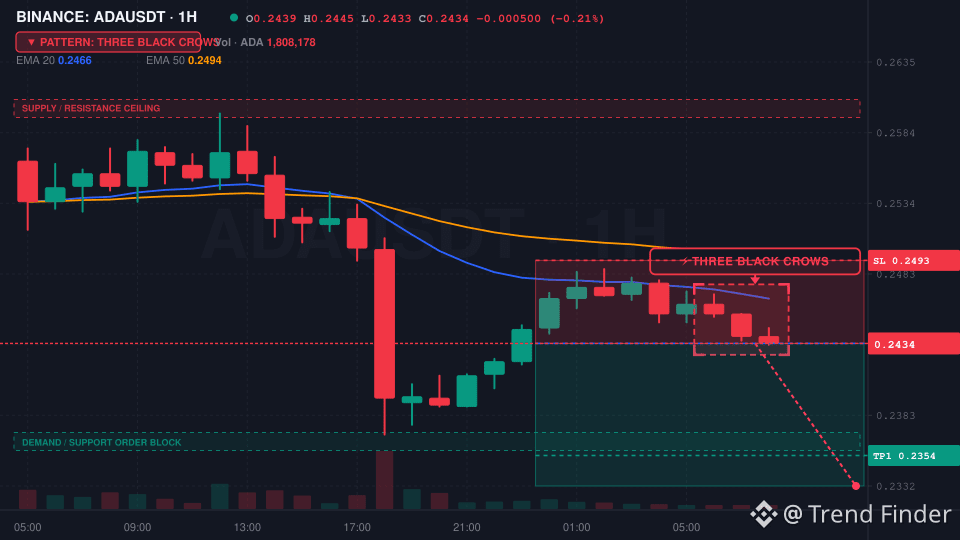
Orderflow on $ADA is looking thin as the 1H Three Black Crows print confirms a sharp distribution phase. While $BTC consolidates, the total absence of institutional bids has triggered a 55-point slide below the 0.2443736 EMA20. RSI 44 suggests the flush is just beginning.
Entry: 0.2434 | SL: 0.24932 | TP1: 0.23541 | TP2: 0.23008
_
#BinanceSquare #CryptoTrading #ADA
Orderflow on $ADA is looking thin as the 1H Three Black Crows print confirms a sharp distribution phase. While $BTC consolidates, the total absence of institutional bids has triggered a 55-point slide below the 0.2443736 EMA20. RSI 44 suggests the flush is just beginning.
Entry: 0.2434 | SL: 0.24932 | TP1: 0.23541 | TP2: 0.23008
_
#BinanceSquare #CryptoTrading #ADA
Entry: 0.2434 | SL: 0.24932 | TP1: 0.23541 | TP2: 0.23008
_
#BinanceSquare #CryptoTrading #ADA
1
17
·
--
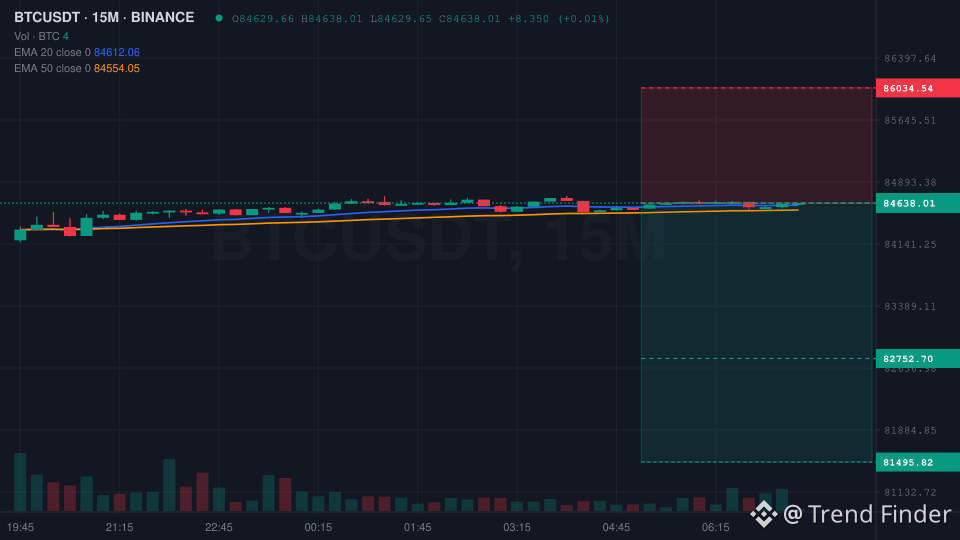
The tape is getting heavy as institutional bids vanish. $BTC bears are aggressively front-running this 15M breakdown while distribution hits $ETH. With price losing the EMA20 and RSI 44 showing weakness, the path of least resistance is down.
Entry: 84638.01
SL: 86034.54
TP1: 82752.7
TP2: 81495.82
_
#BinanceSquare #CryptoTrading #BTC
The tape is getting heavy as institutional bids vanish. $BTC bears are aggressively front-running this 15M breakdown while distribution hits $ETH . With price losing the EMA20 and RSI 44 showing weakness, the path of least resistance is down.
Entry: 84638.01
SL: 86034.54
TP1: 82752.7
TP2: 81495.82
_
#BinanceSquare #CryptoTrading #BTC
Entry: 84638.01
SL: 86034.54
TP1: 82752.7
TP2: 81495.82
_
#BinanceSquare #CryptoTrading #BTC
1
20
·
--
BTC.D remains sticky at the highs, sucking capital out of alts and leaving sector rotation feeling fragmented. $NEAR is just drifting around 4.703 in this rangebound chop while TOTAL3 stays suppressed. Until institutional orderflow steps in with real conviction, cash is a valid position.
#MarketStructure #BitcoinDominance #NEAR
BTC.D remains sticky at the highs, sucking capital out of alts and leaving sector rotation feeling fragmented. $NEAR is just drifting around 4.703 in this rangebound chop while TOTAL3 stays suppressed. Until institutional orderflow steps in with real conviction, cash is a valid position.
#MarketStructure #BitcoinDominance #NEAR
#MarketStructure #BitcoinDominance #NEAR

1
61
·
--
Why the BNB Launchpool Engine Is Absorbing Circulating Supply Faster Than EverWhy the $BNB Launchpool Engine Is Absorbing Circulating Supply Faster Than Ever
While spot prices around 767.25 reflect stable consolidation, the real action is unfolding deep within the Binance ecosystem's tokenomics engine. A massive structural shift is taking place across recent Megadrop and Launchpool campaigns, driving an aggressive absorption of circulating supply that fundamentally alters market dynamics.
When analyzing recent project debuts, the reward allocation structure clearly heavily favors long-term ecosystem participants. The BNB farming pools consistently secure between 80% and 85% of total reward allocations, with the remainder split across stablecoin pools like FDUSD and USDC. This massive weighting forces an ongoing scramble for yield, effectively removing substantial quantities of token float from active spot trading.
The architecture of these new listings is remarkably consistent. Typically, 3% to 7% of a token's total supply is distributed through early farming rewards, while initial circulating supply at listing is tightly bounded between 13% and 19% of maximum supply. This strategic bottleneck creates a high Fully Diluted Valuation benchmark right at TGE, insulating the asset from immediate post-listing dump pressure. On-chain whale tracking shows institutional capital locking into stablecoin pools for yield efficiency, while core participants lock up native supply for long-term protocol utility and recurring launch access.
The real volatility triggers lie further down the roadmap, specifically around team and investor cliff release windows. Until those mid-term unlocks arrive, the continuous cycle of yield farming creates a constant supply sink.
Are you actively farming these continuous yields with your holdings, or are you sitting on stablecoins waiting for post-listing pullbacks?
#BinanceLaunchpool #NewCryptoLaunch
Why the BNB Launchpool Engine Is Absorbing Circulating Supply Faster Than Ever
Why the $BNB Launchpool Engine Is Absorbing Circulating Supply Faster Than Ever
While spot prices around 767.25 reflect stable consolidation, the real action is unfolding deep within the Binance ecosystem's tokenomics engine. A massive structural shift is taking place across recent Megadrop and Launchpool campaigns, driving an aggressive absorption of circulating supply that fundamentally alters market dynamics.
When analyzing recent project debuts, the reward allocation structure clearly heavily favors long-term ecosystem participants. The BNB farming pools consistently secure between 80% and 85% of total reward allocations, with the remainder split across stablecoin pools like FDUSD and USDC. This massive weighting forces an ongoing scramble for yield, effectively removing substantial quantities of token float from active spot trading.
The architecture of these new listings is remarkably consistent. Typically, 3% to 7% of a token's total supply is distributed through early farming rewards, while initial circulating supply at listing is tightly bounded between 13% and 19% of maximum supply. This strategic bottleneck creates a high Fully Diluted Valuation benchmark right at TGE, insulating the asset from immediate post-listing dump pressure. On-chain whale tracking shows institutional capital locking into stablecoin pools for yield efficiency, while core participants lock up native supply for long-term protocol utility and recurring launch access.
The real volatility triggers lie further down the roadmap, specifically around team and investor cliff release windows. Until those mid-term unlocks arrive, the continuous cycle of yield farming creates a constant supply sink.
Are you actively farming these continuous yields with your holdings, or are you sitting on stablecoins waiting for post-listing pullbacks?
#BinanceLaunchpool #NewCryptoLaunch
While spot prices around 767.25 reflect stable consolidation, the real action is unfolding deep within the Binance ecosystem's tokenomics engine. A massive structural shift is taking place across recent Megadrop and Launchpool campaigns, driving an aggressive absorption of circulating supply that fundamentally alters market dynamics.
When analyzing recent project debuts, the reward allocation structure clearly heavily favors long-term ecosystem participants. The BNB farming pools consistently secure between 80% and 85% of total reward allocations, with the remainder split across stablecoin pools like FDUSD and USDC. This massive weighting forces an ongoing scramble for yield, effectively removing substantial quantities of token float from active spot trading.
The architecture of these new listings is remarkably consistent. Typically, 3% to 7% of a token's total supply is distributed through early farming rewards, while initial circulating supply at listing is tightly bounded between 13% and 19% of maximum supply. This strategic bottleneck creates a high Fully Diluted Valuation benchmark right at TGE, insulating the asset from immediate post-listing dump pressure. On-chain whale tracking shows institutional capital locking into stablecoin pools for yield efficiency, while core participants lock up native supply for long-term protocol utility and recurring launch access.
The real volatility triggers lie further down the roadmap, specifically around team and investor cliff release windows. Until those mid-term unlocks arrive, the continuous cycle of yield farming creates a constant supply sink.
Are you actively farming these continuous yields with your holdings, or are you sitting on stablecoins waiting for post-listing pullbacks?
#BinanceLaunchpool #NewCryptoLaunch
1
3
·
--
XRP Liquidation Heat Map: Why the Short Squeeze Might Only Be StartingXRP Liquidation Heat Map: Why the Short Squeeze Might Only Be Starting
The current tape for $XRP is screaming derivatives dominance as we see a massive disconnect between spot stability and futures aggression. While the price hovers around the 1.52 mark, just north of our 1.485 reference, the aggregate Open Interest has ballooned to 2.92 billion USD. That 16.39 percent jump in just twenty four hours tells me that fresh speculative capital is flooding the system, not just recycled positions.
What stands out most is the sheer violence of the recent short squeeze. We just witnessed over 23.20 million USD in short liquidations, representing a staggering 658 percent surge compared to the long side. Bears tried to cap the move and got absolutely incinerated as price pushed through local resistance. Even with this volatility, funding rates on Binance and Bybit are staying lean at roughly positive 0.0100 percent. This is actually a healthy sign; it shows the market isnt overly exuberant or top-heavy yet, though the leverage ratio sitting at 0.197 is still historically high compared to the six-month average.
On the supply side, the October 1st unlock of 1 billion tokens was largely a non-event because Ripple stuck to its historical practice and re-escrowed the majority of it. Whales are holding steady at roughly 3.90 billion tokens after that massive accumulation phase in late September, suggesting the big money is waiting for a macro catalyst rather than offloading into this strength. The options market is even more lopsided, with a put/call ratio of 0.54 signaling that the institutional bias is firmly tilted toward the upside. Even the ETF-related derivatives show almost zero demand for downside protection right now.
With the leverage resetting slightly but Open Interest climbing back toward three billion, the board is set for another major move. Are you guys positioned for a continuation, or do you think the funding rates will eventually turn into a trap for late longs?
_
#OpenInterest #FundingRates
XRP Liquidation Heat Map: Why the Short Squeeze Might Only Be Starting
XRP Liquidation Heat Map: Why the Short Squeeze Might Only Be Starting
The current tape for $XRP is screaming derivatives dominance as we see a massive disconnect between spot stability and futures aggression. While the price hovers around the 1.52 mark, just north of our 1.485 reference, the aggregate Open Interest has ballooned to 2.92 billion USD. That 16.39 percent jump in just twenty four hours tells me that fresh speculative capital is flooding the system, not just recycled positions.
What stands out most is the sheer violence of the recent short squeeze. We just witnessed over 23.20 million USD in short liquidations, representing a staggering 658 percent surge compared to the long side. Bears tried to cap the move and got absolutely incinerated as price pushed through local resistance. Even with this volatility, funding rates on Binance and Bybit are staying lean at roughly positive 0.0100 percent. This is actually a healthy sign; it shows the market isnt overly exuberant or top-heavy yet, though the leverage ratio sitting at 0.197 is still historically high compared to the six-month average.
On the supply side, the October 1st unlock of 1 billion tokens was largely a non-event because Ripple stuck to its historical practice and re-escrowed the majority of it. Whales are holding steady at roughly 3.90 billion tokens after that massive accumulation phase in late September, suggesting the big money is waiting for a macro catalyst rather than offloading into this strength. The options market is even more lopsided, with a put/call ratio of 0.54 signaling that the institutional bias is firmly tilted toward the upside. Even the ETF-related derivatives show almost zero demand for downside protection right now.
With the leverage resetting slightly but Open Interest climbing back toward three billion, the board is set for another major move. Are you guys positioned for a continuation, or do you think the funding rates will eventually turn into a trap for late longs?
_
#OpenInterest #FundingRates
The current tape for $XRP is screaming derivatives dominance as we see a massive disconnect between spot stability and futures aggression. While the price hovers around the 1.52 mark, just north of our 1.485 reference, the aggregate Open Interest has ballooned to 2.92 billion USD. That 16.39 percent jump in just twenty four hours tells me that fresh speculative capital is flooding the system, not just recycled positions.
What stands out most is the sheer violence of the recent short squeeze. We just witnessed over 23.20 million USD in short liquidations, representing a staggering 658 percent surge compared to the long side. Bears tried to cap the move and got absolutely incinerated as price pushed through local resistance. Even with this volatility, funding rates on Binance and Bybit are staying lean at roughly positive 0.0100 percent. This is actually a healthy sign; it shows the market isnt overly exuberant or top-heavy yet, though the leverage ratio sitting at 0.197 is still historically high compared to the six-month average.
On the supply side, the October 1st unlock of 1 billion tokens was largely a non-event because Ripple stuck to its historical practice and re-escrowed the majority of it. Whales are holding steady at roughly 3.90 billion tokens after that massive accumulation phase in late September, suggesting the big money is waiting for a macro catalyst rather than offloading into this strength. The options market is even more lopsided, with a put/call ratio of 0.54 signaling that the institutional bias is firmly tilted toward the upside. Even the ETF-related derivatives show almost zero demand for downside protection right now.
With the leverage resetting slightly but Open Interest climbing back toward three billion, the board is set for another major move. Are you guys positioned for a continuation, or do you think the funding rates will eventually turn into a trap for late longs?
_
#OpenInterest #FundingRates
1
28
·
--
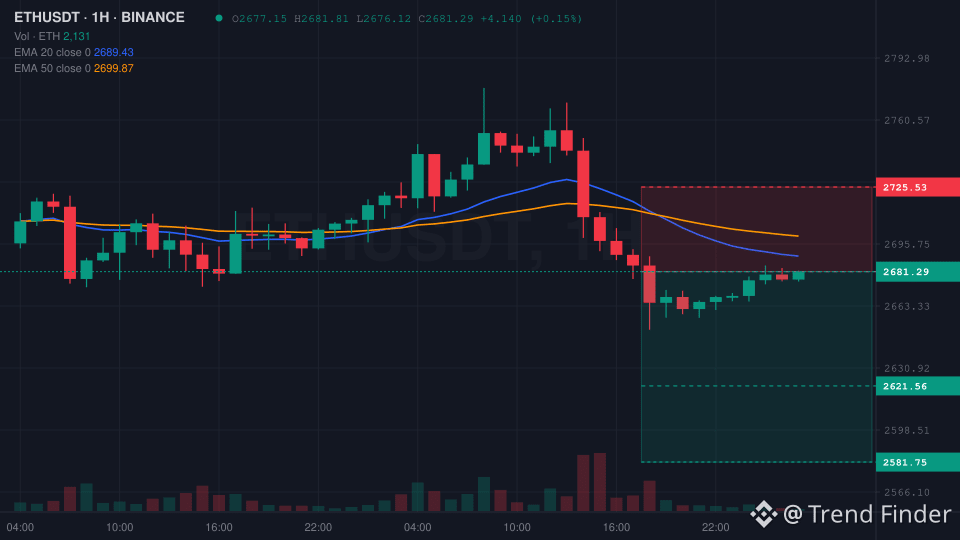
Sell-side pressure is hammering the $ETH tape as bids evaporate at the 1H supply ceiling. This 55-point breakdown below EMA20 2692.01516 exposes a clear path for RSI 44 to flush lower while $BTC remains weak. Institutional distribution is aggressive.
Entry: 2681.29 | SL: 2725.53 | TP1: 2621.56 | TP2: 2581.75
#BinanceSquare #CryptoTrading #ETH
Sell-side pressure is hammering the $ETH tape as bids evaporate at the 1H supply ceiling. This 55-point breakdown below EMA20 2692.01516 exposes a clear path for RSI 44 to flush lower while $BTC remains weak. Institutional distribution is aggressive.
Entry: 2681.29 | SL: 2725.53 | TP1: 2621.56 | TP2: 2581.75
#BinanceSquare #CryptoTrading #ETH
Entry: 2681.29 | SL: 2725.53 | TP1: 2621.56 | TP2: 2581.75
#BinanceSquare #CryptoTrading #ETH
1
39
·
--
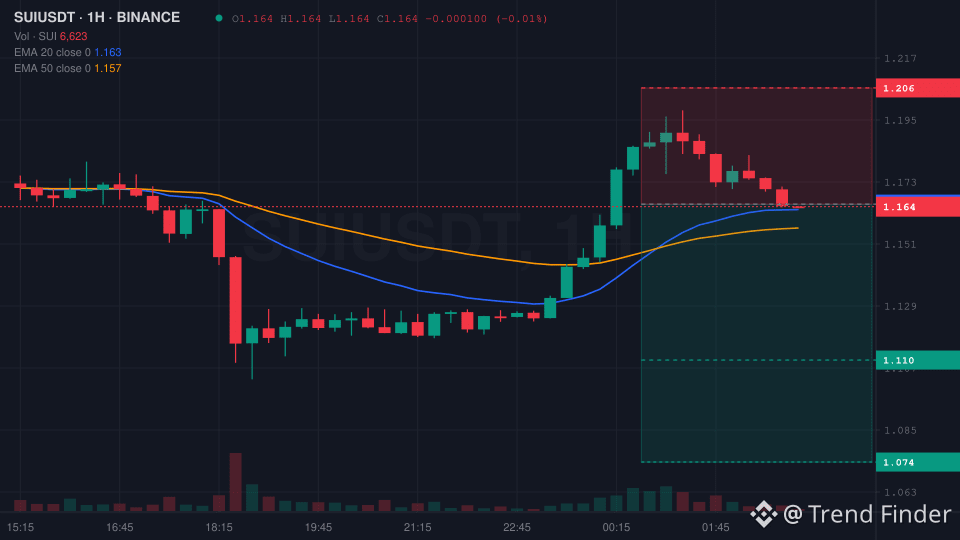
Bearish momentum is accelerating as $SUI supply hits the tape in size. This 1H Evening Star reversal signals a decisive 55-point SHORT window while $BTC continues to bleed. With price trending below the EMA20, RSI 44 suggests the local floor is still a long way off.
Entry: 1.165 | SL: 1.206 | TP1: 1.11 | TP2: 1.074
_
#BinanceSquare #CryptoTrading #SUI
Bearish momentum is accelerating as $SUI supply hits the tape in size. This 1H Evening Star reversal signals a decisive 55-point SHORT window while $BTC continues to bleed. With price trending below the EMA20, RSI 44 suggests the local floor is still a long way off.
Entry: 1.165 | SL: 1.206 | TP1: 1.11 | TP2: 1.074
_
#BinanceSquare #CryptoTrading #SUI
Entry: 1.165 | SL: 1.206 | TP1: 1.11 | TP2: 1.074
_
#BinanceSquare #CryptoTrading #SUI
1
95
·
--
The 100ms Finality Era: How Solana is Rewriting the Layer-1 PlaybookThe 100ms Finality Era: How Solana is Rewriting the Layer-1 Playbook
Solana is ditching the old playbook and the Q3 data shows why this architecture shift is finally hitting the mainnet in a big way. We are looking at more than just a speed boost; we are seeing a fundamental rewire of how $SOL handles finality. While the market watches the 119.14 price level, the real story is the underlying infrastructure.
The move to the Alpenglow consensus model is the headline act. By swapping Proof of History and Tower BFT for Votor and Rotor, the network is aiming for 100 to 150 millisecond finality. That is a massive leap from the current 12.8 second range. This change, scheduled for the Agave 4.3 release in October 2026, transforms the chain into a high-frequency settlement layer that rivals traditional finance speeds.
On-chain metrics are already reflecting this growth. In Q3 2026, daily active addresses climbed to 4.1 million, while total transactions for the quarter surged 45 percent to 14 billion. This activity is fueled by recent efficiency gains like the SIMD-0286 compute limit increase and the 90 percent reduction in rent costs through the Agave 4.2 updates. Average fees are sitting at 0.005741, which keeps the barrier to entry non-existent for users and developers alike.
The institutional side is matching this technical momentum. U.S. spot Solana ETFs just pulled in 188 million in net inflows during late September, marking twelve straight weeks of positive movement. With a circulating supply of 588,075,265 tokens, this 1.6 billion in cumulative institutional buying is absorbing secondary market supply and building a strong floor. Over 9,400 monthly active developers are currently building on this stack, suggesting the roadmap has plenty of legs.
As we transition into this next phase of the mainnet, the focus shifts from simple throughput to ultra-low latency. Can any other Layer-1 actually compete with 150ms finality once Alpenglow goes live?
️
#Layer2 #BlockchainScaling
The 100ms Finality Era: How Solana is Rewriting the Layer-1 Playbook
The 100ms Finality Era: How Solana is Rewriting the Layer-1 Playbook
Solana is ditching the old playbook and the Q3 data shows why this architecture shift is finally hitting the mainnet in a big way. We are looking at more than just a speed boost; we are seeing a fundamental rewire of how $SOL handles finality. While the market watches the 119.14 price level, the real story is the underlying infrastructure.
The move to the Alpenglow consensus model is the headline act. By swapping Proof of History and Tower BFT for Votor and Rotor, the network is aiming for 100 to 150 millisecond finality. That is a massive leap from the current 12.8 second range. This change, scheduled for the Agave 4.3 release in October 2026, transforms the chain into a high-frequency settlement layer that rivals traditional finance speeds.
On-chain metrics are already reflecting this growth. In Q3 2026, daily active addresses climbed to 4.1 million, while total transactions for the quarter surged 45 percent to 14 billion. This activity is fueled by recent efficiency gains like the SIMD-0286 compute limit increase and the 90 percent reduction in rent costs through the Agave 4.2 updates. Average fees are sitting at 0.005741, which keeps the barrier to entry non-existent for users and developers alike.
The institutional side is matching this technical momentum. U.S. spot Solana ETFs just pulled in 188 million in net inflows during late September, marking twelve straight weeks of positive movement. With a circulating supply of 588,075,265 tokens, this 1.6 billion in cumulative institutional buying is absorbing secondary market supply and building a strong floor. Over 9,400 monthly active developers are currently building on this stack, suggesting the roadmap has plenty of legs.
As we transition into this next phase of the mainnet, the focus shifts from simple throughput to ultra-low latency. Can any other Layer-1 actually compete with 150ms finality once Alpenglow goes live?
️
#Layer2 #BlockchainScaling
Solana is ditching the old playbook and the Q3 data shows why this architecture shift is finally hitting the mainnet in a big way. We are looking at more than just a speed boost; we are seeing a fundamental rewire of how $SOL handles finality. While the market watches the 119.14 price level, the real story is the underlying infrastructure.
The move to the Alpenglow consensus model is the headline act. By swapping Proof of History and Tower BFT for Votor and Rotor, the network is aiming for 100 to 150 millisecond finality. That is a massive leap from the current 12.8 second range. This change, scheduled for the Agave 4.3 release in October 2026, transforms the chain into a high-frequency settlement layer that rivals traditional finance speeds.
On-chain metrics are already reflecting this growth. In Q3 2026, daily active addresses climbed to 4.1 million, while total transactions for the quarter surged 45 percent to 14 billion. This activity is fueled by recent efficiency gains like the SIMD-0286 compute limit increase and the 90 percent reduction in rent costs through the Agave 4.2 updates. Average fees are sitting at 0.005741, which keeps the barrier to entry non-existent for users and developers alike.
The institutional side is matching this technical momentum. U.S. spot Solana ETFs just pulled in 188 million in net inflows during late September, marking twelve straight weeks of positive movement. With a circulating supply of 588,075,265 tokens, this 1.6 billion in cumulative institutional buying is absorbing secondary market supply and building a strong floor. Over 9,400 monthly active developers are currently building on this stack, suggesting the roadmap has plenty of legs.
As we transition into this next phase of the mainnet, the focus shifts from simple throughput to ultra-low latency. Can any other Layer-1 actually compete with 150ms finality once Alpenglow goes live?
️
#Layer2 #BlockchainScaling
53
Log in to explore more content
Join global crypto users on Binance Square
⚡️ Get latest and useful information about crypto.
💬 Trusted by the world’s largest crypto exchange.
👍 Discover real insights from verified creators.
Email / Phone number
Trending Topics
ZcashETFPostsFirstWeeklyOutflow$93.6M
29,149 views
84 Discussing
#ZcashETFPostsFirstWeeklyOutflow$93.6M
🚨🚨🚨🚨🚨🚨🚨🚨🚨🚨🚨🚨🚨🚨✅ 🚨 ZCASH ETF FLOWS TURN NEGATIVE FOR THE FIRST TIME! 📉
$ZEC is facing a notable shift in institutional fund flows, with Zcash investment products recording their first weekly net outflow since launching in August.
According to fund-flow data, around $93.6M was withdrawn from Zcash products during the latest week, while ZEC price action also cooled significantly.
📊 WHAT HAPPENED?
• Weekly Zcash ETF outflow: $93.6M
• September 30 daily outflow: $30.25M
• ZCSH previously attracted around $98.2M in one week
• ZEC is trading near $1,300
• Recent high: around $1,690
• Weekly decline: roughly 17%+
🔍 LEVELS TO WATCH
🟢 Support: $1,280–$1,300
🔴 Resistance: $1,450–$1,500
The key question now is whether the $1,300 area can hold and attract fresh buyers.
Institutional flows will also be important. A return of consistent positive inflows could signal renewed confidence, while continued outflows may keep pressure on $ZEC .
👀 Is this simply profit-taking after ZEC’s huge rally, or could we see another deeper pullback before buyers return?
Share your view below. 👇
#Zcash #ZEC #ZcashETF #Crypto
#analysis
owhggwiohsjowve
·0 Likes
·126 views
GreekPoliceBustCryptoScamRingArrest17
51,061 views
501 Discussing
BitcoinRejectedAt$87K
110,689 views
143 Discussing