
#halving
halving
5.5M views
2,337 Discussing
Hot
Latest

·
--
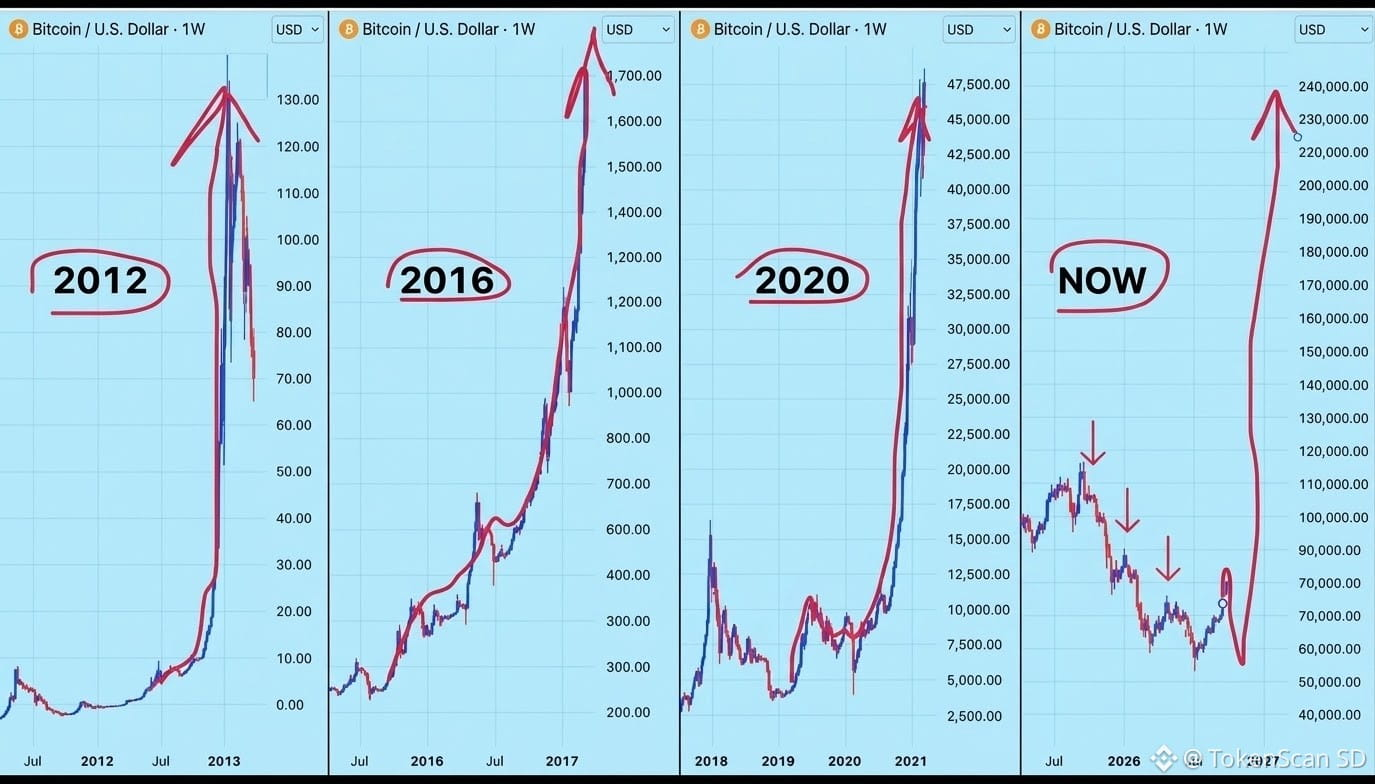
This is not a chart.
This is a zoomed-in photocopy of fate.
Left: 2012, people are still asking “is that money or digital rocks?”
Middle: 2016, people are just learning FOMO.
2020: people are just learning institutions.
Right: 2026, people are just learning to get tired.
The three red arrows in the NOW panel are not a “it’s finished” sign.
It’s the quietest phase at the party.
The lights are still on, the music is still there, but the ones who were dancing have already gone home.
What’s drawn pushing the move to $230K–$240K is not a promise. It’s rhyme.
Bitcoin likes to mess with people using a four-year rhythm,
then in the new cycle it slowly reduces the percentages so that those waiting for x100 end up disappointed,
and those waiting for “it’s dead” also get disappointed.
Price now is ~ $78K.
ATH last time was ~ $126K.
Last summer’s low was ~ $58K.
We’re not in the month yet. We’re also not in the graveyard yet.
If you post this, post it as a reminder of patterns,
not as an airline ticket to $240K.
Because Bitcoin’s cycle is faithful.
But it never promises to stay faithful with the exact same numbers.
#BTC #BitcoinCycle #Halving #HODL
$BTC
{future}(BTCUSDT)
This is not a chart.
This is a zoomed-in photocopy of fate.
Left: 2012, people are still asking “is that money or digital rocks?”
Middle: 2016, people are just learning FOMO.
2020: people are just learning institutions.
Right: 2026, people are just learning to get tired.
The three red arrows in the NOW panel are not a “it’s finished” sign.
It’s the quietest phase at the party.
The lights are still on, the music is still there, but the ones who were dancing have already gone home.
What’s drawn pushing the move to $230K–$240K is not a promise. It’s rhyme.
Bitcoin likes to mess with people using a four-year rhythm,
then in the new cycle it slowly reduces the percentages so that those waiting for x100 end up disappointed,
and those waiting for “it’s dead” also get disappointed.
Price now is ~ $78K.
ATH last time was ~ $126K.
Last summer’s low was ~ $58K.
We’re not in the month yet. We’re also not in the graveyard yet.
If you post this, post it as a reminder of patterns,
not as an airline ticket to $240K.
Because Bitcoin’s cycle is faithful.
But it never promises to stay faithful with the exact same numbers.
#BTC #BitcoinCycle #Halving #HODL
$BTC
This is a zoomed-in photocopy of fate.
Left: 2012, people are still asking “is that money or digital rocks?”
Middle: 2016, people are just learning FOMO.
2020: people are just learning institutions.
Right: 2026, people are just learning to get tired.
The three red arrows in the NOW panel are not a “it’s finished” sign.
It’s the quietest phase at the party.
The lights are still on, the music is still there, but the ones who were dancing have already gone home.
What’s drawn pushing the move to $230K–$240K is not a promise. It’s rhyme.
Bitcoin likes to mess with people using a four-year rhythm,
then in the new cycle it slowly reduces the percentages so that those waiting for x100 end up disappointed,
and those waiting for “it’s dead” also get disappointed.
Price now is ~ $78K.
ATH last time was ~ $126K.
Last summer’s low was ~ $58K.
We’re not in the month yet. We’re also not in the graveyard yet.
If you post this, post it as a reminder of patterns,
not as an airline ticket to $240K.
Because Bitcoin’s cycle is faithful.
But it never promises to stay faithful with the exact same numbers.
#BTC #BitcoinCycle #Halving #HODL
$BTC
121

·
--
⏱️ IS THE END OF ATH DROUGHT APPROACHING FOR BITCOIN? ⏳🚀
Analyst Darkfost warned that Bitcoin is about to complete 365 days without recording a new all-time high. Although the classic post-halving pattern seems to be changing, the data reveals a structural bullish signal 📊✨
Cycle compression trend:
🗓️ 2014 - 2017: 1,180 days between cycle highs.
🗓️ 2017 - 2020: 1,094 days between cycle highs.
🗓️ 2021 - 2024: 849 days between cycle highs.
What does this mean?
The interval between highs is shortening. If this acceleration continues, Bitcoin could set a new all-time high earlier than expected along the route before the April 2028 halving.
Do you think we’ll break the ATH before the year ends, or will the consolidation extend into 2027? 💬👇 I’m reading you in the comments!
#Bitcoin #Halving #OnChain #CryptoAnalysis #CryptoCommunity
$BTC
{spot}(BTCUSDT)
$BNB
{spot}(BNBUSDT)
$ETH
{spot}(ETHUSDT)
⏱️ IS THE END OF ATH DROUGHT APPROACHING FOR BITCOIN? ⏳🚀
Analyst Darkfost warned that Bitcoin is about to complete 365 days without recording a new all-time high. Although the classic post-halving pattern seems to be changing, the data reveals a structural bullish signal 📊✨
Cycle compression trend:
🗓️ 2014 - 2017: 1,180 days between cycle highs.
🗓️ 2017 - 2020: 1,094 days between cycle highs.
🗓️ 2021 - 2024: 849 days between cycle highs.
What does this mean?
The interval between highs is shortening. If this acceleration continues, Bitcoin could set a new all-time high earlier than expected along the route before the April 2028 halving.
Do you think we’ll break the ATH before the year ends, or will the consolidation extend into 2027? 💬👇 I’m reading you in the comments!
#Bitcoin #Halving #OnChain #CryptoAnalysis #CryptoCommunity
$BTC
$BNB
$ETH
Analyst Darkfost warned that Bitcoin is about to complete 365 days without recording a new all-time high. Although the classic post-halving pattern seems to be changing, the data reveals a structural bullish signal 📊✨
Cycle compression trend:
🗓️ 2014 - 2017: 1,180 days between cycle highs.
🗓️ 2017 - 2020: 1,094 days between cycle highs.
🗓️ 2021 - 2024: 849 days between cycle highs.
What does this mean?
The interval between highs is shortening. If this acceleration continues, Bitcoin could set a new all-time high earlier than expected along the route before the April 2028 halving.
Do you think we’ll break the ATH before the year ends, or will the consolidation extend into 2027? 💬👇 I’m reading you in the comments!
#Bitcoin #Halving #OnChain #CryptoAnalysis #CryptoCommunity
$BTC
$BNB
$ETH
1
1
708

🚀 $BTC BATTLE AT $77,600‑$77,900 SUPPORT AS 2028 HALVING HUNTS $232K 🦈
Entry: 77,600‑77,900 ⚡
Target: 80,000 🚀
Stop Loss: 76,100 ⚠️
📊 Sellers are hammering BTC hard after the CPI shock, but the $77,600‑$77,900 shelf is still swallowing liquidity faster than a shark in a feeding frenzy. ⚡ If the price clings, we stay in the sweet spot for a pre‑halving rally that could set the stage for a 4x thrust before April 2028. 🌊 The next macro test is the upcoming CPI – a catalyst that could either cement the floor or plunge us deeper.
💬 How are you positioning for the $80k upside or the $76.1k safety net? 👇
⚠️ Not financial advice. Always manage your risk. 🛡️
🏷️ #BTC #LongSetup #Halving #Crypto
🔥 💎
🚀 $BTC BATTLE AT $77,600‑$77,900 SUPPORT AS 2028 HALVING HUNTS $232K 🦈
Entry: 77,600‑77,900 ⚡
Target: 80,000 🚀
Stop Loss: 76,100 ⚠️
📊 Sellers are hammering BTC hard after the CPI shock, but the $77,600‑$77,900 shelf is still swallowing liquidity faster than a shark in a feeding frenzy. ⚡ If the price clings, we stay in the sweet spot for a pre‑halving rally that could set the stage for a 4x thrust before April 2028. 🌊 The next macro test is the upcoming CPI – a catalyst that could either cement the floor or plunge us deeper.
💬 How are you positioning for the $80k upside or the $76.1k safety net? 👇
⚠️ Not financial advice. Always manage your risk. 🛡️
🏷️ #BTC #LongSetup #Halving #Crypto
🔥 💎
Entry: 77,600‑77,900 ⚡
Target: 80,000 🚀
Stop Loss: 76,100 ⚠️
📊 Sellers are hammering BTC hard after the CPI shock, but the $77,600‑$77,900 shelf is still swallowing liquidity faster than a shark in a feeding frenzy. ⚡ If the price clings, we stay in the sweet spot for a pre‑halving rally that could set the stage for a 4x thrust before April 2028. 🌊 The next macro test is the upcoming CPI – a catalyst that could either cement the floor or plunge us deeper.
💬 How are you positioning for the $80k upside or the $76.1k safety net? 👇
⚠️ Not financial advice. Always manage your risk. 🛡️
🏷️ #BTC #LongSetup #Halving #Crypto
🔥 💎
33

·
--

Article
Bitcoin May Hit $400K by 2030 – Coinbase CEO Says Bottom Is InMost traders watch price. Smart money watches the halving cycle instead.
The signal: Brian Armstrong, Coinbase CEO, just declared that Bitcoin’s next halving, set for roughly 18 months from now, will likely trigger a new bull run that could push $BTC to $400,000 by 2030. He cites on‑chain data showing a steep decline in active addresses during the downturn, followed by a rapid rebound in staking and liquidity provisioning. #Bitcoin #Halving #CryptoForecast
Interpretation: Armstrong’s analysis aligns with the classic supply‑demand model. The halving cuts mining rewards in half, tightening supply while demand continues to climb, especially as institutional adoption accelerates. The current dip is a “bottoming” phase, evidenced by whale activity shifting from short‑term speculation to long‑term holding. If the cycle repeats, $BTC could see a 10‑fold rally over the next decade, mirroring the 2013‑2017 surge.
Watch list: Monitor the on‑chain metric “Miner Revenue to Total Revenue Ratio.” A sustained drop below 30% often precedes a price rally, as miners become less profitable and sell less, allowing the market to absorb more $BTC at lower prices. #MinerRevenue
Thought closer: With the halving approaching, are you positioned to ride the next wave, or will you let the market’s momentum pass you by?
Bitcoin May Hit $400K by 2030 – Coinbase CEO Says Bottom Is In
Most traders watch price. Smart money watches the halving cycle instead.
The signal: Brian Armstrong, Coinbase CEO, just declared that Bitcoin’s next halving, set for roughly 18 months from now, will likely trigger a new bull run that could push $BTC to $400,000 by 2030. He cites on‑chain data showing a steep decline in active addresses during the downturn, followed by a rapid rebound in staking and liquidity provisioning. #Bitcoin #Halving #CryptoForecast
Interpretation: Armstrong’s analysis aligns with the classic supply‑demand model. The halving cuts mining rewards in half, tightening supply while demand continues to climb, especially as institutional adoption accelerates. The current dip is a “bottoming” phase, evidenced by whale activity shifting from short‑term speculation to long‑term holding. If the cycle repeats, $BTC could see a 10‑fold rally over the next decade, mirroring the 2013‑2017 surge.
Watch list: Monitor the on‑chain metric “Miner Revenue to Total Revenue Ratio.” A sustained drop below 30% often precedes a price rally, as miners become less profitable and sell less, allowing the market to absorb more $BTC at lower prices. #MinerRevenue
Thought closer: With the halving approaching, are you positioned to ride the next wave, or will you let the market’s momentum pass you by?
The signal: Brian Armstrong, Coinbase CEO, just declared that Bitcoin’s next halving, set for roughly 18 months from now, will likely trigger a new bull run that could push $BTC to $400,000 by 2030. He cites on‑chain data showing a steep decline in active addresses during the downturn, followed by a rapid rebound in staking and liquidity provisioning. #Bitcoin #Halving #CryptoForecast
Interpretation: Armstrong’s analysis aligns with the classic supply‑demand model. The halving cuts mining rewards in half, tightening supply while demand continues to climb, especially as institutional adoption accelerates. The current dip is a “bottoming” phase, evidenced by whale activity shifting from short‑term speculation to long‑term holding. If the cycle repeats, $BTC could see a 10‑fold rally over the next decade, mirroring the 2013‑2017 surge.
Watch list: Monitor the on‑chain metric “Miner Revenue to Total Revenue Ratio.” A sustained drop below 30% often precedes a price rally, as miners become less profitable and sell less, allowing the market to absorb more $BTC at lower prices. #MinerRevenue
Thought closer: With the halving approaching, are you positioned to ride the next wave, or will you let the market’s momentum pass you by?
26

·
--
Picture this: an investor sitting on the sidelines during the 2016 and 2020 cycles, constantly waiting for the perfect bottom only to end up buying the exact top out of pure frustration. Most market participants get crushed not because they pick the wrong assets, but because they have zero concept of cyclical timing and panic when volatility hits.
Historical cycle data reveals an interesting pattern called the 500-day framework. In previous market regimes, accumulating $BTC roughly 500 days prior to the halving and exiting 500 days after delivered consistent cycle outperformance compared to chasing altcoins like $ETH or $SOL during late-stage euphoria. The logic is grounded in supply shock dynamics rather than short-term price noise.
With the next halving projected around 585 days away, that leaves a narrow window of roughly 85 days before entering that optimal historical accumulation zone. Comparing this setup to previous pre-halving consolidation phases shows that patience during these quiet chop periods usually separates long-term winners from exit liquidity.
Are you sticking to a strict cycle-based time horizon, or are you trying to pinpoint the exact local bottom?
#Bitcoin #CryptoTrading #Halving
Picture this: an investor sitting on the sidelines during the 2016 and 2020 cycles, constantly waiting for the perfect bottom only to end up buying the exact top out of pure frustration. Most market participants get crushed not because they pick the wrong assets, but because they have zero concept of cyclical timing and panic when volatility hits.
Historical cycle data reveals an interesting pattern called the 500-day framework. In previous market regimes, accumulating $BTC roughly 500 days prior to the halving and exiting 500 days after delivered consistent cycle outperformance compared to chasing altcoins like $ETH or $SOL during late-stage euphoria. The logic is grounded in supply shock dynamics rather than short-term price noise.
With the next halving projected around 585 days away, that leaves a narrow window of roughly 85 days before entering that optimal historical accumulation zone. Comparing this setup to previous pre-halving consolidation phases shows that patience during these quiet chop periods usually separates long-term winners from exit liquidity.
Are you sticking to a strict cycle-based time horizon, or are you trying to pinpoint the exact local bottom?
#Bitcoin #CryptoTrading #Halving
Historical cycle data reveals an interesting pattern called the 500-day framework. In previous market regimes, accumulating $BTC roughly 500 days prior to the halving and exiting 500 days after delivered consistent cycle outperformance compared to chasing altcoins like $ETH or $SOL during late-stage euphoria. The logic is grounded in supply shock dynamics rather than short-term price noise.
With the next halving projected around 585 days away, that leaves a narrow window of roughly 85 days before entering that optimal historical accumulation zone. Comparing this setup to previous pre-halving consolidation phases shows that patience during these quiet chop periods usually separates long-term winners from exit liquidity.
Are you sticking to a strict cycle-based time horizon, or are you trying to pinpoint the exact local bottom?
#Bitcoin #CryptoTrading #Halving

11

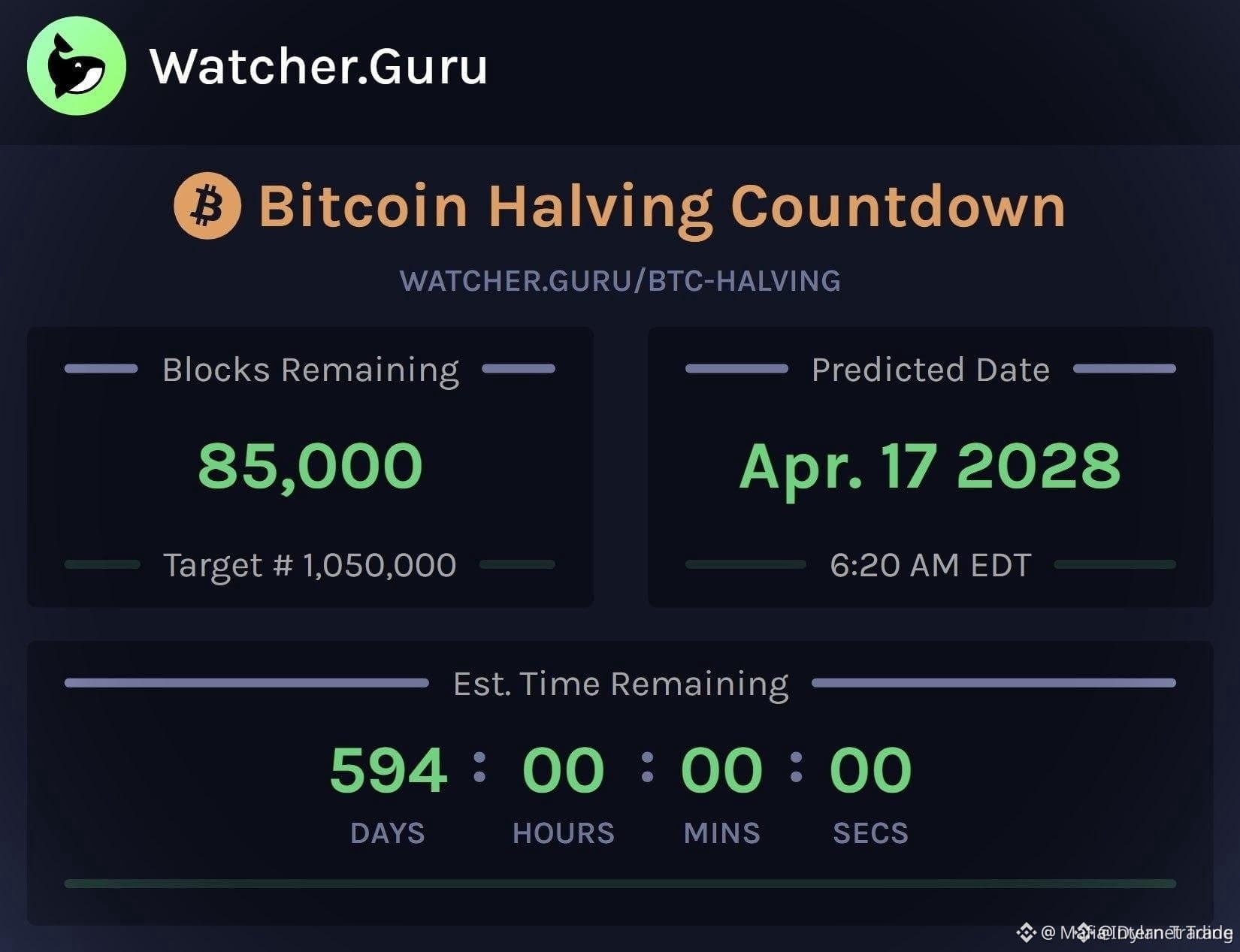
$BTC HALVING COUNTDOWN HITS 85,000 BLOCKS AS SUPPLY SQUEEZE TIGHTENS! ⚡ 📊
The supply clock is ticking fast. With $BTC sitting just 85,000 blocks out from its next structural reduction, the daily issuance curve is preparing for an aggressive shift. 📊 Smart capital is already calculating miner margin thresholds while block production holds firm at 10-minute averages.
While network hash rate fluctuations will generate inevitable short-term turbulence, the raw mathematical tightening of incoming supply remains relentless. 🦈 Order flow positioning indicates quiet absorption as institutional desks prepare for the inventory squeeze.
This setup is establishing a classic battleground between miner adjustments and long-term liquidity accumulation. 💬 Are you positioning ahead of the block reduction or awaiting a pre-halving sweep? 👇
⚠️ Not financial advice. Always manage your risk. 🛡️
🏷️ #BTC #Bitcoin #Halving #Crypto
⚡ 💎
$BTC HALVING COUNTDOWN HITS 85,000 BLOCKS AS SUPPLY SQUEEZE TIGHTENS! ⚡ 📊
The supply clock is ticking fast. With $BTC sitting just 85,000 blocks out from its next structural reduction, the daily issuance curve is preparing for an aggressive shift. 📊 Smart capital is already calculating miner margin thresholds while block production holds firm at 10-minute averages.
While network hash rate fluctuations will generate inevitable short-term turbulence, the raw mathematical tightening of incoming supply remains relentless. 🦈 Order flow positioning indicates quiet absorption as institutional desks prepare for the inventory squeeze.
This setup is establishing a classic battleground between miner adjustments and long-term liquidity accumulation. 💬 Are you positioning ahead of the block reduction or awaiting a pre-halving sweep? 👇
⚠️ Not financial advice. Always manage your risk. 🛡️
🏷️ #BTC #Bitcoin #Halving #Crypto
⚡ 💎
The supply clock is ticking fast. With $BTC sitting just 85,000 blocks out from its next structural reduction, the daily issuance curve is preparing for an aggressive shift. 📊 Smart capital is already calculating miner margin thresholds while block production holds firm at 10-minute averages.
While network hash rate fluctuations will generate inevitable short-term turbulence, the raw mathematical tightening of incoming supply remains relentless. 🦈 Order flow positioning indicates quiet absorption as institutional desks prepare for the inventory squeeze.
This setup is establishing a classic battleground between miner adjustments and long-term liquidity accumulation. 💬 Are you positioning ahead of the block reduction or awaiting a pre-halving sweep? 👇
⚠️ Not financial advice. Always manage your risk. 🛡️
🏷️ #BTC #Bitcoin #Halving #Crypto
⚡ 💎
29

·
--
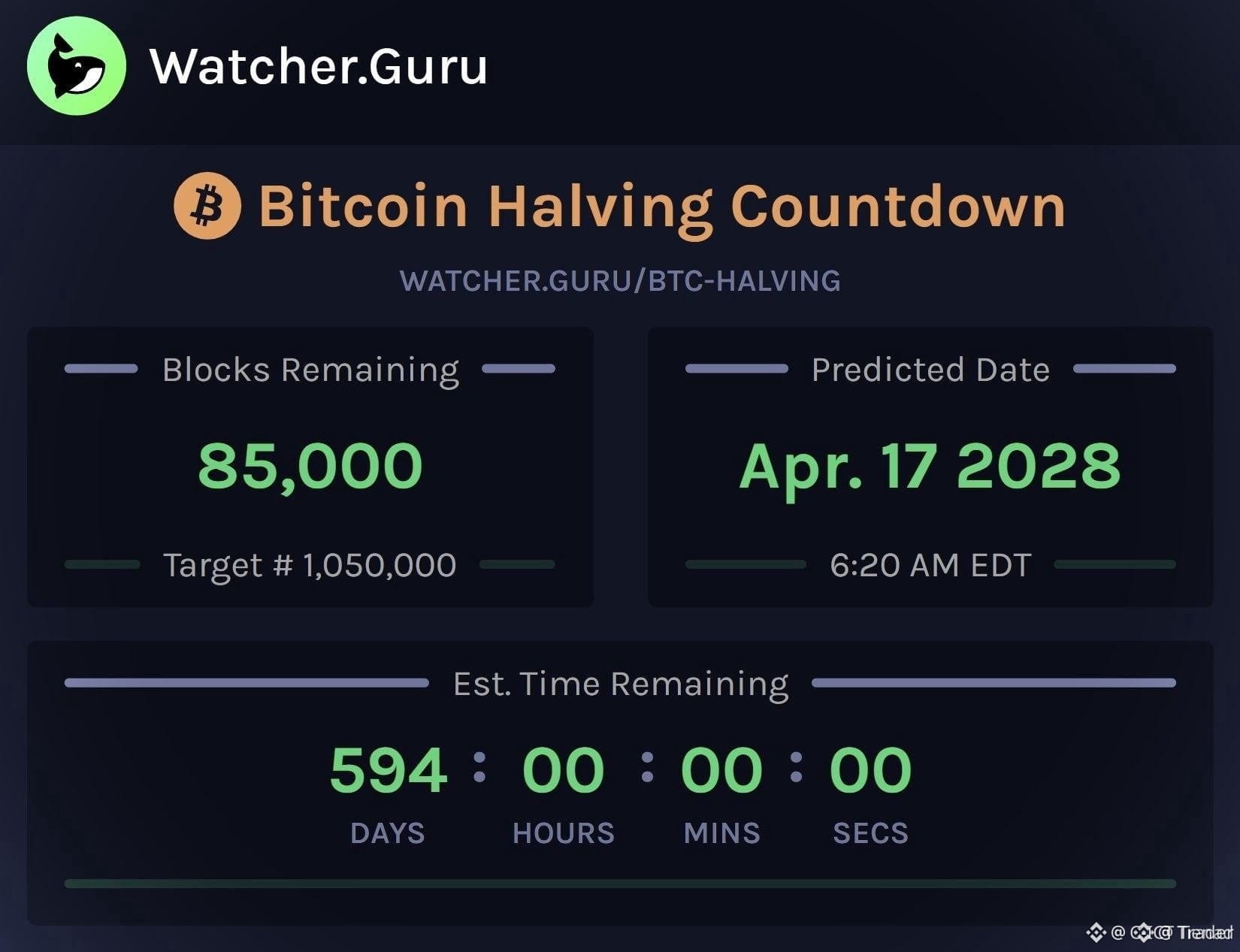
🚨 85,000 BLOCKS UNTIL THE NEXT $BTC HALVING AS SUPPLY SQUEEZE APPROACHES! ⚡
With roughly 85,000 blocks remaining until the next $BTC block reward cut, institutional eyes are already mapping out the macro liquidity cycle. 📊 As block issuance slows down over the next 1.5 years, order flow dynamics typically transition from miner distribution to structural accumulation ahead of tightening supply.
While retail debates whether anticipation leads to pre-halving distribution or immediate expansion, smart money focuses on high-timeframe order blocks and demand defense. 🔍 The countdown represents a structural regime shift where market depth and systemic scarcity dictate long-term direction.
🤔 Do you expect institutional positioning to front-run the supply cut, or will macro headwinds trigger one final liquidity sweep before the expansion begins? 👇
⚠️ Not financial advice. Always manage your risk. 🛡️
🏷️ #BTC #Bitcoin #Halving #MarketStructure
🎯 🦈
🚨 85,000 BLOCKS UNTIL THE NEXT $BTC HALVING AS SUPPLY SQUEEZE APPROACHES! ⚡
With roughly 85,000 blocks remaining until the next $BTC block reward cut, institutional eyes are already mapping out the macro liquidity cycle. 📊 As block issuance slows down over the next 1.5 years, order flow dynamics typically transition from miner distribution to structural accumulation ahead of tightening supply.
While retail debates whether anticipation leads to pre-halving distribution or immediate expansion, smart money focuses on high-timeframe order blocks and demand defense. 🔍 The countdown represents a structural regime shift where market depth and systemic scarcity dictate long-term direction.
🤔 Do you expect institutional positioning to front-run the supply cut, or will macro headwinds trigger one final liquidity sweep before the expansion begins? 👇
⚠️ Not financial advice. Always manage your risk. 🛡️
🏷️ #BTC #Bitcoin #Halving #MarketStructure
🎯 🦈
With roughly 85,000 blocks remaining until the next $BTC block reward cut, institutional eyes are already mapping out the macro liquidity cycle. 📊 As block issuance slows down over the next 1.5 years, order flow dynamics typically transition from miner distribution to structural accumulation ahead of tightening supply.
While retail debates whether anticipation leads to pre-halving distribution or immediate expansion, smart money focuses on high-timeframe order blocks and demand defense. 🔍 The countdown represents a structural regime shift where market depth and systemic scarcity dictate long-term direction.
🤔 Do you expect institutional positioning to front-run the supply cut, or will macro headwinds trigger one final liquidity sweep before the expansion begins? 👇
⚠️ Not financial advice. Always manage your risk. 🛡️
🏷️ #BTC #Bitcoin #Halving #MarketStructure
🎯 🦈
13

·
--
Bullish
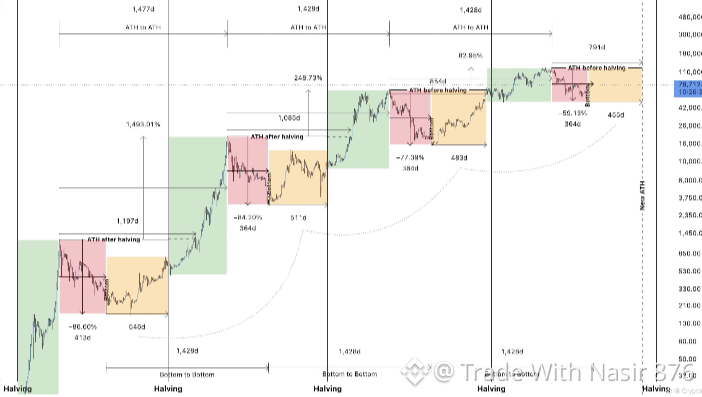
🚀 Bitcoin Market Cycles & Halving Analysis: Is History Repeating Itself? 📊
Looking closely at Bitcoin's historical chart, the market follows a strikingly consistent 4-year pattern. Here is what the data from previous Halving cycles reveals:
1️⃣ ATH to ATH Cycle (~1,400+ Days)
Every new All-Time High (ATH) peak takes approximately 1,428 to 1,477 days (~4 years) to form from the previous top.
2️⃣ Bear Market Bottoms (364 to 413 Days)
After hitting a peak, the market enters a correction phase (Red Zone):
2013–2015: -86.00% drop over 413 days
2017–2018: -84.20% drop over 364 days
2021–2022: -77.38% drop over 364 days
Historically, market bottoms tend to form around 364 days into the bear trend.
3️⃣ Accumulation & Recovery Phase (400–600+ Days)
Following the bottom, BTC enters an accumulation phase (Orange Zone) where price consolidates and builds momentum for the next macro expansion.
4️⃣ Halving & Parabolic Expansion
Vertically marked Halving events consistently mark the transition into the main structural expansion (Green Zone), leading to new historic highs.
💡 Key Takeaway:
Short-term volatility can be noisy, but macro cycles highlight strong structural consistency across 4-year periods. If historic post-halving patterns hold true, the macro outlook remains structurally bullish. 📈🔥
⚠️ Disclaimer: For educational purposes only. Not financial advice. Always Do Your Own Research (DYOR).
#CryptoAnalysis #TechnicalAnalysis #Halving #CryptoMarket #cryptotrading
$BTC
{spot}(BTCUSDT)
🚀 Bitcoin Market Cycles & Halving Analysis: Is History Repeating Itself? 📊
Looking closely at Bitcoin's historical chart, the market follows a strikingly consistent 4-year pattern. Here is what the data from previous Halving cycles reveals:
1️⃣ ATH to ATH Cycle (~1,400+ Days)
Every new All-Time High (ATH) peak takes approximately 1,428 to 1,477 days (~4 years) to form from the previous top.
2️⃣ Bear Market Bottoms (364 to 413 Days)
After hitting a peak, the market enters a correction phase (Red Zone):
2013–2015: -86.00% drop over 413 days
2017–2018: -84.20% drop over 364 days
2021–2022: -77.38% drop over 364 days
Historically, market bottoms tend to form around 364 days into the bear trend.
3️⃣ Accumulation & Recovery Phase (400–600+ Days)
Following the bottom, BTC enters an accumulation phase (Orange Zone) where price consolidates and builds momentum for the next macro expansion.
4️⃣ Halving & Parabolic Expansion
Vertically marked Halving events consistently mark the transition into the main structural expansion (Green Zone), leading to new historic highs.
💡 Key Takeaway:
Short-term volatility can be noisy, but macro cycles highlight strong structural consistency across 4-year periods. If historic post-halving patterns hold true, the macro outlook remains structurally bullish. 📈🔥
⚠️ Disclaimer: For educational purposes only. Not financial advice. Always Do Your Own Research (DYOR).
#CryptoAnalysis #TechnicalAnalysis #Halving #CryptoMarket #cryptotrading
$BTC
Looking closely at Bitcoin's historical chart, the market follows a strikingly consistent 4-year pattern. Here is what the data from previous Halving cycles reveals:
1️⃣ ATH to ATH Cycle (~1,400+ Days)
Every new All-Time High (ATH) peak takes approximately 1,428 to 1,477 days (~4 years) to form from the previous top.
2️⃣ Bear Market Bottoms (364 to 413 Days)
After hitting a peak, the market enters a correction phase (Red Zone):
2013–2015: -86.00% drop over 413 days
2017–2018: -84.20% drop over 364 days
2021–2022: -77.38% drop over 364 days
Historically, market bottoms tend to form around 364 days into the bear trend.
3️⃣ Accumulation & Recovery Phase (400–600+ Days)
Following the bottom, BTC enters an accumulation phase (Orange Zone) where price consolidates and builds momentum for the next macro expansion.
4️⃣ Halving & Parabolic Expansion
Vertically marked Halving events consistently mark the transition into the main structural expansion (Green Zone), leading to new historic highs.
💡 Key Takeaway:
Short-term volatility can be noisy, but macro cycles highlight strong structural consistency across 4-year periods. If historic post-halving patterns hold true, the macro outlook remains structurally bullish. 📈🔥
⚠️ Disclaimer: For educational purposes only. Not financial advice. Always Do Your Own Research (DYOR).
#CryptoAnalysis #TechnicalAnalysis #Halving #CryptoMarket #cryptotrading
$BTC
22


Every few years, Bitcoin's supply issuance changes—and the entire crypto market starts paying attention.
But here's the interesting part: the halving doesn't guarantee that prices will rise.
What it does change is the rate at which new supply enters the market. Then supply, demand, liquidity, and expectations do the rest.
Markets like $LTC have similar supply mechanisms worth understanding too.
#Halving #Litecoin
Every few years, Bitcoin's supply issuance changes—and the entire crypto market starts paying attention.
But here's the interesting part: the halving doesn't guarantee that prices will rise.
What it does change is the rate at which new supply enters the market. Then supply, demand, liquidity, and expectations do the rest.
Markets like $LTC have similar supply mechanisms worth understanding too.
#Halving #Litecoin
But here's the interesting part: the halving doesn't guarantee that prices will rise.
What it does change is the rate at which new supply enters the market. Then supply, demand, liquidity, and expectations do the rest.
Markets like $LTC have similar supply mechanisms worth understanding too.
#Halving #Litecoin
1
54

Is the crypto market chaotic or predictable? 📊👇
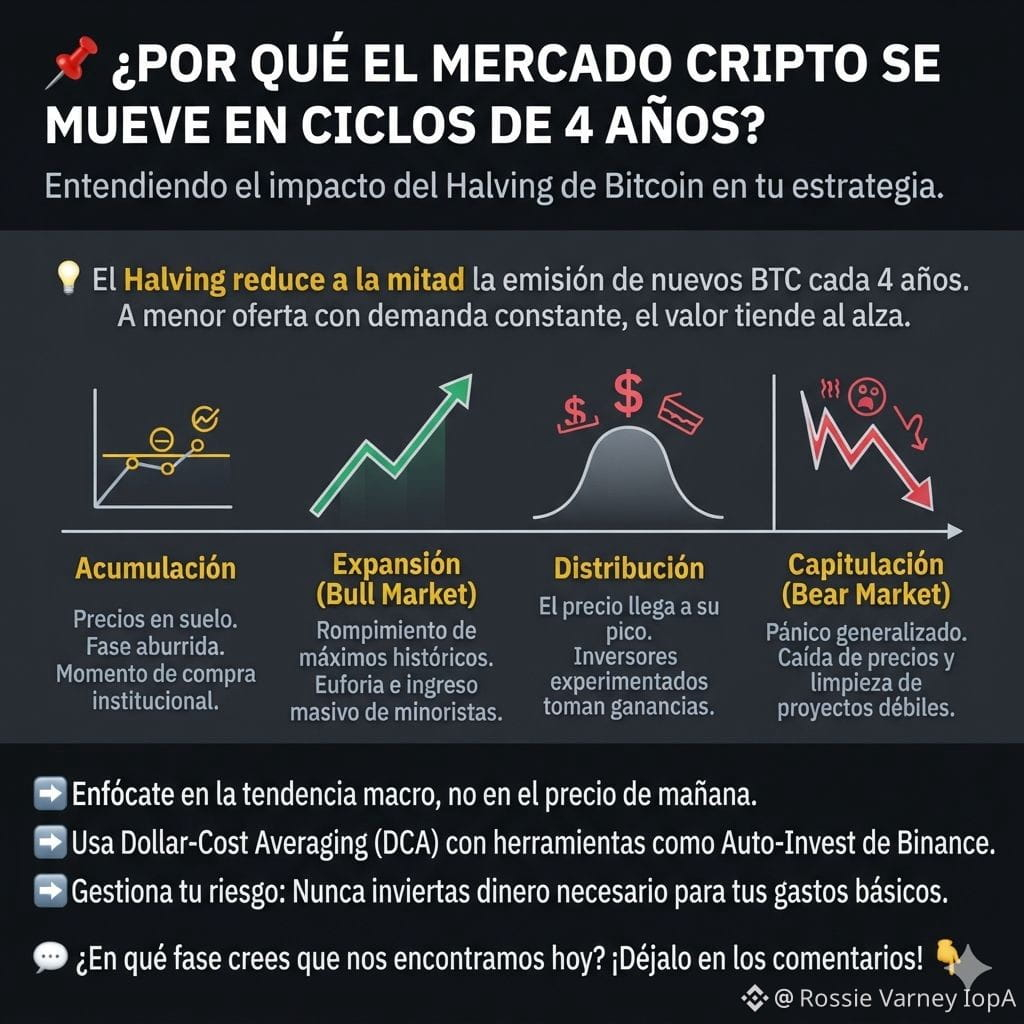
Many beginners enter cryptocurrencies thinking that prices go up and down without any sense. The reality is different: the market moves in macro 4-year cycles, guided by an impeccable mathematical event: Bitcoin’s Halving.
If you understand which phase we’re in, you stop trading out of emotion and start trading with strategy. 🧠
Here I summarize the 4 phases you must master (see the details on the flyer 🖼️):
1️⃣ Accumulation: Low prices. The market consolidates in silence.
2️⃣ Expansion: Breaks above previous highs, euphoria, and mass adoption.
3️⃣ Distribution: The price reaches its peak. Strong hands take profits.
4️⃣ Capitulation: Panic, severe correction, and a market cleanup.
💡 The Golden Advice: Don’t try to guess tomorrow’s price. Automate your purchases with Binance Auto-Invest using the DCA (Dollar-Cost Averaging) strategy and reduce the impact of volatility. 📈
💬 I’m opening the debate in the community! What phase of the cycle do you think we’re exactly in today? I’ll read your comments. 👇
* Disclaimer: This is not financial advice; it’s just an opinion 👍. Always do your own research (DYOR)*
#bitcoin #Halving #CryptoInvesting #CryptoEducation #learnAndEarn
Is the crypto market chaotic or predictable? 📊👇
Many beginners enter cryptocurrencies thinking that prices go up and down without any sense. The reality is different: the market moves in macro 4-year cycles, guided by an impeccable mathematical event: Bitcoin’s Halving.
If you understand which phase we’re in, you stop trading out of emotion and start trading with strategy. 🧠
Here I summarize the 4 phases you must master (see the details on the flyer 🖼️):
1️⃣ Accumulation: Low prices. The market consolidates in silence.
2️⃣ Expansion: Breaks above previous highs, euphoria, and mass adoption.
3️⃣ Distribution: The price reaches its peak. Strong hands take profits.
4️⃣ Capitulation: Panic, severe correction, and a market cleanup.
💡 The Golden Advice: Don’t try to guess tomorrow’s price. Automate your purchases with Binance Auto-Invest using the DCA (Dollar-Cost Averaging) strategy and reduce the impact of volatility. 📈
💬 I’m opening the debate in the community! What phase of the cycle do you think we’re exactly in today? I’ll read your comments. 👇
* Disclaimer: This is not financial advice; it’s just an opinion 👍. Always do your own research (DYOR)*
#bitcoin #Halving #CryptoInvesting #CryptoEducation #learnAndEarn
Many beginners enter cryptocurrencies thinking that prices go up and down without any sense. The reality is different: the market moves in macro 4-year cycles, guided by an impeccable mathematical event: Bitcoin’s Halving.
If you understand which phase we’re in, you stop trading out of emotion and start trading with strategy. 🧠
Here I summarize the 4 phases you must master (see the details on the flyer 🖼️):
1️⃣ Accumulation: Low prices. The market consolidates in silence.
2️⃣ Expansion: Breaks above previous highs, euphoria, and mass adoption.
3️⃣ Distribution: The price reaches its peak. Strong hands take profits.
4️⃣ Capitulation: Panic, severe correction, and a market cleanup.
💡 The Golden Advice: Don’t try to guess tomorrow’s price. Automate your purchases with Binance Auto-Invest using the DCA (Dollar-Cost Averaging) strategy and reduce the impact of volatility. 📈
💬 I’m opening the debate in the community! What phase of the cycle do you think we’re exactly in today? I’ll read your comments. 👇
* Disclaimer: This is not financial advice; it’s just an opinion 👍. Always do your own research (DYOR)*
#bitcoin #Halving #CryptoInvesting #CryptoEducation #learnAndEarn
157

FAITH IN CYCLES AND HALVING: WHY HISTORY WON'T REPEAT ITSELF LIKE YOU EXPECT 📊🛑
"Every 4 years Bitcoin pumps after halving, it's obvious!" — the main mantra of long-term retail investors. Our firm reminds you: once a pattern becomes obvious to 100% of market participants, it stops working.
Why old rules are breaking:
1. INSTITUTIONALS AND ETFs: The market is no longer controlled by miners and retail buyers from their basements. Big Wall Street funds have entered the game. They have their own rules for liquidity distribution and different time horizons.
2. SHIFTING CYCLES: Big capital knows your expectations. They can easily orchestrate a prolonged bear market right when you’re expecting a "to the moon" moment according to your calendar.
3. LIQUIDITY VS ILLUSIONS: Prices move towards where the most stops and inefficiencies are, not where the calendar says they should.
I’m waiting for the witnesses of the "eternal four-year cycle" in the comments. Bring your analysis, and let’s break it down with the latest volume data. 👇
$BTC #Halving #smartmoney #Binance #BinanceSquare
FAITH IN CYCLES AND HALVING: WHY HISTORY WON'T REPEAT ITSELF LIKE YOU EXPECT 📊🛑
"Every 4 years Bitcoin pumps after halving, it's obvious!" — the main mantra of long-term retail investors. Our firm reminds you: once a pattern becomes obvious to 100% of market participants, it stops working.
Why old rules are breaking:
1. INSTITUTIONALS AND ETFs: The market is no longer controlled by miners and retail buyers from their basements. Big Wall Street funds have entered the game. They have their own rules for liquidity distribution and different time horizons.
2. SHIFTING CYCLES: Big capital knows your expectations. They can easily orchestrate a prolonged bear market right when you’re expecting a "to the moon" moment according to your calendar.
3. LIQUIDITY VS ILLUSIONS: Prices move towards where the most stops and inefficiencies are, not where the calendar says they should.
I’m waiting for the witnesses of the "eternal four-year cycle" in the comments. Bring your analysis, and let’s break it down with the latest volume data. 👇
$BTC #Halving #smartmoney #Binance #BinanceSquare
"Every 4 years Bitcoin pumps after halving, it's obvious!" — the main mantra of long-term retail investors. Our firm reminds you: once a pattern becomes obvious to 100% of market participants, it stops working.
Why old rules are breaking:
1. INSTITUTIONALS AND ETFs: The market is no longer controlled by miners and retail buyers from their basements. Big Wall Street funds have entered the game. They have their own rules for liquidity distribution and different time horizons.
2. SHIFTING CYCLES: Big capital knows your expectations. They can easily orchestrate a prolonged bear market right when you’re expecting a "to the moon" moment according to your calendar.
3. LIQUIDITY VS ILLUSIONS: Prices move towards where the most stops and inefficiencies are, not where the calendar says they should.
I’m waiting for the witnesses of the "eternal four-year cycle" in the comments. Bring your analysis, and let’s break it down with the latest volume data. 👇
$BTC #Halving #smartmoney #Binance #BinanceSquare
4
435

·
--
📊 Recent analysis highlights that the Bitcoin halving countdown is entering the final quarter, sparking discussion about a potential bottoming phase.
🧠 The halving reduces block rewards by 50%, historically influencing supply dynamics and miner economics.
🔍 On‑chain metrics show a gradual decline in hash rate growth and a modest rise in the difficulty adjustment rate since the last halving.
💡 Market participants note that the reduced issuance could tighten scarcity, while demand trends remain a key variable.
⚡ The upcoming halving event is scheduled for early 2024, making the next few months a focal point for network activity monitoring.
📈 As always, DYOR before forming any conclusions about $BTC’s future trajectory.
🤔 How do you think the supply shift will interact with macro‑economic factors? #CryptoNews #Bitcoin #Halving #Blockchain #GAMERXERO
📊 Recent analysis highlights that the Bitcoin halving countdown is entering the final quarter, sparking discussion about a potential bottoming phase.
🧠 The halving reduces block rewards by 50%, historically influencing supply dynamics and miner economics.
🔍 On‑chain metrics show a gradual decline in hash rate growth and a modest rise in the difficulty adjustment rate since the last halving.
💡 Market participants note that the reduced issuance could tighten scarcity, while demand trends remain a key variable.
⚡ The upcoming halving event is scheduled for early 2024, making the next few months a focal point for network activity monitoring.
📈 As always, DYOR before forming any conclusions about $BTC ’s future trajectory.
🤔 How do you think the supply shift will interact with macro‑economic factors? #CryptoNews #Bitcoin #Halving #Blockchain #GAMERXERO
🧠 The halving reduces block rewards by 50%, historically influencing supply dynamics and miner economics.
🔍 On‑chain metrics show a gradual decline in hash rate growth and a modest rise in the difficulty adjustment rate since the last halving.
💡 Market participants note that the reduced issuance could tighten scarcity, while demand trends remain a key variable.
⚡ The upcoming halving event is scheduled for early 2024, making the next few months a focal point for network activity monitoring.
📈 As always, DYOR before forming any conclusions about $BTC ’s future trajectory.
🤔 How do you think the supply shift will interact with macro‑economic factors? #CryptoNews #Bitcoin #Halving #Blockchain #GAMERXERO
50

⛏️ Bitcoin Halving Explained: How the Block Reward Cut Shapes $BTC Supply
On July 20, 2026, Bitcoin miners continue to secure the network as the halving mechanism reduces block rewards every 210,000 blocks. This deflationary event cuts the mining subsidy in half, constraining the supply of $BTC over time. The latest halving lowered rewards to 3.125 $BTC per block, reinforcing the digital scarcity at the core of Bitcoin's design.
As of July 20, 2026, Bitcoin dominance sits at 56.51%, highlighting the asset's market leadership. Each halving reinforces $BTC as a deflationary store of value with a fixed supply of 21 million coins.
📌 Key Takeaway:
Bitcoin halvings are pre-programmed supply shocks that historically precede significant price appreciation for the asset.
#Bitcoin #Halving #Mining #CryptoEducation
#BinanceAlphaAlert
⛏️ Bitcoin Halving Explained: How the Block Reward Cut Shapes $BTC Supply
On July 20, 2026, Bitcoin miners continue to secure the network as the halving mechanism reduces block rewards every 210,000 blocks. This deflationary event cuts the mining subsidy in half, constraining the supply of $BTC over time. The latest halving lowered rewards to 3.125 $BTC per block, reinforcing the digital scarcity at the core of Bitcoin's design.
As of July 20, 2026, Bitcoin dominance sits at 56.51%, highlighting the asset's market leadership. Each halving reinforces $BTC as a deflationary store of value with a fixed supply of 21 million coins.
📌 Key Takeaway:
Bitcoin halvings are pre-programmed supply shocks that historically precede significant price appreciation for the asset.
#Bitcoin #Halving #Mining #CryptoEducation
#BinanceAlphaAlert
On July 20, 2026, Bitcoin miners continue to secure the network as the halving mechanism reduces block rewards every 210,000 blocks. This deflationary event cuts the mining subsidy in half, constraining the supply of $BTC over time. The latest halving lowered rewards to 3.125 $BTC per block, reinforcing the digital scarcity at the core of Bitcoin's design.
As of July 20, 2026, Bitcoin dominance sits at 56.51%, highlighting the asset's market leadership. Each halving reinforces $BTC as a deflationary store of value with a fixed supply of 21 million coins.
📌 Key Takeaway:
Bitcoin halvings are pre-programmed supply shocks that historically precede significant price appreciation for the asset.
#Bitcoin #Halving #Mining #CryptoEducation
#BinanceAlphaAlert
29

·
--
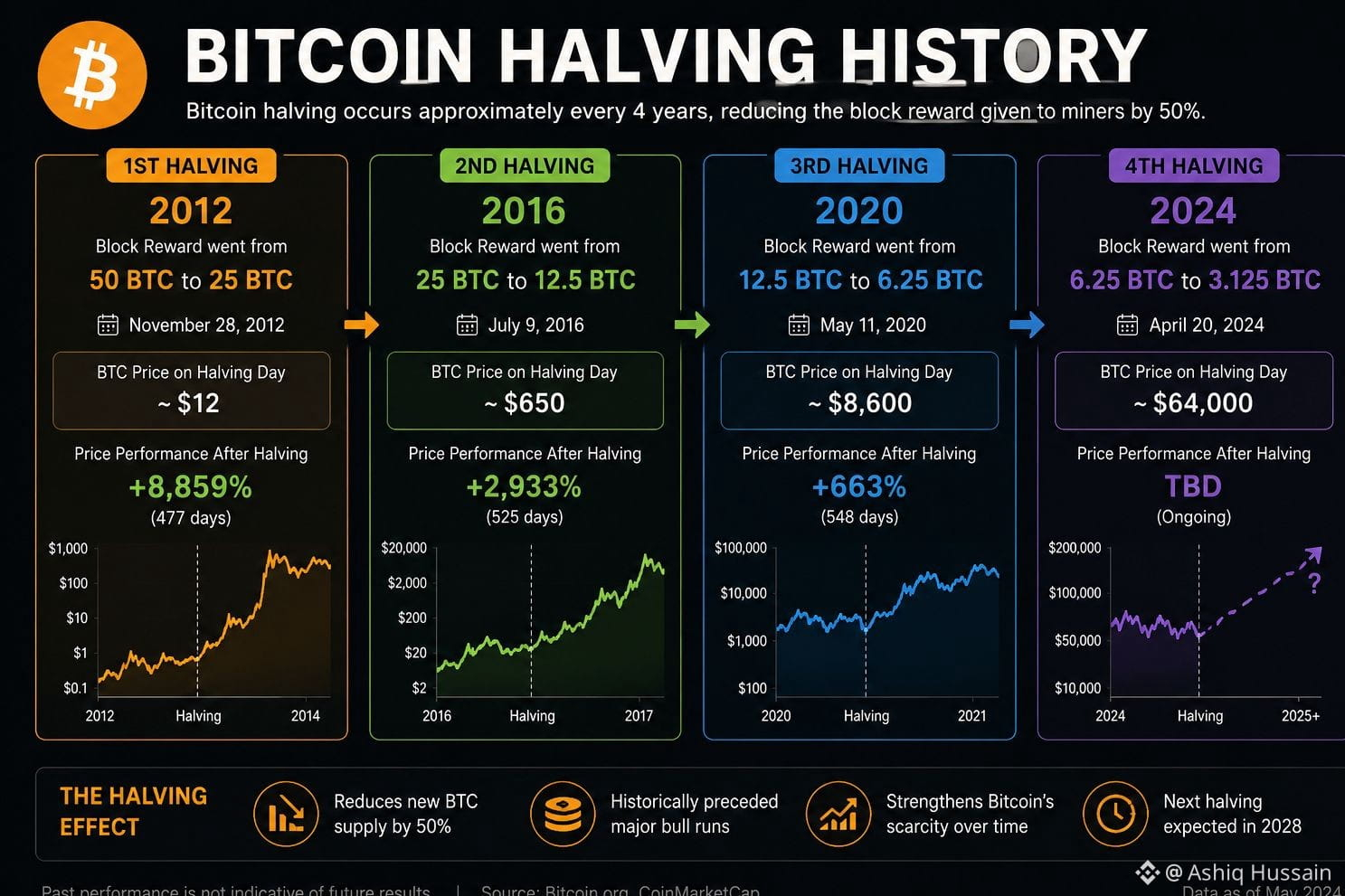
$BTC 🚨 BITCOIN HALVING HISTORY 🚨
Every 4 years, Bitcoin changes the game.
The halving cuts mining rewards by 50%, reducing new BTC supply and increasing scarcity. 📉⚡
📌 2012 → 50 BTC ➜ 25 BTC
📌 2016 → 25 BTC ➜ 12.5 BTC
📌 2020 → 12.5 BTC ➜ 6.25 BTC
📌 2024 → 6.25 BTC ➜ 3.125 BTC
History shows one thing clearly:
After every halving, Bitcoin entered massive bullish cycles. 📈🔥
From a few dollars to all-time highs, Bitcoin continues proving why scarcity matters.
Now the market watches closely to see what happens after the 2024 halving. 👀
Will history repeat again? 🚀$BTC
{spot}(BTCUSDT)
#Bitcoin #BTC #Halving #Crypto #BullRun #BitcoinHalving #CryptoMarket #Blockchain #BTC2026
$BTC 🚨 BITCOIN HALVING HISTORY 🚨
Every 4 years, Bitcoin changes the game.
The halving cuts mining rewards by 50%, reducing new BTC supply and increasing scarcity. 📉⚡
📌 2012 → 50 BTC ➜ 25 BTC
📌 2016 → 25 BTC ➜ 12.5 BTC
📌 2020 → 12.5 BTC ➜ 6.25 BTC
📌 2024 → 6.25 BTC ➜ 3.125 BTC
History shows one thing clearly:
After every halving, Bitcoin entered massive bullish cycles. 📈🔥
From a few dollars to all-time highs, Bitcoin continues proving why scarcity matters.
Now the market watches closely to see what happens after the 2024 halving. 👀
Will history repeat again? 🚀$BTC
#Bitcoin #BTC #Halving #Crypto #BullRun #BitcoinHalving #CryptoMarket #Blockchain #BTC2026
Every 4 years, Bitcoin changes the game.
The halving cuts mining rewards by 50%, reducing new BTC supply and increasing scarcity. 📉⚡
📌 2012 → 50 BTC ➜ 25 BTC
📌 2016 → 25 BTC ➜ 12.5 BTC
📌 2020 → 12.5 BTC ➜ 6.25 BTC
📌 2024 → 6.25 BTC ➜ 3.125 BTC
History shows one thing clearly:
After every halving, Bitcoin entered massive bullish cycles. 📈🔥
From a few dollars to all-time highs, Bitcoin continues proving why scarcity matters.
Now the market watches closely to see what happens after the 2024 halving. 👀
Will history repeat again? 🚀$BTC
#Bitcoin #BTC #Halving #Crypto #BullRun #BitcoinHalving #CryptoMarket #Blockchain #BTC2026
157

·
--
Fidelity: Bitcoin stays secure after halvings.
Asset manager Fidelity directly challenges research claiming Bitcoin becomes less secure following block reward reductions. Their analysis shows mining difficulty adjusts efficiently and institutional miners bring operational scale that compensates for reduced subsidies. Hash rate data from Q2 2026 confirms sustained network strength despite April halving cutting rewards to 3.125 BTC per block.
The counter-report highlights that validator concentration shifts toward professional operations rather than distributing across smaller nodes. Energy efficiency improvements and transaction fee dynamics provide additional security layers. Critics previously argued miners would exit after reward drops, creating consensus vulnerabilities.
Fidelity's data demonstrates consistent hash rate through multiple halving cycles, suggesting adaptive security rather than declining protection. The asset manager concludes that Bitcoin's security model strengthens through market-driven optimization.
Will miners continue securing the network as rewards dwindle? 👇
#Bitcoin #Halving #Fidelity
Fidelity: Bitcoin stays secure after halvings.
Asset manager Fidelity directly challenges research claiming Bitcoin becomes less secure following block reward reductions. Their analysis shows mining difficulty adjusts efficiently and institutional miners bring operational scale that compensates for reduced subsidies. Hash rate data from Q2 2026 confirms sustained network strength despite April halving cutting rewards to 3.125 BTC per block.
The counter-report highlights that validator concentration shifts toward professional operations rather than distributing across smaller nodes. Energy efficiency improvements and transaction fee dynamics provide additional security layers. Critics previously argued miners would exit after reward drops, creating consensus vulnerabilities.
Fidelity's data demonstrates consistent hash rate through multiple halving cycles, suggesting adaptive security rather than declining protection. The asset manager concludes that Bitcoin's security model strengthens through market-driven optimization.
Will miners continue securing the network as rewards dwindle? 👇
#Bitcoin #Halving #Fidelity
Asset manager Fidelity directly challenges research claiming Bitcoin becomes less secure following block reward reductions. Their analysis shows mining difficulty adjusts efficiently and institutional miners bring operational scale that compensates for reduced subsidies. Hash rate data from Q2 2026 confirms sustained network strength despite April halving cutting rewards to 3.125 BTC per block.
The counter-report highlights that validator concentration shifts toward professional operations rather than distributing across smaller nodes. Energy efficiency improvements and transaction fee dynamics provide additional security layers. Critics previously argued miners would exit after reward drops, creating consensus vulnerabilities.
Fidelity's data demonstrates consistent hash rate through multiple halving cycles, suggesting adaptive security rather than declining protection. The asset manager concludes that Bitcoin's security model strengthens through market-driven optimization.
Will miners continue securing the network as rewards dwindle? 👇
#Bitcoin #Halving #Fidelity
1
137

·
--

Article
⛏️ THE EFFECT OF THE BITCOIN HALVING AND MARKET CYCLES: WHAT COMES NEXT?🔥 BITCOIN HALVING 2026: DO YOU ALREADY KNOW WHAT’S COMING?
Bitcoin’s halving is one of the most anticipated events in the crypto world. It happens approximately every 4 years and cuts in half the reward that miners receive for validating blocks. The last halving was in April 2024, and now we’re in the phase where the market starts to feel its effects.
But what does the halving really mean for the price? Why do many say it’s the start of a new bull cycle? And most importantly: how can you prepare for what’s coming?
⛏️ THE EFFECT OF THE BITCOIN HALVING AND MARKET CYCLES: WHAT COMES NEXT?
🔥 BITCOIN HALVING 2026: DO YOU ALREADY KNOW WHAT’S COMING?
Bitcoin’s halving is one of the most anticipated events in the crypto world. It happens approximately every 4 years and cuts in half the reward that miners receive for validating blocks. The last halving was in April 2024, and now we’re in the phase where the market starts to feel its effects.
But what does the halving really mean for the price? Why do many say it’s the start of a new bull cycle? And most importantly: how can you prepare for what’s coming?
Bitcoin’s halving is one of the most anticipated events in the crypto world. It happens approximately every 4 years and cuts in half the reward that miners receive for validating blocks. The last halving was in April 2024, and now we’re in the phase where the market starts to feel its effects.
But what does the halving really mean for the price? Why do many say it’s the start of a new bull cycle? And most importantly: how can you prepare for what’s coming?
2
2
494

·
--

Article
Decoding the Halving:Bitcoin's Programmed Scarcity 📉
At the very core of the crypto economy lies a programmatic event known as the halving, which systematically reduces emissions over time. Roughly every four years, the mining block subsidy awarded to network participants is cut exactly in half, directly tightening the daily market supply. This unique deflationary monetary policy is completely automated within the code, meaning no central entity can alter the pre-programmed distribution schedule. For $BTC
{spot}(BTCUSDT)
investors, these cyclical events have historically served as major catalysts for long-term network growth, illustrating the classic economic relationship between steady demand and shrinking supply. While legacy central banks increase liquidity during crises, @Bitcoinworld reduces its issuance velocity, proving its value as a predictably scarce digital commodity. This predictable framework forces the mining industry to become more efficient, driving the adoption of sustainable energy solutions worldwide. Understanding this unique dynamic reveals why decentralized architecture represents a revolutionary evolution in global financial design. 🔋
#Halving #Tokenomics #bullmarket #Web3Dev #scarcity
Decoding the Halving:
Bitcoin's Programmed Scarcity 📉
At the very core of the crypto economy lies a programmatic event known as the halving, which systematically reduces emissions over time. Roughly every four years, the mining block subsidy awarded to network participants is cut exactly in half, directly tightening the daily market supply. This unique deflationary monetary policy is completely automated within the code, meaning no central entity can alter the pre-programmed distribution schedule. For $BTC
investors, these cyclical events have historically served as major catalysts for long-term network growth, illustrating the classic economic relationship between steady demand and shrinking supply. While legacy central banks increase liquidity during crises, @Bitcoinworld reduces its issuance velocity, proving its value as a predictably scarce digital commodity. This predictable framework forces the mining industry to become more efficient, driving the adoption of sustainable energy solutions worldwide. Understanding this unique dynamic reveals why decentralized architecture represents a revolutionary evolution in global financial design. 🔋
#Halving #Tokenomics #bullmarket #Web3Dev #scarcity
At the very core of the crypto economy lies a programmatic event known as the halving, which systematically reduces emissions over time. Roughly every four years, the mining block subsidy awarded to network participants is cut exactly in half, directly tightening the daily market supply. This unique deflationary monetary policy is completely automated within the code, meaning no central entity can alter the pre-programmed distribution schedule. For $BTC
investors, these cyclical events have historically served as major catalysts for long-term network growth, illustrating the classic economic relationship between steady demand and shrinking supply. While legacy central banks increase liquidity during crises, @Bitcoinworld reduces its issuance velocity, proving its value as a predictably scarce digital commodity. This predictable framework forces the mining industry to become more efficient, driving the adoption of sustainable energy solutions worldwide. Understanding this unique dynamic reveals why decentralized architecture represents a revolutionary evolution in global financial design. 🔋
#Halving #Tokenomics #bullmarket #Web3Dev #scarcity
53

·
--
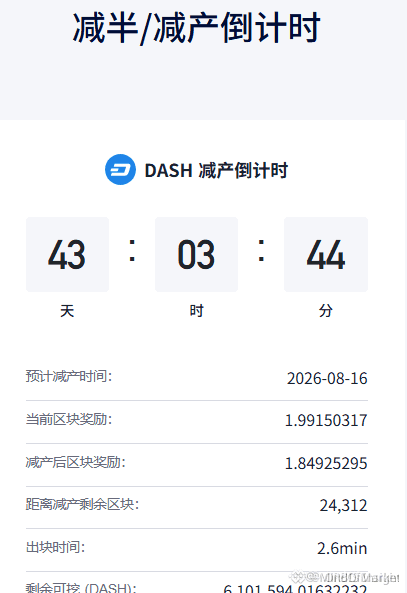
$DASH HALVING INCOMING — STRUCTURE POINTS TO 160 TARGET 🎯
Target: 160 🚀
The $DASH halving is now the dominant narrative, and market structure suggests smart money is accumulating ahead of the event. On the 4H chart, we see a clean accumulation range forming with higher lows and decreasing volume on dips — a classic pre-breakout pattern.
With the event acting as a known catalyst, the path of least resistance is up toward the 160 resistance zone. The R:R here depends on your entry, but the setup is textbook for a trend continuation. Are you buying the dip or waiting for confirmation?
Not financial advice. Always manage your risk.
#DASH #Halving #LongSetup #Crypto
🎯
$DASH HALVING INCOMING — STRUCTURE POINTS TO 160 TARGET 🎯
Target: 160 🚀
The $DASH halving is now the dominant narrative, and market structure suggests smart money is accumulating ahead of the event. On the 4H chart, we see a clean accumulation range forming with higher lows and decreasing volume on dips — a classic pre-breakout pattern.
With the event acting as a known catalyst, the path of least resistance is up toward the 160 resistance zone. The R:R here depends on your entry, but the setup is textbook for a trend continuation. Are you buying the dip or waiting for confirmation?
Not financial advice. Always manage your risk.
#DASH #Halving #LongSetup #Crypto
🎯
Target: 160 🚀
The $DASH halving is now the dominant narrative, and market structure suggests smart money is accumulating ahead of the event. On the 4H chart, we see a clean accumulation range forming with higher lows and decreasing volume on dips — a classic pre-breakout pattern.
With the event acting as a known catalyst, the path of least resistance is up toward the 160 resistance zone. The R:R here depends on your entry, but the setup is textbook for a trend continuation. Are you buying the dip or waiting for confirmation?
Not financial advice. Always manage your risk.
#DASH #Halving #LongSetup #Crypto
🎯
1
100
Log in to explore more content
Join global crypto users on Binance Square
⚡️ Get latest and useful information about crypto.
💬 Trusted by the world’s largest crypto exchange.
👍 Discover real insights from verified creators.
Email / Phone number
Trending Topics
1
#AIStocksWhatNext
646,568 views
4,815 Discussing
2
#21SharesLaunchesEuropesFirstZcashETP
10,727 views
392 Discussing
3
#CardanoJoinsX402PaymentStandard
7,414 views
301 Discussing
4
#BitcoinTops$87KAtEightMonthHigh
7,083 views
80 Discussing
5
#ZECBreaksAbove$1600AtRecordHigh
4,068 views
63 Discussing
6
#BitwiseNEARStakingETPAssetsTop$100M
28,070 views
80 Discussing
7
#BitcoinBreaksAboveMayHighNears$86K
27,953 views
260 Discussing
8
#DogecoinRises15%
103,377 views
1,716 Discussing
9
#$14BBitcoinOptionsExpireFriday
7,919 views
110 Discussing
10
#BNBMarketCapPassesBNYMellon
65,173 views
1,387 Discussing