

#haedal
haedal
1.3M views
3,626 Discussing
Hot
Latest

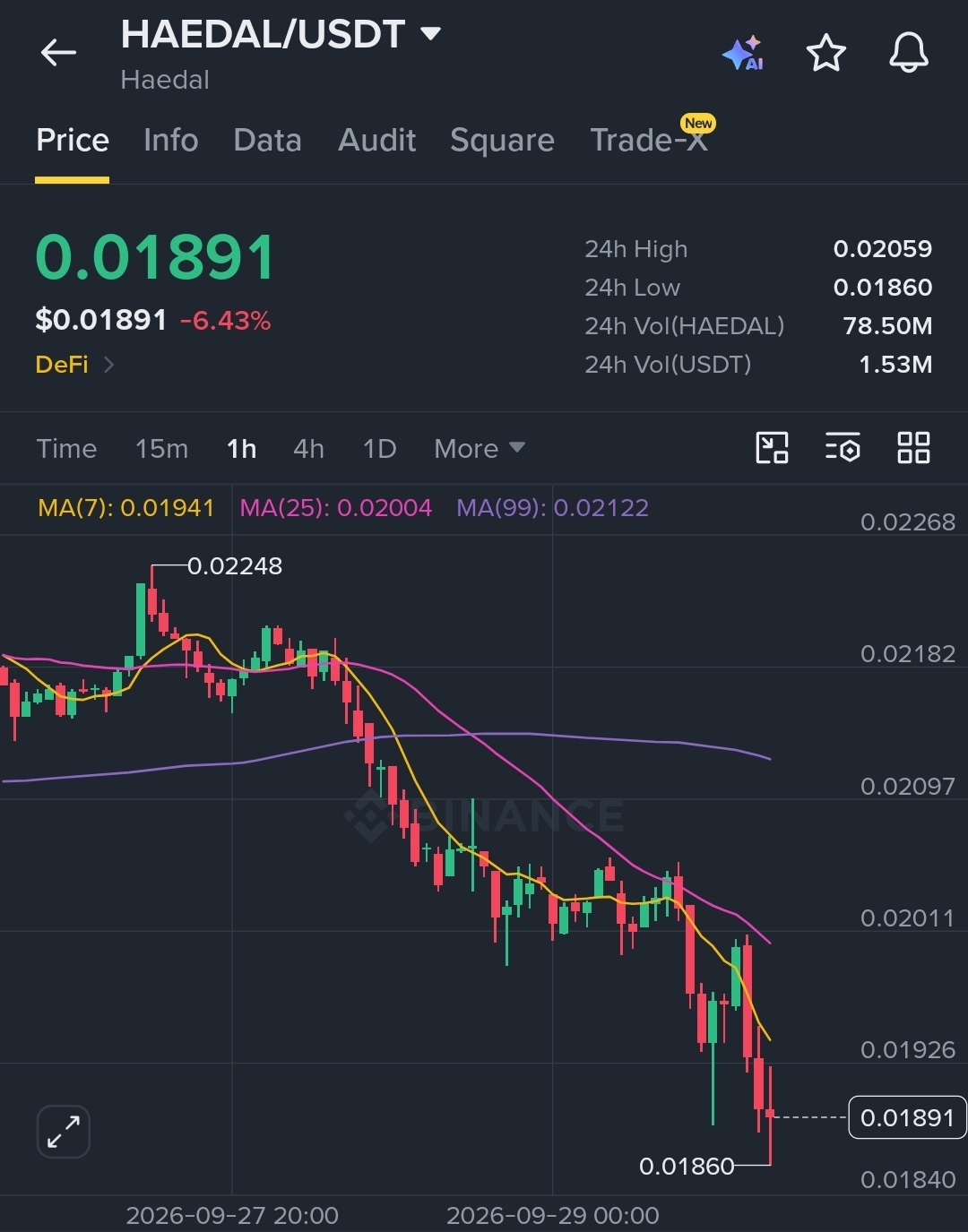
$HAEDAL /USDT — 🔴 SHORT · Conf 68%
📍 Entry: 0.0188 – 0.0189
🛑 SL: 0.0204
🎯 TP1: 0.0179
✅ TP2: 0.0172
🏆 TP3: 0.0160
Price is below MA7, MA25 and MA99 with lower highs since 0.02248.
$HAEDAL : Haedal Protocol is a liquid staking protocol on Sui issuing haSUI; the risk is competition from other Sui LSTs, and 24H volume is only ~1.53M USDT.
Do liquid staking tokens on a single L1 have a moat, or does the biggest LST always win?
#HAEDAL #HaedalProtocol #LiquidStaking #hasui #LST
{future}(HAEDALUSDT)
$HAEDAL /USDT — 🔴 SHORT · Conf 68%
📍 Entry: 0.0188 – 0.0189
🛑 SL: 0.0204
🎯 TP1: 0.0179
✅ TP2: 0.0172
🏆 TP3: 0.0160
Price is below MA7, MA25 and MA99 with lower highs since 0.02248.
$HAEDAL : Haedal Protocol is a liquid staking protocol on Sui issuing haSUI; the risk is competition from other Sui LSTs, and 24H volume is only ~1.53M USDT.
Do liquid staking tokens on a single L1 have a moat, or does the biggest LST always win?
#HAEDAL #HaedalProtocol #LiquidStaking #hasui #LST
📍 Entry: 0.0188 – 0.0189
🛑 SL: 0.0204
🎯 TP1: 0.0179
✅ TP2: 0.0172
🏆 TP3: 0.0160
Price is below MA7, MA25 and MA99 with lower highs since 0.02248.
$HAEDAL : Haedal Protocol is a liquid staking protocol on Sui issuing haSUI; the risk is competition from other Sui LSTs, and 24H volume is only ~1.53M USDT.
Do liquid staking tokens on a single L1 have a moat, or does the biggest LST always win?
#HAEDAL #HaedalProtocol #LiquidStaking #hasui #LST

1
148

$4M+ flowing through Haedal Lending Vault. 🦦
This is more than just another milestone.
$HAEDAL Lending Vault is making it easier for users to put their capital to work across Sui lending markets without having to constantly manage allocations themselves.
Deposit → Haedal handles the strategy → your capital keeps working.
As liquidity continues to grow, the bigger picture becomes clearer: yield management on $SUI is getting simpler, smarter, and more automated.
$4M crossed. The otters are still swimming. 🦦🔥
#Haedal
$4M+ flowing through Haedal Lending Vault. 🦦
This is more than just another milestone.
$HAEDAL Lending Vault is making it easier for users to put their capital to work across Sui lending markets without having to constantly manage allocations themselves.
Deposit → Haedal handles the strategy → your capital keeps working.
As liquidity continues to grow, the bigger picture becomes clearer: yield management on $SUI is getting simpler, smarter, and more automated.
$4M crossed. The otters are still swimming. 🦦🔥
#Haedal
This is more than just another milestone.
$HAEDAL Lending Vault is making it easier for users to put their capital to work across Sui lending markets without having to constantly manage allocations themselves.
Deposit → Haedal handles the strategy → your capital keeps working.
As liquidity continues to grow, the bigger picture becomes clearer: yield management on $SUI is getting simpler, smarter, and more automated.
$4M crossed. The otters are still swimming. 🦦🔥
#Haedal

2
318

·
--
Bullish
Partly True
$4M in TVL and still growing! 🦦🌊
Haedal Lending Vault is gaining traction as more users put their assets to work across Sui lending markets.
Simplified yield management, automated strategies, and more opportunities for $HAEDAL
$SUI #Haedal
$4M in TVL and still growing! 🦦🌊
Haedal Lending Vault is gaining traction as more users put their assets to work across Sui lending markets.
Simplified yield management, automated strategies, and more opportunities for $HAEDAL
$SUI #Haedal
Haedal Lending Vault is gaining traction as more users put their assets to work across Sui lending markets.
Simplified yield management, automated strategies, and more opportunities for $HAEDAL
$SUI #Haedal

3
677


·
--
Bullish
Looking at the numbers, Haedal Lending Vault is showing some solid momentum.
$2M → $4M liquidity crossed, while the USDC Vault capacity keeps expanding.
USDC Vault: up to 1M USDC
SUI Vault: 1.5M SUI
The interesting part? Liquidity is growing while Haedal handles allocation and strategy execution in the background.
Watching the next resistance: $5M. 👀🌊
#Haedal $HAEDAL
Looking at the numbers, Haedal Lending Vault is showing some solid momentum.
$2M → $4M liquidity crossed, while the USDC Vault capacity keeps expanding.
USDC Vault: up to 1M USDC
SUI Vault: 1.5M SUI
The interesting part? Liquidity is growing while Haedal handles allocation and strategy execution in the background.
Watching the next resistance: $5M. 👀🌊
#Haedal $HAEDAL
$2M → $4M liquidity crossed, while the USDC Vault capacity keeps expanding.
USDC Vault: up to 1M USDC
SUI Vault: 1.5M SUI
The interesting part? Liquidity is growing while Haedal handles allocation and strategy execution in the background.
Watching the next resistance: $5M. 👀🌊
#Haedal $HAEDAL


1
443

·
--
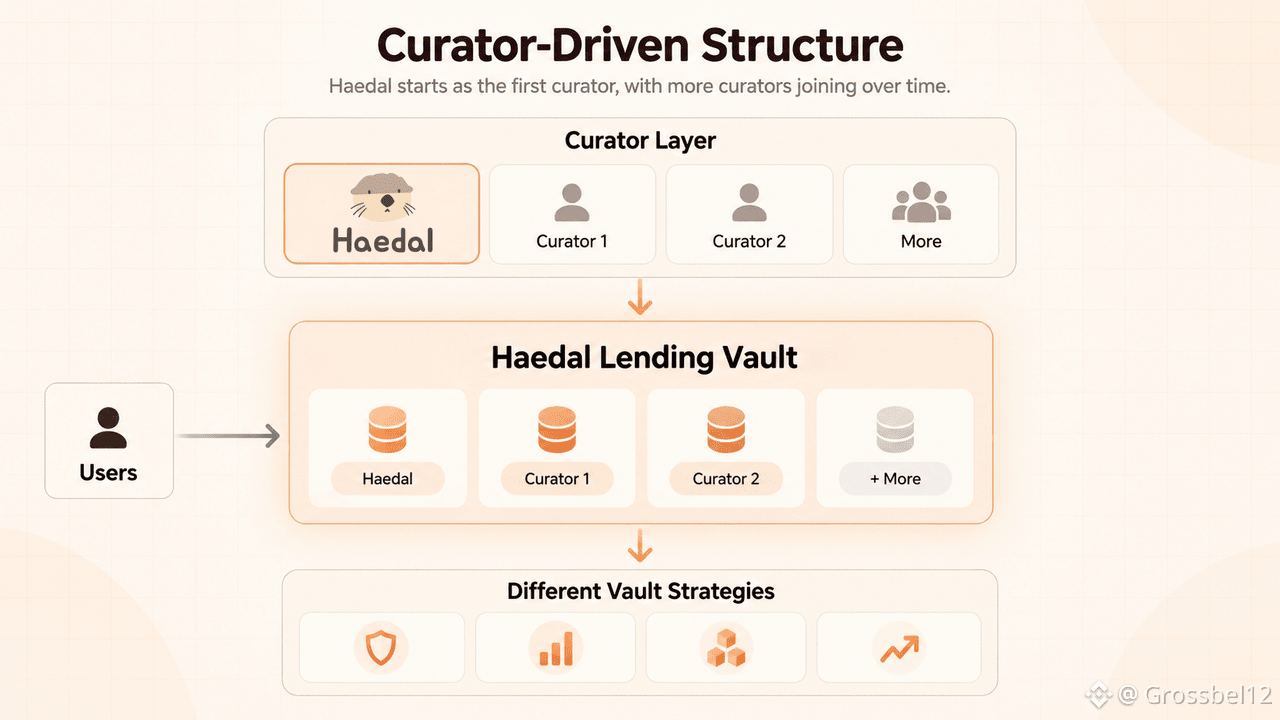
A curator should be evaluated on decisions, not one APY snapshot.
For Haedal Lending Vault, performance attribution means separating three questions: Was capital placed in the right lending markets? Were reallocations timely when rates and liquidity changed? Did daily compounding convert rewards into persistent vault share-price growth?
A strong market can make every allocation look intelligent. The harder test is what happens after incentives decline or liquidity becomes uneven. Compare allocation changes with subsequent realized returns, check whether turnover improved outcomes, and measure results against a simple direct-lending benchmark over the same period.
Haedal is the first curator at launch, and vault activity is visible on-chain. That creates accountability, not guaranteed alpha.
Treat curator selection like manager selection: require a repeatable process, transparent positioning and controlled downside. The module remains BETA.
#Haedal @HaedalProtocol
A curator should be evaluated on decisions, not one APY snapshot.
For Haedal Lending Vault, performance attribution means separating three questions: Was capital placed in the right lending markets? Were reallocations timely when rates and liquidity changed? Did daily compounding convert rewards into persistent vault share-price growth?
A strong market can make every allocation look intelligent. The harder test is what happens after incentives decline or liquidity becomes uneven. Compare allocation changes with subsequent realized returns, check whether turnover improved outcomes, and measure results against a simple direct-lending benchmark over the same period.
Haedal is the first curator at launch, and vault activity is visible on-chain. That creates accountability, not guaranteed alpha.
Treat curator selection like manager selection: require a repeatable process, transparent positioning and controlled downside. The module remains BETA.
#Haedal @HaedalProtocol
For Haedal Lending Vault, performance attribution means separating three questions: Was capital placed in the right lending markets? Were reallocations timely when rates and liquidity changed? Did daily compounding convert rewards into persistent vault share-price growth?
A strong market can make every allocation look intelligent. The harder test is what happens after incentives decline or liquidity becomes uneven. Compare allocation changes with subsequent realized returns, check whether turnover improved outcomes, and measure results against a simple direct-lending benchmark over the same period.
Haedal is the first curator at launch, and vault activity is visible on-chain. That creates accountability, not guaranteed alpha.
Treat curator selection like manager selection: require a repeatable process, transparent positioning and controlled downside. The module remains BETA.
#Haedal @HaedalProtocol
196
·
--
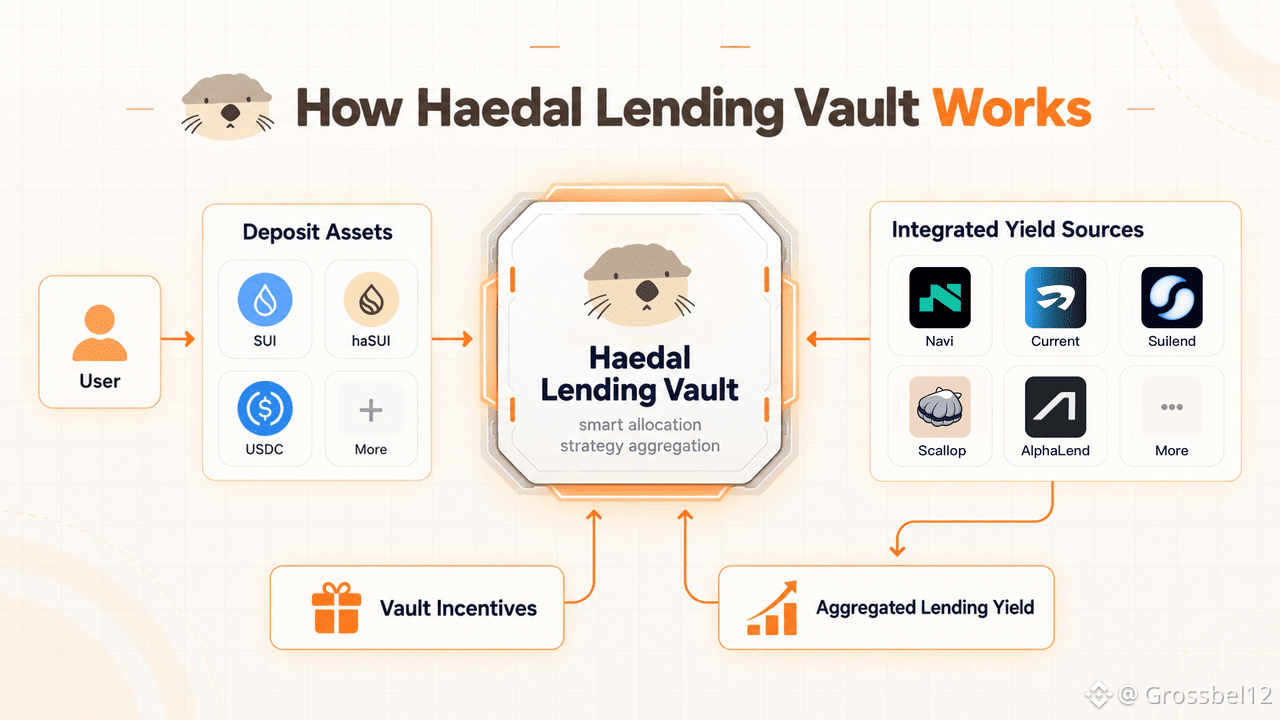
A lending APY is not one permanent source of return.
For Haedal Lending Vault, realized yield can reflect lending-market rates, protocol incentives and the effect of reinvesting rewards. These components behave differently: utilization-driven lending rates can rise or fall, incentives can be reduced, and compounding only adds value when rewards continue to accrue.
That makes yield quality more important than the headline number. A professional review asks three questions: how much return is supported by organic borrowing demand, how much depends on temporary incentives, and whether vault share-price growth confirms the advertised opportunity after fees.
The strategy can move across Sui lending venues as conditions change, but it cannot make temporary incentives permanent. Monitor allocation changes and realized performance rather than extrapolating one APY snapshot.
The module is BETA. High yield should increase scrutiny, not position size.
#Haedal @HaedalProtocol
A lending APY is not one permanent source of return.
For Haedal Lending Vault, realized yield can reflect lending-market rates, protocol incentives and the effect of reinvesting rewards. These components behave differently: utilization-driven lending rates can rise or fall, incentives can be reduced, and compounding only adds value when rewards continue to accrue.
That makes yield quality more important than the headline number. A professional review asks three questions: how much return is supported by organic borrowing demand, how much depends on temporary incentives, and whether vault share-price growth confirms the advertised opportunity after fees.
The strategy can move across Sui lending venues as conditions change, but it cannot make temporary incentives permanent. Monitor allocation changes and realized performance rather than extrapolating one APY snapshot.
The module is BETA. High yield should increase scrutiny, not position size.
#Haedal @HaedalProtocol
For Haedal Lending Vault, realized yield can reflect lending-market rates, protocol incentives and the effect of reinvesting rewards. These components behave differently: utilization-driven lending rates can rise or fall, incentives can be reduced, and compounding only adds value when rewards continue to accrue.
That makes yield quality more important than the headline number. A professional review asks three questions: how much return is supported by organic borrowing demand, how much depends on temporary incentives, and whether vault share-price growth confirms the advertised opportunity after fees.
The strategy can move across Sui lending venues as conditions change, but it cannot make temporary incentives permanent. Monitor allocation changes and realized performance rather than extrapolating one APY snapshot.
The module is BETA. High yield should increase scrutiny, not position size.
#Haedal @HaedalProtocol
117

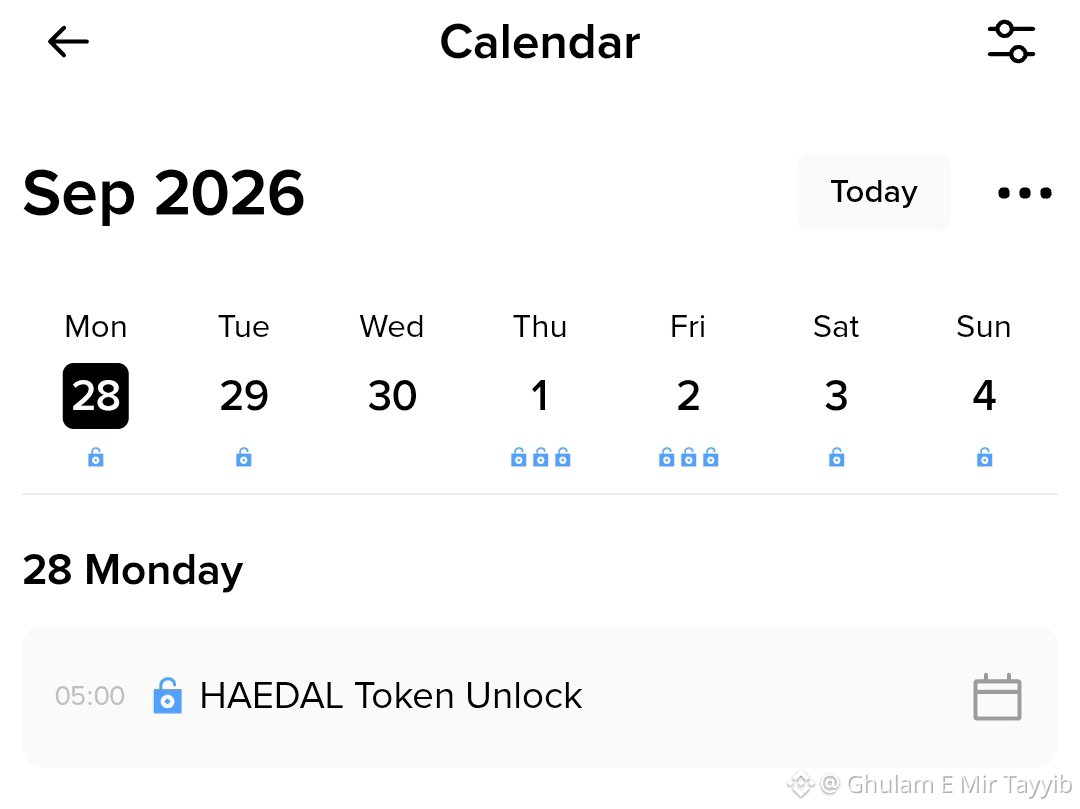
Crypto Calendar — Sep 28, 2026
Today's key event: $HAEDAL
{future}(HAEDALUSDT)
token unlock at 05:00 UTC.
When locked tokens hit circulation, sellers can suddenly have more supply to work with, which often leads to choppy price action around the unlock window. Worth keeping an eye on volume and order flow in the hours after.
Coming up this week: $HEMI
{future}(HEMIUSDT)
unlocks tomorrow, then $PARTI
{future}(PARTIUSDT)
, MAV and FF on Thursday.
Trading through unlocks or staying out of the way? 👇
#Haedal #TokenUnlock #CryptoCalendar
Crypto Calendar — Sep 28, 2026
Today's key event: $HAEDAL
token unlock at 05:00 UTC.
When locked tokens hit circulation, sellers can suddenly have more supply to work with, which often leads to choppy price action around the unlock window. Worth keeping an eye on volume and order flow in the hours after.
Coming up this week: $HEMI
unlocks tomorrow, then $PARTI
, MAV and FF on Thursday.
Trading through unlocks or staying out of the way? 👇
#Haedal #TokenUnlock #CryptoCalendar
Today's key event: $HAEDAL
token unlock at 05:00 UTC.
When locked tokens hit circulation, sellers can suddenly have more supply to work with, which often leads to choppy price action around the unlock window. Worth keeping an eye on volume and order flow in the hours after.
Coming up this week: $HEMI
unlocks tomorrow, then $PARTI
, MAV and FF on Thursday.
Trading through unlocks or staying out of the way? 👇
#Haedal #TokenUnlock #CryptoCalendar
2
70

·
--
Holding $SUI 285.7 USDT
$HAEDAL Personally, I find the concept pretty interesting.
You simply deposit an asset, and the vault automatically allocates the liquidity across multiple lending markets to try to optimize the yield.
I really like the idea of not having to constantly move your funds from one protocol to another.
And more importantly, I think @HaedalProtocol could bring a new dynamic to DeFi on $SUI .
I’m definitely going to keep an eye on this protocol and watch closely for the opportunities that could come from it.
Sui is slowly building out its ecosystem… and some of the pieces are starting to get really interesting.
Anyway, definitely worth watching, but as always, stay cautious guys. DYOR.
#trading
#Haedal
$HAEDAL Personally, I find the concept pretty interesting.
You simply deposit an asset, and the vault automatically allocates the liquidity across multiple lending markets to try to optimize the yield.
I really like the idea of not having to constantly move your funds from one protocol to another.
And more importantly, I think @Haedal Protocol could bring a new dynamic to DeFi on $SUI .
I’m definitely going to keep an eye on this protocol and watch closely for the opportunities that could come from it.
Sui is slowly building out its ecosystem… and some of the pieces are starting to get really interesting.
Anyway, definitely worth watching, but as always, stay cautious guys. DYOR.
#trading
#Haedal
You simply deposit an asset, and the vault automatically allocates the liquidity across multiple lending markets to try to optimize the yield.
I really like the idea of not having to constantly move your funds from one protocol to another.
And more importantly, I think @Haedal Protocol could bring a new dynamic to DeFi on $SUI .
I’m definitely going to keep an eye on this protocol and watch closely for the opportunities that could come from it.
Sui is slowly building out its ecosystem… and some of the pieces are starting to get really interesting.
Anyway, definitely worth watching, but as always, stay cautious guys. DYOR.
#trading
#Haedal
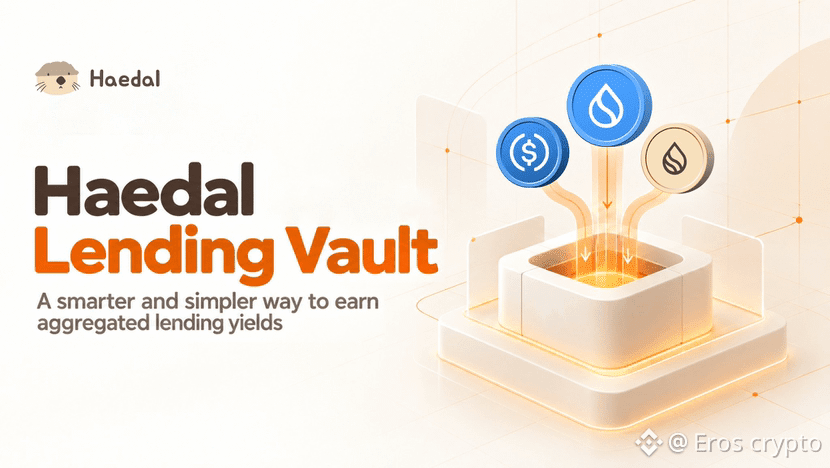
206 Atlas:
Yield aggregation sounds efficient, but I worry about smart contract risk diluting returns. The -9% SUI move makes that beta exposure painful regardless of the vault strategy.
4
7
943

·
--
DeFi yield isn’t only about the rate.
What happens to the rewards after you earn them?
That’s where Haedal Lending Vault gets interesting to me.
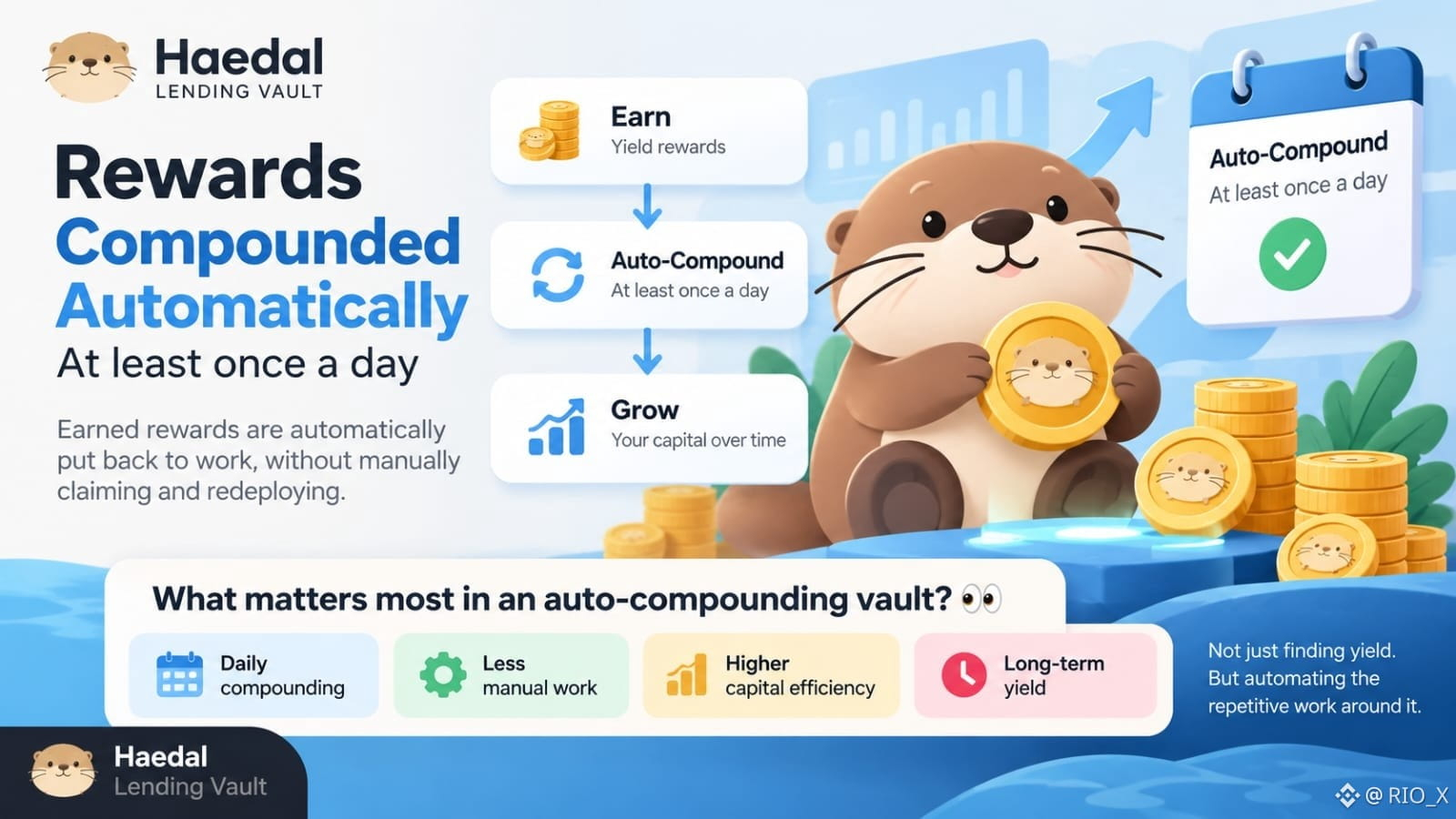
The vault automatically compounds rewards at least once a day, so earned yield can be put back to work without manually claiming and redeploying it.
Instead of:
Earn → Claim → Reinvest → Repeat
the compounding happens as part of the strategy.
It may sound like a small detail, but keeping rewards productive can make a difference over time.
That’s one of the core value points I see in a lending vault:
Not just finding yield.
Not just allocating capital.
But automating the repetitive work around it.
What matters most in an auto-compounding vault? 👀
🔹 Daily compounding
🔹 Less manual work
🔹 Higher capital efficiency
🔹 Long-term yield
#Haedal @HaedalProtocol
DeFi yield isn’t only about the rate.
What happens to the rewards after you earn them?
That’s where Haedal Lending Vault gets interesting to me.
The vault automatically compounds rewards at least once a day, so earned yield can be put back to work without manually claiming and redeploying it.
Instead of:
Earn → Claim → Reinvest → Repeat
the compounding happens as part of the strategy.
It may sound like a small detail, but keeping rewards productive can make a difference over time.
That’s one of the core value points I see in a lending vault:
Not just finding yield.
Not just allocating capital.
But automating the repetitive work around it.
What matters most in an auto-compounding vault? 👀
🔹 Daily compounding
🔹 Less manual work
🔹 Higher capital efficiency
🔹 Long-term yield
#Haedal @Haedal Protocol
What happens to the rewards after you earn them?
That’s where Haedal Lending Vault gets interesting to me.
The vault automatically compounds rewards at least once a day, so earned yield can be put back to work without manually claiming and redeploying it.
Instead of:
Earn → Claim → Reinvest → Repeat
the compounding happens as part of the strategy.
It may sound like a small detail, but keeping rewards productive can make a difference over time.
That’s one of the core value points I see in a lending vault:
Not just finding yield.
Not just allocating capital.
But automating the repetitive work around it.
What matters most in an auto-compounding vault? 👀
🔹 Daily compounding
🔹 Less manual work
🔹 Higher capital efficiency
🔹 Long-term yield
#Haedal @Haedal Protocol
2
160

·
--
What’s underneath the vault matters more than the vault itself. 👀
One thing I find interesting about Haedal’s Lending Vault is that the strategy isn’t necessarily tied to a single lending venue.
Instead, the allocation layer can work across supported lending markets.
And that distinction matters.
Because in DeFi, concentrating capital in one venue can mean concentrating your exposure to:
→ One protocol
→ One liquidity environment
→ One rate structure
→ One set of incentives
A diversified approach changes the question.
It’s not simply:
“Which market has the highest APY?”
It becomes:
“How should capital be distributed across available opportunities?”
That’s where I think vault infrastructure becomes more interesting.
Instead of manually splitting capital between different markets and constantly monitoring them, the strategy sits underneath and handles allocation according to its defined approach.
For me, the core value isn’t chasing the highest number.
It’s having diversification built underneath the strategy.
If a DeFi vault can diversify across lending markets, what matters most to you? 👇
$HAEDAL #Haedal @HaedalProtocol $SOON $PHA
{future}(BRUSDT)
{future}(ARXUSDT)
What’s underneath the vault matters more than the vault itself. 👀
One thing I find interesting about Haedal’s Lending Vault is that the strategy isn’t necessarily tied to a single lending venue.
Instead, the allocation layer can work across supported lending markets.
And that distinction matters.
Because in DeFi, concentrating capital in one venue can mean concentrating your exposure to:
→ One protocol
→ One liquidity environment
→ One rate structure
→ One set of incentives
A diversified approach changes the question.
It’s not simply:
“Which market has the highest APY?”
It becomes:
“How should capital be distributed across available opportunities?”
That’s where I think vault infrastructure becomes more interesting.
Instead of manually splitting capital between different markets and constantly monitoring them, the strategy sits underneath and handles allocation according to its defined approach.
For me, the core value isn’t chasing the highest number.
It’s having diversification built underneath the strategy.
If a DeFi vault can diversify across lending markets, what matters most to you? 👇
$HAEDAL #Haedal @Haedal Protocol $SOON $PHA
One thing I find interesting about Haedal’s Lending Vault is that the strategy isn’t necessarily tied to a single lending venue.
Instead, the allocation layer can work across supported lending markets.
And that distinction matters.
Because in DeFi, concentrating capital in one venue can mean concentrating your exposure to:
→ One protocol
→ One liquidity environment
→ One rate structure
→ One set of incentives
A diversified approach changes the question.
It’s not simply:
“Which market has the highest APY?”
It becomes:
“How should capital be distributed across available opportunities?”
That’s where I think vault infrastructure becomes more interesting.
Instead of manually splitting capital between different markets and constantly monitoring them, the strategy sits underneath and handles allocation according to its defined approach.
For me, the core value isn’t chasing the highest number.
It’s having diversification built underneath the strategy.
If a DeFi vault can diversify across lending markets, what matters most to you? 👇
$HAEDAL #Haedal @Haedal Protocol $SOON $PHA
🏦 Spread across venues
100%
📊 Risk diversification
0%
💧 Deep liquidity
0%
⚙️ Automated allocation
0%
4 votes • Voting closed
3
570

·
--
Verified
I’m noticing that the interesting part of Haedal’s Lending Vault is not simply the yield. It is how the system is designed to manage liquidity when conditions change.
The idea is straightforward: I deposit once, while the vault handles allocation across supported Sui lending markets. Instead of manually checking rates, moving funds, claiming rewards, and reinvesting, the process is designed to be automated.
Haedal connects markets including NAVI, Suilend, Scallop, Current, and AlphaFi, with vaults for SUI, USDC, and haSUI.
What I’m watching most closely is dynamic allocation. Lending rates, liquidity, and incentives can change, so the important question is how the vault responds when the underlying environment changes.
The AlphaFi situation makes this practical. Haedal removed AlphaLend after AlphaFi announced its wind-down and stated that no Haedal vault funds were affected.
I’m noticing that this makes monitoring, predictable operations, and the ability to adjust exposure more important than simply displaying an APY.
For me, the bigger story is the strategy layer:
One deposit, multiple markets, automated allocation, and automated compounding.
I’m watching how this model performs when real conditions become less predictable.
$HAEDAL #Haedal @HaedalProtocol
Not financial advice.
I’m noticing that the interesting part of Haedal’s Lending Vault is not simply the yield. It is how the system is designed to manage liquidity when conditions change.
The idea is straightforward: I deposit once, while the vault handles allocation across supported Sui lending markets. Instead of manually checking rates, moving funds, claiming rewards, and reinvesting, the process is designed to be automated.
Haedal connects markets including NAVI, Suilend, Scallop, Current, and AlphaFi, with vaults for SUI, USDC, and haSUI.
What I’m watching most closely is dynamic allocation. Lending rates, liquidity, and incentives can change, so the important question is how the vault responds when the underlying environment changes.
The AlphaFi situation makes this practical. Haedal removed AlphaLend after AlphaFi announced its wind-down and stated that no Haedal vault funds were affected.
I’m noticing that this makes monitoring, predictable operations, and the ability to adjust exposure more important than simply displaying an APY.
For me, the bigger story is the strategy layer:
One deposit, multiple markets, automated allocation, and automated compounding.
I’m watching how this model performs when real conditions become less predictable.
$HAEDAL #Haedal @Haedal Protocol
Not financial advice.
The idea is straightforward: I deposit once, while the vault handles allocation across supported Sui lending markets. Instead of manually checking rates, moving funds, claiming rewards, and reinvesting, the process is designed to be automated.
Haedal connects markets including NAVI, Suilend, Scallop, Current, and AlphaFi, with vaults for SUI, USDC, and haSUI.
What I’m watching most closely is dynamic allocation. Lending rates, liquidity, and incentives can change, so the important question is how the vault responds when the underlying environment changes.
The AlphaFi situation makes this practical. Haedal removed AlphaLend after AlphaFi announced its wind-down and stated that no Haedal vault funds were affected.
I’m noticing that this makes monitoring, predictable operations, and the ability to adjust exposure more important than simply displaying an APY.
For me, the bigger story is the strategy layer:
One deposit, multiple markets, automated allocation, and automated compounding.
I’m watching how this model performs when real conditions become less predictable.
$HAEDAL #Haedal @Haedal Protocol
Not financial advice.

GAREEBO WHALE :
Why You Promoting Scam Project
1
2
223

·
--
Verified
Can One Haedal Vault Optimize Sui Lending Markets?
Haedal just launched its Lending Vault on Sui and the interesting part isn't simply that there’s another lending product.
The idea is pretty simple:
deposit once, and let the vault move your liquidity across multiple lending markets.
Instead of opening different protocols, comparing rates, manually moving funds and repeatedly claiming rewards, the new Haedal Lending Vault is designed to handle that process automatically.
What caught my attention is the dynamic allocation.
Lending conditions can change. Liquidity changes. Incentives change. So rather than leaving capital parked in one venue, the vault can adjust its allocation across supported Sui lending markets.
Haedal says the vault currently connects markets including NAVI, Current, Suilend, Scallop and AlphaFi, with SUI, USDC and haSUI vaults available.
Rewards are also automatically reinvested, so users don't need to keep coming back to manually claim and compound them.
That’s the real idea behind this launch:
one deposit → multiple lending markets → automated allocation → automated compounding.
Haedal is basically turning several lending positions into one simpler experience.
$HAEDAL #Haedal @HaedalProtocol
Not financial advice.
{spot}(HAEDALUSDT)
Can One Haedal Vault Optimize Sui Lending Markets?
Haedal just launched its Lending Vault on Sui and the interesting part isn't simply that there’s another lending product.
The idea is pretty simple:
deposit once, and let the vault move your liquidity across multiple lending markets.
Instead of opening different protocols, comparing rates, manually moving funds and repeatedly claiming rewards, the new Haedal Lending Vault is designed to handle that process automatically.
What caught my attention is the dynamic allocation.
Lending conditions can change. Liquidity changes. Incentives change. So rather than leaving capital parked in one venue, the vault can adjust its allocation across supported Sui lending markets.
Haedal says the vault currently connects markets including NAVI, Current, Suilend, Scallop and AlphaFi, with SUI, USDC and haSUI vaults available.
Rewards are also automatically reinvested, so users don't need to keep coming back to manually claim and compound them.
That’s the real idea behind this launch:
one deposit → multiple lending markets → automated allocation → automated compounding.
Haedal is basically turning several lending positions into one simpler experience.
$HAEDAL #Haedal @Haedal Protocol
Not financial advice.
Haedal just launched its Lending Vault on Sui and the interesting part isn't simply that there’s another lending product.
The idea is pretty simple:
deposit once, and let the vault move your liquidity across multiple lending markets.
Instead of opening different protocols, comparing rates, manually moving funds and repeatedly claiming rewards, the new Haedal Lending Vault is designed to handle that process automatically.
What caught my attention is the dynamic allocation.
Lending conditions can change. Liquidity changes. Incentives change. So rather than leaving capital parked in one venue, the vault can adjust its allocation across supported Sui lending markets.
Haedal says the vault currently connects markets including NAVI, Current, Suilend, Scallop and AlphaFi, with SUI, USDC and haSUI vaults available.
Rewards are also automatically reinvested, so users don't need to keep coming back to manually claim and compound them.
That’s the real idea behind this launch:
one deposit → multiple lending markets → automated allocation → automated compounding.
Haedal is basically turning several lending positions into one simpler experience.
$HAEDAL #Haedal @Haedal Protocol
Not financial advice.

Draven Kai:
The multi-market approach could help reduce dependence on a single lending venue.
21
1
24
843

·
--
One thing I’m watching with DeFi vaults isn't just the yield.
It’s how the strategy responds when something changes underneath.
Haedal recently removed AlphaLend from its Lending Vault following AlphaFi’s wind-down announcement.
Haedal also stated that no Haedal vault funds were affected.
That’s an important part of the aggregation model.
The underlying protocols can change, incentives can shift, and market conditions can evolve.
A vault needs to be able to adapt instead of treating its initial allocation as permanent.
That’s why I find the strategy layer more interesting than simply looking at the current APY.
The real question is what happens underneath when the market changes.
Poll: What matters most in a DeFi vault? 👇
$HAEDAL #Haedal @HaedalProtocol
Not financial advice.
One thing I’m watching with DeFi vaults isn't just the yield.
It’s how the strategy responds when something changes underneath.
Haedal recently removed AlphaLend from its Lending Vault following AlphaFi’s wind-down announcement.
Haedal also stated that no Haedal vault funds were affected.
That’s an important part of the aggregation model.
The underlying protocols can change, incentives can shift, and market conditions can evolve.
A vault needs to be able to adapt instead of treating its initial allocation as permanent.
That’s why I find the strategy layer more interesting than simply looking at the current APY.
The real question is what happens underneath when the market changes.
Poll: What matters most in a DeFi vault? 👇
$HAEDAL #Haedal @Haedal Protocol
Not financial advice.
It’s how the strategy responds when something changes underneath.
Haedal recently removed AlphaLend from its Lending Vault following AlphaFi’s wind-down announcement.
Haedal also stated that no Haedal vault funds were affected.
That’s an important part of the aggregation model.
The underlying protocols can change, incentives can shift, and market conditions can evolve.
A vault needs to be able to adapt instead of treating its initial allocation as permanent.
That’s why I find the strategy layer more interesting than simply looking at the current APY.
The real question is what happens underneath when the market changes.
Poll: What matters most in a DeFi vault? 👇
$HAEDAL #Haedal @Haedal Protocol
Not financial advice.
🔹 Yield
🔹 Risk management
🔹 Strategy adaptability
🔹 Protocol selection
16 hr(s) left
1
197
·
--
$3M+ liquidity in the Haedal Lending Vault. 🦦🌊
What caught my attention isn't just the milestone.It’s the pace at which the vault has been growing.
First $1M.
Then $2M.
Now liquidity has pushed past $3M, with the USDC Vault capacity raised again to 3M USDC to accommodate demand.
That tells me there’s growing interest in a simpler way to access aggregated lending opportunities across Sui.
The basic idea remains straightforward:
Deposit once → the vault manages the allocation across supported lending markets.
And as the lending landscape changes, the strategy can adjust rather than leaving users to manually manage every position.
Interesting to watch how this develops from here.What do you think is driving the Haedal Lending Vault’s rapid growth?
$HAEDAL #Haedal @HaedalProtocol
**Not financial advice.**
$3M+ liquidity in the Haedal Lending Vault. 🦦🌊
What caught my attention isn't just the milestone.It’s the pace at which the vault has been growing.
First $1M.
Then $2M.
Now liquidity has pushed past $3M, with the USDC Vault capacity raised again to 3M USDC to accommodate demand.
That tells me there’s growing interest in a simpler way to access aggregated lending opportunities across Sui.
The basic idea remains straightforward:
Deposit once → the vault manages the allocation across supported lending markets.
And as the lending landscape changes, the strategy can adjust rather than leaving users to manually manage every position.
Interesting to watch how this develops from here.What do you think is driving the Haedal Lending Vault’s rapid growth?
$HAEDAL #Haedal @Haedal Protocol
**Not financial advice.**
What caught my attention isn't just the milestone.It’s the pace at which the vault has been growing.
First $1M.
Then $2M.
Now liquidity has pushed past $3M, with the USDC Vault capacity raised again to 3M USDC to accommodate demand.
That tells me there’s growing interest in a simpler way to access aggregated lending opportunities across Sui.
The basic idea remains straightforward:
Deposit once → the vault manages the allocation across supported lending markets.
And as the lending landscape changes, the strategy can adjust rather than leaving users to manually manage every position.
Interesting to watch how this develops from here.What do you think is driving the Haedal Lending Vault’s rapid growth?
$HAEDAL #Haedal @Haedal Protocol
**Not financial advice.**
Simpler access to lending
Growing Sui DeFi activity
Automated allocation strategy
More users exploring yield
15 hr(s) left
1
523

·
--
Partly True
$SUI DEFI IS FLOODING $HAEDAL 💧 🦦🔥
Haedal’s Lending Vaults are filling FAST.
The idea is simple:
👉 deposit SUI, USDC or haSUI once, and @HaedalProtocol automatically allocates your funds across lending markets like Navi, Suilend and Scallop, adjusting as yields, liquidity and incentives change.
The demand is rising fast! On users demand they expanded the capacity of the vaults couple times:
from 300K → 500K → 700K capacity for both SUI and USDC.
Then USDC jumped again to 1,000,000 !
Within just 2 days, total liquidity passed $1 MILLION. 💰
Now boosted incentives are live, with promotional APYs reaching 30%+ on major assets.
One deposit. Multiple lending markets. Automatic reallocation.
And apparently, Sui users can't get enough of it . 🦦🌊🏄
#Haedal $HAEDAL
{future}(HAEDALUSDT)
$SUI DEFI IS FLOODING $HAEDAL 💧 🦦🔥
Haedal’s Lending Vaults are filling FAST.
The idea is simple:
👉 deposit SUI, USDC or haSUI once, and @Haedal Protocol automatically allocates your funds across lending markets like Navi, Suilend and Scallop, adjusting as yields, liquidity and incentives change.
The demand is rising fast! On users demand they expanded the capacity of the vaults couple times:
from 300K → 500K → 700K capacity for both SUI and USDC.
Then USDC jumped again to 1,000,000 !
Within just 2 days, total liquidity passed $1 MILLION. 💰
Now boosted incentives are live, with promotional APYs reaching 30%+ on major assets.
One deposit. Multiple lending markets. Automatic reallocation.
And apparently, Sui users can't get enough of it . 🦦🌊🏄
#Haedal $HAEDAL
Haedal’s Lending Vaults are filling FAST.
The idea is simple:
👉 deposit SUI, USDC or haSUI once, and @Haedal Protocol automatically allocates your funds across lending markets like Navi, Suilend and Scallop, adjusting as yields, liquidity and incentives change.
The demand is rising fast! On users demand they expanded the capacity of the vaults couple times:
from 300K → 500K → 700K capacity for both SUI and USDC.
Then USDC jumped again to 1,000,000 !
Within just 2 days, total liquidity passed $1 MILLION. 💰
Now boosted incentives are live, with promotional APYs reaching 30%+ on major assets.
One deposit. Multiple lending markets. Automatic reallocation.
And apparently, Sui users can't get enough of it . 🦦🌊🏄
#Haedal $HAEDAL


_Ram:
And the APY got 10% bonus from $HAEDAL tokens hahaha😁
4
8
747
·
--
Not every investor needs a Lending Vault
Haedal Lending Vault may be suitable for users who find it difficult to directly track interest rates and liquidity across multiple lending markets, or who want to automate reward claims and reinvestments. This is because it reduces the number of positions that need to be managed and consolidates operations into a single vault share.
On the other hand, direct lending may be simpler for investors who plan to deploy funds only for a very short period, need to choose specific lending protocols directly, or want to control every movement themselves. Even when large amounts of capital must be withdrawn immediately, it’s still important to consider withdrawal liquidity in the underlying market first.
The selection criteria aren’t about the highest APY. You should compare the value of time saved, the level of curator dependency, net profit after fee deductions, the liquidity required, and the acceptable level of smart-contract risk.
Even a good product can be the wrong choice with the wrong investment timeframe and position size. This module is in BETA.
#Haedal @HaedalProtocol
Not every investor needs a Lending Vault
Haedal Lending Vault may be suitable for users who find it difficult to directly track interest rates and liquidity across multiple lending markets, or who want to automate reward claims and reinvestments. This is because it reduces the number of positions that need to be managed and consolidates operations into a single vault share.
On the other hand, direct lending may be simpler for investors who plan to deploy funds only for a very short period, need to choose specific lending protocols directly, or want to control every movement themselves. Even when large amounts of capital must be withdrawn immediately, it’s still important to consider withdrawal liquidity in the underlying market first.
The selection criteria aren’t about the highest APY. You should compare the value of time saved, the level of curator dependency, net profit after fee deductions, the liquidity required, and the acceptable level of smart-contract risk.
Even a good product can be the wrong choice with the wrong investment timeframe and position size. This module is in BETA.
#Haedal @HaedalProtocol
Haedal Lending Vault may be suitable for users who find it difficult to directly track interest rates and liquidity across multiple lending markets, or who want to automate reward claims and reinvestments. This is because it reduces the number of positions that need to be managed and consolidates operations into a single vault share.
On the other hand, direct lending may be simpler for investors who plan to deploy funds only for a very short period, need to choose specific lending protocols directly, or want to control every movement themselves. Even when large amounts of capital must be withdrawn immediately, it’s still important to consider withdrawal liquidity in the underlying market first.
The selection criteria aren’t about the highest APY. You should compare the value of time saved, the level of curator dependency, net profit after fee deductions, the liquidity required, and the acceptable level of smart-contract risk.
Even a good product can be the wrong choice with the wrong investment timeframe and position size. This module is in BETA.
#Haedal @HaedalProtocol

1
65
Yield just got another boost on Sui. 🦦
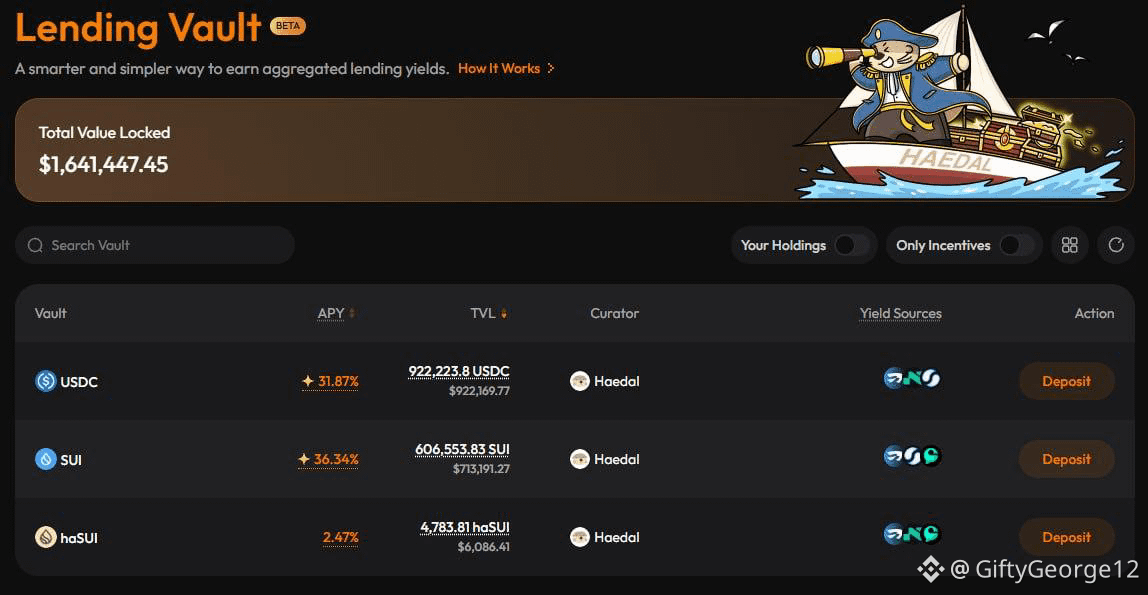
$HAEDAL Lending Vault incentives have been renewed, bringing attractive APRs for both USDC and SUI.
What makes it interesting is the strategy behind it:
• Capital is allocated across underlying lending protocols
• Users can share in native lending fees and incentives
• Allocations adjust dynamically based on protocol health and yield performance
• Built with a strong focus on product security
One vault, smarter allocation, more opportunities to earn across $SUI DeFi.
Haedal keeps building.
#Haedal
Yield just got another boost on Sui. 🦦
$HAEDAL Lending Vault incentives have been renewed, bringing attractive APRs for both USDC and SUI.
What makes it interesting is the strategy behind it:
• Capital is allocated across underlying lending protocols
• Users can share in native lending fees and incentives
• Allocations adjust dynamically based on protocol health and yield performance
• Built with a strong focus on product security
One vault, smarter allocation, more opportunities to earn across $SUI DeFi.
Haedal keeps building.
#Haedal
$HAEDAL Lending Vault incentives have been renewed, bringing attractive APRs for both USDC and SUI.
What makes it interesting is the strategy behind it:
• Capital is allocated across underlying lending protocols
• Users can share in native lending fees and incentives
• Allocations adjust dynamically based on protocol health and yield performance
• Built with a strong focus on product security
One vault, smarter allocation, more opportunities to earn across $SUI DeFi.
Haedal keeps building.
#Haedal
1
207

·
--
$HAEDAL 🦦🌊
This is a story where “convenience” becomes a competitive advantage.
In DeFi, finding high yield isn’t that difficult.
What’s truly hard is managing that yield continuously.
You need to check where the returns are highest, move your assets, manage the rewards, and when market conditions change, revise the strategy again.
The reason Haedal Lending Vault is so appealing is that it reduces all of this hassle. 🦦
Users deposit their assets,
and the Vault looks for opportunities and moves between multiple Lending Markets.
I believe this will become an extremely important competitive edge in DeFi going forward.
What people want isn’t more complex finance—
but smarter finance that takes care of complicated tasks for them. 💧
The recent sight of liquidity rapidly flowing into the Haedal Lending Vault also seems to reflect this demand.
After all, the next generation of DeFi may come down to a difference between:
“How many features are there?” and
“How little do users have to worry?”
🦦 Capital moves actively, while users stay comfortable.
The DeFi Haedal is building is getting simpler every day,
but the work the capital does inside it is actually becoming even more.
Deposit once. Let the Vault do the moves. 🌊
This is the direction I expect for HAEDAL. 🔥
#Haedal #SUİ #defi #lending #USDC
$HAEDAL 🦦🌊
This is a story where “convenience” becomes a competitive advantage.
In DeFi, finding high yield isn’t that difficult.
What’s truly hard is managing that yield continuously.
You need to check where the returns are highest, move your assets, manage the rewards, and when market conditions change, revise the strategy again.
The reason Haedal Lending Vault is so appealing is that it reduces all of this hassle. 🦦
Users deposit their assets,
and the Vault looks for opportunities and moves between multiple Lending Markets.
I believe this will become an extremely important competitive edge in DeFi going forward.
What people want isn’t more complex finance—
but smarter finance that takes care of complicated tasks for them. 💧
The recent sight of liquidity rapidly flowing into the Haedal Lending Vault also seems to reflect this demand.
After all, the next generation of DeFi may come down to a difference between:
“How many features are there?” and
“How little do users have to worry?”
🦦 Capital moves actively, while users stay comfortable.
The DeFi Haedal is building is getting simpler every day,
but the work the capital does inside it is actually becoming even more.
Deposit once. Let the Vault do the moves. 🌊
This is the direction I expect for HAEDAL. 🔥
#Haedal #SUİ #defi #lending #USDC
This is a story where “convenience” becomes a competitive advantage.
In DeFi, finding high yield isn’t that difficult.
What’s truly hard is managing that yield continuously.
You need to check where the returns are highest, move your assets, manage the rewards, and when market conditions change, revise the strategy again.
The reason Haedal Lending Vault is so appealing is that it reduces all of this hassle. 🦦
Users deposit their assets,
and the Vault looks for opportunities and moves between multiple Lending Markets.
I believe this will become an extremely important competitive edge in DeFi going forward.
What people want isn’t more complex finance—
but smarter finance that takes care of complicated tasks for them. 💧
The recent sight of liquidity rapidly flowing into the Haedal Lending Vault also seems to reflect this demand.
After all, the next generation of DeFi may come down to a difference between:
“How many features are there?” and
“How little do users have to worry?”
🦦 Capital moves actively, while users stay comfortable.
The DeFi Haedal is building is getting simpler every day,
but the work the capital does inside it is actually becoming even more.
Deposit once. Let the Vault do the moves. 🌊
This is the direction I expect for HAEDAL. 🔥
#Haedal #SUİ #defi #lending #USDC
60
With AlphaFi winding down, some users are now looking for a new place to put their lending positions.
Haedal Lending Vault is worth having on the radar. 🦦
Your deposits are allocated directly across underlying lending protocols, allowing you to earn native lending interest alongside incentive rewards.
Haedal also actively monitors health factors and yields, adjusting allocations when market conditions change.
And with $HAEDAL incentives currently live on the vault, there’s even more reason to explore it.
For users looking for a simpler way to access lending opportunities across $SUI DeFi, this is a solid time to check out Haedal Lending Vault.
https://haedal.xyz/lending
#Haedal
With AlphaFi winding down, some users are now looking for a new place to put their lending positions.
Haedal Lending Vault is worth having on the radar. 🦦
Your deposits are allocated directly across underlying lending protocols, allowing you to earn native lending interest alongside incentive rewards.
Haedal also actively monitors health factors and yields, adjusting allocations when market conditions change.
And with $HAEDAL incentives currently live on the vault, there’s even more reason to explore it.
For users looking for a simpler way to access lending opportunities across $SUI DeFi, this is a solid time to check out Haedal Lending Vault.
https://haedal.xyz/lending
#Haedal
Haedal Lending Vault is worth having on the radar. 🦦
Your deposits are allocated directly across underlying lending protocols, allowing you to earn native lending interest alongside incentive rewards.
Haedal also actively monitors health factors and yields, adjusting allocations when market conditions change.
And with $HAEDAL incentives currently live on the vault, there’s even more reason to explore it.
For users looking for a simpler way to access lending opportunities across $SUI DeFi, this is a solid time to check out Haedal Lending Vault.
https://haedal.xyz/lending
#Haedal

1
166
·
--
$HAEDAL 🦦🌊
A new week begins, and Yield looks anything but ordinary from the start.
The current APY of the Haedal Lending Vault really stands out. 🔥
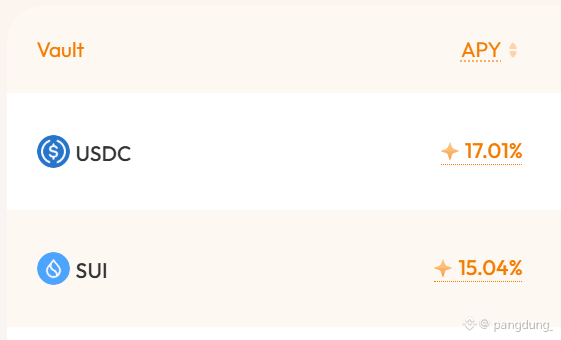
💵 USDC Vault → 17.01% APY
💧 SUI Vault → 15.04% APY
Both Vaults are showcasing attractive APYs above 15%, kicking off the new week on a strong note.
After the recent surge in Lending Vault liquidity surpassing $3M and expanding up to the USDC Vault limit with 3M USDC, it’s now showing quite an exciting side with Yield as well. 🦦
The Haedal Lending Vault deposits once and then moves—leveraging multiple Lending Markets to find more efficient opportunities.
Deposit once. Let the Vault do the moves. 🌊
Great yield, growing liquidity, and demand expanding fast.
🦦 Starting this new week just like Haedal—otterly good. 🔥
#HAEDAL #SUİ #defi #USDC #lending
$HAEDAL 🦦🌊
A new week begins, and Yield looks anything but ordinary from the start.
The current APY of the Haedal Lending Vault really stands out. 🔥
💵 USDC Vault → 17.01% APY
💧 SUI Vault → 15.04% APY
Both Vaults are showcasing attractive APYs above 15%, kicking off the new week on a strong note.
After the recent surge in Lending Vault liquidity surpassing $3M and expanding up to the USDC Vault limit with 3M USDC, it’s now showing quite an exciting side with Yield as well. 🦦
The Haedal Lending Vault deposits once and then moves—leveraging multiple Lending Markets to find more efficient opportunities.
Deposit once. Let the Vault do the moves. 🌊
Great yield, growing liquidity, and demand expanding fast.
🦦 Starting this new week just like Haedal—otterly good. 🔥
#HAEDAL #SUİ #defi #USDC #lending
A new week begins, and Yield looks anything but ordinary from the start.
The current APY of the Haedal Lending Vault really stands out. 🔥
💵 USDC Vault → 17.01% APY
💧 SUI Vault → 15.04% APY
Both Vaults are showcasing attractive APYs above 15%, kicking off the new week on a strong note.
After the recent surge in Lending Vault liquidity surpassing $3M and expanding up to the USDC Vault limit with 3M USDC, it’s now showing quite an exciting side with Yield as well. 🦦
The Haedal Lending Vault deposits once and then moves—leveraging multiple Lending Markets to find more efficient opportunities.
Deposit once. Let the Vault do the moves. 🌊
Great yield, growing liquidity, and demand expanding fast.
🦦 Starting this new week just like Haedal—otterly good. 🔥
#HAEDAL #SUİ #defi #USDC #lending
1
72
Log in to explore more content
Join global crypto users on Binance Square
⚡️ Get latest and useful information about crypto.
💬 Trusted by the world’s largest crypto exchange.
👍 Discover real insights from verified creators.
Email / Phone number
Trending Topics
1
#EarningsSeason
219,079 views
1,999 Discussing
2
#BitwiseLaunchesFirstSpotNEARETF
9,648 views
320 Discussing
3
#USJobOpeningsFallToFiveMonthLow
15,332 views
245 Discussing
4
#ECBToTestAIAgentsInDigitalEuroPayments
15,481 views
406 Discussing
5
#JapanFSABacksFourthStablecoinTradeSettlementPilot
18,063 views
449 Discussing
6
#BitgetHackerFailsToMoveStolenFunds
33,342 views
557 Discussing
7
#BitMineETHHoldingsTop6Million
28,602 views
666 Discussing
8
#StrategyAdds1666BTCHoldingsReach847666
24,325 views
463 Discussing
9
#NvidiaApproves$150BBuyback
4,642 views
71 Discussing
10
#OpenAIDelaysGPT6.1OverSafetyIssues
37,196 views
832 Discussing