
#zcashfallsbelow
zcashfallsbelow
1,983 views
37 Discussing
Hot
Latest


·
--
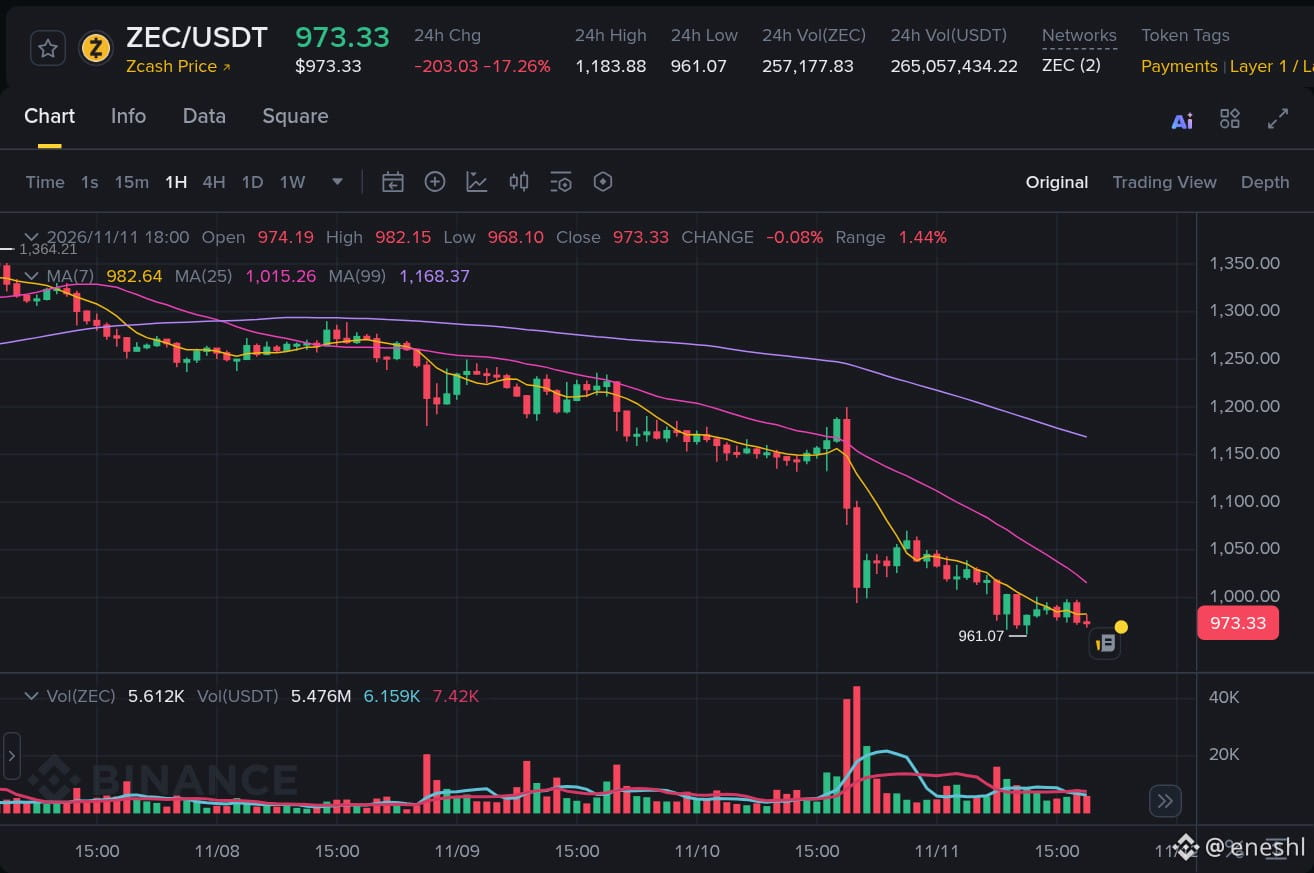
zcash just lost 1k for the first time since september
#ZcashFallsBelow$1000ForFirstTimeSinceSeptember
NU7 went live friday, grayscale pledged money to the ecosystem yesterday, and $ZEC still led the big coins lower after the hot cpi print. monero went green today, so it reads like rotation inside privacy, not a sector dump
my read, zec perp open interest is climbing again while price slides, so fresh shorts are leaning on it. thats fuel both ways. if $BTC steadies, a squeeze back over the round number is on the table. if btc keeps bleeding, shorts get paid and etf outflows add supply
im watching for an hourly reclaim of 1k with oi dropping
does zec win back 1k before btc finds a floor ?
CryptoAmeer:
I followed you, do you follow me?
1
4
2k

·
--
Zcash just lost $1,000 and it happened the day after Grayscale threw $1 million at the ecosystem.
ZEC is down about 25% in a week and hit $963 yesterday, its lowest since September. It was above $1,370 on Friday when the NU7 upgrade went live. Now the chart is sitting near oversold and traders are watching $900 next.
The weird part is the timing. Grayscale launched a national ad campaign and pledged $1 million to Zcash projects on Tuesday, and the price still fell 13% the next day. The ZCSH ETF has seen around $30 million in outflows this month too.
Privacy coins had a huge run this year and ZEC is still up a lot from January, but this week is a reminder how fast these moves reverse.
Would you buy a privacy coin this beaten up, or wait until it proves $1,000 is support again? $ZEC #ZcashFallsBelow$1000ForFirstTimeSinceSeptember

1
300

·
--
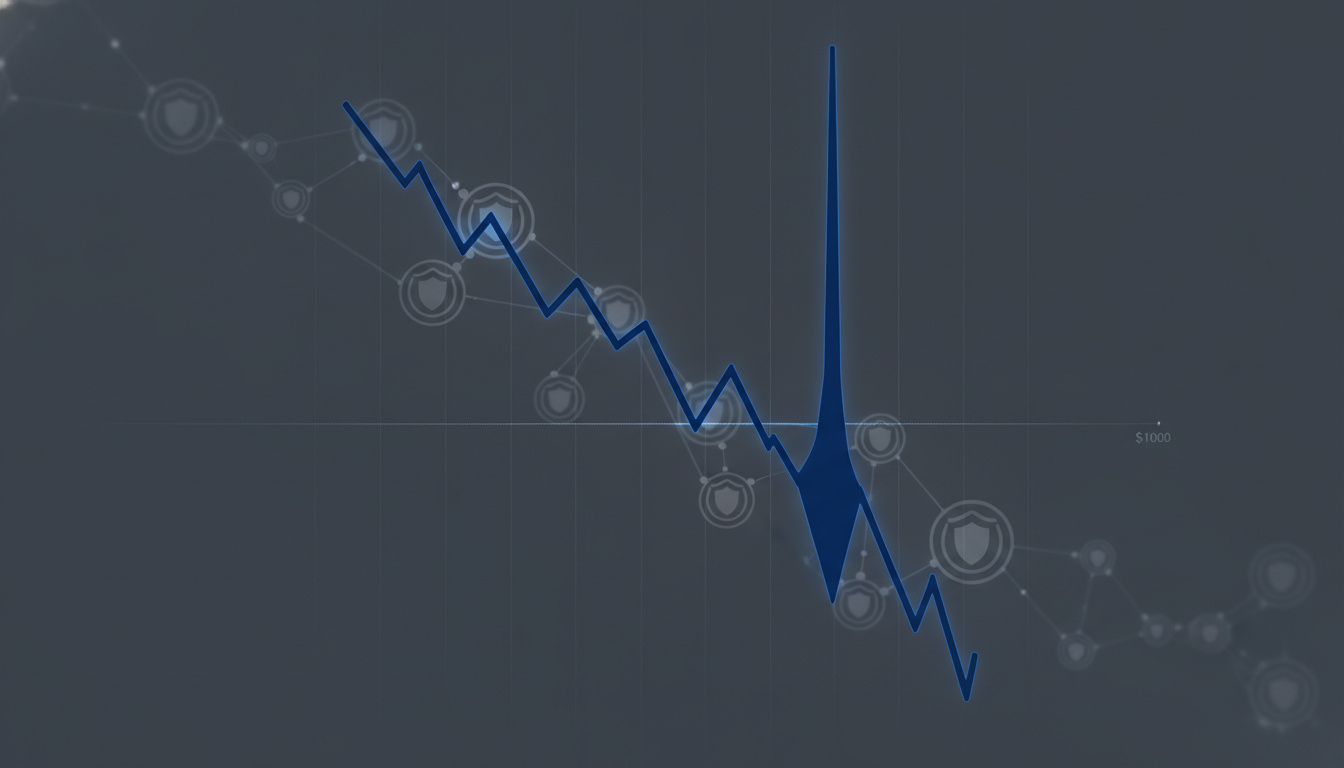
Zcash (ZEC) has recently fallen below the significant psychological and technical level of $1000, a threshold not seen since September. This price action is a notable event for the privacy-focused cryptocurrency, indicating a potential shift in market sentiment or a reaction to broader market trends. Investors and traders will be closely watching to see if this is a temporary dip or the start of a more sustained downtrend. Factors such as overall market liquidity, regulatory news, and developments within the Zcash ecosystem itself will play a crucial role in its future price trajectory. The breach of this level could trigger further selling pressure as stop-loss orders are activated, but it might also present a buying opportunity for those who believe in Zcash's long-term potential.
Disclaimer: This content is for informational purposes only and does not constitute investment advice.
#ZcashFallsBelow$1000ForFirstTimeSinceSeptember
Disclaimer: This content is for informational purposes only and does not constitute investment advice.
#ZcashFallsBelow$1000ForFirstTimeSinceSeptember
59

·
--
#ZcashFallsBelow$1000ForFirstTimeSinceSeptember
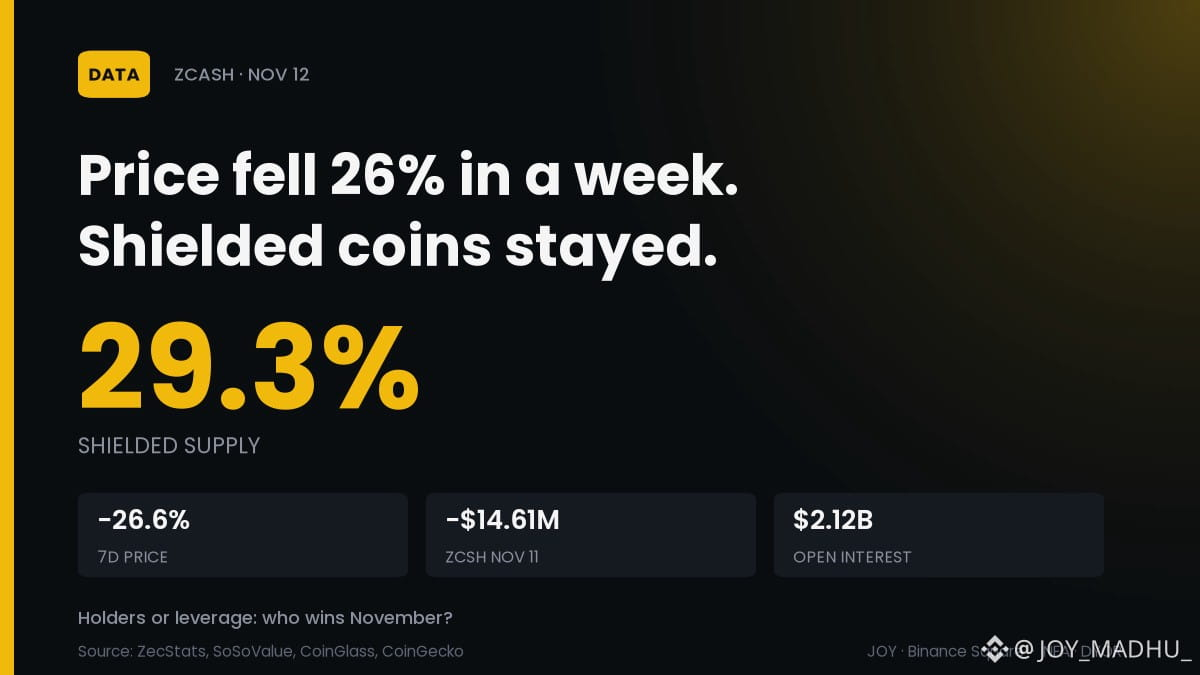
🛡️ ZEC Fell 26% in a Week. Shielded Coins Didn't Leave.
Traders are dumping Zcash, but holders aren't pulling coins from its private pools.
📊 ~4.99M ZEC shielded, 29.3% of supply (ZecStats, Nov 11)
📉 ZCSH ETF lost $14.61M on Nov 11, its worst day this month
🏦 ETF net assets $562M, down $106M since Nov 2
⚠️ Open interest ~$2.12B, funding positive (CoinGlass)
My read: holders aren't fleeing, but $2B of leverage must clear first.
Does shielded supply hold above 29% through November, or crack? 👇
$ZEC
#ZcashFallsBelow$1000ForFirstTimeSinceSeptember #Zcash #Privacy
9
·
--
#ZcashFallsBelow$1000ForFirstTimeSinceSeptember
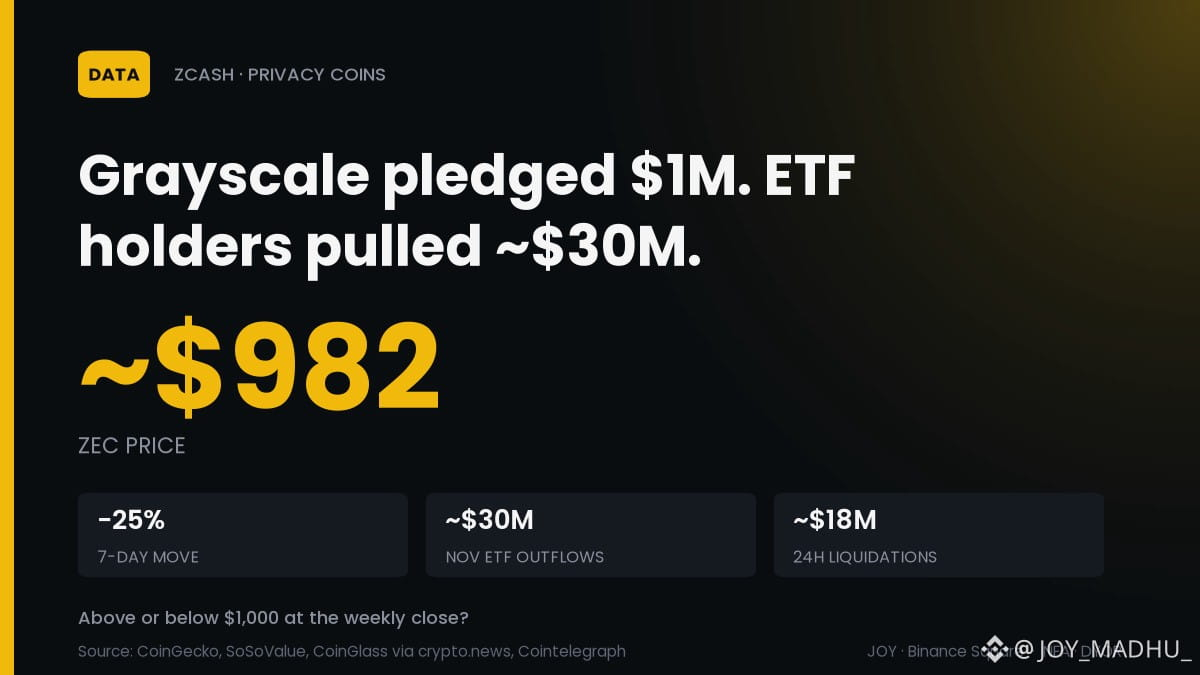
🔻 Grayscale Pledged $1M. ETF Holders Pulled ~$30M.
Zcash lost $1,000 for the first time since September, and new backing from its biggest fund hasn't stopped the selling.
📉 ZEC ~$982, down about 25% in 7 days (CoinGecko)
📊 ~$30M ETF outflows in Nov after ~$46M in Oct (SoSoValue)
⚠️ ~$18M liquidated in 24h, about 72% longs (CoinGlass)
📅 Above $1,370 Friday, when NU7 cut blocks from 75s to 25s
My read: the upgrade worked. This is leverage and outflows, not a broken chain.
Will $ZEC close this week above or below $1,000? 👇
#ZcashFallsBelow$1000ForFirstTimeSinceSeptember #Zcash #PrivacyCoins
34

·
--
$ZEC hit $961, its lowest since Sept 4. Lookonchain: 27 of 32 $1M+ ZEC longs now underwater.
#ZcashFallsBelow$1000ForFirstTimeSinceSeptember #Write2Earn
What tells you a flush is finished, and why?
$ZEC hit $961, its lowest since Sept 4. Lookonchain: 27 of 32 $1M+ ZEC longs now underwater.
#ZcashFallsBelow$1000ForFirstTimeSinceSeptember #Write2Earn
What tells you a flush is finished, and why?
#ZcashFallsBelow$1000ForFirstTimeSinceSeptember #Write2Earn
What tells you a flush is finished, and why?
219
·
--
Zcash ($ZEC) has fallen below the $1000 mark for the first time since September, a significant psychological barrier for the privacy-focused cryptocurrency. This decline, while perhaps not surprising given broader market sentiment, raises questions about investor confidence and the immediate future trajectory of $ZEC.
This price action could signal a shift in market dynamics or simply reflect a temporary pullback. Traders and investors will be closely watching for signs of recovery or further downside. The key will be whether the underlying fundamentals and adoption trends for Zcash can sustain interest despite this short-term price weakness. The market is always looking for the next narrative, and a break below such a key level often prompts a re-evaluation of positions.
This event warrants attention for anyone holding or considering $ZEC. Understanding the factors driving this move is crucial for navigating the current crypto landscape.
#ZcashFallsBelow$1000ForFirstTimeSinceSeptember
Zcash ($ZEC ) has fallen below the $1000 mark for the first time since September, a significant psychological barrier for the privacy-focused cryptocurrency. This decline, while perhaps not surprising given broader market sentiment, raises questions about investor confidence and the immediate future trajectory of $ZEC .
This price action could signal a shift in market dynamics or simply reflect a temporary pullback. Traders and investors will be closely watching for signs of recovery or further downside. The key will be whether the underlying fundamentals and adoption trends for Zcash can sustain interest despite this short-term price weakness. The market is always looking for the next narrative, and a break below such a key level often prompts a re-evaluation of positions.
This event warrants attention for anyone holding or considering $ZEC . Understanding the factors driving this move is crucial for navigating the current crypto landscape.
#ZcashFallsBelow$1000ForFirstTimeSinceSeptember
278

·
--
Verified
🚨 Zcash drops below $1,000! Heavy losses in just 24 hours!
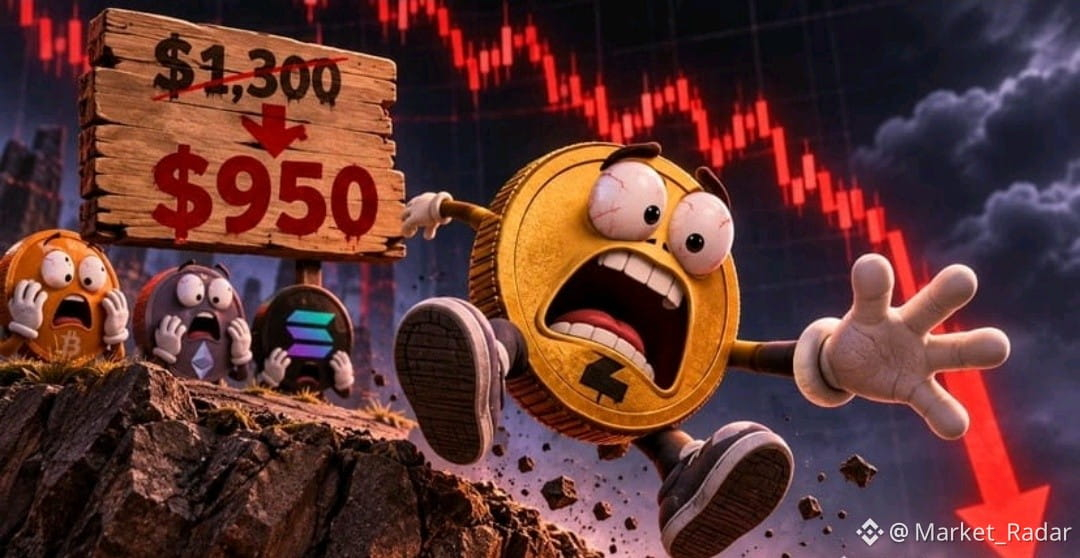
$ZEC came under massive selling pressure, falling from around $1,300 to $950 in just one day. That’s a drop of nearly 27%, wiping hundreds of millions of dollars off its market value.
This is the first time Zcash has fallen below the $1,000 level since September.
What makes this drop worse is the liquidation pressure. Long positions worth around $35.7 million were liquidated over the past 24 hours, accelerating the decline.
Higher-than-expected U.S. Consumer Price Index (CPI) data added further pressure to an already weak market, while privacy coins also faced heavy selling.
Even Grayscale’s commitment to allocate $1 million to the Zcash ecosystem couldn’t stop the bleeding.
After this sharp rally, is this just a healthy correction, or are we witnessing the beginning of a much deeper collapse?
#ZcashFallsBelow
#HotCPIDecemberHikePriced
#zcash
$ZEC
{spot}(ZECUSDT)
🚨 Zcash drops below $1,000! Heavy losses in just 24 hours!
$ZEC came under massive selling pressure, falling from around $1,300 to $950 in just one day. That’s a drop of nearly 27%, wiping hundreds of millions of dollars off its market value.
This is the first time Zcash has fallen below the $1,000 level since September.
What makes this drop worse is the liquidation pressure. Long positions worth around $35.7 million were liquidated over the past 24 hours, accelerating the decline.
Higher-than-expected U.S. Consumer Price Index (CPI) data added further pressure to an already weak market, while privacy coins also faced heavy selling.
Even Grayscale’s commitment to allocate $1 million to the Zcash ecosystem couldn’t stop the bleeding.
After this sharp rally, is this just a healthy correction, or are we witnessing the beginning of a much deeper collapse?
#ZcashFallsBelow
#HotCPIDecemberHikePriced
#zcash
$ZEC
1
673

·
--
ZEC has fallen below $1,000. What’s dropping isn’t the privacy narrative—it’s the momentum after an overextended rally.
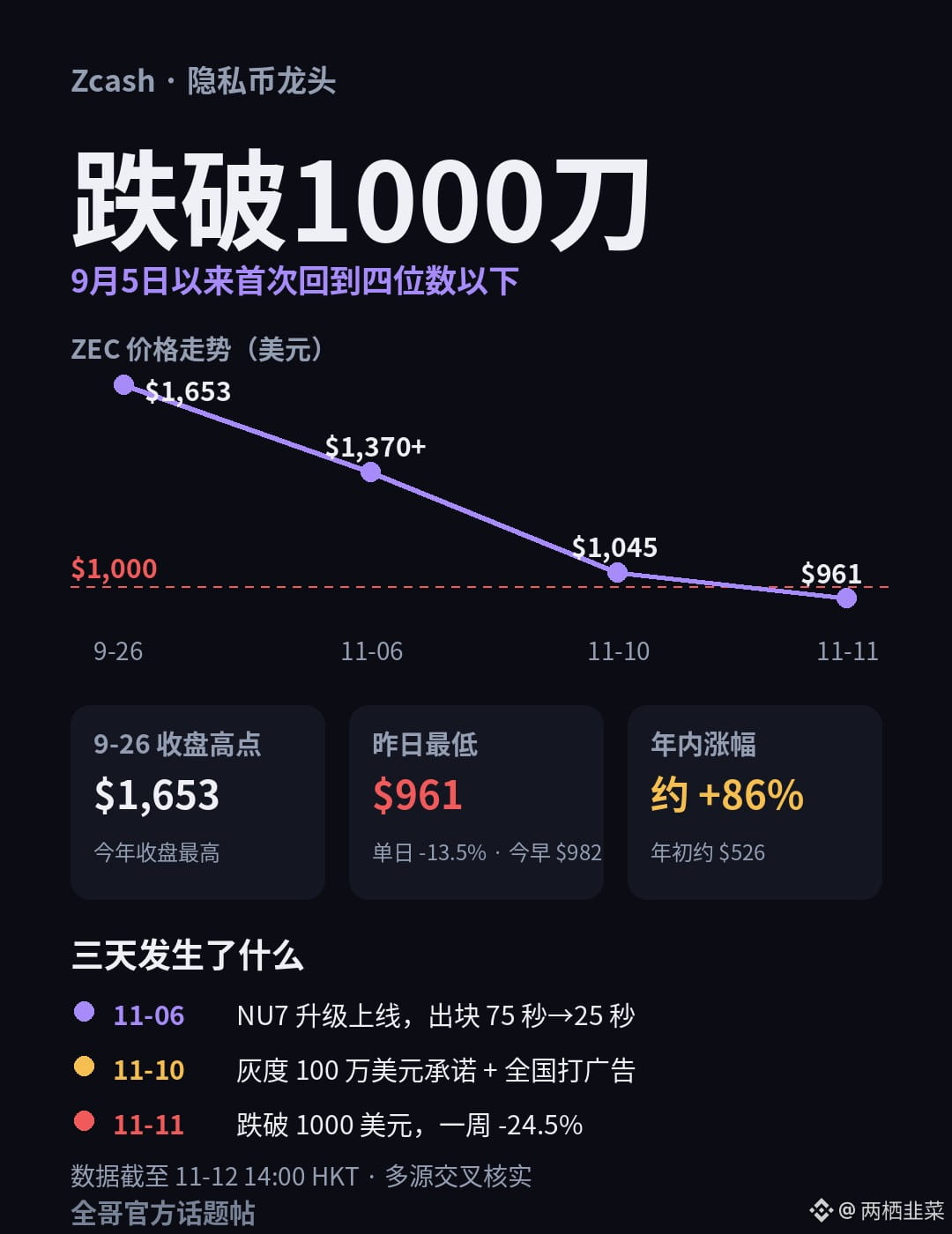
Zcash fell below $1,000 yesterday, closing at $978.85 after hitting a low of $961.07. It was the first time it had dropped back below four figures since September 5. Down 13.5% in a day and 24.5% over a week, it was the worst performer among the top 100. Over the same period, Bitcoin fell 5.8% and Ethereum 11.6%.
Don’t rush to write it off. It closed at $1,653 on September 26, a closing high; at the start of the year, it was just $526, and it’s still up nearly 90% this year. The biggest rallies tend to see the sharpest pullbacks. Put simply, this move has given back about half of September’s frenzied gains.
Good and bad news collided: last Friday’s NU7 upgrade cut block time from 75 seconds to 25, while the price was still above $1,370; on Monday, Grayscale spent $1 million on ads promoting ZCSH. The ads ran, but the price fell below $1,000. Grayscale’s ETF saw $46.25 million in outflows in October, followed by another $15 million in November. Liquidations over 24 hours totaled $40.63 million, including $35.35 million in long positions. The positive news failed to support the price, suggesting this sell-off isn’t about changing fundamentals, but a cascade of leveraged positions and profit-taking.
ZEC has a market cap of $16.9 billion. It’s the biggest privacy coin, accounting for 60% of the sector. Breaking below $1,000 means a psychological threshold gave way; it doesn’t mean the business is dead.
Look at it on two levels: in the short term, this is a normal pullback after an overheated rally. Over the long term, whether there are sustained buyers for the privacy sector will determine if it can get back above four figures. Ads can draw attention, but they can’t bring in buyers to catch the fall.
Falling below $1,000 isn’t the scary part. The scary part is assuming that means it’s automatically cheap.
#ZcashFallsBelow$1000ForFirstTimeSinceSeptember
$ZEC $BTC
277

·
--
ZEC falls below $1,000 as interest rises | U.S. PPI has not been released yet | I’ll wait and see; I’ll consider participating once the price regains its footing
My stance is not to buy into the decline for now. The exact topic being discussed on Binance Square is #ZcashFallsBelow$1000ForFirstTimeSinceSeptember, and ZEC has also made the Most Searched list over the past six hours. Search interest indicates attention, not net buying. At the time of writing, ZEC/USDT on Binance was around $956.71, down about 4.72% in 24 hours, with a low of $942.86 and a high of $1,023.44. The $1,000 round-number level is still overhead. As long as an intraday rebound fails to close back above it, a steep drop alone is not evidence that the decline has bottomed.
This time, I’m more focused on when the macroeconomic data will be released than on inventing a project-specific reason for the decline. The U.S. Bureau of Labor Statistics calendar schedules the October Producer Price Index release for 8:30 a.m. Eastern Time on November 13. The results have not been released yet, so it would be premature to say that inflation came in hotter than expected. PPI can affect market expectations for inflation and the interest-rate path, and then feed through to crypto assets via the dollar, Treasury yields, and risk appetite. ZEC’s market depth is usually lower than BTC’s, so macro repricing can lead to larger short-term swings. But that is a risk-transmission mechanism, not a prediction about the data or price direction.
Institutional fund flows also can’t be inferred from popular posts. Farside currently lists a $14.6 million net outflow for ZCSH on November 11, while the November 12 entry is still blank. The zero total automatically displayed on the page should not be interpreted as meaning there were no outflows that day. The latest verifiable Grayscale figures from its website are for November 11: a fund market price of $26.53, down 5.22% on the day. That reflects secondary-market performance of the fund shares; net subscriptions and redemptions are a separate metric. In the previous two articles, I checked the NU7 upgrade and governance proposal. This time, I’ve seen no official evidence that the loss of the $1,000 level can be directly attributed to a protocol failure or the implementation of a proposal, so I won’t present old news as a new catalyst.
The key levels I’m watching are the 24-hour low of $942.86, the $1,000 level above it, and the 24-hour high of $1,023.44. If the price breaks below the low and cannot quickly recover it, the bearish assessment will strengthen. If a four-hour candle closes back above $1,000, then holds on a retest, and subsequently breaks above $1,023.44, my wait-and-see stance will be invalidated. Quotes may gap around the PPI release; a trigger price is not necessarily the price at which a trade can actually be executed.
If I were trading this myself: I wouldn’t participate right now. My tentative direction would be to go long spot in the direction of the trend, not to buy the dip against the trend. Only if, after the PPI release, the price holds above $1,000 on a four-hour basis and does not break below it on a retest would I open a test position using 2% of my total capital. I’d first target around $1,023, sell half when it reaches that level, and target $1,050 with the remainder. If a four-hour candle closes back below $985 after entry, I’d stop out. If the price breaks directly below $942.86, the plan is void and I’d stay in cash and wait. If the price rises without triggering a retest, I won’t chase it. If volatility is excessive or slippage is significant after the data release, I’ll cancel the orders and stay on the sidelines. Position size is based on total capital; I won’t use leverage or describe an untriggered plan as an executed trade.
#ZcashFallsBelow$1000ForFirstTimeSinceSeptember #ZEC
The above is solely my personal market observation and does not constitute investment advice.

8
·
--
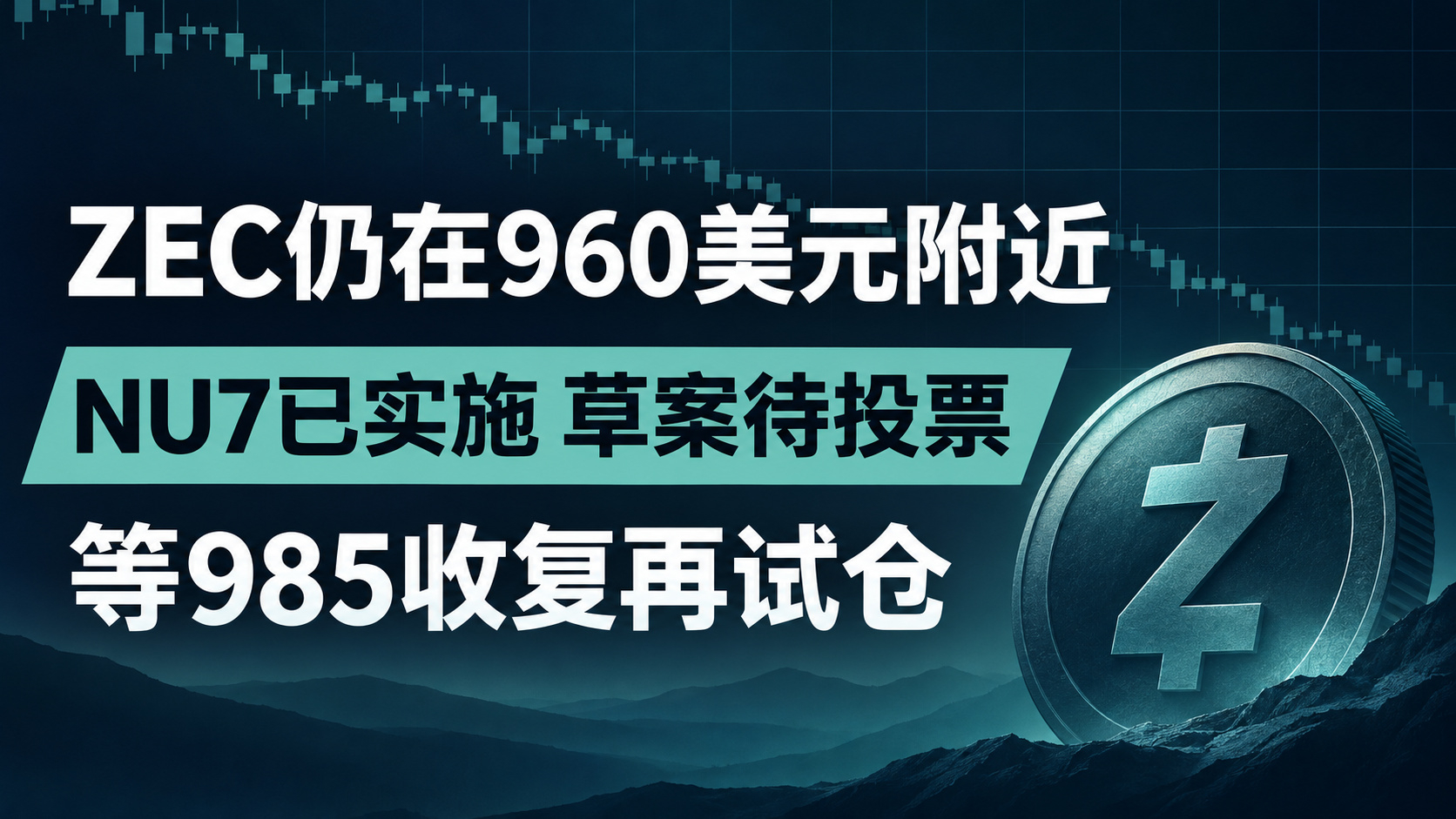
ZEC is still near $960 | NU7 is live, while the new draft still awaits a vote—two separate things | I’m not chasing the supply narrative
My stance is to keep watching from the sidelines and first untangle two Zcash timelines that are easy to confuse. The Zcash Foundation’s Zebra 7.0.0 release notes and ZIP 259 make clear that the NU7 mainnet upgrade activated at block height 3543405; community records show that block was produced on November 6. NU7 shortens the target block interval from 75 seconds to 25 seconds, while proportionally adjusting the reward per block. As a result, scheduled daily issuance has not increased just because blocks are produced “three times faster”; the four-year halving schedule and 21 million coin cap have not changed either. Treating faster block production as direct supply acceleration is a flawed trading premise.
Another rule already included in NU7 is the Network Sustainability Mechanism: according to the official announcement, 60% of transaction fees from each block go into the mechanism’s reserve, while miners keep 40%; the reserve will be used for block rewards in the future according to the protocol’s arrangements. This does not permanently burn all transaction fees, nor does it mean that anyone is actively buying on the market. Separately, the “transfer 50,000 ZEC from ZCG and redirect the future 8% subsidy to a new lockbox” discussed in the previous round is a different Draft ZIP. Although the draft code has already been merged into the documentation repository, the community vote is still scheduled for November 16–30, so neither the transfer nor the new rules should be described as already in effect. The old rules are live; the new proposal is awaiting governance. Their respective weights in the supply narrative must not be conflated.
Why do I focus on these details? Faster confirmations could improve the wallet and payment experience, and fee redistribution could affect the network’s long-term security budget. But the short-term price impact depends on actual transaction counts, fee rates, and user adoption; you can’t infer definite spot buying from a single “60%” figure. Trending topics on Binance Square are still discussing ZEC falling below $1,000, but buzz and protocol usage are two different things. At the time of writing, Binance ZEC/USDT was around $960.68, down about 1.1% over 24 hours, with a low of $948 and a high of $1,024.57; the market has yet to reclaim $1,000. Farside shows net outflows of about $14.6 million from ZCSH on November 11. Data for November 12 is incomplete, and a blank entry does not mean inflows have recovered.
If I were trading this myself, I’d stay out for now; the only direction I’d consider is a spot long, with total position size at zero. I’d wait for ZEC to move back above $985 and hold $975 on an hourly retest before entering a position equal to 2% of total capital; after reclaiming $1,000, I’d add at most enough to bring it to 4%. I’d take half off at the first target of $1,025, then reduce the position further at the second target of $1,050. I’d stop out if the price fell below $950; if an hourly close lost $948, I’d exit the entire position and cancel the long plan. If the community ultimately rejects the 50,000-coin proposal, or complete fund-flow data continues to deteriorate while the price fails to return to $985, I’ll remain flat. Protocol facts, governance expectations, and price confirmation each require their own evidence; one news item cannot stand in for all three.
#ZcashFallsBelow$1000ForFirstTimeSinceSeptember #ZEC
The above is only my personal market observation and does not constitute investment advice.
8
·
--
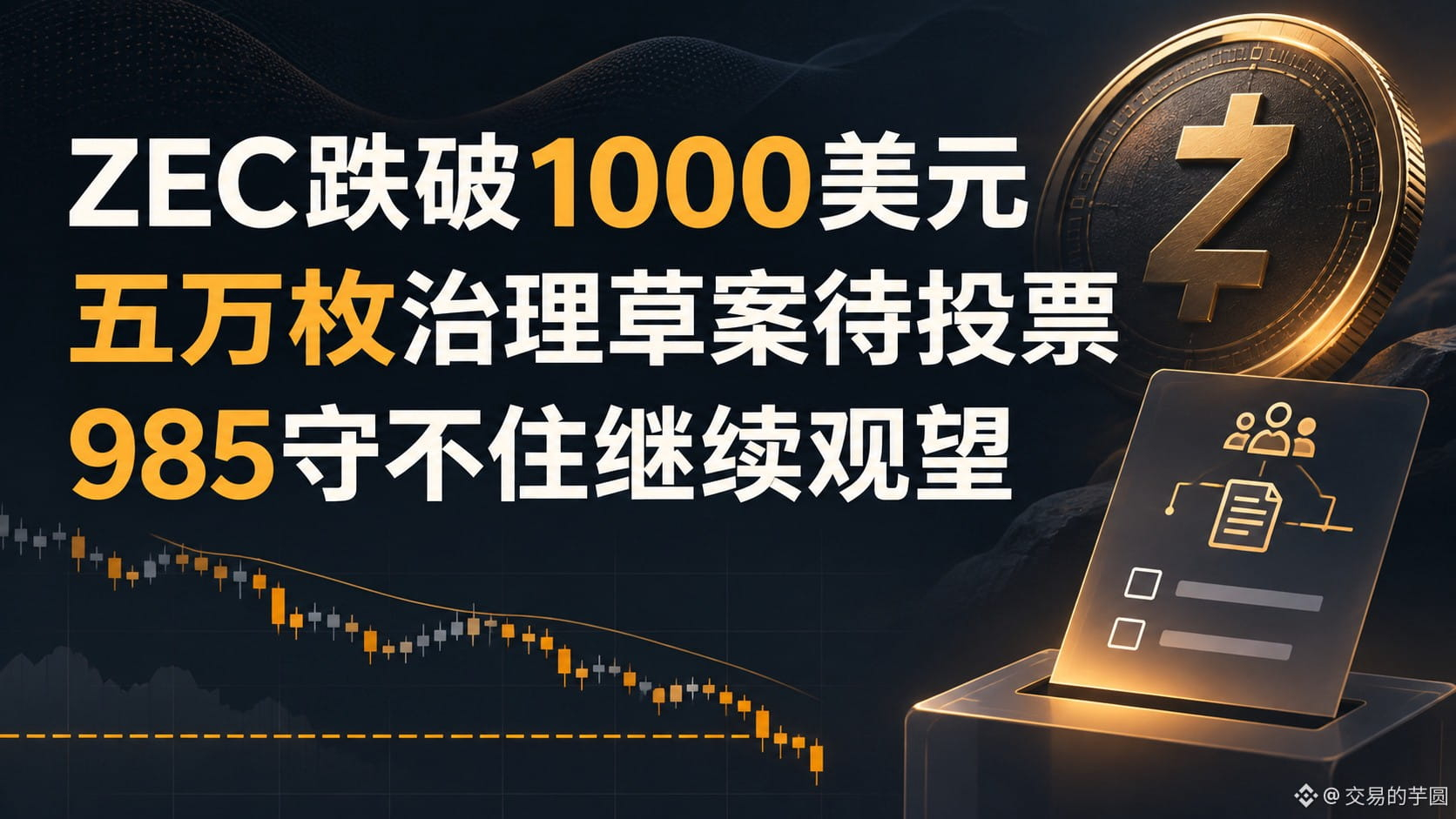
ZEC Falls Below $1,000 | 50,000-ZEC Governance Proposal Under Discussion | I’ll Wait for a Vote and Price Confirmation
My stance is to watch cautiously. I won’t treat a draft that has been merged into the codebase as a supply-reduction benefit that has already taken effect. Binance Square’s current trending topics include “#ZcashFallsBelow$1000ForFirstTimeSinceSeptember,” and ZEC also appears among the Most Searched. This shows that the market is focused on both the $1,000 threshold and the governance dispute; a lot of discussion does not necessarily mean buying pressure. ZEC/USDT on Binance was around $965 when I checked, down about 2.9% over the past 24 hours, with a low of about $948 and a high of about $1,025. The price is already below $1,000 and has yet to prove that buyers are stepping in by holding above that level.
The real issue worth unpacking is Zcash’s development funding draft. Pull request No. 1428 in the Zcash ZIP repository was merged into the main branch on November 11, but the document is still marked Draft. The proposal says that, if accepted and activated in a future network upgrade, the 8% of block subsidies originally allocated to Zcash Community Grants would instead go to a new development and legal defense lockbox. It also requires ZCG to transfer 50,000 ZEC to the address associated with the Network Sustainability Mechanism. The community forum lists the timeline as discussion from November 9 to 15, voting from November 16 to 30, and then further steps dependent on consensus, engineering implementation, and miner upgrades. So for now, all we can say is that “the proposal is under discussion”—not that 50,000 ZEC has been transferred or burned, or that the subsidy rules have already changed.
This could affect the price through several different channels. Supporters value the clearer allocation of funds and the prospect of temporarily removing coins from circulation; critics worry that less money for developer grants could undermine long-term ecosystem investment. Even if the proposal is implemented in the future, the NSM accounting mechanism is not equivalent to immediately buying 50,000 ZEC on an exchange. Any supply change and future release rules will depend on the final version. The more immediate facts in the short term are that the price has fallen below $1,000 and Farside shows net outflows of about $14.6 million from ZCSH on November 11. The table still doesn’t have complete data for November 12, so I won’t treat a blank as zero outflows or inflows.
If I were trading this myself, I’d stay out for now. The only direction I’d consider is a small spot long position, with no leverage. I’d wait for ZEC to reclaim $1,000 and hold above $985 on a retest before opening a trial position with 2% of my total capital. If it then holds above $1,025, I’d add up to a maximum of 4%. I’d take half off near the first target of $1,050, then continue trimming around the second target of $1,080. If it falls back below $985, I’d stop out of the trial position; if it closes an hourly candle below $948, I’d exit completely and abandon the bullish plan. A vote against the proposal, or a final official text that changes the key funding arrangements, would also overturn my view that governance expectations are improving. Market buzz can provide clues to watch, but trading decisions should still be based on published rules and price confirmation.
#ZcashFallsBelow$1000ForFirstTimeSinceSeptember #ZEC
The above is only my personal market observation and does not constitute investment advice.
5
·
--
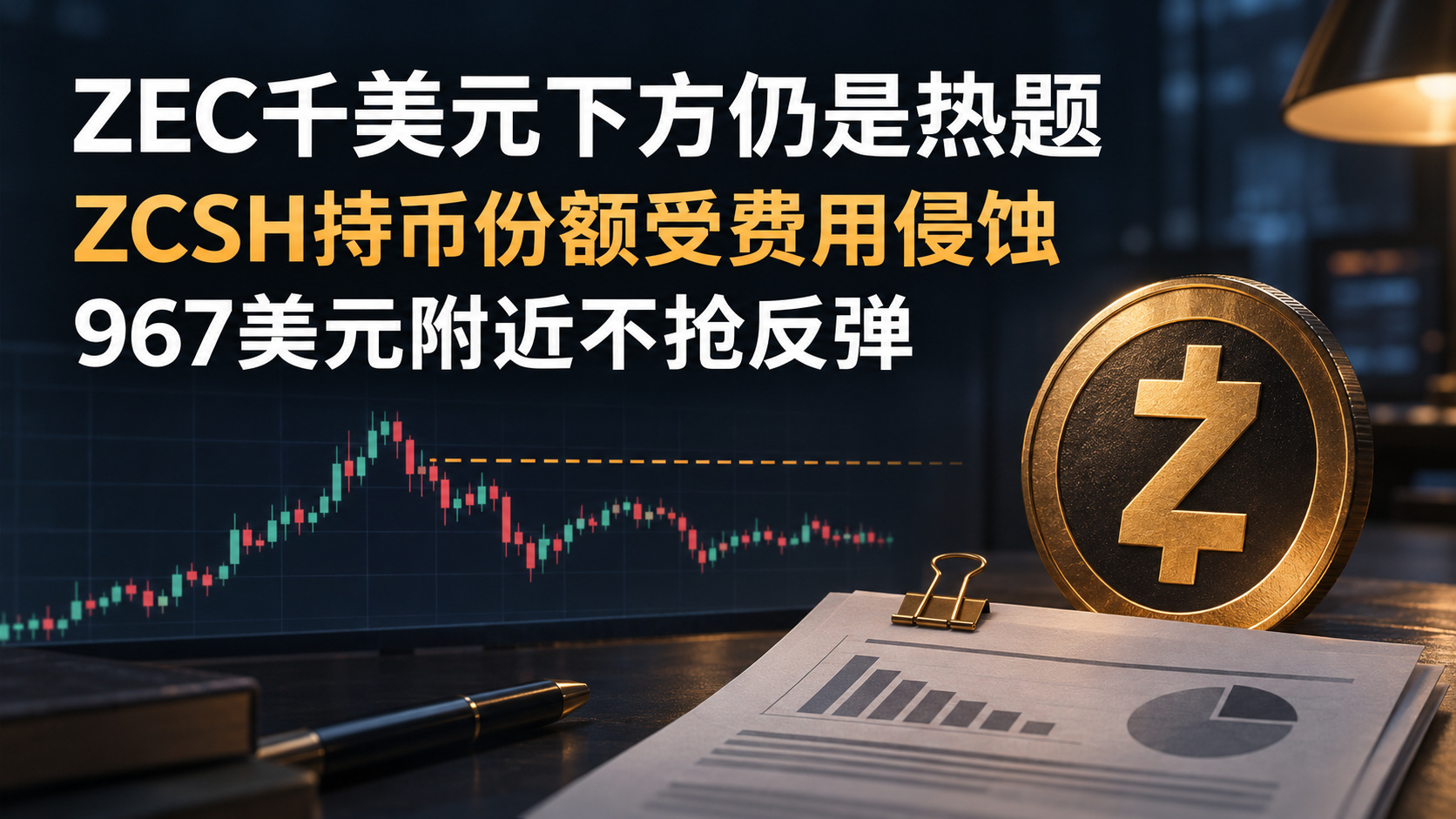
ZEC Below $1,000 Remains a Hot Topic | Fees Erode ZCSH’s ZEC per Share | Don’t Chase a Bounce Around $967
I remain cautious. The trending topic on Binance Square is still #ZcashFallsBelow$1000ForFirstTimeSinceSeptember. What I can verify from live market data is that ZEC spot is below $1,000; the claim “for the first time since September” requires complete historical data and cannot be treated as independently verified just from the topic’s name. What’s more worth unpacking today is the long-term holding cost of an institutional product: Grayscale’s Zcash ETF, ticker ZCSH, disclosed in its quarterly report filed with the U.S. SEC for the period ended September 30 that its annualized expense ratio is 2.50%. The amount of ZEC represented by each share fell from about 0.0272 at the end of 2025 to about 0.0267 at the end of September 2026. The filing says the main reason was periodic withdrawals of ZEC to pay the sponsor fee. This is a structural erosion from fees; it does not mean the fund suddenly sold an equivalent amount of ZEC today.
Why does this matter to the crypto market? ZCSH gives traditional accounts exposure to ZEC’s price, but ETF shares and directly holding ZEC are not exactly the same thing. Even if the price of ZEC moves sideways, fees gradually reduce the amount of underlying coins represented by each share. Investors in the secondary market also need to consider premiums or discounts and bid-ask spreads. The quarterly report also explains that share creations and redemptions are handled by authorized participants, and that the timing of cash redemptions and in-kind creations differs. You can’t simply equate a ZCSH buy order on an exchange with a ZEC spot buy order at the exact same second. To get a real read on institutional fund flows, look at net creations and redemptions after disclosure, changes in the fund’s ZEC holdings, and price spreads together.
As for the market reaction, at the time of writing, Binance ZEC/USDT was around $967.61, down about 1.33% over 24 hours, with a range of $951.21 to $1,024.57. The $1,000 round-number level has yet to be reclaimed. In the Farside table, ZCSH recorded net outflows of about $14.6 million on November 11, while the November 12 field is still blank. The 0.0 displayed automatically on the page does not confirm that there were no flows. The fund data and ZEC price are both weak, but that does not prove every dollar of outflows was directly sold on Binance’s spot order book that day. I’ll first watch whether $960 and $951 hold, with $985, $1,000, and $1,025 as upside levels. If the price holds above $1,000 consistently on both the 15-minute and hourly timeframes, and net fund flows improve, I’ll revise my current bearish view. If $951 gives way and a rebound fails to clear $960, the case for buying the dip no longer holds.
If I were trading this myself, I’d stay out for now, remain directionally neutral, and keep my position at 0%. Only if a 15-minute candle closes back above $985, followed by a successful retest on rising volume, would I try a spot long with 1.5% of my total capital. My first target would be $1,000 and the second $1,024; I’d trim half at $1,000 and move the stop on the remainder to around breakeven. I’d place the initial stop below $965 and exit the entire position if it is hit. If the price still can’t hold above $985 an hour after entry, I’d exit proactively. If $951 breaks first, the plan is canceled; I’ll wait for a new price structure and fund data rather than use high leverage to bet on a return to $1,000. These are all conditional plans; I’m not assuming that any trade has already been executed.
Sources: Grayscale’s ZCSH quarterly report filed with the SEC, Farside ZEC fund flows, and Binance ZEC/USDT spot. #ZcashFallsBelow$1000ForFirstTimeSinceSeptember #ZEC
The above is solely my personal market observation and does not constitute investment advice.
·
--
Grayscale commits to investing in the Zcash ecosystem|$400,000 in grants awarded|ZEC hasn’t held above $1,000, so I’m waiting
I support investment in the ecosystem, but remain cautious about ZEC in the short term. Binance Square’s trending topics still include “Zcash falls below $1,000,” highlighting price pressure. I’m more interested in where the funds are actually going. In an official announcement on November 10, Grayscale launched the Zcash Invest educational platform and said it planned to invest $1 million in nonprofits and projects in the Zcash ecosystem. The first $400,000 has been awarded to four organizations, at $100,000 each: the Zcash Foundation, Pretty Good Policy for Zcash, Shielded Labs, and Project Tachyon. Grayscale’s website news page and project page list the same arrangement. One distinction is essential: $1 million is the planned investment, not an amount that has already been fully disbursed; the $400,000 in grants supports the ecosystem—it is not Grayscale buying $400,000 worth of ZEC on the spot market.
Grayscale also said that for up to 12 months after ZCSH becomes effective as an exchange-traded product, it intends to use 100% of the sponsorship fees it receives to support trust-related activities, as well as research and development, marketing, and education for the Zcash network. The announcement’s footnote is also clear: this money comes from the sponsor’s own funds after it receives the fees. The commitment is voluntary and may be changed or discontinued at the sponsor’s discretion; it is not a legal obligation of the fund to the community. So I won’t mechanically treat “fees flowing back” as buy orders for ZEC. It could improve wallets, research, and public awareness, but it will take time and disclosures about future grants to verify the impact.
There is already contrary evidence in the market: Farside data shows a net outflow of about $14.6 million from ZCSH on November 11; Grayscale’s product page shows that ZCSH closed at $26.53 that day, down 5.22%. At the time of writing, Binance ZEC/USDT is around $988.81, up about 0.22% over 24 hours, with a range of $951.21 to $1,024.57. Spot has rebounded from its low, but is still struggling around $1,000, so it’s hard to say the news has already reversed the trend. Fund net flows, the fund’s secondary-market price, and spot ZEC are three different data points; they should not be simply added together or misrepresented as selling at the same time. The trending topic’s roughly 186 discussions indicate attention only, not stronger buying.
If I were trading this myself, I wouldn’t enter now. I would only consider a small spot long, with no high leverage. I’d test an entry with 2% of my total capital only if ZEC’s one-hour candle closes above $1,005 and then retests $1,000 without breaking below it. I’d take half off at the first target of $1,025, then half of the remainder at the second target of $1,050. I’d close the rest if a four-hour candle closes back below $1,000. The initial stop would be below $975; if the price first breaks below the intraday low of $951, that would invalidate my view outright, and I’d stay out and wait. Going forward, I’ll check whether the remaining $600,000 is actually allocated, what results the recipient organizations deliver, and whether fund flows can stabilize. Without price confirmation, I won’t pay the cost of chasing a narrative.
Sources: Grayscale’s official November 10 announcement and Zcash Invest page, Farside ZCSH fund flows, Binance Square trending topics, and live ZEC/USDT quotes. #ZcashFallsBelow$1000ForFirstTimeSinceSeptember #ZEC
This is only my personal market observation and does not constitute investment advice.

·
--
ZEC remains below $1,000 | Zodl updates wallet privacy layer | First watch whether the rebound can reclaim 1000
My stance is to observe rather than chase the rally. #ZcashFallsBelow$1000ForFirstTimeSinceSeptember is still trending on Binance Square, with around 188 discussions so far. At the time of writing, ZEC/USDT is around $990.81, up about 1.50% over 24 hours, but still below $1,000. What’s more worth discussing today is not this round-number level itself, but whether wallet privacy can extend from the blockchain to the metadata of network connections. In an official announcement on November 9, Zodl said it had begun gradually rolling out its own lightweight wallet servers, with OHTTP access through independent relays operated by Cloudflare and Fastly. The relays can see users’ IP addresses, but cannot read encrypted wallet requests; Zodl processes the requests but cannot see the original IP addresses. Zodl 3.20.0 will initially cover Android and iOS, with the rollout happening gradually—not all users have switched over at once.
This has practical significance for ZEC: while shielded transactions protect on-chain amounts and address information, the IP addresses, request times, and synchronization patterns associated with lightweight wallet connections may still reveal behavioral clues. OHTTP divides this information among different parties, improving privacy by default. But it is not a guarantee of “complete anonymity.” Zodl explicitly acknowledged in a community discussion that if the relay and gateway collude, or are both subject to legal demands, the privacy assumptions change; for a higher threat model, it still recommends using Tor as well. Technical improvements may enhance the long-term user experience, but they do not mean buying pressure must increase today, nor should a wallet update be mistaken for an upgrade to the Zcash protocol. My independent assessment is that if the market focuses only on the words “privacy coin” and ignores the limits of the privacy design, it could misprice application-layer progress as an unconditional positive.
The market reaction has offered no clear confirmation. ZEC’s 24-hour range was around $951.21 to $1,024.57. Although it has rebounded from the intraday low, it has yet to hold above $1,000. Separately, according to Farside, the fund corresponding to ZCSH saw estimated net outflows of around $14.6 million on November 11. This is an estimate of fund flows, separate from the Zodl wallet upgrade; it would be a stretch to claim the former was driven by the latter. Next, I’m watching whether 1000 can turn into support, with the intraday high near 1025 above that; below, I’m watching 980 first, and then 951 if that level breaks. If the market remains below 1000, the idea that technical progress is driving a short-term rally would be invalidated.
If I were trading this myself, I would sit this one out for now. I’d only consider a small spot position on the long side if the conditions are met, capped at 2.5% of total capital. The entry trigger would be an hourly close above 1000, followed by a successful retest and a move back up. The first target is 1025, where I’d take half off, with a target of 1050 for the remainder. I’d stop out if an hourly close falls back below 980 after entry. If the price reaches 1025 and then quickly falls back below 1000, or if fund outflows continue while spot volume and price action fail to follow through, I’d close the remaining position. If 980 breaks first, I’d cancel this long setup and wait for new evidence rather than betting on a round-number level with high leverage. Privacy infrastructure is a long-term variable; a trade still needs market confirmation.
#ZcashFallsBelow$1000ForFirstTimeSinceSeptember #ZEC
The above is solely my personal market observation and does not constitute investment advice.

·
--
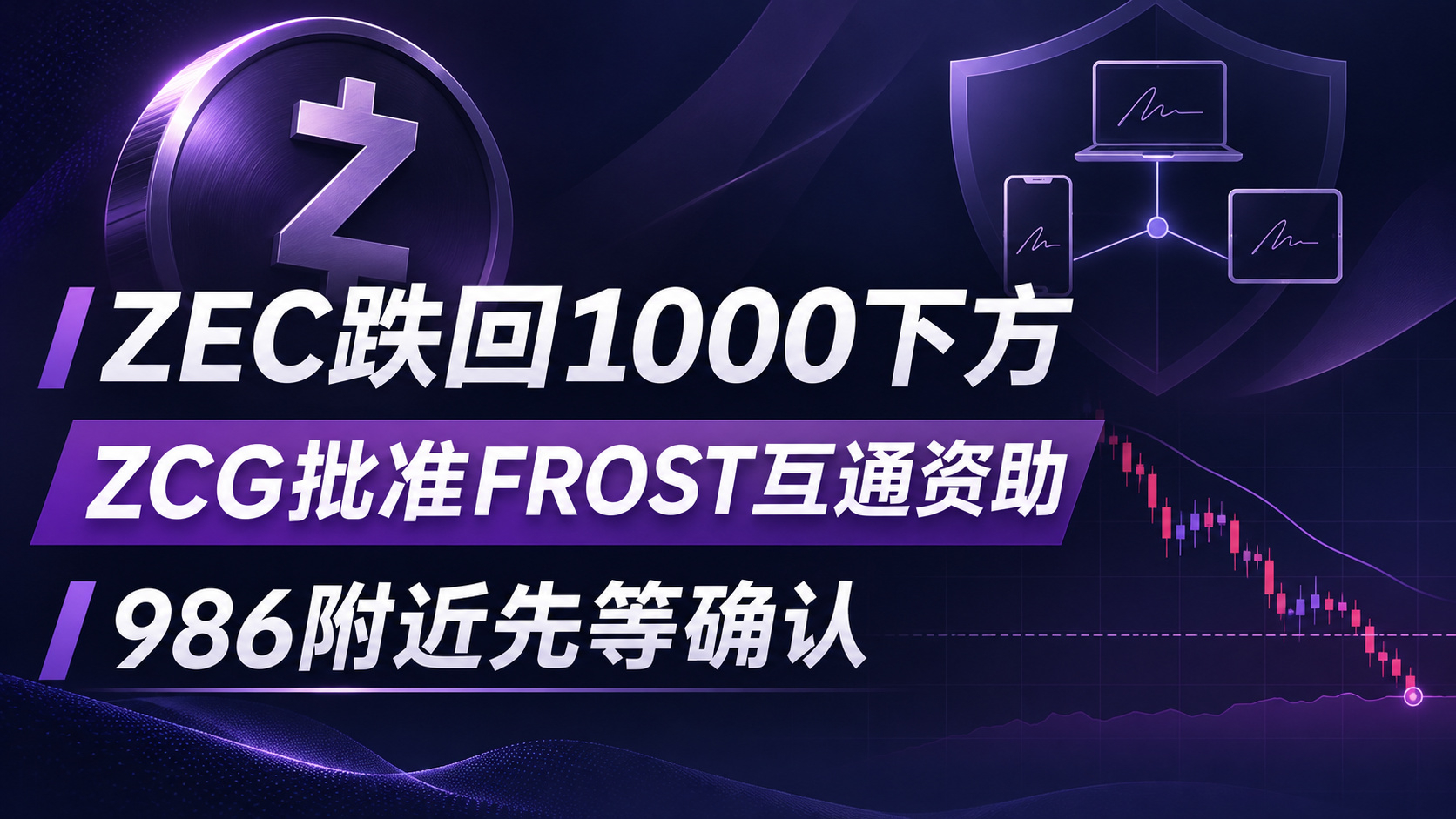
ZEC Falls Back Below $1,000 | Community Grant Supports FROST Interoperability | Focus on Delivery, Don’t Chase the Rebound
My view: This news has long-term value, but for now it is not enough to turn the short-term downtrend directly into a buying opportunity. Binance Square is discussing ZEC falling below $1,000. Meanwhile, the minutes from the November 9 meeting published by Zcash Community Grants (ZCG) show that the committee approved a grant application to fund an open specification and reference implementation for FROST threshold signatures across shielded ZEC wallets. The grant is for $16,500, paid upon completion of two milestones. This is a funding decision; it does not mean the product is complete, has passed an audit, or is already interoperable across multiple wallets.
This detail matters more than “another developer is working on multisig.” If shielded wallets each define their own messages between signing devices and their own key-share backup methods, users may still be unable to recover funds or coordinate when switching wallets—even if all of them support 2-of-3 signatures. If an open specification, test vectors, and an independent Rust component are actually delivered, they could reduce reliance on any single wallet implementation and make it easier for users to move large shielded holdings between wallets. But the grant application also states that a public mainnet release for all users must wait for the relevant viewing-key standards and an independent audit. So I see this as verifiable progress on infrastructure, not as revenue or capital inflows today.
The market reaction should be assessed separately. At around 3:56 p.m. Beijing time today, ZEC/USDT on Binance was around $986.4, down about 1.12% over 24 hours, with a range of $951.21 to $1,024.57. The price is still below $1,000, so it would be wrong to say that the grant approval has already driven a rally. The $1,000 level is a psychological threshold and a level to reclaim; around $1,024 is resistance at the day’s high, while around $951 is support at the day’s low. If the price breaks below $951 and fails to reclaim it, the rebound thesis is invalidated. If it regains and holds above $1,000, then moves past $1,024, that would show buyers are willing to pay more on the news and for subsequent delivery.
If I were trading it myself: I would stay out for now. My only tentative bias would be a small, low-exposure spot position, with no high leverage. I would consider entering in stages using 2% of my total capital only after a 4-hour candle closes above $1,000 and the price subsequently retests that level without breaking below it. If it then breaks above $1,024, I would look toward $1,050 as a target, but I would not add to the position based on a single upper wick. I would take half off at $1,024 and use the post-breakout retest low as a trailing stop for the remainder. The initial stop would be below $951; if triggered, I would close the position. If there is a false breakout, a 4-hour candle closes back below $1,000, or there is a significant obstacle to project delivery or the audit, I would cancel any plans that have not been triggered and exit any existing position in full. The technical grant is worth monitoring, but any trade should still depend on price confirmation and risk limits.
Sources: ZCG’s November 9 meeting minutes, the project application, and milestone details; price data is Binance ZEC/USDT’s 24-hour market data at the time. #ZcashFallsBelow$1000ForFirstTimeSinceSeptember #ZEC
This is solely my personal market observation and does not constitute investment advice.
3
·
--
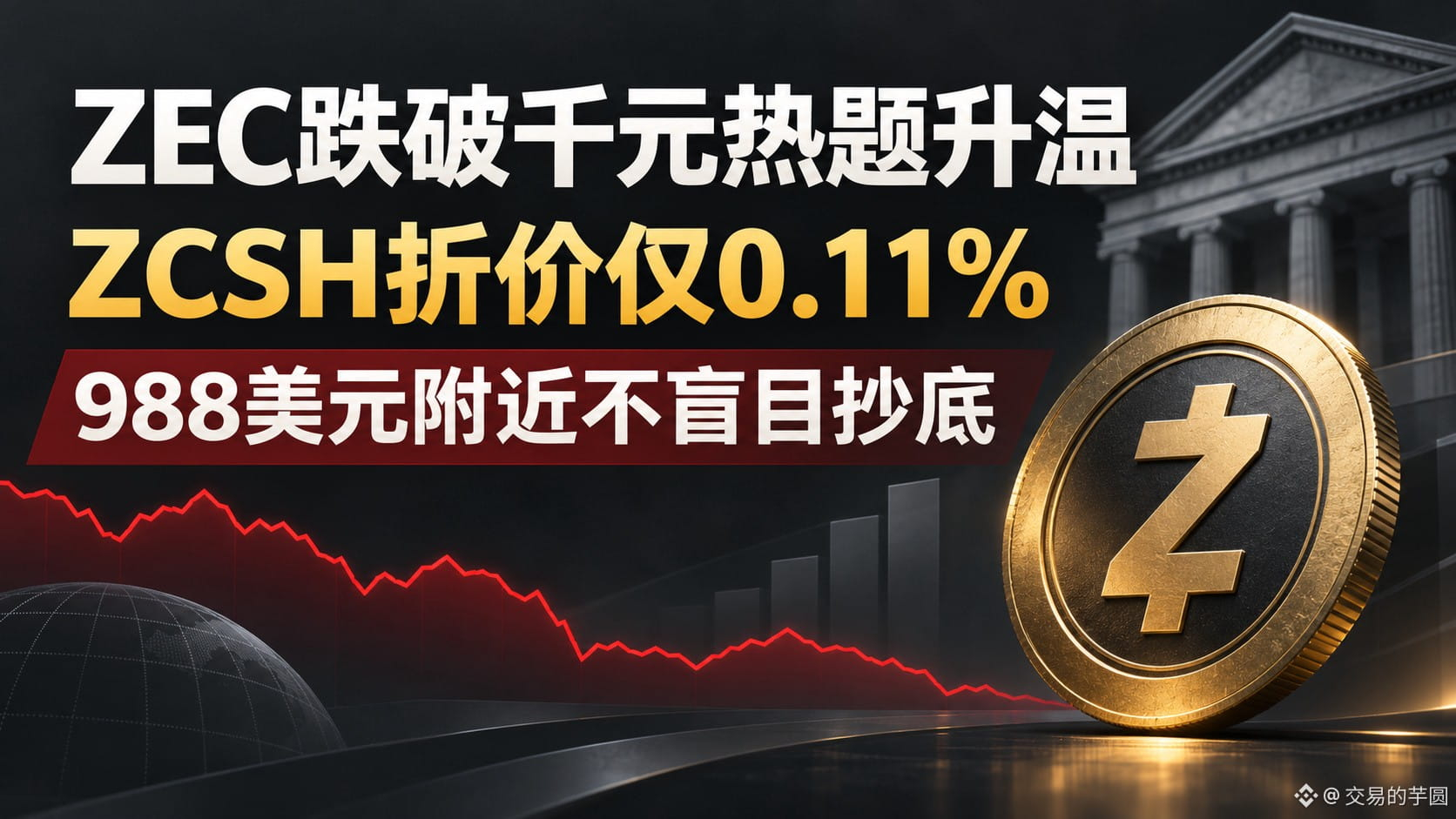
ZEC Falls Below $1,000 as Trending Topic Keeps Heating Up | Fund Discount Just 0.11% | I Don’t Buy the Dip Just Because It’s “Cheap”
My stance upfront: I still treat ZEC as a highly volatile asset, and I won’t automatically buy just because it has fallen below a round-number threshold. The number of discussions about #ZcashFallsBelow$1000ForFirstTimeSinceSeptember in Binance Square’s Trending Topics rose from about 135 when I last checked to 145, showing that interest is still growing; but interest measures discussion, not demand. ZEC has also attracted a lot of attention in Most Searched, which needs to be considered separately from actual fund and spot-market quotes.
This time, I’m looking at things from the perspective of institutional capital. As of November 11, Grayscale ZCSH’s official website listed a market price of $26.53 and a net asset value of $26.56 per share, with an official discount rate of 0.11%; about 2.46 million shares traded that day. This means the fund shares on the secondary market were only slightly below their corresponding NAV. ZEC breaking below $1,000 does not mean the fund is trading at an extreme discount or that institutions are indiscriminately dumping it. Grayscale’s page also lists the fund’s holdings at about 577,300 ZEC, or 0.02658281 ZEC per share; holdings are a snapshot of the fund’s assets, and the number of shares traded that day cannot be used directly to estimate how much ZEC was added or redeemed. The $14.6 million net outflow from Farside on the 11th that I checked last time is a flow metric; the discount and trading volume here are two different kinds of indicators.
Why does this matter for ZEC? The fund price being close to NAV suggests there is currently little evidence of “panic discounting at the share level.” But NAV itself will fall as ZEC falls, and a small discount doesn’t mean spot prices can’t keep dropping. The Zcash community is still discussing the development fund and future upgrade plans. Draft proposals, voting schedules, and network rules that have actually been implemented must be treated separately: the forum says voting is scheduled to begin from November 16 to 30, but whether consensus is reached afterward remains to be seen. Treating these governance proposals as supply changes that have already taken effect would also mislead traders. Macroeconomic interest rates and risk appetite across the broader crypto market can also amplify ZEC’s volatility around round-number thresholds.
The facts currently presented by the market are that Binance ZECUSDT was around $988.37 when checked, down about 1.72% over 24 hours, with a high of $1,024.57 and a low of $951.21. Spot has rebounded from the low, but has yet to climb back above the daily open of $1,005.66. I’m watching $951, $1,006, and $1,025. If it falls below $951 again and fails to rebound strongly, my short-term recovery thesis is invalidated. If it first gets back above $1,006 and then decisively breaks through $1,025, that would suggest buyers have absorbed some of the concerns around fund outflows and governance uncertainty.
If I were trading this myself: I wouldn’t enter now; my position would be 0%, and I’d only consider a conditional, unleveraged spot long. I’d only test the waters with at most 0.2% of my total capital after ZEC gets back above $1,006 and holds that level on a retest. My first target would be $1,025; I’d take half off there and leave the rest to target $1,060. If it falls below $951 after entry, I’d stop out rather than average down. If the breakout fails and the price falls back below $1,006, or fund data shows more pronounced and sustained outflows, I’d close the remaining position. If these conditions aren’t met, I’ll stay out of the market. A plan should not be presented as a completed trade. First confirm whether flows and price are moving in sync, then consider the opportunity.
#ZcashFallsBelow$1000ForFirstTimeSinceSeptember #ZEC
This is solely my personal market observation and does not constitute investment advice.
12

·
--
Partly True
Article
ZEC falls below 1,000: The ecosystem has catalysts, so why hasn't spot buying picked up?ZEC falls below 1,000: The ecosystem has catalysts, so why hasn't spot buying picked up?
At 05:39 Beijing time on November 12, Binance Square's trending page showed `#ZcashFallsBelow$1000ForFirstTimeSinceSeptember` in second place, with 62 people discussing it on the page. What's more worth examining isn't the breach of a round-number threshold itself, but this: Zcash has just received ecosystem support and a protocol upgrade, yet its price has still fallen back below 1,000.
First, let's clarify the boundaries of these events. Grayscale's Zcash Invest page states that, for up to 12 months after ZCSH takes effect, it plans to put 100% of its sponsorship fees toward supporting the development, marketing, and education of the Zcash network. This is a voluntary arrangement by the issuer, not a commitment to buy spot ZEC, nor a direct investment in ZEC by ZCSH. Zcash's NU7 upgrade, meanwhile, reduces the target block interval from 75 seconds to 25 seconds and adds shielded action limits and the Network Sustainability Mechanism. Improvements in protocol efficiency are real progress, but they do not automatically translate into buying demand on exchanges.
ZEC falls below 1,000: The ecosystem has catalysts, so why hasn't spot buying picked up?
ZEC falls below 1,000: The ecosystem has catalysts, so why hasn't spot buying picked up?
At 05:39 Beijing time on November 12, Binance Square's trending page showed `#ZcashFallsBelow$1000ForFirstTimeSinceSeptember` in second place, with 62 people discussing it on the page. What's more worth examining isn't the breach of a round-number threshold itself, but this: Zcash has just received ecosystem support and a protocol upgrade, yet its price has still fallen back below 1,000.
First, let's clarify the boundaries of these events. Grayscale's Zcash Invest page states that, for up to 12 months after ZCSH takes effect, it plans to put 100% of its sponsorship fees toward supporting the development, marketing, and education of the Zcash network. This is a voluntary arrangement by the issuer, not a commitment to buy spot ZEC, nor a direct investment in ZEC by ZCSH. Zcash's NU7 upgrade, meanwhile, reduces the target block interval from 75 seconds to 25 seconds and adds shielded action limits and the Network Sustainability Mechanism. Improvements in protocol efficiency are real progress, but they do not automatically translate into buying demand on exchanges.
569
·
--
ZEC Watch | ZCSH Sees $14.6 Million in Daily Net Outflows | Wait for Flows to Stabilize Before Buying the Dip Below $1,000
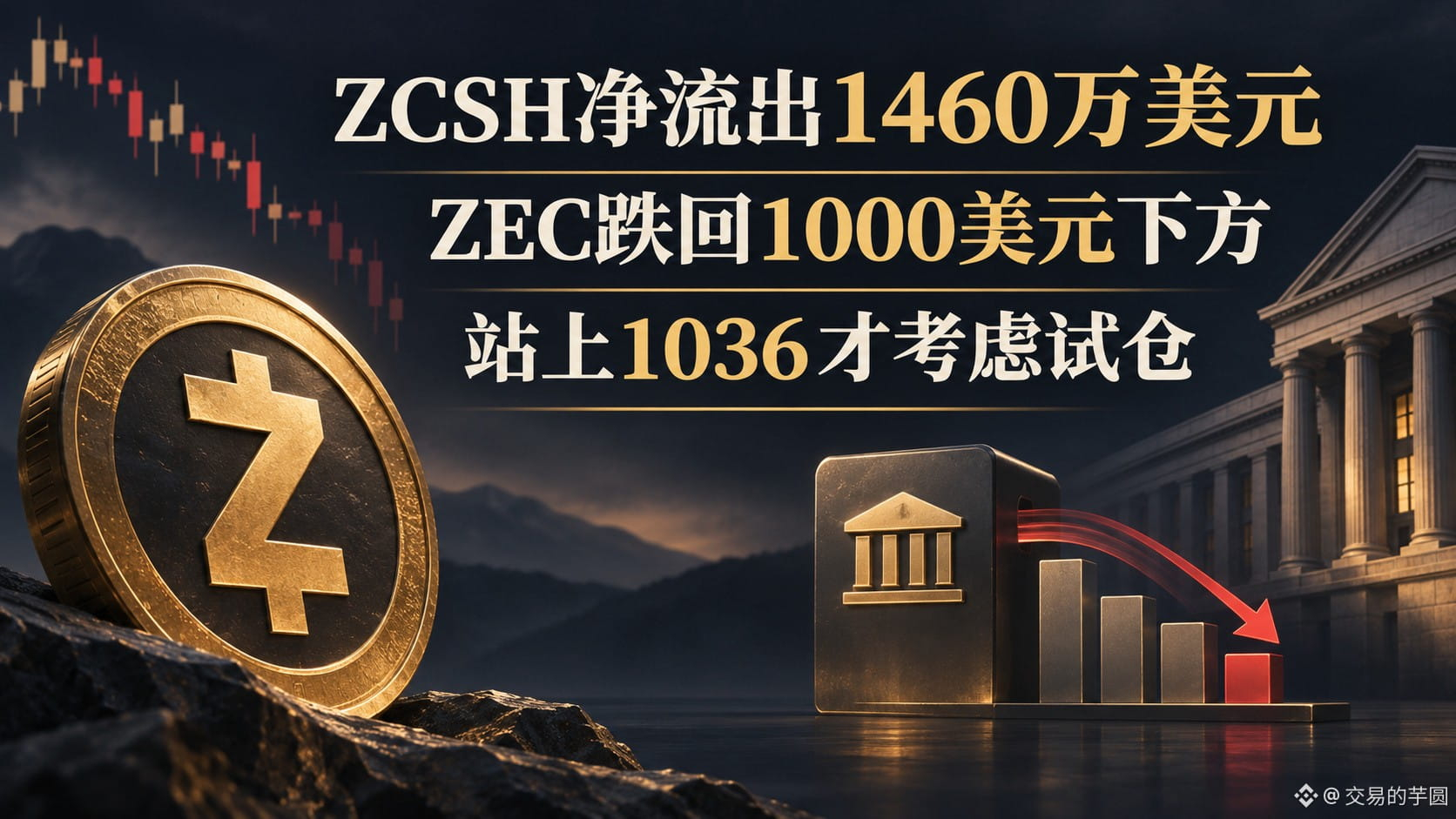
My current stance is to hold off on buying the dip. The trending topic on Binance Square is still Zcash falling below $1,000. What’s more worth adding today isn’t another candlestick chart, but a fact just added to the fund flow data. Farside now shows that U.S. Zcash fund ZCSH saw net outflows of about $14.6 million on November 11, while flows were zero on November 10. On the same day, the fund issuer Grayscale’s website showed that ZCSH closed at $26.53, down 5.22% from the previous day, with about 2.46 million shares traded; the page listed fund assets of about $577 million and holdings of about 577,300 ZEC. Farside’s flow data tracks institutional figures, while Grayscale’s page provides price and holdings snapshots. The metrics use different methodologies: the 2.46 million shares traded on the secondary market cannot all be counted as redemptions, and the drop in fund assets caused by price changes certainly cannot all be attributed to coin sales.
Why does this net outflow matter for ZEC? ZCSH is an exchange-traded product that holds ZEC. If sustained net redemptions occur, the product must handle its shares and underlying assets according to its mechanism, which could weaken marginal buying demand. But a single day’s figure only indicates the direction of subscriptions and redemptions on that day. It doesn’t prove that all redemptions were dumped into the spot market at once, nor can we say they were the only reason ZEC fell. More importantly, watch whether outflows continue over the next two trading days, and whether the fund shares and holdings reported by Grayscale also decline. If flows quickly turn positive, today’s pressure may have been only a round of rebalancing. I’ll also keep an eye on project governance discussions, but the ZCG Treasury Committee proposal is still a community proposal; it shouldn’t be described as already implemented or as actual coin sales today.
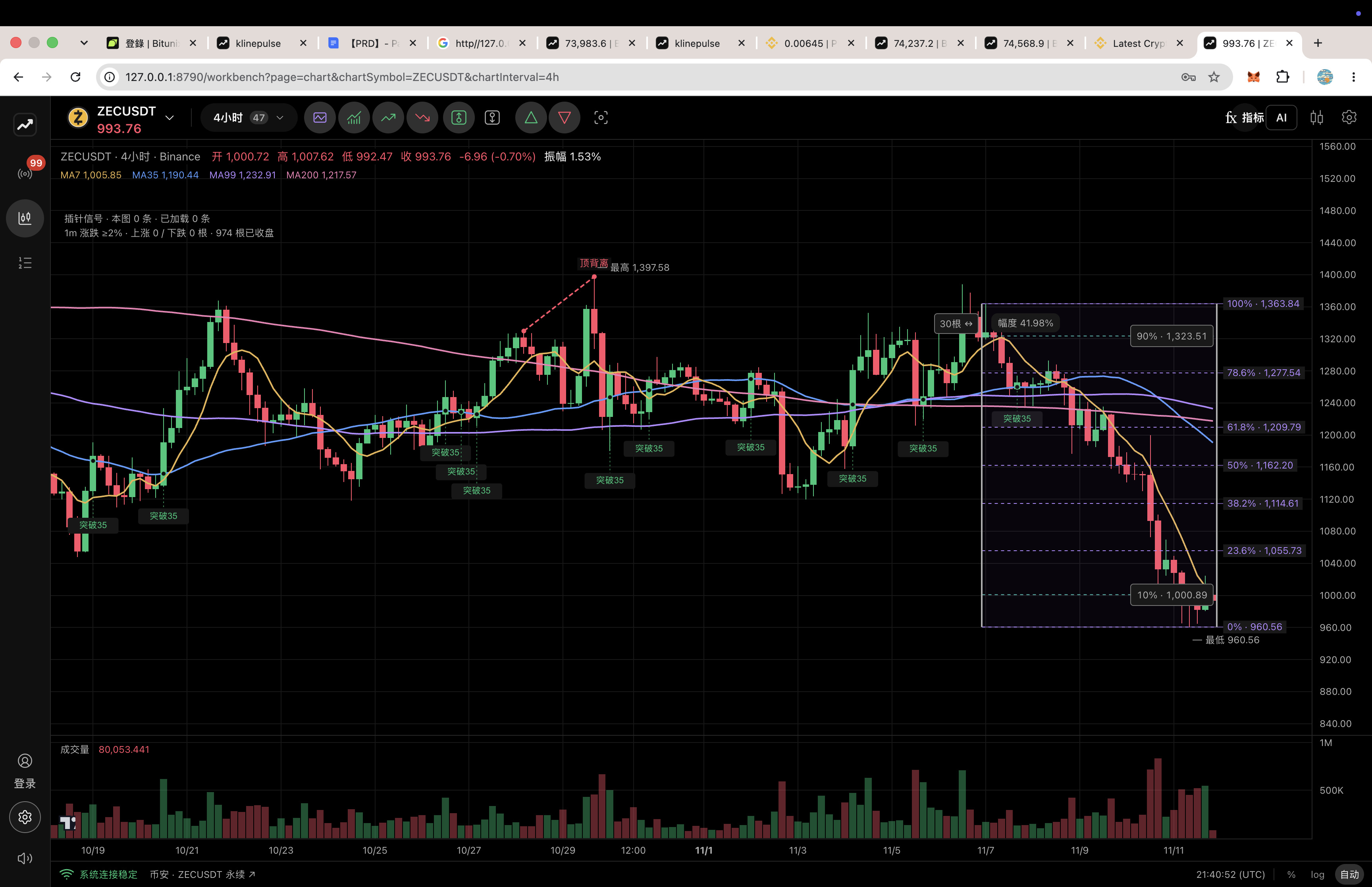
The market has already reacted: at the time of checking, ZECUSDT on Binance was around $983.35, down about 4.69% in 24 hours, with a high of $1,035.94 and a low of $951.21. The pullback from above $1,000 suggests that the previous rebounds failed to establish firm support. ZCSH’s price also fell, but fund prices, spot ZEC, and fund flows can influence one another, so their moving in the same direction does not establish a single cause. The key question is whether the price can first reclaim $1,000, then hold around $1,036; $951 is the 24-hour low. If it breaks below $951 and fails to rebound, my assumption that the short-term decline is stabilizing is invalidated. If it moves back above $1,036 and subsequent fund flows improve, there will be a stronger basis for discussing a recovery.
If I were trading this myself: I wouldn’t participate now or take a high-leverage countertrend long. I’d only consider a spot position if the one-hour candle closes above $1,036, the price holds the $1,000–$1,036 range on a retest, and fund data doesn’t deteriorate for several consecutive days. If those conditions are met, I’d use no more than 3% of my total capital to test a position. The first target is $1,070, where I’d take half off; the second is $1,110, where I’d take half of the remainder off. After entry, if a one-hour candle closes back below $1,000 and the next candle fails to reclaim it, I’d stop out. If $951 is decisively broken, I’d close the entire remaining position and cancel the original plan. If the price first falls below $951, I’d rather stay out and reassess than average down. Improving fund flows and price confirmation should be verified separately; discipline matters more than trying to call the bottom.
Sources: Farside Zcash fund flows, Grayscale ZCSH product page, Binance ZECUSDT market data, Zcash community governance forum. #ZcashFallsBelow$1000ForFirstTimeSinceSeptember #ZEC
This is solely my personal market observation and does not constitute investment advice.
3
·
--
ZEC remains below $1,000|Proof of reserves can be verified|Don't mistake 1:1 coverage for buying pressure
I remain cautious. “Zcash falls below $1,000” is still second on Binance Square’s trending list, and ZEC is also on the six-hour search rankings. When prices are weak, exchange security and custody transparency can directly affect whether holders are willing to stay in the market. Here’s an easily confused fact: an exchange proving it has sufficient reserves to cover customer assets and new active buying emerging in the market are two different things.
Binance’s official November 2 announcement on the recovery from the security incident stated that zero-knowledge proofs had been generated for the October 31 reserve snapshot, with ZEC among ten assets for which users can independently verify at least 1:1 coverage. Binance’s proof-of-reserves page explains that users can find their record ID and Merkle leaf through the wallet verification portal, and check whether their balance at the time of the snapshot was included in the liabilities total. This is transparency information for specific assets at a specific point in time. It does not directly prove that prices will rise today, nor does it replace ongoing scrutiny of subsequent snapshots, withdrawal status, and the exchange’s overall risk. The official recovery announcement also noted that replenishment of affected assets was still progressing in stages, so “ten assets are fully covered” should not be expanded to mean that all coins are risk-free at all times.
Why does this matter to ZEC? Holders of privacy coins are especially concerned about secure custody and the freedom to transfer their assets. If reserve verification is credible, it may ease panic selling prompted by a security incident; but it is not the same as fund inflows, nor does it mean Binance is continuously buying ZEC on the spot market to push up its price. Changes in subscriptions and redemptions for the ZCSH fund belong to another channel of capital flows and should not be double-counted with exchange reserve figures. I’m more concerned with whether users can actually verify the snapshot corresponding to their accounts, and whether subsequent disclosures continue to include ZEC. Any claim about “how much ZEC was bought today” requires new official trading or reserve data and cannot be inferred from an old snapshot.
The market reaction remains weak: at the time of checking, ZEC was around $988, down about 3.2% over 24 hours, with a high of $1,039 and a low of $951. The $1,000 level is the immediate psychological threshold; if the price only briefly moves above it before falling back, that suggests headline attention alone is not enough to change selling pressure. First, watch whether the area around $951 holds, then whether $1,000 and $1,039 can be reclaimed in turn. My cautious view would only be overturned if the price holds above $1,039 on increased volume and subsequent capital flows and project news improve in tandem. If it breaks below $951 and fails to recover on a rebound, the downside risk needs to be reassessed—no guessing where the bottom is.
If I were trading this myself, I would stay out for now and remain flat—not chase a short or rush to buy the dip. I would only consider a leveraged-free spot long using 2% of my total capital if a four-hour candle closes back above $1,000 and the price holds there on a retest. I’d initially target $1,020, take half off upon reaching it, and hold the rest for $1,039. The initial stop-loss would be below $970; if triggered, I’d close the entire position without adding to it. If the price falls back below $1,000 after entry, or subsequent official verification information changes materially, I’d close the position proactively even if the stop-loss hasn’t been hit. If the market breaks directly below $951, the entire long plan is canceled; staying flat is also a way to execute a plan.
Sources: Binance’s November 2 announcement on the recovery from the security incident, Binance’s proof-of-reserves information, Binance spot market snapshot. #ZcashFallsBelow$1000ForFirstTimeSinceSeptember #ZEC
The above is solely my personal market observation and does not constitute investment advice.

3
Log in to explore more content
Join global crypto users on Binance Square
⚡️ Get latest and useful information about crypto.
💬 Trusted by the world’s largest crypto exchange.
👍 Discover real insights from verified creators.
Email / Phone number
Trending Topics
1
#HuangExitNvidiaStrategyInFocus
30,045 views
597 Discussing
2
#AnthropicRejectsIPODelayValuationinQuestion
597,743 views
4,935 Discussing
3
#BitMineReports$6.3BNetLossForFiscal2026
3,590 views
78 Discussing
4
#ChipStocksExtendLossesAfterNvidiaCEOChange
10,061 views
290 Discussing
5
#ThailandProposes$148KDailyStablecoinDepositWithdrawalCaps
758 views
17 Discussing
6
#CoreWeaveJumps10%On168%RevenueGrowth
137,056 views
1,529 Discussing
7
#ZcashFallsBelow$1000ForFirstTimeSinceSeptember
68,804 views
252 Discussing
8
#MSCIRemovalMayCurbStrategy’sBitcoinBuying
31,503 views
496 Discussing
9
#TradFiForBeginners
506,387 views
3,554 Discussing
10
#USJoblessClaimsRise
19.1M views
7,688 Discussing