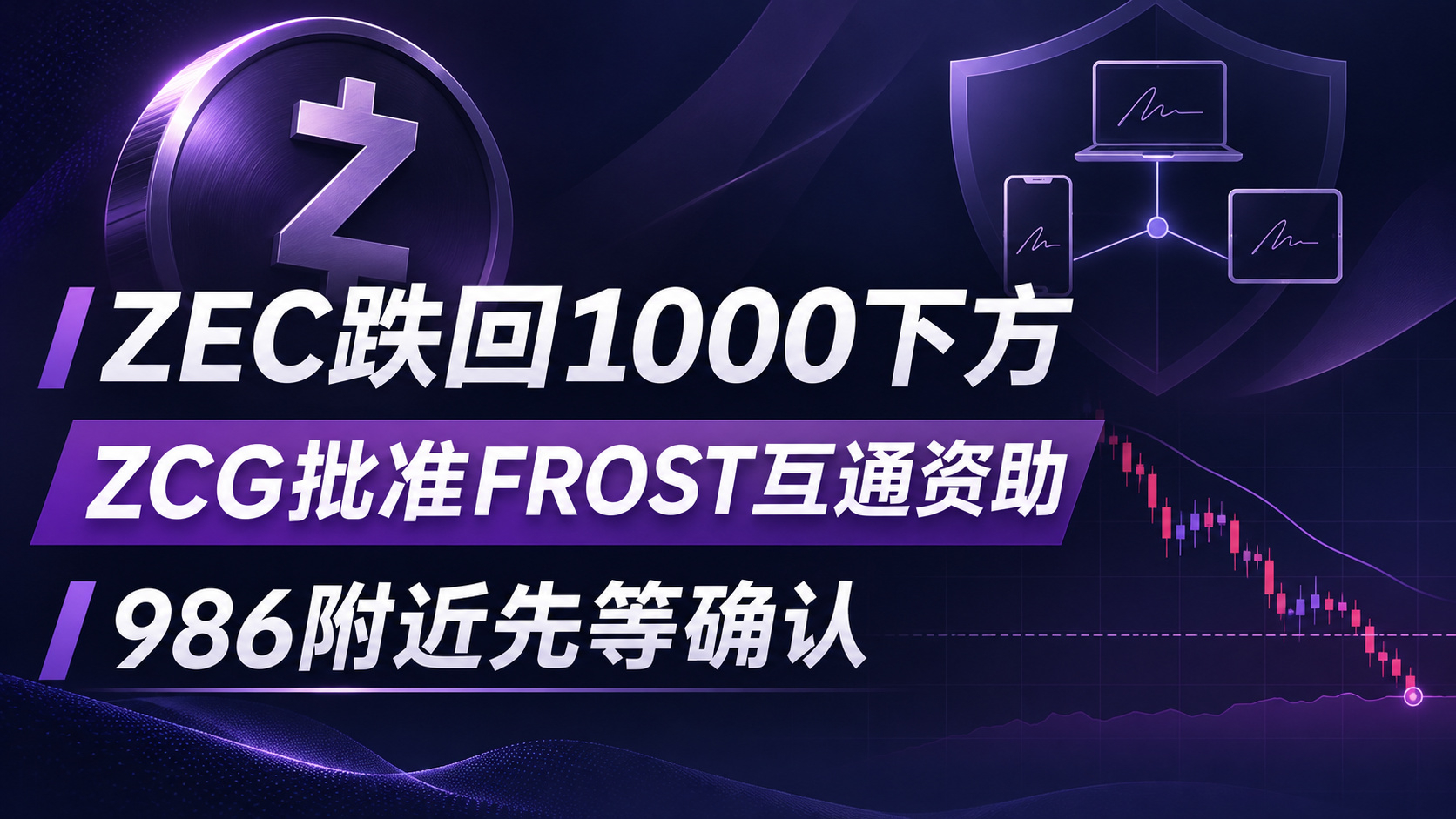
ZEC Falls Back Below $1,000 | Community Grant Supports FROST Interoperability | Focus on Delivery, Don’t Chase the Rebound
My view: This news has long-term value, but for now it is not enough to turn the short-term downtrend directly into a buying opportunity. Binance Square is discussing ZEC falling below $1,000. Meanwhile, the minutes from the November 9 meeting published by Zcash Community Grants (ZCG) show that the committee approved a grant application to fund an open specification and reference implementation for FROST threshold signatures across shielded ZEC wallets. The grant is for $16,500, paid upon completion of two milestones. This is a funding decision; it does not mean the product is complete, has passed an audit, or is already interoperable across multiple wallets.
This detail matters more than “another developer is working on multisig.” If shielded wallets each define their own messages between signing devices and their own key-share backup methods, users may still be unable to recover funds or coordinate when switching wallets—even if all of them support 2-of-3 signatures. If an open specification, test vectors, and an independent Rust component are actually delivered, they could reduce reliance on any single wallet implementation and make it easier for users to move large shielded holdings between wallets. But the grant application also states that a public mainnet release for all users must wait for the relevant viewing-key standards and an independent audit. So I see this as verifiable progress on infrastructure, not as revenue or capital inflows today.
The market reaction should be assessed separately. At around 3:56 p.m. Beijing time today, ZEC/USDT on Binance was around $986.4, down about 1.12% over 24 hours, with a range of $951.21 to $1,024.57. The price is still below $1,000, so it would be wrong to say that the grant approval has already driven a rally. The $1,000 level is a psychological threshold and a level to reclaim; around $1,024 is resistance at the day’s high, while around $951 is support at the day’s low. If the price breaks below $951 and fails to reclaim it, the rebound thesis is invalidated. If it regains and holds above $1,000, then moves past $1,024, that would show buyers are willing to pay more on the news and for subsequent delivery.
If I were trading it myself: I would stay out for now. My only tentative bias would be a small, low-exposure spot position, with no high leverage. I would consider entering in stages using 2% of my total capital only after a 4-hour candle closes above $1,000 and the price subsequently retests that level without breaking below it. If it then breaks above $1,024, I would look toward $1,050 as a target, but I would not add to the position based on a single upper wick. I would take half off at $1,024 and use the post-breakout retest low as a trailing stop for the remainder. The initial stop would be below $951; if triggered, I would close the position. If there is a false breakout, a 4-hour candle closes back below $1,000, or there is a significant obstacle to project delivery or the audit, I would cancel any plans that have not been triggered and exit any existing position in full. The technical grant is worth monitoring, but any trade should still depend on price confirmation and risk limits.
Sources: ZCG’s November 9 meeting minutes, the project application, and milestone details; price data is Binance ZEC/USDT’s 24-hour market data at the time. #ZcashFallsBelow$1000ForFirstTimeSinceSeptember #ZEC
This is solely my personal market observation and does not constitute investment advice.