
#tradingturtle
tradingturtle
2,582 views
82 Discussing
Hot
Latest

Risk management · Lesson 10
Position sizing
A wider stop changes the meaning of the same position size.
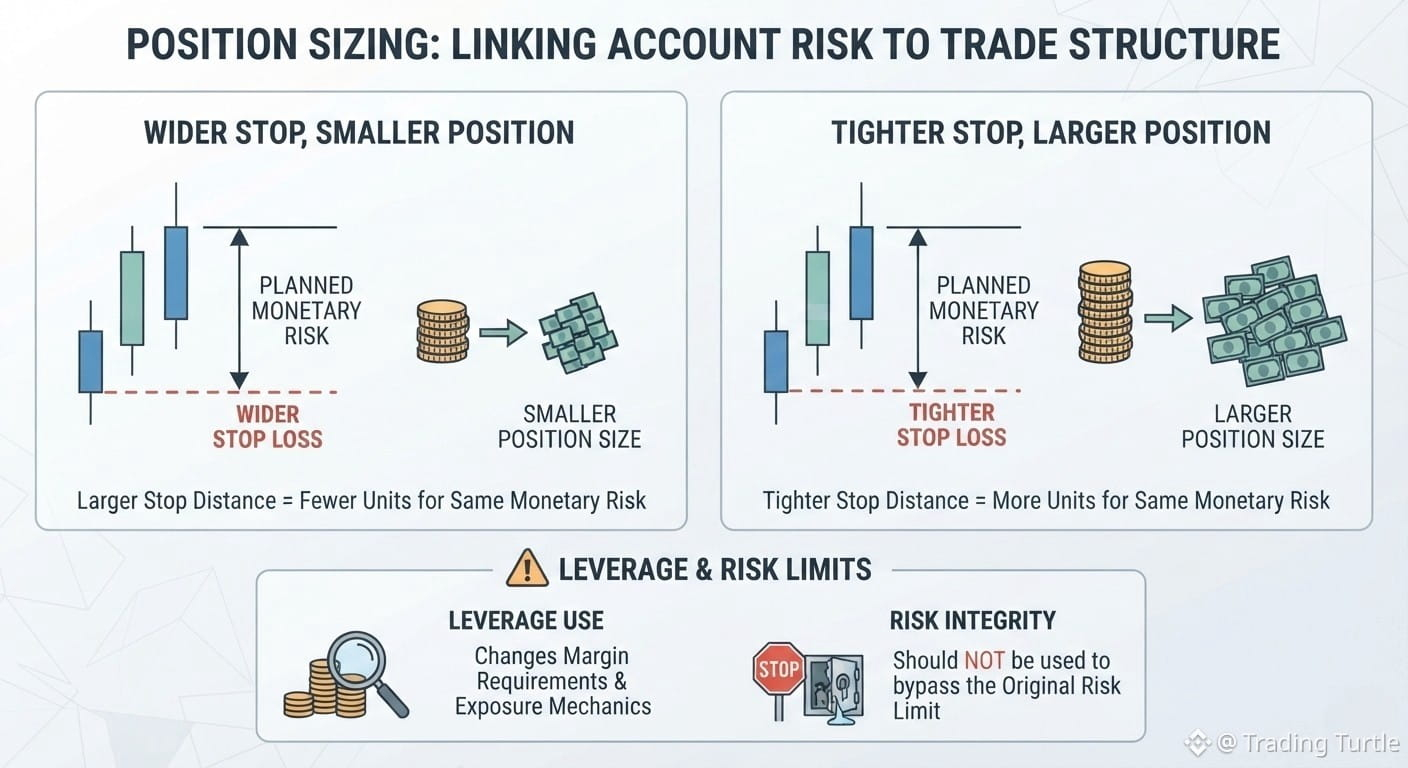
Position sizing links account risk to trade structure. A wider stop generally requires a smaller position for the same planned monetary risk, while a tighter stop permits a larger position only if the tighter invalidation is technically justified. Leverage changes margin requirements and exposure mechanics, but it should not be used to bypass the original risk limit.
Imagine the distance to invalidation widens while the risk budget stays fixed. Position size must respond to that distance rather than being chosen independently.
Explain how a change in stop distance affects size when the planned risk budget is unchanged. Include fees and execution uncertainty.
Next in this series: Risk-reward and expectancy.
#TradingEducation #PriceAction #RiskManagement #TradingTurtle
Risk management · Lesson 10
Position sizing
A wider stop changes the meaning of the same position size.
Position sizing links account risk to trade structure. A wider stop generally requires a smaller position for the same planned monetary risk, while a tighter stop permits a larger position only if the tighter invalidation is technically justified. Leverage changes margin requirements and exposure mechanics, but it should not be used to bypass the original risk limit.
Imagine the distance to invalidation widens while the risk budget stays fixed. Position size must respond to that distance rather than being chosen independently.
Explain how a change in stop distance affects size when the planned risk budget is unchanged. Include fees and execution uncertainty.
Next in this series: Risk-reward and expectancy.
#TradingEducation #PriceAction #RiskManagement #TradingTurtle
Position sizing
A wider stop changes the meaning of the same position size.
Position sizing links account risk to trade structure. A wider stop generally requires a smaller position for the same planned monetary risk, while a tighter stop permits a larger position only if the tighter invalidation is technically justified. Leverage changes margin requirements and exposure mechanics, but it should not be used to bypass the original risk limit.
Imagine the distance to invalidation widens while the risk budget stays fixed. Position size must respond to that distance rather than being chosen independently.
Explain how a change in stop distance affects size when the planned risk budget is unchanged. Include fees and execution uncertainty.
Next in this series: Risk-reward and expectancy.
#TradingEducation #PriceAction #RiskManagement #TradingTurtle
53
Risk management · Lesson 9
Risk per trade
An appealing setup can distract from the amount of capital exposed if it fails.
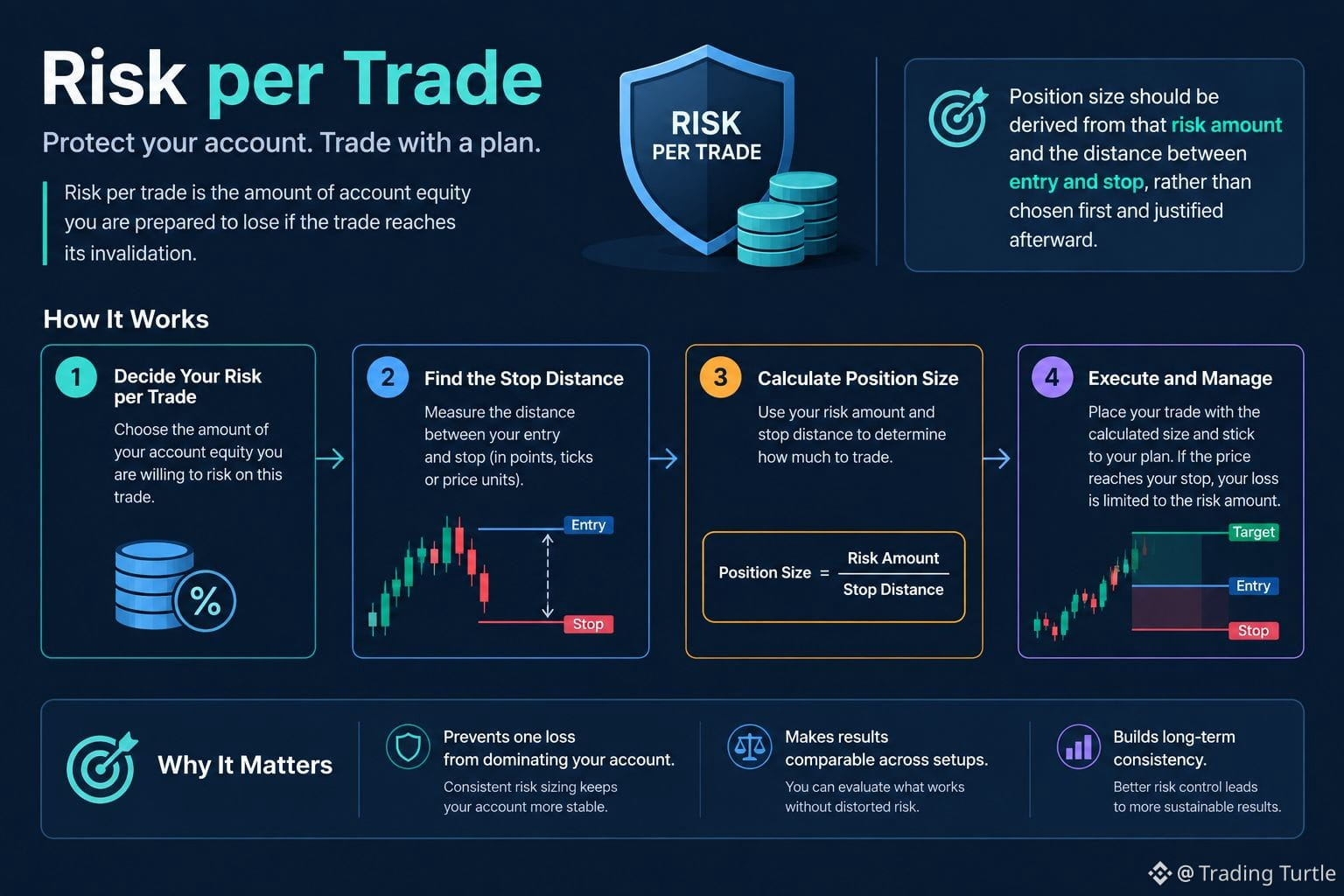
Risk per trade is the amount of account equity a trader is prepared to lose if the trade reaches its invalidation. Position size should be derived from that risk amount and the distance between entry and stop, rather than chosen first and justified afterward. Consistent risk sizing helps keep one losing trade from dominating the account and makes results easier to compare across setups.
Compare two hypothetical trades with different stop distances. Equal position sizes do not necessarily expose equal amounts of capital.
Describe the loss your plan is designed around before discussing potential reward. State what could make the realised loss worse.
Next in this series: Position sizing.
#TradingEducation #PriceAction #RiskManagement #TradingTurtle
Risk management · Lesson 9
Risk per trade
An appealing setup can distract from the amount of capital exposed if it fails.
Risk per trade is the amount of account equity a trader is prepared to lose if the trade reaches its invalidation. Position size should be derived from that risk amount and the distance between entry and stop, rather than chosen first and justified afterward. Consistent risk sizing helps keep one losing trade from dominating the account and makes results easier to compare across setups.
Compare two hypothetical trades with different stop distances. Equal position sizes do not necessarily expose equal amounts of capital.
Describe the loss your plan is designed around before discussing potential reward. State what could make the realised loss worse.
Next in this series: Position sizing.
#TradingEducation #PriceAction #RiskManagement #TradingTurtle
Risk per trade
An appealing setup can distract from the amount of capital exposed if it fails.
Risk per trade is the amount of account equity a trader is prepared to lose if the trade reaches its invalidation. Position size should be derived from that risk amount and the distance between entry and stop, rather than chosen first and justified afterward. Consistent risk sizing helps keep one losing trade from dominating the account and makes results easier to compare across setups.
Compare two hypothetical trades with different stop distances. Equal position sizes do not necessarily expose equal amounts of capital.
Describe the loss your plan is designed around before discussing potential reward. State what could make the realised loss worse.
Next in this series: Position sizing.
#TradingEducation #PriceAction #RiskManagement #TradingTurtle
1
Define Invalidation Before Setting an Entry
1. Identify the core thesis of the setup (e.g., price will break the resistance because momentum is strong).
2. Ask: What specific market move would prove this thesis wrong? Write that condition down as the invalidation point.
3. Verify that the invalidation point is observable on the chart before you even consider an entry price (e.g., a close below the swing low for a long bias).
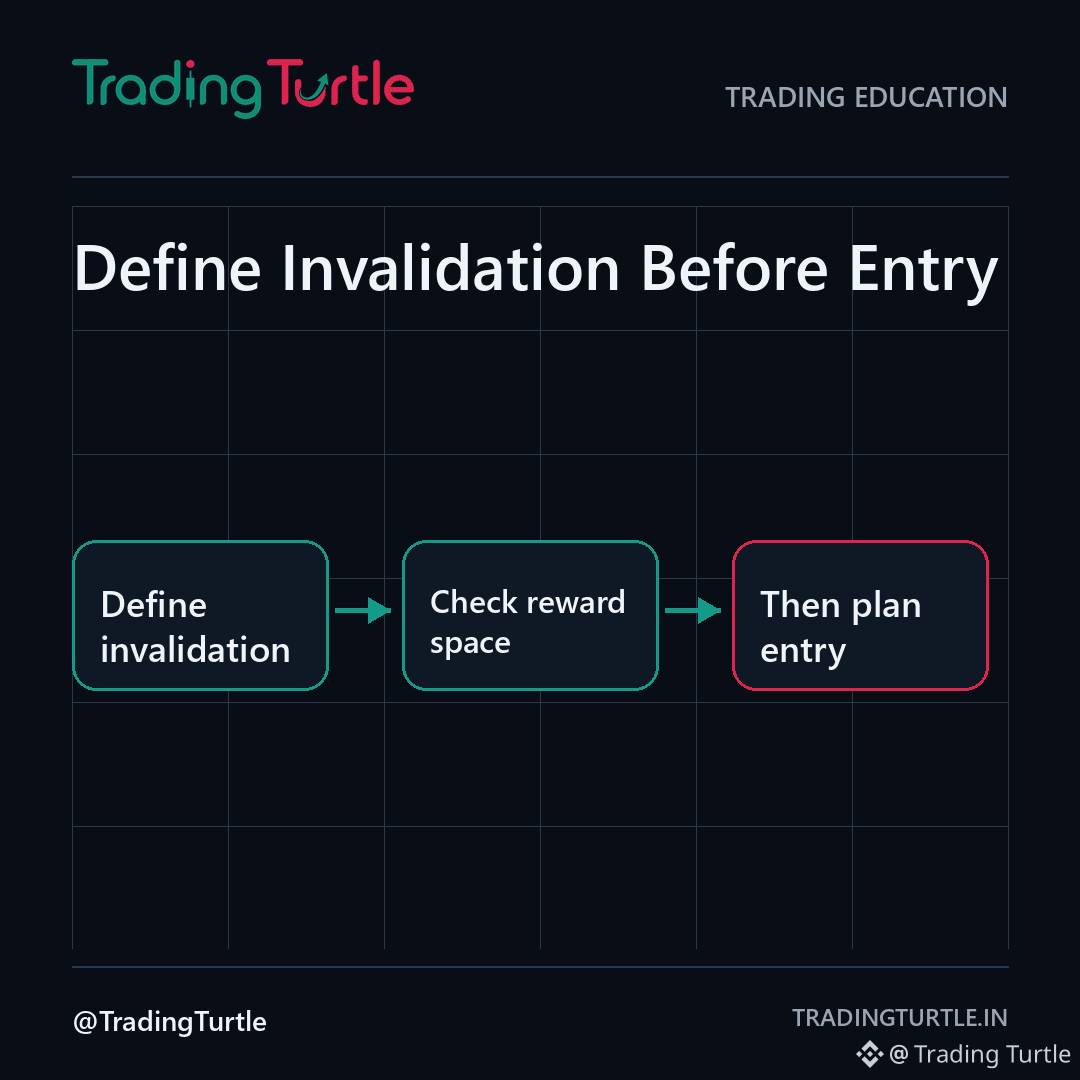
4. Only after the invalidation is clearly defined, calculate risk: place the stop at the invalidation level and size the position so that loss equals your predefined risk unit.
5. Confirm that the reward target is at least twice the distance to the invalidation; if not, discard or adjust the setup.
A trade is not fully defined until you know exactly what will invalidate the idea; use that point to set entry, stop, and position size.
#TradingTurtle #PositionSizing #RiskManagement
Define Invalidation Before Setting an Entry
1. Identify the core thesis of the setup (e.g., price will break the resistance because momentum is strong).
2. Ask: What specific market move would prove this thesis wrong? Write that condition down as the invalidation point.
3. Verify that the invalidation point is observable on the chart before you even consider an entry price (e.g., a close below the swing low for a long bias).
4. Only after the invalidation is clearly defined, calculate risk: place the stop at the invalidation level and size the position so that loss equals your predefined risk unit.
5. Confirm that the reward target is at least twice the distance to the invalidation; if not, discard or adjust the setup.
A trade is not fully defined until you know exactly what will invalidate the idea; use that point to set entry, stop, and position size.
#TradingTurtle #PositionSizing #RiskManagement
1. Identify the core thesis of the setup (e.g., price will break the resistance because momentum is strong).
2. Ask: What specific market move would prove this thesis wrong? Write that condition down as the invalidation point.
3. Verify that the invalidation point is observable on the chart before you even consider an entry price (e.g., a close below the swing low for a long bias).
4. Only after the invalidation is clearly defined, calculate risk: place the stop at the invalidation level and size the position so that loss equals your predefined risk unit.
5. Confirm that the reward target is at least twice the distance to the invalidation; if not, discard or adjust the setup.
A trade is not fully defined until you know exactly what will invalidate the idea; use that point to set entry, stop, and position size.
#TradingTurtle #PositionSizing #RiskManagement
45
Maintain Your Risk Unit During Drawdown
You are in a losing streak and your account equity has fallen below the level where a typical trade would risk your standard unit (e.g., 1% of account). The condition for action is: equity < threshold that defines a full risk unit.
The instinct to enlarge position size to “recover faster” is invalid because it raises the absolute dollar risk per trade, breaking the consistency of your risk process and exposing you to larger losses if the trend continues.
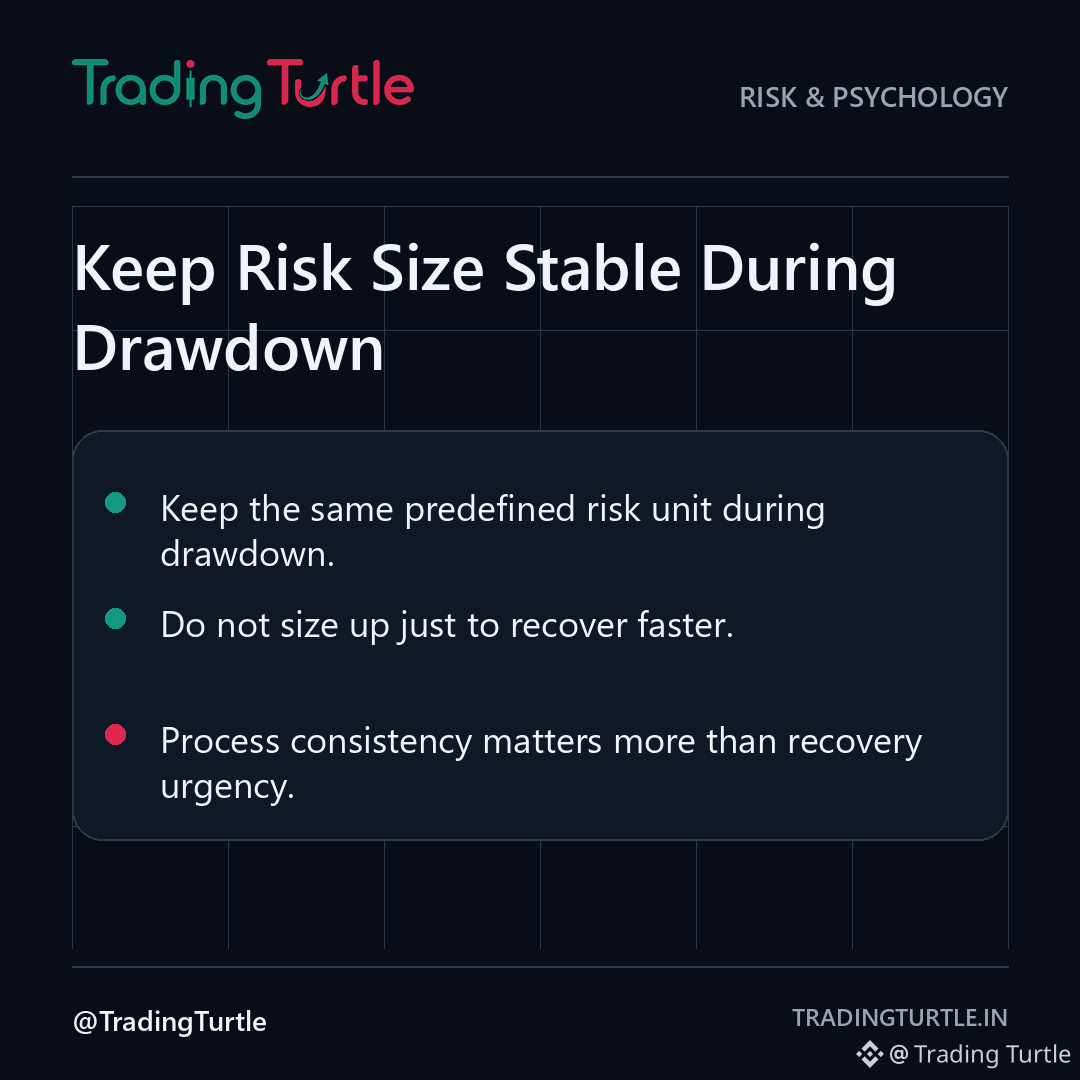
Decision: keep the predefined risk unit unchanged. Trade the same % of equity as before, even if that means a smaller dollar amount per trade while you are in drawdown.
Preserve the original risk unit during drawdown; avoid scaling up position size to chase recovery.
#TradingTurtle #PositionSizing #TradingPsychology
Maintain Your Risk Unit During Drawdown
You are in a losing streak and your account equity has fallen below the level where a typical trade would risk your standard unit (e.g., 1% of account). The condition for action is: equity < threshold that defines a full risk unit.
The instinct to enlarge position size to “recover faster” is invalid because it raises the absolute dollar risk per trade, breaking the consistency of your risk process and exposing you to larger losses if the trend continues.
Decision: keep the predefined risk unit unchanged. Trade the same % of equity as before, even if that means a smaller dollar amount per trade while you are in drawdown.
Preserve the original risk unit during drawdown; avoid scaling up position size to chase recovery.
#TradingTurtle #PositionSizing #TradingPsychology
You are in a losing streak and your account equity has fallen below the level where a typical trade would risk your standard unit (e.g., 1% of account). The condition for action is: equity < threshold that defines a full risk unit.
The instinct to enlarge position size to “recover faster” is invalid because it raises the absolute dollar risk per trade, breaking the consistency of your risk process and exposing you to larger losses if the trend continues.
Decision: keep the predefined risk unit unchanged. Trade the same % of equity as before, even if that means a smaller dollar amount per trade while you are in drawdown.
Preserve the original risk unit during drawdown; avoid scaling up position size to chase recovery.
#TradingTurtle #PositionSizing #TradingPsychology
71
Late-Entry Fomo | Risk psychology | #TradingTurtle
──────────────────────────────────────
The candle that creates FOMO is often the candle that already used the easy part of the move. If the entry comes after expansion, the stop is usually wider and the next target is usually closer. A better rule is to wait for pullback, retest, or a fresh reaction where risk can be defined. 🛡️
#RiskManagement #TradingPsychology #TradingPlan
Late-Entry Fomo | Risk psychology | #TradingTurtle
──────────────────────────────────────
The candle that creates FOMO is often the candle that already used the easy part of the move. If the entry comes after expansion, the stop is usually wider and the next target is usually closer. A better rule is to wait for pullback, retest, or a fresh reaction where risk can be defined. 🛡️
#RiskManagement #TradingPsychology #TradingPlan
──────────────────────────────────────
The candle that creates FOMO is often the candle that already used the easy part of the move. If the entry comes after expansion, the stop is usually wider and the next target is usually closer. A better rule is to wait for pullback, retest, or a fresh reaction where risk can be defined. 🛡️
#RiskManagement #TradingPsychology #TradingPlan
4
Multi-Timeframe Trading | Htf To Ltf Entries | #TradingTurtle
──────────────────────────────────────
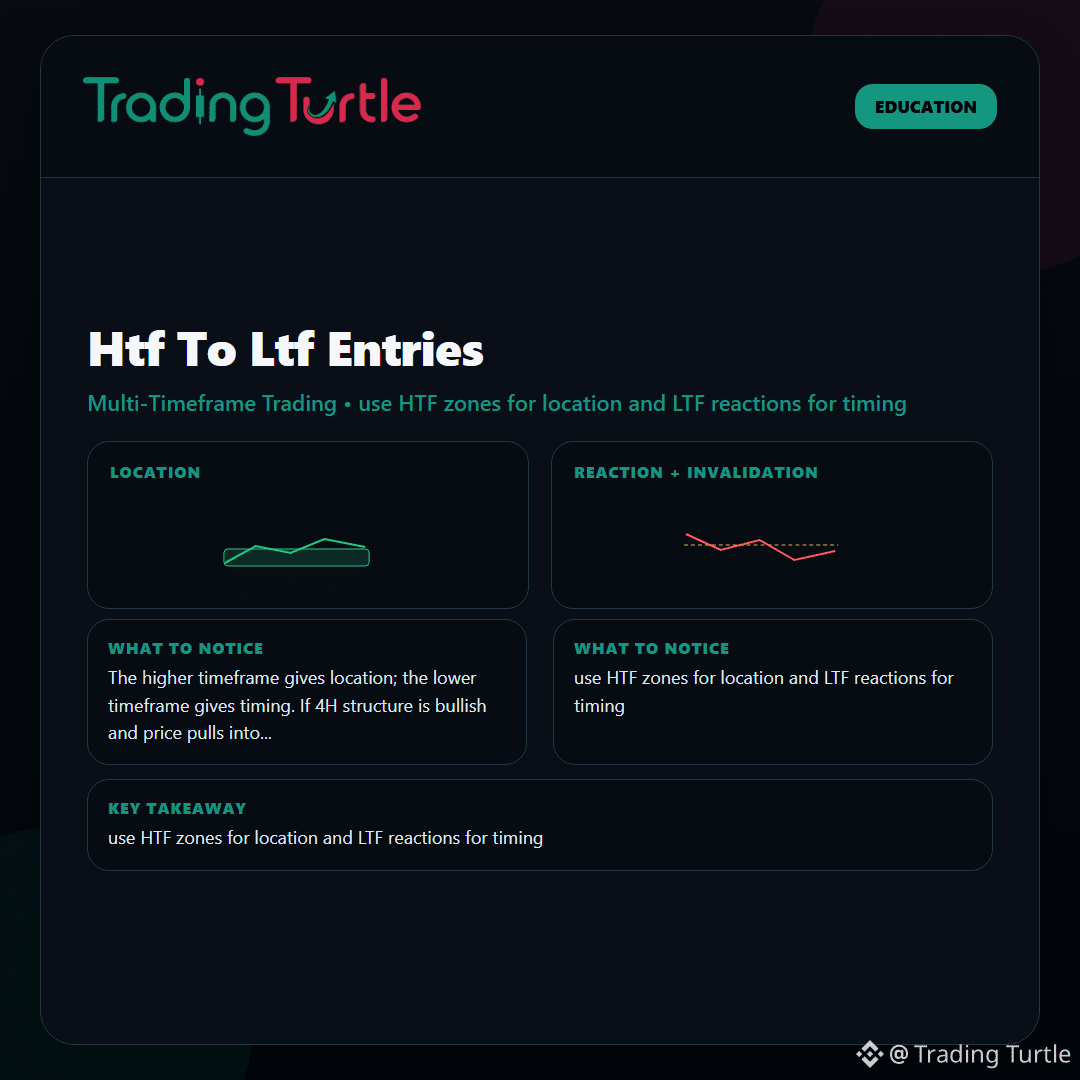
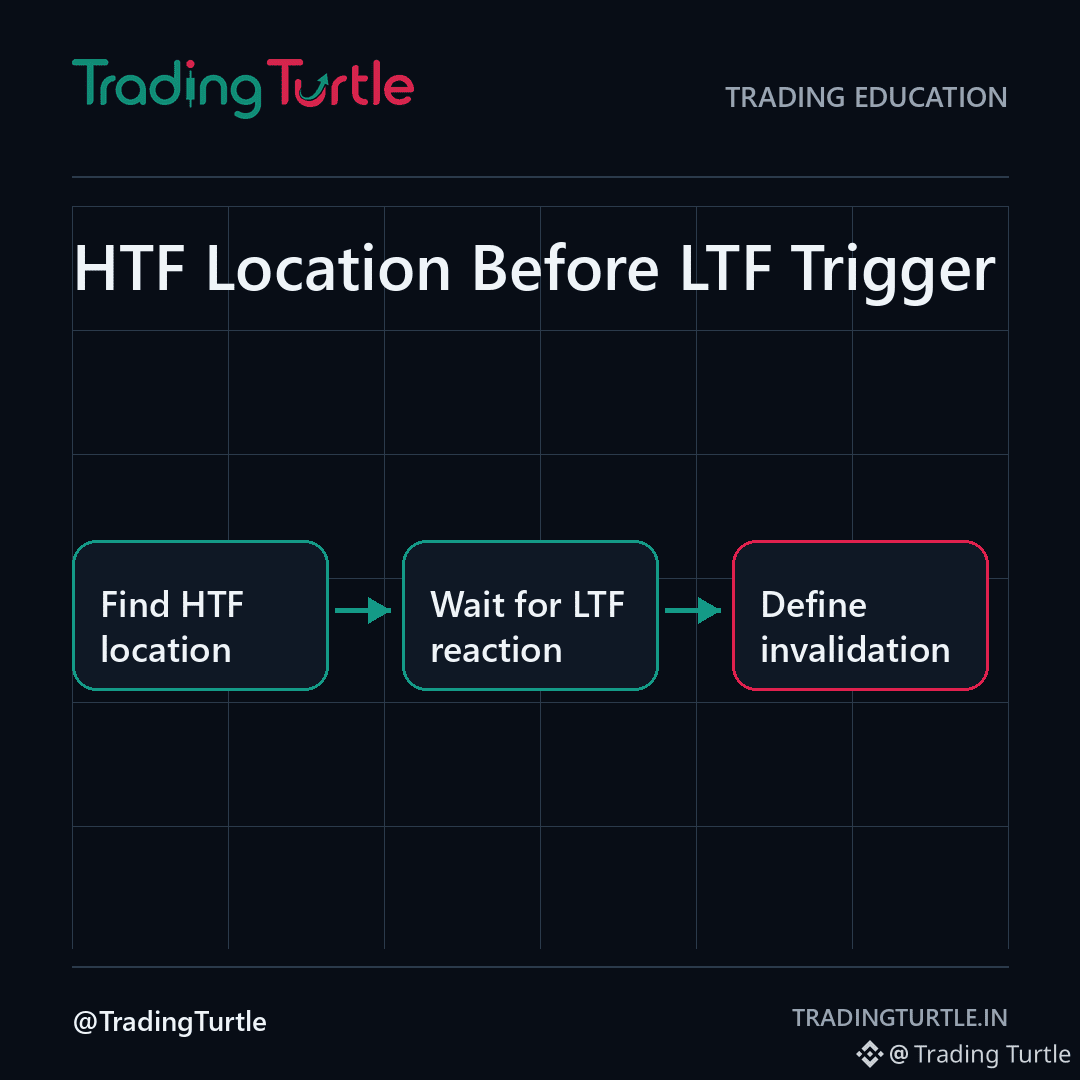
The higher timeframe gives location; the lower timeframe gives timing. If 4H structure is bullish and price pulls into a 4H demand or support area, a 15M reaction can help define entry and invalidation. The lower timeframe should not fight the higher timeframe obstacle. The mindset is discipline: do not take a lower-timeframe candle just because it looks good if the higher timeframe is pressing into supply or resistance with no room. 🐢
#TradingEducation #TechnicalAnalysis #CryptoTrading
Multi-Timeframe Trading | Htf To Ltf Entries | #TradingTurtle
──────────────────────────────────────
The higher timeframe gives location; the lower timeframe gives timing. If 4H structure is bullish and price pulls into a 4H demand or support area, a 15M reaction can help define entry and invalidation. The lower timeframe should not fight the higher timeframe obstacle. The mindset is discipline: do not take a lower-timeframe candle just because it looks good if the higher timeframe is pressing into supply or resistance with no room. 🐢
#TradingEducation #TechnicalAnalysis #CryptoTrading
──────────────────────────────────────
The higher timeframe gives location; the lower timeframe gives timing. If 4H structure is bullish and price pulls into a 4H demand or support area, a 15M reaction can help define entry and invalidation. The lower timeframe should not fight the higher timeframe obstacle. The mindset is discipline: do not take a lower-timeframe candle just because it looks good if the higher timeframe is pressing into supply or resistance with no room. 🐢
#TradingEducation #TechnicalAnalysis #CryptoTrading
4
🧠 Market Structure | Range Edges | #TradingTurtle
──────────────────────────────────────
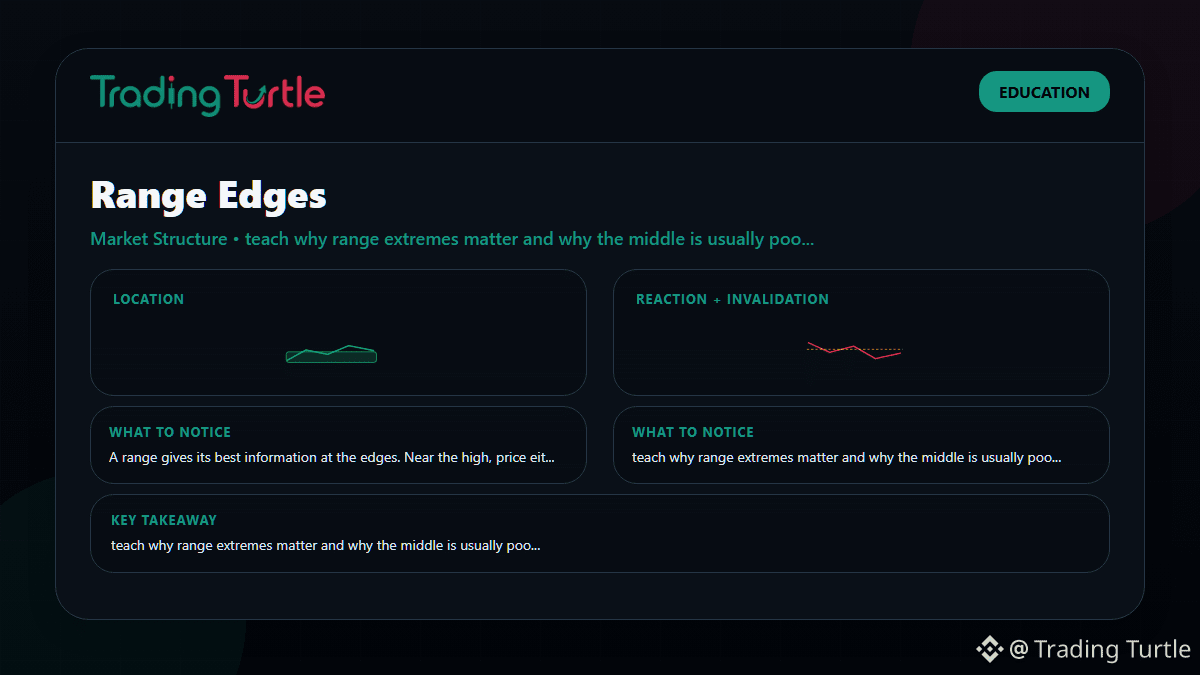
A range gives its best information at the edges. Near the high, price either accepts above resistance or rejects back inside. Near the low, price either accepts below support or fails and reclaims. The middle of the range is psychologically noisy because both buyers and sellers can be wrong quickly. The mindset lesson is patience: wait for the edge, then decide whether the market is breaking out, sweeping liquidity, or reverting. 🐢
#TradingEducation #TechnicalAnalysis #CryptoTrading
🧠 Market Structure | Range Edges | #TradingTurtle
──────────────────────────────────────
A range gives its best information at the edges. Near the high, price either accepts above resistance or rejects back inside. Near the low, price either accepts below support or fails and reclaims. The middle of the range is psychologically noisy because both buyers and sellers can be wrong quickly. The mindset lesson is patience: wait for the edge, then decide whether the market is breaking out, sweeping liquidity, or reverting. 🐢
#TradingEducation #TechnicalAnalysis #CryptoTrading
──────────────────────────────────────
A range gives its best information at the edges. Near the high, price either accepts above resistance or rejects back inside. Near the low, price either accepts below support or fails and reclaims. The middle of the range is psychologically noisy because both buyers and sellers can be wrong quickly. The mindset lesson is patience: wait for the edge, then decide whether the market is breaking out, sweeping liquidity, or reverting. 🐢
#TradingEducation #TechnicalAnalysis #CryptoTrading
3
🛡️ The No-Trade Rule | Risk psychology | #TradingTurtle
──────────────────────────────────────
A no-trade rule protects you from the setups that look active but have no clean location. If price is mid-range, invalidation is vague, or the next opposing zone is too close, standing aside is not weakness. The goal is to save attention and capital for the chart areas where the plan is obvious. 🛡️
#RiskManagement #TradingPsychology #TradingPlan
🛡️ The No-Trade Rule | Risk psychology | #TradingTurtle
──────────────────────────────────────
A no-trade rule protects you from the setups that look active but have no clean location. If price is mid-range, invalidation is vague, or the next opposing zone is too close, standing aside is not weakness. The goal is to save attention and capital for the chart areas where the plan is obvious. 🛡️
#RiskManagement #TradingPsychology #TradingPlan
──────────────────────────────────────
A no-trade rule protects you from the setups that look active but have no clean location. If price is mid-range, invalidation is vague, or the next opposing zone is too close, standing aside is not weakness. The goal is to save attention and capital for the chart areas where the plan is obvious. 🛡️
#RiskManagement #TradingPsychology #TradingPlan
31
🛡️ Risk & Psychology | #TradingTurtle
──────────────────────────────────────
Having a plan and following it feel completely different in the moment. The gap between what traders say they do and what they actually do.
The hard part is not knowing this — it's catching yourself in the moment. That's where journaling and pre-defined rules actually help: not as bureaucracy, but as something to check against when the emotion is trying to make decisions for you.
Most accounts aren't blown by bad strategy. They're blown by ignoring the strategy at exactly the wrong moment.
#TradingPsychology #RiskManagement #CryptoMindset #TradingTurtle
🛡️ Risk & Psychology | #TradingTurtle
──────────────────────────────────────
Having a plan and following it feel completely different in the moment. The gap between what traders say they do and what they actually do.
The hard part is not knowing this — it's catching yourself in the moment. That's where journaling and pre-defined rules actually help: not as bureaucracy, but as something to check against when the emotion is trying to make decisions for you.
Most accounts aren't blown by bad strategy. They're blown by ignoring the strategy at exactly the wrong moment.
#TradingPsychology #RiskManagement #CryptoMindset #TradingTurtle
──────────────────────────────────────
Having a plan and following it feel completely different in the moment. The gap between what traders say they do and what they actually do.
The hard part is not knowing this — it's catching yourself in the moment. That's where journaling and pre-defined rules actually help: not as bureaucracy, but as something to check against when the emotion is trying to make decisions for you.
Most accounts aren't blown by bad strategy. They're blown by ignoring the strategy at exactly the wrong moment.
#TradingPsychology #RiskManagement #CryptoMindset #TradingTurtle
130
Losing trades teach more than winning ones — here's a recent lesson:
🛡️ Risk & Psychology | #TradingTurtle
──────────────────────────────────────
How traders respond after a loss defines their results more than any single trade. The trap of needing to 'make it back' immediately.
The hard part is not knowing this — it's catching yourself in the moment. That's where journaling and pre-defined rules actually help: not as bureaucracy, but as something to check against when the emotion is trying to make decisions for you.
Most accounts aren't blown by bad strategy. They're blown by ignoring the strategy at exactly the wrong moment.
#RiskManagement #TradingPsychology #TradingMindset
Losing trades teach more than winning ones — here's a recent lesson:
🛡️ Risk & Psychology | #TradingTurtle
──────────────────────────────────────
How traders respond after a loss defines their results more than any single trade. The trap of needing to 'make it back' immediately.
The hard part is not knowing this — it's catching yourself in the moment. That's where journaling and pre-defined rules actually help: not as bureaucracy, but as something to check against when the emotion is trying to make decisions for you.
Most accounts aren't blown by bad strategy. They're blown by ignoring the strategy at exactly the wrong moment.
#RiskManagement #TradingPsychology #TradingMindset
🛡️ Risk & Psychology | #TradingTurtle
──────────────────────────────────────
How traders respond after a loss defines their results more than any single trade. The trap of needing to 'make it back' immediately.
The hard part is not knowing this — it's catching yourself in the moment. That's where journaling and pre-defined rules actually help: not as bureaucracy, but as something to check against when the emotion is trying to make decisions for you.
Most accounts aren't blown by bad strategy. They're blown by ignoring the strategy at exactly the wrong moment.
#RiskManagement #TradingPsychology #TradingMindset
20
Liquidity and price action · Lesson 13
Liquidity and execution quality
A quoted price can hide how difficult it is to execute a whole order.
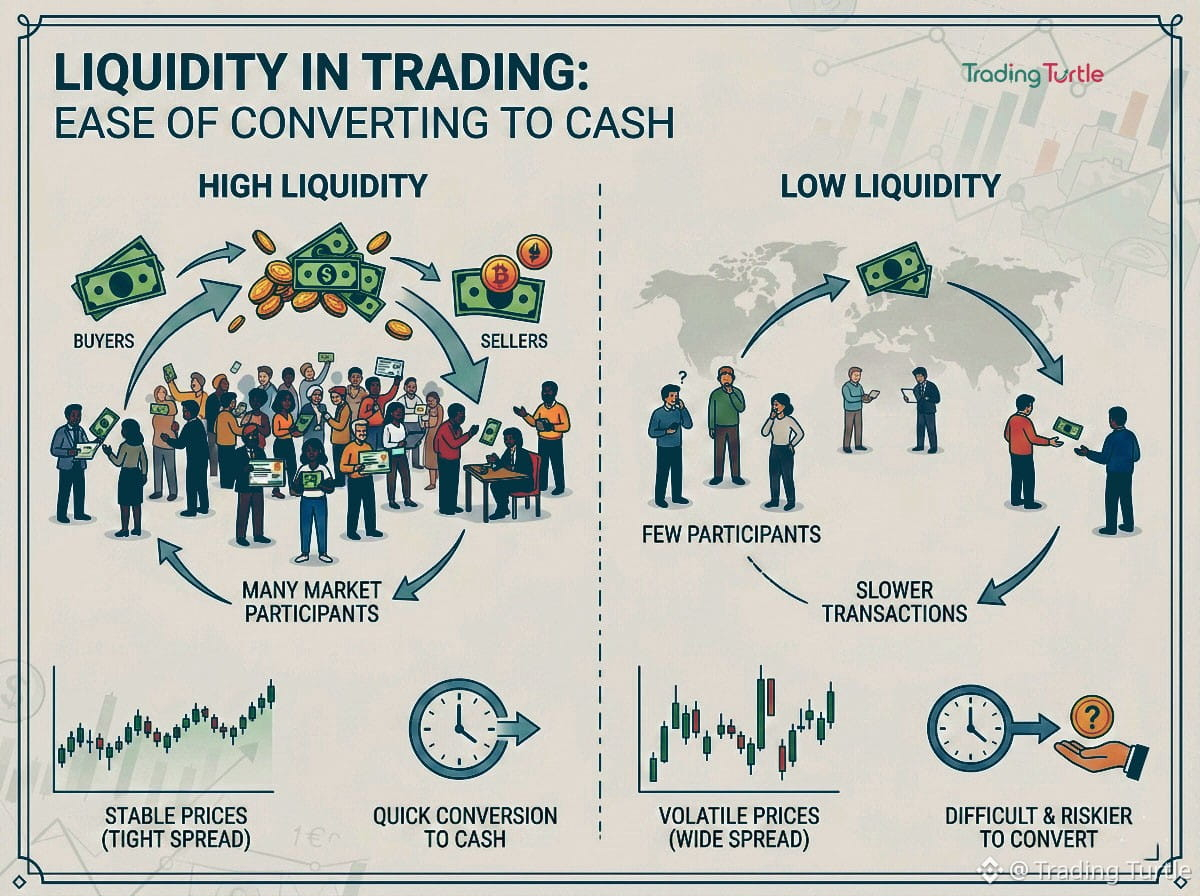
Liquidity describes the market’s ability to absorb buying and selling without large price changes. Highly liquid markets usually have tighter spreads and deeper books, while illiquid markets can produce larger slippage and sharper reactions. Traders should evaluate liquidity in relation to their own order size and timeframe rather than assuming a market is simply liquid or illiquid.
Imagine a market that looks active but has little quantity near the best quote. A larger order may cross several levels to fill.
Describe how the quantity available near the quote changes the quality of a hypothetical execution.
Next in this series: Support, resistance and reaction zones.
#TradingEducation #PriceAction #RiskManagement #TradingTurtle
Liquidity and price action · Lesson 13
Liquidity and execution quality
A quoted price can hide how difficult it is to execute a whole order.
Liquidity describes the market’s ability to absorb buying and selling without large price changes. Highly liquid markets usually have tighter spreads and deeper books, while illiquid markets can produce larger slippage and sharper reactions. Traders should evaluate liquidity in relation to their own order size and timeframe rather than assuming a market is simply liquid or illiquid.
Imagine a market that looks active but has little quantity near the best quote. A larger order may cross several levels to fill.
Describe how the quantity available near the quote changes the quality of a hypothetical execution.
Next in this series: Support, resistance and reaction zones.
#TradingEducation #PriceAction #RiskManagement #TradingTurtle
Liquidity and execution quality
A quoted price can hide how difficult it is to execute a whole order.
Liquidity describes the market’s ability to absorb buying and selling without large price changes. Highly liquid markets usually have tighter spreads and deeper books, while illiquid markets can produce larger slippage and sharper reactions. Traders should evaluate liquidity in relation to their own order size and timeframe rather than assuming a market is simply liquid or illiquid.
Imagine a market that looks active but has little quantity near the best quote. A larger order may cross several levels to fill.
Describe how the quantity available near the quote changes the quality of a hypothetical execution.
Next in this series: Support, resistance and reaction zones.
#TradingEducation #PriceAction #RiskManagement #TradingTurtle
60
Orders and execution · Lesson 7
Stop orders and invalidation
A stop trigger and the final exit price are separate events.
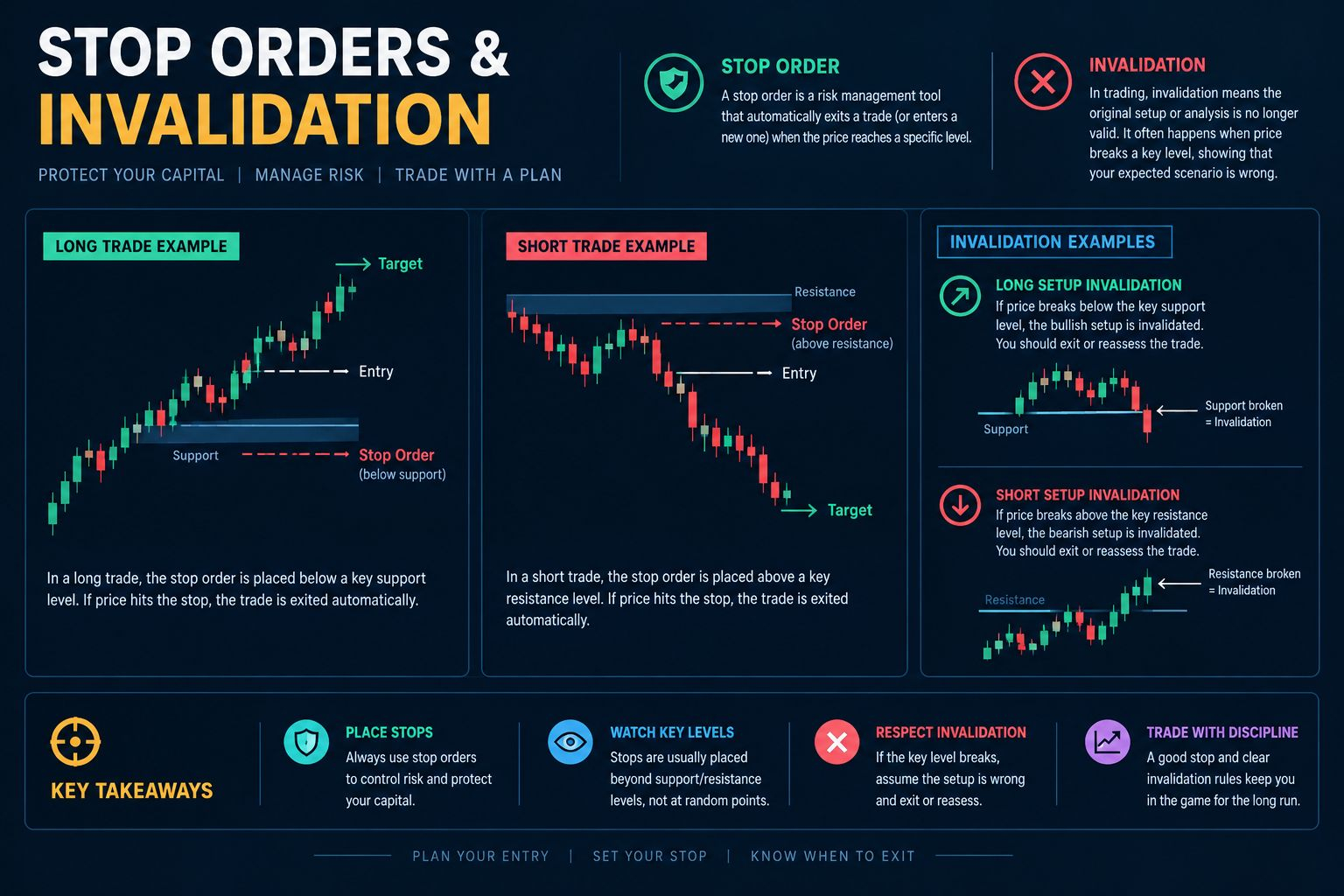
A stop order becomes active after a trigger condition is met. Traders often use stops to define where a trade idea is no longer valid, but the trigger does not guarantee the final fill price during gaps or fast markets. Good risk planning separates the analytical invalidation level from the amount of capital that can be lost if execution is worse than expected.
Imagine price gaps through a trigger during a fast market. The stop activates, but execution can occur beyond the level used in the original plan.
Write down the difference between invalidating an idea and guaranteeing an exit price. Explain why execution risk belongs in a plan.
Next in this series: Order book, spread and depth.
#TradingEducation #PriceAction #RiskManagement #TradingTurtle
Orders and execution · Lesson 7
Stop orders and invalidation
A stop trigger and the final exit price are separate events.
A stop order becomes active after a trigger condition is met. Traders often use stops to define where a trade idea is no longer valid, but the trigger does not guarantee the final fill price during gaps or fast markets. Good risk planning separates the analytical invalidation level from the amount of capital that can be lost if execution is worse than expected.
Imagine price gaps through a trigger during a fast market. The stop activates, but execution can occur beyond the level used in the original plan.
Write down the difference between invalidating an idea and guaranteeing an exit price. Explain why execution risk belongs in a plan.
Next in this series: Order book, spread and depth.
#TradingEducation #PriceAction #RiskManagement #TradingTurtle
Stop orders and invalidation
A stop trigger and the final exit price are separate events.
A stop order becomes active after a trigger condition is met. Traders often use stops to define where a trade idea is no longer valid, but the trigger does not guarantee the final fill price during gaps or fast markets. Good risk planning separates the analytical invalidation level from the amount of capital that can be lost if execution is worse than expected.
Imagine price gaps through a trigger during a fast market. The stop activates, but execution can occur beyond the level used in the original plan.
Write down the difference between invalidating an idea and guaranteeing an exit price. Explain why execution risk belongs in a plan.
Next in this series: Order book, spread and depth.
#TradingEducation #PriceAction #RiskManagement #TradingTurtle
25
Orders and execution · Lesson 5
Market orders
Getting an immediate fill and getting the price you expected are different things.
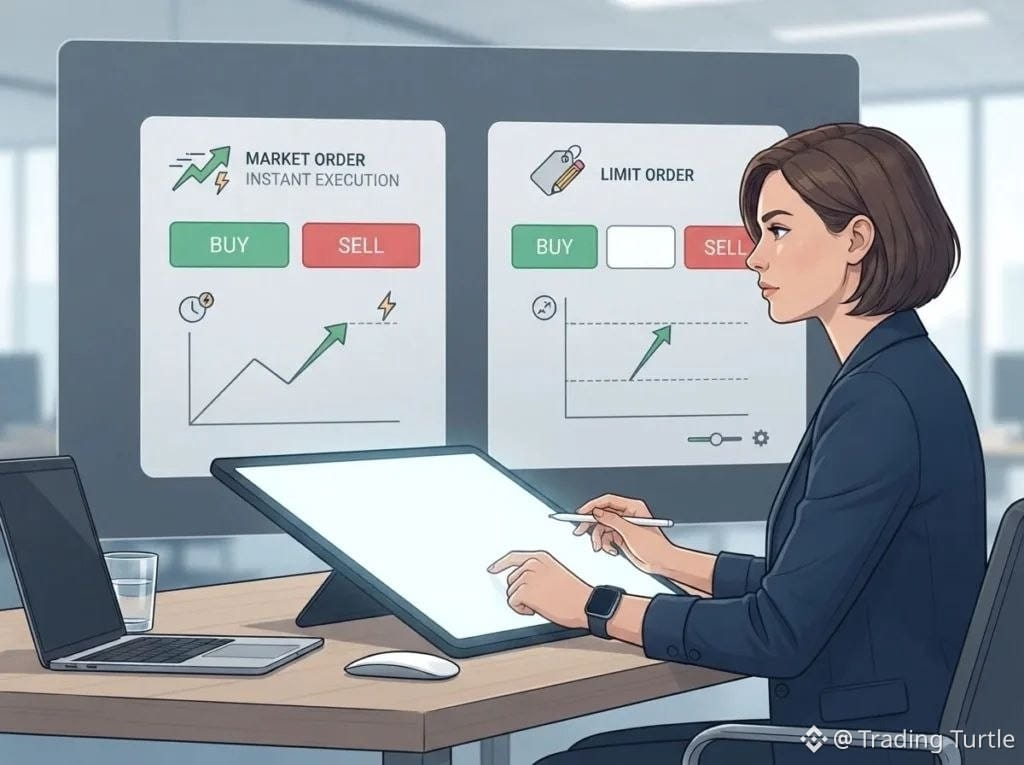
A market order prioritizes execution over exact price. It normally fills against available liquidity in the order book, which means the final average fill can differ from the last displayed price when the market moves quickly or depth is thin. This difference is slippage. Market orders can be useful when execution matters more than price precision, but they should not be treated as price guarantees.
Imagine available sell orders near the displayed price are thin. A market buy can fill across several prices, so the average differs from the screen price you first saw.
Explain the difference between the displayed price and the average execution price, using a historical or simulated order book.
Next in this series: Limit orders.
#TradingEducation #PriceAction #RiskManagement #TradingTurtle
Orders and execution · Lesson 5
Market orders
Getting an immediate fill and getting the price you expected are different things.
A market order prioritizes execution over exact price. It normally fills against available liquidity in the order book, which means the final average fill can differ from the last displayed price when the market moves quickly or depth is thin. This difference is slippage. Market orders can be useful when execution matters more than price precision, but they should not be treated as price guarantees.
Imagine available sell orders near the displayed price are thin. A market buy can fill across several prices, so the average differs from the screen price you first saw.
Explain the difference between the displayed price and the average execution price, using a historical or simulated order book.
Next in this series: Limit orders.
#TradingEducation #PriceAction #RiskManagement #TradingTurtle
Market orders
Getting an immediate fill and getting the price you expected are different things.
A market order prioritizes execution over exact price. It normally fills against available liquidity in the order book, which means the final average fill can differ from the last displayed price when the market moves quickly or depth is thin. This difference is slippage. Market orders can be useful when execution matters more than price precision, but they should not be treated as price guarantees.
Imagine available sell orders near the displayed price are thin. A market buy can fill across several prices, so the average differs from the screen price you first saw.
Explain the difference between the displayed price and the average execution price, using a historical or simulated order book.
Next in this series: Limit orders.
#TradingEducation #PriceAction #RiskManagement #TradingTurtle
59
Market structure · Lesson 4
Breaks, shifts and confirmation
A broken level is a reason to reassess the chart, not proof of a new trend.
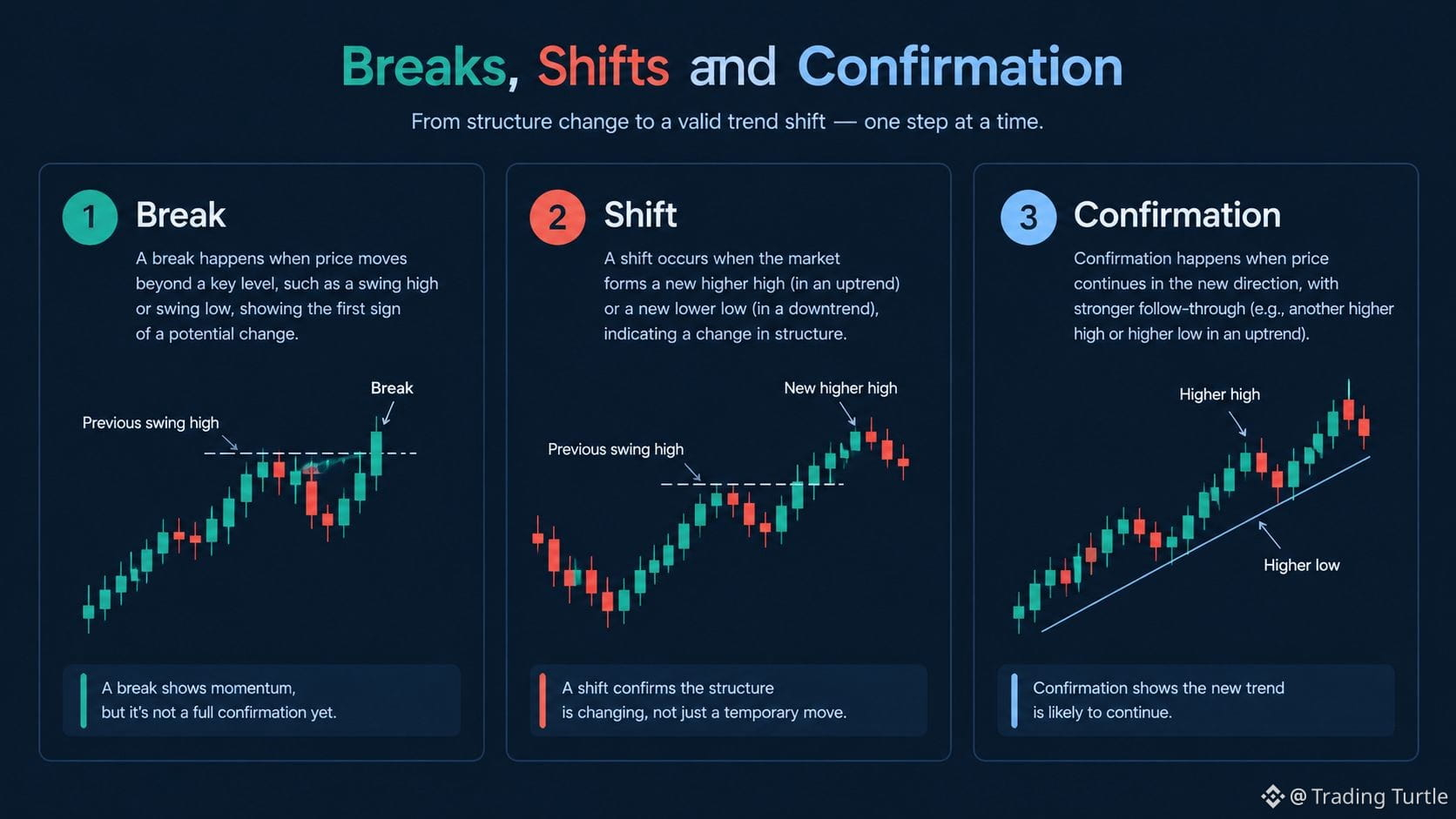
A break of a meaningful swing can weaken the prior structure, but it does not guarantee a full reversal. Confirmation usually comes from what price does after the break: whether the market accepts beyond the level, forms a new opposing swing sequence, or quickly reclaims the broken area. Structure is evidence for a trading thesis, not a promise about the next candle.
Compare a break followed by acceptance beyond a level with a break that quickly returns inside the old structure. The follow-through gives the two moves different meanings.
Find a historical break and hide the later candles. Write what evidence would strengthen or weaken each interpretation.
Next in this series: Market orders.
#TradingEducation #PriceAction #RiskManagement #TradingTurtle
Market structure · Lesson 4
Breaks, shifts and confirmation
A broken level is a reason to reassess the chart, not proof of a new trend.
A break of a meaningful swing can weaken the prior structure, but it does not guarantee a full reversal. Confirmation usually comes from what price does after the break: whether the market accepts beyond the level, forms a new opposing swing sequence, or quickly reclaims the broken area. Structure is evidence for a trading thesis, not a promise about the next candle.
Compare a break followed by acceptance beyond a level with a break that quickly returns inside the old structure. The follow-through gives the two moves different meanings.
Find a historical break and hide the later candles. Write what evidence would strengthen or weaken each interpretation.
Next in this series: Market orders.
#TradingEducation #PriceAction #RiskManagement #TradingTurtle
Breaks, shifts and confirmation
A broken level is a reason to reassess the chart, not proof of a new trend.
A break of a meaningful swing can weaken the prior structure, but it does not guarantee a full reversal. Confirmation usually comes from what price does after the break: whether the market accepts beyond the level, forms a new opposing swing sequence, or quickly reclaims the broken area. Structure is evidence for a trading thesis, not a promise about the next candle.
Compare a break followed by acceptance beyond a level with a break that quickly returns inside the old structure. The follow-through gives the two moves different meanings.
Find a historical break and hide the later candles. Write what evidence would strengthen or weaken each interpretation.
Next in this series: Market orders.
#TradingEducation #PriceAction #RiskManagement #TradingTurtle
51
Market structure · Lesson 3
Lower highs and lower lows
A brief rally can look like a recovery even while the broader downtrend continues.
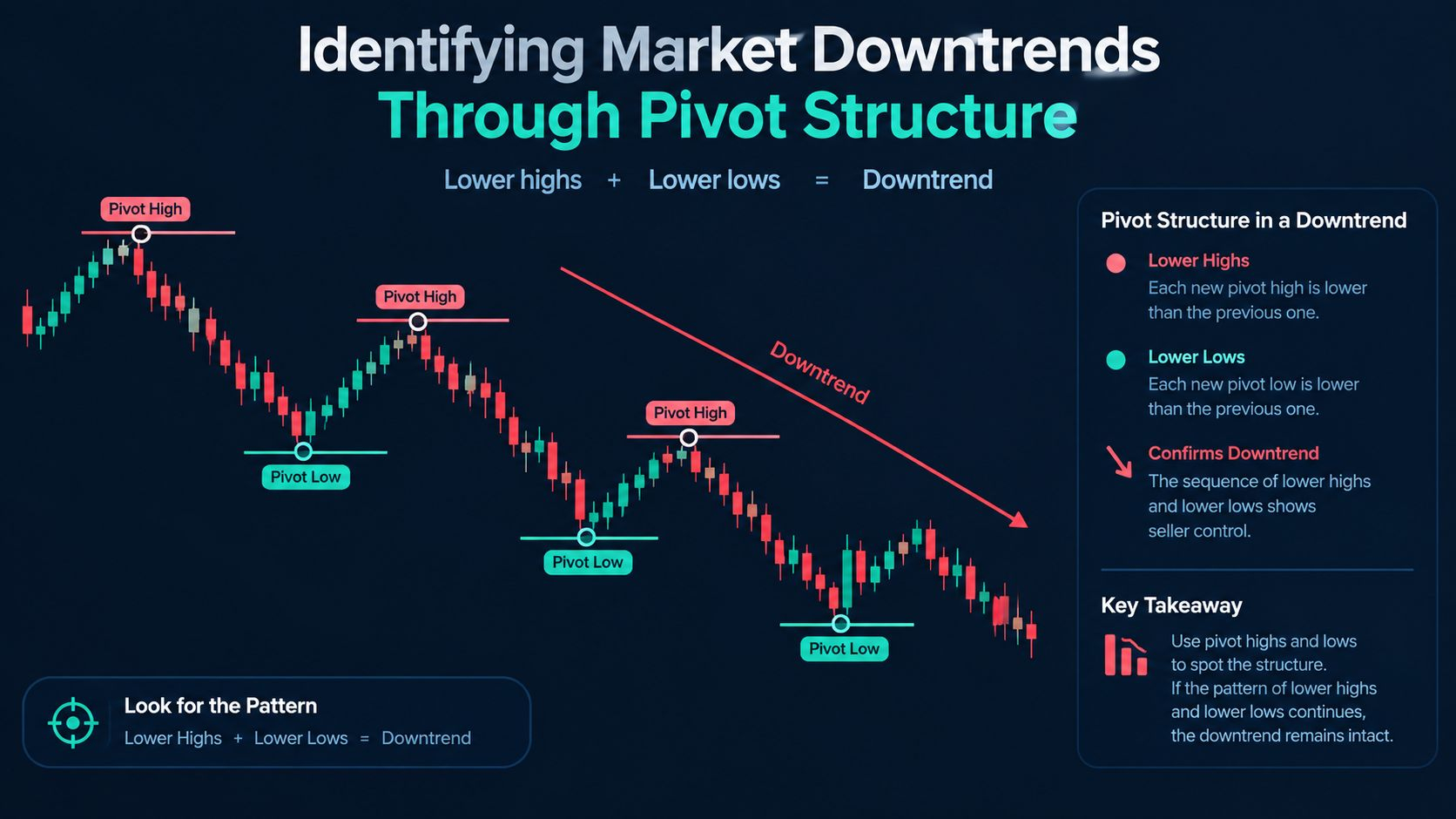
A downtrend is commonly described by meaningful lower highs and lower lows. Sellers repeatedly prevent rallies from reclaiming prior important highs while price establishes lower lows. Traders should distinguish structural pivots from ordinary noise and avoid calling a reversal from one isolated break without considering the next reaction and the higher-timeframe context.
Imagine a rally stops below the previous meaningful high, followed by a fresh low. Buyers lifted price temporarily, but the sequence of lower highs and lower lows remained intact.
On a historical chart, mark a rally high and the following low. Explain whether they changed the structure or continued it.
Next in this series: Breaks, shifts and confirmation.
#TradingEducation #PriceAction #RiskManagement #TradingTurtle
Market structure · Lesson 3
Lower highs and lower lows
A brief rally can look like a recovery even while the broader downtrend continues.
A downtrend is commonly described by meaningful lower highs and lower lows. Sellers repeatedly prevent rallies from reclaiming prior important highs while price establishes lower lows. Traders should distinguish structural pivots from ordinary noise and avoid calling a reversal from one isolated break without considering the next reaction and the higher-timeframe context.
Imagine a rally stops below the previous meaningful high, followed by a fresh low. Buyers lifted price temporarily, but the sequence of lower highs and lower lows remained intact.
On a historical chart, mark a rally high and the following low. Explain whether they changed the structure or continued it.
Next in this series: Breaks, shifts and confirmation.
#TradingEducation #PriceAction #RiskManagement #TradingTurtle
Lower highs and lower lows
A brief rally can look like a recovery even while the broader downtrend continues.
A downtrend is commonly described by meaningful lower highs and lower lows. Sellers repeatedly prevent rallies from reclaiming prior important highs while price establishes lower lows. Traders should distinguish structural pivots from ordinary noise and avoid calling a reversal from one isolated break without considering the next reaction and the higher-timeframe context.
Imagine a rally stops below the previous meaningful high, followed by a fresh low. Buyers lifted price temporarily, but the sequence of lower highs and lower lows remained intact.
On a historical chart, mark a rally high and the following low. Explain whether they changed the structure or continued it.
Next in this series: Breaks, shifts and confirmation.
#TradingEducation #PriceAction #RiskManagement #TradingTurtle
33
🎁 Binance Rewards Hub tasks, safely | #TradingTurtle
──────────────────────────────────────
Rewards Hub can be useful, but the details matter. Before doing any task, check whether the reward is a token voucher, trading-fee rebate, cashback voucher, or another limited offer, then read the expiry and unlock rules. I would avoid forcing deposits or trades just to chase a small reward; the task should make sense even without the bonus. The clean approach is to complete only simple, official, low-risk tasks and ignore anything that pushes urgency outside the app. 🐢
#BinanceRewards #CryptoEducation #BinanceGuide #RiskManagement
🎁 Binance Rewards Hub tasks, safely | #TradingTurtle
──────────────────────────────────────
Rewards Hub can be useful, but the details matter. Before doing any task, check whether the reward is a token voucher, trading-fee rebate, cashback voucher, or another limited offer, then read the expiry and unlock rules. I would avoid forcing deposits or trades just to chase a small reward; the task should make sense even without the bonus. The clean approach is to complete only simple, official, low-risk tasks and ignore anything that pushes urgency outside the app. 🐢
#BinanceRewards #CryptoEducation #BinanceGuide #RiskManagement
──────────────────────────────────────
Rewards Hub can be useful, but the details matter. Before doing any task, check whether the reward is a token voucher, trading-fee rebate, cashback voucher, or another limited offer, then read the expiry and unlock rules. I would avoid forcing deposits or trades just to chase a small reward; the task should make sense even without the bonus. The clean approach is to complete only simple, official, low-risk tasks and ignore anything that pushes urgency outside the app. 🐢
#BinanceRewards #CryptoEducation #BinanceGuide #RiskManagement
89
When a Clean LTF Trigger Fails on HTF Context
Mistake: Entering a short on a sharp lower‑timeframe bearish candle that appears clean, while the same price level sits near a higher‑timeframe swing high or inside a broader uptrend.
Why it fails: The higher‑timeframe structure supplies strong buying interest. Even though the LTF candle shows a tidy reversal, the market’s dominant bias on the HTF can overwhelm the short signal, leading to a quick bounce and a loss.
Better rule: Before acting on any LTF trigger, confirm that the price is not positioned within a higher‑timeframe swing high, trend channel, or key resistance zone. If the HTF context is bullish, only take long entries on LTF signals; for short entries, require the price to be below a recent HTF swing low or inside a clear downtrend.
Always validate the higher‑timeframe location first; a clean lower‑timeframe signal is only reliable when it aligns with the broader market bias.
#TradingTurtle #TradingEducation #MarketStructure
When a Clean LTF Trigger Fails on HTF Context
Mistake: Entering a short on a sharp lower‑timeframe bearish candle that appears clean, while the same price level sits near a higher‑timeframe swing high or inside a broader uptrend.
Why it fails: The higher‑timeframe structure supplies strong buying interest. Even though the LTF candle shows a tidy reversal, the market’s dominant bias on the HTF can overwhelm the short signal, leading to a quick bounce and a loss.
Better rule: Before acting on any LTF trigger, confirm that the price is not positioned within a higher‑timeframe swing high, trend channel, or key resistance zone. If the HTF context is bullish, only take long entries on LTF signals; for short entries, require the price to be below a recent HTF swing low or inside a clear downtrend.
Always validate the higher‑timeframe location first; a clean lower‑timeframe signal is only reliable when it aligns with the broader market bias.
#TradingTurtle #TradingEducation #MarketStructure
Mistake: Entering a short on a sharp lower‑timeframe bearish candle that appears clean, while the same price level sits near a higher‑timeframe swing high or inside a broader uptrend.
Why it fails: The higher‑timeframe structure supplies strong buying interest. Even though the LTF candle shows a tidy reversal, the market’s dominant bias on the HTF can overwhelm the short signal, leading to a quick bounce and a loss.
Better rule: Before acting on any LTF trigger, confirm that the price is not positioned within a higher‑timeframe swing high, trend channel, or key resistance zone. If the HTF context is bullish, only take long entries on LTF signals; for short entries, require the price to be below a recent HTF swing low or inside a clear downtrend.
Always validate the higher‑timeframe location first; a clean lower‑timeframe signal is only reliable when it aligns with the broader market bias.
#TradingTurtle #TradingEducation #MarketStructure
43
Retest Confirms Breakout Strength
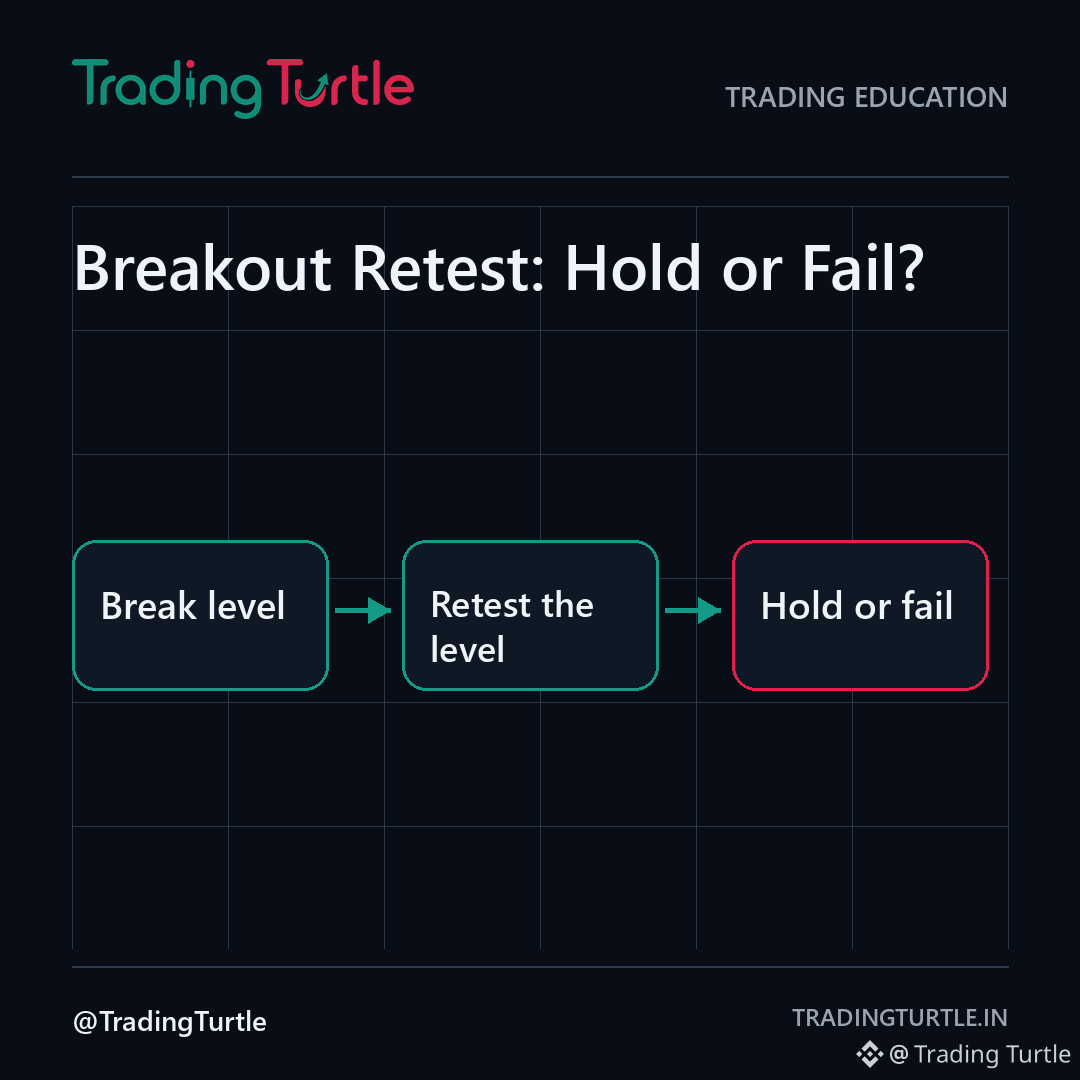
You see a clear breakout: price moves beyond a well‑tested resistance (or support) with strong volume. The breakout alone tells you the market is attempting a new direction, but it does not guarantee sustainability.
Condition for action: after the breakout, price returns to the broken level and holds there for at least one candle without closing below (for a bullish breakout) or above (for a bearish breakout). The retest must respect the same volume profile that supported the original move.
Invalidation: if on the retest the price pierces the broken level and closes beyond it, or if the retest candle shows a clear rejection (large wick beyond the level and a close back inside), the breakout is considered failed. In that case, stay out or consider a short (for a bullish breakout) or long (for a bearish breakout).
Decision: when the retest holds, enter in the direction of the original breakout with a stop just beyond the retest level. If the retest fails, refrain from entering and treat the move as a false breakout.
Enter only after a breakout retests and holds the broken level; a failed retest signals a false breakout.
#TradingTurtle #BreakoutTrading #PriceAction
Retest Confirms Breakout Strength
You see a clear breakout: price moves beyond a well‑tested resistance (or support) with strong volume. The breakout alone tells you the market is attempting a new direction, but it does not guarantee sustainability.
Condition for action: after the breakout, price returns to the broken level and holds there for at least one candle without closing below (for a bullish breakout) or above (for a bearish breakout). The retest must respect the same volume profile that supported the original move.
Invalidation: if on the retest the price pierces the broken level and closes beyond it, or if the retest candle shows a clear rejection (large wick beyond the level and a close back inside), the breakout is considered failed. In that case, stay out or consider a short (for a bullish breakout) or long (for a bearish breakout).
Decision: when the retest holds, enter in the direction of the original breakout with a stop just beyond the retest level. If the retest fails, refrain from entering and treat the move as a false breakout.
Enter only after a breakout retests and holds the broken level; a failed retest signals a false breakout.
#TradingTurtle #BreakoutTrading #PriceAction
You see a clear breakout: price moves beyond a well‑tested resistance (or support) with strong volume. The breakout alone tells you the market is attempting a new direction, but it does not guarantee sustainability.
Condition for action: after the breakout, price returns to the broken level and holds there for at least one candle without closing below (for a bullish breakout) or above (for a bearish breakout). The retest must respect the same volume profile that supported the original move.
Invalidation: if on the retest the price pierces the broken level and closes beyond it, or if the retest candle shows a clear rejection (large wick beyond the level and a close back inside), the breakout is considered failed. In that case, stay out or consider a short (for a bullish breakout) or long (for a bearish breakout).
Decision: when the retest holds, enter in the direction of the original breakout with a stop just beyond the retest level. If the retest fails, refrain from entering and treat the move as a false breakout.
Enter only after a breakout retests and holds the broken level; a failed retest signals a false breakout.
#TradingTurtle #BreakoutTrading #PriceAction
59
Using Binance Square as a creator | #TradingTurtle
──────────────────────────────────────
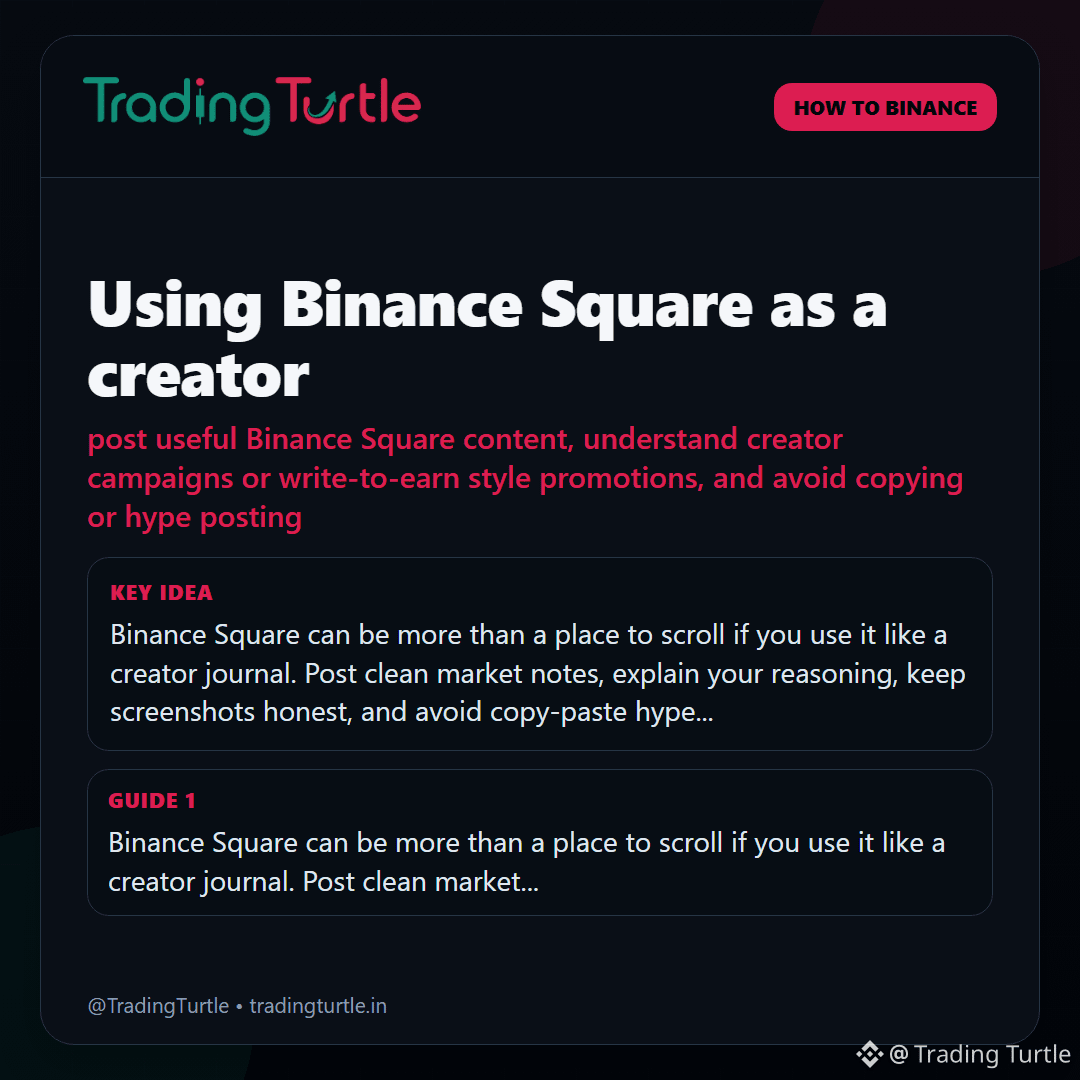
Binance Square can be more than a place to scroll if you use it like a creator journal. Post clean market notes, explain your reasoning, keep screenshots honest, and avoid copy-paste hype because weak content usually ages badly. If Binance runs creator or write-to-earn campaigns, check the official campaign terms inside Square before expecting anything. The long-term edge is useful, consistent posts that people save or reply to, not loud predictions. 🐢
#BinanceSquare #CryptoCreator #CryptoEducation #BinanceGuide
Using Binance Square as a creator | #TradingTurtle
──────────────────────────────────────
Binance Square can be more than a place to scroll if you use it like a creator journal. Post clean market notes, explain your reasoning, keep screenshots honest, and avoid copy-paste hype because weak content usually ages badly. If Binance runs creator or write-to-earn campaigns, check the official campaign terms inside Square before expecting anything. The long-term edge is useful, consistent posts that people save or reply to, not loud predictions. 🐢
#BinanceSquare #CryptoCreator #CryptoEducation #BinanceGuide
──────────────────────────────────────
Binance Square can be more than a place to scroll if you use it like a creator journal. Post clean market notes, explain your reasoning, keep screenshots honest, and avoid copy-paste hype because weak content usually ages badly. If Binance runs creator or write-to-earn campaigns, check the official campaign terms inside Square before expecting anything. The long-term edge is useful, consistent posts that people save or reply to, not loud predictions. 🐢
#BinanceSquare #CryptoCreator #CryptoEducation #BinanceGuide
43
Crypto news brief | $BTC | #TradingTurtle
──────────────────────────────────────
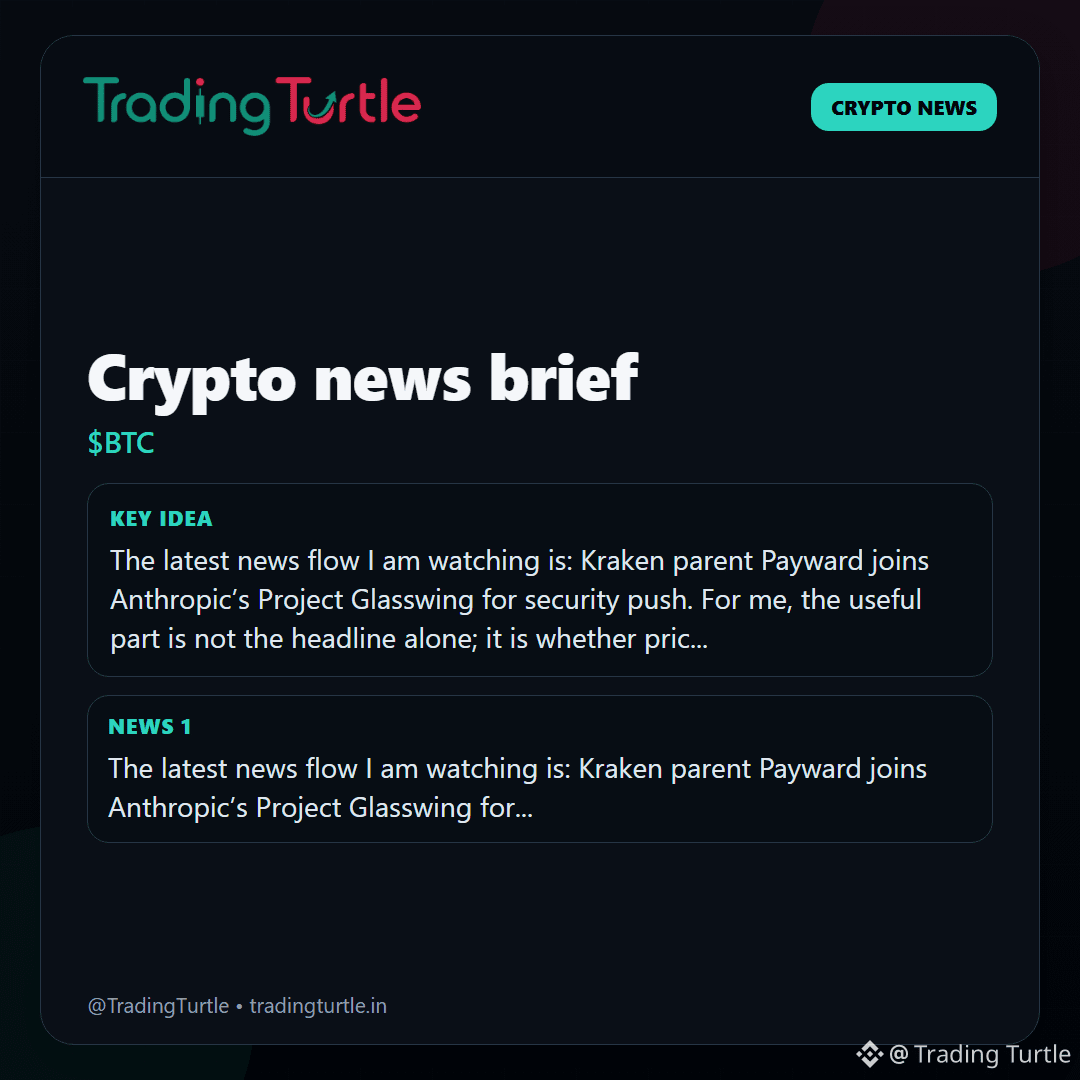
The latest news flow I am watching is: Kraken parent Payward joins Anthropic’s Project Glasswing for security push. For me, the useful part is not the headline alone; it is whether price confirms it with clean structure, volume, and a level that can be managed. 📰
BTC #CryptoNews #MarketUpdate #Binance
Crypto news brief | $BTC | #TradingTurtle
──────────────────────────────────────
The latest news flow I am watching is: Kraken parent Payward joins Anthropic’s Project Glasswing for security push. For me, the useful part is not the headline alone; it is whether price confirms it with clean structure, volume, and a level that can be managed. 📰
BTC #CryptoNews #MarketUpdate #Binance
──────────────────────────────────────
The latest news flow I am watching is: Kraken parent Payward joins Anthropic’s Project Glasswing for security push. For me, the useful part is not the headline alone; it is whether price confirms it with clean structure, volume, and a level that can be managed. 📰
BTC #CryptoNews #MarketUpdate #Binance
15
Log in to explore more content
Join global crypto users on Binance Square
⚡️ Get latest and useful information about crypto.
💬 Trusted by the world’s largest crypto exchange.
👍 Discover real insights from verified creators.
Email / Phone number
Trending Topics
1
#FedRateWatch
765,415 views
3,629 Discussing
2
#BitcoinFalls4%
0 views
0 Discussing
3
#ArgentinaCommitsToOECDCryptoReportingBy2029
3,492 views
112 Discussing
4
#EthereumFallsBelow$2400
2,152 views
51 Discussing
5
#USDTLaunchesOnZamaPrivacyProtocol
979 views
48 Discussing
6
#USSenateBlocksClarityAct
16,470 views
286 Discussing
7
#BitcoinSlidesTo$76000
34,176 views
155 Discussing
8
#BitcoinReboundsTo$79K
66,539 views
426 Discussing
9
#StrategyMarketCapPassesFord
59,292 views
874 Discussing
10
#ClarityActOddsHalveOnPolymarket
98,399 views
797 Discussing