

#tradingeducation
tradingeducation
154,234 views
1,171 Discussing
Hot
Latest
Beginners think funding rate is just "the fee for holding a perpetual." Wrong. It's a positioning gauge in disguise.
When funding turns sharply positive, longs are paying shorts — meaning the crowd has piled aggressively into one side of the trade. That imbalance doesn't predict direction, but it tells you how stretched sentiment has become. Extreme, sustained funding often means a market is crowded and vulnerable to a sharp unwind if conditions shift, since one-sided positioning has less room to add more of the same.
Watch how funding behaves during strong trends versus choppy ranges — notice when it spikes far from neutral relative to its own recent history.
What's the most extreme funding reading you've ever seen play out?
$TRX $BTC $ETH #Trading #TradingEducation #Crypto #TA
Follow for daily trading education · Education only, not financial advice.
Beginners think funding rate is just "the fee for holding a perpetual." Wrong. It's a positioning gauge in disguise.
When funding turns sharply positive, longs are paying shorts — meaning the crowd has piled aggressively into one side of the trade. That imbalance doesn't predict direction, but it tells you how stretched sentiment has become. Extreme, sustained funding often means a market is crowded and vulnerable to a sharp unwind if conditions shift, since one-sided positioning has less room to add more of the same.
Watch how funding behaves during strong trends versus choppy ranges — notice when it spikes far from neutral relative to its own recent history.
What's the most extreme funding reading you've ever seen play out?
$TRX $BTC $ETH #Trading #TradingEducation #Crypto #TA
Follow for daily trading education · Education only, not financial advice.
When funding turns sharply positive, longs are paying shorts — meaning the crowd has piled aggressively into one side of the trade. That imbalance doesn't predict direction, but it tells you how stretched sentiment has become. Extreme, sustained funding often means a market is crowded and vulnerable to a sharp unwind if conditions shift, since one-sided positioning has less room to add more of the same.
Watch how funding behaves during strong trends versus choppy ranges — notice when it spikes far from neutral relative to its own recent history.
What's the most extreme funding reading you've ever seen play out?
$TRX $BTC $ETH #Trading #TradingEducation #Crypto #TA
Follow for daily trading education · Education only, not financial advice.

95

·
--
📊 $ATR.US
{stock_us}(ATR.US)
: The Indicator That Measures Market Volatility
If you trade crypto, knowing how much the market is moving can be just as important as knowing the direction.
🔹 ATR = Average True Range
It measures market volatility — not whether price will go up or down.
💡 How traders use ATR:
• Higher ATR → stronger volatility & larger price swings
• Lower ATR → quieter market & smaller movements
• ATR can help set more realistic Stop Loss and Take Profit levels
• Useful for avoiding stops that are too tight during volatile markets
📌 Example:
If BTC has a high ATR, a very tight stop-loss may be hit by normal market fluctuations. Traders may use ATR to understand the typical range before choosing their risk level.
#ATR #CryptoTrading #BinanceSquare #TradingEducation
📊 $ATR.US
: The Indicator That Measures Market Volatility
If you trade crypto, knowing how much the market is moving can be just as important as knowing the direction.
🔹 ATR = Average True Range
It measures market volatility — not whether price will go up or down.
💡 How traders use ATR:
• Higher ATR → stronger volatility & larger price swings
• Lower ATR → quieter market & smaller movements
• ATR can help set more realistic Stop Loss and Take Profit levels
• Useful for avoiding stops that are too tight during volatile markets
📌 Example:
If BTC has a high ATR, a very tight stop-loss may be hit by normal market fluctuations. Traders may use ATR to understand the typical range before choosing their risk level.
#ATR #CryptoTrading #BinanceSquare #TradingEducation
: The Indicator That Measures Market Volatility
If you trade crypto, knowing how much the market is moving can be just as important as knowing the direction.
🔹 ATR = Average True Range
It measures market volatility — not whether price will go up or down.
💡 How traders use ATR:
• Higher ATR → stronger volatility & larger price swings
• Lower ATR → quieter market & smaller movements
• ATR can help set more realistic Stop Loss and Take Profit levels
• Useful for avoiding stops that are too tight during volatile markets
📌 Example:
If BTC has a high ATR, a very tight stop-loss may be hit by normal market fluctuations. Traders may use ATR to understand the typical range before choosing their risk level.
#ATR #CryptoTrading #BinanceSquare #TradingEducation
ATRUS+0.29%
74

·
--

Article
The Real Journey of a Trader 📈Trading is not about making money overnight. It is a journey of learning, patience, discipline, and continuous improvement.
Every successful trader starts as a beginner. The first step is not putting in more money—it is understanding the market, learning how price moves, and practicing without risking real capital.
A good trader understands that losses are part of the learning process. Instead of chasing quick profits, focus on managing risk, controlling emotions, and following a clear strategy.
Start small. Learn every day. Practice consistently. Keep your emotions under control.
Big results are built through small improvements repeated every day.
«Learn first. Practice second. Trade responsibly. Grow with patience. 🚀📊»
#Binanc #Trading #CryptoTrading #TradingEducation #tradingMotivation
The Real Journey of a Trader 📈
Trading is not about making money overnight. It is a journey of learning, patience, discipline, and continuous improvement.
Every successful trader starts as a beginner. The first step is not putting in more money—it is understanding the market, learning how price moves, and practicing without risking real capital.
A good trader understands that losses are part of the learning process. Instead of chasing quick profits, focus on managing risk, controlling emotions, and following a clear strategy.
Start small. Learn every day. Practice consistently. Keep your emotions under control.
Big results are built through small improvements repeated every day.
«Learn first. Practice second. Trade responsibly. Grow with patience. 🚀📊»
#Binanc #Trading #CryptoTrading #TradingEducation #tradingMotivation
Every successful trader starts as a beginner. The first step is not putting in more money—it is understanding the market, learning how price moves, and practicing without risking real capital.
A good trader understands that losses are part of the learning process. Instead of chasing quick profits, focus on managing risk, controlling emotions, and following a clear strategy.
Start small. Learn every day. Practice consistently. Keep your emotions under control.
Big results are built through small improvements repeated every day.
«Learn first. Practice second. Trade responsibly. Grow with patience. 🚀📊»
#Binanc #Trading #CryptoTrading #TradingEducation #tradingMotivation
58

Article
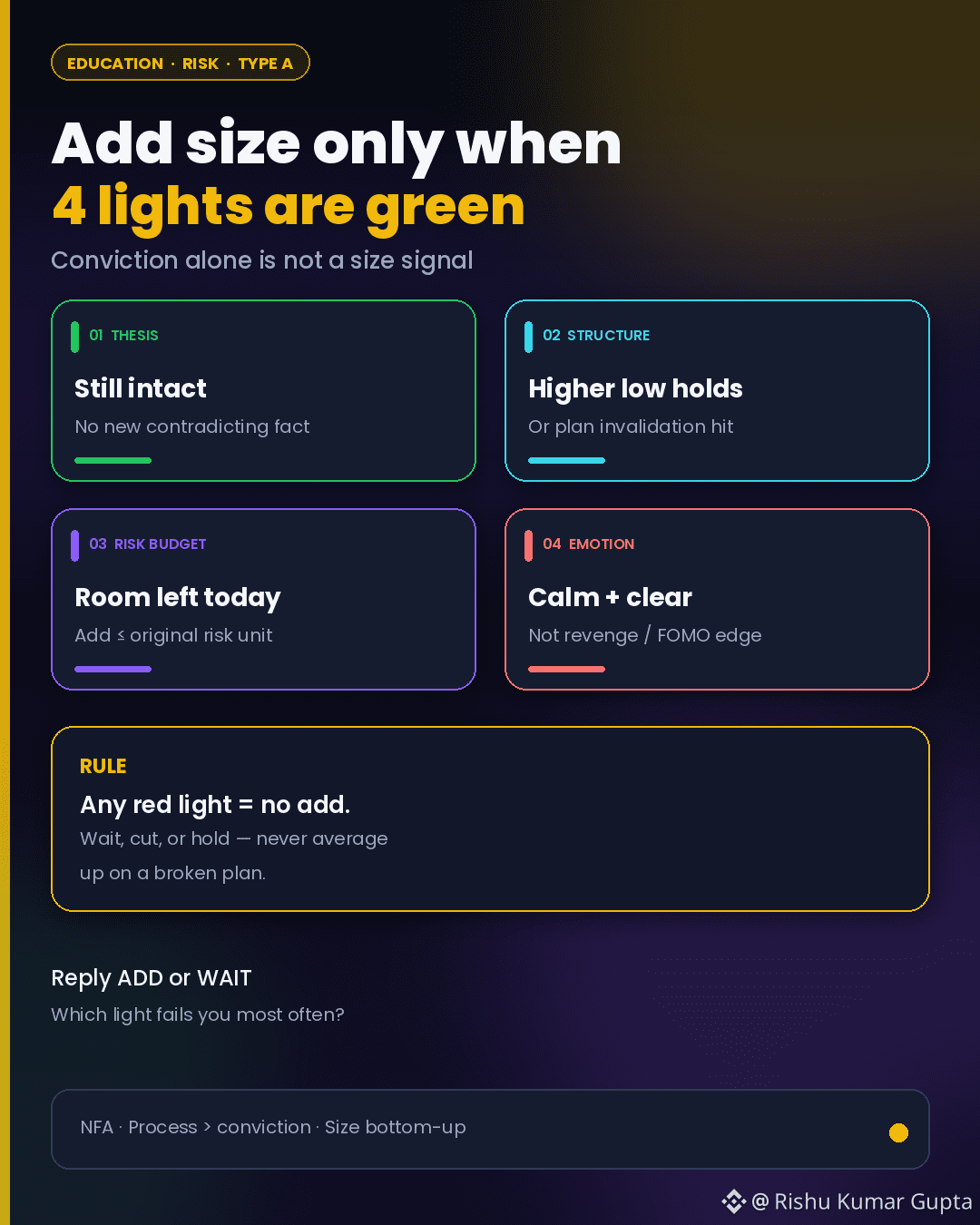
The Add Rule: Size Up Only When 4 Lights Are GreenMost traders blow up by *adding* into hope — not by the first entry.
The Add Rule is simple: size up only when **all 4 lights are green**.
**01 · Thesis still intact**
No fresh fact killed your reason to be in. News flip, narrative break, or catalyst miss = red.
**02 · Structure still holds**
Your higher-low / plan level is alive. If invalidation already printed, you are averaging into a dead idea.
**03 · Risk budget has room**
Add at most **one original risk unit**. If today's max loss is already used, flat or cut — never “one more add.”
**04 · Emotion is calm**
If you feel revenge, FOMO, or “I need to make it back,” that light is red. Walk away.
**Rule:** any red light = no add. Wait, cut, or hold. Never average up on a broken plan.
Conviction is a vibe. Size is a checklist.
NFA — education only, not financial advice.
Which light fails you most often? Reply **ADD** or **WAIT**.
$BTC #TradingEducation #RiskManagement #CryptoTrading
The Add Rule: Size Up Only When 4 Lights Are Green
Most traders blow up by *adding* into hope — not by the first entry.
The Add Rule is simple: size up only when **all 4 lights are green**.
**01 · Thesis still intact**
No fresh fact killed your reason to be in. News flip, narrative break, or catalyst miss = red.
**02 · Structure still holds**
Your higher-low / plan level is alive. If invalidation already printed, you are averaging into a dead idea.
**03 · Risk budget has room**
Add at most **one original risk unit**. If today's max loss is already used, flat or cut — never “one more add.”
**04 · Emotion is calm**
If you feel revenge, FOMO, or “I need to make it back,” that light is red. Walk away.
**Rule:** any red light = no add. Wait, cut, or hold. Never average up on a broken plan.
Conviction is a vibe. Size is a checklist.
NFA — education only, not financial advice.
Which light fails you most often? Reply **ADD** or **WAIT**.
$BTC #TradingEducation #RiskManagement #CryptoTrading
The Add Rule is simple: size up only when **all 4 lights are green**.
**01 · Thesis still intact**
No fresh fact killed your reason to be in. News flip, narrative break, or catalyst miss = red.
**02 · Structure still holds**
Your higher-low / plan level is alive. If invalidation already printed, you are averaging into a dead idea.
**03 · Risk budget has room**
Add at most **one original risk unit**. If today's max loss is already used, flat or cut — never “one more add.”
**04 · Emotion is calm**
If you feel revenge, FOMO, or “I need to make it back,” that light is red. Walk away.
**Rule:** any red light = no add. Wait, cut, or hold. Never average up on a broken plan.
Conviction is a vibe. Size is a checklist.
NFA — education only, not financial advice.
Which light fails you most often? Reply **ADD** or **WAIT**.
$BTC #TradingEducation #RiskManagement #CryptoTrading
52

The First Law in Financial Markets: Protecting Capital Comes Before Chasing Profits 🛡️💵Content: Most beginner traders fall into the FOMO trap (fear of missing out), which pushes them to buy at historical resistance levels only to find themselves victims of a momentary correction. To turn your trading into a sustainable source of income, you must strictly follow three rules: Set a stop-loss order (Stop Loss) precisely before pressing the buy button. Take profit gradually: don’t wait for the absolute peak; sell 25% of your position at each resistance level that gets broken. Manage position size: do not risk more than 2% to 5% in a single trade of your total investment portfolio.#Risk #Management #CryptoTips #TradingEducation
The First Law in Financial Markets: Protecting Capital Comes Before Chasing Profits 🛡️💵Content: Most beginner traders fall into the FOMO trap (fear of missing out), which pushes them to buy at historical resistance levels only to find themselves victims of a momentary correction. To turn your trading into a sustainable source of income, you must strictly follow three rules: Set a stop-loss order (Stop Loss) precisely before pressing the buy button. Take profit gradually: don’t wait for the absolute peak; sell 25% of your position at each resistance level that gets broken. Manage position size: do not risk more than 2% to 5% in a single trade of your total investment portfolio.#Risk #Management #CryptoTips #TradingEducation
1
60
Ever wonder why price loves to poke above the obvious high or dip below the obvious low right before it actually moves?
Here's the gap: those levels aren't random. Every trader who bought a low or shorted a high has orders parked just beyond it — stop losses, breakout entries, liquidations. That's resting liquidity, and it pools exactly where the crowd expects support or resistance to hold. Price doesn't respect those levels, it hunts them. Big players need that liquidity to fill their own size, so price gets pushed into the pocket, triggers the orders, then often reverses.
Next time you're watching a range, mark the highs and lows everyone can see. Watch what happens the moment price touches them — does it reverse hard after a quick spike through?
What level are you watching get swept right now?
$AVAX $LINK $TRX #Trading #TradingEducation #Crypto #TA
Follow for daily trading education · Education only, not financial advice.
Ever wonder why price loves to poke above the obvious high or dip below the obvious low right before it actually moves?
Here's the gap: those levels aren't random. Every trader who bought a low or shorted a high has orders parked just beyond it — stop losses, breakout entries, liquidations. That's resting liquidity, and it pools exactly where the crowd expects support or resistance to hold. Price doesn't respect those levels, it hunts them. Big players need that liquidity to fill their own size, so price gets pushed into the pocket, triggers the orders, then often reverses.
Next time you're watching a range, mark the highs and lows everyone can see. Watch what happens the moment price touches them — does it reverse hard after a quick spike through?
What level are you watching get swept right now?
$AVAX $LINK $TRX #Trading #TradingEducation #Crypto #TA
Follow for daily trading education · Education only, not financial advice.
Here's the gap: those levels aren't random. Every trader who bought a low or shorted a high has orders parked just beyond it — stop losses, breakout entries, liquidations. That's resting liquidity, and it pools exactly where the crowd expects support or resistance to hold. Price doesn't respect those levels, it hunts them. Big players need that liquidity to fill their own size, so price gets pushed into the pocket, triggers the orders, then often reverses.
Next time you're watching a range, mark the highs and lows everyone can see. Watch what happens the moment price touches them — does it reverse hard after a quick spike through?
What level are you watching get swept right now?
$AVAX $LINK $TRX #Trading #TradingEducation #Crypto #TA
Follow for daily trading education · Education only, not financial advice.

240

·
--
Bullish
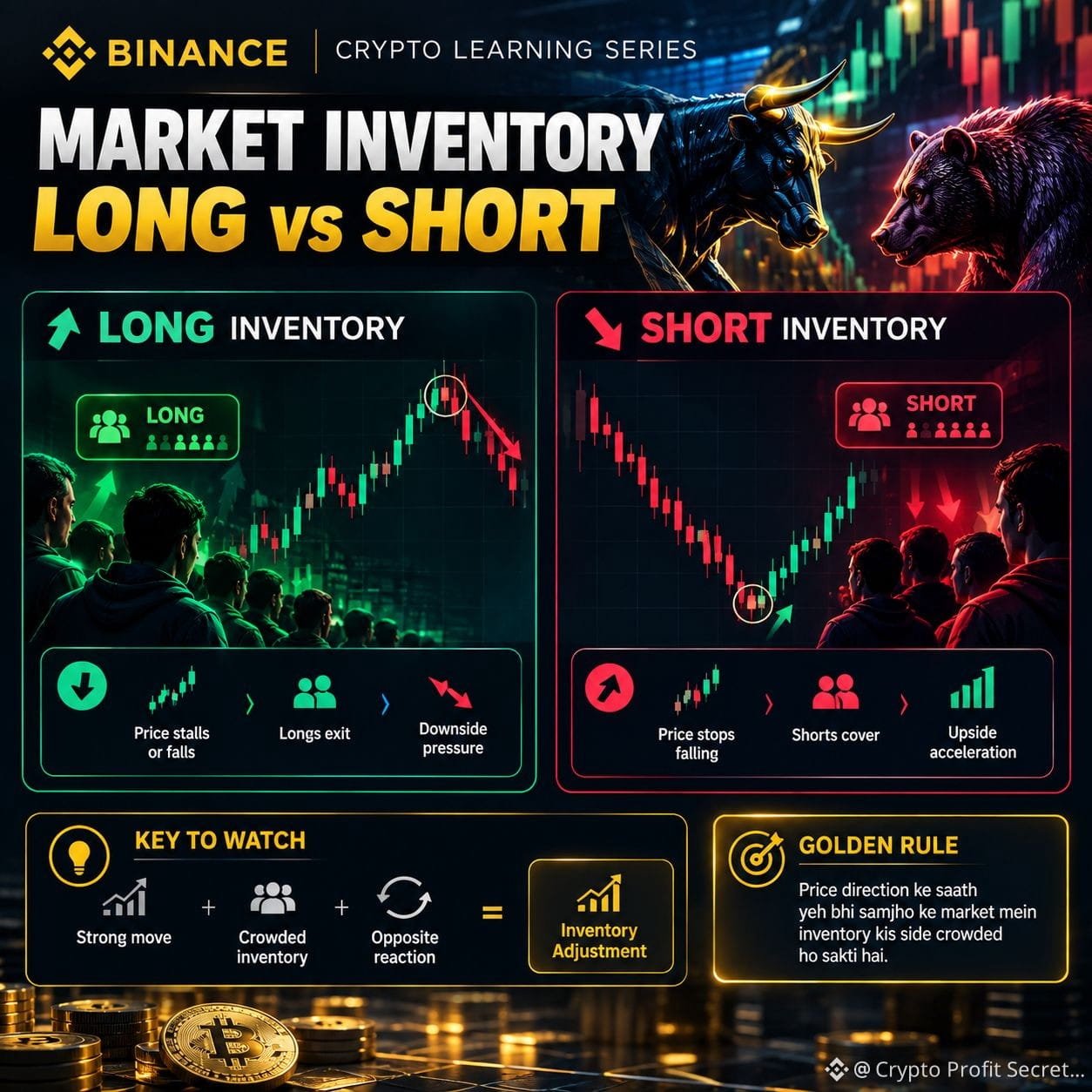
📘 Part 88 — Market Inventory: Long vs Short
🔥 In the Market Profile, it’s not only price—traders’ “Inventory” also moves the auction.
Long Inventory:
When market participants are heavily positioned Long. If price doesn’t continue upward and selling starts, longs may exit → downside pressure can increase.
Short Inventory:
When there is more Short positioning in the market. If price doesn’t continue downward and buying comes in, shorts can cover → the upside move may accelerate.
🔍 What to look for in the auction?
Strong move + crowded inventory + opposite reaction
= A signal that an Inventory Adjustment is possible.
That means the market can move sharply not only due to fresh buyers/sellers, but also due to exits/covering of existing positions.
🧠 Golden Rule:
Along with the price direction, also understand which side of the market’s inventory may be crowded.
#BinanceSquare #crypto #BTC #CryptoLearning #tradingeducation $BTC
{spot}(BTCUSDT)
📘 Part 88 — Market Inventory: Long vs Short
🔥 In the Market Profile, it’s not only price—traders’ “Inventory” also moves the auction.
Long Inventory:
When market participants are heavily positioned Long. If price doesn’t continue upward and selling starts, longs may exit → downside pressure can increase.
Short Inventory:
When there is more Short positioning in the market. If price doesn’t continue downward and buying comes in, shorts can cover → the upside move may accelerate.
🔍 What to look for in the auction?
Strong move + crowded inventory + opposite reaction
= A signal that an Inventory Adjustment is possible.
That means the market can move sharply not only due to fresh buyers/sellers, but also due to exits/covering of existing positions.
🧠 Golden Rule:
Along with the price direction, also understand which side of the market’s inventory may be crowded.
#BinanceSquare #crypto #BTC #CryptoLearning #tradingeducation $BTC
🔥 In the Market Profile, it’s not only price—traders’ “Inventory” also moves the auction.
Long Inventory:
When market participants are heavily positioned Long. If price doesn’t continue upward and selling starts, longs may exit → downside pressure can increase.
Short Inventory:
When there is more Short positioning in the market. If price doesn’t continue downward and buying comes in, shorts can cover → the upside move may accelerate.
🔍 What to look for in the auction?
Strong move + crowded inventory + opposite reaction
= A signal that an Inventory Adjustment is possible.
That means the market can move sharply not only due to fresh buyers/sellers, but also due to exits/covering of existing positions.
🧠 Golden Rule:
Along with the price direction, also understand which side of the market’s inventory may be crowded.
#BinanceSquare #crypto #BTC #CryptoLearning #tradingeducation $BTC
2
61
Conviction has never once told you how many coins to buy.
Here's the mechanic most traders skip: position size should come from the distance between your entry and the point that proves you wrong, combined with how much of your account you're willing to lose if that happens. Wide invalidation, smaller size. Tight invalidation, larger size is possible. The excitement you feel about a setup has zero mathematical relationship to any of this. Size decided by emotion is just risk decided by accident.
Next time you enter, calculate size last, not first. Find invalidation, define acceptable account risk, then let the math hand you the size.
What's your process for setting invalidation before you size a trade?
$ETH $BNB $SOL #Trading #TradingEducation #Crypto #TA
Follow for daily trading education · Education only, not financial advice.
Conviction has never once told you how many coins to buy.
Here's the mechanic most traders skip: position size should come from the distance between your entry and the point that proves you wrong, combined with how much of your account you're willing to lose if that happens. Wide invalidation, smaller size. Tight invalidation, larger size is possible. The excitement you feel about a setup has zero mathematical relationship to any of this. Size decided by emotion is just risk decided by accident.
Next time you enter, calculate size last, not first. Find invalidation, define acceptable account risk, then let the math hand you the size.
What's your process for setting invalidation before you size a trade?
$ETH $BNB $SOL #Trading #TradingEducation #Crypto #TA
Follow for daily trading education · Education only, not financial advice.
Here's the mechanic most traders skip: position size should come from the distance between your entry and the point that proves you wrong, combined with how much of your account you're willing to lose if that happens. Wide invalidation, smaller size. Tight invalidation, larger size is possible. The excitement you feel about a setup has zero mathematical relationship to any of this. Size decided by emotion is just risk decided by accident.
Next time you enter, calculate size last, not first. Find invalidation, define acceptable account risk, then let the math hand you the size.
What's your process for setting invalidation before you size a trade?
$ETH $BNB $SOL #Trading #TradingEducation #Crypto #TA
Follow for daily trading education · Education only, not financial advice.
94

Understanding Risk-to-Reward Ratio (R:R)
Title: The Math Behind Winning Traders: Risk to Reward Ratio 📐
You don't need a 90% win rate to be profitable in crypto. You just need proper Risk-to-Reward (R:R) management.
Quick Math Example:
1:3 R:R Ratio: If you risk $10 to make $30, you only need to win 35% of your trades to remain overall profitable!
1:1 R:R Ratio: Requires a 50%+ win rate just to break even after exchange fees.
Rule: Never enter a trade where potential reward isn't at least 2x the potential risk.
What is your preferred Risk-to-Reward ratio when placing orders?
#TradingEducation #RiskManagement #Write2Earn #CryptoTips
Understanding Risk-to-Reward Ratio (R:R)
Title: The Math Behind Winning Traders: Risk to Reward Ratio 📐
You don't need a 90% win rate to be profitable in crypto. You just need proper Risk-to-Reward (R:R) management.
Quick Math Example:
1:3 R:R Ratio: If you risk $10 to make $30, you only need to win 35% of your trades to remain overall profitable!
1:1 R:R Ratio: Requires a 50%+ win rate just to break even after exchange fees.
Rule: Never enter a trade where potential reward isn't at least 2x the potential risk.
What is your preferred Risk-to-Reward ratio when placing orders?
#TradingEducation #RiskManagement #Write2Earn #CryptoTips
Title: The Math Behind Winning Traders: Risk to Reward Ratio 📐
You don't need a 90% win rate to be profitable in crypto. You just need proper Risk-to-Reward (R:R) management.
Quick Math Example:
1:3 R:R Ratio: If you risk $10 to make $30, you only need to win 35% of your trades to remain overall profitable!
1:1 R:R Ratio: Requires a 50%+ win rate just to break even after exchange fees.
Rule: Never enter a trade where potential reward isn't at least 2x the potential risk.
What is your preferred Risk-to-Reward ratio when placing orders?
#TradingEducation #RiskManagement #Write2Earn #CryptoTips
1
4
Article
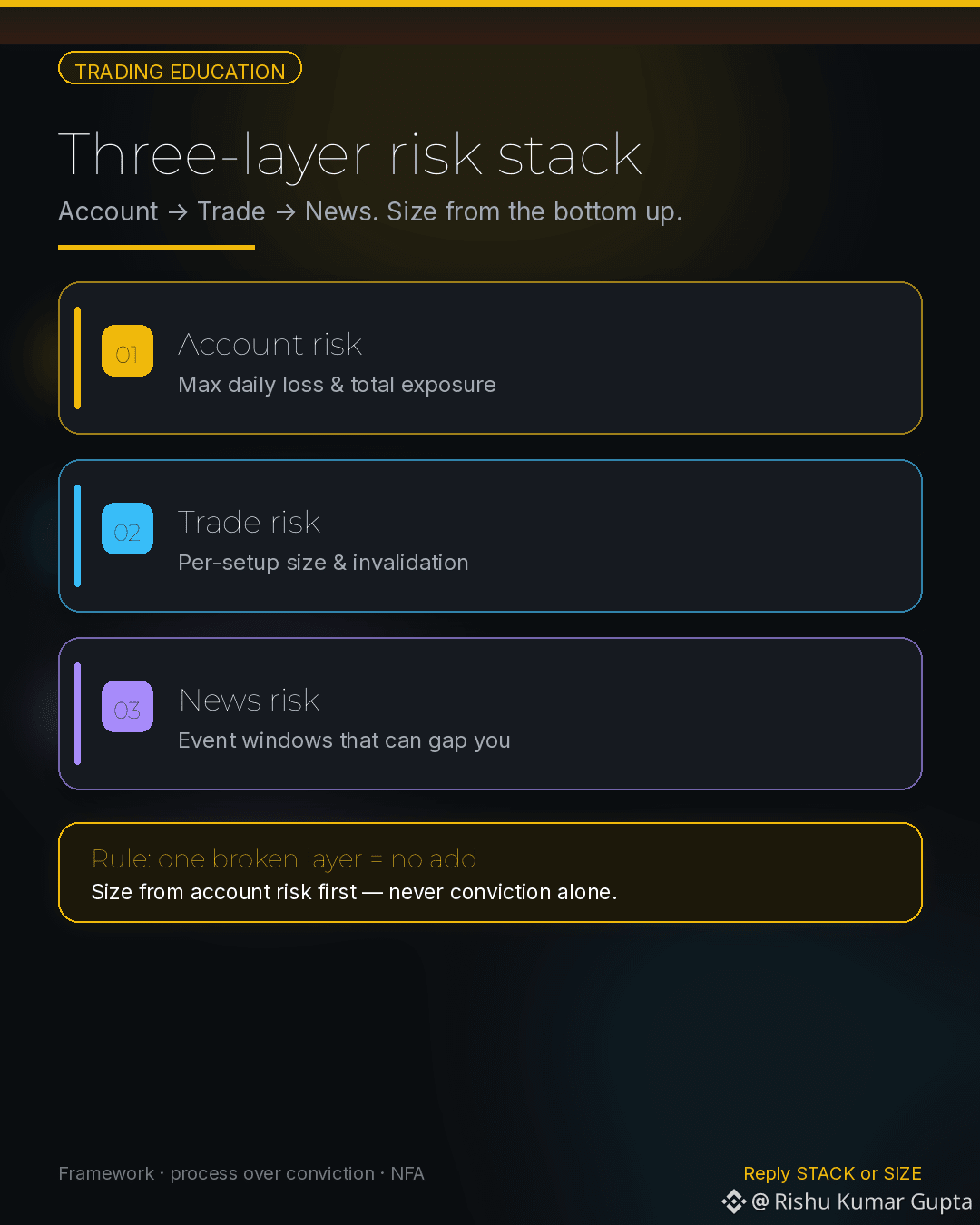
Three-layer risk stackMost traders size from conviction. Pros size from a stack.
Three layers — check bottom-up before you add:
1) Account risk — max daily loss & total exposure. If the day is already red past your line, stop. No “make it back” adds.
2) Trade risk — per-setup size + clear invalidation. If you can’t name the exit, you don’t have a trade.
3) News risk — event windows that can gap you. Same thesis, worse timing = still a no.
Concrete takeaway: size from the stack bottom-up (account first). One broken layer = no add. Conviction never overrides a broken layer.
Reply STACK or SIZE
NFA — education only, not financial advice.
#TradingEducation #RiskManagement
Three-layer risk stack
Most traders size from conviction. Pros size from a stack.
Three layers — check bottom-up before you add:
1) Account risk — max daily loss & total exposure. If the day is already red past your line, stop. No “make it back” adds.
2) Trade risk — per-setup size + clear invalidation. If you can’t name the exit, you don’t have a trade.
3) News risk — event windows that can gap you. Same thesis, worse timing = still a no.
Concrete takeaway: size from the stack bottom-up (account first). One broken layer = no add. Conviction never overrides a broken layer.
Reply STACK or SIZE
NFA — education only, not financial advice.
#TradingEducation #RiskManagement
Three layers — check bottom-up before you add:
1) Account risk — max daily loss & total exposure. If the day is already red past your line, stop. No “make it back” adds.
2) Trade risk — per-setup size + clear invalidation. If you can’t name the exit, you don’t have a trade.
3) News risk — event windows that can gap you. Same thesis, worse timing = still a no.
Concrete takeaway: size from the stack bottom-up (account first). One broken layer = no add. Conviction never overrides a broken layer.
Reply STACK or SIZE
NFA — education only, not financial advice.
#TradingEducation #RiskManagement
26
Nobody boards a plane with only one engine. Airlines build in redundancy because a single failure shouldn't end the flight. Trading needs the same logic.
Here's the concept: capping risk to a small fraction of the account per trade means no single loss can ground you. Lose big once, and you need a huge win just to get back to even — math that quietly wrecks accounts. Lose small, repeatedly, and you stay in the game long enough for your edge to actually play out.
Watch how much of your account moves on a single bad trade. If one loss changes your mood or your month, the position was too big, not just the market too mean.
What's your personal ceiling per trade, and does your last month of trades actually respect it?
$ADA $DOGE $AVAX #Trading #TradingEducation #Crypto #TA
Follow for daily trading education · Education only, not financial advice.
Nobody boards a plane with only one engine. Airlines build in redundancy because a single failure shouldn't end the flight. Trading needs the same logic.
Here's the concept: capping risk to a small fraction of the account per trade means no single loss can ground you. Lose big once, and you need a huge win just to get back to even — math that quietly wrecks accounts. Lose small, repeatedly, and you stay in the game long enough for your edge to actually play out.
Watch how much of your account moves on a single bad trade. If one loss changes your mood or your month, the position was too big, not just the market too mean.
What's your personal ceiling per trade, and does your last month of trades actually respect it?
$ADA $DOGE $AVAX #Trading #TradingEducation #Crypto #TA
Follow for daily trading education · Education only, not financial advice.
Here's the concept: capping risk to a small fraction of the account per trade means no single loss can ground you. Lose big once, and you need a huge win just to get back to even — math that quietly wrecks accounts. Lose small, repeatedly, and you stay in the game long enough for your edge to actually play out.
Watch how much of your account moves on a single bad trade. If one loss changes your mood or your month, the position was too big, not just the market too mean.
What's your personal ceiling per trade, and does your last month of trades actually respect it?
$ADA $DOGE $AVAX #Trading #TradingEducation #Crypto #TA
Follow for daily trading education · Education only, not financial advice.

217

·
--
A perfect chart setup can fail in one headline. ⚡
News doesn’t respect support, resistance, RSI, or moving averages.
Major economic releases, regulation updates, exchange issues, or geopolitical headlines can bring instant volume and wide candles. Price may break a level that held for days—then reverse just as fast.
That doesn’t make technical analysis useless. It means technical levels work best when normal order flow is in control. During news, uncertainty takes over.
Example: price compresses below resistance and your breakout plan looks clean. A headline hits, price spikes above, triggers buyers, then falls back into the range. The setup wasn’t necessarily wrong—the environment changed. 🧠
Practical rule: check for major scheduled news before trading. If it’s near, reduce size, be patient, or wait for the first reaction to settle. Don’t randomly widen stops.
For surprise news, don’t chase the first candle. Let volatility show where price is truly accepted.
News creates movement.
It doesn’t automatically create opportunity. 🎯
Do you check the economic calendar before trading? 👇
#CryptoTrading #RiskManagement #MarketVolatility #TradingEducation
A perfect chart setup can fail in one headline. ⚡
News doesn’t respect support, resistance, RSI, or moving averages.
Major economic releases, regulation updates, exchange issues, or geopolitical headlines can bring instant volume and wide candles. Price may break a level that held for days—then reverse just as fast.
That doesn’t make technical analysis useless. It means technical levels work best when normal order flow is in control. During news, uncertainty takes over.
Example: price compresses below resistance and your breakout plan looks clean. A headline hits, price spikes above, triggers buyers, then falls back into the range. The setup wasn’t necessarily wrong—the environment changed. 🧠
Practical rule: check for major scheduled news before trading. If it’s near, reduce size, be patient, or wait for the first reaction to settle. Don’t randomly widen stops.
For surprise news, don’t chase the first candle. Let volatility show where price is truly accepted.
News creates movement.
It doesn’t automatically create opportunity. 🎯
Do you check the economic calendar before trading? 👇
#CryptoTrading #RiskManagement #MarketVolatility #TradingEducation
News doesn’t respect support, resistance, RSI, or moving averages.
Major economic releases, regulation updates, exchange issues, or geopolitical headlines can bring instant volume and wide candles. Price may break a level that held for days—then reverse just as fast.
That doesn’t make technical analysis useless. It means technical levels work best when normal order flow is in control. During news, uncertainty takes over.
Example: price compresses below resistance and your breakout plan looks clean. A headline hits, price spikes above, triggers buyers, then falls back into the range. The setup wasn’t necessarily wrong—the environment changed. 🧠
Practical rule: check for major scheduled news before trading. If it’s near, reduce size, be patient, or wait for the first reaction to settle. Don’t randomly widen stops.
For surprise news, don’t chase the first candle. Let volatility show where price is truly accepted.
News creates movement.
It doesn’t automatically create opportunity. 🎯
Do you check the economic calendar before trading? 👇
#CryptoTrading #RiskManagement #MarketVolatility #TradingEducation

57


·
--
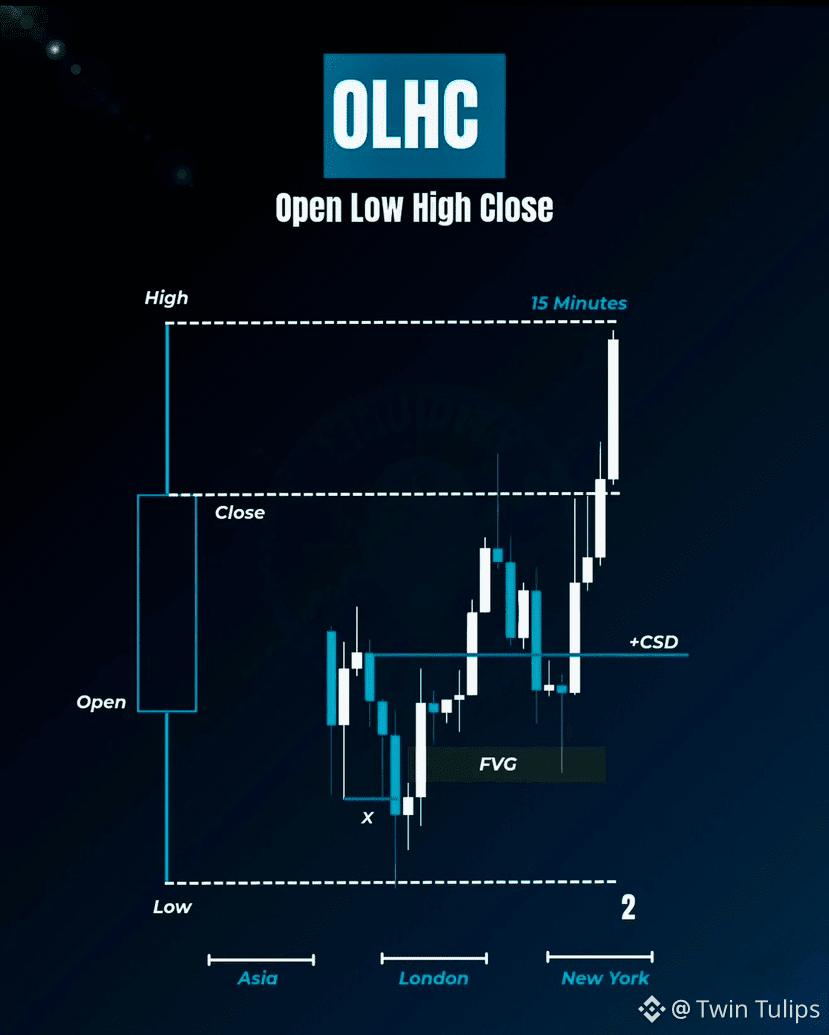
Open, High, Low, Close 💜
The 4 Numbers Behind Every Candle 🕯️
Every candlestick tells a story through four key prices:
🟢 Open — Where the candle starts
🔺 High — The highest price reached
🔻 Low — The lowest price reached
⚪ Close — Where the candle finishes
🎯 Simple Candle Flow:
Open → Price Moves → High/Low → Close
The relationship between the Open and Close helps you understand whether buyers or sellers controlled the candle.
💡 Golden Rule: Don’t read a candle in isolation. Combine OHLC with market structure, liquidity, and context before making a trading decision.
Learn the basics, study historical charts, and backtest your ideas.
#OHLC #CandlestickTrading #PriceAction #TradingEducation
Open, High, Low, Close 💜
The 4 Numbers Behind Every Candle 🕯️
Every candlestick tells a story through four key prices:
🟢 Open — Where the candle starts
🔺 High — The highest price reached
🔻 Low — The lowest price reached
⚪ Close — Where the candle finishes
🎯 Simple Candle Flow:
Open → Price Moves → High/Low → Close
The relationship between the Open and Close helps you understand whether buyers or sellers controlled the candle.
💡 Golden Rule: Don’t read a candle in isolation. Combine OHLC with market structure, liquidity, and context before making a trading decision.
Learn the basics, study historical charts, and backtest your ideas.
#OHLC #CandlestickTrading #PriceAction #TradingEducation
The 4 Numbers Behind Every Candle 🕯️
Every candlestick tells a story through four key prices:
🟢 Open — Where the candle starts
🔺 High — The highest price reached
🔻 Low — The lowest price reached
⚪ Close — Where the candle finishes
🎯 Simple Candle Flow:
Open → Price Moves → High/Low → Close
The relationship between the Open and Close helps you understand whether buyers or sellers controlled the candle.
💡 Golden Rule: Don’t read a candle in isolation. Combine OHLC with market structure, liquidity, and context before making a trading decision.
Learn the basics, study historical charts, and backtest your ideas.
#OHLC #CandlestickTrading #PriceAction #TradingEducation
8
1k

·
--
How to read Bitcoin price movement without relying on guesswork?
Does a rise in $BTC always mean the trend will continue? Not necessarily.
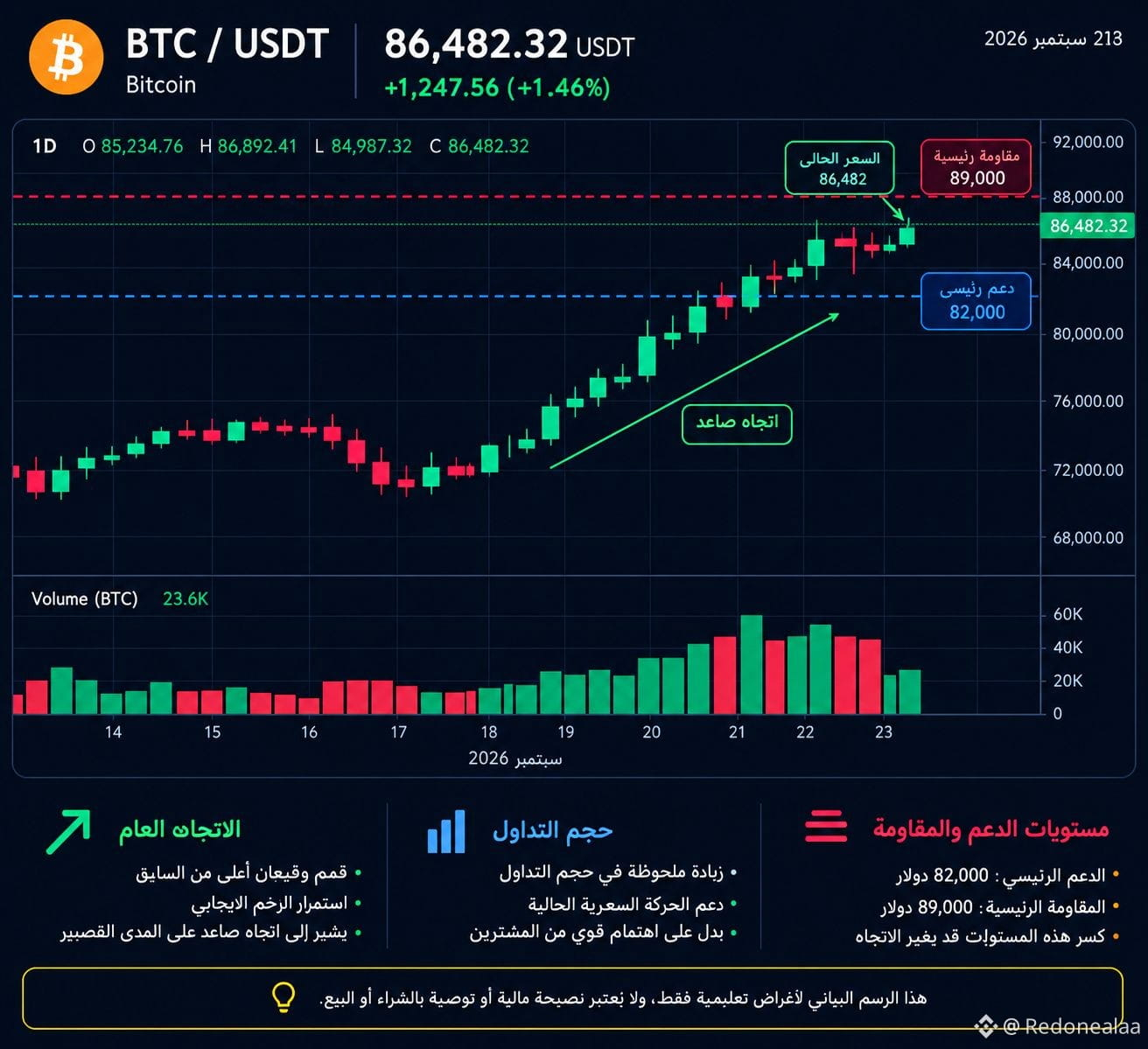
Before forming any opinion about Bitcoin’s movement, you can look at 3 simple elements:
1️⃣ Overall trend: Is the price making higher highs and higher lows—or lower ones?
2️⃣ Trading volume: Is the price move supported by clear trading activity?
3️⃣ Support and resistance levels: How does the price react to the levels where there was previous activity?
The most important thing is to gather these signals together instead of relying on just one indicator.
📈 Add a $BTC chart to the post to follow the current price action, then compare what you see on the chart with these three points.
⚠️ This content is for educational purposes only and is not a buy or sell recommendation. The crypto market is volatile, and any trading decision should be based on your own research and risk management.
#Bitcoin #BTC #Crypto #BinanceSquare #TradingEducation
How to read Bitcoin price movement without relying on guesswork?
Does a rise in $BTC always mean the trend will continue? Not necessarily.
Before forming any opinion about Bitcoin’s movement, you can look at 3 simple elements:
1️⃣ Overall trend: Is the price making higher highs and higher lows—or lower ones?
2️⃣ Trading volume: Is the price move supported by clear trading activity?
3️⃣ Support and resistance levels: How does the price react to the levels where there was previous activity?
The most important thing is to gather these signals together instead of relying on just one indicator.
📈 Add a $BTC chart to the post to follow the current price action, then compare what you see on the chart with these three points.
⚠️ This content is for educational purposes only and is not a buy or sell recommendation. The crypto market is volatile, and any trading decision should be based on your own research and risk management.
#Bitcoin #BTC #Crypto #BinanceSquare #TradingEducation
Does a rise in $BTC always mean the trend will continue? Not necessarily.
Before forming any opinion about Bitcoin’s movement, you can look at 3 simple elements:
1️⃣ Overall trend: Is the price making higher highs and higher lows—or lower ones?
2️⃣ Trading volume: Is the price move supported by clear trading activity?
3️⃣ Support and resistance levels: How does the price react to the levels where there was previous activity?
The most important thing is to gather these signals together instead of relying on just one indicator.
📈 Add a $BTC chart to the post to follow the current price action, then compare what you see on the chart with these three points.
⚠️ This content is for educational purposes only and is not a buy or sell recommendation. The crypto market is volatile, and any trading decision should be based on your own research and risk management.
#Bitcoin #BTC #Crypto #BinanceSquare #TradingEducation
1
83
·
--
🪙 Crypto Trading Article
Why Crypto Trading Is an Exciting Skill to Learn
Crypto trading is an exciting way to learn about digital assets, market movements, chart analysis, and financial technology.
One of the most interesting things about crypto is that the market provides plenty of opportunities to study price action and understand how different market conditions develop.
Learning crypto trading can help improve technical analysis, patience, discipline, and decision-making skills. By studying charts, learning market concepts, and practicing consistently, you can continue developing your trading knowledge.
The crypto market is also closely connected with the rapidly growing world of blockchain and digital finance, making it an interesting field for people who enjoy learning about modern financial technology.#Crypto #CryptoTrading #BTC #Trading #Blockchain #TradingEducation
🪙 Crypto Trading Article
Why Crypto Trading Is an Exciting Skill to Learn
Crypto trading is an exciting way to learn about digital assets, market movements, chart analysis, and financial technology.
One of the most interesting things about crypto is that the market provides plenty of opportunities to study price action and understand how different market conditions develop.
Learning crypto trading can help improve technical analysis, patience, discipline, and decision-making skills. By studying charts, learning market concepts, and practicing consistently, you can continue developing your trading knowledge.
The crypto market is also closely connected with the rapidly growing world of blockchain and digital finance, making it an interesting field for people who enjoy learning about modern financial technology.#Crypto #CryptoTrading #BTC #Trading #Blockchain #TradingEducation
Why Crypto Trading Is an Exciting Skill to Learn
Crypto trading is an exciting way to learn about digital assets, market movements, chart analysis, and financial technology.
One of the most interesting things about crypto is that the market provides plenty of opportunities to study price action and understand how different market conditions develop.
Learning crypto trading can help improve technical analysis, patience, discipline, and decision-making skills. By studying charts, learning market concepts, and practicing consistently, you can continue developing your trading knowledge.
The crypto market is also closely connected with the rapidly growing world of blockchain and digital finance, making it an interesting field for people who enjoy learning about modern financial technology.#Crypto #CryptoTrading #BTC #Trading #Blockchain #TradingEducation
67
·
--
Moving averages don’t predict price. They help you stop fighting the bigger flow. 📊
Think of them as a moving “map” of where price has been accepted over time.
A rising 50-period MA with price holding above it often supports a bullish trend context. A falling MA with price repeatedly rejected below it points to bearish pressure.
But here’s the key:
A moving average is an area of interest—not a magic buy or sell line. ⚠️
Example: in an uptrend, price pulls back toward the 20 or 50 MA. Don’t blindly enter on the first touch. Watch the reaction:
• Does price hold the area?
• Does a bullish candle reclaim it?
• Is the wider market structure still making higher lows?
If price slices through the MA and fails to recover it, the trend may be weakening.
Practical rule: use one or two MAs only. For example, use the 50 MA for trend direction and the 20 MA for shorter-term pullback context. More lines usually create more confusion. 🧠
The MA should support your read of structure—not replace it.
Trend first. Reaction second. Entry last. 🎯
Which moving average do you find most useful on your chart? 👇
#MovingAverages #TechnicalAnalysis #CryptoTrading #TradingEducation
Moving averages don’t predict price. They help you stop fighting the bigger flow. 📊
Think of them as a moving “map” of where price has been accepted over time.
A rising 50-period MA with price holding above it often supports a bullish trend context. A falling MA with price repeatedly rejected below it points to bearish pressure.
But here’s the key:
A moving average is an area of interest—not a magic buy or sell line. ⚠️
Example: in an uptrend, price pulls back toward the 20 or 50 MA. Don’t blindly enter on the first touch. Watch the reaction:
• Does price hold the area?
• Does a bullish candle reclaim it?
• Is the wider market structure still making higher lows?
If price slices through the MA and fails to recover it, the trend may be weakening.
Practical rule: use one or two MAs only. For example, use the 50 MA for trend direction and the 20 MA for shorter-term pullback context. More lines usually create more confusion. 🧠
The MA should support your read of structure—not replace it.
Trend first. Reaction second. Entry last. 🎯
Which moving average do you find most useful on your chart? 👇
#MovingAverages #TechnicalAnalysis #CryptoTrading #TradingEducation
Think of them as a moving “map” of where price has been accepted over time.
A rising 50-period MA with price holding above it often supports a bullish trend context. A falling MA with price repeatedly rejected below it points to bearish pressure.
But here’s the key:
A moving average is an area of interest—not a magic buy or sell line. ⚠️
Example: in an uptrend, price pulls back toward the 20 or 50 MA. Don’t blindly enter on the first touch. Watch the reaction:
• Does price hold the area?
• Does a bullish candle reclaim it?
• Is the wider market structure still making higher lows?
If price slices through the MA and fails to recover it, the trend may be weakening.
Practical rule: use one or two MAs only. For example, use the 50 MA for trend direction and the 20 MA for shorter-term pullback context. More lines usually create more confusion. 🧠
The MA should support your read of structure—not replace it.
Trend first. Reaction second. Entry last. 🎯
Which moving average do you find most useful on your chart? 👇
#MovingAverages #TechnicalAnalysis #CryptoTrading #TradingEducation

90

·
--
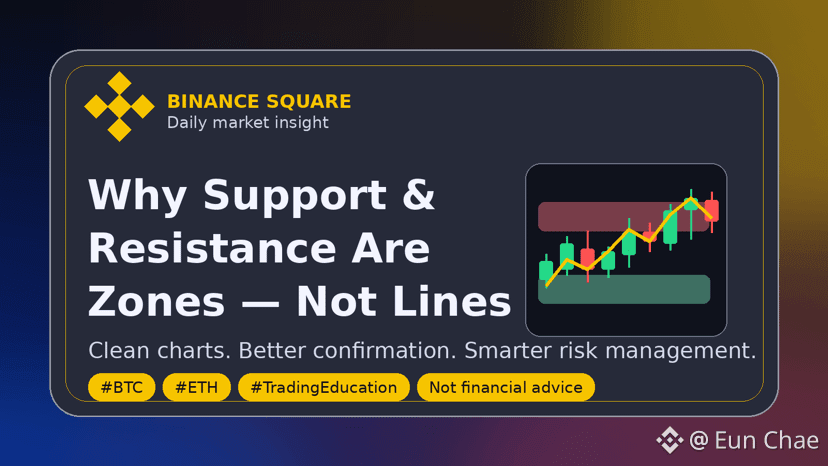
Why “support” and “resistance” are zones, not exact lines!
Many new traders draw one perfect line on a chart and expect price to react there every time.
In reality, markets are driven by orders, liquidity, and changing sentiment so key levels often behave more like areas than precise numbers.
A support zone is where buyers have previously shown interest. A resistance zone is where sellers have previously stepped in. But price can briefly move beyond these areas before deciding direction, especially in volatile markets like crypto.
For $BTC , $ETH , and other major assets, I like to think in terms of: Zones over linesConfirmation over predictionRisk management over being “right”
A clean chart can help, but no level is guaranteed. The goal is not to predict every move, it’s to build a repeatable process and avoid emotional decisions.
Not financial advice! ✌🏻
#tradingeducation #TechnicalAnalysis 📊
Why “support” and “resistance” are zones, not exact lines!
Many new traders draw one perfect line on a chart and expect price to react there every time.
In reality, markets are driven by orders, liquidity, and changing sentiment so key levels often behave more like areas than precise numbers.
A support zone is where buyers have previously shown interest. A resistance zone is where sellers have previously stepped in. But price can briefly move beyond these areas before deciding direction, especially in volatile markets like crypto.
For $BTC , $ETH , and other major assets, I like to think in terms of: Zones over linesConfirmation over predictionRisk management over being “right”
A clean chart can help, but no level is guaranteed. The goal is not to predict every move, it’s to build a repeatable process and avoid emotional decisions.
Not financial advice! ✌🏻
#tradingeducation #TechnicalAnalysis 📊
Many new traders draw one perfect line on a chart and expect price to react there every time.
In reality, markets are driven by orders, liquidity, and changing sentiment so key levels often behave more like areas than precise numbers.
A support zone is where buyers have previously shown interest. A resistance zone is where sellers have previously stepped in. But price can briefly move beyond these areas before deciding direction, especially in volatile markets like crypto.
For $BTC , $ETH , and other major assets, I like to think in terms of: Zones over linesConfirmation over predictionRisk management over being “right”
A clean chart can help, but no level is guaranteed. The goal is not to predict every move, it’s to build a repeatable process and avoid emotional decisions.
Not financial advice! ✌🏻
#tradingeducation #TechnicalAnalysis 📊
Ar-Kar 90:
Why not!?
2
1
15
Article
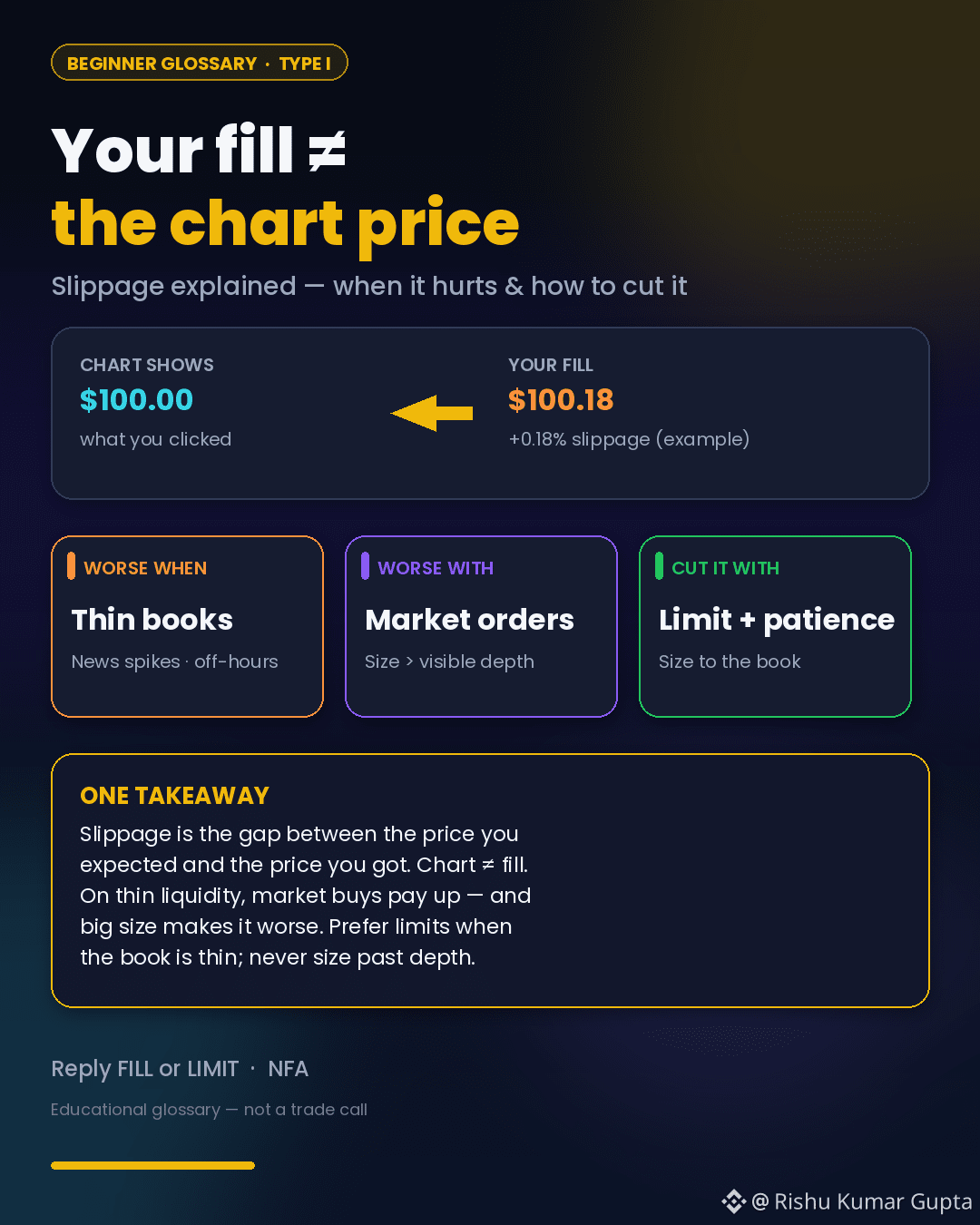
Slippage in Plain EnglishYour fill is not the chart price.
That gap is slippage — the difference between the price you expected and the price you actually got. Beginners often blame “the exchange” when the real issue is order type + thin liquidity + size.
When slippage gets worse
• Thin order books (off-hours, small alts, right after a headline)
• Market orders that sweep multiple price levels
• Position size bigger than visible depth
How to cut it
1. Prefer limit orders when the book looks thin
2. Size to what you can see — not what you hope fills
3. Avoid slamming size into news wicks; wait for depth to rebuild
Chart price is a quote. Your fill is a trade. Treat them as different numbers.
NFA — educational glossary only.
Reply FILL if you’ve been burned by a market order, or LIMIT if you wait for the book.
$BTC $ETH #TradingEducation #BinanceSquare #CryptoBasics
Slippage in Plain English
Your fill is not the chart price.
That gap is slippage — the difference between the price you expected and the price you actually got. Beginners often blame “the exchange” when the real issue is order type + thin liquidity + size.
When slippage gets worse
• Thin order books (off-hours, small alts, right after a headline)
• Market orders that sweep multiple price levels
• Position size bigger than visible depth
How to cut it
1. Prefer limit orders when the book looks thin
2. Size to what you can see — not what you hope fills
3. Avoid slamming size into news wicks; wait for depth to rebuild
Chart price is a quote. Your fill is a trade. Treat them as different numbers.
NFA — educational glossary only.
Reply FILL if you’ve been burned by a market order, or LIMIT if you wait for the book.
$BTC $ETH #TradingEducation #BinanceSquare #CryptoBasics
That gap is slippage — the difference between the price you expected and the price you actually got. Beginners often blame “the exchange” when the real issue is order type + thin liquidity + size.
When slippage gets worse
• Thin order books (off-hours, small alts, right after a headline)
• Market orders that sweep multiple price levels
• Position size bigger than visible depth
How to cut it
1. Prefer limit orders when the book looks thin
2. Size to what you can see — not what you hope fills
3. Avoid slamming size into news wicks; wait for depth to rebuild
Chart price is a quote. Your fill is a trade. Treat them as different numbers.
NFA — educational glossary only.
Reply FILL if you’ve been burned by a market order, or LIMIT if you wait for the book.
$BTC $ETH #TradingEducation #BinanceSquare #CryptoBasics
16
·
--
📈 GOLDEN CROSS & DEATH CROSS — TREND CHANGE SIGN?
$SUI
{spot}(SUIUSDT)
Have you ever seen EMA 50 and EMA 200 intersect?
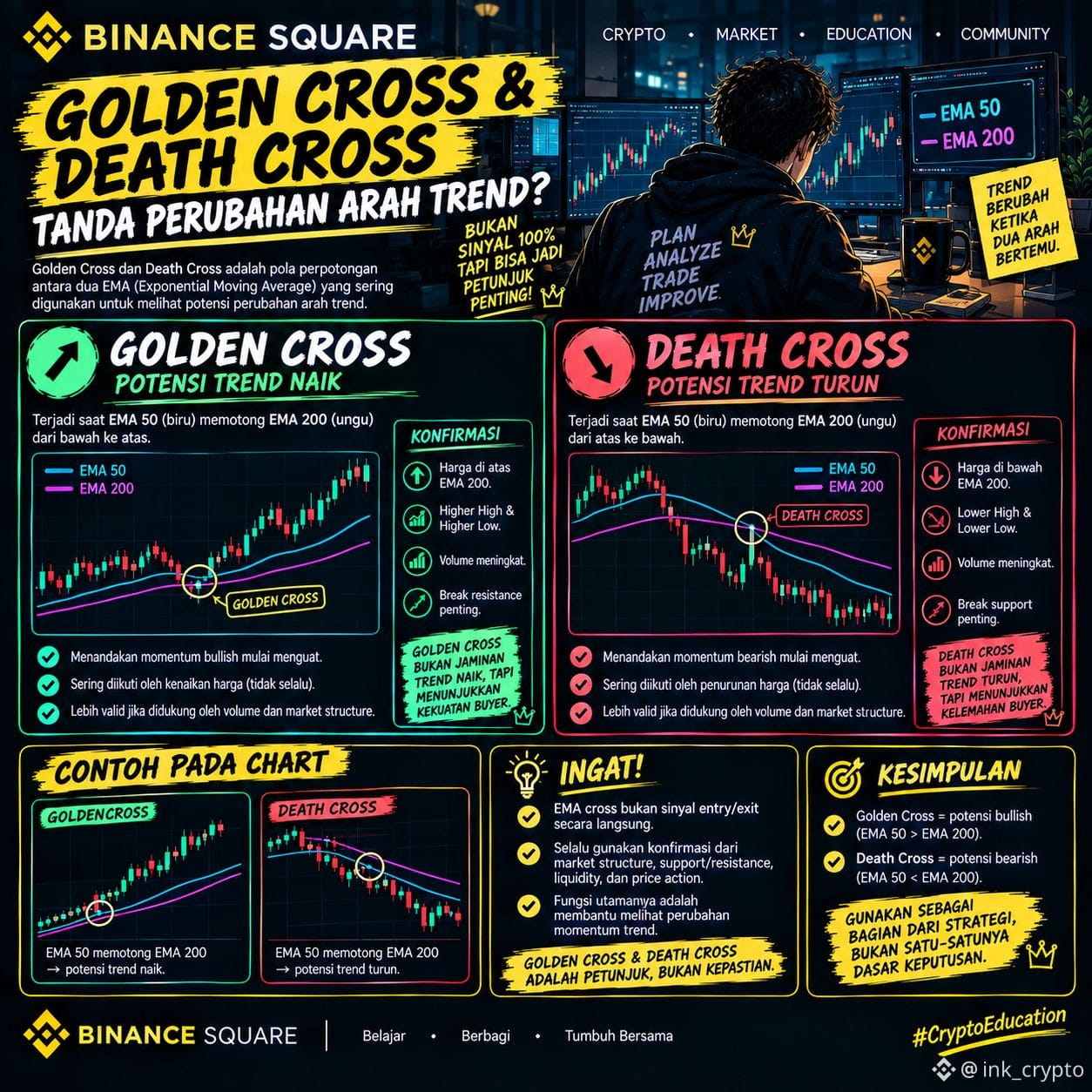
Well, this is what’s often called the Golden Cross and Death Cross.
🟢 GOLDEN CROSS
Occurs when EMA 50 crosses above EMA 200 from the bottom.
Usually considered a sign that bullish momentum is starting to strengthen.
🔴 DEATH CROSS
Occurs when EMA 50 crosses below EMA 200 from the top.
Usually considered a sign that bearish momentum is starting to strengthen.
⚠️ But don’t immediately BUY/SELL just because you see a crossover!
Crossovers can be a delayed signal, especially when the market is moving sideways.
Try to confirm with:
✅ Market Structure
✅ Support & Resistance
✅ Liquidity
✅ Volume
✅ Price Action
🎯 Golden Cross & Death Cross = a momentum hint, not a guarantee of the price direction.
In your opinion, do EMA crossovers help more often—or do they actually make you enter too late? 👇
#tradingeducation #CryptoEducation💡🚀 #BinanceSquare
📈 GOLDEN CROSS & DEATH CROSS — TREND CHANGE SIGN?
$SUI
Have you ever seen EMA 50 and EMA 200 intersect?
Well, this is what’s often called the Golden Cross and Death Cross.
🟢 GOLDEN CROSS
Occurs when EMA 50 crosses above EMA 200 from the bottom.
Usually considered a sign that bullish momentum is starting to strengthen.
🔴 DEATH CROSS
Occurs when EMA 50 crosses below EMA 200 from the top.
Usually considered a sign that bearish momentum is starting to strengthen.
⚠️ But don’t immediately BUY/SELL just because you see a crossover!
Crossovers can be a delayed signal, especially when the market is moving sideways.
Try to confirm with:
✅ Market Structure
✅ Support & Resistance
✅ Liquidity
✅ Volume
✅ Price Action
🎯 Golden Cross & Death Cross = a momentum hint, not a guarantee of the price direction.
In your opinion, do EMA crossovers help more often—or do they actually make you enter too late? 👇
#tradingeducation #CryptoEducation💡🚀 #BinanceSquare
$SUI
Have you ever seen EMA 50 and EMA 200 intersect?
Well, this is what’s often called the Golden Cross and Death Cross.
🟢 GOLDEN CROSS
Occurs when EMA 50 crosses above EMA 200 from the bottom.
Usually considered a sign that bullish momentum is starting to strengthen.
🔴 DEATH CROSS
Occurs when EMA 50 crosses below EMA 200 from the top.
Usually considered a sign that bearish momentum is starting to strengthen.
⚠️ But don’t immediately BUY/SELL just because you see a crossover!
Crossovers can be a delayed signal, especially when the market is moving sideways.
Try to confirm with:
✅ Market Structure
✅ Support & Resistance
✅ Liquidity
✅ Volume
✅ Price Action
🎯 Golden Cross & Death Cross = a momentum hint, not a guarantee of the price direction.
In your opinion, do EMA crossovers help more often—or do they actually make you enter too late? 👇
#tradingeducation #CryptoEducation💡🚀 #BinanceSquare
1
1.2k
·
--
5 Steps to Become a Better Trader 👀
1️⃣ Build One Strategy
Stop jumping between strategies. Pick one setup and understand it deeply.
2️⃣ Backtest It
Collect enough data to understand how your setup performs in different market conditions.
3️⃣ Create Clear Rules
Define your entry, stop loss, target, invalidation, and risk before taking a trade.
4️⃣ Control Your Risk
Protect your capital first. One trade should never have the power to destroy your account.
5️⃣ Master Your Execution
Follow your plan consistently and review your trades to identify mistakes and improve.
💡 Golden Rule: You don’t need to predict every move. You need a repeatable process you can execute with discipline.
#TradingEducation #TradingStrategy #TradingDiscipline #RiskManagement
5 Steps to Become a Better Trader 👀
1️⃣ Build One Strategy
Stop jumping between strategies. Pick one setup and understand it deeply.
2️⃣ Backtest It
Collect enough data to understand how your setup performs in different market conditions.
3️⃣ Create Clear Rules
Define your entry, stop loss, target, invalidation, and risk before taking a trade.
4️⃣ Control Your Risk
Protect your capital first. One trade should never have the power to destroy your account.
5️⃣ Master Your Execution
Follow your plan consistently and review your trades to identify mistakes and improve.
💡 Golden Rule: You don’t need to predict every move. You need a repeatable process you can execute with discipline.
#TradingEducation #TradingStrategy #TradingDiscipline #RiskManagement
1️⃣ Build One Strategy
Stop jumping between strategies. Pick one setup and understand it deeply.
2️⃣ Backtest It
Collect enough data to understand how your setup performs in different market conditions.
3️⃣ Create Clear Rules
Define your entry, stop loss, target, invalidation, and risk before taking a trade.
4️⃣ Control Your Risk
Protect your capital first. One trade should never have the power to destroy your account.
5️⃣ Master Your Execution
Follow your plan consistently and review your trades to identify mistakes and improve.
💡 Golden Rule: You don’t need to predict every move. You need a repeatable process you can execute with discipline.
#TradingEducation #TradingStrategy #TradingDiscipline #RiskManagement
Has_been:
ben zaten bu dünyaya bunun için gelmişim zaten 2 senedir zaten 5 kuruş yiyemedim ölcem gitcem sonunda sağlık olsun 9 milyon daha siliniz böyle boyle erir gider
1
1
5
2.8k
Log in to explore more content
Join global crypto users on Binance Square
⚡️ Get latest and useful information about crypto.
💬 Trusted by the world’s largest crypto exchange.
👍 Discover real insights from verified creators.
Email / Phone number
Trending Topics
1
#BitwiseFilesFinalNEARSpotETFProspectus
24,744 views
764 Discussing
2
#BitgetHackerMoves$83MStolenXRP
18,530 views
114 Discussing
3
#SOLSpotETFWeeklyInflow$188M
9,469 views
87 Discussing
4
#DogecoinETFsPostBiggestWeekSinceLaunch
22,367 views
658 Discussing
5
#StrategyStriveAdd2305BitcoinThisWeek
84,671 views
1,739 Discussing
6
#TrumpRejectsIranHormuzReopening
80,539 views
1,341 Discussing
7
#CircleTetherFreezeBitgetHackerWallet
82,202 views
1,280 Discussing
8
#SECSaysTokenBuybacksNotAutoSecurities
49,428 views
771 Discussing
9
#ChinaUSAgreeOn$30BTariffCut
3,956 views
41 Discussing
10
#CoinMarketCapCompletesCoinglassAcquisition
58,965 views
884 Discussing