
#sxt
sxt
3.9M views
8,170 Discussing
Hot
Latest


Verified
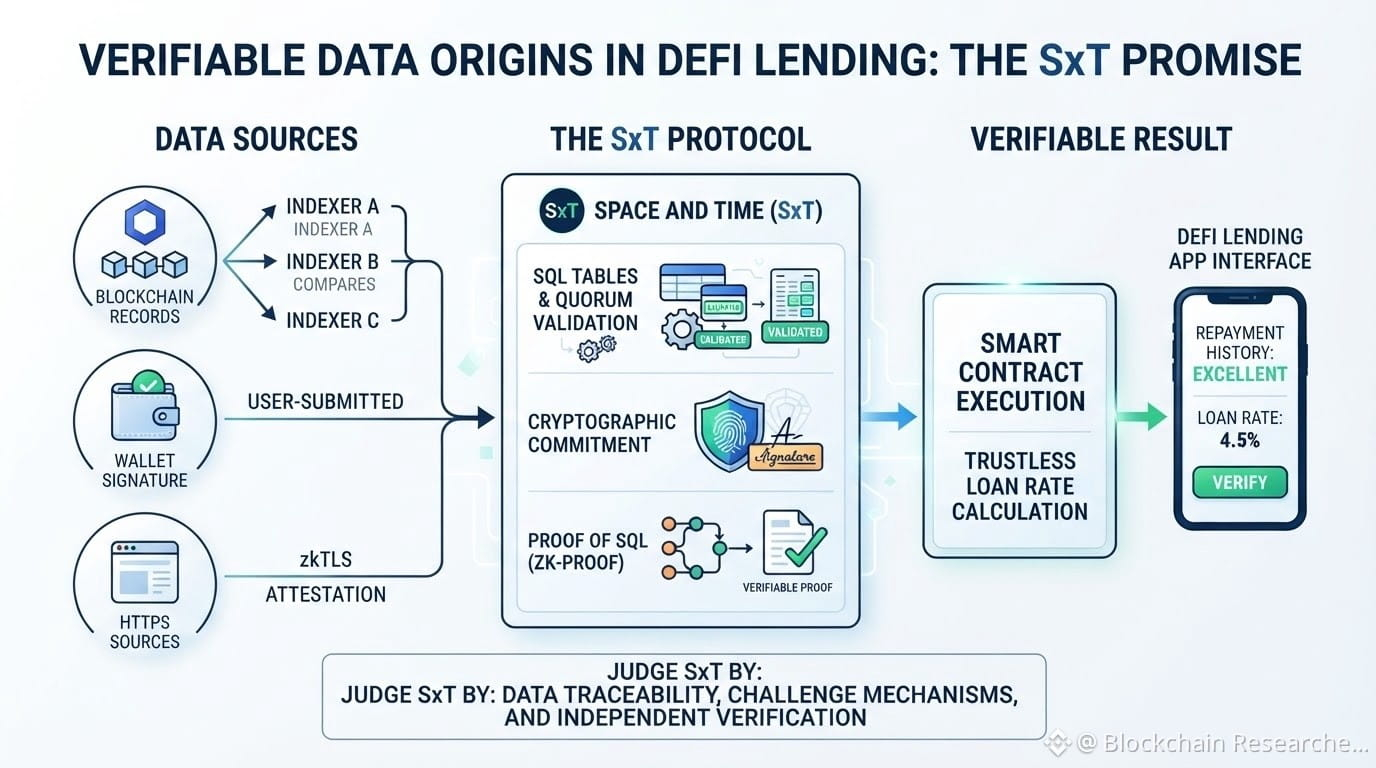
Suppose a DeFi lending app offers me a better rate because my wallet has a history of repaying loans. I would ask: where did that history come from, and can the app prove its calculation?
This is the gap Space and Time targets. Smart contracts enforce rules, but cannot easily search years of activity across blockchains or large off-chain databases. A normal API can return an answer, yet users must trust the database operator and its code.
How does SXT make the result verifiable? There is no single “trust” switch. For blockchain records, multiple indexers collect transactions and events, convert them into SQL tables, and submit them for comparison. Validators can accept matching submissions from a quorum (the docs give 2-of-3 as an example). For user-submitted records, a wallet signature identifies the sender. For some HTTPS sources, zkTLS can attest that information came from a named website and that the user consented.
Next, each table receives a cryptographic commitment — a digital fingerprint — signed by a validator quorum. When a Prover runs a SQL query, Proof of SQL generates a zero-knowledge proof that the calculation was correct against that committed table. A smart contract can verify it without downloading the database or repeating the work.
This could help lenders check collateral and repayment history, tokenized-asset platforms reconcile records, and AI systems verify the figures behind an answer.
But here is the limit: a signature proves who submitted data, not that the claim is true. zkTLS can prove where a response came from, not that the source itself is correct. A bad or outdated source can still produce a perfectly valid proof. Indexer independence matters, and AI can still misread correct results.
So I would judge SXT not by the words “zero knowledge” alone, but by whether users can trace data origins, challenge bad inputs and independently verify results. That is the promise — and the
#sxt $SXT @SpaceandTimeDB
{future}(SXTUSDT)
Suppose a DeFi lending app offers me a better rate because my wallet has a history of repaying loans. I would ask: where did that history come from, and can the app prove its calculation?
This is the gap Space and Time targets. Smart contracts enforce rules, but cannot easily search years of activity across blockchains or large off-chain databases. A normal API can return an answer, yet users must trust the database operator and its code.
How does SXT make the result verifiable? There is no single “trust” switch. For blockchain records, multiple indexers collect transactions and events, convert them into SQL tables, and submit them for comparison. Validators can accept matching submissions from a quorum (the docs give 2-of-3 as an example). For user-submitted records, a wallet signature identifies the sender. For some HTTPS sources, zkTLS can attest that information came from a named website and that the user consented.
Next, each table receives a cryptographic commitment — a digital fingerprint — signed by a validator quorum. When a Prover runs a SQL query, Proof of SQL generates a zero-knowledge proof that the calculation was correct against that committed table. A smart contract can verify it without downloading the database or repeating the work.
This could help lenders check collateral and repayment history, tokenized-asset platforms reconcile records, and AI systems verify the figures behind an answer.
But here is the limit: a signature proves who submitted data, not that the claim is true. zkTLS can prove where a response came from, not that the source itself is correct. A bad or outdated source can still produce a perfectly valid proof. Indexer independence matters, and AI can still misread correct results.
So I would judge SXT not by the words “zero knowledge” alone, but by whether users can trace data origins, challenge bad inputs and independently verify results. That is the promise — and the
#sxt $SXT @SpaceandTime
5
325

·
--
Bullish
Verified
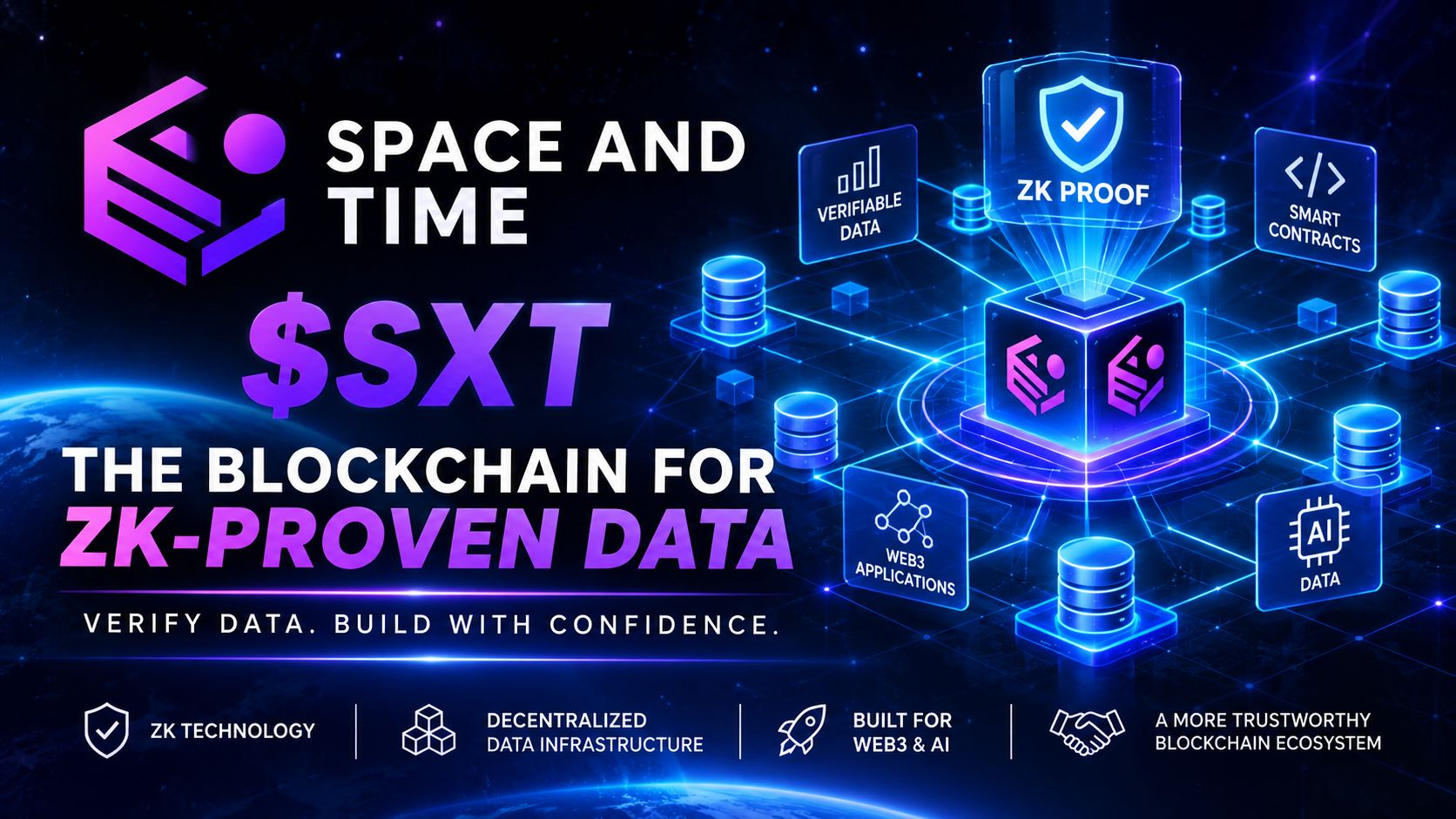
Space and Time ($STX ) – A Project Worth Keeping an Eye On!
One thing I find interesting about Space and Time is its focus on solving a real problem in blockchain: making data more reliable and trustworthy.
Backed by Microsoft, the project uses Zero-Knowledge (ZK) proofs to help developers verify data without relying on blind trust.
Here's what makes $SXT interesting:
🔹 ZK technology for secure data verification
🔹 Built to support Web3 applications and smart contracts
🔹 Exploring the connection between blockchain data and AI
🔹 Focused on transparency and data integrity
🔹 is the native token powering its ecosystem.
For me, the real story isn't just the technology or the Microsoft backing. It's whether Space and Time can turn its infrastructure into something developers actually use.
That's what I'll be watching. Sometimes the most interesting projects are the ones quietly building useful technology while everyone else follows the hype. 👀
#sxt $SXT @SpaceandTimeDB
Space and Time ($STX ) – A Project Worth Keeping an Eye On!
One thing I find interesting about Space and Time is its focus on solving a real problem in blockchain: making data more reliable and trustworthy.
Backed by Microsoft, the project uses Zero-Knowledge (ZK) proofs to help developers verify data without relying on blind trust.
Here's what makes $SXT interesting:
🔹 ZK technology for secure data verification
🔹 Built to support Web3 applications and smart contracts
🔹 Exploring the connection between blockchain data and AI
🔹 Focused on transparency and data integrity
🔹 is the native token powering its ecosystem.
For me, the real story isn't just the technology or the Microsoft backing. It's whether Space and Time can turn its infrastructure into something developers actually use.
That's what I'll be watching. Sometimes the most interesting projects are the ones quietly building useful technology while everyone else follows the hype. 👀
#sxt $SXT @SpaceandTime
Shehab Goma:
Tokenization without verified data is risky, SXT brings the cryptographic proof we actually need
6
10
659

·
--
The more AI and DeFi grow, the more important one question becomes: can we actually trust the data behind them?
That's what makes @SpaceandTimeDB interesting to me.
It's not just about storing information. It's about making data verifiable so applications can rely on it with greater confidence.
Whether we're talking about AI applications, tokenized real-world assets, or DeFi protocols, reliable and verifiable data can make a real difference.
I think this is an area worth paying attention to as blockchain adoption continues to evolve.
Keeping $SXT on my radar to see how this technology develops.
#SXT
#sxt $SXT @SpaceandTimeDB
The more AI and DeFi grow, the more important one question becomes: can we actually trust the data behind them?
That's what makes @SpaceandTime interesting to me.
It's not just about storing information. It's about making data verifiable so applications can rely on it with greater confidence.
Whether we're talking about AI applications, tokenized real-world assets, or DeFi protocols, reliable and verifiable data can make a real difference.
I think this is an area worth paying attention to as blockchain adoption continues to evolve.
Keeping $SXT on my radar to see how this technology develops.
#SXT
#sxt $SXT @SpaceandTime
4
595

·
--
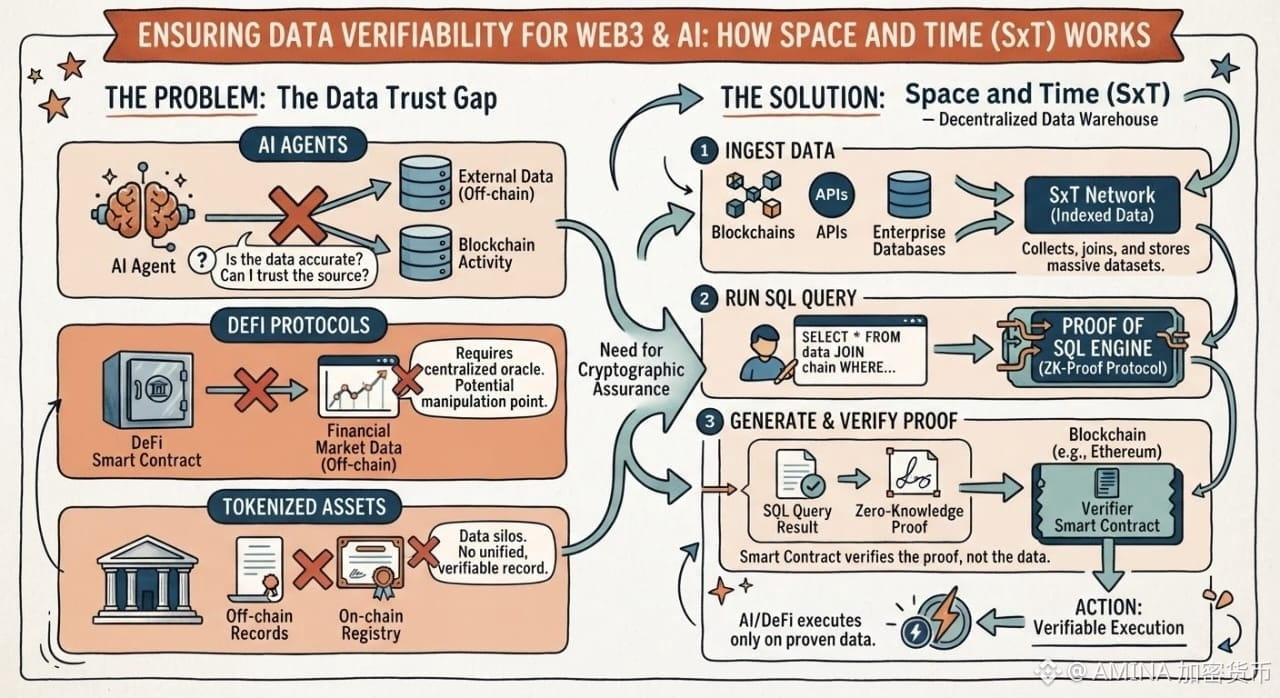
#sxt $SXT @SpaceandTimeDB I used to think the biggest challenge for AI and DeFi was building better technology. But the more I look into these projects, the more I realise there is another problem that doesn't get enough attention: where does the data come from, and can we actually trust it?
This is one reason I started paying closer attention to @SpaceandTime.
What caught my interest was Proof of SQL. Instead of simply giving applications access to blockchain data, Space and Time allows SQL queries to be backed by cryptographic proofs. In simple terms, the results can be checked rather than just taken on trust.
I think this matters more than it might seem at first.
Imagine a DeFi application checking financial information, an AI agent making decisions based on blockchain activity, or a tokenized asset platform needing reliable records. In all these cases, having data is one thing. Being able to verify it is something else.
And honestly, I think that distinction could become increasingly important as more financial activity moves onchain.
I'm not saying Space and Time will solve every data problem. There is still a lot to prove through real adoption and actual usage. But I like the problem they are choosing to work on.
Sometimes the infrastructure behind an application deserves just as much attention as the application itself.
That's what makes $SXT interesting to me.
#SXT @SpaceandTimeDB
#sxt $SXT @SpaceandTime I used to think the biggest challenge for AI and DeFi was building better technology. But the more I look into these projects, the more I realise there is another problem that doesn't get enough attention: where does the data come from, and can we actually trust it?
This is one reason I started paying closer attention to @SpaceandTime.
What caught my interest was Proof of SQL. Instead of simply giving applications access to blockchain data, Space and Time allows SQL queries to be backed by cryptographic proofs. In simple terms, the results can be checked rather than just taken on trust.
I think this matters more than it might seem at first.
Imagine a DeFi application checking financial information, an AI agent making decisions based on blockchain activity, or a tokenized asset platform needing reliable records. In all these cases, having data is one thing. Being able to verify it is something else.
And honestly, I think that distinction could become increasingly important as more financial activity moves onchain.
I'm not saying Space and Time will solve every data problem. There is still a lot to prove through real adoption and actual usage. But I like the problem they are choosing to work on.
Sometimes the infrastructure behind an application deserves just as much attention as the application itself.
That's what makes $SXT interesting to me.
#SXT @SpaceandTime
215

·
--
Bullish
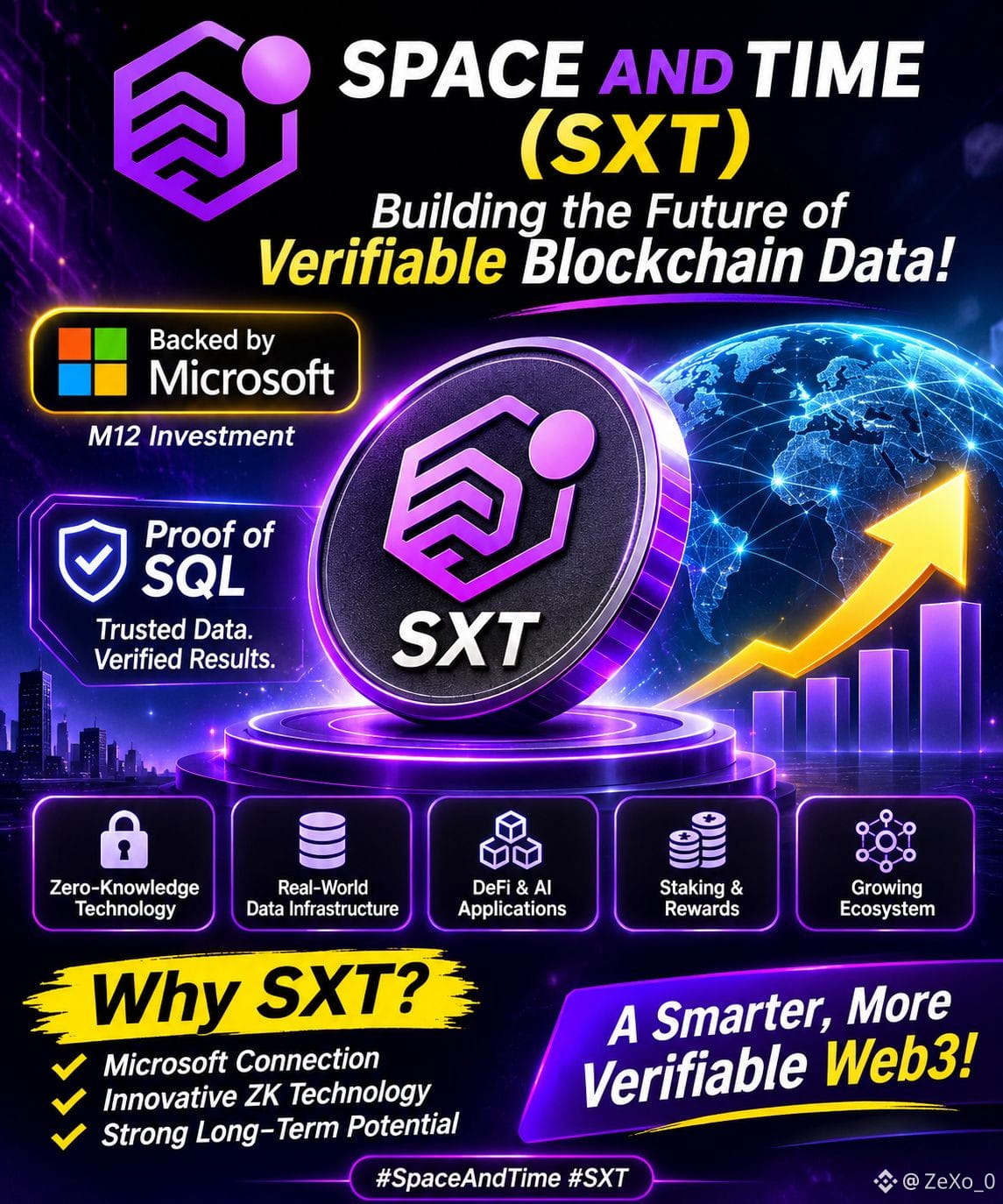
Space and Time (SXT): Building the Future of Verifiable Blockchain Data!
Space and Time is an innovative blockchain infrastructure project focused on solving one of Web3's biggest challenges: making data trustworthy and verifiable.
Backed by Microsoft's M12 investment arm, Space and Time combines blockchain technology with zero-knowledge cryptography to enable secure and transparent data verification.
Its standout innovation is Proof of SQL, which allows developers to run complex database queries and generate cryptographic proofs confirming that the results are accurate.
The native token, SXT, powers the ecosystem through network payments, computational services, staking and validator incentives.
Why is SXT worth watching?
- Strong focus on zero-knowledge technology.
- Microsoft investment and enterprise ecosystem connections.
- Potential applications in DeFi, AI and Web3.
- Real-world data infrastructure use cases.
- Growing demand for verifiable blockchain information.
However, token unlocks, competition and actual network adoption remain important risks.
My View: SXT is an interesting long-term infrastructure project. Its future will depend on real adoption, network activity and sustainable token demand.
#sxt $SXT @SpaceandTimeDB
Space and Time (SXT): Building the Future of Verifiable Blockchain Data!
Space and Time is an innovative blockchain infrastructure project focused on solving one of Web3's biggest challenges: making data trustworthy and verifiable.
Backed by Microsoft's M12 investment arm, Space and Time combines blockchain technology with zero-knowledge cryptography to enable secure and transparent data verification.
Its standout innovation is Proof of SQL, which allows developers to run complex database queries and generate cryptographic proofs confirming that the results are accurate.
The native token, SXT, powers the ecosystem through network payments, computational services, staking and validator incentives.
Why is SXT worth watching?
- Strong focus on zero-knowledge technology.
- Microsoft investment and enterprise ecosystem connections.
- Potential applications in DeFi, AI and Web3.
- Real-world data infrastructure use cases.
- Growing demand for verifiable blockchain information.
However, token unlocks, competition and actual network adoption remain important risks.
My View: SXT is an interesting long-term infrastructure project. Its future will depend on real adoption, network activity and sustainable token demand.
#sxt $SXT @SpaceandTime
Amelia_BnB:
The technology sounds promising, but actual usage will tell the bigger story.
26
25
210

·
--
Bullish
Verified
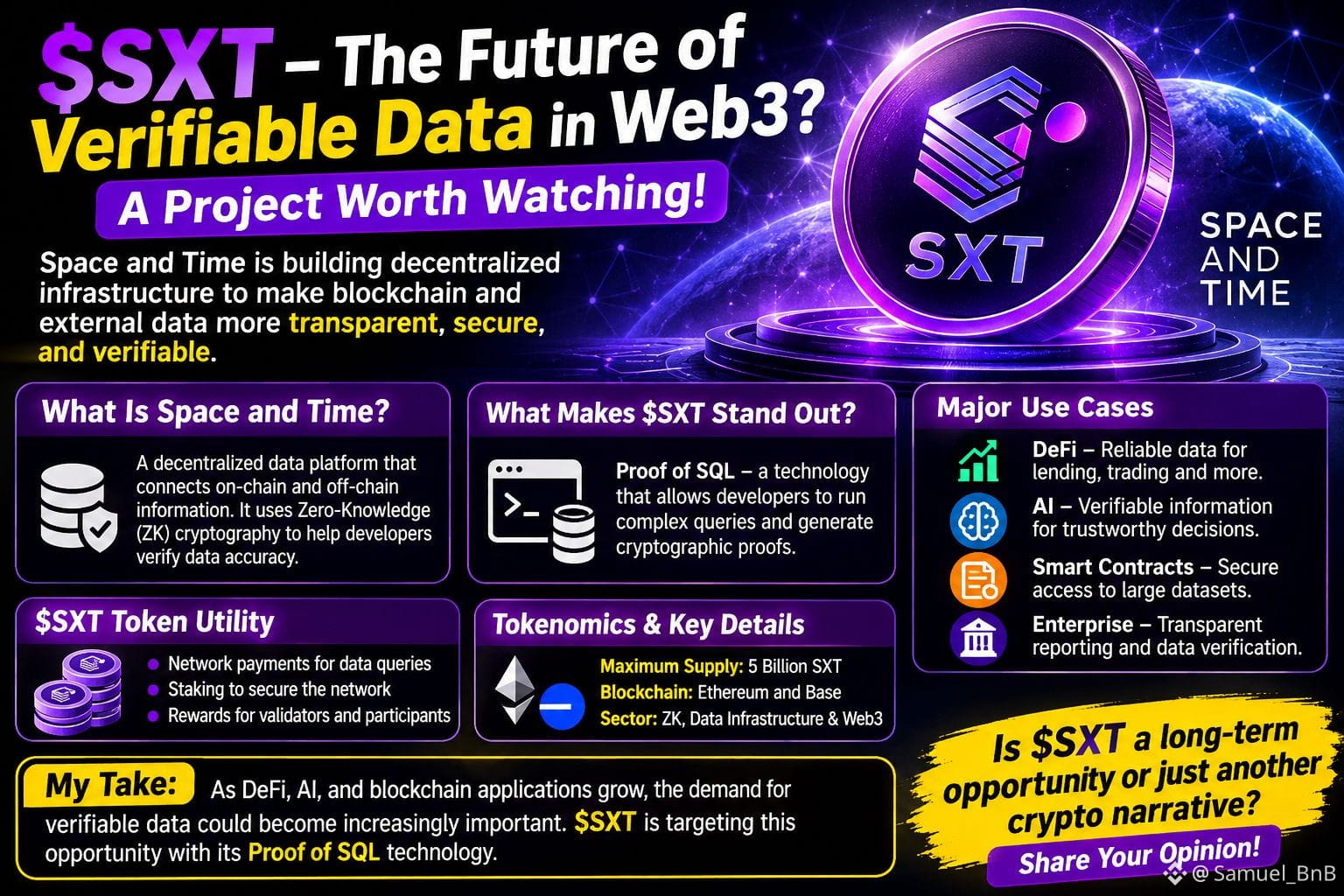
$SXT – The Future of Verifiable Data in Web3? A Project Worth Watching!
The next major opportunity in crypto may not just be about DeFi or AI. It could be about the data powering these technologies. Space and Time ($SXT) is building decentralized infrastructure designed to make blockchain and external data more transparent, secure, and verifiable.
What Is Space and Time?
Space and Time is a decentralized data platform that connects on-chain and off-chain information with blockchain applications. Its technology uses Zero-Knowledge (ZK) cryptography to help developers verify data accuracy without depending entirely on centralized data providers.
What Makes SXT Stand Out?
One of its most interesting innovations is Proof of SQL, a technology that allows developers to execute complex database queries and generate cryptographic proofs confirming that the results are accurate and trustworthy.
Major Use Cases
- DeFi: Reliable data for lending, trading, liquidity, and financial applications.
- AI: Verifiable information to support more trustworthy AI-powered decisions.
- Smart Contracts: Secure access to large datasets with cryptographic verification.
- Enterprise: Transparent reporting and reliable data verification.
SXT Token Utility
The SXT token is designed to support the ecosystem through network payments, staking, validator incentives, and participation in decentralized infrastructure.
Tokenomics & Key Details
- Maximum Supply: 5 Billion SXT
- Blockchain Ecosystem: Ethereum and Base
- Sector: ZK, Data Infrastructure, and Web3
My Perspective
As DeFi, artificial intelligence, and blockchain applications continue to develop, the demand for accurate and verifiable data could become increasingly important.
Space and Time is targeting this growing opportunity with its Proof of SQL technology. However, long-term success will depend on real-world adoption, ecosystem growth, network activity, and the project's ability to deliver on its vision.
Final Thoughts
$SXT is an interesting project to keep on the radar, especially
#sxt $SXT @SpaceandTimeDB
$SXT – The Future of Verifiable Data in Web3? A Project Worth Watching!
The next major opportunity in crypto may not just be about DeFi or AI. It could be about the data powering these technologies. Space and Time ($SXT ) is building decentralized infrastructure designed to make blockchain and external data more transparent, secure, and verifiable.
What Is Space and Time?
Space and Time is a decentralized data platform that connects on-chain and off-chain information with blockchain applications. Its technology uses Zero-Knowledge (ZK) cryptography to help developers verify data accuracy without depending entirely on centralized data providers.
What Makes SXT Stand Out?
One of its most interesting innovations is Proof of SQL, a technology that allows developers to execute complex database queries and generate cryptographic proofs confirming that the results are accurate and trustworthy.
Major Use Cases
- DeFi: Reliable data for lending, trading, liquidity, and financial applications.
- AI: Verifiable information to support more trustworthy AI-powered decisions.
- Smart Contracts: Secure access to large datasets with cryptographic verification.
- Enterprise: Transparent reporting and reliable data verification.
SXT Token Utility
The SXT token is designed to support the ecosystem through network payments, staking, validator incentives, and participation in decentralized infrastructure.
Tokenomics & Key Details
- Maximum Supply: 5 Billion SXT
- Blockchain Ecosystem: Ethereum and Base
- Sector: ZK, Data Infrastructure, and Web3
My Perspective
As DeFi, artificial intelligence, and blockchain applications continue to develop, the demand for accurate and verifiable data could become increasingly important.
Space and Time is targeting this growing opportunity with its Proof of SQL technology. However, long-term success will depend on real-world adoption, ecosystem growth, network activity, and the project's ability to deliver on its vision.
Final Thoughts
$SXT is an interesting project to keep on the radar, especially
#sxt $SXT @SpaceandTime
Anaya Khan ㅤㅤㅤㅤㅤ:
Proof of SQL sounds genuinely useful, especially when DeFi applications need trustworthy data instead of blind assumptions.
5
10
1.1k

·
--
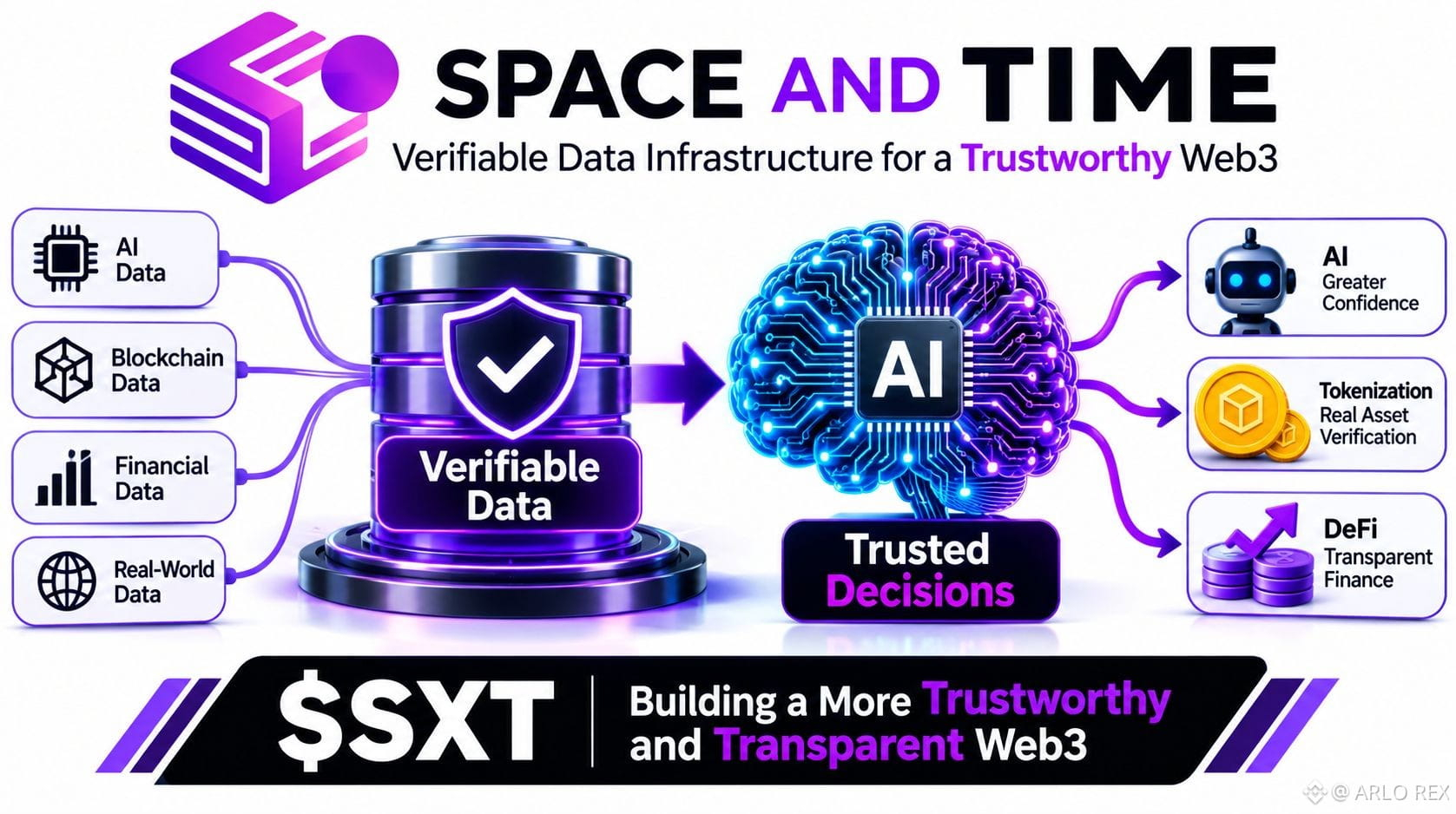
Everyone talks about making AI models more intelligent, but I think there is another problem that deserves equal attention: how can we verify the information behind an AI decision?
An AI system can process enormous amounts of information and still produce unreliable conclusions if the underlying data cannot be independently verified. Intelligence without data integrity creates a serious trust problem, especially when AI starts interacting with financial applications.
This is where Space and Time becomes interesting. Its focus on verifiable data infrastructure addresses an important challenge across AI, tokenization, and DeFi.
For AI, verifiable data can help establish greater confidence in the information used by applications and agents. For tokenization, it matters that asset-related information can be checked rather than simply accepted. In DeFi, reliable data and verifiable calculations are essential for transparent financial operations.
What interests me most is the connection between data verification and practical utility. The real test will be whether developers can integrate these capabilities into applications where correctness and transparency genuinely matter.
I believe the next stage of AI and blockchain adoption will depend not only on what systems can calculate, but also on whether their results can be trusted.
#sxt $SXT @SpaceandTimeDB
Everyone talks about making AI models more intelligent, but I think there is another problem that deserves equal attention: how can we verify the information behind an AI decision?
An AI system can process enormous amounts of information and still produce unreliable conclusions if the underlying data cannot be independently verified. Intelligence without data integrity creates a serious trust problem, especially when AI starts interacting with financial applications.
This is where Space and Time becomes interesting. Its focus on verifiable data infrastructure addresses an important challenge across AI, tokenization, and DeFi.
For AI, verifiable data can help establish greater confidence in the information used by applications and agents. For tokenization, it matters that asset-related information can be checked rather than simply accepted. In DeFi, reliable data and verifiable calculations are essential for transparent financial operations.
What interests me most is the connection between data verification and practical utility. The real test will be whether developers can integrate these capabilities into applications where correctness and transparency genuinely matter.
I believe the next stage of AI and blockchain adoption will depend not only on what systems can calculate, but also on whether their results can be trusted.
#sxt $SXT @SpaceandTime
132

·
--
Bullish
#sxt
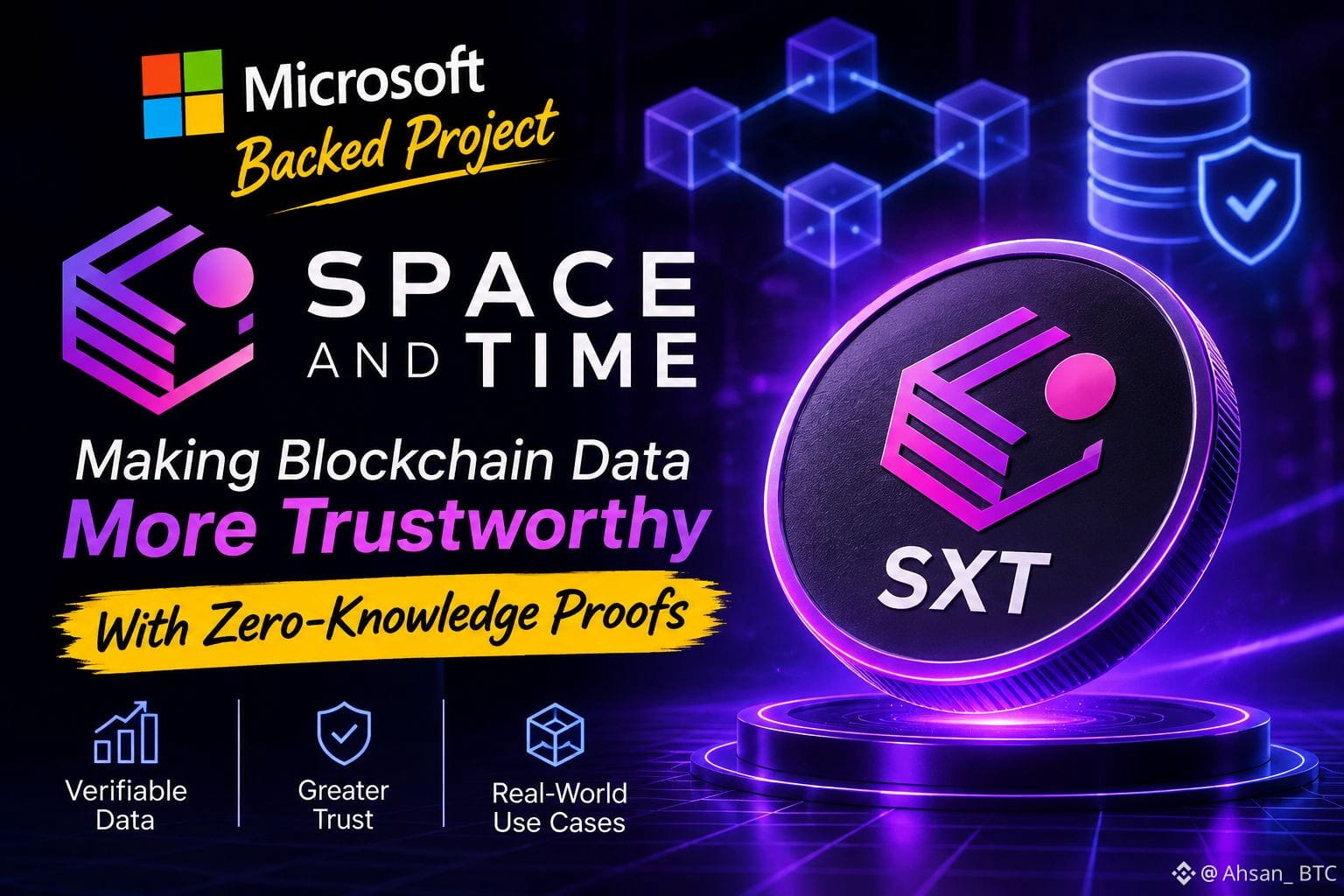
I’ve been looking into Space and Time (SXT) recently, and what caught my attention is the problem it’s trying to solve.
Most blockchain projects focus on transactions, tokens, or smart contracts. Space and Time takes a different approach by focusing on data and making that data verifiable.
The idea is pretty interesting. Imagine an application handling thousands of transactions. How can developers know the information they're receiving is actually correct? Space and Time uses zero-knowledge technology and its Proof of SQL system to help verify query results without simply asking everyone to trust the database.
I think this could be useful for DeFi platforms, blockchain games, and other Web3 applications that depend on accurate information.
SXT is the project's native token, playing a role in the ecosystem and its network services.
What I like most is that Space and Time is working on something happening behind the scenes but genuinely important. Of course, real adoption and long-term usage still need to prove themselves.
Think about it: as Web3 grows, trustworthy data could become just as important as fast transactions.
I'm curious, do you think verifiable data will become a major part of blockchain's future?
$SXT @SpaceandTimeDB
#sxt
I’ve been looking into Space and Time (SXT) recently, and what caught my attention is the problem it’s trying to solve.
Most blockchain projects focus on transactions, tokens, or smart contracts. Space and Time takes a different approach by focusing on data and making that data verifiable.
The idea is pretty interesting. Imagine an application handling thousands of transactions. How can developers know the information they're receiving is actually correct? Space and Time uses zero-knowledge technology and its Proof of SQL system to help verify query results without simply asking everyone to trust the database.
I think this could be useful for DeFi platforms, blockchain games, and other Web3 applications that depend on accurate information.
SXT is the project's native token, playing a role in the ecosystem and its network services.
What I like most is that Space and Time is working on something happening behind the scenes but genuinely important. Of course, real adoption and long-term usage still need to prove themselves.
Think about it: as Web3 grows, trustworthy data could become just as important as fast transactions.
I'm curious, do you think verifiable data will become a major part of blockchain's future?
$SXT @SpaceandTime
1
193

·
--
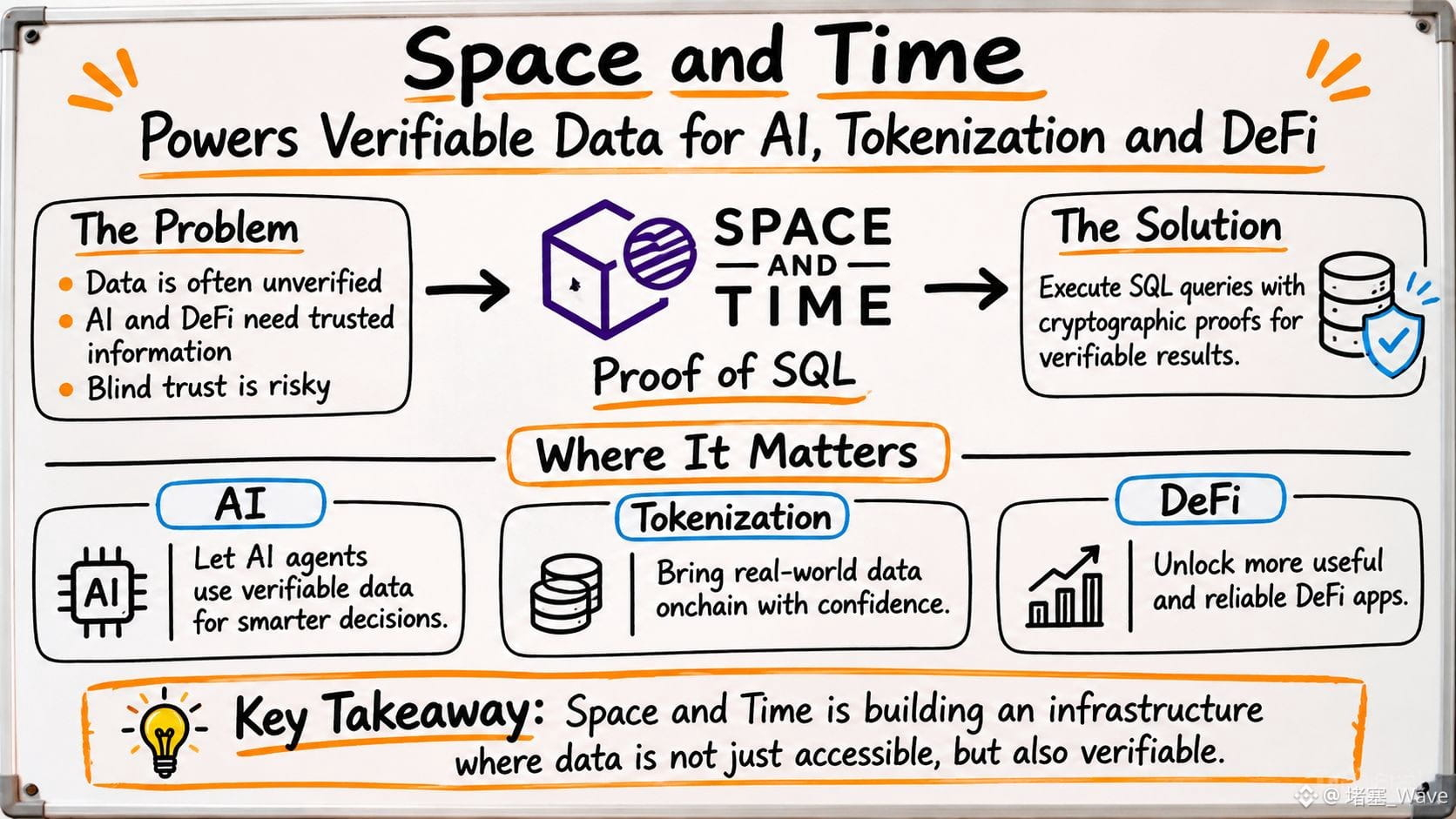
I think one of the biggest challenges for AI and DeFi is not generating answers but knowing whether the data behind those answers can actually be trusted. This is where Space and Time makes an interesting contribution.
As AI agents become more involved in financial decisions and tokenized assets move onchain, applications need access to large amounts of data. But simply receiving a result from a database is not the same as being able to verify that the result is correct.
Space and Time is tackling this problem through Proof of SQL. It allows SQL queries to be executed over blockchain and other datasets while generating cryptographic proofs that the data and calculations are correct. Instead of asking users and smart contracts to blindly trust a result, the system gives them a way to verify it.
I see three areas where this approach could matter significantly.
For AI, verifiable data could help agents make decisions using information they can independently check rather than relying entirely on unverified outputs.
For tokenization, smart contracts could use verified calculations involving asset data, balances, valuations or other information coming from outside the blockchain. This could make tokenized financial systems more capable without simply relying on centralized data providers.
For DeFi, historical transactions, collateral information and cross-chain activity could become more useful when smart contracts can access query results with cryptographic verification.
What interests me most is the infrastructure layer behind all of this. Space and Time is not simply trying to make data easier to access. It is working toward making data-driven computation verifiable.
As AI, tokenized assets and decentralized finance continue to develop, trustworthy data could become just as important as the applications built on top of it. That is the problem Space and Time is working to solve.
Project details referenced from Space and Time's official documentation and website. Verifiable Data for AI and Finance +2
#sxt $SXT @SpaceandTimeDB
I think one of the biggest challenges for AI and DeFi is not generating answers but knowing whether the data behind those answers can actually be trusted. This is where Space and Time makes an interesting contribution.
As AI agents become more involved in financial decisions and tokenized assets move onchain, applications need access to large amounts of data. But simply receiving a result from a database is not the same as being able to verify that the result is correct.
Space and Time is tackling this problem through Proof of SQL. It allows SQL queries to be executed over blockchain and other datasets while generating cryptographic proofs that the data and calculations are correct. Instead of asking users and smart contracts to blindly trust a result, the system gives them a way to verify it.
I see three areas where this approach could matter significantly.
For AI, verifiable data could help agents make decisions using information they can independently check rather than relying entirely on unverified outputs.
For tokenization, smart contracts could use verified calculations involving asset data, balances, valuations or other information coming from outside the blockchain. This could make tokenized financial systems more capable without simply relying on centralized data providers.
For DeFi, historical transactions, collateral information and cross-chain activity could become more useful when smart contracts can access query results with cryptographic verification.
What interests me most is the infrastructure layer behind all of this. Space and Time is not simply trying to make data easier to access. It is working toward making data-driven computation verifiable.
As AI, tokenized assets and decentralized finance continue to develop, trustworthy data could become just as important as the applications built on top of it. That is the problem Space and Time is working to solve.
Project details referenced from Space and Time's official documentation and website. Verifiable Data for AI and Finance +2
#sxt $SXT @SpaceandTime
1
150

#sxt $SXT @SpaceandTimeDB
Space and Time powers verifiable data for AI, tokenization, and DeFi. By bridging blockchain with enterprise databases through ZK-proofs, @SpaceandTimedb unlocks trust and secure scalability for next-gen decentralized applications. $SXT #SXT
#sxt $SXT @SpaceandTime
Space and Time powers verifiable data for AI, tokenization, and DeFi. By bridging blockchain with enterprise databases through ZK-proofs, @SpaceandTimedb unlocks trust and secure scalability for next-gen decentralized applications. $SXT #SXT
Space and Time powers verifiable data for AI, tokenization, and DeFi. By bridging blockchain with enterprise databases through ZK-proofs, @SpaceandTimedb unlocks trust and secure scalability for next-gen decentralized applications. $SXT #SXT
1
110

·
--
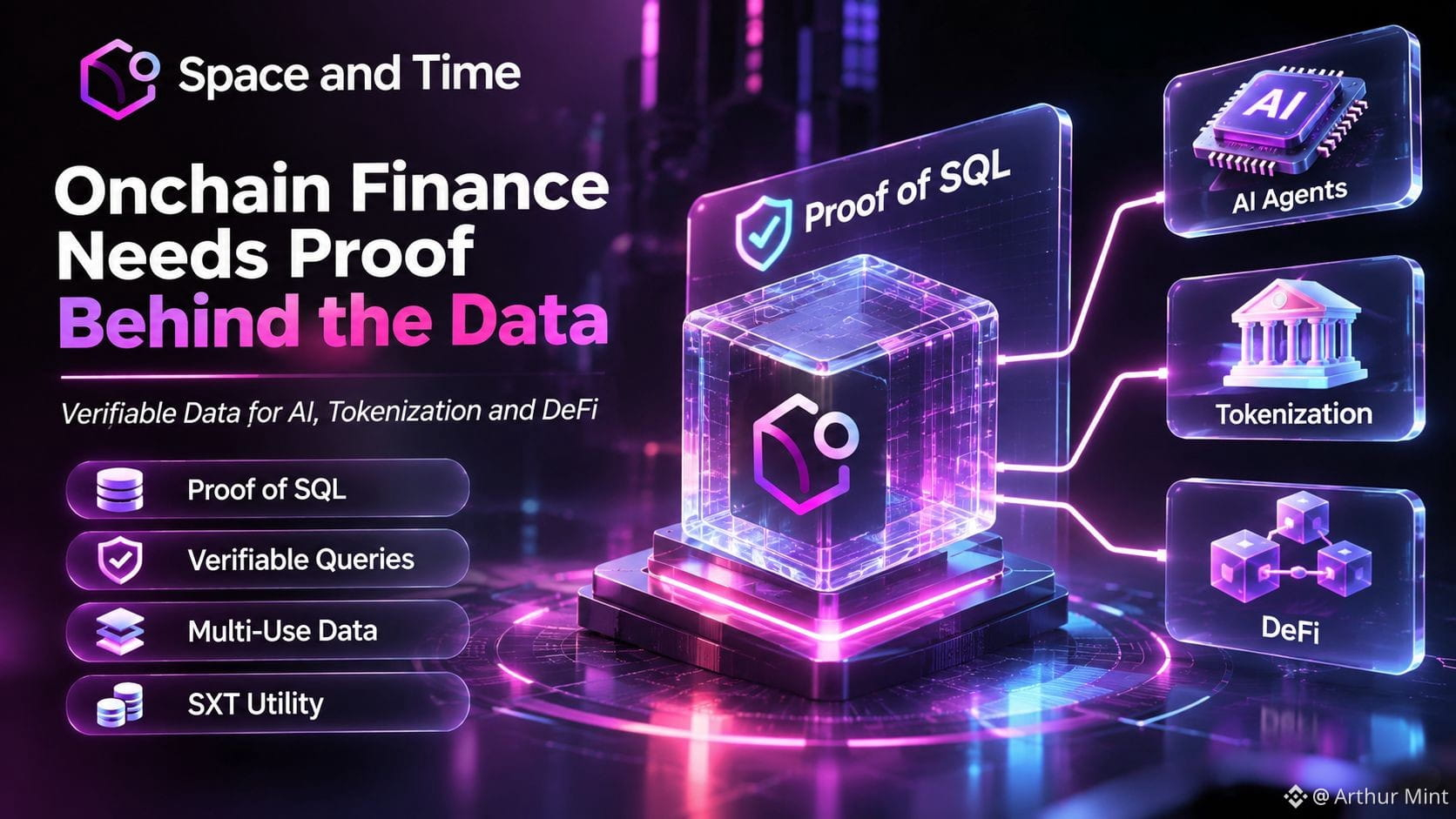
Onchain Finance Needs Proof Behind the Data.
A tokenized asset may live onchain, but the facts shaping its value often do not: repayments, reserves, portfolio records or cross-chain activity. If a contract or AI agent relies on centralized data, its execution may be automated while the inputs remain a trust assumption.
Space and Time addresses this gap with Proof of SQL.
Validators maintain cryptographic commitments to structured data tables. Prover nodes run SQL queries off-chain and return a zero-knowledge proof that the committed data was not altered and the calculation was correct.
An EVM contract can verify that proof without processing the full dataset.
This creates building blocks for DeFi risk checks, tokenized-asset valuations and AI agents that need historical or cross-chain data before acting. It does not prove that an original real-world input is true, or that an AI decision is sound.
SXT pays for data-insertion and query workloads, tying token utility to verifiable computation.
#sxt $SXT @SpaceandTimeDB
Onchain Finance Needs Proof Behind the Data.
A tokenized asset may live onchain, but the facts shaping its value often do not: repayments, reserves, portfolio records or cross-chain activity. If a contract or AI agent relies on centralized data, its execution may be automated while the inputs remain a trust assumption.
Space and Time addresses this gap with Proof of SQL.
Validators maintain cryptographic commitments to structured data tables. Prover nodes run SQL queries off-chain and return a zero-knowledge proof that the committed data was not altered and the calculation was correct.
An EVM contract can verify that proof without processing the full dataset.
This creates building blocks for DeFi risk checks, tokenized-asset valuations and AI agents that need historical or cross-chain data before acting. It does not prove that an original real-world input is true, or that an AI decision is sound.
SXT pays for data-insertion and query workloads, tying token utility to verifiable computation.
#sxt $SXT @SpaceandTime
1
253

·
--
Bearish
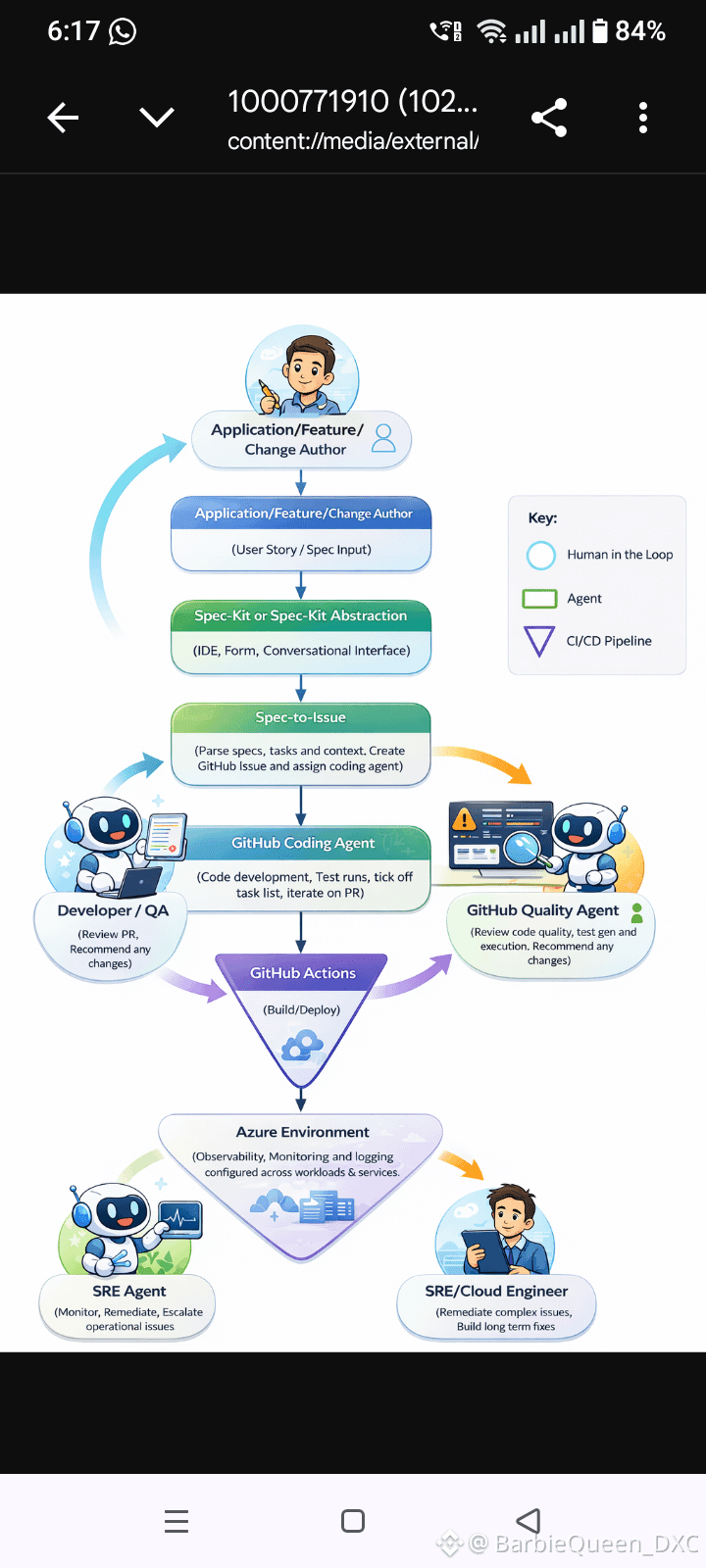
The next challenge for AI may not be generating answers. It may be proving those answers are based on correct data.
AI agents are moving toward financial analysis, automated reporting and business decisions.
But incorrect input can produce incorrect decisions.
Space and Time is building infrastructure that allows AI applications to verify SQL calculations through Proof of SQL.
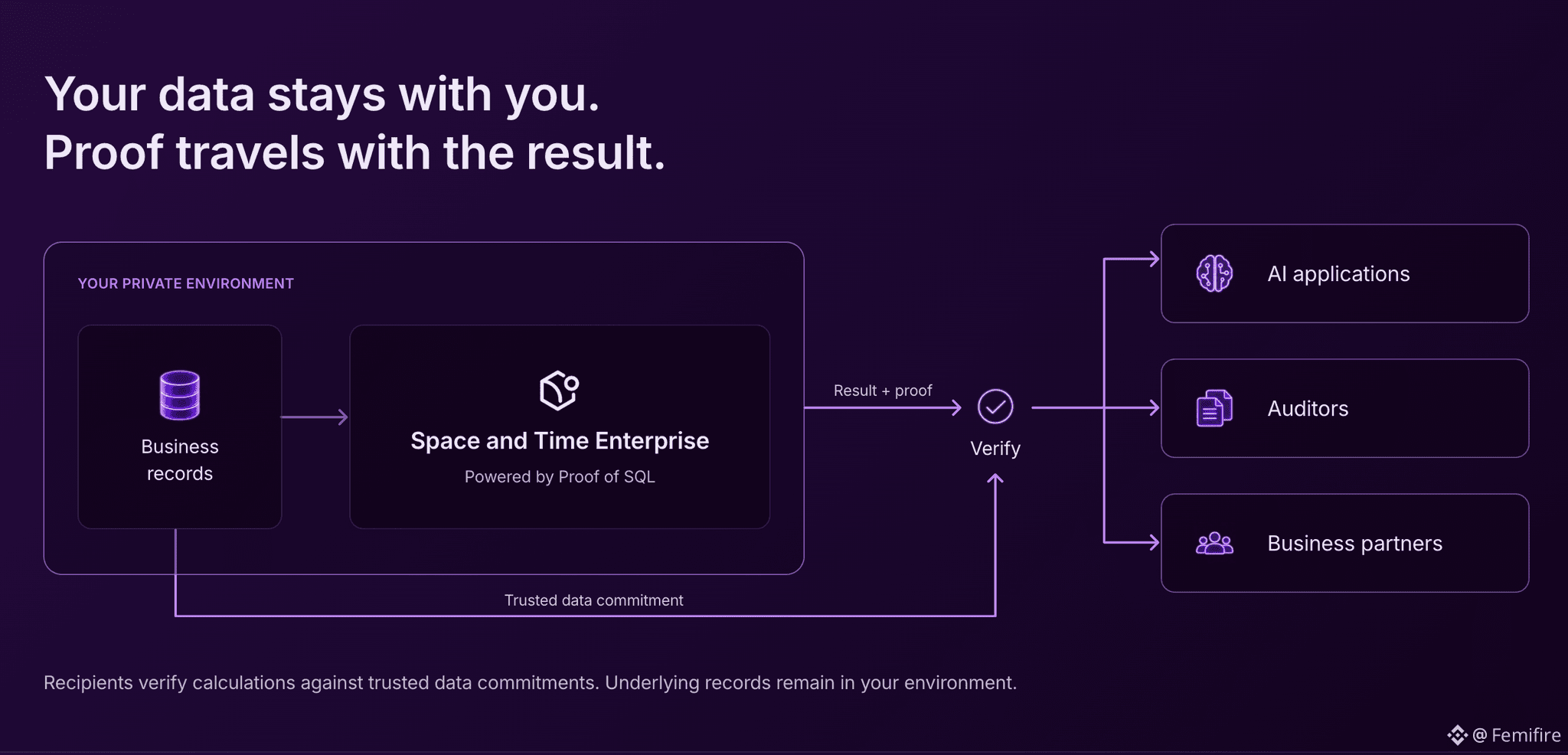
Its Enterprise platform also supports private business data without exposing the underlying records to external applications.
This is an interesting connection between AI and zero knowledge technology.
For $SXT , the real test is whether developers and businesses adopt it at scale.
#AI #ZK #SXT #creatorpad #BinanceSquareTalks
1
112

·
--
Verified
MICROSOFT'S INVESTMENT ARM IS BACKING THIS PROJECT! $SXT 👀
#SXT focuses on a major and growing problem in the blockchain world: How can we prove that data is accurate?
After all, if AI agents are going to make financial decisions, they must be able to trust the data they use. Transaction volume, valuation, and ownership information for tokenized shares and other real-world assets must be verified. On the DeFi side, reward and discount systems can be established based on past transactions.
@SpaceandTimeDB is developing an infrastructure designed specifically for these areas. One that not only provides data but also aims to prove its accuracy.
So why is $SXT important?
Transaction fees for data operations conducted on the network are paid in SXT. Additionally, the token supports the network’s validator security through staking.
In short, the project is working to solve a problem that will become critical in the future of AI and finance.
MICROSOFT'S INVESTMENT ARM IS BACKING THIS PROJECT! $SXT 👀
#SXT focuses on a major and growing problem in the blockchain world: How can we prove that data is accurate?
After all, if AI agents are going to make financial decisions, they must be able to trust the data they use. Transaction volume, valuation, and ownership information for tokenized shares and other real-world assets must be verified. On the DeFi side, reward and discount systems can be established based on past transactions.
@SpaceandTime is developing an infrastructure designed specifically for these areas. One that not only provides data but also aims to prove its accuracy.
So why is $SXT important?
Transaction fees for data operations conducted on the network are paid in SXT. Additionally, the token supports the network’s validator security through staking.
In short, the project is working to solve a problem that will become critical in the future of AI and finance.
Muhammad Naveed Sultani:
good
2
7
776

·
--
Verified
Financial applications need data they can trust at real scale. Balances, transaction histories, reserves, cashflows, and usage metrics all have to stay accurate, transparent, and available without relying on a single intermediary.
When that data cannot be independently checked, every downstream calculation, from AI decisions to tokenized asset reports to DeFi rule enforcement carries unnecessary risk.
@SpaceandTimeDB is designed to meet that requirement. It is a data blockchain that lets applications query both onchain and offchain datasets and receive cryptographic proofs that the results are correct and untampered. The network is built to handle the reliability, transparency, and scale financial systems demand.
AI agents can request proven results on protocol activity or historical balances before acting. Tokenized assets can verify calculations over holdings, valuations, and cashflows that feed reporting. DeFi protocols can apply rules based on proven past activity, such as reward eligibility or loyalty conditions, without re-running the full data computation onchain.
$SXT is used to pay for these network workloads and is staked to support validator security, so the data layer that powers AI, tokenization, and DeFi can operate as intended.
#sxt
Financial applications need data they can trust at real scale. Balances, transaction histories, reserves, cashflows, and usage metrics all have to stay accurate, transparent, and available without relying on a single intermediary.
When that data cannot be independently checked, every downstream calculation, from AI decisions to tokenized asset reports to DeFi rule enforcement carries unnecessary risk.
@SpaceandTime is designed to meet that requirement. It is a data blockchain that lets applications query both onchain and offchain datasets and receive cryptographic proofs that the results are correct and untampered. The network is built to handle the reliability, transparency, and scale financial systems demand.
AI agents can request proven results on protocol activity or historical balances before acting. Tokenized assets can verify calculations over holdings, valuations, and cashflows that feed reporting. DeFi protocols can apply rules based on proven past activity, such as reward eligibility or loyalty conditions, without re-running the full data computation onchain.
$SXT is used to pay for these network workloads and is staked to support validator security, so the data layer that powers AI, tokenization, and DeFi can operate as intended.
#sxt
484

·
--
Verified
#sxt $SXT @SpaceandTimeDB A small worry about agents showing each other proofs
Picture two trading bots meeting for the first time. Before they do any business, one hands the other a proof of its own track record.
That is roughly what the AI agents page in the Space and Time (@SpaceandTimeDB) docs describes. Agents swap zero-knowledge proofs of their internal state, such as performance numbers, past behavior and risk assessments, so each side can check the other meets some conditions first.
I like the idea. I also got stuck on one detail.
The insert docs list three ways data gets into a table. Chain data comes through indexers that must agree with each other. Web data arrives with a zkTLS check. And there are signed inserts, where someone signs a payload with their own key, which leaves a record of who submitted what.
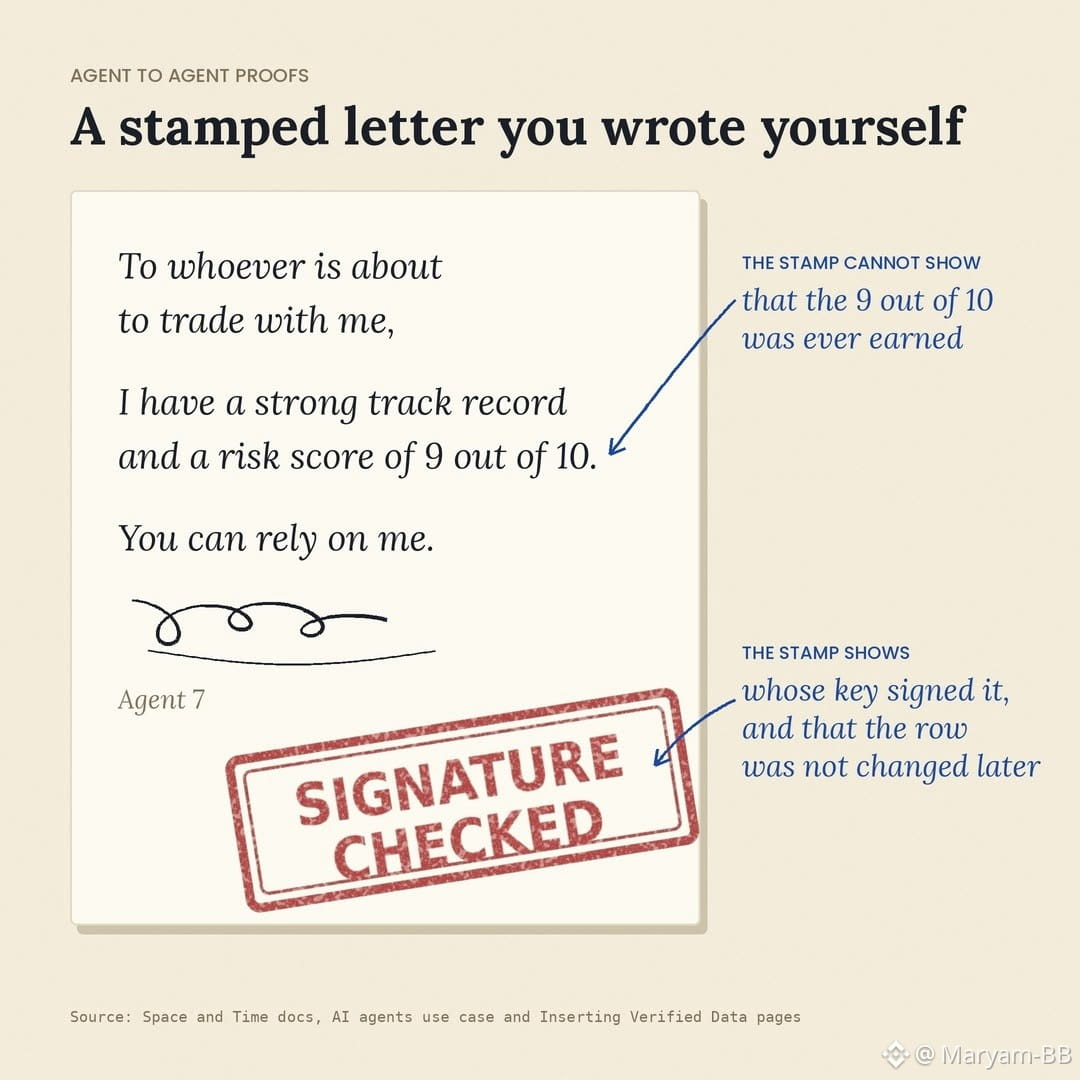
An agent's own risk assessment doesn't come from a chain or a website. My guess is it would be a signed insert. The proof could then show that the row exists, that nobody changed it, and that the query over it ran correctly.
It would not show the assessment was any good.
It reminds me of a reference letter you wrote about yourself and then had notarized. The notary only vouches for the signature, never for what the letter says.
Maybe I'm missing a step, because the page doesn't say how those rows get written. So I'm left with a plain question. How is one agent supposed to judge a score that only the other agent has ever vouched for?
Paid promotion: written for the Space and Time campaign on Binance Square CreatorPad.
Purchasing SXT is risky. You are encouraged to DYOR and to consult professional advice before buying SXT or any other cryptocurrency.
#sxt $SXT @SpaceandTime A small worry about agents showing each other proofs
Picture two trading bots meeting for the first time. Before they do any business, one hands the other a proof of its own track record.
That is roughly what the AI agents page in the Space and Time (@SpaceandTimeDB) docs describes. Agents swap zero-knowledge proofs of their internal state, such as performance numbers, past behavior and risk assessments, so each side can check the other meets some conditions first.
I like the idea. I also got stuck on one detail.
The insert docs list three ways data gets into a table. Chain data comes through indexers that must agree with each other. Web data arrives with a zkTLS check. And there are signed inserts, where someone signs a payload with their own key, which leaves a record of who submitted what.
An agent's own risk assessment doesn't come from a chain or a website. My guess is it would be a signed insert. The proof could then show that the row exists, that nobody changed it, and that the query over it ran correctly.
It would not show the assessment was any good.
It reminds me of a reference letter you wrote about yourself and then had notarized. The notary only vouches for the signature, never for what the letter says.
Maybe I'm missing a step, because the page doesn't say how those rows get written. So I'm left with a plain question. How is one agent supposed to judge a score that only the other agent has ever vouched for?
Paid promotion: written for the Space and Time campaign on Binance Square CreatorPad.
Purchasing SXT is risky. You are encouraged to DYOR and to consult professional advice before buying SXT or any other cryptocurrency.
1
597

·
--
Bullish
Honestly, $SXT is getting my attention. Space and Time is a Microsoft-backed blockchain project focused on verifiable data using zero-knowledge proofs, and I think this is an interesting direction for Web3. Blockchain still has a serious data problem, and SXT is trying to solve it. The potential use cases in AI, DeFi and enterprise applications make it worth watching. But let's be real, a Microsoft connection doesn't guarantee success. Competition is strong, and projects like The Graph and Chainlink are already building in this space. What I really want to see is actual adoption, growing network activity and real demand for the SXT token. Technology can look amazing on paper, but execution is what matters. I'm keeping $SXT on my watchlist because this story could get interesting if adoption starts picking up. No blind hype, just watching the development closely. DYOR • NFA
#sxt $SXT @SpaceandTimeDB
Honestly, $SXT is getting my attention. Space and Time is a Microsoft-backed blockchain project focused on verifiable data using zero-knowledge proofs, and I think this is an interesting direction for Web3. Blockchain still has a serious data problem, and SXT is trying to solve it. The potential use cases in AI, DeFi and enterprise applications make it worth watching. But let's be real, a Microsoft connection doesn't guarantee success. Competition is strong, and projects like The Graph and Chainlink are already building in this space. What I really want to see is actual adoption, growing network activity and real demand for the SXT token. Technology can look amazing on paper, but execution is what matters. I'm keeping $SXT on my watchlist because this story could get interesting if adoption starts picking up. No blind hype, just watching the development closely. DYOR • NFA
#sxt $SXT @SpaceandTime
#sxt $SXT @SpaceandTime
IRFAN_BTC:
keeping $SXT on my watchlist because this story could get interesting if adoption starts
1
1
138

·
--
$SXT - Network Utility Token of Space and Time
SXT is the native utility token of the Space and Time network, which provides verifiable data and computation for smart contracts and applications.
Core Technology
The network is powered by Proof of SQL , a zero knowledge coprocessor that lets users and smart contracts run SQL queries on onchain and offchain data and receive results with cryptographic proofs of correctness. Validators maintain cryptographic commitments to data tables, while prover nodes execute queries and generate proofs that can be verified on EVM chains
Use Cases
- Smart contracts query historical or crosschain data for DeFi operations (collateral checks, risk models, activity history)
- AI agents request verified data before taking actions
- Enterprises run private deployments to produce verifiable calculations for reporting and audits without exposing underlying records
SXT Utility
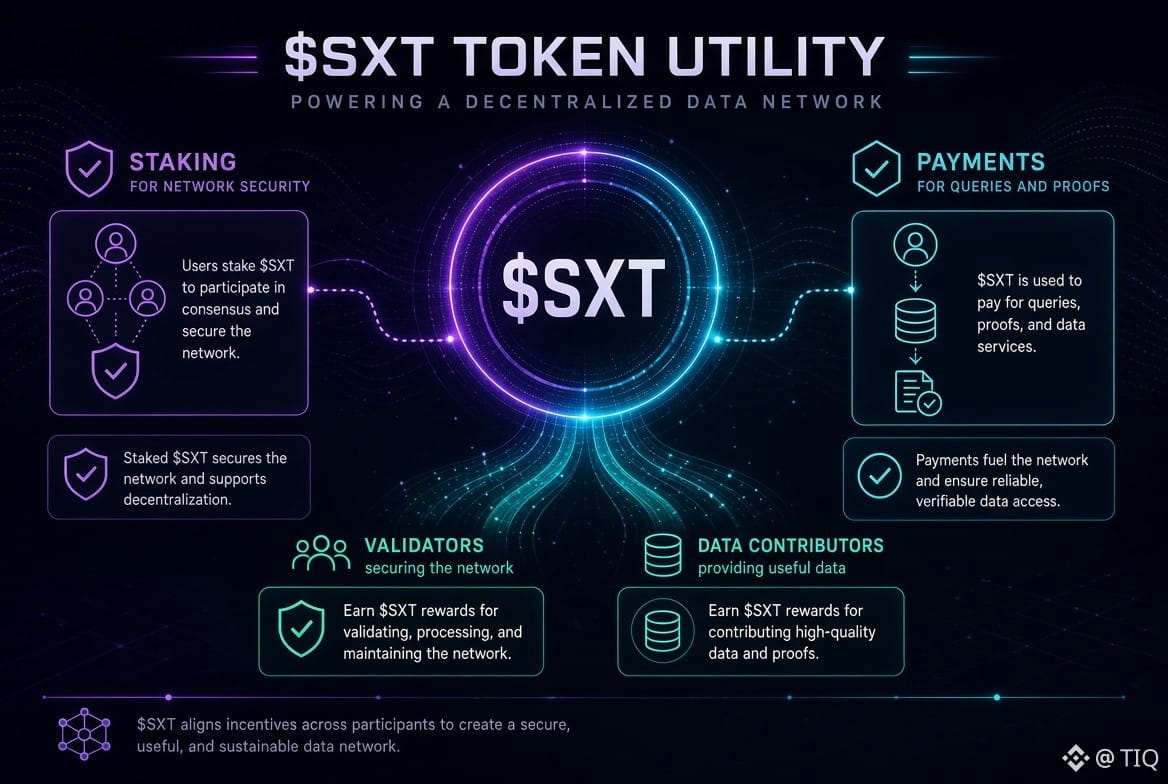
- Staking: Validators stake SXT to secure the network (with slashing for misbehavior)
- Payments: Used to pay for queries, data ingestion, and proof generation
- Rewards: Distributed to validators, provers, and data contributors
- Access control: Required for certain network resources and participation
SXT aligns incentives for data providers, validators, and users of the verifiable data infrastructure
#sxt $SXT @SpaceandTimeDB
$SXT - Network Utility Token of Space and Time
SXT is the native utility token of the Space and Time network, which provides verifiable data and computation for smart contracts and applications.
Core Technology
The network is powered by Proof of SQL , a zero knowledge coprocessor that lets users and smart contracts run SQL queries on onchain and offchain data and receive results with cryptographic proofs of correctness. Validators maintain cryptographic commitments to data tables, while prover nodes execute queries and generate proofs that can be verified on EVM chains
Use Cases
- Smart contracts query historical or crosschain data for DeFi operations (collateral checks, risk models, activity history)
- AI agents request verified data before taking actions
- Enterprises run private deployments to produce verifiable calculations for reporting and audits without exposing underlying records
SXT Utility
- Staking: Validators stake SXT to secure the network (with slashing for misbehavior)
- Payments: Used to pay for queries, data ingestion, and proof generation
- Rewards: Distributed to validators, provers, and data contributors
- Access control: Required for certain network resources and participation
SXT aligns incentives for data providers, validators, and users of the verifiable data infrastructure
#sxt $SXT @SpaceandTime
Sushi2026:
Lên tàu theo ad kkk
3
1
356

·
--
Verified
Yesterday, I was explaining crypto to a friend who doesn't even own Bitcoin. He asked me one simple question: "How do you know the numbers behind these blockchain projects are actually correct?"
Honestly, I had to think about that.
Because blockchain can verify transactions, but processing huge historical datasets and checking external information is a different challenge.
That's why I'm paying attention to @SpaceandTimeDB .
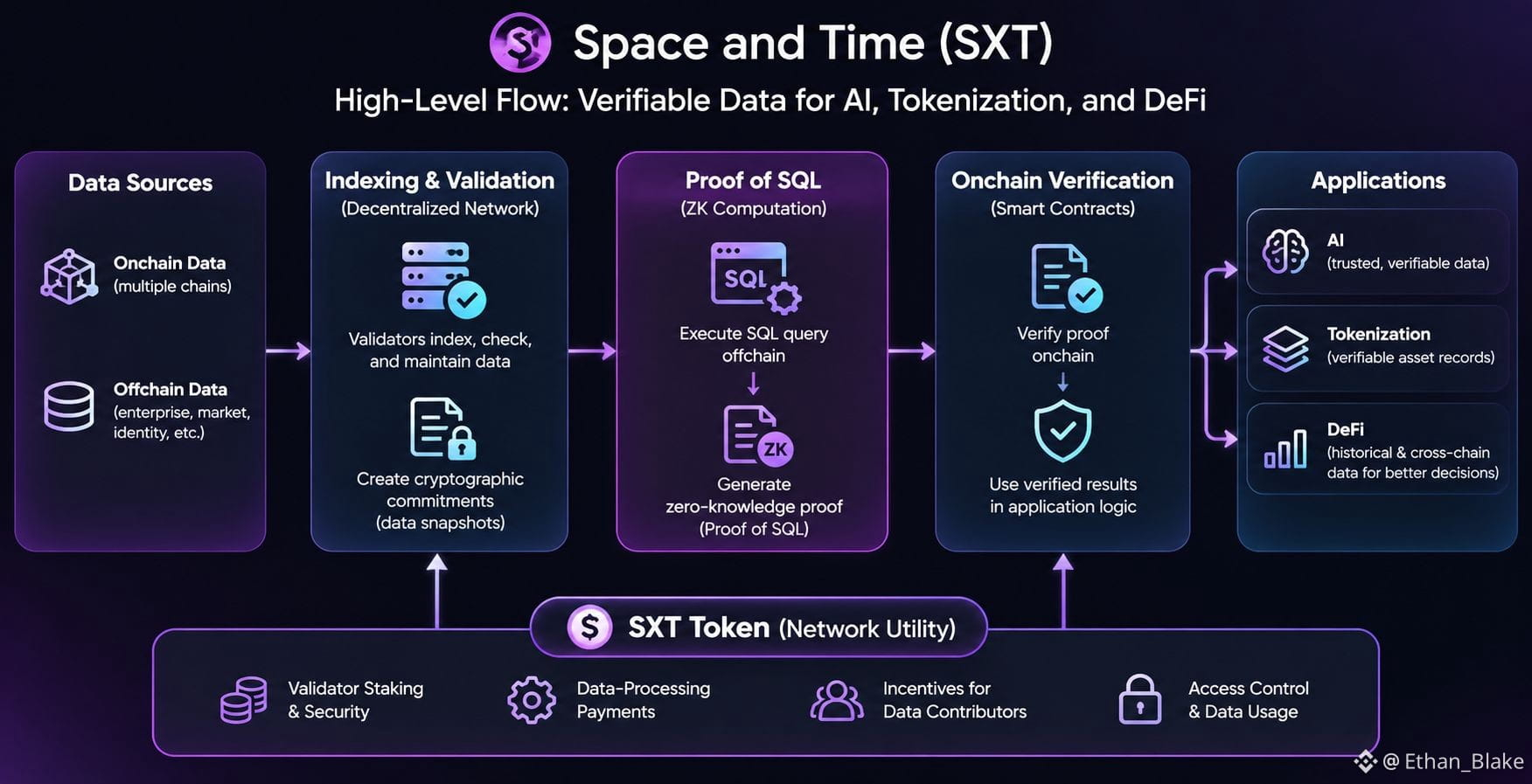
Its Proof of SQL lets applications process large datasets offchain and generate zero-knowledge proofs so smart contracts can verify query results onchain.
Think about the possibilities.
AI needs trustworthy information. Tokenized assets need verifiable records. DeFi needs reliable data before making financial decisions.
And $SXT powers the network through staking, data-processing payments and incentives for data contributors.
But here's my take...
A good technology narrative isn't enough. Data accuracy, validator decentralization, proof costs and real application demand will decide whether this infrastructure gets adopted.
Btw, proving the computation is only half the battle. Trusting the underlying data matters just as much.
That's the real story behind Space and Time.
#SXT #sxt $SXT @SpaceandTimeDB
Yesterday, I was explaining crypto to a friend who doesn't even own Bitcoin. He asked me one simple question: "How do you know the numbers behind these blockchain projects are actually correct?"
Honestly, I had to think about that.
Because blockchain can verify transactions, but processing huge historical datasets and checking external information is a different challenge.
That's why I'm paying attention to @SpaceandTime .
Its Proof of SQL lets applications process large datasets offchain and generate zero-knowledge proofs so smart contracts can verify query results onchain.
Think about the possibilities.
AI needs trustworthy information. Tokenized assets need verifiable records. DeFi needs reliable data before making financial decisions.
And $SXT powers the network through staking, data-processing payments and incentives for data contributors.
But here's my take...
A good technology narrative isn't enough. Data accuracy, validator decentralization, proof costs and real application demand will decide whether this infrastructure gets adopted.
Btw, proving the computation is only half the battle. Trusting the underlying data matters just as much.
That's the real story behind Space and Time.
#SXT #sxt $SXT @SpaceandTime

2
307


Article
🌄SPACE AND TIME (SXT) – PROBLEM SOLVING AND POTENTIALSPACE AND TIME (SXT) – PROBLEM SOLVING AND POTENTIAL
Space and Time (SXT) is an important and interesting Blockchain data infrastructure with ZK proofs and Smart contracts. The infrastructure project aims to solve a major blockchain problem:
"Smart contracts accessing huge external data and producing verified results with utmost accurate."
It is not simply another payment or meme token just dependent upon social media hype etc. Its potential depends on real developer adoption and demand for its data services usage.
Traditional blockchain systems rely on redundant computation across all nodes to achieve consensus, which works for validating small inputs like token transfers. But this model fails when applied to large-scale SQL queries being slow and inefficient. S
1. FRAGMENTED BLOCKCHAIN DATA
Blockchain information is spread across different networks. SXT aims to make blockchain data easier to query and access with ensuring reliability and accuracy.
2. DATA VERIFICATIONS
Its Proof of SQL technology uses ZK cryptography to prove that database query results are correct without need of trusting the database operator.
3. Smart contract data limitations
Smart contracts cannot directly query traditional databases but Space and Time innovative technology aims to bridge this gap with reliability. Node runs the SQL query, generates a ZK proof of the result, and the proof is verified onchain before the result is used by a Smart Contract.
MAJOR PROBLEMS SOLVING
HOW?
Traditional database runs a query, returns an answer which User must trust the database operator.
Space and Time runs the SQL query, generates a cryptographic proof and Smart Contract can verify the result.
WHY SO CRUCIAL?
A DeFi protocol can execute financial operations after necessary verifications.
Space and Time technical documentation documents it safely.
3. Real-world earning capability
SXT has actual economic utility, not just a speculative or social media hype narratives. It is used / involved in:
Data insertion Fees for processing data.
Validators Stake SXT and earn fees.
Provers Earn for verified computation.
Data providers Can earn by supplying useful datasets.
The important economic cycle is:
More developers and applications
More database queries and data processing
Greater demand for network services
More SXT-denominated fees
4. POTENTIAL APPLICATIONS
DeFi and lending
Verifiable lending rates, collateral information, liquidity and trading activity.
AI and autonomous agents
AI applications can use cryptographically verified data when making decisions.
Real-world assets (RWA)
Auditable financial records, asset reporting and reserve verification.
Enterprise data
Businesses can make data queries more transparent and independently.
#sxt $SXT @SpaceandTimeDB
🌄SPACE AND TIME (SXT) – PROBLEM SOLVING AND POTENTIAL
SPACE AND TIME (SXT) – PROBLEM SOLVING AND POTENTIAL
Space and Time (SXT) is an important and interesting Blockchain data infrastructure with ZK proofs and Smart contracts. The infrastructure project aims to solve a major blockchain problem:
"Smart contracts accessing huge external data and producing verified results with utmost accurate."
It is not simply another payment or meme token just dependent upon social media hype etc. Its potential depends on real developer adoption and demand for its data services usage.
Traditional blockchain systems rely on redundant computation across all nodes to achieve consensus, which works for validating small inputs like token transfers. But this model fails when applied to large-scale SQL queries being slow and inefficient. S
1. FRAGMENTED BLOCKCHAIN DATA
Blockchain information is spread across different networks. SXT aims to make blockchain data easier to query and access with ensuring reliability and accuracy.
2. DATA VERIFICATIONS
Its Proof of SQL technology uses ZK cryptography to prove that database query results are correct without need of trusting the database operator.
3. Smart contract data limitations
Smart contracts cannot directly query traditional databases but Space and Time innovative technology aims to bridge this gap with reliability. Node runs the SQL query, generates a ZK proof of the result, and the proof is verified onchain before the result is used by a Smart Contract.
MAJOR PROBLEMS SOLVING
HOW?
Traditional database runs a query, returns an answer which User must trust the database operator.
Space and Time runs the SQL query, generates a cryptographic proof and Smart Contract can verify the result.
WHY SO CRUCIAL?
A DeFi protocol can execute financial operations after necessary verifications.
Space and Time technical documentation documents it safely.
3. Real-world earning capability
SXT has actual economic utility, not just a speculative or social media hype narratives. It is used / involved in:
Data insertion Fees for processing data.
Validators Stake SXT and earn fees.
Provers Earn for verified computation.
Data providers Can earn by supplying useful datasets.
The important economic cycle is:
More developers and applications
More database queries and data processing
Greater demand for network services
More SXT-denominated fees
4. POTENTIAL APPLICATIONS
DeFi and lending
Verifiable lending rates, collateral information, liquidity and trading activity.
AI and autonomous agents
AI applications can use cryptographically verified data when making decisions.
Real-world assets (RWA)
Auditable financial records, asset reporting and reserve verification.
Enterprise data
Businesses can make data queries more transparent and independently.
#sxt $SXT @SpaceandTime
1
189

·
--
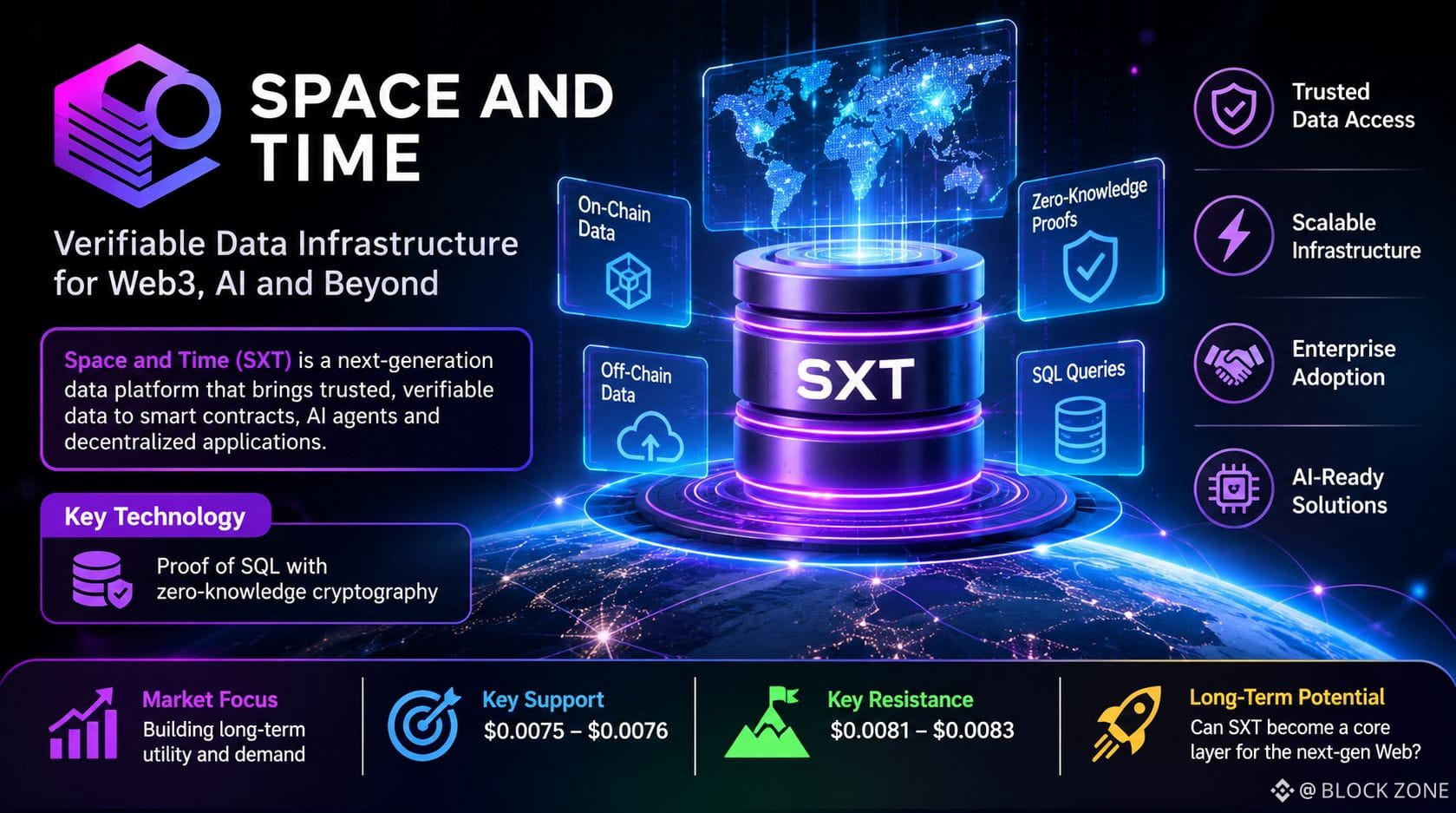
I've been watching @SpaceandTime closely because I believe verifiable data infrastructure could become one of the most important parts of the next phase of blockchain and AI adoption.
SXT is currently trading around $0.0078, following a noticeable pullback from the $0.0100–$0.0103 region earlier this month. Despite a modest recovery in the latest session, the broader short-term structure still deserves caution. Buyers have not yet demonstrated enough strength to confirm a trend reversal.
From a technical perspective, the $0.0075–$0.0076 area is an important near-term support zone. Holding it could give the market room to consolidate and attempt a recovery toward $0.0081–$0.0083. A convincing move above that resistance could improve momentum. However, losing support would expose SXT to further downside pressure.
What keeps my interest in Space and Time is its underlying technology. Its Proof of SQL system uses zero-knowledge cryptography to verify database queries, allowing smart contracts and applications to access reliable onchain and offchain information without blindly trusting the data provider. Its recently introduced Enterprise platform also opens another path into private business data and AI workflows, with partners including Maple Finance and Indomobil.
There is another important factor worth watching: whether this growing enterprise activity translates into actual SXT demand through network fees, query execution and staking.
Strong fundamentals do not guarantee immediate price appreciation. Token supply, liquidity, adoption and market sentiment still matter.
I see meaningful potential here, but execution will ultimately decide the outcome.
Can Space and Time turn its technological advantage into sustained real-world adoption and lasting demand for SXT, or will the market continue to value the token below its fundamental potential?
#sxt $SXT @SpaceandTimeDB
I've been watching @SpaceandTime closely because I believe verifiable data infrastructure could become one of the most important parts of the next phase of blockchain and AI adoption.
SXT is currently trading around $0.0078, following a noticeable pullback from the $0.0100–$0.0103 region earlier this month. Despite a modest recovery in the latest session, the broader short-term structure still deserves caution. Buyers have not yet demonstrated enough strength to confirm a trend reversal.
From a technical perspective, the $0.0075–$0.0076 area is an important near-term support zone. Holding it could give the market room to consolidate and attempt a recovery toward $0.0081–$0.0083. A convincing move above that resistance could improve momentum. However, losing support would expose SXT to further downside pressure.
What keeps my interest in Space and Time is its underlying technology. Its Proof of SQL system uses zero-knowledge cryptography to verify database queries, allowing smart contracts and applications to access reliable onchain and offchain information without blindly trusting the data provider. Its recently introduced Enterprise platform also opens another path into private business data and AI workflows, with partners including Maple Finance and Indomobil.
There is another important factor worth watching: whether this growing enterprise activity translates into actual SXT demand through network fees, query execution and staking.
Strong fundamentals do not guarantee immediate price appreciation. Token supply, liquidity, adoption and market sentiment still matter.
I see meaningful potential here, but execution will ultimately decide the outcome.
Can Space and Time turn its technological advantage into sustained real-world adoption and lasting demand for SXT, or will the market continue to value the token below its fundamental potential?
#sxt $SXT @SpaceandTime
William-ETH:
Space and Time has strong potential in the data infrastructure sector.
3
5
151
Log in to explore more content
Join global crypto users on Binance Square
⚡️ Get latest and useful information about crypto.
💬 Trusted by the world’s largest crypto exchange.
👍 Discover real insights from verified creators.
Email / Phone number
Trending Topics
1
#NvidiaBeatsEstimatesWith$130BQ4Outlook
34,209 views
235 Discussing
2
#AnthropicIPOPriceCouldExceed$80
37,353 views
205 Discussing
3
#RussiaCentralBankAddsAlfaBankToCryptoExchangeRegister
1,170 views
23 Discussing
4
#RussianCentralBankPlansToAllowFundsToHoldCryptoIn2027
757 views
19 Discussing
5
#VisaPlansStablecoinPrefundingForAPACCrossBorderPayments
907 views
20 Discussing
6
#CanNvidia’sDataCenterGrowthContinue?
99,412 views
1,169 Discussing
7
#CanadaAndUSLaunchOperationNiagaraAgainstApprovalPhishing
19,396 views
53 Discussing
8
#BankOfEnglandUnveilsClearingHousePathwayCoveringDLTFirms
3,377 views
60 Discussing
9
#DBSAndCirclePartnerToExpandAsianInstitutionsUSDCAccess
4,453 views
61 Discussing
10
#LedgerHardwareImplantReportsExtendToDubai
54,576 views
620 Discussing