

Ahsan_ BTC
19.5k Posts

Ahsan_ BTC
 Square Verified
Report
Block User
“Hunting entries. Protecting capital
1.3K+ Following
30.4K+ Followers
30.4K+ Liked
Posts
All
Quotes
Live
·
--
Bullish
🚨 $ADA SHORT SQUEEZE ALERT! 🚨
Liquidation: $1.6512K Short Wiped at $0.2609 on Binance 💥
What Happened?
Bears just got hit! A short position was forcefully closed as ADA pushed up to $0.2609. This forced buying adds fuel to the fire, signaling that sellers are losing grip at these levels. 📈
Why It Matters:
• Bullish Signal: Shorts are getting liquidated on the way up. If ADA holds above $0.26, more stops will trigger, creating a cascade effect.
• **Momentum Shift:** ADA is attempting to reclaim a key psychological zone. Holding $0.26 as support would be a major win for the bulls.
• Key Level to Watch: $0.2609 is the battleground. Holding above = bullish continuation. Losing it = chop.
Trade Setup (If Momentum Continues):
✅ Entry: $0.2580 – $0.2610 (on confirmation)
🎯 TP1: $0.2680
🎯 TP2: $0.2750
🎯 TP3: $0.2850
🛑 SL: $0.2480
⚖️ R:R ~ 1:2.5
Outlook:
⚡ Short-term: Shorts are trapped. If buying volume follows, $0.27 is the next target.
🔭 Long-term: ADA is a blue-chip Layer-1. Reclaiming $0.26 is a step toward a macro reversal. Losing $0.25 opens the door to $0.23.
Sentiment: Watch for a volume spike. Liquidations often mark local bottoms or breakout confirmations. Key inflection point. 👀
⚠️ Not financial advice. Liquidations can be volatile. DYOR and manage risk!
Watching $ADA? Drop a 🟢 below!
$ADA
{spot}(ADAUSDT)
#ADA #QNTRises39%
🚨 $ADA SHORT SQUEEZE ALERT! 🚨
Liquidation: $1.6512K Short Wiped at $0.2609 on Binance 💥
What Happened?
Bears just got hit! A short position was forcefully closed as ADA pushed up to $0.2609. This forced buying adds fuel to the fire, signaling that sellers are losing grip at these levels. 📈
Why It Matters:
• Bullish Signal: Shorts are getting liquidated on the way up. If ADA holds above $0.26, more stops will trigger, creating a cascade effect.
• **Momentum Shift:** ADA is attempting to reclaim a key psychological zone. Holding $0.26 as support would be a major win for the bulls.
• Key Level to Watch: $0.2609 is the battleground. Holding above = bullish continuation. Losing it = chop.
Trade Setup (If Momentum Continues):
✅ Entry: $0.2580 – $0.2610 (on confirmation)
🎯 TP1: $0.2680
🎯 TP2: $0.2750
🎯 TP3: $0.2850
🛑 SL: $0.2480
⚖️ R:R ~ 1:2.5
Outlook:
⚡ Short-term: Shorts are trapped. If buying volume follows, $0.27 is the next target.
🔭 Long-term: ADA is a blue-chip Layer-1. Reclaiming $0.26 is a step toward a macro reversal. Losing $0.25 opens the door to $0.23.
Sentiment: Watch for a volume spike. Liquidations often mark local bottoms or breakout confirmations. Key inflection point. 👀
⚠️ Not financial advice. Liquidations can be volatile. DYOR and manage risk!
Watching $ADA ? Drop a 🟢 below!
$ADA
#ADA #QNTRises39%
Liquidation: $1.6512K Short Wiped at $0.2609 on Binance 💥
What Happened?
Bears just got hit! A short position was forcefully closed as ADA pushed up to $0.2609. This forced buying adds fuel to the fire, signaling that sellers are losing grip at these levels. 📈
Why It Matters:
• Bullish Signal: Shorts are getting liquidated on the way up. If ADA holds above $0.26, more stops will trigger, creating a cascade effect.
• **Momentum Shift:** ADA is attempting to reclaim a key psychological zone. Holding $0.26 as support would be a major win for the bulls.
• Key Level to Watch: $0.2609 is the battleground. Holding above = bullish continuation. Losing it = chop.
Trade Setup (If Momentum Continues):
✅ Entry: $0.2580 – $0.2610 (on confirmation)
🎯 TP1: $0.2680
🎯 TP2: $0.2750
🎯 TP3: $0.2850
🛑 SL: $0.2480
⚖️ R:R ~ 1:2.5
Outlook:
⚡ Short-term: Shorts are trapped. If buying volume follows, $0.27 is the next target.
🔭 Long-term: ADA is a blue-chip Layer-1. Reclaiming $0.26 is a step toward a macro reversal. Losing $0.25 opens the door to $0.23.
Sentiment: Watch for a volume spike. Liquidations often mark local bottoms or breakout confirmations. Key inflection point. 👀
⚠️ Not financial advice. Liquidations can be volatile. DYOR and manage risk!
Watching $ADA ? Drop a 🟢 below!
$ADA
#ADA #QNTRises39%
74
·
--
Bullish
🚨 $SEI SHORT SQUEEZE ALERT! 🚨
Liquidation: $4.5714K Short Wiped at $0.07726 on Binance 💥
What Happened?
Bears just got squeezed! A short position was forcefully closed as SEI pushed up to $0.07726. This forced buying adds fuel to the fire, signaling that sellers are losing grip at these levels. 📈
Why It Matters:
• Bullish Signal: Shorts are getting liquidated on the way up. If SEI holds above $0.077, more stops will trigger, creating a cascade effect.
• **Momentum Shift:** SEI is attempting to build a base. Reclaiming $0.077 as support would be a major win for the bulls.
• Key Level to Watch: $0.07726 is the battleground. Holding above = bullish continuation. Losing it = fakeout.
Trade Setup (If Momentum Continues):
✅ Entry: $0.0765 – $0.0775 (on confirmation)
🎯 TP1: $0.0800
🎯 TP2: $0.0830
🎯 TP3: $0.0870
🛑 SL: $0.0740
⚖️ R:R ~ 1:2.5
Outlook:
⚡ Short-term: Shorts are trapped. If buying volume follows, $0.080 is the next target.
🔭 Long-term: SEI is a high-performance Layer-1. Needs to reclaim $0.08+ to confirm a macro trend reversal.
Sentiment: Watch for a volume spike. Liquidations often mark local bottoms or breakout confirmations. Key inflection point. 👀
⚠️ Not financial advice. Liquidations can be volatile. DYOR and manage risk!
Watching $SEI? Drop a 🟢 below!
$SEI
{spot}(SEIUSDT)
#SECSaysBuybacksUpgradesDontMakeTokenSecurity #SEİ
🚨 $SEI SHORT SQUEEZE ALERT! 🚨
Liquidation: $4.5714K Short Wiped at $0.07726 on Binance 💥
What Happened?
Bears just got squeezed! A short position was forcefully closed as SEI pushed up to $0.07726. This forced buying adds fuel to the fire, signaling that sellers are losing grip at these levels. 📈
Why It Matters:
• Bullish Signal: Shorts are getting liquidated on the way up. If SEI holds above $0.077, more stops will trigger, creating a cascade effect.
• **Momentum Shift:** SEI is attempting to build a base. Reclaiming $0.077 as support would be a major win for the bulls.
• Key Level to Watch: $0.07726 is the battleground. Holding above = bullish continuation. Losing it = fakeout.
Trade Setup (If Momentum Continues):
✅ Entry: $0.0765 – $0.0775 (on confirmation)
🎯 TP1: $0.0800
🎯 TP2: $0.0830
🎯 TP3: $0.0870
🛑 SL: $0.0740
⚖️ R:R ~ 1:2.5
Outlook:
⚡ Short-term: Shorts are trapped. If buying volume follows, $0.080 is the next target.
🔭 Long-term: SEI is a high-performance Layer-1. Needs to reclaim $0.08+ to confirm a macro trend reversal.
Sentiment: Watch for a volume spike. Liquidations often mark local bottoms or breakout confirmations. Key inflection point. 👀
⚠️ Not financial advice. Liquidations can be volatile. DYOR and manage risk!
Watching $SEI ? Drop a 🟢 below!
$SEI
#SECSaysBuybacksUpgradesDontMakeTokenSecurity #SEİ
Liquidation: $4.5714K Short Wiped at $0.07726 on Binance 💥
What Happened?
Bears just got squeezed! A short position was forcefully closed as SEI pushed up to $0.07726. This forced buying adds fuel to the fire, signaling that sellers are losing grip at these levels. 📈
Why It Matters:
• Bullish Signal: Shorts are getting liquidated on the way up. If SEI holds above $0.077, more stops will trigger, creating a cascade effect.
• **Momentum Shift:** SEI is attempting to build a base. Reclaiming $0.077 as support would be a major win for the bulls.
• Key Level to Watch: $0.07726 is the battleground. Holding above = bullish continuation. Losing it = fakeout.
Trade Setup (If Momentum Continues):
✅ Entry: $0.0765 – $0.0775 (on confirmation)
🎯 TP1: $0.0800
🎯 TP2: $0.0830
🎯 TP3: $0.0870
🛑 SL: $0.0740
⚖️ R:R ~ 1:2.5
Outlook:
⚡ Short-term: Shorts are trapped. If buying volume follows, $0.080 is the next target.
🔭 Long-term: SEI is a high-performance Layer-1. Needs to reclaim $0.08+ to confirm a macro trend reversal.
Sentiment: Watch for a volume spike. Liquidations often mark local bottoms or breakout confirmations. Key inflection point. 👀
⚠️ Not financial advice. Liquidations can be volatile. DYOR and manage risk!
Watching $SEI ? Drop a 🟢 below!
$SEI
#SECSaysBuybacksUpgradesDontMakeTokenSecurity #SEİ
39
·
--
Bullish
$DOT SHORT SQUEEZE ALERT!
Liquidation: $7.8814K Short Wiped at $1.25148 on Binance 💥
What Happened?
Bears just got hit! A notable short position was liquidated as DOT pushed up to $1.2514. This forced buying pressure adds fuel to the fire, signaling that shorts are losing control at these levels. 📈
Why It Matters:
• Bullish Signal: $7.8K might sound small, but it's a clear indication that bearish momentum is weakening. If DOT holds above $1.25, more short stops will trigger.
• Momentum Shift: DOT is attempting to reclaim a key psychological zone. A clean break above $1.25 could invite fresh longs.
• **Key Level to Watch:** **$1.2514** is the line in the sand. Holding above = bullish continuation. Losing it = chop.
Trade Setup (If Momentum Continues):
✅ Entry: $1.245 – $1.255 (on confirmation)
🎯 TP1: $1.290
🎯 TP2: $1.330
🎯 TP3: $1.380
🛑 SL: $1.215
⚖️ R:R ~ 1:2.5
Outlook:
⚡ Short-term: Shorts are trapped. If buying volume follows, $1.30 is the next target.
🔭 Long-term: DOT (Polkadot) is a blue-chip Layer-0 blockchain. Reclaiming $1.25 is a step toward a macro reversal.
Sentiment: Watch for a volume spike. Liquidations often mark local bottoms or breakout confirmations. Key inflection point. 👀
⚠️ Not financial advice. Liquidations can be volatile. DYOR and manage risk!
Watching $DOT ? Drop a 🟢 below!
$DOT
{spot}(DOTUSDT)
#dot #CFTCUpdatesGuidanceOnTokenizedAssets
$DOT SHORT SQUEEZE ALERT!
Liquidation: $7.8814K Short Wiped at $1.25148 on Binance 💥
What Happened?
Bears just got hit! A notable short position was liquidated as DOT pushed up to $1.2514. This forced buying pressure adds fuel to the fire, signaling that shorts are losing control at these levels. 📈
Why It Matters:
• Bullish Signal: $7.8K might sound small, but it's a clear indication that bearish momentum is weakening. If DOT holds above $1.25, more short stops will trigger.
• Momentum Shift: DOT is attempting to reclaim a key psychological zone. A clean break above $1.25 could invite fresh longs.
• **Key Level to Watch:** **$1.2514** is the line in the sand. Holding above = bullish continuation. Losing it = chop.
Trade Setup (If Momentum Continues):
✅ Entry: $1.245 – $1.255 (on confirmation)
🎯 TP1: $1.290
🎯 TP2: $1.330
🎯 TP3: $1.380
🛑 SL: $1.215
⚖️ R:R ~ 1:2.5
Outlook:
⚡ Short-term: Shorts are trapped. If buying volume follows, $1.30 is the next target.
🔭 Long-term: DOT (Polkadot) is a blue-chip Layer-0 blockchain. Reclaiming $1.25 is a step toward a macro reversal.
Sentiment: Watch for a volume spike. Liquidations often mark local bottoms or breakout confirmations. Key inflection point. 👀
⚠️ Not financial advice. Liquidations can be volatile. DYOR and manage risk!
Watching $DOT ? Drop a 🟢 below!
$DOT
#dot #CFTCUpdatesGuidanceOnTokenizedAssets
Liquidation: $7.8814K Short Wiped at $1.25148 on Binance 💥
What Happened?
Bears just got hit! A notable short position was liquidated as DOT pushed up to $1.2514. This forced buying pressure adds fuel to the fire, signaling that shorts are losing control at these levels. 📈
Why It Matters:
• Bullish Signal: $7.8K might sound small, but it's a clear indication that bearish momentum is weakening. If DOT holds above $1.25, more short stops will trigger.
• Momentum Shift: DOT is attempting to reclaim a key psychological zone. A clean break above $1.25 could invite fresh longs.
• **Key Level to Watch:** **$1.2514** is the line in the sand. Holding above = bullish continuation. Losing it = chop.
Trade Setup (If Momentum Continues):
✅ Entry: $1.245 – $1.255 (on confirmation)
🎯 TP1: $1.290
🎯 TP2: $1.330
🎯 TP3: $1.380
🛑 SL: $1.215
⚖️ R:R ~ 1:2.5
Outlook:
⚡ Short-term: Shorts are trapped. If buying volume follows, $1.30 is the next target.
🔭 Long-term: DOT (Polkadot) is a blue-chip Layer-0 blockchain. Reclaiming $1.25 is a step toward a macro reversal.
Sentiment: Watch for a volume spike. Liquidations often mark local bottoms or breakout confirmations. Key inflection point. 👀
⚠️ Not financial advice. Liquidations can be volatile. DYOR and manage risk!
Watching $DOT ? Drop a 🟢 below!
$DOT
#dot #CFTCUpdatesGuidanceOnTokenizedAssets
89
·
--
Bullish
$QNT SHORT SQUEEZE ALERT!
Liquidation: $1.9784K Short Wiped at $98.9205 on Binance 💥
What Happened?
Bears got caught slipping! A small but notable short position just got liquidated as QNT pushed up to nearly $99. When shorts get liquidated, it forces them to buy back at market price — fueling upward momentum. 📈
Why It Matters:
• Bullish Signal: Shorts are feeling the heat. A break above $99 could trigger a cascade of further liquidations.
• **Momentum Shift:** QNT is showing strength. If it reclaims $100, expect a fast move up as more stops get hit.
• Key Level to Watch: $98.92 is now the battleground. Holding above this = bullish continuation. Losing it = fakeout.
Trade Setup (If Momentum Continues):
✅ Entry: $98.50 – $99.20 (on confirmation)
🎯 TP1: $102.00
🎯 TP2: $105.50
🎯 TP3: $110.00
🛑 SL: $96.00
⚖️ R:R ~ 1:2.5
Outlook:
⚡ Short-term: Shorts are trapped. If buying volume follows, $100+ is imminent.
🔭 Long-term: QNT (Quant) is a top-tier interoperability project. Reclaiming $100 is a major psychological win for the bulls.
Sentiment: Watch for a volume spike. Liquidations often mark local bottoms or breakout confirmations. This is a key inflection point. 👀
⚠️ Not financial advice. Liquidations can be volatile. DYOR and manage risk!
Watching $QNT ? Drop a 🟢 below!
$QNT
{spot}(QNTUSDT)
#QNT #BitcoinSpotETFsTurnNetPositiveYTD
$QNT SHORT SQUEEZE ALERT!
Liquidation: $1.9784K Short Wiped at $98.9205 on Binance 💥
What Happened?
Bears got caught slipping! A small but notable short position just got liquidated as QNT pushed up to nearly $99. When shorts get liquidated, it forces them to buy back at market price — fueling upward momentum. 📈
Why It Matters:
• Bullish Signal: Shorts are feeling the heat. A break above $99 could trigger a cascade of further liquidations.
• **Momentum Shift:** QNT is showing strength. If it reclaims $100, expect a fast move up as more stops get hit.
• Key Level to Watch: $98.92 is now the battleground. Holding above this = bullish continuation. Losing it = fakeout.
Trade Setup (If Momentum Continues):
✅ Entry: $98.50 – $99.20 (on confirmation)
🎯 TP1: $102.00
🎯 TP2: $105.50
🎯 TP3: $110.00
🛑 SL: $96.00
⚖️ R:R ~ 1:2.5
Outlook:
⚡ Short-term: Shorts are trapped. If buying volume follows, $100+ is imminent.
🔭 Long-term: QNT (Quant) is a top-tier interoperability project. Reclaiming $100 is a major psychological win for the bulls.
Sentiment: Watch for a volume spike. Liquidations often mark local bottoms or breakout confirmations. This is a key inflection point. 👀
⚠️ Not financial advice. Liquidations can be volatile. DYOR and manage risk!
Watching $QNT ? Drop a 🟢 below!
$QNT
#QNT #BitcoinSpotETFsTurnNetPositiveYTD
Liquidation: $1.9784K Short Wiped at $98.9205 on Binance 💥
What Happened?
Bears got caught slipping! A small but notable short position just got liquidated as QNT pushed up to nearly $99. When shorts get liquidated, it forces them to buy back at market price — fueling upward momentum. 📈
Why It Matters:
• Bullish Signal: Shorts are feeling the heat. A break above $99 could trigger a cascade of further liquidations.
• **Momentum Shift:** QNT is showing strength. If it reclaims $100, expect a fast move up as more stops get hit.
• Key Level to Watch: $98.92 is now the battleground. Holding above this = bullish continuation. Losing it = fakeout.
Trade Setup (If Momentum Continues):
✅ Entry: $98.50 – $99.20 (on confirmation)
🎯 TP1: $102.00
🎯 TP2: $105.50
🎯 TP3: $110.00
🛑 SL: $96.00
⚖️ R:R ~ 1:2.5
Outlook:
⚡ Short-term: Shorts are trapped. If buying volume follows, $100+ is imminent.
🔭 Long-term: QNT (Quant) is a top-tier interoperability project. Reclaiming $100 is a major psychological win for the bulls.
Sentiment: Watch for a volume spike. Liquidations often mark local bottoms or breakout confirmations. This is a key inflection point. 👀
⚠️ Not financial advice. Liquidations can be volatile. DYOR and manage risk!
Watching $QNT ? Drop a 🟢 below!
$QNT
#QNT #BitcoinSpotETFsTurnNetPositiveYTD
152
·
--
Bullish
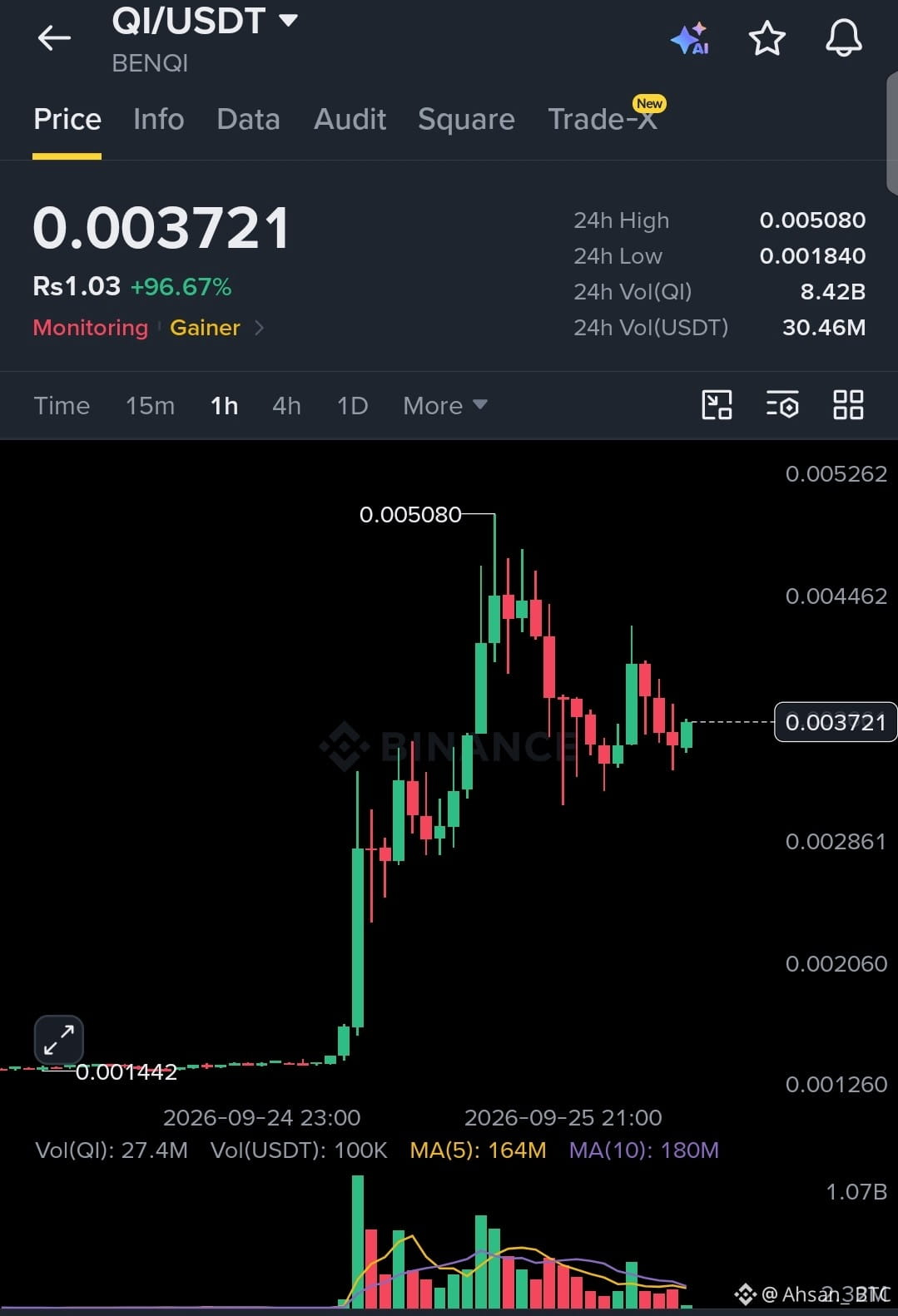
$QI /USDT — Parabolic Explosion, Now Cooling! 🚀🧊
Current Price: ~$0.003721 (+96.67% 24h) 💚
Overview: BENQI ($QI) is a decentralized liquidity market and liquid staking protocol on the Avalanche network. Currently tagged as a "Monitoring" gainer after a massive nearly 100% pump. 🏔️
Technical Setup (1H):
📈 Insane vertical pump from $0.00144 to $0.00508.
🐻 Sharp rejection at the top, now retracing to $0.0037.
📊 MA5 (164M) < MA10 (180M) = short-term momentum has flipped bearish.
📉 Volume fading hard = the initial hype is over. Expect choppy consolidation.
Key Levels:
🔴 Resistance: $0.00446 → $0.00508 (local top)
🟢 Support: $0.00286 → $0.00206 (major structure)
Trade Plan (High Risk / Dip Buy):
✅ Entry: $0.00340 – $0.00370 (current pullback zone)
🎯 TP1: $0.00446
🎯 TP2: $0.00508
🎯 TP3: $0.00580
🛑 SL: $0.00280
⚖️ R:R ~ 1:2.5
Outlook:
⚡ Short-term: Consolidation between $0.0028–$0.0044. Needs to reclaim $0.004 to resume the uptrend.
🔭 Long-term: Needs an Avalanche/DeFi narrative catalyst to sustain these gains. Otherwise, it will bleed back to the base.
Sentiment: 8.42B QI volume = massive speculation. This is a highly volatile, low-cap play. Expect violent swings. 🎢
⚠️ Not financial advice. Parabolic pumps are dangerous to chase. DYOR. Use tight stops!
Caught the $QI pump? Drop a 🚀 below!
$QI
{spot}(QIUSDT)
#QI
#BitcoinSpotETFsTurnNetPositiveYTD
$QI /USDT — Parabolic Explosion, Now Cooling! 🚀🧊
Current Price: ~$0.003721 (+96.67% 24h) 💚
Overview: BENQI ($QI ) is a decentralized liquidity market and liquid staking protocol on the Avalanche network. Currently tagged as a "Monitoring" gainer after a massive nearly 100% pump. 🏔️
Technical Setup (1H):
📈 Insane vertical pump from $0.00144 to $0.00508.
🐻 Sharp rejection at the top, now retracing to $0.0037.
📊 MA5 (164M) < MA10 (180M) = short-term momentum has flipped bearish.
📉 Volume fading hard = the initial hype is over. Expect choppy consolidation.
Key Levels:
🔴 Resistance: $0.00446 → $0.00508 (local top)
🟢 Support: $0.00286 → $0.00206 (major structure)
Trade Plan (High Risk / Dip Buy):
✅ Entry: $0.00340 – $0.00370 (current pullback zone)
🎯 TP1: $0.00446
🎯 TP2: $0.00508
🎯 TP3: $0.00580
🛑 SL: $0.00280
⚖️ R:R ~ 1:2.5
Outlook:
⚡ Short-term: Consolidation between $0.0028–$0.0044. Needs to reclaim $0.004 to resume the uptrend.
🔭 Long-term: Needs an Avalanche/DeFi narrative catalyst to sustain these gains. Otherwise, it will bleed back to the base.
Sentiment: 8.42B QI volume = massive speculation. This is a highly volatile, low-cap play. Expect violent swings. 🎢
⚠️ Not financial advice. Parabolic pumps are dangerous to chase. DYOR. Use tight stops!
Caught the $QI pump? Drop a 🚀 below!
$QI
#QI
#BitcoinSpotETFsTurnNetPositiveYTD
Current Price: ~$0.003721 (+96.67% 24h) 💚
Overview: BENQI ($QI ) is a decentralized liquidity market and liquid staking protocol on the Avalanche network. Currently tagged as a "Monitoring" gainer after a massive nearly 100% pump. 🏔️
Technical Setup (1H):
📈 Insane vertical pump from $0.00144 to $0.00508.
🐻 Sharp rejection at the top, now retracing to $0.0037.
📊 MA5 (164M) < MA10 (180M) = short-term momentum has flipped bearish.
📉 Volume fading hard = the initial hype is over. Expect choppy consolidation.
Key Levels:
🔴 Resistance: $0.00446 → $0.00508 (local top)
🟢 Support: $0.00286 → $0.00206 (major structure)
Trade Plan (High Risk / Dip Buy):
✅ Entry: $0.00340 – $0.00370 (current pullback zone)
🎯 TP1: $0.00446
🎯 TP2: $0.00508
🎯 TP3: $0.00580
🛑 SL: $0.00280
⚖️ R:R ~ 1:2.5
Outlook:
⚡ Short-term: Consolidation between $0.0028–$0.0044. Needs to reclaim $0.004 to resume the uptrend.
🔭 Long-term: Needs an Avalanche/DeFi narrative catalyst to sustain these gains. Otherwise, it will bleed back to the base.
Sentiment: 8.42B QI volume = massive speculation. This is a highly volatile, low-cap play. Expect violent swings. 🎢
⚠️ Not financial advice. Parabolic pumps are dangerous to chase. DYOR. Use tight stops!
Caught the $QI pump? Drop a 🚀 below!
$QI
#QI
#BitcoinSpotETFsTurnNetPositiveYTD
173
·
--
Bullish
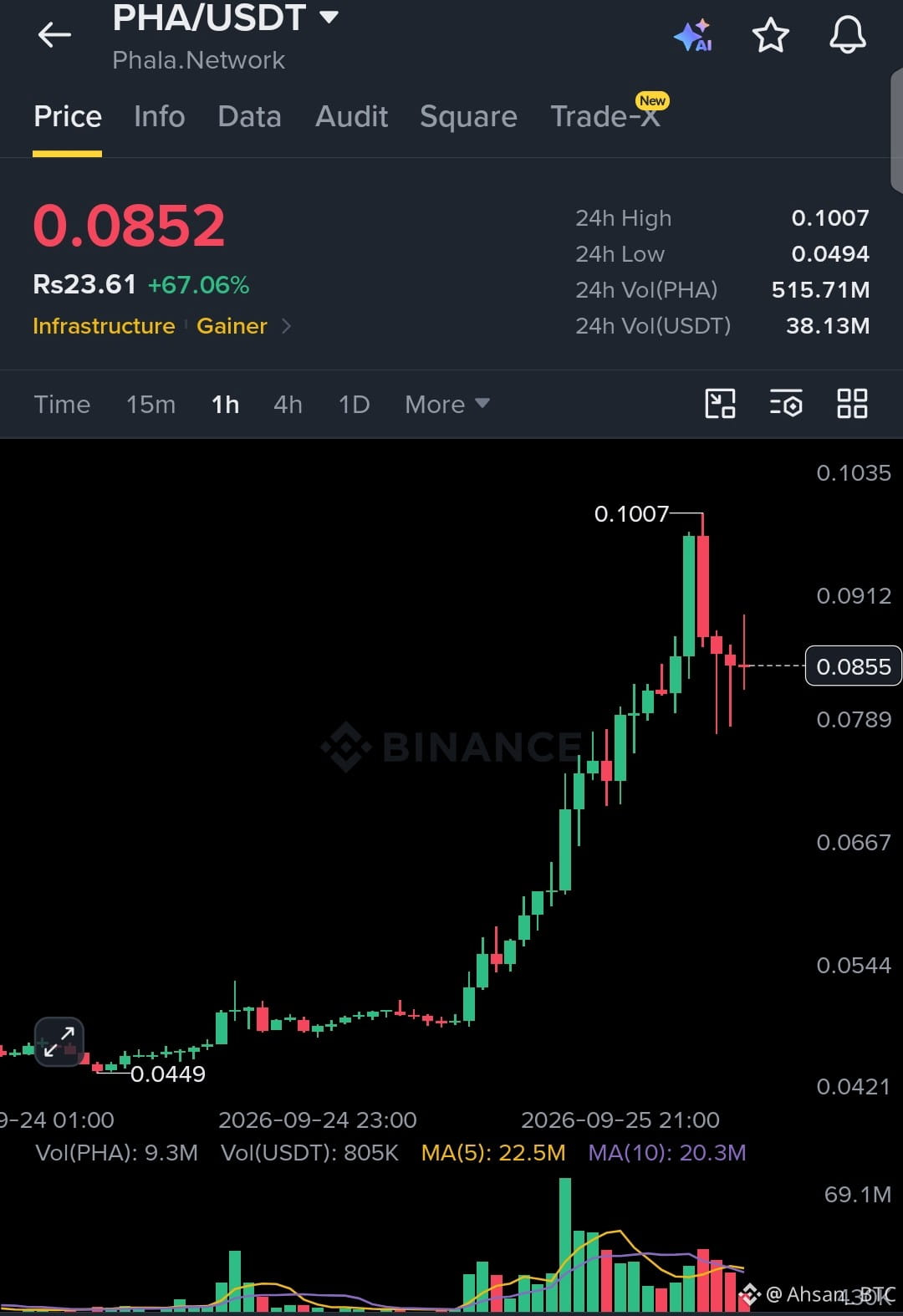
$PHA /USDT — Infrastructure Massive Breakout! 🚀🔥
Current Price: ~$0.0852 (+67.06% 24h) 💚
Overview: Phala Network ($PHA) is a decentralized cloud computing protocol focused on privacy and secure off-chain computation. A heavy hitter in the "Infrastructure" sector currently running hot. 🖥️🔒
Technical Setup (1H):
📈 Parabolic vertical breakout from $0.0449 to $0.1007.
🐂 Retracing now, finding initial support near $0.085.
📊 MA5 (22.5M) > MA10 (20.3M) = trend firmly bullish, but momentum cooling.
📉 Volume fading from peak = profit-taking in progress.
Key Levels:
🔴 Resistance: $0.0912 → $0.1007 (local top) → $0.1035
🟢 Support: $0.0789 → $0.0667 → $0.0544
Trade Plan (Dip Buy / Momentum):
✅ Entry: $0.0780 – $0.0850 (on pullback / current zone)
🎯 TP1: $0.0912
🎯 TP2: $0.1007
🎯 TP3: $0.1150
🛑 SL: $0.0680
⚖️ R:R ~ 1:2.5
Outlook:
⚡ Short-term: Consolidation expected between $0.078–$0.090. Break above $0.0912 = next leg up.
🔭 Long-term: Infrastructure coins have massive upside. Reclaiming $0.10 would put price discovery back on the table.
Sentiment: 515M PHA volume = massive whale interest. Infrastructure narrative is hot right now. 🐋
⚠️ Not financial advice. Massive pumps = massive dumps. DYOR. Use tight stops!
Riding $PHA ? Drop a 🖥️ below!
$PHA
{spot}(PHAUSDT)
#PHA #BitgetBreachForgedRequestsNotStolenKeys
$PHA /USDT — Infrastructure Massive Breakout! 🚀🔥
Current Price: ~$0.0852 (+67.06% 24h) 💚
Overview: Phala Network ($PHA ) is a decentralized cloud computing protocol focused on privacy and secure off-chain computation. A heavy hitter in the "Infrastructure" sector currently running hot. 🖥️🔒
Technical Setup (1H):
📈 Parabolic vertical breakout from $0.0449 to $0.1007.
🐂 Retracing now, finding initial support near $0.085.
📊 MA5 (22.5M) > MA10 (20.3M) = trend firmly bullish, but momentum cooling.
📉 Volume fading from peak = profit-taking in progress.
Key Levels:
🔴 Resistance: $0.0912 → $0.1007 (local top) → $0.1035
🟢 Support: $0.0789 → $0.0667 → $0.0544
Trade Plan (Dip Buy / Momentum):
✅ Entry: $0.0780 – $0.0850 (on pullback / current zone)
🎯 TP1: $0.0912
🎯 TP2: $0.1007
🎯 TP3: $0.1150
🛑 SL: $0.0680
⚖️ R:R ~ 1:2.5
Outlook:
⚡ Short-term: Consolidation expected between $0.078–$0.090. Break above $0.0912 = next leg up.
🔭 Long-term: Infrastructure coins have massive upside. Reclaiming $0.10 would put price discovery back on the table.
Sentiment: 515M PHA volume = massive whale interest. Infrastructure narrative is hot right now. 🐋
⚠️ Not financial advice. Massive pumps = massive dumps. DYOR. Use tight stops!
Riding $PHA ? Drop a 🖥️ below!
$PHA
#PHA #BitgetBreachForgedRequestsNotStolenKeys
Current Price: ~$0.0852 (+67.06% 24h) 💚
Overview: Phala Network ($PHA ) is a decentralized cloud computing protocol focused on privacy and secure off-chain computation. A heavy hitter in the "Infrastructure" sector currently running hot. 🖥️🔒
Technical Setup (1H):
📈 Parabolic vertical breakout from $0.0449 to $0.1007.
🐂 Retracing now, finding initial support near $0.085.
📊 MA5 (22.5M) > MA10 (20.3M) = trend firmly bullish, but momentum cooling.
📉 Volume fading from peak = profit-taking in progress.
Key Levels:
🔴 Resistance: $0.0912 → $0.1007 (local top) → $0.1035
🟢 Support: $0.0789 → $0.0667 → $0.0544
Trade Plan (Dip Buy / Momentum):
✅ Entry: $0.0780 – $0.0850 (on pullback / current zone)
🎯 TP1: $0.0912
🎯 TP2: $0.1007
🎯 TP3: $0.1150
🛑 SL: $0.0680
⚖️ R:R ~ 1:2.5
Outlook:
⚡ Short-term: Consolidation expected between $0.078–$0.090. Break above $0.0912 = next leg up.
🔭 Long-term: Infrastructure coins have massive upside. Reclaiming $0.10 would put price discovery back on the table.
Sentiment: 515M PHA volume = massive whale interest. Infrastructure narrative is hot right now. 🐋
⚠️ Not financial advice. Massive pumps = massive dumps. DYOR. Use tight stops!
Riding $PHA ? Drop a 🖥️ below!
$PHA
#PHA #BitgetBreachForgedRequestsNotStolenKeys
258
·
--
Bullish
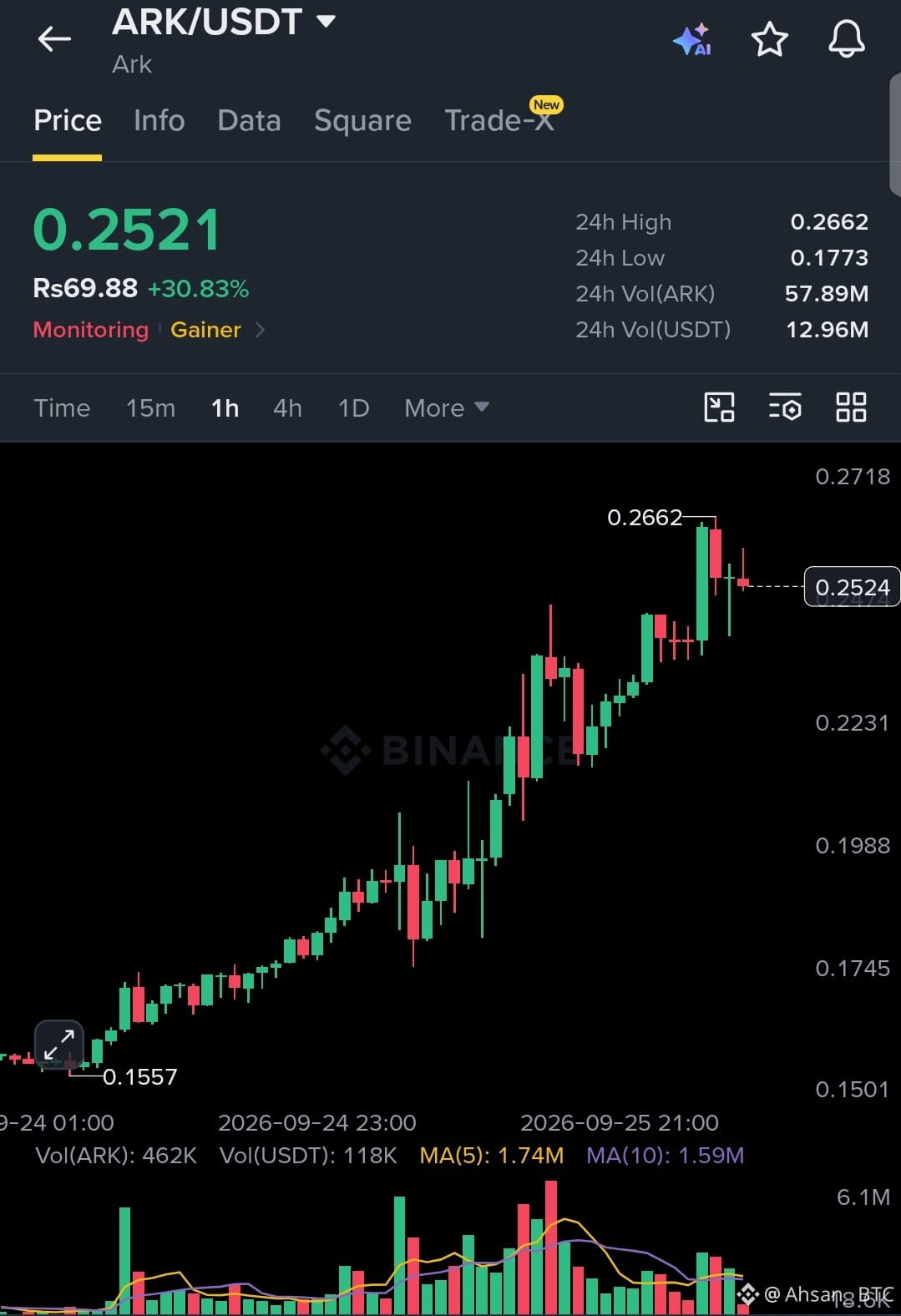
$ARK /USDT — Steady Uptrend, Bulls in Control! 📈🟢
Current Price: ~$0.2521 (+30.83% 24h) 💚
Overview: Ark ($ARK) is a veteran blockchain project focused on interoperability and enterprise solutions. It's currently tagged as a "Monitoring" gainer, showing strong revival momentum. 🏗️
Technical Setup (1H):
📈 Textbook staircase uptrend from $0.1557 to $0.2662.
🐂 Healthy pullback, now consolidating near $0.2521.
📊 MA5 (1.74M) > MA10 (1.59M) = bullish trend firmly intact. 💪
📉 Volume easing off during consolidation = healthy cooling, not a dump.
Key Levels:
🔴 Resistance: $0.2662 → $0.2718
🟢 Support: $0.2231 → $0.1988 (major structure)
Trade Plan (Trend Continuation):
✅ Entry: $0.2450 – $0.2520 (current consolidation zone)
🎯 TP1: $0.2662
🎯 TP2: $0.2800
🎯 TP3: $0.2950
🛑 SL: $0.2200
⚖️ R:R ~ 1:2.5
Outlook:
⚡ Short-term: Holding above $0.24 keeps bulls in play. A clean break above $0.266 targets $0.28+.
🔭 Long-term: Needs to hold the $0.20 structural support to maintain a macro bullish reversal.
Sentiment: $12.96M turnover shows decent interest, but this is still a mid/low-cap mover. Watch for follow-through volume on the next leg up. 🐋
⚠️ Not financial advice. DYOR. Always manage your risk and use stop losses!
Riding the $ARK train? Drop a 🏛️ below!
$ARK
{spot}(ARKUSDT)
#ARK
#NYAndPolymarketSueEachOther #BinanceWillListHyperliquid(HYPE)
$ARK /USDT — Steady Uptrend, Bulls in Control! 📈🟢
Current Price: ~$0.2521 (+30.83% 24h) 💚
Overview: Ark ($ARK ) is a veteran blockchain project focused on interoperability and enterprise solutions. It's currently tagged as a "Monitoring" gainer, showing strong revival momentum. 🏗️
Technical Setup (1H):
📈 Textbook staircase uptrend from $0.1557 to $0.2662.
🐂 Healthy pullback, now consolidating near $0.2521.
📊 MA5 (1.74M) > MA10 (1.59M) = bullish trend firmly intact. 💪
📉 Volume easing off during consolidation = healthy cooling, not a dump.
Key Levels:
🔴 Resistance: $0.2662 → $0.2718
🟢 Support: $0.2231 → $0.1988 (major structure)
Trade Plan (Trend Continuation):
✅ Entry: $0.2450 – $0.2520 (current consolidation zone)
🎯 TP1: $0.2662
🎯 TP2: $0.2800
🎯 TP3: $0.2950
🛑 SL: $0.2200
⚖️ R:R ~ 1:2.5
Outlook:
⚡ Short-term: Holding above $0.24 keeps bulls in play. A clean break above $0.266 targets $0.28+.
🔭 Long-term: Needs to hold the $0.20 structural support to maintain a macro bullish reversal.
Sentiment: $12.96M turnover shows decent interest, but this is still a mid/low-cap mover. Watch for follow-through volume on the next leg up. 🐋
⚠️ Not financial advice. DYOR. Always manage your risk and use stop losses!
Riding the $ARK train? Drop a 🏛️ below!
$ARK
#ARK
#NYAndPolymarketSueEachOther #BinanceWillListHyperliquid(HYPE)
Current Price: ~$0.2521 (+30.83% 24h) 💚
Overview: Ark ($ARK ) is a veteran blockchain project focused on interoperability and enterprise solutions. It's currently tagged as a "Monitoring" gainer, showing strong revival momentum. 🏗️
Technical Setup (1H):
📈 Textbook staircase uptrend from $0.1557 to $0.2662.
🐂 Healthy pullback, now consolidating near $0.2521.
📊 MA5 (1.74M) > MA10 (1.59M) = bullish trend firmly intact. 💪
📉 Volume easing off during consolidation = healthy cooling, not a dump.
Key Levels:
🔴 Resistance: $0.2662 → $0.2718
🟢 Support: $0.2231 → $0.1988 (major structure)
Trade Plan (Trend Continuation):
✅ Entry: $0.2450 – $0.2520 (current consolidation zone)
🎯 TP1: $0.2662
🎯 TP2: $0.2800
🎯 TP3: $0.2950
🛑 SL: $0.2200
⚖️ R:R ~ 1:2.5
Outlook:
⚡ Short-term: Holding above $0.24 keeps bulls in play. A clean break above $0.266 targets $0.28+.
🔭 Long-term: Needs to hold the $0.20 structural support to maintain a macro bullish reversal.
Sentiment: $12.96M turnover shows decent interest, but this is still a mid/low-cap mover. Watch for follow-through volume on the next leg up. 🐋
⚠️ Not financial advice. DYOR. Always manage your risk and use stop losses!
Riding the $ARK train? Drop a 🏛️ below!
$ARK
#ARK
#NYAndPolymarketSueEachOther #BinanceWillListHyperliquid(HYPE)
174
·
--
Bullish
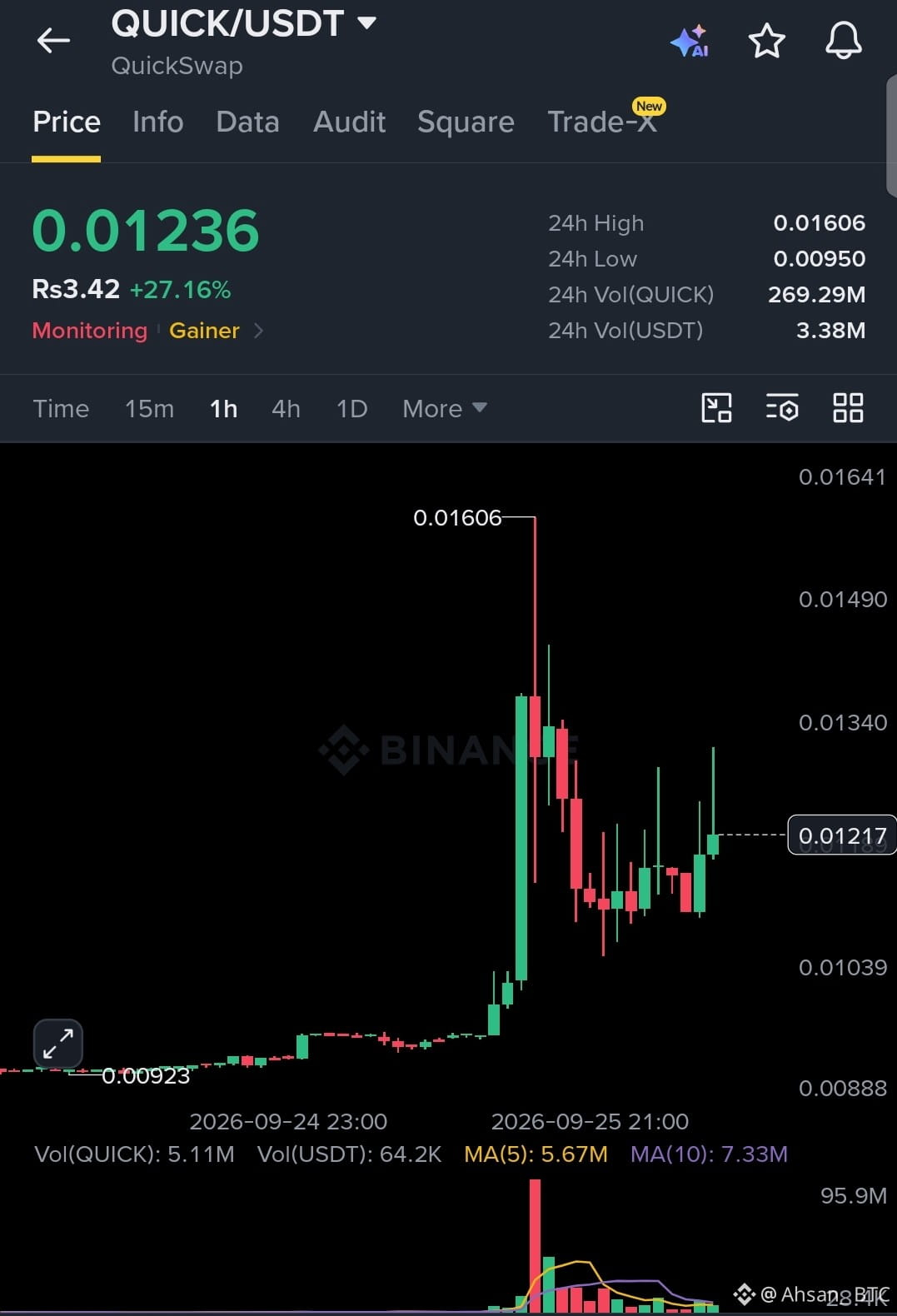
$QUICK /USDT — Massive Wick, Now Cooling! 🧊⚡
Current Price: ~$0.01236 (+27.16% 24h) 💚
Overview: QuickSwap ($QUICK) is a leading DEX on Polygon. This "Monitoring" tag token just had a violent spike — classic low-liquidity volatility. 🎢
Technical Setup (1H):
📉 Insane wick to $0.01606 — instant rejection (blow-off top).
🐻 Sharp dump to $0.00950, now bouncing to $0.012.
📊 MA5 (5.67M) < MA10 (7.33M) = bearish crossover, momentum fading.
📉 Volume dying = hype is over, choppy range ahead. 😴
Key Levels:
🔴 Resistance: $0.01340 → $0.01490 → $0.01606
🟢 Support: $0.01039 → $0.00923 (critical floor)
Trade Plan (Range Scalp):
✅ Entry: $0.01150 – $0.01200 (near current consolidation)
🎯 TP1: $0.01340
🎯 TP2: $0.01490
🎯 TP3: $0.01600
🛑 SL: $0.01000
⚖️ R:R ~ 1:2.5
Outlook:
⚡ Short-term: Needs to reclaim $0.0134 to resume uptrend. Otherwise, expect chop between $0.010–$0.013.
🔭 Long-term: Needs a Polygon/DEX narrative catalyst to sustain. Otherwise, it bleeds.
Sentiment: Liquidity is dangerously thin ($3.38M turnover). Slippage risk is HIGH. Use limit orders only. 🐋
⚠️ Not financial advice. Low liquidity = extreme volatility. DYOR. Tight stops!
Watching $QUICK ? Drop a ⚡ below!
$QUICK
{spot}(QUICKUSDT)
#QUICK
#CFTCUpdatesGuidanceOnTokenizedAssets
$QUICK /USDT — Massive Wick, Now Cooling! 🧊⚡
Current Price: ~$0.01236 (+27.16% 24h) 💚
Overview: QuickSwap ($QUICK ) is a leading DEX on Polygon. This "Monitoring" tag token just had a violent spike — classic low-liquidity volatility. 🎢
Technical Setup (1H):
📉 Insane wick to $0.01606 — instant rejection (blow-off top).
🐻 Sharp dump to $0.00950, now bouncing to $0.012.
📊 MA5 (5.67M) < MA10 (7.33M) = bearish crossover, momentum fading.
📉 Volume dying = hype is over, choppy range ahead. 😴
Key Levels:
🔴 Resistance: $0.01340 → $0.01490 → $0.01606
🟢 Support: $0.01039 → $0.00923 (critical floor)
Trade Plan (Range Scalp):
✅ Entry: $0.01150 – $0.01200 (near current consolidation)
🎯 TP1: $0.01340
🎯 TP2: $0.01490
🎯 TP3: $0.01600
🛑 SL: $0.01000
⚖️ R:R ~ 1:2.5
Outlook:
⚡ Short-term: Needs to reclaim $0.0134 to resume uptrend. Otherwise, expect chop between $0.010–$0.013.
🔭 Long-term: Needs a Polygon/DEX narrative catalyst to sustain. Otherwise, it bleeds.
Sentiment: Liquidity is dangerously thin ($3.38M turnover). Slippage risk is HIGH. Use limit orders only. 🐋
⚠️ Not financial advice. Low liquidity = extreme volatility. DYOR. Tight stops!
Watching $QUICK ? Drop a ⚡ below!
$QUICK
#QUICK
#CFTCUpdatesGuidanceOnTokenizedAssets
Current Price: ~$0.01236 (+27.16% 24h) 💚
Overview: QuickSwap ($QUICK ) is a leading DEX on Polygon. This "Monitoring" tag token just had a violent spike — classic low-liquidity volatility. 🎢
Technical Setup (1H):
📉 Insane wick to $0.01606 — instant rejection (blow-off top).
🐻 Sharp dump to $0.00950, now bouncing to $0.012.
📊 MA5 (5.67M) < MA10 (7.33M) = bearish crossover, momentum fading.
📉 Volume dying = hype is over, choppy range ahead. 😴
Key Levels:
🔴 Resistance: $0.01340 → $0.01490 → $0.01606
🟢 Support: $0.01039 → $0.00923 (critical floor)
Trade Plan (Range Scalp):
✅ Entry: $0.01150 – $0.01200 (near current consolidation)
🎯 TP1: $0.01340
🎯 TP2: $0.01490
🎯 TP3: $0.01600
🛑 SL: $0.01000
⚖️ R:R ~ 1:2.5
Outlook:
⚡ Short-term: Needs to reclaim $0.0134 to resume uptrend. Otherwise, expect chop between $0.010–$0.013.
🔭 Long-term: Needs a Polygon/DEX narrative catalyst to sustain. Otherwise, it bleeds.
Sentiment: Liquidity is dangerously thin ($3.38M turnover). Slippage risk is HIGH. Use limit orders only. 🐋
⚠️ Not financial advice. Low liquidity = extreme volatility. DYOR. Tight stops!
Watching $QUICK ? Drop a ⚡ below!
$QUICK
#QUICK
#CFTCUpdatesGuidanceOnTokenizedAssets
335
·
--
Bullish
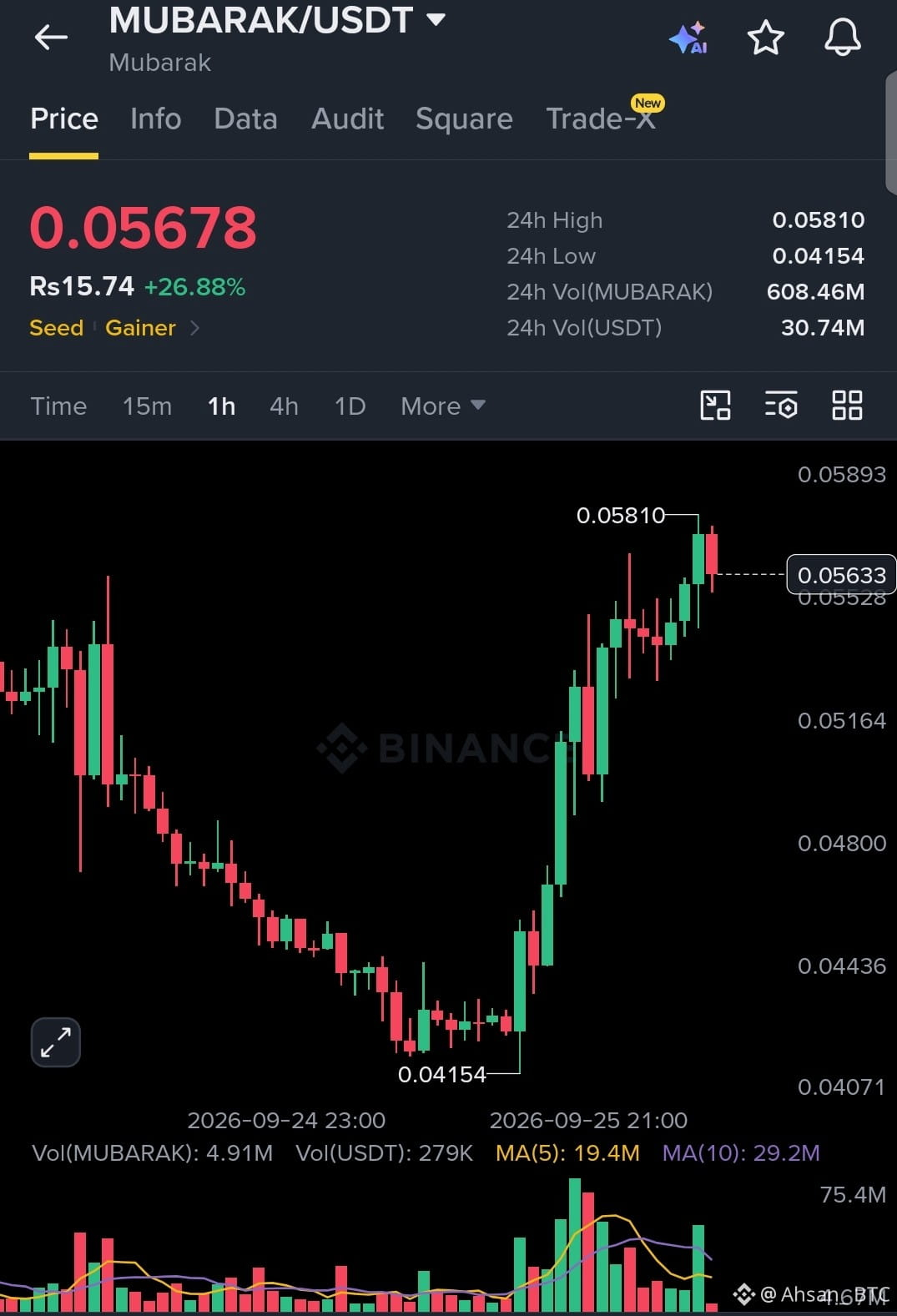
$MUBARAK /USDT — Parabolic Meme Pump! 🚀🔥
Current Price: ~$0.05678 (+26.88% 24h) 💚
Overview: MUBARAK is a Binance "Seed" tagged meme coin riding high on Middle East narrative hype. Pure sentiment-driven play — massive volatility, massive volume. 🐋
Technical Setup (1H):
📈 Insane vertical pump from $0.0415 to $0.0581.
🐂 Currently consolidating just below the highs — bull flag vibes.
📊 MA5 (19.4M) below MA10 (29.2M) — short-term momentum cooling after the spike.
📉 Volume fading from peak = profit-taking phase.
Key Levels:
🔴 Resistance: $0.0581 → $0.0589 (local top)
🟢 Support: $0.0552 → $0.0516 → $0.0480
Trade Plan (High Risk Momentum):
✅ Entry: $0.0530 – $0.0555 (on dip/retest)
🎯 TP1: $0.0581
🎯 TP2: $0.0620
🎯 TP3: $0.0680
🛑 SL: $0.0490
⚖️ R:R ~ 1:2.5
Outlook:
⚡ Short-term: Holding $0.055 keeps bulls alive. Break above $0.0581 = new leg up.
🔭 Long-term: Meme coin = pure hype. Dies fast without fresh news or CZ/Middle East catalysts. 🎢
Sentiment: 608M MUBARAK volume = still hot, but cooling. Watch for whale exits. 🐋
⚠️ Not financial advice. Meme coins are extremely volatile. DYOR. Use tight stops!
Riding the $MUBARAK wave? Drop a 🚀 below!
$MUBARAK
{spot}(MUBARAKUSDT)
#MUBRAK
#BitgetBreachForgedRequestsNotStolenKeys
$MUBARAK /USDT — Parabolic Meme Pump! 🚀🔥
Current Price: ~$0.05678 (+26.88% 24h) 💚
Overview: MUBARAK is a Binance "Seed" tagged meme coin riding high on Middle East narrative hype. Pure sentiment-driven play — massive volatility, massive volume. 🐋
Technical Setup (1H):
📈 Insane vertical pump from $0.0415 to $0.0581.
🐂 Currently consolidating just below the highs — bull flag vibes.
📊 MA5 (19.4M) below MA10 (29.2M) — short-term momentum cooling after the spike.
📉 Volume fading from peak = profit-taking phase.
Key Levels:
🔴 Resistance: $0.0581 → $0.0589 (local top)
🟢 Support: $0.0552 → $0.0516 → $0.0480
Trade Plan (High Risk Momentum):
✅ Entry: $0.0530 – $0.0555 (on dip/retest)
🎯 TP1: $0.0581
🎯 TP2: $0.0620
🎯 TP3: $0.0680
🛑 SL: $0.0490
⚖️ R:R ~ 1:2.5
Outlook:
⚡ Short-term: Holding $0.055 keeps bulls alive. Break above $0.0581 = new leg up.
🔭 Long-term: Meme coin = pure hype. Dies fast without fresh news or CZ/Middle East catalysts. 🎢
Sentiment: 608M MUBARAK volume = still hot, but cooling. Watch for whale exits. 🐋
⚠️ Not financial advice. Meme coins are extremely volatile. DYOR. Use tight stops!
Riding the $MUBARAK wave? Drop a 🚀 below!
$MUBARAK
#MUBRAK
#BitgetBreachForgedRequestsNotStolenKeys
Current Price: ~$0.05678 (+26.88% 24h) 💚
Overview: MUBARAK is a Binance "Seed" tagged meme coin riding high on Middle East narrative hype. Pure sentiment-driven play — massive volatility, massive volume. 🐋
Technical Setup (1H):
📈 Insane vertical pump from $0.0415 to $0.0581.
🐂 Currently consolidating just below the highs — bull flag vibes.
📊 MA5 (19.4M) below MA10 (29.2M) — short-term momentum cooling after the spike.
📉 Volume fading from peak = profit-taking phase.
Key Levels:
🔴 Resistance: $0.0581 → $0.0589 (local top)
🟢 Support: $0.0552 → $0.0516 → $0.0480
Trade Plan (High Risk Momentum):
✅ Entry: $0.0530 – $0.0555 (on dip/retest)
🎯 TP1: $0.0581
🎯 TP2: $0.0620
🎯 TP3: $0.0680
🛑 SL: $0.0490
⚖️ R:R ~ 1:2.5
Outlook:
⚡ Short-term: Holding $0.055 keeps bulls alive. Break above $0.0581 = new leg up.
🔭 Long-term: Meme coin = pure hype. Dies fast without fresh news or CZ/Middle East catalysts. 🎢
Sentiment: 608M MUBARAK volume = still hot, but cooling. Watch for whale exits. 🐋
⚠️ Not financial advice. Meme coins are extremely volatile. DYOR. Use tight stops!
Riding the $MUBARAK wave? Drop a 🚀 below!
$MUBARAK
#MUBRAK
#BitgetBreachForgedRequestsNotStolenKeys
239
·
--
Bullish
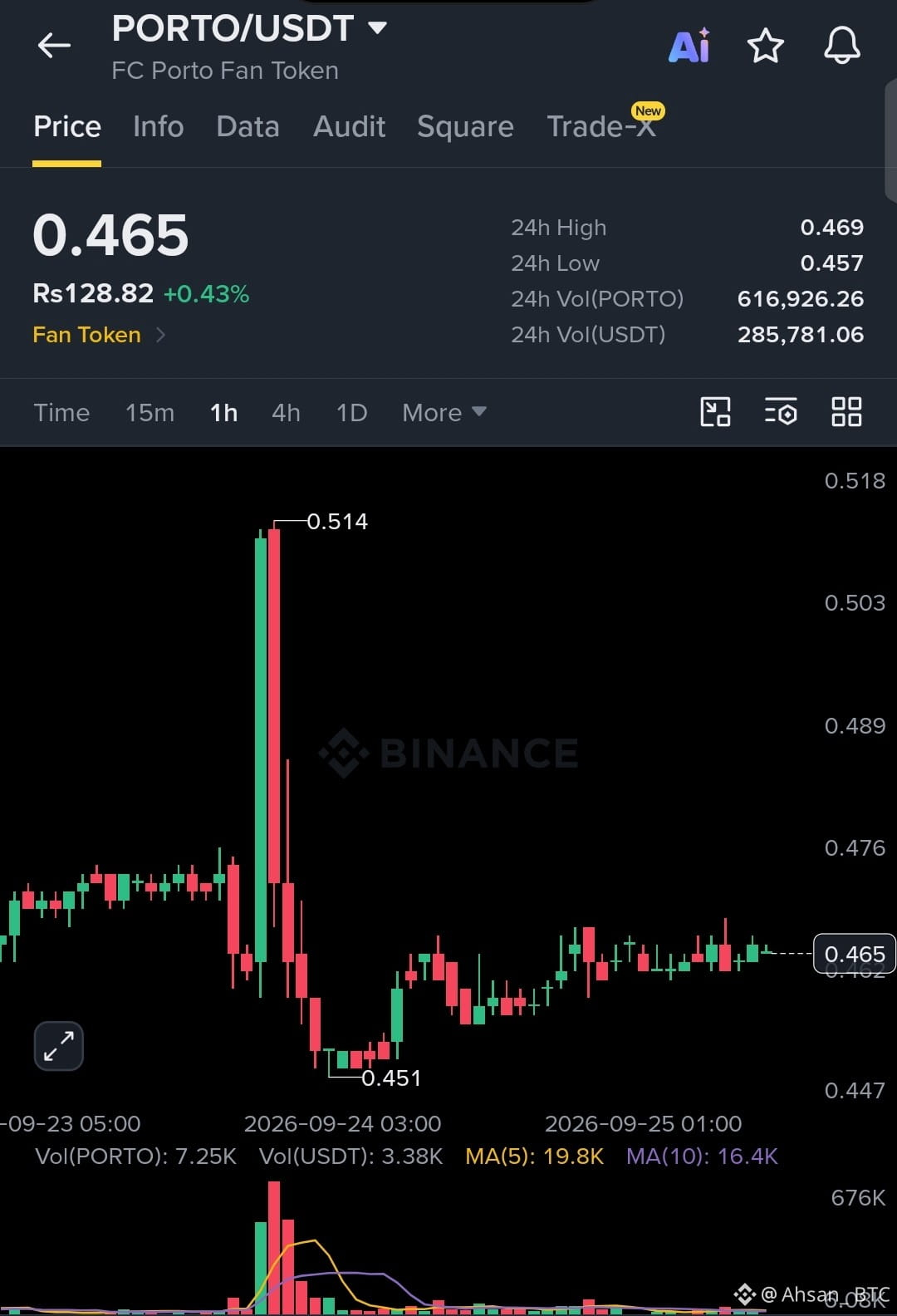
$PORTO /USDT — Fan Token Cooling Off 🧊⚽
Current Price: ~$0.465 (+0.43% 24h) ➡️
Overview: FC Porto Fan Token — a utility token giving holders voting rights, VIP rewards, and fan experiences. Sports fan tokens pump on match hype and dump when the event ends. 🏟️
Technical Setup (1H):
📉 Massive wick to $0.514 — instant rejection (classic blow-off top).
🐻 Sharp dump to $0.451, now ranging sideways.
📊 MA5 (19.8K) > MA10 (16.4K) = slight bullish curl, but weak.
📉 Volume DEAD — only 285K USDT in 24h. No fuel. 😴
Key Levels:
🔴 Resistance: $0.469 → $0.476 → $0.489
🟢 Support: $0.457 → $0.451 (critical)
Trade Plan (Range Play Only):
✅ Entry: $0.4550 – $0.4600 (near support)
🎯 TP1: $0.4690
🎯 TP2: $0.4760
🎯 TP3: $0.4890
🛑 SL: $0.4480
⚖️ R:R ~ 1:2
Outlook:
⚡ Short-term: Stuck in a tight range $0.451–$0.469. Needs volume to break out.
🔭 Long-term: Only pumps on match/news catalysts. No catalyst = no move. Avoid holding blindly.
Sentiment: Very low volume = low interest right now. Waiting for a game-day pump or team announcement. ⚽
⚠️ Not financial advice. Fan tokens are hype-driven. DYOR. Low volume = slippage risk!
Holding $PORTO for match day? Drop a ⚽ below!
$PORTO
{spot}(PORTOUSDT)
#porto
$PORTO /USDT — Fan Token Cooling Off 🧊⚽
Current Price: ~$0.465 (+0.43% 24h) ➡️
Overview: FC Porto Fan Token — a utility token giving holders voting rights, VIP rewards, and fan experiences. Sports fan tokens pump on match hype and dump when the event ends. 🏟️
Technical Setup (1H):
📉 Massive wick to $0.514 — instant rejection (classic blow-off top).
🐻 Sharp dump to $0.451, now ranging sideways.
📊 MA5 (19.8K) > MA10 (16.4K) = slight bullish curl, but weak.
📉 Volume DEAD — only 285K USDT in 24h. No fuel. 😴
Key Levels:
🔴 Resistance: $0.469 → $0.476 → $0.489
🟢 Support: $0.457 → $0.451 (critical)
Trade Plan (Range Play Only):
✅ Entry: $0.4550 – $0.4600 (near support)
🎯 TP1: $0.4690
🎯 TP2: $0.4760
🎯 TP3: $0.4890
🛑 SL: $0.4480
⚖️ R:R ~ 1:2
Outlook:
⚡ Short-term: Stuck in a tight range $0.451–$0.469. Needs volume to break out.
🔭 Long-term: Only pumps on match/news catalysts. No catalyst = no move. Avoid holding blindly.
Sentiment: Very low volume = low interest right now. Waiting for a game-day pump or team announcement. ⚽
⚠️ Not financial advice. Fan tokens are hype-driven. DYOR. Low volume = slippage risk!
Holding $PORTO for match day? Drop a ⚽ below!
$PORTO
#porto
Current Price: ~$0.465 (+0.43% 24h) ➡️
Overview: FC Porto Fan Token — a utility token giving holders voting rights, VIP rewards, and fan experiences. Sports fan tokens pump on match hype and dump when the event ends. 🏟️
Technical Setup (1H):
📉 Massive wick to $0.514 — instant rejection (classic blow-off top).
🐻 Sharp dump to $0.451, now ranging sideways.
📊 MA5 (19.8K) > MA10 (16.4K) = slight bullish curl, but weak.
📉 Volume DEAD — only 285K USDT in 24h. No fuel. 😴
Key Levels:
🔴 Resistance: $0.469 → $0.476 → $0.489
🟢 Support: $0.457 → $0.451 (critical)
Trade Plan (Range Play Only):
✅ Entry: $0.4550 – $0.4600 (near support)
🎯 TP1: $0.4690
🎯 TP2: $0.4760
🎯 TP3: $0.4890
🛑 SL: $0.4480
⚖️ R:R ~ 1:2
Outlook:
⚡ Short-term: Stuck in a tight range $0.451–$0.469. Needs volume to break out.
🔭 Long-term: Only pumps on match/news catalysts. No catalyst = no move. Avoid holding blindly.
Sentiment: Very low volume = low interest right now. Waiting for a game-day pump or team announcement. ⚽
⚠️ Not financial advice. Fan tokens are hype-driven. DYOR. Low volume = slippage risk!
Holding $PORTO for match day? Drop a ⚽ below!
$PORTO
#porto
132
·
--
Bullish
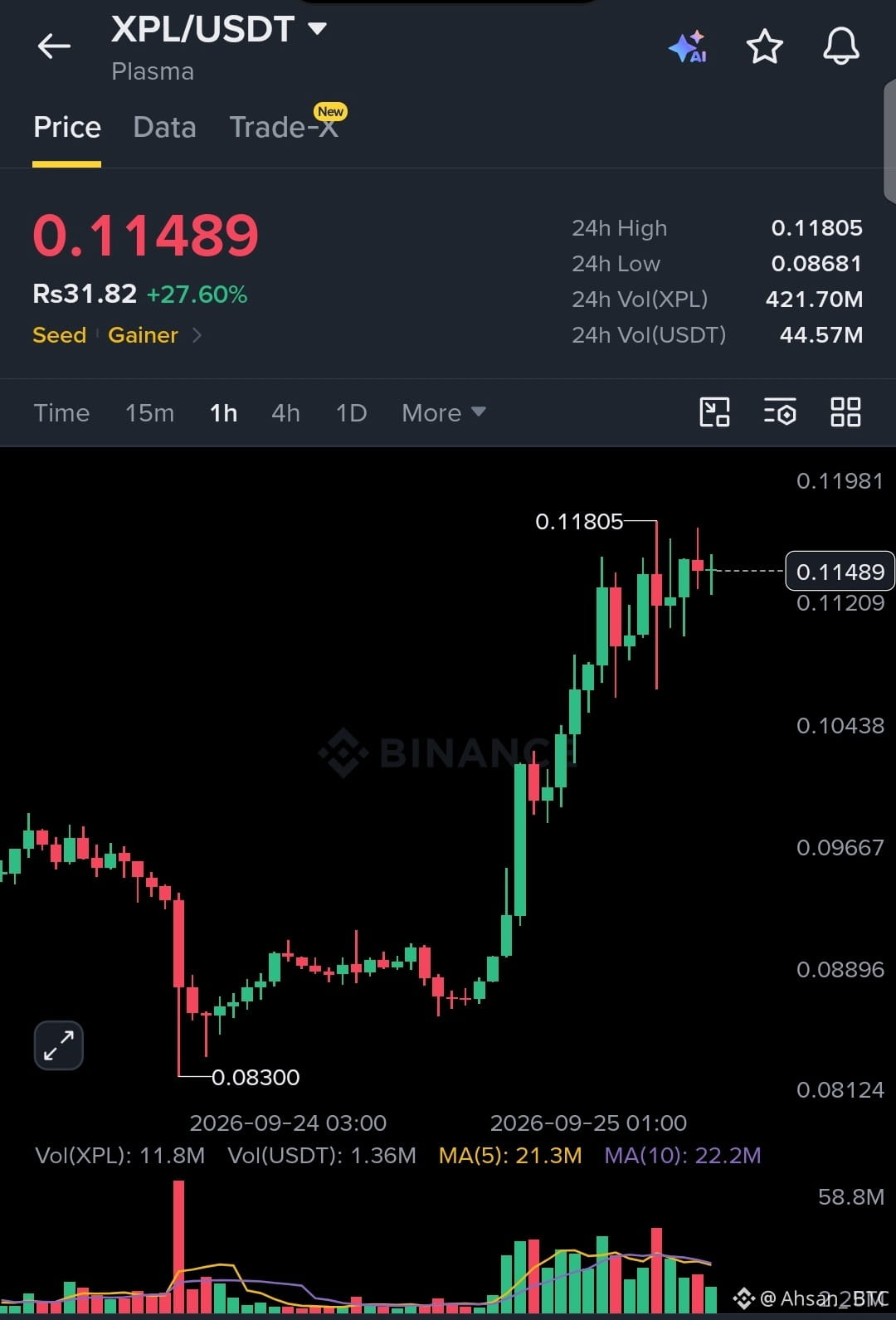
$XPL /USDT (Plasma) — Explosive Breakout! ⚡📈
Current Price: ~$0.11489 (+27.60% 24h) 💚
Overview: Plasma ($XPL) is a new "Seed" tag project on Binance. High volatility, early-stage play. Strong mover in the infrastructure/gainer sector today. 🚀
Technical Setup (1H):
📈 Parabolic pump from $0.083 to $0.118 high.
🐂 Consolidating near highs — bull flag forming.
📊 MA5 (21.3M) hugging MA10 (22.2M) = trend intact.
📉 Volume fading after spike = cooldown phase.
Key Levels:
🔴 Resistance: $0.1180 → $0.1198
🟢 Support: $0.1120 → $0.1043 → $0.0966
Trade Plan:
✅ Entry: $0.1100 – $0.1140 (on retest)
🎯 TP1: $0.1180
🎯 TP2: $0.1250
🎯 TP3: $0.1350
🛑 SL: $0.1020
⚖️ R:R ~ 1:2.5
Outlook:
⚡ Short-term: Holding $0.112 keeps bulls in control. Break above $0.118 = continuation.
🔭 Long-term: New listing = high risk. Needs volume + utility confirmation to sustain.
Sentiment: 421M XPL volume = heavy interest. Seed tag = early-stage speculation. 🐋
⚠️ Not financial advice. New listings are extremely volatile. DYOR. Tight stops!
Watching $XPL? Drop a ⚡ below!
$XPL
{spot}(XPLUSDT)
#XPL
#BinanceWillListHyperliquid(HYPE)
$XPL /USDT (Plasma) — Explosive Breakout! ⚡📈
Current Price: ~$0.11489 (+27.60% 24h) 💚
Overview: Plasma ($XPL ) is a new "Seed" tag project on Binance. High volatility, early-stage play. Strong mover in the infrastructure/gainer sector today. 🚀
Technical Setup (1H):
📈 Parabolic pump from $0.083 to $0.118 high.
🐂 Consolidating near highs — bull flag forming.
📊 MA5 (21.3M) hugging MA10 (22.2M) = trend intact.
📉 Volume fading after spike = cooldown phase.
Key Levels:
🔴 Resistance: $0.1180 → $0.1198
🟢 Support: $0.1120 → $0.1043 → $0.0966
Trade Plan:
✅ Entry: $0.1100 – $0.1140 (on retest)
🎯 TP1: $0.1180
🎯 TP2: $0.1250
🎯 TP3: $0.1350
🛑 SL: $0.1020
⚖️ R:R ~ 1:2.5
Outlook:
⚡ Short-term: Holding $0.112 keeps bulls in control. Break above $0.118 = continuation.
🔭 Long-term: New listing = high risk. Needs volume + utility confirmation to sustain.
Sentiment: 421M XPL volume = heavy interest. Seed tag = early-stage speculation. 🐋
⚠️ Not financial advice. New listings are extremely volatile. DYOR. Tight stops!
Watching $XPL ? Drop a ⚡ below!
$XPL
#XPL
#BinanceWillListHyperliquid(HYPE)
Current Price: ~$0.11489 (+27.60% 24h) 💚
Overview: Plasma ($XPL ) is a new "Seed" tag project on Binance. High volatility, early-stage play. Strong mover in the infrastructure/gainer sector today. 🚀
Technical Setup (1H):
📈 Parabolic pump from $0.083 to $0.118 high.
🐂 Consolidating near highs — bull flag forming.
📊 MA5 (21.3M) hugging MA10 (22.2M) = trend intact.
📉 Volume fading after spike = cooldown phase.
Key Levels:
🔴 Resistance: $0.1180 → $0.1198
🟢 Support: $0.1120 → $0.1043 → $0.0966
Trade Plan:
✅ Entry: $0.1100 – $0.1140 (on retest)
🎯 TP1: $0.1180
🎯 TP2: $0.1250
🎯 TP3: $0.1350
🛑 SL: $0.1020
⚖️ R:R ~ 1:2.5
Outlook:
⚡ Short-term: Holding $0.112 keeps bulls in control. Break above $0.118 = continuation.
🔭 Long-term: New listing = high risk. Needs volume + utility confirmation to sustain.
Sentiment: 421M XPL volume = heavy interest. Seed tag = early-stage speculation. 🐋
⚠️ Not financial advice. New listings are extremely volatile. DYOR. Tight stops!
Watching $XPL ? Drop a ⚡ below!
$XPL
#XPL
#BinanceWillListHyperliquid(HYPE)
144
·
--
Bullish
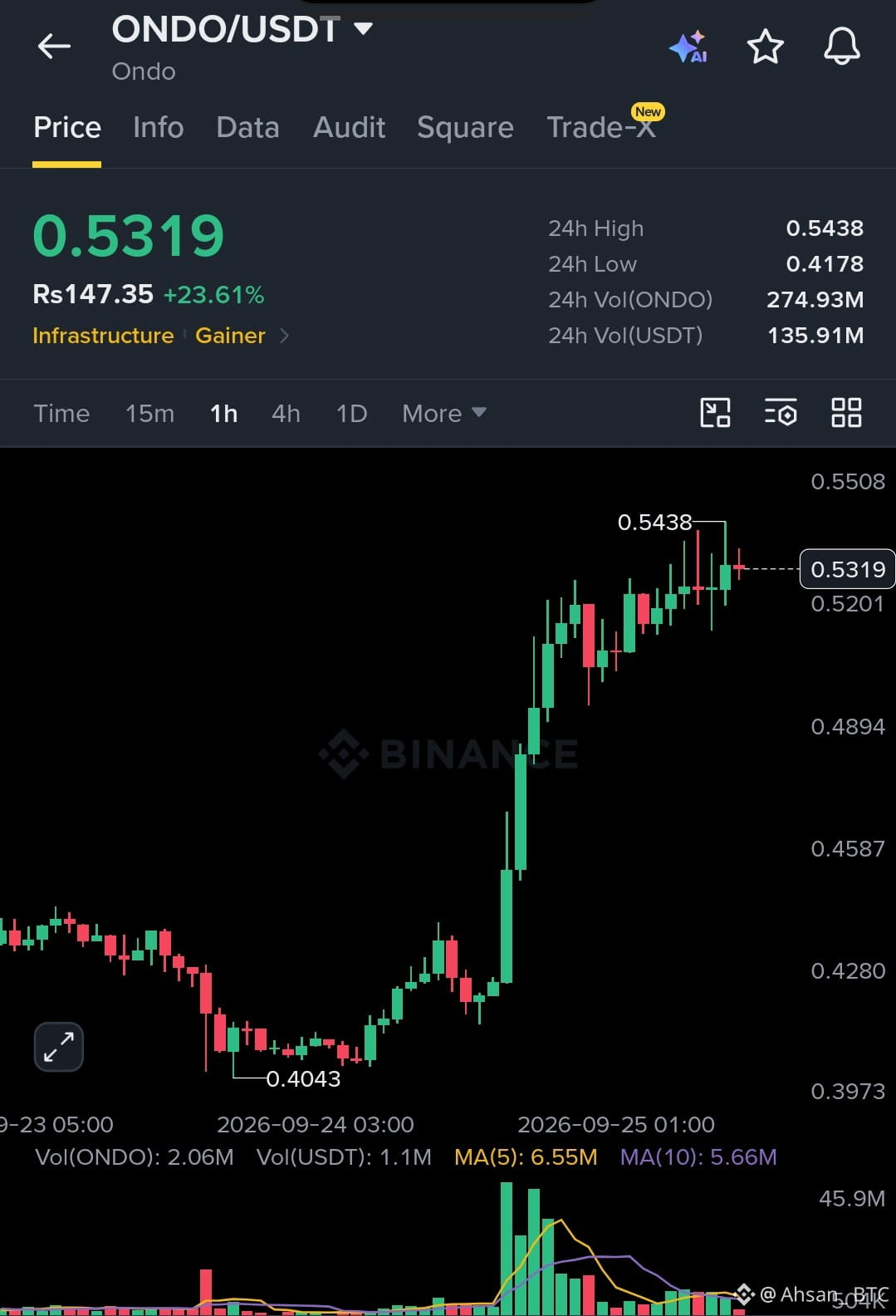
$ONDO /USDT — RWA Giant on the Move! 🏦🔥
Current Price: ~$0.5319 (+23.61% 24h) 💚
Overview: ONDO is the top Real-World Asset (RWA) protocol, tokenizing traditional finance (T-Bills, money markets) on-chain. Strong institutional narrative + real utility. 🏛️
Technical Setup (1H):
📈 Huge breakout from $0.40 base — parabolic move.
🐂 Bull flag consolidation near highs ($0.5438).
📊 MA5 > MA10 = bullish trend intact.
📉 Volume cooling = healthy cooldown, not a dump.
Key Levels:
🔴 Resistance: $0.5438 → $0.5508
🟢 Support: $0.5200 → $0.4894 (critical)
Trade Plan:
✅ Entry: $0.5200 – $0.5320
🎯 TP1: $0.5500
🎯 TP2: $0.5800
🎯 TP3: $0.6200
🛑 SL: $0.4850
⚖️ R:R ~ 1:3
Outlook:
⚡ Short-term: Consolidation $0.52–$0.54, then likely retest $0.55.
🔭 Long-term: Top-tier RWA blue chip. $0.70+ in play if BTC stays stable.
Sentiment: 274M ONDO volume = whale interest. RWA rotation is real. 🐋
⚠️ Not financial advice. DYOR. Manage your risk!
Holding $ONDO? Drop a 🚀 below!
$ONDO
{spot}(ONDOUSDT)
#ONDO
#OndoFinanceSoughtSaleAfterFoundersDeath
$ONDO /USDT — RWA Giant on the Move! 🏦🔥
Current Price: ~$0.5319 (+23.61% 24h) 💚
Overview: ONDO is the top Real-World Asset (RWA) protocol, tokenizing traditional finance (T-Bills, money markets) on-chain. Strong institutional narrative + real utility. 🏛️
Technical Setup (1H):
📈 Huge breakout from $0.40 base — parabolic move.
🐂 Bull flag consolidation near highs ($0.5438).
📊 MA5 > MA10 = bullish trend intact.
📉 Volume cooling = healthy cooldown, not a dump.
Key Levels:
🔴 Resistance: $0.5438 → $0.5508
🟢 Support: $0.5200 → $0.4894 (critical)
Trade Plan:
✅ Entry: $0.5200 – $0.5320
🎯 TP1: $0.5500
🎯 TP2: $0.5800
🎯 TP3: $0.6200
🛑 SL: $0.4850
⚖️ R:R ~ 1:3
Outlook:
⚡ Short-term: Consolidation $0.52–$0.54, then likely retest $0.55.
🔭 Long-term: Top-tier RWA blue chip. $0.70+ in play if BTC stays stable.
Sentiment: 274M ONDO volume = whale interest. RWA rotation is real. 🐋
⚠️ Not financial advice. DYOR. Manage your risk!
Holding $ONDO ? Drop a 🚀 below!
$ONDO
#ONDO
#OndoFinanceSoughtSaleAfterFoundersDeath
Current Price: ~$0.5319 (+23.61% 24h) 💚
Overview: ONDO is the top Real-World Asset (RWA) protocol, tokenizing traditional finance (T-Bills, money markets) on-chain. Strong institutional narrative + real utility. 🏛️
Technical Setup (1H):
📈 Huge breakout from $0.40 base — parabolic move.
🐂 Bull flag consolidation near highs ($0.5438).
📊 MA5 > MA10 = bullish trend intact.
📉 Volume cooling = healthy cooldown, not a dump.
Key Levels:
🔴 Resistance: $0.5438 → $0.5508
🟢 Support: $0.5200 → $0.4894 (critical)
Trade Plan:
✅ Entry: $0.5200 – $0.5320
🎯 TP1: $0.5500
🎯 TP2: $0.5800
🎯 TP3: $0.6200
🛑 SL: $0.4850
⚖️ R:R ~ 1:3
Outlook:
⚡ Short-term: Consolidation $0.52–$0.54, then likely retest $0.55.
🔭 Long-term: Top-tier RWA blue chip. $0.70+ in play if BTC stays stable.
Sentiment: 274M ONDO volume = whale interest. RWA rotation is real. 🐋
⚠️ Not financial advice. DYOR. Manage your risk!
Holding $ONDO ? Drop a 🚀 below!
$ONDO
#ONDO
#OndoFinanceSoughtSaleAfterFoundersDeath
131
·
--
Bullish
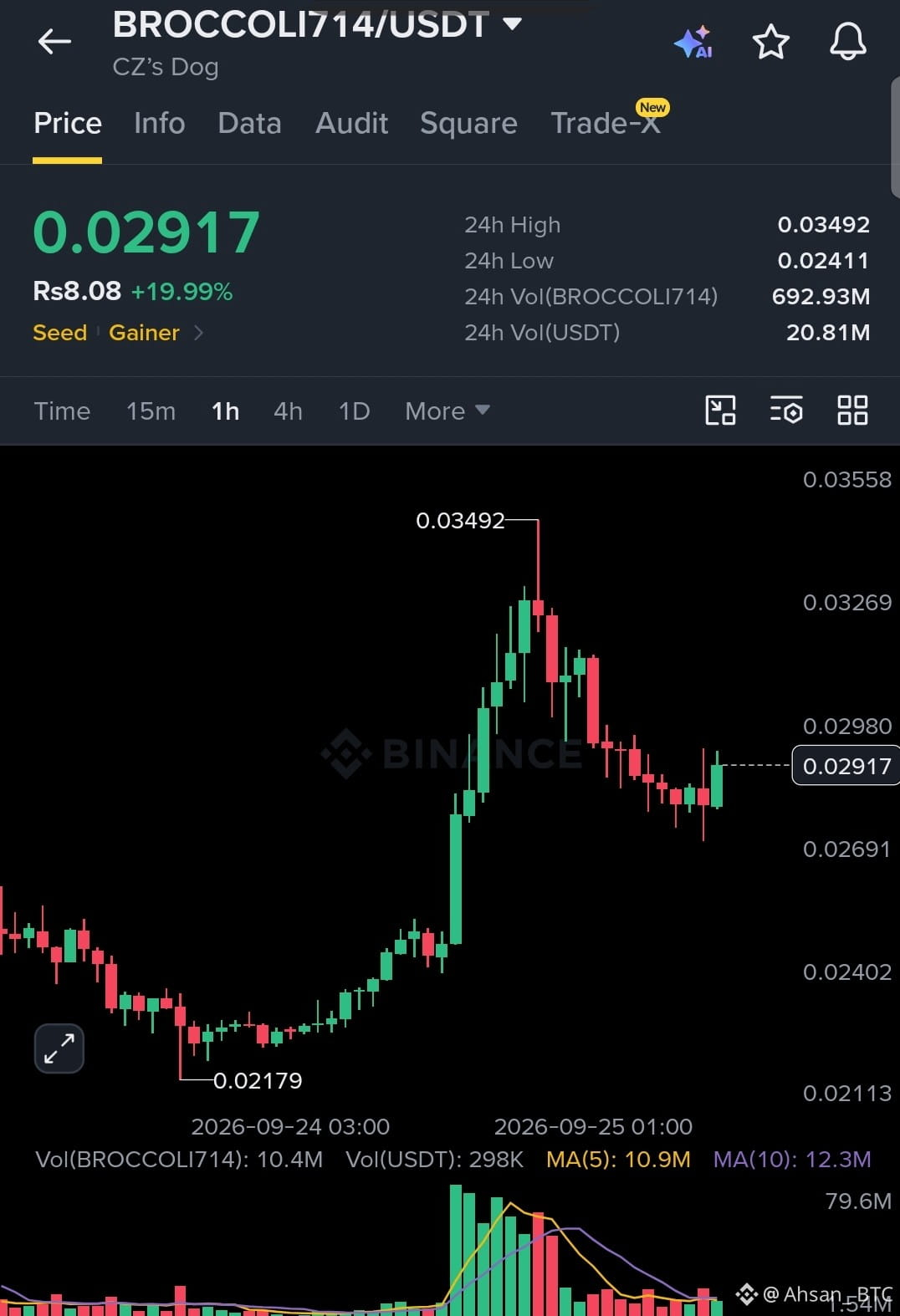
$BROCCOLI714/USDT — CZ's Dog Pumping! 🐕🥦
Current Price: ~$0.02917 (+19.99% 24h) 💚
Overview: Meme coin tied to Binance's CZ (Changpeng Zhao) and his dog. Pure narrative-driven play — high risk, high volatility. Not for the faint-hearted. 🎢
Technical Setup (1H):
📈 Massive green candle pumped from $0.0217 to $0.0349 high.
🐻 Now pulling back — profit-taking in progress.
📉 MA5 crossing below MA10 = short-term bearish momentum.
📊 Volume fading hard = hype cooling off.
Key Levels:
🔴 Resistance: $0.0349 (24h high) → $0.0355
🟢 Support: $0.0269 → $0.0240 (critical)
Trade Plan:
✅ Entry (Dip Buy): $0.0265 – $0.0275
🎯 TP1: $0.0298
🎯 TP2: $0.0325
🎯 TP3: $0.0350
🛑 SL: $0.0235
⚖️ R:R ~ 1:2.5
Outlook:
⚡ Short-term: Bearish pullback. Wait for support reclaim before entering. Don't FOMO green candles!
🔭 Long-term: Meme coin = pure sentiment. Dies fast without fresh CZ news or volume.
Sentiment: 692M BROCCOLI volume = still hot, but fading. Needs a new catalyst to reclaim highs.
⚠️ Not financial advice. Meme coins are extremely volatile. DYOR. Use tight stops!
Bought the dip or waiting? Drop a 🥦 below!
$BROCCOLI714
{spot}(BROCCOLI714USDT)
#BROCCLI714
#OndoFinanceSoughtSaleAfterFoundersDeath
$BROCCOLI714 /USDT — CZ's Dog Pumping! 🐕🥦
Current Price: ~$0.02917 (+19.99% 24h) 💚
Overview: Meme coin tied to Binance's CZ (Changpeng Zhao) and his dog. Pure narrative-driven play — high risk, high volatility. Not for the faint-hearted. 🎢
Technical Setup (1H):
📈 Massive green candle pumped from $0.0217 to $0.0349 high.
🐻 Now pulling back — profit-taking in progress.
📉 MA5 crossing below MA10 = short-term bearish momentum.
📊 Volume fading hard = hype cooling off.
Key Levels:
🔴 Resistance: $0.0349 (24h high) → $0.0355
🟢 Support: $0.0269 → $0.0240 (critical)
Trade Plan:
✅ Entry (Dip Buy): $0.0265 – $0.0275
🎯 TP1: $0.0298
🎯 TP2: $0.0325
🎯 TP3: $0.0350
🛑 SL: $0.0235
⚖️ R:R ~ 1:2.5
Outlook:
⚡ Short-term: Bearish pullback. Wait for support reclaim before entering. Don't FOMO green candles!
🔭 Long-term: Meme coin = pure sentiment. Dies fast without fresh CZ news or volume.
Sentiment: 692M BROCCOLI volume = still hot, but fading. Needs a new catalyst to reclaim highs.
⚠️ Not financial advice. Meme coins are extremely volatile. DYOR. Use tight stops!
Bought the dip or waiting? Drop a 🥦 below!
$BROCCOLI714
#BROCCLI714
#OndoFinanceSoughtSaleAfterFoundersDeath
Current Price: ~$0.02917 (+19.99% 24h) 💚
Overview: Meme coin tied to Binance's CZ (Changpeng Zhao) and his dog. Pure narrative-driven play — high risk, high volatility. Not for the faint-hearted. 🎢
Technical Setup (1H):
📈 Massive green candle pumped from $0.0217 to $0.0349 high.
🐻 Now pulling back — profit-taking in progress.
📉 MA5 crossing below MA10 = short-term bearish momentum.
📊 Volume fading hard = hype cooling off.
Key Levels:
🔴 Resistance: $0.0349 (24h high) → $0.0355
🟢 Support: $0.0269 → $0.0240 (critical)
Trade Plan:
✅ Entry (Dip Buy): $0.0265 – $0.0275
🎯 TP1: $0.0298
🎯 TP2: $0.0325
🎯 TP3: $0.0350
🛑 SL: $0.0235
⚖️ R:R ~ 1:2.5
Outlook:
⚡ Short-term: Bearish pullback. Wait for support reclaim before entering. Don't FOMO green candles!
🔭 Long-term: Meme coin = pure sentiment. Dies fast without fresh CZ news or volume.
Sentiment: 692M BROCCOLI volume = still hot, but fading. Needs a new catalyst to reclaim highs.
⚠️ Not financial advice. Meme coins are extremely volatile. DYOR. Use tight stops!
Bought the dip or waiting? Drop a 🥦 below!
$BROCCOLI714
#BROCCLI714
#OndoFinanceSoughtSaleAfterFoundersDeath
272
·
--
Bullish
🔴 $CAKE Long Liquidation — $2.40952
CAKE is around $2.45 currently; Binance historical data shows a recent $2.555 high on Sep 18 and a $2.413 low on Sep 19.
Support
S1: $2.40–2.42
S2: $2.30–2.34
S3: $2.20–2.24
Resistance
R1: $2.48–2.52
R2: $2.55–2.58
R3: $2.65–2.70
EP: $2.40–2.44
TP1: $2.50
TP2: $2.56
TP3: $2.65–2.70
SL: $2.30
Pro tip: $2.40–2.42 is the key reaction zone because the liquidation printed at $2.4095. If CAKE reclaims $2.50 and holds, $2.55–2.58 becomes the next area to watch. If $2.40 breaks decisively, avoid forcing the long and watch $2.30–2.34.
⚠️ Liquidation flow is a signal, not confirmation; use position sizing and leverage accordingly.
$CAKE
{spot}(CAKEUSDT)
#Cake
🔴 $CAKE Long Liquidation — $2.40952
CAKE is around $2.45 currently; Binance historical data shows a recent $2.555 high on Sep 18 and a $2.413 low on Sep 19.
Support
S1: $2.40–2.42
S2: $2.30–2.34
S3: $2.20–2.24
Resistance
R1: $2.48–2.52
R2: $2.55–2.58
R3: $2.65–2.70
EP: $2.40–2.44
TP1: $2.50
TP2: $2.56
TP3: $2.65–2.70
SL: $2.30
Pro tip: $2.40–2.42 is the key reaction zone because the liquidation printed at $2.4095. If CAKE reclaims $2.50 and holds, $2.55–2.58 becomes the next area to watch. If $2.40 breaks decisively, avoid forcing the long and watch $2.30–2.34.
⚠️ Liquidation flow is a signal, not confirmation; use position sizing and leverage accordingly.
$CAKE
#Cake
CAKE is around $2.45 currently; Binance historical data shows a recent $2.555 high on Sep 18 and a $2.413 low on Sep 19.
Support
S1: $2.40–2.42
S2: $2.30–2.34
S3: $2.20–2.24
Resistance
R1: $2.48–2.52
R2: $2.55–2.58
R3: $2.65–2.70
EP: $2.40–2.44
TP1: $2.50
TP2: $2.56
TP3: $2.65–2.70
SL: $2.30
Pro tip: $2.40–2.42 is the key reaction zone because the liquidation printed at $2.4095. If CAKE reclaims $2.50 and holds, $2.55–2.58 becomes the next area to watch. If $2.40 breaks decisively, avoid forcing the long and watch $2.30–2.34.
⚠️ Liquidation flow is a signal, not confirmation; use position sizing and leverage accordingly.
$CAKE
#Cake
417
·
--
Bullish
🔴 $ONE Long Liquidation — $0.00233
ONE has been extremely volatile: recent data shows a $0.00239 high on Sep 17 and price around $0.00187–0.00212 on Sep 19.
Support
S1: $0.00190–0.00198
S2: $0.00178–0.00185
S3: $0.00160–0.00170
Resistance
R1: $0.00215–0.00220
R2: $0.00230–0.00235
R3: $0.00238–0.00245
EP: $0.00192–0.00205
TP1: $0.00220
TP2: $0.00235
TP3: $0.00245+
SL: $0.00178
Pro tip: The $0.00230–0.00235 area is the key reclaim zone because the liquidation occurred at $0.00233. A clean break + hold above it can open the way toward the recent $0.00239 area; rejection there favors a pullback toward $0.0020.
⚠️ ONE is moving violently, so avoid chasing candles and keep leverage low. Liquidation data is a signal, not confirmation.
$ONE
{spot}(ONEUSDT)
#ONE
🔴 $ONE Long Liquidation — $0.00233
ONE has been extremely volatile: recent data shows a $0.00239 high on Sep 17 and price around $0.00187–0.00212 on Sep 19.
Support
S1: $0.00190–0.00198
S2: $0.00178–0.00185
S3: $0.00160–0.00170
Resistance
R1: $0.00215–0.00220
R2: $0.00230–0.00235
R3: $0.00238–0.00245
EP: $0.00192–0.00205
TP1: $0.00220
TP2: $0.00235
TP3: $0.00245+
SL: $0.00178
Pro tip: The $0.00230–0.00235 area is the key reclaim zone because the liquidation occurred at $0.00233. A clean break + hold above it can open the way toward the recent $0.00239 area; rejection there favors a pullback toward $0.0020.
⚠️ ONE is moving violently, so avoid chasing candles and keep leverage low. Liquidation data is a signal, not confirmation.
$ONE
#ONE
ONE has been extremely volatile: recent data shows a $0.00239 high on Sep 17 and price around $0.00187–0.00212 on Sep 19.
Support
S1: $0.00190–0.00198
S2: $0.00178–0.00185
S3: $0.00160–0.00170
Resistance
R1: $0.00215–0.00220
R2: $0.00230–0.00235
R3: $0.00238–0.00245
EP: $0.00192–0.00205
TP1: $0.00220
TP2: $0.00235
TP3: $0.00245+
SL: $0.00178
Pro tip: The $0.00230–0.00235 area is the key reclaim zone because the liquidation occurred at $0.00233. A clean break + hold above it can open the way toward the recent $0.00239 area; rejection there favors a pullback toward $0.0020.
⚠️ ONE is moving violently, so avoid chasing candles and keep leverage low. Liquidation data is a signal, not confirmation.
$ONE
#ONE
324
·
--
Bullish
🟢 $JST Short Liquidation — $0.11674
JST is currently around $0.116, with Binance showing a recent 24h range around $0.1131–$0.1166.
Support
S1: $0.1140–0.1150
S2: $0.1125–0.1130
S3: $0.1100–0.1110
Resistance
R1: $0.1167–0.1172
R2: $0.1184–0.1200
R3: $0.1220–0.1240
EP: $0.1145–0.1162
TP1: $0.1172
TP2: $0.1200
TP3: $0.1230
SL: $0.1125
Pro tip: The liquidation level $0.11674 is the key reclaim area. If JST breaks and holds $0.1172 with volume, the upside targets become more plausible. If it rejects there, watch $0.114–0.115 for support. Current technical levels also place resistance around $0.1172–$0.1184 and support around $0.1151/$0.1125.
⚠️ Liquidation flow is confirmation context, not a guaranteed reversal signal.
$JST
{spot}(JSTUSDT)
#jst
🟢 $JST Short Liquidation — $0.11674
JST is currently around $0.116, with Binance showing a recent 24h range around $0.1131–$0.1166.
Support
S1: $0.1140–0.1150
S2: $0.1125–0.1130
S3: $0.1100–0.1110
Resistance
R1: $0.1167–0.1172
R2: $0.1184–0.1200
R3: $0.1220–0.1240
EP: $0.1145–0.1162
TP1: $0.1172
TP2: $0.1200
TP3: $0.1230
SL: $0.1125
Pro tip: The liquidation level $0.11674 is the key reclaim area. If JST breaks and holds $0.1172 with volume, the upside targets become more plausible. If it rejects there, watch $0.114–0.115 for support. Current technical levels also place resistance around $0.1172–$0.1184 and support around $0.1151/$0.1125.
⚠️ Liquidation flow is confirmation context, not a guaranteed reversal signal.
$JST
#jst
JST is currently around $0.116, with Binance showing a recent 24h range around $0.1131–$0.1166.
Support
S1: $0.1140–0.1150
S2: $0.1125–0.1130
S3: $0.1100–0.1110
Resistance
R1: $0.1167–0.1172
R2: $0.1184–0.1200
R3: $0.1220–0.1240
EP: $0.1145–0.1162
TP1: $0.1172
TP2: $0.1200
TP3: $0.1230
SL: $0.1125
Pro tip: The liquidation level $0.11674 is the key reclaim area. If JST breaks and holds $0.1172 with volume, the upside targets become more plausible. If it rejects there, watch $0.114–0.115 for support. Current technical levels also place resistance around $0.1172–$0.1184 and support around $0.1151/$0.1125.
⚠️ Liquidation flow is confirmation context, not a guaranteed reversal signal.
$JST
#jst
134
·
--
Bullish
🔴 $ONE — Long Liquidation Setup
The $0.00156 long liquidation is close to the current market area. ONE is extremely volatile today: CoinMarketCap shows roughly $0.00155, with a 24h range of $0.000642–$0.001632.
🟩 SUPPORT
S1: $0.00148–$0.00152
S2: $0.00140–$0.00145 ⭐
S3: $0.00125–$0.00130
🟥 RESISTANCE
R1: $0.00160–$0.00163 ⭐
R2: $0.00170–$0.00175
R3: $0.00190–$0.00200
🎯 LONG PLAN
EP: $0.00148–$0.00155
TP1: $0.00163
TP2: $0.00175
TP3: $0.00200
SL: $0.00140
💡 Pro Tip
Don't chase after the huge move. The $0.00148–$0.00152 area is the key reaction zone. A clean reclaim/hold above $0.00163 would provide stronger confirmation toward the next levels.
ONE's hourly trend is currently bullish, but RSI is already overbought, while daily volatility is very high.
Next targets 🎯 → $0.00163 → $0.00175 → $0.00200
⚠️ High-risk setup: the liquidation print itself doesn't guarantee continuation. Keep leverage low and wait for confirmation.
$ONE
{spot}(ONEUSDT)
#one
🔴 $ONE — Long Liquidation Setup
The $0.00156 long liquidation is close to the current market area. ONE is extremely volatile today: CoinMarketCap shows roughly $0.00155, with a 24h range of $0.000642–$0.001632.
🟩 SUPPORT
S1: $0.00148–$0.00152
S2: $0.00140–$0.00145 ⭐
S3: $0.00125–$0.00130
🟥 RESISTANCE
R1: $0.00160–$0.00163 ⭐
R2: $0.00170–$0.00175
R3: $0.00190–$0.00200
🎯 LONG PLAN
EP: $0.00148–$0.00155
TP1: $0.00163
TP2: $0.00175
TP3: $0.00200
SL: $0.00140
💡 Pro Tip
Don't chase after the huge move. The $0.00148–$0.00152 area is the key reaction zone. A clean reclaim/hold above $0.00163 would provide stronger confirmation toward the next levels.
ONE's hourly trend is currently bullish, but RSI is already overbought, while daily volatility is very high.
Next targets 🎯 → $0.00163 → $0.00175 → $0.00200
⚠️ High-risk setup: the liquidation print itself doesn't guarantee continuation. Keep leverage low and wait for confirmation.
$ONE
#one
The $0.00156 long liquidation is close to the current market area. ONE is extremely volatile today: CoinMarketCap shows roughly $0.00155, with a 24h range of $0.000642–$0.001632.
🟩 SUPPORT
S1: $0.00148–$0.00152
S2: $0.00140–$0.00145 ⭐
S3: $0.00125–$0.00130
🟥 RESISTANCE
R1: $0.00160–$0.00163 ⭐
R2: $0.00170–$0.00175
R3: $0.00190–$0.00200
🎯 LONG PLAN
EP: $0.00148–$0.00155
TP1: $0.00163
TP2: $0.00175
TP3: $0.00200
SL: $0.00140
💡 Pro Tip
Don't chase after the huge move. The $0.00148–$0.00152 area is the key reaction zone. A clean reclaim/hold above $0.00163 would provide stronger confirmation toward the next levels.
ONE's hourly trend is currently bullish, but RSI is already overbought, while daily volatility is very high.
Next targets 🎯 → $0.00163 → $0.00175 → $0.00200
⚠️ High-risk setup: the liquidation print itself doesn't guarantee continuation. Keep leverage low and wait for confirmation.
$ONE
#one
1
193
·
--
Bullish
🟢 $AVA — Short Liquidation Setup
The $0.2593 short liquidation is happening after an unusually large move. Binance/market data shows AVA recently traded as high as $0.329, while the current area is around $0.259.
🟩 SUPPORT
S1: $0.250–$0.260 ⭐
S2: $0.235–$0.245
S3: $0.205–$0.215
🟥 RESISTANCE
R1: $0.273–$0.281
R2: $0.289–$0.301 ⭐
R3: $0.325–$0.330
🎯 LONG PLAN
EP: $0.250–$0.260
TP1: $0.281
TP2: $0.300
TP3: $0.325
SL: $0.238
💡 Pro Tip
The key level is $0.281. A reclaim and hold above it would strengthen the continuation setup; rejection can bring AVA back toward $0.25. Current technical pivot data places $0.281 as the pivot, $0.293/$0.301 as resistance, and $0.261/$0.253 as lower support levels.
⚠️ Very high volatility: AVA moved roughly $0.156 → $0.329 within the recent session range. Binance also has AVA under its Monitoring Tag, which means elevated risk and possible additional volatility.
Next targets 🎯 → $0.281 → $0.300 → $0.325
Liquidation data is a confirmation signal, not a guarantee of direction.
$AVA
{spot}(AVAUSDT)
#AVA
🟢 $AVA — Short Liquidation Setup
The $0.2593 short liquidation is happening after an unusually large move. Binance/market data shows AVA recently traded as high as $0.329, while the current area is around $0.259.
🟩 SUPPORT
S1: $0.250–$0.260 ⭐
S2: $0.235–$0.245
S3: $0.205–$0.215
🟥 RESISTANCE
R1: $0.273–$0.281
R2: $0.289–$0.301 ⭐
R3: $0.325–$0.330
🎯 LONG PLAN
EP: $0.250–$0.260
TP1: $0.281
TP2: $0.300
TP3: $0.325
SL: $0.238
💡 Pro Tip
The key level is $0.281. A reclaim and hold above it would strengthen the continuation setup; rejection can bring AVA back toward $0.25. Current technical pivot data places $0.281 as the pivot, $0.293/$0.301 as resistance, and $0.261/$0.253 as lower support levels.
⚠️ Very high volatility: AVA moved roughly $0.156 → $0.329 within the recent session range. Binance also has AVA under its Monitoring Tag, which means elevated risk and possible additional volatility.
Next targets 🎯 → $0.281 → $0.300 → $0.325
Liquidation data is a confirmation signal, not a guarantee of direction.
$AVA
#AVA
The $0.2593 short liquidation is happening after an unusually large move. Binance/market data shows AVA recently traded as high as $0.329, while the current area is around $0.259.
🟩 SUPPORT
S1: $0.250–$0.260 ⭐
S2: $0.235–$0.245
S3: $0.205–$0.215
🟥 RESISTANCE
R1: $0.273–$0.281
R2: $0.289–$0.301 ⭐
R3: $0.325–$0.330
🎯 LONG PLAN
EP: $0.250–$0.260
TP1: $0.281
TP2: $0.300
TP3: $0.325
SL: $0.238
💡 Pro Tip
The key level is $0.281. A reclaim and hold above it would strengthen the continuation setup; rejection can bring AVA back toward $0.25. Current technical pivot data places $0.281 as the pivot, $0.293/$0.301 as resistance, and $0.261/$0.253 as lower support levels.
⚠️ Very high volatility: AVA moved roughly $0.156 → $0.329 within the recent session range. Binance also has AVA under its Monitoring Tag, which means elevated risk and possible additional volatility.
Next targets 🎯 → $0.281 → $0.300 → $0.325
Liquidation data is a confirmation signal, not a guarantee of direction.
$AVA
#AVA
61
·
--
Bullish
🔴 $LSK — Long Liquidation Setup
The $0.4125 long liquidation sits right around a technically important area. Current Binance technical data shows $0.4125 as a Fibonacci S1 level, while $0.4305 is the pivot and $0.4485 is the next Fibonacci resistance.
🟩 SUPPORT
S1: $0.410–$0.413 ⭐
S2: $0.400–$0.403
S3: $0.383–$0.390
🟥 RESISTANCE
R1: $0.430–$0.432
R2: $0.447–$0.450
R3: $0.475–$0.480
🎯 LONG PLAN
EP: $0.410–$0.420
TP1: $0.430
TP2: $0.448
TP3: $0.475
SL: $0.398
💡 Pro Tip
The $0.410–$0.413 zone is the key reaction area. If LSK holds it and reclaims $0.430, upside targets become more relevant. If $0.400 breaks decisively, avoid forcing the long.
Recent LSK price action has been exceptionally volatile, and Binance currently places LSK under its Monitoring Tag, which Binance says indicates higher volatility/risk.
Next targets 🎯 → $0.430 → $0.448 → $0.475
⚠️ Given the volatility, keep leverage low and wait for confirmation rather than entering directly on the liquidation print.
$LSK
{spot}(LSKUSDT)
#LSK
🔴 $LSK — Long Liquidation Setup
The $0.4125 long liquidation sits right around a technically important area. Current Binance technical data shows $0.4125 as a Fibonacci S1 level, while $0.4305 is the pivot and $0.4485 is the next Fibonacci resistance.
🟩 SUPPORT
S1: $0.410–$0.413 ⭐
S2: $0.400–$0.403
S3: $0.383–$0.390
🟥 RESISTANCE
R1: $0.430–$0.432
R2: $0.447–$0.450
R3: $0.475–$0.480
🎯 LONG PLAN
EP: $0.410–$0.420
TP1: $0.430
TP2: $0.448
TP3: $0.475
SL: $0.398
💡 Pro Tip
The $0.410–$0.413 zone is the key reaction area. If LSK holds it and reclaims $0.430, upside targets become more relevant. If $0.400 breaks decisively, avoid forcing the long.
Recent LSK price action has been exceptionally volatile, and Binance currently places LSK under its Monitoring Tag, which Binance says indicates higher volatility/risk.
Next targets 🎯 → $0.430 → $0.448 → $0.475
⚠️ Given the volatility, keep leverage low and wait for confirmation rather than entering directly on the liquidation print.
$LSK
#LSK
The $0.4125 long liquidation sits right around a technically important area. Current Binance technical data shows $0.4125 as a Fibonacci S1 level, while $0.4305 is the pivot and $0.4485 is the next Fibonacci resistance.
🟩 SUPPORT
S1: $0.410–$0.413 ⭐
S2: $0.400–$0.403
S3: $0.383–$0.390
🟥 RESISTANCE
R1: $0.430–$0.432
R2: $0.447–$0.450
R3: $0.475–$0.480
🎯 LONG PLAN
EP: $0.410–$0.420
TP1: $0.430
TP2: $0.448
TP3: $0.475
SL: $0.398
💡 Pro Tip
The $0.410–$0.413 zone is the key reaction area. If LSK holds it and reclaims $0.430, upside targets become more relevant. If $0.400 breaks decisively, avoid forcing the long.
Recent LSK price action has been exceptionally volatile, and Binance currently places LSK under its Monitoring Tag, which Binance says indicates higher volatility/risk.
Next targets 🎯 → $0.430 → $0.448 → $0.475
⚠️ Given the volatility, keep leverage low and wait for confirmation rather than entering directly on the liquidation print.
$LSK
#LSK
359
·
--
Bullish
🔴 $UNITREE — Long Liquidation Setup
The $73.815 long liquidation is important because UNITREE is trading around the mid-$70s and has been highly volatile. Current market data shows roughly $75.67, with a +8% 24h move.
🟩 SUPPORT
S1: $72.5–$73.8 ⭐
S2: $69.5–$70.5
S3: $66.0–$67.5
🟥 RESISTANCE
R1: $76.5–$78.0
R2: $80–$82
R3: $85–$88
🎯 LONG PLAN
EP: $72.5–$75.0
TP1: $78
TP2: $82
TP3: $88
SL: $69.5
💡 Pro Tip
Because a long liquidation occurred at $73.815, don't blindly buy the liquidation level. Look for $72.5–$74 to hold and price to reclaim $76–78. A sustained break below $72.5 weakens this setup.
Next targets 🎯 → $78 → $82 → $88
⚠️ UNITREE is a Binance perpetual based on UniTree Technology, and Binance lists up to 20× leverage; the exchange can adjust contract parameters based on market conditions.
$UNITREE
{future}(UNITREEUSDT)
#Unitree
🔴 $UNITREE — Long Liquidation Setup
The $73.815 long liquidation is important because UNITREE is trading around the mid-$70s and has been highly volatile. Current market data shows roughly $75.67, with a +8% 24h move.
🟩 SUPPORT
S1: $72.5–$73.8 ⭐
S2: $69.5–$70.5
S3: $66.0–$67.5
🟥 RESISTANCE
R1: $76.5–$78.0
R2: $80–$82
R3: $85–$88
🎯 LONG PLAN
EP: $72.5–$75.0
TP1: $78
TP2: $82
TP3: $88
SL: $69.5
💡 Pro Tip
Because a long liquidation occurred at $73.815, don't blindly buy the liquidation level. Look for $72.5–$74 to hold and price to reclaim $76–78. A sustained break below $72.5 weakens this setup.
Next targets 🎯 → $78 → $82 → $88
⚠️ UNITREE is a Binance perpetual based on UniTree Technology, and Binance lists up to 20× leverage; the exchange can adjust contract parameters based on market conditions.
$UNITREE
#Unitree
The $73.815 long liquidation is important because UNITREE is trading around the mid-$70s and has been highly volatile. Current market data shows roughly $75.67, with a +8% 24h move.
🟩 SUPPORT
S1: $72.5–$73.8 ⭐
S2: $69.5–$70.5
S3: $66.0–$67.5
🟥 RESISTANCE
R1: $76.5–$78.0
R2: $80–$82
R3: $85–$88
🎯 LONG PLAN
EP: $72.5–$75.0
TP1: $78
TP2: $82
TP3: $88
SL: $69.5
💡 Pro Tip
Because a long liquidation occurred at $73.815, don't blindly buy the liquidation level. Look for $72.5–$74 to hold and price to reclaim $76–78. A sustained break below $72.5 weakens this setup.
Next targets 🎯 → $78 → $82 → $88
⚠️ UNITREE is a Binance perpetual based on UniTree Technology, and Binance lists up to 20× leverage; the exchange can adjust contract parameters based on market conditions.
$UNITREE
#Unitree
370
Log in to explore more content
Join global crypto users on Binance Square
⚡️ Get latest and useful information about crypto.
💬 Trusted by the world’s largest crypto exchange.
👍 Discover real insights from verified creators.
Email / Phone number