
#spacexaddedtovalueindexes
spacexaddedtovalueindexes
17,657 views
174 Discussing
Hot
Latest

·
--
SpaceX Added to Major Value Indexes
{future}(SPCXUSDT)
$SPCX has been included in prominent value-oriented indexes following its public market debut, reflecting its substantial valuation and growing recognition among institutional investors. The addition provides broader exposure for index-tracking funds and highlights the company’s transition from private to listed status.
The move comes as SpaceX commands a significant market capitalization driven by its leadership in commercial spaceflight, satellite communications, and reusable rocket technology. Inclusion in value indexes may attract passive capital flows and enhance liquidity in its shares.
Investors have shown interest in SpaceX’s diversified revenue streams, including Starlink services and potential deep-space initiatives. The development underscores the expanding footprint of space economy companies in traditional investment frameworks.
{spot}(SPCXBUSDT)
Market participants will monitor trading activity and index weighting adjustments in the coming periods. The inclusion marks another milestone in the maturation of the commercial space sector.#SpaceXAddedToValueIndexes
SpaceX Added to Major Value Indexes
$SPCX has been included in prominent value-oriented indexes following its public market debut, reflecting its substantial valuation and growing recognition among institutional investors. The addition provides broader exposure for index-tracking funds and highlights the company’s transition from private to listed status.
The move comes as SpaceX commands a significant market capitalization driven by its leadership in commercial spaceflight, satellite communications, and reusable rocket technology. Inclusion in value indexes may attract passive capital flows and enhance liquidity in its shares.
Investors have shown interest in SpaceX’s diversified revenue streams, including Starlink services and potential deep-space initiatives. The development underscores the expanding footprint of space economy companies in traditional investment frameworks.
Market participants will monitor trading activity and index weighting adjustments in the coming periods. The inclusion marks another milestone in the maturation of the commercial space sector.#SpaceXAddedToValueIndexes
$SPCX has been included in prominent value-oriented indexes following its public market debut, reflecting its substantial valuation and growing recognition among institutional investors. The addition provides broader exposure for index-tracking funds and highlights the company’s transition from private to listed status.
The move comes as SpaceX commands a significant market capitalization driven by its leadership in commercial spaceflight, satellite communications, and reusable rocket technology. Inclusion in value indexes may attract passive capital flows and enhance liquidity in its shares.
Investors have shown interest in SpaceX’s diversified revenue streams, including Starlink services and potential deep-space initiatives. The development underscores the expanding footprint of space economy companies in traditional investment frameworks.
Market participants will monitor trading activity and index weighting adjustments in the coming periods. The inclusion marks another milestone in the maturation of the commercial space sector.#SpaceXAddedToValueIndexes
264

·
--
Bullish
#SpaceXAddedToValueIndexes is an interesting milestone for the investment world. It highlights how innovative companies can mature into businesses that many investors now view as having long-term value, not just high growth potential. As the space industry continues to expand through satellite internet, reusable rockets, and deep-space missions, SpaceX remains one of the companies shaping the future of technology and exploration. Watching how markets respond to this development will be fascinating. 🚀
#SpaceX #Investing #Innovation #Technology #ValueInvesting #SpaceExploration #SpaceXAddedToValueIndexes
#SpaceXAddedToValueIndexes is an interesting milestone for the investment world. It highlights how innovative companies can mature into businesses that many investors now view as having long-term value, not just high growth potential. As the space industry continues to expand through satellite internet, reusable rockets, and deep-space missions, SpaceX remains one of the companies shaping the future of technology and exploration. Watching how markets respond to this development will be fascinating. 🚀
#SpaceX #Investing #Innovation #Technology #ValueInvesting #SpaceExploration #SpaceXAddedToValueIndexes
#SpaceX #Investing #Innovation #Technology #ValueInvesting #SpaceExploration #SpaceXAddedToValueIndexes
144

·
--
Article
How Wall Street Redefines Risk to Trap RetailMost people think value indexes are reserved for boring, low-risk companies, but SpaceX getting added to them shows how Wall Street is quietly redefining what risk means.
This kind of institutional rebranding often triggers massive retail FOMO, leading traders to buy speculative assets at the absolute top while thinking they are making a safe, long-term play. It is an easy way to get trapped in illiquid positions when the market suddenly turns and the hype fades.
A value index is traditionally designed for stable, cash-generating businesses, so adding a capital-intensive aerospace giant is a massive shift. In the crypto space, we see a very similar trap play out when investors treat highly speculative AI protocols like $RENDER or layer-2 networks like $ARB as safe, value-driven utility plays. The reality is that these assets still trade like high-beta tech, not stable value.
When macro liquidity tightens, institutions dump these perceived value growth assets first to de-risk into hard money like $BTC. If you are allocating capital under the assumption that institutional inclusion makes these ecosystems safe, you are ignoring how quickly liquidity can dry up.
Anyone else seeing this disconnect between institutional marketing and actual asset risk?
#SpaceXAddedToValueIndexes #ARBJumps19
How Wall Street Redefines Risk to Trap Retail
Most people think value indexes are reserved for boring, low-risk companies, but SpaceX getting added to them shows how Wall Street is quietly redefining what risk means.
This kind of institutional rebranding often triggers massive retail FOMO, leading traders to buy speculative assets at the absolute top while thinking they are making a safe, long-term play. It is an easy way to get trapped in illiquid positions when the market suddenly turns and the hype fades.
A value index is traditionally designed for stable, cash-generating businesses, so adding a capital-intensive aerospace giant is a massive shift. In the crypto space, we see a very similar trap play out when investors treat highly speculative AI protocols like $RENDER or layer-2 networks like $ARB as safe, value-driven utility plays. The reality is that these assets still trade like high-beta tech, not stable value.
When macro liquidity tightens, institutions dump these perceived value growth assets first to de-risk into hard money like $BTC . If you are allocating capital under the assumption that institutional inclusion makes these ecosystems safe, you are ignoring how quickly liquidity can dry up.
Anyone else seeing this disconnect between institutional marketing and actual asset risk?
#SpaceXAddedToValueIndexes #ARBJumps19
This kind of institutional rebranding often triggers massive retail FOMO, leading traders to buy speculative assets at the absolute top while thinking they are making a safe, long-term play. It is an easy way to get trapped in illiquid positions when the market suddenly turns and the hype fades.
A value index is traditionally designed for stable, cash-generating businesses, so adding a capital-intensive aerospace giant is a massive shift. In the crypto space, we see a very similar trap play out when investors treat highly speculative AI protocols like $RENDER or layer-2 networks like $ARB as safe, value-driven utility plays. The reality is that these assets still trade like high-beta tech, not stable value.
When macro liquidity tightens, institutions dump these perceived value growth assets first to de-risk into hard money like $BTC . If you are allocating capital under the assumption that institutional inclusion makes these ecosystems safe, you are ignoring how quickly liquidity can dry up.
Anyone else seeing this disconnect between institutional marketing and actual asset risk?
#SpaceXAddedToValueIndexes #ARBJumps19
134

#SpaceXAddedToValueIndexes Yes — that headline looks broadly right, but the more precise version is:
SpaceX was added to major equity indexes, including growth and broad-market benchmarks, and it was also classified into some value-oriented index products by certain index providers.
What I could verify:
Bloomberg reported on July 7, 2026 that after 15 trading days, SpaceX became part of the Nasdaq-100, and that it had also been added to FTSE Russell and MSCI indexes. (bloomberg.com)
FTSE Russell had earlier said in an informative notice dated June 4, 2026 that if SpaceX met the fast-entry threshold after its first trading day, it would be added to the Russell US Index Series effective June 29, 2026. (research.ftserussell.com)
MSCI’s index announcements show entries for “US: SPACE EXPL TECH CORP A” on June 12, 2026 and an IPO update on June 8, 2026, confirming index treatment around the listing. (msci.com)
Bloomberg also specifically framed the debate as “Is SpaceX a Value Stock? Fidelity and FTSE Russell Think So,” which supports the idea that SpaceX ended up in some value index classifications, not just plain market-cap indexes. (bloomberg.com)
So if your tag is #SpaceXAddedToValueIndexes, I’d refine it to:
“SpaceX added to major indexes, including some value-oriented index buckets.” (bloomberg.com)
If you want, I can turn this into:
a clean one-line news headline,
a why-this-matters-for-investors summary, or
a bull vs. bear take on passive flows into SpaceX.$SPCX
{future}(SPCXUSDT)
$SPCXB
{spot}(SPCXBUSDT)
$SPACE
{future}(SPACEUSDT)
@Binance_News @Binance_Square_Official @Binance_Announcement
#SpaceXAddedToValueIndexes Yes — that headline looks broadly right, but the more precise version is:
SpaceX was added to major equity indexes, including growth and broad-market benchmarks, and it was also classified into some value-oriented index products by certain index providers.
What I could verify:
Bloomberg reported on July 7, 2026 that after 15 trading days, SpaceX became part of the Nasdaq-100, and that it had also been added to FTSE Russell and MSCI indexes. (bloomberg.com)
FTSE Russell had earlier said in an informative notice dated June 4, 2026 that if SpaceX met the fast-entry threshold after its first trading day, it would be added to the Russell US Index Series effective June 29, 2026. (research.ftserussell.com)
MSCI’s index announcements show entries for “US: SPACE EXPL TECH CORP A” on June 12, 2026 and an IPO update on June 8, 2026, confirming index treatment around the listing. (msci.com)
Bloomberg also specifically framed the debate as “Is SpaceX a Value Stock? Fidelity and FTSE Russell Think So,” which supports the idea that SpaceX ended up in some value index classifications, not just plain market-cap indexes. (bloomberg.com)
So if your tag is #SpaceXAddedToValueIndexes, I’d refine it to:
“SpaceX added to major indexes, including some value-oriented index buckets.” (bloomberg.com)
If you want, I can turn this into:
a clean one-line news headline,
a why-this-matters-for-investors summary, or
a bull vs. bear take on passive flows into SpaceX.$SPCX
$SPCXB
$SPACE
@Binance News @Binance Square Official @Binance Announcement
SpaceX was added to major equity indexes, including growth and broad-market benchmarks, and it was also classified into some value-oriented index products by certain index providers.
What I could verify:
Bloomberg reported on July 7, 2026 that after 15 trading days, SpaceX became part of the Nasdaq-100, and that it had also been added to FTSE Russell and MSCI indexes. (bloomberg.com)
FTSE Russell had earlier said in an informative notice dated June 4, 2026 that if SpaceX met the fast-entry threshold after its first trading day, it would be added to the Russell US Index Series effective June 29, 2026. (research.ftserussell.com)
MSCI’s index announcements show entries for “US: SPACE EXPL TECH CORP A” on June 12, 2026 and an IPO update on June 8, 2026, confirming index treatment around the listing. (msci.com)
Bloomberg also specifically framed the debate as “Is SpaceX a Value Stock? Fidelity and FTSE Russell Think So,” which supports the idea that SpaceX ended up in some value index classifications, not just plain market-cap indexes. (bloomberg.com)
So if your tag is #SpaceXAddedToValueIndexes, I’d refine it to:
“SpaceX added to major indexes, including some value-oriented index buckets.” (bloomberg.com)
If you want, I can turn this into:
a clean one-line news headline,
a why-this-matters-for-investors summary, or
a bull vs. bear take on passive flows into SpaceX.$SPCX
$SPCXB
$SPACE
@Binance News @Binance Square Official @Binance Announcement
1
367

·
--
#spacexaddedtovalueindexes 🚀 SpaceX Added to Value Indexes
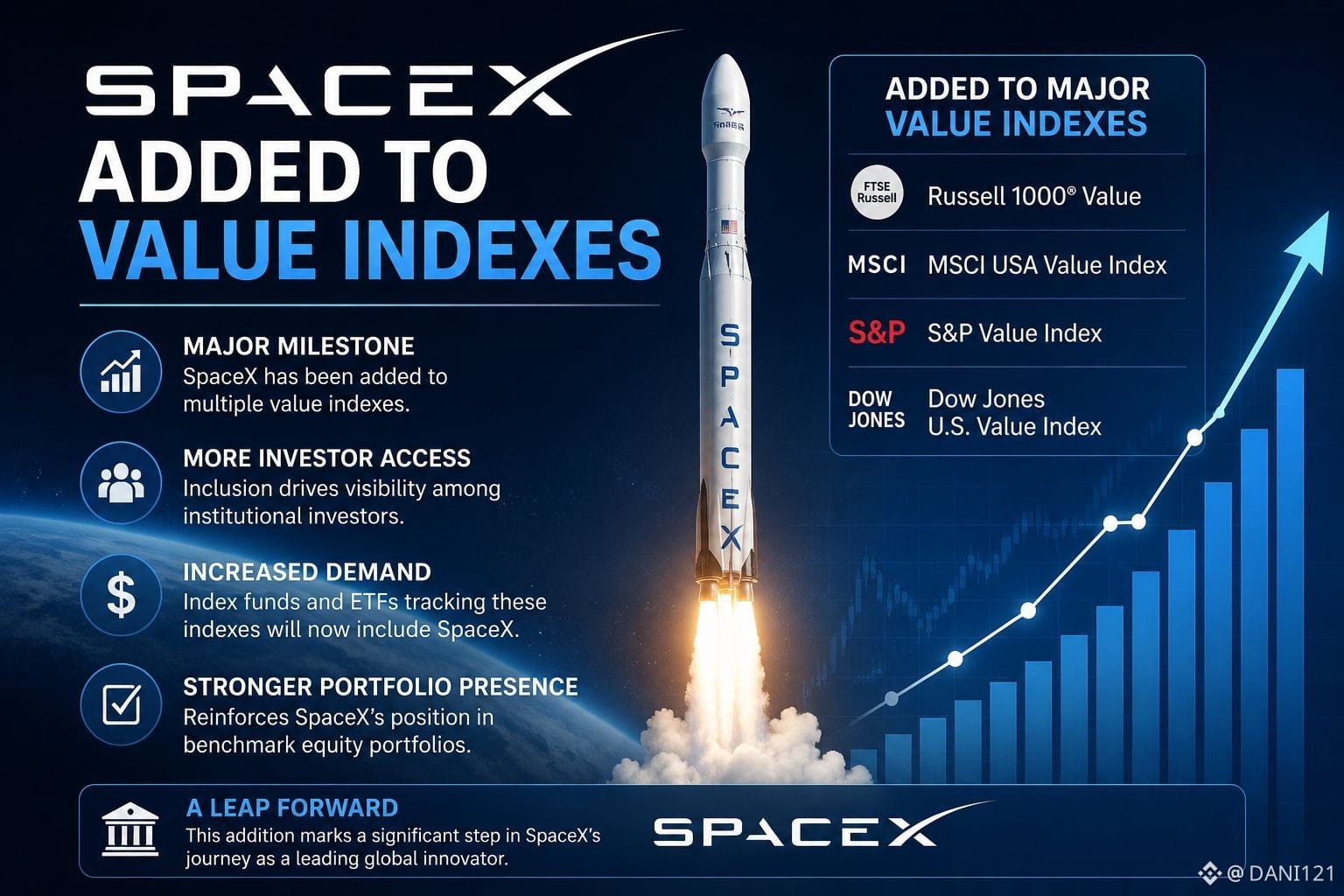
SpaceX has been added to major value indexes, marking a notable milestone that could increase its visibility among institutional investors and index-tracking funds.
Key Highlights
🚀 SpaceX added to value indexes
📈 Inclusion may attract passive investment flows
💼 Increases exposure among institutional investors
🌍 Reflects the company's growing market significance
⚠️ Index inclusion does not directly affect the company's fundamentals
Why It Matters
Index inclusion can increase demand from funds that track those benchmarks, potentially boosting liquidity and investor interest. It also highlights SpaceX's growing prominence within the broader investment landscape.
Social Media Post
🚨 SpaceX Added to Value Indexes
SpaceX has been added to major value indexes, expanding its presence in institutional investment benchmarks.
🚀 Added to value indexes
📈 Potential for passive fund inflows
💼 Greater institutional exposure
🌍 Growing market significance
⚠️ Index inclusion boosts visibility
The move could increase investor interest as index-tracking funds adjust their portfolios.
#SpaceX #Stocks #Indexes #Investing #Markets #Aerospace #Finance #Technology
#spacexaddedtovalueindexes 🚀 SpaceX Added to Value Indexes
SpaceX has been added to major value indexes, marking a notable milestone that could increase its visibility among institutional investors and index-tracking funds.
Key Highlights
🚀 SpaceX added to value indexes
📈 Inclusion may attract passive investment flows
💼 Increases exposure among institutional investors
🌍 Reflects the company's growing market significance
⚠️ Index inclusion does not directly affect the company's fundamentals
Why It Matters
Index inclusion can increase demand from funds that track those benchmarks, potentially boosting liquidity and investor interest. It also highlights SpaceX's growing prominence within the broader investment landscape.
Social Media Post
🚨 SpaceX Added to Value Indexes
SpaceX has been added to major value indexes, expanding its presence in institutional investment benchmarks.
🚀 Added to value indexes
📈 Potential for passive fund inflows
💼 Greater institutional exposure
🌍 Growing market significance
⚠️ Index inclusion boosts visibility
The move could increase investor interest as index-tracking funds adjust their portfolios.
#SpaceX #Stocks #Indexes #Investing #Markets #Aerospace #Finance #Technology
SpaceX has been added to major value indexes, marking a notable milestone that could increase its visibility among institutional investors and index-tracking funds.
Key Highlights
🚀 SpaceX added to value indexes
📈 Inclusion may attract passive investment flows
💼 Increases exposure among institutional investors
🌍 Reflects the company's growing market significance
⚠️ Index inclusion does not directly affect the company's fundamentals
Why It Matters
Index inclusion can increase demand from funds that track those benchmarks, potentially boosting liquidity and investor interest. It also highlights SpaceX's growing prominence within the broader investment landscape.
Social Media Post
🚨 SpaceX Added to Value Indexes
SpaceX has been added to major value indexes, expanding its presence in institutional investment benchmarks.
🚀 Added to value indexes
📈 Potential for passive fund inflows
💼 Greater institutional exposure
🌍 Growing market significance
⚠️ Index inclusion boosts visibility
The move could increase investor interest as index-tracking funds adjust their portfolios.
#SpaceX #Stocks #Indexes #Investing #Markets #Aerospace #Finance #Technology
SPCX+0.55%
SPCXUS-1.22%
13
309

·
--
Article
Why the SpaceX Index Listing Rekt Crypto TradersHere is what happened when traditional markets quietly added SpaceX to value indexes last week, sparking a wave of speculative confusion across the digital asset space.
Many retail investors immediately rushed to buy loosely related tech and AI tokens, hoping to catch a spillover rally, only to watch their capital exit. This classic trap of trading macro headlines without understanding capital flow often leaves late entrants holding the bag during periods of low market confidence.
The inclusion of a private aerospace giant in value indexes signals a shifting definition of value in traditional finance, but it does not inject capital into crypto. While traditional funds reallocated capital, crypto majors like $BTC and stablecoins like $USDT saw muted volume. This proves that institutional interest in private equity rarely translates to immediate on-chain buying pressure.
The risk here lies in narrative correlation. Traders looking at high-tech protocols like $RENDER might assume that traditional tech valuation pumps lift all boats. In reality, during periods of market fear, capital consolidates rather than disperses. Buying the hype of a traditional market index adjustment expecting a crypto pump usually ends in frustration because the underlying liquidity rails are entirely separate.
How do you hedge your portfolio when traditional tech news creates false signals in the crypto market?
#SpaceXAddedToValueIndexes #CFTCWarnsFullCryptoRulesIfClarityActStalls
Why the SpaceX Index Listing Rekt Crypto Traders
Here is what happened when traditional markets quietly added SpaceX to value indexes last week, sparking a wave of speculative confusion across the digital asset space.
Many retail investors immediately rushed to buy loosely related tech and AI tokens, hoping to catch a spillover rally, only to watch their capital exit. This classic trap of trading macro headlines without understanding capital flow often leaves late entrants holding the bag during periods of low market confidence.
The inclusion of a private aerospace giant in value indexes signals a shifting definition of value in traditional finance, but it does not inject capital into crypto. While traditional funds reallocated capital, crypto majors like $BTC and stablecoins like $USDT saw muted volume. This proves that institutional interest in private equity rarely translates to immediate on-chain buying pressure.
The risk here lies in narrative correlation. Traders looking at high-tech protocols like $RENDER might assume that traditional tech valuation pumps lift all boats. In reality, during periods of market fear, capital consolidates rather than disperses. Buying the hype of a traditional market index adjustment expecting a crypto pump usually ends in frustration because the underlying liquidity rails are entirely separate.
How do you hedge your portfolio when traditional tech news creates false signals in the crypto market?
#SpaceXAddedToValueIndexes #CFTCWarnsFullCryptoRulesIfClarityActStalls
Many retail investors immediately rushed to buy loosely related tech and AI tokens, hoping to catch a spillover rally, only to watch their capital exit. This classic trap of trading macro headlines without understanding capital flow often leaves late entrants holding the bag during periods of low market confidence.
The inclusion of a private aerospace giant in value indexes signals a shifting definition of value in traditional finance, but it does not inject capital into crypto. While traditional funds reallocated capital, crypto majors like $BTC and stablecoins like $USDT saw muted volume. This proves that institutional interest in private equity rarely translates to immediate on-chain buying pressure.
The risk here lies in narrative correlation. Traders looking at high-tech protocols like $RENDER might assume that traditional tech valuation pumps lift all boats. In reality, during periods of market fear, capital consolidates rather than disperses. Buying the hype of a traditional market index adjustment expecting a crypto pump usually ends in frustration because the underlying liquidity rails are entirely separate.
How do you hedge your portfolio when traditional tech news creates false signals in the crypto market?
#SpaceXAddedToValueIndexes #CFTCWarnsFullCryptoRulesIfClarityActStalls
98

·
--
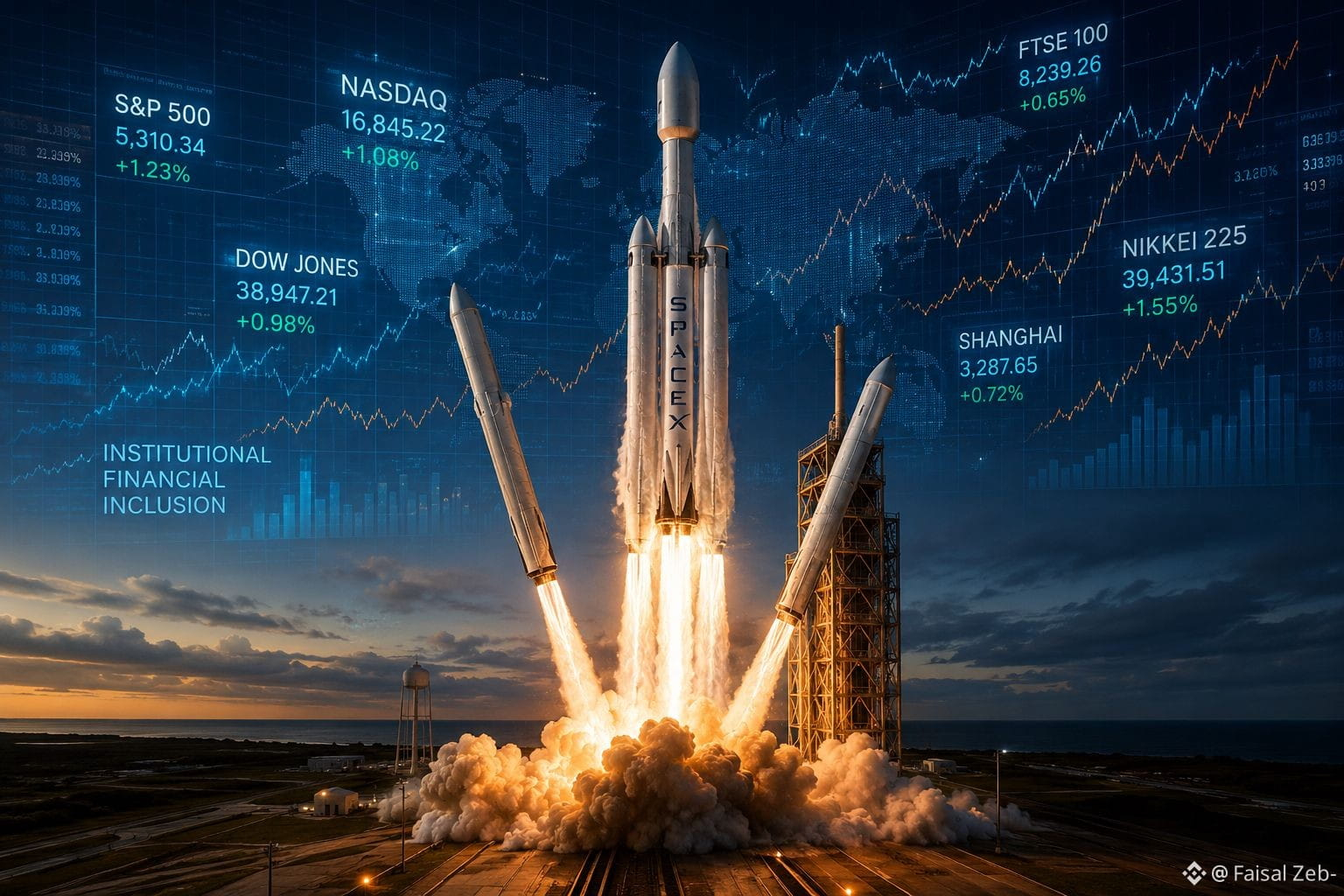
SpaceX has achieved another institutional milestone by officially being added to major traditional value indexes, bridging the gap between private aerospace and public market benchmarking. This historic inclusion reflects the company's massive, stable valuation and dominant position in global satellite and space infrastructure. Retail and institutional investors are viewing this as a massive step toward the normalization of commercial space economies. #SpaceXAddedToValueIndexes
SpaceX has achieved another institutional milestone by officially being added to major traditional value indexes, bridging the gap between private aerospace and public market benchmarking. This historic inclusion reflects the company's massive, stable valuation and dominant position in global satellite and space infrastructure. Retail and institutional investors are viewing this as a massive step toward the normalization of commercial space economies. #SpaceXAddedToValueIndexes
SPCX+0.55%
SPCXUS-1.22%
110

·
--
🚀 SpaceX Enters Value Index, What Does It Mean for Investors?The entry of large companies into various indices indicates growing investor confidence in the technology sector.
Although SpaceX is not a crypto company, positive sentiment in the technology sector often has a good psychological effect on digital assets.
Diversification remains the best strategy amid dynamic market conditions.
#SpaceXAddedToValueIndexes #SpaceX <t-22/><t-23/>#Crypto #Investing #BinanceSquare
🚀 SpaceX Enters Value Index, What Does It Mean for Investors?
The entry of large companies into various indices indicates growing investor confidence in the technology sector.
Although SpaceX is not a crypto company, positive sentiment in the technology sector often has a good psychological effect on digital assets.
Diversification remains the best strategy amid dynamic market conditions.
#SpaceXAddedToValueIndexes #SpaceX <t-22/><t-23/>#Crypto #Investing #BinanceSquare
Although SpaceX is not a crypto company, positive sentiment in the technology sector often has a good psychological effect on digital assets.
Diversification remains the best strategy amid dynamic market conditions.
#SpaceXAddedToValueIndexes #SpaceX <t-22/><t-23/>#Crypto #Investing #BinanceSquare
194

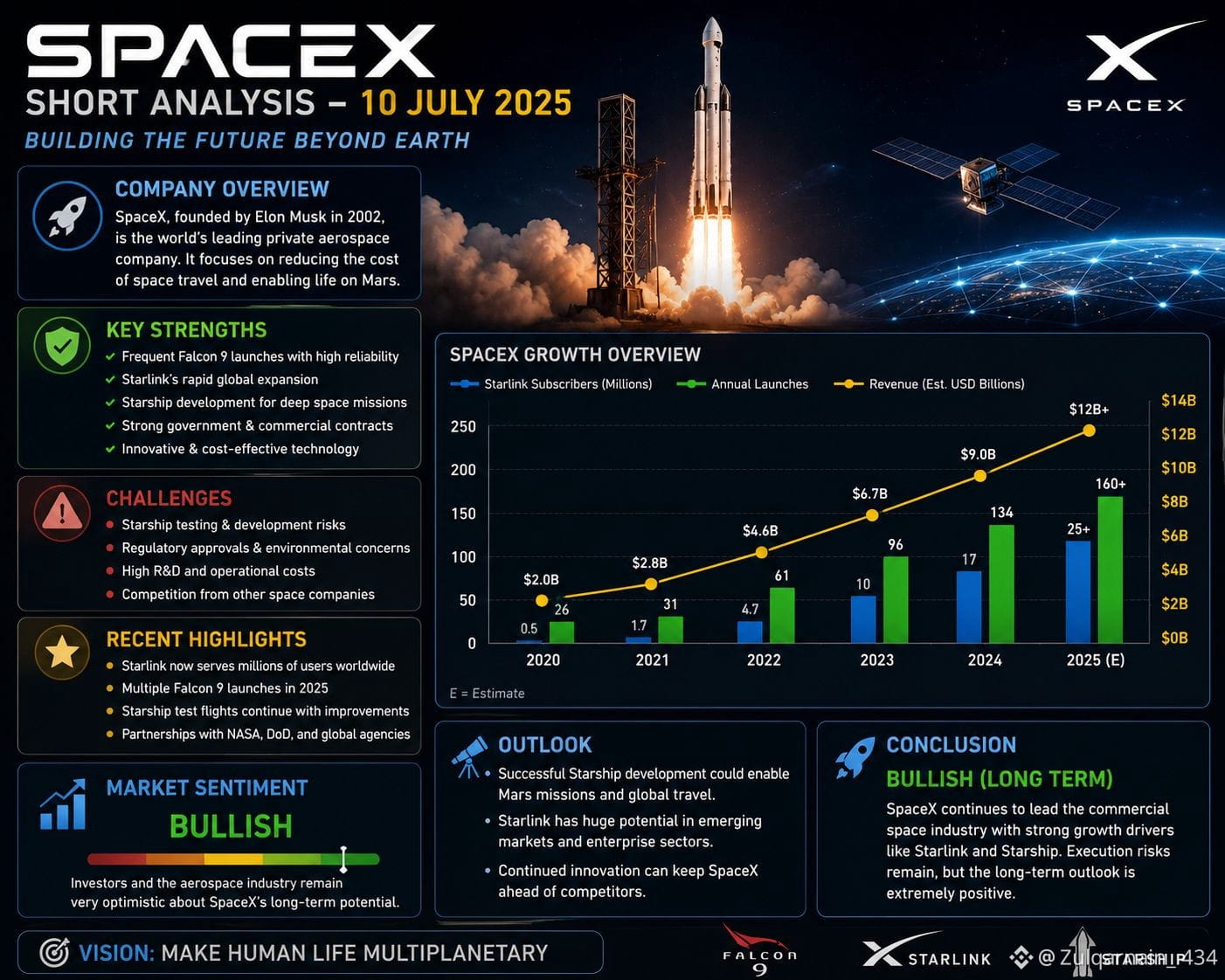
SpaceX remains one of the world's strongest private space companies, with a long-term bullish outlook.
Key Strength: Frequent Falcon 9 launches, growing Starlink subscribers, and continued development of Starship support the company's long-term growth.
Challenges: Starship testing, regulatory approvals, and the high cost of space development can create short-term uncertainty.
Market Sentiment: Bullish — Investors and the aerospace industry continue to view SpaceX as a leader in commercial space technology.
Outlook: If Starship development continues successfully and Starlink expands globally, SpaceX's long-term value could strengthen further.
Conclusion:
Bullish (Long Term) — SpaceX continues to lead the commercial space industry, although major projects like Starship still carry execution risks.$SPCXB
{spot}(SPCXBUSDT)
#SPACXUSDT #SpaceXAddedToValueIndexes
SpaceX remains one of the world's strongest private space companies, with a long-term bullish outlook.
Key Strength: Frequent Falcon 9 launches, growing Starlink subscribers, and continued development of Starship support the company's long-term growth.
Challenges: Starship testing, regulatory approvals, and the high cost of space development can create short-term uncertainty.
Market Sentiment: Bullish — Investors and the aerospace industry continue to view SpaceX as a leader in commercial space technology.
Outlook: If Starship development continues successfully and Starlink expands globally, SpaceX's long-term value could strengthen further.
Conclusion:
Bullish (Long Term) — SpaceX continues to lead the commercial space industry, although major projects like Starship still carry execution risks.$SPCXB
#SPACXUSDT #SpaceXAddedToValueIndexes
Key Strength: Frequent Falcon 9 launches, growing Starlink subscribers, and continued development of Starship support the company's long-term growth.
Challenges: Starship testing, regulatory approvals, and the high cost of space development can create short-term uncertainty.
Market Sentiment: Bullish — Investors and the aerospace industry continue to view SpaceX as a leader in commercial space technology.
Outlook: If Starship development continues successfully and Starlink expands globally, SpaceX's long-term value could strengthen further.
Conclusion:
Bullish (Long Term) — SpaceX continues to lead the commercial space industry, although major projects like Starship still carry execution risks.$SPCXB
#SPACXUSDT #SpaceXAddedToValueIndexes
515

$SENT
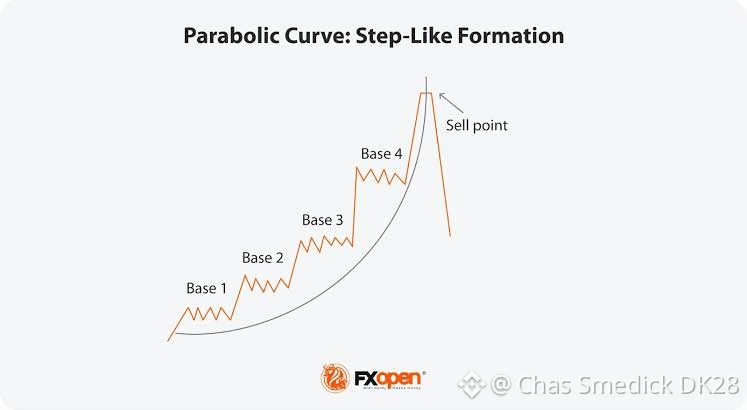
$SENT Goes Vertical: AI DePIN Narrative Triggers Parabolic Breakout
Sentient (SENT) has hijacked the crypto market's attention, booking a massive +26.58% pump within 24 hours to secure a spot among the top gainers on Binance. Driven by a surge in retail interest and newly expanded tier-1 exchange visibility, SENT violently rejected its multi-week baseline to blast to a local high of $0.01764.
@CZ @todayq @Crypto_Jobs
#SKHynixSetsADRGuidancePriceAt$149 #SpaceXAddedToValueIndexes #WarshNamesLeadersForFiveFedTaskForces
{future}(SENTUSDT)
$SENT
$SENT Goes Vertical: AI DePIN Narrative Triggers Parabolic Breakout
Sentient (SENT) has hijacked the crypto market's attention, booking a massive +26.58% pump within 24 hours to secure a spot among the top gainers on Binance. Driven by a surge in retail interest and newly expanded tier-1 exchange visibility, SENT violently rejected its multi-week baseline to blast to a local high of $0.01764.
@CZ @Todayq News @CryptoJobs3
#SKHynixSetsADRGuidancePriceAt$149 #SpaceXAddedToValueIndexes #WarshNamesLeadersForFiveFedTaskForces
$SENT Goes Vertical: AI DePIN Narrative Triggers Parabolic Breakout
Sentient (SENT) has hijacked the crypto market's attention, booking a massive +26.58% pump within 24 hours to secure a spot among the top gainers on Binance. Driven by a surge in retail interest and newly expanded tier-1 exchange visibility, SENT violently rejected its multi-week baseline to blast to a local high of $0.01764.
@CZ @Todayq News @CryptoJobs3
#SKHynixSetsADRGuidancePriceAt$149 #SpaceXAddedToValueIndexes #WarshNamesLeadersForFiveFedTaskForces
1
1
95

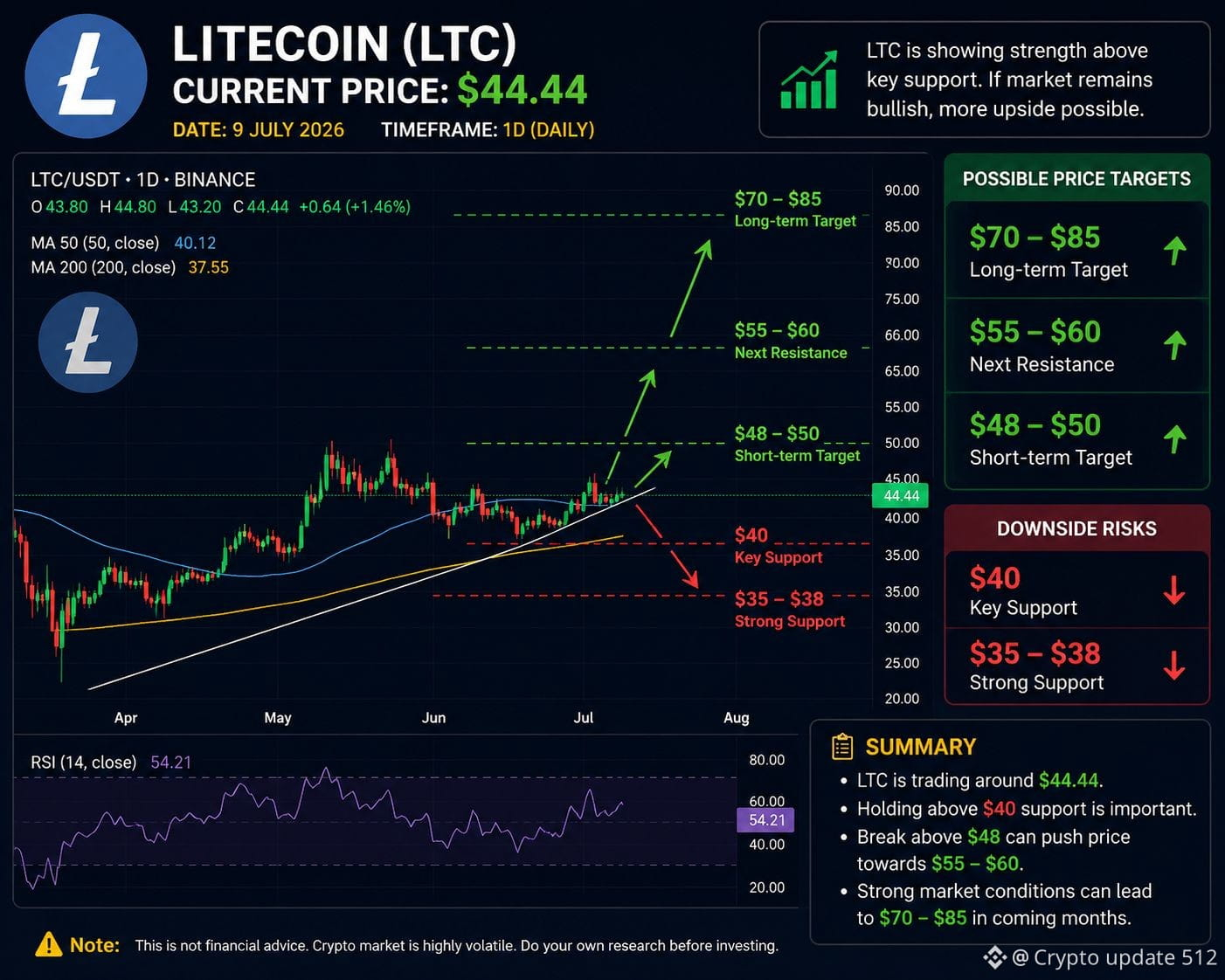
#LTC If Litecoin (LTC) is around $44.28 here are the possible price targets:
Short-term bullish target: $48–50
Next resistance: $55–60
If the crypto market stays strong: $70–85 in the coming months (not guaranteed)
$LTC #ARBJumps19% #SpaceXAddedToValueIndexes
{spot}(LTCUSDT)
#LTC If Litecoin (LTC) is around $44.28 here are the possible price targets:
Short-term bullish target: $48–50
Next resistance: $55–60
If the crypto market stays strong: $70–85 in the coming months (not guaranteed)
$LTC #ARBJumps19% #SpaceXAddedToValueIndexes
Short-term bullish target: $48–50
Next resistance: $55–60
If the crypto market stays strong: $70–85 in the coming months (not guaranteed)
$LTC #ARBJumps19% #SpaceXAddedToValueIndexes
1
154
·
--
Bearish
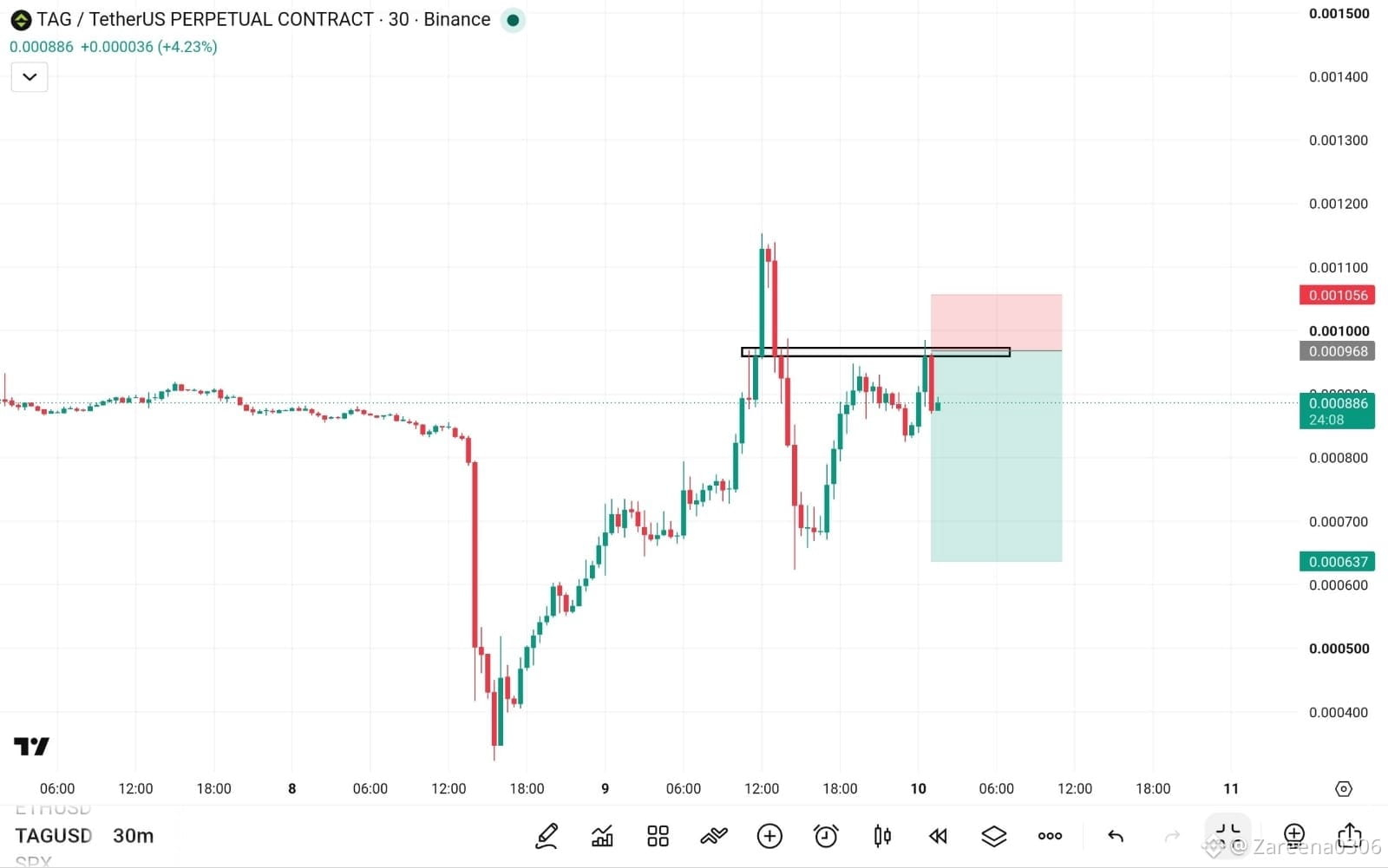
#TAGUSDT $TAG
SHORT
Leverage: 10x - 50x
Entry : 0.00091500 - 0.0009500
Take Profits: 0.000820 - 0.000760 - 0.000670 - 0.000588
Stop Loss: 0.001070
Bearish setup active — follow the signal and secure profits at targets.
#UPSFedExFallOnAmazonShippingThreat #SpaceXAddedToValueIndexes #CorningJumpsOver8% SKHynixRaises$26.5BInUSIPO#USJoblessClaimsFallTo215K $NVDAB $GOOGLB
#TAGUSDT $TAG
SHORT
Leverage: 10x - 50x
Entry : 0.00091500 - 0.0009500
Take Profits: 0.000820 - 0.000760 - 0.000670 - 0.000588
Stop Loss: 0.001070
Bearish setup active — follow the signal and secure profits at targets.
#UPSFedExFallOnAmazonShippingThreat #SpaceXAddedToValueIndexes #CorningJumpsOver8% SKHynixRaises$26.5BInUSIPO#USJoblessClaimsFallTo215K $NVDAB $GOOGLB
SHORT
Leverage: 10x - 50x
Entry : 0.00091500 - 0.0009500
Take Profits: 0.000820 - 0.000760 - 0.000670 - 0.000588
Stop Loss: 0.001070
Bearish setup active — follow the signal and secure profits at targets.
#UPSFedExFallOnAmazonShippingThreat #SpaceXAddedToValueIndexes #CorningJumpsOver8% SKHynixRaises$26.5BInUSIPO#USJoblessClaimsFallTo215K $NVDAB $GOOGLB
99

$SKL
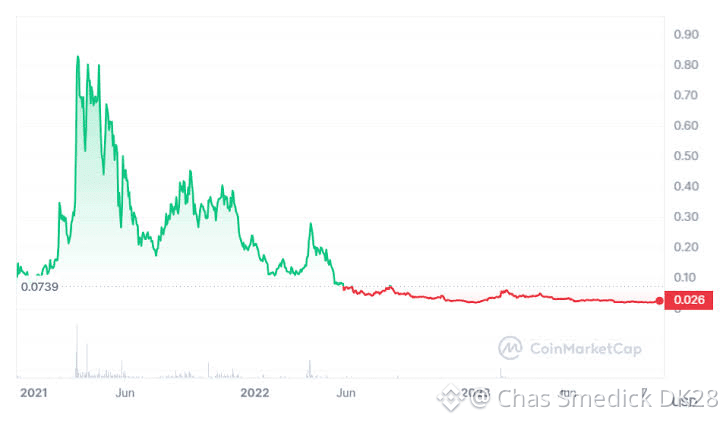
SKL Breaking Out: Has the SKALE Network Bottomed or Is a Liquidity Trap Lurking?
SKALE (SKL) grabbed the spotlight by leading the daily gainers list on Binance, surging over 21% within a concentrated 6-hour window to trade near $0.0042 to $0.0045. This explosive move has broken a prolonged, multi-week consolidation phase and triggered massive interest from momentum traders.
#SKHynixSetsADRGuidancePriceAt$149 #SpaceXAddedToValueIndexes #iranwon
{future}(SKLUSDT)
$SKL
SKL Breaking Out: Has the SKALE Network Bottomed or Is a Liquidity Trap Lurking?
SKALE (SKL) grabbed the spotlight by leading the daily gainers list on Binance, surging over 21% within a concentrated 6-hour window to trade near $0.0042 to $0.0045. This explosive move has broken a prolonged, multi-week consolidation phase and triggered massive interest from momentum traders.
#SKHynixSetsADRGuidancePriceAt$149 #SpaceXAddedToValueIndexes #iranwon
SKL Breaking Out: Has the SKALE Network Bottomed or Is a Liquidity Trap Lurking?
SKALE (SKL) grabbed the spotlight by leading the daily gainers list on Binance, surging over 21% within a concentrated 6-hour window to trade near $0.0042 to $0.0045. This explosive move has broken a prolonged, multi-week consolidation phase and triggered massive interest from momentum traders.
#SKHynixSetsADRGuidancePriceAt$149 #SpaceXAddedToValueIndexes #iranwon
1
1
138

·
--
Bullish
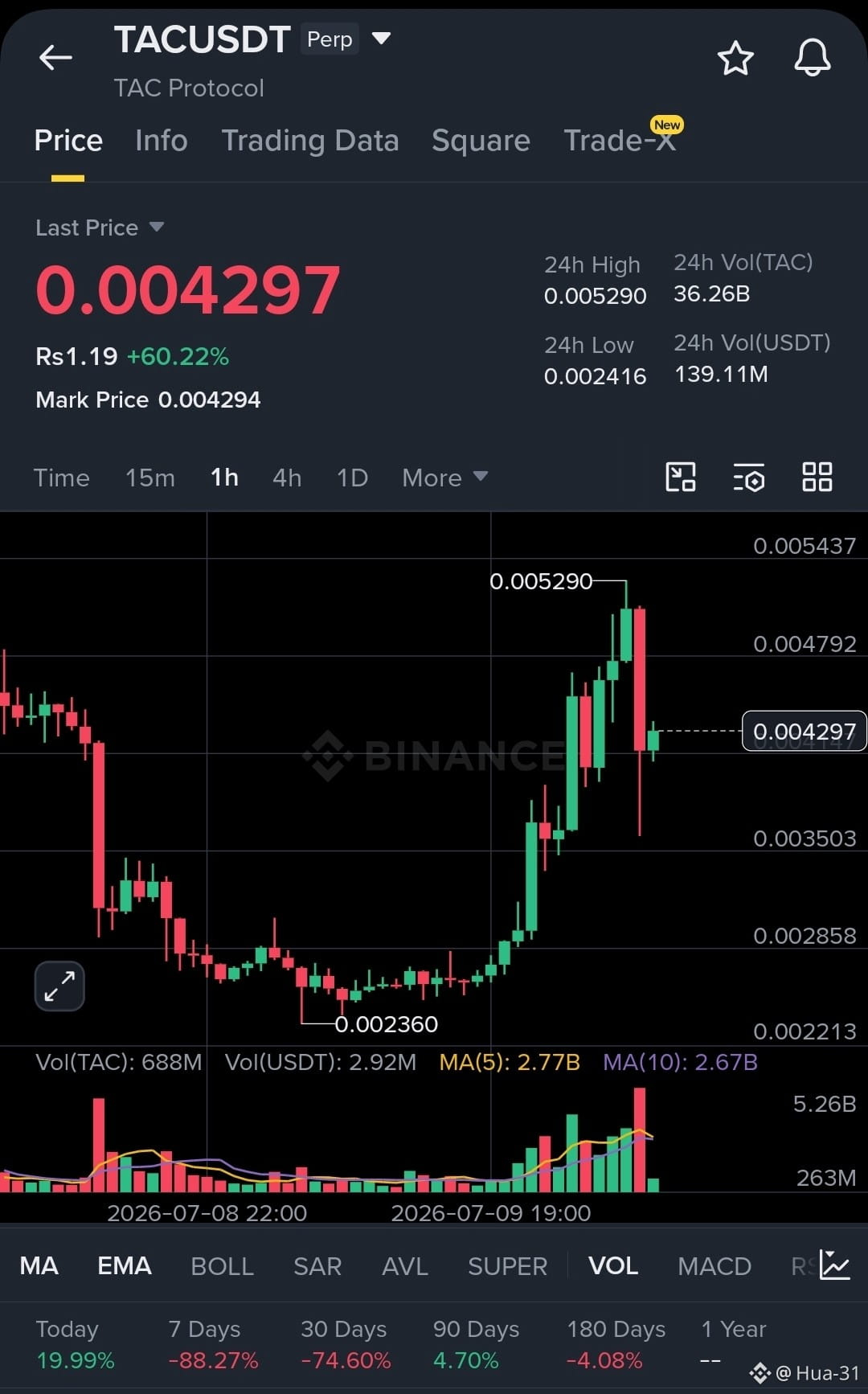
$TAC
Strong bullish momentum remains intact after an explosive breakout backed by exceptional volume. The recent pullback is showing healthy profit-taking while price continues to defend higher support, keeping the structure favorable for another continuation leg if buyers reclaim momentum.
EP: 0.004180 – 0.004320
TP1: 0.004700
TP2: 0.005000
TP3: 0.005300
SL: 0.003780
Momentum remains firmly in the bulls' favor as long as support holds. The current structure favors continuation toward higher resistance with disciplined risk management and a strong risk-to-reward profile.
$TAC
SKHynixRaises$26.5BInUSIPO
#SpaceXAddedToValueIndexes
{future}(TACUSDT)
$TAC
Strong bullish momentum remains intact after an explosive breakout backed by exceptional volume. The recent pullback is showing healthy profit-taking while price continues to defend higher support, keeping the structure favorable for another continuation leg if buyers reclaim momentum.
EP: 0.004180 – 0.004320
TP1: 0.004700
TP2: 0.005000
TP3: 0.005300
SL: 0.003780
Momentum remains firmly in the bulls' favor as long as support holds. The current structure favors continuation toward higher resistance with disciplined risk management and a strong risk-to-reward profile.
$TAC
SKHynixRaises$26.5BInUSIPO
#SpaceXAddedToValueIndexes
Strong bullish momentum remains intact after an explosive breakout backed by exceptional volume. The recent pullback is showing healthy profit-taking while price continues to defend higher support, keeping the structure favorable for another continuation leg if buyers reclaim momentum.
EP: 0.004180 – 0.004320
TP1: 0.004700
TP2: 0.005000
TP3: 0.005300
SL: 0.003780
Momentum remains firmly in the bulls' favor as long as support holds. The current structure favors continuation toward higher resistance with disciplined risk management and a strong risk-to-reward profile.
$TAC
SKHynixRaises$26.5BInUSIPO
#SpaceXAddedToValueIndexes
62

·
--
Bullish
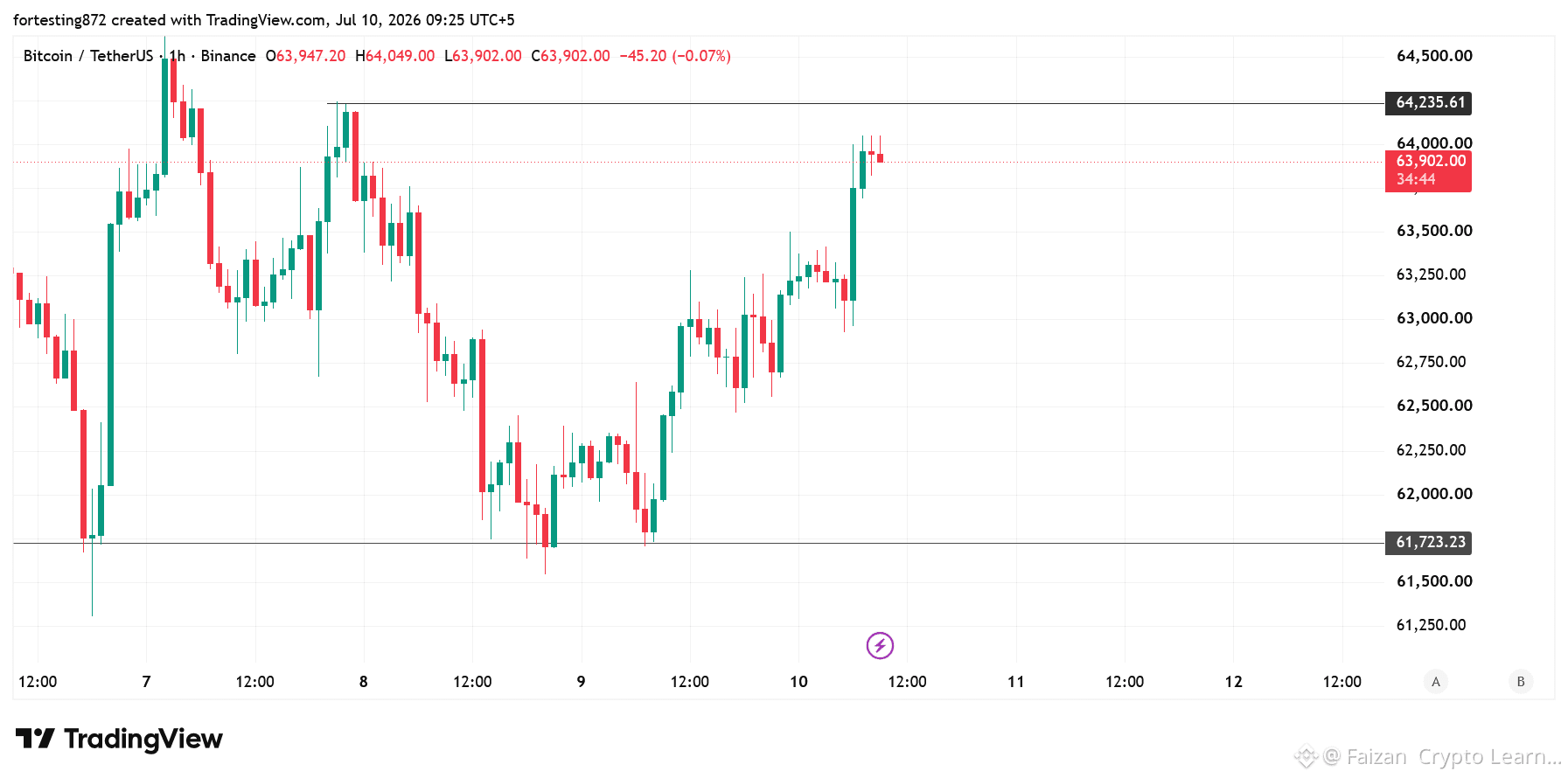
$BTC Bitcoin spent July 9 and 10 building a clear upward stairs structure, proving buyers are aggressively stepping in earlier at every dip.
🚀 IF THE BREAKOUT ABOVE $64,259.69 IS CONFIRMED, I AM GOING LONG ON IT! 🐋🔥
🟢 ENTRY ZONE: $63,800 - $64,300
✅ TP1: $64,950
✅ TP2: $65,600
✅ TP3: $66,400+
🛑 STOP LOSS: $63,150
DYOR!!
#SpaceXAddedToValueIndexes
$BTC Bitcoin spent July 9 and 10 building a clear upward stairs structure, proving buyers are aggressively stepping in earlier at every dip.
🚀 IF THE BREAKOUT ABOVE $64,259.69 IS CONFIRMED, I AM GOING LONG ON IT! 🐋🔥
🟢 ENTRY ZONE: $63,800 - $64,300
✅ TP1: $64,950
✅ TP2: $65,600
✅ TP3: $66,400+
🛑 STOP LOSS: $63,150
DYOR!!
#SpaceXAddedToValueIndexes
🚀 IF THE BREAKOUT ABOVE $64,259.69 IS CONFIRMED, I AM GOING LONG ON IT! 🐋🔥
🟢 ENTRY ZONE: $63,800 - $64,300
✅ TP1: $64,950
✅ TP2: $65,600
✅ TP3: $66,400+
🛑 STOP LOSS: $63,150
DYOR!!
#SpaceXAddedToValueIndexes
43

·
--
Bullish
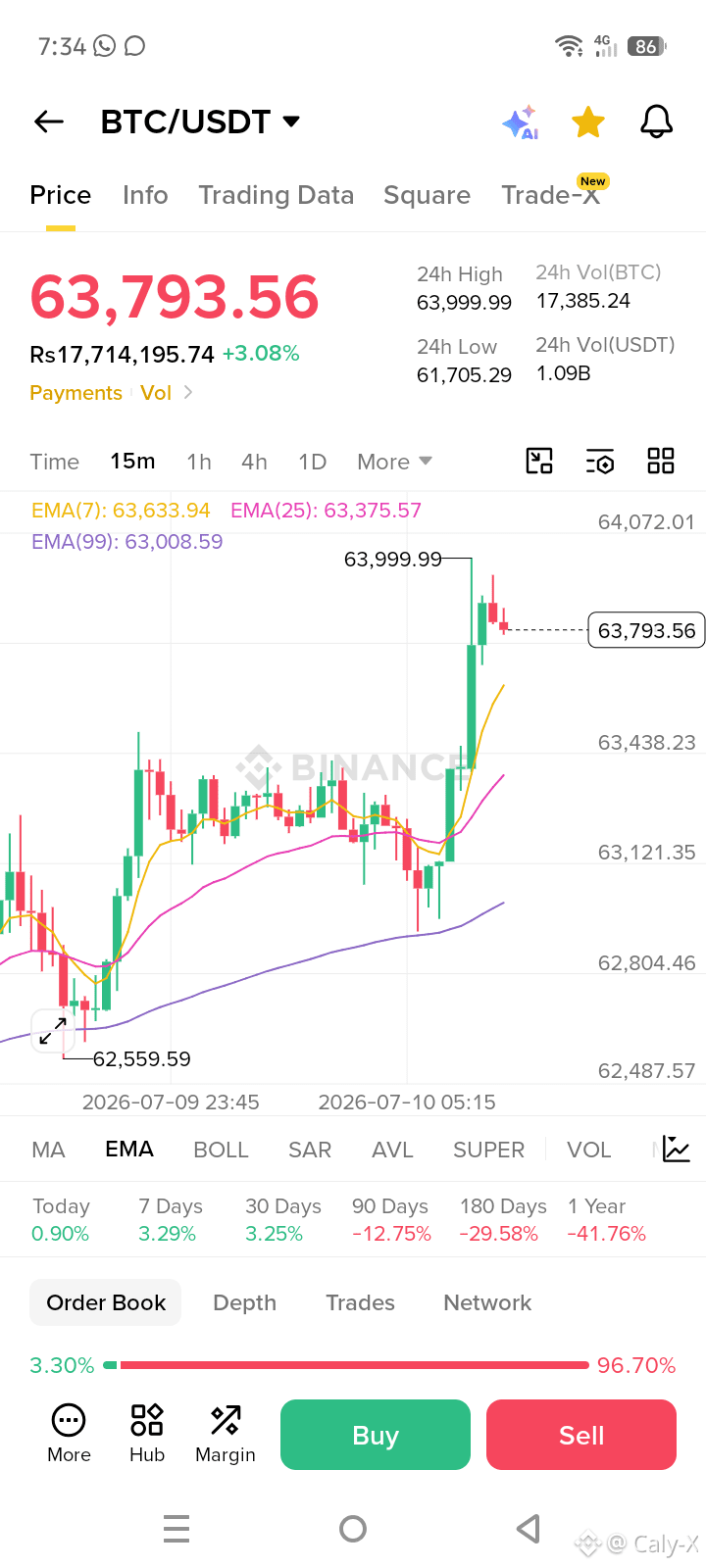
$BTC /USDT ⚡
Buy: $63,700–63,850
TP1: $64,000
TP2: $64,250
TP3: $64,600
SL: $63,350
"BTC just exploded through resistance. Momentum is building—if bulls stay in control, the next leg up could come fast.
{spot}(BTCUSDT)
#ARBJumps19% #UPSFedExFallOnAmazonShippingThreat #SpaceXAddedToValueIndexes #CorningJumpsOver8% #USJoblessClaimsFallTo215K
$BTC /USDT ⚡
Buy: $63,700–63,850
TP1: $64,000
TP2: $64,250
TP3: $64,600
SL: $63,350
"BTC just exploded through resistance. Momentum is building—if bulls stay in control, the next leg up could come fast.
#ARBJumps19% #UPSFedExFallOnAmazonShippingThreat #SpaceXAddedToValueIndexes #CorningJumpsOver8% #USJoblessClaimsFallTo215K
Buy: $63,700–63,850
TP1: $64,000
TP2: $64,250
TP3: $64,600
SL: $63,350
"BTC just exploded through resistance. Momentum is building—if bulls stay in control, the next leg up could come fast.
#ARBJumps19% #UPSFedExFallOnAmazonShippingThreat #SpaceXAddedToValueIndexes #CorningJumpsOver8% #USJoblessClaimsFallTo215K
103

·
--
Bullish
$SKL
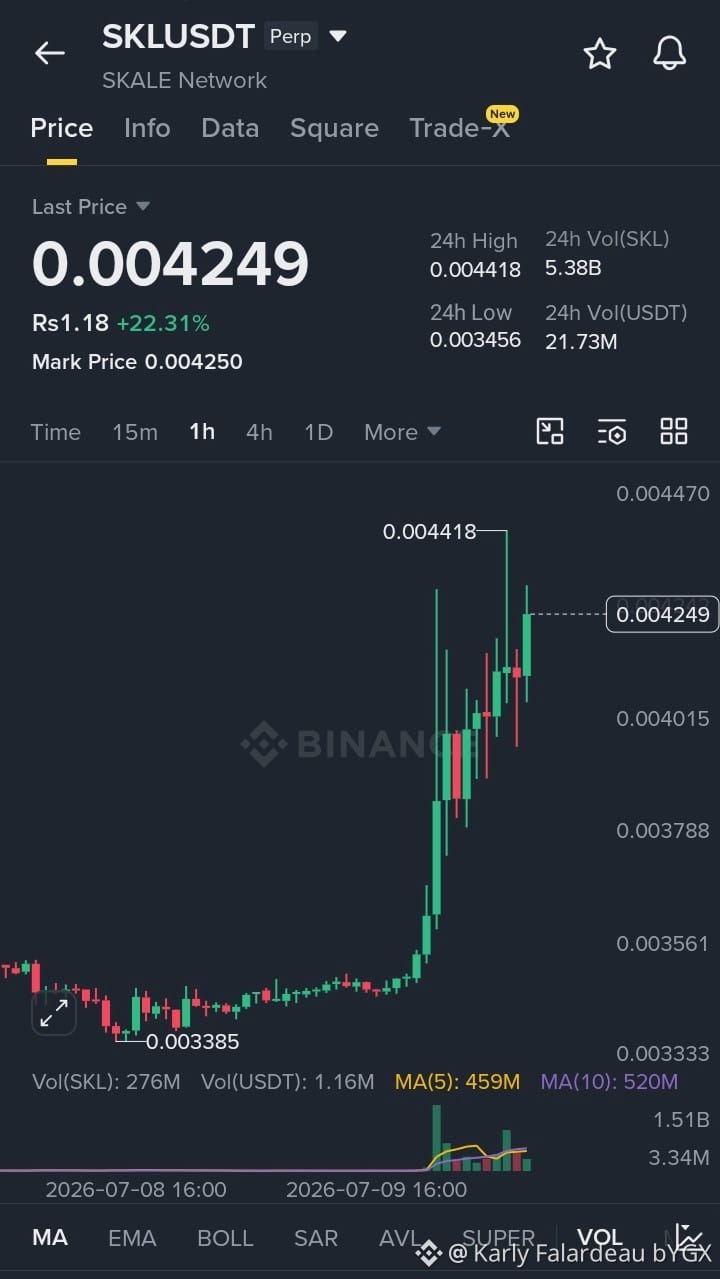
LONG SETUP — BINANCE PERP
Breakout retest complete. Volume surge confirms accumulation above key support. Momentum shifting bullish.
EP: 0.004250
TP1: 0.004420
TP2: 0.004650
TP3: 0.005000
SL: 0.004080
Risk 2% per trade. Trail after TP1.
$SKL #SpaceXAddedToValueIndexes
#USJoblessClaimsFallTo215K
{future}(SKLUSDT)
$SKL
LONG SETUP — BINANCE PERP
Breakout retest complete. Volume surge confirms accumulation above key support. Momentum shifting bullish.
EP: 0.004250
TP1: 0.004420
TP2: 0.004650
TP3: 0.005000
SL: 0.004080
Risk 2% per trade. Trail after TP1.
$SKL #SpaceXAddedToValueIndexes
#USJoblessClaimsFallTo215K
LONG SETUP — BINANCE PERP
Breakout retest complete. Volume surge confirms accumulation above key support. Momentum shifting bullish.
EP: 0.004250
TP1: 0.004420
TP2: 0.004650
TP3: 0.005000
SL: 0.004080
Risk 2% per trade. Trail after TP1.
$SKL #SpaceXAddedToValueIndexes
#USJoblessClaimsFallTo215K
66
·
--
Bullish
#USNaturalGasFallsOver6% #OpenAILaunchesGPT5.6Family #UPSFedExFallOnAmazonShippingThreat SKHynixRaises$26.5BInUSIPO#CorningJumpsOver8% #SpaceXAddedToValueIndexes $METAB
#USNaturalGasFallsOver6% #OpenAILaunchesGPT5.6Family #UPSFedExFallOnAmazonShippingThreat SKHynixRaises$26.5BInUSIPO#CorningJumpsOver8% #SpaceXAddedToValueIndexes $METAB
127

·
--
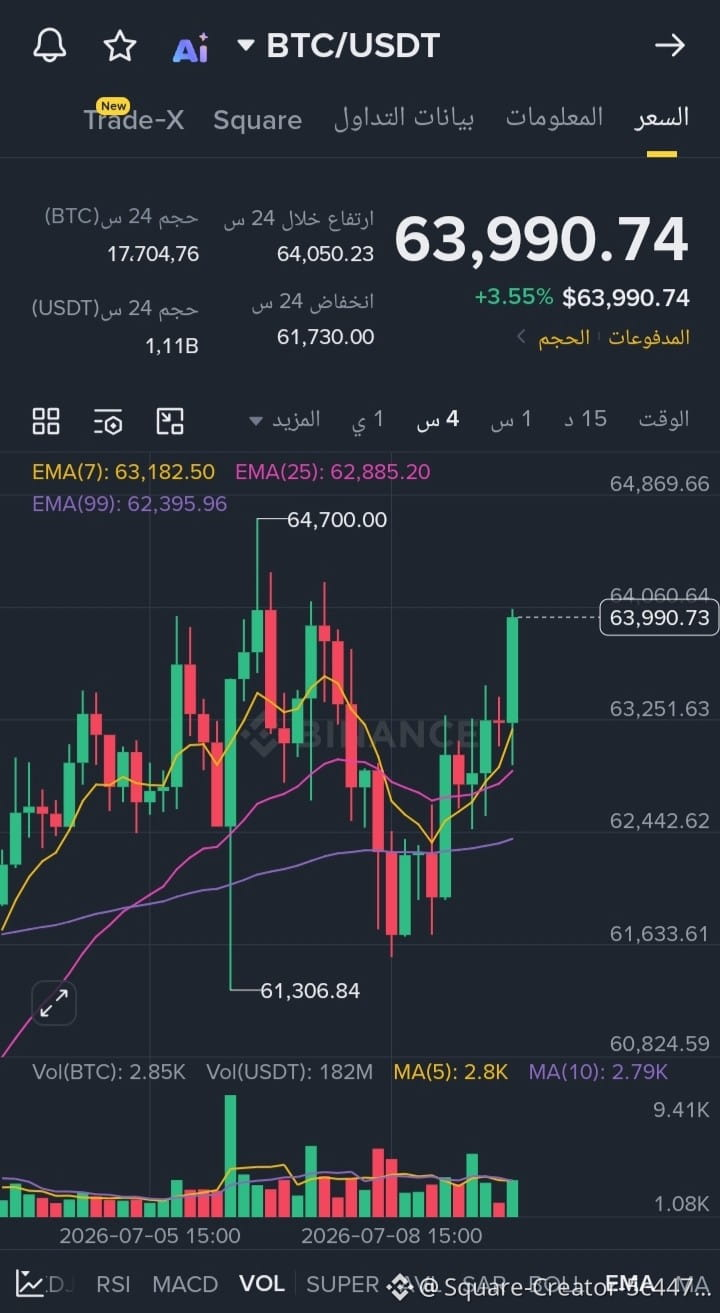
Technical Analysis of Coin $BTC
💥Current trend is bullish and strong: The current price (63,990.74) is trading above all exponential moving averages (EMA 7, 25, 99), reflecting clear buyer control and strong positive momentum in the short term.
💥Support and resistance: The price bounced successfully from support zones near 61,306 and is now approaching the key resistance level and the next obstacle at the 64,700 peak.
💥Trading outlook: Continued upward movement is conditional on holding above the EMA(7) average at 63,182, and a clear breakout above the 64,700 resistance will open the door for further gains.
#SpaceXAddedToValueIndexes
💥 Don’t forget to follow so you receive every new update 💥
Technical Analysis of Coin $BTC
💥Current trend is bullish and strong: The current price (63,990.74) is trading above all exponential moving averages (EMA 7, 25, 99), reflecting clear buyer control and strong positive momentum in the short term.
💥Support and resistance: The price bounced successfully from support zones near 61,306 and is now approaching the key resistance level and the next obstacle at the 64,700 peak.
💥Trading outlook: Continued upward movement is conditional on holding above the EMA(7) average at 63,182, and a clear breakout above the 64,700 resistance will open the door for further gains.
#SpaceXAddedToValueIndexes
💥 Don’t forget to follow so you receive every new update 💥
💥Current trend is bullish and strong: The current price (63,990.74) is trading above all exponential moving averages (EMA 7, 25, 99), reflecting clear buyer control and strong positive momentum in the short term.
💥Support and resistance: The price bounced successfully from support zones near 61,306 and is now approaching the key resistance level and the next obstacle at the 64,700 peak.
💥Trading outlook: Continued upward movement is conditional on holding above the EMA(7) average at 63,182, and a clear breakout above the 64,700 resistance will open the door for further gains.
#SpaceXAddedToValueIndexes
💥 Don’t forget to follow so you receive every new update 💥
113
Log in to explore more content
Join global crypto users on Binance Square
⚡️ Get latest and useful information about crypto.
💬 Trusted by the world’s largest crypto exchange.
👍 Discover real insights from verified creators.
Email / Phone number
Trending Topics
1
#BOJRaisesRatesTo31YearHigh
903 views
74 Discussing
2
#HKCompletesFirstHKDStablecoinUseCase
19,708 views
515 Discussing
3
#VietnamPlansFirstCryptoLicensesIn2026
14,103 views
342 Discussing
4
#BTCBreaks80K
236,600 views
3,671 Discussing
5
#BitcoinMarketCapTopsTesla
30,483 views
700 Discussing
6
#SOLJumpsAbout10%
44,281 views
771 Discussing
7
#EthereumReclaims$2600
3,493 views
92 Discussing
8
#LineraShutsDownAfterFundraisingFallsShort
10,322 views
206 Discussing
9
#SECReceivesAmendedInjectiveETFFiling
23,557 views
466 Discussing
10
#SanDiskToJoinSP100OnSep21
16,992 views
292 Discussing