
#ston.fi
ston.fi
66,394 views
698 Discussing
Hot
Latest

The interesting question isn't whether TON needs another DEX.
It's what TON's financial infrastructure looks like when:
Liquidity becomes deeper. Cross-chain swaps become easier. Yield becomes more accessible. Governance becomes more meaningful. And users stop thinking about the infrastructure underneath.
That's the bigger STON.fi story I'm watching.
@stonfi #STON.fi
The interesting question isn't whether TON needs another DEX.
It's what TON's financial infrastructure looks like when:
Liquidity becomes deeper. Cross-chain swaps become easier. Yield becomes more accessible. Governance becomes more meaningful. And users stop thinking about the infrastructure underneath.
That's the bigger STON.fi story I'm watching.
@STONfi DEX #STON.fi
It's what TON's financial infrastructure looks like when:
Liquidity becomes deeper. Cross-chain swaps become easier. Yield becomes more accessible. Governance becomes more meaningful. And users stop thinking about the infrastructure underneath.
That's the bigger STON.fi story I'm watching.
@STONfi DEX #STON.fi
1
80

·
--
One thing I respect about STON.fi is that they don’t only talk about the good days.
After the recent $GRAM (formerly TON) congestion, they openly explained what happened, how it affected transactions, and what they’re doing to make the system more resilient.
The traffic spike was significant enough that swaps were temporarily paused to help protect users.
Now the focus is on strengthening the infrastructure:
• More routers
• Fewer messages during swaps
• A more distributed architecture
• Better resilience under heavy traffic
That’s the side of DeFi people often overlook.
Networks get congested. Traffic spikes. Things can break.
What matters is how the team responds, communicates, and improves the infrastructure afterward.
For me, that’s what makes STON.fi worth watching.
The real test isn’t avoiding every problem.
It’s becoming stronger after one.
$GRAM #STON.fi
One thing I respect about STON.fi is that they don’t only talk about the good days.
After the recent $GRAM (formerly TON) congestion, they openly explained what happened, how it affected transactions, and what they’re doing to make the system more resilient.
The traffic spike was significant enough that swaps were temporarily paused to help protect users.
Now the focus is on strengthening the infrastructure:
• More routers
• Fewer messages during swaps
• A more distributed architecture
• Better resilience under heavy traffic
That’s the side of DeFi people often overlook.
Networks get congested. Traffic spikes. Things can break.
What matters is how the team responds, communicates, and improves the infrastructure afterward.
For me, that’s what makes STON.fi worth watching.
The real test isn’t avoiding every problem.
It’s becoming stronger after one.
$GRAM #STON.fi
After the recent $GRAM (formerly TON) congestion, they openly explained what happened, how it affected transactions, and what they’re doing to make the system more resilient.
The traffic spike was significant enough that swaps were temporarily paused to help protect users.
Now the focus is on strengthening the infrastructure:
• More routers
• Fewer messages during swaps
• A more distributed architecture
• Better resilience under heavy traffic
That’s the side of DeFi people often overlook.
Networks get congested. Traffic spikes. Things can break.
What matters is how the team responds, communicates, and improves the infrastructure afterward.
For me, that’s what makes STON.fi worth watching.
The real test isn’t avoiding every problem.
It’s becoming stronger after one.
$GRAM #STON.fi

280

·
--
Bullish
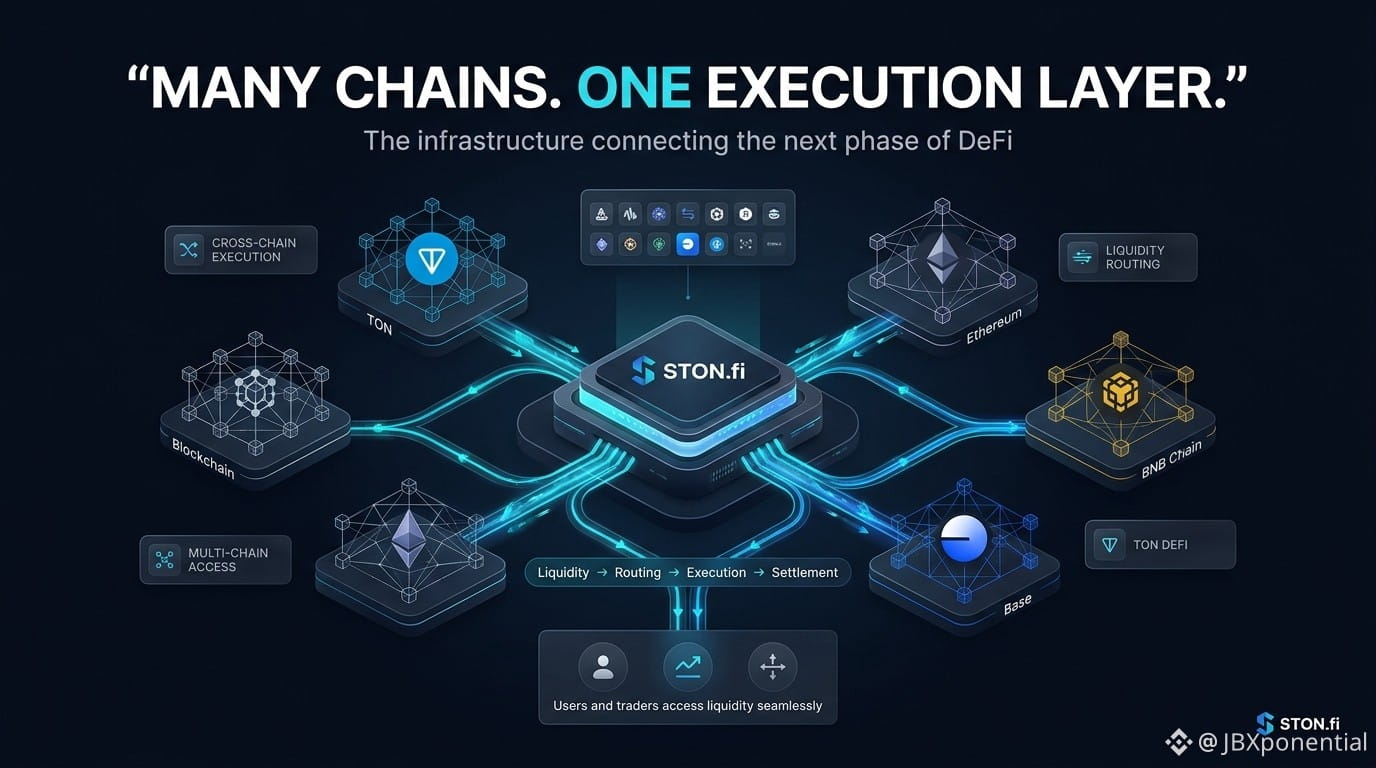
From Chain-Specific DeFi to Connected DeFi: Why Infrastructure Matters
Imagine entering a financial market where every bank uses a completely different road system.
Your destination is only a few kilometres away, but crossing between networks requires different bridges, different procedures and different tools.
That is still a large part of the DeFi experience.
Users don't simply interact with assets. They interact with chains, bridges, liquidity pools, routers and execution mechanisms.
As DeFi becomes increasingly multi-chain, this creates a new infrastructure challenge.
The problem isn't just liquidity
Liquidity exists across many ecosystems.
The problem is accessing that liquidity efficiently.
A user may hold assets on one network while the opportunity they want exists somewhere else.
Historically, solving that problem often meant manually navigating bridges and multiple protocols.
Cross-chain execution aims to abstract away much of this complexity.
Instead of forcing users to understand the infrastructure, the infrastructure increasingly works behind the scenes.
This is where STON.fi becomes interesting
STON.fi started with a strong position inside the TON ecosystem as a decentralized exchange.
But the broader evolution is toward cross-chain execution and liquidity infrastructure.
That shift matters because TON doesn't exist in isolation.
The future of TON DeFi will also depend on how easily capital and users can interact with the wider blockchain economy.
The more connected DeFi becomes, the more important execution infrastructure becomes.
The bigger picture
I think the interesting question isn't:
“Which blockchain will win?”
It is:
“Which infrastructure will make users care less about which blockchain they are using?”
That could become one of the defining themes of the next stage of DeFi.
@STONfi
@stonfi ston_fi #STON.fi $STON
Explore more research at blog.ston.fi
From Chain-Specific DeFi to Connected DeFi: Why Infrastructure Matters
Imagine entering a financial market where every bank uses a completely different road system.
Your destination is only a few kilometres away, but crossing between networks requires different bridges, different procedures and different tools.
That is still a large part of the DeFi experience.
Users don't simply interact with assets. They interact with chains, bridges, liquidity pools, routers and execution mechanisms.
As DeFi becomes increasingly multi-chain, this creates a new infrastructure challenge.
The problem isn't just liquidity
Liquidity exists across many ecosystems.
The problem is accessing that liquidity efficiently.
A user may hold assets on one network while the opportunity they want exists somewhere else.
Historically, solving that problem often meant manually navigating bridges and multiple protocols.
Cross-chain execution aims to abstract away much of this complexity.
Instead of forcing users to understand the infrastructure, the infrastructure increasingly works behind the scenes.
This is where STON.fi becomes interesting
STON.fi started with a strong position inside the TON ecosystem as a decentralized exchange.
But the broader evolution is toward cross-chain execution and liquidity infrastructure.
That shift matters because TON doesn't exist in isolation.
The future of TON DeFi will also depend on how easily capital and users can interact with the wider blockchain economy.
The more connected DeFi becomes, the more important execution infrastructure becomes.
The bigger picture
I think the interesting question isn't:
“Which blockchain will win?”
It is:
“Which infrastructure will make users care less about which blockchain they are using?”
That could become one of the defining themes of the next stage of DeFi.
@STONfi
@STONfi DEX ston_fi #STON.fi $STON
Explore more research at blog.ston.fi
Imagine entering a financial market where every bank uses a completely different road system.
Your destination is only a few kilometres away, but crossing between networks requires different bridges, different procedures and different tools.
That is still a large part of the DeFi experience.
Users don't simply interact with assets. They interact with chains, bridges, liquidity pools, routers and execution mechanisms.
As DeFi becomes increasingly multi-chain, this creates a new infrastructure challenge.
The problem isn't just liquidity
Liquidity exists across many ecosystems.
The problem is accessing that liquidity efficiently.
A user may hold assets on one network while the opportunity they want exists somewhere else.
Historically, solving that problem often meant manually navigating bridges and multiple protocols.
Cross-chain execution aims to abstract away much of this complexity.
Instead of forcing users to understand the infrastructure, the infrastructure increasingly works behind the scenes.
This is where STON.fi becomes interesting
STON.fi started with a strong position inside the TON ecosystem as a decentralized exchange.
But the broader evolution is toward cross-chain execution and liquidity infrastructure.
That shift matters because TON doesn't exist in isolation.
The future of TON DeFi will also depend on how easily capital and users can interact with the wider blockchain economy.
The more connected DeFi becomes, the more important execution infrastructure becomes.
The bigger picture
I think the interesting question isn't:
“Which blockchain will win?”
It is:
“Which infrastructure will make users care less about which blockchain they are using?”
That could become one of the defining themes of the next stage of DeFi.
@STONfi
@STONfi DEX ston_fi #STON.fi $STON
Explore more research at blog.ston.fi
68

·
--
Bullish
⚡️ Why STON.fi’s Omniston Matters for Cross-Chain DeFi
Cross-chain execution is often reduced to “bridging,” but the underlying architecture matters.
Many solutions rely on wrapped assets or custodial bridge contracts, introducing additional trust and smart-contract risks. #STONfi takes a different approach with Omniston, combining an RFQ (Request for Quote) model with Hashed Timelock Contracts (HTLCs) for atomic settlement.
In simple terms: the swap is designed to complete fully or revert, rather than leaving assets in an uncertain intermediate state.
Omniston also aggregates liquidity from multiple sources and competing resolvers, helping traders access competitive pricing instead of relying on a single liquidity pool.
Its expanding connectivity across TON, Ethereum, Base, BNB Chain, Polygon, Avalanche, Arbitrum and TRON is particularly important for stablecoin liquidity and cross-chain capital movement.
Looking ahead, concentrated liquidity and a gRPC-native API could further improve capital efficiency and developer integrations.
As a #STON.fi ambassador, I see the bigger opportunity clearly:
Omniston isn't simply connecting chains. It's working toward making cross-chain execution feel invisible to the user while keeping custody decentralized.
The architecture is worth watching as TON DeFi continues to evolve.
#STONfi #Omniston #TON #DeFi #CrossChain
⚡️ Why STON.fi’s Omniston Matters for Cross-Chain DeFi
Cross-chain execution is often reduced to “bridging,” but the underlying architecture matters.
Many solutions rely on wrapped assets or custodial bridge contracts, introducing additional trust and smart-contract risks. #STONfi takes a different approach with Omniston, combining an RFQ (Request for Quote) model with Hashed Timelock Contracts (HTLCs) for atomic settlement.
In simple terms: the swap is designed to complete fully or revert, rather than leaving assets in an uncertain intermediate state.
Omniston also aggregates liquidity from multiple sources and competing resolvers, helping traders access competitive pricing instead of relying on a single liquidity pool.
Its expanding connectivity across TON, Ethereum, Base, BNB Chain, Polygon, Avalanche, Arbitrum and TRON is particularly important for stablecoin liquidity and cross-chain capital movement.
Looking ahead, concentrated liquidity and a gRPC-native API could further improve capital efficiency and developer integrations.
As a #STON.fi ambassador, I see the bigger opportunity clearly:
Omniston isn't simply connecting chains. It's working toward making cross-chain execution feel invisible to the user while keeping custody decentralized.
The architecture is worth watching as TON DeFi continues to evolve.
#STONfi #Omniston #TON #DeFi #CrossChain
Cross-chain execution is often reduced to “bridging,” but the underlying architecture matters.
Many solutions rely on wrapped assets or custodial bridge contracts, introducing additional trust and smart-contract risks. #STONfi takes a different approach with Omniston, combining an RFQ (Request for Quote) model with Hashed Timelock Contracts (HTLCs) for atomic settlement.
In simple terms: the swap is designed to complete fully or revert, rather than leaving assets in an uncertain intermediate state.
Omniston also aggregates liquidity from multiple sources and competing resolvers, helping traders access competitive pricing instead of relying on a single liquidity pool.
Its expanding connectivity across TON, Ethereum, Base, BNB Chain, Polygon, Avalanche, Arbitrum and TRON is particularly important for stablecoin liquidity and cross-chain capital movement.
Looking ahead, concentrated liquidity and a gRPC-native API could further improve capital efficiency and developer integrations.
As a #STON.fi ambassador, I see the bigger opportunity clearly:
Omniston isn't simply connecting chains. It's working toward making cross-chain execution feel invisible to the user while keeping custody decentralized.
The architecture is worth watching as TON DeFi continues to evolve.
#STONfi #Omniston #TON #DeFi #CrossChain
1
51
·
--
Bullish
TON DeFi Is Moving Into Its Infrastructure Era
The most interesting developments in DeFi are not always the ones with the loudest headlines.
Sometimes, they are the changes happening underneath the user experience.
TON has recently experienced a period of significant network congestion and temporary outages. During the disruption, STON.fi temporarily paused swaps as a protective measure and restored normal swap functionality after TON recovered.
For anyone studying DeFi infrastructure, this is an important reminder.
A decentralized application is only one layer of the system.
Underneath it are the blockchain, liquidity, routing mechanisms, execution infrastructure and cross-chain connections that determine how smoothly value can move.
This is becoming particularly important for TON.
STON.fi is increasingly moving beyond the idea of being simply a DEX on TON. Its broader infrastructure direction includes liquidity aggregation and cross-chain execution through Omniston. STON.fi's recent publications have focused heavily on cross-chain swaps, atomic swaps, bridges and the future of seamless cross-chain UX.
The numbers are beginning to make the narrative tangible.
On August 25, Omniston processed approximately $150K in cross-chain swap volume in one day.
That is still early-stage activity.
But early infrastructure often looks small before the network effect becomes visible.
The bigger question is not simply:
“How much volume is happening today?”
It is:
“What infrastructure will be capable of handling tomorrow's volume?”
That is why I believe the next phase of TON DeFi deserves to be viewed through an infrastructure lens.
Liquidity.
Execution.
Cross-chain connectivity.
User experience.
These are the rails that can determine how far the ecosystem travels.
STON.fi is one of the projects I am watching as this transition develops.
@ston_fi #STON.fi $STON
blog.ston.fi $TON
TON DeFi Is Moving Into Its Infrastructure Era
The most interesting developments in DeFi are not always the ones with the loudest headlines.
Sometimes, they are the changes happening underneath the user experience.
TON has recently experienced a period of significant network congestion and temporary outages. During the disruption, STON.fi temporarily paused swaps as a protective measure and restored normal swap functionality after TON recovered.
For anyone studying DeFi infrastructure, this is an important reminder.
A decentralized application is only one layer of the system.
Underneath it are the blockchain, liquidity, routing mechanisms, execution infrastructure and cross-chain connections that determine how smoothly value can move.
This is becoming particularly important for TON.
STON.fi is increasingly moving beyond the idea of being simply a DEX on TON. Its broader infrastructure direction includes liquidity aggregation and cross-chain execution through Omniston. STON.fi's recent publications have focused heavily on cross-chain swaps, atomic swaps, bridges and the future of seamless cross-chain UX.
The numbers are beginning to make the narrative tangible.
On August 25, Omniston processed approximately $150K in cross-chain swap volume in one day.
That is still early-stage activity.
But early infrastructure often looks small before the network effect becomes visible.
The bigger question is not simply:
“How much volume is happening today?”
It is:
“What infrastructure will be capable of handling tomorrow's volume?”
That is why I believe the next phase of TON DeFi deserves to be viewed through an infrastructure lens.
Liquidity.
Execution.
Cross-chain connectivity.
User experience.
These are the rails that can determine how far the ecosystem travels.
STON.fi is one of the projects I am watching as this transition develops.
@ston_fi #STON.fi $STON
blog.ston.fi $TON
The most interesting developments in DeFi are not always the ones with the loudest headlines.
Sometimes, they are the changes happening underneath the user experience.
TON has recently experienced a period of significant network congestion and temporary outages. During the disruption, STON.fi temporarily paused swaps as a protective measure and restored normal swap functionality after TON recovered.
For anyone studying DeFi infrastructure, this is an important reminder.
A decentralized application is only one layer of the system.
Underneath it are the blockchain, liquidity, routing mechanisms, execution infrastructure and cross-chain connections that determine how smoothly value can move.
This is becoming particularly important for TON.
STON.fi is increasingly moving beyond the idea of being simply a DEX on TON. Its broader infrastructure direction includes liquidity aggregation and cross-chain execution through Omniston. STON.fi's recent publications have focused heavily on cross-chain swaps, atomic swaps, bridges and the future of seamless cross-chain UX.
The numbers are beginning to make the narrative tangible.
On August 25, Omniston processed approximately $150K in cross-chain swap volume in one day.
That is still early-stage activity.
But early infrastructure often looks small before the network effect becomes visible.
The bigger question is not simply:
“How much volume is happening today?”
It is:
“What infrastructure will be capable of handling tomorrow's volume?”
That is why I believe the next phase of TON DeFi deserves to be viewed through an infrastructure lens.
Liquidity.
Execution.
Cross-chain connectivity.
User experience.
These are the rails that can determine how far the ecosystem travels.
STON.fi is one of the projects I am watching as this transition develops.
@ston_fi #STON.fi $STON
blog.ston.fi $TON
1
80
·
--

Article
How to Actually Stay Safe on TON DEXes: A Practical Guide Using Real Trust ScoresMost crypto losses on decentralized exchanges don’t happen because of hacks or complex smart contract bugs.
They happen because people click “Swap” before they check anything.
On The Open Network (TON), this problem is especially common. New tokens appear every day. Some are legitimate projects. Many are low-effort copies or outright traps. The interface looks clean, the numbers look exciting, and the urge to FOMO is strong.
The good news? You already have free tools that can filter out most of the garbage in under 30 seconds. One of the best is the Trust Score system built directly into STON.fi, the leading DEX on TON, powered by DYOR.io.
This article walks you through exactly how to use it, with real screenshots as proof.
Why Most People Still Get Rekt
When you open a swap interface, the default view shows you two numbers: how much you send and how much you receive. Everything else is hidden behind a few taps.
Scammers know this. They create tokens with attractive names, flashy logos, and artificial price movement. The average user sees a green candle and hits swap. Only later do they notice the token has almost no holders, an enormous supply, or a contract that can be changed at any time.
On TON, transaction fees are extremely low and confirmation is fast. That speed is great for users and equally great for people who want to move quickly before anyone notices the red flags.
Meet the Tool That Changes the Game
STON.fi is the dominant decentralized exchange on TON. It handles the majority of swap volume on the network and integrates directly with popular TON wallets.
Inside the swap interface, when you select a token, a detailed panel appears. At the top of that panel is a Trust Score a number from 0 to 100 calculated by DYOR.io.
The score is based on multiple on-chain and off-chain factors, including
:
- Token age
- Number of holders
- Liquidity depth
- Trading history
- Contract behavior
- Distribution patterns
It is not a guarantee of safety. No score ever is. But it is one of the fastest and most practical filters currently available on TON
How to Check a Token in Practice
Here’s the exact process, based on real screenshots from the STON.fi app:
1. Open the Swap tab on app.ston.fi
2. Select the token you want to receive
3. Tap the token name or the info icon
4. Look at the Trust Score panel that appears
Let’s examine three real examples side by side.
Example 1: STON (the native token of the DEX)
Trust Score: 92
Age: 3 years 2 months
Total supply: approximately 100 million
Holders: 71.16K
This is what a mature, widely held token looks like. High score, multi-year history, tens of thousands of holders. The distribution is broad enough that no single wallet can easily manipulate the market.
Example 2: tsTON (Tonstakers liquid staking token)
Trust Score: 100
Age: 2 years 4 months
Total supply: around 110 million
Holders: 141.35K
A perfect score. Extremely high holder count. This is the profile of a legitimate, widely adopted product in the TON ecosystem.
Example 3: CHERRY
Trust Score: 74
Age: 2 years 4 months
Total supply: 100 billion
Holders: only 3.64K
Still above the “average” threshold of 50, but the combination of a massive supply and a very low number of holders is a clear warning sign. The score is decent, yet the fundamentals look weaker than the first two examples.
Seeing these three panels next to each other makes the difference obvious. You don’t need to be a blockchain expert. The contrast is visual and immediate.
How to Read the Numbers Like a Pro
Use this simple mental checklist every time you open a token panel:
- Trust Score 90+ → Generally safer territory. Still verify the project, but the on-chain data looks healthy.
- 70–89 → Proceed with caution. Dig into the website, team, and community.
- Below 50 → High risk. Most experienced users simply walk away.
- Age → Tokens older than 1–2 years have survived more market cycles. Brand-new tokens carry higher risk by default.
- Holders → A few hundred holders is a red flag. Several thousand is better. Tens of thousands is usually healthier.
- Supply → Extremely large supplies (tens or hundreds of billions) combined with low holders often signal dilution risk or poor tokenomics.
Also check the contract address. On STON.fi it is shown clearly. You can copy it and verify it on a TON explorer if you want extra confirmation.
Extra Habits That Separate Survivors from Casualties
Checking the Trust Score is the first filter. Here are a few more habits that compound your safety:
- Never swap large amounts of a token you’ve never researched. Start small.
- Look at liquidity. Low liquidity means high slippage and easy price manipulation.
- Avoid tokens that only exist on one obscure pool.
- Be suspicious of aggressive social media campaigns pushing a brand-new token.
- Remember that a high Trust Score does not mean “guaranteed to go up.” It only means the token looks less likely to be an obvious scam based on current data.
The Real Advantage
The biggest edge on TON is not finding the next 100x. It is avoiding the 50 tokens that go to zero while you wait for the one that might work.
Most people treat DEXes like casinos. A smaller group treats them like tools. The second group uses the information that is already sitting in front of them the Trust Score, the holder count, the age, the supply.
Those few extra seconds of checking cost almost nothing. The money they save can be significant.
Next time you open @stonfi and select a token, take the extra moment. Look at the number. Look at the holders. Look at the age.
That small habit is one of the highest-ROI decisions you can make in crypto.
Stay curious. Stay careful. And always do your own research with the tools that actually make it easy.
#Web3 #Stonfiers #STON.fi
How to Actually Stay Safe on TON DEXes: A Practical Guide Using Real Trust Scores
Most crypto losses on decentralized exchanges don’t happen because of hacks or complex smart contract bugs.
They happen because people click “Swap” before they check anything.
On The Open Network (TON), this problem is especially common. New tokens appear every day. Some are legitimate projects. Many are low-effort copies or outright traps. The interface looks clean, the numbers look exciting, and the urge to FOMO is strong.
The good news? You already have free tools that can filter out most of the garbage in under 30 seconds. One of the best is the Trust Score system built directly into STON.fi, the leading DEX on TON, powered by DYOR.io.
This article walks you through exactly how to use it, with real screenshots as proof.
Why Most People Still Get Rekt
When you open a swap interface, the default view shows you two numbers: how much you send and how much you receive. Everything else is hidden behind a few taps.
Scammers know this. They create tokens with attractive names, flashy logos, and artificial price movement. The average user sees a green candle and hits swap. Only later do they notice the token has almost no holders, an enormous supply, or a contract that can be changed at any time.
On TON, transaction fees are extremely low and confirmation is fast. That speed is great for users and equally great for people who want to move quickly before anyone notices the red flags.
Meet the Tool That Changes the Game
STON.fi is the dominant decentralized exchange on TON. It handles the majority of swap volume on the network and integrates directly with popular TON wallets.
Inside the swap interface, when you select a token, a detailed panel appears. At the top of that panel is a Trust Score a number from 0 to 100 calculated by DYOR.io.
The score is based on multiple on-chain and off-chain factors, including
:
- Token age
- Number of holders
- Liquidity depth
- Trading history
- Contract behavior
- Distribution patterns
It is not a guarantee of safety. No score ever is. But it is one of the fastest and most practical filters currently available on TON
How to Check a Token in Practice
Here’s the exact process, based on real screenshots from the STON.fi app:
1. Open the Swap tab on app.ston.fi
2. Select the token you want to receive
3. Tap the token name or the info icon
4. Look at the Trust Score panel that appears
Let’s examine three real examples side by side.
Example 1: STON (the native token of the DEX)
Trust Score: 92
Age: 3 years 2 months
Total supply: approximately 100 million
Holders: 71.16K
This is what a mature, widely held token looks like. High score, multi-year history, tens of thousands of holders. The distribution is broad enough that no single wallet can easily manipulate the market.
Example 2: tsTON (Tonstakers liquid staking token)
Trust Score: 100
Age: 2 years 4 months
Total supply: around 110 million
Holders: 141.35K
A perfect score. Extremely high holder count. This is the profile of a legitimate, widely adopted product in the TON ecosystem.
Example 3: CHERRY
Trust Score: 74
Age: 2 years 4 months
Total supply: 100 billion
Holders: only 3.64K
Still above the “average” threshold of 50, but the combination of a massive supply and a very low number of holders is a clear warning sign. The score is decent, yet the fundamentals look weaker than the first two examples.
Seeing these three panels next to each other makes the difference obvious. You don’t need to be a blockchain expert. The contrast is visual and immediate.
How to Read the Numbers Like a Pro
Use this simple mental checklist every time you open a token panel:
- Trust Score 90+ → Generally safer territory. Still verify the project, but the on-chain data looks healthy.
- 70–89 → Proceed with caution. Dig into the website, team, and community.
- Below 50 → High risk. Most experienced users simply walk away.
- Age → Tokens older than 1–2 years have survived more market cycles. Brand-new tokens carry higher risk by default.
- Holders → A few hundred holders is a red flag. Several thousand is better. Tens of thousands is usually healthier.
- Supply → Extremely large supplies (tens or hundreds of billions) combined with low holders often signal dilution risk or poor tokenomics.
Also check the contract address. On STON.fi it is shown clearly. You can copy it and verify it on a TON explorer if you want extra confirmation.
Extra Habits That Separate Survivors from Casualties
Checking the Trust Score is the first filter. Here are a few more habits that compound your safety:
- Never swap large amounts of a token you’ve never researched. Start small.
- Look at liquidity. Low liquidity means high slippage and easy price manipulation.
- Avoid tokens that only exist on one obscure pool.
- Be suspicious of aggressive social media campaigns pushing a brand-new token.
- Remember that a high Trust Score does not mean “guaranteed to go up.” It only means the token looks less likely to be an obvious scam based on current data.
The Real Advantage
The biggest edge on TON is not finding the next 100x. It is avoiding the 50 tokens that go to zero while you wait for the one that might work.
Most people treat DEXes like casinos. A smaller group treats them like tools. The second group uses the information that is already sitting in front of them the Trust Score, the holder count, the age, the supply.
Those few extra seconds of checking cost almost nothing. The money they save can be significant.
Next time you open @STONfi DEX and select a token, take the extra moment. Look at the number. Look at the holders. Look at the age.
That small habit is one of the highest-ROI decisions you can make in crypto.
Stay curious. Stay careful. And always do your own research with the tools that actually make it easy.
#Web3 #Stonfiers #STON.fi
They happen because people click “Swap” before they check anything.
On The Open Network (TON), this problem is especially common. New tokens appear every day. Some are legitimate projects. Many are low-effort copies or outright traps. The interface looks clean, the numbers look exciting, and the urge to FOMO is strong.
The good news? You already have free tools that can filter out most of the garbage in under 30 seconds. One of the best is the Trust Score system built directly into STON.fi, the leading DEX on TON, powered by DYOR.io.
This article walks you through exactly how to use it, with real screenshots as proof.
Why Most People Still Get Rekt
When you open a swap interface, the default view shows you two numbers: how much you send and how much you receive. Everything else is hidden behind a few taps.
Scammers know this. They create tokens with attractive names, flashy logos, and artificial price movement. The average user sees a green candle and hits swap. Only later do they notice the token has almost no holders, an enormous supply, or a contract that can be changed at any time.
On TON, transaction fees are extremely low and confirmation is fast. That speed is great for users and equally great for people who want to move quickly before anyone notices the red flags.
Meet the Tool That Changes the Game
STON.fi is the dominant decentralized exchange on TON. It handles the majority of swap volume on the network and integrates directly with popular TON wallets.
Inside the swap interface, when you select a token, a detailed panel appears. At the top of that panel is a Trust Score a number from 0 to 100 calculated by DYOR.io.
The score is based on multiple on-chain and off-chain factors, including
:
- Token age
- Number of holders
- Liquidity depth
- Trading history
- Contract behavior
- Distribution patterns
It is not a guarantee of safety. No score ever is. But it is one of the fastest and most practical filters currently available on TON
How to Check a Token in Practice
Here’s the exact process, based on real screenshots from the STON.fi app:
1. Open the Swap tab on app.ston.fi
2. Select the token you want to receive
3. Tap the token name or the info icon
4. Look at the Trust Score panel that appears
Let’s examine three real examples side by side.
Example 1: STON (the native token of the DEX)
Trust Score: 92
Age: 3 years 2 months
Total supply: approximately 100 million
Holders: 71.16K
This is what a mature, widely held token looks like. High score, multi-year history, tens of thousands of holders. The distribution is broad enough that no single wallet can easily manipulate the market.
Example 2: tsTON (Tonstakers liquid staking token)
Trust Score: 100
Age: 2 years 4 months
Total supply: around 110 million
Holders: 141.35K
A perfect score. Extremely high holder count. This is the profile of a legitimate, widely adopted product in the TON ecosystem.
Example 3: CHERRY
Trust Score: 74
Age: 2 years 4 months
Total supply: 100 billion
Holders: only 3.64K
Still above the “average” threshold of 50, but the combination of a massive supply and a very low number of holders is a clear warning sign. The score is decent, yet the fundamentals look weaker than the first two examples.
Seeing these three panels next to each other makes the difference obvious. You don’t need to be a blockchain expert. The contrast is visual and immediate.
How to Read the Numbers Like a Pro
Use this simple mental checklist every time you open a token panel:
- Trust Score 90+ → Generally safer territory. Still verify the project, but the on-chain data looks healthy.
- 70–89 → Proceed with caution. Dig into the website, team, and community.
- Below 50 → High risk. Most experienced users simply walk away.
- Age → Tokens older than 1–2 years have survived more market cycles. Brand-new tokens carry higher risk by default.
- Holders → A few hundred holders is a red flag. Several thousand is better. Tens of thousands is usually healthier.
- Supply → Extremely large supplies (tens or hundreds of billions) combined with low holders often signal dilution risk or poor tokenomics.
Also check the contract address. On STON.fi it is shown clearly. You can copy it and verify it on a TON explorer if you want extra confirmation.
Extra Habits That Separate Survivors from Casualties
Checking the Trust Score is the first filter. Here are a few more habits that compound your safety:
- Never swap large amounts of a token you’ve never researched. Start small.
- Look at liquidity. Low liquidity means high slippage and easy price manipulation.
- Avoid tokens that only exist on one obscure pool.
- Be suspicious of aggressive social media campaigns pushing a brand-new token.
- Remember that a high Trust Score does not mean “guaranteed to go up.” It only means the token looks less likely to be an obvious scam based on current data.
The Real Advantage
The biggest edge on TON is not finding the next 100x. It is avoiding the 50 tokens that go to zero while you wait for the one that might work.
Most people treat DEXes like casinos. A smaller group treats them like tools. The second group uses the information that is already sitting in front of them the Trust Score, the holder count, the age, the supply.
Those few extra seconds of checking cost almost nothing. The money they save can be significant.
Next time you open @STONfi DEX and select a token, take the extra moment. Look at the number. Look at the holders. Look at the age.
That small habit is one of the highest-ROI decisions you can make in crypto.
Stay curious. Stay careful. And always do your own research with the tools that actually make it easy.
#Web3 #Stonfiers #STON.fi
1
1
219
·
--
Article
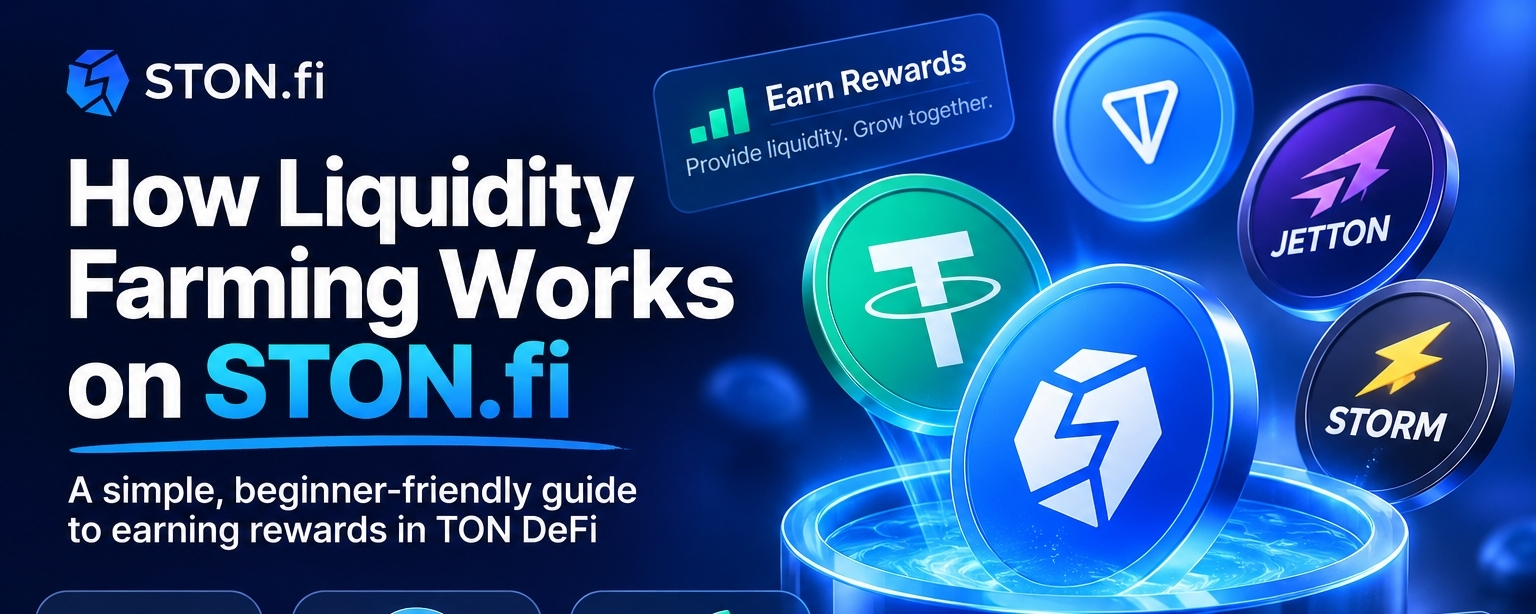
How Liquidity Farming Works on STON.fiEver looked at a DeFi farm showing a big APR or thousands of free tokens and thought, “This has to be easy money”?
You’re not alone. Most people do.
But here’s the truth: that big number on the screen is only one small part of the story. Liquidity farming can be useful and even rewarding when you understand how it actually works. When you don’t, it can quietly cost you.
Let’s walk through it together in plain English, using real examples from STON.fi (one of the biggest DEXs on the TON blockchain). No complicated jargon. Just clear explanations so you can decide for yourself.
This is educational only. Not financial advice. Always do your own research and check the latest numbers on the STON.fi app before doing anything with your money.
What Exactly Is Liquidity Farming?
Think of a decentralized exchange like a busy market. For people to trade tokens smoothly, the market needs plenty of goods on the shelves. Those “shelves” are called liquidity pools shared pots that hold pairs of tokens, for example STON and USDT.
When you put your tokens into one of these pools, you become a liquidity provider. In return, the platform gives you LP tokens. These are like a digital receipt that proves how much of the pool belongs to you. On STON.fi, you get them automatically the moment you add liquidity.
Farming is the extra layer on top. Some pools pay additional token rewards to people who keep their liquidity in the pool. The simple flow looks like this:
Add liquidity → Receive LP tokens → Stake the LP tokens in the farm → Possibly earn extra rewards
Notice the word “possibly.” The rewards are incentives, not a guaranteed salary.
Why Do Farms Even Exist?
Exchanges need deep liquidity so traders can swap without big price slips. But people won’t just lock up their tokens for free forever.
So projects offer farming rewards as a thank-you (and a way to attract more liquidity). It’s a three-way deal:
- Traders get smoother swaps
- Liquidity providers can earn trading fees plus farm rewards
- The project gets stronger markets for its tokens
That’s the basic engine behind most DeFi farming.
What’s Currently Farming on STON.fi?
Details change often, so always double-check the app. Here’s a clear snapshot of the main active farms (as of late August 2026):
STON/USDT
STON is the native token of the STON.fi protocol itself.
- 10,000 STON paid out every month
- Ongoing farm, no LP token lock-up
- Boost available: eligible STON stakers can get up to 2× the farm APR (usually by staking 500+ or 1,000+ STON). The boost has been running through the end of August in recent campaigns, with a typical per-user liquidity limit around $10,000.
This one shows how holding and staking the platform’s own token can give you an extra edge.
JETTON/USDT and JETTON/GRAM
JETTON belongs to JetTon Games, a GameFi project on TON.
- Each farm pays 200,000 JETTON per month
- Both run until 31 December 2026
- No LP lock-up
Same reward token, different pairs. That difference matters a lot for risk.
STORM/GRAM
STORM is connected to a perpetual trading platform on TON.
- 30,000 STORM every day
- Ongoing, no lock-up
A large daily number looks exciting until you remember that the real value depends on the token’s price and your share of the total farm.
The Truth About APR
A high APR does not mean your money will grow by that percentage.
APR is just an estimate based on today’s reward rate and today’s farm size. It can drop (or rise) when more people join, when rewards change, or when token prices move. Treat it as a snapshot, not a promise.
LP Tokens Your Receipt
LP tokens are simply proof that you own a piece of the pool. They’re not meant for speculation. They’re your claim on the liquidity you provided. When there’s no lock-up (like in these current farms), you can usually unstake and withdraw when you want just pay the normal network fees.
The One Risk You Must Understand: Impermanent Loss
This is the part many beginners skip and later regret.
Suppose you add equal amounts of Token A and Token B. If one token’s price moves a lot compared with the other, the pool automatically rebalances. When you leave, you may get back a different mix of tokens than you put in.
The difference between simply holding the tokens versus providing liquidity is called impermanent loss. It only becomes permanent when you withdraw.
Farming rewards can help cover some of this, but they don’t cancel the risk. High APR never equals guaranteed profit.
A Smarter Way to Choose a Farm
Forget “Which one has the biggest number?” Ask these instead:
1. Do I actually understand both tokens in the pair?
2. What token am I earning as a reward and how volatile is it?
3. Can the APR change, and how often?
4. What happens if prices move sharply?
5. Is there any lock-up?
6. Have I researched the project behind the tokens?
This simple checklist turns farming from a gamble into a thoughtful decision.
Why Liquidity Actually Matters
Healthy DeFi needs liquidity the same way a city needs roads. Without it, trading becomes expensive and slow. Liquidity providers supply those roads. Farming is just one tool projects use to encourage people to build them.
It’s not only about personal yield. It’s about how the whole system works together.
Final Thoughts
@stonfi farms (STON/USDT, the two JETTON pairs, STORM/GRAM and others) are useful real examples of how liquidity farming works on TON. Different assets, different reward tokens, different timelines perfect for learning.
Before you put any money in:
- Understand the pool
- Understand the rewards
- Understand APR
- Understand impermanent loss
- Understand the risks
And always DYOR.
In DeFi, knowing how the system works will serve you far better than chasing the flashiest number on the screen.
Check the latest farm details, APRs, and boost conditions yourself at app.ston.fi. Things change. Stay curious, stay careful, and enjoy learning how it all fits together.
#web3 #Stonfiers #STON.fi
How Liquidity Farming Works on STON.fi
Ever looked at a DeFi farm showing a big APR or thousands of free tokens and thought, “This has to be easy money”?
You’re not alone. Most people do.
But here’s the truth: that big number on the screen is only one small part of the story. Liquidity farming can be useful and even rewarding when you understand how it actually works. When you don’t, it can quietly cost you.
Let’s walk through it together in plain English, using real examples from STON.fi (one of the biggest DEXs on the TON blockchain). No complicated jargon. Just clear explanations so you can decide for yourself.
This is educational only. Not financial advice. Always do your own research and check the latest numbers on the STON.fi app before doing anything with your money.
What Exactly Is Liquidity Farming?
Think of a decentralized exchange like a busy market. For people to trade tokens smoothly, the market needs plenty of goods on the shelves. Those “shelves” are called liquidity pools shared pots that hold pairs of tokens, for example STON and USDT.
When you put your tokens into one of these pools, you become a liquidity provider. In return, the platform gives you LP tokens. These are like a digital receipt that proves how much of the pool belongs to you. On STON.fi, you get them automatically the moment you add liquidity.
Farming is the extra layer on top. Some pools pay additional token rewards to people who keep their liquidity in the pool. The simple flow looks like this:
Add liquidity → Receive LP tokens → Stake the LP tokens in the farm → Possibly earn extra rewards
Notice the word “possibly.” The rewards are incentives, not a guaranteed salary.
Why Do Farms Even Exist?
Exchanges need deep liquidity so traders can swap without big price slips. But people won’t just lock up their tokens for free forever.
So projects offer farming rewards as a thank-you (and a way to attract more liquidity). It’s a three-way deal:
- Traders get smoother swaps
- Liquidity providers can earn trading fees plus farm rewards
- The project gets stronger markets for its tokens
That’s the basic engine behind most DeFi farming.
What’s Currently Farming on STON.fi?
Details change often, so always double-check the app. Here’s a clear snapshot of the main active farms (as of late August 2026):
STON/USDT
STON is the native token of the STON.fi protocol itself.
- 10,000 STON paid out every month
- Ongoing farm, no LP token lock-up
- Boost available: eligible STON stakers can get up to 2× the farm APR (usually by staking 500+ or 1,000+ STON). The boost has been running through the end of August in recent campaigns, with a typical per-user liquidity limit around $10,000.
This one shows how holding and staking the platform’s own token can give you an extra edge.
JETTON/USDT and JETTON/GRAM
JETTON belongs to JetTon Games, a GameFi project on TON.
- Each farm pays 200,000 JETTON per month
- Both run until 31 December 2026
- No LP lock-up
Same reward token, different pairs. That difference matters a lot for risk.
STORM/GRAM
STORM is connected to a perpetual trading platform on TON.
- 30,000 STORM every day
- Ongoing, no lock-up
A large daily number looks exciting until you remember that the real value depends on the token’s price and your share of the total farm.
The Truth About APR
A high APR does not mean your money will grow by that percentage.
APR is just an estimate based on today’s reward rate and today’s farm size. It can drop (or rise) when more people join, when rewards change, or when token prices move. Treat it as a snapshot, not a promise.
LP Tokens Your Receipt
LP tokens are simply proof that you own a piece of the pool. They’re not meant for speculation. They’re your claim on the liquidity you provided. When there’s no lock-up (like in these current farms), you can usually unstake and withdraw when you want just pay the normal network fees.
The One Risk You Must Understand: Impermanent Loss
This is the part many beginners skip and later regret.
Suppose you add equal amounts of Token A and Token B. If one token’s price moves a lot compared with the other, the pool automatically rebalances. When you leave, you may get back a different mix of tokens than you put in.
The difference between simply holding the tokens versus providing liquidity is called impermanent loss. It only becomes permanent when you withdraw.
Farming rewards can help cover some of this, but they don’t cancel the risk. High APR never equals guaranteed profit.
A Smarter Way to Choose a Farm
Forget “Which one has the biggest number?” Ask these instead:
1. Do I actually understand both tokens in the pair?
2. What token am I earning as a reward and how volatile is it?
3. Can the APR change, and how often?
4. What happens if prices move sharply?
5. Is there any lock-up?
6. Have I researched the project behind the tokens?
This simple checklist turns farming from a gamble into a thoughtful decision.
Why Liquidity Actually Matters
Healthy DeFi needs liquidity the same way a city needs roads. Without it, trading becomes expensive and slow. Liquidity providers supply those roads. Farming is just one tool projects use to encourage people to build them.
It’s not only about personal yield. It’s about how the whole system works together.
Final Thoughts
@STONfi DEX farms (STON/USDT, the two JETTON pairs, STORM/GRAM and others) are useful real examples of how liquidity farming works on TON. Different assets, different reward tokens, different timelines perfect for learning.
Before you put any money in:
- Understand the pool
- Understand the rewards
- Understand APR
- Understand impermanent loss
- Understand the risks
And always DYOR.
In DeFi, knowing how the system works will serve you far better than chasing the flashiest number on the screen.
Check the latest farm details, APRs, and boost conditions yourself at app.ston.fi. Things change. Stay curious, stay careful, and enjoy learning how it all fits together.
#web3 #Stonfiers #STON.fi
You’re not alone. Most people do.
But here’s the truth: that big number on the screen is only one small part of the story. Liquidity farming can be useful and even rewarding when you understand how it actually works. When you don’t, it can quietly cost you.
Let’s walk through it together in plain English, using real examples from STON.fi (one of the biggest DEXs on the TON blockchain). No complicated jargon. Just clear explanations so you can decide for yourself.
This is educational only. Not financial advice. Always do your own research and check the latest numbers on the STON.fi app before doing anything with your money.
What Exactly Is Liquidity Farming?
Think of a decentralized exchange like a busy market. For people to trade tokens smoothly, the market needs plenty of goods on the shelves. Those “shelves” are called liquidity pools shared pots that hold pairs of tokens, for example STON and USDT.
When you put your tokens into one of these pools, you become a liquidity provider. In return, the platform gives you LP tokens. These are like a digital receipt that proves how much of the pool belongs to you. On STON.fi, you get them automatically the moment you add liquidity.
Farming is the extra layer on top. Some pools pay additional token rewards to people who keep their liquidity in the pool. The simple flow looks like this:
Add liquidity → Receive LP tokens → Stake the LP tokens in the farm → Possibly earn extra rewards
Notice the word “possibly.” The rewards are incentives, not a guaranteed salary.
Why Do Farms Even Exist?
Exchanges need deep liquidity so traders can swap without big price slips. But people won’t just lock up their tokens for free forever.
So projects offer farming rewards as a thank-you (and a way to attract more liquidity). It’s a three-way deal:
- Traders get smoother swaps
- Liquidity providers can earn trading fees plus farm rewards
- The project gets stronger markets for its tokens
That’s the basic engine behind most DeFi farming.
What’s Currently Farming on STON.fi?
Details change often, so always double-check the app. Here’s a clear snapshot of the main active farms (as of late August 2026):
STON/USDT
STON is the native token of the STON.fi protocol itself.
- 10,000 STON paid out every month
- Ongoing farm, no LP token lock-up
- Boost available: eligible STON stakers can get up to 2× the farm APR (usually by staking 500+ or 1,000+ STON). The boost has been running through the end of August in recent campaigns, with a typical per-user liquidity limit around $10,000.
This one shows how holding and staking the platform’s own token can give you an extra edge.
JETTON/USDT and JETTON/GRAM
JETTON belongs to JetTon Games, a GameFi project on TON.
- Each farm pays 200,000 JETTON per month
- Both run until 31 December 2026
- No LP lock-up
Same reward token, different pairs. That difference matters a lot for risk.
STORM/GRAM
STORM is connected to a perpetual trading platform on TON.
- 30,000 STORM every day
- Ongoing, no lock-up
A large daily number looks exciting until you remember that the real value depends on the token’s price and your share of the total farm.
The Truth About APR
A high APR does not mean your money will grow by that percentage.
APR is just an estimate based on today’s reward rate and today’s farm size. It can drop (or rise) when more people join, when rewards change, or when token prices move. Treat it as a snapshot, not a promise.
LP Tokens Your Receipt
LP tokens are simply proof that you own a piece of the pool. They’re not meant for speculation. They’re your claim on the liquidity you provided. When there’s no lock-up (like in these current farms), you can usually unstake and withdraw when you want just pay the normal network fees.
The One Risk You Must Understand: Impermanent Loss
This is the part many beginners skip and later regret.
Suppose you add equal amounts of Token A and Token B. If one token’s price moves a lot compared with the other, the pool automatically rebalances. When you leave, you may get back a different mix of tokens than you put in.
The difference between simply holding the tokens versus providing liquidity is called impermanent loss. It only becomes permanent when you withdraw.
Farming rewards can help cover some of this, but they don’t cancel the risk. High APR never equals guaranteed profit.
A Smarter Way to Choose a Farm
Forget “Which one has the biggest number?” Ask these instead:
1. Do I actually understand both tokens in the pair?
2. What token am I earning as a reward and how volatile is it?
3. Can the APR change, and how often?
4. What happens if prices move sharply?
5. Is there any lock-up?
6. Have I researched the project behind the tokens?
This simple checklist turns farming from a gamble into a thoughtful decision.
Why Liquidity Actually Matters
Healthy DeFi needs liquidity the same way a city needs roads. Without it, trading becomes expensive and slow. Liquidity providers supply those roads. Farming is just one tool projects use to encourage people to build them.
It’s not only about personal yield. It’s about how the whole system works together.
Final Thoughts
@STONfi DEX farms (STON/USDT, the two JETTON pairs, STORM/GRAM and others) are useful real examples of how liquidity farming works on TON. Different assets, different reward tokens, different timelines perfect for learning.
Before you put any money in:
- Understand the pool
- Understand the rewards
- Understand APR
- Understand impermanent loss
- Understand the risks
And always DYOR.
In DeFi, knowing how the system works will serve you far better than chasing the flashiest number on the screen.
Check the latest farm details, APRs, and boost conditions yourself at app.ston.fi. Things change. Stay curious, stay careful, and enjoy learning how it all fits together.
#web3 #Stonfiers #STON.fi
1
1
29
·
--
Bullish
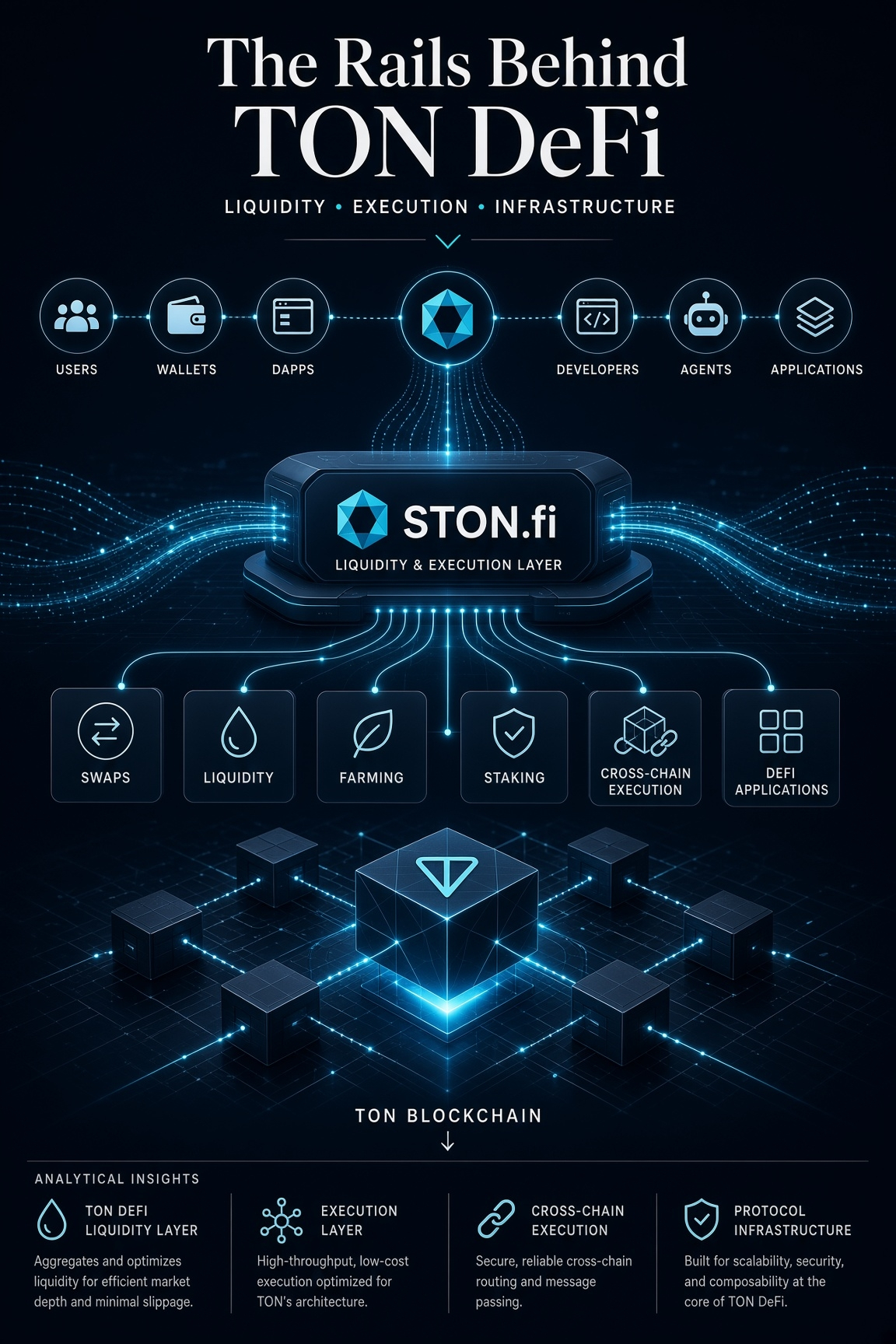
The Part of DeFi Users Rarely See: INFRASTRUCTURE
When someone swaps a token, the experience can look deceptively simple.
Select an asset.
Enter an amount.
Confirm the transaction.
But behind that interface is a much larger system involving liquidity, routing, execution and blockchain infrastructure.
This is where the infrastructure layer becomes important.
As the TON ecosystem grows, DeFi applications need reliable liquidity and efficient execution underneath them.
That creates an interesting shift in how we should evaluate DeFi.
Instead of asking only:
“What is popular?”
We should also ask:
“What infrastructure enables these applications to work?”
STON.fi is part of this infrastructure conversation through its role in liquidity and swaps within the TON ecosystem, while cross-chain capabilities expand the possible routes for users and assets.
The evolution of DeFi is therefore not only happening at the application layer.
It is also happening underneath it.
Infrastructure defines how efficiently an ecosystem can scale.
@ston_fi
#STON.fi $STON
blog.ston.fi
The Part of DeFi Users Rarely See: INFRASTRUCTURE
When someone swaps a token, the experience can look deceptively simple.
Select an asset.
Enter an amount.
Confirm the transaction.
But behind that interface is a much larger system involving liquidity, routing, execution and blockchain infrastructure.
This is where the infrastructure layer becomes important.
As the TON ecosystem grows, DeFi applications need reliable liquidity and efficient execution underneath them.
That creates an interesting shift in how we should evaluate DeFi.
Instead of asking only:
“What is popular?”
We should also ask:
“What infrastructure enables these applications to work?”
STON.fi is part of this infrastructure conversation through its role in liquidity and swaps within the TON ecosystem, while cross-chain capabilities expand the possible routes for users and assets.
The evolution of DeFi is therefore not only happening at the application layer.
It is also happening underneath it.
Infrastructure defines how efficiently an ecosystem can scale.
@ston_fi
#STON.fi $STON
blog.ston.fi
When someone swaps a token, the experience can look deceptively simple.
Select an asset.
Enter an amount.
Confirm the transaction.
But behind that interface is a much larger system involving liquidity, routing, execution and blockchain infrastructure.
This is where the infrastructure layer becomes important.
As the TON ecosystem grows, DeFi applications need reliable liquidity and efficient execution underneath them.
That creates an interesting shift in how we should evaluate DeFi.
Instead of asking only:
“What is popular?”
We should also ask:
“What infrastructure enables these applications to work?”
STON.fi is part of this infrastructure conversation through its role in liquidity and swaps within the TON ecosystem, while cross-chain capabilities expand the possible routes for users and assets.
The evolution of DeFi is therefore not only happening at the application layer.
It is also happening underneath it.
Infrastructure defines how efficiently an ecosystem can scale.
@ston_fi
#STON.fi $STON
blog.ston.fi
102
Why STON.fi Makes TON DeFi Feel Simpler
One of the biggest problems in DeFi isn't always the technology. It's the amount of complexity users have to navigate.
A simple swap can involve choosing a network, finding liquidity, comparing routes, checking slippage and worrying about whether an unfamiliar token or contract is legitimate.
STON.fi takes a different approach.
The user experience is centered around the action itself: connect a wallet, select the assets, review the transaction and swap.
Underneath that simple interface is the infrastructure that makes decentralized trading possible.
For me, that's an important measure of DeFi maturity.
The best protocol isn't necessarily the one that shows users the most machinery. It's the one that can make sophisticated infrastructure feel simple without taking custody away from the user.
That's where STON.fi's role in the TON ecosystem becomes interesting.
@stonfi #STON.fi
Why STON.fi Makes TON DeFi Feel Simpler
One of the biggest problems in DeFi isn't always the technology. It's the amount of complexity users have to navigate.
A simple swap can involve choosing a network, finding liquidity, comparing routes, checking slippage and worrying about whether an unfamiliar token or contract is legitimate.
STON.fi takes a different approach.
The user experience is centered around the action itself: connect a wallet, select the assets, review the transaction and swap.
Underneath that simple interface is the infrastructure that makes decentralized trading possible.
For me, that's an important measure of DeFi maturity.
The best protocol isn't necessarily the one that shows users the most machinery. It's the one that can make sophisticated infrastructure feel simple without taking custody away from the user.
That's where STON.fi's role in the TON ecosystem becomes interesting.
@STONfi DEX #STON.fi
One of the biggest problems in DeFi isn't always the technology. It's the amount of complexity users have to navigate.
A simple swap can involve choosing a network, finding liquidity, comparing routes, checking slippage and worrying about whether an unfamiliar token or contract is legitimate.
STON.fi takes a different approach.
The user experience is centered around the action itself: connect a wallet, select the assets, review the transaction and swap.
Underneath that simple interface is the infrastructure that makes decentralized trading possible.
For me, that's an important measure of DeFi maturity.
The best protocol isn't necessarily the one that shows users the most machinery. It's the one that can make sophisticated infrastructure feel simple without taking custody away from the user.
That's where STON.fi's role in the TON ecosystem becomes interesting.
@STONfi DEX #STON.fi
1
94

·
--
Bullish
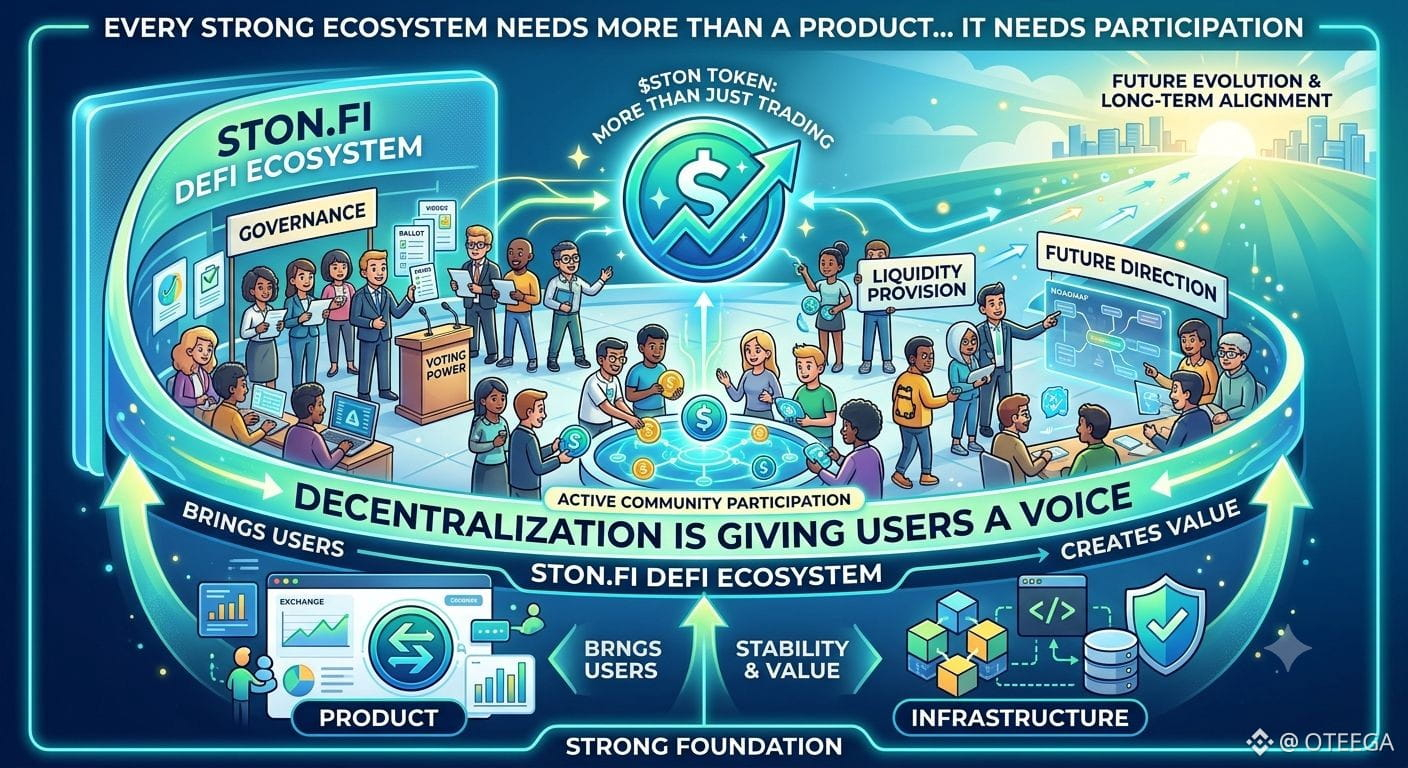
EVERY STRONG ECOSYSTEM NEEDS MORE THAN A PRODUCT.
IT NEEDS PARTICIPATION.
That’s where $STON becomes important.
A token should be more than something people trade on a chart.
In a growing DeFi ecosystem, it can become part of how the community participates in governance, liquidity, and the future direction of the protocol.
STON.fi is building an ecosystem where the community can play a role beyond simply being users.
Because decentralization isn’t just about removing middlemen.
It’s about giving the people who use the ecosystem a voice in how it evolves.
That’s what makes the $STON side of the ecosystem worth watching.
The product brings users.
Infrastructure creates value.
But community participation can help shape what comes next.
And in DeFi, that long-term alignment matters.
#STON.fi #OMNISTON #DEFI #DEX $SOL
EVERY STRONG ECOSYSTEM NEEDS MORE THAN A PRODUCT.
IT NEEDS PARTICIPATION.
That’s where $STON becomes important.
A token should be more than something people trade on a chart.
In a growing DeFi ecosystem, it can become part of how the community participates in governance, liquidity, and the future direction of the protocol.
STON.fi is building an ecosystem where the community can play a role beyond simply being users.
Because decentralization isn’t just about removing middlemen.
It’s about giving the people who use the ecosystem a voice in how it evolves.
That’s what makes the $STON side of the ecosystem worth watching.
The product brings users.
Infrastructure creates value.
But community participation can help shape what comes next.
And in DeFi, that long-term alignment matters.
#STON.fi #OMNISTON #DEFI #DEX $SOL
IT NEEDS PARTICIPATION.
That’s where $STON becomes important.
A token should be more than something people trade on a chart.
In a growing DeFi ecosystem, it can become part of how the community participates in governance, liquidity, and the future direction of the protocol.
STON.fi is building an ecosystem where the community can play a role beyond simply being users.
Because decentralization isn’t just about removing middlemen.
It’s about giving the people who use the ecosystem a voice in how it evolves.
That’s what makes the $STON side of the ecosystem worth watching.
The product brings users.
Infrastructure creates value.
But community participation can help shape what comes next.
And in DeFi, that long-term alignment matters.
#STON.fi #OMNISTON #DEFI #DEX $SOL
123
·
--
Bullish
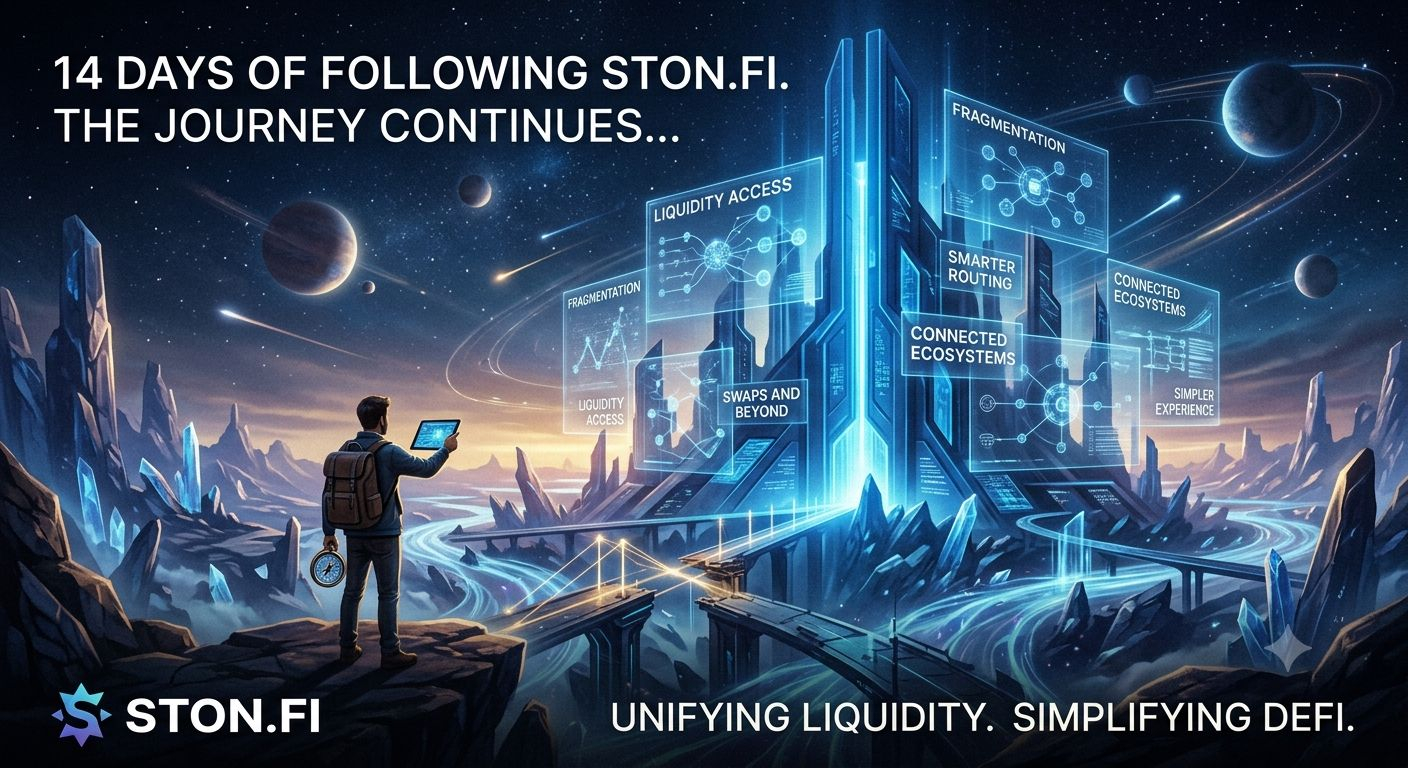
14 DAYS OF FOLLOWING WHAT STON.FI IS BUILDING.
And one thing is becoming clear.
The story is bigger than swaps.
The deeper problem is fragmentation.
Liquidity is everywhere.
But accessing it efficiently is still difficult.
Different chains.
Different pools.
Different routes.
Different experiences.
Over the past two weeks, I’ve been looking closely at how STON.fi and Omniston fit into this picture.
The thesis is simple:
DeFi doesn’t necessarily need more complexity.
It needs better infrastructure to manage the complexity that already exists.
That means:
Better liquidity access.
Smarter routing.
More connected ecosystems.
And a simpler experience for users.
Week 1 was about understanding the problem.
Week 2 was about understanding the infrastructure.
Next, I’m going deeper into what makes the STON.fi ecosystem work.
The journey continues.
#STON.fi #OMNISTON #Defi #swap
$ETH
14 DAYS OF FOLLOWING WHAT STON.FI IS BUILDING.
And one thing is becoming clear.
The story is bigger than swaps.
The deeper problem is fragmentation.
Liquidity is everywhere.
But accessing it efficiently is still difficult.
Different chains.
Different pools.
Different routes.
Different experiences.
Over the past two weeks, I’ve been looking closely at how STON.fi and Omniston fit into this picture.
The thesis is simple:
DeFi doesn’t necessarily need more complexity.
It needs better infrastructure to manage the complexity that already exists.
That means:
Better liquidity access.
Smarter routing.
More connected ecosystems.
And a simpler experience for users.
Week 1 was about understanding the problem.
Week 2 was about understanding the infrastructure.
Next, I’m going deeper into what makes the STON.fi ecosystem work.
The journey continues.
#STON.fi #OMNISTON #Defi #swap
$ETH
And one thing is becoming clear.
The story is bigger than swaps.
The deeper problem is fragmentation.
Liquidity is everywhere.
But accessing it efficiently is still difficult.
Different chains.
Different pools.
Different routes.
Different experiences.
Over the past two weeks, I’ve been looking closely at how STON.fi and Omniston fit into this picture.
The thesis is simple:
DeFi doesn’t necessarily need more complexity.
It needs better infrastructure to manage the complexity that already exists.
That means:
Better liquidity access.
Smarter routing.
More connected ecosystems.
And a simpler experience for users.
Week 1 was about understanding the problem.
Week 2 was about understanding the infrastructure.
Next, I’m going deeper into what makes the STON.fi ecosystem work.
The journey continues.
#STON.fi #OMNISTON #Defi #swap
$ETH
99

·
--
A cross-chain swap has two very different problems hiding underneath the interface.
First, you need to find a good deal.
Then you need to make sure that deal actually settles correctly.
Those problems sound connected, but they require different mechanisms.
STON.fi's architecture around Omniston is interesting because it treats them separately.
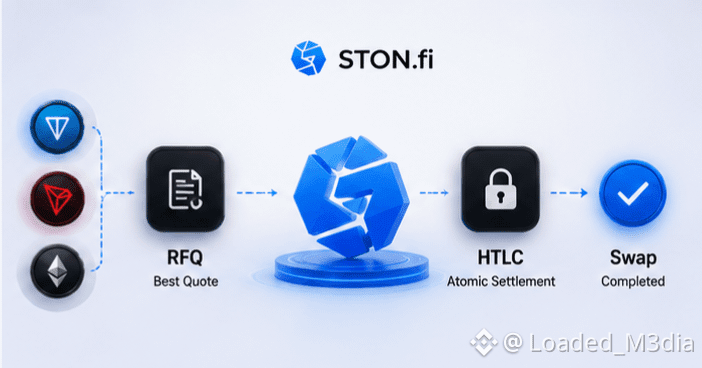
The first layer is RFQ, or Request for Quote.
Instead of leaving the user to search through different liquidity sources manually, the system can request quotes from professional resolvers.
Those resolvers compete to fill the trade, creating a quote-discovery process where the available offers can be compared before execution.
That solves the pricing and liquidity side of the problem.
But a quote is still just an agreement.
The assets eventually have to move.
That's where HTLC-based settlement comes in.
Hashed Timelock Contracts use cryptographic conditions and time limits to coordinate the two sides of a cross-chain swap.
Omniston uses paired HTLCs across the participating networks.
The important idea is atomicity.
The intended exchange either happens according to the agreed conditions or the process can revert through the timelock mechanism.
So you don't have one mechanism trying to solve everything.
RFQ helps answer:
"Who can give me the best available execution?"
HTLC helps answer:
"How do we settle that execution without turning the trade into a trust exercise?"
That combination is why the architecture is worth paying attention to.
Cross-chain DeFi isn't simply about moving an asset from Chain A to Chain B.
It involves liquidity discovery, pricing, counterparties, execution and settlement.
When those pieces are coordinated properly, the user can interact with the system through a much simpler experience.
The complexity still exists.
It's just where it belongs.
Underneath the interface.
#STON.fi #defi
A cross-chain swap has two very different problems hiding underneath the interface.
First, you need to find a good deal.
Then you need to make sure that deal actually settles correctly.
Those problems sound connected, but they require different mechanisms.
STON.fi's architecture around Omniston is interesting because it treats them separately.
The first layer is RFQ, or Request for Quote.
Instead of leaving the user to search through different liquidity sources manually, the system can request quotes from professional resolvers.
Those resolvers compete to fill the trade, creating a quote-discovery process where the available offers can be compared before execution.
That solves the pricing and liquidity side of the problem.
But a quote is still just an agreement.
The assets eventually have to move.
That's where HTLC-based settlement comes in.
Hashed Timelock Contracts use cryptographic conditions and time limits to coordinate the two sides of a cross-chain swap.
Omniston uses paired HTLCs across the participating networks.
The important idea is atomicity.
The intended exchange either happens according to the agreed conditions or the process can revert through the timelock mechanism.
So you don't have one mechanism trying to solve everything.
RFQ helps answer:
"Who can give me the best available execution?"
HTLC helps answer:
"How do we settle that execution without turning the trade into a trust exercise?"
That combination is why the architecture is worth paying attention to.
Cross-chain DeFi isn't simply about moving an asset from Chain A to Chain B.
It involves liquidity discovery, pricing, counterparties, execution and settlement.
When those pieces are coordinated properly, the user can interact with the system through a much simpler experience.
The complexity still exists.
It's just where it belongs.
Underneath the interface.
#STON.fi #defi
First, you need to find a good deal.
Then you need to make sure that deal actually settles correctly.
Those problems sound connected, but they require different mechanisms.
STON.fi's architecture around Omniston is interesting because it treats them separately.
The first layer is RFQ, or Request for Quote.
Instead of leaving the user to search through different liquidity sources manually, the system can request quotes from professional resolvers.
Those resolvers compete to fill the trade, creating a quote-discovery process where the available offers can be compared before execution.
That solves the pricing and liquidity side of the problem.
But a quote is still just an agreement.
The assets eventually have to move.
That's where HTLC-based settlement comes in.
Hashed Timelock Contracts use cryptographic conditions and time limits to coordinate the two sides of a cross-chain swap.
Omniston uses paired HTLCs across the participating networks.
The important idea is atomicity.
The intended exchange either happens according to the agreed conditions or the process can revert through the timelock mechanism.
So you don't have one mechanism trying to solve everything.
RFQ helps answer:
"Who can give me the best available execution?"
HTLC helps answer:
"How do we settle that execution without turning the trade into a trust exercise?"
That combination is why the architecture is worth paying attention to.
Cross-chain DeFi isn't simply about moving an asset from Chain A to Chain B.
It involves liquidity discovery, pricing, counterparties, execution and settlement.
When those pieces are coordinated properly, the user can interact with the system through a much simpler experience.
The complexity still exists.
It's just where it belongs.
Underneath the interface.
#STON.fi #defi
10

·
--
Bullish
The APR number on a DEX can be a little misleading if you don't look at what sits behind it.
I was going through the pools on STON.fi and noticed how different the numbers can be.
JETTON/USDT shows 0.08% APR but almost 49.4% farm APR.
TONG/GRAM is 0.43% APR with 64.91% farm APR.
Then JETTON/GRAM is showing 1.27% APR with 27.79% farm APR.
So what's actually happening?
The smaller APR is connected to the fees generated by trading activity.
The much bigger farm number comes from additional incentives.
That's an important difference when you're looking at a pool to provide liquidity.
If traders are using the pool, LPs earn their share of the fees generated from those swaps.
The farm incentive is extra. It can make the displayed return much higher, but it can also change or end when the incentive campaign changes.
So I wouldn't just look at 64.91% and assume that's what the pool naturally generates.
I'd first ask where the return is coming from.
Trading activity, or incentives?
That's one thing worth checking when exploring liquidity pools on STON.fi.
#STON.fi #TON
The APR number on a DEX can be a little misleading if you don't look at what sits behind it.
I was going through the pools on STON.fi and noticed how different the numbers can be.
JETTON/USDT shows 0.08% APR but almost 49.4% farm APR.
TONG/GRAM is 0.43% APR with 64.91% farm APR.
Then JETTON/GRAM is showing 1.27% APR with 27.79% farm APR.
So what's actually happening?
The smaller APR is connected to the fees generated by trading activity.
The much bigger farm number comes from additional incentives.
That's an important difference when you're looking at a pool to provide liquidity.
If traders are using the pool, LPs earn their share of the fees generated from those swaps.
The farm incentive is extra. It can make the displayed return much higher, but it can also change or end when the incentive campaign changes.
So I wouldn't just look at 64.91% and assume that's what the pool naturally generates.
I'd first ask where the return is coming from.
Trading activity, or incentives?
That's one thing worth checking when exploring liquidity pools on STON.fi.
#STON.fi #TON
I was going through the pools on STON.fi and noticed how different the numbers can be.
JETTON/USDT shows 0.08% APR but almost 49.4% farm APR.
TONG/GRAM is 0.43% APR with 64.91% farm APR.
Then JETTON/GRAM is showing 1.27% APR with 27.79% farm APR.
So what's actually happening?
The smaller APR is connected to the fees generated by trading activity.
The much bigger farm number comes from additional incentives.
That's an important difference when you're looking at a pool to provide liquidity.
If traders are using the pool, LPs earn their share of the fees generated from those swaps.
The farm incentive is extra. It can make the displayed return much higher, but it can also change or end when the incentive campaign changes.
So I wouldn't just look at 64.91% and assume that's what the pool naturally generates.
I'd first ask where the return is coming from.
Trading activity, or incentives?
That's one thing worth checking when exploring liquidity pools on STON.fi.
#STON.fi #TON
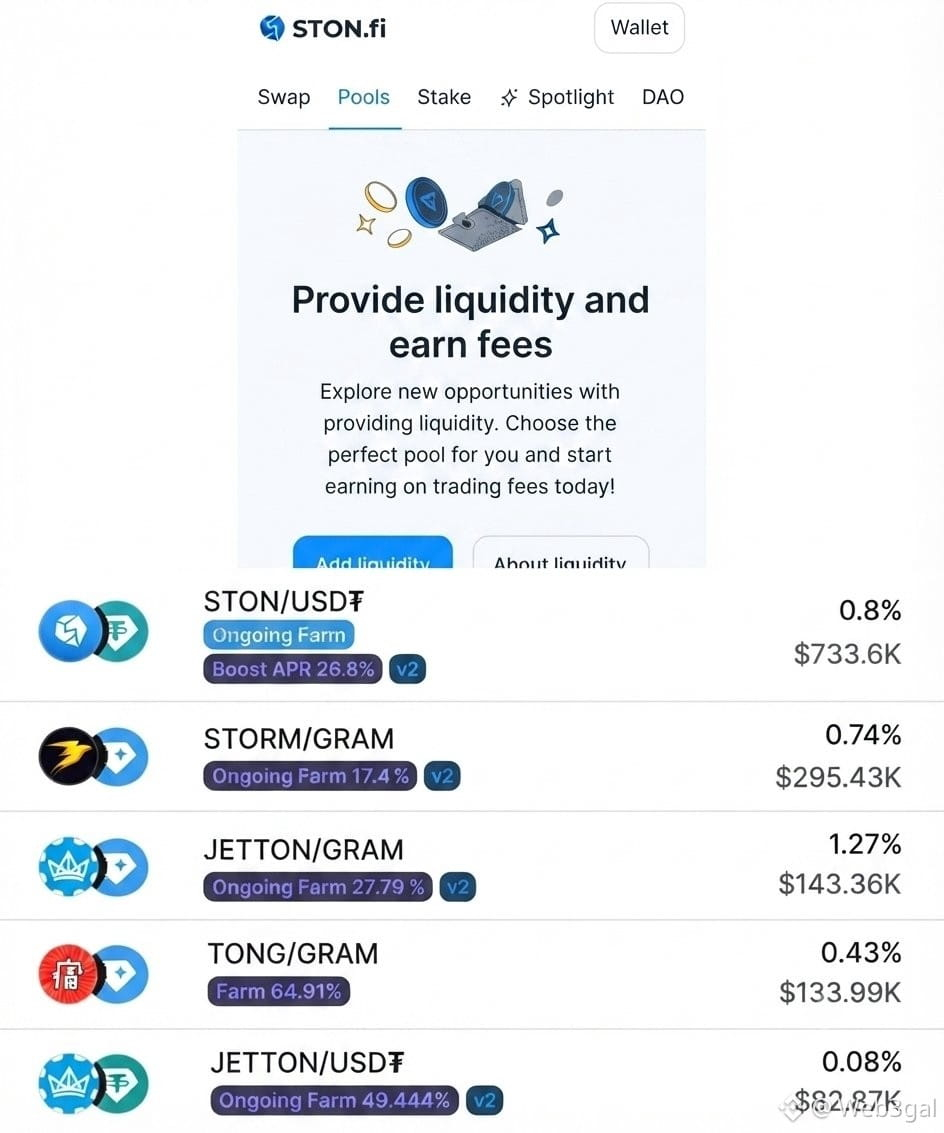
1
87

Why Originality Matters in STON.fi ContentWeb3 moves quickly.
When a project announces something important, dozens of creators may publish within minutes.
The result is often a timeline full of nearly identical posts.
That is exactly why originality matters.
The STON.fi Ambassador Program considers originality when reviewing contributions. This gives creators an opportunity to add their own perspective instead of simply rewriting official announcements.
Originality does not mean inventing information.
It means adding something useful.
Suppose STON.fi releases a product update.
A creator could copy the announcement.
Or they could ask:
What changed?
Why does it matter?
Who benefits?
How does it affect the user experience?
What should beginners understand?
That second approach creates original analysis.
The same principle works for educational content.
Instead of saying decentralized trading is useful, explain a real workflow.
Instead of saying liquidity matters, explain how liquidity can influence execution.
Instead of saying #STON.fi i is important to TON, explain the role a DEX plays in an expanding blockchain economy.
Specificity creates differentiation.
Personal experience creates authenticity.
Research creates accuracy.
Analysis creates depth.
That combination produces content that feels genuinely useful.
I would also make official links part of the workflow.
When readers can verify information directly, the content becomes more credible.
Accuracy matters especially in crypto because people can act on what they read.
That means ambassadors should avoid exaggerated promises, unsupported claims, and misleading financial language.
The best content respects the reader.
It teaches without pretending.
It promotes without exaggerating.
It explains without hiding limitations.
In a crowded Web3 timeline, this becomes a competitive advantage.
People may forget another promotional post.
They are more likely to remember the creator who helped them understand something difficult.
That is the kind of originality worth building.
Not originality for attention.
Originality through usefulness.
#STONfi #GRAM #DEFİ
Why Originality Matters in STON.fi Content
Web3 moves quickly.
When a project announces something important, dozens of creators may publish within minutes.
The result is often a timeline full of nearly identical posts.
That is exactly why originality matters.
The STON.fi Ambassador Program considers originality when reviewing contributions. This gives creators an opportunity to add their own perspective instead of simply rewriting official announcements.
Originality does not mean inventing information.
It means adding something useful.
Suppose STON.fi releases a product update.
A creator could copy the announcement.
Or they could ask:
What changed?
Why does it matter?
Who benefits?
How does it affect the user experience?
What should beginners understand?
That second approach creates original analysis.
The same principle works for educational content.
Instead of saying decentralized trading is useful, explain a real workflow.
Instead of saying liquidity matters, explain how liquidity can influence execution.
Instead of saying #STON.fi i is important to TON, explain the role a DEX plays in an expanding blockchain economy.
Specificity creates differentiation.
Personal experience creates authenticity.
Research creates accuracy.
Analysis creates depth.
That combination produces content that feels genuinely useful.
I would also make official links part of the workflow.
When readers can verify information directly, the content becomes more credible.
Accuracy matters especially in crypto because people can act on what they read.
That means ambassadors should avoid exaggerated promises, unsupported claims, and misleading financial language.
The best content respects the reader.
It teaches without pretending.
It promotes without exaggerating.
It explains without hiding limitations.
In a crowded Web3 timeline, this becomes a competitive advantage.
People may forget another promotional post.
They are more likely to remember the creator who helped them understand something difficult.
That is the kind of originality worth building.
Not originality for attention.
Originality through usefulness.
#STONfi #GRAM #DEFİ
When a project announces something important, dozens of creators may publish within minutes.
The result is often a timeline full of nearly identical posts.
That is exactly why originality matters.
The STON.fi Ambassador Program considers originality when reviewing contributions. This gives creators an opportunity to add their own perspective instead of simply rewriting official announcements.
Originality does not mean inventing information.
It means adding something useful.
Suppose STON.fi releases a product update.
A creator could copy the announcement.
Or they could ask:
What changed?
Why does it matter?
Who benefits?
How does it affect the user experience?
What should beginners understand?
That second approach creates original analysis.
The same principle works for educational content.
Instead of saying decentralized trading is useful, explain a real workflow.
Instead of saying liquidity matters, explain how liquidity can influence execution.
Instead of saying #STON.fi i is important to TON, explain the role a DEX plays in an expanding blockchain economy.
Specificity creates differentiation.
Personal experience creates authenticity.
Research creates accuracy.
Analysis creates depth.
That combination produces content that feels genuinely useful.
I would also make official links part of the workflow.
When readers can verify information directly, the content becomes more credible.
Accuracy matters especially in crypto because people can act on what they read.
That means ambassadors should avoid exaggerated promises, unsupported claims, and misleading financial language.
The best content respects the reader.
It teaches without pretending.
It promotes without exaggerating.
It explains without hiding limitations.
In a crowded Web3 timeline, this becomes a competitive advantage.
People may forget another promotional post.
They are more likely to remember the creator who helped them understand something difficult.
That is the kind of originality worth building.
Not originality for attention.
Originality through usefulness.
#STONfi #GRAM #DEFİ
82

·
--
Why TON Needs Better DeFi EducationBlockchain adoption is not only a technology problem.
It is also an education problem.
Many users hear terms like liquidity pools, automated market makers, routing, staking, farming, and cross chain swaps without understanding what they actually mean.
That creates friction.
STON.fi operates within the TON ecosystem, making it an interesting platform through which users can learn practical DeFi concepts.
The opportunity for Stonbassadors is therefore larger than promotion.
A contributor can take complicated protocol mechanics and turn them into understandable education.
Imagine explaining a liquidity pool using a simple real world example. Then connect that example to how #STON.fi works. Follow that with a practical explanation of what users should check before supplying liquidity.
That is useful content.
The current Stonbassador program explicitly encourages contributors to participate according to their skills, interests, and understanding of STON.fi, while allowing room for creativity beyond predefined examples. �
STON
This creates an important advantage.
You do not need to sound like an advertisement.
You need to sound like someone who understands the product.
Good content can focus on user education, ecosystem analysis, feature explanations, tutorials, product observations, or broader DeFi research.
Originality matters because copied information adds little value.
Integrity matters because misleading information damages communities.
Professionalism matters because ambassadors represent more than themselves.
The best strategy is simple:
Learn the protocol deeply.
Identify one useful insight.
Explain it clearly.
Add your own perspective.
Then publish something that teaches the reader something they did not understand before.
That is how community content becomes ecosystem infrastructure.
#STONfi #GRAM #defi
Why TON Needs Better DeFi Education
Blockchain adoption is not only a technology problem.
It is also an education problem.
Many users hear terms like liquidity pools, automated market makers, routing, staking, farming, and cross chain swaps without understanding what they actually mean.
That creates friction.
STON.fi operates within the TON ecosystem, making it an interesting platform through which users can learn practical DeFi concepts.
The opportunity for Stonbassadors is therefore larger than promotion.
A contributor can take complicated protocol mechanics and turn them into understandable education.
Imagine explaining a liquidity pool using a simple real world example. Then connect that example to how #STON.fi works. Follow that with a practical explanation of what users should check before supplying liquidity.
That is useful content.
The current Stonbassador program explicitly encourages contributors to participate according to their skills, interests, and understanding of STON.fi, while allowing room for creativity beyond predefined examples. �
STON
This creates an important advantage.
You do not need to sound like an advertisement.
You need to sound like someone who understands the product.
Good content can focus on user education, ecosystem analysis, feature explanations, tutorials, product observations, or broader DeFi research.
Originality matters because copied information adds little value.
Integrity matters because misleading information damages communities.
Professionalism matters because ambassadors represent more than themselves.
The best strategy is simple:
Learn the protocol deeply.
Identify one useful insight.
Explain it clearly.
Add your own perspective.
Then publish something that teaches the reader something they did not understand before.
That is how community content becomes ecosystem infrastructure.
#STONfi #GRAM #defi
It is also an education problem.
Many users hear terms like liquidity pools, automated market makers, routing, staking, farming, and cross chain swaps without understanding what they actually mean.
That creates friction.
STON.fi operates within the TON ecosystem, making it an interesting platform through which users can learn practical DeFi concepts.
The opportunity for Stonbassadors is therefore larger than promotion.
A contributor can take complicated protocol mechanics and turn them into understandable education.
Imagine explaining a liquidity pool using a simple real world example. Then connect that example to how #STON.fi works. Follow that with a practical explanation of what users should check before supplying liquidity.
That is useful content.
The current Stonbassador program explicitly encourages contributors to participate according to their skills, interests, and understanding of STON.fi, while allowing room for creativity beyond predefined examples. �
STON
This creates an important advantage.
You do not need to sound like an advertisement.
You need to sound like someone who understands the product.
Good content can focus on user education, ecosystem analysis, feature explanations, tutorials, product observations, or broader DeFi research.
Originality matters because copied information adds little value.
Integrity matters because misleading information damages communities.
Professionalism matters because ambassadors represent more than themselves.
The best strategy is simple:
Learn the protocol deeply.
Identify one useful insight.
Explain it clearly.
Add your own perspective.
Then publish something that teaches the reader something they did not understand before.
That is how community content becomes ecosystem infrastructure.
#STONfi #GRAM #defi
1
86
·
--
Bullish
WHAT IF YOU DIDN’T HAVE TO SEARCH FOR THE BEST LIQUIDITY YOURSELF?
That’s the idea behind liquidity aggregation.
Imagine there are several pools offering the same swap.
One might have deeper liquidity.
Another might offer better pricing.
Another could provide a more efficient route.
Instead of making the user check everything manually, an aggregation layer can look across available liquidity and help identify a better route.
That’s where Omniston comes in.
STON.fi is building infrastructure designed to connect liquidity across different sources and ecosystems.
The user sees a simple swap.
Behind the scenes, the infrastructure handles much of the complexity.
That’s the kind of UX DeFi needs if it wants to reach the next level.
Better liquidity access.
Less friction.
More efficient execution.
#STON.fi #DEFI #swap #ton #OMNISTON
$BTC $ETH $NVDA.US
WHAT IF YOU DIDN’T HAVE TO SEARCH FOR THE BEST LIQUIDITY YOURSELF?
That’s the idea behind liquidity aggregation.
Imagine there are several pools offering the same swap.
One might have deeper liquidity.
Another might offer better pricing.
Another could provide a more efficient route.
Instead of making the user check everything manually, an aggregation layer can look across available liquidity and help identify a better route.
That’s where Omniston comes in.
STON.fi is building infrastructure designed to connect liquidity across different sources and ecosystems.
The user sees a simple swap.
Behind the scenes, the infrastructure handles much of the complexity.
That’s the kind of UX DeFi needs if it wants to reach the next level.
Better liquidity access.
Less friction.
More efficient execution.
#STON.fi #DEFI #swap #ton #OMNISTON
$BTC $ETH $NVDA.US
That’s the idea behind liquidity aggregation.
Imagine there are several pools offering the same swap.
One might have deeper liquidity.
Another might offer better pricing.
Another could provide a more efficient route.
Instead of making the user check everything manually, an aggregation layer can look across available liquidity and help identify a better route.
That’s where Omniston comes in.
STON.fi is building infrastructure designed to connect liquidity across different sources and ecosystems.
The user sees a simple swap.
Behind the scenes, the infrastructure handles much of the complexity.
That’s the kind of UX DeFi needs if it wants to reach the next level.
Better liquidity access.
Less friction.
More efficient execution.
#STON.fi #DEFI #swap #ton #OMNISTON
$BTC $ETH $NVDA.US
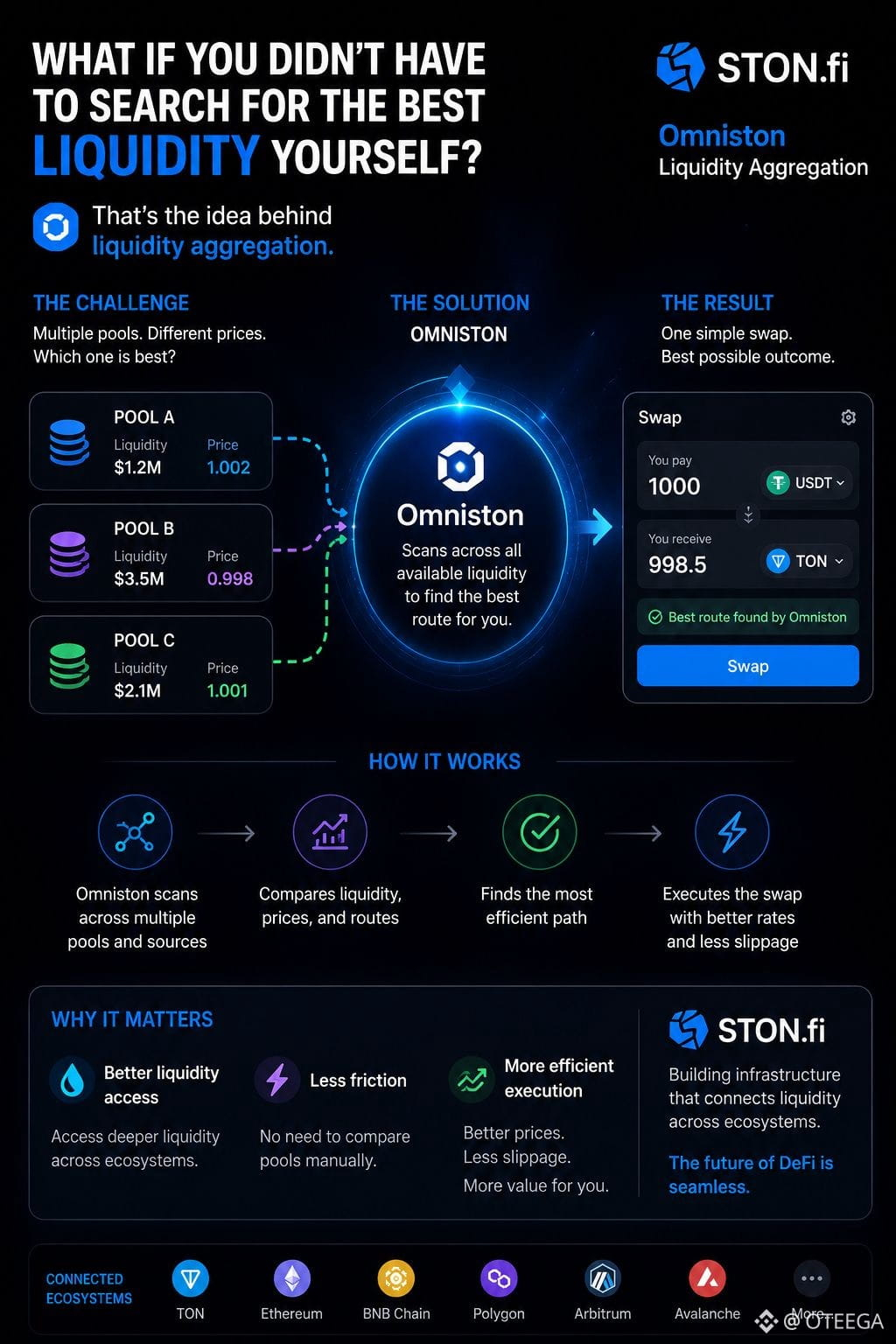
118

·
--
Cross chain swaps just became a little easier.
STON.fi now lets you choose a custom destination address when making a cross chain swap.
You don't need to connect a wallet on both chains.
Simply:
1️⃣ Connect your source wallet
2️⃣ Turn on “Receive to custom address”
3️⃣ Paste the wallet address you want to receive the tokens
4️⃣ Confirm
The feature currently supports assets across $TON , $TRON.US , $Ethereum, $BNB Chain, Base, Avalanche, Arbitrum, Polygon and Robinhood Chain.
I like this kind of improvement because it solves a real user problem: fewer wallet connections and a cleaner cross-chain flow.
Just remember to verify the destination address and network before signing.
https://app.ston.fi/swap
#STON.fi #TON #BinanceSquare #Web3
Cross chain swaps just became a little easier.
STON.fi now lets you choose a custom destination address when making a cross chain swap.
You don't need to connect a wallet on both chains.
Simply:
1️⃣ Connect your source wallet
2️⃣ Turn on “Receive to custom address”
3️⃣ Paste the wallet address you want to receive the tokens
4️⃣ Confirm
The feature currently supports assets across $TON , $TRON.US , $Ethereum, $BNB Chain, Base, Avalanche, Arbitrum, Polygon and Robinhood Chain.
I like this kind of improvement because it solves a real user problem: fewer wallet connections and a cleaner cross-chain flow.
Just remember to verify the destination address and network before signing.
https://app.ston.fi/swap
#STON.fi #TON #BinanceSquare #Web3
STON.fi now lets you choose a custom destination address when making a cross chain swap.
You don't need to connect a wallet on both chains.
Simply:
1️⃣ Connect your source wallet
2️⃣ Turn on “Receive to custom address”
3️⃣ Paste the wallet address you want to receive the tokens
4️⃣ Confirm
The feature currently supports assets across $TON , $TRON.US , $Ethereum, $BNB Chain, Base, Avalanche, Arbitrum, Polygon and Robinhood Chain.
I like this kind of improvement because it solves a real user problem: fewer wallet connections and a cleaner cross-chain flow.
Just remember to verify the destination address and network before signing.
https://app.ston.fi/swap
#STON.fi #TON #BinanceSquare #Web3
3
108

·
--
Bullish
Why STON.fi Is Attracting Attention From Top Crypto Investors
In every market cycle, a few investors consistently identify transformative platforms before the broader market recognizes their potential.
Ribbit Capital is one of those investors.
The firm previously backed Robinhood and @Coin-Base at early stages, helping support two companies that went on to reshape fintech and crypto adoption.
Now Ribbit Capital has participated in STON.fi's $9.5 million Series A round alongside CoinFund and Delphi Ventures.
The numbers behind @stonfi are already significant:
• Over $6 billion in cumulative trading volume
• More than 27 million transactions processed
• Over 80% share of TON's DEX market volume
As the TON ecosystem continues to expand, infrastructure projects capable of supporting large-scale liquidity and user activity become increasingly important.
#STON.fi has positioned itself as a key component of $TON DeFi landscape, providing the trading infrastructure that many users and projects rely on today.
When experienced investors with a history of identifying major industry winners allocate capital to a protocol, it often signals confidence in the long-term growth potential of that ecosystem.
The market will ultimately decide the outcome, but STON.fi is clearly becoming one of the most closely watched projects within TON DeFi.
Why STON.fi Is Attracting Attention From Top Crypto Investors
In every market cycle, a few investors consistently identify transformative platforms before the broader market recognizes their potential.
Ribbit Capital is one of those investors.
The firm previously backed Robinhood and @Coin_base at early stages, helping support two companies that went on to reshape fintech and crypto adoption.
Now Ribbit Capital has participated in STON.fi's $9.5 million Series A round alongside CoinFund and Delphi Ventures.
The numbers behind @STONfi DEX are already significant:
• Over $6 billion in cumulative trading volume
• More than 27 million transactions processed
• Over 80% share of TON's DEX market volume
As the TON ecosystem continues to expand, infrastructure projects capable of supporting large-scale liquidity and user activity become increasingly important.
#STON.fi has positioned itself as a key component of $TON DeFi landscape, providing the trading infrastructure that many users and projects rely on today.
When experienced investors with a history of identifying major industry winners allocate capital to a protocol, it often signals confidence in the long-term growth potential of that ecosystem.
The market will ultimately decide the outcome, but STON.fi is clearly becoming one of the most closely watched projects within TON DeFi.
In every market cycle, a few investors consistently identify transformative platforms before the broader market recognizes their potential.
Ribbit Capital is one of those investors.
The firm previously backed Robinhood and @Coin_base at early stages, helping support two companies that went on to reshape fintech and crypto adoption.
Now Ribbit Capital has participated in STON.fi's $9.5 million Series A round alongside CoinFund and Delphi Ventures.
The numbers behind @STONfi DEX are already significant:
• Over $6 billion in cumulative trading volume
• More than 27 million transactions processed
• Over 80% share of TON's DEX market volume
As the TON ecosystem continues to expand, infrastructure projects capable of supporting large-scale liquidity and user activity become increasingly important.
#STON.fi has positioned itself as a key component of $TON DeFi landscape, providing the trading infrastructure that many users and projects rely on today.
When experienced investors with a history of identifying major industry winners allocate capital to a protocol, it often signals confidence in the long-term growth potential of that ecosystem.
The market will ultimately decide the outcome, but STON.fi is clearly becoming one of the most closely watched projects within TON DeFi.
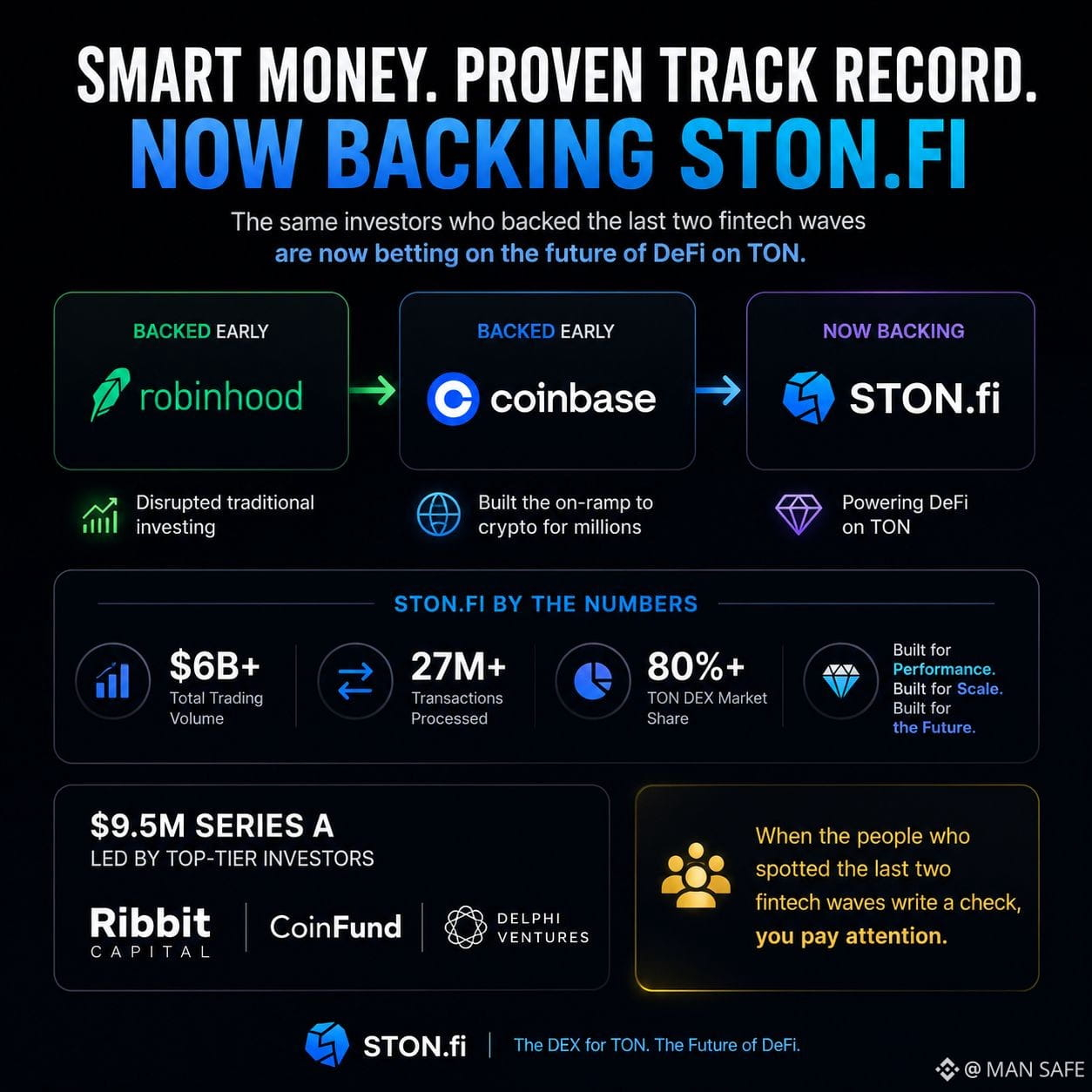
1
153

·
--
STON.fi Is Turning @ton_blockchain Into a More Connected Financial Ecosystem
Crypto has always been fragmented.
Bitcoin liquidity sits in one ecosystem. Tokenised assets operate elsewhere. Stablecoins and DeFi liquidity are spread across multiple networks.
For users, that often means moving between platforms just to access different opportunities.
@stonfi is helping reduce that fragmentation within TON.
Its expanding ecosystem brings together assets such as cbBTC, xStocks, stablecoins, cross-chain assets, and DeFi tokens, giving users broader access through a self-custodial experience.
But the bigger opportunity is not simply adding more assets.
It is connecting liquidity.
When assets, liquidity, and users can interact more seamlessly, the TON ecosystem becomes more useful for both everyday users and DeFi applications.
Self-custody also remains central. Users can access these opportunities while maintaining control of their funds rather than relying on a centralised intermediary.
As DeFi matures, connectivity and liquidity infrastructure could become increasingly important.
#STON.fi is positioning itself around that trend, helping connect different assets and liquidity sources across TON and beyond.
The next phase of TON may not be about having more isolated assets.
It could be about creating a more connected financial ecosystem where those assets can actually move, trade, and interact efficiently.
That is the infrastructure layer worth watching.
Always DYOR before interacting with DeFi protocols.
#DEFİ #STONfi
STON.fi Is Turning @Ton Network Into a More Connected Financial Ecosystem
Crypto has always been fragmented.
Bitcoin liquidity sits in one ecosystem. Tokenised assets operate elsewhere. Stablecoins and DeFi liquidity are spread across multiple networks.
For users, that often means moving between platforms just to access different opportunities.
@STONfi DEX is helping reduce that fragmentation within TON.
Its expanding ecosystem brings together assets such as cbBTC, xStocks, stablecoins, cross-chain assets, and DeFi tokens, giving users broader access through a self-custodial experience.
But the bigger opportunity is not simply adding more assets.
It is connecting liquidity.
When assets, liquidity, and users can interact more seamlessly, the TON ecosystem becomes more useful for both everyday users and DeFi applications.
Self-custody also remains central. Users can access these opportunities while maintaining control of their funds rather than relying on a centralised intermediary.
As DeFi matures, connectivity and liquidity infrastructure could become increasingly important.
#STON.fi is positioning itself around that trend, helping connect different assets and liquidity sources across TON and beyond.
The next phase of TON may not be about having more isolated assets.
It could be about creating a more connected financial ecosystem where those assets can actually move, trade, and interact efficiently.
That is the infrastructure layer worth watching.
Always DYOR before interacting with DeFi protocols.
#DEFİ #STONfi
Crypto has always been fragmented.
Bitcoin liquidity sits in one ecosystem. Tokenised assets operate elsewhere. Stablecoins and DeFi liquidity are spread across multiple networks.
For users, that often means moving between platforms just to access different opportunities.
@STONfi DEX is helping reduce that fragmentation within TON.
Its expanding ecosystem brings together assets such as cbBTC, xStocks, stablecoins, cross-chain assets, and DeFi tokens, giving users broader access through a self-custodial experience.
But the bigger opportunity is not simply adding more assets.
It is connecting liquidity.
When assets, liquidity, and users can interact more seamlessly, the TON ecosystem becomes more useful for both everyday users and DeFi applications.
Self-custody also remains central. Users can access these opportunities while maintaining control of their funds rather than relying on a centralised intermediary.
As DeFi matures, connectivity and liquidity infrastructure could become increasingly important.
#STON.fi is positioning itself around that trend, helping connect different assets and liquidity sources across TON and beyond.
The next phase of TON may not be about having more isolated assets.
It could be about creating a more connected financial ecosystem where those assets can actually move, trade, and interact efficiently.
That is the infrastructure layer worth watching.
Always DYOR before interacting with DeFi protocols.
#DEFİ #STONfi
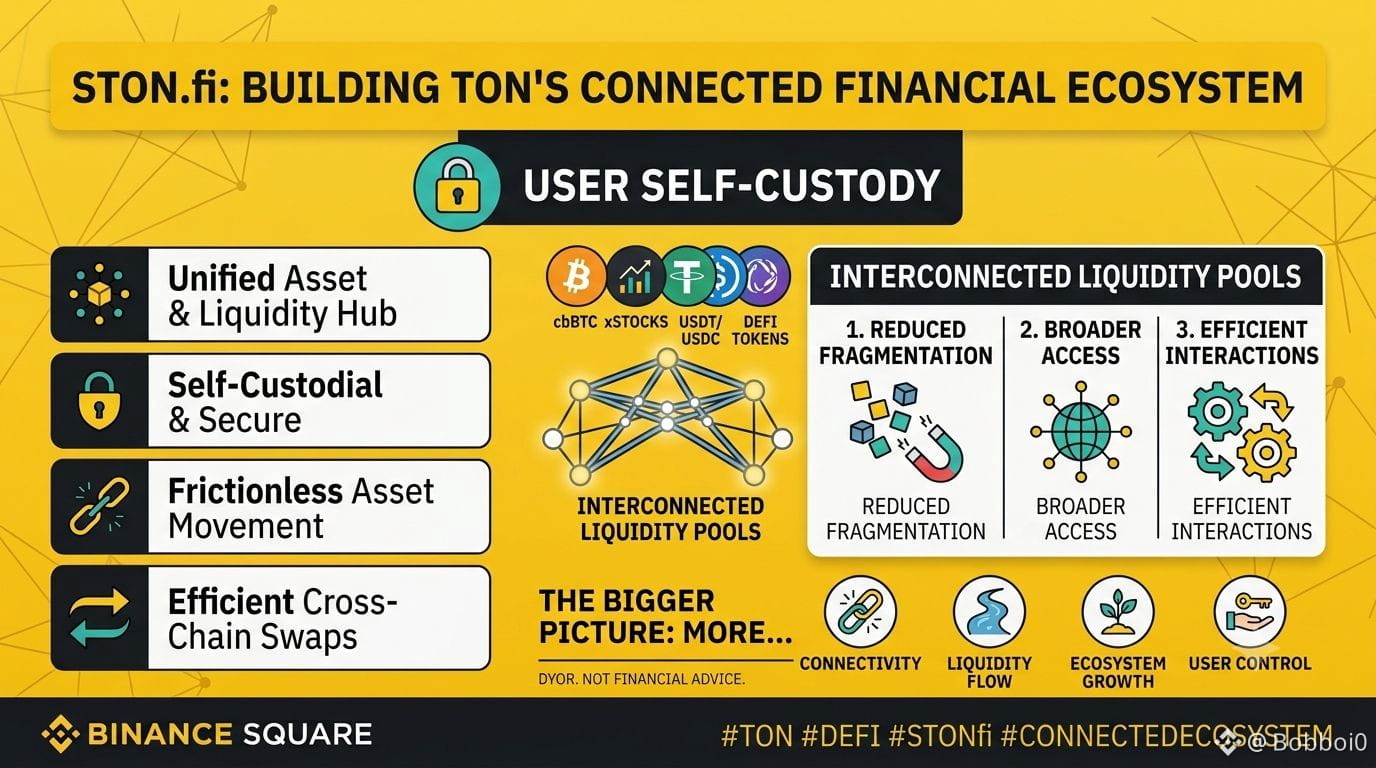
2
99

·
--

Article
Robinhood Chain Joins STON.fi's Expanding Cross-Chain EcosystemCross-chain infrastructure is no longer just about transferring assets between blockchains. It is becoming the layer that connects entire ecosystems and creates a more unified Web3 experience.
With the integration of Robinhood Chain, #STON.fi continues expanding its cross-chain network, giving $GRAM users seamless access to tokenized assets, stablecoins and on-chain markets all from a single interface.
Why Robinhood Chain?
As an EVM-compatible Layer 2, Robinhood Chain is built to power the next generation of on-chain finance. Its integration introduces new opportunities for users to interact with tokenized real-world assets (RWAs), stablecoins, and a growing range of decentralized applications.
Supported Cross-Chain Assets
Users can now swap stablecoins across multiple ecosystems including:
- USDT on TON
- USDG on Robinhood Chain
- USDT and USDC on Ethereum, Base, BNB Chain, and Avalanche
- USDT0 and USDC on Arbitrum
- PUSD and USDC on Polygon
Built for Simplicity
Every cross-chain transaction is powered by Omniston, STON.fi's execution layer, which automatically handles routing, pricing, and settlement. Users simply choose the asset, select the destination, confirm the quote, and receive the expected amount most swaps are completed within 15–40 seconds.
Key Highlights
- Seamless access to Robinhood Chain from the STON.fi interface.
- Efficient cross-chain swaps across leading blockchain ecosystems.
- Smart execution powered by Omniston for optimal routing and pricing.
- Typical settlement time of 15–40 seconds.
- Initial rollout includes a $1,000 maximum per transaction on Robinhood Chain.
The significance of this integration extends beyond adding another supported network.
It reinforces a future where blockchain complexity fades into the background, allowing users to focus on the experience rather than the infrastructure.
By connecting more ecosystems under one interface, STON.fi continues moving Web3 toward a truly interconnected financial network where accessing liquidity across chains feels as seamless as using a single blockchain.
#STONfi @stonfi $GRAM
#TON #Robinhood
Robinhood Chain Joins STON.fi's Expanding Cross-Chain Ecosystem
Cross-chain infrastructure is no longer just about transferring assets between blockchains. It is becoming the layer that connects entire ecosystems and creates a more unified Web3 experience.
With the integration of Robinhood Chain, #STON.fi continues expanding its cross-chain network, giving $GRAM users seamless access to tokenized assets, stablecoins and on-chain markets all from a single interface.
Why Robinhood Chain?
As an EVM-compatible Layer 2, Robinhood Chain is built to power the next generation of on-chain finance. Its integration introduces new opportunities for users to interact with tokenized real-world assets (RWAs), stablecoins, and a growing range of decentralized applications.
Supported Cross-Chain Assets
Users can now swap stablecoins across multiple ecosystems including:
- USDT on TON
- USDG on Robinhood Chain
- USDT and USDC on Ethereum, Base, BNB Chain, and Avalanche
- USDT0 and USDC on Arbitrum
- PUSD and USDC on Polygon
Built for Simplicity
Every cross-chain transaction is powered by Omniston, STON.fi's execution layer, which automatically handles routing, pricing, and settlement. Users simply choose the asset, select the destination, confirm the quote, and receive the expected amount most swaps are completed within 15–40 seconds.
Key Highlights
- Seamless access to Robinhood Chain from the STON.fi interface.
- Efficient cross-chain swaps across leading blockchain ecosystems.
- Smart execution powered by Omniston for optimal routing and pricing.
- Typical settlement time of 15–40 seconds.
- Initial rollout includes a $1,000 maximum per transaction on Robinhood Chain.
The significance of this integration extends beyond adding another supported network.
It reinforces a future where blockchain complexity fades into the background, allowing users to focus on the experience rather than the infrastructure.
By connecting more ecosystems under one interface, STON.fi continues moving Web3 toward a truly interconnected financial network where accessing liquidity across chains feels as seamless as using a single blockchain.
#STONfi @STONfi DEX $GRAM
#TON #Robinhood
With the integration of Robinhood Chain, #STON.fi continues expanding its cross-chain network, giving $GRAM users seamless access to tokenized assets, stablecoins and on-chain markets all from a single interface.
Why Robinhood Chain?
As an EVM-compatible Layer 2, Robinhood Chain is built to power the next generation of on-chain finance. Its integration introduces new opportunities for users to interact with tokenized real-world assets (RWAs), stablecoins, and a growing range of decentralized applications.
Supported Cross-Chain Assets
Users can now swap stablecoins across multiple ecosystems including:
- USDT on TON
- USDG on Robinhood Chain
- USDT and USDC on Ethereum, Base, BNB Chain, and Avalanche
- USDT0 and USDC on Arbitrum
- PUSD and USDC on Polygon
Built for Simplicity
Every cross-chain transaction is powered by Omniston, STON.fi's execution layer, which automatically handles routing, pricing, and settlement. Users simply choose the asset, select the destination, confirm the quote, and receive the expected amount most swaps are completed within 15–40 seconds.
Key Highlights
- Seamless access to Robinhood Chain from the STON.fi interface.
- Efficient cross-chain swaps across leading blockchain ecosystems.
- Smart execution powered by Omniston for optimal routing and pricing.
- Typical settlement time of 15–40 seconds.
- Initial rollout includes a $1,000 maximum per transaction on Robinhood Chain.
The significance of this integration extends beyond adding another supported network.
It reinforces a future where blockchain complexity fades into the background, allowing users to focus on the experience rather than the infrastructure.
By connecting more ecosystems under one interface, STON.fi continues moving Web3 toward a truly interconnected financial network where accessing liquidity across chains feels as seamless as using a single blockchain.
#STONfi @STONfi DEX $GRAM
#TON #Robinhood
1
96
Log in to explore more content
Join global crypto users on Binance Square
⚡️ Get latest and useful information about crypto.
💬 Trusted by the world’s largest crypto exchange.
👍 Discover real insights from verified creators.
Email / Phone number
Trending Topics
1
#ChainlinkPowersBottomlinePaymentPlatform
1,099 views
69 Discussing
2
#StellarActivatesProtocol28At211TPS
9,060 views
271 Discussing
3
#SECGrantsInnovationExemptionForTokenizedStocks
7,109 views
218 Discussing
4
#XRPGains3%AsRippleAddsMPPSupport
5,192 views
160 Discussing
5
#SPGlobalToAcquireOpenZeppelin
3,538 views
129 Discussing
6
#WorldLaunchesSelfCustodyAppIn150Countries
1,081 views
50 Discussing
7
#BitcoinSurpasses$77000
21,089 views
247 Discussing
8
#ParadigmDisclosesZECHolding
91,613 views
1,253 Discussing
9
#BitcoinETFsShed$450M
29,572 views
231 Discussing
10
#USWeeklyJoblessClaimsFallTo196K
49,661 views
722 Discussing