

#quantum
quantum
159,257 views
572 Discussing
Hot
Latest

🚨 $QNT IS MOVING LIKE IT HAS SOMETHING TO PROVE 😂🔥 QNT just printed a $357 intraday high while trading volume crossed $1.5B. 👀 The crazy part? Its current price is still far below its $428 ATH. After a move this violent, #QNT #quantum #Crypto #BinanceSquare
the real question is: Can QNT reclaim its ATH? 🟢
🚨 $QNT IS MOVING LIKE IT HAS SOMETHING TO PROVE 😂🔥 QNT just printed a $357 intraday high while trading volume crossed $1.5B. 👀 The crazy part? Its current price is still far below its $428 ATH. After a move this violent, #QNT #quantum #Crypto #BinanceSquare
the real question is: Can QNT reclaim its ATH? 🟢
the real question is: Can QNT reclaim its ATH? 🟢
🟢 A. Easily 🚀
55%
🟡 B. Needs a pullback 📉
29%
🔵 C. More sideways first 😴
0%
😴 🟣 D. Too risky now 🤔
16%
38 votes • Voting closed
1.8k

Bitcoin ($BTC)’s quantum‑risk roadmap took three concrete steps this week.
A cost breakthrough slashes the price tag of post‑quantum cryptographic tools, opening the door for broader network upgrades.
At the same time, a new privacy design adds hidden layers to transaction data, raising the bar for any quantum decryption effort. Finally, a custody playbook spells out how custodians can shift to quantum‑resistant keys without disrupting service. These moves turn theoretical worries into actionable logistics. Which of these three advances—lower costs, stronger privacy, or clear custody guidance—offers the most immediate safeguard for Bitcoin?
#Bitcoin #Quantum #Security #Cryptography #Research
Bitcoin ($BTC )’s quantum‑risk roadmap took three concrete steps this week.
A cost breakthrough slashes the price tag of post‑quantum cryptographic tools, opening the door for broader network upgrades.
At the same time, a new privacy design adds hidden layers to transaction data, raising the bar for any quantum decryption effort. Finally, a custody playbook spells out how custodians can shift to quantum‑resistant keys without disrupting service. These moves turn theoretical worries into actionable logistics. Which of these three advances—lower costs, stronger privacy, or clear custody guidance—offers the most immediate safeguard for Bitcoin?
#Bitcoin #Quantum #Security #Cryptography #Research
A cost breakthrough slashes the price tag of post‑quantum cryptographic tools, opening the door for broader network upgrades.
At the same time, a new privacy design adds hidden layers to transaction data, raising the bar for any quantum decryption effort. Finally, a custody playbook spells out how custodians can shift to quantum‑resistant keys without disrupting service. These moves turn theoretical worries into actionable logistics. Which of these three advances—lower costs, stronger privacy, or clear custody guidance—offers the most immediate safeguard for Bitcoin?
#Bitcoin #Quantum #Security #Cryptography #Research
53

·
--
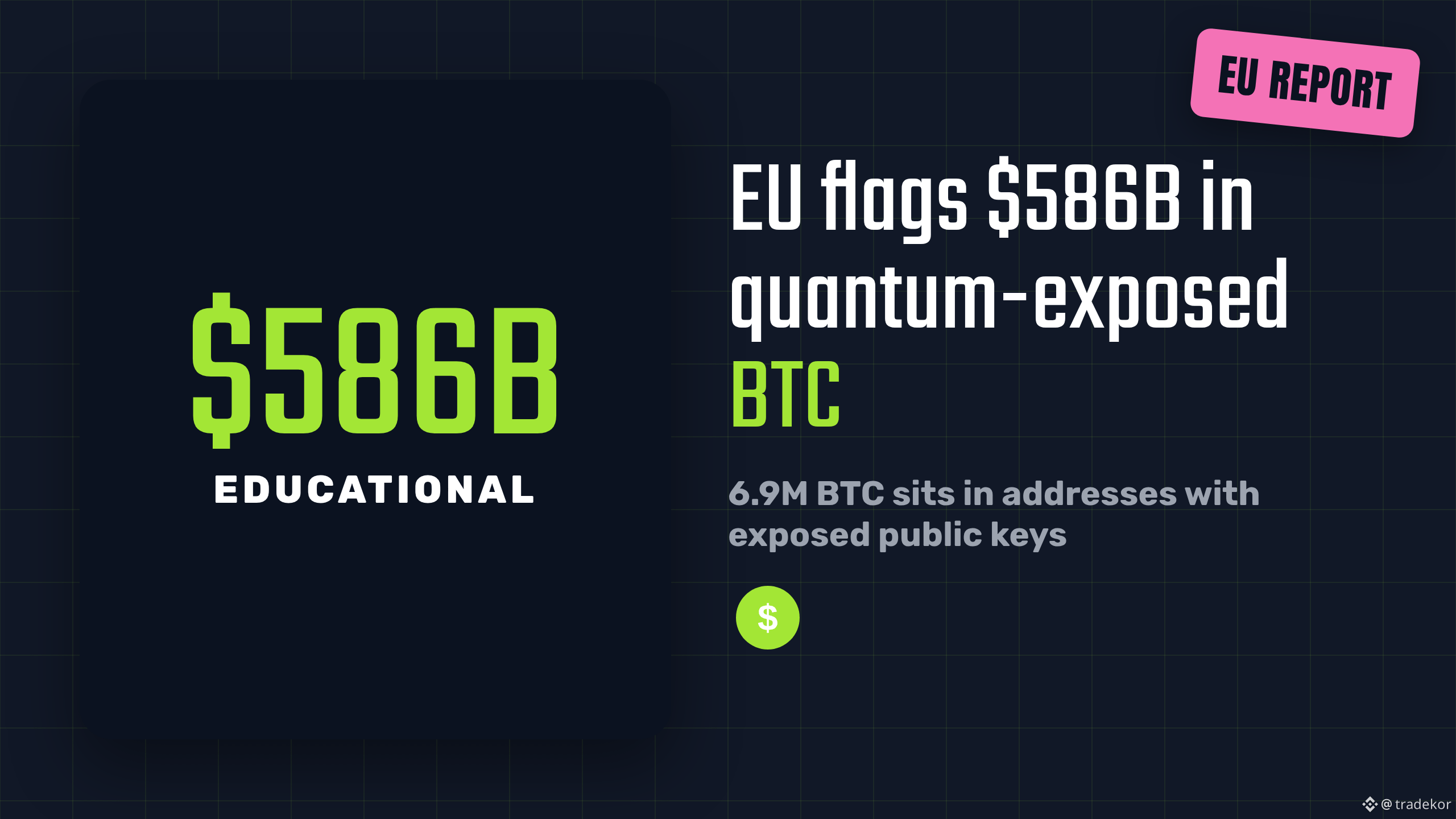
6.9 million BTC (~$586B) sits in addresses EU regulators say a quantum computer could crack -- possibly before the tech is even commercially useful for anything else.
That's roughly a third of all circulating Bitcoin.
The news: The EU's three financial supervisory authorities (EBA, ESMA, EIOPA -- collectively "the ESAs") published their Autumn 2026 Risk Update on Sept 23, warning that advanced quantum computers could break the elliptic-curve cryptography securing blockchains "earlier than any viable commercial application" for the tech. The specific risk: legacy or reused Bitcoin addresses where the public key is already exposed on-chain, making them uniquely vulnerable to a "harvest now, decrypt later" attack -- adversaries collecting exposed public keys today, then decrypting them once a powerful enough quantum machine exists. The European Commission is urging member states to start post-quantum migration by end-2026; Ethereum has set a Dec 2029 deadline for its own quantum-resistant upgrade. Bitcoin has no agreed migration path yet -- proposals exist (BIP-360/361) but remain contested.
The catch: this is a risk timeline, not an imminent event -- no quantum computer today can actually break this cryptography, and estimates for when one might vary widely across the field. The real news is regulators formally flagging it as a systemic risk worth planning for now, not a countdown clock.
Our read: the interesting tension here isn't the science, it's the governance problem -- fixing this on Bitcoin requires networkwide consensus and moving billions in exposed coins, which is a coordination challenge with no clean precedent.
Does a formal EU regulator warning change your urgency on this, or does "quantum threat" still feel too far off to plan around?
Not financial advice. DYOR.
$BTC #CryptoNews #Quantum #Security
6.9 million BTC (~$586B) sits in addresses EU regulators say a quantum computer could crack -- possibly before the tech is even commercially useful for anything else.
That's roughly a third of all circulating Bitcoin.
The news: The EU's three financial supervisory authorities (EBA, ESMA, EIOPA -- collectively "the ESAs") published their Autumn 2026 Risk Update on Sept 23, warning that advanced quantum computers could break the elliptic-curve cryptography securing blockchains "earlier than any viable commercial application" for the tech. The specific risk: legacy or reused Bitcoin addresses where the public key is already exposed on-chain, making them uniquely vulnerable to a "harvest now, decrypt later" attack -- adversaries collecting exposed public keys today, then decrypting them once a powerful enough quantum machine exists. The European Commission is urging member states to start post-quantum migration by end-2026; Ethereum has set a Dec 2029 deadline for its own quantum-resistant upgrade. Bitcoin has no agreed migration path yet -- proposals exist (BIP-360/361) but remain contested.
The catch: this is a risk timeline, not an imminent event -- no quantum computer today can actually break this cryptography, and estimates for when one might vary widely across the field. The real news is regulators formally flagging it as a systemic risk worth planning for now, not a countdown clock.
Our read: the interesting tension here isn't the science, it's the governance problem -- fixing this on Bitcoin requires networkwide consensus and moving billions in exposed coins, which is a coordination challenge with no clean precedent.
Does a formal EU regulator warning change your urgency on this, or does "quantum threat" still feel too far off to plan around?
Not financial advice. DYOR.
$BTC #CryptoNews #Quantum #Security
That's roughly a third of all circulating Bitcoin.
The news: The EU's three financial supervisory authorities (EBA, ESMA, EIOPA -- collectively "the ESAs") published their Autumn 2026 Risk Update on Sept 23, warning that advanced quantum computers could break the elliptic-curve cryptography securing blockchains "earlier than any viable commercial application" for the tech. The specific risk: legacy or reused Bitcoin addresses where the public key is already exposed on-chain, making them uniquely vulnerable to a "harvest now, decrypt later" attack -- adversaries collecting exposed public keys today, then decrypting them once a powerful enough quantum machine exists. The European Commission is urging member states to start post-quantum migration by end-2026; Ethereum has set a Dec 2029 deadline for its own quantum-resistant upgrade. Bitcoin has no agreed migration path yet -- proposals exist (BIP-360/361) but remain contested.
The catch: this is a risk timeline, not an imminent event -- no quantum computer today can actually break this cryptography, and estimates for when one might vary widely across the field. The real news is regulators formally flagging it as a systemic risk worth planning for now, not a countdown clock.
Our read: the interesting tension here isn't the science, it's the governance problem -- fixing this on Bitcoin requires networkwide consensus and moving billions in exposed coins, which is a coordination challenge with no clean precedent.
Does a formal EU regulator warning change your urgency on this, or does "quantum threat" still feel too far off to plan around?
Not financial advice. DYOR.
$BTC #CryptoNews #Quantum #Security
86

Quantum Threat: EU Sounds the Alarm
EU financial regulators have warned that quantum computing threatens blockchain encryption, and the issue of old addresses with public keys has become more urgent. At the same time, a week of working with AI coding lowered the estimated cost of a Bitcoin quantum-resistant transaction from $320 to $66. The topic of the year.
#Quantum #bitcoin #NFA✅
Quantum Threat: EU Sounds the Alarm
EU financial regulators have warned that quantum computing threatens blockchain encryption, and the issue of old addresses with public keys has become more urgent. At the same time, a week of working with AI coding lowered the estimated cost of a Bitcoin quantum-resistant transaction from $320 to $66. The topic of the year.
#Quantum #bitcoin #NFA✅
EU financial regulators have warned that quantum computing threatens blockchain encryption, and the issue of old addresses with public keys has become more urgent. At the same time, a week of working with AI coding lowered the estimated cost of a Bitcoin quantum-resistant transaction from $320 to $66. The topic of the year.
#Quantum #bitcoin #NFA✅

32

🚨 EU regulatory warning: quantum computing may weaken blockchain security 🧠
📊 | $BTC | $ETH | $BNB |
- Please follow, like, and comment to discuss industry developments together. 📈
- EU regulatory authorities warn that quantum computing technology could break existing blockchain encryption algorithms.
- The concern relates to the Bitcoin network, and developers are assessing draft proposals to migrate to quantum-resistant solutions.
- Ethereum’s official roadmap shows the goal is to complete a quantum security upgrade by 2029. 🔥
- If quantum attacks become feasible, it could raise market concerns about Bitcoin’s security, and prices may face near-term pressure.
- Regulators’ attention may push the industry to accelerate R&D on quantum-resistant chains, and related projects are expected to attract funding.
- Currently, whale activity remains neutral, with no large-scale buying or selling.
- In the short term, market sentiment is expected to stay range-bound, and investors may prefer to wait and watch.
- What do you think will be the long-term impact of quantum computing on crypto assets? Feel free to share your views.
- Stay tuned for our in-depth analysis—leave a comment to tell us what you think.
- #Bitcoin #Ethereum #Quantum #Crypto #Blockchain
🚨 EU regulatory warning: quantum computing may weaken blockchain security 🧠
📊 | $BTC | $ETH | $BNB |
- Please follow, like, and comment to discuss industry developments together. 📈
- EU regulatory authorities warn that quantum computing technology could break existing blockchain encryption algorithms.
- The concern relates to the Bitcoin network, and developers are assessing draft proposals to migrate to quantum-resistant solutions.
- Ethereum’s official roadmap shows the goal is to complete a quantum security upgrade by 2029. 🔥
- If quantum attacks become feasible, it could raise market concerns about Bitcoin’s security, and prices may face near-term pressure.
- Regulators’ attention may push the industry to accelerate R&D on quantum-resistant chains, and related projects are expected to attract funding.
- Currently, whale activity remains neutral, with no large-scale buying or selling.
- In the short term, market sentiment is expected to stay range-bound, and investors may prefer to wait and watch.
- What do you think will be the long-term impact of quantum computing on crypto assets? Feel free to share your views.
- Stay tuned for our in-depth analysis—leave a comment to tell us what you think.
- #Bitcoin #Ethereum #Quantum #Crypto #Blockchain
📊 | $BTC | $ETH | $BNB |
- Please follow, like, and comment to discuss industry developments together. 📈
- EU regulatory authorities warn that quantum computing technology could break existing blockchain encryption algorithms.
- The concern relates to the Bitcoin network, and developers are assessing draft proposals to migrate to quantum-resistant solutions.
- Ethereum’s official roadmap shows the goal is to complete a quantum security upgrade by 2029. 🔥
- If quantum attacks become feasible, it could raise market concerns about Bitcoin’s security, and prices may face near-term pressure.
- Regulators’ attention may push the industry to accelerate R&D on quantum-resistant chains, and related projects are expected to attract funding.
- Currently, whale activity remains neutral, with no large-scale buying or selling.
- In the short term, market sentiment is expected to stay range-bound, and investors may prefer to wait and watch.
- What do you think will be the long-term impact of quantum computing on crypto assets? Feel free to share your views.
- Stay tuned for our in-depth analysis—leave a comment to tell us what you think.
- #Bitcoin #Ethereum #Quantum #Crypto #Blockchain
17
🚨 Bitcoin or achieves quantum security, but Lightning Network privacy is still threatened 🧠
📊 | $BTC | $ETH | $BNB |
- Please follow, like, and comment to share your views and discuss together. 📈
- PQLN uses sub-millisecond encryption across five off-chain layers to enhance quantum security.
- The default design leads to an approximately 10.2x increase in gossip download volume across the network.
- Bitcoin as a whole may achieve quantum resistance, but Lightning Network privacy has not yet been improved.
- This technology was disclosed on CryptoSlate for the first time, and market sentiment remains neutral. 🔥
- If quantum security is implemented, Bitcoin may attract institutional attention, and in the short term the price may stay range-bound.
- Lightning Network privacy remains exposed, which could cause some users to move to other Layer-2 solutions.
- Whale activity remains neutral, with no signs of large buy/sell orders, so its impact on the market is limited.
- Bitcoin’s near-term volatility is expected to be limited, and the overall trend is still mainly sideways consolidation.
- Do you think quantum-secure technology can improve Bitcoin’s long-term value? Feel free to share your opinion.
- Please keep an eye on our in-depth analysis and leave your comments.
#Bitcoin #Crypto #Quantum #Lightning #Whales
🚨 Bitcoin or achieves quantum security, but Lightning Network privacy is still threatened 🧠
📊 | $BTC | $ETH | $BNB |
- Please follow, like, and comment to share your views and discuss together. 📈
- PQLN uses sub-millisecond encryption across five off-chain layers to enhance quantum security.
- The default design leads to an approximately 10.2x increase in gossip download volume across the network.
- Bitcoin as a whole may achieve quantum resistance, but Lightning Network privacy has not yet been improved.
- This technology was disclosed on CryptoSlate for the first time, and market sentiment remains neutral. 🔥
- If quantum security is implemented, Bitcoin may attract institutional attention, and in the short term the price may stay range-bound.
- Lightning Network privacy remains exposed, which could cause some users to move to other Layer-2 solutions.
- Whale activity remains neutral, with no signs of large buy/sell orders, so its impact on the market is limited.
- Bitcoin’s near-term volatility is expected to be limited, and the overall trend is still mainly sideways consolidation.
- Do you think quantum-secure technology can improve Bitcoin’s long-term value? Feel free to share your opinion.
- Please keep an eye on our in-depth analysis and leave your comments.
#Bitcoin #Crypto #Quantum #Lightning #Whales
📊 | $BTC | $ETH | $BNB |
- Please follow, like, and comment to share your views and discuss together. 📈
- PQLN uses sub-millisecond encryption across five off-chain layers to enhance quantum security.
- The default design leads to an approximately 10.2x increase in gossip download volume across the network.
- Bitcoin as a whole may achieve quantum resistance, but Lightning Network privacy has not yet been improved.
- This technology was disclosed on CryptoSlate for the first time, and market sentiment remains neutral. 🔥
- If quantum security is implemented, Bitcoin may attract institutional attention, and in the short term the price may stay range-bound.
- Lightning Network privacy remains exposed, which could cause some users to move to other Layer-2 solutions.
- Whale activity remains neutral, with no signs of large buy/sell orders, so its impact on the market is limited.
- Bitcoin’s near-term volatility is expected to be limited, and the overall trend is still mainly sideways consolidation.
- Do you think quantum-secure technology can improve Bitcoin’s long-term value? Feel free to share your opinion.
- Please keep an eye on our in-depth analysis and leave your comments.
#Bitcoin #Crypto #Quantum #Lightning #Whales
274
🚨 AI agents significantly reduce the cost of quantum attacks on Bitcoin 🧠
📊 | $BTC | $ETH | $BNB |
- Please follow, like, and comment—share your thoughts together. 📈
- The ECDSA.Fail challenge shows that the resource requirements for the key components of quantum attacks on Bitcoin drop by 86%.
- This benchmark targets implementations of the Elliptic Curve Digital Signature Algorithm (ECDSA) against potential quantum attacks.
- Research indicates that using AI agents can substantially optimize attack paths and reduce computational costs.
- This technology is still in the experimental stage, and its real-world impact on network security remains to be observed. 🔥
- The market may believe quantum risk remains manageable in the short term, and the price may trade sideways.
- If quantum attack costs fall further, regulatory pressure could increase, potentially leading to capital outflows.
- Currently, there have been no significant changes in large-holder behavior; holdings remain neutral.
- In the short term, Bitcoin’s volatility is expected to stay within a low range.
- How long do you think until advances in quantum technology have a substantive impact on Bitcoin?
- Keep following our in-depth analysis and share your insights.
- #Bitcoin #Crypto #Quantum #Security #Whales
🚨 AI agents significantly reduce the cost of quantum attacks on Bitcoin 🧠
📊 | $BTC | $ETH | $BNB |
- Please follow, like, and comment—share your thoughts together. 📈
- The ECDSA.Fail challenge shows that the resource requirements for the key components of quantum attacks on Bitcoin drop by 86%.
- This benchmark targets implementations of the Elliptic Curve Digital Signature Algorithm (ECDSA) against potential quantum attacks.
- Research indicates that using AI agents can substantially optimize attack paths and reduce computational costs.
- This technology is still in the experimental stage, and its real-world impact on network security remains to be observed. 🔥
- The market may believe quantum risk remains manageable in the short term, and the price may trade sideways.
- If quantum attack costs fall further, regulatory pressure could increase, potentially leading to capital outflows.
- Currently, there have been no significant changes in large-holder behavior; holdings remain neutral.
- In the short term, Bitcoin’s volatility is expected to stay within a low range.
- How long do you think until advances in quantum technology have a substantive impact on Bitcoin?
- Keep following our in-depth analysis and share your insights.
- #Bitcoin #Crypto #Quantum #Security #Whales
📊 | $BTC | $ETH | $BNB |
- Please follow, like, and comment—share your thoughts together. 📈
- The ECDSA.Fail challenge shows that the resource requirements for the key components of quantum attacks on Bitcoin drop by 86%.
- This benchmark targets implementations of the Elliptic Curve Digital Signature Algorithm (ECDSA) against potential quantum attacks.
- Research indicates that using AI agents can substantially optimize attack paths and reduce computational costs.
- This technology is still in the experimental stage, and its real-world impact on network security remains to be observed. 🔥
- The market may believe quantum risk remains manageable in the short term, and the price may trade sideways.
- If quantum attack costs fall further, regulatory pressure could increase, potentially leading to capital outflows.
- Currently, there have been no significant changes in large-holder behavior; holdings remain neutral.
- In the short term, Bitcoin’s volatility is expected to stay within a low range.
- How long do you think until advances in quantum technology have a substantive impact on Bitcoin?
- Keep following our in-depth analysis and share your insights.
- #Bitcoin #Crypto #Quantum #Security #Whales
74

·
--
Bullish
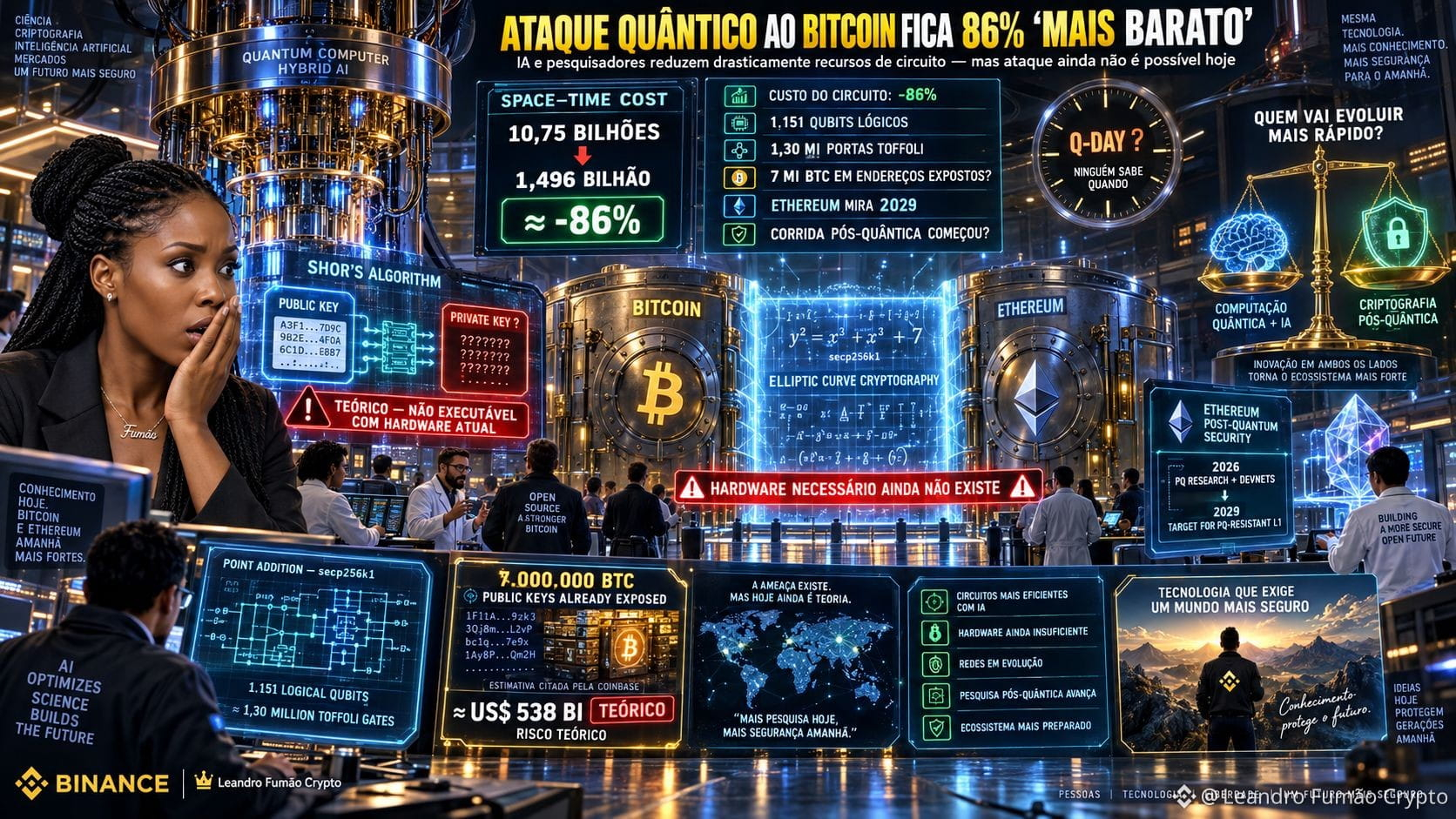
⚔️🛡️💸 QUANTUM ATTACK ON ₿ITCOIN BECOMES 86% “CHEAPER” IN JUST 2 MONTHS🤺
The race between blockchain and quantum computing has just gained a new alert.
An open challenge with more than 100 researchers and AI agents managed to reduce by approximately 86% a space-time cost metric of an essential circuit for a potential quantum attack on the cryptography used by Bitcoin and Ethereum.
The new circuit for the secp256k1 curve uses about:
⚛️ 1,151 logical qubits
⚙️ 1.30 million Toffoli gates
The benchmark score dropped from approximately:
10.75 BILLION → 1.496 BILLION
in less than two months.
🔥 Why Does This Matter?
A fault-tolerant quantum computer could, in theory, use Shor’s algorithm to recover a private key from an exposed public key.
According to an estimate from Coinbase’s quantum advisory board cited by the report, about 7 million BTC are currently in addresses whose public keys are already visible, including older P2PK-type wallets.
⚠️ BUT THIS DOESN’T MEAN BITCOIN CAN BE BROKEN TODAY
The researchers themselves stress that optimizing the circuit does not create the quantum computer needed to run it. Current hardware remains far from a fault-tolerant machine capable of this attack.
The warning sign is the speed of progress: AI + human researchers are reducing the required resources more rapidly.
Ethereum has already set an aggressive goal to make its L1 resistant to quantum threats across execution, consensus, and data layers by December 2029.
🔥 Maybe the real race isn’t
“When will the quantum computer arrive?”
But:
“Bitcoin▸ $BTC ▸ Ethereum▸ $ETH ▸ will be ready when it arrives?”
👇 Is the quantum threat still far off, or does it already deserve top priority?
#Bitcoin❗ #Ethereum✅ #quantum
⚔️🛡️💸 QUANTUM ATTACK ON ₿ITCOIN BECOMES 86% “CHEAPER” IN JUST 2 MONTHS🤺
The race between blockchain and quantum computing has just gained a new alert.
An open challenge with more than 100 researchers and AI agents managed to reduce by approximately 86% a space-time cost metric of an essential circuit for a potential quantum attack on the cryptography used by Bitcoin and Ethereum.
The new circuit for the secp256k1 curve uses about:
⚛️ 1,151 logical qubits
⚙️ 1.30 million Toffoli gates
The benchmark score dropped from approximately:
10.75 BILLION → 1.496 BILLION
in less than two months.
🔥 Why Does This Matter?
A fault-tolerant quantum computer could, in theory, use Shor’s algorithm to recover a private key from an exposed public key.
According to an estimate from Coinbase’s quantum advisory board cited by the report, about 7 million BTC are currently in addresses whose public keys are already visible, including older P2PK-type wallets.
⚠️ BUT THIS DOESN’T MEAN BITCOIN CAN BE BROKEN TODAY
The researchers themselves stress that optimizing the circuit does not create the quantum computer needed to run it. Current hardware remains far from a fault-tolerant machine capable of this attack.
The warning sign is the speed of progress: AI + human researchers are reducing the required resources more rapidly.
Ethereum has already set an aggressive goal to make its L1 resistant to quantum threats across execution, consensus, and data layers by December 2029.
🔥 Maybe the real race isn’t
“When will the quantum computer arrive?”
But:
“Bitcoin▸ $BTC ▸ Ethereum▸ $ETH ▸ will be ready when it arrives?”
👇 Is the quantum threat still far off, or does it already deserve top priority?
#Bitcoin❗ #Ethereum✅ #quantum
The race between blockchain and quantum computing has just gained a new alert.
An open challenge with more than 100 researchers and AI agents managed to reduce by approximately 86% a space-time cost metric of an essential circuit for a potential quantum attack on the cryptography used by Bitcoin and Ethereum.
The new circuit for the secp256k1 curve uses about:
⚛️ 1,151 logical qubits
⚙️ 1.30 million Toffoli gates
The benchmark score dropped from approximately:
10.75 BILLION → 1.496 BILLION
in less than two months.
🔥 Why Does This Matter?
A fault-tolerant quantum computer could, in theory, use Shor’s algorithm to recover a private key from an exposed public key.
According to an estimate from Coinbase’s quantum advisory board cited by the report, about 7 million BTC are currently in addresses whose public keys are already visible, including older P2PK-type wallets.
⚠️ BUT THIS DOESN’T MEAN BITCOIN CAN BE BROKEN TODAY
The researchers themselves stress that optimizing the circuit does not create the quantum computer needed to run it. Current hardware remains far from a fault-tolerant machine capable of this attack.
The warning sign is the speed of progress: AI + human researchers are reducing the required resources more rapidly.
Ethereum has already set an aggressive goal to make its L1 resistant to quantum threats across execution, consensus, and data layers by December 2029.
🔥 Maybe the real race isn’t
“When will the quantum computer arrive?”
But:
“Bitcoin▸ $BTC ▸ Ethereum▸ $ETH ▸ will be ready when it arrives?”
👇 Is the quantum threat still far off, or does it already deserve top priority?
#Bitcoin❗ #Ethereum✅ #quantum
3
504
·
--
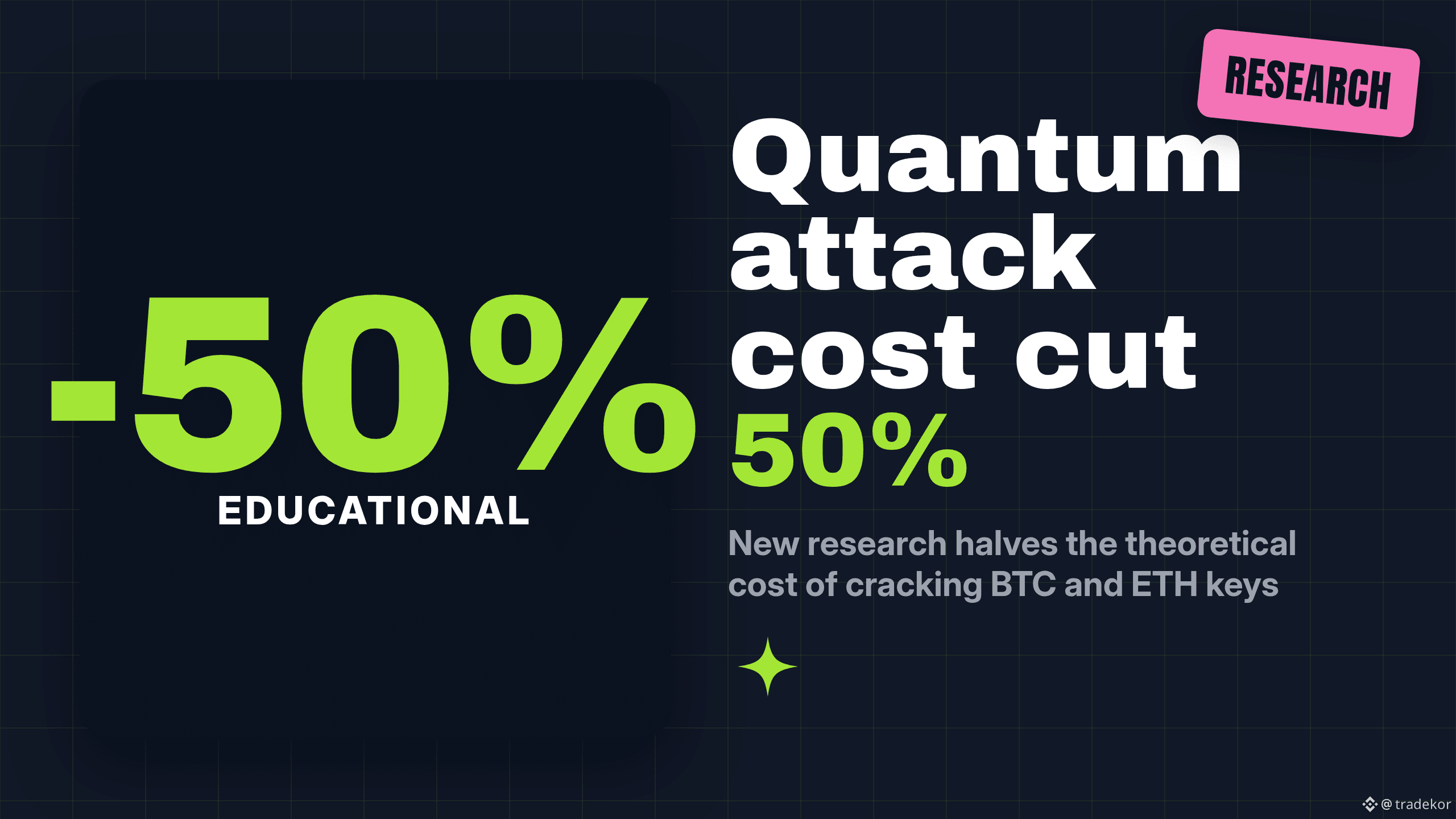
Researchers just cut the estimated quantum-computing cost to attack Bitcoin and Ethereum's encryption by more than 50% -- and no machine on Earth can actually do it yet.
The news: a collaborative effort (100+ contributors, including teams from the Ethereum Foundation, Theta Labs, and StarkWare) designed a new quantum circuit needing 1,151 logical qubits and about 1.3 million Toffoli gates to perform the core arithmetic step in breaking the elliptic-curve cryptography (secp256k1) that secures both Bitcoin and Ethereum private keys. The combined resource score came to roughly 1.5 billion -- more than 50% below the ~3 billion benchmark Google Quantum AI published in March, and an 86% drop from where an open research challenge started just two months ago.
The catch: today's quantum hardware has only ~1,000-1,200 physical qubits and logical-qubit counts in the tens or low hundreds -- nowhere close to running this. This is a benchmark for a theoretical future attack, not a live threat, and remediation (protocol upgrades, wallet migrations to quantum-resistant signatures) has years of runway to happen before hardware could plausibly catch up. Progress like this tends to come in irregular jumps, not a steady countdown clock.
Why it still matters: roughly 7 million BTC sit in addresses where the public key is already exposed on-chain -- those are the coins most at risk whenever "Q-Day" eventually arrives, and industry-wide migration to quantum-resistant wallets takes years to roll out even once the tech exists. Research like this is exactly what should be driving that migration timeline, not a sudden hardware breakthrough nobody saw coming.
Does a 50%+ cut in the theoretical attack cost change your view on how urgent quantum-resistant wallet migration actually is?
Not financial advice. DYOR.
$BTC $ETH #CryptoNews #Quantum #Security
Researchers just cut the estimated quantum-computing cost to attack Bitcoin and Ethereum's encryption by more than 50% -- and no machine on Earth can actually do it yet.
The news: a collaborative effort (100+ contributors, including teams from the Ethereum Foundation, Theta Labs, and StarkWare) designed a new quantum circuit needing 1,151 logical qubits and about 1.3 million Toffoli gates to perform the core arithmetic step in breaking the elliptic-curve cryptography (secp256k1) that secures both Bitcoin and Ethereum private keys. The combined resource score came to roughly 1.5 billion -- more than 50% below the ~3 billion benchmark Google Quantum AI published in March, and an 86% drop from where an open research challenge started just two months ago.
The catch: today's quantum hardware has only ~1,000-1,200 physical qubits and logical-qubit counts in the tens or low hundreds -- nowhere close to running this. This is a benchmark for a theoretical future attack, not a live threat, and remediation (protocol upgrades, wallet migrations to quantum-resistant signatures) has years of runway to happen before hardware could plausibly catch up. Progress like this tends to come in irregular jumps, not a steady countdown clock.
Why it still matters: roughly 7 million BTC sit in addresses where the public key is already exposed on-chain -- those are the coins most at risk whenever "Q-Day" eventually arrives, and industry-wide migration to quantum-resistant wallets takes years to roll out even once the tech exists. Research like this is exactly what should be driving that migration timeline, not a sudden hardware breakthrough nobody saw coming.
Does a 50%+ cut in the theoretical attack cost change your view on how urgent quantum-resistant wallet migration actually is?
Not financial advice. DYOR.
$BTC $ETH #CryptoNews #Quantum #Security
The news: a collaborative effort (100+ contributors, including teams from the Ethereum Foundation, Theta Labs, and StarkWare) designed a new quantum circuit needing 1,151 logical qubits and about 1.3 million Toffoli gates to perform the core arithmetic step in breaking the elliptic-curve cryptography (secp256k1) that secures both Bitcoin and Ethereum private keys. The combined resource score came to roughly 1.5 billion -- more than 50% below the ~3 billion benchmark Google Quantum AI published in March, and an 86% drop from where an open research challenge started just two months ago.
The catch: today's quantum hardware has only ~1,000-1,200 physical qubits and logical-qubit counts in the tens or low hundreds -- nowhere close to running this. This is a benchmark for a theoretical future attack, not a live threat, and remediation (protocol upgrades, wallet migrations to quantum-resistant signatures) has years of runway to happen before hardware could plausibly catch up. Progress like this tends to come in irregular jumps, not a steady countdown clock.
Why it still matters: roughly 7 million BTC sit in addresses where the public key is already exposed on-chain -- those are the coins most at risk whenever "Q-Day" eventually arrives, and industry-wide migration to quantum-resistant wallets takes years to roll out even once the tech exists. Research like this is exactly what should be driving that migration timeline, not a sudden hardware breakthrough nobody saw coming.
Does a 50%+ cut in the theoretical attack cost change your view on how urgent quantum-resistant wallet migration actually is?
Not financial advice. DYOR.
$BTC $ETH #CryptoNews #Quantum #Security
65
🚨 QUANTUS launches a quantum-secure mainnet 📈 Lock in $27 trillion of crypto risk 🧠
📊 | $BTC | $ETH | $BNB |
- Please follow, like, and comment to share your views. 📈
- Quantus officially went live today with a proof-of-work mainnet, featuring built-in post-quantum cryptography.
- This network is quantum-resistant from the ground up, designed to address the potential threat that future quantum computing poses to crypto assets.
- The project claims its goal is to protect around $27 trillion worth of exposure in the crypto market.
- Quantum security is positioned as a core competitive advantage of the next generation of blockchains, drawing attention from some institutions. 🔥
- If quantum computing breakthroughs occur, Quantus’s quantum-security advantage could attract more asset migration.
- However, in the short term the mainnet is still in the testing phase; market reaction may remain cautious, and price action is expected to trade sideways.
- Whale activity is currently neutral, with no large-scale buying or selling.
- If the project gains endorsements from mainstream institutions, capital inflows may occur in the short term, boosting on-chain activity.
- Do you think quantum security will become a key factor in blockchain competition?
- Stay tuned and leave your comments—let’s discuss industry trends together.
- #Crypto #Blockchain #Quantum #Whales #DeFi
🚨 QUANTUS launches a quantum-secure mainnet 📈 Lock in $27 trillion of crypto risk 🧠
📊 | $BTC | $ETH | $BNB |
- Please follow, like, and comment to share your views. 📈
- Quantus officially went live today with a proof-of-work mainnet, featuring built-in post-quantum cryptography.
- This network is quantum-resistant from the ground up, designed to address the potential threat that future quantum computing poses to crypto assets.
- The project claims its goal is to protect around $27 trillion worth of exposure in the crypto market.
- Quantum security is positioned as a core competitive advantage of the next generation of blockchains, drawing attention from some institutions. 🔥
- If quantum computing breakthroughs occur, Quantus’s quantum-security advantage could attract more asset migration.
- However, in the short term the mainnet is still in the testing phase; market reaction may remain cautious, and price action is expected to trade sideways.
- Whale activity is currently neutral, with no large-scale buying or selling.
- If the project gains endorsements from mainstream institutions, capital inflows may occur in the short term, boosting on-chain activity.
- Do you think quantum security will become a key factor in blockchain competition?
- Stay tuned and leave your comments—let’s discuss industry trends together.
- #Crypto #Blockchain #Quantum #Whales #DeFi
📊 | $BTC | $ETH | $BNB |
- Please follow, like, and comment to share your views. 📈
- Quantus officially went live today with a proof-of-work mainnet, featuring built-in post-quantum cryptography.
- This network is quantum-resistant from the ground up, designed to address the potential threat that future quantum computing poses to crypto assets.
- The project claims its goal is to protect around $27 trillion worth of exposure in the crypto market.
- Quantum security is positioned as a core competitive advantage of the next generation of blockchains, drawing attention from some institutions. 🔥
- If quantum computing breakthroughs occur, Quantus’s quantum-security advantage could attract more asset migration.
- However, in the short term the mainnet is still in the testing phase; market reaction may remain cautious, and price action is expected to trade sideways.
- Whale activity is currently neutral, with no large-scale buying or selling.
- If the project gains endorsements from mainstream institutions, capital inflows may occur in the short term, boosting on-chain activity.
- Do you think quantum security will become a key factor in blockchain competition?
- Stay tuned and leave your comments—let’s discuss industry trends together.
- #Crypto #Blockchain #Quantum #Whales #DeFi
126

·
--
Quantum risk easing? Crypto researchers cut Bitcoin and Ethereum quantum attack estimates by 50%. A CoinDesk-revealed paper shows humans and AI beating Google’s March result on a core calculation used by Shor’s algorithm, adding a new variable to crypto’s quantum clock. How soon until post-quantum security matters? $BTC $ETH #Quantum #Security #Crypto
Quantum risk easing? Crypto researchers cut Bitcoin and Ethereum quantum attack estimates by 50%. A CoinDesk-revealed paper shows humans and AI beating Google’s March result on a core calculation used by Shor’s algorithm, adding a new variable to crypto’s quantum clock. How soon until post-quantum security matters? $BTC $ETH #Quantum #Security #Crypto
24

·
--
Ethereum aims to become a quantum-resistant L1 by 2029!
The Ethereum Foundation is targeting December 2029 to bring the network into a state that can withstand quantum attacks on the execution, consensus, and data layers.
Among the 62 proposals for the Hegotá upgrade, two notable priorities are FOCIL to enhance censorship resistance and Frame Transactions to abstract accounts, while laying the groundwork for the post-quantum era.
Hegotá is not yet a “quantum-resistant” hard fork, but it will play an important role in tracking progress. The Ethereum Foundation even wants to prepare for “Q-Day” as early as 2030.
Ethereum’s quantum-resistance race has officially entered the long-term phase.
#Ethereum #ETH #Quantum #Blockchain
Ethereum aims to become a quantum-resistant L1 by 2029!
The Ethereum Foundation is targeting December 2029 to bring the network into a state that can withstand quantum attacks on the execution, consensus, and data layers.
Among the 62 proposals for the Hegotá upgrade, two notable priorities are FOCIL to enhance censorship resistance and Frame Transactions to abstract accounts, while laying the groundwork for the post-quantum era.
Hegotá is not yet a “quantum-resistant” hard fork, but it will play an important role in tracking progress. The Ethereum Foundation even wants to prepare for “Q-Day” as early as 2030.
Ethereum’s quantum-resistance race has officially entered the long-term phase.
#Ethereum #ETH #Quantum #Blockchain
The Ethereum Foundation is targeting December 2029 to bring the network into a state that can withstand quantum attacks on the execution, consensus, and data layers.
Among the 62 proposals for the Hegotá upgrade, two notable priorities are FOCIL to enhance censorship resistance and Frame Transactions to abstract accounts, while laying the groundwork for the post-quantum era.
Hegotá is not yet a “quantum-resistant” hard fork, but it will play an important role in tracking progress. The Ethereum Foundation even wants to prepare for “Q-Day” as early as 2030.
Ethereum’s quantum-resistance race has officially entered the long-term phase.
#Ethereum #ETH #Quantum #Blockchain

52

·
--
⚠️ Study: The cost of a quantum attack on BTC and ETH drops by more than 50%
A new study indicates that the estimated cost of carrying out a quantum computing attack targeting Bitcoin and Ethereum has fallen by more than 50%.
📌 This development does not mean there is currently an actual quantum attack, but it once again highlights the risks of quantum computing and the importance of developing encryption solutions capable of resisting these attacks.
#Bitcoin #Ethereum #crypto #Quantum
⚠️ Study: The cost of a quantum attack on BTC and ETH drops by more than 50%
A new study indicates that the estimated cost of carrying out a quantum computing attack targeting Bitcoin and Ethereum has fallen by more than 50%.
📌 This development does not mean there is currently an actual quantum attack, but it once again highlights the risks of quantum computing and the importance of developing encryption solutions capable of resisting these attacks.
#Bitcoin #Ethereum #crypto #Quantum
A new study indicates that the estimated cost of carrying out a quantum computing attack targeting Bitcoin and Ethereum has fallen by more than 50%.
📌 This development does not mean there is currently an actual quantum attack, but it once again highlights the risks of quantum computing and the importance of developing encryption solutions capable of resisting these attacks.
#Bitcoin #Ethereum #crypto #Quantum
24

·
--
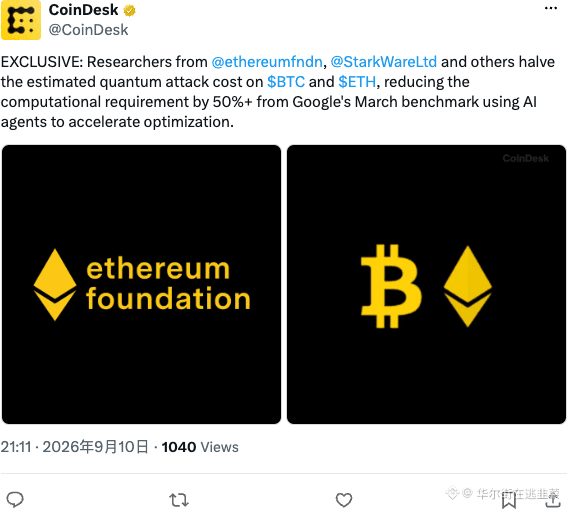
Quantum computing power cut in half, and the “quantum threat” bills for Bitcoin and Ethereum directly got a 50% discount. The Ethereum Foundation and some researchers at StarkWare used AI agents to run optimization, pushing down Google’s March benchmark costs by another 50%+. Don’t rush to call it doomsday—this instead suggests that quantum-resistance upgrades should be put on the agenda. Whoever gets deployed first will capture the next wave of the narrative.
$BTC $ETH #Quantum
Quantum computing power cut in half, and the “quantum threat” bills for Bitcoin and Ethereum directly got a 50% discount. The Ethereum Foundation and some researchers at StarkWare used AI agents to run optimization, pushing down Google’s March benchmark costs by another 50%+. Don’t rush to call it doomsday—this instead suggests that quantum-resistance upgrades should be put on the agenda. Whoever gets deployed first will capture the next wave of the narrative.
$BTC $ETH #Quantum
$BTC $ETH #Quantum
207
·
--
Ethereum makes quantum resistance a top priority with a 2029 deadline. The Ethereum Foundation aims to harden the network before a quantum computer capable of breaking today’s cryptography could plausibly arrive, and says upcoming upgrades will be judged against that clock. A pivotal shift for on-chain security and the roadmap ahead. $ETH #Ethereum #Quantum #CryptoSecurity
Ethereum makes quantum resistance a top priority with a 2029 deadline. The Ethereum Foundation aims to harden the network before a quantum computer capable of breaking today’s cryptography could plausibly arrive, and says upcoming upgrades will be judged against that clock. A pivotal shift for on-chain security and the roadmap ahead. $ETH #Ethereum #Quantum #CryptoSecurity
7

·
--
$IONQ 🚀 Quantum Computing needs a new scoreboard.
IonQ just published a benchmarking framework that looks beyond simple qubit counts.
The framework evaluates quantum systems on 13 real-world benchmarks across:
🔹 Optimization
🔹 Quantum Chemistry
🔹 Machine Learning
🔹 Data Loading
🔹 Simulation
🔹 Foundational Algorithms
The key metrics? Solution Quality + Time-to-Solution (TTS) — measuring how quickly a system can actually produce a solution that meets a predefined quality threshold.
What makes this interesting is the focus on the full system stack, rather than isolated hardware specifications.
Even more important: IonQ says the benchmark code is publicly available for independent verification, while comparative results were independently validated by Kearney.
⚛️ The quantum race may eventually be less about “Who has the most qubits?”
…and more about:
“Who can solve useful problems fastest, accurately, and at scale?”
That shift could be huge for the future of quantum computing.
{stock_us}(IONQ.US)
#Quantum #Crypto #AI #Technology #BinanceSquare
$IONQ 🚀 Quantum Computing needs a new scoreboard.
IonQ just published a benchmarking framework that looks beyond simple qubit counts.
The framework evaluates quantum systems on 13 real-world benchmarks across:
🔹 Optimization
🔹 Quantum Chemistry
🔹 Machine Learning
🔹 Data Loading
🔹 Simulation
🔹 Foundational Algorithms
The key metrics? Solution Quality + Time-to-Solution (TTS) — measuring how quickly a system can actually produce a solution that meets a predefined quality threshold.
What makes this interesting is the focus on the full system stack, rather than isolated hardware specifications.
Even more important: IonQ says the benchmark code is publicly available for independent verification, while comparative results were independently validated by Kearney.
⚛️ The quantum race may eventually be less about “Who has the most qubits?”
…and more about:
“Who can solve useful problems fastest, accurately, and at scale?”
That shift could be huge for the future of quantum computing.
#Quantum #Crypto #AI #Technology #BinanceSquare
IonQ just published a benchmarking framework that looks beyond simple qubit counts.
The framework evaluates quantum systems on 13 real-world benchmarks across:
🔹 Optimization
🔹 Quantum Chemistry
🔹 Machine Learning
🔹 Data Loading
🔹 Simulation
🔹 Foundational Algorithms
The key metrics? Solution Quality + Time-to-Solution (TTS) — measuring how quickly a system can actually produce a solution that meets a predefined quality threshold.
What makes this interesting is the focus on the full system stack, rather than isolated hardware specifications.
Even more important: IonQ says the benchmark code is publicly available for independent verification, while comparative results were independently validated by Kearney.
⚛️ The quantum race may eventually be less about “Who has the most qubits?”
…and more about:
“Who can solve useful problems fastest, accurately, and at scale?”
That shift could be huge for the future of quantum computing.
#Quantum #Crypto #AI #Technology #BinanceSquare
IONQUS+0.89%
IONQ-0.20%
186

·
--
Quantum threats are trending again! This time, Bitcoin Magazine went straight for a “quantum special,” seriously digging into whether quantum computing can actually destroy Bitcoin.
In plain speech, it’s three points:
1️⃣ The day quantum computers really become mature, the first to be hit would be early old wallets—Satoshi’s original 1 million BTC would theoretically be the first to get exposed
2️⃣ Bitcoin’s network attack surface isn’t as wildly exposed as people imagine, but it does have weak spots
3️⃣ Quantum-resistant solutions have been under research, but the community has turned into a big debate, so reaching consensus isn’t that easy
How should you look at the market? This kind of quantum FUD shows up to make a splash every so often, and the “pits” it throws end up being gold mines in hindsight. In the short term, sentiment might get steered off course, but once the day comes when quantum can actually crack it, Big Block (BTC) would have already completed the quantum-resistant upgrade. Technical fear has never been able to kill BTC—in fact, every time it shows up, it becomes an opportunity to get in.
Don’t get scared out of your position—hold steady.
$BTC #Quantum #Bitcoin
Quantum threats are trending again! This time, Bitcoin Magazine went straight for a “quantum special,” seriously digging into whether quantum computing can actually destroy Bitcoin.
In plain speech, it’s three points:
1️⃣ The day quantum computers really become mature, the first to be hit would be early old wallets—Satoshi’s original 1 million BTC would theoretically be the first to get exposed
2️⃣ Bitcoin’s network attack surface isn’t as wildly exposed as people imagine, but it does have weak spots
3️⃣ Quantum-resistant solutions have been under research, but the community has turned into a big debate, so reaching consensus isn’t that easy
How should you look at the market? This kind of quantum FUD shows up to make a splash every so often, and the “pits” it throws end up being gold mines in hindsight. In the short term, sentiment might get steered off course, but once the day comes when quantum can actually crack it, Big Block (BTC) would have already completed the quantum-resistant upgrade. Technical fear has never been able to kill BTC—in fact, every time it shows up, it becomes an opportunity to get in.
Don’t get scared out of your position—hold steady.
$BTC #Quantum #Bitcoin
In plain speech, it’s three points:
1️⃣ The day quantum computers really become mature, the first to be hit would be early old wallets—Satoshi’s original 1 million BTC would theoretically be the first to get exposed
2️⃣ Bitcoin’s network attack surface isn’t as wildly exposed as people imagine, but it does have weak spots
3️⃣ Quantum-resistant solutions have been under research, but the community has turned into a big debate, so reaching consensus isn’t that easy
How should you look at the market? This kind of quantum FUD shows up to make a splash every so often, and the “pits” it throws end up being gold mines in hindsight. In the short term, sentiment might get steered off course, but once the day comes when quantum can actually crack it, Big Block (BTC) would have already completed the quantum-resistant upgrade. Technical fear has never been able to kill BTC—in fact, every time it shows up, it becomes an opportunity to get in.
Don’t get scared out of your position—hold steady.
$BTC #Quantum #Bitcoin
46


·
--
Quantum computing threats are no longer just a future narrative. Recently, major ecosystems like Stellar, ETH, and SUI are pushing for upgrades related to anti-quantum/quantum cryptography, prompting the market to start re-evaluating the 'security premium'.
Quantum $QUANTUM is currently priced around $0.00193. The key focus isn't on short-term trades but on whether the narrative evolves from a concept into a real infrastructure demand. If anti-quantum security becomes a standard upgrade for public chains, related assets might gain temporary attention.
However, this kind of theme can be very volatile, so it's crucial to closely monitor on-chain activity, liquidity, and the actual progress of projects to avoid just chasing trends.
#Quantum #抗量子 #Crypto
Quantum computing threats are no longer just a future narrative. Recently, major ecosystems like Stellar, ETH, and SUI are pushing for upgrades related to anti-quantum/quantum cryptography, prompting the market to start re-evaluating the 'security premium'.
Quantum $QUANTUM is currently priced around $0.00193. The key focus isn't on short-term trades but on whether the narrative evolves from a concept into a real infrastructure demand. If anti-quantum security becomes a standard upgrade for public chains, related assets might gain temporary attention.
However, this kind of theme can be very volatile, so it's crucial to closely monitor on-chain activity, liquidity, and the actual progress of projects to avoid just chasing trends.
#Quantum #抗量子 #Crypto
Quantum $QUANTUM is currently priced around $0.00193. The key focus isn't on short-term trades but on whether the narrative evolves from a concept into a real infrastructure demand. If anti-quantum security becomes a standard upgrade for public chains, related assets might gain temporary attention.
However, this kind of theme can be very volatile, so it's crucial to closely monitor on-chain activity, liquidity, and the actual progress of projects to avoid just chasing trends.
#Quantum #抗量子 #Crypto
12

·
--
Trump signs orders to build a quantum computer and protect against the one that could break encryption
The White House issued twin executive orders to accelerate U.S. development of large-scale quantum computers while simultaneously hardening defenses against such machines.
#Tech #quantum computing #News
Trump signs orders to build a quantum computer and protect against the one that could break encryption
The White House issued twin executive orders to accelerate U.S. development of large-scale quantum computers while simultaneously hardening defenses against such machines.
#Tech #quantum computing #News
The White House issued twin executive orders to accelerate U.S. development of large-scale quantum computers while simultaneously hardening defenses against such machines.
#Tech #quantum computing #News
63
Log in to explore more content
Join global crypto users on Binance Square
⚡️ Get latest and useful information about crypto.
💬 Trusted by the world’s largest crypto exchange.
👍 Discover real insights from verified creators.
Email / Phone number
Trending Topics
1
#NFPWatch
10.5M views
17,257 Discussing
2
#XRPPostsFirstThreeGreenMonthsInQ3
3,044 views
100 Discussing
3
#BitcoinRisesToward$85K
32,980 views
88 Discussing
4
#AmazonPlansToSell$8BNvidiaChips
3,130 views
64 Discussing
5
#NEARFallsToAround$4.70Down14%
34,662 views
89 Discussing
6
#EthereumFoundationLaunchesZkAPIOnMainnet
51,240 views
768 Discussing
7
#EvernorthPlansNasdaqListingOct8
73,764 views
644 Discussing
8
#SECProposesCryptoCustodyFramework
64,289 views
582 Discussing
9
#IMFApproves$139MDisbursementToElSalvador
31,418 views
31 Discussing
10
#AnthropicTargetsIPOAsSoonAsMidNovember
47,693 views
476 Discussing