
#pajakkripto
pajakkripto
232 views
6 Discussing
Hot
Latest

·
--
Greece has just written the rules for crypto taxes—and the rate is lower than originally planned.
The facts: On Nov. 5, 2026, the Greek parliament passed a bill imposing a 10% tax on crypto capital gains, with net gains of up to €500 (about $563) per year tax-free. The rules take effect on Jan. 1, 2027. Crypto-to-crypto swaps are exempt, and there’s a 12-month voluntary disclosure window for previously unreported gains. The 10% rate was reduced from the original 15% proposal after a public consultation held Oct. 7–22. Implementing rules on transparency and audits are expected in the coming weeks—Greek finance ministry officials themselves have acknowledged that state revenue will be hard to predict, since most investors use foreign platforms. Source: Reuters, Nov. 5, 2026.
My take: This isn’t just about Greece. It’s part of a global trend—one country after another is closing crypto tax loopholes, and Greece is doing so amid the EU’s DAC8 reporting regime, which has been in effect since Jan. 1, 2026. This isn’t a catalyst for prices today (the Greek market is small), but it’s another piece in an increasingly dense regulatory map—and a reminder that transaction trails are being recorded everywhere.
What I’m watching next: Tonight’s U.S. NFP release at 20:30 WIB remains the market’s key directional catalyst, while BTC is still hovering around $75,974 after dropping overnight.
What do you think—do tax rules like these make the market more mature, or just drive traders to foreign platforms?
#RegulasiKripto #PajakKripto $BTC
50
·
--
South Korea is almost certain to delay its crypto tax again — this would be the fourth delay, and this time it’s targeting 2029.
The facts: Democratic Party lawmakers on parliament’s Finance Committee agreed on Nov. 3, 2026, to recommend delaying the crypto income tax to party leaders, with the leading option being to push it back by about two years: from Jan. 1, 2027, to Jan. 1, 2029 (Seoul Economic Daily, cited by KuCoin and Analytics Insight, Nov. 3). The tax itself is 22% on annual gains above 2.5 million won. The reasons: transaction data from overseas exchanges is still incomplete, international data sharing through the OECD’s CARF framework will only be fully operational in 2029, and the Digital Asset Act has yet to be finalized. Important to note: this is not yet law — changing the timeline requires parliament to amend the Income Tax Act, and until that happens, the current date remains Jan. 1, 2027.
My take: This isn’t a cancellation of the tax; it’s an acknowledgment that the country isn’t ready. South Korea has delayed it three times since the framework was approved in 2020, so the market there knows the pattern: the tax is still coming, just continually pushed back. For investors, what’s changing isn’t the tax burden, but the certainty around timing — and that uncertainty is what has been holding them back. With BTC still around $76,770 this morning, I read news like this as easing regulatory pressure, not as a catalyst for a rally.
What I’m watching next: the Democratic Party leadership’s decision over the next 1–2 weeks, the fate of the bill linking the tax’s start date to CARF milestones, and tax bill discussions through early December.
What do you think? Will this fourth delay make Korean investors more willing to enter the market, or will they wait even longer until the rules are truly final?
This is my analysis, not financial advice — always DYOR.
#PajakKripto #KoreaSelatan $BTC
54

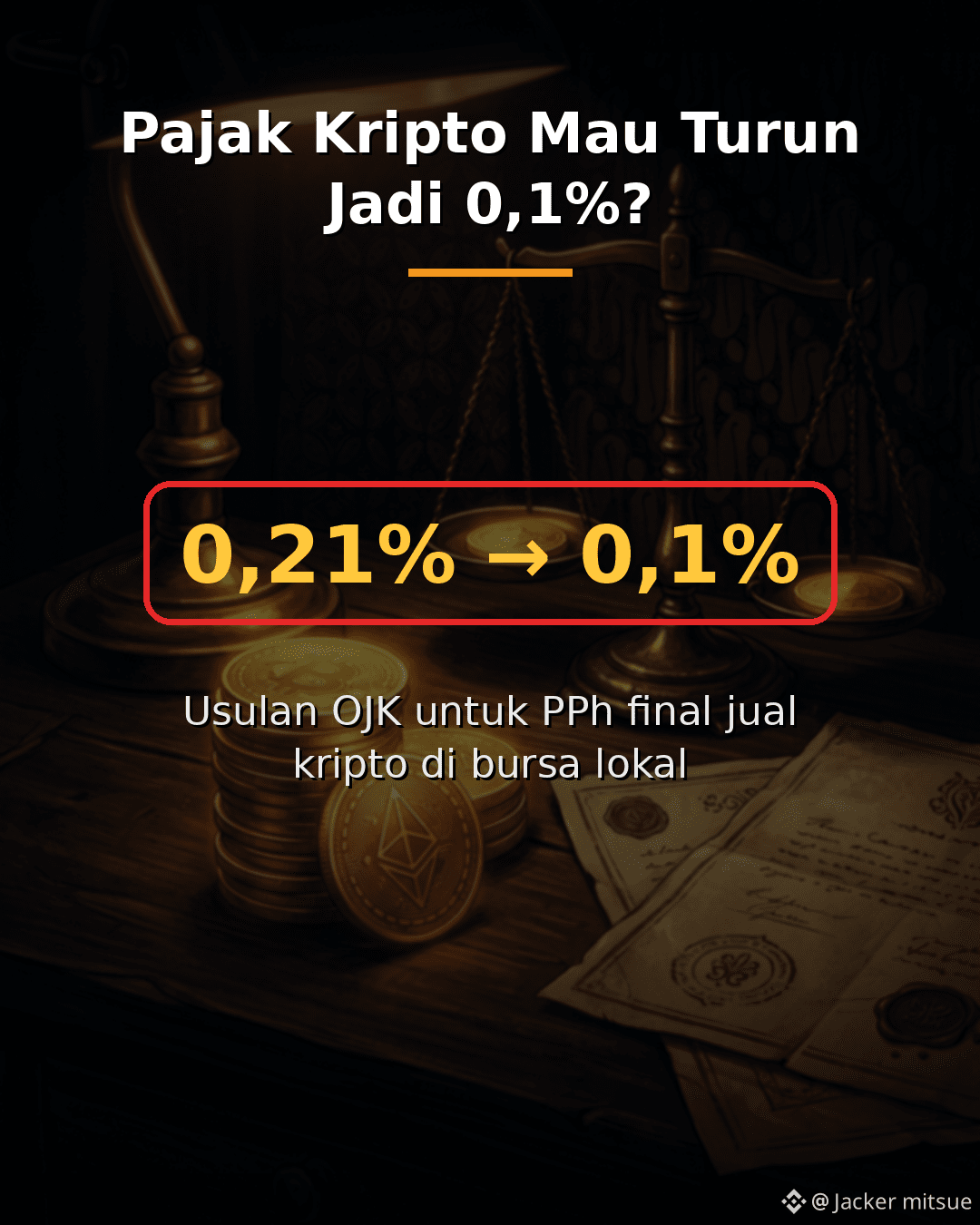
Will crypto tax in Indonesia drop to 0.1%?
Currently 0.21% (local exchanges) | 1% (foreign platforms) | Proposed: 0.1%
1. Current regulations — Since August 1, 2025, under PMK 50/2025, crypto sales are subject to a final Article 22 income tax of 0.21% of the transaction value when made through a domestic exchange, and 1% when made through a foreign platform. Buying crypto? It is no longer subject to VAT because crypto is treated as a security.
2. OJK proposal — Adi Budiarso of OJK said the industry is pushing for the final income tax rate to be reduced from 0.21% to 0.1%, matching the tax on stock sales on the stock exchange (at a seminar on Oct. 16, 2026, as reported by DDTCNews). It is still a proposal; no new PMK has been issued.
3. What this means for you — Tax is calculated on the sale value, not the profit. For example: sell Rp10 million worth of crypto on a local exchange, and the income tax is Rp21,000; if the proposal is approved, it would be Rp10,000. Keep an eye out for official announcements from the Ministry of Finance/DJP.
#PajakKripto #OJK #KriptoIndonesia #Regulasi #BinanceSquare
71
Log in to explore more content
Join global crypto users on Binance Square
⚡️ Get latest and useful information about crypto.
💬 Trusted by the world’s largest crypto exchange.
👍 Discover real insights from verified creators.
Email / Phone number
Trending Topics
1
#BitcoinRebounds$75KAsChipsLead
5,485 views
105 Discussing
2
#JobsReportRaisesHikeOdds
85,151 views
856 Discussing
3
#US Data Center Rules May Constrain AI Expansion
10,637 views
94 Discussing
4
#$2TWipedOutHedgeFundsFaceLiquidation
12,708 views
95 Discussing
5
#WillAnthropicListOnTime
11,333 views
240 Discussing
6
#USNovemberMichiganExpectationsIndexPrelimAt50.9
20,149 views
340 Discussing
7
#OilPlungesBelow$100
20,402 views
38 Discussing
8
#TradFiForBeginners
12,183 views
218 Discussing
9
#USMidtermsCouldShakeUpUS-IranTies
39,200 views
507 Discussing
10
#RussianCentralBankNamesBTCETHUSDTForNonQualifiedInvestors
760 views
11 Discussing