
#liquidityproviding
liquidityproviding
197 views
8 Discussing
Hot
Latest


·
--
APR is only one part of the equation on $STON.
Two liquidity pools may display identical APR figures, yet generate very different outcomes for liquidity providers over time.
Factors such as trading volume, fee generation, asset volatility, and impermanent loss often have a greater impact on overall profitability than the headline yield itself.
For this reason, experienced liquidity providers evaluate the quality of returns rather than focusing solely on APR percentages.
On STON.fi, sustainable performance is driven by real market activity and effective risk management, not yield metrics alone. $TON @stonfi
#TON #STONfi #DeFi #LiquidityProviding
APR is only one part of the equation on $STON.
Two liquidity pools may display identical APR figures, yet generate very different outcomes for liquidity providers over time.
Factors such as trading volume, fee generation, asset volatility, and impermanent loss often have a greater impact on overall profitability than the headline yield itself.
For this reason, experienced liquidity providers evaluate the quality of returns rather than focusing solely on APR percentages.
On STON.fi, sustainable performance is driven by real market activity and effective risk management, not yield metrics alone. $TON @STONfi DEX
#TON #STONfi #DeFi #LiquidityProviding
124

·
--
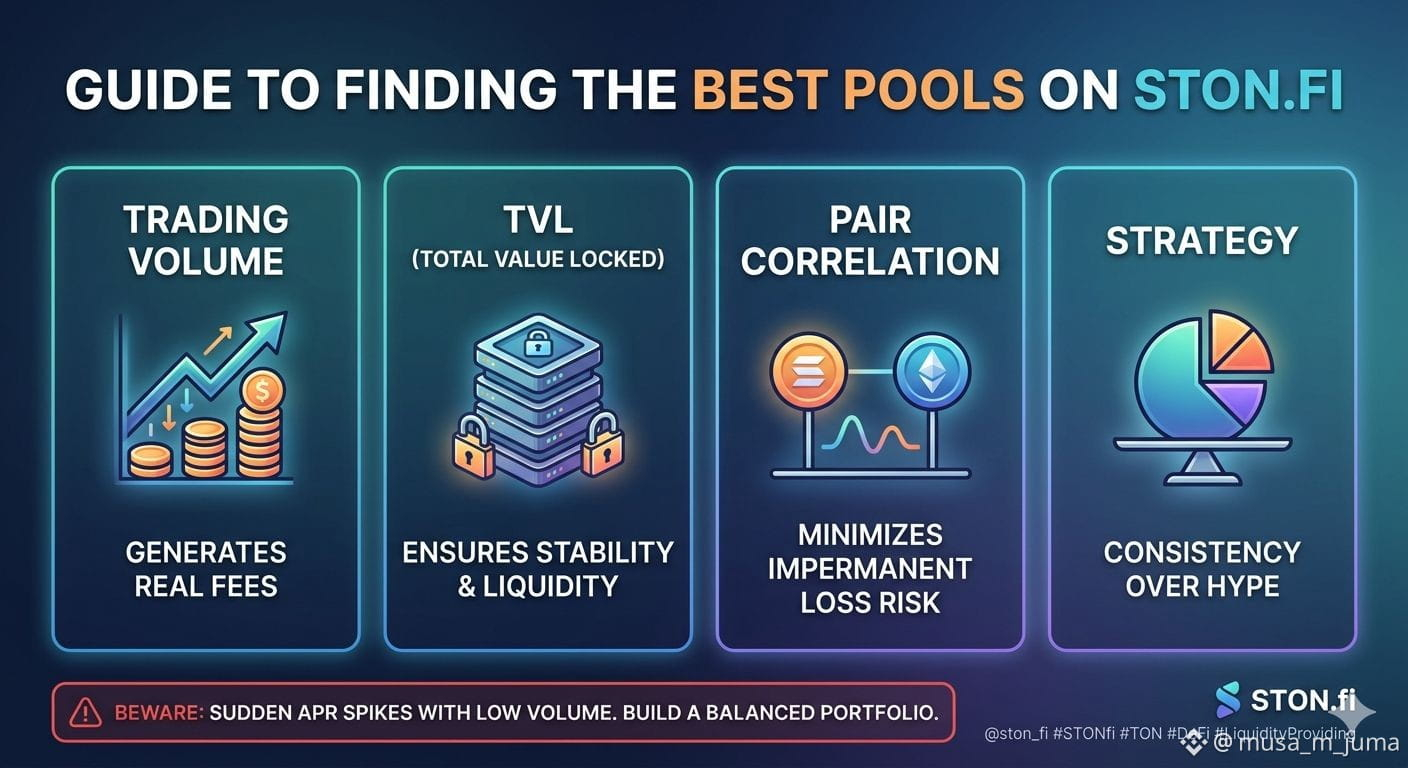
💡 Chasing the highest APR? You might be looking at the wrong metric.
When it comes to liquidity pools on STON.fi, smart LPs don't just follow big numbers—they look at what generates those returns.
Things worth checking before entering a pool:
🔹 Trading volume → More volume usually means more fees
🔹 TVL → Healthy liquidity supports stability
🔹 Asset correlation → Lower IL risk in correlated pairs
🔹 Volume/TVL ratio → A key indicator of capital efficiency
⚠️ Don't overlook the risks:
• Unsustainable APR spikes
• Low-volume pools with inflated rewards
• Impermanent loss in volatile pairs
One interesting trend: some mid-sized pools are currently generating better returns than larger pools because their liquidity is being used more efficiently.
The best LP strategy isn't finding one perfect pool.
It's building a diversified portfolio that balances yield and risk.
In DeFi, sustainable returns often outperform short-term hype.
#STONfi #TON #DeFi #YieldFarming #LiquidityProviding $TON
1
145

·
--
Most liquidity providers in DeFi are losing money without realizing it — and the math explains why.
Impermanent loss (IL) is misunderstood as a minor drag. It is not. When you provide liquidity to a volatile pair and the price ratio moves 2x, you lose roughly 5.7% relative to just holding. At 4x, that loss hits 25%. Most retail LP yields rarely compensate for this fully, especially in thin pools where trading volume dries up when markets move hard — exactly when IL bites deepest.
Concentrated liquidity (introduced in Uniswap v3) changed the calculus but raised the complexity. Narrow ranges earn 10–50x more fees per dollar deployed, but they require active management. An LP who sets a tight range and walks away often earns zero fees while still absorbing maximum IL once price exits the range.
The LPs who actually profit share three traits:
1. They choose correlated pairs (e.g., $ETH/$BNB or stablecoin pairs) where IL is structurally bounded.
2. They size ranges to match realistic volatility, not wishful thinking.
3. They track fee APY vs realized IL weekly — not monthly.
DeFi yield farming is not passive income. It is an active market-making job. The protocols that will win long-term are those making this complexity invisible to end users — abstracting range management into smart vaults, auto-rebalancers, and intent-based liquidity.
Know the math before you LP. The pool does not care about your APY screenshot.
$ETH $BNB $AVAX
#DeFi #LiquidityProviding #ImpermanentLoss #YieldFarming #CryptoInsights
Most liquidity providers in DeFi are losing money without realizing it — and the math explains why.
Impermanent loss (IL) is misunderstood as a minor drag. It is not. When you provide liquidity to a volatile pair and the price ratio moves 2x, you lose roughly 5.7% relative to just holding. At 4x, that loss hits 25%. Most retail LP yields rarely compensate for this fully, especially in thin pools where trading volume dries up when markets move hard — exactly when IL bites deepest.
Concentrated liquidity (introduced in Uniswap v3) changed the calculus but raised the complexity. Narrow ranges earn 10–50x more fees per dollar deployed, but they require active management. An LP who sets a tight range and walks away often earns zero fees while still absorbing maximum IL once price exits the range.
The LPs who actually profit share three traits:
1. They choose correlated pairs (e.g., $ETH /$BNB or stablecoin pairs) where IL is structurally bounded.
2. They size ranges to match realistic volatility, not wishful thinking.
3. They track fee APY vs realized IL weekly — not monthly.
DeFi yield farming is not passive income. It is an active market-making job. The protocols that will win long-term are those making this complexity invisible to end users — abstracting range management into smart vaults, auto-rebalancers, and intent-based liquidity.
Know the math before you LP. The pool does not care about your APY screenshot.
$ETH $BNB $AVAX
#DeFi #LiquidityProviding #ImpermanentLoss #YieldFarming #CryptoInsights
126
·
--
Concentrated Liquidity Is Rewriting the DeFi Playbook — Are You Positioned Correctly?
When Uniswap v3 introduced concentrated liquidity, it fundamentally changed the game for LPs. Instead of spreading capital uniformly across an infinite price range, LPs can now concentrate it within a defined band — capturing dramatically higher fee yield on the same dollar of capital.
The insight most traders miss: fee tier selection matters as much as range selection.
- 0.05% pools attract high-frequency arbitrageurs and stableswap volume — thin margins, massive velocity.
- 0.30% pools are the sweet spot for moderately volatile pairs — balancing volume and fee capture.
- 1.00% pools are for exotic or low-liquidity pairs where impermanent loss risk demands higher compensation.
The real alpha is in understanding how pool composition shifts as volatility regimes change. In low-volatility environments, tighter ranges compound fee income aggressively. When volatility spikes, wide-range LPs absorb impermanent loss while tight-range LPs get blown out of position entirely.
This is why passive LPing is a losing strategy without active range management — or a protocol that does it for you.
Sophisticated capital is now flowing toward automated liquidity managers that rebalance ranges dynamically, effectively turning LP positions into structured yield products.
DeFi infrastructure is maturing. Passive yield is being replaced by managed yield. That structural shift is quietly driving capital efficiency higher across $ETH and $BNB ecosystems alike.
Understand the mechanics before chasing the APY.
#DeFi #LiquidityProviding #CryptoAlpha #Web3 #BinanceSquare
19
·
--
Concentrated Liquidity Is the Quiet Revolution DeFi Needed
Most retail LPs still think about DeFi liquidity the old way — deposit tokens into a pool, earn a flat yield spread across the entire price curve from zero to infinity. That model works, but it is brutally capital-inefficient.
Concentrated liquidity changed the game. By letting LPs define a custom price range, capital is deployed only where it actually matters — around the market price. This means a liquidity provider can achieve the same depth as a traditional AMM with a fraction of the capital, or capture dramatically more fees with the same capital.
The implications ripple outward:
• Tighter spreads benefit traders, reducing slippage on major pairs
• LPs who actively manage ranges earn outsized returns vs passive depositors
• Protocols compete on liquidity architecture, not just token incentives
• Capital efficiency improvements attract institutional market-makers previously priced out of DeFi
The next layer is automated rebalancing vaults that manage ranges on behalf of passive LPs — bringing active market-making to everyone.
$ETH and $BNB ecosystem DEXes pioneered this model. $SOL-based exchanges adopted CLMMs shortly after. The architectural upgrade is now spreading to every major chain.
DeFi is becoming genuinely competitive with centralized order books. Not just ideologically — structurally.
#DeFi #LiquidityProviding #DEX #CryptoAlpha #Web3
Concentrated Liquidity Is the Quiet Revolution DeFi Needed
Most retail LPs still think about DeFi liquidity the old way — deposit tokens into a pool, earn a flat yield spread across the entire price curve from zero to infinity. That model works, but it is brutally capital-inefficient.
Concentrated liquidity changed the game. By letting LPs define a custom price range, capital is deployed only where it actually matters — around the market price. This means a liquidity provider can achieve the same depth as a traditional AMM with a fraction of the capital, or capture dramatically more fees with the same capital.
The implications ripple outward:
• Tighter spreads benefit traders, reducing slippage on major pairs
• LPs who actively manage ranges earn outsized returns vs passive depositors
• Protocols compete on liquidity architecture, not just token incentives
• Capital efficiency improvements attract institutional market-makers previously priced out of DeFi
The next layer is automated rebalancing vaults that manage ranges on behalf of passive LPs — bringing active market-making to everyone.
$ETH and $BNB ecosystem DEXes pioneered this model. $SOL -based exchanges adopted CLMMs shortly after. The architectural upgrade is now spreading to every major chain.
DeFi is becoming genuinely competitive with centralized order books. Not just ideologically — structurally.
#DeFi #LiquidityProviding #DEX #CryptoAlpha #Web3
48
·
--
Concentrated liquidity is one of the most underappreciated innovations in DeFi — and most retail traders still don't fully understand how it changes the game.
Traditional AMMs spread liquidity uniformly across every possible price range from zero to infinity. That sounds fair, but in practice it means 95%+ of deposited capital sits idle at price ranges the market never visits. Capital efficiency was terrible.
Concentrated liquidity lets LPs deploy capital within a chosen price band. Focus your position in a tight range around the current price and you can capture the same fee revenue with roughly 10–20x less capital deployed.
The catch? You need to actively manage your range. When price exits your band, you stop earning fees and hold 100% of the depreciating asset — impermanent loss becomes very real, very fast.
This has quietly bifurcated DeFi into two groups:
• Passive LPs who consistently underperform
• Active and algorithmic LPs who extract the majority of fees
$ETH pioneered this model, $BNB chain has replicated it across its DEX ecosystem, and $SOL native DEXes are running CLMM designs tuned for high-frequency price movements.
For DeFi to scale to the next 100 million users, capital efficiency must keep improving. Concentrated liquidity is step one — the protocols that solve automated range management will own the next wave of liquidity.
#DeFi #LiquidityProviding #AMM #CryptoInsights #Web3
53

·
--
Uniswap trades incentives for execution
Here’s why Uniswap is betting on execution over higher LP incentives
This move matters to traders as it may impact liquidity and trading fees. Stronger infrastructure could offset lower incentives, but the outcome is uncertain. Traders should watch for changes in liquidity and market dynamics.
#Crypto #Uniswap #DeFi #LiquidityProviding #Blockchain
26
Log in to explore more content
Join global crypto users on Binance Square
⚡️ Get latest and useful information about crypto.
💬 Trusted by the world’s largest crypto exchange.
👍 Discover real insights from verified creators.
Email / Phone number
Trending Topics
1
#BinanceReopensWithdrawalsForMoreAssets
1.1M views
5,932 Discussing
2
#$2TWipedOutHedgeFundsFaceLiquidation
1,354 views
35 Discussing
3
#AnthropicIPOValuationDoubts
18,343 views
448 Discussing
4
#USMidtermsCouldShakeUpUS-IranTies
0 views
1 Discussing
5
#RussiaInvestigativeCommitteeProposesAddingCryptoToAMLSystem
18 views
3 Discussing
6
#SouthKoreaDelaysCryptoTaxationUntil2029
2,624 views
80 Discussing
7
#HongKongPlansTaxIncentivesCoveringDigitalAssets
2,432 views
55 Discussing
8
#ECBTargetsDigitalEuroIssuanceIn2029
2,311 views
65 Discussing
9
#ChainalysisBreachExposedPasswordHashesAndLiveTokens
325 views
14 Discussing
10
#UkraineCentralBankOpposesCurrentCryptoAssetBill
3,230 views
87 Discussing