
#keamanankripto
keamanankripto
1,394 views
13 Discussing
Hot
Latest

·
--
Crypto payment server hacked—why were only older versions affected?
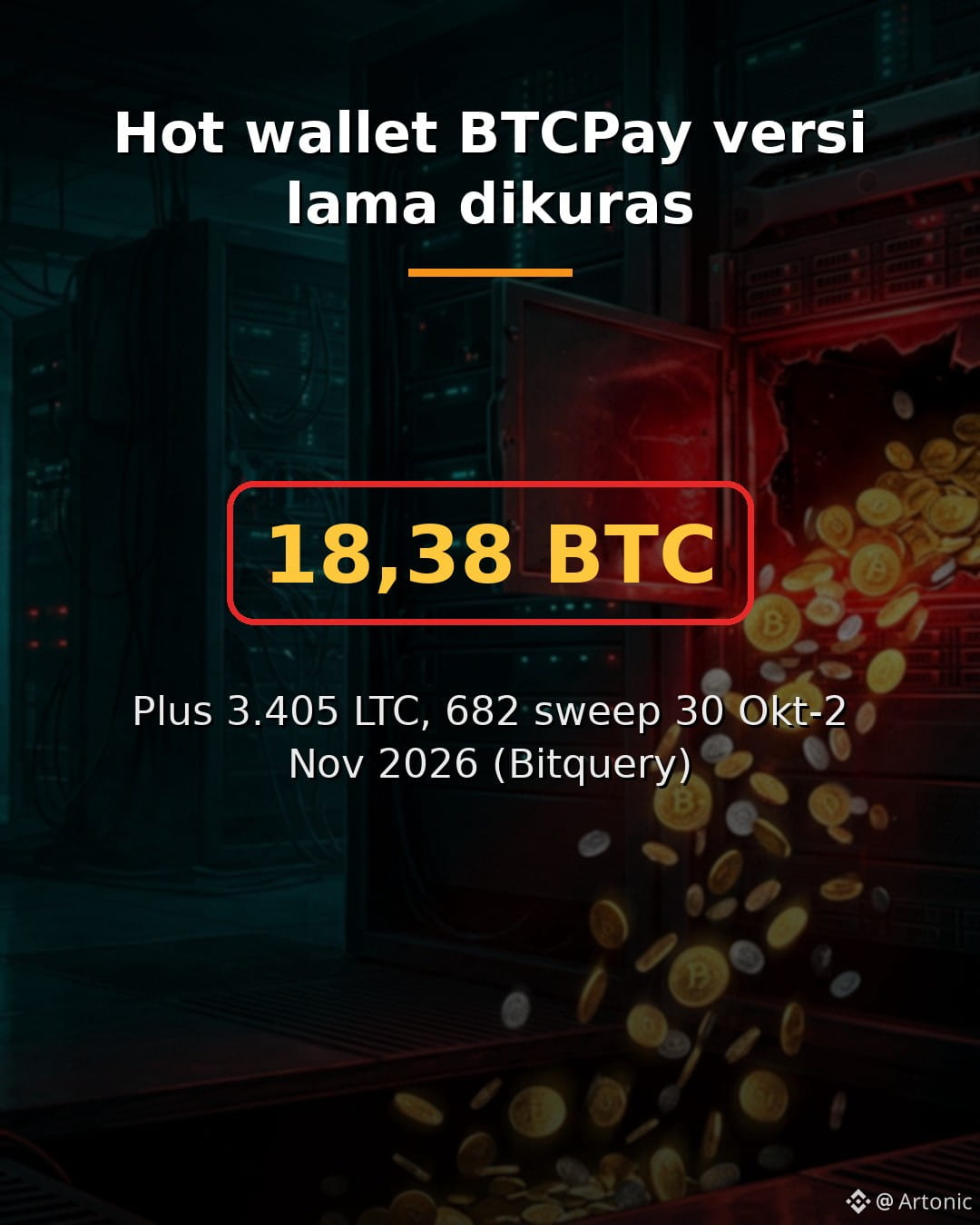
Tracked funds: 18.38 BTC + 3,405 LTC (~$1.63 million) | 682 sweeps, Oct. 30–Nov. 2, 2026
BTCPay Server, an open-source crypto payment processor used by many merchants, confirmed that hot wallets on servers running version 2.4.1 or earlier were drained. Key points:
1. Old vulnerability, server not updated — A patch has been available since version 2.4.2 (August 7, 2026). The drained servers had never installed it. The attacker logged in as an admin and drained the hot wallets.
2. Activity continued after the warning — According to Bitquery, 87% of the funds moved in a single wave on November 1, and another 267 sweeps (~$150,000) took place after BTCPay asked servers to be shut down. This is a lower-bound estimate and does not include Lightning funds.
3. Updating alone isn’t enough — Users of older versions are advised to migrate to a new server with a new wallet and seed. Wallets whose keys are kept outside the server (e.g., hardware wallets) are safe.
The lesson: keep only operational funds in hot wallets; store the rest in a wallet whose keys you control.
#KeamananKripto #Bitcoin #BTCPay #HotWallet #BinanceSquare
Crypto payment server hacked—why were only older versions affected?
Tracked funds: 18.38 BTC + 3,405 LTC (~$1.63 million) | 682 sweeps, Oct. 30–Nov. 2, 2026
BTCPay Server, an open-source crypto payment processor used by many merchants, confirmed that hot wallets on servers running version 2.4.1 or earlier were drained. Key points:
1. Old vulnerability, server not updated — A patch has been available since version 2.4.2 (August 7, 2026). The drained servers had never installed it. The attacker logged in as an admin and drained the hot wallets.
2. Activity continued after the warning — According to Bitquery, 87% of the funds moved in a single wave on November 1, and another 267 sweeps (~$150,000) took place after BTCPay asked servers to be shut down. This is a lower-bound estimate and does not include Lightning funds.
3. Updating alone isn’t enough — Users of older versions are advised to migrate to a new server with a new wallet and seed. Wallets whose keys are kept outside the server (e.g., hardware wallets) are safe.
The lesson: keep only operational funds in hot wallets; store the rest in a wallet whose keys you control.
#KeamananKripto #Bitcoin #BTCPay #HotWallet #BinanceSquare
Tracked funds: 18.38 BTC + 3,405 LTC (~$1.63 million) | 682 sweeps, Oct. 30–Nov. 2, 2026
BTCPay Server, an open-source crypto payment processor used by many merchants, confirmed that hot wallets on servers running version 2.4.1 or earlier were drained. Key points:
1. Old vulnerability, server not updated — A patch has been available since version 2.4.2 (August 7, 2026). The drained servers had never installed it. The attacker logged in as an admin and drained the hot wallets.
2. Activity continued after the warning — According to Bitquery, 87% of the funds moved in a single wave on November 1, and another 267 sweeps (~$150,000) took place after BTCPay asked servers to be shut down. This is a lower-bound estimate and does not include Lightning funds.
3. Updating alone isn’t enough — Users of older versions are advised to migrate to a new server with a new wallet and seed. Wallets whose keys are kept outside the server (e.g., hardware wallets) are safe.
The lesson: keep only operational funds in hot wallets; store the rest in a wallet whose keys you control.
#KeamananKripto #Bitcoin #BTCPay #HotWallet #BinanceSquare
169

Seed phrase leaked—can the crypto wallet still be saved?
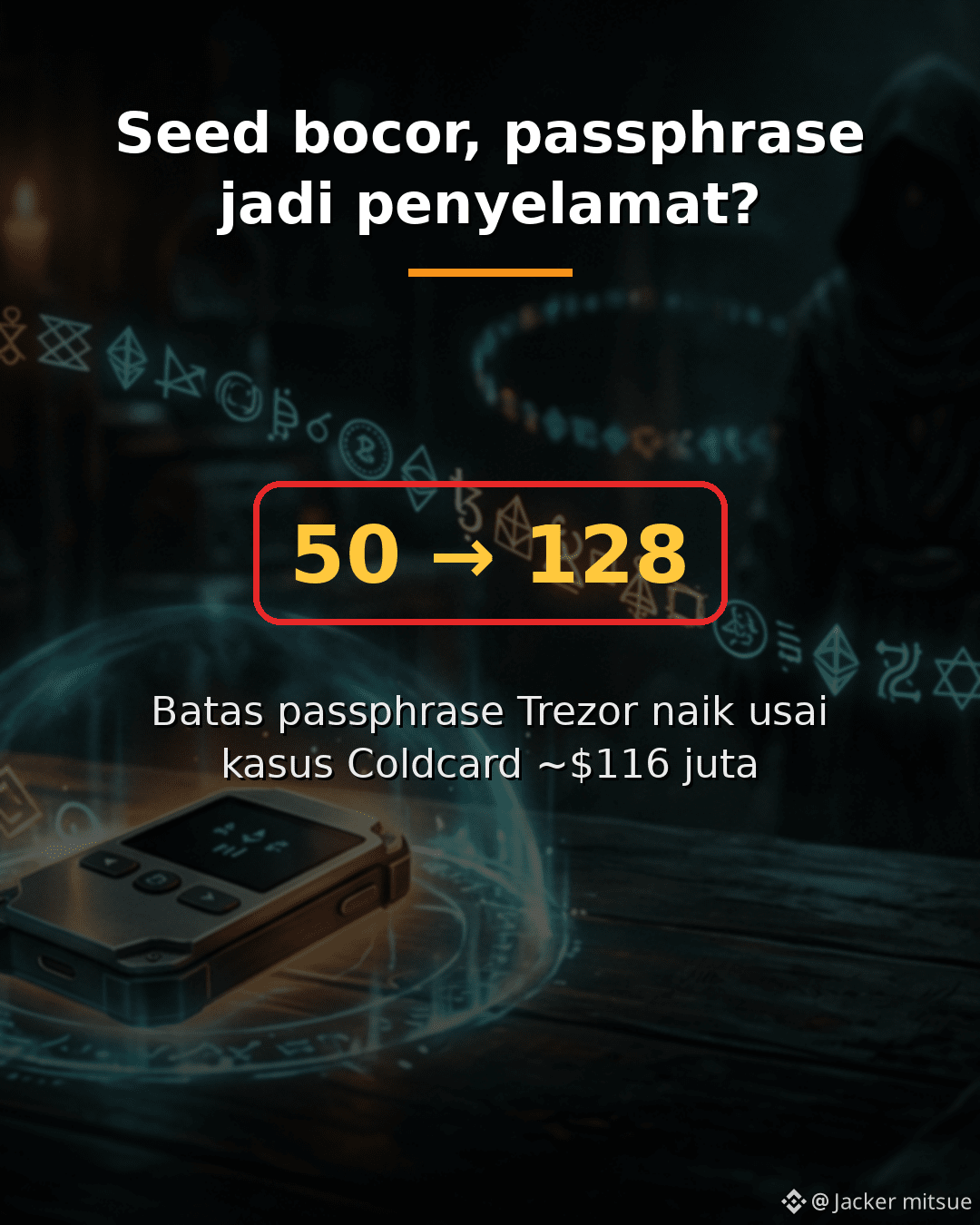
Trezor passphrase: 50 → 128 characters
Sunday (Nov 1, 2026), Trezor raised the optional passphrase limit from 50 to 128 characters with an update to Trezor Suite and new firmware. Older firmware remains capped at 50.
1. The trigger: the Coldcard case — A firmware bug in version 4.0.1 (March 2021) made the seed on some devices only as strong as 40 bits, not 128 bits. Since July 30, 2026, around 1,816 BTC (~$116 million) has been drained from more than 5,200 addresses (Galaxy Research data via TRM Labs).
2. Passphrase = a second layer — Like an extra password on top of the seed phrase. An attacker who gets the seed still needs the correct passphrase. According to Trezor, some victims were saved because they used a strong, unique passphrase.
3. Important note — A passphrase doesn’t fix a seed that’s already weak, and if you forget it, access is lost. Trezor is also asking buyers who purchased from former reseller CryptoBilis since March to move their funds to a new wallet.
#KeamananKripto #Trezor #Coldcard #SeedPhrase #BinanceSquare
Seed phrase leaked—can the crypto wallet still be saved?
Trezor passphrase: 50 → 128 characters
Sunday (Nov 1, 2026), Trezor raised the optional passphrase limit from 50 to 128 characters with an update to Trezor Suite and new firmware. Older firmware remains capped at 50.
1. The trigger: the Coldcard case — A firmware bug in version 4.0.1 (March 2021) made the seed on some devices only as strong as 40 bits, not 128 bits. Since July 30, 2026, around 1,816 BTC (~$116 million) has been drained from more than 5,200 addresses (Galaxy Research data via TRM Labs).
2. Passphrase = a second layer — Like an extra password on top of the seed phrase. An attacker who gets the seed still needs the correct passphrase. According to Trezor, some victims were saved because they used a strong, unique passphrase.
3. Important note — A passphrase doesn’t fix a seed that’s already weak, and if you forget it, access is lost. Trezor is also asking buyers who purchased from former reseller CryptoBilis since March to move their funds to a new wallet.
#KeamananKripto #Trezor #Coldcard #SeedPhrase #BinanceSquare
Trezor passphrase: 50 → 128 characters
Sunday (Nov 1, 2026), Trezor raised the optional passphrase limit from 50 to 128 characters with an update to Trezor Suite and new firmware. Older firmware remains capped at 50.
1. The trigger: the Coldcard case — A firmware bug in version 4.0.1 (March 2021) made the seed on some devices only as strong as 40 bits, not 128 bits. Since July 30, 2026, around 1,816 BTC (~$116 million) has been drained from more than 5,200 addresses (Galaxy Research data via TRM Labs).
2. Passphrase = a second layer — Like an extra password on top of the seed phrase. An attacker who gets the seed still needs the correct passphrase. According to Trezor, some victims were saved because they used a strong, unique passphrase.
3. Important note — A passphrase doesn’t fix a seed that’s already weak, and if you forget it, access is lost. Trezor is also asking buyers who purchased from former reseller CryptoBilis since March to move their funds to a new wallet.
#KeamananKripto #Trezor #Coldcard #SeedPhrase #BinanceSquare
56

·
--
Solana validators are being urged to act now — a critical Linux vulnerability rated 9.8/10 lurks beneath the network.
The facts: Anza, the developer of the Solana validator client, issued an “Action Required” alert on Nov. 1 regarding CVE-2026-98432: a use-after-free bug during IPv4 TCP connection setup, with a CVSS score of 9.8 (critical). Anthropic’s research model has even created a proof of concept that lets a remote attacker execute commands as root on Linux servers with Multipath TCP listeners — without credentials or user interaction. Since Anza runs on Ubuntu 24.04 and validators need public IPv4 addresses, the exposure is real.
While waiting for a kernel fix, Ubuntu operators have been urged to filter incoming traffic and disable two networking features. As of Sunday evening US time, Ubuntu’s tracker still listed fixes for versions 22.04/24.04/26.04/26.10 as “work in progress” — no patched kernel yet; Red Hat had already released fixes for RHEL 8/9/10 on Nov. 1.
My take: this is a reminder that a chain’s biggest risk sometimes isn’t the chain itself, but the operating system underneath it. As long as validators respond quickly with mitigations, the impact on everyday users should be limited — what I’m watching now is whether validator disruptions emerge over the next few days, and when the patched Ubuntu kernel is released. SOL itself is flat this morning, hovering around $94.9 — I’m not claiming this news is what’s moving its price.
What I’m watching next: an announcement of the patched Ubuntu kernel and confirmation from Anza that the mitigations are sufficient.
This is my analysis, not financial advice — always DYOR.
What do you think: should validators patch a vulnerability this severe within hours, or is a few days enough?
#Solana #KeamananKripto $SOL
Solana validators are being urged to act now — a critical Linux vulnerability rated 9.8/10 lurks beneath the network.
The facts: Anza, the developer of the Solana validator client, issued an “Action Required” alert on Nov. 1 regarding CVE-2026-98432: a use-after-free bug during IPv4 TCP connection setup, with a CVSS score of 9.8 (critical). Anthropic’s research model has even created a proof of concept that lets a remote attacker execute commands as root on Linux servers with Multipath TCP listeners — without credentials or user interaction. Since Anza runs on Ubuntu 24.04 and validators need public IPv4 addresses, the exposure is real.
While waiting for a kernel fix, Ubuntu operators have been urged to filter incoming traffic and disable two networking features. As of Sunday evening US time, Ubuntu’s tracker still listed fixes for versions 22.04/24.04/26.04/26.10 as “work in progress” — no patched kernel yet; Red Hat had already released fixes for RHEL 8/9/10 on Nov. 1.
My take: this is a reminder that a chain’s biggest risk sometimes isn’t the chain itself, but the operating system underneath it. As long as validators respond quickly with mitigations, the impact on everyday users should be limited — what I’m watching now is whether validator disruptions emerge over the next few days, and when the patched Ubuntu kernel is released. SOL itself is flat this morning, hovering around $94.9 — I’m not claiming this news is what’s moving its price.
What I’m watching next: an announcement of the patched Ubuntu kernel and confirmation from Anza that the mitigations are sufficient.
This is my analysis, not financial advice — always DYOR.
What do you think: should validators patch a vulnerability this severe within hours, or is a few days enough?
#Solana #KeamananKripto $SOL
The facts: Anza, the developer of the Solana validator client, issued an “Action Required” alert on Nov. 1 regarding CVE-2026-98432: a use-after-free bug during IPv4 TCP connection setup, with a CVSS score of 9.8 (critical). Anthropic’s research model has even created a proof of concept that lets a remote attacker execute commands as root on Linux servers with Multipath TCP listeners — without credentials or user interaction. Since Anza runs on Ubuntu 24.04 and validators need public IPv4 addresses, the exposure is real.
While waiting for a kernel fix, Ubuntu operators have been urged to filter incoming traffic and disable two networking features. As of Sunday evening US time, Ubuntu’s tracker still listed fixes for versions 22.04/24.04/26.04/26.10 as “work in progress” — no patched kernel yet; Red Hat had already released fixes for RHEL 8/9/10 on Nov. 1.
My take: this is a reminder that a chain’s biggest risk sometimes isn’t the chain itself, but the operating system underneath it. As long as validators respond quickly with mitigations, the impact on everyday users should be limited — what I’m watching now is whether validator disruptions emerge over the next few days, and when the patched Ubuntu kernel is released. SOL itself is flat this morning, hovering around $94.9 — I’m not claiming this news is what’s moving its price.
What I’m watching next: an announcement of the patched Ubuntu kernel and confirmation from Anza that the mitigations are sufficient.
This is my analysis, not financial advice — always DYOR.
What do you think: should validators patch a vulnerability this severe within hours, or is a few days enough?
#Solana #KeamananKripto $SOL
117
·
--
Chainalysis trackers found a laundering pattern they had never seen before involving funds stolen from Binance — thousands of automated transactions, and many wallets that always started with exactly 1 TRX.
Fact: in an Oct. 30, 2026 blog post, Chainalysis wrote that the perpetrators weren’t simply moving funds forward — they were cycling them repeatedly among many wallets, often returning to wallets they had used before. The pattern was consistent: an address received exactly 1 TRX, then received a larger amount, and then forwarded it. Chainalysis believes this was a programmatic process to obscure the trail. So far, about $2.8 billion has been frozen; the perpetrators briefly exchanged $325 million in stablecoins for $285 million in ETH in about 20 minutes to evade the freeze.
My take: this changes the picture — the laundering wasn’t manual, but automated, making the race between freezing and laundering even faster. With BTC around $77,400 and the market still defensive in the wake of the hack, I don’t read this as a buy or sell signal, but as a reason why exchange security is a major theme this week.
What I’m watching next: further movement of the stolen funds, confirmation that the targeted withdrawals will resume on Sunday, Nov. 1, and the proof-of-reserves report on Monday, Nov. 2.
Do you think automated laundering like this will force exchange security standards to level up, or will it just become a never-ending race?
This is my analysis, not financial advice — always DYOR.
#KeamananKripto #BinanceHack $BTC $ETH
Chainalysis trackers found a laundering pattern they had never seen before involving funds stolen from Binance — thousands of automated transactions, and many wallets that always started with exactly 1 TRX.
Fact: in an Oct. 30, 2026 blog post, Chainalysis wrote that the perpetrators weren’t simply moving funds forward — they were cycling them repeatedly among many wallets, often returning to wallets they had used before. The pattern was consistent: an address received exactly 1 TRX, then received a larger amount, and then forwarded it. Chainalysis believes this was a programmatic process to obscure the trail. So far, about $2.8 billion has been frozen; the perpetrators briefly exchanged $325 million in stablecoins for $285 million in ETH in about 20 minutes to evade the freeze.
My take: this changes the picture — the laundering wasn’t manual, but automated, making the race between freezing and laundering even faster. With BTC around $77,400 and the market still defensive in the wake of the hack, I don’t read this as a buy or sell signal, but as a reason why exchange security is a major theme this week.
What I’m watching next: further movement of the stolen funds, confirmation that the targeted withdrawals will resume on Sunday, Nov. 1, and the proof-of-reserves report on Monday, Nov. 2.
Do you think automated laundering like this will force exchange security standards to level up, or will it just become a never-ending race?
This is my analysis, not financial advice — always DYOR.
#KeamananKripto #BinanceHack $BTC $ETH
Fact: in an Oct. 30, 2026 blog post, Chainalysis wrote that the perpetrators weren’t simply moving funds forward — they were cycling them repeatedly among many wallets, often returning to wallets they had used before. The pattern was consistent: an address received exactly 1 TRX, then received a larger amount, and then forwarded it. Chainalysis believes this was a programmatic process to obscure the trail. So far, about $2.8 billion has been frozen; the perpetrators briefly exchanged $325 million in stablecoins for $285 million in ETH in about 20 minutes to evade the freeze.
My take: this changes the picture — the laundering wasn’t manual, but automated, making the race between freezing and laundering even faster. With BTC around $77,400 and the market still defensive in the wake of the hack, I don’t read this as a buy or sell signal, but as a reason why exchange security is a major theme this week.
What I’m watching next: further movement of the stolen funds, confirmation that the targeted withdrawals will resume on Sunday, Nov. 1, and the proof-of-reserves report on Monday, Nov. 2.
Do you think automated laundering like this will force exchange security standards to level up, or will it just become a never-ending race?
This is my analysis, not financial advice — always DYOR.
#KeamananKripto #BinanceHack $BTC $ETH
61
·
--
16 South Korean financial companies have already been hit by cyberattacks—and now the regulator is stepping in directly at the country’s second-largest crypto exchange.
The facts: South Korea’s Financial Services Commission (FSC) held an emergency meeting on Oct. 28 about the Bithumb data breach. Attendees included the Financial Supervisory Service, the Financial Security Institute, the DAXA alliance of crypto exchanges, and Bithumb itself. The regulator immediately began an on-site investigation to determine the cause and scope of the breach, and said it would oversee full compensation if customer losses are confirmed. Most importantly, the FSC said it would push for bank-level security standards across the crypto industry—a sector not currently covered by South Korea’s Electronic Financial Transactions Act. For context, the FSS governor said cyberattacks had hit 16 financial companies as of Oct. 14, and Daishin Securities confirmed that data belonging to 38,490 customers had been leaked. Bithumb is still investigating whether customer data was exposed; so far, no crypto funds have been reported missing. (Seoul Economic Daily, Cointelegraph, AJU Press, Oct. 28.)
My take: this is a turning point worth noting—not just another company-specific incident, but a systemic response. Bank-level standards mean higher compliance costs for exchanges, but they could also become a trust differentiator: exchanges that meet the standards may find it easier to attract institutional customers. The risk is that overly burdensome rules could squeeze smaller exchanges. BTC is currently around $81,510, but this news isn’t about price—it’s about whether South Korea becomes a model for crypto security regulation that other countries follow.
What I’m watching: the results of the FSC’s on-site investigation, whether Bithumb customer data is confirmed to have been leaked, and the specific details of the proposed bank-level standards.
What do you think: will bank-level security standards make crypto exchanges safer—or will they kill off smaller exchanges that can’t afford to comply?
This is my analysis, not financial advice—always DYOR.
#RegulasiKorea #KeamananKripto $BTC
16 South Korean financial companies have already been hit by cyberattacks—and now the regulator is stepping in directly at the country’s second-largest crypto exchange.
The facts: South Korea’s Financial Services Commission (FSC) held an emergency meeting on Oct. 28 about the Bithumb data breach. Attendees included the Financial Supervisory Service, the Financial Security Institute, the DAXA alliance of crypto exchanges, and Bithumb itself. The regulator immediately began an on-site investigation to determine the cause and scope of the breach, and said it would oversee full compensation if customer losses are confirmed. Most importantly, the FSC said it would push for bank-level security standards across the crypto industry—a sector not currently covered by South Korea’s Electronic Financial Transactions Act. For context, the FSS governor said cyberattacks had hit 16 financial companies as of Oct. 14, and Daishin Securities confirmed that data belonging to 38,490 customers had been leaked. Bithumb is still investigating whether customer data was exposed; so far, no crypto funds have been reported missing. (Seoul Economic Daily, Cointelegraph, AJU Press, Oct. 28.)
My take: this is a turning point worth noting—not just another company-specific incident, but a systemic response. Bank-level standards mean higher compliance costs for exchanges, but they could also become a trust differentiator: exchanges that meet the standards may find it easier to attract institutional customers. The risk is that overly burdensome rules could squeeze smaller exchanges. BTC is currently around $81,510, but this news isn’t about price—it’s about whether South Korea becomes a model for crypto security regulation that other countries follow.
What I’m watching: the results of the FSC’s on-site investigation, whether Bithumb customer data is confirmed to have been leaked, and the specific details of the proposed bank-level standards.
What do you think: will bank-level security standards make crypto exchanges safer—or will they kill off smaller exchanges that can’t afford to comply?
This is my analysis, not financial advice—always DYOR.
#RegulasiKorea #KeamananKripto $BTC
The facts: South Korea’s Financial Services Commission (FSC) held an emergency meeting on Oct. 28 about the Bithumb data breach. Attendees included the Financial Supervisory Service, the Financial Security Institute, the DAXA alliance of crypto exchanges, and Bithumb itself. The regulator immediately began an on-site investigation to determine the cause and scope of the breach, and said it would oversee full compensation if customer losses are confirmed. Most importantly, the FSC said it would push for bank-level security standards across the crypto industry—a sector not currently covered by South Korea’s Electronic Financial Transactions Act. For context, the FSS governor said cyberattacks had hit 16 financial companies as of Oct. 14, and Daishin Securities confirmed that data belonging to 38,490 customers had been leaked. Bithumb is still investigating whether customer data was exposed; so far, no crypto funds have been reported missing. (Seoul Economic Daily, Cointelegraph, AJU Press, Oct. 28.)
My take: this is a turning point worth noting—not just another company-specific incident, but a systemic response. Bank-level standards mean higher compliance costs for exchanges, but they could also become a trust differentiator: exchanges that meet the standards may find it easier to attract institutional customers. The risk is that overly burdensome rules could squeeze smaller exchanges. BTC is currently around $81,510, but this news isn’t about price—it’s about whether South Korea becomes a model for crypto security regulation that other countries follow.
What I’m watching: the results of the FSC’s on-site investigation, whether Bithumb customer data is confirmed to have been leaked, and the specific details of the proposed bank-level standards.
What do you think: will bank-level security standards make crypto exchanges safer—or will they kill off smaller exchanges that can’t afford to comply?
This is my analysis, not financial advice—always DYOR.
#RegulasiKorea #KeamananKripto $BTC
6
·
--
It wasn’t the exchange that was breached — it was its analytics vendor. And that’s exactly why this case is worth paying attention to.
The facts: Coinbase confirmed on Oct. 28 that a security incident at Amplitude, a third-party analytics vendor, exposed the contact details of a small subset of its customers — email addresses and phone numbers. Coinbase said its internal systems were not accessed without authorization and customer funds were unaffected, and that it is notifying affected customers and regulators. The figure of 70,000+ customers being circulated comes from a claim by security firm SlowMist — Coinbase has NOT confirmed that number. On the same day, similar reports also implicated Bithumb and two South Korean companies — separate incidents, but with the same pattern: customer data is being targeted.
My take: the difference between “being breached” and “being exposed through a vendor” isn’t just a matter of wording. Leaked contact details are raw material for phishing and SIM-swapping attacks — attacks that don’t require breaching an exchange to drain victims’ accounts. And this incident underscores a weak point that’s often overlooked: your account security is only as strong as the weakest vendor holding your data. BTC is now around $81,049, but this news isn’t about price — it’s about staying alert.
What I’m watching: whether Amplitude releases technical details about the incident, and whether a wave of phishing targeting Coinbase customers actually emerges over the next few days.
Have you ever received a suspicious message pretending to be from an exchange? Share what gave it away in the comments — so others can stay alert too.
This is my analysis, not financial advice — always DYOR.
#KeamananKripto #Phishing $BTC
It wasn’t the exchange that was breached — it was its analytics vendor. And that’s exactly why this case is worth paying attention to.
The facts: Coinbase confirmed on Oct. 28 that a security incident at Amplitude, a third-party analytics vendor, exposed the contact details of a small subset of its customers — email addresses and phone numbers. Coinbase said its internal systems were not accessed without authorization and customer funds were unaffected, and that it is notifying affected customers and regulators. The figure of 70,000+ customers being circulated comes from a claim by security firm SlowMist — Coinbase has NOT confirmed that number. On the same day, similar reports also implicated Bithumb and two South Korean companies — separate incidents, but with the same pattern: customer data is being targeted.
My take: the difference between “being breached” and “being exposed through a vendor” isn’t just a matter of wording. Leaked contact details are raw material for phishing and SIM-swapping attacks — attacks that don’t require breaching an exchange to drain victims’ accounts. And this incident underscores a weak point that’s often overlooked: your account security is only as strong as the weakest vendor holding your data. BTC is now around $81,049, but this news isn’t about price — it’s about staying alert.
What I’m watching: whether Amplitude releases technical details about the incident, and whether a wave of phishing targeting Coinbase customers actually emerges over the next few days.
Have you ever received a suspicious message pretending to be from an exchange? Share what gave it away in the comments — so others can stay alert too.
This is my analysis, not financial advice — always DYOR.
#KeamananKripto #Phishing $BTC
The facts: Coinbase confirmed on Oct. 28 that a security incident at Amplitude, a third-party analytics vendor, exposed the contact details of a small subset of its customers — email addresses and phone numbers. Coinbase said its internal systems were not accessed without authorization and customer funds were unaffected, and that it is notifying affected customers and regulators. The figure of 70,000+ customers being circulated comes from a claim by security firm SlowMist — Coinbase has NOT confirmed that number. On the same day, similar reports also implicated Bithumb and two South Korean companies — separate incidents, but with the same pattern: customer data is being targeted.
My take: the difference between “being breached” and “being exposed through a vendor” isn’t just a matter of wording. Leaked contact details are raw material for phishing and SIM-swapping attacks — attacks that don’t require breaching an exchange to drain victims’ accounts. And this incident underscores a weak point that’s often overlooked: your account security is only as strong as the weakest vendor holding your data. BTC is now around $81,049, but this news isn’t about price — it’s about staying alert.
What I’m watching: whether Amplitude releases technical details about the incident, and whether a wave of phishing targeting Coinbase customers actually emerges over the next few days.
Have you ever received a suspicious message pretending to be from an exchange? Share what gave it away in the comments — so others can stay alert too.
This is my analysis, not financial advice — always DYOR.
#KeamananKripto #Phishing $BTC
10
·
--
One wrong wallet address copy, and your money could be gone forever?
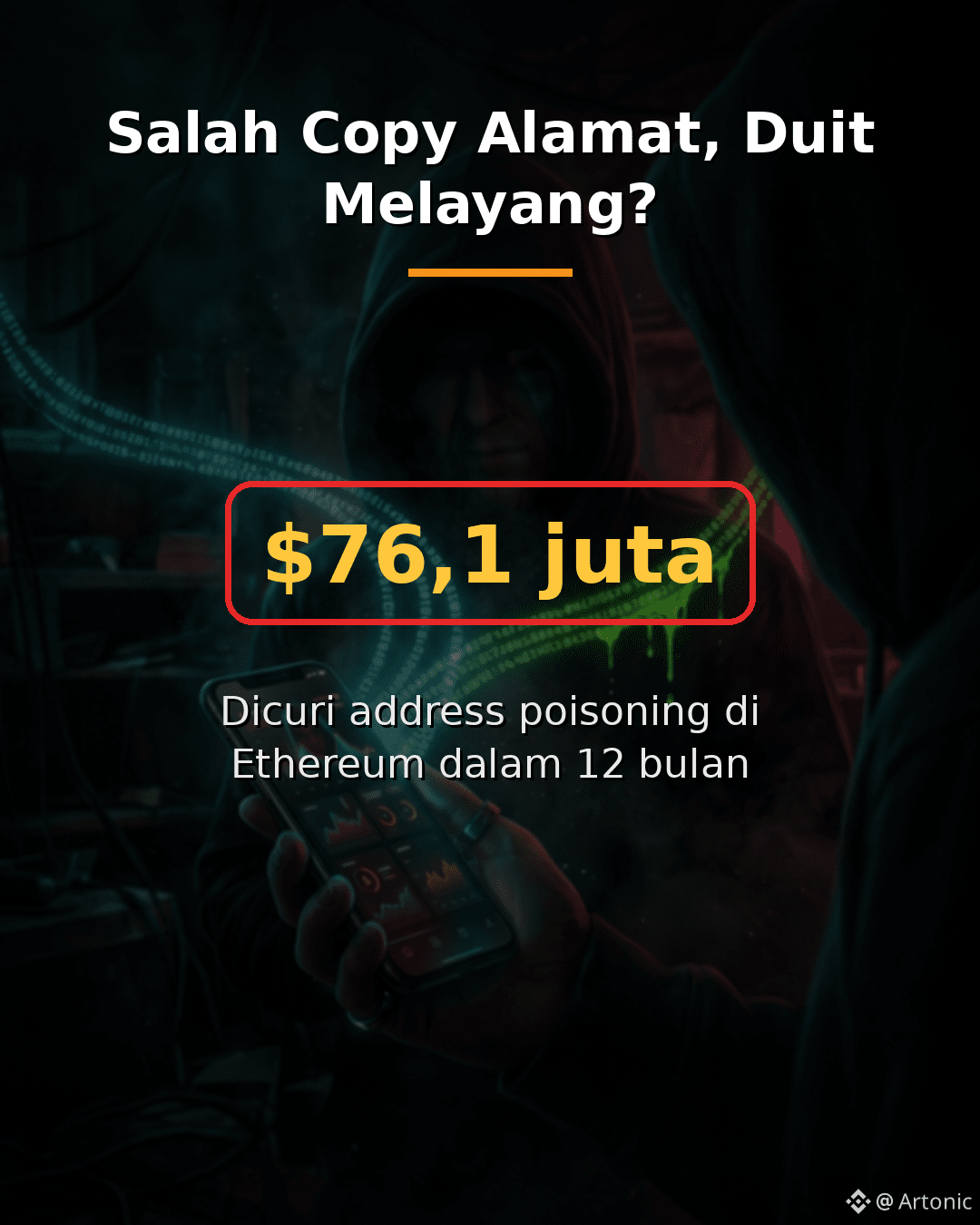
$76.1 million | 1,635 victims | 7,997,367 wallets targeted
It’s called address poisoning. Scammers create fake addresses that look similar at the beginning and end to addresses you usually send money to, then “slip” them into your transaction history through dust or 0-token transfers. When you copy an address from your history, your money ends up with the scammer.
1. It’s widespread — Bitquery research (12 months through July 31, 2026) recorded 1,635 people losing a total of $76.1 million on Ethereum alone. The biggest case: nearly $50 million in USDT on December 19, 2025; the fake address matched only the first 3 characters.
2. The bait is patient — The median time from bait to theft is 4.5 days. In a recent case (October 28, 2026, Scam Sniffer), a user lost ~$50,000 in USDT because the fake address matched the first 4 & last 6 characters.
3. Stay safe — Never copy an address from your transaction history. Save it in your address book, check the middle characters too, and be careful with your own exchange deposit address (28.3% of cases spoof this address).
#AddressPoisoning #KeamananKripto #Ethereum #USDT #BinanceSquare
One wrong wallet address copy, and your money could be gone forever?
$76.1 million | 1,635 victims | 7,997,367 wallets targeted
It’s called address poisoning. Scammers create fake addresses that look similar at the beginning and end to addresses you usually send money to, then “slip” them into your transaction history through dust or 0-token transfers. When you copy an address from your history, your money ends up with the scammer.
1. It’s widespread — Bitquery research (12 months through July 31, 2026) recorded 1,635 people losing a total of $76.1 million on Ethereum alone. The biggest case: nearly $50 million in USDT on December 19, 2025; the fake address matched only the first 3 characters.
2. The bait is patient — The median time from bait to theft is 4.5 days. In a recent case (October 28, 2026, Scam Sniffer), a user lost ~$50,000 in USDT because the fake address matched the first 4 & last 6 characters.
3. Stay safe — Never copy an address from your transaction history. Save it in your address book, check the middle characters too, and be careful with your own exchange deposit address (28.3% of cases spoof this address).
#AddressPoisoning #KeamananKripto #Ethereum #USDT #BinanceSquare
$76.1 million | 1,635 victims | 7,997,367 wallets targeted
It’s called address poisoning. Scammers create fake addresses that look similar at the beginning and end to addresses you usually send money to, then “slip” them into your transaction history through dust or 0-token transfers. When you copy an address from your history, your money ends up with the scammer.
1. It’s widespread — Bitquery research (12 months through July 31, 2026) recorded 1,635 people losing a total of $76.1 million on Ethereum alone. The biggest case: nearly $50 million in USDT on December 19, 2025; the fake address matched only the first 3 characters.
2. The bait is patient — The median time from bait to theft is 4.5 days. In a recent case (October 28, 2026, Scam Sniffer), a user lost ~$50,000 in USDT because the fake address matched the first 4 & last 6 characters.
3. Stay safe — Never copy an address from your transaction history. Save it in your address book, check the middle characters too, and be careful with your own exchange deposit address (28.3% of cases spoof this address).
#AddressPoisoning #KeamananKripto #Ethereum #USDT #BinanceSquare
419
Log in to explore more content
Join global crypto users on Binance Square
⚡️ Get latest and useful information about crypto.
💬 Trusted by the world’s largest crypto exchange.
👍 Discover real insights from verified creators.
Email / Phone number
Trending Topics
1
#BTCRebounds80K
84,106 views
824 Discussing
2
#Binance98PercentReplenished
47,004 views
647 Discussing
3
#USMidterms-WhatAreMarketsExpecting?
369,148 views
2,162 Discussing
4
#USOctoberNFP-AreRateCutsStillPossible
409,572 views
2,899 Discussing
5
#USClearsSingleStockPerpetualFutures
1,597 views
64 Discussing
6
#StrategySTRCHits$100ForFirstTimeSinceMay
0 views
1 Discussing
7
#TrumpFamilyBackedBitcoinMinerReportsQ3Profit
883 views
40 Discussing
8
#SouthKoreaPlansImmediateCryptoSecurityIncidentReportingRules
56 views
5 Discussing
9
#CourtRejectsCMARequestToPauseSingleStockPerpetuals
428 views
22 Discussing
10
#AMDBeatsExpectations-AINarrativeContinues
107,345 views
825 Discussing