
#googlb
googlb
19,225 views
624 Discussing
Hot
Latest

·
--
Volume surged to 1.27x the hourly average as $GOOGLB tests $288.23.
The asset holds a +1.31% daily gain inside a $278.02 to $290.80 range.
A bullish breakout scenario requires sustained acceptance above the upper range boundary with continued volume expansion.
Conversely, a drop below the recent hourly close of $288.05 signals potential exhaustion and late-entry risk.
Will buyers secure a daily close above the $290.80 high, or does a slide back toward the $278.02 low invalidate this momentum?
Tap $GOOGLB for the live chart. #GOOGLB #BinanceSquare
Volume surged to 1.27x the hourly average as $GOOGLB tests $288.23.
The asset holds a +1.31% daily gain inside a $278.02 to $290.80 range.
A bullish breakout scenario requires sustained acceptance above the upper range boundary with continued volume expansion.
Conversely, a drop below the recent hourly close of $288.05 signals potential exhaustion and late-entry risk.
Will buyers secure a daily close above the $290.80 high, or does a slide back toward the $278.02 low invalidate this momentum?
Tap $GOOGLB for the live chart. #GOOGLB #BinanceSquare
The asset holds a +1.31% daily gain inside a $278.02 to $290.80 range.
A bullish breakout scenario requires sustained acceptance above the upper range boundary with continued volume expansion.
Conversely, a drop below the recent hourly close of $288.05 signals potential exhaustion and late-entry risk.
Will buyers secure a daily close above the $290.80 high, or does a slide back toward the $278.02 low invalidate this momentum?
Tap $GOOGLB for the live chart. #GOOGLB #BinanceSquare

·
--
$GOOGLB 🚀 $GOOGLB LONG SETUP 🟢
The bullish momentum for $GOOGLB is intensifying, with a strong 4.25% gain over the last 24 hours signaling significant buying interest. Strong volume backing this move suggests potential for further upside as $GOOGLB tests higher resistance levels.
📊 24h: +4.25% | Vol: $21,222,080.54
📈 TRADE PLAN
🔹 Entry: 289.81
🛑 Stop Loss: 284.18
🎯 TP1: 298.30
🎯 TP2: 304.20
🎯 TP3: 310.50
⚖️ Risk:Reward (TP1): 1:1.50
🔔 Trigger: A sustained breakout and candle close above the 290.00 psychological level would confirm the bullish intent.
⚠️ Risk Note: High volatility is expected near the 296.59 daily high; ensure tight stop management to mitigate downside exposure.
Always wait for a clear breakout confirmation before committing capital to the trade.
Click below 👇🏻 to trade
$GOOGLB
Follow @T4_TZX for more updates...
#GOOGLB #CryptoTrading #MarketAnalysis #BinanceSquare
$GOOGLB 🚀 $GOOGLB LONG SETUP 🟢
The bullish momentum for $GOOGLB is intensifying, with a strong 4.25% gain over the last 24 hours signaling significant buying interest. Strong volume backing this move suggests potential for further upside as $GOOGLB tests higher resistance levels.
📊 24h: +4.25% | Vol: $21,222,080.54
📈 TRADE PLAN
🔹 Entry: 289.81
🛑 Stop Loss: 284.18
🎯 TP1: 298.30
🎯 TP2: 304.20
🎯 TP3: 310.50
⚖️ Risk:Reward (TP1): 1:1.50
🔔 Trigger: A sustained breakout and candle close above the 290.00 psychological level would confirm the bullish intent.
⚠️ Risk Note: High volatility is expected near the 296.59 daily high; ensure tight stop management to mitigate downside exposure.
Always wait for a clear breakout confirmation before committing capital to the trade.
Click below 👇🏻 to trade
$GOOGLB
Follow @T4_TZX for more updates...
#GOOGLB #CryptoTrading #MarketAnalysis #BinanceSquare
The bullish momentum for $GOOGLB is intensifying, with a strong 4.25% gain over the last 24 hours signaling significant buying interest. Strong volume backing this move suggests potential for further upside as $GOOGLB tests higher resistance levels.
📊 24h: +4.25% | Vol: $21,222,080.54
📈 TRADE PLAN
🔹 Entry: 289.81
🛑 Stop Loss: 284.18
🎯 TP1: 298.30
🎯 TP2: 304.20
🎯 TP3: 310.50
⚖️ Risk:Reward (TP1): 1:1.50
🔔 Trigger: A sustained breakout and candle close above the 290.00 psychological level would confirm the bullish intent.
⚠️ Risk Note: High volatility is expected near the 296.59 daily high; ensure tight stop management to mitigate downside exposure.
Always wait for a clear breakout confirmation before committing capital to the trade.
Click below 👇🏻 to trade
$GOOGLB
Follow @T4_TZX for more updates...
#GOOGLB #CryptoTrading #MarketAnalysis #BinanceSquare
5

·
--
$GOOGLB looks ready to go up from here 🚀
Entry zone 288.9991 to 290.6127
Stop 284.5943
Targets 298.8336 then 304.5293 then 313.0729
RSI is 58 so it has room to run
Up 4.1 percent today and holding strong
Price is in the zone right now
Tap $GOOGLB to buy
Last 7 days of my calls, 35 hit target and 52 hit stop
#GOOGLB #TradingSignals
$GOOGLB looks ready to go up from here 🚀
Entry zone 288.9991 to 290.6127
Stop 284.5943
Targets 298.8336 then 304.5293 then 313.0729
RSI is 58 so it has room to run
Up 4.1 percent today and holding strong
Price is in the zone right now
Tap $GOOGLB to buy
Last 7 days of my calls, 35 hit target and 52 hit stop
#GOOGLB #TradingSignals
Entry zone 288.9991 to 290.6127
Stop 284.5943
Targets 298.8336 then 304.5293 then 313.0729
RSI is 58 so it has room to run
Up 4.1 percent today and holding strong
Price is in the zone right now
Tap $GOOGLB to buy
Last 7 days of my calls, 35 hit target and 52 hit stop
#GOOGLB #TradingSignals
3
·
--
Volume is fading fast as $GOOGLB tests the upper range.
Trading at $289.62 with a 4.02% daily gain, the asset posts $21.53M in 24h volume. However, the latest hourly volume sits at just 0.17x the 23-hour average following a dip to 287.96.
If buyers push past the 296.59 high on rising volume, continuation toward higher levels remains a scenario to watch. Conversely, failure to hold above the 277.71 low invalidates the near-term bullish structure.
Will you wait for a confirmed volume breakout above 296.59, or does a drop toward 277.71 change your bias?
Tap $GOOGLB for the live chart. #GOOGLB #BinanceSquare
Volume is fading fast as $GOOGLB tests the upper range.
Trading at $289.62 with a 4.02% daily gain, the asset posts $21.53M in 24h volume. However, the latest hourly volume sits at just 0.17x the 23-hour average following a dip to 287.96.
If buyers push past the 296.59 high on rising volume, continuation toward higher levels remains a scenario to watch. Conversely, failure to hold above the 277.71 low invalidates the near-term bullish structure.
Will you wait for a confirmed volume breakout above 296.59, or does a drop toward 277.71 change your bias?
Tap $GOOGLB for the live chart. #GOOGLB #BinanceSquare
Trading at $289.62 with a 4.02% daily gain, the asset posts $21.53M in 24h volume. However, the latest hourly volume sits at just 0.17x the 23-hour average following a dip to 287.96.
If buyers push past the 296.59 high on rising volume, continuation toward higher levels remains a scenario to watch. Conversely, failure to hold above the 277.71 low invalidates the near-term bullish structure.
Will you wait for a confirmed volume breakout above 296.59, or does a drop toward 277.71 change your bias?
Tap $GOOGLB for the live chart. #GOOGLB #BinanceSquare
2
·
--
Volume spiked 1.27x above average as $GOOGLB reached 284.14.
Buyers drove a +1.26% gain over 24 hours, testing the upper boundary near 285. This volume expansion signals active participation, but chasing price near the range high carries mean-reversion risk back toward the 273.16 low.
A sustained hold above 285 offers bullish confirmation, while a drop back under the hourly close at 284.02 invalidates the immediate breakout attempt.
Will you wait for a confirmed hourly close above 285, or does the risk of a rejection at these highs keep you on the sidelines?
Tap $GOOGLB for the live chart. #GOOGLB #BinanceSquare
Volume spiked 1.27x above average as $GOOGLB reached 284.14.
Buyers drove a +1.26% gain over 24 hours, testing the upper boundary near 285. This volume expansion signals active participation, but chasing price near the range high carries mean-reversion risk back toward the 273.16 low.
A sustained hold above 285 offers bullish confirmation, while a drop back under the hourly close at 284.02 invalidates the immediate breakout attempt.
Will you wait for a confirmed hourly close above 285, or does the risk of a rejection at these highs keep you on the sidelines?
Tap $GOOGLB for the live chart. #GOOGLB #BinanceSquare
Buyers drove a +1.26% gain over 24 hours, testing the upper boundary near 285. This volume expansion signals active participation, but chasing price near the range high carries mean-reversion risk back toward the 273.16 low.
A sustained hold above 285 offers bullish confirmation, while a drop back under the hourly close at 284.02 invalidates the immediate breakout attempt.
Will you wait for a confirmed hourly close above 285, or does the risk of a rejection at these highs keep you on the sidelines?
Tap $GOOGLB for the live chart. #GOOGLB #BinanceSquare

·
--
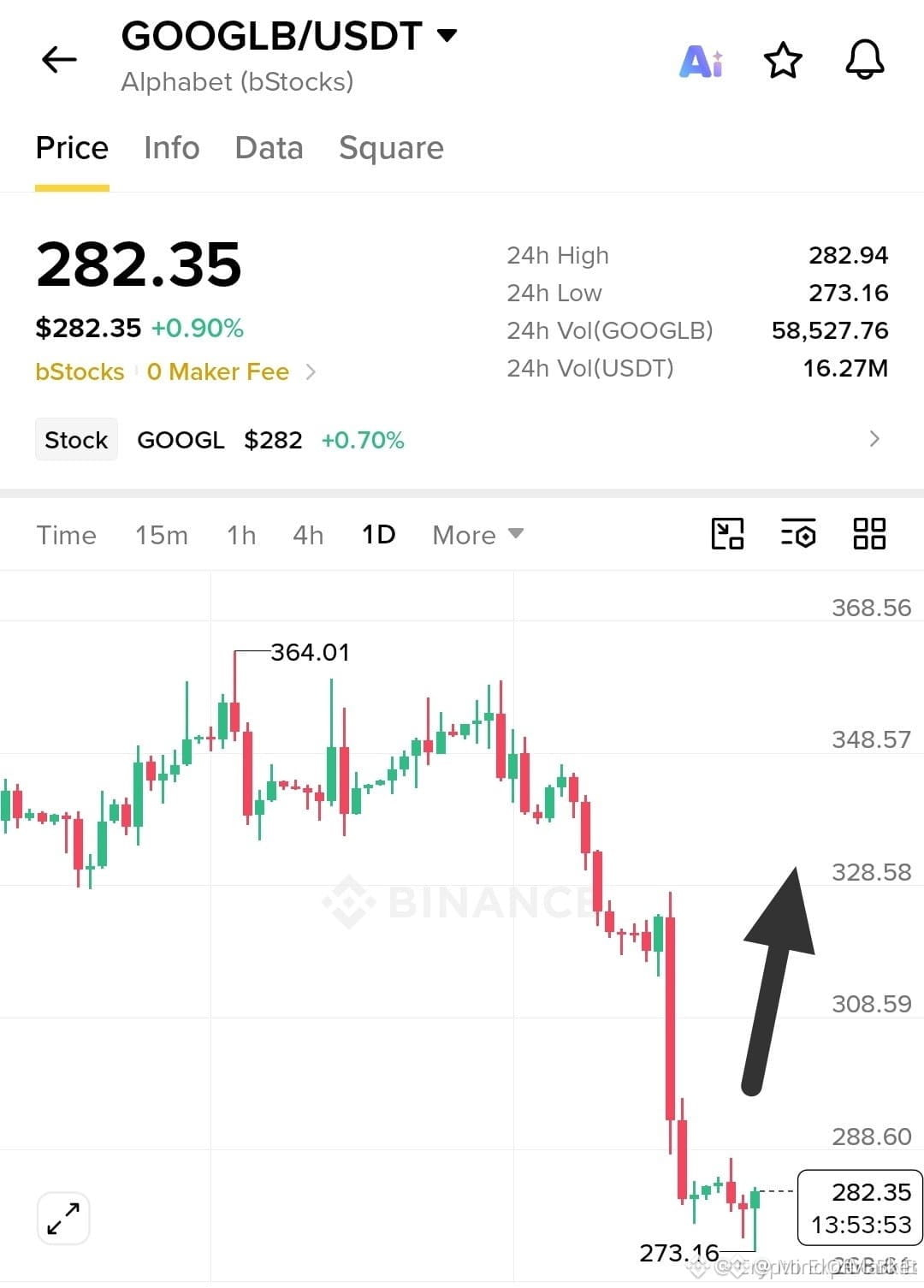
🚨 $GOOGLB SURGES ABOVE $282 – BULLISH SWING SETUP 💥
Entry: $282 🟢
Target: $286 🚀
Target: $291 🚀
Target: $297 🚀
Stop Loss: $278.50 ⚠️
The order block at $282 has held firm across three 4‑hour candles, swallowing sell pressure and signaling smart‑money accumulation 🌊. Volume spikes accompany each bounce, confirming the liquidity vacuum is being filled 📊. With the price locked above the entry, the next liquidity pools sit at $286, $291 and $297 – classic upward bias zones where institutional sellers may re‑enter. A clean break of $286 would ignite a rapid climb toward the $291‑$297 corridor ⚡.
💬 Which target are you eyeing first – the early $286 test or the deeper $297 run? 👇
⚠️ Not financial advice. Always manage your risk. 🛡️
🏷️ #GOOGLB #LongSetup #Bullish #SmartMoney #Crypto
🚀 💎
🚨 $GOOGLB SURGES ABOVE $282 – BULLISH SWING SETUP 💥
Entry: $282 🟢
Target: $286 🚀
Target: $291 🚀
Target: $297 🚀
Stop Loss: $278.50 ⚠️
The order block at $282 has held firm across three 4‑hour candles, swallowing sell pressure and signaling smart‑money accumulation 🌊. Volume spikes accompany each bounce, confirming the liquidity vacuum is being filled 📊. With the price locked above the entry, the next liquidity pools sit at $286, $291 and $297 – classic upward bias zones where institutional sellers may re‑enter. A clean break of $286 would ignite a rapid climb toward the $291‑$297 corridor ⚡.
💬 Which target are you eyeing first – the early $286 test or the deeper $297 run? 👇
⚠️ Not financial advice. Always manage your risk. 🛡️
🏷️ #GOOGLB #LongSetup #Bullish #SmartMoney #Crypto
🚀 💎
Entry: $282 🟢
Target: $286 🚀
Target: $291 🚀
Target: $297 🚀
Stop Loss: $278.50 ⚠️
The order block at $282 has held firm across three 4‑hour candles, swallowing sell pressure and signaling smart‑money accumulation 🌊. Volume spikes accompany each bounce, confirming the liquidity vacuum is being filled 📊. With the price locked above the entry, the next liquidity pools sit at $286, $291 and $297 – classic upward bias zones where institutional sellers may re‑enter. A clean break of $286 would ignite a rapid climb toward the $291‑$297 corridor ⚡.
💬 Which target are you eyeing first – the early $286 test or the deeper $297 run? 👇
⚠️ Not financial advice. Always manage your risk. 🛡️
🏷️ #GOOGLB #LongSetup #Bullish #SmartMoney #Crypto
🚀 💎
3

·
--
🚀 $GOOGLB BREAKING ABOVE $282 – BULLISH SURGE TO $297 📈
Entry: $282 ⚡
Target: $286 🎯
Target: $291 🎯
Target: $297 🎯
Stop Loss: $278.50 ⚠️
Smart money is snapping up liquidity at $282, and the 20x leverage cranks the order flow into overdrive. 📊 The bullish bias is clear – every candle above the entry fuels a cascade toward the next resistance. 💡 Hold firm above $282 and the path to $291‑$297 opens wide, but if the price slips to the stop, the swing flips fast.
The trade rewards the patience of a disciplined long, letting the market’s momentum do the heavy lifting. 📈 Keep the risk tight and avoid chasing a dip that could bite. 💬 Are you ready to ride this upward wave or waiting for a deeper pullback? 👇
⚠️ Not financial advice. Always manage your risk. 🛡️
🏷️ #GOOGLB #LongSetup #Bullish #Leverage #Crypto
🚀 ⚡
🚀 $GOOGLB BREAKING ABOVE $282 – BULLISH SURGE TO $297 📈
Entry: $282 ⚡
Target: $286 🎯
Target: $291 🎯
Target: $297 🎯
Stop Loss: $278.50 ⚠️
Smart money is snapping up liquidity at $282, and the 20x leverage cranks the order flow into overdrive. 📊 The bullish bias is clear – every candle above the entry fuels a cascade toward the next resistance. 💡 Hold firm above $282 and the path to $291‑$297 opens wide, but if the price slips to the stop, the swing flips fast.
The trade rewards the patience of a disciplined long, letting the market’s momentum do the heavy lifting. 📈 Keep the risk tight and avoid chasing a dip that could bite. 💬 Are you ready to ride this upward wave or waiting for a deeper pullback? 👇
⚠️ Not financial advice. Always manage your risk. 🛡️
🏷️ #GOOGLB #LongSetup #Bullish #Leverage #Crypto
🚀 ⚡
Entry: $282 ⚡
Target: $286 🎯
Target: $291 🎯
Target: $297 🎯
Stop Loss: $278.50 ⚠️
Smart money is snapping up liquidity at $282, and the 20x leverage cranks the order flow into overdrive. 📊 The bullish bias is clear – every candle above the entry fuels a cascade toward the next resistance. 💡 Hold firm above $282 and the path to $291‑$297 opens wide, but if the price slips to the stop, the swing flips fast.
The trade rewards the patience of a disciplined long, letting the market’s momentum do the heavy lifting. 📈 Keep the risk tight and avoid chasing a dip that could bite. 💬 Are you ready to ride this upward wave or waiting for a deeper pullback? 👇
⚠️ Not financial advice. Always manage your risk. 🛡️
🏷️ #GOOGLB #LongSetup #Bullish #Leverage #Crypto
🚀 ⚡
6
·
--
$GOOGLB volume cools as price stabilizes near $278.04.
On $17.77M daily volume, price hovers inside the recent 273.16 to 281.80 range following a 0.43% daily dip. Low relative hourly volume points to temporary consolidation rather than aggressive distribution.
A bullish continuation scenario requires reclaiming the upper boundary near 281.80 on rising volume. Conversely, a breakdown below the 273.16 range low invalidates this setup, signaling deeper selling pressure.
Will buyers defend the lower range limit, or will a break above 281.80 confirm strength first?
Tap $GOOGLB for the live chart. #GOOGLB #BinanceSquare
$GOOGLB volume cools as price stabilizes near $278.04.
On $17.77M daily volume, price hovers inside the recent 273.16 to 281.80 range following a 0.43% daily dip. Low relative hourly volume points to temporary consolidation rather than aggressive distribution.
A bullish continuation scenario requires reclaiming the upper boundary near 281.80 on rising volume. Conversely, a breakdown below the 273.16 range low invalidates this setup, signaling deeper selling pressure.
Will buyers defend the lower range limit, or will a break above 281.80 confirm strength first?
Tap $GOOGLB for the live chart. #GOOGLB #BinanceSquare
On $17.77M daily volume, price hovers inside the recent 273.16 to 281.80 range following a 0.43% daily dip. Low relative hourly volume points to temporary consolidation rather than aggressive distribution.
A bullish continuation scenario requires reclaiming the upper boundary near 281.80 on rising volume. Conversely, a breakdown below the 273.16 range low invalidates this setup, signaling deeper selling pressure.
Will buyers defend the lower range limit, or will a break above 281.80 confirm strength first?
Tap $GOOGLB for the live chart. #GOOGLB #BinanceSquare

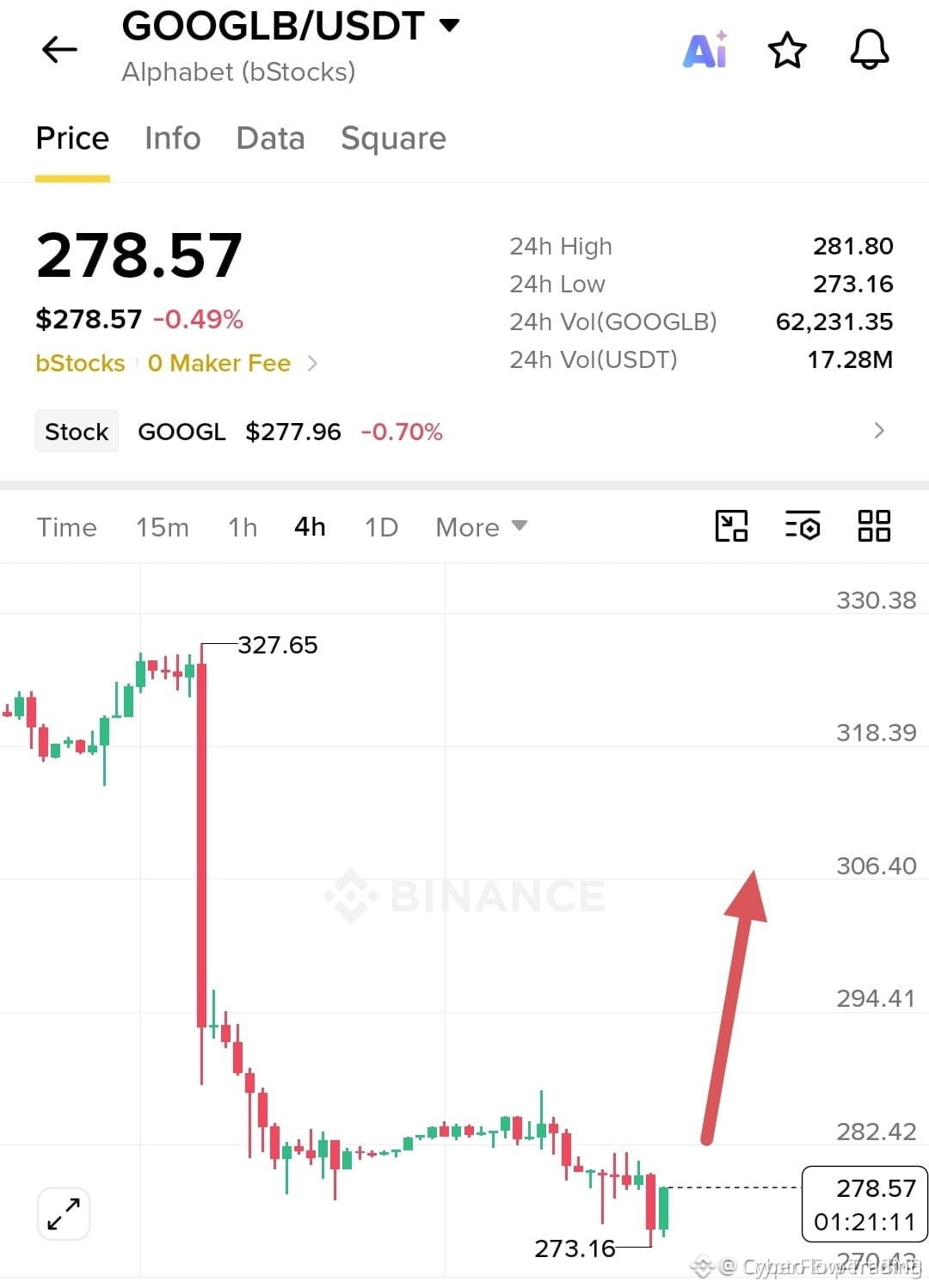
🚀 $GOOGLB QUICK REBOUND PLAY 📈
Entry: 278 ⚡
Target: 282 🚀
Target: 286.5 🚀
Target: 292 🚀
Stop Loss: 274.80 ⚠️
The daily RSI is stuck in the 20‑zone, flagging a deep oversold condition while the 4H and daily charts still wear a bearish hue. 📊 A tight demand pocket around $276‑$278 is swallowing sell pressure, setting the stage for a swift rebound.
If price holds above $276 and nudges the $278 entry, the next resistance at $281.64 becomes a launchpad toward the tiered targets at $282, $286.5 and $292. 🦈 Break below $274.80 and the long is dead, prompting an immediate exit.
💬 Are you ready to ride this short‑term bounce or wait for a cleaner breakout?
⚠️ Not financial advice. Always manage your risk. 🛡️
🏷️ #GOOGLB #LongSetup #Rebound #Crypto
🔥 💎
🚀 $GOOGLB QUICK REBOUND PLAY 📈
Entry: 278 ⚡
Target: 282 🚀
Target: 286.5 🚀
Target: 292 🚀
Stop Loss: 274.80 ⚠️
The daily RSI is stuck in the 20‑zone, flagging a deep oversold condition while the 4H and daily charts still wear a bearish hue. 📊 A tight demand pocket around $276‑$278 is swallowing sell pressure, setting the stage for a swift rebound.
If price holds above $276 and nudges the $278 entry, the next resistance at $281.64 becomes a launchpad toward the tiered targets at $282, $286.5 and $292. 🦈 Break below $274.80 and the long is dead, prompting an immediate exit.
💬 Are you ready to ride this short‑term bounce or wait for a cleaner breakout?
⚠️ Not financial advice. Always manage your risk. 🛡️
🏷️ #GOOGLB #LongSetup #Rebound #Crypto
🔥 💎
Entry: 278 ⚡
Target: 282 🚀
Target: 286.5 🚀
Target: 292 🚀
Stop Loss: 274.80 ⚠️
The daily RSI is stuck in the 20‑zone, flagging a deep oversold condition while the 4H and daily charts still wear a bearish hue. 📊 A tight demand pocket around $276‑$278 is swallowing sell pressure, setting the stage for a swift rebound.
If price holds above $276 and nudges the $278 entry, the next resistance at $281.64 becomes a launchpad toward the tiered targets at $282, $286.5 and $292. 🦈 Break below $274.80 and the long is dead, prompting an immediate exit.
💬 Are you ready to ride this short‑term bounce or wait for a cleaner breakout?
⚠️ Not financial advice. Always manage your risk. 🛡️
🏷️ #GOOGLB #LongSetup #Rebound #Crypto
🔥 💎
17

·
--
Bullish
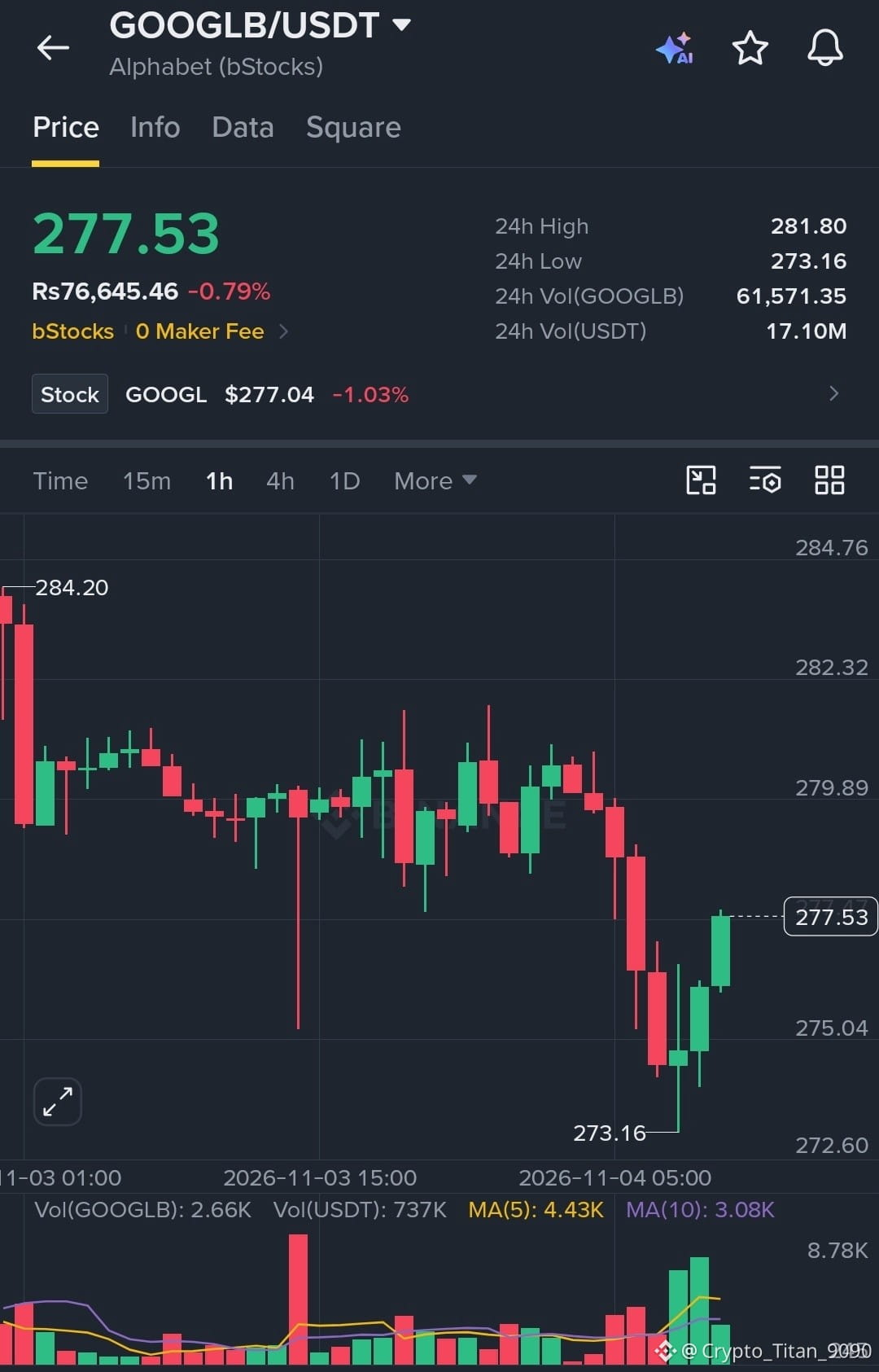
$GOOGLB - Bullish Breakout Continuation.
🎯 TP1: $278.00
🎯 TP2: $280.00
🎯 TP3: $282.00
🎯 TP4: $285.00
🛑 SL: $272.00
Long on sustained momentum. Stop below breakout level.
Click here to Trade 👇
#GOOGLB
{spot}(GOOGLBUSDT)
$GOOGLB - Bullish Breakout Continuation.
🎯 TP1: $278.00
🎯 TP2: $280.00
🎯 TP3: $282.00
🎯 TP4: $285.00
🛑 SL: $272.00
Long on sustained momentum. Stop below breakout level.
Click here to Trade 👇
#GOOGLB
🎯 TP1: $278.00
🎯 TP2: $280.00
🎯 TP3: $282.00
🎯 TP4: $285.00
🛑 SL: $272.00
Long on sustained momentum. Stop below breakout level.
Click here to Trade 👇
#GOOGLB
27
·
--
Hourly volume spiked 3.04x above average as $GOOGLB pulled back to $274.68.
This 1.85% daily drop sits inside a 23-hour range between $274.27 and $281.80, with the last hourly close ticking up 0.11% to $274.81. High volume during a dip highlights strong participation, but heavy turnover can signal churning rather than accumulation.
As a watch scenario, a sustained move back above the $281.80 high would suggest renewed buyer strength, while slipping below the $274.27 low points to increased downside pressure.
Will a break above $281.80 confirm a momentum continuation, or does a drop under $274.27 invalidate the bounce setup entirely?
Tap $GOOGLB for the live chart. #GOOGLB #BinanceSquare
Hourly volume spiked 3.04x above average as $GOOGLB pulled back to $274.68.
This 1.85% daily drop sits inside a 23-hour range between $274.27 and $281.80, with the last hourly close ticking up 0.11% to $274.81. High volume during a dip highlights strong participation, but heavy turnover can signal churning rather than accumulation.
As a watch scenario, a sustained move back above the $281.80 high would suggest renewed buyer strength, while slipping below the $274.27 low points to increased downside pressure.
Will a break above $281.80 confirm a momentum continuation, or does a drop under $274.27 invalidate the bounce setup entirely?
Tap $GOOGLB for the live chart. #GOOGLB #BinanceSquare
This 1.85% daily drop sits inside a 23-hour range between $274.27 and $281.80, with the last hourly close ticking up 0.11% to $274.81. High volume during a dip highlights strong participation, but heavy turnover can signal churning rather than accumulation.
As a watch scenario, a sustained move back above the $281.80 high would suggest renewed buyer strength, while slipping below the $274.27 low points to increased downside pressure.
Will a break above $281.80 confirm a momentum continuation, or does a drop under $274.27 invalidate the bounce setup entirely?
Tap $GOOGLB for the live chart. #GOOGLB #BinanceSquare
3

·
--
$GOOGLB GOOGLEB Analysis & Roadmap
GOOGLEB represents tokenized Alphabet equity (bStocks) in the emerging Real-World Asset (RWA) market.
Fundamentals: Backed by Alphabet’s traditional equity value, it offers retail and DeFi traders 24/7 liquidity on DEXs like PancakeSwap and Uniswap without traditional broker friction.
Roadmap:
Q1–Q2: Expand liquidity pools and cross-chain bridging to major Layer-2 networks.
Q3: Implement institutional compliance frameworks (KYC/AML) for RWA protocols.
Q4: Integrate tokenized yields into decentralized lending platforms.
#GOOGLB #cryptouniverseofficial #Binance #Square
{spot}(GOOGLBUSDT)
$GOOGLB GOOGLEB Analysis & Roadmap
GOOGLEB represents tokenized Alphabet equity (bStocks) in the emerging Real-World Asset (RWA) market.
Fundamentals: Backed by Alphabet’s traditional equity value, it offers retail and DeFi traders 24/7 liquidity on DEXs like PancakeSwap and Uniswap without traditional broker friction.
Roadmap:
Q1–Q2: Expand liquidity pools and cross-chain bridging to major Layer-2 networks.
Q3: Implement institutional compliance frameworks (KYC/AML) for RWA protocols.
Q4: Integrate tokenized yields into decentralized lending platforms.
#GOOGLB #cryptouniverseofficial #Binance #Square
GOOGLEB represents tokenized Alphabet equity (bStocks) in the emerging Real-World Asset (RWA) market.
Fundamentals: Backed by Alphabet’s traditional equity value, it offers retail and DeFi traders 24/7 liquidity on DEXs like PancakeSwap and Uniswap without traditional broker friction.
Roadmap:
Q1–Q2: Expand liquidity pools and cross-chain bridging to major Layer-2 networks.
Q3: Implement institutional compliance frameworks (KYC/AML) for RWA protocols.
Q4: Integrate tokenized yields into decentralized lending platforms.
#GOOGLB #cryptouniverseofficial #Binance #Square

GOOGUS+1.03%
GOOGLB+0.77%
147

·
--
Article
Evening Recap: Tokenized Stocks Steal the Show as ETH Rallies on Rising Volume$GOOGLB’s price action today makes the big players’ intentions clear. Those waiting for a pullback may never get one.
Market evidence: Current price is 292.81U, down 0.3% over 1 hour and up 3.3% over 4 hours. Volume is holding up, it ranks second on the gainers’ leaderboard, and MSTRB and ETH are rising in tandem—it’s not going it alone.
The logic is simple: In this evening recap, the spot gainers’ leaderboard steals the show with tokenized stocks GOOGLB and MSTRB. ETH is holding its place as a major market anchor on rising volume. The Fear & Greed Index is neutral at 50—risk appetite is recovering moderately, but there’s no euphoria yet.
Top gainers: INJ +8.1%, ETH +2.9%, MSTRB +2.9%, ADA +2.7%—you can see where the money is going.
Evening Recap: Tokenized Stocks Steal the Show as ETH Rallies on Rising Volume
$GOOGLB ’s price action today makes the big players’ intentions clear. Those waiting for a pullback may never get one.
Market evidence: Current price is 292.81U, down 0.3% over 1 hour and up 3.3% over 4 hours. Volume is holding up, it ranks second on the gainers’ leaderboard, and MSTRB and ETH are rising in tandem—it’s not going it alone.
The logic is simple: In this evening recap, the spot gainers’ leaderboard steals the show with tokenized stocks GOOGLB and MSTRB. ETH is holding its place as a major market anchor on rising volume. The Fear & Greed Index is neutral at 50—risk appetite is recovering moderately, but there’s no euphoria yet.
Top gainers: INJ +8.1%, ETH +2.9%, MSTRB +2.9%, ADA +2.7%—you can see where the money is going.
Market evidence: Current price is 292.81U, down 0.3% over 1 hour and up 3.3% over 4 hours. Volume is holding up, it ranks second on the gainers’ leaderboard, and MSTRB and ETH are rising in tandem—it’s not going it alone.
The logic is simple: In this evening recap, the spot gainers’ leaderboard steals the show with tokenized stocks GOOGLB and MSTRB. ETH is holding its place as a major market anchor on rising volume. The Fear & Greed Index is neutral at 50—risk appetite is recovering moderately, but there’s no euphoria yet.
Top gainers: INJ +8.1%, ETH +2.9%, MSTRB +2.9%, ADA +2.7%—you can see where the money is going.
19

The incentive budget Binance has allocated to GOOGLB is substantial even compared with a whole range of crypto-native perpetuals. That’s exactly the question: why does a tokenized stock perpetual need such hefty subsidies?
The answer isn’t complicated: depth comes mainly from subsidies, not demand.
Subsidies determine quotes; opinions don’t
Market makers face a different cost model when quoting both sides of stock perpetuals than they do with BTC perpetuals. Crypto contracts have natural support from hedging and basis-trading flows, while stock perpetuals have far fewer counterparties—especially on weekdays without earnings reports or economic data. In those conditions, order book depth is driven mainly by “how much can I earn in rewards for placing an order?” rather than “what is Google worth?” The test is simple but effective: compare the reward settlement windows with order sizes. If depth swells periodically, that liquidity is coming from subsidies—and will disappear when the parameters change. The 61 likes are asking, “Why is the allocation so large?” The real question is: when the subsidies stop, who will still be placing orders here?
Open interest is rising, but price discovery hasn’t kept pace
What’s more worth watching is how well OI aligns with price direction. Rising OI alongside a flat price most likely means hedging positions are piling up; rising OI alongside sustained directional moves is what shows that people are genuinely using this instrument to express a view. GOOGL has fallen from 408 to 324 over this period, wiping out nearly $500 billion in market cap in a week. An asset of this size is not short on opinions; what it lacks is the depth to absorb them. Genuine demand should show up in the efficiency of price discovery. For now, it shows up more in order book depth. Those are two different things.
Funding rates used to signal direction; now they’re being diluted
The most valuable feature of tokenized stock perpetuals was supposed to be that they’re the only place where markets can keep voting while traditional exchanges are closed. The funding rate is the reading from that vote. But when order book depth comes mainly from subsidies, a handful of arbitrage strategies can keep funding rates oscillating within a very narrow range. The reading is still there, but it carries less information. Trading on it as a directional guide means making position decisions based on a price signal distorted by subsidies.
The real risk is in the parameters, not the candlestick chart
Subsidies are a parameter the issuer can adjust at any time, regardless of what the market is doing. The day they’re tapered, the first sign won’t be a big red candle. It’ll be a thinner order book, wider bid-ask spreads, and worse fills on your limit orders. If you built a position during the subsidy period on the assumption that “there’s plenty of depth,” execution price will be the first thing to hurt you when subsidies are reduced; your directional call may be perfectly fine. Whether this week’s subsidies stay or go will affect your actual execution more than guessing where Google is headed next.
GOOGLB’s liquidity is rented for now. Who pays the rent, and for how long, are the variables that matter most in this business. Until those parameters are stable, relying on its order book depth when sizing a position carries significant risk.
#合约交易 #Crypto #GOOGLB
The incentive budget Binance has allocated to GOOGLB is substantial even compared with a whole range of crypto-native perpetuals. That’s exactly the question: why does a tokenized stock perpetual need such hefty subsidies?
The answer isn’t complicated: depth comes mainly from subsidies, not demand.
Subsidies determine quotes; opinions don’t
Market makers face a different cost model when quoting both sides of stock perpetuals than they do with BTC perpetuals. Crypto contracts have natural support from hedging and basis-trading flows, while stock perpetuals have far fewer counterparties—especially on weekdays without earnings reports or economic data. In those conditions, order book depth is driven mainly by “how much can I earn in rewards for placing an order?” rather than “what is Google worth?” The test is simple but effective: compare the reward settlement windows with order sizes. If depth swells periodically, that liquidity is coming from subsidies—and will disappear when the parameters change. The 61 likes are asking, “Why is the allocation so large?” The real question is: when the subsidies stop, who will still be placing orders here?
Open interest is rising, but price discovery hasn’t kept pace
What’s more worth watching is how well OI aligns with price direction. Rising OI alongside a flat price most likely means hedging positions are piling up; rising OI alongside sustained directional moves is what shows that people are genuinely using this instrument to express a view. GOOGL has fallen from 408 to 324 over this period, wiping out nearly $500 billion in market cap in a week. An asset of this size is not short on opinions; what it lacks is the depth to absorb them. Genuine demand should show up in the efficiency of price discovery. For now, it shows up more in order book depth. Those are two different things.
Funding rates used to signal direction; now they’re being diluted
The most valuable feature of tokenized stock perpetuals was supposed to be that they’re the only place where markets can keep voting while traditional exchanges are closed. The funding rate is the reading from that vote. But when order book depth comes mainly from subsidies, a handful of arbitrage strategies can keep funding rates oscillating within a very narrow range. The reading is still there, but it carries less information. Trading on it as a directional guide means making position decisions based on a price signal distorted by subsidies.
The real risk is in the parameters, not the candlestick chart
Subsidies are a parameter the issuer can adjust at any time, regardless of what the market is doing. The day they’re tapered, the first sign won’t be a big red candle. It’ll be a thinner order book, wider bid-ask spreads, and worse fills on your limit orders. If you built a position during the subsidy period on the assumption that “there’s plenty of depth,” execution price will be the first thing to hurt you when subsidies are reduced; your directional call may be perfectly fine. Whether this week’s subsidies stay or go will affect your actual execution more than guessing where Google is headed next.
GOOGLB’s liquidity is rented for now. Who pays the rent, and for how long, are the variables that matter most in this business. Until those parameters are stable, relying on its order book depth when sizing a position carries significant risk.
#合约交易 #Crypto #GOOGLB
The answer isn’t complicated: depth comes mainly from subsidies, not demand.
Subsidies determine quotes; opinions don’t
Market makers face a different cost model when quoting both sides of stock perpetuals than they do with BTC perpetuals. Crypto contracts have natural support from hedging and basis-trading flows, while stock perpetuals have far fewer counterparties—especially on weekdays without earnings reports or economic data. In those conditions, order book depth is driven mainly by “how much can I earn in rewards for placing an order?” rather than “what is Google worth?” The test is simple but effective: compare the reward settlement windows with order sizes. If depth swells periodically, that liquidity is coming from subsidies—and will disappear when the parameters change. The 61 likes are asking, “Why is the allocation so large?” The real question is: when the subsidies stop, who will still be placing orders here?
Open interest is rising, but price discovery hasn’t kept pace
What’s more worth watching is how well OI aligns with price direction. Rising OI alongside a flat price most likely means hedging positions are piling up; rising OI alongside sustained directional moves is what shows that people are genuinely using this instrument to express a view. GOOGL has fallen from 408 to 324 over this period, wiping out nearly $500 billion in market cap in a week. An asset of this size is not short on opinions; what it lacks is the depth to absorb them. Genuine demand should show up in the efficiency of price discovery. For now, it shows up more in order book depth. Those are two different things.
Funding rates used to signal direction; now they’re being diluted
The most valuable feature of tokenized stock perpetuals was supposed to be that they’re the only place where markets can keep voting while traditional exchanges are closed. The funding rate is the reading from that vote. But when order book depth comes mainly from subsidies, a handful of arbitrage strategies can keep funding rates oscillating within a very narrow range. The reading is still there, but it carries less information. Trading on it as a directional guide means making position decisions based on a price signal distorted by subsidies.
The real risk is in the parameters, not the candlestick chart
Subsidies are a parameter the issuer can adjust at any time, regardless of what the market is doing. The day they’re tapered, the first sign won’t be a big red candle. It’ll be a thinner order book, wider bid-ask spreads, and worse fills on your limit orders. If you built a position during the subsidy period on the assumption that “there’s plenty of depth,” execution price will be the first thing to hurt you when subsidies are reduced; your directional call may be perfectly fine. Whether this week’s subsidies stay or go will affect your actual execution more than guessing where Google is headed next.
GOOGLB’s liquidity is rented for now. Who pays the rent, and for how long, are the variables that matter most in this business. Until those parameters are stable, relying on its order book depth when sizing a position carries significant risk.
#合约交易 #Crypto #GOOGLB
66

·
--
A liquidity vacuum increases the sensitivity of $GOOGLB price movements
What will the price action and order flow confirm next?
The details that put the move in context are: a nearby liquidity-shortfall metric of 86.38. The reference price is 291.62 USDT. Observed order-block strength near the price is 17.95. Net trade flow leans toward buyers by 3.5K.
For $GOOGLB, what matters in this move is what it says about market structure, not just the price pattern. Reduced depth can amplify the price impact of orders, in either direction.
What supports this reading is the following condition: depth remains weak as the price advances. What would weaken it is the opposite: liquidity returns and the spread narrows.
A liquidity vacuum alone does not determine $GOOGLB’s movement; what matters more is depth returning to the area, alongside the degree of the liquidity vacuum and the price. Confidence is moderate, and any subsequent reading could change this assessment.
#GOOGLB #تحليل_السوق #السيولة #تداول #Cryptocurrency
A liquidity vacuum increases the sensitivity of $GOOGLB price movements
What will the price action and order flow confirm next?
The details that put the move in context are: a nearby liquidity-shortfall metric of 86.38. The reference price is 291.62 USDT. Observed order-block strength near the price is 17.95. Net trade flow leans toward buyers by 3.5K.
For $GOOGLB , what matters in this move is what it says about market structure, not just the price pattern. Reduced depth can amplify the price impact of orders, in either direction.
What supports this reading is the following condition: depth remains weak as the price advances. What would weaken it is the opposite: liquidity returns and the spread narrows.
A liquidity vacuum alone does not determine $GOOGLB ’s movement; what matters more is depth returning to the area, alongside the degree of the liquidity vacuum and the price. Confidence is moderate, and any subsequent reading could change this assessment.
#GOOGLB #تحليل_السوق #السيولة #تداول #Cryptocurrency
What will the price action and order flow confirm next?
The details that put the move in context are: a nearby liquidity-shortfall metric of 86.38. The reference price is 291.62 USDT. Observed order-block strength near the price is 17.95. Net trade flow leans toward buyers by 3.5K.
For $GOOGLB , what matters in this move is what it says about market structure, not just the price pattern. Reduced depth can amplify the price impact of orders, in either direction.
What supports this reading is the following condition: depth remains weak as the price advances. What would weaken it is the opposite: liquidity returns and the spread narrows.
A liquidity vacuum alone does not determine $GOOGLB ’s movement; what matters more is depth returning to the area, alongside the degree of the liquidity vacuum and the price. Confidence is moderate, and any subsequent reading could change this assessment.
#GOOGLB #تحليل_السوق #السيولة #تداول #Cryptocurrency

·
--
$GOOGLB 14-day RSI is 26.2, still in oversold territory, but the price has rebounded from its 14-day low: up 4.2% today to 289.77, with a 24-hour range of 278.09–296.59 and trading volume of $21 million.
What happened: Over the past 14 days, Google fell steadily from 346.92 to 273.16, dropping more than 20% and pushing the RSI down to an oversold 26.2. Today's 4.2% gain marks the first meaningful rebound near the low.
Why it’s worth watching: Oversold doesn’t mean an immediate reversal; it only indicates that bearish momentum has largely played out. The key is whether the rebound can hold. If the price can reclaim the 300 area and stay above the 24-hour low of 278.09, the oversold recovery may continue. Conversely, a break below that low would suggest the downtrend is not over.
What to watch next: Whether the price holds above 278.09, and whether trading volume supports the rebound. In oversold territory, it’s better to observe than chase the rally.
#GOOGLB #Trend Analysis
$GOOGLB 14-day RSI is 26.2, still in oversold territory, but the price has rebounded from its 14-day low: up 4.2% today to 289.77, with a 24-hour range of 278.09–296.59 and trading volume of $21 million.
What happened: Over the past 14 days, Google fell steadily from 346.92 to 273.16, dropping more than 20% and pushing the RSI down to an oversold 26.2. Today's 4.2% gain marks the first meaningful rebound near the low.
Why it’s worth watching: Oversold doesn’t mean an immediate reversal; it only indicates that bearish momentum has largely played out. The key is whether the rebound can hold. If the price can reclaim the 300 area and stay above the 24-hour low of 278.09, the oversold recovery may continue. Conversely, a break below that low would suggest the downtrend is not over.
What to watch next: Whether the price holds above 278.09, and whether trading volume supports the rebound. In oversold territory, it’s better to observe than chase the rally.
#GOOGLB #Trend Analysis
What happened: Over the past 14 days, Google fell steadily from 346.92 to 273.16, dropping more than 20% and pushing the RSI down to an oversold 26.2. Today's 4.2% gain marks the first meaningful rebound near the low.
Why it’s worth watching: Oversold doesn’t mean an immediate reversal; it only indicates that bearish momentum has largely played out. The key is whether the rebound can hold. If the price can reclaim the 300 area and stay above the 24-hour low of 278.09, the oversold recovery may continue. Conversely, a break below that low would suggest the downtrend is not over.
What to watch next: Whether the price holds above 278.09, and whether trading volume supports the rebound. In oversold territory, it’s better to observe than chase the rally.
#GOOGLB #Trend Analysis
GOOGUS+1.03%

·
--
$GOOGLB hits a new 24-hour high: current price 289.16, previous high 285.
After the breakout, two things are key:
· Whether the previous high of 285 can turn from resistance into support (holds on a retest)
· Whether trading volume increases during the breakout; a breakout on low volume can easily turn out to be false
What reasons do you have for being bullish or bearish?
#GOOGLB
$GOOGLB hits a new 24-hour high: current price 289.16, previous high 285.
After the breakout, two things are key:
· Whether the previous high of 285 can turn from resistance into support (holds on a retest)
· Whether trading volume increases during the breakout; a breakout on low volume can easily turn out to be false
What reasons do you have for being bullish or bearish?
#GOOGLB
After the breakout, two things are key:
· Whether the previous high of 285 can turn from resistance into support (holds on a retest)
· Whether trading volume increases during the breakout; a breakout on low volume can easily turn out to be false
What reasons do you have for being bullish or bearish?
#GOOGLB
179

·
--
🐋 $GOOGLB hit a new 24-hour high, with firm buying pressure.
Current price: 288.56, breaking above the previous high of 285. 24-hour trading volume: $20.33 million.
Short stop-loss orders often cluster near new highs, so holding above this level could trigger a short squeeze. But beware of a pullback after the surge.
#GOOGLB
Personal notes only; not a specific trading recommendation.
🐋 $GOOGLB hit a new 24-hour high, with firm buying pressure.
Current price: 288.56, breaking above the previous high of 285. 24-hour trading volume: $20.33 million.
Short stop-loss orders often cluster near new highs, so holding above this level could trigger a short squeeze. But beware of a pullback after the surge.
#GOOGLB
Personal notes only; not a specific trading recommendation.
Current price: 288.56, breaking above the previous high of 285. 24-hour trading volume: $20.33 million.
Short stop-loss orders often cluster near new highs, so holding above this level could trigger a short squeeze. But beware of a pullback after the surge.
#GOOGLB
Personal notes only; not a specific trading recommendation.
3

·
--
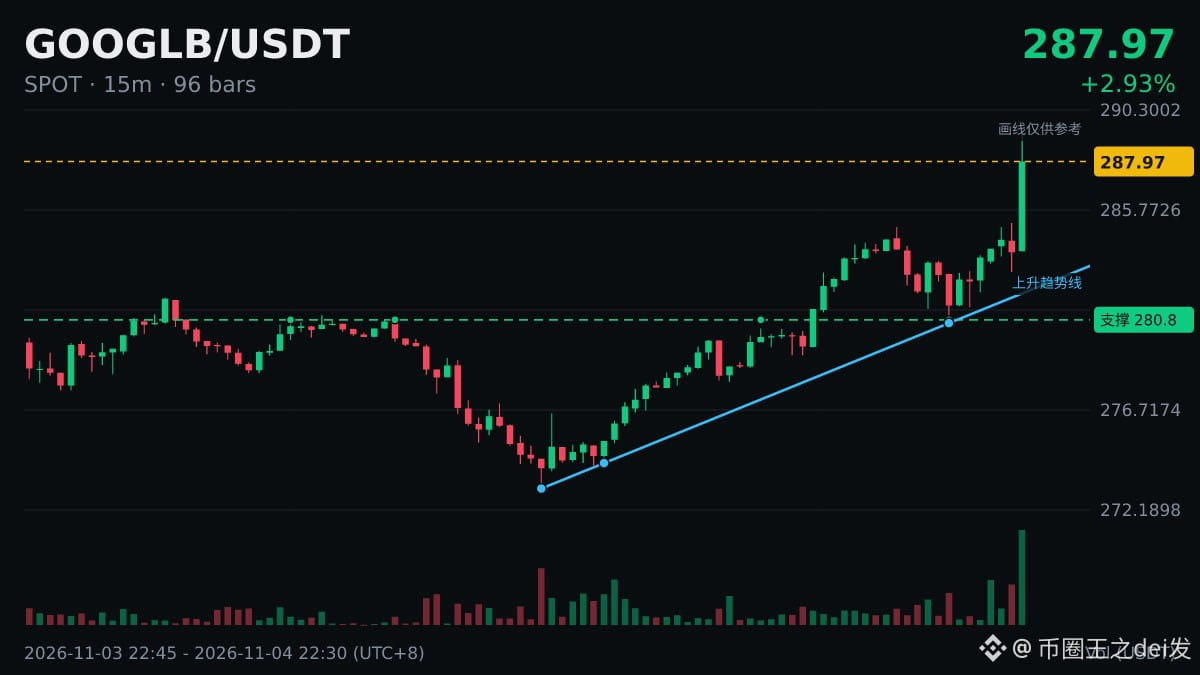
$GOOGLB |5-minute volume up 12.3x|price up 1.22%
Before looking at fund flows, first understand what a volume surge is.
Trading volume is often called the fuel of the market: for a trend to continue, volume generally needs to keep up—but this is an observation, not a rule.
A rise on high volume is often interpreted as an advance supported by trading activity, while a decline on high volume is often seen as a sign of heavier selling pressure. These, however, are only rules of thumb.
The same data can mean entirely different things in different market conditions, so don’t blindly apply a single rule of thumb.
#GOOGLB
$GOOGLB |5-minute volume up 12.3x|price up 1.22%
Before looking at fund flows, first understand what a volume surge is.
Trading volume is often called the fuel of the market: for a trend to continue, volume generally needs to keep up—but this is an observation, not a rule.
A rise on high volume is often interpreted as an advance supported by trading activity, while a decline on high volume is often seen as a sign of heavier selling pressure. These, however, are only rules of thumb.
The same data can mean entirely different things in different market conditions, so don’t blindly apply a single rule of thumb.
#GOOGLB
Before looking at fund flows, first understand what a volume surge is.
Trading volume is often called the fuel of the market: for a trend to continue, volume generally needs to keep up—but this is an observation, not a rule.
A rise on high volume is often interpreted as an advance supported by trading activity, while a decline on high volume is often seen as a sign of heavier selling pressure. These, however, are only rules of thumb.
The same data can mean entirely different things in different market conditions, so don’t blindly apply a single rule of thumb.
#GOOGLB
1
1

·
--
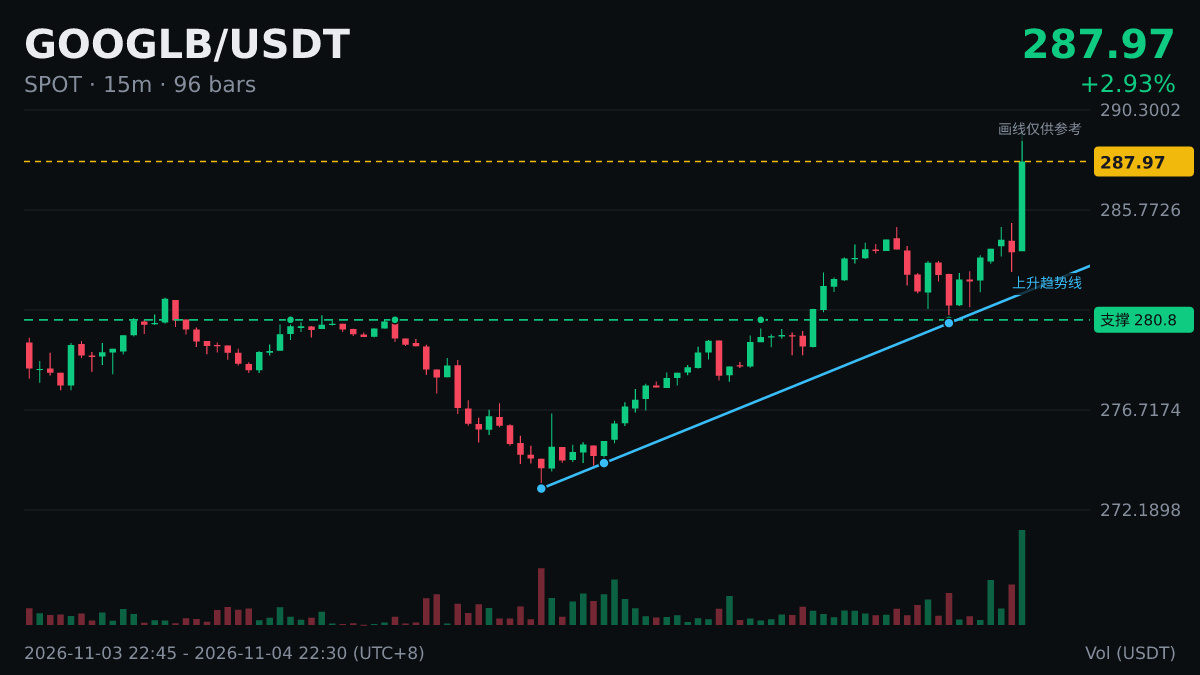
Just noticed volume surged 12.3x in $GOOGLB 5 minutes, driving the price up 1.22%.
With volume this high, either new money is coming in or someone is rebalancing their positions. The price action will show which direction things are headed.
#GOOGLB
Just noticed volume surged 12.3x in $GOOGLB 5 minutes, driving the price up 1.22%.
With volume this high, either new money is coming in or someone is rebalancing their positions. The price action will show which direction things are headed.
#GOOGLB
With volume this high, either new money is coming in or someone is rebalancing their positions. The price action will show which direction things are headed.
#GOOGLB
15
Log in to explore more content
Join global crypto users on Binance Square
⚡️ Get latest and useful information about crypto.
💬 Trusted by the world’s largest crypto exchange.
👍 Discover real insights from verified creators.
Email / Phone number
Trending Topics
1
#BitcoinRebounds$75KAsChipsLead
3,212 views
83 Discussing
2
#JobsReportRaisesHikeOdds
66,670 views
756 Discussing
3
#US Data Center Rules May Constrain AI Expansion
7,963 views
88 Discussing
4
#$2TWipedOutHedgeFundsFaceLiquidation
10,172 views
91 Discussing
5
#WillAnthropicListOnTime
6,905 views
175 Discussing
6
#USNovemberMichiganExpectationsIndexPrelimAt50.9
13,916 views
285 Discussing
7
#OilPlungesBelow$100
15,523 views
37 Discussing
8
#TradFiForBeginners
8,429 views
169 Discussing
9
#USMidtermsCouldShakeUpUS-IranTies
31,160 views
453 Discussing
10
#RussianCentralBankNamesBTCETHUSDTForNonQualifiedInvestors
545 views
10 Discussing