

#diariodetrading
diariodetrading
399 views
4 Discussing
Hot
Latest

·
--
90% of traders don’t lose money because of a bad strategy—they lose money by repeating the same mistake twice. 📉🤯
In the crypto world, the difference between a gambler and a professional isn’t luck; it’s the ability to measure and adjust. What’s your best secret weapon for doing that? A trading journal or logbook. 📔✨
Keeping a record of your trades helps you escape emotional chaos and see the data objectively. Here’s how to set yours up simply so you can start learning from your own mistakes today:
🎯 Basic Info: Write down the date, the cryptocurrency (e.g., BTC/USDT), and the trade type (Long/Short).
🧠 Entry Reason: Why did you enter the market? Define whether it was a resistance breakout, a technical pattern, or... if you let yourself get caught by FOMO (be honest—this journal is just for you).
📊 Key Levels: Record your entry price, Stop Loss, and Take Profit. This will help you see if you’re following your own risk management.
🎭 Emotional State: Were you stressed, euphoric, or calm when opening and closing the trade? Psychotrading is vital.
💡 The Lesson (the gold of the journal): When you close the trade—whether it was a win or a loss—write down what you did right and what mistake you must not repeat.
Reviewing your journal every weekend will give you accurate “X-ray” views of your strengths and weaknesses. You’ll stop trading blindly and start building long-term profitability. 🚀
And you—do you already keep a trading journal, or have you been trading everything based on memory? Leave your answer in the comments. 👇
🔔 Follow me for more high-value trading tips, market analysis, and crypto education!
#TradingTips
#Psicotrading
#DiarioDeTrading
#EducacionCripto
#Bitcoin
90% of traders don’t lose money because of a bad strategy—they lose money by repeating the same mistake twice. 📉🤯
In the crypto world, the difference between a gambler and a professional isn’t luck; it’s the ability to measure and adjust. What’s your best secret weapon for doing that? A trading journal or logbook. 📔✨
Keeping a record of your trades helps you escape emotional chaos and see the data objectively. Here’s how to set yours up simply so you can start learning from your own mistakes today:
🎯 Basic Info: Write down the date, the cryptocurrency (e.g., BTC/USDT), and the trade type (Long/Short).
🧠 Entry Reason: Why did you enter the market? Define whether it was a resistance breakout, a technical pattern, or... if you let yourself get caught by FOMO (be honest—this journal is just for you).
📊 Key Levels: Record your entry price, Stop Loss, and Take Profit. This will help you see if you’re following your own risk management.
🎭 Emotional State: Were you stressed, euphoric, or calm when opening and closing the trade? Psychotrading is vital.
💡 The Lesson (the gold of the journal): When you close the trade—whether it was a win or a loss—write down what you did right and what mistake you must not repeat.
Reviewing your journal every weekend will give you accurate “X-ray” views of your strengths and weaknesses. You’ll stop trading blindly and start building long-term profitability. 🚀
And you—do you already keep a trading journal, or have you been trading everything based on memory? Leave your answer in the comments. 👇
🔔 Follow me for more high-value trading tips, market analysis, and crypto education!
#TradingTips
#Psicotrading
#DiarioDeTrading
#EducacionCripto
#Bitcoin
In the crypto world, the difference between a gambler and a professional isn’t luck; it’s the ability to measure and adjust. What’s your best secret weapon for doing that? A trading journal or logbook. 📔✨
Keeping a record of your trades helps you escape emotional chaos and see the data objectively. Here’s how to set yours up simply so you can start learning from your own mistakes today:
🎯 Basic Info: Write down the date, the cryptocurrency (e.g., BTC/USDT), and the trade type (Long/Short).
🧠 Entry Reason: Why did you enter the market? Define whether it was a resistance breakout, a technical pattern, or... if you let yourself get caught by FOMO (be honest—this journal is just for you).
📊 Key Levels: Record your entry price, Stop Loss, and Take Profit. This will help you see if you’re following your own risk management.
🎭 Emotional State: Were you stressed, euphoric, or calm when opening and closing the trade? Psychotrading is vital.
💡 The Lesson (the gold of the journal): When you close the trade—whether it was a win or a loss—write down what you did right and what mistake you must not repeat.
Reviewing your journal every weekend will give you accurate “X-ray” views of your strengths and weaknesses. You’ll stop trading blindly and start building long-term profitability. 🚀
And you—do you already keep a trading journal, or have you been trading everything based on memory? Leave your answer in the comments. 👇
🔔 Follow me for more high-value trading tips, market analysis, and crypto education!
#TradingTips
#Psicotrading
#DiarioDeTrading
#EducacionCripto
#Bitcoin

230
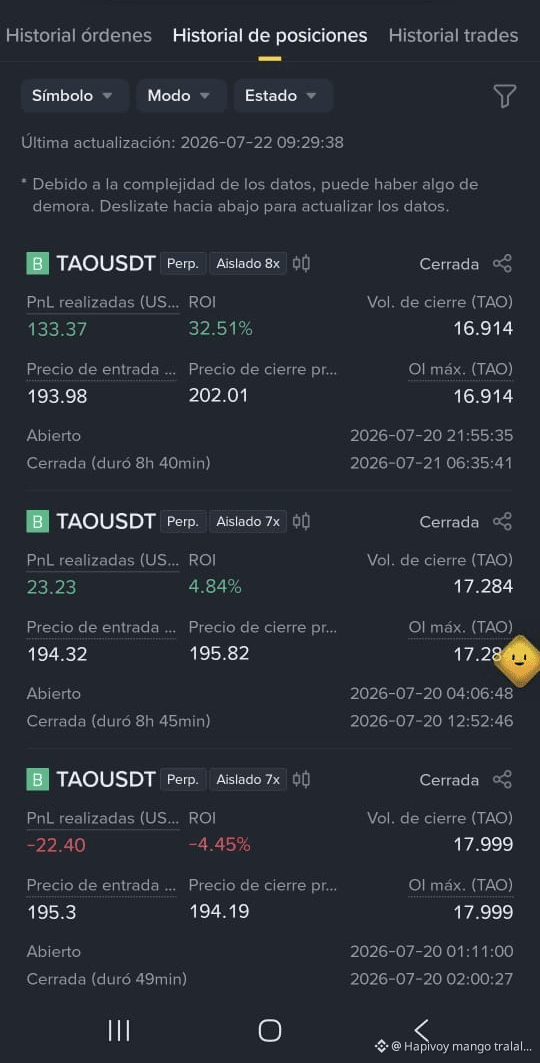
📓 The same thesis, three attempts, one week: -$22, +$23, +$133. Net: +$134. This is the breakdown that almost no account shows:
The thesis: $TAO defended its floor (192-193) for the fifth time that week. Long at the bottom of the range. And before the first click, the contract with myself: this idea has a budget—if it costs me more than $60, I’m wrong and it’s over.
1️⃣ Attempt 1 — long 195.3: the night sweep stopped me out in 49 minutes. -$22.40. The agreed price for testing early. No drama: it was in the contract.
2️⃣ Attempt 2 — long 194.3: weak bounce, manual close at 195.8. +$23.23. Recovered the entry fee. The thesis was still alive; this wasn’t THE entry yet.
3️⃣ Attempt 3 — long 193.98: the basement of the range, the entry from the original plan. And this time with the full manual: stop to breakeven on lift-off, partial ahead of the round number, take profit ahead of the previous high. Closed on its own at 6:35 a.m. at 202.01: +$133.37 (+32.5%). The orders did the work; I slept.
What matters isn’t the result—it's the structure that produced it:
✅ The maximum cost of the idea was defined BEFORE entering
✅ Each attempt carried its physical stop on the ticket
✅ No attempt was born from the anger of the previous one: each waited for its level
✅ The winner was managed while I was asleep
Exactly one week ago, this same scenario returned +$104 to zero because I didn’t manage it. The difference wasn’t luck or a better analysis: it was a manual written with the scars from the previous week.
Price does what it wants. The process is the only thing you sign.
Do you define how much an idea can cost you before entering… or do you find out after it already cost you? 👇
#trading #GestiónDeRiesgo #DiarioDeTrading #Write2Earn
⚠️ Not financial advice. Leveraged futures are extremely high risk and most people lose money with them. I trade small size and I show losses and gains equally. Don’t copy anyone’s trades—not mine. DYOR.
📓 The same thesis, three attempts, one week: -$22, +$23, +$133. Net: +$134. This is the breakdown that almost no account shows:
The thesis: $TAO defended its floor (192-193) for the fifth time that week. Long at the bottom of the range. And before the first click, the contract with myself: this idea has a budget—if it costs me more than $60, I’m wrong and it’s over.
1️⃣ Attempt 1 — long 195.3: the night sweep stopped me out in 49 minutes. -$22.40. The agreed price for testing early. No drama: it was in the contract.
2️⃣ Attempt 2 — long 194.3: weak bounce, manual close at 195.8. +$23.23. Recovered the entry fee. The thesis was still alive; this wasn’t THE entry yet.
3️⃣ Attempt 3 — long 193.98: the basement of the range, the entry from the original plan. And this time with the full manual: stop to breakeven on lift-off, partial ahead of the round number, take profit ahead of the previous high. Closed on its own at 6:35 a.m. at 202.01: +$133.37 (+32.5%). The orders did the work; I slept.
What matters isn’t the result—it's the structure that produced it:
✅ The maximum cost of the idea was defined BEFORE entering
✅ Each attempt carried its physical stop on the ticket
✅ No attempt was born from the anger of the previous one: each waited for its level
✅ The winner was managed while I was asleep
Exactly one week ago, this same scenario returned +$104 to zero because I didn’t manage it. The difference wasn’t luck or a better analysis: it was a manual written with the scars from the previous week.
Price does what it wants. The process is the only thing you sign.
Do you define how much an idea can cost you before entering… or do you find out after it already cost you? 👇
#trading #GestiónDeRiesgo #DiarioDeTrading #Write2Earn
⚠️ Not financial advice. Leveraged futures are extremely high risk and most people lose money with them. I trade small size and I show losses and gains equally. Don’t copy anyone’s trades—not mine. DYOR.
The thesis: $TAO defended its floor (192-193) for the fifth time that week. Long at the bottom of the range. And before the first click, the contract with myself: this idea has a budget—if it costs me more than $60, I’m wrong and it’s over.
1️⃣ Attempt 1 — long 195.3: the night sweep stopped me out in 49 minutes. -$22.40. The agreed price for testing early. No drama: it was in the contract.
2️⃣ Attempt 2 — long 194.3: weak bounce, manual close at 195.8. +$23.23. Recovered the entry fee. The thesis was still alive; this wasn’t THE entry yet.
3️⃣ Attempt 3 — long 193.98: the basement of the range, the entry from the original plan. And this time with the full manual: stop to breakeven on lift-off, partial ahead of the round number, take profit ahead of the previous high. Closed on its own at 6:35 a.m. at 202.01: +$133.37 (+32.5%). The orders did the work; I slept.
What matters isn’t the result—it's the structure that produced it:
✅ The maximum cost of the idea was defined BEFORE entering
✅ Each attempt carried its physical stop on the ticket
✅ No attempt was born from the anger of the previous one: each waited for its level
✅ The winner was managed while I was asleep
Exactly one week ago, this same scenario returned +$104 to zero because I didn’t manage it. The difference wasn’t luck or a better analysis: it was a manual written with the scars from the previous week.
Price does what it wants. The process is the only thing you sign.
Do you define how much an idea can cost you before entering… or do you find out after it already cost you? 👇
#trading #GestiónDeRiesgo #DiarioDeTrading #Write2Earn
⚠️ Not financial advice. Leveraged futures are extremely high risk and most people lose money with them. I trade small size and I show losses and gains equally. Don’t copy anyone’s trades—not mine. DYOR.
543
·
--
I didn’t know Binance had a section called “Learn & Earn”, and honestly, I was surprised.
I did one of the courses and it helped me understand concepts that I used to see in videos but couldn’t quite grasp.
Also, you can receive a reward while you learn.
If you’re just starting out, I highly recommend it because you learn, you gain something, and little by little you start to feel more confident.
Have you tried it yet? What course do you recommend?
#Binance #TradingDesdeCero #DiarioDeTrading #TURTLEBNB
I didn’t know Binance had a section called “Learn & Earn”, and honestly, I was surprised.
I did one of the courses and it helped me understand concepts that I used to see in videos but couldn’t quite grasp.
Also, you can receive a reward while you learn.
If you’re just starting out, I highly recommend it because you learn, you gain something, and little by little you start to feel more confident.
Have you tried it yet? What course do you recommend?
#Binance #TradingDesdeCero #DiarioDeTrading #TURTLEBNB
I did one of the courses and it helped me understand concepts that I used to see in videos but couldn’t quite grasp.
Also, you can receive a reward while you learn.
If you’re just starting out, I highly recommend it because you learn, you gain something, and little by little you start to feel more confident.
Have you tried it yet? What course do you recommend?
#Binance #TradingDesdeCero #DiarioDeTrading #TURTLEBNB

117
Log in to explore more content
Join global crypto users on Binance Square
⚡️ Get latest and useful information about crypto.
💬 Trusted by the world’s largest crypto exchange.
👍 Discover real insights from verified creators.
Email / Phone number
Trending Topics
1
#CircleMints500MUSDCOnSolana
5,463 views
297 Discussing
2
#PolymarketBankFailureBetsDrawFDICConcern
18,165 views
525 Discussing
3
#BlackRockBuildsTokenizedPortfoliosForOndo
13,908 views
363 Discussing
4
#BitwiseFilesToListNEARETFOnNYSEArca
14,968 views
348 Discussing
5
#SECCommissionerPeirceToLeaveOct2
16,135 views
286 Discussing
6
#SECSaysBuybacksUpgradesDontMakeTokenSecurity
16,835 views
273 Discussing
7
#StrategyProposesDailyDividendsForPreferreds
2,358 views
76 Discussing
8
#CircleTetherFreezeBitgetHackerWallet
1,168 views
49 Discussing
9
#CoinMarketCapCompletesCoinglassAcquisition
4,787 views
70 Discussing
10
#QNTRises39%
80,380 views
1,390 Discussing