

#defieducation
defieducation
127,991 views
256 Discussing
Hot
Latest

📊 TVL IS A SIGNAL, NOT A SAFETY SCORE
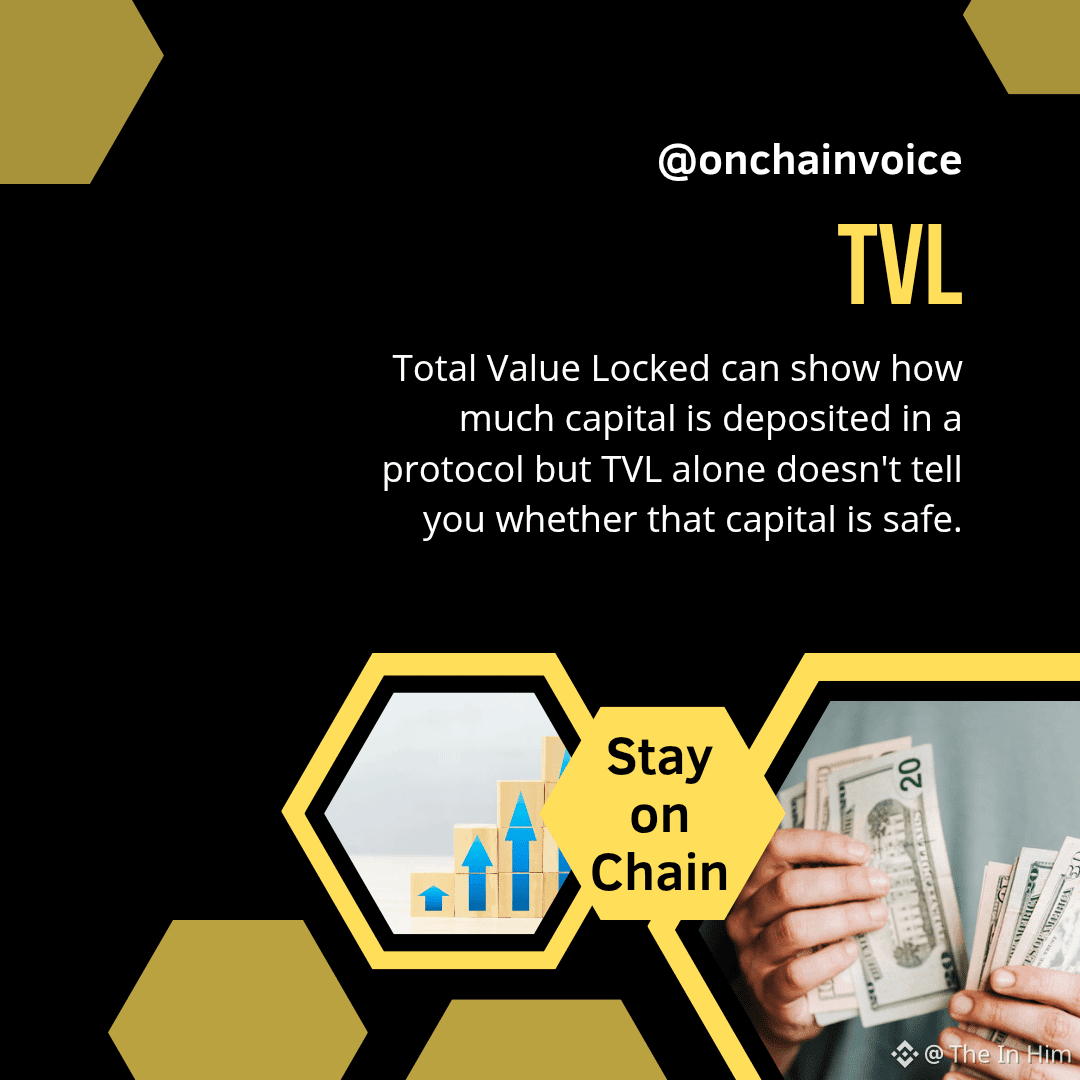
Total Value Locked (TVL) tells us how much capital is currently deposited in a DeFi protocol. It can be useful for understanding adoption and capital flows but a large TVL doesn't automatically mean a protocol is safe.
Before trusting the number, look deeper:
🔎 How does the protocol work?
🔐 Has the smart contract been audited?
⚠️ What are the major risks?
💧 How sustainable is the liquidity?
📉 What happens if users withdraw?
Don't let a big TVL number do your research for you.
👉 Follow @onchainvoice for simple, practical education on DeFi, blockchain & digital assets.
💾 Save this post for your next DeFi research session.
📲 Share it with someone who thinks high TVL automatically means low risk.
Learn the technology. Understand the value. Stay OnChain.
#onchainvoice #tvl #totalvaluelocked #defi #defieducation
📊 TVL IS A SIGNAL, NOT A SAFETY SCORE
Total Value Locked (TVL) tells us how much capital is currently deposited in a DeFi protocol. It can be useful for understanding adoption and capital flows but a large TVL doesn't automatically mean a protocol is safe.
Before trusting the number, look deeper:
🔎 How does the protocol work?
🔐 Has the smart contract been audited?
⚠️ What are the major risks?
💧 How sustainable is the liquidity?
📉 What happens if users withdraw?
Don't let a big TVL number do your research for you.
👉 Follow @onchainvoice for simple, practical education on DeFi, blockchain & digital assets.
💾 Save this post for your next DeFi research session.
📲 Share it with someone who thinks high TVL automatically means low risk.
Learn the technology. Understand the value. Stay OnChain.
#onchainvoice #tvl #totalvaluelocked #defi #defieducation
Total Value Locked (TVL) tells us how much capital is currently deposited in a DeFi protocol. It can be useful for understanding adoption and capital flows but a large TVL doesn't automatically mean a protocol is safe.
Before trusting the number, look deeper:
🔎 How does the protocol work?
🔐 Has the smart contract been audited?
⚠️ What are the major risks?
💧 How sustainable is the liquidity?
📉 What happens if users withdraw?
Don't let a big TVL number do your research for you.
👉 Follow @onchainvoice for simple, practical education on DeFi, blockchain & digital assets.
💾 Save this post for your next DeFi research session.
📲 Share it with someone who thinks high TVL automatically means low risk.
Learn the technology. Understand the value. Stay OnChain.
#onchainvoice #tvl #totalvaluelocked #defi #defieducation
1
36

🎓 What Is TVL (Total Value Locked) and Why Does It Matter?
On June 25, 2026, DeFi protocols processing billions in volume rely on TVL — but what does this metric actually tell us?
TVL (Total Value Locked) measures the total value of assets deposited in a DeFi protocol's smart contracts. It's denominated in USD and represents the fuel powering the protocol.
Why TVL matters:
- Higher TVL = more liquidity = better trading experience.
- Growing TVL = protocol is attracting capital = vote of confidence.
- Falling TVL = users withdrawing = potential loss of interest.
- TVL is to DeFi what market cap is to tokens.
Today's context:
- Ethereum $ETH ($198B mcap) has the highest TVL in DeFi.
- Hyperliquid $HYPE ($14.14B mcap) has growing TVL as traders deposit collateral for perps.
- TRON $TRX ($31.2B mcap) has massive TVL from its stablecoin ecosystem.
- The $264B in stablecoins includes significant TVL in DeFi lending and yield protocols.
📌 Key Takeaway:
TVL measures how much capital users trust a DeFi protocol with — it's the money under management metric for decentralized finance.
#TVL #DeFiEducation
#BinanceAlphaAlert
🎓 What Is TVL (Total Value Locked) and Why Does It Matter?
On June 25, 2026, DeFi protocols processing billions in volume rely on TVL — but what does this metric actually tell us?
TVL (Total Value Locked) measures the total value of assets deposited in a DeFi protocol's smart contracts. It's denominated in USD and represents the fuel powering the protocol.
Why TVL matters:
- Higher TVL = more liquidity = better trading experience.
- Growing TVL = protocol is attracting capital = vote of confidence.
- Falling TVL = users withdrawing = potential loss of interest.
- TVL is to DeFi what market cap is to tokens.
Today's context:
- Ethereum $ETH ($198B mcap) has the highest TVL in DeFi.
- Hyperliquid $HYPE ($14.14B mcap) has growing TVL as traders deposit collateral for perps.
- TRON $TRX ($31.2B mcap) has massive TVL from its stablecoin ecosystem.
- The $264B in stablecoins includes significant TVL in DeFi lending and yield protocols.
📌 Key Takeaway:
TVL measures how much capital users trust a DeFi protocol with — it's the money under management metric for decentralized finance.
#TVL #DeFiEducation
#BinanceAlphaAlert
On June 25, 2026, DeFi protocols processing billions in volume rely on TVL — but what does this metric actually tell us?
TVL (Total Value Locked) measures the total value of assets deposited in a DeFi protocol's smart contracts. It's denominated in USD and represents the fuel powering the protocol.
Why TVL matters:
- Higher TVL = more liquidity = better trading experience.
- Growing TVL = protocol is attracting capital = vote of confidence.
- Falling TVL = users withdrawing = potential loss of interest.
- TVL is to DeFi what market cap is to tokens.
Today's context:
- Ethereum $ETH ($198B mcap) has the highest TVL in DeFi.
- Hyperliquid $HYPE ($14.14B mcap) has growing TVL as traders deposit collateral for perps.
- TRON $TRX ($31.2B mcap) has massive TVL from its stablecoin ecosystem.
- The $264B in stablecoins includes significant TVL in DeFi lending and yield protocols.
📌 Key Takeaway:
TVL measures how much capital users trust a DeFi protocol with — it's the money under management metric for decentralized finance.
#TVL #DeFiEducation
#BinanceAlphaAlert
47
📚 What Is MEV?: Miner/Maximal Extractable Value and how it affects your trades
On July 19, 2026, MEV (Maximal Extractable Value) is the profit that block proposers can extract by reordering, including, or excluding transactions within a block. On Ethereum $ETH, this can result in users paying higher fees or getting worse execution prices than expected.
While originally a concern on Ethereum, MEV affects all smart contract platforms including Solana $SOL. Understanding MEV helps traders use strategies like slippage limits and private transaction relay services to protect against unfavorable execution.
📌 Key Takeaway:
MEV is an invisible tax that affects nearly every DeFi transaction. Being aware of it — and using tools to mitigate it — can meaningfully improve your trading execution outcomes.
#MEV #Ethereum #DeFiEducation
#BinanceAlphaAlert
📚 What Is MEV?: Miner/Maximal Extractable Value and how it affects your trades
On July 19, 2026, MEV (Maximal Extractable Value) is the profit that block proposers can extract by reordering, including, or excluding transactions within a block. On Ethereum $ETH , this can result in users paying higher fees or getting worse execution prices than expected.
While originally a concern on Ethereum, MEV affects all smart contract platforms including Solana $SOL . Understanding MEV helps traders use strategies like slippage limits and private transaction relay services to protect against unfavorable execution.
📌 Key Takeaway:
MEV is an invisible tax that affects nearly every DeFi transaction. Being aware of it — and using tools to mitigate it — can meaningfully improve your trading execution outcomes.
#MEV #Ethereum #DeFiEducation
#BinanceAlphaAlert
On July 19, 2026, MEV (Maximal Extractable Value) is the profit that block proposers can extract by reordering, including, or excluding transactions within a block. On Ethereum $ETH , this can result in users paying higher fees or getting worse execution prices than expected.
While originally a concern on Ethereum, MEV affects all smart contract platforms including Solana $SOL . Understanding MEV helps traders use strategies like slippage limits and private transaction relay services to protect against unfavorable execution.
📌 Key Takeaway:
MEV is an invisible tax that affects nearly every DeFi transaction. Being aware of it — and using tools to mitigate it — can meaningfully improve your trading execution outcomes.
#MEV #Ethereum #DeFiEducation
#BinanceAlphaAlert
48
💰 HIGH YIELD ≠ LOW RISK
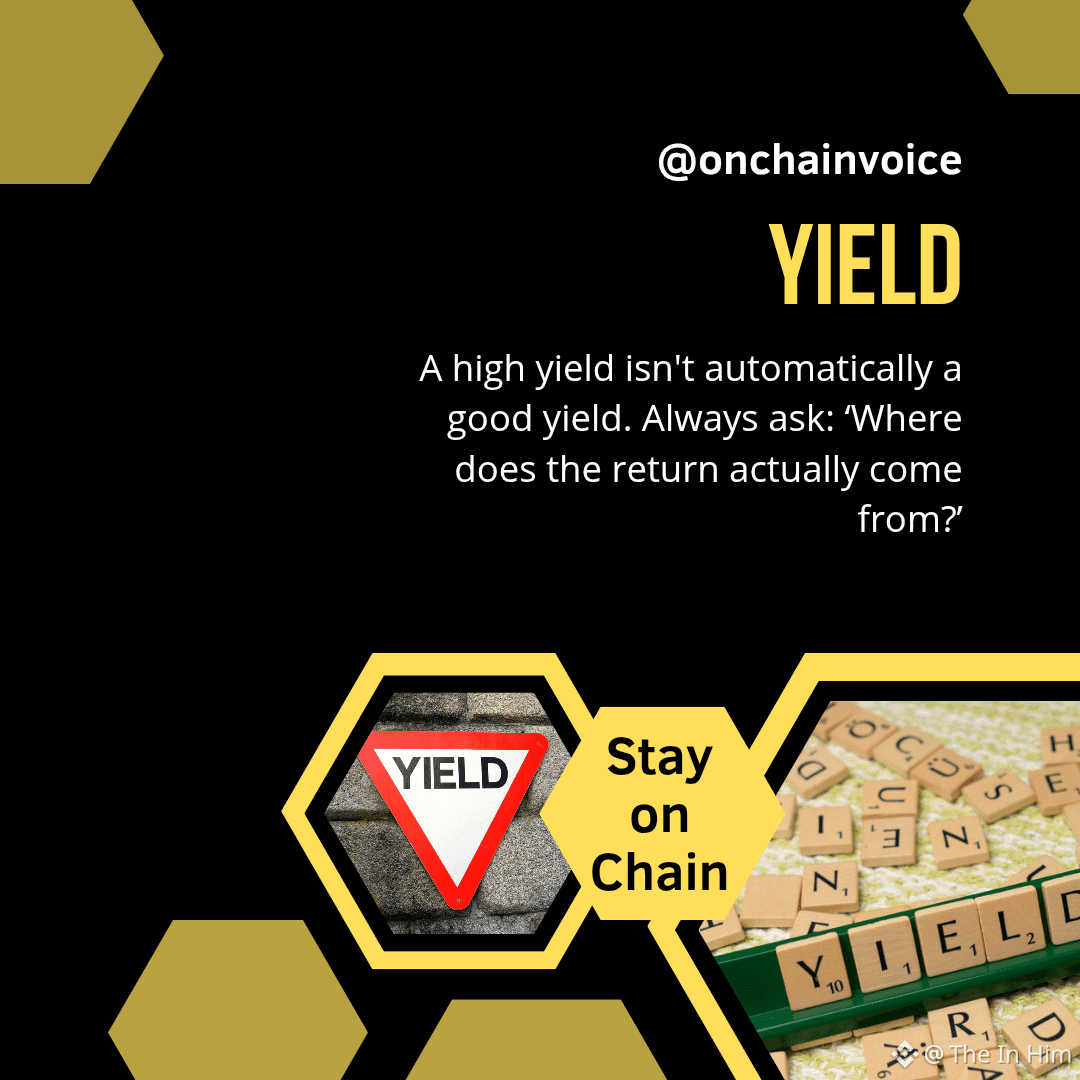
A big APY can look attractive but the percentage alone doesn't tell you the whole story.
Before putting your capital into a DeFi opportunity, ask:
🔎 Where is the yield coming from?
📊 Is it generated from real economic activity or temporary incentives?
⚠️ What risks are involved?
🔐 Is the smart contract secure?
📉 What happens if market conditions change?
Don't chase the number. Understand the mechanism behind it.
At OnChain Voice, we're here to help you look beyond the headline APY and understand how digital assets and DeFi actually work.
👉 Follow @onchainvoice for simple, practical digital-asset education.
💬 Save this post and share it with someone who needs to hear this before chasing yield.
Learn the technology. Understand the value. Stay OnChain.
#onchainvoice #defi #yield #cryptoeducation #defieducation
💰 HIGH YIELD ≠ LOW RISK
A big APY can look attractive but the percentage alone doesn't tell you the whole story.
Before putting your capital into a DeFi opportunity, ask:
🔎 Where is the yield coming from?
📊 Is it generated from real economic activity or temporary incentives?
⚠️ What risks are involved?
🔐 Is the smart contract secure?
📉 What happens if market conditions change?
Don't chase the number. Understand the mechanism behind it.
At OnChain Voice, we're here to help you look beyond the headline APY and understand how digital assets and DeFi actually work.
👉 Follow @onchainvoice for simple, practical digital-asset education.
💬 Save this post and share it with someone who needs to hear this before chasing yield.
Learn the technology. Understand the value. Stay OnChain.
#onchainvoice #defi #yield #cryptoeducation #defieducation
A big APY can look attractive but the percentage alone doesn't tell you the whole story.
Before putting your capital into a DeFi opportunity, ask:
🔎 Where is the yield coming from?
📊 Is it generated from real economic activity or temporary incentives?
⚠️ What risks are involved?
🔐 Is the smart contract secure?
📉 What happens if market conditions change?
Don't chase the number. Understand the mechanism behind it.
At OnChain Voice, we're here to help you look beyond the headline APY and understand how digital assets and DeFi actually work.
👉 Follow @onchainvoice for simple, practical digital-asset education.
💬 Save this post and share it with someone who needs to hear this before chasing yield.
Learn the technology. Understand the value. Stay OnChain.
#onchainvoice #defi #yield #cryptoeducation #defieducation
1
70

·
--
#termmax @termmax
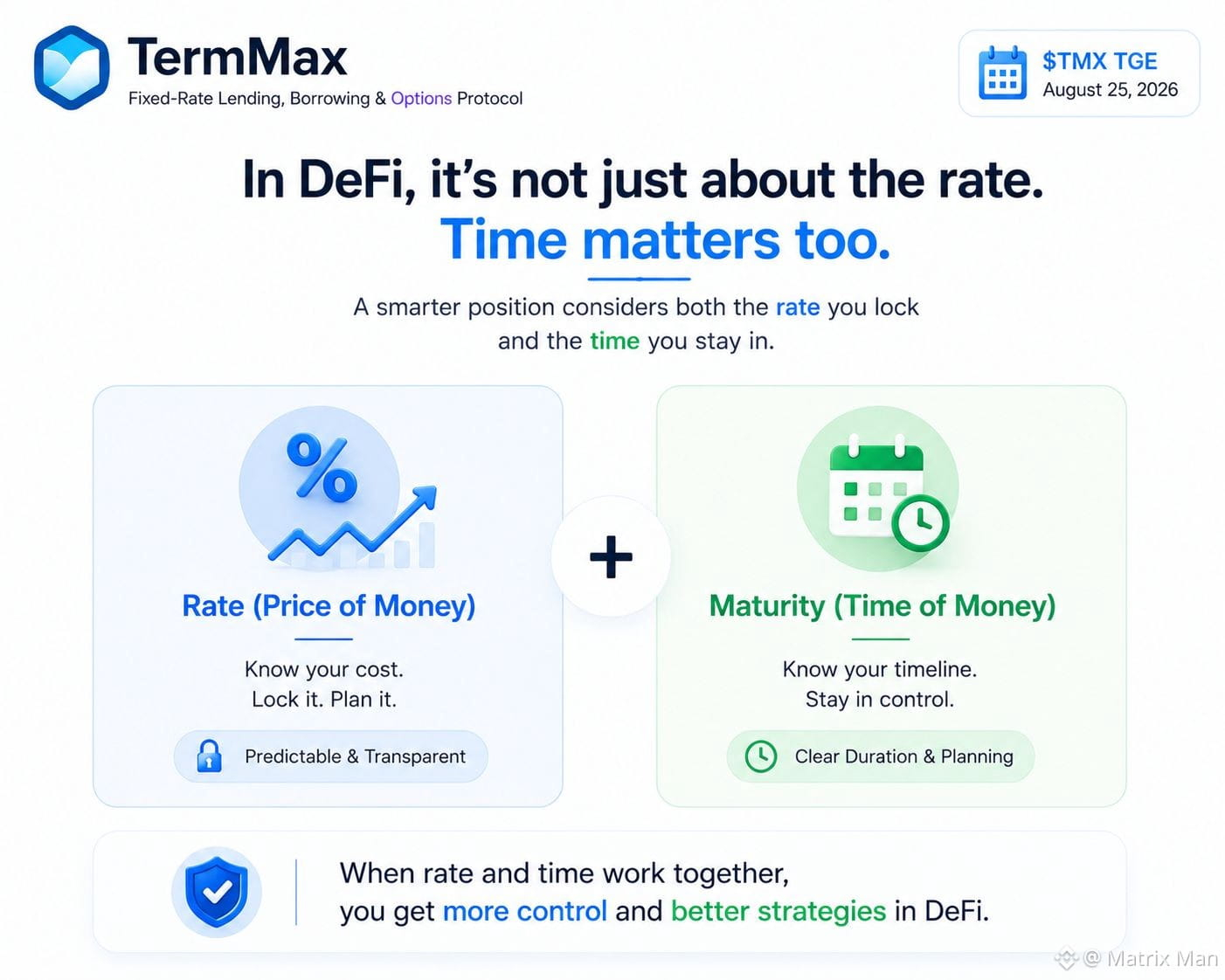
One thing I’ve started to appreciate while exploring DeFi is that the rate is only one part of the picture. The time you stay in a position can matter just as much. ⏳
That’s why the fixed-term side of @termmax caught my attention.
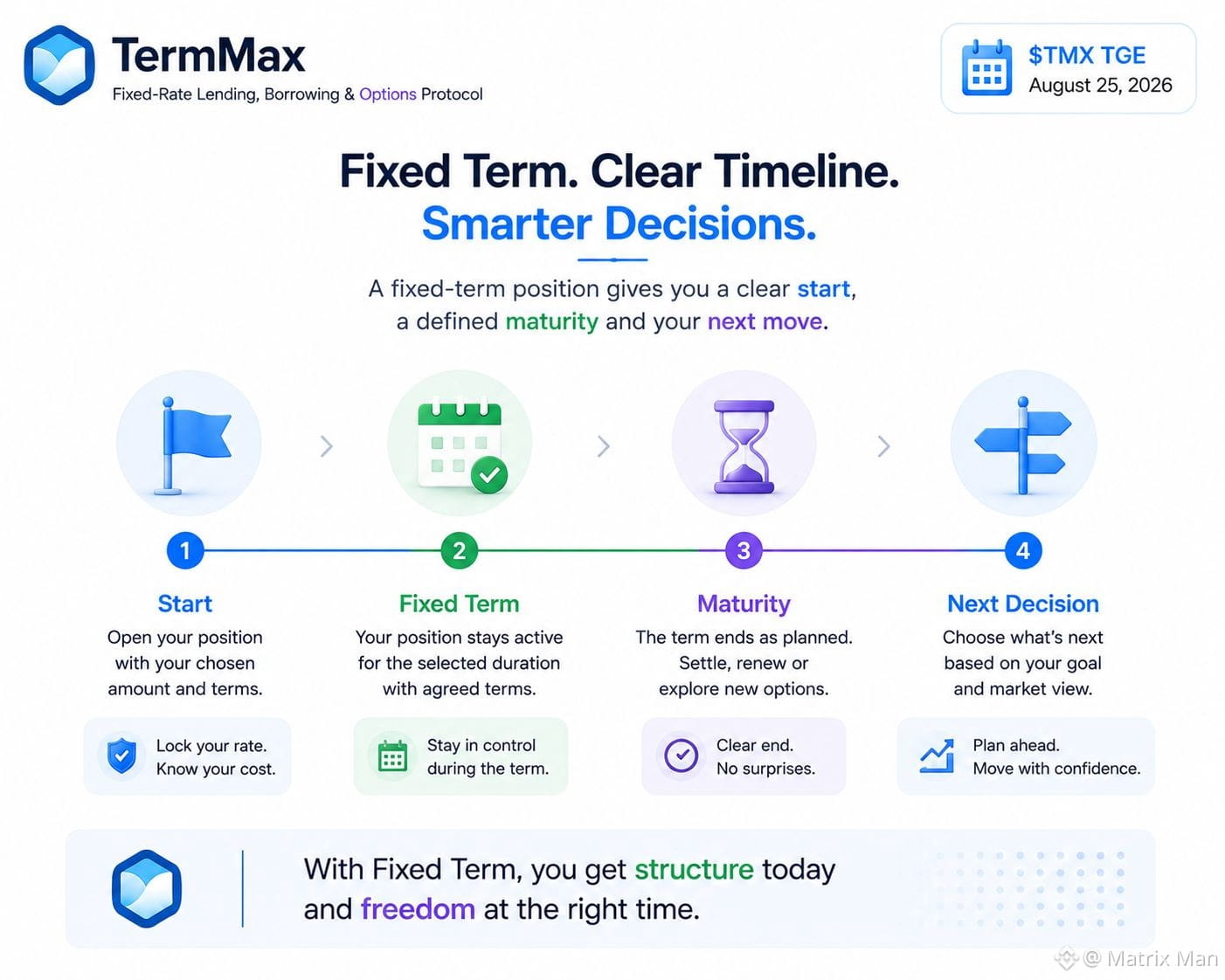
With fixed-term lending and borrowing, you’re not only thinking about the rate. You also have a defined maturity, which gives you a clearer timeline for the position.
For example, when planning a strategy, knowing when something matures can make it easier to think about your capital, repayments and the next move. Instead of looking at everything as an open-ended position, you have a specific time frame to work with. 📌
I think this is an underrated part of DeFi. People often focus heavily on APY or market movements, while the structure of the position itself can be just as important.
TermMax combines fixed rates, fixed terms and options, giving users different tools depending on what they are trying to achieve.
I’m still exploring how these pieces work together in real use cases, but the idea of making DeFi positions more structured is definitely interesting.
For you, what matters more when planning a position: the rate, the maturity, or the flexibility? 🤔
#TermMax #DeFiEducation
#termmax @TermMax
One thing I’ve started to appreciate while exploring DeFi is that the rate is only one part of the picture. The time you stay in a position can matter just as much. ⏳
That’s why the fixed-term side of @TermMax caught my attention.
With fixed-term lending and borrowing, you’re not only thinking about the rate. You also have a defined maturity, which gives you a clearer timeline for the position.
For example, when planning a strategy, knowing when something matures can make it easier to think about your capital, repayments and the next move. Instead of looking at everything as an open-ended position, you have a specific time frame to work with. 📌
I think this is an underrated part of DeFi. People often focus heavily on APY or market movements, while the structure of the position itself can be just as important.
TermMax combines fixed rates, fixed terms and options, giving users different tools depending on what they are trying to achieve.
I’m still exploring how these pieces work together in real use cases, but the idea of making DeFi positions more structured is definitely interesting.
For you, what matters more when planning a position: the rate, the maturity, or the flexibility? 🤔
#TermMax #DeFiEducation
One thing I’ve started to appreciate while exploring DeFi is that the rate is only one part of the picture. The time you stay in a position can matter just as much. ⏳
That’s why the fixed-term side of @TermMax caught my attention.
With fixed-term lending and borrowing, you’re not only thinking about the rate. You also have a defined maturity, which gives you a clearer timeline for the position.
For example, when planning a strategy, knowing when something matures can make it easier to think about your capital, repayments and the next move. Instead of looking at everything as an open-ended position, you have a specific time frame to work with. 📌
I think this is an underrated part of DeFi. People often focus heavily on APY or market movements, while the structure of the position itself can be just as important.
TermMax combines fixed rates, fixed terms and options, giving users different tools depending on what they are trying to achieve.
I’m still exploring how these pieces work together in real use cases, but the idea of making DeFi positions more structured is definitely interesting.
For you, what matters more when planning a position: the rate, the maturity, or the flexibility? 🤔
#TermMax #DeFiEducation
1
75

Decentralized Finance (DeFi) Coins
🏦 The decentralized financial sector (DeFi) is surging!
A noticeable rise today in lending protocols and decentralized exchanges, with a massive influx of liquidity into the TVL (Total Value Locked). 💸
Decentralization remains the backbone for revitalizing the market!
#defi
#DeFiForTheWin
$WIN
{spot}(WINUSDT)
#DeFiEducation
$EDU
{future}(EDUUSDT)
Decentralized Finance (DeFi) Coins
🏦 The decentralized financial sector (DeFi) is surging!
A noticeable rise today in lending protocols and decentralized exchanges, with a massive influx of liquidity into the TVL (Total Value Locked). 💸
Decentralization remains the backbone for revitalizing the market!
#defi
#DeFiForTheWin
$WIN
#DeFiEducation
$EDU
🏦 The decentralized financial sector (DeFi) is surging!
A noticeable rise today in lending protocols and decentralized exchanges, with a massive influx of liquidity into the TVL (Total Value Locked). 💸
Decentralization remains the backbone for revitalizing the market!
#defi
#DeFiForTheWin
$WIN
#DeFiEducation
$EDU
1
158

·
--
Are you aware that Wall Street analysts believe Uniswap's native token UNI could skyrocket nearly 40 times its current value by 2030, driven by a likely increase in on-chain activity?
#TheFutureOfDEX #DecentralizedFinance
The concept is simple: as more Wall Street traders and institutions move their transactions online, decentralized exchanges (DEXs) like Uniswap will see a surge in demand for their native tokens. This is because these tokens are often used to secure spots on the order book and facilitate trades, and as the volume of on-chain transactions grows, the value of these tokens is expected to follow.
A real-world example of this can be seen in the growing adoption of DEXs in the traditional finance world. For instance, some financial institutions are already exploring the use of DEXs for their own trades, which could lead to an even greater influx of capital into the space.
So what can you do to prepare for this potential surge in demand? Start by learning more about the DeFi space and staying up-to-date on the latest trends and developments, #DecentralizedFinance and #DeFiEducation.
What do you think will be the most significant driving force behind the adoption of DEXs and the growth of Uniswap's token price?
Are you aware that Wall Street analysts believe Uniswap's native token UNI could skyrocket nearly 40 times its current value by 2030, driven by a likely increase in on-chain activity?
#TheFutureOfDEX #DecentralizedFinance
The concept is simple: as more Wall Street traders and institutions move their transactions online, decentralized exchanges (DEXs) like Uniswap will see a surge in demand for their native tokens. This is because these tokens are often used to secure spots on the order book and facilitate trades, and as the volume of on-chain transactions grows, the value of these tokens is expected to follow.
A real-world example of this can be seen in the growing adoption of DEXs in the traditional finance world. For instance, some financial institutions are already exploring the use of DEXs for their own trades, which could lead to an even greater influx of capital into the space.
So what can you do to prepare for this potential surge in demand? Start by learning more about the DeFi space and staying up-to-date on the latest trends and developments, #DecentralizedFinance and #DeFiEducation.
What do you think will be the most significant driving force behind the adoption of DEXs and the growth of Uniswap's token price?
#TheFutureOfDEX #DecentralizedFinance
The concept is simple: as more Wall Street traders and institutions move their transactions online, decentralized exchanges (DEXs) like Uniswap will see a surge in demand for their native tokens. This is because these tokens are often used to secure spots on the order book and facilitate trades, and as the volume of on-chain transactions grows, the value of these tokens is expected to follow.
A real-world example of this can be seen in the growing adoption of DEXs in the traditional finance world. For instance, some financial institutions are already exploring the use of DEXs for their own trades, which could lead to an even greater influx of capital into the space.
So what can you do to prepare for this potential surge in demand? Start by learning more about the DeFi space and staying up-to-date on the latest trends and developments, #DecentralizedFinance and #DeFiEducation.
What do you think will be the most significant driving force behind the adoption of DEXs and the growth of Uniswap's token price?
23


Article
High Returns or Hidden Risk? Binance’s 35% APR Explained$BTC
Binance Earn’s Yield Arena offers up to 35% yearly returns through staking, savings, and special deals. But “up to” means not guaranteed. Higher returns often come with higher risk and limited availability. It’s best for experienced users, while beginners should invest small amounts carefully.
#Binance
#Crypto
#CryptoNews
#CryptoInvesting
#CryptoTrading
#PassiveIncome
#EarnCrypto
#CryptoEarnings
#APR
#YieldFarming
#StakingRewards
#CryptoProfit
#BullRun
#Altcoins
#DeFiEducation $XRP $ETH
#Web3
#CryptoOpportunity
#MakeMoneyOnline
#FinancialFreedom
#InvestSmart
High Returns or Hidden Risk? Binance’s 35% APR Explained
$BTC
Binance Earn’s Yield Arena offers up to 35% yearly returns through staking, savings, and special deals. But “up to” means not guaranteed. Higher returns often come with higher risk and limited availability. It’s best for experienced users, while beginners should invest small amounts carefully.
#Binance
#Crypto
#CryptoNews
#CryptoInvesting
#CryptoTrading
#PassiveIncome
#EarnCrypto
#CryptoEarnings
#APR
#YieldFarming
#StakingRewards
#CryptoProfit
#BullRun
#Altcoins
#DeFiEducation $XRP $ETH
#Web3
#CryptoOpportunity
#MakeMoneyOnline
#FinancialFreedom
#InvestSmart
Binance Earn’s Yield Arena offers up to 35% yearly returns through staking, savings, and special deals. But “up to” means not guaranteed. Higher returns often come with higher risk and limited availability. It’s best for experienced users, while beginners should invest small amounts carefully.
#Binance
#Crypto
#CryptoNews
#CryptoInvesting
#CryptoTrading
#PassiveIncome
#EarnCrypto
#CryptoEarnings
#APR
#YieldFarming
#StakingRewards
#CryptoProfit
#BullRun
#Altcoins
#DeFiEducation $XRP $ETH
#Web3
#CryptoOpportunity
#MakeMoneyOnline
#FinancialFreedom
#InvestSmart
8
127

·
--
🚨 Recent DeFi Breach — Important Lesson for Crypto Users
A recent platform security issue highlights a key truth:
Not your keys → not your crypto.
What you should do 👇
✔️ Avoid storing large funds on platforms
✔️ Use secure wallets for long-term holding
✔️ Double-check transactions before confirming
DeFi offers opportunities…
But also risks.
💡 Security should always come first.
#DeFiEducation
Are you using self-custody?
👇 Yes or No?
🔖 Save this
🔥 Follow Coin-Dropz for crypto updates
🚨 Recent DeFi Breach — Important Lesson for Crypto Users
A recent platform security issue highlights a key truth:
Not your keys → not your crypto.
What you should do 👇
✔️ Avoid storing large funds on platforms
✔️ Use secure wallets for long-term holding
✔️ Double-check transactions before confirming
DeFi offers opportunities…
But also risks.
💡 Security should always come first.
#DeFiEducation
Are you using self-custody?
👇 Yes or No?
🔖 Save this
🔥 Follow Coin-Dropz for crypto updates
A recent platform security issue highlights a key truth:
Not your keys → not your crypto.
What you should do 👇
✔️ Avoid storing large funds on platforms
✔️ Use secure wallets for long-term holding
✔️ Double-check transactions before confirming
DeFi offers opportunities…
But also risks.
💡 Security should always come first.
#DeFiEducation
Are you using self-custody?
👇 Yes or No?
🔖 Save this
🔥 Follow Coin-Dropz for crypto updates
96


Article
🚨 DeFi's Next Crisis? How One Smart Contract Bug Can Drain 6 Blockchains at OnceDeFi-related losses have declined significantly, falling from $2.62 billion in 2022 to approximately $534 million by 2024. Enhanced security frameworks, more rigorous auditing practices, and stronger infrastructure have mitigated many of the industry's most prevalent attack vectors.
Bridge Exploits Are No Longer the Primary Threat
Cross-chain bridge vulnerabilities once accounted for a substantial share of crypto-related losses. Today, improved validation mechanisms and native cross-chain messaging solutions have significantly reduced bridge-related incidents, making them a much smaller portion of overall DeFi exploits.
Flash Loan Attacks Continue to Decrease
Protocols increasingly implement sophisticated safeguards, including TWAP pricing mechanisms, secure oracle integrations, and robust reentrancy protections. Consequently, flash-loan attacks have become less effective and less frequent.
A New Systemic Risk Is Emerging
One of the most significant challenges facing DeFi today is the widespread deployment of identical codebases across multiple blockchains. Protocols routinely launch the same smart contracts on $Ethereum, $Base, $Arbitrum, $Polygon, $OP Mainnet, and $Sonic.
One Vulnerability Can Affect Multiple Networks
A single vulnerability can have far-reaching consequences when the same code is deployed across several chains. The Balancer V2 incident highlighted this risk, as an arithmetic precision flaw enabled attackers to extract approximately $128 million across six networks within a matter of minutes.
Audits Alone Are Insufficient
Despite multiple security assessments, the vulnerability remained undiscovered. Modern exploits are increasingly sophisticated and often arise from subtle mathematical inaccuracies or complex logical edge cases that can evade traditional review processes.
The Future of DeFi Security
The industry has made substantial progress in addressing many of the threats that defined earlier stages of DeFi. However, the next generation of attacks is likely to focus on shared infrastructure and multi-chain deployments. As a result, the security conversation is evolving from protecting individual protocols to safeguarding interconnected ecosystems.
Bottom Line
While many traditional DeFi risks have diminished, the growing adoption of multi-chain architectures introduces new systemic challenges. A single coding error can now result in significant losses across multiple networks simultaneously.
#DeFiEducation #defi #UpdateAlert #Ethereum #Polygon
$ETH
{spot}(ETHUSDT)
$POL
{spot}(POLUSDT)
$SONIC
{future}(SONICUSDT)
🚨 DeFi's Next Crisis? How One Smart Contract Bug Can Drain 6 Blockchains at Once
DeFi-related losses have declined significantly, falling from $2.62 billion in 2022 to approximately $534 million by 2024. Enhanced security frameworks, more rigorous auditing practices, and stronger infrastructure have mitigated many of the industry's most prevalent attack vectors.
Bridge Exploits Are No Longer the Primary Threat
Cross-chain bridge vulnerabilities once accounted for a substantial share of crypto-related losses. Today, improved validation mechanisms and native cross-chain messaging solutions have significantly reduced bridge-related incidents, making them a much smaller portion of overall DeFi exploits.
Flash Loan Attacks Continue to Decrease
Protocols increasingly implement sophisticated safeguards, including TWAP pricing mechanisms, secure oracle integrations, and robust reentrancy protections. Consequently, flash-loan attacks have become less effective and less frequent.
A New Systemic Risk Is Emerging
One of the most significant challenges facing DeFi today is the widespread deployment of identical codebases across multiple blockchains. Protocols routinely launch the same smart contracts on $Ethereum, $Base, $Arbitrum, $Polygon, $OP Mainnet, and $Sonic.
One Vulnerability Can Affect Multiple Networks
A single vulnerability can have far-reaching consequences when the same code is deployed across several chains. The Balancer V2 incident highlighted this risk, as an arithmetic precision flaw enabled attackers to extract approximately $128 million across six networks within a matter of minutes.
Audits Alone Are Insufficient
Despite multiple security assessments, the vulnerability remained undiscovered. Modern exploits are increasingly sophisticated and often arise from subtle mathematical inaccuracies or complex logical edge cases that can evade traditional review processes.
The Future of DeFi Security
The industry has made substantial progress in addressing many of the threats that defined earlier stages of DeFi. However, the next generation of attacks is likely to focus on shared infrastructure and multi-chain deployments. As a result, the security conversation is evolving from protecting individual protocols to safeguarding interconnected ecosystems.
Bottom Line
While many traditional DeFi risks have diminished, the growing adoption of multi-chain architectures introduces new systemic challenges. A single coding error can now result in significant losses across multiple networks simultaneously.
#DeFiEducation #defi #UpdateAlert #Ethereum #Polygon
$ETH
$POL
$SONIC
Bridge Exploits Are No Longer the Primary Threat
Cross-chain bridge vulnerabilities once accounted for a substantial share of crypto-related losses. Today, improved validation mechanisms and native cross-chain messaging solutions have significantly reduced bridge-related incidents, making them a much smaller portion of overall DeFi exploits.
Flash Loan Attacks Continue to Decrease
Protocols increasingly implement sophisticated safeguards, including TWAP pricing mechanisms, secure oracle integrations, and robust reentrancy protections. Consequently, flash-loan attacks have become less effective and less frequent.
A New Systemic Risk Is Emerging
One of the most significant challenges facing DeFi today is the widespread deployment of identical codebases across multiple blockchains. Protocols routinely launch the same smart contracts on $Ethereum, $Base, $Arbitrum, $Polygon, $OP Mainnet, and $Sonic.
One Vulnerability Can Affect Multiple Networks
A single vulnerability can have far-reaching consequences when the same code is deployed across several chains. The Balancer V2 incident highlighted this risk, as an arithmetic precision flaw enabled attackers to extract approximately $128 million across six networks within a matter of minutes.
Audits Alone Are Insufficient
Despite multiple security assessments, the vulnerability remained undiscovered. Modern exploits are increasingly sophisticated and often arise from subtle mathematical inaccuracies or complex logical edge cases that can evade traditional review processes.
The Future of DeFi Security
The industry has made substantial progress in addressing many of the threats that defined earlier stages of DeFi. However, the next generation of attacks is likely to focus on shared infrastructure and multi-chain deployments. As a result, the security conversation is evolving from protecting individual protocols to safeguarding interconnected ecosystems.
Bottom Line
While many traditional DeFi risks have diminished, the growing adoption of multi-chain architectures introduces new systemic challenges. A single coding error can now result in significant losses across multiple networks simultaneously.
#DeFiEducation #defi #UpdateAlert #Ethereum #Polygon
$ETH
$POL
$SONIC
1
279

·
--
When I see a fund split across two chains, I don't just add the numbers,I ask why.
XRPL and Ethereum have different liquidity profiles and different institutional users. A chain split like OUSG's tells you something about strategy, not just size.
$ONDO
{spot}(ONDOUSDT)
#DeFiEducation #RWA #ChainStrategy #ONDO
When I see a fund split across two chains, I don't just add the numbers,I ask why.
XRPL and Ethereum have different liquidity profiles and different institutional users. A chain split like OUSG's tells you something about strategy, not just size.
$ONDO
#DeFiEducation #RWA #ChainStrategy #ONDO
XRPL and Ethereum have different liquidity profiles and different institutional users. A chain split like OUSG's tells you something about strategy, not just size.
$ONDO
#DeFiEducation #RWA #ChainStrategy #ONDO
Quoted content has been removed
98
🔒 STAKING ≠ FREE MONEY
Staking can help secure and support certain blockchain networks while giving participants the opportunity to earn rewards but those rewards come with risks and trade-offs.
Before staking, ask yourself:
🔎 How does the staking mechanism work?
💰 Where do the rewards come from?
📉 What happens if the token price falls?
⏳ Is there an unstaking or lock-up period?
⚠️ What risks does the network or protocol carry?
Don't stake because the APY looks good. Stake because you understand the system.
👉 Follow @onchainvoice for simple, practical education on crypto, DeFi, blockchain & digital assets.
💬 Have you ever staked crypto? What was your experience?
📌 Save this post for the next time you're considering staking.
Learn the technology. Understand the value. Stay OnChain.
#onchainvoice #staking #cryptostaking #defi #defieducation
🔒 STAKING ≠ FREE MONEY
Staking can help secure and support certain blockchain networks while giving participants the opportunity to earn rewards but those rewards come with risks and trade-offs.
Before staking, ask yourself:
🔎 How does the staking mechanism work?
💰 Where do the rewards come from?
📉 What happens if the token price falls?
⏳ Is there an unstaking or lock-up period?
⚠️ What risks does the network or protocol carry?
Don't stake because the APY looks good. Stake because you understand the system.
👉 Follow @onchainvoice for simple, practical education on crypto, DeFi, blockchain & digital assets.
💬 Have you ever staked crypto? What was your experience?
📌 Save this post for the next time you're considering staking.
Learn the technology. Understand the value. Stay OnChain.
#onchainvoice #staking #cryptostaking #defi #defieducation
Staking can help secure and support certain blockchain networks while giving participants the opportunity to earn rewards but those rewards come with risks and trade-offs.
Before staking, ask yourself:
🔎 How does the staking mechanism work?
💰 Where do the rewards come from?
📉 What happens if the token price falls?
⏳ Is there an unstaking or lock-up period?
⚠️ What risks does the network or protocol carry?
Don't stake because the APY looks good. Stake because you understand the system.
👉 Follow @onchainvoice for simple, practical education on crypto, DeFi, blockchain & digital assets.
💬 Have you ever staked crypto? What was your experience?
📌 Save this post for the next time you're considering staking.
Learn the technology. Understand the value. Stay OnChain.
#onchainvoice #staking #cryptostaking #defi #defieducation

1
46

$BNB, $BTC, and $ETH remain some of the most talked-about assets in crypto. Each has its own strengths and risks, so understanding the market and managing risk is important. 📊🚀
#BNB #BTC #ETH #Crypto #DeFiEducation
$BNB, $BTC, and $ETH remain some of the most talked-about assets in crypto. Each has its own strengths and risks, so understanding the market and managing risk is important. 📊🚀
#BNB #BTC #ETH #Crypto #DeFiEducation
#BNB #BTC #ETH #Crypto #DeFiEducation
127

⚡ Ethereum powers much more than a coin.
From DeFi and NFTs to tokenized assets, Ethereum continues to be a major platform for blockchain innovation.
🌍 What Ethereum project are you following the most?
#Ethereum✅ #ETH🔥🔥🔥🔥🔥🔥 #DeFiEducation #Web3Revolution #BinanceSquareFamily
⚡ Ethereum powers much more than a coin.
From DeFi and NFTs to tokenized assets, Ethereum continues to be a major platform for blockchain innovation.
🌍 What Ethereum project are you following the most?
#Ethereum✅ #ETH🔥🔥🔥🔥🔥🔥 #DeFiEducation #Web3Revolution #BinanceSquareFamily
From DeFi and NFTs to tokenized assets, Ethereum continues to be a major platform for blockchain innovation.
🌍 What Ethereum project are you following the most?
#Ethereum✅ #ETH🔥🔥🔥🔥🔥🔥 #DeFiEducation #Web3Revolution #BinanceSquareFamily
71


Verified
Article
NB Coin Now on Binance – Powering the Future of Crypto!
$NB Coin has officially become a rising name in the crypto market, now making waves across the Binance trading community. This token offers more than speculation — it’s built on solid fundamentals, community trust, and practical blockchain applications.
With a focus on innovation, NB Coin integrates utility across DeFi, payments, and ecosystem growth. Traders and investors alike are turning to NB Coin for its strong potential and transparent tokenomics model.
As Binance continues to highlight tokens shaping the future of finance, NB Coin stands out as a project built for real adoption and value creation.
For More Information Visit –cryptodisplay.io
#NB #Crypto #Binance #Blockchain #DeFiEducation
$NB Coin has officially become a rising name in the crypto market, now making waves across the Binance trading community. This token offers more than speculation — it’s built on solid fundamentals, community trust, and practical blockchain applications.
With a focus on innovation, NB Coin integrates utility across DeFi, payments, and ecosystem growth. Traders and investors alike are turning to NB Coin for its strong potential and transparent tokenomics model.
As Binance continues to highlight tokens shaping the future of finance, NB Coin stands out as a project built for real adoption and value creation.
For More Information Visit –cryptodisplay.io
#NB #Crypto #Binance #Blockchain #DeFiEducation
NB Coin Now on Binance – Powering the Future of Crypto!
$NB Coin has officially become a rising name in the crypto market, now making waves across the Binance trading community. This token offers more than speculation — it’s built on solid fundamentals, community trust, and practical blockchain applications.
With a focus on innovation, NB Coin integrates utility across DeFi, payments, and ecosystem growth. Traders and investors alike are turning to NB Coin for its strong potential and transparent tokenomics model.
As Binance continues to highlight tokens shaping the future of finance, NB Coin stands out as a project built for real adoption and value creation.
For More Information Visit –cryptodisplay.io
#NB #Crypto #Binance #Blockchain #DeFiEducation
3
2
2
1.9k

·
--
What Is Impermanent Loss? (With a STONfi Example)📉 Impermanent Loss Explained: A Core Risk in Liquidity Provision on STONfi
Impermanent loss is one of the most important concepts to understand before providing liquidity on a decentralized exchange like stonfi
It occurs when the price of the tokens you deposit into a liquidity pool changes compared to when you first added them. As prices move, the pool automatically rebalances your assets to maintain its ratio. This can result in a lower value compared to simply holding the tokens in your wallet.
🔍 Example (TON/USDT Pool on STON.fi)
Assume you provide liquidity to a TON/USDT pool on STONfi You deposit equal values of TON and USDT. If the price of TON increases significantly, the pool will gradually sell some of your TON for USDT to keep the balance.
When you withdraw, you may end up with:
Less TON
More USDT
Even though your total value might still grow, it can be lower than if you had just held TON without providing liquidity. That difference is called impermanent loss.
⚖️ Why It Is Called “Impermanent”
It is described as impermanent because if prices return to their original ratio, the loss can reduce or disappear. However, once you withdraw liquidity, it becomes permanent.
📊 Key Insight
Understanding impermanent loss helps users make better decisions when choosing pools, balancing potential rewards from fees or farming incentives against possible price divergence.
#STON.fi #TONDeF #DeFiEducation #LiquidityFa #Web3Research
What Is Impermanent Loss? (With a STONfi Example)
📉 Impermanent Loss Explained: A Core Risk in Liquidity Provision on STONfi
Impermanent loss is one of the most important concepts to understand before providing liquidity on a decentralized exchange like stonfi
It occurs when the price of the tokens you deposit into a liquidity pool changes compared to when you first added them. As prices move, the pool automatically rebalances your assets to maintain its ratio. This can result in a lower value compared to simply holding the tokens in your wallet.
🔍 Example (TON/USDT Pool on STON.fi)
Assume you provide liquidity to a TON/USDT pool on STONfi You deposit equal values of TON and USDT. If the price of TON increases significantly, the pool will gradually sell some of your TON for USDT to keep the balance.
When you withdraw, you may end up with:
Less TON
More USDT
Even though your total value might still grow, it can be lower than if you had just held TON without providing liquidity. That difference is called impermanent loss.
⚖️ Why It Is Called “Impermanent”
It is described as impermanent because if prices return to their original ratio, the loss can reduce or disappear. However, once you withdraw liquidity, it becomes permanent.
📊 Key Insight
Understanding impermanent loss helps users make better decisions when choosing pools, balancing potential rewards from fees or farming incentives against possible price divergence.
#STON.fi #TONDeF #DeFiEducation #LiquidityFa #Web3Research
Impermanent loss is one of the most important concepts to understand before providing liquidity on a decentralized exchange like stonfi
It occurs when the price of the tokens you deposit into a liquidity pool changes compared to when you first added them. As prices move, the pool automatically rebalances your assets to maintain its ratio. This can result in a lower value compared to simply holding the tokens in your wallet.
🔍 Example (TON/USDT Pool on STON.fi)
Assume you provide liquidity to a TON/USDT pool on STONfi You deposit equal values of TON and USDT. If the price of TON increases significantly, the pool will gradually sell some of your TON for USDT to keep the balance.
When you withdraw, you may end up with:
Less TON
More USDT
Even though your total value might still grow, it can be lower than if you had just held TON without providing liquidity. That difference is called impermanent loss.
⚖️ Why It Is Called “Impermanent”
It is described as impermanent because if prices return to their original ratio, the loss can reduce or disappear. However, once you withdraw liquidity, it becomes permanent.
📊 Key Insight
Understanding impermanent loss helps users make better decisions when choosing pools, balancing potential rewards from fees or farming incentives against possible price divergence.
#STON.fi #TONDeF #DeFiEducation #LiquidityFa #Web3Research
155

·
--
⚡ U.S. Congress Holds Bipartisan Discussions on Ethics and DeFi Provisions
The U.S. Congress is taking part in bipartisan discussions on issues of ethics and DeFi provisions. Unverified reports suggest that President Trump has accepted an ethics package, which could clear a major hurdle for the Clarity Act and move forward with comprehensive crypto legislation.
#DeFiEducation
⚡ U.S. Congress Holds Bipartisan Discussions on Ethics and DeFi Provisions
The U.S. Congress is taking part in bipartisan discussions on issues of ethics and DeFi provisions. Unverified reports suggest that President Trump has accepted an ethics package, which could clear a major hurdle for the Clarity Act and move forward with comprehensive crypto legislation.
#DeFiEducation
The U.S. Congress is taking part in bipartisan discussions on issues of ethics and DeFi provisions. Unverified reports suggest that President Trump has accepted an ethics package, which could clear a major hurdle for the Clarity Act and move forward with comprehensive crypto legislation.
#DeFiEducation
123

·
--
Bullish
$BR – BEDROCK IS NOT HERE TO FIT IN
Most of DeFi is stuck in a loop — declining yields, recycled narratives, and empty incentives. Projects promise returns, but behind the scenes, the engine is breaking.
⚙️ WHAT BEDROCK ACTUALLY DOES
Bedrock focuses on Bitcoin capital — not chasing trends, but optimizing real yield through intelligent restaking strategies. It’s built to adapt in a market where traditional yield models are dying.
🚀 WHY IT MATTERS NOW
Let’s be real: yields are compressing everywhere. The easy money phase is over. Protocols that survive will be the ones with actual design, not marketing noise.
Bedrock is positioning itself as that next layer — where capital isn’t just parked, it’s actively working.
💡 WHAT YOU GET
Smarter yield exposure
Sustainable reward structures
A system built for long-term players, not short-term farmers
⚠️ FINAL TAKE
Ignore BR now if you want. But when the market rotates to real builders, this is exactly the kind of project people will wish they studied earlier.
#bedrock $BR
@Bedrock
#MarketMomentum
#DeFiEducation
#BTC
#yield
$BR
$BR – BEDROCK IS NOT HERE TO FIT IN
Most of DeFi is stuck in a loop — declining yields, recycled narratives, and empty incentives. Projects promise returns, but behind the scenes, the engine is breaking.
⚙️ WHAT BEDROCK ACTUALLY DOES
Bedrock focuses on Bitcoin capital — not chasing trends, but optimizing real yield through intelligent restaking strategies. It’s built to adapt in a market where traditional yield models are dying.
🚀 WHY IT MATTERS NOW
Let’s be real: yields are compressing everywhere. The easy money phase is over. Protocols that survive will be the ones with actual design, not marketing noise.
Bedrock is positioning itself as that next layer — where capital isn’t just parked, it’s actively working.
💡 WHAT YOU GET
Smarter yield exposure
Sustainable reward structures
A system built for long-term players, not short-term farmers
⚠️ FINAL TAKE
Ignore BR now if you want. But when the market rotates to real builders, this is exactly the kind of project people will wish they studied earlier.
#bedrock $BR
@Bedrock
#MarketMomentum
#DeFiEducation
#BTC
#yield
$BR
Most of DeFi is stuck in a loop — declining yields, recycled narratives, and empty incentives. Projects promise returns, but behind the scenes, the engine is breaking.
⚙️ WHAT BEDROCK ACTUALLY DOES
Bedrock focuses on Bitcoin capital — not chasing trends, but optimizing real yield through intelligent restaking strategies. It’s built to adapt in a market where traditional yield models are dying.
🚀 WHY IT MATTERS NOW
Let’s be real: yields are compressing everywhere. The easy money phase is over. Protocols that survive will be the ones with actual design, not marketing noise.
Bedrock is positioning itself as that next layer — where capital isn’t just parked, it’s actively working.
💡 WHAT YOU GET
Smarter yield exposure
Sustainable reward structures
A system built for long-term players, not short-term farmers
⚠️ FINAL TAKE
Ignore BR now if you want. But when the market rotates to real builders, this is exactly the kind of project people will wish they studied earlier.
#bedrock $BR
@Bedrock
#MarketMomentum
#DeFiEducation
#BTC
#yield
$BR
Md Jawed Hassan :
Plz like and comment
1
1
132

·
--
Bearish
$ZKJ The crypto showed a price increase over the last day. Reason being a short squeeze due to delisting. The market got heavy on one side expecting a drop, but it reversed. However, it looks like the orders on the book aren’t holding back the sells, with no offers. The price is dropping after a strong rally. Which side are you on? The delisting happens today. Stay alert. #DeFiEducation #deslisting
$ZKJ The crypto showed a price increase over the last day. Reason being a short squeeze due to delisting. The market got heavy on one side expecting a drop, but it reversed. However, it looks like the orders on the book aren’t holding back the sells, with no offers. The price is dropping after a strong rally. Which side are you on? The delisting happens today. Stay alert. #DeFiEducation #deslisting
167

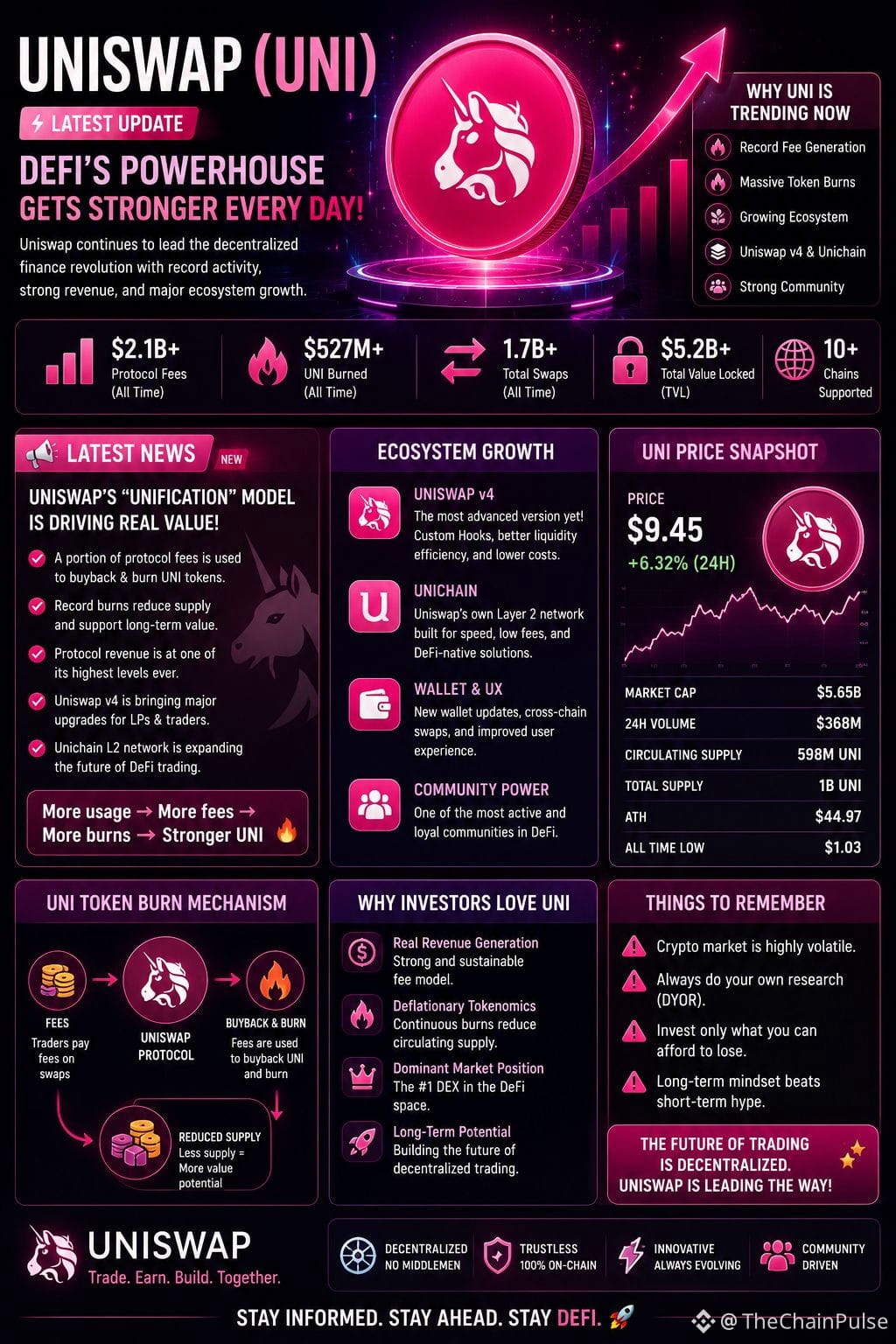
🚨 One of the biggest developments around Uniswap (UNI) isn't the price...
It's the growing connection between protocol usage and token value. 👀
Recently, Uniswap's "UNIfication" model continued attracting attention as protocol fees and token burn mechanisms became a major topic across the DeFi sector.
🔥 Why is this important?
Every time protocol activity grows, more value can potentially flow back into the ecosystem through fee generation and UNI burns.
What's Happening? 🦄
✅ Record UNI token burns reported
✅ Strong protocol fee generation
✅ Continued expansion of Uniswap's ecosystem
✅ Growing adoption of Uniswap v4 and Unichain
Many analysts believe this represents one of the biggest economic changes in Uniswap's history.
Why Are Investors Watching UNI? 👀
🌐 Largest DeFi Trading Ecosystems
💰 Billions in Trading Volume
🔥 Deflationary Token Burn Narrative
⚡ Continued Product Expansion
Uniswap remains one of the most widely used decentralized exchanges in crypto, processing massive on-chain trading activity across multiple blockchains.
Interesting Fact 🤔
Many crypto projects depend heavily on speculation.
Uniswap generates real protocol fees from actual trading activity, making it one of the most established DeFi protocols in the industry.
Final Thought
Bitcoin changed money.
Ethereum changed applications.
Uniswap changed how people trade crypto without intermediaries.
Now investors are watching whether growing protocol activity, fee generation, and token burns can become the next chapter in UNI's story.
💬 What's more important for a crypto project?
🔥 Token Burns
💰 Revenue Generation
🌐 User Adoption
Share your opinion below! 👇
#UniswapFoundation
#DeFiEducation #EthereumETFApprovalExpectations #write2earn🌐
$UNI
{spot}(UNIUSDT)
🚨 One of the biggest developments around Uniswap (UNI) isn't the price...
It's the growing connection between protocol usage and token value. 👀
Recently, Uniswap's "UNIfication" model continued attracting attention as protocol fees and token burn mechanisms became a major topic across the DeFi sector.
🔥 Why is this important?
Every time protocol activity grows, more value can potentially flow back into the ecosystem through fee generation and UNI burns.
What's Happening? 🦄
✅ Record UNI token burns reported
✅ Strong protocol fee generation
✅ Continued expansion of Uniswap's ecosystem
✅ Growing adoption of Uniswap v4 and Unichain
Many analysts believe this represents one of the biggest economic changes in Uniswap's history.
Why Are Investors Watching UNI? 👀
🌐 Largest DeFi Trading Ecosystems
💰 Billions in Trading Volume
🔥 Deflationary Token Burn Narrative
⚡ Continued Product Expansion
Uniswap remains one of the most widely used decentralized exchanges in crypto, processing massive on-chain trading activity across multiple blockchains.
Interesting Fact 🤔
Many crypto projects depend heavily on speculation.
Uniswap generates real protocol fees from actual trading activity, making it one of the most established DeFi protocols in the industry.
Final Thought
Bitcoin changed money.
Ethereum changed applications.
Uniswap changed how people trade crypto without intermediaries.
Now investors are watching whether growing protocol activity, fee generation, and token burns can become the next chapter in UNI's story.
💬 What's more important for a crypto project?
🔥 Token Burns
💰 Revenue Generation
🌐 User Adoption
Share your opinion below! 👇
#UniswapFoundation
#DeFiEducation #EthereumETFApprovalExpectations #write2earn🌐
$UNI
It's the growing connection between protocol usage and token value. 👀
Recently, Uniswap's "UNIfication" model continued attracting attention as protocol fees and token burn mechanisms became a major topic across the DeFi sector.
🔥 Why is this important?
Every time protocol activity grows, more value can potentially flow back into the ecosystem through fee generation and UNI burns.
What's Happening? 🦄
✅ Record UNI token burns reported
✅ Strong protocol fee generation
✅ Continued expansion of Uniswap's ecosystem
✅ Growing adoption of Uniswap v4 and Unichain
Many analysts believe this represents one of the biggest economic changes in Uniswap's history.
Why Are Investors Watching UNI? 👀
🌐 Largest DeFi Trading Ecosystems
💰 Billions in Trading Volume
🔥 Deflationary Token Burn Narrative
⚡ Continued Product Expansion
Uniswap remains one of the most widely used decentralized exchanges in crypto, processing massive on-chain trading activity across multiple blockchains.
Interesting Fact 🤔
Many crypto projects depend heavily on speculation.
Uniswap generates real protocol fees from actual trading activity, making it one of the most established DeFi protocols in the industry.
Final Thought
Bitcoin changed money.
Ethereum changed applications.
Uniswap changed how people trade crypto without intermediaries.
Now investors are watching whether growing protocol activity, fee generation, and token burns can become the next chapter in UNI's story.
💬 What's more important for a crypto project?
🔥 Token Burns
💰 Revenue Generation
🌐 User Adoption
Share your opinion below! 👇
#UniswapFoundation
#DeFiEducation #EthereumETFApprovalExpectations #write2earn🌐
$UNI
1
131
Log in to explore more content
Join global crypto users on Binance Square
⚡️ Get latest and useful information about crypto.
💬 Trusted by the world’s largest crypto exchange.
👍 Discover real insights from verified creators.
Email / Phone number
Trending Topics
1
#ZcashETFPostsFirstWeeklyOutflow$93.6M
42,660 views
135 Discussing
2
#GreekPoliceBustCryptoScamRingArrest17
105,758 views
806 Discussing
3
#BitcoinRejectedAt$87K
136,092 views
193 Discussing
4
#FedOctoberRateHikeOddsFallTo17%
132,760 views
1,063 Discussing
5
#NvidiaHitsRecordHighUp2.4%
95,614 views
765 Discussing
6
#CanaryFilesAmendedS1ForPEPEETF
24,800 views
532 Discussing
7
#USRussiaUkraineTalksReportedlyIncludeLukoilOilDeal
36,839 views
509 Discussing
8
#BitcoinParesGainsAfterRallyTo$86.5K
50,734 views
168 Discussing
9
#CerebrasSinksNearly20%OnReportNvidiaToPowerOpenAI
126,964 views
1,149 Discussing
10
#SECProposesCryptoCustodyRules
174,551 views
1,428 Discussing