
#cryptovsbanking
cryptovsbanking
97 views
4 Discussing
Hot
Latest

Article
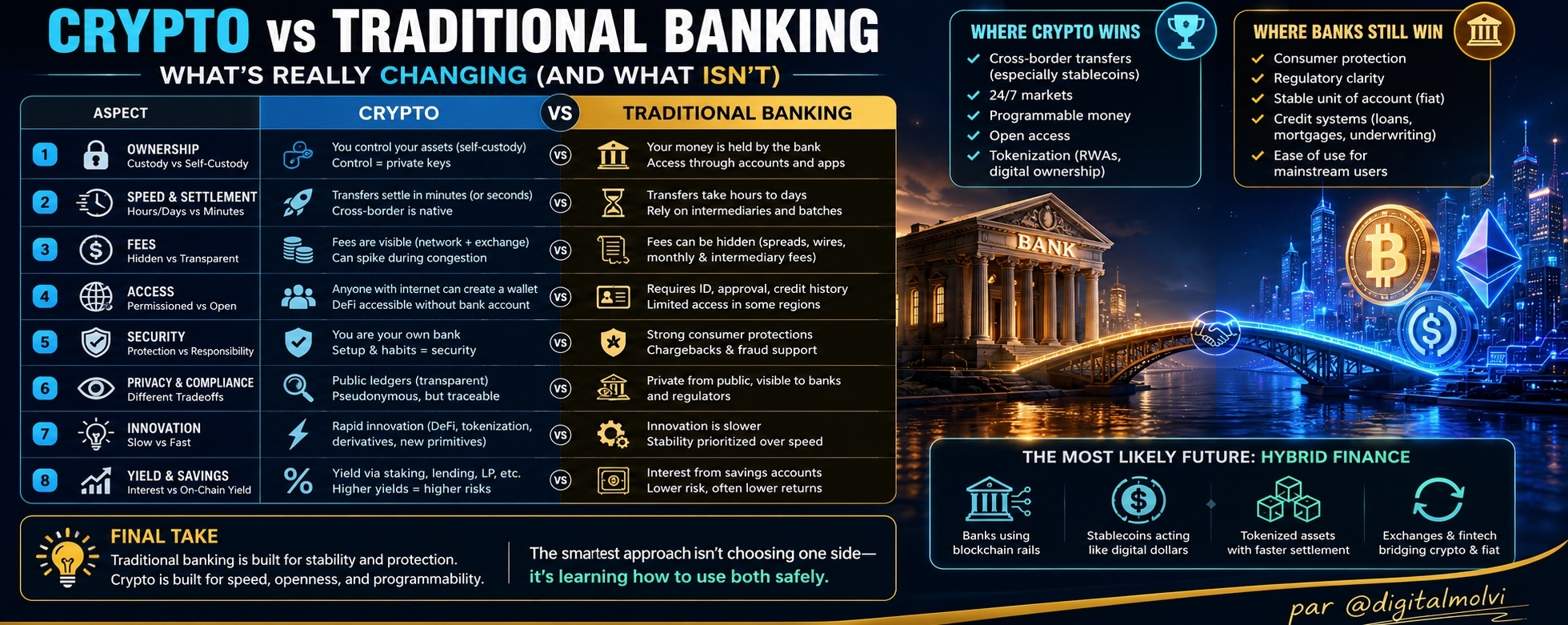
Crypto vs Traditional Banking?Crypto and traditional banking are often framed as enemies: “banks are old, crypto is the future.” Reality is more nuanced. Banks are great at stability and compliance, while crypto is great at speed, programmability, and open access. The next decade likely looks less like “crypto replaces banks” and more like banks + crypto rails merging.
Here’s a clear comparison to understand where each wins, where each struggles, and how everyday users can benefit.
1) Ownership: Custody vs Self-Custody
Traditional Banking
Your money is held by a bank.
You access it through accounts, cards, and apps.
Banks can freeze accounts under legal/compliance rules.
Crypto
You can hold assets yourself (self-custody) or use an exchange/custodian.
Control depends on who holds the private keys.
Self-custody gives control, but also full responsibility.
Key point: Crypto offers true ownership, but it comes with real accountability. Lose your keys, lose access.
2) Speed & Settlement: Hours/Days vs Minutes
Traditional Banking
Transfers can take hours to days (especially cross-border).
Settlement often happens in batches and through intermediaries.
Crypto
Transfers can settle in minutes (sometimes seconds depending on the network).
Cross-border is native—no need for correspondent banks.
Why it matters: For global payments and remittances, crypto rails can be dramatically faster and cheaper—especially using stablecoins.
3) Fees: Hidden Costs vs Transparent (But Variable)
Traditional Banking
Fees can be hidden: FX spreads, wire fees, monthly charges, intermediary fees.
Some services are “free” but paid for through spreads and restrictions.
Crypto
Fees are usually visible (network fees + exchange fees).
Network fees can spike during congestion (e.g., busy chains).
Reality check: Crypto can be cheaper, but not always. The best option depends on the chain, timing, and method.
4) Access: Permissioned vs Open
Traditional Banking
Requires documentation, credit history, and approval.
Some regions face limited access to banking services.
Crypto
Anyone with internet can create a wallet.
DeFi services can be accessed without a bank account (though regulations vary).
Big advantage: Crypto can serve people who are underbanked—but scams and user mistakes are also more common in open systems.
5) Security: Institutional Protection vs Personal Responsibility
Traditional Banking
Strong consumer protections in many countries.
Fraud departments, chargebacks, and regulated dispute processes.
Crypto
Security depends on your setup: device safety, seed phrase storage, phishing awareness.
Transactions are typically irreversible.
Bottom line: Banks protect users from many mistakes. Crypto rewards good security habits—and punishes carelessness.
6) Privacy & Compliance: Different Tradeoffs
Traditional Banking
Banks collect extensive personal data.
Transactions are private from the public, but visible to the bank and regulators.
Crypto
Many blockchains are transparent (public ledger).
Wallet addresses are pseudonymous, but can be linked to identity through exchanges and analytics.
Important: Crypto is not “invisible money.” It’s often more traceable than people think.
7) Innovation: Slow & Regulated vs Fast & Experimental
Traditional Banking
Innovation is slower due to regulation and legacy systems.
Stability is prioritized over speed.
Crypto
Rapid innovation: DeFi lending, automated market makers, tokenization, on-chain derivatives.
More experimental—higher risk of hacks, failures, and volatility.
Tradeoff: Crypto moves fast, but users must manage higher risk.
8) Yield & Savings: Interest Accounts vs On-Chain Yield
Traditional Banking
Savings yields depend on central bank rates and bank policies.
Generally lower risk, but returns may be modest.
Crypto
Yield can come from staking, lending, liquidity provision, or structured products.
Higher yields often mean higher risk (smart contract risk, liquidation risk, token price risk).
Rule of thumb: If the yield looks too good to be true, it usually is.
Where Crypto Wins Today
Cross-border transfers (especially stablecoins)
24/7 markets (no banking hours)
Programmable money (smart contracts)
Open access (anyone can participate)
Tokenization (RWAs, digital ownership, new financial primitives)
Where Banks Still Win
Consumer protection
Regulatory clarity
Stable unit of account (fiat)
Credit systems (loans, mortgages, underwriting)
Ease of use for mainstream users
The Most Likely Future: Hybrid Finance
Instead of “crypto vs banks,” we’re moving toward:
Banks using blockchain rails for settlement
Stablecoins acting like digital dollars
Tokenized assets (stocks, bonds, funds) trading with faster settlement
Exchanges and fintech apps bridging crypto and fiat smoothly
In short: crypto becomes infrastructure, not just an alternative.
Final Take
Traditional banking is built for stability and protection. Crypto is built for speed, openness, and programmability. The smartest approach for most people isn’t choosing one side—it’s learning how to use both safely.#digitalmolvi #BinanceSquare #cryptovsbanking #Banking #article
$BTC
{spot}(BTCUSDT)
$ETH
{spot}(ETHUSDT)
$BNB
{spot}(BNBUSDT)
Crypto vs Traditional Banking?
Crypto and traditional banking are often framed as enemies: “banks are old, crypto is the future.” Reality is more nuanced. Banks are great at stability and compliance, while crypto is great at speed, programmability, and open access. The next decade likely looks less like “crypto replaces banks” and more like banks + crypto rails merging.
Here’s a clear comparison to understand where each wins, where each struggles, and how everyday users can benefit.
1) Ownership: Custody vs Self-Custody
Traditional Banking
Your money is held by a bank.
You access it through accounts, cards, and apps.
Banks can freeze accounts under legal/compliance rules.
Crypto
You can hold assets yourself (self-custody) or use an exchange/custodian.
Control depends on who holds the private keys.
Self-custody gives control, but also full responsibility.
Key point: Crypto offers true ownership, but it comes with real accountability. Lose your keys, lose access.
2) Speed & Settlement: Hours/Days vs Minutes
Traditional Banking
Transfers can take hours to days (especially cross-border).
Settlement often happens in batches and through intermediaries.
Crypto
Transfers can settle in minutes (sometimes seconds depending on the network).
Cross-border is native—no need for correspondent banks.
Why it matters: For global payments and remittances, crypto rails can be dramatically faster and cheaper—especially using stablecoins.
3) Fees: Hidden Costs vs Transparent (But Variable)
Traditional Banking
Fees can be hidden: FX spreads, wire fees, monthly charges, intermediary fees.
Some services are “free” but paid for through spreads and restrictions.
Crypto
Fees are usually visible (network fees + exchange fees).
Network fees can spike during congestion (e.g., busy chains).
Reality check: Crypto can be cheaper, but not always. The best option depends on the chain, timing, and method.
4) Access: Permissioned vs Open
Traditional Banking
Requires documentation, credit history, and approval.
Some regions face limited access to banking services.
Crypto
Anyone with internet can create a wallet.
DeFi services can be accessed without a bank account (though regulations vary).
Big advantage: Crypto can serve people who are underbanked—but scams and user mistakes are also more common in open systems.
5) Security: Institutional Protection vs Personal Responsibility
Traditional Banking
Strong consumer protections in many countries.
Fraud departments, chargebacks, and regulated dispute processes.
Crypto
Security depends on your setup: device safety, seed phrase storage, phishing awareness.
Transactions are typically irreversible.
Bottom line: Banks protect users from many mistakes. Crypto rewards good security habits—and punishes carelessness.
6) Privacy & Compliance: Different Tradeoffs
Traditional Banking
Banks collect extensive personal data.
Transactions are private from the public, but visible to the bank and regulators.
Crypto
Many blockchains are transparent (public ledger).
Wallet addresses are pseudonymous, but can be linked to identity through exchanges and analytics.
Important: Crypto is not “invisible money.” It’s often more traceable than people think.
7) Innovation: Slow & Regulated vs Fast & Experimental
Traditional Banking
Innovation is slower due to regulation and legacy systems.
Stability is prioritized over speed.
Crypto
Rapid innovation: DeFi lending, automated market makers, tokenization, on-chain derivatives.
More experimental—higher risk of hacks, failures, and volatility.
Tradeoff: Crypto moves fast, but users must manage higher risk.
8) Yield & Savings: Interest Accounts vs On-Chain Yield
Traditional Banking
Savings yields depend on central bank rates and bank policies.
Generally lower risk, but returns may be modest.
Crypto
Yield can come from staking, lending, liquidity provision, or structured products.
Higher yields often mean higher risk (smart contract risk, liquidation risk, token price risk).
Rule of thumb: If the yield looks too good to be true, it usually is.
Where Crypto Wins Today
Cross-border transfers (especially stablecoins)
24/7 markets (no banking hours)
Programmable money (smart contracts)
Open access (anyone can participate)
Tokenization (RWAs, digital ownership, new financial primitives)
Where Banks Still Win
Consumer protection
Regulatory clarity
Stable unit of account (fiat)
Credit systems (loans, mortgages, underwriting)
Ease of use for mainstream users
The Most Likely Future: Hybrid Finance
Instead of “crypto vs banks,” we’re moving toward:
Banks using blockchain rails for settlement
Stablecoins acting like digital dollars
Tokenized assets (stocks, bonds, funds) trading with faster settlement
Exchanges and fintech apps bridging crypto and fiat smoothly
In short: crypto becomes infrastructure, not just an alternative.
Final Take
Traditional banking is built for stability and protection. Crypto is built for speed, openness, and programmability. The smartest approach for most people isn’t choosing one side—it’s learning how to use both safely.#digitalmolvi #BinanceSquare #cryptovsbanking #Banking #article
$BTC
$ETH
$BNB
Here’s a clear comparison to understand where each wins, where each struggles, and how everyday users can benefit.
1) Ownership: Custody vs Self-Custody
Traditional Banking
Your money is held by a bank.
You access it through accounts, cards, and apps.
Banks can freeze accounts under legal/compliance rules.
Crypto
You can hold assets yourself (self-custody) or use an exchange/custodian.
Control depends on who holds the private keys.
Self-custody gives control, but also full responsibility.
Key point: Crypto offers true ownership, but it comes with real accountability. Lose your keys, lose access.
2) Speed & Settlement: Hours/Days vs Minutes
Traditional Banking
Transfers can take hours to days (especially cross-border).
Settlement often happens in batches and through intermediaries.
Crypto
Transfers can settle in minutes (sometimes seconds depending on the network).
Cross-border is native—no need for correspondent banks.
Why it matters: For global payments and remittances, crypto rails can be dramatically faster and cheaper—especially using stablecoins.
3) Fees: Hidden Costs vs Transparent (But Variable)
Traditional Banking
Fees can be hidden: FX spreads, wire fees, monthly charges, intermediary fees.
Some services are “free” but paid for through spreads and restrictions.
Crypto
Fees are usually visible (network fees + exchange fees).
Network fees can spike during congestion (e.g., busy chains).
Reality check: Crypto can be cheaper, but not always. The best option depends on the chain, timing, and method.
4) Access: Permissioned vs Open
Traditional Banking
Requires documentation, credit history, and approval.
Some regions face limited access to banking services.
Crypto
Anyone with internet can create a wallet.
DeFi services can be accessed without a bank account (though regulations vary).
Big advantage: Crypto can serve people who are underbanked—but scams and user mistakes are also more common in open systems.
5) Security: Institutional Protection vs Personal Responsibility
Traditional Banking
Strong consumer protections in many countries.
Fraud departments, chargebacks, and regulated dispute processes.
Crypto
Security depends on your setup: device safety, seed phrase storage, phishing awareness.
Transactions are typically irreversible.
Bottom line: Banks protect users from many mistakes. Crypto rewards good security habits—and punishes carelessness.
6) Privacy & Compliance: Different Tradeoffs
Traditional Banking
Banks collect extensive personal data.
Transactions are private from the public, but visible to the bank and regulators.
Crypto
Many blockchains are transparent (public ledger).
Wallet addresses are pseudonymous, but can be linked to identity through exchanges and analytics.
Important: Crypto is not “invisible money.” It’s often more traceable than people think.
7) Innovation: Slow & Regulated vs Fast & Experimental
Traditional Banking
Innovation is slower due to regulation and legacy systems.
Stability is prioritized over speed.
Crypto
Rapid innovation: DeFi lending, automated market makers, tokenization, on-chain derivatives.
More experimental—higher risk of hacks, failures, and volatility.
Tradeoff: Crypto moves fast, but users must manage higher risk.
8) Yield & Savings: Interest Accounts vs On-Chain Yield
Traditional Banking
Savings yields depend on central bank rates and bank policies.
Generally lower risk, but returns may be modest.
Crypto
Yield can come from staking, lending, liquidity provision, or structured products.
Higher yields often mean higher risk (smart contract risk, liquidation risk, token price risk).
Rule of thumb: If the yield looks too good to be true, it usually is.
Where Crypto Wins Today
Cross-border transfers (especially stablecoins)
24/7 markets (no banking hours)
Programmable money (smart contracts)
Open access (anyone can participate)
Tokenization (RWAs, digital ownership, new financial primitives)
Where Banks Still Win
Consumer protection
Regulatory clarity
Stable unit of account (fiat)
Credit systems (loans, mortgages, underwriting)
Ease of use for mainstream users
The Most Likely Future: Hybrid Finance
Instead of “crypto vs banks,” we’re moving toward:
Banks using blockchain rails for settlement
Stablecoins acting like digital dollars
Tokenized assets (stocks, bonds, funds) trading with faster settlement
Exchanges and fintech apps bridging crypto and fiat smoothly
In short: crypto becomes infrastructure, not just an alternative.
Final Take
Traditional banking is built for stability and protection. Crypto is built for speed, openness, and programmability. The smartest approach for most people isn’t choosing one side—it’s learning how to use both safely.#digitalmolvi #BinanceSquare #cryptovsbanking #Banking #article
$BTC
$ETH
$BNB
72

·
--
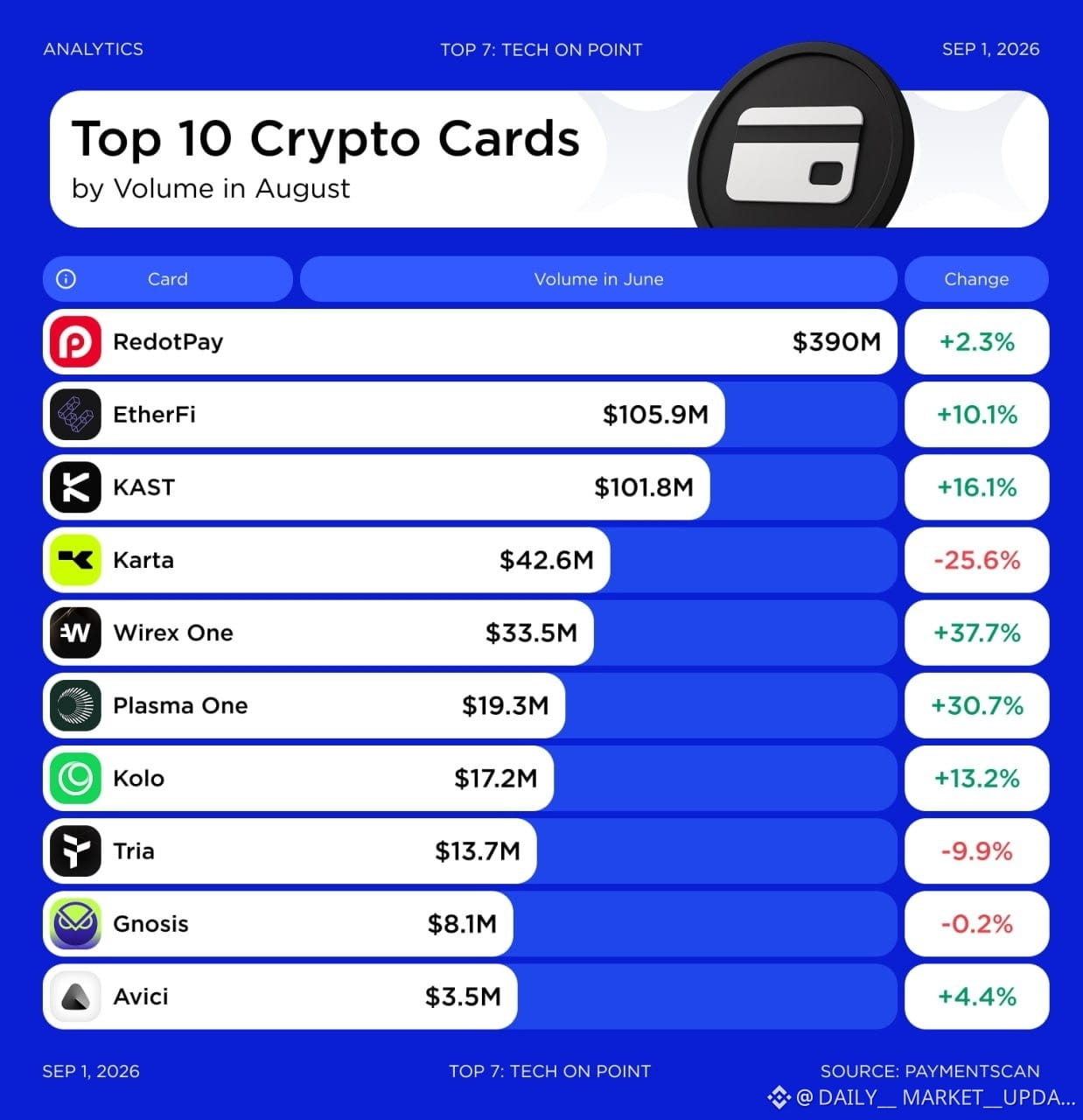
Top 10 Crypto Cards by Volume – August Breakdown 💳📊
August saw ~$735M in total card spend across the top 10 crypto cards.
But here’s the kicker 👇
RedotPay alone raked in $390M – that’s more than every other card on the list combined. 🏦💥
But while the leader sits comfortably, the chasing pack is speeding up 🚀:
· KAST ↗️ +16.1%
· Wirex One 📈 +37.7%
· Plasma One ⚡ +30.7%
· Kolo 📊 +13.2%
RedotPay grew just 2.3% this month – coasting while the rest are compounding fast.
The race for second is heating up too 🔥 – EtherFi and KAST are now separated by less than $4M**, both hovering around the **$100M mark. A real nail-biter! 🥊
Not everyone’s winning though.
Karta took a -25.6% dip to $42.6M – the only major decline this month, and steep enough to signal more than just a slow cycle. 📉
Now, let’s talk scale 🌍:
$735M/month across all crypto cards is roughly what a mid-sized regional bank processes.
Yes, the space is growing fast – but it’s still a tiny blip compared to traditional payment rails.
#CryptoCards 💳
#RedotPay 🥇
#CryptoSpending 📈
#KAST 🚀
#Wirex 💰
#Plasma 🔥
#Kolo 📊
#EtherFi 🧠
#Karta 📉
#CryptoGrowth 🌱
#PaymentRails 🏦
#AugustData 📅
#CryptoVsBanking ⚖️
Top 10 Crypto Cards by Volume – August Breakdown 💳📊
August saw ~$735M in total card spend across the top 10 crypto cards.
But here’s the kicker 👇
RedotPay alone raked in $390M – that’s more than every other card on the list combined. 🏦💥
But while the leader sits comfortably, the chasing pack is speeding up 🚀:
· KAST ↗️ +16.1%
· Wirex One 📈 +37.7%
· Plasma One ⚡ +30.7%
· Kolo 📊 +13.2%
RedotPay grew just 2.3% this month – coasting while the rest are compounding fast.
The race for second is heating up too 🔥 – EtherFi and KAST are now separated by less than $4M**, both hovering around the **$100M mark. A real nail-biter! 🥊
Not everyone’s winning though.
Karta took a -25.6% dip to $42.6M – the only major decline this month, and steep enough to signal more than just a slow cycle. 📉
Now, let’s talk scale 🌍:
$735M/month across all crypto cards is roughly what a mid-sized regional bank processes.
Yes, the space is growing fast – but it’s still a tiny blip compared to traditional payment rails.
#CryptoCards 💳
#RedotPay 🥇
#CryptoSpending 📈
#KAST 🚀
#Wirex 💰
#Plasma 🔥
#Kolo 📊
#EtherFi 🧠
#Karta 📉
#CryptoGrowth 🌱
#PaymentRails 🏦
#AugustData 📅
#CryptoVsBanking ⚖️
August saw ~$735M in total card spend across the top 10 crypto cards.
But here’s the kicker 👇
RedotPay alone raked in $390M – that’s more than every other card on the list combined. 🏦💥
But while the leader sits comfortably, the chasing pack is speeding up 🚀:
· KAST ↗️ +16.1%
· Wirex One 📈 +37.7%
· Plasma One ⚡ +30.7%
· Kolo 📊 +13.2%
RedotPay grew just 2.3% this month – coasting while the rest are compounding fast.
The race for second is heating up too 🔥 – EtherFi and KAST are now separated by less than $4M**, both hovering around the **$100M mark. A real nail-biter! 🥊
Not everyone’s winning though.
Karta took a -25.6% dip to $42.6M – the only major decline this month, and steep enough to signal more than just a slow cycle. 📉
Now, let’s talk scale 🌍:
$735M/month across all crypto cards is roughly what a mid-sized regional bank processes.
Yes, the space is growing fast – but it’s still a tiny blip compared to traditional payment rails.
#CryptoCards 💳
#RedotPay 🥇
#CryptoSpending 📈
#KAST 🚀
#Wirex 💰
#Plasma 🔥
#Kolo 📊
#EtherFi 🧠
#Karta 📉
#CryptoGrowth 🌱
#PaymentRails 🏦
#AugustData 📅
#CryptoVsBanking ⚖️
197

·
--
Bank deposit vs Binance Earn: Where is it more effective to hold savings? 🏦 vs 🟡
People often ask: “Why use Earn tools in crypto if there are regular bank deposits?” Let’s compare TradFi (classic finance) and Binance Earn across three main parameters.
⚖️ 1. Flexibility and withdrawals:
• TradFi: If you close your deposit early, the bank most often cancels all accrued interest.
• Binance Earn (Flexible): Interest is accrued daily. Withdraw funds whenever you want—the accumulated profit stays with you.
⚖️ 2. Entry threshold and currency:
• TradFi: There’s often a minimum deposit amount, and foreign-currency deposits have extremely low rates.
• Binance Earn: Starts from $1 in stablecoins (USDT/USDC) with competitive annual yield (APY).
⚖️ 3. Risks:
• TradFi: Protected by government deposit guarantee funds, but there are fiat inflation risks.
• Binance Earn: Smart-contract and platform risks, but higher liquidity for quick market maneuvering.
Conclusion: For fast capital and a crypto reserve, Binance Earn offers far more flexibility than a traditional bank.
@Binance_Ukraine
#BinanceERN #TradFi #Finance #CryptoVsBanking #PassiveIncome
Bank deposit vs Binance Earn: Where is it more effective to hold savings? 🏦 vs 🟡
People often ask: “Why use Earn tools in crypto if there are regular bank deposits?” Let’s compare TradFi (classic finance) and Binance Earn across three main parameters.
⚖️ 1. Flexibility and withdrawals:
• TradFi: If you close your deposit early, the bank most often cancels all accrued interest.
• Binance Earn (Flexible): Interest is accrued daily. Withdraw funds whenever you want—the accumulated profit stays with you.
⚖️ 2. Entry threshold and currency:
• TradFi: There’s often a minimum deposit amount, and foreign-currency deposits have extremely low rates.
• Binance Earn: Starts from $1 in stablecoins (USDT/USDC) with competitive annual yield (APY).
⚖️ 3. Risks:
• TradFi: Protected by government deposit guarantee funds, but there are fiat inflation risks.
• Binance Earn: Smart-contract and platform risks, but higher liquidity for quick market maneuvering.
Conclusion: For fast capital and a crypto reserve, Binance Earn offers far more flexibility than a traditional bank.
@Binance_Ukraine
#BinanceERN #TradFi #Finance #CryptoVsBanking #PassiveIncome
People often ask: “Why use Earn tools in crypto if there are regular bank deposits?” Let’s compare TradFi (classic finance) and Binance Earn across three main parameters.
⚖️ 1. Flexibility and withdrawals:
• TradFi: If you close your deposit early, the bank most often cancels all accrued interest.
• Binance Earn (Flexible): Interest is accrued daily. Withdraw funds whenever you want—the accumulated profit stays with you.
⚖️ 2. Entry threshold and currency:
• TradFi: There’s often a minimum deposit amount, and foreign-currency deposits have extremely low rates.
• Binance Earn: Starts from $1 in stablecoins (USDT/USDC) with competitive annual yield (APY).
⚖️ 3. Risks:
• TradFi: Protected by government deposit guarantee funds, but there are fiat inflation risks.
• Binance Earn: Smart-contract and platform risks, but higher liquidity for quick market maneuvering.
Conclusion: For fast capital and a crypto reserve, Binance Earn offers far more flexibility than a traditional bank.
@Binance_Ukraine
#BinanceERN #TradFi #Finance #CryptoVsBanking #PassiveIncome
1
81
Log in to explore more content
Join global crypto users on Binance Square
⚡️ Get latest and useful information about crypto.
💬 Trusted by the world’s largest crypto exchange.
👍 Discover real insights from verified creators.
Email / Phone number
Trending Topics
1
#WhatWillDriveCryptoandStocks’NextRebound?
2,645 views
104 Discussing
2
#Anthropic’s6xIPODemandSignalsPotentialRecordRaise
694 views
38 Discussing
3
#HuangExitNvidiaStrategyInFocus
133,014 views
1,331 Discussing
4
#AnthropicRejectsIPODelayValuationinQuestion
746,670 views
5,516 Discussing
5
#HedgeFundsCMEBitcoinNetShortsFall89%
6,600 views
106 Discussing
6
#BitMineReports$6.3BNetLossForFiscal2026
18,036 views
156 Discussing
7
#TradFiForBeginners
546,262 views
3,805 Discussing
8
#SoFiExpandsSoFiUSDStablecoinToPolygon
5,111 views
89 Discussing
9
#TetherGoldXAUTCompletesKPMGAudit
6,962 views
94 Discussing
10
#ChipStocksExtendLossesAfterNvidiaCEOChange
49,979 views
523 Discussing