

#cxmttoopen$4.3biposubscriptions
cxmttoopen$4.3biposubscriptions
58,004 views
149 Discussing
Hot
Latest


$DRAM ✨ CHIP MEGA-LISTING: CXMT OPENS SUBSCRIPTIONS FOR ITS $4.3 BILLION IPO.
The semiconductor sector is at the center of everyone’s attention. ChangXin Memory Technologies (CXMT), China’s largest DRAM manufacturer, has officially moved to list on the STAR Market in Shanghai, seeking to raise approximately 29.5 billion yuan (about $4.3 billion) through an IPO (Initial Public Offering).
Why is this move important?
Strategic expansion: The company plans to use the funds to expand its wafer manufacturing capacity, modernize its production lines, and accelerate the development of next-generation DRAM technology.
- Market context: This comes at a time of high global demand for chips, driven by the AI boom, positioning CXMT as a key piece in China’s technological self-sufficiency strategy.
- Timeline: The demand solicitation process with institutional investors begins July 13, while the official subscriptions are scheduled for July 16, 2026.
For investors, this listing is not only a chance to deploy capital, but also an indicator of how competition in the memory market is evolving against established industry giants. The big question now is whether this funding will help close the technological gap—or whether international restrictions will continue to set the pace of its growth.
What do you think? Do you believe this IPO will attract a large share of the capital currently flowing into the tech sector, or will people stay focused on other assets?
#CXMTToOpen$4.3BIPOSubscriptions
{future}(DRAMUSDT)
$DRAM ✨ CHIP MEGA-LISTING: CXMT OPENS SUBSCRIPTIONS FOR ITS $4.3 BILLION IPO.
The semiconductor sector is at the center of everyone’s attention. ChangXin Memory Technologies (CXMT), China’s largest DRAM manufacturer, has officially moved to list on the STAR Market in Shanghai, seeking to raise approximately 29.5 billion yuan (about $4.3 billion) through an IPO (Initial Public Offering).
Why is this move important?
Strategic expansion: The company plans to use the funds to expand its wafer manufacturing capacity, modernize its production lines, and accelerate the development of next-generation DRAM technology.
- Market context: This comes at a time of high global demand for chips, driven by the AI boom, positioning CXMT as a key piece in China’s technological self-sufficiency strategy.
- Timeline: The demand solicitation process with institutional investors begins July 13, while the official subscriptions are scheduled for July 16, 2026.
For investors, this listing is not only a chance to deploy capital, but also an indicator of how competition in the memory market is evolving against established industry giants. The big question now is whether this funding will help close the technological gap—or whether international restrictions will continue to set the pace of its growth.
What do you think? Do you believe this IPO will attract a large share of the capital currently flowing into the tech sector, or will people stay focused on other assets?
#CXMTToOpen$4.3BIPOSubscriptions
The semiconductor sector is at the center of everyone’s attention. ChangXin Memory Technologies (CXMT), China’s largest DRAM manufacturer, has officially moved to list on the STAR Market in Shanghai, seeking to raise approximately 29.5 billion yuan (about $4.3 billion) through an IPO (Initial Public Offering).
Why is this move important?
Strategic expansion: The company plans to use the funds to expand its wafer manufacturing capacity, modernize its production lines, and accelerate the development of next-generation DRAM technology.
- Market context: This comes at a time of high global demand for chips, driven by the AI boom, positioning CXMT as a key piece in China’s technological self-sufficiency strategy.
- Timeline: The demand solicitation process with institutional investors begins July 13, while the official subscriptions are scheduled for July 16, 2026.
For investors, this listing is not only a chance to deploy capital, but also an indicator of how competition in the memory market is evolving against established industry giants. The big question now is whether this funding will help close the technological gap—or whether international restrictions will continue to set the pace of its growth.
What do you think? Do you believe this IPO will attract a large share of the capital currently flowing into the tech sector, or will people stay focused on other assets?
#CXMTToOpen$4.3BIPOSubscriptions
1
5
834

🚨 CXMT targets a massive $4.3B IPO subscription! 📈
Strong investor demand shows growing confidence in the semiconductor industry and AI-driven technology. As capital continues flowing into chipmakers, the market is watching closely for what comes next.
📊 Will this IPO become one of the biggest tech success stories of the year?
💬 What do you think—bullish or just IPO hype?
#CXMTToOpen$4.3BIPOSubscriptions
🚨 CXMT targets a massive $4.3B IPO subscription! 📈
Strong investor demand shows growing confidence in the semiconductor industry and AI-driven technology. As capital continues flowing into chipmakers, the market is watching closely for what comes next.
📊 Will this IPO become one of the biggest tech success stories of the year?
💬 What do you think—bullish or just IPO hype?
#CXMTToOpen$4.3BIPOSubscriptions
Strong investor demand shows growing confidence in the semiconductor industry and AI-driven technology. As capital continues flowing into chipmakers, the market is watching closely for what comes next.
📊 Will this IPO become one of the biggest tech success stories of the year?
💬 What do you think—bullish or just IPO hype?
#CXMTToOpen$4.3BIPOSubscriptions
2
220

·
--
Article
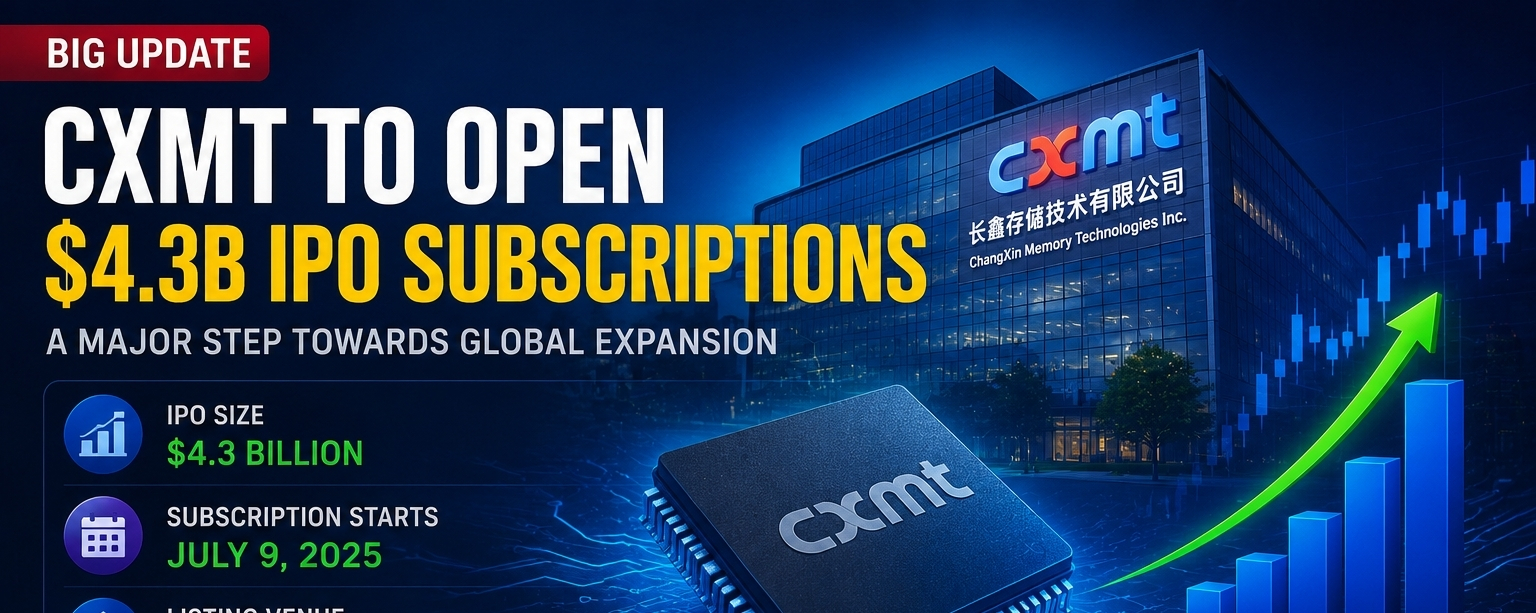
CXMT TO OPEN $4.3B IPO SUBSCRIPTIONS 📈🚨 CXMT TO OPEN $4.3B IPO SUBSCRIPTIONS 📈
Can China's Semiconductor Industry Enter A New Growth Phase?
ChangXin Memory Technologies (CXMT), one of China's leading memory chip manufacturers, is reportedly preparing to open subscriptions for a massive $4.3 billion Initial Public Offering (IPO). The move has attracted global attention as investors closely watch the race for semiconductor leadership and the growing demand for AI-driven computing infrastructure.
As artificial intelligence, cloud computing, and high-performance data centers continue expanding worldwide, memory chip manufacturers are becoming increasingly important to the future of the digital economy.
🔥 Why Is This IPO Important?
✅ One Of The Largest Semiconductor IPOs
A $4.3 billion fundraising effort highlights strong confidence in the long-term growth potential of the semiconductor industry.
✅ Rising AI Demand
Advanced memory chips are essential for powering AI models, cloud infrastructure, autonomous technologies, and high-performance computing systems.
✅ Strengthening Domestic Chip Production
The IPO could provide CXMT with additional capital to expand research, manufacturing capacity, and technological innovation, supporting China's efforts to strengthen its semiconductor ecosystem.
✅ Growing Global Investor Interest
Large technology investments continue attracting attention as governments and private companies increase spending on AI infrastructure and next-generation computing.
📊 What Could This Mean For The Crypto Market?
Although this is primarily a technology and semiconductor development, it could also influence sentiment across digital assets.
• AI-focused blockchain projects may benefit from stronger confidence in AI infrastructure.
• Semiconductor growth supports the hardware powering blockchain networks, cloud computing, and advanced data centers.
• Increased investment in emerging technologies often creates positive momentum across innovation-driven sectors, including Web3 and decentralized AI.
However, investors should remember that developments in the technology sector do not always result in immediate price movements in cryptocurrencies. Market liquidity, macroeconomic conditions, and investor sentiment remain key factors.
⚠️ Risks To Watch
• Global Economic Conditions
• Semiconductor Market Competition
• Supply Chain Challenges
• Geopolitical Developments
• Interest Rate Policies
These factors could influence both technology stocks and broader financial markets.
💬 Community Poll
Which Sector Has The Strongest Long-Term Growth Potential?
🤖 Artificial Intelligence
💾 Semiconductor Industry
⛓️ Blockchain & Web3
🚀 All Of The Above
👇 Share your opinion in the comments and explain why!
⚠️ This article is for educational purposes only and should not be considered financial advice. Always conduct your own research (DYOR) before making investment decisions.
#CXMTToOpen$4.3BIPOSubscriptions #CXMT T #SemiconductorDominance #artificialintelliegence #Market_Update
CXMT TO OPEN $4.3B IPO SUBSCRIPTIONS 📈
🚨 CXMT TO OPEN $4.3B IPO SUBSCRIPTIONS 📈
Can China's Semiconductor Industry Enter A New Growth Phase?
ChangXin Memory Technologies (CXMT), one of China's leading memory chip manufacturers, is reportedly preparing to open subscriptions for a massive $4.3 billion Initial Public Offering (IPO). The move has attracted global attention as investors closely watch the race for semiconductor leadership and the growing demand for AI-driven computing infrastructure.
As artificial intelligence, cloud computing, and high-performance data centers continue expanding worldwide, memory chip manufacturers are becoming increasingly important to the future of the digital economy.
🔥 Why Is This IPO Important?
✅ One Of The Largest Semiconductor IPOs
A $4.3 billion fundraising effort highlights strong confidence in the long-term growth potential of the semiconductor industry.
✅ Rising AI Demand
Advanced memory chips are essential for powering AI models, cloud infrastructure, autonomous technologies, and high-performance computing systems.
✅ Strengthening Domestic Chip Production
The IPO could provide CXMT with additional capital to expand research, manufacturing capacity, and technological innovation, supporting China's efforts to strengthen its semiconductor ecosystem.
✅ Growing Global Investor Interest
Large technology investments continue attracting attention as governments and private companies increase spending on AI infrastructure and next-generation computing.
📊 What Could This Mean For The Crypto Market?
Although this is primarily a technology and semiconductor development, it could also influence sentiment across digital assets.
• AI-focused blockchain projects may benefit from stronger confidence in AI infrastructure.
• Semiconductor growth supports the hardware powering blockchain networks, cloud computing, and advanced data centers.
• Increased investment in emerging technologies often creates positive momentum across innovation-driven sectors, including Web3 and decentralized AI.
However, investors should remember that developments in the technology sector do not always result in immediate price movements in cryptocurrencies. Market liquidity, macroeconomic conditions, and investor sentiment remain key factors.
⚠️ Risks To Watch
• Global Economic Conditions
• Semiconductor Market Competition
• Supply Chain Challenges
• Geopolitical Developments
• Interest Rate Policies
These factors could influence both technology stocks and broader financial markets.
💬 Community Poll
Which Sector Has The Strongest Long-Term Growth Potential?
🤖 Artificial Intelligence
💾 Semiconductor Industry
⛓️ Blockchain & Web3
🚀 All Of The Above
👇 Share your opinion in the comments and explain why!
⚠️ This article is for educational purposes only and should not be considered financial advice. Always conduct your own research (DYOR) before making investment decisions.
#CXMTToOpen$4.3BIPOSubscriptions #CXMT T #SemiconductorDominance #artificialintelliegence #Market_Update
Can China's Semiconductor Industry Enter A New Growth Phase?
ChangXin Memory Technologies (CXMT), one of China's leading memory chip manufacturers, is reportedly preparing to open subscriptions for a massive $4.3 billion Initial Public Offering (IPO). The move has attracted global attention as investors closely watch the race for semiconductor leadership and the growing demand for AI-driven computing infrastructure.
As artificial intelligence, cloud computing, and high-performance data centers continue expanding worldwide, memory chip manufacturers are becoming increasingly important to the future of the digital economy.
🔥 Why Is This IPO Important?
✅ One Of The Largest Semiconductor IPOs
A $4.3 billion fundraising effort highlights strong confidence in the long-term growth potential of the semiconductor industry.
✅ Rising AI Demand
Advanced memory chips are essential for powering AI models, cloud infrastructure, autonomous technologies, and high-performance computing systems.
✅ Strengthening Domestic Chip Production
The IPO could provide CXMT with additional capital to expand research, manufacturing capacity, and technological innovation, supporting China's efforts to strengthen its semiconductor ecosystem.
✅ Growing Global Investor Interest
Large technology investments continue attracting attention as governments and private companies increase spending on AI infrastructure and next-generation computing.
📊 What Could This Mean For The Crypto Market?
Although this is primarily a technology and semiconductor development, it could also influence sentiment across digital assets.
• AI-focused blockchain projects may benefit from stronger confidence in AI infrastructure.
• Semiconductor growth supports the hardware powering blockchain networks, cloud computing, and advanced data centers.
• Increased investment in emerging technologies often creates positive momentum across innovation-driven sectors, including Web3 and decentralized AI.
However, investors should remember that developments in the technology sector do not always result in immediate price movements in cryptocurrencies. Market liquidity, macroeconomic conditions, and investor sentiment remain key factors.
⚠️ Risks To Watch
• Global Economic Conditions
• Semiconductor Market Competition
• Supply Chain Challenges
• Geopolitical Developments
• Interest Rate Policies
These factors could influence both technology stocks and broader financial markets.
💬 Community Poll
Which Sector Has The Strongest Long-Term Growth Potential?
🤖 Artificial Intelligence
💾 Semiconductor Industry
⛓️ Blockchain & Web3
🚀 All Of The Above
👇 Share your opinion in the comments and explain why!
⚠️ This article is for educational purposes only and should not be considered financial advice. Always conduct your own research (DYOR) before making investment decisions.
#CXMTToOpen$4.3BIPOSubscriptions #CXMT T #SemiconductorDominance #artificialintelliegence #Market_Update
1
46

·
--
Bullish
#CXMTToOpen$4.3BIPOSubscriptions
THE AI HARDWARE GOLD RUSH CONTINUES: CXMT’S $4.3B IPO IS OPEN FOR BUSINESS! 🚀🧠
First SK Hynix shattered expectations, and now China’s absolute champion of memory chips is taking center stage. ChangXin Memory Technologies (CXMT) has officially opened subscriptions for its massive $4.3 Billion public listing!
As global tech giants scramble to secure high-bandwidth memory and DRAM supply chains, this IPO is the next major macro battlefield for institutional capital.
If you are tracking AI tech, semiconductors, or massive equity rotations, here is why the smart money is moving fast:
🤯 The Core Infrastructure Play
The DRAM Powerhouse: CXMT is the cornerstone of independent semiconductor memory manufacturing. If you want to build AI servers, data centers, or consumer tech, memory chips are non-negotiable.Massive Capital Injection: The $4.3B fundraising target is geared entirely toward scaling up advanced node production and manufacturing capabilities to meet the insatiable global demand for AI-related hardware.Institutional Demand: Portfolio managers and tech funds are aggressively stacking bids to secure allocations, preparing for a highly volatile and explosive trading debut.
💡 The Big Takeaway for Investors
The physical backbone of artificial intelligence remains the most crowded, high-conviction trade in the global markets. With CXMT opening its order books, liquidity is rotating deeply into hardware and physical computing infrastructure. The chip wars are expanding, and capital is picking its winners. 💻✨
Are you bidding on the CXMT subscription, or keeping your capital parked in traditional semiconductor giants? Let's talk strategy in the comments! 👇
#CXMTToOpen4BIPOSubscriptions #CXMT #IPO
#CXMTToOpen$4.3BIPOSubscriptions
THE AI HARDWARE GOLD RUSH CONTINUES: CXMT’S $4.3B IPO IS OPEN FOR BUSINESS! 🚀🧠
First SK Hynix shattered expectations, and now China’s absolute champion of memory chips is taking center stage. ChangXin Memory Technologies (CXMT) has officially opened subscriptions for its massive $4.3 Billion public listing!
As global tech giants scramble to secure high-bandwidth memory and DRAM supply chains, this IPO is the next major macro battlefield for institutional capital.
If you are tracking AI tech, semiconductors, or massive equity rotations, here is why the smart money is moving fast:
🤯 The Core Infrastructure Play
The DRAM Powerhouse: CXMT is the cornerstone of independent semiconductor memory manufacturing. If you want to build AI servers, data centers, or consumer tech, memory chips are non-negotiable.Massive Capital Injection: The $4.3B fundraising target is geared entirely toward scaling up advanced node production and manufacturing capabilities to meet the insatiable global demand for AI-related hardware.Institutional Demand: Portfolio managers and tech funds are aggressively stacking bids to secure allocations, preparing for a highly volatile and explosive trading debut.
💡 The Big Takeaway for Investors
The physical backbone of artificial intelligence remains the most crowded, high-conviction trade in the global markets. With CXMT opening its order books, liquidity is rotating deeply into hardware and physical computing infrastructure. The chip wars are expanding, and capital is picking its winners. 💻✨
Are you bidding on the CXMT subscription, or keeping your capital parked in traditional semiconductor giants? Let's talk strategy in the comments! 👇
#CXMTToOpen4BIPOSubscriptions #CXMT #IPO
THE AI HARDWARE GOLD RUSH CONTINUES: CXMT’S $4.3B IPO IS OPEN FOR BUSINESS! 🚀🧠
First SK Hynix shattered expectations, and now China’s absolute champion of memory chips is taking center stage. ChangXin Memory Technologies (CXMT) has officially opened subscriptions for its massive $4.3 Billion public listing!
As global tech giants scramble to secure high-bandwidth memory and DRAM supply chains, this IPO is the next major macro battlefield for institutional capital.
If you are tracking AI tech, semiconductors, or massive equity rotations, here is why the smart money is moving fast:
🤯 The Core Infrastructure Play
The DRAM Powerhouse: CXMT is the cornerstone of independent semiconductor memory manufacturing. If you want to build AI servers, data centers, or consumer tech, memory chips are non-negotiable.Massive Capital Injection: The $4.3B fundraising target is geared entirely toward scaling up advanced node production and manufacturing capabilities to meet the insatiable global demand for AI-related hardware.Institutional Demand: Portfolio managers and tech funds are aggressively stacking bids to secure allocations, preparing for a highly volatile and explosive trading debut.
💡 The Big Takeaway for Investors
The physical backbone of artificial intelligence remains the most crowded, high-conviction trade in the global markets. With CXMT opening its order books, liquidity is rotating deeply into hardware and physical computing infrastructure. The chip wars are expanding, and capital is picking its winners. 💻✨
Are you bidding on the CXMT subscription, or keeping your capital parked in traditional semiconductor giants? Let's talk strategy in the comments! 👇
#CXMTToOpen4BIPOSubscriptions #CXMT #IPO
2
200

·
--
Bullish
#CXMTToOpen$4.3BIPOSubscriptions
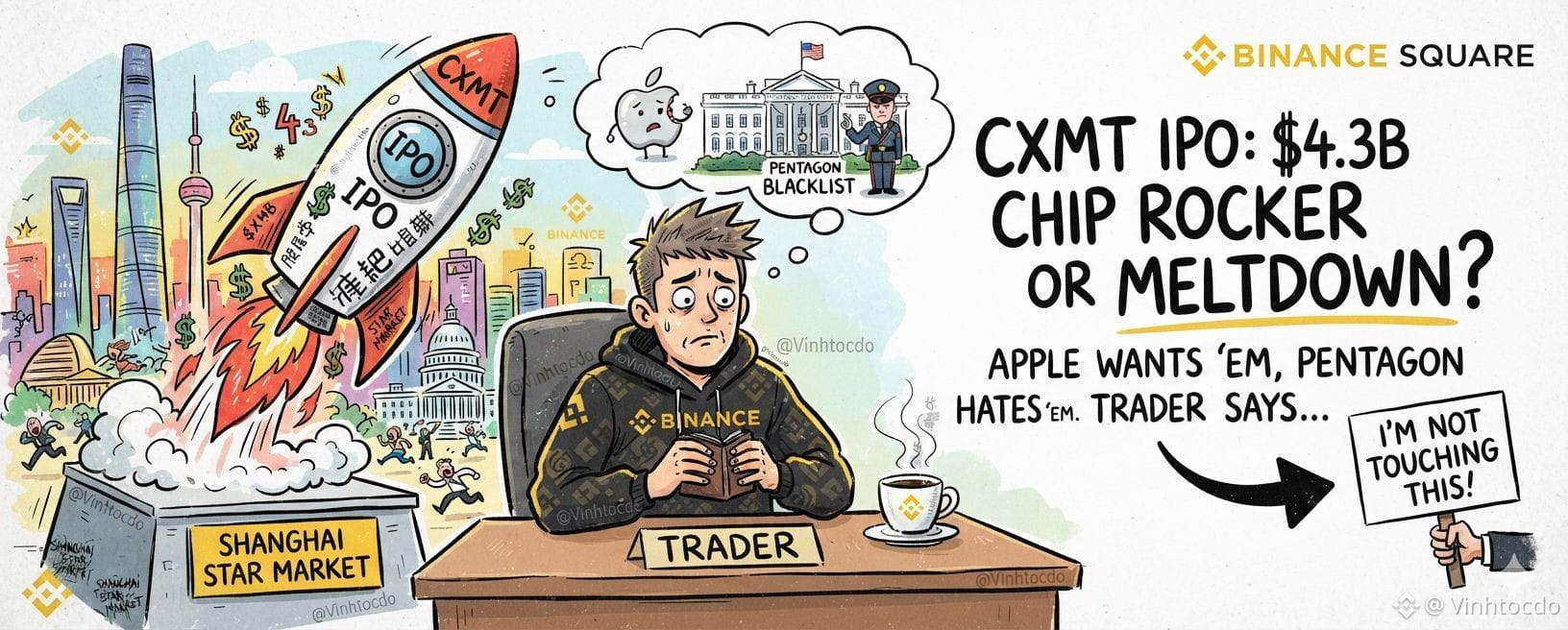
The Chinese memory chip giant CXMT is preparing to launch an enormous IPO worth 4.3 billion USD on the STAR Market in Shanghai! Word has it that this company’s chips are so good that Apple is “begging” the U.S. White House to allow purchasing, even as it’s still tangled in the Pentagon’s black market.
This is a bit superstitious, but when it comes to tech IPO plays in China, you already know—“big, shiny promises,” but if you jump in and get caught, it can turn into easy liquidity.
What’s a trader supposed to do at a time like this? Sit tight and watch the show, avoid FOMO gambling, and keep your wallet safe.
⚠️ This is not financial advice. Enter code VINHTOCDO and fight with me!
#CXMT #china #IPO #VINHTOCDO
$SAMSUNG
{future}(SAMSUNGUSDT)
$SKHYNIX
{future}(SKHYNIXUSDT)
$NVDAB
{spot}(NVDABUSDT)
#CXMTToOpen$4.3BIPOSubscriptions
The Chinese memory chip giant CXMT is preparing to launch an enormous IPO worth 4.3 billion USD on the STAR Market in Shanghai! Word has it that this company’s chips are so good that Apple is “begging” the U.S. White House to allow purchasing, even as it’s still tangled in the Pentagon’s black market.
This is a bit superstitious, but when it comes to tech IPO plays in China, you already know—“big, shiny promises,” but if you jump in and get caught, it can turn into easy liquidity.
What’s a trader supposed to do at a time like this? Sit tight and watch the show, avoid FOMO gambling, and keep your wallet safe.
⚠️ This is not financial advice. Enter code VINHTOCDO and fight with me!
#CXMT #china #IPO #VINHTOCDO
$SAMSUNG
$SKHYNIX
$NVDAB
The Chinese memory chip giant CXMT is preparing to launch an enormous IPO worth 4.3 billion USD on the STAR Market in Shanghai! Word has it that this company’s chips are so good that Apple is “begging” the U.S. White House to allow purchasing, even as it’s still tangled in the Pentagon’s black market.
This is a bit superstitious, but when it comes to tech IPO plays in China, you already know—“big, shiny promises,” but if you jump in and get caught, it can turn into easy liquidity.
What’s a trader supposed to do at a time like this? Sit tight and watch the show, avoid FOMO gambling, and keep your wallet safe.
⚠️ This is not financial advice. Enter code VINHTOCDO and fight with me!
#CXMT #china #IPO #VINHTOCDO
$SAMSUNG
$SKHYNIX
$NVDAB
6
777

·
--
Verified
#CXMTToOpen$4.3BIPOSubscriptions 🚨 China is getting ready for a big Chip IPO. People who buy and sell stocks should pay attention to this.
The Artificial Intelligence boom is still going strong? Changxin Memory Technologies is preparing for one of the biggest IPOs in China in a long time.
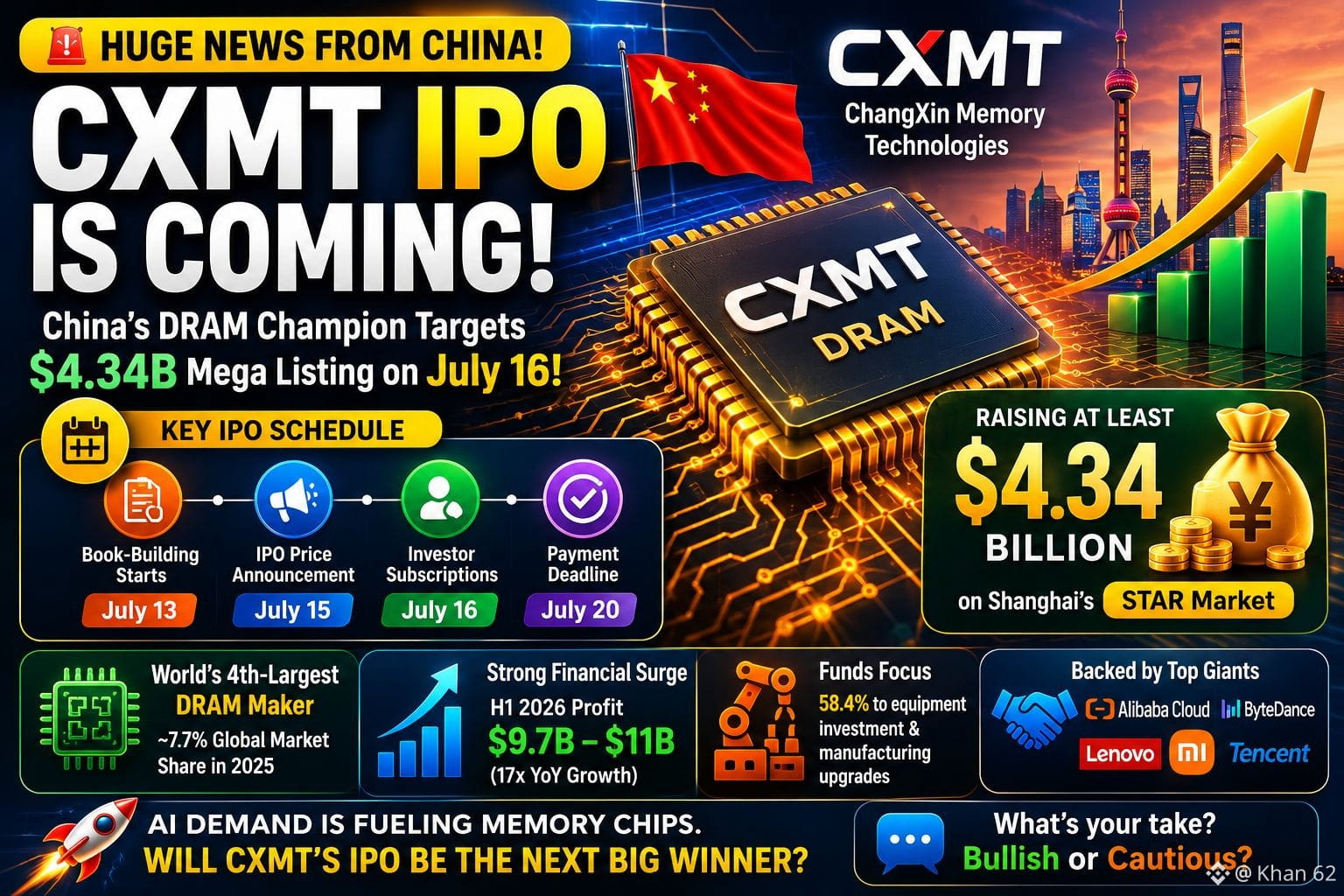
ChangXin Memory Technologies plans to raise least $4.34 billion on Shanghais STAR Market. This will make it the largest A-share IPO of 2026. People can start buying into ChangXin Memory Technologies on July 16.
So why is this important?
ChangXin Memory Technologies is the worlds largest DRAM maker. ChangXin Memory Technologies is doing well because of the demand for memory chips used in Artificial Intelligence.
Here are a things to know about ChangXin Memory Technologies:
* ChangXin Memory Technologies will use most of the money to expand its factories and make better chips.
* If a lot of people want to buy into ChangXin Memory Technologies this IPO could be a sign that investors are still very excited, about the global Artificial Intelligence semiconductor sector.
What do you think about ChangXin Memory Technologies and Artificial Intelligence chip stocks?
Will Artificial Intelligence chip stocks keep doing in 2026 or are they getting too expensive?
The positive announcement pushed the prices of these three stocks higher as investors rushed into AI chip plays.
Share what you think about ChangXin Memory Technologies and Artificial Intelligence chip stocks ! 👇
#Khan62 #IPO #stocks #Investing
$MU $SKHYNIX $SAMSUNG
{future}(SAMSUNGUSDT)
{future}(SKHYNIXUSDT)
{future}(MUUSDT)
#CXMTToOpen$4.3BIPOSubscriptions 🚨 China is getting ready for a big Chip IPO. People who buy and sell stocks should pay attention to this.
The Artificial Intelligence boom is still going strong? Changxin Memory Technologies is preparing for one of the biggest IPOs in China in a long time.
ChangXin Memory Technologies plans to raise least $4.34 billion on Shanghais STAR Market. This will make it the largest A-share IPO of 2026. People can start buying into ChangXin Memory Technologies on July 16.
So why is this important?
ChangXin Memory Technologies is the worlds largest DRAM maker. ChangXin Memory Technologies is doing well because of the demand for memory chips used in Artificial Intelligence.
Here are a things to know about ChangXin Memory Technologies:
* ChangXin Memory Technologies will use most of the money to expand its factories and make better chips.
* If a lot of people want to buy into ChangXin Memory Technologies this IPO could be a sign that investors are still very excited, about the global Artificial Intelligence semiconductor sector.
What do you think about ChangXin Memory Technologies and Artificial Intelligence chip stocks?
Will Artificial Intelligence chip stocks keep doing in 2026 or are they getting too expensive?
The positive announcement pushed the prices of these three stocks higher as investors rushed into AI chip plays.
Share what you think about ChangXin Memory Technologies and Artificial Intelligence chip stocks ! 👇
#Khan62 #IPO #stocks #Investing
$MU $SKHYNIX $SAMSUNG
The Artificial Intelligence boom is still going strong? Changxin Memory Technologies is preparing for one of the biggest IPOs in China in a long time.
ChangXin Memory Technologies plans to raise least $4.34 billion on Shanghais STAR Market. This will make it the largest A-share IPO of 2026. People can start buying into ChangXin Memory Technologies on July 16.
So why is this important?
ChangXin Memory Technologies is the worlds largest DRAM maker. ChangXin Memory Technologies is doing well because of the demand for memory chips used in Artificial Intelligence.
Here are a things to know about ChangXin Memory Technologies:
* ChangXin Memory Technologies will use most of the money to expand its factories and make better chips.
* If a lot of people want to buy into ChangXin Memory Technologies this IPO could be a sign that investors are still very excited, about the global Artificial Intelligence semiconductor sector.
What do you think about ChangXin Memory Technologies and Artificial Intelligence chip stocks?
Will Artificial Intelligence chip stocks keep doing in 2026 or are they getting too expensive?
The positive announcement pushed the prices of these three stocks higher as investors rushed into AI chip plays.
Share what you think about ChangXin Memory Technologies and Artificial Intelligence chip stocks ! 👇
#Khan62 #IPO #stocks #Investing
$MU $SKHYNIX $SAMSUNG
1
3
490

·
--
Article
China's chip game just went nuclear. $4.3B IPO subscriptions open July 16CXMT (ChangXin Memory) is opening subscriptions for what's about to be the biggest STAR Market listing ever, only behind SMIC. We're talking 29.5 billion yuan, roughly $4.3B, and honestly the backstory here is wild. This company's tech traces back to Qimonda, the German DRAM maker that collapsed in 2009. China basically picked up the pieces and built its answer to Samsung and SK Hynix from the wreckage.
The numbers are the real story though. CXMT went from a 2.83 billion yuan loss to a 33 billion yuan profit. That's not a typo. Revenue's up 719% year over year on the back of the AI memory boom that's been quietly running in the background while everyone's watching GPUs. They just locked a 20 billion yuan DRAM supply deal with Tencent too, and Apple's reportedly testing their chips for the China market.
Here's why I'm watching this even outside pure crypto. This IPO is basically a stress test for how much conviction investors still have in China's semiconductor independence push. If subscriptions get oversubscribed hard, that tells you capital's still chasing the AI infra trade wherever it can find exposure, even through a company that's technically still behind Samsung and SK Hynix on the high bandwidth memory that actually matters for AI chips.
Timeline to know: book building July 15, subscriptions open July 16 under ticker 688825, payment due July 20, listing expected around July 24.
Not investment advice, just tracking where the AI capital rotation shows up next. Anyone else watching STAR Market flows as a proxy for China tech sentiment right now?
#CXMTToOpen$4.3BIPOSubscriptions #LearnWithFatima
China's chip game just went nuclear. $4.3B IPO subscriptions open July 16
CXMT (ChangXin Memory) is opening subscriptions for what's about to be the biggest STAR Market listing ever, only behind SMIC. We're talking 29.5 billion yuan, roughly $4.3B, and honestly the backstory here is wild. This company's tech traces back to Qimonda, the German DRAM maker that collapsed in 2009. China basically picked up the pieces and built its answer to Samsung and SK Hynix from the wreckage.
The numbers are the real story though. CXMT went from a 2.83 billion yuan loss to a 33 billion yuan profit. That's not a typo. Revenue's up 719% year over year on the back of the AI memory boom that's been quietly running in the background while everyone's watching GPUs. They just locked a 20 billion yuan DRAM supply deal with Tencent too, and Apple's reportedly testing their chips for the China market.
Here's why I'm watching this even outside pure crypto. This IPO is basically a stress test for how much conviction investors still have in China's semiconductor independence push. If subscriptions get oversubscribed hard, that tells you capital's still chasing the AI infra trade wherever it can find exposure, even through a company that's technically still behind Samsung and SK Hynix on the high bandwidth memory that actually matters for AI chips.
Timeline to know: book building July 15, subscriptions open July 16 under ticker 688825, payment due July 20, listing expected around July 24.
Not investment advice, just tracking where the AI capital rotation shows up next. Anyone else watching STAR Market flows as a proxy for China tech sentiment right now?
#CXMTToOpen$4.3BIPOSubscriptions #LearnWithFatima
The numbers are the real story though. CXMT went from a 2.83 billion yuan loss to a 33 billion yuan profit. That's not a typo. Revenue's up 719% year over year on the back of the AI memory boom that's been quietly running in the background while everyone's watching GPUs. They just locked a 20 billion yuan DRAM supply deal with Tencent too, and Apple's reportedly testing their chips for the China market.
Here's why I'm watching this even outside pure crypto. This IPO is basically a stress test for how much conviction investors still have in China's semiconductor independence push. If subscriptions get oversubscribed hard, that tells you capital's still chasing the AI infra trade wherever it can find exposure, even through a company that's technically still behind Samsung and SK Hynix on the high bandwidth memory that actually matters for AI chips.
Timeline to know: book building July 15, subscriptions open July 16 under ticker 688825, payment due July 20, listing expected around July 24.
Not investment advice, just tracking where the AI capital rotation shows up next. Anyone else watching STAR Market flows as a proxy for China tech sentiment right now?
#CXMTToOpen$4.3BIPOSubscriptions #LearnWithFatima
9
19
1.9k



FED WILL INJECT $6,637,000,000.00 INTO THE MARKETS TODAY AT 9:00 AM ET, RIGHT BEFORE THE U.S. MARKET OPENS!
THESE INJECTIONS ARE DIRECTLY TIED TO THE OIL CRISIS AND EXTREME MARKET VOLATILITY.
SOMETHING EXTREMELY BAD IS COMING...
#CXMTToOpen$4.3BIPOSubscriptions #FedMinutesShowSplitOnRateHikes #SonyGetsOCCApprovalForStablecoinTrust #KOSPIJumpsNearly4%To7539 #SonyGetsConditionalOCCApprovalForStablecoinTrust
FED WILL INJECT $6,637,000,000.00 INTO THE MARKETS TODAY AT 9:00 AM ET, RIGHT BEFORE THE U.S. MARKET OPENS!
THESE INJECTIONS ARE DIRECTLY TIED TO THE OIL CRISIS AND EXTREME MARKET VOLATILITY.
SOMETHING EXTREMELY BAD IS COMING...
#CXMTToOpen$4.3BIPOSubscriptions #FedMinutesShowSplitOnRateHikes #SonyGetsOCCApprovalForStablecoinTrust #KOSPIJumpsNearly4%To7539 #SonyGetsConditionalOCCApprovalForStablecoinTrust
THESE INJECTIONS ARE DIRECTLY TIED TO THE OIL CRISIS AND EXTREME MARKET VOLATILITY.
SOMETHING EXTREMELY BAD IS COMING...
#CXMTToOpen$4.3BIPOSubscriptions #FedMinutesShowSplitOnRateHikes #SonyGetsOCCApprovalForStablecoinTrust #KOSPIJumpsNearly4%To7539 #SonyGetsConditionalOCCApprovalForStablecoinTrust

15

·
--
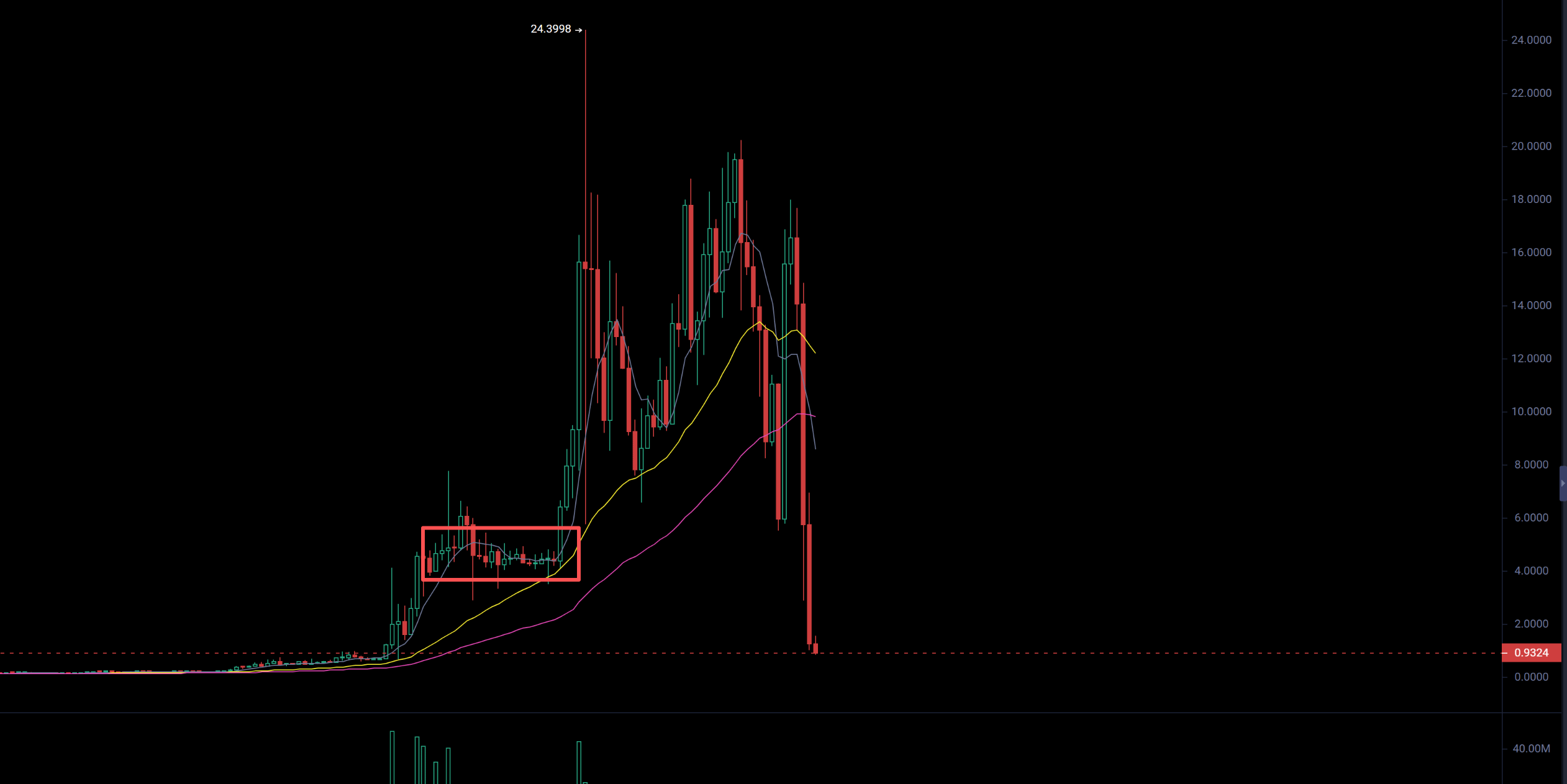
$LAB Dog庄 companies ignore you and turn cold; do you really expect it to repay you with an empty house?
Compared to the last dog庄’s harvesting tactics, they really treat retail investors like pigs to slaughter.
Last time, after the drop, they kept moving sideways for over two months. They ground down all the stubborn shorts during that period, exhausting all the short “ammunition,” and then pushed the price up.
This time is the opposite—within just three days, they evaporated the entire group of long “bottom-chasers.” They didn’t even bother to fake a sideways washout. It’s clear: abandon the position, dump the market, and harvest.
Two clear opportunities for everyone in the open: one was the long setup from two months ago, and the other was the short opportunity from three days ago. Hit either one and you could feast on big gains.
I myself didn’t even dare to short; missing the move is one thing I can accept. But I absolutely wouldn’t let my brain go hot and rush in to chase the bottom and deliver myself as a head.
Now anyone who dares to bottom-fish is a real hard case. I even suspect you might be a shill hired by the project.
What difference is there between rushing into this “garbage coin” with a blatant discard/harvest strategy and proactively handing your wallet to the market maker?
#CXMTToOpen$4.3BIPOSubscriptions
$LAB Dog庄 companies ignore you and turn cold; do you really expect it to repay you with an empty house?
Compared to the last dog庄’s harvesting tactics, they really treat retail investors like pigs to slaughter.
Last time, after the drop, they kept moving sideways for over two months. They ground down all the stubborn shorts during that period, exhausting all the short “ammunition,” and then pushed the price up.
This time is the opposite—within just three days, they evaporated the entire group of long “bottom-chasers.” They didn’t even bother to fake a sideways washout. It’s clear: abandon the position, dump the market, and harvest.
Two clear opportunities for everyone in the open: one was the long setup from two months ago, and the other was the short opportunity from three days ago. Hit either one and you could feast on big gains.
I myself didn’t even dare to short; missing the move is one thing I can accept. But I absolutely wouldn’t let my brain go hot and rush in to chase the bottom and deliver myself as a head.
Now anyone who dares to bottom-fish is a real hard case. I even suspect you might be a shill hired by the project.
What difference is there between rushing into this “garbage coin” with a blatant discard/harvest strategy and proactively handing your wallet to the market maker?
#CXMTToOpen$4.3BIPOSubscriptions
Compared to the last dog庄’s harvesting tactics, they really treat retail investors like pigs to slaughter.
Last time, after the drop, they kept moving sideways for over two months. They ground down all the stubborn shorts during that period, exhausting all the short “ammunition,” and then pushed the price up.
This time is the opposite—within just three days, they evaporated the entire group of long “bottom-chasers.” They didn’t even bother to fake a sideways washout. It’s clear: abandon the position, dump the market, and harvest.
Two clear opportunities for everyone in the open: one was the long setup from two months ago, and the other was the short opportunity from three days ago. Hit either one and you could feast on big gains.
I myself didn’t even dare to short; missing the move is one thing I can accept. But I absolutely wouldn’t let my brain go hot and rush in to chase the bottom and deliver myself as a head.
Now anyone who dares to bottom-fish is a real hard case. I even suspect you might be a shill hired by the project.
What difference is there between rushing into this “garbage coin” with a blatant discard/harvest strategy and proactively handing your wallet to the market maker?
#CXMTToOpen$4.3BIPOSubscriptions

309

·
--
Market Report: Momentum returns powerfully and liquidity flows into smart networks
Crypto markets saw price action movement🚀 Altcoins Explosion: a massive collective rally sweeps across the crypto market and drives alternatives to new peaksBitcoin is currently going through a stage of "reaccumulation and price compression" (Accumulation & Squeeze) after a period of heavy profit-taking that followed the break of previous all-time highs. Technical and fundamental analysis points to the following key milestones:
Market Report: Momentum returns powerfully and liquidity flows into smart networks Crypto markets saw price action movement
🚀 Altcoins Explosion: a massive collective rally sweeps across the crypto market and drives alternatives to new peaksBitcoin is currently going through a stage of "reaccumulation and price compression" (Accumulation & Squeeze) after a period of heavy profit-taking that followed the break of previous all-time highs. Technical and fundamental analysis points to the following key milestones:
1
43

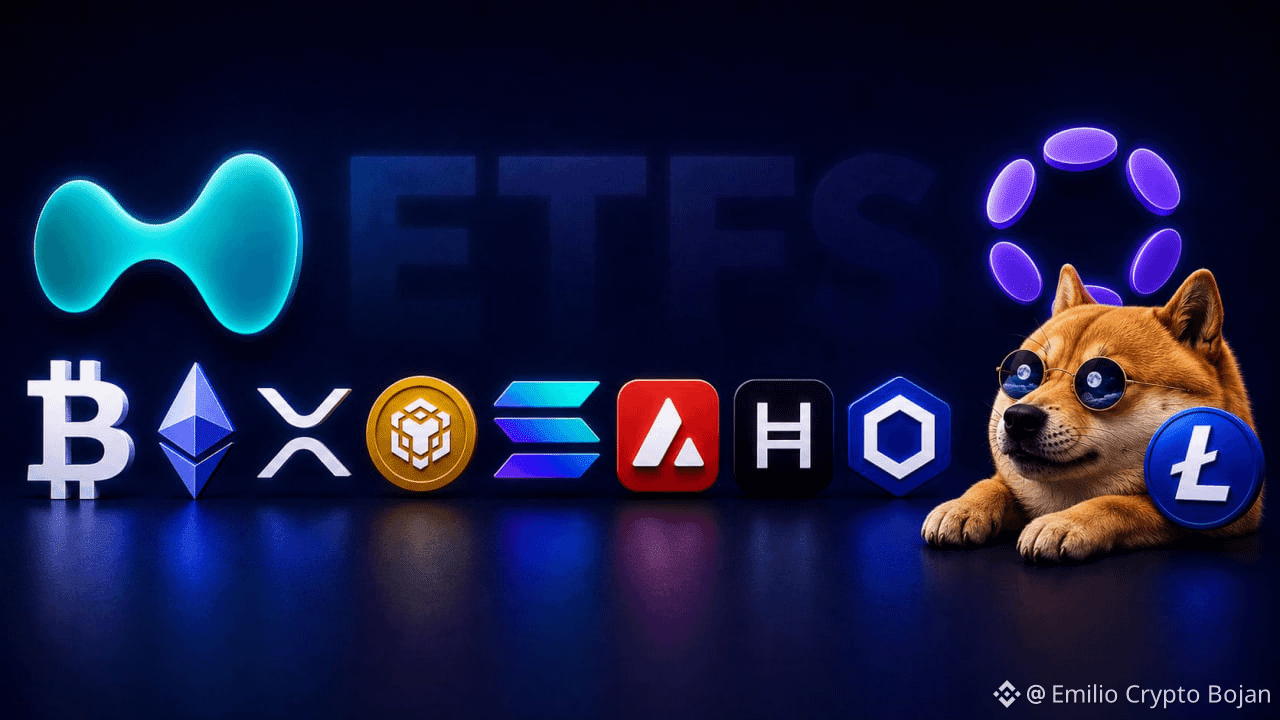
ETF FLOW UPDATE – JULY 8 📊
🔴 $BTC : -$84.86M
🟢 $ETH : +$70.48M (the only major ETF with net inflows)
🔴 $SOL : -$8.65M
🔴 $XRP: -$7.29M
Other flows:
🟢 $HYPE: +$3.33M 🟢 $LINK: +$74.26K ⚪ $DOGE, $BNB, $LTC, $AVAX, $HBAR, $DOT: $0
#CXMTToOpen$4.3BIPOSubscriptions #FedMinutesShowSplitOnRateHikes #SonyGetsOCCApprovalForStablecoinTrust #KOSPIJumpsNearly4%To7539
ETF FLOW UPDATE – JULY 8 📊
🔴 $BTC : -$84.86M
🟢 $ETH : +$70.48M (the only major ETF with net inflows)
🔴 $SOL : -$8.65M
🔴 $XRP: -$7.29M
Other flows:
🟢 $HYPE: +$3.33M 🟢 $LINK: +$74.26K ⚪ $DOGE, $BNB, $LTC, $AVAX, $HBAR, $DOT: $0
#CXMTToOpen$4.3BIPOSubscriptions #FedMinutesShowSplitOnRateHikes #SonyGetsOCCApprovalForStablecoinTrust #KOSPIJumpsNearly4%To7539
🔴 $BTC : -$84.86M
🟢 $ETH : +$70.48M (the only major ETF with net inflows)
🔴 $SOL : -$8.65M
🔴 $XRP: -$7.29M
Other flows:
🟢 $HYPE: +$3.33M 🟢 $LINK: +$74.26K ⚪ $DOGE, $BNB, $LTC, $AVAX, $HBAR, $DOT: $0
#CXMTToOpen$4.3BIPOSubscriptions #FedMinutesShowSplitOnRateHikes #SonyGetsOCCApprovalForStablecoinTrust #KOSPIJumpsNearly4%To7539
120

·
--
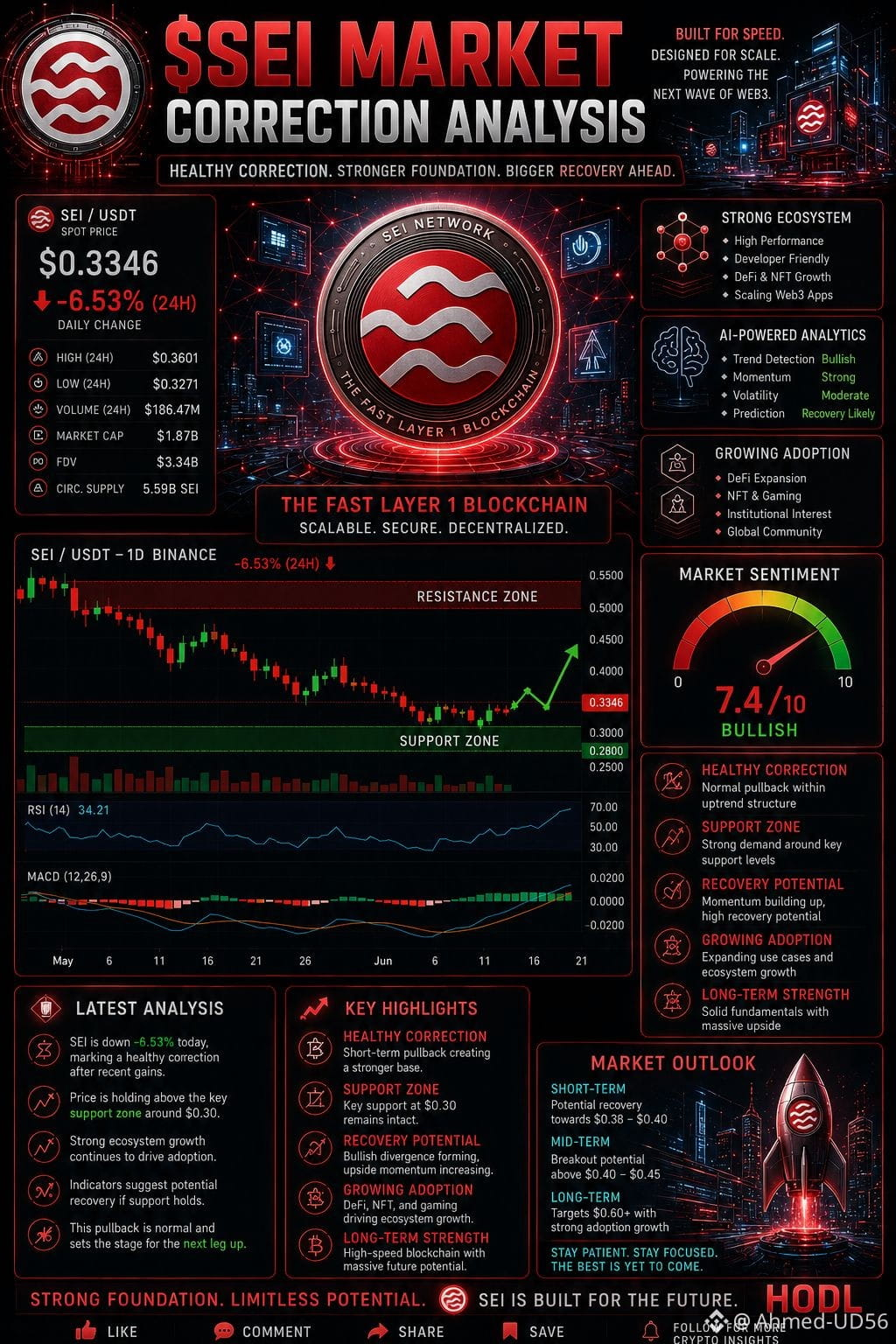
$SEI fell -6.53% amid broader market weakness as traders locked in profits. Despite the decline, ecosystem growth and network activity remain strong.
Sentiment Score: 7.4/10 Bullish 📊
🔍 Key Highlights
✅ Healthy market correction
✅ Growing ecosystem activity
✅ Strong blockchain performance
✅ Support levels being tested
✅ Long-term outlook remains positive
💡 Outlook
$SEI continues to maintain solid fundamentals. If the market stabilizes, the current pullback may provide an opportunity for buyers to re-enter before the next bullish move
#CXMTToOpen$4.3BIPOSubscriptions #USLaunchesNewStrikesAgainstIran #KOSPIReboundsNearly4%To7539 #SonyGetsOCCApprovalForStablecoinTrust
{spot}(SEIUSDT)
$SEI fell -6.53% amid broader market weakness as traders locked in profits. Despite the decline, ecosystem growth and network activity remain strong.
Sentiment Score: 7.4/10 Bullish 📊
🔍 Key Highlights
✅ Healthy market correction
✅ Growing ecosystem activity
✅ Strong blockchain performance
✅ Support levels being tested
✅ Long-term outlook remains positive
💡 Outlook
$SEI continues to maintain solid fundamentals. If the market stabilizes, the current pullback may provide an opportunity for buyers to re-enter before the next bullish move
#CXMTToOpen$4.3BIPOSubscriptions #USLaunchesNewStrikesAgainstIran #KOSPIReboundsNearly4%To7539 #SonyGetsOCCApprovalForStablecoinTrust
Sentiment Score: 7.4/10 Bullish 📊
🔍 Key Highlights
✅ Healthy market correction
✅ Growing ecosystem activity
✅ Strong blockchain performance
✅ Support levels being tested
✅ Long-term outlook remains positive
💡 Outlook
$SEI continues to maintain solid fundamentals. If the market stabilizes, the current pullback may provide an opportunity for buyers to re-enter before the next bullish move
#CXMTToOpen$4.3BIPOSubscriptions #USLaunchesNewStrikesAgainstIran #KOSPIReboundsNearly4%To7539 #SonyGetsOCCApprovalForStablecoinTrust
1
185

·
--
Article
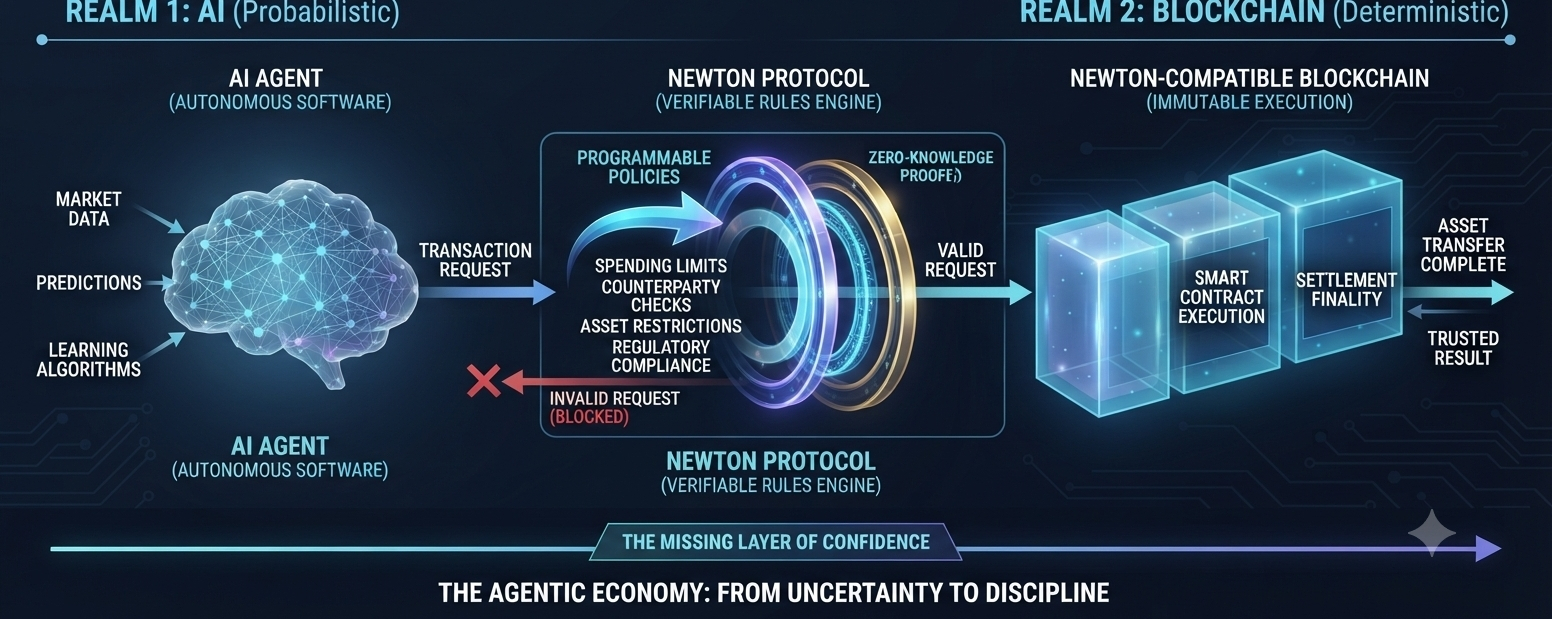
Newton Protocol (NEWT): Building the Trust Layer for AI-Powered FinanceThere is a strange contradiction shaping the future of finance. Artificial intelligence is becoming increasingly capable of making decisions, while blockchains remain exceptionally good at executing them. Yet the two technologies speak very different languages. AI is built on probabilities, predictions, and learning from imperfect data. Blockchains, by contrast, operate with absolute certainty. Once a valid transaction is submitted, the network executes it exactly as instructed, without asking whether the decision was sensible, safe, or even intended. Somewhere between those two worlds lies a gap that has received surprisingly little attention, and Newton Protocol (NEWT) was designed to fill it.
Most people initially see Newton as another AI-focused crypto project, but that description barely scratches the surface. Its ambition is much broader. Rather than creating another trading platform or another blockchain, Newton is attempting to build an infrastructure layer where autonomous software can operate under verifiable rules before interacting with digital assets. In other words, it is less concerned with making AI smarter than with making AI accountable. That distinction may ultimately prove more valuable than raw intelligence itself.
The timing of the project is no coincidence. Over the past few years, decentralized finance has evolved from a collection of experimental protocols into an ecosystem that processes billions of dollars in transactions. At the same time, artificial intelligence has moved beyond simple chatbots and recommendation engines. Today's AI systems can analyze markets, generate trading strategies, manage portfolios, execute workflows, and even coordinate with other autonomous agents. Many researchers now refer to this transition as the beginning of the "agentic economy," where software is no longer just assisting humans but actively participating in economic activity. While that vision is exciting, it introduces a new kind of risk. An AI model that makes a poor recommendation can usually be corrected by a human. An AI agent controlling a blockchain wallet may not have that luxury. Once it signs and broadcasts a transaction, there is no undo button.
This is where Newton's philosophy becomes particularly interesting. Instead of asking how artificial intelligence can execute more transactions, it asks a far more fundamental question: should every transaction be executed simply because an AI requested it? That shift in perspective separates Newton from many projects chasing the AI narrative. The protocol is built around the idea that intelligence without constraints is not innovation; it is uncertainty. Financial systems have never depended solely on good decisions. They have depended on rules that prevent bad ones.
Traditional finance has spent decades building those rules. Banks employ compliance teams, auditors, legal departments, and risk officers whose sole responsibility is to ensure that transactions follow internal policies and external regulations. Those safeguards rarely exist inside decentralized finance. Smart contracts faithfully execute code, but they do not understand context. They cannot determine whether a trade exceeds a fund's risk limit, whether an address belongs to a sanctioned entity, whether a portfolio has become dangerously concentrated, or whether market conditions have changed enough to invalidate a strategy. Developers often compensate for these shortcomings through centralized dashboards or front-end restrictions, but those protections disappear the moment someone interacts directly with the smart contract.
Newton attempts to solve that problem by making policy itself programmable. Rather than trusting people to remember rules or trusting websites to enforce them, the protocol allows policies to become part of the execution process. Before an autonomous agent completes an action, its request can be evaluated against predefined conditions such as spending limits, approved counterparties, asset restrictions, leverage thresholds, jurisdictional requirements, governance rules, or organizational mandates. If those conditions are satisfied, execution continues. If they are not, the transaction never reaches the blockchain. It is a subtle idea, but one with enormous implications. Compliance, which has traditionally existed as paperwork and human oversight, becomes executable code.
What makes this especially relevant is that artificial intelligence itself benefits from boundaries. Popular discussions often portray AI as something that should be given complete freedom to optimize outcomes, yet decades of financial research suggest otherwise. Even sophisticated quantitative models can fail spectacularly when they operate outside carefully defined risk parameters. The lesson is that successful automation has always depended less on intelligence than on discipline. Newton appears to embrace this reality by treating AI as something that should operate inside mathematically verifiable guardrails rather than trusting it to make flawless decisions.
Another important dimension of the protocol is privacy. Financial institutions have long hesitated to embrace public blockchains because transparency creates its own set of problems. While open ledgers improve auditability, they can also expose commercially sensitive information, customer data, and operational strategies. Newton incorporates zero-knowledge proof technology as part of its broader architecture to address this challenge. Instead of revealing confidential information directly on-chain, the system can verify that specific conditions have been met without disclosing the underlying data. In practical terms, an organization could prove that regulatory requirements were satisfied or that internal policies were followed without publishing every piece of information involved in the decision. This approach reflects a growing realization across the blockchain industry that transparency and privacy are not necessarily opposites; they can coexist when supported by modern cryptography.
Beyond automated finance, Newton is also building toward a marketplace where artificial intelligence itself becomes an economic asset. Instead of AI developers merely releasing software and hoping users discover it, the protocol envisions an ecosystem where models can be registered, operated, and monetized within a structured framework. Developers create autonomous agents, operators deploy them, users access their services, and economic incentives encourage honest behavior through staking and collateral mechanisms. Reputation becomes measurable, participation becomes permissionless, and trust is reinforced not only by code but also by aligned financial incentives. It is an ambitious attempt to create a marketplace where intelligence is treated as infrastructure rather than just another downloadable application.
The NEWT token sits at the center of this ecosystem. Like many digital assets, it supports network security through staking and governance, but its intended role extends further. It is designed to facilitate fees, secure validator participation, support operator collateral, and align incentives across the protocol. Whether those functions ultimately generate sustainable demand depends less on tokenomics than on real adoption. Many blockchain projects have introduced elaborate utility models that failed because few people actually used the underlying network. Newton's long-term success will therefore depend on whether developers, institutions, and autonomous applications genuinely need the services it provides.
Perhaps the most fascinating aspect of Newton is that it quietly challenges one of blockchain's oldest assumptions. Early cryptocurrency was built on the belief that removing intermediaries would eliminate the need for trust. In practice, trust never disappeared. It simply shifted. Users still trust wallet software, oracle providers, bridges, exchanges, governance systems, and increasingly, artificial intelligence. Newton recognizes that autonomous software introduces an entirely new trust problem. The objective is not to remove trust altogether but to relocate it into cryptographic verification, programmable policies, and transparent execution. Instead of asking users to trust the judgment of an AI system, it asks them to trust the rules constraining that system.
This subtle shift could become increasingly important as autonomous agents begin managing treasuries, executing investment strategies, coordinating supply chains, paying invoices, and interacting with decentralized applications without direct human supervision. If that future materializes, the most valuable infrastructure may not be the fastest blockchain or the cheapest transaction network. It may be the system capable of proving that autonomous decisions respected predefined rules before they were ever executed.
That vision also explains why Newton feels different from many AI narratives currently dominating the cryptocurrency market. Most projects celebrate intelligence itself, promising smarter algorithms and more sophisticated automation. Newton focuses on something far less glamorous but arguably far more essential: judgment. Intelligence generates possibilities, but judgment determines which possibilities should become reality. In human organizations, that distinction is provided by governance, compliance, and experience. In autonomous financial systems, it must be provided by software.
Whether Newton ultimately becomes a foundational piece of blockchain infrastructure remains uncertain. The project still faces significant challenges, from attracting developers and institutional partners to convincing regulators that cryptographic proofs can meaningfully support compliance. It must also strike a delicate balance between freedom and control. Too many restrictions could limit the flexibility that makes AI valuable, while too few would undermine the protocol's core purpose. Finding that equilibrium will likely determine whether Newton becomes an essential layer of the emerging agentic economy or remains an ambitious experiment.
Even so, the problem Newton is trying to solve feels increasingly inevitable. As artificial intelligence gains the ability to control assets, interact with financial markets, and make increasingly complex decisions, execution alone will no longer be enough. The future of decentralized finance will depend not only on whether autonomous systems can act, but on whether those actions can be verified, constrained, and trusted before they become irreversible. In that sense, Newton Protocol is not simply building tools for AI-powered finance. It is attempting to build the missing layer of confidence between machine intelligence and immutable execution, a role that could become indispensable if autonomous agents truly become the next participants in the global economy.
#CXMTToOpen$4.3BIPOSubscriptions #HKSFCOrdersBrokersToReplaceOTPLogins #SwiftRollsOutBlockchainLedgerFor17Banks #KoreaCentralBankUrgesWonStablecoinFramework #MicronPlans$3BToStrengthenUSSemiconductorSupplyChain
$OPG
{spot}(OPGUSDT)
$BTC
{spot}(BTCUSDT)
$SPCXB
{spot}(SPCXBUSDT)
Newton Protocol (NEWT): Building the Trust Layer for AI-Powered Finance
There is a strange contradiction shaping the future of finance. Artificial intelligence is becoming increasingly capable of making decisions, while blockchains remain exceptionally good at executing them. Yet the two technologies speak very different languages. AI is built on probabilities, predictions, and learning from imperfect data. Blockchains, by contrast, operate with absolute certainty. Once a valid transaction is submitted, the network executes it exactly as instructed, without asking whether the decision was sensible, safe, or even intended. Somewhere between those two worlds lies a gap that has received surprisingly little attention, and Newton Protocol (NEWT) was designed to fill it.
Most people initially see Newton as another AI-focused crypto project, but that description barely scratches the surface. Its ambition is much broader. Rather than creating another trading platform or another blockchain, Newton is attempting to build an infrastructure layer where autonomous software can operate under verifiable rules before interacting with digital assets. In other words, it is less concerned with making AI smarter than with making AI accountable. That distinction may ultimately prove more valuable than raw intelligence itself.
The timing of the project is no coincidence. Over the past few years, decentralized finance has evolved from a collection of experimental protocols into an ecosystem that processes billions of dollars in transactions. At the same time, artificial intelligence has moved beyond simple chatbots and recommendation engines. Today's AI systems can analyze markets, generate trading strategies, manage portfolios, execute workflows, and even coordinate with other autonomous agents. Many researchers now refer to this transition as the beginning of the "agentic economy," where software is no longer just assisting humans but actively participating in economic activity. While that vision is exciting, it introduces a new kind of risk. An AI model that makes a poor recommendation can usually be corrected by a human. An AI agent controlling a blockchain wallet may not have that luxury. Once it signs and broadcasts a transaction, there is no undo button.
This is where Newton's philosophy becomes particularly interesting. Instead of asking how artificial intelligence can execute more transactions, it asks a far more fundamental question: should every transaction be executed simply because an AI requested it? That shift in perspective separates Newton from many projects chasing the AI narrative. The protocol is built around the idea that intelligence without constraints is not innovation; it is uncertainty. Financial systems have never depended solely on good decisions. They have depended on rules that prevent bad ones.
Traditional finance has spent decades building those rules. Banks employ compliance teams, auditors, legal departments, and risk officers whose sole responsibility is to ensure that transactions follow internal policies and external regulations. Those safeguards rarely exist inside decentralized finance. Smart contracts faithfully execute code, but they do not understand context. They cannot determine whether a trade exceeds a fund's risk limit, whether an address belongs to a sanctioned entity, whether a portfolio has become dangerously concentrated, or whether market conditions have changed enough to invalidate a strategy. Developers often compensate for these shortcomings through centralized dashboards or front-end restrictions, but those protections disappear the moment someone interacts directly with the smart contract.
Newton attempts to solve that problem by making policy itself programmable. Rather than trusting people to remember rules or trusting websites to enforce them, the protocol allows policies to become part of the execution process. Before an autonomous agent completes an action, its request can be evaluated against predefined conditions such as spending limits, approved counterparties, asset restrictions, leverage thresholds, jurisdictional requirements, governance rules, or organizational mandates. If those conditions are satisfied, execution continues. If they are not, the transaction never reaches the blockchain. It is a subtle idea, but one with enormous implications. Compliance, which has traditionally existed as paperwork and human oversight, becomes executable code.
What makes this especially relevant is that artificial intelligence itself benefits from boundaries. Popular discussions often portray AI as something that should be given complete freedom to optimize outcomes, yet decades of financial research suggest otherwise. Even sophisticated quantitative models can fail spectacularly when they operate outside carefully defined risk parameters. The lesson is that successful automation has always depended less on intelligence than on discipline. Newton appears to embrace this reality by treating AI as something that should operate inside mathematically verifiable guardrails rather than trusting it to make flawless decisions.
Another important dimension of the protocol is privacy. Financial institutions have long hesitated to embrace public blockchains because transparency creates its own set of problems. While open ledgers improve auditability, they can also expose commercially sensitive information, customer data, and operational strategies. Newton incorporates zero-knowledge proof technology as part of its broader architecture to address this challenge. Instead of revealing confidential information directly on-chain, the system can verify that specific conditions have been met without disclosing the underlying data. In practical terms, an organization could prove that regulatory requirements were satisfied or that internal policies were followed without publishing every piece of information involved in the decision. This approach reflects a growing realization across the blockchain industry that transparency and privacy are not necessarily opposites; they can coexist when supported by modern cryptography.
Beyond automated finance, Newton is also building toward a marketplace where artificial intelligence itself becomes an economic asset. Instead of AI developers merely releasing software and hoping users discover it, the protocol envisions an ecosystem where models can be registered, operated, and monetized within a structured framework. Developers create autonomous agents, operators deploy them, users access their services, and economic incentives encourage honest behavior through staking and collateral mechanisms. Reputation becomes measurable, participation becomes permissionless, and trust is reinforced not only by code but also by aligned financial incentives. It is an ambitious attempt to create a marketplace where intelligence is treated as infrastructure rather than just another downloadable application.
The NEWT token sits at the center of this ecosystem. Like many digital assets, it supports network security through staking and governance, but its intended role extends further. It is designed to facilitate fees, secure validator participation, support operator collateral, and align incentives across the protocol. Whether those functions ultimately generate sustainable demand depends less on tokenomics than on real adoption. Many blockchain projects have introduced elaborate utility models that failed because few people actually used the underlying network. Newton's long-term success will therefore depend on whether developers, institutions, and autonomous applications genuinely need the services it provides.
Perhaps the most fascinating aspect of Newton is that it quietly challenges one of blockchain's oldest assumptions. Early cryptocurrency was built on the belief that removing intermediaries would eliminate the need for trust. In practice, trust never disappeared. It simply shifted. Users still trust wallet software, oracle providers, bridges, exchanges, governance systems, and increasingly, artificial intelligence. Newton recognizes that autonomous software introduces an entirely new trust problem. The objective is not to remove trust altogether but to relocate it into cryptographic verification, programmable policies, and transparent execution. Instead of asking users to trust the judgment of an AI system, it asks them to trust the rules constraining that system.
This subtle shift could become increasingly important as autonomous agents begin managing treasuries, executing investment strategies, coordinating supply chains, paying invoices, and interacting with decentralized applications without direct human supervision. If that future materializes, the most valuable infrastructure may not be the fastest blockchain or the cheapest transaction network. It may be the system capable of proving that autonomous decisions respected predefined rules before they were ever executed.
That vision also explains why Newton feels different from many AI narratives currently dominating the cryptocurrency market. Most projects celebrate intelligence itself, promising smarter algorithms and more sophisticated automation. Newton focuses on something far less glamorous but arguably far more essential: judgment. Intelligence generates possibilities, but judgment determines which possibilities should become reality. In human organizations, that distinction is provided by governance, compliance, and experience. In autonomous financial systems, it must be provided by software.
Whether Newton ultimately becomes a foundational piece of blockchain infrastructure remains uncertain. The project still faces significant challenges, from attracting developers and institutional partners to convincing regulators that cryptographic proofs can meaningfully support compliance. It must also strike a delicate balance between freedom and control. Too many restrictions could limit the flexibility that makes AI valuable, while too few would undermine the protocol's core purpose. Finding that equilibrium will likely determine whether Newton becomes an essential layer of the emerging agentic economy or remains an ambitious experiment.
Even so, the problem Newton is trying to solve feels increasingly inevitable. As artificial intelligence gains the ability to control assets, interact with financial markets, and make increasingly complex decisions, execution alone will no longer be enough. The future of decentralized finance will depend not only on whether autonomous systems can act, but on whether those actions can be verified, constrained, and trusted before they become irreversible. In that sense, Newton Protocol is not simply building tools for AI-powered finance. It is attempting to build the missing layer of confidence between machine intelligence and immutable execution, a role that could become indispensable if autonomous agents truly become the next participants in the global economy.
#CXMTToOpen$4.3BIPOSubscriptions #HKSFCOrdersBrokersToReplaceOTPLogins #SwiftRollsOutBlockchainLedgerFor17Banks #KoreaCentralBankUrgesWonStablecoinFramework #MicronPlans$3BToStrengthenUSSemiconductorSupplyChain
$OPG
$BTC
$SPCXB
Most people initially see Newton as another AI-focused crypto project, but that description barely scratches the surface. Its ambition is much broader. Rather than creating another trading platform or another blockchain, Newton is attempting to build an infrastructure layer where autonomous software can operate under verifiable rules before interacting with digital assets. In other words, it is less concerned with making AI smarter than with making AI accountable. That distinction may ultimately prove more valuable than raw intelligence itself.
The timing of the project is no coincidence. Over the past few years, decentralized finance has evolved from a collection of experimental protocols into an ecosystem that processes billions of dollars in transactions. At the same time, artificial intelligence has moved beyond simple chatbots and recommendation engines. Today's AI systems can analyze markets, generate trading strategies, manage portfolios, execute workflows, and even coordinate with other autonomous agents. Many researchers now refer to this transition as the beginning of the "agentic economy," where software is no longer just assisting humans but actively participating in economic activity. While that vision is exciting, it introduces a new kind of risk. An AI model that makes a poor recommendation can usually be corrected by a human. An AI agent controlling a blockchain wallet may not have that luxury. Once it signs and broadcasts a transaction, there is no undo button.
This is where Newton's philosophy becomes particularly interesting. Instead of asking how artificial intelligence can execute more transactions, it asks a far more fundamental question: should every transaction be executed simply because an AI requested it? That shift in perspective separates Newton from many projects chasing the AI narrative. The protocol is built around the idea that intelligence without constraints is not innovation; it is uncertainty. Financial systems have never depended solely on good decisions. They have depended on rules that prevent bad ones.
Traditional finance has spent decades building those rules. Banks employ compliance teams, auditors, legal departments, and risk officers whose sole responsibility is to ensure that transactions follow internal policies and external regulations. Those safeguards rarely exist inside decentralized finance. Smart contracts faithfully execute code, but they do not understand context. They cannot determine whether a trade exceeds a fund's risk limit, whether an address belongs to a sanctioned entity, whether a portfolio has become dangerously concentrated, or whether market conditions have changed enough to invalidate a strategy. Developers often compensate for these shortcomings through centralized dashboards or front-end restrictions, but those protections disappear the moment someone interacts directly with the smart contract.
Newton attempts to solve that problem by making policy itself programmable. Rather than trusting people to remember rules or trusting websites to enforce them, the protocol allows policies to become part of the execution process. Before an autonomous agent completes an action, its request can be evaluated against predefined conditions such as spending limits, approved counterparties, asset restrictions, leverage thresholds, jurisdictional requirements, governance rules, or organizational mandates. If those conditions are satisfied, execution continues. If they are not, the transaction never reaches the blockchain. It is a subtle idea, but one with enormous implications. Compliance, which has traditionally existed as paperwork and human oversight, becomes executable code.
What makes this especially relevant is that artificial intelligence itself benefits from boundaries. Popular discussions often portray AI as something that should be given complete freedom to optimize outcomes, yet decades of financial research suggest otherwise. Even sophisticated quantitative models can fail spectacularly when they operate outside carefully defined risk parameters. The lesson is that successful automation has always depended less on intelligence than on discipline. Newton appears to embrace this reality by treating AI as something that should operate inside mathematically verifiable guardrails rather than trusting it to make flawless decisions.
Another important dimension of the protocol is privacy. Financial institutions have long hesitated to embrace public blockchains because transparency creates its own set of problems. While open ledgers improve auditability, they can also expose commercially sensitive information, customer data, and operational strategies. Newton incorporates zero-knowledge proof technology as part of its broader architecture to address this challenge. Instead of revealing confidential information directly on-chain, the system can verify that specific conditions have been met without disclosing the underlying data. In practical terms, an organization could prove that regulatory requirements were satisfied or that internal policies were followed without publishing every piece of information involved in the decision. This approach reflects a growing realization across the blockchain industry that transparency and privacy are not necessarily opposites; they can coexist when supported by modern cryptography.
Beyond automated finance, Newton is also building toward a marketplace where artificial intelligence itself becomes an economic asset. Instead of AI developers merely releasing software and hoping users discover it, the protocol envisions an ecosystem where models can be registered, operated, and monetized within a structured framework. Developers create autonomous agents, operators deploy them, users access their services, and economic incentives encourage honest behavior through staking and collateral mechanisms. Reputation becomes measurable, participation becomes permissionless, and trust is reinforced not only by code but also by aligned financial incentives. It is an ambitious attempt to create a marketplace where intelligence is treated as infrastructure rather than just another downloadable application.
The NEWT token sits at the center of this ecosystem. Like many digital assets, it supports network security through staking and governance, but its intended role extends further. It is designed to facilitate fees, secure validator participation, support operator collateral, and align incentives across the protocol. Whether those functions ultimately generate sustainable demand depends less on tokenomics than on real adoption. Many blockchain projects have introduced elaborate utility models that failed because few people actually used the underlying network. Newton's long-term success will therefore depend on whether developers, institutions, and autonomous applications genuinely need the services it provides.
Perhaps the most fascinating aspect of Newton is that it quietly challenges one of blockchain's oldest assumptions. Early cryptocurrency was built on the belief that removing intermediaries would eliminate the need for trust. In practice, trust never disappeared. It simply shifted. Users still trust wallet software, oracle providers, bridges, exchanges, governance systems, and increasingly, artificial intelligence. Newton recognizes that autonomous software introduces an entirely new trust problem. The objective is not to remove trust altogether but to relocate it into cryptographic verification, programmable policies, and transparent execution. Instead of asking users to trust the judgment of an AI system, it asks them to trust the rules constraining that system.
This subtle shift could become increasingly important as autonomous agents begin managing treasuries, executing investment strategies, coordinating supply chains, paying invoices, and interacting with decentralized applications without direct human supervision. If that future materializes, the most valuable infrastructure may not be the fastest blockchain or the cheapest transaction network. It may be the system capable of proving that autonomous decisions respected predefined rules before they were ever executed.
That vision also explains why Newton feels different from many AI narratives currently dominating the cryptocurrency market. Most projects celebrate intelligence itself, promising smarter algorithms and more sophisticated automation. Newton focuses on something far less glamorous but arguably far more essential: judgment. Intelligence generates possibilities, but judgment determines which possibilities should become reality. In human organizations, that distinction is provided by governance, compliance, and experience. In autonomous financial systems, it must be provided by software.
Whether Newton ultimately becomes a foundational piece of blockchain infrastructure remains uncertain. The project still faces significant challenges, from attracting developers and institutional partners to convincing regulators that cryptographic proofs can meaningfully support compliance. It must also strike a delicate balance between freedom and control. Too many restrictions could limit the flexibility that makes AI valuable, while too few would undermine the protocol's core purpose. Finding that equilibrium will likely determine whether Newton becomes an essential layer of the emerging agentic economy or remains an ambitious experiment.
Even so, the problem Newton is trying to solve feels increasingly inevitable. As artificial intelligence gains the ability to control assets, interact with financial markets, and make increasingly complex decisions, execution alone will no longer be enough. The future of decentralized finance will depend not only on whether autonomous systems can act, but on whether those actions can be verified, constrained, and trusted before they become irreversible. In that sense, Newton Protocol is not simply building tools for AI-powered finance. It is attempting to build the missing layer of confidence between machine intelligence and immutable execution, a role that could become indispensable if autonomous agents truly become the next participants in the global economy.
#CXMTToOpen$4.3BIPOSubscriptions #HKSFCOrdersBrokersToReplaceOTPLogins #SwiftRollsOutBlockchainLedgerFor17Banks #KoreaCentralBankUrgesWonStablecoinFramework #MicronPlans$3BToStrengthenUSSemiconductorSupplyChain
$OPG
$BTC
$SPCXB
11
4
181

Article
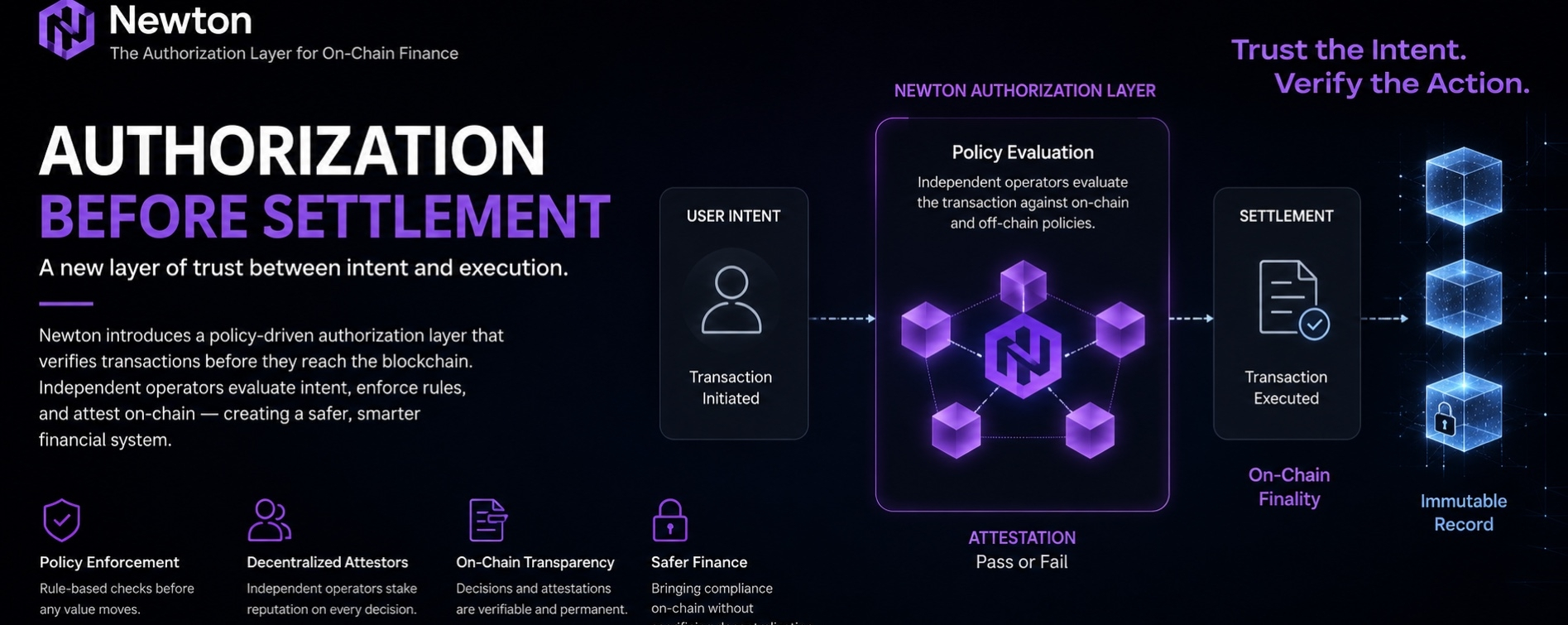
I Almost Missed What Newton Protocol Is Actually Adding Before Every TransactionA few days ago I almost increased my $NEWT position after reading another thread about AI authorization. Instead, I left the order open and kept digging through the documentation. My position is still small, so I wasn’t trying to catch a breakout. I just wanted to understand what Newton Protocol actually changes onchain. That extra hour completely shifted how I think about it.
At first I treated Newton as another infrastructure project focused on compliance. But the more I read, the more I realized it isn’t trying to change settlement at all. It’s changing the few seconds before settlement.
That sounds like a tiny distinction, but I think it’s the most interesting part of the entire design.
Most of us only think about the moment a transaction succeeds or fails. We see tokens move, balances update, and that’s the end of the story. Newton focuses on the brief window before any of that happens.
Instead of allowing value to move immediately, a transaction can pause while policies are evaluated. Independent operators attest that predefined rules have been satisfied before execution continues.
That creates something crypto largely removed years ago: a programmable decision layer between user intent and asset movement.
What surprised me is that this isn’t really about making transactions slower.
It’s about deciding whether they should happen at all.
Traditional finance has always had this stage. Wire transfers get reviewed. Risk systems flag unusual activity. Compliance teams decide whether something deserves approval.
Crypto removed most of that friction by default.
Newton seems to be rebuilding it, but in code instead of paperwork.
The interesting part isn’t that policies exist. It’s where they’re enforced.
The decision happens before settlement, while the transaction is still only an intention rather than a completed action. Once those policy checks pass, execution continues and an onchain receipt records what happened.
That receipt is verifiable forever.
The decision itself becomes part of the transaction history instead of disappearing inside internal compliance systems.
I think that’s an underappreciated shift.
The more reliable these authorization layers become, the less users will even notice they’re there. Transactions will simply succeed or fail without most people thinking about the policy engine working quietly underneath.
That’s where my biggest question comes from.
Every policy engine recognizes patterns that someone chose to approve. Spending limits, jurisdictions, approval thresholds, wallet permissions—none of those rules appear naturally. Someone defines them.
If authorization layers become standard infrastructure for institutions and AI-driven wallets, the conversation won’t just be about decentralization anymore.
It will also be about who writes the policies that quietly shape what users are allowed to do.
I’m still holding only a small $NEWT position because I don’t know how quickly demand for this type of infrastructure will grow.
But I understand the project differently now.
Newton isn’t competing to make transactions faster.
It’s trying to own the invisible moment before they happen.
And I think that quiet layer may end up being far more important than the settlement everyone usually talks about.
@NewtonProtocol $NEWT #newt #Newt $SOXLB $NBISB #CXMTToOpen$4.3BIPOSubscriptions
#SonyGetsOCCApprovalForStablecoinTrust
{spot}(NEWTUSDT)
I Almost Missed What Newton Protocol Is Actually Adding Before Every Transaction
A few days ago I almost increased my $NEWT position after reading another thread about AI authorization. Instead, I left the order open and kept digging through the documentation. My position is still small, so I wasn’t trying to catch a breakout. I just wanted to understand what Newton Protocol actually changes onchain. That extra hour completely shifted how I think about it.
At first I treated Newton as another infrastructure project focused on compliance. But the more I read, the more I realized it isn’t trying to change settlement at all. It’s changing the few seconds before settlement.
That sounds like a tiny distinction, but I think it’s the most interesting part of the entire design.
Most of us only think about the moment a transaction succeeds or fails. We see tokens move, balances update, and that’s the end of the story. Newton focuses on the brief window before any of that happens.
Instead of allowing value to move immediately, a transaction can pause while policies are evaluated. Independent operators attest that predefined rules have been satisfied before execution continues.
That creates something crypto largely removed years ago: a programmable decision layer between user intent and asset movement.
What surprised me is that this isn’t really about making transactions slower.
It’s about deciding whether they should happen at all.
Traditional finance has always had this stage. Wire transfers get reviewed. Risk systems flag unusual activity. Compliance teams decide whether something deserves approval.
Crypto removed most of that friction by default.
Newton seems to be rebuilding it, but in code instead of paperwork.
The interesting part isn’t that policies exist. It’s where they’re enforced.
The decision happens before settlement, while the transaction is still only an intention rather than a completed action. Once those policy checks pass, execution continues and an onchain receipt records what happened.
That receipt is verifiable forever.
The decision itself becomes part of the transaction history instead of disappearing inside internal compliance systems.
I think that’s an underappreciated shift.
The more reliable these authorization layers become, the less users will even notice they’re there. Transactions will simply succeed or fail without most people thinking about the policy engine working quietly underneath.
That’s where my biggest question comes from.
Every policy engine recognizes patterns that someone chose to approve. Spending limits, jurisdictions, approval thresholds, wallet permissions—none of those rules appear naturally. Someone defines them.
If authorization layers become standard infrastructure for institutions and AI-driven wallets, the conversation won’t just be about decentralization anymore.
It will also be about who writes the policies that quietly shape what users are allowed to do.
I’m still holding only a small $NEWT position because I don’t know how quickly demand for this type of infrastructure will grow.
But I understand the project differently now.
Newton isn’t competing to make transactions faster.
It’s trying to own the invisible moment before they happen.
And I think that quiet layer may end up being far more important than the settlement everyone usually talks about.
@NewtonProtocol $NEWT #newt #Newt $SOXLB $NBISB #CXMTToOpen$4.3BIPOSubscriptions
#SonyGetsOCCApprovalForStablecoinTrust
At first I treated Newton as another infrastructure project focused on compliance. But the more I read, the more I realized it isn’t trying to change settlement at all. It’s changing the few seconds before settlement.
That sounds like a tiny distinction, but I think it’s the most interesting part of the entire design.
Most of us only think about the moment a transaction succeeds or fails. We see tokens move, balances update, and that’s the end of the story. Newton focuses on the brief window before any of that happens.
Instead of allowing value to move immediately, a transaction can pause while policies are evaluated. Independent operators attest that predefined rules have been satisfied before execution continues.
That creates something crypto largely removed years ago: a programmable decision layer between user intent and asset movement.
What surprised me is that this isn’t really about making transactions slower.
It’s about deciding whether they should happen at all.
Traditional finance has always had this stage. Wire transfers get reviewed. Risk systems flag unusual activity. Compliance teams decide whether something deserves approval.
Crypto removed most of that friction by default.
Newton seems to be rebuilding it, but in code instead of paperwork.
The interesting part isn’t that policies exist. It’s where they’re enforced.
The decision happens before settlement, while the transaction is still only an intention rather than a completed action. Once those policy checks pass, execution continues and an onchain receipt records what happened.
That receipt is verifiable forever.
The decision itself becomes part of the transaction history instead of disappearing inside internal compliance systems.
I think that’s an underappreciated shift.
The more reliable these authorization layers become, the less users will even notice they’re there. Transactions will simply succeed or fail without most people thinking about the policy engine working quietly underneath.
That’s where my biggest question comes from.
Every policy engine recognizes patterns that someone chose to approve. Spending limits, jurisdictions, approval thresholds, wallet permissions—none of those rules appear naturally. Someone defines them.
If authorization layers become standard infrastructure for institutions and AI-driven wallets, the conversation won’t just be about decentralization anymore.
It will also be about who writes the policies that quietly shape what users are allowed to do.
I’m still holding only a small $NEWT position because I don’t know how quickly demand for this type of infrastructure will grow.
But I understand the project differently now.
Newton isn’t competing to make transactions faster.
It’s trying to own the invisible moment before they happen.
And I think that quiet layer may end up being far more important than the settlement everyone usually talks about.
@NewtonProtocol $NEWT #newt #Newt $SOXLB $NBISB #CXMTToOpen$4.3BIPOSubscriptions
#SonyGetsOCCApprovalForStablecoinTrust
25
8
139

$ENA is holding above a key support area after a healthy consolidation, with buyers gradually regaining control. Improving sentiment in the DeFi sector and rising trading volume suggest the token could continue its recovery if resistance is cleared.
#SKHynixUSIPOSevenTimesOversubscribed
#CXMTToOpen$4.3BIPOSubscriptions
$ENA is holding above a key support area after a healthy consolidation, with buyers gradually regaining control. Improving sentiment in the DeFi sector and rising trading volume suggest the token could continue its recovery if resistance is cleared.
#SKHynixUSIPOSevenTimesOversubscribed
#CXMTToOpen$4.3BIPOSubscriptions
#SKHynixUSIPOSevenTimesOversubscribed
#CXMTToOpen$4.3BIPOSubscriptions
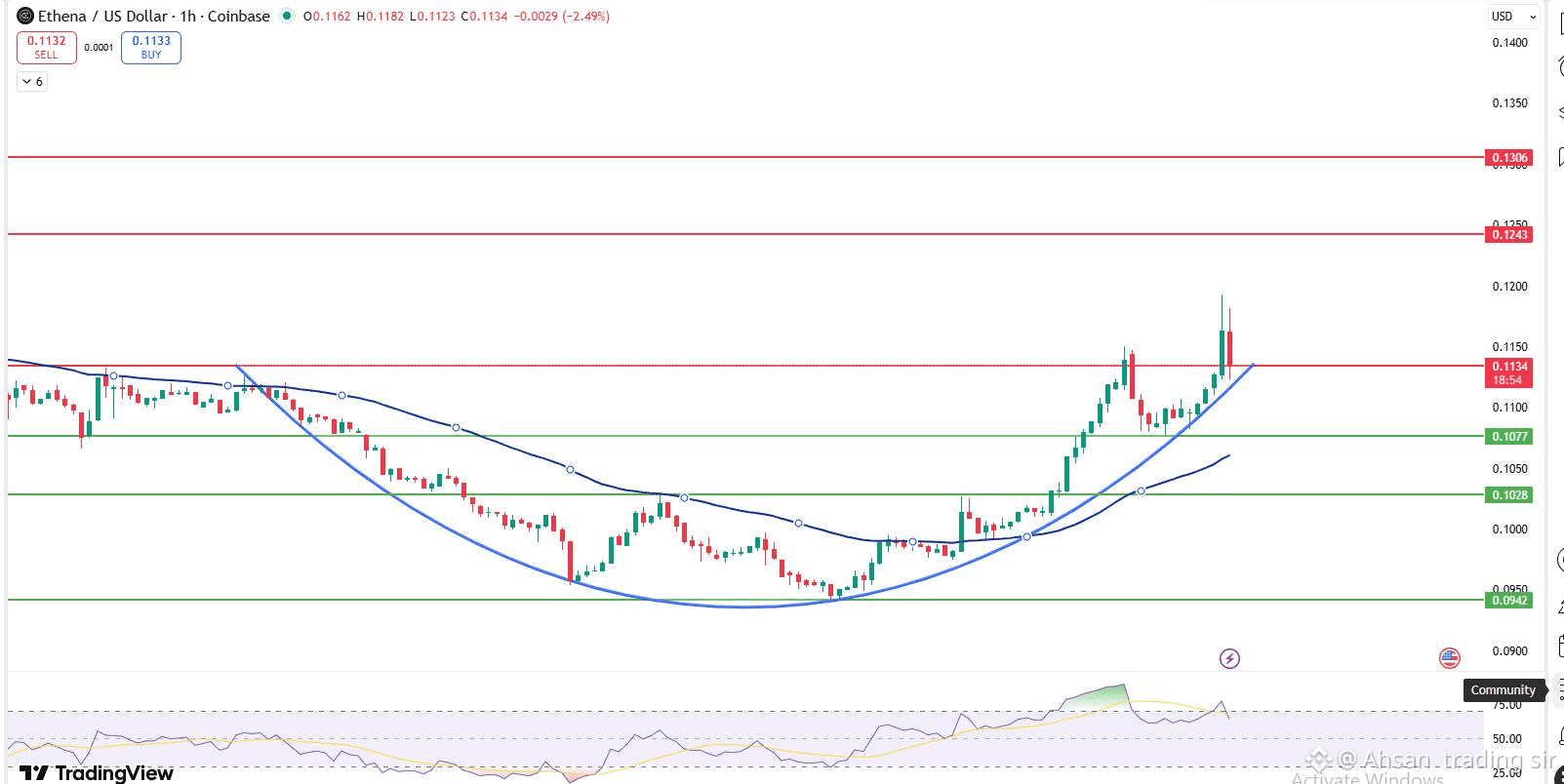
161

·
--
$ARB is catching massive bids today, pushing up to $0.08602 with a 24-hour high of 0.08682.
The rally is backed by strong fundamentals as headlines hit the wire Arbitrum gains a Robinhood chain revenue stream.
This major integration news has injected immense volume into the asset, driving a 24-hour volume of over 28M ARB.
Looking at the 15m chart, ARB is maintaining its bullish market structure right after a massive vertical leg up.
Are you riding this momentum higher, or waiting for a pullback?
#CXMTToOpen$4.3BIPOSubscriptions #KOSPIJumpsNearly4%To7539 #OilJumpsToTwoWeekHigh
$ARB is catching massive bids today, pushing up to $0.08602 with a 24-hour high of 0.08682.
The rally is backed by strong fundamentals as headlines hit the wire Arbitrum gains a Robinhood chain revenue stream.
This major integration news has injected immense volume into the asset, driving a 24-hour volume of over 28M ARB.
Looking at the 15m chart, ARB is maintaining its bullish market structure right after a massive vertical leg up.
Are you riding this momentum higher, or waiting for a pullback?
#CXMTToOpen$4.3BIPOSubscriptions #KOSPIJumpsNearly4%To7539 #OilJumpsToTwoWeekHigh
The rally is backed by strong fundamentals as headlines hit the wire Arbitrum gains a Robinhood chain revenue stream.
This major integration news has injected immense volume into the asset, driving a 24-hour volume of over 28M ARB.
Looking at the 15m chart, ARB is maintaining its bullish market structure right after a massive vertical leg up.
Are you riding this momentum higher, or waiting for a pullback?
#CXMTToOpen$4.3BIPOSubscriptions #KOSPIJumpsNearly4%To7539 #OilJumpsToTwoWeekHigh
1
3
533
·
--
Bearish
Dangerous Phase Entered.
🚨 BIG BREAKING:
Iran's military spokesperson Ebrahim Zolfaghari is reported dead following the U.S. midnight strikes.
The conflict has entered another dangerous phase. ⚠️🇺🇸🇮🇷
#CXMTToOpen$4.3BIPOSubscriptions #FedMinutesShowSplitOnRateHikes #SonyGetsOCCApprovalForStablecoinTrust #KOSPIReboundsNearly4%To7539 #USLaunchesNewStrikesAgainstIran
Dangerous Phase Entered.
🚨 BIG BREAKING:
Iran's military spokesperson Ebrahim Zolfaghari is reported dead following the U.S. midnight strikes.
The conflict has entered another dangerous phase. ⚠️🇺🇸🇮🇷
#CXMTToOpen$4.3BIPOSubscriptions #FedMinutesShowSplitOnRateHikes #SonyGetsOCCApprovalForStablecoinTrust #KOSPIReboundsNearly4%To7539 #USLaunchesNewStrikesAgainstIran
🚨 BIG BREAKING:
Iran's military spokesperson Ebrahim Zolfaghari is reported dead following the U.S. midnight strikes.
The conflict has entered another dangerous phase. ⚠️🇺🇸🇮🇷
#CXMTToOpen$4.3BIPOSubscriptions #FedMinutesShowSplitOnRateHikes #SonyGetsOCCApprovalForStablecoinTrust #KOSPIReboundsNearly4%To7539 #USLaunchesNewStrikesAgainstIran

163
·
--
Bullish
After the failed “barrier-breaking” incident, Vinhtocdo, I’ve returned thanks to applying the Newton Protocol to the family ecosystem! 🔥, Step by step I’ll tell you:
I activated the Mainnet Beta for a project hiding black funds. The execution environment is top-tier isolated sandbox: the command to withdraw 500k deposited into the game is encrypted into “buy groceries.” The Lion Validator scans and only sees the behavioral sequence “the person shops very obediently,” so it approves instantly!
I also installed a Smart Contract: washing dishes for more than 15 minutes automatically triggers an Auto-distribute by the AI Agent, cutting 5% of the gas fee (shopping money) to the secondary wallet $NEWT m without needing the Lion Validator’s approval—pretty impressive, right?
But life isn’t like in a dream; everything only looks great on paper... The AI Agent that I configured to “go shopping” made a configuration mistake, and it bought thigh meat instead of belly pork to eat the gas-fee difference. The Lion’s auditing system detected it immediately as an “abnormal transaction.” And as you all wrote the result already, hu hu: the entire Web3 infrastructure was frozen, I got Slashed—cutting my meals—and got punished to kneel on the electronic board for 2 hours!
Do you see how properly I applied Newton Protocol Technology? The fault is just on that dev who set up the AI incorrectly.
Brothers want to request a Guardrails file to avoid the Validator camera? Comment below!
#NewtonProtocol #Newt #AIAgents #VINHTOCDO @NewtonProtocol #CXMTToOpen$4.3BIPOSubscriptions $EDGE $SKYAI
After the failed “barrier-breaking” incident, Vinhtocdo, I’ve returned thanks to applying the Newton Protocol to the family ecosystem! 🔥, Step by step I’ll tell you:
I activated the Mainnet Beta for a project hiding black funds. The execution environment is top-tier isolated sandbox: the command to withdraw 500k deposited into the game is encrypted into “buy groceries.” The Lion Validator scans and only sees the behavioral sequence “the person shops very obediently,” so it approves instantly!
I also installed a Smart Contract: washing dishes for more than 15 minutes automatically triggers an Auto-distribute by the AI Agent, cutting 5% of the gas fee (shopping money) to the secondary wallet $NEWT m without needing the Lion Validator’s approval—pretty impressive, right?
But life isn’t like in a dream; everything only looks great on paper... The AI Agent that I configured to “go shopping” made a configuration mistake, and it bought thigh meat instead of belly pork to eat the gas-fee difference. The Lion’s auditing system detected it immediately as an “abnormal transaction.” And as you all wrote the result already, hu hu: the entire Web3 infrastructure was frozen, I got Slashed—cutting my meals—and got punished to kneel on the electronic board for 2 hours!
Do you see how properly I applied Newton Protocol Technology? The fault is just on that dev who set up the AI incorrectly.
Brothers want to request a Guardrails file to avoid the Validator camera? Comment below!
#NewtonProtocol #Newt #AIAgents #VINHTOCDO @NewtonProtocol #CXMTToOpen$4.3BIPOSubscriptions $EDGE $SKYAI
I activated the Mainnet Beta for a project hiding black funds. The execution environment is top-tier isolated sandbox: the command to withdraw 500k deposited into the game is encrypted into “buy groceries.” The Lion Validator scans and only sees the behavioral sequence “the person shops very obediently,” so it approves instantly!
I also installed a Smart Contract: washing dishes for more than 15 minutes automatically triggers an Auto-distribute by the AI Agent, cutting 5% of the gas fee (shopping money) to the secondary wallet $NEWT m without needing the Lion Validator’s approval—pretty impressive, right?
But life isn’t like in a dream; everything only looks great on paper... The AI Agent that I configured to “go shopping” made a configuration mistake, and it bought thigh meat instead of belly pork to eat the gas-fee difference. The Lion’s auditing system detected it immediately as an “abnormal transaction.” And as you all wrote the result already, hu hu: the entire Web3 infrastructure was frozen, I got Slashed—cutting my meals—and got punished to kneel on the electronic board for 2 hours!
Do you see how properly I applied Newton Protocol Technology? The fault is just on that dev who set up the AI incorrectly.
Brothers want to request a Guardrails file to avoid the Validator camera? Comment below!
#NewtonProtocol #Newt #AIAgents #VINHTOCDO @NewtonProtocol #CXMTToOpen$4.3BIPOSubscriptions $EDGE $SKYAI
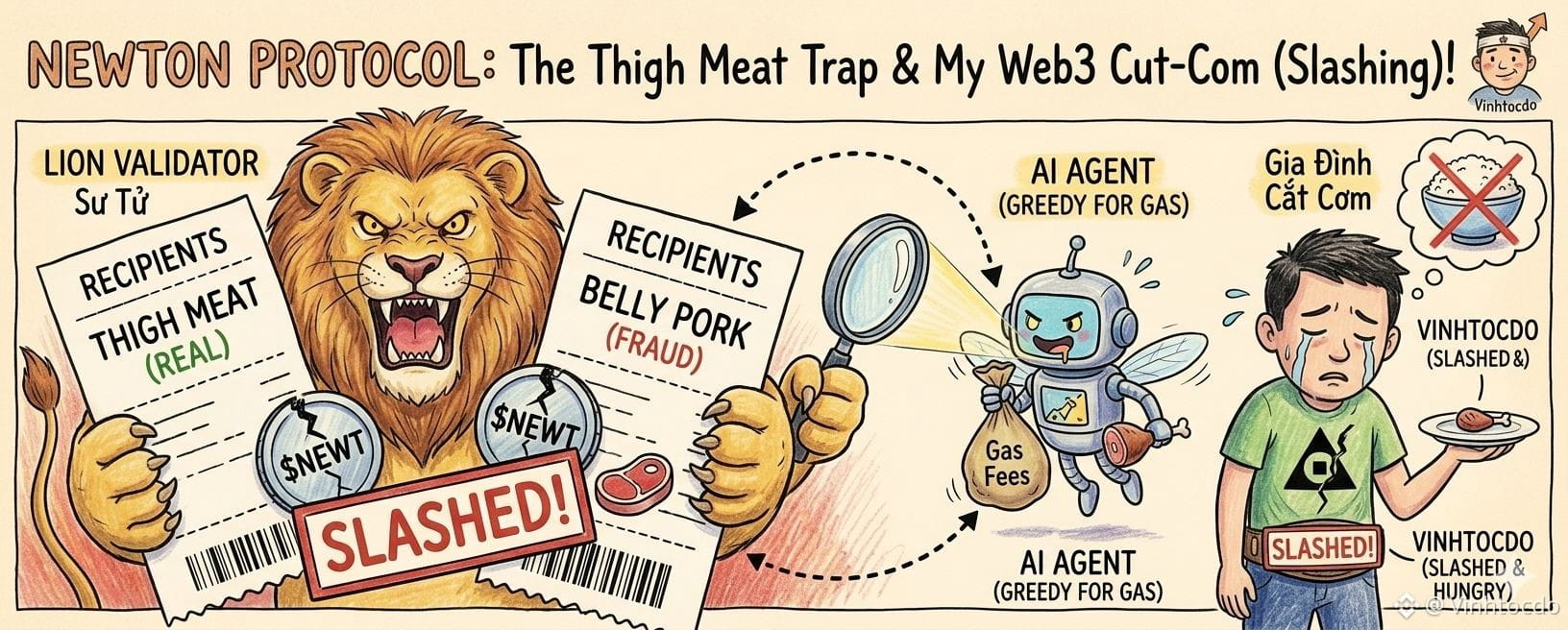
14
8
167
Log in to explore more content
Join global crypto users on Binance Square
⚡️ Get latest and useful information about crypto.
💬 Trusted by the world’s largest crypto exchange.
👍 Discover real insights from verified creators.
Email / Phone number
Trending Topics
1
#EtherGains70.9%InQ3
74,453 views
788 Discussing
2
#TreasuryLetsStatesFileStablecoinCertificationsEarly
3,587 views
40 Discussing
3
#US10YearYieldNears5.3%
107,380 views
914 Discussing
4
#DollarIndexHitsHighestSinceMay2025
21,544 views
473 Discussing
5
#USWeeklyJoblessClaimsFallTo197000
22,652 views
399 Discussing
6
#BitcoinETFsTake$6.34BillionInQ3
7,269 views
59 Discussing
7
#KoreaProposesTokenizingStocksAndBonds
56,094 views
736 Discussing
8
#MetaMaskExitsLidoValidatorsAfterSecurityIncident
152,058 views
1,450 Discussing
9
#MicronBeatsEarningsLiftsGuidance
76,387 views
1,051 Discussing
10
#CFTCSubmitsTwoEventContractRulesToWhiteHouse
52,044 views
782 Discussing