

FAISAL_804
17.2k Posts

FAISAL_804
 Square Verified+
Report
Block User
Crypto enthusiast 📊 | Sharing trading insights & Web3 trends 🚀
Open Trade
Frequent Trader
11.7 Months
152 Following
34.3K+ Followers
18.7K+ Liked
Posts
Portfolio
All
Quotes
Live
·
--
$GPROB is currently displayed at approximately 1.28, with a -1.54% move. The shown PKR value is around Rs354.71. Unlike several coins in this snapshot, $GPROB is showing negative short-term movement. Traders may watch whether selling pressure continues or whether buyers step in around current levels. The displayed figures are a snapshot and should not be treated as a prediction of future price action. 📉
{spot}(GPROBUSDT)
$GPROB is currently displayed at approximately 1.28, with a -1.54% move. The shown PKR value is around Rs354.71. Unlike several coins in this snapshot, $GPROB is showing negative short-term movement. Traders may watch whether selling pressure continues or whether buyers step in around current levels. The displayed figures are a snapshot and should not be treated as a prediction of future price action. 📉
237
·
--
$CYPHB is trading around 4.13, showing a strong +5.09% move in the displayed snapshot. Its approximate PKR value is Rs1,144.51. The positive price action puts attention on this coin as traders monitor whether momentum continues or begins to cool. Short-term moves can change quickly, so checking live price, liquidity and volume is important before taking any position. 🔥
{spot}(CYPHBUSDT)
$CYPHB is trading around 4.13, showing a strong +5.09% move in the displayed snapshot. Its approximate PKR value is Rs1,144.51. The positive price action puts attention on this coin as traders monitor whether momentum continues or begins to cool. Short-term moves can change quickly, so checking live price, liquidity and volume is important before taking any position. 🔥
107
·
--
$AMCB is currently shown at around 2.92, recording a +1.39% move. The displayed PKR value is approximately Rs809.19. The coin is showing moderate positive momentum in this snapshot, although the percentage move alone does not indicate where price goes next. Traders can monitor volume, market sentiment and follow-through while keeping position size and risk management in mind. 📈
{spot}(AMCBUSDT)
$AMCB is currently shown at around 2.92, recording a +1.39% move. The displayed PKR value is approximately Rs809.19. The coin is showing moderate positive momentum in this snapshot, although the percentage move alone does not indicate where price goes next. Traders can monitor volume, market sentiment and follow-through while keeping position size and risk management in mind. 📈
163
·
--
$AGPUB is trading around 12.43, with a notable +7.25% move in the displayed data. Its shown value is approximately Rs3,444.60. The positive percentage makes this one of the stronger gainers in the snapshot. Momentum traders may watch volume and whether the move can sustain, while others may wait for confirmation. This is market information, not a guarantee of future performance. 🚀
{spot}(AGPUBUSDT)
$AGPUB is trading around 12.43, with a notable +7.25% move in the displayed data. Its shown value is approximately Rs3,444.60. The positive percentage makes this one of the stronger gainers in the snapshot. Momentum traders may watch volume and whether the move can sustain, while others may wait for confirmation. This is market information, not a guarantee of future performance. 🚀
145
·
--
$HYPE is currently trading around 92.13, showing a +0.08% move. The displayed PKR value is approximately Rs25,531.07. Price action is relatively stable in this snapshot, with only a small positive change. Traders can watch whether this stability develops into stronger momentum or another consolidation phase. Always manage risk and verify live market data before making any trading decision. 📊
{spot}(HYPEUSDT)
$HYPE is currently trading around 92.13, showing a +0.08% move. The displayed PKR value is approximately Rs25,531.07. Price action is relatively stable in this snapshot, with only a small positive change. Traders can watch whether this stability develops into stronger momentum or another consolidation phase. Always manage risk and verify live market data before making any trading decision. 📊
153
·
--
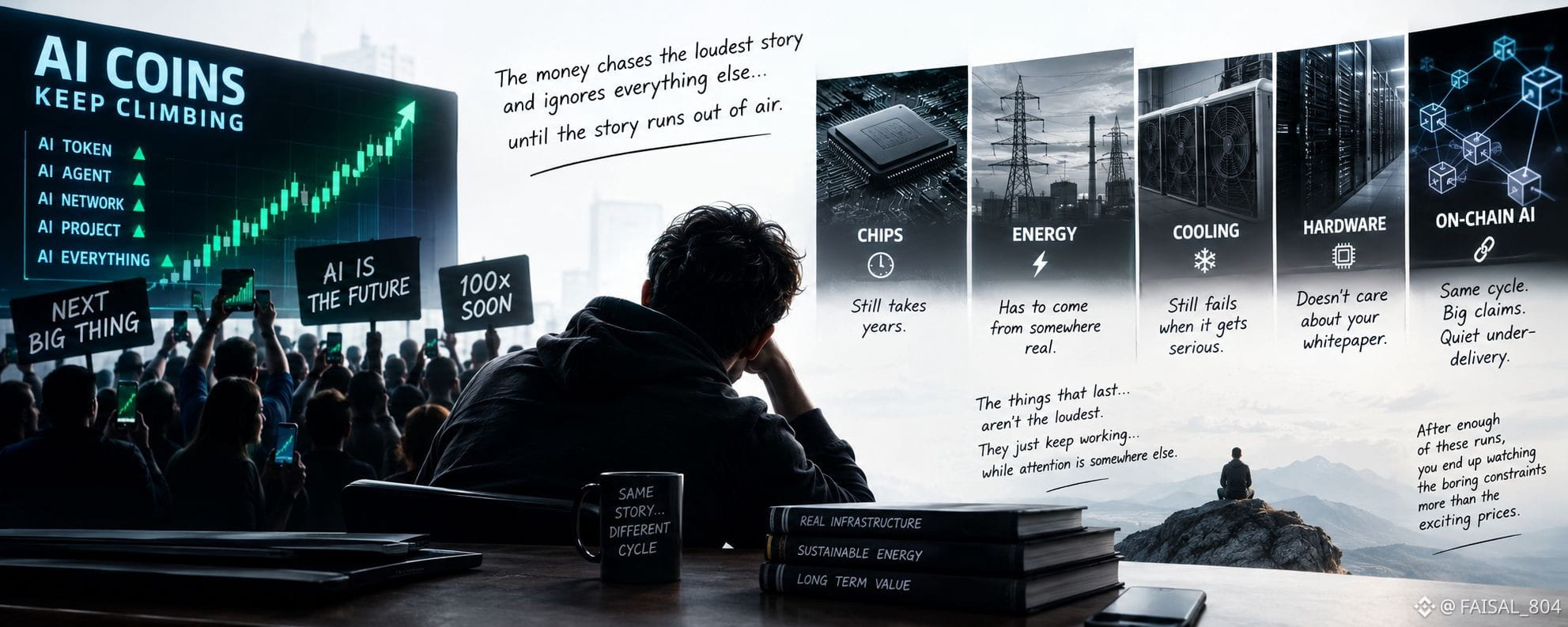
It’s late and I’m sitting here watching the same AI names keep climbing while the rest of the market just gets ignored. I’ve been around crypto long enough that this whole pattern is starting to feel tired. Money locks onto the loudest story and pretends nothing else exists until the story finally runs out of air.
Last time around it was the same. Suddenly every project had an AI angle. Most of them never got close to the real problems. Power still had limits. Cooling still failed when things got serious. The hardware didn’t care what the whitepapers said. I keep noticing how quickly people forget those parts the second the charts start looking good.
I’m not sure this stretch is any different. The big stocks can keep rising for a while longer—they usually do. But the hard parts don’t disappear just because the narrative is strong. Chips still take years. Energy still has to come from somewhere actual. Most of the on-chain versions I’ve watched just repeated the same cycle of big claims and then quiet under-delivery once the incentives dried up.
Something about how quiet everything else has gotten still feels familiar. The things that tend to last through these periods are usually the ones that don’t need a fresh story every few weeks. Just the ones that keep working while attention is somewhere else. I don’t fully trust that either. After enough of these runs you end up watching the boring constraints more than the exciting prices.
#AIStocksWhatNext
$LAB
{future}(LABUSDT)
$AEON
{alpha}(560x277add739c6e0477616948357af9e79fe1ec9b80)
$人生K线
{alpha}(560x1a1e69f1e6182e2f8b9e8987e83c016ac9444444)
It’s late and I’m sitting here watching the same AI names keep climbing while the rest of the market just gets ignored. I’ve been around crypto long enough that this whole pattern is starting to feel tired. Money locks onto the loudest story and pretends nothing else exists until the story finally runs out of air.
Last time around it was the same. Suddenly every project had an AI angle. Most of them never got close to the real problems. Power still had limits. Cooling still failed when things got serious. The hardware didn’t care what the whitepapers said. I keep noticing how quickly people forget those parts the second the charts start looking good.
I’m not sure this stretch is any different. The big stocks can keep rising for a while longer—they usually do. But the hard parts don’t disappear just because the narrative is strong. Chips still take years. Energy still has to come from somewhere actual. Most of the on-chain versions I’ve watched just repeated the same cycle of big claims and then quiet under-delivery once the incentives dried up.
Something about how quiet everything else has gotten still feels familiar. The things that tend to last through these periods are usually the ones that don’t need a fresh story every few weeks. Just the ones that keep working while attention is somewhere else. I don’t fully trust that either. After enough of these runs you end up watching the boring constraints more than the exciting prices.
#AIStocksWhatNext
$LAB
$AEON
$人生K线
Last time around it was the same. Suddenly every project had an AI angle. Most of them never got close to the real problems. Power still had limits. Cooling still failed when things got serious. The hardware didn’t care what the whitepapers said. I keep noticing how quickly people forget those parts the second the charts start looking good.
I’m not sure this stretch is any different. The big stocks can keep rising for a while longer—they usually do. But the hard parts don’t disappear just because the narrative is strong. Chips still take years. Energy still has to come from somewhere actual. Most of the on-chain versions I’ve watched just repeated the same cycle of big claims and then quiet under-delivery once the incentives dried up.
Something about how quiet everything else has gotten still feels familiar. The things that tend to last through these periods are usually the ones that don’t need a fresh story every few weeks. Just the ones that keep working while attention is somewhere else. I don’t fully trust that either. After enough of these runs you end up watching the boring constraints more than the exciting prices.
#AIStocksWhatNext
$LAB
$AEON
$人生K线
1
1.6k
·
--
$INTW is joining the strong market move! 📈🔥
INTWUSDT is showing approximately +11.22%, with the displayed price around $32.03. The double-digit gain makes INTW one of the stronger movers visible in the screenshot. Attention now turns to momentum continuation, trading activity, and whether buyers can maintain control after this sharp move higher. 🚀⚡
{future}(INTWUSDT)
$INTW is joining the strong market move! 📈🔥
INTWUSDT is showing approximately +11.22%, with the displayed price around $32.03. The double-digit gain makes INTW one of the stronger movers visible in the screenshot. Attention now turns to momentum continuation, trading activity, and whether buyers can maintain control after this sharp move higher. 🚀⚡
INTWUSDT is showing approximately +11.22%, with the displayed price around $32.03. The double-digit gain makes INTW one of the stronger movers visible in the screenshot. Attention now turns to momentum continuation, trading activity, and whether buyers can maintain control after this sharp move higher. 🚀⚡
317
·
--
$BSV is showing powerful upside momentum! 🚀🔥
BSVUSDT is currently up around +11.54%, trading near $19.33 in the screenshot. The strong daily-style move places BSV among the notable gainers on this list. Traders will be watching the reaction around current levels and looking for signs of continued buying interest as the market decides whether this momentum has further room to develop. 📈👀
{future}(BSVUSDT)
$BSV is showing powerful upside momentum! 🚀🔥
BSVUSDT is currently up around +11.54%, trading near $19.33 in the screenshot. The strong daily-style move places BSV among the notable gainers on this list. Traders will be watching the reaction around current levels and looking for signs of continued buying interest as the market decides whether this momentum has further room to develop. 📈👀
BSVUSDT is currently up around +11.54%, trading near $19.33 in the screenshot. The strong daily-style move places BSV among the notable gainers on this list. Traders will be watching the reaction around current levels and looking for signs of continued buying interest as the market decides whether this momentum has further room to develop. 📈👀
218
·
--
$SONIC is making a strong move! ⚡🚀
SONICUSDT is up around +11.65%, with price near $0.02751 according to the screenshot. The token is showing notable strength alongside several other double-digit gainers. This kind of momentum can quickly increase market attention, making the next price action important for determining whether buyers continue pushing higher or begin securing profits. 🔥👀
{future}(SONICUSDT)
$SONIC is making a strong move! ⚡🚀
SONICUSDT is up around +11.65%, with price near $0.02751 according to the screenshot. The token is showing notable strength alongside several other double-digit gainers. This kind of momentum can quickly increase market attention, making the next price action important for determining whether buyers continue pushing higher or begin securing profits. 🔥👀
SONICUSDT is up around +11.65%, with price near $0.02751 according to the screenshot. The token is showing notable strength alongside several other double-digit gainers. This kind of momentum can quickly increase market attention, making the next price action important for determining whether buyers continue pushing higher or begin securing profits. 🔥👀
238
·
--
$POPCAT is back on the momentum radar! 🐱🔥
POPCATUSDT is showing approximately +11.66%, with the displayed price near $0.05765. The double-digit gain highlights a strong move in the current market snapshot. Traders may now focus on whether POPCAT can maintain this buying pressure and extend the rally, or whether the rapid rise brings short-term profit-taking into the market. 🚀📊
{future}(POPCATUSDT)
$POPCAT is back on the momentum radar! 🐱🔥
POPCATUSDT is showing approximately +11.66%, with the displayed price near $0.05765. The double-digit gain highlights a strong move in the current market snapshot. Traders may now focus on whether POPCAT can maintain this buying pressure and extend the rally, or whether the rapid rise brings short-term profit-taking into the market. 🚀📊
POPCATUSDT is showing approximately +11.66%, with the displayed price near $0.05765. The double-digit gain highlights a strong move in the current market snapshot. Traders may now focus on whether POPCAT can maintain this buying pressure and extend the rally, or whether the rapid rise brings short-term profit-taking into the market. 🚀📊
98
·
--
$ARX is pushing higher with strong momentum! 🚀
ARXUSDT is currently showing around +11.82%, trading near $0.2147 in the screenshot. The move places ARX among the leading gainers displayed on the list. Momentum is clearly attracting attention, but traders will be watching closely for follow-through and whether buying pressure remains strong enough to keep the current move developing. 👀📈
{future}(ARXUSDT)
$ARX is pushing higher with strong momentum! 🚀
ARXUSDT is currently showing around +11.82%, trading near $0.2147 in the screenshot. The move places ARX among the leading gainers displayed on the list. Momentum is clearly attracting attention, but traders will be watching closely for follow-through and whether buying pressure remains strong enough to keep the current move developing. 👀📈
ARXUSDT is currently showing around +11.82%, trading near $0.2147 in the screenshot. The move places ARX among the leading gainers displayed on the list. Momentum is clearly attracting attention, but traders will be watching closely for follow-through and whether buying pressure remains strong enough to keep the current move developing. 👀📈
505
·
--
$ARM is moving with serious momentum! ⚡🚀
ARMUSDT is showing approximately +12.00%, with the displayed price around 320.53. A double-digit move like this immediately puts the token on the radar of momentum-focused traders. The next stage could be important as buyers look to defend the move while sellers may consider taking profits after such a strong percentage increase. 📊🔥
{future}(ARMUSDT)
$ARM is moving with serious momentum! ⚡🚀
ARMUSDT is showing approximately +12.00%, with the displayed price around 320.53. A double-digit move like this immediately puts the token on the radar of momentum-focused traders. The next stage could be important as buyers look to defend the move while sellers may consider taking profits after such a strong percentage increase. 📊🔥
ARMUSDT is showing approximately +12.00%, with the displayed price around 320.53. A double-digit move like this immediately puts the token on the radar of momentum-focused traders. The next stage could be important as buyers look to defend the move while sellers may consider taking profits after such a strong percentage increase. 📊🔥
69
·
--
$ARKM is showing impressive strength today! 📈🔥
ARKMUSDT is up approximately +12.01%, with price around $0.1306 in the screenshot. Breaking into double-digit gains puts ARKM firmly among the session's stronger performers shown here. Attention now shifts toward continuation: can buyers keep the pressure on, or will traders start locking in gains after the rapid move? 👀🚀
{spot}(ARKMUSDT)
$ARKM is showing impressive strength today! 📈🔥
ARKMUSDT is up approximately +12.01%, with price around $0.1306 in the screenshot. Breaking into double-digit gains puts ARKM firmly among the session's stronger performers shown here. Attention now shifts toward continuation: can buyers keep the pressure on, or will traders start locking in gains after the rapid move? 👀🚀
ARKMUSDT is up approximately +12.01%, with price around $0.1306 in the screenshot. Breaking into double-digit gains puts ARKM firmly among the session's stronger performers shown here. Attention now shifts toward continuation: can buyers keep the pressure on, or will traders start locking in gains after the rapid move? 👀🚀
217
·
--
$1000FLOKI is joining the rally! 🐕🔥
1000FLOKIUSDT is showing around +12.14%, with the displayed price near $0.02955. The strong percentage gain puts this token among the notable movers in the screenshot. Momentum traders may be watching closely for continued buying pressure, while the market will ultimately determine whether this strength develops into another leg higher or begins to fade. 🚀👀
{future}(1000FLOKIUSDT)
$1000FLOKI is joining the rally! 🐕🔥
1000FLOKIUSDT is showing around +12.14%, with the displayed price near $0.02955. The strong percentage gain puts this token among the notable movers in the screenshot. Momentum traders may be watching closely for continued buying pressure, while the market will ultimately determine whether this strength develops into another leg higher or begins to fade. 🚀👀
1000FLOKIUSDT is showing around +12.14%, with the displayed price near $0.02955. The strong percentage gain puts this token among the notable movers in the screenshot. Momentum traders may be watching closely for continued buying pressure, while the market will ultimately determine whether this strength develops into another leg higher or begins to fade. 🚀👀
126
·
--
$PENGU is moving fast! 🐧🔥
PENGUUSDT is showing approximately +12.20%, with the price around $0.009102. A move of this size can quickly bring increased attention and trading activity. Bulls are clearly showing strength in this snapshot, while the next phase will depend on whether buyers continue supporting the move or short-term profit-taking appears. 👀📊
{spot}(PENGUUSDT)
$PENGU is moving fast! 🐧🔥
PENGUUSDT is showing approximately +12.20%, with the price around $0.009102. A move of this size can quickly bring increased attention and trading activity. Bulls are clearly showing strength in this snapshot, while the next phase will depend on whether buyers continue supporting the move or short-term profit-taking appears. 👀📊
PENGUUSDT is showing approximately +12.20%, with the price around $0.009102. A move of this size can quickly bring increased attention and trading activity. Bulls are clearly showing strength in this snapshot, while the next phase will depend on whether buyers continue supporting the move or short-term profit-taking appears. 👀📊
173
·
--
$IOTX is catching serious momentum! ⚡
IOTXUSDT is up around +12.29%, trading near $0.003765 in the screenshot. The strong percentage move highlights aggressive buying activity and renewed attention around the token. The key question now is whether this momentum can continue and turn into a sustained move, or whether traders begin taking profits after the rally. 🚀📈
{spot}(IOTXUSDT)
$IOTX is catching serious momentum! ⚡
IOTXUSDT is up around +12.29%, trading near $0.003765 in the screenshot. The strong percentage move highlights aggressive buying activity and renewed attention around the token. The key question now is whether this momentum can continue and turn into a sustained move, or whether traders begin taking profits after the rally. 🚀📈
IOTXUSDT is up around +12.29%, trading near $0.003765 in the screenshot. The strong percentage move highlights aggressive buying activity and renewed attention around the token. The key question now is whether this momentum can continue and turn into a sustained move, or whether traders begin taking profits after the rally. 🚀📈
200
·
--
$DOGE is making a strong move today! 🚀
DOGEUSDT is currently showing around +12.34%, with price near $0.10006. This kind of momentum puts Dogecoin back in the spotlight and could attract fresh market attention. Traders will be watching whether buyers can maintain this strength or if the move starts cooling after the sharp push higher. 👀🔥
{spot}(DOGEUSDT)
$DOGE is making a strong move today! 🚀
DOGEUSDT is currently showing around +12.34%, with price near $0.10006. This kind of momentum puts Dogecoin back in the spotlight and could attract fresh market attention. Traders will be watching whether buyers can maintain this strength or if the move starts cooling after the sharp push higher. 👀🔥
DOGEUSDT is currently showing around +12.34%, with price near $0.10006. This kind of momentum puts Dogecoin back in the spotlight and could attract fresh market attention. Traders will be watching whether buyers can maintain this strength or if the move starts cooling after the sharp push higher. 👀🔥
163
·
--
🔥 $PIE.ETF is catching serious momentum!
PIEVERSEUSDT is trading around $1.6267 (Rs451.06) with a strong +38.36% gain. The move shows that buyers have been active and the token is attracting considerable market attention. After such a strong push, traders may focus on whether PIE can establish support at higher levels and continue its upward momentum in the next move. 🚀💰
{etf_us}(PIE.ETF)
🔥 $PIE.ETF is catching serious momentum!
PIEVERSEUSDT is trading around $1.6267 (Rs451.06) with a strong +38.36% gain. The move shows that buyers have been active and the token is attracting considerable market attention. After such a strong push, traders may focus on whether PIE can establish support at higher levels and continue its upward momentum in the next move. 🚀💰
PIEVERSEUSDT is trading around $1.6267 (Rs451.06) with a strong +38.36% gain. The move shows that buyers have been active and the token is attracting considerable market attention. After such a strong push, traders may focus on whether PIE can establish support at higher levels and continue its upward momentum in the next move. 🚀💰
PIEVERSE+1.61%
PIEETF+1.46%
1
196
·
--
🚀 $BR is making a strong breakout move!
BR is trading near $0.92197 (Rs255.65) and is up an impressive +43.61%. The strong percentage gain places BRU among the notable performers in the current market snapshot. Traders may now be watching for sustained buying pressure, consolidation and possible continuation as the token attempts to hold onto its recent momentum. 👀📈
{future}(BRUSDT)
🚀 $BR is making a strong breakout move!
BR is trading near $0.92197 (Rs255.65) and is up an impressive +43.61%. The strong percentage gain places BRU among the notable performers in the current market snapshot. Traders may now be watching for sustained buying pressure, consolidation and possible continuation as the token attempts to hold onto its recent momentum. 👀📈
BR is trading near $0.92197 (Rs255.65) and is up an impressive +43.61%. The strong percentage gain places BRU among the notable performers in the current market snapshot. Traders may now be watching for sustained buying pressure, consolidation and possible continuation as the token attempts to hold onto its recent momentum. 👀📈
205
·
--
⚡ $MYX is moving aggressively!
MYXUSDT is currently around $0.08979 (Rs24.89), recording a solid +45.24% gain. This kind of daily movement highlights strong market activity and growing attention around the token. The next phase could be important as traders watch whether buyers continue defending the momentum or whether the market starts taking profits after the rapid rise. 📈🔥
{future}(MYXUSDT)
⚡ $MYX is moving aggressively!
MYXUSDT is currently around $0.08979 (Rs24.89), recording a solid +45.24% gain. This kind of daily movement highlights strong market activity and growing attention around the token. The next phase could be important as traders watch whether buyers continue defending the momentum or whether the market starts taking profits after the rapid rise. 📈🔥
MYXUSDT is currently around $0.08979 (Rs24.89), recording a solid +45.24% gain. This kind of daily movement highlights strong market activity and growing attention around the token. The next phase could be important as traders watch whether buyers continue defending the momentum or whether the market starts taking profits after the rapid rise. 📈🔥
1
327
Log in to explore more content
Join global crypto users on Binance Square
⚡️ Get latest and useful information about crypto.
💬 Trusted by the world’s largest crypto exchange.
👍 Discover real insights from verified creators.
Email / Phone number
Trending Topics
BitwiseFilesFinalNEARSpotETFProspectus
22,987 views
709 Discussing
#bitwisefilesfinalnearspotetfprospectus 🚀
Can the NEAR token reach $562?$NEAR
Bitwise is preparing a spot NEAR ETF, listed under the ticker NRR on NYSE Arca. The manager was already discussing targets of $155, or even $562 by 2030.$RESOLV $DASH
Rajo C
·5 Likes
·3.4k views
BitgetHackerMoves$83MStolenXRP
17,735 views
112 Discussing
SOLSpotETFWeeklyInflow$188M
8,966 views
85 Discussing