

#bedrockprotocol
bedrockprotocol
5,215 views
175 Discussing
Hot
Latest

#bedrock $BR
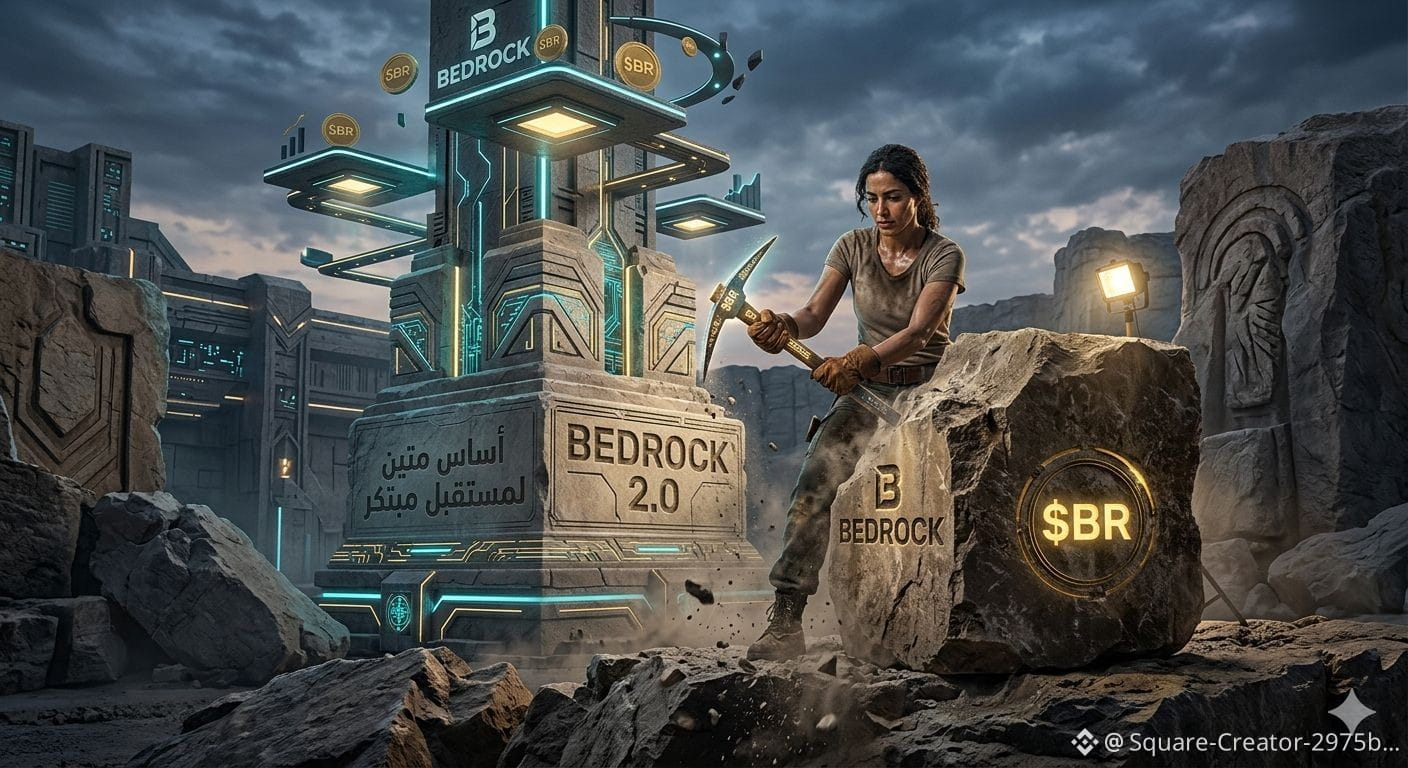
True success in the crypto game is built on solid innovation and sustainable solutions, not on empty promises. The platform @Bedrock is proving today with the launch of its revolutionary update Bedrock 2.0 that it’s the safest spot for liquid restaking. This development gives the token $BR real value and unprecedented flexibility for savvy investors looking for efficiency and transparency away from flimsy projects. #Bedrock标签 #BedRockProtocol #BedrockCoin
#bedrock $BR
True success in the crypto game is built on solid innovation and sustainable solutions, not on empty promises. The platform @Bedrock is proving today with the launch of its revolutionary update Bedrock 2.0 that it’s the safest spot for liquid restaking. This development gives the token $BR real value and unprecedented flexibility for savvy investors looking for efficiency and transparency away from flimsy projects. #Bedrock标签 #BedRockProtocol #BedrockCoin
True success in the crypto game is built on solid innovation and sustainable solutions, not on empty promises. The platform @Bedrock is proving today with the launch of its revolutionary update Bedrock 2.0 that it’s the safest spot for liquid restaking. This development gives the token $BR real value and unprecedented flexibility for savvy investors looking for efficiency and transparency away from flimsy projects. #Bedrock标签 #BedRockProtocol #BedrockCoin
1
74

·
--
I was reading the @Bedrock 2.0 whitepaper, and it got me thinking about how lazy most protocol upgrades actually are.They throw a fresh coat of paint on a buggy dashboard, tweak a few inflationary rewards, and call it "revolutionary" to spark a temporary pump.
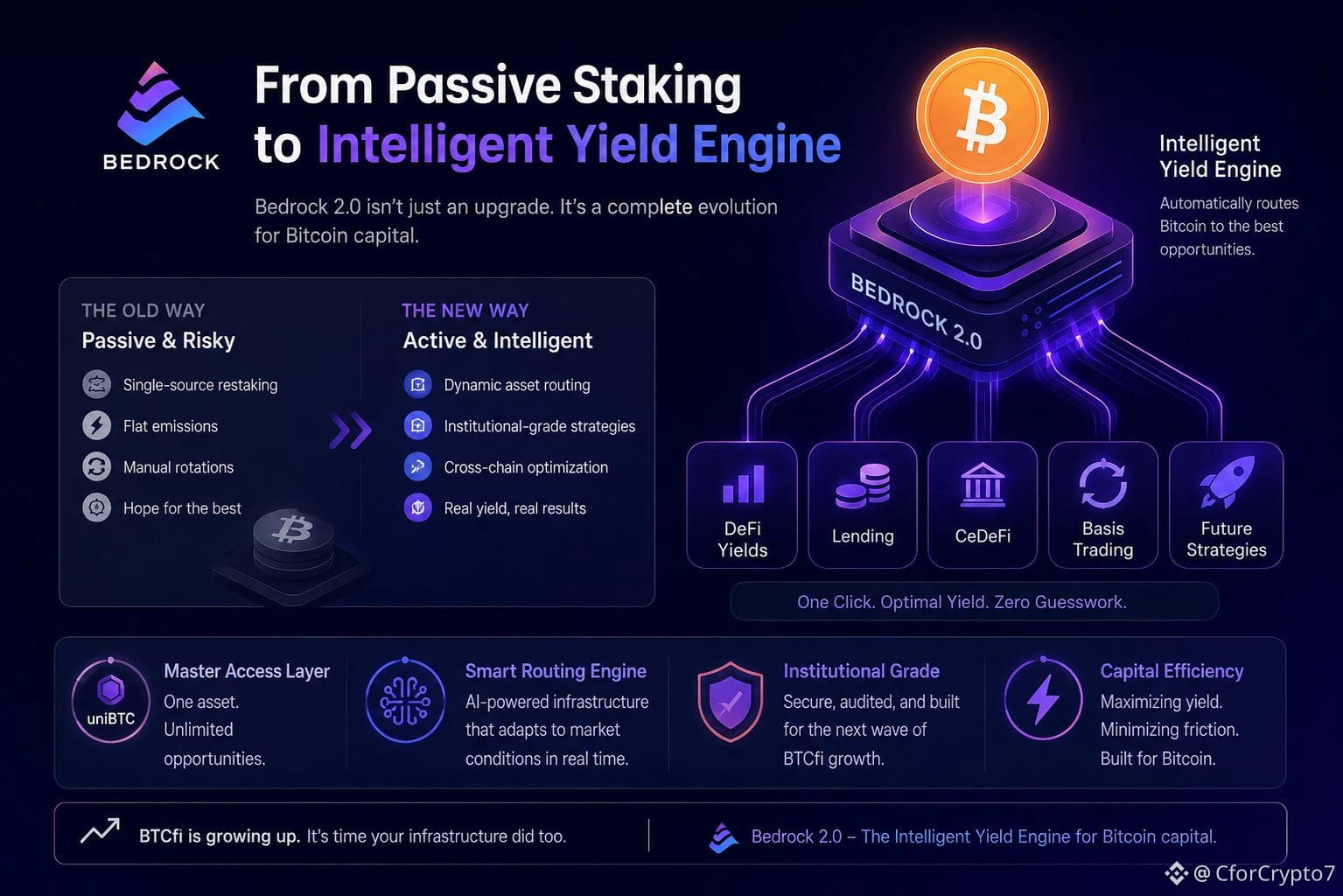
Bedrock's shift feels fundamentally different though. They aren't just updating a website they're entirely pivoting from a single source restaking protocol into an Intelligent Yield Engine for Bitcoin capital.
I remember when we locked up assets in passive pools and just prayed the underlying yields wouldn't collapse.
Bedrock spent a year in the trenches listening to the market and recognized that passive staking on flat emissions is a dead end.
So instead of keeping us as passive stakers, Bedrock 2.0 acts as a dynamic asset router. Using uniBTC as the master access layer, it automatically routes Bitcoin across institutional-grade strategies that actually produce yield.
They have also redesigned the homepage and user journey to match this evolution. Multi-chain manual rotations are abstracted away entirely, so capital efficiency becomes something you can actually navigate without a headache.
BTCfi is growing up, and the infrastructure needs to keep pace. If you are tired of watching your Bitcoin sit idle, it is worth understanding how this routing engine actually works.
#Bedrock #BedRockProtocol #defi #cforcrypto $BR $BTC
I was reading the @Bedrock 2.0 whitepaper, and it got me thinking about how lazy most protocol upgrades actually are.They throw a fresh coat of paint on a buggy dashboard, tweak a few inflationary rewards, and call it "revolutionary" to spark a temporary pump.
Bedrock's shift feels fundamentally different though. They aren't just updating a website they're entirely pivoting from a single source restaking protocol into an Intelligent Yield Engine for Bitcoin capital.
I remember when we locked up assets in passive pools and just prayed the underlying yields wouldn't collapse.
Bedrock spent a year in the trenches listening to the market and recognized that passive staking on flat emissions is a dead end.
So instead of keeping us as passive stakers, Bedrock 2.0 acts as a dynamic asset router. Using uniBTC as the master access layer, it automatically routes Bitcoin across institutional-grade strategies that actually produce yield.
They have also redesigned the homepage and user journey to match this evolution. Multi-chain manual rotations are abstracted away entirely, so capital efficiency becomes something you can actually navigate without a headache.
BTCfi is growing up, and the infrastructure needs to keep pace. If you are tired of watching your Bitcoin sit idle, it is worth understanding how this routing engine actually works.
#Bedrock #BedRockProtocol #defi #cforcrypto $BR $BTC
Bedrock's shift feels fundamentally different though. They aren't just updating a website they're entirely pivoting from a single source restaking protocol into an Intelligent Yield Engine for Bitcoin capital.
I remember when we locked up assets in passive pools and just prayed the underlying yields wouldn't collapse.
Bedrock spent a year in the trenches listening to the market and recognized that passive staking on flat emissions is a dead end.
So instead of keeping us as passive stakers, Bedrock 2.0 acts as a dynamic asset router. Using uniBTC as the master access layer, it automatically routes Bitcoin across institutional-grade strategies that actually produce yield.
They have also redesigned the homepage and user journey to match this evolution. Multi-chain manual rotations are abstracted away entirely, so capital efficiency becomes something you can actually navigate without a headache.
BTCfi is growing up, and the infrastructure needs to keep pace. If you are tired of watching your Bitcoin sit idle, it is worth understanding how this routing engine actually works.
#Bedrock #BedRockProtocol #defi #cforcrypto $BR $BTC
223

·
--
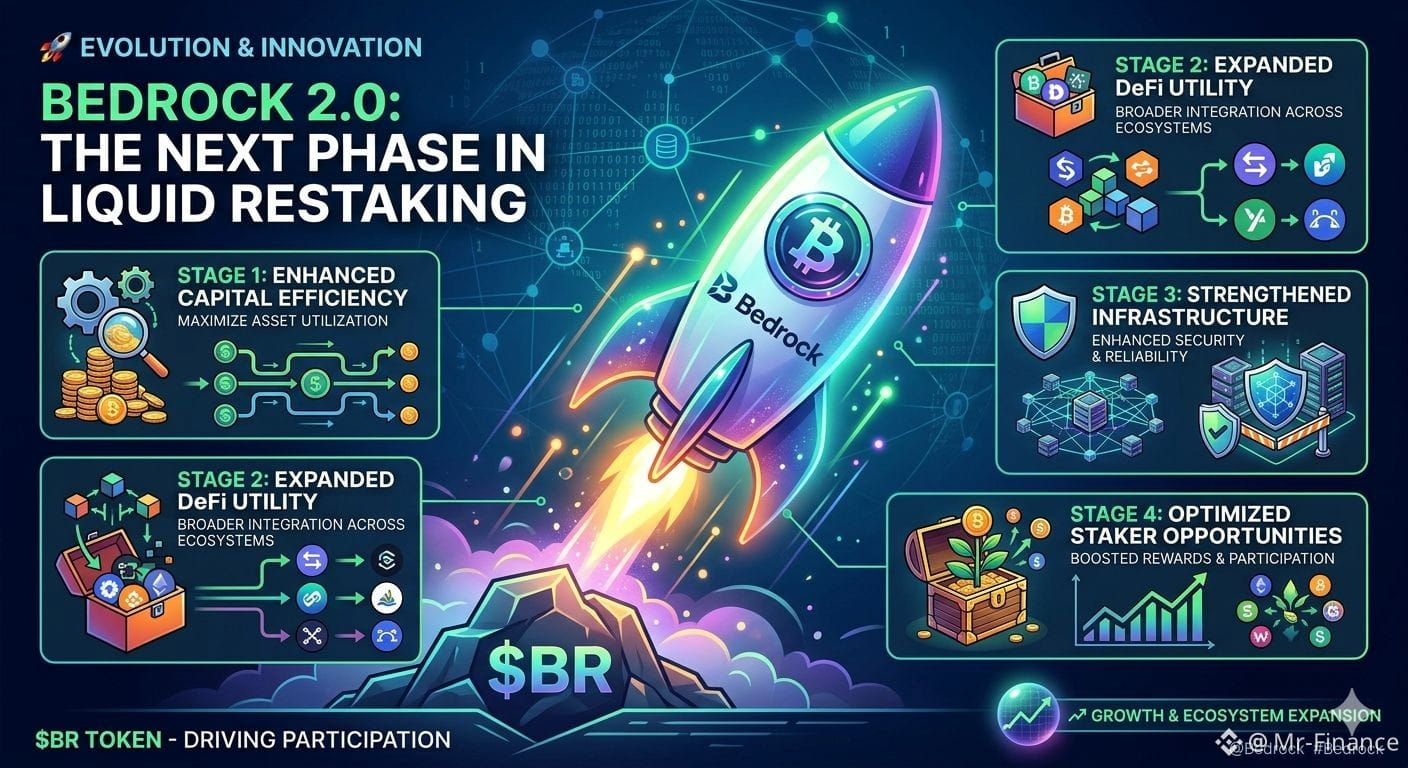
#bedrock $BR 🚀 The evolution of liquid restaking is getting more interesting with Bedrock 2.0. I’ve been following how @Bedrock is working to improve capital efficiency while giving users more flexibility across the decentralized finance ecosystem. The focus on expanding utility, strengthening infrastructure, and creating more opportunities for stakers could make Bedrock 2.0 an important development to watch in the coming months. As the ecosystem grows, I’m excited to see how $BR helps drive participation and innovation across the network. 🌍📈
$BR #BedRockProtocol @Bedrock
#bedrock $BR 🚀 The evolution of liquid restaking is getting more interesting with Bedrock 2.0. I’ve been following how @Bedrock is working to improve capital efficiency while giving users more flexibility across the decentralized finance ecosystem. The focus on expanding utility, strengthening infrastructure, and creating more opportunities for stakers could make Bedrock 2.0 an important development to watch in the coming months. As the ecosystem grows, I’m excited to see how $BR helps drive participation and innovation across the network. 🌍📈
$BR #BedRockProtocol @Bedrock
$BR #BedRockProtocol @Bedrock
88

·
--
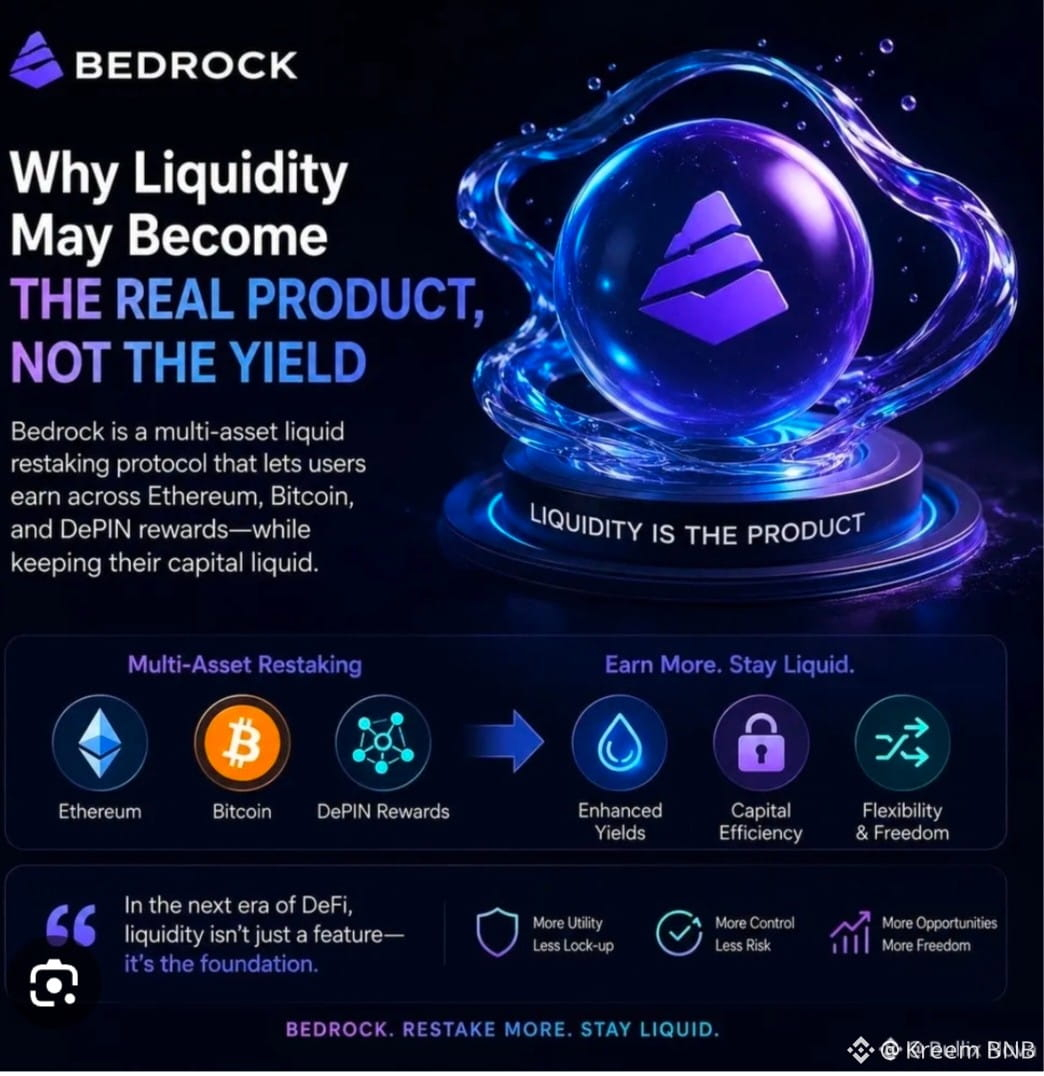
After Bedrock 2.0, staking has actually become fun. With @Bedrock Bedrock I staked both ETH and BTC together and my liquidity didn’t get locked. On top of that I’m earning $BR tokens and DePIN rewards separately. One platform, three benefits. #BedRockProtocol $BR
After Bedrock 2.0, staking has actually become fun. With @Bedrock Bedrock I staked both ETH and BTC together and my liquidity didn’t get locked. On top of that I’m earning $BR tokens and DePIN rewards separately. One platform, three benefits. #BedRockProtocol $BR
109

#bedrock $BR The evolution of liquid staking is getting interesting with @Bedrock and the vision behind Bedrock 2.0. Instead of focusing on a single asset, Bedrock is building a unified framework that helps users unlock more utility, liquidity, and yield opportunities across the ecosystem.
What stands out about Bedrock 2.0 is its focus on capital efficiency and expanding the possibilities of liquid restaking. As DeFi continues to mature, protocols that help users maximize asset productivity without sacrificing flexibility will likely play an important role.
I'm watching closely to see how the ecosystem develops and how $BR captures value as adoption grows. The next phase of decentralized finance may be driven by protocols that make liquidity work smarter, not harder.
$BR #BedRockProtocol
#bedrock $BR The evolution of liquid staking is getting interesting with @Bedrock and the vision behind Bedrock 2.0. Instead of focusing on a single asset, Bedrock is building a unified framework that helps users unlock more utility, liquidity, and yield opportunities across the ecosystem.
What stands out about Bedrock 2.0 is its focus on capital efficiency and expanding the possibilities of liquid restaking. As DeFi continues to mature, protocols that help users maximize asset productivity without sacrificing flexibility will likely play an important role.
I'm watching closely to see how the ecosystem develops and how $BR captures value as adoption grows. The next phase of decentralized finance may be driven by protocols that make liquidity work smarter, not harder.
$BR #BedRockProtocol
What stands out about Bedrock 2.0 is its focus on capital efficiency and expanding the possibilities of liquid restaking. As DeFi continues to mature, protocols that help users maximize asset productivity without sacrificing flexibility will likely play an important role.
I'm watching closely to see how the ecosystem develops and how $BR captures value as adoption grows. The next phase of decentralized finance may be driven by protocols that make liquidity work smarter, not harder.
$BR #BedRockProtocol
81

#bedrock $BR
Looking forward to seeing how @Bedrock evolves with the rollout of Bedrock 2.0. The updates to their staking infrastructure and security frameworks look solid. Keeping a close eye on the $BR token utilities as the ecosystem expands. #BedRockProtocol
#bedrock $BR
Looking forward to seeing how @Bedrock evolves with the rollout of Bedrock 2.0. The updates to their staking infrastructure and security frameworks look solid. Keeping a close eye on the $BR token utilities as the ecosystem expands. #BedRockProtocol
Looking forward to seeing how @Bedrock evolves with the rollout of Bedrock 2.0. The updates to their staking infrastructure and security frameworks look solid. Keeping a close eye on the $BR token utilities as the ecosystem expands. #BedRockProtocol
137

·
--
#bedrock $BR
What convinces me the most about @Bedrock is that governance carries real weight. You convert $BR into veBR and decide where the protocol incentives go. It's not a decorative token. #BedRockProtocol
#bedrock $BR
What convinces me the most about @Bedrock is that governance carries real weight. You convert $BR into veBR and decide where the protocol incentives go. It's not a decorative token. #BedRockProtocol
What convinces me the most about @Bedrock is that governance carries real weight. You convert $BR into veBR and decide where the protocol incentives go. It's not a decorative token. #BedRockProtocol
1
154

·
--
Liquidity is the future @Bedrock makes it accessible
Earn more Stay liquid. Powered by Bedroc
In DeFi, liquidity is the real advantage
Restake smarter stay flexible with Bedrock
Unlock rewards without locking your freedom
Bedrock: Where yield meets liquidity
More rewards More flexibility One Bedrock
Liquidity first. Opportunities always
#BedrockDAO #BedRockProtocol #BedrockDeFi #BedrockGem
Liquidity is the future @Bedrock makes it accessible
Earn more Stay liquid. Powered by Bedroc
In DeFi, liquidity is the real advantage
Restake smarter stay flexible with Bedrock
Unlock rewards without locking your freedom
Bedrock: Where yield meets liquidity
More rewards More flexibility One Bedrock
Liquidity first. Opportunities always
#BedrockDAO #BedRockProtocol #BedrockDeFi #BedrockGem
Earn more Stay liquid. Powered by Bedroc
In DeFi, liquidity is the real advantage
Restake smarter stay flexible with Bedrock
Unlock rewards without locking your freedom
Bedrock: Where yield meets liquidity
More rewards More flexibility One Bedrock
Liquidity first. Opportunities always
#BedrockDAO #BedRockProtocol #BedrockDeFi #BedrockGem
111

#bedrock $BR
Bedrock has been making headlines recently as it continues to expand its Bitcoin-focused DeFi ecosystem. The project recently introduced its BTCFi assets, uniBTC and brBTC, to new blockchain networks, giving users more ways to access liquidity and staking opportunities. Bedrock has also gained attention through new partnerships and community campaigns, helping boost awareness of its platform. As interest in Bitcoin-based DeFi solutions continues to grow, Bedrock is positioning itself as one of the projects to watch in the space.
@Bedrock #BedRockProtocol
#bedrock $BR
Bedrock has been making headlines recently as it continues to expand its Bitcoin-focused DeFi ecosystem. The project recently introduced its BTCFi assets, uniBTC and brBTC, to new blockchain networks, giving users more ways to access liquidity and staking opportunities. Bedrock has also gained attention through new partnerships and community campaigns, helping boost awareness of its platform. As interest in Bitcoin-based DeFi solutions continues to grow, Bedrock is positioning itself as one of the projects to watch in the space.
@Bedrock #BedRockProtocol
Bedrock has been making headlines recently as it continues to expand its Bitcoin-focused DeFi ecosystem. The project recently introduced its BTCFi assets, uniBTC and brBTC, to new blockchain networks, giving users more ways to access liquidity and staking opportunities. Bedrock has also gained attention through new partnerships and community campaigns, helping boost awareness of its platform. As interest in Bitcoin-based DeFi solutions continues to grow, Bedrock is positioning itself as one of the projects to watch in the space.
@Bedrock #BedRockProtocol
82

·
--
$BR
{future}(BRUSDT)
@Bedrock
👑 Who really understands the playbook?
Most people think Binance won because they built the biggest exchange.
I believe that's only half the story.
The real genius wasn't in the product.
It was in the playbook.
📖 Access creates demand.
BNB wasn't valuable just because it existed.
It became valuable because it opened up opportunities.
🔑 Launchpad access
🔑 Launchpool rewards
🔑 Binance Alpha opportunities
🔑 Early participation in TGE
🔑 Exclusive airdrop
The more opportunities Binance created, the more reasons people had to hold BNB.
Now look at Bedrock.
I don't think @Bedrock is copying Binance's product.
I think they are studying the principle behind BNB's success.
Access.
And that aligns perfectly with Bedrock's new vision:
⚡ Bedrock 2.0: A smart yield engine for Bitcoin capital.
An ecosystem designed to help users discover, access, analyze, and allocate Bitcoin capital more intelligently.
This is where $BR gets interesting.
Because it's evolving to become more than just a rewards token.
It's becoming the access layer for the Bitcoin yield engine.
🟣 Higher tiers unlock enhanced yields.
🟣 Higher tiers unlock priority access to premium vaults.
🟣 Higher tiers unlock exclusive BRClaw AI capabilities.
🟣 Higher tiers unlock exclusive access to institutional-grade Bitcoin strategies.
Imagine a vault with high demand and limited capacity.
Not everyone can get in.
#BedRockProtocol
$BR
@Bedrock
👑 Who really understands the playbook?
Most people think Binance won because they built the biggest exchange.
I believe that's only half the story.
The real genius wasn't in the product.
It was in the playbook.
📖 Access creates demand.
BNB wasn't valuable just because it existed.
It became valuable because it opened up opportunities.
🔑 Launchpad access
🔑 Launchpool rewards
🔑 Binance Alpha opportunities
🔑 Early participation in TGE
🔑 Exclusive airdrop
The more opportunities Binance created, the more reasons people had to hold BNB.
Now look at Bedrock.
I don't think @Bedrock is copying Binance's product.
I think they are studying the principle behind BNB's success.
Access.
And that aligns perfectly with Bedrock's new vision:
⚡ Bedrock 2.0: A smart yield engine for Bitcoin capital.
An ecosystem designed to help users discover, access, analyze, and allocate Bitcoin capital more intelligently.
This is where $BR gets interesting.
Because it's evolving to become more than just a rewards token.
It's becoming the access layer for the Bitcoin yield engine.
🟣 Higher tiers unlock enhanced yields.
🟣 Higher tiers unlock priority access to premium vaults.
🟣 Higher tiers unlock exclusive BRClaw AI capabilities.
🟣 Higher tiers unlock exclusive access to institutional-grade Bitcoin strategies.
Imagine a vault with high demand and limited capacity.
Not everyone can get in.
#BedRockProtocol
@Bedrock
👑 Who really understands the playbook?
Most people think Binance won because they built the biggest exchange.
I believe that's only half the story.
The real genius wasn't in the product.
It was in the playbook.
📖 Access creates demand.
BNB wasn't valuable just because it existed.
It became valuable because it opened up opportunities.
🔑 Launchpad access
🔑 Launchpool rewards
🔑 Binance Alpha opportunities
🔑 Early participation in TGE
🔑 Exclusive airdrop
The more opportunities Binance created, the more reasons people had to hold BNB.
Now look at Bedrock.
I don't think @Bedrock is copying Binance's product.
I think they are studying the principle behind BNB's success.
Access.
And that aligns perfectly with Bedrock's new vision:
⚡ Bedrock 2.0: A smart yield engine for Bitcoin capital.
An ecosystem designed to help users discover, access, analyze, and allocate Bitcoin capital more intelligently.
This is where $BR gets interesting.
Because it's evolving to become more than just a rewards token.
It's becoming the access layer for the Bitcoin yield engine.
🟣 Higher tiers unlock enhanced yields.
🟣 Higher tiers unlock priority access to premium vaults.
🟣 Higher tiers unlock exclusive BRClaw AI capabilities.
🟣 Higher tiers unlock exclusive access to institutional-grade Bitcoin strategies.
Imagine a vault with high demand and limited capacity.
Not everyone can get in.
#BedRockProtocol
104

#bedrock $BR @Bedrock #BedRockProtocol
I used to think liquidity was something you only needed when you wanted to sell an asset.
That's how most of us have been taught to think. If you need cash or flexibility, you sell part of your position. If you want to keep exposure, you hold. It always felt like you had to choose one or the other.
While looking into @Bedrock , I started thinking about this differently.
What if liquidity shouldn't depend on selling at all? What if holding an asset and getting utility from it could happen at the same time?
For a long time in crypto, there was a clear tradeoff. You could hold your assets for the long term, or you could put them to work. Doing both wasn't always easy.
That's why projects focused on BTCFi have become so interesting. They are trying to make Bitcoin more useful without forcing holders to give up their positions.
For me, that's the most interesting thing about Bedrock. It's not just about uniBTC itself. It's about the bigger idea behind it.
When capital becomes easier to use while still maintaining ownership, people can react to opportunities without constantly reshuffling their portfolios. That makes the whole ecosystem more efficient.
Bitcoin represents an enormous amount of value, yet much of it has historically remained idle. BTCFi is trying to change that, and Bedrock is one of the projects exploring what that future could look like.
We're still in the early stages, but I think the impact of making Bitcoin more productive could be bigger than many people expect.
$BR #BedRockProtocol $ALLO $SKYAI
#bedrock $BR @Bedrock #BedRockProtocol
I used to think liquidity was something you only needed when you wanted to sell an asset.
That's how most of us have been taught to think. If you need cash or flexibility, you sell part of your position. If you want to keep exposure, you hold. It always felt like you had to choose one or the other.
While looking into @Bedrock , I started thinking about this differently.
What if liquidity shouldn't depend on selling at all? What if holding an asset and getting utility from it could happen at the same time?
For a long time in crypto, there was a clear tradeoff. You could hold your assets for the long term, or you could put them to work. Doing both wasn't always easy.
That's why projects focused on BTCFi have become so interesting. They are trying to make Bitcoin more useful without forcing holders to give up their positions.
For me, that's the most interesting thing about Bedrock. It's not just about uniBTC itself. It's about the bigger idea behind it.
When capital becomes easier to use while still maintaining ownership, people can react to opportunities without constantly reshuffling their portfolios. That makes the whole ecosystem more efficient.
Bitcoin represents an enormous amount of value, yet much of it has historically remained idle. BTCFi is trying to change that, and Bedrock is one of the projects exploring what that future could look like.
We're still in the early stages, but I think the impact of making Bitcoin more productive could be bigger than many people expect.
$BR #BedRockProtocol $ALLO $SKYAI
I used to think liquidity was something you only needed when you wanted to sell an asset.
That's how most of us have been taught to think. If you need cash or flexibility, you sell part of your position. If you want to keep exposure, you hold. It always felt like you had to choose one or the other.
While looking into @Bedrock , I started thinking about this differently.
What if liquidity shouldn't depend on selling at all? What if holding an asset and getting utility from it could happen at the same time?
For a long time in crypto, there was a clear tradeoff. You could hold your assets for the long term, or you could put them to work. Doing both wasn't always easy.
That's why projects focused on BTCFi have become so interesting. They are trying to make Bitcoin more useful without forcing holders to give up their positions.
For me, that's the most interesting thing about Bedrock. It's not just about uniBTC itself. It's about the bigger idea behind it.
When capital becomes easier to use while still maintaining ownership, people can react to opportunities without constantly reshuffling their portfolios. That makes the whole ecosystem more efficient.
Bitcoin represents an enormous amount of value, yet much of it has historically remained idle. BTCFi is trying to change that, and Bedrock is one of the projects exploring what that future could look like.
We're still in the early stages, but I think the impact of making Bitcoin more productive could be bigger than many people expect.
$BR #BedRockProtocol $ALLO $SKYAI
325
#bedrock $BR
This project is a total flop, and the campaign is pointless—just like we’ve come to expect. These coins are only here to bail out such digital disasters, with the team only interested in pocketing cash from the unsuspecting without a care for the project’s success. Take project @Bedrock , for example; it's just another one of those traditional ideas thrown together by its creators without any innovation or change in structure. What’s the point of a volatile token that brings nothing but grief to the holder, making them hesitant to buy in or even save their money in it? Stability and calmness are what attract capital, not robbing people’s funds one way or another.
#BedRockProtocol
#SIRENCOIN
#BTC☀️
#bedrock $BR
This project is a total flop, and the campaign is pointless—just like we’ve come to expect. These coins are only here to bail out such digital disasters, with the team only interested in pocketing cash from the unsuspecting without a care for the project’s success. Take project @Bedrock , for example; it's just another one of those traditional ideas thrown together by its creators without any innovation or change in structure. What’s the point of a volatile token that brings nothing but grief to the holder, making them hesitant to buy in or even save their money in it? Stability and calmness are what attract capital, not robbing people’s funds one way or another.
#BedRockProtocol
#SIRENCOIN
#BTC☀️
This project is a total flop, and the campaign is pointless—just like we’ve come to expect. These coins are only here to bail out such digital disasters, with the team only interested in pocketing cash from the unsuspecting without a care for the project’s success. Take project @Bedrock , for example; it's just another one of those traditional ideas thrown together by its creators without any innovation or change in structure. What’s the point of a volatile token that brings nothing but grief to the holder, making them hesitant to buy in or even save their money in it? Stability and calmness are what attract capital, not robbing people’s funds one way or another.
#BedRockProtocol
#SIRENCOIN
#BTC☀️
1
90

Title: 2.0 Bedrock Fixing a Problem No One Talked About
All Liquid Staking protocols promise you yields, but
@Bedrock with 2.0 Bedrock focuses on something more important:
Real capital efficiency.
With 2.0 Bedrock, LST tokens have become more efficient.
This means the same asset you're staking can work for you in
two places at the same time: generating yield from staking,
and at the same time, its liquidity is open for use in DeFi without loss.
Token $BR isn't just for the government. It's what allows the system to evolve based on user needs, not just developer whims. Every update that comes out, holders of $BR have a voice
in it.
$BR
{future}(BRUSDT)
#bedrocks #Bedrockk #BedRockProtocol
Title: 2.0 Bedrock Fixing a Problem No One Talked About
All Liquid Staking protocols promise you yields, but
@Bedrock with 2.0 Bedrock focuses on something more important:
Real capital efficiency.
With 2.0 Bedrock, LST tokens have become more efficient.
This means the same asset you're staking can work for you in
two places at the same time: generating yield from staking,
and at the same time, its liquidity is open for use in DeFi without loss.
Token $BR isn't just for the government. It's what allows the system to evolve based on user needs, not just developer whims. Every update that comes out, holders of $BR have a voice
in it.
$BR
#bedrocks #Bedrockk #BedRockProtocol
All Liquid Staking protocols promise you yields, but
@Bedrock with 2.0 Bedrock focuses on something more important:
Real capital efficiency.
With 2.0 Bedrock, LST tokens have become more efficient.
This means the same asset you're staking can work for you in
two places at the same time: generating yield from staking,
and at the same time, its liquidity is open for use in DeFi without loss.
Token $BR isn't just for the government. It's what allows the system to evolve based on user needs, not just developer whims. Every update that comes out, holders of $BR have a voice
in it.
$BR
#bedrocks #Bedrockk #BedRockProtocol
1
98

·
--
Security is the most critical pillar for any protocol today, and with the launch of Bedrock 2.0, the team at @Bedrock shows they take this aspect very seriously. This new version introduces audit enhancements and risk mitigation that protect community assets more effectively. Strengthening their governance and the liquidity around $BR opens up a very interesting window of opportunities for crypto enthusiasts looking for projects with real and audited tech foundations. #BedRockProtocol #bedrock
Security is the most critical pillar for any protocol today, and with the launch of Bedrock 2.0, the team at @Bedrock shows they take this aspect very seriously. This new version introduces audit enhancements and risk mitigation that protect community assets more effectively. Strengthening their governance and the liquidity around $BR opens up a very interesting window of opportunities for crypto enthusiasts looking for projects with real and audited tech foundations. #BedRockProtocol #bedrock
1
1
162

·
--
Bullish
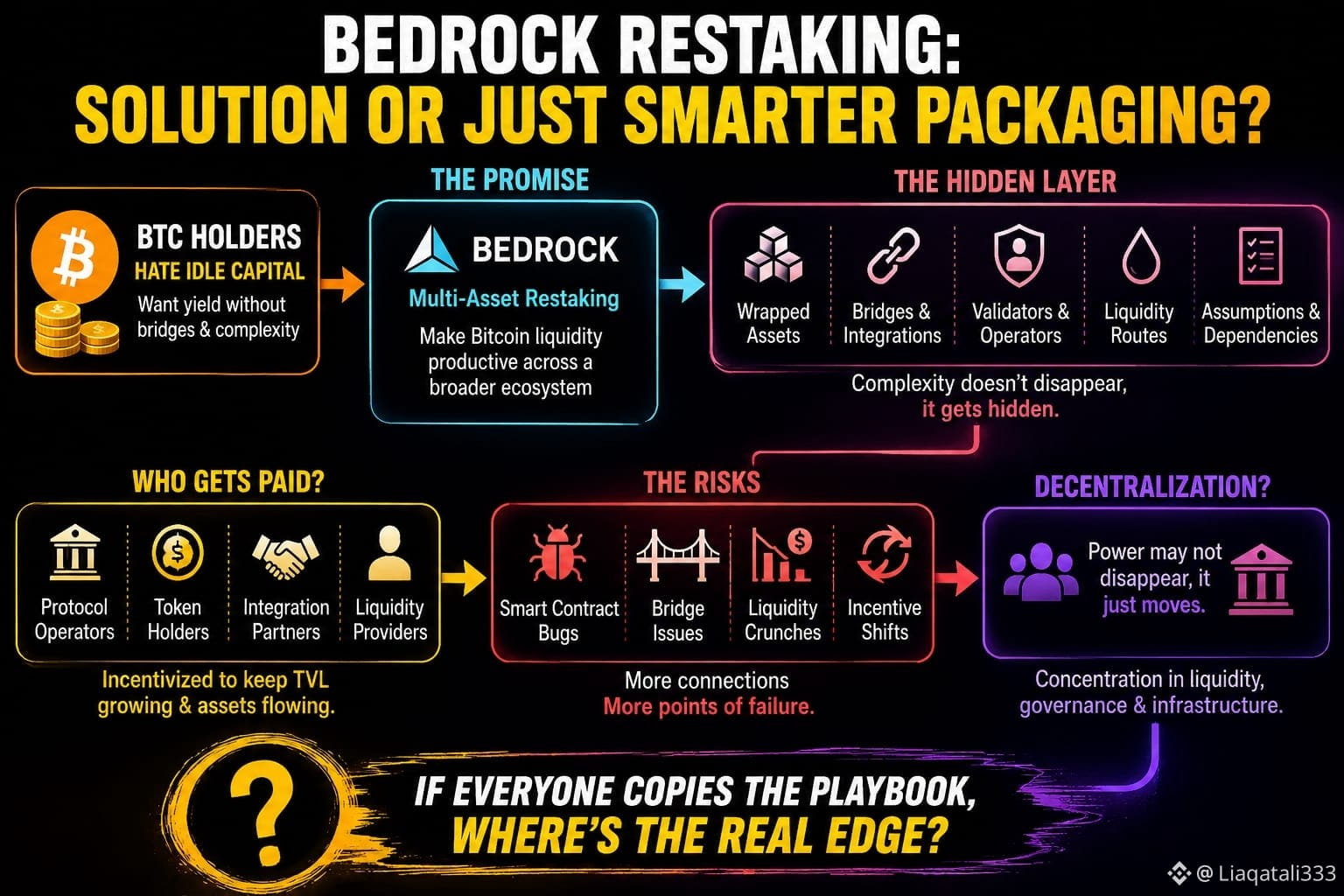
The pitch behind Bedrock’s multi-asset restaking model is easy to understand. BTC holders hate idle capital.
They want yield without constantly shuffling assets across chains, bridges, and protocols.
@Bedrock
On paper, Bedrock claims to solve that fragmentation problem by making Bitcoin liquidity more productive while keeping capital moving through a broader restaking ecosystem.
But that’s where my skepticism kicks in.
Every cycle introduces a new layer that promises to simplify crypto. Then you look under the hood and discover an even larger stack of dependencies, wrapped assets, integrations, validators, liquidity routes, and assumptions. The user experience may feel smoother, but complexity doesn’t disappear. It just gets hidden.
The real question is whether Bedrock is reducing friction or simply packaging it more effectively.
And who gets paid if this works? Protocol operators. Token holders. Integration partners. Liquidity providers. Everyone collecting fees along the value chain has a clear incentive to keep assets flowing and TVL growing.
Let’s be honest, decentralization claims deserve scrutiny. If liquidity, governance influence, validator relationships, or critical infrastructure remain concentrated among a relatively small group of actors, then power hasn’t disappeared. It has just moved.$BR
Then there’s failure. Smart contract bugs. Bridge issues. Liquidity crunches. Incentive shifts. Real users do strange things under stress, especially when markets turn ugly.
The marketing highlights capital efficiency. What it rarely emphasizes is dependency risk. Every additional connection can become another point of failure.
And if every BTCFi protocol eventually copies the same playbook, where exactly does the edge come from once everyone is selling the same promise? #BedRockProtocol #bedrock
$ALLO
{spot}(ALLOUSDT)
The pitch behind Bedrock’s multi-asset restaking model is easy to understand. BTC holders hate idle capital.
They want yield without constantly shuffling assets across chains, bridges, and protocols.
@Bedrock
On paper, Bedrock claims to solve that fragmentation problem by making Bitcoin liquidity more productive while keeping capital moving through a broader restaking ecosystem.
But that’s where my skepticism kicks in.
Every cycle introduces a new layer that promises to simplify crypto. Then you look under the hood and discover an even larger stack of dependencies, wrapped assets, integrations, validators, liquidity routes, and assumptions. The user experience may feel smoother, but complexity doesn’t disappear. It just gets hidden.
The real question is whether Bedrock is reducing friction or simply packaging it more effectively.
And who gets paid if this works? Protocol operators. Token holders. Integration partners. Liquidity providers. Everyone collecting fees along the value chain has a clear incentive to keep assets flowing and TVL growing.
Let’s be honest, decentralization claims deserve scrutiny. If liquidity, governance influence, validator relationships, or critical infrastructure remain concentrated among a relatively small group of actors, then power hasn’t disappeared. It has just moved.$BR
Then there’s failure. Smart contract bugs. Bridge issues. Liquidity crunches. Incentive shifts. Real users do strange things under stress, especially when markets turn ugly.
The marketing highlights capital efficiency. What it rarely emphasizes is dependency risk. Every additional connection can become another point of failure.
And if every BTCFi protocol eventually copies the same playbook, where exactly does the edge come from once everyone is selling the same promise? #BedRockProtocol #bedrock
$ALLO
They want yield without constantly shuffling assets across chains, bridges, and protocols.
@Bedrock
On paper, Bedrock claims to solve that fragmentation problem by making Bitcoin liquidity more productive while keeping capital moving through a broader restaking ecosystem.
But that’s where my skepticism kicks in.
Every cycle introduces a new layer that promises to simplify crypto. Then you look under the hood and discover an even larger stack of dependencies, wrapped assets, integrations, validators, liquidity routes, and assumptions. The user experience may feel smoother, but complexity doesn’t disappear. It just gets hidden.
The real question is whether Bedrock is reducing friction or simply packaging it more effectively.
And who gets paid if this works? Protocol operators. Token holders. Integration partners. Liquidity providers. Everyone collecting fees along the value chain has a clear incentive to keep assets flowing and TVL growing.
Let’s be honest, decentralization claims deserve scrutiny. If liquidity, governance influence, validator relationships, or critical infrastructure remain concentrated among a relatively small group of actors, then power hasn’t disappeared. It has just moved.$BR
Then there’s failure. Smart contract bugs. Bridge issues. Liquidity crunches. Incentive shifts. Real users do strange things under stress, especially when markets turn ugly.
The marketing highlights capital efficiency. What it rarely emphasizes is dependency risk. Every additional connection can become another point of failure.
And if every BTCFi protocol eventually copies the same playbook, where exactly does the edge come from once everyone is selling the same promise? #BedRockProtocol #bedrock
$ALLO
4
6
237
Title: Why is everyone talking about 2.0 Bedrock?
Imagine taking your $ETH and putting it into staking, while at the same time using it in DeFi to earn additional profits!
This is exactly what @Bedrock offers with $BR , uniBTC, uniETH: the game changer 2.0 Bedrock
keeps your assets in Liquid Staking tokens...uniloTX.
$BR
{future}(BRUSDT)
#BedRockProtocol #bedrockoficial
Title: Why is everyone talking about 2.0 Bedrock?
Imagine taking your $ETH and putting it into staking, while at the same time using it in DeFi to earn additional profits!
This is exactly what @Bedrock offers with $BR , uniBTC, uniETH: the game changer 2.0 Bedrock
keeps your assets in Liquid Staking tokens...uniloTX.
$BR
#BedRockProtocol #bedrockoficial
Imagine taking your $ETH and putting it into staking, while at the same time using it in DeFi to earn additional profits!
This is exactly what @Bedrock offers with $BR , uniBTC, uniETH: the game changer 2.0 Bedrock
keeps your assets in Liquid Staking tokens...uniloTX.
$BR
#BedRockProtocol #bedrockoficial
108

·
--
Exploring the future of liquid staking with @Bedrock and the evolution brought by Bedrock 2.0 🚀
The vision of combining multi-asset restaking, better capital efficiency, and stronger DeFi utility makes $BR one of the most interesting ecosystems to watch this cycle.
Bedrock 2.0 is pushing innovation forward by creating more opportunities for users to maximize yield while keeping assets productive across chains. Excited to see how the ecosystem grows from here! 🔥
$BR #BedRockProtocol
#bedrock $BR
Exploring the future of liquid staking with @Bedrock and the evolution brought by Bedrock 2.0 🚀
The vision of combining multi-asset restaking, better capital efficiency, and stronger DeFi utility makes $BR one of the most interesting ecosystems to watch this cycle.
Bedrock 2.0 is pushing innovation forward by creating more opportunities for users to maximize yield while keeping assets productive across chains. Excited to see how the ecosystem grows from here! 🔥
$BR #BedRockProtocol
#bedrock $BR
The vision of combining multi-asset restaking, better capital efficiency, and stronger DeFi utility makes $BR one of the most interesting ecosystems to watch this cycle.
Bedrock 2.0 is pushing innovation forward by creating more opportunities for users to maximize yield while keeping assets productive across chains. Excited to see how the ecosystem grows from here! 🔥
$BR #BedRockProtocol
#bedrock $BR
80

Verified
What struck me first about Bedrock Token’s June 20 cliff is how easy it is to reduce it into a simple sell-pressure story.
@Bedrock #Bedrock $BR
I do not think that is enough.
A team-linked unlock is not just supply entering the room.
It is a trust check, and Bedrock Token is about to face that in public.
The surface view is simple: June 20, 2026 is the date people watch.
Underneath, the market is really asking whether the Founding Team remains aligned when tokens become more flexible.
That matters because Bedrock Token has a 1B max supply, so every unlock sits inside a much larger long-term distribution map.
The reported circulating supply near 261.25M BR also matters, because it means the market is still judging how future supply will meet real demand, not just current attention.
The quiet part is, unlocking does not mean selling.
That counterargument is fair.
But the market does not wait for perfect proof. It reads movement, silence, staking behavior, transfer patterns, and whether confidence gets thinner before the date.
If Bedrock Token handles this without aggressive distribution, the unlock could become less of a threat and more of a maturity signal.
If the behavior looks careless, even a small amount can feel heavier than it is.
This is where crypto infrastructure is heading, I think.
Markets are not only pricing tokens now.
They are pricing coordination under stress.
Bedrock Token’s June 20 cliff will show whether trust survives when structure gets tested.
$H $ESPORTS #bedrocks #BedRockProtocol #BedrockGem
June 20 Cliff? ⏳
What struck me first about Bedrock Token’s June 20 cliff is how easy it is to reduce it into a simple sell-pressure story.
@Bedrock #Bedrock $BR
I do not think that is enough.
A team-linked unlock is not just supply entering the room.
It is a trust check, and Bedrock Token is about to face that in public.
The surface view is simple: June 20, 2026 is the date people watch.
Underneath, the market is really asking whether the Founding Team remains aligned when tokens become more flexible.
That matters because Bedrock Token has a 1B max supply, so every unlock sits inside a much larger long-term distribution map.
The reported circulating supply near 261.25M BR also matters, because it means the market is still judging how future supply will meet real demand, not just current attention.
The quiet part is, unlocking does not mean selling.
That counterargument is fair.
But the market does not wait for perfect proof. It reads movement, silence, staking behavior, transfer patterns, and whether confidence gets thinner before the date.
If Bedrock Token handles this without aggressive distribution, the unlock could become less of a threat and more of a maturity signal.
If the behavior looks careless, even a small amount can feel heavier than it is.
This is where crypto infrastructure is heading, I think.
Markets are not only pricing tokens now.
They are pricing coordination under stress.
Bedrock Token’s June 20 cliff will show whether trust survives when structure gets tested.
$H $ESPORTS #bedrocks #BedRockProtocol #BedrockGem
June 20 Cliff? ⏳
@Bedrock #Bedrock $BR
I do not think that is enough.
A team-linked unlock is not just supply entering the room.
It is a trust check, and Bedrock Token is about to face that in public.
The surface view is simple: June 20, 2026 is the date people watch.
Underneath, the market is really asking whether the Founding Team remains aligned when tokens become more flexible.
That matters because Bedrock Token has a 1B max supply, so every unlock sits inside a much larger long-term distribution map.
The reported circulating supply near 261.25M BR also matters, because it means the market is still judging how future supply will meet real demand, not just current attention.
The quiet part is, unlocking does not mean selling.
That counterargument is fair.
But the market does not wait for perfect proof. It reads movement, silence, staking behavior, transfer patterns, and whether confidence gets thinner before the date.
If Bedrock Token handles this without aggressive distribution, the unlock could become less of a threat and more of a maturity signal.
If the behavior looks careless, even a small amount can feel heavier than it is.
This is where crypto infrastructure is heading, I think.
Markets are not only pricing tokens now.
They are pricing coordination under stress.
Bedrock Token’s June 20 cliff will show whether trust survives when structure gets tested.
$H $ESPORTS #bedrocks #BedRockProtocol #BedrockGem
June 20 Cliff? ⏳
Trust Holds Strong 🛡️
80%
Pressure Builds First 🔻
20%
Wait For Data 👀
0%
Liquidity Absorbs It 🌊
0%
5 votes • Voting closed
56
26
880


Voting rights do not automatically create balanced governance.
@Bedrock #Bedrock $BR
That is the part many people miss when they look at token-based systems. A protocol can have open proposals, public voting, many wallets, and still be fragile if real decision power sits inside a small group of large voters.
For Bedrock Token, the serious governance question is not only, “Can holders vote?” The better question is, “Who has enough weight to shape the result when voting begins?”
This is where governance risk becomes mathematical. Wallet count can look healthy, but voting weight tells the real story. If the top few voters control a large share of active votes, then the system may look decentralized on the surface while being concentrated underneath.
HHI helps measure that concentration. Top-N control shows whether the largest voters can influence or dominate proposals. Turnout shows how much power whales gain when smaller holders stay silent. A wallet with moderate total voting power can become highly influential when participation is weak.
That is why active voters matter more than passive holders. A silent majority does not protect governance. It only leaves more space for organized voters, large wallets, or aligned groups to decide outcomes.
A passed vote should not be treated as automatically strong. The real test is how that vote passed. Was participation broad? Was power balanced? Did smaller voters matter? Or did the result depend mainly on a few dominant wallets?
Bedrock Token governance becomes more trustworthy when it is measured beyond the final vote count.
Strong governance is not just the right to vote. It is the ability to prevent quiet control.
$BNB $EDEN #BedrockGem #BedRockProtocol #BedrockFi
Who Controls Governance?
Voting rights do not automatically create balanced governance.
@Bedrock #Bedrock $BR
That is the part many people miss when they look at token-based systems. A protocol can have open proposals, public voting, many wallets, and still be fragile if real decision power sits inside a small group of large voters.
For Bedrock Token, the serious governance question is not only, “Can holders vote?” The better question is, “Who has enough weight to shape the result when voting begins?”
This is where governance risk becomes mathematical. Wallet count can look healthy, but voting weight tells the real story. If the top few voters control a large share of active votes, then the system may look decentralized on the surface while being concentrated underneath.
HHI helps measure that concentration. Top-N control shows whether the largest voters can influence or dominate proposals. Turnout shows how much power whales gain when smaller holders stay silent. A wallet with moderate total voting power can become highly influential when participation is weak.
That is why active voters matter more than passive holders. A silent majority does not protect governance. It only leaves more space for organized voters, large wallets, or aligned groups to decide outcomes.
A passed vote should not be treated as automatically strong. The real test is how that vote passed. Was participation broad? Was power balanced? Did smaller voters matter? Or did the result depend mainly on a few dominant wallets?
Bedrock Token governance becomes more trustworthy when it is measured beyond the final vote count.
Strong governance is not just the right to vote. It is the ability to prevent quiet control.
$BNB $EDEN #BedrockGem #BedRockProtocol #BedrockFi
Who Controls Governance?
@Bedrock #Bedrock $BR
That is the part many people miss when they look at token-based systems. A protocol can have open proposals, public voting, many wallets, and still be fragile if real decision power sits inside a small group of large voters.
For Bedrock Token, the serious governance question is not only, “Can holders vote?” The better question is, “Who has enough weight to shape the result when voting begins?”
This is where governance risk becomes mathematical. Wallet count can look healthy, but voting weight tells the real story. If the top few voters control a large share of active votes, then the system may look decentralized on the surface while being concentrated underneath.
HHI helps measure that concentration. Top-N control shows whether the largest voters can influence or dominate proposals. Turnout shows how much power whales gain when smaller holders stay silent. A wallet with moderate total voting power can become highly influential when participation is weak.
That is why active voters matter more than passive holders. A silent majority does not protect governance. It only leaves more space for organized voters, large wallets, or aligned groups to decide outcomes.
A passed vote should not be treated as automatically strong. The real test is how that vote passed. Was participation broad? Was power balanced? Did smaller voters matter? Or did the result depend mainly on a few dominant wallets?
Bedrock Token governance becomes more trustworthy when it is measured beyond the final vote count.
Strong governance is not just the right to vote. It is the ability to prevent quiet control.
$BNB $EDEN #BedrockGem #BedRockProtocol #BedrockFi
Who Controls Governance?
🐋 Whale Power
66%
⚖️ Voter Balance
17%
🗳️ Turnout Strength
17%
18 votes • Voting closed
153
1
110
1.6k

#bedrock $BR The golden opportunity doesn't come around twice in a lifetime! 🌠 With the launch of the revolutionary Bedrock 2.0 update, we're entering a whole new phase in the crypto world 🚀. Many traders waste time waiting ⏱️, but the savvy ones know that scarcity of opportunities is what creates wealth and success 💎.
The @Bedrock project consistently proves it's at the forefront, and with this powerful upgrade, the token $BR is gearing up to unlock limitless horizons in the market 🎯. Don't just be a spectator, take action now before it's too late! 🔥
#BedRockProtocol
#bedrock $BR The golden opportunity doesn't come around twice in a lifetime! 🌠 With the launch of the revolutionary Bedrock 2.0 update, we're entering a whole new phase in the crypto world 🚀. Many traders waste time waiting ⏱️, but the savvy ones know that scarcity of opportunities is what creates wealth and success 💎.
The @Bedrock project consistently proves it's at the forefront, and with this powerful upgrade, the token $BR is gearing up to unlock limitless horizons in the market 🎯. Don't just be a spectator, take action now before it's too late! 🔥
#BedRockProtocol
The @Bedrock project consistently proves it's at the forefront, and with this powerful upgrade, the token $BR is gearing up to unlock limitless horizons in the market 🎯. Don't just be a spectator, take action now before it's too late! 🔥
#BedRockProtocol

2
1
51
Log in to explore more content
Join global crypto users on Binance Square
⚡️ Get latest and useful information about crypto.
💬 Trusted by the world’s largest crypto exchange.
👍 Discover real insights from verified creators.
Email / Phone number
Trending Topics
1
#EtherGains70.9%InQ3
0 views
0 Discussing
2
#US10YearYieldNears5.3%
15,162 views
247 Discussing
3
#DollarIndexHitsHighestSinceMay2025
0 views
0 Discussing
4
#USWeeklyJoblessClaimsFallTo197000
579 views
64 Discussing
5
#BitcoinETFsTake$6.34BillionInQ3
575 views
33 Discussing
6
#KoreaProposesTokenizingStocksAndBonds
27,184 views
435 Discussing
7
#MetaMaskExitsLidoValidatorsAfterSecurityIncident
100,696 views
1,151 Discussing
8
#MicronBeatsEarningsLiftsGuidance
57,028 views
882 Discussing
9
#CFTCSubmitsTwoEventContractRulesToWhiteHouse
39,613 views
702 Discussing
10
#BitcoinClears$85200
42,204 views
371 Discussing