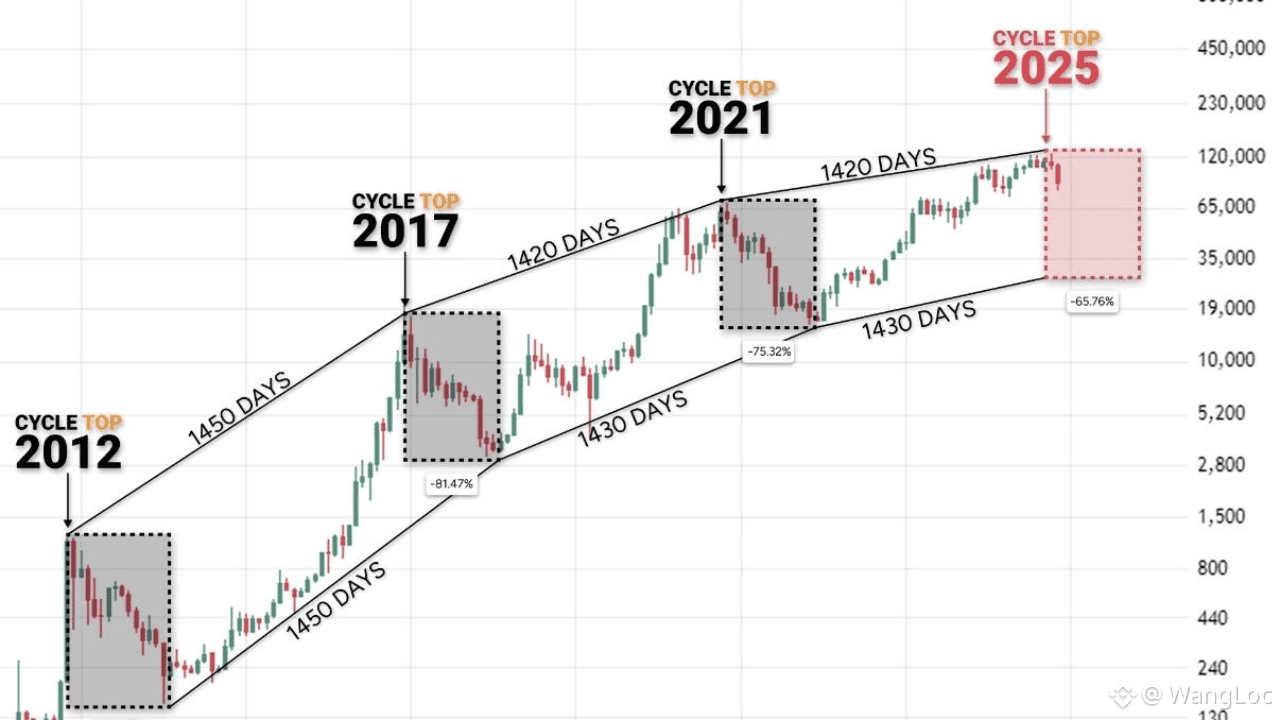
This chart suggests a #bitcoin cycle low around ~$25,000 in 2026 👀 If this plays out, it wouldn’t be shocking. Deep bear markets historically compress sentiment to extremes long after the majority believes the pain is already over. The real question isn’t whether $25k is possible it’s how prepared people are to buy when narratives are dead, volume is gone, and conviction is at its lowest. Markets don’t bottom when hope exists. They bottom when everyone stops caring. If this model is even partially right, 2026 could be where long-term wealth is quietly built not chased. #CPIWatch #WriteToEarnUpgrade $BTC $XRP $ETH
Watching crypto turn into a giant copytrading arena over the last few years has been kind of strange honestly. One wallet makes a smart move and within minutes the entire timeline is tracking it, reposting it, trying to front run the next entry. Feels like trading slowly became performance instead of execution.
The idea behind $GENIUS feels less focused on creating more noise and more focused on giving traders back some control. At least that’s how I’ve been reading it. The project gives me the impression that it understands how different decision making becomes once every move is constantly monitored by bots, engagement accounts, and thousands of copytraders waiting behind the screen.
Most platforms still seem obsessed with maximizing visibility at all costs. Genius feels like it’s leaning the other direction a bit, toward cleaner execution and less unnecessary exposure. And honestly I think that part of the market is still very early.
OpenLedger, or What AI Coordination Starts Looking Like When Incentives Actually Align
The more I read about OpenLedger, the more I think the real problem it’s trying to solve is not technical capability. AI already has models, compute, APIs, deployment frameworks, and enough infrastructure to scale rapidly. The harder problem now feels economic. Specifically: who actually captures value inside AI systems once they become large enough to matter. Right now most AI pipelines still work in a very one-directional way. Data moves upward through centralized systems, models get trained, companies monetize the outputs, and the people who supplied the underlying information usually disappear from the value chain entirely. Not because the industry forgot about them, but because the infrastructure was never designed to coordinate attribution and compensation at scale. That’s the part OpenLedger seems focused on changing. Proof of Attribution is probably the clearest example. Instead of treating datasets like anonymous fuel for models, OpenLedger attempts to trace how contributions influence outputs after deployment. Smaller models use influence function approximations while larger systems rely on Infini-gram style span matching to connect outputs back toward source material. What matters to me isn’t only the technical mechanism itself. It’s the economic implication underneath it. If attribution becomes native infrastructure instead of an optional feature, contributors stop functioning like invisible inputs and start functioning more like participants inside the AI economy. And honestly, I think Datanets make that idea much more concrete. A cybersecurity Datanet built by practitioners accumulates differently from a generic scraped dataset. Same with biomedical or legal datasets curated by people actually working in those fields. The value is no longer only scale. It becomes provenance, specialization, and verified contribution history layered together over time. That creates a very different coordination model from how most centralized AI systems operate today. Instead of value flowing upward toward whoever owns the aggregation layer, OpenLedger seems designed so value circulates horizontally across contributors, validators, developers, and model builders interacting through the same infrastructure layer. The OPEN token ties directly into that coordination loop too. Governance, rewards, fees, contributor incentives, model usage, ecosystem participation. It feels less like a detached speculative asset and more like infrastructure connecting economic activity inside the network itself. I also think tools like ModelFactory and OpenLoRA matter more than people initially realize. Lowering the cost of training and deploying specialized models changes participation dynamics completely. Developers no longer need to rebuild everything independently just to access domain-specific intelligence. Shared infrastructure becomes cheaper than isolated infrastructure. That’s usually how real ecosystems strengthen over time. And maybe that’s the deeper reason OpenLedger keeps standing out to me compared to a lot of AI narratives in crypto right now. It doesn’t really feel optimized around hype velocity alone. It feels optimized around coordination efficiency inside a future AI economy where attribution, ownership, and participation become impossible to ignore. Still early obviously, and there are still huge execution questions ahead. But I do think the protocols quietly building coordination infrastructure today are probably more important than the market currently realizes. Because once AI economies scale large enough, the systems determining who captures value underneath them matter more than the applications sitting on top. @OpenLedger $OPEN #OpenLedger
The Most Important Layer Is Usually the One Nobody Notices The more I think about OpenLedger, the less it feels like a normal “AI chain” narrative to me.
Honestly, it feels closer to middleware.
Not the flashy application layer people interact with directly, but the coordination layer quietly sitting underneath everything else. The part handling identity, attribution, payments, and verification without forcing every developer to rebuild the same infrastructure over and over again.
That’s probably the real problem OpenLedger is trying to solve. Right now, if an AI agent wants to consume data, verify permissions, trigger payments to contributors, and keep an auditable reasoning trail, most of those systems still live separately. Some are Web2 APIs, some are smart contracts, some are internal databases. None were really designed around a shared attribution standard.
The friction stays invisible until something breaks.
What makes OpenLedger interesting is that the architecture seems designed to collapse those coordination layers into a single protocol surface. Proof of Attribution connects data to models, models to outputs, and outputs back to contributors automatically. Identity, payments, attribution, and compliance start functioning more like inherited infrastructure instead of optional add-ons.
And honestly, that feels much more important long term than another throughput narrative.
Middleware almost never sounds exciting while it’s being built. But eventually entire systems depend on it quietly working in the background.
OpenLedger, or Why Future AI Networks Probably Need Boundaries More Than Speed
The more I think about future AI systems, the more I feel like the real challenge eventually stops being intelligence itself. Not bigger models. Not larger context windows. Not faster inference. Coordination becomes the harder problem. Right now most infrastructure still assumes humans remain the center of operational control. Humans approve transactions, review permissions, supervise execution flows, and intervene when systems behave unexpectedly. That model works while software remains tool-like. But autonomous AI systems do not behave like static software tools for very long. Once agents begin interacting continuously with liquidity, APIs, datasets, execution environments, and financial incentives, the entire infrastructure layer inherits a different responsibility. The system is no longer supporting occasional human interaction. It is supporting machine-driven coordination operating at speeds humans realistically cannot supervise action by action forever. And honestly, I think this is where OpenLedger starts feeling much more important than a simple “AI blockchain” narrative. Because the architecture appears designed around constrained coordination rather than unrestricted automation. That distinction matters a lot. A lot of ecosystems still treat performance as the primary objective, as if higher throughput automatically creates stronger infrastructure. But speed and survivability are not the same thing. Actually, once AI systems operate economically at scale, speed without boundaries probably increases risk faster than it increases efficiency. The Sessions framework inside OpenLedger is probably the clearest example of that design philosophy. Time-bound and scope-bound delegation sounds procedural at first, almost administrative, until you realize how many failures across crypto came from the opposite assumption. Permissions that never expired. Wallet approvals left active indefinitely because revoking them became inconvenient. Delegated authority accumulating silently across systems nobody audits carefully anymore. Most catastrophic incidents do not begin with insufficient TPS. They begin with excessive trust. One workflow inherits broader permissions than intended. One emergency approval survives longer than expected. One AI agent gains operational authority that nobody fully reviews because the system already became too complex to supervise manually. Then eventually convenience compounds into infrastructure risk. That is the uncomfortable side of autonomous economies most narratives avoid discussing. The challenge is not simply making AI systems capable. The challenge is making them governable. Can machine-driven execution remain constrained? Can authority expire properly? Can autonomous systems coordinate economically without inheriting permanent permissions everywhere they operate? Those questions probably matter more long term than benchmark speeds. And I think OpenLedger understands that better than most AI infrastructure narratives in crypto right now. The modular execution structure reflects it too. Fast execution layers encourage experimentation and scalability, while settlement and coordination layers require more conservative operational assumptions. Separating those responsibilities creates flexibility without forcing the entire system to optimize around the same risk profile. That becomes extremely important once AI coordination scales. Because AI systems do not sleep. They do not stop operating during weekends or office hours. Activity compounds continuously across workflows, liquidity systems, and data environments. If the architecture underneath lacks meaningful trust boundaries, exposure scales alongside automation. That is the hidden asymmetry inside future AI economies. Autonomy amplifies both efficiency and failure simultaneously. OpenLedger seems architected around limiting blast radius instead of assuming perfect behavior forever. And honestly, that feels much closer to how mature infrastructure evolves historically. Every large financial system eventually becomes obsessed with permissions. Not because innovation failed. Because scale changes the emotional cost of mistakes. The larger the system becomes, the more dangerous unrestricted authority feels. That is also why I increasingly think blockchain infrastructure eventually becomes necessary for machine-scale coordination environments. Not because blockchain magically improves intelligence, but because autonomous systems require verifiable coordination frameworks capable of enforcing boundaries even when activity becomes partially machine-driven. At that point blockchain stops being purely transactional infrastructure. It becomes behavioral infrastructure. The system is no longer only processing transfers. It is managing relationships between delegation, authority, automation, accountability, and operational trust. That is a much harder problem than maximizing throughput. And probably a more important one too. The industry spent years believing faster systems automatically created safer systems. But speed without enforceable coordination boundaries eventually becomes permissionless fragility. A ledger capable of executing anything without meaningful operational constraints does not eliminate systemic risk. It accelerates exposure. That is why OpenLedger interests me more as a coordination architecture than as a short-term AI narrative. The combination of modular execution, constrained delegation, utility design, and machine-scale coordination feels structurally more durable than ecosystems optimizing purely around activity metrics and attention cycles. Not because the system removes risk completely. No serious infrastructure can promise that. But because the architecture appears built around the assumption that autonomous systems eventually require survivability mechanisms stronger than human supervision alone. And historically, infrastructure preparing for future coordination pressure before everyone else notices the problem usually ends up mattering more than the market initially expects. @OpenLedger $OPEN #OpenLedger
Some Infrastructure Only Makes Sense Right Before Everyone Needs It
I keep thinking about how a lot of technology infrastructure looks unnecessary right before the environment suddenly depends on it completely. Cloud systems felt oversized before applications became permanently online. GPU demand looked irrational before AI started absorbing entire data centers.
OpenLedger gives me a similar feeling lately.
Most blockchain ecosystems today still behave as if humans remain the center of coordination. Humans approve transactions, review permissions, supervise execution flows. But autonomous AI systems don’t really scale around human timing. They operate continuously across liquidity, data, and execution environments faster than manual oversight can realistically keep up with.
At some point the problem stops being raw computation.
It becomes trust and coordination.
That’s why the Sessions framework inside OpenLedger stands out to me more than the throughput narrative. Time-bound and scope-bound delegation feels much closer to how autonomous systems probably need to operate long term. Wallets acting like permanent authority containers doesn’t seem sustainable once AI agents begin interacting economically at scale.
The modular architecture matters too. Separating high-speed execution from more conservative coordination layers feels less like marketing and more like operational design.
A lot of ecosystems still feel optimized for current attention cycles.
OpenLedger feels like it’s preparing for future coordination pressure instead.
And historically, infrastructure built for future pressure usually looks early right until the moment everyone realizes why it was necessary.
OpenLedger and the Idea That Autonomous Systems Need Boundaries More Than Speed
One thing I keep noticing every cycle is that markets usually spend the early phase rewarding visibility, then spend the later phase searching for infrastructure capable of surviving what that visibility created. At first, nobody really cares about coordination risk. Liquidity moves emotionally. Communities chase momentum because momentum itself becomes value. Systems get evaluated through engagement metrics instead of operational durability. Fast execution becomes a narrative by itself. Then eventually reality catches up. A wallet approval remains active longer than intended. An AI agent receives broader permissions than it should. A coordination layer built for convenience suddenly has to support systems operating continuously without human supervision. That’s usually the point where infrastructure stops sounding boring. And honestly, the more I read about OpenLedger, the less I think the interesting part is simply “AI + blockchain.” Plenty of projects can combine those words. What feels more important is the architectural assumption underneath the system. OpenLedger seems designed around the idea that autonomous coordination requires constrained authority, not unrestricted automation. That distinction matters a lot once AI systems begin interacting directly with execution environments, liquidity, and economic incentives at scale. Most blockchain infrastructure today still assumes humans remain the primary coordination layer. Humans approve transactions manually, monitor permissions, review execution behavior, and intervene when something looks wrong. But agentic systems change that model completely. AI agents operate continuously. They do not pause for office hours, risk reviews, or emotional hesitation. And once autonomous systems begin handling more operational complexity, traditional signing behavior starts becoming a bottleneck instead of a safeguard. I think OpenLedger understands that transition better than most projects in this sector. The Sessions framework is probably the clearest example. Time-bound and scope-bound delegation sounds procedural at first, almost like a UX feature, until you realize how many failures across crypto originated from the opposite philosophy. Permanent approvals. Unlimited permissions. Delegated authority surviving long after its intended use case expired. Most infrastructure failures don’t start with insufficient throughput. They start with excessive trust accumulating silently inside systems nobody fully audits anymore. That’s why scoped delegation feels structurally important to me. Fewer repetitive signatures is not only about convenience. It reduces behavioral fatigue while limiting how much authority any single process inherits over time. Wallets stop functioning like permanent approval containers and start behaving more like temporary operational credentials. And honestly, that feels much closer to how mature infrastructure evolves in every industry once scale arrives. I also think people underestimate how important this becomes when AI coordination enters the equation. Autonomous agents amplify both efficiency and exposure simultaneously. A system capable of executing actions continuously without boundaries doesn’t eliminate operational risk. It accelerates it. That’s probably the uncomfortable side of agentic economies most narratives avoid discussing. Everyone talks about autonomous execution. Fewer people talk about containment. OpenLedger seems unusually focused on containment. The modular architecture reflects that too. Fast execution environments encourage experimentation, while settlement and coordination layers require much stricter operational assumptions. Separating those responsibilities creates flexibility without forcing the entire system to inherit the same risk profile. And the more I think about it, the more infrastructure starts feeling like behavioral design rather than purely technical design. Because once AI systems coordinate value autonomously, blockchain stops being only financial infrastructure. It becomes infrastructure governing relationships between authority, automation, delegation, and accountability. That’s a much harder problem than simply scaling TPS. I’m not saying OpenLedger has solved all of this already. The long-term execution challenges are still real. Agentic systems operating safely at scale remains an unsolved problem for almost the entire industry. But I do think the protocol is approaching the problem from a more durable direction than ecosystems optimizing purely around speed or narrative attention. Speculative cycles usually reward activity first. Infrastructure survives by managing what happens after the activity arrives. And historically, the systems that last longest are rarely the ones maximizing freedom without constraints. They’re usually the ones quietly building coordination frameworks capable of limiting damage when human behavior, incentives, or automation eventually become unpredictable. That’s probably why OpenLedger interests me more as a coordination architecture than as a simple AI narrative. Because the future of autonomous economies probably depends less on removing boundaries entirely and more on designing the right ones before scale makes mistakes irreversible. @OpenLedger $OPEN #OpenLedger
One thing I keep noticing in crypto is that meme cycles usually feel unbeatable right until markets slow down. During euphoric phases, attention moves faster than fundamentals. Liquidity rotates into whatever feels viral, communities chase momentum, and almost everything gets valued like engagement itself is a moat.
But eventually markets calm down and infrastructure starts getting tested by reality instead of hype.
That’s where projects like OpenLedger become more interesting to me.
What stands out isn’t only the AI narrative. It’s the assumption underneath the architecture. OpenLedger seems built around the idea that autonomous systems need controlled coordination, not unlimited permissions and blind automation.
The Sessions framework is probably the clearest example of that.
Instead of wallets acting like permanent approval layers, delegation becomes time-bound and scope-bound. Fewer repetitive signatures, but also fewer open-ended risks sitting quietly in the background. Honestly, that feels more aligned with how AI agents will probably interact with on-chain systems long term.
I think people underestimate how important these coordination layers become once AI starts operating inside financial environments at scale. At that point the conversation stops being about hype entirely. It becomes about what still functions safely when human supervision can’t keep up with system speed anymore.
And historically, infrastructure narratives survive longer because eventually every market asks the same question after speculation fades: What actually still works under pressure?
The Next Phase of AI Might Care Less About Intelligence and More About Accountability
The more I think about where AI adoption is heading, the more it feels like the first major wave already happened. We solved the access problem faster than most people expected. Models became easier to use, APIs became cheap, open-source tooling exploded, and suddenly almost anyone could add an AI layer to a product without needing a dedicated machine learning team. That phase was mostly about capability. The next phase feels different. It feels like it’s going to be about accountability. And honestly, I think that shift changes which infrastructure actually matters. Right now most AI systems still operate in relatively low-stakes environments. If a chatbot hallucinates inside a customer support flow, it’s annoying but manageable. But once AI starts moving deeper into legal workflows, medical systems, enterprise operations, financial underwriting, or compliance-heavy industries, the conversation changes completely. At that point the question is no longer “can the model generate a useful answer?” It becomes: Where did this output come from? What data shaped it? Can we verify the provenance? Who is responsible if the output is wrong? That’s the part that made OpenLedger start feeling more important to me over time. At first glance it looks like another AI infrastructure protocol inside the broader crypto narrative. But the more I read about the actual architecture, the more it feels like OpenLedger is building specifically for this second wave rather than the first one. The core mechanism is Proof of Attribution. Instead of treating training data as an invisible input that disappears once the model is deployed, OpenLedger keeps the relationship between data and model outputs traceable. Datasets inside Datanets carry provenance tracked on-chain, and inference events can theoretically route rewards back toward the contributors whose data influenced the output. For smaller models the system uses influence function approximations. Larger language models rely on suffix-array token matching to determine attribution relevance. The technical side is obviously complicated, but the underlying idea is surprisingly straightforward. OpenLedger is trying to make the data layer of AI auditable after the fact. And I think that’s a much bigger deal than most people realize. Because accountability infrastructure behaves differently from normal infrastructure. Its value increases as the consequences of AI decisions become more serious. Most AI infrastructure projects today are competing around efficiency. Faster inference, cheaper compute, decentralized GPU markets, optimized routing layers. OpenLedger is operating in a different category entirely. It’s building infrastructure around trust, provenance, and verifiability. That distinction matters a lot if enterprise adoption becomes the next major growth phase for AI. A hospital deploying AI-assisted diagnostics cannot rely on “trust us, the model is good.” A legal platform using AI for document analysis eventually needs explainability around the data shaping those outputs. Financial systems dealing with credit or risk scoring increasingly face regulatory pressure around transparency and auditability. In those environments, provenance stops being optional. And this is where Datanets become especially interesting to me. The way OpenLedger structures domain-specific datasets around verticals like healthcare, finance, and legal services creates something more defensible than generic scraped data pools. These aren’t just collections of information. They’re provenance-verified data supply chains where contribution history, validation, and ownership remain visible over time. A mature medical Datanet built over several years by verified contributors has a completely different profile from an anonymous internet-scale dataset. Not necessarily because the model is larger or smarter, but because the underlying data infrastructure is auditable. That creates a second-order effect most people probably overlook. As enterprises start prioritizing attribution and compliance, the value of curated domain-specific datasets compounds. And contributors who helped build those Datanets early occupy a structural position later participants cannot replicate easily. Provenance is timestamped. Contribution history becomes part of the network itself. Network effects emerge at the data layer instead of only the application layer. I also think OpenLedger’s infrastructure choices make more sense once you view the protocol through this lens. Running as an Ethereum L2 using the OP Stack with EigenDA for data availability isn’t just about scalability marketing. Attribution systems operating at inference-level frequency generate massive recording requirements. Without cheap throughput and efficient data availability, the economics break down quickly. So the architecture feels tied directly to the protocol’s long-term thesis. Even EVM compatibility matters more than people think. Enterprises and developers already understand Ethereum tooling, compliance frameworks, and security assumptions better than entirely new architectures. Familiar infrastructure lowers friction when adoption eventually matters. Still, I don’t think any of this guarantees success. The timing question remains huge. Enterprise AI adoption in regulated industries is still slower than crypto people usually expect. Procurement cycles are long. Legal frameworks around AI accountability are still evolving. And there’s always the possibility that centralized AI providers solve attribution internally before decentralized attribution layers become standard infrastructure. That’s probably the real competitive question hanging over OpenLedger. Does the market eventually want open, protocol-level attribution systems? Or does accountability get absorbed into closed enterprise platforms companies already trust? I don’t think anyone fully knows yet. But I do think OpenLedger is one of the few AI crypto projects that feels like it’s genuinely building for where the market might go next instead of optimizing purely for where attention already is today. And if the next phase of AI adoption really becomes less about raw capability and more about accountability, provenance, and verifiable ownership, then protocols positioned at that layer might end up mattering far more than the market currently prices in. Still early obviously. But the deeper I look into OpenLedger, the less it feels like a short-term AI narrative and the more it feels like infrastructure waiting for a specific market condition to arrive. @OpenLedger $OPEN #OpenLedger $GENIUS $BEAT
The More I Think About AI Economies, the More OpenLedger Starts Making Sense
Whenever people talk about AI becoming a trillion-dollar industry, the conversation usually stays focused on how big the market could get. But honestly, I’ve started thinking the more important question is who actually captures the value once that economy matures.
Because historically, the people providing the raw inputs rarely end up owning meaningful parts of the system they helped create.
That’s probably why OpenLedger caught my attention. The protocol seems built around the idea that data contributors shouldn’t disappear into the background once models become valuable.
Through Proof of Attribution, datasets inside Datanets are tracked on-chain, and when models generate outputs later, contributors can theoretically receive rewards tied back to their data’s influence.
What makes this interesting to me is that OpenLedger is trying to solve attribution before AI ownership becomes a major legal and economic problem, not after.
And timing probably matters a lot here.
If attribution infrastructure exists early enough, contributors become actual participants inside the AI economy. If it arrives too late, the dominant platforms may already control the value flows by default.
I’m not saying OpenLedger definitely becomes that infrastructure layer, because there are still a lot of execution questions. But I do think the protocol is asking a deeper question than most AI projects right now.
Not “how big will AI become?”
More like: when AI becomes enormous, who will already be
OpenLedger Feels Like Infrastructure Built for a Market That Hasn’t Fully Arrived Yet
The more time I spend reading about OpenLedger, the less it feels like a normal crypto narrative trade to me. A lot of projects are designed to capture value from markets that already exist. OpenLedger feels different because it seems to be building for a version of the AI economy that hasn’t actually formed yet. And I think that distinction matters more than people realize. On the surface, the protocol is understandable enough. OpenLedger runs proof of attribution directly at the protocol layer. Data contributions inside Datanets get tracked, models train on those datasets, and when inference happens later, rewards can flow back toward the original contributors whose data shaped the output. Smaller models use influence function approximations while larger language models rely on suffix-array token matching to trace contribution relevance. The mechanics are technical, but the bigger implication is actually pretty simple. OpenLedger is trying to make data ownership inside AI economically visible instead of invisible. That idea probably sounds obvious at first, until you sit with how AI currently works. Most models today were trained on massive amounts of scraped information where contributors never had attribution, ownership, or economic participation in what those systems eventually produced. The entire pipeline assumes that data enters the model and disappears as an identifiable asset afterward. OpenLedger is effectively betting that this stops being acceptable over time. What makes the project interesting to me is that it’s not only building tooling. It’s building around a future assumption. Specifically the idea that attribution eventually becomes economically important enough that infrastructure supporting it matters at the protocol level rather than as an optional feature added later. That future doesn’t fully exist yet. Which is probably why the project can feel slightly abstract if you only look at today’s market conditions. Right now most AI infrastructure narratives still revolve around compute. GPU marketplaces, decentralized inference, cloud alternatives, distributed training. Those are easy stories for the market to understand because they map cleanly onto existing infrastructure models. OpenLedger feels like it’s operating one layer underneath that conversation. The focus here is the data economy itself. Datanets are probably the clearest example of this. Instead of treating all information as generic fuel for large models, OpenLedger organizes domain-specific datasets into their own contribution networks. Medical, legal, financial, enterprise-specific knowledge. Each Datanet becomes its own accumulation layer where provenance and quality theoretically compound over time. And once you think about that deeply enough, the asymmetry becomes hard to ignore. A verified healthcare dataset built over multiple years by specialists inside the protocol is not something competitors recreate quickly. Same with legal datasets or industry-specific financial intelligence. The moat is no longer only the model architecture. The moat becomes the history, provenance, validation, and contributor network attached to the data itself. That changes how value accrues across the stack. If the data layer becomes defensible, then models trained on top inherit part of that defensibility. Agents using those models inherit it too. The infrastructure compounds upward from whoever controls the underlying information economy. I think that’s also why OpenLedger chose to position itself as infrastructure rather than only an application layer product. Running as an Ethereum L2 on the OP Stack with EigenDA handling data availability isn’t just branding. Attribution systems operating at inference-level frequency would become economically unusable without scalable throughput underneath them. So the architecture choices feel tied directly to the core thesis rather than added afterward for narrative alignment. The same thing applies to OpenCircle. A lot of people look at ecosystem funding programs as pure marketing, but the 25 million dollar builder initiative makes more sense if you view OpenLedger as a protocol trying to accelerate the arrival of the market it depends on. If attribution-based AI infrastructure eventually matters, developers need to start building on it before the demand becomes obvious. That creates a strange dynamic though. OpenLedger is simultaneously early and dependent on timing. If attribution becomes important fast enough, the protocol already has infrastructure, ecosystem incentives, and network effects developing ahead of competitors. If the market moves slower than expected, there’s always the risk of building sophisticated infrastructure for a problem that remains theoretical longer than investors want to wait. And honestly, I think that tension is unavoidable for projects positioned this early around structural shifts. The investor profile reflects that pretty clearly too. Polychain Capital, Borderless Capital, and Sreeram Kannan from EigenLayer are not the kind of backers that usually chase short-term narrative hype alone. Infrastructure investors typically care about whether a protocol becomes foundational if the market evolves in a certain direction. OpenLedger feels like that kind of bet. Not a guaranteed winner. Not even necessarily a protocol the broader market fully understands yet. Just a very specific thesis that the AI economy eventually reorganizes around attribution, provenance, and contributor ownership instead of treating data as a free externality forever. There are still obvious open questions. Whether proof of attribution scales cleanly at production-level inference frequency is still something the protocol needs to prove over time. Whether contributor incentives remain strong after the early growth phase is another issue entirely. And there’s always the possibility that centralized AI companies solve attribution internally before decentralized infrastructure becomes necessary. But I also think it would be a mistake to read OpenLedger only as another AI narrative token. It feels more like infrastructure designed for a market structure that does not fully exist yet, but might become extremely important once the economics around AI ownership mature enough that people stop ignoring where the underlying data came from. And projects built for futures that haven’t arrived yet usually look unnecessary right until the moment they suddenly don’t. @OpenLedger $OPEN #OpenLedger
What Made Me Look at OpenLedger Differently Wasn’t the AI Narrative
At first I assumed OpenLedger was competing in the same lane as most AI infrastructure projects. Decentralized GPUs, compute markets, inference layers. Basically trying to rebuild cloud infrastructure on-chain. But after reading deeper, that actually doesn’t feel like the main point here.
The interesting part is the attribution system underneath it.
OpenLedger is trying to track how training data contributes to model outputs, then route rewards back to the original contributors through proof of attribution. Smaller models use influence function approximations while larger LLMs rely on suffix-array token matching.
It sounds technical at first, but the implication is pretty simple. Data stops being an invisible input and starts becoming an owned asset inside the network.
And I think that changes the economics more than people realize.
If high-quality Datanets around healthcare, finance, or legal knowledge start compounding over time, early contributors are not just farming rewards. They’re helping build datasets that become harder to replicate later. Provenance itself becomes part of the value.
That’s probably why investors like Polychain and Borderless looked at it early. Not because “AI + crypto” is trendy, but because infrastructure tied to ownership usually gets stronger as networks mature.
Still very early obviously, but OpenLedger feels less like a compute story and more like a bet on who controls the data layer of AI.
Sitting at the Center of Every Trend Is Not the Same as Owning One
The more I read about OpenLedger, the less I see it as a simple AI token and the more I see it as a protocol trying to position itself underneath several trends at the same time. AI infrastructure, decentralized data ownership, proof-of-contribution systems, on-chain incentives, even parts of the DePIN narrative. At first that sounded incredibly strong to me. Then after sitting with it longer, I started wondering if being connected to every major narrative is actually the same thing as having a real moat. Because sometimes projects look important simply because they sit in the middle of conversations people already want to believe in. OpenLedger’s core mechanism is still one of the more interesting things I’ve seen in this sector though. The protocol tracks which datasets contribute to model training, and when those models later generate outputs, rewards can theoretically flow back to the original contributors. What caught my attention is that this isn’t framed as vague “community rewards” marketing. They’re actually attempting attribution at the protocol level using influence function approximations for smaller models and suffix-array token matching for larger language models. That part matters because most AI + crypto projects I’ve seen focus heavily on compute. GPU marketplaces, inference routing, decentralized cloud infrastructure. OpenLedger feels like it’s making a different bet entirely. The assumption here seems to be that data, especially curated domain-specific data, becomes the real scarce asset in AI over time. And honestly, I think there’s a strong argument for that. A medical Datanet with years of verified contributions is difficult to recreate quickly. Same with legal or financial datasets built by actual practitioners. Once provenance, validation, and attribution become embedded into the dataset itself, the value isn’t only the raw information anymore. The value becomes the history and trust layer surrounding it. That creates a kind of defensibility that generic scraped datasets probably never achieve. The deeper implication is that if the data layer becomes defensible, then the models trained on top inherit part of that advantage too. And eventually the agents using those models inherit it as well. The whole stack compounds upward from whoever controls the data foundation underneath. But this is also where I think the real asymmetry appears. When a protocol sits at the center of multiple narratives, people sometimes assume that means diversification. In reality it can also mean correlated exposure. OpenLedger only fully works as a thesis if several things become true at the same time. AI data needs to remain scarce and valuable. Attribution needs to stay computationally viable at scale. Contributors need to keep participating long after early incentives compress. And value generated by AI systems actually needs to route back toward infrastructure layers instead of getting captured entirely by applications sitting on top. Individually, none of those assumptions sound unreasonable. Together, they become a much bigger execution challenge. I also keep thinking about the incentive dynamics over time. Early contributors to a Datanet are probably in a very different position from later ones. If someone helps build a specialized dataset early, they are not just participating. They are effectively shaping the supply side of a future market. Once that dataset matures and gains network effects, new contributors enter a structure that already has established reward flows and entrenched participants. That’s normal network effect behavior, but it creates long-term questions around contribution quality and sustainability. Financial incentives work extremely well during accumulation phases. They become harder to maintain once the market matures and the easy upside disappears. OpenLedger seems aware of this with initiatives like OpenCircle funding builders and ecosystem growth, but I still feel like the long-term contributor behavior is one of the most important things to watch. Infrastructure-wise though, I understand why serious investors looked at it early. Running on the OP Stack with EigenDA for data availability actually makes sense for the type of throughput attribution systems would require. If inference-level contribution tracking becomes expensive or slow, the entire concept starts breaking down economically. So at least the technical architecture appears aligned with the protocol’s main objective instead of feeling bolted on afterward. What I keep coming back to is that OpenLedger doesn’t really feel like a direct bet on AI hype itself. It feels more like a bet on ownership inside the AI economy. Specifically the idea that data contributors eventually demand infrastructure that recognizes and compensates them natively rather than treating them as invisible inputs. Maybe that becomes one of the defining mechanics of AI over the next five years. Maybe attribution ends up being too expensive, too complex, or simply less important than centralized platforms solving the problem internally. I honestly don’t know yet. But I do think there’s a meaningful difference between a protocol borrowing attention from multiple narratives and one trying to structurally connect them. And OpenLedger, for better or worse, seems to be attempting the second. Still watching closely. Feels early enough that the market probably hasn’t fully decided what category this belongs to yet. @OpenLedger $OPEN #OpenLedger
I Don’t Think OpenLedger Is Really Betting on Compute
The first time I looked at OpenLedger, I honestly thought it was just another AI + crypto project trying to ride market momentum. There are already too many protocols talking about decentralized GPUs and inference layers, and after a while they all start sounding similar.
But the more I read into it, the more it felt like OpenLedger is actually making a different bet entirely.
Most AI infrastructure narratives today revolve around compute. Renting GPUs, routing inference, rewarding nodes. Basically rebuilding cloud infrastructure in a decentralized form. OpenLedger doesn’t really seem focused on that. What they appear to care about is the data layer itself, and more specifically who owns it.
The proof of attribution system is probably the part that changed how I looked at it. Every dataset contribution gets tracked, and when models generate outputs tied back to that data, contributors can theoretically receive rewards. At first I thought that was mostly a transparency feature. Now I’m starting to think it might be the actual economic core of the protocol.
Because high-quality domain data compounds over time. A medical or legal Datanet built by real contributors for years becomes difficult to replicate cheaply. And if the data becomes defensible, then the models trained on it inherit that advantage too.
Maybe that’s the deeper angle here. Not decentralized compute. Decentralized ownership of the AI supply chain itself.
Still early obviously, but I think that distinction matters more than people realize.
Trying to Figure Out Whether $OPEN Is Just Another AI Token or Something Bigger
I’ve been looking deeper into OpenLedger lately, mostly because AI-related tokens keep showing up everywhere again and honestly a lot of them still feel interchangeable to me. Same narrative, same promises, different branding. So when I started reading about OPEN, I was mostly trying to understand whether the token actually has a role inside the ecosystem or if it’s just there because every project needs one. At the current stage, the market cap still feels relatively early compared to some of the bigger AI narratives already running around crypto. That’s probably why people are paying attention now. From what I saw, the total supply is set at 1 billion tokens, while the initial circulating supply is only around 21.5%. Usually when I see low circulation I become cautious immediately because unlock pressure can become a real problem later, especially if hype runs ahead of actual adoption. But at least the allocation structure caught my eye a little. The community allocation being around 61% feels intentional. A lot of projects talk about decentralization while most of the supply quietly sits with insiders or early funds. OpenLedger still has investor and team allocations obviously, which is normal, but the heavier community focus seems connected to the whole idea of decentralized AI participation. At least from the outside, it looks like they’re trying to align the token with ecosystem growth rather than only fundraising. What made me spend more time on it though was the utility side. I know “utility token” has become one of the most overused phrases in crypto, but OPEN actually seems tied into multiple layers of the network instead of just governance voting nobody participates in. From what I understand, staking is supposed to help secure and coordinate activity across the network. Then there’s fee payment for using services inside the ecosystem, especially if OpenLedger’s AI infrastructure and marketplace become active later. Contributors who provide datasets, validate information, or help run AI agents can also earn rewards in $OPEN . That part feels important because the token isn’t only rewarding speculation, at least theoretically. It’s trying to create an economy around data, AI execution, and participation itself. I think that’s also where the 2026 narrative could become interesting if the roadmap actually lands properly. Full mainnet deployment sounds like the obvious catalyst people are watching, but honestly I’m more curious about whether the AI Marketplace gets real traction. If developers and companies start using decentralized datasets or specialized AI agents there, demand for the token might start coming from actual network activity instead of pure market hype. The enterprise angle is another thing I keep thinking about. Crypto people sometimes underestimate how valuable specialized data can become for businesses. Generic AI models are useful, but industries like healthcare, finance, and legal services usually need smaller, domain-specific systems trained on curated datasets. OpenLedger seems to be positioning itself around that idea with Datanets and contributor-owned AI infrastructure. If that works, then the token could end up representing access to a growing data economy rather than only governance rights. Still, there are obvious risks too. Vesting schedules matter a lot for projects like this, especially when narratives move faster than adoption. AI crypto is also becoming extremely crowded. Every week there’s another protocol claiming it will power decentralized intelligence or autonomous agents. Some of them will disappear once attention rotates elsewhere. And honestly, even if the idea is strong, execution is still everything here. Building decentralized infrastructure is already difficult. Building decentralized AI infrastructure while keeping incentives aligned feels even harder. The challenge isn’t only attracting contributors early on, it’s maintaining data quality once rewards become financialized. At the same time though, I can also see why people think OPEN could benefit heavily if the AI narrative expands again in 2026. Crypto markets tend to move toward sectors where people believe future demand could exist, even before the fundamentals fully mature. If OpenLedger manages to combine real usage with the broader AI momentum, the upside probably looks very different from smaller “AI meme” projects that don’t actually build infrastructure. I’m still treating it carefully for now. Not because the concept feels weak, but because AI and crypto together can create a lot of excitement very quickly, and excitement alone usually isn’t enough long term. Still, among the newer AI projects I’ve read recently, OpenLedger feels like one of the few trying to connect token incentives with something that could have real economic value outside speculation. Definitely still a DYOR situation for me, but I understand the thesis a lot more now than I did a few weeks ago. @OpenLedger $OPEN #OpenLedger
Why OpenLedger’s Datanets Feel More Important Than Another AI Narrative
Lately I’ve been thinking a lot about how AI keeps getting called “open”, while most of the valuable data behind it is still controlled by a few companies. That gap is probably bigger than people realize.
What caught my attention with OpenLedger was the idea of Datanets. From what I understand, it’s basically a way for communities to build specialized datasets together instead of relying on closed data silos. Like healthcare, finance, legal research… areas where generic AI models usually struggle because the knowledge is too specific.
The interesting part is that every contribution gets recorded on-chain, so data ownership and attribution don’t just disappear in the background. If someone contributes useful data, helps validate it, or does annotation work, they can actually earn rewards when the dataset gets used later for training models. I’m not fully sure how smoothly this scales yet, but the logic behind it makes sense to me.
I also think this connects a lot with the rise of smaller specialized AI models lately. Not every AI system needs to be a giant model trained on the entire internet. Sometimes better domain data matters more.
Feels like OpenLedger is trying to turn knowledge itself into something communities can collectively build and benefit from. Still early obviously, but I can see why people are paying attention to it now.
On-chain data shows that Ethereum’s “Transfers by External Contract Calls (Total)” metric reached a new all-time high in late April 2026. Specifically, transfers surged from around 142,194 on April 10 to a peak of 309,032 on April 25, marking an increase of over 117% within a short period.
Importantly, this rise is not tied to a single isolated event such as a major airdrop or a specific protocol launch. Instead, it reflects a broad-based increase in network activity across multiple segments. During April 2026, Ethereum also recorded an all-time high in total transaction count.
Key contributors include a strong increase in stablecoin transfer volumes, growing Layer-2 settlement activity, and higher usage across DeFi, gaming, and social applications. This indicates expanding demand for smart contract interactions across the ecosystem.
Over the same period, $ETH price showed relatively limited movement, rising modestly from approximately $2,245 to $2,320. This divergence between surging on-chain activity and stable price action suggests that current growth is driven primarily by underlying network usage rather than short-term speculation.
Overall, Ethereum is seeing a significant increase in infrastructure utilization, while price has yet to fully reflect this expansion. #ETH
The comparison highlights that $BTC corrective structures across previous cycles (2014, 2018, 2022) share similarities in how price declines after setting a peak. These phases typically consist of multiple downward legs, interspersed with short-lived rebounds before a bottom forms.
Historically, these corrections tend to unfold over several stages, with a relatively defined sequence of declines before the market stabilizes and transitions into accumulation.
In the current context (2026), price structure appears to be in the early-to-mid phase of a corrective cycle, with several downward legs already formed but not yet completing the full process seen in prior cycles.
A common pattern across cycles is that after a multi-leg decline, the market shifts into a sideways phase before establishing a new trend.
Overall, $BTC is undergoing a corrective process that resembles prior cycles, but still requires additional time to complete the structure and confirm a new equilibrium.
$BTC spot trading volume across major exchanges has dropped to its lowest level since October 2023, according to Glassnode data. This reflects a clear decline in overall market participation.
In this context, BTC continues to trade within the 70k–80k range under thinner liquidity conditions. Price remains range-bound, indicating a temporary balance between supply and demand in the absence of strong capital inflows.
Low-volume environments tend to make price action more sensitive, as moves can become amplified once new capital enters or market expectations shift.
Overall, $BTC appears to be in an accumulation phase with reduced participation, and current conditions may lead to increased volatility once a clearer directional bias emerges.
Pixels and the Moment Time Stopped Being the Main Advantage
I didn’t expect a simple timer change in Pixels to feel this… meaningful. When I first read the Chapter 2.5 update, longer crop timers just sounded like a quality-of-life tweak. Less clicking, less stress. That’s it. But the more I thought about it, the more it felt like they were quietly redefining what “effort” even means in the game. Before that shift, everything leaned toward availability. If you could check in constantly, you had an edge. Not because you were better, just because your schedule allowed it. And that kind of advantage is hard to compete with. You can’t out-strategy someone who’s simply online more often. Longer timers changed that balance. Now, missing a 30-minute window doesn’t feel like falling behind anymore. You can log in a few times a day, run full cycles, and still stay competitive. It sounds small, but it opens the game up to people who don’t want to structure their day around it. But what’s interesting is… optimization didn’t disappear. It just moved. Instead of “who logs in the most,” it’s more like “who understands the rhythm better.” How you align your Energy usage with longer crop cycles, when you check in, how you avoid hitting cap without overthinking it. It’s less about intensity, more about timing. And then when you think about land owners and automation, it kind of completes the picture. At some point, the system lets you reduce reliance on time almost entirely. But before you get there, this middle layer matters a lot. I’m not even sure everyone adjusted to this change yet. A lot of people probably still play like the old system is in place. But if you actually shift how you think about time in Pixels now, it feels like the game is rewarding a different kind of player than it used to. Less about who’s always there. More about who understands when it matters to be there. @Pixels $PIXEL #pixel $ZKJ $DAM