

VerityWire
65 Posts

VerityWire
Report
Block User
Crypto security beyond the headlines. We verify the facts, explain the risks, and focus on what matters most.
3 Following
32 Followers
37 Liked
Posts
PINNED
·
--
Crypto moves fast. The first headline is often incomplete. Follow VerityWire if you want the security side and the market context without price calls or hype.
We look at exploits, protocol changes, infrastructure failures, and wallet or custody incidents.
We also cover the market when something is actually moving it — what happened, why major coins are reacting, and what is still unclear.
If something is confirmed, we say it. If it is still unclear, we say that too.
Crypto moves fast. The first headline is often incomplete. Follow VerityWire if you want the security side and the market context without price calls or hype.
We look at exploits, protocol changes, infrastructure failures, and wallet or custody incidents.
We also cover the market when something is actually moving it — what happened, why major coins are reacting, and what is still unclear.
If something is confirmed, we say it. If it is still unclear, we say that too.
We look at exploits, protocol changes, infrastructure failures, and wallet or custody incidents.
We also cover the market when something is actually moving it — what happened, why major coins are reacting, and what is still unclear.
If something is confirmed, we say it. If it is still unclear, we say that too.
98
·
--
MetaMask has started exiting Ethereum validators affected by a security incident in part of its infrastructure.
MetaMask says it has found no immediate threat to its wallets. The staking service is non-custodial, and client withdrawal keys are not controlled by MetaMask.
Lido says the affected validators are already exiting and expects the last of them to exit by October 7. Completing the exit, withdrawal and re-entry process may take around 45 days. During that period, some staking rewards may be missed and downtime penalties may apply.
The incident is still under investigation. What has been confirmed is an infrastructure security issue affecting MetaMask-operated validators — not a compromise of MetaMask wallets or confirmed loss of stETH holder funds.
$ETH
#MetaMask #Lido #Ethereum #Security
MetaMask has started exiting Ethereum validators affected by a security incident in part of its infrastructure.
MetaMask says it has found no immediate threat to its wallets. The staking service is non-custodial, and client withdrawal keys are not controlled by MetaMask.
Lido says the affected validators are already exiting and expects the last of them to exit by October 7. Completing the exit, withdrawal and re-entry process may take around 45 days. During that period, some staking rewards may be missed and downtime penalties may apply.
The incident is still under investigation. What has been confirmed is an infrastructure security issue affecting MetaMask-operated validators — not a compromise of MetaMask wallets or confirmed loss of stETH holder funds.
$ETH
#MetaMask #Lido #Ethereum #Security
MetaMask says it has found no immediate threat to its wallets. The staking service is non-custodial, and client withdrawal keys are not controlled by MetaMask.
Lido says the affected validators are already exiting and expects the last of them to exit by October 7. Completing the exit, withdrawal and re-entry process may take around 45 days. During that period, some staking rewards may be missed and downtime penalties may apply.
The incident is still under investigation. What has been confirmed is an infrastructure security issue affecting MetaMask-operated validators — not a compromise of MetaMask wallets or confirmed loss of stETH holder funds.
$ETH
#MetaMask #Lido #Ethereum #Security
60
·
--
ENA has a routine unlock tomorrow, but October 5 is the bigger date.
Tokenomist says the remaining investor schedule was pulled forward into one final unlock of about 1.41 billion ENA, roughly 14% of the current circulating supply.
That ends investor vesting 17 months early. The tokens become unlocked on October 5. That does not mean they will all be sold.
ENA has a routine unlock tomorrow, but October 5 is the bigger date.
Tokenomist says the remaining investor schedule was pulled forward into one final unlock of about 1.41 billion ENA, roughly 14% of the current circulating supply.
That ends investor vesting 17 months early. The tokens become unlocked on October 5. That does not mean they will all be sold.
Tokenomist says the remaining investor schedule was pulled forward into one final unlock of about 1.41 billion ENA, roughly 14% of the current circulating supply.
That ends investor vesting 17 months early. The tokens become unlocked on October 5. That does not mean they will all be sold.
193
·
--
KMNO has a token unlock tomorrow.
Binance News says about 229 million KMNO are scheduled to unlock on September 30, worth roughly $11.3 million and equal to about 2.81% of the circulating supply.
Tokenomist also lists September 30 as Kamino’s next unlock and says the tokens go to core contributors.
An unlock does not mean those tokens will be sold. It does mean more supply becomes available.
KMNO has a token unlock tomorrow.
Binance News says about 229 million KMNO are scheduled to unlock on September 30, worth roughly $11.3 million and equal to about 2.81% of the circulating supply.
Tokenomist also lists September 30 as Kamino’s next unlock and says the tokens go to core contributors.
An unlock does not mean those tokens will be sold. It does mean more supply becomes available.
Binance News says about 229 million KMNO are scheduled to unlock on September 30, worth roughly $11.3 million and equal to about 2.81% of the circulating supply.
Tokenomist also lists September 30 as Kamino’s next unlock and says the tokens go to core contributors.
An unlock does not mean those tokens will be sold. It does mean more supply becomes available.
106
·
--
SUI has been moving again. October 1 is the next date worth keeping in mind.
About 13.26 million SUI are scheduled to unlock that day, worth roughly $16.7 million at current prices. That is only about 0.32% of the circulating supply.
So the unlock is real, but it is not a huge supply event by itself. The more interesting question is whether SUI can keep the recent attention once that new supply becomes available.
SUI has been moving again. October 1 is the next date worth keeping in mind.
About 13.26 million SUI are scheduled to unlock that day, worth roughly $16.7 million at current prices. That is only about 0.32% of the circulating supply.
So the unlock is real, but it is not a huge supply event by itself. The more interesting question is whether SUI can keep the recent attention once that new supply becomes available.
About 13.26 million SUI are scheduled to unlock that day, worth roughly $16.7 million at current prices. That is only about 0.32% of the circulating supply.
So the unlock is real, but it is not a huge supply event by itself. The more interesting question is whether SUI can keep the recent attention once that new supply becomes available.
187
·
--
DoubleZero’s $2Z had a big day on Binance. October 2 is the date I’d write down next.
Binance News says about 1.66 billion 2Z are scheduled to unlock that day, equal to roughly 47.7% of the current circulating supply.
Those tokens are not automatically sold when they unlock. But it is a lot of new supply becoming available just days after today’s move.
DoubleZero’s $2Z had a big day on Binance. October 2 is the date I’d write down next.
Binance News says about 1.66 billion 2Z are scheduled to unlock that day, equal to roughly 47.7% of the current circulating supply.
Those tokens are not automatically sold when they unlock. But it is a lot of new supply becoming available just days after today’s move.
Binance News says about 1.66 billion 2Z are scheduled to unlock that day, equal to roughly 47.7% of the current circulating supply.
Those tokens are not automatically sold when they unlock. But it is a lot of new supply becoming available just days after today’s move.
1
216
·
--
Quant moved sharply after The Clearing House selected the company for its On-Chain Money Initiative.
The Clearing House says Quant will provide interoperability, orchestration and transaction management for tokenized bank deposits. The network will also connect to RTP and CHIPS.
It is expected to open to participating institutions in the first half of 2027.
The announcement does not say participating banks will use the QNT token.
Quant moved sharply after The Clearing House selected the company for its On-Chain Money Initiative.
The Clearing House says Quant will provide interoperability, orchestration and transaction management for tokenized bank deposits. The network will also connect to RTP and CHIPS.
It is expected to open to participating institutions in the first half of 2027.
The announcement does not say participating banks will use the QNT token.
The Clearing House says Quant will provide interoperability, orchestration and transaction management for tokenized bank deposits. The network will also connect to RTP and CHIPS.
It is expected to open to participating institutions in the first half of 2027.
The announcement does not say participating banks will use the QNT token.
244
·
--
$XRP is having a better day than Bitcoin.
It is up about 2%, while BTC has slipped slightly. XRP trading volume is also much higher than yesterday, rising from roughly $3.9B to $6.7B.
The timing stands out. XRP Ledger has just shipped an emergency update for security-sensitive issues. The full technical details are still private.
No rush for the exits followed.
For now, XRP is trading as if that news is manageable. More volume came in and the price held up.
$XRP is having a better day than Bitcoin.
It is up about 2%, while BTC has slipped slightly. XRP trading volume is also much higher than yesterday, rising from roughly $3.9B to $6.7B.
The timing stands out. XRP Ledger has just shipped an emergency update for security-sensitive issues. The full technical details are still private.
No rush for the exits followed.
For now, XRP is trading as if that news is manageable. More volume came in and the price held up.
It is up about 2%, while BTC has slipped slightly. XRP trading volume is also much higher than yesterday, rising from roughly $3.9B to $6.7B.
The timing stands out. XRP Ledger has just shipped an emergency update for security-sensitive issues. The full technical details are still private.
No rush for the exits followed.
For now, XRP is trading as if that news is manageable. More volume came in and the price held up.
78
·
--
$SOL just moved one step closer to its biggest consensus change.
Alpenglow is now live on Solana devnet, replacing TowerBFT on that cluster. The new consensus targets roughly 150ms finality, down from about 12.8 seconds under TowerBFT.
This is not a mainnet launch. Mainnet-beta still runs the existing consensus, and no Alpenglow mainnet date has been announced.
For now, the important part is that developers can test real apps and integrations against Alpenglow before the mainnet migration.
$SOL just moved one step closer to its biggest consensus change.
Alpenglow is now live on Solana devnet, replacing TowerBFT on that cluster. The new consensus targets roughly 150ms finality, down from about 12.8 seconds under TowerBFT.
This is not a mainnet launch. Mainnet-beta still runs the existing consensus, and no Alpenglow mainnet date has been announced.
For now, the important part is that developers can test real apps and integrations against Alpenglow before the mainnet migration.
Alpenglow is now live on Solana devnet, replacing TowerBFT on that cluster. The new consensus targets roughly 150ms finality, down from about 12.8 seconds under TowerBFT.
This is not a mainnet launch. Mainnet-beta still runs the existing consensus, and no Alpenglow mainnet date has been announced.
For now, the important part is that developers can test real apps and integrations against Alpenglow before the mainnet migration.
67
·
--
SEC staff published new crypto FAQs on September 25.
One answer deals with projects that keep working on a network after it is already functional. Maintenance, upgrades and work to grow the network do not count as “essential managerial efforts” under the interpretation cited by the staff.
There is also a specific answer on buybacks. If the system is functional, a buyback announcement for a non-security crypto asset does not count as that kind of promise. If the system is not functional, the answer can change when the buyback is promoted as a way to create yield or returns.
These are staff FAQs from the SEC’s Division of Corporation Finance, not a new SEC rule. They do not create new legal obligations.
SEC staff published new crypto FAQs on September 25.
One answer deals with projects that keep working on a network after it is already functional. Maintenance, upgrades and work to grow the network do not count as “essential managerial efforts” under the interpretation cited by the staff.
There is also a specific answer on buybacks. If the system is functional, a buyback announcement for a non-security crypto asset does not count as that kind of promise. If the system is not functional, the answer can change when the buyback is promoted as a way to create yield or returns.
These are staff FAQs from the SEC’s Division of Corporation Finance, not a new SEC rule. They do not create new legal obligations.
One answer deals with projects that keep working on a network after it is already functional. Maintenance, upgrades and work to grow the network do not count as “essential managerial efforts” under the interpretation cited by the staff.
There is also a specific answer on buybacks. If the system is functional, a buyback announcement for a non-security crypto asset does not count as that kind of promise. If the system is not functional, the answer can change when the buyback is promoted as a way to create yield or returns.
These are staff FAQs from the SEC’s Division of Corporation Finance, not a new SEC rule. They do not create new legal obligations.
73
·
--
ARK Invest is putting its $1.3 billion venture fund onchain.
ARKVX is being tokenized through Securitize and will be available on Ethereum. The fund holds a mix of private and public tech companies, with current positions including OpenAI, Stripe and Anthropic.
The important distinction: those companies are not being individually tokenized. The fund itself is moving onto blockchain infrastructure.
That makes this less about creating another crypto asset and more about changing how an existing investment product can be issued, owned and accessed.
$ETH
ARK Invest is putting its $1.3 billion venture fund onchain.
ARKVX is being tokenized through Securitize and will be available on Ethereum. The fund holds a mix of private and public tech companies, with current positions including OpenAI, Stripe and Anthropic.
The important distinction: those companies are not being individually tokenized. The fund itself is moving onto blockchain infrastructure.
That makes this less about creating another crypto asset and more about changing how an existing investment product can be issued, owned and accessed.
$ETH
ARKVX is being tokenized through Securitize and will be available on Ethereum. The fund holds a mix of private and public tech companies, with current positions including OpenAI, Stripe and Anthropic.
The important distinction: those companies are not being individually tokenized. The fund itself is moving onto blockchain infrastructure.
That makes this less about creating another crypto asset and more about changing how an existing investment product can be issued, owned and accessed.
$ETH
59
·
--
Binance is winding down STG as Stargate moves to ZRO.
Binance set three STG cutoffs for today: new STGUSDT futures positions at 08:30 UTC, contract settlement at 09:00, and the end of STG margin support at 10:00. Spot is on a separate schedule and stays open until October 6.
Binance will convert STG at a fixed rate of 1 STG = 0.08634 ZRO. LayerZero says holders can also convert STG directly until December 15.
STG is not disappearing everywhere at once. Futures, margin and spot are being shut down on different schedules, while the conversion window stays open much longer. A move in STG or ZRO today does not prove the merger caused it.
Binance is winding down STG as Stargate moves to ZRO.
Binance set three STG cutoffs for today: new STGUSDT futures positions at 08:30 UTC, contract settlement at 09:00, and the end of STG margin support at 10:00. Spot is on a separate schedule and stays open until October 6.
Binance will convert STG at a fixed rate of 1 STG = 0.08634 ZRO. LayerZero says holders can also convert STG directly until December 15.
STG is not disappearing everywhere at once. Futures, margin and spot are being shut down on different schedules, while the conversion window stays open much longer. A move in STG or ZRO today does not prove the merger caused it.
Binance set three STG cutoffs for today: new STGUSDT futures positions at 08:30 UTC, contract settlement at 09:00, and the end of STG margin support at 10:00. Spot is on a separate schedule and stays open until October 6.
Binance will convert STG at a fixed rate of 1 STG = 0.08634 ZRO. LayerZero says holders can also convert STG directly until December 15.
STG is not disappearing everywhere at once. Futures, margin and spot are being shut down on different schedules, while the conversion window stays open much longer. A move in STG or ZRO today does not prove the merger caused it.
285
·
--
NEAR jumped about 23% today. This time, there is a real usage number behind the move.
CoinDesk says daily ZEC volume through NEAR Intents has risen roughly sixfold over the past week. Intents lets wallets swap assets across different chains without making users move funds between those chains first. ZODL is one of the wallets using it for ZEC.
That does not prove ZEC traffic caused the whole NEAR rally. But it gives the market something concrete to watch.
If ZEC activity stays high after the price spike, the usage story gets stronger. If it quickly falls back, so does that explanation.
$NEAR $ZEC
NEAR jumped about 23% today. This time, there is a real usage number behind the move.
CoinDesk says daily ZEC volume through NEAR Intents has risen roughly sixfold over the past week. Intents lets wallets swap assets across different chains without making users move funds between those chains first. ZODL is one of the wallets using it for ZEC.
That does not prove ZEC traffic caused the whole NEAR rally. But it gives the market something concrete to watch.
If ZEC activity stays high after the price spike, the usage story gets stronger. If it quickly falls back, so does that explanation.
$NEAR $ZEC
CoinDesk says daily ZEC volume through NEAR Intents has risen roughly sixfold over the past week. Intents lets wallets swap assets across different chains without making users move funds between those chains first. ZODL is one of the wallets using it for ZEC.
That does not prove ZEC traffic caused the whole NEAR rally. But it gives the market something concrete to watch.
If ZEC activity stays high after the price spike, the usage story gets stronger. If it quickly falls back, so does that explanation.
$NEAR $ZEC
187
·
--
$HYPE set a new all-time high at $94.48 today. Hyperliquid had switched on manual borrowing a day earlier.
Hyperliquid now lets users supply HYPE or BTC as collateral and borrow USDC or USDT. Hyperliquid said $269M was borrowed that day across the same HyperCore borrowing infrastructure used by manual borrows and portfolio margin.
Hyperliquid sets HYPE at 65% LTV. That means $10,000 of HYPE collateral can provide up to $6,500 of borrowing capacity before other limits. Supplied HYPE itself does not earn interest.
The partial-liquidation threshold for HYPE is 82.5%. A lower HYPE price, more borrowing, collateral withdrawals or accrued interest can raise liquidation risk.
$HYPE
$HYPE set a new all-time high at $94.48 today. Hyperliquid had switched on manual borrowing a day earlier.
Hyperliquid now lets users supply HYPE or BTC as collateral and borrow USDC or USDT. Hyperliquid said $269M was borrowed that day across the same HyperCore borrowing infrastructure used by manual borrows and portfolio margin.
Hyperliquid sets HYPE at 65% LTV. That means $10,000 of HYPE collateral can provide up to $6,500 of borrowing capacity before other limits. Supplied HYPE itself does not earn interest.
The partial-liquidation threshold for HYPE is 82.5%. A lower HYPE price, more borrowing, collateral withdrawals or accrued interest can raise liquidation risk.
$HYPE
Hyperliquid now lets users supply HYPE or BTC as collateral and borrow USDC or USDT. Hyperliquid said $269M was borrowed that day across the same HyperCore borrowing infrastructure used by manual borrows and portfolio margin.
Hyperliquid sets HYPE at 65% LTV. That means $10,000 of HYPE collateral can provide up to $6,500 of borrowing capacity before other limits. Supplied HYPE itself does not earn interest.
The partial-liquidation threshold for HYPE is 82.5%. A lower HYPE price, more borrowing, collateral withdrawals or accrued interest can raise liquidation risk.
$HYPE
107
·
--
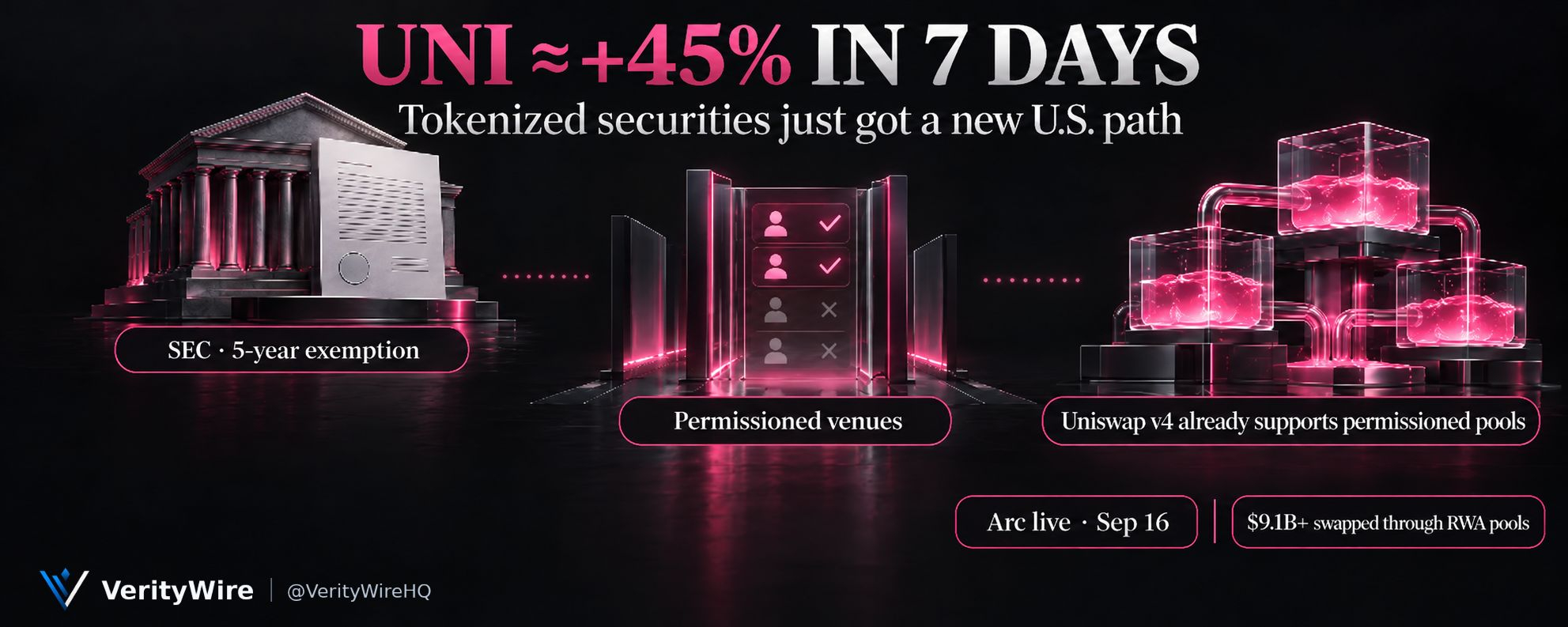
$UNI is up about 45% over the past week. The latest leg came as U.S. rules opened a new path for tokenized stock trading onchain.
On September 17, the SEC created a five-year exemption for certain tokenized U.S. stocks to trade through permissioned venues.
Uniswap already has infrastructure built for that market. Its v4 Permissioned Pools check issuer-managed allowlists on every swap and liquidity action. Uniswap designed them for regulated assets including tokenized funds, securities and equities.
This is not just a future use case. In June, Uniswap said more than $9.1B had already been swapped through real-world-asset pools across 2.6M transactions and more than 140,000 wallets.
Arc adds another piece. Uniswap went live there on September 16 as a preferred DEX on Circle’s stablecoin-focused network.
The SEC did not approve Uniswap itself. But the new framework targets the same kind of permissioned onchain market infrastructure Uniswap has already built.
$UNI
$UNI is up about 45% over the past week. The latest leg came as U.S. rules opened a new path for tokenized stock trading onchain.
On September 17, the SEC created a five-year exemption for certain tokenized U.S. stocks to trade through permissioned venues.
Uniswap already has infrastructure built for that market. Its v4 Permissioned Pools check issuer-managed allowlists on every swap and liquidity action. Uniswap designed them for regulated assets including tokenized funds, securities and equities.
This is not just a future use case. In June, Uniswap said more than $9.1B had already been swapped through real-world-asset pools across 2.6M transactions and more than 140,000 wallets.
Arc adds another piece. Uniswap went live there on September 16 as a preferred DEX on Circle’s stablecoin-focused network.
The SEC did not approve Uniswap itself. But the new framework targets the same kind of permissioned onchain market infrastructure Uniswap has already built.
$UNI
On September 17, the SEC created a five-year exemption for certain tokenized U.S. stocks to trade through permissioned venues.
Uniswap already has infrastructure built for that market. Its v4 Permissioned Pools check issuer-managed allowlists on every swap and liquidity action. Uniswap designed them for regulated assets including tokenized funds, securities and equities.
This is not just a future use case. In June, Uniswap said more than $9.1B had already been swapped through real-world-asset pools across 2.6M transactions and more than 140,000 wallets.
Arc adds another piece. Uniswap went live there on September 16 as a preferred DEX on Circle’s stablecoin-focused network.
The SEC did not approve Uniswap itself. But the new framework targets the same kind of permissioned onchain market infrastructure Uniswap has already built.
$UNI
88
·
--
$SOL is one of the strongest large-cap movers today, up about 12% over 24 hours on Binance while BTC is up about 5% and ETH about 6%.
The easy explanation is to point at Solana’s recent network upgrades. But the timing does not support calling them the cause of today’s move.
Solana did cut mainnet target slot time to 300ms in late August. That is a real infrastructure change, but it happened weeks ago. The latest Solana changelog also said V1 transaction activation was delayed to epoch 1035, so this is not a clean “new upgrade went live today” story.
What is confirmed: SOL is outperforming during a broad crypto rebound, trading around $113 with roughly $6.5B in 24-hour volume. Attention around the move is also picking up on Binance Square.
What is not confirmed is a fresh Solana-specific trigger.
I’d watch whether SOL keeps outperforming once the broader market rebound settles. If that relative strength disappears, today’s move looks more like high-beta market participation than a new Solana catalyst.
$SOL
$SOL is one of the strongest large-cap movers today, up about 12% over 24 hours on Binance while BTC is up about 5% and ETH about 6%.
The easy explanation is to point at Solana’s recent network upgrades. But the timing does not support calling them the cause of today’s move.
Solana did cut mainnet target slot time to 300ms in late August. That is a real infrastructure change, but it happened weeks ago. The latest Solana changelog also said V1 transaction activation was delayed to epoch 1035, so this is not a clean “new upgrade went live today” story.
What is confirmed: SOL is outperforming during a broad crypto rebound, trading around $113 with roughly $6.5B in 24-hour volume. Attention around the move is also picking up on Binance Square.
What is not confirmed is a fresh Solana-specific trigger.
I’d watch whether SOL keeps outperforming once the broader market rebound settles. If that relative strength disappears, today’s move looks more like high-beta market participation than a new Solana catalyst.
$SOL
The easy explanation is to point at Solana’s recent network upgrades. But the timing does not support calling them the cause of today’s move.
Solana did cut mainnet target slot time to 300ms in late August. That is a real infrastructure change, but it happened weeks ago. The latest Solana changelog also said V1 transaction activation was delayed to epoch 1035, so this is not a clean “new upgrade went live today” story.
What is confirmed: SOL is outperforming during a broad crypto rebound, trading around $113 with roughly $6.5B in 24-hour volume. Attention around the move is also picking up on Binance Square.
What is not confirmed is a fresh Solana-specific trigger.
I’d watch whether SOL keeps outperforming once the broader market rebound settles. If that relative strength disappears, today’s move looks more like high-beta market participation than a new Solana catalyst.
$SOL
120
·
--
Verified
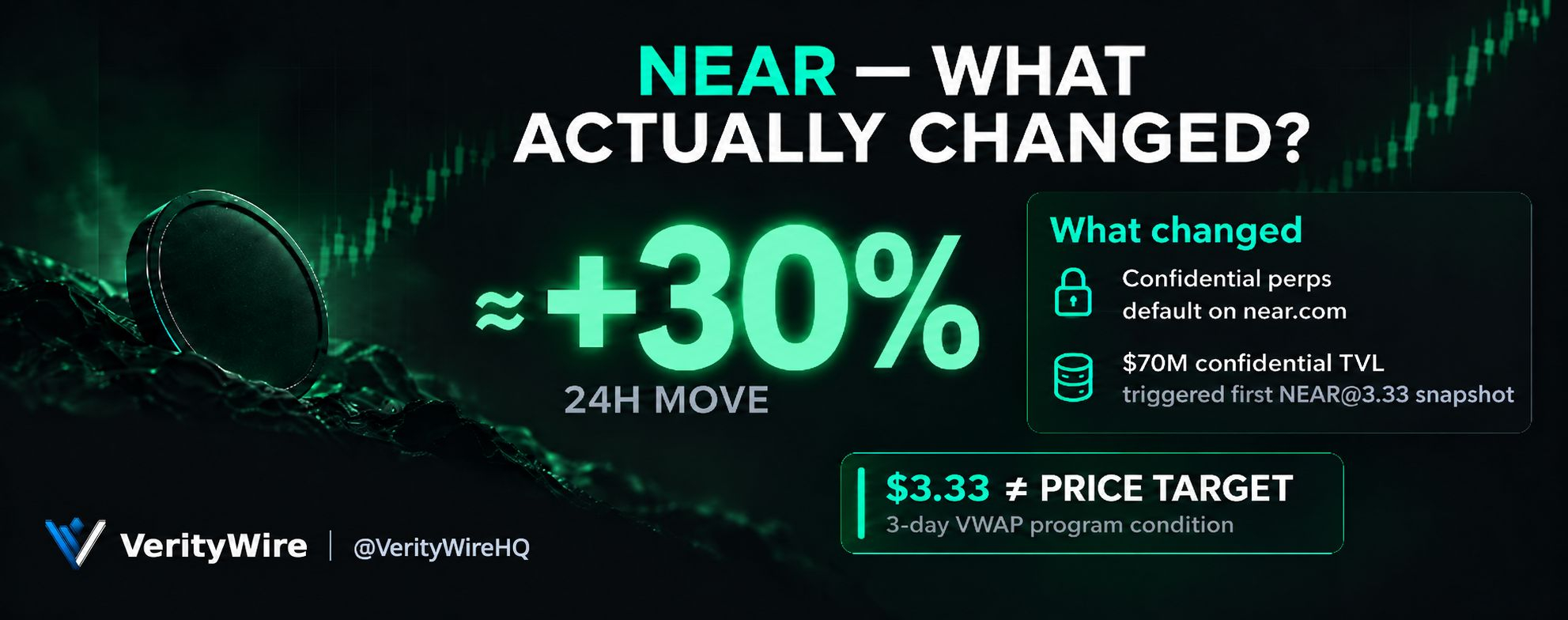
NEAR was up about 30% over 24 hours at the latest check, during a broader altcoin rally. The move also came as near.com rolled out confidential-by-default perpetual positions and said confidential TVL had crossed $70 million, enough to trigger the first NEAR@3.33 snapshot.
That program name can be misleading. A brief move above $3.33 does not unlock the 333,333 milestone tokens; the rule uses a three-day VWAP at or above that level.
The timing makes the product news relevant, but it does not prove it caused the whole rally. near.com also says its Confidential Mode reduces public visibility rather than guaranteeing complete anonymity.
NEAR was up about 30% over 24 hours at the latest check, during a broader altcoin rally. The move also came as near.com rolled out confidential-by-default perpetual positions and said confidential TVL had crossed $70 million, enough to trigger the first NEAR@3.33 snapshot.
That program name can be misleading. A brief move above $3.33 does not unlock the 333,333 milestone tokens; the rule uses a three-day VWAP at or above that level.
The timing makes the product news relevant, but it does not prove it caused the whole rally. near.com also says its Confidential Mode reduces public visibility rather than guaranteeing complete anonymity.
That program name can be misleading. A brief move above $3.33 does not unlock the 333,333 milestone tokens; the rule uses a three-day VWAP at or above that level.
The timing makes the product news relevant, but it does not prove it caused the whole rally. near.com also says its Confidential Mode reduces public visibility rather than guaranteeing complete anonymity.
187
·
--
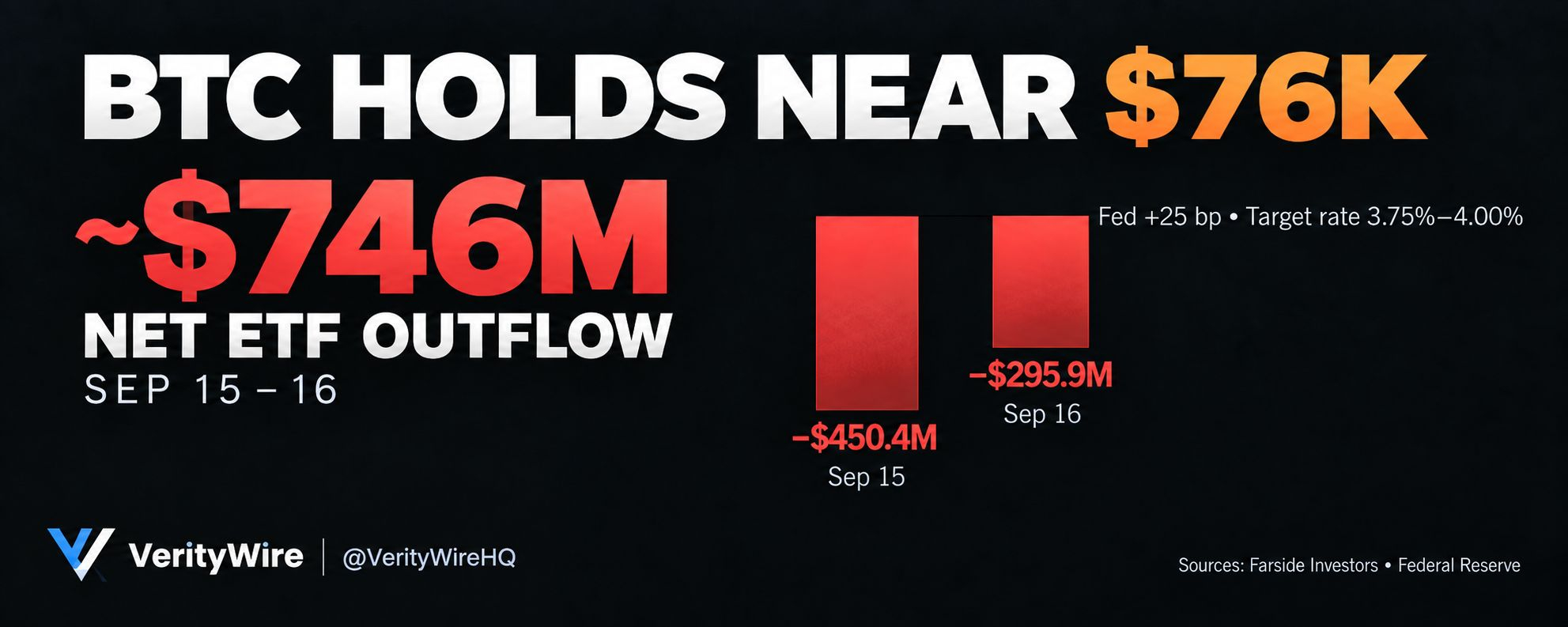
Bitcoin is still hovering around $76K after a tough two-day stretch.
The Fed raised rates by 25 bps to 3.75%–4.00%, the dollar strengthened, and U.S. spot Bitcoin ETFs recorded $450.4M in net outflows on Sept. 15 and another $295.9M on Sept. 16 — about $746M across two sessions.
Yet BTC still hasn’t broken into another sharp move lower.
That does not prove demand is strong. It suggests something narrower: the market is absorbing tighter macro conditions and weak ETF flows better than many would expect.
The next real test is ETF flows. If they stabilize while BTC holds this range, selling pressure may be easing. If outflows continue and price slips, this resilience was only temporary.
For now, price and flows are telling different stories.
$BTC
Bitcoin is still hovering around $76K after a tough two-day stretch.
The Fed raised rates by 25 bps to 3.75%–4.00%, the dollar strengthened, and U.S. spot Bitcoin ETFs recorded $450.4M in net outflows on Sept. 15 and another $295.9M on Sept. 16 — about $746M across two sessions.
Yet BTC still hasn’t broken into another sharp move lower.
That does not prove demand is strong. It suggests something narrower: the market is absorbing tighter macro conditions and weak ETF flows better than many would expect.
The next real test is ETF flows. If they stabilize while BTC holds this range, selling pressure may be easing. If outflows continue and price slips, this resilience was only temporary.
For now, price and flows are telling different stories.
$BTC
The Fed raised rates by 25 bps to 3.75%–4.00%, the dollar strengthened, and U.S. spot Bitcoin ETFs recorded $450.4M in net outflows on Sept. 15 and another $295.9M on Sept. 16 — about $746M across two sessions.
Yet BTC still hasn’t broken into another sharp move lower.
That does not prove demand is strong. It suggests something narrower: the market is absorbing tighter macro conditions and weak ETF flows better than many would expect.
The next real test is ETF flows. If they stabilize while BTC holds this range, selling pressure may be easing. If outflows continue and price slips, this resilience was only temporary.
For now, price and flows are telling different stories.
$BTC
95
·
--
Crypto’s overnight drop had a clear chain behind it.
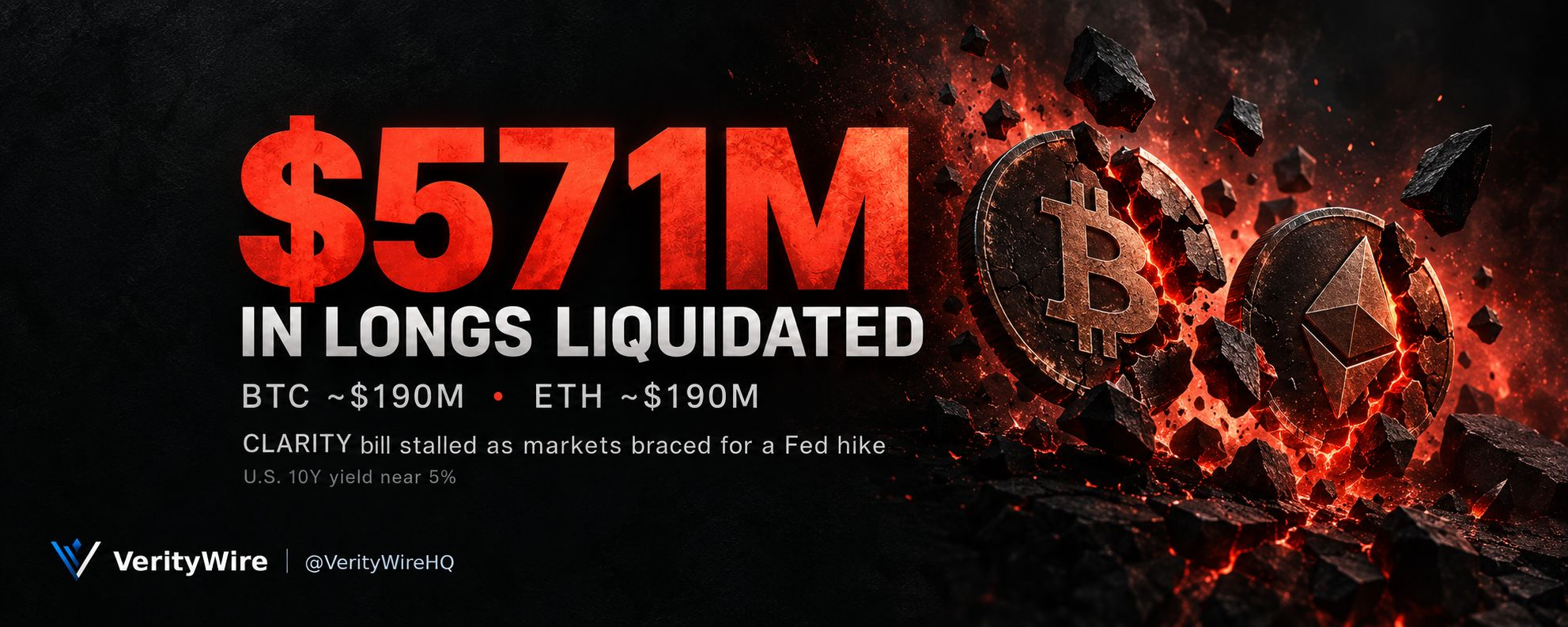
The U.S. Senate failed to advance the CLARITY bill, while 10-year Treasury yields were sitting near 5% and markets were bracing for a Fed hike. That was already a difficult backdrop for risk assets.
Then leverage made the move worse.
As BTC and ETH fell, exchanges started closing leveraged long positions automatically. About $571M in longs were liquidated over 24 hours, with BTC and ETH accounting for roughly $190M each.
So the $571M wasn’t the original cause of the selloff. It was the accelerator. The market was already under pressure — leverage turned the drop into a faster one.
$BTC $ETH
Crypto’s overnight drop had a clear chain behind it.
The U.S. Senate failed to advance the CLARITY bill, while 10-year Treasury yields were sitting near 5% and markets were bracing for a Fed hike. That was already a difficult backdrop for risk assets.
Then leverage made the move worse.
As BTC and ETH fell, exchanges started closing leveraged long positions automatically. About $571M in longs were liquidated over 24 hours, with BTC and ETH accounting for roughly $190M each.
So the $571M wasn’t the original cause of the selloff. It was the accelerator. The market was already under pressure — leverage turned the drop into a faster one.
$BTC $ETH
The U.S. Senate failed to advance the CLARITY bill, while 10-year Treasury yields were sitting near 5% and markets were bracing for a Fed hike. That was already a difficult backdrop for risk assets.
Then leverage made the move worse.
As BTC and ETH fell, exchanges started closing leveraged long positions automatically. About $571M in longs were liquidated over 24 hours, with BTC and ETH accounting for roughly $190M each.
So the $571M wasn’t the original cause of the selloff. It was the accelerator. The market was already under pressure — leverage turned the drop into a faster one.
$BTC $ETH
60
·
--
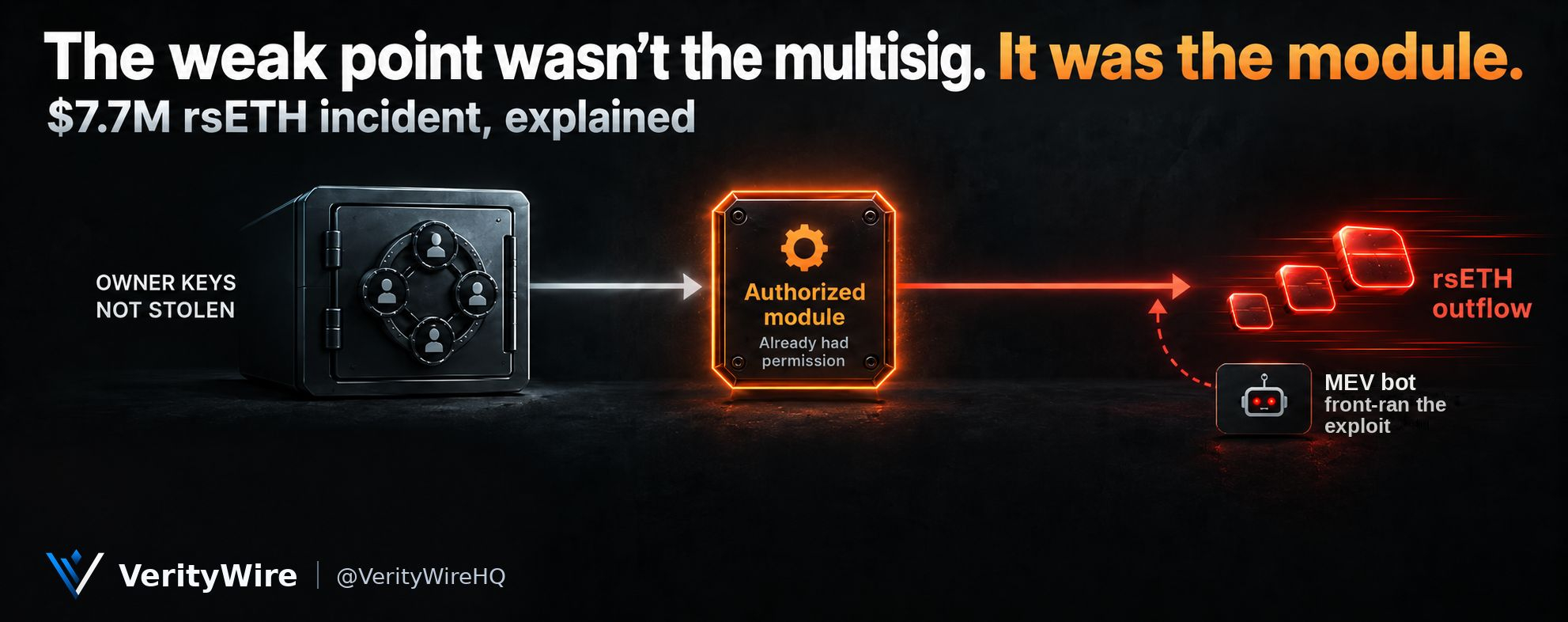
On Sept. 15, about $7.7M in rsETH was pulled from an Ethereum Safe. No owner key was stolen, and the Safe contracts weren’t the problem.
The wallet had a custom module that was already allowed to act for it. A missing access check let an outside caller use that permission without getting a new signature from the owners.
An MEV bot then spotted the transaction and got to the rsETH first. Kelp temporarily restricted the receiving address.
That changes how you look at a multisig. The signer threshold matters, but so does every module that can act without going back to those signers.
On Sept. 15, about $7.7M in rsETH was pulled from an Ethereum Safe. No owner key was stolen, and the Safe contracts weren’t the problem.
The wallet had a custom module that was already allowed to act for it. A missing access check let an outside caller use that permission without getting a new signature from the owners.
An MEV bot then spotted the transaction and got to the rsETH first. Kelp temporarily restricted the receiving address.
That changes how you look at a multisig. The signer threshold matters, but so does every module that can act without going back to those signers.
The wallet had a custom module that was already allowed to act for it. A missing access check let an outside caller use that permission without getting a new signature from the owners.
An MEV bot then spotted the transaction and got to the rsETH first. Kelp temporarily restricted the receiving address.
That changes how you look at a multisig. The signer threshold matters, but so does every module that can act without going back to those signers.
67
Log in to explore more content
Join global crypto users on Binance Square
⚡️ Get latest and useful information about crypto.
💬 Trusted by the world’s largest crypto exchange.
👍 Discover real insights from verified creators.
Email / Phone number
Trending Topics
EtherGains70.9%InQ3
94,796 views
895 Discussing
One of the best third quarters in history 💰
September closed out last night, and with it, the quarter. For the quarter, BTC is up 42%—the second-best Q3 on record. ETH had a record-breaking Q3 overall, up 70%.
Looking at the chart, things are still looking good: we’re holding support, but we’re testing it more and more often. Plus, ETF momentum is weakening — inflows are gradually declining, and yesterday saw outflows for the first time in a long while.
Yes, historically, October has been a good month for crypto — it’s not called “Uptober” for nothing. But it’s also one of the most volatile months. Last year, for example, we managed to hit a new all-time high (ATH) and experience a flash crash.
🚀 High Accuracy Trades.
$BTC
$ETH
$SOL
#EtherGains70.9%InQ3 #DollarIndexHitsHighestSinceMay2025 #CFTCSubmitsTwoEventContractRulesToWhiteHouse #MicronBeatsEarningsLiftsGuidance
Knowledge is Power
·0 Likes
·178 views
TreasuryLetsStatesFileStablecoinCertificationsEarly
4,716 views
53 Discussing
US10YearYieldNears5.3%
117,296 views
961 Discussing