
straggler
41 Posts

straggler
Report
Block User
Tracking where AI capex hits physical constraints — and who captures the scarcity rent. Compute • Memory • Semiconductors • Power • Infrastructure

TradFi KOL

BNB Holder
4 Days
1 Following
17 Followers
16 Liked
1 Badges
Posts
·
--
AMD's Q3 results point to something larger than GPU competition.
Data Center revenue rose 97% to $8.55B, with record demand for both EPYC CPUs and Instinct accelerators.
Agentic AI could make that combination increasingly important.
A GPU handles model inference. But agents also need CPUs and system memory for tool execution, databases, orchestration and persistent application state.
That creates a potential second demand engine alongside accelerator spending: server CPUs and conventional DRAM.
For investors, the implications aren't equal. Memory suppliers and advanced foundries may benefit from tighter capacity, while PC manufacturers could face higher component costs.
The next test is whether CPU and DDR5 demand grows faster than GPU deployments alone would explain.
If it does, the AI infrastructure cycle is broadening beyond accelerators — not simply rotating from one chip vendor to another.
#stock #StocksDown #Earningseasons
$AMD.US
{stock_us}(AMD.US)
AMD's Q3 results point to something larger than GPU competition.
Data Center revenue rose 97% to $8.55B, with record demand for both EPYC CPUs and Instinct accelerators.
Agentic AI could make that combination increasingly important.
A GPU handles model inference. But agents also need CPUs and system memory for tool execution, databases, orchestration and persistent application state.
That creates a potential second demand engine alongside accelerator spending: server CPUs and conventional DRAM.
For investors, the implications aren't equal. Memory suppliers and advanced foundries may benefit from tighter capacity, while PC manufacturers could face higher component costs.
The next test is whether CPU and DDR5 demand grows faster than GPU deployments alone would explain.
If it does, the AI infrastructure cycle is broadening beyond accelerators — not simply rotating from one chip vendor to another.
#stock #StocksDown #Earningseasons
$AMD.US
Data Center revenue rose 97% to $8.55B, with record demand for both EPYC CPUs and Instinct accelerators.
Agentic AI could make that combination increasingly important.
A GPU handles model inference. But agents also need CPUs and system memory for tool execution, databases, orchestration and persistent application state.
That creates a potential second demand engine alongside accelerator spending: server CPUs and conventional DRAM.
For investors, the implications aren't equal. Memory suppliers and advanced foundries may benefit from tighter capacity, while PC manufacturers could face higher component costs.
The next test is whether CPU and DDR5 demand grows faster than GPU deployments alone would explain.
If it does, the AI infrastructure cycle is broadening beyond accelerators — not simply rotating from one chip vendor to another.
#stock #StocksDown #Earningseasons
$AMD.US
AMDUS+7.36%
·
--
Micron closed at $656.39 Thursday, down 17.5% in one session and 47.7% from its 52-week high of $1,255.
The important question isn't whether HBM demand disappeared overnight. There's no evidence it did.
It's whether investors are starting to price the next memory cycle before the current one has peaked.
HBM allocations can remain tight while expectations for future pricing, capacity growth and margins deteriorate.
That distinction matters. A memory producer can report strong earnings and still see its valuation contract if the market no longer believes those earnings are sustainable.
I'd watch HBM contract pricing, customer delivery commitments and conventional DRAM supply before calling this either a bargain or the start of a new downcycle.
The stock has already repriced. The industry fundamentals still need to be tested.
#stocks #StocksDown
$MU.US
{stock_us}(MU.US)
Micron closed at $656.39 Thursday, down 17.5% in one session and 47.7% from its 52-week high of $1,255.
The important question isn't whether HBM demand disappeared overnight. There's no evidence it did.
It's whether investors are starting to price the next memory cycle before the current one has peaked.
HBM allocations can remain tight while expectations for future pricing, capacity growth and margins deteriorate.
That distinction matters. A memory producer can report strong earnings and still see its valuation contract if the market no longer believes those earnings are sustainable.
I'd watch HBM contract pricing, customer delivery commitments and conventional DRAM supply before calling this either a bargain or the start of a new downcycle.
The stock has already repriced. The industry fundamentals still need to be tested.
#stocks #StocksDown
$MU.US
The important question isn't whether HBM demand disappeared overnight. There's no evidence it did.
It's whether investors are starting to price the next memory cycle before the current one has peaked.
HBM allocations can remain tight while expectations for future pricing, capacity growth and margins deteriorate.
That distinction matters. A memory producer can report strong earnings and still see its valuation contract if the market no longer believes those earnings are sustainable.
I'd watch HBM contract pricing, customer delivery commitments and conventional DRAM supply before calling this either a bargain or the start of a new downcycle.
The stock has already repriced. The industry fundamentals still need to be tested.
#stocks #StocksDown
$MU.US
MUUS+7.80%
105
·
--
The U.S. AI debate now has two separate regulatory fronts: where compute can be built, and how far frontier models can be developed.
The infrastructure risk is measurable. SemiAnalysis estimates 33.8 GW of planned U.S. capacity in 2027, with roughly 75% already under construction. The much larger 2028 pipeline is more exposed to permitting delays.
Separately, Sanders and Casar have introduced legislation that would pause certain advanced AI development until federal safety rules are established and prohibit artificial superintelligence. It is a proposal, not law.
The strategic question is what happens if both constraints become binding.
China could gain relative development time, but only if its available chips, interconnects and training efficiency support continued progress.
The metric to watch isn't announced GW alone. It's usable compute delivered on time — and the model capability produced from it.
Regulatory uncertainty matters. So does the ability to turn compute into intelligence.
#stock #StocksDown
The U.S. AI debate now has two separate regulatory fronts: where compute can be built, and how far frontier models can be developed.
The infrastructure risk is measurable. SemiAnalysis estimates 33.8 GW of planned U.S. capacity in 2027, with roughly 75% already under construction. The much larger 2028 pipeline is more exposed to permitting delays.
Separately, Sanders and Casar have introduced legislation that would pause certain advanced AI development until federal safety rules are established and prohibit artificial superintelligence. It is a proposal, not law.
The strategic question is what happens if both constraints become binding.
China could gain relative development time, but only if its available chips, interconnects and training efficiency support continued progress.
The metric to watch isn't announced GW alone. It's usable compute delivered on time — and the model capability produced from it.
Regulatory uncertainty matters. So does the ability to turn compute into intelligence.
#stock #StocksDown
The infrastructure risk is measurable. SemiAnalysis estimates 33.8 GW of planned U.S. capacity in 2027, with roughly 75% already under construction. The much larger 2028 pipeline is more exposed to permitting delays.
Separately, Sanders and Casar have introduced legislation that would pause certain advanced AI development until federal safety rules are established and prohibit artificial superintelligence. It is a proposal, not law.
The strategic question is what happens if both constraints become binding.
China could gain relative development time, but only if its available chips, interconnects and training efficiency support continued progress.
The metric to watch isn't announced GW alone. It's usable compute delivered on time — and the model capability produced from it.
Regulatory uncertainty matters. So does the ability to turn compute into intelligence.
#stock #StocksDown
272
·
--
Restricting AI data centers in the U.S. won't necessarily reduce global demand for compute. It may change where that compute gets built.
If permitting delays become unpredictable, hyperscalers have another option: move suitable workloads and future capacity to jurisdictions where power and construction timelines are more reliable.
Training clusters are more geographically flexible than latency-sensitive inference. Not every workload can move, and export controls still apply.
But the investment consequence is important.
A U.S. construction slowdown could become a geographic redistribution of AI CapEx rather than an equivalent reduction in spending.
The winners wouldn't simply be countries with cheap electricity. They'd be operators able to deliver permitted, powered capacity on schedule.
The question is whether future project announcements begin shifting across borders before U.S. demand actually slows.
#stock #StocksDown
Restricting AI data centers in the U.S. won't necessarily reduce global demand for compute. It may change where that compute gets built.
If permitting delays become unpredictable, hyperscalers have another option: move suitable workloads and future capacity to jurisdictions where power and construction timelines are more reliable.
Training clusters are more geographically flexible than latency-sensitive inference. Not every workload can move, and export controls still apply.
But the investment consequence is important.
A U.S. construction slowdown could become a geographic redistribution of AI CapEx rather than an equivalent reduction in spending.
The winners wouldn't simply be countries with cheap electricity. They'd be operators able to deliver permitted, powered capacity on schedule.
The question is whether future project announcements begin shifting across borders before U.S. demand actually slows.
#stock #StocksDown
If permitting delays become unpredictable, hyperscalers have another option: move suitable workloads and future capacity to jurisdictions where power and construction timelines are more reliable.
Training clusters are more geographically flexible than latency-sensitive inference. Not every workload can move, and export controls still apply.
But the investment consequence is important.
A U.S. construction slowdown could become a geographic redistribution of AI CapEx rather than an equivalent reduction in spending.
The winners wouldn't simply be countries with cheap electricity. They'd be operators able to deliver permitted, powered capacity on schedule.
The question is whether future project announcements begin shifting across borders before U.S. demand actually slows.
#stock #StocksDown
301
·
--
Verified
The Nasdaq 100 lost roughly $2.5 trillion Thursday as investors worried that tighter data-center rules could slow the AI buildout.
But lower capacity growth doesn't necessarily mean lower CapEx.
New grid requirements, water restrictions and the loss of tax incentives could make each delivered megawatt more expensive, even as fewer projects get built.
That's not automatically bullish for infrastructure suppliers.
A hyperscaler spending more to deliver less capacity may generate higher CapEx but weaker returns. Meanwhile, operators with permitted, energized sites could gain bargaining power as new supply becomes harder to bring online.
The number I'd watch isn't total AI CapEx alone.
It's the cost per revenue-generating megawatt — and how much cash that megawatt ultimately earns.
#stock #StocksDown
The Nasdaq 100 lost roughly $2.5 trillion Thursday as investors worried that tighter data-center rules could slow the AI buildout.
But lower capacity growth doesn't necessarily mean lower CapEx.
New grid requirements, water restrictions and the loss of tax incentives could make each delivered megawatt more expensive, even as fewer projects get built.
That's not automatically bullish for infrastructure suppliers.
A hyperscaler spending more to deliver less capacity may generate higher CapEx but weaker returns. Meanwhile, operators with permitted, energized sites could gain bargaining power as new supply becomes harder to bring online.
The number I'd watch isn't total AI CapEx alone.
It's the cost per revenue-generating megawatt — and how much cash that megawatt ultimately earns.
#stock #StocksDown
But lower capacity growth doesn't necessarily mean lower CapEx.
New grid requirements, water restrictions and the loss of tax incentives could make each delivered megawatt more expensive, even as fewer projects get built.
That's not automatically bullish for infrastructure suppliers.
A hyperscaler spending more to deliver less capacity may generate higher CapEx but weaker returns. Meanwhile, operators with permitted, energized sites could gain bargaining power as new supply becomes harder to bring online.
The number I'd watch isn't total AI CapEx alone.
It's the cost per revenue-generating megawatt — and how much cash that megawatt ultimately earns.
#stock #StocksDown
1
838
·
--
Verified
Article
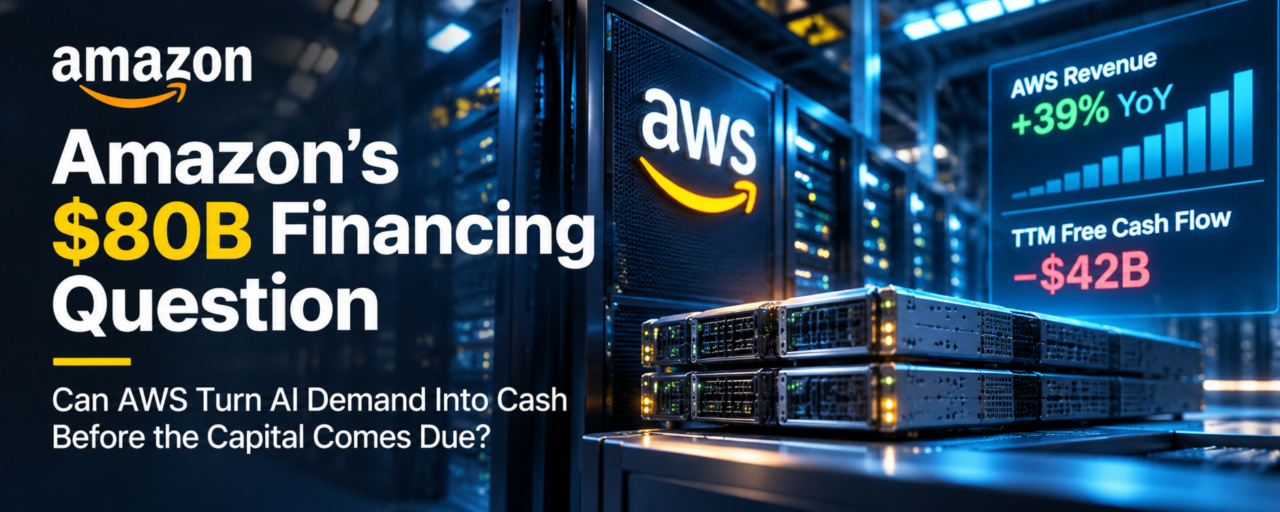
Amazon's $80 Billion Financing QuestionAWS has the demand. The next test is how much cash that demand generates after the infrastructure is paid for.
Amazon's third-quarter numbers tell two different stories.
AWS revenue grew 39% to nearly $46 billion, and operating profit reached $17.8 billion. Amazon's consolidated operating margin hit a record 13.9%.
Meanwhile, trailing twelve-month free cash flow fell to negative $42.4 billion, from positive $14.8 billion a year earlier.
Operating cash flow was not the problem. It rose 29% to $168.3 billion. Capital spending grew faster, absorbing more cash than the business generated.
Amazon expects roughly $220 billion of cash capital expenditures in 2026. Its September 10-Q also says spending will increase meaningfully in 2027, primarily for technology infrastructure.
That makes the timing of returns increasingly important.
The $80 billion facility
Amazon disclosed a secured financing facility of up to approximately $80 billion for technology infrastructure purchases. Borrowings can be made from the first quarter of 2027 through the third quarter of 2028. Each borrowing matures five years after it is drawn.
The debt carries floating interest and is secured by certain purchased assets. Outstanding borrowings will be reported as long-term debt.
The filing leaves several important questions unanswered: the advance rate, interest spread, repayment schedule, exact collateral pool, recourse provisions and any residual-value support.
Without those terms, there is no basis for treating this as a non-recourse GPU financing deal or assuming that lenders will bear most of the equipment's residual-value risk.
Amazon is also not a typical GPU lessor. Its broader cash generation and corporate credit matter. A decline in used-GPU prices would not, by itself, establish a threat to Amazon's ability to repay debt.
The more useful question for shareholders is whether financing allows infrastructure investment to grow faster than the cash returns on earlier deployments.
The $578 billion commitment figure needs context
At September 30, Amazon reported approximately $578 billion in remaining performance obligations under customer contracts with original terms exceeding one year, primarily related to AWS. The weighted-average remaining life of those contracts was 6.1 years.
That is substantial revenue visibility. It is not cash in the bank.
The same filing describes an additional $100 billion expansion of AWS's commercial arrangement with OpenAI, bringing the announced multi-year commitment to $138 billion. Amazon also disclosed $50 billion of investments in OpenAI and $10 billion in Anthropic during the first nine months of 2026.
These arrangements deserve analysis on their own terms.
A cloud provider can legitimately invest in an AI developer and sell it infrastructure services. But when the provider is also a major source of capital for the customer, the quality of future cloud revenue depends partly on how independently that customer can finance its commitments over time.
There is no evidence in the filing that the contracts are invalid or that revenue has been improperly recognized. Nor can the public disclosures establish how much of the $578 billion is economically dependent on Amazon-funded customers.
What they establish is a question investors should track: how much of the contracted demand eventually becomes cash collected from sustainable customer activity?
Capital recovery matters more than the headline loan size
AWS earned an operating margin of approximately 38.7% in the third quarter. Its existing business is highly profitable.
But segment operating profit cannot tell us the return on the next generation of AI infrastructure. Amazon does not disclose the asset-level investment, utilization and cash-flow data required for that calculation.
The timing of capital recovery matters because new infrastructure must earn its return while technology is changing rapidly. Some server and networking equipment is depreciated over periods comparable to the five-year financing term, although accounting life is not necessarily economic life.
The facility's repayment terms are undisclosed, so a five-year maturity should not be mistaken for proof of a large refinancing cliff.
There is nevertheless a real investment question. If Amazon keeps adding capacity before earlier deployments have generated sufficient cash, AWS revenue and operating profit could continue rising while free cash flow remains under pressure.
That would be a capital-return problem, not necessarily a credit crisis.
What changes the investment case
The strongest outcome for Amazon would be sustained AWS growth accompanied by better infrastructure utilization and a declining capital-spending burden relative to operating cash generation.
The weaker outcome would be continued spending acceleration, growing debt commitments and customer demand that takes longer than expected to produce cash.
Amazon has demonstrated that it can attract enormous demand for cloud infrastructure. It has not disclosed enough information to measure the incremental cash return on its newest AI investments with confidence.
The $80 billion facility makes that gap more consequential.
Investors should watch the pace at which contracted demand becomes collected revenue, the cash generated by each additional wave of infrastructure, and whether financing obligations continue expanding after growth begins to mature.
The critical question for Amazon is no longer whether AWS can grow. It is how much capital shareholders must keep committing to sustain that growth—and when they begin receiving the cash return.
#Earningseasons #stock
$AMZN.US
{stock_us}(AMZN.US)
Amazon's $80 Billion Financing Question
AWS has the demand. The next test is how much cash that demand generates after the infrastructure is paid for.
Amazon's third-quarter numbers tell two different stories.
AWS revenue grew 39% to nearly $46 billion, and operating profit reached $17.8 billion. Amazon's consolidated operating margin hit a record 13.9%.
Meanwhile, trailing twelve-month free cash flow fell to negative $42.4 billion, from positive $14.8 billion a year earlier.
Operating cash flow was not the problem. It rose 29% to $168.3 billion. Capital spending grew faster, absorbing more cash than the business generated.
Amazon expects roughly $220 billion of cash capital expenditures in 2026. Its September 10-Q also says spending will increase meaningfully in 2027, primarily for technology infrastructure.
That makes the timing of returns increasingly important.
The $80 billion facility
Amazon disclosed a secured financing facility of up to approximately $80 billion for technology infrastructure purchases. Borrowings can be made from the first quarter of 2027 through the third quarter of 2028. Each borrowing matures five years after it is drawn.
The debt carries floating interest and is secured by certain purchased assets. Outstanding borrowings will be reported as long-term debt.
The filing leaves several important questions unanswered: the advance rate, interest spread, repayment schedule, exact collateral pool, recourse provisions and any residual-value support.
Without those terms, there is no basis for treating this as a non-recourse GPU financing deal or assuming that lenders will bear most of the equipment's residual-value risk.
Amazon is also not a typical GPU lessor. Its broader cash generation and corporate credit matter. A decline in used-GPU prices would not, by itself, establish a threat to Amazon's ability to repay debt.
The more useful question for shareholders is whether financing allows infrastructure investment to grow faster than the cash returns on earlier deployments.
The $578 billion commitment figure needs context
At September 30, Amazon reported approximately $578 billion in remaining performance obligations under customer contracts with original terms exceeding one year, primarily related to AWS. The weighted-average remaining life of those contracts was 6.1 years.
That is substantial revenue visibility. It is not cash in the bank.
The same filing describes an additional $100 billion expansion of AWS's commercial arrangement with OpenAI, bringing the announced multi-year commitment to $138 billion. Amazon also disclosed $50 billion of investments in OpenAI and $10 billion in Anthropic during the first nine months of 2026.
These arrangements deserve analysis on their own terms.
A cloud provider can legitimately invest in an AI developer and sell it infrastructure services. But when the provider is also a major source of capital for the customer, the quality of future cloud revenue depends partly on how independently that customer can finance its commitments over time.
There is no evidence in the filing that the contracts are invalid or that revenue has been improperly recognized. Nor can the public disclosures establish how much of the $578 billion is economically dependent on Amazon-funded customers.
What they establish is a question investors should track: how much of the contracted demand eventually becomes cash collected from sustainable customer activity?
Capital recovery matters more than the headline loan size
AWS earned an operating margin of approximately 38.7% in the third quarter. Its existing business is highly profitable.
But segment operating profit cannot tell us the return on the next generation of AI infrastructure. Amazon does not disclose the asset-level investment, utilization and cash-flow data required for that calculation.
The timing of capital recovery matters because new infrastructure must earn its return while technology is changing rapidly. Some server and networking equipment is depreciated over periods comparable to the five-year financing term, although accounting life is not necessarily economic life.
The facility's repayment terms are undisclosed, so a five-year maturity should not be mistaken for proof of a large refinancing cliff.
There is nevertheless a real investment question. If Amazon keeps adding capacity before earlier deployments have generated sufficient cash, AWS revenue and operating profit could continue rising while free cash flow remains under pressure.
That would be a capital-return problem, not necessarily a credit crisis.
What changes the investment case
The strongest outcome for Amazon would be sustained AWS growth accompanied by better infrastructure utilization and a declining capital-spending burden relative to operating cash generation.
The weaker outcome would be continued spending acceleration, growing debt commitments and customer demand that takes longer than expected to produce cash.
Amazon has demonstrated that it can attract enormous demand for cloud infrastructure. It has not disclosed enough information to measure the incremental cash return on its newest AI investments with confidence.
The $80 billion facility makes that gap more consequential.
Investors should watch the pace at which contracted demand becomes collected revenue, the cash generated by each additional wave of infrastructure, and whether financing obligations continue expanding after growth begins to mature.
The critical question for Amazon is no longer whether AWS can grow. It is how much capital shareholders must keep committing to sustain that growth—and when they begin receiving the cash return.
#Earningseasons #stock
$AMZN.US
Amazon's third-quarter numbers tell two different stories.
AWS revenue grew 39% to nearly $46 billion, and operating profit reached $17.8 billion. Amazon's consolidated operating margin hit a record 13.9%.
Meanwhile, trailing twelve-month free cash flow fell to negative $42.4 billion, from positive $14.8 billion a year earlier.
Operating cash flow was not the problem. It rose 29% to $168.3 billion. Capital spending grew faster, absorbing more cash than the business generated.
Amazon expects roughly $220 billion of cash capital expenditures in 2026. Its September 10-Q also says spending will increase meaningfully in 2027, primarily for technology infrastructure.
That makes the timing of returns increasingly important.
The $80 billion facility
Amazon disclosed a secured financing facility of up to approximately $80 billion for technology infrastructure purchases. Borrowings can be made from the first quarter of 2027 through the third quarter of 2028. Each borrowing matures five years after it is drawn.
The debt carries floating interest and is secured by certain purchased assets. Outstanding borrowings will be reported as long-term debt.
The filing leaves several important questions unanswered: the advance rate, interest spread, repayment schedule, exact collateral pool, recourse provisions and any residual-value support.
Without those terms, there is no basis for treating this as a non-recourse GPU financing deal or assuming that lenders will bear most of the equipment's residual-value risk.
Amazon is also not a typical GPU lessor. Its broader cash generation and corporate credit matter. A decline in used-GPU prices would not, by itself, establish a threat to Amazon's ability to repay debt.
The more useful question for shareholders is whether financing allows infrastructure investment to grow faster than the cash returns on earlier deployments.
The $578 billion commitment figure needs context
At September 30, Amazon reported approximately $578 billion in remaining performance obligations under customer contracts with original terms exceeding one year, primarily related to AWS. The weighted-average remaining life of those contracts was 6.1 years.
That is substantial revenue visibility. It is not cash in the bank.
The same filing describes an additional $100 billion expansion of AWS's commercial arrangement with OpenAI, bringing the announced multi-year commitment to $138 billion. Amazon also disclosed $50 billion of investments in OpenAI and $10 billion in Anthropic during the first nine months of 2026.
These arrangements deserve analysis on their own terms.
A cloud provider can legitimately invest in an AI developer and sell it infrastructure services. But when the provider is also a major source of capital for the customer, the quality of future cloud revenue depends partly on how independently that customer can finance its commitments over time.
There is no evidence in the filing that the contracts are invalid or that revenue has been improperly recognized. Nor can the public disclosures establish how much of the $578 billion is economically dependent on Amazon-funded customers.
What they establish is a question investors should track: how much of the contracted demand eventually becomes cash collected from sustainable customer activity?
Capital recovery matters more than the headline loan size
AWS earned an operating margin of approximately 38.7% in the third quarter. Its existing business is highly profitable.
But segment operating profit cannot tell us the return on the next generation of AI infrastructure. Amazon does not disclose the asset-level investment, utilization and cash-flow data required for that calculation.
The timing of capital recovery matters because new infrastructure must earn its return while technology is changing rapidly. Some server and networking equipment is depreciated over periods comparable to the five-year financing term, although accounting life is not necessarily economic life.
The facility's repayment terms are undisclosed, so a five-year maturity should not be mistaken for proof of a large refinancing cliff.
There is nevertheless a real investment question. If Amazon keeps adding capacity before earlier deployments have generated sufficient cash, AWS revenue and operating profit could continue rising while free cash flow remains under pressure.
That would be a capital-return problem, not necessarily a credit crisis.
What changes the investment case
The strongest outcome for Amazon would be sustained AWS growth accompanied by better infrastructure utilization and a declining capital-spending burden relative to operating cash generation.
The weaker outcome would be continued spending acceleration, growing debt commitments and customer demand that takes longer than expected to produce cash.
Amazon has demonstrated that it can attract enormous demand for cloud infrastructure. It has not disclosed enough information to measure the incremental cash return on its newest AI investments with confidence.
The $80 billion facility makes that gap more consequential.
Investors should watch the pace at which contracted demand becomes collected revenue, the cash generated by each additional wave of infrastructure, and whether financing obligations continue expanding after growth begins to mature.
The critical question for Amazon is no longer whether AWS can grow. It is how much capital shareholders must keep committing to sustain that growth—and when they begin receiving the cash return.
#Earningseasons #stock
$AMZN.US
AMZNUS-0.52%
870
·
--
Verified
KOSPI plunged more than 8% shortly after Friday's open, triggering a market-wide circuit breaker. Samsung and SK hynix were hit hard again.
This is more than Seoul following Nasdaq.
Thursday's U.S. selloff repriced AI infrastructure spending and regulatory risk. Korea is now repricing the memory suppliers that sit upstream of nearly every AI accelerator.
But a collapse in HBM suppliers' share prices doesn't mean HBM supply has suddenly loosened.
The real test comes in customer behavior: do GPU makers maintain their HBM allocations and contract commitments, or start pushing out deliveries and renegotiating terms?
That's where a financial-market shock would become a change in industry economics.
#stock
KOSPI plunged more than 8% shortly after Friday's open, triggering a market-wide circuit breaker. Samsung and SK hynix were hit hard again.
This is more than Seoul following Nasdaq.
Thursday's U.S. selloff repriced AI infrastructure spending and regulatory risk. Korea is now repricing the memory suppliers that sit upstream of nearly every AI accelerator.
But a collapse in HBM suppliers' share prices doesn't mean HBM supply has suddenly loosened.
The real test comes in customer behavior: do GPU makers maintain their HBM allocations and contract commitments, or start pushing out deliveries and renegotiating terms?
That's where a financial-market shock would become a change in industry economics.
#stock
This is more than Seoul following Nasdaq.
Thursday's U.S. selloff repriced AI infrastructure spending and regulatory risk. Korea is now repricing the memory suppliers that sit upstream of nearly every AI accelerator.
But a collapse in HBM suppliers' share prices doesn't mean HBM supply has suddenly loosened.
The real test comes in customer behavior: do GPU makers maintain their HBM allocations and contract commitments, or start pushing out deliveries and renegotiating terms?
That's where a financial-market shock would become a change in industry economics.
#stock
2.4k
·
--
SpaceX's five-year CDS hit a record 284.3 bps Thursday, according to Bloomberg/ICE.
That's notable for a company with nearly $90B in cash and short-term securities, $38B in debt and a BBB+ rating from Fitch.
The pressure isn't simply today's balance sheet.
SpaceX has committed to a roughly $40B GPU financing lease. Its Super Intelligence business is growing rapidly, but one customer accounted for 34.5% of consolidated Q3 revenue, and some cloud contracts allow termination on 90 days' notice.
That creates a duration mismatch worth watching: multi-year equipment financing against less certain customer revenue.
The real test is whether contracted compute demand turns into durable cash flow before financing commitments become a burden.
Credit spreads may reveal that risk before reported revenue does.
#stock
$SPCX.US
{stock_us}(SPCX.US)
SpaceX's five-year CDS hit a record 284.3 bps Thursday, according to Bloomberg/ICE.
That's notable for a company with nearly $90B in cash and short-term securities, $38B in debt and a BBB+ rating from Fitch.
The pressure isn't simply today's balance sheet.
SpaceX has committed to a roughly $40B GPU financing lease. Its Super Intelligence business is growing rapidly, but one customer accounted for 34.5% of consolidated Q3 revenue, and some cloud contracts allow termination on 90 days' notice.
That creates a duration mismatch worth watching: multi-year equipment financing against less certain customer revenue.
The real test is whether contracted compute demand turns into durable cash flow before financing commitments become a burden.
Credit spreads may reveal that risk before reported revenue does.
#stock
$SPCX.US
That's notable for a company with nearly $90B in cash and short-term securities, $38B in debt and a BBB+ rating from Fitch.
The pressure isn't simply today's balance sheet.
SpaceX has committed to a roughly $40B GPU financing lease. Its Super Intelligence business is growing rapidly, but one customer accounted for 34.5% of consolidated Q3 revenue, and some cloud contracts allow termination on 90 days' notice.
That creates a duration mismatch worth watching: multi-year equipment financing against less certain customer revenue.
The real test is whether contracted compute demand turns into durable cash flow before financing commitments become a burden.
Credit spreads may reveal that risk before reported revenue does.
#stock
$SPCX.US
SPCXUS+3.93%
367
·
--
The AI selloff is exposing a risk that doesn't show up in GPU demand forecasts: permission to build.
Texas already has restrictions on data-center permitting and grid connections. Its incoming governor has proposed a broader moratorium until new protections are enacted.
That changes the economics of AI infrastructure.
A signed customer contract and available financing don't guarantee a data center can be energized on schedule.
Projects with secured permits and power access may become more valuable. Projects still waiting for approval face a different financing equation.
AI demand can remain strong while the capacity needed to serve it gets delayed.
The next question for investors is how much planned CapEx can actually become operating capacity.
The AI selloff is exposing a risk that doesn't show up in GPU demand forecasts: permission to build.
Texas already has restrictions on data-center permitting and grid connections. Its incoming governor has proposed a broader moratorium until new protections are enacted.
That changes the economics of AI infrastructure.
A signed customer contract and available financing don't guarantee a data center can be energized on schedule.
Projects with secured permits and power access may become more valuable. Projects still waiting for approval face a different financing equation.
AI demand can remain strong while the capacity needed to serve it gets delayed.
The next question for investors is how much planned CapEx can actually become operating capacity.
Texas already has restrictions on data-center permitting and grid connections. Its incoming governor has proposed a broader moratorium until new protections are enacted.
That changes the economics of AI infrastructure.
A signed customer contract and available financing don't guarantee a data center can be energized on schedule.
Projects with secured permits and power access may become more valuable. Projects still waiting for approval face a different financing equation.
AI demand can remain strong while the capacity needed to serve it gets delayed.
The next question for investors is how much planned CapEx can actually become operating capacity.
20
·
--
Thursday's AI selloff wasn't just about AI demand.
The Nasdaq fell 5.5%, while semiconductor stocks suffered even steeper losses. Goldman Sachs' trading desk reported hedge funds selling recently purchased hyperscaler positions, with institutional buyers largely absent.
That helps explain the speed of the decline. It doesn't settle the valuation question.
Forced selling can push strong and weak businesses down together. But once liquidity returns, financing costs, delivery schedules and cash generation should matter more.
The test isn't simply whether AI stocks bounce.
It's which companies can recover without relying on another round of cheap capital.
#stock
Thursday's AI selloff wasn't just about AI demand.
The Nasdaq fell 5.5%, while semiconductor stocks suffered even steeper losses. Goldman Sachs' trading desk reported hedge funds selling recently purchased hyperscaler positions, with institutional buyers largely absent.
That helps explain the speed of the decline. It doesn't settle the valuation question.
Forced selling can push strong and weak businesses down together. But once liquidity returns, financing costs, delivery schedules and cash generation should matter more.
The test isn't simply whether AI stocks bounce.
It's which companies can recover without relying on another round of cheap capital.
#stock
The Nasdaq fell 5.5%, while semiconductor stocks suffered even steeper losses. Goldman Sachs' trading desk reported hedge funds selling recently purchased hyperscaler positions, with institutional buyers largely absent.
That helps explain the speed of the decline. It doesn't settle the valuation question.
Forced selling can push strong and weak businesses down together. But once liquidity returns, financing costs, delivery schedules and cash generation should matter more.
The test isn't simply whether AI stocks bounce.
It's which companies can recover without relying on another round of cheap capital.
#stock
66
·
--
IREN Earnings: The Real Test of Neocloud Economics
IREN reports FY27 Q1 earnings today. Wall Street expects roughly $222M in revenue, but the headline beat or miss isn't the most important number.
IREN is moving from selling future AI capacity to delivering it. Horizon 1 has been accepted by Microsoft under their $9.7B contract. The remaining Horizon deployments will test how reliably that capacity can come online.
Three things matter tonight:
How quickly contracted ARR converts into recognized AI Cloud revenue.
Whether construction, GPU deployment and customer acceptance remain on schedule.
How much financing, depreciation and dilution shareholders must absorb to support that growth.
The risk isn't necessarily weak AI demand. It's that capital costs begin accumulating before the assets generate revenue.
A revenue beat would be encouraging. But the stronger evidence would be on-time delivery, improving unit economics and a credible path to cash returns after financing costs.
That's the real test for IREN — and increasingly for the Neocloud sector.
#EarningSeasons #stock
$IREN.US
{stock_us}(IREN.US)
IREN Earnings: The Real Test of Neocloud Economics
IREN reports FY27 Q1 earnings today. Wall Street expects roughly $222M in revenue, but the headline beat or miss isn't the most important number.
IREN is moving from selling future AI capacity to delivering it. Horizon 1 has been accepted by Microsoft under their $9.7B contract. The remaining Horizon deployments will test how reliably that capacity can come online.
Three things matter tonight:
How quickly contracted ARR converts into recognized AI Cloud revenue.
Whether construction, GPU deployment and customer acceptance remain on schedule.
How much financing, depreciation and dilution shareholders must absorb to support that growth.
The risk isn't necessarily weak AI demand. It's that capital costs begin accumulating before the assets generate revenue.
A revenue beat would be encouraging. But the stronger evidence would be on-time delivery, improving unit economics and a credible path to cash returns after financing costs.
That's the real test for IREN — and increasingly for the Neocloud sector.
#EarningSeasons #stock
$IREN.US
IREN reports FY27 Q1 earnings today. Wall Street expects roughly $222M in revenue, but the headline beat or miss isn't the most important number.
IREN is moving from selling future AI capacity to delivering it. Horizon 1 has been accepted by Microsoft under their $9.7B contract. The remaining Horizon deployments will test how reliably that capacity can come online.
Three things matter tonight:
How quickly contracted ARR converts into recognized AI Cloud revenue.
Whether construction, GPU deployment and customer acceptance remain on schedule.
How much financing, depreciation and dilution shareholders must absorb to support that growth.
The risk isn't necessarily weak AI demand. It's that capital costs begin accumulating before the assets generate revenue.
A revenue beat would be encouraging. But the stronger evidence would be on-time delivery, improving unit economics and a credible path to cash returns after financing costs.
That's the real test for IREN — and increasingly for the Neocloud sector.
#EarningSeasons #stock
$IREN.US
MSFT-4.11%
IRENUS+17.55%
160
·
--
AI demand hasn't disappeared. The cost of financing it is becoming harder to ignore.
Oracle is raising $20B through debt and equity. Meta is planning a $60B share-sale program. A $63B vehicle will finance Broadcom chips for Anthropic, with Broadcom providing residual-value support.
These aren't equivalent structures, but they point to the same question: who ultimately bears the cost and risk of AI expansion?
For Oracle, it's debt service and dilution. For Meta, potential dilution. For Broadcom, exposure to the residual value of the equipment it supplies.
The next valuation divide may be less about who signs the largest AI contracts and more about who retains the cash flows after financing those contracts.
#stock
$ORCL.US $META.US $AVGO.US
{stock_us}(ORCL.US)
AI demand hasn't disappeared. The cost of financing it is becoming harder to ignore.
Oracle is raising $20B through debt and equity. Meta is planning a $60B share-sale program. A $63B vehicle will finance Broadcom chips for Anthropic, with Broadcom providing residual-value support.
These aren't equivalent structures, but they point to the same question: who ultimately bears the cost and risk of AI expansion?
For Oracle, it's debt service and dilution. For Meta, potential dilution. For Broadcom, exposure to the residual value of the equipment it supplies.
The next valuation divide may be less about who signs the largest AI contracts and more about who retains the cash flows after financing those contracts.
#stock
$ORCL.US $META.US $AVGO.US
Oracle is raising $20B through debt and equity. Meta is planning a $60B share-sale program. A $63B vehicle will finance Broadcom chips for Anthropic, with Broadcom providing residual-value support.
These aren't equivalent structures, but they point to the same question: who ultimately bears the cost and risk of AI expansion?
For Oracle, it's debt service and dilution. For Meta, potential dilution. For Broadcom, exposure to the residual value of the equipment it supplies.
The next valuation divide may be less about who signs the largest AI contracts and more about who retains the cash flows after financing those contracts.
#stock
$ORCL.US $META.US $AVGO.US
METAUS+1.31%
AVGOUS+4.82%
ORCLUS+3.57%
369
·
--
Verified
Bloomberg reports Micron has largely halted work on its planned $3B–$4.5B Fab 11E in Taiwan amid a labor dispute. The DRAM/HBM facility was scheduled to come online in 2028.
Micron says existing Taiwan operations remain normal.
This isn't a current production cut. It's a potential delay to future memory supply.
The more interesting shift: AI-driven memory profits are changing labor's bargaining position, and that can affect expansion economics.
Watch tomorrow's labor talks and whether Micron revises Fab 11E's construction schedule.
#stock
$MU.US
{stock_us}(MU.US)
Bloomberg reports Micron has largely halted work on its planned $3B–$4.5B Fab 11E in Taiwan amid a labor dispute. The DRAM/HBM facility was scheduled to come online in 2028.
Micron says existing Taiwan operations remain normal.
This isn't a current production cut. It's a potential delay to future memory supply.
The more interesting shift: AI-driven memory profits are changing labor's bargaining position, and that can affect expansion economics.
Watch tomorrow's labor talks and whether Micron revises Fab 11E's construction schedule.
#stock
$MU.US
Micron says existing Taiwan operations remain normal.
This isn't a current production cut. It's a potential delay to future memory supply.
The more interesting shift: AI-driven memory profits are changing labor's bargaining position, and that can affect expansion economics.
Watch tomorrow's labor talks and whether Micron revises Fab 11E's construction schedule.
#stock
$MU.US
MUUS+7.80%
811
·
--
Astera Labs reported $585M in Q3 revenue, up 154% YoY. Scorpio fabric switches are now its largest product family.
That mix shift matters more than the headline growth.
Astera is moving beyond conditioning high-speed signals into controlling how accelerators and memory communicate within AI systems.
The next test is whether switch adoption raises Astera's content per AI rack without eroding its margins.
More connections create demand. Owning more of the switching architecture could create pricing power.
#stock
$ALAB.US
{stock_us}(ALAB.US)
Astera Labs reported $585M in Q3 revenue, up 154% YoY. Scorpio fabric switches are now its largest product family.
That mix shift matters more than the headline growth.
Astera is moving beyond conditioning high-speed signals into controlling how accelerators and memory communicate within AI systems.
The next test is whether switch adoption raises Astera's content per AI rack without eroding its margins.
More connections create demand. Owning more of the switching architecture could create pricing power.
#stock
$ALAB.US
That mix shift matters more than the headline growth.
Astera is moving beyond conditioning high-speed signals into controlling how accelerators and memory communicate within AI systems.
The next test is whether switch adoption raises Astera's content per AI rack without eroding its margins.
More connections create demand. Owning more of the switching architecture could create pricing power.
#stock
$ALAB.US
ALABUS+8.34%
61
·
--
Riot's 10-Q names Anthropic as the tenant behind its $28B, 910 MW Corsicana lease.
The more interesting detail is the contract structure.
Anthropic takes the compute equipment and operating risk. Riot provides powered land and infrastructure under a 15-year triple-net lease, with rent starting as capacity is delivered.
That turns access to power into contracted revenue. But it doesn't eliminate execution risk.
Riot still faces substantial infrastructure spending, financing requirements and penalties for late delivery.
The $28B headline is not equity value.
The real test is how much cash Riot retains after funding and delivering those 910 MW.
#stock
$RIOT.US
Riot's 10-Q names Anthropic as the tenant behind its $28B, 910 MW Corsicana lease.
The more interesting detail is the contract structure.
Anthropic takes the compute equipment and operating risk. Riot provides powered land and infrastructure under a 15-year triple-net lease, with rent starting as capacity is delivered.
That turns access to power into contracted revenue. But it doesn't eliminate execution risk.
Riot still faces substantial infrastructure spending, financing requirements and penalties for late delivery.
The $28B headline is not equity value.
The real test is how much cash Riot retains after funding and delivering those 910 MW.
#stock
$RIOT.US
The more interesting detail is the contract structure.
Anthropic takes the compute equipment and operating risk. Riot provides powered land and infrastructure under a 15-year triple-net lease, with rent starting as capacity is delivered.
That turns access to power into contracted revenue. But it doesn't eliminate execution risk.
Riot still faces substantial infrastructure spending, financing requirements and penalties for late delivery.
The $28B headline is not equity value.
The real test is how much cash Riot retains after funding and delivering those 910 MW.
#stock
$RIOT.US
1
219
·
--
Apple cut some engineers' daily AI spending caps from $300 to $200 in October, Bloomberg reports. Further cuts to $100 are being considered.
The interesting part isn't the $100 reduction. It's that Apple is encouraging more AI use while putting tighter limits on what each employee can spend.
Some teams are already being steered toward cheaper or on-device models.
AI adoption can keep growing without unlimited inference budgets.
The next question is whether companies can get more useful work done per dollar spent on AI.
#stock
$AAPL.US
Apple cut some engineers' daily AI spending caps from $300 to $200 in October, Bloomberg reports. Further cuts to $100 are being considered.
The interesting part isn't the $100 reduction. It's that Apple is encouraging more AI use while putting tighter limits on what each employee can spend.
Some teams are already being steered toward cheaper or on-device models.
AI adoption can keep growing without unlimited inference budgets.
The next question is whether companies can get more useful work done per dollar spent on AI.
#stock
$AAPL.US
The interesting part isn't the $100 reduction. It's that Apple is encouraging more AI use while putting tighter limits on what each employee can spend.
Some teams are already being steered toward cheaper or on-device models.
AI adoption can keep growing without unlimited inference budgets.
The next question is whether companies can get more useful work done per dollar spent on AI.
#stock
$AAPL.US
AAPLUS-0.99%
1
529
·
--
Verified
Article
Apple’s Memory Bargaining Power Is Being RepricedAI is giving memory suppliers better alternatives. The consequences may outlast the current pricing cycle.
Apple has spent decades turning purchasing scale into favorable supply terms. Its orders are large, its product schedules relatively predictable, and its relationships with component suppliers often span multiple product generations.
For memory manufacturers, that predictability has historically been worth a discount. In a business prone to violent swings in pricing and utilization, a customer capable of absorbing large volumes through a downturn provides real economic value.
The rise of AI infrastructure is changing the calculation.
Samsung, SK hynix and Micron now have increasingly attractive opportunities in HBM, server DRAM and enterprise storage. These products compete for capital, engineering attention and manufacturing investment, even where their production processes are not directly interchangeable with mobile memory.
Apple remains one of the industry's most important customers. What has changed is the value of the alternatives available to its suppliers.
That shift is beginning to show up in contract structures.
A different bargain
Micron's fiscal 2026 disclosures provide a useful window into the industry's changing economics.
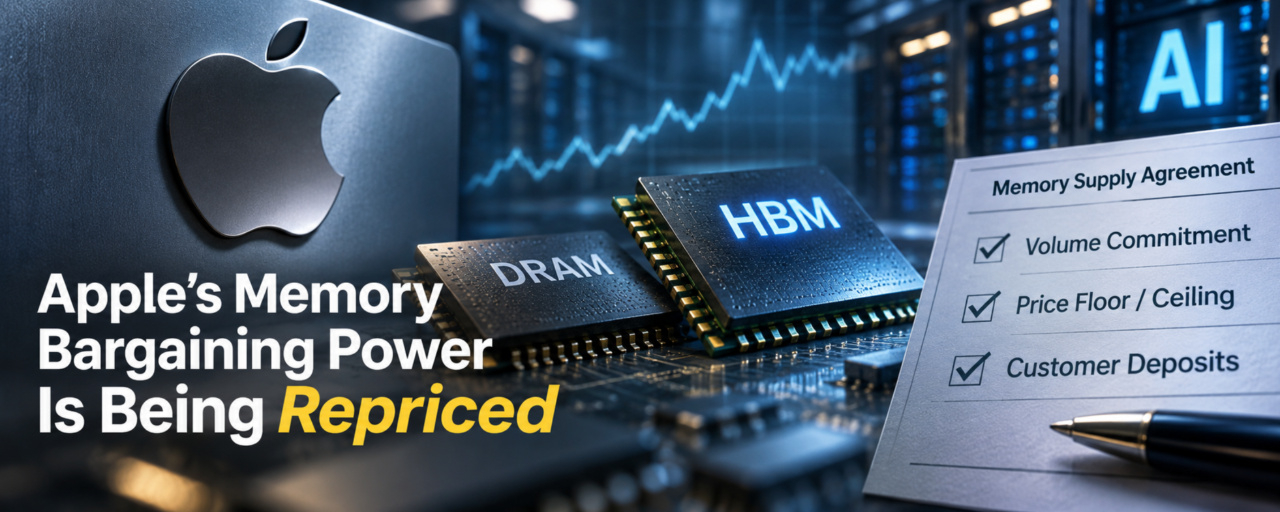
The company has entered into multi-year strategic customer agreements with binding volume commitments. Most contain price floors and ceilings. Micron has said the floor prices in these agreements could support gross margins meaningfully above its historical quarterly peaks.
The financial commitments are substantial. During fiscal 2026, Micron received $12.75 billion in customer deposits, with another $7 billion in issued or committed letters of credit.
The deposits are generally refundable when customers meet their purchase obligations. They should not be confused with revenue.
Their importance is contractual. Customers are committing both future purchases and financial resources to secure memory supply.
For Micron, a price floor reduces exposure to the next downturn. Minimum purchase obligations provide greater visibility into future utilization. For customers, price ceilings offer protection against shortages, but volume commitments and floors can become costly if demand weakens or market prices fall.
The economics depend on the negotiated terms, not simply the length of the agreement.
SK hynix has also disclosed longer-term supply arrangements with pricing linked to market conditions within agreed ranges. Samsung continues to prioritize its high-end memory mix, including HBM and server products.
These disclosures do not establish that Apple has accepted similar terms. They do show why the negotiating environment facing large memory buyers may be changing.
Apple still has room to maneuver
Apple's fiscal 2026 product gross margin increased to 39.3%, from 36.8% in fiscal 2025.
The company attributed the improvement primarily to product mix and tariff refunds, partly offset by higher component costs, including memory.
That result deserves weight. Apple has continued to protect reported profitability despite rising input costs.
Its options remain considerable. It can negotiate across suppliers, adjust product configurations, shift its sales mix toward higher-priced devices and, where demand permits, pass some costs through to customers.
Each option has limits. Higher selling prices can affect demand. Supplier diversification takes time, particularly where qualification requirements are demanding. Longer commitments may improve supply assurance while reducing the freedom to revise orders.
The financial statements tell us Apple has managed the pressure so far. They do not tell us whether it is obtaining the same purchasing terms it could have negotiated several years ago.
The downturn will be the better test
A rising DRAM price is poor evidence of a permanent loss of bargaining power. Memory prices have always been cyclical.
The more revealing period will come when supply improves.
In previous cycles, excess capacity put suppliers under pressure to discount. Large buyers could use their scale and predictable demand to negotiate better terms.
Long-term agreements with enforceable volume commitments and price floors could soften that pressure for suppliers. If enough production is covered, customers may recover less of the price decline than they would have under shorter-term arrangements.
There are clear limits to this argument. New fabs, changing AI demand, process transitions and competition among the major suppliers could restore substantial pricing leverage to Apple. Contract ceilings could also protect buyers more effectively during a prolonged shortage.
My working hypothesis is narrower: Apple's purchasing advantage may become less responsive to a recovery in memory supply, particularly where long-term commitments limit its ability to renegotiate or shift volumes.
The hypothesis fails if Apple regains its historical discounts and purchasing flexibility as industry conditions normalize.
What investors should price
Using Apple's fiscal 2026 tax rate and diluted share count, an additional $1 billion in annual component costs that the company cannot offset would reduce diluted EPS by roughly $0.056.
That is a sensitivity calculation, not a forecast. Apple does not disclose the contract-level information needed to isolate its actual memory cost exposure.
A temporary increase in component costs belongs in near-term earnings estimates. A sustained change in procurement flexibility belongs in a longer-term assessment of margins and cash generation. The two should not be valued in the same way.
For now, the evidence supports a change in suppliers' incentives and contracting practices. It does not yet establish a lasting deterioration in Apple's purchasing power.
The distinction will become clearer when memory prices eventually decline.
If Apple can again secure substantial discounts without surrendering flexibility, its scale advantage remains intact. If suppliers preserve higher price floors and stronger purchase commitments through the downturn, investors will have evidence that AI has altered the economics of one of Apple's longstanding supply-chain advantages.
The next memory downcycle may tell us more about Apple's bargaining power than the current shortage.
#EarningSeason #Stock
$AAPL.US
Apple’s Memory Bargaining Power Is Being Repriced
AI is giving memory suppliers better alternatives. The consequences may outlast the current pricing cycle.
Apple has spent decades turning purchasing scale into favorable supply terms. Its orders are large, its product schedules relatively predictable, and its relationships with component suppliers often span multiple product generations.
For memory manufacturers, that predictability has historically been worth a discount. In a business prone to violent swings in pricing and utilization, a customer capable of absorbing large volumes through a downturn provides real economic value.
The rise of AI infrastructure is changing the calculation.
Samsung, SK hynix and Micron now have increasingly attractive opportunities in HBM, server DRAM and enterprise storage. These products compete for capital, engineering attention and manufacturing investment, even where their production processes are not directly interchangeable with mobile memory.
Apple remains one of the industry's most important customers. What has changed is the value of the alternatives available to its suppliers.
That shift is beginning to show up in contract structures.
A different bargain
Micron's fiscal 2026 disclosures provide a useful window into the industry's changing economics.
The company has entered into multi-year strategic customer agreements with binding volume commitments. Most contain price floors and ceilings. Micron has said the floor prices in these agreements could support gross margins meaningfully above its historical quarterly peaks.
The financial commitments are substantial. During fiscal 2026, Micron received $12.75 billion in customer deposits, with another $7 billion in issued or committed letters of credit.
The deposits are generally refundable when customers meet their purchase obligations. They should not be confused with revenue.
Their importance is contractual. Customers are committing both future purchases and financial resources to secure memory supply.
For Micron, a price floor reduces exposure to the next downturn. Minimum purchase obligations provide greater visibility into future utilization. For customers, price ceilings offer protection against shortages, but volume commitments and floors can become costly if demand weakens or market prices fall.
The economics depend on the negotiated terms, not simply the length of the agreement.
SK hynix has also disclosed longer-term supply arrangements with pricing linked to market conditions within agreed ranges. Samsung continues to prioritize its high-end memory mix, including HBM and server products.
These disclosures do not establish that Apple has accepted similar terms. They do show why the negotiating environment facing large memory buyers may be changing.
Apple still has room to maneuver
Apple's fiscal 2026 product gross margin increased to 39.3%, from 36.8% in fiscal 2025.
The company attributed the improvement primarily to product mix and tariff refunds, partly offset by higher component costs, including memory.
That result deserves weight. Apple has continued to protect reported profitability despite rising input costs.
Its options remain considerable. It can negotiate across suppliers, adjust product configurations, shift its sales mix toward higher-priced devices and, where demand permits, pass some costs through to customers.
Each option has limits. Higher selling prices can affect demand. Supplier diversification takes time, particularly where qualification requirements are demanding. Longer commitments may improve supply assurance while reducing the freedom to revise orders.
The financial statements tell us Apple has managed the pressure so far. They do not tell us whether it is obtaining the same purchasing terms it could have negotiated several years ago.
The downturn will be the better test
A rising DRAM price is poor evidence of a permanent loss of bargaining power. Memory prices have always been cyclical.
The more revealing period will come when supply improves.
In previous cycles, excess capacity put suppliers under pressure to discount. Large buyers could use their scale and predictable demand to negotiate better terms.
Long-term agreements with enforceable volume commitments and price floors could soften that pressure for suppliers. If enough production is covered, customers may recover less of the price decline than they would have under shorter-term arrangements.
There are clear limits to this argument. New fabs, changing AI demand, process transitions and competition among the major suppliers could restore substantial pricing leverage to Apple. Contract ceilings could also protect buyers more effectively during a prolonged shortage.
My working hypothesis is narrower: Apple's purchasing advantage may become less responsive to a recovery in memory supply, particularly where long-term commitments limit its ability to renegotiate or shift volumes.
The hypothesis fails if Apple regains its historical discounts and purchasing flexibility as industry conditions normalize.
What investors should price
Using Apple's fiscal 2026 tax rate and diluted share count, an additional $1 billion in annual component costs that the company cannot offset would reduce diluted EPS by roughly $0.056.
That is a sensitivity calculation, not a forecast. Apple does not disclose the contract-level information needed to isolate its actual memory cost exposure.
A temporary increase in component costs belongs in near-term earnings estimates. A sustained change in procurement flexibility belongs in a longer-term assessment of margins and cash generation. The two should not be valued in the same way.
For now, the evidence supports a change in suppliers' incentives and contracting practices. It does not yet establish a lasting deterioration in Apple's purchasing power.
The distinction will become clearer when memory prices eventually decline.
If Apple can again secure substantial discounts without surrendering flexibility, its scale advantage remains intact. If suppliers preserve higher price floors and stronger purchase commitments through the downturn, investors will have evidence that AI has altered the economics of one of Apple's longstanding supply-chain advantages.
The next memory downcycle may tell us more about Apple's bargaining power than the current shortage.
#EarningSeason #Stock
$AAPL.US
Apple has spent decades turning purchasing scale into favorable supply terms. Its orders are large, its product schedules relatively predictable, and its relationships with component suppliers often span multiple product generations.
For memory manufacturers, that predictability has historically been worth a discount. In a business prone to violent swings in pricing and utilization, a customer capable of absorbing large volumes through a downturn provides real economic value.
The rise of AI infrastructure is changing the calculation.
Samsung, SK hynix and Micron now have increasingly attractive opportunities in HBM, server DRAM and enterprise storage. These products compete for capital, engineering attention and manufacturing investment, even where their production processes are not directly interchangeable with mobile memory.
Apple remains one of the industry's most important customers. What has changed is the value of the alternatives available to its suppliers.
That shift is beginning to show up in contract structures.
A different bargain
Micron's fiscal 2026 disclosures provide a useful window into the industry's changing economics.
The company has entered into multi-year strategic customer agreements with binding volume commitments. Most contain price floors and ceilings. Micron has said the floor prices in these agreements could support gross margins meaningfully above its historical quarterly peaks.
The financial commitments are substantial. During fiscal 2026, Micron received $12.75 billion in customer deposits, with another $7 billion in issued or committed letters of credit.
The deposits are generally refundable when customers meet their purchase obligations. They should not be confused with revenue.
Their importance is contractual. Customers are committing both future purchases and financial resources to secure memory supply.
For Micron, a price floor reduces exposure to the next downturn. Minimum purchase obligations provide greater visibility into future utilization. For customers, price ceilings offer protection against shortages, but volume commitments and floors can become costly if demand weakens or market prices fall.
The economics depend on the negotiated terms, not simply the length of the agreement.
SK hynix has also disclosed longer-term supply arrangements with pricing linked to market conditions within agreed ranges. Samsung continues to prioritize its high-end memory mix, including HBM and server products.
These disclosures do not establish that Apple has accepted similar terms. They do show why the negotiating environment facing large memory buyers may be changing.
Apple still has room to maneuver
Apple's fiscal 2026 product gross margin increased to 39.3%, from 36.8% in fiscal 2025.
The company attributed the improvement primarily to product mix and tariff refunds, partly offset by higher component costs, including memory.
That result deserves weight. Apple has continued to protect reported profitability despite rising input costs.
Its options remain considerable. It can negotiate across suppliers, adjust product configurations, shift its sales mix toward higher-priced devices and, where demand permits, pass some costs through to customers.
Each option has limits. Higher selling prices can affect demand. Supplier diversification takes time, particularly where qualification requirements are demanding. Longer commitments may improve supply assurance while reducing the freedom to revise orders.
The financial statements tell us Apple has managed the pressure so far. They do not tell us whether it is obtaining the same purchasing terms it could have negotiated several years ago.
The downturn will be the better test
A rising DRAM price is poor evidence of a permanent loss of bargaining power. Memory prices have always been cyclical.
The more revealing period will come when supply improves.
In previous cycles, excess capacity put suppliers under pressure to discount. Large buyers could use their scale and predictable demand to negotiate better terms.
Long-term agreements with enforceable volume commitments and price floors could soften that pressure for suppliers. If enough production is covered, customers may recover less of the price decline than they would have under shorter-term arrangements.
There are clear limits to this argument. New fabs, changing AI demand, process transitions and competition among the major suppliers could restore substantial pricing leverage to Apple. Contract ceilings could also protect buyers more effectively during a prolonged shortage.
My working hypothesis is narrower: Apple's purchasing advantage may become less responsive to a recovery in memory supply, particularly where long-term commitments limit its ability to renegotiate or shift volumes.
The hypothesis fails if Apple regains its historical discounts and purchasing flexibility as industry conditions normalize.
What investors should price
Using Apple's fiscal 2026 tax rate and diluted share count, an additional $1 billion in annual component costs that the company cannot offset would reduce diluted EPS by roughly $0.056.
That is a sensitivity calculation, not a forecast. Apple does not disclose the contract-level information needed to isolate its actual memory cost exposure.
A temporary increase in component costs belongs in near-term earnings estimates. A sustained change in procurement flexibility belongs in a longer-term assessment of margins and cash generation. The two should not be valued in the same way.
For now, the evidence supports a change in suppliers' incentives and contracting practices. It does not yet establish a lasting deterioration in Apple's purchasing power.
The distinction will become clearer when memory prices eventually decline.
If Apple can again secure substantial discounts without surrendering flexibility, its scale advantage remains intact. If suppliers preserve higher price floors and stronger purchase commitments through the downturn, investors will have evidence that AI has altered the economics of one of Apple's longstanding supply-chain advantages.
The next memory downcycle may tell us more about Apple's bargaining power than the current shortage.
#EarningSeason #Stock
$AAPL.US
3
10.7k
·
--
Verified
Microsoft's $5B CapEx shortfall exposes an asymmetry in AI infrastructure.
Amy Hood confirmed delayed third-party capacity pushed spending into later quarters. The Information names IREN among the affected suppliers; Aterio's build analysis also flags delivery risk at Horizon 4.
For Microsoft, a delay can mean spending later. For a neocloud, it can mean financing costs accumulating before customer acceptance and revenue begin.
The question isn't whether AI demand disappeared — it's who bears the cost when capacity arrives late. Watch delivery milestones, acceptance dates, and financing costs.
$MSFT.US
Microsoft's $5B CapEx shortfall exposes an asymmetry in AI infrastructure.
Amy Hood confirmed delayed third-party capacity pushed spending into later quarters. The Information names IREN among the affected suppliers; Aterio's build analysis also flags delivery risk at Horizon 4.
For Microsoft, a delay can mean spending later. For a neocloud, it can mean financing costs accumulating before customer acceptance and revenue begin.
The question isn't whether AI demand disappeared — it's who bears the cost when capacity arrives late. Watch delivery milestones, acceptance dates, and financing costs.
$MSFT.US
Amy Hood confirmed delayed third-party capacity pushed spending into later quarters. The Information names IREN among the affected suppliers; Aterio's build analysis also flags delivery risk at Horizon 4.
For Microsoft, a delay can mean spending later. For a neocloud, it can mean financing costs accumulating before customer acceptance and revenue begin.
The question isn't whether AI demand disappeared — it's who bears the cost when capacity arrives late. Watch delivery milestones, acceptance dates, and financing costs.
$MSFT.US
IREN-1.08%
MSFTUS-0.48%
705
·
--
OpenAI says Plus, Pro and Business usage allowances will be shared across ChatGPT and Codex starting in December, measured in tokens. Instant chat is excluded.
That puts interactive reasoning and coding agents into the same usage budget — a long-running coding task can eat into what's left for other advanced work.
Watch the actual allowance sizes, reset periods, and credit pricing. Those decide whether this is mostly accounting or a real shift in subscription economics.
OpenAI says Plus, Pro and Business usage allowances will be shared across ChatGPT and Codex starting in December, measured in tokens. Instant chat is excluded.
That puts interactive reasoning and coding agents into the same usage budget — a long-running coding task can eat into what's left for other advanced work.
Watch the actual allowance sizes, reset periods, and credit pricing. Those decide whether this is mostly accounting or a real shift in subscription economics.
That puts interactive reasoning and coding agents into the same usage budget — a long-running coding task can eat into what's left for other advanced work.
Watch the actual allowance sizes, reset periods, and credit pricing. Those decide whether this is mostly accounting or a real shift in subscription economics.
24
·
--
Verified
TeraWulf secured Google's credit backstop for Anthropic's ~$19B, 20-year lease at its 401MW Justified campus. The 8-K gives Google options to assume leases or pay defined termination fees under specified default conditions.
The scarce input isn't just power or land. It's bankable counterparty credit.
Watch the actual project debt terms. If Google's support materially lowers borrowing costs, hyperscaler credit becomes another source of advantage for AI infrastructure developers.
$WULF.US F $GOOGL.US
TeraWulf secured Google's credit backstop for Anthropic's ~$19B, 20-year lease at its 401MW Justified campus. The 8-K gives Google options to assume leases or pay defined termination fees under specified default conditions.
The scarce input isn't just power or land. It's bankable counterparty credit.
Watch the actual project debt terms. If Google's support materially lowers borrowing costs, hyperscaler credit becomes another source of advantage for AI infrastructure developers.
$WULF.US F $GOOGL.US
The scarce input isn't just power or land. It's bankable counterparty credit.
Watch the actual project debt terms. If Google's support materially lowers borrowing costs, hyperscaler credit becomes another source of advantage for AI infrastructure developers.
$WULF.US F $GOOGL.US
WULFUS+6.35%
GOOGLUS+1.41%
GOOGUS+1.33%
1.1k
Log in to explore more content
Join global crypto users on Binance Square
⚡️ Get latest and useful information about crypto.
💬 Trusted by the world’s largest crypto exchange.
👍 Discover real insights from verified creators.
Email / Phone number
Trending Topics
BinanceReopensWithdrawalsForMoreAssets
1.1M views
5,677 Discussing
Recovery Update #9: Withdrawals for More Assets to Reopen (2026-11-06)
Binance Announcement
·149 Likes
·615.8k views
$2TWipedOutHedgeFundsFaceLiquidation
39 views
8 Discussing
AnthropicIPOValuationDoubts
11,349 views
343 Discussing