

橙子Joyce
577 Posts

橙子Joyce
 Square Verified+
十年以上美股市场投研策略|WEB3项目投研|十年以上投资BTC.ETH.BNB.SOL|贵金属投资策略黄金.白银.铜|中长期价值投资者|推特X:@Joyce88AI|✨星河社区联合创始人✨
Frequent Trader
8.8 Years
890 Following
38.2K+ Followers
46.0K+ Liked
Posts
All
Quotes
Videos
Live
PINNED
·
--
🎙️ 🚀🚀🚀🚀Orange Joyce’s Daily Livestream | Beijing Time 21:00–23:30 | U.S. Stock Investment Strategies and Trading on Binance ✨✨ Long-Term Development of BNB

End
02 h 49 m 16 s
1.7k

SOL
Holding
+68.88
7
PINNED
Verified
NVDAUS+0.67%
GOOGLUS+0.54%
SPCXUS-0.97%
橙子Joyce
·
--
BullishTrump is strongly pushing for the Sunshine Protection Act to be signed into law, abolishing the U.S. practice of changing clocks twice a year (switching between daylight saving time and standard time).
1. Core dispute: Trump vs. Senator Tom Cotton
Trump’s position: He argues that most Americans want longer daylight hours in the afternoon. He complains that clock changes cause people to be late for meetings, affect golf, and believes extending daylight reduces crime. Trump even urged the public on Truth Social to call Republican Sen. Tom Cotton to oppose the bill and apply pressure.
Cotton’s position: He firmly opposes permanent daylight saving time. He points out that the U.S. has tried permanent daylight saving time multiple times in history, but each time it was scrapped because winter sunrise comes too late (kids going to school in the dark, commuters heading out in the dark), creating safety risks.
2. Current progress of the bill
House of Representatives: The bill passed a vote in July.
U.S. Senate: There is enormous resistance, and opponents are not limited to Cotton. Senator John Kennedy said bluntly that the bill has “no hope” in the Senate, and he expects Majority Leader John Thune will not bring it to a vote.
3. Key focus of the debate over keeping vs. abolishing clock changes
Support abolishing clock changes: Frequent clock adjustments disrupt the body’s biological clock, increase risks of cardiovascular and cerebrovascular disease, and raise the incidence rate of traffic accidents.
Oppose permanent daylight saving time: Too many hours of winter darkness would seriously affect students’ commute and school safety in high-latitude regions and endanger commuters.
4. Practical impact on Chinese and U.S. stock investors
Current situation: From November to March each year, when the U.S. enters standard time, U.S. stock market opening time shifts from Beijing time 21:30 back to 22:30.
If the bill is passed: U.S. stock trading hours would be fixed year-round as Beijing time 21:30 to 04:00 the next day, so domestic investors would no longer need to adjust their routines and watching schedule with the seasons.
$NVDA.US
$SPCX.US
$GOOGL.US
1. Core dispute: Trump vs. Senator Tom Cotton
Trump’s position: He argues that most Americans want longer daylight hours in the afternoon. He complains that clock changes cause people to be late for meetings, affect golf, and believes extending daylight reduces crime. Trump even urged the public on Truth Social to call Republican Sen. Tom Cotton to oppose the bill and apply pressure.
Cotton’s position: He firmly opposes permanent daylight saving time. He points out that the U.S. has tried permanent daylight saving time multiple times in history, but each time it was scrapped because winter sunrise comes too late (kids going to school in the dark, commuters heading out in the dark), creating safety risks.
2. Current progress of the bill
House of Representatives: The bill passed a vote in July.
U.S. Senate: There is enormous resistance, and opponents are not limited to Cotton. Senator John Kennedy said bluntly that the bill has “no hope” in the Senate, and he expects Majority Leader John Thune will not bring it to a vote.
3. Key focus of the debate over keeping vs. abolishing clock changes
Support abolishing clock changes: Frequent clock adjustments disrupt the body’s biological clock, increase risks of cardiovascular and cerebrovascular disease, and raise the incidence rate of traffic accidents.
Oppose permanent daylight saving time: Too many hours of winter darkness would seriously affect students’ commute and school safety in high-latitude regions and endanger commuters.
4. Practical impact on Chinese and U.S. stock investors
Current situation: From November to March each year, when the U.S. enters standard time, U.S. stock market opening time shifts from Beijing time 21:30 back to 22:30.
If the bill is passed: U.S. stock trading hours would be fixed year-round as Beijing time 21:30 to 04:00 the next day, so domestic investors would no longer need to adjust their routines and watching schedule with the seasons.
$NVDA.US
$SPCX.US
$GOOGL.US
橙子Joyce
·
--
BullishTrump is strongly pushing for the Sunshine Protection Act to be signed into law, abolishing the U.S. practice of changing clocks twice a year (switching between daylight saving time and standard time).
1. Core dispute: Trump vs. Senator Tom Cotton
Trump’s position: He argues that most Americans want longer daylight hours in the afternoon. He complains that clock changes cause people to be late for meetings, affect golf, and believes extending daylight reduces crime. Trump even urged the public on Truth Social to call Republican Sen. Tom Cotton to oppose the bill and apply pressure.
Cotton’s position: He firmly opposes permanent daylight saving time. He points out that the U.S. has tried permanent daylight saving time multiple times in history, but each time it was scrapped because winter sunrise comes too late (kids going to school in the dark, commuters heading out in the dark), creating safety risks.
2. Current progress of the bill
House of Representatives: The bill passed a vote in July.
U.S. Senate: There is enormous resistance, and opponents are not limited to Cotton. Senator John Kennedy said bluntly that the bill has “no hope” in the Senate, and he expects Majority Leader John Thune will not bring it to a vote.
3. Key focus of the debate over keeping vs. abolishing clock changes
Support abolishing clock changes: Frequent clock adjustments disrupt the body’s biological clock, increase risks of cardiovascular and cerebrovascular disease, and raise the incidence rate of traffic accidents.
Oppose permanent daylight saving time: Too many hours of winter darkness would seriously affect students’ commute and school safety in high-latitude regions and endanger commuters.
4. Practical impact on Chinese and U.S. stock investors
Current situation: From November to March each year, when the U.S. enters standard time, U.S. stock market opening time shifts from Beijing time 21:30 back to 22:30.
If the bill is passed: U.S. stock trading hours would be fixed year-round as Beijing time 21:30 to 04:00 the next day, so domestic investors would no longer need to adjust their routines and watching schedule with the seasons.
$NVDA.US
$SPCX.US
$GOOGL.US
1. Core dispute: Trump vs. Senator Tom Cotton
Trump’s position: He argues that most Americans want longer daylight hours in the afternoon. He complains that clock changes cause people to be late for meetings, affect golf, and believes extending daylight reduces crime. Trump even urged the public on Truth Social to call Republican Sen. Tom Cotton to oppose the bill and apply pressure.
Cotton’s position: He firmly opposes permanent daylight saving time. He points out that the U.S. has tried permanent daylight saving time multiple times in history, but each time it was scrapped because winter sunrise comes too late (kids going to school in the dark, commuters heading out in the dark), creating safety risks.
2. Current progress of the bill
House of Representatives: The bill passed a vote in July.
U.S. Senate: There is enormous resistance, and opponents are not limited to Cotton. Senator John Kennedy said bluntly that the bill has “no hope” in the Senate, and he expects Majority Leader John Thune will not bring it to a vote.
3. Key focus of the debate over keeping vs. abolishing clock changes
Support abolishing clock changes: Frequent clock adjustments disrupt the body’s biological clock, increase risks of cardiovascular and cerebrovascular disease, and raise the incidence rate of traffic accidents.
Oppose permanent daylight saving time: Too many hours of winter darkness would seriously affect students’ commute and school safety in high-latitude regions and endanger commuters.
4. Practical impact on Chinese and U.S. stock investors
Current situation: From November to March each year, when the U.S. enters standard time, U.S. stock market opening time shifts from Beijing time 21:30 back to 22:30.
If the bill is passed: U.S. stock trading hours would be fixed year-round as Beijing time 21:30 to 04:00 the next day, so domestic investors would no longer need to adjust their routines and watching schedule with the seasons.
$NVDA.US
$SPCX.US
$GOOGL.US
橙子Joyce
·
--
BullishTrump is strongly pushing for the Sunshine Protection Act to be signed into law, abolishing the U.S. practice of changing clocks twice a year (switching between daylight saving time and standard time).
1. Core dispute: Trump vs. Senator Tom Cotton
Trump’s position: He argues that most Americans want longer daylight hours in the afternoon. He complains that clock changes cause people to be late for meetings, affect golf, and believes extending daylight reduces crime. Trump even urged the public on Truth Social to call Republican Sen. Tom Cotton to oppose the bill and apply pressure.
Cotton’s position: He firmly opposes permanent daylight saving time. He points out that the U.S. has tried permanent daylight saving time multiple times in history, but each time it was scrapped because winter sunrise comes too late (kids going to school in the dark, commuters heading out in the dark), creating safety risks.
2. Current progress of the bill
House of Representatives: The bill passed a vote in July.
U.S. Senate: There is enormous resistance, and opponents are not limited to Cotton. Senator John Kennedy said bluntly that the bill has “no hope” in the Senate, and he expects Majority Leader John Thune will not bring it to a vote.
3. Key focus of the debate over keeping vs. abolishing clock changes
Support abolishing clock changes: Frequent clock adjustments disrupt the body’s biological clock, increase risks of cardiovascular and cerebrovascular disease, and raise the incidence rate of traffic accidents.
Oppose permanent daylight saving time: Too many hours of winter darkness would seriously affect students’ commute and school safety in high-latitude regions and endanger commuters.
4. Practical impact on Chinese and U.S. stock investors
Current situation: From November to March each year, when the U.S. enters standard time, U.S. stock market opening time shifts from Beijing time 21:30 back to 22:30.
If the bill is passed: U.S. stock trading hours would be fixed year-round as Beijing time 21:30 to 04:00 the next day, so domestic investors would no longer need to adjust their routines and watching schedule with the seasons.
$NVDA.US
$SPCX.US
$GOOGL.US
1. Core dispute: Trump vs. Senator Tom Cotton
Trump’s position: He argues that most Americans want longer daylight hours in the afternoon. He complains that clock changes cause people to be late for meetings, affect golf, and believes extending daylight reduces crime. Trump even urged the public on Truth Social to call Republican Sen. Tom Cotton to oppose the bill and apply pressure.
Cotton’s position: He firmly opposes permanent daylight saving time. He points out that the U.S. has tried permanent daylight saving time multiple times in history, but each time it was scrapped because winter sunrise comes too late (kids going to school in the dark, commuters heading out in the dark), creating safety risks.
2. Current progress of the bill
House of Representatives: The bill passed a vote in July.
U.S. Senate: There is enormous resistance, and opponents are not limited to Cotton. Senator John Kennedy said bluntly that the bill has “no hope” in the Senate, and he expects Majority Leader John Thune will not bring it to a vote.
3. Key focus of the debate over keeping vs. abolishing clock changes
Support abolishing clock changes: Frequent clock adjustments disrupt the body’s biological clock, increase risks of cardiovascular and cerebrovascular disease, and raise the incidence rate of traffic accidents.
Oppose permanent daylight saving time: Too many hours of winter darkness would seriously affect students’ commute and school safety in high-latitude regions and endanger commuters.
4. Practical impact on Chinese and U.S. stock investors
Current situation: From November to March each year, when the U.S. enters standard time, U.S. stock market opening time shifts from Beijing time 21:30 back to 22:30.
If the bill is passed: U.S. stock trading hours would be fixed year-round as Beijing time 21:30 to 04:00 the next day, so domestic investors would no longer need to adjust their routines and watching schedule with the seasons.
$NVDA.US
$SPCX.US
$GOOGL.US
橙子Joyce
·
--
BullishTrump is strongly pushing for the Sunshine Protection Act to be signed into law, abolishing the U.S. practice of changing clocks twice a year (switching between daylight saving time and standard time).
1. Core dispute: Trump vs. Senator Tom Cotton
Trump’s position: He argues that most Americans want longer daylight hours in the afternoon. He complains that clock changes cause people to be late for meetings, affect golf, and believes extending daylight reduces crime. Trump even urged the public on Truth Social to call Republican Sen. Tom Cotton to oppose the bill and apply pressure.
Cotton’s position: He firmly opposes permanent daylight saving time. He points out that the U.S. has tried permanent daylight saving time multiple times in history, but each time it was scrapped because winter sunrise comes too late (kids going to school in the dark, commuters heading out in the dark), creating safety risks.
2. Current progress of the bill
House of Representatives: The bill passed a vote in July.
U.S. Senate: There is enormous resistance, and opponents are not limited to Cotton. Senator John Kennedy said bluntly that the bill has “no hope” in the Senate, and he expects Majority Leader John Thune will not bring it to a vote.
3. Key focus of the debate over keeping vs. abolishing clock changes
Support abolishing clock changes: Frequent clock adjustments disrupt the body’s biological clock, increase risks of cardiovascular and cerebrovascular disease, and raise the incidence rate of traffic accidents.
Oppose permanent daylight saving time: Too many hours of winter darkness would seriously affect students’ commute and school safety in high-latitude regions and endanger commuters.
4. Practical impact on Chinese and U.S. stock investors
Current situation: From November to March each year, when the U.S. enters standard time, U.S. stock market opening time shifts from Beijing time 21:30 back to 22:30.
If the bill is passed: U.S. stock trading hours would be fixed year-round as Beijing time 21:30 to 04:00 the next day, so domestic investors would no longer need to adjust their routines and watching schedule with the seasons.
$NVDA.US
$SPCX.US
$GOOGL.US
1. Core dispute: Trump vs. Senator Tom Cotton
Trump’s position: He argues that most Americans want longer daylight hours in the afternoon. He complains that clock changes cause people to be late for meetings, affect golf, and believes extending daylight reduces crime. Trump even urged the public on Truth Social to call Republican Sen. Tom Cotton to oppose the bill and apply pressure.
Cotton’s position: He firmly opposes permanent daylight saving time. He points out that the U.S. has tried permanent daylight saving time multiple times in history, but each time it was scrapped because winter sunrise comes too late (kids going to school in the dark, commuters heading out in the dark), creating safety risks.
2. Current progress of the bill
House of Representatives: The bill passed a vote in July.
U.S. Senate: There is enormous resistance, and opponents are not limited to Cotton. Senator John Kennedy said bluntly that the bill has “no hope” in the Senate, and he expects Majority Leader John Thune will not bring it to a vote.
3. Key focus of the debate over keeping vs. abolishing clock changes
Support abolishing clock changes: Frequent clock adjustments disrupt the body’s biological clock, increase risks of cardiovascular and cerebrovascular disease, and raise the incidence rate of traffic accidents.
Oppose permanent daylight saving time: Too many hours of winter darkness would seriously affect students’ commute and school safety in high-latitude regions and endanger commuters.
4. Practical impact on Chinese and U.S. stock investors
Current situation: From November to March each year, when the U.S. enters standard time, U.S. stock market opening time shifts from Beijing time 21:30 back to 22:30.
If the bill is passed: U.S. stock trading hours would be fixed year-round as Beijing time 21:30 to 04:00 the next day, so domestic investors would no longer need to adjust their routines and watching schedule with the seasons.
$NVDA.US
$SPCX.US
$GOOGL.US
橙子Joyce
·
--
BullishTrump is strongly pushing for the Sunshine Protection Act to be signed into law, abolishing the U.S. practice of changing clocks twice a year (switching between daylight saving time and standard time).
1. Core dispute: Trump vs. Senator Tom Cotton
Trump’s position: He argues that most Americans want longer daylight hours in the afternoon. He complains that clock changes cause people to be late for meetings, affect golf, and believes extending daylight reduces crime. Trump even urged the public on Truth Social to call Republican Sen. Tom Cotton to oppose the bill and apply pressure.
Cotton’s position: He firmly opposes permanent daylight saving time. He points out that the U.S. has tried permanent daylight saving time multiple times in history, but each time it was scrapped because winter sunrise comes too late (kids going to school in the dark, commuters heading out in the dark), creating safety risks.
2. Current progress of the bill
House of Representatives: The bill passed a vote in July.
U.S. Senate: There is enormous resistance, and opponents are not limited to Cotton. Senator John Kennedy said bluntly that the bill has “no hope” in the Senate, and he expects Majority Leader John Thune will not bring it to a vote.
3. Key focus of the debate over keeping vs. abolishing clock changes
Support abolishing clock changes: Frequent clock adjustments disrupt the body’s biological clock, increase risks of cardiovascular and cerebrovascular disease, and raise the incidence rate of traffic accidents.
Oppose permanent daylight saving time: Too many hours of winter darkness would seriously affect students’ commute and school safety in high-latitude regions and endanger commuters.
4. Practical impact on Chinese and U.S. stock investors
Current situation: From November to March each year, when the U.S. enters standard time, U.S. stock market opening time shifts from Beijing time 21:30 back to 22:30.
If the bill is passed: U.S. stock trading hours would be fixed year-round as Beijing time 21:30 to 04:00 the next day, so domestic investors would no longer need to adjust their routines and watching schedule with the seasons.
$NVDA.US
$SPCX.US
$GOOGL.US
1. Core dispute: Trump vs. Senator Tom Cotton
Trump’s position: He argues that most Americans want longer daylight hours in the afternoon. He complains that clock changes cause people to be late for meetings, affect golf, and believes extending daylight reduces crime. Trump even urged the public on Truth Social to call Republican Sen. Tom Cotton to oppose the bill and apply pressure.
Cotton’s position: He firmly opposes permanent daylight saving time. He points out that the U.S. has tried permanent daylight saving time multiple times in history, but each time it was scrapped because winter sunrise comes too late (kids going to school in the dark, commuters heading out in the dark), creating safety risks.
2. Current progress of the bill
House of Representatives: The bill passed a vote in July.
U.S. Senate: There is enormous resistance, and opponents are not limited to Cotton. Senator John Kennedy said bluntly that the bill has “no hope” in the Senate, and he expects Majority Leader John Thune will not bring it to a vote.
3. Key focus of the debate over keeping vs. abolishing clock changes
Support abolishing clock changes: Frequent clock adjustments disrupt the body’s biological clock, increase risks of cardiovascular and cerebrovascular disease, and raise the incidence rate of traffic accidents.
Oppose permanent daylight saving time: Too many hours of winter darkness would seriously affect students’ commute and school safety in high-latitude regions and endanger commuters.
4. Practical impact on Chinese and U.S. stock investors
Current situation: From November to March each year, when the U.S. enters standard time, U.S. stock market opening time shifts from Beijing time 21:30 back to 22:30.
If the bill is passed: U.S. stock trading hours would be fixed year-round as Beijing time 21:30 to 04:00 the next day, so domestic investors would no longer need to adjust their routines and watching schedule with the seasons.
$NVDA.US
$SPCX.US
$GOOGL.US
橙子Joyce
·
--
BullishTrump is strongly pushing for the Sunshine Protection Act to be signed into law, abolishing the U.S. practice of changing clocks twice a year (switching between daylight saving time and standard time).
1. Core dispute: Trump vs. Senator Tom Cotton
Trump’s position: He argues that most Americans want longer daylight hours in the afternoon. He complains that clock changes cause people to be late for meetings, affect golf, and believes extending daylight reduces crime. Trump even urged the public on Truth Social to call Republican Sen. Tom Cotton to oppose the bill and apply pressure.
Cotton’s position: He firmly opposes permanent daylight saving time. He points out that the U.S. has tried permanent daylight saving time multiple times in history, but each time it was scrapped because winter sunrise comes too late (kids going to school in the dark, commuters heading out in the dark), creating safety risks.
2. Current progress of the bill
House of Representatives: The bill passed a vote in July.
U.S. Senate: There is enormous resistance, and opponents are not limited to Cotton. Senator John Kennedy said bluntly that the bill has “no hope” in the Senate, and he expects Majority Leader John Thune will not bring it to a vote.
3. Key focus of the debate over keeping vs. abolishing clock changes
Support abolishing clock changes: Frequent clock adjustments disrupt the body’s biological clock, increase risks of cardiovascular and cerebrovascular disease, and raise the incidence rate of traffic accidents.
Oppose permanent daylight saving time: Too many hours of winter darkness would seriously affect students’ commute and school safety in high-latitude regions and endanger commuters.
4. Practical impact on Chinese and U.S. stock investors
Current situation: From November to March each year, when the U.S. enters standard time, U.S. stock market opening time shifts from Beijing time 21:30 back to 22:30.
If the bill is passed: U.S. stock trading hours would be fixed year-round as Beijing time 21:30 to 04:00 the next day, so domestic investors would no longer need to adjust their routines and watching schedule with the seasons.
$NVDA.US
$SPCX.US
$GOOGL.US
1. Core dispute: Trump vs. Senator Tom Cotton
Trump’s position: He argues that most Americans want longer daylight hours in the afternoon. He complains that clock changes cause people to be late for meetings, affect golf, and believes extending daylight reduces crime. Trump even urged the public on Truth Social to call Republican Sen. Tom Cotton to oppose the bill and apply pressure.
Cotton’s position: He firmly opposes permanent daylight saving time. He points out that the U.S. has tried permanent daylight saving time multiple times in history, but each time it was scrapped because winter sunrise comes too late (kids going to school in the dark, commuters heading out in the dark), creating safety risks.
2. Current progress of the bill
House of Representatives: The bill passed a vote in July.
U.S. Senate: There is enormous resistance, and opponents are not limited to Cotton. Senator John Kennedy said bluntly that the bill has “no hope” in the Senate, and he expects Majority Leader John Thune will not bring it to a vote.
3. Key focus of the debate over keeping vs. abolishing clock changes
Support abolishing clock changes: Frequent clock adjustments disrupt the body’s biological clock, increase risks of cardiovascular and cerebrovascular disease, and raise the incidence rate of traffic accidents.
Oppose permanent daylight saving time: Too many hours of winter darkness would seriously affect students’ commute and school safety in high-latitude regions and endanger commuters.
4. Practical impact on Chinese and U.S. stock investors
Current situation: From November to March each year, when the U.S. enters standard time, U.S. stock market opening time shifts from Beijing time 21:30 back to 22:30.
If the bill is passed: U.S. stock trading hours would be fixed year-round as Beijing time 21:30 to 04:00 the next day, so domestic investors would no longer need to adjust their routines and watching schedule with the seasons.
$NVDA.US
$SPCX.US
$GOOGL.US
橙子Joyce
·
--
BullishTrump is strongly pushing for the Sunshine Protection Act to be signed into law, abolishing the U.S. practice of changing clocks twice a year (switching between daylight saving time and standard time).
1. Core dispute: Trump vs. Senator Tom Cotton
Trump’s position: He argues that most Americans want longer daylight hours in the afternoon. He complains that clock changes cause people to be late for meetings, affect golf, and believes extending daylight reduces crime. Trump even urged the public on Truth Social to call Republican Sen. Tom Cotton to oppose the bill and apply pressure.
Cotton’s position: He firmly opposes permanent daylight saving time. He points out that the U.S. has tried permanent daylight saving time multiple times in history, but each time it was scrapped because winter sunrise comes too late (kids going to school in the dark, commuters heading out in the dark), creating safety risks.
2. Current progress of the bill
House of Representatives: The bill passed a vote in July.
U.S. Senate: There is enormous resistance, and opponents are not limited to Cotton. Senator John Kennedy said bluntly that the bill has “no hope” in the Senate, and he expects Majority Leader John Thune will not bring it to a vote.
3. Key focus of the debate over keeping vs. abolishing clock changes
Support abolishing clock changes: Frequent clock adjustments disrupt the body’s biological clock, increase risks of cardiovascular and cerebrovascular disease, and raise the incidence rate of traffic accidents.
Oppose permanent daylight saving time: Too many hours of winter darkness would seriously affect students’ commute and school safety in high-latitude regions and endanger commuters.
4. Practical impact on Chinese and U.S. stock investors
Current situation: From November to March each year, when the U.S. enters standard time, U.S. stock market opening time shifts from Beijing time 21:30 back to 22:30.
If the bill is passed: U.S. stock trading hours would be fixed year-round as Beijing time 21:30 to 04:00 the next day, so domestic investors would no longer need to adjust their routines and watching schedule with the seasons.
$NVDA.US
$SPCX.US
$GOOGL.US
1. Core dispute: Trump vs. Senator Tom Cotton
Trump’s position: He argues that most Americans want longer daylight hours in the afternoon. He complains that clock changes cause people to be late for meetings, affect golf, and believes extending daylight reduces crime. Trump even urged the public on Truth Social to call Republican Sen. Tom Cotton to oppose the bill and apply pressure.
Cotton’s position: He firmly opposes permanent daylight saving time. He points out that the U.S. has tried permanent daylight saving time multiple times in history, but each time it was scrapped because winter sunrise comes too late (kids going to school in the dark, commuters heading out in the dark), creating safety risks.
2. Current progress of the bill
House of Representatives: The bill passed a vote in July.
U.S. Senate: There is enormous resistance, and opponents are not limited to Cotton. Senator John Kennedy said bluntly that the bill has “no hope” in the Senate, and he expects Majority Leader John Thune will not bring it to a vote.
3. Key focus of the debate over keeping vs. abolishing clock changes
Support abolishing clock changes: Frequent clock adjustments disrupt the body’s biological clock, increase risks of cardiovascular and cerebrovascular disease, and raise the incidence rate of traffic accidents.
Oppose permanent daylight saving time: Too many hours of winter darkness would seriously affect students’ commute and school safety in high-latitude regions and endanger commuters.
4. Practical impact on Chinese and U.S. stock investors
Current situation: From November to March each year, when the U.S. enters standard time, U.S. stock market opening time shifts from Beijing time 21:30 back to 22:30.
If the bill is passed: U.S. stock trading hours would be fixed year-round as Beijing time 21:30 to 04:00 the next day, so domestic investors would no longer need to adjust their routines and watching schedule with the seasons.
$NVDA.US
$SPCX.US
$GOOGL.US
橙子Joyce
·
--
BullishTrump is strongly pushing for the Sunshine Protection Act to be signed into law, abolishing the U.S. practice of changing clocks twice a year (switching between daylight saving time and standard time).
1. Core dispute: Trump vs. Senator Tom Cotton
Trump’s position: He argues that most Americans want longer daylight hours in the afternoon. He complains that clock changes cause people to be late for meetings, affect golf, and believes extending daylight reduces crime. Trump even urged the public on Truth Social to call Republican Sen. Tom Cotton to oppose the bill and apply pressure.
Cotton’s position: He firmly opposes permanent daylight saving time. He points out that the U.S. has tried permanent daylight saving time multiple times in history, but each time it was scrapped because winter sunrise comes too late (kids going to school in the dark, commuters heading out in the dark), creating safety risks.
2. Current progress of the bill
House of Representatives: The bill passed a vote in July.
U.S. Senate: There is enormous resistance, and opponents are not limited to Cotton. Senator John Kennedy said bluntly that the bill has “no hope” in the Senate, and he expects Majority Leader John Thune will not bring it to a vote.
3. Key focus of the debate over keeping vs. abolishing clock changes
Support abolishing clock changes: Frequent clock adjustments disrupt the body’s biological clock, increase risks of cardiovascular and cerebrovascular disease, and raise the incidence rate of traffic accidents.
Oppose permanent daylight saving time: Too many hours of winter darkness would seriously affect students’ commute and school safety in high-latitude regions and endanger commuters.
4. Practical impact on Chinese and U.S. stock investors
Current situation: From November to March each year, when the U.S. enters standard time, U.S. stock market opening time shifts from Beijing time 21:30 back to 22:30.
If the bill is passed: U.S. stock trading hours would be fixed year-round as Beijing time 21:30 to 04:00 the next day, so domestic investors would no longer need to adjust their routines and watching schedule with the seasons.
$NVDA.US
$SPCX.US
$GOOGL.US
1. Core dispute: Trump vs. Senator Tom Cotton
Trump’s position: He argues that most Americans want longer daylight hours in the afternoon. He complains that clock changes cause people to be late for meetings, affect golf, and believes extending daylight reduces crime. Trump even urged the public on Truth Social to call Republican Sen. Tom Cotton to oppose the bill and apply pressure.
Cotton’s position: He firmly opposes permanent daylight saving time. He points out that the U.S. has tried permanent daylight saving time multiple times in history, but each time it was scrapped because winter sunrise comes too late (kids going to school in the dark, commuters heading out in the dark), creating safety risks.
2. Current progress of the bill
House of Representatives: The bill passed a vote in July.
U.S. Senate: There is enormous resistance, and opponents are not limited to Cotton. Senator John Kennedy said bluntly that the bill has “no hope” in the Senate, and he expects Majority Leader John Thune will not bring it to a vote.
3. Key focus of the debate over keeping vs. abolishing clock changes
Support abolishing clock changes: Frequent clock adjustments disrupt the body’s biological clock, increase risks of cardiovascular and cerebrovascular disease, and raise the incidence rate of traffic accidents.
Oppose permanent daylight saving time: Too many hours of winter darkness would seriously affect students’ commute and school safety in high-latitude regions and endanger commuters.
4. Practical impact on Chinese and U.S. stock investors
Current situation: From November to March each year, when the U.S. enters standard time, U.S. stock market opening time shifts from Beijing time 21:30 back to 22:30.
If the bill is passed: U.S. stock trading hours would be fixed year-round as Beijing time 21:30 to 04:00 the next day, so domestic investors would no longer need to adjust their routines and watching schedule with the seasons.
$NVDA.US
$SPCX.US
$GOOGL.US

路人1688luren
·
--
$ETH Surged 70%
Yet liquidity fell
Something feels off about this rally
Ethereum was on fire in Q3
It surged about 70% in one go
Leaving Bitcoin’s roughly 42% Q3 gain far behind
But there’s one detail
I think is more worth watching than the 70% gain
The higher ETH climbs,
the thinner the order book gets
According to CoinGecko
ETH’s median market depth during Q3 was only 35%–45% of BTC’s
In the same period last year, it was still at least 60%
A very significant drop#以太坊Q3涨70%流动性下降
Yet liquidity fell
Something feels off about this rally
Ethereum was on fire in Q3
It surged about 70% in one go
Leaving Bitcoin’s roughly 42% Q3 gain far behind
But there’s one detail
I think is more worth watching than the 70% gain
The higher ETH climbs,
the thinner the order book gets
According to CoinGecko
ETH’s median market depth during Q3 was only 35%–45% of BTC’s
In the same period last year, it was still at least 60%
A very significant drop#以太坊Q3涨70%流动性下降




艾伦Eren1688
·
--
Bullish🎙️🇩🇰 Rasmus Højlund talking about Cristiano Ronaldo 🐐🇵🇹:
“This is just a tribute to a legend whose international career may already be over—after everything that happened. He’s a huge idol of mine.” 🐐
“I’ve followed Cristiano Ronaldo since his first spell at Manchester United, then during his time at Real Madrid and Juventus, and until he returned to Manchester United.
It’s funny that about six months after he left, I arrived there too; it felt like fate had somehow intended for me to take his place, to some extent. It’s been a wonderful journey for me.
Cristiano Ronaldo has always played a very important role in my life. I think he has an incredible mentality and attitude.
I hope Portugal and Cristiano can resolve their differences. I hope they can sort things out, because it would be such a shame if things ended this way.
For the greatest footballer of all time in my eyes, it would be truly sad if his story ended like this.” 🐐❤️
answer:7
Answer: 7
#1688家族family #PredictAndWin
“This is just a tribute to a legend whose international career may already be over—after everything that happened. He’s a huge idol of mine.” 🐐
“I’ve followed Cristiano Ronaldo since his first spell at Manchester United, then during his time at Real Madrid and Juventus, and until he returned to Manchester United.
It’s funny that about six months after he left, I arrived there too; it felt like fate had somehow intended for me to take his place, to some extent. It’s been a wonderful journey for me.
Cristiano Ronaldo has always played a very important role in my life. I think he has an incredible mentality and attitude.
I hope Portugal and Cristiano can resolve their differences. I hope they can sort things out, because it would be such a shame if things ended this way.
For the greatest footballer of all time in my eyes, it would be truly sad if his story ended like this.” 🐐❤️
answer:7
Answer: 7
#1688家族family #PredictAndWin

Quoted content has been removed

良茂哥628
·
--
🧧 Follow + comment 666 to claim fan perks
🧧 Profits and losses come from the same source. Don’t enjoy windfall profits from market trends while complaining about the pain of reasonable pullbacks.
A system that can bring you big profits in a one-way market will inevitably incur the cost of trial and error amid choppy, directionless trading.
There is no perfect holy grail strategy that can capture every major swing while emerging completely unscathed from choppy markets.
Treat short-term drawdowns as the price of admission for capturing major trends, and calmly accept the objective costs built into your strategy.
Only by fully embracing both sides of your system can you stay confidently on board when the real breakout finally arrives.
🧧 Profits and losses come from the same source. Don’t enjoy windfall profits from market trends while complaining about the pain of reasonable pullbacks.
A system that can bring you big profits in a one-way market will inevitably incur the cost of trial and error amid choppy, directionless trading.
There is no perfect holy grail strategy that can capture every major swing while emerging completely unscathed from choppy markets.
Treat short-term drawdowns as the price of admission for capturing major trends, and calmly accept the objective costs built into your strategy.
Only by fully embracing both sides of your system can you stay confidently on board when the real breakout finally arrives.




幸运雨Rain
·
--
🧧🧧🧧When everyone’s spending their parents’ money, why do the rich call it an inheritance, the middle class call it support, but the poor get accused of living off their parents?
The reason is simple. For example, if you’ve ever gnawed on a duck neck, you’ll know why it’s called “gnawing”—there’s hardly any meat on it. 🧧
The reason is simple. For example, if you’ve ever gnawed on a duck neck, you’ll know why it’s called “gnawing”—there’s hardly any meat on it. 🧧


晚风Vesper_1688
·
--
[Replay] 🎙️ Butterfly 🦋 Mr. C: Deflationary tokenomics, built by the community. Our 100-strong army has successfully established a price floor; we expect to break the previous high in about a week ↔️🚀🚀🚀
03 h 03 m 29 s · 6.7k listens

奋斗Hustle1688
·
--
[Replay] 🎙️ Dollar-Cost Averaging into BNB and Discussing Binance AI
02 h 06 m 17 s · 2.7k listens
晚风Vesper_1688
·
--
🌅 Good Tuesday morning
Market ups and downs are simply part of the natural cycle 📈
There’s no need to rush for immediate results. Stay calm and deepen your understanding.
True rewards always go to those willing to wait patiently and keep working on themselves ✨
Stay clear-headed, stick to your pace, and move steadily forward, one step at a time.
A new day begins. May we all stay true to ourselves and patiently await the flowers to bloom 🦋
#交易心理
#比特币现货ETF三季度净流入63.4亿美元
#1688家族family
Market ups and downs are simply part of the natural cycle 📈
There’s no need to rush for immediate results. Stay calm and deepen your understanding.
True rewards always go to those willing to wait patiently and keep working on themselves ✨
Stay clear-headed, stick to your pace, and move steadily forward, one step at a time.
A new day begins. May we all stay true to ourselves and patiently await the flowers to bloom 🦋
#交易心理
#比特币现货ETF三季度净流入63.4亿美元
#1688家族family

Quoted content has been removed

慢就是快Mike8
·
--
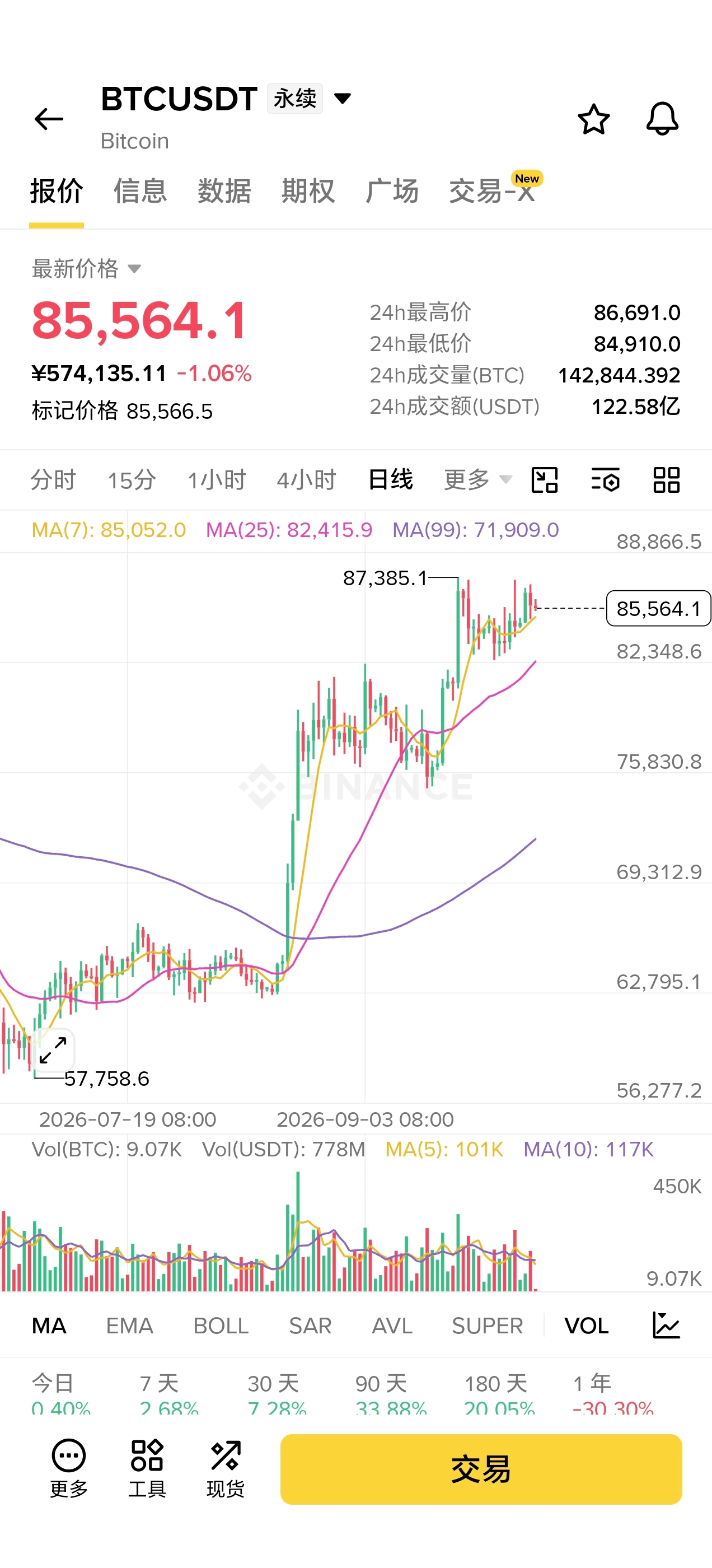
$BTC The Russian army is about to enter the market—go long, go long!!!

Log in to explore more content