
O L I V I E
13.6k Posts

O L I V I E
Report
Block User

Traders League Badge Expert
Open Trade
Frequent Trader
1.3 Years
430 Following
19.4K+ Followers
21.5K+ Liked
1 Badges
Posts
Portfolio
All
Quotes
Live
PINNED
·
--
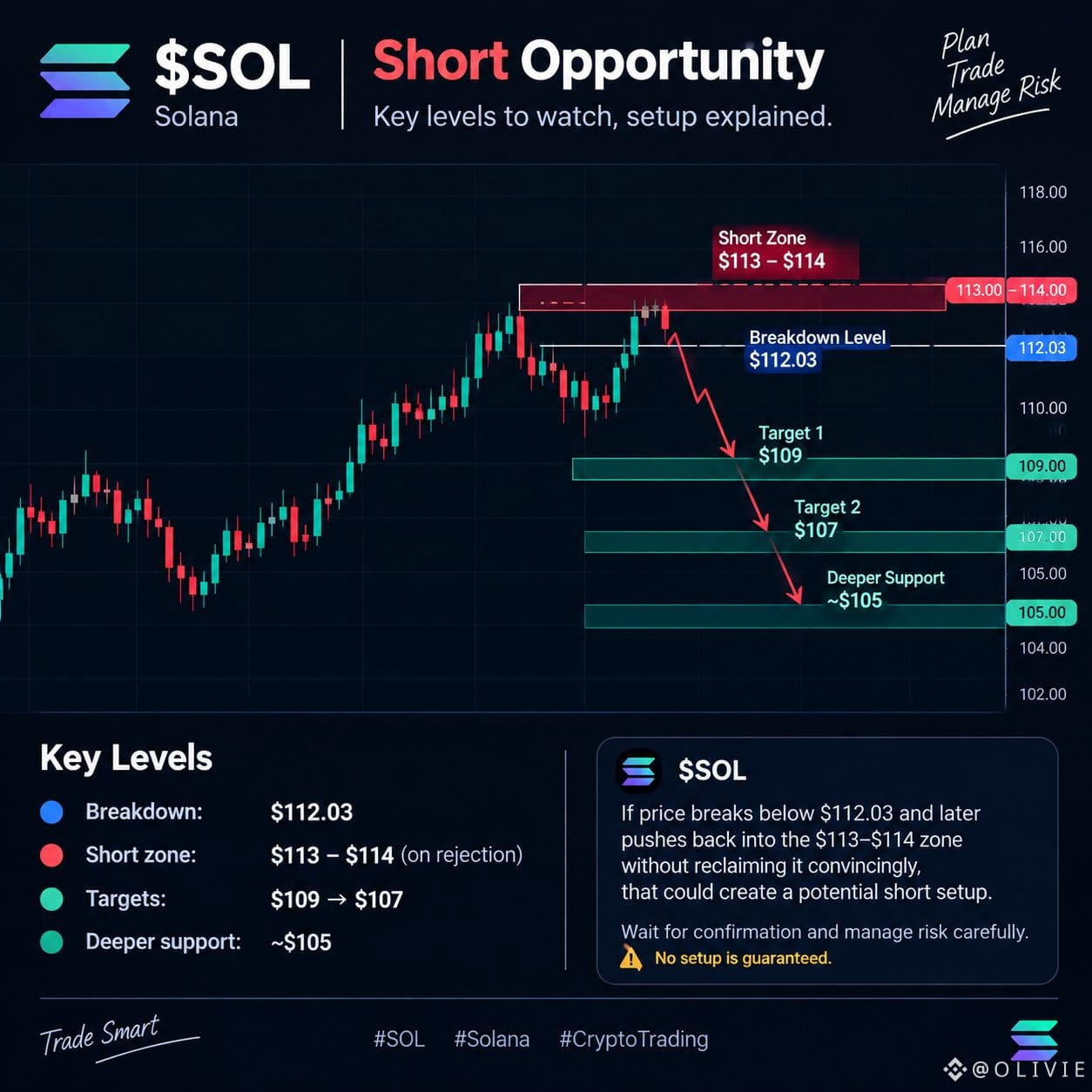
$SOL is approaching an interesting resistance area 👀
If price breaks below $112.03 and later pushes back into the $113–$114 zone without reclaiming it convincingly, that could create a potential short setup.
The downside levels I’m watching are around $107–$109 first.
If selling pressure increases, $105 becomes an important area to monitor, while a deeper move would require stronger bearish confirmation.
Key levels:
• Breakdown: $112.03
• Short zone: $113–$114 on rejection
• Targets: $109 → $107
• Deeper support: ~$105
Wait for confirmation and manage risk carefully. No setup is guaranteed. 📉
#SOL #solana #CryptoTrading
$SOL is approaching an interesting resistance area 👀
If price breaks below $112.03 and later pushes back into the $113–$114 zone without reclaiming it convincingly, that could create a potential short setup.
The downside levels I’m watching are around $107–$109 first.
If selling pressure increases, $105 becomes an important area to monitor, while a deeper move would require stronger bearish confirmation.
Key levels:
• Breakdown: $112.03
• Short zone: $113–$114 on rejection
• Targets: $109 → $107
• Deeper support: ~$105
Wait for confirmation and manage risk carefully. No setup is guaranteed. 📉
#SOL #solana #CryptoTrading
If price breaks below $112.03 and later pushes back into the $113–$114 zone without reclaiming it convincingly, that could create a potential short setup.
The downside levels I’m watching are around $107–$109 first.
If selling pressure increases, $105 becomes an important area to monitor, while a deeper move would require stronger bearish confirmation.
Key levels:
• Breakdown: $112.03
• Short zone: $113–$114 on rejection
• Targets: $109 → $107
• Deeper support: ~$105
Wait for confirmation and manage risk carefully. No setup is guaranteed. 📉
#SOL #solana #CryptoTrading
18
25
3.7k
·
--
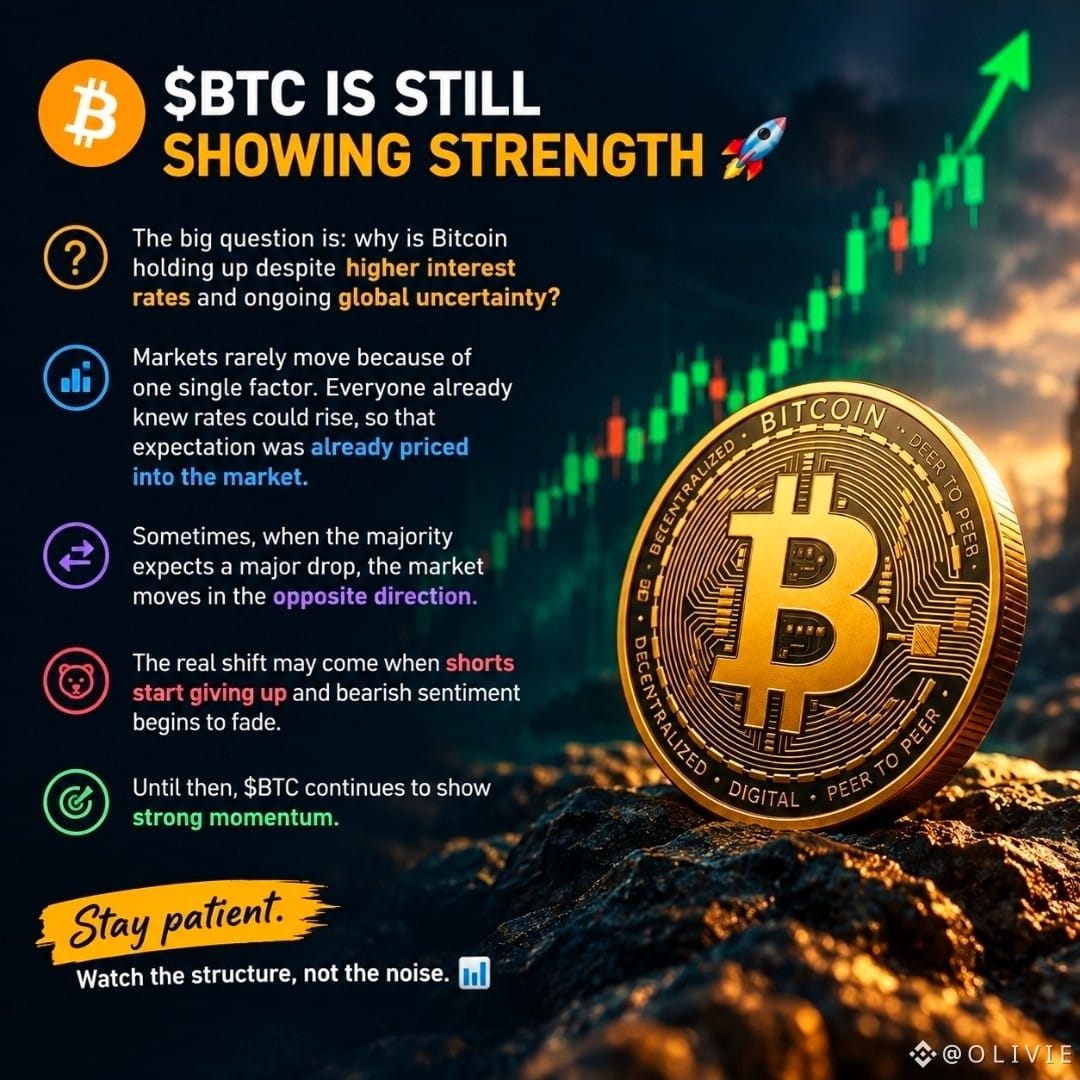
$BTC IS STILL SHOWING STRENGTH 🚀
The big question is: why is Bitcoin holding up despite higher interest rates and ongoing global uncertainty?
Markets rarely move because of one single factor. Everyone already knew rates could rise, so that expectation was already priced into the market.
Sometimes, when the majority expects a major drop, the market moves in the opposite direction.
The real shift may come when shorts start giving up and bearish sentiment begins to fade. Until then, $BTC continues to show strong momentum.
Stay patient. Watch the structure, not the noise.
#BTC走势分析
$BTC IS STILL SHOWING STRENGTH 🚀
The big question is: why is Bitcoin holding up despite higher interest rates and ongoing global uncertainty?
Markets rarely move because of one single factor. Everyone already knew rates could rise, so that expectation was already priced into the market.
Sometimes, when the majority expects a major drop, the market moves in the opposite direction.
The real shift may come when shorts start giving up and bearish sentiment begins to fade. Until then, $BTC continues to show strong momentum.
Stay patient. Watch the structure, not the noise.
#BTC走势分析
The big question is: why is Bitcoin holding up despite higher interest rates and ongoing global uncertainty?
Markets rarely move because of one single factor. Everyone already knew rates could rise, so that expectation was already priced into the market.
Sometimes, when the majority expects a major drop, the market moves in the opposite direction.
The real shift may come when shorts start giving up and bearish sentiment begins to fade. Until then, $BTC continues to show strong momentum.
Stay patient. Watch the structure, not the noise.
#BTC走势分析
10
10
484
·
--
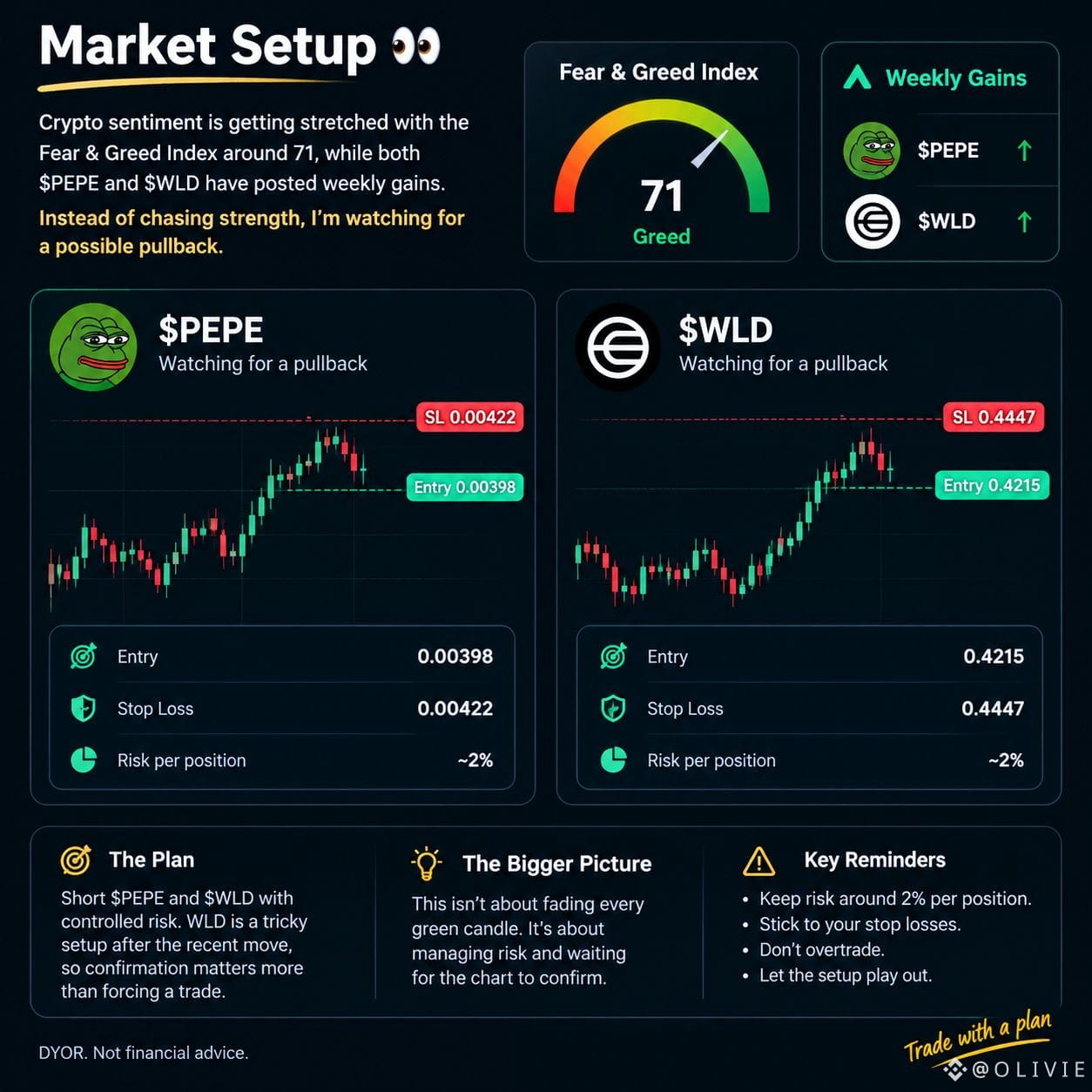
Crypto sentiment is getting stretched with the Fear & Greed Index around 71, while $PEPE and $WLD have both posted weekly gains.
Instead of chasing strength, I’m watching for a possible pullback.
$PEPE ntry: 0.00398
SL: 0.00422
WLD Entry: 0.4215
SL: 0.4447
I’m keeping the risk controlled at around 2% per position. WLD is a tricky setup after the recent move, so confirmation matters more than forcing a trade.
For me, this is about managing risk and waiting for the chart to confirm—not blindly fading every green candle.
DYOR. Not financial advice.
Crypto sentiment is getting stretched with the Fear & Greed Index around 71, while $PEPE and $WLD have both posted weekly gains.
Instead of chasing strength, I’m watching for a possible pullback.
$PEPE ntry: 0.00398
SL: 0.00422
WLD Entry: 0.4215
SL: 0.4447
I’m keeping the risk controlled at around 2% per position. WLD is a tricky setup after the recent move, so confirmation matters more than forcing a trade.
For me, this is about managing risk and waiting for the chart to confirm—not blindly fading every green candle.
DYOR. Not financial advice.
Instead of chasing strength, I’m watching for a possible pullback.
$PEPE ntry: 0.00398
SL: 0.00422
WLD Entry: 0.4215
SL: 0.4447
I’m keeping the risk controlled at around 2% per position. WLD is a tricky setup after the recent move, so confirmation matters more than forcing a trade.
For me, this is about managing risk and waiting for the chart to confirm—not blindly fading every green candle.
DYOR. Not financial advice.
13
16
2.7k
·
--
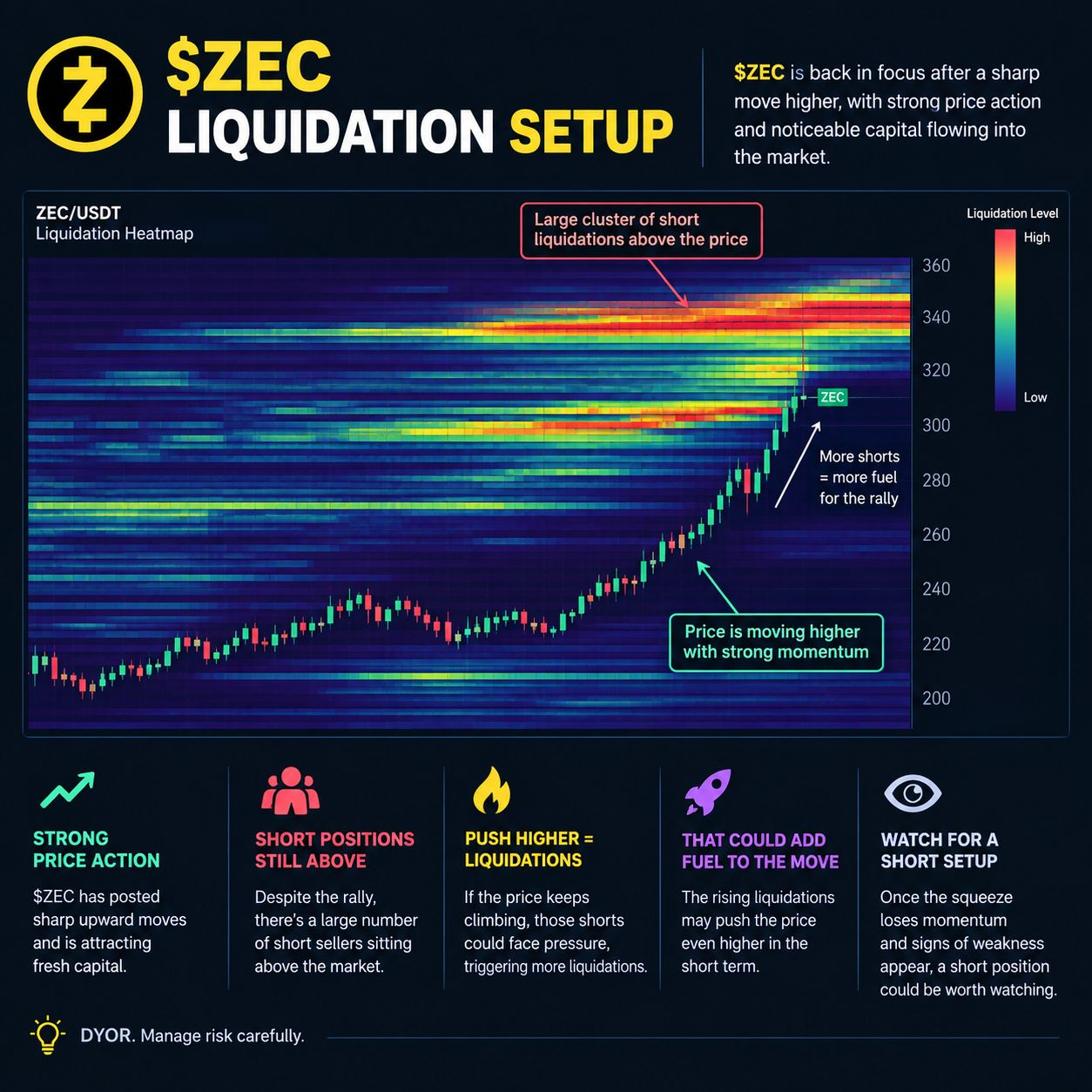
$ZEC is back in focus after a sharp move higher, with strong price action and noticeable capital flowing into the market.
The liquidation map is becoming interesting. Despite the rally, a large number of short positions are still sitting above the market. If price keeps pushing higher, those shorts could face increasing pressure and trigger additional liquidations.
That could add fuel to the current move.
I’ll be watching the liquidation zones closely. Once the short squeeze loses momentum and the market starts showing weakness, a short setup could become worth watching.
DYOR. Manage risk carefully.
#BTC突破7万大关 #zec
$ZEC is back in focus after a sharp move higher, with strong price action and noticeable capital flowing into the market.
The liquidation map is becoming interesting. Despite the rally, a large number of short positions are still sitting above the market. If price keeps pushing higher, those shorts could face increasing pressure and trigger additional liquidations.
That could add fuel to the current move.
I’ll be watching the liquidation zones closely. Once the short squeeze loses momentum and the market starts showing weakness, a short setup could become worth watching.
DYOR. Manage risk carefully.
#BTC突破7万大关 #zec
The liquidation map is becoming interesting. Despite the rally, a large number of short positions are still sitting above the market. If price keeps pushing higher, those shorts could face increasing pressure and trigger additional liquidations.
That could add fuel to the current move.
I’ll be watching the liquidation zones closely. Once the short squeeze loses momentum and the market starts showing weakness, a short setup could become worth watching.
DYOR. Manage risk carefully.
#BTC突破7万大关 #zec
17
18
3.1k
·
--
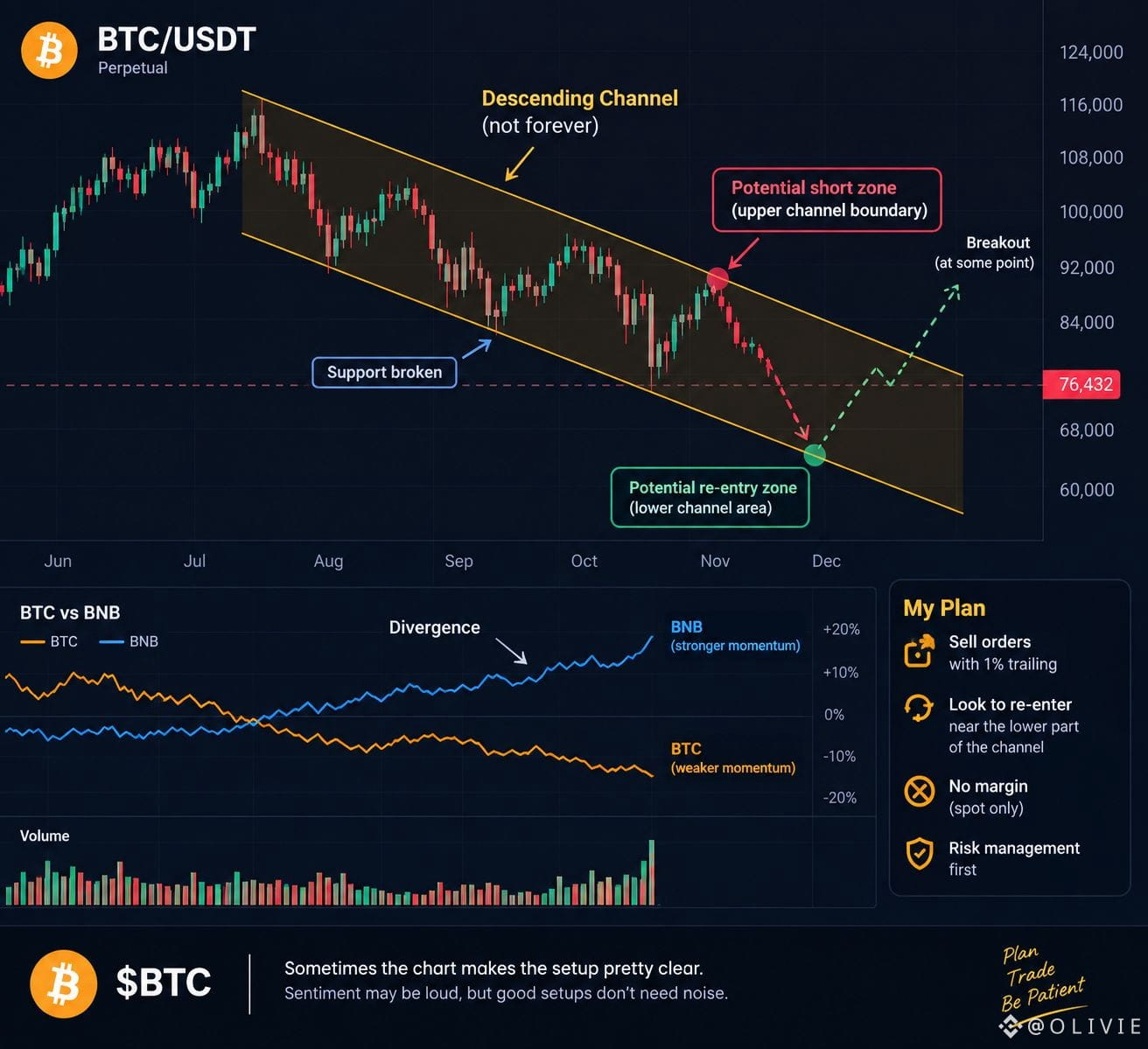
$BTC sometimes the chart makes the setup pretty clear.
Some traders are expecting a local bottom around October, but regardless of timing, this descending channel won’t last forever. Eventually, BTC should break out of it.
For now, with sentiment heavily focused on another ATH, the upper boundary of the channel looks like an area worth watching for potential rejection.
The divergence between BTC and BNB is also interesting, especially with BNB showing stronger momentum right now.
I’ve placed sell orders with a 1% trailing setup and plan to look for a potential re-entry closer to the lower part of the channel.
No margin, just a spot-based approach with risk management in mind.#BTC突破7万大关
$BTC sometimes the chart makes the setup pretty clear.
Some traders are expecting a local bottom around October, but regardless of timing, this descending channel won’t last forever. Eventually, BTC should break out of it.
For now, with sentiment heavily focused on another ATH, the upper boundary of the channel looks like an area worth watching for potential rejection.
The divergence between BTC and BNB is also interesting, especially with BNB showing stronger momentum right now.
I’ve placed sell orders with a 1% trailing setup and plan to look for a potential re-entry closer to the lower part of the channel.
No margin, just a spot-based approach with risk management in mind.#BTC突破7万大关
Some traders are expecting a local bottom around October, but regardless of timing, this descending channel won’t last forever. Eventually, BTC should break out of it.
For now, with sentiment heavily focused on another ATH, the upper boundary of the channel looks like an area worth watching for potential rejection.
The divergence between BTC and BNB is also interesting, especially with BNB showing stronger momentum right now.
I’ve placed sell orders with a 1% trailing setup and plan to look for a potential re-entry closer to the lower part of the channel.
No margin, just a spot-based approach with risk management in mind.#BTC突破7万大关
15
16
433
·
--
Article
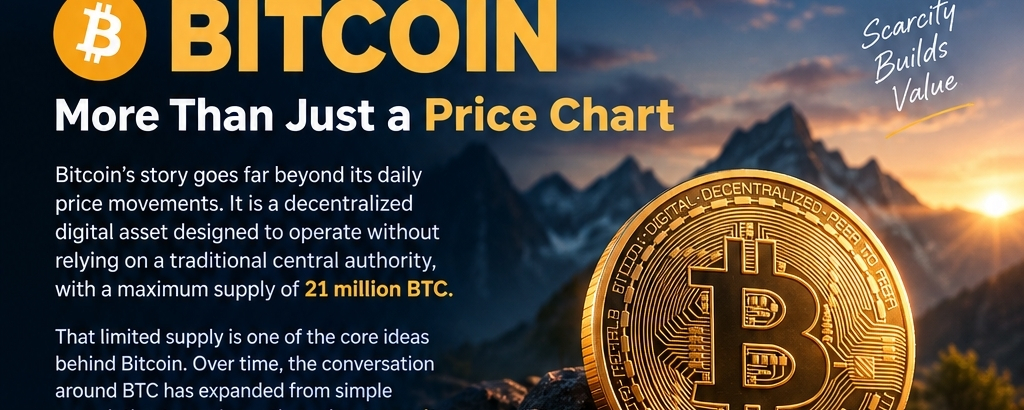
Bitcoin: More Than Just a Price ChartBitcoin’s story goes far beyond its daily price movements. It is a decentralized digital asset designed to operate without relying on a traditional central authority, with a maximum supply of 21 million BTC.
That limited supply is one of the core ideas behind Bitcoin. Over time, the conversation around BTC has expanded from simple speculation toward questions about scarcity, adoption, liquidity, and its potential role within the broader financial system.
But Bitcoin’s market is never driven by one factor alone.
When looking at BTC, I think it’s important to consider several pieces of the puzzle:
→ Price structure: Is Bitcoin maintaining higher highs and higher lows?
→ Support & resistance: Which levels are attracting buyers or sellers?
→ Volume: Is a breakout supported by meaningful market participation?
→ ETF flows: Are institutional flows adding or reducing exposure?
→ Macro conditions: How are interest rates, liquidity, and risk sentiment affecting markets?
→ On-chain activity: What are large holders and network participants doing?
And perhaps the most important lesson: not every Bitcoin rally needs to be chased.
BTC can move quickly in both directions, and short-term volatility can be significant. Looking for confirmation, managing risk, and understanding your own time horizon can be more useful than reacting emotionally to every candle.
Bitcoin can be viewed through many different lenses — technology, scarcity, decentralization, monetary economics, investment, and adoption.
The short-term question is often:
“Where is BTC going next?”
But the bigger question is:
“What role will Bitcoin play in the global financial system over the next decade?” ₿
That is what makes Bitcoin such an interesting asset to keep studying.
DYOR. Crypto assets carry significant risk.#BTC走势分析
Bitcoin: More Than Just a Price Chart
Bitcoin’s story goes far beyond its daily price movements. It is a decentralized digital asset designed to operate without relying on a traditional central authority, with a maximum supply of 21 million BTC.
That limited supply is one of the core ideas behind Bitcoin. Over time, the conversation around BTC has expanded from simple speculation toward questions about scarcity, adoption, liquidity, and its potential role within the broader financial system.
But Bitcoin’s market is never driven by one factor alone.
When looking at BTC, I think it’s important to consider several pieces of the puzzle:
→ Price structure: Is Bitcoin maintaining higher highs and higher lows?
→ Support & resistance: Which levels are attracting buyers or sellers?
→ Volume: Is a breakout supported by meaningful market participation?
→ ETF flows: Are institutional flows adding or reducing exposure?
→ Macro conditions: How are interest rates, liquidity, and risk sentiment affecting markets?
→ On-chain activity: What are large holders and network participants doing?
And perhaps the most important lesson: not every Bitcoin rally needs to be chased.
BTC can move quickly in both directions, and short-term volatility can be significant. Looking for confirmation, managing risk, and understanding your own time horizon can be more useful than reacting emotionally to every candle.
Bitcoin can be viewed through many different lenses — technology, scarcity, decentralization, monetary economics, investment, and adoption.
The short-term question is often:
“Where is BTC going next?”
But the bigger question is:
“What role will Bitcoin play in the global financial system over the next decade?” ₿
That is what makes Bitcoin such an interesting asset to keep studying.
DYOR. Crypto assets carry significant risk.#BTC走势分析
That limited supply is one of the core ideas behind Bitcoin. Over time, the conversation around BTC has expanded from simple speculation toward questions about scarcity, adoption, liquidity, and its potential role within the broader financial system.
But Bitcoin’s market is never driven by one factor alone.
When looking at BTC, I think it’s important to consider several pieces of the puzzle:
→ Price structure: Is Bitcoin maintaining higher highs and higher lows?
→ Support & resistance: Which levels are attracting buyers or sellers?
→ Volume: Is a breakout supported by meaningful market participation?
→ ETF flows: Are institutional flows adding or reducing exposure?
→ Macro conditions: How are interest rates, liquidity, and risk sentiment affecting markets?
→ On-chain activity: What are large holders and network participants doing?
And perhaps the most important lesson: not every Bitcoin rally needs to be chased.
BTC can move quickly in both directions, and short-term volatility can be significant. Looking for confirmation, managing risk, and understanding your own time horizon can be more useful than reacting emotionally to every candle.
Bitcoin can be viewed through many different lenses — technology, scarcity, decentralization, monetary economics, investment, and adoption.
The short-term question is often:
“Where is BTC going next?”
But the bigger question is:
“What role will Bitcoin play in the global financial system over the next decade?” ₿
That is what makes Bitcoin such an interesting asset to keep studying.
DYOR. Crypto assets carry significant risk.#BTC走势分析
167
·
--
Article
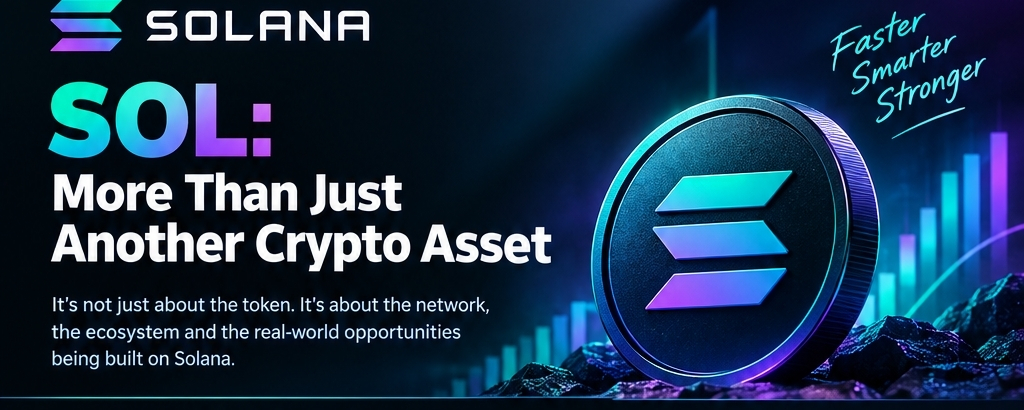
SOL: More Than Just Another Crypto AssetWhen people talk about Solana, the conversation often starts with $SOL price action.
But the bigger story is not only about the token.
It is about the network being built underneath it.
Solana has positioned itself as a high-performance blockchain designed for applications that need fast execution, low transaction costs, and high throughput. Its architecture is increasingly being used across DeFi, payments, tokenized assets, trading, consumer applications, and developer infrastructure.
⚡ Speed Is Only One Part of the Story
Solana's appeal has always been closely connected to performance.
The network's transaction model allows multiple instructions to be composed into atomic transactions, while its architecture is designed for fast execution. Solana's official documentation describes roughly 400ms block times historically, while recent 2026 upgrades have pushed target slot times down to 300ms.
That matters because blockchain adoption isn't only about decentralization.
For everyday applications, users also care about:
• How quickly transactions settle
• How much transactions cost
• Whether the network can handle demand
• Whether developers can build efficiently
• Whether applications can scale without becoming too expensive
Solana is trying to compete on all of these fronts.
🏦 DeFi Is Becoming More Sophisticated
Solana is no longer simply a chain for token swaps and speculative trading.
Its ecosystem now includes decentralized exchanges, lending markets, perpetuals, stablecoins, oracles and other financial infrastructure. The network's composability allows different financial applications to interact within the same execution environment.
This creates an important flywheel:
More liquidity → more applications → more users → more transactions → more demand for blockspace.
If that cycle continues, SOL's role becomes increasingly important because SOL is used within the network for transaction fees and staking.
🌍 The RWA Opportunity
One of the most interesting developments around Solana is the growth of real-world assets.
Tokenized equities and other real-world assets are increasingly moving onchain, bringing traditional financial instruments into blockchain-based markets.
Solana reported that its RWA ecosystem surpassed $4 billion in value during August 2026, while tokenized-stock and stablecoin activity continued expanding.
This is significant because RWAs could eventually connect traditional capital markets with programmable blockchain infrastructure.
Instead of thinking about crypto as a completely separate financial system, we can start thinking about blockchains as infrastructure for moving, trading, settling and managing financial assets.
That is a much bigger opportunity.
💵 Stablecoins & Payments
Payments could become another major use case.
Solana's ecosystem has continued expanding stablecoin infrastructure, while companies are exploring Solana for settlement, payment rails and consumer-facing financial products. In August, Western Union launched a Visa card backed by its USDPT stablecoin on Solana, while MoneyGram introduced infrastructure connecting Solana applications with its global cash network.
The important point is that these developments are not simply about crypto speculation.
They are about using blockchain rails for real financial activity.
🛠️ Developers Matter
A blockchain can have a strong token, but without developers and applications, long-term adoption becomes difficult.
Solana continues investing heavily in developer infrastructure, tooling and performance improvements. Its ecosystem provides resources for building DeFi applications, payment systems, tokenized assets, games and other onchain applications.
Recent protocol upgrades have also increased block capacity and improved execution performance. In July 2026, Solana activated an upgrade raising mainnet block limits to 100 million compute units.
That kind of infrastructure development is easy to overlook when the market is focused only on price.
But infrastructure is what can create sustainable demand over time.
🔥 What Could Drive SOL Forward?
There are several factors worth watching:
1. DeFi growth
More trading, lending, derivatives and liquidity could increase network activity.
2. Tokenized assets
If tokenized stocks, funds and other RWAs continue moving onchain, Solana could benefit from increased financial activity.
3. Stablecoin payments
More stablecoin transfers and real-world payment integrations could create consistent network usage.
4. Developer adoption
More applications can create a stronger ecosystem and increase demand for blockspace.
5. Network improvements
Faster execution and greater capacity can make the network more attractive for high-frequency applications.
6. Institutional adoption
If financial institutions continue experimenting with blockchain-based settlement and tokenization, high-performance networks could become increasingly relevant.
⚠️ But SOL Still Has Risks
A strong ecosystem does not guarantee a rising token price.
Crypto remains highly volatile.
SOL can experience large drawdowns even when the underlying network continues developing. Competition between Layer-1 networks is also intense, and users can move between ecosystems quickly.
There are also risks around network reliability, decentralization, regulation, liquidity and speculative activity.
The August 2026 infrastructure incident was a useful reminder that resilience matters. Solana reported that a routing failure at its largest infrastructure provider took nearly 29% of network stake offline, while blocks continued to be produced and transactions continued landing.
For investors, this highlights an important distinction:
Technology growth ≠ guaranteed token appreciation.
📊 My SOL Watchlist
Rather than focusing only on a specific price target, I would watch the bigger picture:
Network activity
Are transactions and users continuing to grow?
DeFi liquidity
Is capital actually being deployed across the ecosystem?
Stablecoin usage
Are stablecoins becoming a meaningful payment and settlement layer?
RWA adoption
Are tokenized assets generating sustainable activity?
Developer growth
Are builders continuing to choose Solana?
Market structure
Is SOL making higher highs and higher lows?
These indicators can provide more useful information than simply watching a candle move up or down.
Final Thoughts
The SOL thesis is becoming bigger than a simple “crypto goes up” narrative.
Solana is increasingly positioning itself as infrastructure for DeFi, payments, tokenized assets, trading and consumer applications.
The biggest question is not whether SOL can have another short-term rally.
The bigger question is:
Can Solana continue turning network activity into sustainable economic value?
If adoption keeps expanding across financial markets, payments and tokenized assets, SOL could remain one of the most important assets to watch in the blockchain sector.
But as always:
Don't chase candles.
Watch the fundamentals.
Manage risk.
DYOR.
#Solana #SOL
SOL: More Than Just Another Crypto Asset
When people talk about Solana, the conversation often starts with $SOL price action.
But the bigger story is not only about the token.
It is about the network being built underneath it.
Solana has positioned itself as a high-performance blockchain designed for applications that need fast execution, low transaction costs, and high throughput. Its architecture is increasingly being used across DeFi, payments, tokenized assets, trading, consumer applications, and developer infrastructure.
⚡ Speed Is Only One Part of the Story
Solana's appeal has always been closely connected to performance.
The network's transaction model allows multiple instructions to be composed into atomic transactions, while its architecture is designed for fast execution. Solana's official documentation describes roughly 400ms block times historically, while recent 2026 upgrades have pushed target slot times down to 300ms.
That matters because blockchain adoption isn't only about decentralization.
For everyday applications, users also care about:
• How quickly transactions settle
• How much transactions cost
• Whether the network can handle demand
• Whether developers can build efficiently
• Whether applications can scale without becoming too expensive
Solana is trying to compete on all of these fronts.
🏦 DeFi Is Becoming More Sophisticated
Solana is no longer simply a chain for token swaps and speculative trading.
Its ecosystem now includes decentralized exchanges, lending markets, perpetuals, stablecoins, oracles and other financial infrastructure. The network's composability allows different financial applications to interact within the same execution environment.
This creates an important flywheel:
More liquidity → more applications → more users → more transactions → more demand for blockspace.
If that cycle continues, SOL's role becomes increasingly important because SOL is used within the network for transaction fees and staking.
🌍 The RWA Opportunity
One of the most interesting developments around Solana is the growth of real-world assets.
Tokenized equities and other real-world assets are increasingly moving onchain, bringing traditional financial instruments into blockchain-based markets.
Solana reported that its RWA ecosystem surpassed $4 billion in value during August 2026, while tokenized-stock and stablecoin activity continued expanding.
This is significant because RWAs could eventually connect traditional capital markets with programmable blockchain infrastructure.
Instead of thinking about crypto as a completely separate financial system, we can start thinking about blockchains as infrastructure for moving, trading, settling and managing financial assets.
That is a much bigger opportunity.
💵 Stablecoins & Payments
Payments could become another major use case.
Solana's ecosystem has continued expanding stablecoin infrastructure, while companies are exploring Solana for settlement, payment rails and consumer-facing financial products. In August, Western Union launched a Visa card backed by its USDPT stablecoin on Solana, while MoneyGram introduced infrastructure connecting Solana applications with its global cash network.
The important point is that these developments are not simply about crypto speculation.
They are about using blockchain rails for real financial activity.
🛠️ Developers Matter
A blockchain can have a strong token, but without developers and applications, long-term adoption becomes difficult.
Solana continues investing heavily in developer infrastructure, tooling and performance improvements. Its ecosystem provides resources for building DeFi applications, payment systems, tokenized assets, games and other onchain applications.
Recent protocol upgrades have also increased block capacity and improved execution performance. In July 2026, Solana activated an upgrade raising mainnet block limits to 100 million compute units.
That kind of infrastructure development is easy to overlook when the market is focused only on price.
But infrastructure is what can create sustainable demand over time.
🔥 What Could Drive SOL Forward?
There are several factors worth watching:
1. DeFi growth
More trading, lending, derivatives and liquidity could increase network activity.
2. Tokenized assets
If tokenized stocks, funds and other RWAs continue moving onchain, Solana could benefit from increased financial activity.
3. Stablecoin payments
More stablecoin transfers and real-world payment integrations could create consistent network usage.
4. Developer adoption
More applications can create a stronger ecosystem and increase demand for blockspace.
5. Network improvements
Faster execution and greater capacity can make the network more attractive for high-frequency applications.
6. Institutional adoption
If financial institutions continue experimenting with blockchain-based settlement and tokenization, high-performance networks could become increasingly relevant.
⚠️ But SOL Still Has Risks
A strong ecosystem does not guarantee a rising token price.
Crypto remains highly volatile.
SOL can experience large drawdowns even when the underlying network continues developing. Competition between Layer-1 networks is also intense, and users can move between ecosystems quickly.
There are also risks around network reliability, decentralization, regulation, liquidity and speculative activity.
The August 2026 infrastructure incident was a useful reminder that resilience matters. Solana reported that a routing failure at its largest infrastructure provider took nearly 29% of network stake offline, while blocks continued to be produced and transactions continued landing.
For investors, this highlights an important distinction:
Technology growth ≠ guaranteed token appreciation.
📊 My SOL Watchlist
Rather than focusing only on a specific price target, I would watch the bigger picture:
Network activity
Are transactions and users continuing to grow?
DeFi liquidity
Is capital actually being deployed across the ecosystem?
Stablecoin usage
Are stablecoins becoming a meaningful payment and settlement layer?
RWA adoption
Are tokenized assets generating sustainable activity?
Developer growth
Are builders continuing to choose Solana?
Market structure
Is SOL making higher highs and higher lows?
These indicators can provide more useful information than simply watching a candle move up or down.
Final Thoughts
The SOL thesis is becoming bigger than a simple “crypto goes up” narrative.
Solana is increasingly positioning itself as infrastructure for DeFi, payments, tokenized assets, trading and consumer applications.
The biggest question is not whether SOL can have another short-term rally.
The bigger question is:
Can Solana continue turning network activity into sustainable economic value?
If adoption keeps expanding across financial markets, payments and tokenized assets, SOL could remain one of the most important assets to watch in the blockchain sector.
But as always:
Don't chase candles.
Watch the fundamentals.
Manage risk.
DYOR.
#Solana #SOL
But the bigger story is not only about the token.
It is about the network being built underneath it.
Solana has positioned itself as a high-performance blockchain designed for applications that need fast execution, low transaction costs, and high throughput. Its architecture is increasingly being used across DeFi, payments, tokenized assets, trading, consumer applications, and developer infrastructure.
⚡ Speed Is Only One Part of the Story
Solana's appeal has always been closely connected to performance.
The network's transaction model allows multiple instructions to be composed into atomic transactions, while its architecture is designed for fast execution. Solana's official documentation describes roughly 400ms block times historically, while recent 2026 upgrades have pushed target slot times down to 300ms.
That matters because blockchain adoption isn't only about decentralization.
For everyday applications, users also care about:
• How quickly transactions settle
• How much transactions cost
• Whether the network can handle demand
• Whether developers can build efficiently
• Whether applications can scale without becoming too expensive
Solana is trying to compete on all of these fronts.
🏦 DeFi Is Becoming More Sophisticated
Solana is no longer simply a chain for token swaps and speculative trading.
Its ecosystem now includes decentralized exchanges, lending markets, perpetuals, stablecoins, oracles and other financial infrastructure. The network's composability allows different financial applications to interact within the same execution environment.
This creates an important flywheel:
More liquidity → more applications → more users → more transactions → more demand for blockspace.
If that cycle continues, SOL's role becomes increasingly important because SOL is used within the network for transaction fees and staking.
🌍 The RWA Opportunity
One of the most interesting developments around Solana is the growth of real-world assets.
Tokenized equities and other real-world assets are increasingly moving onchain, bringing traditional financial instruments into blockchain-based markets.
Solana reported that its RWA ecosystem surpassed $4 billion in value during August 2026, while tokenized-stock and stablecoin activity continued expanding.
This is significant because RWAs could eventually connect traditional capital markets with programmable blockchain infrastructure.
Instead of thinking about crypto as a completely separate financial system, we can start thinking about blockchains as infrastructure for moving, trading, settling and managing financial assets.
That is a much bigger opportunity.
💵 Stablecoins & Payments
Payments could become another major use case.
Solana's ecosystem has continued expanding stablecoin infrastructure, while companies are exploring Solana for settlement, payment rails and consumer-facing financial products. In August, Western Union launched a Visa card backed by its USDPT stablecoin on Solana, while MoneyGram introduced infrastructure connecting Solana applications with its global cash network.
The important point is that these developments are not simply about crypto speculation.
They are about using blockchain rails for real financial activity.
🛠️ Developers Matter
A blockchain can have a strong token, but without developers and applications, long-term adoption becomes difficult.
Solana continues investing heavily in developer infrastructure, tooling and performance improvements. Its ecosystem provides resources for building DeFi applications, payment systems, tokenized assets, games and other onchain applications.
Recent protocol upgrades have also increased block capacity and improved execution performance. In July 2026, Solana activated an upgrade raising mainnet block limits to 100 million compute units.
That kind of infrastructure development is easy to overlook when the market is focused only on price.
But infrastructure is what can create sustainable demand over time.
🔥 What Could Drive SOL Forward?
There are several factors worth watching:
1. DeFi growth
More trading, lending, derivatives and liquidity could increase network activity.
2. Tokenized assets
If tokenized stocks, funds and other RWAs continue moving onchain, Solana could benefit from increased financial activity.
3. Stablecoin payments
More stablecoin transfers and real-world payment integrations could create consistent network usage.
4. Developer adoption
More applications can create a stronger ecosystem and increase demand for blockspace.
5. Network improvements
Faster execution and greater capacity can make the network more attractive for high-frequency applications.
6. Institutional adoption
If financial institutions continue experimenting with blockchain-based settlement and tokenization, high-performance networks could become increasingly relevant.
⚠️ But SOL Still Has Risks
A strong ecosystem does not guarantee a rising token price.
Crypto remains highly volatile.
SOL can experience large drawdowns even when the underlying network continues developing. Competition between Layer-1 networks is also intense, and users can move between ecosystems quickly.
There are also risks around network reliability, decentralization, regulation, liquidity and speculative activity.
The August 2026 infrastructure incident was a useful reminder that resilience matters. Solana reported that a routing failure at its largest infrastructure provider took nearly 29% of network stake offline, while blocks continued to be produced and transactions continued landing.
For investors, this highlights an important distinction:
Technology growth ≠ guaranteed token appreciation.
📊 My SOL Watchlist
Rather than focusing only on a specific price target, I would watch the bigger picture:
Network activity
Are transactions and users continuing to grow?
DeFi liquidity
Is capital actually being deployed across the ecosystem?
Stablecoin usage
Are stablecoins becoming a meaningful payment and settlement layer?
RWA adoption
Are tokenized assets generating sustainable activity?
Developer growth
Are builders continuing to choose Solana?
Market structure
Is SOL making higher highs and higher lows?
These indicators can provide more useful information than simply watching a candle move up or down.
Final Thoughts
The SOL thesis is becoming bigger than a simple “crypto goes up” narrative.
Solana is increasingly positioning itself as infrastructure for DeFi, payments, tokenized assets, trading and consumer applications.
The biggest question is not whether SOL can have another short-term rally.
The bigger question is:
Can Solana continue turning network activity into sustainable economic value?
If adoption keeps expanding across financial markets, payments and tokenized assets, SOL could remain one of the most important assets to watch in the blockchain sector.
But as always:
Don't chase candles.
Watch the fundamentals.
Manage risk.
DYOR.
#Solana #SOL
400
·
--
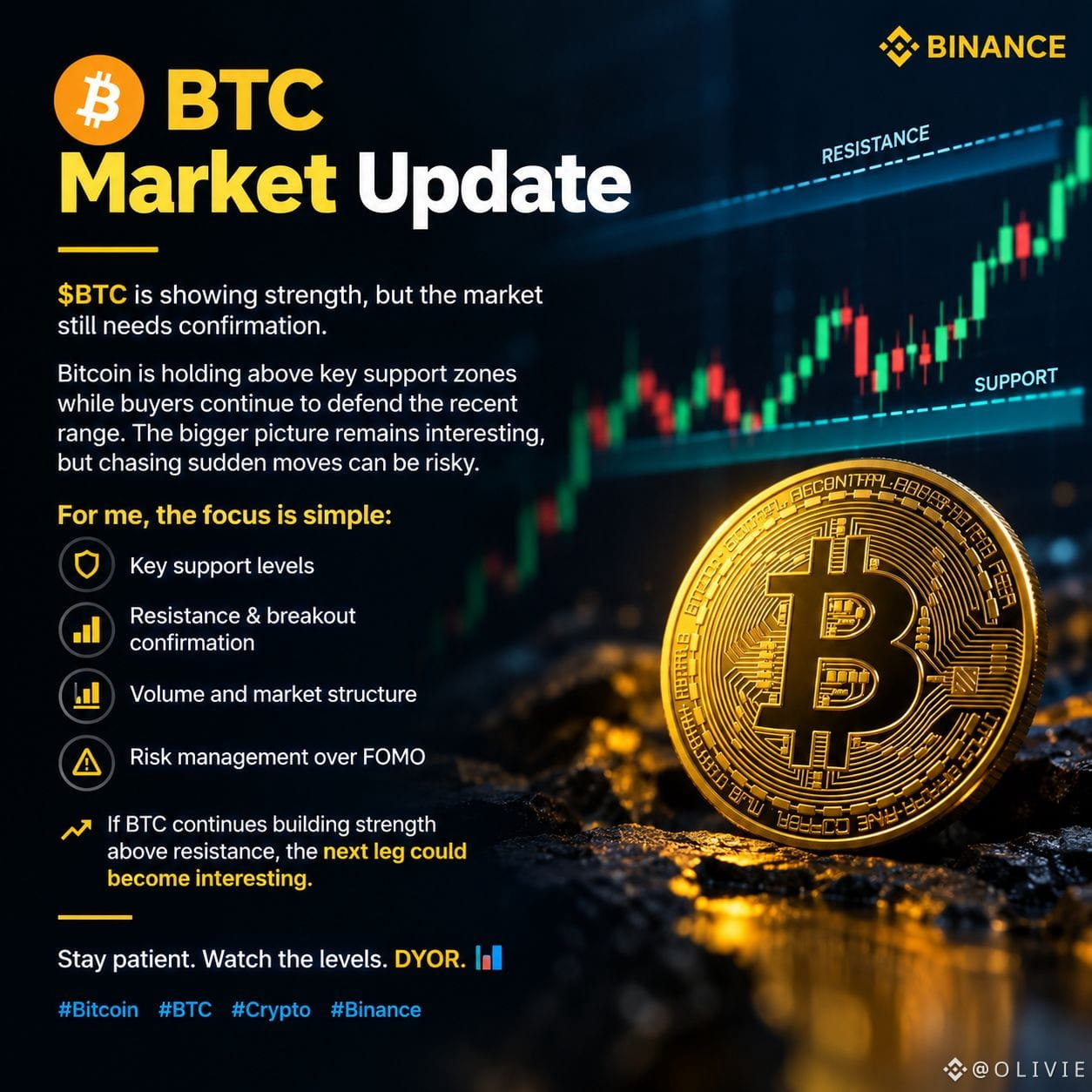
$BTC is showing strength, but the market still needs confirmation.
Bitcoin is holding above key support zones while buyers continue to defend the recent range. The bigger picture remains interesting, but chasing sudden moves can be risky.
For me, the focus is simple:
Key support levels
Resistance & breakout confirmation
Volume and market structure
Risk management over FOMO
If BTC continues building strength above resistance, the next leg could become interesting.
Stay patient. Watch the levels. DYOR. 📊
#BTC
#BTC突破7万大关
$BTC is showing strength, but the market still needs confirmation.
Bitcoin is holding above key support zones while buyers continue to defend the recent range. The bigger picture remains interesting, but chasing sudden moves can be risky.
For me, the focus is simple:
Key support levels
Resistance & breakout confirmation
Volume and market structure
Risk management over FOMO
If BTC continues building strength above resistance, the next leg could become interesting.
Stay patient. Watch the levels. DYOR. 📊
#BTC
#BTC突破7万大关
Bitcoin is holding above key support zones while buyers continue to defend the recent range. The bigger picture remains interesting, but chasing sudden moves can be risky.
For me, the focus is simple:
Key support levels
Resistance & breakout confirmation
Volume and market structure
Risk management over FOMO
If BTC continues building strength above resistance, the next leg could become interesting.
Stay patient. Watch the levels. DYOR. 📊
#BTC
#BTC突破7万大关
153
·
--
Article
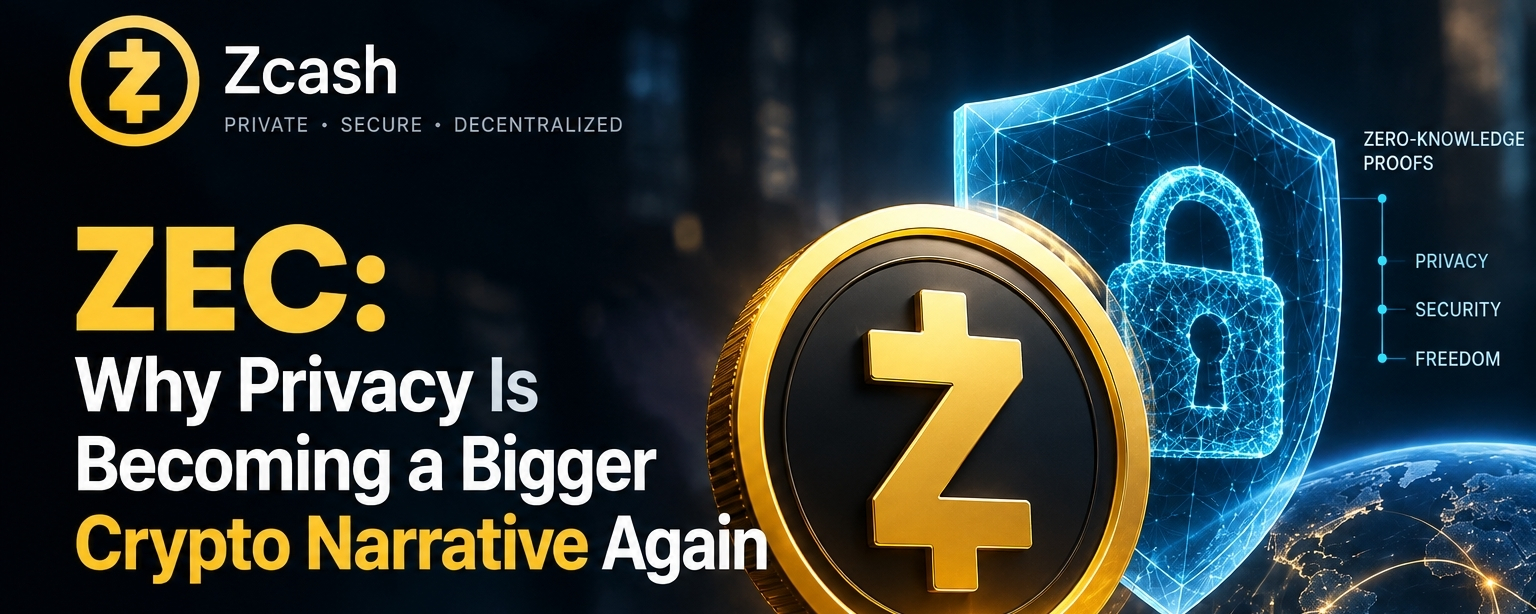
ZEC: Why Privacy Is Becoming a Bigger Crypto Narrative AgainFor years, the crypto market has focused on one simple idea:
Everything should be transparent.
But as blockchain adoption grows, another question becomes increasingly important:
Do users really want every financial transaction to remain permanently visible?
This is where Zcash and $ZEC become interesting.
Zcash was built around a different philosophy: digital money should not necessarily mean publicly exposing your entire financial history.
The project describes itself as “encrypted electronic cash”, using zero-knowledge cryptography to enable private peer-to-peer payments.
And in 2026, privacy is becoming an increasingly relevant conversation again.
What Makes Zcash Different?
Most major public blockchains make transaction information visible onchain.
Anyone can potentially inspect addresses, balances and transaction history.
Zcash gives users another option.
Its shielded transactions use zero-knowledge proofs to allow transactions to be verified without publicly revealing the underlying financial information.
In simple terms:
The network can verify that a transaction is valid without forcing everyone to see all of the details.
That is one of the most important concepts behind Zcash.
Zcash also supports transparent transactions, meaning users can choose between privacy and transparency depending on the wallet and transaction type.
Privacy Is Not Just About Hiding
The word “privacy” sometimes creates the wrong impression.
Privacy does not necessarily mean illegal activity.
Think about traditional banking.
Your bank may know how much money you have and where you spend it, but your neighbors do not.
On a completely transparent blockchain, however, financial activity can potentially be analyzed by anyone.
That creates a different problem.
Imagine your wallet address is connected to your real identity.
Someone could potentially track:
→ How much you hold
→ Where you receive money
→ Where you spend it
→ Which services you use
→ How your balance changes over time
For businesses, institutions and ordinary users, that level of transparency may not always be desirable.
Zcash is essentially asking:
Can we have the benefits of blockchain without turning every financial transaction into public data?
The Technology Behind ZEC
Zcash uses zero-knowledge cryptography, specifically zk-SNARKs, to enable shielded transactions.
The technology allows the network to verify important conditions without exposing the transaction's sensitive details.
This is one reason Zcash has remained one of the most recognizable privacy-focused projects in crypto.
And the technology continues to evolve.
The Zcash protocol has gone through multiple network upgrades, with the latest major development in 2026 being NU6.3, also known as Ironwood.
Ironwood activated on July 28, 2026.
The upgrade introduced a new shielded pool designed to strengthen security and make the integrity of Zcash's circulating supply independently verifiable. The previous Orchard pool was restricted, with funds leaving Orchard required to pass through a turnstile into Ironwood.
That is a significant development.
It shows that privacy isn't simply about adding another feature.
The protocol itself continues to evolve around:
security + privacy + verifiability.
Why 2026 Has Been Important for ZEC
ZEC has experienced renewed market attention during 2026.
Privacy coins have returned to the conversation as investors reconsider the role of financial privacy in the next generation of blockchain infrastructure. Zcash was among the assets benefiting from that renewed interest.
But the story isn't only about price.
There have also been important developments around regulation, institutional exposure and ecosystem infrastructure.
For example, the Zcash Foundation's 2026 report disclosed that the SEC had concluded its review of the organization without recommending enforcement action.
Another potentially important development came from Grayscale.
In May 2026, Grayscale filed to convert its Zcash Trust into a spot ETF structure under the proposed ticker ZCSH on NYSE Arca.
If products like this continue expanding access to privacy-focused assets, ZEC could become easier for traditional investors to gain exposure to.
That doesn't guarantee price appreciation.
But it does show that institutional interest in privacy-focused crypto assets is becoming a more serious conversation.
The Supply Story
ZEC also has a relatively distinctive monetary policy.
Like Bitcoin, Zcash has a maximum supply of 21 million ZEC.
That creates a scarcity narrative that many investors find attractive.
But scarcity alone is not enough.
The important question is:
What creates demand for the scarce asset?
For ZEC, the answer potentially comes from several directions:
Privacy
Users who want private digital money.
Payments
People who want to send value without exposing their complete financial history.
Crypto-native finance
Applications where financial privacy becomes increasingly important.
Institutional demand
Potential exposure through regulated investment products.
Privacy infrastructure
A broader ecosystem built around zero-knowledge technology.
If multiple sources of demand develop simultaneously, the long-term ZEC thesis becomes more interesting.
Zcash and the Bigger Privacy Trend
This is probably the part of the ZEC story I find most interesting.
Crypto is becoming more sophisticated.
We are moving from simple transfers toward:
→ DeFi
→ Tokenization
→ Stablecoins
→ AI agents
→ Onchain identity
→ Institutional finance
→ Real-world assets
As more economic activity moves onchain, the amount of sensitive information potentially exposed by public blockchains also increases.
That creates a natural demand for privacy-preserving infrastructure.
Imagine a company using blockchain for payroll.
Would it want every employee's salary publicly visible?
Probably not.
Imagine an institution moving billions of dollars between wallets.
Would it want competitors tracking every transaction in real time?
Probably not.
Imagine an individual receiving their salary in stablecoins.
Would they want everyone to know their income and spending history?
Again, probably not.
This is where privacy becomes more than a crypto ideology.
It becomes a financial infrastructure requirement.
But There Are Risks
A bullish ZEC thesis should also acknowledge the risks.
Privacy-focused cryptocurrencies face more regulatory complexity than many conventional crypto assets.
Exchanges and financial institutions may have different policies around privacy-enhancing assets.
There is also competition.
Zcash is not the only project working on private transactions or zero-knowledge technology.
And Zcash itself faced a significant governance dispute in early 2026, when the Electric Coin Company development team left following a disagreement with the Bootstrap board and formed a new company.
Governance and developer coordination therefore remain important things to monitor.
Technology alone doesn't guarantee adoption.
A strong protocol still needs:
developers + wallets + liquidity + users + infrastructure + sustainable governance.
What I'm Watching With ZEC
Instead of focusing only on short-term candles, I would watch several fundamentals.
1. Shielded adoption
How much ZEC is actually moving through shielded pools?
Increasing shielded usage could indicate that users value Zcash's core privacy functionality.
2. Developer activity
A privacy protocol needs continuous technical development.
Updates around scalability, security and usability will be critical.
3. Wallet experience
Privacy technology needs to become easy enough for ordinary users.
If using shielded ZEC remains complicated, mainstream adoption becomes harder.
4. Institutional access
ETF developments and regulated investment products could potentially introduce ZEC to a much wider investor base.
5. Regulatory clarity
This may become one of the biggest factors for privacy coins over the coming years.
6. Real-world usage
Ultimately, the strongest signal would be growing usage rather than speculation alone.
The Bigger ZEC Thesis
The strongest argument for Zcash isn't simply:
“ZEC is going to pump.”
That's a weak thesis.
The stronger argument is:
As more financial activity moves onchain, financial privacy becomes increasingly valuable.
Bitcoin proved that decentralized digital scarcity can work.
Ethereum demonstrated that programmable money can create entire financial ecosystems.
Stablecoins demonstrated that blockchain networks can move digital dollars globally.
The next question could be:
Can blockchain provide financial privacy at scale?
Zcash has been working on that problem for years.
And with continued protocol upgrades, renewed interest in privacy coins, growing institutional discussion and increasing awareness of onchain privacy, the ZEC story may be entering another important chapter.
I'm not interested in chasing a candle simply because ZEC is moving.
I'm more interested in the underlying thesis:
If the future of finance is increasingly onchain, privacy may become just as important as transparency.
And if that happens, Zcash is one of the projects worth watching closely.
DYOR. This article is for educational purposes only and is not financial advice.
#BTC走势分析 #ZeusInCrypto #zec
ZEC: Why Privacy Is Becoming a Bigger Crypto Narrative Again
For years, the crypto market has focused on one simple idea:
Everything should be transparent.
But as blockchain adoption grows, another question becomes increasingly important:
Do users really want every financial transaction to remain permanently visible?
This is where Zcash and $ZEC become interesting.
Zcash was built around a different philosophy: digital money should not necessarily mean publicly exposing your entire financial history.
The project describes itself as “encrypted electronic cash”, using zero-knowledge cryptography to enable private peer-to-peer payments.
And in 2026, privacy is becoming an increasingly relevant conversation again.
What Makes Zcash Different?
Most major public blockchains make transaction information visible onchain.
Anyone can potentially inspect addresses, balances and transaction history.
Zcash gives users another option.
Its shielded transactions use zero-knowledge proofs to allow transactions to be verified without publicly revealing the underlying financial information.
In simple terms:
The network can verify that a transaction is valid without forcing everyone to see all of the details.
That is one of the most important concepts behind Zcash.
Zcash also supports transparent transactions, meaning users can choose between privacy and transparency depending on the wallet and transaction type.
Privacy Is Not Just About Hiding
The word “privacy” sometimes creates the wrong impression.
Privacy does not necessarily mean illegal activity.
Think about traditional banking.
Your bank may know how much money you have and where you spend it, but your neighbors do not.
On a completely transparent blockchain, however, financial activity can potentially be analyzed by anyone.
That creates a different problem.
Imagine your wallet address is connected to your real identity.
Someone could potentially track:
→ How much you hold
→ Where you receive money
→ Where you spend it
→ Which services you use
→ How your balance changes over time
For businesses, institutions and ordinary users, that level of transparency may not always be desirable.
Zcash is essentially asking:
Can we have the benefits of blockchain without turning every financial transaction into public data?
The Technology Behind ZEC
Zcash uses zero-knowledge cryptography, specifically zk-SNARKs, to enable shielded transactions.
The technology allows the network to verify important conditions without exposing the transaction's sensitive details.
This is one reason Zcash has remained one of the most recognizable privacy-focused projects in crypto.
And the technology continues to evolve.
The Zcash protocol has gone through multiple network upgrades, with the latest major development in 2026 being NU6.3, also known as Ironwood.
Ironwood activated on July 28, 2026.
The upgrade introduced a new shielded pool designed to strengthen security and make the integrity of Zcash's circulating supply independently verifiable. The previous Orchard pool was restricted, with funds leaving Orchard required to pass through a turnstile into Ironwood.
That is a significant development.
It shows that privacy isn't simply about adding another feature.
The protocol itself continues to evolve around:
security + privacy + verifiability.
Why 2026 Has Been Important for ZEC
ZEC has experienced renewed market attention during 2026.
Privacy coins have returned to the conversation as investors reconsider the role of financial privacy in the next generation of blockchain infrastructure. Zcash was among the assets benefiting from that renewed interest.
But the story isn't only about price.
There have also been important developments around regulation, institutional exposure and ecosystem infrastructure.
For example, the Zcash Foundation's 2026 report disclosed that the SEC had concluded its review of the organization without recommending enforcement action.
Another potentially important development came from Grayscale.
In May 2026, Grayscale filed to convert its Zcash Trust into a spot ETF structure under the proposed ticker ZCSH on NYSE Arca.
If products like this continue expanding access to privacy-focused assets, ZEC could become easier for traditional investors to gain exposure to.
That doesn't guarantee price appreciation.
But it does show that institutional interest in privacy-focused crypto assets is becoming a more serious conversation.
The Supply Story
ZEC also has a relatively distinctive monetary policy.
Like Bitcoin, Zcash has a maximum supply of 21 million ZEC.
That creates a scarcity narrative that many investors find attractive.
But scarcity alone is not enough.
The important question is:
What creates demand for the scarce asset?
For ZEC, the answer potentially comes from several directions:
Privacy
Users who want private digital money.
Payments
People who want to send value without exposing their complete financial history.
Crypto-native finance
Applications where financial privacy becomes increasingly important.
Institutional demand
Potential exposure through regulated investment products.
Privacy infrastructure
A broader ecosystem built around zero-knowledge technology.
If multiple sources of demand develop simultaneously, the long-term ZEC thesis becomes more interesting.
Zcash and the Bigger Privacy Trend
This is probably the part of the ZEC story I find most interesting.
Crypto is becoming more sophisticated.
We are moving from simple transfers toward:
→ DeFi
→ Tokenization
→ Stablecoins
→ AI agents
→ Onchain identity
→ Institutional finance
→ Real-world assets
As more economic activity moves onchain, the amount of sensitive information potentially exposed by public blockchains also increases.
That creates a natural demand for privacy-preserving infrastructure.
Imagine a company using blockchain for payroll.
Would it want every employee's salary publicly visible?
Probably not.
Imagine an institution moving billions of dollars between wallets.
Would it want competitors tracking every transaction in real time?
Probably not.
Imagine an individual receiving their salary in stablecoins.
Would they want everyone to know their income and spending history?
Again, probably not.
This is where privacy becomes more than a crypto ideology.
It becomes a financial infrastructure requirement.
But There Are Risks
A bullish ZEC thesis should also acknowledge the risks.
Privacy-focused cryptocurrencies face more regulatory complexity than many conventional crypto assets.
Exchanges and financial institutions may have different policies around privacy-enhancing assets.
There is also competition.
Zcash is not the only project working on private transactions or zero-knowledge technology.
And Zcash itself faced a significant governance dispute in early 2026, when the Electric Coin Company development team left following a disagreement with the Bootstrap board and formed a new company.
Governance and developer coordination therefore remain important things to monitor.
Technology alone doesn't guarantee adoption.
A strong protocol still needs:
developers + wallets + liquidity + users + infrastructure + sustainable governance.
What I'm Watching With ZEC
Instead of focusing only on short-term candles, I would watch several fundamentals.
1. Shielded adoption
How much ZEC is actually moving through shielded pools?
Increasing shielded usage could indicate that users value Zcash's core privacy functionality.
2. Developer activity
A privacy protocol needs continuous technical development.
Updates around scalability, security and usability will be critical.
3. Wallet experience
Privacy technology needs to become easy enough for ordinary users.
If using shielded ZEC remains complicated, mainstream adoption becomes harder.
4. Institutional access
ETF developments and regulated investment products could potentially introduce ZEC to a much wider investor base.
5. Regulatory clarity
This may become one of the biggest factors for privacy coins over the coming years.
6. Real-world usage
Ultimately, the strongest signal would be growing usage rather than speculation alone.
The Bigger ZEC Thesis
The strongest argument for Zcash isn't simply:
“ZEC is going to pump.”
That's a weak thesis.
The stronger argument is:
As more financial activity moves onchain, financial privacy becomes increasingly valuable.
Bitcoin proved that decentralized digital scarcity can work.
Ethereum demonstrated that programmable money can create entire financial ecosystems.
Stablecoins demonstrated that blockchain networks can move digital dollars globally.
The next question could be:
Can blockchain provide financial privacy at scale?
Zcash has been working on that problem for years.
And with continued protocol upgrades, renewed interest in privacy coins, growing institutional discussion and increasing awareness of onchain privacy, the ZEC story may be entering another important chapter.
I'm not interested in chasing a candle simply because ZEC is moving.
I'm more interested in the underlying thesis:
If the future of finance is increasingly onchain, privacy may become just as important as transparency.
And if that happens, Zcash is one of the projects worth watching closely.
DYOR. This article is for educational purposes only and is not financial advice.
#BTC走势分析 #ZeusInCrypto #zec
Everything should be transparent.
But as blockchain adoption grows, another question becomes increasingly important:
Do users really want every financial transaction to remain permanently visible?
This is where Zcash and $ZEC become interesting.
Zcash was built around a different philosophy: digital money should not necessarily mean publicly exposing your entire financial history.
The project describes itself as “encrypted electronic cash”, using zero-knowledge cryptography to enable private peer-to-peer payments.
And in 2026, privacy is becoming an increasingly relevant conversation again.
What Makes Zcash Different?
Most major public blockchains make transaction information visible onchain.
Anyone can potentially inspect addresses, balances and transaction history.
Zcash gives users another option.
Its shielded transactions use zero-knowledge proofs to allow transactions to be verified without publicly revealing the underlying financial information.
In simple terms:
The network can verify that a transaction is valid without forcing everyone to see all of the details.
That is one of the most important concepts behind Zcash.
Zcash also supports transparent transactions, meaning users can choose between privacy and transparency depending on the wallet and transaction type.
Privacy Is Not Just About Hiding
The word “privacy” sometimes creates the wrong impression.
Privacy does not necessarily mean illegal activity.
Think about traditional banking.
Your bank may know how much money you have and where you spend it, but your neighbors do not.
On a completely transparent blockchain, however, financial activity can potentially be analyzed by anyone.
That creates a different problem.
Imagine your wallet address is connected to your real identity.
Someone could potentially track:
→ How much you hold
→ Where you receive money
→ Where you spend it
→ Which services you use
→ How your balance changes over time
For businesses, institutions and ordinary users, that level of transparency may not always be desirable.
Zcash is essentially asking:
Can we have the benefits of blockchain without turning every financial transaction into public data?
The Technology Behind ZEC
Zcash uses zero-knowledge cryptography, specifically zk-SNARKs, to enable shielded transactions.
The technology allows the network to verify important conditions without exposing the transaction's sensitive details.
This is one reason Zcash has remained one of the most recognizable privacy-focused projects in crypto.
And the technology continues to evolve.
The Zcash protocol has gone through multiple network upgrades, with the latest major development in 2026 being NU6.3, also known as Ironwood.
Ironwood activated on July 28, 2026.
The upgrade introduced a new shielded pool designed to strengthen security and make the integrity of Zcash's circulating supply independently verifiable. The previous Orchard pool was restricted, with funds leaving Orchard required to pass through a turnstile into Ironwood.
That is a significant development.
It shows that privacy isn't simply about adding another feature.
The protocol itself continues to evolve around:
security + privacy + verifiability.
Why 2026 Has Been Important for ZEC
ZEC has experienced renewed market attention during 2026.
Privacy coins have returned to the conversation as investors reconsider the role of financial privacy in the next generation of blockchain infrastructure. Zcash was among the assets benefiting from that renewed interest.
But the story isn't only about price.
There have also been important developments around regulation, institutional exposure and ecosystem infrastructure.
For example, the Zcash Foundation's 2026 report disclosed that the SEC had concluded its review of the organization without recommending enforcement action.
Another potentially important development came from Grayscale.
In May 2026, Grayscale filed to convert its Zcash Trust into a spot ETF structure under the proposed ticker ZCSH on NYSE Arca.
If products like this continue expanding access to privacy-focused assets, ZEC could become easier for traditional investors to gain exposure to.
That doesn't guarantee price appreciation.
But it does show that institutional interest in privacy-focused crypto assets is becoming a more serious conversation.
The Supply Story
ZEC also has a relatively distinctive monetary policy.
Like Bitcoin, Zcash has a maximum supply of 21 million ZEC.
That creates a scarcity narrative that many investors find attractive.
But scarcity alone is not enough.
The important question is:
What creates demand for the scarce asset?
For ZEC, the answer potentially comes from several directions:
Privacy
Users who want private digital money.
Payments
People who want to send value without exposing their complete financial history.
Crypto-native finance
Applications where financial privacy becomes increasingly important.
Institutional demand
Potential exposure through regulated investment products.
Privacy infrastructure
A broader ecosystem built around zero-knowledge technology.
If multiple sources of demand develop simultaneously, the long-term ZEC thesis becomes more interesting.
Zcash and the Bigger Privacy Trend
This is probably the part of the ZEC story I find most interesting.
Crypto is becoming more sophisticated.
We are moving from simple transfers toward:
→ DeFi
→ Tokenization
→ Stablecoins
→ AI agents
→ Onchain identity
→ Institutional finance
→ Real-world assets
As more economic activity moves onchain, the amount of sensitive information potentially exposed by public blockchains also increases.
That creates a natural demand for privacy-preserving infrastructure.
Imagine a company using blockchain for payroll.
Would it want every employee's salary publicly visible?
Probably not.
Imagine an institution moving billions of dollars between wallets.
Would it want competitors tracking every transaction in real time?
Probably not.
Imagine an individual receiving their salary in stablecoins.
Would they want everyone to know their income and spending history?
Again, probably not.
This is where privacy becomes more than a crypto ideology.
It becomes a financial infrastructure requirement.
But There Are Risks
A bullish ZEC thesis should also acknowledge the risks.
Privacy-focused cryptocurrencies face more regulatory complexity than many conventional crypto assets.
Exchanges and financial institutions may have different policies around privacy-enhancing assets.
There is also competition.
Zcash is not the only project working on private transactions or zero-knowledge technology.
And Zcash itself faced a significant governance dispute in early 2026, when the Electric Coin Company development team left following a disagreement with the Bootstrap board and formed a new company.
Governance and developer coordination therefore remain important things to monitor.
Technology alone doesn't guarantee adoption.
A strong protocol still needs:
developers + wallets + liquidity + users + infrastructure + sustainable governance.
What I'm Watching With ZEC
Instead of focusing only on short-term candles, I would watch several fundamentals.
1. Shielded adoption
How much ZEC is actually moving through shielded pools?
Increasing shielded usage could indicate that users value Zcash's core privacy functionality.
2. Developer activity
A privacy protocol needs continuous technical development.
Updates around scalability, security and usability will be critical.
3. Wallet experience
Privacy technology needs to become easy enough for ordinary users.
If using shielded ZEC remains complicated, mainstream adoption becomes harder.
4. Institutional access
ETF developments and regulated investment products could potentially introduce ZEC to a much wider investor base.
5. Regulatory clarity
This may become one of the biggest factors for privacy coins over the coming years.
6. Real-world usage
Ultimately, the strongest signal would be growing usage rather than speculation alone.
The Bigger ZEC Thesis
The strongest argument for Zcash isn't simply:
“ZEC is going to pump.”
That's a weak thesis.
The stronger argument is:
As more financial activity moves onchain, financial privacy becomes increasingly valuable.
Bitcoin proved that decentralized digital scarcity can work.
Ethereum demonstrated that programmable money can create entire financial ecosystems.
Stablecoins demonstrated that blockchain networks can move digital dollars globally.
The next question could be:
Can blockchain provide financial privacy at scale?
Zcash has been working on that problem for years.
And with continued protocol upgrades, renewed interest in privacy coins, growing institutional discussion and increasing awareness of onchain privacy, the ZEC story may be entering another important chapter.
I'm not interested in chasing a candle simply because ZEC is moving.
I'm more interested in the underlying thesis:
If the future of finance is increasingly onchain, privacy may become just as important as transparency.
And if that happens, Zcash is one of the projects worth watching closely.
DYOR. This article is for educational purposes only and is not financial advice.
#BTC走势分析 #ZeusInCrypto #zec
480
·
--
Article
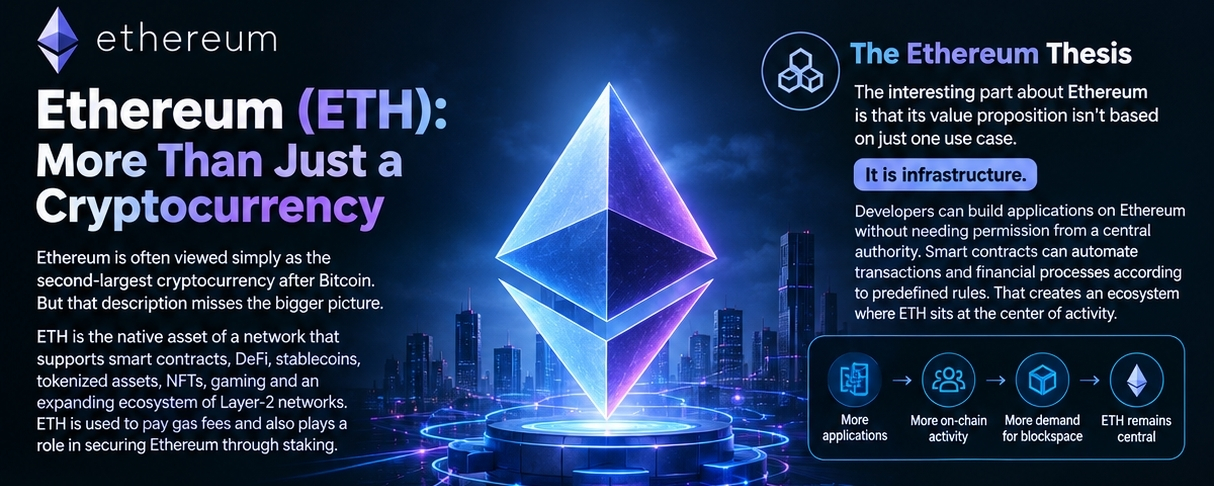
Ethereum (ETH): More Than Just a CryptocurrencyEthereum is often viewed simply as the second-largest cryptocurrency after Bitcoin. But that description misses the bigger picture.
ETH is the native asset of a network that supports smart contracts, DeFi, stablecoins, tokenized assets, NFTs, gaming, and an expanding ecosystem of Layer-2 networks. ETH is used to pay gas fees and also plays a role in securing Ethereum through staking.
ethereum.org +1
The Ethereum Thesis
The interesting part about Ethereum is that its value proposition isn't based on just one use case.
It is infrastructure.
Developers can build applications on Ethereum without needing permission from a central authority. Smart contracts can automate transactions and financial processes according to predefined rules.
ethereum.org
That creates an ecosystem where ETH sits at the center of activity.
More applications can mean more on-chain activity. More activity can create demand for blockspace, while ETH remains the asset used for network fees and staking.
Scaling Is the Big Story
One of Ethereum's biggest challenges has always been scalability.
The network has been moving toward a Layer-2-centric model, where rollups process transactions more efficiently while Ethereum remains the settlement and security layer. Ethereum's roadmap continues to focus on increasing capacity, improving data availability and making transactions cheaper.
The Ethereum Foundation's 2026 priorities also emphasize scaling, improving user experience and hardening the Layer 1.
This matters because long-term adoption requires infrastructure that can support millions of users without making the network unnecessarily expensive or difficult to use.
ETH and Staking
ETH also has a unique role as a productive asset within its own network.
Ethereum uses Proof of Stake, meaning validators stake ETH to participate in securing the blockchain. Users can also participate through staking pools with smaller amounts than the 32 ETH required to operate a validator directly.
That gives ETH another important function beyond simply transferring value.
It helps secure the infrastructure on which the Ethereum economy operates.
Ethereum and the Multichain Future
Another important development is the growing relationship between Ethereum Layer 1 and Layer 2 networks.
Rather than every application needing to operate directly on Ethereum mainnet, different L2s can provide specialized environments while Ethereum acts as a settlement, liquidity and security hub. The Ethereum Foundation describes this as a model where L2s provide additional customization and scale while L1 remains the core foundation.
If this model succeeds, Ethereum doesn't necessarily need every transaction to happen directly on L1.
It needs to remain the trusted foundation underneath a much larger on-chain economy.
What Could Drive ETH Forward?
Several narratives could remain important for ETH:
• DeFi growth
• Stablecoin adoption
• Tokenized real-world assets
• Layer-2 expansion
• Institutional blockchain adoption
• Staking participation
• Better transaction efficiency
• Growing demand for Ethereum-based applications
The important point is that these narratives are connected.
More applications can create more activity. Better scaling can improve user experience. More users can strengthen the ecosystem. And ETH remains deeply connected to the network's economic and security model.
But Risks Still Matter
The ETH thesis isn't risk-free.
Competition from other blockchains remains strong. Ethereum must continue improving scalability, UX and interoperability while maintaining decentralization and security.
The crypto market itself also remains highly volatile.
So rather than chasing short-term candles, I think the more interesting question is:
Can Ethereum continue expanding its role as the settlement and infrastructure layer for the on-chain economy?
If the answer is yes, ETH's long-term story could be much bigger than simply being a cryptocurrency.
ETH isn't just an asset to watch on a chart. It's an asset connected to an entire blockchain economy. 📈
#Ethereum #ETH #DeFi #Layer2 #Blockchain
Ethereum (ETH): More Than Just a Cryptocurrency
Ethereum is often viewed simply as the second-largest cryptocurrency after Bitcoin. But that description misses the bigger picture.
ETH is the native asset of a network that supports smart contracts, DeFi, stablecoins, tokenized assets, NFTs, gaming, and an expanding ecosystem of Layer-2 networks. ETH is used to pay gas fees and also plays a role in securing Ethereum through staking.
ethereum.org +1
The Ethereum Thesis
The interesting part about Ethereum is that its value proposition isn't based on just one use case.
It is infrastructure.
Developers can build applications on Ethereum without needing permission from a central authority. Smart contracts can automate transactions and financial processes according to predefined rules.
ethereum.org
That creates an ecosystem where ETH sits at the center of activity.
More applications can mean more on-chain activity. More activity can create demand for blockspace, while ETH remains the asset used for network fees and staking.
Scaling Is the Big Story
One of Ethereum's biggest challenges has always been scalability.
The network has been moving toward a Layer-2-centric model, where rollups process transactions more efficiently while Ethereum remains the settlement and security layer. Ethereum's roadmap continues to focus on increasing capacity, improving data availability and making transactions cheaper.
The Ethereum Foundation's 2026 priorities also emphasize scaling, improving user experience and hardening the Layer 1.
This matters because long-term adoption requires infrastructure that can support millions of users without making the network unnecessarily expensive or difficult to use.
ETH and Staking
ETH also has a unique role as a productive asset within its own network.
Ethereum uses Proof of Stake, meaning validators stake ETH to participate in securing the blockchain. Users can also participate through staking pools with smaller amounts than the 32 ETH required to operate a validator directly.
That gives ETH another important function beyond simply transferring value.
It helps secure the infrastructure on which the Ethereum economy operates.
Ethereum and the Multichain Future
Another important development is the growing relationship between Ethereum Layer 1 and Layer 2 networks.
Rather than every application needing to operate directly on Ethereum mainnet, different L2s can provide specialized environments while Ethereum acts as a settlement, liquidity and security hub. The Ethereum Foundation describes this as a model where L2s provide additional customization and scale while L1 remains the core foundation.
If this model succeeds, Ethereum doesn't necessarily need every transaction to happen directly on L1.
It needs to remain the trusted foundation underneath a much larger on-chain economy.
What Could Drive ETH Forward?
Several narratives could remain important for ETH:
• DeFi growth
• Stablecoin adoption
• Tokenized real-world assets
• Layer-2 expansion
• Institutional blockchain adoption
• Staking participation
• Better transaction efficiency
• Growing demand for Ethereum-based applications
The important point is that these narratives are connected.
More applications can create more activity. Better scaling can improve user experience. More users can strengthen the ecosystem. And ETH remains deeply connected to the network's economic and security model.
But Risks Still Matter
The ETH thesis isn't risk-free.
Competition from other blockchains remains strong. Ethereum must continue improving scalability, UX and interoperability while maintaining decentralization and security.
The crypto market itself also remains highly volatile.
So rather than chasing short-term candles, I think the more interesting question is:
Can Ethereum continue expanding its role as the settlement and infrastructure layer for the on-chain economy?
If the answer is yes, ETH's long-term story could be much bigger than simply being a cryptocurrency.
ETH isn't just an asset to watch on a chart. It's an asset connected to an entire blockchain economy. 📈
#Ethereum #ETH #DeFi #Layer2 #Blockchain
ETH is the native asset of a network that supports smart contracts, DeFi, stablecoins, tokenized assets, NFTs, gaming, and an expanding ecosystem of Layer-2 networks. ETH is used to pay gas fees and also plays a role in securing Ethereum through staking.
ethereum.org +1
The Ethereum Thesis
The interesting part about Ethereum is that its value proposition isn't based on just one use case.
It is infrastructure.
Developers can build applications on Ethereum without needing permission from a central authority. Smart contracts can automate transactions and financial processes according to predefined rules.
ethereum.org
That creates an ecosystem where ETH sits at the center of activity.
More applications can mean more on-chain activity. More activity can create demand for blockspace, while ETH remains the asset used for network fees and staking.
Scaling Is the Big Story
One of Ethereum's biggest challenges has always been scalability.
The network has been moving toward a Layer-2-centric model, where rollups process transactions more efficiently while Ethereum remains the settlement and security layer. Ethereum's roadmap continues to focus on increasing capacity, improving data availability and making transactions cheaper.
The Ethereum Foundation's 2026 priorities also emphasize scaling, improving user experience and hardening the Layer 1.
This matters because long-term adoption requires infrastructure that can support millions of users without making the network unnecessarily expensive or difficult to use.
ETH and Staking
ETH also has a unique role as a productive asset within its own network.
Ethereum uses Proof of Stake, meaning validators stake ETH to participate in securing the blockchain. Users can also participate through staking pools with smaller amounts than the 32 ETH required to operate a validator directly.
That gives ETH another important function beyond simply transferring value.
It helps secure the infrastructure on which the Ethereum economy operates.
Ethereum and the Multichain Future
Another important development is the growing relationship between Ethereum Layer 1 and Layer 2 networks.
Rather than every application needing to operate directly on Ethereum mainnet, different L2s can provide specialized environments while Ethereum acts as a settlement, liquidity and security hub. The Ethereum Foundation describes this as a model where L2s provide additional customization and scale while L1 remains the core foundation.
If this model succeeds, Ethereum doesn't necessarily need every transaction to happen directly on L1.
It needs to remain the trusted foundation underneath a much larger on-chain economy.
What Could Drive ETH Forward?
Several narratives could remain important for ETH:
• DeFi growth
• Stablecoin adoption
• Tokenized real-world assets
• Layer-2 expansion
• Institutional blockchain adoption
• Staking participation
• Better transaction efficiency
• Growing demand for Ethereum-based applications
The important point is that these narratives are connected.
More applications can create more activity. Better scaling can improve user experience. More users can strengthen the ecosystem. And ETH remains deeply connected to the network's economic and security model.
But Risks Still Matter
The ETH thesis isn't risk-free.
Competition from other blockchains remains strong. Ethereum must continue improving scalability, UX and interoperability while maintaining decentralization and security.
The crypto market itself also remains highly volatile.
So rather than chasing short-term candles, I think the more interesting question is:
Can Ethereum continue expanding its role as the settlement and infrastructure layer for the on-chain economy?
If the answer is yes, ETH's long-term story could be much bigger than simply being a cryptocurrency.
ETH isn't just an asset to watch on a chart. It's an asset connected to an entire blockchain economy. 📈
#Ethereum #ETH #DeFi #Layer2 #Blockchain
1
182
·
--
Prediction markets are getting more interesting 👀
Polymarket shows how people can use markets to express views on real-world events and probabilities, rather than just trading price charts.
For Binance users, this is another interesting part of the broader crypto ecosystem where blockchain, market data and user predictions come together.
The bigger question is: will prediction markets become a mainstream crypto use case?
I’m watching this space closely. #Polymarket
Prediction markets are getting more interesting 👀
Polymarket shows how people can use markets to express views on real-world events and probabilities, rather than just trading price charts.
For Binance users, this is another interesting part of the broader crypto ecosystem where blockchain, market data and user predictions come together.
The bigger question is: will prediction markets become a mainstream crypto use case?
I’m watching this space closely. #Polymarket
Polymarket shows how people can use markets to express views on real-world events and probabilities, rather than just trading price charts.
For Binance users, this is another interesting part of the broader crypto ecosystem where blockchain, market data and user predictions come together.
The bigger question is: will prediction markets become a mainstream crypto use case?
I’m watching this space closely. #Polymarket

161
·
--

Article
Bitcoin: From Digital Asset to Global Financial InfrastructureBitcoin is often viewed through one simple lens: price. People watch the chart, discuss support and resistance, and try to predict the next move. But the bigger Bitcoin story goes far beyond daily candles.
Bitcoin has gradually developed from an experimental digital currency into a global financial asset with growing participation from individuals, institutions, businesses and financial markets. The more important question now is not simply whether Bitcoin can reach a higher price, but how its role in the global financial system continues to evolve.
Why Bitcoin Still Matters
Bitcoin was created around a simple idea: a digital form of money that can operate without depending on a central authority to control the network.
Its fixed maximum supply of 21 million BTC is one of its most important characteristics. Unlike traditional currencies, Bitcoin's supply cannot simply be increased whenever policymakers decide to do so.
This scarcity is one reason many investors view Bitcoin as a potential long-term store of value.
At the same time, Bitcoin is not risk-free. Its price can move aggressively in both directions, and market sentiment can change quickly. Understanding that volatility is essential for anyone considering exposure to BTC.
Bitcoin Is Becoming More Institutional
One of the biggest changes in the Bitcoin market has been the growing involvement of traditional finance.
Institutions increasingly have ways to gain exposure to Bitcoin through regulated financial products, custody solutions and professional trading infrastructure.
This matters because institutional participation can bring additional liquidity and legitimacy to the market. It also means Bitcoin is no longer limited to early crypto users.
However, institutional adoption does not guarantee higher prices. Large investors can also sell, hedge or reduce exposure. Bitcoin remains a market where risk management matters.
The Importance of Network Security
Bitcoin's value is not based only on its price.
The Bitcoin network is secured through proof-of-work mining, where miners use computational power to validate transactions and maintain the blockchain.
This decentralized security model is one of Bitcoin's core strengths. Thousands of participants around the world contribute to maintaining the network without requiring a central operator.
The result is a financial network that can operate continuously and settle transactions without relying on a traditional banking system.
Bitcoin as a Global Asset
Another important characteristic of Bitcoin is accessibility.
Traditional financial markets can have different operating hours, intermediaries and geographic restrictions. Bitcoin operates on a global network that is available 24/7.
For people living in economies with unstable currencies, limited access to financial services or expensive cross-border transfers, Bitcoin can represent a different type of financial infrastructure.
That does not mean Bitcoin automatically solves every financial problem. Transaction fees, volatility, regulation, custody and user security remain important considerations.
Bitcoin and the Future of Payments
Bitcoin's original vision was closely connected to digital payments, but its role has evolved.
Today, Bitcoin is often used more as a long-term asset than as an everyday payment currency. Layer-2 technologies such as the Lightning Network are attempting to improve Bitcoin's usefulness for faster and smaller transactions.
This creates an interesting possibility: Bitcoin can potentially function as a base settlement layer while additional technologies handle faster everyday transactions.
The future may not require Bitcoin itself to handle every transaction directly.
Bitcoin and the Broader Crypto Economy
Bitcoin also plays a major role in the wider digital-asset ecosystem.
When Bitcoin moves strongly, it often affects overall market sentiment. Traders monitor BTC liquidity, derivatives markets, ETF flows, macroeconomic conditions and institutional positioning because these factors can influence the broader crypto market.
But Bitcoin and the rest of crypto should not be treated as the same thing.
Bitcoin has a very different monetary design from smart-contract platforms, stablecoins, DeFi protocols and RWA networks. Each serves different purposes.
What Could Drive Bitcoin Forward?
Several factors could continue shaping Bitcoin's long-term trajectory.
Institutional adoption is one.
Regulatory clarity is another.
Growing demand for scarce digital assets could also matter, particularly if Bitcoin continues to gain acceptance among traditional investors.
Technological improvements, better custody infrastructure and easier access could further reduce the barriers for new users.
At the same time, macroeconomic conditions remain important. Interest rates, liquidity, inflation expectations and global risk appetite can all influence Bitcoin demand.
The Risks Should Not Be Ignored
Bitcoin's potential does not eliminate its risks.
Price volatility remains one of the biggest challenges. A strong rally can quickly be followed by a major correction.
There are also regulatory, security and custody risks. Losing private keys, interacting with fraudulent platforms or using excessive leverage can result in significant losses.
This is why a long-term Bitcoin thesis should never be based only on a price target.
Understanding position size, risk tolerance and market conditions is just as important as understanding the technology.
The Bigger Picture
The most interesting part of Bitcoin's journey may be that the conversation is gradually changing.
In the early days, the question was whether Bitcoin could survive.
Then the question became whether it could become valuable.
Now the conversation is increasingly about how Bitcoin fits into the global financial system.
Whether Bitcoin ultimately becomes a major store of value, a global settlement asset, a payment network, or some combination of these roles remains to be seen.
But one thing is clear: Bitcoin has moved far beyond being just an experiment.
Its network, scarcity, liquidity and growing financial infrastructure have created an asset class that is difficult for the global financial system to ignore.
The next chapter may not simply be about Bitcoin going up.
It may be about Bitcoin becoming increasingly integrated into how the world thinks about money, ownership and digital value.#Btc
Bitcoin: From Digital Asset to Global Financial Infrastructure
Bitcoin is often viewed through one simple lens: price. People watch the chart, discuss support and resistance, and try to predict the next move. But the bigger Bitcoin story goes far beyond daily candles.
Bitcoin has gradually developed from an experimental digital currency into a global financial asset with growing participation from individuals, institutions, businesses and financial markets. The more important question now is not simply whether Bitcoin can reach a higher price, but how its role in the global financial system continues to evolve.
Why Bitcoin Still Matters
Bitcoin was created around a simple idea: a digital form of money that can operate without depending on a central authority to control the network.
Its fixed maximum supply of 21 million BTC is one of its most important characteristics. Unlike traditional currencies, Bitcoin's supply cannot simply be increased whenever policymakers decide to do so.
This scarcity is one reason many investors view Bitcoin as a potential long-term store of value.
At the same time, Bitcoin is not risk-free. Its price can move aggressively in both directions, and market sentiment can change quickly. Understanding that volatility is essential for anyone considering exposure to BTC.
Bitcoin Is Becoming More Institutional
One of the biggest changes in the Bitcoin market has been the growing involvement of traditional finance.
Institutions increasingly have ways to gain exposure to Bitcoin through regulated financial products, custody solutions and professional trading infrastructure.
This matters because institutional participation can bring additional liquidity and legitimacy to the market. It also means Bitcoin is no longer limited to early crypto users.
However, institutional adoption does not guarantee higher prices. Large investors can also sell, hedge or reduce exposure. Bitcoin remains a market where risk management matters.
The Importance of Network Security
Bitcoin's value is not based only on its price.
The Bitcoin network is secured through proof-of-work mining, where miners use computational power to validate transactions and maintain the blockchain.
This decentralized security model is one of Bitcoin's core strengths. Thousands of participants around the world contribute to maintaining the network without requiring a central operator.
The result is a financial network that can operate continuously and settle transactions without relying on a traditional banking system.
Bitcoin as a Global Asset
Another important characteristic of Bitcoin is accessibility.
Traditional financial markets can have different operating hours, intermediaries and geographic restrictions. Bitcoin operates on a global network that is available 24/7.
For people living in economies with unstable currencies, limited access to financial services or expensive cross-border transfers, Bitcoin can represent a different type of financial infrastructure.
That does not mean Bitcoin automatically solves every financial problem. Transaction fees, volatility, regulation, custody and user security remain important considerations.
Bitcoin and the Future of Payments
Bitcoin's original vision was closely connected to digital payments, but its role has evolved.
Today, Bitcoin is often used more as a long-term asset than as an everyday payment currency. Layer-2 technologies such as the Lightning Network are attempting to improve Bitcoin's usefulness for faster and smaller transactions.
This creates an interesting possibility: Bitcoin can potentially function as a base settlement layer while additional technologies handle faster everyday transactions.
The future may not require Bitcoin itself to handle every transaction directly.
Bitcoin and the Broader Crypto Economy
Bitcoin also plays a major role in the wider digital-asset ecosystem.
When Bitcoin moves strongly, it often affects overall market sentiment. Traders monitor BTC liquidity, derivatives markets, ETF flows, macroeconomic conditions and institutional positioning because these factors can influence the broader crypto market.
But Bitcoin and the rest of crypto should not be treated as the same thing.
Bitcoin has a very different monetary design from smart-contract platforms, stablecoins, DeFi protocols and RWA networks. Each serves different purposes.
What Could Drive Bitcoin Forward?
Several factors could continue shaping Bitcoin's long-term trajectory.
Institutional adoption is one.
Regulatory clarity is another.
Growing demand for scarce digital assets could also matter, particularly if Bitcoin continues to gain acceptance among traditional investors.
Technological improvements, better custody infrastructure and easier access could further reduce the barriers for new users.
At the same time, macroeconomic conditions remain important. Interest rates, liquidity, inflation expectations and global risk appetite can all influence Bitcoin demand.
The Risks Should Not Be Ignored
Bitcoin's potential does not eliminate its risks.
Price volatility remains one of the biggest challenges. A strong rally can quickly be followed by a major correction.
There are also regulatory, security and custody risks. Losing private keys, interacting with fraudulent platforms or using excessive leverage can result in significant losses.
This is why a long-term Bitcoin thesis should never be based only on a price target.
Understanding position size, risk tolerance and market conditions is just as important as understanding the technology.
The Bigger Picture
The most interesting part of Bitcoin's journey may be that the conversation is gradually changing.
In the early days, the question was whether Bitcoin could survive.
Then the question became whether it could become valuable.
Now the conversation is increasingly about how Bitcoin fits into the global financial system.
Whether Bitcoin ultimately becomes a major store of value, a global settlement asset, a payment network, or some combination of these roles remains to be seen.
But one thing is clear: Bitcoin has moved far beyond being just an experiment.
Its network, scarcity, liquidity and growing financial infrastructure have created an asset class that is difficult for the global financial system to ignore.
The next chapter may not simply be about Bitcoin going up.
It may be about Bitcoin becoming increasingly integrated into how the world thinks about money, ownership and digital value.#Btc
Bitcoin has gradually developed from an experimental digital currency into a global financial asset with growing participation from individuals, institutions, businesses and financial markets. The more important question now is not simply whether Bitcoin can reach a higher price, but how its role in the global financial system continues to evolve.
Why Bitcoin Still Matters
Bitcoin was created around a simple idea: a digital form of money that can operate without depending on a central authority to control the network.
Its fixed maximum supply of 21 million BTC is one of its most important characteristics. Unlike traditional currencies, Bitcoin's supply cannot simply be increased whenever policymakers decide to do so.
This scarcity is one reason many investors view Bitcoin as a potential long-term store of value.
At the same time, Bitcoin is not risk-free. Its price can move aggressively in both directions, and market sentiment can change quickly. Understanding that volatility is essential for anyone considering exposure to BTC.
Bitcoin Is Becoming More Institutional
One of the biggest changes in the Bitcoin market has been the growing involvement of traditional finance.
Institutions increasingly have ways to gain exposure to Bitcoin through regulated financial products, custody solutions and professional trading infrastructure.
This matters because institutional participation can bring additional liquidity and legitimacy to the market. It also means Bitcoin is no longer limited to early crypto users.
However, institutional adoption does not guarantee higher prices. Large investors can also sell, hedge or reduce exposure. Bitcoin remains a market where risk management matters.
The Importance of Network Security
Bitcoin's value is not based only on its price.
The Bitcoin network is secured through proof-of-work mining, where miners use computational power to validate transactions and maintain the blockchain.
This decentralized security model is one of Bitcoin's core strengths. Thousands of participants around the world contribute to maintaining the network without requiring a central operator.
The result is a financial network that can operate continuously and settle transactions without relying on a traditional banking system.
Bitcoin as a Global Asset
Another important characteristic of Bitcoin is accessibility.
Traditional financial markets can have different operating hours, intermediaries and geographic restrictions. Bitcoin operates on a global network that is available 24/7.
For people living in economies with unstable currencies, limited access to financial services or expensive cross-border transfers, Bitcoin can represent a different type of financial infrastructure.
That does not mean Bitcoin automatically solves every financial problem. Transaction fees, volatility, regulation, custody and user security remain important considerations.
Bitcoin and the Future of Payments
Bitcoin's original vision was closely connected to digital payments, but its role has evolved.
Today, Bitcoin is often used more as a long-term asset than as an everyday payment currency. Layer-2 technologies such as the Lightning Network are attempting to improve Bitcoin's usefulness for faster and smaller transactions.
This creates an interesting possibility: Bitcoin can potentially function as a base settlement layer while additional technologies handle faster everyday transactions.
The future may not require Bitcoin itself to handle every transaction directly.
Bitcoin and the Broader Crypto Economy
Bitcoin also plays a major role in the wider digital-asset ecosystem.
When Bitcoin moves strongly, it often affects overall market sentiment. Traders monitor BTC liquidity, derivatives markets, ETF flows, macroeconomic conditions and institutional positioning because these factors can influence the broader crypto market.
But Bitcoin and the rest of crypto should not be treated as the same thing.
Bitcoin has a very different monetary design from smart-contract platforms, stablecoins, DeFi protocols and RWA networks. Each serves different purposes.
What Could Drive Bitcoin Forward?
Several factors could continue shaping Bitcoin's long-term trajectory.
Institutional adoption is one.
Regulatory clarity is another.
Growing demand for scarce digital assets could also matter, particularly if Bitcoin continues to gain acceptance among traditional investors.
Technological improvements, better custody infrastructure and easier access could further reduce the barriers for new users.
At the same time, macroeconomic conditions remain important. Interest rates, liquidity, inflation expectations and global risk appetite can all influence Bitcoin demand.
The Risks Should Not Be Ignored
Bitcoin's potential does not eliminate its risks.
Price volatility remains one of the biggest challenges. A strong rally can quickly be followed by a major correction.
There are also regulatory, security and custody risks. Losing private keys, interacting with fraudulent platforms or using excessive leverage can result in significant losses.
This is why a long-term Bitcoin thesis should never be based only on a price target.
Understanding position size, risk tolerance and market conditions is just as important as understanding the technology.
The Bigger Picture
The most interesting part of Bitcoin's journey may be that the conversation is gradually changing.
In the early days, the question was whether Bitcoin could survive.
Then the question became whether it could become valuable.
Now the conversation is increasingly about how Bitcoin fits into the global financial system.
Whether Bitcoin ultimately becomes a major store of value, a global settlement asset, a payment network, or some combination of these roles remains to be seen.
But one thing is clear: Bitcoin has moved far beyond being just an experiment.
Its network, scarcity, liquidity and growing financial infrastructure have created an asset class that is difficult for the global financial system to ignore.
The next chapter may not simply be about Bitcoin going up.
It may be about Bitcoin becoming increasingly integrated into how the world thinks about money, ownership and digital value.#Btc
240
·
--
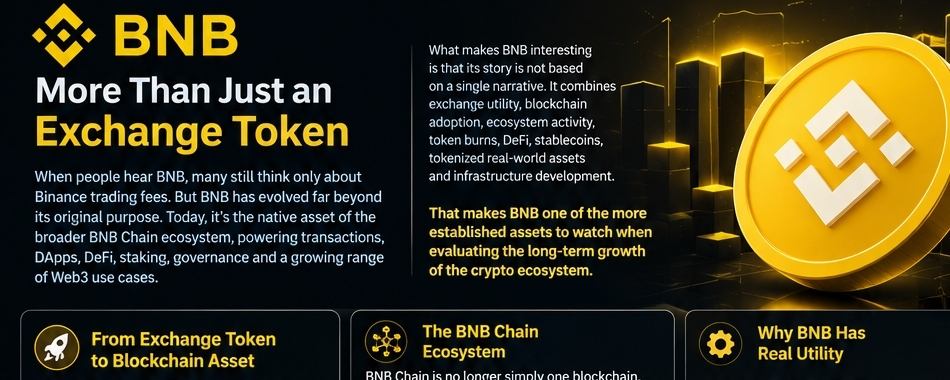
Article
BNB: More Than Just an Exchange TokenWhen people hear BNB, many still think only about Binance trading fees.
But BNB has evolved far beyond its original purpose.
Today, BNB is the native asset of the broader BNB Chain ecosystem, powering transactions, decentralized applications, DeFi, staking, governance, and a growing range of Web3 use cases.
What makes BNB interesting is that its story is not based on a single narrative. It combines exchange utility, blockchain adoption, ecosystem activity, token burns, DeFi, stablecoins, tokenized real-world assets, and infrastructure development.
That makes BNB one of the more established assets to watch when evaluating the long-term growth of the crypto ecosystem.
From Exchange Token to Blockchain Asset
BNB was launched in 2017 through an ICO.
Its original use case was relatively simple: users could use BNB to receive benefits such as trading-fee discounts on Binance.
Over time, however, the token's role expanded significantly.
BNB became the native asset of BNB Chain and is now used for transaction fees, staking, decentralized applications, DeFi protocols, and other blockchain activities.
This evolution is important.
A token with only one use case depends heavily on that use case.
BNB, on the other hand, is connected to an entire ecosystem of applications and infrastructure.
The BNB Chain Ecosystem
BNB Chain is no longer simply one blockchain.
The ecosystem currently includes three major components:
BNB Smart Chain (BSC) is the main smart-contract and application layer. It supports EVM-compatible applications, DeFi, games, NFTs, and other decentralized applications.
opBNB is a Layer-2 scaling solution designed to provide higher throughput and lower transaction costs.
BNB Greenfield focuses on decentralized data storage.
Together, these components create a broader infrastructure around BNB rather than treating the token as just an exchange utility asset.
This gives BNB exposure to several areas of blockchain adoption at the same time.
Why BNB Has Real Utility
One of the strongest arguments for BNB is utility.
BNB can be used to pay transaction fees across the BNB Chain ecosystem. It also plays a role in staking and network participation.
For users interacting with BNB Chain applications, BNB can therefore function as the gas asset that makes activity possible.
There is also utility within the Binance ecosystem.
BNB holders can potentially access benefits such as trading-fee discounts, Launchpool opportunities, HODLer Airdrops, Megadrop participation, and other programs depending on eligibility and current terms.
This creates multiple sources of potential demand.
BNB and DeFi
DeFi remains one of the major pillars of BNB Chain.
The ecosystem has hosted decentralized exchanges, lending platforms, liquid-staking products, yield protocols, and many other applications.
This matters because blockchain value is ultimately connected to what people actually do on the network.
If users are trading, lending, borrowing, transferring stablecoins, providing liquidity, interacting with applications, or deploying smart contracts, there is an underlying demand for network infrastructure.
BNB sits at the center of that infrastructure.
Real-World Assets Could Become Another Major Driver
One of the most interesting developments around BNB Chain is the growth of tokenized real-world assets.
Tokenization is moving beyond the idea of simply putting speculative tokens on-chain.
The broader goal is to bring assets such as equities, credit, funds, and other financial instruments into blockchain-based markets.
Binance Research reported that BNB Chain became a leading venue for tokenized equities during the first half of 2026, while its tokenized RWA market capitalization increased 107% during that period.
If this trend continues, BNB Chain could become increasingly relevant to the connection between traditional finance and on-chain markets.
That is a much bigger opportunity than simple crypto trading.
The Deflationary Side of BNB
Another major part of the BNB thesis is token supply.
BNB launched with an initial supply of 200 million tokens.
The ecosystem uses multiple burn mechanisms to reduce supply over time.
The quarterly Auto-Burn permanently removes BNB from circulation, with the amount calculated using factors including BNB's price and the number of blocks produced.
BNB Chain also uses BEP-95, which burns a portion of gas fees continuously from validated blocks.
The long-term objective is to reduce the supply toward 100 million BNB.
The 35th quarterly burn in April 2026 removed more than 1.56 million BNB, with an approximate value of $1.02 billion at the time.
This doesn't automatically mean the price must rise.
But from a tokenomics perspective, reducing supply while maintaining or increasing demand can create a favorable long-term setup.
Supply and demand still matter.
BNB Chain Is Also Getting Faster
Infrastructure performance is another important part of the story.
According to BNB Chain's H2 2026 roadmap, BNB Smart Chain reduced its block interval from around 750 milliseconds to 450 milliseconds during the first half of 2026.
Benchmark throughput also nearly doubled to approximately 5,200 TPS.
The roadmap targets further performance improvements and describes a longer-term architecture designed for much greater scale.
For mainstream adoption, infrastructure needs to be fast, affordable, and reliable.
Users generally don't care about blockchain architecture.
They care about whether an application works quickly and whether transactions are affordable.
That makes scalability a fundamental part of BNB Chain's long-term strategy.
AI, Stablecoins and Web3 Infrastructure
The next phase of blockchain adoption may not come from one single application.
It could come from the combination of several trends:
AI agents.
Stablecoin payments.
DeFi.
Tokenized assets.
Gaming.
Consumer applications.
Institutional finance.
BNB Chain is positioning its infrastructure around several of these areas.
This diversification is important because crypto narratives change quickly.
A blockchain that can support multiple categories of applications has a better chance of remaining relevant when market attention moves from one sector to another.
BNB's Biggest Strength: Network Effects
Perhaps the most important BNB advantage is network effect.
BNB sits at the intersection of:
Binance
BNB Chain
DeFi
Stablecoins
Web3 applications
Tokenized assets
Launch platforms
Staking
Developer infrastructure
Each part can potentially reinforce the others.
More users can create more transactions.
More transactions can create more demand for infrastructure.
More developers can create more applications.
More applications can attract more users.
And growing ecosystem activity can strengthen the overall utility of BNB.
That feedback loop is difficult for newer blockchain projects to replicate.
But BNB Is Not Risk-Free
A strong ecosystem does not mean guaranteed returns.
BNB investors still face significant risks.
The crypto market remains highly volatile.
BNB is also closely associated with the Binance ecosystem, meaning regulatory developments, exchange-related issues, market sentiment, or changes in the broader crypto environment can affect its valuation.
Competition is another major risk.
Ethereum, Solana, Tron, and other ecosystems are all competing for developers, liquidity, users, stablecoin activity, DeFi, and tokenized assets.
There is also the basic risk that blockchain adoption may not grow as quickly as expected.
Therefore, token burns and strong infrastructure should not be treated as automatic reasons to buy.
What I Would Watch Going Forward
For BNB, I would focus less on short-term hype and more on measurable ecosystem growth.
Some important indicators include:
1. BNB Chain activity
Are transactions, active users, developers, and applications continuing to grow?
2. DeFi liquidity
Is capital actually being deployed across lending, DEXs, staking, and other applications?
3. Stablecoin adoption
Stablecoins can be one of the biggest drivers of blockchain activity.
4. RWA growth
Tokenized equities, private credit, funds, and other real-world assets could become a major long-term sector.
5. Network performance
Can BNB Chain continue improving speed and scalability without sacrificing reliability?
6. Token supply
Continued burns are important, but demand remains equally important.
7. Institutional adoption
If institutions increasingly use BNB Chain for tokenized assets or financial infrastructure, that could strengthen the long-term thesis.
The Bigger Picture
The most interesting thing about BNB is that its story has changed.
It started as an exchange utility token.
Today, it represents a much broader blockchain ecosystem.
BNB is used for network fees, staking, DeFi, applications, and various Binance-related programs. At the same time, BNB Chain is expanding into areas such as tokenized real-world assets, stablecoins, AI infrastructure, and high-performance blockchain applications.
The combination of utility, ecosystem activity, infrastructure development, and a decreasing token supply gives BNB a fundamentally different profile from many purely speculative crypto assets.
But the long-term thesis still depends on one thing:
real adoption.
If users and developers continue building on BNB Chain, if on-chain financial activity keeps expanding, and if BNB continues to be required throughout that ecosystem, its utility story becomes stronger.
Final Thoughts
BNB is no longer simply a token used to reduce Binance trading fees.
It has become the native asset of a broad blockchain ecosystem with applications across DeFi, payments, Web3, tokenization, staking, and decentralized infrastructure.
Its deflationary tokenomics add another interesting dimension, while the continued focus on scalability and new financial use cases could create additional demand over time.
Still, investors should separate fundamentals from price predictions.
A strong ecosystem does not guarantee that BNB will always go up.
The better approach is to watch adoption, liquidity, network activity, tokenomics, competition, and broader market conditions.
For me, the most interesting BNB narrative is not simply:
“BNB can reach X price.”
It is:
“How much financial and Web3 activity can eventually run through the BNB ecosystem?”
That is the question worth watching.
DYOR. Crypto markets are highly volatile. This is educational content, not financial advice.#BTC走势分析 #bnb一輩子
BNB: More Than Just an Exchange Token
When people hear BNB, many still think only about Binance trading fees.
But BNB has evolved far beyond its original purpose.
Today, BNB is the native asset of the broader BNB Chain ecosystem, powering transactions, decentralized applications, DeFi, staking, governance, and a growing range of Web3 use cases.
What makes BNB interesting is that its story is not based on a single narrative. It combines exchange utility, blockchain adoption, ecosystem activity, token burns, DeFi, stablecoins, tokenized real-world assets, and infrastructure development.
That makes BNB one of the more established assets to watch when evaluating the long-term growth of the crypto ecosystem.
From Exchange Token to Blockchain Asset
BNB was launched in 2017 through an ICO.
Its original use case was relatively simple: users could use BNB to receive benefits such as trading-fee discounts on Binance.
Over time, however, the token's role expanded significantly.
BNB became the native asset of BNB Chain and is now used for transaction fees, staking, decentralized applications, DeFi protocols, and other blockchain activities.
This evolution is important.
A token with only one use case depends heavily on that use case.
BNB, on the other hand, is connected to an entire ecosystem of applications and infrastructure.
The BNB Chain Ecosystem
BNB Chain is no longer simply one blockchain.
The ecosystem currently includes three major components:
BNB Smart Chain (BSC) is the main smart-contract and application layer. It supports EVM-compatible applications, DeFi, games, NFTs, and other decentralized applications.
opBNB is a Layer-2 scaling solution designed to provide higher throughput and lower transaction costs.
BNB Greenfield focuses on decentralized data storage.
Together, these components create a broader infrastructure around BNB rather than treating the token as just an exchange utility asset.
This gives BNB exposure to several areas of blockchain adoption at the same time.
Why BNB Has Real Utility
One of the strongest arguments for BNB is utility.
BNB can be used to pay transaction fees across the BNB Chain ecosystem. It also plays a role in staking and network participation.
For users interacting with BNB Chain applications, BNB can therefore function as the gas asset that makes activity possible.
There is also utility within the Binance ecosystem.
BNB holders can potentially access benefits such as trading-fee discounts, Launchpool opportunities, HODLer Airdrops, Megadrop participation, and other programs depending on eligibility and current terms.
This creates multiple sources of potential demand.
BNB and DeFi
DeFi remains one of the major pillars of BNB Chain.
The ecosystem has hosted decentralized exchanges, lending platforms, liquid-staking products, yield protocols, and many other applications.
This matters because blockchain value is ultimately connected to what people actually do on the network.
If users are trading, lending, borrowing, transferring stablecoins, providing liquidity, interacting with applications, or deploying smart contracts, there is an underlying demand for network infrastructure.
BNB sits at the center of that infrastructure.
Real-World Assets Could Become Another Major Driver
One of the most interesting developments around BNB Chain is the growth of tokenized real-world assets.
Tokenization is moving beyond the idea of simply putting speculative tokens on-chain.
The broader goal is to bring assets such as equities, credit, funds, and other financial instruments into blockchain-based markets.
Binance Research reported that BNB Chain became a leading venue for tokenized equities during the first half of 2026, while its tokenized RWA market capitalization increased 107% during that period.
If this trend continues, BNB Chain could become increasingly relevant to the connection between traditional finance and on-chain markets.
That is a much bigger opportunity than simple crypto trading.
The Deflationary Side of BNB
Another major part of the BNB thesis is token supply.
BNB launched with an initial supply of 200 million tokens.
The ecosystem uses multiple burn mechanisms to reduce supply over time.
The quarterly Auto-Burn permanently removes BNB from circulation, with the amount calculated using factors including BNB's price and the number of blocks produced.
BNB Chain also uses BEP-95, which burns a portion of gas fees continuously from validated blocks.
The long-term objective is to reduce the supply toward 100 million BNB.
The 35th quarterly burn in April 2026 removed more than 1.56 million BNB, with an approximate value of $1.02 billion at the time.
This doesn't automatically mean the price must rise.
But from a tokenomics perspective, reducing supply while maintaining or increasing demand can create a favorable long-term setup.
Supply and demand still matter.
BNB Chain Is Also Getting Faster
Infrastructure performance is another important part of the story.
According to BNB Chain's H2 2026 roadmap, BNB Smart Chain reduced its block interval from around 750 milliseconds to 450 milliseconds during the first half of 2026.
Benchmark throughput also nearly doubled to approximately 5,200 TPS.
The roadmap targets further performance improvements and describes a longer-term architecture designed for much greater scale.
For mainstream adoption, infrastructure needs to be fast, affordable, and reliable.
Users generally don't care about blockchain architecture.
They care about whether an application works quickly and whether transactions are affordable.
That makes scalability a fundamental part of BNB Chain's long-term strategy.
AI, Stablecoins and Web3 Infrastructure
The next phase of blockchain adoption may not come from one single application.
It could come from the combination of several trends:
AI agents.
Stablecoin payments.
DeFi.
Tokenized assets.
Gaming.
Consumer applications.
Institutional finance.
BNB Chain is positioning its infrastructure around several of these areas.
This diversification is important because crypto narratives change quickly.
A blockchain that can support multiple categories of applications has a better chance of remaining relevant when market attention moves from one sector to another.
BNB's Biggest Strength: Network Effects
Perhaps the most important BNB advantage is network effect.
BNB sits at the intersection of:
Binance
BNB Chain
DeFi
Stablecoins
Web3 applications
Tokenized assets
Launch platforms
Staking
Developer infrastructure
Each part can potentially reinforce the others.
More users can create more transactions.
More transactions can create more demand for infrastructure.
More developers can create more applications.
More applications can attract more users.
And growing ecosystem activity can strengthen the overall utility of BNB.
That feedback loop is difficult for newer blockchain projects to replicate.
But BNB Is Not Risk-Free
A strong ecosystem does not mean guaranteed returns.
BNB investors still face significant risks.
The crypto market remains highly volatile.
BNB is also closely associated with the Binance ecosystem, meaning regulatory developments, exchange-related issues, market sentiment, or changes in the broader crypto environment can affect its valuation.
Competition is another major risk.
Ethereum, Solana, Tron, and other ecosystems are all competing for developers, liquidity, users, stablecoin activity, DeFi, and tokenized assets.
There is also the basic risk that blockchain adoption may not grow as quickly as expected.
Therefore, token burns and strong infrastructure should not be treated as automatic reasons to buy.
What I Would Watch Going Forward
For BNB, I would focus less on short-term hype and more on measurable ecosystem growth.
Some important indicators include:
1. BNB Chain activity
Are transactions, active users, developers, and applications continuing to grow?
2. DeFi liquidity
Is capital actually being deployed across lending, DEXs, staking, and other applications?
3. Stablecoin adoption
Stablecoins can be one of the biggest drivers of blockchain activity.
4. RWA growth
Tokenized equities, private credit, funds, and other real-world assets could become a major long-term sector.
5. Network performance
Can BNB Chain continue improving speed and scalability without sacrificing reliability?
6. Token supply
Continued burns are important, but demand remains equally important.
7. Institutional adoption
If institutions increasingly use BNB Chain for tokenized assets or financial infrastructure, that could strengthen the long-term thesis.
The Bigger Picture
The most interesting thing about BNB is that its story has changed.
It started as an exchange utility token.
Today, it represents a much broader blockchain ecosystem.
BNB is used for network fees, staking, DeFi, applications, and various Binance-related programs. At the same time, BNB Chain is expanding into areas such as tokenized real-world assets, stablecoins, AI infrastructure, and high-performance blockchain applications.
The combination of utility, ecosystem activity, infrastructure development, and a decreasing token supply gives BNB a fundamentally different profile from many purely speculative crypto assets.
But the long-term thesis still depends on one thing:
real adoption.
If users and developers continue building on BNB Chain, if on-chain financial activity keeps expanding, and if BNB continues to be required throughout that ecosystem, its utility story becomes stronger.
Final Thoughts
BNB is no longer simply a token used to reduce Binance trading fees.
It has become the native asset of a broad blockchain ecosystem with applications across DeFi, payments, Web3, tokenization, staking, and decentralized infrastructure.
Its deflationary tokenomics add another interesting dimension, while the continued focus on scalability and new financial use cases could create additional demand over time.
Still, investors should separate fundamentals from price predictions.
A strong ecosystem does not guarantee that BNB will always go up.
The better approach is to watch adoption, liquidity, network activity, tokenomics, competition, and broader market conditions.
For me, the most interesting BNB narrative is not simply:
“BNB can reach X price.”
It is:
“How much financial and Web3 activity can eventually run through the BNB ecosystem?”
That is the question worth watching.
DYOR. Crypto markets are highly volatile. This is educational content, not financial advice.#BTC走势分析 #bnb一輩子
But BNB has evolved far beyond its original purpose.
Today, BNB is the native asset of the broader BNB Chain ecosystem, powering transactions, decentralized applications, DeFi, staking, governance, and a growing range of Web3 use cases.
What makes BNB interesting is that its story is not based on a single narrative. It combines exchange utility, blockchain adoption, ecosystem activity, token burns, DeFi, stablecoins, tokenized real-world assets, and infrastructure development.
That makes BNB one of the more established assets to watch when evaluating the long-term growth of the crypto ecosystem.
From Exchange Token to Blockchain Asset
BNB was launched in 2017 through an ICO.
Its original use case was relatively simple: users could use BNB to receive benefits such as trading-fee discounts on Binance.
Over time, however, the token's role expanded significantly.
BNB became the native asset of BNB Chain and is now used for transaction fees, staking, decentralized applications, DeFi protocols, and other blockchain activities.
This evolution is important.
A token with only one use case depends heavily on that use case.
BNB, on the other hand, is connected to an entire ecosystem of applications and infrastructure.
The BNB Chain Ecosystem
BNB Chain is no longer simply one blockchain.
The ecosystem currently includes three major components:
BNB Smart Chain (BSC) is the main smart-contract and application layer. It supports EVM-compatible applications, DeFi, games, NFTs, and other decentralized applications.
opBNB is a Layer-2 scaling solution designed to provide higher throughput and lower transaction costs.
BNB Greenfield focuses on decentralized data storage.
Together, these components create a broader infrastructure around BNB rather than treating the token as just an exchange utility asset.
This gives BNB exposure to several areas of blockchain adoption at the same time.
Why BNB Has Real Utility
One of the strongest arguments for BNB is utility.
BNB can be used to pay transaction fees across the BNB Chain ecosystem. It also plays a role in staking and network participation.
For users interacting with BNB Chain applications, BNB can therefore function as the gas asset that makes activity possible.
There is also utility within the Binance ecosystem.
BNB holders can potentially access benefits such as trading-fee discounts, Launchpool opportunities, HODLer Airdrops, Megadrop participation, and other programs depending on eligibility and current terms.
This creates multiple sources of potential demand.
BNB and DeFi
DeFi remains one of the major pillars of BNB Chain.
The ecosystem has hosted decentralized exchanges, lending platforms, liquid-staking products, yield protocols, and many other applications.
This matters because blockchain value is ultimately connected to what people actually do on the network.
If users are trading, lending, borrowing, transferring stablecoins, providing liquidity, interacting with applications, or deploying smart contracts, there is an underlying demand for network infrastructure.
BNB sits at the center of that infrastructure.
Real-World Assets Could Become Another Major Driver
One of the most interesting developments around BNB Chain is the growth of tokenized real-world assets.
Tokenization is moving beyond the idea of simply putting speculative tokens on-chain.
The broader goal is to bring assets such as equities, credit, funds, and other financial instruments into blockchain-based markets.
Binance Research reported that BNB Chain became a leading venue for tokenized equities during the first half of 2026, while its tokenized RWA market capitalization increased 107% during that period.
If this trend continues, BNB Chain could become increasingly relevant to the connection between traditional finance and on-chain markets.
That is a much bigger opportunity than simple crypto trading.
The Deflationary Side of BNB
Another major part of the BNB thesis is token supply.
BNB launched with an initial supply of 200 million tokens.
The ecosystem uses multiple burn mechanisms to reduce supply over time.
The quarterly Auto-Burn permanently removes BNB from circulation, with the amount calculated using factors including BNB's price and the number of blocks produced.
BNB Chain also uses BEP-95, which burns a portion of gas fees continuously from validated blocks.
The long-term objective is to reduce the supply toward 100 million BNB.
The 35th quarterly burn in April 2026 removed more than 1.56 million BNB, with an approximate value of $1.02 billion at the time.
This doesn't automatically mean the price must rise.
But from a tokenomics perspective, reducing supply while maintaining or increasing demand can create a favorable long-term setup.
Supply and demand still matter.
BNB Chain Is Also Getting Faster
Infrastructure performance is another important part of the story.
According to BNB Chain's H2 2026 roadmap, BNB Smart Chain reduced its block interval from around 750 milliseconds to 450 milliseconds during the first half of 2026.
Benchmark throughput also nearly doubled to approximately 5,200 TPS.
The roadmap targets further performance improvements and describes a longer-term architecture designed for much greater scale.
For mainstream adoption, infrastructure needs to be fast, affordable, and reliable.
Users generally don't care about blockchain architecture.
They care about whether an application works quickly and whether transactions are affordable.
That makes scalability a fundamental part of BNB Chain's long-term strategy.
AI, Stablecoins and Web3 Infrastructure
The next phase of blockchain adoption may not come from one single application.
It could come from the combination of several trends:
AI agents.
Stablecoin payments.
DeFi.
Tokenized assets.
Gaming.
Consumer applications.
Institutional finance.
BNB Chain is positioning its infrastructure around several of these areas.
This diversification is important because crypto narratives change quickly.
A blockchain that can support multiple categories of applications has a better chance of remaining relevant when market attention moves from one sector to another.
BNB's Biggest Strength: Network Effects
Perhaps the most important BNB advantage is network effect.
BNB sits at the intersection of:
Binance
BNB Chain
DeFi
Stablecoins
Web3 applications
Tokenized assets
Launch platforms
Staking
Developer infrastructure
Each part can potentially reinforce the others.
More users can create more transactions.
More transactions can create more demand for infrastructure.
More developers can create more applications.
More applications can attract more users.
And growing ecosystem activity can strengthen the overall utility of BNB.
That feedback loop is difficult for newer blockchain projects to replicate.
But BNB Is Not Risk-Free
A strong ecosystem does not mean guaranteed returns.
BNB investors still face significant risks.
The crypto market remains highly volatile.
BNB is also closely associated with the Binance ecosystem, meaning regulatory developments, exchange-related issues, market sentiment, or changes in the broader crypto environment can affect its valuation.
Competition is another major risk.
Ethereum, Solana, Tron, and other ecosystems are all competing for developers, liquidity, users, stablecoin activity, DeFi, and tokenized assets.
There is also the basic risk that blockchain adoption may not grow as quickly as expected.
Therefore, token burns and strong infrastructure should not be treated as automatic reasons to buy.
What I Would Watch Going Forward
For BNB, I would focus less on short-term hype and more on measurable ecosystem growth.
Some important indicators include:
1. BNB Chain activity
Are transactions, active users, developers, and applications continuing to grow?
2. DeFi liquidity
Is capital actually being deployed across lending, DEXs, staking, and other applications?
3. Stablecoin adoption
Stablecoins can be one of the biggest drivers of blockchain activity.
4. RWA growth
Tokenized equities, private credit, funds, and other real-world assets could become a major long-term sector.
5. Network performance
Can BNB Chain continue improving speed and scalability without sacrificing reliability?
6. Token supply
Continued burns are important, but demand remains equally important.
7. Institutional adoption
If institutions increasingly use BNB Chain for tokenized assets or financial infrastructure, that could strengthen the long-term thesis.
The Bigger Picture
The most interesting thing about BNB is that its story has changed.
It started as an exchange utility token.
Today, it represents a much broader blockchain ecosystem.
BNB is used for network fees, staking, DeFi, applications, and various Binance-related programs. At the same time, BNB Chain is expanding into areas such as tokenized real-world assets, stablecoins, AI infrastructure, and high-performance blockchain applications.
The combination of utility, ecosystem activity, infrastructure development, and a decreasing token supply gives BNB a fundamentally different profile from many purely speculative crypto assets.
But the long-term thesis still depends on one thing:
real adoption.
If users and developers continue building on BNB Chain, if on-chain financial activity keeps expanding, and if BNB continues to be required throughout that ecosystem, its utility story becomes stronger.
Final Thoughts
BNB is no longer simply a token used to reduce Binance trading fees.
It has become the native asset of a broad blockchain ecosystem with applications across DeFi, payments, Web3, tokenization, staking, and decentralized infrastructure.
Its deflationary tokenomics add another interesting dimension, while the continued focus on scalability and new financial use cases could create additional demand over time.
Still, investors should separate fundamentals from price predictions.
A strong ecosystem does not guarantee that BNB will always go up.
The better approach is to watch adoption, liquidity, network activity, tokenomics, competition, and broader market conditions.
For me, the most interesting BNB narrative is not simply:
“BNB can reach X price.”
It is:
“How much financial and Web3 activity can eventually run through the BNB ecosystem?”
That is the question worth watching.
DYOR. Crypto markets are highly volatile. This is educational content, not financial advice.#BTC走势分析 #bnb一輩子
1
1
225
·
--
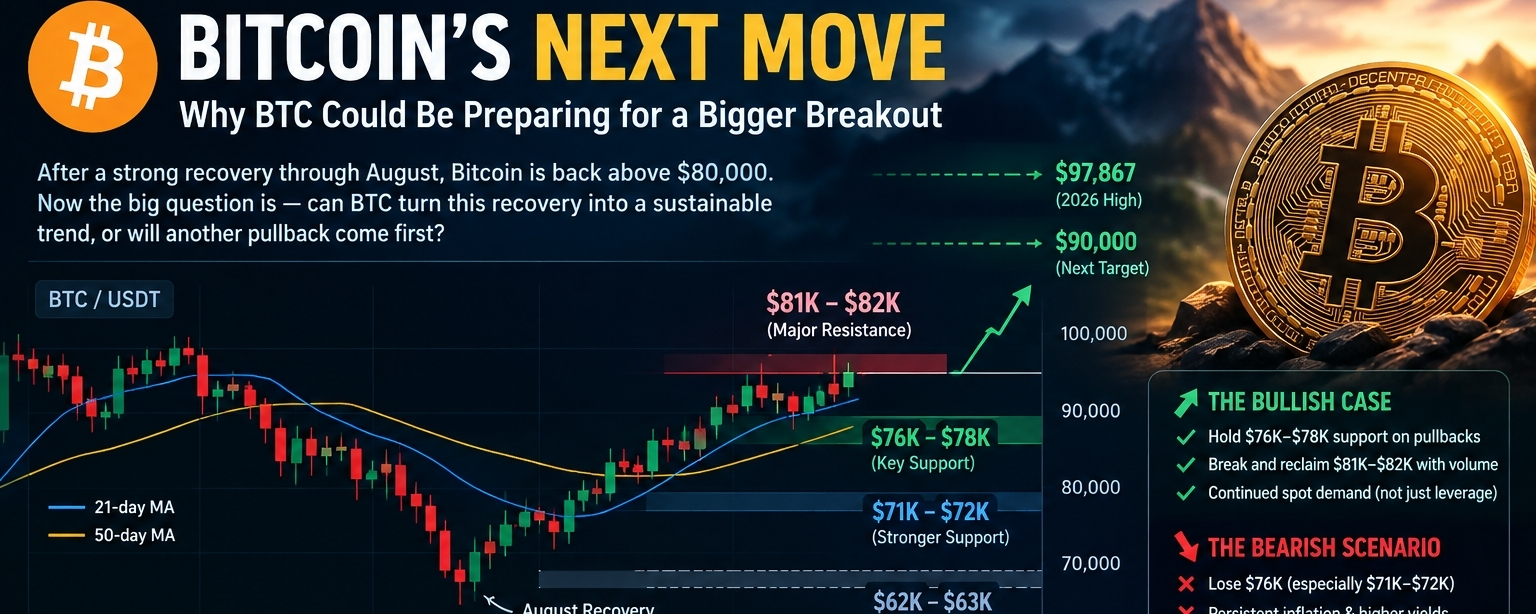
Article
Bitcoin’s Next Move: Why BTC Could Be Preparing for a Bigger BreakoutBitcoin is once again at a point where the next few sessions could define the direction of the broader crypto market.
After a strong recovery through August, BTC pushed above $80,000 and briefly traded above $81,000 before momentum cooled. The market is now watching whether Bitcoin can turn this recovery into a sustainable trend or whether another pullback will come first.
What makes the current setup interesting is that Bitcoin is no longer showing the same structure it had during the earlier weakness. The recent rally pushed BTC back above several important moving averages, while the 21-day moving average has also formed a bullish signal. That doesn't guarantee another rally, but it suggests that buyers are gradually regaining control.
The $76K–$82K Zone Is Critical
For me, the most important thing right now isn't chasing every green candle. It's watching the levels where buyers and sellers are likely to fight.
The $76,000–$78,000 area has become an important support zone. If BTC continues holding above this region during pullbacks, it would suggest that buyers are defending the recent recovery.
On the upside, $81,000–$82,000 is the major area to watch.
Bitcoin has already tested this region, but a clean breakout with strong volume could change the entire market structure. Analysts have pointed to roughly $82,000 as an important resistance area, with a successful breakout potentially opening the path toward $90,000.
That is why the next move matters more than the current candle.
Institutional Demand Remains Important
Another major part of the Bitcoin story is institutional participation.
Recent reports indicate that U.S. spot Bitcoin ETFs have continued to attract meaningful demand, while renewed buying activity has helped support the recovery. 21Shares reported around $3.05 billion in ETF inflows during the August rally, suggesting that the move wasn't purely driven by speculative leverage.
This distinction matters.
A rally driven entirely by leverage can disappear quickly when traders start closing positions. But when spot demand is present alongside improving technical structure, the market has a stronger foundation.
At the same time, investors should not assume every rally is automatically sustainable. Some of the recent upside was accelerated by short liquidations, meaning part of the move came from forced buying rather than fresh long-term capital.
So the key question is simple:
Can BTC keep attracting real demand after the short squeeze fades?
Macro Could Decide the Next Breakout
Bitcoin is still highly sensitive to the macro environment.
The upcoming U.S. inflation data and Federal Reserve decision are particularly important. A softer inflation reading could strengthen expectations for easier monetary conditions, while persistent inflation could keep pressure on risk assets.
This is why Bitcoin's chart cannot be viewed in isolation.
Treasury yields, the dollar, liquidity conditions and expectations around Federal Reserve policy can all influence whether capital flows toward risk assets such as Bitcoin.
Recent comments from Fed Governor Christopher Waller also helped boost risk appetite, showing just how quickly monetary-policy expectations can affect crypto markets.
What Would Make the Bullish Case Stronger?
The bullish case becomes much more convincing if BTC can do three things:
First: Hold the $76K–$78K support region during pullbacks.
Second: Break and reclaim the $81K–$82K resistance zone with convincing volume.
Third: See continued spot demand rather than another rally dominated by leverage.
If those conditions line up, Bitcoin could begin targeting higher resistance zones, with $90K becoming a realistic technical objective rather than just a psychological number.
And if BTC eventually pushes beyond the major resistance near $82K, market attention could quickly shift toward the 2026 high near $97,867.
But There Is Still a Bearish Scenario
Being bullish doesn't mean ignoring risk.
If Bitcoin loses the $76K area and especially the stronger support around $71K–$72K, the current recovery structure could weaken considerably. Reuters' technical analysis identified $71,781 as an important level, with deeper downside potentially exposing the $62K–$63K region.
Macro conditions are another risk.
If inflation remains stubborn, Treasury yields continue rising and the Federal Reserve maintains a tighter stance, Bitcoin could struggle to sustain higher prices. Higher yields generally make risk assets less attractive, particularly when investors are already cautious about liquidity.
That means the market isn't simply waiting for a technical breakout.
It is waiting for confirmation from both price and macro liquidity.
My View on BTC
Bitcoin's structure is becoming much more interesting after the August recovery.
I wouldn't call every move above $80K the beginning of a new bull market yet. The market still needs confirmation. But the fact that BTC recovered strongly from the lower levels, reclaimed major moving averages and attracted renewed institutional interest is difficult to ignore.
For now, I would rather watch the reaction around support than chase the price after a sudden pump.
If BTC holds the $76K–$78K region and eventually breaks $82K with strong demand, the next major conversation could quickly become $90K and beyond.
But if support fails, the market may need another round of consolidation before buyers are ready to push higher.
Bitcoin doesn't need to move vertically to remain bullish.
Sometimes the strongest setups are built through patience, consolidation and repeated tests of resistance.
Right now, $82K is the door.
If Bitcoin can finally open it and stay above it, the market could enter a very different phase.
This is market commentary, not financial advice. Crypto remains highly volatile, and key levels can change quickly.#BTC走势分析
Bitcoin’s Next Move: Why BTC Could Be Preparing for a Bigger Breakout
Bitcoin is once again at a point where the next few sessions could define the direction of the broader crypto market.
After a strong recovery through August, BTC pushed above $80,000 and briefly traded above $81,000 before momentum cooled. The market is now watching whether Bitcoin can turn this recovery into a sustainable trend or whether another pullback will come first.
What makes the current setup interesting is that Bitcoin is no longer showing the same structure it had during the earlier weakness. The recent rally pushed BTC back above several important moving averages, while the 21-day moving average has also formed a bullish signal. That doesn't guarantee another rally, but it suggests that buyers are gradually regaining control.
The $76K–$82K Zone Is Critical
For me, the most important thing right now isn't chasing every green candle. It's watching the levels where buyers and sellers are likely to fight.
The $76,000–$78,000 area has become an important support zone. If BTC continues holding above this region during pullbacks, it would suggest that buyers are defending the recent recovery.
On the upside, $81,000–$82,000 is the major area to watch.
Bitcoin has already tested this region, but a clean breakout with strong volume could change the entire market structure. Analysts have pointed to roughly $82,000 as an important resistance area, with a successful breakout potentially opening the path toward $90,000.
That is why the next move matters more than the current candle.
Institutional Demand Remains Important
Another major part of the Bitcoin story is institutional participation.
Recent reports indicate that U.S. spot Bitcoin ETFs have continued to attract meaningful demand, while renewed buying activity has helped support the recovery. 21Shares reported around $3.05 billion in ETF inflows during the August rally, suggesting that the move wasn't purely driven by speculative leverage.
This distinction matters.
A rally driven entirely by leverage can disappear quickly when traders start closing positions. But when spot demand is present alongside improving technical structure, the market has a stronger foundation.
At the same time, investors should not assume every rally is automatically sustainable. Some of the recent upside was accelerated by short liquidations, meaning part of the move came from forced buying rather than fresh long-term capital.
So the key question is simple:
Can BTC keep attracting real demand after the short squeeze fades?
Macro Could Decide the Next Breakout
Bitcoin is still highly sensitive to the macro environment.
The upcoming U.S. inflation data and Federal Reserve decision are particularly important. A softer inflation reading could strengthen expectations for easier monetary conditions, while persistent inflation could keep pressure on risk assets.
This is why Bitcoin's chart cannot be viewed in isolation.
Treasury yields, the dollar, liquidity conditions and expectations around Federal Reserve policy can all influence whether capital flows toward risk assets such as Bitcoin.
Recent comments from Fed Governor Christopher Waller also helped boost risk appetite, showing just how quickly monetary-policy expectations can affect crypto markets.
What Would Make the Bullish Case Stronger?
The bullish case becomes much more convincing if BTC can do three things:
First: Hold the $76K–$78K support region during pullbacks.
Second: Break and reclaim the $81K–$82K resistance zone with convincing volume.
Third: See continued spot demand rather than another rally dominated by leverage.
If those conditions line up, Bitcoin could begin targeting higher resistance zones, with $90K becoming a realistic technical objective rather than just a psychological number.
And if BTC eventually pushes beyond the major resistance near $82K, market attention could quickly shift toward the 2026 high near $97,867.
But There Is Still a Bearish Scenario
Being bullish doesn't mean ignoring risk.
If Bitcoin loses the $76K area and especially the stronger support around $71K–$72K, the current recovery structure could weaken considerably. Reuters' technical analysis identified $71,781 as an important level, with deeper downside potentially exposing the $62K–$63K region.
Macro conditions are another risk.
If inflation remains stubborn, Treasury yields continue rising and the Federal Reserve maintains a tighter stance, Bitcoin could struggle to sustain higher prices. Higher yields generally make risk assets less attractive, particularly when investors are already cautious about liquidity.
That means the market isn't simply waiting for a technical breakout.
It is waiting for confirmation from both price and macro liquidity.
My View on BTC
Bitcoin's structure is becoming much more interesting after the August recovery.
I wouldn't call every move above $80K the beginning of a new bull market yet. The market still needs confirmation. But the fact that BTC recovered strongly from the lower levels, reclaimed major moving averages and attracted renewed institutional interest is difficult to ignore.
For now, I would rather watch the reaction around support than chase the price after a sudden pump.
If BTC holds the $76K–$78K region and eventually breaks $82K with strong demand, the next major conversation could quickly become $90K and beyond.
But if support fails, the market may need another round of consolidation before buyers are ready to push higher.
Bitcoin doesn't need to move vertically to remain bullish.
Sometimes the strongest setups are built through patience, consolidation and repeated tests of resistance.
Right now, $82K is the door.
If Bitcoin can finally open it and stay above it, the market could enter a very different phase.
This is market commentary, not financial advice. Crypto remains highly volatile, and key levels can change quickly.#BTC走势分析
After a strong recovery through August, BTC pushed above $80,000 and briefly traded above $81,000 before momentum cooled. The market is now watching whether Bitcoin can turn this recovery into a sustainable trend or whether another pullback will come first.
What makes the current setup interesting is that Bitcoin is no longer showing the same structure it had during the earlier weakness. The recent rally pushed BTC back above several important moving averages, while the 21-day moving average has also formed a bullish signal. That doesn't guarantee another rally, but it suggests that buyers are gradually regaining control.
The $76K–$82K Zone Is Critical
For me, the most important thing right now isn't chasing every green candle. It's watching the levels where buyers and sellers are likely to fight.
The $76,000–$78,000 area has become an important support zone. If BTC continues holding above this region during pullbacks, it would suggest that buyers are defending the recent recovery.
On the upside, $81,000–$82,000 is the major area to watch.
Bitcoin has already tested this region, but a clean breakout with strong volume could change the entire market structure. Analysts have pointed to roughly $82,000 as an important resistance area, with a successful breakout potentially opening the path toward $90,000.
That is why the next move matters more than the current candle.
Institutional Demand Remains Important
Another major part of the Bitcoin story is institutional participation.
Recent reports indicate that U.S. spot Bitcoin ETFs have continued to attract meaningful demand, while renewed buying activity has helped support the recovery. 21Shares reported around $3.05 billion in ETF inflows during the August rally, suggesting that the move wasn't purely driven by speculative leverage.
This distinction matters.
A rally driven entirely by leverage can disappear quickly when traders start closing positions. But when spot demand is present alongside improving technical structure, the market has a stronger foundation.
At the same time, investors should not assume every rally is automatically sustainable. Some of the recent upside was accelerated by short liquidations, meaning part of the move came from forced buying rather than fresh long-term capital.
So the key question is simple:
Can BTC keep attracting real demand after the short squeeze fades?
Macro Could Decide the Next Breakout
Bitcoin is still highly sensitive to the macro environment.
The upcoming U.S. inflation data and Federal Reserve decision are particularly important. A softer inflation reading could strengthen expectations for easier monetary conditions, while persistent inflation could keep pressure on risk assets.
This is why Bitcoin's chart cannot be viewed in isolation.
Treasury yields, the dollar, liquidity conditions and expectations around Federal Reserve policy can all influence whether capital flows toward risk assets such as Bitcoin.
Recent comments from Fed Governor Christopher Waller also helped boost risk appetite, showing just how quickly monetary-policy expectations can affect crypto markets.
What Would Make the Bullish Case Stronger?
The bullish case becomes much more convincing if BTC can do three things:
First: Hold the $76K–$78K support region during pullbacks.
Second: Break and reclaim the $81K–$82K resistance zone with convincing volume.
Third: See continued spot demand rather than another rally dominated by leverage.
If those conditions line up, Bitcoin could begin targeting higher resistance zones, with $90K becoming a realistic technical objective rather than just a psychological number.
And if BTC eventually pushes beyond the major resistance near $82K, market attention could quickly shift toward the 2026 high near $97,867.
But There Is Still a Bearish Scenario
Being bullish doesn't mean ignoring risk.
If Bitcoin loses the $76K area and especially the stronger support around $71K–$72K, the current recovery structure could weaken considerably. Reuters' technical analysis identified $71,781 as an important level, with deeper downside potentially exposing the $62K–$63K region.
Macro conditions are another risk.
If inflation remains stubborn, Treasury yields continue rising and the Federal Reserve maintains a tighter stance, Bitcoin could struggle to sustain higher prices. Higher yields generally make risk assets less attractive, particularly when investors are already cautious about liquidity.
That means the market isn't simply waiting for a technical breakout.
It is waiting for confirmation from both price and macro liquidity.
My View on BTC
Bitcoin's structure is becoming much more interesting after the August recovery.
I wouldn't call every move above $80K the beginning of a new bull market yet. The market still needs confirmation. But the fact that BTC recovered strongly from the lower levels, reclaimed major moving averages and attracted renewed institutional interest is difficult to ignore.
For now, I would rather watch the reaction around support than chase the price after a sudden pump.
If BTC holds the $76K–$78K region and eventually breaks $82K with strong demand, the next major conversation could quickly become $90K and beyond.
But if support fails, the market may need another round of consolidation before buyers are ready to push higher.
Bitcoin doesn't need to move vertically to remain bullish.
Sometimes the strongest setups are built through patience, consolidation and repeated tests of resistance.
Right now, $82K is the door.
If Bitcoin can finally open it and stay above it, the market could enter a very different phase.
This is market commentary, not financial advice. Crypto remains highly volatile, and key levels can change quickly.#BTC走势分析
224
·
--
Bitcoin is showing why patience matters in crypto. After the recent volatility, $BTC is holding key levels while buyers continue to defend the market structure.
The bigger picture still looks constructive, but the next move depends on whether Bitcoin can reclaim and hold higher resistance with strong volume. A clean breakout could attract fresh momentum, while losing major support may trigger another pullback.
For now, I’m watching price action, volume, and liquidity closely. No FOMO—let the market confirm the move. 👀
#BTC走势分析
Bitcoin is showing why patience matters in crypto. After the recent volatility, $BTC is holding key levels while buyers continue to defend the market structure.
The bigger picture still looks constructive, but the next move depends on whether Bitcoin can reclaim and hold higher resistance with strong volume. A clean breakout could attract fresh momentum, while losing major support may trigger another pullback.
For now, I’m watching price action, volume, and liquidity closely. No FOMO—let the market confirm the move. 👀
#BTC走势分析
The bigger picture still looks constructive, but the next move depends on whether Bitcoin can reclaim and hold higher resistance with strong volume. A clean breakout could attract fresh momentum, while losing major support may trigger another pullback.
For now, I’m watching price action, volume, and liquidity closely. No FOMO—let the market confirm the move. 👀
#BTC走势分析
131
·
--
BNB: The Bigger Story Behind One of Crypto’s Most Recognized AssetsWhen people talk about BNB, the conversation often starts with Binance.
But that’s only one part of the story.
BNB has grown from being an exchange utility token into an important asset within a much broader blockchain ecosystem. Today, its relevance is closely connected to BNB Chain, where users, developers, DeFi protocols, stablecoins, games, and Web3 applications interact on-chain.
And that evolution is what makes BNB worth watching.
The crypto market has changed significantly over the years. Early narratives were mostly about Bitcoin, exchanges, and speculation. Today, the bigger opportunity is increasingly about infrastructure — the networks that actually support users and applications.
BNB sits directly in that conversation.
From Exchange Utility to Blockchain Infrastructure
BNB originally had a relatively simple purpose.
Users could hold BNB and benefit from utility within the Binance ecosystem.
But as the ecosystem expanded, the role of BNB expanded as well.
BNB became the native asset of BNB Chain, giving it a much larger use case across the blockchain economy.
Today, BNB can be used for network fees and interacted with across different applications within the ecosystem.
That difference is important.
There is a big gap between a token that exists mainly because people speculate on it and an asset that is integrated into an ecosystem where users actually need it.
BNB increasingly falls into the second category.
BNB Chain Is the Bigger Picture
If you only look at BNB's price chart, you're missing a major part of the story.
The more interesting question is what is happening around the asset.
BNB Chain has become a home for decentralized applications, DeFi protocols, stablecoin activity, gaming projects, infrastructure, and other Web3 use cases.
Every transaction, application, and interaction contributes to blockchain activity.
And that creates an ecosystem effect.
More users can attract more developers.
More developers can create more applications.
More applications can bring more users.
More liquidity can make the ecosystem more useful.
That cycle is one of the most important things to watch in blockchain networks.
DeFi Could Remain a Major Growth Area
Decentralized finance is another major part of the BNB ecosystem.
Lending, decentralized exchanges, liquidity provision, staking, yield strategies, and other financial applications are gradually becoming a larger part of crypto infrastructure.
For users, the attraction is simple:
Access financial applications directly through blockchain infrastructure.
No traditional market opening hours.
No geographic limitations in the same way traditional finance often has.
And transactions can happen around the clock.
BNB Chain's role in this environment gives BNB another layer of utility.
The token isn't just sitting outside the ecosystem.
It is connected to the network that users are actually interacting with.
Stablecoins Change the Equation
One of the biggest developments in crypto is the rise of stablecoins.
Stablecoins are increasingly being used for trading, payments, transfers, liquidity, and DeFi.
This matters because stablecoin activity creates demand for blockchain infrastructure.
Think about it:
A user holds a stablecoin.
They move it on-chain.
They trade it.
They provide liquidity.
They use it in DeFi.
They interact with another application.
All of these actions require infrastructure underneath them.
As blockchain-based financial activity grows, networks capable of handling that activity become increasingly important.
That makes stablecoin growth another area worth watching when evaluating the long-term BNB Chain thesis.
The Developer Side Matters Too
Users are only one side of a blockchain ecosystem.
Developers are arguably just as important.
A blockchain can have a large user base, but without developers building useful applications, long-term growth becomes difficult.
The more tools, infrastructure, and applications available to developers, the easier it becomes for new projects to enter the ecosystem.
This creates a flywheel.
Developers build.
Users arrive.
Liquidity follows.
More developers see opportunity.
More applications are created.
And the ecosystem becomes deeper.
That's the kind of growth that can matter more than short-term hype.
BNB Is Not Risk-Free
Of course, there is another side to the story.
BNB is still a cryptocurrency, which means volatility is part of the game.
Market sentiment can change quickly.
Bitcoin can pull the entire market higher or lower.
Liquidity conditions can change.
Regulatory developments can affect exchanges and blockchain ecosystems.
Competition between Layer 1 networks is also intense.
And most importantly, ecosystem growth does not automatically mean that the token price must go up.
That's why it's important to separate fundamental adoption from short-term speculation.
A strong ecosystem can improve a long-term thesis, but it doesn't remove market risk.
What I Would Watch Going Forward
For BNB, I would focus less on random short-term price predictions and more on the underlying metrics.
1. Network activity
Are users continuing to interact with BNB Chain?
2. Stablecoin liquidity
Is stablecoin activity expanding across the ecosystem?
3. DeFi growth
Are users deploying more capital into decentralized applications?
4. Developer adoption
Are new protocols and applications continuing to launch?
5. Ecosystem diversity
Is activity coming from multiple sectors rather than depending on one narrative?
6. Market structure
And of course, price still matters. Support, resistance, volume, liquidity, and overall market momentum can influence short-term performance.
These factors together provide a much better picture than simply looking at one candle.
The Long-Term BNB Thesis
The strongest part of the BNB story, in my opinion, is its evolution.
BNB started with exchange utility.
Then it became connected to a broader blockchain.
That blockchain developed an ecosystem.
And that ecosystem now spans multiple areas of Web3.
This is exactly what makes infrastructure assets interesting.
They don't necessarily need a new narrative every week.
They need continued usage.
They need developers.
They need liquidity.
They need users.
And they need applications that solve real problems.
If BNB Chain continues expanding across DeFi, stablecoins, payments, gaming, and other Web3 sectors, BNB's role within that ecosystem becomes increasingly important.
That doesn't mean the price only goes up.
Crypto never works that simply.
There will be corrections.
There will be volatility.
There will be periods where the market loses interest.
But long-term investors should always look beyond the noise.
Final Thoughts
BNB is no longer just an exchange token.
It's part of a much larger blockchain ecosystem.
That's the key point.
The future of crypto won't be built only around speculative trading. It will increasingly depend on infrastructure that people actually use.
Networks that can attract users, developers, liquidity, stablecoins, DeFi protocols, and applications have the potential to remain relevant through multiple market cycles.
BNB is one of the assets positioned at the center of that ecosystem.
So instead of asking only:
“How high can BNB go?”
I think the more interesting question is:
“How big can the BNB ecosystem become?”
Because if adoption continues growing, the value of being connected to a widely used blockchain economy becomes much more interesting.
For me, BNB remains one of the major crypto assets worth keeping on the radar. 👀🔥
Do your own research. Crypto remains highly volatile and this is not financial advice.
#BTC走势分析 #BNB_Market_Update
BNB: The Bigger Story Behind One of Crypto’s Most Recognized Assets
When people talk about BNB, the conversation often starts with Binance.
But that’s only one part of the story.
BNB has grown from being an exchange utility token into an important asset within a much broader blockchain ecosystem. Today, its relevance is closely connected to BNB Chain, where users, developers, DeFi protocols, stablecoins, games, and Web3 applications interact on-chain.
And that evolution is what makes BNB worth watching.
The crypto market has changed significantly over the years. Early narratives were mostly about Bitcoin, exchanges, and speculation. Today, the bigger opportunity is increasingly about infrastructure — the networks that actually support users and applications.
BNB sits directly in that conversation.
From Exchange Utility to Blockchain Infrastructure
BNB originally had a relatively simple purpose.
Users could hold BNB and benefit from utility within the Binance ecosystem.
But as the ecosystem expanded, the role of BNB expanded as well.
BNB became the native asset of BNB Chain, giving it a much larger use case across the blockchain economy.
Today, BNB can be used for network fees and interacted with across different applications within the ecosystem.
That difference is important.
There is a big gap between a token that exists mainly because people speculate on it and an asset that is integrated into an ecosystem where users actually need it.
BNB increasingly falls into the second category.
BNB Chain Is the Bigger Picture
If you only look at BNB's price chart, you're missing a major part of the story.
The more interesting question is what is happening around the asset.
BNB Chain has become a home for decentralized applications, DeFi protocols, stablecoin activity, gaming projects, infrastructure, and other Web3 use cases.
Every transaction, application, and interaction contributes to blockchain activity.
And that creates an ecosystem effect.
More users can attract more developers.
More developers can create more applications.
More applications can bring more users.
More liquidity can make the ecosystem more useful.
That cycle is one of the most important things to watch in blockchain networks.
DeFi Could Remain a Major Growth Area
Decentralized finance is another major part of the BNB ecosystem.
Lending, decentralized exchanges, liquidity provision, staking, yield strategies, and other financial applications are gradually becoming a larger part of crypto infrastructure.
For users, the attraction is simple:
Access financial applications directly through blockchain infrastructure.
No traditional market opening hours.
No geographic limitations in the same way traditional finance often has.
And transactions can happen around the clock.
BNB Chain's role in this environment gives BNB another layer of utility.
The token isn't just sitting outside the ecosystem.
It is connected to the network that users are actually interacting with.
Stablecoins Change the Equation
One of the biggest developments in crypto is the rise of stablecoins.
Stablecoins are increasingly being used for trading, payments, transfers, liquidity, and DeFi.
This matters because stablecoin activity creates demand for blockchain infrastructure.
Think about it:
A user holds a stablecoin.
They move it on-chain.
They trade it.
They provide liquidity.
They use it in DeFi.
They interact with another application.
All of these actions require infrastructure underneath them.
As blockchain-based financial activity grows, networks capable of handling that activity become increasingly important.
That makes stablecoin growth another area worth watching when evaluating the long-term BNB Chain thesis.
The Developer Side Matters Too
Users are only one side of a blockchain ecosystem.
Developers are arguably just as important.
A blockchain can have a large user base, but without developers building useful applications, long-term growth becomes difficult.
The more tools, infrastructure, and applications available to developers, the easier it becomes for new projects to enter the ecosystem.
This creates a flywheel.
Developers build.
Users arrive.
Liquidity follows.
More developers see opportunity.
More applications are created.
And the ecosystem becomes deeper.
That's the kind of growth that can matter more than short-term hype.
BNB Is Not Risk-Free
Of course, there is another side to the story.
BNB is still a cryptocurrency, which means volatility is part of the game.
Market sentiment can change quickly.
Bitcoin can pull the entire market higher or lower.
Liquidity conditions can change.
Regulatory developments can affect exchanges and blockchain ecosystems.
Competition between Layer 1 networks is also intense.
And most importantly, ecosystem growth does not automatically mean that the token price must go up.
That's why it's important to separate fundamental adoption from short-term speculation.
A strong ecosystem can improve a long-term thesis, but it doesn't remove market risk.
What I Would Watch Going Forward
For BNB, I would focus less on random short-term price predictions and more on the underlying metrics.
1. Network activity
Are users continuing to interact with BNB Chain?
2. Stablecoin liquidity
Is stablecoin activity expanding across the ecosystem?
3. DeFi growth
Are users deploying more capital into decentralized applications?
4. Developer adoption
Are new protocols and applications continuing to launch?
5. Ecosystem diversity
Is activity coming from multiple sectors rather than depending on one narrative?
6. Market structure
And of course, price still matters. Support, resistance, volume, liquidity, and overall market momentum can influence short-term performance.
These factors together provide a much better picture than simply looking at one candle.
The Long-Term BNB Thesis
The strongest part of the BNB story, in my opinion, is its evolution.
BNB started with exchange utility.
Then it became connected to a broader blockchain.
That blockchain developed an ecosystem.
And that ecosystem now spans multiple areas of Web3.
This is exactly what makes infrastructure assets interesting.
They don't necessarily need a new narrative every week.
They need continued usage.
They need developers.
They need liquidity.
They need users.
And they need applications that solve real problems.
If BNB Chain continues expanding across DeFi, stablecoins, payments, gaming, and other Web3 sectors, BNB's role within that ecosystem becomes increasingly important.
That doesn't mean the price only goes up.
Crypto never works that simply.
There will be corrections.
There will be volatility.
There will be periods where the market loses interest.
But long-term investors should always look beyond the noise.
Final Thoughts
BNB is no longer just an exchange token.
It's part of a much larger blockchain ecosystem.
That's the key point.
The future of crypto won't be built only around speculative trading. It will increasingly depend on infrastructure that people actually use.
Networks that can attract users, developers, liquidity, stablecoins, DeFi protocols, and applications have the potential to remain relevant through multiple market cycles.
BNB is one of the assets positioned at the center of that ecosystem.
So instead of asking only:
“How high can BNB go?”
I think the more interesting question is:
“How big can the BNB ecosystem become?”
Because if adoption continues growing, the value of being connected to a widely used blockchain economy becomes much more interesting.
For me, BNB remains one of the major crypto assets worth keeping on the radar. 👀🔥
Do your own research. Crypto remains highly volatile and this is not financial advice.
#BTC走势分析 #BNB_Market_Update
But that’s only one part of the story.
BNB has grown from being an exchange utility token into an important asset within a much broader blockchain ecosystem. Today, its relevance is closely connected to BNB Chain, where users, developers, DeFi protocols, stablecoins, games, and Web3 applications interact on-chain.
And that evolution is what makes BNB worth watching.
The crypto market has changed significantly over the years. Early narratives were mostly about Bitcoin, exchanges, and speculation. Today, the bigger opportunity is increasingly about infrastructure — the networks that actually support users and applications.
BNB sits directly in that conversation.
From Exchange Utility to Blockchain Infrastructure
BNB originally had a relatively simple purpose.
Users could hold BNB and benefit from utility within the Binance ecosystem.
But as the ecosystem expanded, the role of BNB expanded as well.
BNB became the native asset of BNB Chain, giving it a much larger use case across the blockchain economy.
Today, BNB can be used for network fees and interacted with across different applications within the ecosystem.
That difference is important.
There is a big gap between a token that exists mainly because people speculate on it and an asset that is integrated into an ecosystem where users actually need it.
BNB increasingly falls into the second category.
BNB Chain Is the Bigger Picture
If you only look at BNB's price chart, you're missing a major part of the story.
The more interesting question is what is happening around the asset.
BNB Chain has become a home for decentralized applications, DeFi protocols, stablecoin activity, gaming projects, infrastructure, and other Web3 use cases.
Every transaction, application, and interaction contributes to blockchain activity.
And that creates an ecosystem effect.
More users can attract more developers.
More developers can create more applications.
More applications can bring more users.
More liquidity can make the ecosystem more useful.
That cycle is one of the most important things to watch in blockchain networks.
DeFi Could Remain a Major Growth Area
Decentralized finance is another major part of the BNB ecosystem.
Lending, decentralized exchanges, liquidity provision, staking, yield strategies, and other financial applications are gradually becoming a larger part of crypto infrastructure.
For users, the attraction is simple:
Access financial applications directly through blockchain infrastructure.
No traditional market opening hours.
No geographic limitations in the same way traditional finance often has.
And transactions can happen around the clock.
BNB Chain's role in this environment gives BNB another layer of utility.
The token isn't just sitting outside the ecosystem.
It is connected to the network that users are actually interacting with.
Stablecoins Change the Equation
One of the biggest developments in crypto is the rise of stablecoins.
Stablecoins are increasingly being used for trading, payments, transfers, liquidity, and DeFi.
This matters because stablecoin activity creates demand for blockchain infrastructure.
Think about it:
A user holds a stablecoin.
They move it on-chain.
They trade it.
They provide liquidity.
They use it in DeFi.
They interact with another application.
All of these actions require infrastructure underneath them.
As blockchain-based financial activity grows, networks capable of handling that activity become increasingly important.
That makes stablecoin growth another area worth watching when evaluating the long-term BNB Chain thesis.
The Developer Side Matters Too
Users are only one side of a blockchain ecosystem.
Developers are arguably just as important.
A blockchain can have a large user base, but without developers building useful applications, long-term growth becomes difficult.
The more tools, infrastructure, and applications available to developers, the easier it becomes for new projects to enter the ecosystem.
This creates a flywheel.
Developers build.
Users arrive.
Liquidity follows.
More developers see opportunity.
More applications are created.
And the ecosystem becomes deeper.
That's the kind of growth that can matter more than short-term hype.
BNB Is Not Risk-Free
Of course, there is another side to the story.
BNB is still a cryptocurrency, which means volatility is part of the game.
Market sentiment can change quickly.
Bitcoin can pull the entire market higher or lower.
Liquidity conditions can change.
Regulatory developments can affect exchanges and blockchain ecosystems.
Competition between Layer 1 networks is also intense.
And most importantly, ecosystem growth does not automatically mean that the token price must go up.
That's why it's important to separate fundamental adoption from short-term speculation.
A strong ecosystem can improve a long-term thesis, but it doesn't remove market risk.
What I Would Watch Going Forward
For BNB, I would focus less on random short-term price predictions and more on the underlying metrics.
1. Network activity
Are users continuing to interact with BNB Chain?
2. Stablecoin liquidity
Is stablecoin activity expanding across the ecosystem?
3. DeFi growth
Are users deploying more capital into decentralized applications?
4. Developer adoption
Are new protocols and applications continuing to launch?
5. Ecosystem diversity
Is activity coming from multiple sectors rather than depending on one narrative?
6. Market structure
And of course, price still matters. Support, resistance, volume, liquidity, and overall market momentum can influence short-term performance.
These factors together provide a much better picture than simply looking at one candle.
The Long-Term BNB Thesis
The strongest part of the BNB story, in my opinion, is its evolution.
BNB started with exchange utility.
Then it became connected to a broader blockchain.
That blockchain developed an ecosystem.
And that ecosystem now spans multiple areas of Web3.
This is exactly what makes infrastructure assets interesting.
They don't necessarily need a new narrative every week.
They need continued usage.
They need developers.
They need liquidity.
They need users.
And they need applications that solve real problems.
If BNB Chain continues expanding across DeFi, stablecoins, payments, gaming, and other Web3 sectors, BNB's role within that ecosystem becomes increasingly important.
That doesn't mean the price only goes up.
Crypto never works that simply.
There will be corrections.
There will be volatility.
There will be periods where the market loses interest.
But long-term investors should always look beyond the noise.
Final Thoughts
BNB is no longer just an exchange token.
It's part of a much larger blockchain ecosystem.
That's the key point.
The future of crypto won't be built only around speculative trading. It will increasingly depend on infrastructure that people actually use.
Networks that can attract users, developers, liquidity, stablecoins, DeFi protocols, and applications have the potential to remain relevant through multiple market cycles.
BNB is one of the assets positioned at the center of that ecosystem.
So instead of asking only:
“How high can BNB go?”
I think the more interesting question is:
“How big can the BNB ecosystem become?”
Because if adoption continues growing, the value of being connected to a widely used blockchain economy becomes much more interesting.
For me, BNB remains one of the major crypto assets worth keeping on the radar. 👀🔥
Do your own research. Crypto remains highly volatile and this is not financial advice.
#BTC走势分析 #BNB_Market_Update
251
·
--
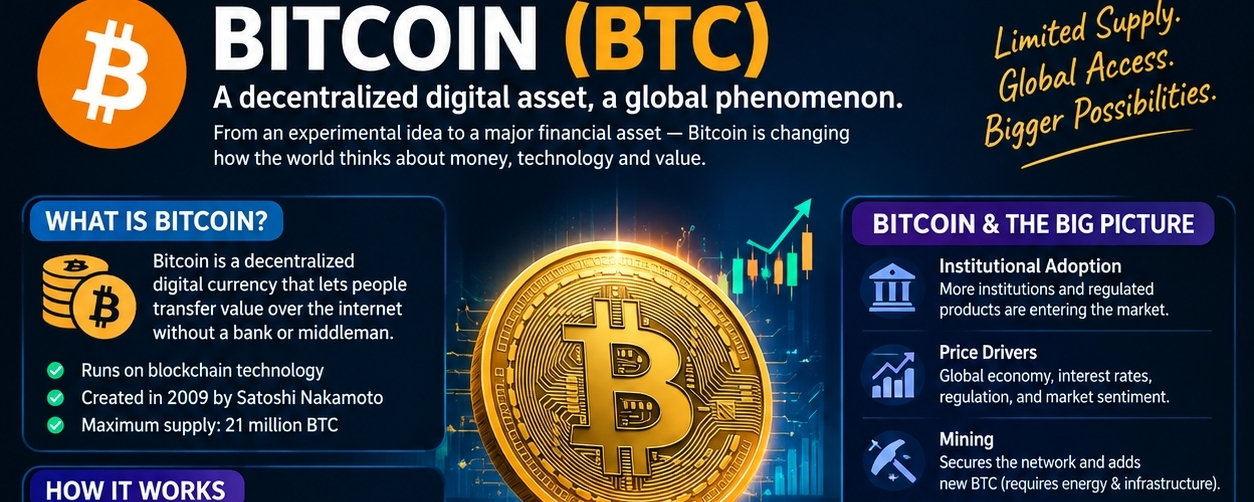
Article
Bitcoin (BTC): The World’s Leading CryptocurrencyIntroduction
Bitcoin (BTC) is a decentralized digital asset that has transformed the financial and technology landscape. Unlike traditional currencies, Bitcoin operates without a central bank and uses blockchain technology to record transactions.
Since its launch in 2009, Bitcoin has gained global attention because of its limited supply, decentralization, and potential as a digital store of value.
What Is Bitcoin?
Bitcoin allows users to transfer value digitally without relying on a traditional bank or intermediary. Transactions are verified by a decentralized network and recorded on a public blockchain.
Bitcoin has a maximum supply of 21 million BTC, making scarcity one of its key characteristics.
How Does Bitcoin Work?
Bitcoin uses Proof of Work to secure its network. Miners verify transactions and add new blocks to the blockchain.
Users control their Bitcoin through cryptographic keys. A public address is used to receive BTC, while a private key authorizes transactions. Protecting private keys and recovery phrases is extremely important.
Why Do People Invest in Bitcoin?
Bitcoin attracts investors for several reasons:
Limited supply and scarcity
Decentralized structure
Global accessibility
Potential long-term growth
Portfolio diversification
Potential store-of-value characteristics
Some investors hold BTC for the long term, while others use strategies such as dollar-cost averaging or active trading.
Bitcoin and Market Volatility
Bitcoin is a highly volatile asset. Its price can move rapidly because of market sentiment, liquidity, regulations, institutional activity, interest rates, and global economic conditions.
Technical traders often study support, resistance, volume, market structure, moving averages, RSI, and other indicators. However, no indicator can guarantee future price movements.
Institutional Adoption
Institutional interest has become an important part of Bitcoin’s growth. Financial institutions and professional investors have increasingly explored ways to gain BTC exposure.
Bitcoin investment products have also helped connect cryptocurrency with traditional financial markets.
Bitcoin’s Main Risks
Bitcoin offers opportunities, but it also carries significant risks:
High price volatility
Regulatory uncertainty
Security and wallet risks
Market manipulation
Excessive leverage
Exchange and technology risks
Investors should never risk more money than they can afford to lose.
Risk Management
Good risk management is essential when trading or investing in BTC.
Consider:
Using reasonable position sizes
Avoiding excessive leverage
Setting stop-loss levels when appropriate
Diversifying exposure
Having a clear trading or investment plan
Avoiding emotional decisions
The goal is not to predict every Bitcoin move, but to manage risk when the market moves against you.
The Future of Bitcoin
Bitcoin’s future will depend on factors such as institutional adoption, regulation, technology, global economic conditions, and consumer acceptance.
Although uncertainty remains, Bitcoin has already established itself as a major digital asset and an important part of the global financial conversation.
Conclusion
Bitcoin is more than just a cryptocurrency. Its decentralized network, limited supply, blockchain technology, and global accessibility have created a new way to think about money and digital assets.
However, BTC remains highly volatile and carries real risks. Education, research, security, and disciplined risk management should always come before investment decisions.
Disclaimer: This content is for educational purposes only and is not financial advice.#BTC走势分析
Bitcoin (BTC): The World’s Leading Cryptocurrency
Introduction
Bitcoin (BTC) is a decentralized digital asset that has transformed the financial and technology landscape. Unlike traditional currencies, Bitcoin operates without a central bank and uses blockchain technology to record transactions.
Since its launch in 2009, Bitcoin has gained global attention because of its limited supply, decentralization, and potential as a digital store of value.
What Is Bitcoin?
Bitcoin allows users to transfer value digitally without relying on a traditional bank or intermediary. Transactions are verified by a decentralized network and recorded on a public blockchain.
Bitcoin has a maximum supply of 21 million BTC, making scarcity one of its key characteristics.
How Does Bitcoin Work?
Bitcoin uses Proof of Work to secure its network. Miners verify transactions and add new blocks to the blockchain.
Users control their Bitcoin through cryptographic keys. A public address is used to receive BTC, while a private key authorizes transactions. Protecting private keys and recovery phrases is extremely important.
Why Do People Invest in Bitcoin?
Bitcoin attracts investors for several reasons:
Limited supply and scarcity
Decentralized structure
Global accessibility
Potential long-term growth
Portfolio diversification
Potential store-of-value characteristics
Some investors hold BTC for the long term, while others use strategies such as dollar-cost averaging or active trading.
Bitcoin and Market Volatility
Bitcoin is a highly volatile asset. Its price can move rapidly because of market sentiment, liquidity, regulations, institutional activity, interest rates, and global economic conditions.
Technical traders often study support, resistance, volume, market structure, moving averages, RSI, and other indicators. However, no indicator can guarantee future price movements.
Institutional Adoption
Institutional interest has become an important part of Bitcoin’s growth. Financial institutions and professional investors have increasingly explored ways to gain BTC exposure.
Bitcoin investment products have also helped connect cryptocurrency with traditional financial markets.
Bitcoin’s Main Risks
Bitcoin offers opportunities, but it also carries significant risks:
High price volatility
Regulatory uncertainty
Security and wallet risks
Market manipulation
Excessive leverage
Exchange and technology risks
Investors should never risk more money than they can afford to lose.
Risk Management
Good risk management is essential when trading or investing in BTC.
Consider:
Using reasonable position sizes
Avoiding excessive leverage
Setting stop-loss levels when appropriate
Diversifying exposure
Having a clear trading or investment plan
Avoiding emotional decisions
The goal is not to predict every Bitcoin move, but to manage risk when the market moves against you.
The Future of Bitcoin
Bitcoin’s future will depend on factors such as institutional adoption, regulation, technology, global economic conditions, and consumer acceptance.
Although uncertainty remains, Bitcoin has already established itself as a major digital asset and an important part of the global financial conversation.
Conclusion
Bitcoin is more than just a cryptocurrency. Its decentralized network, limited supply, blockchain technology, and global accessibility have created a new way to think about money and digital assets.
However, BTC remains highly volatile and carries real risks. Education, research, security, and disciplined risk management should always come before investment decisions.
Disclaimer: This content is for educational purposes only and is not financial advice.#BTC走势分析
Bitcoin (BTC) is a decentralized digital asset that has transformed the financial and technology landscape. Unlike traditional currencies, Bitcoin operates without a central bank and uses blockchain technology to record transactions.
Since its launch in 2009, Bitcoin has gained global attention because of its limited supply, decentralization, and potential as a digital store of value.
What Is Bitcoin?
Bitcoin allows users to transfer value digitally without relying on a traditional bank or intermediary. Transactions are verified by a decentralized network and recorded on a public blockchain.
Bitcoin has a maximum supply of 21 million BTC, making scarcity one of its key characteristics.
How Does Bitcoin Work?
Bitcoin uses Proof of Work to secure its network. Miners verify transactions and add new blocks to the blockchain.
Users control their Bitcoin through cryptographic keys. A public address is used to receive BTC, while a private key authorizes transactions. Protecting private keys and recovery phrases is extremely important.
Why Do People Invest in Bitcoin?
Bitcoin attracts investors for several reasons:
Limited supply and scarcity
Decentralized structure
Global accessibility
Potential long-term growth
Portfolio diversification
Potential store-of-value characteristics
Some investors hold BTC for the long term, while others use strategies such as dollar-cost averaging or active trading.
Bitcoin and Market Volatility
Bitcoin is a highly volatile asset. Its price can move rapidly because of market sentiment, liquidity, regulations, institutional activity, interest rates, and global economic conditions.
Technical traders often study support, resistance, volume, market structure, moving averages, RSI, and other indicators. However, no indicator can guarantee future price movements.
Institutional Adoption
Institutional interest has become an important part of Bitcoin’s growth. Financial institutions and professional investors have increasingly explored ways to gain BTC exposure.
Bitcoin investment products have also helped connect cryptocurrency with traditional financial markets.
Bitcoin’s Main Risks
Bitcoin offers opportunities, but it also carries significant risks:
High price volatility
Regulatory uncertainty
Security and wallet risks
Market manipulation
Excessive leverage
Exchange and technology risks
Investors should never risk more money than they can afford to lose.
Risk Management
Good risk management is essential when trading or investing in BTC.
Consider:
Using reasonable position sizes
Avoiding excessive leverage
Setting stop-loss levels when appropriate
Diversifying exposure
Having a clear trading or investment plan
Avoiding emotional decisions
The goal is not to predict every Bitcoin move, but to manage risk when the market moves against you.
The Future of Bitcoin
Bitcoin’s future will depend on factors such as institutional adoption, regulation, technology, global economic conditions, and consumer acceptance.
Although uncertainty remains, Bitcoin has already established itself as a major digital asset and an important part of the global financial conversation.
Conclusion
Bitcoin is more than just a cryptocurrency. Its decentralized network, limited supply, blockchain technology, and global accessibility have created a new way to think about money and digital assets.
However, BTC remains highly volatile and carries real risks. Education, research, security, and disciplined risk management should always come before investment decisions.
Disclaimer: This content is for educational purposes only and is not financial advice.#BTC走势分析
1
1
642
·
--
Bitcoin (BTC): The Institutional Shift Is Getting Harder to IgnoreBitcoin is no longer just a story about retail traders, early adopters, and crypto-native companies.
The bigger story now is how quickly BTC is becoming part of the traditional financial system.
From spot ETFs to institutional custody, regulated trading infrastructure, and major banks entering the digital-asset market, Bitcoin is increasingly being treated as a legitimate financial asset rather than an experimental technology.
And that shift could matter more for Bitcoin's long-term trajectory than any single short-term price move.
Bitcoin Is Entering Traditional Finance
One of the clearest signs of this transition came today as Standard Chartered launched institutional spot trading for Bitcoin and Ether in the UAE, becoming the first globally systemically important bank to offer these services in the Gulf market.
This is important because institutions care about more than simply being able to buy BTC.
They need:
• Regulated access
• Institutional-grade custody
• Deep liquidity
• Compliance infrastructure
• Risk management
• Reliable execution
As these pieces continue to develop, the barrier between traditional finance and crypto becomes smaller.
Coinbase Research notes that institutional participation has matured significantly, with investors now accessing BTC and ETH through spot markets, futures, options, ETFs, and other regulated products.
That is a completely different market structure from the Bitcoin of a few years ago.
ETFs Changed the Game
Spot Bitcoin ETFs created one of the biggest bridges between traditional capital and BTC.
Instead of an institution having to build its own crypto custody and trading infrastructure, an ETF provides exposure through a familiar regulated investment structure.
According to The Block Research, more than 2,000 institutions reported Bitcoin ETF holdings in Q1 2026, showing how institutional participation has continued expanding.
This doesn't mean every institution is bullish on Bitcoin.
It means BTC has become accessible to investors who previously couldn't—or wouldn't—participate directly in crypto markets.
And accessibility matters.
The easier it becomes for pensions, asset managers, family offices, advisers, corporations, and banks to gain exposure, the larger the potential capital base becomes.
BTC Price Still Has to Prove Itself
Institutional adoption doesn't mean Bitcoin can only go up.
Bitcoin remains volatile, and macroeconomic conditions continue to matter.
As of September 3, BTC is trading around the $77K–$78K area after a strong August rebound. Reuters notes that Bitcoin recently broke above several major moving averages, but resistance around $82,793 remains an important technical level.
That creates an interesting setup.
If BTC can establish itself above the major resistance zone, momentum could strengthen and bring higher levels into focus.
But if the market loses key support areas, the bullish structure could weaken quickly.
So the bigger picture may be bullish while the short-term chart remains uncertain.
Both things can be true at the same time.
The Macro Factor
Bitcoin doesn't trade in isolation.
Interest rates, liquidity, the U.S. dollar, bond yields, inflation expectations, and global risk appetite can all influence BTC.
The Federal Reserve remains particularly important.
Recent market expectations have been sensitive to the possibility of further rate tightening, which can strengthen the dollar and put pressure on risk assets.
This is why simply saying "institutions are buying Bitcoin" isn't enough.
The question is:
How much capital is entering, through which vehicles, and under what macro conditions?
That is where the next phase of the Bitcoin market could become especially interesting.
The Institutionalisation Thesis
The most important change isn't necessarily Bitcoin's price.
It's Bitcoin's position within the financial system.
A few years ago, the conversation was:
"Will institutions ever take Bitcoin seriously?"
Today, the conversation is increasingly:
"How much exposure should institutions have, and what is the best way to access it?"
That is a massive shift.
Banks are building crypto services.
Asset managers are offering Bitcoin products.
ETFs are providing regulated exposure.
Custodians are building institutional infrastructure.
Trading venues are becoming more sophisticated.
And regulators are increasingly developing frameworks around digital assets.
Bitcoin is moving from the edges of finance toward the center of the conversation.
What Comes Next for BTC?
The next stage could be less about retail speculation and more about capital allocation.
If institutional participation continues growing, Bitcoin could increasingly behave like a global macro asset—still volatile, still risky, but increasingly integrated with traditional portfolios.
That doesn't guarantee a particular price target.
It does, however, change the potential scale of the market.
For traders, the short term remains about levels, liquidity, momentum, and risk management.
For long-term investors, the bigger question is whether Bitcoin continues gaining acceptance as a scarce digital asset within the global financial system.
Right now, the evidence of institutional integration is becoming difficult to ignore.
Bitcoin isn't simply waiting for traditional finance to arrive anymore.
Traditional finance is actively building around Bitcoin. #BTC走势分析
Bitcoin (BTC): The Institutional Shift Is Getting Harder to Ignore
Bitcoin is no longer just a story about retail traders, early adopters, and crypto-native companies.
The bigger story now is how quickly BTC is becoming part of the traditional financial system.
From spot ETFs to institutional custody, regulated trading infrastructure, and major banks entering the digital-asset market, Bitcoin is increasingly being treated as a legitimate financial asset rather than an experimental technology.
And that shift could matter more for Bitcoin's long-term trajectory than any single short-term price move.
Bitcoin Is Entering Traditional Finance
One of the clearest signs of this transition came today as Standard Chartered launched institutional spot trading for Bitcoin and Ether in the UAE, becoming the first globally systemically important bank to offer these services in the Gulf market.
This is important because institutions care about more than simply being able to buy BTC.
They need:
• Regulated access
• Institutional-grade custody
• Deep liquidity
• Compliance infrastructure
• Risk management
• Reliable execution
As these pieces continue to develop, the barrier between traditional finance and crypto becomes smaller.
Coinbase Research notes that institutional participation has matured significantly, with investors now accessing BTC and ETH through spot markets, futures, options, ETFs, and other regulated products.
That is a completely different market structure from the Bitcoin of a few years ago.
ETFs Changed the Game
Spot Bitcoin ETFs created one of the biggest bridges between traditional capital and BTC.
Instead of an institution having to build its own crypto custody and trading infrastructure, an ETF provides exposure through a familiar regulated investment structure.
According to The Block Research, more than 2,000 institutions reported Bitcoin ETF holdings in Q1 2026, showing how institutional participation has continued expanding.
This doesn't mean every institution is bullish on Bitcoin.
It means BTC has become accessible to investors who previously couldn't—or wouldn't—participate directly in crypto markets.
And accessibility matters.
The easier it becomes for pensions, asset managers, family offices, advisers, corporations, and banks to gain exposure, the larger the potential capital base becomes.
BTC Price Still Has to Prove Itself
Institutional adoption doesn't mean Bitcoin can only go up.
Bitcoin remains volatile, and macroeconomic conditions continue to matter.
As of September 3, BTC is trading around the $77K–$78K area after a strong August rebound. Reuters notes that Bitcoin recently broke above several major moving averages, but resistance around $82,793 remains an important technical level.
That creates an interesting setup.
If BTC can establish itself above the major resistance zone, momentum could strengthen and bring higher levels into focus.
But if the market loses key support areas, the bullish structure could weaken quickly.
So the bigger picture may be bullish while the short-term chart remains uncertain.
Both things can be true at the same time.
The Macro Factor
Bitcoin doesn't trade in isolation.
Interest rates, liquidity, the U.S. dollar, bond yields, inflation expectations, and global risk appetite can all influence BTC.
The Federal Reserve remains particularly important.
Recent market expectations have been sensitive to the possibility of further rate tightening, which can strengthen the dollar and put pressure on risk assets.
This is why simply saying "institutions are buying Bitcoin" isn't enough.
The question is:
How much capital is entering, through which vehicles, and under what macro conditions?
That is where the next phase of the Bitcoin market could become especially interesting.
The Institutionalisation Thesis
The most important change isn't necessarily Bitcoin's price.
It's Bitcoin's position within the financial system.
A few years ago, the conversation was:
"Will institutions ever take Bitcoin seriously?"
Today, the conversation is increasingly:
"How much exposure should institutions have, and what is the best way to access it?"
That is a massive shift.
Banks are building crypto services.
Asset managers are offering Bitcoin products.
ETFs are providing regulated exposure.
Custodians are building institutional infrastructure.
Trading venues are becoming more sophisticated.
And regulators are increasingly developing frameworks around digital assets.
Bitcoin is moving from the edges of finance toward the center of the conversation.
What Comes Next for BTC?
The next stage could be less about retail speculation and more about capital allocation.
If institutional participation continues growing, Bitcoin could increasingly behave like a global macro asset—still volatile, still risky, but increasingly integrated with traditional portfolios.
That doesn't guarantee a particular price target.
It does, however, change the potential scale of the market.
For traders, the short term remains about levels, liquidity, momentum, and risk management.
For long-term investors, the bigger question is whether Bitcoin continues gaining acceptance as a scarce digital asset within the global financial system.
Right now, the evidence of institutional integration is becoming difficult to ignore.
Bitcoin isn't simply waiting for traditional finance to arrive anymore.
Traditional finance is actively building around Bitcoin. #BTC走势分析
The bigger story now is how quickly BTC is becoming part of the traditional financial system.
From spot ETFs to institutional custody, regulated trading infrastructure, and major banks entering the digital-asset market, Bitcoin is increasingly being treated as a legitimate financial asset rather than an experimental technology.
And that shift could matter more for Bitcoin's long-term trajectory than any single short-term price move.
Bitcoin Is Entering Traditional Finance
One of the clearest signs of this transition came today as Standard Chartered launched institutional spot trading for Bitcoin and Ether in the UAE, becoming the first globally systemically important bank to offer these services in the Gulf market.
This is important because institutions care about more than simply being able to buy BTC.
They need:
• Regulated access
• Institutional-grade custody
• Deep liquidity
• Compliance infrastructure
• Risk management
• Reliable execution
As these pieces continue to develop, the barrier between traditional finance and crypto becomes smaller.
Coinbase Research notes that institutional participation has matured significantly, with investors now accessing BTC and ETH through spot markets, futures, options, ETFs, and other regulated products.
That is a completely different market structure from the Bitcoin of a few years ago.
ETFs Changed the Game
Spot Bitcoin ETFs created one of the biggest bridges between traditional capital and BTC.
Instead of an institution having to build its own crypto custody and trading infrastructure, an ETF provides exposure through a familiar regulated investment structure.
According to The Block Research, more than 2,000 institutions reported Bitcoin ETF holdings in Q1 2026, showing how institutional participation has continued expanding.
This doesn't mean every institution is bullish on Bitcoin.
It means BTC has become accessible to investors who previously couldn't—or wouldn't—participate directly in crypto markets.
And accessibility matters.
The easier it becomes for pensions, asset managers, family offices, advisers, corporations, and banks to gain exposure, the larger the potential capital base becomes.
BTC Price Still Has to Prove Itself
Institutional adoption doesn't mean Bitcoin can only go up.
Bitcoin remains volatile, and macroeconomic conditions continue to matter.
As of September 3, BTC is trading around the $77K–$78K area after a strong August rebound. Reuters notes that Bitcoin recently broke above several major moving averages, but resistance around $82,793 remains an important technical level.
That creates an interesting setup.
If BTC can establish itself above the major resistance zone, momentum could strengthen and bring higher levels into focus.
But if the market loses key support areas, the bullish structure could weaken quickly.
So the bigger picture may be bullish while the short-term chart remains uncertain.
Both things can be true at the same time.
The Macro Factor
Bitcoin doesn't trade in isolation.
Interest rates, liquidity, the U.S. dollar, bond yields, inflation expectations, and global risk appetite can all influence BTC.
The Federal Reserve remains particularly important.
Recent market expectations have been sensitive to the possibility of further rate tightening, which can strengthen the dollar and put pressure on risk assets.
This is why simply saying "institutions are buying Bitcoin" isn't enough.
The question is:
How much capital is entering, through which vehicles, and under what macro conditions?
That is where the next phase of the Bitcoin market could become especially interesting.
The Institutionalisation Thesis
The most important change isn't necessarily Bitcoin's price.
It's Bitcoin's position within the financial system.
A few years ago, the conversation was:
"Will institutions ever take Bitcoin seriously?"
Today, the conversation is increasingly:
"How much exposure should institutions have, and what is the best way to access it?"
That is a massive shift.
Banks are building crypto services.
Asset managers are offering Bitcoin products.
ETFs are providing regulated exposure.
Custodians are building institutional infrastructure.
Trading venues are becoming more sophisticated.
And regulators are increasingly developing frameworks around digital assets.
Bitcoin is moving from the edges of finance toward the center of the conversation.
What Comes Next for BTC?
The next stage could be less about retail speculation and more about capital allocation.
If institutional participation continues growing, Bitcoin could increasingly behave like a global macro asset—still volatile, still risky, but increasingly integrated with traditional portfolios.
That doesn't guarantee a particular price target.
It does, however, change the potential scale of the market.
For traders, the short term remains about levels, liquidity, momentum, and risk management.
For long-term investors, the bigger question is whether Bitcoin continues gaining acceptance as a scarce digital asset within the global financial system.
Right now, the evidence of institutional integration is becoming difficult to ignore.
Bitcoin isn't simply waiting for traditional finance to arrive anymore.
Traditional finance is actively building around Bitcoin. #BTC走势分析
1
2
431
·
--
Bitcoin doesn’t need to prove itself every day.
It has already survived multiple cycles, crashes, criticism, and countless “it’s over” narratives.
What matters now is adoption, liquidity, infrastructure, and the growing understanding of what Bitcoin actually represents.
The short-term chart will always be noisy.
The long-term thesis remains simple:
Limited supply. Decentralized network. Global liquidity.
Bitcoin is still building its story. #BTC走势分析
Bitcoin doesn’t need to prove itself every day.
It has already survived multiple cycles, crashes, criticism, and countless “it’s over” narratives.
What matters now is adoption, liquidity, infrastructure, and the growing understanding of what Bitcoin actually represents.
The short-term chart will always be noisy.
The long-term thesis remains simple:
Limited supply. Decentralized network. Global liquidity.
Bitcoin is still building its story. #BTC走势分析
It has already survived multiple cycles, crashes, criticism, and countless “it’s over” narratives.
What matters now is adoption, liquidity, infrastructure, and the growing understanding of what Bitcoin actually represents.
The short-term chart will always be noisy.
The long-term thesis remains simple:
Limited supply. Decentralized network. Global liquidity.
Bitcoin is still building its story. #BTC走势分析
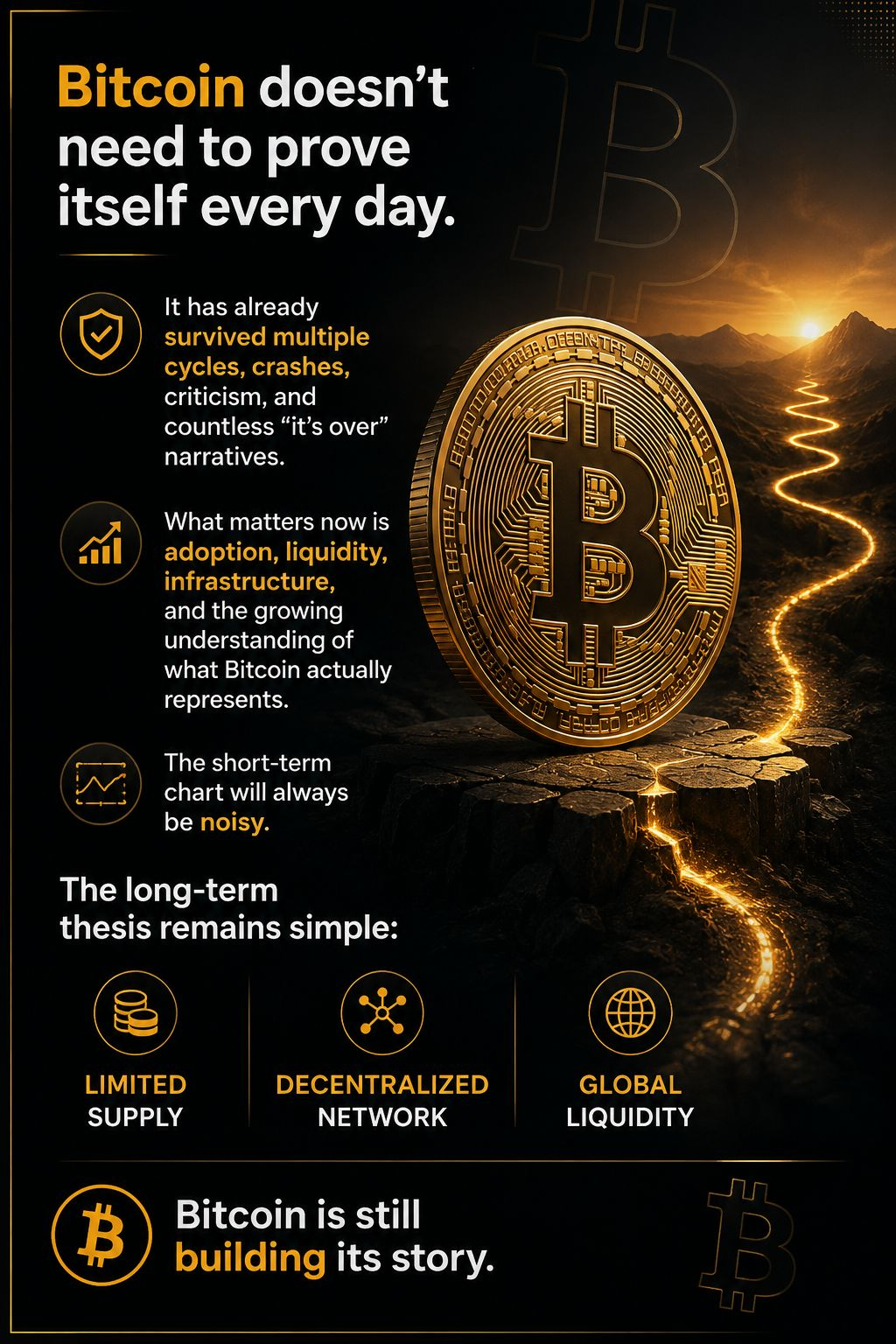
227
·
--
Bitcoin Long Setup: Watching for the Next Move 🚀Bitcoin is once again approaching a critical area where buyers could try to regain control. After the recent volatility, the focus now is on whether BTC can build enough momentum to push toward higher levels.
📊 BTC Long Setup
Pair: BTC/USDT
Direction: Long 📈
Entry Zone: $77,000–$77,800
Support: $76,000–$76,500
Resistance: $80,000–$81,000
TP1: $79,000
TP2: $80,500
TP3: $82,000
Stop Loss: $75,500
The key level to watch is the $76K support zone. If buyers successfully defend this area and volume starts increasing, BTC could attempt a move back toward $80K and potentially higher.
However, confirmation is important. A clean breakout above resistance would strengthen the bullish setup, while losing the key support could invalidate the long idea.
🎯 Risk Management
Don’t risk more than 1–2% of your trading capital on a single setup. Use appropriate position sizing, avoid excessive leverage, and consider securing partial profits at each target.
Bitcoin can move quickly, so patience and risk management matter more than chasing candles.
Informational content only. Not financial advice. Always do your own research.#BTC走势分析
Bitcoin Long Setup: Watching for the Next Move 🚀
Bitcoin is once again approaching a critical area where buyers could try to regain control. After the recent volatility, the focus now is on whether BTC can build enough momentum to push toward higher levels.
📊 BTC Long Setup
Pair: BTC/USDT
Direction: Long 📈
Entry Zone: $77,000–$77,800
Support: $76,000–$76,500
Resistance: $80,000–$81,000
TP1: $79,000
TP2: $80,500
TP3: $82,000
Stop Loss: $75,500
The key level to watch is the $76K support zone. If buyers successfully defend this area and volume starts increasing, BTC could attempt a move back toward $80K and potentially higher.
However, confirmation is important. A clean breakout above resistance would strengthen the bullish setup, while losing the key support could invalidate the long idea.
🎯 Risk Management
Don’t risk more than 1–2% of your trading capital on a single setup. Use appropriate position sizing, avoid excessive leverage, and consider securing partial profits at each target.
Bitcoin can move quickly, so patience and risk management matter more than chasing candles.
Informational content only. Not financial advice. Always do your own research.#BTC走势分析
📊 BTC Long Setup
Pair: BTC/USDT
Direction: Long 📈
Entry Zone: $77,000–$77,800
Support: $76,000–$76,500
Resistance: $80,000–$81,000
TP1: $79,000
TP2: $80,500
TP3: $82,000
Stop Loss: $75,500
The key level to watch is the $76K support zone. If buyers successfully defend this area and volume starts increasing, BTC could attempt a move back toward $80K and potentially higher.
However, confirmation is important. A clean breakout above resistance would strengthen the bullish setup, while losing the key support could invalidate the long idea.
🎯 Risk Management
Don’t risk more than 1–2% of your trading capital on a single setup. Use appropriate position sizing, avoid excessive leverage, and consider securing partial profits at each target.
Bitcoin can move quickly, so patience and risk management matter more than chasing candles.
Informational content only. Not financial advice. Always do your own research.#BTC走势分析
269
Log in to explore more content
Join global crypto users on Binance Square
⚡️ Get latest and useful information about crypto.
💬 Trusted by the world’s largest crypto exchange.
👍 Discover real insights from verified creators.
Email / Phone number
Trending Topics
AIStocksWhatNext
160,374 views
1,941 Discussing
Share & Win Traffic Reward in our Trending Hashtag Campaign
✨Topic: What Other Investment Opportunities Remain as AI Stocks Keep Rising?
👉How to Join:
Publish a short post or article with hashtag #AIStocksWhatNext
Share whether you’re bullish or bearish, and post your AI stock holdings or trade — using the trade widget may improve your eligibility.
You can also strengthen your post by sharing data or charts, and avoiding AI-generated images.
✍️Create content based on the below angles:
- Nvidia says chip sales will double next year, and top AI companies keep hitting record revenue, the compute spend behind it is just as staggering. Is AI demand really taking off? And how long can it last? AI stocks are up across the board. Is this a real breakout, or just a short-term bounce?
- Industry leaders are calling to slow down AI development, while Trump plans to build an “AI Force”, claiming AI could account for 25% of U.S. GDP in the future. Whose side are you on? Will state-level backing be a long-term win for AI stocks?
- Are you buying AI stocks? Share your AI-related trade/holdings with our trade sharing widget.
⏰Campaign Period:
- 2026-09-22 7:00 - 2026-09-24 4:00 UTC
🎁Reward:
- Qualified posts that comply with the above guidelines and contain more than 100 words will be reviewed and may receive a random traffic boost of 500 to 3,000 views. You will receive a notification from your feed secretary if your post is selected.
- Get a chance to have your article featured on Binance Square Official
Need ideas for your post? Visit the topic page #AIStocksWhatNext or the Square Guide on How to Post for Better Reach.
Binance Square Official
·265 Likes
·538k views
BitcoinBreaksAboveMayHighNears$86K
4,784 views
97 Discussing
DogecoinRises15%
12,007 views
532 Discussing