

RISKEE_MID
268 Posts

RISKEE_MID
Report
Block User
let’s talk about crypto
Open Trade
Occasional Trader
2.1 Years
8 Following
41 Followers
300 Liked
Posts
Portfolio
All
Quotes
·
--
Article
Why Can Two Crypto Platforms Show Different Prices for the Same Token?Why Can Two Crypto Platforms Show Different Prices for the Same Token?
It is common for two crypto platforms to display different prices for the same token at exactly the same time.
A user may open two TON DEXs, search for the same asset pair, and see slightly different exchange rates. Sometimes the difference is small. In other cases, especially for smaller tokens or large trades, the gap can become significant.
At first glance, this may look like a pricing error. Usually, it is not.
The key is understanding that a decentralized exchange does not necessarily use one universal price for an asset. A DEX normally derives its trading price from the liquidity available inside a particular pool, while other platforms may calculate prices from different pools, different markets, external price feeds, or aggregated sources.
This means two platforms can be looking at the same token but observing different markets.
On TON, this becomes particularly important because liquidity is distributed across different DEXs, pools, market makers and liquidity sources. Understanding where a displayed price comes from—and more importantly, how much you can actually receive when you trade—is more useful than simply comparing the number shown beside a token.
STON.fi provides a practical example of this pool-based pricing model, while Omniston demonstrates how aggregation can reduce the need for users to manually compare every available venue.
A Token Does Not Have One Universal On-Chain Price
One of the first concepts to understand is that a token does not have a single automatically enforced market price across every blockchain venue.
Imagine a token called TOKEN trading against a stablecoin.
On one TON DEX, the TOKEN/USDT pool might contain a certain quantity of TOKEN and USDT. Another DEX may contain a completely different quantity of both assets.
Because the liquidity composition is different, the exchange rate produced by each pool can also be different.
In an automated market maker, or AMM, the pool itself provides the market-making mechanism. STON.fi describes a liquidity pool as a smart-contract vault containing a pair of tokens, where the pool's price is determined algorithmically from the ratio of the assets held inside it.
So when two DEXs show different prices, they may not actually disagree about a universal price.
They may simply be reporting the current state of two different pools.
1. DEX Prices Come From Local Liquidity and Pool Ratios
This is the most fundamental reason prices differ.
Consider a simplified pool containing:
100,000 TOKEN100,000 USDT
Ignoring fees and other mechanics for the moment, the pool ratio suggests roughly:
1 TOKEN ≈ 1 USDT
Now imagine traders buy TOKEN from that pool.
TOKEN leaves the pool while USDT enters it.
The ratio changes.
Suppose the pool now contains:
90,000 TOKEN and 111,000 USDT
The pool's implied price is no longer the same as before.
This is one of the defining characteristics of AMM-based markets: trades change the pool's reserves, and those reserve changes influence subsequent prices.
For a constant-product AMM, the simplified relationship is commonly represented as:
x × y = k
where:
x = reserve of token A
y = reserve of token B
k = invariant
The actual execution calculation also includes trading fees and the amount being traded, but the important idea is simple: the available liquidity inside the pool determines the price.
Now imagine another TON DEX has a separate TOKEN/USDT pool containing a different quantity of TOKEN and USDT.
Its internal ratio may therefore imply another price.
For example:
DEX A:
1 TOKEN ≈ 1.00 USDT
DEX B:
1 TOKEN ≈ 1.04 USDT
Neither number necessarily means that one DEX is broken.
The markets simply have different liquidity conditions.
STON.fi's documentation similarly explains that pools algorithmically determine their price from the ratio of the tokens inside them.
The Displayed Price Is Not Necessarily the Price You Will Execute
This distinction is extremely important.
A platform may display:
1 TOKEN = 1.05 USDT
But that does not automatically mean you can sell 50,000 TOKEN and receive exactly 52,500 USDT.
The displayed figure may represent a spot price, an indicative quote, or the current pool ratio.
Your actual trade interacts with available liquidity.
As the size of your order increases, the trade can move through the liquidity curve and produce a different effective exchange rate.
This is known as price impact.
STON.fi explicitly distinguishes the swap rate from price impact and minimum received. Its documentation explains that larger trades in smaller pools generally have greater price impact because the trade itself moves the price within the pool.
That creates a crucial difference between:
Displayed price
and
Executable price
The second one matters more when you are actually trading.
2. Thin Liquidity Can Make Price Differences Much Larger
Liquidity depth is one of the biggest reasons two platforms can show noticeably different prices.
Suppose DEX A has a large TOKEN/USDT pool, while DEX B has a very small pool.
A small transaction may produce reasonably similar prices on both platforms.
But a large transaction can produce dramatically different results.
Imagine a trader wants to buy $50,000 worth of TOKEN.
On the deeper pool, $50,000 may represent only a small portion of available liquidity.
On the smaller pool, the same trade could consume a much larger part of the available liquidity.
The result is greater price impact.
This is why a platform showing a slightly better headline price does not necessarily provide the better trade.
The important question becomes:
How much TOKEN can I actually receive for my exact input after price impact and fees?
STON.fi recommends looking at liquidity indicators such as TVL and swap volume when evaluating pools. Its documentation notes that higher TVL generally indicates deeper liquidity and lower slippage, while swap volume provides information about trading activity. It also warns that a high APR combined with very low TVL can indicate unstable liquidity, making it important to evaluate several metrics together rather than relying on one figure.
In other words, the pool with the highest displayed price is not automatically the pool with the best execution.
A Simple TON Example
Suppose TOKEN is trading across three TON venues.
Venue A
Displayed price:
1 TOKEN = 1.00 USDT
Liquidity:
High
Estimated output for a $10,000 trade:
9,960 TOKEN
Venue B
Displayed price:
1 TOKEN = 1.03 USDT
Liquidity:
Low
Estimated output for a $10,000 trade:
9,500 TOKEN
Venue C
Displayed price:
1 TOKEN = 1.01 USDT
Liquidity:
Medium
Estimated output:
9,850 TOKEN
Looking only at the ticker price, Venue B appears attractive.
Looking at the actual executable amount, Venue A may deliver more TOKEN.
This illustrates why professional trading comparisons should focus on execution rather than headline numbers.
TVL Helps, But TVL Is Not a Price Guarantee
Total value locked, or TVL, is useful because it provides a broad indication of how much capital is committed to a liquidity pool.
However, TVL should not be interpreted as a guarantee of execution quality.
A pool can have significant TVL and still experience changing conditions.
Likewise, a pool with lower TVL may occasionally produce a competitive quote for a particular trade.
That is why TVL, trading activity, price impact, fees and the actual quote should be considered together.
STON.fi specifically advises evaluating TVL, swap volume and APR collectively rather than relying on a single metric.
For a trader, the final executable quote remains the most directly relevant measurement.
3. Different Platforms May Update Their Prices at Different Times
Another reason for price discrepancies is timing.
Crypto markets move continuously.
A price shown on one application may have been calculated a fraction of a second earlier than another price.
This becomes more important during volatile markets.
Suppose TOKEN suddenly moves from:
$1.00 → $1.05
One platform may update immediately.
Another may refresh its data slightly later.
A third platform may display an aggregated market price based on multiple sources.
For a short period, all three can legitimately display different figures.
This is not unusual.
The difference becomes even more visible when platforms use different update mechanisms.
Some systems continuously request fresh quotes.
Others refresh periodically.
Some dashboards may rely on indexed market data.
Others may query the blockchain or liquidity source directly.
Therefore, two interfaces can be accurate representations of their respective data sources while still showing different numbers.
Price Feeds Are Not the Same as Executable Liquidity
Another common source of confusion is the distinction between a reference price and an execution quote.
A price feed may tell an application:
TOKEN ≈ $1.05
That information can be useful for portfolio valuation, charts or dashboards.
But a price feed does not necessarily represent the amount you can receive in a live swap.
A trader may see a reference price of $1.05 and discover that a large swap executes materially below that level because the available liquidity is insufficient.
The reference price answers:
“What is the token approximately worth according to this data source?”
The executable quote answers:
“How much will I actually receive for this trade right now?”
Those are different questions.
4. Different Markets Can Create Different Prices
A token can also trade simultaneously in different market environments.
For example, it may have:
A TON DEX poolAnother TON DEX poolAn order-book marketA centralized exchange marketAn OTC or RFQ marketA liquidity provider quoting directly
These markets do not necessarily have identical participants, liquidity depth, fees or trading activity.
Therefore, temporary price differences are normal.
Arbitrage traders may attempt to exploit large discrepancies by buying an asset where it is cheaper and selling where it is more expensive.
Their activity can push prices toward each other, but it does not guarantee that every venue will display exactly the same value at every moment.
On-chain liquidity is especially local: the state of one pool can change because of trades occurring in that pool without instantly changing every other market in exactly the same way.
The Same Token Can Have Several "Prices"
This leads to an important vocabulary distinction.
A token can simultaneously have:
Reference price
A market-data estimate used for valuation.
Pool price
The price implied by a particular AMM's reserves.
Quoted price
The amount a trading system currently offers for a specific trade.
Effective execution price
The actual average price after considering the entire trade.
Mark or index price
A reference number derived from one or multiple external markets.
These values can differ without any contradiction.
The mistake is assuming that one number must be the universal "true" price.
5. Fees Make Cross-Platform Comparisons Even More Important
Even when two venues show nearly identical prices, the final result can still differ because fees are not always identical.
A swap can involve:
Trading feesProtocol feesReferral feesNetwork costsPrice impactSlippageRouting costs
STON.fi documents a configurable per-pool trading-fee model and notes that fees can vary by pool.
Therefore, comparing two platforms purely by the displayed token price can miss part of the actual economics.
For example:
Platform A
Displayed price: $1.000
Fee: 0.3%
Low price impact
Platform B
Displayed price: $1.005
Fee: 0.8%
Higher price impact
Platform B appears better when looking at the first number.
After the entire transaction is calculated, Platform A may provide the greater final output.
This is why experienced traders compare net execution rather than ticker prices.
How to Compare Prices Correctly
Instead of asking:
“Which platform has the higher token price?”
ask:
“For the amount I am selling, which route gives me the highest final amount of the asset I want?”
That changes the analysis completely.
A practical comparison should look at:
1. Same asset
Confirm that both platforms are trading the same token contract and the same blockchain representation.
This matters because identical tickers do not always mean identical assets.
2. Same trading direction
TOKEN → USDT is not equivalent to USDT → TOKEN.
Always compare the same input and output assets.
3. Same trade size
A $100 trade and a $100,000 trade can produce very different execution prices.
4. Price impact
Check how much the trade itself moves the market.
5. Fees
Include every relevant trading and routing fee.
6. Minimum received
The final output after slippage protection provides a much more practical view of transaction quality.
7. Final executable amount
This is the number that ultimately matters.
For example:
You provide: 10,000 USDT
Route A returns: 9,870 TOKEN
Route B returns: 9,940 TOKEN
Even if Route A displays a slightly better headline spot price, Route B may be the better executable route for that exact trade.
STON.fi as a Practical Example
STON.fi demonstrates why the distinction between pool price and execution price matters.
Its liquidity-pool architecture uses smart-contract pools containing token pairs. The pool determines its price algorithmically from its underlying liquidity relationship.
Suppose a TOKEN/USDT pool changes because users buy TOKEN.
The reserve composition changes.
That changes the pool's implied exchange rate.
A different TON DEX may have experienced a different sequence of trades and therefore have a different reserve composition.
The two platforms can consequently show different prices even though they are both trading TOKEN against USDT.
This is not necessarily a discrepancy in the token itself.
It is a reflection of different liquidity states.
Price Impact Makes the Pool's Current Ratio Only Part of the Story
A pool's instantaneous ratio gives useful information, but a user does not execute an infinitely small trade.
The moment a real transaction enters the pool, the reserves change.
That means the effective price over the entire transaction can differ from the initial displayed rate.
STON.fi's user documentation explicitly defines price impact as the amount by which a swap moves the price inside the pool, with larger trades in smaller pools generally producing more impact.
This is why professional comparisons should never stop at:
“DEX A says $1.00 and DEX B says $1.02.”
The correct next question is:
“What does each venue return for my exact transaction?”
Slippage and Price Impact Are Related, But Not Identical
These terms are often mixed together.
Price impact is the movement caused by the size of your own trade relative to available liquidity.
Slippage generally refers to the difference between an expected execution condition and what is ultimately received, including changes that may occur before or during execution.
A user can therefore encounter both.
For example, you may receive a quote expecting 10,000 TOKEN but specify that the transaction must receive at least 9,900 TOKEN.
The minimum amount protects the trade against excessive adverse movement.
STON.fi explains that its interface shows the swap rate, price impact, minimum received and blockchain fee, allowing users to assess the conditions before confirming a swap.
Why Manually Checking Every TON DEX Is Not Always Efficient
At this point, the problem becomes obvious.
If liquidity is fragmented, a trader who wants the best execution may need to check multiple venues.
That can mean comparing:
STON.fi
DeDust
Tonco
Other liquidity sources
RFQ liquidity
And potentially multiple pools or routes between the same assets.
This becomes inefficient very quickly.
It also creates a timing problem.
By the time a user checks the second platform, the first quote may already have changed.
By the time they compare the third, the market may have moved again.
In fast-moving markets, manual comparison is therefore not just inconvenient.
It can become an execution disadvantage.
Omniston: Aggregating the Liquidity Instead of Making the User Search for It
This is where an aggregator such as Omniston becomes useful.
Rather than asking the user to open multiple DEXs and compare prices individually, Omniston is designed to aggregate liquidity from multiple sources and search for an optimal route.
STON.fi's documentation describes Omniston as a liquidity aggregation protocol for TON that combines liquidity from multiple sources, including AMM DEXs and RFQ resolvers.
The concept is simple.
Instead of:
User → DEX A
then
User → DEX B
then
User → DEX C
the user can request a quote through an aggregation layer.
The aggregator can examine available sources and determine which route offers the most favorable execution conditions for the requested trade.
STON.fi describes Omniston's workflow as a request, aggregation of multiple liquidity sources, route selection, and execution through the selected route.
Aggregation Is About Execution, Not Just Displayed Prices
This distinction matters.
An aggregator is valuable not because it can find a larger number on a screen, but because it can evaluate actual trading conditions.
The best route for a user could depend on:
Pool depthPrice impactFeesAvailable liquidityTrade sizeMulti-hop routingRFQ quotesCurrent market conditions
A route that looks worse at the headline level can sometimes produce better final execution after all of these variables are considered.
STON.fi's current documentation states that Omniston combines liquidity from multiple DEXs and uses resolvers that compete to provide quotes, with the system selecting and executing the chosen route.
That turns the problem from:
“Which DEX should I manually check?”
into:
“Which available route gives me the best executable result for this transaction?”
An Example of How Aggregation Changes the Workflow
Imagine you want to swap:
10,000 USDT → TOKEN
There are three liquidity sources.
STON.fi
Quote:
9,850 TOKEN
DEX B
Quote:
9,780 TOKEN
DEX C
Quote:
9,910 TOKEN
A manual trader would need to check all three venues.
An aggregation layer can compare the available liquidity and return the most competitive route.
Now imagine the largest liquidity source cannot fully satisfy the trade efficiently.
The aggregator may find a different route or source with better conditions.
STON.fi documentation describes Omniston as combining liquidity from multiple sources, with the goal of finding optimal swap routes and reducing slippage, particularly for larger trades.
That is the practical value of aggregation.
A Better Mental Model for Crypto Prices
Instead of thinking:
“The token has one price.”
Think:
“The token has different prices across different markets and each market has different liquidity and execution conditions.”
Then add another layer:
“The best displayed price is not necessarily the best executable price.”
And finally:
“The best executable route depends on my exact trade size and current liquidity.”
This mental model explains most of the apparent contradictions users encounter when comparing crypto platforms.
Why Larger Trades Expose the Difference More Clearly
Small trades often hide market fragmentation.
Suppose two DEXs both show TOKEN around $1.
A $20 transaction may execute almost exactly as expected on either platform.
But a $100,000 transaction is different.
The deeper market may absorb the trade with relatively limited price impact.
The thinner market may experience significant movement.
Consequently:
Small trade:
Displayed price ≈ execution price
Large trade:
Displayed price can differ substantially from execution price
This is one reason aggregators become increasingly valuable as trade size grows.
The larger the transaction, the more important liquidity distribution becomes.
What Users Should Actually Compare
A more sophisticated comparison between TON DEXs should therefore look something like this:
MetricWhat it tells youSpot/displayed priceCurrent indicative market levelLiquidity / TVLBroad depth of the poolSwap volumeRecent trading activityPrice impactHow much your trade moves the poolTrading feeCost charged by the liquidity venueSlippage toleranceProtection against worse executionMinimum receivedWorst acceptable output for the transactionFinal quoteExpected executable resultEffective priceAverage price after the trade's full economics
No single metric tells the whole story.
A high displayed price can be unattractive if the pool is shallow.
A large TVL does not automatically guarantee the best quote.
A low fee does not necessarily compensate for poor liquidity.
And a reference market price does not guarantee that the same amount is executable on-chain.
The Real Question Is Not "Who Has the Cheapest Price?"
For a swap, the more useful question is:
“Who gives me the best executable amount for this exact transaction?”
That difference may sound small, but it changes how users should interact with DeFi.
Instead of comparing screenshots of token prices, compare actual quotes.
Instead of checking only TVL, consider liquidity together with volume and price impact.
Instead of assuming a displayed price represents final execution, inspect the swap conditions.
And instead of manually visiting every TON DEX every time, an aggregation layer can help search across multiple liquidity sources.
Final Perspective
Different crypto platforms can show different prices for the same token because there is no requirement for every venue to maintain the exact same live price at every moment.
DEXs discover prices from their own liquidity.
Different pools have different reserves.
Different reserves produce different exchange rates.
Different liquidity depths create different levels of price impact.
Different platforms may update their data at different times.
Different markets have different participants, fees and execution conditions.
And a reference price can differ from the price a user can actually execute.
STON.fi's liquidity-pool model makes this particularly clear: pool prices emerge from the assets held inside the pool, while the quality of an actual trade depends on factors such as liquidity, price impact, fees and the amount being swapped.
This is also why comparing only ticker prices can be misleading.
For a real trader, the most important number is not necessarily:
“What price does this platform display?”
It is:
“How much will I actually receive after liquidity, fees and price impact are taken into account?”
On TON, liquidity is distributed across multiple venues, so manually finding that answer can require checking several markets.
Omniston addresses that fragmentation by aggregating liquidity sources and quotes, helping users discover routes across connected DEXs and RFQ liquidity rather than forcing every trader to compare each venue manually.
The result is a more useful way to think about DeFi pricing:
A token does not simply have a price.
A market has liquidity.
A trade consumes that liquidity.
And the quality of the trade is determined by execution.
Once that distinction is understood, seeing two different prices for the same token stops looking like a contradiction.
It becomes a normal consequence of how decentralized markets actually work.
Read more about STONfi here: https://help.ston.fi/hc/en-us/articles/28370516180252-How-do-I-evaluate-a-liquidity-pool-using-TVL-APR-and-swap-volume
#GamingCoins
Why Can Two Crypto Platforms Show Different Prices for the Same Token?
Why Can Two Crypto Platforms Show Different Prices for the Same Token?
It is common for two crypto platforms to display different prices for the same token at exactly the same time.
A user may open two TON DEXs, search for the same asset pair, and see slightly different exchange rates. Sometimes the difference is small. In other cases, especially for smaller tokens or large trades, the gap can become significant.
At first glance, this may look like a pricing error. Usually, it is not.
The key is understanding that a decentralized exchange does not necessarily use one universal price for an asset. A DEX normally derives its trading price from the liquidity available inside a particular pool, while other platforms may calculate prices from different pools, different markets, external price feeds, or aggregated sources.
This means two platforms can be looking at the same token but observing different markets.
On TON, this becomes particularly important because liquidity is distributed across different DEXs, pools, market makers and liquidity sources. Understanding where a displayed price comes from—and more importantly, how much you can actually receive when you trade—is more useful than simply comparing the number shown beside a token.
STON.fi provides a practical example of this pool-based pricing model, while Omniston demonstrates how aggregation can reduce the need for users to manually compare every available venue.
A Token Does Not Have One Universal On-Chain Price
One of the first concepts to understand is that a token does not have a single automatically enforced market price across every blockchain venue.
Imagine a token called TOKEN trading against a stablecoin.
On one TON DEX, the TOKEN/USDT pool might contain a certain quantity of TOKEN and USDT. Another DEX may contain a completely different quantity of both assets.
Because the liquidity composition is different, the exchange rate produced by each pool can also be different.
In an automated market maker, or AMM, the pool itself provides the market-making mechanism. STON.fi describes a liquidity pool as a smart-contract vault containing a pair of tokens, where the pool's price is determined algorithmically from the ratio of the assets held inside it.
So when two DEXs show different prices, they may not actually disagree about a universal price.
They may simply be reporting the current state of two different pools.
1. DEX Prices Come From Local Liquidity and Pool Ratios
This is the most fundamental reason prices differ.
Consider a simplified pool containing:
100,000 TOKEN100,000 USDT
Ignoring fees and other mechanics for the moment, the pool ratio suggests roughly:
1 TOKEN ≈ 1 USDT
Now imagine traders buy TOKEN from that pool.
TOKEN leaves the pool while USDT enters it.
The ratio changes.
Suppose the pool now contains:
90,000 TOKEN and 111,000 USDT
The pool's implied price is no longer the same as before.
This is one of the defining characteristics of AMM-based markets: trades change the pool's reserves, and those reserve changes influence subsequent prices.
For a constant-product AMM, the simplified relationship is commonly represented as:
x × y = k
where:
x = reserve of token A
y = reserve of token B
k = invariant
The actual execution calculation also includes trading fees and the amount being traded, but the important idea is simple: the available liquidity inside the pool determines the price.
Now imagine another TON DEX has a separate TOKEN/USDT pool containing a different quantity of TOKEN and USDT.
Its internal ratio may therefore imply another price.
For example:
DEX A:
1 TOKEN ≈ 1.00 USDT
DEX B:
1 TOKEN ≈ 1.04 USDT
Neither number necessarily means that one DEX is broken.
The markets simply have different liquidity conditions.
STON.fi's documentation similarly explains that pools algorithmically determine their price from the ratio of the tokens inside them.
The Displayed Price Is Not Necessarily the Price You Will Execute
This distinction is extremely important.
A platform may display:
1 TOKEN = 1.05 USDT
But that does not automatically mean you can sell 50,000 TOKEN and receive exactly 52,500 USDT.
The displayed figure may represent a spot price, an indicative quote, or the current pool ratio.
Your actual trade interacts with available liquidity.
As the size of your order increases, the trade can move through the liquidity curve and produce a different effective exchange rate.
This is known as price impact.
STON.fi explicitly distinguishes the swap rate from price impact and minimum received. Its documentation explains that larger trades in smaller pools generally have greater price impact because the trade itself moves the price within the pool.
That creates a crucial difference between:
Displayed price
and
Executable price
The second one matters more when you are actually trading.
2. Thin Liquidity Can Make Price Differences Much Larger
Liquidity depth is one of the biggest reasons two platforms can show noticeably different prices.
Suppose DEX A has a large TOKEN/USDT pool, while DEX B has a very small pool.
A small transaction may produce reasonably similar prices on both platforms.
But a large transaction can produce dramatically different results.
Imagine a trader wants to buy $50,000 worth of TOKEN.
On the deeper pool, $50,000 may represent only a small portion of available liquidity.
On the smaller pool, the same trade could consume a much larger part of the available liquidity.
The result is greater price impact.
This is why a platform showing a slightly better headline price does not necessarily provide the better trade.
The important question becomes:
How much TOKEN can I actually receive for my exact input after price impact and fees?
STON.fi recommends looking at liquidity indicators such as TVL and swap volume when evaluating pools. Its documentation notes that higher TVL generally indicates deeper liquidity and lower slippage, while swap volume provides information about trading activity. It also warns that a high APR combined with very low TVL can indicate unstable liquidity, making it important to evaluate several metrics together rather than relying on one figure.
In other words, the pool with the highest displayed price is not automatically the pool with the best execution.
A Simple TON Example
Suppose TOKEN is trading across three TON venues.
Venue A
Displayed price:
1 TOKEN = 1.00 USDT
Liquidity:
High
Estimated output for a $10,000 trade:
9,960 TOKEN
Venue B
Displayed price:
1 TOKEN = 1.03 USDT
Liquidity:
Low
Estimated output for a $10,000 trade:
9,500 TOKEN
Venue C
Displayed price:
1 TOKEN = 1.01 USDT
Liquidity:
Medium
Estimated output:
9,850 TOKEN
Looking only at the ticker price, Venue B appears attractive.
Looking at the actual executable amount, Venue A may deliver more TOKEN.
This illustrates why professional trading comparisons should focus on execution rather than headline numbers.
TVL Helps, But TVL Is Not a Price Guarantee
Total value locked, or TVL, is useful because it provides a broad indication of how much capital is committed to a liquidity pool.
However, TVL should not be interpreted as a guarantee of execution quality.
A pool can have significant TVL and still experience changing conditions.
Likewise, a pool with lower TVL may occasionally produce a competitive quote for a particular trade.
That is why TVL, trading activity, price impact, fees and the actual quote should be considered together.
STON.fi specifically advises evaluating TVL, swap volume and APR collectively rather than relying on a single metric.
For a trader, the final executable quote remains the most directly relevant measurement.
3. Different Platforms May Update Their Prices at Different Times
Another reason for price discrepancies is timing.
Crypto markets move continuously.
A price shown on one application may have been calculated a fraction of a second earlier than another price.
This becomes more important during volatile markets.
Suppose TOKEN suddenly moves from:
$1.00 → $1.05
One platform may update immediately.
Another may refresh its data slightly later.
A third platform may display an aggregated market price based on multiple sources.
For a short period, all three can legitimately display different figures.
This is not unusual.
The difference becomes even more visible when platforms use different update mechanisms.
Some systems continuously request fresh quotes.
Others refresh periodically.
Some dashboards may rely on indexed market data.
Others may query the blockchain or liquidity source directly.
Therefore, two interfaces can be accurate representations of their respective data sources while still showing different numbers.
Price Feeds Are Not the Same as Executable Liquidity
Another common source of confusion is the distinction between a reference price and an execution quote.
A price feed may tell an application:
TOKEN ≈ $1.05
That information can be useful for portfolio valuation, charts or dashboards.
But a price feed does not necessarily represent the amount you can receive in a live swap.
A trader may see a reference price of $1.05 and discover that a large swap executes materially below that level because the available liquidity is insufficient.
The reference price answers:
“What is the token approximately worth according to this data source?”
The executable quote answers:
“How much will I actually receive for this trade right now?”
Those are different questions.
4. Different Markets Can Create Different Prices
A token can also trade simultaneously in different market environments.
For example, it may have:
A TON DEX poolAnother TON DEX poolAn order-book marketA centralized exchange marketAn OTC or RFQ marketA liquidity provider quoting directly
These markets do not necessarily have identical participants, liquidity depth, fees or trading activity.
Therefore, temporary price differences are normal.
Arbitrage traders may attempt to exploit large discrepancies by buying an asset where it is cheaper and selling where it is more expensive.
Their activity can push prices toward each other, but it does not guarantee that every venue will display exactly the same value at every moment.
On-chain liquidity is especially local: the state of one pool can change because of trades occurring in that pool without instantly changing every other market in exactly the same way.
The Same Token Can Have Several "Prices"
This leads to an important vocabulary distinction.
A token can simultaneously have:
Reference price
A market-data estimate used for valuation.
Pool price
The price implied by a particular AMM's reserves.
Quoted price
The amount a trading system currently offers for a specific trade.
Effective execution price
The actual average price after considering the entire trade.
Mark or index price
A reference number derived from one or multiple external markets.
These values can differ without any contradiction.
The mistake is assuming that one number must be the universal "true" price.
5. Fees Make Cross-Platform Comparisons Even More Important
Even when two venues show nearly identical prices, the final result can still differ because fees are not always identical.
A swap can involve:
Trading feesProtocol feesReferral feesNetwork costsPrice impactSlippageRouting costs
STON.fi documents a configurable per-pool trading-fee model and notes that fees can vary by pool.
Therefore, comparing two platforms purely by the displayed token price can miss part of the actual economics.
For example:
Platform A
Displayed price: $1.000
Fee: 0.3%
Low price impact
Platform B
Displayed price: $1.005
Fee: 0.8%
Higher price impact
Platform B appears better when looking at the first number.
After the entire transaction is calculated, Platform A may provide the greater final output.
This is why experienced traders compare net execution rather than ticker prices.
How to Compare Prices Correctly
Instead of asking:
“Which platform has the higher token price?”
ask:
“For the amount I am selling, which route gives me the highest final amount of the asset I want?”
That changes the analysis completely.
A practical comparison should look at:
1. Same asset
Confirm that both platforms are trading the same token contract and the same blockchain representation.
This matters because identical tickers do not always mean identical assets.
2. Same trading direction
TOKEN → USDT is not equivalent to USDT → TOKEN.
Always compare the same input and output assets.
3. Same trade size
A $100 trade and a $100,000 trade can produce very different execution prices.
4. Price impact
Check how much the trade itself moves the market.
5. Fees
Include every relevant trading and routing fee.
6. Minimum received
The final output after slippage protection provides a much more practical view of transaction quality.
7. Final executable amount
This is the number that ultimately matters.
For example:
You provide: 10,000 USDT
Route A returns: 9,870 TOKEN
Route B returns: 9,940 TOKEN
Even if Route A displays a slightly better headline spot price, Route B may be the better executable route for that exact trade.
STON.fi as a Practical Example
STON.fi demonstrates why the distinction between pool price and execution price matters.
Its liquidity-pool architecture uses smart-contract pools containing token pairs. The pool determines its price algorithmically from its underlying liquidity relationship.
Suppose a TOKEN/USDT pool changes because users buy TOKEN.
The reserve composition changes.
That changes the pool's implied exchange rate.
A different TON DEX may have experienced a different sequence of trades and therefore have a different reserve composition.
The two platforms can consequently show different prices even though they are both trading TOKEN against USDT.
This is not necessarily a discrepancy in the token itself.
It is a reflection of different liquidity states.
Price Impact Makes the Pool's Current Ratio Only Part of the Story
A pool's instantaneous ratio gives useful information, but a user does not execute an infinitely small trade.
The moment a real transaction enters the pool, the reserves change.
That means the effective price over the entire transaction can differ from the initial displayed rate.
STON.fi's user documentation explicitly defines price impact as the amount by which a swap moves the price inside the pool, with larger trades in smaller pools generally producing more impact.
This is why professional comparisons should never stop at:
“DEX A says $1.00 and DEX B says $1.02.”
The correct next question is:
“What does each venue return for my exact transaction?”
Slippage and Price Impact Are Related, But Not Identical
These terms are often mixed together.
Price impact is the movement caused by the size of your own trade relative to available liquidity.
Slippage generally refers to the difference between an expected execution condition and what is ultimately received, including changes that may occur before or during execution.
A user can therefore encounter both.
For example, you may receive a quote expecting 10,000 TOKEN but specify that the transaction must receive at least 9,900 TOKEN.
The minimum amount protects the trade against excessive adverse movement.
STON.fi explains that its interface shows the swap rate, price impact, minimum received and blockchain fee, allowing users to assess the conditions before confirming a swap.
Why Manually Checking Every TON DEX Is Not Always Efficient
At this point, the problem becomes obvious.
If liquidity is fragmented, a trader who wants the best execution may need to check multiple venues.
That can mean comparing:
STON.fi
DeDust
Tonco
Other liquidity sources
RFQ liquidity
And potentially multiple pools or routes between the same assets.
This becomes inefficient very quickly.
It also creates a timing problem.
By the time a user checks the second platform, the first quote may already have changed.
By the time they compare the third, the market may have moved again.
In fast-moving markets, manual comparison is therefore not just inconvenient.
It can become an execution disadvantage.
Omniston: Aggregating the Liquidity Instead of Making the User Search for It
This is where an aggregator such as Omniston becomes useful.
Rather than asking the user to open multiple DEXs and compare prices individually, Omniston is designed to aggregate liquidity from multiple sources and search for an optimal route.
STON.fi's documentation describes Omniston as a liquidity aggregation protocol for TON that combines liquidity from multiple sources, including AMM DEXs and RFQ resolvers.
The concept is simple.
Instead of:
User → DEX A
then
User → DEX B
then
User → DEX C
the user can request a quote through an aggregation layer.
The aggregator can examine available sources and determine which route offers the most favorable execution conditions for the requested trade.
STON.fi describes Omniston's workflow as a request, aggregation of multiple liquidity sources, route selection, and execution through the selected route.
Aggregation Is About Execution, Not Just Displayed Prices
This distinction matters.
An aggregator is valuable not because it can find a larger number on a screen, but because it can evaluate actual trading conditions.
The best route for a user could depend on:
Pool depthPrice impactFeesAvailable liquidityTrade sizeMulti-hop routingRFQ quotesCurrent market conditions
A route that looks worse at the headline level can sometimes produce better final execution after all of these variables are considered.
STON.fi's current documentation states that Omniston combines liquidity from multiple DEXs and uses resolvers that compete to provide quotes, with the system selecting and executing the chosen route.
That turns the problem from:
“Which DEX should I manually check?”
into:
“Which available route gives me the best executable result for this transaction?”
An Example of How Aggregation Changes the Workflow
Imagine you want to swap:
10,000 USDT → TOKEN
There are three liquidity sources.
STON.fi
Quote:
9,850 TOKEN
DEX B
Quote:
9,780 TOKEN
DEX C
Quote:
9,910 TOKEN
A manual trader would need to check all three venues.
An aggregation layer can compare the available liquidity and return the most competitive route.
Now imagine the largest liquidity source cannot fully satisfy the trade efficiently.
The aggregator may find a different route or source with better conditions.
STON.fi documentation describes Omniston as combining liquidity from multiple sources, with the goal of finding optimal swap routes and reducing slippage, particularly for larger trades.
That is the practical value of aggregation.
A Better Mental Model for Crypto Prices
Instead of thinking:
“The token has one price.”
Think:
“The token has different prices across different markets and each market has different liquidity and execution conditions.”
Then add another layer:
“The best displayed price is not necessarily the best executable price.”
And finally:
“The best executable route depends on my exact trade size and current liquidity.”
This mental model explains most of the apparent contradictions users encounter when comparing crypto platforms.
Why Larger Trades Expose the Difference More Clearly
Small trades often hide market fragmentation.
Suppose two DEXs both show TOKEN around $1.
A $20 transaction may execute almost exactly as expected on either platform.
But a $100,000 transaction is different.
The deeper market may absorb the trade with relatively limited price impact.
The thinner market may experience significant movement.
Consequently:
Small trade:
Displayed price ≈ execution price
Large trade:
Displayed price can differ substantially from execution price
This is one reason aggregators become increasingly valuable as trade size grows.
The larger the transaction, the more important liquidity distribution becomes.
What Users Should Actually Compare
A more sophisticated comparison between TON DEXs should therefore look something like this:
MetricWhat it tells youSpot/displayed priceCurrent indicative market levelLiquidity / TVLBroad depth of the poolSwap volumeRecent trading activityPrice impactHow much your trade moves the poolTrading feeCost charged by the liquidity venueSlippage toleranceProtection against worse executionMinimum receivedWorst acceptable output for the transactionFinal quoteExpected executable resultEffective priceAverage price after the trade's full economics
No single metric tells the whole story.
A high displayed price can be unattractive if the pool is shallow.
A large TVL does not automatically guarantee the best quote.
A low fee does not necessarily compensate for poor liquidity.
And a reference market price does not guarantee that the same amount is executable on-chain.
The Real Question Is Not "Who Has the Cheapest Price?"
For a swap, the more useful question is:
“Who gives me the best executable amount for this exact transaction?”
That difference may sound small, but it changes how users should interact with DeFi.
Instead of comparing screenshots of token prices, compare actual quotes.
Instead of checking only TVL, consider liquidity together with volume and price impact.
Instead of assuming a displayed price represents final execution, inspect the swap conditions.
And instead of manually visiting every TON DEX every time, an aggregation layer can help search across multiple liquidity sources.
Final Perspective
Different crypto platforms can show different prices for the same token because there is no requirement for every venue to maintain the exact same live price at every moment.
DEXs discover prices from their own liquidity.
Different pools have different reserves.
Different reserves produce different exchange rates.
Different liquidity depths create different levels of price impact.
Different platforms may update their data at different times.
Different markets have different participants, fees and execution conditions.
And a reference price can differ from the price a user can actually execute.
STON.fi's liquidity-pool model makes this particularly clear: pool prices emerge from the assets held inside the pool, while the quality of an actual trade depends on factors such as liquidity, price impact, fees and the amount being swapped.
This is also why comparing only ticker prices can be misleading.
For a real trader, the most important number is not necessarily:
“What price does this platform display?”
It is:
“How much will I actually receive after liquidity, fees and price impact are taken into account?”
On TON, liquidity is distributed across multiple venues, so manually finding that answer can require checking several markets.
Omniston addresses that fragmentation by aggregating liquidity sources and quotes, helping users discover routes across connected DEXs and RFQ liquidity rather than forcing every trader to compare each venue manually.
The result is a more useful way to think about DeFi pricing:
A token does not simply have a price.
A market has liquidity.
A trade consumes that liquidity.
And the quality of the trade is determined by execution.
Once that distinction is understood, seeing two different prices for the same token stops looking like a contradiction.
It becomes a normal consequence of how decentralized markets actually work.
Read more about STONfi here: https://help.ston.fi/hc/en-us/articles/28370516180252-How-do-I-evaluate-a-liquidity-pool-using-TVL-APR-and-swap-volume
#GamingCoins
It is common for two crypto platforms to display different prices for the same token at exactly the same time.
A user may open two TON DEXs, search for the same asset pair, and see slightly different exchange rates. Sometimes the difference is small. In other cases, especially for smaller tokens or large trades, the gap can become significant.
At first glance, this may look like a pricing error. Usually, it is not.
The key is understanding that a decentralized exchange does not necessarily use one universal price for an asset. A DEX normally derives its trading price from the liquidity available inside a particular pool, while other platforms may calculate prices from different pools, different markets, external price feeds, or aggregated sources.
This means two platforms can be looking at the same token but observing different markets.
On TON, this becomes particularly important because liquidity is distributed across different DEXs, pools, market makers and liquidity sources. Understanding where a displayed price comes from—and more importantly, how much you can actually receive when you trade—is more useful than simply comparing the number shown beside a token.
STON.fi provides a practical example of this pool-based pricing model, while Omniston demonstrates how aggregation can reduce the need for users to manually compare every available venue.
A Token Does Not Have One Universal On-Chain Price
One of the first concepts to understand is that a token does not have a single automatically enforced market price across every blockchain venue.
Imagine a token called TOKEN trading against a stablecoin.
On one TON DEX, the TOKEN/USDT pool might contain a certain quantity of TOKEN and USDT. Another DEX may contain a completely different quantity of both assets.
Because the liquidity composition is different, the exchange rate produced by each pool can also be different.
In an automated market maker, or AMM, the pool itself provides the market-making mechanism. STON.fi describes a liquidity pool as a smart-contract vault containing a pair of tokens, where the pool's price is determined algorithmically from the ratio of the assets held inside it.
So when two DEXs show different prices, they may not actually disagree about a universal price.
They may simply be reporting the current state of two different pools.
1. DEX Prices Come From Local Liquidity and Pool Ratios
This is the most fundamental reason prices differ.
Consider a simplified pool containing:
100,000 TOKEN100,000 USDT
Ignoring fees and other mechanics for the moment, the pool ratio suggests roughly:
1 TOKEN ≈ 1 USDT
Now imagine traders buy TOKEN from that pool.
TOKEN leaves the pool while USDT enters it.
The ratio changes.
Suppose the pool now contains:
90,000 TOKEN and 111,000 USDT
The pool's implied price is no longer the same as before.
This is one of the defining characteristics of AMM-based markets: trades change the pool's reserves, and those reserve changes influence subsequent prices.
For a constant-product AMM, the simplified relationship is commonly represented as:
x × y = k
where:
x = reserve of token A
y = reserve of token B
k = invariant
The actual execution calculation also includes trading fees and the amount being traded, but the important idea is simple: the available liquidity inside the pool determines the price.
Now imagine another TON DEX has a separate TOKEN/USDT pool containing a different quantity of TOKEN and USDT.
Its internal ratio may therefore imply another price.
For example:
DEX A:
1 TOKEN ≈ 1.00 USDT
DEX B:
1 TOKEN ≈ 1.04 USDT
Neither number necessarily means that one DEX is broken.
The markets simply have different liquidity conditions.
STON.fi's documentation similarly explains that pools algorithmically determine their price from the ratio of the tokens inside them.
The Displayed Price Is Not Necessarily the Price You Will Execute
This distinction is extremely important.
A platform may display:
1 TOKEN = 1.05 USDT
But that does not automatically mean you can sell 50,000 TOKEN and receive exactly 52,500 USDT.
The displayed figure may represent a spot price, an indicative quote, or the current pool ratio.
Your actual trade interacts with available liquidity.
As the size of your order increases, the trade can move through the liquidity curve and produce a different effective exchange rate.
This is known as price impact.
STON.fi explicitly distinguishes the swap rate from price impact and minimum received. Its documentation explains that larger trades in smaller pools generally have greater price impact because the trade itself moves the price within the pool.
That creates a crucial difference between:
Displayed price
and
Executable price
The second one matters more when you are actually trading.
2. Thin Liquidity Can Make Price Differences Much Larger
Liquidity depth is one of the biggest reasons two platforms can show noticeably different prices.
Suppose DEX A has a large TOKEN/USDT pool, while DEX B has a very small pool.
A small transaction may produce reasonably similar prices on both platforms.
But a large transaction can produce dramatically different results.
Imagine a trader wants to buy $50,000 worth of TOKEN.
On the deeper pool, $50,000 may represent only a small portion of available liquidity.
On the smaller pool, the same trade could consume a much larger part of the available liquidity.
The result is greater price impact.
This is why a platform showing a slightly better headline price does not necessarily provide the better trade.
The important question becomes:
How much TOKEN can I actually receive for my exact input after price impact and fees?
STON.fi recommends looking at liquidity indicators such as TVL and swap volume when evaluating pools. Its documentation notes that higher TVL generally indicates deeper liquidity and lower slippage, while swap volume provides information about trading activity. It also warns that a high APR combined with very low TVL can indicate unstable liquidity, making it important to evaluate several metrics together rather than relying on one figure.
In other words, the pool with the highest displayed price is not automatically the pool with the best execution.
A Simple TON Example
Suppose TOKEN is trading across three TON venues.
Venue A
Displayed price:
1 TOKEN = 1.00 USDT
Liquidity:
High
Estimated output for a $10,000 trade:
9,960 TOKEN
Venue B
Displayed price:
1 TOKEN = 1.03 USDT
Liquidity:
Low
Estimated output for a $10,000 trade:
9,500 TOKEN
Venue C
Displayed price:
1 TOKEN = 1.01 USDT
Liquidity:
Medium
Estimated output:
9,850 TOKEN
Looking only at the ticker price, Venue B appears attractive.
Looking at the actual executable amount, Venue A may deliver more TOKEN.
This illustrates why professional trading comparisons should focus on execution rather than headline numbers.
TVL Helps, But TVL Is Not a Price Guarantee
Total value locked, or TVL, is useful because it provides a broad indication of how much capital is committed to a liquidity pool.
However, TVL should not be interpreted as a guarantee of execution quality.
A pool can have significant TVL and still experience changing conditions.
Likewise, a pool with lower TVL may occasionally produce a competitive quote for a particular trade.
That is why TVL, trading activity, price impact, fees and the actual quote should be considered together.
STON.fi specifically advises evaluating TVL, swap volume and APR collectively rather than relying on a single metric.
For a trader, the final executable quote remains the most directly relevant measurement.
3. Different Platforms May Update Their Prices at Different Times
Another reason for price discrepancies is timing.
Crypto markets move continuously.
A price shown on one application may have been calculated a fraction of a second earlier than another price.
This becomes more important during volatile markets.
Suppose TOKEN suddenly moves from:
$1.00 → $1.05
One platform may update immediately.
Another may refresh its data slightly later.
A third platform may display an aggregated market price based on multiple sources.
For a short period, all three can legitimately display different figures.
This is not unusual.
The difference becomes even more visible when platforms use different update mechanisms.
Some systems continuously request fresh quotes.
Others refresh periodically.
Some dashboards may rely on indexed market data.
Others may query the blockchain or liquidity source directly.
Therefore, two interfaces can be accurate representations of their respective data sources while still showing different numbers.
Price Feeds Are Not the Same as Executable Liquidity
Another common source of confusion is the distinction between a reference price and an execution quote.
A price feed may tell an application:
TOKEN ≈ $1.05
That information can be useful for portfolio valuation, charts or dashboards.
But a price feed does not necessarily represent the amount you can receive in a live swap.
A trader may see a reference price of $1.05 and discover that a large swap executes materially below that level because the available liquidity is insufficient.
The reference price answers:
“What is the token approximately worth according to this data source?”
The executable quote answers:
“How much will I actually receive for this trade right now?”
Those are different questions.
4. Different Markets Can Create Different Prices
A token can also trade simultaneously in different market environments.
For example, it may have:
A TON DEX poolAnother TON DEX poolAn order-book marketA centralized exchange marketAn OTC or RFQ marketA liquidity provider quoting directly
These markets do not necessarily have identical participants, liquidity depth, fees or trading activity.
Therefore, temporary price differences are normal.
Arbitrage traders may attempt to exploit large discrepancies by buying an asset where it is cheaper and selling where it is more expensive.
Their activity can push prices toward each other, but it does not guarantee that every venue will display exactly the same value at every moment.
On-chain liquidity is especially local: the state of one pool can change because of trades occurring in that pool without instantly changing every other market in exactly the same way.
The Same Token Can Have Several "Prices"
This leads to an important vocabulary distinction.
A token can simultaneously have:
Reference price
A market-data estimate used for valuation.
Pool price
The price implied by a particular AMM's reserves.
Quoted price
The amount a trading system currently offers for a specific trade.
Effective execution price
The actual average price after considering the entire trade.
Mark or index price
A reference number derived from one or multiple external markets.
These values can differ without any contradiction.
The mistake is assuming that one number must be the universal "true" price.
5. Fees Make Cross-Platform Comparisons Even More Important
Even when two venues show nearly identical prices, the final result can still differ because fees are not always identical.
A swap can involve:
Trading feesProtocol feesReferral feesNetwork costsPrice impactSlippageRouting costs
STON.fi documents a configurable per-pool trading-fee model and notes that fees can vary by pool.
Therefore, comparing two platforms purely by the displayed token price can miss part of the actual economics.
For example:
Platform A
Displayed price: $1.000
Fee: 0.3%
Low price impact
Platform B
Displayed price: $1.005
Fee: 0.8%
Higher price impact
Platform B appears better when looking at the first number.
After the entire transaction is calculated, Platform A may provide the greater final output.
This is why experienced traders compare net execution rather than ticker prices.
How to Compare Prices Correctly
Instead of asking:
“Which platform has the higher token price?”
ask:
“For the amount I am selling, which route gives me the highest final amount of the asset I want?”
That changes the analysis completely.
A practical comparison should look at:
1. Same asset
Confirm that both platforms are trading the same token contract and the same blockchain representation.
This matters because identical tickers do not always mean identical assets.
2. Same trading direction
TOKEN → USDT is not equivalent to USDT → TOKEN.
Always compare the same input and output assets.
3. Same trade size
A $100 trade and a $100,000 trade can produce very different execution prices.
4. Price impact
Check how much the trade itself moves the market.
5. Fees
Include every relevant trading and routing fee.
6. Minimum received
The final output after slippage protection provides a much more practical view of transaction quality.
7. Final executable amount
This is the number that ultimately matters.
For example:
You provide: 10,000 USDT
Route A returns: 9,870 TOKEN
Route B returns: 9,940 TOKEN
Even if Route A displays a slightly better headline spot price, Route B may be the better executable route for that exact trade.
STON.fi as a Practical Example
STON.fi demonstrates why the distinction between pool price and execution price matters.
Its liquidity-pool architecture uses smart-contract pools containing token pairs. The pool determines its price algorithmically from its underlying liquidity relationship.
Suppose a TOKEN/USDT pool changes because users buy TOKEN.
The reserve composition changes.
That changes the pool's implied exchange rate.
A different TON DEX may have experienced a different sequence of trades and therefore have a different reserve composition.
The two platforms can consequently show different prices even though they are both trading TOKEN against USDT.
This is not necessarily a discrepancy in the token itself.
It is a reflection of different liquidity states.
Price Impact Makes the Pool's Current Ratio Only Part of the Story
A pool's instantaneous ratio gives useful information, but a user does not execute an infinitely small trade.
The moment a real transaction enters the pool, the reserves change.
That means the effective price over the entire transaction can differ from the initial displayed rate.
STON.fi's user documentation explicitly defines price impact as the amount by which a swap moves the price inside the pool, with larger trades in smaller pools generally producing more impact.
This is why professional comparisons should never stop at:
“DEX A says $1.00 and DEX B says $1.02.”
The correct next question is:
“What does each venue return for my exact transaction?”
Slippage and Price Impact Are Related, But Not Identical
These terms are often mixed together.
Price impact is the movement caused by the size of your own trade relative to available liquidity.
Slippage generally refers to the difference between an expected execution condition and what is ultimately received, including changes that may occur before or during execution.
A user can therefore encounter both.
For example, you may receive a quote expecting 10,000 TOKEN but specify that the transaction must receive at least 9,900 TOKEN.
The minimum amount protects the trade against excessive adverse movement.
STON.fi explains that its interface shows the swap rate, price impact, minimum received and blockchain fee, allowing users to assess the conditions before confirming a swap.
Why Manually Checking Every TON DEX Is Not Always Efficient
At this point, the problem becomes obvious.
If liquidity is fragmented, a trader who wants the best execution may need to check multiple venues.
That can mean comparing:
STON.fi
DeDust
Tonco
Other liquidity sources
RFQ liquidity
And potentially multiple pools or routes between the same assets.
This becomes inefficient very quickly.
It also creates a timing problem.
By the time a user checks the second platform, the first quote may already have changed.
By the time they compare the third, the market may have moved again.
In fast-moving markets, manual comparison is therefore not just inconvenient.
It can become an execution disadvantage.
Omniston: Aggregating the Liquidity Instead of Making the User Search for It
This is where an aggregator such as Omniston becomes useful.
Rather than asking the user to open multiple DEXs and compare prices individually, Omniston is designed to aggregate liquidity from multiple sources and search for an optimal route.
STON.fi's documentation describes Omniston as a liquidity aggregation protocol for TON that combines liquidity from multiple sources, including AMM DEXs and RFQ resolvers.
The concept is simple.
Instead of:
User → DEX A
then
User → DEX B
then
User → DEX C
the user can request a quote through an aggregation layer.
The aggregator can examine available sources and determine which route offers the most favorable execution conditions for the requested trade.
STON.fi describes Omniston's workflow as a request, aggregation of multiple liquidity sources, route selection, and execution through the selected route.
Aggregation Is About Execution, Not Just Displayed Prices
This distinction matters.
An aggregator is valuable not because it can find a larger number on a screen, but because it can evaluate actual trading conditions.
The best route for a user could depend on:
Pool depthPrice impactFeesAvailable liquidityTrade sizeMulti-hop routingRFQ quotesCurrent market conditions
A route that looks worse at the headline level can sometimes produce better final execution after all of these variables are considered.
STON.fi's current documentation states that Omniston combines liquidity from multiple DEXs and uses resolvers that compete to provide quotes, with the system selecting and executing the chosen route.
That turns the problem from:
“Which DEX should I manually check?”
into:
“Which available route gives me the best executable result for this transaction?”
An Example of How Aggregation Changes the Workflow
Imagine you want to swap:
10,000 USDT → TOKEN
There are three liquidity sources.
STON.fi
Quote:
9,850 TOKEN
DEX B
Quote:
9,780 TOKEN
DEX C
Quote:
9,910 TOKEN
A manual trader would need to check all three venues.
An aggregation layer can compare the available liquidity and return the most competitive route.
Now imagine the largest liquidity source cannot fully satisfy the trade efficiently.
The aggregator may find a different route or source with better conditions.
STON.fi documentation describes Omniston as combining liquidity from multiple sources, with the goal of finding optimal swap routes and reducing slippage, particularly for larger trades.
That is the practical value of aggregation.
A Better Mental Model for Crypto Prices
Instead of thinking:
“The token has one price.”
Think:
“The token has different prices across different markets and each market has different liquidity and execution conditions.”
Then add another layer:
“The best displayed price is not necessarily the best executable price.”
And finally:
“The best executable route depends on my exact trade size and current liquidity.”
This mental model explains most of the apparent contradictions users encounter when comparing crypto platforms.
Why Larger Trades Expose the Difference More Clearly
Small trades often hide market fragmentation.
Suppose two DEXs both show TOKEN around $1.
A $20 transaction may execute almost exactly as expected on either platform.
But a $100,000 transaction is different.
The deeper market may absorb the trade with relatively limited price impact.
The thinner market may experience significant movement.
Consequently:
Small trade:
Displayed price ≈ execution price
Large trade:
Displayed price can differ substantially from execution price
This is one reason aggregators become increasingly valuable as trade size grows.
The larger the transaction, the more important liquidity distribution becomes.
What Users Should Actually Compare
A more sophisticated comparison between TON DEXs should therefore look something like this:
MetricWhat it tells youSpot/displayed priceCurrent indicative market levelLiquidity / TVLBroad depth of the poolSwap volumeRecent trading activityPrice impactHow much your trade moves the poolTrading feeCost charged by the liquidity venueSlippage toleranceProtection against worse executionMinimum receivedWorst acceptable output for the transactionFinal quoteExpected executable resultEffective priceAverage price after the trade's full economics
No single metric tells the whole story.
A high displayed price can be unattractive if the pool is shallow.
A large TVL does not automatically guarantee the best quote.
A low fee does not necessarily compensate for poor liquidity.
And a reference market price does not guarantee that the same amount is executable on-chain.
The Real Question Is Not "Who Has the Cheapest Price?"
For a swap, the more useful question is:
“Who gives me the best executable amount for this exact transaction?”
That difference may sound small, but it changes how users should interact with DeFi.
Instead of comparing screenshots of token prices, compare actual quotes.
Instead of checking only TVL, consider liquidity together with volume and price impact.
Instead of assuming a displayed price represents final execution, inspect the swap conditions.
And instead of manually visiting every TON DEX every time, an aggregation layer can help search across multiple liquidity sources.
Final Perspective
Different crypto platforms can show different prices for the same token because there is no requirement for every venue to maintain the exact same live price at every moment.
DEXs discover prices from their own liquidity.
Different pools have different reserves.
Different reserves produce different exchange rates.
Different liquidity depths create different levels of price impact.
Different platforms may update their data at different times.
Different markets have different participants, fees and execution conditions.
And a reference price can differ from the price a user can actually execute.
STON.fi's liquidity-pool model makes this particularly clear: pool prices emerge from the assets held inside the pool, while the quality of an actual trade depends on factors such as liquidity, price impact, fees and the amount being swapped.
This is also why comparing only ticker prices can be misleading.
For a real trader, the most important number is not necessarily:
“What price does this platform display?”
It is:
“How much will I actually receive after liquidity, fees and price impact are taken into account?”
On TON, liquidity is distributed across multiple venues, so manually finding that answer can require checking several markets.
Omniston addresses that fragmentation by aggregating liquidity sources and quotes, helping users discover routes across connected DEXs and RFQ liquidity rather than forcing every trader to compare each venue manually.
The result is a more useful way to think about DeFi pricing:
A token does not simply have a price.
A market has liquidity.
A trade consumes that liquidity.
And the quality of the trade is determined by execution.
Once that distinction is understood, seeing two different prices for the same token stops looking like a contradiction.
It becomes a normal consequence of how decentralized markets actually work.
Read more about STONfi here: https://help.ston.fi/hc/en-us/articles/28370516180252-How-do-I-evaluate-a-liquidity-pool-using-TVL-APR-and-swap-volume
#GamingCoins
·
--
Article
How to Move Tokens Between TON and Ethereum Without a Traditional BridgeHow to Move Tokens Between TON and Ethereum Without a Traditional Bridge
Moving tokens between TON and Ethereum used to be strongly associated with one familiar architecture: use a bridge, lock an asset on one network, wait for the system to recognize the transaction, and receive a representation or released liquidity on the other side.
But cross-chain infrastructure has evolved.
Today, users can approach the same problem from a different direction: instead of asking, “How do I transfer this asset to another blockchain?”, they can ask, “What asset do I want to receive on the other blockchain?”
That distinction is at the heart of resolver-based cross chain swaps.
With a swap-first architecture such as Omniston, developed by STON.fi, the objective is not simply to transport an asset between TON and Ethereum. The system coordinates an exchange between assets on two independent blockchains. A resolver supplies liquidity on the destination side, while linked Hashed Timelock Contracts (HTLCs) connect the two sides of the transaction.
The result is designed around an important principle: the swap should either settle according to its conditions on both sides or return the locked funds through the timelock mechanism.
Why Move Value Between TON and Ethereum?
Blockchains are isolated environments. Ethereum does not inherently know what happened on TON and TON does not inherently know what happened on Ethereum. Moving value between them therefore requires some mechanism for coordinating activity across the two networks.
The reason users want that coordination is usually practical.
A user holding assets on Ethereum may want access to TON based DeFi, TON native tokens, different liquidity opportunities or potentially lower transaction costs for subsequent activity. Conversely, a TON user may want access to Ethereum liquidity, EVM based applications, or assets that primarily exist in the Ethereum ecosystem.
The important point is that the user normally has an outcome in mind rather than an infrastructure preference.
Someone may start with USDT on Ethereum and actually want USDT on TON. Another user may hold an asset on TON but want an Ethereum based token or stablecoin. In both cases, merely moving an equivalent representation across the network is only part of the problem.
This is where the difference between bridge first and swap first architectures becomes important.
Bridge First vs Swap First
A traditional bridge is primarily designed around transferring value from one blockchain to another.
In a classic lock-and-mint model, the source asset is locked in a bridge contract. The destination network then receives a wrapped or mirrored representation. Other bridge architectures can use destination-side liquidity instead of minting a wrapped asset, but the central objective remains transportation of value across networks.
A typical bridge-first flow therefore looks like:
Asset on Ethereum → bridge → asset representation on TON → optional swap → desired TON asset
The user first completes the cross-chain transfer and then handles whatever conversion is necessary after arrival.
A swap-first approach reverses the perspective:
Asset on Ethereum → cross-chain quote → destination asset on TON
Instead of making the intermediate representation the user's main concern, the route is built around the asset the user actually wants to receive.
This is one reason modern cross-chain products can feel considerably different from traditional bridge workflows. A cross-chain swap combines the movement between networks with the exchange itself, making the final destination asset part of the original order.
Neither architecture should be understood as merely a different interface. They make different assumptions about custody, liquidity, settlement and what the user receives at the end.
Bridge-first: transport first
Suppose a user has an asset on Ethereum and wants to participate in TON DeFi.
A bridge may move the value to TON first. Depending on the bridge architecture, the user could receive a wrapped token or another representation supported by that bridge.
The process might then require another swap into the token actually needed for the desired TON application.
That creates additional route-management responsibility. The user has to understand not only how to cross the network boundary, but also whether the resulting token is accepted by the destination protocol.
Swap-first: outcome first
With a cross-chain swap, the user specifies the source asset and destination asset.
For example:
Ethereum USDT → TON USDT
The system does not need to give the user a wrapped Ethereum representation on TON and ask them to perform another conversion. Instead, the destination-side liquidity provider can supply the requested TON-side asset directly.
That is the architectural idea behind Omniston.
The important question changes from:
“How can I move this token across?”
to:
“What do I want to receive on the other chain?”
What Does the User Actually Receive?
This is one of the most important differences to understand.
A bridge can move value while leaving the user with a wrapped or mirrored representation of the original asset. That representation may be perfectly useful, but it can introduce another consideration: whether the destination protocol supports that particular version.
A swap-first architecture targets the destination asset directly.
For example, imagine a user starts with USDT on Ethereum and requests USDT on TON through an Omniston-powered route.
The desired result is not an Ethereum-wrapped representation of USDT on TON. The resolver supplies the requested destination-side asset, so the user receives the appropriate TON side token directly. STON.fi describes this as the practical difference between bridging into a wrapped Jetton and atomically swapping into a destination asset through Omniston.
The same principle works in the opposite direction.
A user might start with a TON asset and request an Ethereum token. The destination is defined by the quote and order rather than by simply reproducing the source asset on another chain.
That distinction makes the architecture particularly useful for users who already know what they want to do after the cross-chain transaction.
Where Resolver Based Execution Enters
The next question is obvious:
If there is no traditional bridge vault holding the user's assets and minting a wrapped representation, who provides the asset on the other chain?
The answer is the resolver.
A resolver is a liquidity provider participating in the Omniston network. It evaluates incoming requests, provides a quote, and commits destination-side liquidity when it agrees to fulfill the trade. Resolvers can compete for requests, meaning the cross-chain transaction can be treated as a liquidity marketplace rather than a single bridge controlled route.
Imagine a user wants to exchange Ethereum USDT for TON USDT.
The user creates a request specifying the source asset, destination asset and amount.
Omniston distributes a Request for Quote, commonly called an RFQ, to participating resolvers.
Resolvers can respond with their proposed execution terms.
A suitable resolver is selected and the two sides of the transaction are then connected through the settlement mechanism.
This matters because the resolver is not simply promising:
“I will send your destination tokens later.”
The protocol's design requires the resolver to commit destination-side assets through the corresponding settlement structure.
That commitment is what gives the system its cryptographic connection between the source and destination transactions.
Understanding HTLCs Without the Jargon
The technical foundation behind this process is the Hashed Timelock Contract, or HTLC.
The name sounds complex, but its purpose can be explained through two ideas:
A secret
and
a deadline.
First, a cryptographic secret is generated.
A hash of that secret is used as the hashlock. The hash can be shared publicly, but the original secret remains hidden until the appropriate stage of execution.
The second component is the timelock.
The contracts define a time condition under which the transaction can either be completed using the secret or refunded after the required period expires.
Omniston links two HTLCs:
A bid HTLC on the source blockchain.An ask HTLC on the destination blockchain.
The two contracts use the same cryptographic condition.
This creates the central relationship between the two chains.
The user's source side asset is locked in the bid HTLC.
The resolver's destination-side asset is locked in the ask HTLC.
The same secret connects them.
How the Atomic Settlement Works
Consider a simplified Ethereum → TON example.
The user has USDT on Ethereum and wants USDT on TON.
Step 1: The order is created
The user specifies the source and destination assets and accepts a quote.
The system creates the cryptographic condition required for settlement, and the user's source-side funds become subject to the bid-side HTLC.
Step 2: A resolver commits
A resolver accepts the trade and commits to fulfilling the destination side.
The resolver supplies the requested TON-side asset.
Step 3: The destination side is locked
The resolver's destination asset is placed into the corresponding HTLC on TON using the same hashlock.
At this point, the source and destination sides are cryptographically connected.
Step 4: The secret is revealed
When the execution condition is satisfied, the secret becomes available on-chain.
The user can use the secret to claim the destination asset from the ask HTLC.
The resolver can use that same secret to claim the source-side asset from the bid HTLC.
One cryptographic event therefore connects both settlements.
Step 5: The timelock provides the fallback
What happens if the swap does not complete?
This is where the second half of HTLC architecture becomes important.
If the secret is never revealed within the required time window, the timelock allows the locked assets to become refundable to their original owners.
The documented Omniston model therefore describes three possible outcomes: successful settlement when the secret is disclosed, a user refund when a resolver fails to respond, or a resolver refund if the secret is never disclosed.
This is what the protocol means by all or nothing settlement.
The goal is not merely to make cross-chain swaps faster or simpler. The settlement logic is designed so the two sides of the transaction remain cryptographically connected.
Why “Without a Bridge” Does Not Mean “Without Infrastructure”
It is worth clarifying the phrase without a traditional bridge.
It does not mean blockchains suddenly communicate directly.
It does not mean there is no liquidity provider.
It does not mean there are no smart contracts.
And it does not mean there is no cross chain execution infrastructure.
Instead, it means the user is not relying on the conventional bridge pattern of putting assets into a shared bridge vault and receiving a wrapped representation on the other network.
Omniston replaces that bridge-first model with a resolver-based execution layer using linked HTLCs. STON.fi's documentation describes Omniston as an aggregation and execution layer capable of working with liquidity sources and resolvers, while the current cross-chain architecture uses resolvers and HTLC based settlement for cross chain execution.
The infrastructure is still there.
It is simply organized around execution of an exchange, rather than transport through a shared vault.
A Practical Example With STON.fi and Omniston
Now consider how the architecture appears from a user's perspective.
Suppose you have USDT on Ethereum and want USDT on TON.
Rather than beginning with a separate bridge, the practical flow through a STON.fi-powered cross-chain interface can be understood as:
Ethereum / USDT → Omniston quote → TON / USDT
The first requirement is a valid destination.
You select Ethereum as the source network, USDT as the source asset, TON as the destination network and the desired TON side asset.
Omniston then obtains quotes through its resolver network.
The resolver's quote determines how much destination-side liquidity will be provided for the source amount under the quoted conditions. STON.fi's developer documentation also describes Omniston integrations as using RFQ requests, quote streaming, transaction construction and trade status tracking.
From the user's perspective, this compresses what could otherwise become a multi-stage workflow into one intended outcome:
“I want this asset on that chain.”
Underneath, however, the protocol is coordinating multiple blockchain operations.
That is an important distinction.
A simple interface does not mean the underlying architecture is simple.
The user sees a swap.
The protocol is coordinating an RFQ, resolver liquidity, source side settlement, destination side settlement, cryptographic conditions and transaction tracking.
Why the Destination Asset Matters
Imagine two possible routes for an Ethereum user entering TON DeFi.
Route A
Ethereum USDT → Bridge → Wrapped USDT on TON → Swap → TON USDT
Route B
Ethereum USDT → Omniston → TON USDT
The two routes have the same broad objective, but the intermediate experience is different.
Route A treats the cross-chain movement as the primary operation and the token conversion as a separate problem.
Route B starts with the final outcome.
This is particularly relevant when the user knows exactly what asset is required on TON.
A destination application may expect a particular TON Jetton rather than an arbitrary wrapped representation. A swap first architecture attempts to solve that requirement before the funds arrive rather than leaving the user to resolve it afterward.
That is why STON.fi describes Omniston's approach as being centered on the destination asset rather than simply moving the source asset across the network.
The Role of RFQ Liquidity
Another important component is the Request for Quote mechanism.
An AMM typically exposes liquidity through pools.
A resolver-based system introduces another liquidity source: professional market participants that can respond to individual requests with executable pricing.
When an Omniston request is broadcast, eligible resolvers can evaluate the trade and return quotes. They bring their own capital and can compete on the execution terms they are prepared to offer.
This creates a marketplace around cross-chain execution.
Instead of relying on one permanent pool containing a representation of assets from multiple chains, destination side liquidity can be supplied by a resolver when a specific order needs to be filled.
For the user, the practical benefit is that the cross chain route can be built around an actual destination quote.
For the infrastructure, the benefit is that liquidity can be coordinated around individual transactions.
What Happens During a Larger Swap?
Large orders do not necessarily have to behave as one indivisible transaction.
The Omniston architecture described by STON.fi supports partial fills by splitting a larger order into separate sub-swaps. Each sub swap can have its own cryptographic secret, hashlock and HTLC pair.
Conceptually, a 1,000 unit order could be divided into multiple smaller executions.
That means one sub-swap can settle while another remains pending or ultimately refunds, depending on the execution conditions.
This is an important distinction from thinking of a cross chain transaction as a single giant transfer.
At the protocol level, the system can coordinate multiple settlement units.
Bridge Risk vs Resolver Based Settlement
The architectural comparison is not simply about speed.
It is also about where trust and risk are concentrated.
A traditional bridge can concentrate substantial value inside contracts or infrastructure responsible for representing or releasing assets on another chain. The security model therefore depends significantly on that bridge's architecture, operators, validators, multisig controls or other verification mechanisms.
The resolver/HTLC model takes a different approach.
Rather than maintaining one shared vault containing the user's destination representation, independent resolvers supply destination side liquidity and the settlement contracts link the source and destination sides.
That does not mean the system has no risks. Users still have to consider smart contract risk, resolver availability, liquidity conditions, incorrect addresses, network conditions and the security of the assets themselves.
But the architecture changes where the risk sits.
The intended security property is enforced by the linked HTLC conditions rather than by trusting a centralized party to manually release the other side of a transfer.
Before You Execute a TON ↔ Ethereum Swap
Even when the protocol is designed to simplify cross chain execution, users should not treat the process as “connect wallet and click blindly.”
The final checks remain important.
1. Check the source network
Make sure the asset is actually on the network you selected.
USDT on Ethereum is not the same on-chain object as USDT on TON, even though they share the same ticker and broader monetary reference.
Always verify the network before signing.
2. Check the destination network
Confirm that TON is actually the destination if that is where you intend to receive the funds.
Likewise, when moving in the opposite direction, verify the specific EVM network.
Cross-chain transactions are network specific.
3. Check the destination asset
Do not focus only on the amount.
Look carefully at the asset you are receiving.
The whole point of the swap-first approach is that the destination asset is part of the requested outcome.
4. Check the wallet address
TON addresses and EVM addresses use different formats.
EVM addresses generally begin with 0x, while TON addresses have a different structure.
A valid address on one network is not automatically a valid destination address for the other. STON.fi specifically recommends verifying the destination chain, token address and wallet compatibility before execution.
5. Review the quote
Do not treat the quote as decorative information.
Check:
amount sent → amount received → network → destination asset → applicable fees → quoted conditions
A quote should make the final outcome understandable before you approve the transaction.
6. Check resolver availability
A resolver needs to be available to fill the request.
If no suitable resolver responds, the order may not initiate.
This is not necessarily a failed transaction. It can simply mean there is not enough resolver liquidity for that particular pair and amount at that moment. STON.fi's description notes that when no resolver responds, no HTLC needs to be locked and the user retains the original funds.
7. Keep enough network gas
Cross chain execution does not eliminate blockchain transaction fees.
The source side wallet still needs enough network-native balance to execute the necessary transaction.
STON.fi's current guidance specifically notes the importance of maintaining sufficient TON for transactions involving the TON wallet.
8. Do not resubmit blindly
A transaction that appears delayed should first be investigated.
Check the relevant blockchain explorer and the transaction or trade status before creating another request.
Submitting the same order repeatedly without understanding the first transaction can make troubleshooting more complicated.
From a User's Perspective, the Flow Is Simple
The complete experience can be reduced to a few visible stages:
Choose the source asset.
Choose the destination network.
Choose the destination asset.
Request a quote.
Review the amount, fees and destination.
Approve the source transaction.
Track the execution.
Behind those actions, Omniston is coordinating a considerably more sophisticated process involving resolvers, RFQs, HTLCs and blockchain settlement.
STON.fi's developer tools expose quote retrieval, transaction construction and trade tracking to applications integrating Omniston, showing that the same infrastructure can sit underneath wallets, DeFi applications and other interfaces rather than existing only as a standalone user experience.
The Bigger Idea: Cross-Chain as an Outcome
The deeper significance of resolver-based cross chain execution is not simply that it removes one button from the user interface.
It changes how cross chain transactions can be designed.
The traditional mental model is:
Move the asset → wait for it to arrive → convert it → use it.
The newer model is:
Specify the asset you want → obtain a quote → settle the exchange across chains.
That difference sounds small, but architecturally it is significant.
The bridge first model is primarily concerned with transporting value.
The swap-first model is primarily concerned with delivering an intended outcome.
Omniston takes that concept further by combining RFQ based resolver liquidity with linked HTLC settlement. The resolver provides the destination-side liquidity, while the shared cryptographic condition connects the source and destination legs. If the required condition is met, both sides can settle; if it is not, the timelock mechanism provides the refund path described by the protocol.
Final Thoughts
Moving tokens between TON and Ethereum does not necessarily require the user to begin with a traditional bridge.
The important distinction is between transport first and outcome first cross-chain architecture.
A bridge-first approach generally focuses on getting value from one blockchain to another, potentially leaving the user with a wrapped or mirrored destination representation that may require another conversion.
A swap-first approach starts with the desired destination asset.
That is the model demonstrated by Omniston.
Through a resolver network, users can request destination focused quotes while independent liquidity providers supply the asset needed on the other side. Linked HTLCs then connect the source and destination transactions through a shared cryptographic condition and timelocks.
For a practical TON ↔ Ethereum route through STON.fi, the important principle is therefore simple:
You are not merely moving a token across a blockchain boundary. You are requesting an asset on the destination chain and allowing the infrastructure to coordinate the exchange that gets you there.
That is what makes resolver-based cross chain execution different from a traditional bridge first workflow.
And before every swap, the practical discipline remains the same: verify the wallet, network, destination asset, quote, fees and transaction status.
The interface may make cross-chain movement look like one swap, but understanding what happens underneath is what allows users to use that simplicity intelligently.
Read more about STONfi here: https://blog.ston.fi/omniston-explained-how-cross-chain-swaps-on-ton-work-without-a-bridge/
How to Move Tokens Between TON and Ethereum Without a Traditional Bridge
How to Move Tokens Between TON and Ethereum Without a Traditional Bridge
Moving tokens between TON and Ethereum used to be strongly associated with one familiar architecture: use a bridge, lock an asset on one network, wait for the system to recognize the transaction, and receive a representation or released liquidity on the other side.
But cross-chain infrastructure has evolved.
Today, users can approach the same problem from a different direction: instead of asking, “How do I transfer this asset to another blockchain?”, they can ask, “What asset do I want to receive on the other blockchain?”
That distinction is at the heart of resolver-based cross chain swaps.
With a swap-first architecture such as Omniston, developed by STON.fi, the objective is not simply to transport an asset between TON and Ethereum. The system coordinates an exchange between assets on two independent blockchains. A resolver supplies liquidity on the destination side, while linked Hashed Timelock Contracts (HTLCs) connect the two sides of the transaction.
The result is designed around an important principle: the swap should either settle according to its conditions on both sides or return the locked funds through the timelock mechanism.
Why Move Value Between TON and Ethereum?
Blockchains are isolated environments. Ethereum does not inherently know what happened on TON and TON does not inherently know what happened on Ethereum. Moving value between them therefore requires some mechanism for coordinating activity across the two networks.
The reason users want that coordination is usually practical.
A user holding assets on Ethereum may want access to TON based DeFi, TON native tokens, different liquidity opportunities or potentially lower transaction costs for subsequent activity. Conversely, a TON user may want access to Ethereum liquidity, EVM based applications, or assets that primarily exist in the Ethereum ecosystem.
The important point is that the user normally has an outcome in mind rather than an infrastructure preference.
Someone may start with USDT on Ethereum and actually want USDT on TON. Another user may hold an asset on TON but want an Ethereum based token or stablecoin. In both cases, merely moving an equivalent representation across the network is only part of the problem.
This is where the difference between bridge first and swap first architectures becomes important.
Bridge First vs Swap First
A traditional bridge is primarily designed around transferring value from one blockchain to another.
In a classic lock-and-mint model, the source asset is locked in a bridge contract. The destination network then receives a wrapped or mirrored representation. Other bridge architectures can use destination-side liquidity instead of minting a wrapped asset, but the central objective remains transportation of value across networks.
A typical bridge-first flow therefore looks like:
Asset on Ethereum → bridge → asset representation on TON → optional swap → desired TON asset
The user first completes the cross-chain transfer and then handles whatever conversion is necessary after arrival.
A swap-first approach reverses the perspective:
Asset on Ethereum → cross-chain quote → destination asset on TON
Instead of making the intermediate representation the user's main concern, the route is built around the asset the user actually wants to receive.
This is one reason modern cross-chain products can feel considerably different from traditional bridge workflows. A cross-chain swap combines the movement between networks with the exchange itself, making the final destination asset part of the original order.
Neither architecture should be understood as merely a different interface. They make different assumptions about custody, liquidity, settlement and what the user receives at the end.
Bridge-first: transport first
Suppose a user has an asset on Ethereum and wants to participate in TON DeFi.
A bridge may move the value to TON first. Depending on the bridge architecture, the user could receive a wrapped token or another representation supported by that bridge.
The process might then require another swap into the token actually needed for the desired TON application.
That creates additional route-management responsibility. The user has to understand not only how to cross the network boundary, but also whether the resulting token is accepted by the destination protocol.
Swap-first: outcome first
With a cross-chain swap, the user specifies the source asset and destination asset.
For example:
Ethereum USDT → TON USDT
The system does not need to give the user a wrapped Ethereum representation on TON and ask them to perform another conversion. Instead, the destination-side liquidity provider can supply the requested TON-side asset directly.
That is the architectural idea behind Omniston.
The important question changes from:
“How can I move this token across?”
to:
“What do I want to receive on the other chain?”
What Does the User Actually Receive?
This is one of the most important differences to understand.
A bridge can move value while leaving the user with a wrapped or mirrored representation of the original asset. That representation may be perfectly useful, but it can introduce another consideration: whether the destination protocol supports that particular version.
A swap-first architecture targets the destination asset directly.
For example, imagine a user starts with USDT on Ethereum and requests USDT on TON through an Omniston-powered route.
The desired result is not an Ethereum-wrapped representation of USDT on TON. The resolver supplies the requested destination-side asset, so the user receives the appropriate TON side token directly. STON.fi describes this as the practical difference between bridging into a wrapped Jetton and atomically swapping into a destination asset through Omniston.
The same principle works in the opposite direction.
A user might start with a TON asset and request an Ethereum token. The destination is defined by the quote and order rather than by simply reproducing the source asset on another chain.
That distinction makes the architecture particularly useful for users who already know what they want to do after the cross-chain transaction.
Where Resolver Based Execution Enters
The next question is obvious:
If there is no traditional bridge vault holding the user's assets and minting a wrapped representation, who provides the asset on the other chain?
The answer is the resolver.
A resolver is a liquidity provider participating in the Omniston network. It evaluates incoming requests, provides a quote, and commits destination-side liquidity when it agrees to fulfill the trade. Resolvers can compete for requests, meaning the cross-chain transaction can be treated as a liquidity marketplace rather than a single bridge controlled route.
Imagine a user wants to exchange Ethereum USDT for TON USDT.
The user creates a request specifying the source asset, destination asset and amount.
Omniston distributes a Request for Quote, commonly called an RFQ, to participating resolvers.
Resolvers can respond with their proposed execution terms.
A suitable resolver is selected and the two sides of the transaction are then connected through the settlement mechanism.
This matters because the resolver is not simply promising:
“I will send your destination tokens later.”
The protocol's design requires the resolver to commit destination-side assets through the corresponding settlement structure.
That commitment is what gives the system its cryptographic connection between the source and destination transactions.
Understanding HTLCs Without the Jargon
The technical foundation behind this process is the Hashed Timelock Contract, or HTLC.
The name sounds complex, but its purpose can be explained through two ideas:
A secret
and
a deadline.
First, a cryptographic secret is generated.
A hash of that secret is used as the hashlock. The hash can be shared publicly, but the original secret remains hidden until the appropriate stage of execution.
The second component is the timelock.
The contracts define a time condition under which the transaction can either be completed using the secret or refunded after the required period expires.
Omniston links two HTLCs:
A bid HTLC on the source blockchain.An ask HTLC on the destination blockchain.
The two contracts use the same cryptographic condition.
This creates the central relationship between the two chains.
The user's source side asset is locked in the bid HTLC.
The resolver's destination-side asset is locked in the ask HTLC.
The same secret connects them.
How the Atomic Settlement Works
Consider a simplified Ethereum → TON example.
The user has USDT on Ethereum and wants USDT on TON.
Step 1: The order is created
The user specifies the source and destination assets and accepts a quote.
The system creates the cryptographic condition required for settlement, and the user's source-side funds become subject to the bid-side HTLC.
Step 2: A resolver commits
A resolver accepts the trade and commits to fulfilling the destination side.
The resolver supplies the requested TON-side asset.
Step 3: The destination side is locked
The resolver's destination asset is placed into the corresponding HTLC on TON using the same hashlock.
At this point, the source and destination sides are cryptographically connected.
Step 4: The secret is revealed
When the execution condition is satisfied, the secret becomes available on-chain.
The user can use the secret to claim the destination asset from the ask HTLC.
The resolver can use that same secret to claim the source-side asset from the bid HTLC.
One cryptographic event therefore connects both settlements.
Step 5: The timelock provides the fallback
What happens if the swap does not complete?
This is where the second half of HTLC architecture becomes important.
If the secret is never revealed within the required time window, the timelock allows the locked assets to become refundable to their original owners.
The documented Omniston model therefore describes three possible outcomes: successful settlement when the secret is disclosed, a user refund when a resolver fails to respond, or a resolver refund if the secret is never disclosed.
This is what the protocol means by all or nothing settlement.
The goal is not merely to make cross-chain swaps faster or simpler. The settlement logic is designed so the two sides of the transaction remain cryptographically connected.
Why “Without a Bridge” Does Not Mean “Without Infrastructure”
It is worth clarifying the phrase without a traditional bridge.
It does not mean blockchains suddenly communicate directly.
It does not mean there is no liquidity provider.
It does not mean there are no smart contracts.
And it does not mean there is no cross chain execution infrastructure.
Instead, it means the user is not relying on the conventional bridge pattern of putting assets into a shared bridge vault and receiving a wrapped representation on the other network.
Omniston replaces that bridge-first model with a resolver-based execution layer using linked HTLCs. STON.fi's documentation describes Omniston as an aggregation and execution layer capable of working with liquidity sources and resolvers, while the current cross-chain architecture uses resolvers and HTLC based settlement for cross chain execution.
The infrastructure is still there.
It is simply organized around execution of an exchange, rather than transport through a shared vault.
A Practical Example With STON.fi and Omniston
Now consider how the architecture appears from a user's perspective.
Suppose you have USDT on Ethereum and want USDT on TON.
Rather than beginning with a separate bridge, the practical flow through a STON.fi-powered cross-chain interface can be understood as:
Ethereum / USDT → Omniston quote → TON / USDT
The first requirement is a valid destination.
You select Ethereum as the source network, USDT as the source asset, TON as the destination network and the desired TON side asset.
Omniston then obtains quotes through its resolver network.
The resolver's quote determines how much destination-side liquidity will be provided for the source amount under the quoted conditions. STON.fi's developer documentation also describes Omniston integrations as using RFQ requests, quote streaming, transaction construction and trade status tracking.
From the user's perspective, this compresses what could otherwise become a multi-stage workflow into one intended outcome:
“I want this asset on that chain.”
Underneath, however, the protocol is coordinating multiple blockchain operations.
That is an important distinction.
A simple interface does not mean the underlying architecture is simple.
The user sees a swap.
The protocol is coordinating an RFQ, resolver liquidity, source side settlement, destination side settlement, cryptographic conditions and transaction tracking.
Why the Destination Asset Matters
Imagine two possible routes for an Ethereum user entering TON DeFi.
Route A
Ethereum USDT → Bridge → Wrapped USDT on TON → Swap → TON USDT
Route B
Ethereum USDT → Omniston → TON USDT
The two routes have the same broad objective, but the intermediate experience is different.
Route A treats the cross-chain movement as the primary operation and the token conversion as a separate problem.
Route B starts with the final outcome.
This is particularly relevant when the user knows exactly what asset is required on TON.
A destination application may expect a particular TON Jetton rather than an arbitrary wrapped representation. A swap first architecture attempts to solve that requirement before the funds arrive rather than leaving the user to resolve it afterward.
That is why STON.fi describes Omniston's approach as being centered on the destination asset rather than simply moving the source asset across the network.
The Role of RFQ Liquidity
Another important component is the Request for Quote mechanism.
An AMM typically exposes liquidity through pools.
A resolver-based system introduces another liquidity source: professional market participants that can respond to individual requests with executable pricing.
When an Omniston request is broadcast, eligible resolvers can evaluate the trade and return quotes. They bring their own capital and can compete on the execution terms they are prepared to offer.
This creates a marketplace around cross-chain execution.
Instead of relying on one permanent pool containing a representation of assets from multiple chains, destination side liquidity can be supplied by a resolver when a specific order needs to be filled.
For the user, the practical benefit is that the cross chain route can be built around an actual destination quote.
For the infrastructure, the benefit is that liquidity can be coordinated around individual transactions.
What Happens During a Larger Swap?
Large orders do not necessarily have to behave as one indivisible transaction.
The Omniston architecture described by STON.fi supports partial fills by splitting a larger order into separate sub-swaps. Each sub swap can have its own cryptographic secret, hashlock and HTLC pair.
Conceptually, a 1,000 unit order could be divided into multiple smaller executions.
That means one sub-swap can settle while another remains pending or ultimately refunds, depending on the execution conditions.
This is an important distinction from thinking of a cross chain transaction as a single giant transfer.
At the protocol level, the system can coordinate multiple settlement units.
Bridge Risk vs Resolver Based Settlement
The architectural comparison is not simply about speed.
It is also about where trust and risk are concentrated.
A traditional bridge can concentrate substantial value inside contracts or infrastructure responsible for representing or releasing assets on another chain. The security model therefore depends significantly on that bridge's architecture, operators, validators, multisig controls or other verification mechanisms.
The resolver/HTLC model takes a different approach.
Rather than maintaining one shared vault containing the user's destination representation, independent resolvers supply destination side liquidity and the settlement contracts link the source and destination sides.
That does not mean the system has no risks. Users still have to consider smart contract risk, resolver availability, liquidity conditions, incorrect addresses, network conditions and the security of the assets themselves.
But the architecture changes where the risk sits.
The intended security property is enforced by the linked HTLC conditions rather than by trusting a centralized party to manually release the other side of a transfer.
Before You Execute a TON ↔ Ethereum Swap
Even when the protocol is designed to simplify cross chain execution, users should not treat the process as “connect wallet and click blindly.”
The final checks remain important.
1. Check the source network
Make sure the asset is actually on the network you selected.
USDT on Ethereum is not the same on-chain object as USDT on TON, even though they share the same ticker and broader monetary reference.
Always verify the network before signing.
2. Check the destination network
Confirm that TON is actually the destination if that is where you intend to receive the funds.
Likewise, when moving in the opposite direction, verify the specific EVM network.
Cross-chain transactions are network specific.
3. Check the destination asset
Do not focus only on the amount.
Look carefully at the asset you are receiving.
The whole point of the swap-first approach is that the destination asset is part of the requested outcome.
4. Check the wallet address
TON addresses and EVM addresses use different formats.
EVM addresses generally begin with 0x, while TON addresses have a different structure.
A valid address on one network is not automatically a valid destination address for the other. STON.fi specifically recommends verifying the destination chain, token address and wallet compatibility before execution.
5. Review the quote
Do not treat the quote as decorative information.
Check:
amount sent → amount received → network → destination asset → applicable fees → quoted conditions
A quote should make the final outcome understandable before you approve the transaction.
6. Check resolver availability
A resolver needs to be available to fill the request.
If no suitable resolver responds, the order may not initiate.
This is not necessarily a failed transaction. It can simply mean there is not enough resolver liquidity for that particular pair and amount at that moment. STON.fi's description notes that when no resolver responds, no HTLC needs to be locked and the user retains the original funds.
7. Keep enough network gas
Cross chain execution does not eliminate blockchain transaction fees.
The source side wallet still needs enough network-native balance to execute the necessary transaction.
STON.fi's current guidance specifically notes the importance of maintaining sufficient TON for transactions involving the TON wallet.
8. Do not resubmit blindly
A transaction that appears delayed should first be investigated.
Check the relevant blockchain explorer and the transaction or trade status before creating another request.
Submitting the same order repeatedly without understanding the first transaction can make troubleshooting more complicated.
From a User's Perspective, the Flow Is Simple
The complete experience can be reduced to a few visible stages:
Choose the source asset.
Choose the destination network.
Choose the destination asset.
Request a quote.
Review the amount, fees and destination.
Approve the source transaction.
Track the execution.
Behind those actions, Omniston is coordinating a considerably more sophisticated process involving resolvers, RFQs, HTLCs and blockchain settlement.
STON.fi's developer tools expose quote retrieval, transaction construction and trade tracking to applications integrating Omniston, showing that the same infrastructure can sit underneath wallets, DeFi applications and other interfaces rather than existing only as a standalone user experience.
The Bigger Idea: Cross-Chain as an Outcome
The deeper significance of resolver-based cross chain execution is not simply that it removes one button from the user interface.
It changes how cross chain transactions can be designed.
The traditional mental model is:
Move the asset → wait for it to arrive → convert it → use it.
The newer model is:
Specify the asset you want → obtain a quote → settle the exchange across chains.
That difference sounds small, but architecturally it is significant.
The bridge first model is primarily concerned with transporting value.
The swap-first model is primarily concerned with delivering an intended outcome.
Omniston takes that concept further by combining RFQ based resolver liquidity with linked HTLC settlement. The resolver provides the destination-side liquidity, while the shared cryptographic condition connects the source and destination legs. If the required condition is met, both sides can settle; if it is not, the timelock mechanism provides the refund path described by the protocol.
Final Thoughts
Moving tokens between TON and Ethereum does not necessarily require the user to begin with a traditional bridge.
The important distinction is between transport first and outcome first cross-chain architecture.
A bridge-first approach generally focuses on getting value from one blockchain to another, potentially leaving the user with a wrapped or mirrored destination representation that may require another conversion.
A swap-first approach starts with the desired destination asset.
That is the model demonstrated by Omniston.
Through a resolver network, users can request destination focused quotes while independent liquidity providers supply the asset needed on the other side. Linked HTLCs then connect the source and destination transactions through a shared cryptographic condition and timelocks.
For a practical TON ↔ Ethereum route through STON.fi, the important principle is therefore simple:
You are not merely moving a token across a blockchain boundary. You are requesting an asset on the destination chain and allowing the infrastructure to coordinate the exchange that gets you there.
That is what makes resolver-based cross chain execution different from a traditional bridge first workflow.
And before every swap, the practical discipline remains the same: verify the wallet, network, destination asset, quote, fees and transaction status.
The interface may make cross-chain movement look like one swap, but understanding what happens underneath is what allows users to use that simplicity intelligently.
Read more about STONfi here: https://blog.ston.fi/omniston-explained-how-cross-chain-swaps-on-ton-work-without-a-bridge/
Moving tokens between TON and Ethereum used to be strongly associated with one familiar architecture: use a bridge, lock an asset on one network, wait for the system to recognize the transaction, and receive a representation or released liquidity on the other side.
But cross-chain infrastructure has evolved.
Today, users can approach the same problem from a different direction: instead of asking, “How do I transfer this asset to another blockchain?”, they can ask, “What asset do I want to receive on the other blockchain?”
That distinction is at the heart of resolver-based cross chain swaps.
With a swap-first architecture such as Omniston, developed by STON.fi, the objective is not simply to transport an asset between TON and Ethereum. The system coordinates an exchange between assets on two independent blockchains. A resolver supplies liquidity on the destination side, while linked Hashed Timelock Contracts (HTLCs) connect the two sides of the transaction.
The result is designed around an important principle: the swap should either settle according to its conditions on both sides or return the locked funds through the timelock mechanism.
Why Move Value Between TON and Ethereum?
Blockchains are isolated environments. Ethereum does not inherently know what happened on TON and TON does not inherently know what happened on Ethereum. Moving value between them therefore requires some mechanism for coordinating activity across the two networks.
The reason users want that coordination is usually practical.
A user holding assets on Ethereum may want access to TON based DeFi, TON native tokens, different liquidity opportunities or potentially lower transaction costs for subsequent activity. Conversely, a TON user may want access to Ethereum liquidity, EVM based applications, or assets that primarily exist in the Ethereum ecosystem.
The important point is that the user normally has an outcome in mind rather than an infrastructure preference.
Someone may start with USDT on Ethereum and actually want USDT on TON. Another user may hold an asset on TON but want an Ethereum based token or stablecoin. In both cases, merely moving an equivalent representation across the network is only part of the problem.
This is where the difference between bridge first and swap first architectures becomes important.
Bridge First vs Swap First
A traditional bridge is primarily designed around transferring value from one blockchain to another.
In a classic lock-and-mint model, the source asset is locked in a bridge contract. The destination network then receives a wrapped or mirrored representation. Other bridge architectures can use destination-side liquidity instead of minting a wrapped asset, but the central objective remains transportation of value across networks.
A typical bridge-first flow therefore looks like:
Asset on Ethereum → bridge → asset representation on TON → optional swap → desired TON asset
The user first completes the cross-chain transfer and then handles whatever conversion is necessary after arrival.
A swap-first approach reverses the perspective:
Asset on Ethereum → cross-chain quote → destination asset on TON
Instead of making the intermediate representation the user's main concern, the route is built around the asset the user actually wants to receive.
This is one reason modern cross-chain products can feel considerably different from traditional bridge workflows. A cross-chain swap combines the movement between networks with the exchange itself, making the final destination asset part of the original order.
Neither architecture should be understood as merely a different interface. They make different assumptions about custody, liquidity, settlement and what the user receives at the end.
Bridge-first: transport first
Suppose a user has an asset on Ethereum and wants to participate in TON DeFi.
A bridge may move the value to TON first. Depending on the bridge architecture, the user could receive a wrapped token or another representation supported by that bridge.
The process might then require another swap into the token actually needed for the desired TON application.
That creates additional route-management responsibility. The user has to understand not only how to cross the network boundary, but also whether the resulting token is accepted by the destination protocol.
Swap-first: outcome first
With a cross-chain swap, the user specifies the source asset and destination asset.
For example:
Ethereum USDT → TON USDT
The system does not need to give the user a wrapped Ethereum representation on TON and ask them to perform another conversion. Instead, the destination-side liquidity provider can supply the requested TON-side asset directly.
That is the architectural idea behind Omniston.
The important question changes from:
“How can I move this token across?”
to:
“What do I want to receive on the other chain?”
What Does the User Actually Receive?
This is one of the most important differences to understand.
A bridge can move value while leaving the user with a wrapped or mirrored representation of the original asset. That representation may be perfectly useful, but it can introduce another consideration: whether the destination protocol supports that particular version.
A swap-first architecture targets the destination asset directly.
For example, imagine a user starts with USDT on Ethereum and requests USDT on TON through an Omniston-powered route.
The desired result is not an Ethereum-wrapped representation of USDT on TON. The resolver supplies the requested destination-side asset, so the user receives the appropriate TON side token directly. STON.fi describes this as the practical difference between bridging into a wrapped Jetton and atomically swapping into a destination asset through Omniston.
The same principle works in the opposite direction.
A user might start with a TON asset and request an Ethereum token. The destination is defined by the quote and order rather than by simply reproducing the source asset on another chain.
That distinction makes the architecture particularly useful for users who already know what they want to do after the cross-chain transaction.
Where Resolver Based Execution Enters
The next question is obvious:
If there is no traditional bridge vault holding the user's assets and minting a wrapped representation, who provides the asset on the other chain?
The answer is the resolver.
A resolver is a liquidity provider participating in the Omniston network. It evaluates incoming requests, provides a quote, and commits destination-side liquidity when it agrees to fulfill the trade. Resolvers can compete for requests, meaning the cross-chain transaction can be treated as a liquidity marketplace rather than a single bridge controlled route.
Imagine a user wants to exchange Ethereum USDT for TON USDT.
The user creates a request specifying the source asset, destination asset and amount.
Omniston distributes a Request for Quote, commonly called an RFQ, to participating resolvers.
Resolvers can respond with their proposed execution terms.
A suitable resolver is selected and the two sides of the transaction are then connected through the settlement mechanism.
This matters because the resolver is not simply promising:
“I will send your destination tokens later.”
The protocol's design requires the resolver to commit destination-side assets through the corresponding settlement structure.
That commitment is what gives the system its cryptographic connection between the source and destination transactions.
Understanding HTLCs Without the Jargon
The technical foundation behind this process is the Hashed Timelock Contract, or HTLC.
The name sounds complex, but its purpose can be explained through two ideas:
A secret
and
a deadline.
First, a cryptographic secret is generated.
A hash of that secret is used as the hashlock. The hash can be shared publicly, but the original secret remains hidden until the appropriate stage of execution.
The second component is the timelock.
The contracts define a time condition under which the transaction can either be completed using the secret or refunded after the required period expires.
Omniston links two HTLCs:
A bid HTLC on the source blockchain.An ask HTLC on the destination blockchain.
The two contracts use the same cryptographic condition.
This creates the central relationship between the two chains.
The user's source side asset is locked in the bid HTLC.
The resolver's destination-side asset is locked in the ask HTLC.
The same secret connects them.
How the Atomic Settlement Works
Consider a simplified Ethereum → TON example.
The user has USDT on Ethereum and wants USDT on TON.
Step 1: The order is created
The user specifies the source and destination assets and accepts a quote.
The system creates the cryptographic condition required for settlement, and the user's source-side funds become subject to the bid-side HTLC.
Step 2: A resolver commits
A resolver accepts the trade and commits to fulfilling the destination side.
The resolver supplies the requested TON-side asset.
Step 3: The destination side is locked
The resolver's destination asset is placed into the corresponding HTLC on TON using the same hashlock.
At this point, the source and destination sides are cryptographically connected.
Step 4: The secret is revealed
When the execution condition is satisfied, the secret becomes available on-chain.
The user can use the secret to claim the destination asset from the ask HTLC.
The resolver can use that same secret to claim the source-side asset from the bid HTLC.
One cryptographic event therefore connects both settlements.
Step 5: The timelock provides the fallback
What happens if the swap does not complete?
This is where the second half of HTLC architecture becomes important.
If the secret is never revealed within the required time window, the timelock allows the locked assets to become refundable to their original owners.
The documented Omniston model therefore describes three possible outcomes: successful settlement when the secret is disclosed, a user refund when a resolver fails to respond, or a resolver refund if the secret is never disclosed.
This is what the protocol means by all or nothing settlement.
The goal is not merely to make cross-chain swaps faster or simpler. The settlement logic is designed so the two sides of the transaction remain cryptographically connected.
Why “Without a Bridge” Does Not Mean “Without Infrastructure”
It is worth clarifying the phrase without a traditional bridge.
It does not mean blockchains suddenly communicate directly.
It does not mean there is no liquidity provider.
It does not mean there are no smart contracts.
And it does not mean there is no cross chain execution infrastructure.
Instead, it means the user is not relying on the conventional bridge pattern of putting assets into a shared bridge vault and receiving a wrapped representation on the other network.
Omniston replaces that bridge-first model with a resolver-based execution layer using linked HTLCs. STON.fi's documentation describes Omniston as an aggregation and execution layer capable of working with liquidity sources and resolvers, while the current cross-chain architecture uses resolvers and HTLC based settlement for cross chain execution.
The infrastructure is still there.
It is simply organized around execution of an exchange, rather than transport through a shared vault.
A Practical Example With STON.fi and Omniston
Now consider how the architecture appears from a user's perspective.
Suppose you have USDT on Ethereum and want USDT on TON.
Rather than beginning with a separate bridge, the practical flow through a STON.fi-powered cross-chain interface can be understood as:
Ethereum / USDT → Omniston quote → TON / USDT
The first requirement is a valid destination.
You select Ethereum as the source network, USDT as the source asset, TON as the destination network and the desired TON side asset.
Omniston then obtains quotes through its resolver network.
The resolver's quote determines how much destination-side liquidity will be provided for the source amount under the quoted conditions. STON.fi's developer documentation also describes Omniston integrations as using RFQ requests, quote streaming, transaction construction and trade status tracking.
From the user's perspective, this compresses what could otherwise become a multi-stage workflow into one intended outcome:
“I want this asset on that chain.”
Underneath, however, the protocol is coordinating multiple blockchain operations.
That is an important distinction.
A simple interface does not mean the underlying architecture is simple.
The user sees a swap.
The protocol is coordinating an RFQ, resolver liquidity, source side settlement, destination side settlement, cryptographic conditions and transaction tracking.
Why the Destination Asset Matters
Imagine two possible routes for an Ethereum user entering TON DeFi.
Route A
Ethereum USDT → Bridge → Wrapped USDT on TON → Swap → TON USDT
Route B
Ethereum USDT → Omniston → TON USDT
The two routes have the same broad objective, but the intermediate experience is different.
Route A treats the cross-chain movement as the primary operation and the token conversion as a separate problem.
Route B starts with the final outcome.
This is particularly relevant when the user knows exactly what asset is required on TON.
A destination application may expect a particular TON Jetton rather than an arbitrary wrapped representation. A swap first architecture attempts to solve that requirement before the funds arrive rather than leaving the user to resolve it afterward.
That is why STON.fi describes Omniston's approach as being centered on the destination asset rather than simply moving the source asset across the network.
The Role of RFQ Liquidity
Another important component is the Request for Quote mechanism.
An AMM typically exposes liquidity through pools.
A resolver-based system introduces another liquidity source: professional market participants that can respond to individual requests with executable pricing.
When an Omniston request is broadcast, eligible resolvers can evaluate the trade and return quotes. They bring their own capital and can compete on the execution terms they are prepared to offer.
This creates a marketplace around cross-chain execution.
Instead of relying on one permanent pool containing a representation of assets from multiple chains, destination side liquidity can be supplied by a resolver when a specific order needs to be filled.
For the user, the practical benefit is that the cross chain route can be built around an actual destination quote.
For the infrastructure, the benefit is that liquidity can be coordinated around individual transactions.
What Happens During a Larger Swap?
Large orders do not necessarily have to behave as one indivisible transaction.
The Omniston architecture described by STON.fi supports partial fills by splitting a larger order into separate sub-swaps. Each sub swap can have its own cryptographic secret, hashlock and HTLC pair.
Conceptually, a 1,000 unit order could be divided into multiple smaller executions.
That means one sub-swap can settle while another remains pending or ultimately refunds, depending on the execution conditions.
This is an important distinction from thinking of a cross chain transaction as a single giant transfer.
At the protocol level, the system can coordinate multiple settlement units.
Bridge Risk vs Resolver Based Settlement
The architectural comparison is not simply about speed.
It is also about where trust and risk are concentrated.
A traditional bridge can concentrate substantial value inside contracts or infrastructure responsible for representing or releasing assets on another chain. The security model therefore depends significantly on that bridge's architecture, operators, validators, multisig controls or other verification mechanisms.
The resolver/HTLC model takes a different approach.
Rather than maintaining one shared vault containing the user's destination representation, independent resolvers supply destination side liquidity and the settlement contracts link the source and destination sides.
That does not mean the system has no risks. Users still have to consider smart contract risk, resolver availability, liquidity conditions, incorrect addresses, network conditions and the security of the assets themselves.
But the architecture changes where the risk sits.
The intended security property is enforced by the linked HTLC conditions rather than by trusting a centralized party to manually release the other side of a transfer.
Before You Execute a TON ↔ Ethereum Swap
Even when the protocol is designed to simplify cross chain execution, users should not treat the process as “connect wallet and click blindly.”
The final checks remain important.
1. Check the source network
Make sure the asset is actually on the network you selected.
USDT on Ethereum is not the same on-chain object as USDT on TON, even though they share the same ticker and broader monetary reference.
Always verify the network before signing.
2. Check the destination network
Confirm that TON is actually the destination if that is where you intend to receive the funds.
Likewise, when moving in the opposite direction, verify the specific EVM network.
Cross-chain transactions are network specific.
3. Check the destination asset
Do not focus only on the amount.
Look carefully at the asset you are receiving.
The whole point of the swap-first approach is that the destination asset is part of the requested outcome.
4. Check the wallet address
TON addresses and EVM addresses use different formats.
EVM addresses generally begin with 0x, while TON addresses have a different structure.
A valid address on one network is not automatically a valid destination address for the other. STON.fi specifically recommends verifying the destination chain, token address and wallet compatibility before execution.
5. Review the quote
Do not treat the quote as decorative information.
Check:
amount sent → amount received → network → destination asset → applicable fees → quoted conditions
A quote should make the final outcome understandable before you approve the transaction.
6. Check resolver availability
A resolver needs to be available to fill the request.
If no suitable resolver responds, the order may not initiate.
This is not necessarily a failed transaction. It can simply mean there is not enough resolver liquidity for that particular pair and amount at that moment. STON.fi's description notes that when no resolver responds, no HTLC needs to be locked and the user retains the original funds.
7. Keep enough network gas
Cross chain execution does not eliminate blockchain transaction fees.
The source side wallet still needs enough network-native balance to execute the necessary transaction.
STON.fi's current guidance specifically notes the importance of maintaining sufficient TON for transactions involving the TON wallet.
8. Do not resubmit blindly
A transaction that appears delayed should first be investigated.
Check the relevant blockchain explorer and the transaction or trade status before creating another request.
Submitting the same order repeatedly without understanding the first transaction can make troubleshooting more complicated.
From a User's Perspective, the Flow Is Simple
The complete experience can be reduced to a few visible stages:
Choose the source asset.
Choose the destination network.
Choose the destination asset.
Request a quote.
Review the amount, fees and destination.
Approve the source transaction.
Track the execution.
Behind those actions, Omniston is coordinating a considerably more sophisticated process involving resolvers, RFQs, HTLCs and blockchain settlement.
STON.fi's developer tools expose quote retrieval, transaction construction and trade tracking to applications integrating Omniston, showing that the same infrastructure can sit underneath wallets, DeFi applications and other interfaces rather than existing only as a standalone user experience.
The Bigger Idea: Cross-Chain as an Outcome
The deeper significance of resolver-based cross chain execution is not simply that it removes one button from the user interface.
It changes how cross chain transactions can be designed.
The traditional mental model is:
Move the asset → wait for it to arrive → convert it → use it.
The newer model is:
Specify the asset you want → obtain a quote → settle the exchange across chains.
That difference sounds small, but architecturally it is significant.
The bridge first model is primarily concerned with transporting value.
The swap-first model is primarily concerned with delivering an intended outcome.
Omniston takes that concept further by combining RFQ based resolver liquidity with linked HTLC settlement. The resolver provides the destination-side liquidity, while the shared cryptographic condition connects the source and destination legs. If the required condition is met, both sides can settle; if it is not, the timelock mechanism provides the refund path described by the protocol.
Final Thoughts
Moving tokens between TON and Ethereum does not necessarily require the user to begin with a traditional bridge.
The important distinction is between transport first and outcome first cross-chain architecture.
A bridge-first approach generally focuses on getting value from one blockchain to another, potentially leaving the user with a wrapped or mirrored destination representation that may require another conversion.
A swap-first approach starts with the desired destination asset.
That is the model demonstrated by Omniston.
Through a resolver network, users can request destination focused quotes while independent liquidity providers supply the asset needed on the other side. Linked HTLCs then connect the source and destination transactions through a shared cryptographic condition and timelocks.
For a practical TON ↔ Ethereum route through STON.fi, the important principle is therefore simple:
You are not merely moving a token across a blockchain boundary. You are requesting an asset on the destination chain and allowing the infrastructure to coordinate the exchange that gets you there.
That is what makes resolver-based cross chain execution different from a traditional bridge first workflow.
And before every swap, the practical discipline remains the same: verify the wallet, network, destination asset, quote, fees and transaction status.
The interface may make cross-chain movement look like one swap, but understanding what happens underneath is what allows users to use that simplicity intelligently.
Read more about STONfi here: https://blog.ston.fi/omniston-explained-how-cross-chain-swaps-on-ton-work-without-a-bridge/
74
·
--
Article
What Is a DEX and How Does It Work?What Is a DEX and How Does It Work?
Decentralized exchanges, commonly called DEXs, are one of the fundamental building blocks of decentralized finance (DeFi). They allow users to exchange digital assets directly through blockchain infrastructure rather than depositing funds into a centrally controlled exchange account.
But a DEX is more than an interface with a “Swap” button. Underneath that interface are wallets, smart contracts, liquidity, pricing mechanisms, transaction messages and, in many cases, automated market makers (AMMs).
Understanding these components makes it easier to understand what actually happens when you exchange one token for another.
1. What Is a Decentralized Exchange?
A decentralized exchange is a blockchain-based trading system in which users interact with smart contracts or other on-chain mechanisms to execute asset exchanges without handing custody of their funds to a traditional centralized exchange.
The important distinction is where control and execution reside.
On a centralized exchange (CEX), a user normally deposits assets into an account controlled by the exchange. The platform maintains an internal ledger and operates the matching and settlement infrastructure.
With a DEX, the user's wallet remains the starting point for the transaction. Instead of transferring assets to an exchange-controlled balance first, the user authorizes blockchain transactions that interact with the exchange's smart contracts or liquidity infrastructure.
This does not mean every component surrounding a DEX must be decentralized. A DEX can have a web interface, APIs, indexing services or other infrastructure operated by particular entities. What matters is that the relevant asset-exchange logic and settlement are executed according to blockchain-based rules rather than requiring a centralized custodian to take possession of the user's trading funds.
That distinction also explains why “DEX” and “decentralized application” are not interchangeable terms. A DEX is a particular type of financial application that uses decentralized infrastructure to facilitate asset exchange.
2. Self Custody: Your Wallet Is the Starting Point
Self custody is one of the most important concepts behind DEX trading.
A self custodial wallet gives the user control over the private key or recovery credentials needed to authorize transactions. Instead of asking a company to move funds on the user's behalf, the user signs the transaction and the blockchain network processes it.
On TON, wallets are themselves smart contract based accounts. A wallet contract verifies signatures and uses transaction sequencing mechanisms such as seqno to prevent replayed transactions. The private key remains the critical authorization mechanism.
This changes the normal exchange experience.
You do not typically:
Deposit → receive an exchange balance → place a trade → withdraw.
Instead, the basic DEX model is closer to:
Connect wallet → select assets → review quote → authorize transaction → smart contracts execute → receive the output asset.
Self-custody provides control, but it also transfers responsibility to the user. Losing a recovery phrase, signing a malicious transaction, selecting the wrong token contract or misunderstanding transaction parameters can create risks that a centralized intermediary might otherwise absorb.
For TON specifically, fungible assets are generally represented using Jettons. TON documentation describes Jettons as consisting of a master contract plus individual wallet contracts associated with holders, rather than one centralized token-balance database.
3. Smart Contracts: The Execution Engine
Smart contracts are the programmable infrastructure that makes a DEX possible.
A smart contract is code deployed on a blockchain that responds to transactions and messages according to predefined rules. On TON, smart contracts contain code and persistent data and communicate through messages.
For a DEX, smart contracts can manage functions such as:
holding and accounting for liquidity;calculating swap outcomes;receiving one asset and sending another;enforcing transaction conditions;distributing trading fees;issuing or accounting for liquidity-provider positions.
The key idea is that the exchange does not need an employee sitting behind the interface approving each trade.
The user signs a transaction, the blockchain processes it, and the contract executes its programmed logic.
This is why a DEX can operate continuously and transparently. The rules are encoded into blockchain infrastructure rather than relying entirely on an institution's internal database.
However, smart contracts are not automatically safe simply because they are on a blockchain. Bugs, flawed economic assumptions, malicious token contracts and poorly designed integrations can still create risks. Users therefore need to distinguish non-custodial execution from risk-free execution.
4. AMMs and Liquidity Pools
One of the most widely used DEX designs is the Automated Market Maker, or AMM.
Traditional markets often rely on buyers and sellers placing orders. An AMM takes a different approach: liquidity is deposited into pools and mathematical rules determine how assets are exchanged.
Imagine a pool containing two assets:
Asset A + Asset B
Liquidity providers deposit the assets into the pool. Traders can then swap one asset for the other directly against that liquidity.
Instead of asking:
“Is there another trader willing to sell me this exact amount?”
the AMM asks:
“Given the current state of the pool and its pricing rules, how much of the other asset can this transaction receive?”
This is one of the biggest conceptual differences between an AMM and an order-book exchange.
How does the pool determine the price?
The answer depends on the AMM's mathematical design.
A common model uses a constant-product relationship such as:
x × y = k
The important intuition is not the formula itself, but what happens when a trade changes the quantities of the two assets in the pool.
Suppose a pool contains $100,000 worth of Asset A and $100,000 worth of Asset B.
A relatively small trade changes the pool ratio only slightly.
A much larger trade moves the ratio more significantly.
That movement affects the effective execution price. This is why trade size and available liquidity matter.
Price impact vs. slippage
These concepts are often confused.
Price impact is the effect that your own trade has on the pool's price because your transaction changes the pool's asset ratio.
Slippage generally refers to the difference between the expected execution and the eventual execution caused by market or price changes during the transaction process.
STON.fi's educational material similarly distinguishes price impact from slippage and explains why larger trades relative to available liquidity can produce larger price impact.
This is one reason liquidity depth matters. A large pool can generally absorb a given trade more easily than a shallow pool.
5. Where Does DEX Liquidity Come From?
Liquidity does not simply appear.
It is supplied by liquidity providers, often called LPs.
An LP deposits assets into a liquidity pool so traders can use that capital.
For example, an LP might contribute:
$5,000 worth of $GRAM + $5,000 worth of another token
The liquidity becomes available for swaps.
In return, liquidity providers can receive a share of eligible trading fees generated by transactions using the pool. The exact mechanics depend on the DEX and pool design.
This creates an important relationship:
Traders need liquidity.
Liquidity providers supply liquidity.
Trading generates fees.
The protocol's smart contracts distribute those fees according to its rules.
Liquidity provision also introduces risks. If the relative prices of the deposited assets change significantly, an LP can experience impermanent loss compared with simply holding the assets outside the pool. STON.fi's documentation specifically explains this relationship between changing asset ratios and LP returns.
Therefore, the existence of an attractive APR does not automatically mean a liquidity position is profitable. Trading fees, token prices, incentives, volatility and impermanent loss all matter.
6. AMM vs. Order Book: The High Level Difference
An order-book DEX resembles the traditional trading model.
Users submit orders such as:
Buy 10 tokens at $5
or:
Sell 10 tokens at $5.10
A trade occurs when compatible orders meet.
An AMM DEX does not require a conventional list of matching buy and sell orders. Instead, trades interact with liquidity pools and pricing algorithms.
The distinction can be summarized conceptually:
Order BookAMMBuy and sell ordersLiquidity poolsOrders seek counterpartiesPool provides liquidityMatching engine/logicPricing algorithmTraders interact through bids and asksTraders interact with pool liquidityExecution depends on matching liquidityExecution depends heavily on pool state
Neither model removes the need for liquidity. They simply organize that liquidity differently.
STON.fi is an example of the AMM approach. STON.fi's own educational material describes AMM DEXs as pool based systems and distinguishes them from order-book DEXs.
7. A Simple Wallet to Swap Flow
Now put all of the pieces together.
Imagine a user wants to swap $GRAM for USDT on TON.
Step 1: Connect the wallet
The user opens the DEX interface and connects a compatible TON wallet.
The DEX interface can read the wallet address and relevant blockchain information, while the wallet remains responsible for authorizing transactions.
Step 2: Choose the assets
The user selects:
From: $GRAM
To: USDT
The interface then requests information about available liquidity and possible execution routes.
Step 3: Receive a quote
The DEX calculates an expected output amount.
The displayed result can depend on:
available liquidity;trade size;pool pricing;fees;price impact;slippage settings;and, where aggregation is involved, available routes across liquidity sources.
This quote is important because the headline market price is not necessarily the exact price a particular transaction will receive.
Step 4: Review the transaction
The user reviews the amount being exchanged and the expected amount received.
A self-custodial wallet may also show the transaction details and required network fee.
Step 5: Sign
The user approves the transaction in the wallet.
The private key authorizes the transaction; it is not handed to the DEX interface.
Step 6: Blockchain execution
The transaction reaches the blockchain.
The relevant smart contracts process the messages, move the input asset according to the protocol's rules, calculate the output and deliver the resulting asset.
Step 7: Receive the output
Once the transaction settles, the user's wallet reflects the received token.
There is no traditional exchange balance that needs to be withdrawn.
The blockchain itself records the resulting state.
That is the fundamental DEX experience:
Wallet → Authorization → Smart-contract execution → On-chain settlement → Wallet
8. STON.fi as a Practical Example on TON
STON.fi provides a concrete example of how these concepts come together within the TON ecosystem.
STON.fi is a decentralized exchange built on TON and uses the AMM model for its native liquidity infrastructure. Its pools provide liquidity against which swaps can execute, while users interact through their wallets rather than depositing funds into a conventional custodial exchange account.
The STON.fi guide organizes the user journey around connecting a wallet, swapping assets, understanding rate and price impact, providing liquidity, evaluating pools and managing other DeFi functions.
A STON.fi swap
A simplified STON.fi swap therefore looks like:
Connect TON wallet
Select the asset to sell
Select the asset to receive
Review rate, price impact and minimum received
Check network and swap costs
Confirm in wallet
Smart contracts execute the transaction
Receive the selected asset
The important point is that STON.fi is the practical implementation, while the underlying principles are the general DEX concepts discussed above.
9. Liquidity on STON.fi
STON.fi's liquidity pools are the infrastructure that allows AMM based swaps to take place.
Users can provide liquidity to supported pairs, becoming liquidity providers rather than simply traders.
The platform also provides pool information such as:
TVL the total value locked in the pool.
24-hour volume the amount traded through the pair over the specified period.
APR an estimate based on recent pool activity rather than a guaranteed future return.
STON.fi notes that higher liquidity can help accommodate larger transactions with less price impact, while volume influences the fees available to liquidity providers. It also warns that pool metrics can change significantly with market conditions.
This illustrates a central principle of DeFi:
Liquidity is not just a number displayed on a dashboard. It directly influences trading execution.
10. STON.fi and Permissionless Liquidity
Another important aspect of decentralized exchange infrastructure is permissionless participation.
STON.fi's documentation explains that tokens can become swappable at the protocol level through the creation of liquidity pools. The interface may nevertheless apply visibility or safety policies to certain assets.
This demonstrates an important distinction:
Protocol availability ≠ interface endorsement.
A token existing on-chain or having a pool does not automatically mean the token is legitimate, safe or officially endorsed.
Users still need to verify token contract addresses, liquidity, project information and transaction details.
STON.fi also notes that some assets can be hidden from the interface while remaining accessible through contract level or other interfaces, while certain categories can be filtered or blocked at the application layer.
That is why a DEX should never be treated as a substitute for personal verification.
11. Fees: What Are You Actually Paying?
DEX transactions can involve more than one type of cost.
There may be:
Network fees paid for blockchain computation and transaction processing.
DEX or pool fees charged according to the exchange and pool's fee structure.
Price impact an economic cost arising because your own transaction changes the pool's effective price.
Slippage the movement between expected and actual execution within the permitted transaction conditions.
On STON.fi, its documentation has described a default 0.3% swap fee structure for applicable pools, with 0.2% allocated to liquidity providers and 0.1% to the protocol; however, users should always check the current pool/interface information because fee structures can change.
Network fees are separate from the exchange's trading fee.
On TON, $GRAM is the native asset used for network fees and smart contract execution. TON documentation identifies Toncoin as the native cryptocurrency used to pay transaction and smart contract execution costs.
This means holding only the token you want to trade is not always sufficient. A user may also need some native network asset to pay for blockchain execution.
12. Routing and Fragmented Liquidity
There is another challenge beyond simply having liquidity: where the best liquidity exists.
Suppose one DEX has the best route for Token A → Token B, while another has deeper liquidity for a different part of the transaction.
An aggregator or routing layer can compare available liquidity sources and construct an execution path.
This is particularly relevant to the current STON.fi experience.
STON.fi introduced Omniston as a liquidity aggregation and routing layer and its documentation states that smart routing is enabled by default in the STON.fi dApp, allowing liquidity from multiple DEXs to be considered rather than restricting every swap to a single pool or protocol.
The distinction is important:
STON.fi's AMM pools provide liquidity infrastructure.
Omniston can aggregate and route liquidity across sources.
This helps explain why a modern DEX interface can feel simpler than the underlying infrastructure actually is.
The user sees:
“Swap A for B.”
Behind the interface, the system may need to determine:
Which pool?
Which liquidity source?
Which route?
What output?
What price impact?
What execution conditions?
That complexity can be abstracted away from the user while still being settled through blockchain-based mechanisms.
13. What a DEX Does Not Guarantee
Decentralization does not automatically mean:
No risk.
It does not guarantee that every token is legitimate.
It does not guarantee that every price is favorable.
It does not guarantee unlimited liquidity.
It does not eliminate smart-contract risk.
It does not eliminate market volatility.
It does not guarantee that a transaction cannot fail.
And self-custody does not mean someone else can recover your funds if you lose your recovery credentials.
The DEX removes or reduces particular forms of intermediary dependence, but the user takes on more responsibility for understanding what they are signing and interacting with.
14. The Bigger Picture
A DEX can be understood as the intersection of several technologies:
Wallets provide user-controlled authorization.
Blockchains provide the settlement layer.
Smart contracts provide programmable execution.
Liquidity pools provide capital for swaps.
AMMs provide mathematical pricing mechanisms.
Liquidity providers supply trading capital.
Routing systems can connect fragmented liquidity.
Interfaces turn this technical infrastructure into a usable product.
Remove any one of these components and the experience changes significantly.
This is why the “Swap” button is actually the final layer of a much deeper system.
Conclusion
A decentralized exchange is fundamentally a way to exchange digital assets through blockchain-based infrastructure without relying on a conventional centralized custodian to hold and settle the user's trading balance.
AMM-based DEXs achieve this by replacing traditional order matching with liquidity pools and mathematical pricing mechanisms. Liquidity providers supply the assets that traders use, while smart contracts enforce the rules for swaps and fee distribution.
The user experience can be remarkably simple:
Connect wallet → choose assets → review quote → sign → settle on-chain.
But underneath that simplicity are liquidity management, pricing algorithms, smart contracts, network transactions, fees, slippage, price impact and security considerations.
STON.fi provides a practical example on TON. Its AMM liquidity pools demonstrate the core mechanics of decentralized exchange trading, while its broader routing infrastructure, including Omniston, illustrates how modern DEX experiences can aggregate liquidity beyond a single pool.
The most useful way to think about a DEX, therefore, is not simply as a decentralized version of a traditional exchange.
It is a programmable, wallet driven financial system where liquidity, pricing and settlement are coordinated through blockchain infrastructure and smart contracts.
Once that model is understood, the next time you connect a wallet and press “Swap,” you can see what is really happening behind the button.
Read more about STONfi DEX : blog.ston.fi
What Is a DEX and How Does It Work?
What Is a DEX and How Does It Work?
Decentralized exchanges, commonly called DEXs, are one of the fundamental building blocks of decentralized finance (DeFi). They allow users to exchange digital assets directly through blockchain infrastructure rather than depositing funds into a centrally controlled exchange account.
But a DEX is more than an interface with a “Swap” button. Underneath that interface are wallets, smart contracts, liquidity, pricing mechanisms, transaction messages and, in many cases, automated market makers (AMMs).
Understanding these components makes it easier to understand what actually happens when you exchange one token for another.
1. What Is a Decentralized Exchange?
A decentralized exchange is a blockchain-based trading system in which users interact with smart contracts or other on-chain mechanisms to execute asset exchanges without handing custody of their funds to a traditional centralized exchange.
The important distinction is where control and execution reside.
On a centralized exchange (CEX), a user normally deposits assets into an account controlled by the exchange. The platform maintains an internal ledger and operates the matching and settlement infrastructure.
With a DEX, the user's wallet remains the starting point for the transaction. Instead of transferring assets to an exchange-controlled balance first, the user authorizes blockchain transactions that interact with the exchange's smart contracts or liquidity infrastructure.
This does not mean every component surrounding a DEX must be decentralized. A DEX can have a web interface, APIs, indexing services or other infrastructure operated by particular entities. What matters is that the relevant asset-exchange logic and settlement are executed according to blockchain-based rules rather than requiring a centralized custodian to take possession of the user's trading funds.
That distinction also explains why “DEX” and “decentralized application” are not interchangeable terms. A DEX is a particular type of financial application that uses decentralized infrastructure to facilitate asset exchange.
2. Self Custody: Your Wallet Is the Starting Point
Self custody is one of the most important concepts behind DEX trading.
A self custodial wallet gives the user control over the private key or recovery credentials needed to authorize transactions. Instead of asking a company to move funds on the user's behalf, the user signs the transaction and the blockchain network processes it.
On TON, wallets are themselves smart contract based accounts. A wallet contract verifies signatures and uses transaction sequencing mechanisms such as seqno to prevent replayed transactions. The private key remains the critical authorization mechanism.
This changes the normal exchange experience.
You do not typically:
Deposit → receive an exchange balance → place a trade → withdraw.
Instead, the basic DEX model is closer to:
Connect wallet → select assets → review quote → authorize transaction → smart contracts execute → receive the output asset.
Self-custody provides control, but it also transfers responsibility to the user. Losing a recovery phrase, signing a malicious transaction, selecting the wrong token contract or misunderstanding transaction parameters can create risks that a centralized intermediary might otherwise absorb.
For TON specifically, fungible assets are generally represented using Jettons. TON documentation describes Jettons as consisting of a master contract plus individual wallet contracts associated with holders, rather than one centralized token-balance database.
3. Smart Contracts: The Execution Engine
Smart contracts are the programmable infrastructure that makes a DEX possible.
A smart contract is code deployed on a blockchain that responds to transactions and messages according to predefined rules. On TON, smart contracts contain code and persistent data and communicate through messages.
For a DEX, smart contracts can manage functions such as:
holding and accounting for liquidity;calculating swap outcomes;receiving one asset and sending another;enforcing transaction conditions;distributing trading fees;issuing or accounting for liquidity-provider positions.
The key idea is that the exchange does not need an employee sitting behind the interface approving each trade.
The user signs a transaction, the blockchain processes it, and the contract executes its programmed logic.
This is why a DEX can operate continuously and transparently. The rules are encoded into blockchain infrastructure rather than relying entirely on an institution's internal database.
However, smart contracts are not automatically safe simply because they are on a blockchain. Bugs, flawed economic assumptions, malicious token contracts and poorly designed integrations can still create risks. Users therefore need to distinguish non-custodial execution from risk-free execution.
4. AMMs and Liquidity Pools
One of the most widely used DEX designs is the Automated Market Maker, or AMM.
Traditional markets often rely on buyers and sellers placing orders. An AMM takes a different approach: liquidity is deposited into pools and mathematical rules determine how assets are exchanged.
Imagine a pool containing two assets:
Asset A + Asset B
Liquidity providers deposit the assets into the pool. Traders can then swap one asset for the other directly against that liquidity.
Instead of asking:
“Is there another trader willing to sell me this exact amount?”
the AMM asks:
“Given the current state of the pool and its pricing rules, how much of the other asset can this transaction receive?”
This is one of the biggest conceptual differences between an AMM and an order-book exchange.
How does the pool determine the price?
The answer depends on the AMM's mathematical design.
A common model uses a constant-product relationship such as:
x × y = k
The important intuition is not the formula itself, but what happens when a trade changes the quantities of the two assets in the pool.
Suppose a pool contains $100,000 worth of Asset A and $100,000 worth of Asset B.
A relatively small trade changes the pool ratio only slightly.
A much larger trade moves the ratio more significantly.
That movement affects the effective execution price. This is why trade size and available liquidity matter.
Price impact vs. slippage
These concepts are often confused.
Price impact is the effect that your own trade has on the pool's price because your transaction changes the pool's asset ratio.
Slippage generally refers to the difference between the expected execution and the eventual execution caused by market or price changes during the transaction process.
STON.fi's educational material similarly distinguishes price impact from slippage and explains why larger trades relative to available liquidity can produce larger price impact.
This is one reason liquidity depth matters. A large pool can generally absorb a given trade more easily than a shallow pool.
5. Where Does DEX Liquidity Come From?
Liquidity does not simply appear.
It is supplied by liquidity providers, often called LPs.
An LP deposits assets into a liquidity pool so traders can use that capital.
For example, an LP might contribute:
$5,000 worth of $GRAM + $5,000 worth of another token
The liquidity becomes available for swaps.
In return, liquidity providers can receive a share of eligible trading fees generated by transactions using the pool. The exact mechanics depend on the DEX and pool design.
This creates an important relationship:
Traders need liquidity.
Liquidity providers supply liquidity.
Trading generates fees.
The protocol's smart contracts distribute those fees according to its rules.
Liquidity provision also introduces risks. If the relative prices of the deposited assets change significantly, an LP can experience impermanent loss compared with simply holding the assets outside the pool. STON.fi's documentation specifically explains this relationship between changing asset ratios and LP returns.
Therefore, the existence of an attractive APR does not automatically mean a liquidity position is profitable. Trading fees, token prices, incentives, volatility and impermanent loss all matter.
6. AMM vs. Order Book: The High Level Difference
An order-book DEX resembles the traditional trading model.
Users submit orders such as:
Buy 10 tokens at $5
or:
Sell 10 tokens at $5.10
A trade occurs when compatible orders meet.
An AMM DEX does not require a conventional list of matching buy and sell orders. Instead, trades interact with liquidity pools and pricing algorithms.
The distinction can be summarized conceptually:
Order BookAMMBuy and sell ordersLiquidity poolsOrders seek counterpartiesPool provides liquidityMatching engine/logicPricing algorithmTraders interact through bids and asksTraders interact with pool liquidityExecution depends on matching liquidityExecution depends heavily on pool state
Neither model removes the need for liquidity. They simply organize that liquidity differently.
STON.fi is an example of the AMM approach. STON.fi's own educational material describes AMM DEXs as pool based systems and distinguishes them from order-book DEXs.
7. A Simple Wallet to Swap Flow
Now put all of the pieces together.
Imagine a user wants to swap $GRAM for USDT on TON.
Step 1: Connect the wallet
The user opens the DEX interface and connects a compatible TON wallet.
The DEX interface can read the wallet address and relevant blockchain information, while the wallet remains responsible for authorizing transactions.
Step 2: Choose the assets
The user selects:
From: $GRAM
To: USDT
The interface then requests information about available liquidity and possible execution routes.
Step 3: Receive a quote
The DEX calculates an expected output amount.
The displayed result can depend on:
available liquidity;trade size;pool pricing;fees;price impact;slippage settings;and, where aggregation is involved, available routes across liquidity sources.
This quote is important because the headline market price is not necessarily the exact price a particular transaction will receive.
Step 4: Review the transaction
The user reviews the amount being exchanged and the expected amount received.
A self-custodial wallet may also show the transaction details and required network fee.
Step 5: Sign
The user approves the transaction in the wallet.
The private key authorizes the transaction; it is not handed to the DEX interface.
Step 6: Blockchain execution
The transaction reaches the blockchain.
The relevant smart contracts process the messages, move the input asset according to the protocol's rules, calculate the output and deliver the resulting asset.
Step 7: Receive the output
Once the transaction settles, the user's wallet reflects the received token.
There is no traditional exchange balance that needs to be withdrawn.
The blockchain itself records the resulting state.
That is the fundamental DEX experience:
Wallet → Authorization → Smart-contract execution → On-chain settlement → Wallet
8. STON.fi as a Practical Example on TON
STON.fi provides a concrete example of how these concepts come together within the TON ecosystem.
STON.fi is a decentralized exchange built on TON and uses the AMM model for its native liquidity infrastructure. Its pools provide liquidity against which swaps can execute, while users interact through their wallets rather than depositing funds into a conventional custodial exchange account.
The STON.fi guide organizes the user journey around connecting a wallet, swapping assets, understanding rate and price impact, providing liquidity, evaluating pools and managing other DeFi functions.
A STON.fi swap
A simplified STON.fi swap therefore looks like:
Connect TON wallet
Select the asset to sell
Select the asset to receive
Review rate, price impact and minimum received
Check network and swap costs
Confirm in wallet
Smart contracts execute the transaction
Receive the selected asset
The important point is that STON.fi is the practical implementation, while the underlying principles are the general DEX concepts discussed above.
9. Liquidity on STON.fi
STON.fi's liquidity pools are the infrastructure that allows AMM based swaps to take place.
Users can provide liquidity to supported pairs, becoming liquidity providers rather than simply traders.
The platform also provides pool information such as:
TVL the total value locked in the pool.
24-hour volume the amount traded through the pair over the specified period.
APR an estimate based on recent pool activity rather than a guaranteed future return.
STON.fi notes that higher liquidity can help accommodate larger transactions with less price impact, while volume influences the fees available to liquidity providers. It also warns that pool metrics can change significantly with market conditions.
This illustrates a central principle of DeFi:
Liquidity is not just a number displayed on a dashboard. It directly influences trading execution.
10. STON.fi and Permissionless Liquidity
Another important aspect of decentralized exchange infrastructure is permissionless participation.
STON.fi's documentation explains that tokens can become swappable at the protocol level through the creation of liquidity pools. The interface may nevertheless apply visibility or safety policies to certain assets.
This demonstrates an important distinction:
Protocol availability ≠ interface endorsement.
A token existing on-chain or having a pool does not automatically mean the token is legitimate, safe or officially endorsed.
Users still need to verify token contract addresses, liquidity, project information and transaction details.
STON.fi also notes that some assets can be hidden from the interface while remaining accessible through contract level or other interfaces, while certain categories can be filtered or blocked at the application layer.
That is why a DEX should never be treated as a substitute for personal verification.
11. Fees: What Are You Actually Paying?
DEX transactions can involve more than one type of cost.
There may be:
Network fees paid for blockchain computation and transaction processing.
DEX or pool fees charged according to the exchange and pool's fee structure.
Price impact an economic cost arising because your own transaction changes the pool's effective price.
Slippage the movement between expected and actual execution within the permitted transaction conditions.
On STON.fi, its documentation has described a default 0.3% swap fee structure for applicable pools, with 0.2% allocated to liquidity providers and 0.1% to the protocol; however, users should always check the current pool/interface information because fee structures can change.
Network fees are separate from the exchange's trading fee.
On TON, $GRAM is the native asset used for network fees and smart contract execution. TON documentation identifies Toncoin as the native cryptocurrency used to pay transaction and smart contract execution costs.
This means holding only the token you want to trade is not always sufficient. A user may also need some native network asset to pay for blockchain execution.
12. Routing and Fragmented Liquidity
There is another challenge beyond simply having liquidity: where the best liquidity exists.
Suppose one DEX has the best route for Token A → Token B, while another has deeper liquidity for a different part of the transaction.
An aggregator or routing layer can compare available liquidity sources and construct an execution path.
This is particularly relevant to the current STON.fi experience.
STON.fi introduced Omniston as a liquidity aggregation and routing layer and its documentation states that smart routing is enabled by default in the STON.fi dApp, allowing liquidity from multiple DEXs to be considered rather than restricting every swap to a single pool or protocol.
The distinction is important:
STON.fi's AMM pools provide liquidity infrastructure.
Omniston can aggregate and route liquidity across sources.
This helps explain why a modern DEX interface can feel simpler than the underlying infrastructure actually is.
The user sees:
“Swap A for B.”
Behind the interface, the system may need to determine:
Which pool?
Which liquidity source?
Which route?
What output?
What price impact?
What execution conditions?
That complexity can be abstracted away from the user while still being settled through blockchain-based mechanisms.
13. What a DEX Does Not Guarantee
Decentralization does not automatically mean:
No risk.
It does not guarantee that every token is legitimate.
It does not guarantee that every price is favorable.
It does not guarantee unlimited liquidity.
It does not eliminate smart-contract risk.
It does not eliminate market volatility.
It does not guarantee that a transaction cannot fail.
And self-custody does not mean someone else can recover your funds if you lose your recovery credentials.
The DEX removes or reduces particular forms of intermediary dependence, but the user takes on more responsibility for understanding what they are signing and interacting with.
14. The Bigger Picture
A DEX can be understood as the intersection of several technologies:
Wallets provide user-controlled authorization.
Blockchains provide the settlement layer.
Smart contracts provide programmable execution.
Liquidity pools provide capital for swaps.
AMMs provide mathematical pricing mechanisms.
Liquidity providers supply trading capital.
Routing systems can connect fragmented liquidity.
Interfaces turn this technical infrastructure into a usable product.
Remove any one of these components and the experience changes significantly.
This is why the “Swap” button is actually the final layer of a much deeper system.
Conclusion
A decentralized exchange is fundamentally a way to exchange digital assets through blockchain-based infrastructure without relying on a conventional centralized custodian to hold and settle the user's trading balance.
AMM-based DEXs achieve this by replacing traditional order matching with liquidity pools and mathematical pricing mechanisms. Liquidity providers supply the assets that traders use, while smart contracts enforce the rules for swaps and fee distribution.
The user experience can be remarkably simple:
Connect wallet → choose assets → review quote → sign → settle on-chain.
But underneath that simplicity are liquidity management, pricing algorithms, smart contracts, network transactions, fees, slippage, price impact and security considerations.
STON.fi provides a practical example on TON. Its AMM liquidity pools demonstrate the core mechanics of decentralized exchange trading, while its broader routing infrastructure, including Omniston, illustrates how modern DEX experiences can aggregate liquidity beyond a single pool.
The most useful way to think about a DEX, therefore, is not simply as a decentralized version of a traditional exchange.
It is a programmable, wallet driven financial system where liquidity, pricing and settlement are coordinated through blockchain infrastructure and smart contracts.
Once that model is understood, the next time you connect a wallet and press “Swap,” you can see what is really happening behind the button.
Read more about STONfi DEX : blog.ston.fi
Decentralized exchanges, commonly called DEXs, are one of the fundamental building blocks of decentralized finance (DeFi). They allow users to exchange digital assets directly through blockchain infrastructure rather than depositing funds into a centrally controlled exchange account.
But a DEX is more than an interface with a “Swap” button. Underneath that interface are wallets, smart contracts, liquidity, pricing mechanisms, transaction messages and, in many cases, automated market makers (AMMs).
Understanding these components makes it easier to understand what actually happens when you exchange one token for another.
1. What Is a Decentralized Exchange?
A decentralized exchange is a blockchain-based trading system in which users interact with smart contracts or other on-chain mechanisms to execute asset exchanges without handing custody of their funds to a traditional centralized exchange.
The important distinction is where control and execution reside.
On a centralized exchange (CEX), a user normally deposits assets into an account controlled by the exchange. The platform maintains an internal ledger and operates the matching and settlement infrastructure.
With a DEX, the user's wallet remains the starting point for the transaction. Instead of transferring assets to an exchange-controlled balance first, the user authorizes blockchain transactions that interact with the exchange's smart contracts or liquidity infrastructure.
This does not mean every component surrounding a DEX must be decentralized. A DEX can have a web interface, APIs, indexing services or other infrastructure operated by particular entities. What matters is that the relevant asset-exchange logic and settlement are executed according to blockchain-based rules rather than requiring a centralized custodian to take possession of the user's trading funds.
That distinction also explains why “DEX” and “decentralized application” are not interchangeable terms. A DEX is a particular type of financial application that uses decentralized infrastructure to facilitate asset exchange.
2. Self Custody: Your Wallet Is the Starting Point
Self custody is one of the most important concepts behind DEX trading.
A self custodial wallet gives the user control over the private key or recovery credentials needed to authorize transactions. Instead of asking a company to move funds on the user's behalf, the user signs the transaction and the blockchain network processes it.
On TON, wallets are themselves smart contract based accounts. A wallet contract verifies signatures and uses transaction sequencing mechanisms such as seqno to prevent replayed transactions. The private key remains the critical authorization mechanism.
This changes the normal exchange experience.
You do not typically:
Deposit → receive an exchange balance → place a trade → withdraw.
Instead, the basic DEX model is closer to:
Connect wallet → select assets → review quote → authorize transaction → smart contracts execute → receive the output asset.
Self-custody provides control, but it also transfers responsibility to the user. Losing a recovery phrase, signing a malicious transaction, selecting the wrong token contract or misunderstanding transaction parameters can create risks that a centralized intermediary might otherwise absorb.
For TON specifically, fungible assets are generally represented using Jettons. TON documentation describes Jettons as consisting of a master contract plus individual wallet contracts associated with holders, rather than one centralized token-balance database.
3. Smart Contracts: The Execution Engine
Smart contracts are the programmable infrastructure that makes a DEX possible.
A smart contract is code deployed on a blockchain that responds to transactions and messages according to predefined rules. On TON, smart contracts contain code and persistent data and communicate through messages.
For a DEX, smart contracts can manage functions such as:
holding and accounting for liquidity;calculating swap outcomes;receiving one asset and sending another;enforcing transaction conditions;distributing trading fees;issuing or accounting for liquidity-provider positions.
The key idea is that the exchange does not need an employee sitting behind the interface approving each trade.
The user signs a transaction, the blockchain processes it, and the contract executes its programmed logic.
This is why a DEX can operate continuously and transparently. The rules are encoded into blockchain infrastructure rather than relying entirely on an institution's internal database.
However, smart contracts are not automatically safe simply because they are on a blockchain. Bugs, flawed economic assumptions, malicious token contracts and poorly designed integrations can still create risks. Users therefore need to distinguish non-custodial execution from risk-free execution.
4. AMMs and Liquidity Pools
One of the most widely used DEX designs is the Automated Market Maker, or AMM.
Traditional markets often rely on buyers and sellers placing orders. An AMM takes a different approach: liquidity is deposited into pools and mathematical rules determine how assets are exchanged.
Imagine a pool containing two assets:
Asset A + Asset B
Liquidity providers deposit the assets into the pool. Traders can then swap one asset for the other directly against that liquidity.
Instead of asking:
“Is there another trader willing to sell me this exact amount?”
the AMM asks:
“Given the current state of the pool and its pricing rules, how much of the other asset can this transaction receive?”
This is one of the biggest conceptual differences between an AMM and an order-book exchange.
How does the pool determine the price?
The answer depends on the AMM's mathematical design.
A common model uses a constant-product relationship such as:
x × y = k
The important intuition is not the formula itself, but what happens when a trade changes the quantities of the two assets in the pool.
Suppose a pool contains $100,000 worth of Asset A and $100,000 worth of Asset B.
A relatively small trade changes the pool ratio only slightly.
A much larger trade moves the ratio more significantly.
That movement affects the effective execution price. This is why trade size and available liquidity matter.
Price impact vs. slippage
These concepts are often confused.
Price impact is the effect that your own trade has on the pool's price because your transaction changes the pool's asset ratio.
Slippage generally refers to the difference between the expected execution and the eventual execution caused by market or price changes during the transaction process.
STON.fi's educational material similarly distinguishes price impact from slippage and explains why larger trades relative to available liquidity can produce larger price impact.
This is one reason liquidity depth matters. A large pool can generally absorb a given trade more easily than a shallow pool.
5. Where Does DEX Liquidity Come From?
Liquidity does not simply appear.
It is supplied by liquidity providers, often called LPs.
An LP deposits assets into a liquidity pool so traders can use that capital.
For example, an LP might contribute:
$5,000 worth of $GRAM + $5,000 worth of another token
The liquidity becomes available for swaps.
In return, liquidity providers can receive a share of eligible trading fees generated by transactions using the pool. The exact mechanics depend on the DEX and pool design.
This creates an important relationship:
Traders need liquidity.
Liquidity providers supply liquidity.
Trading generates fees.
The protocol's smart contracts distribute those fees according to its rules.
Liquidity provision also introduces risks. If the relative prices of the deposited assets change significantly, an LP can experience impermanent loss compared with simply holding the assets outside the pool. STON.fi's documentation specifically explains this relationship between changing asset ratios and LP returns.
Therefore, the existence of an attractive APR does not automatically mean a liquidity position is profitable. Trading fees, token prices, incentives, volatility and impermanent loss all matter.
6. AMM vs. Order Book: The High Level Difference
An order-book DEX resembles the traditional trading model.
Users submit orders such as:
Buy 10 tokens at $5
or:
Sell 10 tokens at $5.10
A trade occurs when compatible orders meet.
An AMM DEX does not require a conventional list of matching buy and sell orders. Instead, trades interact with liquidity pools and pricing algorithms.
The distinction can be summarized conceptually:
Order BookAMMBuy and sell ordersLiquidity poolsOrders seek counterpartiesPool provides liquidityMatching engine/logicPricing algorithmTraders interact through bids and asksTraders interact with pool liquidityExecution depends on matching liquidityExecution depends heavily on pool state
Neither model removes the need for liquidity. They simply organize that liquidity differently.
STON.fi is an example of the AMM approach. STON.fi's own educational material describes AMM DEXs as pool based systems and distinguishes them from order-book DEXs.
7. A Simple Wallet to Swap Flow
Now put all of the pieces together.
Imagine a user wants to swap $GRAM for USDT on TON.
Step 1: Connect the wallet
The user opens the DEX interface and connects a compatible TON wallet.
The DEX interface can read the wallet address and relevant blockchain information, while the wallet remains responsible for authorizing transactions.
Step 2: Choose the assets
The user selects:
From: $GRAM
To: USDT
The interface then requests information about available liquidity and possible execution routes.
Step 3: Receive a quote
The DEX calculates an expected output amount.
The displayed result can depend on:
available liquidity;trade size;pool pricing;fees;price impact;slippage settings;and, where aggregation is involved, available routes across liquidity sources.
This quote is important because the headline market price is not necessarily the exact price a particular transaction will receive.
Step 4: Review the transaction
The user reviews the amount being exchanged and the expected amount received.
A self-custodial wallet may also show the transaction details and required network fee.
Step 5: Sign
The user approves the transaction in the wallet.
The private key authorizes the transaction; it is not handed to the DEX interface.
Step 6: Blockchain execution
The transaction reaches the blockchain.
The relevant smart contracts process the messages, move the input asset according to the protocol's rules, calculate the output and deliver the resulting asset.
Step 7: Receive the output
Once the transaction settles, the user's wallet reflects the received token.
There is no traditional exchange balance that needs to be withdrawn.
The blockchain itself records the resulting state.
That is the fundamental DEX experience:
Wallet → Authorization → Smart-contract execution → On-chain settlement → Wallet
8. STON.fi as a Practical Example on TON
STON.fi provides a concrete example of how these concepts come together within the TON ecosystem.
STON.fi is a decentralized exchange built on TON and uses the AMM model for its native liquidity infrastructure. Its pools provide liquidity against which swaps can execute, while users interact through their wallets rather than depositing funds into a conventional custodial exchange account.
The STON.fi guide organizes the user journey around connecting a wallet, swapping assets, understanding rate and price impact, providing liquidity, evaluating pools and managing other DeFi functions.
A STON.fi swap
A simplified STON.fi swap therefore looks like:
Connect TON wallet
Select the asset to sell
Select the asset to receive
Review rate, price impact and minimum received
Check network and swap costs
Confirm in wallet
Smart contracts execute the transaction
Receive the selected asset
The important point is that STON.fi is the practical implementation, while the underlying principles are the general DEX concepts discussed above.
9. Liquidity on STON.fi
STON.fi's liquidity pools are the infrastructure that allows AMM based swaps to take place.
Users can provide liquidity to supported pairs, becoming liquidity providers rather than simply traders.
The platform also provides pool information such as:
TVL the total value locked in the pool.
24-hour volume the amount traded through the pair over the specified period.
APR an estimate based on recent pool activity rather than a guaranteed future return.
STON.fi notes that higher liquidity can help accommodate larger transactions with less price impact, while volume influences the fees available to liquidity providers. It also warns that pool metrics can change significantly with market conditions.
This illustrates a central principle of DeFi:
Liquidity is not just a number displayed on a dashboard. It directly influences trading execution.
10. STON.fi and Permissionless Liquidity
Another important aspect of decentralized exchange infrastructure is permissionless participation.
STON.fi's documentation explains that tokens can become swappable at the protocol level through the creation of liquidity pools. The interface may nevertheless apply visibility or safety policies to certain assets.
This demonstrates an important distinction:
Protocol availability ≠ interface endorsement.
A token existing on-chain or having a pool does not automatically mean the token is legitimate, safe or officially endorsed.
Users still need to verify token contract addresses, liquidity, project information and transaction details.
STON.fi also notes that some assets can be hidden from the interface while remaining accessible through contract level or other interfaces, while certain categories can be filtered or blocked at the application layer.
That is why a DEX should never be treated as a substitute for personal verification.
11. Fees: What Are You Actually Paying?
DEX transactions can involve more than one type of cost.
There may be:
Network fees paid for blockchain computation and transaction processing.
DEX or pool fees charged according to the exchange and pool's fee structure.
Price impact an economic cost arising because your own transaction changes the pool's effective price.
Slippage the movement between expected and actual execution within the permitted transaction conditions.
On STON.fi, its documentation has described a default 0.3% swap fee structure for applicable pools, with 0.2% allocated to liquidity providers and 0.1% to the protocol; however, users should always check the current pool/interface information because fee structures can change.
Network fees are separate from the exchange's trading fee.
On TON, $GRAM is the native asset used for network fees and smart contract execution. TON documentation identifies Toncoin as the native cryptocurrency used to pay transaction and smart contract execution costs.
This means holding only the token you want to trade is not always sufficient. A user may also need some native network asset to pay for blockchain execution.
12. Routing and Fragmented Liquidity
There is another challenge beyond simply having liquidity: where the best liquidity exists.
Suppose one DEX has the best route for Token A → Token B, while another has deeper liquidity for a different part of the transaction.
An aggregator or routing layer can compare available liquidity sources and construct an execution path.
This is particularly relevant to the current STON.fi experience.
STON.fi introduced Omniston as a liquidity aggregation and routing layer and its documentation states that smart routing is enabled by default in the STON.fi dApp, allowing liquidity from multiple DEXs to be considered rather than restricting every swap to a single pool or protocol.
The distinction is important:
STON.fi's AMM pools provide liquidity infrastructure.
Omniston can aggregate and route liquidity across sources.
This helps explain why a modern DEX interface can feel simpler than the underlying infrastructure actually is.
The user sees:
“Swap A for B.”
Behind the interface, the system may need to determine:
Which pool?
Which liquidity source?
Which route?
What output?
What price impact?
What execution conditions?
That complexity can be abstracted away from the user while still being settled through blockchain-based mechanisms.
13. What a DEX Does Not Guarantee
Decentralization does not automatically mean:
No risk.
It does not guarantee that every token is legitimate.
It does not guarantee that every price is favorable.
It does not guarantee unlimited liquidity.
It does not eliminate smart-contract risk.
It does not eliminate market volatility.
It does not guarantee that a transaction cannot fail.
And self-custody does not mean someone else can recover your funds if you lose your recovery credentials.
The DEX removes or reduces particular forms of intermediary dependence, but the user takes on more responsibility for understanding what they are signing and interacting with.
14. The Bigger Picture
A DEX can be understood as the intersection of several technologies:
Wallets provide user-controlled authorization.
Blockchains provide the settlement layer.
Smart contracts provide programmable execution.
Liquidity pools provide capital for swaps.
AMMs provide mathematical pricing mechanisms.
Liquidity providers supply trading capital.
Routing systems can connect fragmented liquidity.
Interfaces turn this technical infrastructure into a usable product.
Remove any one of these components and the experience changes significantly.
This is why the “Swap” button is actually the final layer of a much deeper system.
Conclusion
A decentralized exchange is fundamentally a way to exchange digital assets through blockchain-based infrastructure without relying on a conventional centralized custodian to hold and settle the user's trading balance.
AMM-based DEXs achieve this by replacing traditional order matching with liquidity pools and mathematical pricing mechanisms. Liquidity providers supply the assets that traders use, while smart contracts enforce the rules for swaps and fee distribution.
The user experience can be remarkably simple:
Connect wallet → choose assets → review quote → sign → settle on-chain.
But underneath that simplicity are liquidity management, pricing algorithms, smart contracts, network transactions, fees, slippage, price impact and security considerations.
STON.fi provides a practical example on TON. Its AMM liquidity pools demonstrate the core mechanics of decentralized exchange trading, while its broader routing infrastructure, including Omniston, illustrates how modern DEX experiences can aggregate liquidity beyond a single pool.
The most useful way to think about a DEX, therefore, is not simply as a decentralized version of a traditional exchange.
It is a programmable, wallet driven financial system where liquidity, pricing and settlement are coordinated through blockchain infrastructure and smart contracts.
Once that model is understood, the next time you connect a wallet and press “Swap,” you can see what is really happening behind the button.
Read more about STONfi DEX : blog.ston.fi
1
254
·
--
Article
Why Did My STON.fi Transaction Fail?Why Did My STON.fi Transaction Fail? A Complete Guide to Diagnosing Failed Transactions
A failed transaction on STON.fi can be frustrating, especially when your wallet shows an error without clearly explaining what went wrong. But a failed operation does not automatically mean that the STON.fi protocol is broken.
The cause can be much closer to the user: insufficient $GRAM for network fees, a change in market conditions, excessive price impact, slippage limits, wallet or connection issues, a token specific problem, a farm lock, or an actual on chain execution failure.
The most reliable way to troubleshoot the problem is to identify exactly what operation you were performing, determine whether the transaction was actually broadcast to the TON blockchain and then inspect the relevant conditions before trying again.
STON.fi’s Help Center separates issues across transactions, withdrawals, token problems and technical issues, while its swap documentation explains the price, slippage and blockchain fee conditions that can affect execution.
1. Start by Identifying the Operation
The first question should always be: What were you trying to do?
A swap, liquidity withdrawal, farm withdrawal, pool operation and token transfer can fail for different reasons.
For example, a liquidity withdrawal requires $GRAM to cover the blockchain fee. STON.fi explicitly instructs users who cannot withdraw liquidity to first verify their $GRAM balance before assuming there is a protocol problem.
Farming operations can introduce another condition: some farms have a lock-up period. If a user attempts to withdraw while the position is still locked, the transaction may not be available regardless of the wallet balance. STON.fi recommends checking the remaining lock period first, then checking the $GRAM balance and reconnecting the wallet if necessary.
This makes the operation type an important diagnostic clue.
Before retrying, determine whether the failed action was:
A token swap
Check the quoted rate, price impact, minimum received, slippage tolerance, token warnings and $GRAM available for the blockchain fee.
A liquidity withdrawal
Check whether the wallet contains sufficient $GRAM and whether the wallet connection is functioning correctly.
A farm withdrawal or close operation
Check for an active lock-up period, sufficient $GRAM, wallet connectivity and, where necessary, whether another compatible wallet produces the same result.
A custombtoken interaction
Verify the token contract address, metadata, decimals, liquidity and any warnings before interacting again. STON.fi specifically warns that a custom token's name, ticker or logo does not prove that it is legitimate.
Correctly identifying the operation prevents you from applying the wrong solution.
2. Check Your Wallet's $GRAM Balance
One of the simplest causes of failed transactions is also one of the easiest to overlook: the wallet needs enough $GRAM to pay the network fee.
STON.fi describes the blockchain fee as the network cost required to execute a transaction, and its documentation states that users need $GRAM in the wallet for network fees. The exact fee depends on the operation and can be displayed in the interface before confirmation.
This matters because the token you are swapping is not necessarily the asset used to pay the blockchain fee.
For example, you could hold enough USDT to perform a swap but still be unable to execute the transaction if your wallet does not have enough $GRAM for the required network fees.
STON.fi's withdrawal documentation makes the same point: withdrawals from liquidity pools and farms require $GRAM to cover blockchain fees.
Why the balance can be misleading
Having a non-zero $GRAM balance does not automatically mean that it is sufficient.
A transaction may require more network value than the amount currently available after accounting for the transaction's processing requirements. TON transactions can include storage, gas, action and forwarding fees depending on the message flow.
Therefore, do not simply ask:
"Do I have $GRAM?"
Ask:
"Do I have enough $GRAM for this specific operation?"
The blockchain-fee field shown by STON.fi before signing is useful for this check.
3. Understand Slippage and Price Impact
For swaps, one of the most important distinctions is between price impact and slippage.
They are related, but they are not the same thing.
Price impact
Price impact refers to how much your own trade changes the price inside the liquidity pool.
Because STON.fi uses an automated market maker model, swapping tokens changes the ratio of assets in a pool. A large swap relative to the available liquidity can therefore move the pool price significantly.
This means a swap can fail to provide the expected execution even when the market itself has not moved dramatically. The trade may simply be too large compared with the available liquidity.
Slippage
Slippage is different.
It describes the difference between the price you see when requesting the transaction and the actual price when the transaction executes on-chain.
Network delays, market volatility and other traders can cause the expected price to change between those two moments.
STON.fi currently documents a default 1% slippage tolerance and a default 5% price-impact threshold. These values can be changed in the swap settings, but increasing them exposes the user to potentially worse execution.
This is why blindly increasing slippage is not a proper troubleshooting strategy.
If the transaction fails because the market moved outside the accepted limits, the correct question is not simply:
"How do I make the transaction go through?"
It is:
"Why did the expected execution become unacceptable?"
You may need to reduce the trade size, wait for market conditions to stabilize, or reconsider the selected token pair rather than simply accepting a worse rate.
4. Check the Minimum Received and Swap Details
Before confirming a swap, STON.fi displays several important parameters.
Swap rate tells you how much of the output asset you are expected to receive.
Price impact indicates how much your trade affects the pool price.
Minimum received represents the lowest amount of the output token you should receive under the configured slippage conditions.
Blockchain fee indicates the network cost required to execute the transaction.
These numbers should be reviewed before signing, not only after something goes wrong.
A transaction that looked attractive at the beginning can become less favorable if the market moves, liquidity changes, or the expected execution price deteriorates.
Large orders deserve particular attention because a large trade against a relatively small pool can create significantly higher price impact. STON.fi notes that splitting a large swap into smaller trades can reduce price impact, although multiple transactions also introduce additional fees and therefore do not automatically guarantee a better overall result.
5. Pay Attention to Token Warnings
Not every failed or problematic transaction is caused by liquidity or network conditions.
The token itself may be the problem.
STON.fi allows users to import custom tokens by entering their smart-contract address. However, the platform explicitly warns users to obtain the correct official contract address and independently research the token because fraudulent tokens can copy legitimate names, symbols and logos.
This is particularly important when interacting with unfamiliar assets.
A token may look legitimate because its displayed name and logo resemble a known project, while its underlying contract is completely different.
TON's own documentation reinforces this security concern: token metadata alone should not be treated as authentication, because attackers can create fake jettons with matching names, symbols and images.
Before retrying a transaction involving a custom token, verify:
the official contract address;the token's metadata and decimals;whether sufficient liquidity exists;whether the asset is actually the intended token;whether STON.fi displays a warning;whether the token has unusual or suspicious behavior.
STON.fi's glossary also identifies fake tokens and honeypots as known risks.
A failed transaction is sometimes a warning to investigate an asset more carefully rather than something to force through.
6. Check Whether the Transaction Was Actually Broadcast
This is one of the most important diagnostic steps.
There is a difference between:
A transaction that was never successfully submitted by the wallet
and
A transaction that was submitted to TON but failed during blockchain execution.
If the wallet refused the request before broadcasting it, there may be no corresponding on-chain transaction to inspect.
But if the transaction reached the blockchain, its execution can be investigated using a TON explorer.
TON's documentation explains that transaction links can be generated using the account address, logical time and transaction hash, allowing the transaction to be inspected through an explorer.
Therefore, after a failed transaction, look for the transaction hash or explorer link provided by the wallet or application.
If there is no transaction record, focus first on the wallet, connection, signing or submission stage.
If there is an on chain transaction, inspect its blockchain status and execution details.
7. Read the TON Transaction Result
An explorer can reveal information that a simple wallet error message may not show.
TON transactions are processed through different execution phases, including storage, compute and action phases. Depending on what went wrong, the blockchain may record an execution failure or generate a bounced message.
A bounce is particularly useful as a diagnostic signal. TON documentation explains that a bounce message can be generated when a bounceable message fails during contract execution or when an action fails under the appropriate conditions.
This means a transaction appearing as "failed" does not tell the entire story by itself.
Look at the transaction trace and determine:
Was the transaction included on-chain?Which contract received the message?Did execution reach the expected contract?Was there a compute-phase failure?Was there an action-phase failure?Was the message bounced?Was there an indication of insufficient funds?Did a subsequent message succeed or fail?
For complex operations, one user action can involve several blockchain messages. Examining the transaction trace can therefore provide more information than relying on the first error displayed in the wallet.
8. Wallet and Connection Problems Can Also Be the Cause
STON.fi's own troubleshooting guidance repeatedly recommends reconnecting the wallet when an operation fails.
For certain withdrawal problems, STON.fi suggests disconnecting and reconnecting the wallet, then, when necessary, trying the same wallet through another compatible TON wallet application. If the operation works in another wallet, the problem may be associated with the original wallet application rather than the STON.fi protocol.
This is an important diagnostic method because it helps isolate the source of the failure.
For example:
Failure only in one wallet:
There may be a wallet-specific connection, signing or implementation issue.
Failure across multiple compatible wallets:
The problem is less likely to be limited to one wallet application and may require investigation at the protocol or blockchain level.
STON.fi specifically recommends contacting the wallet's support team when an issue appears only in that wallet, while issues reproduced across wallets should be escalated to STON.fi support.
9. Farming and Withdrawal Transactions Have Extra Conditions
Not every transaction is a swap.
Farming positions can have lock-up periods, and those restrictions must be checked before treating an unsuccessful withdrawal as a technical failure.
STON.fi states that the lock period is shown before a farming position is confirmed. If a "blocking" message appears, the first step is to verify whether the lock-up period has expired. After that, check the $GRAM balance and reconnect the wallet if necessary.
Likewise, closing a farming position can require $GRAM for the network fee. STON.fi's troubleshooting sequence is to check the lock period, verify the $GRAM balance, reconnect the wallet and then try a different compatible wallet if the problem continues.
This demonstrates why the operation type matters so much: a failed swap and a blocked farm withdrawal are not necessarily diagnosed in the same way.
10. Do Not Immediately Retry the Same Transaction
One of the most common mistakes is repeatedly pressing Retry without understanding the cause.
If the problem is insufficient $GRAM, another attempt will not solve it.
If the problem is excessive price impact, immediately repeating the same trade may produce the same result.
If the market has moved beyond your slippage tolerance, retrying without reconsidering the quote can leave you in exactly the same situation.
If the token itself is suspicious, repeated attempts can increase your exposure to the underlying risk.
And if the transaction has already been broadcast, creating another transaction before checking its status can make it harder to understand what actually happened.
A better sequence is:
Identify → Inspect → Diagnose → Correct → Retry.
Not:
Fail → Retry → Fail → Retry.
11. A Practical STON.fi Troubleshooting Workflow
When a STON.fi transaction fails, work through the following sequence.
Step 1: Identify the operation
Was it a swap, liquidity deposit, liquidity withdrawal, farming action, staking operation or token interaction?
Step 2: Check the wallet
Confirm that the correct wallet is connected and that it contains enough $GRAM to cover the network fee.
Step 3: Review the transaction parameters
For swaps, check:
swap rate;price impact;minimum received;slippage tolerance;selected route or execution option;blockchain fee.
STON.fi exposes these parameters to help users understand the transaction before confirmation.
Step 4: Check token legitimacy
For unfamiliar or manually imported tokens, verify the official contract address and investigate any warnings before interacting further.
Step 5: Check transaction status on-chain
Find the transaction hash and inspect it with a TON explorer. Determine whether the transaction was broadcast, executed, bounced or failed during one of the execution phases.
Step 6: Isolate the source
Reconnect the wallet.
If appropriate, test the same wallet in another compatible TON wallet application. STON.fi uses this approach in its own troubleshooting documentation to distinguish wallet side issues from broader problems.
Step 7: Correct the actual cause
Add sufficient $GRAM if fees are the problem.
Wait or reconsider the trade if market movement is the problem.
Reduce trade size if price impact is excessive.
Verify the token if the asset is unfamiliar.
Wait for a farm lock-up to expire if the position is still locked.
Reconnect or change the wallet application if the problem appears wallet-specific.
Step 8: Retry only after diagnosis
Once the likely cause has been identified and corrected, a new attempt becomes meaningful.
What Information Should You Collect for Support?
When the issue continues after basic troubleshooting, avoid sending only a message such as:
"My transaction failed."
That gives support very little information to work with.
Instead, collect the relevant transaction data.
Include:
Wallet address: preferably the public address involved in the transaction.
Transaction hash or explorer link: when the transaction was actually broadcast.
Operation type: swap, withdrawal, farming, liquidity, etc.
Token pair: for swaps.
Amount: the amount attempted.
Approximate time of the transaction: useful for locating the event.
Error message: provide the exact wording shown by STON.fi or your wallet.
Wallet application: identify which TON-compatible wallet was used.
Screenshots: where useful, especially for displaying the exact error or warning.
Do not provide your seed phrase, private key, recovery phrase or other sensitive wallet credentials to anyone claiming to be support.
STON.fi directs users to its official support channels when troubleshooting cannot resolve the issue.
The Key Lesson
A failed STON.fi transaction is not automatically a protocol failure.
The most effective troubleshooting approach is to locate where the transaction failed.
It may have failed before broadcasting because of the wallet or connection.
It may have been rejected because there was insufficient $GRAM for network fees.
It may have become unacceptable because of price impact or slippage.
It may have been restricted by a farm's lock-up conditions.
It may involve a token that requires additional verification.
Or the transaction may have reached TON and failed during blockchain execution.
The solution is therefore not to blindly increase slippage or repeatedly press retry.
The correct approach is to identify the operation, check the wallet balance, review the transaction parameters, verify the token, inspect the TON transaction status, isolate the likely cause and only then retry.
That turns a vague "transaction failed" message into a structured troubleshooting process.
Final Diagnostic Checklist
Operation: What exactly was I trying to do?
$GRAM: Is there enough native $GRAM for the network fee?
Swap conditions: Did price impact or slippage exceed the acceptable limits?
Minimum received: Did the expected output change?
Token: Is the contract address legitimate and is the asset safe to interact with?
Wallet: Is the correct wallet connected and responding properly?
Explorer: Was the transaction actually broadcast, and what happened on-chain?
Farm/withdrawal: Is there an active lock or another operation-specific restriction?
Retry: Have I identified and corrected the likely cause before submitting another transaction?
Support: Do I have the transaction hash, wallet address, operation details, timestamp and error message ready?
Troubleshooting becomes much easier once these questions are answered in order.
STON.fi's official Help Center remains the primary reference for transaction and withdrawal issues, while TON's explorer and blockchain documentation provide the deeper on-chain evidence needed when a transaction has already been broadcast.
$NVDAB
Why Did My STON.fi Transaction Fail?
Why Did My STON.fi Transaction Fail? A Complete Guide to Diagnosing Failed Transactions
A failed transaction on STON.fi can be frustrating, especially when your wallet shows an error without clearly explaining what went wrong. But a failed operation does not automatically mean that the STON.fi protocol is broken.
The cause can be much closer to the user: insufficient $GRAM for network fees, a change in market conditions, excessive price impact, slippage limits, wallet or connection issues, a token specific problem, a farm lock, or an actual on chain execution failure.
The most reliable way to troubleshoot the problem is to identify exactly what operation you were performing, determine whether the transaction was actually broadcast to the TON blockchain and then inspect the relevant conditions before trying again.
STON.fi’s Help Center separates issues across transactions, withdrawals, token problems and technical issues, while its swap documentation explains the price, slippage and blockchain fee conditions that can affect execution.
1. Start by Identifying the Operation
The first question should always be: What were you trying to do?
A swap, liquidity withdrawal, farm withdrawal, pool operation and token transfer can fail for different reasons.
For example, a liquidity withdrawal requires $GRAM to cover the blockchain fee. STON.fi explicitly instructs users who cannot withdraw liquidity to first verify their $GRAM balance before assuming there is a protocol problem.
Farming operations can introduce another condition: some farms have a lock-up period. If a user attempts to withdraw while the position is still locked, the transaction may not be available regardless of the wallet balance. STON.fi recommends checking the remaining lock period first, then checking the $GRAM balance and reconnecting the wallet if necessary.
This makes the operation type an important diagnostic clue.
Before retrying, determine whether the failed action was:
A token swap
Check the quoted rate, price impact, minimum received, slippage tolerance, token warnings and $GRAM available for the blockchain fee.
A liquidity withdrawal
Check whether the wallet contains sufficient $GRAM and whether the wallet connection is functioning correctly.
A farm withdrawal or close operation
Check for an active lock-up period, sufficient $GRAM, wallet connectivity and, where necessary, whether another compatible wallet produces the same result.
A custombtoken interaction
Verify the token contract address, metadata, decimals, liquidity and any warnings before interacting again. STON.fi specifically warns that a custom token's name, ticker or logo does not prove that it is legitimate.
Correctly identifying the operation prevents you from applying the wrong solution.
2. Check Your Wallet's $GRAM Balance
One of the simplest causes of failed transactions is also one of the easiest to overlook: the wallet needs enough $GRAM to pay the network fee.
STON.fi describes the blockchain fee as the network cost required to execute a transaction, and its documentation states that users need $GRAM in the wallet for network fees. The exact fee depends on the operation and can be displayed in the interface before confirmation.
This matters because the token you are swapping is not necessarily the asset used to pay the blockchain fee.
For example, you could hold enough USDT to perform a swap but still be unable to execute the transaction if your wallet does not have enough $GRAM for the required network fees.
STON.fi's withdrawal documentation makes the same point: withdrawals from liquidity pools and farms require $GRAM to cover blockchain fees.
Why the balance can be misleading
Having a non-zero $GRAM balance does not automatically mean that it is sufficient.
A transaction may require more network value than the amount currently available after accounting for the transaction's processing requirements. TON transactions can include storage, gas, action and forwarding fees depending on the message flow.
Therefore, do not simply ask:
"Do I have $GRAM?"
Ask:
"Do I have enough $GRAM for this specific operation?"
The blockchain-fee field shown by STON.fi before signing is useful for this check.
3. Understand Slippage and Price Impact
For swaps, one of the most important distinctions is between price impact and slippage.
They are related, but they are not the same thing.
Price impact
Price impact refers to how much your own trade changes the price inside the liquidity pool.
Because STON.fi uses an automated market maker model, swapping tokens changes the ratio of assets in a pool. A large swap relative to the available liquidity can therefore move the pool price significantly.
This means a swap can fail to provide the expected execution even when the market itself has not moved dramatically. The trade may simply be too large compared with the available liquidity.
Slippage
Slippage is different.
It describes the difference between the price you see when requesting the transaction and the actual price when the transaction executes on-chain.
Network delays, market volatility and other traders can cause the expected price to change between those two moments.
STON.fi currently documents a default 1% slippage tolerance and a default 5% price-impact threshold. These values can be changed in the swap settings, but increasing them exposes the user to potentially worse execution.
This is why blindly increasing slippage is not a proper troubleshooting strategy.
If the transaction fails because the market moved outside the accepted limits, the correct question is not simply:
"How do I make the transaction go through?"
It is:
"Why did the expected execution become unacceptable?"
You may need to reduce the trade size, wait for market conditions to stabilize, or reconsider the selected token pair rather than simply accepting a worse rate.
4. Check the Minimum Received and Swap Details
Before confirming a swap, STON.fi displays several important parameters.
Swap rate tells you how much of the output asset you are expected to receive.
Price impact indicates how much your trade affects the pool price.
Minimum received represents the lowest amount of the output token you should receive under the configured slippage conditions.
Blockchain fee indicates the network cost required to execute the transaction.
These numbers should be reviewed before signing, not only after something goes wrong.
A transaction that looked attractive at the beginning can become less favorable if the market moves, liquidity changes, or the expected execution price deteriorates.
Large orders deserve particular attention because a large trade against a relatively small pool can create significantly higher price impact. STON.fi notes that splitting a large swap into smaller trades can reduce price impact, although multiple transactions also introduce additional fees and therefore do not automatically guarantee a better overall result.
5. Pay Attention to Token Warnings
Not every failed or problematic transaction is caused by liquidity or network conditions.
The token itself may be the problem.
STON.fi allows users to import custom tokens by entering their smart-contract address. However, the platform explicitly warns users to obtain the correct official contract address and independently research the token because fraudulent tokens can copy legitimate names, symbols and logos.
This is particularly important when interacting with unfamiliar assets.
A token may look legitimate because its displayed name and logo resemble a known project, while its underlying contract is completely different.
TON's own documentation reinforces this security concern: token metadata alone should not be treated as authentication, because attackers can create fake jettons with matching names, symbols and images.
Before retrying a transaction involving a custom token, verify:
the official contract address;the token's metadata and decimals;whether sufficient liquidity exists;whether the asset is actually the intended token;whether STON.fi displays a warning;whether the token has unusual or suspicious behavior.
STON.fi's glossary also identifies fake tokens and honeypots as known risks.
A failed transaction is sometimes a warning to investigate an asset more carefully rather than something to force through.
6. Check Whether the Transaction Was Actually Broadcast
This is one of the most important diagnostic steps.
There is a difference between:
A transaction that was never successfully submitted by the wallet
and
A transaction that was submitted to TON but failed during blockchain execution.
If the wallet refused the request before broadcasting it, there may be no corresponding on-chain transaction to inspect.
But if the transaction reached the blockchain, its execution can be investigated using a TON explorer.
TON's documentation explains that transaction links can be generated using the account address, logical time and transaction hash, allowing the transaction to be inspected through an explorer.
Therefore, after a failed transaction, look for the transaction hash or explorer link provided by the wallet or application.
If there is no transaction record, focus first on the wallet, connection, signing or submission stage.
If there is an on chain transaction, inspect its blockchain status and execution details.
7. Read the TON Transaction Result
An explorer can reveal information that a simple wallet error message may not show.
TON transactions are processed through different execution phases, including storage, compute and action phases. Depending on what went wrong, the blockchain may record an execution failure or generate a bounced message.
A bounce is particularly useful as a diagnostic signal. TON documentation explains that a bounce message can be generated when a bounceable message fails during contract execution or when an action fails under the appropriate conditions.
This means a transaction appearing as "failed" does not tell the entire story by itself.
Look at the transaction trace and determine:
Was the transaction included on-chain?Which contract received the message?Did execution reach the expected contract?Was there a compute-phase failure?Was there an action-phase failure?Was the message bounced?Was there an indication of insufficient funds?Did a subsequent message succeed or fail?
For complex operations, one user action can involve several blockchain messages. Examining the transaction trace can therefore provide more information than relying on the first error displayed in the wallet.
8. Wallet and Connection Problems Can Also Be the Cause
STON.fi's own troubleshooting guidance repeatedly recommends reconnecting the wallet when an operation fails.
For certain withdrawal problems, STON.fi suggests disconnecting and reconnecting the wallet, then, when necessary, trying the same wallet through another compatible TON wallet application. If the operation works in another wallet, the problem may be associated with the original wallet application rather than the STON.fi protocol.
This is an important diagnostic method because it helps isolate the source of the failure.
For example:
Failure only in one wallet:
There may be a wallet-specific connection, signing or implementation issue.
Failure across multiple compatible wallets:
The problem is less likely to be limited to one wallet application and may require investigation at the protocol or blockchain level.
STON.fi specifically recommends contacting the wallet's support team when an issue appears only in that wallet, while issues reproduced across wallets should be escalated to STON.fi support.
9. Farming and Withdrawal Transactions Have Extra Conditions
Not every transaction is a swap.
Farming positions can have lock-up periods, and those restrictions must be checked before treating an unsuccessful withdrawal as a technical failure.
STON.fi states that the lock period is shown before a farming position is confirmed. If a "blocking" message appears, the first step is to verify whether the lock-up period has expired. After that, check the $GRAM balance and reconnect the wallet if necessary.
Likewise, closing a farming position can require $GRAM for the network fee. STON.fi's troubleshooting sequence is to check the lock period, verify the $GRAM balance, reconnect the wallet and then try a different compatible wallet if the problem continues.
This demonstrates why the operation type matters so much: a failed swap and a blocked farm withdrawal are not necessarily diagnosed in the same way.
10. Do Not Immediately Retry the Same Transaction
One of the most common mistakes is repeatedly pressing Retry without understanding the cause.
If the problem is insufficient $GRAM, another attempt will not solve it.
If the problem is excessive price impact, immediately repeating the same trade may produce the same result.
If the market has moved beyond your slippage tolerance, retrying without reconsidering the quote can leave you in exactly the same situation.
If the token itself is suspicious, repeated attempts can increase your exposure to the underlying risk.
And if the transaction has already been broadcast, creating another transaction before checking its status can make it harder to understand what actually happened.
A better sequence is:
Identify → Inspect → Diagnose → Correct → Retry.
Not:
Fail → Retry → Fail → Retry.
11. A Practical STON.fi Troubleshooting Workflow
When a STON.fi transaction fails, work through the following sequence.
Step 1: Identify the operation
Was it a swap, liquidity deposit, liquidity withdrawal, farming action, staking operation or token interaction?
Step 2: Check the wallet
Confirm that the correct wallet is connected and that it contains enough $GRAM to cover the network fee.
Step 3: Review the transaction parameters
For swaps, check:
swap rate;price impact;minimum received;slippage tolerance;selected route or execution option;blockchain fee.
STON.fi exposes these parameters to help users understand the transaction before confirmation.
Step 4: Check token legitimacy
For unfamiliar or manually imported tokens, verify the official contract address and investigate any warnings before interacting further.
Step 5: Check transaction status on-chain
Find the transaction hash and inspect it with a TON explorer. Determine whether the transaction was broadcast, executed, bounced or failed during one of the execution phases.
Step 6: Isolate the source
Reconnect the wallet.
If appropriate, test the same wallet in another compatible TON wallet application. STON.fi uses this approach in its own troubleshooting documentation to distinguish wallet side issues from broader problems.
Step 7: Correct the actual cause
Add sufficient $GRAM if fees are the problem.
Wait or reconsider the trade if market movement is the problem.
Reduce trade size if price impact is excessive.
Verify the token if the asset is unfamiliar.
Wait for a farm lock-up to expire if the position is still locked.
Reconnect or change the wallet application if the problem appears wallet-specific.
Step 8: Retry only after diagnosis
Once the likely cause has been identified and corrected, a new attempt becomes meaningful.
What Information Should You Collect for Support?
When the issue continues after basic troubleshooting, avoid sending only a message such as:
"My transaction failed."
That gives support very little information to work with.
Instead, collect the relevant transaction data.
Include:
Wallet address: preferably the public address involved in the transaction.
Transaction hash or explorer link: when the transaction was actually broadcast.
Operation type: swap, withdrawal, farming, liquidity, etc.
Token pair: for swaps.
Amount: the amount attempted.
Approximate time of the transaction: useful for locating the event.
Error message: provide the exact wording shown by STON.fi or your wallet.
Wallet application: identify which TON-compatible wallet was used.
Screenshots: where useful, especially for displaying the exact error or warning.
Do not provide your seed phrase, private key, recovery phrase or other sensitive wallet credentials to anyone claiming to be support.
STON.fi directs users to its official support channels when troubleshooting cannot resolve the issue.
The Key Lesson
A failed STON.fi transaction is not automatically a protocol failure.
The most effective troubleshooting approach is to locate where the transaction failed.
It may have failed before broadcasting because of the wallet or connection.
It may have been rejected because there was insufficient $GRAM for network fees.
It may have become unacceptable because of price impact or slippage.
It may have been restricted by a farm's lock-up conditions.
It may involve a token that requires additional verification.
Or the transaction may have reached TON and failed during blockchain execution.
The solution is therefore not to blindly increase slippage or repeatedly press retry.
The correct approach is to identify the operation, check the wallet balance, review the transaction parameters, verify the token, inspect the TON transaction status, isolate the likely cause and only then retry.
That turns a vague "transaction failed" message into a structured troubleshooting process.
Final Diagnostic Checklist
Operation: What exactly was I trying to do?
$GRAM: Is there enough native $GRAM for the network fee?
Swap conditions: Did price impact or slippage exceed the acceptable limits?
Minimum received: Did the expected output change?
Token: Is the contract address legitimate and is the asset safe to interact with?
Wallet: Is the correct wallet connected and responding properly?
Explorer: Was the transaction actually broadcast, and what happened on-chain?
Farm/withdrawal: Is there an active lock or another operation-specific restriction?
Retry: Have I identified and corrected the likely cause before submitting another transaction?
Support: Do I have the transaction hash, wallet address, operation details, timestamp and error message ready?
Troubleshooting becomes much easier once these questions are answered in order.
STON.fi's official Help Center remains the primary reference for transaction and withdrawal issues, while TON's explorer and blockchain documentation provide the deeper on-chain evidence needed when a transaction has already been broadcast.
$NVDAB
A failed transaction on STON.fi can be frustrating, especially when your wallet shows an error without clearly explaining what went wrong. But a failed operation does not automatically mean that the STON.fi protocol is broken.
The cause can be much closer to the user: insufficient $GRAM for network fees, a change in market conditions, excessive price impact, slippage limits, wallet or connection issues, a token specific problem, a farm lock, or an actual on chain execution failure.
The most reliable way to troubleshoot the problem is to identify exactly what operation you were performing, determine whether the transaction was actually broadcast to the TON blockchain and then inspect the relevant conditions before trying again.
STON.fi’s Help Center separates issues across transactions, withdrawals, token problems and technical issues, while its swap documentation explains the price, slippage and blockchain fee conditions that can affect execution.
1. Start by Identifying the Operation
The first question should always be: What were you trying to do?
A swap, liquidity withdrawal, farm withdrawal, pool operation and token transfer can fail for different reasons.
For example, a liquidity withdrawal requires $GRAM to cover the blockchain fee. STON.fi explicitly instructs users who cannot withdraw liquidity to first verify their $GRAM balance before assuming there is a protocol problem.
Farming operations can introduce another condition: some farms have a lock-up period. If a user attempts to withdraw while the position is still locked, the transaction may not be available regardless of the wallet balance. STON.fi recommends checking the remaining lock period first, then checking the $GRAM balance and reconnecting the wallet if necessary.
This makes the operation type an important diagnostic clue.
Before retrying, determine whether the failed action was:
A token swap
Check the quoted rate, price impact, minimum received, slippage tolerance, token warnings and $GRAM available for the blockchain fee.
A liquidity withdrawal
Check whether the wallet contains sufficient $GRAM and whether the wallet connection is functioning correctly.
A farm withdrawal or close operation
Check for an active lock-up period, sufficient $GRAM, wallet connectivity and, where necessary, whether another compatible wallet produces the same result.
A custombtoken interaction
Verify the token contract address, metadata, decimals, liquidity and any warnings before interacting again. STON.fi specifically warns that a custom token's name, ticker or logo does not prove that it is legitimate.
Correctly identifying the operation prevents you from applying the wrong solution.
2. Check Your Wallet's $GRAM Balance
One of the simplest causes of failed transactions is also one of the easiest to overlook: the wallet needs enough $GRAM to pay the network fee.
STON.fi describes the blockchain fee as the network cost required to execute a transaction, and its documentation states that users need $GRAM in the wallet for network fees. The exact fee depends on the operation and can be displayed in the interface before confirmation.
This matters because the token you are swapping is not necessarily the asset used to pay the blockchain fee.
For example, you could hold enough USDT to perform a swap but still be unable to execute the transaction if your wallet does not have enough $GRAM for the required network fees.
STON.fi's withdrawal documentation makes the same point: withdrawals from liquidity pools and farms require $GRAM to cover blockchain fees.
Why the balance can be misleading
Having a non-zero $GRAM balance does not automatically mean that it is sufficient.
A transaction may require more network value than the amount currently available after accounting for the transaction's processing requirements. TON transactions can include storage, gas, action and forwarding fees depending on the message flow.
Therefore, do not simply ask:
"Do I have $GRAM?"
Ask:
"Do I have enough $GRAM for this specific operation?"
The blockchain-fee field shown by STON.fi before signing is useful for this check.
3. Understand Slippage and Price Impact
For swaps, one of the most important distinctions is between price impact and slippage.
They are related, but they are not the same thing.
Price impact
Price impact refers to how much your own trade changes the price inside the liquidity pool.
Because STON.fi uses an automated market maker model, swapping tokens changes the ratio of assets in a pool. A large swap relative to the available liquidity can therefore move the pool price significantly.
This means a swap can fail to provide the expected execution even when the market itself has not moved dramatically. The trade may simply be too large compared with the available liquidity.
Slippage
Slippage is different.
It describes the difference between the price you see when requesting the transaction and the actual price when the transaction executes on-chain.
Network delays, market volatility and other traders can cause the expected price to change between those two moments.
STON.fi currently documents a default 1% slippage tolerance and a default 5% price-impact threshold. These values can be changed in the swap settings, but increasing them exposes the user to potentially worse execution.
This is why blindly increasing slippage is not a proper troubleshooting strategy.
If the transaction fails because the market moved outside the accepted limits, the correct question is not simply:
"How do I make the transaction go through?"
It is:
"Why did the expected execution become unacceptable?"
You may need to reduce the trade size, wait for market conditions to stabilize, or reconsider the selected token pair rather than simply accepting a worse rate.
4. Check the Minimum Received and Swap Details
Before confirming a swap, STON.fi displays several important parameters.
Swap rate tells you how much of the output asset you are expected to receive.
Price impact indicates how much your trade affects the pool price.
Minimum received represents the lowest amount of the output token you should receive under the configured slippage conditions.
Blockchain fee indicates the network cost required to execute the transaction.
These numbers should be reviewed before signing, not only after something goes wrong.
A transaction that looked attractive at the beginning can become less favorable if the market moves, liquidity changes, or the expected execution price deteriorates.
Large orders deserve particular attention because a large trade against a relatively small pool can create significantly higher price impact. STON.fi notes that splitting a large swap into smaller trades can reduce price impact, although multiple transactions also introduce additional fees and therefore do not automatically guarantee a better overall result.
5. Pay Attention to Token Warnings
Not every failed or problematic transaction is caused by liquidity or network conditions.
The token itself may be the problem.
STON.fi allows users to import custom tokens by entering their smart-contract address. However, the platform explicitly warns users to obtain the correct official contract address and independently research the token because fraudulent tokens can copy legitimate names, symbols and logos.
This is particularly important when interacting with unfamiliar assets.
A token may look legitimate because its displayed name and logo resemble a known project, while its underlying contract is completely different.
TON's own documentation reinforces this security concern: token metadata alone should not be treated as authentication, because attackers can create fake jettons with matching names, symbols and images.
Before retrying a transaction involving a custom token, verify:
the official contract address;the token's metadata and decimals;whether sufficient liquidity exists;whether the asset is actually the intended token;whether STON.fi displays a warning;whether the token has unusual or suspicious behavior.
STON.fi's glossary also identifies fake tokens and honeypots as known risks.
A failed transaction is sometimes a warning to investigate an asset more carefully rather than something to force through.
6. Check Whether the Transaction Was Actually Broadcast
This is one of the most important diagnostic steps.
There is a difference between:
A transaction that was never successfully submitted by the wallet
and
A transaction that was submitted to TON but failed during blockchain execution.
If the wallet refused the request before broadcasting it, there may be no corresponding on-chain transaction to inspect.
But if the transaction reached the blockchain, its execution can be investigated using a TON explorer.
TON's documentation explains that transaction links can be generated using the account address, logical time and transaction hash, allowing the transaction to be inspected through an explorer.
Therefore, after a failed transaction, look for the transaction hash or explorer link provided by the wallet or application.
If there is no transaction record, focus first on the wallet, connection, signing or submission stage.
If there is an on chain transaction, inspect its blockchain status and execution details.
7. Read the TON Transaction Result
An explorer can reveal information that a simple wallet error message may not show.
TON transactions are processed through different execution phases, including storage, compute and action phases. Depending on what went wrong, the blockchain may record an execution failure or generate a bounced message.
A bounce is particularly useful as a diagnostic signal. TON documentation explains that a bounce message can be generated when a bounceable message fails during contract execution or when an action fails under the appropriate conditions.
This means a transaction appearing as "failed" does not tell the entire story by itself.
Look at the transaction trace and determine:
Was the transaction included on-chain?Which contract received the message?Did execution reach the expected contract?Was there a compute-phase failure?Was there an action-phase failure?Was the message bounced?Was there an indication of insufficient funds?Did a subsequent message succeed or fail?
For complex operations, one user action can involve several blockchain messages. Examining the transaction trace can therefore provide more information than relying on the first error displayed in the wallet.
8. Wallet and Connection Problems Can Also Be the Cause
STON.fi's own troubleshooting guidance repeatedly recommends reconnecting the wallet when an operation fails.
For certain withdrawal problems, STON.fi suggests disconnecting and reconnecting the wallet, then, when necessary, trying the same wallet through another compatible TON wallet application. If the operation works in another wallet, the problem may be associated with the original wallet application rather than the STON.fi protocol.
This is an important diagnostic method because it helps isolate the source of the failure.
For example:
Failure only in one wallet:
There may be a wallet-specific connection, signing or implementation issue.
Failure across multiple compatible wallets:
The problem is less likely to be limited to one wallet application and may require investigation at the protocol or blockchain level.
STON.fi specifically recommends contacting the wallet's support team when an issue appears only in that wallet, while issues reproduced across wallets should be escalated to STON.fi support.
9. Farming and Withdrawal Transactions Have Extra Conditions
Not every transaction is a swap.
Farming positions can have lock-up periods, and those restrictions must be checked before treating an unsuccessful withdrawal as a technical failure.
STON.fi states that the lock period is shown before a farming position is confirmed. If a "blocking" message appears, the first step is to verify whether the lock-up period has expired. After that, check the $GRAM balance and reconnect the wallet if necessary.
Likewise, closing a farming position can require $GRAM for the network fee. STON.fi's troubleshooting sequence is to check the lock period, verify the $GRAM balance, reconnect the wallet and then try a different compatible wallet if the problem continues.
This demonstrates why the operation type matters so much: a failed swap and a blocked farm withdrawal are not necessarily diagnosed in the same way.
10. Do Not Immediately Retry the Same Transaction
One of the most common mistakes is repeatedly pressing Retry without understanding the cause.
If the problem is insufficient $GRAM, another attempt will not solve it.
If the problem is excessive price impact, immediately repeating the same trade may produce the same result.
If the market has moved beyond your slippage tolerance, retrying without reconsidering the quote can leave you in exactly the same situation.
If the token itself is suspicious, repeated attempts can increase your exposure to the underlying risk.
And if the transaction has already been broadcast, creating another transaction before checking its status can make it harder to understand what actually happened.
A better sequence is:
Identify → Inspect → Diagnose → Correct → Retry.
Not:
Fail → Retry → Fail → Retry.
11. A Practical STON.fi Troubleshooting Workflow
When a STON.fi transaction fails, work through the following sequence.
Step 1: Identify the operation
Was it a swap, liquidity deposit, liquidity withdrawal, farming action, staking operation or token interaction?
Step 2: Check the wallet
Confirm that the correct wallet is connected and that it contains enough $GRAM to cover the network fee.
Step 3: Review the transaction parameters
For swaps, check:
swap rate;price impact;minimum received;slippage tolerance;selected route or execution option;blockchain fee.
STON.fi exposes these parameters to help users understand the transaction before confirmation.
Step 4: Check token legitimacy
For unfamiliar or manually imported tokens, verify the official contract address and investigate any warnings before interacting further.
Step 5: Check transaction status on-chain
Find the transaction hash and inspect it with a TON explorer. Determine whether the transaction was broadcast, executed, bounced or failed during one of the execution phases.
Step 6: Isolate the source
Reconnect the wallet.
If appropriate, test the same wallet in another compatible TON wallet application. STON.fi uses this approach in its own troubleshooting documentation to distinguish wallet side issues from broader problems.
Step 7: Correct the actual cause
Add sufficient $GRAM if fees are the problem.
Wait or reconsider the trade if market movement is the problem.
Reduce trade size if price impact is excessive.
Verify the token if the asset is unfamiliar.
Wait for a farm lock-up to expire if the position is still locked.
Reconnect or change the wallet application if the problem appears wallet-specific.
Step 8: Retry only after diagnosis
Once the likely cause has been identified and corrected, a new attempt becomes meaningful.
What Information Should You Collect for Support?
When the issue continues after basic troubleshooting, avoid sending only a message such as:
"My transaction failed."
That gives support very little information to work with.
Instead, collect the relevant transaction data.
Include:
Wallet address: preferably the public address involved in the transaction.
Transaction hash or explorer link: when the transaction was actually broadcast.
Operation type: swap, withdrawal, farming, liquidity, etc.
Token pair: for swaps.
Amount: the amount attempted.
Approximate time of the transaction: useful for locating the event.
Error message: provide the exact wording shown by STON.fi or your wallet.
Wallet application: identify which TON-compatible wallet was used.
Screenshots: where useful, especially for displaying the exact error or warning.
Do not provide your seed phrase, private key, recovery phrase or other sensitive wallet credentials to anyone claiming to be support.
STON.fi directs users to its official support channels when troubleshooting cannot resolve the issue.
The Key Lesson
A failed STON.fi transaction is not automatically a protocol failure.
The most effective troubleshooting approach is to locate where the transaction failed.
It may have failed before broadcasting because of the wallet or connection.
It may have been rejected because there was insufficient $GRAM for network fees.
It may have become unacceptable because of price impact or slippage.
It may have been restricted by a farm's lock-up conditions.
It may involve a token that requires additional verification.
Or the transaction may have reached TON and failed during blockchain execution.
The solution is therefore not to blindly increase slippage or repeatedly press retry.
The correct approach is to identify the operation, check the wallet balance, review the transaction parameters, verify the token, inspect the TON transaction status, isolate the likely cause and only then retry.
That turns a vague "transaction failed" message into a structured troubleshooting process.
Final Diagnostic Checklist
Operation: What exactly was I trying to do?
$GRAM: Is there enough native $GRAM for the network fee?
Swap conditions: Did price impact or slippage exceed the acceptable limits?
Minimum received: Did the expected output change?
Token: Is the contract address legitimate and is the asset safe to interact with?
Wallet: Is the correct wallet connected and responding properly?
Explorer: Was the transaction actually broadcast, and what happened on-chain?
Farm/withdrawal: Is there an active lock or another operation-specific restriction?
Retry: Have I identified and corrected the likely cause before submitting another transaction?
Support: Do I have the transaction hash, wallet address, operation details, timestamp and error message ready?
Troubleshooting becomes much easier once these questions are answered in order.
STON.fi's official Help Center remains the primary reference for transaction and withdrawal issues, while TON's explorer and blockchain documentation provide the deeper on-chain evidence needed when a transaction has already been broadcast.
$NVDAB
1
347
·
--
Article
How to Import a Custom Token by Contract Address on STON.fiHow to Import a Custom Token by Contract Address on STON.fi
Decentralized finance gives users access to a wide range of assets, including tokens that may not immediately appear in a decentralized exchange’s normal token search. On STON.fi, users can manually import a custom token by entering its smart contract address.
This feature is useful when a token is new, has limited visibility in the interface, or is available only through its contract address. However, there is one principle every user should understand before proceeding:
Being able to import a token does not mean the token is safe, legitimate, endorsed, or recommended by STON.fi.
STON.fi explicitly advises users to research a custom token themselves because the platform cannot verify whether every manually imported token is trustworthy.
What Does “Importing a Token” Mean?
A token’s smart contract address is its unique on chain identifier. Names, symbols and logos can be copied, but the contract address identifies the specific asset you are interacting with.
When you manually import a token on STON.fi, you are essentially telling the interface which on chain asset you want to interact with. The process does not create a new token, modify its smart contract or make the project legitimate.
STON.fi’s official process is straightforward: open the Swap interface, open the token selector, paste the token’s smart-contract address, verify the displayed metadata and confirm the import.
Step 1: Get the Correct Contract Address
The most important step happens before you even open STON.fi.
Obtain the token’s smart-contract address from an official and trustworthy source. This could be the project’s verified official website, official documentation or another authoritative channel that clearly identifies the token contract.
Do not assume that a familiar name, ticker, logo or social-media post represents the genuine token.
Scammers can create assets with names and symbols that closely resemble established projects. STON.fi specifically warns that scam tokens regularly copy popular names.
A useful rule is:
Verify the address, not just the name.
Even a token displayed with the expected name and symbol should be treated cautiously until its contract address has been independently confirmed.
Step 2: Open STON.fi and the Token Selector
Once you have verified the address, open STON.fi and navigate to the Swap interface.
From there, open the token selector. This is where you choose the asset you want to send or receive.
STON.fi allows users to search for a token using its smart contract address when the asset is not readily available through the normal token search.
Step 3: Paste the Smart-Contract Address
Paste the token’s contract address into the search field.
STON.fi will attempt to identify the asset associated with that address. This is the point where you should slow down rather than immediately confirming the import.
The interface should display token information such as its name, symbol and decimals. Compare these details with the information supplied by the project’s legitimate sources.
The goal is not simply to make the token appear in your list. The goal is to make sure the asset displayed by STON.fi corresponds to the asset you intended to interact with.
Step 4: Verify the Metadata and Any Warnings
Before confirming the import, examine the information presented by STON.fi.
Check the:
Name
Does it match the expected token?
Symbol
Is the ticker consistent with the official project information?
Decimals
Does the displayed token configuration correspond to the expected asset?
Warnings or labels
Does STON.fi indicate that the token has characteristics requiring additional caution?
This step matters because token metadata alone should never be treated as proof of legitimacy.
STON.fi has introduced interface labels for certain non-standard or potentially risky tokens, including categories such as Fake, Honeypot, Taxable, Suspicious and DMCA Notice. Depending on the category, the interface can restrict how the asset is accessed or whether it can be swapped through the STON.fi dApp.
For example, a honeypot may allow users to buy a token while preventing normal selling. A taxable token may deduct additional fees during transfers. A fake token may imitate the identity of a legitimate asset.
These distinctions are important because “token available on chain” and “token safe to trade” are two very different statements.
Step 5: Confirm the Import
After verifying the address, metadata and warnings, you can confirm the import.
STON.fi’s official help documentation states that once the import is confirmed, the token appears in your list and becomes available for swaps, subject to the interface’s applicable restrictions and policies.
At this stage, remember that the import has only made the asset accessible through the interface.
It has not certified the token.
Importing Is Not the Same as Trusting
This is perhaps the most important concept in the entire process.
A custom token import is an interface function. It is not an endorsement.
STON.fi explicitly states that it cannot verify whether a custom token is trustworthy and instructs users to research the asset before interacting with it.
Therefore:
Import ≠ verification.
Import ≠ endorsement.
Import ≠ security guarantee.
The responsibility for evaluating the asset remains with the user.
This distinction is fundamental to decentralized systems. Tokens can exist on-chain without receiving approval from a centralized authority and STON.fi’s interface applies its own policies and safety signals without determining what assets are allowed to exist on the blockchain.
Check Liquidity Before You Swap
Finding the correct token is only the beginning. Before executing a trade, examine the available liquidity.
A token can have the correct contract address and still have extremely low liquidity.
Low liquidity can make a swap expensive because a relatively large transaction can move the pool price significantly. This can lead to substantial price impact and a much worse execution rate than expected.
STON.fi’s own guidance emphasizes checking liquidity when working with newly added or custom assets. Its documentation also notes that fragmented or shallow liquidity can worsen swap conditions.
Before swapping, therefore, consider:
How much liquidity does the pool have?
How large is your trade compared with that liquidity?
What price impact does STON.fi show?
How much will you actually receive?
Is the market sufficiently active for you to exit the position later?
A token being tradable does not automatically mean there is a healthy market for it.
Look Beyond the Interface
A professional approach to custom token trading goes beyond simply checking whether the token appears on STON.fi.
Research the project independently.
Verify that the official website publishes the same contract address. Check the project’s documented token information and official communication channels. Examine the token’s on chain activity and available liquidity. Look for unusual mechanics, transfer restrictions, excessive taxes or other conditions that could affect your ability to trade.
STON.fi recommends that users do their own research before interacting with custom tokens, while its token labeling system is designed to provide additional context for assets that exhibit particular characteristics.
Why Contract Address Import Matters
Manual importing solves a practical problem in an open DeFi ecosystem.
New tokens may not immediately appear through a normal name-based search. Some assets may intentionally require users to enter their contract address, while others may be subject to interface policies that affect how they are displayed.
Using the contract address gives the user a precise way to identify the intended on-chain asset.
But this precision only works when the address itself is correct.
That is why the safest workflow is:
Official source → Verify contract address → Paste into STON.fi → Check metadata → Review warnings → Check liquidity → Evaluate the trade → Confirm only when satisfied.
The Bottom Line
Importing a custom token on STON.fi is simple, but the simplicity of the interface should not make users careless.
Start by obtaining the correct contract address from an official source. Open STON.fi’s Swap interface, use the token selector, paste the address and carefully verify the name, symbol and decimals. Review any warnings or labels before confirming the import. Once imported, investigate the token and its liquidity before executing a swap.
Most importantly, remember:
Manual import is an access feature, not a safety endorsement.
STON.fi can provide interface-level information and warnings, but users must independently determine whether a custom token is legitimate, sufficiently liquid and appropriate for their intended transaction.
In DeFi, the contract address tells you which asset you are interacting with.
It does not tell you whether you should trust it.
Read more about this Here: https://help.ston.fi/hc/en-us/articles/28370514499228-How-do-I-add-or-import-a-custom-token-using-its-contract-address
#CPIWatch #CryptoSectorsFallSecondDay
How to Import a Custom Token by Contract Address on STON.fi
How to Import a Custom Token by Contract Address on STON.fi
Decentralized finance gives users access to a wide range of assets, including tokens that may not immediately appear in a decentralized exchange’s normal token search. On STON.fi, users can manually import a custom token by entering its smart contract address.
This feature is useful when a token is new, has limited visibility in the interface, or is available only through its contract address. However, there is one principle every user should understand before proceeding:
Being able to import a token does not mean the token is safe, legitimate, endorsed, or recommended by STON.fi.
STON.fi explicitly advises users to research a custom token themselves because the platform cannot verify whether every manually imported token is trustworthy.
What Does “Importing a Token” Mean?
A token’s smart contract address is its unique on chain identifier. Names, symbols and logos can be copied, but the contract address identifies the specific asset you are interacting with.
When you manually import a token on STON.fi, you are essentially telling the interface which on chain asset you want to interact with. The process does not create a new token, modify its smart contract or make the project legitimate.
STON.fi’s official process is straightforward: open the Swap interface, open the token selector, paste the token’s smart-contract address, verify the displayed metadata and confirm the import.
Step 1: Get the Correct Contract Address
The most important step happens before you even open STON.fi.
Obtain the token’s smart-contract address from an official and trustworthy source. This could be the project’s verified official website, official documentation or another authoritative channel that clearly identifies the token contract.
Do not assume that a familiar name, ticker, logo or social-media post represents the genuine token.
Scammers can create assets with names and symbols that closely resemble established projects. STON.fi specifically warns that scam tokens regularly copy popular names.
A useful rule is:
Verify the address, not just the name.
Even a token displayed with the expected name and symbol should be treated cautiously until its contract address has been independently confirmed.
Step 2: Open STON.fi and the Token Selector
Once you have verified the address, open STON.fi and navigate to the Swap interface.
From there, open the token selector. This is where you choose the asset you want to send or receive.
STON.fi allows users to search for a token using its smart contract address when the asset is not readily available through the normal token search.
Step 3: Paste the Smart-Contract Address
Paste the token’s contract address into the search field.
STON.fi will attempt to identify the asset associated with that address. This is the point where you should slow down rather than immediately confirming the import.
The interface should display token information such as its name, symbol and decimals. Compare these details with the information supplied by the project’s legitimate sources.
The goal is not simply to make the token appear in your list. The goal is to make sure the asset displayed by STON.fi corresponds to the asset you intended to interact with.
Step 4: Verify the Metadata and Any Warnings
Before confirming the import, examine the information presented by STON.fi.
Check the:
Name
Does it match the expected token?
Symbol
Is the ticker consistent with the official project information?
Decimals
Does the displayed token configuration correspond to the expected asset?
Warnings or labels
Does STON.fi indicate that the token has characteristics requiring additional caution?
This step matters because token metadata alone should never be treated as proof of legitimacy.
STON.fi has introduced interface labels for certain non-standard or potentially risky tokens, including categories such as Fake, Honeypot, Taxable, Suspicious and DMCA Notice. Depending on the category, the interface can restrict how the asset is accessed or whether it can be swapped through the STON.fi dApp.
For example, a honeypot may allow users to buy a token while preventing normal selling. A taxable token may deduct additional fees during transfers. A fake token may imitate the identity of a legitimate asset.
These distinctions are important because “token available on chain” and “token safe to trade” are two very different statements.
Step 5: Confirm the Import
After verifying the address, metadata and warnings, you can confirm the import.
STON.fi’s official help documentation states that once the import is confirmed, the token appears in your list and becomes available for swaps, subject to the interface’s applicable restrictions and policies.
At this stage, remember that the import has only made the asset accessible through the interface.
It has not certified the token.
Importing Is Not the Same as Trusting
This is perhaps the most important concept in the entire process.
A custom token import is an interface function. It is not an endorsement.
STON.fi explicitly states that it cannot verify whether a custom token is trustworthy and instructs users to research the asset before interacting with it.
Therefore:
Import ≠ verification.
Import ≠ endorsement.
Import ≠ security guarantee.
The responsibility for evaluating the asset remains with the user.
This distinction is fundamental to decentralized systems. Tokens can exist on-chain without receiving approval from a centralized authority and STON.fi’s interface applies its own policies and safety signals without determining what assets are allowed to exist on the blockchain.
Check Liquidity Before You Swap
Finding the correct token is only the beginning. Before executing a trade, examine the available liquidity.
A token can have the correct contract address and still have extremely low liquidity.
Low liquidity can make a swap expensive because a relatively large transaction can move the pool price significantly. This can lead to substantial price impact and a much worse execution rate than expected.
STON.fi’s own guidance emphasizes checking liquidity when working with newly added or custom assets. Its documentation also notes that fragmented or shallow liquidity can worsen swap conditions.
Before swapping, therefore, consider:
How much liquidity does the pool have?
How large is your trade compared with that liquidity?
What price impact does STON.fi show?
How much will you actually receive?
Is the market sufficiently active for you to exit the position later?
A token being tradable does not automatically mean there is a healthy market for it.
Look Beyond the Interface
A professional approach to custom token trading goes beyond simply checking whether the token appears on STON.fi.
Research the project independently.
Verify that the official website publishes the same contract address. Check the project’s documented token information and official communication channels. Examine the token’s on chain activity and available liquidity. Look for unusual mechanics, transfer restrictions, excessive taxes or other conditions that could affect your ability to trade.
STON.fi recommends that users do their own research before interacting with custom tokens, while its token labeling system is designed to provide additional context for assets that exhibit particular characteristics.
Why Contract Address Import Matters
Manual importing solves a practical problem in an open DeFi ecosystem.
New tokens may not immediately appear through a normal name-based search. Some assets may intentionally require users to enter their contract address, while others may be subject to interface policies that affect how they are displayed.
Using the contract address gives the user a precise way to identify the intended on-chain asset.
But this precision only works when the address itself is correct.
That is why the safest workflow is:
Official source → Verify contract address → Paste into STON.fi → Check metadata → Review warnings → Check liquidity → Evaluate the trade → Confirm only when satisfied.
The Bottom Line
Importing a custom token on STON.fi is simple, but the simplicity of the interface should not make users careless.
Start by obtaining the correct contract address from an official source. Open STON.fi’s Swap interface, use the token selector, paste the address and carefully verify the name, symbol and decimals. Review any warnings or labels before confirming the import. Once imported, investigate the token and its liquidity before executing a swap.
Most importantly, remember:
Manual import is an access feature, not a safety endorsement.
STON.fi can provide interface-level information and warnings, but users must independently determine whether a custom token is legitimate, sufficiently liquid and appropriate for their intended transaction.
In DeFi, the contract address tells you which asset you are interacting with.
It does not tell you whether you should trust it.
Read more about this Here: https://help.ston.fi/hc/en-us/articles/28370514499228-How-do-I-add-or-import-a-custom-token-using-its-contract-address
#CPIWatch #CryptoSectorsFallSecondDay
Decentralized finance gives users access to a wide range of assets, including tokens that may not immediately appear in a decentralized exchange’s normal token search. On STON.fi, users can manually import a custom token by entering its smart contract address.
This feature is useful when a token is new, has limited visibility in the interface, or is available only through its contract address. However, there is one principle every user should understand before proceeding:
Being able to import a token does not mean the token is safe, legitimate, endorsed, or recommended by STON.fi.
STON.fi explicitly advises users to research a custom token themselves because the platform cannot verify whether every manually imported token is trustworthy.
What Does “Importing a Token” Mean?
A token’s smart contract address is its unique on chain identifier. Names, symbols and logos can be copied, but the contract address identifies the specific asset you are interacting with.
When you manually import a token on STON.fi, you are essentially telling the interface which on chain asset you want to interact with. The process does not create a new token, modify its smart contract or make the project legitimate.
STON.fi’s official process is straightforward: open the Swap interface, open the token selector, paste the token’s smart-contract address, verify the displayed metadata and confirm the import.
Step 1: Get the Correct Contract Address
The most important step happens before you even open STON.fi.
Obtain the token’s smart-contract address from an official and trustworthy source. This could be the project’s verified official website, official documentation or another authoritative channel that clearly identifies the token contract.
Do not assume that a familiar name, ticker, logo or social-media post represents the genuine token.
Scammers can create assets with names and symbols that closely resemble established projects. STON.fi specifically warns that scam tokens regularly copy popular names.
A useful rule is:
Verify the address, not just the name.
Even a token displayed with the expected name and symbol should be treated cautiously until its contract address has been independently confirmed.
Step 2: Open STON.fi and the Token Selector
Once you have verified the address, open STON.fi and navigate to the Swap interface.
From there, open the token selector. This is where you choose the asset you want to send or receive.
STON.fi allows users to search for a token using its smart contract address when the asset is not readily available through the normal token search.
Step 3: Paste the Smart-Contract Address
Paste the token’s contract address into the search field.
STON.fi will attempt to identify the asset associated with that address. This is the point where you should slow down rather than immediately confirming the import.
The interface should display token information such as its name, symbol and decimals. Compare these details with the information supplied by the project’s legitimate sources.
The goal is not simply to make the token appear in your list. The goal is to make sure the asset displayed by STON.fi corresponds to the asset you intended to interact with.
Step 4: Verify the Metadata and Any Warnings
Before confirming the import, examine the information presented by STON.fi.
Check the:
Name
Does it match the expected token?
Symbol
Is the ticker consistent with the official project information?
Decimals
Does the displayed token configuration correspond to the expected asset?
Warnings or labels
Does STON.fi indicate that the token has characteristics requiring additional caution?
This step matters because token metadata alone should never be treated as proof of legitimacy.
STON.fi has introduced interface labels for certain non-standard or potentially risky tokens, including categories such as Fake, Honeypot, Taxable, Suspicious and DMCA Notice. Depending on the category, the interface can restrict how the asset is accessed or whether it can be swapped through the STON.fi dApp.
For example, a honeypot may allow users to buy a token while preventing normal selling. A taxable token may deduct additional fees during transfers. A fake token may imitate the identity of a legitimate asset.
These distinctions are important because “token available on chain” and “token safe to trade” are two very different statements.
Step 5: Confirm the Import
After verifying the address, metadata and warnings, you can confirm the import.
STON.fi’s official help documentation states that once the import is confirmed, the token appears in your list and becomes available for swaps, subject to the interface’s applicable restrictions and policies.
At this stage, remember that the import has only made the asset accessible through the interface.
It has not certified the token.
Importing Is Not the Same as Trusting
This is perhaps the most important concept in the entire process.
A custom token import is an interface function. It is not an endorsement.
STON.fi explicitly states that it cannot verify whether a custom token is trustworthy and instructs users to research the asset before interacting with it.
Therefore:
Import ≠ verification.
Import ≠ endorsement.
Import ≠ security guarantee.
The responsibility for evaluating the asset remains with the user.
This distinction is fundamental to decentralized systems. Tokens can exist on-chain without receiving approval from a centralized authority and STON.fi’s interface applies its own policies and safety signals without determining what assets are allowed to exist on the blockchain.
Check Liquidity Before You Swap
Finding the correct token is only the beginning. Before executing a trade, examine the available liquidity.
A token can have the correct contract address and still have extremely low liquidity.
Low liquidity can make a swap expensive because a relatively large transaction can move the pool price significantly. This can lead to substantial price impact and a much worse execution rate than expected.
STON.fi’s own guidance emphasizes checking liquidity when working with newly added or custom assets. Its documentation also notes that fragmented or shallow liquidity can worsen swap conditions.
Before swapping, therefore, consider:
How much liquidity does the pool have?
How large is your trade compared with that liquidity?
What price impact does STON.fi show?
How much will you actually receive?
Is the market sufficiently active for you to exit the position later?
A token being tradable does not automatically mean there is a healthy market for it.
Look Beyond the Interface
A professional approach to custom token trading goes beyond simply checking whether the token appears on STON.fi.
Research the project independently.
Verify that the official website publishes the same contract address. Check the project’s documented token information and official communication channels. Examine the token’s on chain activity and available liquidity. Look for unusual mechanics, transfer restrictions, excessive taxes or other conditions that could affect your ability to trade.
STON.fi recommends that users do their own research before interacting with custom tokens, while its token labeling system is designed to provide additional context for assets that exhibit particular characteristics.
Why Contract Address Import Matters
Manual importing solves a practical problem in an open DeFi ecosystem.
New tokens may not immediately appear through a normal name-based search. Some assets may intentionally require users to enter their contract address, while others may be subject to interface policies that affect how they are displayed.
Using the contract address gives the user a precise way to identify the intended on-chain asset.
But this precision only works when the address itself is correct.
That is why the safest workflow is:
Official source → Verify contract address → Paste into STON.fi → Check metadata → Review warnings → Check liquidity → Evaluate the trade → Confirm only when satisfied.
The Bottom Line
Importing a custom token on STON.fi is simple, but the simplicity of the interface should not make users careless.
Start by obtaining the correct contract address from an official source. Open STON.fi’s Swap interface, use the token selector, paste the address and carefully verify the name, symbol and decimals. Review any warnings or labels before confirming the import. Once imported, investigate the token and its liquidity before executing a swap.
Most importantly, remember:
Manual import is an access feature, not a safety endorsement.
STON.fi can provide interface-level information and warnings, but users must independently determine whether a custom token is legitimate, sufficiently liquid and appropriate for their intended transaction.
In DeFi, the contract address tells you which asset you are interacting with.
It does not tell you whether you should trust it.
Read more about this Here: https://help.ston.fi/hc/en-us/articles/28370514499228-How-do-I-add-or-import-a-custom-token-using-its-contract-address
#CPIWatch #CryptoSectorsFallSecondDay
1
62
·
--
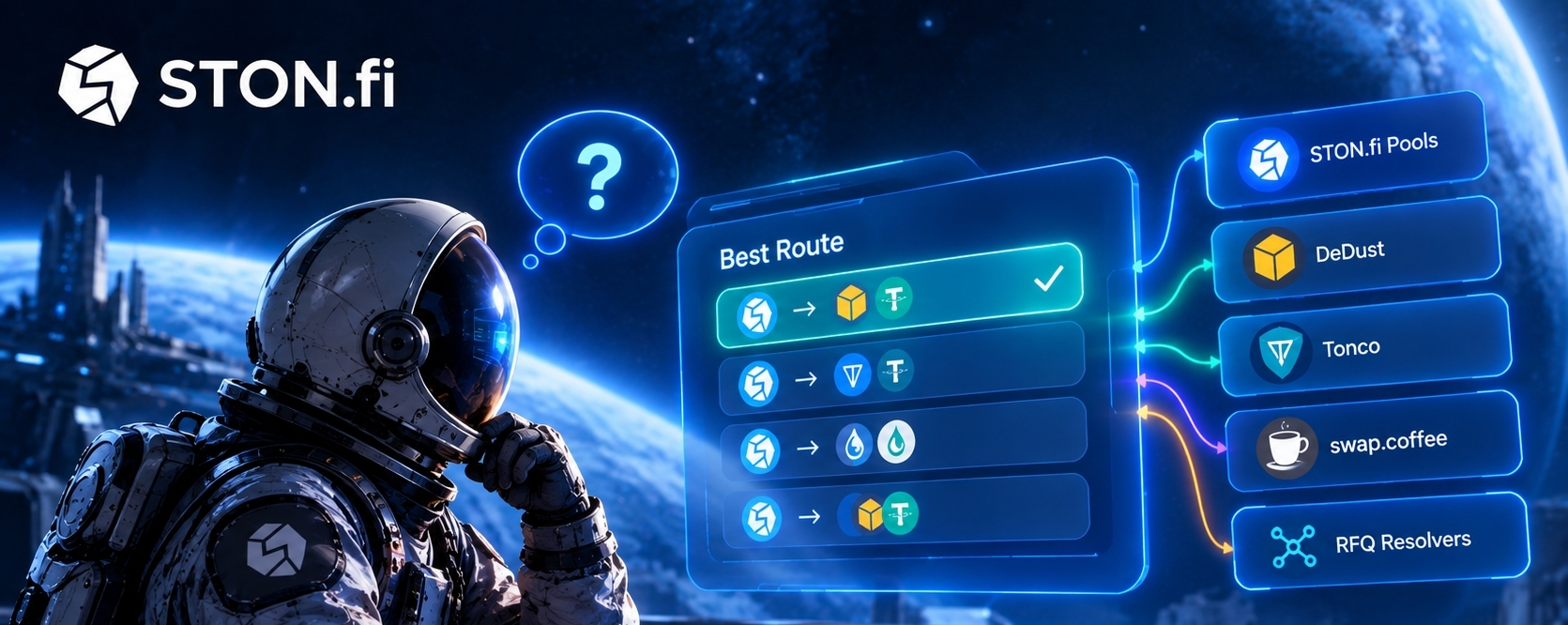
Article
What Is Omniston and How It Improves STON.fi SwapsWhat Is Omniston and How It Improves STON.fi Swaps
Decentralized exchanges have made token swapping simple, but there is still a major challenge behind the scenes: liquidity is fragmented.
The best price for a swap may not always exist in one liquidity pool or even on one decentralized exchange. One source could have deeper liquidity, another could offer a better price, while a resolver may provide a competitive quote for the same trade.
This is where Omniston becomes important.
Omniston is the liquidity aggregation and execution layer behind STON.fi swaps. Instead of restricting a swap to a single pool, it can request competing quotes, compare available routes across connected liquidity sources and select the strongest valid execution for the trade.
The result is a smarter swap experience where users can access more of the available liquidity without manually searching across multiple platforms.
What Is Omniston?
At its core, Omniston is designed to solve the problem of fragmented liquidity.
Imagine you want to exchange Token A for Token B.
Without an aggregation layer, you might have to check different pools or decentralized exchanges yourself to determine where the best route is. That takes time, and by the time you find a better option, market conditions may have already changed.
Omniston brings these possibilities together.
It can connect STON.fi swaps to multiple liquidity sources and execution providers, allowing them to compete for the same trade. Instead of asking only one pool, the system can evaluate multiple available options and determine which route provides the strongest valid execution.
In simple terms:
Omniston acts like a smart traffic controller for liquidity.
It does not create new liquidity by itself. Instead, it helps make more existing liquidity reachable through the familiar STON.fi swapping experience.
What Omniston Does on STON.fi
Omniston introduces several important capabilities to the STON.fi swap experience.
1. It turns fragmented liquidity into one comparable market
Liquidity can exist across different AMM pools, decentralized exchanges, and RFQ-based resolvers.
Rather than forcing users to investigate each source independently, Omniston brings available options into the same routing process.
This gives the system a wider view of the market when looking for an execution path.
2. AMM DEXs and RFQ resolvers can compete
Omniston is not limited to traditional AMM liquidity.
AMM DEXs can provide routes through their liquidity pools, while RFQ resolvers can return quotes for the same trade.
This creates competition around the swap instead of assuming that one liquidity source will always provide the best execution.
3. It supports cross-DEX routing
The best route is not necessarily a direct swap.
For example, instead of moving directly from:
Token A → Token B
the optimal path could be:
Token A → TON → Token B
By considering multiple sources and intermediate assets, Omniston can identify routes that may provide better execution than a single direct pool.
4. STON.fi uses Omniston smart routing by default
This means smart routing is integrated into the normal STON.fi swap experience rather than requiring users to manually compare different liquidity sources themselves.
The complexity stays behind the interface while the user still follows the familiar process:
Choose tokens → review the quote → confirm the swap.
How Omniston Finds a Route
Omniston's routing process can be understood as a simple sequence.
Step 1: You define your swap
The process begins when you select the assets you want to exchange and specify the amount.
For example:
Sell: Token A
Receive: Token B
The system now knows what needs to be executed.
Step 2: Connected sources return routes or quotes
Omniston communicates with connected liquidity sources and resolvers.
These sources can provide different possibilities for completing the same swap.
One source may offer a direct pool.
Another may provide a multi hop route.
A resolver may return a competitive RFQ quote.
Step 3: Omniston compares the available options
The returned routes and quotes are evaluated against each other.
The objective is to identify the strongest valid execution available to the system for that request.
This is where aggregation becomes valuable: instead of evaluating only one option, Omniston can compare multiple possibilities.
Step 4: The selected route is executed
Once you accept the quote, the selected path is built into the wallet transaction.
From the user's perspective, the experience remains straightforward.
You do not have to manually execute several swaps across multiple DEXs just because the optimal route involves more than one source.
The routing complexity happens behind the scenes.
Why Aggregation Matters for STON.fi Users
A single DEX can have limitations.
It may not have the deepest liquidity for a particular token pair. Another platform might have a better route, while a resolver may be able to provide a more competitive quote.
Without aggregation, discovering these alternatives can be difficult.
Omniston addresses this by making more existing liquidity reachable through one interface.
This does not mean Omniston creates liquidity.
Instead, it improves access to liquidity that already exists.
Think about it this way:
A map does not create roads. It helps you identify which roads can take you to your destination.
Similarly, Omniston does not create the underlying pools or resolver liquidity. It helps connect the trade to available routes and determine which valid option is strongest.
More Liquidity Can Mean Better Execution
For traders, one of the most important considerations is the impact a swap has on the market.
Large trades can move the price inside a liquidity pool, producing greater price impact.
When more liquidity sources are available for consideration, a trade may have access to deeper liquidity or a route that distributes execution more efficiently.
This can potentially lead to:
Lower price impact
More competitive execution
Better access to liquidity
Improved routing for larger trades
However, aggregation should not be interpreted as a guarantee.
Market conditions are constantly changing and the strongest available route can change from one moment to another.
A Better Quote Can Replace an Earlier Quote
Another important characteristic of an aggregated routing system is that liquidity conditions are not static.
Prices can move.
Pool balances can change.
Resolvers can update their quotes.
New liquidity can become available.
Because of this, an earlier quote may no longer represent the strongest available option while a swap request remains active.
Omniston can compare available offers and use a better valid quote when one becomes available.
This helps the routing process remain responsive to changing market conditions.
Where Omniston Can Source Liquidity
A STON.fi swap can potentially use several connected liquidity sources.
These include:
STON.fi pools
DeDust
Tonco
swap.coffee
Resolver liquidity
The important point is that users do not need to manually visit every platform.
The aggregation layer brings the available possibilities into the STON.fi swap flow, allowing the user to review the resulting quote before confirming.
This creates a simpler user experience while giving the routing system a wider selection of possible execution paths.
AMM Pools vs RFQ Resolvers
To understand why Omniston can be powerful, it helps to understand the difference between these liquidity models.
AMM liquidity
An Automated Market Maker (AMM) uses liquidity pools to facilitate trades.
The price is determined by the pool's pricing mechanism and the assets available inside it.
Different AMM pools can have different levels of liquidity, resulting in different prices and levels of price impact.
RFQ liquidity
Request-for-Quote (RFQ) systems work differently.
Instead of relying solely on a public liquidity pool, a resolver can provide a specific quote for the requested trade.
This introduces another possible source of execution that can compete with AMM-based routes.
By allowing AMM DEXs and RFQ resolvers to participate in the same routing process, Omniston can compare fundamentally different execution sources for the user's trade.
Cross DEX Routing: More Than a Direct Swap
One of the most useful concepts behind aggregation is that the best route does not always have to be direct.
Suppose you want:
Token A → Token B
A direct pool may exist, but it could have limited liquidity.
A better route could instead be:
Token A → TON → Token B
The first portion could use one liquidity source, while the second portion could use another.
This is known as multi hop or cross DEX routing.
The advantage is that the routing engine can search beyond a single trading pair and consider a broader network of available paths.
For users, this can potentially improve execution without requiring them to manually perform each step.
The User Experience Remains Simple
One of the biggest advantages of an aggregation layer is that complicated routing does not necessarily have to mean a complicated user interface.
From the user's perspective, the experience can remain familiar:
1. Select the token you want to sell.
2. Select the token you want to receive.
3. Enter the amount.
4. Review the available quote and execution details.
5. Confirm the transaction in your wallet.
Behind these simple actions, Omniston can be evaluating multiple sources and possible routes.
This separation between complex infrastructure and simple user experience is one of the strongest arguments for aggregation.
The Benefits of Omniston
Omniston can improve the STON.fi swap experience in several ways.
More competition
When multiple liquidity sources can compete for the same trade, users are not relying on one isolated liquidity source.
Better route discovery
A route that would be difficult for a user to discover manually can be considered automatically.
Access to deeper liquidity
More connected sources can give the routing system access to a larger liquidity landscape.
Potentially lower price impact
For larger trades especially, access to additional liquidity can help identify routes with lower price impact.
Simpler user experience
Users do not need to manually move between different DEX interfaces to compare every possible option.
Smarter execution
The system can evaluate competing quotes and routes rather than simply sending the trade through one predetermined pool.
What Omniston Does Not Guarantee
Aggregation is powerful, but it is important to understand its limitations.
It does not guarantee the best price everywhere
Omniston evaluates the liquidity sources and resolvers connected to its routing system.
That does not mean it has access to every source of liquidity that exists across the entire market.
Therefore, aggregation is not a guarantee of the best possible price anywhere in the world.
Market conditions can change
Crypto markets move quickly.
The quote you see can change because liquidity, prices and market conditions change between quote generation and execution.
More routes do not automatically mean zero slippage
Additional liquidity sources can improve routing opportunities, but slippage can still occur.
The final result depends on the market and the specific trade.
Users still need to verify the transaction
Smart routing reduces the need for manual comparison, but users should still inspect what they are approving.
What You Should Check Before Confirming a Swap
Even with intelligent aggregation, users should never blindly approve a transaction.
Before confirming a STON.fi swap, pay attention to:
The token you are selling
Make sure you selected the correct asset and the correct token address where applicable.
The token you are receiving
Verify that the destination token is the one you actually intend to receive.
Expected output
Check how much you are expected to receive.
Minimum received
Review the minimum amount protected by your slippage settings.
Price impact
For larger trades, price impact can be especially important.
Route details
Understanding where your swap is being routed can provide additional context about the execution.
Wallet prompt
Always inspect the transaction shown by your wallet before signing.
The aggregation layer can make routing smarter, but the final responsibility for approving a transaction still sits with the user.
Omniston in One Simple Example
Imagine you want to swap 1,000 units of Token A for Token B.
A traditional single-pool approach might send your trade to one pool without checking whether another source can provide better execution.
With Omniston, multiple possibilities can be considered.
For example:
Route 1: Token A → STON.fi Pool → Token B
Route 2: Token A → DeDust → Token B
Route 3: Token A → Tonco → Token B
Route 4: Token A → TON → Token B
Route 5: Token A → RFQ Resolver → Token B
Omniston can compare the available valid offers and select the strongest route for the request.
The exact result depends on available liquidity, market conditions, fees, price impact and the state of the connected sources at that moment.
The important idea is that the user does not have to manually test every route.
Why Omniston Matters for the STON.fi Ecosystem
As decentralized finance grows, liquidity becomes increasingly fragmented.
Different platforms can specialize in different pools, trading pairs, pricing mechanisms and liquidity strategies.
That fragmentation creates opportunity, but it also creates complexity.
Aggregation provides a way to connect those pieces.
For STON.fi users, Omniston means the swap interface can become more than a gateway to one liquidity pool.
It can become an intelligent access point to a broader liquidity network.
Instead of asking:
“Which pool should I use?”
the experience can shift toward:
“Which available route provides the strongest execution for my trade?”
That is a meaningful difference.
The Bigger Picture
The long-term importance of systems like Omniston goes beyond simply finding a cheaper swap.
Aggregation is about making decentralized liquidity easier to access.
Users should not need to become experts in every DEX, pool, resolver and routing path just to make a basic token swap.
Infrastructure can handle much of that complexity in the background while the user retains visibility into the quote and transaction before signing.
That creates a balance between:
More liquidity
More competition
Smarter routing
Simpler execution and User control
Final Thoughts
Omniston adds an important layer to the STON.fi swapping experience by connecting fragmented liquidity and comparing available execution opportunities.
It can request competing quotes, evaluate routes across connected sources, support multi-hop and cross DEX paths and select a strong valid route for the swap.
The key value is not that Omniston magically creates liquidity.
Its value is that it helps make more existing liquidity accessible and comparable.
STON.fi users can therefore benefit from a routing system that looks beyond a single pool while maintaining a familiar swap experience.
Still, aggregation is not a guarantee of perfect execution. Users should continue checking the token, expected output, minimum received, slippage, route information and wallet transaction before signing.
Ultimately, Omniston moves the swapping experience toward a simple idea:
More connected liquidity. Smarter routes. Better opportunities for execution.
So, on your next STON.fi swap, what would you check first:
the final output or the route details?
Explore more on STON.FI
#USStocksCloseLowerIntelRises9%
What Is Omniston and How It Improves STON.fi Swaps
What Is Omniston and How It Improves STON.fi Swaps
Decentralized exchanges have made token swapping simple, but there is still a major challenge behind the scenes: liquidity is fragmented.
The best price for a swap may not always exist in one liquidity pool or even on one decentralized exchange. One source could have deeper liquidity, another could offer a better price, while a resolver may provide a competitive quote for the same trade.
This is where Omniston becomes important.
Omniston is the liquidity aggregation and execution layer behind STON.fi swaps. Instead of restricting a swap to a single pool, it can request competing quotes, compare available routes across connected liquidity sources and select the strongest valid execution for the trade.
The result is a smarter swap experience where users can access more of the available liquidity without manually searching across multiple platforms.
What Is Omniston?
At its core, Omniston is designed to solve the problem of fragmented liquidity.
Imagine you want to exchange Token A for Token B.
Without an aggregation layer, you might have to check different pools or decentralized exchanges yourself to determine where the best route is. That takes time, and by the time you find a better option, market conditions may have already changed.
Omniston brings these possibilities together.
It can connect STON.fi swaps to multiple liquidity sources and execution providers, allowing them to compete for the same trade. Instead of asking only one pool, the system can evaluate multiple available options and determine which route provides the strongest valid execution.
In simple terms:
Omniston acts like a smart traffic controller for liquidity.
It does not create new liquidity by itself. Instead, it helps make more existing liquidity reachable through the familiar STON.fi swapping experience.
What Omniston Does on STON.fi
Omniston introduces several important capabilities to the STON.fi swap experience.
1. It turns fragmented liquidity into one comparable market
Liquidity can exist across different AMM pools, decentralized exchanges, and RFQ-based resolvers.
Rather than forcing users to investigate each source independently, Omniston brings available options into the same routing process.
This gives the system a wider view of the market when looking for an execution path.
2. AMM DEXs and RFQ resolvers can compete
Omniston is not limited to traditional AMM liquidity.
AMM DEXs can provide routes through their liquidity pools, while RFQ resolvers can return quotes for the same trade.
This creates competition around the swap instead of assuming that one liquidity source will always provide the best execution.
3. It supports cross-DEX routing
The best route is not necessarily a direct swap.
For example, instead of moving directly from:
Token A → Token B
the optimal path could be:
Token A → TON → Token B
By considering multiple sources and intermediate assets, Omniston can identify routes that may provide better execution than a single direct pool.
4. STON.fi uses Omniston smart routing by default
This means smart routing is integrated into the normal STON.fi swap experience rather than requiring users to manually compare different liquidity sources themselves.
The complexity stays behind the interface while the user still follows the familiar process:
Choose tokens → review the quote → confirm the swap.
How Omniston Finds a Route
Omniston's routing process can be understood as a simple sequence.
Step 1: You define your swap
The process begins when you select the assets you want to exchange and specify the amount.
For example:
Sell: Token A
Receive: Token B
The system now knows what needs to be executed.
Step 2: Connected sources return routes or quotes
Omniston communicates with connected liquidity sources and resolvers.
These sources can provide different possibilities for completing the same swap.
One source may offer a direct pool.
Another may provide a multi hop route.
A resolver may return a competitive RFQ quote.
Step 3: Omniston compares the available options
The returned routes and quotes are evaluated against each other.
The objective is to identify the strongest valid execution available to the system for that request.
This is where aggregation becomes valuable: instead of evaluating only one option, Omniston can compare multiple possibilities.
Step 4: The selected route is executed
Once you accept the quote, the selected path is built into the wallet transaction.
From the user's perspective, the experience remains straightforward.
You do not have to manually execute several swaps across multiple DEXs just because the optimal route involves more than one source.
The routing complexity happens behind the scenes.
Why Aggregation Matters for STON.fi Users
A single DEX can have limitations.
It may not have the deepest liquidity for a particular token pair. Another platform might have a better route, while a resolver may be able to provide a more competitive quote.
Without aggregation, discovering these alternatives can be difficult.
Omniston addresses this by making more existing liquidity reachable through one interface.
This does not mean Omniston creates liquidity.
Instead, it improves access to liquidity that already exists.
Think about it this way:
A map does not create roads. It helps you identify which roads can take you to your destination.
Similarly, Omniston does not create the underlying pools or resolver liquidity. It helps connect the trade to available routes and determine which valid option is strongest.
More Liquidity Can Mean Better Execution
For traders, one of the most important considerations is the impact a swap has on the market.
Large trades can move the price inside a liquidity pool, producing greater price impact.
When more liquidity sources are available for consideration, a trade may have access to deeper liquidity or a route that distributes execution more efficiently.
This can potentially lead to:
Lower price impact
More competitive execution
Better access to liquidity
Improved routing for larger trades
However, aggregation should not be interpreted as a guarantee.
Market conditions are constantly changing and the strongest available route can change from one moment to another.
A Better Quote Can Replace an Earlier Quote
Another important characteristic of an aggregated routing system is that liquidity conditions are not static.
Prices can move.
Pool balances can change.
Resolvers can update their quotes.
New liquidity can become available.
Because of this, an earlier quote may no longer represent the strongest available option while a swap request remains active.
Omniston can compare available offers and use a better valid quote when one becomes available.
This helps the routing process remain responsive to changing market conditions.
Where Omniston Can Source Liquidity
A STON.fi swap can potentially use several connected liquidity sources.
These include:
STON.fi pools
DeDust
Tonco
swap.coffee
Resolver liquidity
The important point is that users do not need to manually visit every platform.
The aggregation layer brings the available possibilities into the STON.fi swap flow, allowing the user to review the resulting quote before confirming.
This creates a simpler user experience while giving the routing system a wider selection of possible execution paths.
AMM Pools vs RFQ Resolvers
To understand why Omniston can be powerful, it helps to understand the difference between these liquidity models.
AMM liquidity
An Automated Market Maker (AMM) uses liquidity pools to facilitate trades.
The price is determined by the pool's pricing mechanism and the assets available inside it.
Different AMM pools can have different levels of liquidity, resulting in different prices and levels of price impact.
RFQ liquidity
Request-for-Quote (RFQ) systems work differently.
Instead of relying solely on a public liquidity pool, a resolver can provide a specific quote for the requested trade.
This introduces another possible source of execution that can compete with AMM-based routes.
By allowing AMM DEXs and RFQ resolvers to participate in the same routing process, Omniston can compare fundamentally different execution sources for the user's trade.
Cross DEX Routing: More Than a Direct Swap
One of the most useful concepts behind aggregation is that the best route does not always have to be direct.
Suppose you want:
Token A → Token B
A direct pool may exist, but it could have limited liquidity.
A better route could instead be:
Token A → TON → Token B
The first portion could use one liquidity source, while the second portion could use another.
This is known as multi hop or cross DEX routing.
The advantage is that the routing engine can search beyond a single trading pair and consider a broader network of available paths.
For users, this can potentially improve execution without requiring them to manually perform each step.
The User Experience Remains Simple
One of the biggest advantages of an aggregation layer is that complicated routing does not necessarily have to mean a complicated user interface.
From the user's perspective, the experience can remain familiar:
1. Select the token you want to sell.
2. Select the token you want to receive.
3. Enter the amount.
4. Review the available quote and execution details.
5. Confirm the transaction in your wallet.
Behind these simple actions, Omniston can be evaluating multiple sources and possible routes.
This separation between complex infrastructure and simple user experience is one of the strongest arguments for aggregation.
The Benefits of Omniston
Omniston can improve the STON.fi swap experience in several ways.
More competition
When multiple liquidity sources can compete for the same trade, users are not relying on one isolated liquidity source.
Better route discovery
A route that would be difficult for a user to discover manually can be considered automatically.
Access to deeper liquidity
More connected sources can give the routing system access to a larger liquidity landscape.
Potentially lower price impact
For larger trades especially, access to additional liquidity can help identify routes with lower price impact.
Simpler user experience
Users do not need to manually move between different DEX interfaces to compare every possible option.
Smarter execution
The system can evaluate competing quotes and routes rather than simply sending the trade through one predetermined pool.
What Omniston Does Not Guarantee
Aggregation is powerful, but it is important to understand its limitations.
It does not guarantee the best price everywhere
Omniston evaluates the liquidity sources and resolvers connected to its routing system.
That does not mean it has access to every source of liquidity that exists across the entire market.
Therefore, aggregation is not a guarantee of the best possible price anywhere in the world.
Market conditions can change
Crypto markets move quickly.
The quote you see can change because liquidity, prices and market conditions change between quote generation and execution.
More routes do not automatically mean zero slippage
Additional liquidity sources can improve routing opportunities, but slippage can still occur.
The final result depends on the market and the specific trade.
Users still need to verify the transaction
Smart routing reduces the need for manual comparison, but users should still inspect what they are approving.
What You Should Check Before Confirming a Swap
Even with intelligent aggregation, users should never blindly approve a transaction.
Before confirming a STON.fi swap, pay attention to:
The token you are selling
Make sure you selected the correct asset and the correct token address where applicable.
The token you are receiving
Verify that the destination token is the one you actually intend to receive.
Expected output
Check how much you are expected to receive.
Minimum received
Review the minimum amount protected by your slippage settings.
Price impact
For larger trades, price impact can be especially important.
Route details
Understanding where your swap is being routed can provide additional context about the execution.
Wallet prompt
Always inspect the transaction shown by your wallet before signing.
The aggregation layer can make routing smarter, but the final responsibility for approving a transaction still sits with the user.
Omniston in One Simple Example
Imagine you want to swap 1,000 units of Token A for Token B.
A traditional single-pool approach might send your trade to one pool without checking whether another source can provide better execution.
With Omniston, multiple possibilities can be considered.
For example:
Route 1: Token A → STON.fi Pool → Token B
Route 2: Token A → DeDust → Token B
Route 3: Token A → Tonco → Token B
Route 4: Token A → TON → Token B
Route 5: Token A → RFQ Resolver → Token B
Omniston can compare the available valid offers and select the strongest route for the request.
The exact result depends on available liquidity, market conditions, fees, price impact and the state of the connected sources at that moment.
The important idea is that the user does not have to manually test every route.
Why Omniston Matters for the STON.fi Ecosystem
As decentralized finance grows, liquidity becomes increasingly fragmented.
Different platforms can specialize in different pools, trading pairs, pricing mechanisms and liquidity strategies.
That fragmentation creates opportunity, but it also creates complexity.
Aggregation provides a way to connect those pieces.
For STON.fi users, Omniston means the swap interface can become more than a gateway to one liquidity pool.
It can become an intelligent access point to a broader liquidity network.
Instead of asking:
“Which pool should I use?”
the experience can shift toward:
“Which available route provides the strongest execution for my trade?”
That is a meaningful difference.
The Bigger Picture
The long-term importance of systems like Omniston goes beyond simply finding a cheaper swap.
Aggregation is about making decentralized liquidity easier to access.
Users should not need to become experts in every DEX, pool, resolver and routing path just to make a basic token swap.
Infrastructure can handle much of that complexity in the background while the user retains visibility into the quote and transaction before signing.
That creates a balance between:
More liquidity
More competition
Smarter routing
Simpler execution and User control
Final Thoughts
Omniston adds an important layer to the STON.fi swapping experience by connecting fragmented liquidity and comparing available execution opportunities.
It can request competing quotes, evaluate routes across connected sources, support multi-hop and cross DEX paths and select a strong valid route for the swap.
The key value is not that Omniston magically creates liquidity.
Its value is that it helps make more existing liquidity accessible and comparable.
STON.fi users can therefore benefit from a routing system that looks beyond a single pool while maintaining a familiar swap experience.
Still, aggregation is not a guarantee of perfect execution. Users should continue checking the token, expected output, minimum received, slippage, route information and wallet transaction before signing.
Ultimately, Omniston moves the swapping experience toward a simple idea:
More connected liquidity. Smarter routes. Better opportunities for execution.
So, on your next STON.fi swap, what would you check first:
the final output or the route details?
Explore more on STON.FI
#USStocksCloseLowerIntelRises9%
Decentralized exchanges have made token swapping simple, but there is still a major challenge behind the scenes: liquidity is fragmented.
The best price for a swap may not always exist in one liquidity pool or even on one decentralized exchange. One source could have deeper liquidity, another could offer a better price, while a resolver may provide a competitive quote for the same trade.
This is where Omniston becomes important.
Omniston is the liquidity aggregation and execution layer behind STON.fi swaps. Instead of restricting a swap to a single pool, it can request competing quotes, compare available routes across connected liquidity sources and select the strongest valid execution for the trade.
The result is a smarter swap experience where users can access more of the available liquidity without manually searching across multiple platforms.
What Is Omniston?
At its core, Omniston is designed to solve the problem of fragmented liquidity.
Imagine you want to exchange Token A for Token B.
Without an aggregation layer, you might have to check different pools or decentralized exchanges yourself to determine where the best route is. That takes time, and by the time you find a better option, market conditions may have already changed.
Omniston brings these possibilities together.
It can connect STON.fi swaps to multiple liquidity sources and execution providers, allowing them to compete for the same trade. Instead of asking only one pool, the system can evaluate multiple available options and determine which route provides the strongest valid execution.
In simple terms:
Omniston acts like a smart traffic controller for liquidity.
It does not create new liquidity by itself. Instead, it helps make more existing liquidity reachable through the familiar STON.fi swapping experience.
What Omniston Does on STON.fi
Omniston introduces several important capabilities to the STON.fi swap experience.
1. It turns fragmented liquidity into one comparable market
Liquidity can exist across different AMM pools, decentralized exchanges, and RFQ-based resolvers.
Rather than forcing users to investigate each source independently, Omniston brings available options into the same routing process.
This gives the system a wider view of the market when looking for an execution path.
2. AMM DEXs and RFQ resolvers can compete
Omniston is not limited to traditional AMM liquidity.
AMM DEXs can provide routes through their liquidity pools, while RFQ resolvers can return quotes for the same trade.
This creates competition around the swap instead of assuming that one liquidity source will always provide the best execution.
3. It supports cross-DEX routing
The best route is not necessarily a direct swap.
For example, instead of moving directly from:
Token A → Token B
the optimal path could be:
Token A → TON → Token B
By considering multiple sources and intermediate assets, Omniston can identify routes that may provide better execution than a single direct pool.
4. STON.fi uses Omniston smart routing by default
This means smart routing is integrated into the normal STON.fi swap experience rather than requiring users to manually compare different liquidity sources themselves.
The complexity stays behind the interface while the user still follows the familiar process:
Choose tokens → review the quote → confirm the swap.
How Omniston Finds a Route
Omniston's routing process can be understood as a simple sequence.
Step 1: You define your swap
The process begins when you select the assets you want to exchange and specify the amount.
For example:
Sell: Token A
Receive: Token B
The system now knows what needs to be executed.
Step 2: Connected sources return routes or quotes
Omniston communicates with connected liquidity sources and resolvers.
These sources can provide different possibilities for completing the same swap.
One source may offer a direct pool.
Another may provide a multi hop route.
A resolver may return a competitive RFQ quote.
Step 3: Omniston compares the available options
The returned routes and quotes are evaluated against each other.
The objective is to identify the strongest valid execution available to the system for that request.
This is where aggregation becomes valuable: instead of evaluating only one option, Omniston can compare multiple possibilities.
Step 4: The selected route is executed
Once you accept the quote, the selected path is built into the wallet transaction.
From the user's perspective, the experience remains straightforward.
You do not have to manually execute several swaps across multiple DEXs just because the optimal route involves more than one source.
The routing complexity happens behind the scenes.
Why Aggregation Matters for STON.fi Users
A single DEX can have limitations.
It may not have the deepest liquidity for a particular token pair. Another platform might have a better route, while a resolver may be able to provide a more competitive quote.
Without aggregation, discovering these alternatives can be difficult.
Omniston addresses this by making more existing liquidity reachable through one interface.
This does not mean Omniston creates liquidity.
Instead, it improves access to liquidity that already exists.
Think about it this way:
A map does not create roads. It helps you identify which roads can take you to your destination.
Similarly, Omniston does not create the underlying pools or resolver liquidity. It helps connect the trade to available routes and determine which valid option is strongest.
More Liquidity Can Mean Better Execution
For traders, one of the most important considerations is the impact a swap has on the market.
Large trades can move the price inside a liquidity pool, producing greater price impact.
When more liquidity sources are available for consideration, a trade may have access to deeper liquidity or a route that distributes execution more efficiently.
This can potentially lead to:
Lower price impact
More competitive execution
Better access to liquidity
Improved routing for larger trades
However, aggregation should not be interpreted as a guarantee.
Market conditions are constantly changing and the strongest available route can change from one moment to another.
A Better Quote Can Replace an Earlier Quote
Another important characteristic of an aggregated routing system is that liquidity conditions are not static.
Prices can move.
Pool balances can change.
Resolvers can update their quotes.
New liquidity can become available.
Because of this, an earlier quote may no longer represent the strongest available option while a swap request remains active.
Omniston can compare available offers and use a better valid quote when one becomes available.
This helps the routing process remain responsive to changing market conditions.
Where Omniston Can Source Liquidity
A STON.fi swap can potentially use several connected liquidity sources.
These include:
STON.fi pools
DeDust
Tonco
swap.coffee
Resolver liquidity
The important point is that users do not need to manually visit every platform.
The aggregation layer brings the available possibilities into the STON.fi swap flow, allowing the user to review the resulting quote before confirming.
This creates a simpler user experience while giving the routing system a wider selection of possible execution paths.
AMM Pools vs RFQ Resolvers
To understand why Omniston can be powerful, it helps to understand the difference between these liquidity models.
AMM liquidity
An Automated Market Maker (AMM) uses liquidity pools to facilitate trades.
The price is determined by the pool's pricing mechanism and the assets available inside it.
Different AMM pools can have different levels of liquidity, resulting in different prices and levels of price impact.
RFQ liquidity
Request-for-Quote (RFQ) systems work differently.
Instead of relying solely on a public liquidity pool, a resolver can provide a specific quote for the requested trade.
This introduces another possible source of execution that can compete with AMM-based routes.
By allowing AMM DEXs and RFQ resolvers to participate in the same routing process, Omniston can compare fundamentally different execution sources for the user's trade.
Cross DEX Routing: More Than a Direct Swap
One of the most useful concepts behind aggregation is that the best route does not always have to be direct.
Suppose you want:
Token A → Token B
A direct pool may exist, but it could have limited liquidity.
A better route could instead be:
Token A → TON → Token B
The first portion could use one liquidity source, while the second portion could use another.
This is known as multi hop or cross DEX routing.
The advantage is that the routing engine can search beyond a single trading pair and consider a broader network of available paths.
For users, this can potentially improve execution without requiring them to manually perform each step.
The User Experience Remains Simple
One of the biggest advantages of an aggregation layer is that complicated routing does not necessarily have to mean a complicated user interface.
From the user's perspective, the experience can remain familiar:
1. Select the token you want to sell.
2. Select the token you want to receive.
3. Enter the amount.
4. Review the available quote and execution details.
5. Confirm the transaction in your wallet.
Behind these simple actions, Omniston can be evaluating multiple sources and possible routes.
This separation between complex infrastructure and simple user experience is one of the strongest arguments for aggregation.
The Benefits of Omniston
Omniston can improve the STON.fi swap experience in several ways.
More competition
When multiple liquidity sources can compete for the same trade, users are not relying on one isolated liquidity source.
Better route discovery
A route that would be difficult for a user to discover manually can be considered automatically.
Access to deeper liquidity
More connected sources can give the routing system access to a larger liquidity landscape.
Potentially lower price impact
For larger trades especially, access to additional liquidity can help identify routes with lower price impact.
Simpler user experience
Users do not need to manually move between different DEX interfaces to compare every possible option.
Smarter execution
The system can evaluate competing quotes and routes rather than simply sending the trade through one predetermined pool.
What Omniston Does Not Guarantee
Aggregation is powerful, but it is important to understand its limitations.
It does not guarantee the best price everywhere
Omniston evaluates the liquidity sources and resolvers connected to its routing system.
That does not mean it has access to every source of liquidity that exists across the entire market.
Therefore, aggregation is not a guarantee of the best possible price anywhere in the world.
Market conditions can change
Crypto markets move quickly.
The quote you see can change because liquidity, prices and market conditions change between quote generation and execution.
More routes do not automatically mean zero slippage
Additional liquidity sources can improve routing opportunities, but slippage can still occur.
The final result depends on the market and the specific trade.
Users still need to verify the transaction
Smart routing reduces the need for manual comparison, but users should still inspect what they are approving.
What You Should Check Before Confirming a Swap
Even with intelligent aggregation, users should never blindly approve a transaction.
Before confirming a STON.fi swap, pay attention to:
The token you are selling
Make sure you selected the correct asset and the correct token address where applicable.
The token you are receiving
Verify that the destination token is the one you actually intend to receive.
Expected output
Check how much you are expected to receive.
Minimum received
Review the minimum amount protected by your slippage settings.
Price impact
For larger trades, price impact can be especially important.
Route details
Understanding where your swap is being routed can provide additional context about the execution.
Wallet prompt
Always inspect the transaction shown by your wallet before signing.
The aggregation layer can make routing smarter, but the final responsibility for approving a transaction still sits with the user.
Omniston in One Simple Example
Imagine you want to swap 1,000 units of Token A for Token B.
A traditional single-pool approach might send your trade to one pool without checking whether another source can provide better execution.
With Omniston, multiple possibilities can be considered.
For example:
Route 1: Token A → STON.fi Pool → Token B
Route 2: Token A → DeDust → Token B
Route 3: Token A → Tonco → Token B
Route 4: Token A → TON → Token B
Route 5: Token A → RFQ Resolver → Token B
Omniston can compare the available valid offers and select the strongest route for the request.
The exact result depends on available liquidity, market conditions, fees, price impact and the state of the connected sources at that moment.
The important idea is that the user does not have to manually test every route.
Why Omniston Matters for the STON.fi Ecosystem
As decentralized finance grows, liquidity becomes increasingly fragmented.
Different platforms can specialize in different pools, trading pairs, pricing mechanisms and liquidity strategies.
That fragmentation creates opportunity, but it also creates complexity.
Aggregation provides a way to connect those pieces.
For STON.fi users, Omniston means the swap interface can become more than a gateway to one liquidity pool.
It can become an intelligent access point to a broader liquidity network.
Instead of asking:
“Which pool should I use?”
the experience can shift toward:
“Which available route provides the strongest execution for my trade?”
That is a meaningful difference.
The Bigger Picture
The long-term importance of systems like Omniston goes beyond simply finding a cheaper swap.
Aggregation is about making decentralized liquidity easier to access.
Users should not need to become experts in every DEX, pool, resolver and routing path just to make a basic token swap.
Infrastructure can handle much of that complexity in the background while the user retains visibility into the quote and transaction before signing.
That creates a balance between:
More liquidity
More competition
Smarter routing
Simpler execution and User control
Final Thoughts
Omniston adds an important layer to the STON.fi swapping experience by connecting fragmented liquidity and comparing available execution opportunities.
It can request competing quotes, evaluate routes across connected sources, support multi-hop and cross DEX paths and select a strong valid route for the swap.
The key value is not that Omniston magically creates liquidity.
Its value is that it helps make more existing liquidity accessible and comparable.
STON.fi users can therefore benefit from a routing system that looks beyond a single pool while maintaining a familiar swap experience.
Still, aggregation is not a guarantee of perfect execution. Users should continue checking the token, expected output, minimum received, slippage, route information and wallet transaction before signing.
Ultimately, Omniston moves the swapping experience toward a simple idea:
More connected liquidity. Smarter routes. Better opportunities for execution.
So, on your next STON.fi swap, what would you check first:
the final output or the route details?
Explore more on STON.FI
#USStocksCloseLowerIntelRises9%
1
165
·
--
Article
WStable Pools on STON.fi: A Deeper Look at Weighted Stable Swap LiquidityWStable Pools on STON.fi: A Deeper Look at Weighted Stable Swap Liquidity
In decentralized finance, not every asset pair behaves like a typical 50/50 trading pair.
Some assets are highly correlated but are not perfectly identical. A liquid staking token and its underlying asset are a good example: they may generally move together, yet their exchange relationship can gradually change as staking rewards accumulate.
This is where WStable pools on STON.fi become useful.
WStable, short for Weighted Stable Swap and also referred to as WSS, is a specialized liquidity pool design that combines the efficient pricing behavior of a StableSwap style curve with custom asset weights and a relative rate parameter.
Instead of forcing liquidity providers into an equal 50/50 allocation or assuming that two correlated assets always trade at exactly 1:1, WStable is designed to account for a more flexible relationship between them.
What Is a WStable Pool?
A WStable pool is STON.fi's implementation of a Weighted Stable Swap liquidity model.
At the smart-contract level, the pool type is identified as:
weighted_stableswap
The design is intended primarily for closely related or correlated assets whose prices tend to remain near an expected relationship.
Examples can include:
A liquid staking token and its underlying assetDifferent representations of closely correlated assetsOther assets where the exchange rate is expected to remain relatively stable but may evolve over time
The important distinction is that correlation does not necessarily mean equality.
Two assets can move together while still having a changing relative value. A liquid staking token, for example, can gradually become worth more than one unit of its underlying asset as staking rewards accrue.
WStable is designed with this kind of relationship in mind.
Why Stable Swap Pricing Matters
To understand WStable, it helps to first understand why StableSwap-style curves exist.
Traditional constant-product AMMs are highly effective for general-purpose asset trading, but they can produce meaningful price impact when users execute large trades.
A standard constant-product pool follows the familiar invariant:
x × y = k
As one asset is removed from the pool and the other is added, the marginal price changes according to the pool's balance.
This works well for assets that can move significantly relative to one another. But for highly correlated assets, it can be inefficient.
Imagine a pair where the market expects the assets to trade close to one another. A large amount of liquidity may still experience unnecessary slippage under a traditional constant-product curve.
StableSwap style pricing addresses this by flattening the curve around the expected relationship.
That means trades can potentially execute with lower price impact when the assets remain near their intended relative value.
WStable Takes the Idea Further
A conventional stable pool often assumes that the assets are similarly weighted and that their relationship is relatively straightforward.
WStable adds another layer of flexibility.
It combines:
StableSwap-style pricing + custom weights + a relative rate
This allows the pool to represent correlated assets whose relationship is more nuanced than a simple 50/50 pool with a fixed 1:1 assumption.
In other words, WStable is not simply saying:
These assets are correlated.
It is also able to account for:
How much of each asset should be represented in the pool, and what relative rate should be used between them?
That distinction is important for specialized liquidity strategies.
The Role of Weights
One of the defining characteristics of WStable is that liquidity does not have to be divided equally between the two assets.
A traditional pool may use a:
50% / 50%
allocation.
WStable can instead support a configuration such as:
75% / 25%
The exact allocation depends on the pool design and its intended use.
Why does this matter?
Because equal exposure is not always the optimal structure for correlated assets.
Suppose a pool contains a liquid staking token and its underlying asset. The protocol may want greater exposure to the yield bearing asset while retaining enough of the underlying asset to facilitate efficient trading.
With a 75/25 configuration, the pool can reflect that preference directly.
The weights therefore become part of the pool's economic structure rather than simply being an incidental liquidity distribution.
The Importance of the Rate Parameter
Weights are only part of the picture.
WStable also introduces a rate parameter that helps represent the evolving relationship between correlated assets.
This matters because two assets can remain closely connected without maintaining a permanent 1:1 exchange ratio.
Consider a liquid staking token.
At launch, it might be approximately equivalent to one unit of the underlying asset.
Over time, however, staking rewards can accumulate within the liquid staking mechanism. The liquid staking token may then represent more underlying value than it did previously.
As a simplified example:
1 LST = 1.00 underlying asset
could eventually become:
1 LST ≈ 1.05 underlying assets
The assets remain highly correlated, but their relative value has changed.
A rate parameter allows the pool to account for this evolving relationship.
This is one of the key differences between a simple stable-pair assumption and a more specialized weighted stable design.
Key Parameters Inside a WStable Pool
WStable introduces several important values that determine how the pool behaves.
Among the parameters associated with the design are:
amp
The amplification parameter helps shape the StableSwap-style curve.
It influences how strongly the curve is optimized around the expected stable relationship between the assets.
Higher amplification can make the curve flatter around the target region, potentially improving efficiency for trades near the expected price relationship, although the precise behavior depends on the implementation and pool state.
rate
The rate represents the relative relationship between the two assets.
This is especially useful for assets whose exchange relationship changes gradually rather than remaining fixed at exactly 1:1.
w0
The weight parameter defines the intended allocation of one side of the pool.
Rather than assuming a universal 50/50 structure, the pool can use a customized weight.
rate_setter
The rate setter is associated with the mechanism responsible for updating or managing the relevant rate parameter.
Together, these values give WStable more flexibility than a basic stable pool.
Why Would a Pool Need Unequal Weights?
At first glance, a 50/50 pool may seem like the obvious choice for two correlated assets.
But asset behavior is rarely perfectly symmetrical.
A liquid staking token, for example, can provide exposure to staking rewards, while the underlying native asset does not have exactly the same characteristics inside the pool.
The protocol may therefore want to maintain more of one asset than the other.
With WStable, the pool can intentionally reflect this preference.
This creates a structure where liquidity is not just deposited equally, but configured according to the economic relationship between the assets.
That is particularly relevant for specialized pairs where one asset may be more desirable to hold, while both remain necessary for efficient swapping.
The tsTON Example
STON.fi's WStable design can be illustrated through its pool involving tsTON and the native ecosystem asset, later renamed Gram with the ticker GRAM in June 2026.
The pool was introduced as an example of how weighted stable liquidity can be applied to closely related assets.
STON.fi describes the pool using a:
75% tsTON / 25% GRAM
allocation.
This is significant because it demonstrates that the pool is not built around the assumption that both assets need to represent equal portions of liquidity.
Instead, the design can prioritize greater exposure to tsTON, the yield-bearing asset, while still retaining GRAM liquidity to support swaps between the two.
The example highlights one of WStable's core strengths:
the ability to combine correlated-asset pricing with an intentionally unequal allocation.
WStable vs. WCPI
WStable can be easily confused with another STON.fi pool model: WCPI.
Although both use weights, they solve different problems.
WCPI = Weighted Constant Product Invariant
WCPI extends the familiar constant-product AMM model by allowing custom weights.
Instead of being restricted to 50/50 liquidity, a WCPI pool can use configurations such as:
80/20
or
75/25
The weights become part of the constant-product pricing mechanism.
WStable Weighted Stable Swap
WStable also supports custom weights, but its purpose is different.
It is designed for closely correlated assets and uses a StableSwap-style pricing curve, together with a relative rate.
So the distinction can be simplified as:
WCPI = weighted constant-product pricing
WStable = weighted StableSwap pricing for correlated assets
Both provide flexibility, but their pricing models are designed around different market conditions.
Why WStable Can Be More Capital Efficient
Capital efficiency is one of the biggest reasons specialized AMMs exist.
In a general-purpose liquidity pool, assets can move far apart in price. The pricing curve therefore needs to accommodate a wide range of possible outcomes.
For correlated assets, that can result in capital being deployed inefficiently.
If two assets normally trade close to a particular exchange relationship, a pool can be designed to concentrate more useful liquidity around that region.
StableSwap-style mathematics helps accomplish this.
WStable adds additional flexibility through weights and rate management.
The result is a pool specifically designed around the idea that:
the assets are correlated, but not necessarily identical.
That can make liquidity more efficient around the expected relationship and potentially reduce unnecessary price impact for suitable trades.
What Happens When the Relationship Changes?
A key point is that WStable does not eliminate market risk.
The model works best when the assets maintain a strong correlation and remain reasonably close to the relationship the pool was designed around.
But markets can change.
A liquid staking token could deviate from expectations. Liquidity could become imbalanced. Market demand could shift suddenly. The assumed relationship between two correlated assets could weaken.
When that happens, the benefits of a stable-style curve can diminish.
This is an important concept:
StableSwap-style efficiency is not the same thing as guaranteed stability.
The pool's design can optimize trading around an expected relationship, but it cannot force the market to maintain that relationship.
Price Impact Still Matters
WStable can reduce price impact around the intended trading region, but it does not mean every trade will be executed with zero slippage.
Price impact still depends on factors such as:
Pool depthTrade sizeCurrent pool balancesThe configured weightsThe expected asset relationshipMarket conditions
A large trade can still move the pool meaningfully, particularly when available liquidity is insufficient for the order size.
So WStable should be viewed as a specialized pricing mechanism not a guarantee of perfect execution.
The Role of Correlation
Correlation is fundamental to the WStable concept.
The model is most appropriate when two assets have a relationship that is expected to remain relatively close.
For example, a liquid staking token and its underlying asset may generally track one another because the value of the liquid staking token is derived from the underlying asset plus accumulated staking rewards.
But correlation exists on a spectrum.
Two assets can be strongly correlated today and diverge tomorrow.
A pool that assumes a stable relationship can therefore become less efficient if the underlying economics change dramatically.
This is why understanding the assets behind a WStable pool is just as important as understanding the pool mathematics.
Who Benefits From WStable Pools?
WStable pools are particularly relevant to several groups within DeFi.
Liquidity Providers
Liquidity providers can use specialized pool structures that are better aligned with the behavior of correlated assets.
Instead of automatically committing to a 50/50 allocation, they participate in a pool designed around a specific weight and pricing relationship.
Traders
Traders swapping between closely related assets may benefit from a pricing curve optimized around the expected exchange relationship.
When market conditions remain within that region, the pool can offer more efficient execution than a generic constant-product design.
Protocol Designers
Protocols can use weighted stable pools when their ecosystem contains assets with a close relationship but different economic characteristics.
The ability to incorporate both weights and a rate gives developers more flexibility in expressing that relationship on chain.
What Users Should Watch Before Using a WStable Pool
Despite its specialized design, WStable is not risk free.
Before providing liquidity or trading through one of these pools, users should understand several factors.
1. Asset Correlation
The more closely the assets track the expected relationship, the more relevant the stable-style curve becomes.
A major divergence can reduce the effectiveness of the design.
2. Pool Depth
A specialized pricing curve cannot compensate for extremely low liquidity.
Deeper liquidity generally gives traders more room to execute larger transactions efficiently.
3. Trade Size
Even an optimized curve can experience meaningful price impact when a trade is large relative to the pool.
4. Weight Configuration
The allocation matters.
A 75/25 pool behaves differently from a 50/50 pool because liquidity is distributed differently between the assets.
5. Rate Accuracy
The rate parameter is especially important for correlated assets whose relative value changes over time.
An outdated or inaccurate representation of that relationship can affect pool behavior.
6. Smart Contract and Protocol Risk
As with any DeFi liquidity mechanism, users remain exposed to smart-contract risk, implementation risk and broader protocol risks.
Specialized mathematics does not remove those risks.
WStable Is Not Simply "Another Stablecoin Pool"
The name can make WStable sound like a conventional stablecoin pool, but its use case is broader.
The important idea is not merely that the assets should have identical prices.
Instead, the pool is designed for assets that have a predictable or relatively stable relationship, even when that relationship is not exactly 1:1.
That makes WStable particularly interesting for assets such as liquid staking tokens, where the exchange rate can evolve over time.
In that sense, WStable sits between two worlds:
the flexibility of weighted pools
and
the capital efficiency of StableSwap-style pricing.
Why This Matters for DeFi Infrastructure
As decentralized finance matures, one generic AMM model is unlikely to be optimal for every asset pair.
Highly volatile tokens, stablecoins, liquid staking tokens and other correlated assets have very different market structures.
A constant product pool can work well for broad purpose trading, while specialized models can provide better capital efficiency for specific relationships.
WStable reflects this broader evolution.
Rather than treating every pair identically, the pool model can incorporate the characteristics of the assets themselves.
The result is a more specialized approach to liquidity infrastructure.
Final Thoughts
WStable pools on STON.fi are Weighted Stable Swap liquidity pools designed for correlated assets whose relationship may be stable without being perfectly identical.
They combine:
1. StableSwap style pricing
2. Custom asset weights
3. A relative rate
and parameters such as:
1. amp, rate, w0, and rate_setter
Together, these components allow a pool to move beyond the limitations of a simple 50/50 stable design.
The tsTON/GRAM example demonstrates the concept clearly, with STON.fi describing a 75% tsTON and 25% GRAM allocation. The structure gives greater weight to the yield bearing asset while still maintaining liquidity for swaps between the two.
Most importantly, WStable should not be viewed as a mechanism that removes risk. Its strength comes from aligning the AMM's pricing behavior with the economic relationship between the assets.
For correlated pairs, that can mean better capital efficiency, more appropriate liquidity allocation and potentially lower price impact around the expected exchange rate.
As DeFi continues to evolve, the future of AMMs may not be about finding one perfect formula for every market.
It may be about choosing the right formula for the right assets.
And that is exactly where WStable becomes interesting.
Explore more on STON.FI
#IMFSaysElSalvadorBTCNoPublicFunds #EightChineseFinancialFirmsRaise360BYuan
WStable Pools on STON.fi: A Deeper Look at Weighted Stable Swap Liquidity
WStable Pools on STON.fi: A Deeper Look at Weighted Stable Swap Liquidity
In decentralized finance, not every asset pair behaves like a typical 50/50 trading pair.
Some assets are highly correlated but are not perfectly identical. A liquid staking token and its underlying asset are a good example: they may generally move together, yet their exchange relationship can gradually change as staking rewards accumulate.
This is where WStable pools on STON.fi become useful.
WStable, short for Weighted Stable Swap and also referred to as WSS, is a specialized liquidity pool design that combines the efficient pricing behavior of a StableSwap style curve with custom asset weights and a relative rate parameter.
Instead of forcing liquidity providers into an equal 50/50 allocation or assuming that two correlated assets always trade at exactly 1:1, WStable is designed to account for a more flexible relationship between them.
What Is a WStable Pool?
A WStable pool is STON.fi's implementation of a Weighted Stable Swap liquidity model.
At the smart-contract level, the pool type is identified as:
weighted_stableswap
The design is intended primarily for closely related or correlated assets whose prices tend to remain near an expected relationship.
Examples can include:
A liquid staking token and its underlying assetDifferent representations of closely correlated assetsOther assets where the exchange rate is expected to remain relatively stable but may evolve over time
The important distinction is that correlation does not necessarily mean equality.
Two assets can move together while still having a changing relative value. A liquid staking token, for example, can gradually become worth more than one unit of its underlying asset as staking rewards accrue.
WStable is designed with this kind of relationship in mind.
Why Stable Swap Pricing Matters
To understand WStable, it helps to first understand why StableSwap-style curves exist.
Traditional constant-product AMMs are highly effective for general-purpose asset trading, but they can produce meaningful price impact when users execute large trades.
A standard constant-product pool follows the familiar invariant:
x × y = k
As one asset is removed from the pool and the other is added, the marginal price changes according to the pool's balance.
This works well for assets that can move significantly relative to one another. But for highly correlated assets, it can be inefficient.
Imagine a pair where the market expects the assets to trade close to one another. A large amount of liquidity may still experience unnecessary slippage under a traditional constant-product curve.
StableSwap style pricing addresses this by flattening the curve around the expected relationship.
That means trades can potentially execute with lower price impact when the assets remain near their intended relative value.
WStable Takes the Idea Further
A conventional stable pool often assumes that the assets are similarly weighted and that their relationship is relatively straightforward.
WStable adds another layer of flexibility.
It combines:
StableSwap-style pricing + custom weights + a relative rate
This allows the pool to represent correlated assets whose relationship is more nuanced than a simple 50/50 pool with a fixed 1:1 assumption.
In other words, WStable is not simply saying:
These assets are correlated.
It is also able to account for:
How much of each asset should be represented in the pool, and what relative rate should be used between them?
That distinction is important for specialized liquidity strategies.
The Role of Weights
One of the defining characteristics of WStable is that liquidity does not have to be divided equally between the two assets.
A traditional pool may use a:
50% / 50%
allocation.
WStable can instead support a configuration such as:
75% / 25%
The exact allocation depends on the pool design and its intended use.
Why does this matter?
Because equal exposure is not always the optimal structure for correlated assets.
Suppose a pool contains a liquid staking token and its underlying asset. The protocol may want greater exposure to the yield bearing asset while retaining enough of the underlying asset to facilitate efficient trading.
With a 75/25 configuration, the pool can reflect that preference directly.
The weights therefore become part of the pool's economic structure rather than simply being an incidental liquidity distribution.
The Importance of the Rate Parameter
Weights are only part of the picture.
WStable also introduces a rate parameter that helps represent the evolving relationship between correlated assets.
This matters because two assets can remain closely connected without maintaining a permanent 1:1 exchange ratio.
Consider a liquid staking token.
At launch, it might be approximately equivalent to one unit of the underlying asset.
Over time, however, staking rewards can accumulate within the liquid staking mechanism. The liquid staking token may then represent more underlying value than it did previously.
As a simplified example:
1 LST = 1.00 underlying asset
could eventually become:
1 LST ≈ 1.05 underlying assets
The assets remain highly correlated, but their relative value has changed.
A rate parameter allows the pool to account for this evolving relationship.
This is one of the key differences between a simple stable-pair assumption and a more specialized weighted stable design.
Key Parameters Inside a WStable Pool
WStable introduces several important values that determine how the pool behaves.
Among the parameters associated with the design are:
amp
The amplification parameter helps shape the StableSwap-style curve.
It influences how strongly the curve is optimized around the expected stable relationship between the assets.
Higher amplification can make the curve flatter around the target region, potentially improving efficiency for trades near the expected price relationship, although the precise behavior depends on the implementation and pool state.
rate
The rate represents the relative relationship between the two assets.
This is especially useful for assets whose exchange relationship changes gradually rather than remaining fixed at exactly 1:1.
w0
The weight parameter defines the intended allocation of one side of the pool.
Rather than assuming a universal 50/50 structure, the pool can use a customized weight.
rate_setter
The rate setter is associated with the mechanism responsible for updating or managing the relevant rate parameter.
Together, these values give WStable more flexibility than a basic stable pool.
Why Would a Pool Need Unequal Weights?
At first glance, a 50/50 pool may seem like the obvious choice for two correlated assets.
But asset behavior is rarely perfectly symmetrical.
A liquid staking token, for example, can provide exposure to staking rewards, while the underlying native asset does not have exactly the same characteristics inside the pool.
The protocol may therefore want to maintain more of one asset than the other.
With WStable, the pool can intentionally reflect this preference.
This creates a structure where liquidity is not just deposited equally, but configured according to the economic relationship between the assets.
That is particularly relevant for specialized pairs where one asset may be more desirable to hold, while both remain necessary for efficient swapping.
The tsTON Example
STON.fi's WStable design can be illustrated through its pool involving tsTON and the native ecosystem asset, later renamed Gram with the ticker GRAM in June 2026.
The pool was introduced as an example of how weighted stable liquidity can be applied to closely related assets.
STON.fi describes the pool using a:
75% tsTON / 25% GRAM
allocation.
This is significant because it demonstrates that the pool is not built around the assumption that both assets need to represent equal portions of liquidity.
Instead, the design can prioritize greater exposure to tsTON, the yield-bearing asset, while still retaining GRAM liquidity to support swaps between the two.
The example highlights one of WStable's core strengths:
the ability to combine correlated-asset pricing with an intentionally unequal allocation.
WStable vs. WCPI
WStable can be easily confused with another STON.fi pool model: WCPI.
Although both use weights, they solve different problems.
WCPI = Weighted Constant Product Invariant
WCPI extends the familiar constant-product AMM model by allowing custom weights.
Instead of being restricted to 50/50 liquidity, a WCPI pool can use configurations such as:
80/20
or
75/25
The weights become part of the constant-product pricing mechanism.
WStable Weighted Stable Swap
WStable also supports custom weights, but its purpose is different.
It is designed for closely correlated assets and uses a StableSwap-style pricing curve, together with a relative rate.
So the distinction can be simplified as:
WCPI = weighted constant-product pricing
WStable = weighted StableSwap pricing for correlated assets
Both provide flexibility, but their pricing models are designed around different market conditions.
Why WStable Can Be More Capital Efficient
Capital efficiency is one of the biggest reasons specialized AMMs exist.
In a general-purpose liquidity pool, assets can move far apart in price. The pricing curve therefore needs to accommodate a wide range of possible outcomes.
For correlated assets, that can result in capital being deployed inefficiently.
If two assets normally trade close to a particular exchange relationship, a pool can be designed to concentrate more useful liquidity around that region.
StableSwap-style mathematics helps accomplish this.
WStable adds additional flexibility through weights and rate management.
The result is a pool specifically designed around the idea that:
the assets are correlated, but not necessarily identical.
That can make liquidity more efficient around the expected relationship and potentially reduce unnecessary price impact for suitable trades.
What Happens When the Relationship Changes?
A key point is that WStable does not eliminate market risk.
The model works best when the assets maintain a strong correlation and remain reasonably close to the relationship the pool was designed around.
But markets can change.
A liquid staking token could deviate from expectations. Liquidity could become imbalanced. Market demand could shift suddenly. The assumed relationship between two correlated assets could weaken.
When that happens, the benefits of a stable-style curve can diminish.
This is an important concept:
StableSwap-style efficiency is not the same thing as guaranteed stability.
The pool's design can optimize trading around an expected relationship, but it cannot force the market to maintain that relationship.
Price Impact Still Matters
WStable can reduce price impact around the intended trading region, but it does not mean every trade will be executed with zero slippage.
Price impact still depends on factors such as:
Pool depthTrade sizeCurrent pool balancesThe configured weightsThe expected asset relationshipMarket conditions
A large trade can still move the pool meaningfully, particularly when available liquidity is insufficient for the order size.
So WStable should be viewed as a specialized pricing mechanism not a guarantee of perfect execution.
The Role of Correlation
Correlation is fundamental to the WStable concept.
The model is most appropriate when two assets have a relationship that is expected to remain relatively close.
For example, a liquid staking token and its underlying asset may generally track one another because the value of the liquid staking token is derived from the underlying asset plus accumulated staking rewards.
But correlation exists on a spectrum.
Two assets can be strongly correlated today and diverge tomorrow.
A pool that assumes a stable relationship can therefore become less efficient if the underlying economics change dramatically.
This is why understanding the assets behind a WStable pool is just as important as understanding the pool mathematics.
Who Benefits From WStable Pools?
WStable pools are particularly relevant to several groups within DeFi.
Liquidity Providers
Liquidity providers can use specialized pool structures that are better aligned with the behavior of correlated assets.
Instead of automatically committing to a 50/50 allocation, they participate in a pool designed around a specific weight and pricing relationship.
Traders
Traders swapping between closely related assets may benefit from a pricing curve optimized around the expected exchange relationship.
When market conditions remain within that region, the pool can offer more efficient execution than a generic constant-product design.
Protocol Designers
Protocols can use weighted stable pools when their ecosystem contains assets with a close relationship but different economic characteristics.
The ability to incorporate both weights and a rate gives developers more flexibility in expressing that relationship on chain.
What Users Should Watch Before Using a WStable Pool
Despite its specialized design, WStable is not risk free.
Before providing liquidity or trading through one of these pools, users should understand several factors.
1. Asset Correlation
The more closely the assets track the expected relationship, the more relevant the stable-style curve becomes.
A major divergence can reduce the effectiveness of the design.
2. Pool Depth
A specialized pricing curve cannot compensate for extremely low liquidity.
Deeper liquidity generally gives traders more room to execute larger transactions efficiently.
3. Trade Size
Even an optimized curve can experience meaningful price impact when a trade is large relative to the pool.
4. Weight Configuration
The allocation matters.
A 75/25 pool behaves differently from a 50/50 pool because liquidity is distributed differently between the assets.
5. Rate Accuracy
The rate parameter is especially important for correlated assets whose relative value changes over time.
An outdated or inaccurate representation of that relationship can affect pool behavior.
6. Smart Contract and Protocol Risk
As with any DeFi liquidity mechanism, users remain exposed to smart-contract risk, implementation risk and broader protocol risks.
Specialized mathematics does not remove those risks.
WStable Is Not Simply "Another Stablecoin Pool"
The name can make WStable sound like a conventional stablecoin pool, but its use case is broader.
The important idea is not merely that the assets should have identical prices.
Instead, the pool is designed for assets that have a predictable or relatively stable relationship, even when that relationship is not exactly 1:1.
That makes WStable particularly interesting for assets such as liquid staking tokens, where the exchange rate can evolve over time.
In that sense, WStable sits between two worlds:
the flexibility of weighted pools
and
the capital efficiency of StableSwap-style pricing.
Why This Matters for DeFi Infrastructure
As decentralized finance matures, one generic AMM model is unlikely to be optimal for every asset pair.
Highly volatile tokens, stablecoins, liquid staking tokens and other correlated assets have very different market structures.
A constant product pool can work well for broad purpose trading, while specialized models can provide better capital efficiency for specific relationships.
WStable reflects this broader evolution.
Rather than treating every pair identically, the pool model can incorporate the characteristics of the assets themselves.
The result is a more specialized approach to liquidity infrastructure.
Final Thoughts
WStable pools on STON.fi are Weighted Stable Swap liquidity pools designed for correlated assets whose relationship may be stable without being perfectly identical.
They combine:
1. StableSwap style pricing
2. Custom asset weights
3. A relative rate
and parameters such as:
1. amp, rate, w0, and rate_setter
Together, these components allow a pool to move beyond the limitations of a simple 50/50 stable design.
The tsTON/GRAM example demonstrates the concept clearly, with STON.fi describing a 75% tsTON and 25% GRAM allocation. The structure gives greater weight to the yield bearing asset while still maintaining liquidity for swaps between the two.
Most importantly, WStable should not be viewed as a mechanism that removes risk. Its strength comes from aligning the AMM's pricing behavior with the economic relationship between the assets.
For correlated pairs, that can mean better capital efficiency, more appropriate liquidity allocation and potentially lower price impact around the expected exchange rate.
As DeFi continues to evolve, the future of AMMs may not be about finding one perfect formula for every market.
It may be about choosing the right formula for the right assets.
And that is exactly where WStable becomes interesting.
Explore more on STON.FI
#IMFSaysElSalvadorBTCNoPublicFunds #EightChineseFinancialFirmsRaise360BYuan
In decentralized finance, not every asset pair behaves like a typical 50/50 trading pair.
Some assets are highly correlated but are not perfectly identical. A liquid staking token and its underlying asset are a good example: they may generally move together, yet their exchange relationship can gradually change as staking rewards accumulate.
This is where WStable pools on STON.fi become useful.
WStable, short for Weighted Stable Swap and also referred to as WSS, is a specialized liquidity pool design that combines the efficient pricing behavior of a StableSwap style curve with custom asset weights and a relative rate parameter.
Instead of forcing liquidity providers into an equal 50/50 allocation or assuming that two correlated assets always trade at exactly 1:1, WStable is designed to account for a more flexible relationship between them.
What Is a WStable Pool?
A WStable pool is STON.fi's implementation of a Weighted Stable Swap liquidity model.
At the smart-contract level, the pool type is identified as:
weighted_stableswap
The design is intended primarily for closely related or correlated assets whose prices tend to remain near an expected relationship.
Examples can include:
A liquid staking token and its underlying assetDifferent representations of closely correlated assetsOther assets where the exchange rate is expected to remain relatively stable but may evolve over time
The important distinction is that correlation does not necessarily mean equality.
Two assets can move together while still having a changing relative value. A liquid staking token, for example, can gradually become worth more than one unit of its underlying asset as staking rewards accrue.
WStable is designed with this kind of relationship in mind.
Why Stable Swap Pricing Matters
To understand WStable, it helps to first understand why StableSwap-style curves exist.
Traditional constant-product AMMs are highly effective for general-purpose asset trading, but they can produce meaningful price impact when users execute large trades.
A standard constant-product pool follows the familiar invariant:
x × y = k
As one asset is removed from the pool and the other is added, the marginal price changes according to the pool's balance.
This works well for assets that can move significantly relative to one another. But for highly correlated assets, it can be inefficient.
Imagine a pair where the market expects the assets to trade close to one another. A large amount of liquidity may still experience unnecessary slippage under a traditional constant-product curve.
StableSwap style pricing addresses this by flattening the curve around the expected relationship.
That means trades can potentially execute with lower price impact when the assets remain near their intended relative value.
WStable Takes the Idea Further
A conventional stable pool often assumes that the assets are similarly weighted and that their relationship is relatively straightforward.
WStable adds another layer of flexibility.
It combines:
StableSwap-style pricing + custom weights + a relative rate
This allows the pool to represent correlated assets whose relationship is more nuanced than a simple 50/50 pool with a fixed 1:1 assumption.
In other words, WStable is not simply saying:
These assets are correlated.
It is also able to account for:
How much of each asset should be represented in the pool, and what relative rate should be used between them?
That distinction is important for specialized liquidity strategies.
The Role of Weights
One of the defining characteristics of WStable is that liquidity does not have to be divided equally between the two assets.
A traditional pool may use a:
50% / 50%
allocation.
WStable can instead support a configuration such as:
75% / 25%
The exact allocation depends on the pool design and its intended use.
Why does this matter?
Because equal exposure is not always the optimal structure for correlated assets.
Suppose a pool contains a liquid staking token and its underlying asset. The protocol may want greater exposure to the yield bearing asset while retaining enough of the underlying asset to facilitate efficient trading.
With a 75/25 configuration, the pool can reflect that preference directly.
The weights therefore become part of the pool's economic structure rather than simply being an incidental liquidity distribution.
The Importance of the Rate Parameter
Weights are only part of the picture.
WStable also introduces a rate parameter that helps represent the evolving relationship between correlated assets.
This matters because two assets can remain closely connected without maintaining a permanent 1:1 exchange ratio.
Consider a liquid staking token.
At launch, it might be approximately equivalent to one unit of the underlying asset.
Over time, however, staking rewards can accumulate within the liquid staking mechanism. The liquid staking token may then represent more underlying value than it did previously.
As a simplified example:
1 LST = 1.00 underlying asset
could eventually become:
1 LST ≈ 1.05 underlying assets
The assets remain highly correlated, but their relative value has changed.
A rate parameter allows the pool to account for this evolving relationship.
This is one of the key differences between a simple stable-pair assumption and a more specialized weighted stable design.
Key Parameters Inside a WStable Pool
WStable introduces several important values that determine how the pool behaves.
Among the parameters associated with the design are:
amp
The amplification parameter helps shape the StableSwap-style curve.
It influences how strongly the curve is optimized around the expected stable relationship between the assets.
Higher amplification can make the curve flatter around the target region, potentially improving efficiency for trades near the expected price relationship, although the precise behavior depends on the implementation and pool state.
rate
The rate represents the relative relationship between the two assets.
This is especially useful for assets whose exchange relationship changes gradually rather than remaining fixed at exactly 1:1.
w0
The weight parameter defines the intended allocation of one side of the pool.
Rather than assuming a universal 50/50 structure, the pool can use a customized weight.
rate_setter
The rate setter is associated with the mechanism responsible for updating or managing the relevant rate parameter.
Together, these values give WStable more flexibility than a basic stable pool.
Why Would a Pool Need Unequal Weights?
At first glance, a 50/50 pool may seem like the obvious choice for two correlated assets.
But asset behavior is rarely perfectly symmetrical.
A liquid staking token, for example, can provide exposure to staking rewards, while the underlying native asset does not have exactly the same characteristics inside the pool.
The protocol may therefore want to maintain more of one asset than the other.
With WStable, the pool can intentionally reflect this preference.
This creates a structure where liquidity is not just deposited equally, but configured according to the economic relationship between the assets.
That is particularly relevant for specialized pairs where one asset may be more desirable to hold, while both remain necessary for efficient swapping.
The tsTON Example
STON.fi's WStable design can be illustrated through its pool involving tsTON and the native ecosystem asset, later renamed Gram with the ticker GRAM in June 2026.
The pool was introduced as an example of how weighted stable liquidity can be applied to closely related assets.
STON.fi describes the pool using a:
75% tsTON / 25% GRAM
allocation.
This is significant because it demonstrates that the pool is not built around the assumption that both assets need to represent equal portions of liquidity.
Instead, the design can prioritize greater exposure to tsTON, the yield-bearing asset, while still retaining GRAM liquidity to support swaps between the two.
The example highlights one of WStable's core strengths:
the ability to combine correlated-asset pricing with an intentionally unequal allocation.
WStable vs. WCPI
WStable can be easily confused with another STON.fi pool model: WCPI.
Although both use weights, they solve different problems.
WCPI = Weighted Constant Product Invariant
WCPI extends the familiar constant-product AMM model by allowing custom weights.
Instead of being restricted to 50/50 liquidity, a WCPI pool can use configurations such as:
80/20
or
75/25
The weights become part of the constant-product pricing mechanism.
WStable Weighted Stable Swap
WStable also supports custom weights, but its purpose is different.
It is designed for closely correlated assets and uses a StableSwap-style pricing curve, together with a relative rate.
So the distinction can be simplified as:
WCPI = weighted constant-product pricing
WStable = weighted StableSwap pricing for correlated assets
Both provide flexibility, but their pricing models are designed around different market conditions.
Why WStable Can Be More Capital Efficient
Capital efficiency is one of the biggest reasons specialized AMMs exist.
In a general-purpose liquidity pool, assets can move far apart in price. The pricing curve therefore needs to accommodate a wide range of possible outcomes.
For correlated assets, that can result in capital being deployed inefficiently.
If two assets normally trade close to a particular exchange relationship, a pool can be designed to concentrate more useful liquidity around that region.
StableSwap-style mathematics helps accomplish this.
WStable adds additional flexibility through weights and rate management.
The result is a pool specifically designed around the idea that:
the assets are correlated, but not necessarily identical.
That can make liquidity more efficient around the expected relationship and potentially reduce unnecessary price impact for suitable trades.
What Happens When the Relationship Changes?
A key point is that WStable does not eliminate market risk.
The model works best when the assets maintain a strong correlation and remain reasonably close to the relationship the pool was designed around.
But markets can change.
A liquid staking token could deviate from expectations. Liquidity could become imbalanced. Market demand could shift suddenly. The assumed relationship between two correlated assets could weaken.
When that happens, the benefits of a stable-style curve can diminish.
This is an important concept:
StableSwap-style efficiency is not the same thing as guaranteed stability.
The pool's design can optimize trading around an expected relationship, but it cannot force the market to maintain that relationship.
Price Impact Still Matters
WStable can reduce price impact around the intended trading region, but it does not mean every trade will be executed with zero slippage.
Price impact still depends on factors such as:
Pool depthTrade sizeCurrent pool balancesThe configured weightsThe expected asset relationshipMarket conditions
A large trade can still move the pool meaningfully, particularly when available liquidity is insufficient for the order size.
So WStable should be viewed as a specialized pricing mechanism not a guarantee of perfect execution.
The Role of Correlation
Correlation is fundamental to the WStable concept.
The model is most appropriate when two assets have a relationship that is expected to remain relatively close.
For example, a liquid staking token and its underlying asset may generally track one another because the value of the liquid staking token is derived from the underlying asset plus accumulated staking rewards.
But correlation exists on a spectrum.
Two assets can be strongly correlated today and diverge tomorrow.
A pool that assumes a stable relationship can therefore become less efficient if the underlying economics change dramatically.
This is why understanding the assets behind a WStable pool is just as important as understanding the pool mathematics.
Who Benefits From WStable Pools?
WStable pools are particularly relevant to several groups within DeFi.
Liquidity Providers
Liquidity providers can use specialized pool structures that are better aligned with the behavior of correlated assets.
Instead of automatically committing to a 50/50 allocation, they participate in a pool designed around a specific weight and pricing relationship.
Traders
Traders swapping between closely related assets may benefit from a pricing curve optimized around the expected exchange relationship.
When market conditions remain within that region, the pool can offer more efficient execution than a generic constant-product design.
Protocol Designers
Protocols can use weighted stable pools when their ecosystem contains assets with a close relationship but different economic characteristics.
The ability to incorporate both weights and a rate gives developers more flexibility in expressing that relationship on chain.
What Users Should Watch Before Using a WStable Pool
Despite its specialized design, WStable is not risk free.
Before providing liquidity or trading through one of these pools, users should understand several factors.
1. Asset Correlation
The more closely the assets track the expected relationship, the more relevant the stable-style curve becomes.
A major divergence can reduce the effectiveness of the design.
2. Pool Depth
A specialized pricing curve cannot compensate for extremely low liquidity.
Deeper liquidity generally gives traders more room to execute larger transactions efficiently.
3. Trade Size
Even an optimized curve can experience meaningful price impact when a trade is large relative to the pool.
4. Weight Configuration
The allocation matters.
A 75/25 pool behaves differently from a 50/50 pool because liquidity is distributed differently between the assets.
5. Rate Accuracy
The rate parameter is especially important for correlated assets whose relative value changes over time.
An outdated or inaccurate representation of that relationship can affect pool behavior.
6. Smart Contract and Protocol Risk
As with any DeFi liquidity mechanism, users remain exposed to smart-contract risk, implementation risk and broader protocol risks.
Specialized mathematics does not remove those risks.
WStable Is Not Simply "Another Stablecoin Pool"
The name can make WStable sound like a conventional stablecoin pool, but its use case is broader.
The important idea is not merely that the assets should have identical prices.
Instead, the pool is designed for assets that have a predictable or relatively stable relationship, even when that relationship is not exactly 1:1.
That makes WStable particularly interesting for assets such as liquid staking tokens, where the exchange rate can evolve over time.
In that sense, WStable sits between two worlds:
the flexibility of weighted pools
and
the capital efficiency of StableSwap-style pricing.
Why This Matters for DeFi Infrastructure
As decentralized finance matures, one generic AMM model is unlikely to be optimal for every asset pair.
Highly volatile tokens, stablecoins, liquid staking tokens and other correlated assets have very different market structures.
A constant product pool can work well for broad purpose trading, while specialized models can provide better capital efficiency for specific relationships.
WStable reflects this broader evolution.
Rather than treating every pair identically, the pool model can incorporate the characteristics of the assets themselves.
The result is a more specialized approach to liquidity infrastructure.
Final Thoughts
WStable pools on STON.fi are Weighted Stable Swap liquidity pools designed for correlated assets whose relationship may be stable without being perfectly identical.
They combine:
1. StableSwap style pricing
2. Custom asset weights
3. A relative rate
and parameters such as:
1. amp, rate, w0, and rate_setter
Together, these components allow a pool to move beyond the limitations of a simple 50/50 stable design.
The tsTON/GRAM example demonstrates the concept clearly, with STON.fi describing a 75% tsTON and 25% GRAM allocation. The structure gives greater weight to the yield bearing asset while still maintaining liquidity for swaps between the two.
Most importantly, WStable should not be viewed as a mechanism that removes risk. Its strength comes from aligning the AMM's pricing behavior with the economic relationship between the assets.
For correlated pairs, that can mean better capital efficiency, more appropriate liquidity allocation and potentially lower price impact around the expected exchange rate.
As DeFi continues to evolve, the future of AMMs may not be about finding one perfect formula for every market.
It may be about choosing the right formula for the right assets.
And that is exactly where WStable becomes interesting.
Explore more on STON.FI
#IMFSaysElSalvadorBTCNoPublicFunds #EightChineseFinancialFirmsRaise360BYuan
1
269
·
--
Article
How Omniston Handles Referral Fees for IntegrationHow Omniston Handles Referral Fees for Integrators
Every swap that moves through a wallet, a trading terminal, or a Telegram bot represents a moment where that app added value: it found the user, built the interface, and handled the connection to their TON wallet. Omniston's referral system is the mechanism that turns that value into revenue. Instead of bolting a fee on top of a trade, Omniston lets integrators embed their commission directly into the price-discovery process, so the fee is baked into the quote before resolvers even start competing.
This piece walks through exactly how that system works — from the two fields you add to a quote request, through the full request-to-settlement lifecycle, to the very different payout mechanics hiding behind each liquidity source Omniston can route through. It closes with the practical trade-offs integrators face once they actually have to choose a fee rate and decide whether to let it flex.
The Two Fields That Turn Your App Into a Revenue Source
At its core, Omniston's referral model rests on a simple idea: the integrator — not the trader, not the resolver — decides who gets paid and how much, and that decision is attached to the quote request itself.
Two parameters do the work:
ParameterWhat it controls
Referrer address: The TON wallet that should receive the revenue. This is passed as a structured object rather than a bare string, since Omniston's request format also carries a blockchain identifier alongside the address — useful groundwork now that the protocol is expanding beyond TON-only routing into cross-chain swaps.Referral fee, in basis points: The rate you're requesting, expressed in bps rather than a raw percentage. One basis point equals 0.01%, so a request of 10 bps works out to 0.1%, and 50 bps is 0.5%. Most implementations support anywhere from a fraction of a percent up to a 1% ceiling.
Naming differs slightly depending on where you're integrating: the Node.js and React SDKs expose these as referrerAddress and referrerFeeBps in camelCase, while the embeddable Widget uses matching configuration fields so you can theme and deploy a full swap UI without touching the underlying API directly. Underneath, they all map to the same two request fields.
A minimal quote request with referral data attached looks roughly like this:
{
"referrer_address": {
"blockchain": 607,
"address": "EQ...yourWalletAddressHere..."
},
"referrer_fee_bps": 10
}
That's genuinely all it takes to opt in. From here, the fee travels with the quote through the rest of the pipeline automatically — you don't need to re-assert it at settlement time or reconcile it manually against the trade.
From Quote Request to Settlement: The Full Lifecycle
Referral fees don't sit off to the side of a swap — they're woven into every stage of it. The flow breaks down into five steps:
The trader chooses assets and an amount. This happens entirely inside your interface — a wallet's swap tab, a trading terminal, or a bot's chat flow.Your app requests a quote from Omniston, referral data attached. This is the moment your referrer_address and referrer_fee_bps (and optionally a flexibility flag, covered below) get bundled into the outgoing request.Resolvers compete for the trade. Omniston broadcasts the request to the liquidity sources it aggregates — AMM pools, on-chain RFQ resolvers, and connected DEXs — each of which returns a quote that already accounts for your requested fee. The route offering the best net terms to the trader, fee included, wins.The trader reviews and signs. Because the rate was locked in during the quote stage, there's no fee surprise waiting at signature time — what was quoted is what settles.Revenue settles according to whichever liquidity source executed the trade. This last step is where things get interesting, because "settlement" doesn't mean the same thing twice.
That last point is the crux of the whole system, and it's worth its own section.
Why the Winning Route Changes How and When You Get Paid
Omniston is an aggregator, not a single exchange. It doesn't own one settlement engine; it plugs into several, and each one was built by a different team with its own contract architecture. Your referral fee is honored everywhere, but how it reaches your wallet depends entirely on which liquidity source ends up filling the trade.
STON.fi DEX v1 — Fixed and Instant
The oldest and simplest path. The pool contract itself enforces a flat 0.1% (10 bps) referral fee — you can't request more or less on this route — and it pays out in the same transaction as the swap. There's no claiming step, no vault to check, and no delay. If a v1 pool wins the quote, your fee just shows up.
STON.fi DEX v2 — Configurable, but Vault-Based
DEX v2 trades flexibility for a small amount of friction. Fee rates here are configurable across roughly 0.01% to 1%, giving integrators meaningful room to price their service. The catch is that fees aren't transferred during the swap itself — they accumulate in a vault, with one vault created per unique token-and-referrer pairing.
Claiming is straightforward but manual: you connect a wallet to STON.fi's vault interface, see everything available to withdraw, and trigger a claim transaction. Integrators who'd rather automate this can call the withdrawal helper exposed by the SDK's Router object, or discover every vault tied to their address programmatically through a dedicated wallet-lookup endpoint rather than tracking pool addresses by hand.
DeDust, Tonco, and CoffeeSwap — A Shared Vault Mechanism, Outside the Router
These three DEXs sit outside STON.fi's own Router entirely, so they share a separate settlement path built on standalone Fee-Vault Minter contracts. This has a real practical consequence: the convenient SDK helpers that handle DEX v2 vaults don't apply here. Pulling fees from these routes means calling contract methods directly on-chain.
The mechanics split by asset type:
TON-denominated fees are credited to the referrer instantly, during the swap transaction — no different from DEX v1 in that respect.Jetton-denominated fees land in a per-jetton vault, deterministically derived from the referrer's address and the jetton in question. Collecting them requires locating your specific vault contract, then sending it a collectFees() call along with a small amount of TON to cover gas.
Because there's no SDK abstraction here, integrators typically need a TON development setup (the Blueprint framework alongside the core TON packages) to write the vault wrapper logic, or they fall back to raw RPC calls against a TON node provider to read vault balances and addresses directly. Either way, this route demands more engineering investment than the STON.fi paths.
Escrow — Its Own Contract Family
Escrow-routed swaps use a referral mechanism that's conceptually identical to DeDust and Tonco — locate a personal vault, then withdraw from it — but runs on an entirely separate set of contracts (an Escrow Minter and Escrow Vaults rather than the Fee-Vault Minter). SDK wrappers for this flow aren't available yet either, so, like the DeDust/Tonco/CoffeeSwap path, integrating it means writing direct on-chain contract calls.
The Full Picture, Side by Side
The upshot: a single integrator, using one set of referral parameters, could see their revenue arrive through four structurally different mechanisms depending purely on which venue happened to offer the best price on a given trade. That's the cost of plugging into an aggregator rather than a single exchange — and it's exactly why Omniston built a second lever to manage the tension this creates.
Flexible Referrer Fee: Letting Execution Quality Win
Here's the compatibility problem this feature exists to solve: DEX v1 pools have a hard ceiling of 0.1% (10 bps) baked into the contract itself, while v2 and the other connected DEXs support up to 1% (100 bps). If you set your fee at, say, 30 bps and the best available price for your trader happens to sit in a v1 pool, that pool simply can't honor your requested rate — so by default, Omniston has to exclude it from consideration, even if it was the better deal for the user.
The flexible_referrer_fee flag (nested inside settlement_params) is the fix. Turn it on, and Omniston is allowed to lower your effective fee for a specific route when doing so is the only way to unlock a better price — dropping that 30 bps request down to the 10 bps ceiling v1 supports, rather than skipping v1 entirely. Two guarantees make this safe to enable:
It's off by default. Nothing changes in your fee behavior unless you explicitly opt in.The fee only ever moves down, never up. Enabling this flag can't cost you more than you asked for; at worst, on a v1-routed trade, you earn the same 10 bps you'd have earned on that route anyway.
In practice, this setting only matters if your default fee sits above 10 bps — if you're already requesting the v1 maximum or less, there's nothing for it to adjust. For anyone pricing their service above that floor, it's a way to stop your own fee rate from silently walling off part of the liquidity Omniston aggregates.
Monitoring and Reconciling What You've Actually Earned
Given how differently each route pays out, checking your wallet balance alone will almost never give you the full picture of what you've earned — a meaningful share of your revenue may simply be sitting unclaimed in a vault somewhere.
Omniston (via STON.fi's API layer) does expose REST endpoints for tracking this: one to list every fee vault tied to your address, one for a running log of fee accruals, one for withdrawal history, and one for aggregated totals over a time period. It's worth being precise about their scope, though — these endpoints only cover STON.fi DEX v2. They have no visibility into DeDust, Tonco, CoffeeSwap, or Escrow volume, because those routes never touch the Router-based vault system the API was built to read.
For integrators doing meaningful volume across all of Omniston's connected liquidity, that leaves a real gap. Reconciling revenue from the non-STON.fi routes currently means one of two things: reading vault contract state directly on-chain yourself, or standing up your own lightweight indexer to watch for the relevant events. Until a unified fee API extends across all route types, this is the honest cost of full-coverage revenue tracking — budget engineering time for it before you promise stakeholders a single, accurate revenue dashboard.
Choosing a Strategy: Strict Rate or Flexible Fee?
Once the mechanics are in place, integrators land on a real strategic question, and it doesn't have a universally right answer — it depends on what you're optimizing for.
Holding a strict, fixed rate gives you predictability. Every swap through your app earns exactly the bps you configured, which makes revenue forecasting simple and your commercial terms easy to explain to a business partner or investor. The cost is that whenever your rate exceeds v1's 10 bps ceiling, any trade that would have executed best through a v1 pool gets routed elsewhere instead — potentially at a slightly worse price for your user, purely to preserve your fee.
Enabling flexible fees flips that trade-off. Your users are guaranteed to never lose out on a v1 route because of your pricing, and you still collect the maximum fee that route can support — you just accept that your realized rate per trade won't always match your configured rate. For an integrator whose brand depends on "best execution, always," or one competing on user experience rather than fee transparency, that variability is usually an easy trade to make.
There's also an operational dimension worth factoring in that has nothing to do with rate at all: DEX v1 and v2 settle cleanly and are fully covered by Omniston's REST tracking tools, while DeDust, Tonco, CoffeeSwap, and Escrow require you to either build on-chain reconciliation tooling or accept less visibility into that slice of your revenue. An integrator without spare engineering capacity for vault-contract work might reasonably lean toward strategies that concentrate more volume on the routes with existing tooling — which is itself an argument for testing both fee configurations against real trade data before committing to one.
The Takeaway
Omniston's referral system does the hard part for you: it attaches your fee at the moment a quote is formed, lets resolvers compete with that fee already priced in, and settles it according to whichever venue wins — without requiring you to build custom logic per DEX just to get paid. What it doesn't do is pretend that every settlement path is the same, and integrators who understand why a DEX v1 fill behaves nothing like a Tonco fill will be much better positioned to price their fee, monitor their revenue, and decide whether a strict rate or a flexible one actually serves their users best.
So for your own integration, would you hold a strict referral rate for predictable revenue, or enable flexible fees to guarantee your users always get the best available route? The right answer probably depends on whether your app competes on trust in a fixed number or on the promise of the best price, every time.
Read more about OMNISTON HERE: https://docs.ston.fi/developer-section/omniston/overview
#LululemonTumbles20%OnWeakGuidance
How Omniston Handles Referral Fees for Integration
How Omniston Handles Referral Fees for Integrators
Every swap that moves through a wallet, a trading terminal, or a Telegram bot represents a moment where that app added value: it found the user, built the interface, and handled the connection to their TON wallet. Omniston's referral system is the mechanism that turns that value into revenue. Instead of bolting a fee on top of a trade, Omniston lets integrators embed their commission directly into the price-discovery process, so the fee is baked into the quote before resolvers even start competing.
This piece walks through exactly how that system works — from the two fields you add to a quote request, through the full request-to-settlement lifecycle, to the very different payout mechanics hiding behind each liquidity source Omniston can route through. It closes with the practical trade-offs integrators face once they actually have to choose a fee rate and decide whether to let it flex.
The Two Fields That Turn Your App Into a Revenue Source
At its core, Omniston's referral model rests on a simple idea: the integrator — not the trader, not the resolver — decides who gets paid and how much, and that decision is attached to the quote request itself.
Two parameters do the work:
ParameterWhat it controls
Referrer address: The TON wallet that should receive the revenue. This is passed as a structured object rather than a bare string, since Omniston's request format also carries a blockchain identifier alongside the address — useful groundwork now that the protocol is expanding beyond TON-only routing into cross-chain swaps.Referral fee, in basis points: The rate you're requesting, expressed in bps rather than a raw percentage. One basis point equals 0.01%, so a request of 10 bps works out to 0.1%, and 50 bps is 0.5%. Most implementations support anywhere from a fraction of a percent up to a 1% ceiling.
Naming differs slightly depending on where you're integrating: the Node.js and React SDKs expose these as referrerAddress and referrerFeeBps in camelCase, while the embeddable Widget uses matching configuration fields so you can theme and deploy a full swap UI without touching the underlying API directly. Underneath, they all map to the same two request fields.
A minimal quote request with referral data attached looks roughly like this:
{
"referrer_address": {
"blockchain": 607,
"address": "EQ...yourWalletAddressHere..."
},
"referrer_fee_bps": 10
}
That's genuinely all it takes to opt in. From here, the fee travels with the quote through the rest of the pipeline automatically — you don't need to re-assert it at settlement time or reconcile it manually against the trade.
From Quote Request to Settlement: The Full Lifecycle
Referral fees don't sit off to the side of a swap — they're woven into every stage of it. The flow breaks down into five steps:
The trader chooses assets and an amount. This happens entirely inside your interface — a wallet's swap tab, a trading terminal, or a bot's chat flow.Your app requests a quote from Omniston, referral data attached. This is the moment your referrer_address and referrer_fee_bps (and optionally a flexibility flag, covered below) get bundled into the outgoing request.Resolvers compete for the trade. Omniston broadcasts the request to the liquidity sources it aggregates — AMM pools, on-chain RFQ resolvers, and connected DEXs — each of which returns a quote that already accounts for your requested fee. The route offering the best net terms to the trader, fee included, wins.The trader reviews and signs. Because the rate was locked in during the quote stage, there's no fee surprise waiting at signature time — what was quoted is what settles.Revenue settles according to whichever liquidity source executed the trade. This last step is where things get interesting, because "settlement" doesn't mean the same thing twice.
That last point is the crux of the whole system, and it's worth its own section.
Why the Winning Route Changes How and When You Get Paid
Omniston is an aggregator, not a single exchange. It doesn't own one settlement engine; it plugs into several, and each one was built by a different team with its own contract architecture. Your referral fee is honored everywhere, but how it reaches your wallet depends entirely on which liquidity source ends up filling the trade.
STON.fi DEX v1 — Fixed and Instant
The oldest and simplest path. The pool contract itself enforces a flat 0.1% (10 bps) referral fee — you can't request more or less on this route — and it pays out in the same transaction as the swap. There's no claiming step, no vault to check, and no delay. If a v1 pool wins the quote, your fee just shows up.
STON.fi DEX v2 — Configurable, but Vault-Based
DEX v2 trades flexibility for a small amount of friction. Fee rates here are configurable across roughly 0.01% to 1%, giving integrators meaningful room to price their service. The catch is that fees aren't transferred during the swap itself — they accumulate in a vault, with one vault created per unique token-and-referrer pairing.
Claiming is straightforward but manual: you connect a wallet to STON.fi's vault interface, see everything available to withdraw, and trigger a claim transaction. Integrators who'd rather automate this can call the withdrawal helper exposed by the SDK's Router object, or discover every vault tied to their address programmatically through a dedicated wallet-lookup endpoint rather than tracking pool addresses by hand.
DeDust, Tonco, and CoffeeSwap — A Shared Vault Mechanism, Outside the Router
These three DEXs sit outside STON.fi's own Router entirely, so they share a separate settlement path built on standalone Fee-Vault Minter contracts. This has a real practical consequence: the convenient SDK helpers that handle DEX v2 vaults don't apply here. Pulling fees from these routes means calling contract methods directly on-chain.
The mechanics split by asset type:
TON-denominated fees are credited to the referrer instantly, during the swap transaction — no different from DEX v1 in that respect.Jetton-denominated fees land in a per-jetton vault, deterministically derived from the referrer's address and the jetton in question. Collecting them requires locating your specific vault contract, then sending it a collectFees() call along with a small amount of TON to cover gas.
Because there's no SDK abstraction here, integrators typically need a TON development setup (the Blueprint framework alongside the core TON packages) to write the vault wrapper logic, or they fall back to raw RPC calls against a TON node provider to read vault balances and addresses directly. Either way, this route demands more engineering investment than the STON.fi paths.
Escrow — Its Own Contract Family
Escrow-routed swaps use a referral mechanism that's conceptually identical to DeDust and Tonco — locate a personal vault, then withdraw from it — but runs on an entirely separate set of contracts (an Escrow Minter and Escrow Vaults rather than the Fee-Vault Minter). SDK wrappers for this flow aren't available yet either, so, like the DeDust/Tonco/CoffeeSwap path, integrating it means writing direct on-chain contract calls.
The Full Picture, Side by Side
The upshot: a single integrator, using one set of referral parameters, could see their revenue arrive through four structurally different mechanisms depending purely on which venue happened to offer the best price on a given trade. That's the cost of plugging into an aggregator rather than a single exchange — and it's exactly why Omniston built a second lever to manage the tension this creates.
Flexible Referrer Fee: Letting Execution Quality Win
Here's the compatibility problem this feature exists to solve: DEX v1 pools have a hard ceiling of 0.1% (10 bps) baked into the contract itself, while v2 and the other connected DEXs support up to 1% (100 bps). If you set your fee at, say, 30 bps and the best available price for your trader happens to sit in a v1 pool, that pool simply can't honor your requested rate — so by default, Omniston has to exclude it from consideration, even if it was the better deal for the user.
The flexible_referrer_fee flag (nested inside settlement_params) is the fix. Turn it on, and Omniston is allowed to lower your effective fee for a specific route when doing so is the only way to unlock a better price — dropping that 30 bps request down to the 10 bps ceiling v1 supports, rather than skipping v1 entirely. Two guarantees make this safe to enable:
It's off by default. Nothing changes in your fee behavior unless you explicitly opt in.The fee only ever moves down, never up. Enabling this flag can't cost you more than you asked for; at worst, on a v1-routed trade, you earn the same 10 bps you'd have earned on that route anyway.
In practice, this setting only matters if your default fee sits above 10 bps — if you're already requesting the v1 maximum or less, there's nothing for it to adjust. For anyone pricing their service above that floor, it's a way to stop your own fee rate from silently walling off part of the liquidity Omniston aggregates.
Monitoring and Reconciling What You've Actually Earned
Given how differently each route pays out, checking your wallet balance alone will almost never give you the full picture of what you've earned — a meaningful share of your revenue may simply be sitting unclaimed in a vault somewhere.
Omniston (via STON.fi's API layer) does expose REST endpoints for tracking this: one to list every fee vault tied to your address, one for a running log of fee accruals, one for withdrawal history, and one for aggregated totals over a time period. It's worth being precise about their scope, though — these endpoints only cover STON.fi DEX v2. They have no visibility into DeDust, Tonco, CoffeeSwap, or Escrow volume, because those routes never touch the Router-based vault system the API was built to read.
For integrators doing meaningful volume across all of Omniston's connected liquidity, that leaves a real gap. Reconciling revenue from the non-STON.fi routes currently means one of two things: reading vault contract state directly on-chain yourself, or standing up your own lightweight indexer to watch for the relevant events. Until a unified fee API extends across all route types, this is the honest cost of full-coverage revenue tracking — budget engineering time for it before you promise stakeholders a single, accurate revenue dashboard.
Choosing a Strategy: Strict Rate or Flexible Fee?
Once the mechanics are in place, integrators land on a real strategic question, and it doesn't have a universally right answer — it depends on what you're optimizing for.
Holding a strict, fixed rate gives you predictability. Every swap through your app earns exactly the bps you configured, which makes revenue forecasting simple and your commercial terms easy to explain to a business partner or investor. The cost is that whenever your rate exceeds v1's 10 bps ceiling, any trade that would have executed best through a v1 pool gets routed elsewhere instead — potentially at a slightly worse price for your user, purely to preserve your fee.
Enabling flexible fees flips that trade-off. Your users are guaranteed to never lose out on a v1 route because of your pricing, and you still collect the maximum fee that route can support — you just accept that your realized rate per trade won't always match your configured rate. For an integrator whose brand depends on "best execution, always," or one competing on user experience rather than fee transparency, that variability is usually an easy trade to make.
There's also an operational dimension worth factoring in that has nothing to do with rate at all: DEX v1 and v2 settle cleanly and are fully covered by Omniston's REST tracking tools, while DeDust, Tonco, CoffeeSwap, and Escrow require you to either build on-chain reconciliation tooling or accept less visibility into that slice of your revenue. An integrator without spare engineering capacity for vault-contract work might reasonably lean toward strategies that concentrate more volume on the routes with existing tooling — which is itself an argument for testing both fee configurations against real trade data before committing to one.
The Takeaway
Omniston's referral system does the hard part for you: it attaches your fee at the moment a quote is formed, lets resolvers compete with that fee already priced in, and settles it according to whichever venue wins — without requiring you to build custom logic per DEX just to get paid. What it doesn't do is pretend that every settlement path is the same, and integrators who understand why a DEX v1 fill behaves nothing like a Tonco fill will be much better positioned to price their fee, monitor their revenue, and decide whether a strict rate or a flexible one actually serves their users best.
So for your own integration, would you hold a strict referral rate for predictable revenue, or enable flexible fees to guarantee your users always get the best available route? The right answer probably depends on whether your app competes on trust in a fixed number or on the promise of the best price, every time.
Read more about OMNISTON HERE: https://docs.ston.fi/developer-section/omniston/overview
#LululemonTumbles20%OnWeakGuidance
Every swap that moves through a wallet, a trading terminal, or a Telegram bot represents a moment where that app added value: it found the user, built the interface, and handled the connection to their TON wallet. Omniston's referral system is the mechanism that turns that value into revenue. Instead of bolting a fee on top of a trade, Omniston lets integrators embed their commission directly into the price-discovery process, so the fee is baked into the quote before resolvers even start competing.
This piece walks through exactly how that system works — from the two fields you add to a quote request, through the full request-to-settlement lifecycle, to the very different payout mechanics hiding behind each liquidity source Omniston can route through. It closes with the practical trade-offs integrators face once they actually have to choose a fee rate and decide whether to let it flex.
The Two Fields That Turn Your App Into a Revenue Source
At its core, Omniston's referral model rests on a simple idea: the integrator — not the trader, not the resolver — decides who gets paid and how much, and that decision is attached to the quote request itself.
Two parameters do the work:
ParameterWhat it controls
Referrer address: The TON wallet that should receive the revenue. This is passed as a structured object rather than a bare string, since Omniston's request format also carries a blockchain identifier alongside the address — useful groundwork now that the protocol is expanding beyond TON-only routing into cross-chain swaps.Referral fee, in basis points: The rate you're requesting, expressed in bps rather than a raw percentage. One basis point equals 0.01%, so a request of 10 bps works out to 0.1%, and 50 bps is 0.5%. Most implementations support anywhere from a fraction of a percent up to a 1% ceiling.
Naming differs slightly depending on where you're integrating: the Node.js and React SDKs expose these as referrerAddress and referrerFeeBps in camelCase, while the embeddable Widget uses matching configuration fields so you can theme and deploy a full swap UI without touching the underlying API directly. Underneath, they all map to the same two request fields.
A minimal quote request with referral data attached looks roughly like this:
{
"referrer_address": {
"blockchain": 607,
"address": "EQ...yourWalletAddressHere..."
},
"referrer_fee_bps": 10
}
That's genuinely all it takes to opt in. From here, the fee travels with the quote through the rest of the pipeline automatically — you don't need to re-assert it at settlement time or reconcile it manually against the trade.
From Quote Request to Settlement: The Full Lifecycle
Referral fees don't sit off to the side of a swap — they're woven into every stage of it. The flow breaks down into five steps:
The trader chooses assets and an amount. This happens entirely inside your interface — a wallet's swap tab, a trading terminal, or a bot's chat flow.Your app requests a quote from Omniston, referral data attached. This is the moment your referrer_address and referrer_fee_bps (and optionally a flexibility flag, covered below) get bundled into the outgoing request.Resolvers compete for the trade. Omniston broadcasts the request to the liquidity sources it aggregates — AMM pools, on-chain RFQ resolvers, and connected DEXs — each of which returns a quote that already accounts for your requested fee. The route offering the best net terms to the trader, fee included, wins.The trader reviews and signs. Because the rate was locked in during the quote stage, there's no fee surprise waiting at signature time — what was quoted is what settles.Revenue settles according to whichever liquidity source executed the trade. This last step is where things get interesting, because "settlement" doesn't mean the same thing twice.
That last point is the crux of the whole system, and it's worth its own section.
Why the Winning Route Changes How and When You Get Paid
Omniston is an aggregator, not a single exchange. It doesn't own one settlement engine; it plugs into several, and each one was built by a different team with its own contract architecture. Your referral fee is honored everywhere, but how it reaches your wallet depends entirely on which liquidity source ends up filling the trade.
STON.fi DEX v1 — Fixed and Instant
The oldest and simplest path. The pool contract itself enforces a flat 0.1% (10 bps) referral fee — you can't request more or less on this route — and it pays out in the same transaction as the swap. There's no claiming step, no vault to check, and no delay. If a v1 pool wins the quote, your fee just shows up.
STON.fi DEX v2 — Configurable, but Vault-Based
DEX v2 trades flexibility for a small amount of friction. Fee rates here are configurable across roughly 0.01% to 1%, giving integrators meaningful room to price their service. The catch is that fees aren't transferred during the swap itself — they accumulate in a vault, with one vault created per unique token-and-referrer pairing.
Claiming is straightforward but manual: you connect a wallet to STON.fi's vault interface, see everything available to withdraw, and trigger a claim transaction. Integrators who'd rather automate this can call the withdrawal helper exposed by the SDK's Router object, or discover every vault tied to their address programmatically through a dedicated wallet-lookup endpoint rather than tracking pool addresses by hand.
DeDust, Tonco, and CoffeeSwap — A Shared Vault Mechanism, Outside the Router
These three DEXs sit outside STON.fi's own Router entirely, so they share a separate settlement path built on standalone Fee-Vault Minter contracts. This has a real practical consequence: the convenient SDK helpers that handle DEX v2 vaults don't apply here. Pulling fees from these routes means calling contract methods directly on-chain.
The mechanics split by asset type:
TON-denominated fees are credited to the referrer instantly, during the swap transaction — no different from DEX v1 in that respect.Jetton-denominated fees land in a per-jetton vault, deterministically derived from the referrer's address and the jetton in question. Collecting them requires locating your specific vault contract, then sending it a collectFees() call along with a small amount of TON to cover gas.
Because there's no SDK abstraction here, integrators typically need a TON development setup (the Blueprint framework alongside the core TON packages) to write the vault wrapper logic, or they fall back to raw RPC calls against a TON node provider to read vault balances and addresses directly. Either way, this route demands more engineering investment than the STON.fi paths.
Escrow — Its Own Contract Family
Escrow-routed swaps use a referral mechanism that's conceptually identical to DeDust and Tonco — locate a personal vault, then withdraw from it — but runs on an entirely separate set of contracts (an Escrow Minter and Escrow Vaults rather than the Fee-Vault Minter). SDK wrappers for this flow aren't available yet either, so, like the DeDust/Tonco/CoffeeSwap path, integrating it means writing direct on-chain contract calls.
The Full Picture, Side by Side
The upshot: a single integrator, using one set of referral parameters, could see their revenue arrive through four structurally different mechanisms depending purely on which venue happened to offer the best price on a given trade. That's the cost of plugging into an aggregator rather than a single exchange — and it's exactly why Omniston built a second lever to manage the tension this creates.
Flexible Referrer Fee: Letting Execution Quality Win
Here's the compatibility problem this feature exists to solve: DEX v1 pools have a hard ceiling of 0.1% (10 bps) baked into the contract itself, while v2 and the other connected DEXs support up to 1% (100 bps). If you set your fee at, say, 30 bps and the best available price for your trader happens to sit in a v1 pool, that pool simply can't honor your requested rate — so by default, Omniston has to exclude it from consideration, even if it was the better deal for the user.
The flexible_referrer_fee flag (nested inside settlement_params) is the fix. Turn it on, and Omniston is allowed to lower your effective fee for a specific route when doing so is the only way to unlock a better price — dropping that 30 bps request down to the 10 bps ceiling v1 supports, rather than skipping v1 entirely. Two guarantees make this safe to enable:
It's off by default. Nothing changes in your fee behavior unless you explicitly opt in.The fee only ever moves down, never up. Enabling this flag can't cost you more than you asked for; at worst, on a v1-routed trade, you earn the same 10 bps you'd have earned on that route anyway.
In practice, this setting only matters if your default fee sits above 10 bps — if you're already requesting the v1 maximum or less, there's nothing for it to adjust. For anyone pricing their service above that floor, it's a way to stop your own fee rate from silently walling off part of the liquidity Omniston aggregates.
Monitoring and Reconciling What You've Actually Earned
Given how differently each route pays out, checking your wallet balance alone will almost never give you the full picture of what you've earned — a meaningful share of your revenue may simply be sitting unclaimed in a vault somewhere.
Omniston (via STON.fi's API layer) does expose REST endpoints for tracking this: one to list every fee vault tied to your address, one for a running log of fee accruals, one for withdrawal history, and one for aggregated totals over a time period. It's worth being precise about their scope, though — these endpoints only cover STON.fi DEX v2. They have no visibility into DeDust, Tonco, CoffeeSwap, or Escrow volume, because those routes never touch the Router-based vault system the API was built to read.
For integrators doing meaningful volume across all of Omniston's connected liquidity, that leaves a real gap. Reconciling revenue from the non-STON.fi routes currently means one of two things: reading vault contract state directly on-chain yourself, or standing up your own lightweight indexer to watch for the relevant events. Until a unified fee API extends across all route types, this is the honest cost of full-coverage revenue tracking — budget engineering time for it before you promise stakeholders a single, accurate revenue dashboard.
Choosing a Strategy: Strict Rate or Flexible Fee?
Once the mechanics are in place, integrators land on a real strategic question, and it doesn't have a universally right answer — it depends on what you're optimizing for.
Holding a strict, fixed rate gives you predictability. Every swap through your app earns exactly the bps you configured, which makes revenue forecasting simple and your commercial terms easy to explain to a business partner or investor. The cost is that whenever your rate exceeds v1's 10 bps ceiling, any trade that would have executed best through a v1 pool gets routed elsewhere instead — potentially at a slightly worse price for your user, purely to preserve your fee.
Enabling flexible fees flips that trade-off. Your users are guaranteed to never lose out on a v1 route because of your pricing, and you still collect the maximum fee that route can support — you just accept that your realized rate per trade won't always match your configured rate. For an integrator whose brand depends on "best execution, always," or one competing on user experience rather than fee transparency, that variability is usually an easy trade to make.
There's also an operational dimension worth factoring in that has nothing to do with rate at all: DEX v1 and v2 settle cleanly and are fully covered by Omniston's REST tracking tools, while DeDust, Tonco, CoffeeSwap, and Escrow require you to either build on-chain reconciliation tooling or accept less visibility into that slice of your revenue. An integrator without spare engineering capacity for vault-contract work might reasonably lean toward strategies that concentrate more volume on the routes with existing tooling — which is itself an argument for testing both fee configurations against real trade data before committing to one.
The Takeaway
Omniston's referral system does the hard part for you: it attaches your fee at the moment a quote is formed, lets resolvers compete with that fee already priced in, and settles it according to whichever venue wins — without requiring you to build custom logic per DEX just to get paid. What it doesn't do is pretend that every settlement path is the same, and integrators who understand why a DEX v1 fill behaves nothing like a Tonco fill will be much better positioned to price their fee, monitor their revenue, and decide whether a strict rate or a flexible one actually serves their users best.
So for your own integration, would you hold a strict referral rate for predictable revenue, or enable flexible fees to guarantee your users always get the best available route? The right answer probably depends on whether your app competes on trust in a fixed number or on the promise of the best price, every time.
Read more about OMNISTON HERE: https://docs.ston.fi/developer-section/omniston/overview
#LululemonTumbles20%OnWeakGuidance
1
87
·
--
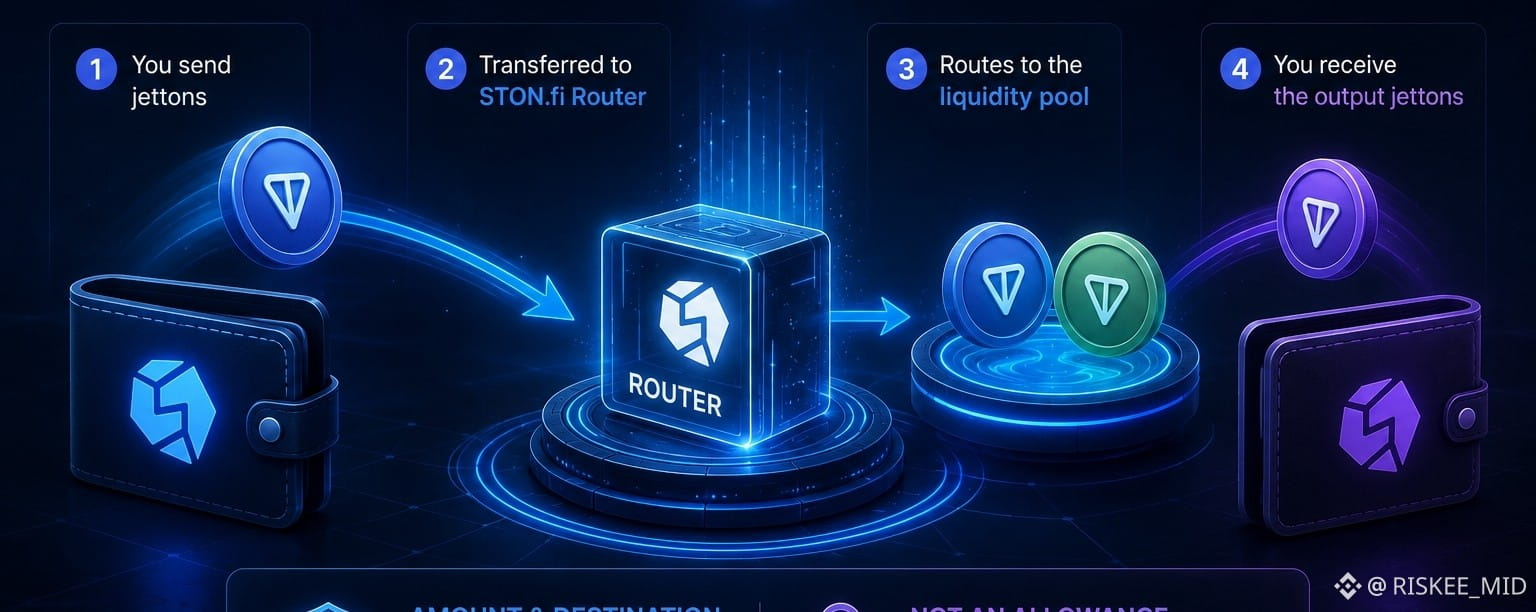
Article
Can a Malicious Jetton Request Affect a STON.fi User?Can a Malicious Jetton Request Affect a STON.fi User?
Security in DeFi is not only about the protocol you use. It is also about understanding exactly what your wallet is being asked to authorize.
For STON.fi users on TON, one important distinction is often overlooked: standard TON jettons do not use the ERC-20-style approve and allowance model. Under TEP-74, a jetton transfer authorizes a specific transfer request rather than granting a reusable allowance that another contract can spend later.
That difference changes how users should think about malicious swap requests, fake interfaces and wallet permissions.
How TON Jettons Differ From ERC-20
On Ethereum, ERC-20 tokens commonly rely on approve, allowance and transferFrom. A user may approve a spender for a particular amount, after which that spender can move tokens without requiring a new approval for every transaction.
Standard TON jettons work differently.
Under TEP-74, there is no standard approve, allowance, or transferFrom mechanism. A jetton transfer is instead authorized for the transaction being executed.
In a properly implemented jetton wallet, a transfer that does not originate from the owner should be rejected. This means that simply interacting with a token or connecting a wallet does not automatically create an unlimited, persistent jetton spending allowance.
That is a crucial security distinction.
So, Can a Malicious Jetton Request Still Cause Damage?
Yes.
The absence of ERC20 allowances does not make a user immune to malicious requests. The danger can come from what the user is actually signing.
A fake website could imitate a legitimate DeFi interface and present a transaction that appears to be a STON.fi swap while actually requesting a direct transfer of jettons to an attacker controlled address.
The transaction may look legitimate at first glance, but the important question is:
What exactly is my wallet being asked to send and where is it going?
TON Connect can also present requests containing one or more outgoing messages. Once the user authorizes those messages, the wallet executes what was approved.
This is why blindly clicking Confirm is dangerous, even when the request appears to involve a familiar token or protocol.
How a Genuine STON.fi Jetton Swap Works
A normal STON.fi jetton-to-jetton swap follows a defined transaction flow.
The user's jettons are transferred into the relevant Router flow with a payload containing information that helps the Router process the swap. The Router then forwards the request toward the appropriate liquidity pool and the swap continues according to the protocol's logic.
The important security point is that the amount being transferred is part of the transaction the user authorizes.
It is not equivalent to granting STON.fi an unlimited, reusable TEP-74 allowance.
Therefore, authorizing one legitimate swap does not automatically mean that a standard jetton contract has given STON.fi or another contract, permission to spend an unlimited balance in future transactions.
Where the Real Risks Appear
The bigger risk is often not a hidden ERC-20-style allowance, but a user unknowingly approving the wrong transaction.
A malicious interface may request:
A direct jetton transfer
Instead of sending tokens into the intended STON.fi Router, the transaction may send them directly to an attacker's wallet.
An unexpected amount
The requested amount may be larger than the user intended to swap.
A misleading destination
The interface could visually resemble STON.fi while directing funds somewhere completely different.
A wallet extension or broader capability
Wallet V5 extensions can introduce capabilities that go beyond a simple one-time transfer. These should be evaluated much more carefully because the security implications can be broader than an individual swap.
What Should STON.fi Users Check Before Signing?
Before approving a transaction, do not focus only on the website's appearance. Examine the transaction itself.
Verify the jetton you are sending and confirm that it is the intended asset.
Check the exact amount being transferred. A familiar token does not make an unfamiliar amount safe.
Inspect the destination and transaction structure. Confirm that the request matches the expected STON.fi interaction rather than an ordinary transfer to an unknown address.
Also determine what you are signing. Is it:
a token transfer,a data signature,or a wallet extension/capability change?
Those actions have very different security implications.
For unfamiliar assets, verify the official token master address instead of relying only on the token's name, ticker, logo, or website branding. Attackers can create look-alike jettons that appear legitimate.
A Key Point About One-Time Malicious Transfers
Suppose a user is tricked into approving a malicious jetton transfer.
That transaction can result in the immediate loss of the amount authorized. However, that completed transfer does not automatically become a reusable TEP-74 allowance that an attacker can later exploit for arbitrary STON.fi swaps.
This distinction matters.
A malicious transaction is still dangerous, but its danger should be understood correctly. Standard TEP-74 behavior is not the same as giving an attacker an unlimited ERC-20 allowance.
However, the situation changes dramatically if the underlying wallet itself becomes compromised.
What If the Wallet or Key Is Compromised?
A compromised seed phrase, private key, or sufficiently powerful wallet extension can affect much more than a single STON.fi transaction.
In that scenario, the attacker may be able to authorize future transactions directly from the wallet, depending on the capabilities they have obtained.
This is why wallet security remains fundamental even when the token standard itself does not implement persistent allowances.
There is also another important consideration:
Non-standard jettons
Not every jetton behaves exactly like a simple implementation of the standard.
A non-standard or custom jetton may introduce additional administrative logic, transfer restrictions, hooks, permissions, or other contract behavior. Users should therefore avoid assuming that every asset carries exactly the same risk profile as a basic TEP-74 implementation.
The Practical Security Rule
The safest mindset is simple:
Do not ask only, “Am I using STON.fi?”
Ask:
“What transaction is my wallet asking me to authorize?”
A legitimate STON.fi interface should still be treated carefully. Verify the asset, amount, transaction destination and wallet action before signing.
A wallet confirmation is not proof that a transaction is safe. It is simply the moment when you authorize the transaction to happen.
Final Takeaway
A malicious jetton request can absolutely affect a STON.fi user, but not because standard TON jettons secretly operate like ERC-20 unlimited allowances.
Under TEP-74, there is no standard approve, allowance or transferFrom model. A normal jetton transfer is authorized as a specific transaction.
The real danger comes from signing the wrong transaction, trusting a malicious interface, interacting with a fake jetton, approving unexpected outgoing messages or exposing the wallet itself through a compromised key or extension.
For every STON.fi interaction, slow down before signing.
Check the jetton.
Check the amount.
Check the destination.
Check what your wallet is actually authorizing.
In DeFi, the safest transaction is not the one that looks familiar.
It is the one you have verified.
Explore more on STON.FI
#BTC #GRAM
Can a Malicious Jetton Request Affect a STON.fi User?
Can a Malicious Jetton Request Affect a STON.fi User?
Security in DeFi is not only about the protocol you use. It is also about understanding exactly what your wallet is being asked to authorize.
For STON.fi users on TON, one important distinction is often overlooked: standard TON jettons do not use the ERC-20-style approve and allowance model. Under TEP-74, a jetton transfer authorizes a specific transfer request rather than granting a reusable allowance that another contract can spend later.
That difference changes how users should think about malicious swap requests, fake interfaces and wallet permissions.
How TON Jettons Differ From ERC-20
On Ethereum, ERC-20 tokens commonly rely on approve, allowance and transferFrom. A user may approve a spender for a particular amount, after which that spender can move tokens without requiring a new approval for every transaction.
Standard TON jettons work differently.
Under TEP-74, there is no standard approve, allowance, or transferFrom mechanism. A jetton transfer is instead authorized for the transaction being executed.
In a properly implemented jetton wallet, a transfer that does not originate from the owner should be rejected. This means that simply interacting with a token or connecting a wallet does not automatically create an unlimited, persistent jetton spending allowance.
That is a crucial security distinction.
So, Can a Malicious Jetton Request Still Cause Damage?
Yes.
The absence of ERC20 allowances does not make a user immune to malicious requests. The danger can come from what the user is actually signing.
A fake website could imitate a legitimate DeFi interface and present a transaction that appears to be a STON.fi swap while actually requesting a direct transfer of jettons to an attacker controlled address.
The transaction may look legitimate at first glance, but the important question is:
What exactly is my wallet being asked to send and where is it going?
TON Connect can also present requests containing one or more outgoing messages. Once the user authorizes those messages, the wallet executes what was approved.
This is why blindly clicking Confirm is dangerous, even when the request appears to involve a familiar token or protocol.
How a Genuine STON.fi Jetton Swap Works
A normal STON.fi jetton-to-jetton swap follows a defined transaction flow.
The user's jettons are transferred into the relevant Router flow with a payload containing information that helps the Router process the swap. The Router then forwards the request toward the appropriate liquidity pool and the swap continues according to the protocol's logic.
The important security point is that the amount being transferred is part of the transaction the user authorizes.
It is not equivalent to granting STON.fi an unlimited, reusable TEP-74 allowance.
Therefore, authorizing one legitimate swap does not automatically mean that a standard jetton contract has given STON.fi or another contract, permission to spend an unlimited balance in future transactions.
Where the Real Risks Appear
The bigger risk is often not a hidden ERC-20-style allowance, but a user unknowingly approving the wrong transaction.
A malicious interface may request:
A direct jetton transfer
Instead of sending tokens into the intended STON.fi Router, the transaction may send them directly to an attacker's wallet.
An unexpected amount
The requested amount may be larger than the user intended to swap.
A misleading destination
The interface could visually resemble STON.fi while directing funds somewhere completely different.
A wallet extension or broader capability
Wallet V5 extensions can introduce capabilities that go beyond a simple one-time transfer. These should be evaluated much more carefully because the security implications can be broader than an individual swap.
What Should STON.fi Users Check Before Signing?
Before approving a transaction, do not focus only on the website's appearance. Examine the transaction itself.
Verify the jetton you are sending and confirm that it is the intended asset.
Check the exact amount being transferred. A familiar token does not make an unfamiliar amount safe.
Inspect the destination and transaction structure. Confirm that the request matches the expected STON.fi interaction rather than an ordinary transfer to an unknown address.
Also determine what you are signing. Is it:
a token transfer,a data signature,or a wallet extension/capability change?
Those actions have very different security implications.
For unfamiliar assets, verify the official token master address instead of relying only on the token's name, ticker, logo, or website branding. Attackers can create look-alike jettons that appear legitimate.
A Key Point About One-Time Malicious Transfers
Suppose a user is tricked into approving a malicious jetton transfer.
That transaction can result in the immediate loss of the amount authorized. However, that completed transfer does not automatically become a reusable TEP-74 allowance that an attacker can later exploit for arbitrary STON.fi swaps.
This distinction matters.
A malicious transaction is still dangerous, but its danger should be understood correctly. Standard TEP-74 behavior is not the same as giving an attacker an unlimited ERC-20 allowance.
However, the situation changes dramatically if the underlying wallet itself becomes compromised.
What If the Wallet or Key Is Compromised?
A compromised seed phrase, private key, or sufficiently powerful wallet extension can affect much more than a single STON.fi transaction.
In that scenario, the attacker may be able to authorize future transactions directly from the wallet, depending on the capabilities they have obtained.
This is why wallet security remains fundamental even when the token standard itself does not implement persistent allowances.
There is also another important consideration:
Non-standard jettons
Not every jetton behaves exactly like a simple implementation of the standard.
A non-standard or custom jetton may introduce additional administrative logic, transfer restrictions, hooks, permissions, or other contract behavior. Users should therefore avoid assuming that every asset carries exactly the same risk profile as a basic TEP-74 implementation.
The Practical Security Rule
The safest mindset is simple:
Do not ask only, “Am I using STON.fi?”
Ask:
“What transaction is my wallet asking me to authorize?”
A legitimate STON.fi interface should still be treated carefully. Verify the asset, amount, transaction destination and wallet action before signing.
A wallet confirmation is not proof that a transaction is safe. It is simply the moment when you authorize the transaction to happen.
Final Takeaway
A malicious jetton request can absolutely affect a STON.fi user, but not because standard TON jettons secretly operate like ERC-20 unlimited allowances.
Under TEP-74, there is no standard approve, allowance or transferFrom model. A normal jetton transfer is authorized as a specific transaction.
The real danger comes from signing the wrong transaction, trusting a malicious interface, interacting with a fake jetton, approving unexpected outgoing messages or exposing the wallet itself through a compromised key or extension.
For every STON.fi interaction, slow down before signing.
Check the jetton.
Check the amount.
Check the destination.
Check what your wallet is actually authorizing.
In DeFi, the safest transaction is not the one that looks familiar.
It is the one you have verified.
Explore more on STON.FI
#BTC #GRAM
Security in DeFi is not only about the protocol you use. It is also about understanding exactly what your wallet is being asked to authorize.
For STON.fi users on TON, one important distinction is often overlooked: standard TON jettons do not use the ERC-20-style approve and allowance model. Under TEP-74, a jetton transfer authorizes a specific transfer request rather than granting a reusable allowance that another contract can spend later.
That difference changes how users should think about malicious swap requests, fake interfaces and wallet permissions.
How TON Jettons Differ From ERC-20
On Ethereum, ERC-20 tokens commonly rely on approve, allowance and transferFrom. A user may approve a spender for a particular amount, after which that spender can move tokens without requiring a new approval for every transaction.
Standard TON jettons work differently.
Under TEP-74, there is no standard approve, allowance, or transferFrom mechanism. A jetton transfer is instead authorized for the transaction being executed.
In a properly implemented jetton wallet, a transfer that does not originate from the owner should be rejected. This means that simply interacting with a token or connecting a wallet does not automatically create an unlimited, persistent jetton spending allowance.
That is a crucial security distinction.
So, Can a Malicious Jetton Request Still Cause Damage?
Yes.
The absence of ERC20 allowances does not make a user immune to malicious requests. The danger can come from what the user is actually signing.
A fake website could imitate a legitimate DeFi interface and present a transaction that appears to be a STON.fi swap while actually requesting a direct transfer of jettons to an attacker controlled address.
The transaction may look legitimate at first glance, but the important question is:
What exactly is my wallet being asked to send and where is it going?
TON Connect can also present requests containing one or more outgoing messages. Once the user authorizes those messages, the wallet executes what was approved.
This is why blindly clicking Confirm is dangerous, even when the request appears to involve a familiar token or protocol.
How a Genuine STON.fi Jetton Swap Works
A normal STON.fi jetton-to-jetton swap follows a defined transaction flow.
The user's jettons are transferred into the relevant Router flow with a payload containing information that helps the Router process the swap. The Router then forwards the request toward the appropriate liquidity pool and the swap continues according to the protocol's logic.
The important security point is that the amount being transferred is part of the transaction the user authorizes.
It is not equivalent to granting STON.fi an unlimited, reusable TEP-74 allowance.
Therefore, authorizing one legitimate swap does not automatically mean that a standard jetton contract has given STON.fi or another contract, permission to spend an unlimited balance in future transactions.
Where the Real Risks Appear
The bigger risk is often not a hidden ERC-20-style allowance, but a user unknowingly approving the wrong transaction.
A malicious interface may request:
A direct jetton transfer
Instead of sending tokens into the intended STON.fi Router, the transaction may send them directly to an attacker's wallet.
An unexpected amount
The requested amount may be larger than the user intended to swap.
A misleading destination
The interface could visually resemble STON.fi while directing funds somewhere completely different.
A wallet extension or broader capability
Wallet V5 extensions can introduce capabilities that go beyond a simple one-time transfer. These should be evaluated much more carefully because the security implications can be broader than an individual swap.
What Should STON.fi Users Check Before Signing?
Before approving a transaction, do not focus only on the website's appearance. Examine the transaction itself.
Verify the jetton you are sending and confirm that it is the intended asset.
Check the exact amount being transferred. A familiar token does not make an unfamiliar amount safe.
Inspect the destination and transaction structure. Confirm that the request matches the expected STON.fi interaction rather than an ordinary transfer to an unknown address.
Also determine what you are signing. Is it:
a token transfer,a data signature,or a wallet extension/capability change?
Those actions have very different security implications.
For unfamiliar assets, verify the official token master address instead of relying only on the token's name, ticker, logo, or website branding. Attackers can create look-alike jettons that appear legitimate.
A Key Point About One-Time Malicious Transfers
Suppose a user is tricked into approving a malicious jetton transfer.
That transaction can result in the immediate loss of the amount authorized. However, that completed transfer does not automatically become a reusable TEP-74 allowance that an attacker can later exploit for arbitrary STON.fi swaps.
This distinction matters.
A malicious transaction is still dangerous, but its danger should be understood correctly. Standard TEP-74 behavior is not the same as giving an attacker an unlimited ERC-20 allowance.
However, the situation changes dramatically if the underlying wallet itself becomes compromised.
What If the Wallet or Key Is Compromised?
A compromised seed phrase, private key, or sufficiently powerful wallet extension can affect much more than a single STON.fi transaction.
In that scenario, the attacker may be able to authorize future transactions directly from the wallet, depending on the capabilities they have obtained.
This is why wallet security remains fundamental even when the token standard itself does not implement persistent allowances.
There is also another important consideration:
Non-standard jettons
Not every jetton behaves exactly like a simple implementation of the standard.
A non-standard or custom jetton may introduce additional administrative logic, transfer restrictions, hooks, permissions, or other contract behavior. Users should therefore avoid assuming that every asset carries exactly the same risk profile as a basic TEP-74 implementation.
The Practical Security Rule
The safest mindset is simple:
Do not ask only, “Am I using STON.fi?”
Ask:
“What transaction is my wallet asking me to authorize?”
A legitimate STON.fi interface should still be treated carefully. Verify the asset, amount, transaction destination and wallet action before signing.
A wallet confirmation is not proof that a transaction is safe. It is simply the moment when you authorize the transaction to happen.
Final Takeaway
A malicious jetton request can absolutely affect a STON.fi user, but not because standard TON jettons secretly operate like ERC-20 unlimited allowances.
Under TEP-74, there is no standard approve, allowance or transferFrom model. A normal jetton transfer is authorized as a specific transaction.
The real danger comes from signing the wrong transaction, trusting a malicious interface, interacting with a fake jetton, approving unexpected outgoing messages or exposing the wallet itself through a compromised key or extension.
For every STON.fi interaction, slow down before signing.
Check the jetton.
Check the amount.
Check the destination.
Check what your wallet is actually authorizing.
In DeFi, the safest transaction is not the one that looks familiar.
It is the one you have verified.
Explore more on STON.FI
#BTC #GRAM
1
173
·
--
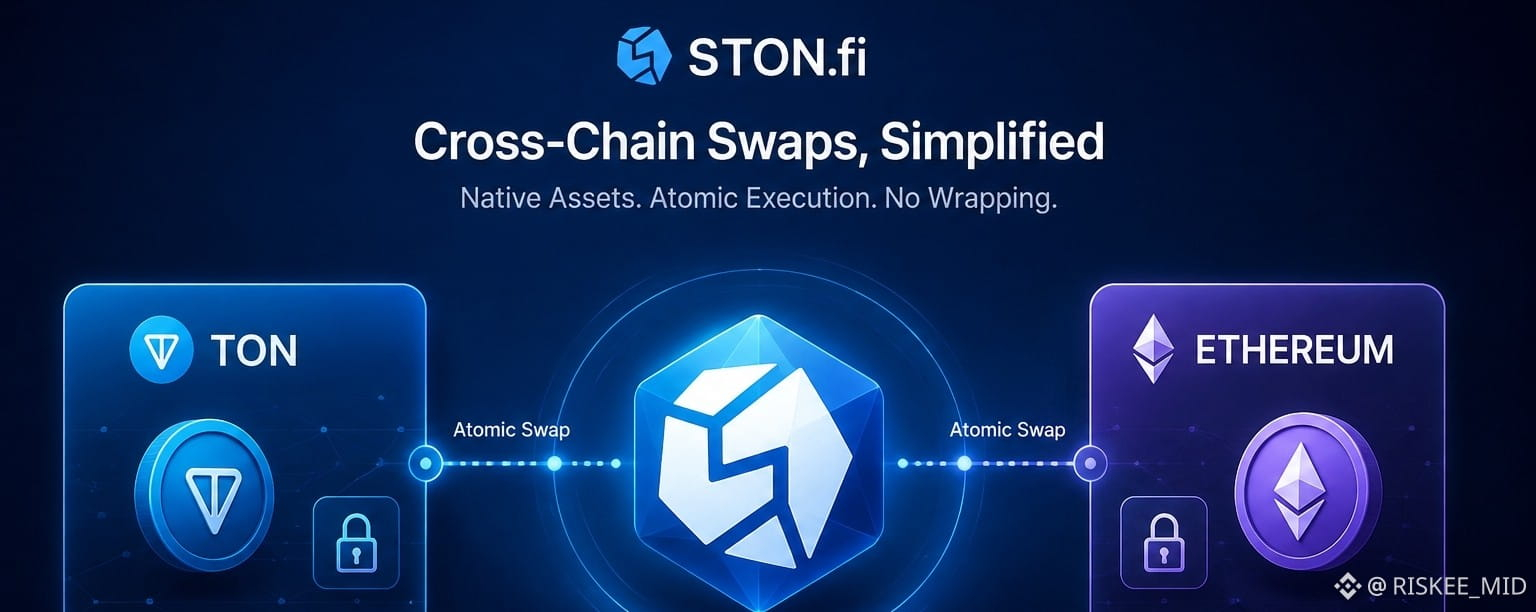
Article
How Omniston Connects TON and EthereumTON AND ETHEREUM SWAP
STON.fi’s approach to cross-chain swapping is built around a simple idea: users should be able to exchange value across independent blockchains without first turning their assets into wrapped representations.
With Omniston, STON.fi uses a resolver-based execution model combined with Request for Quote (RFQ) and Hashed Timelock Contracts (HTLCs) to coordinate swaps between TON and networks such as Ethereum. Instead of relying on a conventional lock-and-mint bridge, the system is designed to deliver the asset the user actually requested on the destination chain.
How Omniston Connects TON and Ethereum
TON and Ethereum operate as separate blockchain environments, so a native asset on one network cannot simply appear on the other. Omniston addresses this coordination problem by introducing resolvers—liquidity providers that compete to fulfill cross-chain orders.
When a user creates a swap, Omniston sends an RFQ to available resolvers. They return executable quotes based on the assets, amounts and destination requirements. The selected resolver then commits its own destination-side liquidity, creating a direct economic incentive to complete the transaction.
This means the resolver is not merely making a promise to provide Ethereum liquidity. Its destination-side funds are committed through the settlement mechanism itself.
The Role of HTLCs
The technical foundation is the Hashed Timelock Contract.
For a TON-to-Ethereum swap, the source-side and destination-side assets are placed into linked HTLCs that use the same cryptographic condition. A secret unlocks the settlement. Once that secret is revealed, the user can claim the Ethereum-side asset, while the resolver can claim the TON-side asset using the same secret.
The timelock provides the second layer of protection.
If the required condition is never completed within the defined time window, the locked assets become refundable according to the contract rules. In practical terms, the design aims for an all-or-nothing outcome: successful settlement for both sides, or a refund path rather than an indefinitely incomplete swap.
A TON → Ethereum Swap, Step by Step
Imagine a user wants to exchange a TON-side asset for an Ethereum-side asset.
1. Select the route
The user chooses the source asset on TON, the destination asset on Ethereum, and the receiving wallet.
2. Request a quote
Omniston distributes an RFQ to participating resolvers.
3. Compare execution
The user receives a quote showing the expected output and relevant costs before confirming.
4. Commit the source-side transaction
The user authorizes the TON-side commitment. As with any TON transaction, network gas is still required.
5. Resolver commits Ethereum liquidity
The selected resolver locks the destination asset on Ethereum through the corresponding HTLC using the linked cryptographic condition.
6. Settlement occurs
Once the secret is revealed, the destination asset becomes claimable and the resolver can claim the source-side asset.
7. Refund when necessary
If the settlement condition is not fulfilled within the required timeframe, the timelock mechanism provides the applicable refund path.
Why This Is Different From a Traditional Bridge
The biggest distinction is what actually happens to the assets.
A conventional bridge commonly follows a lock-and-mint model: the original asset is locked on one chain and a wrapped representation is issued on another. That wrapped asset then depends on the bridge infrastructure maintaining the underlying relationship.
Omniston takes a different route.
It is designed as a cross-chain exchange, not a mechanism for creating a wrapped copy of the original token. The user requests a destination asset, and a resolver supplies that asset from its own destination-side liquidity.
So instead of:
Asset A → bridge lock → wrapped Asset A
the model is closer to:
Asset A → atomic exchange → native Asset B
That distinction can be important for users who want to use the destination asset directly rather than receive a bridged representation.
Why Resolvers Matter
Resolvers are one of the most important parts of Omniston’s architecture.
They effectively turn cross-chain liquidity into a competitive marketplace. Multiple resolvers can respond to the same RFQ, allowing execution to be driven by available liquidity and pricing rather than a single bridge reserve.
The resolver takes on the destination-side execution responsibility and commits capital to the trade. This removes the need for a single shared vault holding a massive pool of user funds, which is a major structural difference from many traditional bridge architectures.
For larger orders, Omniston can also support partial fills, allowing an order to be divided into independent sub-swaps rather than forcing the entire amount through one execution path.
What Users Should Actually Care About
The technology underneath Omniston is sophisticated, but the user-facing objective is straightforward:
Choose what you have, choose what you want, review the quote, and let the protocol coordinate the cross-chain settlement.
Still, users should not ignore the practical details. The final amount, fees, destination network, receiving address and required gas should always be checked before confirming a transaction. Cross-chain execution does not eliminate network costs, and the destination chain still matters for settlement speed and usability.
The Bigger Picture
Omniston demonstrates an important evolution in cross-chain DeFi.
Instead of asking, “How do I move this token across a bridge?”, the experience becomes, “What asset do I want to receive on the other chain?”
That is a fundamental shift from asset transportation toward cross-chain execution.
Through RFQ-based resolver competition, native destination liquidity and linked HTLCs, STON.fi’s Omniston architecture is designed to connect TON with independent networks such as Ethereum while avoiding the traditional wrapped-asset step. The result is a model centered on direct exchange, cryptographic settlement and predefined refund conditions rather than dependence on a shared bridge vault.
For anyone exploring cross-chain DeFi, understanding this distinction is essential: a bridge moves representations of assets, while an atomic cross-chain swap can exchange one native asset for another. Omniston is built around the latter model.
Read more about STONfi here
Explore more on STON.FI
#VenezuelaUSSign25YearOilDeal
How Omniston Connects TON and Ethereum
TON AND ETHEREUM SWAP
STON.fi’s approach to cross-chain swapping is built around a simple idea: users should be able to exchange value across independent blockchains without first turning their assets into wrapped representations.
With Omniston, STON.fi uses a resolver-based execution model combined with Request for Quote (RFQ) and Hashed Timelock Contracts (HTLCs) to coordinate swaps between TON and networks such as Ethereum. Instead of relying on a conventional lock-and-mint bridge, the system is designed to deliver the asset the user actually requested on the destination chain.
How Omniston Connects TON and Ethereum
TON and Ethereum operate as separate blockchain environments, so a native asset on one network cannot simply appear on the other. Omniston addresses this coordination problem by introducing resolvers—liquidity providers that compete to fulfill cross-chain orders.
When a user creates a swap, Omniston sends an RFQ to available resolvers. They return executable quotes based on the assets, amounts and destination requirements. The selected resolver then commits its own destination-side liquidity, creating a direct economic incentive to complete the transaction.
This means the resolver is not merely making a promise to provide Ethereum liquidity. Its destination-side funds are committed through the settlement mechanism itself.
The Role of HTLCs
The technical foundation is the Hashed Timelock Contract.
For a TON-to-Ethereum swap, the source-side and destination-side assets are placed into linked HTLCs that use the same cryptographic condition. A secret unlocks the settlement. Once that secret is revealed, the user can claim the Ethereum-side asset, while the resolver can claim the TON-side asset using the same secret.
The timelock provides the second layer of protection.
If the required condition is never completed within the defined time window, the locked assets become refundable according to the contract rules. In practical terms, the design aims for an all-or-nothing outcome: successful settlement for both sides, or a refund path rather than an indefinitely incomplete swap.
A TON → Ethereum Swap, Step by Step
Imagine a user wants to exchange a TON-side asset for an Ethereum-side asset.
1. Select the route
The user chooses the source asset on TON, the destination asset on Ethereum, and the receiving wallet.
2. Request a quote
Omniston distributes an RFQ to participating resolvers.
3. Compare execution
The user receives a quote showing the expected output and relevant costs before confirming.
4. Commit the source-side transaction
The user authorizes the TON-side commitment. As with any TON transaction, network gas is still required.
5. Resolver commits Ethereum liquidity
The selected resolver locks the destination asset on Ethereum through the corresponding HTLC using the linked cryptographic condition.
6. Settlement occurs
Once the secret is revealed, the destination asset becomes claimable and the resolver can claim the source-side asset.
7. Refund when necessary
If the settlement condition is not fulfilled within the required timeframe, the timelock mechanism provides the applicable refund path.
Why This Is Different From a Traditional Bridge
The biggest distinction is what actually happens to the assets.
A conventional bridge commonly follows a lock-and-mint model: the original asset is locked on one chain and a wrapped representation is issued on another. That wrapped asset then depends on the bridge infrastructure maintaining the underlying relationship.
Omniston takes a different route.
It is designed as a cross-chain exchange, not a mechanism for creating a wrapped copy of the original token. The user requests a destination asset, and a resolver supplies that asset from its own destination-side liquidity.
So instead of:
Asset A → bridge lock → wrapped Asset A
the model is closer to:
Asset A → atomic exchange → native Asset B
That distinction can be important for users who want to use the destination asset directly rather than receive a bridged representation.
Why Resolvers Matter
Resolvers are one of the most important parts of Omniston’s architecture.
They effectively turn cross-chain liquidity into a competitive marketplace. Multiple resolvers can respond to the same RFQ, allowing execution to be driven by available liquidity and pricing rather than a single bridge reserve.
The resolver takes on the destination-side execution responsibility and commits capital to the trade. This removes the need for a single shared vault holding a massive pool of user funds, which is a major structural difference from many traditional bridge architectures.
For larger orders, Omniston can also support partial fills, allowing an order to be divided into independent sub-swaps rather than forcing the entire amount through one execution path.
What Users Should Actually Care About
The technology underneath Omniston is sophisticated, but the user-facing objective is straightforward:
Choose what you have, choose what you want, review the quote, and let the protocol coordinate the cross-chain settlement.
Still, users should not ignore the practical details. The final amount, fees, destination network, receiving address and required gas should always be checked before confirming a transaction. Cross-chain execution does not eliminate network costs, and the destination chain still matters for settlement speed and usability.
The Bigger Picture
Omniston demonstrates an important evolution in cross-chain DeFi.
Instead of asking, “How do I move this token across a bridge?”, the experience becomes, “What asset do I want to receive on the other chain?”
That is a fundamental shift from asset transportation toward cross-chain execution.
Through RFQ-based resolver competition, native destination liquidity and linked HTLCs, STON.fi’s Omniston architecture is designed to connect TON with independent networks such as Ethereum while avoiding the traditional wrapped-asset step. The result is a model centered on direct exchange, cryptographic settlement and predefined refund conditions rather than dependence on a shared bridge vault.
For anyone exploring cross-chain DeFi, understanding this distinction is essential: a bridge moves representations of assets, while an atomic cross-chain swap can exchange one native asset for another. Omniston is built around the latter model.
Read more about STONfi here
Explore more on STON.FI
#VenezuelaUSSign25YearOilDeal
STON.fi’s approach to cross-chain swapping is built around a simple idea: users should be able to exchange value across independent blockchains without first turning their assets into wrapped representations.
With Omniston, STON.fi uses a resolver-based execution model combined with Request for Quote (RFQ) and Hashed Timelock Contracts (HTLCs) to coordinate swaps between TON and networks such as Ethereum. Instead of relying on a conventional lock-and-mint bridge, the system is designed to deliver the asset the user actually requested on the destination chain.
How Omniston Connects TON and Ethereum
TON and Ethereum operate as separate blockchain environments, so a native asset on one network cannot simply appear on the other. Omniston addresses this coordination problem by introducing resolvers—liquidity providers that compete to fulfill cross-chain orders.
When a user creates a swap, Omniston sends an RFQ to available resolvers. They return executable quotes based on the assets, amounts and destination requirements. The selected resolver then commits its own destination-side liquidity, creating a direct economic incentive to complete the transaction.
This means the resolver is not merely making a promise to provide Ethereum liquidity. Its destination-side funds are committed through the settlement mechanism itself.
The Role of HTLCs
The technical foundation is the Hashed Timelock Contract.
For a TON-to-Ethereum swap, the source-side and destination-side assets are placed into linked HTLCs that use the same cryptographic condition. A secret unlocks the settlement. Once that secret is revealed, the user can claim the Ethereum-side asset, while the resolver can claim the TON-side asset using the same secret.
The timelock provides the second layer of protection.
If the required condition is never completed within the defined time window, the locked assets become refundable according to the contract rules. In practical terms, the design aims for an all-or-nothing outcome: successful settlement for both sides, or a refund path rather than an indefinitely incomplete swap.
A TON → Ethereum Swap, Step by Step
Imagine a user wants to exchange a TON-side asset for an Ethereum-side asset.
1. Select the route
The user chooses the source asset on TON, the destination asset on Ethereum, and the receiving wallet.
2. Request a quote
Omniston distributes an RFQ to participating resolvers.
3. Compare execution
The user receives a quote showing the expected output and relevant costs before confirming.
4. Commit the source-side transaction
The user authorizes the TON-side commitment. As with any TON transaction, network gas is still required.
5. Resolver commits Ethereum liquidity
The selected resolver locks the destination asset on Ethereum through the corresponding HTLC using the linked cryptographic condition.
6. Settlement occurs
Once the secret is revealed, the destination asset becomes claimable and the resolver can claim the source-side asset.
7. Refund when necessary
If the settlement condition is not fulfilled within the required timeframe, the timelock mechanism provides the applicable refund path.
Why This Is Different From a Traditional Bridge
The biggest distinction is what actually happens to the assets.
A conventional bridge commonly follows a lock-and-mint model: the original asset is locked on one chain and a wrapped representation is issued on another. That wrapped asset then depends on the bridge infrastructure maintaining the underlying relationship.
Omniston takes a different route.
It is designed as a cross-chain exchange, not a mechanism for creating a wrapped copy of the original token. The user requests a destination asset, and a resolver supplies that asset from its own destination-side liquidity.
So instead of:
Asset A → bridge lock → wrapped Asset A
the model is closer to:
Asset A → atomic exchange → native Asset B
That distinction can be important for users who want to use the destination asset directly rather than receive a bridged representation.
Why Resolvers Matter
Resolvers are one of the most important parts of Omniston’s architecture.
They effectively turn cross-chain liquidity into a competitive marketplace. Multiple resolvers can respond to the same RFQ, allowing execution to be driven by available liquidity and pricing rather than a single bridge reserve.
The resolver takes on the destination-side execution responsibility and commits capital to the trade. This removes the need for a single shared vault holding a massive pool of user funds, which is a major structural difference from many traditional bridge architectures.
For larger orders, Omniston can also support partial fills, allowing an order to be divided into independent sub-swaps rather than forcing the entire amount through one execution path.
What Users Should Actually Care About
The technology underneath Omniston is sophisticated, but the user-facing objective is straightforward:
Choose what you have, choose what you want, review the quote, and let the protocol coordinate the cross-chain settlement.
Still, users should not ignore the practical details. The final amount, fees, destination network, receiving address and required gas should always be checked before confirming a transaction. Cross-chain execution does not eliminate network costs, and the destination chain still matters for settlement speed and usability.
The Bigger Picture
Omniston demonstrates an important evolution in cross-chain DeFi.
Instead of asking, “How do I move this token across a bridge?”, the experience becomes, “What asset do I want to receive on the other chain?”
That is a fundamental shift from asset transportation toward cross-chain execution.
Through RFQ-based resolver competition, native destination liquidity and linked HTLCs, STON.fi’s Omniston architecture is designed to connect TON with independent networks such as Ethereum while avoiding the traditional wrapped-asset step. The result is a model centered on direct exchange, cryptographic settlement and predefined refund conditions rather than dependence on a shared bridge vault.
For anyone exploring cross-chain DeFi, understanding this distinction is essential: a bridge moves representations of assets, while an atomic cross-chain swap can exchange one native asset for another. Omniston is built around the latter model.
Read more about STONfi here
Explore more on STON.FI
#VenezuelaUSSign25YearOilDeal
1
101
·
--
Article
what Is Bridge Risk Compared with the Omniston Atomic Swap Model?What Is Bridge Risk Compared with the Omniston Atomic Swap Model?
As decentralized finance expands across multiple networks, moving assets between ecosystems has become one of its most important — and riskiest — operations. A user may hold an asset on one blockchain but need an equivalent asset on another. Traditionally, bridges have solved this problem by creating a connection between chains through pooled liquidity, wrapped assets, validators, relayers, or other coordination mechanisms.
However, these systems introduce additional trust and security assumptions.
Omniston takes a different approach for its atomic swap model. Instead of relying on a shared bridge reserve or a conventional lock-and-mint mechanism, the system can use resolver-provided liquidity together with paired Hashed Timelock Contracts, or HTLCs, to coordinate the two sides of a swap.
The distinction is important because the architecture determines not only how assets move, but also how failures are handled.
Where Does Bridge Risk Come From?
Conventional bridges often rely on infrastructure that sits between two independent blockchains. That infrastructure can become a powerful point of failure.
1. Shared reserves can become high-value targets
Many bridge architectures maintain assets in contracts that collectively represent liquidity for users. When large amounts of value accumulate in one contract, that contract becomes an attractive target for attackers.
A vulnerability in the reserve mechanism, withdrawal logic, accounting system, or authorization layer can potentially affect many users simultaneously.
This creates a concentration problem: one exploit may have consequences far beyond a single transaction.
2. Validators and relayers introduce additional trust assumptions
Different bridges use different designs, but some depend on external validators, multisignature committees, relayers, or other participants to observe transactions on one network and authorize actions on another.
These participants must correctly verify information and follow the protocol's rules.
The more external coordination required, the more potential failure points exist. Compromise, collusion, downtime, implementation mistakes, or incorrect message verification can potentially interfere with bridge operations.
3. Wrapped assets create representation risk
A bridged asset is not necessarily the native asset itself.
In many bridge systems, users deposit an original asset into one system and receive a representation of that asset on another chain. The represented asset depends on the bridge continuing to honor the underlying relationship.
If the source custody mechanism or bridge infrastructure fails, the wrapped representation may no longer have the expected backing.
This creates a layer of risk that does not exist in exactly the same form when two parties directly exchange assets through an atomic mechanism.
4. Lock, mint, and withdrawal logic can create systemic exposure
Traditional bridge operations may involve several connected steps:
Lock asset → verify event → authorize message → mint or release asset → process withdrawal
Every step introduces logic that must work correctly.
A flaw in one critical component can potentially propagate through the entire bridge architecture. Because the system often handles assets belonging to many users, the impact can become systemic rather than transaction-specific.
How the Omniston Atomic Swap Model Works
Omniston's atomic approach changes the structure of the transaction.
Instead of creating a permanent relationship between two networks through a shared reserve and wrapped representation, a trade can be structured around a specific order and specific liquidity provided by a resolver.
At a simplified level, the flow looks like this:
1. The order establishes the transaction conditions
The swap begins with defined parameters such as:
The source assetThe destination assetThe amountThe applicable execution conditionsA shared cryptographic hashlock
The hashlock becomes an important part of the settlement mechanism because both sides of the transaction can be tied to the same secret.
2. The user's source assets are locked
The user's assets can be placed into an HTLC on the source side.
An HTLC combines two concepts:
Hashlock: the asset can be claimed when the correct secret is revealed.
Timelock: if settlement does not happen within the required period, the asset can become refundable according to the contract rules.
This means the transaction does not simply depend on another party promising to complete the swap later.
3. The resolver locks destination liquidity
The resolver provides the opposite side of the trade and locks the destination liquidity in another HTLC.
Crucially, the two HTLCs use the same underlying hashlock condition.
This creates a cryptographic relationship between the two sides of the swap.
4. Secret reveal enables settlement
When the valid secret is revealed, it can be used to claim the corresponding locked assets.
The same secret therefore links the settlement of both sides.
Instead of relying on an intermediary to manually move value between chains, the transaction uses predefined cryptographic conditions to coordinate execution.
5. Timelocks provide a refund path
Atomicity does not mean that every transaction must succeed.
It means that the contract logic establishes conditions for successful settlement and conditions for recovery when those requirements are not met.
If the necessary conditions are not satisfied before the relevant timeout, the HTLC mechanisms provide a path for the locked assets to be refunded according to their rules.
This creates an important safety property: failure should not automatically mean permanent loss of the locked funds.
Bridge Model vs Atomic Swap Model
The fundamental difference is the source of trust.
A conventional bridge may depend on a shared infrastructure layer that connects networks together. Users therefore inherit the security assumptions of that bridge.
The Omniston atomic model instead focuses on transaction-specific liquidity and transaction-specific cryptographic conditions.
Rather than saying:
“Trust this shared bridge infrastructure to maintain the relationship between these assets.”
the atomic model is closer to:
“These two sides of this particular trade can settle only when the predefined conditions are satisfied.”
That is a meaningful architectural difference.
Why Removing Shared Bridge Reserves Matters
One of the most important characteristics of the atomic model is that it does not require a shared bridge reserve for the atomic path.
Resolvers supply liquidity for individual trades instead.
This changes the potential blast radius of certain failures.
If a conventional bridge has a large centralized reserve and that reserve is compromised, the consequences can potentially affect the entire pool of users relying on it.
With transaction-specific resolver liquidity, the risk is more directly associated with the individual swap and the mechanisms protecting that swap.
This does not make the system risk-free. It changes where the risk lives.
Instead of concentrating the problem around a common reserve, the architecture distributes execution through individual trades governed by their own conditions.
The Role of Atomicity
The word “atomic” is important because it describes the intended settlement relationship.
For a properly structured atomic swap, the desired outcome is essentially:
Both sides settle successfully
or
Neither side remains permanently committed, and the relevant assets become refundable after the applicable timeout.
This is fundamentally different from an architecture where one party sends an asset and then waits for an intermediary to create, release, mint, or relay the corresponding asset elsewhere.
Atomic conditions reduce the need to trust that an intermediary will successfully complete every stage of the process.
What Risks Does the Atomic Model Still Have?
It would be a mistake to describe atomic swaps as eliminating all cross-chain or DeFi risk.
They primarily change the risk model.
Smart-contract risk
HTLCs are implemented through smart contracts or equivalent blockchain logic. Bugs in those contracts can still create vulnerabilities.
Correct cryptographic design does not protect against flawed implementation.
Blockchain risk
The underlying blockchains remain part of the security model.
Network congestion, reorganization, downtime, unexpected protocol behavior, or other chain-level events can affect execution.
The atomic mechanism cannot make an underlying blockchain immune to its own risks.
Resolver liquidity risk
Resolvers are responsible for supplying destination-side liquidity.
A resolver may not have sufficient liquidity, may withdraw liquidity, or may quote conditions that are no longer attractive to the user.
The model removes certain bridge assumptions, but it still depends on available counterpart liquidity.
Quote and execution risk
A technically successful swap can still be economically unfavorable.
Exchange rates can change, market depth can differ, and execution conditions can move between quote generation and settlement.
Users must therefore evaluate the actual output amount and execution terms instead of focusing only on architecture.
Wallet and signing risk
Atomic settlement cannot protect a user who signs the wrong transaction, interacts with a malicious interface, or provides an unintended asset.
Wallet security remains fundamental.
Asset and network identification risk
Cross-chain environments can contain assets with similar names, different contract addresses, or multiple representations.
Users must verify that they are swapping the intended asset on the intended network.
A secure settlement mechanism cannot correct a transaction that was intentionally or accidentally configured incorrectly.
Large Orders and Partial Completion
Another important consideration is that large orders may be divided into independent sub-swaps.
This can improve execution flexibility and make it easier to source liquidity.
However, it also means the overall transaction should not always be viewed as one indivisible event.
Some portions may execute while another portion does not.
Therefore, users should understand the execution structure of larger orders and confirm how completed and uncompleted portions are handled.
The Bigger Picture
The comparison between bridge risk and Omniston atomic swap risk is not simply a question of which system is “safe” and which is “unsafe.”
The more useful question is:
What assumptions must hold true for the transaction to succeed safely?
A conventional bridge may require confidence in shared reserves, custodial mechanisms, validator sets, relayers, message verification, wrapped-token accounting, and cross-chain release logic.
An atomic swap model shifts that dependency toward:
Resolver liquidity + cryptographic conditions + smart-contract correctness + blockchain reliability.
That is a substantially different failure model.
Practical Takeaway
Bridge architecture often introduces shared infrastructure that can become a concentration point for liquidity and trust.
The Omniston atomic swap model approaches cross-network exchange differently by using resolver liquidity and paired HTLCs tied to shared cryptographic conditions.
The essential concept is straightforward:
The swap either satisfies the predefined settlement conditions, or the timeout mechanism provides a refund path.
This does not eliminate every risk. Smart contracts can still contain bugs, blockchains can still fail, resolvers can still face liquidity constraints, quotes can change, wallets can be compromised, and users can still select the wrong assets or networks.
But the architecture changes the security assumptions.
Instead of depending on a shared bridge reserve and intermediary-controlled minting or release mechanisms, the atomic path can make the individual trade itself the unit of coordination.
For users, the practical lesson is equally important: before signing, verify the exact asset, network, amount, quote, resolver-supported route, execution terms, and refund conditions.
Atomic swaps do not make cross-chain trading risk-free. They make the rules governing settlement much more explicit and transaction-specific.
That difference is at the heart of understanding bridge risk versus the Omniston atomic swap model.
Explore more on STON.FI
what Is Bridge Risk Compared with the Omniston Atomic Swap Model?
What Is Bridge Risk Compared with the Omniston Atomic Swap Model?
As decentralized finance expands across multiple networks, moving assets between ecosystems has become one of its most important — and riskiest — operations. A user may hold an asset on one blockchain but need an equivalent asset on another. Traditionally, bridges have solved this problem by creating a connection between chains through pooled liquidity, wrapped assets, validators, relayers, or other coordination mechanisms.
However, these systems introduce additional trust and security assumptions.
Omniston takes a different approach for its atomic swap model. Instead of relying on a shared bridge reserve or a conventional lock-and-mint mechanism, the system can use resolver-provided liquidity together with paired Hashed Timelock Contracts, or HTLCs, to coordinate the two sides of a swap.
The distinction is important because the architecture determines not only how assets move, but also how failures are handled.
Where Does Bridge Risk Come From?
Conventional bridges often rely on infrastructure that sits between two independent blockchains. That infrastructure can become a powerful point of failure.
1. Shared reserves can become high-value targets
Many bridge architectures maintain assets in contracts that collectively represent liquidity for users. When large amounts of value accumulate in one contract, that contract becomes an attractive target for attackers.
A vulnerability in the reserve mechanism, withdrawal logic, accounting system, or authorization layer can potentially affect many users simultaneously.
This creates a concentration problem: one exploit may have consequences far beyond a single transaction.
2. Validators and relayers introduce additional trust assumptions
Different bridges use different designs, but some depend on external validators, multisignature committees, relayers, or other participants to observe transactions on one network and authorize actions on another.
These participants must correctly verify information and follow the protocol's rules.
The more external coordination required, the more potential failure points exist. Compromise, collusion, downtime, implementation mistakes, or incorrect message verification can potentially interfere with bridge operations.
3. Wrapped assets create representation risk
A bridged asset is not necessarily the native asset itself.
In many bridge systems, users deposit an original asset into one system and receive a representation of that asset on another chain. The represented asset depends on the bridge continuing to honor the underlying relationship.
If the source custody mechanism or bridge infrastructure fails, the wrapped representation may no longer have the expected backing.
This creates a layer of risk that does not exist in exactly the same form when two parties directly exchange assets through an atomic mechanism.
4. Lock, mint, and withdrawal logic can create systemic exposure
Traditional bridge operations may involve several connected steps:
Lock asset → verify event → authorize message → mint or release asset → process withdrawal
Every step introduces logic that must work correctly.
A flaw in one critical component can potentially propagate through the entire bridge architecture. Because the system often handles assets belonging to many users, the impact can become systemic rather than transaction-specific.
How the Omniston Atomic Swap Model Works
Omniston's atomic approach changes the structure of the transaction.
Instead of creating a permanent relationship between two networks through a shared reserve and wrapped representation, a trade can be structured around a specific order and specific liquidity provided by a resolver.
At a simplified level, the flow looks like this:
1. The order establishes the transaction conditions
The swap begins with defined parameters such as:
The source assetThe destination assetThe amountThe applicable execution conditionsA shared cryptographic hashlock
The hashlock becomes an important part of the settlement mechanism because both sides of the transaction can be tied to the same secret.
2. The user's source assets are locked
The user's assets can be placed into an HTLC on the source side.
An HTLC combines two concepts:
Hashlock: the asset can be claimed when the correct secret is revealed.
Timelock: if settlement does not happen within the required period, the asset can become refundable according to the contract rules.
This means the transaction does not simply depend on another party promising to complete the swap later.
3. The resolver locks destination liquidity
The resolver provides the opposite side of the trade and locks the destination liquidity in another HTLC.
Crucially, the two HTLCs use the same underlying hashlock condition.
This creates a cryptographic relationship between the two sides of the swap.
4. Secret reveal enables settlement
When the valid secret is revealed, it can be used to claim the corresponding locked assets.
The same secret therefore links the settlement of both sides.
Instead of relying on an intermediary to manually move value between chains, the transaction uses predefined cryptographic conditions to coordinate execution.
5. Timelocks provide a refund path
Atomicity does not mean that every transaction must succeed.
It means that the contract logic establishes conditions for successful settlement and conditions for recovery when those requirements are not met.
If the necessary conditions are not satisfied before the relevant timeout, the HTLC mechanisms provide a path for the locked assets to be refunded according to their rules.
This creates an important safety property: failure should not automatically mean permanent loss of the locked funds.
Bridge Model vs Atomic Swap Model
The fundamental difference is the source of trust.
A conventional bridge may depend on a shared infrastructure layer that connects networks together. Users therefore inherit the security assumptions of that bridge.
The Omniston atomic model instead focuses on transaction-specific liquidity and transaction-specific cryptographic conditions.
Rather than saying:
“Trust this shared bridge infrastructure to maintain the relationship between these assets.”
the atomic model is closer to:
“These two sides of this particular trade can settle only when the predefined conditions are satisfied.”
That is a meaningful architectural difference.
Why Removing Shared Bridge Reserves Matters
One of the most important characteristics of the atomic model is that it does not require a shared bridge reserve for the atomic path.
Resolvers supply liquidity for individual trades instead.
This changes the potential blast radius of certain failures.
If a conventional bridge has a large centralized reserve and that reserve is compromised, the consequences can potentially affect the entire pool of users relying on it.
With transaction-specific resolver liquidity, the risk is more directly associated with the individual swap and the mechanisms protecting that swap.
This does not make the system risk-free. It changes where the risk lives.
Instead of concentrating the problem around a common reserve, the architecture distributes execution through individual trades governed by their own conditions.
The Role of Atomicity
The word “atomic” is important because it describes the intended settlement relationship.
For a properly structured atomic swap, the desired outcome is essentially:
Both sides settle successfully
or
Neither side remains permanently committed, and the relevant assets become refundable after the applicable timeout.
This is fundamentally different from an architecture where one party sends an asset and then waits for an intermediary to create, release, mint, or relay the corresponding asset elsewhere.
Atomic conditions reduce the need to trust that an intermediary will successfully complete every stage of the process.
What Risks Does the Atomic Model Still Have?
It would be a mistake to describe atomic swaps as eliminating all cross-chain or DeFi risk.
They primarily change the risk model.
Smart-contract risk
HTLCs are implemented through smart contracts or equivalent blockchain logic. Bugs in those contracts can still create vulnerabilities.
Correct cryptographic design does not protect against flawed implementation.
Blockchain risk
The underlying blockchains remain part of the security model.
Network congestion, reorganization, downtime, unexpected protocol behavior, or other chain-level events can affect execution.
The atomic mechanism cannot make an underlying blockchain immune to its own risks.
Resolver liquidity risk
Resolvers are responsible for supplying destination-side liquidity.
A resolver may not have sufficient liquidity, may withdraw liquidity, or may quote conditions that are no longer attractive to the user.
The model removes certain bridge assumptions, but it still depends on available counterpart liquidity.
Quote and execution risk
A technically successful swap can still be economically unfavorable.
Exchange rates can change, market depth can differ, and execution conditions can move between quote generation and settlement.
Users must therefore evaluate the actual output amount and execution terms instead of focusing only on architecture.
Wallet and signing risk
Atomic settlement cannot protect a user who signs the wrong transaction, interacts with a malicious interface, or provides an unintended asset.
Wallet security remains fundamental.
Asset and network identification risk
Cross-chain environments can contain assets with similar names, different contract addresses, or multiple representations.
Users must verify that they are swapping the intended asset on the intended network.
A secure settlement mechanism cannot correct a transaction that was intentionally or accidentally configured incorrectly.
Large Orders and Partial Completion
Another important consideration is that large orders may be divided into independent sub-swaps.
This can improve execution flexibility and make it easier to source liquidity.
However, it also means the overall transaction should not always be viewed as one indivisible event.
Some portions may execute while another portion does not.
Therefore, users should understand the execution structure of larger orders and confirm how completed and uncompleted portions are handled.
The Bigger Picture
The comparison between bridge risk and Omniston atomic swap risk is not simply a question of which system is “safe” and which is “unsafe.”
The more useful question is:
What assumptions must hold true for the transaction to succeed safely?
A conventional bridge may require confidence in shared reserves, custodial mechanisms, validator sets, relayers, message verification, wrapped-token accounting, and cross-chain release logic.
An atomic swap model shifts that dependency toward:
Resolver liquidity + cryptographic conditions + smart-contract correctness + blockchain reliability.
That is a substantially different failure model.
Practical Takeaway
Bridge architecture often introduces shared infrastructure that can become a concentration point for liquidity and trust.
The Omniston atomic swap model approaches cross-network exchange differently by using resolver liquidity and paired HTLCs tied to shared cryptographic conditions.
The essential concept is straightforward:
The swap either satisfies the predefined settlement conditions, or the timeout mechanism provides a refund path.
This does not eliminate every risk. Smart contracts can still contain bugs, blockchains can still fail, resolvers can still face liquidity constraints, quotes can change, wallets can be compromised, and users can still select the wrong assets or networks.
But the architecture changes the security assumptions.
Instead of depending on a shared bridge reserve and intermediary-controlled minting or release mechanisms, the atomic path can make the individual trade itself the unit of coordination.
For users, the practical lesson is equally important: before signing, verify the exact asset, network, amount, quote, resolver-supported route, execution terms, and refund conditions.
Atomic swaps do not make cross-chain trading risk-free. They make the rules governing settlement much more explicit and transaction-specific.
That difference is at the heart of understanding bridge risk versus the Omniston atomic swap model.
Explore more on STON.FI
As decentralized finance expands across multiple networks, moving assets between ecosystems has become one of its most important — and riskiest — operations. A user may hold an asset on one blockchain but need an equivalent asset on another. Traditionally, bridges have solved this problem by creating a connection between chains through pooled liquidity, wrapped assets, validators, relayers, or other coordination mechanisms.
However, these systems introduce additional trust and security assumptions.
Omniston takes a different approach for its atomic swap model. Instead of relying on a shared bridge reserve or a conventional lock-and-mint mechanism, the system can use resolver-provided liquidity together with paired Hashed Timelock Contracts, or HTLCs, to coordinate the two sides of a swap.
The distinction is important because the architecture determines not only how assets move, but also how failures are handled.
Where Does Bridge Risk Come From?
Conventional bridges often rely on infrastructure that sits between two independent blockchains. That infrastructure can become a powerful point of failure.
1. Shared reserves can become high-value targets
Many bridge architectures maintain assets in contracts that collectively represent liquidity for users. When large amounts of value accumulate in one contract, that contract becomes an attractive target for attackers.
A vulnerability in the reserve mechanism, withdrawal logic, accounting system, or authorization layer can potentially affect many users simultaneously.
This creates a concentration problem: one exploit may have consequences far beyond a single transaction.
2. Validators and relayers introduce additional trust assumptions
Different bridges use different designs, but some depend on external validators, multisignature committees, relayers, or other participants to observe transactions on one network and authorize actions on another.
These participants must correctly verify information and follow the protocol's rules.
The more external coordination required, the more potential failure points exist. Compromise, collusion, downtime, implementation mistakes, or incorrect message verification can potentially interfere with bridge operations.
3. Wrapped assets create representation risk
A bridged asset is not necessarily the native asset itself.
In many bridge systems, users deposit an original asset into one system and receive a representation of that asset on another chain. The represented asset depends on the bridge continuing to honor the underlying relationship.
If the source custody mechanism or bridge infrastructure fails, the wrapped representation may no longer have the expected backing.
This creates a layer of risk that does not exist in exactly the same form when two parties directly exchange assets through an atomic mechanism.
4. Lock, mint, and withdrawal logic can create systemic exposure
Traditional bridge operations may involve several connected steps:
Lock asset → verify event → authorize message → mint or release asset → process withdrawal
Every step introduces logic that must work correctly.
A flaw in one critical component can potentially propagate through the entire bridge architecture. Because the system often handles assets belonging to many users, the impact can become systemic rather than transaction-specific.
How the Omniston Atomic Swap Model Works
Omniston's atomic approach changes the structure of the transaction.
Instead of creating a permanent relationship between two networks through a shared reserve and wrapped representation, a trade can be structured around a specific order and specific liquidity provided by a resolver.
At a simplified level, the flow looks like this:
1. The order establishes the transaction conditions
The swap begins with defined parameters such as:
The source assetThe destination assetThe amountThe applicable execution conditionsA shared cryptographic hashlock
The hashlock becomes an important part of the settlement mechanism because both sides of the transaction can be tied to the same secret.
2. The user's source assets are locked
The user's assets can be placed into an HTLC on the source side.
An HTLC combines two concepts:
Hashlock: the asset can be claimed when the correct secret is revealed.
Timelock: if settlement does not happen within the required period, the asset can become refundable according to the contract rules.
This means the transaction does not simply depend on another party promising to complete the swap later.
3. The resolver locks destination liquidity
The resolver provides the opposite side of the trade and locks the destination liquidity in another HTLC.
Crucially, the two HTLCs use the same underlying hashlock condition.
This creates a cryptographic relationship between the two sides of the swap.
4. Secret reveal enables settlement
When the valid secret is revealed, it can be used to claim the corresponding locked assets.
The same secret therefore links the settlement of both sides.
Instead of relying on an intermediary to manually move value between chains, the transaction uses predefined cryptographic conditions to coordinate execution.
5. Timelocks provide a refund path
Atomicity does not mean that every transaction must succeed.
It means that the contract logic establishes conditions for successful settlement and conditions for recovery when those requirements are not met.
If the necessary conditions are not satisfied before the relevant timeout, the HTLC mechanisms provide a path for the locked assets to be refunded according to their rules.
This creates an important safety property: failure should not automatically mean permanent loss of the locked funds.
Bridge Model vs Atomic Swap Model
The fundamental difference is the source of trust.
A conventional bridge may depend on a shared infrastructure layer that connects networks together. Users therefore inherit the security assumptions of that bridge.
The Omniston atomic model instead focuses on transaction-specific liquidity and transaction-specific cryptographic conditions.
Rather than saying:
“Trust this shared bridge infrastructure to maintain the relationship between these assets.”
the atomic model is closer to:
“These two sides of this particular trade can settle only when the predefined conditions are satisfied.”
That is a meaningful architectural difference.
Why Removing Shared Bridge Reserves Matters
One of the most important characteristics of the atomic model is that it does not require a shared bridge reserve for the atomic path.
Resolvers supply liquidity for individual trades instead.
This changes the potential blast radius of certain failures.
If a conventional bridge has a large centralized reserve and that reserve is compromised, the consequences can potentially affect the entire pool of users relying on it.
With transaction-specific resolver liquidity, the risk is more directly associated with the individual swap and the mechanisms protecting that swap.
This does not make the system risk-free. It changes where the risk lives.
Instead of concentrating the problem around a common reserve, the architecture distributes execution through individual trades governed by their own conditions.
The Role of Atomicity
The word “atomic” is important because it describes the intended settlement relationship.
For a properly structured atomic swap, the desired outcome is essentially:
Both sides settle successfully
or
Neither side remains permanently committed, and the relevant assets become refundable after the applicable timeout.
This is fundamentally different from an architecture where one party sends an asset and then waits for an intermediary to create, release, mint, or relay the corresponding asset elsewhere.
Atomic conditions reduce the need to trust that an intermediary will successfully complete every stage of the process.
What Risks Does the Atomic Model Still Have?
It would be a mistake to describe atomic swaps as eliminating all cross-chain or DeFi risk.
They primarily change the risk model.
Smart-contract risk
HTLCs are implemented through smart contracts or equivalent blockchain logic. Bugs in those contracts can still create vulnerabilities.
Correct cryptographic design does not protect against flawed implementation.
Blockchain risk
The underlying blockchains remain part of the security model.
Network congestion, reorganization, downtime, unexpected protocol behavior, or other chain-level events can affect execution.
The atomic mechanism cannot make an underlying blockchain immune to its own risks.
Resolver liquidity risk
Resolvers are responsible for supplying destination-side liquidity.
A resolver may not have sufficient liquidity, may withdraw liquidity, or may quote conditions that are no longer attractive to the user.
The model removes certain bridge assumptions, but it still depends on available counterpart liquidity.
Quote and execution risk
A technically successful swap can still be economically unfavorable.
Exchange rates can change, market depth can differ, and execution conditions can move between quote generation and settlement.
Users must therefore evaluate the actual output amount and execution terms instead of focusing only on architecture.
Wallet and signing risk
Atomic settlement cannot protect a user who signs the wrong transaction, interacts with a malicious interface, or provides an unintended asset.
Wallet security remains fundamental.
Asset and network identification risk
Cross-chain environments can contain assets with similar names, different contract addresses, or multiple representations.
Users must verify that they are swapping the intended asset on the intended network.
A secure settlement mechanism cannot correct a transaction that was intentionally or accidentally configured incorrectly.
Large Orders and Partial Completion
Another important consideration is that large orders may be divided into independent sub-swaps.
This can improve execution flexibility and make it easier to source liquidity.
However, it also means the overall transaction should not always be viewed as one indivisible event.
Some portions may execute while another portion does not.
Therefore, users should understand the execution structure of larger orders and confirm how completed and uncompleted portions are handled.
The Bigger Picture
The comparison between bridge risk and Omniston atomic swap risk is not simply a question of which system is “safe” and which is “unsafe.”
The more useful question is:
What assumptions must hold true for the transaction to succeed safely?
A conventional bridge may require confidence in shared reserves, custodial mechanisms, validator sets, relayers, message verification, wrapped-token accounting, and cross-chain release logic.
An atomic swap model shifts that dependency toward:
Resolver liquidity + cryptographic conditions + smart-contract correctness + blockchain reliability.
That is a substantially different failure model.
Practical Takeaway
Bridge architecture often introduces shared infrastructure that can become a concentration point for liquidity and trust.
The Omniston atomic swap model approaches cross-network exchange differently by using resolver liquidity and paired HTLCs tied to shared cryptographic conditions.
The essential concept is straightforward:
The swap either satisfies the predefined settlement conditions, or the timeout mechanism provides a refund path.
This does not eliminate every risk. Smart contracts can still contain bugs, blockchains can still fail, resolvers can still face liquidity constraints, quotes can change, wallets can be compromised, and users can still select the wrong assets or networks.
But the architecture changes the security assumptions.
Instead of depending on a shared bridge reserve and intermediary-controlled minting or release mechanisms, the atomic path can make the individual trade itself the unit of coordination.
For users, the practical lesson is equally important: before signing, verify the exact asset, network, amount, quote, resolver-supported route, execution terms, and refund conditions.
Atomic swaps do not make cross-chain trading risk-free. They make the rules governing settlement much more explicit and transaction-specific.
That difference is at the heart of understanding bridge risk versus the Omniston atomic swap model.
Explore more on STON.FI
1
83
·
--
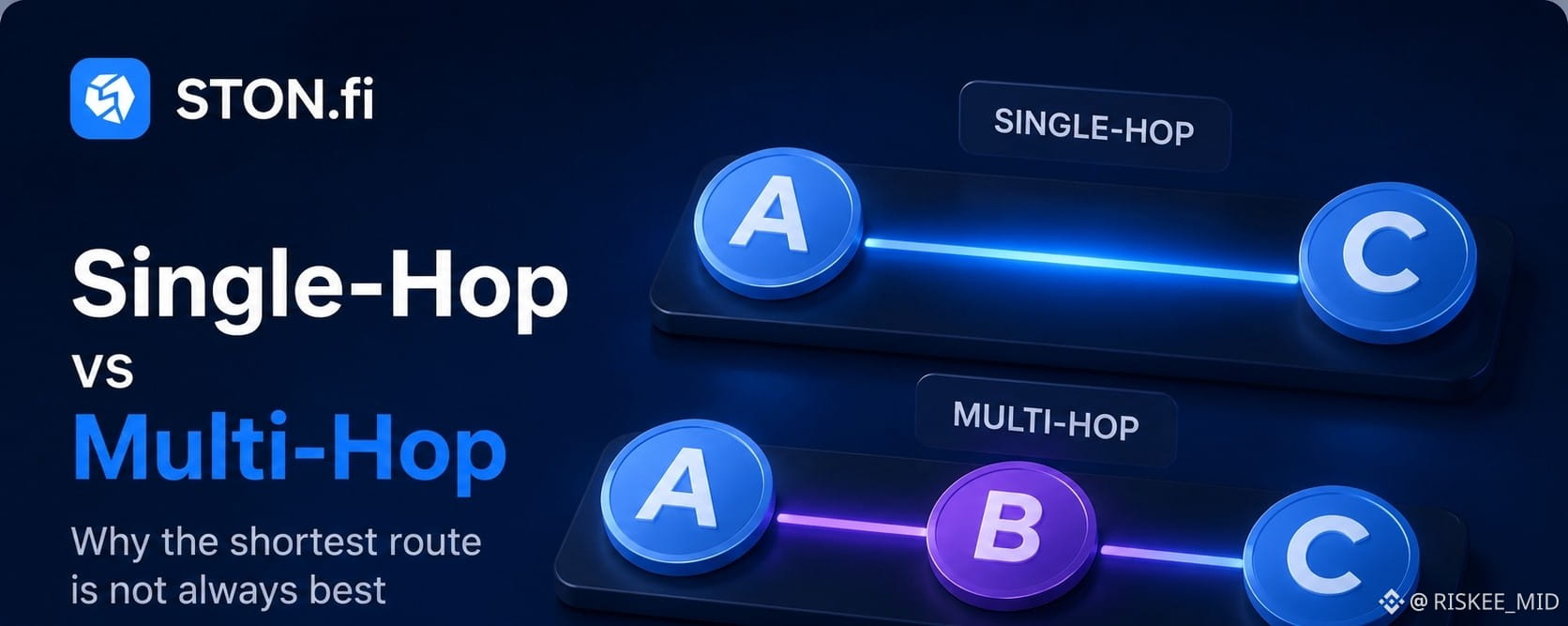
Article
Single-Hop vs Multi-Hop Swaps on STON.fi: Why the Shortest Route Is Not Always BestSingle Hop vs Multi Hop Swaps on STON.fi: Why the Shortest Route Is Not Always Best
In decentralized trading, it is easy to assume that the shortest route must also be the most efficient. A direct swap from Token A to Token C appears simpler than moving through Token B first. Fewer conversions sound like fewer fees, less complexity and better execution.
But in DeFi, simplicity does not automatically mean efficiency.
On STON.fi, a single-hop route can sometimes be the best option, while a multi-hop route can produce a better final result when liquidity is distributed unevenly across pools. The most important question is therefore not “How many hops does this swap use?” but “How much destination token will I actually receive after all relevant costs?”
Understanding this difference helps users evaluate routes more intelligently and avoid choosing a path simply because it looks shorter.
What Is a Hop?
A hop represents one asset-to-asset conversion within a swap route.
A single-hop swap moves directly from Token A to Token C:
Token A → Token C
A multi-hop swap reaches the same destination through one or more intermediate assets:
Token A → Token B → Token C
A route can contain even more conversions when that produces a stronger executable price.
Importantly, hop count refers to the number of asset conversions. It does not mean the number of wallet approvals or separate user interactions. A user may sign a single transaction through a connected wallet interface while the protocol executes a multi-step route on-chain.
This distinction matters because a route that looks complicated from a trading perspective can still be presented as one integrated swap experience.
Why the Direct Route Can Be Worse
The main reason a multi-hop route can outperform a single-hop route is liquidity.
Imagine a direct A/C pool with limited liquidity. A relatively large trade against that pool may move the price significantly, creating substantial price impact. Even though the route contains only one hop, the user could receive fewer destination tokens than expected.
Now imagine that A/B and B/C pools are much deeper.
The route:
A → B → C
may require an additional conversion, but the stronger liquidity available at each stage can reduce the amount of price movement caused by the trade. After accounting for the fees and execution costs of both pools, the multi-hop path may still produce a larger final amount of Token C.
That is the central principle:
Fewer hops do not automatically mean lower total cost.
The economic quality of a route depends on its complete execution, not simply its length.
The Role of Liquidity and Price Impact
Liquidity determines how efficiently a pool can absorb a trade.
When liquidity is deep relative to the size of a swap, trades can generally execute with less price movement. When liquidity is thin, even a moderate transaction can have a noticeable impact on the effective exchange rate.
This creates an important trade-off.
A direct route may have:
One hopOne poolFewer individual swap fees
But it could also have:
Lower liquidityGreater price impactWorse execution for larger orders
A multi-hop route may introduce another pool fee, yet compensate through stronger liquidity and better pricing at each stage.
Therefore, the relevant comparison is not simply the fee charged by each pool. Users should consider the final output after the route has been executed.
Why Fees Alone Are Not Enough
It is tempting to reject a multi-hop route because it contains more conversions and potentially more pool fees. That approach can be misleading.
Suppose a direct swap saves a small amount in fees but suffers significant price impact. A multi-hop route might incur additional fees while still delivering a greater amount of the destination asset.
For example, a direct route could theoretically charge fewer fees but produce 98.5 units of the destination asset, while a two-hop route could cost slightly more in fees but deliver 99.2 units.
From the user's perspective, the second route is economically better.
The goal of routing is not to minimize one isolated cost. It is to maximize the quality of the complete trade execution.
That includes liquidity, fees, price impact and other execution costs.
How STON.fi Handles Route Selection
STON.fi supports more than simply finding a direct pool between two assets.
Its DEX v2 architecture supports chained swaps, allowing routes to move through intermediate assets and work across different v2 Routers where applicable.
This is where Omniston becomes important.
Omniston is enabled by default in the STON.fi dApp and evaluates available liquidity sources to identify executable opportunities. Instead of forcing users to manually determine whether A/C, A/B/C or another route is better, the routing system can compare available paths and select a stronger result.
The key idea is that routing is an optimization problem.
The system is not necessarily looking for the route with the fewest hops. It is looking for a route that can provide the strongest executable outcome under the available market conditions.
Hop Count and Liquidity Sources Are Different
Another important point is that hop count and liquidity-source count are not the same thing.
A route can contain multiple hops while drawing liquidity from different pools or liquidity sources. Conversely, a route with fewer hops may still rely on a pool with poor liquidity for the particular trade size.
This distinction prevents a common misunderstanding: a short route is not automatically a simple or efficient route, and a longer route is not automatically inefficient.
The real question is how effectively the available liquidity is being used to execute the intended trade.
DEX v2 and Chained Swaps
STON.fi DEX v2 supports chained swaps on the same Router as well as routing across different v2 Routers.
That flexibility is significant because liquidity is rarely distributed perfectly across every possible token pair.
For some assets, a direct market may be deep and competitive. For others, liquidity may be concentrated around a common intermediary asset.
A routing system can take advantage of that structure.
Instead of assuming every pair should trade directly, it can consider whether an intermediate asset creates a better path to the final destination.
This is one of the fundamental advantages of intelligent decentralized exchange routing.
What Users Should Actually Check
When evaluating a STON.fi swap, users should pay attention to the final quote, not just the visual simplicity of the route.
Several details are especially important.
Expected Output
The quoted output tells you how much of the destination asset the route is expected to produce.
This is one of the most useful numbers for comparing alternatives.
Minimum Received
The minimum received amount is important because market conditions can change between the quote and execution. It provides a clearer picture of the protection applied to the trade under the chosen slippage settings.
Price Impact
Price impact helps indicate how strongly the trade itself affects the pool price.
A high price impact may signal that the available liquidity is relatively thin for the size of your transaction.
Route Structure
Check whether the swap is direct or uses one or more intermediate assets.
The presence of multiple hops is not automatically a warning sign. What matters is whether the route produces a stronger final result.
Network Execution Costs
Users should also maintain enough native network currency to cover transaction execution requirements.
A highly attractive quote is not useful if the transaction cannot be successfully executed because there is insufficient balance for network costs.
Why Trade Size Matters
Route quality is not fixed.
The same token pair can produce different optimal routes for different trade sizes.
A small swap may fit comfortably inside a direct pool with minimal price impact. A much larger transaction could move that same pool price significantly and make a multi-hop route more attractive.
This means there is no universal rule saying that Token A should always be swapped through Token B.
The optimal route depends on current liquidity conditions, available pools, fees, execution requirements and the size of the order.
A Practical Example
Consider a user swapping Token A for Token C.
The direct route is:
A → C
The alternative route is:
A → B → C
At first glance, the direct route appears superior because it contains only one hop.
However, suppose the A/C pool is relatively shallow. The user's transaction creates meaningful price impact, reducing the amount of Token C received.
Meanwhile, the A/B pool and B/C pool are both deeper. The additional conversion introduces another fee, but the stronger liquidity allows the transaction to execute more efficiently.
The result could be:
Direct route: fewer hops, but lower final output.
Multi-hop route: more hops, but higher final output.
In this situation, choosing the direct route solely because it is shorter would be an economic mistake.
The Broader Lesson About DeFi Routing
This concept extends beyond STON.fi.
Decentralized markets are fragmented. Liquidity can exist across many pools, assets and routing structures. A trader therefore needs more than a simple direct-pair model.
Intelligent routing exists because the best market path is not always obvious from the number of conversions involved.
The purpose of a routing engine is to search through available liquidity and determine how a trade can be executed most effectively.
For users, this means that route length should be treated as information, not as a quality score.
A two-hop or three-hop route is not necessarily worse than a one-hop route. The correct evaluation is based on what the complete route delivers.
Final Takeaway
Single-hop swaps are direct, easy to understand and can be highly efficient when the relevant pool has sufficient liquidity.
Multi-hop swaps introduce additional conversions, but those conversions can unlock deeper liquidity and reduce price impact enough to produce a better overall execution.
On STON.fi, the strongest route is therefore not necessarily the shortest route. With DEX v2's support for chained swaps and Omniston evaluating available liquidity opportunities, route selection can focus on the economic outcome rather than hop count alone.
Before confirming a trade, focus on the numbers that matter most:
Expected output. Minimum received. Price impact. Route structure. Network execution costs.
The practical rule is simple:
Do not ask which route has the fewest hops. Ask which route leaves you with the most destination tokens after all relevant costs.
In decentralized trading, the shortest path may look better on the screen. The best path is the one that executes better for the trade you are actually making.
EXPLORE MORE ON STON.FI HERE
#swap_crypto
Single-Hop vs Multi-Hop Swaps on STON.fi: Why the Shortest Route Is Not Always Best
Single Hop vs Multi Hop Swaps on STON.fi: Why the Shortest Route Is Not Always Best
In decentralized trading, it is easy to assume that the shortest route must also be the most efficient. A direct swap from Token A to Token C appears simpler than moving through Token B first. Fewer conversions sound like fewer fees, less complexity and better execution.
But in DeFi, simplicity does not automatically mean efficiency.
On STON.fi, a single-hop route can sometimes be the best option, while a multi-hop route can produce a better final result when liquidity is distributed unevenly across pools. The most important question is therefore not “How many hops does this swap use?” but “How much destination token will I actually receive after all relevant costs?”
Understanding this difference helps users evaluate routes more intelligently and avoid choosing a path simply because it looks shorter.
What Is a Hop?
A hop represents one asset-to-asset conversion within a swap route.
A single-hop swap moves directly from Token A to Token C:
Token A → Token C
A multi-hop swap reaches the same destination through one or more intermediate assets:
Token A → Token B → Token C
A route can contain even more conversions when that produces a stronger executable price.
Importantly, hop count refers to the number of asset conversions. It does not mean the number of wallet approvals or separate user interactions. A user may sign a single transaction through a connected wallet interface while the protocol executes a multi-step route on-chain.
This distinction matters because a route that looks complicated from a trading perspective can still be presented as one integrated swap experience.
Why the Direct Route Can Be Worse
The main reason a multi-hop route can outperform a single-hop route is liquidity.
Imagine a direct A/C pool with limited liquidity. A relatively large trade against that pool may move the price significantly, creating substantial price impact. Even though the route contains only one hop, the user could receive fewer destination tokens than expected.
Now imagine that A/B and B/C pools are much deeper.
The route:
A → B → C
may require an additional conversion, but the stronger liquidity available at each stage can reduce the amount of price movement caused by the trade. After accounting for the fees and execution costs of both pools, the multi-hop path may still produce a larger final amount of Token C.
That is the central principle:
Fewer hops do not automatically mean lower total cost.
The economic quality of a route depends on its complete execution, not simply its length.
The Role of Liquidity and Price Impact
Liquidity determines how efficiently a pool can absorb a trade.
When liquidity is deep relative to the size of a swap, trades can generally execute with less price movement. When liquidity is thin, even a moderate transaction can have a noticeable impact on the effective exchange rate.
This creates an important trade-off.
A direct route may have:
One hopOne poolFewer individual swap fees
But it could also have:
Lower liquidityGreater price impactWorse execution for larger orders
A multi-hop route may introduce another pool fee, yet compensate through stronger liquidity and better pricing at each stage.
Therefore, the relevant comparison is not simply the fee charged by each pool. Users should consider the final output after the route has been executed.
Why Fees Alone Are Not Enough
It is tempting to reject a multi-hop route because it contains more conversions and potentially more pool fees. That approach can be misleading.
Suppose a direct swap saves a small amount in fees but suffers significant price impact. A multi-hop route might incur additional fees while still delivering a greater amount of the destination asset.
For example, a direct route could theoretically charge fewer fees but produce 98.5 units of the destination asset, while a two-hop route could cost slightly more in fees but deliver 99.2 units.
From the user's perspective, the second route is economically better.
The goal of routing is not to minimize one isolated cost. It is to maximize the quality of the complete trade execution.
That includes liquidity, fees, price impact and other execution costs.
How STON.fi Handles Route Selection
STON.fi supports more than simply finding a direct pool between two assets.
Its DEX v2 architecture supports chained swaps, allowing routes to move through intermediate assets and work across different v2 Routers where applicable.
This is where Omniston becomes important.
Omniston is enabled by default in the STON.fi dApp and evaluates available liquidity sources to identify executable opportunities. Instead of forcing users to manually determine whether A/C, A/B/C or another route is better, the routing system can compare available paths and select a stronger result.
The key idea is that routing is an optimization problem.
The system is not necessarily looking for the route with the fewest hops. It is looking for a route that can provide the strongest executable outcome under the available market conditions.
Hop Count and Liquidity Sources Are Different
Another important point is that hop count and liquidity-source count are not the same thing.
A route can contain multiple hops while drawing liquidity from different pools or liquidity sources. Conversely, a route with fewer hops may still rely on a pool with poor liquidity for the particular trade size.
This distinction prevents a common misunderstanding: a short route is not automatically a simple or efficient route, and a longer route is not automatically inefficient.
The real question is how effectively the available liquidity is being used to execute the intended trade.
DEX v2 and Chained Swaps
STON.fi DEX v2 supports chained swaps on the same Router as well as routing across different v2 Routers.
That flexibility is significant because liquidity is rarely distributed perfectly across every possible token pair.
For some assets, a direct market may be deep and competitive. For others, liquidity may be concentrated around a common intermediary asset.
A routing system can take advantage of that structure.
Instead of assuming every pair should trade directly, it can consider whether an intermediate asset creates a better path to the final destination.
This is one of the fundamental advantages of intelligent decentralized exchange routing.
What Users Should Actually Check
When evaluating a STON.fi swap, users should pay attention to the final quote, not just the visual simplicity of the route.
Several details are especially important.
Expected Output
The quoted output tells you how much of the destination asset the route is expected to produce.
This is one of the most useful numbers for comparing alternatives.
Minimum Received
The minimum received amount is important because market conditions can change between the quote and execution. It provides a clearer picture of the protection applied to the trade under the chosen slippage settings.
Price Impact
Price impact helps indicate how strongly the trade itself affects the pool price.
A high price impact may signal that the available liquidity is relatively thin for the size of your transaction.
Route Structure
Check whether the swap is direct or uses one or more intermediate assets.
The presence of multiple hops is not automatically a warning sign. What matters is whether the route produces a stronger final result.
Network Execution Costs
Users should also maintain enough native network currency to cover transaction execution requirements.
A highly attractive quote is not useful if the transaction cannot be successfully executed because there is insufficient balance for network costs.
Why Trade Size Matters
Route quality is not fixed.
The same token pair can produce different optimal routes for different trade sizes.
A small swap may fit comfortably inside a direct pool with minimal price impact. A much larger transaction could move that same pool price significantly and make a multi-hop route more attractive.
This means there is no universal rule saying that Token A should always be swapped through Token B.
The optimal route depends on current liquidity conditions, available pools, fees, execution requirements and the size of the order.
A Practical Example
Consider a user swapping Token A for Token C.
The direct route is:
A → C
The alternative route is:
A → B → C
At first glance, the direct route appears superior because it contains only one hop.
However, suppose the A/C pool is relatively shallow. The user's transaction creates meaningful price impact, reducing the amount of Token C received.
Meanwhile, the A/B pool and B/C pool are both deeper. The additional conversion introduces another fee, but the stronger liquidity allows the transaction to execute more efficiently.
The result could be:
Direct route: fewer hops, but lower final output.
Multi-hop route: more hops, but higher final output.
In this situation, choosing the direct route solely because it is shorter would be an economic mistake.
The Broader Lesson About DeFi Routing
This concept extends beyond STON.fi.
Decentralized markets are fragmented. Liquidity can exist across many pools, assets and routing structures. A trader therefore needs more than a simple direct-pair model.
Intelligent routing exists because the best market path is not always obvious from the number of conversions involved.
The purpose of a routing engine is to search through available liquidity and determine how a trade can be executed most effectively.
For users, this means that route length should be treated as information, not as a quality score.
A two-hop or three-hop route is not necessarily worse than a one-hop route. The correct evaluation is based on what the complete route delivers.
Final Takeaway
Single-hop swaps are direct, easy to understand and can be highly efficient when the relevant pool has sufficient liquidity.
Multi-hop swaps introduce additional conversions, but those conversions can unlock deeper liquidity and reduce price impact enough to produce a better overall execution.
On STON.fi, the strongest route is therefore not necessarily the shortest route. With DEX v2's support for chained swaps and Omniston evaluating available liquidity opportunities, route selection can focus on the economic outcome rather than hop count alone.
Before confirming a trade, focus on the numbers that matter most:
Expected output. Minimum received. Price impact. Route structure. Network execution costs.
The practical rule is simple:
Do not ask which route has the fewest hops. Ask which route leaves you with the most destination tokens after all relevant costs.
In decentralized trading, the shortest path may look better on the screen. The best path is the one that executes better for the trade you are actually making.
EXPLORE MORE ON STON.FI HERE
#swap_crypto
In decentralized trading, it is easy to assume that the shortest route must also be the most efficient. A direct swap from Token A to Token C appears simpler than moving through Token B first. Fewer conversions sound like fewer fees, less complexity and better execution.
But in DeFi, simplicity does not automatically mean efficiency.
On STON.fi, a single-hop route can sometimes be the best option, while a multi-hop route can produce a better final result when liquidity is distributed unevenly across pools. The most important question is therefore not “How many hops does this swap use?” but “How much destination token will I actually receive after all relevant costs?”
Understanding this difference helps users evaluate routes more intelligently and avoid choosing a path simply because it looks shorter.
What Is a Hop?
A hop represents one asset-to-asset conversion within a swap route.
A single-hop swap moves directly from Token A to Token C:
Token A → Token C
A multi-hop swap reaches the same destination through one or more intermediate assets:
Token A → Token B → Token C
A route can contain even more conversions when that produces a stronger executable price.
Importantly, hop count refers to the number of asset conversions. It does not mean the number of wallet approvals or separate user interactions. A user may sign a single transaction through a connected wallet interface while the protocol executes a multi-step route on-chain.
This distinction matters because a route that looks complicated from a trading perspective can still be presented as one integrated swap experience.
Why the Direct Route Can Be Worse
The main reason a multi-hop route can outperform a single-hop route is liquidity.
Imagine a direct A/C pool with limited liquidity. A relatively large trade against that pool may move the price significantly, creating substantial price impact. Even though the route contains only one hop, the user could receive fewer destination tokens than expected.
Now imagine that A/B and B/C pools are much deeper.
The route:
A → B → C
may require an additional conversion, but the stronger liquidity available at each stage can reduce the amount of price movement caused by the trade. After accounting for the fees and execution costs of both pools, the multi-hop path may still produce a larger final amount of Token C.
That is the central principle:
Fewer hops do not automatically mean lower total cost.
The economic quality of a route depends on its complete execution, not simply its length.
The Role of Liquidity and Price Impact
Liquidity determines how efficiently a pool can absorb a trade.
When liquidity is deep relative to the size of a swap, trades can generally execute with less price movement. When liquidity is thin, even a moderate transaction can have a noticeable impact on the effective exchange rate.
This creates an important trade-off.
A direct route may have:
One hopOne poolFewer individual swap fees
But it could also have:
Lower liquidityGreater price impactWorse execution for larger orders
A multi-hop route may introduce another pool fee, yet compensate through stronger liquidity and better pricing at each stage.
Therefore, the relevant comparison is not simply the fee charged by each pool. Users should consider the final output after the route has been executed.
Why Fees Alone Are Not Enough
It is tempting to reject a multi-hop route because it contains more conversions and potentially more pool fees. That approach can be misleading.
Suppose a direct swap saves a small amount in fees but suffers significant price impact. A multi-hop route might incur additional fees while still delivering a greater amount of the destination asset.
For example, a direct route could theoretically charge fewer fees but produce 98.5 units of the destination asset, while a two-hop route could cost slightly more in fees but deliver 99.2 units.
From the user's perspective, the second route is economically better.
The goal of routing is not to minimize one isolated cost. It is to maximize the quality of the complete trade execution.
That includes liquidity, fees, price impact and other execution costs.
How STON.fi Handles Route Selection
STON.fi supports more than simply finding a direct pool between two assets.
Its DEX v2 architecture supports chained swaps, allowing routes to move through intermediate assets and work across different v2 Routers where applicable.
This is where Omniston becomes important.
Omniston is enabled by default in the STON.fi dApp and evaluates available liquidity sources to identify executable opportunities. Instead of forcing users to manually determine whether A/C, A/B/C or another route is better, the routing system can compare available paths and select a stronger result.
The key idea is that routing is an optimization problem.
The system is not necessarily looking for the route with the fewest hops. It is looking for a route that can provide the strongest executable outcome under the available market conditions.
Hop Count and Liquidity Sources Are Different
Another important point is that hop count and liquidity-source count are not the same thing.
A route can contain multiple hops while drawing liquidity from different pools or liquidity sources. Conversely, a route with fewer hops may still rely on a pool with poor liquidity for the particular trade size.
This distinction prevents a common misunderstanding: a short route is not automatically a simple or efficient route, and a longer route is not automatically inefficient.
The real question is how effectively the available liquidity is being used to execute the intended trade.
DEX v2 and Chained Swaps
STON.fi DEX v2 supports chained swaps on the same Router as well as routing across different v2 Routers.
That flexibility is significant because liquidity is rarely distributed perfectly across every possible token pair.
For some assets, a direct market may be deep and competitive. For others, liquidity may be concentrated around a common intermediary asset.
A routing system can take advantage of that structure.
Instead of assuming every pair should trade directly, it can consider whether an intermediate asset creates a better path to the final destination.
This is one of the fundamental advantages of intelligent decentralized exchange routing.
What Users Should Actually Check
When evaluating a STON.fi swap, users should pay attention to the final quote, not just the visual simplicity of the route.
Several details are especially important.
Expected Output
The quoted output tells you how much of the destination asset the route is expected to produce.
This is one of the most useful numbers for comparing alternatives.
Minimum Received
The minimum received amount is important because market conditions can change between the quote and execution. It provides a clearer picture of the protection applied to the trade under the chosen slippage settings.
Price Impact
Price impact helps indicate how strongly the trade itself affects the pool price.
A high price impact may signal that the available liquidity is relatively thin for the size of your transaction.
Route Structure
Check whether the swap is direct or uses one or more intermediate assets.
The presence of multiple hops is not automatically a warning sign. What matters is whether the route produces a stronger final result.
Network Execution Costs
Users should also maintain enough native network currency to cover transaction execution requirements.
A highly attractive quote is not useful if the transaction cannot be successfully executed because there is insufficient balance for network costs.
Why Trade Size Matters
Route quality is not fixed.
The same token pair can produce different optimal routes for different trade sizes.
A small swap may fit comfortably inside a direct pool with minimal price impact. A much larger transaction could move that same pool price significantly and make a multi-hop route more attractive.
This means there is no universal rule saying that Token A should always be swapped through Token B.
The optimal route depends on current liquidity conditions, available pools, fees, execution requirements and the size of the order.
A Practical Example
Consider a user swapping Token A for Token C.
The direct route is:
A → C
The alternative route is:
A → B → C
At first glance, the direct route appears superior because it contains only one hop.
However, suppose the A/C pool is relatively shallow. The user's transaction creates meaningful price impact, reducing the amount of Token C received.
Meanwhile, the A/B pool and B/C pool are both deeper. The additional conversion introduces another fee, but the stronger liquidity allows the transaction to execute more efficiently.
The result could be:
Direct route: fewer hops, but lower final output.
Multi-hop route: more hops, but higher final output.
In this situation, choosing the direct route solely because it is shorter would be an economic mistake.
The Broader Lesson About DeFi Routing
This concept extends beyond STON.fi.
Decentralized markets are fragmented. Liquidity can exist across many pools, assets and routing structures. A trader therefore needs more than a simple direct-pair model.
Intelligent routing exists because the best market path is not always obvious from the number of conversions involved.
The purpose of a routing engine is to search through available liquidity and determine how a trade can be executed most effectively.
For users, this means that route length should be treated as information, not as a quality score.
A two-hop or three-hop route is not necessarily worse than a one-hop route. The correct evaluation is based on what the complete route delivers.
Final Takeaway
Single-hop swaps are direct, easy to understand and can be highly efficient when the relevant pool has sufficient liquidity.
Multi-hop swaps introduce additional conversions, but those conversions can unlock deeper liquidity and reduce price impact enough to produce a better overall execution.
On STON.fi, the strongest route is therefore not necessarily the shortest route. With DEX v2's support for chained swaps and Omniston evaluating available liquidity opportunities, route selection can focus on the economic outcome rather than hop count alone.
Before confirming a trade, focus on the numbers that matter most:
Expected output. Minimum received. Price impact. Route structure. Network execution costs.
The practical rule is simple:
Do not ask which route has the fewest hops. Ask which route leaves you with the most destination tokens after all relevant costs.
In decentralized trading, the shortest path may look better on the screen. The best path is the one that executes better for the trade you are actually making.
EXPLORE MORE ON STON.FI HERE
#swap_crypto
1
84
·
--
What Is Oracle Risk and When Does It Matter Around STON.fi Assets?What Is Oracle Risk and When Does It Matter Around STON.fi Assets?
DeFi is built around one powerful idea: smart contracts can execute financial rules without relying on a traditional intermediary. But smart contracts cannot automatically know what is happening outside their blockchain. Whenever an application needs external information—such as an asset price, a reserve level, or the status of an off-chain asset—it needs some mechanism to bring that information on-chain.
That is where oracle risk enters the picture.
Oracle risk is the possibility that a blockchain application receives incorrect, stale, delayed, manipulated, unavailable, or improperly interpreted external data and then acts on that data as though it were accurate. The smart contract itself may execute exactly as programmed, yet still produce a harmful financial outcome because the information it relied on was wrong.
For users interacting with STON.fi, understanding this distinction is important. A standard STON.fi AMM swap does not fundamentally depend on an external price oracle to determine the pool's trading price. Instead, the pool can derive pricing from its own on-chain reserves. However, oracle risk can become significant when STON.fi assets interact with lending markets, tokenized real-world assets, collateral systems, or other protocols that require information from outside the pool.
What Exactly Is Oracle Risk?
A smart contract is deterministic. It follows the rules encoded into its logic using the data available to it.
The problem is that some financial decisions require information that does not naturally exist on-chain.
Consider a lending protocol that accepts a STON.fi-traded asset as collateral. Before deciding how much a user can borrow, the protocol may need to know the current market value of that asset.
The blockchain itself does not automatically know the asset's global market price.
An oracle can provide that information.
If the oracle reports the wrong price, the lending protocol can still execute correctly according to its code—but the result may be economically incorrect.
For example, if an asset worth $100 is temporarily reported as worth $160, a lending protocol could allow users to borrow more against it than they should. If the reported price suddenly falls to $40 because of a faulty or manipulated feed, positions could be liquidated unnecessarily.
This illustrates a crucial point:
Oracle risk is often not a smart-contract coding failure. It is an information-quality failure that can become a smart-contract financial failure.
Oracles may provide many types of information, including:
Asset pricesExchange ratesReserve informationMarket statusExternal collateral dataReal-world asset referencesProof-of-reserve information
The more a protocol depends on external information, the more important oracle design becomes.
How STON.fi Pricing Can Work Without an External Oracle
One of the most important distinctions for STON.fi users is the difference between AMM pricing and oracle-based pricing.
A traditional STON.fi AMM pool contains two assets and maintains on-chain reserves. In a simplified constant-product model, the relationship between those reserves determines the pool's current trading price.
As users trade, the reserve balances change.
Those reserve changes affect the next available price.
This means the pool can determine its swap price using information that already exists on the blockchain.
There is no need for an external server to tell the AMM:
“This token is worth $X.”
Instead, the pool's own state determines the exchange rate between its assets.
That is a major difference between a swap mechanism and a price oracle.
A user swapping Asset A for Asset B through an AMM is interacting with a pricing mechanism derived from the pool's liquidity and reserves. An external protocol asking, “What is the USD value of this asset?” may need an oracle.
So, while both systems involve prices, they answer different questions.
AMM pricing:
“What exchange rate is currently available in this pool?”
Oracle pricing:
“What should this asset be valued at according to an external reference?”
Confusing these two concepts can lead to a misunderstanding of where oracle risk actually exists.
When Does Oracle Risk Appear Around STON.fi Assets?
Oracle risk becomes more relevant when an asset traded or accessed through STON.fi is subsequently used in another protocol that requires external information.
1. Lending and Borrowing
Suppose a token is traded on STON.fi and then deposited into a lending protocol as collateral.
The lending protocol needs to determine the collateral's value.
It may use an oracle to answer questions such as:
What is the current market price?Has the price changed significantly?Is the data recent?Should the user's position be liquidated?
Now the safety of the position depends not only on the token and the lending contract, but also on the quality of the pricing mechanism.
If an oracle becomes stale, manipulated, unavailable, or inaccurate, the consequences can include under-collateralized loans, excessive borrowing capacity, premature liquidations, or losses for liquidity providers and lenders.
2. Synthetic and Tokenized Assets
Oracle dependence becomes even more important when an asset represents something that does not naturally exist on the blockchain.
Consider a token designed to track a stock, ETF, commodity, index, or another real-world reference.
The blockchain cannot independently observe the live price of that external asset.
An oracle or another trusted data mechanism must connect the on-chain token to its external reference.
This creates an additional layer of risk.
Even if the token trades smoothly on STON.fi, the deeper question remains:
How does the system know what the underlying real-world asset is worth?
The AMM can facilitate trading, but it does not automatically verify the external asset's real-world value.
xStocks and the Difference Between Access and Verification
Tokenized assets such as xStocks make this distinction particularly important.
A tokenized stock can trade on-chain and become accessible through DeFi infrastructure, including decentralized exchanges and routing systems. But the economic reference of that token originates outside the blockchain.
That means several different components may play different roles.
1. STON.fi:
Provides the decentralized trading and liquidity infrastructure through which users can access and exchange supported assets.
2. Issuer:
Responsible for the token's relationship to the underlying real-world asset and the associated issuance structure.
3. Oracle or data infrastructure:
Can provide reference information about prices, reserves, collateral, or other external conditions required by surrounding financial systems.
These responsibilities should not be treated as the same thing.
STON.fi providing a market for a token does not automatically mean STON.fi is responsible for determining whether the real-world asset represented by that token actually exists, what its external market value is, or whether its backing remains sufficient.
That distinction is essential for understanding risk.
Price Feeds and Proof of Reserve Are Not the Same
One of the most common misunderstandings around tokenized assets is treating price data and reserve verification as interchangeable.
They are not.
A price feed answers a question such as:
“What is this asset worth right now?”
A Proof of Reserve mechanism addresses a different question:
“Does the claimed underlying backing actually exist?”
Imagine a token representing $10 million worth of securities.
A reliable price feed could indicate that the underlying securities are currently worth $10 million.
But that does not independently prove that the issuer actually holds $10 million of those securities.
Conversely, an attestation that the issuer holds $10 million in reserves does not automatically tell you the precise market value of those assets at this exact moment.
Therefore, a robust tokenized-asset system may need multiple forms of verification.
Price verification concerns valuation.
Reserve verification concerns backing.
The two can complement one another, but neither automatically replaces the other.
Where Oracle Failures Can Become Dangerous
Oracle risk becomes especially important when incorrect data can trigger an irreversible or highly consequential action.
Examples include:
-- Liquidations:
A faulty price can cause healthy positions to appear under-collateralized.
-- Borrowing limits:
An inflated valuation can allow users to borrow more funds than their collateral should support.
-- Settlement:
Incorrect reference data can produce an incorrect settlement amount.
-- Redemptions:
A flawed valuation may cause users to receive too much or too little value when redeeming an asset.
-- Synthetic assets:
A manipulated reference price can cause a derivative or synthetic asset to deviate materially from its intended value.
-- Risk management:
Protocols may use external data to determine whether certain positions or markets should remain active.
The important lesson is that an oracle does not need to completely “break” for damage to occur.
Even a temporary delay can matter in a market that moves rapidly.
What Makes an Oracle More Reliable?
Oracle security is not simply about asking whether an oracle exists. The more important question is how the oracle obtains, validates, aggregates, and delivers its information.
Important considerations include:
1. Data Quality
Where does the information originate?
A feed based on a broad and reliable market can be more resilient than one dependent on a single thinly traded venue.
2. Freshness
How recently was the data updated?
A price that was accurate ten minutes ago may be dangerously outdated during a fast-moving market.
3. Manipulation Resistance
How difficult is it for someone to influence the reported value?
Thin liquidity can make some markets easier to manipulate, which can create problems if those markets are used as oracle inputs.
4. Availability
What happens when the data provider becomes unavailable?
A resilient system should have mechanisms for handling outages rather than blindly treating missing information as accurate information.
5. Aggregation
Does the system rely on a single source or multiple independent sources?
Multiple sources can reduce dependence on one vulnerable market or provider.
6. Circuit Breakers and Validation
Does the protocol reject obviously abnormal values?
Sanity checks, deviation limits, heartbeat requirements, and emergency controls can help reduce the impact of bad data.
These mechanisms do not eliminate oracle risk, but they can reduce its probability and severity.
Why STON.fi Users Should Look Beyond the Swap
A successful swap does not mean every layer of the surrounding DeFi system is risk-free.
A user might:
Swap a token on STON.fi.Deposit that token into a lending protocol.Borrow another asset against it.Depend on an oracle for valuation.Face liquidation if the oracle reports a particular price.
Only one step in that journey may depend directly on an oracle, but that step can have a major financial impact.
This is why risk should be evaluated across the entire application stack, not simply at the exchange layer.
STON.fi's role as a trading and liquidity venue should be separated from the risks introduced by protocols that build additional financial functionality around STON.fi-traded assets.
A Practical Risk Framework for Users
Before using a STON.fi asset in another DeFi protocol, it is useful to ask several questions.
1. Does this application require an oracle?
A simple swap may not, but lending, derivatives, synthetic assets, and other financial applications often do.
2. Where does the price come from?
Understand whether the protocol uses a decentralized oracle, market data aggregation, a specific trading venue, or another mechanism.
3. How frequently is the information updated?
Stale data can be almost as dangerous as incorrect data.
4. Can the source be manipulated?
Thin or illiquid markets may create weaknesses.
5. What happens during an oracle outage?
A protocol's emergency behavior can be just as important as its normal operation.
6. Is the token backed by an external asset?
For tokenized real-world assets, investigate the issuer, backing structure, verification process, and relevant data mechanisms.
7. Who is responsible for each layer?
Do not automatically assume that the exchange, token issuer, oracle provider, and lending protocol are the same entity or share the same responsibilities.
Final Thoughts
Oracle risk is best understood as a data dependency risk.
The blockchain can execute code with remarkable precision, but perfect execution cannot compensate for incorrect information.
For STON.fi's core AMM trading mechanism, pricing can be derived directly from on-chain pool reserves, meaning the pool itself does not require an external oracle simply to calculate a swap price.
The situation changes when STON.fi assets move into other financial applications.
Lending protocols may need external price feeds. Tokenized real-world assets may depend on external reference data. Proof-of-reserve systems may be needed to verify backing. Derivatives and synthetic assets can introduce even greater dependence on accurate external information.
For xStocks and similar assets, it is therefore important to distinguish between trading infrastructure, asset issuance, price discovery, oracle data, and reserve verification. Each serves a different function and introduces a different risk surface.
The key takeaway is simple:
A STON.fi swap may not need an oracle, but a financial application built around a STON.fi-traded asset might.
Understanding where that dependency begins—and what happens if the data is wrong—is an essential part of managing DeFi risk.
Explore more on STON.FI
#Oracle #TradingCommunity
What Is Oracle Risk and When Does It Matter Around STON.fi Assets?
What Is Oracle Risk and When Does It Matter Around STON.fi Assets?
DeFi is built around one powerful idea: smart contracts can execute financial rules without relying on a traditional intermediary. But smart contracts cannot automatically know what is happening outside their blockchain. Whenever an application needs external information—such as an asset price, a reserve level, or the status of an off-chain asset—it needs some mechanism to bring that information on-chain.
That is where oracle risk enters the picture.
Oracle risk is the possibility that a blockchain application receives incorrect, stale, delayed, manipulated, unavailable, or improperly interpreted external data and then acts on that data as though it were accurate. The smart contract itself may execute exactly as programmed, yet still produce a harmful financial outcome because the information it relied on was wrong.
For users interacting with STON.fi, understanding this distinction is important. A standard STON.fi AMM swap does not fundamentally depend on an external price oracle to determine the pool's trading price. Instead, the pool can derive pricing from its own on-chain reserves. However, oracle risk can become significant when STON.fi assets interact with lending markets, tokenized real-world assets, collateral systems, or other protocols that require information from outside the pool.
What Exactly Is Oracle Risk?
A smart contract is deterministic. It follows the rules encoded into its logic using the data available to it.
The problem is that some financial decisions require information that does not naturally exist on-chain.
Consider a lending protocol that accepts a STON.fi-traded asset as collateral. Before deciding how much a user can borrow, the protocol may need to know the current market value of that asset.
The blockchain itself does not automatically know the asset's global market price.
An oracle can provide that information.
If the oracle reports the wrong price, the lending protocol can still execute correctly according to its code—but the result may be economically incorrect.
For example, if an asset worth $100 is temporarily reported as worth $160, a lending protocol could allow users to borrow more against it than they should. If the reported price suddenly falls to $40 because of a faulty or manipulated feed, positions could be liquidated unnecessarily.
This illustrates a crucial point:
Oracle risk is often not a smart-contract coding failure. It is an information-quality failure that can become a smart-contract financial failure.
Oracles may provide many types of information, including:
Asset pricesExchange ratesReserve informationMarket statusExternal collateral dataReal-world asset referencesProof-of-reserve information
The more a protocol depends on external information, the more important oracle design becomes.
How STON.fi Pricing Can Work Without an External Oracle
One of the most important distinctions for STON.fi users is the difference between AMM pricing and oracle-based pricing.
A traditional STON.fi AMM pool contains two assets and maintains on-chain reserves. In a simplified constant-product model, the relationship between those reserves determines the pool's current trading price.
As users trade, the reserve balances change.
Those reserve changes affect the next available price.
This means the pool can determine its swap price using information that already exists on the blockchain.
There is no need for an external server to tell the AMM:
“This token is worth $X.”
Instead, the pool's own state determines the exchange rate between its assets.
That is a major difference between a swap mechanism and a price oracle.
A user swapping Asset A for Asset B through an AMM is interacting with a pricing mechanism derived from the pool's liquidity and reserves. An external protocol asking, “What is the USD value of this asset?” may need an oracle.
So, while both systems involve prices, they answer different questions.
AMM pricing:
“What exchange rate is currently available in this pool?”
Oracle pricing:
“What should this asset be valued at according to an external reference?”
Confusing these two concepts can lead to a misunderstanding of where oracle risk actually exists.
When Does Oracle Risk Appear Around STON.fi Assets?
Oracle risk becomes more relevant when an asset traded or accessed through STON.fi is subsequently used in another protocol that requires external information.
1. Lending and Borrowing
Suppose a token is traded on STON.fi and then deposited into a lending protocol as collateral.
The lending protocol needs to determine the collateral's value.
It may use an oracle to answer questions such as:
What is the current market price?Has the price changed significantly?Is the data recent?Should the user's position be liquidated?
Now the safety of the position depends not only on the token and the lending contract, but also on the quality of the pricing mechanism.
If an oracle becomes stale, manipulated, unavailable, or inaccurate, the consequences can include under-collateralized loans, excessive borrowing capacity, premature liquidations, or losses for liquidity providers and lenders.
2. Synthetic and Tokenized Assets
Oracle dependence becomes even more important when an asset represents something that does not naturally exist on the blockchain.
Consider a token designed to track a stock, ETF, commodity, index, or another real-world reference.
The blockchain cannot independently observe the live price of that external asset.
An oracle or another trusted data mechanism must connect the on-chain token to its external reference.
This creates an additional layer of risk.
Even if the token trades smoothly on STON.fi, the deeper question remains:
How does the system know what the underlying real-world asset is worth?
The AMM can facilitate trading, but it does not automatically verify the external asset's real-world value.
xStocks and the Difference Between Access and Verification
Tokenized assets such as xStocks make this distinction particularly important.
A tokenized stock can trade on-chain and become accessible through DeFi infrastructure, including decentralized exchanges and routing systems. But the economic reference of that token originates outside the blockchain.
That means several different components may play different roles.
1. STON.fi:
Provides the decentralized trading and liquidity infrastructure through which users can access and exchange supported assets.
2. Issuer:
Responsible for the token's relationship to the underlying real-world asset and the associated issuance structure.
3. Oracle or data infrastructure:
Can provide reference information about prices, reserves, collateral, or other external conditions required by surrounding financial systems.
These responsibilities should not be treated as the same thing.
STON.fi providing a market for a token does not automatically mean STON.fi is responsible for determining whether the real-world asset represented by that token actually exists, what its external market value is, or whether its backing remains sufficient.
That distinction is essential for understanding risk.
Price Feeds and Proof of Reserve Are Not the Same
One of the most common misunderstandings around tokenized assets is treating price data and reserve verification as interchangeable.
They are not.
A price feed answers a question such as:
“What is this asset worth right now?”
A Proof of Reserve mechanism addresses a different question:
“Does the claimed underlying backing actually exist?”
Imagine a token representing $10 million worth of securities.
A reliable price feed could indicate that the underlying securities are currently worth $10 million.
But that does not independently prove that the issuer actually holds $10 million of those securities.
Conversely, an attestation that the issuer holds $10 million in reserves does not automatically tell you the precise market value of those assets at this exact moment.
Therefore, a robust tokenized-asset system may need multiple forms of verification.
Price verification concerns valuation.
Reserve verification concerns backing.
The two can complement one another, but neither automatically replaces the other.
Where Oracle Failures Can Become Dangerous
Oracle risk becomes especially important when incorrect data can trigger an irreversible or highly consequential action.
Examples include:
-- Liquidations:
A faulty price can cause healthy positions to appear under-collateralized.
-- Borrowing limits:
An inflated valuation can allow users to borrow more funds than their collateral should support.
-- Settlement:
Incorrect reference data can produce an incorrect settlement amount.
-- Redemptions:
A flawed valuation may cause users to receive too much or too little value when redeeming an asset.
-- Synthetic assets:
A manipulated reference price can cause a derivative or synthetic asset to deviate materially from its intended value.
-- Risk management:
Protocols may use external data to determine whether certain positions or markets should remain active.
The important lesson is that an oracle does not need to completely “break” for damage to occur.
Even a temporary delay can matter in a market that moves rapidly.
What Makes an Oracle More Reliable?
Oracle security is not simply about asking whether an oracle exists. The more important question is how the oracle obtains, validates, aggregates, and delivers its information.
Important considerations include:
1. Data Quality
Where does the information originate?
A feed based on a broad and reliable market can be more resilient than one dependent on a single thinly traded venue.
2. Freshness
How recently was the data updated?
A price that was accurate ten minutes ago may be dangerously outdated during a fast-moving market.
3. Manipulation Resistance
How difficult is it for someone to influence the reported value?
Thin liquidity can make some markets easier to manipulate, which can create problems if those markets are used as oracle inputs.
4. Availability
What happens when the data provider becomes unavailable?
A resilient system should have mechanisms for handling outages rather than blindly treating missing information as accurate information.
5. Aggregation
Does the system rely on a single source or multiple independent sources?
Multiple sources can reduce dependence on one vulnerable market or provider.
6. Circuit Breakers and Validation
Does the protocol reject obviously abnormal values?
Sanity checks, deviation limits, heartbeat requirements, and emergency controls can help reduce the impact of bad data.
These mechanisms do not eliminate oracle risk, but they can reduce its probability and severity.
Why STON.fi Users Should Look Beyond the Swap
A successful swap does not mean every layer of the surrounding DeFi system is risk-free.
A user might:
Swap a token on STON.fi.Deposit that token into a lending protocol.Borrow another asset against it.Depend on an oracle for valuation.Face liquidation if the oracle reports a particular price.
Only one step in that journey may depend directly on an oracle, but that step can have a major financial impact.
This is why risk should be evaluated across the entire application stack, not simply at the exchange layer.
STON.fi's role as a trading and liquidity venue should be separated from the risks introduced by protocols that build additional financial functionality around STON.fi-traded assets.
A Practical Risk Framework for Users
Before using a STON.fi asset in another DeFi protocol, it is useful to ask several questions.
1. Does this application require an oracle?
A simple swap may not, but lending, derivatives, synthetic assets, and other financial applications often do.
2. Where does the price come from?
Understand whether the protocol uses a decentralized oracle, market data aggregation, a specific trading venue, or another mechanism.
3. How frequently is the information updated?
Stale data can be almost as dangerous as incorrect data.
4. Can the source be manipulated?
Thin or illiquid markets may create weaknesses.
5. What happens during an oracle outage?
A protocol's emergency behavior can be just as important as its normal operation.
6. Is the token backed by an external asset?
For tokenized real-world assets, investigate the issuer, backing structure, verification process, and relevant data mechanisms.
7. Who is responsible for each layer?
Do not automatically assume that the exchange, token issuer, oracle provider, and lending protocol are the same entity or share the same responsibilities.
Final Thoughts
Oracle risk is best understood as a data dependency risk.
The blockchain can execute code with remarkable precision, but perfect execution cannot compensate for incorrect information.
For STON.fi's core AMM trading mechanism, pricing can be derived directly from on-chain pool reserves, meaning the pool itself does not require an external oracle simply to calculate a swap price.
The situation changes when STON.fi assets move into other financial applications.
Lending protocols may need external price feeds. Tokenized real-world assets may depend on external reference data. Proof-of-reserve systems may be needed to verify backing. Derivatives and synthetic assets can introduce even greater dependence on accurate external information.
For xStocks and similar assets, it is therefore important to distinguish between trading infrastructure, asset issuance, price discovery, oracle data, and reserve verification. Each serves a different function and introduces a different risk surface.
The key takeaway is simple:
A STON.fi swap may not need an oracle, but a financial application built around a STON.fi-traded asset might.
Understanding where that dependency begins—and what happens if the data is wrong—is an essential part of managing DeFi risk.
Explore more on STON.FI
#Oracle #TradingCommunity
DeFi is built around one powerful idea: smart contracts can execute financial rules without relying on a traditional intermediary. But smart contracts cannot automatically know what is happening outside their blockchain. Whenever an application needs external information—such as an asset price, a reserve level, or the status of an off-chain asset—it needs some mechanism to bring that information on-chain.
That is where oracle risk enters the picture.
Oracle risk is the possibility that a blockchain application receives incorrect, stale, delayed, manipulated, unavailable, or improperly interpreted external data and then acts on that data as though it were accurate. The smart contract itself may execute exactly as programmed, yet still produce a harmful financial outcome because the information it relied on was wrong.
For users interacting with STON.fi, understanding this distinction is important. A standard STON.fi AMM swap does not fundamentally depend on an external price oracle to determine the pool's trading price. Instead, the pool can derive pricing from its own on-chain reserves. However, oracle risk can become significant when STON.fi assets interact with lending markets, tokenized real-world assets, collateral systems, or other protocols that require information from outside the pool.
What Exactly Is Oracle Risk?
A smart contract is deterministic. It follows the rules encoded into its logic using the data available to it.
The problem is that some financial decisions require information that does not naturally exist on-chain.
Consider a lending protocol that accepts a STON.fi-traded asset as collateral. Before deciding how much a user can borrow, the protocol may need to know the current market value of that asset.
The blockchain itself does not automatically know the asset's global market price.
An oracle can provide that information.
If the oracle reports the wrong price, the lending protocol can still execute correctly according to its code—but the result may be economically incorrect.
For example, if an asset worth $100 is temporarily reported as worth $160, a lending protocol could allow users to borrow more against it than they should. If the reported price suddenly falls to $40 because of a faulty or manipulated feed, positions could be liquidated unnecessarily.
This illustrates a crucial point:
Oracle risk is often not a smart-contract coding failure. It is an information-quality failure that can become a smart-contract financial failure.
Oracles may provide many types of information, including:
Asset pricesExchange ratesReserve informationMarket statusExternal collateral dataReal-world asset referencesProof-of-reserve information
The more a protocol depends on external information, the more important oracle design becomes.
How STON.fi Pricing Can Work Without an External Oracle
One of the most important distinctions for STON.fi users is the difference between AMM pricing and oracle-based pricing.
A traditional STON.fi AMM pool contains two assets and maintains on-chain reserves. In a simplified constant-product model, the relationship between those reserves determines the pool's current trading price.
As users trade, the reserve balances change.
Those reserve changes affect the next available price.
This means the pool can determine its swap price using information that already exists on the blockchain.
There is no need for an external server to tell the AMM:
“This token is worth $X.”
Instead, the pool's own state determines the exchange rate between its assets.
That is a major difference between a swap mechanism and a price oracle.
A user swapping Asset A for Asset B through an AMM is interacting with a pricing mechanism derived from the pool's liquidity and reserves. An external protocol asking, “What is the USD value of this asset?” may need an oracle.
So, while both systems involve prices, they answer different questions.
AMM pricing:
“What exchange rate is currently available in this pool?”
Oracle pricing:
“What should this asset be valued at according to an external reference?”
Confusing these two concepts can lead to a misunderstanding of where oracle risk actually exists.
When Does Oracle Risk Appear Around STON.fi Assets?
Oracle risk becomes more relevant when an asset traded or accessed through STON.fi is subsequently used in another protocol that requires external information.
1. Lending and Borrowing
Suppose a token is traded on STON.fi and then deposited into a lending protocol as collateral.
The lending protocol needs to determine the collateral's value.
It may use an oracle to answer questions such as:
What is the current market price?Has the price changed significantly?Is the data recent?Should the user's position be liquidated?
Now the safety of the position depends not only on the token and the lending contract, but also on the quality of the pricing mechanism.
If an oracle becomes stale, manipulated, unavailable, or inaccurate, the consequences can include under-collateralized loans, excessive borrowing capacity, premature liquidations, or losses for liquidity providers and lenders.
2. Synthetic and Tokenized Assets
Oracle dependence becomes even more important when an asset represents something that does not naturally exist on the blockchain.
Consider a token designed to track a stock, ETF, commodity, index, or another real-world reference.
The blockchain cannot independently observe the live price of that external asset.
An oracle or another trusted data mechanism must connect the on-chain token to its external reference.
This creates an additional layer of risk.
Even if the token trades smoothly on STON.fi, the deeper question remains:
How does the system know what the underlying real-world asset is worth?
The AMM can facilitate trading, but it does not automatically verify the external asset's real-world value.
xStocks and the Difference Between Access and Verification
Tokenized assets such as xStocks make this distinction particularly important.
A tokenized stock can trade on-chain and become accessible through DeFi infrastructure, including decentralized exchanges and routing systems. But the economic reference of that token originates outside the blockchain.
That means several different components may play different roles.
1. STON.fi:
Provides the decentralized trading and liquidity infrastructure through which users can access and exchange supported assets.
2. Issuer:
Responsible for the token's relationship to the underlying real-world asset and the associated issuance structure.
3. Oracle or data infrastructure:
Can provide reference information about prices, reserves, collateral, or other external conditions required by surrounding financial systems.
These responsibilities should not be treated as the same thing.
STON.fi providing a market for a token does not automatically mean STON.fi is responsible for determining whether the real-world asset represented by that token actually exists, what its external market value is, or whether its backing remains sufficient.
That distinction is essential for understanding risk.
Price Feeds and Proof of Reserve Are Not the Same
One of the most common misunderstandings around tokenized assets is treating price data and reserve verification as interchangeable.
They are not.
A price feed answers a question such as:
“What is this asset worth right now?”
A Proof of Reserve mechanism addresses a different question:
“Does the claimed underlying backing actually exist?”
Imagine a token representing $10 million worth of securities.
A reliable price feed could indicate that the underlying securities are currently worth $10 million.
But that does not independently prove that the issuer actually holds $10 million of those securities.
Conversely, an attestation that the issuer holds $10 million in reserves does not automatically tell you the precise market value of those assets at this exact moment.
Therefore, a robust tokenized-asset system may need multiple forms of verification.
Price verification concerns valuation.
Reserve verification concerns backing.
The two can complement one another, but neither automatically replaces the other.
Where Oracle Failures Can Become Dangerous
Oracle risk becomes especially important when incorrect data can trigger an irreversible or highly consequential action.
Examples include:
-- Liquidations:
A faulty price can cause healthy positions to appear under-collateralized.
-- Borrowing limits:
An inflated valuation can allow users to borrow more funds than their collateral should support.
-- Settlement:
Incorrect reference data can produce an incorrect settlement amount.
-- Redemptions:
A flawed valuation may cause users to receive too much or too little value when redeeming an asset.
-- Synthetic assets:
A manipulated reference price can cause a derivative or synthetic asset to deviate materially from its intended value.
-- Risk management:
Protocols may use external data to determine whether certain positions or markets should remain active.
The important lesson is that an oracle does not need to completely “break” for damage to occur.
Even a temporary delay can matter in a market that moves rapidly.
What Makes an Oracle More Reliable?
Oracle security is not simply about asking whether an oracle exists. The more important question is how the oracle obtains, validates, aggregates, and delivers its information.
Important considerations include:
1. Data Quality
Where does the information originate?
A feed based on a broad and reliable market can be more resilient than one dependent on a single thinly traded venue.
2. Freshness
How recently was the data updated?
A price that was accurate ten minutes ago may be dangerously outdated during a fast-moving market.
3. Manipulation Resistance
How difficult is it for someone to influence the reported value?
Thin liquidity can make some markets easier to manipulate, which can create problems if those markets are used as oracle inputs.
4. Availability
What happens when the data provider becomes unavailable?
A resilient system should have mechanisms for handling outages rather than blindly treating missing information as accurate information.
5. Aggregation
Does the system rely on a single source or multiple independent sources?
Multiple sources can reduce dependence on one vulnerable market or provider.
6. Circuit Breakers and Validation
Does the protocol reject obviously abnormal values?
Sanity checks, deviation limits, heartbeat requirements, and emergency controls can help reduce the impact of bad data.
These mechanisms do not eliminate oracle risk, but they can reduce its probability and severity.
Why STON.fi Users Should Look Beyond the Swap
A successful swap does not mean every layer of the surrounding DeFi system is risk-free.
A user might:
Swap a token on STON.fi.Deposit that token into a lending protocol.Borrow another asset against it.Depend on an oracle for valuation.Face liquidation if the oracle reports a particular price.
Only one step in that journey may depend directly on an oracle, but that step can have a major financial impact.
This is why risk should be evaluated across the entire application stack, not simply at the exchange layer.
STON.fi's role as a trading and liquidity venue should be separated from the risks introduced by protocols that build additional financial functionality around STON.fi-traded assets.
A Practical Risk Framework for Users
Before using a STON.fi asset in another DeFi protocol, it is useful to ask several questions.
1. Does this application require an oracle?
A simple swap may not, but lending, derivatives, synthetic assets, and other financial applications often do.
2. Where does the price come from?
Understand whether the protocol uses a decentralized oracle, market data aggregation, a specific trading venue, or another mechanism.
3. How frequently is the information updated?
Stale data can be almost as dangerous as incorrect data.
4. Can the source be manipulated?
Thin or illiquid markets may create weaknesses.
5. What happens during an oracle outage?
A protocol's emergency behavior can be just as important as its normal operation.
6. Is the token backed by an external asset?
For tokenized real-world assets, investigate the issuer, backing structure, verification process, and relevant data mechanisms.
7. Who is responsible for each layer?
Do not automatically assume that the exchange, token issuer, oracle provider, and lending protocol are the same entity or share the same responsibilities.
Final Thoughts
Oracle risk is best understood as a data dependency risk.
The blockchain can execute code with remarkable precision, but perfect execution cannot compensate for incorrect information.
For STON.fi's core AMM trading mechanism, pricing can be derived directly from on-chain pool reserves, meaning the pool itself does not require an external oracle simply to calculate a swap price.
The situation changes when STON.fi assets move into other financial applications.
Lending protocols may need external price feeds. Tokenized real-world assets may depend on external reference data. Proof-of-reserve systems may be needed to verify backing. Derivatives and synthetic assets can introduce even greater dependence on accurate external information.
For xStocks and similar assets, it is therefore important to distinguish between trading infrastructure, asset issuance, price discovery, oracle data, and reserve verification. Each serves a different function and introduces a different risk surface.
The key takeaway is simple:
A STON.fi swap may not need an oracle, but a financial application built around a STON.fi-traded asset might.
Understanding where that dependency begins—and what happens if the data is wrong—is an essential part of managing DeFi risk.
Explore more on STON.FI
#Oracle #TradingCommunity
1
103
·
--
Article
xStocks on STONfi vs Traditional Shares: What Is Actually Different?xStocks on STONfi vs Traditional Shares: What Is Actually Different?
At first glance, an xStock such as AAPLx or TSLAx can look almost identical to owning Apple or Tesla stock. The price is designed to track the underlying asset, the token can be held in a blockchain wallet, and corporate actions such as dividends can be reflected onchain.
But the similarities end there.
An xStock is not the same legal instrument as an ordinary company share. It is a tokenized representation of an underlying equity or ETF, designed to provide onchain economic exposure while using blockchain infrastructure for transfer, custody and trading. xStocks state that they are backed 1:1 by the referenced underlying security held in regulated custody, while the token itself can be held and transferred on supported blockchains.
That distinction matters because the asset in your wallet, the rights attached to it, and the infrastructure supporting it are different from those involved in traditional stock ownership.
1. The Legal Structure Is Fundamentally Different
When you purchase an ordinary share of Apple through a conventional brokerage, you are acquiring an ownership interest in Apple, subject to the legal and market structure governing that security.
With an xStock, you are acquiring a tokenized instrument that tracks and is backed by a corresponding underlying security. The underlying securities are held through the issuer's custody structure, while you hold the blockchain-based representation in your wallet.
This creates two different layers:
Traditional share
Company equity → shareholder record → brokerage/custody infrastructure → investor
xStock
Underlying security → regulated custody structure → tokenized certificate → blockchain wallet
The economic connection can be strong, but the legal relationship is not identical.
That is why “AAPLx tracks Apple” should never be interpreted as “AAPLx is literally an Apple common share.”
2. Price Exposure Does Not Mean Identical Ownership
The primary attraction of an xStock is economic exposure.
If the referenced stock rises, the xStock is designed to track that movement. If the underlying asset falls, the token is likewise exposed to that downside.
But price exposure is different from direct corporate ownership.
A traditional shareholder may have rights associated with the underlying equity, depending on the security and applicable rules. These can include voting rights and participation in certain corporate actions.
An xStock holder instead owns the tokenized instrument. The token represents exposure to the referenced security but does not transform the holder into a direct shareholder of the company.
This is one of the most important concepts to understand:
Similar economic exposure ≠ identical legal ownership.
3. Voting Rights and Shareholder Privileges
Traditional equity ownership can provide shareholder rights established by the company's governing documents and applicable securities law.
An xStock is structured differently.
Holding an xStock does not give the token holder direct voting rights in the underlying company. In other words, holding TSLAx does not make the wallet holder a registered Tesla shareholder who can vote directly on Tesla corporate resolutions.
This distinction becomes especially important for investors who care about governance, shareholder meetings, proxy voting or other rights attached specifically to the underlying equity.
The xStock model prioritizes onchain economic exposure and transferability, rather than reproducing every legal characteristic of direct share ownership.
4. What Happens to Dividends?
Dividends provide another major example of how the two systems differ.
A conventional shareholder may receive a cash dividend through the brokerage and custody system when the company distributes one.
xStocks use a different mechanism.
According to xStocks documentation, dividend benefits are reflected through token rebasing. Rather than paying the holder a conventional cash dividend, the mechanism increases the holder's token balance while preserving the corresponding economic value of the position. Corporate actions such as stock splits can also be incorporated through the token architecture.
This means the experience can look like:
Traditional share:
Dividend declared → brokerage processes payment → cash credited
xStock:
Dividend associated with underlying asset → token mechanism processes corporate action → holder's token balance is adjusted
So the economic benefit may be represented onchain, but the mechanism is fundamentally different from receiving cash into a traditional brokerage account.
5. Custody: Broker Account vs Your TON Wallet
One of the clearest differences appears in custody.
With traditional shares, investors generally interact with brokers, custodians, clearing systems and securities depositories. Even though the investor has exposure to the security, the holding exists within a conventional financial infrastructure.
With xStocks on TON, the tokenized representation can be held directly in a self-custodial TON wallet. STON.fi's infrastructure allows users to interact with these assets without STON.fi becoming the custodian of the user's tokens.
This changes the user experience significantly.
You can think of it as:
Traditional market:
“Your investment sits inside the brokerage and securities infrastructure.”
Onchain market:
“The token representing the investment sits in your blockchain wallet.”
But self-custody introduces responsibility. Controlling your own wallet means you also control the private keys. Losing those keys, signing a malicious transaction or interacting with an unsafe smart contract can create risks that do not look the same as ordinary brokerage risks.
6. Settlement and Trading Are Different
Traditional U.S. equity markets generally operate on a T+1 settlement cycle, meaning most securities transactions settle one business day after the trade date. The United States moved to T+1 on May 28, 2024.
Blockchain transactions operate differently.
A token transfer on TON is recorded through blockchain transactions rather than the conventional broker-clearing-settlement pipeline. Once the relevant onchain execution is completed, the token can appear in the user's wallet without relying on the same securities settlement infrastructure used by traditional equities.
This creates a powerful difference in accessibility:
Traditional shares: constrained by market structure, brokerage infrastructure and conventional trading schedules.
xStocks: designed for onchain transfer and 24/7 availability, subject to liquidity, platform availability and the specific asset's structure.
The important nuance is that 24/7 token availability does not mean traditional stock markets themselves are open 24/7. It means the tokenized instrument can continue to trade or transfer on blockchain infrastructure outside normal exchange hours. Liquidity and pricing conditions can therefore differ significantly during off-hours.
7. Where STON.fi Fits In
STON.fi is not the issuer of the underlying xStocks.
Its role is to provide the DeFi infrastructure through which supported users can interact with these tokenized assets on TON.
According to STON.fi, xStocks are integrated into its ecosystem as TON assets, while Omniston aggregates liquidity from multiple sources and can route trades toward competitive execution.
The practical flow can look like this:
Connect TON wallet → select an xStock → choose the asset to spend → receive a quote → approve the swap → receive the xStock in your wallet.
The resulting token is a blockchain asset represented as a TON Jetton, with the balance held through the wallet's token-contract infrastructure.
This is fundamentally different from opening a brokerage account, submitting a stock order through a broker and having the position maintained inside a conventional securities account.
8. Composability Is a Major Difference
Traditional shares are powerful financial assets, but they generally operate inside established financial systems.
Tokenized assets can be designed to interact with blockchain applications.
That creates a broader DeFi-oriented model where an xStock can potentially be transferred between supported wallets, integrated into decentralized applications, swapped against other digital assets and used within blockchain-based financial infrastructure.
STON.fi's Omniston is specifically designed to aggregate liquidity from DEXs and resolvers to optimize token swaps on TON.
This is one of the strongest arguments for tokenization:
The stock market exposure becomes a programmable blockchain asset.
Instead of being locked exclusively inside a brokerage interface, the token can become part of a wider onchain ecosystem, subject to the restrictions and support of individual protocols.
9. The Risk Profile Changes Too
Tokenization does not eliminate risk. It adds new layers.
A traditional stock investor already faces market risk: the value of the equity can decline.
An xStock holder can face that same underlying market risk, but there can also be additional considerations involving the issuer, custody arrangement, smart contracts, blockchain infrastructure, liquidity, regulatory restrictions and the mechanics used to maintain the token's connection to the underlying asset.
xStocks state that they are backed 1:1 by underlying securities held in regulated custody, while their official materials also emphasize jurisdictional restrictions and the importance of reviewing the applicable legal documentation.
That means “1:1 backed” should not be interpreted as “risk-free.”
Backing addresses the relationship between the token and the referenced asset. It does not remove every other risk surrounding ownership, infrastructure, regulation or market conditions.
10. So What Are You Actually Buying?
This is the question that matters most.
When you buy a traditional share, you are participating directly in the legal ownership framework of that company's equity.
When you acquire an xStock, you are holding a blockchain-based tokenized instrument designed to provide exposure to the referenced security.
The distinction can be summarized simply:
Traditional stock = direct equity ownership through conventional financial infrastructure.
xStock = tokenized onchain exposure backed by the referenced security.
Both can move with the same underlying market.
They do not necessarily provide the same rights, settlement process, custody model or user experience.
Why This Difference Matters for TON Users
For users inside the TON ecosystem, the xStock model changes how traditional-market exposure can fit into a DeFi environment.
Instead of treating stocks as assets that only exist inside brokerage accounts, tokenization allows exposure to be represented as blockchain assets that can live in a self-custodial wallet and interact with onchain infrastructure.
STON.fi adds the trading layer, while Omniston can aggregate liquidity and route execution across supported sources. The result is a workflow that feels much closer to swapping a digital asset than purchasing a conventional security through a brokerage.
But the easier interface should not hide the underlying complexity.
The token is still linked to a real financial instrument, a legal issuer, custody arrangements and jurisdiction-specific rules.
That is why understanding the structure is just as important as understanding the price chart.
The Bottom Line
xStocks do not simply put “Apple stock on the blockchain.”
They create a different financial instrument around the economic exposure of a referenced security.
You gain potential advantages such as self-custody, blockchain transferability, composability and 24/7 onchain access. At the same time, you give up the assumption that the token carries every right associated with direct share ownership.
Traditional shares prioritize legal equity ownership and shareholder rights.
xStocks prioritize tokenized economic exposure, portability and onchain utility.
Neither description should be treated as automatically better. They solve different problems.
Before interacting with an xStock, examine the specific instrument, its issuer, backing structure, corporate-action mechanics, eligibility requirements, liquidity and applicable legal terms. xStocks themselves state that availability varies by jurisdiction and that users should review the relevant legal and risk documentation.
The real question is no longer simply, “Do I want exposure to Apple or Tesla?”
It is:
Do I value the legal rights of a traditional shareholder, or the self-custody and composability of a tokenized asset?
That distinction is the key to understanding what xStocks on STON.fi actually represent.
Read more about XStocks here: https://xstocks.com/products? | Read more about XStocks on https://blog.ston.fi/how-xstocks-actually-work-from-real-world-asset-to-ton-jetton/?
#xStocks #stock
xStocks on STONfi vs Traditional Shares: What Is Actually Different?
xStocks on STONfi vs Traditional Shares: What Is Actually Different?
At first glance, an xStock such as AAPLx or TSLAx can look almost identical to owning Apple or Tesla stock. The price is designed to track the underlying asset, the token can be held in a blockchain wallet, and corporate actions such as dividends can be reflected onchain.
But the similarities end there.
An xStock is not the same legal instrument as an ordinary company share. It is a tokenized representation of an underlying equity or ETF, designed to provide onchain economic exposure while using blockchain infrastructure for transfer, custody and trading. xStocks state that they are backed 1:1 by the referenced underlying security held in regulated custody, while the token itself can be held and transferred on supported blockchains.
That distinction matters because the asset in your wallet, the rights attached to it, and the infrastructure supporting it are different from those involved in traditional stock ownership.
1. The Legal Structure Is Fundamentally Different
When you purchase an ordinary share of Apple through a conventional brokerage, you are acquiring an ownership interest in Apple, subject to the legal and market structure governing that security.
With an xStock, you are acquiring a tokenized instrument that tracks and is backed by a corresponding underlying security. The underlying securities are held through the issuer's custody structure, while you hold the blockchain-based representation in your wallet.
This creates two different layers:
Traditional share
Company equity → shareholder record → brokerage/custody infrastructure → investor
xStock
Underlying security → regulated custody structure → tokenized certificate → blockchain wallet
The economic connection can be strong, but the legal relationship is not identical.
That is why “AAPLx tracks Apple” should never be interpreted as “AAPLx is literally an Apple common share.”
2. Price Exposure Does Not Mean Identical Ownership
The primary attraction of an xStock is economic exposure.
If the referenced stock rises, the xStock is designed to track that movement. If the underlying asset falls, the token is likewise exposed to that downside.
But price exposure is different from direct corporate ownership.
A traditional shareholder may have rights associated with the underlying equity, depending on the security and applicable rules. These can include voting rights and participation in certain corporate actions.
An xStock holder instead owns the tokenized instrument. The token represents exposure to the referenced security but does not transform the holder into a direct shareholder of the company.
This is one of the most important concepts to understand:
Similar economic exposure ≠ identical legal ownership.
3. Voting Rights and Shareholder Privileges
Traditional equity ownership can provide shareholder rights established by the company's governing documents and applicable securities law.
An xStock is structured differently.
Holding an xStock does not give the token holder direct voting rights in the underlying company. In other words, holding TSLAx does not make the wallet holder a registered Tesla shareholder who can vote directly on Tesla corporate resolutions.
This distinction becomes especially important for investors who care about governance, shareholder meetings, proxy voting or other rights attached specifically to the underlying equity.
The xStock model prioritizes onchain economic exposure and transferability, rather than reproducing every legal characteristic of direct share ownership.
4. What Happens to Dividends?
Dividends provide another major example of how the two systems differ.
A conventional shareholder may receive a cash dividend through the brokerage and custody system when the company distributes one.
xStocks use a different mechanism.
According to xStocks documentation, dividend benefits are reflected through token rebasing. Rather than paying the holder a conventional cash dividend, the mechanism increases the holder's token balance while preserving the corresponding economic value of the position. Corporate actions such as stock splits can also be incorporated through the token architecture.
This means the experience can look like:
Traditional share:
Dividend declared → brokerage processes payment → cash credited
xStock:
Dividend associated with underlying asset → token mechanism processes corporate action → holder's token balance is adjusted
So the economic benefit may be represented onchain, but the mechanism is fundamentally different from receiving cash into a traditional brokerage account.
5. Custody: Broker Account vs Your TON Wallet
One of the clearest differences appears in custody.
With traditional shares, investors generally interact with brokers, custodians, clearing systems and securities depositories. Even though the investor has exposure to the security, the holding exists within a conventional financial infrastructure.
With xStocks on TON, the tokenized representation can be held directly in a self-custodial TON wallet. STON.fi's infrastructure allows users to interact with these assets without STON.fi becoming the custodian of the user's tokens.
This changes the user experience significantly.
You can think of it as:
Traditional market:
“Your investment sits inside the brokerage and securities infrastructure.”
Onchain market:
“The token representing the investment sits in your blockchain wallet.”
But self-custody introduces responsibility. Controlling your own wallet means you also control the private keys. Losing those keys, signing a malicious transaction or interacting with an unsafe smart contract can create risks that do not look the same as ordinary brokerage risks.
6. Settlement and Trading Are Different
Traditional U.S. equity markets generally operate on a T+1 settlement cycle, meaning most securities transactions settle one business day after the trade date. The United States moved to T+1 on May 28, 2024.
Blockchain transactions operate differently.
A token transfer on TON is recorded through blockchain transactions rather than the conventional broker-clearing-settlement pipeline. Once the relevant onchain execution is completed, the token can appear in the user's wallet without relying on the same securities settlement infrastructure used by traditional equities.
This creates a powerful difference in accessibility:
Traditional shares: constrained by market structure, brokerage infrastructure and conventional trading schedules.
xStocks: designed for onchain transfer and 24/7 availability, subject to liquidity, platform availability and the specific asset's structure.
The important nuance is that 24/7 token availability does not mean traditional stock markets themselves are open 24/7. It means the tokenized instrument can continue to trade or transfer on blockchain infrastructure outside normal exchange hours. Liquidity and pricing conditions can therefore differ significantly during off-hours.
7. Where STON.fi Fits In
STON.fi is not the issuer of the underlying xStocks.
Its role is to provide the DeFi infrastructure through which supported users can interact with these tokenized assets on TON.
According to STON.fi, xStocks are integrated into its ecosystem as TON assets, while Omniston aggregates liquidity from multiple sources and can route trades toward competitive execution.
The practical flow can look like this:
Connect TON wallet → select an xStock → choose the asset to spend → receive a quote → approve the swap → receive the xStock in your wallet.
The resulting token is a blockchain asset represented as a TON Jetton, with the balance held through the wallet's token-contract infrastructure.
This is fundamentally different from opening a brokerage account, submitting a stock order through a broker and having the position maintained inside a conventional securities account.
8. Composability Is a Major Difference
Traditional shares are powerful financial assets, but they generally operate inside established financial systems.
Tokenized assets can be designed to interact with blockchain applications.
That creates a broader DeFi-oriented model where an xStock can potentially be transferred between supported wallets, integrated into decentralized applications, swapped against other digital assets and used within blockchain-based financial infrastructure.
STON.fi's Omniston is specifically designed to aggregate liquidity from DEXs and resolvers to optimize token swaps on TON.
This is one of the strongest arguments for tokenization:
The stock market exposure becomes a programmable blockchain asset.
Instead of being locked exclusively inside a brokerage interface, the token can become part of a wider onchain ecosystem, subject to the restrictions and support of individual protocols.
9. The Risk Profile Changes Too
Tokenization does not eliminate risk. It adds new layers.
A traditional stock investor already faces market risk: the value of the equity can decline.
An xStock holder can face that same underlying market risk, but there can also be additional considerations involving the issuer, custody arrangement, smart contracts, blockchain infrastructure, liquidity, regulatory restrictions and the mechanics used to maintain the token's connection to the underlying asset.
xStocks state that they are backed 1:1 by underlying securities held in regulated custody, while their official materials also emphasize jurisdictional restrictions and the importance of reviewing the applicable legal documentation.
That means “1:1 backed” should not be interpreted as “risk-free.”
Backing addresses the relationship between the token and the referenced asset. It does not remove every other risk surrounding ownership, infrastructure, regulation or market conditions.
10. So What Are You Actually Buying?
This is the question that matters most.
When you buy a traditional share, you are participating directly in the legal ownership framework of that company's equity.
When you acquire an xStock, you are holding a blockchain-based tokenized instrument designed to provide exposure to the referenced security.
The distinction can be summarized simply:
Traditional stock = direct equity ownership through conventional financial infrastructure.
xStock = tokenized onchain exposure backed by the referenced security.
Both can move with the same underlying market.
They do not necessarily provide the same rights, settlement process, custody model or user experience.
Why This Difference Matters for TON Users
For users inside the TON ecosystem, the xStock model changes how traditional-market exposure can fit into a DeFi environment.
Instead of treating stocks as assets that only exist inside brokerage accounts, tokenization allows exposure to be represented as blockchain assets that can live in a self-custodial wallet and interact with onchain infrastructure.
STON.fi adds the trading layer, while Omniston can aggregate liquidity and route execution across supported sources. The result is a workflow that feels much closer to swapping a digital asset than purchasing a conventional security through a brokerage.
But the easier interface should not hide the underlying complexity.
The token is still linked to a real financial instrument, a legal issuer, custody arrangements and jurisdiction-specific rules.
That is why understanding the structure is just as important as understanding the price chart.
The Bottom Line
xStocks do not simply put “Apple stock on the blockchain.”
They create a different financial instrument around the economic exposure of a referenced security.
You gain potential advantages such as self-custody, blockchain transferability, composability and 24/7 onchain access. At the same time, you give up the assumption that the token carries every right associated with direct share ownership.
Traditional shares prioritize legal equity ownership and shareholder rights.
xStocks prioritize tokenized economic exposure, portability and onchain utility.
Neither description should be treated as automatically better. They solve different problems.
Before interacting with an xStock, examine the specific instrument, its issuer, backing structure, corporate-action mechanics, eligibility requirements, liquidity and applicable legal terms. xStocks themselves state that availability varies by jurisdiction and that users should review the relevant legal and risk documentation.
The real question is no longer simply, “Do I want exposure to Apple or Tesla?”
It is:
Do I value the legal rights of a traditional shareholder, or the self-custody and composability of a tokenized asset?
That distinction is the key to understanding what xStocks on STON.fi actually represent.
Read more about XStocks here: https://xstocks.com/products? | Read more about XStocks on https://blog.ston.fi/how-xstocks-actually-work-from-real-world-asset-to-ton-jetton/?
#xStocks #stock
At first glance, an xStock such as AAPLx or TSLAx can look almost identical to owning Apple or Tesla stock. The price is designed to track the underlying asset, the token can be held in a blockchain wallet, and corporate actions such as dividends can be reflected onchain.
But the similarities end there.
An xStock is not the same legal instrument as an ordinary company share. It is a tokenized representation of an underlying equity or ETF, designed to provide onchain economic exposure while using blockchain infrastructure for transfer, custody and trading. xStocks state that they are backed 1:1 by the referenced underlying security held in regulated custody, while the token itself can be held and transferred on supported blockchains.
That distinction matters because the asset in your wallet, the rights attached to it, and the infrastructure supporting it are different from those involved in traditional stock ownership.
1. The Legal Structure Is Fundamentally Different
When you purchase an ordinary share of Apple through a conventional brokerage, you are acquiring an ownership interest in Apple, subject to the legal and market structure governing that security.
With an xStock, you are acquiring a tokenized instrument that tracks and is backed by a corresponding underlying security. The underlying securities are held through the issuer's custody structure, while you hold the blockchain-based representation in your wallet.
This creates two different layers:
Traditional share
Company equity → shareholder record → brokerage/custody infrastructure → investor
xStock
Underlying security → regulated custody structure → tokenized certificate → blockchain wallet
The economic connection can be strong, but the legal relationship is not identical.
That is why “AAPLx tracks Apple” should never be interpreted as “AAPLx is literally an Apple common share.”
2. Price Exposure Does Not Mean Identical Ownership
The primary attraction of an xStock is economic exposure.
If the referenced stock rises, the xStock is designed to track that movement. If the underlying asset falls, the token is likewise exposed to that downside.
But price exposure is different from direct corporate ownership.
A traditional shareholder may have rights associated with the underlying equity, depending on the security and applicable rules. These can include voting rights and participation in certain corporate actions.
An xStock holder instead owns the tokenized instrument. The token represents exposure to the referenced security but does not transform the holder into a direct shareholder of the company.
This is one of the most important concepts to understand:
Similar economic exposure ≠ identical legal ownership.
3. Voting Rights and Shareholder Privileges
Traditional equity ownership can provide shareholder rights established by the company's governing documents and applicable securities law.
An xStock is structured differently.
Holding an xStock does not give the token holder direct voting rights in the underlying company. In other words, holding TSLAx does not make the wallet holder a registered Tesla shareholder who can vote directly on Tesla corporate resolutions.
This distinction becomes especially important for investors who care about governance, shareholder meetings, proxy voting or other rights attached specifically to the underlying equity.
The xStock model prioritizes onchain economic exposure and transferability, rather than reproducing every legal characteristic of direct share ownership.
4. What Happens to Dividends?
Dividends provide another major example of how the two systems differ.
A conventional shareholder may receive a cash dividend through the brokerage and custody system when the company distributes one.
xStocks use a different mechanism.
According to xStocks documentation, dividend benefits are reflected through token rebasing. Rather than paying the holder a conventional cash dividend, the mechanism increases the holder's token balance while preserving the corresponding economic value of the position. Corporate actions such as stock splits can also be incorporated through the token architecture.
This means the experience can look like:
Traditional share:
Dividend declared → brokerage processes payment → cash credited
xStock:
Dividend associated with underlying asset → token mechanism processes corporate action → holder's token balance is adjusted
So the economic benefit may be represented onchain, but the mechanism is fundamentally different from receiving cash into a traditional brokerage account.
5. Custody: Broker Account vs Your TON Wallet
One of the clearest differences appears in custody.
With traditional shares, investors generally interact with brokers, custodians, clearing systems and securities depositories. Even though the investor has exposure to the security, the holding exists within a conventional financial infrastructure.
With xStocks on TON, the tokenized representation can be held directly in a self-custodial TON wallet. STON.fi's infrastructure allows users to interact with these assets without STON.fi becoming the custodian of the user's tokens.
This changes the user experience significantly.
You can think of it as:
Traditional market:
“Your investment sits inside the brokerage and securities infrastructure.”
Onchain market:
“The token representing the investment sits in your blockchain wallet.”
But self-custody introduces responsibility. Controlling your own wallet means you also control the private keys. Losing those keys, signing a malicious transaction or interacting with an unsafe smart contract can create risks that do not look the same as ordinary brokerage risks.
6. Settlement and Trading Are Different
Traditional U.S. equity markets generally operate on a T+1 settlement cycle, meaning most securities transactions settle one business day after the trade date. The United States moved to T+1 on May 28, 2024.
Blockchain transactions operate differently.
A token transfer on TON is recorded through blockchain transactions rather than the conventional broker-clearing-settlement pipeline. Once the relevant onchain execution is completed, the token can appear in the user's wallet without relying on the same securities settlement infrastructure used by traditional equities.
This creates a powerful difference in accessibility:
Traditional shares: constrained by market structure, brokerage infrastructure and conventional trading schedules.
xStocks: designed for onchain transfer and 24/7 availability, subject to liquidity, platform availability and the specific asset's structure.
The important nuance is that 24/7 token availability does not mean traditional stock markets themselves are open 24/7. It means the tokenized instrument can continue to trade or transfer on blockchain infrastructure outside normal exchange hours. Liquidity and pricing conditions can therefore differ significantly during off-hours.
7. Where STON.fi Fits In
STON.fi is not the issuer of the underlying xStocks.
Its role is to provide the DeFi infrastructure through which supported users can interact with these tokenized assets on TON.
According to STON.fi, xStocks are integrated into its ecosystem as TON assets, while Omniston aggregates liquidity from multiple sources and can route trades toward competitive execution.
The practical flow can look like this:
Connect TON wallet → select an xStock → choose the asset to spend → receive a quote → approve the swap → receive the xStock in your wallet.
The resulting token is a blockchain asset represented as a TON Jetton, with the balance held through the wallet's token-contract infrastructure.
This is fundamentally different from opening a brokerage account, submitting a stock order through a broker and having the position maintained inside a conventional securities account.
8. Composability Is a Major Difference
Traditional shares are powerful financial assets, but they generally operate inside established financial systems.
Tokenized assets can be designed to interact with blockchain applications.
That creates a broader DeFi-oriented model where an xStock can potentially be transferred between supported wallets, integrated into decentralized applications, swapped against other digital assets and used within blockchain-based financial infrastructure.
STON.fi's Omniston is specifically designed to aggregate liquidity from DEXs and resolvers to optimize token swaps on TON.
This is one of the strongest arguments for tokenization:
The stock market exposure becomes a programmable blockchain asset.
Instead of being locked exclusively inside a brokerage interface, the token can become part of a wider onchain ecosystem, subject to the restrictions and support of individual protocols.
9. The Risk Profile Changes Too
Tokenization does not eliminate risk. It adds new layers.
A traditional stock investor already faces market risk: the value of the equity can decline.
An xStock holder can face that same underlying market risk, but there can also be additional considerations involving the issuer, custody arrangement, smart contracts, blockchain infrastructure, liquidity, regulatory restrictions and the mechanics used to maintain the token's connection to the underlying asset.
xStocks state that they are backed 1:1 by underlying securities held in regulated custody, while their official materials also emphasize jurisdictional restrictions and the importance of reviewing the applicable legal documentation.
That means “1:1 backed” should not be interpreted as “risk-free.”
Backing addresses the relationship between the token and the referenced asset. It does not remove every other risk surrounding ownership, infrastructure, regulation or market conditions.
10. So What Are You Actually Buying?
This is the question that matters most.
When you buy a traditional share, you are participating directly in the legal ownership framework of that company's equity.
When you acquire an xStock, you are holding a blockchain-based tokenized instrument designed to provide exposure to the referenced security.
The distinction can be summarized simply:
Traditional stock = direct equity ownership through conventional financial infrastructure.
xStock = tokenized onchain exposure backed by the referenced security.
Both can move with the same underlying market.
They do not necessarily provide the same rights, settlement process, custody model or user experience.
Why This Difference Matters for TON Users
For users inside the TON ecosystem, the xStock model changes how traditional-market exposure can fit into a DeFi environment.
Instead of treating stocks as assets that only exist inside brokerage accounts, tokenization allows exposure to be represented as blockchain assets that can live in a self-custodial wallet and interact with onchain infrastructure.
STON.fi adds the trading layer, while Omniston can aggregate liquidity and route execution across supported sources. The result is a workflow that feels much closer to swapping a digital asset than purchasing a conventional security through a brokerage.
But the easier interface should not hide the underlying complexity.
The token is still linked to a real financial instrument, a legal issuer, custody arrangements and jurisdiction-specific rules.
That is why understanding the structure is just as important as understanding the price chart.
The Bottom Line
xStocks do not simply put “Apple stock on the blockchain.”
They create a different financial instrument around the economic exposure of a referenced security.
You gain potential advantages such as self-custody, blockchain transferability, composability and 24/7 onchain access. At the same time, you give up the assumption that the token carries every right associated with direct share ownership.
Traditional shares prioritize legal equity ownership and shareholder rights.
xStocks prioritize tokenized economic exposure, portability and onchain utility.
Neither description should be treated as automatically better. They solve different problems.
Before interacting with an xStock, examine the specific instrument, its issuer, backing structure, corporate-action mechanics, eligibility requirements, liquidity and applicable legal terms. xStocks themselves state that availability varies by jurisdiction and that users should review the relevant legal and risk documentation.
The real question is no longer simply, “Do I want exposure to Apple or Tesla?”
It is:
Do I value the legal rights of a traditional shareholder, or the self-custody and composability of a tokenized asset?
That distinction is the key to understanding what xStocks on STON.fi actually represent.
Read more about XStocks here: https://xstocks.com/products? | Read more about XStocks on https://blog.ston.fi/how-xstocks-actually-work-from-real-world-asset-to-ton-jetton/?
#xStocks #stock
1
91
·
--
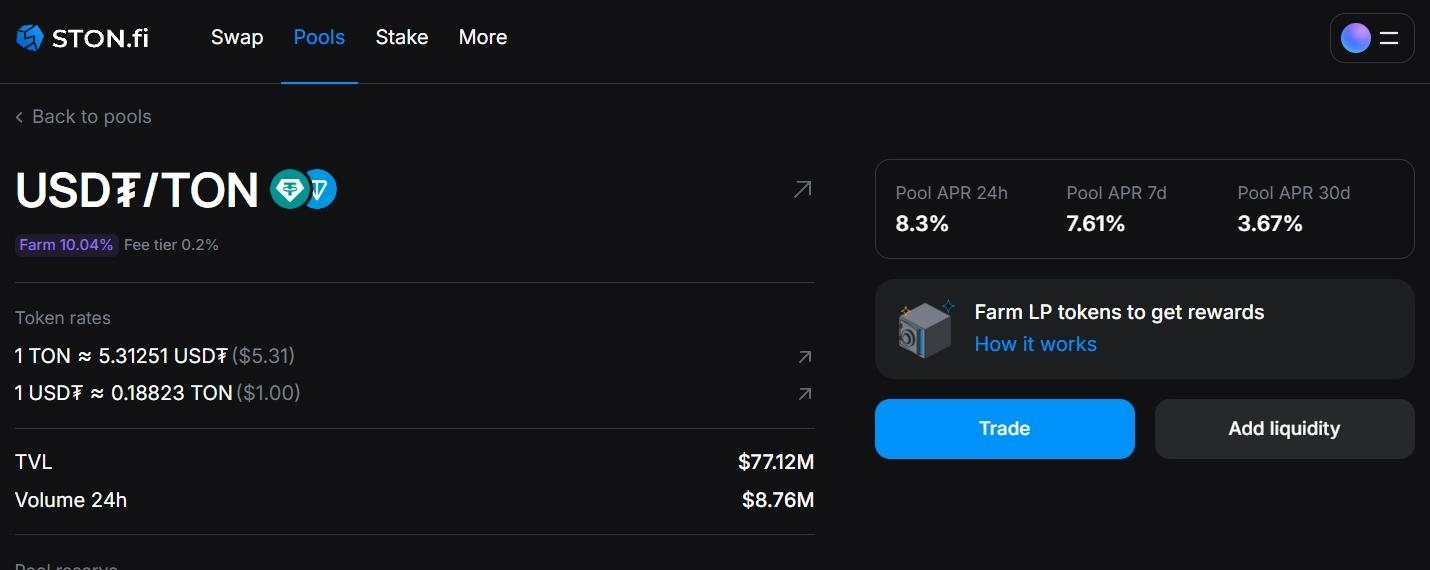
Article
STONfi vs Base DEXs: Native TON Liquidity and Omniston ExecutionSTONfi vs Base DEXs: Native TON Liquidity and Omniston Execution
Decentralized trading becomes much easier to understand when you stop looking only at the interface and instead ask a more fundamental question:
Where does the liquidity live, and how is the trade actually executed?
That distinction is important when comparing STONfi on TON with DEXs operating on Base, such as Uniswap and Aerodrome.
At first glance, the comparison may appear to be simply TON versus Base. In practice, the more useful comparison is between a native liquidity environment and an execution architecture capable of coordinating liquidity across different networks.
STONfi provides TON-native AMM liquidity, while Omniston expands the execution path by aggregating liquidity sources and coordinating cross-chain swaps. Base-native DEXs, meanwhile, are optimized primarily for assets and liquidity already deployed on Base.
Understanding this difference helps traders choose a route based on where their assets start, where they need to finish, and whether the transaction remains on one network or crosses between ecosystems.
Where the Liquidity Lives
The first thing to understand is that liquidity is not automatically universal across blockchains.
STONfi's AMM pools live on TON. They use TON-native assets and Jettons, allowing users to trade assets that already exist within the TON ecosystem. The liquidity is therefore local to TON and can be accessed directly through TON's smart-contract environment.
Base DEXs follow the same basic principle within their own ecosystem. Platforms such as Uniswap and Aerodrome provide liquidity for assets deployed on Base. When a trader swaps one Base-native asset for another Base-native asset, the transaction can remain entirely within the Base network.
This creates a simple rule:
Same-chain trading is naturally local.
A TON user swapping one TON asset for another can use TON liquidity. A Base user trading one Base asset for another can use Base liquidity.
The complexity appears when the desired asset exists on another blockchain.
Same-Chain Swaps vs Cross-Chain Swaps
A conventional AMM is designed to operate within the environment where its pools exist.
Suppose you hold a TON asset and want another TON asset. A TON-native liquidity source can execute that transaction without requiring another blockchain to participate.
Likewise, if you already hold an asset on Base and want to exchange it for another asset available on Base, a Base-native DEX can generally handle the trade locally.
But consider a different scenario:
You hold an asset on TON and want an asset on Base.
A TON AMM cannot simply reach into a Base liquidity pool and complete the other side of the transaction. The two networks have separate state, transaction environments and settlement mechanisms.
That is where an execution layer such as Omniston becomes important.
How Omniston Changes the Execution Model
Omniston is designed to operate beyond the limitations of a single liquidity pool or a single blockchain.
For TON-native swaps, Omniston can aggregate available AMM liquidity and RFQ resolvers, allowing different execution sources to compete for the trade.
Instead of forcing the user to manually evaluate every possible liquidity source, the aggregation layer can evaluate available routes and identify an executable path based on the current market conditions.
For cross-chain trades, the model becomes more advanced.
When moving between TON and Base, Omniston can coordinate competing resolvers and use linked Hashed Timelock Contracts (HTLCs) to establish synchronized settlement conditions between the two chains.
The important concept is that the execution layer does not make the two blockchains become one blockchain.
Instead, it creates a coordinated mechanism that allows independent networks to participate in the same trade.
Understanding the Resolver
Resolvers are an important part of this architecture.
Rather than requiring a single AMM pool to provide both sides of a cross-chain transaction, a resolver can help supply the destination asset while settlement conditions ensure that the transaction follows the agreed execution rules.
This introduces competition into the execution process.
Resolvers can compete based on the terms they offer, while the execution layer coordinates the transaction across the required networks.
For the trader, this can reduce the need to manually construct a complicated multi-step bridge-and-swap process.
The objective is not merely to move tokens between chains. It is to create a coordinated asset-for-asset exchange across separate blockchain environments.
Why This Matters for TON Users
The distinction becomes especially useful when determining which route makes the most sense for a particular trade.
If your asset is already on TON and your target asset is also on TON, native TON liquidity through STONfi or an Omniston-routed TON trade is the natural place to look.
If your asset is already on Base and your target is another Base asset, a Base-native DEX may be the more direct route because the liquidity and settlement remain within the same network.
But when the assets exist on opposite chains, the problem changes.
A conventional single-chain AMM is no longer enough. The trade requires coordination between independent networks.
This is where Omniston's cross-chain execution model becomes particularly relevant.
No Need to Think Only in Terms of Wrapping
One of the practical advantages of a resolver-based cross-chain architecture is that the user does not necessarily need to think in terms of manually obtaining a wrapped intermediate representation of the desired asset.
Instead, the execution system can coordinate the exchange between the source and destination assets through the participating resolvers and settlement mechanisms.
That does not mean cross-chain trading becomes risk-free or magically removes every technical dependency.
It means the complexity can be handled by the execution architecture rather than being exposed entirely to the trader through multiple manual steps.
The key idea is:
The user requests an outcome; the execution layer coordinates the route required to achieve it.
STONfi and Base DEXs Serve Different Starting Points
This comparison should not be interpreted as saying that one ecosystem is universally better than the other.
STONfi's strength is its position within the TON-native liquidity environment.
Base DEXs have their own advantage when the required assets and liquidity already exist on Base.
The deciding factor is therefore often not the brand of the DEX, but the location of the assets and the structure of the trade.
A useful mental model is:
TON asset → TON asset:
Look to TON-native liquidity, including STONfi and Omniston-supported routes.
Base asset → Base asset:
Look to Base-native liquidity such as Uniswap or Aerodrome.
TON asset → Base asset:
Consider Omniston's cross-chain execution and available resolver routes.
Base asset → TON asset:
Again, cross-chain execution becomes the central requirement.
What Traders Should Check Before Signing
Cross-chain convenience should never replace verification.
Before approving a transaction, traders should check the source network, destination network, exact input and output tokens, quoted amounts, execution fees, routing costs, quote validity and current route availability.
A quote can change as market conditions and liquidity change.
The route displayed at one moment may not remain available later, and the final amount received can depend on the execution conditions associated with the selected route.
Understanding these details is especially important when the trade crosses chains because there are more moving parts than in a simple same-network AMM swap.
The Bigger Picture
STONfi and Base DEXs illustrate two different but complementary approaches to decentralized liquidity.
STONfi pools remain native TON liquidity sources.
They provide the underlying liquidity environment for swaps occurring on TON.
Omniston expands the execution layer.
It can aggregate liquidity and coordinate execution across sources, while its cross-chain architecture allows resolvers and linked settlement mechanisms to connect trades between networks such as TON and Base.
This creates a broader trading model in which the important question is no longer simply:
“Which DEX should I use?”
The better question is:
“Where are my assets now, where do I want them to end up, and what execution path can connect those two states most efficiently?”
For a TON-to-TON trade, native TON liquidity may be all you need.
For a Base-to-Base trade, a Base-native DEX can provide the most direct environment.
For a TON-to-Base or Base-to-TON transaction, however, an execution layer capable of coordinating multiple networks becomes much more valuable.
That is the practical distinction between native liquidity and cross-chain execution.
The future of decentralized trading is not necessarily about choosing one chain over another. It is increasingly about connecting the liquidity and execution environments that already exist across them.
And that is where the combination of STONfi's TON-native liquidity and Omniston's broader routing and cross-chain execution architecture becomes particularly interesting.
#SECCancelsCryptoRulemakingMeeting
STONfi vs Base DEXs: Native TON Liquidity and Omniston Execution
STONfi vs Base DEXs: Native TON Liquidity and Omniston Execution
Decentralized trading becomes much easier to understand when you stop looking only at the interface and instead ask a more fundamental question:
Where does the liquidity live, and how is the trade actually executed?
That distinction is important when comparing STONfi on TON with DEXs operating on Base, such as Uniswap and Aerodrome.
At first glance, the comparison may appear to be simply TON versus Base. In practice, the more useful comparison is between a native liquidity environment and an execution architecture capable of coordinating liquidity across different networks.
STONfi provides TON-native AMM liquidity, while Omniston expands the execution path by aggregating liquidity sources and coordinating cross-chain swaps. Base-native DEXs, meanwhile, are optimized primarily for assets and liquidity already deployed on Base.
Understanding this difference helps traders choose a route based on where their assets start, where they need to finish, and whether the transaction remains on one network or crosses between ecosystems.
Where the Liquidity Lives
The first thing to understand is that liquidity is not automatically universal across blockchains.
STONfi's AMM pools live on TON. They use TON-native assets and Jettons, allowing users to trade assets that already exist within the TON ecosystem. The liquidity is therefore local to TON and can be accessed directly through TON's smart-contract environment.
Base DEXs follow the same basic principle within their own ecosystem. Platforms such as Uniswap and Aerodrome provide liquidity for assets deployed on Base. When a trader swaps one Base-native asset for another Base-native asset, the transaction can remain entirely within the Base network.
This creates a simple rule:
Same-chain trading is naturally local.
A TON user swapping one TON asset for another can use TON liquidity. A Base user trading one Base asset for another can use Base liquidity.
The complexity appears when the desired asset exists on another blockchain.
Same-Chain Swaps vs Cross-Chain Swaps
A conventional AMM is designed to operate within the environment where its pools exist.
Suppose you hold a TON asset and want another TON asset. A TON-native liquidity source can execute that transaction without requiring another blockchain to participate.
Likewise, if you already hold an asset on Base and want to exchange it for another asset available on Base, a Base-native DEX can generally handle the trade locally.
But consider a different scenario:
You hold an asset on TON and want an asset on Base.
A TON AMM cannot simply reach into a Base liquidity pool and complete the other side of the transaction. The two networks have separate state, transaction environments and settlement mechanisms.
That is where an execution layer such as Omniston becomes important.
How Omniston Changes the Execution Model
Omniston is designed to operate beyond the limitations of a single liquidity pool or a single blockchain.
For TON-native swaps, Omniston can aggregate available AMM liquidity and RFQ resolvers, allowing different execution sources to compete for the trade.
Instead of forcing the user to manually evaluate every possible liquidity source, the aggregation layer can evaluate available routes and identify an executable path based on the current market conditions.
For cross-chain trades, the model becomes more advanced.
When moving between TON and Base, Omniston can coordinate competing resolvers and use linked Hashed Timelock Contracts (HTLCs) to establish synchronized settlement conditions between the two chains.
The important concept is that the execution layer does not make the two blockchains become one blockchain.
Instead, it creates a coordinated mechanism that allows independent networks to participate in the same trade.
Understanding the Resolver
Resolvers are an important part of this architecture.
Rather than requiring a single AMM pool to provide both sides of a cross-chain transaction, a resolver can help supply the destination asset while settlement conditions ensure that the transaction follows the agreed execution rules.
This introduces competition into the execution process.
Resolvers can compete based on the terms they offer, while the execution layer coordinates the transaction across the required networks.
For the trader, this can reduce the need to manually construct a complicated multi-step bridge-and-swap process.
The objective is not merely to move tokens between chains. It is to create a coordinated asset-for-asset exchange across separate blockchain environments.
Why This Matters for TON Users
The distinction becomes especially useful when determining which route makes the most sense for a particular trade.
If your asset is already on TON and your target asset is also on TON, native TON liquidity through STONfi or an Omniston-routed TON trade is the natural place to look.
If your asset is already on Base and your target is another Base asset, a Base-native DEX may be the more direct route because the liquidity and settlement remain within the same network.
But when the assets exist on opposite chains, the problem changes.
A conventional single-chain AMM is no longer enough. The trade requires coordination between independent networks.
This is where Omniston's cross-chain execution model becomes particularly relevant.
No Need to Think Only in Terms of Wrapping
One of the practical advantages of a resolver-based cross-chain architecture is that the user does not necessarily need to think in terms of manually obtaining a wrapped intermediate representation of the desired asset.
Instead, the execution system can coordinate the exchange between the source and destination assets through the participating resolvers and settlement mechanisms.
That does not mean cross-chain trading becomes risk-free or magically removes every technical dependency.
It means the complexity can be handled by the execution architecture rather than being exposed entirely to the trader through multiple manual steps.
The key idea is:
The user requests an outcome; the execution layer coordinates the route required to achieve it.
STONfi and Base DEXs Serve Different Starting Points
This comparison should not be interpreted as saying that one ecosystem is universally better than the other.
STONfi's strength is its position within the TON-native liquidity environment.
Base DEXs have their own advantage when the required assets and liquidity already exist on Base.
The deciding factor is therefore often not the brand of the DEX, but the location of the assets and the structure of the trade.
A useful mental model is:
TON asset → TON asset:
Look to TON-native liquidity, including STONfi and Omniston-supported routes.
Base asset → Base asset:
Look to Base-native liquidity such as Uniswap or Aerodrome.
TON asset → Base asset:
Consider Omniston's cross-chain execution and available resolver routes.
Base asset → TON asset:
Again, cross-chain execution becomes the central requirement.
What Traders Should Check Before Signing
Cross-chain convenience should never replace verification.
Before approving a transaction, traders should check the source network, destination network, exact input and output tokens, quoted amounts, execution fees, routing costs, quote validity and current route availability.
A quote can change as market conditions and liquidity change.
The route displayed at one moment may not remain available later, and the final amount received can depend on the execution conditions associated with the selected route.
Understanding these details is especially important when the trade crosses chains because there are more moving parts than in a simple same-network AMM swap.
The Bigger Picture
STONfi and Base DEXs illustrate two different but complementary approaches to decentralized liquidity.
STONfi pools remain native TON liquidity sources.
They provide the underlying liquidity environment for swaps occurring on TON.
Omniston expands the execution layer.
It can aggregate liquidity and coordinate execution across sources, while its cross-chain architecture allows resolvers and linked settlement mechanisms to connect trades between networks such as TON and Base.
This creates a broader trading model in which the important question is no longer simply:
“Which DEX should I use?”
The better question is:
“Where are my assets now, where do I want them to end up, and what execution path can connect those two states most efficiently?”
For a TON-to-TON trade, native TON liquidity may be all you need.
For a Base-to-Base trade, a Base-native DEX can provide the most direct environment.
For a TON-to-Base or Base-to-TON transaction, however, an execution layer capable of coordinating multiple networks becomes much more valuable.
That is the practical distinction between native liquidity and cross-chain execution.
The future of decentralized trading is not necessarily about choosing one chain over another. It is increasingly about connecting the liquidity and execution environments that already exist across them.
And that is where the combination of STONfi's TON-native liquidity and Omniston's broader routing and cross-chain execution architecture becomes particularly interesting.
#SECCancelsCryptoRulemakingMeeting
Decentralized trading becomes much easier to understand when you stop looking only at the interface and instead ask a more fundamental question:
Where does the liquidity live, and how is the trade actually executed?
That distinction is important when comparing STONfi on TON with DEXs operating on Base, such as Uniswap and Aerodrome.
At first glance, the comparison may appear to be simply TON versus Base. In practice, the more useful comparison is between a native liquidity environment and an execution architecture capable of coordinating liquidity across different networks.
STONfi provides TON-native AMM liquidity, while Omniston expands the execution path by aggregating liquidity sources and coordinating cross-chain swaps. Base-native DEXs, meanwhile, are optimized primarily for assets and liquidity already deployed on Base.
Understanding this difference helps traders choose a route based on where their assets start, where they need to finish, and whether the transaction remains on one network or crosses between ecosystems.
Where the Liquidity Lives
The first thing to understand is that liquidity is not automatically universal across blockchains.
STONfi's AMM pools live on TON. They use TON-native assets and Jettons, allowing users to trade assets that already exist within the TON ecosystem. The liquidity is therefore local to TON and can be accessed directly through TON's smart-contract environment.
Base DEXs follow the same basic principle within their own ecosystem. Platforms such as Uniswap and Aerodrome provide liquidity for assets deployed on Base. When a trader swaps one Base-native asset for another Base-native asset, the transaction can remain entirely within the Base network.
This creates a simple rule:
Same-chain trading is naturally local.
A TON user swapping one TON asset for another can use TON liquidity. A Base user trading one Base asset for another can use Base liquidity.
The complexity appears when the desired asset exists on another blockchain.
Same-Chain Swaps vs Cross-Chain Swaps
A conventional AMM is designed to operate within the environment where its pools exist.
Suppose you hold a TON asset and want another TON asset. A TON-native liquidity source can execute that transaction without requiring another blockchain to participate.
Likewise, if you already hold an asset on Base and want to exchange it for another asset available on Base, a Base-native DEX can generally handle the trade locally.
But consider a different scenario:
You hold an asset on TON and want an asset on Base.
A TON AMM cannot simply reach into a Base liquidity pool and complete the other side of the transaction. The two networks have separate state, transaction environments and settlement mechanisms.
That is where an execution layer such as Omniston becomes important.
How Omniston Changes the Execution Model
Omniston is designed to operate beyond the limitations of a single liquidity pool or a single blockchain.
For TON-native swaps, Omniston can aggregate available AMM liquidity and RFQ resolvers, allowing different execution sources to compete for the trade.
Instead of forcing the user to manually evaluate every possible liquidity source, the aggregation layer can evaluate available routes and identify an executable path based on the current market conditions.
For cross-chain trades, the model becomes more advanced.
When moving between TON and Base, Omniston can coordinate competing resolvers and use linked Hashed Timelock Contracts (HTLCs) to establish synchronized settlement conditions between the two chains.
The important concept is that the execution layer does not make the two blockchains become one blockchain.
Instead, it creates a coordinated mechanism that allows independent networks to participate in the same trade.
Understanding the Resolver
Resolvers are an important part of this architecture.
Rather than requiring a single AMM pool to provide both sides of a cross-chain transaction, a resolver can help supply the destination asset while settlement conditions ensure that the transaction follows the agreed execution rules.
This introduces competition into the execution process.
Resolvers can compete based on the terms they offer, while the execution layer coordinates the transaction across the required networks.
For the trader, this can reduce the need to manually construct a complicated multi-step bridge-and-swap process.
The objective is not merely to move tokens between chains. It is to create a coordinated asset-for-asset exchange across separate blockchain environments.
Why This Matters for TON Users
The distinction becomes especially useful when determining which route makes the most sense for a particular trade.
If your asset is already on TON and your target asset is also on TON, native TON liquidity through STONfi or an Omniston-routed TON trade is the natural place to look.
If your asset is already on Base and your target is another Base asset, a Base-native DEX may be the more direct route because the liquidity and settlement remain within the same network.
But when the assets exist on opposite chains, the problem changes.
A conventional single-chain AMM is no longer enough. The trade requires coordination between independent networks.
This is where Omniston's cross-chain execution model becomes particularly relevant.
No Need to Think Only in Terms of Wrapping
One of the practical advantages of a resolver-based cross-chain architecture is that the user does not necessarily need to think in terms of manually obtaining a wrapped intermediate representation of the desired asset.
Instead, the execution system can coordinate the exchange between the source and destination assets through the participating resolvers and settlement mechanisms.
That does not mean cross-chain trading becomes risk-free or magically removes every technical dependency.
It means the complexity can be handled by the execution architecture rather than being exposed entirely to the trader through multiple manual steps.
The key idea is:
The user requests an outcome; the execution layer coordinates the route required to achieve it.
STONfi and Base DEXs Serve Different Starting Points
This comparison should not be interpreted as saying that one ecosystem is universally better than the other.
STONfi's strength is its position within the TON-native liquidity environment.
Base DEXs have their own advantage when the required assets and liquidity already exist on Base.
The deciding factor is therefore often not the brand of the DEX, but the location of the assets and the structure of the trade.
A useful mental model is:
TON asset → TON asset:
Look to TON-native liquidity, including STONfi and Omniston-supported routes.
Base asset → Base asset:
Look to Base-native liquidity such as Uniswap or Aerodrome.
TON asset → Base asset:
Consider Omniston's cross-chain execution and available resolver routes.
Base asset → TON asset:
Again, cross-chain execution becomes the central requirement.
What Traders Should Check Before Signing
Cross-chain convenience should never replace verification.
Before approving a transaction, traders should check the source network, destination network, exact input and output tokens, quoted amounts, execution fees, routing costs, quote validity and current route availability.
A quote can change as market conditions and liquidity change.
The route displayed at one moment may not remain available later, and the final amount received can depend on the execution conditions associated with the selected route.
Understanding these details is especially important when the trade crosses chains because there are more moving parts than in a simple same-network AMM swap.
The Bigger Picture
STONfi and Base DEXs illustrate two different but complementary approaches to decentralized liquidity.
STONfi pools remain native TON liquidity sources.
They provide the underlying liquidity environment for swaps occurring on TON.
Omniston expands the execution layer.
It can aggregate liquidity and coordinate execution across sources, while its cross-chain architecture allows resolvers and linked settlement mechanisms to connect trades between networks such as TON and Base.
This creates a broader trading model in which the important question is no longer simply:
“Which DEX should I use?”
The better question is:
“Where are my assets now, where do I want them to end up, and what execution path can connect those two states most efficiently?”
For a TON-to-TON trade, native TON liquidity may be all you need.
For a Base-to-Base trade, a Base-native DEX can provide the most direct environment.
For a TON-to-Base or Base-to-TON transaction, however, an execution layer capable of coordinating multiple networks becomes much more valuable.
That is the practical distinction between native liquidity and cross-chain execution.
The future of decentralized trading is not necessarily about choosing one chain over another. It is increasingly about connecting the liquidity and execution environments that already exist across them.
And that is where the combination of STONfi's TON-native liquidity and Omniston's broader routing and cross-chain execution architecture becomes particularly interesting.
#SECCancelsCryptoRulemakingMeeting
1
85
·
--
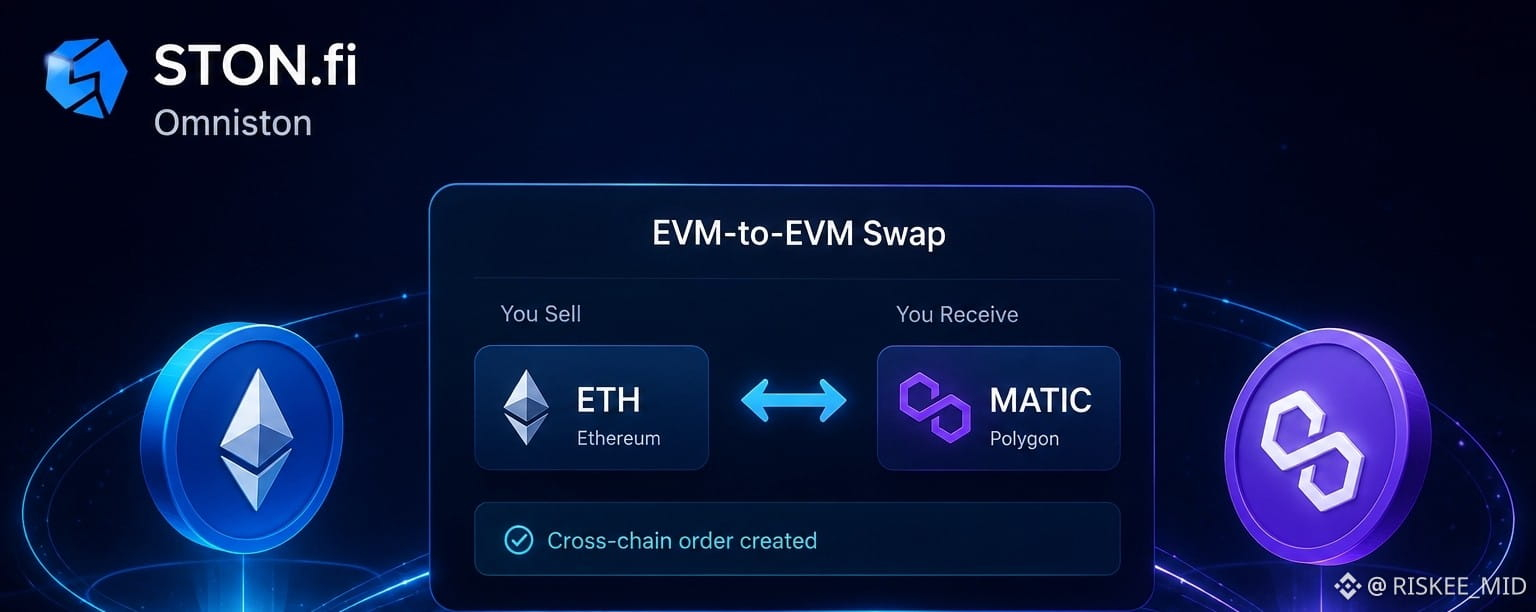
Article
How Omniston Handles EVM-to-EVM Swaps on STON.fiHow Omniston Handles EVM-to-EVM Swaps on STON.fi
Cross-chain trading is often presented as if moving an asset from one blockchain to another should be as simple as swapping two tokens on a decentralized exchange.
In reality, the underlying process can be much more complicated.
A conventional DEX swap generally happens within a single blockchain. Liquidity sits on that network, transactions are executed by contracts on the same ledger, and the entire trade follows one chain’s execution environment.
EVM-to-EVM trading across Ethereum, BNB Chain, Base, Polygon and other networks introduces a different problem: the assets being exchanged exist on separate blockchains that do not share one transaction history.
This is where STON.fi’s Omniston takes a different approach.
Rather than forcing the trade through a traditional bridge-and-swap sequence, Omniston treats the interaction as a cross-chain order. The system combines an RFQ (Request for Quote) model, competitive resolver liquidity and paired Hashed Timelock Contracts (HTLCs) to coordinate settlement across independent EVM networks.
The result is a user-facing experience that can feel like one swap, while the underlying settlement is performed through coordinated mechanisms on multiple chains.
What Is Omniston Doing Differently?
At its core, Omniston is designed to abstract away much of the complexity involved in cross-chain execution.
Instead of requiring a user to manually complete multiple actions across different networks, the interface presents a single cross-chain intent: the asset the user wants to sell, the asset they want to receive and the networks involved.
Behind that request, resolvers compete to provide the destination-side liquidity and execute the transaction according to the quoted terms.
This creates an important distinction.
Omniston does not need to make TON an intermediate stop for every cross-chain route. In an EVM-to-EVM scenario, the source asset and destination asset can remain on their respective EVM networks while the protocol coordinates the settlement between them.
Phase 1 support includes major networks such as Ethereum, BNB Chain, Base and Polygon, creating a foundation for multi-network asset exchange without requiring the user to manually construct a bridge route.
The RFQ Model: Liquidity Competes for the Order
One of the most important components of Omniston's architecture is its RFQ model.
RFQ stands for Request for Quote.
Instead of relying exclusively on a single liquidity pool to determine the execution price, the system allows resolvers to compete by providing quotes for a cross-chain order.
A simplified flow looks like this:
The trader specifies the asset they want to sell and the asset they want to receive.
Omniston broadcasts the order to eligible resolvers.
Resolvers evaluate the request, destination liquidity, execution costs, network conditions and other factors.
They return quotes describing what they can provide.
The system can then select an appropriate execution path based on the available offers.
This model is particularly important for cross-chain trading because liquidity may be fragmented across networks.
A resolver can effectively provide liquidity where it is needed on the destination chain while coordinating the source-side transaction separately.
For the trader, this reduces the need to understand the infrastructure behind the route.
Why Paired HTLCs Matter
The second major component is the use of Hashed Timelock Contracts, commonly called HTLCs.
The challenge in a cross-chain transaction is straightforward:
How can two parties exchange assets that exist on different blockchains without depending on one shared transaction?
The answer is to create matching cryptographic conditions on both networks.
In a simplified example, the trader locks an asset inside a source-side HTLC.
That contract includes:
A hashlock, which defines the secret required to claim the funds.A timelock, which defines what happens if the exchange is not completed within the allowed period.
The resolver, meanwhile, locks the corresponding destination asset using a compatible HTLC condition.
Both sides are therefore connected through the same underlying cryptographic secret.
The Secret Coordinates Settlement
The important element in the process is the secret used by the hashlock.
The assets cannot simply be claimed arbitrarily. The conditions embedded in the contracts determine how settlement can occur.
When the correct secret is revealed to claim one side of the exchange, that secret can be used to satisfy the matching condition on the other side.
This creates a synchronized settlement mechanism between independent blockchains.
The key idea is not that Ethereum and Base suddenly share a common ledger.
They do not.
Instead, the contracts on the separate networks enforce compatible rules that allow the exchange to be completed according to the same cryptographic condition.
That is what gives the mechanism its atomic settlement characteristics.
What Happens If the Trade Fails?
Cross-chain infrastructure also has to account for failure.
Networks can become congested. Transactions can be delayed. A resolver may fail to complete execution. A settlement condition might not be met within the required period.
This is where the timelock becomes critical.
If the conditions required for settlement are not satisfied before the relevant timeout, the HTLC mechanism allows the appropriate party to refund the locked assets according to the contract rules.
The system is therefore not dependent on every transaction succeeding perfectly.
Instead, it is designed around two possible outcomes:
Successful settlement: the cryptographic condition is satisfied and the assets can be claimed.
Timeout: settlement does not complete within the required window and the refund mechanism becomes available.
This makes the cross-chain order more resilient than a process where users must manually coordinate several independent transactions.
Why This Is Different From a Traditional DEX
A normal DEX swap is comparatively simple because both assets are typically available on the same blockchain.
For example, a trader exchanging one token for another on Ethereum can interact with a liquidity pool or routing system that operates entirely within Ethereum's execution environment.
The blockchain already provides the shared state needed to execute the trade.
EVM-to-EVM swaps are different.
Ethereum and Polygon, for example, maintain independent states. A transaction confirmed on one does not automatically execute an equivalent transaction on the other.
Omniston therefore cannot treat a multi-chain swap as one literal blockchain transaction.
Instead, it creates one trading intent backed by multiple coordinated execution steps.
The interface may look unified, but the underlying settlement still occurs separately on each network.
That distinction is important.
The atomicity comes from the protocol rules, cryptographic conditions and timeout mechanisms, not from a magical single transaction spanning multiple blockchains.
No TON Middleman Required
Another important aspect of Omniston's EVM-to-EVM design is that TON does not have to sit in the middle of the transaction.
For an EVM-to-EVM route, the trader does not necessarily need to convert the source asset into TON, move through the TON ecosystem and then convert back into the desired destination asset.
Instead, Omniston can coordinate the source and destination chains directly through its cross-chain execution architecture.
This can reduce unnecessary steps from the user's perspective and make multi-network trading feel much closer to a normal swap.
The important abstraction is therefore:
one order, multiple networks, coordinated settlement.
Partial Fills for Larger Orders
Cross-chain trading also has a liquidity problem that becomes more visible as order size increases.
A large order may not always be efficiently filled by one source or one resolver.
Omniston can support partial fills, allowing larger orders to be handled through multiple execution opportunities rather than depending entirely on one liquidity source.
This can be useful because cross-chain liquidity is rarely distributed evenly.
One resolver may offer attractive execution for part of the order, while another may be better positioned for a different portion.
A system capable of handling partial execution can therefore be more flexible when dealing with fragmented liquidity.
The User Experience vs. the Infrastructure
One of the strongest ideas behind Omniston is the separation between what the user sees and what the protocol actually has to do.
From the trader's perspective, the flow can remain relatively simple:
Choose the asset to sell.
Choose the asset to receive.
Review the available quote.
Approve the transaction.
Allow the cross-chain execution process to complete.
Behind that simple interface, however, several things may be happening.
Resolvers are competing for the order.
Liquidity is being evaluated.
Gas costs are being considered.
Source and destination contracts are being prepared.
HTLC conditions are being established.
Transactions are submitted independently to the involved networks.
Settlement is coordinated through the cryptographic conditions.
This abstraction is important because users generally do not want to become experts in cross-chain transaction coordination just to move an asset between two EVM networks.
What Still Matters: Quotes, Gas and Liquidity
Omniston does not eliminate every challenge associated with cross-chain trading.
The quality of execution still depends on several practical factors.
Quote quality matters. A cross-chain route is only useful if the amount received is competitive.
Gas costs matter. Each participating network can introduce transaction fees that influence the total execution cost.
Liquidity matters. A resolver needs sufficient destination-side liquidity to fulfill the order efficiently.
Network conditions matter. Congestion, confirmation times and transaction reliability can affect execution.
So while the interface can simplify the process, the underlying economics of trading do not disappear.
Cross-chain abstraction makes the experience easier; it does not make liquidity, fees or network conditions irrelevant.
Security Through Coordination, Not Centralization
Another useful way to understand the architecture is that Omniston does not require one shared cross-chain vault controlled by a single intermediary for the swap itself.
Instead, the source and destination chains maintain their own contracts and enforce their own conditions.
The coordination happens through the protocol's execution logic and cryptographic guarantees.
That structure is meaningful because it reduces the conceptual gap between the user's intent and the actual settlement mechanism.
The user is not simply trusting that an intermediary will eventually move the assets.
The trade is structured so that the contracts on the relevant networks define how the exchange should occur and what happens if those conditions are not fulfilled.
The Bigger Picture for Cross-Chain Trading
Omniston's EVM-to-EVM model illustrates a broader shift in decentralized trading.
The future of cross-chain UX may not depend on users learning how every individual blockchain works.
Instead, infrastructure can handle the routing, liquidity discovery and settlement coordination underneath a unified trading experience.
From that perspective, the cross-chain problem becomes less about manually moving assets between chains and more about expressing an intent:
“I want to sell this asset here and receive that asset there.”
Resolvers then compete to satisfy that intent, while cryptographic settlement mechanisms ensure that execution follows defined rules.
This is fundamentally different from simply adding another bridge interface.
A bridge primarily focuses on moving assets or representations of assets between networks.
An order-centric system focuses on fulfilling a trade across networks.
That distinction can become increasingly important as the number of blockchain ecosystems, assets and liquidity venues continues to grow.
Final Takeaway
Omniston's approach to EVM-to-EVM swaps is built around a simple idea with sophisticated infrastructure underneath it.
Instead of treating cross-chain trading as a sequence of unrelated bridge and DEX transactions, it treats the operation as one cross-chain order.
Resolvers compete through an RFQ model.
Destination liquidity is supplied where the trader needs it.
Paired HTLCs establish cryptographic conditions across the participating networks.
Hashlocks coordinate successful claims.
Timelocks provide a path to refunds when settlement does not complete.
Partial fills can help address larger orders.
And importantly, the trade does not require TON to act as an intermediate asset or network for an EVM-to-EVM route.
The result is a system where the trader interacts with one unified swap flow while multiple independent blockchains coordinate underneath it.
That is the real value of cross-chain infrastructure: not making blockchains identical, but making their differences less visible to the user.
As multi-chain liquidity becomes increasingly fragmented, systems like Omniston could play an important role in turning that fragmentation into a simpler trading experience—where the user focuses on the asset they want to trade and the asset they want to receive, while the underlying infrastructure handles the complexity of getting the trade settled.
The main takeaway: Omniston combines RFQ-based liquidity competition with HTLC-based cross-chain settlement, transforming an EVM-to-EVM swap from a complicated multi-step process into a coordinated order designed to execute or safely unwind according to predefined rules.
EXPLORE MORE ON STON.FI EVM-TO-EVM SWAP: https://app.ston.fi/swap?mode=cross-chain&in=bnb%3AUSDT&out=ethereum%3AUSDT
Would you trust an RFQ + HTLC architecture for large cross-chain swaps, or do you still prefer traditional bridge-based routes?
#US #evm
How Omniston Handles EVM-to-EVM Swaps on STON.fi
How Omniston Handles EVM-to-EVM Swaps on STON.fi
Cross-chain trading is often presented as if moving an asset from one blockchain to another should be as simple as swapping two tokens on a decentralized exchange.
In reality, the underlying process can be much more complicated.
A conventional DEX swap generally happens within a single blockchain. Liquidity sits on that network, transactions are executed by contracts on the same ledger, and the entire trade follows one chain’s execution environment.
EVM-to-EVM trading across Ethereum, BNB Chain, Base, Polygon and other networks introduces a different problem: the assets being exchanged exist on separate blockchains that do not share one transaction history.
This is where STON.fi’s Omniston takes a different approach.
Rather than forcing the trade through a traditional bridge-and-swap sequence, Omniston treats the interaction as a cross-chain order. The system combines an RFQ (Request for Quote) model, competitive resolver liquidity and paired Hashed Timelock Contracts (HTLCs) to coordinate settlement across independent EVM networks.
The result is a user-facing experience that can feel like one swap, while the underlying settlement is performed through coordinated mechanisms on multiple chains.
What Is Omniston Doing Differently?
At its core, Omniston is designed to abstract away much of the complexity involved in cross-chain execution.
Instead of requiring a user to manually complete multiple actions across different networks, the interface presents a single cross-chain intent: the asset the user wants to sell, the asset they want to receive and the networks involved.
Behind that request, resolvers compete to provide the destination-side liquidity and execute the transaction according to the quoted terms.
This creates an important distinction.
Omniston does not need to make TON an intermediate stop for every cross-chain route. In an EVM-to-EVM scenario, the source asset and destination asset can remain on their respective EVM networks while the protocol coordinates the settlement between them.
Phase 1 support includes major networks such as Ethereum, BNB Chain, Base and Polygon, creating a foundation for multi-network asset exchange without requiring the user to manually construct a bridge route.
The RFQ Model: Liquidity Competes for the Order
One of the most important components of Omniston's architecture is its RFQ model.
RFQ stands for Request for Quote.
Instead of relying exclusively on a single liquidity pool to determine the execution price, the system allows resolvers to compete by providing quotes for a cross-chain order.
A simplified flow looks like this:
The trader specifies the asset they want to sell and the asset they want to receive.
Omniston broadcasts the order to eligible resolvers.
Resolvers evaluate the request, destination liquidity, execution costs, network conditions and other factors.
They return quotes describing what they can provide.
The system can then select an appropriate execution path based on the available offers.
This model is particularly important for cross-chain trading because liquidity may be fragmented across networks.
A resolver can effectively provide liquidity where it is needed on the destination chain while coordinating the source-side transaction separately.
For the trader, this reduces the need to understand the infrastructure behind the route.
Why Paired HTLCs Matter
The second major component is the use of Hashed Timelock Contracts, commonly called HTLCs.
The challenge in a cross-chain transaction is straightforward:
How can two parties exchange assets that exist on different blockchains without depending on one shared transaction?
The answer is to create matching cryptographic conditions on both networks.
In a simplified example, the trader locks an asset inside a source-side HTLC.
That contract includes:
A hashlock, which defines the secret required to claim the funds.A timelock, which defines what happens if the exchange is not completed within the allowed period.
The resolver, meanwhile, locks the corresponding destination asset using a compatible HTLC condition.
Both sides are therefore connected through the same underlying cryptographic secret.
The Secret Coordinates Settlement
The important element in the process is the secret used by the hashlock.
The assets cannot simply be claimed arbitrarily. The conditions embedded in the contracts determine how settlement can occur.
When the correct secret is revealed to claim one side of the exchange, that secret can be used to satisfy the matching condition on the other side.
This creates a synchronized settlement mechanism between independent blockchains.
The key idea is not that Ethereum and Base suddenly share a common ledger.
They do not.
Instead, the contracts on the separate networks enforce compatible rules that allow the exchange to be completed according to the same cryptographic condition.
That is what gives the mechanism its atomic settlement characteristics.
What Happens If the Trade Fails?
Cross-chain infrastructure also has to account for failure.
Networks can become congested. Transactions can be delayed. A resolver may fail to complete execution. A settlement condition might not be met within the required period.
This is where the timelock becomes critical.
If the conditions required for settlement are not satisfied before the relevant timeout, the HTLC mechanism allows the appropriate party to refund the locked assets according to the contract rules.
The system is therefore not dependent on every transaction succeeding perfectly.
Instead, it is designed around two possible outcomes:
Successful settlement: the cryptographic condition is satisfied and the assets can be claimed.
Timeout: settlement does not complete within the required window and the refund mechanism becomes available.
This makes the cross-chain order more resilient than a process where users must manually coordinate several independent transactions.
Why This Is Different From a Traditional DEX
A normal DEX swap is comparatively simple because both assets are typically available on the same blockchain.
For example, a trader exchanging one token for another on Ethereum can interact with a liquidity pool or routing system that operates entirely within Ethereum's execution environment.
The blockchain already provides the shared state needed to execute the trade.
EVM-to-EVM swaps are different.
Ethereum and Polygon, for example, maintain independent states. A transaction confirmed on one does not automatically execute an equivalent transaction on the other.
Omniston therefore cannot treat a multi-chain swap as one literal blockchain transaction.
Instead, it creates one trading intent backed by multiple coordinated execution steps.
The interface may look unified, but the underlying settlement still occurs separately on each network.
That distinction is important.
The atomicity comes from the protocol rules, cryptographic conditions and timeout mechanisms, not from a magical single transaction spanning multiple blockchains.
No TON Middleman Required
Another important aspect of Omniston's EVM-to-EVM design is that TON does not have to sit in the middle of the transaction.
For an EVM-to-EVM route, the trader does not necessarily need to convert the source asset into TON, move through the TON ecosystem and then convert back into the desired destination asset.
Instead, Omniston can coordinate the source and destination chains directly through its cross-chain execution architecture.
This can reduce unnecessary steps from the user's perspective and make multi-network trading feel much closer to a normal swap.
The important abstraction is therefore:
one order, multiple networks, coordinated settlement.
Partial Fills for Larger Orders
Cross-chain trading also has a liquidity problem that becomes more visible as order size increases.
A large order may not always be efficiently filled by one source or one resolver.
Omniston can support partial fills, allowing larger orders to be handled through multiple execution opportunities rather than depending entirely on one liquidity source.
This can be useful because cross-chain liquidity is rarely distributed evenly.
One resolver may offer attractive execution for part of the order, while another may be better positioned for a different portion.
A system capable of handling partial execution can therefore be more flexible when dealing with fragmented liquidity.
The User Experience vs. the Infrastructure
One of the strongest ideas behind Omniston is the separation between what the user sees and what the protocol actually has to do.
From the trader's perspective, the flow can remain relatively simple:
Choose the asset to sell.
Choose the asset to receive.
Review the available quote.
Approve the transaction.
Allow the cross-chain execution process to complete.
Behind that simple interface, however, several things may be happening.
Resolvers are competing for the order.
Liquidity is being evaluated.
Gas costs are being considered.
Source and destination contracts are being prepared.
HTLC conditions are being established.
Transactions are submitted independently to the involved networks.
Settlement is coordinated through the cryptographic conditions.
This abstraction is important because users generally do not want to become experts in cross-chain transaction coordination just to move an asset between two EVM networks.
What Still Matters: Quotes, Gas and Liquidity
Omniston does not eliminate every challenge associated with cross-chain trading.
The quality of execution still depends on several practical factors.
Quote quality matters. A cross-chain route is only useful if the amount received is competitive.
Gas costs matter. Each participating network can introduce transaction fees that influence the total execution cost.
Liquidity matters. A resolver needs sufficient destination-side liquidity to fulfill the order efficiently.
Network conditions matter. Congestion, confirmation times and transaction reliability can affect execution.
So while the interface can simplify the process, the underlying economics of trading do not disappear.
Cross-chain abstraction makes the experience easier; it does not make liquidity, fees or network conditions irrelevant.
Security Through Coordination, Not Centralization
Another useful way to understand the architecture is that Omniston does not require one shared cross-chain vault controlled by a single intermediary for the swap itself.
Instead, the source and destination chains maintain their own contracts and enforce their own conditions.
The coordination happens through the protocol's execution logic and cryptographic guarantees.
That structure is meaningful because it reduces the conceptual gap between the user's intent and the actual settlement mechanism.
The user is not simply trusting that an intermediary will eventually move the assets.
The trade is structured so that the contracts on the relevant networks define how the exchange should occur and what happens if those conditions are not fulfilled.
The Bigger Picture for Cross-Chain Trading
Omniston's EVM-to-EVM model illustrates a broader shift in decentralized trading.
The future of cross-chain UX may not depend on users learning how every individual blockchain works.
Instead, infrastructure can handle the routing, liquidity discovery and settlement coordination underneath a unified trading experience.
From that perspective, the cross-chain problem becomes less about manually moving assets between chains and more about expressing an intent:
“I want to sell this asset here and receive that asset there.”
Resolvers then compete to satisfy that intent, while cryptographic settlement mechanisms ensure that execution follows defined rules.
This is fundamentally different from simply adding another bridge interface.
A bridge primarily focuses on moving assets or representations of assets between networks.
An order-centric system focuses on fulfilling a trade across networks.
That distinction can become increasingly important as the number of blockchain ecosystems, assets and liquidity venues continues to grow.
Final Takeaway
Omniston's approach to EVM-to-EVM swaps is built around a simple idea with sophisticated infrastructure underneath it.
Instead of treating cross-chain trading as a sequence of unrelated bridge and DEX transactions, it treats the operation as one cross-chain order.
Resolvers compete through an RFQ model.
Destination liquidity is supplied where the trader needs it.
Paired HTLCs establish cryptographic conditions across the participating networks.
Hashlocks coordinate successful claims.
Timelocks provide a path to refunds when settlement does not complete.
Partial fills can help address larger orders.
And importantly, the trade does not require TON to act as an intermediate asset or network for an EVM-to-EVM route.
The result is a system where the trader interacts with one unified swap flow while multiple independent blockchains coordinate underneath it.
That is the real value of cross-chain infrastructure: not making blockchains identical, but making their differences less visible to the user.
As multi-chain liquidity becomes increasingly fragmented, systems like Omniston could play an important role in turning that fragmentation into a simpler trading experience—where the user focuses on the asset they want to trade and the asset they want to receive, while the underlying infrastructure handles the complexity of getting the trade settled.
The main takeaway: Omniston combines RFQ-based liquidity competition with HTLC-based cross-chain settlement, transforming an EVM-to-EVM swap from a complicated multi-step process into a coordinated order designed to execute or safely unwind according to predefined rules.
EXPLORE MORE ON STON.FI EVM-TO-EVM SWAP: https://app.ston.fi/swap?mode=cross-chain&in=bnb%3AUSDT&out=ethereum%3AUSDT
Would you trust an RFQ + HTLC architecture for large cross-chain swaps, or do you still prefer traditional bridge-based routes?
#US #evm
Cross-chain trading is often presented as if moving an asset from one blockchain to another should be as simple as swapping two tokens on a decentralized exchange.
In reality, the underlying process can be much more complicated.
A conventional DEX swap generally happens within a single blockchain. Liquidity sits on that network, transactions are executed by contracts on the same ledger, and the entire trade follows one chain’s execution environment.
EVM-to-EVM trading across Ethereum, BNB Chain, Base, Polygon and other networks introduces a different problem: the assets being exchanged exist on separate blockchains that do not share one transaction history.
This is where STON.fi’s Omniston takes a different approach.
Rather than forcing the trade through a traditional bridge-and-swap sequence, Omniston treats the interaction as a cross-chain order. The system combines an RFQ (Request for Quote) model, competitive resolver liquidity and paired Hashed Timelock Contracts (HTLCs) to coordinate settlement across independent EVM networks.
The result is a user-facing experience that can feel like one swap, while the underlying settlement is performed through coordinated mechanisms on multiple chains.
What Is Omniston Doing Differently?
At its core, Omniston is designed to abstract away much of the complexity involved in cross-chain execution.
Instead of requiring a user to manually complete multiple actions across different networks, the interface presents a single cross-chain intent: the asset the user wants to sell, the asset they want to receive and the networks involved.
Behind that request, resolvers compete to provide the destination-side liquidity and execute the transaction according to the quoted terms.
This creates an important distinction.
Omniston does not need to make TON an intermediate stop for every cross-chain route. In an EVM-to-EVM scenario, the source asset and destination asset can remain on their respective EVM networks while the protocol coordinates the settlement between them.
Phase 1 support includes major networks such as Ethereum, BNB Chain, Base and Polygon, creating a foundation for multi-network asset exchange without requiring the user to manually construct a bridge route.
The RFQ Model: Liquidity Competes for the Order
One of the most important components of Omniston's architecture is its RFQ model.
RFQ stands for Request for Quote.
Instead of relying exclusively on a single liquidity pool to determine the execution price, the system allows resolvers to compete by providing quotes for a cross-chain order.
A simplified flow looks like this:
The trader specifies the asset they want to sell and the asset they want to receive.
Omniston broadcasts the order to eligible resolvers.
Resolvers evaluate the request, destination liquidity, execution costs, network conditions and other factors.
They return quotes describing what they can provide.
The system can then select an appropriate execution path based on the available offers.
This model is particularly important for cross-chain trading because liquidity may be fragmented across networks.
A resolver can effectively provide liquidity where it is needed on the destination chain while coordinating the source-side transaction separately.
For the trader, this reduces the need to understand the infrastructure behind the route.
Why Paired HTLCs Matter
The second major component is the use of Hashed Timelock Contracts, commonly called HTLCs.
The challenge in a cross-chain transaction is straightforward:
How can two parties exchange assets that exist on different blockchains without depending on one shared transaction?
The answer is to create matching cryptographic conditions on both networks.
In a simplified example, the trader locks an asset inside a source-side HTLC.
That contract includes:
A hashlock, which defines the secret required to claim the funds.A timelock, which defines what happens if the exchange is not completed within the allowed period.
The resolver, meanwhile, locks the corresponding destination asset using a compatible HTLC condition.
Both sides are therefore connected through the same underlying cryptographic secret.
The Secret Coordinates Settlement
The important element in the process is the secret used by the hashlock.
The assets cannot simply be claimed arbitrarily. The conditions embedded in the contracts determine how settlement can occur.
When the correct secret is revealed to claim one side of the exchange, that secret can be used to satisfy the matching condition on the other side.
This creates a synchronized settlement mechanism between independent blockchains.
The key idea is not that Ethereum and Base suddenly share a common ledger.
They do not.
Instead, the contracts on the separate networks enforce compatible rules that allow the exchange to be completed according to the same cryptographic condition.
That is what gives the mechanism its atomic settlement characteristics.
What Happens If the Trade Fails?
Cross-chain infrastructure also has to account for failure.
Networks can become congested. Transactions can be delayed. A resolver may fail to complete execution. A settlement condition might not be met within the required period.
This is where the timelock becomes critical.
If the conditions required for settlement are not satisfied before the relevant timeout, the HTLC mechanism allows the appropriate party to refund the locked assets according to the contract rules.
The system is therefore not dependent on every transaction succeeding perfectly.
Instead, it is designed around two possible outcomes:
Successful settlement: the cryptographic condition is satisfied and the assets can be claimed.
Timeout: settlement does not complete within the required window and the refund mechanism becomes available.
This makes the cross-chain order more resilient than a process where users must manually coordinate several independent transactions.
Why This Is Different From a Traditional DEX
A normal DEX swap is comparatively simple because both assets are typically available on the same blockchain.
For example, a trader exchanging one token for another on Ethereum can interact with a liquidity pool or routing system that operates entirely within Ethereum's execution environment.
The blockchain already provides the shared state needed to execute the trade.
EVM-to-EVM swaps are different.
Ethereum and Polygon, for example, maintain independent states. A transaction confirmed on one does not automatically execute an equivalent transaction on the other.
Omniston therefore cannot treat a multi-chain swap as one literal blockchain transaction.
Instead, it creates one trading intent backed by multiple coordinated execution steps.
The interface may look unified, but the underlying settlement still occurs separately on each network.
That distinction is important.
The atomicity comes from the protocol rules, cryptographic conditions and timeout mechanisms, not from a magical single transaction spanning multiple blockchains.
No TON Middleman Required
Another important aspect of Omniston's EVM-to-EVM design is that TON does not have to sit in the middle of the transaction.
For an EVM-to-EVM route, the trader does not necessarily need to convert the source asset into TON, move through the TON ecosystem and then convert back into the desired destination asset.
Instead, Omniston can coordinate the source and destination chains directly through its cross-chain execution architecture.
This can reduce unnecessary steps from the user's perspective and make multi-network trading feel much closer to a normal swap.
The important abstraction is therefore:
one order, multiple networks, coordinated settlement.
Partial Fills for Larger Orders
Cross-chain trading also has a liquidity problem that becomes more visible as order size increases.
A large order may not always be efficiently filled by one source or one resolver.
Omniston can support partial fills, allowing larger orders to be handled through multiple execution opportunities rather than depending entirely on one liquidity source.
This can be useful because cross-chain liquidity is rarely distributed evenly.
One resolver may offer attractive execution for part of the order, while another may be better positioned for a different portion.
A system capable of handling partial execution can therefore be more flexible when dealing with fragmented liquidity.
The User Experience vs. the Infrastructure
One of the strongest ideas behind Omniston is the separation between what the user sees and what the protocol actually has to do.
From the trader's perspective, the flow can remain relatively simple:
Choose the asset to sell.
Choose the asset to receive.
Review the available quote.
Approve the transaction.
Allow the cross-chain execution process to complete.
Behind that simple interface, however, several things may be happening.
Resolvers are competing for the order.
Liquidity is being evaluated.
Gas costs are being considered.
Source and destination contracts are being prepared.
HTLC conditions are being established.
Transactions are submitted independently to the involved networks.
Settlement is coordinated through the cryptographic conditions.
This abstraction is important because users generally do not want to become experts in cross-chain transaction coordination just to move an asset between two EVM networks.
What Still Matters: Quotes, Gas and Liquidity
Omniston does not eliminate every challenge associated with cross-chain trading.
The quality of execution still depends on several practical factors.
Quote quality matters. A cross-chain route is only useful if the amount received is competitive.
Gas costs matter. Each participating network can introduce transaction fees that influence the total execution cost.
Liquidity matters. A resolver needs sufficient destination-side liquidity to fulfill the order efficiently.
Network conditions matter. Congestion, confirmation times and transaction reliability can affect execution.
So while the interface can simplify the process, the underlying economics of trading do not disappear.
Cross-chain abstraction makes the experience easier; it does not make liquidity, fees or network conditions irrelevant.
Security Through Coordination, Not Centralization
Another useful way to understand the architecture is that Omniston does not require one shared cross-chain vault controlled by a single intermediary for the swap itself.
Instead, the source and destination chains maintain their own contracts and enforce their own conditions.
The coordination happens through the protocol's execution logic and cryptographic guarantees.
That structure is meaningful because it reduces the conceptual gap between the user's intent and the actual settlement mechanism.
The user is not simply trusting that an intermediary will eventually move the assets.
The trade is structured so that the contracts on the relevant networks define how the exchange should occur and what happens if those conditions are not fulfilled.
The Bigger Picture for Cross-Chain Trading
Omniston's EVM-to-EVM model illustrates a broader shift in decentralized trading.
The future of cross-chain UX may not depend on users learning how every individual blockchain works.
Instead, infrastructure can handle the routing, liquidity discovery and settlement coordination underneath a unified trading experience.
From that perspective, the cross-chain problem becomes less about manually moving assets between chains and more about expressing an intent:
“I want to sell this asset here and receive that asset there.”
Resolvers then compete to satisfy that intent, while cryptographic settlement mechanisms ensure that execution follows defined rules.
This is fundamentally different from simply adding another bridge interface.
A bridge primarily focuses on moving assets or representations of assets between networks.
An order-centric system focuses on fulfilling a trade across networks.
That distinction can become increasingly important as the number of blockchain ecosystems, assets and liquidity venues continues to grow.
Final Takeaway
Omniston's approach to EVM-to-EVM swaps is built around a simple idea with sophisticated infrastructure underneath it.
Instead of treating cross-chain trading as a sequence of unrelated bridge and DEX transactions, it treats the operation as one cross-chain order.
Resolvers compete through an RFQ model.
Destination liquidity is supplied where the trader needs it.
Paired HTLCs establish cryptographic conditions across the participating networks.
Hashlocks coordinate successful claims.
Timelocks provide a path to refunds when settlement does not complete.
Partial fills can help address larger orders.
And importantly, the trade does not require TON to act as an intermediate asset or network for an EVM-to-EVM route.
The result is a system where the trader interacts with one unified swap flow while multiple independent blockchains coordinate underneath it.
That is the real value of cross-chain infrastructure: not making blockchains identical, but making their differences less visible to the user.
As multi-chain liquidity becomes increasingly fragmented, systems like Omniston could play an important role in turning that fragmentation into a simpler trading experience—where the user focuses on the asset they want to trade and the asset they want to receive, while the underlying infrastructure handles the complexity of getting the trade settled.
The main takeaway: Omniston combines RFQ-based liquidity competition with HTLC-based cross-chain settlement, transforming an EVM-to-EVM swap from a complicated multi-step process into a coordinated order designed to execute or safely unwind according to predefined rules.
EXPLORE MORE ON STON.FI EVM-TO-EVM SWAP: https://app.ston.fi/swap?mode=cross-chain&in=bnb%3AUSDT&out=ethereum%3AUSDT
Would you trust an RFQ + HTLC architecture for large cross-chain swaps, or do you still prefer traditional bridge-based routes?
#US #evm
1
113
·
--
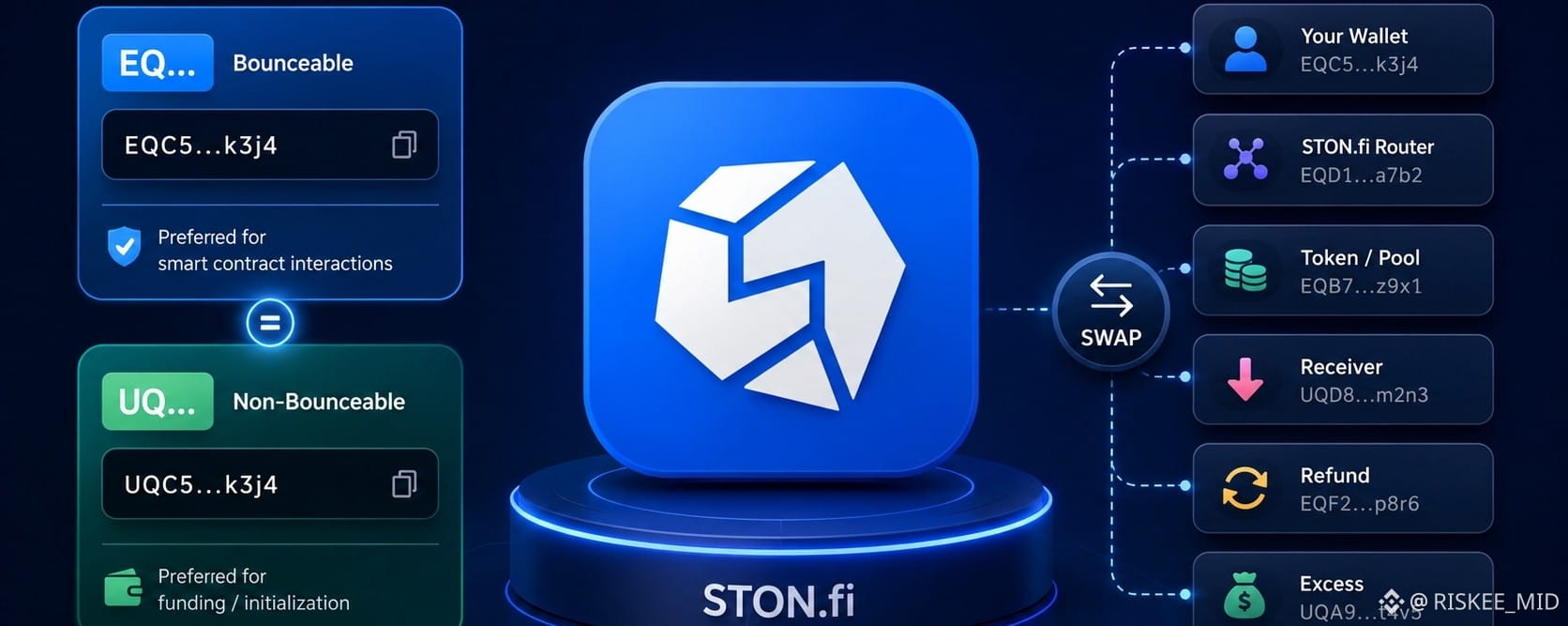
Article
How STONfi Handles Bounceable and Non-Bounceable Addresses on TONHow STONfi Handles Bounceable and Non-Bounceable Addresses on TON
TON addresses can look different while still pointing to the exact same on-chain account.
A common example is the difference between an address beginning with EQ... and one beginning with UQ.... The first is the familiar bounceable user-friendly representation, while the second is the non-bounceable representation. Despite the different prefixes, both can identify the same underlying TON account because the account itself is determined by its workchain and 256-bit account identifier. The bounceable or non-bounceable distinction is encoded as metadata in the user-friendly representation rather than creating a different account.
This distinction becomes especially important when interacting with DeFi protocols such as STONfi, where a single swap can involve several TON addresses and multiple layers of contract messages.
Understanding what the address prefix actually means makes it much easier to understand why STONfi can work with different address representations without treating them as different destinations.
The First Important Distinction: Address Identity vs. Message Behavior
The easiest way to understand TON addresses is to separate who the destination is from how a message should behave when it is sent there.
A TON user-friendly address contains several pieces of information. Among them are the workchain identifier, the account identifier, and flags describing how the address is intended to be handled. In particular, the flags encode whether a message should be sent as bounceable or non-bounceable.
That means the visible prefix is not simply an alternative account identifier.
For example:
EQ... → bounceable user friendly representation
UQ... → non-bounceable user friendly representation
When the underlying workchain and account ID are identical, these are two representations of the same account.
TON's own address utilities can convert an address into its raw, bounceable, and non bounceable forms, which is another way of demonstrating that these are different representations of the same underlying destination rather than separate wallets.
This is one of the most important concepts for developers building on TON:
Do not compare the visual prefix when you are trying to determine whether two addresses identify the same account. Parse the address and compare the underlying address components.
What Does “Bounceable” Actually Mean?
Bounceability is fundamentally about message handling.
TON internal messages contain a bounce flag. When a bounceable message is delivered to a destination and processing fails under the conditions where bouncing is supported, the remaining value can be returned toward the sender. TON's smart contract guidelines recommend bounceable messages for most interactions because they provide protection against certain destination or execution failures.
The important point is that an account does not permanently become a “bounceable account” or a “non bounceable account.”
Instead, the user-friendly address representation contains a flag that software can use when constructing the outgoing message.
TON documents the mainnet friendly formats as:
E... for bounceable addressesU... for non-bounceable addresses
The same account can therefore be represented in either form.
So when someone changes an address from EQ... to UQ..., they have not moved funds, created a second wallet, or changed the account itself.
They have changed the friendly representation and associated bounce preference.
Why Does TON Need Non-Bounceable Addresses?
The answer becomes clearer when we consider account initialization.
TON supports contract accounts whose addresses can be determined before the corresponding contract is deployed. A wallet contract, for example, can have a deterministic address derived from its initialization parameters even before the account has been activated on-chain. TON documentation explicitly describes cases where an address exists as a deterministic value while the account itself is still in the nonexist state.
This creates an important funding problem.
Suppose you want to send TON to a wallet whose address is known but whose account has not yet been initialized. A non bounceable message can be used to fund that destination without the value being bounced back simply because the account has not yet been initialized.
This is why non-bounceable representations are especially associated with funding or initializing wallets.
TON's documentation recommends non-bounceable addresses for wallet contracts in situations where the destination may be uninitialized, while bounceable messages are generally preferred for smart contract interactions where failed execution should result in the value being returned.
Wallets on TON Are Smart Contracts
Another concept that sometimes causes confusion is the word “wallet.”
On TON, a wallet is not merely an account label in the same sense as a traditional centralized exchange account. Wallet implementations are smart contracts, and their address can be derived before deployment.
That is why it is possible to know where a wallet will exist before the wallet contract has actually been initialized on chain.
TON's address workflow reflects this distinction. When a wallet application prepares a transfer, it can inspect the destination's account state. TON documentation notes that when a destination is still uninitialized, wallet software can force the outgoing message's bounce field to false, effectively preferring non-bounceable delivery for initialization scenarios. For already initialized destinations, the wallet can use the bounce preference represented by the address.
So the practical behavior is more sophisticated than simply saying:
“EQ always bounces.”
or
“UQ never bounces.”
The prefix provides a message-handling preference, while the wallet application and destination state can also influence how the transaction is constructed.
Where STONfi Fits Into This Model
A STONfi swap is not simply a single transfer from one wallet to another.
A typical swap can involve several addresses and several messages:
Your wallet → STONfi contract/router → token contracts or pools → recipient/refund/excess destinations
Depending on the operation, the transaction can involve addresses for:
Your connected walletJetton master contractsJetton wallet contractsSTONfi routersPool contractsReceiver addressesRefund addressesExcess-address destinations
Each address may appear at a different layer of the transaction.
This matters because the address used as the initial transaction target is not necessarily the same thing as every address carried inside the contract payload.
When a wallet sends a TON Connect transaction, for example, the message itself has a destination address and may contain an arbitrary payload. Contract interaction can then encode additional MsgAddress values inside that payload. TON's own examples show this pattern for token and NFT interactions, where a contract message can contain addresses such as a new owner or an excess destination.
That is the architecture that makes address handling inside a STONfi swap more interesting than a simple “send from A to B” transfer.
The Initial Target Is Only One Part of the Transaction
Consider the beginning of a swap.
Your wallet creates an outbound message whose initial destination is the STONfi contract that should receive and process the request.
The wallet therefore needs a valid destination address for that contract.
Inside the request payload, however, the protocol may also need to know where resulting assets should be delivered, where excess value should be returned, or where a refund should go if a particular operation requires it.
Those addresses are represented as normal TON address values in the contract data.
They are not necessarily interpreted according to the visual prefix that a human happens to see in a wallet interface.
At the protocol level, the important information is the parsed TON address itself and the message semantics associated with how that address is used.
Why STONfi Can Treat EQ... and UQ... as the Same Destination
Imagine the following simplified scenario:
EQxxxxxxxx... and UQxxxxxxxx...
may look like two different strings.
A naïve application might compare them as raw text and conclude that they represent different wallets.
A TON-aware application should instead parse them into their underlying address structure.
Once parsed, the application can identify the common workchain and account identifier.
That is why the correct mental model is:
Different friendly representation ≠ different account.
This principle is particularly important for STONfi because a DeFi application may receive addresses from different wallets, SDKs, exchanges, explorers, or developers. Different tools may display the same account using different friendly representations.
TON even provides official utilities for detecting and unpacking these forms into their underlying components.
What Happens With STONfi's to Parameters?
According to the behavior described for STONfi's SDK starting with v0.5.0, generated to parameters use bounceable representations because these protocol destinations are expected to be initialized contracts that are intended to receive and execute logic.
That design is consistent with TON's broader smart-contract guidance.
TON recommends bounceable messages for smart-contract interactions because, when appropriate, a failed contract interaction can cause the remaining message value to return instead of simply disappearing into an unusable destination.
This does not mean every address involved in a STONfi transaction must visually begin with EQ.
It means that the message and contract interaction should use the appropriate bounce behavior for the role that address plays.
That distinction is crucial.
A protocol contract receiving an operation is different from a wallet account being initialized for the first time.
Receiver, Refund and Excess Addresses
One of the easiest mistakes for developers is to assume that every address in a swap transaction is the same type of destination.
It is not.
A swap can involve different address roles with different purposes.
Receiver
The receiver identifies where the resulting asset should ultimately be delivered.
Refund
A refund address can be used when an operation has to return value to the originating user or another designated destination.
Excess
An excess destination is used for value that remains after the required execution costs or amounts have been handled.
These addresses can travel through the protocol as TON MsgAddress values embedded in payloads.
This is why simply looking at the first address in a wallet transaction does not tell you everything that is happening inside the swap.
Why Builders Should Parse Addresses Instead of Comparing Strings
For developers, this may be the most practical lesson of all.
Do not build logic such as:
if (addressA === addressB)
when those values may be different user-friendly representations.
Instead, parse both values into proper TON Address objects and compare their underlying identity.
Libraries in the TON ecosystem are designed to convert between raw and friendly representations. TON's documentation explicitly describes converting between raw, bounceable, and non-bounceable forms, while security guidance warns developers to handle TON's multiple address representations correctly.
The application should care about:
workchain + account identifier
rather than:
EQ vs UQ
as a text prefix.
This is especially important for indexing, caching, database storage, portfolio tracking, recipient validation, analytics, and protocol integrations.
A Useful Mental Model
The easiest way to remember the entire system is to think of a TON address as having two layers.
Layer 1: The Account
This is the underlying identity:
Workchain + 256-bit account ID
That is what identifies the destination account.
Layer 2: The User-Friendly Representation
This is how that account is encoded for humans and software:
Raw / Bounceable / Non-bounceable / Testnet variants
The friendly representation adds metadata, including bounceability and testnet information, plus a checksum.
Two friendly strings can therefore describe the same underlying account.
That is exactly why an EQ... representation and a UQ... representation should not automatically be treated as two different wallets.
What Users Should Do Before a STONfi Swap
For everyday STONfi users, the safest approach is surprisingly simple.
Use the address supplied by your wallet or trusted TON tooling rather than manually editing prefixes.
Do not change EQ to UQ, or UQ to EQ, just because another application displays the address differently.
More importantly, always verify the actual destination, network, amount, and transaction details before signing.
TON wallets and TON Connect applications already understand user-friendly addresses and their associated behavior. TON Connect documentation, for example, expects user-friendly addresses for transaction messages and provides utilities for rendering the connected wallet address.
In other words, users generally do not need to manually manage bounce flags when using a properly integrated wallet and protocol interface.
What Builders Should Take Away
For developers integrating STONfi or building TON applications, address normalization should be treated as a fundamental part of the integration rather than an edge case.
A robust implementation should:
Parse addresses before comparing them.
Never assume two different strings mean two different accounts.
Preserve workchain information.
The account identifier must be interpreted together with the correct workchain. TON's security guidance specifically recommends validating the address chain when processing addresses.
Understand the difference between an account and a message.
Bounceability describes how a message should behave; it is not a permanent property that creates a second account.
Use bounceable messages for appropriate contract interactions.
Smart-contract operations generally benefit from bounceable delivery when failed execution should return remaining value.
Use non-bounceable delivery where initialization or funding requires it.
New or uninitialized wallet contracts are the classic case.
Let trusted SDKs handle representation details.
The purpose of an SDK is not only to make contract calls easier, but also to reduce the number of low-level address-handling mistakes developers can make.
The Bigger Picture for STONfi
As TON DeFi becomes more sophisticated, transactions increasingly involve multiple contracts rather than a simple wallet-to-wallet transfer.
STONfi swaps are a good example.
A user may only see:
“Swap token A for token B.”
Behind that simple interface, the blockchain may be coordinating wallet messages, routers, Jetton wallets, pool contracts, receiver destinations and value-return mechanisms.
Correct address handling therefore becomes part of the protocol's reliability.
The difference between EQ... and UQ... may look cosmetic to a user, but at the protocol level it represents a meaningful distinction in message construction.
At the same time, that distinction should never obscure the underlying truth:
The prefix does not automatically mean there are two different accounts.
The same TON account can have different user-friendly representations, while the message sent to that account can carry different bounce behavior depending on how the address is encoded and how the transaction is constructed.
Final Takeaway
TON's address system is powerful precisely because it separates account identity from user-facing representation.
An EQ... address and a UQ... address can point to the same underlying account. The important identity is the workchain plus the account identifier; the friendly prefix adds handling information such as bounceability.
For STONfi users, this means you should not worry when a trusted wallet or application presents your address in a different valid form.
For builders, the lesson is even more important:
Parse TON addresses. Normalize them. Compare their underlying identity. And choose bounce behavior according to the role of the destination and the purpose of the message.
Once that model is clear, STONfi's address handling becomes much easier to understand.
The next time you see an EQ... and UQ... address, do not immediately think “two wallets.”
Think:
same possible destination, different representation, different message-handling preference.
That distinction is small at the interface level, but fundamental when building reliable applications on TON.
Explore more on STON.FI app.ston.fi
Read more about STONfi here BLOG.STON.FI
#Wallet #TON #swap_crypto
How STONfi Handles Bounceable and Non-Bounceable Addresses on TON
How STONfi Handles Bounceable and Non-Bounceable Addresses on TON
TON addresses can look different while still pointing to the exact same on-chain account.
A common example is the difference between an address beginning with EQ... and one beginning with UQ.... The first is the familiar bounceable user-friendly representation, while the second is the non-bounceable representation. Despite the different prefixes, both can identify the same underlying TON account because the account itself is determined by its workchain and 256-bit account identifier. The bounceable or non-bounceable distinction is encoded as metadata in the user-friendly representation rather than creating a different account.
This distinction becomes especially important when interacting with DeFi protocols such as STONfi, where a single swap can involve several TON addresses and multiple layers of contract messages.
Understanding what the address prefix actually means makes it much easier to understand why STONfi can work with different address representations without treating them as different destinations.
The First Important Distinction: Address Identity vs. Message Behavior
The easiest way to understand TON addresses is to separate who the destination is from how a message should behave when it is sent there.
A TON user-friendly address contains several pieces of information. Among them are the workchain identifier, the account identifier, and flags describing how the address is intended to be handled. In particular, the flags encode whether a message should be sent as bounceable or non-bounceable.
That means the visible prefix is not simply an alternative account identifier.
For example:
EQ... → bounceable user friendly representation
UQ... → non-bounceable user friendly representation
When the underlying workchain and account ID are identical, these are two representations of the same account.
TON's own address utilities can convert an address into its raw, bounceable, and non bounceable forms, which is another way of demonstrating that these are different representations of the same underlying destination rather than separate wallets.
This is one of the most important concepts for developers building on TON:
Do not compare the visual prefix when you are trying to determine whether two addresses identify the same account. Parse the address and compare the underlying address components.
What Does “Bounceable” Actually Mean?
Bounceability is fundamentally about message handling.
TON internal messages contain a bounce flag. When a bounceable message is delivered to a destination and processing fails under the conditions where bouncing is supported, the remaining value can be returned toward the sender. TON's smart contract guidelines recommend bounceable messages for most interactions because they provide protection against certain destination or execution failures.
The important point is that an account does not permanently become a “bounceable account” or a “non bounceable account.”
Instead, the user-friendly address representation contains a flag that software can use when constructing the outgoing message.
TON documents the mainnet friendly formats as:
E... for bounceable addressesU... for non-bounceable addresses
The same account can therefore be represented in either form.
So when someone changes an address from EQ... to UQ..., they have not moved funds, created a second wallet, or changed the account itself.
They have changed the friendly representation and associated bounce preference.
Why Does TON Need Non-Bounceable Addresses?
The answer becomes clearer when we consider account initialization.
TON supports contract accounts whose addresses can be determined before the corresponding contract is deployed. A wallet contract, for example, can have a deterministic address derived from its initialization parameters even before the account has been activated on-chain. TON documentation explicitly describes cases where an address exists as a deterministic value while the account itself is still in the nonexist state.
This creates an important funding problem.
Suppose you want to send TON to a wallet whose address is known but whose account has not yet been initialized. A non bounceable message can be used to fund that destination without the value being bounced back simply because the account has not yet been initialized.
This is why non-bounceable representations are especially associated with funding or initializing wallets.
TON's documentation recommends non-bounceable addresses for wallet contracts in situations where the destination may be uninitialized, while bounceable messages are generally preferred for smart contract interactions where failed execution should result in the value being returned.
Wallets on TON Are Smart Contracts
Another concept that sometimes causes confusion is the word “wallet.”
On TON, a wallet is not merely an account label in the same sense as a traditional centralized exchange account. Wallet implementations are smart contracts, and their address can be derived before deployment.
That is why it is possible to know where a wallet will exist before the wallet contract has actually been initialized on chain.
TON's address workflow reflects this distinction. When a wallet application prepares a transfer, it can inspect the destination's account state. TON documentation notes that when a destination is still uninitialized, wallet software can force the outgoing message's bounce field to false, effectively preferring non-bounceable delivery for initialization scenarios. For already initialized destinations, the wallet can use the bounce preference represented by the address.
So the practical behavior is more sophisticated than simply saying:
“EQ always bounces.”
or
“UQ never bounces.”
The prefix provides a message-handling preference, while the wallet application and destination state can also influence how the transaction is constructed.
Where STONfi Fits Into This Model
A STONfi swap is not simply a single transfer from one wallet to another.
A typical swap can involve several addresses and several messages:
Your wallet → STONfi contract/router → token contracts or pools → recipient/refund/excess destinations
Depending on the operation, the transaction can involve addresses for:
Your connected walletJetton master contractsJetton wallet contractsSTONfi routersPool contractsReceiver addressesRefund addressesExcess-address destinations
Each address may appear at a different layer of the transaction.
This matters because the address used as the initial transaction target is not necessarily the same thing as every address carried inside the contract payload.
When a wallet sends a TON Connect transaction, for example, the message itself has a destination address and may contain an arbitrary payload. Contract interaction can then encode additional MsgAddress values inside that payload. TON's own examples show this pattern for token and NFT interactions, where a contract message can contain addresses such as a new owner or an excess destination.
That is the architecture that makes address handling inside a STONfi swap more interesting than a simple “send from A to B” transfer.
The Initial Target Is Only One Part of the Transaction
Consider the beginning of a swap.
Your wallet creates an outbound message whose initial destination is the STONfi contract that should receive and process the request.
The wallet therefore needs a valid destination address for that contract.
Inside the request payload, however, the protocol may also need to know where resulting assets should be delivered, where excess value should be returned, or where a refund should go if a particular operation requires it.
Those addresses are represented as normal TON address values in the contract data.
They are not necessarily interpreted according to the visual prefix that a human happens to see in a wallet interface.
At the protocol level, the important information is the parsed TON address itself and the message semantics associated with how that address is used.
Why STONfi Can Treat EQ... and UQ... as the Same Destination
Imagine the following simplified scenario:
EQxxxxxxxx... and UQxxxxxxxx...
may look like two different strings.
A naïve application might compare them as raw text and conclude that they represent different wallets.
A TON-aware application should instead parse them into their underlying address structure.
Once parsed, the application can identify the common workchain and account identifier.
That is why the correct mental model is:
Different friendly representation ≠ different account.
This principle is particularly important for STONfi because a DeFi application may receive addresses from different wallets, SDKs, exchanges, explorers, or developers. Different tools may display the same account using different friendly representations.
TON even provides official utilities for detecting and unpacking these forms into their underlying components.
What Happens With STONfi's to Parameters?
According to the behavior described for STONfi's SDK starting with v0.5.0, generated to parameters use bounceable representations because these protocol destinations are expected to be initialized contracts that are intended to receive and execute logic.
That design is consistent with TON's broader smart-contract guidance.
TON recommends bounceable messages for smart-contract interactions because, when appropriate, a failed contract interaction can cause the remaining message value to return instead of simply disappearing into an unusable destination.
This does not mean every address involved in a STONfi transaction must visually begin with EQ.
It means that the message and contract interaction should use the appropriate bounce behavior for the role that address plays.
That distinction is crucial.
A protocol contract receiving an operation is different from a wallet account being initialized for the first time.
Receiver, Refund and Excess Addresses
One of the easiest mistakes for developers is to assume that every address in a swap transaction is the same type of destination.
It is not.
A swap can involve different address roles with different purposes.
Receiver
The receiver identifies where the resulting asset should ultimately be delivered.
Refund
A refund address can be used when an operation has to return value to the originating user or another designated destination.
Excess
An excess destination is used for value that remains after the required execution costs or amounts have been handled.
These addresses can travel through the protocol as TON MsgAddress values embedded in payloads.
This is why simply looking at the first address in a wallet transaction does not tell you everything that is happening inside the swap.
Why Builders Should Parse Addresses Instead of Comparing Strings
For developers, this may be the most practical lesson of all.
Do not build logic such as:
if (addressA === addressB)
when those values may be different user-friendly representations.
Instead, parse both values into proper TON Address objects and compare their underlying identity.
Libraries in the TON ecosystem are designed to convert between raw and friendly representations. TON's documentation explicitly describes converting between raw, bounceable, and non-bounceable forms, while security guidance warns developers to handle TON's multiple address representations correctly.
The application should care about:
workchain + account identifier
rather than:
EQ vs UQ
as a text prefix.
This is especially important for indexing, caching, database storage, portfolio tracking, recipient validation, analytics, and protocol integrations.
A Useful Mental Model
The easiest way to remember the entire system is to think of a TON address as having two layers.
Layer 1: The Account
This is the underlying identity:
Workchain + 256-bit account ID
That is what identifies the destination account.
Layer 2: The User-Friendly Representation
This is how that account is encoded for humans and software:
Raw / Bounceable / Non-bounceable / Testnet variants
The friendly representation adds metadata, including bounceability and testnet information, plus a checksum.
Two friendly strings can therefore describe the same underlying account.
That is exactly why an EQ... representation and a UQ... representation should not automatically be treated as two different wallets.
What Users Should Do Before a STONfi Swap
For everyday STONfi users, the safest approach is surprisingly simple.
Use the address supplied by your wallet or trusted TON tooling rather than manually editing prefixes.
Do not change EQ to UQ, or UQ to EQ, just because another application displays the address differently.
More importantly, always verify the actual destination, network, amount, and transaction details before signing.
TON wallets and TON Connect applications already understand user-friendly addresses and their associated behavior. TON Connect documentation, for example, expects user-friendly addresses for transaction messages and provides utilities for rendering the connected wallet address.
In other words, users generally do not need to manually manage bounce flags when using a properly integrated wallet and protocol interface.
What Builders Should Take Away
For developers integrating STONfi or building TON applications, address normalization should be treated as a fundamental part of the integration rather than an edge case.
A robust implementation should:
Parse addresses before comparing them.
Never assume two different strings mean two different accounts.
Preserve workchain information.
The account identifier must be interpreted together with the correct workchain. TON's security guidance specifically recommends validating the address chain when processing addresses.
Understand the difference between an account and a message.
Bounceability describes how a message should behave; it is not a permanent property that creates a second account.
Use bounceable messages for appropriate contract interactions.
Smart-contract operations generally benefit from bounceable delivery when failed execution should return remaining value.
Use non-bounceable delivery where initialization or funding requires it.
New or uninitialized wallet contracts are the classic case.
Let trusted SDKs handle representation details.
The purpose of an SDK is not only to make contract calls easier, but also to reduce the number of low-level address-handling mistakes developers can make.
The Bigger Picture for STONfi
As TON DeFi becomes more sophisticated, transactions increasingly involve multiple contracts rather than a simple wallet-to-wallet transfer.
STONfi swaps are a good example.
A user may only see:
“Swap token A for token B.”
Behind that simple interface, the blockchain may be coordinating wallet messages, routers, Jetton wallets, pool contracts, receiver destinations and value-return mechanisms.
Correct address handling therefore becomes part of the protocol's reliability.
The difference between EQ... and UQ... may look cosmetic to a user, but at the protocol level it represents a meaningful distinction in message construction.
At the same time, that distinction should never obscure the underlying truth:
The prefix does not automatically mean there are two different accounts.
The same TON account can have different user-friendly representations, while the message sent to that account can carry different bounce behavior depending on how the address is encoded and how the transaction is constructed.
Final Takeaway
TON's address system is powerful precisely because it separates account identity from user-facing representation.
An EQ... address and a UQ... address can point to the same underlying account. The important identity is the workchain plus the account identifier; the friendly prefix adds handling information such as bounceability.
For STONfi users, this means you should not worry when a trusted wallet or application presents your address in a different valid form.
For builders, the lesson is even more important:
Parse TON addresses. Normalize them. Compare their underlying identity. And choose bounce behavior according to the role of the destination and the purpose of the message.
Once that model is clear, STONfi's address handling becomes much easier to understand.
The next time you see an EQ... and UQ... address, do not immediately think “two wallets.”
Think:
same possible destination, different representation, different message-handling preference.
That distinction is small at the interface level, but fundamental when building reliable applications on TON.
Explore more on STON.FI app.ston.fi
Read more about STONfi here BLOG.STON.FI
#Wallet #TON #swap_crypto
TON addresses can look different while still pointing to the exact same on-chain account.
A common example is the difference between an address beginning with EQ... and one beginning with UQ.... The first is the familiar bounceable user-friendly representation, while the second is the non-bounceable representation. Despite the different prefixes, both can identify the same underlying TON account because the account itself is determined by its workchain and 256-bit account identifier. The bounceable or non-bounceable distinction is encoded as metadata in the user-friendly representation rather than creating a different account.
This distinction becomes especially important when interacting with DeFi protocols such as STONfi, where a single swap can involve several TON addresses and multiple layers of contract messages.
Understanding what the address prefix actually means makes it much easier to understand why STONfi can work with different address representations without treating them as different destinations.
The First Important Distinction: Address Identity vs. Message Behavior
The easiest way to understand TON addresses is to separate who the destination is from how a message should behave when it is sent there.
A TON user-friendly address contains several pieces of information. Among them are the workchain identifier, the account identifier, and flags describing how the address is intended to be handled. In particular, the flags encode whether a message should be sent as bounceable or non-bounceable.
That means the visible prefix is not simply an alternative account identifier.
For example:
EQ... → bounceable user friendly representation
UQ... → non-bounceable user friendly representation
When the underlying workchain and account ID are identical, these are two representations of the same account.
TON's own address utilities can convert an address into its raw, bounceable, and non bounceable forms, which is another way of demonstrating that these are different representations of the same underlying destination rather than separate wallets.
This is one of the most important concepts for developers building on TON:
Do not compare the visual prefix when you are trying to determine whether two addresses identify the same account. Parse the address and compare the underlying address components.
What Does “Bounceable” Actually Mean?
Bounceability is fundamentally about message handling.
TON internal messages contain a bounce flag. When a bounceable message is delivered to a destination and processing fails under the conditions where bouncing is supported, the remaining value can be returned toward the sender. TON's smart contract guidelines recommend bounceable messages for most interactions because they provide protection against certain destination or execution failures.
The important point is that an account does not permanently become a “bounceable account” or a “non bounceable account.”
Instead, the user-friendly address representation contains a flag that software can use when constructing the outgoing message.
TON documents the mainnet friendly formats as:
E... for bounceable addressesU... for non-bounceable addresses
The same account can therefore be represented in either form.
So when someone changes an address from EQ... to UQ..., they have not moved funds, created a second wallet, or changed the account itself.
They have changed the friendly representation and associated bounce preference.
Why Does TON Need Non-Bounceable Addresses?
The answer becomes clearer when we consider account initialization.
TON supports contract accounts whose addresses can be determined before the corresponding contract is deployed. A wallet contract, for example, can have a deterministic address derived from its initialization parameters even before the account has been activated on-chain. TON documentation explicitly describes cases where an address exists as a deterministic value while the account itself is still in the nonexist state.
This creates an important funding problem.
Suppose you want to send TON to a wallet whose address is known but whose account has not yet been initialized. A non bounceable message can be used to fund that destination without the value being bounced back simply because the account has not yet been initialized.
This is why non-bounceable representations are especially associated with funding or initializing wallets.
TON's documentation recommends non-bounceable addresses for wallet contracts in situations where the destination may be uninitialized, while bounceable messages are generally preferred for smart contract interactions where failed execution should result in the value being returned.
Wallets on TON Are Smart Contracts
Another concept that sometimes causes confusion is the word “wallet.”
On TON, a wallet is not merely an account label in the same sense as a traditional centralized exchange account. Wallet implementations are smart contracts, and their address can be derived before deployment.
That is why it is possible to know where a wallet will exist before the wallet contract has actually been initialized on chain.
TON's address workflow reflects this distinction. When a wallet application prepares a transfer, it can inspect the destination's account state. TON documentation notes that when a destination is still uninitialized, wallet software can force the outgoing message's bounce field to false, effectively preferring non-bounceable delivery for initialization scenarios. For already initialized destinations, the wallet can use the bounce preference represented by the address.
So the practical behavior is more sophisticated than simply saying:
“EQ always bounces.”
or
“UQ never bounces.”
The prefix provides a message-handling preference, while the wallet application and destination state can also influence how the transaction is constructed.
Where STONfi Fits Into This Model
A STONfi swap is not simply a single transfer from one wallet to another.
A typical swap can involve several addresses and several messages:
Your wallet → STONfi contract/router → token contracts or pools → recipient/refund/excess destinations
Depending on the operation, the transaction can involve addresses for:
Your connected walletJetton master contractsJetton wallet contractsSTONfi routersPool contractsReceiver addressesRefund addressesExcess-address destinations
Each address may appear at a different layer of the transaction.
This matters because the address used as the initial transaction target is not necessarily the same thing as every address carried inside the contract payload.
When a wallet sends a TON Connect transaction, for example, the message itself has a destination address and may contain an arbitrary payload. Contract interaction can then encode additional MsgAddress values inside that payload. TON's own examples show this pattern for token and NFT interactions, where a contract message can contain addresses such as a new owner or an excess destination.
That is the architecture that makes address handling inside a STONfi swap more interesting than a simple “send from A to B” transfer.
The Initial Target Is Only One Part of the Transaction
Consider the beginning of a swap.
Your wallet creates an outbound message whose initial destination is the STONfi contract that should receive and process the request.
The wallet therefore needs a valid destination address for that contract.
Inside the request payload, however, the protocol may also need to know where resulting assets should be delivered, where excess value should be returned, or where a refund should go if a particular operation requires it.
Those addresses are represented as normal TON address values in the contract data.
They are not necessarily interpreted according to the visual prefix that a human happens to see in a wallet interface.
At the protocol level, the important information is the parsed TON address itself and the message semantics associated with how that address is used.
Why STONfi Can Treat EQ... and UQ... as the Same Destination
Imagine the following simplified scenario:
EQxxxxxxxx... and UQxxxxxxxx...
may look like two different strings.
A naïve application might compare them as raw text and conclude that they represent different wallets.
A TON-aware application should instead parse them into their underlying address structure.
Once parsed, the application can identify the common workchain and account identifier.
That is why the correct mental model is:
Different friendly representation ≠ different account.
This principle is particularly important for STONfi because a DeFi application may receive addresses from different wallets, SDKs, exchanges, explorers, or developers. Different tools may display the same account using different friendly representations.
TON even provides official utilities for detecting and unpacking these forms into their underlying components.
What Happens With STONfi's to Parameters?
According to the behavior described for STONfi's SDK starting with v0.5.0, generated to parameters use bounceable representations because these protocol destinations are expected to be initialized contracts that are intended to receive and execute logic.
That design is consistent with TON's broader smart-contract guidance.
TON recommends bounceable messages for smart-contract interactions because, when appropriate, a failed contract interaction can cause the remaining message value to return instead of simply disappearing into an unusable destination.
This does not mean every address involved in a STONfi transaction must visually begin with EQ.
It means that the message and contract interaction should use the appropriate bounce behavior for the role that address plays.
That distinction is crucial.
A protocol contract receiving an operation is different from a wallet account being initialized for the first time.
Receiver, Refund and Excess Addresses
One of the easiest mistakes for developers is to assume that every address in a swap transaction is the same type of destination.
It is not.
A swap can involve different address roles with different purposes.
Receiver
The receiver identifies where the resulting asset should ultimately be delivered.
Refund
A refund address can be used when an operation has to return value to the originating user or another designated destination.
Excess
An excess destination is used for value that remains after the required execution costs or amounts have been handled.
These addresses can travel through the protocol as TON MsgAddress values embedded in payloads.
This is why simply looking at the first address in a wallet transaction does not tell you everything that is happening inside the swap.
Why Builders Should Parse Addresses Instead of Comparing Strings
For developers, this may be the most practical lesson of all.
Do not build logic such as:
if (addressA === addressB)
when those values may be different user-friendly representations.
Instead, parse both values into proper TON Address objects and compare their underlying identity.
Libraries in the TON ecosystem are designed to convert between raw and friendly representations. TON's documentation explicitly describes converting between raw, bounceable, and non-bounceable forms, while security guidance warns developers to handle TON's multiple address representations correctly.
The application should care about:
workchain + account identifier
rather than:
EQ vs UQ
as a text prefix.
This is especially important for indexing, caching, database storage, portfolio tracking, recipient validation, analytics, and protocol integrations.
A Useful Mental Model
The easiest way to remember the entire system is to think of a TON address as having two layers.
Layer 1: The Account
This is the underlying identity:
Workchain + 256-bit account ID
That is what identifies the destination account.
Layer 2: The User-Friendly Representation
This is how that account is encoded for humans and software:
Raw / Bounceable / Non-bounceable / Testnet variants
The friendly representation adds metadata, including bounceability and testnet information, plus a checksum.
Two friendly strings can therefore describe the same underlying account.
That is exactly why an EQ... representation and a UQ... representation should not automatically be treated as two different wallets.
What Users Should Do Before a STONfi Swap
For everyday STONfi users, the safest approach is surprisingly simple.
Use the address supplied by your wallet or trusted TON tooling rather than manually editing prefixes.
Do not change EQ to UQ, or UQ to EQ, just because another application displays the address differently.
More importantly, always verify the actual destination, network, amount, and transaction details before signing.
TON wallets and TON Connect applications already understand user-friendly addresses and their associated behavior. TON Connect documentation, for example, expects user-friendly addresses for transaction messages and provides utilities for rendering the connected wallet address.
In other words, users generally do not need to manually manage bounce flags when using a properly integrated wallet and protocol interface.
What Builders Should Take Away
For developers integrating STONfi or building TON applications, address normalization should be treated as a fundamental part of the integration rather than an edge case.
A robust implementation should:
Parse addresses before comparing them.
Never assume two different strings mean two different accounts.
Preserve workchain information.
The account identifier must be interpreted together with the correct workchain. TON's security guidance specifically recommends validating the address chain when processing addresses.
Understand the difference between an account and a message.
Bounceability describes how a message should behave; it is not a permanent property that creates a second account.
Use bounceable messages for appropriate contract interactions.
Smart-contract operations generally benefit from bounceable delivery when failed execution should return remaining value.
Use non-bounceable delivery where initialization or funding requires it.
New or uninitialized wallet contracts are the classic case.
Let trusted SDKs handle representation details.
The purpose of an SDK is not only to make contract calls easier, but also to reduce the number of low-level address-handling mistakes developers can make.
The Bigger Picture for STONfi
As TON DeFi becomes more sophisticated, transactions increasingly involve multiple contracts rather than a simple wallet-to-wallet transfer.
STONfi swaps are a good example.
A user may only see:
“Swap token A for token B.”
Behind that simple interface, the blockchain may be coordinating wallet messages, routers, Jetton wallets, pool contracts, receiver destinations and value-return mechanisms.
Correct address handling therefore becomes part of the protocol's reliability.
The difference between EQ... and UQ... may look cosmetic to a user, but at the protocol level it represents a meaningful distinction in message construction.
At the same time, that distinction should never obscure the underlying truth:
The prefix does not automatically mean there are two different accounts.
The same TON account can have different user-friendly representations, while the message sent to that account can carry different bounce behavior depending on how the address is encoded and how the transaction is constructed.
Final Takeaway
TON's address system is powerful precisely because it separates account identity from user-facing representation.
An EQ... address and a UQ... address can point to the same underlying account. The important identity is the workchain plus the account identifier; the friendly prefix adds handling information such as bounceability.
For STONfi users, this means you should not worry when a trusted wallet or application presents your address in a different valid form.
For builders, the lesson is even more important:
Parse TON addresses. Normalize them. Compare their underlying identity. And choose bounce behavior according to the role of the destination and the purpose of the message.
Once that model is clear, STONfi's address handling becomes much easier to understand.
The next time you see an EQ... and UQ... address, do not immediately think “two wallets.”
Think:
same possible destination, different representation, different message-handling preference.
That distinction is small at the interface level, but fundamental when building reliable applications on TON.
Explore more on STON.FI app.ston.fi
Read more about STONfi here BLOG.STON.FI
#Wallet #TON #swap_crypto
1
1
516
·
--
Article
How to Swap Tokenized Stocks on STON.fi with xStocksHow to Swap Tokenized Stocks on STON.fi with xStocks
Tokenized stocks are becoming one of the most interesting bridges between traditional finance and blockchain-based trading. On STON.fi, this experience is available through xStocks — blockchain-based instruments that give users economic exposure to selected stocks and ETFs in a tokenized form.
Instead of going through a conventional brokerage workflow, eligible users can connect a TON wallet, choose an xStock such as AAPLx, select the asset they want to spend, review the quote, and confirm the transaction. The result is a trading experience that feels familiar to any DeFi user, while still reflecting the structure and risks of a tokenized financial product.
What xStocks Are on STON.fi
xStocks on STON.fi are tracker certificates issued by Backed Assets (JE) Limited. Each token is designed to track the value of an underlying security and is collateralized 1:1 by the referenced asset, which is held in segregated accounts. That structure is what gives xStocks their economic exposure to the stock or ETF they represent.
It is important to understand what this means in practice. xStocks are not the same as directly owning a traditional registered share. They do not provide shareholder voting rights, and they are not identical to holding the underlying asset in a conventional brokerage account. What they do provide is a tokenized form of exposure that can be transferred and traded on-chain.
Because xStocks exist as jettons in the TON ecosystem, they can be held in a TON wallet and traded around the clock. This makes them accessible in a way that traditional stock markets are not, especially for users who want blockchain-native access to market-linked assets.
How to Complete an xStocks Swap
Swapping xStocks on STON.fi is designed to feel simple, but every step matters. A clean execution depends on choosing the right token, checking the quote carefully, and confirming that the wallet request matches your intent.
The process works like this:
First, open the official STON.fi xStocks section. This is where the available tokenized stocks and ETF-linked assets are listed. From there, choose the xStock you want to trade, such as AAPLx, TSLAx, or NVDAx.
Next, select the asset you want to spend. In many cases, users may swap from TON or USDT, depending on the available route and liquidity. After that, enter the amount and review the quote shown by Omniston. This is one of the most important parts of the process, because the quote determines the real execution terms of the trade.
Once the quote looks correct, connect your TON wallet using TON Connect. Then approve the transaction in your wallet after checking the details carefully. After confirmation, settlement takes place and the xStock arrives in your wallet as a jetton.
Although the steps are straightforward, the quality of the quote and the timing of the trade can have a major impact on the result.
Key Things to Check Before Swapping
Before making any xStocks swap, there are a few things every user should understand.
Eligibility comes first. xStocks are not available in all jurisdictions. Restrictions apply in places such as the United States, EU/EEA, the United Kingdom, Canada, Australia, and other restricted regions. Anyone considering a swap should make sure they are eligible before proceeding.
Second, it is essential to understand the product structure. An xStock is a tokenized tracker, not a registered share. That distinction affects what rights you have, what you are buying, and how the asset should be understood.
Third, always review the quote in relation to the underlying market price. This matters even more outside of traditional market hours, when the token’s secondary price can move differently from the stock it tracks.
Finally, make sure your wallet contains enough TON to cover fees. Even a well-quoted swap can fail or become inconvenient if you do not have enough balance for network costs.
Why the Quote Matters
The quote is not just a technical detail. It is the core of the swap experience.
STON.fi uses Omniston for liquidity aggregation, which helps route trades efficiently across available liquidity. In some cases, execution may involve escrow-based settlement mechanics. That means the final price you receive can reflect not only the underlying market value, but also liquidity conditions, supply and demand, and routing dynamics.
This is especially relevant when traditional markets are closed. During those periods, the on-chain secondary price of an xStock can deviate from the real-world stock price. That does not necessarily mean something is wrong. It simply reflects the fact that tokenized assets trade in a different environment than conventional shares.
For this reason, users should avoid treating the displayed quote as a casual estimate. It is the actual trading reference for the swap, and it should be reviewed with the same care as any other financial execution.
What Makes xStocks on STON.fi Different
The main advantage of xStocks on STON.fi is accessibility. Users can interact with tokenized exposure to stocks and ETFs in a DeFi-native way, using a wallet they already control. The assets live on-chain, can be transferred as jettons, and can be traded outside standard market hours.
That makes the experience especially attractive for users who are already active in the TON ecosystem. Instead of switching to a separate brokerage interface, they can explore tokenized exposure directly within a blockchain environment.
At the same time, that convenience comes with responsibility. Users must understand that tokenized stocks are structured products. They are not a substitute for direct share ownership, and they come with jurisdictional restrictions, execution differences, and market dynamics that do not always match the underlying asset perfectly.
Practical Summary
Swapping xStocks on STON.fi is a straightforward process, but it should never be treated casually. The workflow is simple: open the xStocks section, choose the tokenized stock, select the asset to spend, review the Omniston quote, connect your TON wallet, approve the transaction, and wait for settlement.
What makes the experience valuable is not just the ability to trade, but the way it combines blockchain convenience with exposure to familiar market assets. What makes it risky is the same thing: users need to understand eligibility, product structure, and price behavior before confirming a trade.
In practical terms, swapping xStocks on STON.fi feels similar to a normal jetton trade. The difference is that behind the familiar interface sits a tokenized financial instrument that deserves careful attention. For users who understand the mechanics, it offers a modern way to access selected stocks and ETFs on-chain, through the TON ecosystem.
Final Takeaway
xStocks on STON.fi bring tokenized stock exposure into the world of DeFi, giving eligible users a way to trade selected assets as jettons through TON wallets. The process is simple, but the details matter. Eligibility, quote quality, market timing, and product structure all play an important role in how the swap performs.
Used wisely, the experience offers a practical blend of accessibility, flexibility, and on-chain trading. Used carelessly, it can lead to misunderstandings about what the asset really is. That is why the best approach is to treat every swap as both a trade and a product decision.
Explore more on STON.FI app.ston.fi
Read more about STONfi here BLOG.STON.FI
#BitcoinETFsPost$853MWeeklyInflow #GrayscaleWithdrawsThreeAltcoinETFFilings
How to Swap Tokenized Stocks on STON.fi with xStocks
How to Swap Tokenized Stocks on STON.fi with xStocks
Tokenized stocks are becoming one of the most interesting bridges between traditional finance and blockchain-based trading. On STON.fi, this experience is available through xStocks — blockchain-based instruments that give users economic exposure to selected stocks and ETFs in a tokenized form.
Instead of going through a conventional brokerage workflow, eligible users can connect a TON wallet, choose an xStock such as AAPLx, select the asset they want to spend, review the quote, and confirm the transaction. The result is a trading experience that feels familiar to any DeFi user, while still reflecting the structure and risks of a tokenized financial product.
What xStocks Are on STON.fi
xStocks on STON.fi are tracker certificates issued by Backed Assets (JE) Limited. Each token is designed to track the value of an underlying security and is collateralized 1:1 by the referenced asset, which is held in segregated accounts. That structure is what gives xStocks their economic exposure to the stock or ETF they represent.
It is important to understand what this means in practice. xStocks are not the same as directly owning a traditional registered share. They do not provide shareholder voting rights, and they are not identical to holding the underlying asset in a conventional brokerage account. What they do provide is a tokenized form of exposure that can be transferred and traded on-chain.
Because xStocks exist as jettons in the TON ecosystem, they can be held in a TON wallet and traded around the clock. This makes them accessible in a way that traditional stock markets are not, especially for users who want blockchain-native access to market-linked assets.
How to Complete an xStocks Swap
Swapping xStocks on STON.fi is designed to feel simple, but every step matters. A clean execution depends on choosing the right token, checking the quote carefully, and confirming that the wallet request matches your intent.
The process works like this:
First, open the official STON.fi xStocks section. This is where the available tokenized stocks and ETF-linked assets are listed. From there, choose the xStock you want to trade, such as AAPLx, TSLAx, or NVDAx.
Next, select the asset you want to spend. In many cases, users may swap from TON or USDT, depending on the available route and liquidity. After that, enter the amount and review the quote shown by Omniston. This is one of the most important parts of the process, because the quote determines the real execution terms of the trade.
Once the quote looks correct, connect your TON wallet using TON Connect. Then approve the transaction in your wallet after checking the details carefully. After confirmation, settlement takes place and the xStock arrives in your wallet as a jetton.
Although the steps are straightforward, the quality of the quote and the timing of the trade can have a major impact on the result.
Key Things to Check Before Swapping
Before making any xStocks swap, there are a few things every user should understand.
Eligibility comes first. xStocks are not available in all jurisdictions. Restrictions apply in places such as the United States, EU/EEA, the United Kingdom, Canada, Australia, and other restricted regions. Anyone considering a swap should make sure they are eligible before proceeding.
Second, it is essential to understand the product structure. An xStock is a tokenized tracker, not a registered share. That distinction affects what rights you have, what you are buying, and how the asset should be understood.
Third, always review the quote in relation to the underlying market price. This matters even more outside of traditional market hours, when the token’s secondary price can move differently from the stock it tracks.
Finally, make sure your wallet contains enough TON to cover fees. Even a well-quoted swap can fail or become inconvenient if you do not have enough balance for network costs.
Why the Quote Matters
The quote is not just a technical detail. It is the core of the swap experience.
STON.fi uses Omniston for liquidity aggregation, which helps route trades efficiently across available liquidity. In some cases, execution may involve escrow-based settlement mechanics. That means the final price you receive can reflect not only the underlying market value, but also liquidity conditions, supply and demand, and routing dynamics.
This is especially relevant when traditional markets are closed. During those periods, the on-chain secondary price of an xStock can deviate from the real-world stock price. That does not necessarily mean something is wrong. It simply reflects the fact that tokenized assets trade in a different environment than conventional shares.
For this reason, users should avoid treating the displayed quote as a casual estimate. It is the actual trading reference for the swap, and it should be reviewed with the same care as any other financial execution.
What Makes xStocks on STON.fi Different
The main advantage of xStocks on STON.fi is accessibility. Users can interact with tokenized exposure to stocks and ETFs in a DeFi-native way, using a wallet they already control. The assets live on-chain, can be transferred as jettons, and can be traded outside standard market hours.
That makes the experience especially attractive for users who are already active in the TON ecosystem. Instead of switching to a separate brokerage interface, they can explore tokenized exposure directly within a blockchain environment.
At the same time, that convenience comes with responsibility. Users must understand that tokenized stocks are structured products. They are not a substitute for direct share ownership, and they come with jurisdictional restrictions, execution differences, and market dynamics that do not always match the underlying asset perfectly.
Practical Summary
Swapping xStocks on STON.fi is a straightforward process, but it should never be treated casually. The workflow is simple: open the xStocks section, choose the tokenized stock, select the asset to spend, review the Omniston quote, connect your TON wallet, approve the transaction, and wait for settlement.
What makes the experience valuable is not just the ability to trade, but the way it combines blockchain convenience with exposure to familiar market assets. What makes it risky is the same thing: users need to understand eligibility, product structure, and price behavior before confirming a trade.
In practical terms, swapping xStocks on STON.fi feels similar to a normal jetton trade. The difference is that behind the familiar interface sits a tokenized financial instrument that deserves careful attention. For users who understand the mechanics, it offers a modern way to access selected stocks and ETFs on-chain, through the TON ecosystem.
Final Takeaway
xStocks on STON.fi bring tokenized stock exposure into the world of DeFi, giving eligible users a way to trade selected assets as jettons through TON wallets. The process is simple, but the details matter. Eligibility, quote quality, market timing, and product structure all play an important role in how the swap performs.
Used wisely, the experience offers a practical blend of accessibility, flexibility, and on-chain trading. Used carelessly, it can lead to misunderstandings about what the asset really is. That is why the best approach is to treat every swap as both a trade and a product decision.
Explore more on STON.FI app.ston.fi
Read more about STONfi here BLOG.STON.FI
#BitcoinETFsPost$853MWeeklyInflow #GrayscaleWithdrawsThreeAltcoinETFFilings
Tokenized stocks are becoming one of the most interesting bridges between traditional finance and blockchain-based trading. On STON.fi, this experience is available through xStocks — blockchain-based instruments that give users economic exposure to selected stocks and ETFs in a tokenized form.
Instead of going through a conventional brokerage workflow, eligible users can connect a TON wallet, choose an xStock such as AAPLx, select the asset they want to spend, review the quote, and confirm the transaction. The result is a trading experience that feels familiar to any DeFi user, while still reflecting the structure and risks of a tokenized financial product.
What xStocks Are on STON.fi
xStocks on STON.fi are tracker certificates issued by Backed Assets (JE) Limited. Each token is designed to track the value of an underlying security and is collateralized 1:1 by the referenced asset, which is held in segregated accounts. That structure is what gives xStocks their economic exposure to the stock or ETF they represent.
It is important to understand what this means in practice. xStocks are not the same as directly owning a traditional registered share. They do not provide shareholder voting rights, and they are not identical to holding the underlying asset in a conventional brokerage account. What they do provide is a tokenized form of exposure that can be transferred and traded on-chain.
Because xStocks exist as jettons in the TON ecosystem, they can be held in a TON wallet and traded around the clock. This makes them accessible in a way that traditional stock markets are not, especially for users who want blockchain-native access to market-linked assets.
How to Complete an xStocks Swap
Swapping xStocks on STON.fi is designed to feel simple, but every step matters. A clean execution depends on choosing the right token, checking the quote carefully, and confirming that the wallet request matches your intent.
The process works like this:
First, open the official STON.fi xStocks section. This is where the available tokenized stocks and ETF-linked assets are listed. From there, choose the xStock you want to trade, such as AAPLx, TSLAx, or NVDAx.
Next, select the asset you want to spend. In many cases, users may swap from TON or USDT, depending on the available route and liquidity. After that, enter the amount and review the quote shown by Omniston. This is one of the most important parts of the process, because the quote determines the real execution terms of the trade.
Once the quote looks correct, connect your TON wallet using TON Connect. Then approve the transaction in your wallet after checking the details carefully. After confirmation, settlement takes place and the xStock arrives in your wallet as a jetton.
Although the steps are straightforward, the quality of the quote and the timing of the trade can have a major impact on the result.
Key Things to Check Before Swapping
Before making any xStocks swap, there are a few things every user should understand.
Eligibility comes first. xStocks are not available in all jurisdictions. Restrictions apply in places such as the United States, EU/EEA, the United Kingdom, Canada, Australia, and other restricted regions. Anyone considering a swap should make sure they are eligible before proceeding.
Second, it is essential to understand the product structure. An xStock is a tokenized tracker, not a registered share. That distinction affects what rights you have, what you are buying, and how the asset should be understood.
Third, always review the quote in relation to the underlying market price. This matters even more outside of traditional market hours, when the token’s secondary price can move differently from the stock it tracks.
Finally, make sure your wallet contains enough TON to cover fees. Even a well-quoted swap can fail or become inconvenient if you do not have enough balance for network costs.
Why the Quote Matters
The quote is not just a technical detail. It is the core of the swap experience.
STON.fi uses Omniston for liquidity aggregation, which helps route trades efficiently across available liquidity. In some cases, execution may involve escrow-based settlement mechanics. That means the final price you receive can reflect not only the underlying market value, but also liquidity conditions, supply and demand, and routing dynamics.
This is especially relevant when traditional markets are closed. During those periods, the on-chain secondary price of an xStock can deviate from the real-world stock price. That does not necessarily mean something is wrong. It simply reflects the fact that tokenized assets trade in a different environment than conventional shares.
For this reason, users should avoid treating the displayed quote as a casual estimate. It is the actual trading reference for the swap, and it should be reviewed with the same care as any other financial execution.
What Makes xStocks on STON.fi Different
The main advantage of xStocks on STON.fi is accessibility. Users can interact with tokenized exposure to stocks and ETFs in a DeFi-native way, using a wallet they already control. The assets live on-chain, can be transferred as jettons, and can be traded outside standard market hours.
That makes the experience especially attractive for users who are already active in the TON ecosystem. Instead of switching to a separate brokerage interface, they can explore tokenized exposure directly within a blockchain environment.
At the same time, that convenience comes with responsibility. Users must understand that tokenized stocks are structured products. They are not a substitute for direct share ownership, and they come with jurisdictional restrictions, execution differences, and market dynamics that do not always match the underlying asset perfectly.
Practical Summary
Swapping xStocks on STON.fi is a straightforward process, but it should never be treated casually. The workflow is simple: open the xStocks section, choose the tokenized stock, select the asset to spend, review the Omniston quote, connect your TON wallet, approve the transaction, and wait for settlement.
What makes the experience valuable is not just the ability to trade, but the way it combines blockchain convenience with exposure to familiar market assets. What makes it risky is the same thing: users need to understand eligibility, product structure, and price behavior before confirming a trade.
In practical terms, swapping xStocks on STON.fi feels similar to a normal jetton trade. The difference is that behind the familiar interface sits a tokenized financial instrument that deserves careful attention. For users who understand the mechanics, it offers a modern way to access selected stocks and ETFs on-chain, through the TON ecosystem.
Final Takeaway
xStocks on STON.fi bring tokenized stock exposure into the world of DeFi, giving eligible users a way to trade selected assets as jettons through TON wallets. The process is simple, but the details matter. Eligibility, quote quality, market timing, and product structure all play an important role in how the swap performs.
Used wisely, the experience offers a practical blend of accessibility, flexibility, and on-chain trading. Used carelessly, it can lead to misunderstandings about what the asset really is. That is why the best approach is to treat every swap as both a trade and a product decision.
Explore more on STON.FI app.ston.fi
Read more about STONfi here BLOG.STON.FI
#BitcoinETFsPost$853MWeeklyInflow #GrayscaleWithdrawsThreeAltcoinETFFilings
107
·
--
Article
Crypto Security Starts Before the Trade: A Practical Guide to Protecting Your Self-Custodial WalletCrypto Security Starts Before You Trade: A Practical Guide to Protecting Your Self Custodial Wallet
In crypto, security mistakes rarely begin at the moment of a trade.
More often, they happen weeks or months earlier, when someone creates a wallet, writes down a seed phrase, stores it somewhere convenient, and tells themselves they will organize a proper backup later.
That “later” can become one of the biggest security risks in self custody.
As more people enter the TON ecosystem through wallets, Telegram Mini Apps, DeFi applications, decentralized exchanges and liquidity protocols such as STONfi, understanding how to protect wallet access is becoming just as important as understanding how to use the ecosystem.
The good news is that basic wallet security does not have to be complicated. A few simple checks, performed regularly, can significantly reduce the risk of losing access to your assets.
Self Custody Means You Control the Keys
Self custody is one of the defining principles of cryptocurrency.
With a self custodial wallet such as Tonkeeper, your assets are controlled through the private keys associated with your wallet. You are not simply trusting a centralized company to hold your funds on your behalf.
This gives you greater control, but that control comes with responsibility.
If you control the keys, you are also responsible for protecting them.
That means your seed phrase should be treated as one of the most important pieces of information you possess in your crypto journey.
It is not a password that you can simply reset through customer support.
It is not something that should be casually shared with another person.
And it should never be treated as ordinary information.
Your Seed Phrase Is Your Recovery Key
When you create a self custodial wallet, a seed phrase provides a way to recover access to the wallet.
Anyone who obtains the seed phrase may potentially gain control of the assets associated with that wallet.
This is why the safest approach is to keep the phrase offline and protected from unauthorized access.
A common mistake is choosing convenience over security.
Someone may take a screenshot because it is quick. Another person may save the phrase in a notes application. Someone else may send it to themselves through email or a messaging app so they can “find it later.”
These methods may feel convenient, but they introduce additional points of exposure.
Cloud accounts can be compromised. Devices can be lost or accessed by someone else. Screenshots can be synchronized automatically. Emails and saved messages can potentially be accessed if an account is compromised.
For a recovery phrase, convenience should never come before security.
Perform a Regular Wallet Security Check
You do not need to spend hours reviewing your wallet security.
A basic security check can take only a few minutes.
1. Confirm Your Seed Phrase Is Backed Up Securely
First, make sure you actually have a reliable backup of your seed phrase.
A secure offline backup is preferable to storing the phrase digitally.
Your backup should also be protected from physical loss or unauthorized access. Think about what would happen if your primary device were suddenly lost, damaged, or became inaccessible.
The purpose of a backup is to make sure you can recover your wallet when you need it without exposing the recovery phrase unnecessarily.
2. Avoid Digital Copies of Your Seed Phrase
One of the simplest security improvements is removing unnecessary digital copies.
Avoid storing your seed phrase in:
Cloud storageNotes applicationsScreenshotsEmail accountsSaved messagesChat applicationsPassword or document files that are synchronized online
The fewer digital copies that exist, the fewer places an attacker can potentially target.
Your seed phrase should not be treated like an ordinary document.
3. Use PIN Protection
Your wallet device should have appropriate protection enabled.
A PIN adds another layer of security against someone casually accessing your wallet on your device.
While a PIN does not replace proper seed phrase security, it is an important part of your everyday wallet protection.
Security works best as multiple layers rather than relying on a single measure.
4. Review Your Devices
It is also worth checking which devices have access to your wallet.
Old phones, tablets, computers or other devices can remain part of your digital environment long after you stop actively using them.
If you no longer use a device, consider whether it should still have access to your wallet.
Regularly reviewing your devices helps reduce unnecessary exposure and reminds you where your wallet is being used.
5. Check Your Recovery Information While You Still Have Access
One of the worst times to discover a problem with your wallet backup is when you have already lost access to the wallet.
That is why recovery information should be reviewed while everything is still working normally.
Make sure your backup exists, is readable, is stored securely, and is available when needed.
Security is much easier to verify when you still have access than when you are already trying to recover a lost wallet.
Can Tonkeeper Recover a Lost Seed Phrase?
This is an important question for anyone using a self custodial wallet.
The answer is no.
If a user loses their seed phrase and does not have a backup, the wallet provider cannot simply generate a replacement recovery phrase and restore access to the wallet.
This is not a limitation unique to one wallet. It is a fundamental consequence of self custody.
The same principle that gives users control over their assets also means there is no centralized authority with a master key that can simply reset ownership.
That is why protecting the seed phrase is such a critical responsibility.
You can learn more about Tonkeeper and wallet-related information through the official website:
tonkeeper.com/
Security Is Part of Using TON
The TON ecosystem continues to expand beyond simple transfers.
Users can interact with wallets, Telegram Mini Apps, DeFi applications, decentralized exchanges, liquidity pools, tokenized assets, and other blockchain based services.
That creates more opportunities, but it also means users need to develop better security habits.
A secure wallet is only one part of the equation.
Users should also be careful about the applications they connect to, the transactions they approve, the links they open, and the permissions they grant.
Before approving a transaction, take a moment to understand what you are signing.
Before connecting a wallet to an application, make sure you are interacting with the legitimate platform.
And never enter a seed phrase into a website simply because a page claims that you need to “verify” or “synchronize” your wallet.
A legitimate service should never require you to casually reveal your recovery phrase.
DeFi Makes Wallet Security Even More Important
DeFi introduces another layer of responsibility.
When interacting with decentralized exchanges and liquidity protocols such as STONfi, users are not simply holding assets in a wallet. They may also be swapping tokens, providing liquidity, interacting with smart contracts, or participating in other on-chain activities.
That means security awareness should extend beyond protecting the seed phrase.
Users should develop the habit of checking:
The website they are visitingThe application they are connecting toThe transaction they are approvingThe token and amount involvedThe wallet address or contract interactionAny unusual request for permissions or credentials
A few seconds of verification can be valuable when dealing with irreversible blockchain transactions.
You can explore more about STONfi and its ecosystem through its official website and resources:
blog.ston.fi/
Convenience Should Never Replace Security
One of the biggest challenges in crypto security is that unsafe practices are often more convenient.
Saving a seed phrase to your phone is easier than maintaining a secure offline backup.
Keeping everything accessible through the cloud feels convenient.
Reusing familiar passwords feels easier.
Clicking a link immediately feels faster than checking whether the website is legitimate.
But crypto changes the consequences of these decisions.
Blockchain transactions are generally designed to be irreversible. If an attacker gains control of your wallet and moves your assets, there may be no centralized institution capable of reversing the transaction.
That is why prevention matters so much.
The goal is not to make crypto unnecessarily difficult.
The goal is to build security habits that become automatic.
A Simple Security Routine
A useful approach is to periodically perform a short wallet security review.
Ask yourself:
Do I know where my seed phrase is?
Is my backup stored securely offline?
Have I accidentally created any digital copies?
Is my wallet protected by a PIN?
Which devices currently have access to my wallet?
Do I still trust the applications I connect to?
Have I recently reviewed my recovery information?
Would I still be able to recover my wallet if my current device disappeared today?
If you cannot confidently answer these questions, it may be time for a security review.
The Most Important Lesson About Self Custody
Self custody is powerful because it removes the need to depend entirely on a centralized institution to control your assets.
But that freedom comes with responsibility.
Your wallet does not know whether you have safely backed up your seed phrase.
It does not know whether you stored the phrase in an insecure cloud account.
It cannot automatically distinguish a legitimate website from a malicious one when you approve an interaction.
And if you lose the recovery phrase without a backup, there may be no support team capable of restoring access.
That is why wallet security should not be something users think about only after something goes wrong.
It should become part of the normal crypto routine.
Security Today Can Prevent Stress Tomorrow
Crypto security is not about being paranoid.
It is about being prepared.
A few minutes spent reviewing your seed phrase backup, device access, wallet protection, and recovery information can prevent much bigger problems later.
As the TON ecosystem continues to grow and more users interact with wallets, Mini Apps, DeFi applications, decentralized exchanges, and protocols such as STONfi, security awareness will become increasingly important.
The best time to discover a weakness in your wallet security is while you still have full access to your assets.
Do not wait for a lost phone, compromised account, or forgotten backup to force you to think about security.
Check your wallet today.
Protect your recovery phrase.
Review your devices.
Verify what you approve.
And remember the fundamental rule of self-custody:
If you control the keys, protecting those keys is your responsibility.
Explore More on Tonkeeper: tonkeeper.com/
STONfi Blog: blog.ston.fi/
#TON #Tonkeeper #SecurityAlert
Crypto Security Starts Before the Trade: A Practical Guide to Protecting Your Self-Custodial Wallet
Crypto Security Starts Before You Trade: A Practical Guide to Protecting Your Self Custodial Wallet
In crypto, security mistakes rarely begin at the moment of a trade.
More often, they happen weeks or months earlier, when someone creates a wallet, writes down a seed phrase, stores it somewhere convenient, and tells themselves they will organize a proper backup later.
That “later” can become one of the biggest security risks in self custody.
As more people enter the TON ecosystem through wallets, Telegram Mini Apps, DeFi applications, decentralized exchanges and liquidity protocols such as STONfi, understanding how to protect wallet access is becoming just as important as understanding how to use the ecosystem.
The good news is that basic wallet security does not have to be complicated. A few simple checks, performed regularly, can significantly reduce the risk of losing access to your assets.
Self Custody Means You Control the Keys
Self custody is one of the defining principles of cryptocurrency.
With a self custodial wallet such as Tonkeeper, your assets are controlled through the private keys associated with your wallet. You are not simply trusting a centralized company to hold your funds on your behalf.
This gives you greater control, but that control comes with responsibility.
If you control the keys, you are also responsible for protecting them.
That means your seed phrase should be treated as one of the most important pieces of information you possess in your crypto journey.
It is not a password that you can simply reset through customer support.
It is not something that should be casually shared with another person.
And it should never be treated as ordinary information.
Your Seed Phrase Is Your Recovery Key
When you create a self custodial wallet, a seed phrase provides a way to recover access to the wallet.
Anyone who obtains the seed phrase may potentially gain control of the assets associated with that wallet.
This is why the safest approach is to keep the phrase offline and protected from unauthorized access.
A common mistake is choosing convenience over security.
Someone may take a screenshot because it is quick. Another person may save the phrase in a notes application. Someone else may send it to themselves through email or a messaging app so they can “find it later.”
These methods may feel convenient, but they introduce additional points of exposure.
Cloud accounts can be compromised. Devices can be lost or accessed by someone else. Screenshots can be synchronized automatically. Emails and saved messages can potentially be accessed if an account is compromised.
For a recovery phrase, convenience should never come before security.
Perform a Regular Wallet Security Check
You do not need to spend hours reviewing your wallet security.
A basic security check can take only a few minutes.
1. Confirm Your Seed Phrase Is Backed Up Securely
First, make sure you actually have a reliable backup of your seed phrase.
A secure offline backup is preferable to storing the phrase digitally.
Your backup should also be protected from physical loss or unauthorized access. Think about what would happen if your primary device were suddenly lost, damaged, or became inaccessible.
The purpose of a backup is to make sure you can recover your wallet when you need it without exposing the recovery phrase unnecessarily.
2. Avoid Digital Copies of Your Seed Phrase
One of the simplest security improvements is removing unnecessary digital copies.
Avoid storing your seed phrase in:
Cloud storageNotes applicationsScreenshotsEmail accountsSaved messagesChat applicationsPassword or document files that are synchronized online
The fewer digital copies that exist, the fewer places an attacker can potentially target.
Your seed phrase should not be treated like an ordinary document.
3. Use PIN Protection
Your wallet device should have appropriate protection enabled.
A PIN adds another layer of security against someone casually accessing your wallet on your device.
While a PIN does not replace proper seed phrase security, it is an important part of your everyday wallet protection.
Security works best as multiple layers rather than relying on a single measure.
4. Review Your Devices
It is also worth checking which devices have access to your wallet.
Old phones, tablets, computers or other devices can remain part of your digital environment long after you stop actively using them.
If you no longer use a device, consider whether it should still have access to your wallet.
Regularly reviewing your devices helps reduce unnecessary exposure and reminds you where your wallet is being used.
5. Check Your Recovery Information While You Still Have Access
One of the worst times to discover a problem with your wallet backup is when you have already lost access to the wallet.
That is why recovery information should be reviewed while everything is still working normally.
Make sure your backup exists, is readable, is stored securely, and is available when needed.
Security is much easier to verify when you still have access than when you are already trying to recover a lost wallet.
Can Tonkeeper Recover a Lost Seed Phrase?
This is an important question for anyone using a self custodial wallet.
The answer is no.
If a user loses their seed phrase and does not have a backup, the wallet provider cannot simply generate a replacement recovery phrase and restore access to the wallet.
This is not a limitation unique to one wallet. It is a fundamental consequence of self custody.
The same principle that gives users control over their assets also means there is no centralized authority with a master key that can simply reset ownership.
That is why protecting the seed phrase is such a critical responsibility.
You can learn more about Tonkeeper and wallet-related information through the official website:
tonkeeper.com/
Security Is Part of Using TON
The TON ecosystem continues to expand beyond simple transfers.
Users can interact with wallets, Telegram Mini Apps, DeFi applications, decentralized exchanges, liquidity pools, tokenized assets, and other blockchain based services.
That creates more opportunities, but it also means users need to develop better security habits.
A secure wallet is only one part of the equation.
Users should also be careful about the applications they connect to, the transactions they approve, the links they open, and the permissions they grant.
Before approving a transaction, take a moment to understand what you are signing.
Before connecting a wallet to an application, make sure you are interacting with the legitimate platform.
And never enter a seed phrase into a website simply because a page claims that you need to “verify” or “synchronize” your wallet.
A legitimate service should never require you to casually reveal your recovery phrase.
DeFi Makes Wallet Security Even More Important
DeFi introduces another layer of responsibility.
When interacting with decentralized exchanges and liquidity protocols such as STONfi, users are not simply holding assets in a wallet. They may also be swapping tokens, providing liquidity, interacting with smart contracts, or participating in other on-chain activities.
That means security awareness should extend beyond protecting the seed phrase.
Users should develop the habit of checking:
The website they are visitingThe application they are connecting toThe transaction they are approvingThe token and amount involvedThe wallet address or contract interactionAny unusual request for permissions or credentials
A few seconds of verification can be valuable when dealing with irreversible blockchain transactions.
You can explore more about STONfi and its ecosystem through its official website and resources:
blog.ston.fi/
Convenience Should Never Replace Security
One of the biggest challenges in crypto security is that unsafe practices are often more convenient.
Saving a seed phrase to your phone is easier than maintaining a secure offline backup.
Keeping everything accessible through the cloud feels convenient.
Reusing familiar passwords feels easier.
Clicking a link immediately feels faster than checking whether the website is legitimate.
But crypto changes the consequences of these decisions.
Blockchain transactions are generally designed to be irreversible. If an attacker gains control of your wallet and moves your assets, there may be no centralized institution capable of reversing the transaction.
That is why prevention matters so much.
The goal is not to make crypto unnecessarily difficult.
The goal is to build security habits that become automatic.
A Simple Security Routine
A useful approach is to periodically perform a short wallet security review.
Ask yourself:
Do I know where my seed phrase is?
Is my backup stored securely offline?
Have I accidentally created any digital copies?
Is my wallet protected by a PIN?
Which devices currently have access to my wallet?
Do I still trust the applications I connect to?
Have I recently reviewed my recovery information?
Would I still be able to recover my wallet if my current device disappeared today?
If you cannot confidently answer these questions, it may be time for a security review.
The Most Important Lesson About Self Custody
Self custody is powerful because it removes the need to depend entirely on a centralized institution to control your assets.
But that freedom comes with responsibility.
Your wallet does not know whether you have safely backed up your seed phrase.
It does not know whether you stored the phrase in an insecure cloud account.
It cannot automatically distinguish a legitimate website from a malicious one when you approve an interaction.
And if you lose the recovery phrase without a backup, there may be no support team capable of restoring access.
That is why wallet security should not be something users think about only after something goes wrong.
It should become part of the normal crypto routine.
Security Today Can Prevent Stress Tomorrow
Crypto security is not about being paranoid.
It is about being prepared.
A few minutes spent reviewing your seed phrase backup, device access, wallet protection, and recovery information can prevent much bigger problems later.
As the TON ecosystem continues to grow and more users interact with wallets, Mini Apps, DeFi applications, decentralized exchanges, and protocols such as STONfi, security awareness will become increasingly important.
The best time to discover a weakness in your wallet security is while you still have full access to your assets.
Do not wait for a lost phone, compromised account, or forgotten backup to force you to think about security.
Check your wallet today.
Protect your recovery phrase.
Review your devices.
Verify what you approve.
And remember the fundamental rule of self-custody:
If you control the keys, protecting those keys is your responsibility.
Explore More on Tonkeeper: tonkeeper.com/
STONfi Blog: blog.ston.fi/
#TON #Tonkeeper #SecurityAlert
In crypto, security mistakes rarely begin at the moment of a trade.
More often, they happen weeks or months earlier, when someone creates a wallet, writes down a seed phrase, stores it somewhere convenient, and tells themselves they will organize a proper backup later.
That “later” can become one of the biggest security risks in self custody.
As more people enter the TON ecosystem through wallets, Telegram Mini Apps, DeFi applications, decentralized exchanges and liquidity protocols such as STONfi, understanding how to protect wallet access is becoming just as important as understanding how to use the ecosystem.
The good news is that basic wallet security does not have to be complicated. A few simple checks, performed regularly, can significantly reduce the risk of losing access to your assets.
Self Custody Means You Control the Keys
Self custody is one of the defining principles of cryptocurrency.
With a self custodial wallet such as Tonkeeper, your assets are controlled through the private keys associated with your wallet. You are not simply trusting a centralized company to hold your funds on your behalf.
This gives you greater control, but that control comes with responsibility.
If you control the keys, you are also responsible for protecting them.
That means your seed phrase should be treated as one of the most important pieces of information you possess in your crypto journey.
It is not a password that you can simply reset through customer support.
It is not something that should be casually shared with another person.
And it should never be treated as ordinary information.
Your Seed Phrase Is Your Recovery Key
When you create a self custodial wallet, a seed phrase provides a way to recover access to the wallet.
Anyone who obtains the seed phrase may potentially gain control of the assets associated with that wallet.
This is why the safest approach is to keep the phrase offline and protected from unauthorized access.
A common mistake is choosing convenience over security.
Someone may take a screenshot because it is quick. Another person may save the phrase in a notes application. Someone else may send it to themselves through email or a messaging app so they can “find it later.”
These methods may feel convenient, but they introduce additional points of exposure.
Cloud accounts can be compromised. Devices can be lost or accessed by someone else. Screenshots can be synchronized automatically. Emails and saved messages can potentially be accessed if an account is compromised.
For a recovery phrase, convenience should never come before security.
Perform a Regular Wallet Security Check
You do not need to spend hours reviewing your wallet security.
A basic security check can take only a few minutes.
1. Confirm Your Seed Phrase Is Backed Up Securely
First, make sure you actually have a reliable backup of your seed phrase.
A secure offline backup is preferable to storing the phrase digitally.
Your backup should also be protected from physical loss or unauthorized access. Think about what would happen if your primary device were suddenly lost, damaged, or became inaccessible.
The purpose of a backup is to make sure you can recover your wallet when you need it without exposing the recovery phrase unnecessarily.
2. Avoid Digital Copies of Your Seed Phrase
One of the simplest security improvements is removing unnecessary digital copies.
Avoid storing your seed phrase in:
Cloud storageNotes applicationsScreenshotsEmail accountsSaved messagesChat applicationsPassword or document files that are synchronized online
The fewer digital copies that exist, the fewer places an attacker can potentially target.
Your seed phrase should not be treated like an ordinary document.
3. Use PIN Protection
Your wallet device should have appropriate protection enabled.
A PIN adds another layer of security against someone casually accessing your wallet on your device.
While a PIN does not replace proper seed phrase security, it is an important part of your everyday wallet protection.
Security works best as multiple layers rather than relying on a single measure.
4. Review Your Devices
It is also worth checking which devices have access to your wallet.
Old phones, tablets, computers or other devices can remain part of your digital environment long after you stop actively using them.
If you no longer use a device, consider whether it should still have access to your wallet.
Regularly reviewing your devices helps reduce unnecessary exposure and reminds you where your wallet is being used.
5. Check Your Recovery Information While You Still Have Access
One of the worst times to discover a problem with your wallet backup is when you have already lost access to the wallet.
That is why recovery information should be reviewed while everything is still working normally.
Make sure your backup exists, is readable, is stored securely, and is available when needed.
Security is much easier to verify when you still have access than when you are already trying to recover a lost wallet.
Can Tonkeeper Recover a Lost Seed Phrase?
This is an important question for anyone using a self custodial wallet.
The answer is no.
If a user loses their seed phrase and does not have a backup, the wallet provider cannot simply generate a replacement recovery phrase and restore access to the wallet.
This is not a limitation unique to one wallet. It is a fundamental consequence of self custody.
The same principle that gives users control over their assets also means there is no centralized authority with a master key that can simply reset ownership.
That is why protecting the seed phrase is such a critical responsibility.
You can learn more about Tonkeeper and wallet-related information through the official website:
tonkeeper.com/
Security Is Part of Using TON
The TON ecosystem continues to expand beyond simple transfers.
Users can interact with wallets, Telegram Mini Apps, DeFi applications, decentralized exchanges, liquidity pools, tokenized assets, and other blockchain based services.
That creates more opportunities, but it also means users need to develop better security habits.
A secure wallet is only one part of the equation.
Users should also be careful about the applications they connect to, the transactions they approve, the links they open, and the permissions they grant.
Before approving a transaction, take a moment to understand what you are signing.
Before connecting a wallet to an application, make sure you are interacting with the legitimate platform.
And never enter a seed phrase into a website simply because a page claims that you need to “verify” or “synchronize” your wallet.
A legitimate service should never require you to casually reveal your recovery phrase.
DeFi Makes Wallet Security Even More Important
DeFi introduces another layer of responsibility.
When interacting with decentralized exchanges and liquidity protocols such as STONfi, users are not simply holding assets in a wallet. They may also be swapping tokens, providing liquidity, interacting with smart contracts, or participating in other on-chain activities.
That means security awareness should extend beyond protecting the seed phrase.
Users should develop the habit of checking:
The website they are visitingThe application they are connecting toThe transaction they are approvingThe token and amount involvedThe wallet address or contract interactionAny unusual request for permissions or credentials
A few seconds of verification can be valuable when dealing with irreversible blockchain transactions.
You can explore more about STONfi and its ecosystem through its official website and resources:
blog.ston.fi/
Convenience Should Never Replace Security
One of the biggest challenges in crypto security is that unsafe practices are often more convenient.
Saving a seed phrase to your phone is easier than maintaining a secure offline backup.
Keeping everything accessible through the cloud feels convenient.
Reusing familiar passwords feels easier.
Clicking a link immediately feels faster than checking whether the website is legitimate.
But crypto changes the consequences of these decisions.
Blockchain transactions are generally designed to be irreversible. If an attacker gains control of your wallet and moves your assets, there may be no centralized institution capable of reversing the transaction.
That is why prevention matters so much.
The goal is not to make crypto unnecessarily difficult.
The goal is to build security habits that become automatic.
A Simple Security Routine
A useful approach is to periodically perform a short wallet security review.
Ask yourself:
Do I know where my seed phrase is?
Is my backup stored securely offline?
Have I accidentally created any digital copies?
Is my wallet protected by a PIN?
Which devices currently have access to my wallet?
Do I still trust the applications I connect to?
Have I recently reviewed my recovery information?
Would I still be able to recover my wallet if my current device disappeared today?
If you cannot confidently answer these questions, it may be time for a security review.
The Most Important Lesson About Self Custody
Self custody is powerful because it removes the need to depend entirely on a centralized institution to control your assets.
But that freedom comes with responsibility.
Your wallet does not know whether you have safely backed up your seed phrase.
It does not know whether you stored the phrase in an insecure cloud account.
It cannot automatically distinguish a legitimate website from a malicious one when you approve an interaction.
And if you lose the recovery phrase without a backup, there may be no support team capable of restoring access.
That is why wallet security should not be something users think about only after something goes wrong.
It should become part of the normal crypto routine.
Security Today Can Prevent Stress Tomorrow
Crypto security is not about being paranoid.
It is about being prepared.
A few minutes spent reviewing your seed phrase backup, device access, wallet protection, and recovery information can prevent much bigger problems later.
As the TON ecosystem continues to grow and more users interact with wallets, Mini Apps, DeFi applications, decentralized exchanges, and protocols such as STONfi, security awareness will become increasingly important.
The best time to discover a weakness in your wallet security is while you still have full access to your assets.
Do not wait for a lost phone, compromised account, or forgotten backup to force you to think about security.
Check your wallet today.
Protect your recovery phrase.
Review your devices.
Verify what you approve.
And remember the fundamental rule of self-custody:
If you control the keys, protecting those keys is your responsibility.
Explore More on Tonkeeper: tonkeeper.com/
STONfi Blog: blog.ston.fi/
#TON #Tonkeeper #SecurityAlert
108
·
--
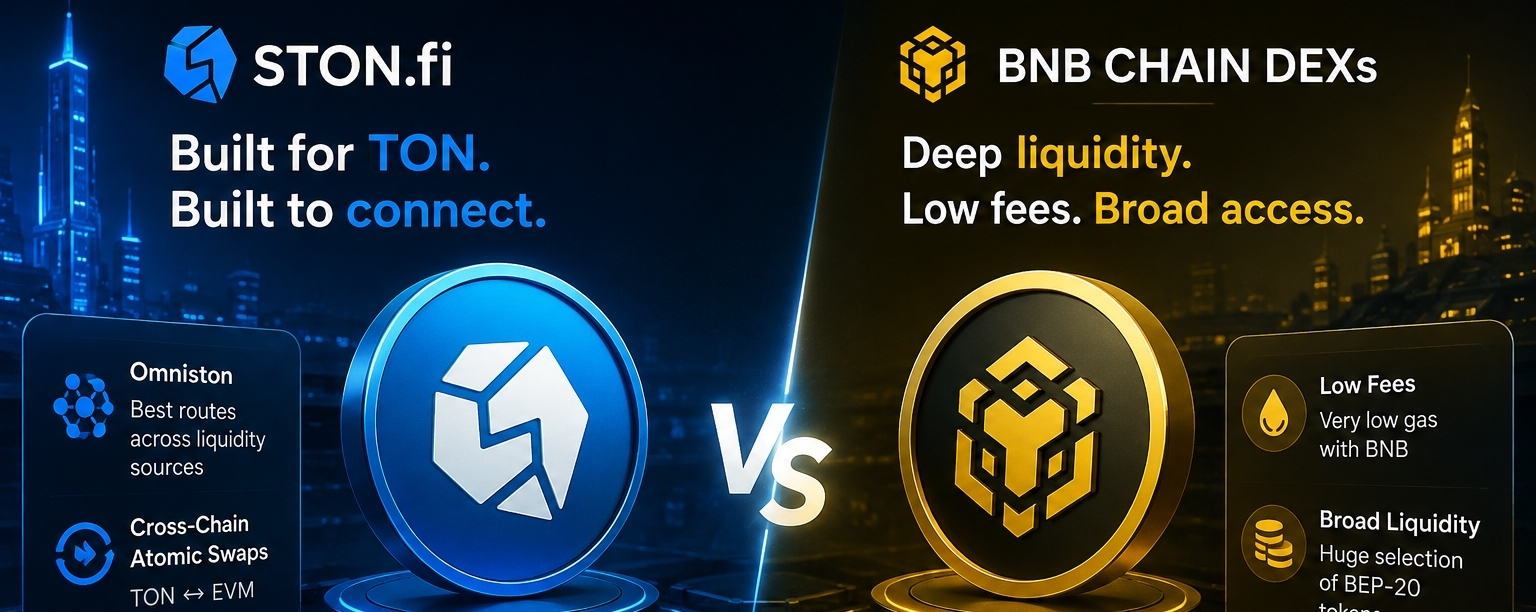
Article
STON.fi vs BNB Chain DEXs: Fees, Liquidity, and Cross-Chain AccessSTON.fi vs BNB Chain DEXs: Fees, Liquidity, and Cross-Chain Access
Decentralized exchanges are not all built for the same kind of user journey. Some are best suited for trades that stay within one ecosystem, while others are designed to make cross-chain movement simpler and more efficient. When comparing STON.fi with DEXs on BNB Smart Chain, the most important question is not simply which platform has the lowest fee on paper. The real question is where your assets already are, what kind of liquidity the pair has, and whether you need a native swap or a cross-chain route.
For TON-native activity, STON.fi is often the more natural fit. For users whose funds already sit on BNB Smart Chain, BNB Chain DEXs are often the stronger choice because they offer broad BEP-20 access, very low network fees, and a much larger liquidity base. Each has its own strengths, and the better option depends on the trade itself rather than a single headline metric.
Why the comparison matters
At first glance, DEX comparisons often focus on swap fees. That is useful, but incomplete. A trade is never just about the pool fee. It also includes gas costs, slippage, route quality, price impact, and, in some cases, bridging or cross-chain execution.
A platform may advertise a lower fee, but if the liquidity is thin or the route is inefficient, the final amount received can still be worse. That is why a proper comparison must look at the full execution path, not just one number.
Fees: what you pay is more than the pool fee
STON.fi uses configurable trading fees, with a documented 0.3% default. That fee is split between liquidity providers and the protocol, which makes the structure clear and easy to understand. For users, this provides a straightforward baseline when evaluating a swap on TON.
On BNB Chain DEXs, the fee structure varies depending on the specific venue and pool type. For example, PancakeSwap V3 supports fee tiers ranging from 0.01% to 1%, while V2 pools charge 0.25% per hop. This flexibility allows different pools to serve different market conditions, but it also means that users need to pay attention to the route they are actually taking.
A low pool fee does not always mean a low total cost. If the trade requires multiple hops, or if the route passes through a shallow pool, the final result may be less favorable than expected. In other words, the quoted fee is only one piece of the full cost structure.
Network fees also play a role. TON fees are shaped by the full transaction trace, meaning the total execution path can affect the final cost. On BSC, gas is paid in BNB and is often very low, which is one reason many users value BNB Chain for frequent or smaller-value trading. But even here, the network fee is only part of the picture. The best trade is the one that combines low gas, strong liquidity, and efficient routing.
Liquidity: where each chain is strongest
Liquidity is one of the most important factors in decentralized trading. A DEX can have attractive fees, but if the pair has weak liquidity, the price impact can quickly erase any advantage.
BNB Smart Chain generally has a much larger liquidity base and a broader token selection, especially for BEP-20 assets. This makes it a strong destination for traders who want access to a wide range of tokens and deep markets. For many assets, especially those already popular on BSC, this broader liquidity can improve execution and reduce slippage.
STON.fi is more concentrated around TON assets. Rather than trying to compete purely on breadth of token listings, it focuses on improving execution within the TON ecosystem. One of its key advantages is Omniston, which aggregates quotes from multiple TON liquidity sources and RFQ resolvers. This helps improve routing efficiency by searching across several sources rather than depending on a single pool.
That distinction matters. Liquidity is not just about total value locked. It is pair-specific, trade-size-specific, and route-specific. A platform may look large overall, but still provide a worse quote for a particular token pair if the liquidity is fragmented or the route is inefficient. The best swap outcome depends on how well the platform can find usable liquidity for the exact trade you want to make.
Cross-chain access: a major difference between the two
The biggest functional difference between STON.fi and a typical BNB Chain DEX is cross-chain execution.
A standard BNB Chain DEX trade stays on BSC. It swaps one BEP-20 asset for another within the same chain. That is useful, efficient, and familiar, especially for users who already hold assets on BSC and want to remain there.
STON.fi goes further by coordinating atomic swaps between TON and supported EVM networks, including BNB Chain. Through Omniston, it can help deliver the native destination asset rather than forcing the user through a more manual multi-step flow. That makes it especially relevant for users who want to move value between ecosystems without having to manage a separate bridge-and-swap process on their own.
This is an important advantage for TON-native users. If your activity starts on TON, STON.fi can provide a more integrated route for reaching another chain. Instead of thinking in separate steps, the user experience becomes more unified: quote, route, execute, and receive the intended asset through a coordinated flow.
Why the cheapest fee is not always the best trade
Many traders naturally look for the lowest fee, but the cheapest-looking trade is not always the cheapest in practice. A swap should be judged by the final amount received, not just the advertised percentage.
Several factors can change that outcome:
Pool fee: the direct fee charged by the DEX or pool.
Gas: the network cost required to execute the transaction.
Price impact: how much the trade moves the market price.
Slippage: the difference between the expected price and the executed price.
Routing quality: whether the platform found the best path or forced a weaker one.
Bridging or cross-chain execution: whether extra steps are needed to complete the swap.
A trade with a smaller fee can still end up more expensive if the liquidity is poor or the route is inefficient. Likewise, a slightly higher fee can still be the better choice if it produces a better final execution price. That is why smart users look at the full picture rather than one number in isolation.
When STON.fi makes more sense
STON.fi is often the better choice when the trade begins on TON or when the user needs a supported atomic route into another network. Its strength lies in TON-native execution, routing through Omniston, and access to cross-chain flows that feel more integrated than a manual sequence of separate actions.
It is especially attractive for users who already operate inside the TON ecosystem and want to stay close to native TON assets while still having the option to reach supported EVM networks. In that setting, STON.fi offers convenience, execution quality, and cross-chain flexibility in one place.
When BNB Chain DEXs make more sense
BNB Chain DEXs are usually the stronger option when the user already holds funds on BSC and wants to trade among BEP-20 assets. The network is known for very low fees, broad token coverage, and deep liquidity across many pairs.
For users who value staying native on BNB Smart Chain, that environment can be very efficient. It is particularly appealing for traders who want wide market access, low gas costs, and familiar execution across a large token ecosystem.
Final takeaway
STON.fi and BNB Chain DEXs solve related problems, but they do not solve them in exactly the same way. STON.fi is especially strong for TON-native flows and supported cross-chain execution. BNB Chain DEXs are often better for users who already sit on BSC and want to trade within a broader BEP-20 market with low network costs and deep liquidity.
The right choice depends on the starting point of your assets and the route you need. If the trade starts on TON or requires a supported atomic path, STON.fi stands out. If the assets are already on BNB Smart Chain and you want to stay there, a BNB Chain DEX may be the more natural choice.
In the end, the best trade is not the one with the lowest visible fee. It is the one that gives you the best complete execution.
Explore more on STON.FI app.ston.fi
Read more about STONfi here BLOG.STON.FI
#BNB_Market_Update #ETHETFsApproved #Market_Update
STON.fi vs BNB Chain DEXs: Fees, Liquidity, and Cross-Chain Access
STON.fi vs BNB Chain DEXs: Fees, Liquidity, and Cross-Chain Access
Decentralized exchanges are not all built for the same kind of user journey. Some are best suited for trades that stay within one ecosystem, while others are designed to make cross-chain movement simpler and more efficient. When comparing STON.fi with DEXs on BNB Smart Chain, the most important question is not simply which platform has the lowest fee on paper. The real question is where your assets already are, what kind of liquidity the pair has, and whether you need a native swap or a cross-chain route.
For TON-native activity, STON.fi is often the more natural fit. For users whose funds already sit on BNB Smart Chain, BNB Chain DEXs are often the stronger choice because they offer broad BEP-20 access, very low network fees, and a much larger liquidity base. Each has its own strengths, and the better option depends on the trade itself rather than a single headline metric.
Why the comparison matters
At first glance, DEX comparisons often focus on swap fees. That is useful, but incomplete. A trade is never just about the pool fee. It also includes gas costs, slippage, route quality, price impact, and, in some cases, bridging or cross-chain execution.
A platform may advertise a lower fee, but if the liquidity is thin or the route is inefficient, the final amount received can still be worse. That is why a proper comparison must look at the full execution path, not just one number.
Fees: what you pay is more than the pool fee
STON.fi uses configurable trading fees, with a documented 0.3% default. That fee is split between liquidity providers and the protocol, which makes the structure clear and easy to understand. For users, this provides a straightforward baseline when evaluating a swap on TON.
On BNB Chain DEXs, the fee structure varies depending on the specific venue and pool type. For example, PancakeSwap V3 supports fee tiers ranging from 0.01% to 1%, while V2 pools charge 0.25% per hop. This flexibility allows different pools to serve different market conditions, but it also means that users need to pay attention to the route they are actually taking.
A low pool fee does not always mean a low total cost. If the trade requires multiple hops, or if the route passes through a shallow pool, the final result may be less favorable than expected. In other words, the quoted fee is only one piece of the full cost structure.
Network fees also play a role. TON fees are shaped by the full transaction trace, meaning the total execution path can affect the final cost. On BSC, gas is paid in BNB and is often very low, which is one reason many users value BNB Chain for frequent or smaller-value trading. But even here, the network fee is only part of the picture. The best trade is the one that combines low gas, strong liquidity, and efficient routing.
Liquidity: where each chain is strongest
Liquidity is one of the most important factors in decentralized trading. A DEX can have attractive fees, but if the pair has weak liquidity, the price impact can quickly erase any advantage.
BNB Smart Chain generally has a much larger liquidity base and a broader token selection, especially for BEP-20 assets. This makes it a strong destination for traders who want access to a wide range of tokens and deep markets. For many assets, especially those already popular on BSC, this broader liquidity can improve execution and reduce slippage.
STON.fi is more concentrated around TON assets. Rather than trying to compete purely on breadth of token listings, it focuses on improving execution within the TON ecosystem. One of its key advantages is Omniston, which aggregates quotes from multiple TON liquidity sources and RFQ resolvers. This helps improve routing efficiency by searching across several sources rather than depending on a single pool.
That distinction matters. Liquidity is not just about total value locked. It is pair-specific, trade-size-specific, and route-specific. A platform may look large overall, but still provide a worse quote for a particular token pair if the liquidity is fragmented or the route is inefficient. The best swap outcome depends on how well the platform can find usable liquidity for the exact trade you want to make.
Cross-chain access: a major difference between the two
The biggest functional difference between STON.fi and a typical BNB Chain DEX is cross-chain execution.
A standard BNB Chain DEX trade stays on BSC. It swaps one BEP-20 asset for another within the same chain. That is useful, efficient, and familiar, especially for users who already hold assets on BSC and want to remain there.
STON.fi goes further by coordinating atomic swaps between TON and supported EVM networks, including BNB Chain. Through Omniston, it can help deliver the native destination asset rather than forcing the user through a more manual multi-step flow. That makes it especially relevant for users who want to move value between ecosystems without having to manage a separate bridge-and-swap process on their own.
This is an important advantage for TON-native users. If your activity starts on TON, STON.fi can provide a more integrated route for reaching another chain. Instead of thinking in separate steps, the user experience becomes more unified: quote, route, execute, and receive the intended asset through a coordinated flow.
Why the cheapest fee is not always the best trade
Many traders naturally look for the lowest fee, but the cheapest-looking trade is not always the cheapest in practice. A swap should be judged by the final amount received, not just the advertised percentage.
Several factors can change that outcome:
Pool fee: the direct fee charged by the DEX or pool.
Gas: the network cost required to execute the transaction.
Price impact: how much the trade moves the market price.
Slippage: the difference between the expected price and the executed price.
Routing quality: whether the platform found the best path or forced a weaker one.
Bridging or cross-chain execution: whether extra steps are needed to complete the swap.
A trade with a smaller fee can still end up more expensive if the liquidity is poor or the route is inefficient. Likewise, a slightly higher fee can still be the better choice if it produces a better final execution price. That is why smart users look at the full picture rather than one number in isolation.
When STON.fi makes more sense
STON.fi is often the better choice when the trade begins on TON or when the user needs a supported atomic route into another network. Its strength lies in TON-native execution, routing through Omniston, and access to cross-chain flows that feel more integrated than a manual sequence of separate actions.
It is especially attractive for users who already operate inside the TON ecosystem and want to stay close to native TON assets while still having the option to reach supported EVM networks. In that setting, STON.fi offers convenience, execution quality, and cross-chain flexibility in one place.
When BNB Chain DEXs make more sense
BNB Chain DEXs are usually the stronger option when the user already holds funds on BSC and wants to trade among BEP-20 assets. The network is known for very low fees, broad token coverage, and deep liquidity across many pairs.
For users who value staying native on BNB Smart Chain, that environment can be very efficient. It is particularly appealing for traders who want wide market access, low gas costs, and familiar execution across a large token ecosystem.
Final takeaway
STON.fi and BNB Chain DEXs solve related problems, but they do not solve them in exactly the same way. STON.fi is especially strong for TON-native flows and supported cross-chain execution. BNB Chain DEXs are often better for users who already sit on BSC and want to trade within a broader BEP-20 market with low network costs and deep liquidity.
The right choice depends on the starting point of your assets and the route you need. If the trade starts on TON or requires a supported atomic path, STON.fi stands out. If the assets are already on BNB Smart Chain and you want to stay there, a BNB Chain DEX may be the more natural choice.
In the end, the best trade is not the one with the lowest visible fee. It is the one that gives you the best complete execution.
Explore more on STON.FI app.ston.fi
Read more about STONfi here BLOG.STON.FI
#BNB_Market_Update #ETHETFsApproved #Market_Update
Decentralized exchanges are not all built for the same kind of user journey. Some are best suited for trades that stay within one ecosystem, while others are designed to make cross-chain movement simpler and more efficient. When comparing STON.fi with DEXs on BNB Smart Chain, the most important question is not simply which platform has the lowest fee on paper. The real question is where your assets already are, what kind of liquidity the pair has, and whether you need a native swap or a cross-chain route.
For TON-native activity, STON.fi is often the more natural fit. For users whose funds already sit on BNB Smart Chain, BNB Chain DEXs are often the stronger choice because they offer broad BEP-20 access, very low network fees, and a much larger liquidity base. Each has its own strengths, and the better option depends on the trade itself rather than a single headline metric.
Why the comparison matters
At first glance, DEX comparisons often focus on swap fees. That is useful, but incomplete. A trade is never just about the pool fee. It also includes gas costs, slippage, route quality, price impact, and, in some cases, bridging or cross-chain execution.
A platform may advertise a lower fee, but if the liquidity is thin or the route is inefficient, the final amount received can still be worse. That is why a proper comparison must look at the full execution path, not just one number.
Fees: what you pay is more than the pool fee
STON.fi uses configurable trading fees, with a documented 0.3% default. That fee is split between liquidity providers and the protocol, which makes the structure clear and easy to understand. For users, this provides a straightforward baseline when evaluating a swap on TON.
On BNB Chain DEXs, the fee structure varies depending on the specific venue and pool type. For example, PancakeSwap V3 supports fee tiers ranging from 0.01% to 1%, while V2 pools charge 0.25% per hop. This flexibility allows different pools to serve different market conditions, but it also means that users need to pay attention to the route they are actually taking.
A low pool fee does not always mean a low total cost. If the trade requires multiple hops, or if the route passes through a shallow pool, the final result may be less favorable than expected. In other words, the quoted fee is only one piece of the full cost structure.
Network fees also play a role. TON fees are shaped by the full transaction trace, meaning the total execution path can affect the final cost. On BSC, gas is paid in BNB and is often very low, which is one reason many users value BNB Chain for frequent or smaller-value trading. But even here, the network fee is only part of the picture. The best trade is the one that combines low gas, strong liquidity, and efficient routing.
Liquidity: where each chain is strongest
Liquidity is one of the most important factors in decentralized trading. A DEX can have attractive fees, but if the pair has weak liquidity, the price impact can quickly erase any advantage.
BNB Smart Chain generally has a much larger liquidity base and a broader token selection, especially for BEP-20 assets. This makes it a strong destination for traders who want access to a wide range of tokens and deep markets. For many assets, especially those already popular on BSC, this broader liquidity can improve execution and reduce slippage.
STON.fi is more concentrated around TON assets. Rather than trying to compete purely on breadth of token listings, it focuses on improving execution within the TON ecosystem. One of its key advantages is Omniston, which aggregates quotes from multiple TON liquidity sources and RFQ resolvers. This helps improve routing efficiency by searching across several sources rather than depending on a single pool.
That distinction matters. Liquidity is not just about total value locked. It is pair-specific, trade-size-specific, and route-specific. A platform may look large overall, but still provide a worse quote for a particular token pair if the liquidity is fragmented or the route is inefficient. The best swap outcome depends on how well the platform can find usable liquidity for the exact trade you want to make.
Cross-chain access: a major difference between the two
The biggest functional difference between STON.fi and a typical BNB Chain DEX is cross-chain execution.
A standard BNB Chain DEX trade stays on BSC. It swaps one BEP-20 asset for another within the same chain. That is useful, efficient, and familiar, especially for users who already hold assets on BSC and want to remain there.
STON.fi goes further by coordinating atomic swaps between TON and supported EVM networks, including BNB Chain. Through Omniston, it can help deliver the native destination asset rather than forcing the user through a more manual multi-step flow. That makes it especially relevant for users who want to move value between ecosystems without having to manage a separate bridge-and-swap process on their own.
This is an important advantage for TON-native users. If your activity starts on TON, STON.fi can provide a more integrated route for reaching another chain. Instead of thinking in separate steps, the user experience becomes more unified: quote, route, execute, and receive the intended asset through a coordinated flow.
Why the cheapest fee is not always the best trade
Many traders naturally look for the lowest fee, but the cheapest-looking trade is not always the cheapest in practice. A swap should be judged by the final amount received, not just the advertised percentage.
Several factors can change that outcome:
Pool fee: the direct fee charged by the DEX or pool.
Gas: the network cost required to execute the transaction.
Price impact: how much the trade moves the market price.
Slippage: the difference between the expected price and the executed price.
Routing quality: whether the platform found the best path or forced a weaker one.
Bridging or cross-chain execution: whether extra steps are needed to complete the swap.
A trade with a smaller fee can still end up more expensive if the liquidity is poor or the route is inefficient. Likewise, a slightly higher fee can still be the better choice if it produces a better final execution price. That is why smart users look at the full picture rather than one number in isolation.
When STON.fi makes more sense
STON.fi is often the better choice when the trade begins on TON or when the user needs a supported atomic route into another network. Its strength lies in TON-native execution, routing through Omniston, and access to cross-chain flows that feel more integrated than a manual sequence of separate actions.
It is especially attractive for users who already operate inside the TON ecosystem and want to stay close to native TON assets while still having the option to reach supported EVM networks. In that setting, STON.fi offers convenience, execution quality, and cross-chain flexibility in one place.
When BNB Chain DEXs make more sense
BNB Chain DEXs are usually the stronger option when the user already holds funds on BSC and wants to trade among BEP-20 assets. The network is known for very low fees, broad token coverage, and deep liquidity across many pairs.
For users who value staying native on BNB Smart Chain, that environment can be very efficient. It is particularly appealing for traders who want wide market access, low gas costs, and familiar execution across a large token ecosystem.
Final takeaway
STON.fi and BNB Chain DEXs solve related problems, but they do not solve them in exactly the same way. STON.fi is especially strong for TON-native flows and supported cross-chain execution. BNB Chain DEXs are often better for users who already sit on BSC and want to trade within a broader BEP-20 market with low network costs and deep liquidity.
The right choice depends on the starting point of your assets and the route you need. If the trade starts on TON or requires a supported atomic path, STON.fi stands out. If the assets are already on BNB Smart Chain and you want to stay there, a BNB Chain DEX may be the more natural choice.
In the end, the best trade is not the one with the lowest visible fee. It is the one that gives you the best complete execution.
Explore more on STON.FI app.ston.fi
Read more about STONfi here BLOG.STON.FI
#BNB_Market_Update #ETHETFsApproved #Market_Update
1
82
Log in to explore more content
Join global crypto users on Binance Square
⚡️ Get latest and useful information about crypto.
💬 Trusted by the world’s largest crypto exchange.
👍 Discover real insights from verified creators.
Email / Phone number
Trending Topics
UKFCAWinsCourtOrderToRecover851400Pounds
44,682 views
883 Discussing
🚨 CRYPTO REGULATION JUST ENTERED A NEW PHASE: THEY’RE NOT ONLY WRITING RULES — THEY’RE TAKING MONEY BACK.
The UK’s FCA has secured another court-backed asset recovery, reinforcing a broader enforcement push against unauthorized financial and crypto-related activity.
And look at what’s happening simultaneously:
🇬🇧 FCA → enforcement + asset recovery
🇺🇸 SEC → clearer rules for functional crypto assets
🇺🇸 Fed → formal stablecoin supervision under the GENIUS Act
That combination matters.
Regulators are no longer debating whether crypto belongs inside the financial system.
They’re increasingly deciding who gets access, what rules they follow, and what happens when those rules are broken.
The next crypto cycle may not be “regulation vs innovation.”
It may be regulated crypto vs everyone who can’t meet the standard. 👀
$COIN $CRCL $BTC
#ukfcawinscourtordertorecover851400pounds #ChainlinkLaunchesCCIP2WithEnterpriseVerification #GoldFallsTo$4144 #QNTFallsOver40%FromMorningHigh #USDTAdds845900HoldersInPast7Days
KimHotbae
·3 Likes
·4.4k views
ChainlinkLaunchesCCIP2WithEnterpriseVerification
55,831 views
1,035 Discussing
GoldFallsTo$4144
18,925 views
171 Discussing