

MEER BANO
879 Posts

MEER BANO
Report
Block User
Crypto Educator | Market Analyst & Trader | Sharing Insights & Strategies |

DUSK Holder
High-Frequency Trader
9.6 Months
333 Following
9.9K+ Followers
1.9K+ Liked
Posts
All
Quotes
Videos
Live


·
--
I checked a lending pool rate on my phone this morning in Rawalpindi, the same one I'd looked at three days ago, and the APY had already shifted enough that my mental math from before was off. I assumed a good rate I find once just stays roughly where it is, so parking funds somewhere decent was basically a one time decision.
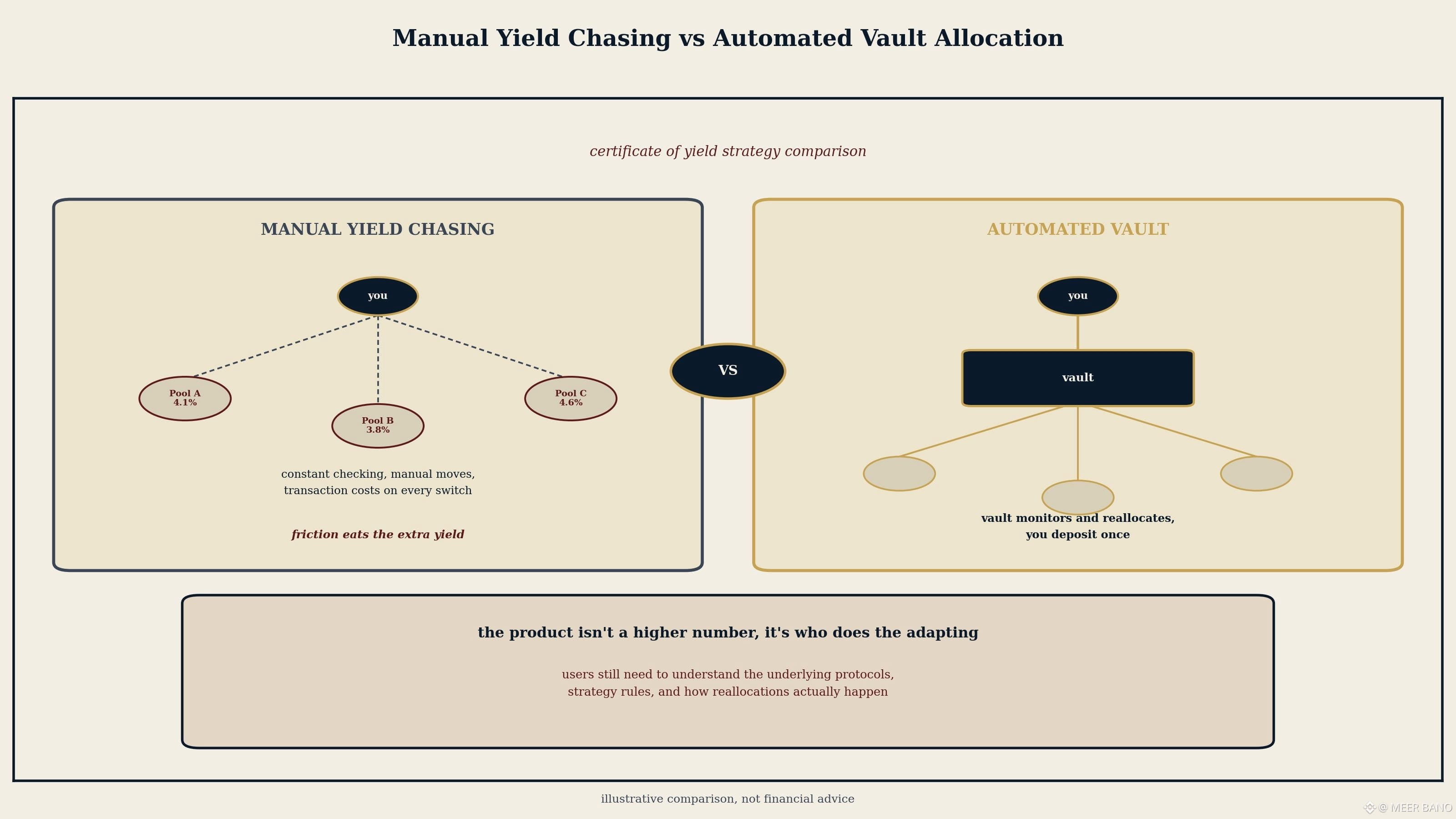
That's not how lending markets actually behave. Rates move as liquidity shifts and incentives get adjusted, so a pool that looked attractive last week isn't guaranteed to still be the best option today. Managing that manually means constantly comparing markets, timing moves, and eating transaction costs every time you reallocate, which quietly eats into whatever extra yield you were chasing in the first place.
What actually shifted my thinking here is realizing the value of a vault like Haedal isn't the number on the APY display. It's that the adaptation work itself gets automated, spreading exposure across supported markets and adjusting allocation as conditions change, instead of a person manually re-deciding this every few days. Automating the adjusting is the actual product, not a marginally higher yield figure.
What isn't clear to me is exactly how often reallocations happen or what specific rules trigger them, that level of detail matters for understanding real risk and I don't have it confirmed.
The real test here is whether the vault's strategy rules stay transparent enough that users can actually verify what's happening with their funds, not just trust the outcome.
Has anyone here actually tracked Haedal's reallocations closely enough to see the
pattern?
@HaedalProtocol #Haedal $HAEDAL
$LSK $BROCCOLI714
I checked a lending pool rate on my phone this morning in Rawalpindi, the same one I'd looked at three days ago, and the APY had already shifted enough that my mental math from before was off. I assumed a good rate I find once just stays roughly where it is, so parking funds somewhere decent was basically a one time decision.
That's not how lending markets actually behave. Rates move as liquidity shifts and incentives get adjusted, so a pool that looked attractive last week isn't guaranteed to still be the best option today. Managing that manually means constantly comparing markets, timing moves, and eating transaction costs every time you reallocate, which quietly eats into whatever extra yield you were chasing in the first place.
What actually shifted my thinking here is realizing the value of a vault like Haedal isn't the number on the APY display. It's that the adaptation work itself gets automated, spreading exposure across supported markets and adjusting allocation as conditions change, instead of a person manually re-deciding this every few days. Automating the adjusting is the actual product, not a marginally higher yield figure.
What isn't clear to me is exactly how often reallocations happen or what specific rules trigger them, that level of detail matters for understanding real risk and I don't have it confirmed.
The real test here is whether the vault's strategy rules stay transparent enough that users can actually verify what's happening with their funds, not just trust the outcome.
Has anyone here actually tracked Haedal's reallocations closely enough to see the
pattern?
@Haedal Protocol #Haedal $HAEDAL
$LSK $BROCCOLI714
That's not how lending markets actually behave. Rates move as liquidity shifts and incentives get adjusted, so a pool that looked attractive last week isn't guaranteed to still be the best option today. Managing that manually means constantly comparing markets, timing moves, and eating transaction costs every time you reallocate, which quietly eats into whatever extra yield you were chasing in the first place.
What actually shifted my thinking here is realizing the value of a vault like Haedal isn't the number on the APY display. It's that the adaptation work itself gets automated, spreading exposure across supported markets and adjusting allocation as conditions change, instead of a person manually re-deciding this every few days. Automating the adjusting is the actual product, not a marginally higher yield figure.
What isn't clear to me is exactly how often reallocations happen or what specific rules trigger them, that level of detail matters for understanding real risk and I don't have it confirmed.
The real test here is whether the vault's strategy rules stay transparent enough that users can actually verify what's happening with their funds, not just trust the outcome.
Has anyone here actually tracked Haedal's reallocations closely enough to see the
pattern?
@Haedal Protocol #Haedal $HAEDAL
$LSK $BROCCOLI714
1
559
·
--
Verified
AI stocks keep pushing higher, but the bigger question is no longer whether AI demand exists.
It’s whether the current spending cycle can keep growing fast enough to justify these valuations.
Nvidia expects chip demand to keep expanding, while major AI companies are reporting record revenues. But behind those numbers is an equally important story: massive spending on data centers, GPUs, networking, power and infrastructure.
That makes this cycle different from a simple software trend. AI adoption is creating real demand for physical compute.
Still, there is a risk investors shouldn’t ignore. If AI companies continue increasing capital expenditure faster than monetization, the market may eventually start asking whether the returns justify the spending.
Government support adds another variable. The U.S. is increasingly treating AI infrastructure as a strategic priority, which could support the sector over the longer term. But policy support alone cannot guarantee that every AI stock will benefit equally.
My view: AI demand looks structurally strong, but strong demand doesn't automatically mean every AI stock is fairly valued.
I’m watching revenue growth, capex, margins and actual AI usage—not just headlines.
#AIStocksWhatNext
$AKE $LSK $BR
AI stocks keep pushing higher, but the bigger question is no longer whether AI demand exists.
It’s whether the current spending cycle can keep growing fast enough to justify these valuations.
Nvidia expects chip demand to keep expanding, while major AI companies are reporting record revenues. But behind those numbers is an equally important story: massive spending on data centers, GPUs, networking, power and infrastructure.
That makes this cycle different from a simple software trend. AI adoption is creating real demand for physical compute.
Still, there is a risk investors shouldn’t ignore. If AI companies continue increasing capital expenditure faster than monetization, the market may eventually start asking whether the returns justify the spending.
Government support adds another variable. The U.S. is increasingly treating AI infrastructure as a strategic priority, which could support the sector over the longer term. But policy support alone cannot guarantee that every AI stock will benefit equally.
My view: AI demand looks structurally strong, but strong demand doesn't automatically mean every AI stock is fairly valued.
I’m watching revenue growth, capex, margins and actual AI usage—not just headlines.
#AIStocksWhatNext
$AKE $LSK $BR
It’s whether the current spending cycle can keep growing fast enough to justify these valuations.
Nvidia expects chip demand to keep expanding, while major AI companies are reporting record revenues. But behind those numbers is an equally important story: massive spending on data centers, GPUs, networking, power and infrastructure.
That makes this cycle different from a simple software trend. AI adoption is creating real demand for physical compute.
Still, there is a risk investors shouldn’t ignore. If AI companies continue increasing capital expenditure faster than monetization, the market may eventually start asking whether the returns justify the spending.
Government support adds another variable. The U.S. is increasingly treating AI infrastructure as a strategic priority, which could support the sector over the longer term. But policy support alone cannot guarantee that every AI stock will benefit equally.
My view: AI demand looks structurally strong, but strong demand doesn't automatically mean every AI stock is fairly valued.
I’m watching revenue growth, capex, margins and actual AI usage—not just headlines.
#AIStocksWhatNext
$AKE $LSK $BR
583
·
--
FOMC September: What’s the Fed’s Next Move?
August core CPI rose 0.3% month-over-month, keeping inflation pressure alive.
Markets are now pricing roughly a 90%+ probability of a 25 bp Fed hike this week.
So the real question isn’t only “Will the Fed hike?”
It’s: What comes next?
My base case is a 25 bp hike, but I wouldn’t automatically call it the start of a long hiking cycle.
The Fed may want to re-establish inflation credibility first, then watch how higher energy costs, demand and future inflation data develop.
For markets, the reaction could depend more on the Fed’s guidance than the hike itself.
→ BTC: A hawkish Fed could pressure risk appetite and liquidity, creating short-term downside volatility.
→ Tech stocks: Higher rates generally increase the discount rate applied to future earnings, which can pressure high-valuation growth stocks.
→ Gold: Higher real yields and a stronger dollar can be a headwind, although inflation and geopolitical risks could keep demand for gold strong.
So I’m watching the statement and press conference closely.
A 25 bp hike may already be priced in.
The bigger move could come from what the Fed signals about October, December and 2027.
My approach: avoid chasing the first FOMC candle. I’d rather wait for confirmation after the decision and then trade the reaction.
What’s your view?
Bullish or bearish on BTC, tech and gold after the FOMC?
#FedRateWatch
FOMC September: What’s the Fed’s Next Move?
August core CPI rose 0.3% month-over-month, keeping inflation pressure alive.
Markets are now pricing roughly a 90%+ probability of a 25 bp Fed hike this week.
So the real question isn’t only “Will the Fed hike?”
It’s: What comes next?
My base case is a 25 bp hike, but I wouldn’t automatically call it the start of a long hiking cycle.
The Fed may want to re-establish inflation credibility first, then watch how higher energy costs, demand and future inflation data develop.
For markets, the reaction could depend more on the Fed’s guidance than the hike itself.
→ BTC: A hawkish Fed could pressure risk appetite and liquidity, creating short-term downside volatility.
→ Tech stocks: Higher rates generally increase the discount rate applied to future earnings, which can pressure high-valuation growth stocks.
→ Gold: Higher real yields and a stronger dollar can be a headwind, although inflation and geopolitical risks could keep demand for gold strong.
So I’m watching the statement and press conference closely.
A 25 bp hike may already be priced in.
The bigger move could come from what the Fed signals about October, December and 2027.
My approach: avoid chasing the first FOMC candle. I’d rather wait for confirmation after the decision and then trade the reaction.
What’s your view?
Bullish or bearish on BTC, tech and gold after the FOMC?
#FedRateWatch
August core CPI rose 0.3% month-over-month, keeping inflation pressure alive.
Markets are now pricing roughly a 90%+ probability of a 25 bp Fed hike this week.
So the real question isn’t only “Will the Fed hike?”
It’s: What comes next?
My base case is a 25 bp hike, but I wouldn’t automatically call it the start of a long hiking cycle.
The Fed may want to re-establish inflation credibility first, then watch how higher energy costs, demand and future inflation data develop.
For markets, the reaction could depend more on the Fed’s guidance than the hike itself.
→ BTC: A hawkish Fed could pressure risk appetite and liquidity, creating short-term downside volatility.
→ Tech stocks: Higher rates generally increase the discount rate applied to future earnings, which can pressure high-valuation growth stocks.
→ Gold: Higher real yields and a stronger dollar can be a headwind, although inflation and geopolitical risks could keep demand for gold strong.
So I’m watching the statement and press conference closely.
A 25 bp hike may already be priced in.
The bigger move could come from what the Fed signals about October, December and 2027.
My approach: avoid chasing the first FOMC candle. I’d rather wait for confirmation after the decision and then trade the reaction.
What’s your view?
Bullish or bearish on BTC, tech and gold after the FOMC?
#FedRateWatch
1
91
·
--
Bullish
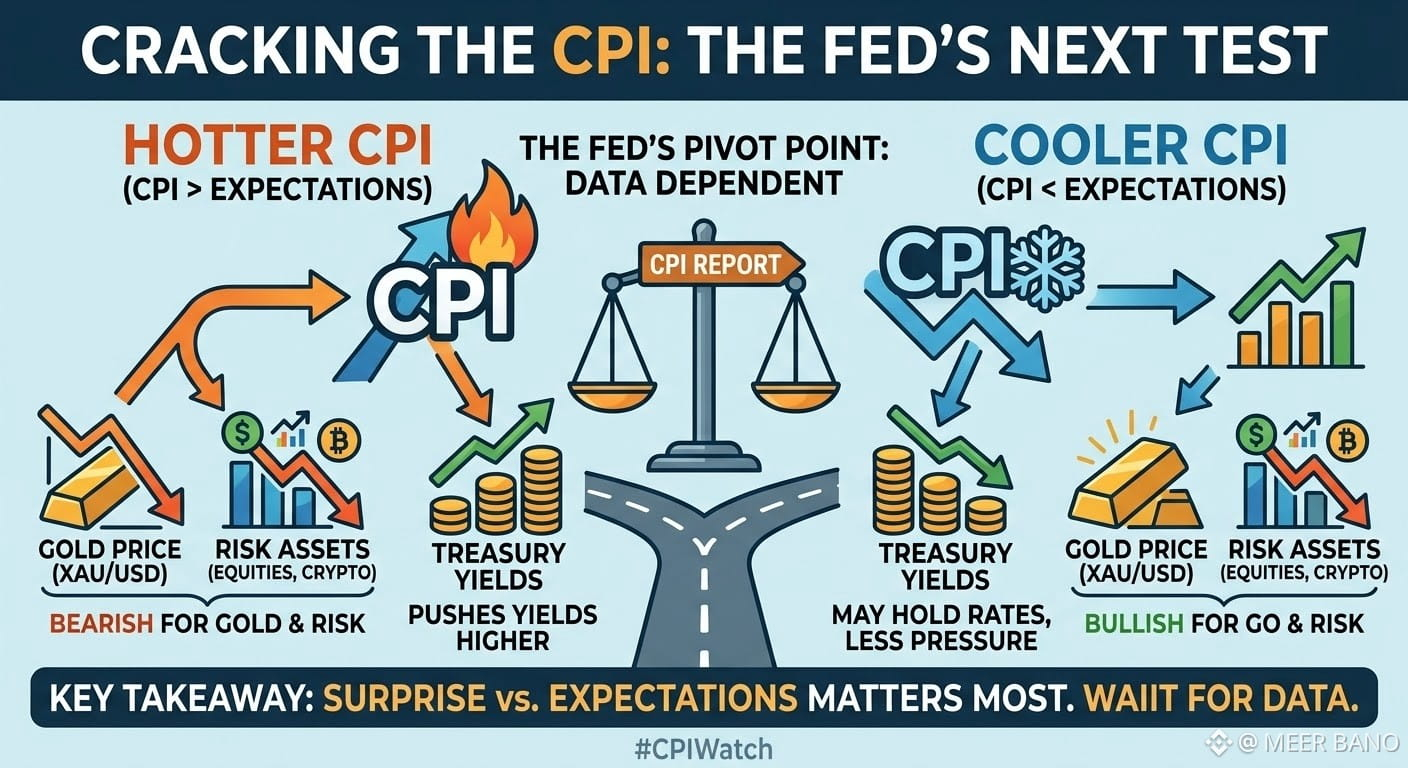
NFP surprised to the upside. Now CPI could decide whether the Fed stays cautious or starts thinking about tighter policy.
If inflation comes in hotter than expected, markets may price out rate cuts and push yields higher. That could create pressure on gold and equities.
If CPI cools, the opposite reaction is possible: lower yields and stronger expectations for easier policy.
My view: the CPI surprise matters more than the headline number itself.
I’m watching the data first, then the market reaction.
#CPIWatch
NFP surprised to the upside. Now CPI could decide whether the Fed stays cautious or starts thinking about tighter policy.
If inflation comes in hotter than expected, markets may price out rate cuts and push yields higher. That could create pressure on gold and equities.
If CPI cools, the opposite reaction is possible: lower yields and stronger expectations for easier policy.
My view: the CPI surprise matters more than the headline number itself.
I’m watching the data first, then the market reaction.
#CPIWatch
If inflation comes in hotter than expected, markets may price out rate cuts and push yields higher. That could create pressure on gold and equities.
If CPI cools, the opposite reaction is possible: lower yields and stronger expectations for easier policy.
My view: the CPI surprise matters more than the headline number itself.
I’m watching the data first, then the market reaction.
#CPIWatch
1
68
·
--
$FF USDT: Riding the +23% Breakout on Falcon Finance 🚀
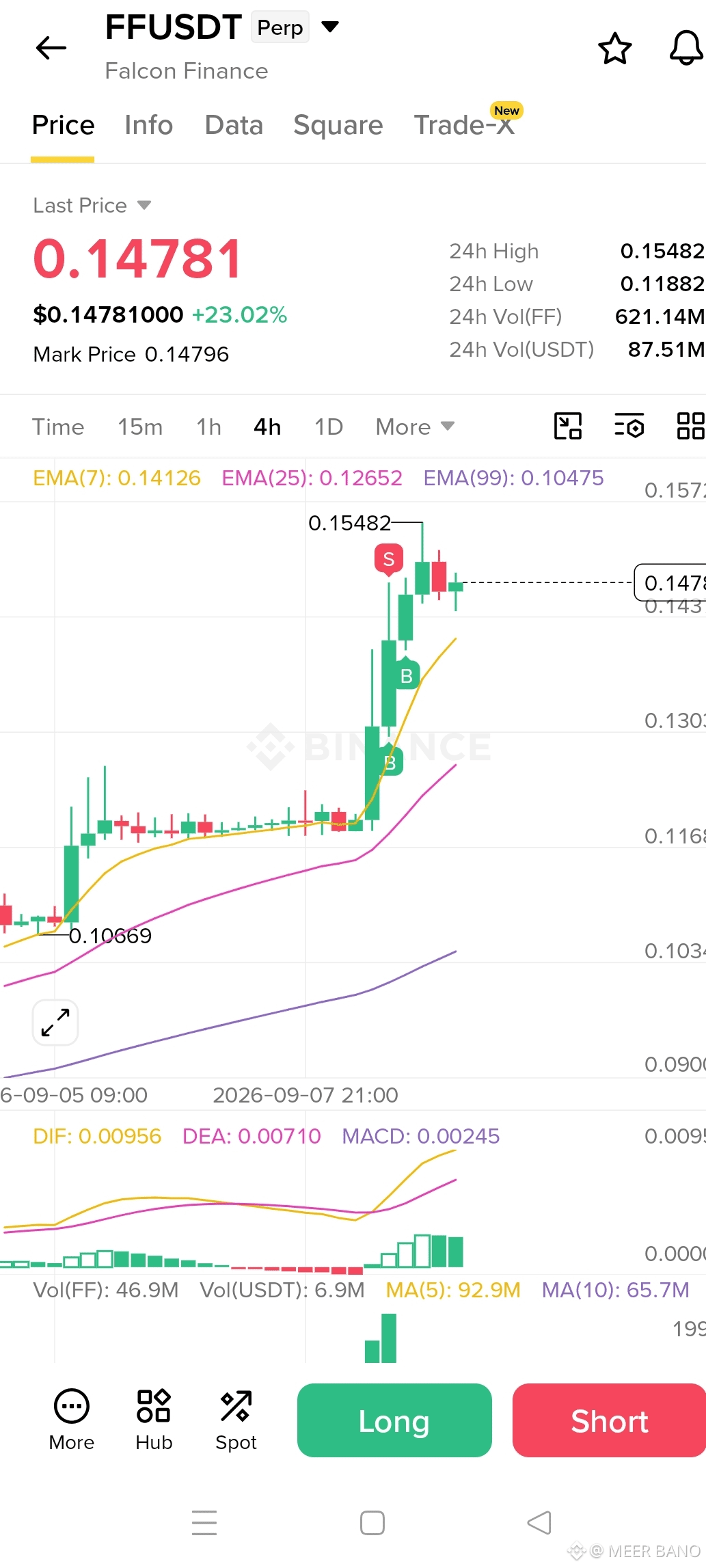
When momentum steps into a consolidation range, patience pays off. FFUSDT (Falcon Finance) surged +23.02% to hit a 24-hour high of 0.15482, driven by a strong volume expansion of 621.14M FF ($87.51M USDT).
Analyzing the 4H chart, price was ranging quietly around the 0.11689 consolidation level before buyers triggered an aggressive vertical breakout above the 7-EMA, 25-EMA, and 99-EMA. My strategy here was entering scale-in positions (marked by the buy tags B on the chart) right as the breakout candle cleared dynamic resistance near 0.12652 and 0.13034, targeting local momentum extension. Profit taking (S tag) was executed near the exhaustion wick around 0.15000 - 0.15482.
Currently, MACD shows accelerating bullish momentum (\text{DIF: } 0.00956, \text{DEA: } 0.00710, \text{MACD: } 0.00245) with 5-period volume (92.9\text{M}) well above its 10-period average (65.7\text{M}).
Key levels to watch:
Support: 0.14126 (7-EMA) & 0.12652 (25-EMA)
Resistance: 0.15482 (Local High)
If FF holds above the 7-EMA dynamic line (0.14126), continuation toward higher liquidity zones remains intact. Avoid chasing tops—wait for healthy retracements before taking fresh entries!
Follow for more disciplined trading setups and technical breakdowns! 👇
$FF USDT: Riding the +23% Breakout on Falcon Finance 🚀
When momentum steps into a consolidation range, patience pays off. FFUSDT (Falcon Finance) surged +23.02% to hit a 24-hour high of 0.15482, driven by a strong volume expansion of 621.14M FF ($87.51M USDT).
Analyzing the 4H chart, price was ranging quietly around the 0.11689 consolidation level before buyers triggered an aggressive vertical breakout above the 7-EMA, 25-EMA, and 99-EMA. My strategy here was entering scale-in positions (marked by the buy tags B on the chart) right as the breakout candle cleared dynamic resistance near 0.12652 and 0.13034, targeting local momentum extension. Profit taking (S tag) was executed near the exhaustion wick around 0.15000 - 0.15482.
Currently, MACD shows accelerating bullish momentum (\text{DIF: } 0.00956, \text{DEA: } 0.00710, \text{MACD: } 0.00245) with 5-period volume (92.9\text{M}) well above its 10-period average (65.7\text{M}).
Key levels to watch:
Support: 0.14126 (7-EMA) & 0.12652 (25-EMA)
Resistance: 0.15482 (Local High)
If FF holds above the 7-EMA dynamic line (0.14126), continuation toward higher liquidity zones remains intact. Avoid chasing tops—wait for healthy retracements before taking fresh entries!
Follow for more disciplined trading setups and technical breakdowns! 👇
When momentum steps into a consolidation range, patience pays off. FFUSDT (Falcon Finance) surged +23.02% to hit a 24-hour high of 0.15482, driven by a strong volume expansion of 621.14M FF ($87.51M USDT).
Analyzing the 4H chart, price was ranging quietly around the 0.11689 consolidation level before buyers triggered an aggressive vertical breakout above the 7-EMA, 25-EMA, and 99-EMA. My strategy here was entering scale-in positions (marked by the buy tags B on the chart) right as the breakout candle cleared dynamic resistance near 0.12652 and 0.13034, targeting local momentum extension. Profit taking (S tag) was executed near the exhaustion wick around 0.15000 - 0.15482.
Currently, MACD shows accelerating bullish momentum (\text{DIF: } 0.00956, \text{DEA: } 0.00710, \text{MACD: } 0.00245) with 5-period volume (92.9\text{M}) well above its 10-period average (65.7\text{M}).
Key levels to watch:
Support: 0.14126 (7-EMA) & 0.12652 (25-EMA)
Resistance: 0.15482 (Local High)
If FF holds above the 7-EMA dynamic line (0.14126), continuation toward higher liquidity zones remains intact. Avoid chasing tops—wait for healthy retracements before taking fresh entries!
Follow for more disciplined trading setups and technical breakdowns! 👇
75
·
--
$SOPH USDT: Managing the Aftermath of a -45% Pump & Dump Volatility Spike 📉
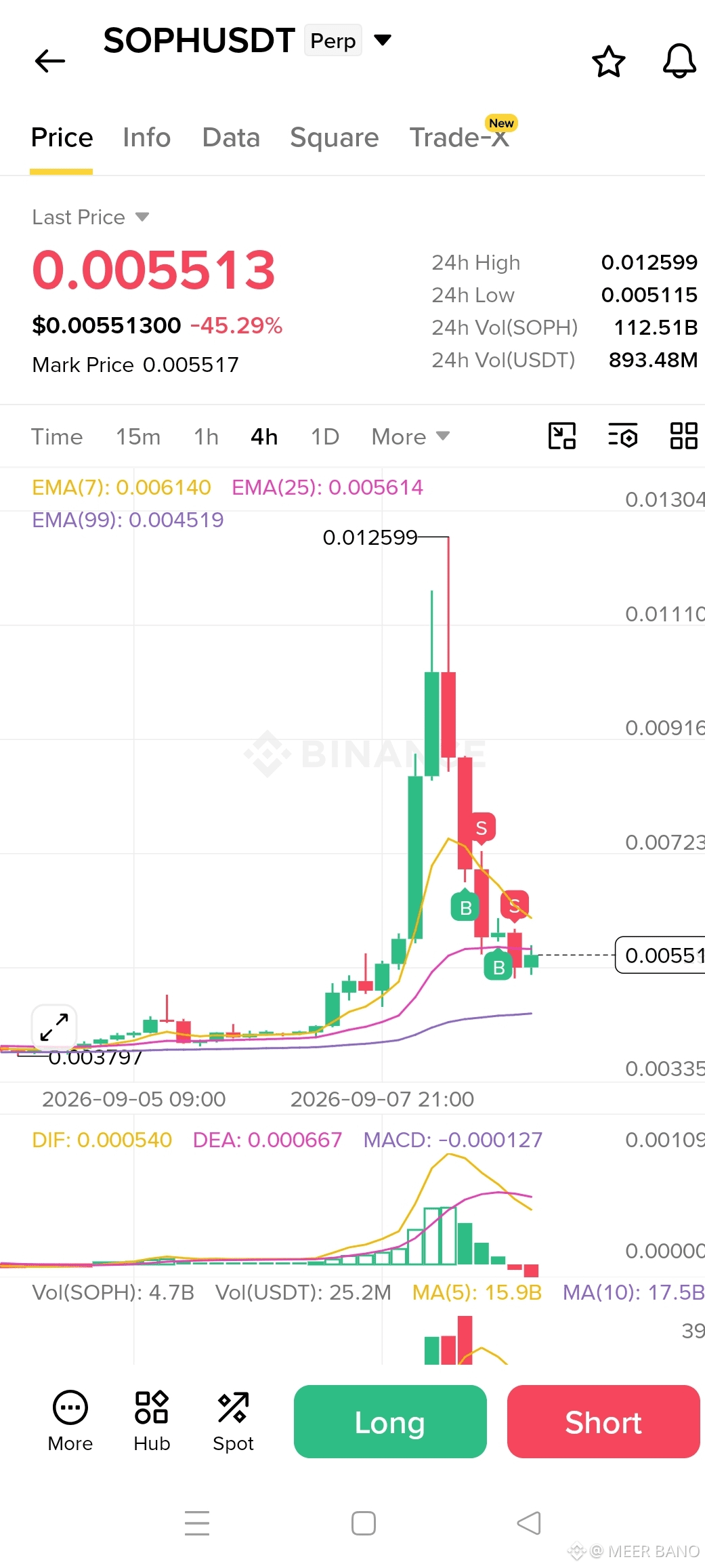
When a coin explodes to a high of 0.012599 and then aggressively retraces down to 0.005513 (-45.29% in 24h), emotion will blow up your account faster than the volatility. Looking at the 4H chart, SOPH experienced a massive parabolic expansion followed by a sharp liquidation cascade right back down toward the key EMA dynamic support band.
My execution strategy here was entirely focused on short-term market structure reactiveness rather than blind spot-buying. On the initial sharp sell-off, I took quick scalar trades (marked by the buy/sell tags on chart) catching local bounce reactions near the 25-EMA (0.005614) while taking quick profits into relief wicks. Currently, price is testing the vital EMA(25) level with MACD printing negative momentum bars (-\text{0.000127}$), signaling that momentum is still cooling down.
Until SOPH consolidates and establishes a firm base above 0.00550 with declining volume, entering heavy swing longs is high risk. Key levels I'm watching: Support at 0.004519 (99-EMA) and Resistance at 0.006140 (7-EMA). Respect your risk management, keep position sizes disciplined on high-volatility pairs, and don't chase FOMO wicks.
Follow for more real-time market breakdowns and disciplined trade setups! 👇
$SOPH USDT: Managing the Aftermath of a -45% Pump & Dump Volatility Spike 📉
When a coin explodes to a high of 0.012599 and then aggressively retraces down to 0.005513 (-45.29% in 24h), emotion will blow up your account faster than the volatility. Looking at the 4H chart, SOPH experienced a massive parabolic expansion followed by a sharp liquidation cascade right back down toward the key EMA dynamic support band.
My execution strategy here was entirely focused on short-term market structure reactiveness rather than blind spot-buying. On the initial sharp sell-off, I took quick scalar trades (marked by the buy/sell tags on chart) catching local bounce reactions near the 25-EMA (0.005614) while taking quick profits into relief wicks. Currently, price is testing the vital EMA(25) level with MACD printing negative momentum bars (-\text{0.000127}$), signaling that momentum is still cooling down.
Until SOPH consolidates and establishes a firm base above 0.00550 with declining volume, entering heavy swing longs is high risk. Key levels I'm watching: Support at 0.004519 (99-EMA) and Resistance at 0.006140 (7-EMA). Respect your risk management, keep position sizes disciplined on high-volatility pairs, and don't chase FOMO wicks.
Follow for more real-time market breakdowns and disciplined trade setups! 👇
When a coin explodes to a high of 0.012599 and then aggressively retraces down to 0.005513 (-45.29% in 24h), emotion will blow up your account faster than the volatility. Looking at the 4H chart, SOPH experienced a massive parabolic expansion followed by a sharp liquidation cascade right back down toward the key EMA dynamic support band.
My execution strategy here was entirely focused on short-term market structure reactiveness rather than blind spot-buying. On the initial sharp sell-off, I took quick scalar trades (marked by the buy/sell tags on chart) catching local bounce reactions near the 25-EMA (0.005614) while taking quick profits into relief wicks. Currently, price is testing the vital EMA(25) level with MACD printing negative momentum bars (-\text{0.000127}$), signaling that momentum is still cooling down.
Until SOPH consolidates and establishes a firm base above 0.00550 with declining volume, entering heavy swing longs is high risk. Key levels I'm watching: Support at 0.004519 (99-EMA) and Resistance at 0.006140 (7-EMA). Respect your risk management, keep position sizes disciplined on high-volatility pairs, and don't chase FOMO wicks.
Follow for more real-time market breakdowns and disciplined trade setups! 👇
121
·
--
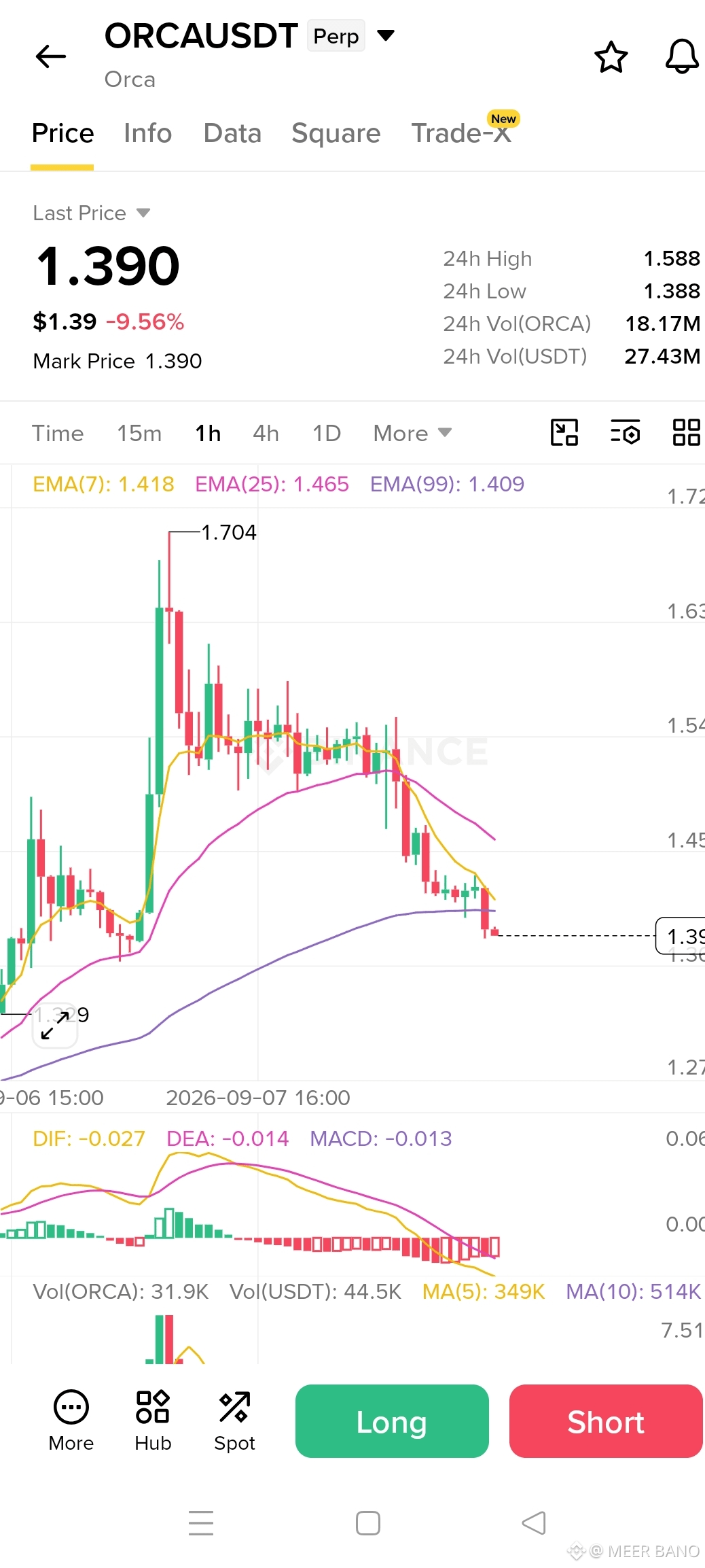
$ORCA /USDT — 1H Trade Setup 📊
Current price: 1.390
24H: -9.56%
This chart is bearish right now. Price is below all key EMAs, and MACD remains negative. I would not take a long at 1.390 while the current momentum is still down.
🔴 Short setup — preferred
Entry: 1.405–1.425 on a weak retest
SL: 1.455
TP1: 1.375
TP2: 1.340
TP3: 1.300
The 1.409 EMA99 is important. If price retests 1.405–1.425 and gets rejected, that gives a cleaner short.
🟢 Long setup
Only consider long after a recovery:
Condition: 1H close back above 1.455–1.465
Then wait for a retest.
Entry: 1.455–1.465
SL: 1.425
TP1: 1.50
TP2: 1.545
TP3: 1.60
⚠️ Critical level
1.388–1.390 is the immediate support/current low area.
If 1.388 breaks with volume, downside can accelerate toward 1.34 → 1.30.
If it holds and produces a strong bullish reversal, a bounce toward 1.409–1.42 is possible.
Verdict
Bias: 🔴 Bearish
EMA7: 1.418 ❌
EMA25: 1.465 ❌
EMA99: 1.409 ❌
MACD: -0.013 ❌
Price structure: lower highs/lower lows ❌
Best trade: Wait for a 1.405–1.425 retest → rejection → SHORT.
At 1.390, chasing a short is also risky because you're already sitting near support.
$ORCA /USDT — 1H Trade Setup 📊
Current price: 1.390
24H: -9.56%
This chart is bearish right now. Price is below all key EMAs, and MACD remains negative. I would not take a long at 1.390 while the current momentum is still down.
🔴 Short setup — preferred
Entry: 1.405–1.425 on a weak retest
SL: 1.455
TP1: 1.375
TP2: 1.340
TP3: 1.300
The 1.409 EMA99 is important. If price retests 1.405–1.425 and gets rejected, that gives a cleaner short.
🟢 Long setup
Only consider long after a recovery:
Condition: 1H close back above 1.455–1.465
Then wait for a retest.
Entry: 1.455–1.465
SL: 1.425
TP1: 1.50
TP2: 1.545
TP3: 1.60
⚠️ Critical level
1.388–1.390 is the immediate support/current low area.
If 1.388 breaks with volume, downside can accelerate toward 1.34 → 1.30.
If it holds and produces a strong bullish reversal, a bounce toward 1.409–1.42 is possible.
Verdict
Bias: 🔴 Bearish
EMA7: 1.418 ❌
EMA25: 1.465 ❌
EMA99: 1.409 ❌
MACD: -0.013 ❌
Price structure: lower highs/lower lows ❌
Best trade: Wait for a 1.405–1.425 retest → rejection → SHORT.
At 1.390, chasing a short is also risky because you're already sitting near support.
Current price: 1.390
24H: -9.56%
This chart is bearish right now. Price is below all key EMAs, and MACD remains negative. I would not take a long at 1.390 while the current momentum is still down.
🔴 Short setup — preferred
Entry: 1.405–1.425 on a weak retest
SL: 1.455
TP1: 1.375
TP2: 1.340
TP3: 1.300
The 1.409 EMA99 is important. If price retests 1.405–1.425 and gets rejected, that gives a cleaner short.
🟢 Long setup
Only consider long after a recovery:
Condition: 1H close back above 1.455–1.465
Then wait for a retest.
Entry: 1.455–1.465
SL: 1.425
TP1: 1.50
TP2: 1.545
TP3: 1.60
⚠️ Critical level
1.388–1.390 is the immediate support/current low area.
If 1.388 breaks with volume, downside can accelerate toward 1.34 → 1.30.
If it holds and produces a strong bullish reversal, a bounce toward 1.409–1.42 is possible.
Verdict
Bias: 🔴 Bearish
EMA7: 1.418 ❌
EMA25: 1.465 ❌
EMA99: 1.409 ❌
MACD: -0.013 ❌
Price structure: lower highs/lower lows ❌
Best trade: Wait for a 1.405–1.425 retest → rejection → SHORT.
At 1.390, chasing a short is also risky because you're already sitting near support.
103
·
--
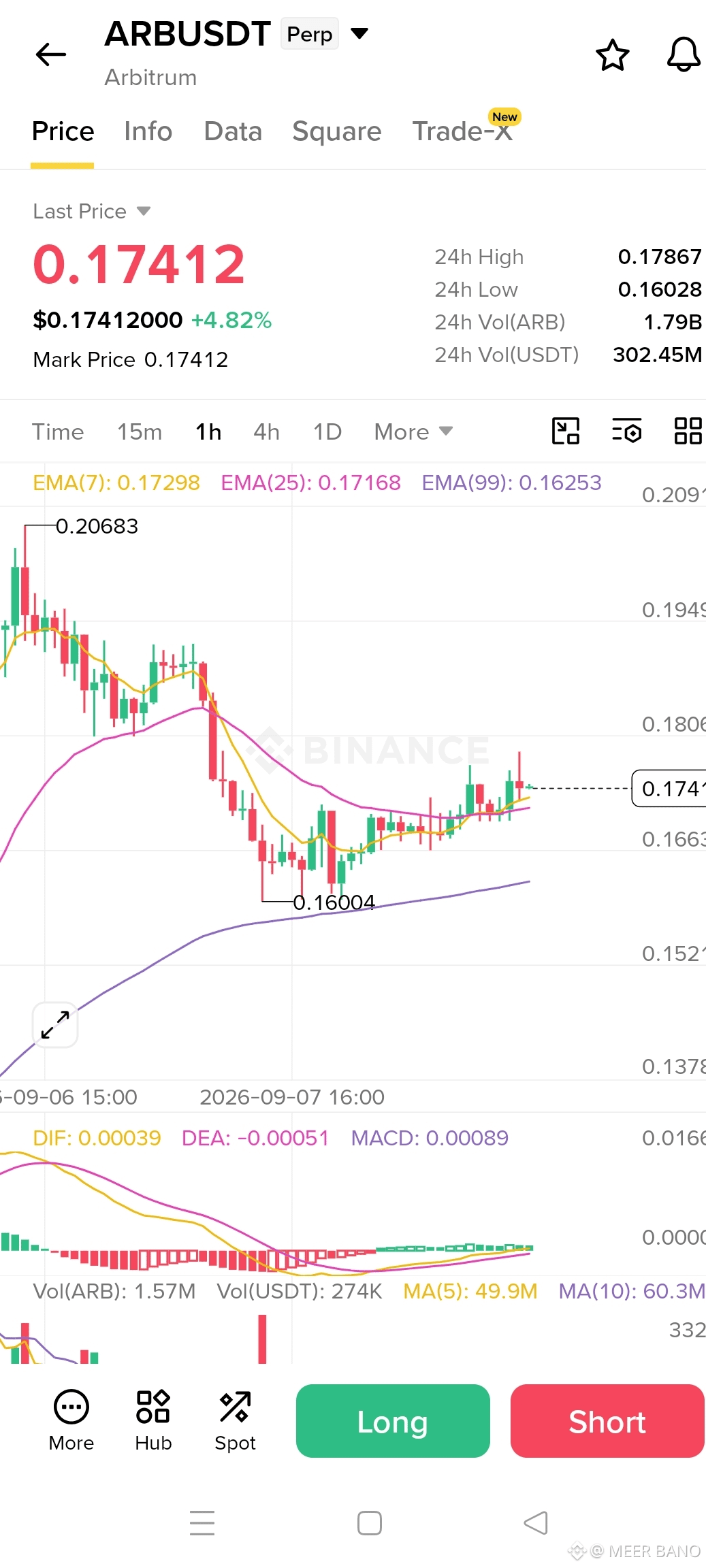
$ARB /USDT — 1H Trade Setup 📊
Current: 0.17412
24H high: 0.17867
24H low: 0.16028
ARB is showing a short-term bullish recovery from 0.16004. Price is now above EMA7 and EMA25, while MACD has turned positive. However, 0.1785–0.1806 is the immediate resistance zone.
🟢 LONG — preferred
Entry: 0.1715–0.1730
SL: 0.1680
TP1: 0.1785
TP2: 0.1806
TP3: 0.1850–0.1900
Best if price pulls back into the entry zone and holds EMA7/EMA25.
🚀 Breakout long
If 1H closes above 0.1806 with strong volume:
Entry: 0.1800–0.1810 retest
SL: 0.1760
TP1: 0.1850
TP2: 0.1900
TP3: 0.1950
🔴 SHORT
Only consider short if 0.1785–0.1806 rejects strongly and price falls back below 0.1715.
Targets: 0.1680 → 0.1630 → 0.1600
🔎 Indicators
EMA7: 0.17298 ✅
EMA25: 0.17168 ✅
EMA99: 0.16253 ✅
MACD: positive ✅
Structure: higher lows after 0.16004 ✅
Bias: 🟢 Bullish above 0.1715.
At 0.1741, I would not chase aggressively. The cleaner trade is a pullback toward 0.1715–0.1730, or wait for a confirmed breakout above 0.1806.
$ARB /USDT — 1H Trade Setup 📊
Current: 0.17412
24H high: 0.17867
24H low: 0.16028
ARB is showing a short-term bullish recovery from 0.16004. Price is now above EMA7 and EMA25, while MACD has turned positive. However, 0.1785–0.1806 is the immediate resistance zone.
🟢 LONG — preferred
Entry: 0.1715–0.1730
SL: 0.1680
TP1: 0.1785
TP2: 0.1806
TP3: 0.1850–0.1900
Best if price pulls back into the entry zone and holds EMA7/EMA25.
🚀 Breakout long
If 1H closes above 0.1806 with strong volume:
Entry: 0.1800–0.1810 retest
SL: 0.1760
TP1: 0.1850
TP2: 0.1900
TP3: 0.1950
🔴 SHORT
Only consider short if 0.1785–0.1806 rejects strongly and price falls back below 0.1715.
Targets: 0.1680 → 0.1630 → 0.1600
🔎 Indicators
EMA7: 0.17298 ✅
EMA25: 0.17168 ✅
EMA99: 0.16253 ✅
MACD: positive ✅
Structure: higher lows after 0.16004 ✅
Bias: 🟢 Bullish above 0.1715.
At 0.1741, I would not chase aggressively. The cleaner trade is a pullback toward 0.1715–0.1730, or wait for a confirmed breakout above 0.1806.
Current: 0.17412
24H high: 0.17867
24H low: 0.16028
ARB is showing a short-term bullish recovery from 0.16004. Price is now above EMA7 and EMA25, while MACD has turned positive. However, 0.1785–0.1806 is the immediate resistance zone.
🟢 LONG — preferred
Entry: 0.1715–0.1730
SL: 0.1680
TP1: 0.1785
TP2: 0.1806
TP3: 0.1850–0.1900
Best if price pulls back into the entry zone and holds EMA7/EMA25.
🚀 Breakout long
If 1H closes above 0.1806 with strong volume:
Entry: 0.1800–0.1810 retest
SL: 0.1760
TP1: 0.1850
TP2: 0.1900
TP3: 0.1950
🔴 SHORT
Only consider short if 0.1785–0.1806 rejects strongly and price falls back below 0.1715.
Targets: 0.1680 → 0.1630 → 0.1600
🔎 Indicators
EMA7: 0.17298 ✅
EMA25: 0.17168 ✅
EMA99: 0.16253 ✅
MACD: positive ✅
Structure: higher lows after 0.16004 ✅
Bias: 🟢 Bullish above 0.1715.
At 0.1741, I would not chase aggressively. The cleaner trade is a pullback toward 0.1715–0.1730, or wait for a confirmed breakout above 0.1806.
126
·
--
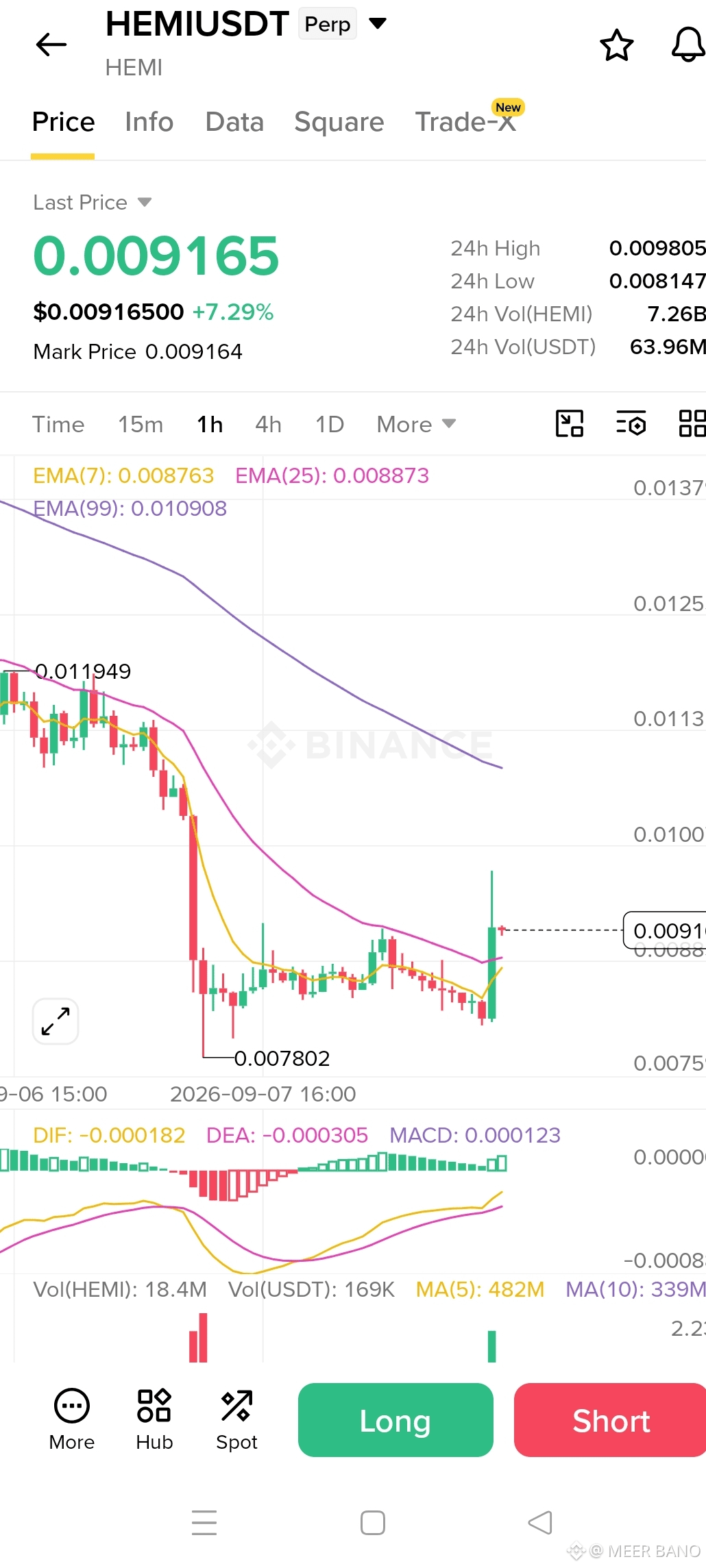
$HEMI /USDT — 1H Trade Setup 📊
Current: 0.009165
24H: +7.29%
The chart has just produced a strong volume spike and bullish impulse, but there is a long upper wick, so chasing at 0.00916 isn't ideal.
🟢 Long setup — preferred
Entry zone: 0.00885–0.00900
Wait for the level to hold and a bullish 1H candle confirmation.
SL: 0.00855
TP1: 0.00970
TP2: 0.00980
TP3: 0.01005
TP4: 0.01090
Risk/reward improves considerably if you get the pullback toward the EMA25/EMA7 area.
🚀 Breakout setup
If HEMI gets a 1H close above 0.00980 with strong volume, then:
Entry: 0.00975–0.00985 retest
SL: 0.00945
TP: 0.01005 → 0.01050 → 0.01090
🔴 Short setup
Don't short at 0.00916 yet.
A short becomes interesting if price reaches 0.00970–0.00980 and gets strongly rejected.
SL: 0.01005
TP1: 0.00915
TP2: 0.00885
TP3: 0.00815
🔎 What the chart says
EMA7: 0.008763 → price above it ✅
EMA25: 0.008873 → price above it ✅
EMA99: 0.010908 → still below it ⚠️
MACD: turning bullish ✅
Volume: major expansion ✅
Recent low: 0.007802
So the immediate trend has improved, but 0.00970–0.00980 is the key resistance zone. A clean break of that area could open the way toward 0.01005 and eventually 0.01090.
My preferred trade: 🟢 LONG on 0.00885–0.00900 confirmation.
Don't chase 0.00916; wait for either the pullback or confirmed breakout.
$HEMI /USDT — 1H Trade Setup 📊
Current: 0.009165
24H: +7.29%
The chart has just produced a strong volume spike and bullish impulse, but there is a long upper wick, so chasing at 0.00916 isn't ideal.
🟢 Long setup — preferred
Entry zone: 0.00885–0.00900
Wait for the level to hold and a bullish 1H candle confirmation.
SL: 0.00855
TP1: 0.00970
TP2: 0.00980
TP3: 0.01005
TP4: 0.01090
Risk/reward improves considerably if you get the pullback toward the EMA25/EMA7 area.
🚀 Breakout setup
If HEMI gets a 1H close above 0.00980 with strong volume, then:
Entry: 0.00975–0.00985 retest
SL: 0.00945
TP: 0.01005 → 0.01050 → 0.01090
🔴 Short setup
Don't short at 0.00916 yet.
A short becomes interesting if price reaches 0.00970–0.00980 and gets strongly rejected.
SL: 0.01005
TP1: 0.00915
TP2: 0.00885
TP3: 0.00815
🔎 What the chart says
EMA7: 0.008763 → price above it ✅
EMA25: 0.008873 → price above it ✅
EMA99: 0.010908 → still below it ⚠️
MACD: turning bullish ✅
Volume: major expansion ✅
Recent low: 0.007802
So the immediate trend has improved, but 0.00970–0.00980 is the key resistance zone. A clean break of that area could open the way toward 0.01005 and eventually 0.01090.
My preferred trade: 🟢 LONG on 0.00885–0.00900 confirmation.
Don't chase 0.00916; wait for either the pullback or confirmed breakout.
Current: 0.009165
24H: +7.29%
The chart has just produced a strong volume spike and bullish impulse, but there is a long upper wick, so chasing at 0.00916 isn't ideal.
🟢 Long setup — preferred
Entry zone: 0.00885–0.00900
Wait for the level to hold and a bullish 1H candle confirmation.
SL: 0.00855
TP1: 0.00970
TP2: 0.00980
TP3: 0.01005
TP4: 0.01090
Risk/reward improves considerably if you get the pullback toward the EMA25/EMA7 area.
🚀 Breakout setup
If HEMI gets a 1H close above 0.00980 with strong volume, then:
Entry: 0.00975–0.00985 retest
SL: 0.00945
TP: 0.01005 → 0.01050 → 0.01090
🔴 Short setup
Don't short at 0.00916 yet.
A short becomes interesting if price reaches 0.00970–0.00980 and gets strongly rejected.
SL: 0.01005
TP1: 0.00915
TP2: 0.00885
TP3: 0.00815
🔎 What the chart says
EMA7: 0.008763 → price above it ✅
EMA25: 0.008873 → price above it ✅
EMA99: 0.010908 → still below it ⚠️
MACD: turning bullish ✅
Volume: major expansion ✅
Recent low: 0.007802
So the immediate trend has improved, but 0.00970–0.00980 is the key resistance zone. A clean break of that area could open the way toward 0.01005 and eventually 0.01090.
My preferred trade: 🟢 LONG on 0.00885–0.00900 confirmation.
Don't chase 0.00916; wait for either the pullback or confirmed breakout.
374
·
--
let's see my first TP 0.073
2nd Tp 0.80
3rd TP 0.1
$ZKC
let's see my first TP 0.073
2nd Tp 0.80
3rd TP 0.1
$ZKC
2nd Tp 0.80
3rd TP 0.1
$ZKC
1
1
110
·
--
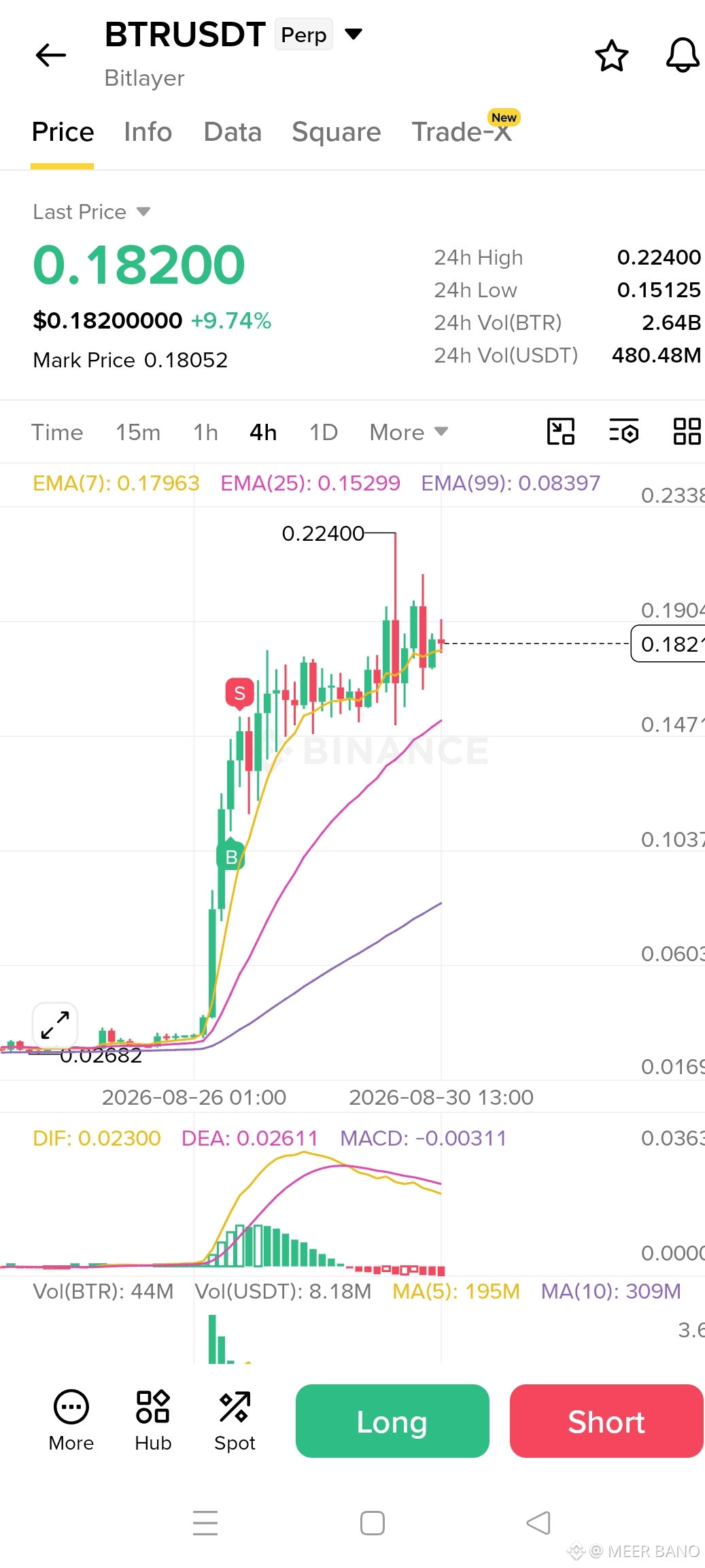
$BTR /USDT — 4H Trade Setup 📊
Current price: 0.1820
Trend: Bullish, but momentum is cooling.
The chart shows a strong breakout from ~0.03, followed by consolidation around 0.15–0.19. Price is still above EMA7/25/99, but MACD has turned slightly negative, so I wouldn't chase the current price.
Key levels
🟢 Support: 0.178–0.180
🟢 Strong support: 0.153–0.156 (EMA25)
🔴 Resistance: 0.190–0.195
🔴 Major resistance: 0.224
🚀 Breakout target: 0.240–0.250 if 0.224 breaks with volume
🟢 Long setup
Preferred entry: 0.175–0.180 after bullish confirmation
SL: 0.152
TP1: 0.195
TP2: 0.224
TP3: 0.240–0.250
Breakout entry: If a 4H candle closes above 0.224, wait for a retest of 0.218–0.224 rather than buying the first spike.
🔴 Short setup
Short only if 0.153 breaks decisively on 4H:
Entry: below 0.153 after retest
SL: 0.165
TP1: 0.145
TP2: 0.125
TP3: 0.105
⚠️ Important
MACD is weakening while price remains near the upper part of the range. That creates a pullback risk.
My bias: 🟢 Bullish above 0.153, but WAIT for either 0.175–0.180 support confirmation or a confirmed 0.224 breakout.
I would not enter aggressively at 0.182.
$BTR /USDT — 4H Trade Setup 📊
Current price: 0.1820
Trend: Bullish, but momentum is cooling.
The chart shows a strong breakout from ~0.03, followed by consolidation around 0.15–0.19. Price is still above EMA7/25/99, but MACD has turned slightly negative, so I wouldn't chase the current price.
Key levels
🟢 Support: 0.178–0.180
🟢 Strong support: 0.153–0.156 (EMA25)
🔴 Resistance: 0.190–0.195
🔴 Major resistance: 0.224
🚀 Breakout target: 0.240–0.250 if 0.224 breaks with volume
🟢 Long setup
Preferred entry: 0.175–0.180 after bullish confirmation
SL: 0.152
TP1: 0.195
TP2: 0.224
TP3: 0.240–0.250
Breakout entry: If a 4H candle closes above 0.224, wait for a retest of 0.218–0.224 rather than buying the first spike.
🔴 Short setup
Short only if 0.153 breaks decisively on 4H:
Entry: below 0.153 after retest
SL: 0.165
TP1: 0.145
TP2: 0.125
TP3: 0.105
⚠️ Important
MACD is weakening while price remains near the upper part of the range. That creates a pullback risk.
My bias: 🟢 Bullish above 0.153, but WAIT for either 0.175–0.180 support confirmation or a confirmed 0.224 breakout.
I would not enter aggressively at 0.182.
Current price: 0.1820
Trend: Bullish, but momentum is cooling.
The chart shows a strong breakout from ~0.03, followed by consolidation around 0.15–0.19. Price is still above EMA7/25/99, but MACD has turned slightly negative, so I wouldn't chase the current price.
Key levels
🟢 Support: 0.178–0.180
🟢 Strong support: 0.153–0.156 (EMA25)
🔴 Resistance: 0.190–0.195
🔴 Major resistance: 0.224
🚀 Breakout target: 0.240–0.250 if 0.224 breaks with volume
🟢 Long setup
Preferred entry: 0.175–0.180 after bullish confirmation
SL: 0.152
TP1: 0.195
TP2: 0.224
TP3: 0.240–0.250
Breakout entry: If a 4H candle closes above 0.224, wait for a retest of 0.218–0.224 rather than buying the first spike.
🔴 Short setup
Short only if 0.153 breaks decisively on 4H:
Entry: below 0.153 after retest
SL: 0.165
TP1: 0.145
TP2: 0.125
TP3: 0.105
⚠️ Important
MACD is weakening while price remains near the upper part of the range. That creates a pullback risk.
My bias: 🟢 Bullish above 0.153, but WAIT for either 0.175–0.180 support confirmation or a confirmed 0.224 breakout.
I would not enter aggressively at 0.182.
1
211
·
--
Verified
I run a small Python script on my laptop in Islamabad that does heavy hashing for a side project, and I once tried moving it into a sandboxed environment thinking it would run just as fast since the logic didn't change. It ran noticeably slower, and until I read about Dusk's Piecrust VM I never actually understood why that happens at a technical level.
I assumed all smart contract execution inside a WASM virtual machine runs at roughly native speed, since WASM is usually marketed as near native performance.
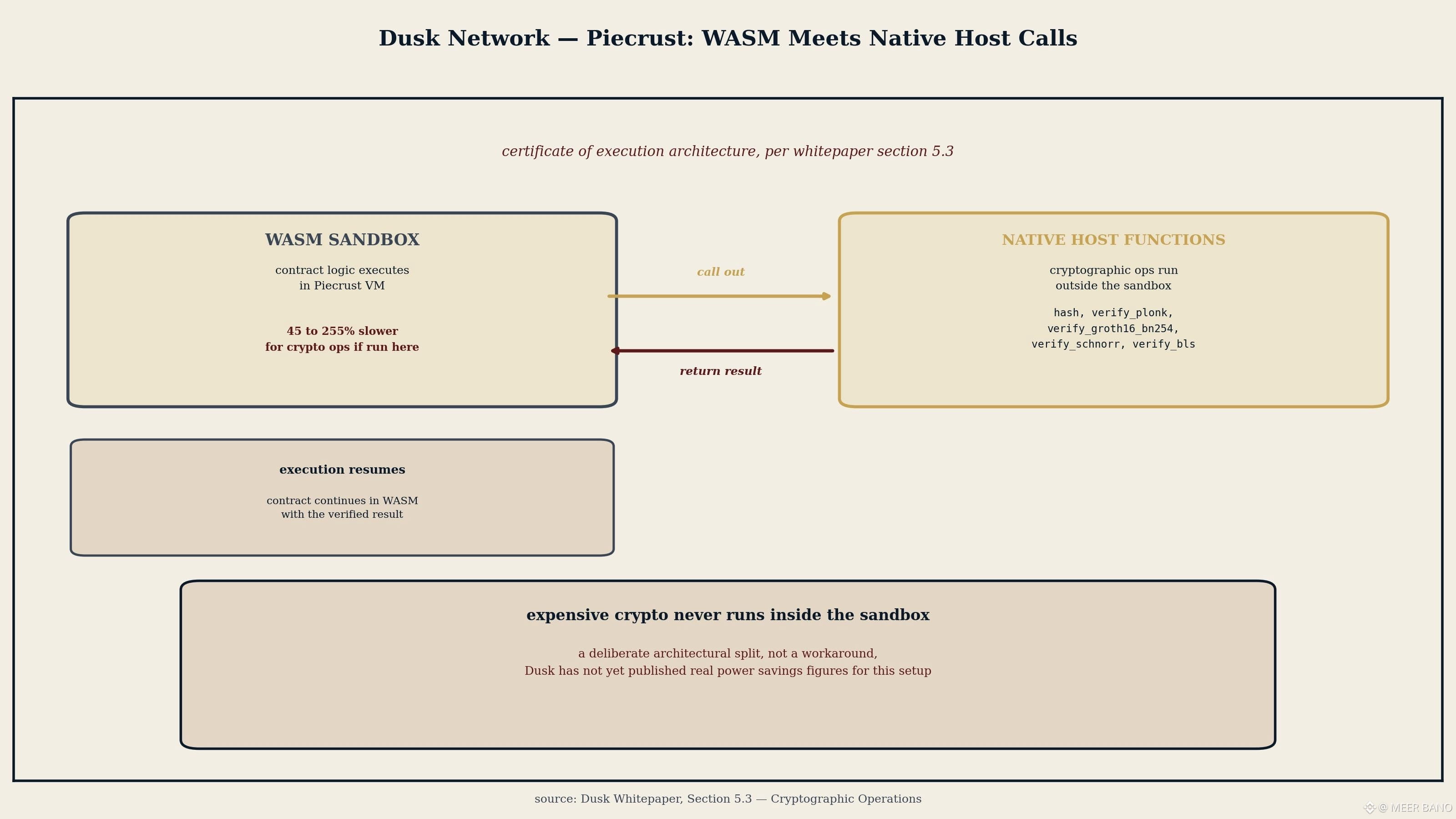
That's not accurate for cryptographic operations specifically. Research cited in the whitepaper shows WASM execution can run 45 to 255 percent slower than native code for complex applications, mainly from virtualized memory management and extra instruction handling inside the sandbox.
That's exactly why Piecrust doesn't run things like ZK proof verification, hashing, or signature checks inside the WASM sandbox at all. It exposes host functions instead, direct native calls for operations like hash, verify_plonk, verify_groth16_bn254, verify_schnorr, and verify_bls. The contract calls out to native code for the expensive cryptographic work, then comes back into WASM for everything else. That's a deliberate architectural split, not a workaround.
What the whitepaper admits directly is that Dusk hasn't quantified actual power savings from this setup yet. So I can't tell you a real efficiency number, because Dusk itself hasn't published one.
The real test for DUSK is whether this host function approach keeps holding up as contract complexity grows on mainnet.
Has anyone benchmarked Piecrust's host function calls against pure WASM execution themselves?
@Dusk_Foundation #dusk $DUSK
{spot}(DUSKUSDT)
I run a small Python script on my laptop in Islamabad that does heavy hashing for a side project, and I once tried moving it into a sandboxed environment thinking it would run just as fast since the logic didn't change. It ran noticeably slower, and until I read about Dusk's Piecrust VM I never actually understood why that happens at a technical level.
I assumed all smart contract execution inside a WASM virtual machine runs at roughly native speed, since WASM is usually marketed as near native performance.
That's not accurate for cryptographic operations specifically. Research cited in the whitepaper shows WASM execution can run 45 to 255 percent slower than native code for complex applications, mainly from virtualized memory management and extra instruction handling inside the sandbox.
That's exactly why Piecrust doesn't run things like ZK proof verification, hashing, or signature checks inside the WASM sandbox at all. It exposes host functions instead, direct native calls for operations like hash, verify_plonk, verify_groth16_bn254, verify_schnorr, and verify_bls. The contract calls out to native code for the expensive cryptographic work, then comes back into WASM for everything else. That's a deliberate architectural split, not a workaround.
What the whitepaper admits directly is that Dusk hasn't quantified actual power savings from this setup yet. So I can't tell you a real efficiency number, because Dusk itself hasn't published one.
The real test for DUSK is whether this host function approach keeps holding up as contract complexity grows on mainnet.
Has anyone benchmarked Piecrust's host function calls against pure WASM execution themselves?
@Dusk #dusk $DUSK
I assumed all smart contract execution inside a WASM virtual machine runs at roughly native speed, since WASM is usually marketed as near native performance.
That's not accurate for cryptographic operations specifically. Research cited in the whitepaper shows WASM execution can run 45 to 255 percent slower than native code for complex applications, mainly from virtualized memory management and extra instruction handling inside the sandbox.
That's exactly why Piecrust doesn't run things like ZK proof verification, hashing, or signature checks inside the WASM sandbox at all. It exposes host functions instead, direct native calls for operations like hash, verify_plonk, verify_groth16_bn254, verify_schnorr, and verify_bls. The contract calls out to native code for the expensive cryptographic work, then comes back into WASM for everything else. That's a deliberate architectural split, not a workaround.
What the whitepaper admits directly is that Dusk hasn't quantified actual power savings from this setup yet. So I can't tell you a real efficiency number, because Dusk itself hasn't published one.
The real test for DUSK is whether this host function approach keeps holding up as contract complexity grows on mainnet.
Has anyone benchmarked Piecrust's host function calls against pure WASM execution themselves?
@Dusk #dusk $DUSK
2
2
101
·
--
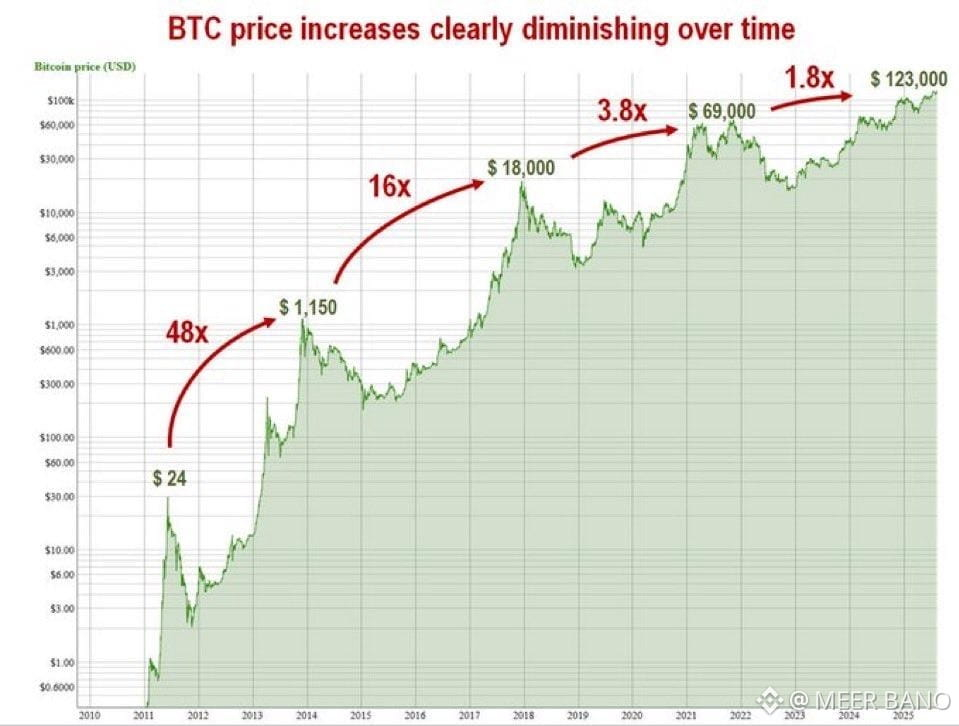
💰 One of the reason we think $BTC will drop below $45k :
2021 Top to 2026 Top : 1.8x
2022 Bottom to 2026 Top : 8.1x
Realistic Calculations :
2026 Top to Next Top : 1.4x ($175k)
2026 Bottom to Next Top : 4.1x
$44k * 4x -> $175k
$35k * 5x -> $175k
2026 Bottom Should be : $44k - $35k
And Final Top Around : $175k
$ONG $ZEC
💰 One of the reason we think $BTC will drop below $45k :
2021 Top to 2026 Top : 1.8x
2022 Bottom to 2026 Top : 8.1x
Realistic Calculations :
2026 Top to Next Top : 1.4x ($175k)
2026 Bottom to Next Top : 4.1x
$44k * 4x -> $175k
$35k * 5x -> $175k
2026 Bottom Should be : $44k - $35k
And Final Top Around : $175k
$ONG $ZEC
2021 Top to 2026 Top : 1.8x
2022 Bottom to 2026 Top : 8.1x
Realistic Calculations :
2026 Top to Next Top : 1.4x ($175k)
2026 Bottom to Next Top : 4.1x
$44k * 4x -> $175k
$35k * 5x -> $175k
2026 Bottom Should be : $44k - $35k
And Final Top Around : $175k
$ONG $ZEC
1
71
·
--
Follow , repost , comment and claim red packet 🎁🎁🎁
Follow , repost , comment and claim red packet 🎁🎁🎁

9
1
3
37
·
--
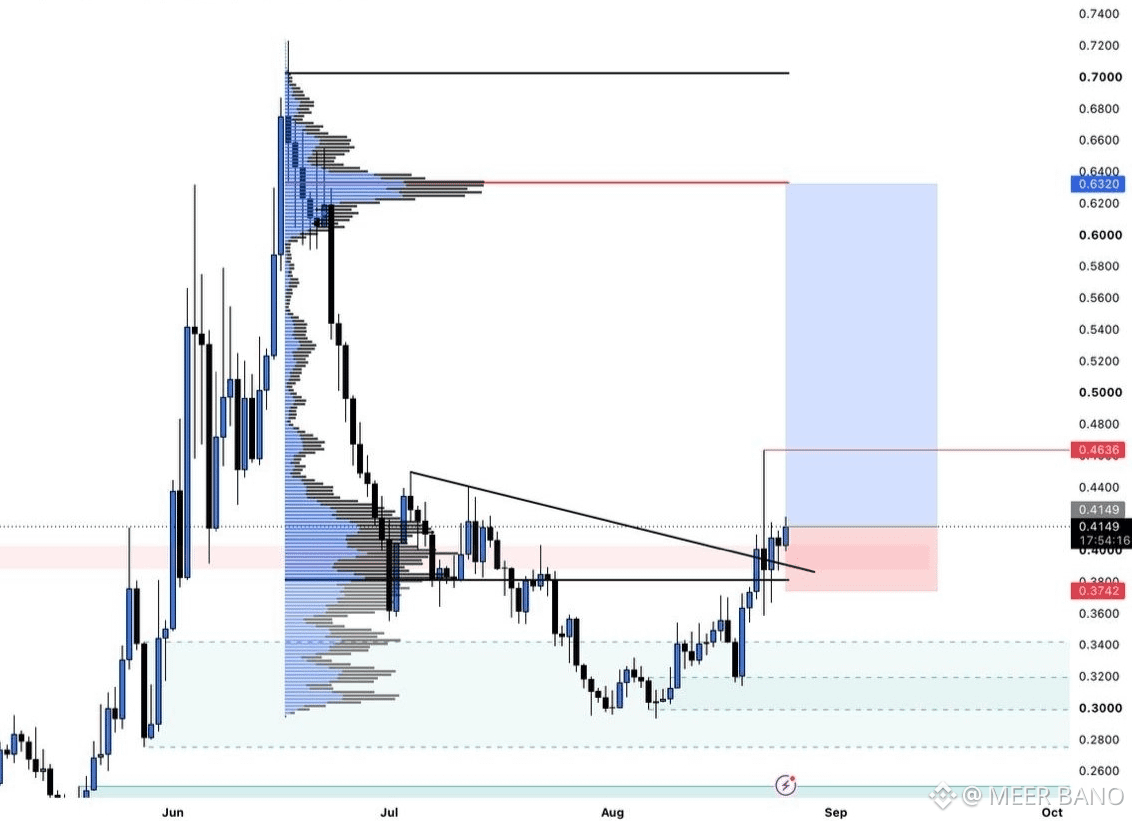
🚀 WLD — Long Setup
Entry: 0.3968 (current market)
🎯 Target: 0.6320 (swing)
🛡️ SL: 0.3742
📈 AI narrative heating up + reclaimed HTF VAL with a breakout higher.
⚠️ Risk: 🟡 Medium — stick to the plan.
$WLD
🚀 WLD — Long Setup
Entry: 0.3968 (current market)
🎯 Target: 0.6320 (swing)
🛡️ SL: 0.3742
📈 AI narrative heating up + reclaimed HTF VAL with a breakout higher.
⚠️ Risk: 🟡 Medium — stick to the plan.
$WLD
Entry: 0.3968 (current market)
🎯 Target: 0.6320 (swing)
🛡️ SL: 0.3742
📈 AI narrative heating up + reclaimed HTF VAL with a breakout higher.
⚠️ Risk: 🟡 Medium — stick to the plan.
$WLD
2
238
·
--
I keep an old cash register receipt roll from my father's shop in Sialkot, every entry stacked one after another and nothing ever gets erased once it's printed. That's the picture I had of UTXO systems, notes just pile up chronologically and stay there. Reading Phoenix broke that assumption a bit.
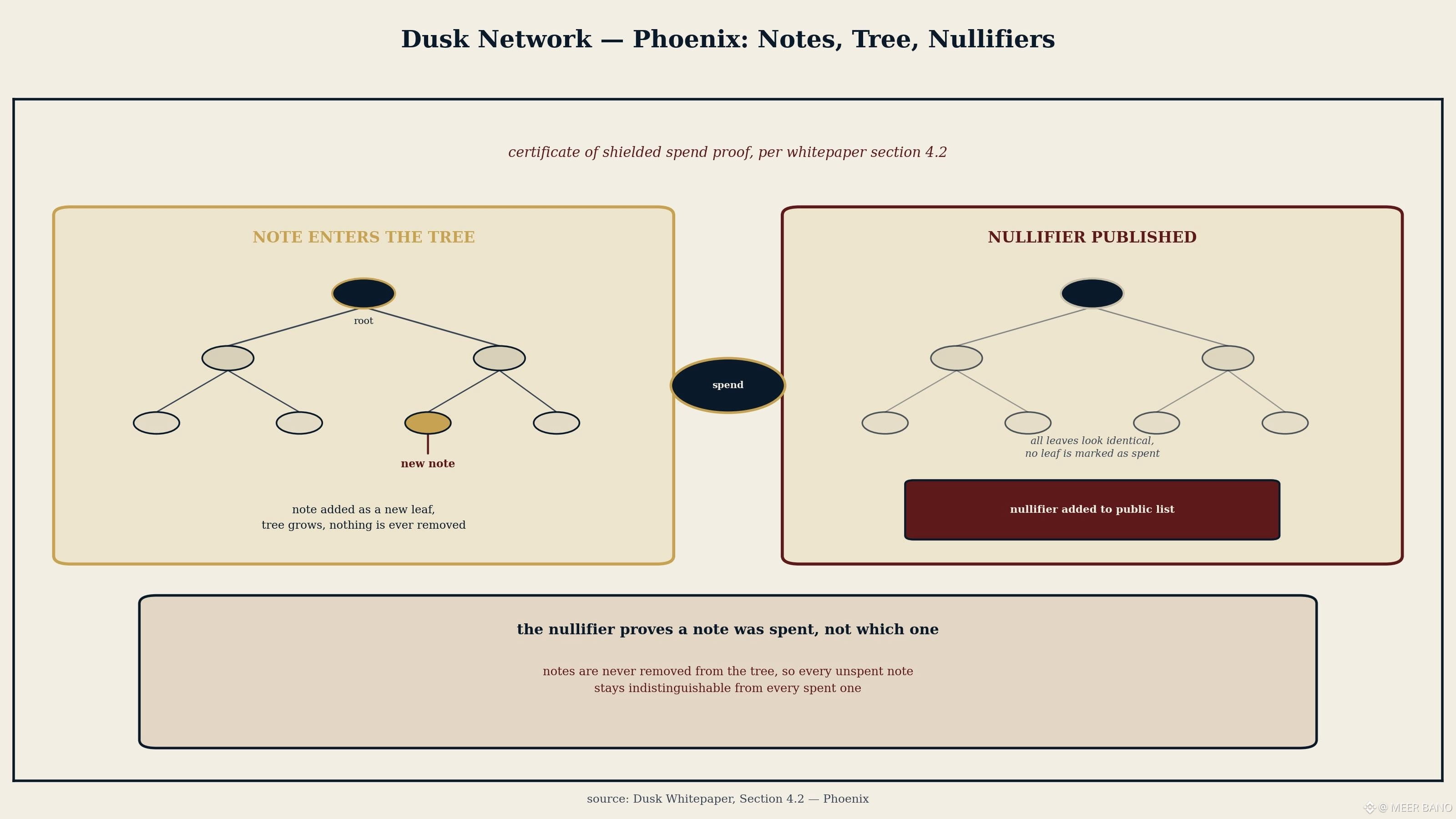
Phoenix does use a UTXO structure, but calls them notes, stored in a Merkle tree rather than a flat ledger. When you spend a note, you don't delete it, you generate a nullifier instead, a value derived from the note's secret key that proves it's been spent without revealing which note in the entire tree it was. The network just tracks the list of used nullifiers. Notes physically stay in the tree forever, growing larger with every transaction, spent or not.
That detail is what actually reframed how I see this. The privacy isn't coming from hiding transactions off chain, it's coming from making every note indistinguishable from every other unspent note once a nullifier appears. Nobody, including validators, can point at the tree and say which specific leaf just got spent. Ownership and balance are proven entirely through a zero knowledge proof, so the network verifies math instead of verifying visible amounts.
What the whitepaper doesn't tell me is how tree size affects proof generation time as the note count grows over years of mainnet activity. That's a real scaling question I can't answer from the source material.
The real test for DUSK is whether Phoenix stays fast to use once the note tree gets genuinely large.
Does anyone know how large the Phoenix note tree currently is on Dusk mainnet?
@Dusk_Foundation #dusk $DUSK
{spot}(DUSKUSDT)
I keep an old cash register receipt roll from my father's shop in Sialkot, every entry stacked one after another and nothing ever gets erased once it's printed. That's the picture I had of UTXO systems, notes just pile up chronologically and stay there. Reading Phoenix broke that assumption a bit.
Phoenix does use a UTXO structure, but calls them notes, stored in a Merkle tree rather than a flat ledger. When you spend a note, you don't delete it, you generate a nullifier instead, a value derived from the note's secret key that proves it's been spent without revealing which note in the entire tree it was. The network just tracks the list of used nullifiers. Notes physically stay in the tree forever, growing larger with every transaction, spent or not.
That detail is what actually reframed how I see this. The privacy isn't coming from hiding transactions off chain, it's coming from making every note indistinguishable from every other unspent note once a nullifier appears. Nobody, including validators, can point at the tree and say which specific leaf just got spent. Ownership and balance are proven entirely through a zero knowledge proof, so the network verifies math instead of verifying visible amounts.
What the whitepaper doesn't tell me is how tree size affects proof generation time as the note count grows over years of mainnet activity. That's a real scaling question I can't answer from the source material.
The real test for DUSK is whether Phoenix stays fast to use once the note tree gets genuinely large.
Does anyone know how large the Phoenix note tree currently is on Dusk mainnet?
@Dusk #dusk $DUSK
Phoenix does use a UTXO structure, but calls them notes, stored in a Merkle tree rather than a flat ledger. When you spend a note, you don't delete it, you generate a nullifier instead, a value derived from the note's secret key that proves it's been spent without revealing which note in the entire tree it was. The network just tracks the list of used nullifiers. Notes physically stay in the tree forever, growing larger with every transaction, spent or not.
That detail is what actually reframed how I see this. The privacy isn't coming from hiding transactions off chain, it's coming from making every note indistinguishable from every other unspent note once a nullifier appears. Nobody, including validators, can point at the tree and say which specific leaf just got spent. Ownership and balance are proven entirely through a zero knowledge proof, so the network verifies math instead of verifying visible amounts.
What the whitepaper doesn't tell me is how tree size affects proof generation time as the note count grows over years of mainnet activity. That's a real scaling question I can't answer from the source material.
The real test for DUSK is whether Phoenix stays fast to use once the note tree gets genuinely large.
Does anyone know how large the Phoenix note tree currently is on Dusk mainnet?
@Dusk #dusk $DUSK
3
4
96
·
--
I sent a bank transfer to a supplier in Gujranwala yesterday and the receipt showed everything, my account, his account, the exact amount, nothing hidden. I assumed Dusk being a privacy chain meant every single transaction on it worked the opposite way, everything obfuscated by default, no exceptions.
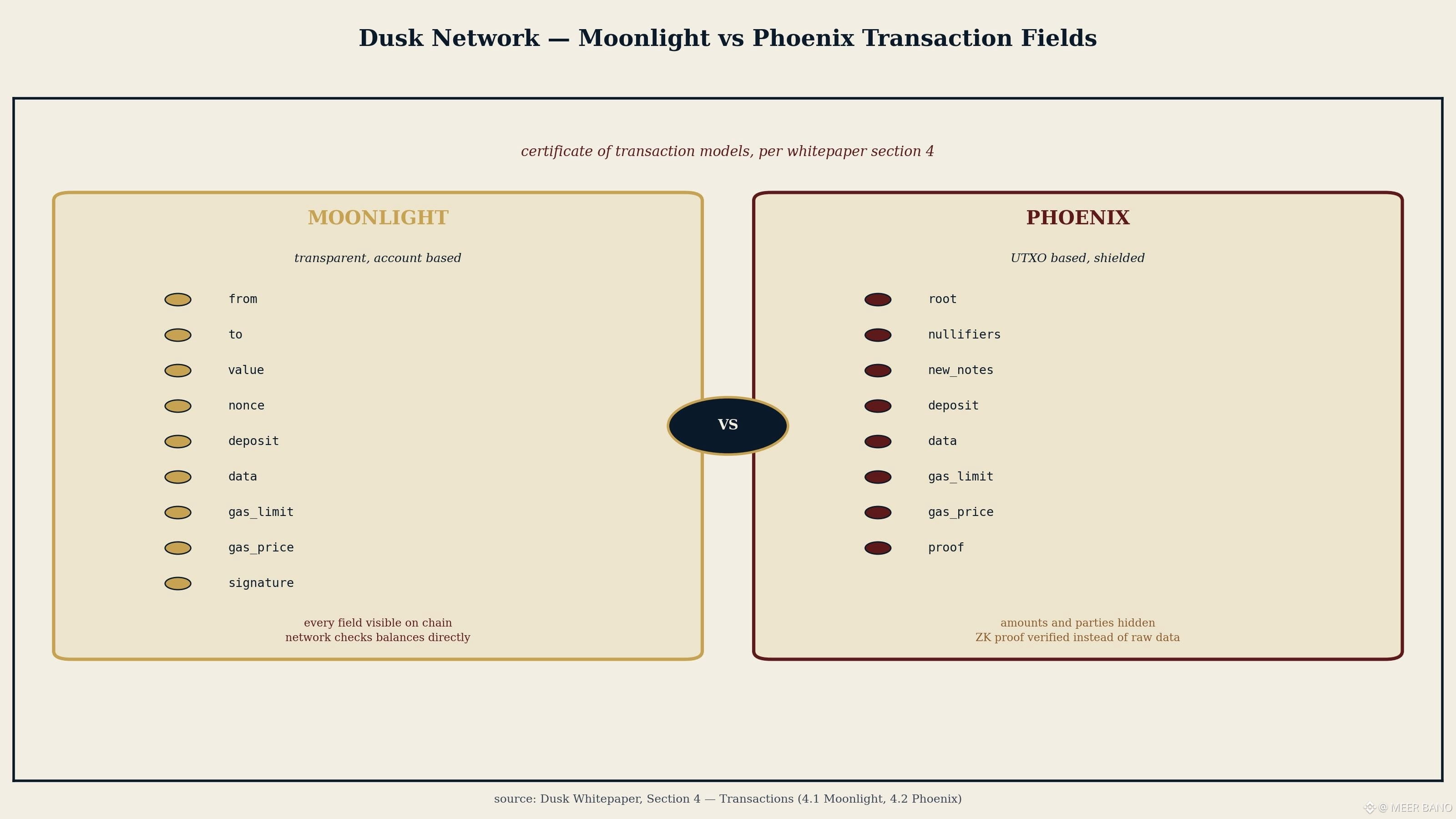
That assumption doesn't hold once you look at Moonlight. It's a fully transparent, account based model, closer to how Ethereum works than to Zcash. Every account has a public key acting as an identifier, and the network tracks a visible nonce and balance for it directly. Ownership gets proven with a straightforward digital signature, the network checks the sender has enough funds, and the nonce has to be exactly one higher than the account's current count to stop replay attacks.
What actually reframed this for me is realizing Dusk isn't a privacy chain that happens to allow transparency as an afterthought. It runs Moonlight and Phoenix side by side as two equally supported transaction models, and only Phoenix handles the obfuscated side. That means Dusk is deliberately built for a world where financial institutions need both, a public audit trail for some transactions and shielded details for others, not one universal privacy default. That's a more mature design choice than a lot of privacy coins even attempt.
What the whitepaper doesn't say is how much of actual network usage runs through Moonlight versus Phoenix in practice. I have no real transaction split to point to.
The real test for DUSK is whether institutions actually use Moonlight for the compliant side of their operations once real volume shows up.
Does anyone know the current Moonlight versus Phoenix transaction split on Dusk mainnet?@Dusk_Foundation #dusk $DUSK
I sent a bank transfer to a supplier in Gujranwala yesterday and the receipt showed everything, my account, his account, the exact amount, nothing hidden. I assumed Dusk being a privacy chain meant every single transaction on it worked the opposite way, everything obfuscated by default, no exceptions.
That assumption doesn't hold once you look at Moonlight. It's a fully transparent, account based model, closer to how Ethereum works than to Zcash. Every account has a public key acting as an identifier, and the network tracks a visible nonce and balance for it directly. Ownership gets proven with a straightforward digital signature, the network checks the sender has enough funds, and the nonce has to be exactly one higher than the account's current count to stop replay attacks.
What actually reframed this for me is realizing Dusk isn't a privacy chain that happens to allow transparency as an afterthought. It runs Moonlight and Phoenix side by side as two equally supported transaction models, and only Phoenix handles the obfuscated side. That means Dusk is deliberately built for a world where financial institutions need both, a public audit trail for some transactions and shielded details for others, not one universal privacy default. That's a more mature design choice than a lot of privacy coins even attempt.
What the whitepaper doesn't say is how much of actual network usage runs through Moonlight versus Phoenix in practice. I have no real transaction split to point to.
The real test for DUSK is whether institutions actually use Moonlight for the compliant side of their operations once real volume shows up.
Does anyone know the current Moonlight versus Phoenix transaction split on Dusk mainnet?@Dusk #dusk $DUSK
That assumption doesn't hold once you look at Moonlight. It's a fully transparent, account based model, closer to how Ethereum works than to Zcash. Every account has a public key acting as an identifier, and the network tracks a visible nonce and balance for it directly. Ownership gets proven with a straightforward digital signature, the network checks the sender has enough funds, and the nonce has to be exactly one higher than the account's current count to stop replay attacks.
What actually reframed this for me is realizing Dusk isn't a privacy chain that happens to allow transparency as an afterthought. It runs Moonlight and Phoenix side by side as two equally supported transaction models, and only Phoenix handles the obfuscated side. That means Dusk is deliberately built for a world where financial institutions need both, a public audit trail for some transactions and shielded details for others, not one universal privacy default. That's a more mature design choice than a lot of privacy coins even attempt.
What the whitepaper doesn't say is how much of actual network usage runs through Moonlight versus Phoenix in practice. I have no real transaction split to point to.
The real test for DUSK is whether institutions actually use Moonlight for the compliant side of their operations once real volume shows up.
Does anyone know the current Moonlight versus Phoenix transaction split on Dusk mainnet?@Dusk #dusk $DUSK
4
6
107
·
--
📉 $BTC LTF Update
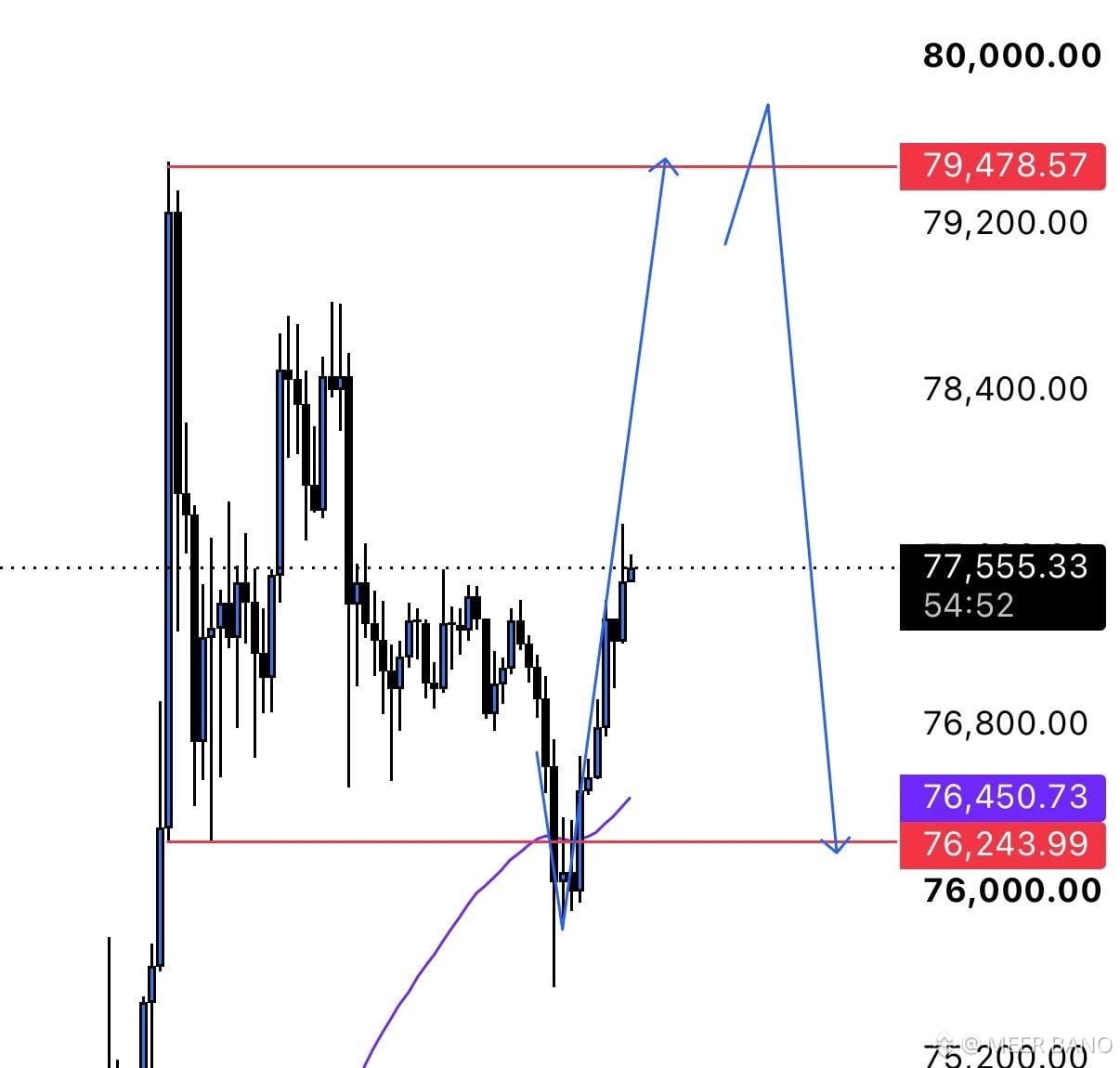
Post-move consolidation — price is now ranging on the lower timeframe. Weekend liquidity is thin, so expect muted action.
Two key levels marked on the chart. A tap on either could trigger a sweep toward the opposite side.
🔍 Watching for a directional push once range edges are tested.
📉 $BTC LTF Update
Post-move consolidation — price is now ranging on the lower timeframe. Weekend liquidity is thin, so expect muted action.
Two key levels marked on the chart. A tap on either could trigger a sweep toward the opposite side.
🔍 Watching for a directional push once range edges are tested.
Post-move consolidation — price is now ranging on the lower timeframe. Weekend liquidity is thin, so expect muted action.
Two key levels marked on the chart. A tap on either could trigger a sweep toward the opposite side.
🔍 Watching for a directional push once range edges are tested.
3
93
·
--
My electricity meter reader in Rawalpindi got a warning notice last month for skipping our street on his rounds, nothing severe, just a formal note in his file. I assumed Dusk treats provisioner misbehavior the same flat way, one warning system, penalties scale up the same regardless of what you actually did wrong.
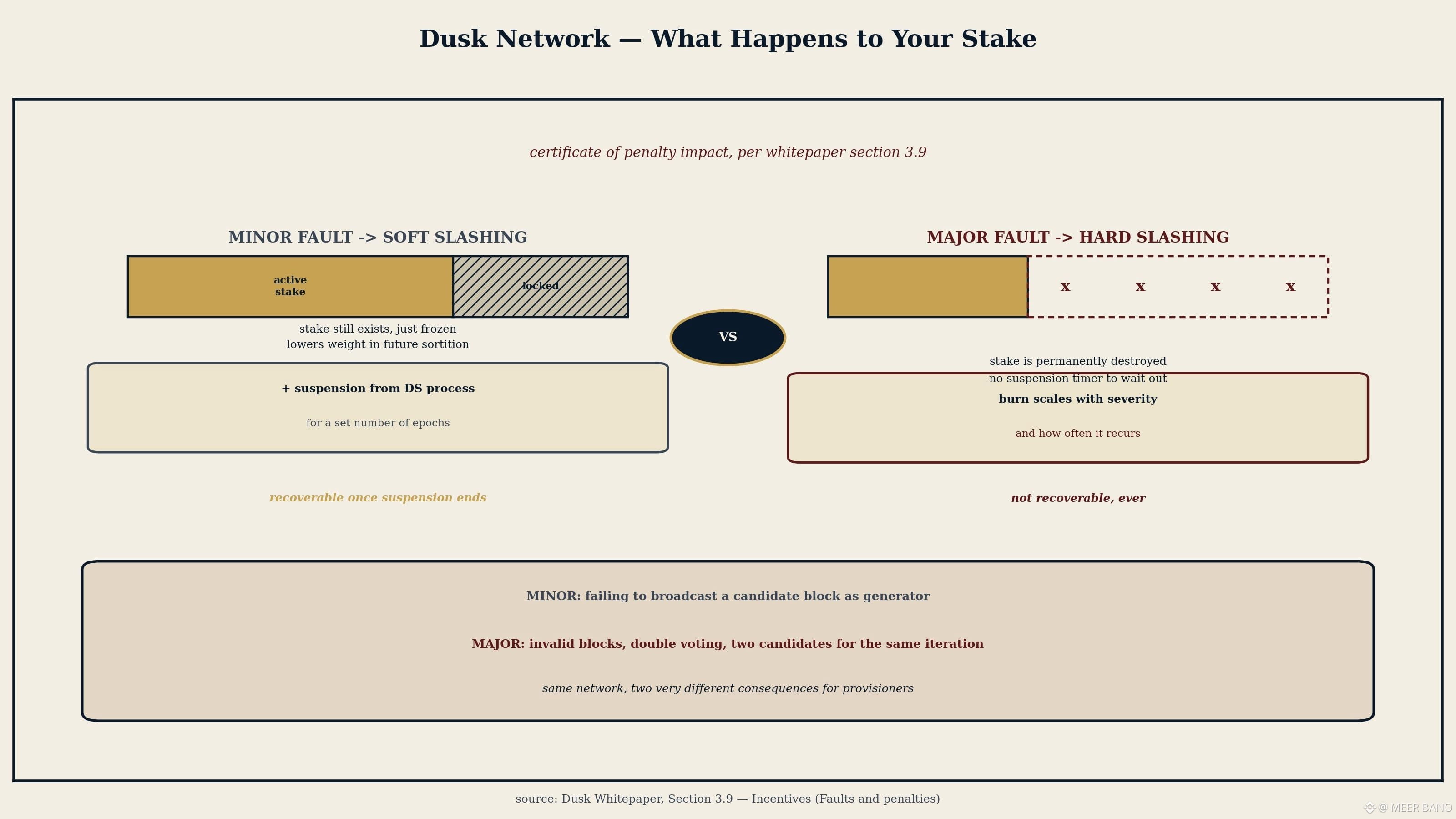
That's not how it works. Dusk splits faults into two clearly separate categories with completely different consequences. A minor fault, like failing to broadcast a candidate block when you were chosen as generator, results in suspension and soft slashing. A major fault, like broadcasting an invalid block, double voting, or putting out two different candidate blocks for the same iteration, triggers hard slashing instead.
The distinction that actually reframed this for me is what soft slashing versus hard slashing actually does. Soft slashing just locks a portion of your stake, which lowers your weight in future sortition rounds but doesn't destroy anything. Hard slashing straight up burns part of your stake, permanently, with the burned amount increasing based on how severe or repeated the fault is. One is a timeout. The other is a real financial loss with no way back.
What the whitepaper doesn't specify is the exact percentage or DUSK amount burned per major fault tier. Without that number I can't tell anyone how costly a specific violation actually is in real terms.
The real test for DUSK is whether hard slashing stays severe enough to actually deter double voting once stake concentration grows.
Does anyone know the real burn percentages Dusk applies for major faults?
#dusk $DUSK @Dusk_Foundation
{spot}(DUSKUSDT)
My electricity meter reader in Rawalpindi got a warning notice last month for skipping our street on his rounds, nothing severe, just a formal note in his file. I assumed Dusk treats provisioner misbehavior the same flat way, one warning system, penalties scale up the same regardless of what you actually did wrong.
That's not how it works. Dusk splits faults into two clearly separate categories with completely different consequences. A minor fault, like failing to broadcast a candidate block when you were chosen as generator, results in suspension and soft slashing. A major fault, like broadcasting an invalid block, double voting, or putting out two different candidate blocks for the same iteration, triggers hard slashing instead.
The distinction that actually reframed this for me is what soft slashing versus hard slashing actually does. Soft slashing just locks a portion of your stake, which lowers your weight in future sortition rounds but doesn't destroy anything. Hard slashing straight up burns part of your stake, permanently, with the burned amount increasing based on how severe or repeated the fault is. One is a timeout. The other is a real financial loss with no way back.
What the whitepaper doesn't specify is the exact percentage or DUSK amount burned per major fault tier. Without that number I can't tell anyone how costly a specific violation actually is in real terms.
The real test for DUSK is whether hard slashing stays severe enough to actually deter double voting once stake concentration grows.
Does anyone know the real burn percentages Dusk applies for major faults?
#dusk $DUSK @Dusk
That's not how it works. Dusk splits faults into two clearly separate categories with completely different consequences. A minor fault, like failing to broadcast a candidate block when you were chosen as generator, results in suspension and soft slashing. A major fault, like broadcasting an invalid block, double voting, or putting out two different candidate blocks for the same iteration, triggers hard slashing instead.
The distinction that actually reframed this for me is what soft slashing versus hard slashing actually does. Soft slashing just locks a portion of your stake, which lowers your weight in future sortition rounds but doesn't destroy anything. Hard slashing straight up burns part of your stake, permanently, with the burned amount increasing based on how severe or repeated the fault is. One is a timeout. The other is a real financial loss with no way back.
What the whitepaper doesn't specify is the exact percentage or DUSK amount burned per major fault tier. Without that number I can't tell anyone how costly a specific violation actually is in real terms.
The real test for DUSK is whether hard slashing stays severe enough to actually deter double voting once stake concentration grows.
Does anyone know the real burn percentages Dusk applies for major faults?
#dusk $DUSK @Dusk
4
7
95
Log in to explore more content
Join global crypto users on Binance Square
⚡️ Get latest and useful information about crypto.
💬 Trusted by the world’s largest crypto exchange.
👍 Discover real insights from verified creators.
Email / Phone number