

Rafi UL Hasan7234
9.8k Posts

Rafi UL Hasan7234
Report
Block User
Crypto Market Analyst. Focusing on fundamental valuation, technical structures, and on-chain metrics X RafiReyon
Frequent Trader
1.2 Years
3.7K+ Following
13.7K+ Followers
10.3K+ Liked
Posts
All
Quotes
Videos
Live
PINNED
·
--
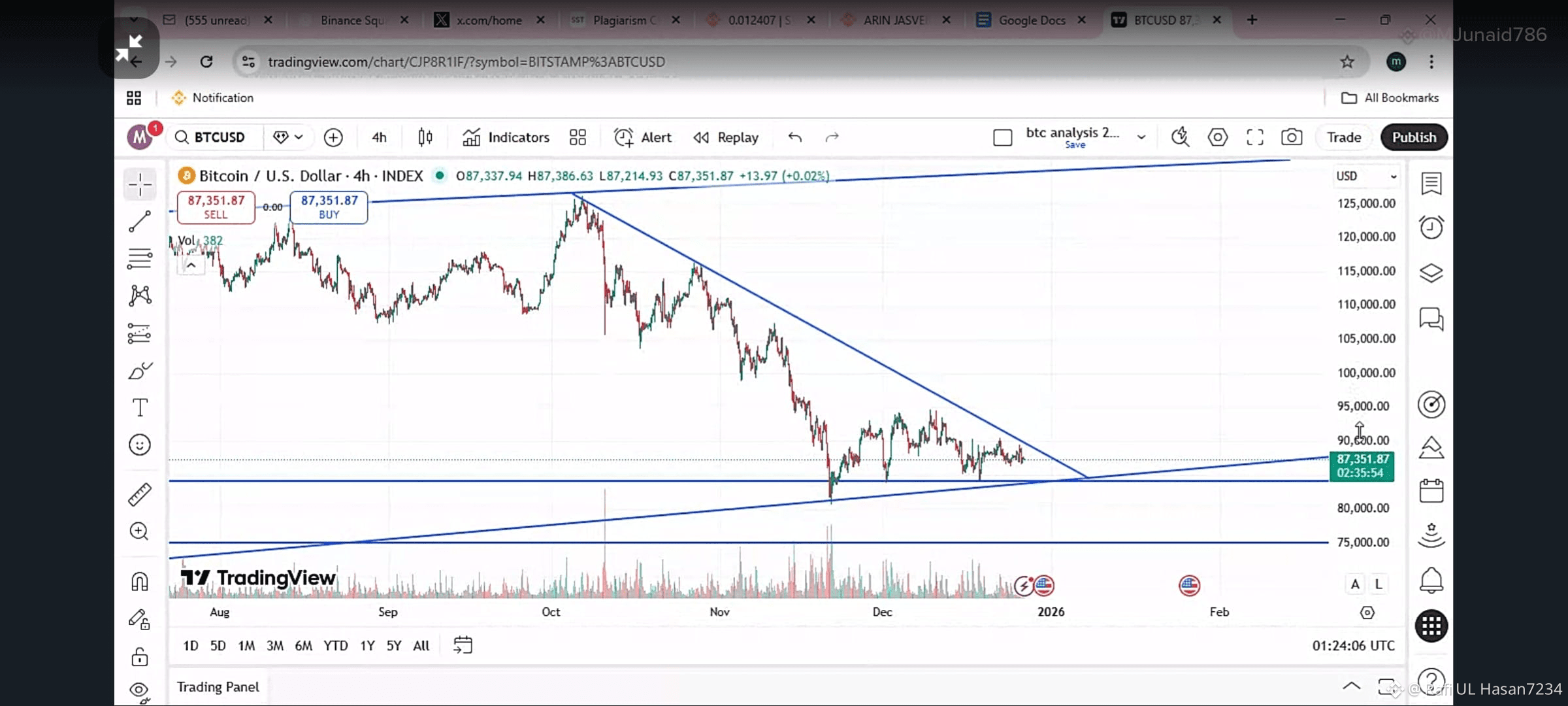
Bearish
In 2026,
No Dp, No Status, No Drama, No Party, No Flex, No Love,
Just Charts,
Just Discipline,
Just Growth.
$BTC
{future}(BTCUSDT)
$ETH
{future}(ETHUSDT)
$BNB
{future}(BNBUSDT)
#Myfollowers💕💕 #Binance
In 2026,
No Dp, No Status, No Drama, No Party, No Flex, No Love,
Just Charts,
Just Discipline,
Just Growth.
$BTC
$ETH
$BNB
#Myfollowers💕💕 #Binance
No Dp, No Status, No Drama, No Party, No Flex, No Love,
Just Charts,
Just Discipline,
Just Growth.
$BTC
$ETH
$BNB
#Myfollowers💕💕 #Binance
455
214
69
455
PINNED
@Square-Creator-41c502cb7c0b
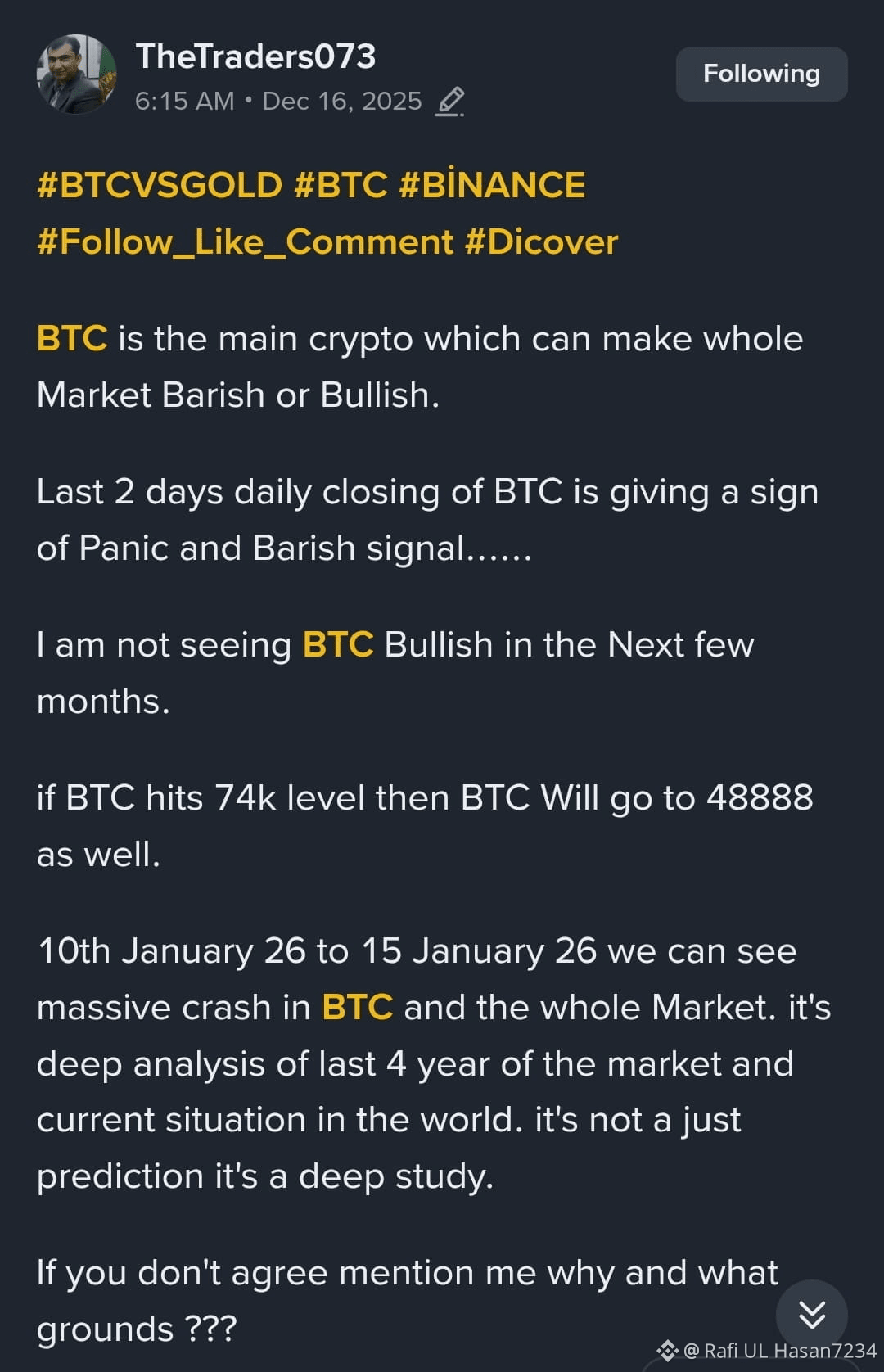
Appreciation for Your Trading Analysis:
i truly admire the clarity and discipline in your trading analysis. The way you break down market structure, manage risk, and wait for confirmation reflects real experience and professionalism. Your insights don’t just show where the market might go — they teach patience, strategy, and control. Learning from your analysis is genuinely valuable, and it inspires confidence in smart, well-planned trading decisions. We become ready when you give us any hint.Hatsofffffff
#followers
[https://app.binance.com/uni-qr/cpo](https://app.binance.com/uni-qr/cpo)
s/33769739608001?r=LV2JGD2S&l=en&uco=ZB9cb6A6dn7VnidMPVF1eg&uc=app_square_share_link&us=copylink
$BTC
{future}(BTCUSDT)
$XRP
{future}(XRPUSDT)
@TheTraders073
Appreciation for Your Trading Analysis:
i truly admire the clarity and discipline in your trading analysis. The way you break down market structure, manage risk, and wait for confirmation reflects real experience and professionalism. Your insights don’t just show where the market might go — they teach patience, strategy, and control. Learning from your analysis is genuinely valuable, and it inspires confidence in smart, well-planned trading decisions. We become ready when you give us any hint.Hatsofffffff
#followers
https://app.binance.com/uni-qr/cpo
s/33769739608001?r=LV2JGD2S&l=en&uco=ZB9cb6A6dn7VnidMPVF1eg&uc=app_square_share_link&us=copylink
$BTC
$XRP
Appreciation for Your Trading Analysis:
i truly admire the clarity and discipline in your trading analysis. The way you break down market structure, manage risk, and wait for confirmation reflects real experience and professionalism. Your insights don’t just show where the market might go — they teach patience, strategy, and control. Learning from your analysis is genuinely valuable, and it inspires confidence in smart, well-planned trading decisions. We become ready when you give us any hint.Hatsofffffff
#followers
https://app.binance.com/uni-qr/cpo
s/33769739608001?r=LV2JGD2S&l=en&uco=ZB9cb6A6dn7VnidMPVF1eg&uc=app_square_share_link&us=copylink
$BTC
$XRP
649
339
118
649
Wow, 9 years! 🥳 Binance has truly reshaped the world of finance, going from a small start to becoming a global crypto leader. It’s incredible to see how much innovation, building, and inspiration has happened, touching millions of lives worldwide. 🌍💛
Nine years of smashing through limits, nine years of unlocking possibilities, and nine years of spearheading the crypto movement. The milestones are astounding, but it’s our amazing community that truly makes Binance special. 🔥
Happy 9th Anniversary, Binance! 🎉
Are you one of the OGs who’s been with us since the beginning? Let me know below! 👇💬
#BinanceTurns9 #Binance9thAnniversary #Binance #Crypto #Web3 #Blockchain #BNB
$SPCXB
{spot}(SPCXBUSDT)
$BTC
{future}(BTCUSDT)
$XAUT
{future}(XAUTUSDT)
Wow, 9 years! 🥳 Binance has truly reshaped the world of finance, going from a small start to becoming a global crypto leader. It’s incredible to see how much innovation, building, and inspiration has happened, touching millions of lives worldwide. 🌍💛
Nine years of smashing through limits, nine years of unlocking possibilities, and nine years of spearheading the crypto movement. The milestones are astounding, but it’s our amazing community that truly makes Binance special. 🔥
Happy 9th Anniversary, Binance! 🎉
Are you one of the OGs who’s been with us since the beginning? Let me know below! 👇💬
#BinanceTurns9 #Binance9thAnniversary #Binance #Crypto #Web3 #Blockchain #BNB
$SPCXB
$BTC
$XAUT
Nine years of smashing through limits, nine years of unlocking possibilities, and nine years of spearheading the crypto movement. The milestones are astounding, but it’s our amazing community that truly makes Binance special. 🔥
Happy 9th Anniversary, Binance! 🎉
Are you one of the OGs who’s been with us since the beginning? Let me know below! 👇💬
#BinanceTurns9 #Binance9thAnniversary #Binance #Crypto #Web3 #Blockchain #BNB
$SPCXB
$BTC
$XAUT

1
2
155
To the @Binance Team (and the community who might see this),
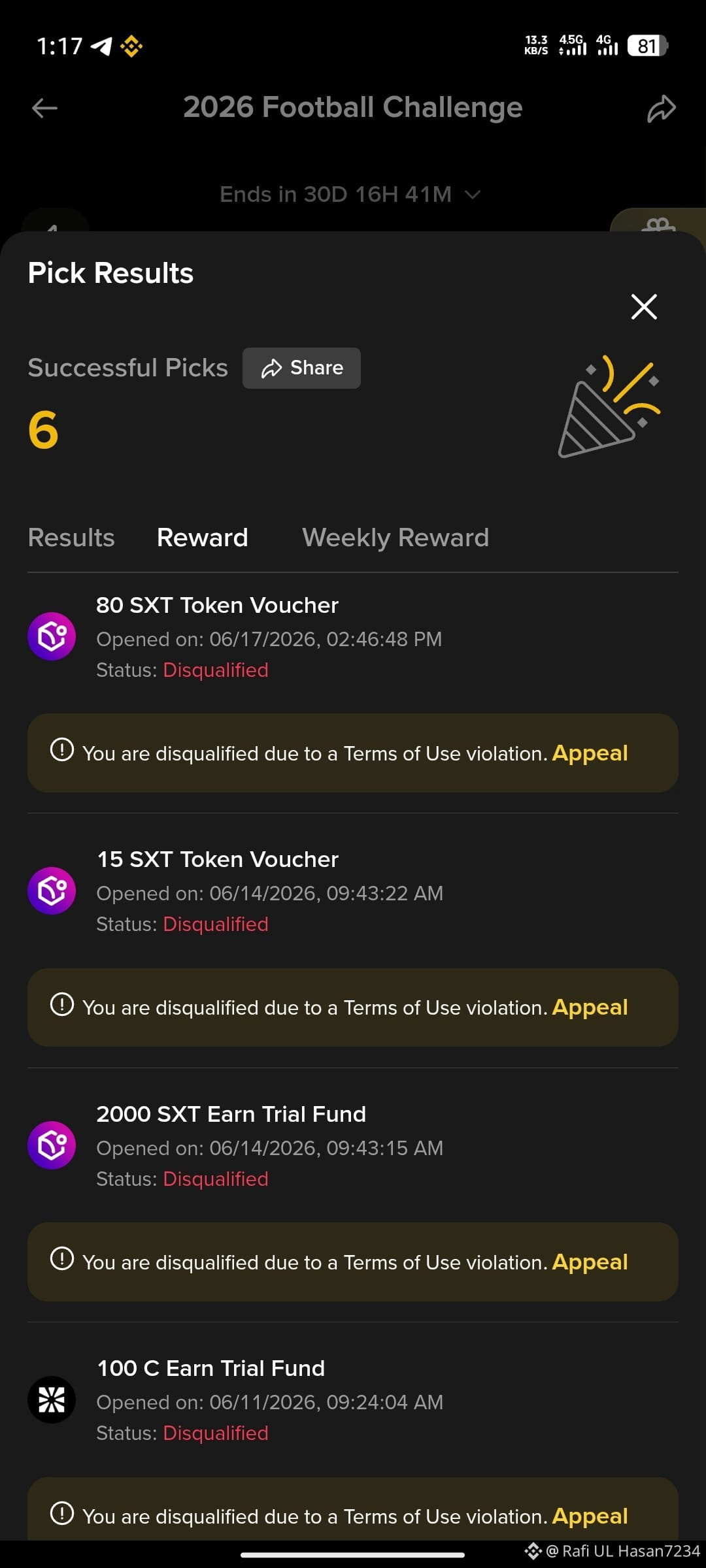
I’m writing this with a heavy heart. I’m just a regular user who got excited about the #2026FootballChallenge.
I thought I was doing well. I opened my rewards and saw:
· 80 SXT Token Voucher (Opened 06/17)
· 15 SXT Token Voucher (Opened 06/14)
· 2000 SXT Earn Trial Fund (Opened 06/14)
· 100 C Earn Trial Fund (Opened 06/11)
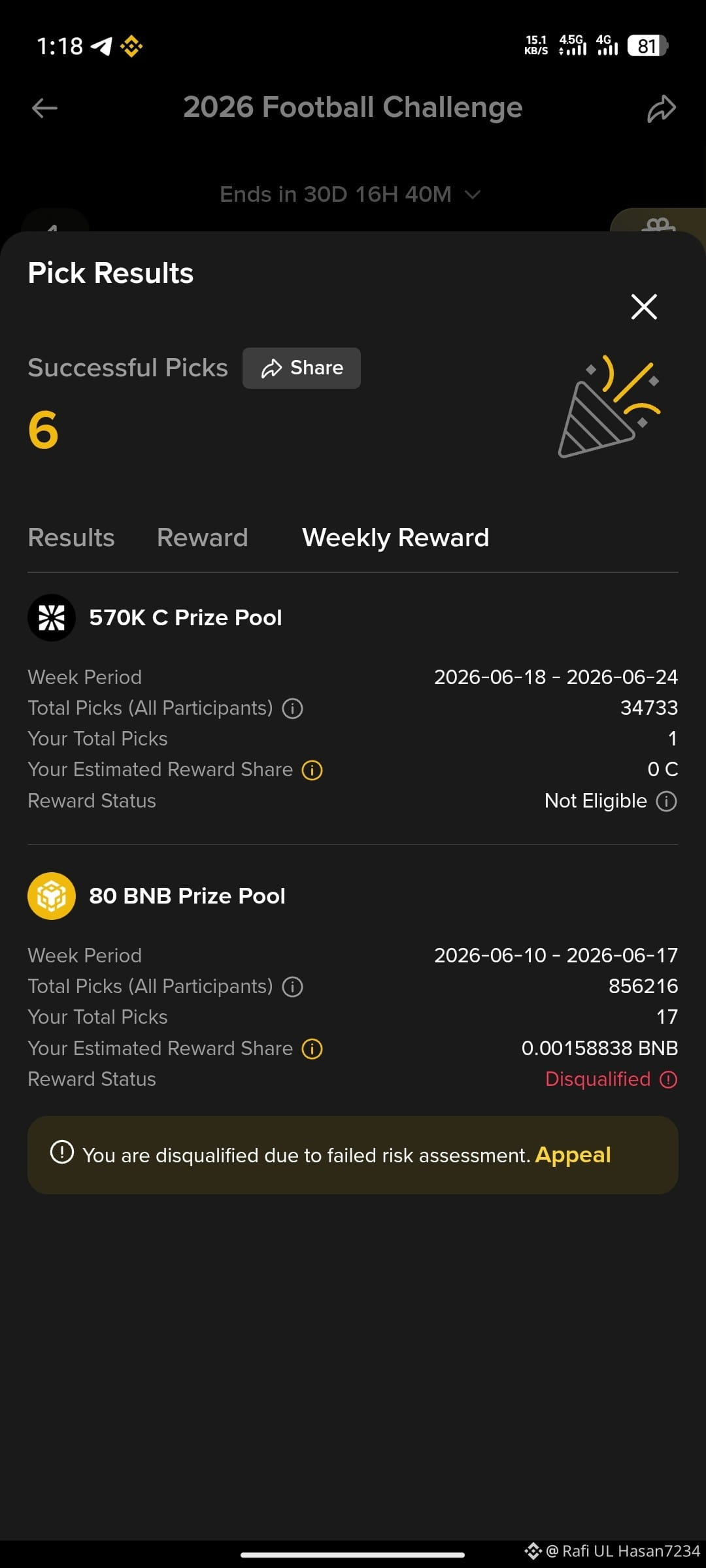
I made my "Successful Picks" and was eagerly eyeing the 570K C Prize Pool and the 80 BNB Prize Pool. I was checking the "Your Estimated Reward Share" section, waiting to see what I’d get for participating in the week periods. I was so happy.
But now, all I see is red.
All my rewards—every single one—say "Disqualified."
One of my screens says "You are disqualified due to a Terms of Use violation."
Another says "You are disqualified due to failed risk assessment."
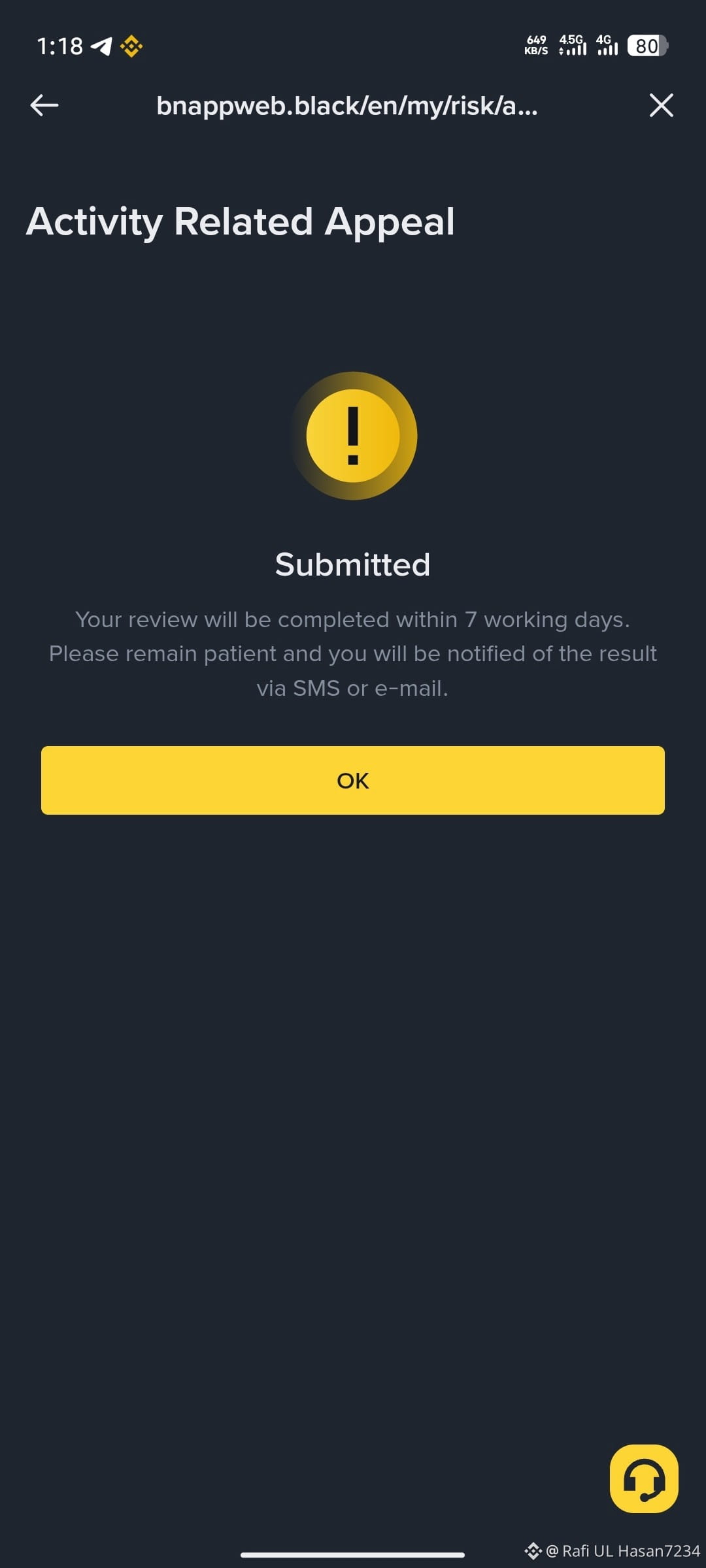
Which one is it? I don't understand. I'm just a football fan trying to win a little bonus. I submitted an "Activity Related Appeal" and it says it will be reviewed in 7 working days, but I’m terrified I’ll just be told the same generic thing.
I feel like I’m being punished for something but I don't know what I did wrong. Was it the risk assessment? Did I break a rule by accident?
I’m not a whale. I’m not a scammer. I'm just a regular guy. Please, can someone look at my case (ID: #131928, #131927, #131926) and tell me what really happened?
I just want to understand. 😢
even don't receive any reword from square post
#Binance #BinanceSupport #FootballChallenge2026 #Crypto #SXT #BinanceSoccer
To the @Binance Team (and the community who might see this),
I’m writing this with a heavy heart. I’m just a regular user who got excited about the #2026FootballChallenge.
I thought I was doing well. I opened my rewards and saw:
· 80 SXT Token Voucher (Opened 06/17)
· 15 SXT Token Voucher (Opened 06/14)
· 2000 SXT Earn Trial Fund (Opened 06/14)
· 100 C Earn Trial Fund (Opened 06/11)
I made my "Successful Picks" and was eagerly eyeing the 570K C Prize Pool and the 80 BNB Prize Pool. I was checking the "Your Estimated Reward Share" section, waiting to see what I’d get for participating in the week periods. I was so happy.
But now, all I see is red.
All my rewards—every single one—say "Disqualified."
One of my screens says "You are disqualified due to a Terms of Use violation."
Another says "You are disqualified due to failed risk assessment."
Which one is it? I don't understand. I'm just a football fan trying to win a little bonus. I submitted an "Activity Related Appeal" and it says it will be reviewed in 7 working days, but I’m terrified I’ll just be told the same generic thing.
I feel like I’m being punished for something but I don't know what I did wrong. Was it the risk assessment? Did I break a rule by accident?
I’m not a whale. I’m not a scammer. I'm just a regular guy. Please, can someone look at my case (ID: #131928, #131927, #131926) and tell me what really happened?
I just want to understand. 😢
even don't receive any reword from square post
#Binance #BinanceSupport #FootballChallenge2026 #Crypto #SXT #BinanceSoccer
I’m writing this with a heavy heart. I’m just a regular user who got excited about the #2026FootballChallenge.
I thought I was doing well. I opened my rewards and saw:
· 80 SXT Token Voucher (Opened 06/17)
· 15 SXT Token Voucher (Opened 06/14)
· 2000 SXT Earn Trial Fund (Opened 06/14)
· 100 C Earn Trial Fund (Opened 06/11)
I made my "Successful Picks" and was eagerly eyeing the 570K C Prize Pool and the 80 BNB Prize Pool. I was checking the "Your Estimated Reward Share" section, waiting to see what I’d get for participating in the week periods. I was so happy.
But now, all I see is red.
All my rewards—every single one—say "Disqualified."
One of my screens says "You are disqualified due to a Terms of Use violation."
Another says "You are disqualified due to failed risk assessment."
Which one is it? I don't understand. I'm just a football fan trying to win a little bonus. I submitted an "Activity Related Appeal" and it says it will be reviewed in 7 working days, but I’m terrified I’ll just be told the same generic thing.
I feel like I’m being punished for something but I don't know what I did wrong. Was it the risk assessment? Did I break a rule by accident?
I’m not a whale. I’m not a scammer. I'm just a regular guy. Please, can someone look at my case (ID: #131928, #131927, #131926) and tell me what really happened?
I just want to understand. 😢
even don't receive any reword from square post
#Binance #BinanceSupport #FootballChallenge2026 #Crypto #SXT #BinanceSoccer
33
3
9
94
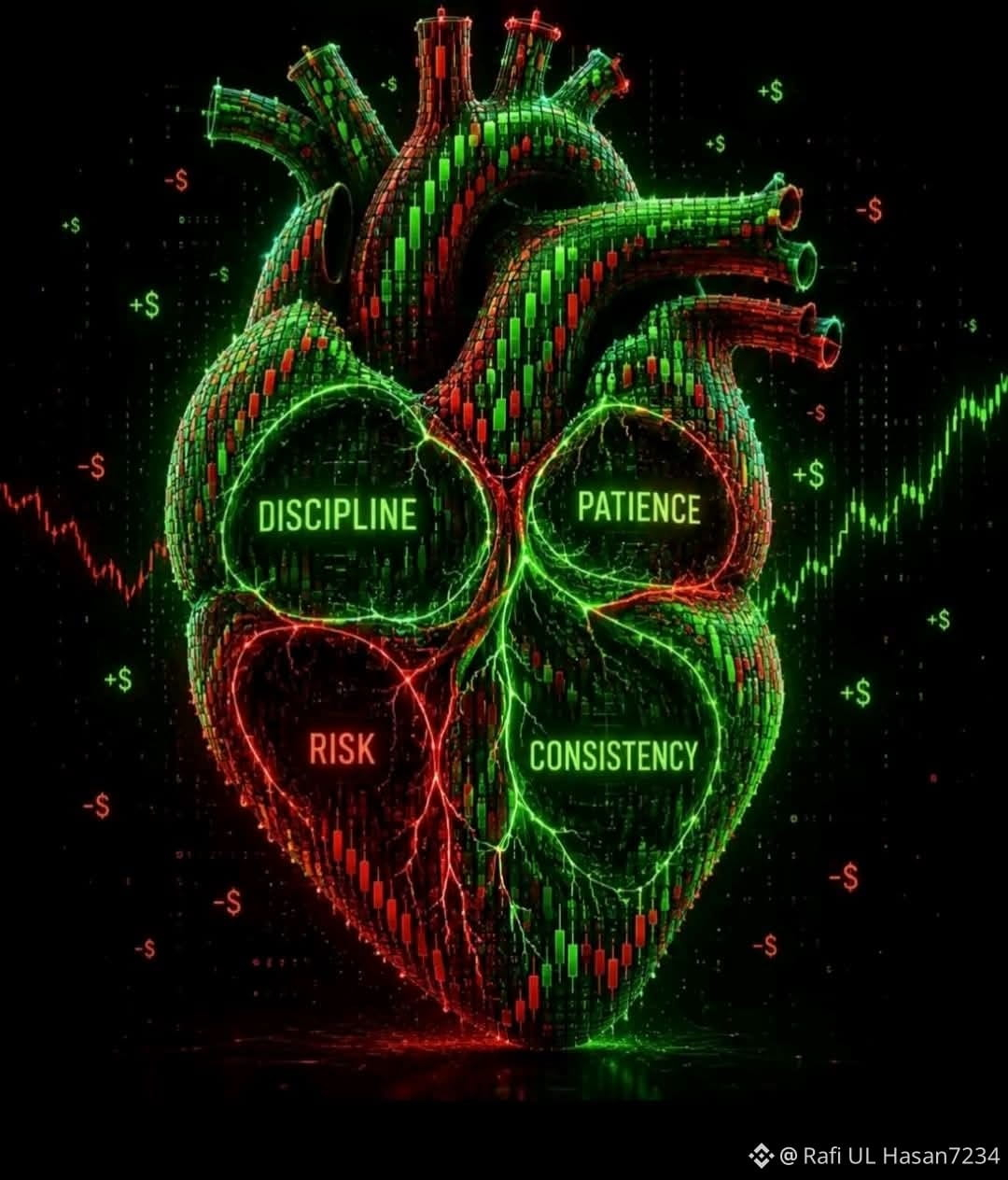
If you are a trader,
you are already a millionaire.
It's only a matter of time and discipline.
Keep going. 💯💯
$BTC
{spot}(BTCUSDT)
$XAUT
{future}(XAUTUSDT)
$XAG
{future}(XAGUSDT)
If you are a trader,
you are already a millionaire.
It's only a matter of time and discipline.
Keep going. 💯💯
$BTC
$XAUT
$XAG
you are already a millionaire.
It's only a matter of time and discipline.
Keep going. 💯💯
$BTC
$XAUT
$XAG
2
112
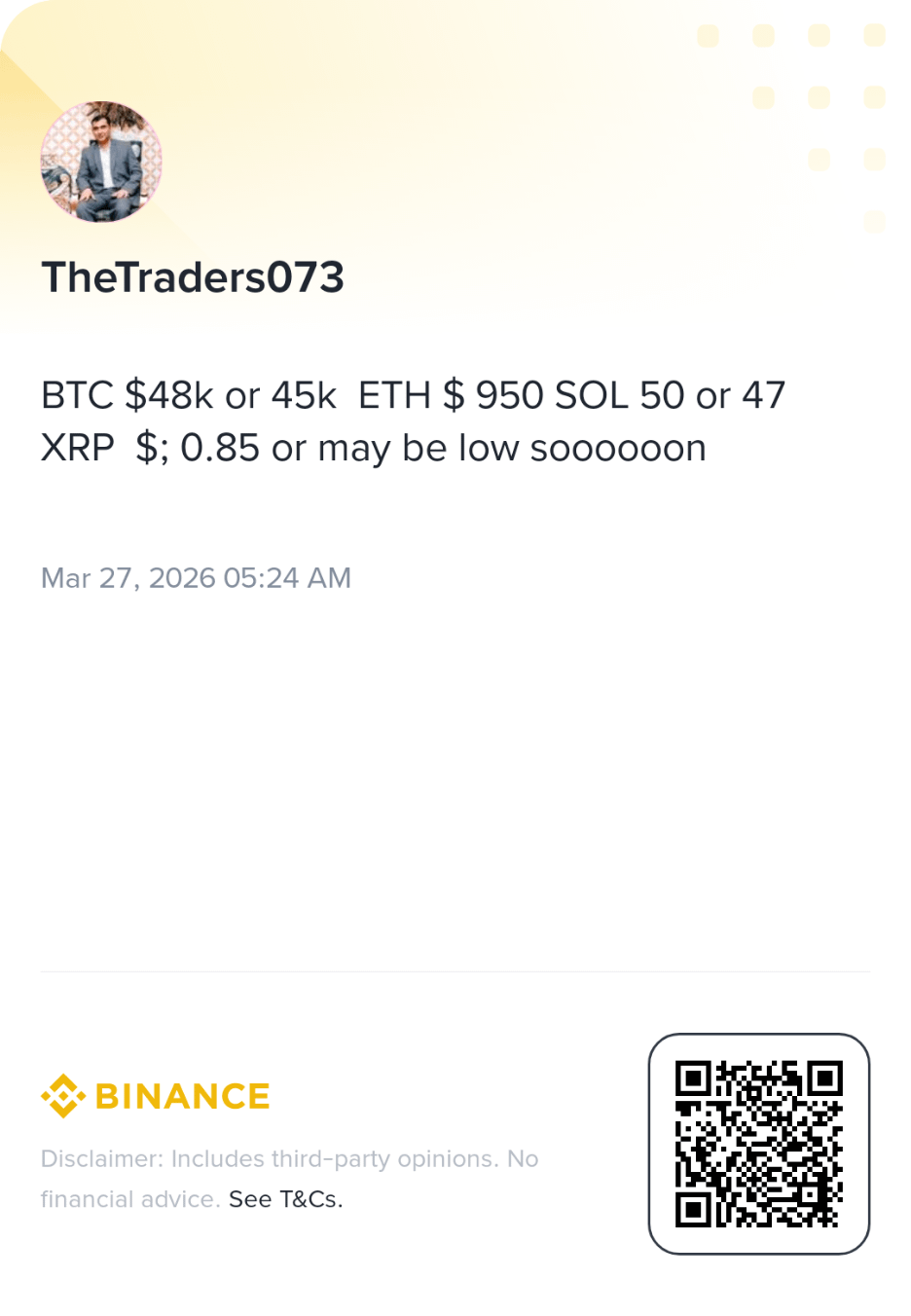
🚨 One Trade Has Everyone Watching
Reports suggest a "Trump Insider" account with a widely followed trading record has opened significant short positions:
• $24.2M BTC Short
• $11.0M SOL Short
• $10.0M ETH Short
This is reported to be the account's largest bearish positioning in weeks, drawing increased attention from market participants.
Whether this signals conviction or simply a high-risk trade remains to be seen.
🚨 One Trade Has Everyone Watching
Reports suggest a "Trump Insider" account with a widely followed trading record has opened significant short positions:
• $24.2M BTC Short
• $11.0M SOL Short
• $10.0M ETH Short
This is reported to be the account's largest bearish positioning in weeks, drawing increased attention from market participants.
Whether this signals conviction or simply a high-risk trade remains to be seen.
Reports suggest a "Trump Insider" account with a widely followed trading record has opened significant short positions:
• $24.2M BTC Short
• $11.0M SOL Short
• $10.0M ETH Short
This is reported to be the account's largest bearish positioning in weeks, drawing increased attention from market participants.
Whether this signals conviction or simply a high-risk trade remains to be seen.
3
163
·
--
Bullish
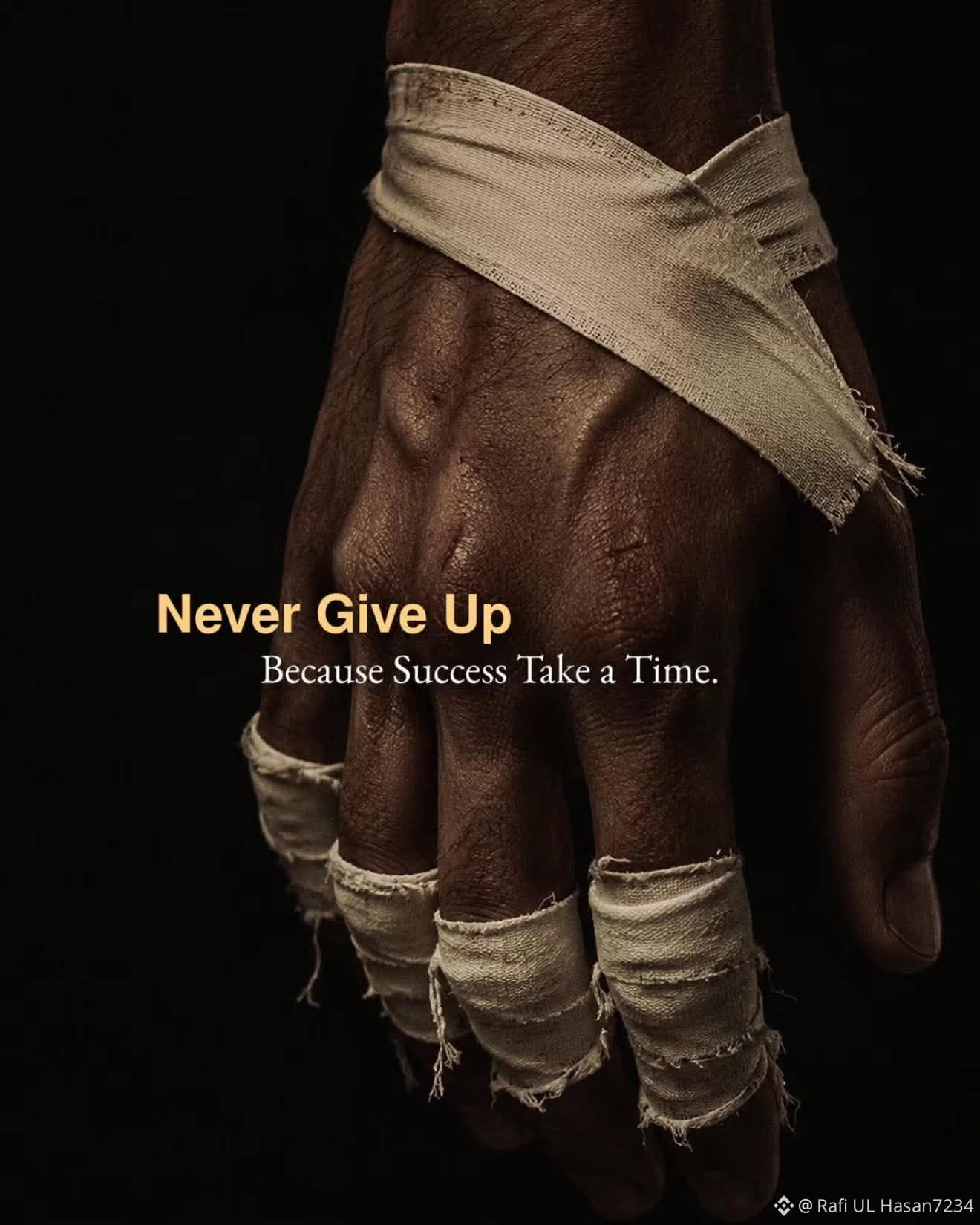
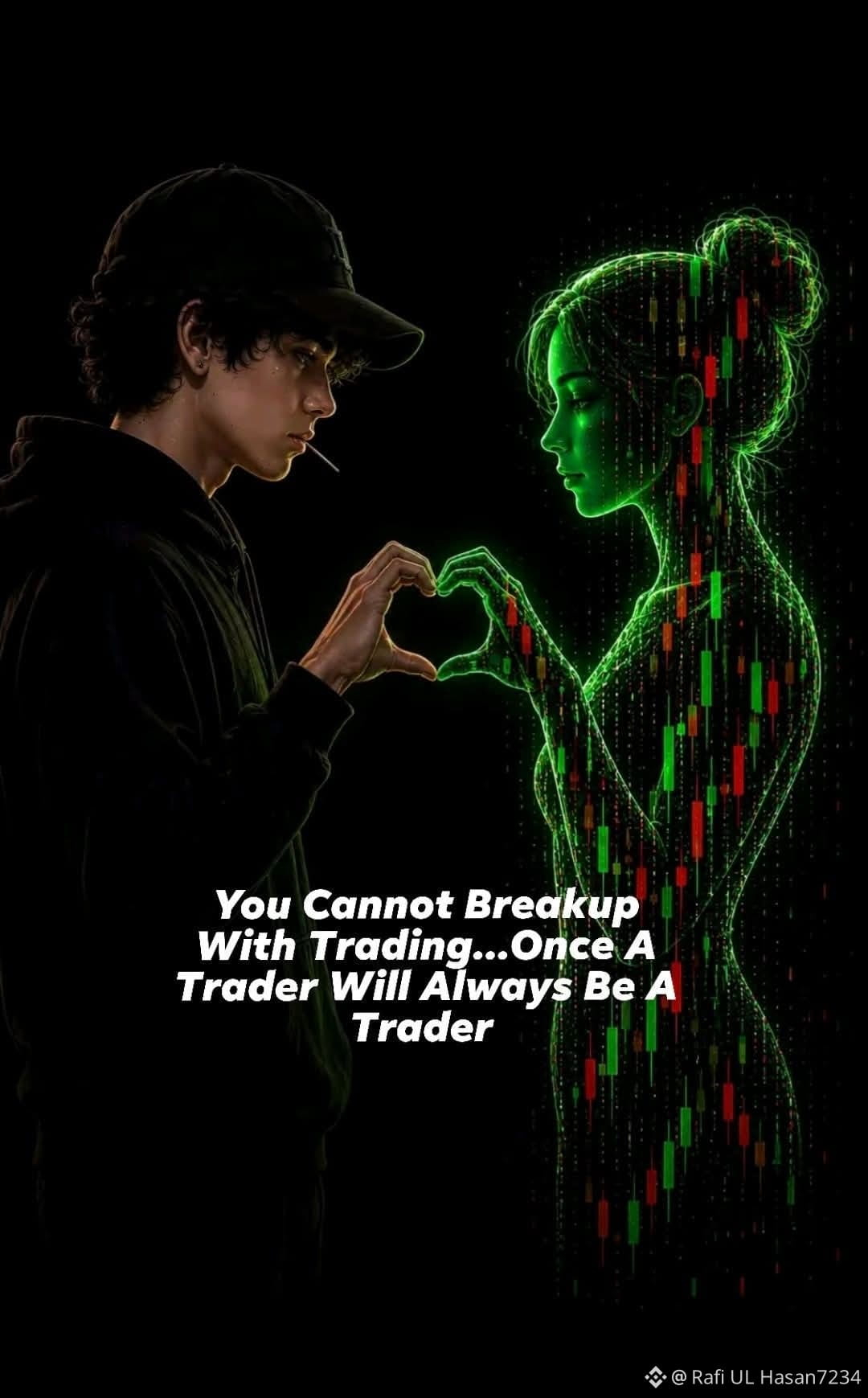
Trading can change you.
From indiscipline to discipline.
Impatient to patient.
Greedy to accepting enough.
Gambler to strategic.
Just trust your process.
Your day will come.
Don't you ever quit.
Keep going.
Trading can change you.
From indiscipline to discipline.
Impatient to patient.
Greedy to accepting enough.
Gambler to strategic.
Just trust your process.
Your day will come.
Don't you ever quit.
Keep going.
From indiscipline to discipline.
Impatient to patient.
Greedy to accepting enough.
Gambler to strategic.
Just trust your process.
Your day will come.
Don't you ever quit.
Keep going.
67
2
8
67
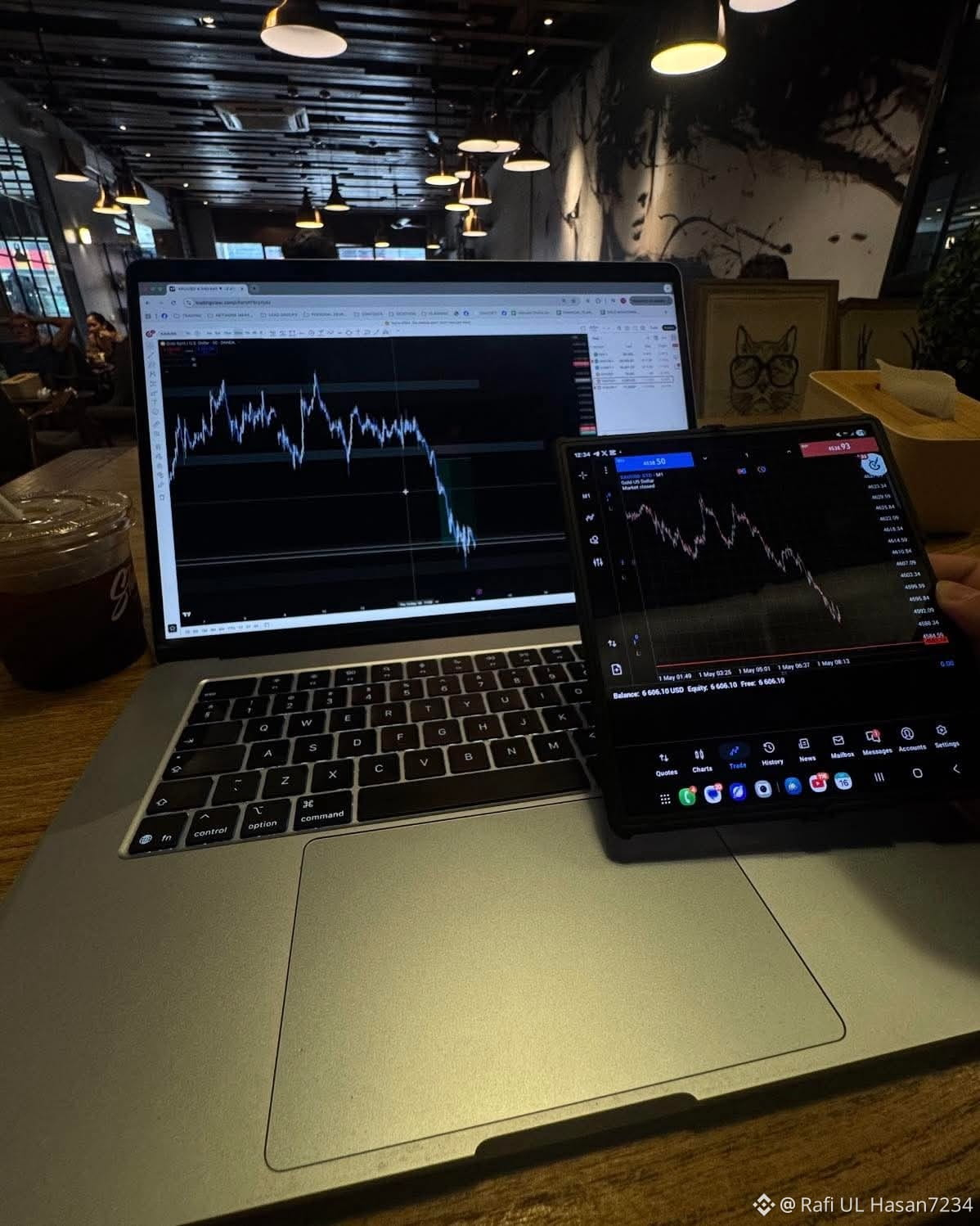
Gold’s recent pullback has traders divided. Is this the beginning of a deeper correction, or simply a healthy retracement within a long-term bull market? Historically, dips in gold during rate-cut cycles have been buying opportunities. With central bank demand still strong and geopolitical uncertainty elevated, I’m leaning toward the latter. Patience over panic. #PostonTradFi
$XAUT
{future}(XAUTUSDT)
Gold’s recent pullback has traders divided. Is this the beginning of a deeper correction, or simply a healthy retracement within a long-term bull market? Historically, dips in gold during rate-cut cycles have been buying opportunities. With central bank demand still strong and geopolitical uncertainty elevated, I’m leaning toward the latter. Patience over panic. #PostonTradFi
$XAUT
$XAUT
1
75
come everyone for live trade with experts
come everyone for live trade with experts

MJR786
·
--
[Ended] 🎙️ Binance Fellows | Market Analysis
306 listens
1
23
claim everyone
claim everyone


AmnaJen
·
--
CLAIM Free reward click the 🖇️👈👈👈👈👈👈

2
32
#pixel $PIXEL
{future}(PIXELUSDT)
Pixels isn’t trying to throw more rewards at you. It’s trying to give the right rewards.
Not every action pays the same. Stacked adjusts payouts based on how you actually play, so farming on autopilot doesn’t work.
$PIXEL flows through the system based on real activity, not randomness.
Less volume, more control. That’s why the economy still feels balanced.
Pixels #PIXEL #pixel
#pixel $PIXEL
Pixels isn’t trying to throw more rewards at you. It’s trying to give the right rewards.
Not every action pays the same. Stacked adjusts payouts based on how you actually play, so farming on autopilot doesn’t work.
$PIXEL flows through the system based on real activity, not randomness.
Less volume, more control. That’s why the economy still feels balanced.
Pixels #PIXEL #pixel
Pixels isn’t trying to throw more rewards at you. It’s trying to give the right rewards.
Not every action pays the same. Stacked adjusts payouts based on how you actually play, so farming on autopilot doesn’t work.
$PIXEL flows through the system based on real activity, not randomness.
Less volume, more control. That’s why the economy still feels balanced.
Pixels #PIXEL #pixel
1
2
121
Pixels: Less About Reward Volume, More About Reward ControlMost Web3 games maximize rewards to push engagement. Pixels takes a different route.
What stands out with Pixels isn’t the amount of rewards — it’s the control. The system doesn’t flood you with tokens. It distributes $PIXEL based on how and when you engage. That subtle shift changes everything.
1. Not All Actions Are Equal
In Pixels, every action doesn’t trigger the same response. Some tasks carry more weight than others. This isn’t restrictive — it’s intentional. Over time, players develop a real understanding of what drives value in the ecosystem.
2. Stacked Keeps It Unpredictable
The Stacked system adjusts rewards based on behavior patterns instead of fixed paths. This prevents easy farming and botting. When rewards are too predictable, systems get exploited. Pixels reduces that predictability just enough to keep the economy stable, while still letting players progress.
3. $PIXEL Flows With Purpose
$PIXEL isn’t pushed out randomly. Its distribution is tied directly to how the system evaluates meaningful activity. That linkage helps maintain long-term balance between players, the treasury, and the game loop.
The Takeaway
Pixels doesn’t try to impress with reward volume. It focuses on consistency, control, and sustainability. And that’s exactly what keeps players around for the long haul.
#PIXEL #GameFi #Web3Gaming #Tokenomics
Pixels: Less About Reward Volume, More About Reward Control
Most Web3 games maximize rewards to push engagement. Pixels takes a different route.
What stands out with Pixels isn’t the amount of rewards — it’s the control. The system doesn’t flood you with tokens. It distributes $PIXEL based on how and when you engage. That subtle shift changes everything.
1. Not All Actions Are Equal
In Pixels, every action doesn’t trigger the same response. Some tasks carry more weight than others. This isn’t restrictive — it’s intentional. Over time, players develop a real understanding of what drives value in the ecosystem.
2. Stacked Keeps It Unpredictable
The Stacked system adjusts rewards based on behavior patterns instead of fixed paths. This prevents easy farming and botting. When rewards are too predictable, systems get exploited. Pixels reduces that predictability just enough to keep the economy stable, while still letting players progress.
3. $PIXEL Flows With Purpose
$PIXEL isn’t pushed out randomly. Its distribution is tied directly to how the system evaluates meaningful activity. That linkage helps maintain long-term balance between players, the treasury, and the game loop.
The Takeaway
Pixels doesn’t try to impress with reward volume. It focuses on consistency, control, and sustainability. And that’s exactly what keeps players around for the long haul.
#PIXEL #GameFi #Web3Gaming #Tokenomics
What stands out with Pixels isn’t the amount of rewards — it’s the control. The system doesn’t flood you with tokens. It distributes $PIXEL based on how and when you engage. That subtle shift changes everything.
1. Not All Actions Are Equal
In Pixels, every action doesn’t trigger the same response. Some tasks carry more weight than others. This isn’t restrictive — it’s intentional. Over time, players develop a real understanding of what drives value in the ecosystem.
2. Stacked Keeps It Unpredictable
The Stacked system adjusts rewards based on behavior patterns instead of fixed paths. This prevents easy farming and botting. When rewards are too predictable, systems get exploited. Pixels reduces that predictability just enough to keep the economy stable, while still letting players progress.
3. $PIXEL Flows With Purpose
$PIXEL isn’t pushed out randomly. Its distribution is tied directly to how the system evaluates meaningful activity. That linkage helps maintain long-term balance between players, the treasury, and the game loop.
The Takeaway
Pixels doesn’t try to impress with reward volume. It focuses on consistency, control, and sustainability. And that’s exactly what keeps players around for the long haul.
#PIXEL #GameFi #Web3Gaming #Tokenomics
1
178
#pixel $PIXEL
{future}(PIXELUSDT)
latest Pixels AMA wasn't about hype. it was about routine.
farming, crafting, checking in. same loop every day. but land upgrades? that’s where it gets personal.
a farm stops being just a grid. you upgrade it, tweak it, return to it. progress feels slow, but it sticks. and when other players see your setup, even small updates feel huge.
Web3 + Ronin are there, but quiet. good. they should be.
Pixels isn’t instant attachment. but land makes the routine feel like yours.
still thinking about it.
$PIXEL #pixel @pixels
#pixel $PIXEL
latest Pixels AMA wasn't about hype. it was about routine.
farming, crafting, checking in. same loop every day. but land upgrades? that’s where it gets personal.
a farm stops being just a grid. you upgrade it, tweak it, return to it. progress feels slow, but it sticks. and when other players see your setup, even small updates feel huge.
Web3 + Ronin are there, but quiet. good. they should be.
Pixels isn’t instant attachment. but land makes the routine feel like yours.
still thinking about it.
$PIXEL #pixel @Pixels
latest Pixels AMA wasn't about hype. it was about routine.
farming, crafting, checking in. same loop every day. but land upgrades? that’s where it gets personal.
a farm stops being just a grid. you upgrade it, tweak it, return to it. progress feels slow, but it sticks. and when other players see your setup, even small updates feel huge.
Web3 + Ronin are there, but quiet. good. they should be.
Pixels isn’t instant attachment. but land makes the routine feel like yours.
still thinking about it.
$PIXEL #pixel @Pixels
1
1
66
Pixels AMA: Land Upgrades Reveal More Than New Tiers — They Show the Real Game LoopThe latest Pixels AMA didn’t drop a flashy headline. Instead, it gave players a quiet look at how the game is actually evolving: through routines, ownership, and slow-burn progress.
Pixels is a social casual Web3 game on Ronin Network. At its core, it’s still farming, exploring, crafting, and checking what’s next. But the recent AMA chatter around NFT land upgrades and the Tier 5 update highlights something deeper.
1. Routine Becomes Identity
Pixels isn’t about sprinting to endgame. It’s daily loops: plant, harvest, upgrade, repeat. Land makes that routine personal. Your farm isn’t just pixels on a grid — it’s a space you tweak, improve, and come back to. Upgrades turn progress from “task complete” into “place built”.
2. Social Layer Amplifies Small Updates
Even minor changes feel bigger because players watch each other. They compare land setups, react to AMAs, and hang out in the same world. That’s why a land economy tweak or Tier 5 hint spreads fast — the community turns routine into narrative.
3. Web3 Works When It’s Quiet
Ownership, identity, and digital assets run under the hood. Ronin handles the infra. The recent AMA suggests the team knows this: big overhauls are coming, but the goal is long-term viability, not hype. Web3 is best when it doesn’t pull focus from the game itself.
4. $PIXEL & Land: Slow Burn > Quick Flip
Land upgrades and new systems like Animal Care point to one thing: Pixels wants stickiness. Not every player bonds instantly. But for those who do, land becomes the reason you log back in. It’s familiar, earned, and slowly yours.
Pixels is still evolving. But if you’re watching land, you’re watching the real roadmap.
@pixels
#Pixels #Ronin #PIXEL #Web3Gaming #NFTLand
$PIXEL
{future}(PIXELUSDT)
Pixels AMA: Land Upgrades Reveal More Than New Tiers — They Show the Real Game Loop
The latest Pixels AMA didn’t drop a flashy headline. Instead, it gave players a quiet look at how the game is actually evolving: through routines, ownership, and slow-burn progress.
Pixels is a social casual Web3 game on Ronin Network. At its core, it’s still farming, exploring, crafting, and checking what’s next. But the recent AMA chatter around NFT land upgrades and the Tier 5 update highlights something deeper.
1. Routine Becomes Identity
Pixels isn’t about sprinting to endgame. It’s daily loops: plant, harvest, upgrade, repeat. Land makes that routine personal. Your farm isn’t just pixels on a grid — it’s a space you tweak, improve, and come back to. Upgrades turn progress from “task complete” into “place built”.
2. Social Layer Amplifies Small Updates
Even minor changes feel bigger because players watch each other. They compare land setups, react to AMAs, and hang out in the same world. That’s why a land economy tweak or Tier 5 hint spreads fast — the community turns routine into narrative.
3. Web3 Works When It’s Quiet
Ownership, identity, and digital assets run under the hood. Ronin handles the infra. The recent AMA suggests the team knows this: big overhauls are coming, but the goal is long-term viability, not hype. Web3 is best when it doesn’t pull focus from the game itself.
4. $PIXEL & Land: Slow Burn > Quick Flip
Land upgrades and new systems like Animal Care point to one thing: Pixels wants stickiness. Not every player bonds instantly. But for those who do, land becomes the reason you log back in. It’s familiar, earned, and slowly yours.
Pixels is still evolving. But if you’re watching land, you’re watching the real roadmap.
@Pixels
#Pixels #Ronin #PIXEL #Web3Gaming #NFTLand
$PIXEL
Pixels is a social casual Web3 game on Ronin Network. At its core, it’s still farming, exploring, crafting, and checking what’s next. But the recent AMA chatter around NFT land upgrades and the Tier 5 update highlights something deeper.
1. Routine Becomes Identity
Pixels isn’t about sprinting to endgame. It’s daily loops: plant, harvest, upgrade, repeat. Land makes that routine personal. Your farm isn’t just pixels on a grid — it’s a space you tweak, improve, and come back to. Upgrades turn progress from “task complete” into “place built”.
2. Social Layer Amplifies Small Updates
Even minor changes feel bigger because players watch each other. They compare land setups, react to AMAs, and hang out in the same world. That’s why a land economy tweak or Tier 5 hint spreads fast — the community turns routine into narrative.
3. Web3 Works When It’s Quiet
Ownership, identity, and digital assets run under the hood. Ronin handles the infra. The recent AMA suggests the team knows this: big overhauls are coming, but the goal is long-term viability, not hype. Web3 is best when it doesn’t pull focus from the game itself.
4. $PIXEL & Land: Slow Burn > Quick Flip
Land upgrades and new systems like Animal Care point to one thing: Pixels wants stickiness. Not every player bonds instantly. But for those who do, land becomes the reason you log back in. It’s familiar, earned, and slowly yours.
Pixels is still evolving. But if you’re watching land, you’re watching the real roadmap.
@Pixels
#Pixels #Ronin #PIXEL #Web3Gaming #NFTLand
$PIXEL
1
81
The Reality of Web3 Gaming: Effort ≠ ValueAt first, Web3 games seemed simple: play, put in time, earn money. Fair. Exciting, even.
After grinding in Pixels, it’s not that clean anymore.
Some days I farm, craft, sell — and earn $PIXEL. The system works with me. My effort counts.
Other days? Same routine. No demand. No value. Just silence.
That’s when it hit me:
In Web3 games, effort ≠ value.
Effort only becomes value if the system notices it.
And that changes how you play.
You stop playing for fun. You start chasing what sells, what trends, what gets attention. Even if it’s not what you want to do.
Pixels#pixel $PIXEL
Here’s the thing: The economy feels real. It moves. It reacts. It’s not a fixed NPC shop. That’s huge for Web3 gaming.
But that realism brings uncertainty. You’re never sure if today’s grind actually matters.
Maybe that’s how real economies work too.
Still not sure if that’s a feature or a flaw for a Web3 game.
Time will tell.
@pixels
TL;DR: Web3 games reward attention, not just effort. Real economy = real uncertainty. #Web3Gaming #Pixels #GameFi
$PIXEL
{future}(PIXELUSDT)
The Reality of Web3 Gaming: Effort ≠ Value
At first, Web3 games seemed simple: play, put in time, earn money. Fair. Exciting, even.
After grinding in Pixels, it’s not that clean anymore.
Some days I farm, craft, sell — and earn $PIXEL . The system works with me. My effort counts.
Other days? Same routine. No demand. No value. Just silence.
That’s when it hit me:
In Web3 games, effort ≠ value.
Effort only becomes value if the system notices it.
And that changes how you play.
You stop playing for fun. You start chasing what sells, what trends, what gets attention. Even if it’s not what you want to do.
Pixels#pixel $PIXEL
Here’s the thing: The economy feels real. It moves. It reacts. It’s not a fixed NPC shop. That’s huge for Web3 gaming.
But that realism brings uncertainty. You’re never sure if today’s grind actually matters.
Maybe that’s how real economies work too.
Still not sure if that’s a feature or a flaw for a Web3 game.
Time will tell.
@Pixels
TL;DR: Web3 games reward attention, not just effort. Real economy = real uncertainty. #Web3Gaming #Pixels #GameFi
$PIXEL
After grinding in Pixels, it’s not that clean anymore.
Some days I farm, craft, sell — and earn $PIXEL . The system works with me. My effort counts.
Other days? Same routine. No demand. No value. Just silence.
That’s when it hit me:
In Web3 games, effort ≠ value.
Effort only becomes value if the system notices it.
And that changes how you play.
You stop playing for fun. You start chasing what sells, what trends, what gets attention. Even if it’s not what you want to do.
Pixels#pixel $PIXEL
Here’s the thing: The economy feels real. It moves. It reacts. It’s not a fixed NPC shop. That’s huge for Web3 gaming.
But that realism brings uncertainty. You’re never sure if today’s grind actually matters.
Maybe that’s how real economies work too.
Still not sure if that’s a feature or a flaw for a Web3 game.
Time will tell.
@Pixels
TL;DR: Web3 games reward attention, not just effort. Real economy = real uncertainty. #Web3Gaming #Pixels #GameFi
$PIXEL
1
2
111
Log in to explore more content
Join global crypto users on Binance Square
⚡️ Get latest and useful information about crypto.
💬 Trusted by the world’s largest crypto exchange.
👍 Discover real insights from verified creators.
Email / Phone number
Trending Topics
FedMinutesFocusOnOctoberPause
208,795 views
1,428 Discussing
🚨 HIGH ALERT ‼️ PLEASE DON’T TRADE BLINDLY FOR THE NEXT HOUR 🚨
Guys, we have FOMC Minutes coming in less than 1 hour.
And after the kind of volatility we already saw today, I really don’t want anyone opening random high-leverage positions just before this release.
The biggest reaction I’m watching will be in Gold (XAU), Silver (XAG), BTC and ETH. Then coins like SOL and other highly leveraged mid/low-cap alts can exaggerate whatever move BTC makes.
Gold and Silver are especially sensitive tonight because the market is already reacting to the US dollar + Treasury yields, and both metals have been under heavy pressure ahead of the Fed minutes.
Briefly speaking
📉Hawkish Fed Minutes → Dollar/yields can push higher → pressure on BTC, crypto, Gold & silver
📈Dovish Fed Minutes → Dollar/yields can cool → BTC, Gold, Silver and risk assets can bounce hard.
And please remember the first candle can be a trap. We can get a pump, immediate dump, liquidations on both sides, and then the real direction.
So for now, protect your positions, reduce unnecessary leverage and don’t FOMO into the first move.
Tonight I’m watching $XAU , $XAG and $BTC first. These will tell us very quickly how the market is reading the Fed.
I will Update you guys on time
Follow @Panda Traders and Turn on Your notifications right now
#FedMinutesFocusOnOctoberPause
Panda Traders
·19 Likes
·4.2k views
BinanceLaunchesBinanceIntelligence
1.2M views
6,607 Discussing
EvernorthDelaysNasdaqDebutToOct12
18,362 views
333 Discussing