

Powerpei
1.3k Posts

Powerpei
 Square Verified+
Report
Block User
独立开发者
DeFi基础设施 & AI交易工具深度分析
自研Web3资产监控软件
美股港股实战洞见
X:@PWenzhen76938 没有任何小号,请勿上当!BP-A2CEE0CCD9E9
Open Trade
Frequent Trader
3.2 Years
1.2K+ Following
41.9K+ Followers
34.7K+ Liked
Posts
Portfolio
All
Quotes
Videos
Live
PINNED
·
--
I joined Binance Square in November last year.
Back then, I saw Yingge promoting the Creator Platform, so I hopped on.
I have to say, Yingge is kind of my benefactor.
I should say she’s a benefactor for a lot of small retail investors. Everyone who knows her knows she’s very capable and also easygoing (and the key is, she’s also beautiful).
The deepest impression I have is when I ran into some small problems and went to ask Yingge for advice—I was afraid I wouldn’t do it well. Yingge told me: Just be yourself.
After that, I met Cy, who also gave me a lot of help and guidance.
I didn’t think too much. I just adjusted the content I usually posted to align more with the task direction.
Bit by bit, I managed to get a few first-place rankings; in total, I think it added up to nearly $10,000.
To be honest, that number isn’t that big, but the advantage is the low barrier to entry.
You don’t need 100,000 followers. You don’t need to grind data every day. If your writing is good, you still have a chance to get on the leaderboard.
Even now, I still update posts every day. Occasionally, when I see creator tasks that fit, I’ll join in.
Not grinding, but it’s pretty interesting.
Compared to writing on X for half a day just to get a few likes, Square at least gives you positive feedback—you write something and you can actually earn money.
#币安广场
I joined Binance Square in November last year.
Back then, I saw Yingge promoting the Creator Platform, so I hopped on.
I have to say, Yingge is kind of my benefactor.
I should say she’s a benefactor for a lot of small retail investors. Everyone who knows her knows she’s very capable and also easygoing (and the key is, she’s also beautiful).
The deepest impression I have is when I ran into some small problems and went to ask Yingge for advice—I was afraid I wouldn’t do it well. Yingge told me: Just be yourself.
After that, I met Cy, who also gave me a lot of help and guidance.
I didn’t think too much. I just adjusted the content I usually posted to align more with the task direction.
Bit by bit, I managed to get a few first-place rankings; in total, I think it added up to nearly $10,000.
To be honest, that number isn’t that big, but the advantage is the low barrier to entry.
You don’t need 100,000 followers. You don’t need to grind data every day. If your writing is good, you still have a chance to get on the leaderboard.
Even now, I still update posts every day. Occasionally, when I see creator tasks that fit, I’ll join in.
Not grinding, but it’s pretty interesting.
Compared to writing on X for half a day just to get a few likes, Square at least gives you positive feedback—you write something and you can actually earn money.
#币安广场
Back then, I saw Yingge promoting the Creator Platform, so I hopped on.
I have to say, Yingge is kind of my benefactor.
I should say she’s a benefactor for a lot of small retail investors. Everyone who knows her knows she’s very capable and also easygoing (and the key is, she’s also beautiful).
The deepest impression I have is when I ran into some small problems and went to ask Yingge for advice—I was afraid I wouldn’t do it well. Yingge told me: Just be yourself.
After that, I met Cy, who also gave me a lot of help and guidance.
I didn’t think too much. I just adjusted the content I usually posted to align more with the task direction.
Bit by bit, I managed to get a few first-place rankings; in total, I think it added up to nearly $10,000.
To be honest, that number isn’t that big, but the advantage is the low barrier to entry.
You don’t need 100,000 followers. You don’t need to grind data every day. If your writing is good, you still have a chance to get on the leaderboard.
Even now, I still update posts every day. Occasionally, when I see creator tasks that fit, I’ll join in.
Not grinding, but it’s pretty interesting.
Compared to writing on X for half a day just to get a few likes, Square at least gives you positive feedback—you write something and you can actually earn money.
#币安广场
33
1
49
23.2k
·
--
Verified
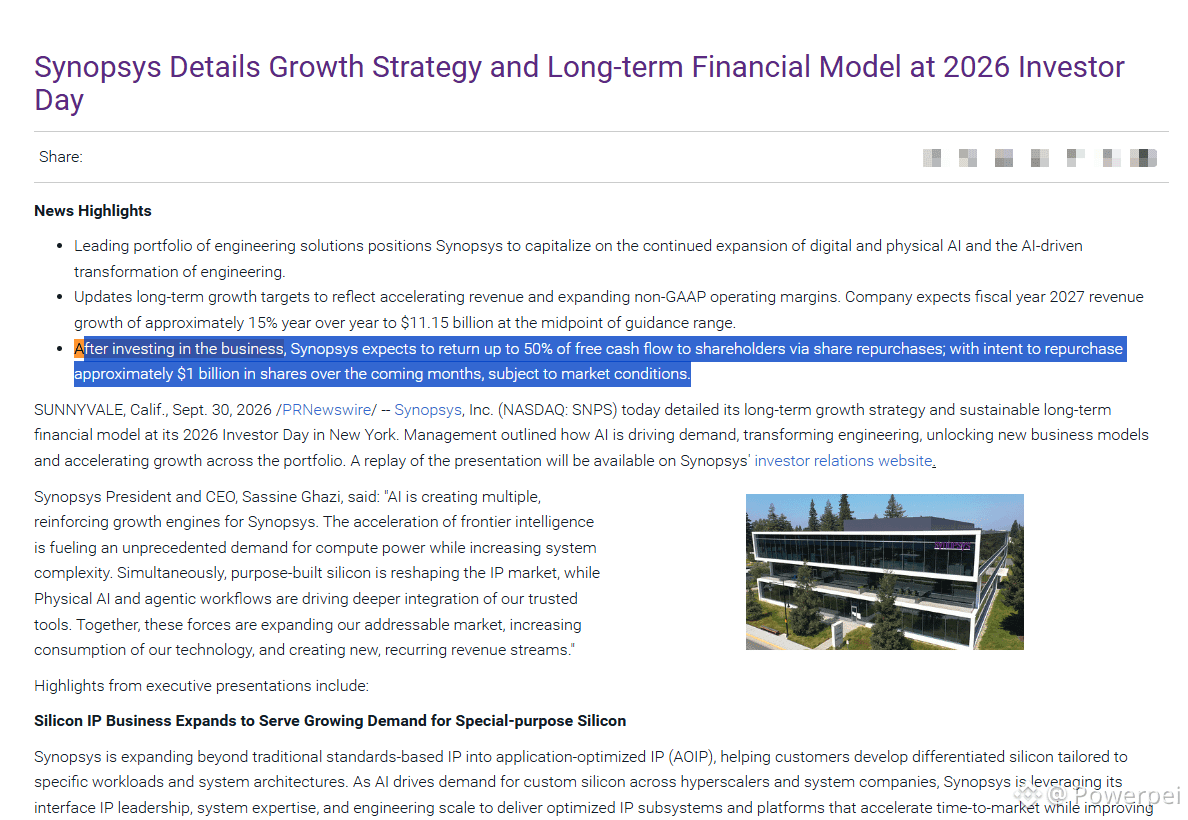
Synopsys rose nearly 5% yesterday, and investors shared a few things at Investor Day
What I’m most paying attention to is the buyback
Over the next few months, the company plans to repurchase about $1 billion worth of stock, and afterward potentially use up to 50% of free cash flow for repurchases
For an EDA company, this is a very heavy signal
Previously, companies like this preferred to pour the money into R&D and acquisitions; now they’re willing to return half of free cash flow to shareholders, which suggests management believes the company is undervalued.
Their revenue target for fiscal year 2027 is also raised to 15% year-over-year growth
The more complex AI chip design gets, the less likely it is that EDA tools will be replaced
Synopsys and Cadence essentially dominate this pipeline. But what I care about isn’t the “AI beneficiary” label—everyone is slapping that on
What I care about is the buyback力度, because it reflects management’s confidence in free cash flow—this isn’t storytelling; it’s management voting with real money.
Price and data are as of the time the post was made. Not investment advice. $SNPS.US
Synopsys rose nearly 5% yesterday, and investors shared a few things at Investor Day
What I’m most paying attention to is the buyback
Over the next few months, the company plans to repurchase about $1 billion worth of stock, and afterward potentially use up to 50% of free cash flow for repurchases
For an EDA company, this is a very heavy signal
Previously, companies like this preferred to pour the money into R&D and acquisitions; now they’re willing to return half of free cash flow to shareholders, which suggests management believes the company is undervalued.
Their revenue target for fiscal year 2027 is also raised to 15% year-over-year growth
The more complex AI chip design gets, the less likely it is that EDA tools will be replaced
Synopsys and Cadence essentially dominate this pipeline. But what I care about isn’t the “AI beneficiary” label—everyone is slapping that on
What I care about is the buyback力度, because it reflects management’s confidence in free cash flow—this isn’t storytelling; it’s management voting with real money.
Price and data are as of the time the post was made. Not investment advice. $SNPS.US
What I’m most paying attention to is the buyback
Over the next few months, the company plans to repurchase about $1 billion worth of stock, and afterward potentially use up to 50% of free cash flow for repurchases
For an EDA company, this is a very heavy signal
Previously, companies like this preferred to pour the money into R&D and acquisitions; now they’re willing to return half of free cash flow to shareholders, which suggests management believes the company is undervalued.
Their revenue target for fiscal year 2027 is also raised to 15% year-over-year growth
The more complex AI chip design gets, the less likely it is that EDA tools will be replaced
Synopsys and Cadence essentially dominate this pipeline. But what I care about isn’t the “AI beneficiary” label—everyone is slapping that on
What I care about is the buyback力度, because it reflects management’s confidence in free cash flow—this isn’t storytelling; it’s management voting with real money.
Price and data are as of the time the post was made. Not investment advice. $SNPS.US
SNPSUS+4.53%
983
·
--
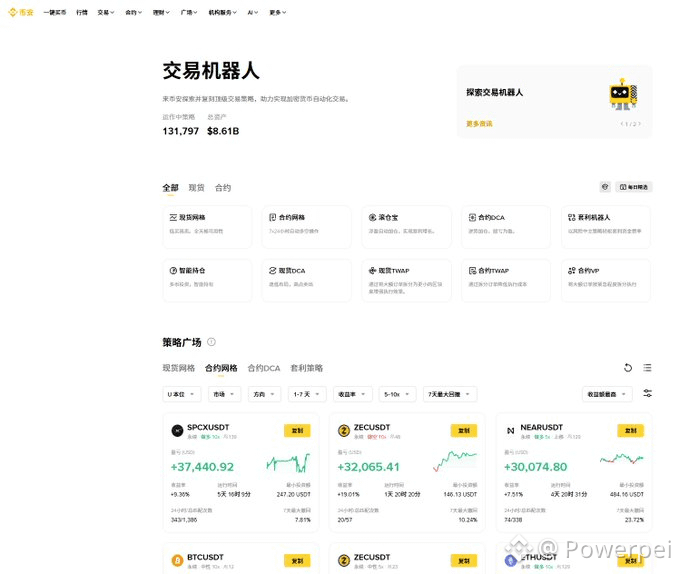
I've been using a Binance grid trading bot for Crypto for quite a while
Set the range—during choppy, sideways markets it automatically buys low and sells high, which is convenient
Yesterday I found that these bots all support bStocks
Spot grid, smart allocation, and spot DCA—all three work
//
So it means I can use the same setup that runs BTC grid
to run grids for Tesla and Nvidia
During earnings season when markets are volatile, grids feel especially comfortable
For me, smart allocation is the one that fits bStocks best
You set target weights of 40% for Tesla, 30% for Nvidia, and 30% for the S&P 500—then the bot automatically buys the underweight and sells the overweight, so the portfolio never drifts
Managing a few US stock positions manually is actually pretty tiring—this saves a lot of effort
DCA is basically dollar-cost averaging
No need to obsess about which price point to buy—just set the frequency and amount, and the bot runs on its own schedule
I’m bullish on the long-term trend of US stocks
nBut if you don’t want to watch the market every day, this is the most suitable
——
No need to open a brokerage account, starts from $5, runs 24/7 automatically
Fractional shares and dividend-handling bots automatically take care of it
bStocks launched ten weeks ago—cumulative trading volume exceeded $24 billion, with 650,000 users
The world’s second-largest tokenized stock issuer, just after Ondo
Before October 1st, bStocks trading pairs have zero maker fees
👉
Try it now: [https://cf-workers-proxy-cyt.pages.dev/zh-CN/trading-bots](https://cf-workers-proxy-cyt.pages.dev/zh-CN/trading-bots)
bStocks are tokenized stocks, backed 1:1 by real US stock assets
Bots don’t guarantee profits—if you set parameters wrong, you can still lose
Follow Binance’s official rules. DYOR
#BStocks
I've been using a Binance grid trading bot for Crypto for quite a while
Set the range—during choppy, sideways markets it automatically buys low and sells high, which is convenient
Yesterday I found that these bots all support bStocks
Spot grid, smart allocation, and spot DCA—all three work
//
So it means I can use the same setup that runs BTC grid
to run grids for Tesla and Nvidia
During earnings season when markets are volatile, grids feel especially comfortable
For me, smart allocation is the one that fits bStocks best
You set target weights of 40% for Tesla, 30% for Nvidia, and 30% for the S&P 500—then the bot automatically buys the underweight and sells the overweight, so the portfolio never drifts
Managing a few US stock positions manually is actually pretty tiring—this saves a lot of effort
DCA is basically dollar-cost averaging
No need to obsess about which price point to buy—just set the frequency and amount, and the bot runs on its own schedule
I’m bullish on the long-term trend of US stocks
nBut if you don’t want to watch the market every day, this is the most suitable
——
No need to open a brokerage account, starts from $5, runs 24/7 automatically
Fractional shares and dividend-handling bots automatically take care of it
bStocks launched ten weeks ago—cumulative trading volume exceeded $24 billion, with 650,000 users
The world’s second-largest tokenized stock issuer, just after Ondo
Before October 1st, bStocks trading pairs have zero maker fees
👉
Try it now: https://cf-workers-proxy-cyt.pages.dev/zh-CN/trading-bots
bStocks are tokenized stocks, backed 1:1 by real US stock assets
Bots don’t guarantee profits—if you set parameters wrong, you can still lose
Follow Binance’s official rules. DYOR
#BStocks
Set the range—during choppy, sideways markets it automatically buys low and sells high, which is convenient
Yesterday I found that these bots all support bStocks
Spot grid, smart allocation, and spot DCA—all three work
//
So it means I can use the same setup that runs BTC grid
to run grids for Tesla and Nvidia
During earnings season when markets are volatile, grids feel especially comfortable
For me, smart allocation is the one that fits bStocks best
You set target weights of 40% for Tesla, 30% for Nvidia, and 30% for the S&P 500—then the bot automatically buys the underweight and sells the overweight, so the portfolio never drifts
Managing a few US stock positions manually is actually pretty tiring—this saves a lot of effort
DCA is basically dollar-cost averaging
No need to obsess about which price point to buy—just set the frequency and amount, and the bot runs on its own schedule
I’m bullish on the long-term trend of US stocks
nBut if you don’t want to watch the market every day, this is the most suitable
——
No need to open a brokerage account, starts from $5, runs 24/7 automatically
Fractional shares and dividend-handling bots automatically take care of it
bStocks launched ten weeks ago—cumulative trading volume exceeded $24 billion, with 650,000 users
The world’s second-largest tokenized stock issuer, just after Ondo
Before October 1st, bStocks trading pairs have zero maker fees
👉
Try it now: https://cf-workers-proxy-cyt.pages.dev/zh-CN/trading-bots
bStocks are tokenized stocks, backed 1:1 by real US stock assets
Bots don’t guarantee profits—if you set parameters wrong, you can still lose
Follow Binance’s official rules. DYOR
#BStocks
5
1.4k
·
--
Verified
QNT surged 300% in one week.
The catalyst is that The Clearing House chose Quant as the technology layer for tokenized deposits.
The clearing organizations of 25 US banks—processing $2 trillion per day.
Also rolled out in the UK: seven banks ran live trades of tokenized British pounds on the Quant platform.
Both storylines hit at once, and the market basically exploded.
//
But after reading the announcement, I want to say this:
If a bank chooses Quant’s software, it doesn’t mean the bank needs to buy QNT tokens.
The full announcement doesn’t mention tokens.
Quant charges enterprise license fees.
In the early architecture, QNT had a node validation feature, but in these two new projects, that relationship isn’t mentioned.
So at this stage, the current price is mostly priced on the narrative.
The tech rollout is real. Token demand is speculative.
After it jumped 300%, chasing it is fine—just first figure out what you’re actually buying.
Price is as of when the post was made. Volatility is extremely high. Not investment advice.
$QNT
{spot}(QNTUSDT)
QNT surged 300% in one week.
The catalyst is that The Clearing House chose Quant as the technology layer for tokenized deposits.
The clearing organizations of 25 US banks—processing $2 trillion per day.
Also rolled out in the UK: seven banks ran live trades of tokenized British pounds on the Quant platform.
Both storylines hit at once, and the market basically exploded.
//
But after reading the announcement, I want to say this:
If a bank chooses Quant’s software, it doesn’t mean the bank needs to buy QNT tokens.
The full announcement doesn’t mention tokens.
Quant charges enterprise license fees.
In the early architecture, QNT had a node validation feature, but in these two new projects, that relationship isn’t mentioned.
So at this stage, the current price is mostly priced on the narrative.
The tech rollout is real. Token demand is speculative.
After it jumped 300%, chasing it is fine—just first figure out what you’re actually buying.
Price is as of when the post was made. Volatility is extremely high. Not investment advice.
$QNT
The catalyst is that The Clearing House chose Quant as the technology layer for tokenized deposits.
The clearing organizations of 25 US banks—processing $2 trillion per day.
Also rolled out in the UK: seven banks ran live trades of tokenized British pounds on the Quant platform.
Both storylines hit at once, and the market basically exploded.
//
But after reading the announcement, I want to say this:
If a bank chooses Quant’s software, it doesn’t mean the bank needs to buy QNT tokens.
The full announcement doesn’t mention tokens.
Quant charges enterprise license fees.
In the early architecture, QNT had a node validation feature, but in these two new projects, that relationship isn’t mentioned.
So at this stage, the current price is mostly priced on the narrative.
The tech rollout is real. Token demand is speculative.
After it jumped 300%, chasing it is fine—just first figure out what you’re actually buying.
Price is as of when the post was made. Volatility is extremely high. Not investment advice.
$QNT
1
2
2.8k
·
--
Verified
The most striking thing on today’s board is HBAR.
In the past 24 hours, it’s risen by nearly 30%, and trading volume has jumped fivefold.
At the same time, BTC is down nearly 2%, and Ethereum is also moving lower—so the whole L1 sector is in the green. It’s basically the only one running.
When you look back, it’s clear the catalyst isn’t imaginary.
On September 23, The Hashgraph Group in the Hedera ecosystem teamed up with IBM.
They directly listed an on-chain identity tool called IDTrust in the IBM Cloud application catalog.
What it does is provide AI agents with verifiable on-chain identities—presented straight in front of IBM’s enterprise customers.
On the same day, Hedera also proposed NVIDIA’s AI security open platform, and the council gained a seat. AI + enterprise adoption are both heating up at the same time.
Also, Canary’s HBAR ETF is already trading on Nasdaq under the ticker HBR. Institutions that want to buy don’t have to route through anything else.
However, the daily chart’s overbought signal has reached 81. With a short-term surge this strong, no matter how good the story sounds, chasing higher still carries the risk of getting stuck. Watch the show, but don’t let your emotions take the wheel.
$HBAR
The most striking thing on today’s board is HBAR.
In the past 24 hours, it’s risen by nearly 30%, and trading volume has jumped fivefold.
At the same time, BTC is down nearly 2%, and Ethereum is also moving lower—so the whole L1 sector is in the green. It’s basically the only one running.
When you look back, it’s clear the catalyst isn’t imaginary.
On September 23, The Hashgraph Group in the Hedera ecosystem teamed up with IBM.
They directly listed an on-chain identity tool called IDTrust in the IBM Cloud application catalog.
What it does is provide AI agents with verifiable on-chain identities—presented straight in front of IBM’s enterprise customers.
On the same day, Hedera also proposed NVIDIA’s AI security open platform, and the council gained a seat. AI + enterprise adoption are both heating up at the same time.
Also, Canary’s HBAR ETF is already trading on Nasdaq under the ticker HBR. Institutions that want to buy don’t have to route through anything else.
However, the daily chart’s overbought signal has reached 81. With a short-term surge this strong, no matter how good the story sounds, chasing higher still carries the risk of getting stuck. Watch the show, but don’t let your emotions take the wheel.
$HBAR
In the past 24 hours, it’s risen by nearly 30%, and trading volume has jumped fivefold.
At the same time, BTC is down nearly 2%, and Ethereum is also moving lower—so the whole L1 sector is in the green. It’s basically the only one running.
When you look back, it’s clear the catalyst isn’t imaginary.
On September 23, The Hashgraph Group in the Hedera ecosystem teamed up with IBM.
They directly listed an on-chain identity tool called IDTrust in the IBM Cloud application catalog.
What it does is provide AI agents with verifiable on-chain identities—presented straight in front of IBM’s enterprise customers.
On the same day, Hedera also proposed NVIDIA’s AI security open platform, and the council gained a seat. AI + enterprise adoption are both heating up at the same time.
Also, Canary’s HBAR ETF is already trading on Nasdaq under the ticker HBR. Institutions that want to buy don’t have to route through anything else.
However, the daily chart’s overbought signal has reached 81. With a short-term surge this strong, no matter how good the story sounds, chasing higher still carries the risk of getting stuck. Watch the show, but don’t let your emotions take the wheel.
$HBAR
2
1.1k
·
--
Verified
Today I scrolled and saw QNT, and it jumped more than 30% in a day—some platforms even show it is close to 50%
CoinMarketCap’s gainers list, CoinGecko’s trend page, and Twitter’s trending heat are all dominated
It’s been a long time since I saw a coin make it onto three boards in the same day
I looked into it—what sparked it was Quant’s announcement about integrating The Clearing House’s on-chain payment network
This is one of the oldest clearing institutions in the US, and it’s the kind of underlying pipeline banks use for transfers between each other. Being able to connect with an organization of this level, the market reacted instantly
“The institutional-grade payments” theme got ignited again
But in a single day, a 30–50% move—no matter what the good news is, the risk of chasing is always there. The steeper it runs, the faster the pullback comes. If you jump in now, the volatility will be very high
Just watch the spectacle—don’t get carried away
The above is my observation of the intraday market. The data and percentage changes are subject to each platform’s real-time numbers and do not constitute investment advice.
$QNT
{spot}(QNTUSDT)
Today I scrolled and saw QNT, and it jumped more than 30% in a day—some platforms even show it is close to 50%
CoinMarketCap’s gainers list, CoinGecko’s trend page, and Twitter’s trending heat are all dominated
It’s been a long time since I saw a coin make it onto three boards in the same day
I looked into it—what sparked it was Quant’s announcement about integrating The Clearing House’s on-chain payment network
This is one of the oldest clearing institutions in the US, and it’s the kind of underlying pipeline banks use for transfers between each other. Being able to connect with an organization of this level, the market reacted instantly
“The institutional-grade payments” theme got ignited again
But in a single day, a 30–50% move—no matter what the good news is, the risk of chasing is always there. The steeper it runs, the faster the pullback comes. If you jump in now, the volatility will be very high
Just watch the spectacle—don’t get carried away
The above is my observation of the intraday market. The data and percentage changes are subject to each platform’s real-time numbers and do not constitute investment advice.
$QNT
CoinMarketCap’s gainers list, CoinGecko’s trend page, and Twitter’s trending heat are all dominated
It’s been a long time since I saw a coin make it onto three boards in the same day
I looked into it—what sparked it was Quant’s announcement about integrating The Clearing House’s on-chain payment network
This is one of the oldest clearing institutions in the US, and it’s the kind of underlying pipeline banks use for transfers between each other. Being able to connect with an organization of this level, the market reacted instantly
“The institutional-grade payments” theme got ignited again
But in a single day, a 30–50% move—no matter what the good news is, the risk of chasing is always there. The steeper it runs, the faster the pullback comes. If you jump in now, the volatility will be very high
Just watch the spectacle—don’t get carried away
The above is my observation of the intraday market. The data and percentage changes are subject to each platform’s real-time numbers and do not constitute investment advice.
$QNT
1
2.1k
·
--
Anthropic acquires Akamai’s cloud services and, as a bonus, took up to 5% of Akamai’s shares
Last Friday everyone was watching Microsoft Copilot and the Strait of Hormuz—this one got pushed down
After reading the contract details, I think it has more substance than the day’s market chatter
━━━━━ ◆ ━━━━━
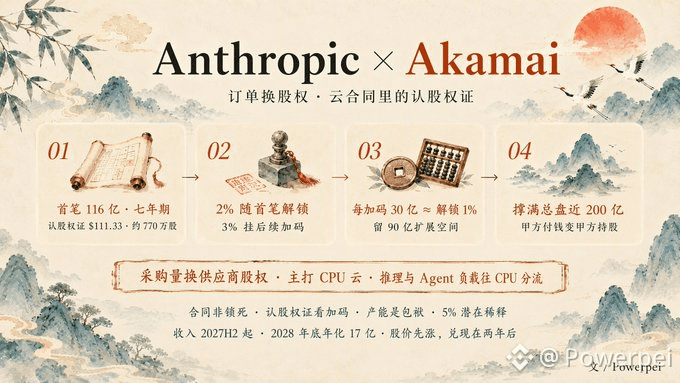
$11.6 billion, seven-year term
Akamai issued Anthropic warrants to buy shares, with an exercise price of $111.33, corresponding to about 7.7 million shares
▪️2% unlocks upon the first $11.6 billion commitment
▪️The remaining 3% is tied to follow-on add-ons—unlock about 1% for every additional $3.0 billion committed
▪️The agreement also leaves $9.0 billion of expansion room—if fully utilized, the total deal size approaches $20 billion
In the past: the buyer paid, the seller delivered
Now: Anthropic trades future procurement volumes for supplier equity, tying its compute cost to Akamai’s share price
This is the first time Akamai has included share warrants in a cloud contract
Using equity dilution to secure a long-term order—Akamai knows exactly the weight of this deal.
//
One more point that was glossed over: the deal is mainly for CPU cloud services, not GPU training clusters
In the past couple of years, AI infrastructure spending and attention were almost entirely bet on Nvidia and HBM
Anthropic is handing general-purpose compute to Akamai, a company with roots in CDNs; inference and agent workloads are already being shifted toward the CPU side
If this line works, the upside beneficiaries of AI infrastructure are far broader than simply buying Nvidia
━━━━━ • ━━━━━
You’ve got to see the timing of the money
First, Akamai has to spend about $5.5 billion in capital expenditures; then this year it will add another $1.7 billion to pre-lock memory and other components
Revenue won’t start coming in until the second half of 2027. In the same year, it’s expected to be $0.15 to $0.30 billion; by the end of 2028 it climbs to $1.7 billion annualized
> The contract isn’t locked in stone
If delivery milestones aren’t met, both parties can walk away
> Whether the warrants can be fully exercised depends on whether follow-on commitments really add up to $20 billion
> Capacity is front-loaded; if demand slows, that becomes a burden
> The potential 5% dilution isn’t free for existing shareholders either
The stock price can run up first
Cash-out happens two years later
—
I remember this isn’t mainly because of how Akamai moved that day
The party that controls long-term compute demand can now write procurement contracts into something close to an equity arrangement
Going forward, the key to watch is whether structures like “orders in exchange for equity” become increasingly common in AI infrastructure deals
The above is based on publicly available information; data should be confirmed with official disclosures from the parties involved. DYOR.
#Anthropic
Anthropic acquires Akamai’s cloud services and, as a bonus, took up to 5% of Akamai’s shares
Last Friday everyone was watching Microsoft Copilot and the Strait of Hormuz—this one got pushed down
After reading the contract details, I think it has more substance than the day’s market chatter
━━━━━ ◆ ━━━━━
$11.6 billion, seven-year term
Akamai issued Anthropic warrants to buy shares, with an exercise price of $111.33, corresponding to about 7.7 million shares
▪️2% unlocks upon the first $11.6 billion commitment
▪️The remaining 3% is tied to follow-on add-ons—unlock about 1% for every additional $3.0 billion committed
▪️The agreement also leaves $9.0 billion of expansion room—if fully utilized, the total deal size approaches $20 billion
In the past: the buyer paid, the seller delivered
Now: Anthropic trades future procurement volumes for supplier equity, tying its compute cost to Akamai’s share price
This is the first time Akamai has included share warrants in a cloud contract
Using equity dilution to secure a long-term order—Akamai knows exactly the weight of this deal.
//
One more point that was glossed over: the deal is mainly for CPU cloud services, not GPU training clusters
In the past couple of years, AI infrastructure spending and attention were almost entirely bet on Nvidia and HBM
Anthropic is handing general-purpose compute to Akamai, a company with roots in CDNs; inference and agent workloads are already being shifted toward the CPU side
If this line works, the upside beneficiaries of AI infrastructure are far broader than simply buying Nvidia
━━━━━ • ━━━━━
You’ve got to see the timing of the money
First, Akamai has to spend about $5.5 billion in capital expenditures; then this year it will add another $1.7 billion to pre-lock memory and other components
Revenue won’t start coming in until the second half of 2027. In the same year, it’s expected to be $0.15 to $0.30 billion; by the end of 2028 it climbs to $1.7 billion annualized
> The contract isn’t locked in stone
If delivery milestones aren’t met, both parties can walk away
> Whether the warrants can be fully exercised depends on whether follow-on commitments really add up to $20 billion
> Capacity is front-loaded; if demand slows, that becomes a burden
> The potential 5% dilution isn’t free for existing shareholders either
The stock price can run up first
Cash-out happens two years later
—
I remember this isn’t mainly because of how Akamai moved that day
The party that controls long-term compute demand can now write procurement contracts into something close to an equity arrangement
Going forward, the key to watch is whether structures like “orders in exchange for equity” become increasingly common in AI infrastructure deals
The above is based on publicly available information; data should be confirmed with official disclosures from the parties involved. DYOR.
#Anthropic
Last Friday everyone was watching Microsoft Copilot and the Strait of Hormuz—this one got pushed down
After reading the contract details, I think it has more substance than the day’s market chatter
━━━━━ ◆ ━━━━━
$11.6 billion, seven-year term
Akamai issued Anthropic warrants to buy shares, with an exercise price of $111.33, corresponding to about 7.7 million shares
▪️2% unlocks upon the first $11.6 billion commitment
▪️The remaining 3% is tied to follow-on add-ons—unlock about 1% for every additional $3.0 billion committed
▪️The agreement also leaves $9.0 billion of expansion room—if fully utilized, the total deal size approaches $20 billion
In the past: the buyer paid, the seller delivered
Now: Anthropic trades future procurement volumes for supplier equity, tying its compute cost to Akamai’s share price
This is the first time Akamai has included share warrants in a cloud contract
Using equity dilution to secure a long-term order—Akamai knows exactly the weight of this deal.
//
One more point that was glossed over: the deal is mainly for CPU cloud services, not GPU training clusters
In the past couple of years, AI infrastructure spending and attention were almost entirely bet on Nvidia and HBM
Anthropic is handing general-purpose compute to Akamai, a company with roots in CDNs; inference and agent workloads are already being shifted toward the CPU side
If this line works, the upside beneficiaries of AI infrastructure are far broader than simply buying Nvidia
━━━━━ • ━━━━━
You’ve got to see the timing of the money
First, Akamai has to spend about $5.5 billion in capital expenditures; then this year it will add another $1.7 billion to pre-lock memory and other components
Revenue won’t start coming in until the second half of 2027. In the same year, it’s expected to be $0.15 to $0.30 billion; by the end of 2028 it climbs to $1.7 billion annualized
> The contract isn’t locked in stone
If delivery milestones aren’t met, both parties can walk away
> Whether the warrants can be fully exercised depends on whether follow-on commitments really add up to $20 billion
> Capacity is front-loaded; if demand slows, that becomes a burden
> The potential 5% dilution isn’t free for existing shareholders either
The stock price can run up first
Cash-out happens two years later
—
I remember this isn’t mainly because of how Akamai moved that day
The party that controls long-term compute demand can now write procurement contracts into something close to an equity arrangement
Going forward, the key to watch is whether structures like “orders in exchange for equity” become increasingly common in AI infrastructure deals
The above is based on publicly available information; data should be confirmed with official disclosures from the parties involved. DYOR.
#Anthropic
1.8k
·
--
Verified
SUI has risen more than 30% over the past week, and today it surged another roughly 10%. Current price is around $1.04–1.07.
Trading volume is close to $1 billion.
A few things are happening at once.
DeepBook launched a user-facing app yesterday.
This is a native order book on the Sui chain, now supporting spot trading and a feature called Predict.
A BTC price range prediction market that takes as little as 60 seconds.
The official says the order book has accumulated over $20 billion in trading volume.
This is the clearest product rollout in the recent ecosystem.
The Sui Foundation has joined the tokenization standards organization of the Linux Foundation—alongside groups like Swift and Wells Fargo—to help develop standards for tokenized assets.
It’s more institution- and RWA-oriented.
DeFi TVL has also followed suit, rising to around $1.2 billion.
There are more catalysts ahead.
On October 7–8, Singapore’s Sui Basecamp—Mysten Labs has teased that it will announce new products. Their exact words were: “bring Sui Finance to another level.”
There’s been a lot of narrative building around this conference lately.
BTC as a programmable collateral, gasless stablecoin payments, private transfers, AI agent settlement—everything is being set up.
My take: this round of SUI isn’t being driven by just one piece of news. Several things are stacking together to create a wave of expectations.
But once expectations are fully priced in, whether it can hold up depends on what’s actually released at Basecamp.
Price is volatile. The above is just a summary of same-day momentum. DYOR.
$SUI
SUI has risen more than 30% over the past week, and today it surged another roughly 10%. Current price is around $1.04–1.07.
Trading volume is close to $1 billion.
A few things are happening at once.
DeepBook launched a user-facing app yesterday.
This is a native order book on the Sui chain, now supporting spot trading and a feature called Predict.
A BTC price range prediction market that takes as little as 60 seconds.
The official says the order book has accumulated over $20 billion in trading volume.
This is the clearest product rollout in the recent ecosystem.
The Sui Foundation has joined the tokenization standards organization of the Linux Foundation—alongside groups like Swift and Wells Fargo—to help develop standards for tokenized assets.
It’s more institution- and RWA-oriented.
DeFi TVL has also followed suit, rising to around $1.2 billion.
There are more catalysts ahead.
On October 7–8, Singapore’s Sui Basecamp—Mysten Labs has teased that it will announce new products. Their exact words were: “bring Sui Finance to another level.”
There’s been a lot of narrative building around this conference lately.
BTC as a programmable collateral, gasless stablecoin payments, private transfers, AI agent settlement—everything is being set up.
My take: this round of SUI isn’t being driven by just one piece of news. Several things are stacking together to create a wave of expectations.
But once expectations are fully priced in, whether it can hold up depends on what’s actually released at Basecamp.
Price is volatile. The above is just a summary of same-day momentum. DYOR.
$SUI
Trading volume is close to $1 billion.
A few things are happening at once.
DeepBook launched a user-facing app yesterday.
This is a native order book on the Sui chain, now supporting spot trading and a feature called Predict.
A BTC price range prediction market that takes as little as 60 seconds.
The official says the order book has accumulated over $20 billion in trading volume.
This is the clearest product rollout in the recent ecosystem.
The Sui Foundation has joined the tokenization standards organization of the Linux Foundation—alongside groups like Swift and Wells Fargo—to help develop standards for tokenized assets.
It’s more institution- and RWA-oriented.
DeFi TVL has also followed suit, rising to around $1.2 billion.
There are more catalysts ahead.
On October 7–8, Singapore’s Sui Basecamp—Mysten Labs has teased that it will announce new products. Their exact words were: “bring Sui Finance to another level.”
There’s been a lot of narrative building around this conference lately.
BTC as a programmable collateral, gasless stablecoin payments, private transfers, AI agent settlement—everything is being set up.
My take: this round of SUI isn’t being driven by just one piece of news. Several things are stacking together to create a wave of expectations.
But once expectations are fully priced in, whether it can hold up depends on what’s actually released at Basecamp.
Price is volatile. The above is just a summary of same-day momentum. DYOR.
$SUI
2
4.8k
·
--
RAY hasn't been quite the same these past two days.
The overall market is pulling back, yet it has repeatedly climbed onto the Top 100 Gainers list several times in a row—within 24 hours, it's up about 14% to 16%. While other coins are falling, it's going up, and the direction of capital is pretty clear.
Raydium is the largest DEX on Solana—there’s really no controversy there. Whether a DEX token can rise ultimately comes down to whether there are people trading it on-chain. Although Solana hasn’t been as crazy as it was earlier in the year with memes, on-chain activity hasn’t really dropped. Raydium is a key liquidity gateway, and trading fees translate into real, tangible income.
My own take: this move looks more like capital is searching for certainty when the broader market is hesitating. In the Solana DEX space, RAY has the steadiest position—supported by real revenue—so short-term capital is willing to gravitate toward this kind of target.
But that’s only a short-term thesis. If the broader market continues downward, DEX tokens won’t be able to hold up either. A two-day rally shouldn’t be mistaken for a trend.
Watch volatility and do your own research (DYOR).
$RAY
RAY hasn't been quite the same these past two days.
The overall market is pulling back, yet it has repeatedly climbed onto the Top 100 Gainers list several times in a row—within 24 hours, it's up about 14% to 16%. While other coins are falling, it's going up, and the direction of capital is pretty clear.
Raydium is the largest DEX on Solana—there’s really no controversy there. Whether a DEX token can rise ultimately comes down to whether there are people trading it on-chain. Although Solana hasn’t been as crazy as it was earlier in the year with memes, on-chain activity hasn’t really dropped. Raydium is a key liquidity gateway, and trading fees translate into real, tangible income.
My own take: this move looks more like capital is searching for certainty when the broader market is hesitating. In the Solana DEX space, RAY has the steadiest position—supported by real revenue—so short-term capital is willing to gravitate toward this kind of target.
But that’s only a short-term thesis. If the broader market continues downward, DEX tokens won’t be able to hold up either. A two-day rally shouldn’t be mistaken for a trend.
Watch volatility and do your own research (DYOR).
$RAY
The overall market is pulling back, yet it has repeatedly climbed onto the Top 100 Gainers list several times in a row—within 24 hours, it's up about 14% to 16%. While other coins are falling, it's going up, and the direction of capital is pretty clear.
Raydium is the largest DEX on Solana—there’s really no controversy there. Whether a DEX token can rise ultimately comes down to whether there are people trading it on-chain. Although Solana hasn’t been as crazy as it was earlier in the year with memes, on-chain activity hasn’t really dropped. Raydium is a key liquidity gateway, and trading fees translate into real, tangible income.
My own take: this move looks more like capital is searching for certainty when the broader market is hesitating. In the Solana DEX space, RAY has the steadiest position—supported by real revenue—so short-term capital is willing to gravitate toward this kind of target.
But that’s only a short-term thesis. If the broader market continues downward, DEX tokens won’t be able to hold up either. A two-day rally shouldn’t be mistaken for a trend.
Watch volatility and do your own research (DYOR).
$RAY
5
2
1.6k
·
--
Partly True
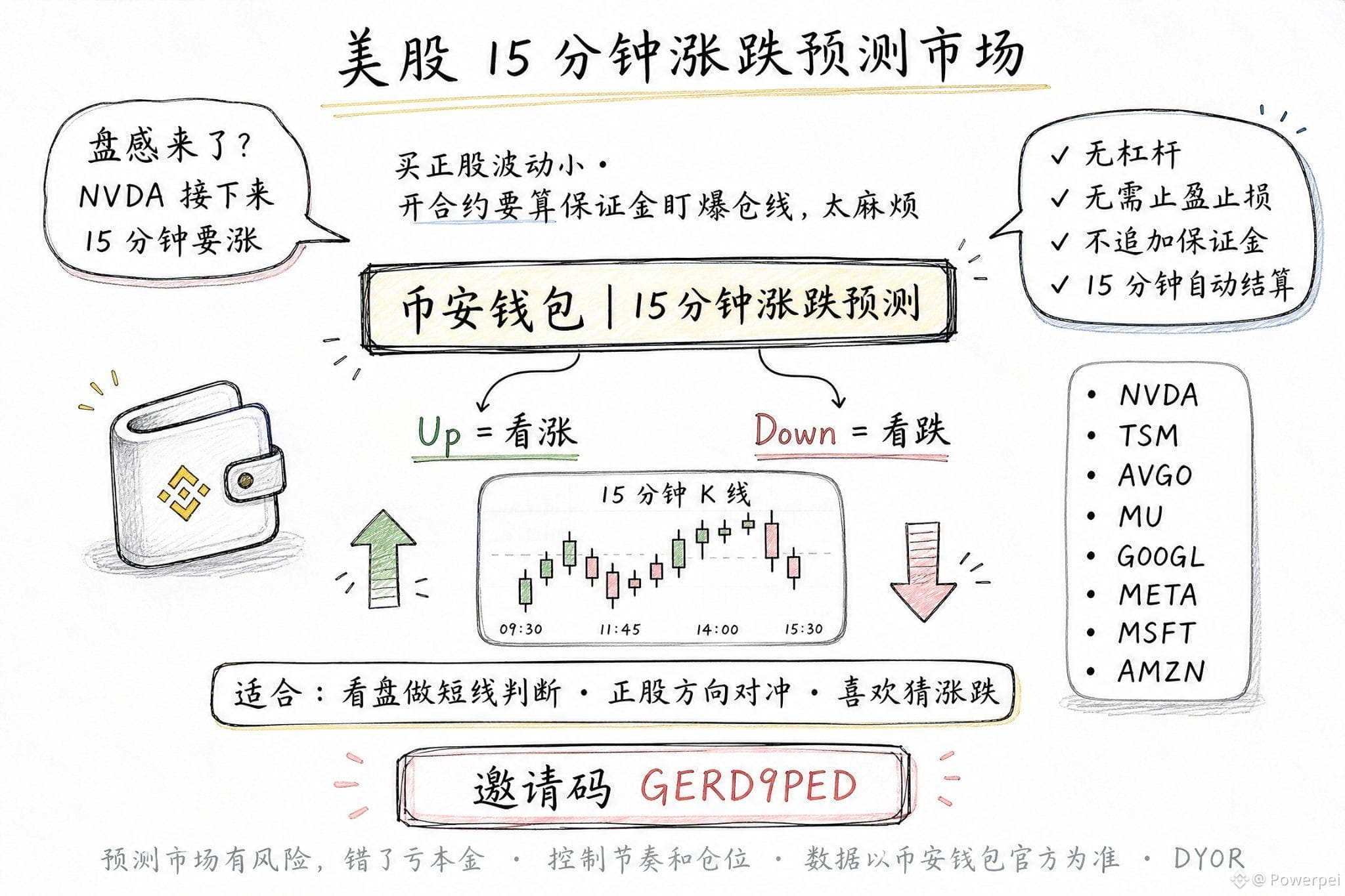
When I’m usually watching the U.S. stock order book, I often get a certain feeling: that 15-minute NVDA move is definitely going to surge.
But what can you do?
If you buy the actual stock, this kind of fluctuation won’t earn you much.
If you trade options, you have to calculate margin, watch the liquidation line—operation costs are just too heavy.
Most of the time, this kind of
short-term directional hunch just ends up wasted.
Binance Wallet just rolled out something that really feels right to me:
U.S. stock 15-minute up/down prediction market
You’re basically betting on one thing:
In the next 15 minutes—will it go up or will it go down?
//
No need to care about the magnitude. No need to calculate the closing price. No need to worry about adding margin, and you definitely won’t get liquidated.
After 15 minutes, it settles automatically. If you’re right, you profit; if you’re wrong, you lose the amount you bet.
Right now it supports eight tickers: $NVDA, $TSM, $AVGO, $MU, $GOOGL, $META, $MSFT, $AMZN.
All are big tech and AI leaders—good liquidity. Within 15 minutes, the volatility is actually larger than many people think.
For some stocks, the movement within a single 15-minute candlestick can be even crazier than BTC over the same period.
//
What caught my attention is that it separates out
this “short-term direction prediction”
thing by itself.
You don’t need to choose a leverage multiple.
You don’t need to set stop-loss or take-profit.
You don’t need to stare at your position.
It’s simply a pure direction call.
If you think NVDA will go up in the next 15 minutes, buy Up.
If you think it will go down, buy Down.
The contracts give you the leveraged profit feel—but they also give you the risk of liquidation.
This one only gives you the directional result, and if it goes wrong, you’ll also know clearly what you lost.
On Polymarket there’s no category for U.S. stock up/down.
Kalshi doesn’t have it either.
As of now, only Binance Wallet has it—and it started by listing eight tickers right away.
——
What scenarios is it good for?
When you’re watching the market and you feel like a particular stock is going to move in the short term, but you don’t want to open a position and hold.
Or if you already hold shares and you want to hedge the short-term direction using a prediction market.
Or maybe you just like guessing up vs. down, you feel like you’ve got good market instincts, and you want to try it.
One round every 15 minutes—fast pace, no dragging.
Don’t forget to enter my invite code—thanks: GERD9PED
Participate in the up&down prediction market to enjoy a 5% fee cashback
Prediction markets carry risks. If you’re wrong, you’ll lose your principal—you’re not guaranteed to win.
A faster frequency also means you might end up doing multiple rounds within an hour. Keep your pace and position sizing under control.
Data is according to Binance Wallet official information—DYOR.
When I’m usually watching the U.S. stock order book, I often get a certain feeling: that 15-minute NVDA move is definitely going to surge.
But what can you do?
If you buy the actual stock, this kind of fluctuation won’t earn you much.
If you trade options, you have to calculate margin, watch the liquidation line—operation costs are just too heavy.
Most of the time, this kind of
short-term directional hunch just ends up wasted.
Binance Wallet just rolled out something that really feels right to me:
U.S. stock 15-minute up/down prediction market
You’re basically betting on one thing:
In the next 15 minutes—will it go up or will it go down?
//
No need to care about the magnitude. No need to calculate the closing price. No need to worry about adding margin, and you definitely won’t get liquidated.
After 15 minutes, it settles automatically. If you’re right, you profit; if you’re wrong, you lose the amount you bet.
Right now it supports eight tickers: $NVDA, $TSM, $AVGO, $MU, $GOOGL, $META, $MSFT, $AMZN.
All are big tech and AI leaders—good liquidity. Within 15 minutes, the volatility is actually larger than many people think.
For some stocks, the movement within a single 15-minute candlestick can be even crazier than BTC over the same period.
//
What caught my attention is that it separates out
this “short-term direction prediction”
thing by itself.
You don’t need to choose a leverage multiple.
You don’t need to set stop-loss or take-profit.
You don’t need to stare at your position.
It’s simply a pure direction call.
If you think NVDA will go up in the next 15 minutes, buy Up.
If you think it will go down, buy Down.
The contracts give you the leveraged profit feel—but they also give you the risk of liquidation.
This one only gives you the directional result, and if it goes wrong, you’ll also know clearly what you lost.
On Polymarket there’s no category for U.S. stock up/down.
Kalshi doesn’t have it either.
As of now, only Binance Wallet has it—and it started by listing eight tickers right away.
——
What scenarios is it good for?
When you’re watching the market and you feel like a particular stock is going to move in the short term, but you don’t want to open a position and hold.
Or if you already hold shares and you want to hedge the short-term direction using a prediction market.
Or maybe you just like guessing up vs. down, you feel like you’ve got good market instincts, and you want to try it.
One round every 15 minutes—fast pace, no dragging.
Don’t forget to enter my invite code—thanks: GERD9PED
Participate in the up&down prediction market to enjoy a 5% fee cashback
Prediction markets carry risks. If you’re wrong, you’ll lose your principal—you’re not guaranteed to win.
A faster frequency also means you might end up doing multiple rounds within an hour. Keep your pace and position sizing under control.
Data is according to Binance Wallet official information—DYOR.
But what can you do?
If you buy the actual stock, this kind of fluctuation won’t earn you much.
If you trade options, you have to calculate margin, watch the liquidation line—operation costs are just too heavy.
Most of the time, this kind of
short-term directional hunch just ends up wasted.
Binance Wallet just rolled out something that really feels right to me:
U.S. stock 15-minute up/down prediction market
You’re basically betting on one thing:
In the next 15 minutes—will it go up or will it go down?
//
No need to care about the magnitude. No need to calculate the closing price. No need to worry about adding margin, and you definitely won’t get liquidated.
After 15 minutes, it settles automatically. If you’re right, you profit; if you’re wrong, you lose the amount you bet.
Right now it supports eight tickers: $NVDA, $TSM, $AVGO, $MU, $GOOGL, $META, $MSFT, $AMZN.
All are big tech and AI leaders—good liquidity. Within 15 minutes, the volatility is actually larger than many people think.
For some stocks, the movement within a single 15-minute candlestick can be even crazier than BTC over the same period.
//
What caught my attention is that it separates out
this “short-term direction prediction”
thing by itself.
You don’t need to choose a leverage multiple.
You don’t need to set stop-loss or take-profit.
You don’t need to stare at your position.
It’s simply a pure direction call.
If you think NVDA will go up in the next 15 minutes, buy Up.
If you think it will go down, buy Down.
The contracts give you the leveraged profit feel—but they also give you the risk of liquidation.
This one only gives you the directional result, and if it goes wrong, you’ll also know clearly what you lost.
On Polymarket there’s no category for U.S. stock up/down.
Kalshi doesn’t have it either.
As of now, only Binance Wallet has it—and it started by listing eight tickers right away.
——
What scenarios is it good for?
When you’re watching the market and you feel like a particular stock is going to move in the short term, but you don’t want to open a position and hold.
Or if you already hold shares and you want to hedge the short-term direction using a prediction market.
Or maybe you just like guessing up vs. down, you feel like you’ve got good market instincts, and you want to try it.
One round every 15 minutes—fast pace, no dragging.
Don’t forget to enter my invite code—thanks: GERD9PED
Participate in the up&down prediction market to enjoy a 5% fee cashback
Prediction markets carry risks. If you’re wrong, you’ll lose your principal—you’re not guaranteed to win.
A faster frequency also means you might end up doing multiple rounds within an hour. Keep your pace and position sizing under control.
Data is according to Binance Wallet official information—DYOR.
2
4.9k
·
--
PONS is back on the gainers leaderboard again—around 0.67–0.70. It’s still about 30% short of the early-September peak of 0.97.
Trading volume is around one hundred million USD; market cap is 460 million, top 100.
I wrote about this before.
Back then, I said we should watch whether on-chain activity can hold up after the gas fee exemption expires.
Now it looks like, in mid-to-late September, on-chain fees really have been trending down. The hype around new token launches has clearly cooled off, but the trading activity is still there—it's not gone to zero directly.
Today the market is lifting it again. I don’t think this is a new narrative.
More like a second-round trade after the launchpad hype has cooled.
Funds are still using PONS as Robinhood Chain’s “platform beta” to buy.
Next, watch one thing: launchpad fee revenue. The buyback-and-burn depends on this. If fees keep sliding, the deflation story won’t hold.
Most new coins will go to zero. Bridging and pre-market/front-running carry extra risks—this isn’t a robust investment.
Data should be taken from official sources. DYOR.
$PONS
{future}(PONSUSDT)
PONS is back on the gainers leaderboard again—around 0.67–0.70. It’s still about 30% short of the early-September peak of 0.97.
Trading volume is around one hundred million USD; market cap is 460 million, top 100.
I wrote about this before.
Back then, I said we should watch whether on-chain activity can hold up after the gas fee exemption expires.
Now it looks like, in mid-to-late September, on-chain fees really have been trending down. The hype around new token launches has clearly cooled off, but the trading activity is still there—it's not gone to zero directly.
Today the market is lifting it again. I don’t think this is a new narrative.
More like a second-round trade after the launchpad hype has cooled.
Funds are still using PONS as Robinhood Chain’s “platform beta” to buy.
Next, watch one thing: launchpad fee revenue. The buyback-and-burn depends on this. If fees keep sliding, the deflation story won’t hold.
Most new coins will go to zero. Bridging and pre-market/front-running carry extra risks—this isn’t a robust investment.
Data should be taken from official sources. DYOR.
$PONS
Trading volume is around one hundred million USD; market cap is 460 million, top 100.
I wrote about this before.
Back then, I said we should watch whether on-chain activity can hold up after the gas fee exemption expires.
Now it looks like, in mid-to-late September, on-chain fees really have been trending down. The hype around new token launches has clearly cooled off, but the trading activity is still there—it's not gone to zero directly.
Today the market is lifting it again. I don’t think this is a new narrative.
More like a second-round trade after the launchpad hype has cooled.
Funds are still using PONS as Robinhood Chain’s “platform beta” to buy.
Next, watch one thing: launchpad fee revenue. The buyback-and-burn depends on this. If fees keep sliding, the deflation story won’t hold.
Most new coins will go to zero. Bridging and pre-market/front-running carry extra risks—this isn’t a robust investment.
Data should be taken from official sources. DYOR.
$PONS
3k
·
--
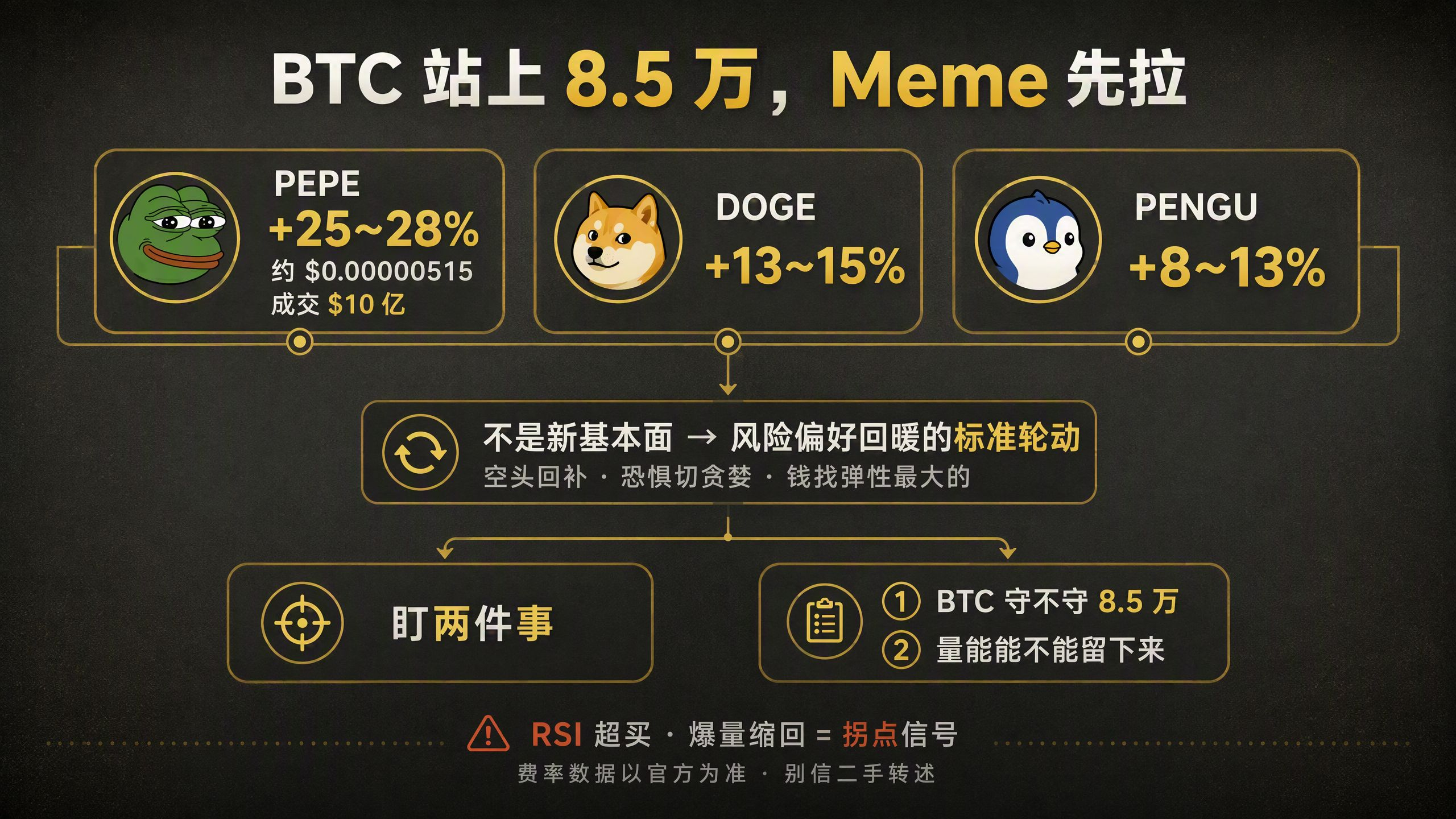
After Bitcoin moves above 85,000, Meme leads the rally
In the past 24 hours, PEPE is up 25–28%, back to about $0.00000515, and trading volume surged to one billion dollars; DOGE is up 13–15%; PENGU is up 8–13%
This isn’t a new fundamental driver—it’s the standard rotation cycle after risk appetite warms back up
With short sellers getting liquidated and forced to cover, sentiment shifts from fear to greed, and the money goes to the most elastic part
Meme has what it needs: active float, light narratives, and concentrated leverage
//
$PEPE has the highest elasticity. Both spot and derivatives are being added aggressively; open interest and volume have doubled. In the short term, it looks like a trend reversal
But the RSI is already overbought, which suggests this is an emotion-fueled acceleration, not fundamentals
$DOGE is the sector trend indicator—if it’s rising with the move, it means the entire Meme risk curve is opening up, and capital isn’t just trading back and forth in tiny micro-caps
$PENGU is driven by social sentiment. Trading value is relatively high versus its market cap; when the hype cools, pullbacks can be just as fast
//
How long can it last? Look at two things: whether BTC can hold above 85,000, and whether funds will shift from “dumping explode today” to sustained rotation
What to watch now isn’t who’s up 20%, but whether the volume can stay
Meme market turning points are often not caused by bad news, but by trading value shrinking quickly from a spike
Fees and data should follow official sources only—don’t trust secondhand retellings, including this article by me.
After Bitcoin moves above 85,000, Meme leads the rally
In the past 24 hours, PEPE is up 25–28%, back to about $0.00000515, and trading volume surged to one billion dollars; DOGE is up 13–15%; PENGU is up 8–13%
This isn’t a new fundamental driver—it’s the standard rotation cycle after risk appetite warms back up
With short sellers getting liquidated and forced to cover, sentiment shifts from fear to greed, and the money goes to the most elastic part
Meme has what it needs: active float, light narratives, and concentrated leverage
//
$PEPE has the highest elasticity. Both spot and derivatives are being added aggressively; open interest and volume have doubled. In the short term, it looks like a trend reversal
But the RSI is already overbought, which suggests this is an emotion-fueled acceleration, not fundamentals
$DOGE is the sector trend indicator—if it’s rising with the move, it means the entire Meme risk curve is opening up, and capital isn’t just trading back and forth in tiny micro-caps
$PENGU is driven by social sentiment. Trading value is relatively high versus its market cap; when the hype cools, pullbacks can be just as fast
//
How long can it last? Look at two things: whether BTC can hold above 85,000, and whether funds will shift from “dumping explode today” to sustained rotation
What to watch now isn’t who’s up 20%, but whether the volume can stay
Meme market turning points are often not caused by bad news, but by trading value shrinking quickly from a spike
Fees and data should follow official sources only—don’t trust secondhand retellings, including this article by me.
In the past 24 hours, PEPE is up 25–28%, back to about $0.00000515, and trading volume surged to one billion dollars; DOGE is up 13–15%; PENGU is up 8–13%
This isn’t a new fundamental driver—it’s the standard rotation cycle after risk appetite warms back up
With short sellers getting liquidated and forced to cover, sentiment shifts from fear to greed, and the money goes to the most elastic part
Meme has what it needs: active float, light narratives, and concentrated leverage
//
$PEPE has the highest elasticity. Both spot and derivatives are being added aggressively; open interest and volume have doubled. In the short term, it looks like a trend reversal
But the RSI is already overbought, which suggests this is an emotion-fueled acceleration, not fundamentals
$DOGE is the sector trend indicator—if it’s rising with the move, it means the entire Meme risk curve is opening up, and capital isn’t just trading back and forth in tiny micro-caps
$PENGU is driven by social sentiment. Trading value is relatively high versus its market cap; when the hype cools, pullbacks can be just as fast
//
How long can it last? Look at two things: whether BTC can hold above 85,000, and whether funds will shift from “dumping explode today” to sustained rotation
What to watch now isn’t who’s up 20%, but whether the volume can stay
Meme market turning points are often not caused by bad news, but by trading value shrinking quickly from a spike
Fees and data should follow official sources only—don’t trust secondhand retellings, including this article by me.
1
1.5k
·
--
ZEC has been stuck on the hot search for days; today the volume also jumped again
Firo, XMR, and Dash are doing the same
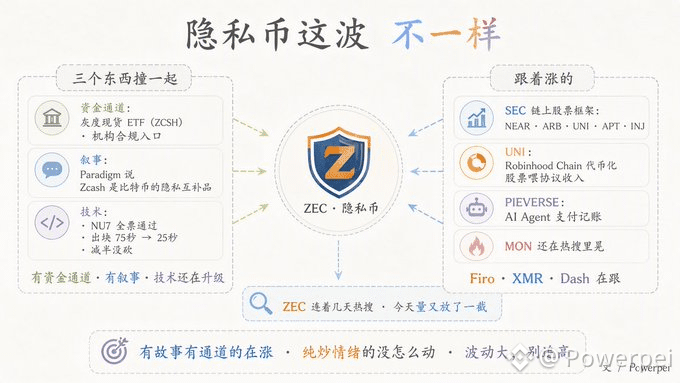
I think this wave of privacy coins is a bit different from before
Grayscale launched a spot ETF (ZCSH), and institutions now have a compliant on-ramp
Paradigm also publicly said that Zcash is a privacy-complement to Bitcoin
Plus NU7 got full approval; block time was cut from 75 seconds down to 25 seconds, and the halving wasn’t reduced
We’ve got capital channels, narratives, and the tech still upgrading—three things are colliding
Also, the SEC released a framework for on-chain stock trading; NEAR, ARB, UNI, APT, and INJ all surged together
Everyone’s guessing which traditional asset will get targeted first once it goes on-chain
I’ve talked about UNI before: the tokenized-stock volume on Robinhood Chain feeds into the protocol revenue that powers it—the logic still holds
PIEVERSE surged hard today too; MON is still hovering around in the hot search
Overall, today’s capital preference is very clear:
those with stories and channels are rising; those driven purely by hype haven’t moved much.
High volatility—don’t chase. DYOR. $ZEC
ZEC has been stuck on the hot search for days; today the volume also jumped again
Firo, XMR, and Dash are doing the same
I think this wave of privacy coins is a bit different from before
Grayscale launched a spot ETF (ZCSH), and institutions now have a compliant on-ramp
Paradigm also publicly said that Zcash is a privacy-complement to Bitcoin
Plus NU7 got full approval; block time was cut from 75 seconds down to 25 seconds, and the halving wasn’t reduced
We’ve got capital channels, narratives, and the tech still upgrading—three things are colliding
Also, the SEC released a framework for on-chain stock trading; NEAR, ARB, UNI, APT, and INJ all surged together
Everyone’s guessing which traditional asset will get targeted first once it goes on-chain
I’ve talked about UNI before: the tokenized-stock volume on Robinhood Chain feeds into the protocol revenue that powers it—the logic still holds
PIEVERSE surged hard today too; MON is still hovering around in the hot search
Overall, today’s capital preference is very clear:
those with stories and channels are rising; those driven purely by hype haven’t moved much.
High volatility—don’t chase. DYOR. $ZEC
Firo, XMR, and Dash are doing the same
I think this wave of privacy coins is a bit different from before
Grayscale launched a spot ETF (ZCSH), and institutions now have a compliant on-ramp
Paradigm also publicly said that Zcash is a privacy-complement to Bitcoin
Plus NU7 got full approval; block time was cut from 75 seconds down to 25 seconds, and the halving wasn’t reduced
We’ve got capital channels, narratives, and the tech still upgrading—three things are colliding
Also, the SEC released a framework for on-chain stock trading; NEAR, ARB, UNI, APT, and INJ all surged together
Everyone’s guessing which traditional asset will get targeted first once it goes on-chain
I’ve talked about UNI before: the tokenized-stock volume on Robinhood Chain feeds into the protocol revenue that powers it—the logic still holds
PIEVERSE surged hard today too; MON is still hovering around in the hot search
Overall, today’s capital preference is very clear:
those with stories and channels are rising; those driven purely by hype haven’t moved much.
High volatility—don’t chase. DYOR. $ZEC
4
9.1k
·
--
ZEC has been trending on the hot search for several days, and today its volume increased again by another chunk. Firo, XMR, and Dash are following along too.
I think this round of privacy coins is a bit different from before.
Grayscale has launched a spot ETF product (ZCSH), giving institutions a compliant entry.
Paradigm also publicly said that Zcash is a privacy complement to Bitcoin.
Plus, NU7 was approved unanimously. Block time was cut from 75 seconds down to 25 seconds, and the halving didn’t slash anything. With funding channels, a narrative, and the technology still upgrading—those three things are colliding at once.
Also, the SEC released a framework for on-chain stock trading, and NEAR, ARB, UNI, APT, and INJ all surged together.
Everyone’s guessing which traditional assets will first get pushed on-chain and hit whose head. I’ve talked about UNI before: on Robinhood Chain, the tokenized stock volume is feeding the protocol’s revenue, and that logic is still there.
PIEVERSE is also surging today—it’s for AI agent payment and bookkeeping. MON is still hovering around in the trending topics.
Overall, it’s pretty clear where capital preference is going today.
The ones with a story and channels are rising; the ones driven purely by hype haven’t moved much.
High volatility—don’t chase the price. DYOR
$ZEC
ZEC has been trending on the hot search for several days, and today its volume increased again by another chunk. Firo, XMR, and Dash are following along too.
I think this round of privacy coins is a bit different from before.
Grayscale has launched a spot ETF product (ZCSH), giving institutions a compliant entry.
Paradigm also publicly said that Zcash is a privacy complement to Bitcoin.
Plus, NU7 was approved unanimously. Block time was cut from 75 seconds down to 25 seconds, and the halving didn’t slash anything. With funding channels, a narrative, and the technology still upgrading—those three things are colliding at once.
Also, the SEC released a framework for on-chain stock trading, and NEAR, ARB, UNI, APT, and INJ all surged together.
Everyone’s guessing which traditional assets will first get pushed on-chain and hit whose head. I’ve talked about UNI before: on Robinhood Chain, the tokenized stock volume is feeding the protocol’s revenue, and that logic is still there.
PIEVERSE is also surging today—it’s for AI agent payment and bookkeeping. MON is still hovering around in the trending topics.
Overall, it’s pretty clear where capital preference is going today.
The ones with a story and channels are rising; the ones driven purely by hype haven’t moved much.
High volatility—don’t chase the price. DYOR
$ZEC
I think this round of privacy coins is a bit different from before.
Grayscale has launched a spot ETF product (ZCSH), giving institutions a compliant entry.
Paradigm also publicly said that Zcash is a privacy complement to Bitcoin.
Plus, NU7 was approved unanimously. Block time was cut from 75 seconds down to 25 seconds, and the halving didn’t slash anything. With funding channels, a narrative, and the technology still upgrading—those three things are colliding at once.
Also, the SEC released a framework for on-chain stock trading, and NEAR, ARB, UNI, APT, and INJ all surged together.
Everyone’s guessing which traditional assets will first get pushed on-chain and hit whose head. I’ve talked about UNI before: on Robinhood Chain, the tokenized stock volume is feeding the protocol’s revenue, and that logic is still there.
PIEVERSE is also surging today—it’s for AI agent payment and bookkeeping. MON is still hovering around in the trending topics.
Overall, it’s pretty clear where capital preference is going today.
The ones with a story and channels are rising; the ones driven purely by hype haven’t moved much.
High volatility—don’t chase the price. DYOR
$ZEC
2
3.1k
·
--
Verified
NEAR pulled off a run today around the $2.65 mark—up about 12% over the past 24 hours.
Both CoinMarketCap and CoinGecko hot searches are showing it.
The direct cause is Confidential Intents.
This is NEAR’s privacy cross-chain channel. The TVL has just crossed $70 million. After passing that threshold, a milestone airdrop called “NEAR @3.33” gets triggered. The 333,000 locked tokens have already been snapshotted—eligible users can go claim them.
Also, the privacy narrative has been heating up across the board recently. ZEC is rising in sync, and THORWallet has also picked up privacy-based swaps. When a few things line up like this, attention and volume both jump.
I didn’t chase this wave.
I only noticed after it had already moved up. Chasing tops isn’t my style. But I think the NEAR direction of privacy cross-chain is worth keeping an eye on—watch whether the TVL is genuinely stickier, or if it’s just a one-time rush for the airdrop.
High volatility—don’t get carried away. DYOR.
$NEAR
{spot}(NEARUSDT)
NEAR pulled off a run today around the $2.65 mark—up about 12% over the past 24 hours.
Both CoinMarketCap and CoinGecko hot searches are showing it.
The direct cause is Confidential Intents.
This is NEAR’s privacy cross-chain channel. The TVL has just crossed $70 million. After passing that threshold, a milestone airdrop called “NEAR @3.33” gets triggered. The 333,000 locked tokens have already been snapshotted—eligible users can go claim them.
Also, the privacy narrative has been heating up across the board recently. ZEC is rising in sync, and THORWallet has also picked up privacy-based swaps. When a few things line up like this, attention and volume both jump.
I didn’t chase this wave.
I only noticed after it had already moved up. Chasing tops isn’t my style. But I think the NEAR direction of privacy cross-chain is worth keeping an eye on—watch whether the TVL is genuinely stickier, or if it’s just a one-time rush for the airdrop.
High volatility—don’t get carried away. DYOR.
$NEAR
Both CoinMarketCap and CoinGecko hot searches are showing it.
The direct cause is Confidential Intents.
This is NEAR’s privacy cross-chain channel. The TVL has just crossed $70 million. After passing that threshold, a milestone airdrop called “NEAR @3.33” gets triggered. The 333,000 locked tokens have already been snapshotted—eligible users can go claim them.
Also, the privacy narrative has been heating up across the board recently. ZEC is rising in sync, and THORWallet has also picked up privacy-based swaps. When a few things line up like this, attention and volume both jump.
I didn’t chase this wave.
I only noticed after it had already moved up. Chasing tops isn’t my style. But I think the NEAR direction of privacy cross-chain is worth keeping an eye on—watch whether the TVL is genuinely stickier, or if it’s just a one-time rush for the airdrop.
High volatility—don’t get carried away. DYOR.
$NEAR
1
2.5k
·
--
Verified
Arc mainnet launched today
I just tried it in my Binance wallet and it feels smoother than I expected
Open your Binance wallet—Arc network is already there
You can directly find it in the popular assets list; tap in and you can buy
No need to add an RPC in the middle, no manual bridging, no hunting for links everywhere
You can immediately view popular memes—pretty convenient
//
If you’ve set up a new chain yourself, you’ll know
Check the Chain ID, find the RPC, bridge over USDC, confirm it arrived, then find the transaction entry (this morning a few friends tried to cross-chain from other wallets but couldn’t find the cross-chain asset—where did it go) Just these steps alone can deter half the people
Binance wallet skips all of that
It gives you ready-made entry points—probably the shortest way to participate in the Arc route right now
//
Let me clarify: Arc itself isn’t another EVM-compatible L1
Circle made it
The core is native issuance of USDC and its cross-chain circulation
The stablecoin doesn’t come from bridging over from another chain—it’s native on-chain. Gas is also in USDC (have to say the structure is very smooth—speed for farming/apeing is fast) So it naturally ties together DeFi, payments, and cross-chain scenarios
It’s not trying to recreate a Meme chain, though memes will definitely run on it too
————
First wave of wallets integrated with Arc: Binance Wallet, MetaMask, Ledger, Kraken, Fireblocks, Upbit
They can be used directly on the mainnet on day one—these are the ones. Binance Wallet is one of them
This time window itself is valuable
Next, zero service fees
Binance Wallet—limited time for 7 days
When trading Arc chain assets via the wallet, the service fee is zero
Covers Meme, DeFi, and cross-chain asset trading. This is a limited-time campaign, not a permanent policy. In the first few days after the new chain launched, asset inflows are the most intense
All kinds of projects are popping up. Trading costs are also zero
With these two windows overlapping, the lowest-friction way to test is this week: should you buy into a certain pool? Try with a small position—no extra service fee
If you want to sweep a round during the window, don’t delay my own plan
Start by taking a small position to test the waters
See which pools on Arc have real depth, and which are still just empty shells
In the popular assets list, if there’s something worth following—I’ll send a separate post about day one of the new chain. Anything can show up
Bullish scams, fake listings, and air pools will all appear
Check liquidity, taxes, and permissions in the contract first before making a move. Don’t go all-in—keep some buffer. On-chain trading has risks. Participate rationally, make your own judgment, don’t get carried away. DYOR
Arc mainnet launched today
I just tried it in my Binance wallet and it feels smoother than I expected
Open your Binance wallet—Arc network is already there
You can directly find it in the popular assets list; tap in and you can buy
No need to add an RPC in the middle, no manual bridging, no hunting for links everywhere
You can immediately view popular memes—pretty convenient
//
If you’ve set up a new chain yourself, you’ll know
Check the Chain ID, find the RPC, bridge over USDC, confirm it arrived, then find the transaction entry (this morning a few friends tried to cross-chain from other wallets but couldn’t find the cross-chain asset—where did it go) Just these steps alone can deter half the people
Binance wallet skips all of that
It gives you ready-made entry points—probably the shortest way to participate in the Arc route right now
//
Let me clarify: Arc itself isn’t another EVM-compatible L1
Circle made it
The core is native issuance of USDC and its cross-chain circulation
The stablecoin doesn’t come from bridging over from another chain—it’s native on-chain. Gas is also in USDC (have to say the structure is very smooth—speed for farming/apeing is fast) So it naturally ties together DeFi, payments, and cross-chain scenarios
It’s not trying to recreate a Meme chain, though memes will definitely run on it too
————
First wave of wallets integrated with Arc: Binance Wallet, MetaMask, Ledger, Kraken, Fireblocks, Upbit
They can be used directly on the mainnet on day one—these are the ones. Binance Wallet is one of them
This time window itself is valuable
Next, zero service fees
Binance Wallet—limited time for 7 days
When trading Arc chain assets via the wallet, the service fee is zero
Covers Meme, DeFi, and cross-chain asset trading. This is a limited-time campaign, not a permanent policy. In the first few days after the new chain launched, asset inflows are the most intense
All kinds of projects are popping up. Trading costs are also zero
With these two windows overlapping, the lowest-friction way to test is this week: should you buy into a certain pool? Try with a small position—no extra service fee
If you want to sweep a round during the window, don’t delay my own plan
Start by taking a small position to test the waters
See which pools on Arc have real depth, and which are still just empty shells
In the popular assets list, if there’s something worth following—I’ll send a separate post about day one of the new chain. Anything can show up
Bullish scams, fake listings, and air pools will all appear
Check liquidity, taxes, and permissions in the contract first before making a move. Don’t go all-in—keep some buffer. On-chain trading has risks. Participate rationally, make your own judgment, don’t get carried away. DYOR
I just tried it in my Binance wallet and it feels smoother than I expected
Open your Binance wallet—Arc network is already there
You can directly find it in the popular assets list; tap in and you can buy
No need to add an RPC in the middle, no manual bridging, no hunting for links everywhere
You can immediately view popular memes—pretty convenient
//
If you’ve set up a new chain yourself, you’ll know
Check the Chain ID, find the RPC, bridge over USDC, confirm it arrived, then find the transaction entry (this morning a few friends tried to cross-chain from other wallets but couldn’t find the cross-chain asset—where did it go) Just these steps alone can deter half the people
Binance wallet skips all of that
It gives you ready-made entry points—probably the shortest way to participate in the Arc route right now
//
Let me clarify: Arc itself isn’t another EVM-compatible L1
Circle made it
The core is native issuance of USDC and its cross-chain circulation
The stablecoin doesn’t come from bridging over from another chain—it’s native on-chain. Gas is also in USDC (have to say the structure is very smooth—speed for farming/apeing is fast) So it naturally ties together DeFi, payments, and cross-chain scenarios
It’s not trying to recreate a Meme chain, though memes will definitely run on it too
————
First wave of wallets integrated with Arc: Binance Wallet, MetaMask, Ledger, Kraken, Fireblocks, Upbit
They can be used directly on the mainnet on day one—these are the ones. Binance Wallet is one of them
This time window itself is valuable
Next, zero service fees
Binance Wallet—limited time for 7 days
When trading Arc chain assets via the wallet, the service fee is zero
Covers Meme, DeFi, and cross-chain asset trading. This is a limited-time campaign, not a permanent policy. In the first few days after the new chain launched, asset inflows are the most intense
All kinds of projects are popping up. Trading costs are also zero
With these two windows overlapping, the lowest-friction way to test is this week: should you buy into a certain pool? Try with a small position—no extra service fee
If you want to sweep a round during the window, don’t delay my own plan
Start by taking a small position to test the waters
See which pools on Arc have real depth, and which are still just empty shells
In the popular assets list, if there’s something worth following—I’ll send a separate post about day one of the new chain. Anything can show up
Bullish scams, fake listings, and air pools will all appear
Check liquidity, taxes, and permissions in the contract first before making a move. Don’t go all-in—keep some buffer. On-chain trading has risks. Participate rationally, make your own judgment, don’t get carried away. DYOR

3
8
9.6k
·
--
Tonight Elche vs Real Madrid, midweek makeup match
Elche this season has failed to win in five rounds, conceded a bunch of goals, and sits second from the bottom
Real Madrid just beat Inter in the Champions League, and have also been picking up points in the league. Mbappé is in great form
No reason to hesitate—I’m backing Real Madrid to win
The only thing worth considering is how many goals Elche will concede—Elche’s defense has picked up a bit recently. In the last match away from home they managed a draw, so they probably won’t get completely blown open. But Real Madrid’s attacking firepower is there; they should be able to get the ball out and create chances with ease.
I lean toward Real Madrid winning + a big game over 2.5 goals
This week happens to have Champions League, Europa League, AFC Champions League, and the top five European leagues all colliding—so the market should be the hottest stretch of the year. Watching football is great, but it’s better to get in on the action yourself:
The Binance Wallet @BinanceWallet Football PNL Grand Tournament is still ongoing. If your trading points reach over 3.19, you can get on the leaderboard. There’s a prize pool of 100,000 U to split, with a single-person maximum of 10,000 U
Invite friends to go for the leaderboard together—friends automatically get a 5% fee discount! Remember to activate first; after activation you’ll receive a 10% rebate. Rebates are paid out in USDT. You can check it anytime on the invitation page and claim it anytime—it never expires.
📍 Binance Wallet App → Predictfun mini program → Assets → Invite Friends → Activate the Referral Program
Trading tournament registration address
[https://web3.binance.com/zh-CN/activity/predict-tc/single/Soccer-PnL](https://web3.binance.com/zh-CN/activity/predict-tc/single/Soccer-PnL)
My invitation link (deep thanks), get 5% fee refund immediately:
https://web3.binance.com/zh-CN/activity/prediction-referral?ref=GERD9PED
Tonight Elche vs Real Madrid, midweek makeup match
Elche this season has failed to win in five rounds, conceded a bunch of goals, and sits second from the bottom
Real Madrid just beat Inter in the Champions League, and have also been picking up points in the league. Mbappé is in great form
No reason to hesitate—I’m backing Real Madrid to win
The only thing worth considering is how many goals Elche will concede—Elche’s defense has picked up a bit recently. In the last match away from home they managed a draw, so they probably won’t get completely blown open. But Real Madrid’s attacking firepower is there; they should be able to get the ball out and create chances with ease.
I lean toward Real Madrid winning + a big game over 2.5 goals
This week happens to have Champions League, Europa League, AFC Champions League, and the top five European leagues all colliding—so the market should be the hottest stretch of the year. Watching football is great, but it’s better to get in on the action yourself:
The Binance Wallet @Binance Wallet Football PNL Grand Tournament is still ongoing. If your trading points reach over 3.19, you can get on the leaderboard. There’s a prize pool of 100,000 U to split, with a single-person maximum of 10,000 U
Invite friends to go for the leaderboard together—friends automatically get a 5% fee discount! Remember to activate first; after activation you’ll receive a 10% rebate. Rebates are paid out in USDT. You can check it anytime on the invitation page and claim it anytime—it never expires.
📍 Binance Wallet App → Predictfun mini program → Assets → Invite Friends → Activate the Referral Program
Trading tournament registration address
https://web3.binance.com/zh-CN/activity/predict-tc/single/Soccer-PnL
My invitation link (deep thanks), get 5% fee refund immediately:
https://web3.binance.com/zh-CN/activity/prediction-referral?ref=GERD9PED
Elche this season has failed to win in five rounds, conceded a bunch of goals, and sits second from the bottom
Real Madrid just beat Inter in the Champions League, and have also been picking up points in the league. Mbappé is in great form
No reason to hesitate—I’m backing Real Madrid to win
The only thing worth considering is how many goals Elche will concede—Elche’s defense has picked up a bit recently. In the last match away from home they managed a draw, so they probably won’t get completely blown open. But Real Madrid’s attacking firepower is there; they should be able to get the ball out and create chances with ease.
I lean toward Real Madrid winning + a big game over 2.5 goals
This week happens to have Champions League, Europa League, AFC Champions League, and the top five European leagues all colliding—so the market should be the hottest stretch of the year. Watching football is great, but it’s better to get in on the action yourself:
The Binance Wallet @Binance Wallet Football PNL Grand Tournament is still ongoing. If your trading points reach over 3.19, you can get on the leaderboard. There’s a prize pool of 100,000 U to split, with a single-person maximum of 10,000 U
Invite friends to go for the leaderboard together—friends automatically get a 5% fee discount! Remember to activate first; after activation you’ll receive a 10% rebate. Rebates are paid out in USDT. You can check it anytime on the invitation page and claim it anytime—it never expires.
📍 Binance Wallet App → Predictfun mini program → Assets → Invite Friends → Activate the Referral Program
Trading tournament registration address
https://web3.binance.com/zh-CN/activity/predict-tc/single/Soccer-PnL
My invitation link (deep thanks), get 5% fee refund immediately:
https://web3.binance.com/zh-CN/activity/prediction-referral?ref=GERD9PED
1
7
1.4k
·
--
PONS surged to $0.97 at the beginning of September, and now it's back to $0.53. It’s already cut nearly half from the peak.
The volume is still there, but the hype has clearly dropped by a notch.
I think the logic here is very simple.
PONS’ price is propped up by buybacks. The buybacks rely on transaction fees. And the transaction fees come from the hype around issuing and trading tokens on the Robinhood Chain. As long as the hype is there, buybacks are there, and the price has a floor. When the hype fades, no deflation model can save it.
The current issue is:
Robinhood Chain’s 90-day gas fee exemption expires on September 30.
Once free gas stops, the cost of issuing tokens won’t be zero anymore. By then, will the daily token-issuing volume still be able to hold up the current level? I have my doubts.
A 45% pullback is either just a correction or a change of direction—let’s see what happens by the end of the month.
Crypto markets are extremely volatile. The above is my personal observation, not investment advice.
$PONS
PONS surged to $0.97 at the beginning of September, and now it's back to $0.53. It’s already cut nearly half from the peak.
The volume is still there, but the hype has clearly dropped by a notch.
I think the logic here is very simple.
PONS’ price is propped up by buybacks. The buybacks rely on transaction fees. And the transaction fees come from the hype around issuing and trading tokens on the Robinhood Chain. As long as the hype is there, buybacks are there, and the price has a floor. When the hype fades, no deflation model can save it.
The current issue is:
Robinhood Chain’s 90-day gas fee exemption expires on September 30.
Once free gas stops, the cost of issuing tokens won’t be zero anymore. By then, will the daily token-issuing volume still be able to hold up the current level? I have my doubts.
A 45% pullback is either just a correction or a change of direction—let’s see what happens by the end of the month.
Crypto markets are extremely volatile. The above is my personal observation, not investment advice.
$PONS
The volume is still there, but the hype has clearly dropped by a notch.
I think the logic here is very simple.
PONS’ price is propped up by buybacks. The buybacks rely on transaction fees. And the transaction fees come from the hype around issuing and trading tokens on the Robinhood Chain. As long as the hype is there, buybacks are there, and the price has a floor. When the hype fades, no deflation model can save it.
The current issue is:
Robinhood Chain’s 90-day gas fee exemption expires on September 30.
Once free gas stops, the cost of issuing tokens won’t be zero anymore. By then, will the daily token-issuing volume still be able to hold up the current level? I have my doubts.
A 45% pullback is either just a correction or a change of direction—let’s see what happens by the end of the month.
Crypto markets are extremely volatile. The above is my personal observation, not investment advice.
$PONS
2
1
2
7.9k
·
--
Verified
LSK surged to nearly 2 yesterday—then got hammered back down. It’s now fluctuating between 0.5 and 0.8
I looked into what actually happened
Three things hit at the same time
The Lisk main chain was shut down on October 31. It wasn’t an upgrade—it was a shutdown. Any coins on-chain, staked positions, and assets in DeFi will simply be gone if they aren’t withdrawn when they expire
Bridging back to Ethereum takes 7 to 8 days, and staked assets must be unlocked first, then you wait another 3 days. There isn’t much time left for procrastinators.
The DAO approved a burn proposal. 100 million LSK were burned, cutting total supply from 400 million to 300 million—one quarter is gone.
The project itself is pivoting. It’s no longer doing a public chain; instead, it’s shifting to enterprise treasury management—putting fiat and stablecoins under a single backend
LSK becomes a platform loyalty token
Shutdown chain + supply cut + a narrative pivot—three catalysts landing together. With high futures leverage, the shorts were basically squeezed out directly. That spike during the day wasn’t pulled up by retail.
But after hitting 2, the retracement was brutal too. This kind of market move comes fast and leaves fast—it feels more like event pricing than fundamentals playing out.
//
I’m not going to chase this. The event is already out in the open, and the supply contraction is already set. The price that needs to reflect it has probably already done one round. Whether there will be another wave later depends on whether new money comes in to take over the narrative—not on the burn itself.
If you still hold LSK that’s staked on the original chain—no matter what happens with the price, move your coins out first. October 31 is a hard deadline. Unlocking + bridging + buffering means you should leave at least two weeks.
Crypto volatility is extremely high. The above is just my observations of the chart, not investment advice $LSK
LSK surged to nearly 2 yesterday—then got hammered back down. It’s now fluctuating between 0.5 and 0.8
I looked into what actually happened
Three things hit at the same time
The Lisk main chain was shut down on October 31. It wasn’t an upgrade—it was a shutdown. Any coins on-chain, staked positions, and assets in DeFi will simply be gone if they aren’t withdrawn when they expire
Bridging back to Ethereum takes 7 to 8 days, and staked assets must be unlocked first, then you wait another 3 days. There isn’t much time left for procrastinators.
The DAO approved a burn proposal. 100 million LSK were burned, cutting total supply from 400 million to 300 million—one quarter is gone.
The project itself is pivoting. It’s no longer doing a public chain; instead, it’s shifting to enterprise treasury management—putting fiat and stablecoins under a single backend
LSK becomes a platform loyalty token
Shutdown chain + supply cut + a narrative pivot—three catalysts landing together. With high futures leverage, the shorts were basically squeezed out directly. That spike during the day wasn’t pulled up by retail.
But after hitting 2, the retracement was brutal too. This kind of market move comes fast and leaves fast—it feels more like event pricing than fundamentals playing out.
//
I’m not going to chase this. The event is already out in the open, and the supply contraction is already set. The price that needs to reflect it has probably already done one round. Whether there will be another wave later depends on whether new money comes in to take over the narrative—not on the burn itself.
If you still hold LSK that’s staked on the original chain—no matter what happens with the price, move your coins out first. October 31 is a hard deadline. Unlocking + bridging + buffering means you should leave at least two weeks.
Crypto volatility is extremely high. The above is just my observations of the chart, not investment advice $LSK
I looked into what actually happened
Three things hit at the same time
The Lisk main chain was shut down on October 31. It wasn’t an upgrade—it was a shutdown. Any coins on-chain, staked positions, and assets in DeFi will simply be gone if they aren’t withdrawn when they expire
Bridging back to Ethereum takes 7 to 8 days, and staked assets must be unlocked first, then you wait another 3 days. There isn’t much time left for procrastinators.
The DAO approved a burn proposal. 100 million LSK were burned, cutting total supply from 400 million to 300 million—one quarter is gone.
The project itself is pivoting. It’s no longer doing a public chain; instead, it’s shifting to enterprise treasury management—putting fiat and stablecoins under a single backend
LSK becomes a platform loyalty token
Shutdown chain + supply cut + a narrative pivot—three catalysts landing together. With high futures leverage, the shorts were basically squeezed out directly. That spike during the day wasn’t pulled up by retail.
But after hitting 2, the retracement was brutal too. This kind of market move comes fast and leaves fast—it feels more like event pricing than fundamentals playing out.
//
I’m not going to chase this. The event is already out in the open, and the supply contraction is already set. The price that needs to reflect it has probably already done one round. Whether there will be another wave later depends on whether new money comes in to take over the narrative—not on the burn itself.
If you still hold LSK that’s staked on the original chain—no matter what happens with the price, move your coins out first. October 31 is a hard deadline. Unlocking + bridging + buffering means you should leave at least two weeks.
Crypto volatility is extremely high. The above is just my observations of the chart, not investment advice $LSK
2
3
2.7k
·
--
I went through next week’s calendar. It’s fairly flat.
No supergiant earnings reports.
No new catalysts that could move the index.
There’s a Lennar earnings report—an ireal estate company—but not many people are watching.
If you don’t trade real estate, skip it.
The only thing with a real story is a nuclear energy company.
◇
Holtec, ticker code HNUC. Plans to set the price around 9/17, and list on Nasdaq on 9/18.
50M shares, the range is $15–$18, with a midpoint valuation of roughly $10B.
Led by JPM and Goldman.
This isn’t a PPT nuclear-power company.
Founded in 1986. Has supplied equipment to more than 150 reactors worldwide, over 200 patents, and three domestic manufacturing bases.
They’re now pushing small modular reactors (SMRs), and they’re also managing the restart of the Palisades nuclear power plant.
With energy prices high and the grid and compute capacity all fighting for electricity, a nuclear power IPO is a smart timing choice.
But it has almost no impact on the broader market. You can treat it as a theme, not as an event trade.
//
What truly drives the tape is just one thing.
On Wednesday: the FOMC.
They meet 9/15–16, with the decision due at 2:00 PM on the 16th.
This time they’ll include the SEP and the dot plot—so it’s a big meeting.
Current target rate: 3.50%–3.75%.
At the July meeting, the vote was 9:3 in favor of adding more—three people already wanted to hike.
The market is currently pricing a very high probability of a 25bp hike.
The hike is already priced in by about 90%.
The issue isn’t whether they’ll hike.
The issue is what “Washington” (the Fed) says after the hike, how the dot plot gets drawn, and whether the wording changes. Those are what create the volatility.
My view: next week isn’t a theme week. It’s a settlement week.
Get the hike out of the way.
Clear out the options expiration.
Friday is the quarterly options expiration date.
Institutions need to rebalance and hedge—regardless of the fundamentals, the market will have noise.
————
In situations like this, it’s easiest to see cases where price doesn’t match the headlines.
The decision could meet expectations and still drop sharply.
Because it’s “sell the fact.”
Oil might be down only a couple dollars and still jump.
Because short-covering.
Don’t try to use the news to explain every single K-line.
In settlement weeks, the volatility often has nothing to do with the narrative—it’s about positioning.
My own approach: no new positions next week.
Wait for this round of noise to pass.
The better-looking opportunities are likely further out.
Later macro data, the big tech earnings season, or a sudden change in the Middle East.
Those are the real things that can change direction.
Next week is basically just going through the motions.
Don’t let intraday swings shake you.
The above is just my personal perspective and doesn’t constitute investment advice. DYOR #美联储何时降息?
I went through next week’s calendar. It’s fairly flat.
No supergiant earnings reports.
No new catalysts that could move the index.
There’s a Lennar earnings report—an ireal estate company—but not many people are watching.
If you don’t trade real estate, skip it.
The only thing with a real story is a nuclear energy company.
◇
Holtec, ticker code HNUC. Plans to set the price around 9/17, and list on Nasdaq on 9/18.
50M shares, the range is $15–$18, with a midpoint valuation of roughly $10B.
Led by JPM and Goldman.
This isn’t a PPT nuclear-power company.
Founded in 1986. Has supplied equipment to more than 150 reactors worldwide, over 200 patents, and three domestic manufacturing bases.
They’re now pushing small modular reactors (SMRs), and they’re also managing the restart of the Palisades nuclear power plant.
With energy prices high and the grid and compute capacity all fighting for electricity, a nuclear power IPO is a smart timing choice.
But it has almost no impact on the broader market. You can treat it as a theme, not as an event trade.
//
What truly drives the tape is just one thing.
On Wednesday: the FOMC.
They meet 9/15–16, with the decision due at 2:00 PM on the 16th.
This time they’ll include the SEP and the dot plot—so it’s a big meeting.
Current target rate: 3.50%–3.75%.
At the July meeting, the vote was 9:3 in favor of adding more—three people already wanted to hike.
The market is currently pricing a very high probability of a 25bp hike.
The hike is already priced in by about 90%.
The issue isn’t whether they’ll hike.
The issue is what “Washington” (the Fed) says after the hike, how the dot plot gets drawn, and whether the wording changes. Those are what create the volatility.
My view: next week isn’t a theme week. It’s a settlement week.
Get the hike out of the way.
Clear out the options expiration.
Friday is the quarterly options expiration date.
Institutions need to rebalance and hedge—regardless of the fundamentals, the market will have noise.
————
In situations like this, it’s easiest to see cases where price doesn’t match the headlines.
The decision could meet expectations and still drop sharply.
Because it’s “sell the fact.”
Oil might be down only a couple dollars and still jump.
Because short-covering.
Don’t try to use the news to explain every single K-line.
In settlement weeks, the volatility often has nothing to do with the narrative—it’s about positioning.
My own approach: no new positions next week.
Wait for this round of noise to pass.
The better-looking opportunities are likely further out.
Later macro data, the big tech earnings season, or a sudden change in the Middle East.
Those are the real things that can change direction.
Next week is basically just going through the motions.
Don’t let intraday swings shake you.
The above is just my personal perspective and doesn’t constitute investment advice. DYOR #美联储何时降息?
No supergiant earnings reports.
No new catalysts that could move the index.
There’s a Lennar earnings report—an ireal estate company—but not many people are watching.
If you don’t trade real estate, skip it.
The only thing with a real story is a nuclear energy company.
◇
Holtec, ticker code HNUC. Plans to set the price around 9/17, and list on Nasdaq on 9/18.
50M shares, the range is $15–$18, with a midpoint valuation of roughly $10B.
Led by JPM and Goldman.
This isn’t a PPT nuclear-power company.
Founded in 1986. Has supplied equipment to more than 150 reactors worldwide, over 200 patents, and three domestic manufacturing bases.
They’re now pushing small modular reactors (SMRs), and they’re also managing the restart of the Palisades nuclear power plant.
With energy prices high and the grid and compute capacity all fighting for electricity, a nuclear power IPO is a smart timing choice.
But it has almost no impact on the broader market. You can treat it as a theme, not as an event trade.
//
What truly drives the tape is just one thing.
On Wednesday: the FOMC.
They meet 9/15–16, with the decision due at 2:00 PM on the 16th.
This time they’ll include the SEP and the dot plot—so it’s a big meeting.
Current target rate: 3.50%–3.75%.
At the July meeting, the vote was 9:3 in favor of adding more—three people already wanted to hike.
The market is currently pricing a very high probability of a 25bp hike.
The hike is already priced in by about 90%.
The issue isn’t whether they’ll hike.
The issue is what “Washington” (the Fed) says after the hike, how the dot plot gets drawn, and whether the wording changes. Those are what create the volatility.
My view: next week isn’t a theme week. It’s a settlement week.
Get the hike out of the way.
Clear out the options expiration.
Friday is the quarterly options expiration date.
Institutions need to rebalance and hedge—regardless of the fundamentals, the market will have noise.
————
In situations like this, it’s easiest to see cases where price doesn’t match the headlines.
The decision could meet expectations and still drop sharply.
Because it’s “sell the fact.”
Oil might be down only a couple dollars and still jump.
Because short-covering.
Don’t try to use the news to explain every single K-line.
In settlement weeks, the volatility often has nothing to do with the narrative—it’s about positioning.
My own approach: no new positions next week.
Wait for this round of noise to pass.
The better-looking opportunities are likely further out.
Later macro data, the big tech earnings season, or a sudden change in the Middle East.
Those are the real things that can change direction.
Next week is basically just going through the motions.
Don’t let intraday swings shake you.
The above is just my personal perspective and doesn’t constitute investment advice. DYOR #美联储何时降息?
1
4
921
Log in to explore more content
Join global crypto users on Binance Square
⚡️ Get latest and useful information about crypto.
💬 Trusted by the world’s largest crypto exchange.
👍 Discover real insights from verified creators.
Email / Phone number