

Noman_peerzada
12.5k Posts

Noman_peerzada
 Square Verified+
Report
Block User
Trader | Community Builder | KOL |Sharing market insights & trend-driven analysis. X: @Noman__peerzada
Open Trade
Frequent Trader
5.6 Years
3.2K+ Following
43.3K+ Followers
41.0K+ Liked
Posts
Portfolio
All
Quotes
Videos
Live
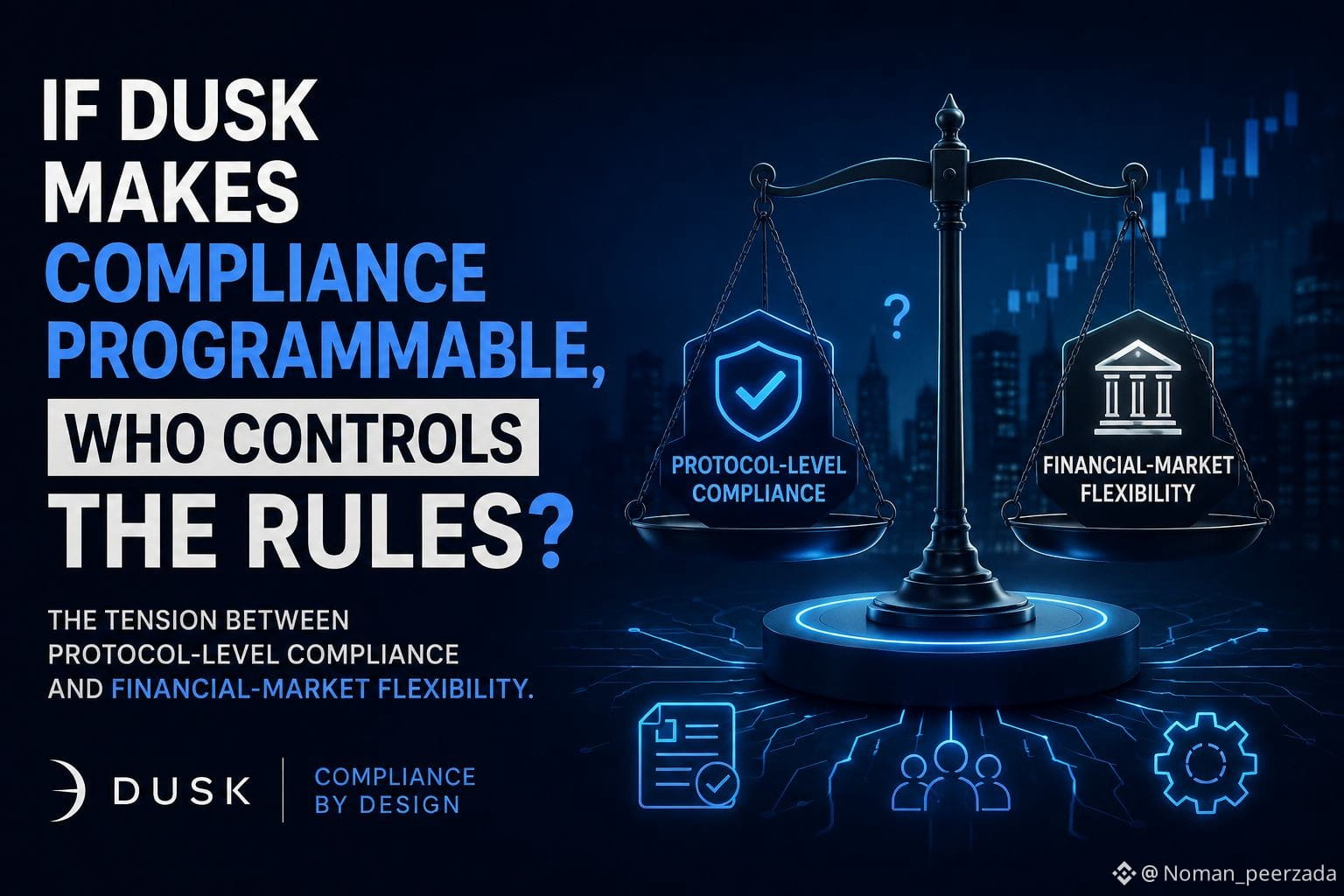
I keep coming back to one awkward part of Dusk: if compliance becomes programmable, who gets to decide when the rules change?
That sounds small until you look at an actual regulated market.
Dusk is pushing selective disclosure and controlled transfers, which makes sense for securities. But financial markets are not static. Investor eligibility can change. Jurisdictions change. Issuers change requirements. A rule that works for 10,000 investors today might become a problem when the market reaches 100,000.
The friction I noticed is that protocol-level compliance can make enforcement cleaner, but it can also make flexibility harder.
If a transfer is blocked by code, there is no “let’s handle this case manually” button unless the market has designed that escape route beforehand.
That creates an interesting tradeoff.
Too little enforcement and regulated assets become difficult to trust.
Too much enforcement and the protocol starts deciding how the market behaves.
Dusk’s selective disclosure model is interesting because it tries to avoid exposing everything while still proving the right conditions. But that only moves the question one level deeper: who controls the policies behind those conditions?
The issuer?
The regulated venue?
A compliance operator?
Or the protocol itself?
I’d rather see the rules remain adjustable without making the chain itself politically or commercially rigid.
Because once compliance is code, changing a rule is no longer just changing a document...
@Dusk_Foundation #dusk $DUSK
{spot}(DUSKUSDT)
I keep coming back to one awkward part of Dusk: if compliance becomes programmable, who gets to decide when the rules change?
That sounds small until you look at an actual regulated market.
Dusk is pushing selective disclosure and controlled transfers, which makes sense for securities. But financial markets are not static. Investor eligibility can change. Jurisdictions change. Issuers change requirements. A rule that works for 10,000 investors today might become a problem when the market reaches 100,000.
The friction I noticed is that protocol-level compliance can make enforcement cleaner, but it can also make flexibility harder.
If a transfer is blocked by code, there is no “let’s handle this case manually” button unless the market has designed that escape route beforehand.
That creates an interesting tradeoff.
Too little enforcement and regulated assets become difficult to trust.
Too much enforcement and the protocol starts deciding how the market behaves.
Dusk’s selective disclosure model is interesting because it tries to avoid exposing everything while still proving the right conditions. But that only moves the question one level deeper: who controls the policies behind those conditions?
The issuer?
The regulated venue?
A compliance operator?
Or the protocol itself?
I’d rather see the rules remain adjustable without making the chain itself politically or commercially rigid.
Because once compliance is code, changing a rule is no longer just changing a document...
@Dusk #dusk $DUSK
That sounds small until you look at an actual regulated market.
Dusk is pushing selective disclosure and controlled transfers, which makes sense for securities. But financial markets are not static. Investor eligibility can change. Jurisdictions change. Issuers change requirements. A rule that works for 10,000 investors today might become a problem when the market reaches 100,000.
The friction I noticed is that protocol-level compliance can make enforcement cleaner, but it can also make flexibility harder.
If a transfer is blocked by code, there is no “let’s handle this case manually” button unless the market has designed that escape route beforehand.
That creates an interesting tradeoff.
Too little enforcement and regulated assets become difficult to trust.
Too much enforcement and the protocol starts deciding how the market behaves.
Dusk’s selective disclosure model is interesting because it tries to avoid exposing everything while still proving the right conditions. But that only moves the question one level deeper: who controls the policies behind those conditions?
The issuer?
The regulated venue?
A compliance operator?
Or the protocol itself?
I’d rather see the rules remain adjustable without making the chain itself politically or commercially rigid.
Because once compliance is code, changing a rule is no longer just changing a document...
@Dusk #dusk $DUSK
8
11
607
When I look at Dusk’s ~10-second finality, the interesting part isn’t speed for its own sake.
For securities, the real question is what happens after a trade.
I tested the idea with a small 30D $DUSK position:
30D trade $DUSK500.3 USDT
A buyer gets an asset. A seller expects payment. Custody, settlement, reporting and compliance workflows start depending on the transaction actually being final.
Waiting 10 seconds for deterministic settlement is very different from waiting through probabilistic confirmation and then building extra logic around the possibility of a reorg.
That sounds like a small infrastructure detail until you think about a market handling hundreds or thousands of transactions.
A meme can survive a few extra blocks.
A securities workflow has more dependencies. If settlement is uncertain, the uncertainty can leak into reconciliation, collateral availability and when the next transaction can safely happen.
This is where Dusk’s timing starts to make more sense to me.
Not because “10 seconds” looks impressive on a benchmark.
Because a predictable settlement point gives financial systems something they can actually schedule around.
The mild frustration is that faster finality alone doesn’t create a functioning securities market. The asset still needs liquidity, counterparties and real demand.
But if those pieces arrive, having to wait around for settlement certainty could become one of those infrastructure problems nobody wants to think about anymore...
What matters more for onchain securities?
@Dusk_Foundation #dusk $DUSK $DEXE
When I look at Dusk’s ~10-second finality, the interesting part isn’t speed for its own sake.
For securities, the real question is what happens after a trade.
I tested the idea with a small 30D $DUSK position:
30D trade $DUSK500.3 USDT
A buyer gets an asset. A seller expects payment. Custody, settlement, reporting and compliance workflows start depending on the transaction actually being final.
Waiting 10 seconds for deterministic settlement is very different from waiting through probabilistic confirmation and then building extra logic around the possibility of a reorg.
That sounds like a small infrastructure detail until you think about a market handling hundreds or thousands of transactions.
A meme can survive a few extra blocks.
A securities workflow has more dependencies. If settlement is uncertain, the uncertainty can leak into reconciliation, collateral availability and when the next transaction can safely happen.
This is where Dusk’s timing starts to make more sense to me.
Not because “10 seconds” looks impressive on a benchmark.
Because a predictable settlement point gives financial systems something they can actually schedule around.
The mild frustration is that faster finality alone doesn’t create a functioning securities market. The asset still needs liquidity, counterparties and real demand.
But if those pieces arrive, having to wait around for settlement certainty could become one of those infrastructure problems nobody wants to think about anymore...
What matters more for onchain securities?
@Dusk #dusk $DUSK $DEXE
For securities, the real question is what happens after a trade.
I tested the idea with a small 30D $DUSK position:
30D trade $DUSK500.3 USDT
A buyer gets an asset. A seller expects payment. Custody, settlement, reporting and compliance workflows start depending on the transaction actually being final.
Waiting 10 seconds for deterministic settlement is very different from waiting through probabilistic confirmation and then building extra logic around the possibility of a reorg.
That sounds like a small infrastructure detail until you think about a market handling hundreds or thousands of transactions.
A meme can survive a few extra blocks.
A securities workflow has more dependencies. If settlement is uncertain, the uncertainty can leak into reconciliation, collateral availability and when the next transaction can safely happen.
This is where Dusk’s timing starts to make more sense to me.
Not because “10 seconds” looks impressive on a benchmark.
Because a predictable settlement point gives financial systems something they can actually schedule around.
The mild frustration is that faster finality alone doesn’t create a functioning securities market. The asset still needs liquidity, counterparties and real demand.
But if those pieces arrive, having to wait around for settlement certainty could become one of those infrastructure problems nobody wants to think about anymore...
What matters more for onchain securities?
@Dusk #dusk $DUSK $DEXE
10-sec deterministic finality
80%
Deep market liquidity
20%
5 votes • Voting closed
15
18
1.1k
The Dusk + 21X connection makes more sense when you stop looking at the token and look at where it can actually trade.
Dusk onboarded with 21X as a trade participant, with the initial focus on stablecoin treasury investment in tokenized money market funds. 21X operates under the EU DLT-TSS framework, combining trading and settlement in the same regulated infrastructure.
That part caught my attention.
A regulated security can be issued onchain, but if secondary trading still happens through fragmented rails, the token hasn't really solved the market problem. It has mostly moved the certificate.
21X is interesting because the venue itself is regulated, while Dusk is working on the underlying asset and settlement workflows. Dusk currently shows ~10s deterministic finality and €300M+ in confirmed issuance with institutions. The practical question for me is liquidity.
Having a licensed venue is one thing. Getting enough buyers and sellers to consistently meet there is another. A regulated market with 20 tokenized securities but thin order flow would still feel pretty empty.
So I’m less interested in how many assets can be put onchain.
I want to see whether Dusk + 21X can make one regulated asset trade repeatedly, settle cleanly, and bring participants back for the next transaction. That’s where this starts getting real...
What matters most for regulated digital securities?
@Dusk_Foundation #dusk $DUSK
The Dusk + 21X connection makes more sense when you stop looking at the token and look at where it can actually trade.
Dusk onboarded with 21X as a trade participant, with the initial focus on stablecoin treasury investment in tokenized money market funds. 21X operates under the EU DLT-TSS framework, combining trading and settlement in the same regulated infrastructure.
That part caught my attention.
A regulated security can be issued onchain, but if secondary trading still happens through fragmented rails, the token hasn't really solved the market problem. It has mostly moved the certificate.
21X is interesting because the venue itself is regulated, while Dusk is working on the underlying asset and settlement workflows. Dusk currently shows ~10s deterministic finality and €300M+ in confirmed issuance with institutions. The practical question for me is liquidity.
Having a licensed venue is one thing. Getting enough buyers and sellers to consistently meet there is another. A regulated market with 20 tokenized securities but thin order flow would still feel pretty empty.
So I’m less interested in how many assets can be put onchain.
I want to see whether Dusk + 21X can make one regulated asset trade repeatedly, settle cleanly, and bring participants back for the next transaction. That’s where this starts getting real...
What matters most for regulated digital securities?
@Dusk #dusk $DUSK
Dusk onboarded with 21X as a trade participant, with the initial focus on stablecoin treasury investment in tokenized money market funds. 21X operates under the EU DLT-TSS framework, combining trading and settlement in the same regulated infrastructure.
That part caught my attention.
A regulated security can be issued onchain, but if secondary trading still happens through fragmented rails, the token hasn't really solved the market problem. It has mostly moved the certificate.
21X is interesting because the venue itself is regulated, while Dusk is working on the underlying asset and settlement workflows. Dusk currently shows ~10s deterministic finality and €300M+ in confirmed issuance with institutions. The practical question for me is liquidity.
Having a licensed venue is one thing. Getting enough buyers and sellers to consistently meet there is another. A regulated market with 20 tokenized securities but thin order flow would still feel pretty empty.
So I’m less interested in how many assets can be put onchain.
I want to see whether Dusk + 21X can make one regulated asset trade repeatedly, settle cleanly, and bring participants back for the next transaction. That’s where this starts getting real...
What matters most for regulated digital securities?
@Dusk #dusk $DUSK
🏦 Regulated trading venues
50%
💧 Deep secondary liquidity
50%
2 votes • Voting closed
23
23
624
The interesting part of Dusk Trade isn’t another RWA token showing up.
It’s whether the asset actually gets used after onboarding.
The flow I keep watching is pretty simple: wallet binding, controlled transfers, then settlement. That creates a different test for RWAs. A token can launch with a nice number attached to it, but if nobody is actually trading or settling it, the market is mostly cosmetic.
Dusk is aiming at the harder part here. Not just putting regulated assets onchain, but creating somewhere they can actually change hands.
That makes activity more useful to watch than token count.
If Dusk Trade starts showing repeat users, meaningful transfer volume, and actual settlement activity, it becomes harder to dismiss the whole RWA category as token launches with thin liquidity.
But there’s a catch.
Even a market with 100 assets can feel dead if only a handful of participants keep touching them. And regulated assets probably won’t get the same speculative churn as crypto-native tokens.
So I’d rather see 1 market with consistent activity than 1,000 RWA tokens sitting untouched.
That’s probably the uncomfortable metric for Dusk Trade too. If the assets are there but the trading isn’t, the infrastructure has proved less than people think...
What proves an RWA is a real market?
@Dusk_Foundation #dusk $DUSK
The interesting part of Dusk Trade isn’t another RWA token showing up.
It’s whether the asset actually gets used after onboarding.
The flow I keep watching is pretty simple: wallet binding, controlled transfers, then settlement. That creates a different test for RWAs. A token can launch with a nice number attached to it, but if nobody is actually trading or settling it, the market is mostly cosmetic.
Dusk is aiming at the harder part here. Not just putting regulated assets onchain, but creating somewhere they can actually change hands.
That makes activity more useful to watch than token count.
If Dusk Trade starts showing repeat users, meaningful transfer volume, and actual settlement activity, it becomes harder to dismiss the whole RWA category as token launches with thin liquidity.
But there’s a catch.
Even a market with 100 assets can feel dead if only a handful of participants keep touching them. And regulated assets probably won’t get the same speculative churn as crypto-native tokens.
So I’d rather see 1 market with consistent activity than 1,000 RWA tokens sitting untouched.
That’s probably the uncomfortable metric for Dusk Trade too. If the assets are there but the trading isn’t, the infrastructure has proved less than people think...
What proves an RWA is a real market?
@Dusk #dusk $DUSK
It’s whether the asset actually gets used after onboarding.
The flow I keep watching is pretty simple: wallet binding, controlled transfers, then settlement. That creates a different test for RWAs. A token can launch with a nice number attached to it, but if nobody is actually trading or settling it, the market is mostly cosmetic.
Dusk is aiming at the harder part here. Not just putting regulated assets onchain, but creating somewhere they can actually change hands.
That makes activity more useful to watch than token count.
If Dusk Trade starts showing repeat users, meaningful transfer volume, and actual settlement activity, it becomes harder to dismiss the whole RWA category as token launches with thin liquidity.
But there’s a catch.
Even a market with 100 assets can feel dead if only a handful of participants keep touching them. And regulated assets probably won’t get the same speculative churn as crypto-native tokens.
So I’d rather see 1 market with consistent activity than 1,000 RWA tokens sitting untouched.
That’s probably the uncomfortable metric for Dusk Trade too. If the assets are there but the trading isn’t, the infrastructure has proved less than people think...
What proves an RWA is a real market?
@Dusk #dusk $DUSK
🔄 Consistent trading
0%
💰 Settlement volume
0%
👥 Repeat users
0%
🪙 More token launches
100%
3 votes • Voting closed
4
8
490
Verified
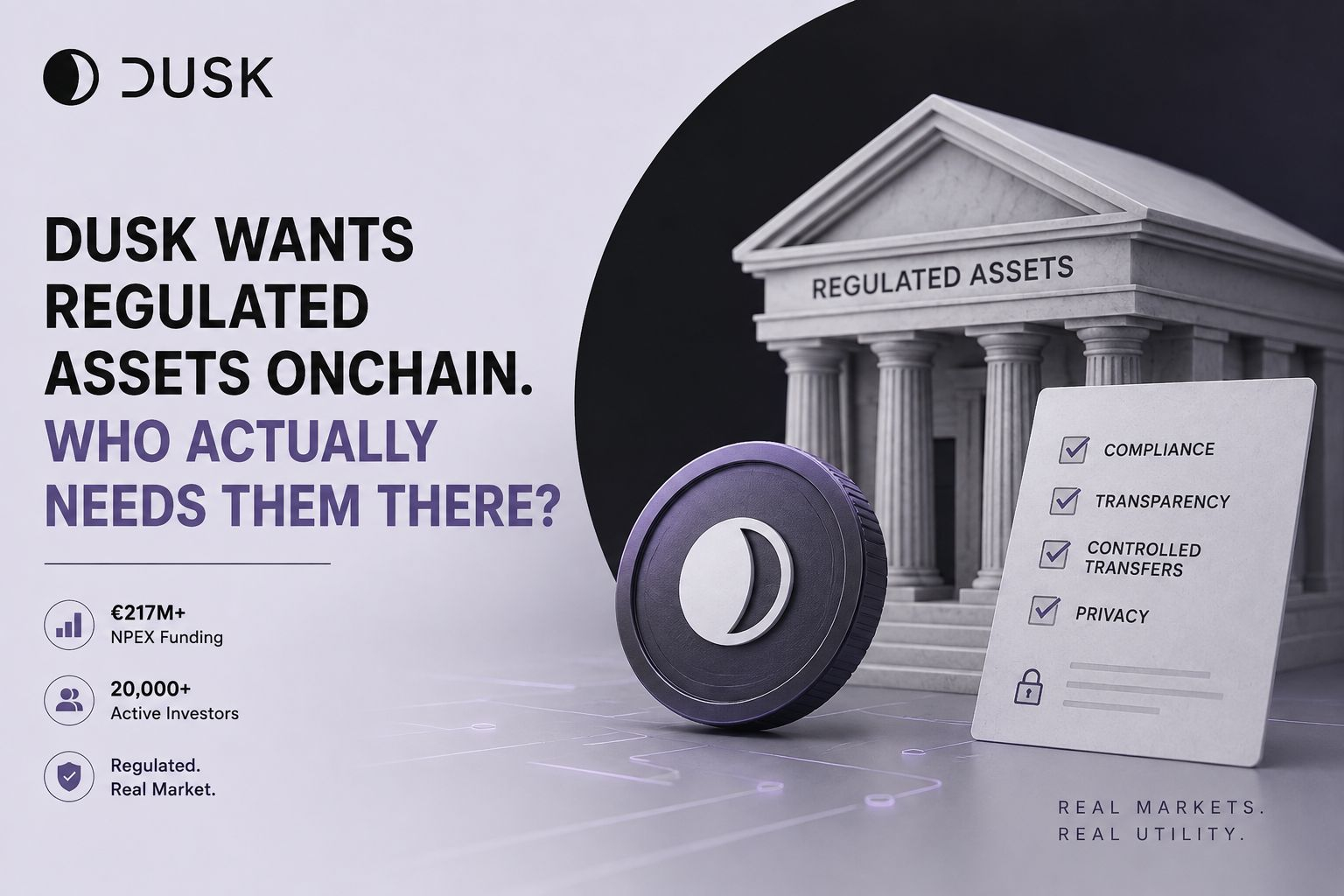
Dusk wants regulated assets onchain. Who actually needs them there?
I keep coming back to the same question when looking at Dusk: putting regulated assets onchain only matters if someone has a reason to use them there.
NPEX is a useful reality check. The Dutch platform operates under AFM supervision, has reported more than €217M in funding and over 20,000 active investors. That is already a real market, not just an RWA pitch.
So the interesting part for Dusk isn't whether another regulated asset can be issued onchain.
It's whether an issuer, investor, or market operator gets something materially better by moving the workflow there.
For an investor, that could mean controlled transfers without exposing every transaction detail.
For an issuer, maybe settlement becomes easier across a wider investor base.
But there's a practical friction I can't ignore: regulated markets don't move simply because the underlying technology is cleaner.
The existing rails already work well enough for many participants.
Dusk therefore needs a stronger answer than "regulated assets belong onchain."
It needs to show where the current process is expensive, slow, fragmented, or unnecessarily opaque, and whether Dusk actually removes that friction.
Otherwise, we may just get regulated assets sitting onchain because they can...
not because anyone really needed them there.
@Dusk_Foundation #dusk $DUSK
Dusk wants regulated assets onchain. Who actually needs them there?
I keep coming back to the same question when looking at Dusk: putting regulated assets onchain only matters if someone has a reason to use them there.
NPEX is a useful reality check. The Dutch platform operates under AFM supervision, has reported more than €217M in funding and over 20,000 active investors. That is already a real market, not just an RWA pitch.
So the interesting part for Dusk isn't whether another regulated asset can be issued onchain.
It's whether an issuer, investor, or market operator gets something materially better by moving the workflow there.
For an investor, that could mean controlled transfers without exposing every transaction detail.
For an issuer, maybe settlement becomes easier across a wider investor base.
But there's a practical friction I can't ignore: regulated markets don't move simply because the underlying technology is cleaner.
The existing rails already work well enough for many participants.
Dusk therefore needs a stronger answer than "regulated assets belong onchain."
It needs to show where the current process is expensive, slow, fragmented, or unnecessarily opaque, and whether Dusk actually removes that friction.
Otherwise, we may just get regulated assets sitting onchain because they can...
not because anyone really needed them there.
@Dusk #dusk $DUSK
I keep coming back to the same question when looking at Dusk: putting regulated assets onchain only matters if someone has a reason to use them there.
NPEX is a useful reality check. The Dutch platform operates under AFM supervision, has reported more than €217M in funding and over 20,000 active investors. That is already a real market, not just an RWA pitch.
So the interesting part for Dusk isn't whether another regulated asset can be issued onchain.
It's whether an issuer, investor, or market operator gets something materially better by moving the workflow there.
For an investor, that could mean controlled transfers without exposing every transaction detail.
For an issuer, maybe settlement becomes easier across a wider investor base.
But there's a practical friction I can't ignore: regulated markets don't move simply because the underlying technology is cleaner.
The existing rails already work well enough for many participants.
Dusk therefore needs a stronger answer than "regulated assets belong onchain."
It needs to show where the current process is expensive, slow, fragmented, or unnecessarily opaque, and whether Dusk actually removes that friction.
Otherwise, we may just get regulated assets sitting onchain because they can...
not because anyone really needed them there.
@Dusk #dusk $DUSK
43
40
644
The more I look at Dusk, the less I care about TVL as the main signal.
TVL can show that capital is sitting there. It doesn’t tell me whether assets are actually moving, settling, or generating repeat activity.
For Dusk, I’d rather watch settlement volume.
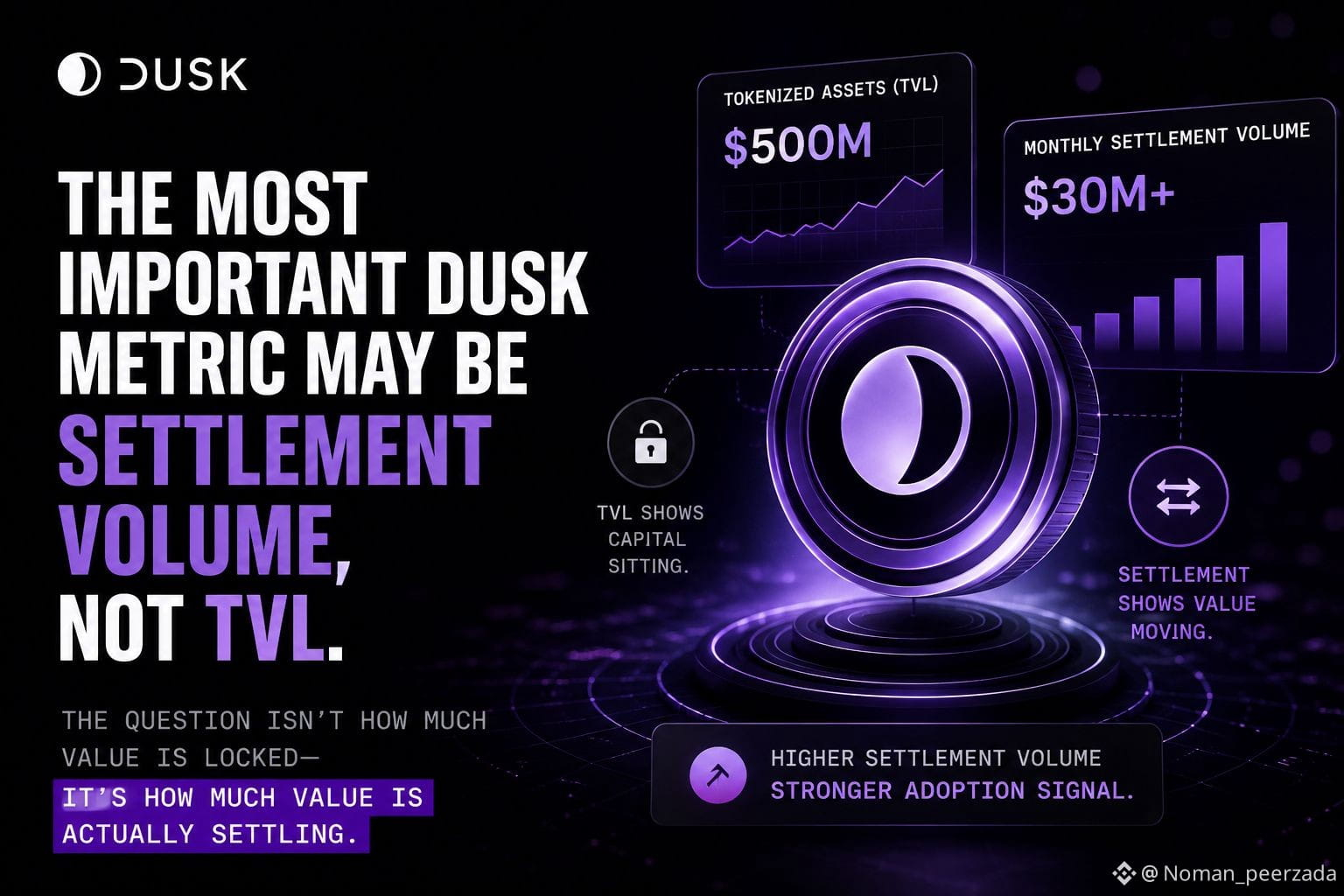
Say Dusk shows $500M in tokenized assets but only $8M of monthly settlement. That would make me pause. The headline asset value looks good, but the market underneath it may still be quiet.
Flip that around: $150M of assets with $30M+ in recurring settlement volume would be much more interesting to me.
The ratio matters too.
If settlement volume keeps rising while TVL stays relatively flat, that could mean the existing assets are actually being used more often. That feels like a stronger adoption signal than another large issuance announcement.
This is also where Dusk Trade becomes interesting to watch.
I’d want to see whether activity turns into repeated transactions rather than one-off issuance events.
The frustrating part is that settlement data is usually less visible than TVL, so it’s harder to track consistently.
But if Dusk is trying to build financial markets, I’m increasingly thinking the question isn’t “how much value is locked?”
It’s “how much value is actually settling?”
What matters more for Dusk adoption?
@Dusk_Foundation #dusk $DUSK
{spot}(DUSKUSDT)
The more I look at Dusk, the less I care about TVL as the main signal.
TVL can show that capital is sitting there. It doesn’t tell me whether assets are actually moving, settling, or generating repeat activity.
For Dusk, I’d rather watch settlement volume.
Say Dusk shows $500M in tokenized assets but only $8M of monthly settlement. That would make me pause. The headline asset value looks good, but the market underneath it may still be quiet.
Flip that around: $150M of assets with $30M+ in recurring settlement volume would be much more interesting to me.
The ratio matters too.
If settlement volume keeps rising while TVL stays relatively flat, that could mean the existing assets are actually being used more often. That feels like a stronger adoption signal than another large issuance announcement.
This is also where Dusk Trade becomes interesting to watch.
I’d want to see whether activity turns into repeated transactions rather than one-off issuance events.
The frustrating part is that settlement data is usually less visible than TVL, so it’s harder to track consistently.
But if Dusk is trying to build financial markets, I’m increasingly thinking the question isn’t “how much value is locked?”
It’s “how much value is actually settling?”
What matters more for Dusk adoption?
@Dusk #dusk $DUSK
TVL can show that capital is sitting there. It doesn’t tell me whether assets are actually moving, settling, or generating repeat activity.
For Dusk, I’d rather watch settlement volume.
Say Dusk shows $500M in tokenized assets but only $8M of monthly settlement. That would make me pause. The headline asset value looks good, but the market underneath it may still be quiet.
Flip that around: $150M of assets with $30M+ in recurring settlement volume would be much more interesting to me.
The ratio matters too.
If settlement volume keeps rising while TVL stays relatively flat, that could mean the existing assets are actually being used more often. That feels like a stronger adoption signal than another large issuance announcement.
This is also where Dusk Trade becomes interesting to watch.
I’d want to see whether activity turns into repeated transactions rather than one-off issuance events.
The frustrating part is that settlement data is usually less visible than TVL, so it’s harder to track consistently.
But if Dusk is trying to build financial markets, I’m increasingly thinking the question isn’t “how much value is locked?”
It’s “how much value is actually settling?”
What matters more for Dusk adoption?
@Dusk #dusk $DUSK
Settlement volume
25%
TVL
50%
Active users
25%
Transaction frequency
0%
4 votes • Voting closed
57
40
1.1k
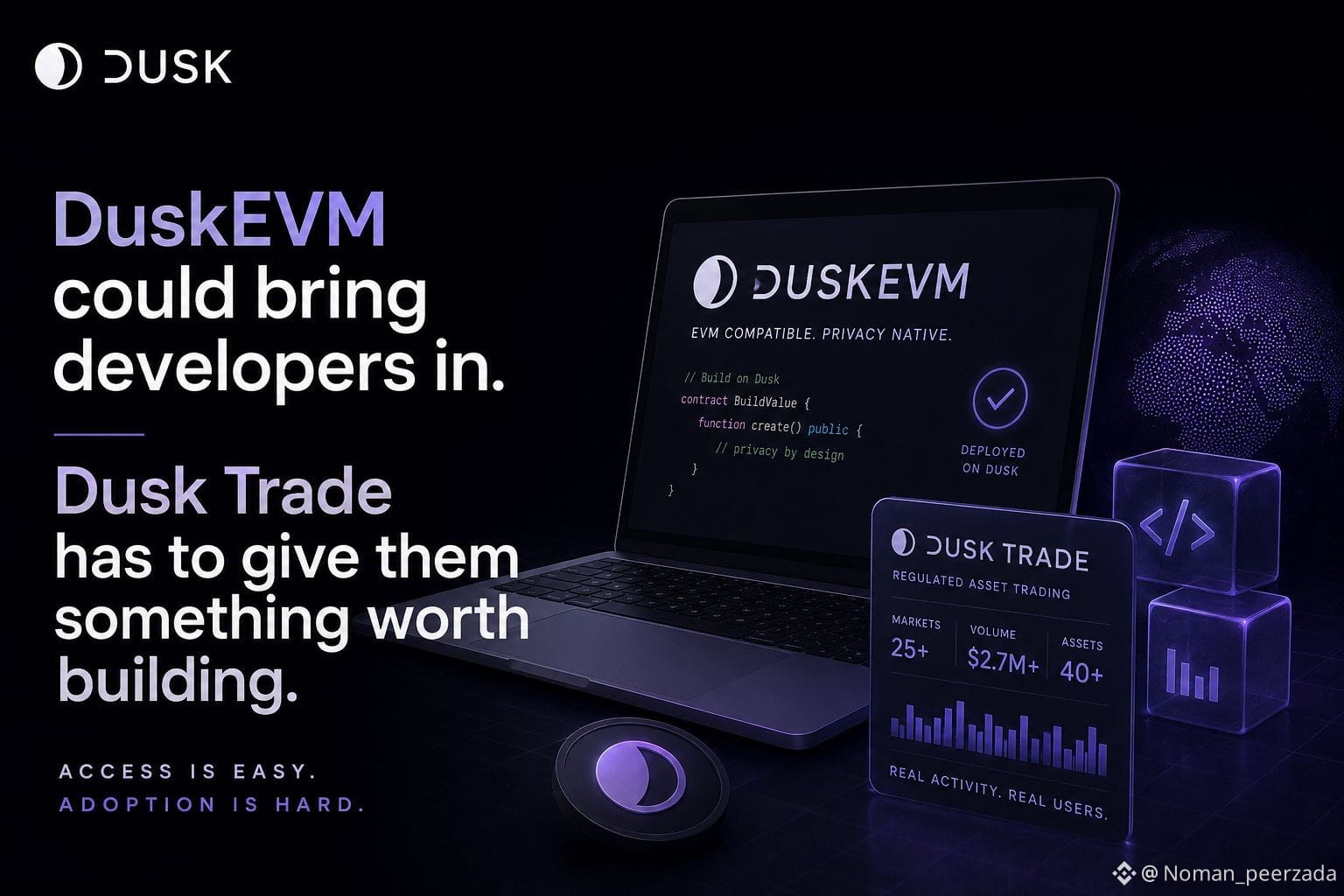
DuskEVM makes the first part of the developer problem easier.
If you already know Solidity and the usual EVM tooling, the barrier to trying Dusk is much lower now. That matters. But getting someone to deploy a contract is very different from getting them to keep building.
This is where Dusk Trade becomes interesting to me.
The question isn’t whether developers can build on Dusk. It’s whether Dusk Trade gives them a reason to spend their next 3 months building there instead of shipping somewhere with deeper liquidity and more obvious user demand.
The product already has a practical angle around regulated asset trading, but developers need more than infrastructure access. They need activity to build around.
If a developer launches a trading interface, automation tool, analytics product, or settlement workflow, what pulls users into it?
That’s the part I’m watching after the DuskEVM launch.
EVM compatibility can reduce the cost of entering Dusk.
It doesn’t automatically create the demand that keeps developers there.
Dusk Trade may end up being the test. Not of whether Dusk can attract developers, but whether it can give those developers enough real market activity to make building feel worth the opportunity cost...
@Dusk_Foundation #dusk $DUSK $DEXE
DuskEVM makes the first part of the developer problem easier.
If you already know Solidity and the usual EVM tooling, the barrier to trying Dusk is much lower now. That matters. But getting someone to deploy a contract is very different from getting them to keep building.
This is where Dusk Trade becomes interesting to me.
The question isn’t whether developers can build on Dusk. It’s whether Dusk Trade gives them a reason to spend their next 3 months building there instead of shipping somewhere with deeper liquidity and more obvious user demand.
The product already has a practical angle around regulated asset trading, but developers need more than infrastructure access. They need activity to build around.
If a developer launches a trading interface, automation tool, analytics product, or settlement workflow, what pulls users into it?
That’s the part I’m watching after the DuskEVM launch.
EVM compatibility can reduce the cost of entering Dusk.
It doesn’t automatically create the demand that keeps developers there.
Dusk Trade may end up being the test. Not of whether Dusk can attract developers, but whether it can give those developers enough real market activity to make building feel worth the opportunity cost...
@Dusk #dusk $DUSK $DEXE
If you already know Solidity and the usual EVM tooling, the barrier to trying Dusk is much lower now. That matters. But getting someone to deploy a contract is very different from getting them to keep building.
This is where Dusk Trade becomes interesting to me.
The question isn’t whether developers can build on Dusk. It’s whether Dusk Trade gives them a reason to spend their next 3 months building there instead of shipping somewhere with deeper liquidity and more obvious user demand.
The product already has a practical angle around regulated asset trading, but developers need more than infrastructure access. They need activity to build around.
If a developer launches a trading interface, automation tool, analytics product, or settlement workflow, what pulls users into it?
That’s the part I’m watching after the DuskEVM launch.
EVM compatibility can reduce the cost of entering Dusk.
It doesn’t automatically create the demand that keeps developers there.
Dusk Trade may end up being the test. Not of whether Dusk can attract developers, but whether it can give those developers enough real market activity to make building feel worth the opportunity cost...
@Dusk #dusk $DUSK $DEXE
34
26
2.4k
Verified
RWA hype keeps pushing the exciting part: tokenized assets, bigger markets, more liquidity.
What I keep noticing with Dusk is how much attention goes into the boring part instead.
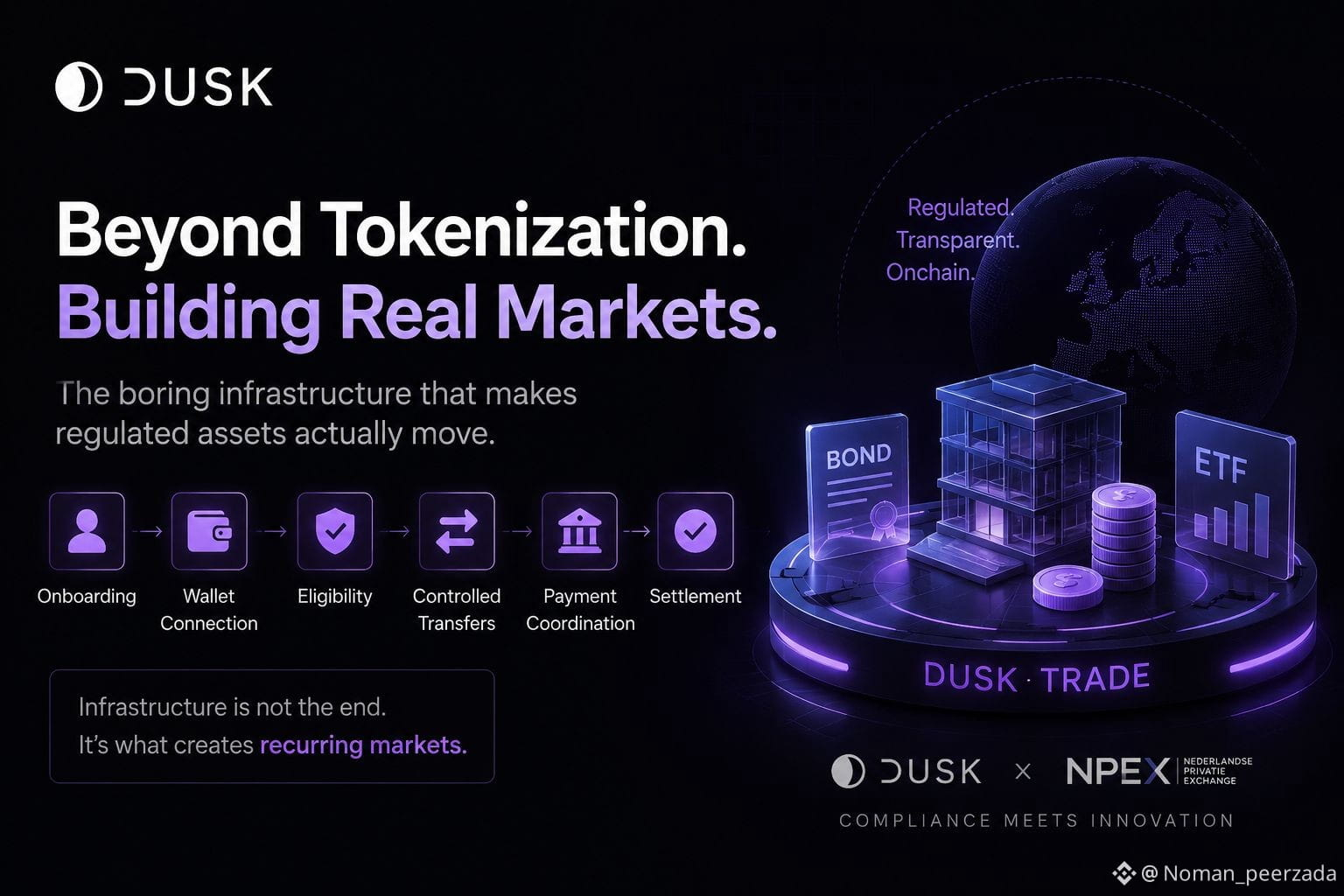
I spent some time looking through Dusk Trade, and the workflow is where the real friction shows up: onboarding, wallet connection, eligibility, controlled transfers, payment coordination, then settlement.
That sounds less interesting than launching another RWA token.
But maybe that is exactly the point.
Dusk has been working with NPEX, a Dutch regulated stock exchange operating under an MTF license, since 2020. The focus is not just putting securities onchain. It is making the actual transaction process work around regulated assets.
The number I care about isn't how many assets can technically be tokenized.
It's how many actually move through the full workflow.
1 asset issued is a demo.
100 assets sitting untouched is still mostly a demo.
Repeated trading and settlement is different.
That is where Dusk becomes interesting to me. The infrastructure matters, but only if it produces recurring market activity instead of another collection of tokenized assets waiting for a use case.
The uncomfortable question is whether the boring infrastructure can create enough real transaction flow to matter.
That part is still the one I’m watching.
@Dusk_Foundation #dusk $DUSK $DEXE
RWA hype keeps pushing the exciting part: tokenized assets, bigger markets, more liquidity.
What I keep noticing with Dusk is how much attention goes into the boring part instead.
I spent some time looking through Dusk Trade, and the workflow is where the real friction shows up: onboarding, wallet connection, eligibility, controlled transfers, payment coordination, then settlement.
That sounds less interesting than launching another RWA token.
But maybe that is exactly the point.
Dusk has been working with NPEX, a Dutch regulated stock exchange operating under an MTF license, since 2020. The focus is not just putting securities onchain. It is making the actual transaction process work around regulated assets.
The number I care about isn't how many assets can technically be tokenized.
It's how many actually move through the full workflow.
1 asset issued is a demo.
100 assets sitting untouched is still mostly a demo.
Repeated trading and settlement is different.
That is where Dusk becomes interesting to me. The infrastructure matters, but only if it produces recurring market activity instead of another collection of tokenized assets waiting for a use case.
The uncomfortable question is whether the boring infrastructure can create enough real transaction flow to matter.
That part is still the one I’m watching.
@Dusk #dusk $DUSK $DEXE
What I keep noticing with Dusk is how much attention goes into the boring part instead.
I spent some time looking through Dusk Trade, and the workflow is where the real friction shows up: onboarding, wallet connection, eligibility, controlled transfers, payment coordination, then settlement.
That sounds less interesting than launching another RWA token.
But maybe that is exactly the point.
Dusk has been working with NPEX, a Dutch regulated stock exchange operating under an MTF license, since 2020. The focus is not just putting securities onchain. It is making the actual transaction process work around regulated assets.
The number I care about isn't how many assets can technically be tokenized.
It's how many actually move through the full workflow.
1 asset issued is a demo.
100 assets sitting untouched is still mostly a demo.
Repeated trading and settlement is different.
That is where Dusk becomes interesting to me. The infrastructure matters, but only if it produces recurring market activity instead of another collection of tokenized assets waiting for a use case.
The uncomfortable question is whether the boring infrastructure can create enough real transaction flow to matter.
That part is still the one I’m watching.
@Dusk #dusk $DUSK $DEXE
192
101
8.6k
Partly True
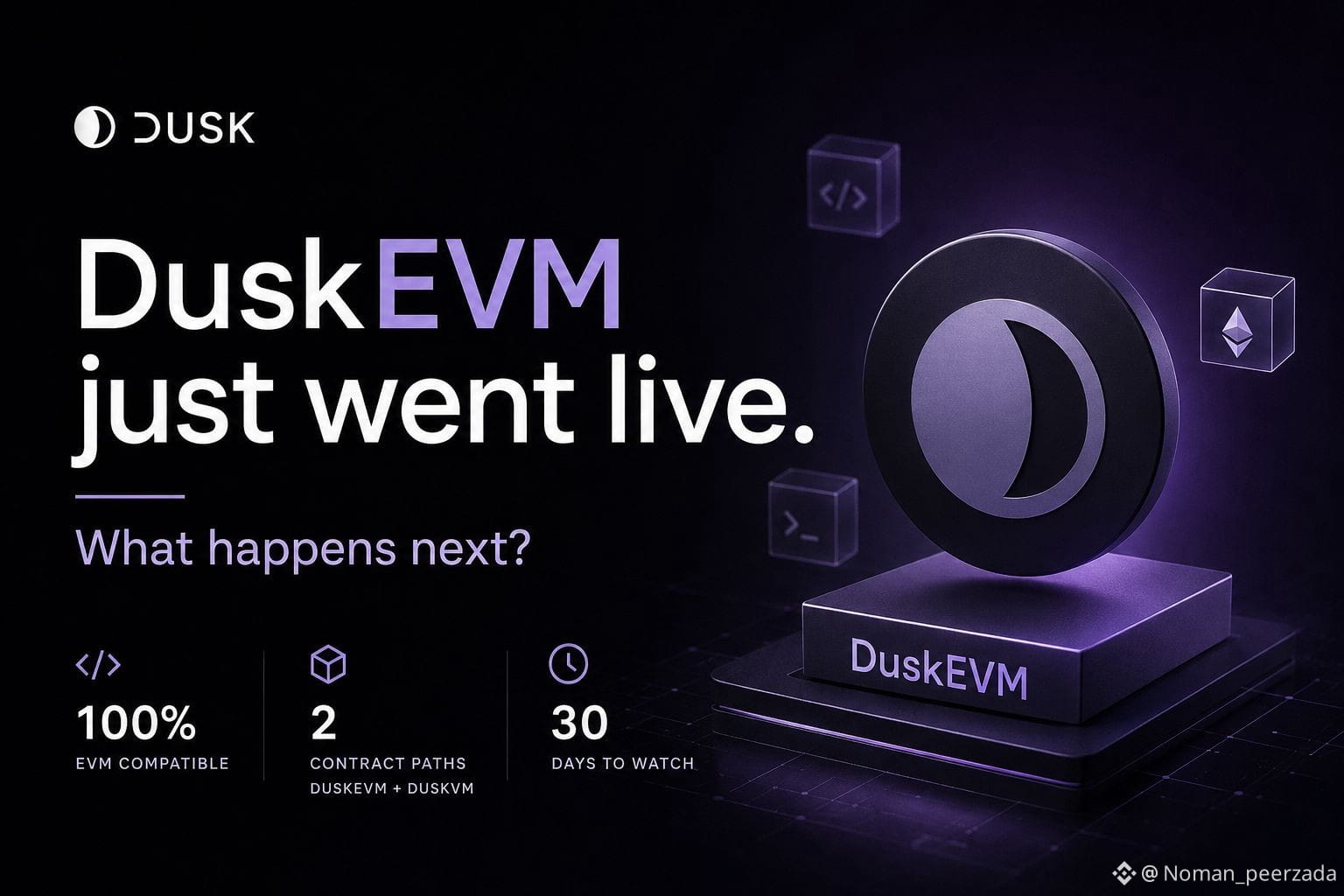
DuskEVM just went live, and the part I’m watching isn’t the launch itself.
It’s how quickly the first few developers actually move from “I can deploy here” to “I want to keep building here.”
I’ve been looking at the DuskEVM setup, and the obvious friction is much lower than Dusk’s native developer path. Solidity and Vyper are supported, and existing EVM tooling is supposed to carry over. That matters because asking developers to learn a new stack is one thing. Asking them to change their entire workflow is another.
But compatibility only gets you to the starting line.
Dusk already has 2 contract paths: DuskEVM and DuskVM. So now there’s a more practical question. If I’m a developer with an existing Solidity application, what makes me choose DuskEVM over the dozens of places where that same code can already run?
The answer probably won’t come from another feature announcement.
It’ll show up in actual deployments, wallet activity, contract interactions and whether developers come back after the first experiment.
Even the GitHub side is worth watching. The public DuskEVM genesis repo was updated on July 28, which shows the pieces have been moving into place, but launch-day activity is a different test.
Now I’m mostly curious about the first 30 days, because that’s when “EVM-compatible” either becomes useful or starts sounding like...
@Dusk_Foundation #dusk $DUSK $DEXE
DuskEVM just went live, and the part I’m watching isn’t the launch itself.
It’s how quickly the first few developers actually move from “I can deploy here” to “I want to keep building here.”
I’ve been looking at the DuskEVM setup, and the obvious friction is much lower than Dusk’s native developer path. Solidity and Vyper are supported, and existing EVM tooling is supposed to carry over. That matters because asking developers to learn a new stack is one thing. Asking them to change their entire workflow is another.
But compatibility only gets you to the starting line.
Dusk already has 2 contract paths: DuskEVM and DuskVM. So now there’s a more practical question. If I’m a developer with an existing Solidity application, what makes me choose DuskEVM over the dozens of places where that same code can already run?
The answer probably won’t come from another feature announcement.
It’ll show up in actual deployments, wallet activity, contract interactions and whether developers come back after the first experiment.
Even the GitHub side is worth watching. The public DuskEVM genesis repo was updated on July 28, which shows the pieces have been moving into place, but launch-day activity is a different test.
Now I’m mostly curious about the first 30 days, because that’s when “EVM-compatible” either becomes useful or starts sounding like...
@Dusk #dusk $DUSK $DEXE
It’s how quickly the first few developers actually move from “I can deploy here” to “I want to keep building here.”
I’ve been looking at the DuskEVM setup, and the obvious friction is much lower than Dusk’s native developer path. Solidity and Vyper are supported, and existing EVM tooling is supposed to carry over. That matters because asking developers to learn a new stack is one thing. Asking them to change their entire workflow is another.
But compatibility only gets you to the starting line.
Dusk already has 2 contract paths: DuskEVM and DuskVM. So now there’s a more practical question. If I’m a developer with an existing Solidity application, what makes me choose DuskEVM over the dozens of places where that same code can already run?
The answer probably won’t come from another feature announcement.
It’ll show up in actual deployments, wallet activity, contract interactions and whether developers come back after the first experiment.
Even the GitHub side is worth watching. The public DuskEVM genesis repo was updated on July 28, which shows the pieces have been moving into place, but launch-day activity is a different test.
Now I’m mostly curious about the first 30 days, because that’s when “EVM-compatible” either becomes useful or starts sounding like...
@Dusk #dusk $DUSK $DEXE
213
106
764
Verified
The part I found interesting wasn’t the token itself. It was what happened when I followed the asset from one wallet to the next.
That’s where Dusk Trade starts to feel different from a typical RWA marketplace.
With Securitize, the workflow is already built around investor onboarding, wallet registration and regulated secondary trading. The infrastructure is more mature, with more than $1B in tokenized assets reported on its platform.
Dusk Trade feels more focused on what happens between those steps.
You onboard, bind the wallet, and then transfers are subject to the right controls before settlement. It makes the wallet feel less like a destination and more like part of the investor’s permissions.
That small detail changed how I looked at the product.
Issuing an RWA token is one thing. Making sure the asset can actually move between eligible participants without breaking the compliance logic is another.
Dusk seems to be putting more attention on that second problem.
But this is where I’m still unsure.
A controlled transfer workflow can make the market safer and cleaner, but it can also add friction. And secondary markets live or die on how much friction traders are willing to tolerate.
Securitize has the advantage of existing volume and a much longer operating history.
Dusk has the cleaner question in front of it: can this workflow turn regulated ownership into actual trading activity, not just technically valid transfers...
What matters most for an RWA marketplace?
@Dusk_Foundation #dusk $DUSK $SNDK
The part I found interesting wasn’t the token itself. It was what happened when I followed the asset from one wallet to the next.
That’s where Dusk Trade starts to feel different from a typical RWA marketplace.
With Securitize, the workflow is already built around investor onboarding, wallet registration and regulated secondary trading. The infrastructure is more mature, with more than $1B in tokenized assets reported on its platform.
Dusk Trade feels more focused on what happens between those steps.
You onboard, bind the wallet, and then transfers are subject to the right controls before settlement. It makes the wallet feel less like a destination and more like part of the investor’s permissions.
That small detail changed how I looked at the product.
Issuing an RWA token is one thing. Making sure the asset can actually move between eligible participants without breaking the compliance logic is another.
Dusk seems to be putting more attention on that second problem.
But this is where I’m still unsure.
A controlled transfer workflow can make the market safer and cleaner, but it can also add friction. And secondary markets live or die on how much friction traders are willing to tolerate.
Securitize has the advantage of existing volume and a much longer operating history.
Dusk has the cleaner question in front of it: can this workflow turn regulated ownership into actual trading activity, not just technically valid transfers...
What matters most for an RWA marketplace?
@Dusk #dusk $DUSK $SNDK
That’s where Dusk Trade starts to feel different from a typical RWA marketplace.
With Securitize, the workflow is already built around investor onboarding, wallet registration and regulated secondary trading. The infrastructure is more mature, with more than $1B in tokenized assets reported on its platform.
Dusk Trade feels more focused on what happens between those steps.
You onboard, bind the wallet, and then transfers are subject to the right controls before settlement. It makes the wallet feel less like a destination and more like part of the investor’s permissions.
That small detail changed how I looked at the product.
Issuing an RWA token is one thing. Making sure the asset can actually move between eligible participants without breaking the compliance logic is another.
Dusk seems to be putting more attention on that second problem.
But this is where I’m still unsure.
A controlled transfer workflow can make the market safer and cleaner, but it can also add friction. And secondary markets live or die on how much friction traders are willing to tolerate.
Securitize has the advantage of existing volume and a much longer operating history.
Dusk has the cleaner question in front of it: can this workflow turn regulated ownership into actual trading activity, not just technically valid transfers...
What matters most for an RWA marketplace?
@Dusk #dusk $DUSK $SNDK
Easy trading
67%
Compliance controls
25%
Fast settlement
0%
Real market activity
8%
12 votes • Voting closed
123
75
1.7k
Verified
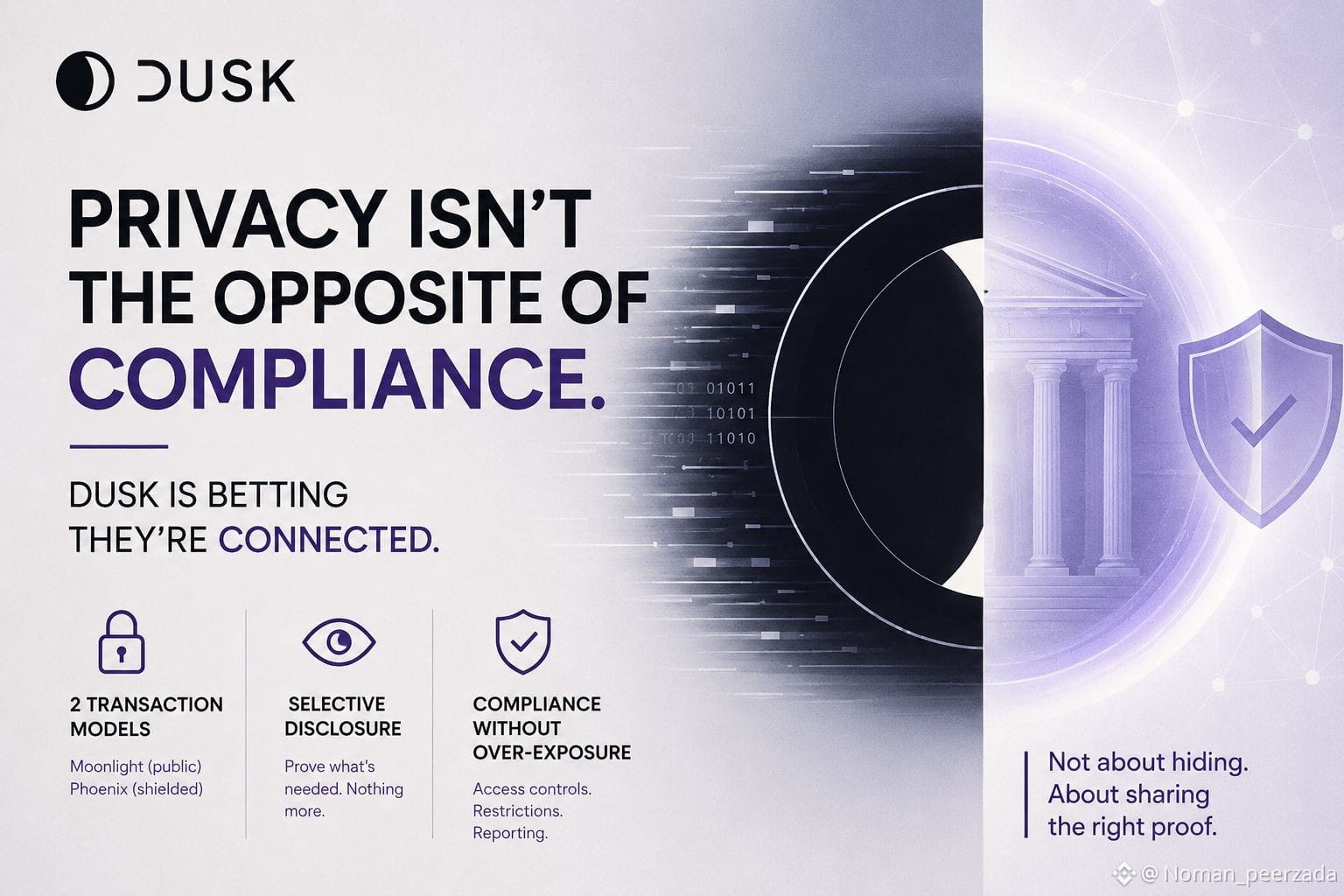
Privacy isn't the opposite of compliance. With Dusk, I'm starting to see why they might actually need each other.
The practical part is selective disclosure.
A regulated investor shouldn't have to expose every balance, transfer, or position just because a regulator or venue needs to verify one specific fact. Dusk's model is trying to separate those two things.
The interesting number for me is 2 transaction models: Moonlight for public flows and Phoenix for shielded transfers. Then there's selective disclosure on top, so the privacy isn't simply "hide everything."
That distinction matters.
If a venue needs proof that an investor is eligible, it shouldn't automatically need the investor's entire financial history. If an auditor needs evidence of a transaction, that shouldn't mean making every surrounding position public.
Dusk is also targeting regulated workflows where access controls, transfer restrictions and reporting sit alongside privacy. That's the part I find more interesting than the usual "private blockchain" pitch.
Still, there's a practical question I can't get past.
Selective disclosure sounds good on paper, but the real test is whether institutions can actually use it without adding another layer of operational friction. Privacy that makes compliance harder won't survive. Privacy that makes compliance more precise might...
@Dusk_Foundation #dusk $DUSK $DEXE
Privacy isn't the opposite of compliance. With Dusk, I'm starting to see why they might actually need each other.
The practical part is selective disclosure.
A regulated investor shouldn't have to expose every balance, transfer, or position just because a regulator or venue needs to verify one specific fact. Dusk's model is trying to separate those two things.
The interesting number for me is 2 transaction models: Moonlight for public flows and Phoenix for shielded transfers. Then there's selective disclosure on top, so the privacy isn't simply "hide everything."
That distinction matters.
If a venue needs proof that an investor is eligible, it shouldn't automatically need the investor's entire financial history. If an auditor needs evidence of a transaction, that shouldn't mean making every surrounding position public.
Dusk is also targeting regulated workflows where access controls, transfer restrictions and reporting sit alongside privacy. That's the part I find more interesting than the usual "private blockchain" pitch.
Still, there's a practical question I can't get past.
Selective disclosure sounds good on paper, but the real test is whether institutions can actually use it without adding another layer of operational friction. Privacy that makes compliance harder won't survive. Privacy that makes compliance more precise might...
@Dusk #dusk $DUSK $DEXE
The practical part is selective disclosure.
A regulated investor shouldn't have to expose every balance, transfer, or position just because a regulator or venue needs to verify one specific fact. Dusk's model is trying to separate those two things.
The interesting number for me is 2 transaction models: Moonlight for public flows and Phoenix for shielded transfers. Then there's selective disclosure on top, so the privacy isn't simply "hide everything."
That distinction matters.
If a venue needs proof that an investor is eligible, it shouldn't automatically need the investor's entire financial history. If an auditor needs evidence of a transaction, that shouldn't mean making every surrounding position public.
Dusk is also targeting regulated workflows where access controls, transfer restrictions and reporting sit alongside privacy. That's the part I find more interesting than the usual "private blockchain" pitch.
Still, there's a practical question I can't get past.
Selective disclosure sounds good on paper, but the real test is whether institutions can actually use it without adding another layer of operational friction. Privacy that makes compliance harder won't survive. Privacy that makes compliance more precise might...
@Dusk #dusk $DUSK $DEXE
163
67
5.5k
Verified
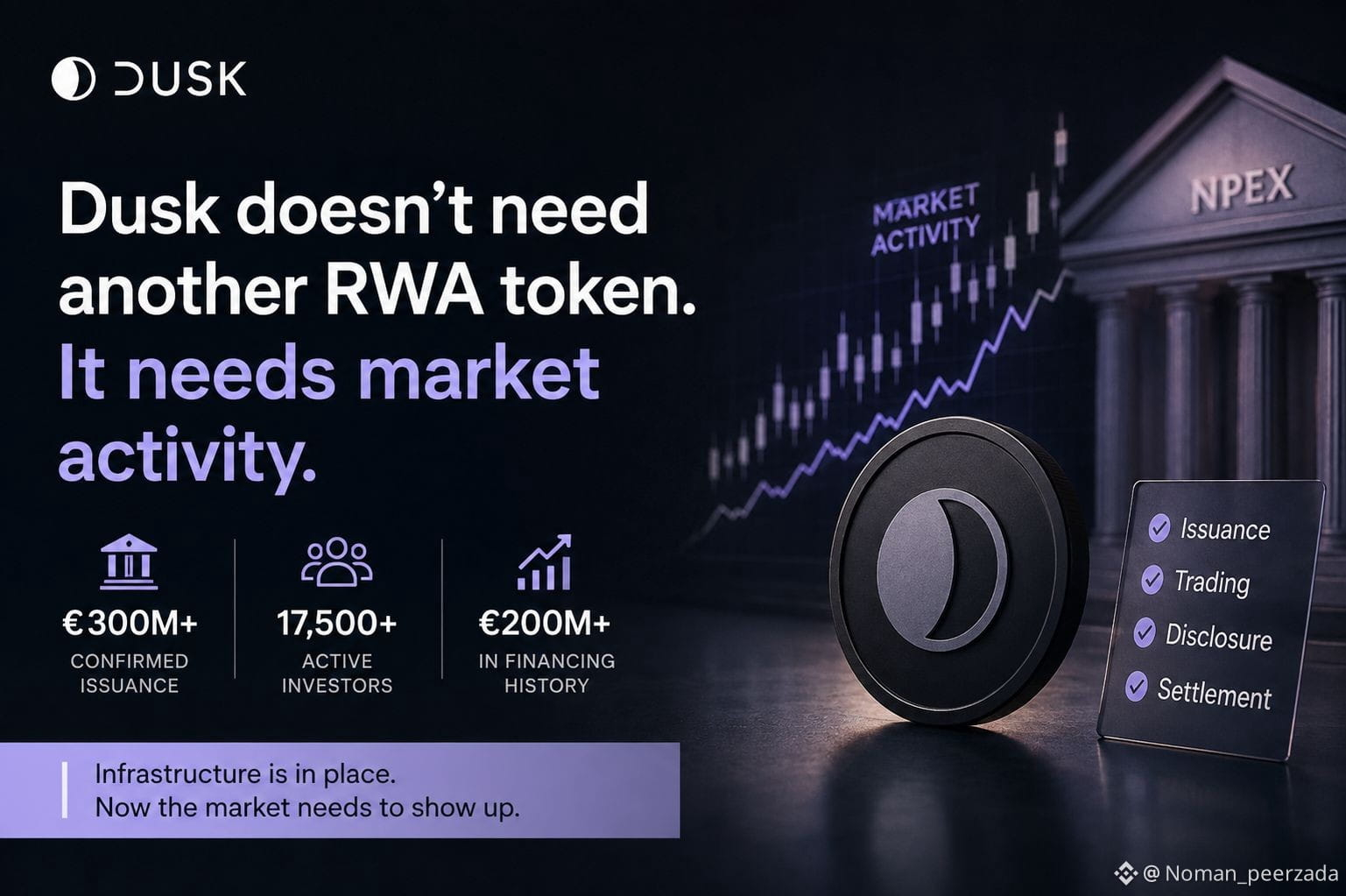
Dusk doesn’t need another RWA token. It needs market activity.
That’s the part I keep coming back to after looking through the NPEX side of the stack.
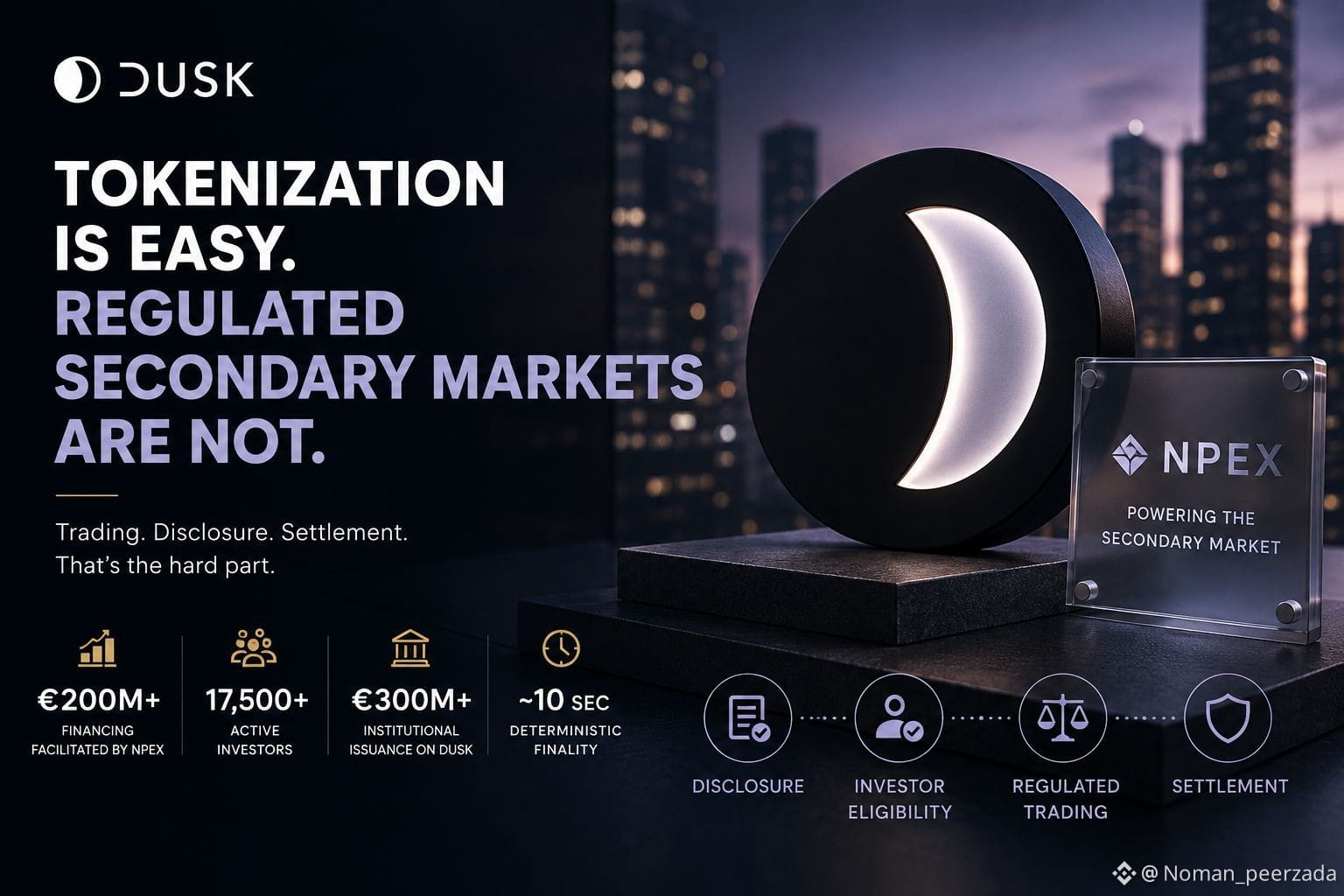
Dusk currently highlights €300M+ in confirmed issuance with institutions, while the NPEX relationship points to €200M+ in financing and 17,500+ active investors. Those numbers make the infrastructure story interesting.
But issuance is not the same as a market.
If an asset gets tokenized and then mostly sits there, the chain has proved that issuance can happen. It hasn’t proved that investors will actually return to buy, sell, rebalance, and discover prices.
That is why I’m more interested in Dusk’s secondary-market activity than another announcement about a new RWA.
The NPEX connection matters here because it gives Dusk something more concrete to work with: an existing regulated venue, existing issuers, and an investor base that already participates in financial markets. Dusk says the NPEX workflow is aimed at bringing issuance, trading, disclosure and settlement onchain.
The practical question is pretty simple.
Can those 17,500+ investors become recurring onchain market participants, rather than just an audience attached to tokenized securities?
€200M+ of historical financing is useful.
But I’d rather see consistent secondary-market volume than another €200M headline...
@Dusk_Foundation #dusk $DUSK $AKE
Dusk doesn’t need another RWA token. It needs market activity.
That’s the part I keep coming back to after looking through the NPEX side of the stack.
Dusk currently highlights €300M+ in confirmed issuance with institutions, while the NPEX relationship points to €200M+ in financing and 17,500+ active investors. Those numbers make the infrastructure story interesting.
But issuance is not the same as a market.
If an asset gets tokenized and then mostly sits there, the chain has proved that issuance can happen. It hasn’t proved that investors will actually return to buy, sell, rebalance, and discover prices.
That is why I’m more interested in Dusk’s secondary-market activity than another announcement about a new RWA.
The NPEX connection matters here because it gives Dusk something more concrete to work with: an existing regulated venue, existing issuers, and an investor base that already participates in financial markets. Dusk says the NPEX workflow is aimed at bringing issuance, trading, disclosure and settlement onchain.
The practical question is pretty simple.
Can those 17,500+ investors become recurring onchain market participants, rather than just an audience attached to tokenized securities?
€200M+ of historical financing is useful.
But I’d rather see consistent secondary-market volume than another €200M headline...
@Dusk #dusk $DUSK $AKE
That’s the part I keep coming back to after looking through the NPEX side of the stack.
Dusk currently highlights €300M+ in confirmed issuance with institutions, while the NPEX relationship points to €200M+ in financing and 17,500+ active investors. Those numbers make the infrastructure story interesting.
But issuance is not the same as a market.
If an asset gets tokenized and then mostly sits there, the chain has proved that issuance can happen. It hasn’t proved that investors will actually return to buy, sell, rebalance, and discover prices.
That is why I’m more interested in Dusk’s secondary-market activity than another announcement about a new RWA.
The NPEX connection matters here because it gives Dusk something more concrete to work with: an existing regulated venue, existing issuers, and an investor base that already participates in financial markets. Dusk says the NPEX workflow is aimed at bringing issuance, trading, disclosure and settlement onchain.
The practical question is pretty simple.
Can those 17,500+ investors become recurring onchain market participants, rather than just an audience attached to tokenized securities?
€200M+ of historical financing is useful.
But I’d rather see consistent secondary-market volume than another €200M headline...
@Dusk #dusk $DUSK $AKE
44
39
486
Partly True
I kept coming back to the NPEX part of Dusk because it changes what “tokenization” actually needs to prove.
NPEX has already facilitated more than €200M in financing and has 17,500+ active investors. So the interesting question isn't whether an asset can become a token. It's whether that token can actually move through a regulated secondary market without creating another pile of manual checks around it.
That is where Dusk's relationship with NPEX gets practical.
The proposed workflow connects trading, investor eligibility, disclosure and settlement instead of treating the token as the finished product. Dusk says selected tokenized RWAs that pass due diligence can become eligible for NPEX secondary-market listing.
I find the disclosure part particularly interesting.
A public blockchain can make ownership data easy to inspect, but regulated markets often need the opposite: prove something to the right party without exposing everything to everyone. Dusk is trying to make selective disclosure part of the transaction flow rather than an external reporting exercise.
The numbers make the test more concrete too: Dusk currently advertises €300M+ in confirmed institutional issuance and roughly 10-second deterministic finality.
Still, getting the settlement rail working is one thing. Getting enough compliant assets and actual buyers to make a secondary market useful is another problem entirely...
What’s the hardest part of bringing RWAs into regulated markets?
@Dusk_Foundation #dusk $DUSK $DEXE
I kept coming back to the NPEX part of Dusk because it changes what “tokenization” actually needs to prove.
NPEX has already facilitated more than €200M in financing and has 17,500+ active investors. So the interesting question isn't whether an asset can become a token. It's whether that token can actually move through a regulated secondary market without creating another pile of manual checks around it.
That is where Dusk's relationship with NPEX gets practical.
The proposed workflow connects trading, investor eligibility, disclosure and settlement instead of treating the token as the finished product. Dusk says selected tokenized RWAs that pass due diligence can become eligible for NPEX secondary-market listing.
I find the disclosure part particularly interesting.
A public blockchain can make ownership data easy to inspect, but regulated markets often need the opposite: prove something to the right party without exposing everything to everyone. Dusk is trying to make selective disclosure part of the transaction flow rather than an external reporting exercise.
The numbers make the test more concrete too: Dusk currently advertises €300M+ in confirmed institutional issuance and roughly 10-second deterministic finality.
Still, getting the settlement rail working is one thing. Getting enough compliant assets and actual buyers to make a secondary market useful is another problem entirely...
What’s the hardest part of bringing RWAs into regulated markets?
@Dusk #dusk $DUSK $DEXE
NPEX has already facilitated more than €200M in financing and has 17,500+ active investors. So the interesting question isn't whether an asset can become a token. It's whether that token can actually move through a regulated secondary market without creating another pile of manual checks around it.
That is where Dusk's relationship with NPEX gets practical.
The proposed workflow connects trading, investor eligibility, disclosure and settlement instead of treating the token as the finished product. Dusk says selected tokenized RWAs that pass due diligence can become eligible for NPEX secondary-market listing.
I find the disclosure part particularly interesting.
A public blockchain can make ownership data easy to inspect, but regulated markets often need the opposite: prove something to the right party without exposing everything to everyone. Dusk is trying to make selective disclosure part of the transaction flow rather than an external reporting exercise.
The numbers make the test more concrete too: Dusk currently advertises €300M+ in confirmed institutional issuance and roughly 10-second deterministic finality.
Still, getting the settlement rail working is one thing. Getting enough compliant assets and actual buyers to make a secondary market useful is another problem entirely...
What’s the hardest part of bringing RWAs into regulated markets?
@Dusk #dusk $DUSK $DEXE
Finding real buyers
67%
Investor eligibility
5%
Ongoing disclosure
17%
Settlement
11%
18 votes • Voting closed
125
62
8.1k
Verified
DuskEVM solved the part of Ethereum migration I expected to be annoying.
The harder question starts after deployment.
I tested the DuskEVM path, and the first experience is surprisingly familiar. Hardhat and Foundry work. Solidity contracts can be deployed. The mainnet chain ID is 744, while testnet uses 745.
That removes a lot of the initial friction I would normally expect when touching a new network.
But getting a contract onto Dusk is one thing. Deciding to keep building there is another.
If I already have an Ethereum workflow, I am not really asking whether Solidity works. I am asking whether Dusk gives me a reason to keep my application there after the first deployment.
That is where the interesting tension starts.
Familiar tooling gets me through the door. It does not automatically change where I want to build long term.
Would I maintain another environment, move users, and adjust my deployment habits just because the Solidity layer feels familiar?
Probably not.
There needs to be something beyond compatibility that makes staying worth the extra effort.
That is the part I would watch more closely than the EVM support itself.
Because lowering the migration cost can get developers to try Dusk.
It does not necessarily give them a reason to stay...
What makes developers stay?
@Dusk_Foundation #dusk $DUSK $SPCX
DuskEVM solved the part of Ethereum migration I expected to be annoying.
The harder question starts after deployment.
I tested the DuskEVM path, and the first experience is surprisingly familiar. Hardhat and Foundry work. Solidity contracts can be deployed. The mainnet chain ID is 744, while testnet uses 745.
That removes a lot of the initial friction I would normally expect when touching a new network.
But getting a contract onto Dusk is one thing. Deciding to keep building there is another.
If I already have an Ethereum workflow, I am not really asking whether Solidity works. I am asking whether Dusk gives me a reason to keep my application there after the first deployment.
That is where the interesting tension starts.
Familiar tooling gets me through the door. It does not automatically change where I want to build long term.
Would I maintain another environment, move users, and adjust my deployment habits just because the Solidity layer feels familiar?
Probably not.
There needs to be something beyond compatibility that makes staying worth the extra effort.
That is the part I would watch more closely than the EVM support itself.
Because lowering the migration cost can get developers to try Dusk.
It does not necessarily give them a reason to stay...
What makes developers stay?
@Dusk #dusk $DUSK $SPCX
The harder question starts after deployment.
I tested the DuskEVM path, and the first experience is surprisingly familiar. Hardhat and Foundry work. Solidity contracts can be deployed. The mainnet chain ID is 744, while testnet uses 745.
That removes a lot of the initial friction I would normally expect when touching a new network.
But getting a contract onto Dusk is one thing. Deciding to keep building there is another.
If I already have an Ethereum workflow, I am not really asking whether Solidity works. I am asking whether Dusk gives me a reason to keep my application there after the first deployment.
That is where the interesting tension starts.
Familiar tooling gets me through the door. It does not automatically change where I want to build long term.
Would I maintain another environment, move users, and adjust my deployment habits just because the Solidity layer feels familiar?
Probably not.
There needs to be something beyond compatibility that makes staying worth the extra effort.
That is the part I would watch more closely than the EVM support itself.
Because lowering the migration cost can get developers to try Dusk.
It does not necessarily give them a reason to stay...
What makes developers stay?
@Dusk #dusk $DUSK $SPCX
Better tools
84%
Lower costs
8%
More users
0%
Unique value
8%
13 votes • Voting closed
55
35
2.6k
Partly True
I spent more time looking at Babylon's Multi-Staking flow than I expected because I wanted to see whether it actually changed how I think about idle BTC, or if it was just another dashboard feature with a better name.
The interesting part wasn't staking itself. It was realizing that the same Bitcoin position doesn't necessarily have to secure only one network over its lifetime. That's a different direction from most Bitcoin infrastructure I've used, where capital usually ends up tied to a single destination until you unwind everything and start over.
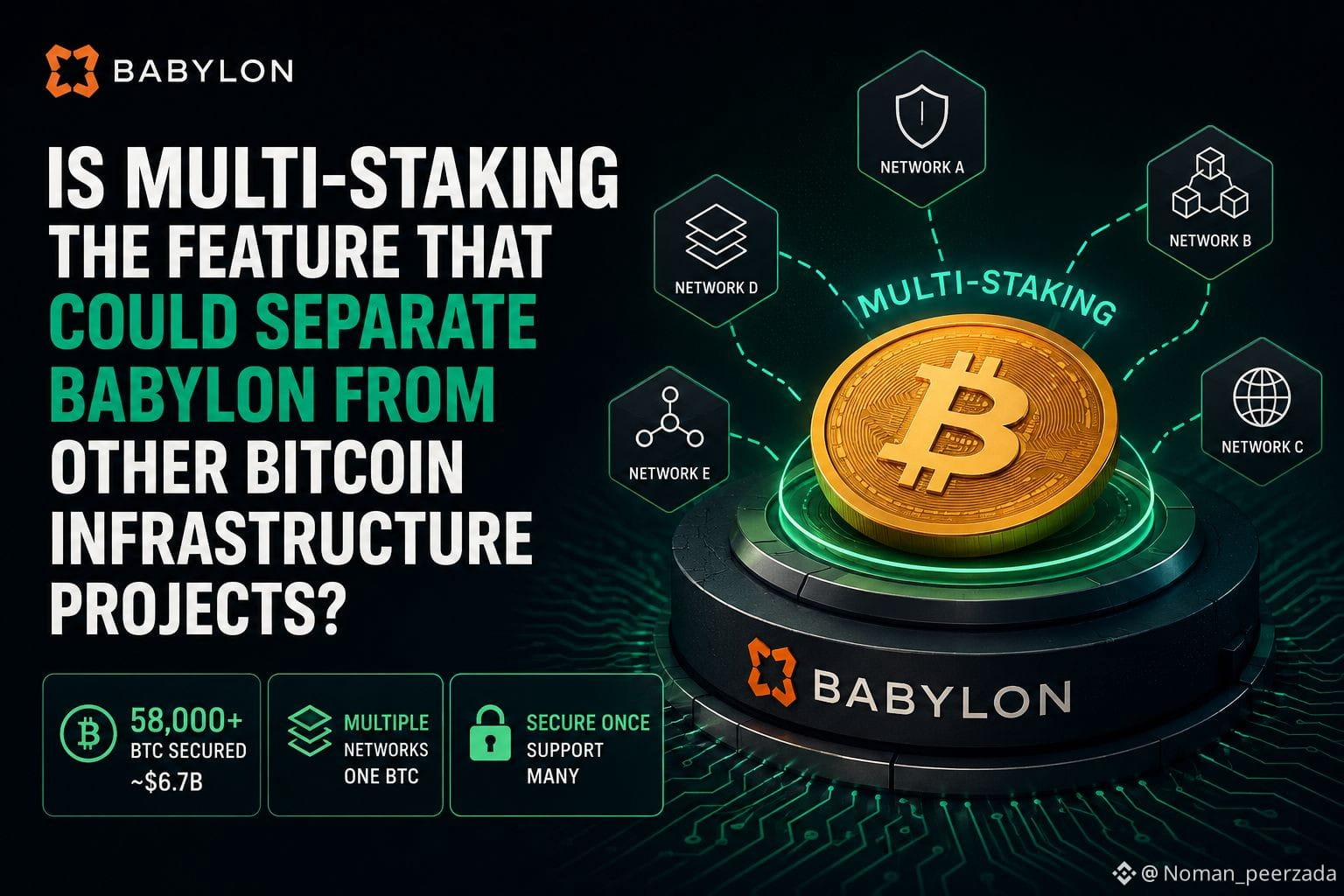
Babylon now secures more than 58,000 BTC, worth roughly $6.7 billion, across its staking infrastructure. That's already a meaningful amount of Bitcoin choosing security over simply sitting inactive. The question I kept coming back to was whether Multi-Staking makes that capital more useful without making it feel more complicated.
In practice, the extra flexibility sounds attractive. But flexibility also creates decisions. Which network deserves your security? Should you spread exposure or keep it concentrated? Every additional option adds another judgment call, and most long-term BTC holders aren't looking for more things to manage.
That's why I think Multi-Staking could end up being more important than another integration announcement. It isn't just adding another destination for Bitcoin. It's quietly changing how secured capital can be allocated over time.
I'm still not convinced the technical challenge is the hard part.
The harder part might be convincing people who are perfectly comfortable doing nothing with their Bitcoin to suddenly start making allocation decisions every few months.
Is Multi-Staking the feature that could separate Babylon?
@babylonlabs_io #baby $BABY $BLESS
I spent more time looking at Babylon's Multi-Staking flow than I expected because I wanted to see whether it actually changed how I think about idle BTC, or if it was just another dashboard feature with a better name.
The interesting part wasn't staking itself. It was realizing that the same Bitcoin position doesn't necessarily have to secure only one network over its lifetime. That's a different direction from most Bitcoin infrastructure I've used, where capital usually ends up tied to a single destination until you unwind everything and start over.
Babylon now secures more than 58,000 BTC, worth roughly $6.7 billion, across its staking infrastructure. That's already a meaningful amount of Bitcoin choosing security over simply sitting inactive. The question I kept coming back to was whether Multi-Staking makes that capital more useful without making it feel more complicated.
In practice, the extra flexibility sounds attractive. But flexibility also creates decisions. Which network deserves your security? Should you spread exposure or keep it concentrated? Every additional option adds another judgment call, and most long-term BTC holders aren't looking for more things to manage.
That's why I think Multi-Staking could end up being more important than another integration announcement. It isn't just adding another destination for Bitcoin. It's quietly changing how secured capital can be allocated over time.
I'm still not convinced the technical challenge is the hard part.
The harder part might be convincing people who are perfectly comfortable doing nothing with their Bitcoin to suddenly start making allocation decisions every few months.
Is Multi-Staking the feature that could separate Babylon?
@BabylonLabs_io #baby $BABY $BLESS
The interesting part wasn't staking itself. It was realizing that the same Bitcoin position doesn't necessarily have to secure only one network over its lifetime. That's a different direction from most Bitcoin infrastructure I've used, where capital usually ends up tied to a single destination until you unwind everything and start over.
Babylon now secures more than 58,000 BTC, worth roughly $6.7 billion, across its staking infrastructure. That's already a meaningful amount of Bitcoin choosing security over simply sitting inactive. The question I kept coming back to was whether Multi-Staking makes that capital more useful without making it feel more complicated.
In practice, the extra flexibility sounds attractive. But flexibility also creates decisions. Which network deserves your security? Should you spread exposure or keep it concentrated? Every additional option adds another judgment call, and most long-term BTC holders aren't looking for more things to manage.
That's why I think Multi-Staking could end up being more important than another integration announcement. It isn't just adding another destination for Bitcoin. It's quietly changing how secured capital can be allocated over time.
I'm still not convinced the technical challenge is the hard part.
The harder part might be convincing people who are perfectly comfortable doing nothing with their Bitcoin to suddenly start making allocation decisions every few months.
Is Multi-Staking the feature that could separate Babylon?
@BabylonLabs_io #baby $BABY $BLESS
Yes, it changes the game
100%
No, adoption matters more
0%
2 votes • Voting closed
155
64
1.8k
I caught myself thinking about the BABY token for the wrong reason.
Every time someone mentions a new exchange listing, the conversation immediately shifts to volume, liquidity, and price. After spending time in Babylon's Public Testnet, that stopped feeling like the important part.
The more interesting question became: what makes someone keep using BABY after they've already bought it?
While testing the Trustless Bitcoin Vault flow, I realized the borrowing experience doesn't end with locking BTC. The protocol keeps pulling you back into the network. Governance. Staking. Co-staking. Future vault activity. That's a very different type of demand than traders chasing the next listing.
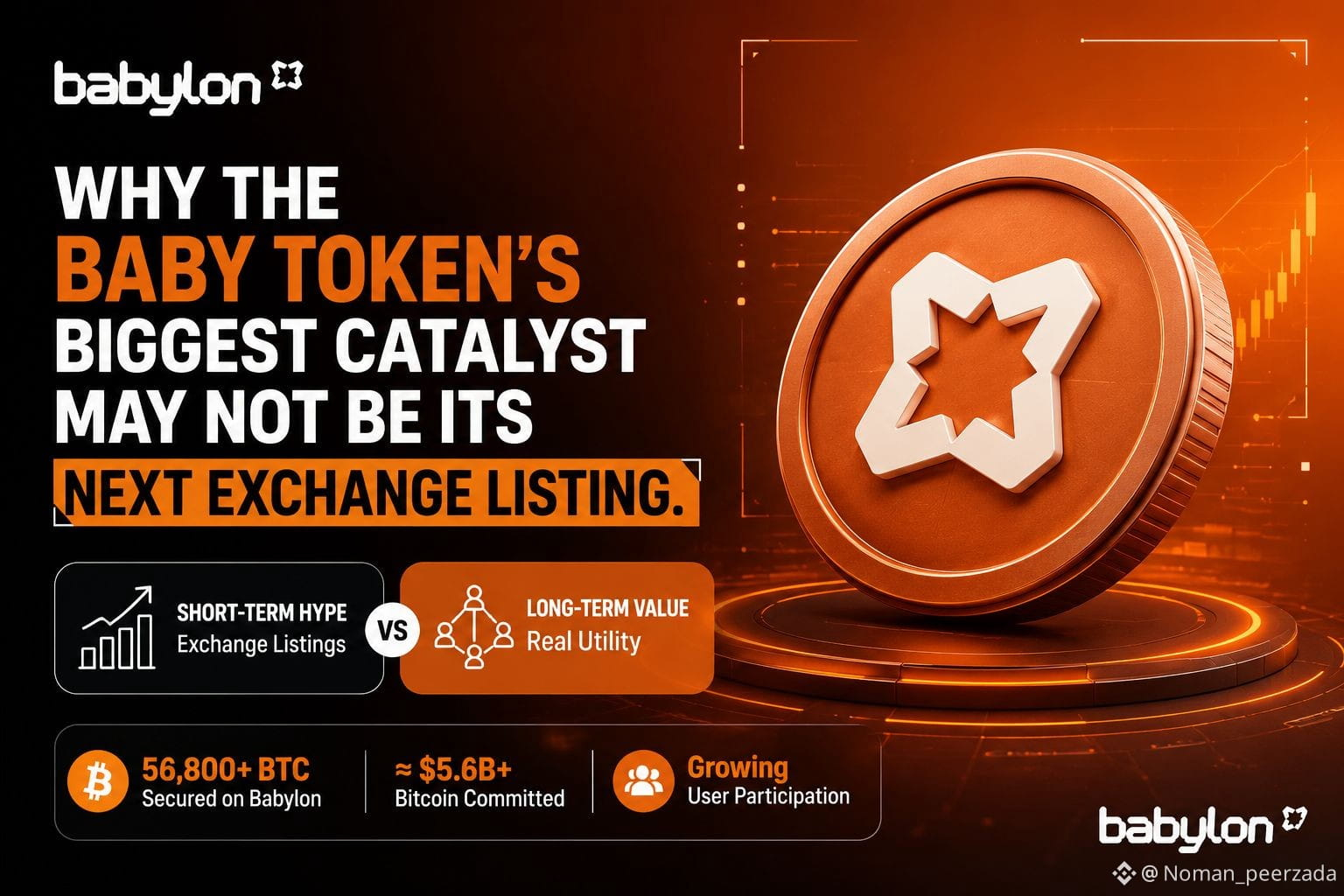
Babylon already secures around 56,800+ BTC, representing roughly $5.6B worth of Bitcoin committed to the protocol. That's a much bigger signal than another exchange logo appearing on a homepage. If even a small percentage of those users begin interacting with the broader BABY-powered functions instead of simply holding BTC, the token has an entirely different demand profile.
Maybe I'm underestimating how much listings still matter.
But listings mostly change who can buy.
Useful infrastructure changes who actually stays.
After trying the product, I find myself watching wallet activity and protocol participation more closely than I watch announcement calendars. If those usage numbers keep moving while everyone else is waiting for the next exchange headline, that might end up being the quieter catalyst people only notice after it's already happened
@babylonlabs_io #baby $BABY $DEXE
What's more likely to drive BABY's long-term value?
I caught myself thinking about the BABY token for the wrong reason.
Every time someone mentions a new exchange listing, the conversation immediately shifts to volume, liquidity, and price. After spending time in Babylon's Public Testnet, that stopped feeling like the important part.
The more interesting question became: what makes someone keep using BABY after they've already bought it?
While testing the Trustless Bitcoin Vault flow, I realized the borrowing experience doesn't end with locking BTC. The protocol keeps pulling you back into the network. Governance. Staking. Co-staking. Future vault activity. That's a very different type of demand than traders chasing the next listing.
Babylon already secures around 56,800+ BTC, representing roughly $5.6B worth of Bitcoin committed to the protocol. That's a much bigger signal than another exchange logo appearing on a homepage. If even a small percentage of those users begin interacting with the broader BABY-powered functions instead of simply holding BTC, the token has an entirely different demand profile.
Maybe I'm underestimating how much listings still matter.
But listings mostly change who can buy.
Useful infrastructure changes who actually stays.
After trying the product, I find myself watching wallet activity and protocol participation more closely than I watch announcement calendars. If those usage numbers keep moving while everyone else is waiting for the next exchange headline, that might end up being the quieter catalyst people only notice after it's already happened
@BabylonLabs_io #baby $BABY $DEXE
What's more likely to drive BABY's long-term value?
Every time someone mentions a new exchange listing, the conversation immediately shifts to volume, liquidity, and price. After spending time in Babylon's Public Testnet, that stopped feeling like the important part.
The more interesting question became: what makes someone keep using BABY after they've already bought it?
While testing the Trustless Bitcoin Vault flow, I realized the borrowing experience doesn't end with locking BTC. The protocol keeps pulling you back into the network. Governance. Staking. Co-staking. Future vault activity. That's a very different type of demand than traders chasing the next listing.
Babylon already secures around 56,800+ BTC, representing roughly $5.6B worth of Bitcoin committed to the protocol. That's a much bigger signal than another exchange logo appearing on a homepage. If even a small percentage of those users begin interacting with the broader BABY-powered functions instead of simply holding BTC, the token has an entirely different demand profile.
Maybe I'm underestimating how much listings still matter.
But listings mostly change who can buy.
Useful infrastructure changes who actually stays.
After trying the product, I find myself watching wallet activity and protocol participation more closely than I watch announcement calendars. If those usage numbers keep moving while everyone else is waiting for the next exchange headline, that might end up being the quieter catalyst people only notice after it's already happened
@BabylonLabs_io #baby $BABY $DEXE
What's more likely to drive BABY's long-term value?
Exchange listings
80%
Protocol usage
20%
5 votes • Voting closed
165
76
1.6k
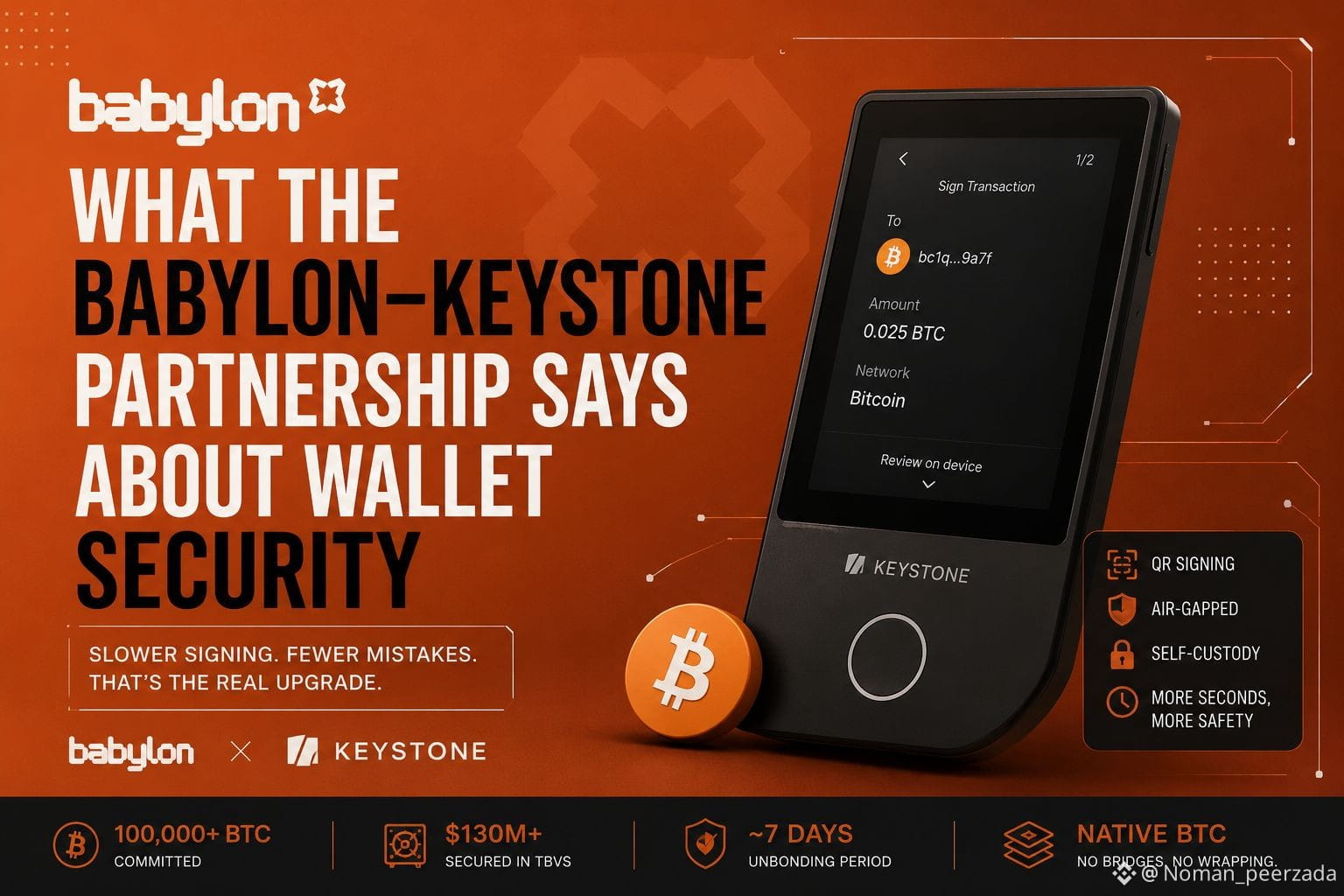
I spent more time looking at the signing flow than the borrowing flow, which probably says something about the Babylon–Keystone partnership.
The interesting part wasn't that Keystone is air-gapped. Plenty of hardware wallets already make that claim. What stood out was how much slower I became before approving anything. Scanning QR codes back and forth felt slightly annoying at first, but I noticed I was actually reading the transaction details instead of clicking through them.
That matters more now that Babylon lets Keystone be one of the supported Bitcoin wallets for native Bitcoin-backed borrowing through Aave v4 using Trustless Bitcoin Vaults. If borrowing against BTC is supposed to stay self-custodial, then the wallet experience can't encourage fast, blind approvals.
I used to think security mostly meant protecting private keys. After trying the flow, I'm starting to think the bigger risk is approving the wrong transaction while your keys remain perfectly safe.
It's a small distinction, but it changes how I look at hardware wallets.
Babylon isn't adding another wallet just to expand a compatibility list. It's choosing a signing experience that deliberately adds a few extra seconds before every approval. That sounds inefficient until you remember a single mistaken signature can cost a lot more than 10 or 20 seconds.
I still wonder how many people will keep that patience once borrowing becomes a routine habit instead of something they test once. That's probably the part worth watching, not whether the partnership announcement itself gets attention.
Does the Babylon × Keystone partnership make wallet security more practical?
@babylonlabs_io #baby $BABY $DEXE
I spent more time looking at the signing flow than the borrowing flow, which probably says something about the Babylon–Keystone partnership.
The interesting part wasn't that Keystone is air-gapped. Plenty of hardware wallets already make that claim. What stood out was how much slower I became before approving anything. Scanning QR codes back and forth felt slightly annoying at first, but I noticed I was actually reading the transaction details instead of clicking through them.
That matters more now that Babylon lets Keystone be one of the supported Bitcoin wallets for native Bitcoin-backed borrowing through Aave v4 using Trustless Bitcoin Vaults. If borrowing against BTC is supposed to stay self-custodial, then the wallet experience can't encourage fast, blind approvals.
I used to think security mostly meant protecting private keys. After trying the flow, I'm starting to think the bigger risk is approving the wrong transaction while your keys remain perfectly safe.
It's a small distinction, but it changes how I look at hardware wallets.
Babylon isn't adding another wallet just to expand a compatibility list. It's choosing a signing experience that deliberately adds a few extra seconds before every approval. That sounds inefficient until you remember a single mistaken signature can cost a lot more than 10 or 20 seconds.
I still wonder how many people will keep that patience once borrowing becomes a routine habit instead of something they test once. That's probably the part worth watching, not whether the partnership announcement itself gets attention.
Does the Babylon × Keystone partnership make wallet security more practical?
@BabylonLabs_io #baby $BABY $DEXE
The interesting part wasn't that Keystone is air-gapped. Plenty of hardware wallets already make that claim. What stood out was how much slower I became before approving anything. Scanning QR codes back and forth felt slightly annoying at first, but I noticed I was actually reading the transaction details instead of clicking through them.
That matters more now that Babylon lets Keystone be one of the supported Bitcoin wallets for native Bitcoin-backed borrowing through Aave v4 using Trustless Bitcoin Vaults. If borrowing against BTC is supposed to stay self-custodial, then the wallet experience can't encourage fast, blind approvals.
I used to think security mostly meant protecting private keys. After trying the flow, I'm starting to think the bigger risk is approving the wrong transaction while your keys remain perfectly safe.
It's a small distinction, but it changes how I look at hardware wallets.
Babylon isn't adding another wallet just to expand a compatibility list. It's choosing a signing experience that deliberately adds a few extra seconds before every approval. That sounds inefficient until you remember a single mistaken signature can cost a lot more than 10 or 20 seconds.
I still wonder how many people will keep that patience once borrowing becomes a routine habit instead of something they test once. That's probably the part worth watching, not whether the partnership announcement itself gets attention.
Does the Babylon × Keystone partnership make wallet security more practical?
@BabylonLabs_io #baby $BABY $DEXE
✅ Yes, safer signing
88%
❌ No, same security
12%
40 votes • Voting closed
175
83
12.9k
I expected the interesting part of Babylon's Trustless Bitcoin Vaults to be the borrowing. It ended up being the limitation instead.
The first thing that stood out wasn't that native BTC could back a loan through Aave V4. It was realizing the vault is created for a specific application. Once that position exists, it isn't something I can casually point somewhere else because another lending market suddenly offers better rates. That changes how I think about committing BTC in the first place.
Over 100,000 BTC has been cumulatively activated through Babylon's Bitcoin staking protocol, while roughly 51,000 BTC is currently staked, representing billions of dollars in Bitcoin already participating. That tells me the willingness to put BTC to work is growing. The question isn't whether people want to use their Bitcoin anymore. It's whether the infrastructure gives them enough flexibility after they've committed it.
That's where I keep hesitating.
Removing wrapping and custody assumptions is a meaningful improvement. I don't think that's the hard part anymore. The harder part is making native BTC feel genuinely liquid across multiple places instead of being tied to whichever destination looked best on day one.
Maybe that's an acceptable trade-off for stronger guarantees. Maybe that's simply how the first version has to work.
I just suspect the long-term conversation won't be about whether Bitcoin can reach DeFi liquidity.
It'll be about how freely that liquidity can move once the Bitcoin is already committed.
If Babylon connects native Bitcoin directly to DeFi liquidity, what's the biggest remaining challenge?
@babylonlabs_io #baby $BABY $BANK
{spot}(BABYUSDT)
I expected the interesting part of Babylon's Trustless Bitcoin Vaults to be the borrowing. It ended up being the limitation instead.
The first thing that stood out wasn't that native BTC could back a loan through Aave V4. It was realizing the vault is created for a specific application. Once that position exists, it isn't something I can casually point somewhere else because another lending market suddenly offers better rates. That changes how I think about committing BTC in the first place.
Over 100,000 BTC has been cumulatively activated through Babylon's Bitcoin staking protocol, while roughly 51,000 BTC is currently staked, representing billions of dollars in Bitcoin already participating. That tells me the willingness to put BTC to work is growing. The question isn't whether people want to use their Bitcoin anymore. It's whether the infrastructure gives them enough flexibility after they've committed it.
That's where I keep hesitating.
Removing wrapping and custody assumptions is a meaningful improvement. I don't think that's the hard part anymore. The harder part is making native BTC feel genuinely liquid across multiple places instead of being tied to whichever destination looked best on day one.
Maybe that's an acceptable trade-off for stronger guarantees. Maybe that's simply how the first version has to work.
I just suspect the long-term conversation won't be about whether Bitcoin can reach DeFi liquidity.
It'll be about how freely that liquidity can move once the Bitcoin is already committed.
If Babylon connects native Bitcoin directly to DeFi liquidity, what's the biggest remaining challenge?
@BabylonLabs_io #baby $BABY $BANK
The first thing that stood out wasn't that native BTC could back a loan through Aave V4. It was realizing the vault is created for a specific application. Once that position exists, it isn't something I can casually point somewhere else because another lending market suddenly offers better rates. That changes how I think about committing BTC in the first place.
Over 100,000 BTC has been cumulatively activated through Babylon's Bitcoin staking protocol, while roughly 51,000 BTC is currently staked, representing billions of dollars in Bitcoin already participating. That tells me the willingness to put BTC to work is growing. The question isn't whether people want to use their Bitcoin anymore. It's whether the infrastructure gives them enough flexibility after they've committed it.
That's where I keep hesitating.
Removing wrapping and custody assumptions is a meaningful improvement. I don't think that's the hard part anymore. The harder part is making native BTC feel genuinely liquid across multiple places instead of being tied to whichever destination looked best on day one.
Maybe that's an acceptable trade-off for stronger guarantees. Maybe that's simply how the first version has to work.
I just suspect the long-term conversation won't be about whether Bitcoin can reach DeFi liquidity.
It'll be about how freely that liquidity can move once the Bitcoin is already committed.
If Babylon connects native Bitcoin directly to DeFi liquidity, what's the biggest remaining challenge?
@BabylonLabs_io #baby $BABY $BANK
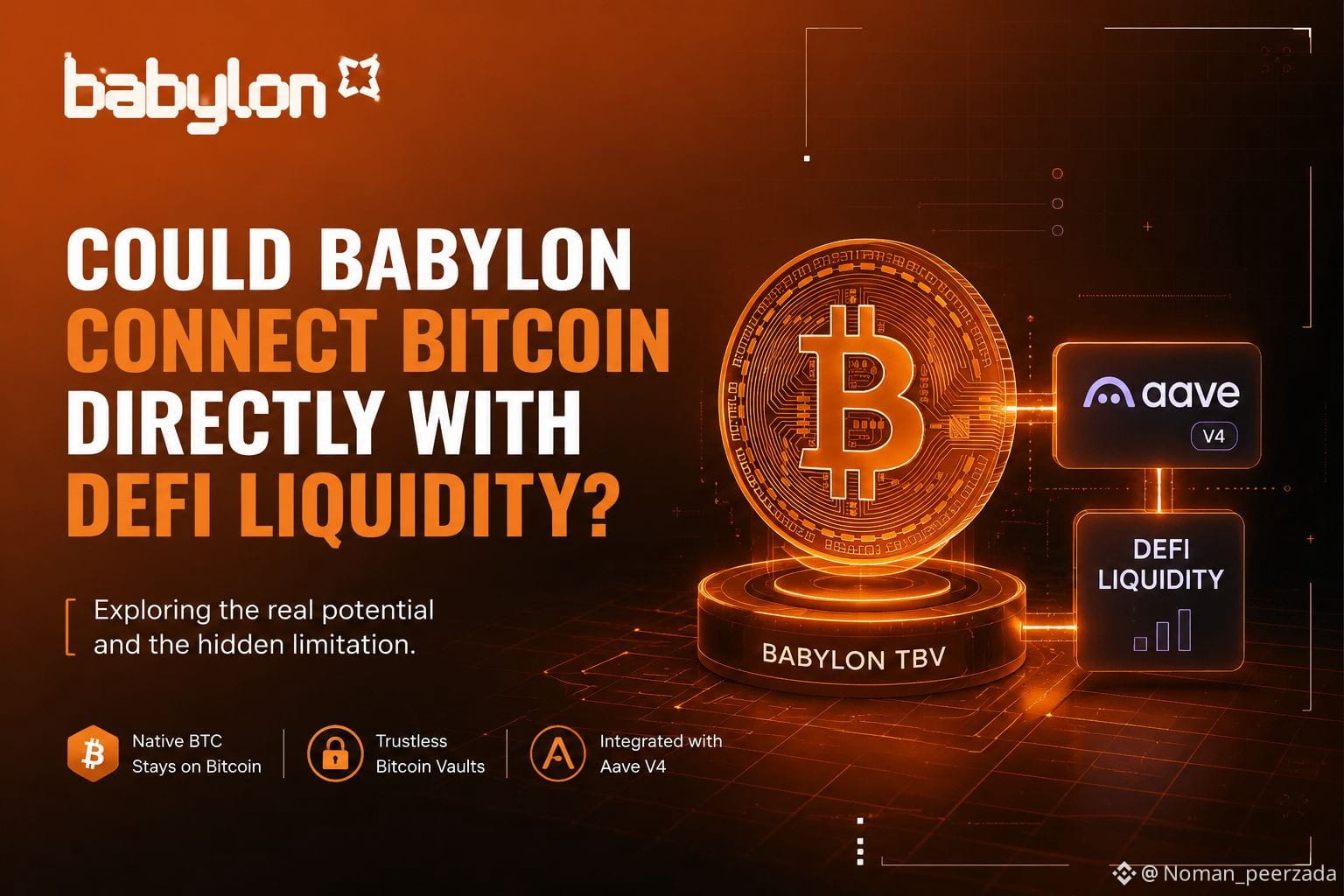
🔸 Liquidity flexibility
56%
🔸 Limited protocol options
13%
🔸 Risk management
31%
🔸 User adoption
0%
16 votes • Voting closed
157
68
1.8k
Partly True
If Bitcoin Is the World's Best Collateral, What's Been Missing? Babylon Thinks It's Infrastructure
I keep coming back to one number: only about 11% of Bitcoin is active in the roughly $64B on-chain credit market. That feels surprisingly low considering how often people call BTC the best collateral asset.
I realized the hesitation isn't always about demand. It's about what happens before the loan even exists.
The part that always made me pause wasn't borrowing itself. It was everything wrapped around it. Bridging. Wrapping. Trusting another layer to represent an asset I already own. Every extra dependency quietly changes the risk calculation, even if the borrowing experience looks smooth.
That's why Babylon's Trustless Bitcoin Vaults caught my attention. The interesting part isn't another lending integration. It's the idea that loan conditions are defined before capital moves, while redemption is enforced through cryptographic proof instead of another intermediary making decisions later.
Then I noticed the timing. Large institutions are increasingly treating Bitcoin as collateral. JPMorgan has begun accepting Bitcoin as loan collateral for institutional clients, and the CFTC approved Bitcoin as collateral for regulated derivatives back in October 2025. That tells me confidence in Bitcoin itself isn't really the missing piece anymore.
Maybe the bigger gap has been the infrastructure connecting native BTC to credit markets without asking holders to compromise on how they hold Bitcoin in the first place.
I'm still watching to see whether that changes actual behavior, because better infrastructure doesn't automatically create participation.
But maybe participation has been waiting on infrastructure all along.
Is infrastructure now the biggest constraint on Bitcoin's next phase of adoption, rather than demand itself?
@babylonlabs_io $BABY #baby $SKHYNIX $DEXE
If Bitcoin Is the World's Best Collateral, What's Been Missing? Babylon Thinks It's Infrastructure
I keep coming back to one number: only about 11% of Bitcoin is active in the roughly $64B on-chain credit market. That feels surprisingly low considering how often people call BTC the best collateral asset.
I realized the hesitation isn't always about demand. It's about what happens before the loan even exists.
The part that always made me pause wasn't borrowing itself. It was everything wrapped around it. Bridging. Wrapping. Trusting another layer to represent an asset I already own. Every extra dependency quietly changes the risk calculation, even if the borrowing experience looks smooth.
That's why Babylon's Trustless Bitcoin Vaults caught my attention. The interesting part isn't another lending integration. It's the idea that loan conditions are defined before capital moves, while redemption is enforced through cryptographic proof instead of another intermediary making decisions later.
Then I noticed the timing. Large institutions are increasingly treating Bitcoin as collateral. JPMorgan has begun accepting Bitcoin as loan collateral for institutional clients, and the CFTC approved Bitcoin as collateral for regulated derivatives back in October 2025. That tells me confidence in Bitcoin itself isn't really the missing piece anymore.
Maybe the bigger gap has been the infrastructure connecting native BTC to credit markets without asking holders to compromise on how they hold Bitcoin in the first place.
I'm still watching to see whether that changes actual behavior, because better infrastructure doesn't automatically create participation.
But maybe participation has been waiting on infrastructure all along.
Is infrastructure now the biggest constraint on Bitcoin's next phase of adoption, rather than demand itself?
@BabylonLabs_io $BABY #baby $SKHYNIX $DEXE
I keep coming back to one number: only about 11% of Bitcoin is active in the roughly $64B on-chain credit market. That feels surprisingly low considering how often people call BTC the best collateral asset.
I realized the hesitation isn't always about demand. It's about what happens before the loan even exists.
The part that always made me pause wasn't borrowing itself. It was everything wrapped around it. Bridging. Wrapping. Trusting another layer to represent an asset I already own. Every extra dependency quietly changes the risk calculation, even if the borrowing experience looks smooth.
That's why Babylon's Trustless Bitcoin Vaults caught my attention. The interesting part isn't another lending integration. It's the idea that loan conditions are defined before capital moves, while redemption is enforced through cryptographic proof instead of another intermediary making decisions later.
Then I noticed the timing. Large institutions are increasingly treating Bitcoin as collateral. JPMorgan has begun accepting Bitcoin as loan collateral for institutional clients, and the CFTC approved Bitcoin as collateral for regulated derivatives back in October 2025. That tells me confidence in Bitcoin itself isn't really the missing piece anymore.
Maybe the bigger gap has been the infrastructure connecting native BTC to credit markets without asking holders to compromise on how they hold Bitcoin in the first place.
I'm still watching to see whether that changes actual behavior, because better infrastructure doesn't automatically create participation.
But maybe participation has been waiting on infrastructure all along.
Is infrastructure now the biggest constraint on Bitcoin's next phase of adoption, rather than demand itself?
@BabylonLabs_io $BABY #baby $SKHYNIX $DEXE
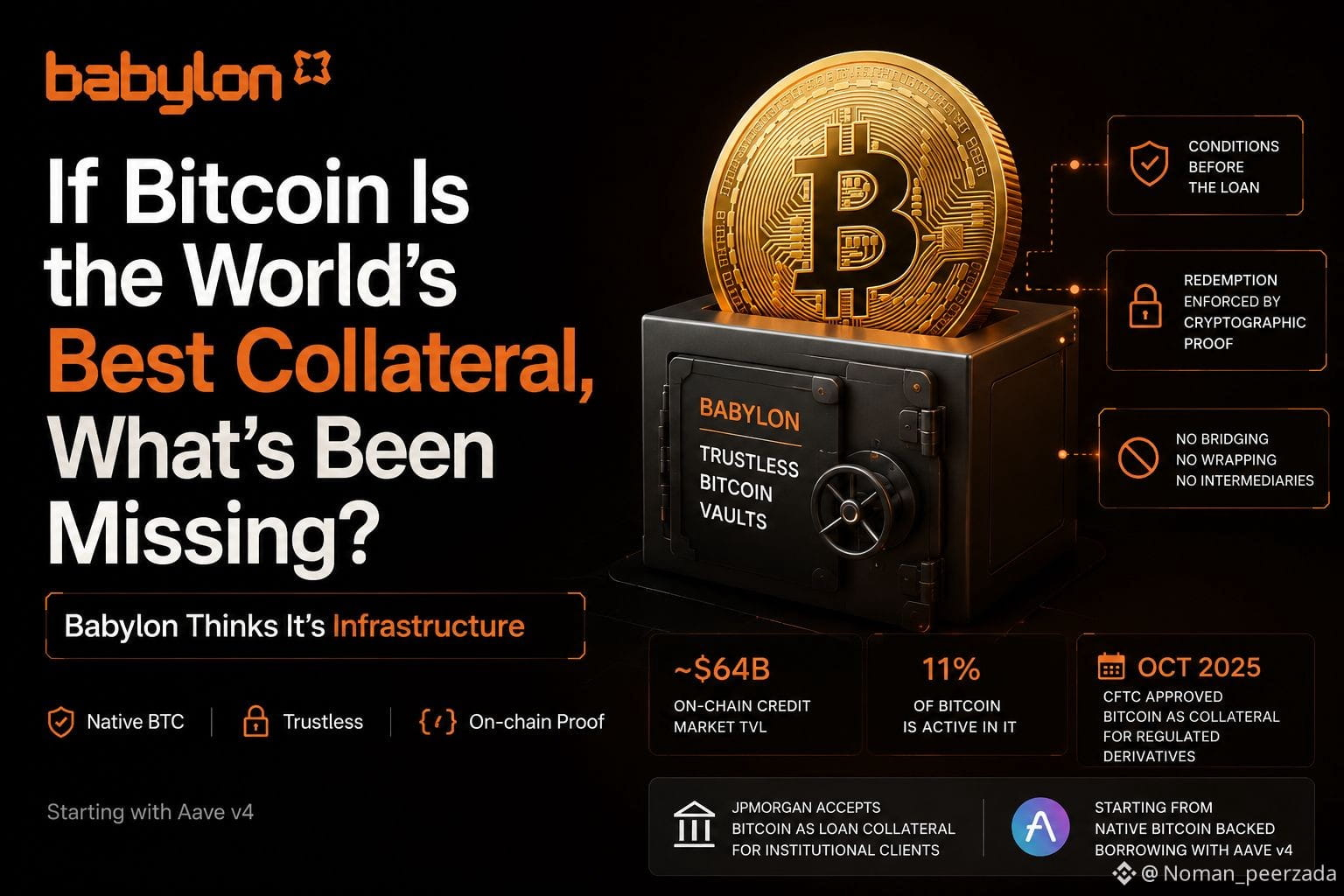
Yes, infrastructure
77%
No, demand.
23%
22 votes • Voting closed
129
70
3.3k
A Babylon staking retry looked fine on paper, but the part that bothered me was what happened after.
The BTC was still there. Nothing was lost. But the mental model changed.
I used to think dormant Bitcoin was simple because the only action required was no action. Hold it, secure it, wait. The moment BTC starts participating in another process, even a controlled one, small operational questions appear.
Who is responsible when timing doesn’t match expectations?
That is the part I keep coming back to with widespread Babylon adoption.
Bitcoin’s biggest shift might not be about creating another yield destination. It might be about changing how people think about idle BTC.
Useful Bitcoin is not the same as untouched Bitcoin.
That sounds obvious, but the difference shows up in small moments. A staking period means planning around availability. Validation requirements mean more attention to what is happening underneath. Extra utility can create more reasons to interact, but every interaction adds another place where assumptions can fail.
Bitcoin holders built their habits around minimizing movement. Babylon challenges that habit.
The strongest networks are not always the ones that add the most activity. Sometimes they are the ones that make new behavior feel predictable.
My bias is still toward simplicity. A Bitcoin position that never needs attention has a certain advantage.
But if Babylon can make participation feel closer to holding, that changes the conversation.
The real test is not whether people can stake BTC. It is whether long-term holders believe the added usefulness is worth the added operational thinking.
That’s where adoption gets interesting. Not at the first transaction, but months later when holding BTC starts to include more decisions.
Would Babylon change how you think about holding BTC?
@babylonlabs_io $BABY #baby
A Babylon staking retry looked fine on paper, but the part that bothered me was what happened after.
The BTC was still there. Nothing was lost. But the mental model changed.
I used to think dormant Bitcoin was simple because the only action required was no action. Hold it, secure it, wait. The moment BTC starts participating in another process, even a controlled one, small operational questions appear.
Who is responsible when timing doesn’t match expectations?
That is the part I keep coming back to with widespread Babylon adoption.
Bitcoin’s biggest shift might not be about creating another yield destination. It might be about changing how people think about idle BTC.
Useful Bitcoin is not the same as untouched Bitcoin.
That sounds obvious, but the difference shows up in small moments. A staking period means planning around availability. Validation requirements mean more attention to what is happening underneath. Extra utility can create more reasons to interact, but every interaction adds another place where assumptions can fail.
Bitcoin holders built their habits around minimizing movement. Babylon challenges that habit.
The strongest networks are not always the ones that add the most activity. Sometimes they are the ones that make new behavior feel predictable.
My bias is still toward simplicity. A Bitcoin position that never needs attention has a certain advantage.
But if Babylon can make participation feel closer to holding, that changes the conversation.
The real test is not whether people can stake BTC. It is whether long-term holders believe the added usefulness is worth the added operational thinking.
That’s where adoption gets interesting. Not at the first transaction, but months later when holding BTC starts to include more decisions.
Would Babylon change how you think about holding BTC?
@BabylonLabs_io $BABY #baby
The BTC was still there. Nothing was lost. But the mental model changed.
I used to think dormant Bitcoin was simple because the only action required was no action. Hold it, secure it, wait. The moment BTC starts participating in another process, even a controlled one, small operational questions appear.
Who is responsible when timing doesn’t match expectations?
That is the part I keep coming back to with widespread Babylon adoption.
Bitcoin’s biggest shift might not be about creating another yield destination. It might be about changing how people think about idle BTC.
Useful Bitcoin is not the same as untouched Bitcoin.
That sounds obvious, but the difference shows up in small moments. A staking period means planning around availability. Validation requirements mean more attention to what is happening underneath. Extra utility can create more reasons to interact, but every interaction adds another place where assumptions can fail.
Bitcoin holders built their habits around minimizing movement. Babylon challenges that habit.
The strongest networks are not always the ones that add the most activity. Sometimes they are the ones that make new behavior feel predictable.
My bias is still toward simplicity. A Bitcoin position that never needs attention has a certain advantage.
But if Babylon can make participation feel closer to holding, that changes the conversation.
The real test is not whether people can stake BTC. It is whether long-term holders believe the added usefulness is worth the added operational thinking.
That’s where adoption gets interesting. Not at the first transaction, but months later when holding BTC starts to include more decisions.
Would Babylon change how you think about holding BTC?
@BabylonLabs_io $BABY #baby
🔘 More useful BTC
100%
🔘 More complexity
0%
5 votes • Voting closed
23
21
734
Log in to explore more content
Join global crypto users on Binance Square
⚡️ Get latest and useful information about crypto.
💬 Trusted by the world’s largest crypto exchange.
👍 Discover real insights from verified creators.
Email / Phone number