Binance Square
crypto work01
2.8k Posts

crypto work01

Open Trade
High-Frequency Trader
1.8 Years
1.2K+ Following
1.1K+ Followers
487 Liked
Posts
Portfolio
🎙️ Let's chat about Web3 crypto topics and contract trading. Building Binance Square together.
avatar
End
03 h 16 m 45 s
8.4k
26
129
·
--
·
--
Bullish
$ESPORTS alpha token bullish 👍🔥 $ESPORTS $LAB
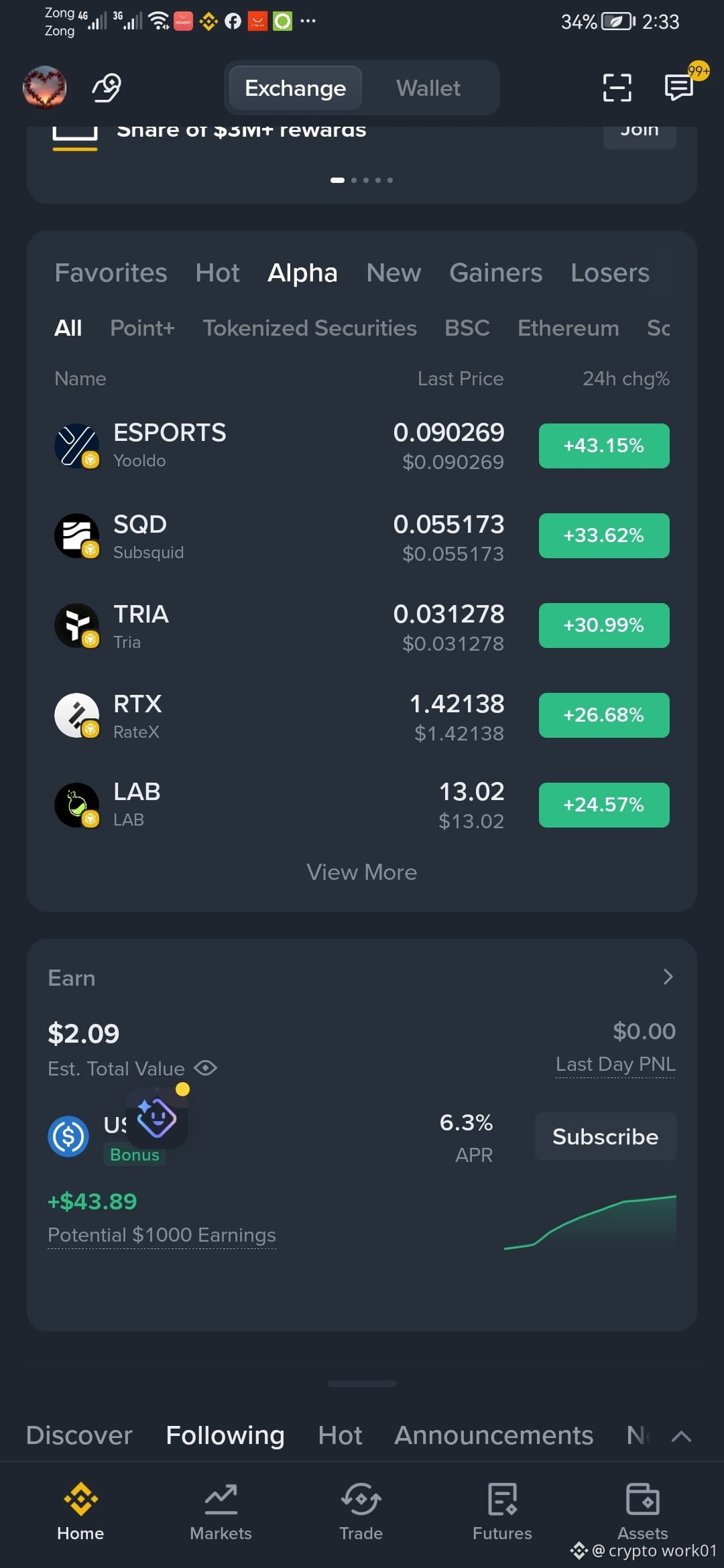
$LAB next target 20$🔥
$XAUT {spot}(XAUTUSDT) #GoldvsBTC Choose Your Team and Win a Share of Up to $200,000 https://www.binance.com/activity/trading-competition/btcvsgold-vol-1?ref=986462350
$XAUT
#GoldvsBTC Choose Your Team and Win a Share of Up to $200,000 https://www.binance.com/activity/trading-competition/btcvsgold-vol-1?ref=986462350
Sign up using my referral link and complete the tasks to receive a $1,000 WAL Earn Trial Fund + $2–$5 in WAL token rewards (limited). https://www.binance.com/activity/trading-competition/apr-referral-ranking?ref=986462350[https://www.binance.com/activity/trading-competition/apr-referral-ranking?ref=986462350](https://www.binance.com/activity/trading-competition/apr-referral-ranking?ref=986462350)
Sign up using my referral link and complete the tasks to receive a $1,000 WAL Earn Trial Fund + $2–$5 in WAL token rewards (limited). https://www.binance.com/activity/trading-competition/apr-referral-ranking?ref=986462350https://www.binance.com/activity/trading-competition/apr-referral-ranking?ref=986462350
Are you tired of flashy crypto projects with zero real-world utility? It’s time to look at the infrastructure quietly holding Web3 together. @SignOfficial is revolutionizing how we handle digital sovereignty, credential verification, and on-chain identity. Instead of just chasing hype, $SIGN is building the foundational trust layer that Web3 desperately needs for secure token distribution and seamless integration. It acts as the connective tissue making digital economies more transparent and reliable. While others chase short-term pumps, smart money looks for long-term permanence. The future of verifiable trust is being built right now. 🚀🔥 #sign
Are you tired of flashy crypto projects with zero real-world utility? It’s time to look at the infrastructure quietly holding Web3 together.

@SignOfficial is revolutionizing how we handle digital sovereignty, credential verification, and on-chain identity. Instead of just chasing hype, $SIGN is building the foundational trust layer that Web3 desperately needs for secure token distribution and seamless integration. It acts as the connective tissue making digital economies more transparent and reliable.

While others chase short-term pumps, smart money looks for long-term permanence. The future of verifiable trust is being built right now. 🚀🔥 #sign
Setting up a business can turn into a long, frustrating process—documents, approvals, and constant delays. Someone I know in Dubai faced the same thing, but after using $SIGN @SignOfficial for identity verification, things moved way quicker than expected. It made me realize how useful digital verification can be. Maybe the future isn’t more paperwork… it’s faster, simpler systems built on trust. #SignDigitalSovereignInfra
Setting up a business can turn into a long, frustrating process—documents, approvals, and constant delays.

Someone I know in Dubai faced the same thing, but after using $SIGN @SignOfficial for identity verification, things moved way quicker than expected.

It made me realize how useful digital verification can be.

Maybe the future isn’t more paperwork… it’s faster, simpler systems built on trust.

#SignDigitalSovereignInfra
At first, I thought privacy meant keeping everything hidden. But with time, I realized that’s not the full picture. Midnight showed me a better way—privacy isn’t about hiding everything, it’s about sharing only what’s necessary while keeping the rest secure. It may seem like a small idea, but it completely changes how trust works. Maybe the future isn’t total transparency or total secrecy… it’s about balance. #night $NIGHT @MidnightNetwork
At first, I thought privacy meant keeping everything hidden. But with time, I realized that’s not the full picture.

Midnight showed me a better way—privacy isn’t about hiding everything, it’s about sharing only what’s necessary while keeping the rest secure.

It may seem like a small idea, but it completely changes how trust works.

Maybe the future isn’t total transparency or total secrecy… it’s about balance.

#night $NIGHT @MidnightNetwork
#signdigitalsovereigninfra $SIGN As the Middle East accelerates toward a digitally sovereign future, infrastructure matters more than ever. @SignOfficial is building the foundation for trust, identity, and secure verification across economies. With $SIGN at its core, this ecosystem empowers governments, businesses, and individuals to operate with transparency and independence. The next phase of digital growth isn’t just innovation—it’s sovereignty. #SignDigitalSovereignInfra
Article
#night$NIGHT Application-Specific ZK Circuits: Precision, Performance, and the Scaling Paradox For the past few days, I’ve been immersed in the architectural patterns behind systems like RIVER, PIPPIN, and the Kachina section—and the deeper I look, the sharper the design philosophy becomes. What initially seemed like a niche optimization now feels like a deliberate, almost philosophical divergence from the mainstream direction of zero-knowledge (ZK) systems. Most modern ZK proof systems are built for general-purpose use. They aim to support a wide range of applications under a single framework, prioritizing flexibility and composability. This approach has obvious advantages: developers can build once and deploy across multiple contexts, benefiting from shared tooling, infrastructure, and standards. Kachina, however, takes a fundamentally different path. Instead of optimizing for universality, it leans into specificity. Each application is paired with its own tailored circuit—custom-built to reflect its exact computational logic. Rather than forcing diverse applications into a generalized proving system, Kachina reshapes the proving system around the application itself. This distinction is not just architectural—it’s deeply consequential. General-purpose systems inherently carry overhead. They must accommodate the full spectrum of possible computations, even if a given application only uses a small subset of that capability. This leads to inefficiencies in proof generation, verification time, and sometimes even security assumptions. Application-specific circuits, by contrast, strip away that excess. They operate with a narrower scope, enabling: Lean proofs: Smaller, more efficient representationsFaster generation: Reduced computational complexityStronger guarantees: Less room for unintended use or misconfiguration In essence, they trade flexibility for precision—and in doing so, unlock a level of performance that general systems struggle to match. But this design choice introduces a new tension: scalability at the ecosystem level. While it’s relatively straightforward to build a handful of highly optimized circuits, the challenge compounds as the number of applications grows. Each new use case demands its own circuit design, auditing process, and maintenance lifecycle. What begins as a performance advantage can evolve into an operational burden. This raises a critical question: Are application-specific circuits the foundation of a high-performance future—or a bottleneck waiting to emerge? On one hand, tailored circuits empower each application to operate at peak efficiency, strengthening the system as a whole through specialization. On the other, the cumulative cost of designing and managing these circuits could hinder scalability, slow innovation, and fragment the ecosystem. The answer likely lies not in choosing one extreme, but in finding a balance. Hybrid models may emerge—where core primitives remain general-purpose, while performance-critical components leverage application-specific optimizations. Tooling and automation could also play a decisive role, reducing the friction of circuit creation and enabling developers to scale without sacrificing precision. Kachina’s approach is a bold statement: that performance, correctness, and intentional design are worth the added complexity. Whether this model scales gracefully or strains under its own weight will depend on how the surrounding ecosystem evolves. For now, it stands as a compelling counterpoint to the “one-size-fits-all” philosophy—a reminder that sometimes, the sharpest designs come from narrowing the scope rather than expanding it. And that tension? It’s exactly where innovation tends to thrive.#night @MidnightNetwork $NIGHT

#night

$NIGHT
Application-Specific ZK Circuits: Precision, Performance, and the Scaling Paradox
For the past few days, I’ve been immersed in the architectural patterns behind systems like RIVER, PIPPIN, and the Kachina section—and the deeper I look, the sharper the design philosophy becomes. What initially seemed like a niche optimization now feels like a deliberate, almost philosophical divergence from the mainstream direction of zero-knowledge (ZK) systems.
Most modern ZK proof systems are built for general-purpose use. They aim to support a wide range of applications under a single framework, prioritizing flexibility and composability. This approach has obvious advantages: developers can build once and deploy across multiple contexts, benefiting from shared tooling, infrastructure, and standards.
Kachina, however, takes a fundamentally different path.
Instead of optimizing for universality, it leans into specificity. Each application is paired with its own tailored circuit—custom-built to reflect its exact computational logic. Rather than forcing diverse applications into a generalized proving system, Kachina reshapes the proving system around the application itself.
This distinction is not just architectural—it’s deeply consequential.
General-purpose systems inherently carry overhead. They must accommodate the full spectrum of possible computations, even if a given application only uses a small subset of that capability. This leads to inefficiencies in proof generation, verification time, and sometimes even security assumptions.
Application-specific circuits, by contrast, strip away that excess. They operate with a narrower scope, enabling:
Lean proofs: Smaller, more efficient representationsFaster generation: Reduced computational complexityStronger guarantees: Less room for unintended use or misconfiguration
In essence, they trade flexibility for precision—and in doing so, unlock a level of performance that general systems struggle to match.
But this design choice introduces a new tension: scalability at the ecosystem level.
While it’s relatively straightforward to build a handful of highly optimized circuits, the challenge compounds as the number of applications grows. Each new use case demands its own circuit design, auditing process, and maintenance lifecycle. What begins as a performance advantage can evolve into an operational burden.
This raises a critical question:
Are application-specific circuits the foundation of a high-performance future—or a bottleneck waiting to emerge?
On one hand, tailored circuits empower each application to operate at peak efficiency, strengthening the system as a whole through specialization. On the other, the cumulative cost of designing and managing these circuits could hinder scalability, slow innovation, and fragment the ecosystem.
The answer likely lies not in choosing one extreme, but in finding a balance.
Hybrid models may emerge—where core primitives remain general-purpose, while performance-critical components leverage application-specific optimizations. Tooling and automation could also play a decisive role, reducing the friction of circuit creation and enabling developers to scale without sacrificing precision.
Kachina’s approach is a bold statement: that performance, correctness, and intentional design are worth the added complexity. Whether this model scales gracefully or strains under its own weight will depend on how the surrounding ecosystem evolves.
For now, it stands as a compelling counterpoint to the “one-size-fits-all” philosophy—a reminder that sometimes, the sharpest designs come from narrowing the scope rather than expanding it.
And that tension? It’s exactly where innovation tends to thrive.#night @MidnightNetwork $NIGHT
Log in to explore more content
Join global crypto users on Binance Square
⚡️ Get latest and useful information about crypto.
💬 Trusted by the world’s largest crypto exchange.
👍 Discover real insights from verified creators.
Email / Phone number
Sitemap
Cookie Preferences
Platform T&Cs