
Proof of X
279 Posts

Proof of X
Report
Block User
Daily crypto market briefings 📊
Reading the market through on-chain data
Not financial advice · NFA / DYOR
16 Following
17 Followers
37 Liked
Posts
·
--
🐻 TL;DR: I'm tactically bearish on $MERL: ongoing vesting faces a limited direct link between chain activity and holder cash flow.
Price: $0.02919 | 24h: -2.54%
Binance USD-M perpetual MERLUSDT | As of Nov 08, 2026, 02:50:21 UTC
Merlin's gas demand primarily goes through BTC; MERL is also supported for AA-wallet payments. Staking and ecosystem utility exist, but network growth alone does not establish cash flow to MERL holders.
The published 2.1B supply allocation assigns 15.23% to private investors, 4.20% to the team and 3% to advisers: 471.03M tokens, or 22.43%, originally allocated to those groups. That is an allocation figure, not the amount still locked or about to be sold. Community and ecosystem releases span 48 months.
DefiLlama's November 7 snapshot reports $32 in 24-hour chain fees. That is a reported chain-activity measure, not MERL-holder income; I would not annualise one day. OKX's whitepaper also states that MERL carries no claim on the development entity's revenues.
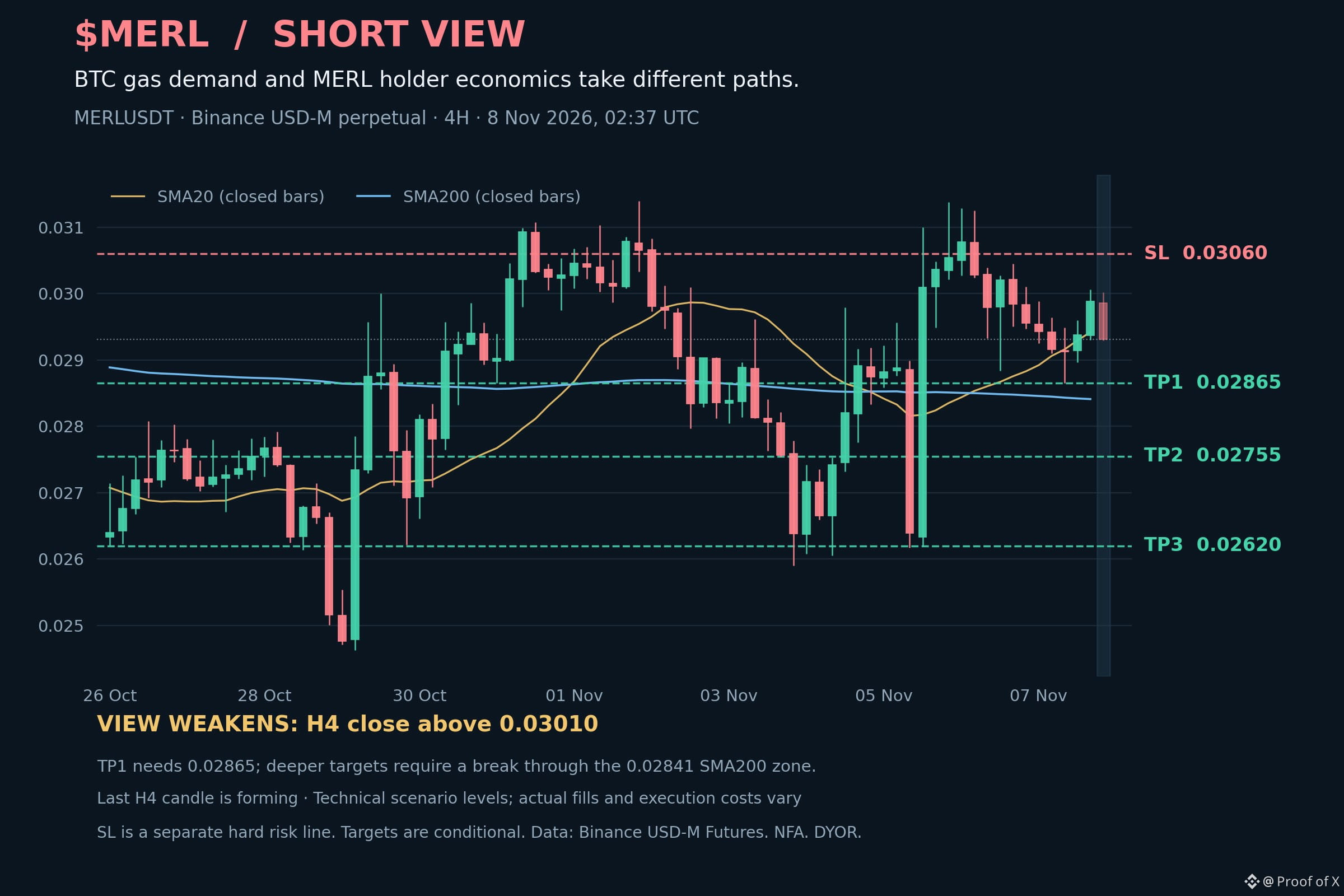
My view: Tactically bearish on rebounds that fail below $0.03010. The H4 200-SMA near $0.02841 is an important obstacle to deeper downside, so this is a range-fade thesis, not a confirmed long-term downtrend.
A break below $0.02865 and that moving-average zone would put $0.02755, then $0.02620 in view. An H4 close above $0.03010 weakens the thesis; the separate hard risk line is $0.03060.
SL: $0.03060
TP1: $0.02865
TP2: $0.02755
TP3: $0.02620
TP1 is only about 0.38R from this price reference. I would avoid chasing a fresh short here. These are conditional chart scenarios; no execution price is stated.
Chart snapshot: Nov 8, 2026, 02:37 UTC. Market quote refreshed above.
Sources: Merlin Chain Docs, Tokenomics and Gas (accessed Nov 8, 2026); OKX Europe, MERL Whitepaper (updated Jun 2, 2026); DefiLlama, Merlin snapshot (Nov 7, 2026); Binance USD-M Futures (Nov 8, 2026).
NFA. DYOR.
$MERL
🐻 TL;DR: I'm tactically bearish on $MERL : ongoing vesting faces a limited direct link between chain activity and holder cash flow.
Price: $0.02919 | 24h: -2.54%
Binance USD-M perpetual MERLUSDT | As of Nov 08, 2026, 02:50:21 UTC
Merlin's gas demand primarily goes through BTC; MERL is also supported for AA-wallet payments. Staking and ecosystem utility exist, but network growth alone does not establish cash flow to MERL holders.
The published 2.1B supply allocation assigns 15.23% to private investors, 4.20% to the team and 3% to advisers: 471.03M tokens, or 22.43%, originally allocated to those groups. That is an allocation figure, not the amount still locked or about to be sold. Community and ecosystem releases span 48 months.
DefiLlama's November 7 snapshot reports $32 in 24-hour chain fees. That is a reported chain-activity measure, not MERL-holder income; I would not annualise one day. OKX's whitepaper also states that MERL carries no claim on the development entity's revenues.
My view: Tactically bearish on rebounds that fail below $0.03010. The H4 200-SMA near $0.02841 is an important obstacle to deeper downside, so this is a range-fade thesis, not a confirmed long-term downtrend.
A break below $0.02865 and that moving-average zone would put $0.02755, then $0.02620 in view. An H4 close above $0.03010 weakens the thesis; the separate hard risk line is $0.03060.
SL: $0.03060
TP1: $0.02865
TP2: $0.02755
TP3: $0.02620
TP1 is only about 0.38R from this price reference. I would avoid chasing a fresh short here. These are conditional chart scenarios; no execution price is stated.
Chart snapshot: Nov 8, 2026, 02:37 UTC. Market quote refreshed above.
Sources: Merlin Chain Docs, Tokenomics and Gas (accessed Nov 8, 2026); OKX Europe, MERL Whitepaper (updated Jun 2, 2026); DefiLlama, Merlin snapshot (Nov 7, 2026); Binance USD-M Futures (Nov 8, 2026).
NFA. DYOR.
$MERL
Price: $0.02919 | 24h: -2.54%
Binance USD-M perpetual MERLUSDT | As of Nov 08, 2026, 02:50:21 UTC
Merlin's gas demand primarily goes through BTC; MERL is also supported for AA-wallet payments. Staking and ecosystem utility exist, but network growth alone does not establish cash flow to MERL holders.
The published 2.1B supply allocation assigns 15.23% to private investors, 4.20% to the team and 3% to advisers: 471.03M tokens, or 22.43%, originally allocated to those groups. That is an allocation figure, not the amount still locked or about to be sold. Community and ecosystem releases span 48 months.
DefiLlama's November 7 snapshot reports $32 in 24-hour chain fees. That is a reported chain-activity measure, not MERL-holder income; I would not annualise one day. OKX's whitepaper also states that MERL carries no claim on the development entity's revenues.
My view: Tactically bearish on rebounds that fail below $0.03010. The H4 200-SMA near $0.02841 is an important obstacle to deeper downside, so this is a range-fade thesis, not a confirmed long-term downtrend.
A break below $0.02865 and that moving-average zone would put $0.02755, then $0.02620 in view. An H4 close above $0.03010 weakens the thesis; the separate hard risk line is $0.03060.
SL: $0.03060
TP1: $0.02865
TP2: $0.02755
TP3: $0.02620
TP1 is only about 0.38R from this price reference. I would avoid chasing a fresh short here. These are conditional chart scenarios; no execution price is stated.
Chart snapshot: Nov 8, 2026, 02:37 UTC. Market quote refreshed above.
Sources: Merlin Chain Docs, Tokenomics and Gas (accessed Nov 8, 2026); OKX Europe, MERL Whitepaper (updated Jun 2, 2026); DefiLlama, Merlin snapshot (Nov 7, 2026); Binance USD-M Futures (Nov 8, 2026).
NFA. DYOR.
$MERL
87
·
--
$PENDLE Price: $1.646 | 24h: -3.57% | S: $1.635 | R: $1.710
🐂 TL;DR: $PENDLE's latest fee-funded buyback is constructive for eligible stakers, but its 32% increase in token quantity overstates the improvement in purchase funding.
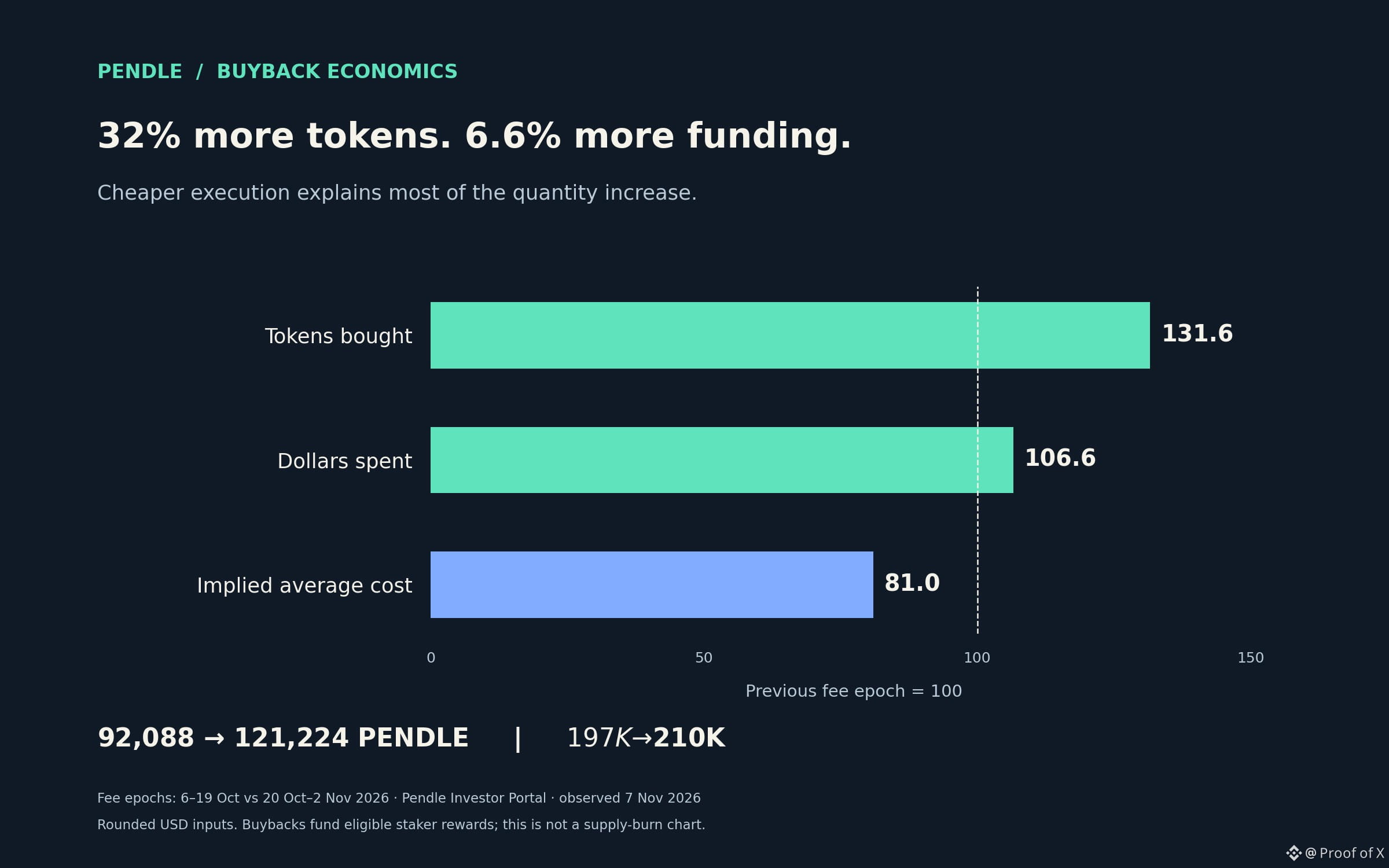
For the completed October 20–November 2 fee epoch, Pendle reports 121,224 PENDLE purchased for approximately $210K. The preceding October 6–19 epoch bought 92,088 for $197K.
Token quantity increased 31.6%; spending increased 6.6%. Implied average purchase cost declined 19.0%, from about $2.139 to $1.732.
At the previous execution price, the new budget would buy roughly 98,165 tokens. Cheaper execution explains about 79% of the additional token count. Calculations use rounded issuer dollar totals, so these are approximate attribution figures, not trade-by-trade execution data.
Pendle reports $271K of protocol revenue for the latest fee epoch. V2 fee revenue funds market purchases that become rewards for eligible active sPENDLE holders, including virtual balances during the vePENDLE transition. Rewards are not a burn or a cash distribution to every liquid PENDLE holder.
Team and investor vesting ended in September 2024; incentives and ecosystem allocations can still add circulating supply. Documentation specifies terminal incentive inflation of 2% annually from April 2026. The buyback quantity alone therefore establishes neither net deflation nor business-revenue growth.
My take: Credit real fee-funded demand and staker rewards, while evaluating growth from the roughly 7% funding improvement. The 32% quantity headline mainly reflects cheaper purchases.
Sources: Pendle Investor Portal, Revenue, fee epochs October 6–19 and October 20–November 2, 2026; Pendle Documentation, sPENDLE and Tokenomics; observed November 7, 2026.
As of: 2026-11-07 14:53:58 UTC | Binance spot PENDLEUSDT. S/R: prior completed November 6 UTC daily candle, H=1.71800000, L=1.64300000, C=1.66900000; classic P=(H+L+C)/3, S1=2P−H, R1=2P−L.
NFA. DYOR.
$PENDLE Price: $1.646 | 24h: -3.57% | S: $1.635 | R: $1.710
🐂 TL;DR: $PENDLE 's latest fee-funded buyback is constructive for eligible stakers, but its 32% increase in token quantity overstates the improvement in purchase funding.
For the completed October 20–November 2 fee epoch, Pendle reports 121,224 PENDLE purchased for approximately $210K. The preceding October 6–19 epoch bought 92,088 for $197K.
Token quantity increased 31.6%; spending increased 6.6%. Implied average purchase cost declined 19.0%, from about $2.139 to $1.732.
At the previous execution price, the new budget would buy roughly 98,165 tokens. Cheaper execution explains about 79% of the additional token count. Calculations use rounded issuer dollar totals, so these are approximate attribution figures, not trade-by-trade execution data.
Pendle reports $271K of protocol revenue for the latest fee epoch. V2 fee revenue funds market purchases that become rewards for eligible active sPENDLE holders, including virtual balances during the vePENDLE transition. Rewards are not a burn or a cash distribution to every liquid PENDLE holder.
Team and investor vesting ended in September 2024; incentives and ecosystem allocations can still add circulating supply. Documentation specifies terminal incentive inflation of 2% annually from April 2026. The buyback quantity alone therefore establishes neither net deflation nor business-revenue growth.
My take: Credit real fee-funded demand and staker rewards, while evaluating growth from the roughly 7% funding improvement. The 32% quantity headline mainly reflects cheaper purchases.
Sources: Pendle Investor Portal, Revenue, fee epochs October 6–19 and October 20–November 2, 2026; Pendle Documentation, sPENDLE and Tokenomics; observed November 7, 2026.
As of: 2026-11-07 14:53:58 UTC | Binance spot PENDLEUSDT. S/R: prior completed November 6 UTC daily candle, H=1.71800000, L=1.64300000, C=1.66900000; classic P=(H+L+C)/3, S1=2P−H, R1=2P−L.
NFA. DYOR.
🐂 TL;DR: $PENDLE 's latest fee-funded buyback is constructive for eligible stakers, but its 32% increase in token quantity overstates the improvement in purchase funding.
For the completed October 20–November 2 fee epoch, Pendle reports 121,224 PENDLE purchased for approximately $210K. The preceding October 6–19 epoch bought 92,088 for $197K.
Token quantity increased 31.6%; spending increased 6.6%. Implied average purchase cost declined 19.0%, from about $2.139 to $1.732.
At the previous execution price, the new budget would buy roughly 98,165 tokens. Cheaper execution explains about 79% of the additional token count. Calculations use rounded issuer dollar totals, so these are approximate attribution figures, not trade-by-trade execution data.
Pendle reports $271K of protocol revenue for the latest fee epoch. V2 fee revenue funds market purchases that become rewards for eligible active sPENDLE holders, including virtual balances during the vePENDLE transition. Rewards are not a burn or a cash distribution to every liquid PENDLE holder.
Team and investor vesting ended in September 2024; incentives and ecosystem allocations can still add circulating supply. Documentation specifies terminal incentive inflation of 2% annually from April 2026. The buyback quantity alone therefore establishes neither net deflation nor business-revenue growth.
My take: Credit real fee-funded demand and staker rewards, while evaluating growth from the roughly 7% funding improvement. The 32% quantity headline mainly reflects cheaper purchases.
Sources: Pendle Investor Portal, Revenue, fee epochs October 6–19 and October 20–November 2, 2026; Pendle Documentation, sPENDLE and Tokenomics; observed November 7, 2026.
As of: 2026-11-07 14:53:58 UTC | Binance spot PENDLEUSDT. S/R: prior completed November 6 UTC daily candle, H=1.71800000, L=1.64300000, C=1.66900000; classic P=(H+L+C)/3, S1=2P−H, R1=2P−L.
NFA. DYOR.
160
·
--
🐂 TL;DR: $GMX's Phase 2 contingency-reserve vote is constructive liquidity planning, not a new $10M buyback. Voting opened November 6 on moving existing treasury assets into a reserve under the existing funding plan.
Compare the funding stages:
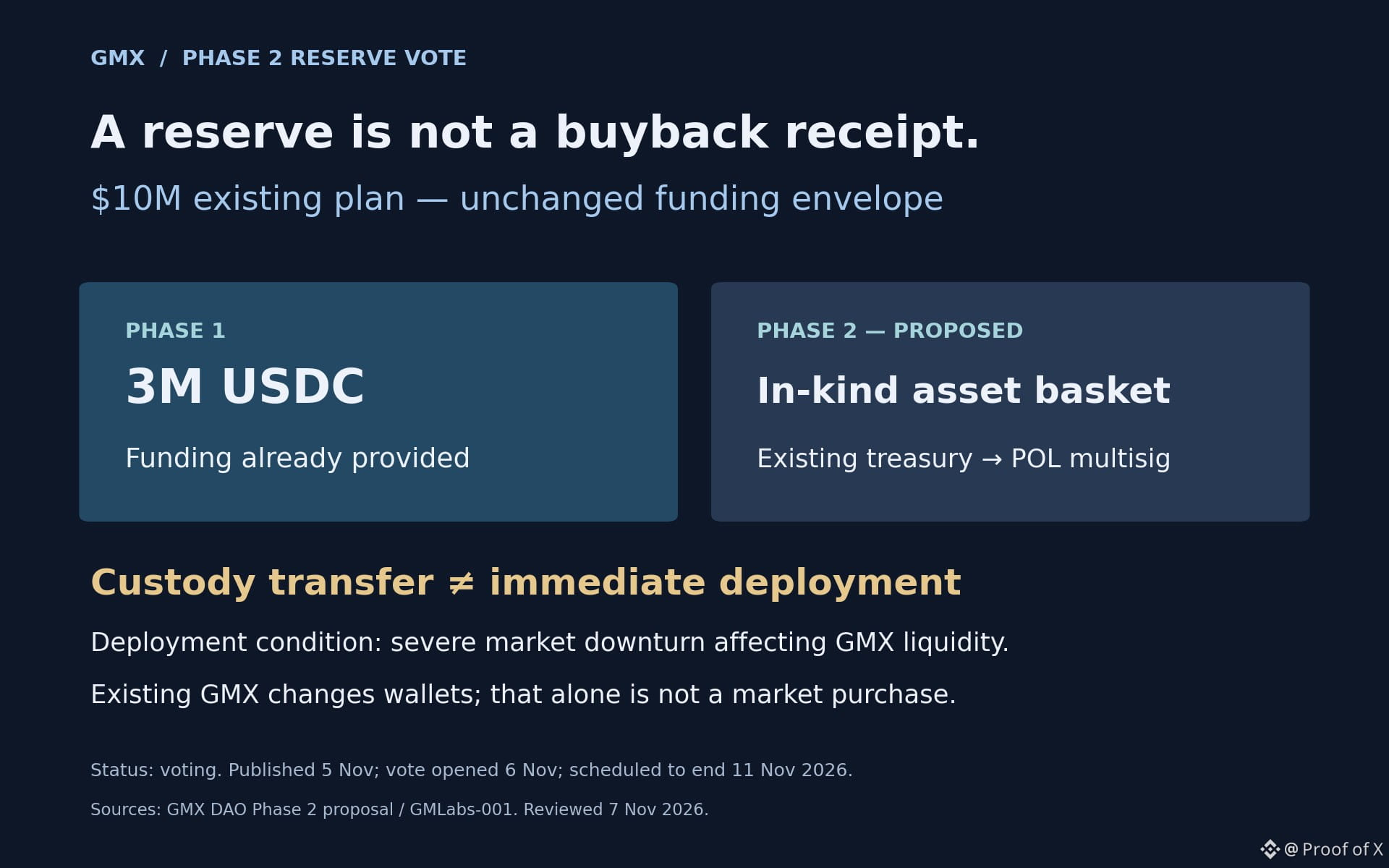
• Phase 1 provided 3 million USDC.
• Phase 2 proposes an in-kind basket of treasury assets, including existing GMX, to the 4-of-7 POL multisig.
• The $10M funding envelope stays unchanged. The basket's market value fluctuates; it is not a fixed $7M cash transfer.
The reserve would be deployed only during a severe market downturn affecting GMX liquidity, allowing a response without another DAO funding vote. Transferring assets does not itself start deployment. The proposal remains in voting, scheduled to end November 11.
The original fund can focus on buybacks or liquidity provision, depending on circulating market cap versus combined open interest. Neither route guarantees a price floor.
My take: Pre-positioned capital can shorten response time. Count approvals, treasury transfers and actual market purchases separately: moving GMX already held by the DAO creates no new market demand by itself.
Sources: GMX DAO, Phase 2 — Contingency Reserve, published November 5, 2026; vote-opening announcement, November 6. GM Labs, GMLabs-001, September 16. Governance status reviewed November 7.
NFA. DYOR.
🐂 TL;DR: $GMX 's Phase 2 contingency-reserve vote is constructive liquidity planning, not a new $10M buyback. Voting opened November 6 on moving existing treasury assets into a reserve under the existing funding plan.
Compare the funding stages:
• Phase 1 provided 3 million USDC.
• Phase 2 proposes an in-kind basket of treasury assets, including existing GMX, to the 4-of-7 POL multisig.
• The $10M funding envelope stays unchanged. The basket's market value fluctuates; it is not a fixed $7M cash transfer.
The reserve would be deployed only during a severe market downturn affecting GMX liquidity, allowing a response without another DAO funding vote. Transferring assets does not itself start deployment. The proposal remains in voting, scheduled to end November 11.
The original fund can focus on buybacks or liquidity provision, depending on circulating market cap versus combined open interest. Neither route guarantees a price floor.
My take: Pre-positioned capital can shorten response time. Count approvals, treasury transfers and actual market purchases separately: moving GMX already held by the DAO creates no new market demand by itself.
Sources: GMX DAO, Phase 2 — Contingency Reserve, published November 5, 2026; vote-opening announcement, November 6. GM Labs, GMLabs-001, September 16. Governance status reviewed November 7.
NFA. DYOR.
Compare the funding stages:
• Phase 1 provided 3 million USDC.
• Phase 2 proposes an in-kind basket of treasury assets, including existing GMX, to the 4-of-7 POL multisig.
• The $10M funding envelope stays unchanged. The basket's market value fluctuates; it is not a fixed $7M cash transfer.
The reserve would be deployed only during a severe market downturn affecting GMX liquidity, allowing a response without another DAO funding vote. Transferring assets does not itself start deployment. The proposal remains in voting, scheduled to end November 11.
The original fund can focus on buybacks or liquidity provision, depending on circulating market cap versus combined open interest. Neither route guarantees a price floor.
My take: Pre-positioned capital can shorten response time. Count approvals, treasury transfers and actual market purchases separately: moving GMX already held by the DAO creates no new market demand by itself.
Sources: GMX DAO, Phase 2 — Contingency Reserve, published November 5, 2026; vote-opening announcement, November 6. GM Labs, GMLabs-001, September 16. Governance status reviewed November 7.
NFA. DYOR.
54
·
--
$KMNO Price: $0.03408 | 24h: -0.64% | S: $0.03376 | R: $0.03507
🐂 TL;DR: $KMNO deserves credit for making leadership earn more of its upside. The CEO's November 2 letter ties most of his allocation to sustained valuation milestones. I would still keep the broader insider allocation in the supply model.
Separate two commitments:
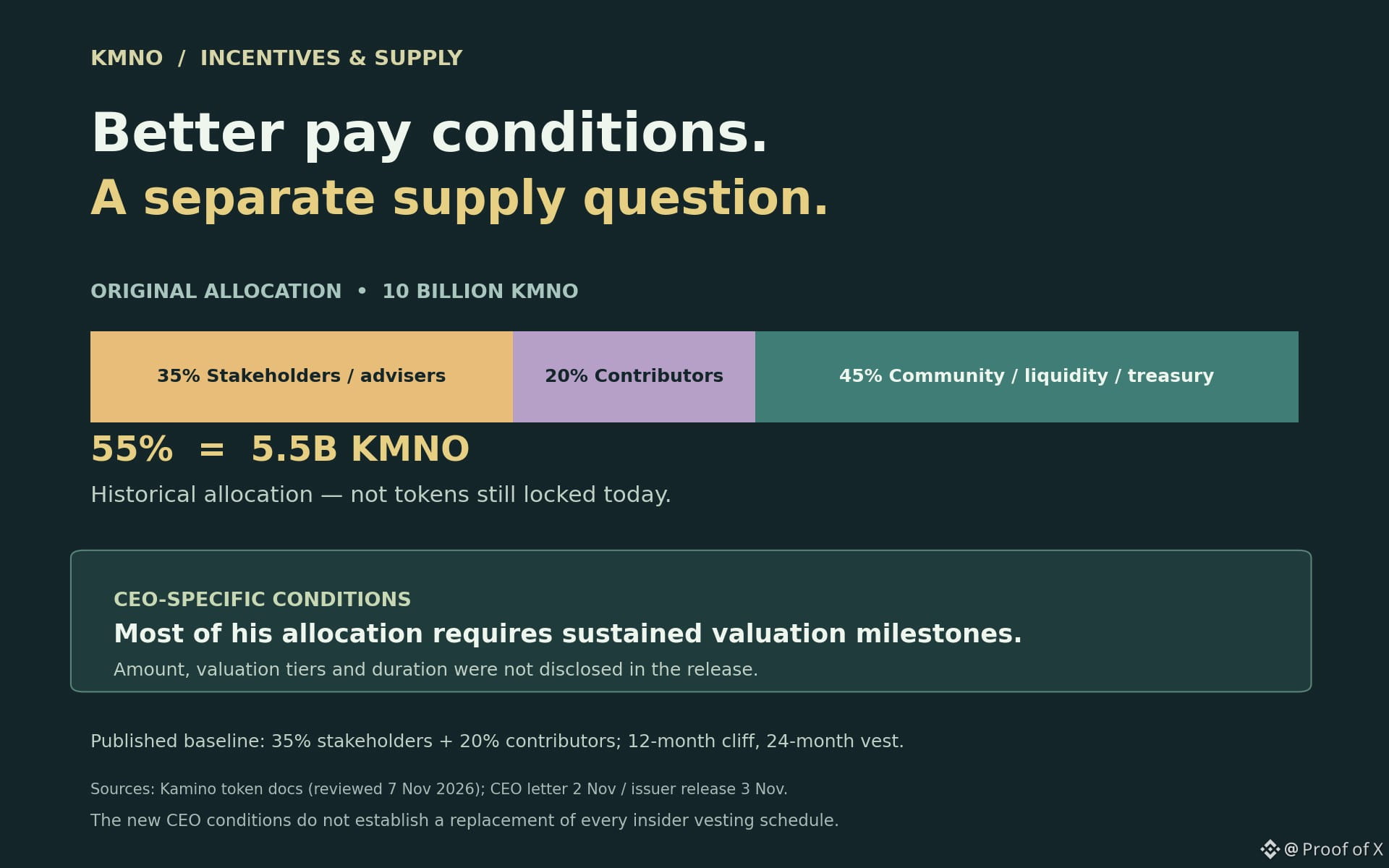
• Published tokenomics: stakeholders/advisors 35%, core contributors 20%—55% of the original 10B supply. Both categories have a 12-month lockup followed by 24-month linear vesting.
• CEO's new conditions: most of his allocation depends on valuation milestones. The release does not disclose its size, thresholds or required holding periods, or replace every insider's schedule.
The business earns a market-specific share of borrower interest; lenders receive a separate share. Kamino says all onchain/offchain revenue and IP accrue to its Foundation, which committed at least $20M over 24 months to expansion. That is a growth commitment, not holder distributions: the release gives KMNO no claim on Foundation revenue or equity.
The economic comparison is Aave: its documented revenue-funded token purchases go to a DAO reserve. Lending growth alone does not establish the same token demand mechanism at Kamino.
My take: This is constructive incentive design, with reinvestment capacity behind the expansion plan. Treat KMNO as exposure to execution and future capital allocation—not an earnings coupon or an end to vesting. The decisive disclosure would be the actual milestone schedule and how much token supply it covers.
Sources: Kamino, One Kamino. One KMNO., November 2; issuer release via Business Wire, November 3, 2026. Kamino KMNO and Borrow Fees docs; Aave AAVE Token docs, undated, reviewed November 7.
As of: 2026-11-07 10:56 UTC | Binance spot KMNOUSDT
S/R basis: Classic S1/R1 from the completed November 6 UTC daily candle.
NFA. DYOR.
$KMNO Price: $0.03408 | 24h: -0.64% | S: $0.03376 | R: $0.03507
🐂 TL;DR: $KMNO deserves credit for making leadership earn more of its upside. The CEO's November 2 letter ties most of his allocation to sustained valuation milestones. I would still keep the broader insider allocation in the supply model.
Separate two commitments:
• Published tokenomics: stakeholders/advisors 35%, core contributors 20%—55% of the original 10B supply. Both categories have a 12-month lockup followed by 24-month linear vesting.
• CEO's new conditions: most of his allocation depends on valuation milestones. The release does not disclose its size, thresholds or required holding periods, or replace every insider's schedule.
The business earns a market-specific share of borrower interest; lenders receive a separate share. Kamino says all onchain/offchain revenue and IP accrue to its Foundation, which committed at least $20M over 24 months to expansion. That is a growth commitment, not holder distributions: the release gives KMNO no claim on Foundation revenue or equity.
The economic comparison is Aave: its documented revenue-funded token purchases go to a DAO reserve. Lending growth alone does not establish the same token demand mechanism at Kamino.
My take: This is constructive incentive design, with reinvestment capacity behind the expansion plan. Treat KMNO as exposure to execution and future capital allocation—not an earnings coupon or an end to vesting. The decisive disclosure would be the actual milestone schedule and how much token supply it covers.
Sources: Kamino, One Kamino. One KMNO., November 2; issuer release via Business Wire, November 3, 2026. Kamino KMNO and Borrow Fees docs; Aave AAVE Token docs, undated, reviewed November 7.
As of: 2026-11-07 10:56 UTC | Binance spot KMNOUSDT
S/R basis: Classic S1/R1 from the completed November 6 UTC daily candle.
NFA. DYOR.
🐂 TL;DR: $KMNO deserves credit for making leadership earn more of its upside. The CEO's November 2 letter ties most of his allocation to sustained valuation milestones. I would still keep the broader insider allocation in the supply model.
Separate two commitments:
• Published tokenomics: stakeholders/advisors 35%, core contributors 20%—55% of the original 10B supply. Both categories have a 12-month lockup followed by 24-month linear vesting.
• CEO's new conditions: most of his allocation depends on valuation milestones. The release does not disclose its size, thresholds or required holding periods, or replace every insider's schedule.
The business earns a market-specific share of borrower interest; lenders receive a separate share. Kamino says all onchain/offchain revenue and IP accrue to its Foundation, which committed at least $20M over 24 months to expansion. That is a growth commitment, not holder distributions: the release gives KMNO no claim on Foundation revenue or equity.
The economic comparison is Aave: its documented revenue-funded token purchases go to a DAO reserve. Lending growth alone does not establish the same token demand mechanism at Kamino.
My take: This is constructive incentive design, with reinvestment capacity behind the expansion plan. Treat KMNO as exposure to execution and future capital allocation—not an earnings coupon or an end to vesting. The decisive disclosure would be the actual milestone schedule and how much token supply it covers.
Sources: Kamino, One Kamino. One KMNO., November 2; issuer release via Business Wire, November 3, 2026. Kamino KMNO and Borrow Fees docs; Aave AAVE Token docs, undated, reviewed November 7.
As of: 2026-11-07 10:56 UTC | Binance spot KMNOUSDT
S/R basis: Classic S1/R1 from the completed November 6 UTC daily candle.
NFA. DYOR.
61
·
--
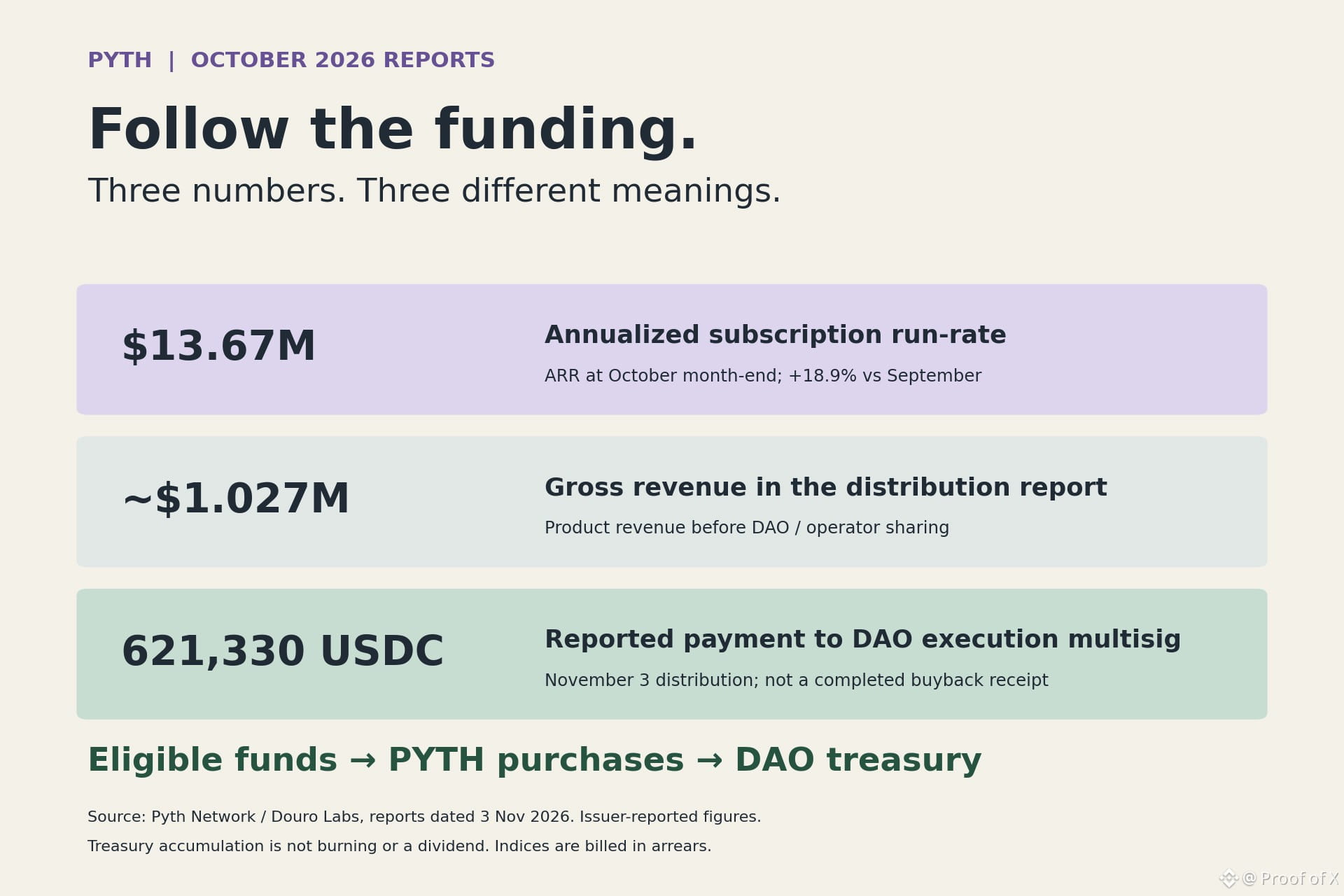
🐂 TL;DR: $PYTH's October report strengthens the case for fee-funded token demand: Douro Labs reports paying 621,330 USDC to the DAO's execution multisig on November 3. I give that funding step more weight than the $13.67M annualized subscription headline.
Three figures, three meanings:
• $13.67M ARR: paid subscription run-rate, up 18.9% on September.
• About $1.027M: reported gross revenue in October's distribution breakdown.
• 621,330 USDC: the DAO's reported payment, after product-specific revenue sharing.
Under Strategic Reserve V2, eligible funds are converted into PYTH and the purchased tokens return to the DAO treasury. This is treasury accumulation, not a token burn or a cash dividend. The reported USDC transfer does not establish that those market purchases are complete. Indices are billed in arrears.
My take: Commercial growth now comes with a specific reported funding amount for token accumulation. Measure the next step by PYTH actually acquired for the treasury—not ARR treated as an immediate buyback budget.
Sources: Douro Labs, October 2026 Pyth Pro report; Pyth Network, October 2026 report, both November 3. Pyth DAO, OP-PIP-136, September 24, 2026.
NFA. DYOR.
🐂 TL;DR: $PYTH 's October report strengthens the case for fee-funded token demand: Douro Labs reports paying 621,330 USDC to the DAO's execution multisig on November 3. I give that funding step more weight than the $13.67M annualized subscription headline.
Three figures, three meanings:
• $13.67M ARR: paid subscription run-rate, up 18.9% on September.
• About $1.027M: reported gross revenue in October's distribution breakdown.
• 621,330 USDC: the DAO's reported payment, after product-specific revenue sharing.
Under Strategic Reserve V2, eligible funds are converted into PYTH and the purchased tokens return to the DAO treasury. This is treasury accumulation, not a token burn or a cash dividend. The reported USDC transfer does not establish that those market purchases are complete. Indices are billed in arrears.
My take: Commercial growth now comes with a specific reported funding amount for token accumulation. Measure the next step by PYTH actually acquired for the treasury—not ARR treated as an immediate buyback budget.
Sources: Douro Labs, October 2026 Pyth Pro report; Pyth Network, October 2026 report, both November 3. Pyth DAO, OP-PIP-136, September 24, 2026.
NFA. DYOR.
Three figures, three meanings:
• $13.67M ARR: paid subscription run-rate, up 18.9% on September.
• About $1.027M: reported gross revenue in October's distribution breakdown.
• 621,330 USDC: the DAO's reported payment, after product-specific revenue sharing.
Under Strategic Reserve V2, eligible funds are converted into PYTH and the purchased tokens return to the DAO treasury. This is treasury accumulation, not a token burn or a cash dividend. The reported USDC transfer does not establish that those market purchases are complete. Indices are billed in arrears.
My take: Commercial growth now comes with a specific reported funding amount for token accumulation. Measure the next step by PYTH actually acquired for the treasury—not ARR treated as an immediate buyback budget.
Sources: Douro Labs, October 2026 Pyth Pro report; Pyth Network, October 2026 report, both November 3. Pyth DAO, OP-PIP-136, September 24, 2026.
NFA. DYOR.
488
·
--
$STRK Price: $0.04187 | 24h: +4.39% | S: $0.03939 | R: $0.04206
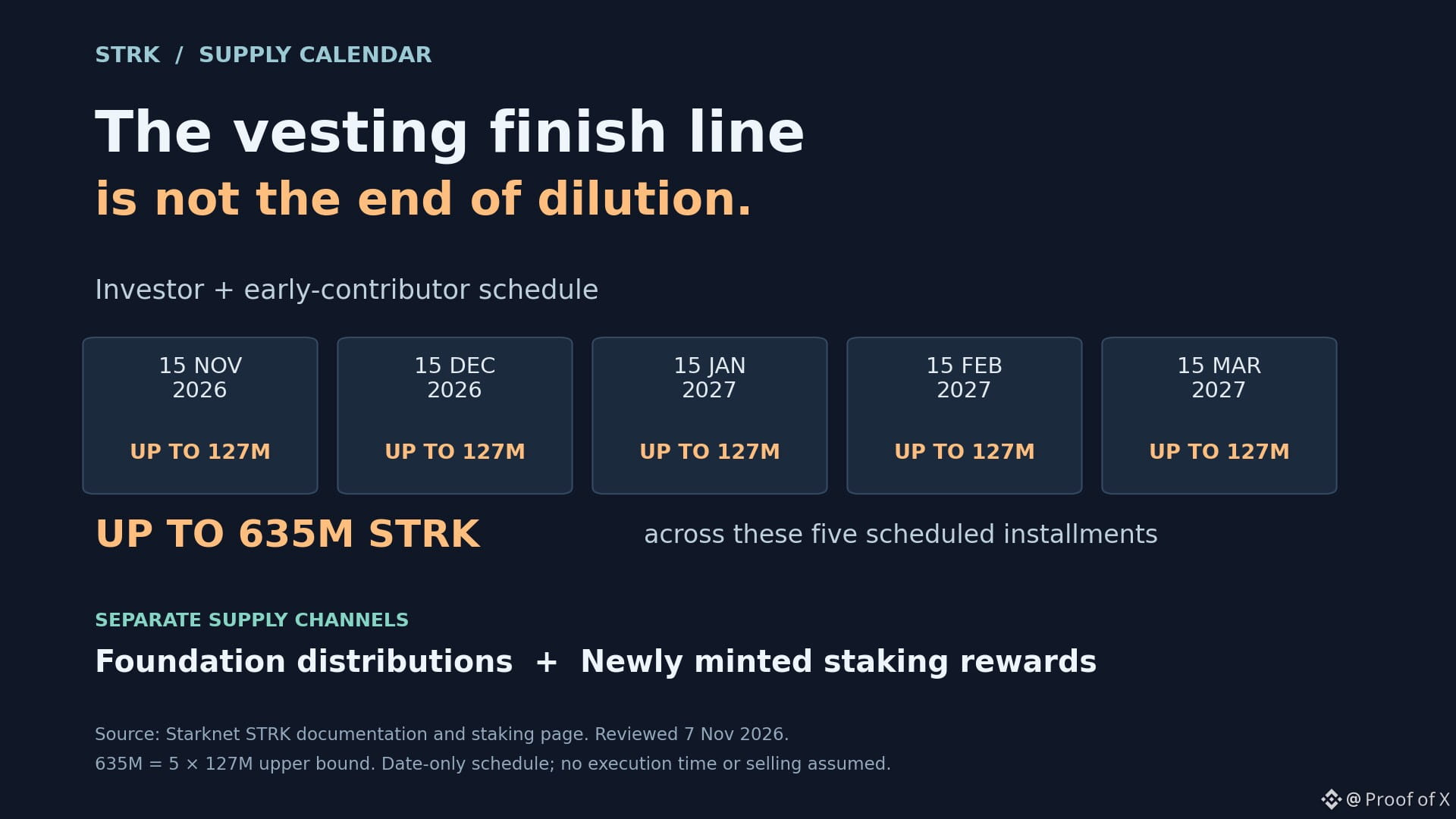
🐻 TL;DR: $STRK's March 2027 vesting endpoint is not an end to dilution. Up to 127 million STRK is scheduled for investors and early contributors on November 15.
Five monthly dates remain through March 15, 2027: up to 635 million combined, or 6.35% of the original 10 billion tokens—not current circulation. Foundation distributions and newly minted staking rewards follow separate rules. Unlocking is not evidence of selling.
My take: The final installment would remove a recurring supply pressure. Subsequent dilution still depends on Foundation distributions and staking issuance.
Article: https://app.binance.com/uni-qr/cart/385610302991397?r=ODRQIW1H&l=en
Sources: Starknet Documentation, STRK; Starknet staking page. Publication dates not displayed; accessed November 7, 2026.
As of: 2026-11-07 06:52 UTC | Binance spot STRKUSDT
S/R basis: Classic S1/R1 from the completed Nov. 6 UTC daily candle.
NFA. DYOR.
$STRK Price: $0.04187 | 24h: +4.39% | S: $0.03939 | R: $0.04206
🐻 TL;DR: $STRK 's March 2027 vesting endpoint is not an end to dilution. Up to 127 million STRK is scheduled for investors and early contributors on November 15.
Five monthly dates remain through March 15, 2027: up to 635 million combined, or 6.35% of the original 10 billion tokens—not current circulation. Foundation distributions and newly minted staking rewards follow separate rules. Unlocking is not evidence of selling.
My take: The final installment would remove a recurring supply pressure. Subsequent dilution still depends on Foundation distributions and staking issuance.
Article: https://app.binance.com/uni-qr/cart/385610302991397?r=ODRQIW1H&l=en
Sources: Starknet Documentation, STRK; Starknet staking page. Publication dates not displayed; accessed November 7, 2026.
As of: 2026-11-07 06:52 UTC | Binance spot STRKUSDT
S/R basis: Classic S1/R1 from the completed Nov. 6 UTC daily candle.
NFA. DYOR.
🐻 TL;DR: $STRK 's March 2027 vesting endpoint is not an end to dilution. Up to 127 million STRK is scheduled for investors and early contributors on November 15.
Five monthly dates remain through March 15, 2027: up to 635 million combined, or 6.35% of the original 10 billion tokens—not current circulation. Foundation distributions and newly minted staking rewards follow separate rules. Unlocking is not evidence of selling.
My take: The final installment would remove a recurring supply pressure. Subsequent dilution still depends on Foundation distributions and staking issuance.
Article: https://app.binance.com/uni-qr/cart/385610302991397?r=ODRQIW1H&l=en
Sources: Starknet Documentation, STRK; Starknet staking page. Publication dates not displayed; accessed November 7, 2026.
As of: 2026-11-07 06:52 UTC | Binance spot STRKUSDT
S/R basis: Classic S1/R1 from the completed Nov. 6 UTC daily candle.
NFA. DYOR.
206
·
--
Verified
Article
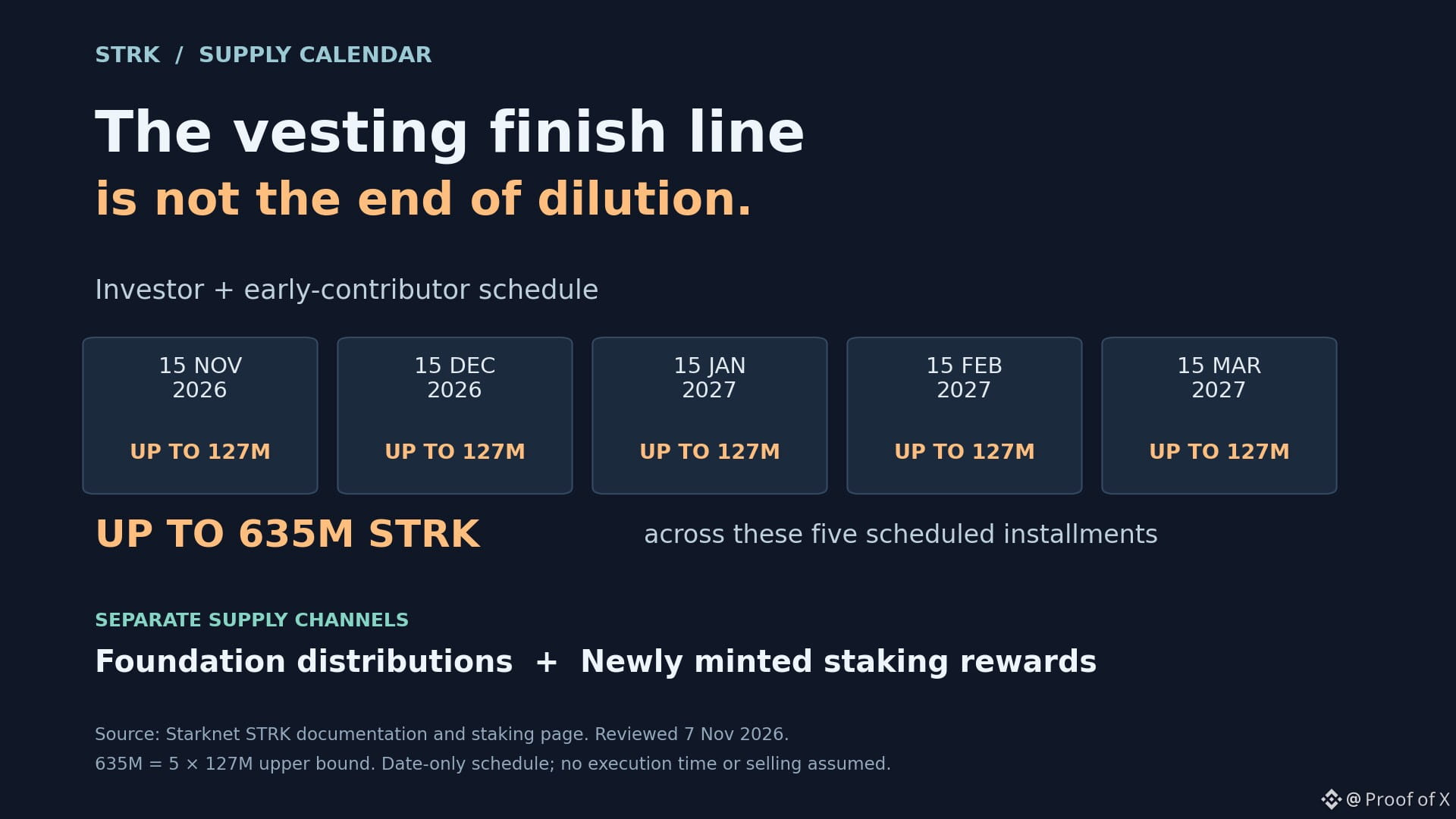
$STRK: March 2027 ends a vesting stream, not dilution🐻 TL;DR: $STRK's March 2027 vesting endpoint is not an end to dilution. The official schedule puts the next investor and early-contributor release at up to 127 million STRK on November 15, while staking issuance and Foundation distributions follow separate rules.
Five dates, one defined ceiling
The remaining scheduled dates are November 15 and December 15, 2026, then January 15, February 15 and March 15, 2027. At the published monthly maximum, that is up to 635 million STRK across five installments.
Each 127 million installment equals 1.27% of the original 10 billion tokens. The five-date ceiling equals 6.35% of that initial supply. These are not percentages of today's circulating supply, and 635 million is not a count of every token still locked.
The schedule concerns investors and early contributors. It gives a date rather than an exact execution time. A release from contractual restrictions does not establish an exchange deposit or a sale.
What the countdown leaves out
Foundation-held allocations are already contractually unlocked, but the documentation excludes retained tokens from circulation until they are distributed through grants or other programs. Those distributions can expand the tradable pool without a new vesting cliff.
Staking rewards are different again: newly minted STRK increases total supply. Starknet's current staking page explicitly describes rewards as newly minted tokens. Neither mechanism is extinguished by the March installment.
My take: The end of this recurring investor/contributor schedule would remove a defined supply pressure, which is useful relief. I would still judge the subsequent supply burden by actual Foundation distributions and staking issuance, rather than treating a completed vesting calendar as fixed supply.
Sources: Starknet Documentation, STRK — Supply and distribution; Starknet, Stake STRK or Bitcoin on Starknet. Publication dates not displayed; accessed November 7, 2026. Five-installment total is the author's arithmetic from the published maximum. No execution or selling is claimed.
NFA. DYOR.
$STRK: March 2027 ends a vesting stream, not dilution
🐻 TL;DR: $STRK 's March 2027 vesting endpoint is not an end to dilution. The official schedule puts the next investor and early-contributor release at up to 127 million STRK on November 15, while staking issuance and Foundation distributions follow separate rules.
Five dates, one defined ceiling
The remaining scheduled dates are November 15 and December 15, 2026, then January 15, February 15 and March 15, 2027. At the published monthly maximum, that is up to 635 million STRK across five installments.
Each 127 million installment equals 1.27% of the original 10 billion tokens. The five-date ceiling equals 6.35% of that initial supply. These are not percentages of today's circulating supply, and 635 million is not a count of every token still locked.
The schedule concerns investors and early contributors. It gives a date rather than an exact execution time. A release from contractual restrictions does not establish an exchange deposit or a sale.
What the countdown leaves out
Foundation-held allocations are already contractually unlocked, but the documentation excludes retained tokens from circulation until they are distributed through grants or other programs. Those distributions can expand the tradable pool without a new vesting cliff.
Staking rewards are different again: newly minted STRK increases total supply. Starknet's current staking page explicitly describes rewards as newly minted tokens. Neither mechanism is extinguished by the March installment.
My take: The end of this recurring investor/contributor schedule would remove a defined supply pressure, which is useful relief. I would still judge the subsequent supply burden by actual Foundation distributions and staking issuance, rather than treating a completed vesting calendar as fixed supply.
Sources: Starknet Documentation, STRK — Supply and distribution; Starknet, Stake STRK or Bitcoin on Starknet. Publication dates not displayed; accessed November 7, 2026. Five-installment total is the author's arithmetic from the published maximum. No execution or selling is claimed.
NFA. DYOR.
Five dates, one defined ceiling
The remaining scheduled dates are November 15 and December 15, 2026, then January 15, February 15 and March 15, 2027. At the published monthly maximum, that is up to 635 million STRK across five installments.
Each 127 million installment equals 1.27% of the original 10 billion tokens. The five-date ceiling equals 6.35% of that initial supply. These are not percentages of today's circulating supply, and 635 million is not a count of every token still locked.
The schedule concerns investors and early contributors. It gives a date rather than an exact execution time. A release from contractual restrictions does not establish an exchange deposit or a sale.
What the countdown leaves out
Foundation-held allocations are already contractually unlocked, but the documentation excludes retained tokens from circulation until they are distributed through grants or other programs. Those distributions can expand the tradable pool without a new vesting cliff.
Staking rewards are different again: newly minted STRK increases total supply. Starknet's current staking page explicitly describes rewards as newly minted tokens. Neither mechanism is extinguished by the March installment.
My take: The end of this recurring investor/contributor schedule would remove a defined supply pressure, which is useful relief. I would still judge the subsequent supply burden by actual Foundation distributions and staking issuance, rather than treating a completed vesting calendar as fixed supply.
Sources: Starknet Documentation, STRK — Supply and distribution; Starknet, Stake STRK or Bitcoin on Starknet. Publication dates not displayed; accessed November 7, 2026. Five-installment total is the author's arithmetic from the published maximum. No execution or selling is claimed.
NFA. DYOR.
1
4
2.4k
·
--
🚨 TL;DR: Gnosis Pay disclosed a breach of its legacy consumer-card system on Nov. 6. For the $GNO ecosystem, my judgment is that self-custody leaves a separate customer-data risk: Gnosis Pay says funds were unaffected even though customer information was exposed.
Unauthorized access was detected on Nov. 3. The company says containment began within two hours; it subsequently replaced affected credentials and addressed the vulnerability. Its enterprise platform for white-label card programs was unaffected.
Gnosis Pay has made 3D Secure mandatory for online card payments and increased monitoring. The consumer system was already scheduled for retirement on Dec. 20. The public notice does not quantify the affected customer count or list all exposed data categories; customers received individual notifications.
My take: Assess the custody and customer-data layers separately. Payment verification can reduce one fraud channel, but exposed personal information can still support convincing phishing. The meaningful follow-through is support and monitoring for misuse through the planned shutdown.
Source: Gnosis Pay, “Data breach on the legacy system powering Gnosis Pay-branded cards,” Nov. 6, 2026; Gnosis Pay Help, “What stops and what continues,” updated Sept. 21, 2026.
NFA. DYOR.
🚨 TL;DR: Gnosis Pay disclosed a breach of its legacy consumer-card system on Nov. 6. For the $GNO ecosystem, my judgment is that self-custody leaves a separate customer-data risk: Gnosis Pay says funds were unaffected even though customer information was exposed.
Unauthorized access was detected on Nov. 3. The company says containment began within two hours; it subsequently replaced affected credentials and addressed the vulnerability. Its enterprise platform for white-label card programs was unaffected.
Gnosis Pay has made 3D Secure mandatory for online card payments and increased monitoring. The consumer system was already scheduled for retirement on Dec. 20. The public notice does not quantify the affected customer count or list all exposed data categories; customers received individual notifications.
My take: Assess the custody and customer-data layers separately. Payment verification can reduce one fraud channel, but exposed personal information can still support convincing phishing. The meaningful follow-through is support and monitoring for misuse through the planned shutdown.
Source: Gnosis Pay, “Data breach on the legacy system powering Gnosis Pay-branded cards,” Nov. 6, 2026; Gnosis Pay Help, “What stops and what continues,” updated Sept. 21, 2026.
NFA. DYOR.
Unauthorized access was detected on Nov. 3. The company says containment began within two hours; it subsequently replaced affected credentials and addressed the vulnerability. Its enterprise platform for white-label card programs was unaffected.
Gnosis Pay has made 3D Secure mandatory for online card payments and increased monitoring. The consumer system was already scheduled for retirement on Dec. 20. The public notice does not quantify the affected customer count or list all exposed data categories; customers received individual notifications.
My take: Assess the custody and customer-data layers separately. Payment verification can reduce one fraud channel, but exposed personal information can still support convincing phishing. The meaningful follow-through is support and monitoring for misuse through the planned shutdown.
Source: Gnosis Pay, “Data breach on the legacy system powering Gnosis Pay-branded cards,” Nov. 6, 2026; Gnosis Pay Help, “What stops and what continues,” updated Sept. 21, 2026.
NFA. DYOR.

29
·
--
$ZEC Price: $1349.09 | 24h: +2.46% | S: $1251.23 | R: $1391.40
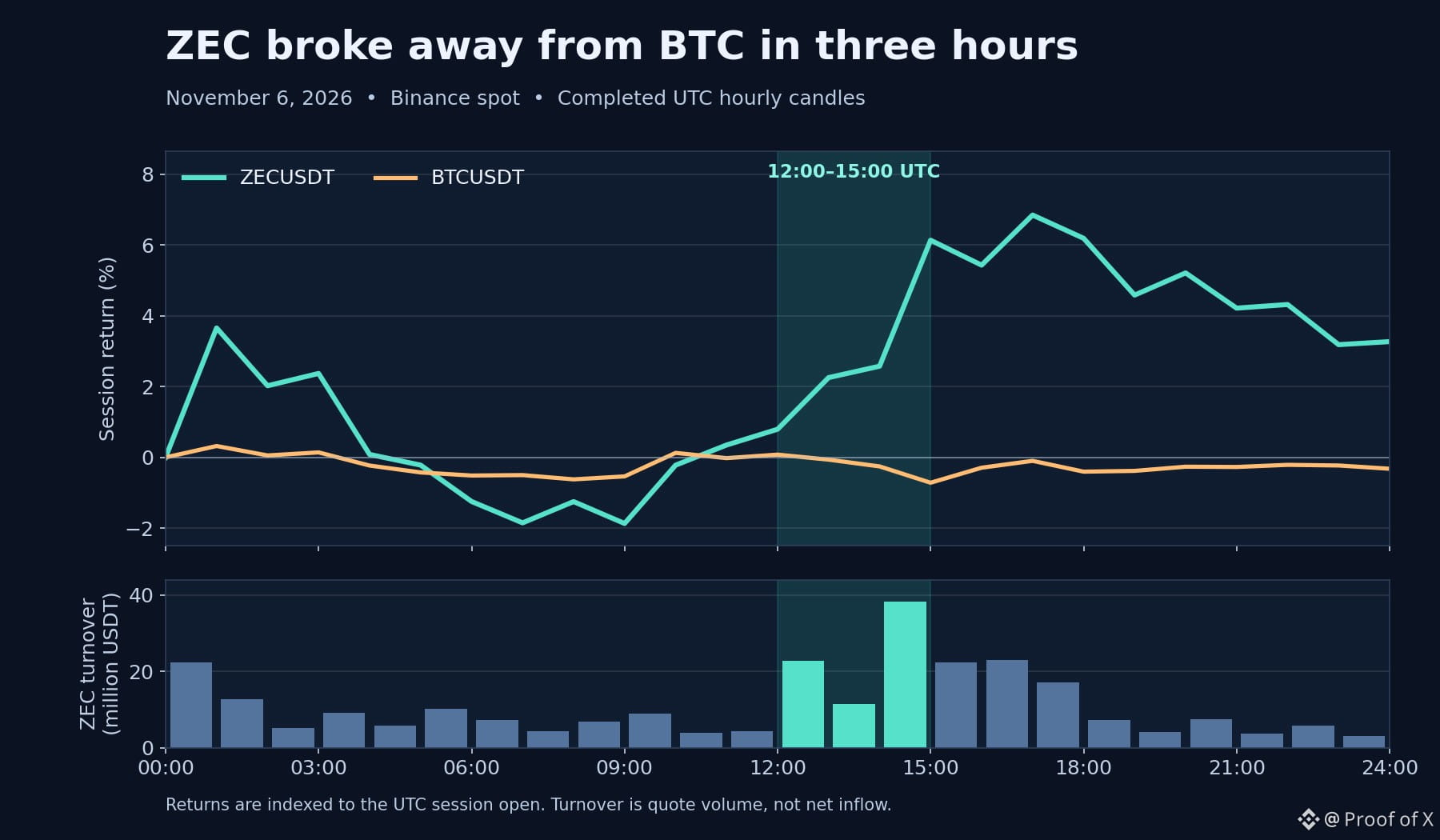
📈 TL;DR: $ZEC’s Nov. 6 lead over BTC was real, but concentrated. ZEC gained 5.30% from 12:00 to 15:00 UTC while BTC fell 0.79%; the window accounted for 27.2% of ZEC’s daily Binance spot turnover.
ZEC fell 2.70% from 15:00 UTC to the close, yet still finished up 3.27% against BTC’s 0.32% decline.
My take: I’d give the relative strength more weight if ZEC can hold near its own highs through another BTC down session, with turnover sustained beyond a few hours.
Full analysis: https://app.binance.com/uni-qr/cart/385551938875863?r=ODRQIW1H&l=en
As of: 2026-11-07 02:55 UTC | Binance spot ZECUSDT
S/R basis: Classic S1/R1 from the completed Nov. 6 UTC daily candle.
Source: Binance Spot, ZECUSDT and BTCUSDT completed candles through Nov. 6, 2026 UTC.
NFA. DYOR.
$ZEC Price: $1349.09 | 24h: +2.46% | S: $1251.23 | R: $1391.40
📈 TL;DR: $ZEC ’s Nov. 6 lead over BTC was real, but concentrated. ZEC gained 5.30% from 12:00 to 15:00 UTC while BTC fell 0.79%; the window accounted for 27.2% of ZEC’s daily Binance spot turnover.
ZEC fell 2.70% from 15:00 UTC to the close, yet still finished up 3.27% against BTC’s 0.32% decline.
My take: I’d give the relative strength more weight if ZEC can hold near its own highs through another BTC down session, with turnover sustained beyond a few hours.
Full analysis: https://app.binance.com/uni-qr/cart/385551938875863?r=ODRQIW1H&l=en
As of: 2026-11-07 02:55 UTC | Binance spot ZECUSDT
S/R basis: Classic S1/R1 from the completed Nov. 6 UTC daily candle.
Source: Binance Spot, ZECUSDT and BTCUSDT completed candles through Nov. 6, 2026 UTC.
NFA. DYOR.
📈 TL;DR: $ZEC ’s Nov. 6 lead over BTC was real, but concentrated. ZEC gained 5.30% from 12:00 to 15:00 UTC while BTC fell 0.79%; the window accounted for 27.2% of ZEC’s daily Binance spot turnover.
ZEC fell 2.70% from 15:00 UTC to the close, yet still finished up 3.27% against BTC’s 0.32% decline.
My take: I’d give the relative strength more weight if ZEC can hold near its own highs through another BTC down session, with turnover sustained beyond a few hours.
Full analysis: https://app.binance.com/uni-qr/cart/385551938875863?r=ODRQIW1H&l=en
As of: 2026-11-07 02:55 UTC | Binance spot ZECUSDT
S/R basis: Classic S1/R1 from the completed Nov. 6 UTC daily candle.
Source: Binance Spot, ZECUSDT and BTCUSDT completed candles through Nov. 6, 2026 UTC.
NFA. DYOR.
276
·
--
Article
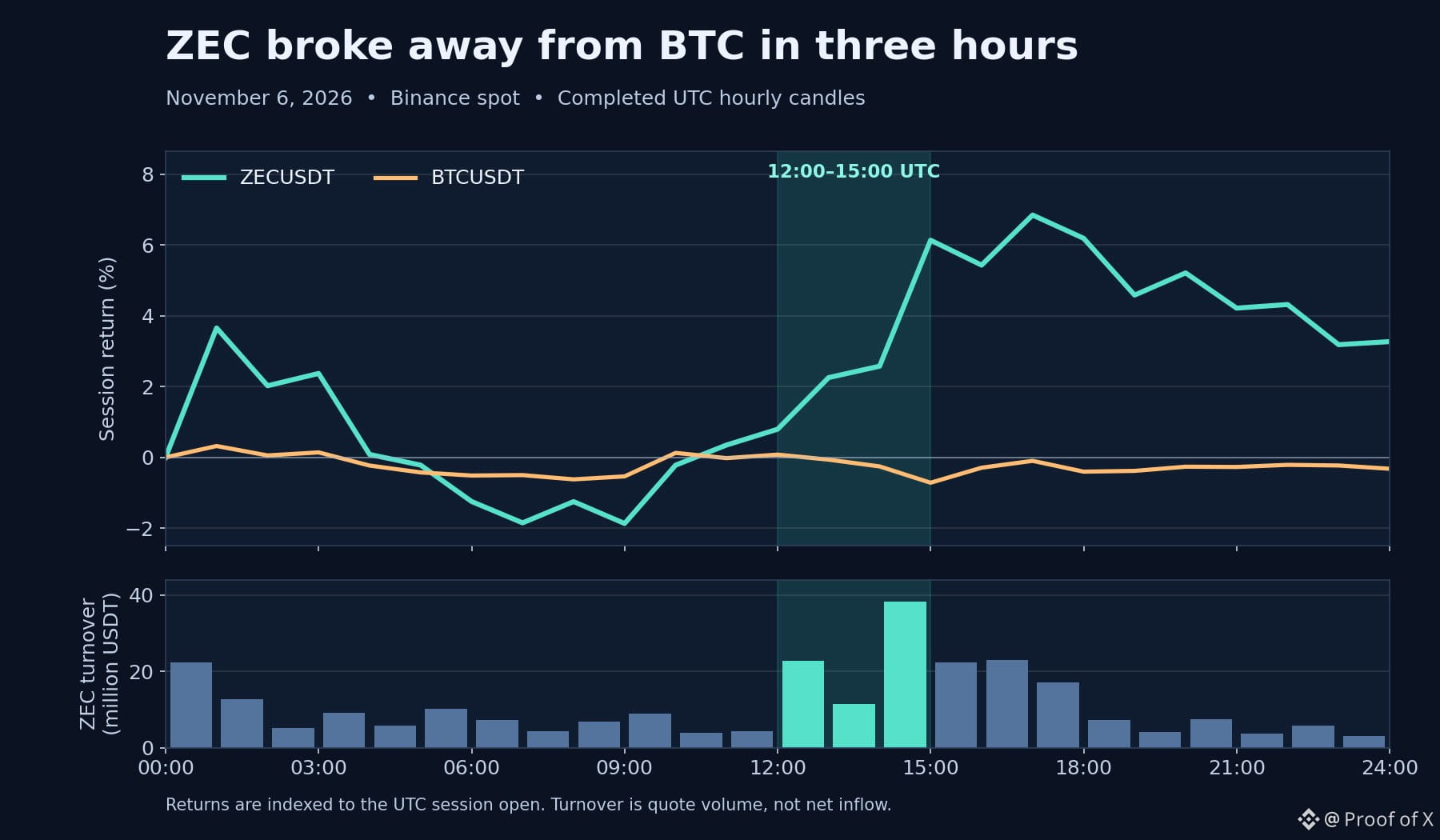
$ZEC's BTC Lead Was Real. Three Hours Did the Heavy Lifting.📈 TL;DR: I read $ZEC’s Nov. 6 session as genuine relative strength with a narrow base. ZEC rose 5.30% from 12:00 to 15:00 UTC as BTC fell 0.79%, and those three hours accounted for 27.2% of ZEC’s daily Binance spot turnover.
The divergence was sharper than the close suggests
ZEC gained 3.27% across the completed UTC session while BTC lost 0.32%, a gap of 3.59 percentage points. ZEC had risen just 0.80% through 12:00 UTC. The three hours that followed produced 72.31M USDT in ZEC turnover. Over the same interval, BTC traded 15.0% of its own daily turnover. That comparison shows how concentrated the ZEC session was relative to the benchmark, even though the two pairs trade at different scales.
ZEC gave back 2.70% from 15:00 UTC to the close, while BTC regained 0.40% over the same period. The relative lead held, but the market did not keep the strongest part of the move. Quote turnover measures the value traded on Binance Spot. It does not tell us how much new money entered or why traders bought or sold.
The weekly check makes the case stronger
Over seven completed UTC sessions ending Nov. 6, ZEC gained 4.18% while BTC lost 1.97%. ZEC’s quote turnover rose 4.1% versus the preceding seven sessions; BTC’s fell 6.6%. That wider window supports the relative strength argument. The fade in the latest session is the reason I’d still look for a second close with broader participation.
My take: The setup I’d take more seriously is another BTC down session in which ZEC holds near its own highs into the close and turnover is sustained beyond its busiest few hours. That would show stronger retention than the Nov. 6 burst.
Source: Binance Spot, ZECUSDT and BTCUSDT completed hourly and daily candles through Nov. 6, 2026 UTC. Returns are close to close. Hourly endpoints use the close of the last completed hour; turnover is in USDT.
NFA. DYOR.
$ZEC's BTC Lead Was Real. Three Hours Did the Heavy Lifting.
📈 TL;DR: I read $ZEC ’s Nov. 6 session as genuine relative strength with a narrow base. ZEC rose 5.30% from 12:00 to 15:00 UTC as BTC fell 0.79%, and those three hours accounted for 27.2% of ZEC’s daily Binance spot turnover.
The divergence was sharper than the close suggests
ZEC gained 3.27% across the completed UTC session while BTC lost 0.32%, a gap of 3.59 percentage points. ZEC had risen just 0.80% through 12:00 UTC. The three hours that followed produced 72.31M USDT in ZEC turnover. Over the same interval, BTC traded 15.0% of its own daily turnover. That comparison shows how concentrated the ZEC session was relative to the benchmark, even though the two pairs trade at different scales.
ZEC gave back 2.70% from 15:00 UTC to the close, while BTC regained 0.40% over the same period. The relative lead held, but the market did not keep the strongest part of the move. Quote turnover measures the value traded on Binance Spot. It does not tell us how much new money entered or why traders bought or sold.
The weekly check makes the case stronger
Over seven completed UTC sessions ending Nov. 6, ZEC gained 4.18% while BTC lost 1.97%. ZEC’s quote turnover rose 4.1% versus the preceding seven sessions; BTC’s fell 6.6%. That wider window supports the relative strength argument. The fade in the latest session is the reason I’d still look for a second close with broader participation.
My take: The setup I’d take more seriously is another BTC down session in which ZEC holds near its own highs into the close and turnover is sustained beyond its busiest few hours. That would show stronger retention than the Nov. 6 burst.
Source: Binance Spot, ZECUSDT and BTCUSDT completed hourly and daily candles through Nov. 6, 2026 UTC. Returns are close to close. Hourly endpoints use the close of the last completed hour; turnover is in USDT.
NFA. DYOR.
The divergence was sharper than the close suggests
ZEC gained 3.27% across the completed UTC session while BTC lost 0.32%, a gap of 3.59 percentage points. ZEC had risen just 0.80% through 12:00 UTC. The three hours that followed produced 72.31M USDT in ZEC turnover. Over the same interval, BTC traded 15.0% of its own daily turnover. That comparison shows how concentrated the ZEC session was relative to the benchmark, even though the two pairs trade at different scales.
ZEC gave back 2.70% from 15:00 UTC to the close, while BTC regained 0.40% over the same period. The relative lead held, but the market did not keep the strongest part of the move. Quote turnover measures the value traded on Binance Spot. It does not tell us how much new money entered or why traders bought or sold.
The weekly check makes the case stronger
Over seven completed UTC sessions ending Nov. 6, ZEC gained 4.18% while BTC lost 1.97%. ZEC’s quote turnover rose 4.1% versus the preceding seven sessions; BTC’s fell 6.6%. That wider window supports the relative strength argument. The fade in the latest session is the reason I’d still look for a second close with broader participation.
My take: The setup I’d take more seriously is another BTC down session in which ZEC holds near its own highs into the close and turnover is sustained beyond its busiest few hours. That would show stronger retention than the Nov. 6 burst.
Source: Binance Spot, ZECUSDT and BTCUSDT completed hourly and daily candles through Nov. 6, 2026 UTC. Returns are close to close. Hourly endpoints use the close of the last completed hour; turnover is in USDT.
NFA. DYOR.
227
·
--
🔥 TL;DR: Aave Labs acquired Avon's team and lending technology. For $AAVE, I see a clear opportunity to offer predictable interest costs on a network that Aave Labs says already has more than $13B in active loans.
The deal includes Avon's fixed and floating rate lending protocols and its onchain order book. Two Avon team members are joining Aave Labs engineering, so Aave gets both the software and people who built it.
A fixed rate would let borrowers budget interest costs when variable rates rise. The acquisition announcement did not launch an Avon-powered Aave market or give a launch date or deal terms.
My take: The useful test is how much borrowers can actually finance at a quoted fixed rate. A deep market at competitive rates would make this acquisition matter beyond the engineering team.
Source: Aave Labs, “Aave Labs Acquires Avon,” November 6, 2026.
NFA. DYOR.
🔥 TL;DR: Aave Labs acquired Avon's team and lending technology. For $AAVE , I see a clear opportunity to offer predictable interest costs on a network that Aave Labs says already has more than $13B in active loans.
The deal includes Avon's fixed and floating rate lending protocols and its onchain order book. Two Avon team members are joining Aave Labs engineering, so Aave gets both the software and people who built it.
A fixed rate would let borrowers budget interest costs when variable rates rise. The acquisition announcement did not launch an Avon-powered Aave market or give a launch date or deal terms.
My take: The useful test is how much borrowers can actually finance at a quoted fixed rate. A deep market at competitive rates would make this acquisition matter beyond the engineering team.
Source: Aave Labs, “Aave Labs Acquires Avon,” November 6, 2026.
NFA. DYOR.
The deal includes Avon's fixed and floating rate lending protocols and its onchain order book. Two Avon team members are joining Aave Labs engineering, so Aave gets both the software and people who built it.
A fixed rate would let borrowers budget interest costs when variable rates rise. The acquisition announcement did not launch an Avon-powered Aave market or give a launch date or deal terms.
My take: The useful test is how much borrowers can actually finance at a quoted fixed rate. A deep market at competitive rates would make this acquisition matter beyond the engineering team.
Source: Aave Labs, “Aave Labs Acquires Avon,” November 6, 2026.
NFA. DYOR.

146
·
--
$HYPE Price: $78.56 | 24h: +2.44% | S: $73.63 | R: $82.28
🔥 TL;DR: A Hyperliquid Strategies subsidiary has applied to carry U.S. futures accounts. For $HYPE, the upside depends on how future trading fees are shared.
The proposed permissioned markets would use HIP-3* infrastructure. Neither broker approval nor market launch is confirmed. Coinbase already offers U.S. perpetual-style futures, so new markets would need to compete on contract choice, liquidity and collateral terms.
Today's Assistance Fund converts its fee share to HYPE that is burned. The future U.S. fee split is undisclosed, and contributor vesting and reserve-funded staking can still add circulating supply.
My take: The application opens a possible distribution channel. Sustained trades and a traceable fee share would make it an economic catalyst for HYPE.
Full Article: https://app.binance.com/uni-qr/cart/385491538675665?r=ODRQIW1H&l=en
As of: 2026-11-06 22:49 UTC | Binance spot HYPEUSDT
S/R basis: Classic S1/R1 from the prior completed UTC daily candle; rounded to 0.01 USDT.
NFA. DYOR.
$HYPE Price: $78.56 | 24h: +2.44% | S: $73.63 | R: $82.28
🔥 TL;DR: A Hyperliquid Strategies subsidiary has applied to carry U.S. futures accounts. For $HYPE , the upside depends on how future trading fees are shared.
The proposed permissioned markets would use HIP-3* infrastructure. Neither broker approval nor market launch is confirmed. Coinbase already offers U.S. perpetual-style futures, so new markets would need to compete on contract choice, liquidity and collateral terms.
Today's Assistance Fund converts its fee share to HYPE that is burned. The future U.S. fee split is undisclosed, and contributor vesting and reserve-funded staking can still add circulating supply.
My take: The application opens a possible distribution channel. Sustained trades and a traceable fee share would make it an economic catalyst for HYPE.
Full Article: https://app.binance.com/uni-qr/cart/385491538675665?r=ODRQIW1H&l=en
As of: 2026-11-06 22:49 UTC | Binance spot HYPEUSDT
S/R basis: Classic S1/R1 from the prior completed UTC daily candle; rounded to 0.01 USDT.
NFA. DYOR.
🔥 TL;DR: A Hyperliquid Strategies subsidiary has applied to carry U.S. futures accounts. For $HYPE , the upside depends on how future trading fees are shared.
The proposed permissioned markets would use HIP-3* infrastructure. Neither broker approval nor market launch is confirmed. Coinbase already offers U.S. perpetual-style futures, so new markets would need to compete on contract choice, liquidity and collateral terms.
Today's Assistance Fund converts its fee share to HYPE that is burned. The future U.S. fee split is undisclosed, and contributor vesting and reserve-funded staking can still add circulating supply.
My take: The application opens a possible distribution channel. Sustained trades and a traceable fee share would make it an economic catalyst for HYPE.
Full Article: https://app.binance.com/uni-qr/cart/385491538675665?r=ODRQIW1H&l=en
As of: 2026-11-06 22:49 UTC | Binance spot HYPEUSDT
S/R basis: Classic S1/R1 from the prior completed UTC daily candle; rounded to 0.01 USDT.
NFA. DYOR.

151
·
--

Article
$HYPE: Who Gets Paid If U.S. Futures Reach Hyperliquid?🔥 TL;DR: A Hyperliquid Strategies subsidiary has applied to carry U.S. futures accounts. For $HYPE, the economic test is whether any future permissioned markets send a meaningful share of trading fees to the Assistance Fund.
Start with the customer, then follow the fee
On November 5, Hyperliquid Strategies (HSI) disclosed that a subsidiary had applied to become a futures commission merchant, or FCM. HSI says the subsidiary would carry U.S. client accounts for permissioned markets on Hyperliquid if approved. Those markets would use proposed HIP-3* features that let independent operators run markets on the underlying exchange infrastructure. The broker application and regulatory approval of the proposed markets are separate uncertainties. Neither the announcement nor the existing HIP-3 documentation establishes launch terms for these markets. [1,2]
Coinbase shows what a prospective entrant would have to compete against. Its registered FCM already gives eligible U.S. customers access to long-dated futures with hourly funding, and those contracts use a regulated clearing arrangement. Hyperliquid's proposed design gives market operators a way to build on a common order-matching system. That could help it offer a different range of contracts. But liquidity, collateral terms and reliable account access determine whether customers return. The announcement supplies no comparable spreads or all-in costs for HIP-3*. [1,3]
Who gets paid if the trades arrive?
In today's Hyperliquid design, trading fees can go to liquidity provision, deployers and the Assistance Fund. The Fund automatically converts its fee receipts to HYPE, which the protocol documentation describes as burned. That can reduce supply; it does not pay passive holders a dividend. Existing HIP-3 fee settings can also vary by deployer and market, so a dollar of gross volume cannot be translated into a fixed amount of HYPE purchases. The fee and clearing terms of a future U.S. market would determine how much of its activity, if any, reaches the Fund. [2]
HSI has a different economic exposure. It reported $12.3 million of staking revenue and validator commissions for the September quarter, and $803 million of unrealized HYPE gains. Those are corporate figures, not protocol fee income or payments to other HYPE holders. HYPE itself is used for staking and HyperEVM gas. Staking rewards draw from the future emissions reserve, and contributor tokens started vesting monthly in November 2025. HSI's annual filing puts contributors at 23.8% of the original one-billion-token maximum allocation. More fee-funded burns could offset some supply entering circulation; the filing and release do not establish that the offset will occur. [1,4,5]
My take: The application is a credible first step toward a new customer channel. For HYPE, I would give it more weight once approved markets disclose their fee split and show sustained turnover that results in measurable Assistance Fund purchases. A broker could attract meaningful activity while retaining much of the economic benefit at the operator level.
Sources
[1] Hyperliquid Strategies, November 5 earnings release: https://www.prnewswire.com/news-releases/hyperliquid-strategies-inc-reports-financial-results-for-the-quarter-ended-september-30-2026-302931281.html
[2] Hyperliquid, current fee mechanics: https://hyperliquid.gitbook.io/hyperliquid-docs/trading/fees
[3] Coinbase, U.S. market access and product: https://help.coinbase.com/en/derivatives/perpetual-style-futures/market-access and https://help.coinbase.com/en/coinbase/derivatives/us-perpetual-futures-overview
[4] Hyperliquid, staking: https://hyperliquid.gitbook.io/hyperliquid-docs/hypercore/staking
[5] Hyperliquid Strategies, FY2026 Form 10-K: https://www.sec.gov/Archives/edgar/data/2078856/000119312526370281/purr-20260630.htm
NFA. DYOR.
$HYPE: Who Gets Paid If U.S. Futures Reach Hyperliquid?
🔥 TL;DR: A Hyperliquid Strategies subsidiary has applied to carry U.S. futures accounts. For $HYPE , the economic test is whether any future permissioned markets send a meaningful share of trading fees to the Assistance Fund.
Start with the customer, then follow the fee
On November 5, Hyperliquid Strategies (HSI) disclosed that a subsidiary had applied to become a futures commission merchant, or FCM. HSI says the subsidiary would carry U.S. client accounts for permissioned markets on Hyperliquid if approved. Those markets would use proposed HIP-3* features that let independent operators run markets on the underlying exchange infrastructure. The broker application and regulatory approval of the proposed markets are separate uncertainties. Neither the announcement nor the existing HIP-3 documentation establishes launch terms for these markets. [1,2]
Coinbase shows what a prospective entrant would have to compete against. Its registered FCM already gives eligible U.S. customers access to long-dated futures with hourly funding, and those contracts use a regulated clearing arrangement. Hyperliquid's proposed design gives market operators a way to build on a common order-matching system. That could help it offer a different range of contracts. But liquidity, collateral terms and reliable account access determine whether customers return. The announcement supplies no comparable spreads or all-in costs for HIP-3*. [1,3]
Who gets paid if the trades arrive?
In today's Hyperliquid design, trading fees can go to liquidity provision, deployers and the Assistance Fund. The Fund automatically converts its fee receipts to HYPE, which the protocol documentation describes as burned. That can reduce supply; it does not pay passive holders a dividend. Existing HIP-3 fee settings can also vary by deployer and market, so a dollar of gross volume cannot be translated into a fixed amount of HYPE purchases. The fee and clearing terms of a future U.S. market would determine how much of its activity, if any, reaches the Fund. [2]
HSI has a different economic exposure. It reported $12.3 million of staking revenue and validator commissions for the September quarter, and $803 million of unrealized HYPE gains. Those are corporate figures, not protocol fee income or payments to other HYPE holders. HYPE itself is used for staking and HyperEVM gas. Staking rewards draw from the future emissions reserve, and contributor tokens started vesting monthly in November 2025. HSI's annual filing puts contributors at 23.8% of the original one-billion-token maximum allocation. More fee-funded burns could offset some supply entering circulation; the filing and release do not establish that the offset will occur. [1,4,5]
My take: The application is a credible first step toward a new customer channel. For HYPE, I would give it more weight once approved markets disclose their fee split and show sustained turnover that results in measurable Assistance Fund purchases. A broker could attract meaningful activity while retaining much of the economic benefit at the operator level.
Sources
[1] Hyperliquid Strategies, November 5 earnings release: https://www.prnewswire.com/news-releases/hyperliquid-strategies-inc-reports-financial-results-for-the-quarter-ended-september-30-2026-302931281.html
[2] Hyperliquid, current fee mechanics: https://hyperliquid.gitbook.io/hyperliquid-docs/trading/fees
[3] Coinbase, U.S. market access and product: https://help.coinbase.com/en/derivatives/perpetual-style-futures/market-access and https://help.coinbase.com/en/coinbase/derivatives/us-perpetual-futures-overview
[4] Hyperliquid, staking: https://hyperliquid.gitbook.io/hyperliquid-docs/hypercore/staking
[5] Hyperliquid Strategies, FY2026 Form 10-K: https://www.sec.gov/Archives/edgar/data/2078856/000119312526370281/purr-20260630.htm
NFA. DYOR.
Start with the customer, then follow the fee
On November 5, Hyperliquid Strategies (HSI) disclosed that a subsidiary had applied to become a futures commission merchant, or FCM. HSI says the subsidiary would carry U.S. client accounts for permissioned markets on Hyperliquid if approved. Those markets would use proposed HIP-3* features that let independent operators run markets on the underlying exchange infrastructure. The broker application and regulatory approval of the proposed markets are separate uncertainties. Neither the announcement nor the existing HIP-3 documentation establishes launch terms for these markets. [1,2]
Coinbase shows what a prospective entrant would have to compete against. Its registered FCM already gives eligible U.S. customers access to long-dated futures with hourly funding, and those contracts use a regulated clearing arrangement. Hyperliquid's proposed design gives market operators a way to build on a common order-matching system. That could help it offer a different range of contracts. But liquidity, collateral terms and reliable account access determine whether customers return. The announcement supplies no comparable spreads or all-in costs for HIP-3*. [1,3]
Who gets paid if the trades arrive?
In today's Hyperliquid design, trading fees can go to liquidity provision, deployers and the Assistance Fund. The Fund automatically converts its fee receipts to HYPE, which the protocol documentation describes as burned. That can reduce supply; it does not pay passive holders a dividend. Existing HIP-3 fee settings can also vary by deployer and market, so a dollar of gross volume cannot be translated into a fixed amount of HYPE purchases. The fee and clearing terms of a future U.S. market would determine how much of its activity, if any, reaches the Fund. [2]
HSI has a different economic exposure. It reported $12.3 million of staking revenue and validator commissions for the September quarter, and $803 million of unrealized HYPE gains. Those are corporate figures, not protocol fee income or payments to other HYPE holders. HYPE itself is used for staking and HyperEVM gas. Staking rewards draw from the future emissions reserve, and contributor tokens started vesting monthly in November 2025. HSI's annual filing puts contributors at 23.8% of the original one-billion-token maximum allocation. More fee-funded burns could offset some supply entering circulation; the filing and release do not establish that the offset will occur. [1,4,5]
My take: The application is a credible first step toward a new customer channel. For HYPE, I would give it more weight once approved markets disclose their fee split and show sustained turnover that results in measurable Assistance Fund purchases. A broker could attract meaningful activity while retaining much of the economic benefit at the operator level.
Sources
[1] Hyperliquid Strategies, November 5 earnings release: https://www.prnewswire.com/news-releases/hyperliquid-strategies-inc-reports-financial-results-for-the-quarter-ended-september-30-2026-302931281.html
[2] Hyperliquid, current fee mechanics: https://hyperliquid.gitbook.io/hyperliquid-docs/trading/fees
[3] Coinbase, U.S. market access and product: https://help.coinbase.com/en/derivatives/perpetual-style-futures/market-access and https://help.coinbase.com/en/coinbase/derivatives/us-perpetual-futures-overview
[4] Hyperliquid, staking: https://hyperliquid.gitbook.io/hyperliquid-docs/hypercore/staking
[5] Hyperliquid Strategies, FY2026 Form 10-K: https://www.sec.gov/Archives/edgar/data/2078856/000119312526370281/purr-20260630.htm
NFA. DYOR.
HYPE-2.37%
PURRUS+2.37%
68
·
--
Verified
🔥 TL;DR: $DASH Core v24.0.0 is now released as a mandatory network upgrade, adding decentralized masternode shares and multi-party payouts once the hard fork activates.
Before v24, a regular masternode registration uses one collateral owner and one payout address. After activation, a version 3 registration can combine 2–8 participants atomically, record each participant's share and refund path, and split owner rewards among multiple payees.
The operational deadline comes first. Masternodes and EvoNodes must run v24 before November 9 at 00:00 UTC. The activation signal requires 85% of the signing quorum to run v24; the earliest estimated activation is block 2,580,480 around November 28. Older nodes must upgrade before activation or they will follow an invalid chain.
Scope matters: the release does not yet signal evo_shares, so shared collateral and multiple owner payouts for EvoNodes await a later release. None of the new shared-masternode behavior is active before the hard fork.
My take: v24 can lower coordination friction for shared masternode participation, but the near-term test is upgrade adoption and clean activation—not the release announcement alone.
Sources:
- Dash Core v24.0.0 release announcement, released November 5, 2026 at 20:17 UTC: https://github.com/dashpay/dash/releases/tag/v24.0.0
- Detailed v24.0.0 release notes: https://github.com/dashpay/dash/blob/v24.0.0/doc/release-notes.md
- Binance spot eligibility check: DASHUSDT status TRADING, observed November 6, 2026 UTC.
NFA. DYOR.
🔥 TL;DR: $DASH Core v24.0.0 is now released as a mandatory network upgrade, adding decentralized masternode shares and multi-party payouts once the hard fork activates.
Before v24, a regular masternode registration uses one collateral owner and one payout address. After activation, a version 3 registration can combine 2–8 participants atomically, record each participant's share and refund path, and split owner rewards among multiple payees.
The operational deadline comes first. Masternodes and EvoNodes must run v24 before November 9 at 00:00 UTC. The activation signal requires 85% of the signing quorum to run v24; the earliest estimated activation is block 2,580,480 around November 28. Older nodes must upgrade before activation or they will follow an invalid chain.
Scope matters: the release does not yet signal evo_shares, so shared collateral and multiple owner payouts for EvoNodes await a later release. None of the new shared-masternode behavior is active before the hard fork.
My take: v24 can lower coordination friction for shared masternode participation, but the near-term test is upgrade adoption and clean activation—not the release announcement alone.
Sources:
- Dash Core v24.0.0 release announcement, released November 5, 2026 at 20:17 UTC: https://github.com/dashpay/dash/releases/tag/v24.0.0
- Detailed v24.0.0 release notes: https://github.com/dashpay/dash/blob/v24.0.0/doc/release-notes.md
- Binance spot eligibility check: DASHUSDT status TRADING, observed November 6, 2026 UTC.
NFA. DYOR.
Before v24, a regular masternode registration uses one collateral owner and one payout address. After activation, a version 3 registration can combine 2–8 participants atomically, record each participant's share and refund path, and split owner rewards among multiple payees.
The operational deadline comes first. Masternodes and EvoNodes must run v24 before November 9 at 00:00 UTC. The activation signal requires 85% of the signing quorum to run v24; the earliest estimated activation is block 2,580,480 around November 28. Older nodes must upgrade before activation or they will follow an invalid chain.
Scope matters: the release does not yet signal evo_shares, so shared collateral and multiple owner payouts for EvoNodes await a later release. None of the new shared-masternode behavior is active before the hard fork.
My take: v24 can lower coordination friction for shared masternode participation, but the near-term test is upgrade adoption and clean activation—not the release announcement alone.
Sources:
- Dash Core v24.0.0 release announcement, released November 5, 2026 at 20:17 UTC: https://github.com/dashpay/dash/releases/tag/v24.0.0
- Detailed v24.0.0 release notes: https://github.com/dashpay/dash/blob/v24.0.0/doc/release-notes.md
- Binance spot eligibility check: DASHUSDT status TRADING, observed November 6, 2026 UTC.
NFA. DYOR.

3
535
·
--
$MOVE Price: $0.005982 | 24h: +2.80% | S: $0.005534 | R: $0.006082
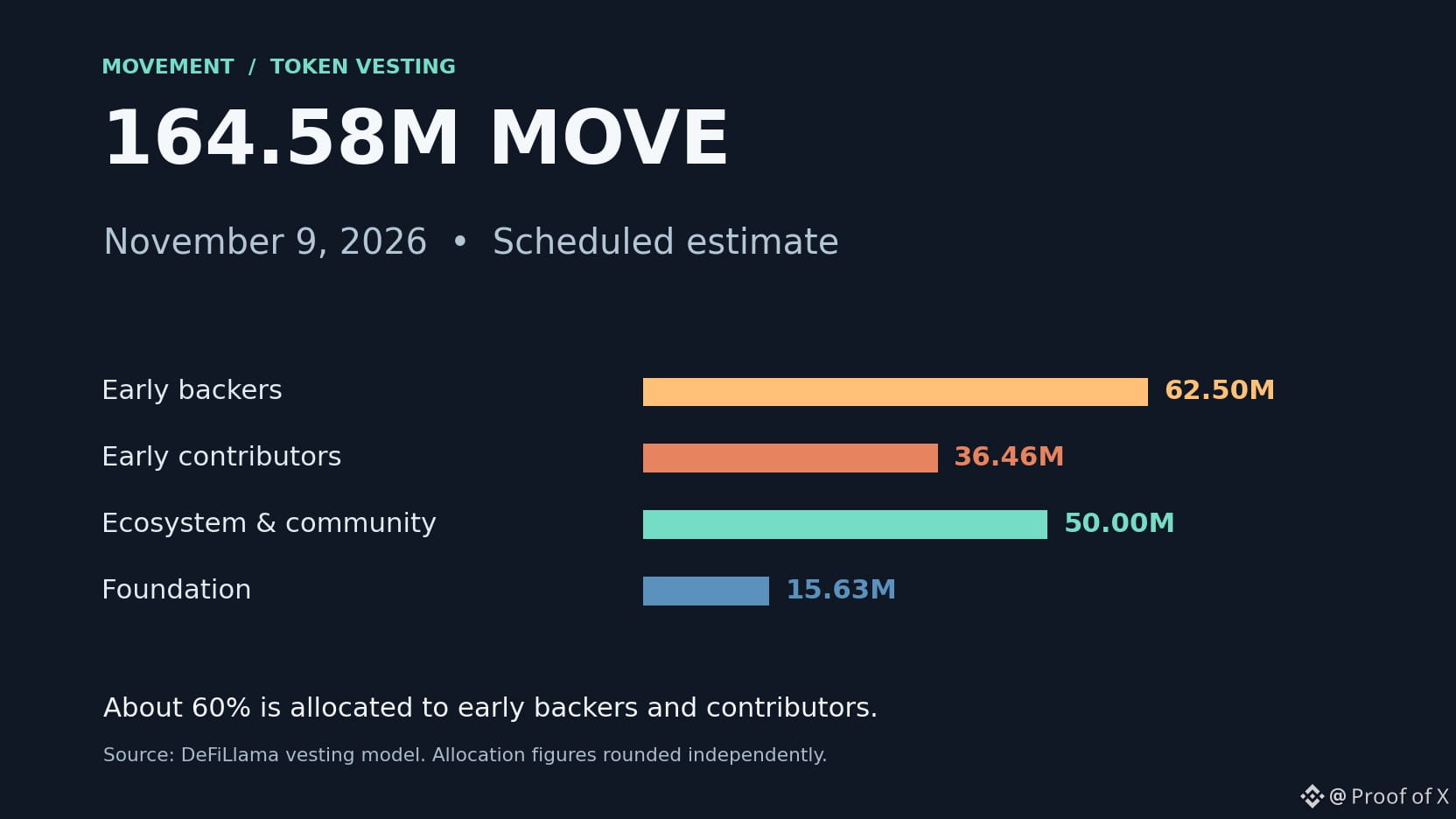
🔥 TL;DR: The November 9 calendar models a 164.58M $MOVE unlock, about 3.53% of DeFiLlama’s November 6 circulating-supply estimate. Early backers and contributors account for roughly 60%.
The project’s October-to-November month-end supply plan implies the same 164.58M step. That plan gives estimated monthly ceilings, while DeFiLlama and Tokenomist identify November 9 and the four recipient categories. The project plan does not specify an execution hour.
My take: The batch is large enough to follow, especially the 98.96M going to backer and contributor allocations. Where those tokens move after vesting will tell us more about liquid supply than the calendar alone.
Full Article: https://app.binance.com/uni-qr/cart/385433063778697?r=ODRQIW1H&l=en
As of: 2026-11-06 18:51 UTC | Binance spot MOVEUSDT
S/R basis: Classic S1/R1 from the Nov. 5 closed UTC daily candle (P = (H + L + C) / 3).
Schedule: Movement team plan via Upbit; DeFiLlama and Tokenomist vesting models.
NFA. DYOR.
$MOVE Price: $0.005982 | 24h: +2.80% | S: $0.005534 | R: $0.006082
🔥 TL;DR: The November 9 calendar models a 164.58M $MOVE unlock, about 3.53% of DeFiLlama’s November 6 circulating-supply estimate. Early backers and contributors account for roughly 60%.
The project’s October-to-November month-end supply plan implies the same 164.58M step. That plan gives estimated monthly ceilings, while DeFiLlama and Tokenomist identify November 9 and the four recipient categories. The project plan does not specify an execution hour.
My take: The batch is large enough to follow, especially the 98.96M going to backer and contributor allocations. Where those tokens move after vesting will tell us more about liquid supply than the calendar alone.
Full Article: https://app.binance.com/uni-qr/cart/385433063778697?r=ODRQIW1H&l=en
As of: 2026-11-06 18:51 UTC | Binance spot MOVEUSDT
S/R basis: Classic S1/R1 from the Nov. 5 closed UTC daily candle (P = (H + L + C) / 3).
Schedule: Movement team plan via Upbit; DeFiLlama and Tokenomist vesting models.
NFA. DYOR.
🔥 TL;DR: The November 9 calendar models a 164.58M $MOVE unlock, about 3.53% of DeFiLlama’s November 6 circulating-supply estimate. Early backers and contributors account for roughly 60%.
The project’s October-to-November month-end supply plan implies the same 164.58M step. That plan gives estimated monthly ceilings, while DeFiLlama and Tokenomist identify November 9 and the four recipient categories. The project plan does not specify an execution hour.
My take: The batch is large enough to follow, especially the 98.96M going to backer and contributor allocations. Where those tokens move after vesting will tell us more about liquid supply than the calendar alone.
Full Article: https://app.binance.com/uni-qr/cart/385433063778697?r=ODRQIW1H&l=en
As of: 2026-11-06 18:51 UTC | Binance spot MOVEUSDT
S/R basis: Classic S1/R1 from the Nov. 5 closed UTC daily candle (P = (H + L + C) / 3).
Schedule: Movement team plan via Upbit; DeFiLlama and Tokenomist vesting models.
NFA. DYOR.
199
·
--
Article
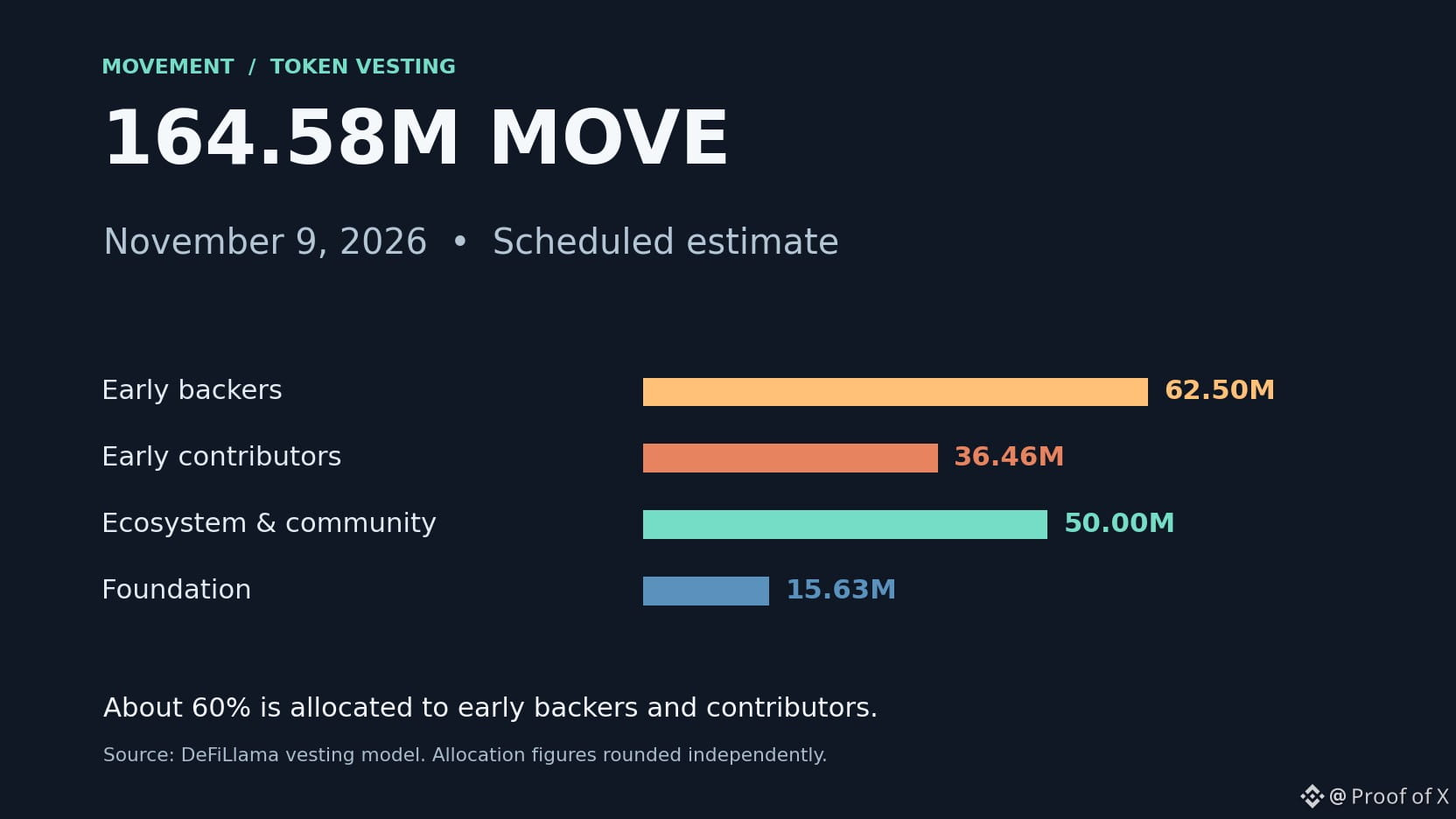
$MOVE: What the 164.58M November 9 unlock actually changes🔥 TL;DR: The November 9 vesting calendar puts about 164.58M $MOVE on the schedule. Early backers and contributors account for 98.96M, or about 60% of the batch. Whether those tokens become liquid is the question the calendar cannot answer.
The strongest check on the size comes from Movement’s own month-end supply plan, as published by Upbit. It lists an estimated maximum of 4.6604B MOVE for October 31 and 4.8250B for November 30. Subtracting the two gives 164.58M MOVE. That is a cross-check on the size of the monthly step, not a project confirmation of the November 9 execution time or a measurement of live float.
DeFiLlama models 62.50M for Early Backers, 36.46M for Early Contributors, 50.00M for Ecosystem & Community and 15.63M for the Foundation. The components are rounded independently. Tokenomist also places the release on November 9 and identifies the same four recipients. This is a monthly vesting installment across several allocations. DeFiLlama lists 01:08 UTC; the project’s month-end plan specifies no hour.
The batch equals about 1.65% of the 10B maximum supply and 3.53% of DeFiLlama’s approximately 4.66B circulating-supply snapshot on November 6. The first comparison measures the batch against the full token budget; the second measures its size relative to the tracker’s estimated float. Neither is an observed increase in circulating supply.
The recipient mix matters. The 65.63M earmarked for ecosystem and Foundation allocations could stay in custody or fund programs over time. Backer and contributor allocations represent a separate pool of newly eligible tokens; the vesting calendar does not establish what those recipients will do. Even a wallet transfer would need destination context before it could be read as potential market supply.
My take: The size and the roughly 60% backer-and-contributor share make this installment worth tracking. The clearest signal after November 9 would be a change in where those tokens sit: continued custody, identifiable program wallets, or sustained transfers to exchange-linked addresses. An exchange deposit alone would still fall short of evidence of a sale.
Sources:
Movement team’s month-end circulation plan, published by Upbit: https://static.upbit.com/guide/circulating_supply/MOVE_20241209.pdf
DeFiLlama vesting model and circulating-supply snapshot: https://defillama.com/unlocks/movement
Tokenomist event date and allocation cross-check: https://tokenomist.ai/movement/unlock-events
NFA. DYOR.
$MOVE: What the 164.58M November 9 unlock actually changes
🔥 TL;DR: The November 9 vesting calendar puts about 164.58M $MOVE on the schedule. Early backers and contributors account for 98.96M, or about 60% of the batch. Whether those tokens become liquid is the question the calendar cannot answer.
The strongest check on the size comes from Movement’s own month-end supply plan, as published by Upbit. It lists an estimated maximum of 4.6604B MOVE for October 31 and 4.8250B for November 30. Subtracting the two gives 164.58M MOVE. That is a cross-check on the size of the monthly step, not a project confirmation of the November 9 execution time or a measurement of live float.
DeFiLlama models 62.50M for Early Backers, 36.46M for Early Contributors, 50.00M for Ecosystem & Community and 15.63M for the Foundation. The components are rounded independently. Tokenomist also places the release on November 9 and identifies the same four recipients. This is a monthly vesting installment across several allocations. DeFiLlama lists 01:08 UTC; the project’s month-end plan specifies no hour.
The batch equals about 1.65% of the 10B maximum supply and 3.53% of DeFiLlama’s approximately 4.66B circulating-supply snapshot on November 6. The first comparison measures the batch against the full token budget; the second measures its size relative to the tracker’s estimated float. Neither is an observed increase in circulating supply.
The recipient mix matters. The 65.63M earmarked for ecosystem and Foundation allocations could stay in custody or fund programs over time. Backer and contributor allocations represent a separate pool of newly eligible tokens; the vesting calendar does not establish what those recipients will do. Even a wallet transfer would need destination context before it could be read as potential market supply.
My take: The size and the roughly 60% backer-and-contributor share make this installment worth tracking. The clearest signal after November 9 would be a change in where those tokens sit: continued custody, identifiable program wallets, or sustained transfers to exchange-linked addresses. An exchange deposit alone would still fall short of evidence of a sale.
Sources:
Movement team’s month-end circulation plan, published by Upbit: https://static.upbit.com/guide/circulating_supply/MOVE_20241209.pdf
DeFiLlama vesting model and circulating-supply snapshot: https://defillama.com/unlocks/movement
Tokenomist event date and allocation cross-check: https://tokenomist.ai/movement/unlock-events
NFA. DYOR.
The strongest check on the size comes from Movement’s own month-end supply plan, as published by Upbit. It lists an estimated maximum of 4.6604B MOVE for October 31 and 4.8250B for November 30. Subtracting the two gives 164.58M MOVE. That is a cross-check on the size of the monthly step, not a project confirmation of the November 9 execution time or a measurement of live float.
DeFiLlama models 62.50M for Early Backers, 36.46M for Early Contributors, 50.00M for Ecosystem & Community and 15.63M for the Foundation. The components are rounded independently. Tokenomist also places the release on November 9 and identifies the same four recipients. This is a monthly vesting installment across several allocations. DeFiLlama lists 01:08 UTC; the project’s month-end plan specifies no hour.
The batch equals about 1.65% of the 10B maximum supply and 3.53% of DeFiLlama’s approximately 4.66B circulating-supply snapshot on November 6. The first comparison measures the batch against the full token budget; the second measures its size relative to the tracker’s estimated float. Neither is an observed increase in circulating supply.
The recipient mix matters. The 65.63M earmarked for ecosystem and Foundation allocations could stay in custody or fund programs over time. Backer and contributor allocations represent a separate pool of newly eligible tokens; the vesting calendar does not establish what those recipients will do. Even a wallet transfer would need destination context before it could be read as potential market supply.
My take: The size and the roughly 60% backer-and-contributor share make this installment worth tracking. The clearest signal after November 9 would be a change in where those tokens sit: continued custody, identifiable program wallets, or sustained transfers to exchange-linked addresses. An exchange deposit alone would still fall short of evidence of a sale.
Sources:
Movement team’s month-end circulation plan, published by Upbit: https://static.upbit.com/guide/circulating_supply/MOVE_20241209.pdf
DeFiLlama vesting model and circulating-supply snapshot: https://defillama.com/unlocks/movement
Tokenomist event date and allocation cross-check: https://tokenomist.ai/movement/unlock-events
NFA. DYOR.
143
·
--
🔥 TL;DR: A new Arbitrum constitutional proposal asks $ARB voters to release 8,425.997 ETH and 74,559,805.2 ARB frozen after the Binance hot-wallet exploit.
The assets remain immobilized on Arbitrum One. The proposal would recover the full frozen balance through one atomic governance action: temporarily upgrade the Ethereum Inbox contract, issue the recovery transaction, then remove the temporary function.
This is a proposal, not an approval or completed transfer. The path starts with forum discussion and a Snapshot temperature check, then requires finalized code, indemnification agreements, an on-chain vote, waiting periods and execution. Binance estimates roughly 49 days, while legal restraints could extend or block the process.
Binance says it has committed SAFU and treasury resources to cover affected users. Any returned assets would be applied to incident losses and costs, including replenishing resources already used. No new ArbitrumDAO treasury allocation is requested.
My take: The proposal turns an emergency freeze into a transparent recovery process, but the meaningful milestone is an approved and legally clear execution—not the filing itself.
Sources:
Arbitrum governance forum, “[Constitutional] AIP: Approve Release of Frozen ETH and ARB,” posted Nov. 5, 2026; updated discussion reviewed Nov. 6, 2026.
Binance Spot exchange information: ARBUSDT status TRADING, checked Nov. 6, 2026 UTC.
NFA. DYOR.
🔥 TL;DR: A new Arbitrum constitutional proposal asks $ARB voters to release 8,425.997 ETH and 74,559,805.2 ARB frozen after the Binance hot-wallet exploit.
The assets remain immobilized on Arbitrum One. The proposal would recover the full frozen balance through one atomic governance action: temporarily upgrade the Ethereum Inbox contract, issue the recovery transaction, then remove the temporary function.
This is a proposal, not an approval or completed transfer. The path starts with forum discussion and a Snapshot temperature check, then requires finalized code, indemnification agreements, an on-chain vote, waiting periods and execution. Binance estimates roughly 49 days, while legal restraints could extend or block the process.
Binance says it has committed SAFU and treasury resources to cover affected users. Any returned assets would be applied to incident losses and costs, including replenishing resources already used. No new ArbitrumDAO treasury allocation is requested.
My take: The proposal turns an emergency freeze into a transparent recovery process, but the meaningful milestone is an approved and legally clear execution—not the filing itself.
Sources:
Arbitrum governance forum, “[Constitutional] AIP: Approve Release of Frozen ETH and ARB,” posted Nov. 5, 2026; updated discussion reviewed Nov. 6, 2026.
Binance Spot exchange information: ARBUSDT status TRADING, checked Nov. 6, 2026 UTC.
NFA. DYOR.
The assets remain immobilized on Arbitrum One. The proposal would recover the full frozen balance through one atomic governance action: temporarily upgrade the Ethereum Inbox contract, issue the recovery transaction, then remove the temporary function.
This is a proposal, not an approval or completed transfer. The path starts with forum discussion and a Snapshot temperature check, then requires finalized code, indemnification agreements, an on-chain vote, waiting periods and execution. Binance estimates roughly 49 days, while legal restraints could extend or block the process.
Binance says it has committed SAFU and treasury resources to cover affected users. Any returned assets would be applied to incident losses and costs, including replenishing resources already used. No new ArbitrumDAO treasury allocation is requested.
My take: The proposal turns an emergency freeze into a transparent recovery process, but the meaningful milestone is an approved and legally clear execution—not the filing itself.
Sources:
Arbitrum governance forum, “[Constitutional] AIP: Approve Release of Frozen ETH and ARB,” posted Nov. 5, 2026; updated discussion reviewed Nov. 6, 2026.
Binance Spot exchange information: ARBUSDT status TRADING, checked Nov. 6, 2026 UTC.
NFA. DYOR.

93
·
--
$XRP Price: $1.1897 | 24h: -7.32% | S: $1.1624 | R: $1.2895
📉 TL;DR: $XRP’s November 6 bounce traded 7.02M USDT over two hours. The later two-hour decline traded 14.65M USDT and erased most of that rebound.
XRP rose 1.16% from 08:00 to 10:00 UTC versus BTC’s 0.75%, then fell 0.93% from 12:00 to 14:00 UTC while BTC fell 0.33%. Both pairs saw turnover rise versus the preceding two hours. The shared pickup in activity does not identify an XRP-specific cause.
My take: The higher-turnover reversal carries more weight than the bounce. Watch whether XRP can hold its gains against BTC when spot activity picks up again.
Full analysis: https://app.binance.com/uni-qr/cart/385374640310140?r=ODRQIW1H&l=en
As of: 2026-11-06 14:53 UTC | Binance spot XRPUSDT
S/R basis: Nov. 5 completed UTC daily candle, classic S1/R1.
NFA. DYOR.
$XRP Price: $1.1897 | 24h: -7.32% | S: $1.1624 | R: $1.2895
📉 TL;DR: $XRP ’s November 6 bounce traded 7.02M USDT over two hours. The later two-hour decline traded 14.65M USDT and erased most of that rebound.
XRP rose 1.16% from 08:00 to 10:00 UTC versus BTC’s 0.75%, then fell 0.93% from 12:00 to 14:00 UTC while BTC fell 0.33%. Both pairs saw turnover rise versus the preceding two hours. The shared pickup in activity does not identify an XRP-specific cause.
My take: The higher-turnover reversal carries more weight than the bounce. Watch whether XRP can hold its gains against BTC when spot activity picks up again.
Full analysis: https://app.binance.com/uni-qr/cart/385374640310140?r=ODRQIW1H&l=en
As of: 2026-11-06 14:53 UTC | Binance spot XRPUSDT
S/R basis: Nov. 5 completed UTC daily candle, classic S1/R1.
NFA. DYOR.
📉 TL;DR: $XRP ’s November 6 bounce traded 7.02M USDT over two hours. The later two-hour decline traded 14.65M USDT and erased most of that rebound.
XRP rose 1.16% from 08:00 to 10:00 UTC versus BTC’s 0.75%, then fell 0.93% from 12:00 to 14:00 UTC while BTC fell 0.33%. Both pairs saw turnover rise versus the preceding two hours. The shared pickup in activity does not identify an XRP-specific cause.
My take: The higher-turnover reversal carries more weight than the bounce. Watch whether XRP can hold its gains against BTC when spot activity picks up again.
Full analysis: https://app.binance.com/uni-qr/cart/385374640310140?r=ODRQIW1H&l=en
As of: 2026-11-06 14:53 UTC | Binance spot XRPUSDT
S/R basis: Nov. 5 completed UTC daily candle, classic S1/R1.
NFA. DYOR.
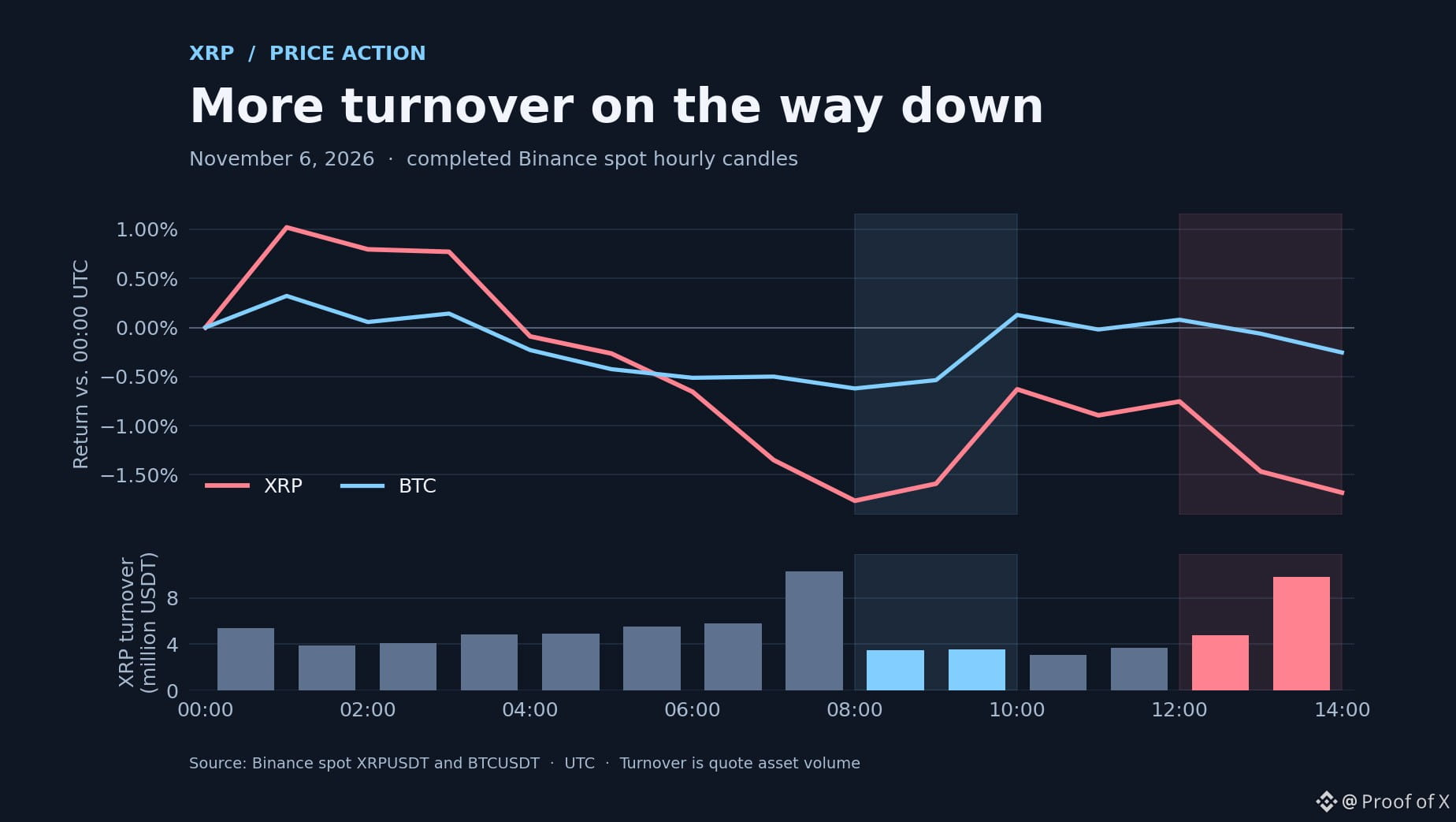
62
·
--
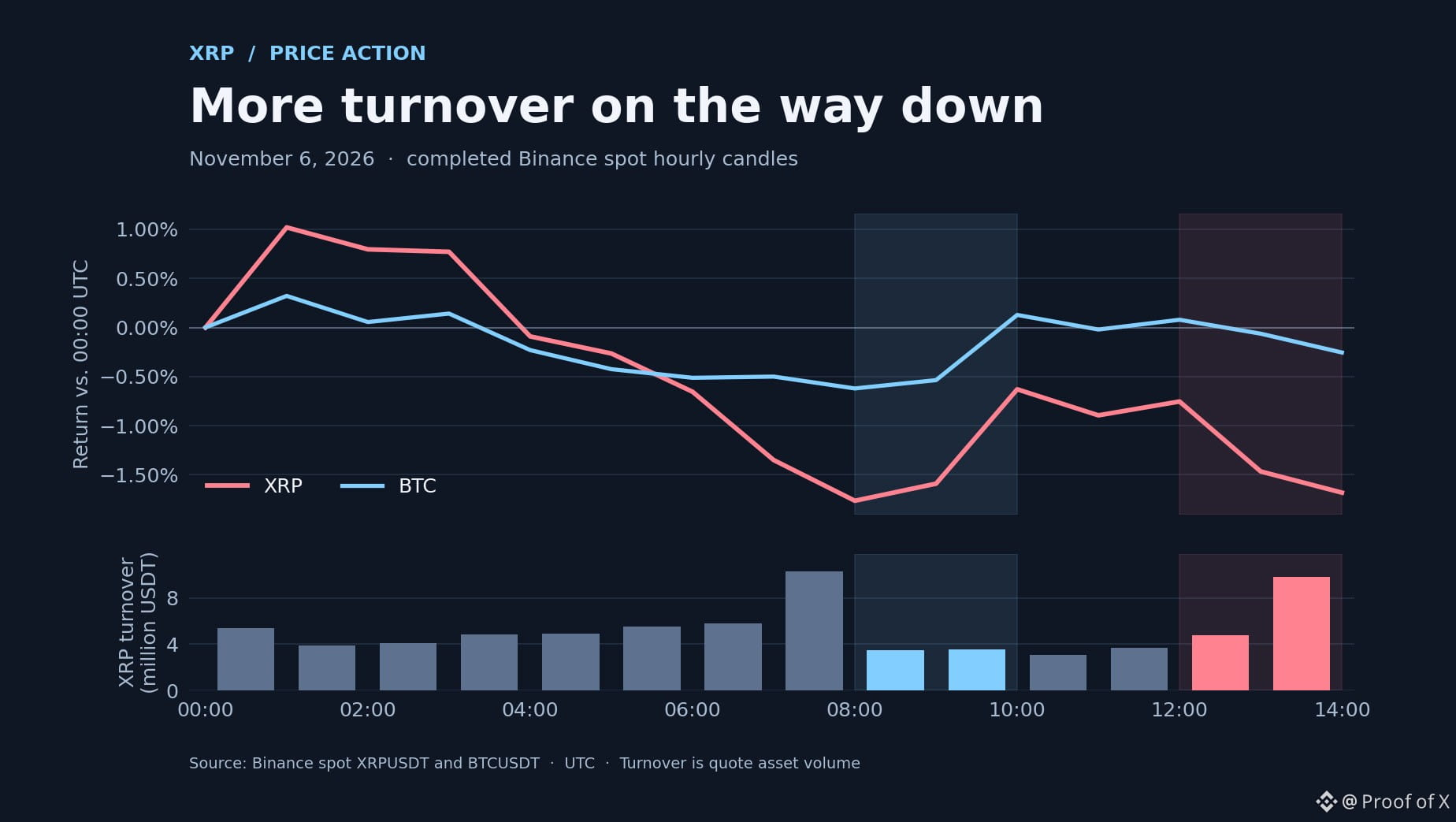
Article
$XRP’s November 6 Bounce Met More Turnover on the Way Down📉 TL;DR: $XRP rebounded 1.16% from 08:00 to 10:00 UTC on November 6, then gave back most of that move. The 12:00–14:00 decline traded 14.65M USDT on Binance spot, more than twice the rebound’s turnover.
The rebound itself was real. Across the two completed hours ending at 10:00 UTC, XRP gained 1.16%, ahead of BTC’s 0.75% rise. That narrowed XRP’s relative loss after a weak morning. But XRP traded only 7.02M USDT in those two hours, and it slipped 0.13% in the next two.
The more revealing comparison is 12:00–14:00 UTC: XRP fell 0.93% as turnover climbed to 14.65M USDT. BTC fell 0.33% in the same interval, and its turnover also rose, from 51.32M USDT in the preceding two hours to 102.57M. Activity picked up across both pairs, so heavier XRP trading alone is weak evidence for an XRP-specific catalyst. The relative price move is clearer: XRP fell nearly three times as much as BTC in percentage terms during that window.
By 14:00 UTC, XRP was down 1.68% from the prior UTC close and BTC was down 0.25%. This followed the November 5 completed session, when XRP declined 7.51% versus 5.49% for BTC. In other words, two hours of better performance failed to reverse the wider relative gap. The intraday figures stop at 14:00 UTC; the November 6 daily candle was still open.
There is a narrower positive reading: XRP briefly outpaced BTC when both rebounded, and that shows the pair could participate in a broader recovery. For that reading to gain weight, the next advance needs to hold its relative gains when activity picks up. Quote turnover measures how much traded; it does not measure net inflows or identify the investors behind the trades.
My take: The higher-turnover reversal is stronger evidence than the early bounce. A more convincing recovery would be one where XRP holds relative gains against BTC through the next busy trading window.
Source: Binance spot XRPUSDT and BTCUSDT, completed 1h bars through 14:00 UTC on November 6, 2026, and the November 5 UTC daily candle. Returns are close to close over the same windows; turnover is the sum of quote asset volume in USDT. Field definitions: https://developers.binance.com/docs/binance-spot-api-docs/rest-api/market-data-endpoints
NFA. DYOR.
$XRP’s November 6 Bounce Met More Turnover on the Way Down
📉 TL;DR: $XRP rebounded 1.16% from 08:00 to 10:00 UTC on November 6, then gave back most of that move. The 12:00–14:00 decline traded 14.65M USDT on Binance spot, more than twice the rebound’s turnover.
The rebound itself was real. Across the two completed hours ending at 10:00 UTC, XRP gained 1.16%, ahead of BTC’s 0.75% rise. That narrowed XRP’s relative loss after a weak morning. But XRP traded only 7.02M USDT in those two hours, and it slipped 0.13% in the next two.
The more revealing comparison is 12:00–14:00 UTC: XRP fell 0.93% as turnover climbed to 14.65M USDT. BTC fell 0.33% in the same interval, and its turnover also rose, from 51.32M USDT in the preceding two hours to 102.57M. Activity picked up across both pairs, so heavier XRP trading alone is weak evidence for an XRP-specific catalyst. The relative price move is clearer: XRP fell nearly three times as much as BTC in percentage terms during that window.
By 14:00 UTC, XRP was down 1.68% from the prior UTC close and BTC was down 0.25%. This followed the November 5 completed session, when XRP declined 7.51% versus 5.49% for BTC. In other words, two hours of better performance failed to reverse the wider relative gap. The intraday figures stop at 14:00 UTC; the November 6 daily candle was still open.
There is a narrower positive reading: XRP briefly outpaced BTC when both rebounded, and that shows the pair could participate in a broader recovery. For that reading to gain weight, the next advance needs to hold its relative gains when activity picks up. Quote turnover measures how much traded; it does not measure net inflows or identify the investors behind the trades.
My take: The higher-turnover reversal is stronger evidence than the early bounce. A more convincing recovery would be one where XRP holds relative gains against BTC through the next busy trading window.
Source: Binance spot XRPUSDT and BTCUSDT, completed 1h bars through 14:00 UTC on November 6, 2026, and the November 5 UTC daily candle. Returns are close to close over the same windows; turnover is the sum of quote asset volume in USDT. Field definitions: https://developers.binance.com/docs/binance-spot-api-docs/rest-api/market-data-endpoints
NFA. DYOR.
The rebound itself was real. Across the two completed hours ending at 10:00 UTC, XRP gained 1.16%, ahead of BTC’s 0.75% rise. That narrowed XRP’s relative loss after a weak morning. But XRP traded only 7.02M USDT in those two hours, and it slipped 0.13% in the next two.
The more revealing comparison is 12:00–14:00 UTC: XRP fell 0.93% as turnover climbed to 14.65M USDT. BTC fell 0.33% in the same interval, and its turnover also rose, from 51.32M USDT in the preceding two hours to 102.57M. Activity picked up across both pairs, so heavier XRP trading alone is weak evidence for an XRP-specific catalyst. The relative price move is clearer: XRP fell nearly three times as much as BTC in percentage terms during that window.
By 14:00 UTC, XRP was down 1.68% from the prior UTC close and BTC was down 0.25%. This followed the November 5 completed session, when XRP declined 7.51% versus 5.49% for BTC. In other words, two hours of better performance failed to reverse the wider relative gap. The intraday figures stop at 14:00 UTC; the November 6 daily candle was still open.
There is a narrower positive reading: XRP briefly outpaced BTC when both rebounded, and that shows the pair could participate in a broader recovery. For that reading to gain weight, the next advance needs to hold its relative gains when activity picks up. Quote turnover measures how much traded; it does not measure net inflows or identify the investors behind the trades.
My take: The higher-turnover reversal is stronger evidence than the early bounce. A more convincing recovery would be one where XRP holds relative gains against BTC through the next busy trading window.
Source: Binance spot XRPUSDT and BTCUSDT, completed 1h bars through 14:00 UTC on November 6, 2026, and the November 5 UTC daily candle. Returns are close to close over the same windows; turnover is the sum of quote asset volume in USDT. Field definitions: https://developers.binance.com/docs/binance-spot-api-docs/rest-api/market-data-endpoints
NFA. DYOR.
58
·
--
🔥 TL;DR: $WLFI has launched a token buyback program whose initial funding may include fees earned from USD1 reserves and other sources.
World Liberty Financial says it will start with an initial allocation and evaluate the program over time. Its stated goals are to encourage active governance participation, concentrate more voting power among committed long-term holders, and make buybacks an ongoing strategy paced by ecosystem growth and governance impact.
The economic change is a new potential funding route from USD1 reserve-fee economics into WLFI purchases. However, the announcement does not disclose the allocation size, purchase timetable, or how repurchased tokens will be held or treated. It therefore does not yet establish a supply reduction, holder yield, or completed value transfer.
My take: The policy creates a potentially meaningful bridge from USD1 economics to $WLFI demand, but the first execution disclosure—including purchase size and token disposition—will determine its measurable impact.
Sources:
- World Liberty Financial (@worldlibertyfi), official announcement, Nov. 6, 2026.
- Reuters, “Trump-backed World Liberty Financial launches WLFI token buyback program,” Nov. 6, 2026.
NFA. DYOR.
🔥 TL;DR: $WLFI has launched a token buyback program whose initial funding may include fees earned from USD1 reserves and other sources.
World Liberty Financial says it will start with an initial allocation and evaluate the program over time. Its stated goals are to encourage active governance participation, concentrate more voting power among committed long-term holders, and make buybacks an ongoing strategy paced by ecosystem growth and governance impact.
The economic change is a new potential funding route from USD1 reserve-fee economics into WLFI purchases. However, the announcement does not disclose the allocation size, purchase timetable, or how repurchased tokens will be held or treated. It therefore does not yet establish a supply reduction, holder yield, or completed value transfer.
My take: The policy creates a potentially meaningful bridge from USD1 economics to $WLFI demand, but the first execution disclosure—including purchase size and token disposition—will determine its measurable impact.
Sources:
- World Liberty Financial (@worldlibertyfi), official announcement, Nov. 6, 2026.
- Reuters, “Trump-backed World Liberty Financial launches WLFI token buyback program,” Nov. 6, 2026.
NFA. DYOR.
World Liberty Financial says it will start with an initial allocation and evaluate the program over time. Its stated goals are to encourage active governance participation, concentrate more voting power among committed long-term holders, and make buybacks an ongoing strategy paced by ecosystem growth and governance impact.
The economic change is a new potential funding route from USD1 reserve-fee economics into WLFI purchases. However, the announcement does not disclose the allocation size, purchase timetable, or how repurchased tokens will be held or treated. It therefore does not yet establish a supply reduction, holder yield, or completed value transfer.
My take: The policy creates a potentially meaningful bridge from USD1 economics to $WLFI demand, but the first execution disclosure—including purchase size and token disposition—will determine its measurable impact.
Sources:
- World Liberty Financial (@worldlibertyfi), official announcement, Nov. 6, 2026.
- Reuters, “Trump-backed World Liberty Financial launches WLFI token buyback program,” Nov. 6, 2026.
NFA. DYOR.

11
Log in to explore more content
Join global crypto users on Binance Square
⚡️ Get latest and useful information about crypto.
💬 Trusted by the world’s largest crypto exchange.
👍 Discover real insights from verified creators.
Email / Phone number
Trending Topics
KeplrAdvisesSocialLoginUsersToTransferAssets
574 views
45 Discussing
#KeplrAdvisesSocialLoginUsersToTransferAssets
KEPLR SECURITY ALERT - If You Used Social Login, Read This!
Keplr has reportedly advised users who created wallets through social-login methods (Google / Apple / Email) to transfer assets to a wallet secured by a recovery phrase or hardware wallet.
Why?
Social login = You rely on a third-party to access your wallet.
Recovery phrase / Hardware wallet = YOU have direct control.
If you use a social-login wallet, do this NOW:
1. Create a NEW wallet with a recovery phrase OR connect a hardware wallet like Ledger.
2. Confirm the destination address and network carefully before sending. One wrong network = funds lost.
3. Make a SMALL TEST TRANSFER first. Send $1-5, confirm it arrives, THEN move the full balance.
4. Store your recovery phrase OFFLINE on paper. Never in photos, cloud, notes, or messages.
5. NEVER share your seed phrase with anyone. Keplr support will NEVER ask for it.
6. Enable 2FA wherever available.
7. Beware of fake wallet-support messages and phishing sites. Only use keplr.app
This is a security precaution, not a comment on price.
I have seen too many people lose everything to fake "Keplr Support" DMs. Do not be next.
Did you create your Keplr with Google login or seed phrase?
Comment "SECURED" if you already moved to a hardware wallet.
#Keplr #CryptoSafety #SeedPhrase #Cosmos
$ATOM $OSMO $TIA
missCryptopkTrader-pk
·0 Likes
·12 views
TetherPlans€28.8MForJuventusCapitalIncrease
604 views
49 Discussing
JobsReportRaisesHikeOdds
627,633 views
3,891 Discussing