

ISHAQJAN
6k Posts

ISHAQJAN
Report
Block User
The chart speaks, I listen. Every candle has a story Fam, let’s make this journey legendary 💛
Open Trade
High-Frequency Trader
1 Years
648 Following
29.2K+ Followers
12.6K+ Liked
Posts
Portfolio
All
Quotes
Live
·
--
Bullish
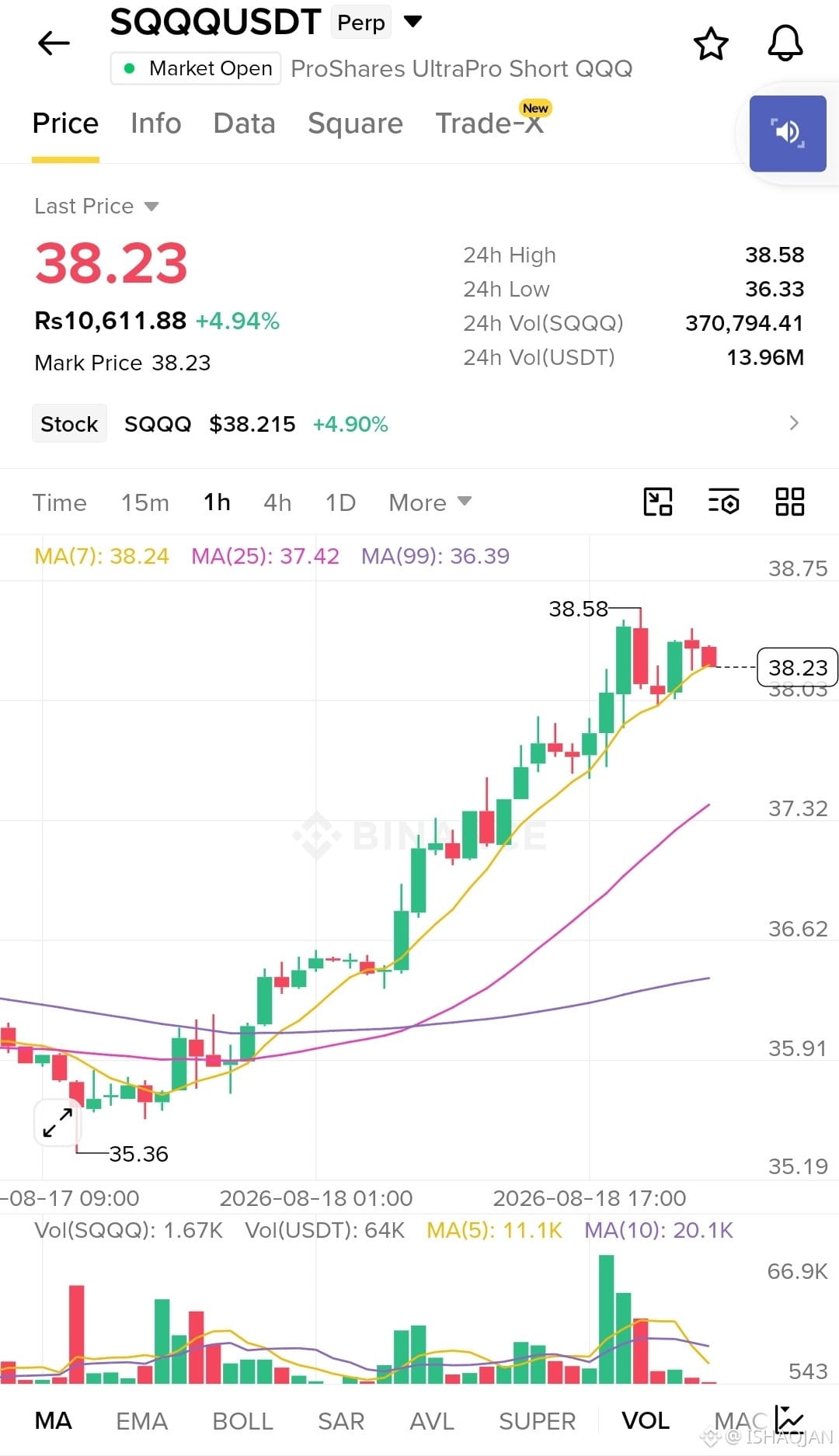
$SQQQ Still Has Fuel Left
SQQQUSDT LONG
Entry: 38.20–38.35
TP: 38.50 / 38.70 / 38.95
SL: 38.05
Leverage: 10x
NFA
DYOR
Trade here 👇
SQQQUSDT
Perp
38.23
+4.94%
{future}(SQQQUSDT)
$SQQQ Still Has Fuel Left
SQQQUSDT LONG
Entry: 38.20–38.35
TP: 38.50 / 38.70 / 38.95
SL: 38.05
Leverage: 10x
NFA
DYOR
Trade here 👇
SQQQUSDT
Perp
38.23
+4.94%
SQQQUSDT LONG
Entry: 38.20–38.35
TP: 38.50 / 38.70 / 38.95
SL: 38.05
Leverage: 10x
NFA
DYOR
Trade here 👇
SQQQUSDT
Perp
38.23
+4.94%
2
1
261
·
--
Bullish
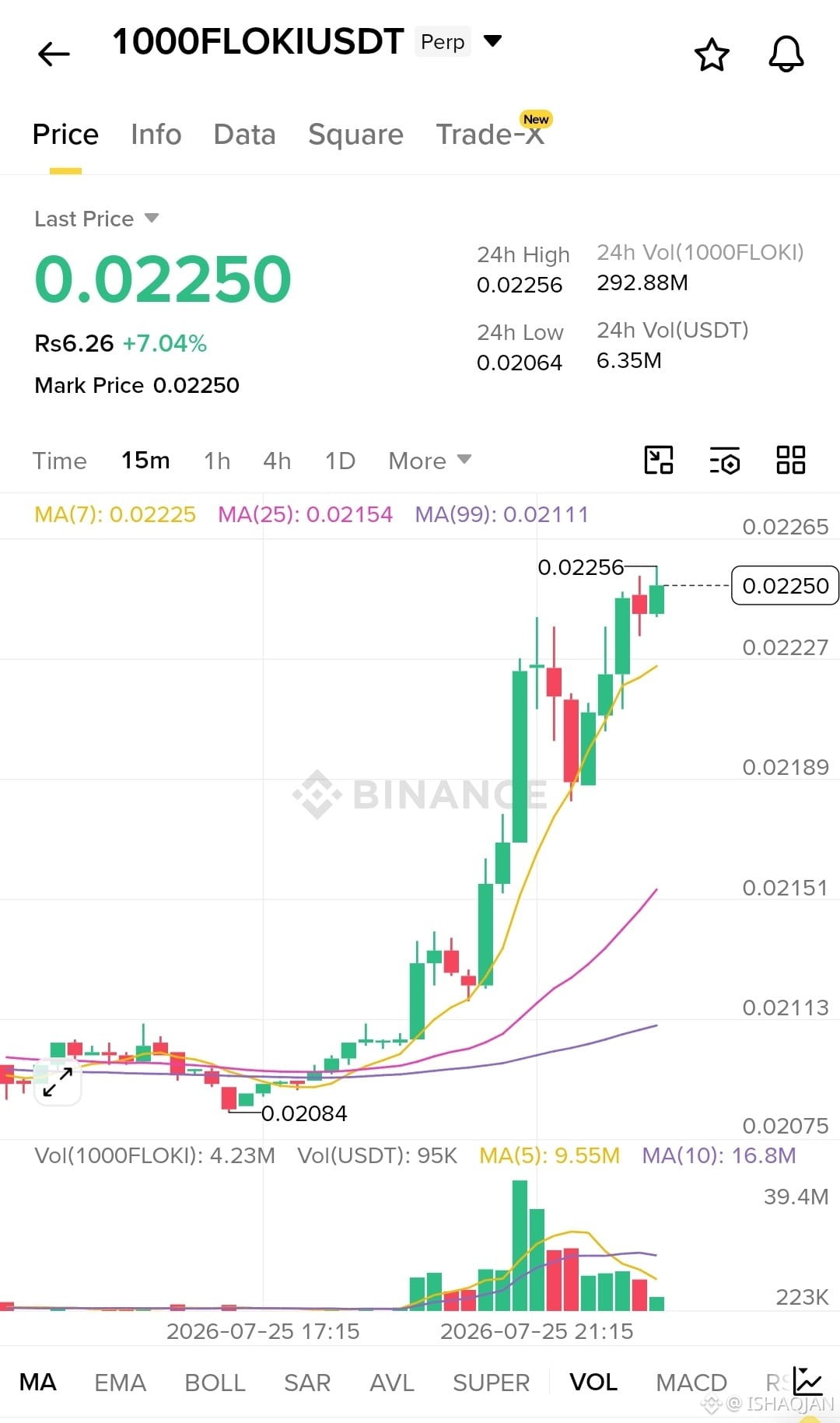
Guys, $FLOKI is breaking out of a short-term accumulation range with strong bullish momentum. If buyers maintain control above the breakout level, the move could extend toward higher resistance. 10x leverage.
Trade Setup
Entry Zone: 0.00002220 – 0.00002250
Target 1: 0.00002320
Target 2: 0.00002420
Target 3: 0.00002550
Stop Loss: 0.00002120
{spot}(FLOKIUSDT)
Guys, $FLOKI is breaking out of a short-term accumulation range with strong bullish momentum. If buyers maintain control above the breakout level, the move could extend toward higher resistance. 10x leverage.
Trade Setup
Entry Zone: 0.00002220 – 0.00002250
Target 1: 0.00002320
Target 2: 0.00002420
Target 3: 0.00002550
Stop Loss: 0.00002120
Trade Setup
Entry Zone: 0.00002220 – 0.00002250
Target 1: 0.00002320
Target 2: 0.00002420
Target 3: 0.00002550
Stop Loss: 0.00002120
1
1
165
·
--
Bullish
I've been thinking about Newton Protocol, not only as infrastructure for AI-driven automation, but as an experiment in how people negotiate trust with systems they no longer fully observe.
For a long time, financial participation required constant attention. People clicked buttons, checked charts, and carried the psychological burden of making every decision themselves. The promise of intelligent agents changes that relationship. We move from acting to specifying intentions, from execution to delegation.
What interests me is that this shift doesn't eliminate trust—it redistributes it.
Projects like Newton emphasize verifiable automation, programmable permissions, and cryptographic guarantees. In a sense, they acknowledge something deeply human: we are increasingly comfortable handing over responsibility, provided that the boundaries of that delegation remain visible and enforceable. The question is whether transparency itself becomes a substitute for understanding.
There's also an interesting tension in the emerging marketplace model for AI developers. Openness invites innovation, but it also creates new hierarchies around reputation, incentives, and influence. If autonomous strategies become valuable public goods, who ultimately shapes the norms that determine which forms of automation are rewarded and which are discouraged?
Perhaps the broader story isn't about AI replacing human agency, but about humans redesigning agency into layers of permissions, policies, and protocols.
As more of our economic activity becomes intent-based rather than action-based, what does meaningful participation actually look like?
#newt $NEWT @NewtonProtocol
I've been thinking about Newton Protocol, not only as infrastructure for AI-driven automation, but as an experiment in how people negotiate trust with systems they no longer fully observe.
For a long time, financial participation required constant attention. People clicked buttons, checked charts, and carried the psychological burden of making every decision themselves. The promise of intelligent agents changes that relationship. We move from acting to specifying intentions, from execution to delegation.
What interests me is that this shift doesn't eliminate trust—it redistributes it.
Projects like Newton emphasize verifiable automation, programmable permissions, and cryptographic guarantees. In a sense, they acknowledge something deeply human: we are increasingly comfortable handing over responsibility, provided that the boundaries of that delegation remain visible and enforceable. The question is whether transparency itself becomes a substitute for understanding.
There's also an interesting tension in the emerging marketplace model for AI developers. Openness invites innovation, but it also creates new hierarchies around reputation, incentives, and influence. If autonomous strategies become valuable public goods, who ultimately shapes the norms that determine which forms of automation are rewarded and which are discouraged?
Perhaps the broader story isn't about AI replacing human agency, but about humans redesigning agency into layers of permissions, policies, and protocols.
As more of our economic activity becomes intent-based rather than action-based, what does meaningful participation actually look like?
#newt $NEWT @NewtonProtocol
For a long time, financial participation required constant attention. People clicked buttons, checked charts, and carried the psychological burden of making every decision themselves. The promise of intelligent agents changes that relationship. We move from acting to specifying intentions, from execution to delegation.
What interests me is that this shift doesn't eliminate trust—it redistributes it.
Projects like Newton emphasize verifiable automation, programmable permissions, and cryptographic guarantees. In a sense, they acknowledge something deeply human: we are increasingly comfortable handing over responsibility, provided that the boundaries of that delegation remain visible and enforceable. The question is whether transparency itself becomes a substitute for understanding.
There's also an interesting tension in the emerging marketplace model for AI developers. Openness invites innovation, but it also creates new hierarchies around reputation, incentives, and influence. If autonomous strategies become valuable public goods, who ultimately shapes the norms that determine which forms of automation are rewarded and which are discouraged?
Perhaps the broader story isn't about AI replacing human agency, but about humans redesigning agency into layers of permissions, policies, and protocols.
As more of our economic activity becomes intent-based rather than action-based, what does meaningful participation actually look like?
#newt $NEWT @NewtonProtocol
7
10
160
·
--
Newton Protocol (NEWT): Building Trust Into the Future of AI-Powered Finance@NewtonProtocol
A few years ago, the idea of letting artificial intelligence make financial decisions on our behalf felt almost uncomfortable. Most people, including me, wanted a human somewhere in the loop—someone to blame if things went wrong, or at least someone to explain why a particular decision was made.
Today, that hesitation still exists, but the technology has evolved much faster than our expectations. AI can analyze markets in seconds, identify patterns invisible to human traders, and automate strategies at a scale that was once impossible. Yet one question remains surprisingly simple: how do we trust these systems?
That is where Newton Protocol (NEWT) becomes an interesting conversation.
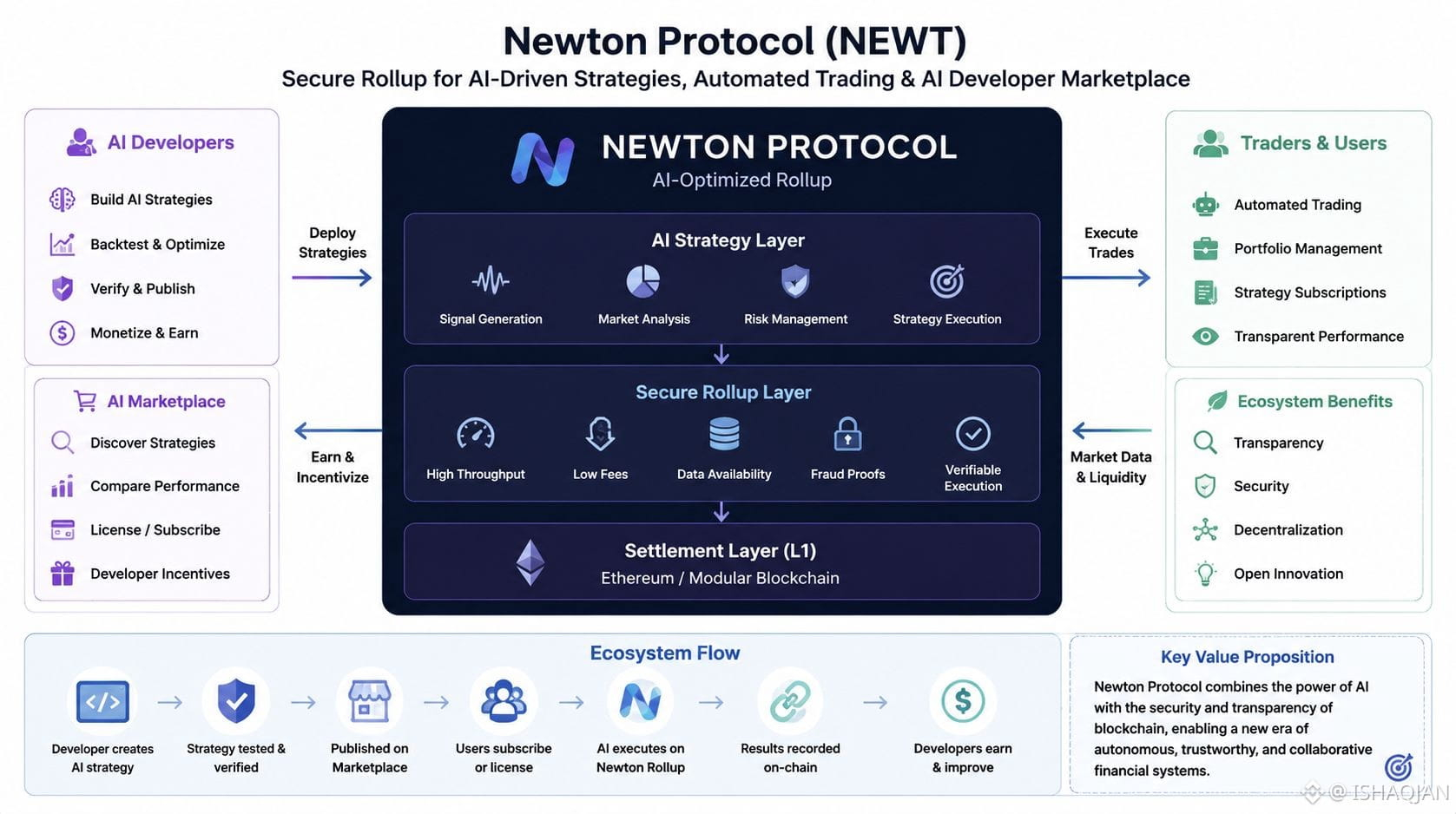
Rather than focusing solely on making AI more powerful, Newton Protocol is attempting to build an ecosystem where AI-driven strategies operate within a secure and transparent blockchain environment. The vision combines automated trading, decentralized infrastructure, and a marketplace that allows developers to create, verify, and monetize intelligent financial tools.
At its core, Newton Protocol aims to establish a secure rollup specifically designed for AI-powered applications. This may sound technical, but the underlying idea is actually quite practical. If AI agents are going to handle assets, execute trades, and manage strategies, they need an environment that is both scalable and trustworthy. Traditional blockchains often struggle with speed and efficiency, while centralized systems require users to place enormous trust in private companies. Newton tries to occupy the middle ground.
What makes this approach compelling is the emphasis on verifiability. In many automated trading systems today, users rarely know why an algorithm made a specific decision. They only see the outcomes. Newton's infrastructure suggests a future where strategies can operate transparently, with blockchain technology providing an auditable record of actions and results. That level of accountability could become increasingly important as AI takes on larger financial responsibilities.
Another fascinating aspect is the marketplace for AI developers. Innovation rarely happens in isolation. Developers, researchers, and independent creators need platforms where they can share their work, receive compensation, and build communities around their ideas. Newton Protocol appears to recognize this reality by creating an ecosystem that rewards the people designing intelligent strategies rather than limiting opportunities to large institutions.
This democratization of financial intelligence could have meaningful implications. A talented developer working from a small apartment somewhere in the world might create an AI strategy that competes with products offered by major firms. Blockchain infrastructure makes ownership and monetization more direct, potentially reducing barriers that have traditionally favored established players.
Of course, no emerging technology comes without challenges. AI-driven trading introduces questions about accountability, security, and market behavior. Even the most sophisticated models can make mistakes or respond unpredictably during unusual market conditions. Building a secure rollup is only part of the equation; establishing user confidence and robust governance mechanisms will be equally important.
There is also the broader philosophical question of how much decision-making humans are willing to delegate to machines. Efficiency is attractive, but trust is earned slowly. The future likely involves collaboration rather than complete automation, where AI enhances human judgment instead of replacing it entirely.
Still, projects like Newton Protocol demonstrate an important shift in thinking. The conversation is no longer just about creating smarter algorithms. It is about creating systems that allow intelligence, transparency, and economic incentives to coexist. That distinction matters because technological progress without trust rarely achieves mass adoption.
Looking ahead, the intersection of blockchain and artificial intelligence may redefine how digital economies function. Secure infrastructure, automated execution, and open developer marketplaces could form the foundation of entirely new financial ecosystems. Whether Newton Protocol ultimately becomes a major player or simply influences broader industry trends, its vision reflects where innovation appears to be heading.
In many ways, the real value of Newton Protocol is not only the technology itself but the questions it forces us to consider. How do we verify intelligent systems? How do developers receive fair rewards for their innovations? And perhaps most importantly, how do we build confidence in a future where machines increasingly participate in economic decision-making?
Those are difficult questions, and there are no easy answers. Yet the willingness to address them directly may be what makes projects like Newton Protocol worth watching as the relationship between AI and decentralized finance continues to evolve.
@NewtonProtocol $NEWT #Newt
Newton Protocol (NEWT): Building Trust Into the Future of AI-Powered Finance
@NewtonProtocol
A few years ago, the idea of letting artificial intelligence make financial decisions on our behalf felt almost uncomfortable. Most people, including me, wanted a human somewhere in the loop—someone to blame if things went wrong, or at least someone to explain why a particular decision was made.
Today, that hesitation still exists, but the technology has evolved much faster than our expectations. AI can analyze markets in seconds, identify patterns invisible to human traders, and automate strategies at a scale that was once impossible. Yet one question remains surprisingly simple: how do we trust these systems?
That is where Newton Protocol (NEWT) becomes an interesting conversation.
Rather than focusing solely on making AI more powerful, Newton Protocol is attempting to build an ecosystem where AI-driven strategies operate within a secure and transparent blockchain environment. The vision combines automated trading, decentralized infrastructure, and a marketplace that allows developers to create, verify, and monetize intelligent financial tools.
At its core, Newton Protocol aims to establish a secure rollup specifically designed for AI-powered applications. This may sound technical, but the underlying idea is actually quite practical. If AI agents are going to handle assets, execute trades, and manage strategies, they need an environment that is both scalable and trustworthy. Traditional blockchains often struggle with speed and efficiency, while centralized systems require users to place enormous trust in private companies. Newton tries to occupy the middle ground.
What makes this approach compelling is the emphasis on verifiability. In many automated trading systems today, users rarely know why an algorithm made a specific decision. They only see the outcomes. Newton's infrastructure suggests a future where strategies can operate transparently, with blockchain technology providing an auditable record of actions and results. That level of accountability could become increasingly important as AI takes on larger financial responsibilities.
Another fascinating aspect is the marketplace for AI developers. Innovation rarely happens in isolation. Developers, researchers, and independent creators need platforms where they can share their work, receive compensation, and build communities around their ideas. Newton Protocol appears to recognize this reality by creating an ecosystem that rewards the people designing intelligent strategies rather than limiting opportunities to large institutions.
This democratization of financial intelligence could have meaningful implications. A talented developer working from a small apartment somewhere in the world might create an AI strategy that competes with products offered by major firms. Blockchain infrastructure makes ownership and monetization more direct, potentially reducing barriers that have traditionally favored established players.
Of course, no emerging technology comes without challenges. AI-driven trading introduces questions about accountability, security, and market behavior. Even the most sophisticated models can make mistakes or respond unpredictably during unusual market conditions. Building a secure rollup is only part of the equation; establishing user confidence and robust governance mechanisms will be equally important.
There is also the broader philosophical question of how much decision-making humans are willing to delegate to machines. Efficiency is attractive, but trust is earned slowly. The future likely involves collaboration rather than complete automation, where AI enhances human judgment instead of replacing it entirely.
Still, projects like Newton Protocol demonstrate an important shift in thinking. The conversation is no longer just about creating smarter algorithms. It is about creating systems that allow intelligence, transparency, and economic incentives to coexist. That distinction matters because technological progress without trust rarely achieves mass adoption.
Looking ahead, the intersection of blockchain and artificial intelligence may redefine how digital economies function. Secure infrastructure, automated execution, and open developer marketplaces could form the foundation of entirely new financial ecosystems. Whether Newton Protocol ultimately becomes a major player or simply influences broader industry trends, its vision reflects where innovation appears to be heading.
In many ways, the real value of Newton Protocol is not only the technology itself but the questions it forces us to consider. How do we verify intelligent systems? How do developers receive fair rewards for their innovations? And perhaps most importantly, how do we build confidence in a future where machines increasingly participate in economic decision-making?
Those are difficult questions, and there are no easy answers. Yet the willingness to address them directly may be what makes projects like Newton Protocol worth watching as the relationship between AI and decentralized finance continues to evolve.
@NewtonProtocol $NEWT #Newt
A few years ago, the idea of letting artificial intelligence make financial decisions on our behalf felt almost uncomfortable. Most people, including me, wanted a human somewhere in the loop—someone to blame if things went wrong, or at least someone to explain why a particular decision was made.
Today, that hesitation still exists, but the technology has evolved much faster than our expectations. AI can analyze markets in seconds, identify patterns invisible to human traders, and automate strategies at a scale that was once impossible. Yet one question remains surprisingly simple: how do we trust these systems?
That is where Newton Protocol (NEWT) becomes an interesting conversation.
Rather than focusing solely on making AI more powerful, Newton Protocol is attempting to build an ecosystem where AI-driven strategies operate within a secure and transparent blockchain environment. The vision combines automated trading, decentralized infrastructure, and a marketplace that allows developers to create, verify, and monetize intelligent financial tools.
At its core, Newton Protocol aims to establish a secure rollup specifically designed for AI-powered applications. This may sound technical, but the underlying idea is actually quite practical. If AI agents are going to handle assets, execute trades, and manage strategies, they need an environment that is both scalable and trustworthy. Traditional blockchains often struggle with speed and efficiency, while centralized systems require users to place enormous trust in private companies. Newton tries to occupy the middle ground.
What makes this approach compelling is the emphasis on verifiability. In many automated trading systems today, users rarely know why an algorithm made a specific decision. They only see the outcomes. Newton's infrastructure suggests a future where strategies can operate transparently, with blockchain technology providing an auditable record of actions and results. That level of accountability could become increasingly important as AI takes on larger financial responsibilities.
Another fascinating aspect is the marketplace for AI developers. Innovation rarely happens in isolation. Developers, researchers, and independent creators need platforms where they can share their work, receive compensation, and build communities around their ideas. Newton Protocol appears to recognize this reality by creating an ecosystem that rewards the people designing intelligent strategies rather than limiting opportunities to large institutions.
This democratization of financial intelligence could have meaningful implications. A talented developer working from a small apartment somewhere in the world might create an AI strategy that competes with products offered by major firms. Blockchain infrastructure makes ownership and monetization more direct, potentially reducing barriers that have traditionally favored established players.
Of course, no emerging technology comes without challenges. AI-driven trading introduces questions about accountability, security, and market behavior. Even the most sophisticated models can make mistakes or respond unpredictably during unusual market conditions. Building a secure rollup is only part of the equation; establishing user confidence and robust governance mechanisms will be equally important.
There is also the broader philosophical question of how much decision-making humans are willing to delegate to machines. Efficiency is attractive, but trust is earned slowly. The future likely involves collaboration rather than complete automation, where AI enhances human judgment instead of replacing it entirely.
Still, projects like Newton Protocol demonstrate an important shift in thinking. The conversation is no longer just about creating smarter algorithms. It is about creating systems that allow intelligence, transparency, and economic incentives to coexist. That distinction matters because technological progress without trust rarely achieves mass adoption.
Looking ahead, the intersection of blockchain and artificial intelligence may redefine how digital economies function. Secure infrastructure, automated execution, and open developer marketplaces could form the foundation of entirely new financial ecosystems. Whether Newton Protocol ultimately becomes a major player or simply influences broader industry trends, its vision reflects where innovation appears to be heading.
In many ways, the real value of Newton Protocol is not only the technology itself but the questions it forces us to consider. How do we verify intelligent systems? How do developers receive fair rewards for their innovations? And perhaps most importantly, how do we build confidence in a future where machines increasingly participate in economic decision-making?
Those are difficult questions, and there are no easy answers. Yet the willingness to address them directly may be what makes projects like Newton Protocol worth watching as the relationship between AI and decentralized finance continues to evolve.
@NewtonProtocol $NEWT #Newt
1
3
154
·
--
Bullish
I’ve been thinking about a pattern that appears whenever a new infrastructure project emerges: we often celebrate the architecture long before we understand the culture it creates.
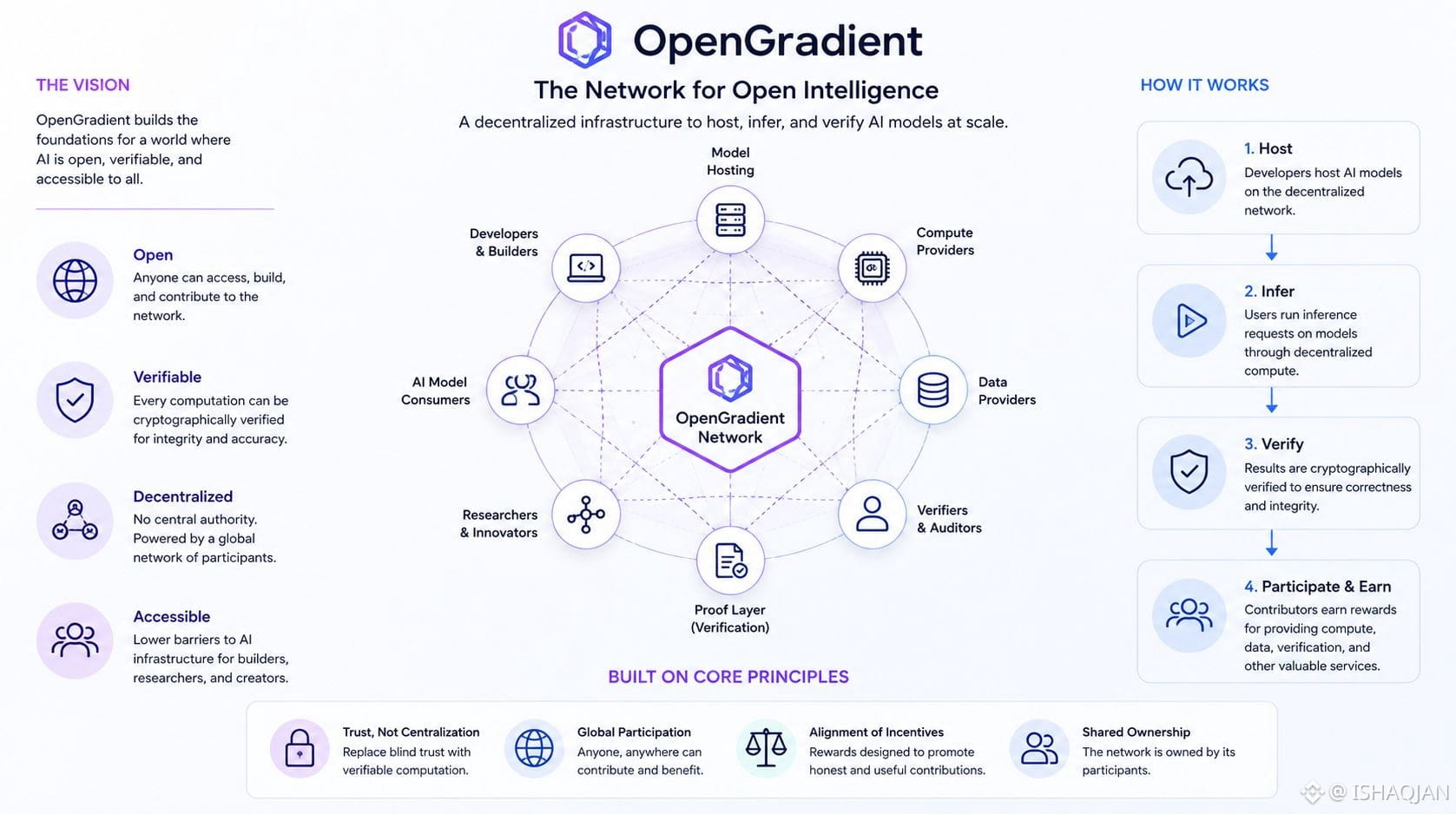
OpenGradient’s vision of decentralized and verifiable AI is technically fascinating. It suggests a future where intelligence is not simply consumed but audited, where computation can be challenged instead of accepted on faith, and where trust is gradually replaced by proof. Yet that shift raises questions that feel more social than technical.
If every AI decision becomes verifiable, do people become more responsible for the systems they build, or do they become more comfortable delegating judgment because a cryptographic record exists? Transparency can reduce uncertainty, but it can also create the illusion that everything important has been measured.
Open systems promise wider participation, yet participation itself has incentives. Some contributors optimize for curiosity, others for reputation, others for rewards. The network may be decentralized, but human motivations rarely are. The difficult task may not be distributing computation—it may be distributing accountability.
Perhaps the most interesting outcome of open intelligence is not that machines become easier to trust, but that humans are asked to redefine what trust actually means. Is it confidence in code, confidence in communities, or confidence in the willingness to question both?
As AI infrastructure becomes more verifiable, which will matter more: the proofs that systems generate, or the values of the people who choose to believe them?
#opg $OPG @OpenGradient
I’ve been thinking about a pattern that appears whenever a new infrastructure project emerges: we often celebrate the architecture long before we understand the culture it creates.
OpenGradient’s vision of decentralized and verifiable AI is technically fascinating. It suggests a future where intelligence is not simply consumed but audited, where computation can be challenged instead of accepted on faith, and where trust is gradually replaced by proof. Yet that shift raises questions that feel more social than technical.
If every AI decision becomes verifiable, do people become more responsible for the systems they build, or do they become more comfortable delegating judgment because a cryptographic record exists? Transparency can reduce uncertainty, but it can also create the illusion that everything important has been measured.
Open systems promise wider participation, yet participation itself has incentives. Some contributors optimize for curiosity, others for reputation, others for rewards. The network may be decentralized, but human motivations rarely are. The difficult task may not be distributing computation—it may be distributing accountability.
Perhaps the most interesting outcome of open intelligence is not that machines become easier to trust, but that humans are asked to redefine what trust actually means. Is it confidence in code, confidence in communities, or confidence in the willingness to question both?
As AI infrastructure becomes more verifiable, which will matter more: the proofs that systems generate, or the values of the people who choose to believe them?
#opg $OPG @OpenGradient
OpenGradient’s vision of decentralized and verifiable AI is technically fascinating. It suggests a future where intelligence is not simply consumed but audited, where computation can be challenged instead of accepted on faith, and where trust is gradually replaced by proof. Yet that shift raises questions that feel more social than technical.
If every AI decision becomes verifiable, do people become more responsible for the systems they build, or do they become more comfortable delegating judgment because a cryptographic record exists? Transparency can reduce uncertainty, but it can also create the illusion that everything important has been measured.
Open systems promise wider participation, yet participation itself has incentives. Some contributors optimize for curiosity, others for reputation, others for rewards. The network may be decentralized, but human motivations rarely are. The difficult task may not be distributing computation—it may be distributing accountability.
Perhaps the most interesting outcome of open intelligence is not that machines become easier to trust, but that humans are asked to redefine what trust actually means. Is it confidence in code, confidence in communities, or confidence in the willingness to question both?
As AI infrastructure becomes more verifiable, which will matter more: the proofs that systems generate, or the values of the people who choose to believe them?
#opg $OPG @OpenGradient
2
4
160
·
--
Bullish
I’ve been thinking about why certain projects stay on my mind long after I close the tab. It’s usually not because of the technology itself, but because of the kind of conversations it quietly starts.
That’s what happened when I came across OpenGradient.
Instead of wondering how powerful AI can become, I found myself wondering how people decide what to trust. We’ve grown used to relying on systems we can’t really see or verify, mostly because they’re convenient. Maybe that’s normal. Maybe it’s just the direction we’ve been moving without noticing.
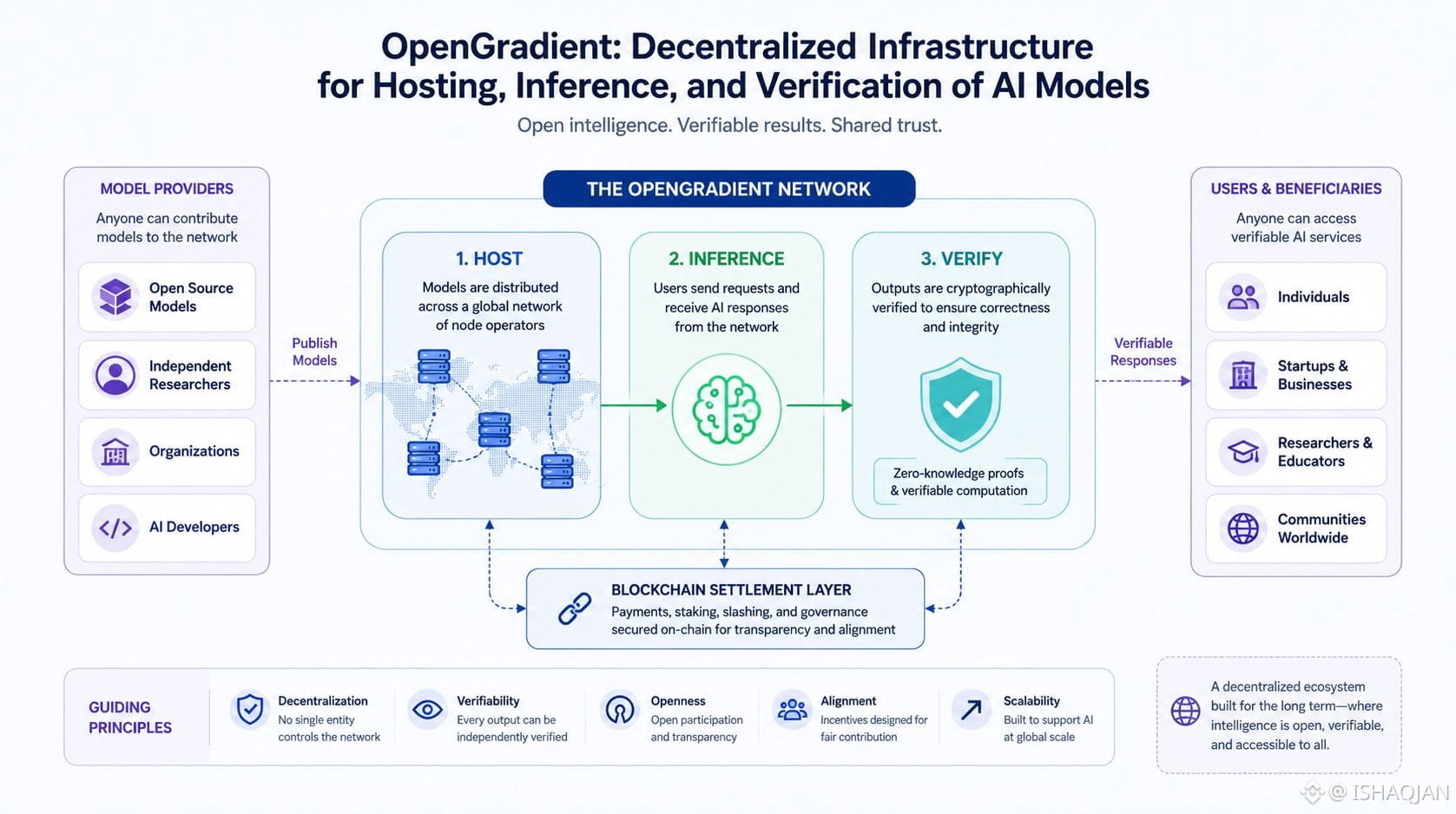
The idea of a network where AI can be hosted and its outputs verified feels like a small shift with bigger implications. It suggests that trust doesn’t always have to come from a company, a brand, or a familiar name—it might come from openness and shared participation.
But that also raises another thought. Even if the technology becomes transparent, people still bring their own incentives, biases, and assumptions. Verification can explain what happened, but it doesn’t always answer why it happened or who should be responsible.
Maybe the future of AI won’t be shaped only by smarter models or faster infrastructure. Maybe it will be shaped by the everyday choices people make about trust, cooperation, and accountability.
I’m not sure where that leads, but I think those questions are becoming just as important as the technology itself.
#opg $OPG @OpenGradient
I’ve been thinking about why certain projects stay on my mind long after I close the tab. It’s usually not because of the technology itself, but because of the kind of conversations it quietly starts.
That’s what happened when I came across OpenGradient.
Instead of wondering how powerful AI can become, I found myself wondering how people decide what to trust. We’ve grown used to relying on systems we can’t really see or verify, mostly because they’re convenient. Maybe that’s normal. Maybe it’s just the direction we’ve been moving without noticing.
The idea of a network where AI can be hosted and its outputs verified feels like a small shift with bigger implications. It suggests that trust doesn’t always have to come from a company, a brand, or a familiar name—it might come from openness and shared participation.
But that also raises another thought. Even if the technology becomes transparent, people still bring their own incentives, biases, and assumptions. Verification can explain what happened, but it doesn’t always answer why it happened or who should be responsible.
Maybe the future of AI won’t be shaped only by smarter models or faster infrastructure. Maybe it will be shaped by the everyday choices people make about trust, cooperation, and accountability.
I’m not sure where that leads, but I think those questions are becoming just as important as the technology itself.
#opg $OPG @OpenGradient
That’s what happened when I came across OpenGradient.
Instead of wondering how powerful AI can become, I found myself wondering how people decide what to trust. We’ve grown used to relying on systems we can’t really see or verify, mostly because they’re convenient. Maybe that’s normal. Maybe it’s just the direction we’ve been moving without noticing.
The idea of a network where AI can be hosted and its outputs verified feels like a small shift with bigger implications. It suggests that trust doesn’t always have to come from a company, a brand, or a familiar name—it might come from openness and shared participation.
But that also raises another thought. Even if the technology becomes transparent, people still bring their own incentives, biases, and assumptions. Verification can explain what happened, but it doesn’t always answer why it happened or who should be responsible.
Maybe the future of AI won’t be shaped only by smarter models or faster infrastructure. Maybe it will be shaped by the everyday choices people make about trust, cooperation, and accountability.
I’m not sure where that leads, but I think those questions are becoming just as important as the technology itself.
#opg $OPG @OpenGradient
1
5
114
·
--
Bullish
I've been thinking about OpenGradient for a while, and what keeps my attention isn't the infrastructure itself—it's the mindset behind it.
Most technology tries to remove friction. We ask a question, receive an answer, and move on without wondering how that answer came into existence or who shaped it. Over time, that habit quietly changes the way we trust information.
A network that makes AI models open, verifiable, and distributed introduces a different kind of relationship. Instead of asking us to simply believe the output, it invites us to examine the process. That feels less like a technical shift and more like a cultural one.
But openness doesn't automatically create understanding. More visibility can lead to more responsibility, yet it can also create the illusion that transparency is the same as accountability. If everyone can verify something, who is expected to question it? And if intelligence becomes a shared resource, how do we decide who guides its direction?
Maybe the most interesting part of open intelligence isn't the architecture or the models themselves. Maybe it's the possibility that we begin valuing participation over passive consumption and curiosity over certainty.
I'm not sure where that leads, but it makes me wonder whether the future of AI will be defined by better algorithms—or by better habits of trust.
#opg $OPG @OpenGradient
I've been thinking about OpenGradient for a while, and what keeps my attention isn't the infrastructure itself—it's the mindset behind it.
Most technology tries to remove friction. We ask a question, receive an answer, and move on without wondering how that answer came into existence or who shaped it. Over time, that habit quietly changes the way we trust information.
A network that makes AI models open, verifiable, and distributed introduces a different kind of relationship. Instead of asking us to simply believe the output, it invites us to examine the process. That feels less like a technical shift and more like a cultural one.
But openness doesn't automatically create understanding. More visibility can lead to more responsibility, yet it can also create the illusion that transparency is the same as accountability. If everyone can verify something, who is expected to question it? And if intelligence becomes a shared resource, how do we decide who guides its direction?
Maybe the most interesting part of open intelligence isn't the architecture or the models themselves. Maybe it's the possibility that we begin valuing participation over passive consumption and curiosity over certainty.
I'm not sure where that leads, but it makes me wonder whether the future of AI will be defined by better algorithms—or by better habits of trust.
#opg $OPG @OpenGradient
Most technology tries to remove friction. We ask a question, receive an answer, and move on without wondering how that answer came into existence or who shaped it. Over time, that habit quietly changes the way we trust information.
A network that makes AI models open, verifiable, and distributed introduces a different kind of relationship. Instead of asking us to simply believe the output, it invites us to examine the process. That feels less like a technical shift and more like a cultural one.
But openness doesn't automatically create understanding. More visibility can lead to more responsibility, yet it can also create the illusion that transparency is the same as accountability. If everyone can verify something, who is expected to question it? And if intelligence becomes a shared resource, how do we decide who guides its direction?
Maybe the most interesting part of open intelligence isn't the architecture or the models themselves. Maybe it's the possibility that we begin valuing participation over passive consumption and curiosity over certainty.
I'm not sure where that leads, but it makes me wonder whether the future of AI will be defined by better algorithms—or by better habits of trust.
#opg $OPG @OpenGradient
20
16
203
·
--
Bullish
Verified
I've been in enough crypto cycles to see the same pattern repeat. A new AI project launches, everyone talks about faster models, better performance, and bigger numbers. For a while, that becomes the entire story.
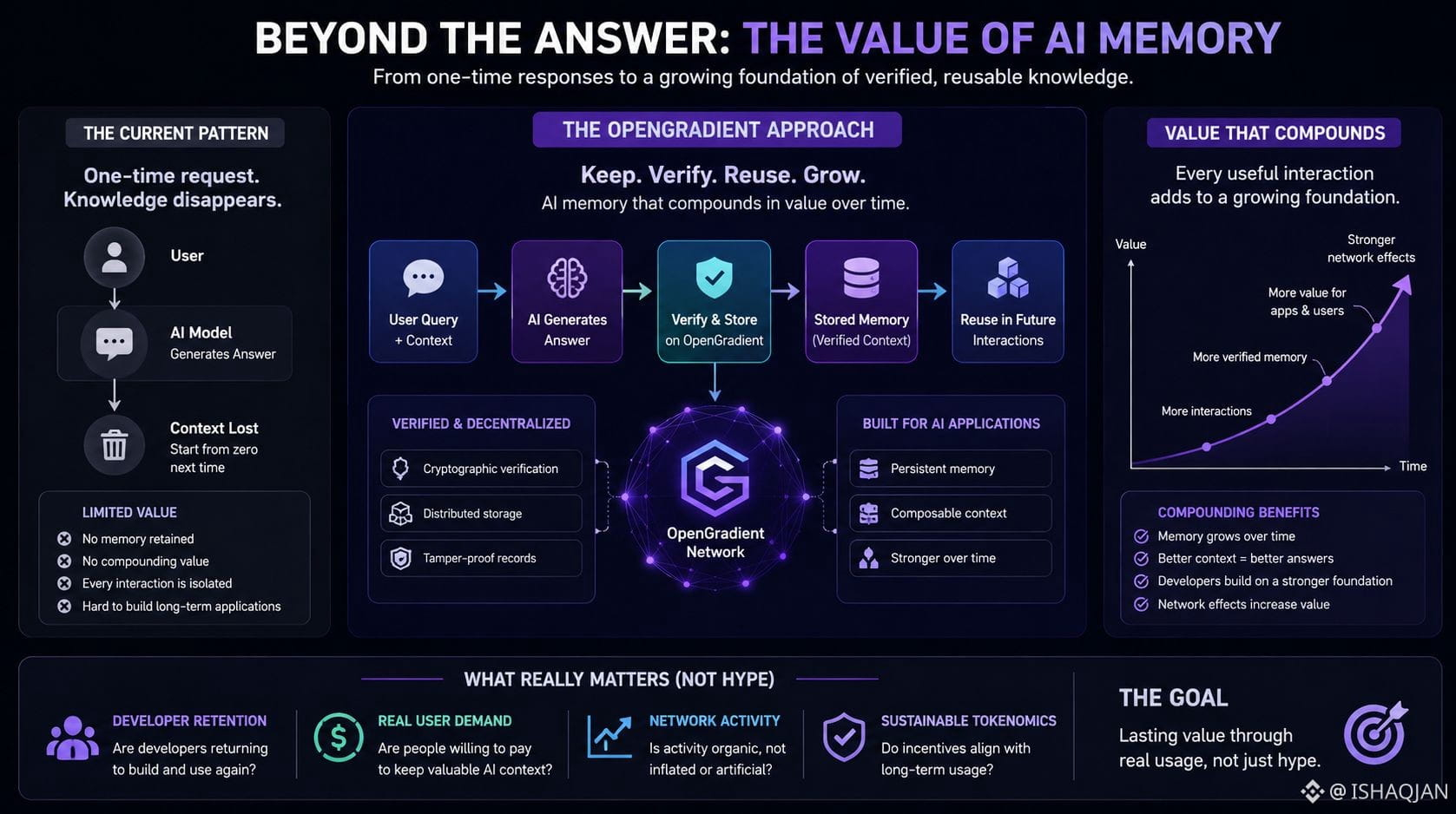
Looking at OpenGradient, I ended up thinking about something different. Instead of asking how smart an AI can be, I started asking what happens after the answer is generated. If an AI can keep verified information and use it again later, that stored knowledge could become just as important as the model itself.
That idea is interesting because memory grows over time. Every useful interaction adds more value instead of disappearing after one request. It feels less like a one-time service and more like a foundation that applications can keep building on.
I'm still careful, though. Good ideas don't always become good investments. If real users aren't coming back, if network activity is inflated, or if token incentives create artificial demand, the narrative won't last. Crypto markets often celebrate possibilities long before they reward actual usage.
So I'm not focused on hype or social media excitement. I'm watching simple things: Are developers returning to use the network again? Are people willing to pay to keep valuable AI context instead of starting from zero every time? If those answers keep improving, OpenGradient could be creating something with lasting value rather than just another short-lived AI trend.
#opg $OPG @OpenGradient
I've been in enough crypto cycles to see the same pattern repeat. A new AI project launches, everyone talks about faster models, better performance, and bigger numbers. For a while, that becomes the entire story.
Looking at OpenGradient, I ended up thinking about something different. Instead of asking how smart an AI can be, I started asking what happens after the answer is generated. If an AI can keep verified information and use it again later, that stored knowledge could become just as important as the model itself.
That idea is interesting because memory grows over time. Every useful interaction adds more value instead of disappearing after one request. It feels less like a one-time service and more like a foundation that applications can keep building on.
I'm still careful, though. Good ideas don't always become good investments. If real users aren't coming back, if network activity is inflated, or if token incentives create artificial demand, the narrative won't last. Crypto markets often celebrate possibilities long before they reward actual usage.
So I'm not focused on hype or social media excitement. I'm watching simple things: Are developers returning to use the network again? Are people willing to pay to keep valuable AI context instead of starting from zero every time? If those answers keep improving, OpenGradient could be creating something with lasting value rather than just another short-lived AI trend.
#opg $OPG @OpenGradient
Looking at OpenGradient, I ended up thinking about something different. Instead of asking how smart an AI can be, I started asking what happens after the answer is generated. If an AI can keep verified information and use it again later, that stored knowledge could become just as important as the model itself.
That idea is interesting because memory grows over time. Every useful interaction adds more value instead of disappearing after one request. It feels less like a one-time service and more like a foundation that applications can keep building on.
I'm still careful, though. Good ideas don't always become good investments. If real users aren't coming back, if network activity is inflated, or if token incentives create artificial demand, the narrative won't last. Crypto markets often celebrate possibilities long before they reward actual usage.
So I'm not focused on hype or social media excitement. I'm watching simple things: Are developers returning to use the network again? Are people willing to pay to keep valuable AI context instead of starting from zero every time? If those answers keep improving, OpenGradient could be creating something with lasting value rather than just another short-lived AI trend.
#opg $OPG @OpenGradient
41
32
620
·
--
Bullish
I’ve been in this space long enough to feel a kind of tiredness that doesn’t come from the charts. It comes from the stories. Every cycle, the same words get repackaged. Privacy. Scale. Compliance. Better UX. The slides get prettier, the demos get smoother, and somewhere along the way I stop listening because I’ve already heard the ending. Most of it blurs. You can only watch so many projects promise to fix the same problem before it all starts to sound like background music.
OpenGradient showed up in my feed and I almost scrolled past it. Decentralized infra for running, checking, and hosting AI models. Privacy built in. On paper, just another line in a long list. But the thing that made me pause wasn’t the ambition. It was how little it was trying to sell me.
We’ve spent years pretending that transparency is a virtue on its own. Put everything on chain, make it public, call it trust. That’s fine until the data actually matters. Medical stuff, model weights, the kind of user behavior that shouldn’t be open for anyone to scrape and resell. The opposite isn’t better either. “Zero-knowledge, trust us” is just another way of saying you won’t get to know anything. Regulators hate it, markets don’t work with it, and users end up with products that feel like locked boxes.
What OpenGradient seems to be doing is living in the middle, which is the least glamorous place to be. Private logic. Selective disclosure. You can prove something ran correctly without showing everyone the whole thing. That’s not a slogan. It’s a constraint, and constraints are where most of these projects fall apart. Because you can design the cleanest architecture in a testnet and still lose when a real developer tries to ship with it. Make it too pure and only PhDs will touch it. Make it too easy and you’re back to a server with a crypto sticker. Try to please compliance and privacy turns into a performance.
I don’t think OpenGradient solves that. I don’t think anything does, not in one go. But it feels
#opg $OPG @OpenGradient
I’ve been in this space long enough to feel a kind of tiredness that doesn’t come from the charts. It comes from the stories. Every cycle, the same words get repackaged. Privacy. Scale. Compliance. Better UX. The slides get prettier, the demos get smoother, and somewhere along the way I stop listening because I’ve already heard the ending. Most of it blurs. You can only watch so many projects promise to fix the same problem before it all starts to sound like background music.
OpenGradient showed up in my feed and I almost scrolled past it. Decentralized infra for running, checking, and hosting AI models. Privacy built in. On paper, just another line in a long list. But the thing that made me pause wasn’t the ambition. It was how little it was trying to sell me.
We’ve spent years pretending that transparency is a virtue on its own. Put everything on chain, make it public, call it trust. That’s fine until the data actually matters. Medical stuff, model weights, the kind of user behavior that shouldn’t be open for anyone to scrape and resell. The opposite isn’t better either. “Zero-knowledge, trust us” is just another way of saying you won’t get to know anything. Regulators hate it, markets don’t work with it, and users end up with products that feel like locked boxes.
What OpenGradient seems to be doing is living in the middle, which is the least glamorous place to be. Private logic. Selective disclosure. You can prove something ran correctly without showing everyone the whole thing. That’s not a slogan. It’s a constraint, and constraints are where most of these projects fall apart. Because you can design the cleanest architecture in a testnet and still lose when a real developer tries to ship with it. Make it too pure and only PhDs will touch it. Make it too easy and you’re back to a server with a crypto sticker. Try to please compliance and privacy turns into a performance.
I don’t think OpenGradient solves that. I don’t think anything does, not in one go. But it feels
#opg $OPG @OpenGradient
OpenGradient showed up in my feed and I almost scrolled past it. Decentralized infra for running, checking, and hosting AI models. Privacy built in. On paper, just another line in a long list. But the thing that made me pause wasn’t the ambition. It was how little it was trying to sell me.
We’ve spent years pretending that transparency is a virtue on its own. Put everything on chain, make it public, call it trust. That’s fine until the data actually matters. Medical stuff, model weights, the kind of user behavior that shouldn’t be open for anyone to scrape and resell. The opposite isn’t better either. “Zero-knowledge, trust us” is just another way of saying you won’t get to know anything. Regulators hate it, markets don’t work with it, and users end up with products that feel like locked boxes.
What OpenGradient seems to be doing is living in the middle, which is the least glamorous place to be. Private logic. Selective disclosure. You can prove something ran correctly without showing everyone the whole thing. That’s not a slogan. It’s a constraint, and constraints are where most of these projects fall apart. Because you can design the cleanest architecture in a testnet and still lose when a real developer tries to ship with it. Make it too pure and only PhDs will touch it. Make it too easy and you’re back to a server with a crypto sticker. Try to please compliance and privacy turns into a performance.
I don’t think OpenGradient solves that. I don’t think anything does, not in one go. But it feels
#opg $OPG @OpenGradient
1
5
135
·
--
Bullish
I’ve been around crypto long enough to see the same ideas come back wearing different clothes.
One cycle it's scalability. The next it's better UX. Then compliance. Then privacy again. The presentations get cleaner, the messaging gets sharper, but after a while a lot of projects start feeling strangely familiar. Not bad—just familiar.
That’s probably why OpenGradient stood out to me.
Not because it promises some perfect future, but because it seems to recognize a simple reality: not everything belongs on full display. Crypto has spent years treating transparency as the ultimate goal, yet real-world data, AI models, and personal information don't fit neatly into that philosophy.
Privacy isn't always about anonymity. Sometimes it's just about having control over what gets shared, when it's shared, and with whom.
What caught my attention is the focus on ideas like private logic, selective disclosure, and verifiable confidentiality. They feel less like marketing terms and more like attempts to solve an actual problem. The balance is difficult, though. More privacy can create trust issues. More transparency can reduce usability. Regulation pulls in one direction while users often want another.
None of this guarantees adoption. We've seen plenty of well-designed systems struggle once they leave the whitepaper stage.
Still, in a market crowded with familiar stories, it's interesting to see a project exploring the space between complete openness and complete secrecy. Whether that matters a year from now is the part I'm still watching.
#opg $OPG @OpenGradient
I’ve been around crypto long enough to see the same ideas come back wearing different clothes.
One cycle it's scalability. The next it's better UX. Then compliance. Then privacy again. The presentations get cleaner, the messaging gets sharper, but after a while a lot of projects start feeling strangely familiar. Not bad—just familiar.
That’s probably why OpenGradient stood out to me.
Not because it promises some perfect future, but because it seems to recognize a simple reality: not everything belongs on full display. Crypto has spent years treating transparency as the ultimate goal, yet real-world data, AI models, and personal information don't fit neatly into that philosophy.
Privacy isn't always about anonymity. Sometimes it's just about having control over what gets shared, when it's shared, and with whom.
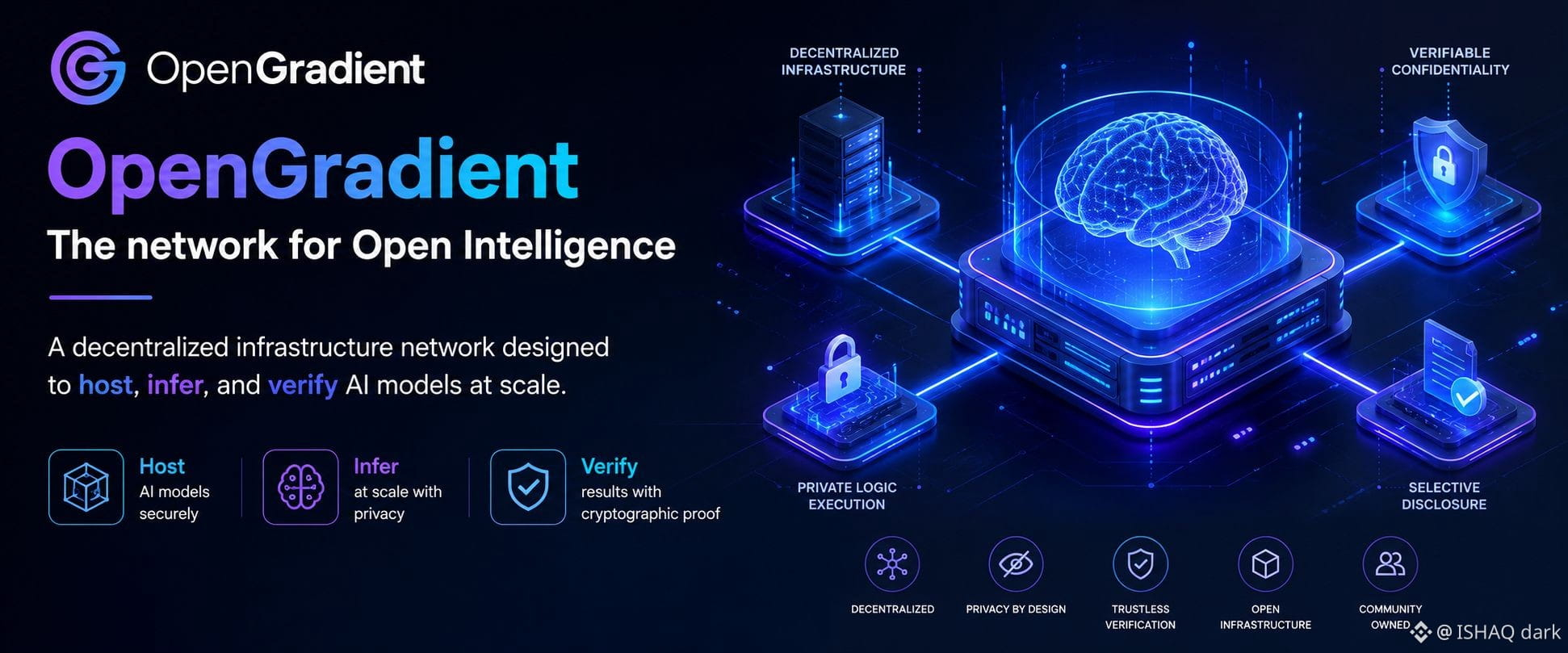
What caught my attention is the focus on ideas like private logic, selective disclosure, and verifiable confidentiality. They feel less like marketing terms and more like attempts to solve an actual problem. The balance is difficult, though. More privacy can create trust issues. More transparency can reduce usability. Regulation pulls in one direction while users often want another.
None of this guarantees adoption. We've seen plenty of well-designed systems struggle once they leave the whitepaper stage.
Still, in a market crowded with familiar stories, it's interesting to see a project exploring the space between complete openness and complete secrecy. Whether that matters a year from now is the part I'm still watching.
#opg $OPG @OpenGradient
One cycle it's scalability. The next it's better UX. Then compliance. Then privacy again. The presentations get cleaner, the messaging gets sharper, but after a while a lot of projects start feeling strangely familiar. Not bad—just familiar.
That’s probably why OpenGradient stood out to me.
Not because it promises some perfect future, but because it seems to recognize a simple reality: not everything belongs on full display. Crypto has spent years treating transparency as the ultimate goal, yet real-world data, AI models, and personal information don't fit neatly into that philosophy.
Privacy isn't always about anonymity. Sometimes it's just about having control over what gets shared, when it's shared, and with whom.
What caught my attention is the focus on ideas like private logic, selective disclosure, and verifiable confidentiality. They feel less like marketing terms and more like attempts to solve an actual problem. The balance is difficult, though. More privacy can create trust issues. More transparency can reduce usability. Regulation pulls in one direction while users often want another.
None of this guarantees adoption. We've seen plenty of well-designed systems struggle once they leave the whitepaper stage.
Still, in a market crowded with familiar stories, it's interesting to see a project exploring the space between complete openness and complete secrecy. Whether that matters a year from now is the part I'm still watching.
#opg $OPG @OpenGradient
1
2
171
·
--
Bullish
I’m watching OpenGradient with cautious interest.
Maybe it's because I've spent too much time in this market, but a lot of crypto projects start blending together after a while. Every cycle brings a fresh wave of "game-changing" narratives, yet somehow the conversations always circle back to the same topics—privacy, scalability, compliance, better user experience. The packaging gets better, the pitch gets smoother, but the core story often feels familiar.
What makes OpenGradient stand out to me isn't that it claims to solve everything. It's that it's asking a question that feels increasingly relevant as AI grows: does everything really need to be fully visible all the time?
The industry tends to treat privacy and transparency as opposites, but real life is rarely that simple. Sometimes people need proof without revealing everything. Sometimes trust comes from verification, not exposure.
That doesn't mean OpenGradient automatically wins. Plenty of technically solid projects struggle when they leave the whitepaper and meet the real world. Adoption is usually harder than architecture.
Still, in a market overflowing with recycled narratives, I find myself paying a little more attention when a project focuses on practical trade-offs instead of perfect solutions. That's where the more interesting ideas usually start.
#opg $OPG @OpenGradient
I’m watching OpenGradient with cautious interest.
Maybe it's because I've spent too much time in this market, but a lot of crypto projects start blending together after a while. Every cycle brings a fresh wave of "game-changing" narratives, yet somehow the conversations always circle back to the same topics—privacy, scalability, compliance, better user experience. The packaging gets better, the pitch gets smoother, but the core story often feels familiar.
What makes OpenGradient stand out to me isn't that it claims to solve everything. It's that it's asking a question that feels increasingly relevant as AI grows: does everything really need to be fully visible all the time?
The industry tends to treat privacy and transparency as opposites, but real life is rarely that simple. Sometimes people need proof without revealing everything. Sometimes trust comes from verification, not exposure.
That doesn't mean OpenGradient automatically wins. Plenty of technically solid projects struggle when they leave the whitepaper and meet the real world. Adoption is usually harder than architecture.
Still, in a market overflowing with recycled narratives, I find myself paying a little more attention when a project focuses on practical trade-offs instead of perfect solutions. That's where the more interesting ideas usually start.
#opg $OPG @OpenGradient
Maybe it's because I've spent too much time in this market, but a lot of crypto projects start blending together after a while. Every cycle brings a fresh wave of "game-changing" narratives, yet somehow the conversations always circle back to the same topics—privacy, scalability, compliance, better user experience. The packaging gets better, the pitch gets smoother, but the core story often feels familiar.
What makes OpenGradient stand out to me isn't that it claims to solve everything. It's that it's asking a question that feels increasingly relevant as AI grows: does everything really need to be fully visible all the time?
The industry tends to treat privacy and transparency as opposites, but real life is rarely that simple. Sometimes people need proof without revealing everything. Sometimes trust comes from verification, not exposure.
That doesn't mean OpenGradient automatically wins. Plenty of technically solid projects struggle when they leave the whitepaper and meet the real world. Adoption is usually harder than architecture.
Still, in a market overflowing with recycled narratives, I find myself paying a little more attention when a project focuses on practical trade-offs instead of perfect solutions. That's where the more interesting ideas usually start.
#opg $OPG @OpenGradient
1
2
140
·
--
Bullish
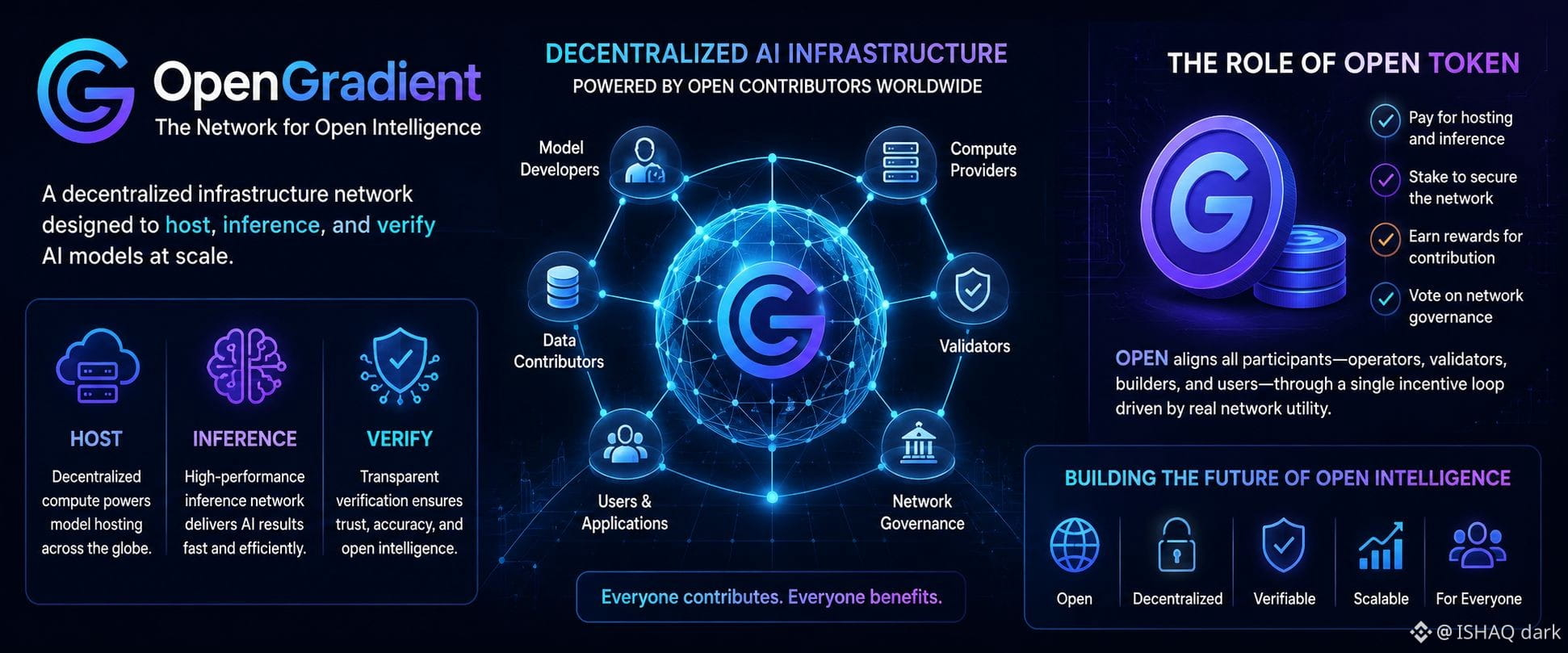
I’ve noticed, OpenGradient is trying to tackle a problem that most decentralized AI projects eventually run into: getting strangers with different incentives to contribute to the same network for reasons beyond rewards. Hosting models, running inference, and verifying outputs sounds useful, but usefulness and sustainable coordination are rarely the same thing.
What I keep coming back to is whether the network can attract real demand for AI services or if participation mainly grows because incentives make it attractive to show up. A lot of systems look decentralized when rewards are flowing. The harder test comes later, when operators, contributors, and token holders have to stay engaged because the network itself is valuable, not because emissions are doing the heavy lifting.
OpenGradient's model depends on infrastructure providers, verification mechanisms, and contributors all moving in the same direction. That creates an interesting incentive loop, but only if network activity reflects actual usage. If compute supply keeps expanding while meaningful demand lags behind, then growth metrics can start telling a very different story from network utility.
I also think concentration deserves more attention than most people give it. As the network scales, does participation spread across a wider group of operators and contributors, or does activity gradually cluster around a handful of dominant players? Decentralization is easy to claim early. Maintaining it as incentives mature is usually where the challenge begins.
The role of OPEN feels tied to this question. If reward distribution ultimately reflects real inference demand, verification work, and infrastructure contribution, then the token may become a signal of productive network activity. If rewards mostly track liquidity, speculation, or participation chasing incentives, then the network could end up measuring growth without measuring value.
For now, I'm watching contributor growth, operator distribution, infrastructure utilization, verification activity, and whether demand
@OpenGradient #opg $OPG
I’ve noticed, OpenGradient is trying to tackle a problem that most decentralized AI projects eventually run into: getting strangers with different incentives to contribute to the same network for reasons beyond rewards. Hosting models, running inference, and verifying outputs sounds useful, but usefulness and sustainable coordination are rarely the same thing.
What I keep coming back to is whether the network can attract real demand for AI services or if participation mainly grows because incentives make it attractive to show up. A lot of systems look decentralized when rewards are flowing. The harder test comes later, when operators, contributors, and token holders have to stay engaged because the network itself is valuable, not because emissions are doing the heavy lifting.
OpenGradient's model depends on infrastructure providers, verification mechanisms, and contributors all moving in the same direction. That creates an interesting incentive loop, but only if network activity reflects actual usage. If compute supply keeps expanding while meaningful demand lags behind, then growth metrics can start telling a very different story from network utility.
I also think concentration deserves more attention than most people give it. As the network scales, does participation spread across a wider group of operators and contributors, or does activity gradually cluster around a handful of dominant players? Decentralization is easy to claim early. Maintaining it as incentives mature is usually where the challenge begins.
The role of OPEN feels tied to this question. If reward distribution ultimately reflects real inference demand, verification work, and infrastructure contribution, then the token may become a signal of productive network activity. If rewards mostly track liquidity, speculation, or participation chasing incentives, then the network could end up measuring growth without measuring value.
For now, I'm watching contributor growth, operator distribution, infrastructure utilization, verification activity, and whether demand
@OpenGradient #opg $OPG
What I keep coming back to is whether the network can attract real demand for AI services or if participation mainly grows because incentives make it attractive to show up. A lot of systems look decentralized when rewards are flowing. The harder test comes later, when operators, contributors, and token holders have to stay engaged because the network itself is valuable, not because emissions are doing the heavy lifting.
OpenGradient's model depends on infrastructure providers, verification mechanisms, and contributors all moving in the same direction. That creates an interesting incentive loop, but only if network activity reflects actual usage. If compute supply keeps expanding while meaningful demand lags behind, then growth metrics can start telling a very different story from network utility.
I also think concentration deserves more attention than most people give it. As the network scales, does participation spread across a wider group of operators and contributors, or does activity gradually cluster around a handful of dominant players? Decentralization is easy to claim early. Maintaining it as incentives mature is usually where the challenge begins.
The role of OPEN feels tied to this question. If reward distribution ultimately reflects real inference demand, verification work, and infrastructure contribution, then the token may become a signal of productive network activity. If rewards mostly track liquidity, speculation, or participation chasing incentives, then the network could end up measuring growth without measuring value.
For now, I'm watching contributor growth, operator distribution, infrastructure utilization, verification activity, and whether demand
@OpenGradient #opg $OPG
3
3
97
·
--
Bullish
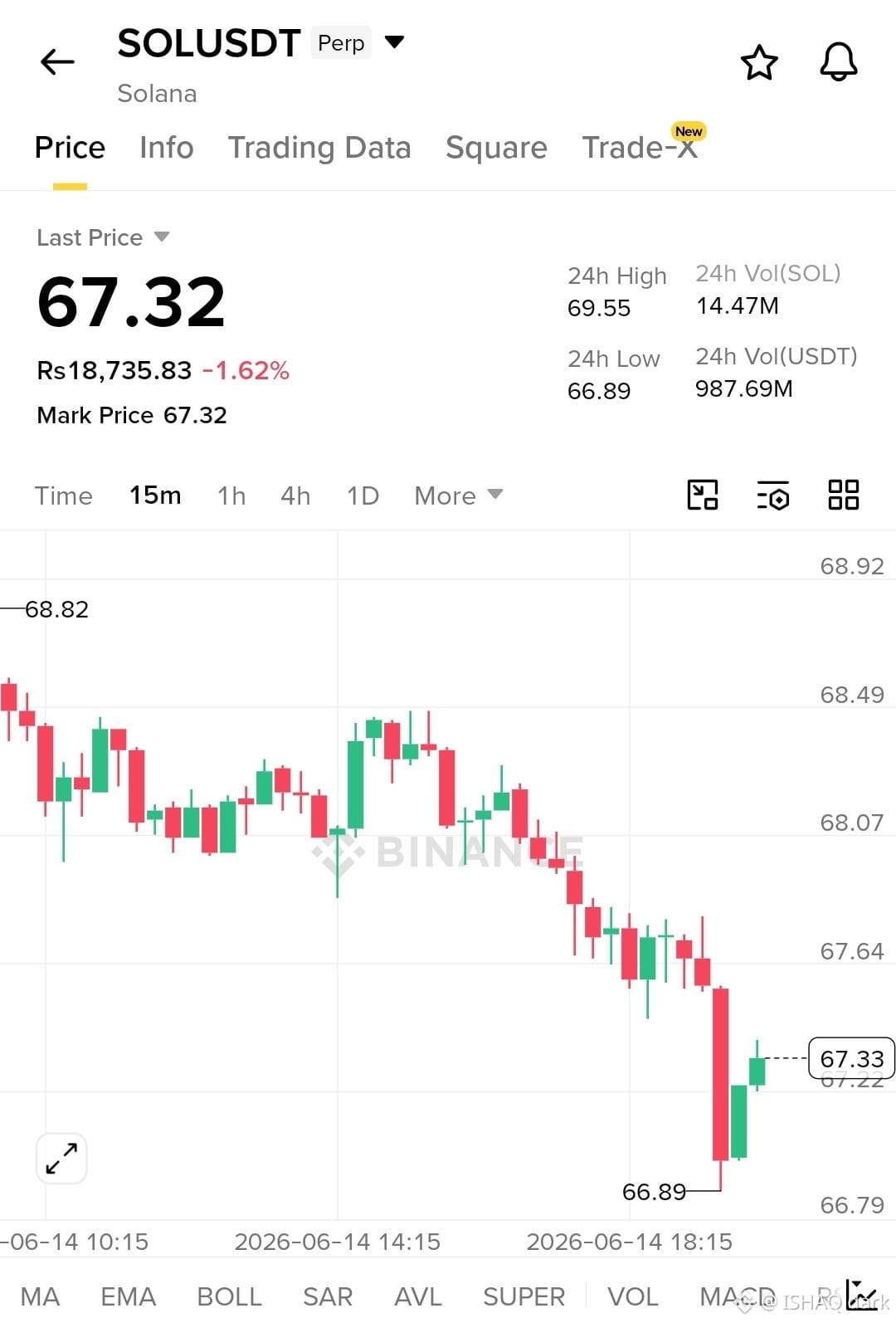
$SOL bulls are still defending the structure.
Long Setup Entry Zone: $68-$69 Targets: $72 → $76 → $82 → $90 Stop Loss: $60
The chart is showing: ✅ Strong support around $68 ✅ Consistent higher lows ✅ Aggressive dip buying ✅ Potential momentum expansion above $72
Take partial profits along the way and protect capital. A good setup means nothing without proper risk management.
{spot}(SOLUSDT)
$SOL bulls are still defending the structure.
Long Setup Entry Zone: $68-$69 Targets: $72 → $76 → $82 → $90 Stop Loss: $60
The chart is showing: ✅ Strong support around $68 ✅ Consistent higher lows ✅ Aggressive dip buying ✅ Potential momentum expansion above $72
Take partial profits along the way and protect capital. A good setup means nothing without proper risk management.
Long Setup Entry Zone: $68-$69 Targets: $72 → $76 → $82 → $90 Stop Loss: $60
The chart is showing: ✅ Strong support around $68 ✅ Consistent higher lows ✅ Aggressive dip buying ✅ Potential momentum expansion above $72
Take partial profits along the way and protect capital. A good setup means nothing without proper risk management.
126
·
--
Bullish
A dip is the chance for regular folks to flip the script, not the rise. Think about it, after this bull run, you know that $BNB , $TRX , and $HYPE are valuable coins that will pump hard in a bull
market, but now their prices are way too high.
If you think like I do, that BNB will hit $10k in the next bull run, that’s an 18x from the current price. If it drops to $300, that’s a 33x. The more it dips, the more you can rake in. The same goes for other coins.
A dip is the chance for regular folks to flip the script, not the rise. Think about it, after this bull run, you know that $BNB , $TRX , and $HYPE are valuable coins that will pump hard in a bull
market, but now their prices are way too high.
If you think like I do, that BNB will hit $10k in the next bull run, that’s an 18x from the current price. If it drops to $300, that’s a 33x. The more it dips, the more you can rake in. The same goes for other coins.
market, but now their prices are way too high.
If you think like I do, that BNB will hit $10k in the next bull run, that’s an 18x from the current price. If it drops to $300, that’s a 33x. The more it dips, the more you can rake in. The same goes for other coins.

2
119
·
--
Bullish
I've been watching OpenLedger closely, and what stands out isn't the narrative—it's the challenge hiding behind it.
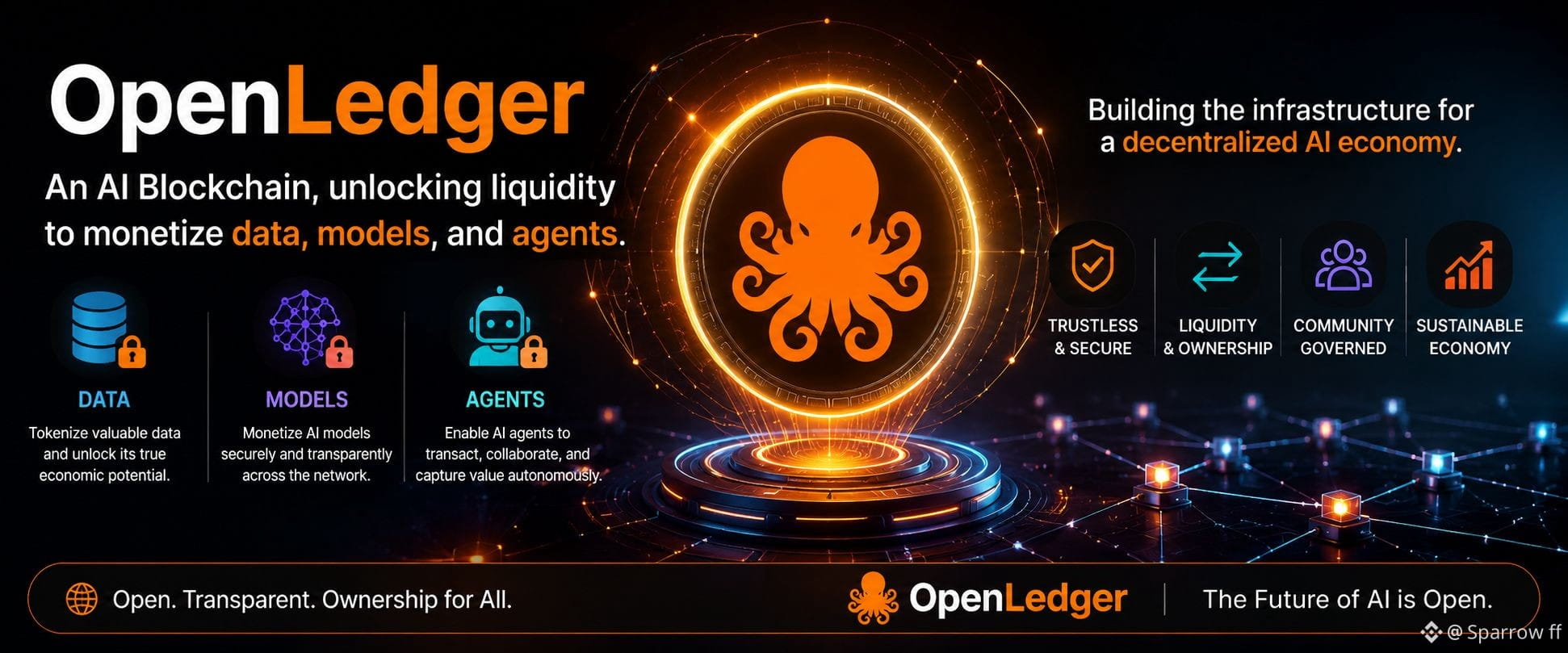
OpenLedger is building around a powerful idea: turning data, AI models, and autonomous agents into productive assets that can be monetized through a blockchain-based economy. On paper, the concept feels timely. AI is expanding rapidly, data is becoming increasingly valuable, and markets are searching for better ways to price and distribute intelligence.
But I've spent enough time around technology cycles to know that the hardest part begins after the excitement.
Creating a marketplace is one thing. Creating a marketplace people return to repeatedly is something entirely different.
The real test for OpenLedger isn't whether it can attract attention. It's whether developers, businesses, and AI builders continue using the network when incentives normalize and speculation fades. Can the platform reduce friction? Can it create trust around data quality? Can it make AI resources easier to discover, deploy, and monetize than existing alternatives?
That is where infrastructure either proves itself or disappears into the background noise of innovation.
What makes OpenLedger interesting to me is that it's operating at the intersection of two industries that often promise more than they deliver: AI and blockchain. If it can survive the operational pressure of both worlds, adoption becomes possible.
For now, I'm less focused on the story and more focused on the signals. Usage. Retention. Integration. Those metrics usually tell the truth long before the market does.
@GeniusOfficial #genius $GENIUS
I've been watching OpenLedger closely, and what stands out isn't the narrative—it's the challenge hiding behind it.
OpenLedger is building around a powerful idea: turning data, AI models, and autonomous agents into productive assets that can be monetized through a blockchain-based economy. On paper, the concept feels timely. AI is expanding rapidly, data is becoming increasingly valuable, and markets are searching for better ways to price and distribute intelligence.
But I've spent enough time around technology cycles to know that the hardest part begins after the excitement.
Creating a marketplace is one thing. Creating a marketplace people return to repeatedly is something entirely different.
The real test for OpenLedger isn't whether it can attract attention. It's whether developers, businesses, and AI builders continue using the network when incentives normalize and speculation fades. Can the platform reduce friction? Can it create trust around data quality? Can it make AI resources easier to discover, deploy, and monetize than existing alternatives?
That is where infrastructure either proves itself or disappears into the background noise of innovation.
What makes OpenLedger interesting to me is that it's operating at the intersection of two industries that often promise more than they deliver: AI and blockchain. If it can survive the operational pressure of both worlds, adoption becomes possible.
For now, I'm less focused on the story and more focused on the signals. Usage. Retention. Integration. Those metrics usually tell the truth long before the market does.
@GeniusOfficial #genius $GENIUS
OpenLedger is building around a powerful idea: turning data, AI models, and autonomous agents into productive assets that can be monetized through a blockchain-based economy. On paper, the concept feels timely. AI is expanding rapidly, data is becoming increasingly valuable, and markets are searching for better ways to price and distribute intelligence.
But I've spent enough time around technology cycles to know that the hardest part begins after the excitement.
Creating a marketplace is one thing. Creating a marketplace people return to repeatedly is something entirely different.
The real test for OpenLedger isn't whether it can attract attention. It's whether developers, businesses, and AI builders continue using the network when incentives normalize and speculation fades. Can the platform reduce friction? Can it create trust around data quality? Can it make AI resources easier to discover, deploy, and monetize than existing alternatives?
That is where infrastructure either proves itself or disappears into the background noise of innovation.
What makes OpenLedger interesting to me is that it's operating at the intersection of two industries that often promise more than they deliver: AI and blockchain. If it can survive the operational pressure of both worlds, adoption becomes possible.
For now, I'm less focused on the story and more focused on the signals. Usage. Retention. Integration. Those metrics usually tell the truth long before the market does.
@GeniusOfficial #genius $GENIUS
131
·
--
Bullish
I've watched countless crypto platforms promise to be the "Bloomberg Terminal of Web3," yet most eventually reveal the same weakness: they sit between users and the chain, creating new layers of trust where trust was supposed to disappear.
That's why Genius Terminal caught my attention.
What stands out to me isn't the flashy narrative or the race for attention. It's the ambition to become the first private and final on-chain terminal—a place where intelligence, execution, and ownership converge without unnecessary intermediaries.
The market is evolving beyond simple dashboards. Traders, builders, and researchers no longer want fragmented tools spread across multiple tabs. They want a unified command center capable of understanding information, interpreting market signals, and acting directly on-chain.
I see Genius Terminal positioning itself at the center of that transition.
If the next phase of crypto is defined by autonomous agents, real-time intelligence, and seamless execution, then terminals won't just display data—they'll become decision engines. The projects that understand this shift early could define how users interact with decentralized networks for years.
The challenge, of course, is execution. Many have attempted to build the ultimate crypto interface and failed. But the opportunity remains enormous.
From my perspective, Genius Terminal isn't just building another product. It's making a bold bet on where on-chain interaction is heading nextand that's exactly what makes it worth watching.
@GeniusOfficial #genius $GENIUS
I've watched countless crypto platforms promise to be the "Bloomberg Terminal of Web3," yet most eventually reveal the same weakness: they sit between users and the chain, creating new layers of trust where trust was supposed to disappear.
That's why Genius Terminal caught my attention.
What stands out to me isn't the flashy narrative or the race for attention. It's the ambition to become the first private and final on-chain terminal—a place where intelligence, execution, and ownership converge without unnecessary intermediaries.
The market is evolving beyond simple dashboards. Traders, builders, and researchers no longer want fragmented tools spread across multiple tabs. They want a unified command center capable of understanding information, interpreting market signals, and acting directly on-chain.
I see Genius Terminal positioning itself at the center of that transition.
If the next phase of crypto is defined by autonomous agents, real-time intelligence, and seamless execution, then terminals won't just display data—they'll become decision engines. The projects that understand this shift early could define how users interact with decentralized networks for years.
The challenge, of course, is execution. Many have attempted to build the ultimate crypto interface and failed. But the opportunity remains enormous.
From my perspective, Genius Terminal isn't just building another product. It's making a bold bet on where on-chain interaction is heading nextand that's exactly what makes it worth watching.
@GeniusOfficial #genius $GENIUS
That's why Genius Terminal caught my attention.
What stands out to me isn't the flashy narrative or the race for attention. It's the ambition to become the first private and final on-chain terminal—a place where intelligence, execution, and ownership converge without unnecessary intermediaries.
The market is evolving beyond simple dashboards. Traders, builders, and researchers no longer want fragmented tools spread across multiple tabs. They want a unified command center capable of understanding information, interpreting market signals, and acting directly on-chain.
I see Genius Terminal positioning itself at the center of that transition.
If the next phase of crypto is defined by autonomous agents, real-time intelligence, and seamless execution, then terminals won't just display data—they'll become decision engines. The projects that understand this shift early could define how users interact with decentralized networks for years.
The challenge, of course, is execution. Many have attempted to build the ultimate crypto interface and failed. But the opportunity remains enormous.
From my perspective, Genius Terminal isn't just building another product. It's making a bold bet on where on-chain interaction is heading nextand that's exactly what makes it worth watching.
@GeniusOfficial #genius $GENIUS

3
1
88
·
--
Bullish
I’m watching OpenLedger closely, not because of the narrative, but because of the pressure it’s choosing to face.
Everyone talks about AI. Everyone talks about data. Everyone talks about agents. Very few projects are trying to solve the harder question: who actually captures value when these systems start operating at scale?
That’s what keeps pulling my attention back to OpenLedger.
The market loves model creation, but creation is the easy part. The real challenge begins after launch. Can data remain valuable? Can models stay relevant? Can agents generate consistent utility instead of short-lived activity?
Most technology stories look strongest during demonstrations. Reality starts when users arrive, costs appear, and infrastructure gets tested under load.
OpenLedger’s thesis is interesting because it sits directly in that tension. It isn’t just about AI capabilities. It’s about building an economic layer around data, models, and agents that can survive real-world usage.
I’ve seen enough market cycles to know that attention alone means very little. Adoption matters. Repeat usage matters. Durability matters.
The projects that survive are rarely the loudest. They’re the ones that continue functioning when the spotlight moves elsewhere.
That’s why I’m less interested in the excitement around OpenLedger and more interested in what happens next.
Because the real test isn’t whether people are talking about it today.
It’s whether they’re still using it years from now.
@Openledger #openledger $OPEN
I’m watching OpenLedger closely, not because of the narrative, but because of the pressure it’s choosing to face.
Everyone talks about AI. Everyone talks about data. Everyone talks about agents. Very few projects are trying to solve the harder question: who actually captures value when these systems start operating at scale?
That’s what keeps pulling my attention back to OpenLedger.
The market loves model creation, but creation is the easy part. The real challenge begins after launch. Can data remain valuable? Can models stay relevant? Can agents generate consistent utility instead of short-lived activity?
Most technology stories look strongest during demonstrations. Reality starts when users arrive, costs appear, and infrastructure gets tested under load.
OpenLedger’s thesis is interesting because it sits directly in that tension. It isn’t just about AI capabilities. It’s about building an economic layer around data, models, and agents that can survive real-world usage.
I’ve seen enough market cycles to know that attention alone means very little. Adoption matters. Repeat usage matters. Durability matters.
The projects that survive are rarely the loudest. They’re the ones that continue functioning when the spotlight moves elsewhere.
That’s why I’m less interested in the excitement around OpenLedger and more interested in what happens next.
Because the real test isn’t whether people are talking about it today.
It’s whether they’re still using it years from now.
@OpenLedger #openledger $OPEN
Everyone talks about AI. Everyone talks about data. Everyone talks about agents. Very few projects are trying to solve the harder question: who actually captures value when these systems start operating at scale?
That’s what keeps pulling my attention back to OpenLedger.
The market loves model creation, but creation is the easy part. The real challenge begins after launch. Can data remain valuable? Can models stay relevant? Can agents generate consistent utility instead of short-lived activity?
Most technology stories look strongest during demonstrations. Reality starts when users arrive, costs appear, and infrastructure gets tested under load.
OpenLedger’s thesis is interesting because it sits directly in that tension. It isn’t just about AI capabilities. It’s about building an economic layer around data, models, and agents that can survive real-world usage.
I’ve seen enough market cycles to know that attention alone means very little. Adoption matters. Repeat usage matters. Durability matters.
The projects that survive are rarely the loudest. They’re the ones that continue functioning when the spotlight moves elsewhere.
That’s why I’m less interested in the excitement around OpenLedger and more interested in what happens next.
Because the real test isn’t whether people are talking about it today.
It’s whether they’re still using it years from now.
@OpenLedger #openledger $OPEN
1
119
·
--
Article
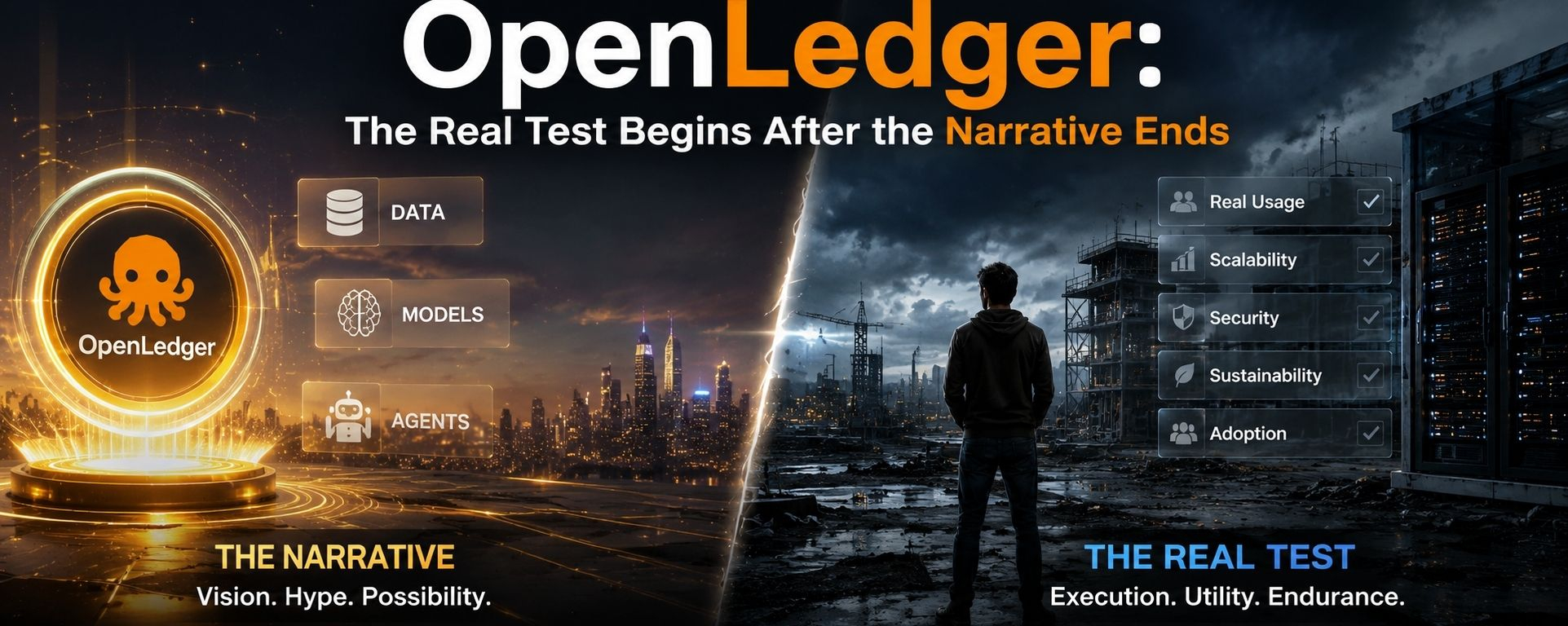
OpenLedger: The Real Test Begins After the Narrative EndsI keep returning to the same thought whenever I look at projects like OpenLedger. After watching technology markets for long enough, it becomes difficult to get overly excited by a narrative alone. The story always arrives first. The expectations arrive shortly after. What takes much longer is discovering whether a product can survive the ordinary pressures of real usage. That is usually the part that interests me most. Not the launch, not the attention, not the early optimism, but the period that comes afterward when a system has to justify its existence every single day.
OpenLedger enters the conversation at a moment when artificial intelligence is expanding into almost every corner of the technology industry. Data has become valuable. Models have become valuable. Even the idea of autonomous agents is beginning to develop its own economy. On paper, creating infrastructure that allows these assets to be monetized and exchanged feels like a natural progression. Yet experience has a way of making simple ideas look much more complicated once they encounter reality.
The technology industry often speaks about data as if value is automatically embedded within it. In practice, most data is messy, fragmented, inconsistent, and difficult to evaluate. The challenge is rarely collecting information. The challenge is determining what information remains useful after the excitement fades. The same applies to AI models. Building a model can be impressive. Keeping it relevant is usually far more difficult. Markets celebrate creation because it is visible. Maintenance receives less attention because it happens quietly in the background.
That distinction matters because technology tends to look strongest during demonstrations. Controlled environments remove uncertainty. Real-world deployment introduces it. Suddenly there are costs to manage, workflows to integrate with, users to support, and expectations to meet. Systems that appear efficient in presentations often encounter friction once they become part of someone's daily routine.
This is where many promising narratives begin to slow down. Not because the technology stops working, but because operating technology is different from showcasing it. Organizations do not adopt products simply because they are technically capable. They adopt products because the benefits outweigh the inconvenience of change. Every new layer added to a workflow creates questions. Does it save time? Does it reduce costs? Does it improve outcomes consistently enough to justify its presence?
The same questions apply to AI agents and the broader ecosystem OpenLedger hopes to support. Agents can be intelligent. Models can be sophisticated. Data can be abundant. Yet none of those qualities automatically create usefulness. Utility emerges when systems become dependable enough that people stop thinking about them. Reliability is often less exciting than innovation, but it tends to matter much more over time.
One pattern that repeats across nearly every technology cycle is the tendency to confuse attention with adoption. Attention can arrive quickly. Adoption moves at a much slower pace. A project can attract interest from thousands of observers while only becoming genuinely useful to a much smaller group of participants. The difference between those two things is often where the real story exists.
Infrastructure projects face an even tougher challenge because their success is usually measured years rather than months after launch. The strongest infrastructure rarely feels dramatic. It becomes valuable because it continues functioning while trends change around it. It survives shifts in market sentiment, shifts in technology, and shifts in user behavior. That kind of resilience cannot be demonstrated overnight.
For OpenLedger, the more interesting question is not whether there is demand for better coordination between data, models, and AI-driven systems. That demand clearly exists. The question is whether the framework can remain useful once it faces the ordinary realities of scale, competition, economic pressure, and evolving user expectations. Those are the conditions that reveal strengths and weaknesses far more effectively than market enthusiasm ever can.
The technology sector has always been full of impressive ideas. What remains relatively rare are systems capable of turning those ideas into long-term habits. Habits are what create durability. People return because something consistently solves a problem. They integrate it into their workflows because removing it would create inconvenience. That kind of adoption develops slowly and often without much attention.
Perhaps that is why projects like OpenLedger are most interesting when viewed through a longer lens. The vision itself is easy to understand. The harder part is understanding how that vision behaves when exposed to years of practical use rather than months of anticipation. There is a meaningful difference between attracting interest and becoming infrastructure. One is driven by possibility. The other is earned through repetition.
For now, the story remains unfinished. The ideas are ambitious, but technology history has shown repeatedly that ambition alone rarely determines outcomes. What matters is whether the system continues proving its usefulness when the excitement becomes quieter, when expectations become higher, and when users begin evaluating it not as a concept but as a tool. That is usually the point where appearance gives way to reality, and where the future of a project becomes much easier to see.
@Openledger #OpenLedger $OPEN
OpenLedger: The Real Test Begins After the Narrative Ends
I keep returning to the same thought whenever I look at projects like OpenLedger. After watching technology markets for long enough, it becomes difficult to get overly excited by a narrative alone. The story always arrives first. The expectations arrive shortly after. What takes much longer is discovering whether a product can survive the ordinary pressures of real usage. That is usually the part that interests me most. Not the launch, not the attention, not the early optimism, but the period that comes afterward when a system has to justify its existence every single day.
OpenLedger enters the conversation at a moment when artificial intelligence is expanding into almost every corner of the technology industry. Data has become valuable. Models have become valuable. Even the idea of autonomous agents is beginning to develop its own economy. On paper, creating infrastructure that allows these assets to be monetized and exchanged feels like a natural progression. Yet experience has a way of making simple ideas look much more complicated once they encounter reality.
The technology industry often speaks about data as if value is automatically embedded within it. In practice, most data is messy, fragmented, inconsistent, and difficult to evaluate. The challenge is rarely collecting information. The challenge is determining what information remains useful after the excitement fades. The same applies to AI models. Building a model can be impressive. Keeping it relevant is usually far more difficult. Markets celebrate creation because it is visible. Maintenance receives less attention because it happens quietly in the background.
That distinction matters because technology tends to look strongest during demonstrations. Controlled environments remove uncertainty. Real-world deployment introduces it. Suddenly there are costs to manage, workflows to integrate with, users to support, and expectations to meet. Systems that appear efficient in presentations often encounter friction once they become part of someone's daily routine.
This is where many promising narratives begin to slow down. Not because the technology stops working, but because operating technology is different from showcasing it. Organizations do not adopt products simply because they are technically capable. They adopt products because the benefits outweigh the inconvenience of change. Every new layer added to a workflow creates questions. Does it save time? Does it reduce costs? Does it improve outcomes consistently enough to justify its presence?
The same questions apply to AI agents and the broader ecosystem OpenLedger hopes to support. Agents can be intelligent. Models can be sophisticated. Data can be abundant. Yet none of those qualities automatically create usefulness. Utility emerges when systems become dependable enough that people stop thinking about them. Reliability is often less exciting than innovation, but it tends to matter much more over time.
One pattern that repeats across nearly every technology cycle is the tendency to confuse attention with adoption. Attention can arrive quickly. Adoption moves at a much slower pace. A project can attract interest from thousands of observers while only becoming genuinely useful to a much smaller group of participants. The difference between those two things is often where the real story exists.
Infrastructure projects face an even tougher challenge because their success is usually measured years rather than months after launch. The strongest infrastructure rarely feels dramatic. It becomes valuable because it continues functioning while trends change around it. It survives shifts in market sentiment, shifts in technology, and shifts in user behavior. That kind of resilience cannot be demonstrated overnight.
For OpenLedger, the more interesting question is not whether there is demand for better coordination between data, models, and AI-driven systems. That demand clearly exists. The question is whether the framework can remain useful once it faces the ordinary realities of scale, competition, economic pressure, and evolving user expectations. Those are the conditions that reveal strengths and weaknesses far more effectively than market enthusiasm ever can.
The technology sector has always been full of impressive ideas. What remains relatively rare are systems capable of turning those ideas into long-term habits. Habits are what create durability. People return because something consistently solves a problem. They integrate it into their workflows because removing it would create inconvenience. That kind of adoption develops slowly and often without much attention.
Perhaps that is why projects like OpenLedger are most interesting when viewed through a longer lens. The vision itself is easy to understand. The harder part is understanding how that vision behaves when exposed to years of practical use rather than months of anticipation. There is a meaningful difference between attracting interest and becoming infrastructure. One is driven by possibility. The other is earned through repetition.
For now, the story remains unfinished. The ideas are ambitious, but technology history has shown repeatedly that ambition alone rarely determines outcomes. What matters is whether the system continues proving its usefulness when the excitement becomes quieter, when expectations become higher, and when users begin evaluating it not as a concept but as a tool. That is usually the point where appearance gives way to reality, and where the future of a project becomes much easier to see.
@OpenLedger #OpenLedger $OPEN
OpenLedger enters the conversation at a moment when artificial intelligence is expanding into almost every corner of the technology industry. Data has become valuable. Models have become valuable. Even the idea of autonomous agents is beginning to develop its own economy. On paper, creating infrastructure that allows these assets to be monetized and exchanged feels like a natural progression. Yet experience has a way of making simple ideas look much more complicated once they encounter reality.
The technology industry often speaks about data as if value is automatically embedded within it. In practice, most data is messy, fragmented, inconsistent, and difficult to evaluate. The challenge is rarely collecting information. The challenge is determining what information remains useful after the excitement fades. The same applies to AI models. Building a model can be impressive. Keeping it relevant is usually far more difficult. Markets celebrate creation because it is visible. Maintenance receives less attention because it happens quietly in the background.
That distinction matters because technology tends to look strongest during demonstrations. Controlled environments remove uncertainty. Real-world deployment introduces it. Suddenly there are costs to manage, workflows to integrate with, users to support, and expectations to meet. Systems that appear efficient in presentations often encounter friction once they become part of someone's daily routine.
This is where many promising narratives begin to slow down. Not because the technology stops working, but because operating technology is different from showcasing it. Organizations do not adopt products simply because they are technically capable. They adopt products because the benefits outweigh the inconvenience of change. Every new layer added to a workflow creates questions. Does it save time? Does it reduce costs? Does it improve outcomes consistently enough to justify its presence?
The same questions apply to AI agents and the broader ecosystem OpenLedger hopes to support. Agents can be intelligent. Models can be sophisticated. Data can be abundant. Yet none of those qualities automatically create usefulness. Utility emerges when systems become dependable enough that people stop thinking about them. Reliability is often less exciting than innovation, but it tends to matter much more over time.
One pattern that repeats across nearly every technology cycle is the tendency to confuse attention with adoption. Attention can arrive quickly. Adoption moves at a much slower pace. A project can attract interest from thousands of observers while only becoming genuinely useful to a much smaller group of participants. The difference between those two things is often where the real story exists.
Infrastructure projects face an even tougher challenge because their success is usually measured years rather than months after launch. The strongest infrastructure rarely feels dramatic. It becomes valuable because it continues functioning while trends change around it. It survives shifts in market sentiment, shifts in technology, and shifts in user behavior. That kind of resilience cannot be demonstrated overnight.
For OpenLedger, the more interesting question is not whether there is demand for better coordination between data, models, and AI-driven systems. That demand clearly exists. The question is whether the framework can remain useful once it faces the ordinary realities of scale, competition, economic pressure, and evolving user expectations. Those are the conditions that reveal strengths and weaknesses far more effectively than market enthusiasm ever can.
The technology sector has always been full of impressive ideas. What remains relatively rare are systems capable of turning those ideas into long-term habits. Habits are what create durability. People return because something consistently solves a problem. They integrate it into their workflows because removing it would create inconvenience. That kind of adoption develops slowly and often without much attention.
Perhaps that is why projects like OpenLedger are most interesting when viewed through a longer lens. The vision itself is easy to understand. The harder part is understanding how that vision behaves when exposed to years of practical use rather than months of anticipation. There is a meaningful difference between attracting interest and becoming infrastructure. One is driven by possibility. The other is earned through repetition.
For now, the story remains unfinished. The ideas are ambitious, but technology history has shown repeatedly that ambition alone rarely determines outcomes. What matters is whether the system continues proving its usefulness when the excitement becomes quieter, when expectations become higher, and when users begin evaluating it not as a concept but as a tool. That is usually the point where appearance gives way to reality, and where the future of a project becomes much easier to see.
@OpenLedger #OpenLedger $OPEN
8
15
107
Log in to explore more content
Join global crypto users on Binance Square
⚡️ Get latest and useful information about crypto.
💬 Trusted by the world’s largest crypto exchange.
👍 Discover real insights from verified creators.
Email / Phone number
Trending Topics
SECHaltsCryptoETFReviewsAmidFundingLapse
1,205 views
77 Discussing
#SECHaltsCryptoETFReviewsAmidFundingLapse
SEC Halts Crypto ETF Reviews Amid Funding Lapse
The U.S. Securities and Exchange Commission (SEC) has reportedly paused certain cryptocurrency ETF review activities amid a government funding lapse.
This development has created uncertainty in the crypto market, particularly for investors and companies waiting for regulatory decisions on crypto-related exchange-traded funds (ETFs).
Impact on the Crypto Market
The delay could affect the approval timeline of pending crypto ETF applications. Investors are closely monitoring the situation as regulatory clarity remains an important factor in the growth of the digital asset industry.
Although the pause does not necessarily mean that crypto ETF applications will be rejected, it highlights how government funding disruptions can influence financial regulatory processes.
What Happens Next?
Market participants will be watching for updates on government funding and the SEC's ability to resume normal operations.
Crypto ETFs remain an important topic for institutional adoption, market development, and investor confidence.
Conclusion: The temporary halt highlights the importance of regulatory stability for the future of cryptocurrency investments.
#Crypto #Bitcoin #ETF #SEC #CryptoNews #Blockchain #Binance
King2112
·0 Likes
·31 views
ZcashETFPostsFirstWeeklyOutflow$93.6M
54,582 views
165 Discussing
GreekPoliceBustCryptoScamRingArrest17
157,710 views
1,100 Discussing