
Idrees Official
53 Posts

Idrees Official
Report
Block User
Web3 Growth Engine || Driving narratives, TGE campaigns, and market analysis for protocols.
4 Following
81 Followers
220 Liked
Posts
All
Videos
$XRP This Is Not Just a Payment Token Anymore 🔥
Ripple is holding above the key s/r zone on the weekly timeframe. The token has maintained a rising trendline since 2014, and the long-term chart structure is one of the strongest in the market.
Token powers transactions, bridges currencies, enables AI payments, and sits at the foundation of every XRPL account.
As the finance sector shifts toward tokenization and 24/7 autonomous settlement, #xrp is poised to play a much larger role than most people realize.
Target levels after a confirmed bounce:
🎯 $1.40
🎯 $1.90
🎯 $3.40
🎯 $5.00
1
60
·
--
Bullish
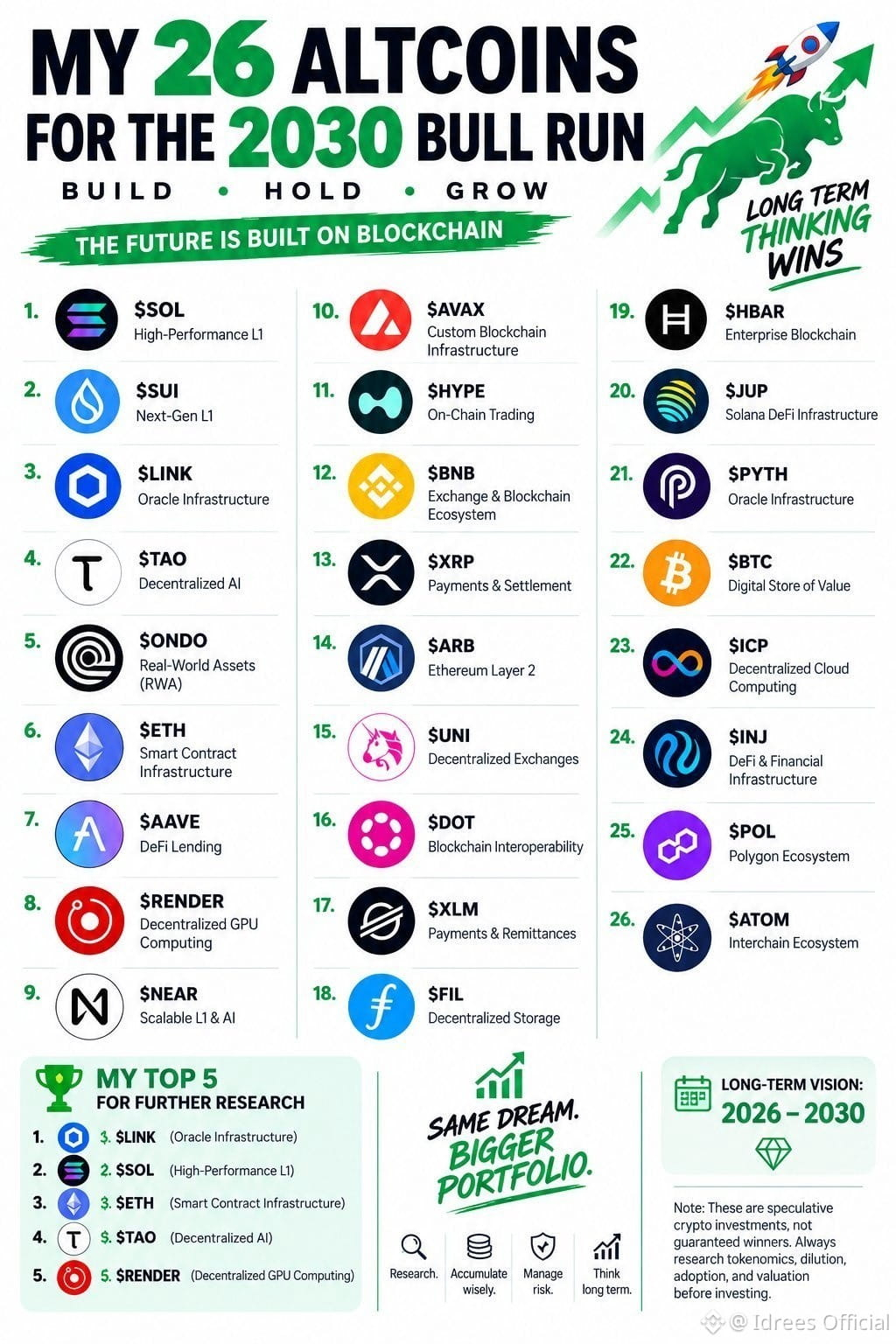
26 POWERHOUSE ASSETS FOR THE 2030 BULL RUN 🚀
While others chase noise, I’m stacking foundational infrastructure built for the next supercycle:
1. $SOL — High-performance L1 speed leader
2. $SUI — Next-generation parallel execution L1
3. $LINK — Critical oracle infrastructure backbone
4. $TAO — Decentralized AI intelligence network
5. $ONDO — Real-world asset tokenization leader
6.$ETH — Core smart contract settlement layer
7. $AAVE — Dominant DeFi lending protocol
8. $RENDER — Decentralized GPU compute powerhouse
9. $NEAR — Scalable L1 with AI positioning
10. $AVAX — Modular custom blockchain infrastructure
11. $HYPE — On-chain trading & perpetuals king
12. $BNB — Full-stack exchange + blockchain ecosystem
13. $XRP — Institutional payments & settlement rails
14. $ARB — Leading Ethereum Layer 2 solution
15. $UNI — Decentralized exchange liquidity pioneer
16. $DOT — True blockchain interoperability standard
17. $XLM — Efficient global remittances network
18. $FIL — Decentralized data storage layer
19. $HBAR — Enterprise-grade blockchain platform
20. $JUP — Solana DeFi liquidity & aggregation engine
21. $PYTH — High-speed low-latency oracle network
22. $BTC — Ultimate digital store of value
23. $ICP — Decentralized cloud computing platform
24. $INJ — Advanced on-chain financial infrastructure
25. $POLE — Expanding Polygon multi-chain ecosystem
26. $ATOM — Interchain communication hub
STRATEGIC VISION 2026–2030
Research deeply. Accumulate with conviction. Protect downside. Think in multi-year cycles. Position early. 💎
#bullish #BulRun #Write2Earn
5
10
10.7k
🚨 $ANTHROPIC : IPO HYPE DOESN'T GUARANTEE A STRONG STOCK.
We've seen this pattern before: huge expectations before listing, massive hype on day one, then reality starts to catch up.
With $ANT trading below its IPO price, I'm watching closely to see whether selling pressure continues.
This is exactly why I bought $ANSS — a 1x inverse product designed to move opposite to $ANT on a daily basis.
I'm not betting against AI. I believe the market may have priced in too much optimism, too quickly.
Follow me for more honest market insights. 🔔
#AnthropicBreaksBelowIPOPriceAmidAISlump
3
676
🚨 YOU WILL LOSE MONEY IF YOU BUY $SPCX NOW
The August bounce from $104 got rejected at $176
Price has been bleeding in a descending channel since and now sits ~$132
Lower highs, lower lows, rising fear
Textbook markdown phase
It feels ugly because it's supposed to
Roadmap:
1. One more leg down
2. Local bottom in Dec
3. 2-3 months of chop at $85-$120
4. Funding resets, OI bleeds, volume dies
5. Final flush: weak hands capitulate, late longs get liquidated
6. Re-accumulation at $150-$170
7. Breakout to $200+
8. Retest of the $228 ATH
5
1.4k
$ETH is playing out a clean Elliott Wave structure
Four big waves are done and we’re at the bottom of the multi-year triangle, which means the final expansion wave is close
The upside from down here is genuinely absurd.
#ETH #Write2Earn
$ETH is playing out a clean Elliott Wave structure
Four big waves are done and we’re at the bottom of the multi-year triangle, which means the final expansion wave is close
The upside from down here is genuinely absurd.
#ETH #Write2Earn
Four big waves are done and we’re at the bottom of the multi-year triangle, which means the final expansion wave is close
The upside from down here is genuinely absurd.
#ETH #Write2Earn
2
272
$THETA Double Bottom Forming. The Reversal Setup Is Here 💁♀️
Theta Network is forming a double bottom pattern on the daily chart.
It's one of the cleanest reversal setups on the market right now. The next move is up.
Target levels:
🎯 $0.15
🎯 $0.20
🎯 $0.25
🎯 $0.37
#Write2Earrn #Write2Earn
$THETA Double Bottom Forming. The Reversal Setup Is Here 💁♀️
Theta Network is forming a double bottom pattern on the daily chart.
It's one of the cleanest reversal setups on the market right now. The next move is up.
Target levels:
🎯 $0.15
🎯 $0.20
🎯 $0.25
🎯 $0.37
#Write2Earrn #Write2Earn
Theta Network is forming a double bottom pattern on the daily chart.
It's one of the cleanest reversal setups on the market right now. The next move is up.
Target levels:
🎯 $0.15
🎯 $0.20
🎯 $0.25
🎯 $0.37
#Write2Earrn #Write2Earn
2
97
$ARB Midline Support + 200% Revenue Growth ✈️
Arbitrum is holding above the midline of the descending channel on the weekly timeframe, using this level as a springboard for its next upward movement.
- Treasury revenue up 200% in a single quarter;
- Transactions hit 43M;
- Stock token holders doubled in 90 days;
- GTA VI (Arbitrum Edition) dropped.
This is a thriving ecosystem waiting for the market to catch up.
Target levels:
🎯 $0.13
🎯 $0.25
🎯 $0.46
🎯 $0.63
🎯 $1.23
#cryptouniverseofficial $XRP #Write2Earn #ARB #Xrp🔥🔥 #xrp
2
246
$BTC just prepared to go parabolic 🔥🔥🔥👀
Biggest bullrun is loading 🚀
Do you think $Bitcoin will go below $50K?
#WillMarketsStageAThanksgivingReliefRally?
$BTC just prepared to go parabolic 🔥🔥🔥👀
Biggest bullrun is loading 🚀
Do you think $Bitcoin will go below $50K?
#WillMarketsStageAThanksgivingReliefRally?
Biggest bullrun is loading 🚀
Do you think $Bitcoin will go below $50K?
#WillMarketsStageAThanksgivingReliefRally?
1
3
174
Crypto prices since Trump took office as the “pro-crypto president”:
• BTC −40%
• ETH −48%
• $LTC −66%
• $XRP −70%
• $SOL −71%
• DOGE −84%
• ADA −86%
Friendly regulation and political support haven’t stopped the drawdown. Alts have been hit the hardest.
Which of these do you still have conviction in from here?
#TrumpCrypto #BTC
• BTC −40%
• ETH −48%
• $LTC −66%
• $XRP −70%
• $SOL −71%
• DOGE −84%
• ADA −86%
Friendly regulation and political support haven’t stopped the drawdown. Alts have been hit the hardest.
Which of these do you still have conviction in from here?
#TrumpCrypto #BTC

2
278
$HBAR The Adoption Is Undeniable 📈
Hedera is testing a major support zone on the weekly timeframe, all while quietly becoming the backbone of real-world financial infrastructure.
- Lloyds and Aberdeen are using #hbar for tokenized assets.;
- Virginia is tracking environmental credits on-chain;
- Japan just signed an MOU for stablecoin payments;
- Five new developer templates are bringing bonds and trade settlement on-chain for banks.
Target levels after a confirmed bounce:
🎯 $0.10
🎯 $0.21
🎯 $0.30
🎯 $0.46
7
625
·
--
Bullish
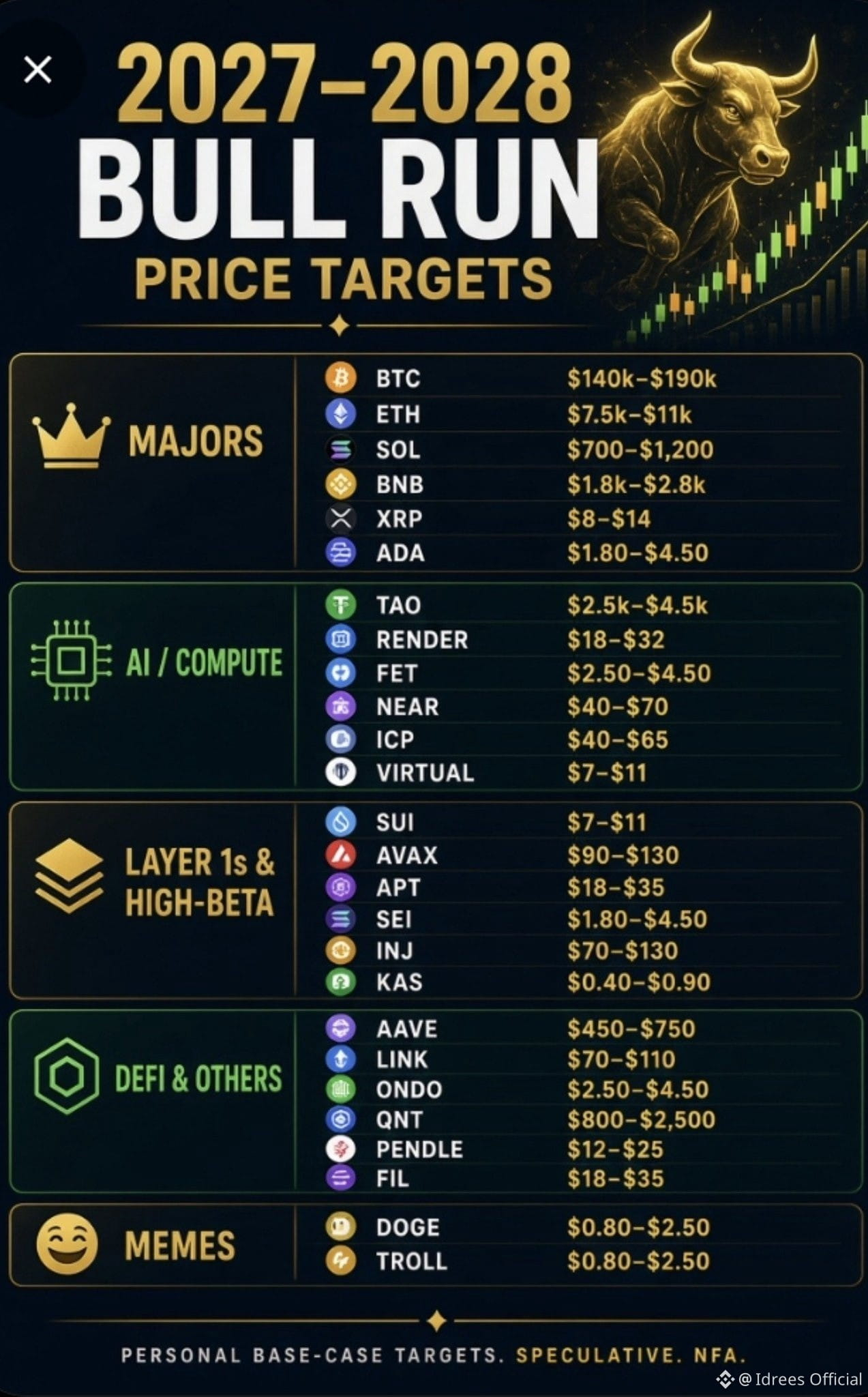
My 2027–2028 Bull Run Price Targets
These are my personal base-case targets for the next major cycle (roughly mid-2027 to early 2028). Not financial advice — pure speculation based on historical cycles, adoption trends, and current narratives. Markets can do anything.
Majors
$BTC: $140k – $190k
$ETH: $7.5k – $11k
$SOL : $700 – $1,200
$BNB : $1.8k – $2.8k
$XRP : $8 – $14
$ADA: $1.80 – $4.50
AI / Compute / DePIN
$TAO: $2.5k – $4.5k
$RENDER: $18 – $32
$FET: $2.50 – $4.50
$NEAR: $40 – $70
$ICP: $40 – $65
$VIRTUAL: $7 – $11
Layer 1s & High-Beta
$SUI: $7 – $11
$AVAX: $90 – $130
$APT: $18 – $35
$SEI: $1.80 – $4.50
$INJ: $70 – $130
$KAS: $0.40 – $0.90
DeFi & Others
$AAVE: $450 – $750
$LINK: $70 – $110
$ONDO: $2.50 – $4.50
$QNT: $800 – $2,500
$PENDLE: $12 – $25
$FIL: $18 – $35
Memes
$DOGE: $0.80 – $2.50
$TROLL: $0.80 – $2.50
Could $TROLL actually run like a top-tier meme this cycle?
Did I miss any strong contenders? Drop them below.
#WillMarketsStageAThanksgivingReliefRally? #BTC #BNB_Market_Update #bnb
3
11
13.8k
$SUI bears have enjoyed their peace for long enough
Price is getting squeezed between two major trendlines
Eventually, something has to give
You all know what's coming next.
#WillMarketsStageAThanksgivingReliefRally? #WillOctCorePCEShiftFedHikeExpectations?
$SUI bears have enjoyed their peace for long enough
Price is getting squeezed between two major trendlines
Eventually, something has to give
You all know what's coming next.
#WillMarketsStageAThanksgivingReliefRally? #WillOctCorePCEShiftFedHikeExpectations?
Price is getting squeezed between two major trendlines
Eventually, something has to give
You all know what's coming next.
#WillMarketsStageAThanksgivingReliefRally? #WillOctCorePCEShiftFedHikeExpectations?
4
2.1k
Lower doesn't scare me... $ETH
We bounced off 1,540, and from here it's honestly a coin flip, either we tag the 2,200 order block first or we lose the low and flush lower before any real move
I'm not going to pretend I know the exact path, since that red line everyone's drawing never plays out clean
This feels a lot like the cycles where we never swept the real low first, and those always took one more flush before the bottom and the move back up
But none of this changes my HTF bias, and down here is where you quietly build spot.
#ETH🔥🔥🔥🔥🔥🔥
2
118
$XLM Falling Wedge Support + Protocol Upgrade 🔍
Stellar is holding above the lower boundary of the falling wedge on the weekly timeframe as one of the most catalyst-rich moments in its history unfolds.
- Protocol 30 "Bell" vote is live today;
- Monthly volumes surged 10x to $18.5B;
- DTCC is targeting #XLM for tokenised assets in 2027.
The network is delivering on every single promise.
Target levels :
🎯 $0.15
🎯 $0.22
🎯 $0.30
🎯 $0.52
🎯 $0.80
1
187
Article
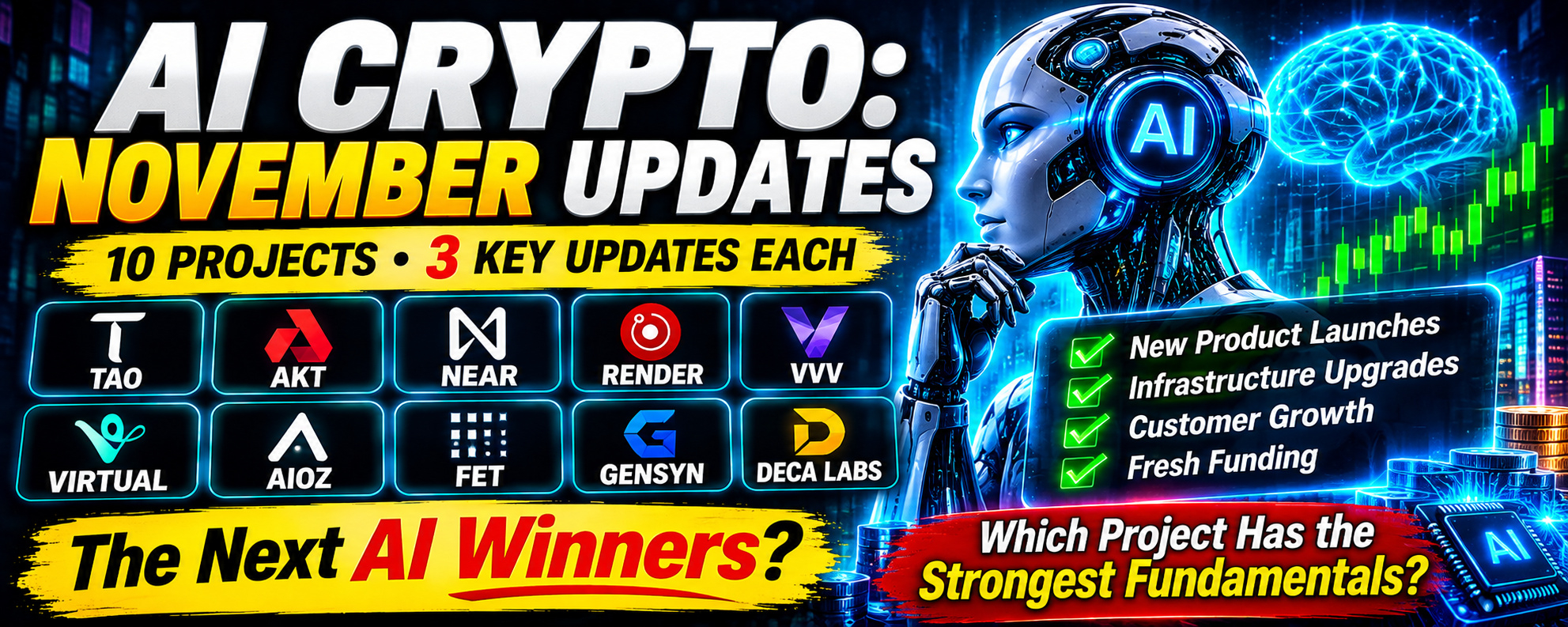
AI CRYPTO: NOVEMBER UPDATESNovember brought product launches, infrastructure upgrades, reported customer growth and fresh funding announcements.
Here are 10 projects and three important updates for each.
$TAO
→ Lium reported approximately $2.7M in GPU spending over October 10–November 9, up from $1.45M in the preceding 31-day period, roughly 86% growth using the rounded figures.
→ Billed customers increased approximately 72% to 2,394. Its reported $34.6M annualized spending run rate extrapolated the latest seven days; it was not realized annual revenue.
→ Almanac reported $109,440 in October fees, up 32%, and said the full amount was used to buy back and burn TAO and SN41 alpha.
$AKT
→ A November 12 network snapshot reported 744 active leases and 202 GPUs in use.
→ Daily compute spending was approximately $8,419, with cumulative network spending around $6.62M.
→ On November 17, Akash introduced Compute Forwards, a proposed market for locking in future GPU-hour prices. It remains in development.
$NEAR
→ On November 11, NEAR AI Gateway launched for macOS, connecting Claude Code, Codex and OpenCode to private AI models.
→ On November 16, governance ratified a phased reduction in maximum annual token issuance from 2.5% to 1.6% over 24 months. Implementation still requires the relevant protocol upgrade and validator adoption.
→ A November report put NEAR Intents’ average daily volume near $134M, versus $129M in October, while reported 30-day protocol earnings eased from approximately $2.2M to $1.8M.
$RENDER
→ On November 6, Salad announced testing of daily onchain RENDER burns ahead of full Milestone 3 BME settlement.
→ The test uses customer usage revenue and Chef payouts to calculate burns. The Chef payout portion is minted back; the remainder stays burned.
→ Reported gross render-job fees were approximately $792K over the 30 days through November 8, with 82.56M cumulative frames rendered. The supplied 5,600-node figure could not be independently confirmed.
$VVV
→ A November 21 snapshot put 30-day protocol revenue at approximately $1.2M, versus $985.3K in the preceding period.
→ Approximately $1.2M was attributed to token buybacks and burns over the same 30-day window.
→ Separately, Sacra estimated Venice AI’s annualized company revenue at $150M in September, up from approximately $10M at the end of 2025. Company revenue and protocol revenue are different measures.
$VIRTUAL
→ On November 17, Virtuals outlined agent tokenization, allowing agents to raise capital and participate in an agent-token marketplace.
→ Eastworlds extends the ecosystem into robotics and physical AI.
→ Butler’s invitation-only web beta forms the third product in the lineup, with VIRTUAL positioned as the ecosystem’s reserve asset.
$AIOZ
→ On November 2, the October report highlighted agent memory workflows, decentralized AI evaluation and new developer tools.
→ On November 10, AIOZ AI introduced a nine-breed dog classification challenge for machine-learning developers.
→ On November 12, AIOZ published its RF-DETR segmentation update, covering real-time masks, bounding boxes and classification scores.
$FET
→ On November 7, Fetch.ai participated in the Cerebral Valley AIE Code Summit hackathon alongside Google DeepMind, Meta and MongoDB.
→ The November 13 development update covered ASI:Chain Web Wallet 0.2.0, including multiple accounts and encrypted keyfile import/export.
→ The development work also included testnet bridging and improvements to Omega’s memory-save reliability.
GENSYN — NO PUBLIC TOKEN TICKER
→ On November 9, Gensyn opened the training run of Open-8B for public auditing.
→ The model has 8B parameters and publishes verifiable training records, allowing individual training steps to be replayed.
→ Gensyn plans to use Open-8B as the judge model for its Delphi information markets after post-training.
DECA LABS — NO PUBLIC TOKEN TICKER
→ On November 9, DECA Labs announced that it had raised $12M in total funding.
→ Backers include Polychain Capital, Accel, Pantera Capital and dao5.
→ The team is building an AI-agent-powered commercialization network to identify opportunities, validate demand, and coordinate software development and distribution through blockchain infrastructure.
The figures above use different reporting periods. Project-reported usage, annualized company revenue, protocol revenue and token buybacks should not be treated as interchangeable.
AI crypto is becoming a competition for customers, compute demand, revenue and actual product adoption.
The next winners may be the projects that turn AI usage into sustainable token demand.
Which project has the strongest fundamentals?
#aicoins #UpdateAlert #TAO #Near
AI CRYPTO: NOVEMBER UPDATES
November brought product launches, infrastructure upgrades, reported customer growth and fresh funding announcements.
Here are 10 projects and three important updates for each.
$TAO
→ Lium reported approximately $2.7M in GPU spending over October 10–November 9, up from $1.45M in the preceding 31-day period, roughly 86% growth using the rounded figures.
→ Billed customers increased approximately 72% to 2,394. Its reported $34.6M annualized spending run rate extrapolated the latest seven days; it was not realized annual revenue.
→ Almanac reported $109,440 in October fees, up 32%, and said the full amount was used to buy back and burn TAO and SN41 alpha.
$AKT
→ A November 12 network snapshot reported 744 active leases and 202 GPUs in use.
→ Daily compute spending was approximately $8,419, with cumulative network spending around $6.62M.
→ On November 17, Akash introduced Compute Forwards, a proposed market for locking in future GPU-hour prices. It remains in development.
$NEAR
→ On November 11, NEAR AI Gateway launched for macOS, connecting Claude Code, Codex and OpenCode to private AI models.
→ On November 16, governance ratified a phased reduction in maximum annual token issuance from 2.5% to 1.6% over 24 months. Implementation still requires the relevant protocol upgrade and validator adoption.
→ A November report put NEAR Intents’ average daily volume near $134M, versus $129M in October, while reported 30-day protocol earnings eased from approximately $2.2M to $1.8M.
$RENDER
→ On November 6, Salad announced testing of daily onchain RENDER burns ahead of full Milestone 3 BME settlement.
→ The test uses customer usage revenue and Chef payouts to calculate burns. The Chef payout portion is minted back; the remainder stays burned.
→ Reported gross render-job fees were approximately $792K over the 30 days through November 8, with 82.56M cumulative frames rendered. The supplied 5,600-node figure could not be independently confirmed.
$VVV
→ A November 21 snapshot put 30-day protocol revenue at approximately $1.2M, versus $985.3K in the preceding period.
→ Approximately $1.2M was attributed to token buybacks and burns over the same 30-day window.
→ Separately, Sacra estimated Venice AI’s annualized company revenue at $150M in September, up from approximately $10M at the end of 2025. Company revenue and protocol revenue are different measures.
$VIRTUAL
→ On November 17, Virtuals outlined agent tokenization, allowing agents to raise capital and participate in an agent-token marketplace.
→ Eastworlds extends the ecosystem into robotics and physical AI.
→ Butler’s invitation-only web beta forms the third product in the lineup, with VIRTUAL positioned as the ecosystem’s reserve asset.
$AIOZ
→ On November 2, the October report highlighted agent memory workflows, decentralized AI evaluation and new developer tools.
→ On November 10, AIOZ AI introduced a nine-breed dog classification challenge for machine-learning developers.
→ On November 12, AIOZ published its RF-DETR segmentation update, covering real-time masks, bounding boxes and classification scores.
$FET
→ On November 7, Fetch.ai participated in the Cerebral Valley AIE Code Summit hackathon alongside Google DeepMind, Meta and MongoDB.
→ The November 13 development update covered ASI:Chain Web Wallet 0.2.0, including multiple accounts and encrypted keyfile import/export.
→ The development work also included testnet bridging and improvements to Omega’s memory-save reliability.
GENSYN — NO PUBLIC TOKEN TICKER
→ On November 9, Gensyn opened the training run of Open-8B for public auditing.
→ The model has 8B parameters and publishes verifiable training records, allowing individual training steps to be replayed.
→ Gensyn plans to use Open-8B as the judge model for its Delphi information markets after post-training.
DECA LABS — NO PUBLIC TOKEN TICKER
→ On November 9, DECA Labs announced that it had raised $12M in total funding.
→ Backers include Polychain Capital, Accel, Pantera Capital and dao5.
→ The team is building an AI-agent-powered commercialization network to identify opportunities, validate demand, and coordinate software development and distribution through blockchain infrastructure.
The figures above use different reporting periods. Project-reported usage, annualized company revenue, protocol revenue and token buybacks should not be treated as interchangeable.
AI crypto is becoming a competition for customers, compute demand, revenue and actual product adoption.
The next winners may be the projects that turn AI usage into sustainable token demand.
Which project has the strongest fundamentals?
#aicoins #UpdateAlert #TAO #Near
2
647
Article
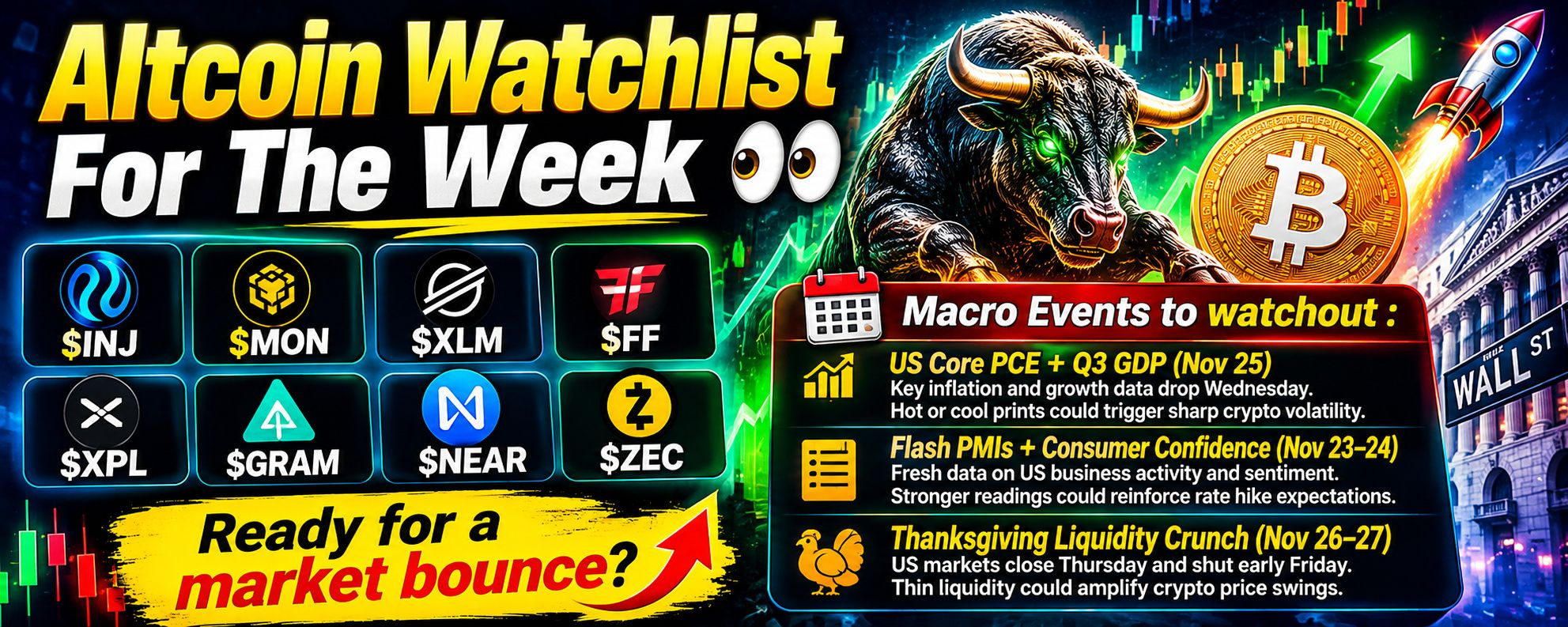
Altcoin Watchlist For The Week 👀> $INJ
> $MON
> $XLM
> $FF
> $XPL
> $GRAM
> $NEAR
> $ZEC
A week full of unlocks, mainnet upgrades and issuance.
Macro Events to watchout :
👉 US Core PCE + Q3 GDP (Nov 25): Key inflation and growth data drop Wednesday. Hot or cool prints could trigger sharp crypto volatility.
👉 Flash PMIs + Consumer Confidence (Nov 23–24): Fresh data on US business activity and consumer sentiment. Stronger readings could reinforce rate hike expectations.
👉 Thanksgiving Liquidity Crunch (Nov 26–27): US markets close Thursday and shut early Friday. Thin liquidity could amplify crypto price swings.
Ready for a market bounce?
#XLM #altcoins #MON
Altcoin Watchlist For The Week 👀
> $INJ
> $MON
> $XLM
> $FF
> $XPL
> $GRAM
> $NEAR
> $ZEC
A week full of unlocks, mainnet upgrades and issuance.
Macro Events to watchout :
👉 US Core PCE + Q3 GDP (Nov 25): Key inflation and growth data drop Wednesday. Hot or cool prints could trigger sharp crypto volatility.
👉 Flash PMIs + Consumer Confidence (Nov 23–24): Fresh data on US business activity and consumer sentiment. Stronger readings could reinforce rate hike expectations.
👉 Thanksgiving Liquidity Crunch (Nov 26–27): US markets close Thursday and shut early Friday. Thin liquidity could amplify crypto price swings.
Ready for a market bounce?
#XLM #altcoins #MON
2
341
$ETH / $BTC could be preparing for its next major move.
After breaking its long-term descending trendline, the pair entered a corrective phase.
Now, ETH/BTC is showing signs of attempting another move higher.
The key level to watch is 0.035.
A confirmed breakout could signal a major shift in ETH's relative strength against Bitcoin.
One level could change everything. 👀
#ETFvsBTC #ETH🔥🔥🔥🔥🔥🔥 #BTC
4
1.4k
$ENA $7.5B Buyback Trigger 🧐
Ethena has been compressing within a descending channel on the weekly timeframe, and the breakout window is opening.
USDe just crossed $100 million on Avalanche and landed on Stellar. It is now closing in on the $7.5 billion supply threshold, which allocates 5% of all protocol revenue toward buybacks.
Target levels after a confirmed breakout:
🎯 $0.13
🎯 $0.25
🎯 $0.47
🎯 $0.87
🎯 $1.35
#ENA #ENAUSDT🚨 $BTC #BTC
3
4k
$SUI holders have probably experienced every possible emotion over the last few months
Bullish when it was above $1.20
Confident when it was making higher highs
Silent during the correction
And now everyone is suddenly questioning the entire ecosystem
That's crypto bros
watching this $0.65 area closely as of now
If buyers defend it and momentum starts coming back, a move towards $1.29 becomes an interesting scenario
Let's see if the bulls actually show up
#sui #RussiaAllowsExchangesToOfferCryptoTrading
1
2
810
$ATOM Accumulate Now or Regret Later 😏
Cosmos is sitting above the lower boundary of the descending channel on the weekly timeframe while most of the market is in full panic mode.
- Over $50B in transactions across 200+ networks;
- Linux Foundation governance with Google Cloud on board;
- Phase 2 tokenomics pointing toward smarter issuance and real Hub revenue.
The market is bleeding, but #ATOM keeps working.
Target levels:
🎯 $2.10
🎯 $3.60
🎯 $5.50
🎯 $10.00
🎯 $15.50
2
4
408
Log in to explore more content
Join global crypto users on Binance Square
⚡️ Get latest and useful information about crypto.
💬 Trusted by the world’s largest crypto exchange.
👍 Discover real insights from verified creators.
Email / Phone number
Trending Topics
CanMarketsReboundAfterThanksgiving?
6,971 views
202 Discussing
Rate-Hike Bets Linger as US Markets Head Into Thanksgiving Closure
Binance News
·1 Likes
·899 views
CouldSpaceX’sOrbitalDataCentersBoostAIChipDemand?
5,481 views
140 Discussing
EvolveAtBinanceBlockchainWeek
640,705 views
6,658 Discussing