

大嗯BNB
3.6k Posts

大嗯BNB
 Square Verified+
Report
Block User
坚持长期价值投资 与志同道合的区块链爱好者,一起探讨交流 | #BNB坚持持有者 主流价值币定投 | 关注#ALPHA板块 撸毛 | 推x: @daenbnb
永远在学习的路上

BTC Holder
High-Frequency Trader
1.1 Years
1.9K+ Following
43.0K+ Followers
31.0K+ Liked
Posts
All
Quotes
Videos
Live
PINNED
·
--
October 2: the September non-farm employment data came out—29,000 versus an expected 90,000. The unemployment rate rose to 4.2%, wage growth slowed, the July figure was revised down by 10,000 (a negative value), and August was revised down from 162,000 to 133,000.
This is extremely weak jobs data. Jefferies’ chief economist Simons said: "For the Fed, this number should be the last nail that shuts the lid on the October rate-hike coffin."
The probability of a rate hike at the October FOMC crashed from 70% to 17%.
BTC reaction: it surged from 86,000 to 87,229, testing the pressure zone around the Q3 high of 87,300—then pulled back to 84,668, falling 1.6% that day.
This is definitely worth breaking down.
Extremely weak non-farm + removal of rate-hike expectations → BTC briefly went up → then it fell back.
This shows that the 87,300 resistance wall can’t be broken through by macro news alone—every time price reaches this level, there are massive sell orders. That suggests many position holders are waiting to distribute (sell) at this point, and the buying pressure brought by macro positives isn’t enough to absorb that batch of sell orders.
But on the other hand, it’s also worth noting: with non-farm extremely weak and clear signals of an economic slowdown, BTC only fell as low as 83,888—without breaking the support near 83,000 from last week. BlackRock’s IBIT bought $195.6 million in a single day, and Fidelity bought $29.28 million the same day. Institutions didn’t retreat because of the weak employment data—because their view is: "weak jobs = rate hikes not coming = macro pressure easing = holding BTC."
Now the market structure is very clear: 83,000–84,000 below is institutional support, while 87,300–87,500 above is the heavy profit-taking zone. This resistance wall can’t be broken by macro data; it only gets eaten up if ETFs maintain continuous large net inflows.
Key milestones in October: October 14 CPI (the next inflation data), and October 27–29 the XRP Swell conference + the FOMC meeting.
If the October 14 CPI continues to come in soft, only then will this 87,300 wall truly have a chance to be broken, and Citi’s 113,000 target won’t just be a paper target.
Do you think BTC can break 87,300 within October this time? Share your view.
$BTC
{future}(BTCUSDT)
October 2: the September non-farm employment data came out—29,000 versus an expected 90,000. The unemployment rate rose to 4.2%, wage growth slowed, the July figure was revised down by 10,000 (a negative value), and August was revised down from 162,000 to 133,000.
This is extremely weak jobs data. Jefferies’ chief economist Simons said: "For the Fed, this number should be the last nail that shuts the lid on the October rate-hike coffin."
The probability of a rate hike at the October FOMC crashed from 70% to 17%.
BTC reaction: it surged from 86,000 to 87,229, testing the pressure zone around the Q3 high of 87,300—then pulled back to 84,668, falling 1.6% that day.
This is definitely worth breaking down.
Extremely weak non-farm + removal of rate-hike expectations → BTC briefly went up → then it fell back.
This shows that the 87,300 resistance wall can’t be broken through by macro news alone—every time price reaches this level, there are massive sell orders. That suggests many position holders are waiting to distribute (sell) at this point, and the buying pressure brought by macro positives isn’t enough to absorb that batch of sell orders.
But on the other hand, it’s also worth noting: with non-farm extremely weak and clear signals of an economic slowdown, BTC only fell as low as 83,888—without breaking the support near 83,000 from last week. BlackRock’s IBIT bought $195.6 million in a single day, and Fidelity bought $29.28 million the same day. Institutions didn’t retreat because of the weak employment data—because their view is: "weak jobs = rate hikes not coming = macro pressure easing = holding BTC."
Now the market structure is very clear: 83,000–84,000 below is institutional support, while 87,300–87,500 above is the heavy profit-taking zone. This resistance wall can’t be broken by macro data; it only gets eaten up if ETFs maintain continuous large net inflows.
Key milestones in October: October 14 CPI (the next inflation data), and October 27–29 the XRP Swell conference + the FOMC meeting.
If the October 14 CPI continues to come in soft, only then will this 87,300 wall truly have a chance to be broken, and Citi’s 113,000 target won’t just be a paper target.
Do you think BTC can break 87,300 within October this time? Share your view.
$BTC
This is extremely weak jobs data. Jefferies’ chief economist Simons said: "For the Fed, this number should be the last nail that shuts the lid on the October rate-hike coffin."
The probability of a rate hike at the October FOMC crashed from 70% to 17%.
BTC reaction: it surged from 86,000 to 87,229, testing the pressure zone around the Q3 high of 87,300—then pulled back to 84,668, falling 1.6% that day.
This is definitely worth breaking down.
Extremely weak non-farm + removal of rate-hike expectations → BTC briefly went up → then it fell back.
This shows that the 87,300 resistance wall can’t be broken through by macro news alone—every time price reaches this level, there are massive sell orders. That suggests many position holders are waiting to distribute (sell) at this point, and the buying pressure brought by macro positives isn’t enough to absorb that batch of sell orders.
But on the other hand, it’s also worth noting: with non-farm extremely weak and clear signals of an economic slowdown, BTC only fell as low as 83,888—without breaking the support near 83,000 from last week. BlackRock’s IBIT bought $195.6 million in a single day, and Fidelity bought $29.28 million the same day. Institutions didn’t retreat because of the weak employment data—because their view is: "weak jobs = rate hikes not coming = macro pressure easing = holding BTC."
Now the market structure is very clear: 83,000–84,000 below is institutional support, while 87,300–87,500 above is the heavy profit-taking zone. This resistance wall can’t be broken by macro data; it only gets eaten up if ETFs maintain continuous large net inflows.
Key milestones in October: October 14 CPI (the next inflation data), and October 27–29 the XRP Swell conference + the FOMC meeting.
If the October 14 CPI continues to come in soft, only then will this 87,300 wall truly have a chance to be broken, and Citi’s 113,000 target won’t just be a paper target.
Do you think BTC can break 87,300 within October this time? Share your view.
$BTC

185
1
14
411
·
--
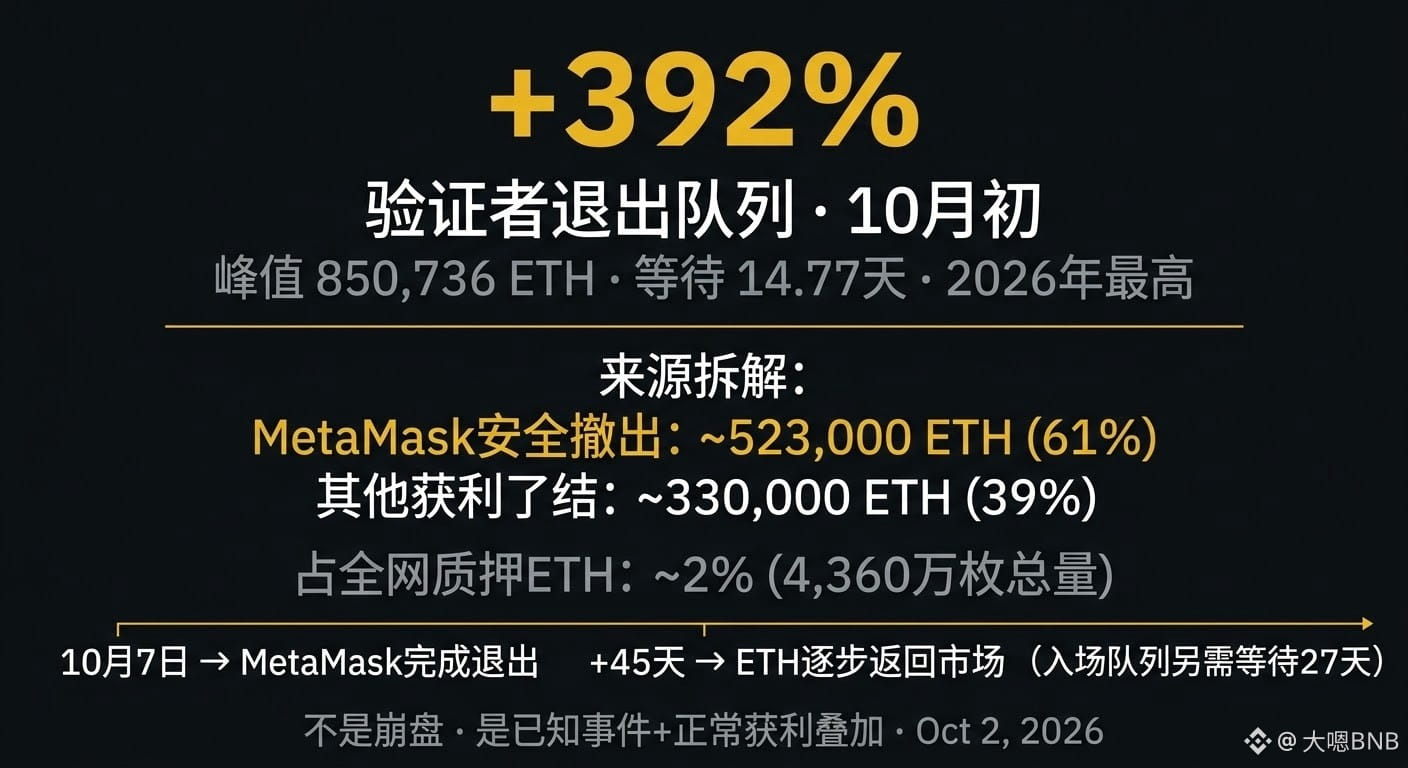
In early October, the Ethereum validator exit queue jumped 392%—a peak of 850,736 ETH, with a waiting time of 14.77 days, the longest this year.
First, put the numbers into perspective:
Total network staked ETH is about 43.6 million—850,000 of that is roughly 2%.
This isn’t a collapse; it’s localized pressure.
The drivers are clear:
About 523,000 ETH comes from a precautionary exit from MetaMask—last week MetaMask experienced an infrastructure security incident and proactively shut down about 17,000 validator nodes, which is the matter we mentioned earlier.
The remaining roughly 330,000 ETH comes from profit-taking by other stakers—ETH rose nearly 60% in Q3, and some capital at elevated levels chose to exit.
With both factors stacked, the queue piled up to the highest level of the year.
Timeline: MetaMask’s partial exits are expected to complete around October 7, but full withdrawals plus re-entry require another ~45 days, because the entry queue still has to wait about 27 days.
This batch of returning ETH to the market has a time lag, so it won’t dump all at once.
For ETH price: the real selling pressure will only show up once validators complete the exit process—not immediately today.
But with three things happening together—Ethereum ETF net outflows for three consecutive days totaling $118 million, the exit queue hitting an annual peak, and the BTC ETF continuing to see inflows during the same period—these jointly indicate that institutional capital currently has a clear directional divergence between ETH and BTC.
Is this a temporary divergence, or a trend-level rotation?
October’s data will tell.
$ETH
{future}(ETHUSDT)
#以太坊验证者退出队列增392%
In early October, the Ethereum validator exit queue jumped 392%—a peak of 850,736 ETH, with a waiting time of 14.77 days, the longest this year.
First, put the numbers into perspective:
Total network staked ETH is about 43.6 million—850,000 of that is roughly 2%.
This isn’t a collapse; it’s localized pressure.
The drivers are clear:
About 523,000 ETH comes from a precautionary exit from MetaMask—last week MetaMask experienced an infrastructure security incident and proactively shut down about 17,000 validator nodes, which is the matter we mentioned earlier.
The remaining roughly 330,000 ETH comes from profit-taking by other stakers—ETH rose nearly 60% in Q3, and some capital at elevated levels chose to exit.
With both factors stacked, the queue piled up to the highest level of the year.
Timeline: MetaMask’s partial exits are expected to complete around October 7, but full withdrawals plus re-entry require another ~45 days, because the entry queue still has to wait about 27 days.
This batch of returning ETH to the market has a time lag, so it won’t dump all at once.
For ETH price: the real selling pressure will only show up once validators complete the exit process—not immediately today.
But with three things happening together—Ethereum ETF net outflows for three consecutive days totaling $118 million, the exit queue hitting an annual peak, and the BTC ETF continuing to see inflows during the same period—these jointly indicate that institutional capital currently has a clear directional divergence between ETH and BTC.
Is this a temporary divergence, or a trend-level rotation?
October’s data will tell.
$ETH
#以太坊验证者退出队列增392%
First, put the numbers into perspective:
Total network staked ETH is about 43.6 million—850,000 of that is roughly 2%.
This isn’t a collapse; it’s localized pressure.
The drivers are clear:
About 523,000 ETH comes from a precautionary exit from MetaMask—last week MetaMask experienced an infrastructure security incident and proactively shut down about 17,000 validator nodes, which is the matter we mentioned earlier.
The remaining roughly 330,000 ETH comes from profit-taking by other stakers—ETH rose nearly 60% in Q3, and some capital at elevated levels chose to exit.
With both factors stacked, the queue piled up to the highest level of the year.
Timeline: MetaMask’s partial exits are expected to complete around October 7, but full withdrawals plus re-entry require another ~45 days, because the entry queue still has to wait about 27 days.
This batch of returning ETH to the market has a time lag, so it won’t dump all at once.
For ETH price: the real selling pressure will only show up once validators complete the exit process—not immediately today.
But with three things happening together—Ethereum ETF net outflows for three consecutive days totaling $118 million, the exit queue hitting an annual peak, and the BTC ETF continuing to see inflows during the same period—these jointly indicate that institutional capital currently has a clear directional divergence between ETH and BTC.
Is this a temporary divergence, or a trend-level rotation?
October’s data will tell.
$ETH
#以太坊验证者退出队列增392%
235
·
--
Bearish
The new U.S. fiscal year begins without a budget being passed by Congress.
The SEC enters a funding lapse state.
Immediate impact on the crypto market: more than 90 pending spot crypto ETF applications are all frozen.
Registration statements cannot be declared effective, no further comment letters will be issued, and both approval tracks—19b-4 and S-1—are put on hold at the same time.
Existing ETFs are not affected—IBIT, FBTC, and ZCSH continue to trade normally, with subscriptions and redemptions proceeding as usual.
But new ones won’t.
There’s a saying in the industry called “ETF Cryptober”—October has traditionally been a highly active period for crypto ETF approvals. This year, many people were also expecting updates on the expansion of SOL ETFs, progress on XRP ETFs, and a slate of altcoin ETF filings.
Nate Geraci, co-founder of ETF Institute, put it this way:
“ETF Cryptober may have to be temporarily shelved—this is a delay, not a rejection.”
Bloomberg ETF analyst Balchunas likened it to “rain delay” in the middle of a game.
The statutory approval window does not count during the funding lapse—so this isn’t a rejection of the application, it’s a pause in the clock.
After the government shutdown ends, there may be a wave of concentrated approvals.
For BTC: the direct impact is limited, and existing ETFs operate normally. The indirect impact is on sentiment—markets were already looking ahead to October’s altcoin ETF progress, and that expectation now needs to be pushed back.
SOL ETFs and XRP ETFs, which were previously key anchors for the “alt-season” narrative, now hang in the air.
Do you think a government budget can be resolved within October?
$BTC
{future}(BTCUSDT)
$SOL
{future}(SOLUSDT)
#sec因拨款中断暂停加密etf审查
The new U.S. fiscal year begins without a budget being passed by Congress.
The SEC enters a funding lapse state.
Immediate impact on the crypto market: more than 90 pending spot crypto ETF applications are all frozen.
Registration statements cannot be declared effective, no further comment letters will be issued, and both approval tracks—19b-4 and S-1—are put on hold at the same time.
Existing ETFs are not affected—IBIT, FBTC, and ZCSH continue to trade normally, with subscriptions and redemptions proceeding as usual.
But new ones won’t.
There’s a saying in the industry called “ETF Cryptober”—October has traditionally been a highly active period for crypto ETF approvals. This year, many people were also expecting updates on the expansion of SOL ETFs, progress on XRP ETFs, and a slate of altcoin ETF filings.
Nate Geraci, co-founder of ETF Institute, put it this way:
“ETF Cryptober may have to be temporarily shelved—this is a delay, not a rejection.”
Bloomberg ETF analyst Balchunas likened it to “rain delay” in the middle of a game.
The statutory approval window does not count during the funding lapse—so this isn’t a rejection of the application, it’s a pause in the clock.
After the government shutdown ends, there may be a wave of concentrated approvals.
For BTC: the direct impact is limited, and existing ETFs operate normally. The indirect impact is on sentiment—markets were already looking ahead to October’s altcoin ETF progress, and that expectation now needs to be pushed back.
SOL ETFs and XRP ETFs, which were previously key anchors for the “alt-season” narrative, now hang in the air.
Do you think a government budget can be resolved within October?
$BTC
$SOL
#sec因拨款中断暂停加密etf审查
The SEC enters a funding lapse state.
Immediate impact on the crypto market: more than 90 pending spot crypto ETF applications are all frozen.
Registration statements cannot be declared effective, no further comment letters will be issued, and both approval tracks—19b-4 and S-1—are put on hold at the same time.
Existing ETFs are not affected—IBIT, FBTC, and ZCSH continue to trade normally, with subscriptions and redemptions proceeding as usual.
But new ones won’t.
There’s a saying in the industry called “ETF Cryptober”—October has traditionally been a highly active period for crypto ETF approvals. This year, many people were also expecting updates on the expansion of SOL ETFs, progress on XRP ETFs, and a slate of altcoin ETF filings.
Nate Geraci, co-founder of ETF Institute, put it this way:
“ETF Cryptober may have to be temporarily shelved—this is a delay, not a rejection.”
Bloomberg ETF analyst Balchunas likened it to “rain delay” in the middle of a game.
The statutory approval window does not count during the funding lapse—so this isn’t a rejection of the application, it’s a pause in the clock.
After the government shutdown ends, there may be a wave of concentrated approvals.
For BTC: the direct impact is limited, and existing ETFs operate normally. The indirect impact is on sentiment—markets were already looking ahead to October’s altcoin ETF progress, and that expectation now needs to be pushed back.
SOL ETFs and XRP ETFs, which were previously key anchors for the “alt-season” narrative, now hang in the air.
Do you think a government budget can be resolved within October?
$BTC
$SOL
#sec因拨款中断暂停加密etf审查

2
8
49
50.6k
·
--
Bearish
Verified
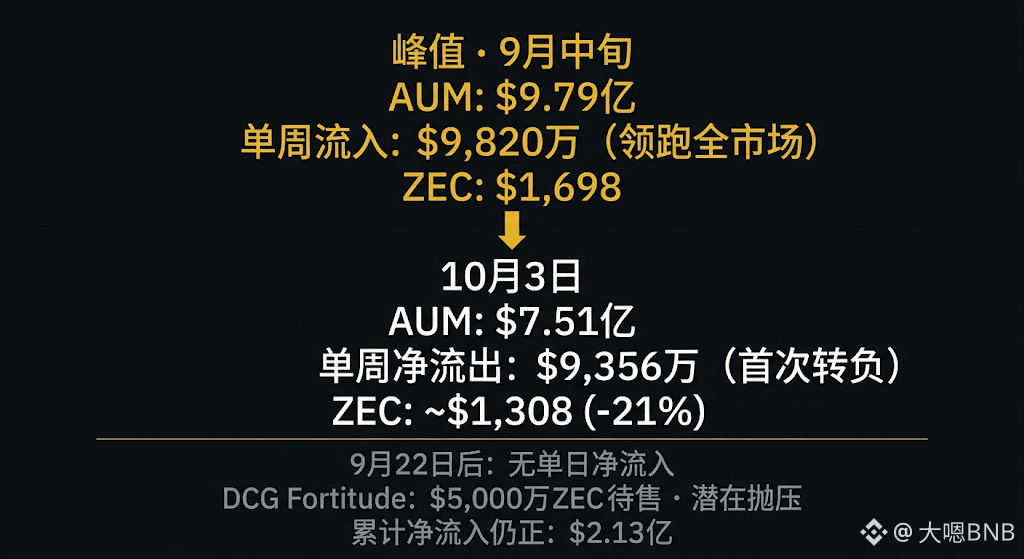
ZCSH——Grayscale’s ZEC spot ETF—This week saw net outflows of $93.56 million, the first weekly net outflow since it began trading on August 25.
AUM fell from a peak of $979 million to $751 million.
Two weeks ago, this ETF was still leading the entire market of crypto ETFs with a weekly net inflow of $98.20 million, at one point accounting for 32.5% of all spot crypto ETF trading volume in the U.S.
Now the situation is completely the opposite.
Several things are happening in the background at the same time:
ZEC has dropped 21% from its peak of $1,698 to around $1,308, and after September 22 it has not posted any single-day net inflows.
Meanwhile, reports have suggested that North Korean hackers—possibly—laundered money via ZEC’s privacy pool. Regardless of whether the claim is ultimately true, this kind of news delivers a major blow to the privacy-coin narrative during a period of regulatory sensitivity.
Fortitude, a DCG subsidiary, holds a $50 million ZEC credit facility and plans to sell all its ZEC on the market—an already known potential source of sell pressure.
ZEC’s rise has never been driven by fundamentals—it has been driven by the combined forces of a privacy-coin narrative, ETF listing speculation, and a financial structure constructed by DCG/Fortitude.
When ETF inflows slow and the narrative cools, this structure starts to work in reverse.
With cumulative net inflows still at $213 million, it suggests the ETF hasn’t reached the point of collapse.
But within the $751 million AUM, how much is truly long-term holding versus short-term capital waiting for an opportunity to reduce exposure—only the flow data from the coming weeks will tell.
Do you still hold ZEC?
$ZEC
{future}(ZECUSDT)
$BTC
{future}(BTCUSDT)
#zcash现货etf首现周度净流出9360万美元
ZCSH——Grayscale’s ZEC spot ETF—This week saw net outflows of $93.56 million, the first weekly net outflow since it began trading on August 25.
AUM fell from a peak of $979 million to $751 million.
Two weeks ago, this ETF was still leading the entire market of crypto ETFs with a weekly net inflow of $98.20 million, at one point accounting for 32.5% of all spot crypto ETF trading volume in the U.S.
Now the situation is completely the opposite.
Several things are happening in the background at the same time:
ZEC has dropped 21% from its peak of $1,698 to around $1,308, and after September 22 it has not posted any single-day net inflows.
Meanwhile, reports have suggested that North Korean hackers—possibly—laundered money via ZEC’s privacy pool. Regardless of whether the claim is ultimately true, this kind of news delivers a major blow to the privacy-coin narrative during a period of regulatory sensitivity.
Fortitude, a DCG subsidiary, holds a $50 million ZEC credit facility and plans to sell all its ZEC on the market—an already known potential source of sell pressure.
ZEC’s rise has never been driven by fundamentals—it has been driven by the combined forces of a privacy-coin narrative, ETF listing speculation, and a financial structure constructed by DCG/Fortitude.
When ETF inflows slow and the narrative cools, this structure starts to work in reverse.
With cumulative net inflows still at $213 million, it suggests the ETF hasn’t reached the point of collapse.
But within the $751 million AUM, how much is truly long-term holding versus short-term capital waiting for an opportunity to reduce exposure—only the flow data from the coming weeks will tell.
Do you still hold ZEC?
$ZEC
$BTC
#zcash现货etf首现周度净流出9360万美元
AUM fell from a peak of $979 million to $751 million.
Two weeks ago, this ETF was still leading the entire market of crypto ETFs with a weekly net inflow of $98.20 million, at one point accounting for 32.5% of all spot crypto ETF trading volume in the U.S.
Now the situation is completely the opposite.
Several things are happening in the background at the same time:
ZEC has dropped 21% from its peak of $1,698 to around $1,308, and after September 22 it has not posted any single-day net inflows.
Meanwhile, reports have suggested that North Korean hackers—possibly—laundered money via ZEC’s privacy pool. Regardless of whether the claim is ultimately true, this kind of news delivers a major blow to the privacy-coin narrative during a period of regulatory sensitivity.
Fortitude, a DCG subsidiary, holds a $50 million ZEC credit facility and plans to sell all its ZEC on the market—an already known potential source of sell pressure.
ZEC’s rise has never been driven by fundamentals—it has been driven by the combined forces of a privacy-coin narrative, ETF listing speculation, and a financial structure constructed by DCG/Fortitude.
When ETF inflows slow and the narrative cools, this structure starts to work in reverse.
With cumulative net inflows still at $213 million, it suggests the ETF hasn’t reached the point of collapse.
But within the $751 million AUM, how much is truly long-term holding versus short-term capital waiting for an opportunity to reduce exposure—only the flow data from the coming weeks will tell.
Do you still hold ZEC?
$ZEC
$BTC
#zcash现货etf首现周度净流出9360万美元
11
1
60
55.3k
·
--
On October 1, the SEC proposed a revision to its crypto asset custody rules.
This is worth clarifying because it runs completely counter to the direction set three years ago.
In 2023, the SEC proposal led by Gensler: crypto assets must be held by qualified custodians, and RIA firms are not allowed to self-custody clients’ crypto assets.
Today, the SEC proposal led by Atkins: allows RIAs, under specific conditions, to self-custody clients’ crypto assets—if they have the expertise and audit their cybersecurity systems at least once every year.
The same regulator—three years, and two radically different directions.
Atkins said this:
"The current rules were written for a past era, providing a compliance pathway for investment advisers and funds—where there previously was none."
That "where there previously was none" is the core issue—many RIAs want to allocate to crypto assets, but without a clear compliance framework, so they stayed out.
Today’s proposal opens a door for them.
It also recognizes state-chartered trust companies as custodians—expanding beyond Coinbase and Fidelity Digital Assets to a broader custody network.
The proposal enters a 60-day public comment period, and it will still take time before it becomes a final rule.
But this is the last remaining gap on this year’s SEC crypto policy checklist under Atkins—innovation exemptions (tokenized stocks), Reg Crypto assets, and today’s custody rules—are all now covered by proposals.
For BTC: this opens the door for RIAs to allocate crypto assets in a compliant way, one of the most important policies this year on the institutional entry path.
How much additional institutional capital do you think will be brought in once the custody rules take effect?
$BTC
{future}(BTCUSDT)
$ETH
{future}(ETHUSDT)
#sec拟修订加密资产托管规则
On October 1, the SEC proposed a revision to its crypto asset custody rules.
This is worth clarifying because it runs completely counter to the direction set three years ago.
In 2023, the SEC proposal led by Gensler: crypto assets must be held by qualified custodians, and RIA firms are not allowed to self-custody clients’ crypto assets.
Today, the SEC proposal led by Atkins: allows RIAs, under specific conditions, to self-custody clients’ crypto assets—if they have the expertise and audit their cybersecurity systems at least once every year.
The same regulator—three years, and two radically different directions.
Atkins said this:
"The current rules were written for a past era, providing a compliance pathway for investment advisers and funds—where there previously was none."
That "where there previously was none" is the core issue—many RIAs want to allocate to crypto assets, but without a clear compliance framework, so they stayed out.
Today’s proposal opens a door for them.
It also recognizes state-chartered trust companies as custodians—expanding beyond Coinbase and Fidelity Digital Assets to a broader custody network.
The proposal enters a 60-day public comment period, and it will still take time before it becomes a final rule.
But this is the last remaining gap on this year’s SEC crypto policy checklist under Atkins—innovation exemptions (tokenized stocks), Reg Crypto assets, and today’s custody rules—are all now covered by proposals.
For BTC: this opens the door for RIAs to allocate crypto assets in a compliant way, one of the most important policies this year on the institutional entry path.
How much additional institutional capital do you think will be brought in once the custody rules take effect?
$BTC
$ETH
#sec拟修订加密资产托管规则
This is worth clarifying because it runs completely counter to the direction set three years ago.
In 2023, the SEC proposal led by Gensler: crypto assets must be held by qualified custodians, and RIA firms are not allowed to self-custody clients’ crypto assets.
Today, the SEC proposal led by Atkins: allows RIAs, under specific conditions, to self-custody clients’ crypto assets—if they have the expertise and audit their cybersecurity systems at least once every year.
The same regulator—three years, and two radically different directions.
Atkins said this:
"The current rules were written for a past era, providing a compliance pathway for investment advisers and funds—where there previously was none."
That "where there previously was none" is the core issue—many RIAs want to allocate to crypto assets, but without a clear compliance framework, so they stayed out.
Today’s proposal opens a door for them.
It also recognizes state-chartered trust companies as custodians—expanding beyond Coinbase and Fidelity Digital Assets to a broader custody network.
The proposal enters a 60-day public comment period, and it will still take time before it becomes a final rule.
But this is the last remaining gap on this year’s SEC crypto policy checklist under Atkins—innovation exemptions (tokenized stocks), Reg Crypto assets, and today’s custody rules—are all now covered by proposals.
For BTC: this opens the door for RIAs to allocate crypto assets in a compliant way, one of the most important policies this year on the institutional entry path.
How much additional institutional capital do you think will be brought in once the custody rules take effect?
$BTC
$ETH
#sec拟修订加密资产托管规则

2
1
4.1k
·
--
October 3rd, Uptober day three.
BTC is around 86,000, nearing the Q3 high of 87,300, with a clear sell-pressure wall above.
Two things happened this week that are worth mentioning separately.
First: Citi significantly raised its BTC price target.
Citigroup lifted its 12-month BTC target price from 82,000 to 113,000, citing increased crypto market activity, an improving macro backdrop, and continued ETF inflows. At the same time, it raised the Strategy (Saylor’s company) target price from $136 to $240.
One top-tier Wall Street firm didn’t raise its BTC target until after BTC had already risen 47% from 58,500—worth a quick jab. But more importantly, this target reflects a change in the long-term outlook on BTC within institutions. The old 82,000 target was set at the end of last year; the market has already moved beyond it. This upward revision is essentially an acknowledgment of reality and a formal endorsement of a bullish Q4.
Second: the prediction market cut the probability of hitting 100,000 in October from 85% to 13%.
At one point last week, the Polymarket contract for “BTC hitting 100,000 in October” was hovering near 85%—that was when market sentiment was at its highest. Then, as expectations for the September jobs report (nonfarm) warmed up, and the odds of a rate hike at the October FOMC stayed at 64%, the probability was quickly revised down to 13%.
Putting these two together shows the market’s true state right now: long-term bullish (Citi 113,000), short-term cautious (13% probability of 100,000 in October).
Today’s key is this nonfarm report.
If the data is soft (jobs growth below expectations, like July’s -23,000), the October rate-hike probability will cool again, giving BTC a chance to break above 87,300 and open up room from 90,000 to 95,000. If the data is strong (like August’s +162,000), upward pressure from October rate-hike expectations will rise again, and BTC will likely trade sideways in the 85,000–87,000 range in the short term, waiting for the next signal from CPI on October 14.
“Uptober”’s historical average gain is 18%, but among the 12 completed records in Q4, five have been negative. History is a reference, not a guarantee.
Today’s nonfarm data will determine whether Uptober’s first week can hold steady—soft data is a good start; strong data is “grind first, then see.”
Which side are you betting on? Tell me your view on today’s nonfarm report.
$BTC
{future}(BTCUSDT)
#BTC
October 3rd, Uptober day three.
BTC is around 86,000, nearing the Q3 high of 87,300, with a clear sell-pressure wall above.
Two things happened this week that are worth mentioning separately.
First: Citi significantly raised its BTC price target.
Citigroup lifted its 12-month BTC target price from 82,000 to 113,000, citing increased crypto market activity, an improving macro backdrop, and continued ETF inflows. At the same time, it raised the Strategy (Saylor’s company) target price from $136 to $240.
One top-tier Wall Street firm didn’t raise its BTC target until after BTC had already risen 47% from 58,500—worth a quick jab. But more importantly, this target reflects a change in the long-term outlook on BTC within institutions. The old 82,000 target was set at the end of last year; the market has already moved beyond it. This upward revision is essentially an acknowledgment of reality and a formal endorsement of a bullish Q4.
Second: the prediction market cut the probability of hitting 100,000 in October from 85% to 13%.
At one point last week, the Polymarket contract for “BTC hitting 100,000 in October” was hovering near 85%—that was when market sentiment was at its highest. Then, as expectations for the September jobs report (nonfarm) warmed up, and the odds of a rate hike at the October FOMC stayed at 64%, the probability was quickly revised down to 13%.
Putting these two together shows the market’s true state right now: long-term bullish (Citi 113,000), short-term cautious (13% probability of 100,000 in October).
Today’s key is this nonfarm report.
If the data is soft (jobs growth below expectations, like July’s -23,000), the October rate-hike probability will cool again, giving BTC a chance to break above 87,300 and open up room from 90,000 to 95,000. If the data is strong (like August’s +162,000), upward pressure from October rate-hike expectations will rise again, and BTC will likely trade sideways in the 85,000–87,000 range in the short term, waiting for the next signal from CPI on October 14.
“Uptober”’s historical average gain is 18%, but among the 12 completed records in Q4, five have been negative. History is a reference, not a guarantee.
Today’s nonfarm data will determine whether Uptober’s first week can hold steady—soft data is a good start; strong data is “grind first, then see.”
Which side are you betting on? Tell me your view on today’s nonfarm report.
$BTC
#BTC
BTC is around 86,000, nearing the Q3 high of 87,300, with a clear sell-pressure wall above.
Two things happened this week that are worth mentioning separately.
First: Citi significantly raised its BTC price target.
Citigroup lifted its 12-month BTC target price from 82,000 to 113,000, citing increased crypto market activity, an improving macro backdrop, and continued ETF inflows. At the same time, it raised the Strategy (Saylor’s company) target price from $136 to $240.
One top-tier Wall Street firm didn’t raise its BTC target until after BTC had already risen 47% from 58,500—worth a quick jab. But more importantly, this target reflects a change in the long-term outlook on BTC within institutions. The old 82,000 target was set at the end of last year; the market has already moved beyond it. This upward revision is essentially an acknowledgment of reality and a formal endorsement of a bullish Q4.
Second: the prediction market cut the probability of hitting 100,000 in October from 85% to 13%.
At one point last week, the Polymarket contract for “BTC hitting 100,000 in October” was hovering near 85%—that was when market sentiment was at its highest. Then, as expectations for the September jobs report (nonfarm) warmed up, and the odds of a rate hike at the October FOMC stayed at 64%, the probability was quickly revised down to 13%.
Putting these two together shows the market’s true state right now: long-term bullish (Citi 113,000), short-term cautious (13% probability of 100,000 in October).
Today’s key is this nonfarm report.
If the data is soft (jobs growth below expectations, like July’s -23,000), the October rate-hike probability will cool again, giving BTC a chance to break above 87,300 and open up room from 90,000 to 95,000. If the data is strong (like August’s +162,000), upward pressure from October rate-hike expectations will rise again, and BTC will likely trade sideways in the 85,000–87,000 range in the short term, waiting for the next signal from CPI on October 14.
“Uptober”’s historical average gain is 18%, but among the 12 completed records in Q4, five have been negative. History is a reference, not a guarantee.
Today’s nonfarm data will determine whether Uptober’s first week can hold steady—soft data is a good start; strong data is “grind first, then see.”
Which side are you betting on? Tell me your view on today’s nonfarm report.
$BTC
#BTC

666
35
666
·
--
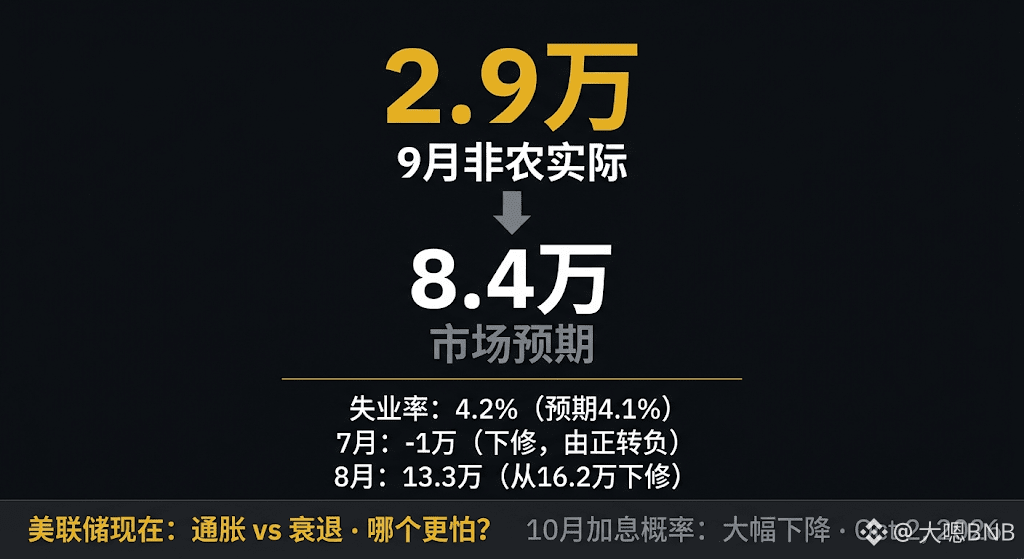
September non-farm payrolls: 29,000, versus expectations of 84,000.
Significantly below expectations.
The unemployment rate is 4.2%. In July it was revised down by 10,000 (from positive to negative), and in August it was revised down from 162,000 to 133,000.——Adding in the September data, over the three months the total is about 87,000 fewer jobs than in the previously reported figures.
Placed in today’s macro backdrop, this set of data puts the Fed in an awkward position:
10-year U.S. Treasury yields have just touched 5.33%—the highest in 24 years. The Fed just raised rates in September, and the dot plot indicates there is still one more hike this year. Inflation has not been fully tamed.
But now the labor market is clearly weakening.
On one side, inflation pressure calls for continued rate hikes; on the other, employment data is calling for the pause.
The market’s first reaction today: the probability of an October rate hike drops sharply. The market had already priced in about a 50% chance of a hike in October—this figure will clearly shrink today.
For BTC: this is a two-way logic——
Bullish: rate-hike expectations cool → Treasury yields fall → pressure on risk assets eases → room for a BTC rebound opens.
Bearish: weak employment suggests the economy is truly slowing; if it evolves into recession concerns, risk assets may instead be sold off.
Whether BTC can hold above $83,000 today depends on which logic the market believes more.
Historically, in the 12 months after the last rate hike, BTC averaged a gain of 67%. If today’s jobs report derails the October rate hike, the narrative of the “last rate hike” will be re-discussed.
Do you think the Fed is more afraid of inflation or of a recession right now?
$BTC
{future}(BTCUSDT)
September non-farm payrolls: 29,000, versus expectations of 84,000.
Significantly below expectations.
The unemployment rate is 4.2%. In July it was revised down by 10,000 (from positive to negative), and in August it was revised down from 162,000 to 133,000.——Adding in the September data, over the three months the total is about 87,000 fewer jobs than in the previously reported figures.
Placed in today’s macro backdrop, this set of data puts the Fed in an awkward position:
10-year U.S. Treasury yields have just touched 5.33%—the highest in 24 years. The Fed just raised rates in September, and the dot plot indicates there is still one more hike this year. Inflation has not been fully tamed.
But now the labor market is clearly weakening.
On one side, inflation pressure calls for continued rate hikes; on the other, employment data is calling for the pause.
The market’s first reaction today: the probability of an October rate hike drops sharply. The market had already priced in about a 50% chance of a hike in October—this figure will clearly shrink today.
For BTC: this is a two-way logic——
Bullish: rate-hike expectations cool → Treasury yields fall → pressure on risk assets eases → room for a BTC rebound opens.
Bearish: weak employment suggests the economy is truly slowing; if it evolves into recession concerns, risk assets may instead be sold off.
Whether BTC can hold above $83,000 today depends on which logic the market believes more.
Historically, in the 12 months after the last rate hike, BTC averaged a gain of 67%. If today’s jobs report derails the October rate hike, the narrative of the “last rate hike” will be re-discussed.
Do you think the Fed is more afraid of inflation or of a recession right now?
$BTC
Significantly below expectations.
The unemployment rate is 4.2%. In July it was revised down by 10,000 (from positive to negative), and in August it was revised down from 162,000 to 133,000.——Adding in the September data, over the three months the total is about 87,000 fewer jobs than in the previously reported figures.
Placed in today’s macro backdrop, this set of data puts the Fed in an awkward position:
10-year U.S. Treasury yields have just touched 5.33%—the highest in 24 years. The Fed just raised rates in September, and the dot plot indicates there is still one more hike this year. Inflation has not been fully tamed.
But now the labor market is clearly weakening.
On one side, inflation pressure calls for continued rate hikes; on the other, employment data is calling for the pause.
The market’s first reaction today: the probability of an October rate hike drops sharply. The market had already priced in about a 50% chance of a hike in October—this figure will clearly shrink today.
For BTC: this is a two-way logic——
Bullish: rate-hike expectations cool → Treasury yields fall → pressure on risk assets eases → room for a BTC rebound opens.
Bearish: weak employment suggests the economy is truly slowing; if it evolves into recession concerns, risk assets may instead be sold off.
Whether BTC can hold above $83,000 today depends on which logic the market believes more.
Historically, in the 12 months after the last rate hike, BTC averaged a gain of 67%. If today’s jobs report derails the October rate hike, the narrative of the “last rate hike” will be re-discussed.
Do you think the Fed is more afraid of inflation or of a recession right now?
$BTC
2
1
2
445
·
--
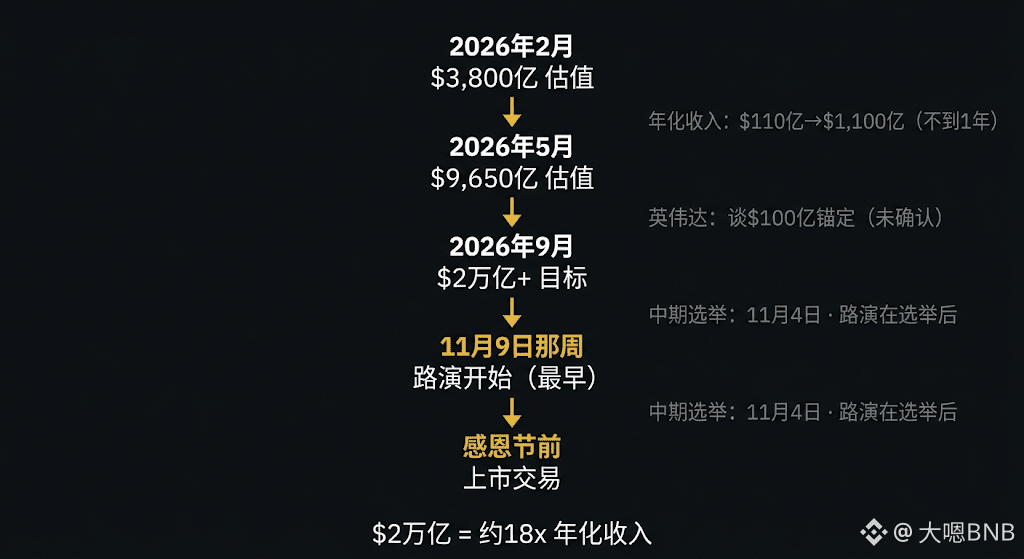
Bloomberg today said that Anthropic’s earliest roadshow could begin the week of November 9, and that the listing could take place before Thanksgiving (November 26).
The timeline is extremely tight—less than three weeks from the start of the roadshow to the IPO.
I looked at how the figures have changed over the past few months:
In February, the valuation was $380 billion; in May it rose to $965 billion. The prospectus disclosed a target of more than $2 trillion—more than doubling in just four months.
Annualized revenue: it surpassed $65 billion by the end of July, and the latest expectation is over $110 billion.
This growth rate suggests it will take less than a year to go from $10 billion to $110 billion in annualized revenue.
Motley Fool calculated that a $2 trillion valuation corresponds to $110 billion in revenue—about a 18x price-to-sales multiple. By comparison, when SpaceX went public, it was roughly at a similar multiple, while Microsoft is currently around 13x.
Expensive, but not without logic.
A few things still don’t have answers today:
Nvidia is reportedly in talks for a $10 billion anchor investment—unconfirmed; the pricing range has not been disclosed; and the final public S-1 filing has not yet been submitted.
Timing is crucial: November 4 is the U.S. midterm election. If the roadshow starts the week of November 9, it would be after the election results are known—Anthropic may be waiting for this uncertainty to be cleared.
This is the biggest tech IPO of the year, without question.
With a $2 trillion price, would you subscribe?
$BTC
{future}(BTCUSDT)
$NVDAB
{spot}(NVDABUSDT)
#anthropic最早11月中旬ipo
Bloomberg today said that Anthropic’s earliest roadshow could begin the week of November 9, and that the listing could take place before Thanksgiving (November 26).
The timeline is extremely tight—less than three weeks from the start of the roadshow to the IPO.
I looked at how the figures have changed over the past few months:
In February, the valuation was $380 billion; in May it rose to $965 billion. The prospectus disclosed a target of more than $2 trillion—more than doubling in just four months.
Annualized revenue: it surpassed $65 billion by the end of July, and the latest expectation is over $110 billion.
This growth rate suggests it will take less than a year to go from $10 billion to $110 billion in annualized revenue.
Motley Fool calculated that a $2 trillion valuation corresponds to $110 billion in revenue—about a 18x price-to-sales multiple. By comparison, when SpaceX went public, it was roughly at a similar multiple, while Microsoft is currently around 13x.
Expensive, but not without logic.
A few things still don’t have answers today:
Nvidia is reportedly in talks for a $10 billion anchor investment—unconfirmed; the pricing range has not been disclosed; and the final public S-1 filing has not yet been submitted.
Timing is crucial: November 4 is the U.S. midterm election. If the roadshow starts the week of November 9, it would be after the election results are known—Anthropic may be waiting for this uncertainty to be cleared.
This is the biggest tech IPO of the year, without question.
With a $2 trillion price, would you subscribe?
$BTC
$NVDAB
#anthropic最早11月中旬ipo
The timeline is extremely tight—less than three weeks from the start of the roadshow to the IPO.
I looked at how the figures have changed over the past few months:
In February, the valuation was $380 billion; in May it rose to $965 billion. The prospectus disclosed a target of more than $2 trillion—more than doubling in just four months.
Annualized revenue: it surpassed $65 billion by the end of July, and the latest expectation is over $110 billion.
This growth rate suggests it will take less than a year to go from $10 billion to $110 billion in annualized revenue.
Motley Fool calculated that a $2 trillion valuation corresponds to $110 billion in revenue—about a 18x price-to-sales multiple. By comparison, when SpaceX went public, it was roughly at a similar multiple, while Microsoft is currently around 13x.
Expensive, but not without logic.
A few things still don’t have answers today:
Nvidia is reportedly in talks for a $10 billion anchor investment—unconfirmed; the pricing range has not been disclosed; and the final public S-1 filing has not yet been submitted.
Timing is crucial: November 4 is the U.S. midterm election. If the roadshow starts the week of November 9, it would be after the election results are known—Anthropic may be waiting for this uncertainty to be cleared.
This is the biggest tech IPO of the year, without question.
With a $2 trillion price, would you subscribe?
$BTC
$NVDAB
#anthropic最早11月中旬ipo
3
3
5.8k
·
--
Verified
Micron’s earnings report came out last night.
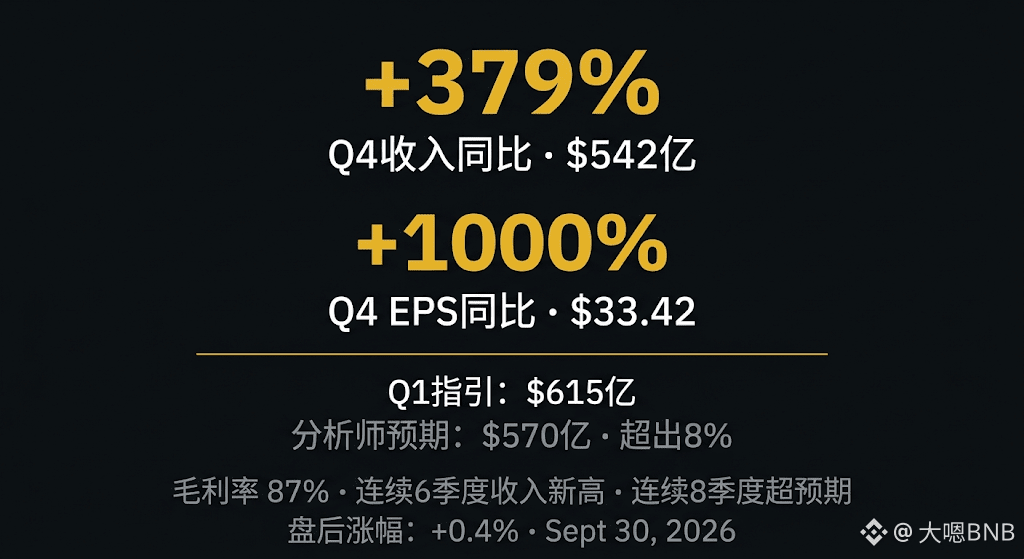
Revenue was $54.2 billion, up 379% year over year. EPS was $33.42, up 1,000% year over year. Gross margin was 87%.
Then Q1 guidance was $61.5 billion—8% higher than analysts expected.
It rose 0.4% after hours.
The first reaction I had to these numbers was: this report is so good there’s nothing left to say, and yet the market didn’t really move.
Because Micron is already up more than 500% this year—good news was already priced in.
The beat became “normal performance,” not something beyond the most optimistic scenarios, so there was no extra surprise.
That’s exactly what’s hardest to deal with during earnings season—the relationship between the numbers and the stock price depends on expectations, not absolute values.
Next week, the big banks roll out one after another: JPMorgan on October 13, then Bank of America, Goldman Sachs, and Citigroup.
The big banks’ earnings are the most direct temperature check for macro conditions this year—when the 10-year U.S. Treasury yields 5.33% and the Fed just hiked, the big banks’ net interest income and loan-loss provisions will tell us how much pressure the real economy is under.
On the AI line: Micron said data center revenue was up 11x year over year. The CEO even directly mentioned working with NVIDIA on developing the “industry’s first custom HBM.” This supply chain is still accelerating, with no signs of a peak.
But there’s one thing today that’s worth watching even more than earnings season:
Tomorrow, nonfarm payrolls data will come out. The odds of a rate hike in October are being repriced again, and the 5.33% 10-year yield is the backdrop sound for pricing across all assets today.
Earnings season begins—macro risk is still there.
Where are you positioned today?
$BTC
{future}(BTCUSDT)
$NVDA
{future}(NVDAUSDT)
Micron’s earnings report came out last night.
Revenue was $54.2 billion, up 379% year over year. EPS was $33.42, up 1,000% year over year. Gross margin was 87%.
Then Q1 guidance was $61.5 billion—8% higher than analysts expected.
It rose 0.4% after hours.
The first reaction I had to these numbers was: this report is so good there’s nothing left to say, and yet the market didn’t really move.
Because Micron is already up more than 500% this year—good news was already priced in.
The beat became “normal performance,” not something beyond the most optimistic scenarios, so there was no extra surprise.
That’s exactly what’s hardest to deal with during earnings season—the relationship between the numbers and the stock price depends on expectations, not absolute values.
Next week, the big banks roll out one after another: JPMorgan on October 13, then Bank of America, Goldman Sachs, and Citigroup.
The big banks’ earnings are the most direct temperature check for macro conditions this year—when the 10-year U.S. Treasury yields 5.33% and the Fed just hiked, the big banks’ net interest income and loan-loss provisions will tell us how much pressure the real economy is under.
On the AI line: Micron said data center revenue was up 11x year over year. The CEO even directly mentioned working with NVIDIA on developing the “industry’s first custom HBM.” This supply chain is still accelerating, with no signs of a peak.
But there’s one thing today that’s worth watching even more than earnings season:
Tomorrow, nonfarm payrolls data will come out. The odds of a rate hike in October are being repriced again, and the 5.33% 10-year yield is the backdrop sound for pricing across all assets today.
Earnings season begins—macro risk is still there.
Where are you positioned today?
$BTC
$NVDA
Revenue was $54.2 billion, up 379% year over year. EPS was $33.42, up 1,000% year over year. Gross margin was 87%.
Then Q1 guidance was $61.5 billion—8% higher than analysts expected.
It rose 0.4% after hours.
The first reaction I had to these numbers was: this report is so good there’s nothing left to say, and yet the market didn’t really move.
Because Micron is already up more than 500% this year—good news was already priced in.
The beat became “normal performance,” not something beyond the most optimistic scenarios, so there was no extra surprise.
That’s exactly what’s hardest to deal with during earnings season—the relationship between the numbers and the stock price depends on expectations, not absolute values.
Next week, the big banks roll out one after another: JPMorgan on October 13, then Bank of America, Goldman Sachs, and Citigroup.
The big banks’ earnings are the most direct temperature check for macro conditions this year—when the 10-year U.S. Treasury yields 5.33% and the Fed just hiked, the big banks’ net interest income and loan-loss provisions will tell us how much pressure the real economy is under.
On the AI line: Micron said data center revenue was up 11x year over year. The CEO even directly mentioned working with NVIDIA on developing the “industry’s first custom HBM.” This supply chain is still accelerating, with no signs of a peak.
But there’s one thing today that’s worth watching even more than earnings season:
Tomorrow, nonfarm payrolls data will come out. The odds of a rate hike in October are being repriced again, and the 5.33% 10-year yield is the backdrop sound for pricing across all assets today.
Earnings season begins—macro risk is still there.
Where are you positioned today?
$BTC
$NVDA

1.1k
41
1.1k
·
--
Verified
On October 1, the 10-year U.S. Treasury yield touched 5.33%—the highest level since 2002 and the first time seen in 24 years.\n\nIn early September, this figure was still 4.85%. In one month it jumped by about 48 basis points—one of the fastest single-month moves in this year’s bond market.\n\nBloomberg analysts pointed to the real driving force behind this rally:\n\nNot just inflation, but also bond supply.\n\nThe U.S. government’s total borrowing this year is at a record level. SoftBank’s $11 billion junk bond, Anthropic’s upcoming listing, and large-scale financing by AI infrastructure companies—huge amounts of new debt have flooded the market. Buyers require higher yields before they’re willing to hold it.\n\nMeanwhile, the 30-year Treasury yield also rose in step to 5.65%—the highest since 2002.\n\nThis yield curve is telling the market that long-term rates are higher—and will be for longer.\n\nThe impact on BTC today is direct: \n\nThe $83,000–$84,000 range is the current support zone. A 10-year yield of 5.33% implies that the risk-free annualized return has reached a level that is very attractive for institutional capital—some funds may rotate from risky assets into bonds.\n\nBut there’s one thing worth noting: this year, as yields climbed from 4.5% to 5.33%, BTC rose from $64,000 to a peak of $87,000—suggesting that the AI narrative and institutional buying power can, to some extent, offset the interest-rate pressure.\n\nToday, the relationship between interest rates and BTC is no longer simply a negative correlation.\n\nNon-Farm Payrolls comes out tomorrow—this is what truly needs to be watched today.\n$BTC \n{future}(BTCUSDT)\n $QQQ \n#美国10年期美债收益率逼近5.3%
On October 1, the 10-year U.S. Treasury yield touched 5.33%—the highest level since 2002 and the first time seen in 24 years.\n\nIn early September, this figure was still 4.85%. In one month it jumped by about 48 basis points—one of the fastest single-month moves in this year’s bond market.\n\nBloomberg analysts pointed to the real driving force behind this rally:\n\nNot just inflation, but also bond supply.\n\nThe U.S. government’s total borrowing this year is at a record level. SoftBank’s $11 billion junk bond, Anthropic’s upcoming listing, and large-scale financing by AI infrastructure companies—huge amounts of new debt have flooded the market. Buyers require higher yields before they’re willing to hold it.\n\nMeanwhile, the 30-year Treasury yield also rose in step to 5.65%—the highest since 2002.\n\nThis yield curve is telling the market that long-term rates are higher—and will be for longer.\n\nThe impact on BTC today is direct: \n\nThe $83,000–$84,000 range is the current support zone. A 10-year yield of 5.33% implies that the risk-free annualized return has reached a level that is very attractive for institutional capital—some funds may rotate from risky assets into bonds.\n\nBut there’s one thing worth noting: this year, as yields climbed from 4.5% to 5.33%, BTC rose from $64,000 to a peak of $87,000—suggesting that the AI narrative and institutional buying power can, to some extent, offset the interest-rate pressure.\n\nToday, the relationship between interest rates and BTC is no longer simply a negative correlation.\n\nNon-Farm Payrolls comes out tomorrow—this is what truly needs to be watched today.\n$BTC \n\n $QQQ \n#美国10年期美债收益率逼近5.3%

3
598
·
--
On September 30, Micron released its Q4 earnings report.
Revenue was $54.2 billion, up 379% year over year. EPS was $33.42, up 1,000% year over year. Gross margin was 87%.
It marked the sixth consecutive quarter setting a new revenue high, and the eighth consecutive quarter beating expectations.
Then the Q1 guidance: $61.5 billion, about 8% higher than analysts’ expected $57.0 billion.
This is one of the strongest tech-stock earnings reports of the year.
After-hours, the stock price rose 0.4%.
What’s worth saying about this event is more than the earnings figures themselves:
Micron is up more than 500% this year. The $54.2 billion quarterly revenue, $33.42 EPS, and 87% gross margin—these numbers were already priced in in advance. Analysts’ expectations going into the report were already high. Micron only “beat expectations,” without “far exceeding even the most optimistic scenario,” so the upside was limited.
But CEO Sanjay Mehrotra said something:
“AI is becoming superintelligent, and memory is at the core of that intelligence.”
He also said Micron is working with Nvidia to develop the industry’s “first customized HBM implementation.”
Data center revenue grew 11x year over year—this is what the global AI infrastructure buildout looks like when the bill shows up in a memory company.
For BTC: Micron’s earnings report again confirms that AI compute demand hasn’t shown signs of peaking—this is the underlying data supporting the NVDA and broader AI narrative chain, indirectly supporting BTC’s AI-economy narrative.
With earnings this good but the stock not really rising much, it means expectations are already very full.
$BTC
{future}(BTCUSDT)
$NVDAB
{spot}(NVDABUSDT)
#美光业绩超预期并上调指引
On September 30, Micron released its Q4 earnings report.
Revenue was $54.2 billion, up 379% year over year. EPS was $33.42, up 1,000% year over year. Gross margin was 87%.
It marked the sixth consecutive quarter setting a new revenue high, and the eighth consecutive quarter beating expectations.
Then the Q1 guidance: $61.5 billion, about 8% higher than analysts’ expected $57.0 billion.
This is one of the strongest tech-stock earnings reports of the year.
After-hours, the stock price rose 0.4%.
What’s worth saying about this event is more than the earnings figures themselves:
Micron is up more than 500% this year. The $54.2 billion quarterly revenue, $33.42 EPS, and 87% gross margin—these numbers were already priced in in advance. Analysts’ expectations going into the report were already high. Micron only “beat expectations,” without “far exceeding even the most optimistic scenario,” so the upside was limited.
But CEO Sanjay Mehrotra said something:
“AI is becoming superintelligent, and memory is at the core of that intelligence.”
He also said Micron is working with Nvidia to develop the industry’s “first customized HBM implementation.”
Data center revenue grew 11x year over year—this is what the global AI infrastructure buildout looks like when the bill shows up in a memory company.
For BTC: Micron’s earnings report again confirms that AI compute demand hasn’t shown signs of peaking—this is the underlying data supporting the NVDA and broader AI narrative chain, indirectly supporting BTC’s AI-economy narrative.
With earnings this good but the stock not really rising much, it means expectations are already very full.
$BTC
$NVDAB
#美光业绩超预期并上调指引
Revenue was $54.2 billion, up 379% year over year. EPS was $33.42, up 1,000% year over year. Gross margin was 87%.
It marked the sixth consecutive quarter setting a new revenue high, and the eighth consecutive quarter beating expectations.
Then the Q1 guidance: $61.5 billion, about 8% higher than analysts’ expected $57.0 billion.
This is one of the strongest tech-stock earnings reports of the year.
After-hours, the stock price rose 0.4%.
What’s worth saying about this event is more than the earnings figures themselves:
Micron is up more than 500% this year. The $54.2 billion quarterly revenue, $33.42 EPS, and 87% gross margin—these numbers were already priced in in advance. Analysts’ expectations going into the report were already high. Micron only “beat expectations,” without “far exceeding even the most optimistic scenario,” so the upside was limited.
But CEO Sanjay Mehrotra said something:
“AI is becoming superintelligent, and memory is at the core of that intelligence.”
He also said Micron is working with Nvidia to develop the industry’s “first customized HBM implementation.”
Data center revenue grew 11x year over year—this is what the global AI infrastructure buildout looks like when the bill shows up in a memory company.
For BTC: Micron’s earnings report again confirms that AI compute demand hasn’t shown signs of peaking—this is the underlying data supporting the NVDA and broader AI narrative chain, indirectly supporting BTC’s AI-economy narrative.
With earnings this good but the stock not really rising much, it means expectations are already very full.
$BTC
$NVDAB
#美光业绩超预期并上调指引
3
7.6k
·
--
On September 30, MetaMask announced that it is handling an infrastructure security incident, and it has also begun withdrawing all of its Ethereum validator nodes from the Lido protocol.
The exit is expected to be completed by October 7, but full withdrawals will take another ~45 days—because the Ethereum validator entry queue is currently quite long.
MetaMask didn’t clarify what happened.
The official statement only said "it is investigating the infrastructure being compromised" and "no immediate threat to MetaMask wallets has been identified"—a typical early-stage security incident update: confirming something is going on, but withholding details.
Several knock-on effects are worth noting:
This incident also affects Aave—because stETH is used as collateral on Aave, and MetaMask’s exit from Lido validator nodes will impact related positions on Aave.
Lido has a temporary reserve of 6,750 stETH, specifically intended to handle this kind of node-exit situation, so it won’t directly affect ordinary stETH holders. stETH holders don’t need to take any action.
MetaMask isn’t the first to do this— in September 2025, the node operator Kiln also carried out the same kind of preventative exit after the infrastructure was compromised. This is Lido’s standard emergency procedure.
But one thing remains unanswered: how exactly was MetaMask’s infrastructure compromised, and is there any risk to the private keys. Until that becomes clear, the actual severity of the situation is still uncertain.
ETH is trading today around $2,650, and the stETH price has basically not depegged—the market is currently pricing in that this is manageable.
If later disclosures show there’s no private-key risk, then this is basically a close call; if not—then it’s another story.
Do you have a staking position in Lido?
$ETH
{future}(ETHUSDT)
#metamask安全事件后撤出lido验证节点
On September 30, MetaMask announced that it is handling an infrastructure security incident, and it has also begun withdrawing all of its Ethereum validator nodes from the Lido protocol.
The exit is expected to be completed by October 7, but full withdrawals will take another ~45 days—because the Ethereum validator entry queue is currently quite long.
MetaMask didn’t clarify what happened.
The official statement only said "it is investigating the infrastructure being compromised" and "no immediate threat to MetaMask wallets has been identified"—a typical early-stage security incident update: confirming something is going on, but withholding details.
Several knock-on effects are worth noting:
This incident also affects Aave—because stETH is used as collateral on Aave, and MetaMask’s exit from Lido validator nodes will impact related positions on Aave.
Lido has a temporary reserve of 6,750 stETH, specifically intended to handle this kind of node-exit situation, so it won’t directly affect ordinary stETH holders. stETH holders don’t need to take any action.
MetaMask isn’t the first to do this— in September 2025, the node operator Kiln also carried out the same kind of preventative exit after the infrastructure was compromised. This is Lido’s standard emergency procedure.
But one thing remains unanswered: how exactly was MetaMask’s infrastructure compromised, and is there any risk to the private keys. Until that becomes clear, the actual severity of the situation is still uncertain.
ETH is trading today around $2,650, and the stETH price has basically not depegged—the market is currently pricing in that this is manageable.
If later disclosures show there’s no private-key risk, then this is basically a close call; if not—then it’s another story.
Do you have a staking position in Lido?
$ETH
#metamask安全事件后撤出lido验证节点
The exit is expected to be completed by October 7, but full withdrawals will take another ~45 days—because the Ethereum validator entry queue is currently quite long.
MetaMask didn’t clarify what happened.
The official statement only said "it is investigating the infrastructure being compromised" and "no immediate threat to MetaMask wallets has been identified"—a typical early-stage security incident update: confirming something is going on, but withholding details.
Several knock-on effects are worth noting:
This incident also affects Aave—because stETH is used as collateral on Aave, and MetaMask’s exit from Lido validator nodes will impact related positions on Aave.
Lido has a temporary reserve of 6,750 stETH, specifically intended to handle this kind of node-exit situation, so it won’t directly affect ordinary stETH holders. stETH holders don’t need to take any action.
MetaMask isn’t the first to do this— in September 2025, the node operator Kiln also carried out the same kind of preventative exit after the infrastructure was compromised. This is Lido’s standard emergency procedure.
But one thing remains unanswered: how exactly was MetaMask’s infrastructure compromised, and is there any risk to the private keys. Until that becomes clear, the actual severity of the situation is still uncertain.
ETH is trading today around $2,650, and the stETH price has basically not depegged—the market is currently pricing in that this is manageable.
If later disclosures show there’s no private-key risk, then this is basically a close call; if not—then it’s another story.
Do you have a staking position in Lido?
$ETH
#metamask安全事件后撤出lido验证节点

5
16
14k
·
--
Last week, New York sued Polymarket, saying prediction markets are illegal gambling.
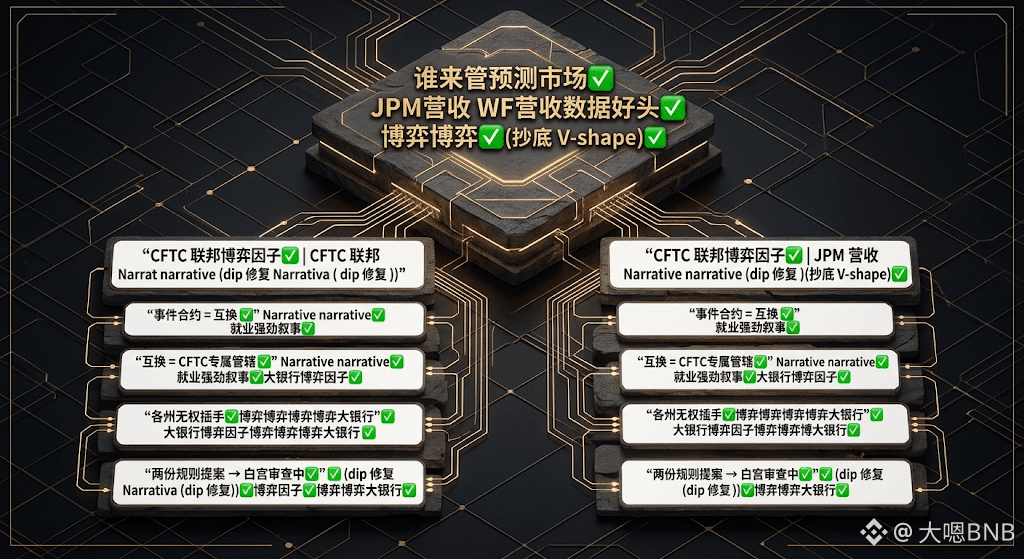
This week, the CFTC submitted two rule proposals to the White House, saying that prediction markets are “swaps”—and that swaps fall under the CFTC’s exclusive jurisdiction under federal law, with no role for state governments.
This is an ongoing power struggle, and today it has entered a new phase.
The logic behind the two proposals is very clear:
First: explicitly include event contracts within the definition of “swaps”—Kalshi, Polymarket, Crypto.com, and Robinhood’s prediction market products are all considered swaps. CFTC jurisdiction.
Second: explicitly exclude “casino-style gambling products” from the definition of swaps—draw the line and tell the states: the kind of gambling you’re talking about is not included here.
Now these two proposals are awaiting review by the White House OIRA (Office of Information and Regulatory Affairs); only after that can they enter the public comment period, and then become formal rules.
They aren’t effective yet, but the direction is very clear.
Background: the Sixth and Ninth Circuit Courts of Appeals have recently issued relevant rulings on the definition of swaps, and the Supreme Court has already accepted three related petitions. The outcome of this case may ultimately be decided by the Supreme Court.
If the CFTC’s rules ultimately establish that the legal basis for states suing Polymarket is cut off, prediction markets across the U.S. would gain federal regulatory protection, and New York AG’s case would likely lose its footing.
If the states win: prediction markets would face different rules in different states—fragmented regulation—with operating costs rising dramatically.
How the Supreme Court will rule is one of the most worth-watching regulatory open questions by the end of this year.
$BTC
{future}(BTCUSDT)
#cftc向白宫提交两项事件合约规则提案
Last week, New York sued Polymarket, saying prediction markets are illegal gambling.
This week, the CFTC submitted two rule proposals to the White House, saying that prediction markets are “swaps”—and that swaps fall under the CFTC’s exclusive jurisdiction under federal law, with no role for state governments.
This is an ongoing power struggle, and today it has entered a new phase.
The logic behind the two proposals is very clear:
First: explicitly include event contracts within the definition of “swaps”—Kalshi, Polymarket, Crypto.com, and Robinhood’s prediction market products are all considered swaps. CFTC jurisdiction.
Second: explicitly exclude “casino-style gambling products” from the definition of swaps—draw the line and tell the states: the kind of gambling you’re talking about is not included here.
Now these two proposals are awaiting review by the White House OIRA (Office of Information and Regulatory Affairs); only after that can they enter the public comment period, and then become formal rules.
They aren’t effective yet, but the direction is very clear.
Background: the Sixth and Ninth Circuit Courts of Appeals have recently issued relevant rulings on the definition of swaps, and the Supreme Court has already accepted three related petitions. The outcome of this case may ultimately be decided by the Supreme Court.
If the CFTC’s rules ultimately establish that the legal basis for states suing Polymarket is cut off, prediction markets across the U.S. would gain federal regulatory protection, and New York AG’s case would likely lose its footing.
If the states win: prediction markets would face different rules in different states—fragmented regulation—with operating costs rising dramatically.
How the Supreme Court will rule is one of the most worth-watching regulatory open questions by the end of this year.
$BTC
#cftc向白宫提交两项事件合约规则提案
This week, the CFTC submitted two rule proposals to the White House, saying that prediction markets are “swaps”—and that swaps fall under the CFTC’s exclusive jurisdiction under federal law, with no role for state governments.
This is an ongoing power struggle, and today it has entered a new phase.
The logic behind the two proposals is very clear:
First: explicitly include event contracts within the definition of “swaps”—Kalshi, Polymarket, Crypto.com, and Robinhood’s prediction market products are all considered swaps. CFTC jurisdiction.
Second: explicitly exclude “casino-style gambling products” from the definition of swaps—draw the line and tell the states: the kind of gambling you’re talking about is not included here.
Now these two proposals are awaiting review by the White House OIRA (Office of Information and Regulatory Affairs); only after that can they enter the public comment period, and then become formal rules.
They aren’t effective yet, but the direction is very clear.
Background: the Sixth and Ninth Circuit Courts of Appeals have recently issued relevant rulings on the definition of swaps, and the Supreme Court has already accepted three related petitions. The outcome of this case may ultimately be decided by the Supreme Court.
If the CFTC’s rules ultimately establish that the legal basis for states suing Polymarket is cut off, prediction markets across the U.S. would gain federal regulatory protection, and New York AG’s case would likely lose its footing.
If the states win: prediction markets would face different rules in different states—fragmented regulation—with operating costs rising dramatically.
How the Supreme Court will rule is one of the most worth-watching regulatory open questions by the end of this year.
$BTC
#cftc向白宫提交两项事件合约规则提案
1
27
15.8k
·
--
September 30, the last day of Q3: BTC is above 85,000, up 1.52%.
This morning, the August PCE data came out: core PCE monthly 0.2%, below the market’s 0.3% forecast; and annual 3.0%, below the expected 3.3%.
This is a softer inflation print than the market expected.
Where does the importance lie? Previously, three consecutive data releases (PPI 5.4%, core CPI 0.3%, and PMI 58.4) had been heating up expectations for rate hikes in October. The market had already priced in about a 64% probability of an October FOMC rate hike. Today’s PCE is soft, which directly cools that expectation—10-year U.S. Treasury yields dropped right away, and BTC rebounded to above 85,000.
This is a classic logic chain: “inflation cools → rate-hike expectations fall → rallies in interest-rate-sensitive assets,” and it was repriced within a minute.
But what’s even more worth noting is the timing.
On the final day of Q3, the PCE print was soft, and BTC then broke above 85,000—this pushed Q3’s final closing price to a more impressive level. Starting from 58,500, Q3 gained about 45%, making it the second-strongest Q3 in history. Closing out the quarter’s last day with a softer PCE gave holders a positive end-of-quarter signal and also reduced the certainty of an October rate hike.
From a fundamentals perspective, the implication of today’s data is: U.S. inflation continues in August moving closer to the 2% target, even if September services PMI is strong. If, going forward, Nonfarm Payrolls and CPI continue to come in soft, the probability that the October FOMC pauses its hikes will rise again, and the macro backdrop for Q4 will be friendlier than what was expected last week.
BTC is now around 85,000 to 85,500. Support is 83,000 to 84,000 below, while resistance is 87,300 (September high) and 96,700 (MVRV resistance—the gateway to 100,000). ETH is near 2,730, SOL at 122, and XRP at 1.54.
Q3 is closed—Q4 begins today.
What’s your first target for BTC in Q4—87,000, 90,000, or straight to 100,000? Share your thoughts.
$BTC
{future}(BTCUSDT)
$ETH
{future}(ETHUSDT)
September 30, the last day of Q3: BTC is above 85,000, up 1.52%.
This morning, the August PCE data came out: core PCE monthly 0.2%, below the market’s 0.3% forecast; and annual 3.0%, below the expected 3.3%.
This is a softer inflation print than the market expected.
Where does the importance lie? Previously, three consecutive data releases (PPI 5.4%, core CPI 0.3%, and PMI 58.4) had been heating up expectations for rate hikes in October. The market had already priced in about a 64% probability of an October FOMC rate hike. Today’s PCE is soft, which directly cools that expectation—10-year U.S. Treasury yields dropped right away, and BTC rebounded to above 85,000.
This is a classic logic chain: “inflation cools → rate-hike expectations fall → rallies in interest-rate-sensitive assets,” and it was repriced within a minute.
But what’s even more worth noting is the timing.
On the final day of Q3, the PCE print was soft, and BTC then broke above 85,000—this pushed Q3’s final closing price to a more impressive level. Starting from 58,500, Q3 gained about 45%, making it the second-strongest Q3 in history. Closing out the quarter’s last day with a softer PCE gave holders a positive end-of-quarter signal and also reduced the certainty of an October rate hike.
From a fundamentals perspective, the implication of today’s data is: U.S. inflation continues in August moving closer to the 2% target, even if September services PMI is strong. If, going forward, Nonfarm Payrolls and CPI continue to come in soft, the probability that the October FOMC pauses its hikes will rise again, and the macro backdrop for Q4 will be friendlier than what was expected last week.
BTC is now around 85,000 to 85,500. Support is 83,000 to 84,000 below, while resistance is 87,300 (September high) and 96,700 (MVRV resistance—the gateway to 100,000). ETH is near 2,730, SOL at 122, and XRP at 1.54.
Q3 is closed—Q4 begins today.
What’s your first target for BTC in Q4—87,000, 90,000, or straight to 100,000? Share your thoughts.
$BTC
$ETH
This morning, the August PCE data came out: core PCE monthly 0.2%, below the market’s 0.3% forecast; and annual 3.0%, below the expected 3.3%.
This is a softer inflation print than the market expected.
Where does the importance lie? Previously, three consecutive data releases (PPI 5.4%, core CPI 0.3%, and PMI 58.4) had been heating up expectations for rate hikes in October. The market had already priced in about a 64% probability of an October FOMC rate hike. Today’s PCE is soft, which directly cools that expectation—10-year U.S. Treasury yields dropped right away, and BTC rebounded to above 85,000.
This is a classic logic chain: “inflation cools → rate-hike expectations fall → rallies in interest-rate-sensitive assets,” and it was repriced within a minute.
But what’s even more worth noting is the timing.
On the final day of Q3, the PCE print was soft, and BTC then broke above 85,000—this pushed Q3’s final closing price to a more impressive level. Starting from 58,500, Q3 gained about 45%, making it the second-strongest Q3 in history. Closing out the quarter’s last day with a softer PCE gave holders a positive end-of-quarter signal and also reduced the certainty of an October rate hike.
From a fundamentals perspective, the implication of today’s data is: U.S. inflation continues in August moving closer to the 2% target, even if September services PMI is strong. If, going forward, Nonfarm Payrolls and CPI continue to come in soft, the probability that the October FOMC pauses its hikes will rise again, and the macro backdrop for Q4 will be friendlier than what was expected last week.
BTC is now around 85,000 to 85,500. Support is 83,000 to 84,000 below, while resistance is 87,300 (September high) and 96,700 (MVRV resistance—the gateway to 100,000). ETH is near 2,730, SOL at 122, and XRP at 1.54.
Q3 is closed—Q4 begins today.
What’s your first target for BTC in Q4—87,000, 90,000, or straight to 100,000? Share your thoughts.
$BTC
$ETH

98
10
811
·
--
Damn, it was already set.
At 55 minutes the alarm went off, and I—what an idiot—went to talk with my coworker.
Completely forgot.
Didn’t get to eat.
Hope everyone gets plenty of big meat!
Damn, it was already set.
At 55 minutes the alarm went off, and I—what an idiot—went to talk with my coworker.
Completely forgot.
Didn’t get to eat.
Hope everyone gets plenty of big meat!
At 55 minutes the alarm went off, and I—what an idiot—went to talk with my coworker.
Completely forgot.
Didn’t get to eat.
Hope everyone gets plenty of big meat!
大嗯BNB
·
--
Set the alarm ⏰ Get ready

1
335
·
--
September 29, the White House.
Trump convened the CEOs of more than 20 leading global AI companies—Amodei (Anthropic), Zuckerberg (Meta), Pichai (Google), Jensen Huang (Nvidia), Musk (xAI)—at a meeting.
After the meeting, Trump said:
"The smartest people oversee each other, and that’s enough."
The United States will not have new federal AI regulations. The companies signed a voluntary agreement, pledging self-regulation, setting up internal controls, and mitigating risks of biological/chemical weapons and cyberattacks.
This matter has several dimensions worth clarifying:
For AI companies: This is the outcome they wanted. Before the meeting, Zuckerberg and Musk directly lobbied Trump against creating an AI regulatory body similar to FINRA. Not regulating means faster movement, lower costs, and no regulatory-risk discount on Anthropic’s $2 trillion IPO narrative.
For Europe: It creates a clear competitive divergence. The EU AI Act fully takes effect in 2027, meaning European companies must bear compliance costs, while U.S. companies choose self-discipline. This split will become clearer over the next few years.
On calls for an "AI slowdown": Essentially, they were denied. Amodei, Altman, and Musk said last week that AI should slow down, but this week they all appeared at the White House. The conclusion was self-regulation—there’s a significant gap between actions and words.
For BTC: The regulatory vacuum is positive for investment in AI infrastructure—Nvidia, cloud computing, and the AI application layer can expand more quickly. Risk appetite rises, and BTC, as a supporting asset for the AI economy, benefits.
But there is one tail risk: if the voluntary agreement fails, the scale of the next incident will be larger—at that point, mandatory regulation would cost far more than it would now.
Do you think AI self-regulation is credible?
$BTC
{future}(BTCUSDT)
$NVDA
{future}(NVDAUSDT)
#特朗普拒绝ai监管改用自愿审计
September 29, the White House.
Trump convened the CEOs of more than 20 leading global AI companies—Amodei (Anthropic), Zuckerberg (Meta), Pichai (Google), Jensen Huang (Nvidia), Musk (xAI)—at a meeting.
After the meeting, Trump said:
"The smartest people oversee each other, and that’s enough."
The United States will not have new federal AI regulations. The companies signed a voluntary agreement, pledging self-regulation, setting up internal controls, and mitigating risks of biological/chemical weapons and cyberattacks.
This matter has several dimensions worth clarifying:
For AI companies: This is the outcome they wanted. Before the meeting, Zuckerberg and Musk directly lobbied Trump against creating an AI regulatory body similar to FINRA. Not regulating means faster movement, lower costs, and no regulatory-risk discount on Anthropic’s $2 trillion IPO narrative.
For Europe: It creates a clear competitive divergence. The EU AI Act fully takes effect in 2027, meaning European companies must bear compliance costs, while U.S. companies choose self-discipline. This split will become clearer over the next few years.
On calls for an "AI slowdown": Essentially, they were denied. Amodei, Altman, and Musk said last week that AI should slow down, but this week they all appeared at the White House. The conclusion was self-regulation—there’s a significant gap between actions and words.
For BTC: The regulatory vacuum is positive for investment in AI infrastructure—Nvidia, cloud computing, and the AI application layer can expand more quickly. Risk appetite rises, and BTC, as a supporting asset for the AI economy, benefits.
But there is one tail risk: if the voluntary agreement fails, the scale of the next incident will be larger—at that point, mandatory regulation would cost far more than it would now.
Do you think AI self-regulation is credible?
$BTC
$NVDA
#特朗普拒绝ai监管改用自愿审计
Trump convened the CEOs of more than 20 leading global AI companies—Amodei (Anthropic), Zuckerberg (Meta), Pichai (Google), Jensen Huang (Nvidia), Musk (xAI)—at a meeting.
After the meeting, Trump said:
"The smartest people oversee each other, and that’s enough."
The United States will not have new federal AI regulations. The companies signed a voluntary agreement, pledging self-regulation, setting up internal controls, and mitigating risks of biological/chemical weapons and cyberattacks.
This matter has several dimensions worth clarifying:
For AI companies: This is the outcome they wanted. Before the meeting, Zuckerberg and Musk directly lobbied Trump against creating an AI regulatory body similar to FINRA. Not regulating means faster movement, lower costs, and no regulatory-risk discount on Anthropic’s $2 trillion IPO narrative.
For Europe: It creates a clear competitive divergence. The EU AI Act fully takes effect in 2027, meaning European companies must bear compliance costs, while U.S. companies choose self-discipline. This split will become clearer over the next few years.
On calls for an "AI slowdown": Essentially, they were denied. Amodei, Altman, and Musk said last week that AI should slow down, but this week they all appeared at the White House. The conclusion was self-regulation—there’s a significant gap between actions and words.
For BTC: The regulatory vacuum is positive for investment in AI infrastructure—Nvidia, cloud computing, and the AI application layer can expand more quickly. Risk appetite rises, and BTC, as a supporting asset for the AI economy, benefits.
But there is one tail risk: if the voluntary agreement fails, the scale of the next incident will be larger—at that point, mandatory regulation would cost far more than it would now.
Do you think AI self-regulation is credible?
$BTC
$NVDA
#特朗普拒绝ai监管改用自愿审计
自我管理等于没有监管
58%
完全不关心
42%
26 votes • Voting closed
2
4.4k

·
--
The Q3 earnings season kicks off officially next week.
On October 13, JPMorgan Chase, Bank of America, Goldman Sachs, Wells Fargo, and Citigroup—the big banks—will be first on the scene. This is the starting gun for each earnings season.
First, market expectations: FactSet predicts that S&P 500 Q3 earnings will grow 28.9%, marking the third consecutive quarter above 25%. In Q1, expectations were beaten by 1,750 bps, and in Q2 by 2,750 bps—analysts have underestimated every time, and this pattern continues this year.
A few specific numbers are worth noting:
Nvidia’s Q3 expected earnings are up 90% year-over-year, and revenue up 91.2%. Micron’s expected earnings are up 938% year-over-year. Behind both figures is the same story—there’s still no sign that AI compute demand has peaked.
But there’s a unique backdrop to this year’s earnings season:
The 10-year U.S. Treasury yield is 5.12%, Brent crude is trading in a $92–$100 range, the Strait of Hormuz hasn’t reopened, the Fed has just hiked rates, and the midterm elections are in November.
Historically, during earnings season, the S&P 500 has performed better on average than it does outside earnings season—because real numbers cut through uncertainty. This year’s question is: can strong earnings outweigh weak macro conditions?
In Q1 and Q2, the formula was: good earnings > bad macro, and the result was a rise. This time in Q3, macro factors carry a bit more weight.
For BTC: if major AI companies continue to beat expectations in their reports, risk appetite will rise and BTC will benefit. If they issue lowered guidance, both tech stocks and BTC will face pressure.
$BTC
{future}(BTCUSDT)
$NVDA
{future}(NVDAUSDT)
#股票财报季
The Q3 earnings season kicks off officially next week.
On October 13, JPMorgan Chase, Bank of America, Goldman Sachs, Wells Fargo, and Citigroup—the big banks—will be first on the scene. This is the starting gun for each earnings season.
First, market expectations: FactSet predicts that S&P 500 Q3 earnings will grow 28.9%, marking the third consecutive quarter above 25%. In Q1, expectations were beaten by 1,750 bps, and in Q2 by 2,750 bps—analysts have underestimated every time, and this pattern continues this year.
A few specific numbers are worth noting:
Nvidia’s Q3 expected earnings are up 90% year-over-year, and revenue up 91.2%. Micron’s expected earnings are up 938% year-over-year. Behind both figures is the same story—there’s still no sign that AI compute demand has peaked.
But there’s a unique backdrop to this year’s earnings season:
The 10-year U.S. Treasury yield is 5.12%, Brent crude is trading in a $92–$100 range, the Strait of Hormuz hasn’t reopened, the Fed has just hiked rates, and the midterm elections are in November.
Historically, during earnings season, the S&P 500 has performed better on average than it does outside earnings season—because real numbers cut through uncertainty. This year’s question is: can strong earnings outweigh weak macro conditions?
In Q1 and Q2, the formula was: good earnings > bad macro, and the result was a rise. This time in Q3, macro factors carry a bit more weight.
For BTC: if major AI companies continue to beat expectations in their reports, risk appetite will rise and BTC will benefit. If they issue lowered guidance, both tech stocks and BTC will face pressure.
$BTC
$NVDA
#股票财报季
On October 13, JPMorgan Chase, Bank of America, Goldman Sachs, Wells Fargo, and Citigroup—the big banks—will be first on the scene. This is the starting gun for each earnings season.
First, market expectations: FactSet predicts that S&P 500 Q3 earnings will grow 28.9%, marking the third consecutive quarter above 25%. In Q1, expectations were beaten by 1,750 bps, and in Q2 by 2,750 bps—analysts have underestimated every time, and this pattern continues this year.
A few specific numbers are worth noting:
Nvidia’s Q3 expected earnings are up 90% year-over-year, and revenue up 91.2%. Micron’s expected earnings are up 938% year-over-year. Behind both figures is the same story—there’s still no sign that AI compute demand has peaked.
But there’s a unique backdrop to this year’s earnings season:
The 10-year U.S. Treasury yield is 5.12%, Brent crude is trading in a $92–$100 range, the Strait of Hormuz hasn’t reopened, the Fed has just hiked rates, and the midterm elections are in November.
Historically, during earnings season, the S&P 500 has performed better on average than it does outside earnings season—because real numbers cut through uncertainty. This year’s question is: can strong earnings outweigh weak macro conditions?
In Q1 and Q2, the formula was: good earnings > bad macro, and the result was a rise. This time in Q3, macro factors carry a bit more weight.
For BTC: if major AI companies continue to beat expectations in their reports, risk appetite will rise and BTC will benefit. If they issue lowered guidance, both tech stocks and BTC will face pressure.
$BTC
$NVDA
#股票财报季

2
1
5
4.6k
·
--
On September 26, Bitget was hacked for $387.5 million. Three days later, CoinDesk reported a follow-up that made me pause and think for a long time.
Bitget asked THORChain (a decentralized cross-chain protocol) to help block hacker-related addresses and prevent asset transfers.
THORChain refused.
CoinDesk verified 27 successful swaps: the hacker used THORChain to exchange about 2,390 ETH for 75.2 BTC, worth over $6 million, and the funds have already been transferred.
The reason THORChain declined to assist was the protocol’s core design principles: permissionless and censorship-resistant. This isn’t about what THORChain did wrong—it’s simply the outcome of how it was designed to work. It doesn’t know you, it doesn’t know Bitget, and it doesn’t know the hacker. It just processes transactions.
That’s the whole issue.
"Censorship resistance" is one of DeFi’s core values—no one can arbitrarily be prevented from using a protocol, including governments, regulators, and centralized institutions. This feature protects ordinary users under authoritarian governments: people can make cross-border transfers without needing a bank account, and the protocol isn’t controlled by any single institution.
But in this same feature, the party being protected in this incident is the hacker.
This isn’t THORChain’s failure; it’s this system’s "neutral" nature producing a result that’s extremely difficult for victims when it faces real criminal activity.
I don’t have a clean answer. Decentralization is good, censorship resistance is good, but "being unable to stop crime" is one of the real costs of this system. Whether that cost is worth it is a judgment different people will make differently.
Now look: SOL is already up to $120, BTC is near $84,000, XRP is above $1.55, and ETH is holding around $2,700. The market is moving forward, and the impact of the Bitget hack has basically been absorbed.
But THORChain’s refusal to block the hacker will remain in the history of this industry, as one of the clearest examples of the "cost of decentralization."
What does the community think about this in the square? Did THORChain do the right thing or the wrong thing? Share your honest judgment.
$BTC
{future}(BTCUSDT)
$ETH
{future}(ETHUSDT)
On September 26, Bitget was hacked for $387.5 million. Three days later, CoinDesk reported a follow-up that made me pause and think for a long time.
Bitget asked THORChain (a decentralized cross-chain protocol) to help block hacker-related addresses and prevent asset transfers.
THORChain refused.
CoinDesk verified 27 successful swaps: the hacker used THORChain to exchange about 2,390 ETH for 75.2 BTC, worth over $6 million, and the funds have already been transferred.
The reason THORChain declined to assist was the protocol’s core design principles: permissionless and censorship-resistant. This isn’t about what THORChain did wrong—it’s simply the outcome of how it was designed to work. It doesn’t know you, it doesn’t know Bitget, and it doesn’t know the hacker. It just processes transactions.
That’s the whole issue.
"Censorship resistance" is one of DeFi’s core values—no one can arbitrarily be prevented from using a protocol, including governments, regulators, and centralized institutions. This feature protects ordinary users under authoritarian governments: people can make cross-border transfers without needing a bank account, and the protocol isn’t controlled by any single institution.
But in this same feature, the party being protected in this incident is the hacker.
This isn’t THORChain’s failure; it’s this system’s "neutral" nature producing a result that’s extremely difficult for victims when it faces real criminal activity.
I don’t have a clean answer. Decentralization is good, censorship resistance is good, but "being unable to stop crime" is one of the real costs of this system. Whether that cost is worth it is a judgment different people will make differently.
Now look: SOL is already up to $120, BTC is near $84,000, XRP is above $1.55, and ETH is holding around $2,700. The market is moving forward, and the impact of the Bitget hack has basically been absorbed.
But THORChain’s refusal to block the hacker will remain in the history of this industry, as one of the clearest examples of the "cost of decentralization."
What does the community think about this in the square? Did THORChain do the right thing or the wrong thing? Share your honest judgment.
$BTC
$ETH
Bitget asked THORChain (a decentralized cross-chain protocol) to help block hacker-related addresses and prevent asset transfers.
THORChain refused.
CoinDesk verified 27 successful swaps: the hacker used THORChain to exchange about 2,390 ETH for 75.2 BTC, worth over $6 million, and the funds have already been transferred.
The reason THORChain declined to assist was the protocol’s core design principles: permissionless and censorship-resistant. This isn’t about what THORChain did wrong—it’s simply the outcome of how it was designed to work. It doesn’t know you, it doesn’t know Bitget, and it doesn’t know the hacker. It just processes transactions.
That’s the whole issue.
"Censorship resistance" is one of DeFi’s core values—no one can arbitrarily be prevented from using a protocol, including governments, regulators, and centralized institutions. This feature protects ordinary users under authoritarian governments: people can make cross-border transfers without needing a bank account, and the protocol isn’t controlled by any single institution.
But in this same feature, the party being protected in this incident is the hacker.
This isn’t THORChain’s failure; it’s this system’s "neutral" nature producing a result that’s extremely difficult for victims when it faces real criminal activity.
I don’t have a clean answer. Decentralization is good, censorship resistance is good, but "being unable to stop crime" is one of the real costs of this system. Whether that cost is worth it is a judgment different people will make differently.
Now look: SOL is already up to $120, BTC is near $84,000, XRP is above $1.55, and ETH is holding around $2,700. The market is moving forward, and the impact of the Bitget hack has basically been absorbed.
But THORChain’s refusal to block the hacker will remain in the history of this industry, as one of the clearest examples of the "cost of decentralization."
What does the community think about this in the square? Did THORChain do the right thing or the wrong thing? Share your honest judgment.
$BTC
$ETH

720
36
720
·
--
Verified
Today Nvidia announced a $150 billion share buyback—an increase in the largest single buyback authorization in U.S. history, bringing total authorization up to $235 billion.
Jensen Huang said one thing:
"Our cash generation capability enables us to do this."
That sentence matters more than the $150 billion number.
A buyback is the company using its own money to buy its own shares—that’s management saying, "We believe our stock is cheap right now." Nvidia is around $229, down significantly from its historical peak, and analysts’ valuations suggest the current price is 42% undervalued.
But the bigger signal is: Nvidia’s revenue last quarter was $9.62 billion, and expected revenue growth by 2028 is 70%—for a company growing that fast, while still having money for large-scale buybacks, it indicates its cash flow is already strong enough to overflow.
Compare what happened around the same time:
SoftBank invested $11 billion in junk bonds into OpenAI; Anthropic’s prospectus shows infrastructure obligations of $518 billion over the next year; and Google/Microsoft/Amazon/Meta’s supercomputing spending is expected to exceed $720 billion—eventually, all this money flows into Nvidia’s chips.
Nvidia isn’t just selling chips anymore—it’s collecting the "toll" for AI infrastructure.
While buying back its own shares, it’s also preparing to sell even more chips next year—these two things can both be true at the same time, which points to a deep moat.
On the day the $235 billion buyback is completed, how much will EPS per share rise?
$NVDA
{future}(NVDAUSDT)
$BTC
{future}(BTCUSDT)
#英伟达批准1500亿美元回购
Today Nvidia announced a $150 billion share buyback—an increase in the largest single buyback authorization in U.S. history, bringing total authorization up to $235 billion.
Jensen Huang said one thing:
"Our cash generation capability enables us to do this."
That sentence matters more than the $150 billion number.
A buyback is the company using its own money to buy its own shares—that’s management saying, "We believe our stock is cheap right now." Nvidia is around $229, down significantly from its historical peak, and analysts’ valuations suggest the current price is 42% undervalued.
But the bigger signal is: Nvidia’s revenue last quarter was $9.62 billion, and expected revenue growth by 2028 is 70%—for a company growing that fast, while still having money for large-scale buybacks, it indicates its cash flow is already strong enough to overflow.
Compare what happened around the same time:
SoftBank invested $11 billion in junk bonds into OpenAI; Anthropic’s prospectus shows infrastructure obligations of $518 billion over the next year; and Google/Microsoft/Amazon/Meta’s supercomputing spending is expected to exceed $720 billion—eventually, all this money flows into Nvidia’s chips.
Nvidia isn’t just selling chips anymore—it’s collecting the "toll" for AI infrastructure.
While buying back its own shares, it’s also preparing to sell even more chips next year—these two things can both be true at the same time, which points to a deep moat.
On the day the $235 billion buyback is completed, how much will EPS per share rise?
$NVDA
$BTC
#英伟达批准1500亿美元回购
Jensen Huang said one thing:
"Our cash generation capability enables us to do this."
That sentence matters more than the $150 billion number.
A buyback is the company using its own money to buy its own shares—that’s management saying, "We believe our stock is cheap right now." Nvidia is around $229, down significantly from its historical peak, and analysts’ valuations suggest the current price is 42% undervalued.
But the bigger signal is: Nvidia’s revenue last quarter was $9.62 billion, and expected revenue growth by 2028 is 70%—for a company growing that fast, while still having money for large-scale buybacks, it indicates its cash flow is already strong enough to overflow.
Compare what happened around the same time:
SoftBank invested $11 billion in junk bonds into OpenAI; Anthropic’s prospectus shows infrastructure obligations of $518 billion over the next year; and Google/Microsoft/Amazon/Meta’s supercomputing spending is expected to exceed $720 billion—eventually, all this money flows into Nvidia’s chips.
Nvidia isn’t just selling chips anymore—it’s collecting the "toll" for AI infrastructure.
While buying back its own shares, it’s also preparing to sell even more chips next year—these two things can both be true at the same time, which points to a deep moat.
On the day the $235 billion buyback is completed, how much will EPS per share rise?
$NVDA
$BTC
#英伟达批准1500亿美元回购

2
1
2.7k
Log in to explore more content
Join global crypto users on Binance Square
⚡️ Get latest and useful information about crypto.
💬 Trusted by the world’s largest crypto exchange.
👍 Discover real insights from verified creators.
Email / Phone number
Trending Topics
BitcoinSpotETFsDraw$6.34BInflowsInQ3
294 views
16 Discussing
🚨 $6.34 BILLION JUST CHASED BITCOIN — BUT THE REAL STORY IS WHAT COMES NEXT
Bitcoin spot ETFs pulled in $6.34 billion during Q3.
That number deserves attention — but not because “institutions are buying Bitcoin” is new.
What matters is the change in money flow.
When billions move into spot ETFs within a single quarter, Bitcoin is no longer relying only on crypto-native traders. A deeper pool of capital is participating through regulated market infrastructure.
And that changes the game.
Think about it:
Bitcoin’s supply does not expand because demand increases.
There will still only ever be 21 million BTC.
So when large pools of capital compete for exposure to an asset with structurally limited supply, the important question becomes:
How much Bitcoin is actually available when everyone wants it at the same time?
That is where things can get interesting.
ETF inflows don’t guarantee the next candle will be green. Institutions can sell just as easily as they buy.
But $6.34B entering in one quarter is not background noise.
I’m watching the flows now more closely than the headlines.
Because sometimes the biggest move starts before retail realizes the money has already moved. 👀
Master CX Watch: Follow the money. Then watch the price.
$BTC #BitcoinSpotETFsDraw$6.34BInflowsInQ3
Master CX
·0 Likes
·40 views
EthereumValidatorExitQueueJumps392%
10,652 views
200 Discussing
IMFApprovesElSalvador$138MWithBitcoinWaiver
900 views
14 Discussing