
0xnut6
63 Posts
0xnut6
Report
Block User
多年資歷的專業交易員與分析師,專注衍生品、DeFi、鏈上數據、RWA 與 AI 賽道。每天整理市場最前沿的資訊,拆解背後的原因、資金流向與風險,幫你在變化快速的加密市場裡看清局勢、做出更好的決策。內容僅供參考,不構成投資建議。
13 Following
14 Followers
7 Liked
Posts
·
--
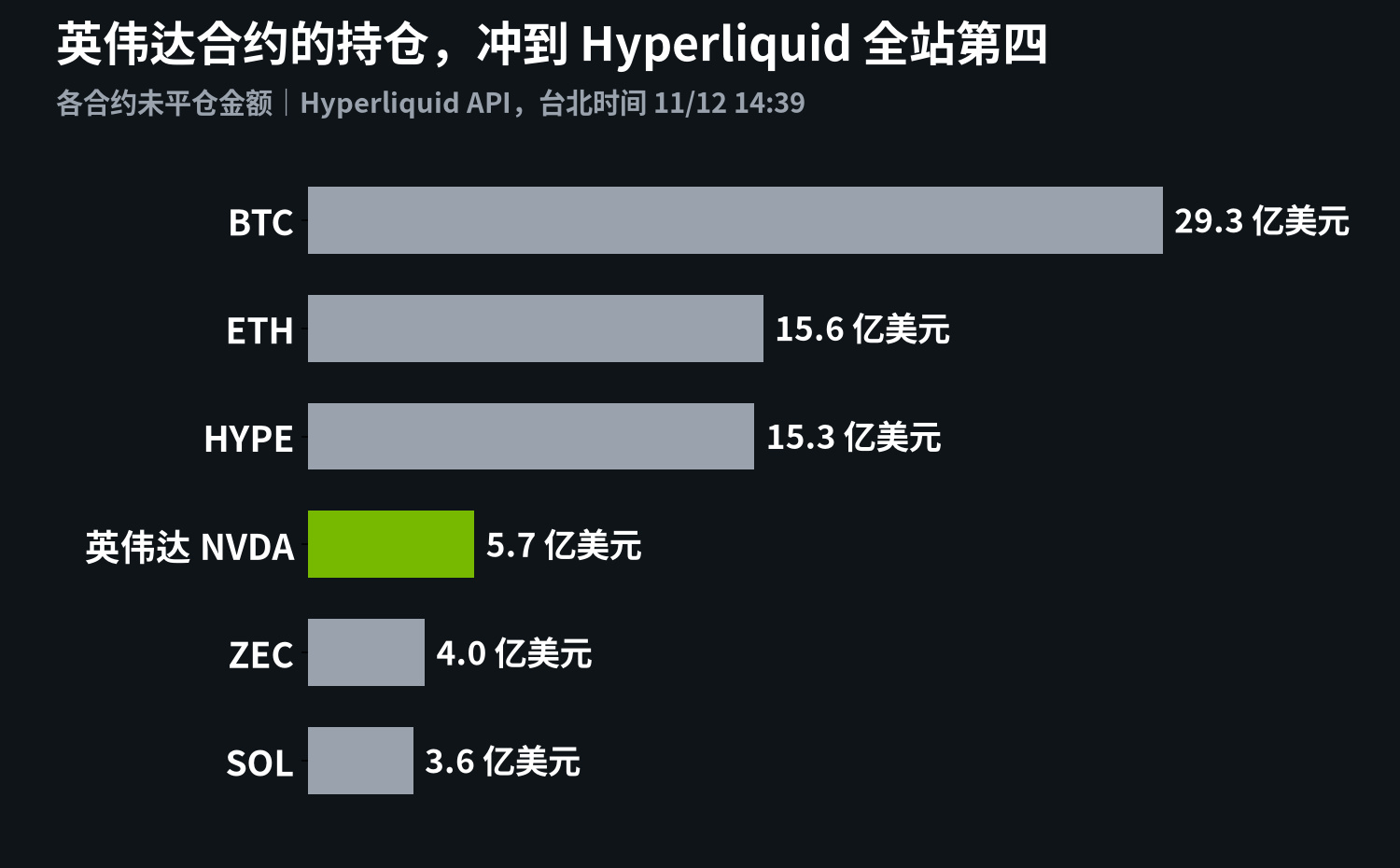
Reports say Nvidia’s (@nvidia) board is preparing to replace Jensen Huang. After the news broke, Nvidia shares fell about 8% in after-hours trading, and on-chain Nvidia contracts heated up too. NVDA perpetual contracts on @HyperliquidX traded about $1.2 billion over the past 24 hours.
The contract is a U.S. stock perpetual launched by @tradexyz on Hyperliquid. It uses USDC as collateral and trades 24 hours a day. As of 2:40 p.m. Taipei time today, its open interest was about $570 million. That puts it fourth across all of Hyperliquid, behind only Bitcoin, Ethereum, and HYPE—and ahead of SOL contracts, at about $360 million. Wu Says, citing monitoring by Mlm, reported that positions in this market grew about 5.8 times in seven days.
The contract price also reacted to the news. NVDA contracts are now around $160.95, down about 6.9% from $172.84 24 hours ago. Nvidia’s board has yet to announce a decision, and Jensen Huang remains CEO for now.
Even after such a steep price drop, longs are still paying shorts on the $570 million in open positions. The contract’s current funding rate is about 0.0069% per hour, or roughly 60% annualized.
$HYPE
259
·
--
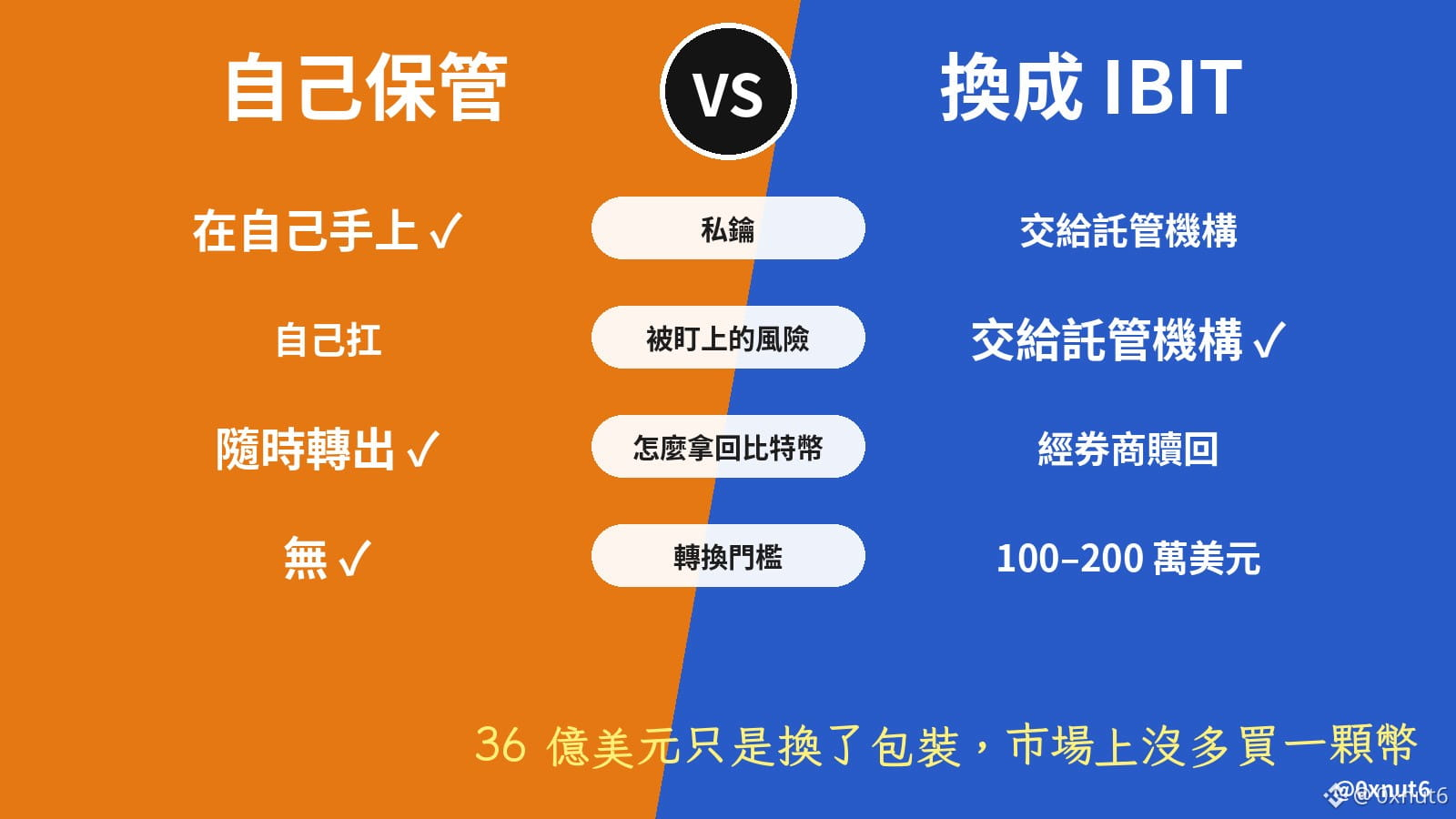
BlackRock Head of Digital Assets Robbie Mitchnick spoke with Barron’s on November 9. According to the report, since the U.S. allowed in-kind creations in July 2025, BlackRock has recorded about $3.6 billion worth of bitcoin being transferred directly from holders’ self-custody wallets into its iShares Bitcoin ETF, ticker IBIT. The actual figure may be higher, since some conversions are handled directly by intermediaries, and BlackRock may not see all of them.
Mitchnick said the reasons clients most often cite are security and peace of mind. French prosecutors responsible for organized crime have recorded 77 cases so far this year involving cryptocurrency-related kidnappings, extortion, and home invasions—more than in all of 2025. In August, a vulnerability was also found in the random number generation used to create private keys in Coldcard hardware wallets. For people holding large amounts of crypto, self-custody of private keys could make them a target.
These in-kind conversions can easily be misread in ETF flow data, because holders hand over bitcoin that already exists and receive newly issued ETF shares in return, without anyone buying coins on the market. These conversions are still counted in ETF creation figures, so when you see inflows, remember that some of them are simply the same bitcoin changing wrappers, not new money entering the market. In fact, cash flowed out over the past week. According to Farside data, U.S. spot bitcoin ETFs saw net outflows of about $1.28 billion in the week ending November 6, with IBIT accounting for about $1.21 billion.
The minimums have also been coming down. When in-kind creations first opened, a transaction required around $30 million; now, through intermediaries such as Galaxy Digital, Talos, and Virtu, transactions can be done with $1 million to $2 million.
After the conversion, the bitcoin is held in cold storage by an affiliate of Coinbase Prime. Holders no longer have the private keys; all they have is ETF shares in their brokerage accounts.
$BTC
BTC-0.40%
IBITETF-1.46%
151
·
--
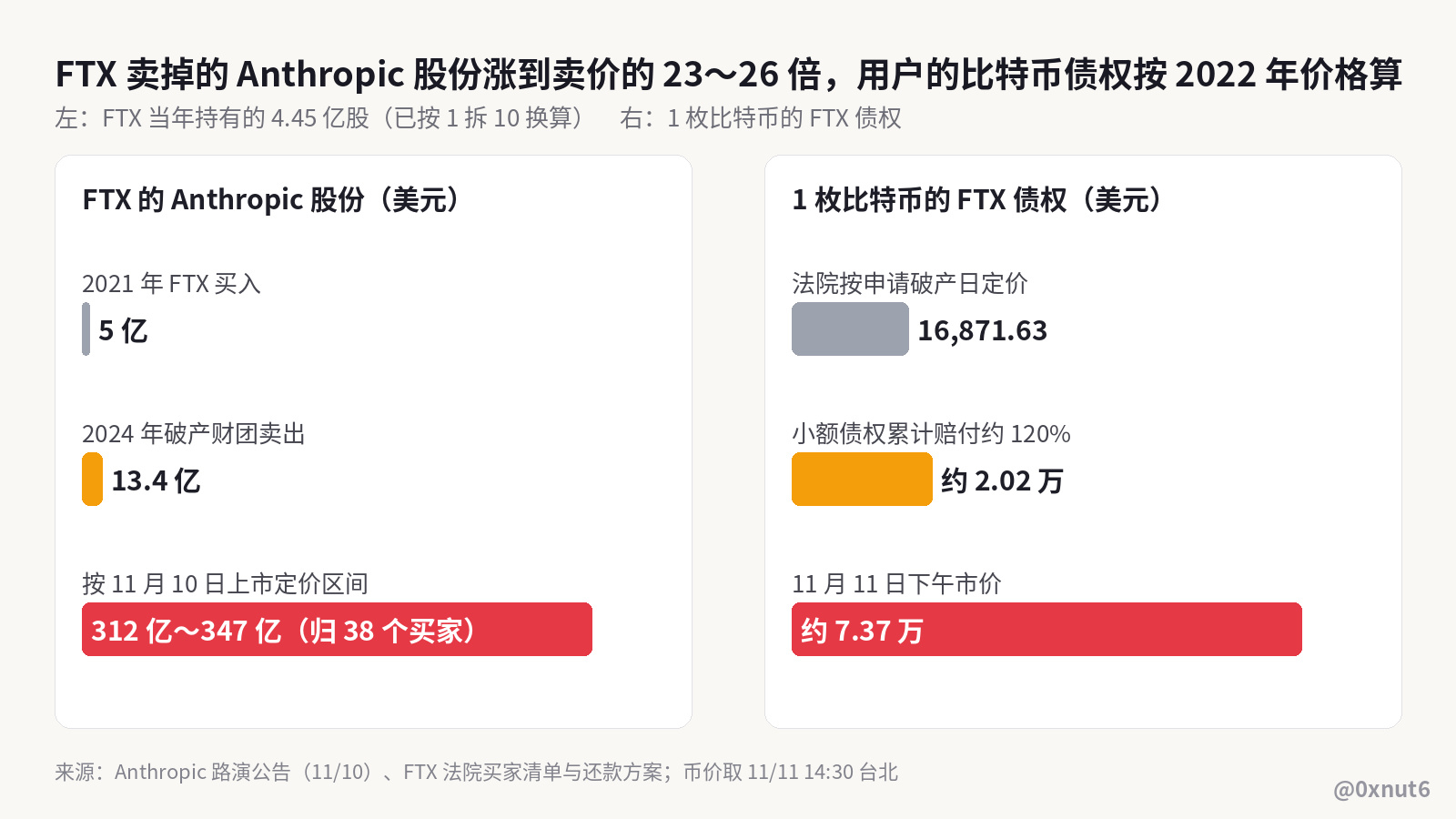
The FTX bankruptcy estate sold all of its @AnthropicAI shares in 2024, bringing in about $1.34 billion. Based on the IPO price range Anthropic announced on November 10, those shares would now be worth $31.2 billion to $34.7 billion.
FTX bought the shares in 2021 for $500 million, acquiring a total of 44.539 million shares. The bankruptcy estate sold them in two rounds for about $30 per share to 38 buyers, including funds managed by Jane Street and Fidelity. In September this year, Anthropic carried out a 10-for-1 stock split, bringing the number of shares to about 445 million. Adjusted for the split, FTX sold them for just $3 per share. The IPO price range is $70 to $78 per share.
Any gains after the shares were sold have nothing to do with FTX; they belong to the buyers who took them over. FTX users’ claims were fixed in dollar terms on November 11, 2022, the day FTX filed for bankruptcy. The court valued Bitcoin at $16,871.63 per coin. Small creditors with claims under $50,000 have received a total of about 120% of their claims. Someone who had deposited 1 Bitcoin can receive about $20,200. Bitcoin was trading at around $73,700 this afternoon, so that amount would now buy back only about 0.27 Bitcoin.
Under FTX’s repayment plan, the 120% received by small creditors already includes 9% annual interest. Any increase in Bitcoin’s price after the bankruptcy filing is not included.
$BTC
·
--
Article
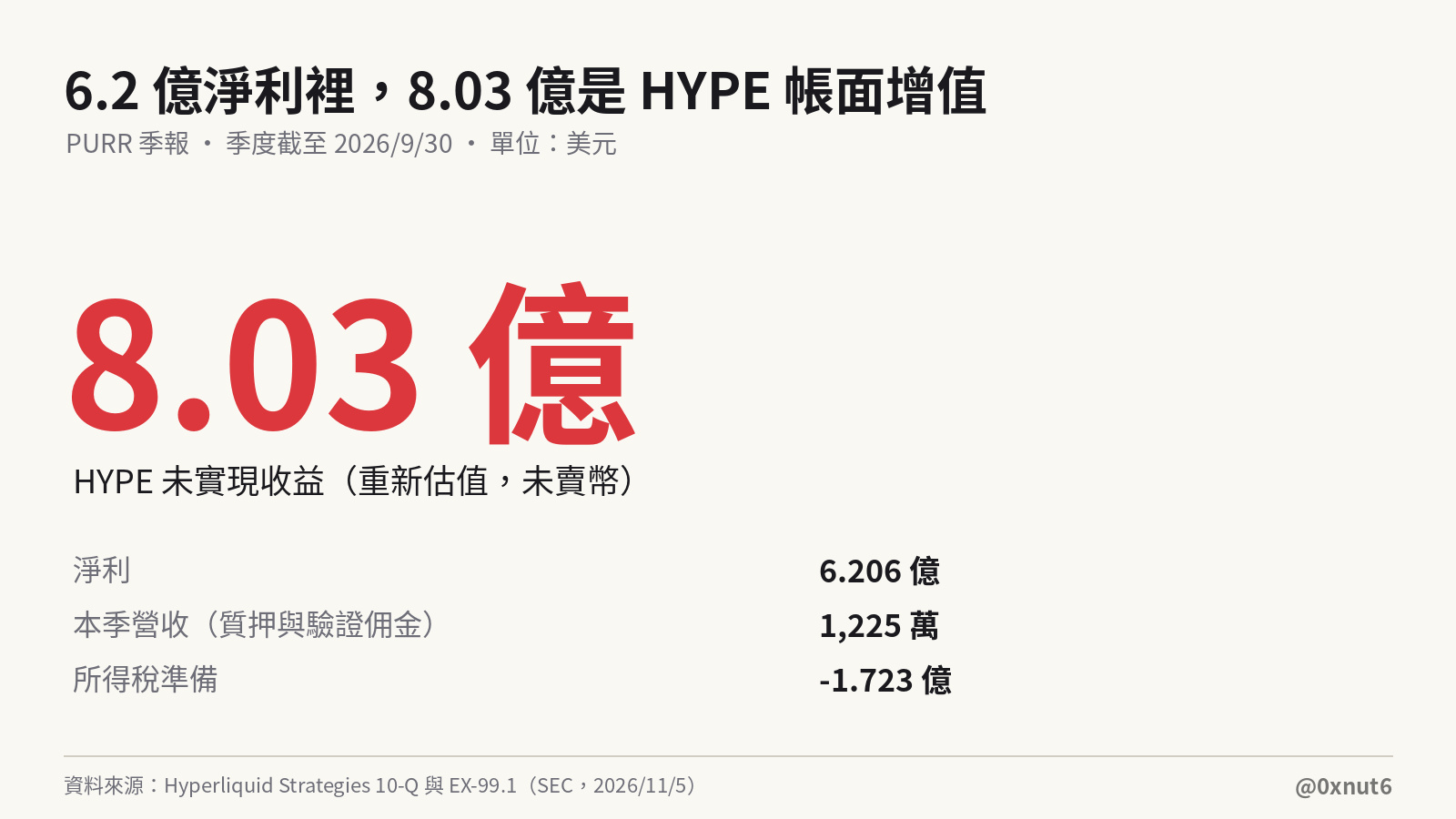
PURR applies to become a futures broker, aiming to open accounts for U.S. customers to trade new HIP-3* permissioned marketsIn its quarterly report released on 11/5, Hyperliquid Strategies (Nasdaq ticker: PURR) reported a striking figure: net income of $620.6 million. But another line in the same announcement could have a bigger impact on the company’s future. The publicly traded company, which specializes in buying HYPE, said its subsidiary had applied to become a futures commission merchant, commonly known in the U.S. as a futures broker.
CEO David Schamis put it this way: deploying $802 million this quarter (of which $785 million went toward buying HYPE) and applying to become a futures broker are “the same bet.” His comment ties together two parts of the treasury company’s strategy: holding HYPE and capturing value from protocol buybacks, and opening accounts for U.S. customers so they can trade on permissioned markets on Hyperliquid.
PURR applies to become a futures broker, aiming to open accounts for U.S. customers to trade new HIP-3* permissioned markets
In its quarterly report released on 11/5, Hyperliquid Strategies (Nasdaq ticker: PURR) reported a striking figure: net income of $620.6 million. But another line in the same announcement could have a bigger impact on the company’s future. The publicly traded company, which specializes in buying HYPE, said its subsidiary had applied to become a futures commission merchant, commonly known in the U.S. as a futures broker.
CEO David Schamis put it this way: deploying $802 million this quarter (of which $785 million went toward buying HYPE) and applying to become a futures broker are “the same bet.” His comment ties together two parts of the treasury company’s strategy: holding HYPE and capturing value from protocol buybacks, and opening accounts for U.S. customers so they can trade on permissioned markets on Hyperliquid.
CEO David Schamis put it this way: deploying $802 million this quarter (of which $785 million went toward buying HYPE) and applying to become a futures broker are “the same bet.” His comment ties together two parts of the treasury company’s strategy: holding HYPE and capturing value from protocol buybacks, and opening accounts for U.S. customers so they can trade on permissioned markets on Hyperliquid.
HYPE-0.80%
PURRUS-3.49%
153
·
--
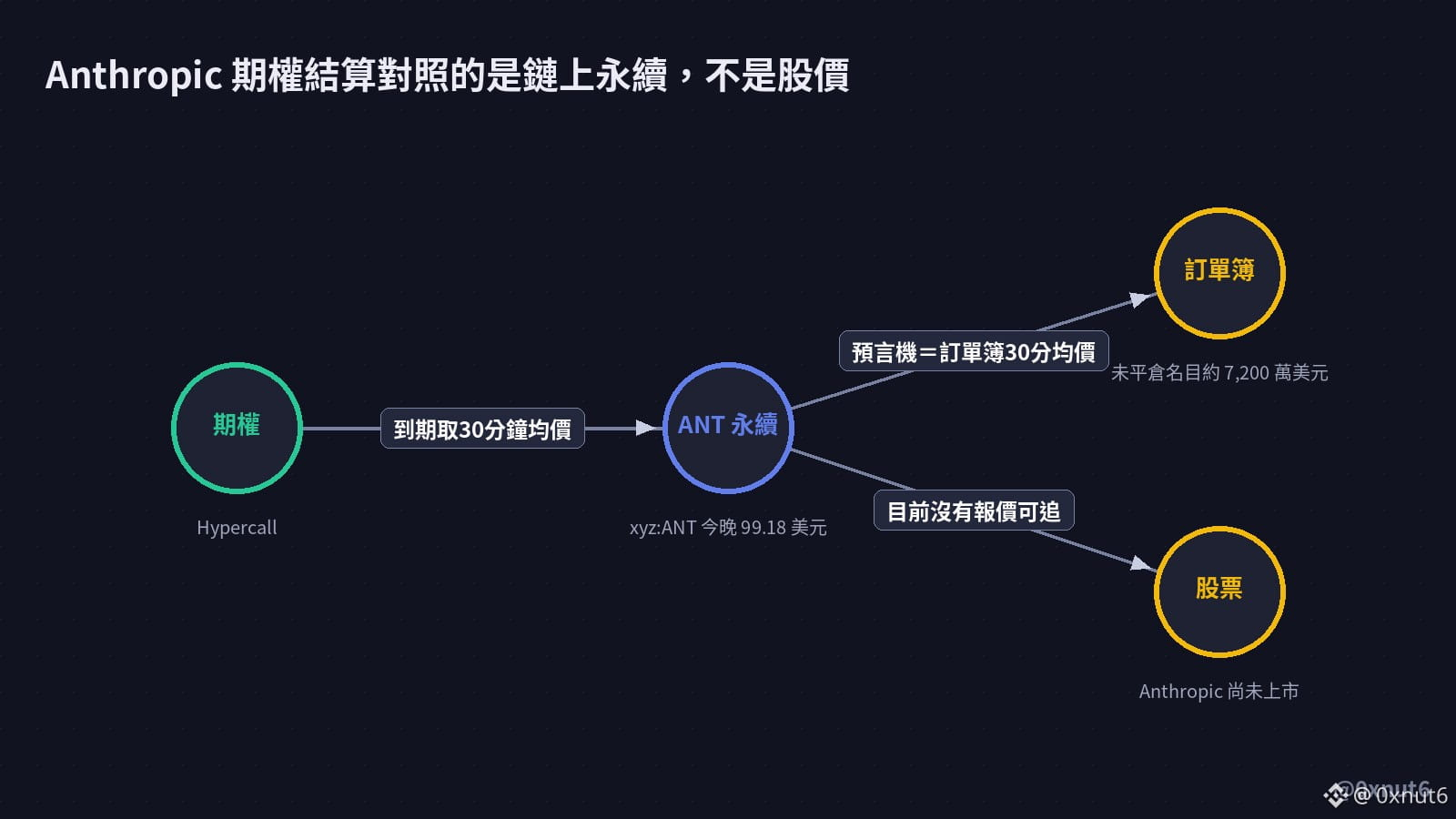
Buying Anthropic options means betting on the on-chain perpetual price, not the stock price.
Hypercall (@SynapseProtocol), an options platform on Hyperliquid, opens pre-IPO options on Anthropic tonight at 21:00. You can trade calls, puts, and spreads, settled in USDC cash; the options are not available to U.S. users. Since Anthropic shares are not yet trading, these options settle against the oracle price of the ANT perpetual contract (xyz:ANT) deployed by @tradexyz on @HyperliquidX.
There is no external quote to track for the ANT perpetual itself, either. According to trade[XYZ] documentation, its oracle price is calculated as a 30-minute average based on its own order book. The contract's opening reference price was $125; at around 21:00 tonight, it was $99.18, about 20% below that reference price. Its open interest is about $72 million in notional value, and its trading volume over the past 24 hours is about $13 million.
Hypercall's documentation says settlement is based on the oracle price over the 30 minutes before expiry, with expiry at 4 a.m. Taipei time. The price is sampled every 2 seconds during that period, with at least 500 samples required. The top and bottom 5% are discarded before calculating the settlement price. This approach can guard against a brief, seconds-long wick, but not against a price being pushed for a full 30 minutes in a market with only about $72 million in open interest.
The listing date is another variable. trade[XYZ] lists the expected IPO date as 11/20, but that is its own estimate; when Anthropic filed its S-1 on 10/26, it announced only the ticker ANT and gave no first trading date. If it still has not listed by the end of the grace period on 1/19/2027, ANT will default to cash settlement at its time-weighted average price since opening, and the options will follow that price.
So the value of these options at expiry depends on the average price of the xyz:ANT order book over its final 30 minutes, and has no direct connection to the IPO price ultimately set by @AnthropicAI and its underwriters.
$HYPE
166
·
--
To support its market cap through burns, Ethereum would have to operate like a company.
Because @VitalikButerin wrote today that if fee burns are to support Ethereum’s current market cap of around $270 billion, Ethereum would essentially have to operate like a world-class corporation, roughly the size of L’Oréal, ranked 55th by market cap. EIP-1559 burns part of the base fee, and Vitalik argues that the mechanism can stay; what he’s changing is the valuation argument: burns can stay, but they shouldn’t be treated as a floor.
First, he took apart the net present value formula behind the idea that “the more you burn, the more it’s worth.” The formula says market cap equals annual fee burns divided by the discount rate; if $1 billion is burned steadily each year and the discount rate is 4%, the floor would be $25 billion. From 2021 to 2023, Ethereum really did burn millions of ETH a year, including the NFT monkey sale he singled out, which burned around $180 million in fees in a single day. But most of that activity came from trading and lending within the ecosystem. If ETH fell tenfold, the money available to pay fees would shrink too, so this burn was never a true floor supported by external demand.
The cost of sustaining @ethereum’s market cap like a company is also clear. According to the estimate he cited, L’Oréal spends about 0.58% of its market cap on R&D each year. Applying that to this chain would almost immediately overwhelm the Ethereum Foundation @ethereumfndn. The protocol would have to allocate around 700,000 ETH a year to R&D instead, cutting validator income by roughly two-thirds; the company would also have to engage in long-term, interventionist governance to pursue new markets and products. Both of these run counter to decentralization, censorship resistance, and resistance to capture.
So he says EIP-1559 and the burn mechanism should both stay, but there’s no need to be upset even if burns remain below 10% of the amount needed to break even over the long term. ETH’s value should come from being a store of value—that is, from the stability provided by decentralization and what he calls CROPS: censorship resistance, resistance to capture, open source, privacy, and security. To rely on burns to sustain the market cap he describes, we’d have to accept large annual allocations from within the protocol and govern a public blockchain like a company.
$ETH

234
·
--
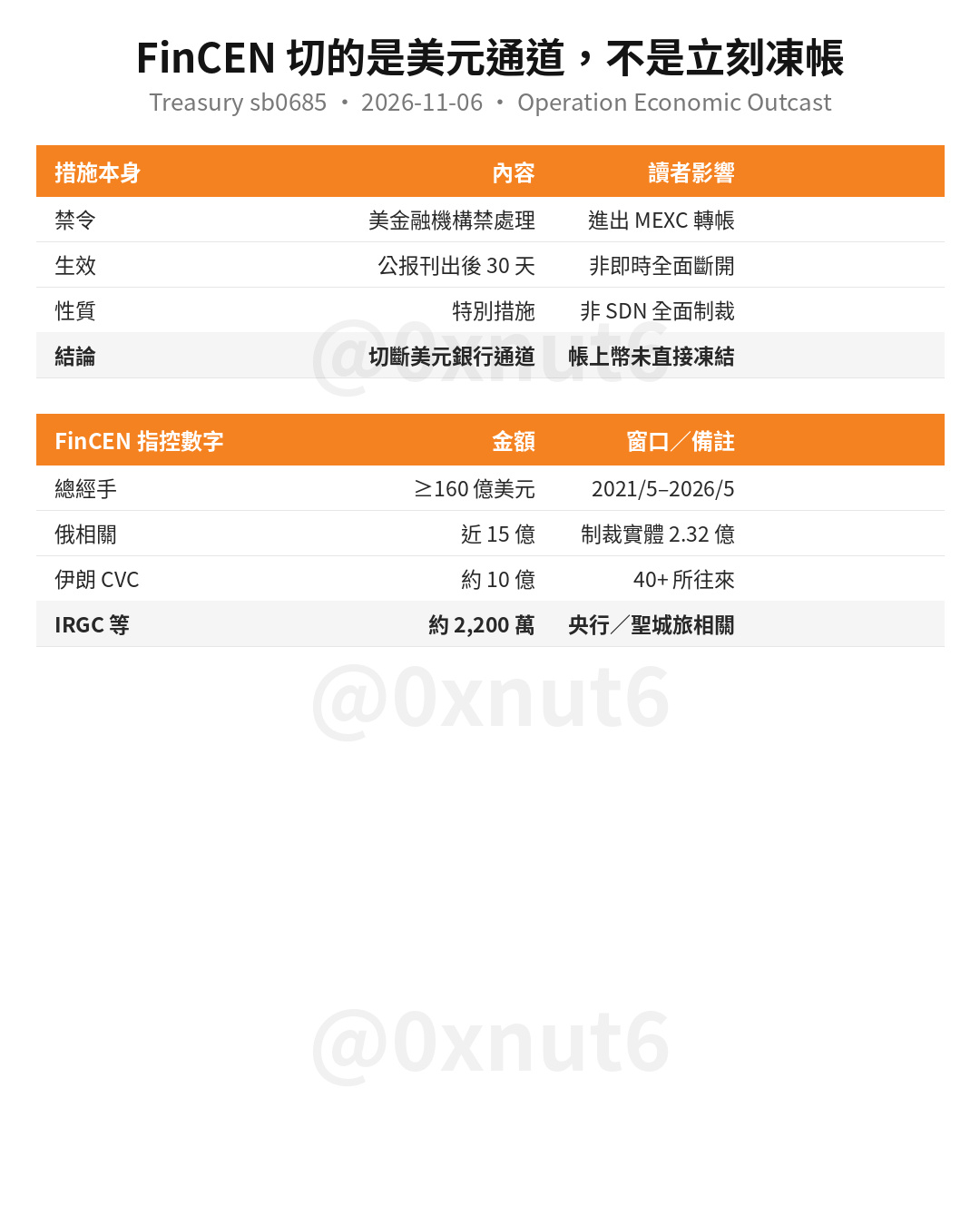
FinCEN is cutting off the dollar channel, not freezing accounts immediately.
Under a special measure, the U.S. Treasury’s Financial Crimes Enforcement Network (FinCEN) has prohibited U.S. financial institutions from processing fund transfers to or from MEXC Global, effectively cutting off its banking access to the U.S. financial system. This is part of Operation Economic Outcast and takes effect 30 days after publication in the Federal Register. It is not a sweeping SDN sanction, nor does it immediately freeze the cryptocurrency in users’ accounts.
FinCEN alleges that from May 2021 to May 2026, MEXC handled at least about $16 billion in funds connected to sanctions evasion, cybercrime, and other activities. Nearly $1.5 billion was Russia-related, with about $232 million in direct dealings with entities sanctioned by the U.S., EU, and UK. MEXC had direct dealings worth about $1 billion with more than 40 Iranian cryptocurrency exchanges, and about $22 million involving Iran’s Central Bank, the Revolutionary Guard, and the Quds Force. As of June 2026, it was still trading with Garantex, sanctioned by OFAC in April 2022, and its successor, Grinex. Founded in 2018, MEXC is among the world’s top 20 exchanges. As of September 2026, its daily trading volume exceeded $1 billion, and its reserves were about $5 billion.
@MEXC’s official response said it was aware of the matter and would cooperate with legal and compliance reviews. It also said operations were normal, user assets were safe, and an independent assessment of its anti-money-laundering and sanctions controls had been launched. The official statement says “cooperate with the review,” not “deny the allegations.”
So for Chinese-speaking readers who still have assets on the platform, the immediate question is whether dollar deposits and withdrawals through banks still work. During the 30-day window, this measure does not directly freeze the coins in their accounts.
83
·
--
Article
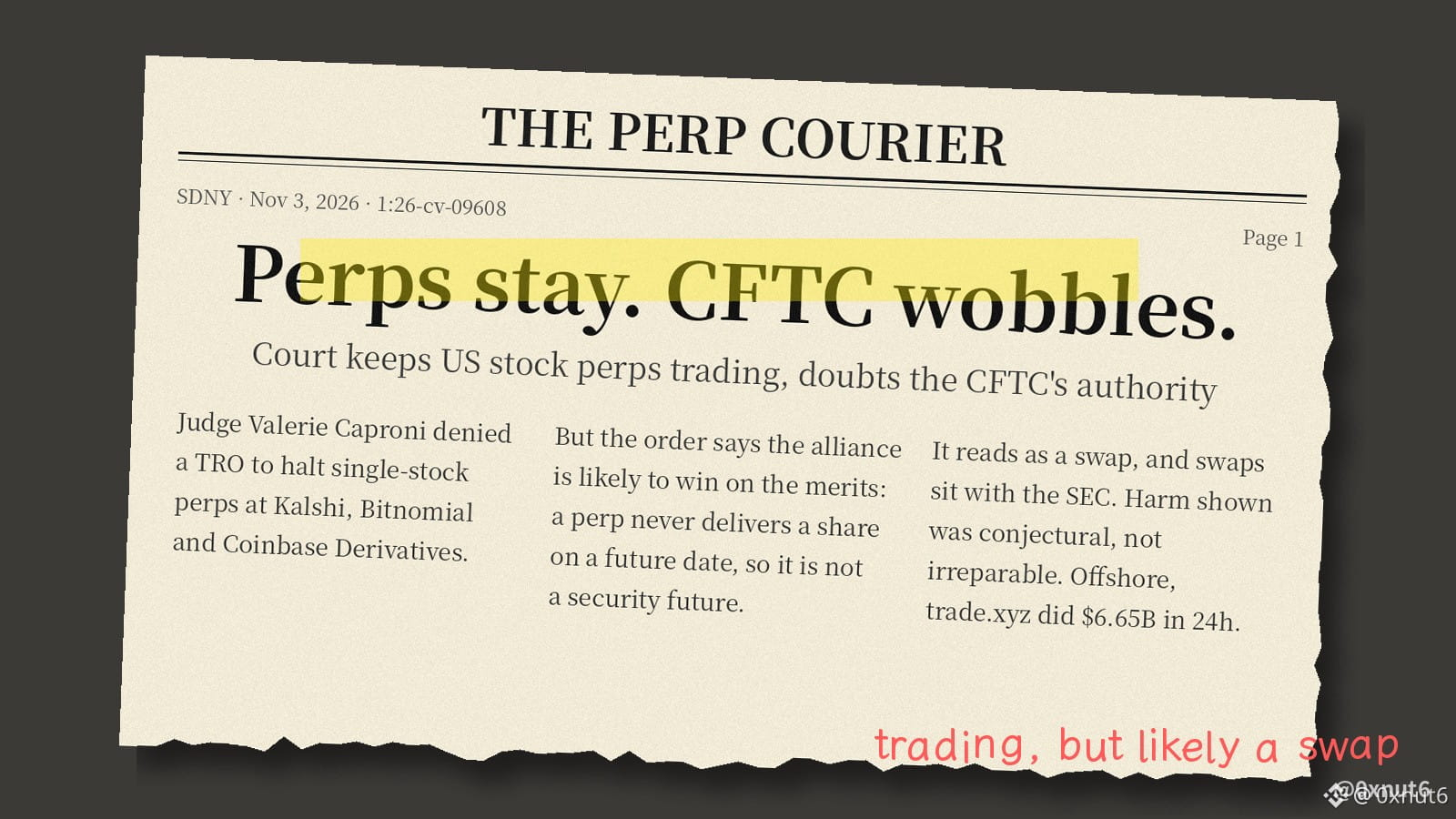
US stock perps keep trading, but the judge doubts the CFTCA federal judge refused on Nov 3 to halt US single-stock perps, then wrote that the challengers will likely win. So the products kept trading while losing the legal argument.
The case: the Capital Markets Alliance, backed by Cboe and Citadel Securities, sued @CFTC hours after it cleared stock perps at Kalshi, Bitnomial and Coinbase Derivatives as security futures.
The reasoning, per Judge Valerie Caproni: a perp never delivers a share on a future date, so it fails the legal definition of a security future. It reads as a swap, and swaps on single stocks belong to the SEC.
Why the halt still failed: she found the equities and public interest favored the alliance, but its declarations showed only conjectural harm, not irreparable harm.
What rides on it: the same product already trades offshore. @tradexyz on Hyperliquid did $6.65B in 24h volume this morning, with $4.4B open interest. Its S&P 500 contract alone traded $736M.
The order denied the halt and still called the CFTC approval likely beyond its authority.
$HYPE
US stock perps keep trading, but the judge doubts the CFTC
A federal judge refused on Nov 3 to halt US single-stock perps, then wrote that the challengers will likely win. So the products kept trading while losing the legal argument.
The case: the Capital Markets Alliance, backed by Cboe and Citadel Securities, sued @CFTC hours after it cleared stock perps at Kalshi, Bitnomial and Coinbase Derivatives as security futures.
The reasoning, per Judge Valerie Caproni: a perp never delivers a share on a future date, so it fails the legal definition of a security future. It reads as a swap, and swaps on single stocks belong to the SEC.
Why the halt still failed: she found the equities and public interest favored the alliance, but its declarations showed only conjectural harm, not irreparable harm.
What rides on it: the same product already trades offshore. @tradexyz on Hyperliquid did $6.65B in 24h volume this morning, with $4.4B open interest. Its S&P 500 contract alone traded $736M.
The order denied the halt and still called the CFTC approval likely beyond its authority.
$HYPE
196
·
--
Circle’s revenue grew 17% year over year, entirely propped up by a one-time token sale.
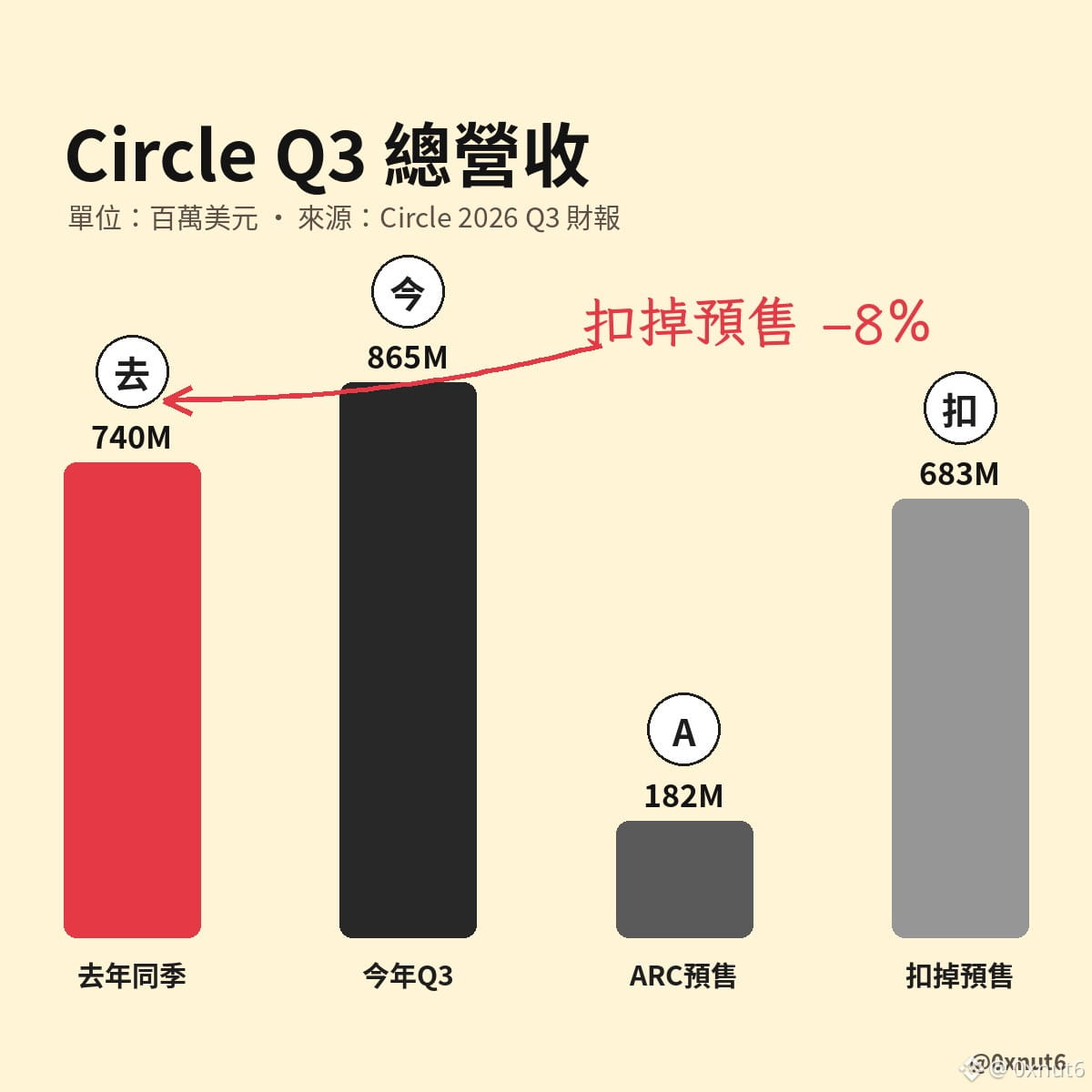
Of the $865 million in total revenue @circle reported tonight for Q3, $182 million came from the ARC token presale—a one-time source of revenue that won’t recur next quarter.
The core business is shrinking: reserve revenue was $658 million, down 8% year over year. The main reason is that the reserve yield fell to 3.5%. As interest rates decline, so does interest income from USDC.
Excluding the presale, total revenue was about $683 million. The same quarter last year brought in $740 million, meaning revenue was down about 8% year over year.
Scale hasn’t increased either: USDC in circulation at quarter-end was $73.9 billion, unchanged year over year.
The guidance from @jerallaire’s team remains unchanged in the same earnings report: the long-term target for USDC circulation is still 40% compound annual growth.
$USDC
27
·
--
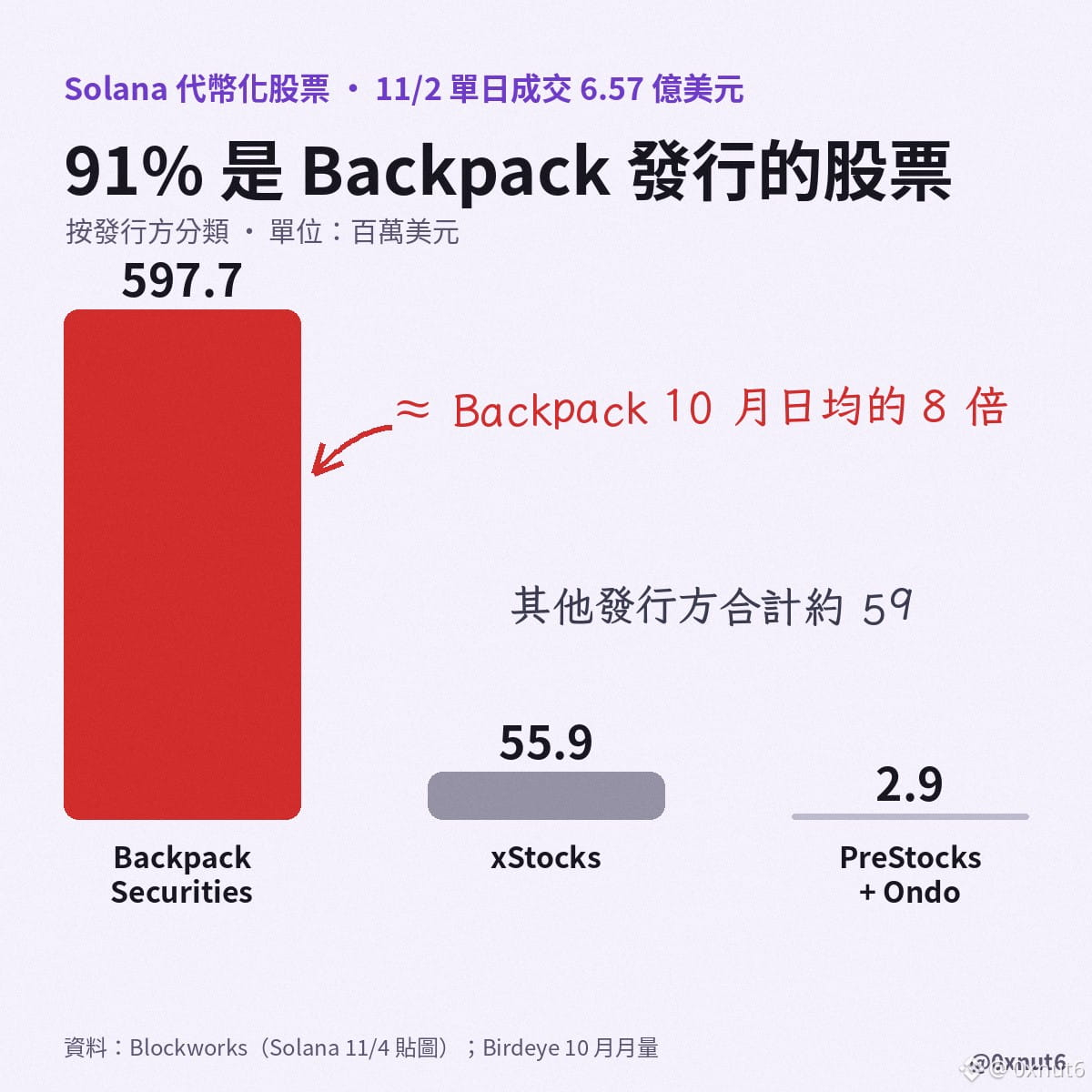
Solana’s official X account posted a chart from Blockworks today: On Monday, 11/2, tokenized stocks on Solana recorded $657 million in daily trading volume, making it the highest-volume day since September. I’ve added the figures from the chart broken down by issuer.
The chart categorizes stocks by who originally issued the token. Stocks issued by Backpack Securities recorded $598 million in trading volume that day, accounting for 91%. In second place, xStocks recorded $55.93 million that day, with no comparable surge in volume. PreStocks and Ondo each recorded just over $1 million.
For comparison, Birdeye’s monthly data shows that Backpack Securities recorded $2.3 billion in trading volume over the entire month of October, averaging about $74 million per day. On 11/2 alone, it did 26% of October’s total monthly volume—about 8 times its October daily average.
This chart is broken down by issuer, not trading venue, so the $598 million represents on-chain trading of stocks issued by Backpack across all venues; it doesn’t necessarily all come from the Backpack exchange.
Excluding Backpack, tokenized stocks from all other issuers on Solana recorded only about $59 million in total trading volume on 11/2—less than the total on-chain volume on most days since September.
$SOL
152
·
--
About $6.34 billion was transferred out of Binance on October 29. In a preliminary report published last night, @binance said the attackers’ first two points of entry were things crypto professionals do almost every day: searching for an AI coding tool to install, and taking a job interview.
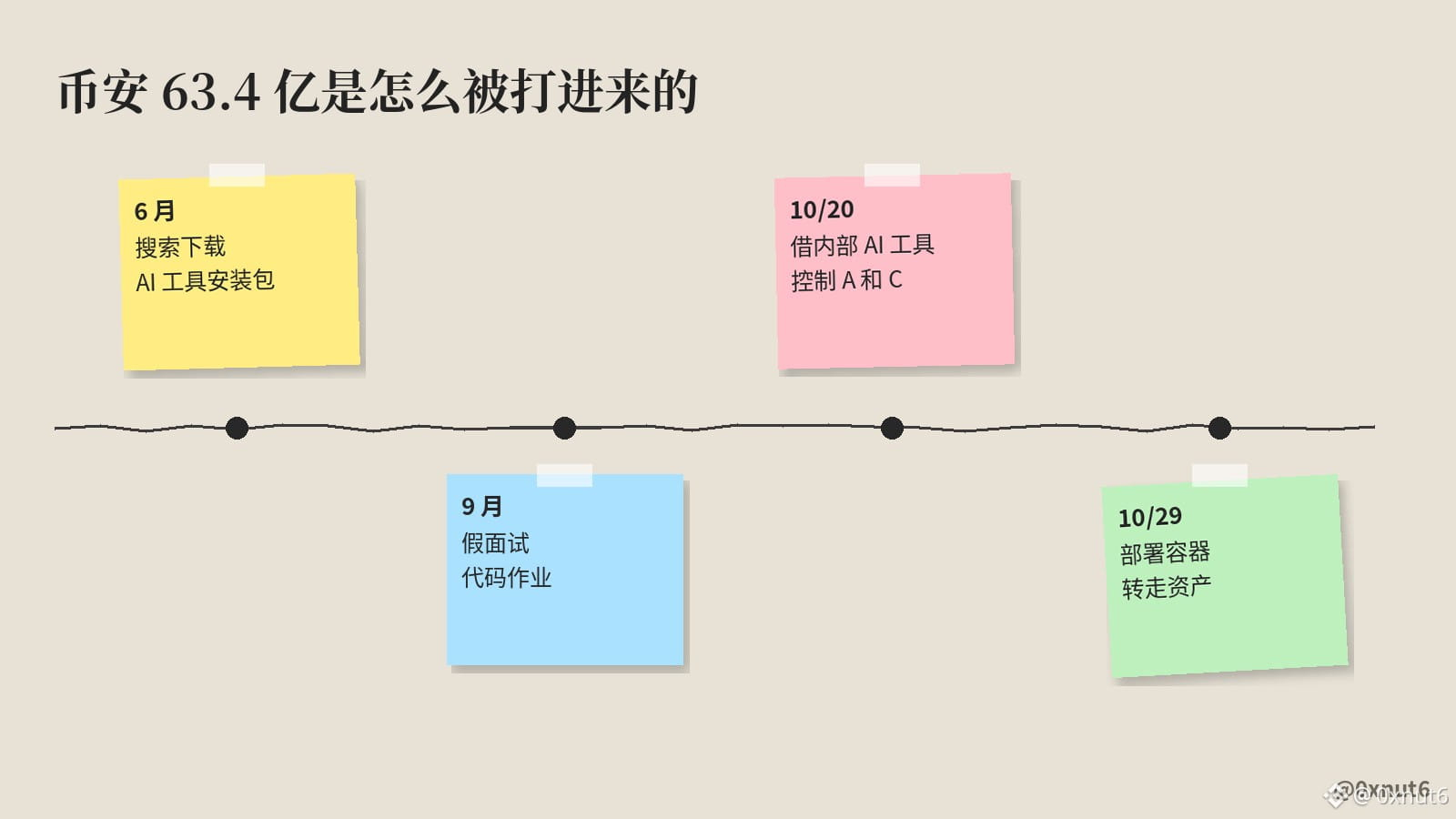
The first entry point was in June. Wallet operations engineer A searched for a popular AI coding tool, but downloaded a tampered Homebrew installer. Binance’s security team detected the anomaly at the time, replaced the computer, and rotated the credentials. Replacing the computer stopped that intrusion, but it couldn’t undo the information that had already leaked: the attackers knew A’s role and the identities of colleagues on his wallet team.
The second entry point was in September. Engineer B was contacted on a legitimate job platform by someone claiming to be a project director. The first interview was a video call with HR, and the person also shared social media accounts featuring personal photos and videos to gain B’s trust. The second interview was with someone claiming to be the CEO, who eventually asked B to download a coding assignment to his work computer. When installed, the repository ran automatically, replaced the computer’s pyenv with a malicious version, and connected to the attackers’ server. The endpoint protection software did not raise an alert.
The subsequent steps all relied on these two computers. On October 20, using B’s computer and an internal AI tool, the attackers took control of the computers of A and another wallet engineer, C, and found a container deployment token on A’s computer. On October 29, they used the token to deploy a container and call the signing service to transfer out the assets.
SlowMist founder Yu Xian @evilcos believes this was an advanced persistent threat that lasted for months. Those who have read the report should check whether they or their colleagues could fall for similar supply-chain attacks. Binance said it has blocked 57 similar suspected North Korea-linked attempts this year, involving tactics such as fake interviews, malware disguised as popular developer tools, and fake video conferencing software. The attempts it failed to stop this time were the installer found through a search in June and the interview assignment in September.
$BNB $BTC
160
·
--
This week I did something that saved me a lot of effort: I told Grok Bot, “Look through my original posts and reposts on X from the past 30 days, and tell me what kinds of posts people are reading and what times are safest to post.” It pulled the data and laid out the results for me.
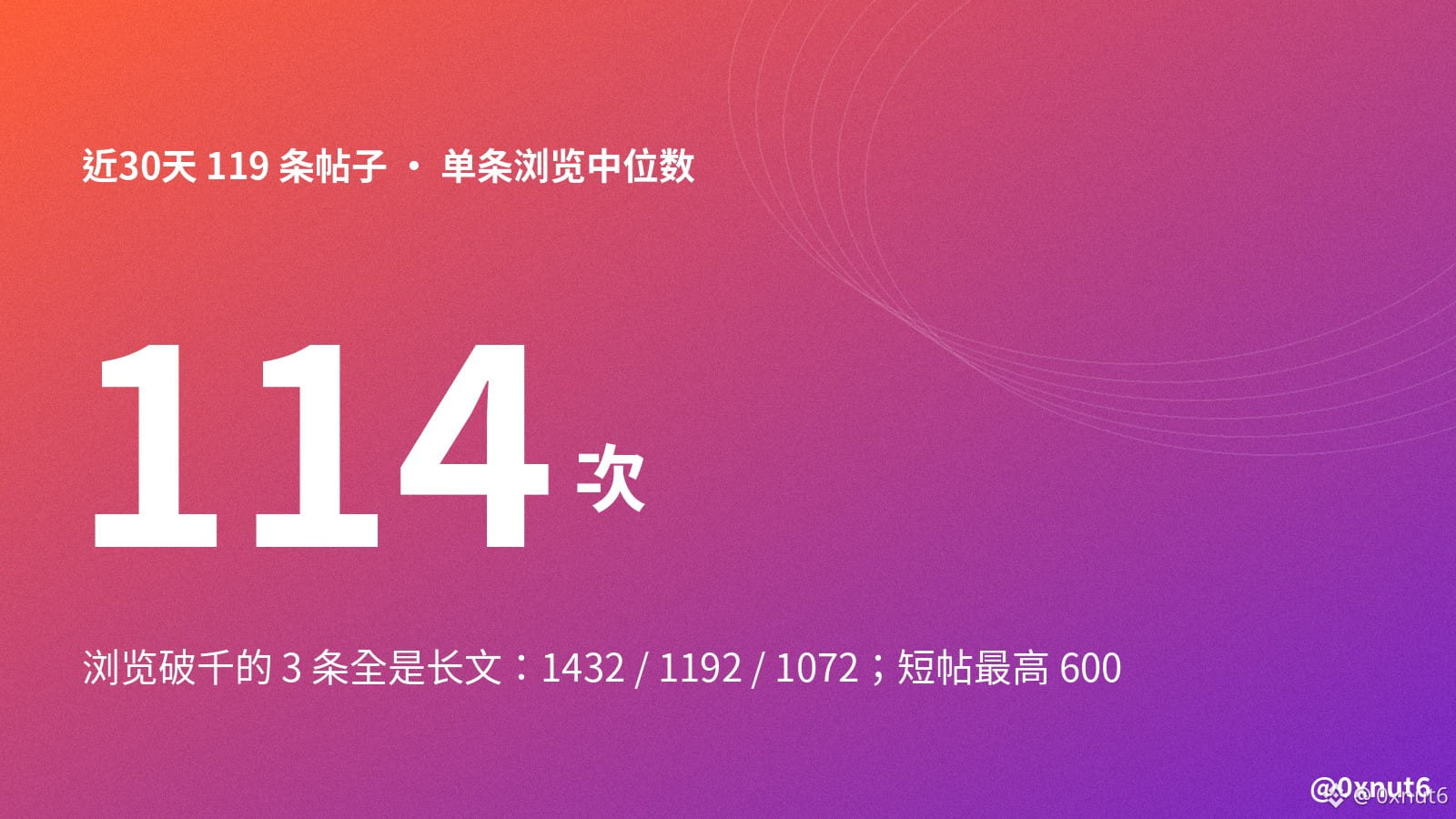
It pulled 119 posts from the past 30 days: 91 original posts and 28 reposts. Total views were about 19,500, while the median views per post were just 114.
The biggest surprise was that the top three were all long-form posts: the tokenized stocks post from 10/15 got 1,432 views, the comparison of Binance and Hyperliquid stock perpetuals from 10/24 got 1,192, and the post from 10/17 about a tenfold fee difference for the same order book frontend got 1,072. All three got more than 9 times the median, while the most-viewed short post, about Solana Alpenglow, got only 600.
I cross-checked the numbers for the top posts against the raw data returned by the X API, and only wrote this after confirming they matched. It’s easy to reproduce: just paste the sentence above as-is. No need to export a CSV or install an analytics plugin. The numbers should always be based on what you pull from your own account at that moment; other people’s screenshots are only a reference.
The most useful takeaway for me is straightforward: short posts keep everyday visibility up, but only long-form posts get over a thousand views.
54
·
--
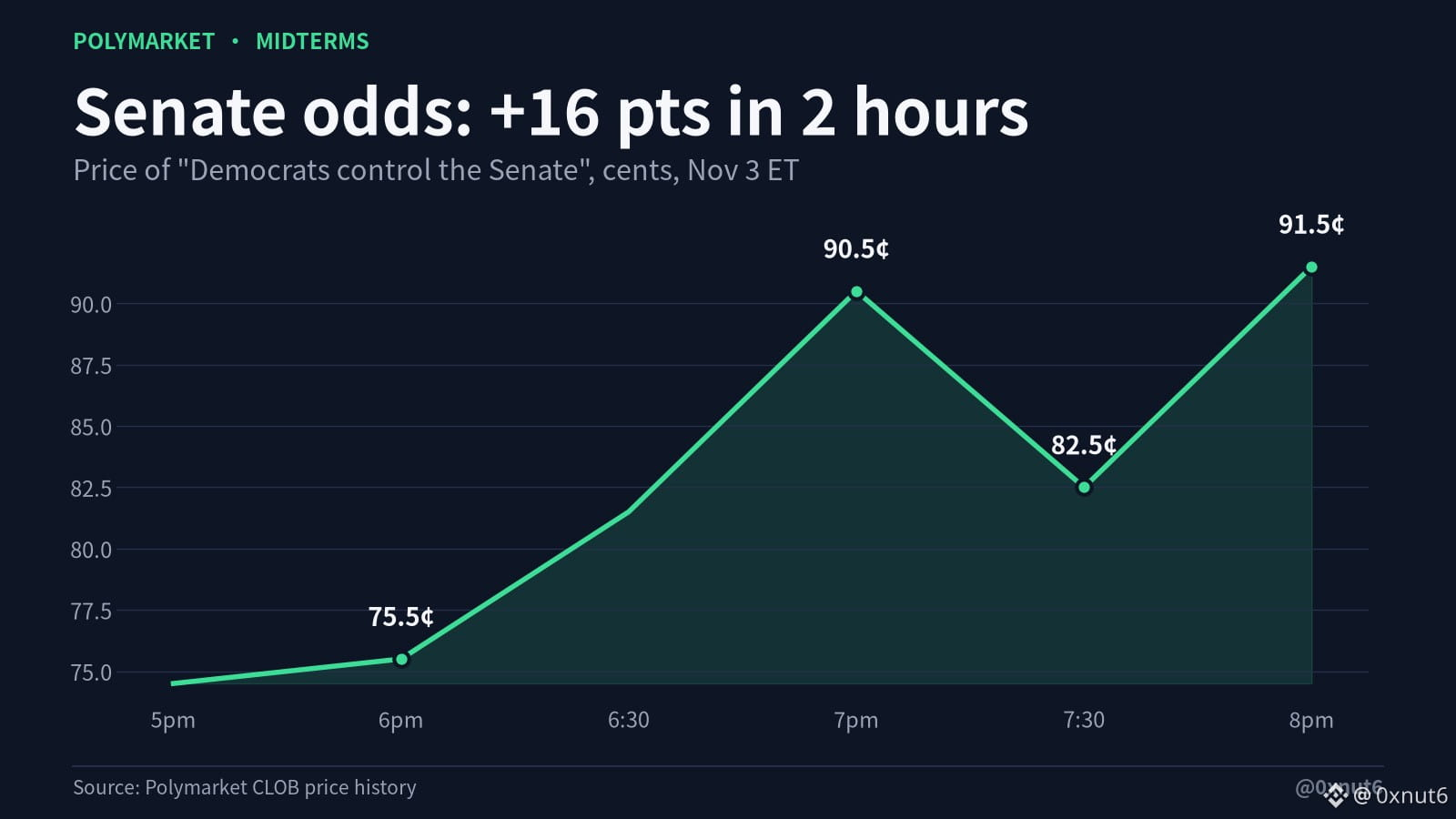
Polymarket's Senate market moved 16 points in two hours tonight, while most US ballots are still uncounted.
Democrats to control the Senate traded at 75.5¢ at 6pm ET. By 8pm ET the same contract printed 91.5¢.
The path was not a straight line. It touched 90.5¢ at 7pm. Thirty minutes later it was back at 82.5¢, then it climbed again.
So early returns, not final tallies, are doing the repricing. @Polymarket shows $24.7M traded on the Senate question and $51.5M on the House, where Democrats sit at 99¢.
At 8pm ET a Democratic Senate cost 91.5¢ on Polymarket, up from 75.5¢ two hours earlier.
$POL $BTC
109
·
--
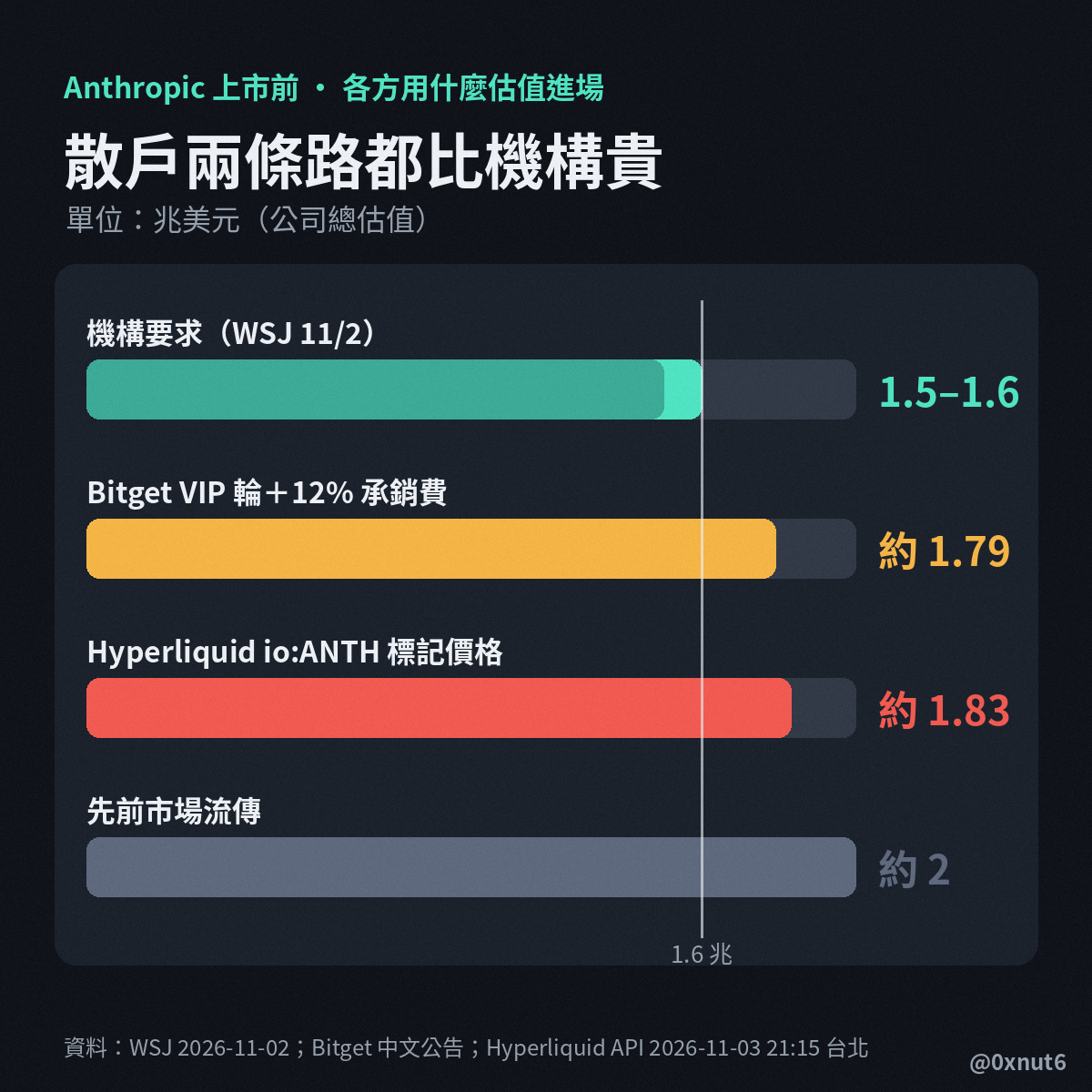
Anthropic hasn’t gone public yet, but retail investors are already paying significantly more than Wall Street institutions.
That’s because institutions are driving down the price. The Wall Street Journal reported on November 2 that institutions preparing to subscribe to the IPO are seeking a valuation of $1.5 trillion to $1.6 trillion, below the roughly $2 trillion previously rumored.
The first route is to buy through an exchange. @Bitget_zh’s IPO Prime VIP round opens on November 5 and requires a 12% underwriting service fee upfront. Even at a $1.6 trillion valuation, adding this fee brings the effective entry price to about $1.79 trillion.
The second route is on-chain perpetuals. On @HyperliquidX, io:ANTH from @entropyIO has each point representing a $1 billion valuation. Tonight’s mark price is around 1,832, or $1.83 trillion, with open interest of about $98.4 million.
Prices on both routes range from $1.79 trillion to $1.83 trillion, 12% to 14% above the $1.6 trillion upper end sought by institutions. Bitget’s announcement lists November 18 as the potential listing date.
$HYPE $BGB
89
·
--
Article
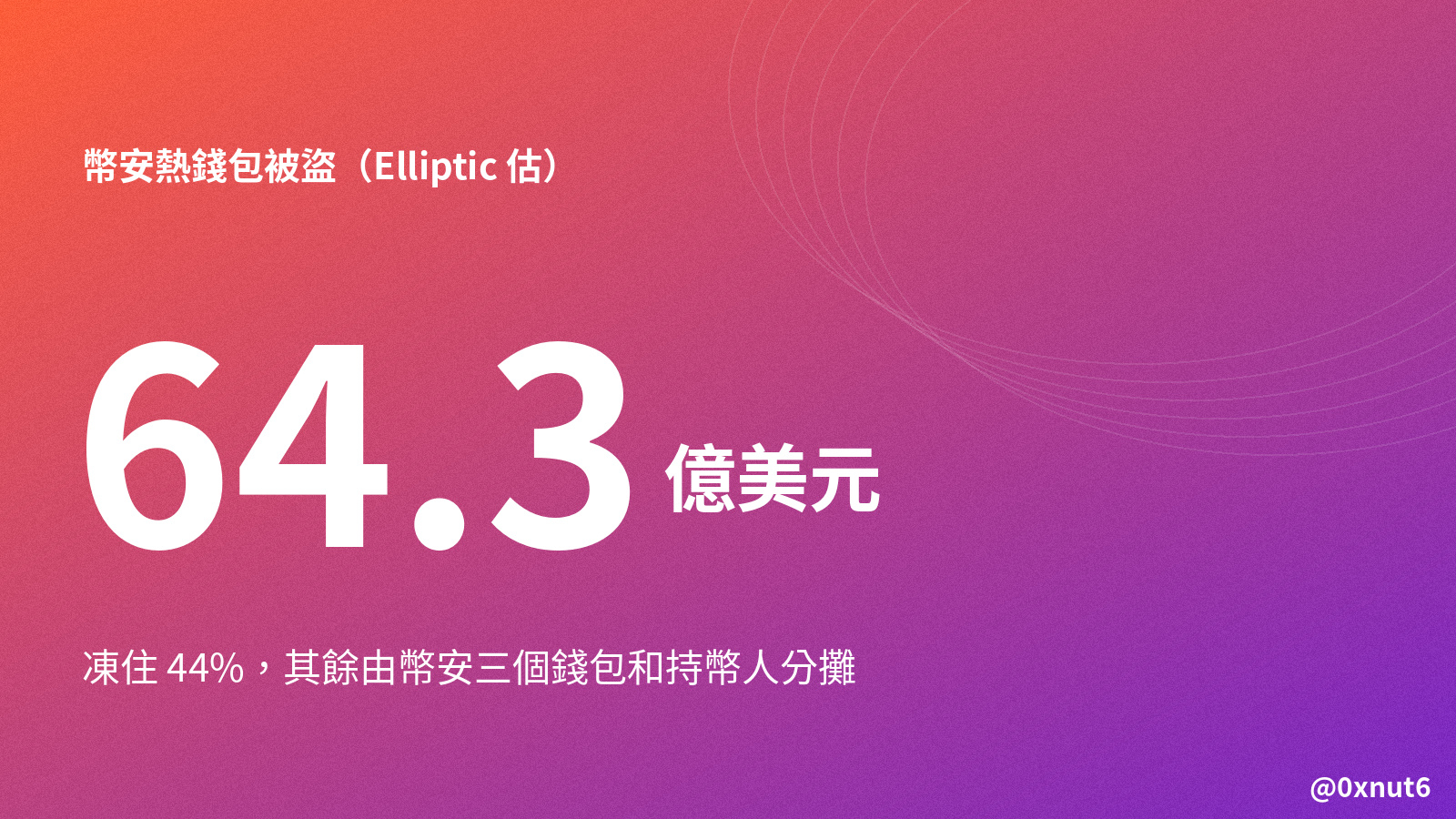
The bill for Binance’s $6.4 billion hack: users didn’t pay—but the money landed in these four placesOnly 44% was frozen; the rest of the bill was paid by Binance’s own three wallets, with holders of the coins dumped by the hackers sharing the cost.
Late on October 29, assets were transferred out of Binance’s hot wallet. Elliptic estimates their value at about $6.43 billion, while Binance says it allocated more than $6.34 billion in company funds to cover the losses. Today is day five: withdrawals have gradually resumed, and Binance has repeatedly said that “losses will not be passed on to users.” Users have indeed not been charged, but $6.4 billion doesn’t just vanish. I’ve brought together Binance’s six official updates from the past few days, @elliptic’s tracking figures, proof-of-reserves snapshots, and on-chain dumping records to see who ultimately bears the cost.
The bill for Binance’s $6.4 billion hack: users didn’t pay—but the money landed in these four places
Only 44% was frozen; the rest of the bill was paid by Binance’s own three wallets, with holders of the coins dumped by the hackers sharing the cost.
Late on October 29, assets were transferred out of Binance’s hot wallet. Elliptic estimates their value at about $6.43 billion, while Binance says it allocated more than $6.34 billion in company funds to cover the losses. Today is day five: withdrawals have gradually resumed, and Binance has repeatedly said that “losses will not be passed on to users.” Users have indeed not been charged, but $6.4 billion doesn’t just vanish. I’ve brought together Binance’s six official updates from the past few days, @elliptic’s tracking figures, proof-of-reserves snapshots, and on-chain dumping records to see who ultimately bears the cost.
Late on October 29, assets were transferred out of Binance’s hot wallet. Elliptic estimates their value at about $6.43 billion, while Binance says it allocated more than $6.34 billion in company funds to cover the losses. Today is day five: withdrawals have gradually resumed, and Binance has repeatedly said that “losses will not be passed on to users.” Users have indeed not been charged, but $6.4 billion doesn’t just vanish. I’ve brought together Binance’s six official updates from the past few days, @elliptic’s tracking figures, proof-of-reserves snapshots, and on-chain dumping records to see who ultimately bears the cost.
271
·
--
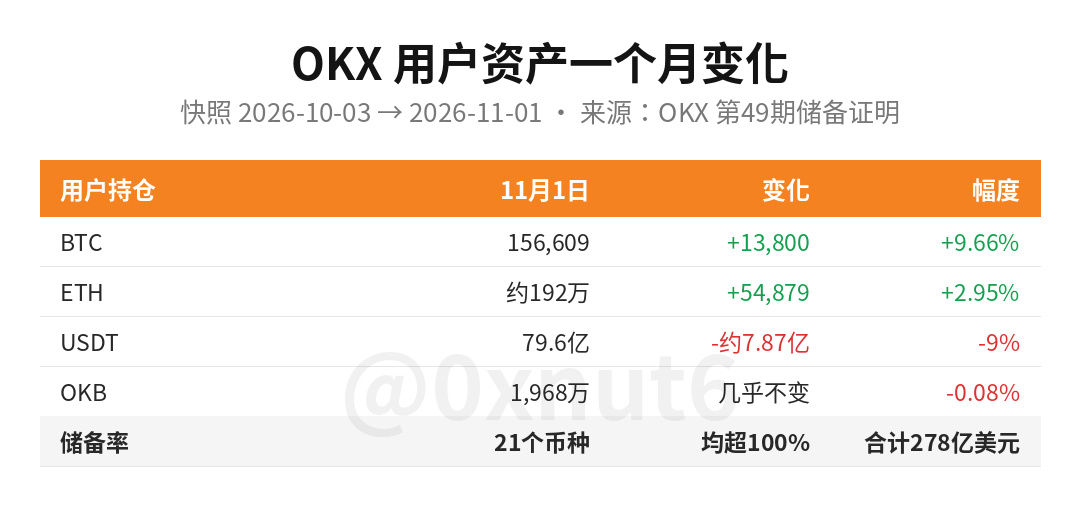
OKX 49th Proof of Reserves: On November 1, users held 156,609 BTC, up 13,800 from October 3.
In the same report, users held about 787 million fewer USDT, leaving 7.96 billion.
The two snapshots use the same methodology, so over the month users deposited more crypto and held fewer stablecoins:
BTC +9.66%
ETH +54,879, to about 1.92 million (+2.95%)
USDT -9%
OKB -0.08%, almost unchanged
According to OKX's official summary, reserve ratios for all 21 assets were above 100%, with major assets totaling $27.8 billion.
Over the month, OKX users' balances increased by 13,800 BTC and decreased by 787 million USDT—the two moved in opposite directions.
$BTC $OKB
204
·
--
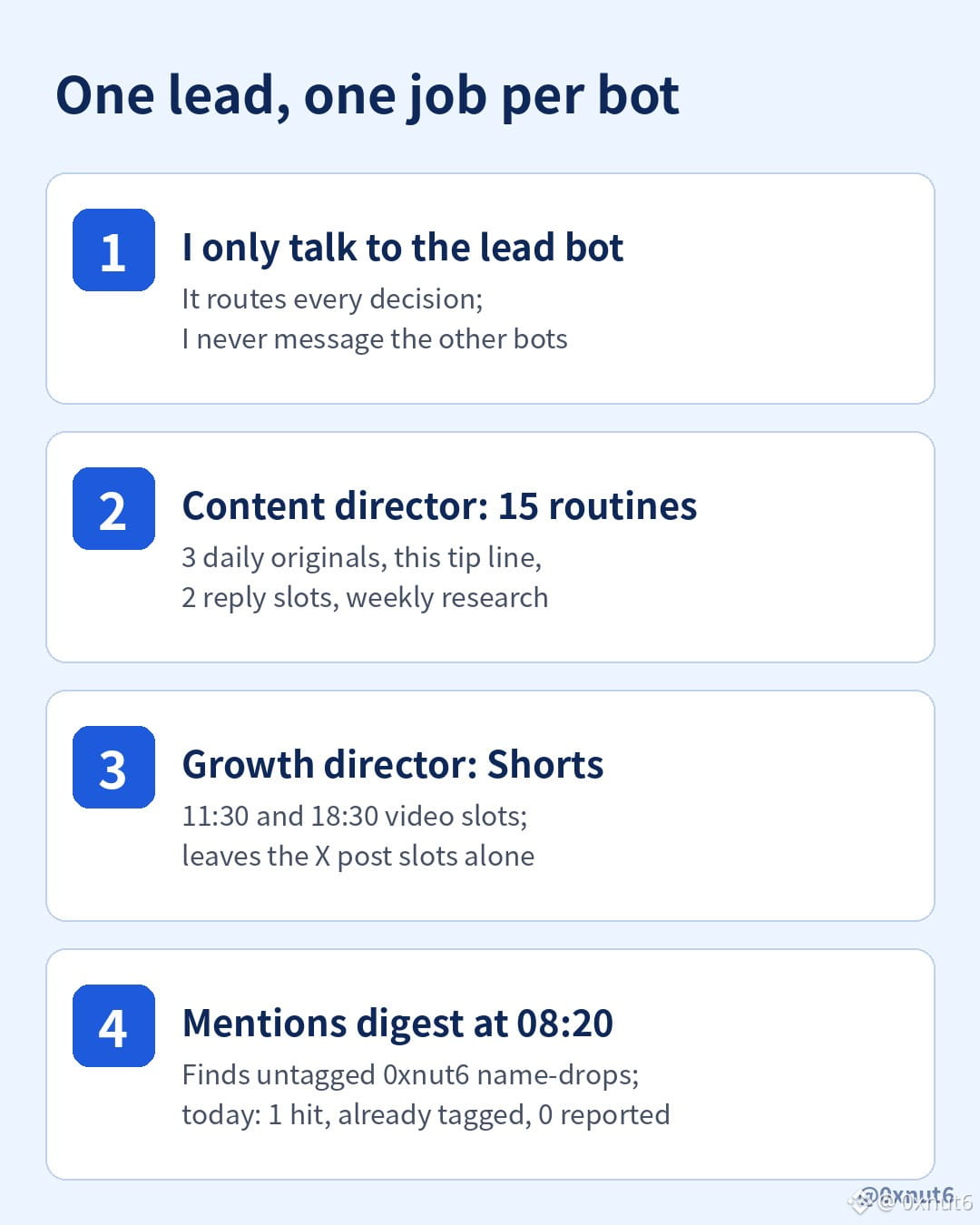
A viral post this week said SpaceXAI engineer Lauren Tan runs her whole job through 7 Grok Bots. She talks to one chief of staff, and every other bot owns exactly one job.
I run @0xnut6 the same way, and the split is boring on purpose. I only talk to one lead bot. Under that lead, a content director owns 15 recurring routines. Those routines cover the three daily originals in English, Simplified Chinese and Traditional Chinese. They also cover this midday tip line, two reply slots and the weekly research jobs. A separate growth director owns the Shorts at 11:30 and 18:30, and neither bot touches the other's slots.
The part I copied straight from her setup is the mentions reader. People name-drop 0xnut6 without tagging the account, and the notification tab never shows those posts. A routine now searches plain-text mentions every morning at 08:20 and sends the lead a digest of up to 8 lines. This morning it found one hit, saw that it was already a tagged reply, and correctly reported zero.
Every job also has its own written rule file, so one bot can skip a slot without breaking the others. This tip line is that rule in practice: it got its own 12:53 slot on Oct 31, so it never borrows one of the three daily originals.
84
·
--
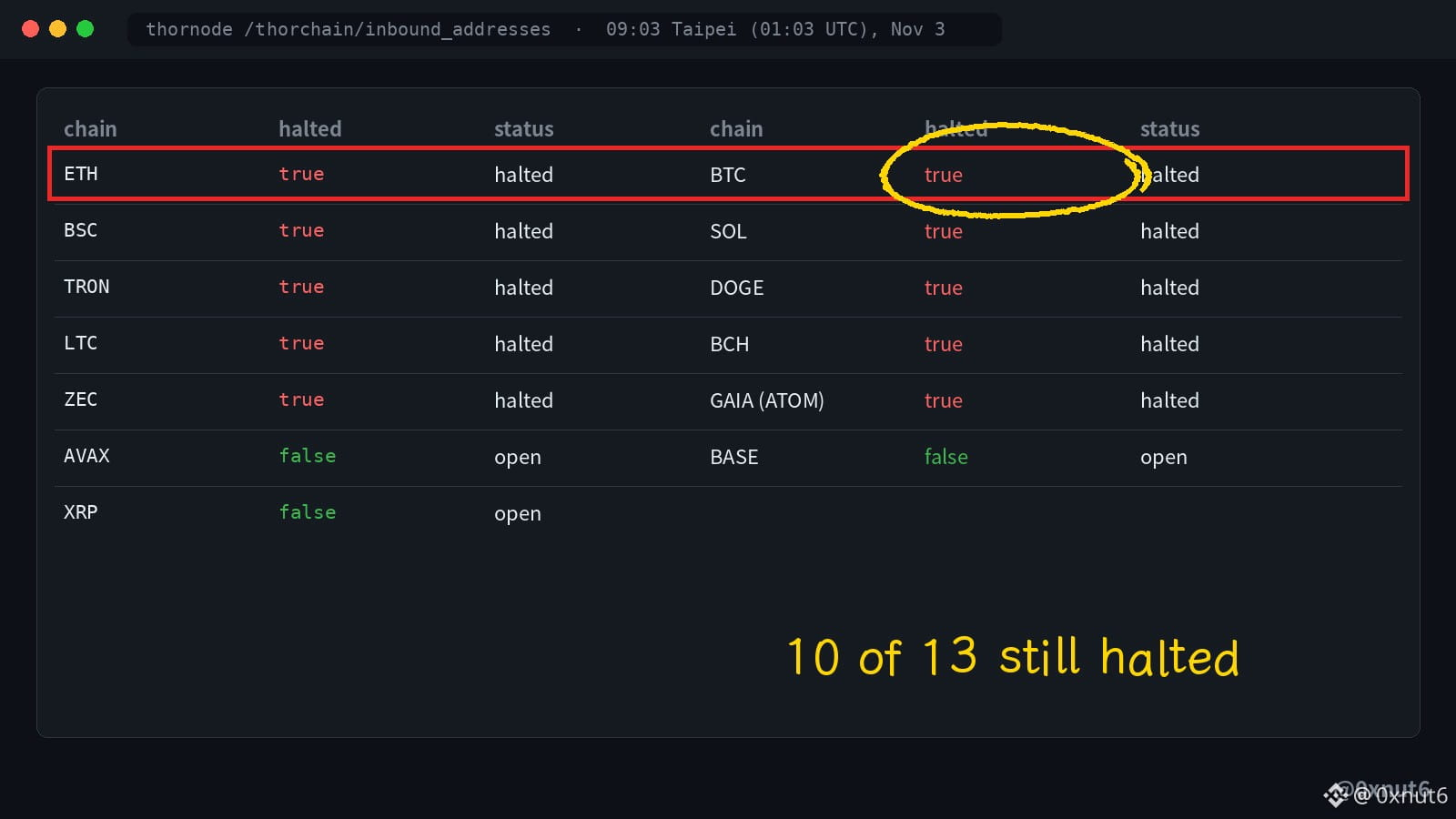
A refund for a deposit that never landed triggered a halt that still has 10 of the 13 chains on THORChain shut after 61 hours.
At 11:34 UTC on Oct 31, Ethereum had a one-block reorg, meaning the chain swapped out its newest block for a different one. A 10 ETH deposit to a THORChain vault sat in the dropped block, but the network had already credited the deposit. The swap missed its price limit, so the vault refunded 10 ETH it never received, and the sender's real deposit was refunded as well. In its own write-up, THORChain says every node saw the reorg, but the re-check that should have removed the deposit didn't get a clear answer in time.
The solvency checker caught the shortfall and paused ETH swaps. Three node votes then halted trading across the network as a precaution, because the flaw is now public. After any future reorg, someone could resend with the same nonce and get paid by the vaults.
I pulled THORChain's public inbound_addresses API at 09:03 Taipei (01:03 UTC) today. BTC, ETH, SOL, BSC, TRON, DOGE, LTC, BCH, ZEC and ATOM all still show halted. Only AVAX, BASE and XRP take swaps right now.
That pause hit the launderers moving the Binance hack funds too. Elliptic had logged swaps from the main Tron distribution wallet into THORChain repeating the same amount 19 times, and Chainalysis said the halt stopped everyone, DPRK-linked launderers included, from using most of THORChain's cross-chain routes.
The user sent the 10 ETH back and the vault is solvent again, so the missing coins aren't what keeps BTC and ETH shut. Nodes vote each chain back on once the replay fix is judged safe. Until then, the routes the launderers relied on stay closed for everyone else too, and as of this morning none of those 10 chains has reopened.
$RUNE $ETH
217
·
--
Solana’s official X account posted Superteam’s remarks at Solana Summit India today: Q3 application revenue neared $300 million, up 50% quarter over quarter; spot DEX volume was $197 billion; and stablecoin market capitalization hit a record $17.51 billion, described as “parabolic growth across the board.” I’ve added the details from the Blockworks report.
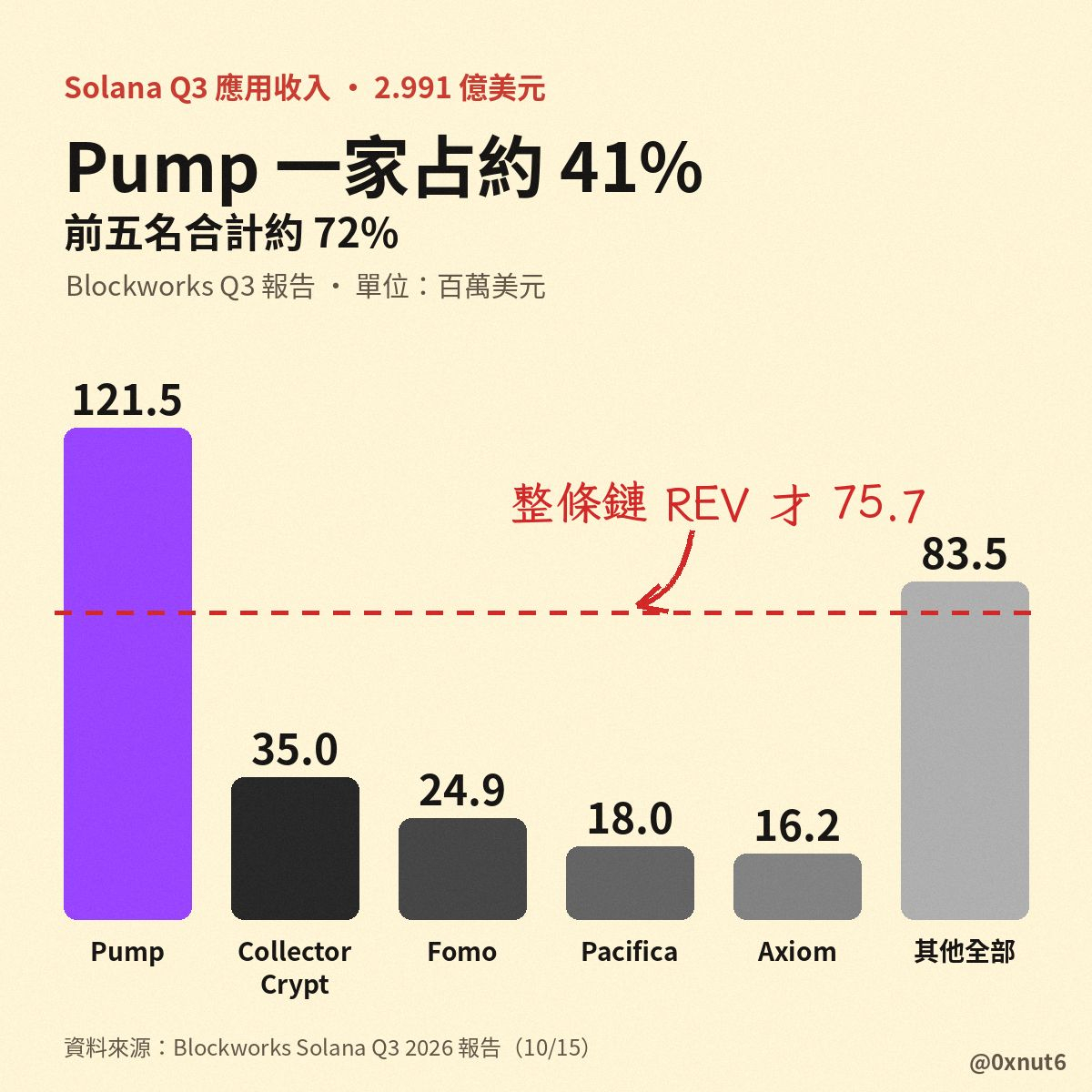
Blockworks published its Solana Q3 report on 10/15. Application revenue was $299.1 million, about 48% higher than Q2’s $201.5 million. September brought in about $117.1 million, making it the highest-revenue month since January this year.
Pump ranked first, bringing in $121.5 million, or about 41%. Next were Collector Crypt at $35 million and Fomo at $24.9 million, followed by Pacifica at $18 million and Axiom at $16.2 million. The top five totaled about $215.6 million, or roughly 72%. All other applications combined brought in about $83.5 million.
Application revenue is not the same as revenue for SOL holders. Blockworks separately calculated on-chain economic value, or REV (primarily transaction fees and priority fees), at $75.7 million for the same quarter—about a quarter of application revenue. The reported record stablecoin market cap of $17.51 billion was September’s peak. The quarter-end report recorded $16.8 billion, up about 3% quarter over quarter.
Pump alone brought in $121.5 million in Q3, about $45.8 million more than the REV of the entire chain for the same quarter.
$SOL
211
·
--
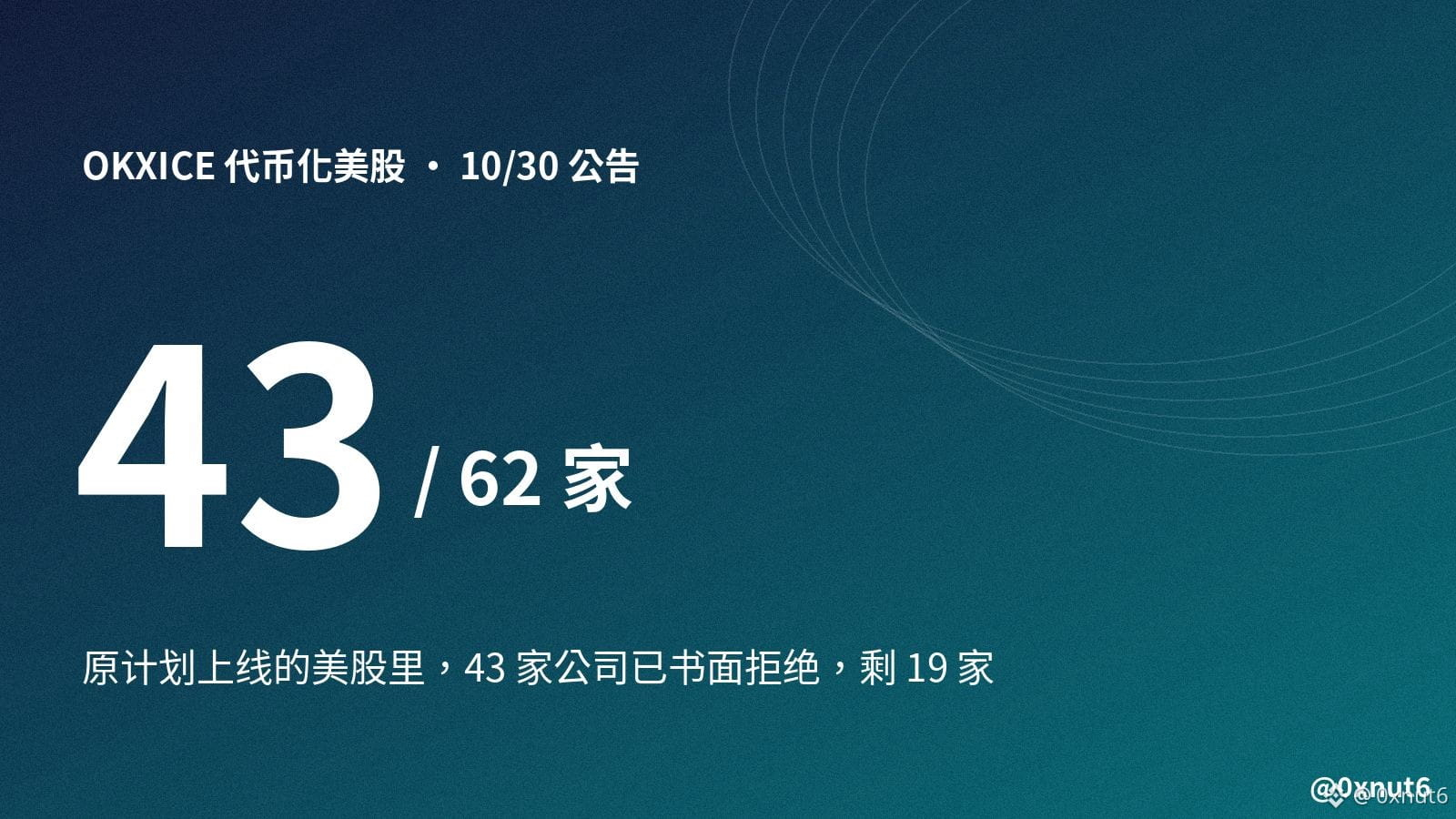
OKXICE originally planned to list tokens for 62 U.S. stocks. As of the 10/30 announcement, 43 companies had refused in writing, with Nvidia, Nike, and Costco among the latest batch. So the decision about which tokenized U.S. stocks can be traded here rests with the listed companies themselves, not @okx or @ICE_Markets.
Under the SEC’s 9/17 innovation exemption rules, platforms must first notify listed companies in writing about tokens issued by third parties, then wait at least 30 days. If a company objects within those 30 days, the platform cannot list that stock’s token. Only tokens issued by the companies themselves are exempt from this restriction.
The number of objections is rising quickly. The 10/4 announcement listed just 1 company objecting; by 10/28, that number was 38. Another 12 were added in the two days before 10/30, bringing the total to 50, including 7 companies that weren’t on the original list.
No objection doesn’t mean consent. The 30-day period only starts on the day a company receives the notice, and subsequent announcements may add more names.
As of 10/30, these 19 companies on the original list had not objected: Apple, Amazon, Tesla, Netflix, Home Depot, Coinbase, Circle, Robinhood, Strategy, Securitize, BitGo, SpaceX, Palantir, ServiceNow, Lam Research, Super Micro Computer, SoFi, GE Vernova, and Boeing.
$OKB
2
Log in to explore more content
Join global crypto users on Binance Square
⚡️ Get latest and useful information about crypto.
💬 Trusted by the world’s largest crypto exchange.
👍 Discover real insights from verified creators.
Email / Phone number
Trending Topics
HuangRisksOusterOverReportedAffairWithSubordinate
24,197 views
418 Discussing
Nvidia Board Meets to Decide Jensen Huang's Future as Crisis Deepens
Binance News
·23 Likes
·22.5k views
AnthropicRejectsIPODelayValuationinQuestion
465,449 views
3,884 Discussing
CoreWeaveJumps10%On168%RevenueGrowth
62,216 views
851 Discussing