

BTC S
5.7k Posts

BTC S
Report
Block User
446 Following
8.3K+ Followers
3.4K+ Liked
Posts
All
Quotes
Live
·
--
Bullish
FOMC September: What's the Fed's Next Move?
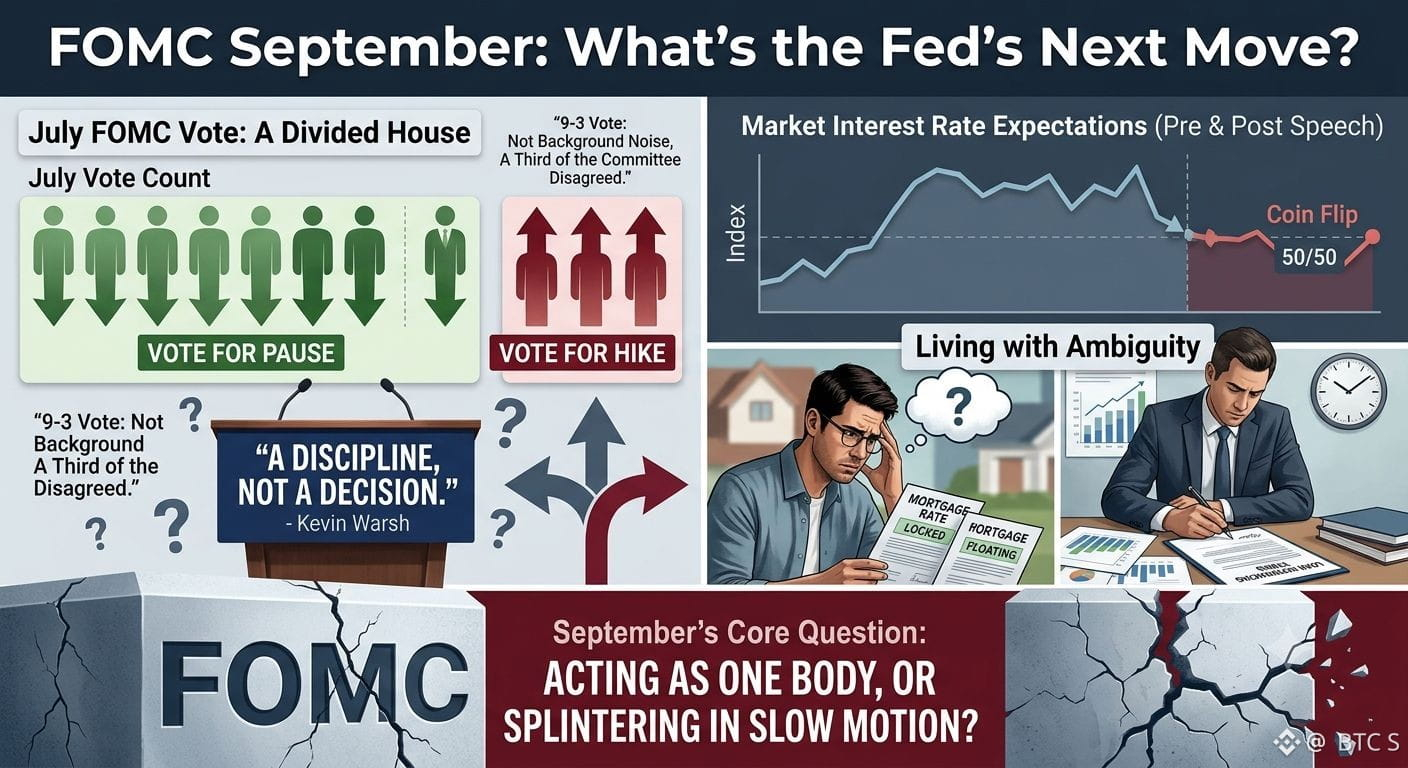
Honestly, I keep getting stuck on the same thing. We talk about "the Fed's decision" like it's one mind making a call, but the July vote was 9–3. Three people already wanted a hike before Warsh ever stepped up to the podium at Jackson Hole. That's not background noise — that's a third of the committee on record disagreeing.
Then Warsh gives this speech where he says the Fed is committed to "a discipline, not a decision." I've turned that phrase over a few times and I genuinely don't know if it's a real philosophy or just a way to duck accountability if things go sideways. But it did something concrete — the market went from mostly expecting a hold to basically a coin flip on a hike, in a matter of days. That's not the Fed calming markets down. That's the Fed handing markets an open question and letting them argue about the answer.
And the people who actually have to live with that ambiguity aren't traders watching dot plots for fun. It's someone locking in a mortgage rate this week, a business deciding whether to term out a loan before Wednesday. They don't get "a discipline." They get a number, cold, and have to move on it.
So I don't think September is really about whether it's 25 basis points up or nothing. It's about whether this committee still acts like one body, or whether we're watching it splinter in slow motion.
$ZEC
{spot}(ZECUSDT)
$BTC
{spot}(BTCUSDT)
$LSK
{spot}(LSKUSDT)
FOMC September: What's the Fed's Next Move?
Honestly, I keep getting stuck on the same thing. We talk about "the Fed's decision" like it's one mind making a call, but the July vote was 9–3. Three people already wanted a hike before Warsh ever stepped up to the podium at Jackson Hole. That's not background noise — that's a third of the committee on record disagreeing.
Then Warsh gives this speech where he says the Fed is committed to "a discipline, not a decision." I've turned that phrase over a few times and I genuinely don't know if it's a real philosophy or just a way to duck accountability if things go sideways. But it did something concrete — the market went from mostly expecting a hold to basically a coin flip on a hike, in a matter of days. That's not the Fed calming markets down. That's the Fed handing markets an open question and letting them argue about the answer.
And the people who actually have to live with that ambiguity aren't traders watching dot plots for fun. It's someone locking in a mortgage rate this week, a business deciding whether to term out a loan before Wednesday. They don't get "a discipline." They get a number, cold, and have to move on it.
So I don't think September is really about whether it's 25 basis points up or nothing. It's about whether this committee still acts like one body, or whether we're watching it splinter in slow motion.
$ZEC
$BTC
$LSK
Honestly, I keep getting stuck on the same thing. We talk about "the Fed's decision" like it's one mind making a call, but the July vote was 9–3. Three people already wanted a hike before Warsh ever stepped up to the podium at Jackson Hole. That's not background noise — that's a third of the committee on record disagreeing.
Then Warsh gives this speech where he says the Fed is committed to "a discipline, not a decision." I've turned that phrase over a few times and I genuinely don't know if it's a real philosophy or just a way to duck accountability if things go sideways. But it did something concrete — the market went from mostly expecting a hold to basically a coin flip on a hike, in a matter of days. That's not the Fed calming markets down. That's the Fed handing markets an open question and letting them argue about the answer.
And the people who actually have to live with that ambiguity aren't traders watching dot plots for fun. It's someone locking in a mortgage rate this week, a business deciding whether to term out a loan before Wednesday. They don't get "a discipline." They get a number, cold, and have to move on it.
So I don't think September is really about whether it's 25 basis points up or nothing. It's about whether this committee still acts like one body, or whether we're watching it splinter in slow motion.
$ZEC
$BTC
$LSK
380
·
--
Bullish
Verified
I keep coming back to the same annoyance every CPI week: everyone treats one monthly number like it's supposed to settle something, when honestly it was never built for that job. There's seasonal noise, sampling weirdness, one or two categories doing all the work — this time it was services, once you strip out energy and shelter. But the Fed has a meeting on the calendar whether the data is clean or not, so for about two days the market just... decides to believe the number means more than it probably does.
So, what happened: core CPI came in at 0.3% for the month, a tenth hotter than expected, and almost immediately rate-hike odds jumped to somewhere around 85%. I don't think that's actually surprising if you were paying attention — futures were already near 73% after the PPI number two days before. This didn't change anyone's mind. It just gave people permission to say out loud what they already suspected.
I'm hesitant to sound too sure about any of this, though. Fed officials themselves were saying the call looked "finely balanced" going in, and honestly their reaction to any single print lately feels more improvised than rule-based. A quarter-point hike next week wouldn't surprise me. Neither would a hold — if there's enough disagreement in the room, that's plausible too.
Honestly, the people who really need to care are the ones with floating-rate debt or a bond desk repricing risk this week. Everyone else watching this like it's a big reveal is probably reading more into it than it deserves.
#CPIWatch
How fast do you think perp funding flips if today’s number comes in hot?
$MET
{spot}(METUSDT)
$BTC
{spot}(BTCUSDT)
$牛来
{spot}(牛来USDT)
I keep coming back to the same annoyance every CPI week: everyone treats one monthly number like it's supposed to settle something, when honestly it was never built for that job. There's seasonal noise, sampling weirdness, one or two categories doing all the work — this time it was services, once you strip out energy and shelter. But the Fed has a meeting on the calendar whether the data is clean or not, so for about two days the market just... decides to believe the number means more than it probably does.
So, what happened: core CPI came in at 0.3% for the month, a tenth hotter than expected, and almost immediately rate-hike odds jumped to somewhere around 85%. I don't think that's actually surprising if you were paying attention — futures were already near 73% after the PPI number two days before. This didn't change anyone's mind. It just gave people permission to say out loud what they already suspected.
I'm hesitant to sound too sure about any of this, though. Fed officials themselves were saying the call looked "finely balanced" going in, and honestly their reaction to any single print lately feels more improvised than rule-based. A quarter-point hike next week wouldn't surprise me. Neither would a hold — if there's enough disagreement in the room, that's plausible too.
Honestly, the people who really need to care are the ones with floating-rate debt or a bond desk repricing risk this week. Everyone else watching this like it's a big reveal is probably reading more into it than it deserves.
#CPIWatch
How fast do you think perp funding flips if today’s number comes in hot?
$MET
$BTC
$牛来
So, what happened: core CPI came in at 0.3% for the month, a tenth hotter than expected, and almost immediately rate-hike odds jumped to somewhere around 85%. I don't think that's actually surprising if you were paying attention — futures were already near 73% after the PPI number two days before. This didn't change anyone's mind. It just gave people permission to say out loud what they already suspected.
I'm hesitant to sound too sure about any of this, though. Fed officials themselves were saying the call looked "finely balanced" going in, and honestly their reaction to any single print lately feels more improvised than rule-based. A quarter-point hike next week wouldn't surprise me. Neither would a hold — if there's enough disagreement in the room, that's plausible too.
Honestly, the people who really need to care are the ones with floating-rate debt or a bond desk repricing risk this week. Everyone else watching this like it's a big reveal is probably reading more into it than it deserves.
#CPIWatch
How fast do you think perp funding flips if today’s number comes in hot?
$MET
$BTC
$牛来

6
1
6
1.6k
·
--
Bullish
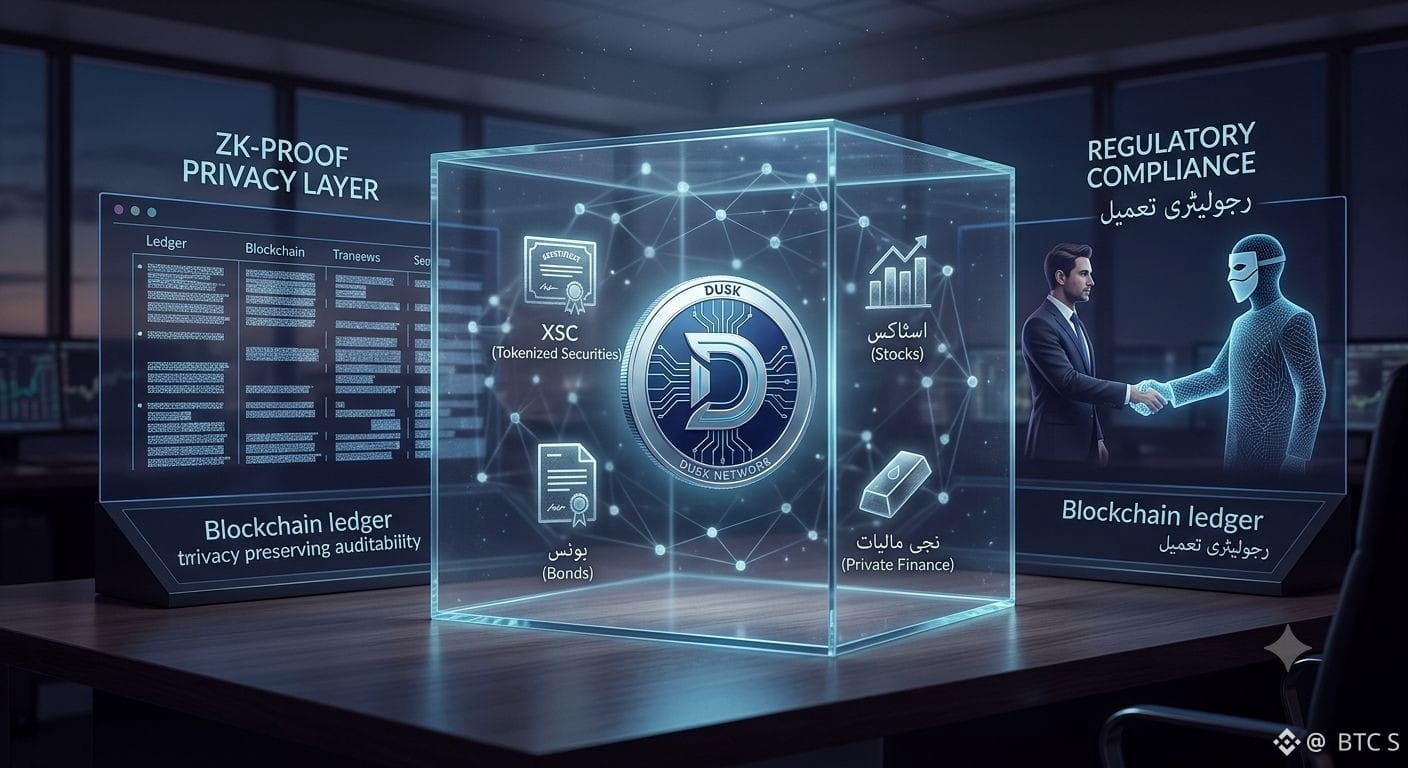
I keep coming back to a pretty basic problem: on most blockchains, everyone sees everything. If a trading desk moves a position, or a company shifts treasury funds, that's just... visible. To competitors, to anyone curious enough to look. And when you put it that way, it's obvious why serious money hangs back. Nobody wants to trade with their cards face-up on the table.
The fixes I've seen don't really solve this, they just move the problem around. Mixers get treated as a red flag the moment compliance sees them. Zero-knowledge rollups mostly make execution faster, they don't hide who's dealing with whom. So you end up with privacy that feels tacked on after the fact, sitting on top of a system that was never designed to be private — and then regulators can't tell the difference between someone protecting a normal position and someone hiding something they shouldn't be.
What Dusk seems to be doing differently is trying to build the privacy into the base layer itself, instead of layering it on top, and doing it in a way that's still auditable when it needs to be. The XSC standard is pointed at a fairly specific problem — tokenized securities that need to pass regulatory checks without exposing every counterparty publicly. It's a narrower goal than "private crypto for everyone," but I think that's actually a point in its favor.
Whether it works probably isn't a technical question at all. It's whether regulated institutions are willing to trust unfamiliar rails with real money. That's slow. And it could stall for reasons that have nothing to do with the code.
#dusk @Dusk_Foundation
$DUSK
{spot}(DUSKUSDT)
$BTR
{future}(BTRUSDT)
$FOREST
{alpha}(560x11cf6bf6d87cb0eb9c294fd6cbfec91ee3a1a7d0)
I keep coming back to a pretty basic problem: on most blockchains, everyone sees everything. If a trading desk moves a position, or a company shifts treasury funds, that's just... visible. To competitors, to anyone curious enough to look. And when you put it that way, it's obvious why serious money hangs back. Nobody wants to trade with their cards face-up on the table.
The fixes I've seen don't really solve this, they just move the problem around. Mixers get treated as a red flag the moment compliance sees them. Zero-knowledge rollups mostly make execution faster, they don't hide who's dealing with whom. So you end up with privacy that feels tacked on after the fact, sitting on top of a system that was never designed to be private — and then regulators can't tell the difference between someone protecting a normal position and someone hiding something they shouldn't be.
What Dusk seems to be doing differently is trying to build the privacy into the base layer itself, instead of layering it on top, and doing it in a way that's still auditable when it needs to be. The XSC standard is pointed at a fairly specific problem — tokenized securities that need to pass regulatory checks without exposing every counterparty publicly. It's a narrower goal than "private crypto for everyone," but I think that's actually a point in its favor.
Whether it works probably isn't a technical question at all. It's whether regulated institutions are willing to trust unfamiliar rails with real money. That's slow. And it could stall for reasons that have nothing to do with the code.
#dusk @Dusk
$DUSK
$BTR
$FOREST
The fixes I've seen don't really solve this, they just move the problem around. Mixers get treated as a red flag the moment compliance sees them. Zero-knowledge rollups mostly make execution faster, they don't hide who's dealing with whom. So you end up with privacy that feels tacked on after the fact, sitting on top of a system that was never designed to be private — and then regulators can't tell the difference between someone protecting a normal position and someone hiding something they shouldn't be.
What Dusk seems to be doing differently is trying to build the privacy into the base layer itself, instead of layering it on top, and doing it in a way that's still auditable when it needs to be. The XSC standard is pointed at a fairly specific problem — tokenized securities that need to pass regulatory checks without exposing every counterparty publicly. It's a narrower goal than "private crypto for everyone," but I think that's actually a point in its favor.
Whether it works probably isn't a technical question at all. It's whether regulated institutions are willing to trust unfamiliar rails with real money. That's slow. And it could stall for reasons that have nothing to do with the code.
#dusk @Dusk
$DUSK
$BTR
$FOREST
291
·
--
Bullish
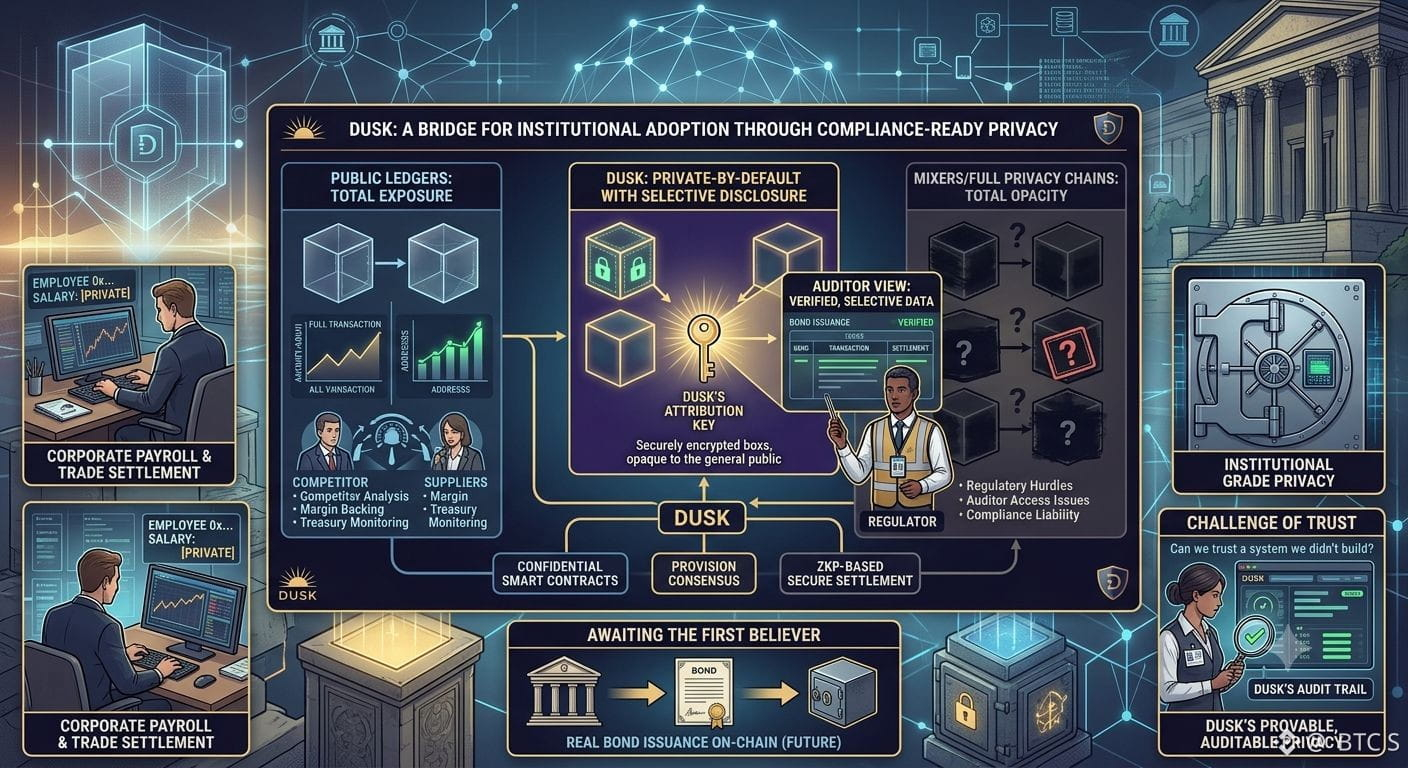
Honestly, the thing that bugs me about public blockchains is how naive they are. Everything's out there, forever every wallet, every transfer, every time you moved money and how much. Fine if you're some anonymous trader flipping tokens at 2am. Not fine if you're a company doing payroll, or a fund settling a trade, or a bank moving basically anything, because now your ledger is also just... telling everyone your business. Suppliers can back into your margins. Competitors can watch your treasury like a live feed. This isn't some edge case people worry about, it's just what happens when "transparent" is the whole design.
So naturally people go looking for privacy tools, and most of them end up breaking something else instead. Mixers make you look like you're hiding something even when you're not great, now you look like a money launderer for using basic financial privacy. And the fully private chains swing too far the other way: they hide things from the one person who's actually supposed to see them, the auditor, the regulator. So you're stuck picking between total exposure and total opacity, and neither one is really usable if you're an actual regulated business.
What Dusk is going for is the annoying middle ground private by default, but with some kind of key that lets the right person see the right thing when they need to. It's a nice idea on paper. But I don't think the hard part was ever the cryptography. The hard part is getting some compliance officer at a bank to actually trust a disclosure system they didn't build, can't fully audit themselves, and have never seen fail (or succeed) in the real world.
I'm not sold yet. Small validator set, a use case that only really matters if institutions show up, and institutions move slowly on purpose. I'd want to see one real bond issuance or securities settlement actually live on it, and stay there, before I'd call this anything more than a good idea waiting for its first believer.
#dusk @Dusk_Foundation
$DUSK
{spot}(DUSKUSDT)
$DEBIT
{alpha}(560x66661c7229901f568f16bd1551b3ba826f83ce49)
$BTR
{future}(BTRUSDT)
Honestly, the thing that bugs me about public blockchains is how naive they are. Everything's out there, forever every wallet, every transfer, every time you moved money and how much. Fine if you're some anonymous trader flipping tokens at 2am. Not fine if you're a company doing payroll, or a fund settling a trade, or a bank moving basically anything, because now your ledger is also just... telling everyone your business. Suppliers can back into your margins. Competitors can watch your treasury like a live feed. This isn't some edge case people worry about, it's just what happens when "transparent" is the whole design.
So naturally people go looking for privacy tools, and most of them end up breaking something else instead. Mixers make you look like you're hiding something even when you're not great, now you look like a money launderer for using basic financial privacy. And the fully private chains swing too far the other way: they hide things from the one person who's actually supposed to see them, the auditor, the regulator. So you're stuck picking between total exposure and total opacity, and neither one is really usable if you're an actual regulated business.
What Dusk is going for is the annoying middle ground private by default, but with some kind of key that lets the right person see the right thing when they need to. It's a nice idea on paper. But I don't think the hard part was ever the cryptography. The hard part is getting some compliance officer at a bank to actually trust a disclosure system they didn't build, can't fully audit themselves, and have never seen fail (or succeed) in the real world.
I'm not sold yet. Small validator set, a use case that only really matters if institutions show up, and institutions move slowly on purpose. I'd want to see one real bond issuance or securities settlement actually live on it, and stay there, before I'd call this anything more than a good idea waiting for its first believer.
#dusk @Dusk
$DUSK
$DEBIT
$BTR
So naturally people go looking for privacy tools, and most of them end up breaking something else instead. Mixers make you look like you're hiding something even when you're not great, now you look like a money launderer for using basic financial privacy. And the fully private chains swing too far the other way: they hide things from the one person who's actually supposed to see them, the auditor, the regulator. So you're stuck picking between total exposure and total opacity, and neither one is really usable if you're an actual regulated business.
What Dusk is going for is the annoying middle ground private by default, but with some kind of key that lets the right person see the right thing when they need to. It's a nice idea on paper. But I don't think the hard part was ever the cryptography. The hard part is getting some compliance officer at a bank to actually trust a disclosure system they didn't build, can't fully audit themselves, and have never seen fail (or succeed) in the real world.
I'm not sold yet. Small validator set, a use case that only really matters if institutions show up, and institutions move slowly on purpose. I'd want to see one real bond issuance or securities settlement actually live on it, and stay there, before I'd call this anything more than a good idea waiting for its first believer.
#dusk @Dusk
$DUSK
$DEBIT
$BTR
2
3
408
·
--
Bullish
Honestly, the thing that gets me thinking about tokenized securities is pretty mundane — it's not some big philosophical question, it's just: why does putting a security on a blockchain always seem to mean everyone can see it? If you've spent any time near capital markets, you know that's backwards. A cap table isn't public. A trade being visible mid-execution can move the price against you before you're even done. Public chains solve trust by showing everyone everything, and securities law solves trust by controlling exactly who gets to see what. Those two ideas don't naturally agree with each other, and most projects don't really wrestle with that — they just pick one side and act like the other one wasn't a problem to begin with.
What's interesting about Dusk is that it's at least trying to sit in that uncomfortable middle. XSC hides the terms and the identities, but it's supposed to let you prove something's true to an auditor or a regulator without cracking the whole thing open for everyone else. I find that a more honest starting point than most "privacy chain" pitches, because it's not privacy as an ideology — it's privacy shaped around who's actually owed the information, legally.
But I'll say the part I can't get past: I don't know if a zero-knowledge proof holds up the way a subpoenaed record does, in an actual dispute, in front of an actual regulator. That's not something a whitepaper can answer for you. And below that sits the less exciting stuff — thin liquidity, a small market cap, institutions that move at the pace of their legal team, not their engineering team.
So my honest read is: this is a serious attempt at a problem worth solving. Whether it goes anywhere probably comes down to a compliance officer somewhere deciding it's good enough to sign off on — not to the cryptography being clever.
#dusk $DUSK @Dusk_Foundation
{spot}(DUSKUSDT)
$TAC
{future}(TACUSDT)
$PENGUIN
{alpha}(CT_5018Jx8AAHj86wbQgUTjGuj6GTTL5Ps3cqxKRTvpaJApump)
Honestly, the thing that gets me thinking about tokenized securities is pretty mundane — it's not some big philosophical question, it's just: why does putting a security on a blockchain always seem to mean everyone can see it? If you've spent any time near capital markets, you know that's backwards. A cap table isn't public. A trade being visible mid-execution can move the price against you before you're even done. Public chains solve trust by showing everyone everything, and securities law solves trust by controlling exactly who gets to see what. Those two ideas don't naturally agree with each other, and most projects don't really wrestle with that — they just pick one side and act like the other one wasn't a problem to begin with.
What's interesting about Dusk is that it's at least trying to sit in that uncomfortable middle. XSC hides the terms and the identities, but it's supposed to let you prove something's true to an auditor or a regulator without cracking the whole thing open for everyone else. I find that a more honest starting point than most "privacy chain" pitches, because it's not privacy as an ideology — it's privacy shaped around who's actually owed the information, legally.
But I'll say the part I can't get past: I don't know if a zero-knowledge proof holds up the way a subpoenaed record does, in an actual dispute, in front of an actual regulator. That's not something a whitepaper can answer for you. And below that sits the less exciting stuff — thin liquidity, a small market cap, institutions that move at the pace of their legal team, not their engineering team.
So my honest read is: this is a serious attempt at a problem worth solving. Whether it goes anywhere probably comes down to a compliance officer somewhere deciding it's good enough to sign off on — not to the cryptography being clever.
#dusk $DUSK @Dusk
$TAC
$PENGUIN
What's interesting about Dusk is that it's at least trying to sit in that uncomfortable middle. XSC hides the terms and the identities, but it's supposed to let you prove something's true to an auditor or a regulator without cracking the whole thing open for everyone else. I find that a more honest starting point than most "privacy chain" pitches, because it's not privacy as an ideology — it's privacy shaped around who's actually owed the information, legally.
But I'll say the part I can't get past: I don't know if a zero-knowledge proof holds up the way a subpoenaed record does, in an actual dispute, in front of an actual regulator. That's not something a whitepaper can answer for you. And below that sits the less exciting stuff — thin liquidity, a small market cap, institutions that move at the pace of their legal team, not their engineering team.
So my honest read is: this is a serious attempt at a problem worth solving. Whether it goes anywhere probably comes down to a compliance officer somewhere deciding it's good enough to sign off on — not to the cryptography being clever.
#dusk $DUSK @Dusk
$TAC
$PENGUIN

3
6
352
·
--
Bullish
Honestly, the thing that trips me up every time someone says "privacy blockchain" is that those two words are kind of at war with each other. A blockchain's whole selling point is that anyone can check it without asking permission. Privacy means the opposite — nobody gets to check anything. So most projects just quietly pick a side. Either it's fully shielded, which is great until an auditor or a regulator needs to actually verify something and there's nothing to show them. Or it's "private" in name only, and underneath it's just a regular transparent chain with better branding. Neither one holds up once real money and real institutions get involved.
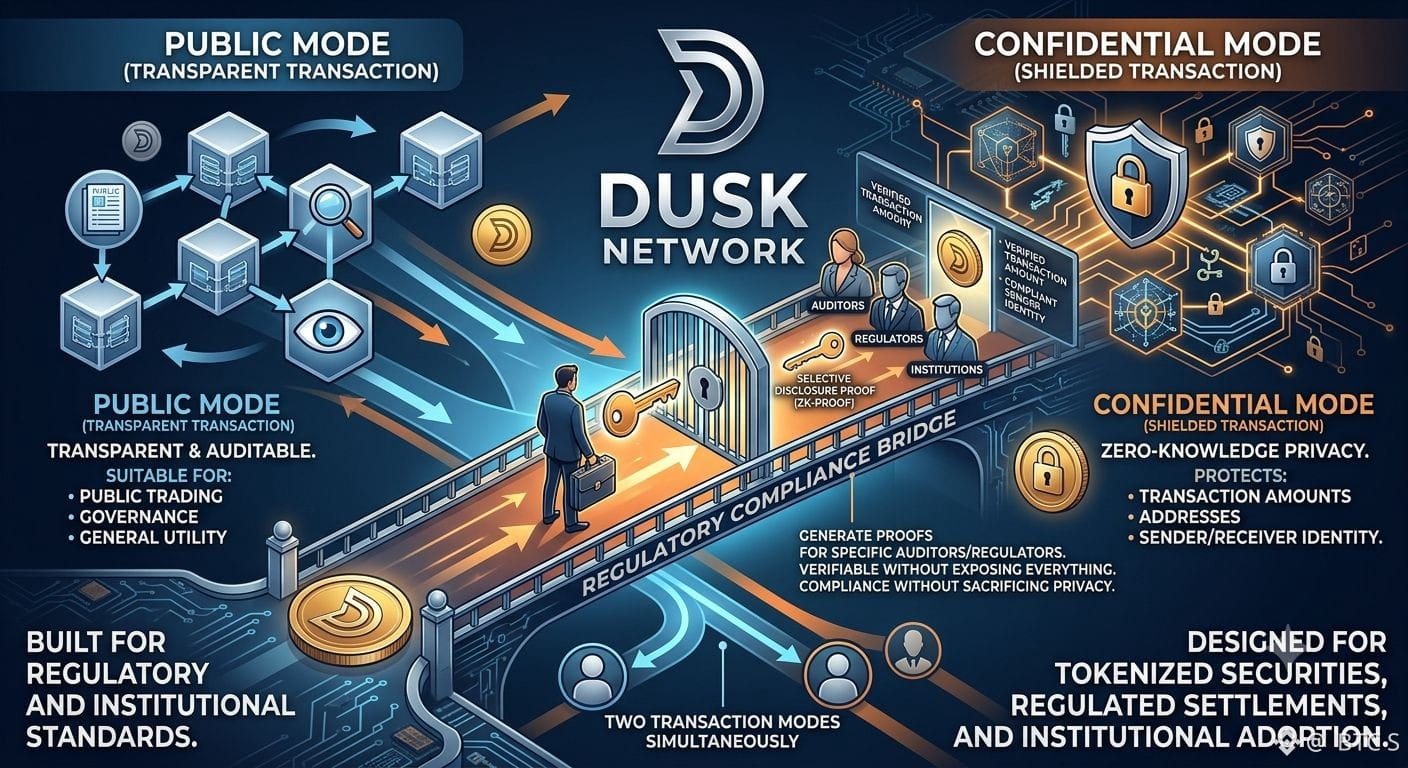
That's the frame I'd put around Dusk. What actually caught my attention isn't the privacy pitch — everyone says that — it's the idea of being able to shield a transaction but still generate proof for the specific person who's supposed to see it. An auditor, a regulator, whoever. That's a much smaller, less impressive-sounding promise than "total anonymity," but honestly it's probably the only version of privacy that has a real shot in something like tokenized securities or regulated settlement, where "just trust us" doesn't fly.
I also noticed they run two separate transaction modes instead of forcing one privacy setting on everybody. Feels like someone actually sat with different use cases instead of building around a slogan. Though more modes also just means more places for something to quietly go wrong.
I wouldn't buy into any of this until it's been through a real audit with real institutional money on the line. The failure I'd watch for is the obvious one — "confidential" that ends up hiding things from the one party it was supposed to protect against.
#dusk @Dusk_Foundation
$TUT
{spot}(TUTUSDT)
$DUSK
{spot}(DUSKUSDT)
$RE
{spot}(REUSDT)
Honestly, the thing that trips me up every time someone says "privacy blockchain" is that those two words are kind of at war with each other. A blockchain's whole selling point is that anyone can check it without asking permission. Privacy means the opposite — nobody gets to check anything. So most projects just quietly pick a side. Either it's fully shielded, which is great until an auditor or a regulator needs to actually verify something and there's nothing to show them. Or it's "private" in name only, and underneath it's just a regular transparent chain with better branding. Neither one holds up once real money and real institutions get involved.
That's the frame I'd put around Dusk. What actually caught my attention isn't the privacy pitch — everyone says that — it's the idea of being able to shield a transaction but still generate proof for the specific person who's supposed to see it. An auditor, a regulator, whoever. That's a much smaller, less impressive-sounding promise than "total anonymity," but honestly it's probably the only version of privacy that has a real shot in something like tokenized securities or regulated settlement, where "just trust us" doesn't fly.
I also noticed they run two separate transaction modes instead of forcing one privacy setting on everybody. Feels like someone actually sat with different use cases instead of building around a slogan. Though more modes also just means more places for something to quietly go wrong.
I wouldn't buy into any of this until it's been through a real audit with real institutional money on the line. The failure I'd watch for is the obvious one — "confidential" that ends up hiding things from the one party it was supposed to protect against.
#dusk @Dusk
$TUT
$DUSK
$RE
That's the frame I'd put around Dusk. What actually caught my attention isn't the privacy pitch — everyone says that — it's the idea of being able to shield a transaction but still generate proof for the specific person who's supposed to see it. An auditor, a regulator, whoever. That's a much smaller, less impressive-sounding promise than "total anonymity," but honestly it's probably the only version of privacy that has a real shot in something like tokenized securities or regulated settlement, where "just trust us" doesn't fly.
I also noticed they run two separate transaction modes instead of forcing one privacy setting on everybody. Feels like someone actually sat with different use cases instead of building around a slogan. Though more modes also just means more places for something to quietly go wrong.
I wouldn't buy into any of this until it's been through a real audit with real institutional money on the line. The failure I'd watch for is the obvious one — "confidential" that ends up hiding things from the one party it was supposed to protect against.
#dusk @Dusk
$TUT
$DUSK
$RE
5
4
297
·
--
Bullish
Okay, here's the thing that actually got me thinking about this, not the whitepaper stuff first.
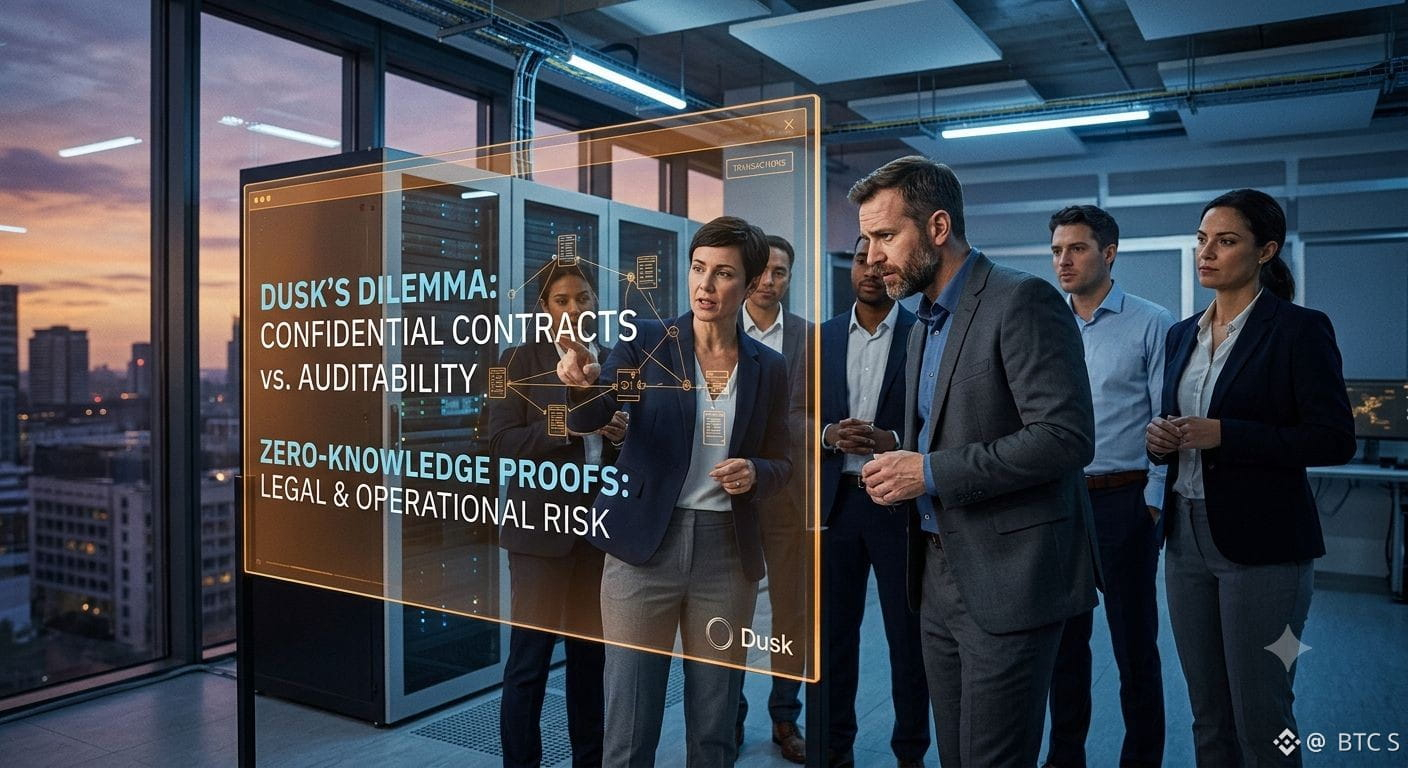
Say you work at a mid-size asset manager and someone suggests moving bond settlement on-chain. Your first question isn't "is it decentralized enough" — it's "can my competitors see my position." Your second question, five minutes later, is "can my regulator see it when they ask." Those two needs pull in opposite directions, and honestly, most crypto projects just pick one and pretend the other doesn't matter. The privacy coins ignore compliance. The compliant chains give up on privacy entirely and call it "transparency" like that's a feature.
So Dusk's pitch — confidential smart contracts, this XSC thing — is at least aimed at the actual tension instead of dodging it. You're not hiding forever, you're hiding by default and revealing on demand. That's closer to how a real audit works. Nobody at a bank wants total anonymity; they want to control who sees what, and when.
I'm not sold on it, though. Zero-knowledge proofs sound airtight in a paper, but the first time a regulator's lawyer asks "what if the proof itself is wrong, who's on the hook," things get messy fast — that's a legal question, not a math one. And a smaller validator set carrying institutional money is a real risk on its own, no matter how good the crypto underneath is.
If this goes anywhere, it won't be loud. It'll be some back-office settlement flow nobody tweets about. That's honestly the only version of "success" that makes sense here.
#dusk @Dusk_Foundation
$TUT
{future}(TUTUSDT)
$DUSK
{future}(DUSKUSDT)
$BABYSHARK
{alpha}(560x777bf78ad4546b61607a17bf4a1977dbbea98c28)
Okay, here's the thing that actually got me thinking about this, not the whitepaper stuff first.
Say you work at a mid-size asset manager and someone suggests moving bond settlement on-chain. Your first question isn't "is it decentralized enough" — it's "can my competitors see my position." Your second question, five minutes later, is "can my regulator see it when they ask." Those two needs pull in opposite directions, and honestly, most crypto projects just pick one and pretend the other doesn't matter. The privacy coins ignore compliance. The compliant chains give up on privacy entirely and call it "transparency" like that's a feature.
So Dusk's pitch — confidential smart contracts, this XSC thing — is at least aimed at the actual tension instead of dodging it. You're not hiding forever, you're hiding by default and revealing on demand. That's closer to how a real audit works. Nobody at a bank wants total anonymity; they want to control who sees what, and when.
I'm not sold on it, though. Zero-knowledge proofs sound airtight in a paper, but the first time a regulator's lawyer asks "what if the proof itself is wrong, who's on the hook," things get messy fast — that's a legal question, not a math one. And a smaller validator set carrying institutional money is a real risk on its own, no matter how good the crypto underneath is.
If this goes anywhere, it won't be loud. It'll be some back-office settlement flow nobody tweets about. That's honestly the only version of "success" that makes sense here.
#dusk @Dusk
$TUT
$DUSK
$BABYSHARK
Say you work at a mid-size asset manager and someone suggests moving bond settlement on-chain. Your first question isn't "is it decentralized enough" — it's "can my competitors see my position." Your second question, five minutes later, is "can my regulator see it when they ask." Those two needs pull in opposite directions, and honestly, most crypto projects just pick one and pretend the other doesn't matter. The privacy coins ignore compliance. The compliant chains give up on privacy entirely and call it "transparency" like that's a feature.
So Dusk's pitch — confidential smart contracts, this XSC thing — is at least aimed at the actual tension instead of dodging it. You're not hiding forever, you're hiding by default and revealing on demand. That's closer to how a real audit works. Nobody at a bank wants total anonymity; they want to control who sees what, and when.
I'm not sold on it, though. Zero-knowledge proofs sound airtight in a paper, but the first time a regulator's lawyer asks "what if the proof itself is wrong, who's on the hook," things get messy fast — that's a legal question, not a math one. And a smaller validator set carrying institutional money is a real risk on its own, no matter how good the crypto underneath is.
If this goes anywhere, it won't be loud. It'll be some back-office settlement flow nobody tweets about. That's honestly the only version of "success" that makes sense here.
#dusk @Dusk
$TUT
$DUSK
$BABYSHARK
3
3
498
·
--
Bullish
Okay, so here's the thing that actually got me thinking about this. Everyone keeps saying banks and institutions "want privacy on-chain," and sure, in some abstract sense they do. But when you actually sit with what that means in practice, it falls apart pretty fast. A trading desk doesn't want to hide from regulators — that's a great way to end up in a very uncomfortable meeting. What they want is to hide from each other. Competitors. Counterparties. The rest of the market. And then, separately, still be able to prove to an auditor that nothing shady happened. Those are two different asks, and most "privacy blockchain" projects only really solve the first one — which, awkwardly, is the one part almost nobody's allowed to want unconditionally.
That's what made me pause on Dusk. Not the privacy pitch itself, everyone has that pitch. What's interesting is they didn't pretend privacy is one setting you just flip on. There's Moonlight for things that should be out in the open, Phoenix for things that shouldn't. Splitting it like that feels less like a marketing decision and more like someone admitting the problem is messier than a whitepaper usually lets on.
Where I get uneasy is the consensus side — sortition, committees, fallback modes, an emergency mode. All reasonable on paper. But I've watched systems like this before, and they don't usually break where you're staring. They break quietly, months later, under conditions nobody tested for.
So who's this actually for? Honestly, not us. Probably institutions willing to move slowly for legal clarity instead of fast for hype. Whether it works depends less on the cryptography and more on whether "confidential" and "hidden" ever get treated as different things by the people writing the rules.#dusk @Dusk_Foundation
$DUSK
{spot}(DUSKUSDT)
$BTC
{spot}(BTCUSDT)
$LAB
{future}(LABUSDT)
Okay, so here's the thing that actually got me thinking about this. Everyone keeps saying banks and institutions "want privacy on-chain," and sure, in some abstract sense they do. But when you actually sit with what that means in practice, it falls apart pretty fast. A trading desk doesn't want to hide from regulators — that's a great way to end up in a very uncomfortable meeting. What they want is to hide from each other. Competitors. Counterparties. The rest of the market. And then, separately, still be able to prove to an auditor that nothing shady happened. Those are two different asks, and most "privacy blockchain" projects only really solve the first one — which, awkwardly, is the one part almost nobody's allowed to want unconditionally.
That's what made me pause on Dusk. Not the privacy pitch itself, everyone has that pitch. What's interesting is they didn't pretend privacy is one setting you just flip on. There's Moonlight for things that should be out in the open, Phoenix for things that shouldn't. Splitting it like that feels less like a marketing decision and more like someone admitting the problem is messier than a whitepaper usually lets on.
Where I get uneasy is the consensus side — sortition, committees, fallback modes, an emergency mode. All reasonable on paper. But I've watched systems like this before, and they don't usually break where you're staring. They break quietly, months later, under conditions nobody tested for.
So who's this actually for? Honestly, not us. Probably institutions willing to move slowly for legal clarity instead of fast for hype. Whether it works depends less on the cryptography and more on whether "confidential" and "hidden" ever get treated as different things by the people writing the rules.#dusk @Dusk
$DUSK
$BTC
$LAB
That's what made me pause on Dusk. Not the privacy pitch itself, everyone has that pitch. What's interesting is they didn't pretend privacy is one setting you just flip on. There's Moonlight for things that should be out in the open, Phoenix for things that shouldn't. Splitting it like that feels less like a marketing decision and more like someone admitting the problem is messier than a whitepaper usually lets on.
Where I get uneasy is the consensus side — sortition, committees, fallback modes, an emergency mode. All reasonable on paper. But I've watched systems like this before, and they don't usually break where you're staring. They break quietly, months later, under conditions nobody tested for.
So who's this actually for? Honestly, not us. Probably institutions willing to move slowly for legal clarity instead of fast for hype. Whether it works depends less on the cryptography and more on whether "confidential" and "hidden" ever get treated as different things by the people writing the rules.#dusk @Dusk
$DUSK
$BTC
$LAB

4
1
486
·
--
Bullish
I keep thinking about a simple, annoying problem: if you're any kind of serious business, you can't just put your money movements on a public blockchain. Everyone would see it — competitors, customers, randoms. So people either avoid chains like this altogether, or they reach for "private" versions that nobody can actually verify from the outside, which just moves the trust problem somewhere else instead of solving it. Neither option is really good enough, and I think that's why so much of "enterprise blockchain" talk has felt hollow for years.
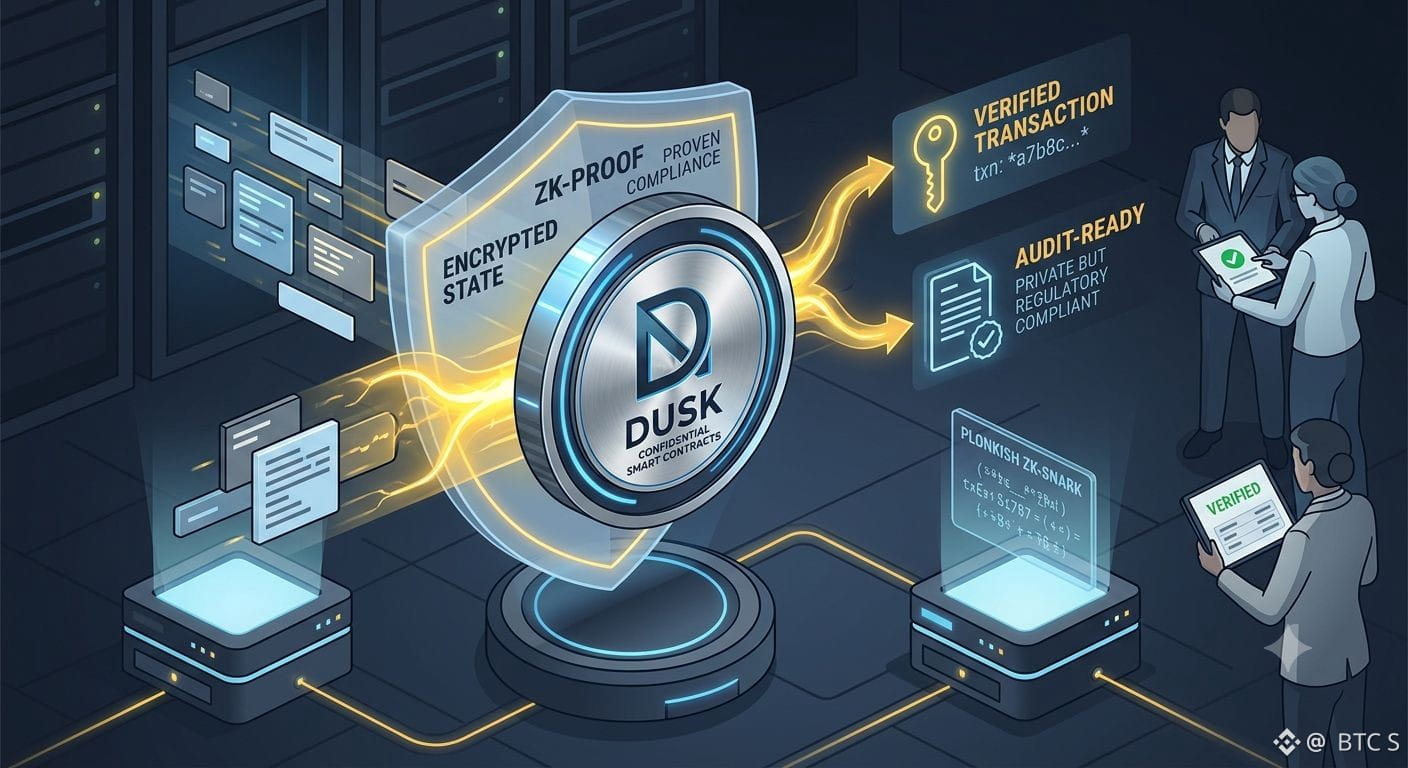
Dusk Network is one of the projects trying to actually sit inside that discomfort instead of picking a side. The idea, as I understand it, is contracts that stay confidential but can still prove they're playing by the rules — without opening up everything to public view. That's a reasonable goal. I just don't think it's an easy one. Zero-knowledge proofs aren't cheap, they're not simple to get right, and "private but provably compliant" is exactly the kind of claim that sounds great until a regulator or an auditor starts poking at it.
So I'm not going to pretend I know how this plays out. If it ends up mattering, it probably won't be loud — some institution quietly using it because it solves a real settlement headache cheaper or safer than what they had before. And if it fails, it'll likely be for ordinary reasons: not enough real usage, not enough liquidity, or a compliance story that cracks the first time someone really tests it.
#dusk @Dusk_Foundation
$DUSK
{future}(DUSKUSDT)
$ONG
{future}(ONGUSDT)
$PEOPLE
{future}(PEOPLEUSDT)
I keep thinking about a simple, annoying problem: if you're any kind of serious business, you can't just put your money movements on a public blockchain. Everyone would see it — competitors, customers, randoms. So people either avoid chains like this altogether, or they reach for "private" versions that nobody can actually verify from the outside, which just moves the trust problem somewhere else instead of solving it. Neither option is really good enough, and I think that's why so much of "enterprise blockchain" talk has felt hollow for years.
Dusk Network is one of the projects trying to actually sit inside that discomfort instead of picking a side. The idea, as I understand it, is contracts that stay confidential but can still prove they're playing by the rules — without opening up everything to public view. That's a reasonable goal. I just don't think it's an easy one. Zero-knowledge proofs aren't cheap, they're not simple to get right, and "private but provably compliant" is exactly the kind of claim that sounds great until a regulator or an auditor starts poking at it.
So I'm not going to pretend I know how this plays out. If it ends up mattering, it probably won't be loud — some institution quietly using it because it solves a real settlement headache cheaper or safer than what they had before. And if it fails, it'll likely be for ordinary reasons: not enough real usage, not enough liquidity, or a compliance story that cracks the first time someone really tests it.
#dusk @Dusk
$DUSK
$ONG
$PEOPLE
Dusk Network is one of the projects trying to actually sit inside that discomfort instead of picking a side. The idea, as I understand it, is contracts that stay confidential but can still prove they're playing by the rules — without opening up everything to public view. That's a reasonable goal. I just don't think it's an easy one. Zero-knowledge proofs aren't cheap, they're not simple to get right, and "private but provably compliant" is exactly the kind of claim that sounds great until a regulator or an auditor starts poking at it.
So I'm not going to pretend I know how this plays out. If it ends up mattering, it probably won't be loud — some institution quietly using it because it solves a real settlement headache cheaper or safer than what they had before. And if it fails, it'll likely be for ordinary reasons: not enough real usage, not enough liquidity, or a compliance story that cracks the first time someone really tests it.
#dusk @Dusk
$DUSK
$ONG
$PEOPLE
4
4
180
·
--
Bullish
Honestly, the thing that gets me thinking about this isn't the tech at all — it's a much simpler question: why doesn't "private" and "compliant" ever seem to go together in crypto? You'd think by now someone would've cracked it, but every time I look closely, projects pick a lane. Either everything's out in the open, which is a problem the second real money's involved — nobody wants a competitor watching their trades unfold live — or everything's hidden, which sounds nice until you remember regulators exist and aren't going anywhere.
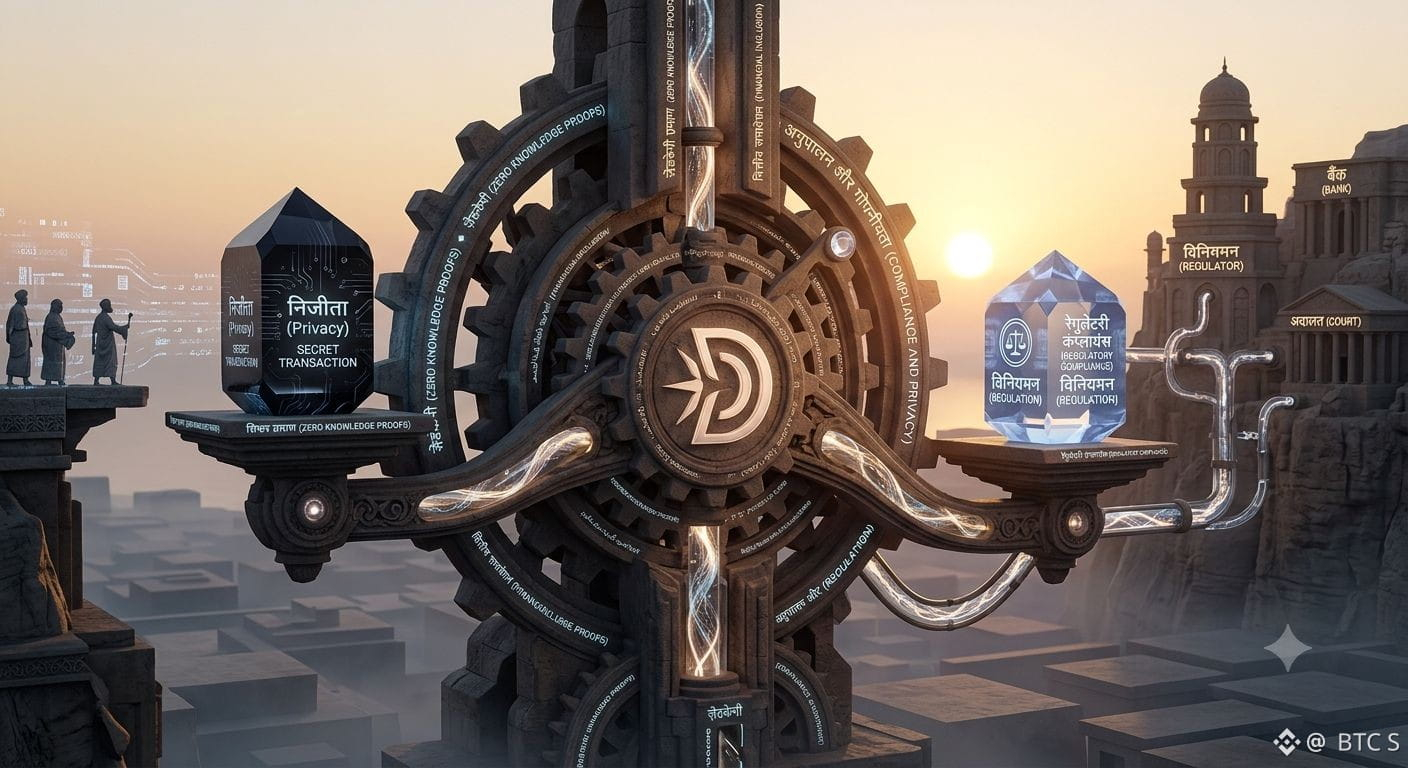
So when I hear "confidential smart contracts," my first reaction isn't excitement, it's a kind of tired curiosity. Okay, but confidential how? Because there's a version of this that just means "hidden from everyone," and there's a version that means "hidden from the public, but still provable to whoever legally needs to see it." Only one of those is actually usable by an institution. The other one's just a nicer-sounding version of the same old problem.
I don't know if Dusk gets this right. I genuinely don't. Zero-knowledge systems are still kind of fiddly in practice, and infrastructure like this doesn't prove itself with a good pitch — it proves itself years later, when some boring settlement just... works, and nothing blows up.
My honest guess is that if this ever takes off, it won't be loud. It'll be some mid-size issuer quietly testing it, compliance team included, and everyone watching to see if it holds up under pressure. That's the real test. Not the whitepaper.
#dusk @Dusk_Foundation
$DUSK
{spot}(DUSKUSDT)
$RE
{spot}(REUSDT)
$BB
{spot}(BBUSDT)
Honestly, the thing that gets me thinking about this isn't the tech at all — it's a much simpler question: why doesn't "private" and "compliant" ever seem to go together in crypto? You'd think by now someone would've cracked it, but every time I look closely, projects pick a lane. Either everything's out in the open, which is a problem the second real money's involved — nobody wants a competitor watching their trades unfold live — or everything's hidden, which sounds nice until you remember regulators exist and aren't going anywhere.
So when I hear "confidential smart contracts," my first reaction isn't excitement, it's a kind of tired curiosity. Okay, but confidential how? Because there's a version of this that just means "hidden from everyone," and there's a version that means "hidden from the public, but still provable to whoever legally needs to see it." Only one of those is actually usable by an institution. The other one's just a nicer-sounding version of the same old problem.
I don't know if Dusk gets this right. I genuinely don't. Zero-knowledge systems are still kind of fiddly in practice, and infrastructure like this doesn't prove itself with a good pitch — it proves itself years later, when some boring settlement just... works, and nothing blows up.
My honest guess is that if this ever takes off, it won't be loud. It'll be some mid-size issuer quietly testing it, compliance team included, and everyone watching to see if it holds up under pressure. That's the real test. Not the whitepaper.
#dusk @Dusk
$DUSK
$RE
$BB
So when I hear "confidential smart contracts," my first reaction isn't excitement, it's a kind of tired curiosity. Okay, but confidential how? Because there's a version of this that just means "hidden from everyone," and there's a version that means "hidden from the public, but still provable to whoever legally needs to see it." Only one of those is actually usable by an institution. The other one's just a nicer-sounding version of the same old problem.
I don't know if Dusk gets this right. I genuinely don't. Zero-knowledge systems are still kind of fiddly in practice, and infrastructure like this doesn't prove itself with a good pitch — it proves itself years later, when some boring settlement just... works, and nothing blows up.
My honest guess is that if this ever takes off, it won't be loud. It'll be some mid-size issuer quietly testing it, compliance team included, and everyone watching to see if it holds up under pressure. That's the real test. Not the whitepaper.
#dusk @Dusk
$DUSK
$RE
$BB
1
1
196
·
--
Bullish
Okay, so I keep coming back to this Dusk Network thing, and the question that actually bugs me isn't "is the tech impressive." It's simpler. Say a bank wants to move a bond on-chain. Their compliance person has to see the trade. Their competitor absolutely should not. The general public? Also no. And most blockchains just don't have a dial for that — you're either shouting your whole balance sheet to the internet, or you've gone full dark and now even the people who are legally owed a look can't get one. That's not how finance has ever actually worked. There's always been a ledger somebody could subpoena, not one anybody could scroll through.
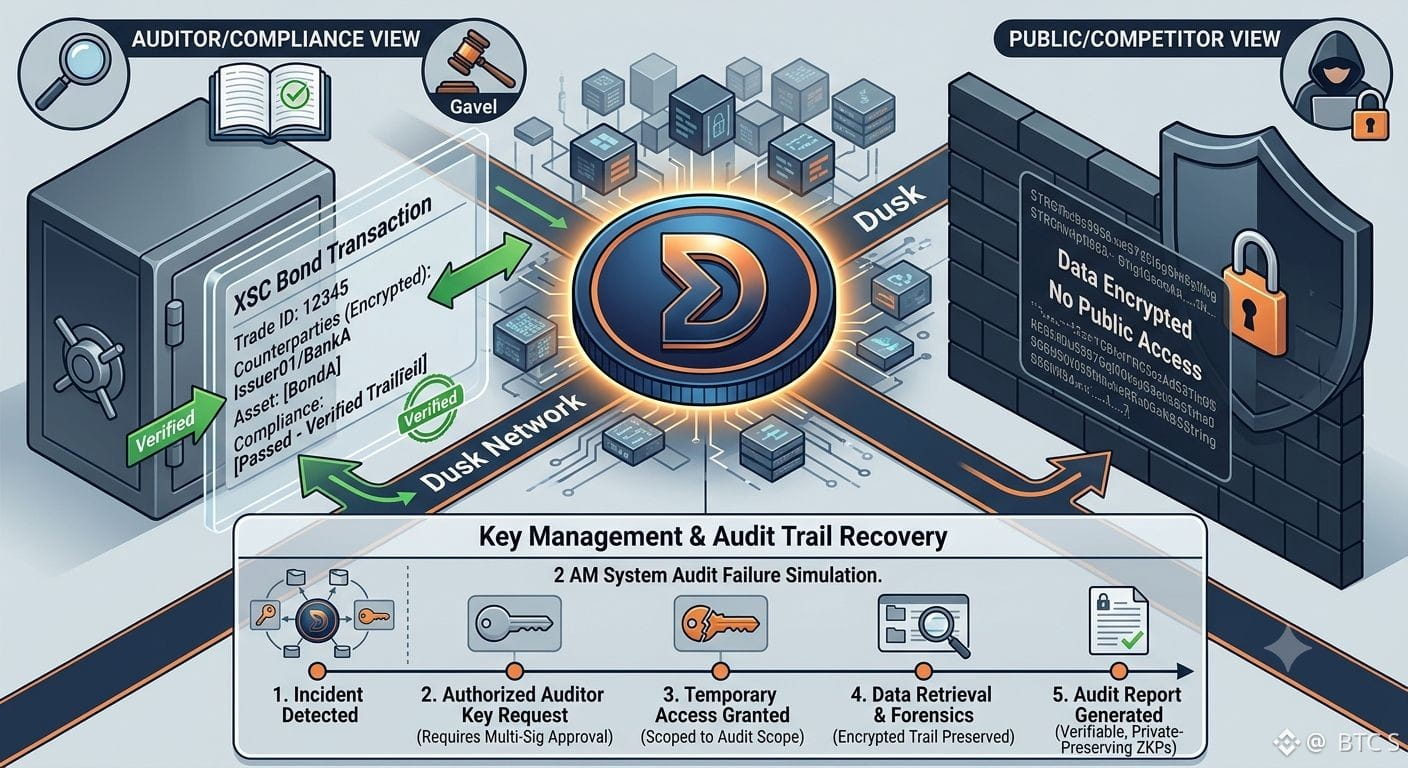
So when Dusk talks about confidential contracts — this XSC standard — the part that interests me isn't the hiding. Hiding is the easy half, honestly. It's whether the showing-when-required half actually holds up outside a demo. Can an auditor get what they need without the whole thing turning into "just trust the protocol"? That's less a crypto question and more a legal-nerves question, and I haven't seen anyone really pressure-test it.
If I'm guessing who touches this first, it's not regular people trading tokens. It's someone issuing a regulated asset who wants discretion from rivals but not from regulators. And whether it survives probably comes down to something unsexy — key recovery, what an audit trail actually looks like at 2am when something's gone wrong. That's usually where these things quietly fall apart.
#dusk @Dusk_Foundation
$DUSK
{spot}(DUSKUSDT)
$LAB
{future}(LABUSDT)
$ESP
{spot}(ESPUSDT)
Okay, so I keep coming back to this Dusk Network thing, and the question that actually bugs me isn't "is the tech impressive." It's simpler. Say a bank wants to move a bond on-chain. Their compliance person has to see the trade. Their competitor absolutely should not. The general public? Also no. And most blockchains just don't have a dial for that — you're either shouting your whole balance sheet to the internet, or you've gone full dark and now even the people who are legally owed a look can't get one. That's not how finance has ever actually worked. There's always been a ledger somebody could subpoena, not one anybody could scroll through.
So when Dusk talks about confidential contracts — this XSC standard — the part that interests me isn't the hiding. Hiding is the easy half, honestly. It's whether the showing-when-required half actually holds up outside a demo. Can an auditor get what they need without the whole thing turning into "just trust the protocol"? That's less a crypto question and more a legal-nerves question, and I haven't seen anyone really pressure-test it.
If I'm guessing who touches this first, it's not regular people trading tokens. It's someone issuing a regulated asset who wants discretion from rivals but not from regulators. And whether it survives probably comes down to something unsexy — key recovery, what an audit trail actually looks like at 2am when something's gone wrong. That's usually where these things quietly fall apart.
#dusk @Dusk
$DUSK
$LAB
$ESP
So when Dusk talks about confidential contracts — this XSC standard — the part that interests me isn't the hiding. Hiding is the easy half, honestly. It's whether the showing-when-required half actually holds up outside a demo. Can an auditor get what they need without the whole thing turning into "just trust the protocol"? That's less a crypto question and more a legal-nerves question, and I haven't seen anyone really pressure-test it.
If I'm guessing who touches this first, it's not regular people trading tokens. It's someone issuing a regulated asset who wants discretion from rivals but not from regulators. And whether it survives probably comes down to something unsexy — key recovery, what an audit trail actually looks like at 2am when something's gone wrong. That's usually where these things quietly fall apart.
#dusk @Dusk
$DUSK
$LAB
$ESP
1
1
269
·
--
Bullish
I've sat in enough of these conversations to know the exact point where people check out. You're explaining some new chain, everyone's nodding, and then someone — usually the person who actually handles money for a living — asks, "okay but who else can see this?" And the honest answer is: everyone. Every wallet, every balance, every move, sitting there in public forever. That's when the nodding stops. Not because they're anti-crypto. Because they've done this job long enough to know you don't run a business with your books open to your competitors.
And look, the fixes that already exist for this always feel a little... improvised? Mixers that make an exchange's compliance team break out in hives. Privacy coins that get quietly dropped the second a regulator raises an eyebrow. Side-chains where you're technically avoiding one trust problem by creating a smaller, weirder one. None of it feels like something you'd actually build a bond issuance on top of.
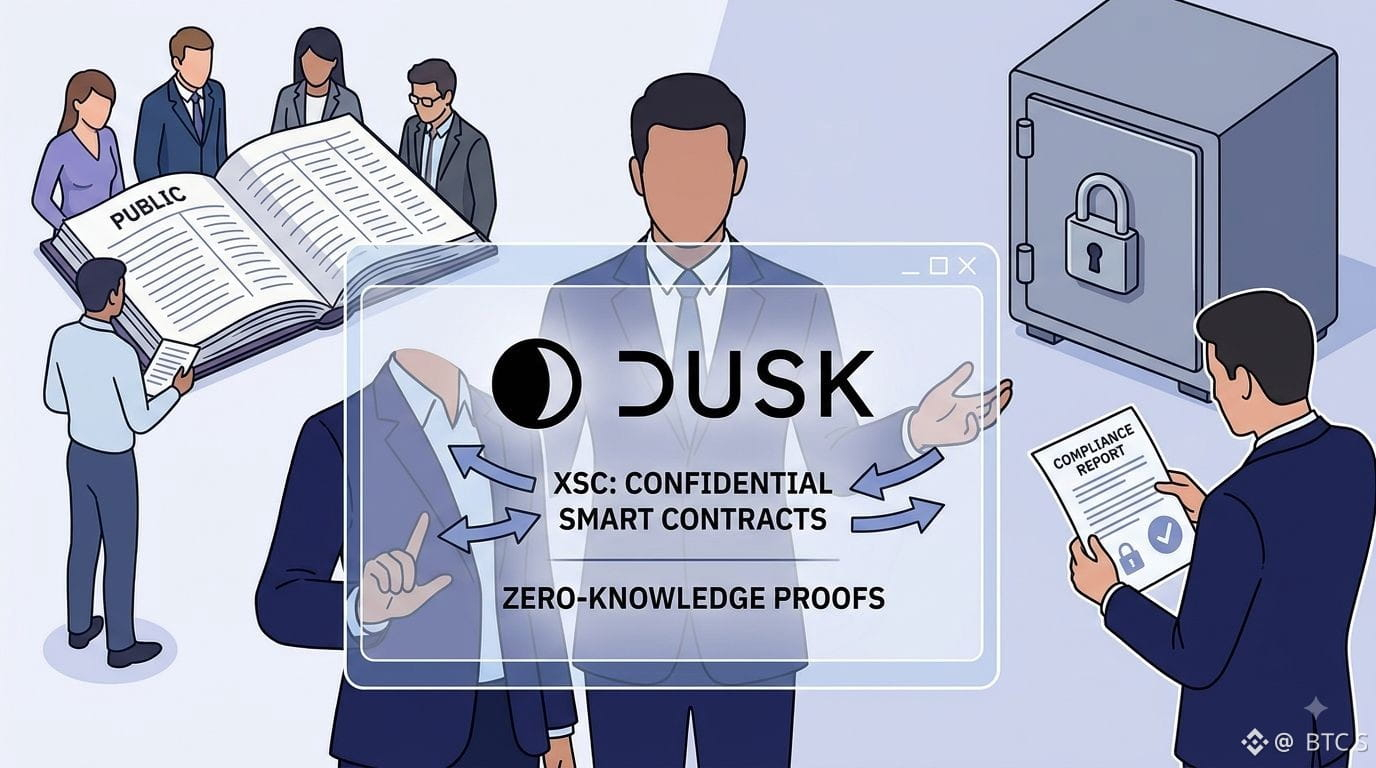
So Dusk's premise is at least aimed at the right question. Don't add privacy after the fact — write it into the contract from the start. That's what XSC is supposed to do: let a transaction prove it's clean without showing anyone what's actually in it.
I genuinely don't know if it holds up once real volume hits it. Proving systems get expensive fast, and getting a regulator comfortable with "trust the proof" instead of "show me the ledger" is a slow, human problem, not a technical one.
If this works for anyone, it's for the boring, regulated players who need privacy and compliance at the same time — not traders looking for a thrill. Small audience. Maybe the right one.
#dusk @Dusk_Foundation
$DUSK
{spot}(DUSKUSDT)
$RED
{spot}(REDUSDT)
$EDEN
{spot}(EDENUSDT)
I've sat in enough of these conversations to know the exact point where people check out. You're explaining some new chain, everyone's nodding, and then someone — usually the person who actually handles money for a living — asks, "okay but who else can see this?" And the honest answer is: everyone. Every wallet, every balance, every move, sitting there in public forever. That's when the nodding stops. Not because they're anti-crypto. Because they've done this job long enough to know you don't run a business with your books open to your competitors.
And look, the fixes that already exist for this always feel a little... improvised? Mixers that make an exchange's compliance team break out in hives. Privacy coins that get quietly dropped the second a regulator raises an eyebrow. Side-chains where you're technically avoiding one trust problem by creating a smaller, weirder one. None of it feels like something you'd actually build a bond issuance on top of.
So Dusk's premise is at least aimed at the right question. Don't add privacy after the fact — write it into the contract from the start. That's what XSC is supposed to do: let a transaction prove it's clean without showing anyone what's actually in it.
I genuinely don't know if it holds up once real volume hits it. Proving systems get expensive fast, and getting a regulator comfortable with "trust the proof" instead of "show me the ledger" is a slow, human problem, not a technical one.
If this works for anyone, it's for the boring, regulated players who need privacy and compliance at the same time — not traders looking for a thrill. Small audience. Maybe the right one.
#dusk @Dusk
$DUSK
$RED
$EDEN
And look, the fixes that already exist for this always feel a little... improvised? Mixers that make an exchange's compliance team break out in hives. Privacy coins that get quietly dropped the second a regulator raises an eyebrow. Side-chains where you're technically avoiding one trust problem by creating a smaller, weirder one. None of it feels like something you'd actually build a bond issuance on top of.
So Dusk's premise is at least aimed at the right question. Don't add privacy after the fact — write it into the contract from the start. That's what XSC is supposed to do: let a transaction prove it's clean without showing anyone what's actually in it.
I genuinely don't know if it holds up once real volume hits it. Proving systems get expensive fast, and getting a regulator comfortable with "trust the proof" instead of "show me the ledger" is a slow, human problem, not a technical one.
If this works for anyone, it's for the boring, regulated players who need privacy and compliance at the same time — not traders looking for a thrill. Small audience. Maybe the right one.
#dusk @Dusk
$DUSK
$RED
$EDEN
2
2
262
·
--
Bullish
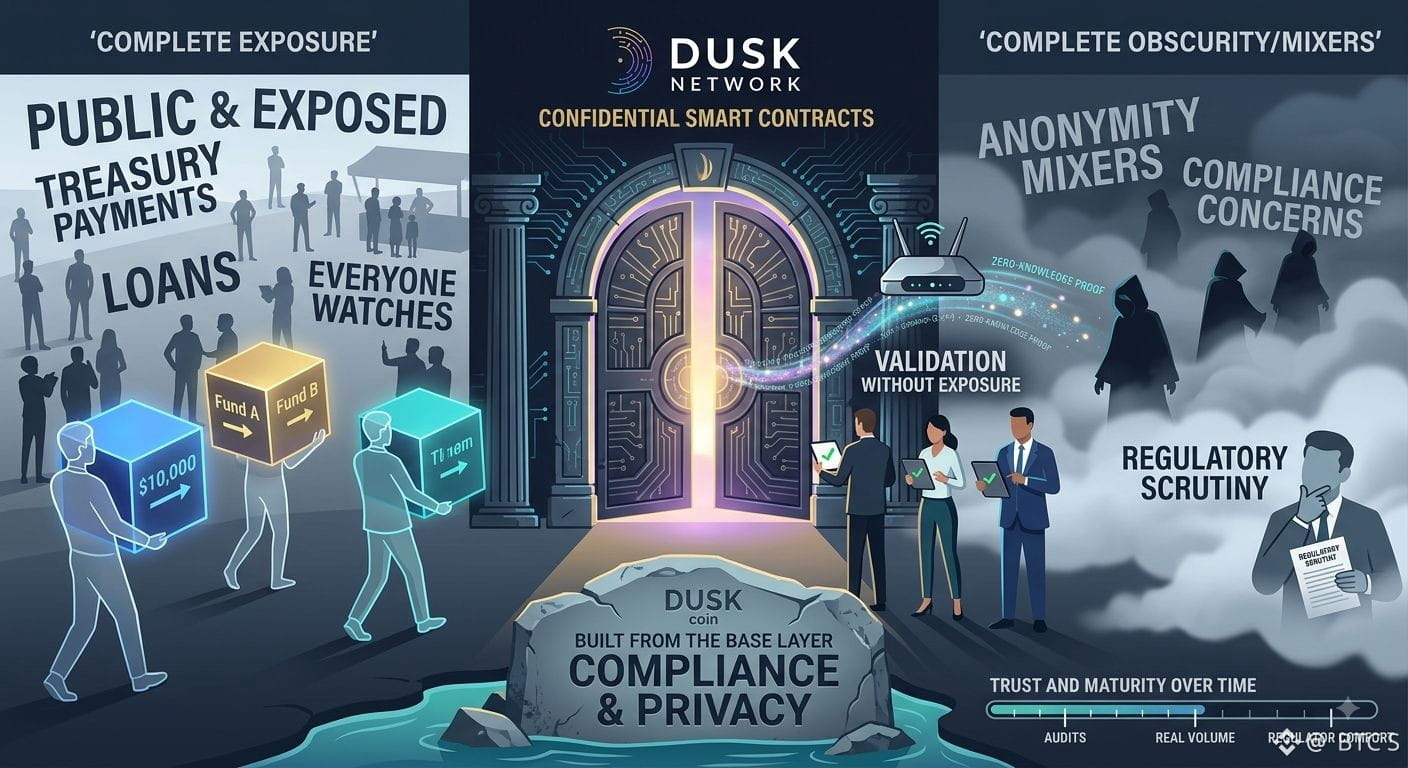
Say you're moving real money on a public blockchain — a treasury payment, a loan, a settlement between two funds. Everyone can see it. Not just the amount, but who, when, how often, the whole shape of it over time. That's the part that never quite gets said out loud. It's not that crypto is missing privacy features, exactly. It's that privacy on-chain tends to be all or nothing. You're either completely exposed, or you're using something like a mixer, and the second one makes any compliance person go quiet and start typing notes. Neither is really usable if you're moving actual capital.
What Dusk is going for, as far as I can tell, is the middle — confidential smart contracts where a transaction proves it's valid without showing everyone what's in it, but where the right party could still check it later if they had to. That's the right thing to want. Nobody's really pulled it off cleanly yet. And building it at the base layer instead of bolting it on afterward is a harder, slower path — smaller validator sets early on, thinner liquidity, a long stretch where nothing feels proven. Regulators aren't going to just trust the cryptography because it's elegant. They need to watch it hold up, for years, before anyone with real money gets comfortable.
So I wouldn't get excited about this one. I'd just keep half an eye on it — is it still running, still getting audited, is anyone with real volume actually touching it. If yes, eventually, it's probably because someone needed this badly enough to wait. If not, it's because trust like this is slow, and most things don't make it that far.
#dusk $DUSK @Dusk_Foundation
{spot}(DUSKUSDT)
Say you're moving real money on a public blockchain — a treasury payment, a loan, a settlement between two funds. Everyone can see it. Not just the amount, but who, when, how often, the whole shape of it over time. That's the part that never quite gets said out loud. It's not that crypto is missing privacy features, exactly. It's that privacy on-chain tends to be all or nothing. You're either completely exposed, or you're using something like a mixer, and the second one makes any compliance person go quiet and start typing notes. Neither is really usable if you're moving actual capital.
What Dusk is going for, as far as I can tell, is the middle — confidential smart contracts where a transaction proves it's valid without showing everyone what's in it, but where the right party could still check it later if they had to. That's the right thing to want. Nobody's really pulled it off cleanly yet. And building it at the base layer instead of bolting it on afterward is a harder, slower path — smaller validator sets early on, thinner liquidity, a long stretch where nothing feels proven. Regulators aren't going to just trust the cryptography because it's elegant. They need to watch it hold up, for years, before anyone with real money gets comfortable.
So I wouldn't get excited about this one. I'd just keep half an eye on it — is it still running, still getting audited, is anyone with real volume actually touching it. If yes, eventually, it's probably because someone needed this badly enough to wait. If not, it's because trust like this is slow, and most things don't make it that far.
#dusk $DUSK @Dusk
What Dusk is going for, as far as I can tell, is the middle — confidential smart contracts where a transaction proves it's valid without showing everyone what's in it, but where the right party could still check it later if they had to. That's the right thing to want. Nobody's really pulled it off cleanly yet. And building it at the base layer instead of bolting it on afterward is a harder, slower path — smaller validator sets early on, thinner liquidity, a long stretch where nothing feels proven. Regulators aren't going to just trust the cryptography because it's elegant. They need to watch it hold up, for years, before anyone with real money gets comfortable.
So I wouldn't get excited about this one. I'd just keep half an eye on it — is it still running, still getting audited, is anyone with real volume actually touching it. If yes, eventually, it's probably because someone needed this badly enough to wait. If not, it's because trust like this is slow, and most things don't make it that far.
#dusk $DUSK @Dusk
18
6
137
·
--
Bullish
Banks won't settle a bond on-chain because the second the trade hits the public ledger, every position size, every counterparty, and every flow pattern becomes visible to anyone. That's not some privacy preference—it's a straight-up legal requirement under almost every securities framework. Regulators need to audit, not be blind. So institutions just freeze. Not because they're anti-blockchain, but because blockchain's default "everything is transparent" setup is actually the compliance roadblock.
Most privacy chains try to dodge that by hiding everything. Regulators call that out immediately: you can't audit if you're blind.
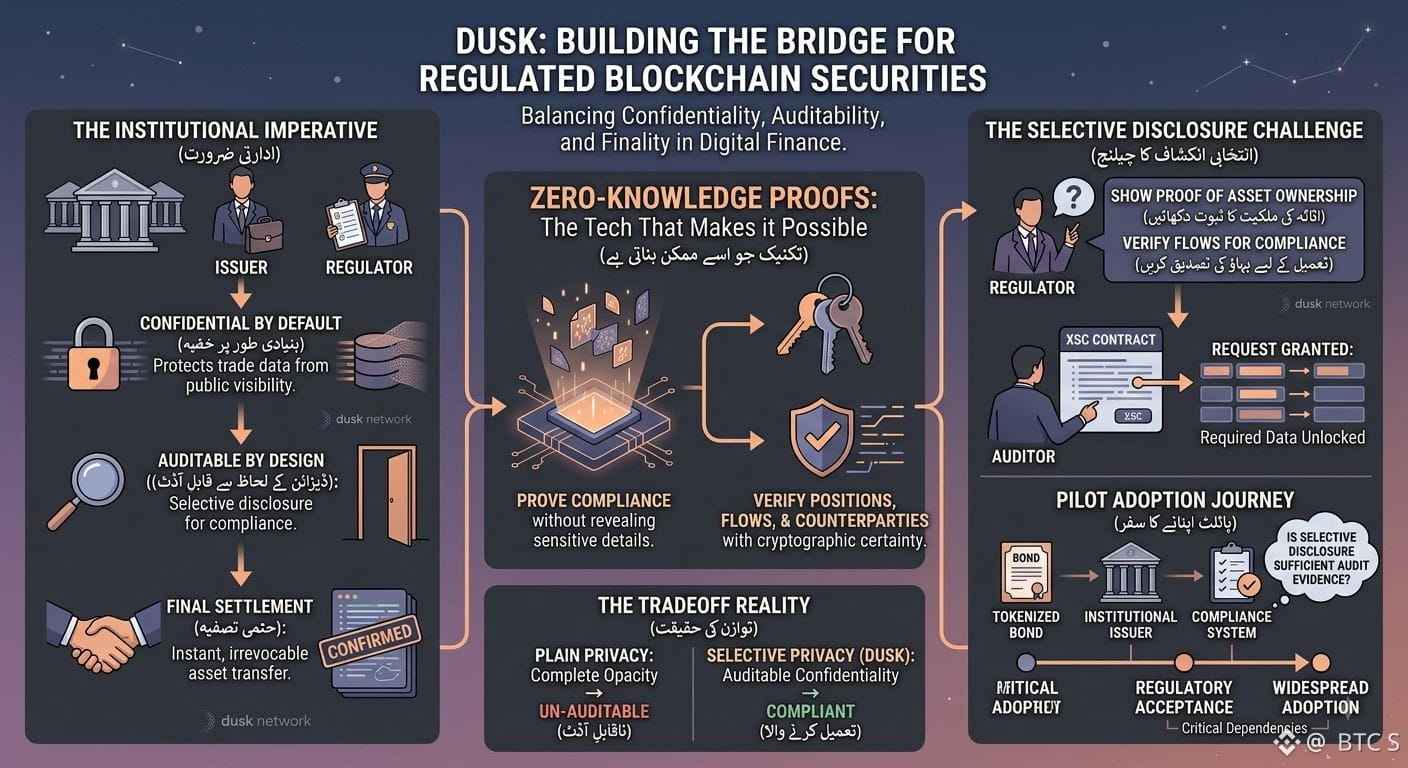
Dusk's XSC contracts try something different. Confidential by default, but selectively provable when a regulator or auditor actually needs to check something. That selective-disclosure idea is the real engineering challenge right now. The zero-knowledge proofs that actually fit real securities-law audit trails are still pretty new, so "compliant privacy" is a lot narrower than plain "private." Adoption's gonna crawl until the regulators decide whether selective disclosure counts as proper audit evidence.
Any chain that claims to deliver both settlement finality and regulatory disclosure at the same time is basically fighting physics. Those two goals pull against each other, and every project ends up picking one and selling the other. Dusk is one of the few that doesn't pretend the trade-off isn't there. That kind of straight talk is refreshing.
The only people who'll actually use this are regulated issuers running pilot tokenized bonds. Retail traders won't touch it—they want liquidity and price discovery, not privacy theater. It only works if the proofs are fast, cheap, and drop straight into existing compliance systems... and if the regulators accept that selective disclosure is enough for audit. Until then, it's still just a "we should try this when we can" idea, not a "we have to use this" reality.
#dusk $DUSK @Dusk_Foundation
{spot}(DUSKUSDT)
Banks won't settle a bond on-chain because the second the trade hits the public ledger, every position size, every counterparty, and every flow pattern becomes visible to anyone. That's not some privacy preference—it's a straight-up legal requirement under almost every securities framework. Regulators need to audit, not be blind. So institutions just freeze. Not because they're anti-blockchain, but because blockchain's default "everything is transparent" setup is actually the compliance roadblock.
Most privacy chains try to dodge that by hiding everything. Regulators call that out immediately: you can't audit if you're blind.
Dusk's XSC contracts try something different. Confidential by default, but selectively provable when a regulator or auditor actually needs to check something. That selective-disclosure idea is the real engineering challenge right now. The zero-knowledge proofs that actually fit real securities-law audit trails are still pretty new, so "compliant privacy" is a lot narrower than plain "private." Adoption's gonna crawl until the regulators decide whether selective disclosure counts as proper audit evidence.
Any chain that claims to deliver both settlement finality and regulatory disclosure at the same time is basically fighting physics. Those two goals pull against each other, and every project ends up picking one and selling the other. Dusk is one of the few that doesn't pretend the trade-off isn't there. That kind of straight talk is refreshing.
The only people who'll actually use this are regulated issuers running pilot tokenized bonds. Retail traders won't touch it—they want liquidity and price discovery, not privacy theater. It only works if the proofs are fast, cheap, and drop straight into existing compliance systems... and if the regulators accept that selective disclosure is enough for audit. Until then, it's still just a "we should try this when we can" idea, not a "we have to use this" reality.
#dusk $DUSK @Dusk
Most privacy chains try to dodge that by hiding everything. Regulators call that out immediately: you can't audit if you're blind.
Dusk's XSC contracts try something different. Confidential by default, but selectively provable when a regulator or auditor actually needs to check something. That selective-disclosure idea is the real engineering challenge right now. The zero-knowledge proofs that actually fit real securities-law audit trails are still pretty new, so "compliant privacy" is a lot narrower than plain "private." Adoption's gonna crawl until the regulators decide whether selective disclosure counts as proper audit evidence.
Any chain that claims to deliver both settlement finality and regulatory disclosure at the same time is basically fighting physics. Those two goals pull against each other, and every project ends up picking one and selling the other. Dusk is one of the few that doesn't pretend the trade-off isn't there. That kind of straight talk is refreshing.
The only people who'll actually use this are regulated issuers running pilot tokenized bonds. Retail traders won't touch it—they want liquidity and price discovery, not privacy theater. It only works if the proofs are fast, cheap, and drop straight into existing compliance systems... and if the regulators accept that selective disclosure is enough for audit. Until then, it's still just a "we should try this when we can" idea, not a "we have to use this" reality.
#dusk $DUSK @Dusk
28
12
154
·
--
Bullish
Here's a question I can't shake: why hasn't serious institutional money touched most "privacy blockchains" yet? It's not lack of interest. Banks and asset managers would love to move things on-chain — cheaper settlement, fewer intermediaries. But they can't post their trading positions for the whole world to see, and regulators won't sign off on something they can't examine when they need to. So you end up needing two things that feel like opposites: keep it private, but make it provable on demand. Most projects pick one. Fully transparent chains leak everything. Fully private ones give regulators nothing to hold onto, which makes them a nonstarter for anything regulated.
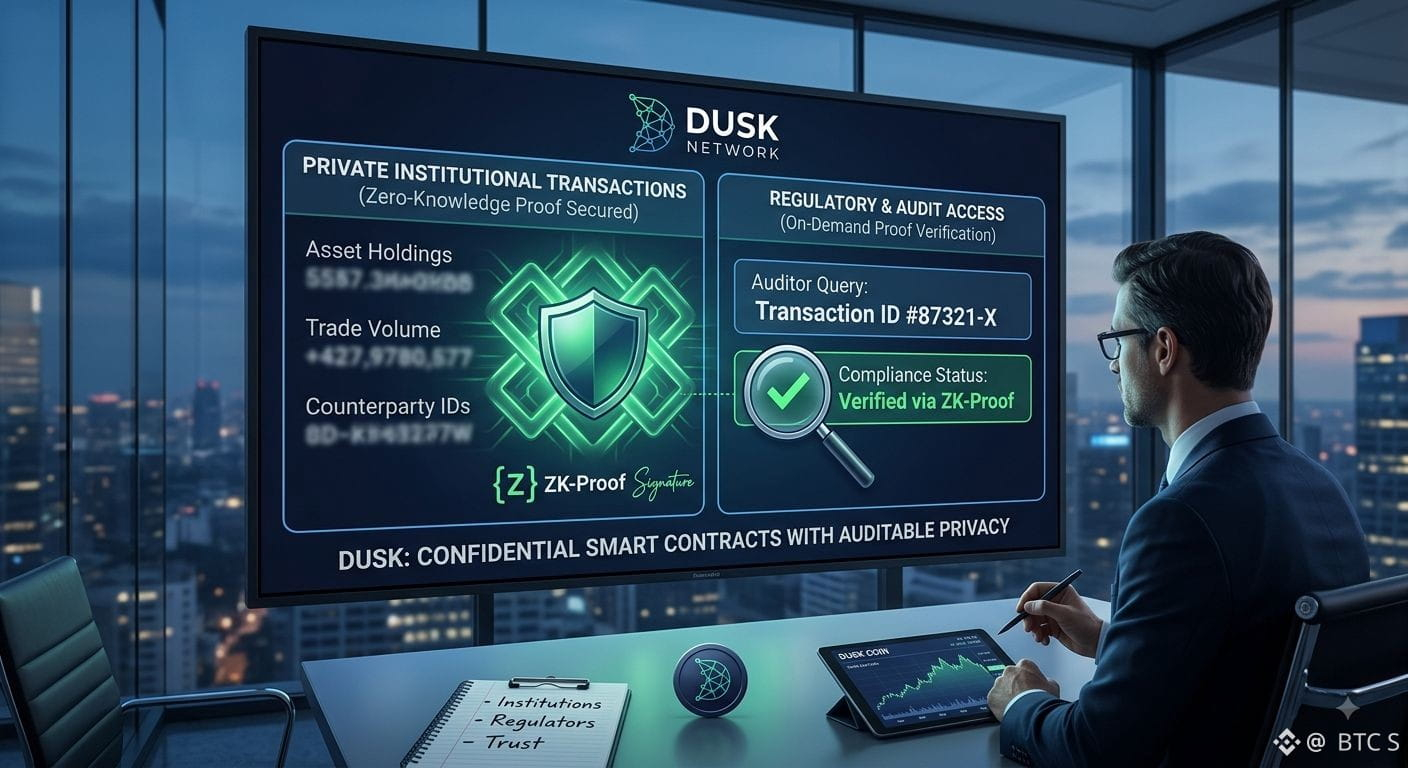
That's the gap Dusk seems to be poking at — confidential contracts that can still produce a proof for the right party without broadcasting the details to everyone else. On paper, that's the right shape of solution. In practice, I'd want to know whether a regulator or auditor would actually accept a zero-knowledge proof as sufficient evidence, because that trust doesn't come from clever cryptography, it comes from years of institutions testing it and not getting burned.
I doubt this is for everyday users — it's a slow, narrow bet aimed at issuers who need privacy and auditability together, and have been waiting because nothing else offered both honestly. It works if regulators genuinely come to trust the proofs over time. It fails quietly if they don't, and the tech just sits there, correct but unused.
#dusk $DUSK @Dusk_Foundation
Here's a question I can't shake: why hasn't serious institutional money touched most "privacy blockchains" yet? It's not lack of interest. Banks and asset managers would love to move things on-chain — cheaper settlement, fewer intermediaries. But they can't post their trading positions for the whole world to see, and regulators won't sign off on something they can't examine when they need to. So you end up needing two things that feel like opposites: keep it private, but make it provable on demand. Most projects pick one. Fully transparent chains leak everything. Fully private ones give regulators nothing to hold onto, which makes them a nonstarter for anything regulated.
That's the gap Dusk seems to be poking at — confidential contracts that can still produce a proof for the right party without broadcasting the details to everyone else. On paper, that's the right shape of solution. In practice, I'd want to know whether a regulator or auditor would actually accept a zero-knowledge proof as sufficient evidence, because that trust doesn't come from clever cryptography, it comes from years of institutions testing it and not getting burned.
I doubt this is for everyday users — it's a slow, narrow bet aimed at issuers who need privacy and auditability together, and have been waiting because nothing else offered both honestly. It works if regulators genuinely come to trust the proofs over time. It fails quietly if they don't, and the tech just sits there, correct but unused.
#dusk $DUSK @Dusk
That's the gap Dusk seems to be poking at — confidential contracts that can still produce a proof for the right party without broadcasting the details to everyone else. On paper, that's the right shape of solution. In practice, I'd want to know whether a regulator or auditor would actually accept a zero-knowledge proof as sufficient evidence, because that trust doesn't come from clever cryptography, it comes from years of institutions testing it and not getting burned.
I doubt this is for everyday users — it's a slow, narrow bet aimed at issuers who need privacy and auditability together, and have been waiting because nothing else offered both honestly. It works if regulators genuinely come to trust the proofs over time. It fails quietly if they don't, and the tech just sits there, correct but unused.
#dusk $DUSK @Dusk
19
7
162
·
--
Bullish
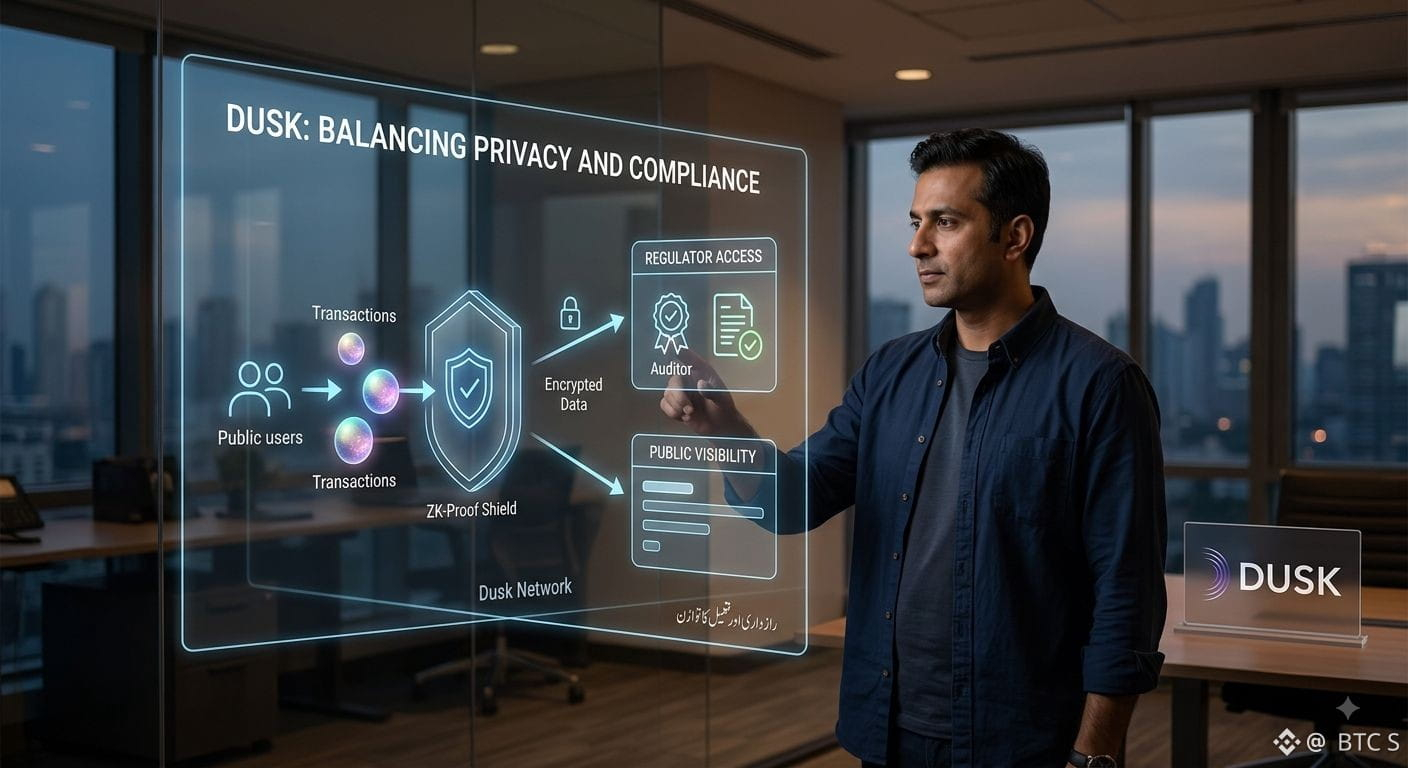
Honestly, the thing that bugs me about most crypto privacy talk is that it skips the actual problem. People jump straight to "zero-knowledge proofs" like that's self-explanatory, when the real question is much simpler: why can't a company issue shares on a blockchain without the whole world watching who bought what?
Because that's the situation right now. Put a security on a public chain and you've basically published your cap table. Every trade, every rebalance, visible to competitors in real time. No serious institution signs up for that. Not because they're hiding something shady — just because that's not how finance has ever worked. Even public markets don't show you the order book's intentions in real time.
The privacy coin era tried to fix this and mostly made regulators nervous instead, because "nobody can see anything" isn't compliance, it's just opacity with better marketing.
What Dusk is attempting feels more like an admission that both extremes are wrong. Keep the transaction private, but build in a way for the right person — an auditor, a regulator — to check it when they actually need to, without exposing it to everyone else. That's a genuinely hard thing to get right, and I say that as someone who's watched a lot of "compliant privacy" pitches turn out to be marketing dressed up as architecture.
I don't know yet if it holds up under real legal scrutiny, or if institutions will trust a chain this small with anything serious. But the problem it's circling is real, and almost nobody else is even trying to solve it properly.
#dusk $DUSK @Dusk_Foundation
Honestly, the thing that bugs me about most crypto privacy talk is that it skips the actual problem. People jump straight to "zero-knowledge proofs" like that's self-explanatory, when the real question is much simpler: why can't a company issue shares on a blockchain without the whole world watching who bought what?
Because that's the situation right now. Put a security on a public chain and you've basically published your cap table. Every trade, every rebalance, visible to competitors in real time. No serious institution signs up for that. Not because they're hiding something shady — just because that's not how finance has ever worked. Even public markets don't show you the order book's intentions in real time.
The privacy coin era tried to fix this and mostly made regulators nervous instead, because "nobody can see anything" isn't compliance, it's just opacity with better marketing.
What Dusk is attempting feels more like an admission that both extremes are wrong. Keep the transaction private, but build in a way for the right person — an auditor, a regulator — to check it when they actually need to, without exposing it to everyone else. That's a genuinely hard thing to get right, and I say that as someone who's watched a lot of "compliant privacy" pitches turn out to be marketing dressed up as architecture.
I don't know yet if it holds up under real legal scrutiny, or if institutions will trust a chain this small with anything serious. But the problem it's circling is real, and almost nobody else is even trying to solve it properly.
#dusk $DUSK @Dusk
Because that's the situation right now. Put a security on a public chain and you've basically published your cap table. Every trade, every rebalance, visible to competitors in real time. No serious institution signs up for that. Not because they're hiding something shady — just because that's not how finance has ever worked. Even public markets don't show you the order book's intentions in real time.
The privacy coin era tried to fix this and mostly made regulators nervous instead, because "nobody can see anything" isn't compliance, it's just opacity with better marketing.
What Dusk is attempting feels more like an admission that both extremes are wrong. Keep the transaction private, but build in a way for the right person — an auditor, a regulator — to check it when they actually need to, without exposing it to everyone else. That's a genuinely hard thing to get right, and I say that as someone who's watched a lot of "compliant privacy" pitches turn out to be marketing dressed up as architecture.
I don't know yet if it holds up under real legal scrutiny, or if institutions will trust a chain this small with anything serious. But the problem it's circling is real, and almost nobody else is even trying to solve it properly.
#dusk $DUSK @Dusk
3
1
2
100
·
--
Bullish
#dusk $DUSK @Dusk_Foundation
Here's a pattern you'll notice if you watch this space long enough: pretty much every serious institution that pokes at blockchain ends up quietly building a private version of it. A consortium chain here, a permissioned ledger there. Nobody makes a big announcement about it — it just keeps happening, and there's a reason.
Public chains show everything by default. Privacy gets bolted on later, as a special case, usually because one client refused to sign off without it. But that's backwards. In finance, keeping your hand hidden isn't some nice extra — it's basically how the system runs. Trade sizes, counterparties, balances: none of that is supposed to be visible to anyone except the people involved, plus whoever actually has legal standing to look. And regulators don't want a public feed either, whatever people assume. They want to be able to look when there's a reason to — not a permanent window into everybody's business all the time.
Bolt privacy on after the fact and you basically get two options, both bad: sketchy mixers nobody really trusts, or full transparency nobody actually wanted. Neither survives contact with real money for long.
Which is why Dusk Network's confidential contracts are worth a look. The idea is to flip the default — privacy is the resting state, and disclosure is something granted, not something that leaks out and then has to get laundered away after the fact. That's a lot closer to how compliance actually works: selective, permissioned, auditable on demand rather than broadcast to the whole world at once.
Whether it actually holds up is another question. Costs, latency, whether regulators will ever trust math they can't personally audit — all still genuinely up in the air. If this approach catches on at all, it'll be institutions quietly settling things in the background, not anyone chasing a headline. And it dies the moment running it costs more than the exposure it's meant to prevent.
{spot}(DUSKUSDT)
#dusk $DUSK @Dusk
Here's a pattern you'll notice if you watch this space long enough: pretty much every serious institution that pokes at blockchain ends up quietly building a private version of it. A consortium chain here, a permissioned ledger there. Nobody makes a big announcement about it — it just keeps happening, and there's a reason.
Public chains show everything by default. Privacy gets bolted on later, as a special case, usually because one client refused to sign off without it. But that's backwards. In finance, keeping your hand hidden isn't some nice extra — it's basically how the system runs. Trade sizes, counterparties, balances: none of that is supposed to be visible to anyone except the people involved, plus whoever actually has legal standing to look. And regulators don't want a public feed either, whatever people assume. They want to be able to look when there's a reason to — not a permanent window into everybody's business all the time.
Bolt privacy on after the fact and you basically get two options, both bad: sketchy mixers nobody really trusts, or full transparency nobody actually wanted. Neither survives contact with real money for long.
Which is why Dusk Network's confidential contracts are worth a look. The idea is to flip the default — privacy is the resting state, and disclosure is something granted, not something that leaks out and then has to get laundered away after the fact. That's a lot closer to how compliance actually works: selective, permissioned, auditable on demand rather than broadcast to the whole world at once.
Whether it actually holds up is another question. Costs, latency, whether regulators will ever trust math they can't personally audit — all still genuinely up in the air. If this approach catches on at all, it'll be institutions quietly settling things in the background, not anyone chasing a headline. And it dies the moment running it costs more than the exposure it's meant to prevent.
Here's a pattern you'll notice if you watch this space long enough: pretty much every serious institution that pokes at blockchain ends up quietly building a private version of it. A consortium chain here, a permissioned ledger there. Nobody makes a big announcement about it — it just keeps happening, and there's a reason.
Public chains show everything by default. Privacy gets bolted on later, as a special case, usually because one client refused to sign off without it. But that's backwards. In finance, keeping your hand hidden isn't some nice extra — it's basically how the system runs. Trade sizes, counterparties, balances: none of that is supposed to be visible to anyone except the people involved, plus whoever actually has legal standing to look. And regulators don't want a public feed either, whatever people assume. They want to be able to look when there's a reason to — not a permanent window into everybody's business all the time.
Bolt privacy on after the fact and you basically get two options, both bad: sketchy mixers nobody really trusts, or full transparency nobody actually wanted. Neither survives contact with real money for long.
Which is why Dusk Network's confidential contracts are worth a look. The idea is to flip the default — privacy is the resting state, and disclosure is something granted, not something that leaks out and then has to get laundered away after the fact. That's a lot closer to how compliance actually works: selective, permissioned, auditable on demand rather than broadcast to the whole world at once.
Whether it actually holds up is another question. Costs, latency, whether regulators will ever trust math they can't personally audit — all still genuinely up in the air. If this approach catches on at all, it'll be institutions quietly settling things in the background, not anyone chasing a headline. And it dies the moment running it costs more than the exposure it's meant to prevent.
10
10
99
·
--
Bullish
#baby $BABY @babylonlabs_io
I was trying to explain this to someone last week and kept getting stuck on the same sentence: "the Bitcoin doesn't actually move." They looked at me like that couldn't possibly be the whole story. And honestly, it isn't — but the part that follows is more interesting than the part that sounds impressive.
Every time Bitcoin shows up in DeFi, something has to give. Usually it's custody. You wrap the coin, or you hand it to a bridge, and what you're left holding is a receipt — a promise that somewhere, someone still has your BTC. That promise has broken often enough that "trust the bridge" stopped being a reasonable ask a while ago.
Babylon tries something less flattering-sounding but maybe more honest: instead of moving the coin, it makes Ethereum go check. The BTC stays locked on Bitcoin under Bitcoin's own rules, and what gets verified elsewhere is proof — a UTXO, a timelock, evidence Bitcoin itself can vouch for. Nobody's holding your coins hostage. Nobody has to.
The catch is patience. Bitcoin doesn't declare things final immediately — reorgs are still possible for a while after a block lands — so any system reading Bitcoin honestly has to sit with some uncertainty before treating that BTC as locked-and-safe. That's not a rough edge to smooth out. It's just what happens when you replace a trusted party with a waiting period.
Which probably tells you who this is actually for. Not the person who wants their Bitcoin working in a DeFi pool by lunchtime. More the fund or validator willing to let capital sit still for a while, if sitting still is what makes it real. Whether that's a fair trade is still an open question — I think it depends less on the tech and more on how much patience the market has left.
#baby $BABY @BabylonLabs_io
I was trying to explain this to someone last week and kept getting stuck on the same sentence: "the Bitcoin doesn't actually move." They looked at me like that couldn't possibly be the whole story. And honestly, it isn't — but the part that follows is more interesting than the part that sounds impressive.
Every time Bitcoin shows up in DeFi, something has to give. Usually it's custody. You wrap the coin, or you hand it to a bridge, and what you're left holding is a receipt — a promise that somewhere, someone still has your BTC. That promise has broken often enough that "trust the bridge" stopped being a reasonable ask a while ago.
Babylon tries something less flattering-sounding but maybe more honest: instead of moving the coin, it makes Ethereum go check. The BTC stays locked on Bitcoin under Bitcoin's own rules, and what gets verified elsewhere is proof — a UTXO, a timelock, evidence Bitcoin itself can vouch for. Nobody's holding your coins hostage. Nobody has to.
The catch is patience. Bitcoin doesn't declare things final immediately — reorgs are still possible for a while after a block lands — so any system reading Bitcoin honestly has to sit with some uncertainty before treating that BTC as locked-and-safe. That's not a rough edge to smooth out. It's just what happens when you replace a trusted party with a waiting period.
Which probably tells you who this is actually for. Not the person who wants their Bitcoin working in a DeFi pool by lunchtime. More the fund or validator willing to let capital sit still for a while, if sitting still is what makes it real. Whether that's a fair trade is still an open question — I think it depends less on the tech and more on how much patience the market has left.
I was trying to explain this to someone last week and kept getting stuck on the same sentence: "the Bitcoin doesn't actually move." They looked at me like that couldn't possibly be the whole story. And honestly, it isn't — but the part that follows is more interesting than the part that sounds impressive.
Every time Bitcoin shows up in DeFi, something has to give. Usually it's custody. You wrap the coin, or you hand it to a bridge, and what you're left holding is a receipt — a promise that somewhere, someone still has your BTC. That promise has broken often enough that "trust the bridge" stopped being a reasonable ask a while ago.
Babylon tries something less flattering-sounding but maybe more honest: instead of moving the coin, it makes Ethereum go check. The BTC stays locked on Bitcoin under Bitcoin's own rules, and what gets verified elsewhere is proof — a UTXO, a timelock, evidence Bitcoin itself can vouch for. Nobody's holding your coins hostage. Nobody has to.
The catch is patience. Bitcoin doesn't declare things final immediately — reorgs are still possible for a while after a block lands — so any system reading Bitcoin honestly has to sit with some uncertainty before treating that BTC as locked-and-safe. That's not a rough edge to smooth out. It's just what happens when you replace a trusted party with a waiting period.
Which probably tells you who this is actually for. Not the person who wants their Bitcoin working in a DeFi pool by lunchtime. More the fund or validator willing to let capital sit still for a while, if sitting still is what makes it real. Whether that's a fair trade is still an open question — I think it depends less on the tech and more on how much patience the market has left.
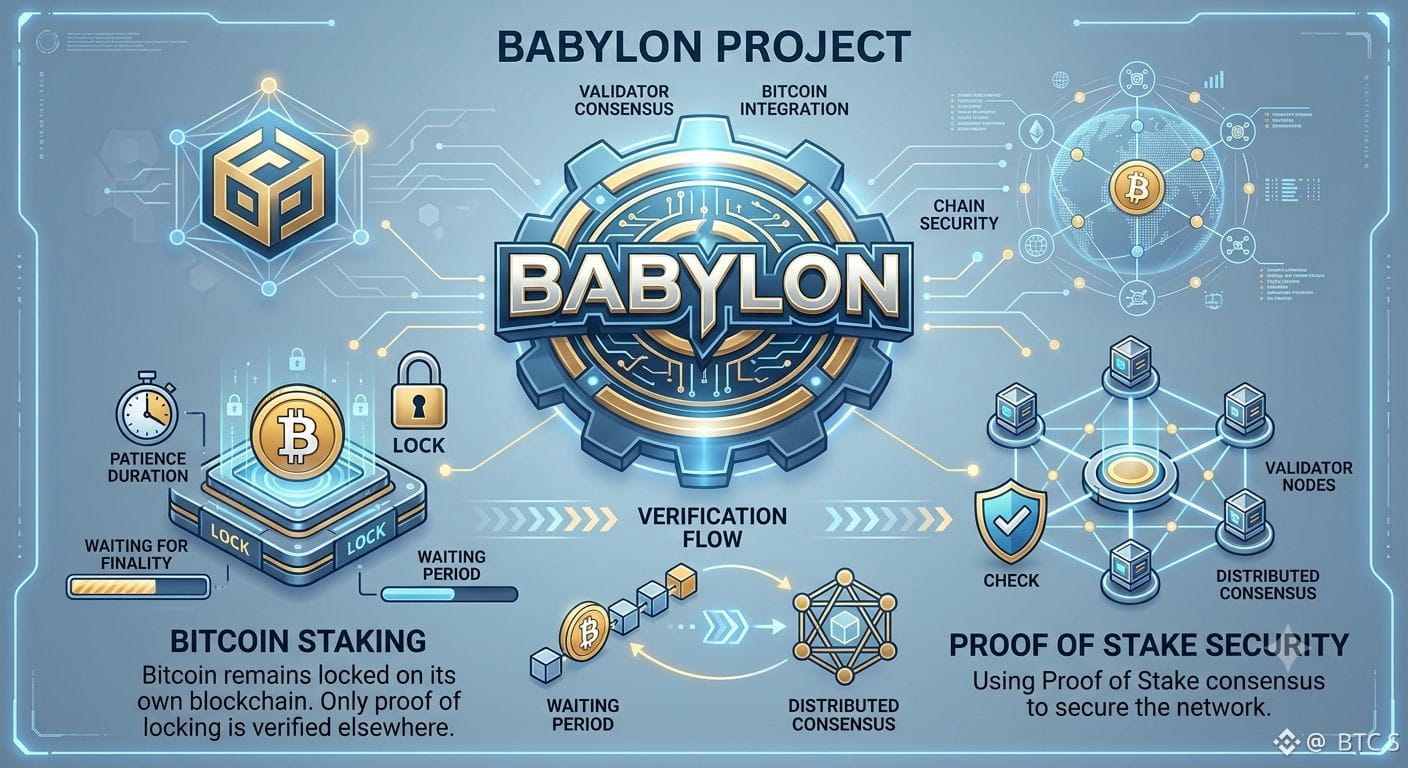
18
8
131
·
--
Bullish
#baby $BABY @babylonlabs_io
Someone in a Discord once asked, completely genuinely, "did something bad happen? why's it dropping?" And the answer was nothing dramatic. No hack, no scandal. Just a scheduled unlock doing exactly what the contract always said it would do. Nobody broke a promise. Nobody had read the calendar closely either.
That's the part of tokenomics that never makes it into the pitch. The allocation chart is the fun slide — team here, investors there, community gets its slice. But that chart is a photo taken on day one. It doesn't say when those people are actually free to sell. And that unglamorous detail, the vesting schedule nobody screenshots, tends to matter a lot more a year in than the pie chart ever did.
I don't have a problem with Babylon's core idea. Bitcoin sits there, mostly idle, and letting it back the security of other chains without dragging it off its own rules is a genuinely useful thing to build. That part feels sound. What worries me is more mundane — whether team and investor tokens trickle out gradually or land in a handful of big clumps that outpace whatever real demand exists at that moment.
There's no clean fix for this, honestly. Lock too much up and the token can't do its job — governance stalls, incentives feel thin. Release too fast and you get volatility that makes a security-focused protocol look anything but secure.
So what I'd actually watch is boring: does unlock pace track real BTC getting staked, or just dates on a spreadsheet? I've seen which one usually wins.
#baby $BABY @BabylonLabs_io
Someone in a Discord once asked, completely genuinely, "did something bad happen? why's it dropping?" And the answer was nothing dramatic. No hack, no scandal. Just a scheduled unlock doing exactly what the contract always said it would do. Nobody broke a promise. Nobody had read the calendar closely either.
That's the part of tokenomics that never makes it into the pitch. The allocation chart is the fun slide — team here, investors there, community gets its slice. But that chart is a photo taken on day one. It doesn't say when those people are actually free to sell. And that unglamorous detail, the vesting schedule nobody screenshots, tends to matter a lot more a year in than the pie chart ever did.
I don't have a problem with Babylon's core idea. Bitcoin sits there, mostly idle, and letting it back the security of other chains without dragging it off its own rules is a genuinely useful thing to build. That part feels sound. What worries me is more mundane — whether team and investor tokens trickle out gradually or land in a handful of big clumps that outpace whatever real demand exists at that moment.
There's no clean fix for this, honestly. Lock too much up and the token can't do its job — governance stalls, incentives feel thin. Release too fast and you get volatility that makes a security-focused protocol look anything but secure.
So what I'd actually watch is boring: does unlock pace track real BTC getting staked, or just dates on a spreadsheet? I've seen which one usually wins.
Someone in a Discord once asked, completely genuinely, "did something bad happen? why's it dropping?" And the answer was nothing dramatic. No hack, no scandal. Just a scheduled unlock doing exactly what the contract always said it would do. Nobody broke a promise. Nobody had read the calendar closely either.
That's the part of tokenomics that never makes it into the pitch. The allocation chart is the fun slide — team here, investors there, community gets its slice. But that chart is a photo taken on day one. It doesn't say when those people are actually free to sell. And that unglamorous detail, the vesting schedule nobody screenshots, tends to matter a lot more a year in than the pie chart ever did.
I don't have a problem with Babylon's core idea. Bitcoin sits there, mostly idle, and letting it back the security of other chains without dragging it off its own rules is a genuinely useful thing to build. That part feels sound. What worries me is more mundane — whether team and investor tokens trickle out gradually or land in a handful of big clumps that outpace whatever real demand exists at that moment.
There's no clean fix for this, honestly. Lock too much up and the token can't do its job — governance stalls, incentives feel thin. Release too fast and you get volatility that makes a security-focused protocol look anything but secure.
So what I'd actually watch is boring: does unlock pace track real BTC getting staked, or just dates on a spreadsheet? I've seen which one usually wins.
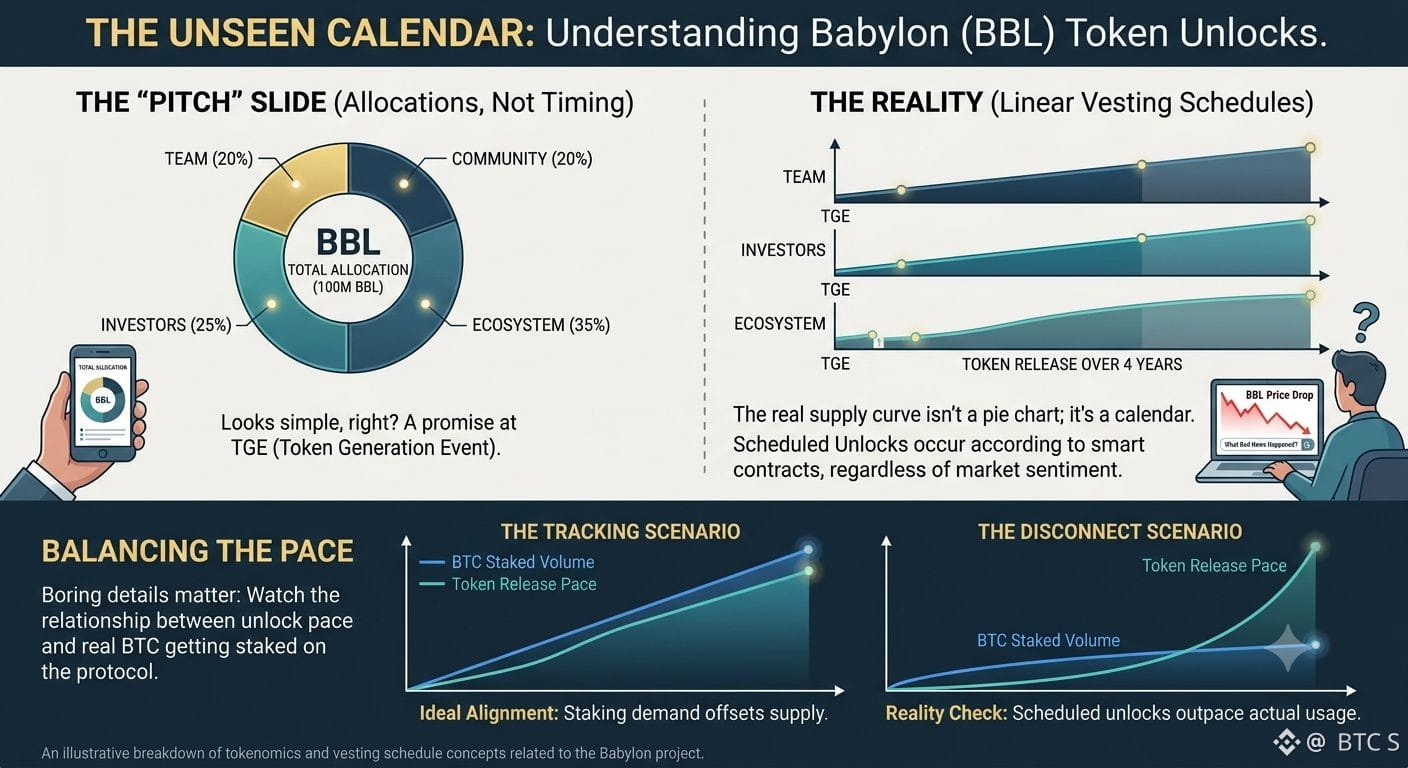
10
6
97
·
--
Bullish
#baby $BABY @babylonlabs_io
You know what actually gets me thinking about this — it's not the mechanism, it's the moment someone's staring at their wallet going "I did the thing, why isn't it done." That gap between action and confirmation. We've all felt it somewhere, waiting for a wire transfer to clear, refreshing a tracking page. But with Bitcoin it's worse because there's no customer service number to call, no human who can just say "yeah it's fine, trust me."
The honest version of what's happening is kind of unglamorous: your unbonding transaction is sitting there, and the system is essentially watching the chain build on top of it, block after block, before it's willing to say "okay, that's real enough now." How many blocks is enough? Depends. Fee market's hot, blocks are packed, everyone else is also trying to unwind positions at the same time — suddenly your "quick unstake" is anything but quick. And that's assuming nothing actually goes wrong.
I don't think this is really a technical flaw so much as a communication one. Products built on top of Bitcoin inherit its pace whether they admit it or not. Babylon seems to at least build the unbonding period into the architecture rather than trying to paper over it with some polished progress bar that implies control it doesn't have.
Whether that earns trust or just tests patience — honestly depends on who's staking and what they're staking for. Someone parking BTC long-term probably doesn't care about a few extra hours. Someone who needs to move fast during a market swing might learn to resent it.
$LABX.ETF
$BTC
#baby $BABY @BabylonLabs_io
You know what actually gets me thinking about this — it's not the mechanism, it's the moment someone's staring at their wallet going "I did the thing, why isn't it done." That gap between action and confirmation. We've all felt it somewhere, waiting for a wire transfer to clear, refreshing a tracking page. But with Bitcoin it's worse because there's no customer service number to call, no human who can just say "yeah it's fine, trust me."
The honest version of what's happening is kind of unglamorous: your unbonding transaction is sitting there, and the system is essentially watching the chain build on top of it, block after block, before it's willing to say "okay, that's real enough now." How many blocks is enough? Depends. Fee market's hot, blocks are packed, everyone else is also trying to unwind positions at the same time — suddenly your "quick unstake" is anything but quick. And that's assuming nothing actually goes wrong.
I don't think this is really a technical flaw so much as a communication one. Products built on top of Bitcoin inherit its pace whether they admit it or not. Babylon seems to at least build the unbonding period into the architecture rather than trying to paper over it with some polished progress bar that implies control it doesn't have.
Whether that earns trust or just tests patience — honestly depends on who's staking and what they're staking for. Someone parking BTC long-term probably doesn't care about a few extra hours. Someone who needs to move fast during a market swing might learn to resent it.
$LABX.ETF
$BTC
You know what actually gets me thinking about this — it's not the mechanism, it's the moment someone's staring at their wallet going "I did the thing, why isn't it done." That gap between action and confirmation. We've all felt it somewhere, waiting for a wire transfer to clear, refreshing a tracking page. But with Bitcoin it's worse because there's no customer service number to call, no human who can just say "yeah it's fine, trust me."
The honest version of what's happening is kind of unglamorous: your unbonding transaction is sitting there, and the system is essentially watching the chain build on top of it, block after block, before it's willing to say "okay, that's real enough now." How many blocks is enough? Depends. Fee market's hot, blocks are packed, everyone else is also trying to unwind positions at the same time — suddenly your "quick unstake" is anything but quick. And that's assuming nothing actually goes wrong.
I don't think this is really a technical flaw so much as a communication one. Products built on top of Bitcoin inherit its pace whether they admit it or not. Babylon seems to at least build the unbonding period into the architecture rather than trying to paper over it with some polished progress bar that implies control it doesn't have.
Whether that earns trust or just tests patience — honestly depends on who's staking and what they're staking for. Someone parking BTC long-term probably doesn't care about a few extra hours. Someone who needs to move fast during a market swing might learn to resent it.
$LABX.ETF
$BTC
4
4
124
Log in to explore more content
Join global crypto users on Binance Square
⚡️ Get latest and useful information about crypto.
💬 Trusted by the world’s largest crypto exchange.
👍 Discover real insights from verified creators.
Email / Phone number
Trending Topics
BitwiseFilesFinalNEARSpotETFProspectus
2,318 views
181 Discussing
🟣 Bitwise just gave Wall Street NEAR exposure with something most ETF headlines won't mention: an exit clock...
#bitwisefilesfinalnearspotetfprospectus
The Bitwise NEAR ETF has cleared registration and NYSE Arca has approved its listing. Its prospectus says the trust intends to stake 100% of its NEAR under normal conditions and retain about 67% of the staking rewards.
Sounds almost perfect:
NEAR exposure + staking yield.
But there's a trade-off.
Staked NEAR isn't instantly liquid.
The protocol requires 2–4 epochs to unstake, with epochs targeted around 12 hours. Bitwise therefore expects normal redemptions to be around T+2, while warning that stressed conditions can extend the process.
That's the part I find fascinating.
An institutional wrapper can turn staking yield into a portfolio feature —
but it can't turn blockchain finality into instant liquidity.
So the metric I'd watch isn't just ETF inflows.
It's how much NEAR stays staked versus how the fund handles redemptions during volatility.
That's where the institutional model gets tested.
Not financial advice. Staking rewards are variable and redemption timing can extend under adverse conditions.
$NEAR $BTC $ETH
#BitwiseFilesFinalNEARSpotETFProspectus #Near #CryptoETFMania #altcoins
Stink meaner
·1 Likes
·212 views
BitgetHackerMoves$83MStolenXRP
10,311 views
74 Discussing
SOLSpotETFWeeklyInflow$188M
4,033 views
61 Discussing