

10年老韭加密研究中心
661 Posts

10年老韭加密研究中心
Report
Block User
关注老韭,财富长久
前金融从业者
金融市场策略|数字资产研究 全球宏观
用数据看市场,用事实拆叙事
用金融思维拨开涨跌中的迷雾,穿透盈利的本质
绑定邀请码享21%自动返佣——10205677

SAND Holder
Frequent Trader
9.2 Years
14 Following
183 Followers
1.1K+ Liked
Posts
All
Quotes
PINNED
·
--
Article
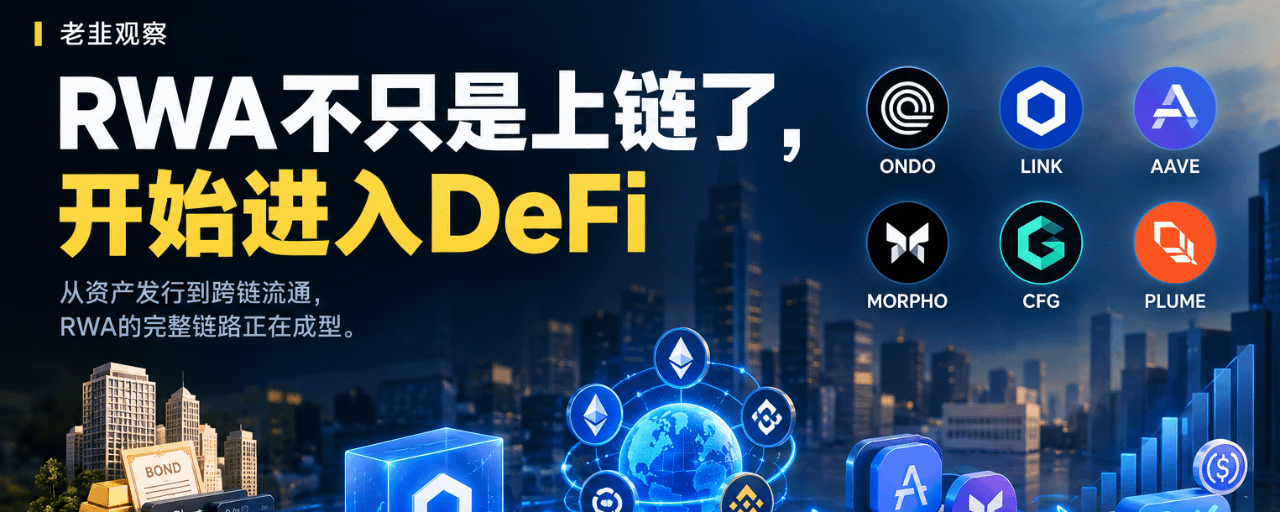
RWA is moving from “on-chain assets” to “on-chain finance”【Old-Crop Observation】
Recently, this RWA track has begun to show a fairly noticeable change.
When people talked about RWA before, it was basically just one sentence:
Move traditional assets like stocks, bonds, and funds onto the blockchain.
But moving assets onto the chain is actually just the first step.
What’s really interesting is that recently, people have started connecting these assets further into DeFi.
And this pathway has gradually been connected together.
First, look at the asset side.
What $ONDO is doing is to turn traditional financial assets like stocks and ETFs into on-chain assets.
This year in February, Ondo's SPYon and QQQon have already entered the Morpho lending market and can be used as collateral to borrow other assets.
RWA is moving from “on-chain assets” to “on-chain finance”
【Old-Crop Observation】
Recently, this RWA track has begun to show a fairly noticeable change.
When people talked about RWA before, it was basically just one sentence:
Move traditional assets like stocks, bonds, and funds onto the blockchain.
But moving assets onto the chain is actually just the first step.
What’s really interesting is that recently, people have started connecting these assets further into DeFi.
And this pathway has gradually been connected together.
First, look at the asset side.
What $ONDO is doing is to turn traditional financial assets like stocks and ETFs into on-chain assets.
This year in February, Ondo's SPYon and QQQon have already entered the Morpho lending market and can be used as collateral to borrow other assets.
1
3
1.6k
·
--
#anthropic滚动12个月营收增长约1200%
【Follow Lao Jiu and wealth will be yours】Anthropic’s revenue surged by around 1,200% in a year! Behind the AI gold rush, the businesses that are actually making money are coming into view.
When people in crypto talk about AI, the conversation often turns to computing power, GPUs, and AI tokens. But if we want to judge whether this AI boom is driven by real demand, perhaps we should first ask whether AI companies themselves can turn their technology into revenue.
Anthropic’s latest financial disclosures show that the company generated about $16.3 billion in revenue in the first half of 2026, compared with about $1.2 billion in the same period last year—an increase of more than 13 times. The commercialization of products such as the Claude model and Claude Code is moving AI beyond a technology race and into the enterprise market, where customers pay for it.
I. AI is no longer just a contest over models—it’s becoming a contest over who can get customers to pay
In the past, AI companies focused on model capabilities and computing capacity. Now, whether businesses are willing to keep paying is becoming another key measure.
If AI can help businesses write code, handle complex tasks, and work more efficiently, it’s no longer just a novel tool; it could become part of their day-to-day operations. For Anthropic, rapid revenue growth suggests that market demand is translating into commercial income. Whether that growth can be sustained, however, remains to be seen.
II. What does this mean for the crypto sector’s AI narrative?
The key takeaway isn’t that AI is booming, so we should buy AI tokens. It’s that we need to distinguish who is actually generating revenue.
Growth in AI companies could strengthen expectations of long-term demand for computing power, automation, and intelligent agents. But revenue earned by traditional AI companies doesn’t automatically translate into value for any particular token. For related projects such as FET and RENDER, we still need to look at real usage, whether the token serves an essential purpose, and whether the project can turn demand into value that benefits token holders.
Lao Jiu believes the AI sector is moving from storytelling to proving its business model. When evaluating a project, we shouldn’t just ask what trend it’s riding—we should also ask whether it has customers, whether it generates revenue, and whether that growth is sustainable.
$BTC $ETH
2
6.7k
·
--
#据报韩国考虑第四次推迟加密税
【Follow Laojiu, and wealth is yours】Will South Korea’s crypto tax be delayed again? If it’s pushed back to 2029, this could be one of the regulatory changes the crypto community cares about most!
There’s more news from South Korea’s crypto market: the tax on gains from crypto assets, originally scheduled to take effect in January 2027, may be delayed for a fourth time—possibly until 2029 at the latest.
According to South Korean media reports on October 26, the Presidential Office is discussing another delay with relevant government departments, but no final decision has been made. If the proposal goes ahead, the tax rules that South Korean crypto investors were about to face will be pushed back by another two years.
I. How was South Korea originally planning to tax crypto?
Under the current plan, South Korea will tax annual gains from transferring or lending virtual assets, among other activities. Gains above the basic deduction of 2.5 million won will be taxed at 20%, bringing the combined rate to 22% after local income tax is included.
The tax was first proposed in 2020. Its implementation date has since been postponed from 2022 to 2023, then to 2025, and later to 2027. If it is delayed again, this will be the fourth postponement.
II. Why delay it again? The key issue is tracking cross-border transaction data
South Korea isn’t simply reluctant to impose the tax; it faces practical challenges with enforcement.
Data from domestic exchanges is relatively easy to obtain, but it is much harder to get complete transaction records for users of overseas exchanges and decentralized trading platforms. South Korea plans to join the OECD’s Crypto-Asset Reporting Framework (CARF) information exchange from 2027, while the United States is expected to begin participating in the relevant information exchange only in 2029.
This means that if South Korea starts collecting taxes first, but cannot obtain overseas transaction data to the same extent, enforcement could differ between users trading on domestic exchanges and those using overseas platforms. Aligning the tax timeline with the progress of international information exchange is one of the key reasons behind the current discussions about postponing the tax.
{spot}(ETHUSDT)
{spot}(BTCUSDT)
#据报韩国考虑第四次推迟加密税
【Follow Laojiu, and wealth is yours】Will South Korea’s crypto tax be delayed again? If it’s pushed back to 2029, this could be one of the regulatory changes the crypto community cares about most!
There’s more news from South Korea’s crypto market: the tax on gains from crypto assets, originally scheduled to take effect in January 2027, may be delayed for a fourth time—possibly until 2029 at the latest.
According to South Korean media reports on October 26, the Presidential Office is discussing another delay with relevant government departments, but no final decision has been made. If the proposal goes ahead, the tax rules that South Korean crypto investors were about to face will be pushed back by another two years.
I. How was South Korea originally planning to tax crypto?
Under the current plan, South Korea will tax annual gains from transferring or lending virtual assets, among other activities. Gains above the basic deduction of 2.5 million won will be taxed at 20%, bringing the combined rate to 22% after local income tax is included.
The tax was first proposed in 2020. Its implementation date has since been postponed from 2022 to 2023, then to 2025, and later to 2027. If it is delayed again, this will be the fourth postponement.
II. Why delay it again? The key issue is tracking cross-border transaction data
South Korea isn’t simply reluctant to impose the tax; it faces practical challenges with enforcement.
Data from domestic exchanges is relatively easy to obtain, but it is much harder to get complete transaction records for users of overseas exchanges and decentralized trading platforms. South Korea plans to join the OECD’s Crypto-Asset Reporting Framework (CARF) information exchange from 2027, while the United States is expected to begin participating in the relevant information exchange only in 2029.
This means that if South Korea starts collecting taxes first, but cannot obtain overseas transaction data to the same extent, enforcement could differ between users trading on domestic exchanges and those using overseas platforms. Aligning the tax timeline with the progress of international information exchange is one of the key reasons behind the current discussions about postponing the tax.
832
·
--
Verified
#富兰克林邓普顿申请股息转比特币etf
【Follow Lao Jiu, and wealth is yours】Franklin Templeton unveils a new strategy: buy U.S. stocks and automatically reinvest dividends in Bitcoin! Is traditional finance bringing BTC into more investors’ portfolios?
In the past, if you wanted Bitcoin exposure, you either bought BTC directly or invested in a spot Bitcoin ETF. Now, Wall Street asset management giant Franklin Templeton is trying something new: instead of simply receiving cash dividends from U.S. stocks, investors can have them automatically converted into Bitcoin-related investments.
1. What’s the difference between these two ETFs?
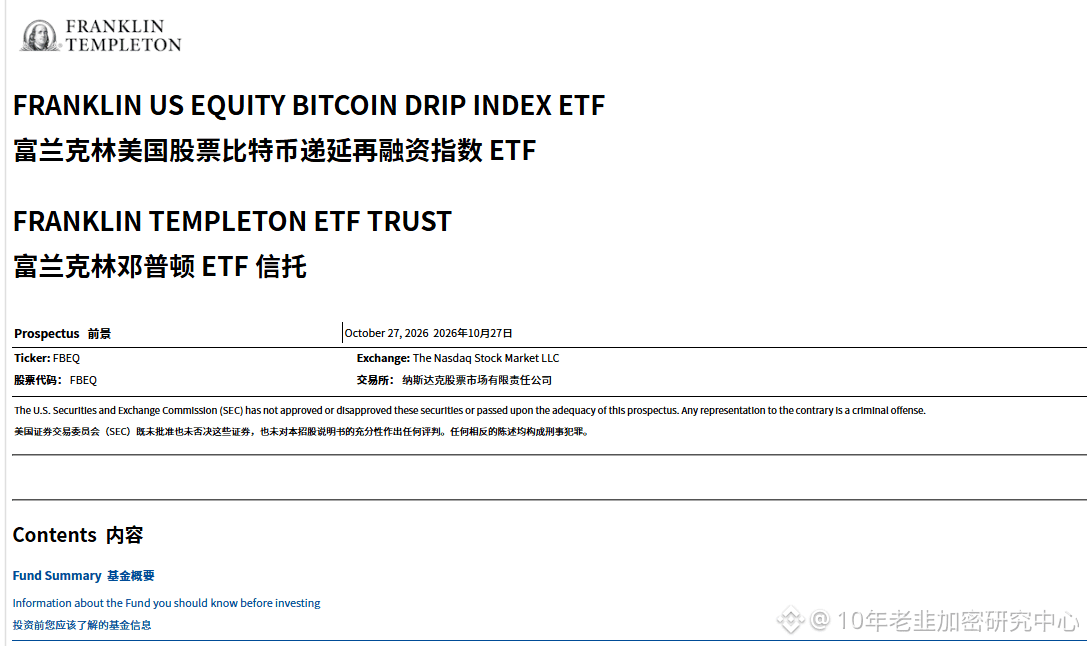
FBEQ: Primarily invests in large-cap U.S. stocks, using a strategy similar to a large-cap portfolio combined with Bitcoin exposure.
FIBT: Focuses on innovative companies, with particular attention to its weighting in technology stocks.
As for fees, the latest filings list annual operating expenses of 0.09% and 0.19%, respectively. However, the specific trading start dates for the two funds have not yet been officially confirmed. Registration and listing do not mean trading has already begun.
2. What does this mean for BTC?
The key point isn’t how large the initial 5% allocation is, but that this approach seeks to create a mechanism for gaining ongoing BTC exposure. Traditional investors can gain indirect exposure to Bitcoin-related assets by holding the funds, without having to actively use cash to buy coins each time. If similar products become more widespread, BTC could find its way into more traditional securities portfolios.
3. One more detail worth noting
This is not a pure Bitcoin ETF. The funds also hold stocks, and Bitcoin exposure can be obtained through exchange-traded products, futures, options, and other instruments. The index rules adjust allocations above 5% during quarterly rebalancing; if Bitcoin’s weighting exceeds 20% between rebalancing dates, that will also trigger a reduction.
So, it’s more like adding a new channel for Bitcoin exposure to traditional stock investments, rather than allowing investors to hold BTC directly.
$BTC
{future}(BTCUSDT)
{spot}(BTCUSDT)
#富兰克林邓普顿申请股息转比特币etf
【Follow Lao Jiu, and wealth is yours】Franklin Templeton unveils a new strategy: buy U.S. stocks and automatically reinvest dividends in Bitcoin! Is traditional finance bringing BTC into more investors’ portfolios?
In the past, if you wanted Bitcoin exposure, you either bought BTC directly or invested in a spot Bitcoin ETF. Now, Wall Street asset management giant Franklin Templeton is trying something new: instead of simply receiving cash dividends from U.S. stocks, investors can have them automatically converted into Bitcoin-related investments.
1. What’s the difference between these two ETFs?
FBEQ: Primarily invests in large-cap U.S. stocks, using a strategy similar to a large-cap portfolio combined with Bitcoin exposure.
FIBT: Focuses on innovative companies, with particular attention to its weighting in technology stocks.
As for fees, the latest filings list annual operating expenses of 0.09% and 0.19%, respectively. However, the specific trading start dates for the two funds have not yet been officially confirmed. Registration and listing do not mean trading has already begun.
2. What does this mean for BTC?
The key point isn’t how large the initial 5% allocation is, but that this approach seeks to create a mechanism for gaining ongoing BTC exposure. Traditional investors can gain indirect exposure to Bitcoin-related assets by holding the funds, without having to actively use cash to buy coins each time. If similar products become more widespread, BTC could find its way into more traditional securities portfolios.
3. One more detail worth noting
This is not a pure Bitcoin ETF. The funds also hold stocks, and Bitcoin exposure can be obtained through exchange-traded products, futures, options, and other instruments. The index rules adjust allocations above 5% during quarterly rebalancing; if Bitcoin’s weighting exceeds 20% between rebalancing dates, that will also trigger a reduction.
So, it’s more like adding a new channel for Bitcoin exposure to traditional stock investments, rather than allowing investors to hold BTC directly.
$BTC
1.2k
·
--
#加拿大提议稳定币赎回规则
【Follow Lao Jiu, and fortune is yours】Canada sets rules for stablecoin redemptions: funds must arrive within 3 business days, with fees capped at 1%! New developments in USDT and USDC regulation?
What is the most important value of a stablecoin? It’s not having “stable” in its name, but whether users can exchange it for fiat currency at the promised value when they want to cash out.
On October 24, Canada released a draft Stablecoin Regulations, setting out more specific redemption requirements for stablecoin issuers: holders may request redemption with no minimum amount; issuers generally must complete the redemption process within 3 business days, and fees may not exceed 1% of the redemption amount. However, if liquidity in the reserve-asset market is insufficient and an issuer cannot meet all requests, the draft also allows daily redemption limits to be imposed.
I. The key focus of these rules is making stablecoins “redeemable”
In past discussions about stablecoins, the market has focused most on whether reserve assets are sufficient and fully backed by U.S. dollars. But for ordinary users, another question matters just as much: even if reserves are sufficient, can they redeem their stablecoins smoothly when they want to convert them back into fiat currency?
By including details such as redemption time limits, fee caps, and minimum redemption amounts in the draft, Canada aims to make the exit mechanism more transparent and reduce uncertainty for users during the redemption process.
II. What does this mean for the crypto market?
Stablecoins are important infrastructure for exchange trading, cross-border transfers, and on-chain finance. Clearer redemption rules could help build user trust in compliant stablecoins over the long term. However, compliance costs could also raise barriers to entry, putting issuers of different sizes under varying degrees of pressure.
It is important to note that this is still a draft at the consultation stage. The consultation period will remain open until December 23, 2026. The government currently expects the framework to take effect in fall 2027, so the new rules are not yet fully in force.
$BTC
{spot}(GMTUSDT)
{future}(BTCUSDT)
#加拿大提议稳定币赎回规则
【Follow Lao Jiu, and fortune is yours】Canada sets rules for stablecoin redemptions: funds must arrive within 3 business days, with fees capped at 1%! New developments in USDT and USDC regulation?
What is the most important value of a stablecoin? It’s not having “stable” in its name, but whether users can exchange it for fiat currency at the promised value when they want to cash out.
On October 24, Canada released a draft Stablecoin Regulations, setting out more specific redemption requirements for stablecoin issuers: holders may request redemption with no minimum amount; issuers generally must complete the redemption process within 3 business days, and fees may not exceed 1% of the redemption amount. However, if liquidity in the reserve-asset market is insufficient and an issuer cannot meet all requests, the draft also allows daily redemption limits to be imposed.
I. The key focus of these rules is making stablecoins “redeemable”
In past discussions about stablecoins, the market has focused most on whether reserve assets are sufficient and fully backed by U.S. dollars. But for ordinary users, another question matters just as much: even if reserves are sufficient, can they redeem their stablecoins smoothly when they want to convert them back into fiat currency?
By including details such as redemption time limits, fee caps, and minimum redemption amounts in the draft, Canada aims to make the exit mechanism more transparent and reduce uncertainty for users during the redemption process.
II. What does this mean for the crypto market?
Stablecoins are important infrastructure for exchange trading, cross-border transfers, and on-chain finance. Clearer redemption rules could help build user trust in compliant stablecoins over the long term. However, compliance costs could also raise barriers to entry, putting issuers of different sizes under varying degrees of pressure.
It is important to note that this is still a draft at the consultation stage. The consultation period will remain open until December 23, 2026. The government currently expects the framework to take effect in fall 2027, so the new rules are not yet fully in force.
$BTC
1
271
·
--
#strategy市值超越纳斯达克跻身全球前400
[Follow Lao Jiu, wealth is yours] Strategy has rushed into the global top 400 by market capitalization! A company疯狂囤BTC, why has it gotten this far?
In traditional financial markets, a company's ranking usually depends on profitability, growth expectations, and industry position. But Strategy (MSTR) has taken a very unusual path: continuously accumulating Bitcoin, and then using financing tools such as stocks, convertible bonds, and preferred shares to closely tie capital markets to BTC assets.
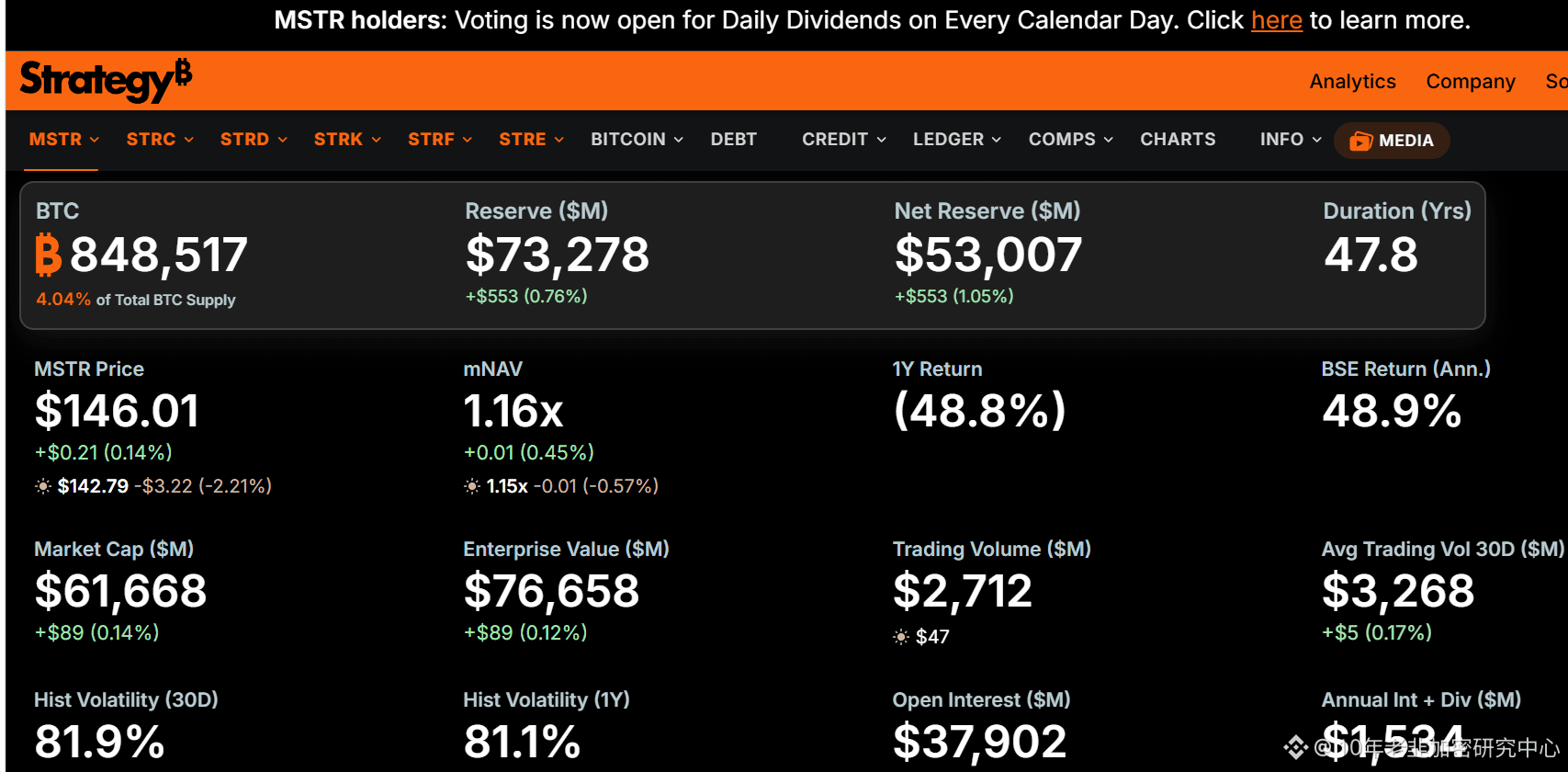
As of late October, Strategy's market capitalization was around $60 billion, placing it within the global top 400 by market cap. Different data platforms use slightly different statistical methods and rankings. According to the company's disclosed holdings, as of October 18 it held about 848,517 BTC, roughly 4% of Bitcoin's total supply cap.
1. What exactly is Strategy betting on?
It is betting not only on the rise in Bitcoin's price, but also on a long-term logic: if $BTC continues to appreciate, the company may be able to use asset value and financing capacity to further expand its holdings.
This model gives traditional stocks a strong crypto-market characteristic. Investors buying MSTR are, in essence, investing in a company that holds a large amount of BTC while continuously engaging in capital operations.
3. What does this mean for the crypto world?
Strategy's scale shows that BTC is no longer just an asset for retail trading; it can also become the core of a listed company's balance sheet and capital market strategy.
{spot}(BTCUSDT)
{future}(BTCUSDT)
#strategy市值超越纳斯达克跻身全球前400
[Follow Lao Jiu, wealth is yours] Strategy has rushed into the global top 400 by market capitalization! A company疯狂囤BTC, why has it gotten this far?
In traditional financial markets, a company's ranking usually depends on profitability, growth expectations, and industry position. But Strategy (MSTR) has taken a very unusual path: continuously accumulating Bitcoin, and then using financing tools such as stocks, convertible bonds, and preferred shares to closely tie capital markets to BTC assets.
As of late October, Strategy's market capitalization was around $60 billion, placing it within the global top 400 by market cap. Different data platforms use slightly different statistical methods and rankings. According to the company's disclosed holdings, as of October 18 it held about 848,517 BTC, roughly 4% of Bitcoin's total supply cap.
1. What exactly is Strategy betting on?
It is betting not only on the rise in Bitcoin's price, but also on a long-term logic: if $BTC continues to appreciate, the company may be able to use asset value and financing capacity to further expand its holdings.
This model gives traditional stocks a strong crypto-market characteristic. Investors buying MSTR are, in essence, investing in a company that holds a large amount of BTC while continuously engaging in capital operations.
3. What does this mean for the crypto world?
Strategy's scale shows that BTC is no longer just an asset for retail trading; it can also become the core of a listed company's balance sheet and capital market strategy.
1
159
·
--
Verified
#sk海力士据报拟派特别股息
[Follow Lao Jiu Wealth You Have] SK Hynix may distribute over 80 billion yuan in special dividends! The money earned from AI computing power is starting to return to shareholders.
The crypto market has recently been debating how far the AI narrative can go, but don’t forget that behind the AI rally, the real money is not only being made by Nvidia, but also by storage chip makers that provide high-bandwidth memory (HBM).
On October 26, according to Korean media reports, SK Hynix is considering distributing a special dividend of about 16 trillion won, equivalent to about 12 billion U.S. dollars. The funds may come from investment gains from selling its stake in Japanese memory chip company Kioxia.
1. Why is this worth paying attention to?
SK Hynix is an important player in the AI industry chain, and HBM is an essential memory component for AI accelerators. As AI infrastructure continues to expand, the market is not only watching chip sales, but also whether these companies can convert industry demand into profit and cash flow.
2. What does this have to do with the crypto market?
AI chips and crypto assets do not follow the same investment logic, but they are both affected by some common factors: market risk appetite, funding costs, and investors’ judgment on whether AI capital expenditures can continue.
If the AI industry chain continues to deliver profits, it may help support market confidence in AI infrastructure; on the other hand, if investors begin to question the returns on massive capital expenditures, related tech stocks and some AI-themed tokens may also come under pressure.
$BTC
{spot}(BTCUSDT)
{future}(BTCUSDT)
#sk海力士据报拟派特别股息
[Follow Lao Jiu Wealth You Have] SK Hynix may distribute over 80 billion yuan in special dividends! The money earned from AI computing power is starting to return to shareholders.
The crypto market has recently been debating how far the AI narrative can go, but don’t forget that behind the AI rally, the real money is not only being made by Nvidia, but also by storage chip makers that provide high-bandwidth memory (HBM).
On October 26, according to Korean media reports, SK Hynix is considering distributing a special dividend of about 16 trillion won, equivalent to about 12 billion U.S. dollars. The funds may come from investment gains from selling its stake in Japanese memory chip company Kioxia.
1. Why is this worth paying attention to?
SK Hynix is an important player in the AI industry chain, and HBM is an essential memory component for AI accelerators. As AI infrastructure continues to expand, the market is not only watching chip sales, but also whether these companies can convert industry demand into profit and cash flow.
2. What does this have to do with the crypto market?
AI chips and crypto assets do not follow the same investment logic, but they are both affected by some common factors: market risk appetite, funding costs, and investors’ judgment on whether AI capital expenditures can continue.
If the AI industry chain continues to deliver profits, it may help support market confidence in AI infrastructure; on the other hand, if investors begin to question the returns on massive capital expenditures, related tech stocks and some AI-themed tokens may also come under pressure.
$BTC
2
905
·
--
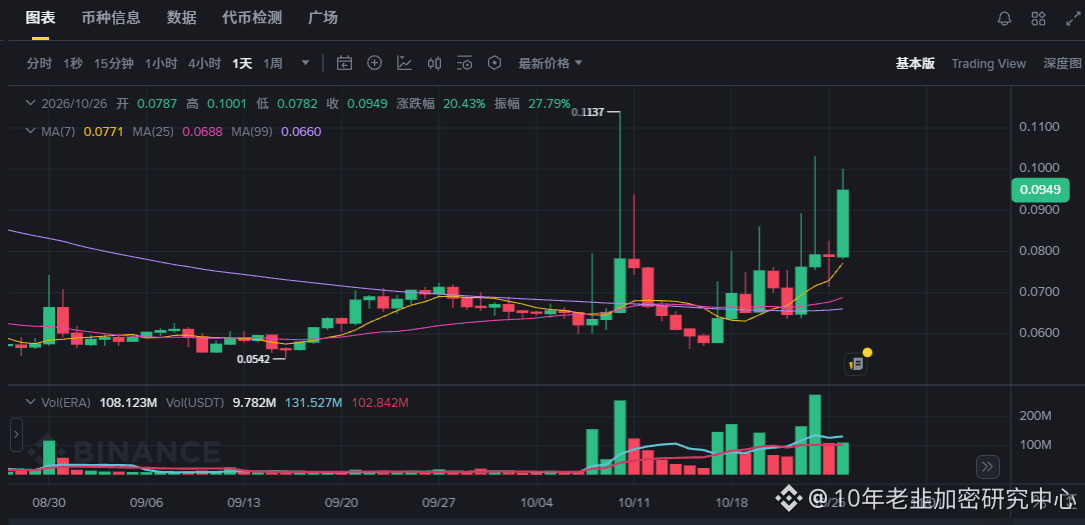
【Old Leek Watch】$ERA Suddenly Surges Nearly 20% on a Spike in Trading Volume! Is This a Reversal for Caldera, or Just a Capital-Driven Rally?
One of today’s coins showing notable movement is Caldera (ERA).
As of October 26, publicly available market data showed that ERA’s 24-hour gain briefly approached 20%, with trading volume rising significantly. More notably, the broader crypto market was relatively weak at the time, while ERA posted a comparatively independent rally.
But that raises the question: what triggered this surge?
1. No major positive catalyst has been confirmed so far; unusual capital flows are the clearest signal at present
For now, this rally should first be described as a sharp move on increased volume, rather than taken as proof that the project’s fundamentals have reversed.
2. What is Caldera’s core narrative?
Caldera focuses on Rollup-as-a-Service, helping projects deploy customized Ethereum scaling networks and improving connectivity and asset flows between different rollups through infrastructure such as Metalayer.
Put simply, more and more independent networks are emerging in the Ethereum ecosystem, but liquidity and interoperability between them remain challenges. Caldera aims to make it easier for projects to build their own chains and to connect these networks.
ERA is also associated with functions such as gas payments, staking, and governance within the ecosystem. This narrative has room to develop.
3. Another risk with ERA that shouldn’t be overlooked: a low circulating supply ratio
According to publicly available market data, ERA has a maximum supply of 1 billion tokens, with approximately 150 million currently in circulation. Its circulating market cap is about $13 million, and its fully diluted valuation is about $86 million.
This means that only a small portion of the maximum supply is currently in circulation.
Tokens with a low circulating supply ratio may see larger price gains when buyers concentrate their capital, but newly unlocked tokens entering circulation could also create selling pressure in the future. A relatively small market cap also means the price can be more easily affected by concentrated trading.
{spot}(ERAUSDT)
{future}(ERAUSDT)
【Old Leek Watch】$ERA Suddenly Surges Nearly 20% on a Spike in Trading Volume! Is This a Reversal for Caldera, or Just a Capital-Driven Rally?
One of today’s coins showing notable movement is Caldera (ERA).
As of October 26, publicly available market data showed that ERA’s 24-hour gain briefly approached 20%, with trading volume rising significantly. More notably, the broader crypto market was relatively weak at the time, while ERA posted a comparatively independent rally.
But that raises the question: what triggered this surge?
1. No major positive catalyst has been confirmed so far; unusual capital flows are the clearest signal at present
For now, this rally should first be described as a sharp move on increased volume, rather than taken as proof that the project’s fundamentals have reversed.
2. What is Caldera’s core narrative?
Caldera focuses on Rollup-as-a-Service, helping projects deploy customized Ethereum scaling networks and improving connectivity and asset flows between different rollups through infrastructure such as Metalayer.
Put simply, more and more independent networks are emerging in the Ethereum ecosystem, but liquidity and interoperability between them remain challenges. Caldera aims to make it easier for projects to build their own chains and to connect these networks.
ERA is also associated with functions such as gas payments, staking, and governance within the ecosystem. This narrative has room to develop.
3. Another risk with ERA that shouldn’t be overlooked: a low circulating supply ratio
According to publicly available market data, ERA has a maximum supply of 1 billion tokens, with approximately 150 million currently in circulation. Its circulating market cap is about $13 million, and its fully diluted valuation is about $86 million.
This means that only a small portion of the maximum supply is currently in circulation.
Tokens with a low circulating supply ratio may see larger price gains when buyers concentrate their capital, but newly unlocked tokens entering circulation could also create selling pressure in the future. A relatively small market cap also means the price can be more easily affected by concentrated trading.
1
93
·
--
#keystone网站遭入侵泄露买家收货地址
【Follow Laojiu, wealth is yours】 On-chain addresses are anonymous, but you aren’t. Old iPhones are the way to go.
Many people buy hardware wallets to keep their private keys offline and their assets under their own control. But this incident reminds us that a wallet itself being secure doesn’t mean the entire process of buying it is equally secure.
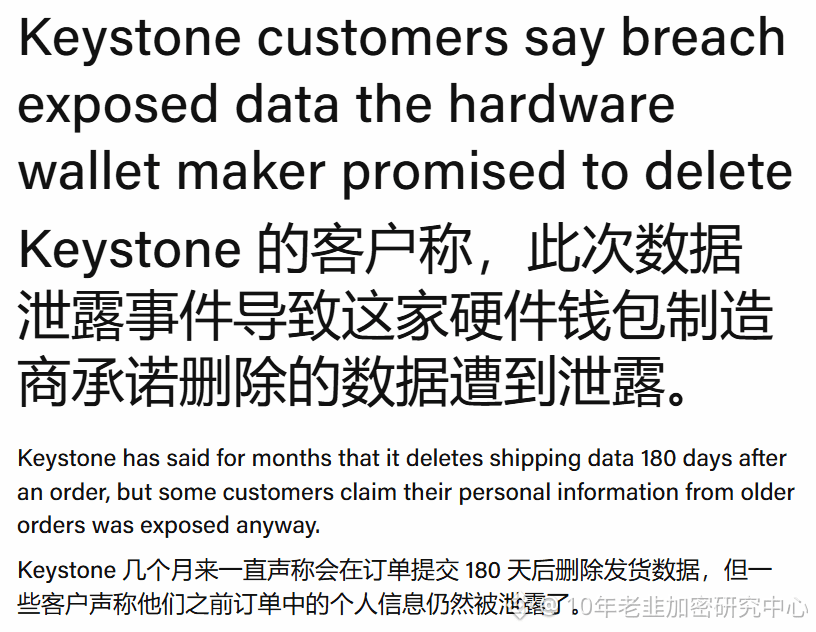
On October 24, hardware wallet manufacturer Keystone disclosed that it had discovered unauthorized access to its official website on October 20. The company later confirmed that a third party had obtained some customer information, including names, contact details, shipping addresses, and order details such as the products purchased and their prices. The number of people affected and the attacker’s identity have not yet been disclosed.
I. If private keys weren’t leaked, why is this still serious?
Keystone said that payment card and bank information, recovery phrases, private keys, and wallet passwords were not affected by this incident. So, at this point, it cannot be directly equated with the theft of wallet assets.
The concern, however, is that the leaked order information could tell scammers who has bought a hardware wallet, how to contact them, and even where they live. Once pieced together, this information could be used for targeted phishing, impersonating customer support, or even to create real-world safety risks. For crypto users, a privacy breach is sometimes just the first step in an attack.
II. What you really need to watch out for is follow-up scams
Keystone said it had blocked the unauthorized access, fixed the vulnerability, and begun notifying affected users. It also warned users to watch out for calls, texts, and emails impersonating the company.
Pay particular attention to messages claiming they can issue a refund, send a replacement device, repair your wallet, or resolve an order issue. If scammers have access to genuine purchase records, they can often gain your trust more easily than with ordinary spam.$BTC $ETH $BMT
{spot}(BTCUSDT)
#keystone网站遭入侵泄露买家收货地址
【Follow Laojiu, wealth is yours】 On-chain addresses are anonymous, but you aren’t. Old iPhones are the way to go.
Many people buy hardware wallets to keep their private keys offline and their assets under their own control. But this incident reminds us that a wallet itself being secure doesn’t mean the entire process of buying it is equally secure.
On October 24, hardware wallet manufacturer Keystone disclosed that it had discovered unauthorized access to its official website on October 20. The company later confirmed that a third party had obtained some customer information, including names, contact details, shipping addresses, and order details such as the products purchased and their prices. The number of people affected and the attacker’s identity have not yet been disclosed.
I. If private keys weren’t leaked, why is this still serious?
Keystone said that payment card and bank information, recovery phrases, private keys, and wallet passwords were not affected by this incident. So, at this point, it cannot be directly equated with the theft of wallet assets.
The concern, however, is that the leaked order information could tell scammers who has bought a hardware wallet, how to contact them, and even where they live. Once pieced together, this information could be used for targeted phishing, impersonating customer support, or even to create real-world safety risks. For crypto users, a privacy breach is sometimes just the first step in an attack.
II. What you really need to watch out for is follow-up scams
Keystone said it had blocked the unauthorized access, fixed the vulnerability, and begun notifying affected users. It also warned users to watch out for calls, texts, and emails impersonating the company.
Pay particular attention to messages claiming they can issue a refund, send a replacement device, repair your wallet, or resolve an order issue. If scammers have access to genuine purchase records, they can often gain your trust more easily than with ordinary spam.$BTC $ETH $BMT
1
1.8k
·
--
#electrum钱包漏洞致资金被盗
【Follow Laojiu, and fortune is yours】Can a Bitcoin wallet really “send money on its own”? A critical Electrum vulnerability has led to users’ funds being stolen!
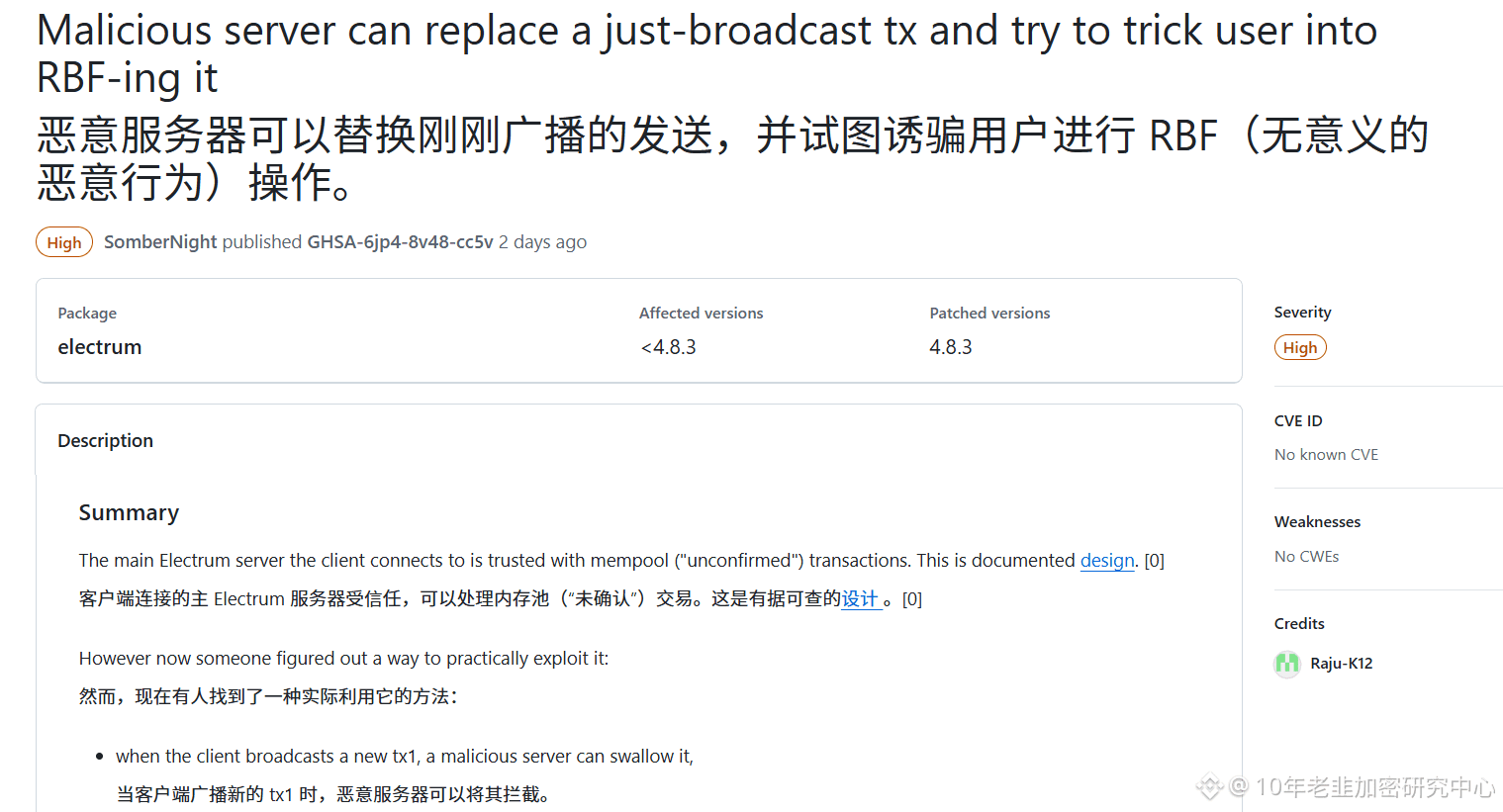
This wasn’t a fake wallet, nor did users expose their private keys. Instead, it was an attack exploiting the transaction confirmation mechanism—and even normal wallet operations could be abused. On October 24, Electrum disclosed a critical security vulnerability affecting all versions earlier than 4.8.3. The development team confirmed that malicious servers were already exploiting it in the wild. They had received two user reports, one of which confirmed a loss of funds.
1. How did the attackers do it?
In short, attackers could use a malicious server to intercept a transaction just sent by a user, then display a tampered, unconfirmed transaction in the wallet history, replacing the recipient address with one controlled by the attacker.
The truly dangerous step comes when users notice the transaction has not been confirmed for a while and click RBF (to speed it up by increasing the fee).
In affected older versions, the wallet might re-sign this forged transaction, ultimately causing the user to send BTC to the attacker. To make the scam harder to spot, attackers would deliberately make the last four characters of the fake address match those of the original address.
2. Does this mean all Electrum users have had their funds stolen?
Of course not. The vulnerability affects versions earlier than 4.8.3, and the attack depends on a malicious server and the user subsequently signing the transaction. Electrum says users running their own server or using a trusted server are not affected by this attack method.
So far, Electrum has disclosed two related user reports. One involved an actual loss of funds, but the total amount stolen and the identities of the malicious servers have not been disclosed.
3. What warning does this incident offer the crypto industry as a whole?
Many people believe that as long as their private keys are not exposed, their assets are absolutely safe. But this incident is a reminder that the transaction information displayed by a wallet, the servers it connects to, and the contents of the transaction ultimately signed can all be sources of risk.
For BTC holders, the most practical steps are to upgrade to Electrum 4.8.3 or a later secure version as soon as possible, and to verify the full recipient address and amount before signing any transaction. Don’t just check the last few characters of the address.
{spot}(BTCUSDT)
{future}(BTCUSDT)
#electrum钱包漏洞致资金被盗
【Follow Laojiu, and fortune is yours】Can a Bitcoin wallet really “send money on its own”? A critical Electrum vulnerability has led to users’ funds being stolen!
This wasn’t a fake wallet, nor did users expose their private keys. Instead, it was an attack exploiting the transaction confirmation mechanism—and even normal wallet operations could be abused. On October 24, Electrum disclosed a critical security vulnerability affecting all versions earlier than 4.8.3. The development team confirmed that malicious servers were already exploiting it in the wild. They had received two user reports, one of which confirmed a loss of funds.
1. How did the attackers do it?
In short, attackers could use a malicious server to intercept a transaction just sent by a user, then display a tampered, unconfirmed transaction in the wallet history, replacing the recipient address with one controlled by the attacker.
The truly dangerous step comes when users notice the transaction has not been confirmed for a while and click RBF (to speed it up by increasing the fee).
In affected older versions, the wallet might re-sign this forged transaction, ultimately causing the user to send BTC to the attacker. To make the scam harder to spot, attackers would deliberately make the last four characters of the fake address match those of the original address.
2. Does this mean all Electrum users have had their funds stolen?
Of course not. The vulnerability affects versions earlier than 4.8.3, and the attack depends on a malicious server and the user subsequently signing the transaction. Electrum says users running their own server or using a trusted server are not affected by this attack method.
So far, Electrum has disclosed two related user reports. One involved an actual loss of funds, but the total amount stolen and the identities of the malicious servers have not been disclosed.
3. What warning does this incident offer the crypto industry as a whole?
Many people believe that as long as their private keys are not exposed, their assets are absolutely safe. But this incident is a reminder that the transaction information displayed by a wallet, the servers it connects to, and the contents of the transaction ultimately signed can all be sources of risk.
For BTC holders, the most practical steps are to upgrade to Electrum 4.8.3 or a later secure version as soon as possible, and to verify the full recipient address and amount before signing any transaction. Don’t just check the last few characters of the address.
2
1.1k
·
--
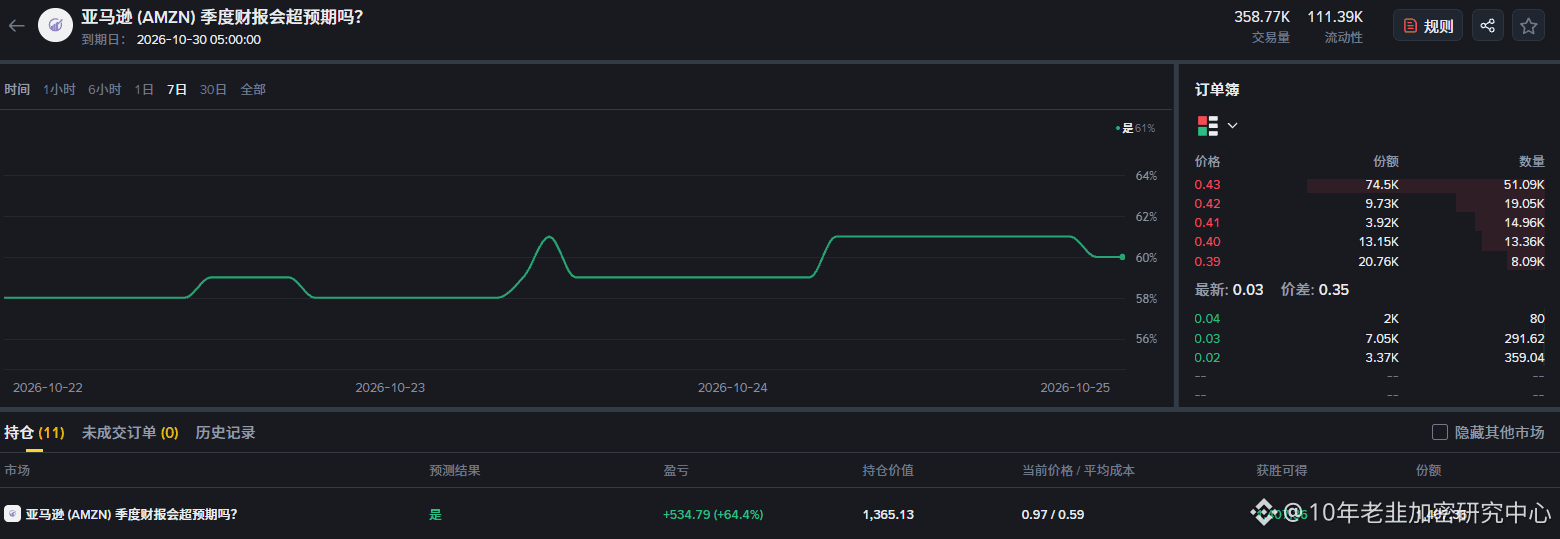
Isn't this price gap a bit too big? There's no liquidity at all. Which projects did everyone put their points into? #币安神算子
Isn't this price gap a bit too big? There's no liquidity at all. Which projects did everyone put their points into? #币安神算子
1
72
·
--
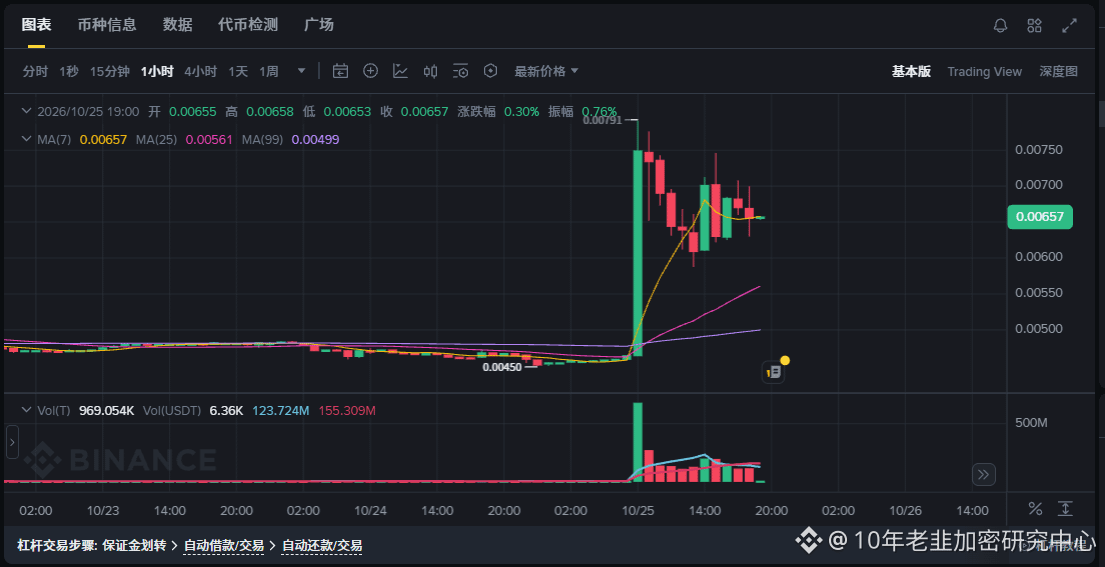
【Veteran Crypto Watch】$T Soars Over 40% in a Single Day! What’s Behind the Sudden Rally—A Fundamental Turnaround or Speculative Buying?
Today, one unusual mover worth watching is Threshold Network (T).
Public market data shows that T briefly rose by more than 40% in 24 hours, while trading volume suddenly surged to over $100 million, drawing significant market attention in a short time. When a coin that usually gets relatively little attention suddenly sees a sharp rise in volume and price, what matters most to Veteran Crypto Watch isn’t how much it has risen, but what’s driving the rally.
1. What’s the story behind T that makes it worth watching?
One of Threshold Network’s core products is tBTC, which aims to let Bitcoin enter applications on other blockchains in a decentralized way.
The project has continued to advance security improvements to the tBTC cross-chain bridge and plans to upgrade its FROST/Schnorr signature mechanism in the fourth quarter, with the aim of improving security and processing efficiency. The project is also exploring institutional-grade Bitcoin custody and lending use cases.
The logic behind this narrative is that if more BTC flows into on-chain lending and other financial applications in the future, demand for tBTC could grow.
{spot}(TUSDT)
【Veteran Crypto Watch】$T Soars Over 40% in a Single Day! What’s Behind the Sudden Rally—A Fundamental Turnaround or Speculative Buying?
Today, one unusual mover worth watching is Threshold Network (T).
Public market data shows that T briefly rose by more than 40% in 24 hours, while trading volume suddenly surged to over $100 million, drawing significant market attention in a short time. When a coin that usually gets relatively little attention suddenly sees a sharp rise in volume and price, what matters most to Veteran Crypto Watch isn’t how much it has risen, but what’s driving the rally.
1. What’s the story behind T that makes it worth watching?
One of Threshold Network’s core products is tBTC, which aims to let Bitcoin enter applications on other blockchains in a decentralized way.
The project has continued to advance security improvements to the tBTC cross-chain bridge and plans to upgrade its FROST/Schnorr signature mechanism in the fourth quarter, with the aim of improving security and processing efficiency. The project is also exploring institutional-grade Bitcoin custody and lending use cases.
The logic behind this narrative is that if more BTC flows into on-chain lending and other financial applications in the future, demand for tBTC could grow.
2
427
·
--
#美国下周将公布q3gdp和9月pce
【Follow Laojiu, build your wealth】Two major US economic reports are coming next week! GDP and PCE will be released on the same day, putting $BTC to another macroeconomic test!
On October 29, the US will release its advance estimate of third-quarter GDP and September PCE inflation data. More importantly, the Federal Reserve is expected to announce its interest rate decision the day before. In other words, just as markets finish digesting the Fed’s policy signals, they will immediately face a dual test of economic growth and inflation.
1. Is strong GDP good news or bad news?
GDP reflects US economic growth. If the data comes in above expectations, it would show that the economy remains resilient, but it could also lead markets to scale back expectations for rate cuts. If it comes in significantly below expectations, markets may worry about an economic slowdown.
So, higher GDP isn’t automatically better, and lower GDP isn’t automatically better either. What matters is how it changes the market’s expectations for Fed policy.
2. PCE is what really moves rate expectations.
PCE is an inflation measure closely watched by the Fed. The key figure is core PCE, which excludes food and energy prices.
If core PCE comes in above expectations, markets may worry that rate cuts will be delayed, and the US dollar and Treasury yields could strengthen. If inflation cools, expectations for rate cuts may increase, but growth and employment data will still need to be taken into account.
3. What should $BTC and altcoins be watching?
If economic growth remains steady and inflation eases, risk assets could find support. But if inflation proves persistent and rate expectations turn hawkish again, BTC, ETH, and highly volatile altcoins could all come under pressure.
{spot}(BTCUSDT)
{future}(BTCUSDT)
#美国下周将公布q3gdp和9月pce
【Follow Laojiu, build your wealth】Two major US economic reports are coming next week! GDP and PCE will be released on the same day, putting $BTC to another macroeconomic test!
On October 29, the US will release its advance estimate of third-quarter GDP and September PCE inflation data. More importantly, the Federal Reserve is expected to announce its interest rate decision the day before. In other words, just as markets finish digesting the Fed’s policy signals, they will immediately face a dual test of economic growth and inflation.
1. Is strong GDP good news or bad news?
GDP reflects US economic growth. If the data comes in above expectations, it would show that the economy remains resilient, but it could also lead markets to scale back expectations for rate cuts. If it comes in significantly below expectations, markets may worry about an economic slowdown.
So, higher GDP isn’t automatically better, and lower GDP isn’t automatically better either. What matters is how it changes the market’s expectations for Fed policy.
2. PCE is what really moves rate expectations.
PCE is an inflation measure closely watched by the Fed. The key figure is core PCE, which excludes food and energy prices.
If core PCE comes in above expectations, markets may worry that rate cuts will be delayed, and the US dollar and Treasury yields could strengthen. If inflation cools, expectations for rate cuts may increase, but growth and employment data will still need to be taken into account.
3. What should $BTC and altcoins be watching?
If economic growth remains steady and inflation eases, risk assets could find support. But if inflation proves persistent and rate expectations turn hawkish again, BTC, ETH, and highly volatile altcoins could all come under pressure.
1
4.9k
·
--
#electrum修复4.8.3前版本高危漏洞
[Follow Old Leek, and fortune is yours] A critical vulnerability has been exposed in a Bitcoin wallet—and attackers may even steal your coins by exploiting the “speed up transaction” feature you click yourself!
On October 24, Electrum officially disclosed a critical security vulnerability affecting all versions earlier than 4.8.3. More concerning, the development team said that malicious servers have already been found exploiting the vulnerability in the wild, and one user report confirmed a loss of funds.
This attack is more subtle than you might think.
1. The attackers don’t crack your private key—they trick you into signing a transaction yourself.
Electrum relies on servers to retrieve information about unconfirmed transactions. A malicious server can intercept a genuine transaction recently broadcast by a user, then display a forged transaction in the wallet’s history that sends funds to the attacker’s address.
If a user sees that a transaction has been pending for a long time and clicks the RBF feature to increase the miner fee, they may unknowingly sign the fraudulent transaction, redirecting their funds to the attacker.
Even more deviously, the last four characters of some fake addresses are deliberately made to resemble those of the original recipient address.
2. This is another reminder that wallet security depends on more than just private keys.
Many people assume that as long as their private keys haven’t been exposed and their hardware wallet is working properly, their assets are safe. But this incident shows that the way transaction information is displayed, the server trust model, and the content of the transaction a user ultimately signs can all become points of vulnerability.
Self-custody doesn’t mean zero risk. What really matters is verifying exactly what you’re signing.
3. What should $BTC holders do now?
Upgrade promptly to Electrum 4.8.3 or a later secure version, and obtain the software through official channels. Before signing any transaction—including one that increases the miner fee—check the full recipient address and amount. Don’t rely on just the last few characters of the address.
{spot}(NVDABUSDT)
{future}(BTCUSDT)
#electrum修复4.8.3前版本高危漏洞
[Follow Old Leek, and fortune is yours] A critical vulnerability has been exposed in a Bitcoin wallet—and attackers may even steal your coins by exploiting the “speed up transaction” feature you click yourself!
On October 24, Electrum officially disclosed a critical security vulnerability affecting all versions earlier than 4.8.3. More concerning, the development team said that malicious servers have already been found exploiting the vulnerability in the wild, and one user report confirmed a loss of funds.
This attack is more subtle than you might think.
1. The attackers don’t crack your private key—they trick you into signing a transaction yourself.
Electrum relies on servers to retrieve information about unconfirmed transactions. A malicious server can intercept a genuine transaction recently broadcast by a user, then display a forged transaction in the wallet’s history that sends funds to the attacker’s address.
If a user sees that a transaction has been pending for a long time and clicks the RBF feature to increase the miner fee, they may unknowingly sign the fraudulent transaction, redirecting their funds to the attacker.
Even more deviously, the last four characters of some fake addresses are deliberately made to resemble those of the original recipient address.
2. This is another reminder that wallet security depends on more than just private keys.
Many people assume that as long as their private keys haven’t been exposed and their hardware wallet is working properly, their assets are safe. But this incident shows that the way transaction information is displayed, the server trust model, and the content of the transaction a user ultimately signs can all become points of vulnerability.
Self-custody doesn’t mean zero risk. What really matters is verifying exactly what you’re signing.
3. What should $BTC holders do now?
Upgrade promptly to Electrum 4.8.3 or a later secure version, and obtain the software through official channels. Before signing any transaction—including one that increases the miner fee—check the full recipient address and amount. Don’t rely on just the last few characters of the address.
3
3
965
·
--
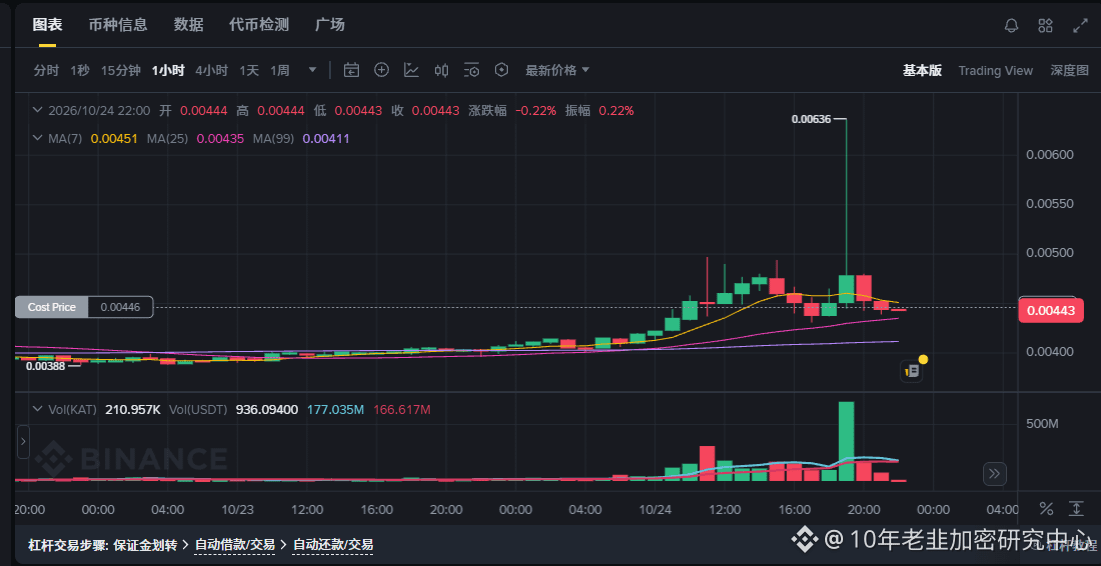
【Follow Lao Jiu, and wealth will be yours】 $KAT
Katana remains worth keeping an eye on in this cycle. Its vKAT governance system is now live, allowing token holders to lock KAT to participate in governance and the allocation of liquidity incentives. Meanwhile, DeFi projects within the ecosystem are still making progress; the key thing to watch is whether real capital and users continue to flow in.
KAT’s current publicly quoted reference price is around $0.00473, up about 18% over the past 24 hours. This is not a good level to chase blindly. I’d rather wait for a pullback and then see whether buying interest is still there.
Entry: $0.004535–0.00445 (consider entering after the price pulls back and stabilizes)
Take profit: $0.00475 / $0.00500 / $0.00520 / $0.00545 / $0.00575
Stop-loss 1: $0.00435 (regular stop-loss)
Stop-loss 2: $0.00425 (final line of defense)
Key points: If volume contracts during a pullback and the price holds within the entry range, continue to monitor it. If it breaks below $0.00445 on heavy volume, don’t stubbornly hold on. If it rallies directly without offering a pullback, it’s better to miss the move than to chase the price.
The above is a conditional trading plan based on publicly available reference quotes. Please check real-time market prices before acting. Ecosystem progress does not guarantee that the token price will rise.
{spot}(KATUSDT)
{future}(KATUSDT)
【Follow Lao Jiu, and wealth will be yours】 $KAT
Katana remains worth keeping an eye on in this cycle. Its vKAT governance system is now live, allowing token holders to lock KAT to participate in governance and the allocation of liquidity incentives. Meanwhile, DeFi projects within the ecosystem are still making progress; the key thing to watch is whether real capital and users continue to flow in.
KAT’s current publicly quoted reference price is around $0.00473, up about 18% over the past 24 hours. This is not a good level to chase blindly. I’d rather wait for a pullback and then see whether buying interest is still there.
Entry: $0.004535–0.00445 (consider entering after the price pulls back and stabilizes)
Take profit: $0.00475 / $0.00500 / $0.00520 / $0.00545 / $0.00575
Stop-loss 1: $0.00435 (regular stop-loss)
Stop-loss 2: $0.00425 (final line of defense)
Key points: If volume contracts during a pullback and the price holds within the entry range, continue to monitor it. If it breaks below $0.00445 on heavy volume, don’t stubbornly hold on. If it rallies directly without offering a pullback, it’s better to miss the move than to chase the price.
The above is a conditional trading plan based on publicly available reference quotes. Please check real-time market prices before acting. Ecosystem progress does not guarantee that the token price will rise.
1
350
·
--
【Follow Laojiu, wealth is yours】 $ARB
ARB’s main focus lately isn’t chasing a rally, but watching for signs that this pullback has found a bottom. The Arbitrum ecosystem previously launched a stablecoin incentive program and continues to pursue stablecoin liquidity and application growth, but positive ecosystem developments don’t necessarily translate into an immediate rise in ARB’s price.
The public market reference on October 24 was around $0.169. Prices have declined in succession recently, and short-term selling pressure remains. My approach is to wait for the price to stabilize before considering a rebound trade, rather than blindly trying to catch a falling knife.
Entry: $0.1678–0.1700 (consider only after support stabilizes)
Take profit: $0.1730 / $0.1770 / $0.1810 / $0.1860 / $0.1920
Stop loss 1: $0.1655 (regular stop loss)
Stop loss 2: $0.1625 (final line of defense)
Key points: If the price breaks below the recent low of $0.1673 and a rebound fails to reclaim it, don’t rush to enter. If it climbs back above $0.1730 with buying support, then watch to see whether the rebound can continue. These prices are for reference as part of a trading plan; check real-time market prices before placing any trades.
{future}(ARBUSDT)
{spot}(ARBUSDT)
【Follow Laojiu, wealth is yours】 $ARB
ARB’s main focus lately isn’t chasing a rally, but watching for signs that this pullback has found a bottom. The Arbitrum ecosystem previously launched a stablecoin incentive program and continues to pursue stablecoin liquidity and application growth, but positive ecosystem developments don’t necessarily translate into an immediate rise in ARB’s price.
The public market reference on October 24 was around $0.169. Prices have declined in succession recently, and short-term selling pressure remains. My approach is to wait for the price to stabilize before considering a rebound trade, rather than blindly trying to catch a falling knife.
Entry: $0.1678–0.1700 (consider only after support stabilizes)
Take profit: $0.1730 / $0.1770 / $0.1810 / $0.1860 / $0.1920
Stop loss 1: $0.1655 (regular stop loss)
Stop loss 2: $0.1625 (final line of defense)
Key points: If the price breaks below the recent low of $0.1673 and a rebound fails to reclaim it, don’t rush to enter. If it climbs back above $0.1730 with buying support, then watch to see whether the rebound can continue. These prices are for reference as part of a trading plan; check real-time market prices before placing any trades.
1
303
·
--
#美国消费者信心维持历史第二低
[Follow Lao Jiu—wealth is yours] U.S. consumer confidence falls to its second-lowest level on record! Oil tops $116—what should Bitcoin watch out for next?
The wallets of Americans may be under more pressure than the market thinks. The University of Michigan’s final consumer sentiment index for October fell to 48.0, down from 48.1 in September and higher only than the record low of 44.8 set in May this year. Although the result was better than the market’s previous forecast of 46.3, that doesn’t mean the situation for U.S. consumers is improving significantly.
1. The cost of living is squeezing consumers’ spending power.
Tensions in the Middle East are driving up energy prices, while gasoline and everyday expenses are putting consumers under increasing pressure. Meanwhile, inflation expectations for the coming year rose to 4.7%, and five-year inflation expectations climbed to 3.5%. This means that even as consumer confidence remains very low, concerns about continued price increases are growing.
2. What does this mean for BTC and altcoins?
If high inflation keeps interest rates elevated and strengthens the U.S. dollar and Treasury yields, risk assets could come under pressure, and $BTC , $ETH , and altcoins may not be immune.
On the other hand, if economic data continues to weaken and markets begin to bet on monetary policy easing in the future, the crypto market could also find support. The key question is whether the Federal Reserve is more concerned about inflation or a cooling economy.
{spot}(ETHUSDT)
{spot}(BTCUSDT)
#美国消费者信心维持历史第二低
[Follow Lao Jiu—wealth is yours] U.S. consumer confidence falls to its second-lowest level on record! Oil tops $116—what should Bitcoin watch out for next?
The wallets of Americans may be under more pressure than the market thinks. The University of Michigan’s final consumer sentiment index for October fell to 48.0, down from 48.1 in September and higher only than the record low of 44.8 set in May this year. Although the result was better than the market’s previous forecast of 46.3, that doesn’t mean the situation for U.S. consumers is improving significantly.
1. The cost of living is squeezing consumers’ spending power.
Tensions in the Middle East are driving up energy prices, while gasoline and everyday expenses are putting consumers under increasing pressure. Meanwhile, inflation expectations for the coming year rose to 4.7%, and five-year inflation expectations climbed to 3.5%. This means that even as consumer confidence remains very low, concerns about continued price increases are growing.
2. What does this mean for BTC and altcoins?
If high inflation keeps interest rates elevated and strengthens the U.S. dollar and Treasury yields, risk assets could come under pressure, and $BTC , $ETH , and altcoins may not be immune.
On the other hand, if economic data continues to weaken and markets begin to bet on monetary policy easing in the future, the crypto market could also find support. The key question is whether the Federal Reserve is more concerned about inflation or a cooling economy.
1
978
·
--
#市场定价美联储下周加息概率仅10%
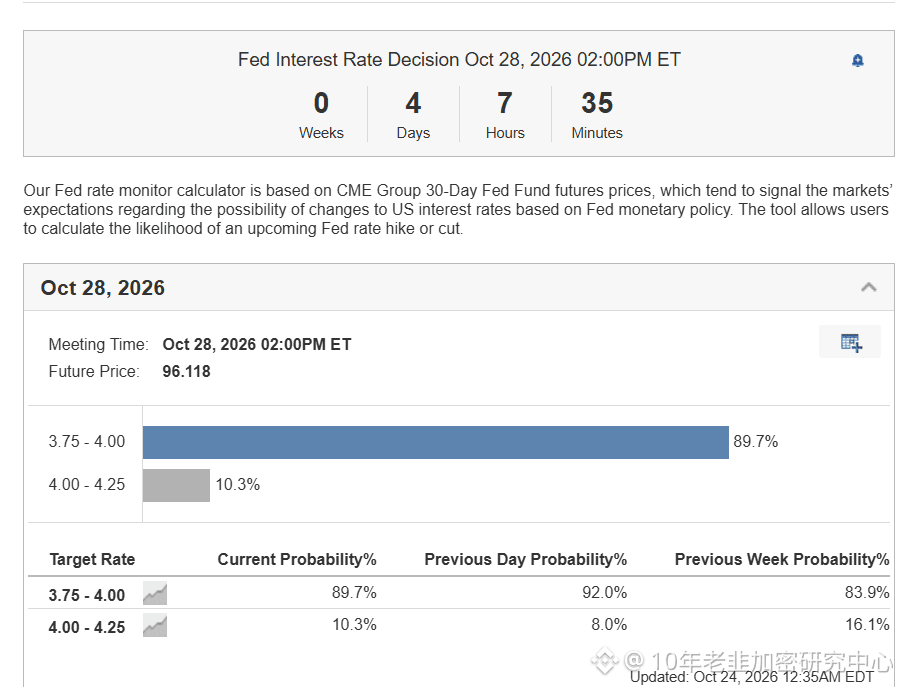
【Follow Laojiu, wealth is yours】Just a 10% chance the Fed will raise rates next week! Is the pressure on $BTC about to ease?
The market is waiting for the Fed’s policy meeting on October 27–28. According to the latest pricing of federal funds rate futures, the market sees about a 10% chance that the Fed will raise rates by 25 basis points next week, and about a 90% chance that it will leave rates unchanged.
It looks like the rate-hike alarm has quieted down for now, but that doesn’t mean the risks are gone.
1. A pause in rate hikes for now doesn’t mean monetary policy is turning accommodative.
The Fed’s current target interest rate range is 3.75% to 4%. Even if it stands pat next week, the possibility of further rate hikes won’t disappear as long as inflation remains stubborn. What the market is really worried about is not just whether rates will rise this time, but how long they will stay high.
2. Why does this matter for BTC and altcoins?
Rates staying high mean that the cost of capital remains elevated, and investors may be more cautious about allocating funds to high-risk assets. If expectations for future rate hikes continue to cool, the dollar and Treasury yields retreat, and risk appetite improves, BTC, $ETH , and some altcoins could get a breather.
3. What should we really be watching next?
1. Watch the Fed Chair’s remarks to gauge the future path of interest rates.
2. See whether the dollar index and Treasury yields fall in tandem.
3. Watch whether BTC can stay strong after the macroeconomic news is released, rather than falling once the news is out.
{spot}(ETHUSDT)
{spot}(BTCUSDT)
#市场定价美联储下周加息概率仅10%
【Follow Laojiu, wealth is yours】Just a 10% chance the Fed will raise rates next week! Is the pressure on $BTC about to ease?
The market is waiting for the Fed’s policy meeting on October 27–28. According to the latest pricing of federal funds rate futures, the market sees about a 10% chance that the Fed will raise rates by 25 basis points next week, and about a 90% chance that it will leave rates unchanged.
It looks like the rate-hike alarm has quieted down for now, but that doesn’t mean the risks are gone.
1. A pause in rate hikes for now doesn’t mean monetary policy is turning accommodative.
The Fed’s current target interest rate range is 3.75% to 4%. Even if it stands pat next week, the possibility of further rate hikes won’t disappear as long as inflation remains stubborn. What the market is really worried about is not just whether rates will rise this time, but how long they will stay high.
2. Why does this matter for BTC and altcoins?
Rates staying high mean that the cost of capital remains elevated, and investors may be more cautious about allocating funds to high-risk assets. If expectations for future rate hikes continue to cool, the dollar and Treasury yields retreat, and risk appetite improves, BTC, $ETH , and some altcoins could get a breather.
3. What should we really be watching next?
1. Watch the Fed Chair’s remarks to gauge the future path of interest rates.
2. See whether the dollar index and Treasury yields fall in tandem.
3. Watch whether BTC can stay strong after the macroeconomic news is released, rather than falling once the news is out.
5
4.4k
·
--
#道指下跌653点
【Follow Laojiu, and wealth is yours】Dow plunges 653 points overnight! Oil surges to $116, and the crypto market should be on alert too!
U.S. stocks dealt the market another blow on Friday. At the close on October 23, the Dow Jones Industrial Average had fallen about 653 points, or 1.23%, to 52,215; the S&P 500 fell 0.52%, and the Nasdaq fell 0.21%. This decline wasn’t simply a pullback in tech stocks—there are two underlying trends worth watching.
First, oil prices are rising, bringing inflationary pressure back.
Brent crude rose about 3.1%, settling at $116.72 a barrel, as markets worried that the situation in the Middle East could deteriorate further. Persistently high oil prices push up companies’ transportation and production costs, and could also make inflation harder to cool.
If inflationary pressure persists, the Fed may have less room to cut interest rates. That’s a challenging macroeconomic environment for both stocks and crypto assets.
Second, what does this have to do with $BTC , $ETH
{future}(ETHUSDT)
?
If rising oil prices further lift inflation expectations and strengthen the dollar and Treasury yields, risk assets could come under pressure, and BTC and ETH may not be immune. But note that a decline in the Dow doesn’t mean Bitcoin will necessarily fall too. The crypto market also has its own fund flows, leveraged liquidations, and ETF flow changes. What really matters is watching Treasury yields, the dollar’s direction, and whether BTC can hold key support levels.
{spot}(BTCUSDT)
#道指下跌653点
【Follow Laojiu, and wealth is yours】Dow plunges 653 points overnight! Oil surges to $116, and the crypto market should be on alert too!
U.S. stocks dealt the market another blow on Friday. At the close on October 23, the Dow Jones Industrial Average had fallen about 653 points, or 1.23%, to 52,215; the S&P 500 fell 0.52%, and the Nasdaq fell 0.21%. This decline wasn’t simply a pullback in tech stocks—there are two underlying trends worth watching.
First, oil prices are rising, bringing inflationary pressure back.
Brent crude rose about 3.1%, settling at $116.72 a barrel, as markets worried that the situation in the Middle East could deteriorate further. Persistently high oil prices push up companies’ transportation and production costs, and could also make inflation harder to cool.
If inflationary pressure persists, the Fed may have less room to cut interest rates. That’s a challenging macroeconomic environment for both stocks and crypto assets.
Second, what does this have to do with $BTC , $ETH
?
If rising oil prices further lift inflation expectations and strengthen the dollar and Treasury yields, risk assets could come under pressure, and BTC and ETH may not be immune. But note that a decline in the Dow doesn’t mean Bitcoin will necessarily fall too. The crypto market also has its own fund flows, leveraged liquidations, and ETF flow changes. What really matters is watching Treasury yields, the dollar’s direction, and whether BTC can hold key support levels.
2
2.7k
Log in to explore more content
Join global crypto users on Binance Square
⚡️ Get latest and useful information about crypto.
💬 Trusted by the world’s largest crypto exchange.
👍 Discover real insights from verified creators.
Email / Phone number