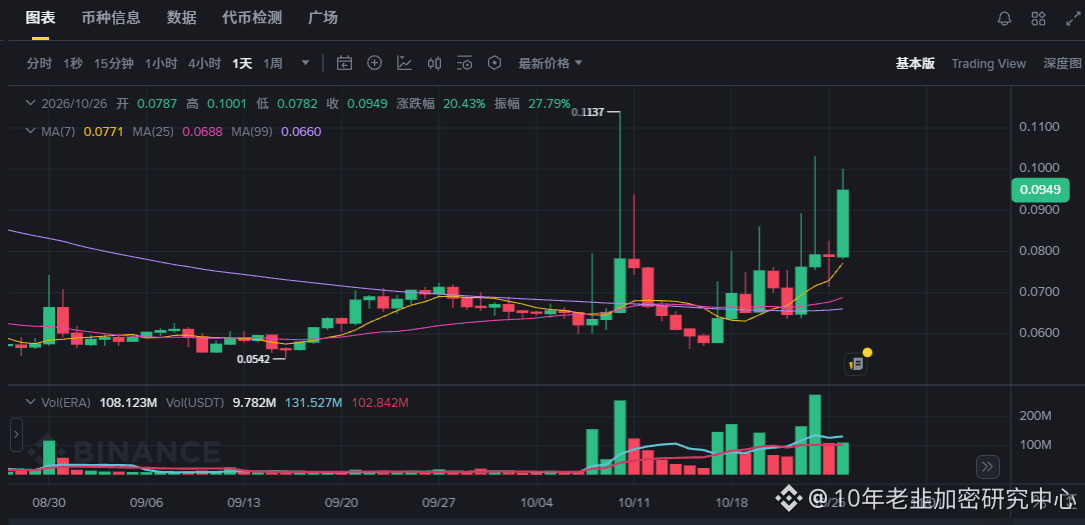
【Old Leek Watch】$ERA Suddenly Surges Nearly 20% on a Spike in Trading Volume! Is This a Reversal for Caldera, or Just a Capital-Driven Rally?
One of today’s coins showing notable movement is Caldera (ERA).
As of October 26, publicly available market data showed that ERA’s 24-hour gain briefly approached 20%, with trading volume rising significantly. More notably, the broader crypto market was relatively weak at the time, while ERA posted a comparatively independent rally.
But that raises the question: what triggered this surge?
1. No major positive catalyst has been confirmed so far; unusual capital flows are the clearest signal at present
For now, this rally should first be described as a sharp move on increased volume, rather than taken as proof that the project’s fundamentals have reversed.
2. What is Caldera’s core narrative?
Caldera focuses on Rollup-as-a-Service, helping projects deploy customized Ethereum scaling networks and improving connectivity and asset flows between different rollups through infrastructure such as Metalayer.
Put simply, more and more independent networks are emerging in the Ethereum ecosystem, but liquidity and interoperability between them remain challenges. Caldera aims to make it easier for projects to build their own chains and to connect these networks.
ERA is also associated with functions such as gas payments, staking, and governance within the ecosystem. This narrative has room to develop.
3. Another risk with ERA that shouldn’t be overlooked: a low circulating supply ratio
According to publicly available market data, ERA has a maximum supply of 1 billion tokens, with approximately 150 million currently in circulation. Its circulating market cap is about $13 million, and its fully diluted valuation is about $86 million.
This means that only a small portion of the maximum supply is currently in circulation.
Tokens with a low circulating supply ratio may see larger price gains when buyers concentrate their capital, but newly unlocked tokens entering circulation could also create selling pressure in the future. A relatively small market cap also means the price can be more easily affected by concentrated trading.